




These Notes for Class 10 Maths Chapter 12 Surface Areas and Volumes give a clear, formula-first revision of the whole chapter, set to the 2026-27 CBSE syllabus. The chapter builds on basic 3D shapes. You learn to find the surface area and volume of combined solids and of the frustum of a cone.
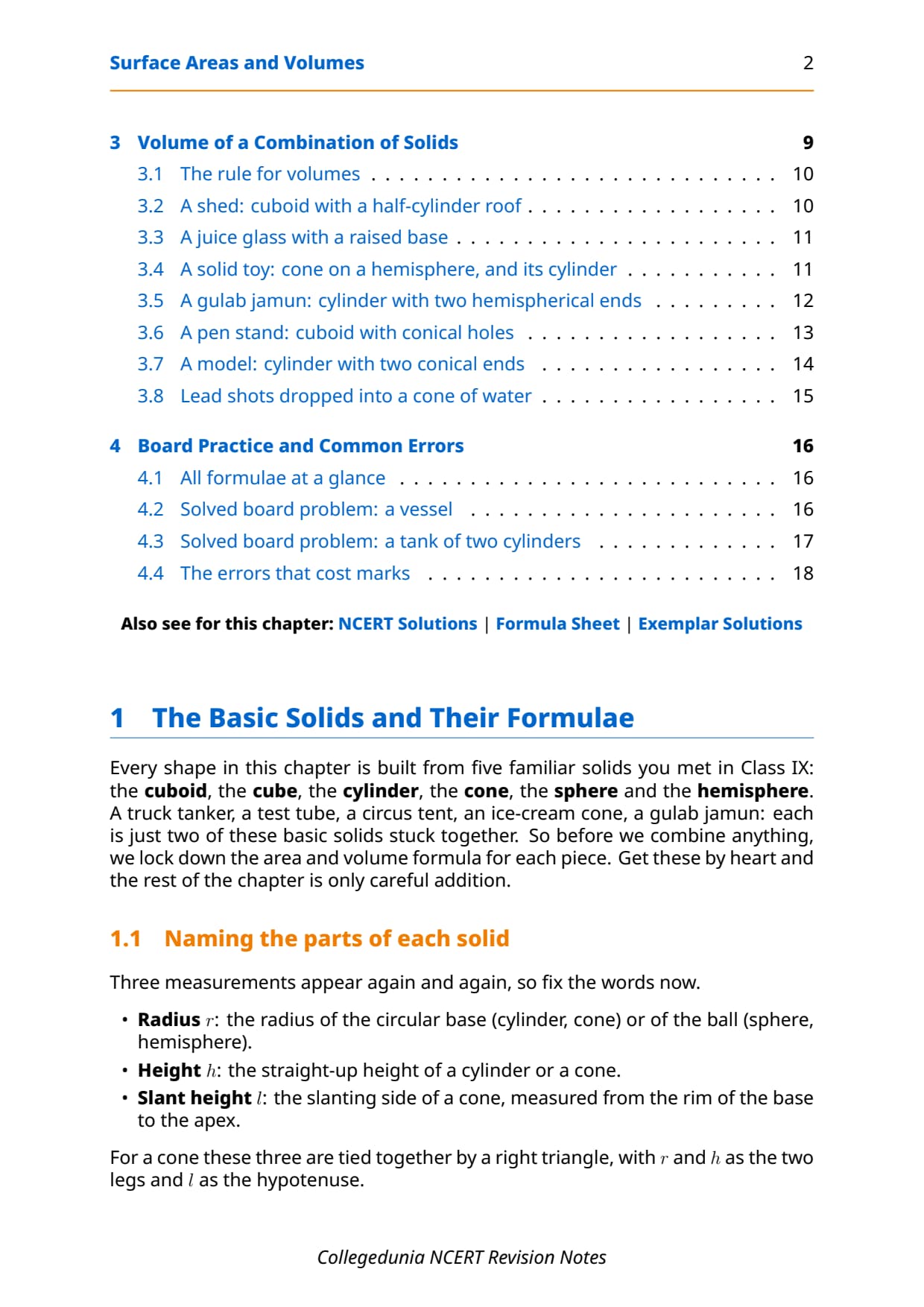
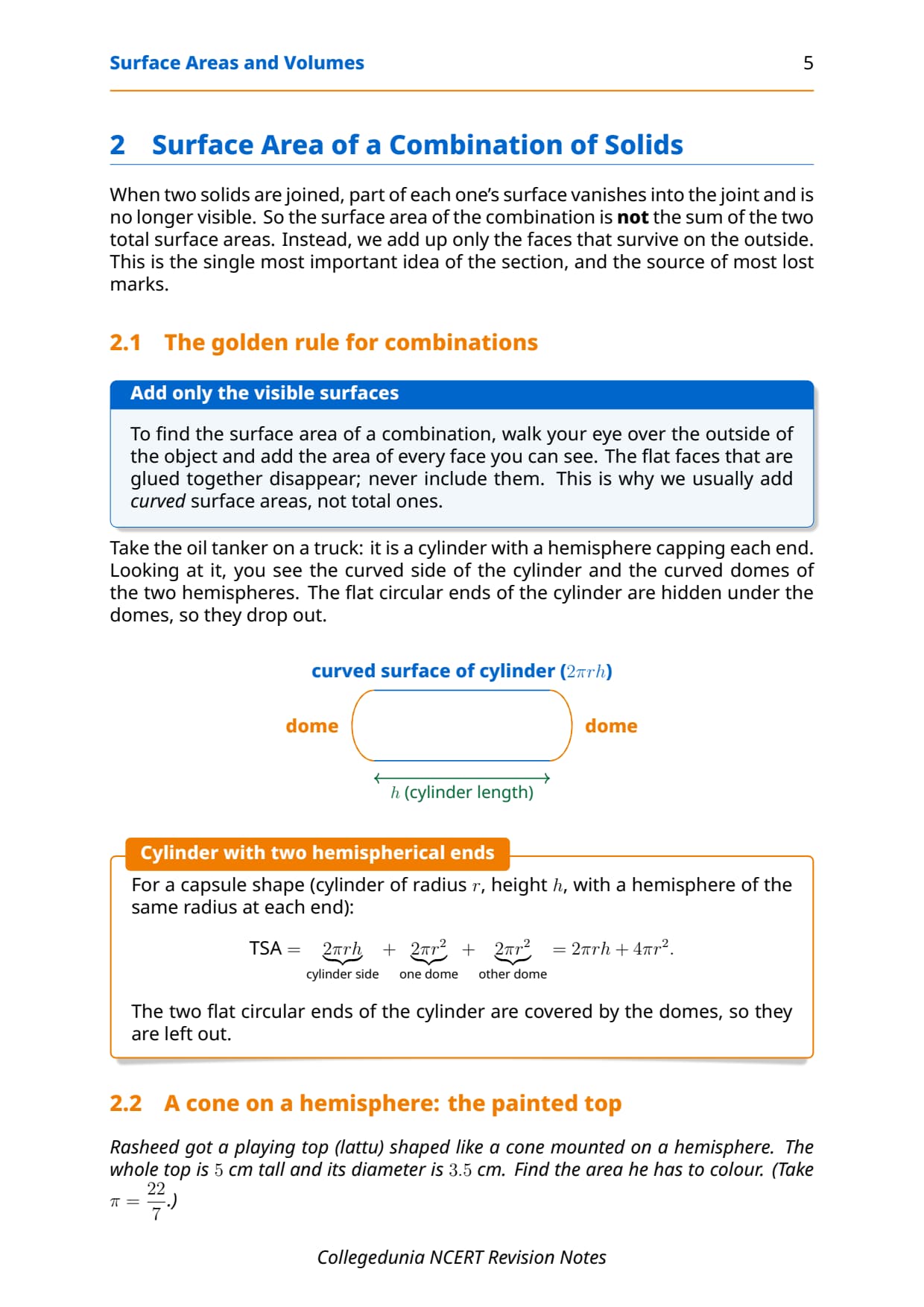
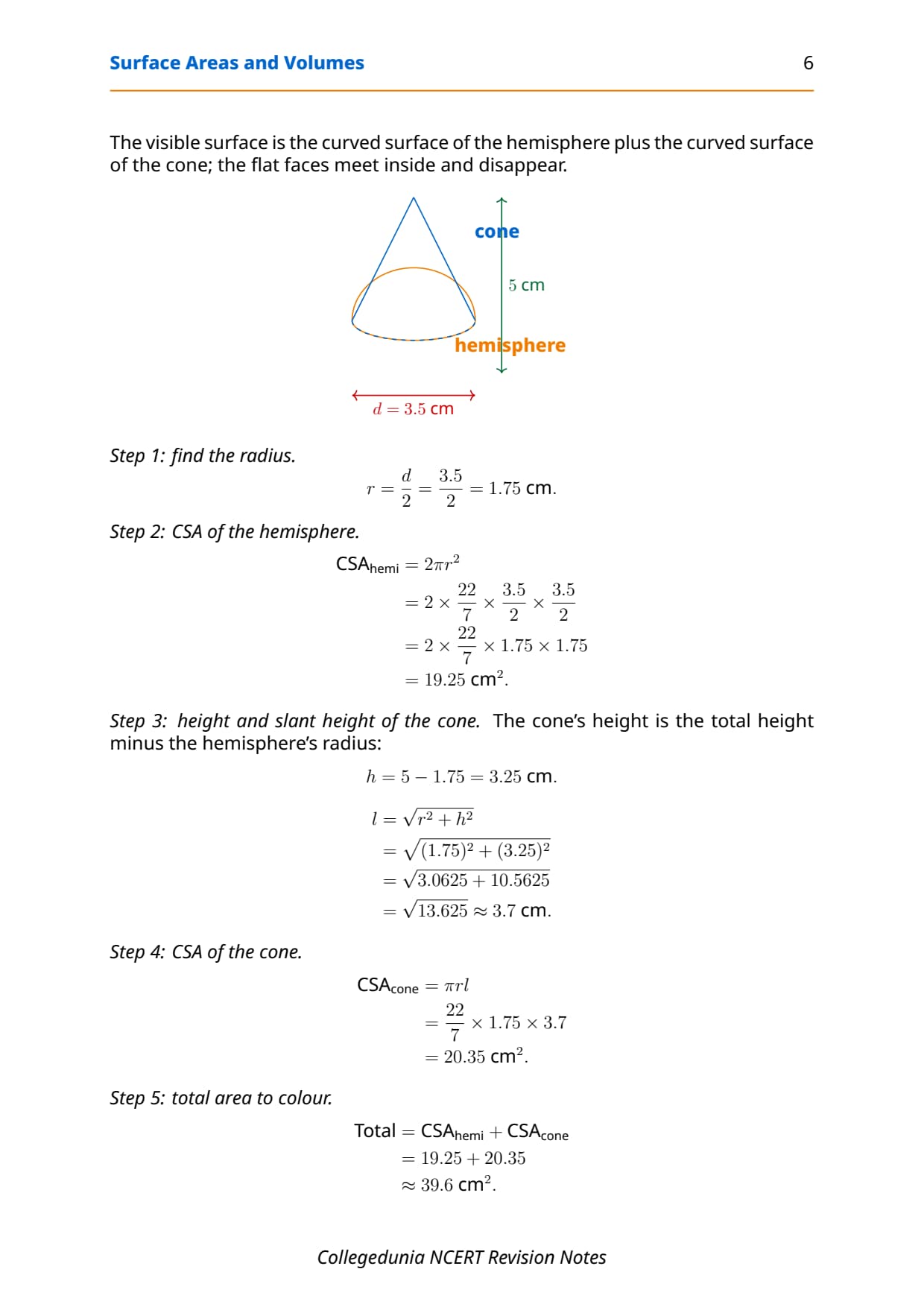
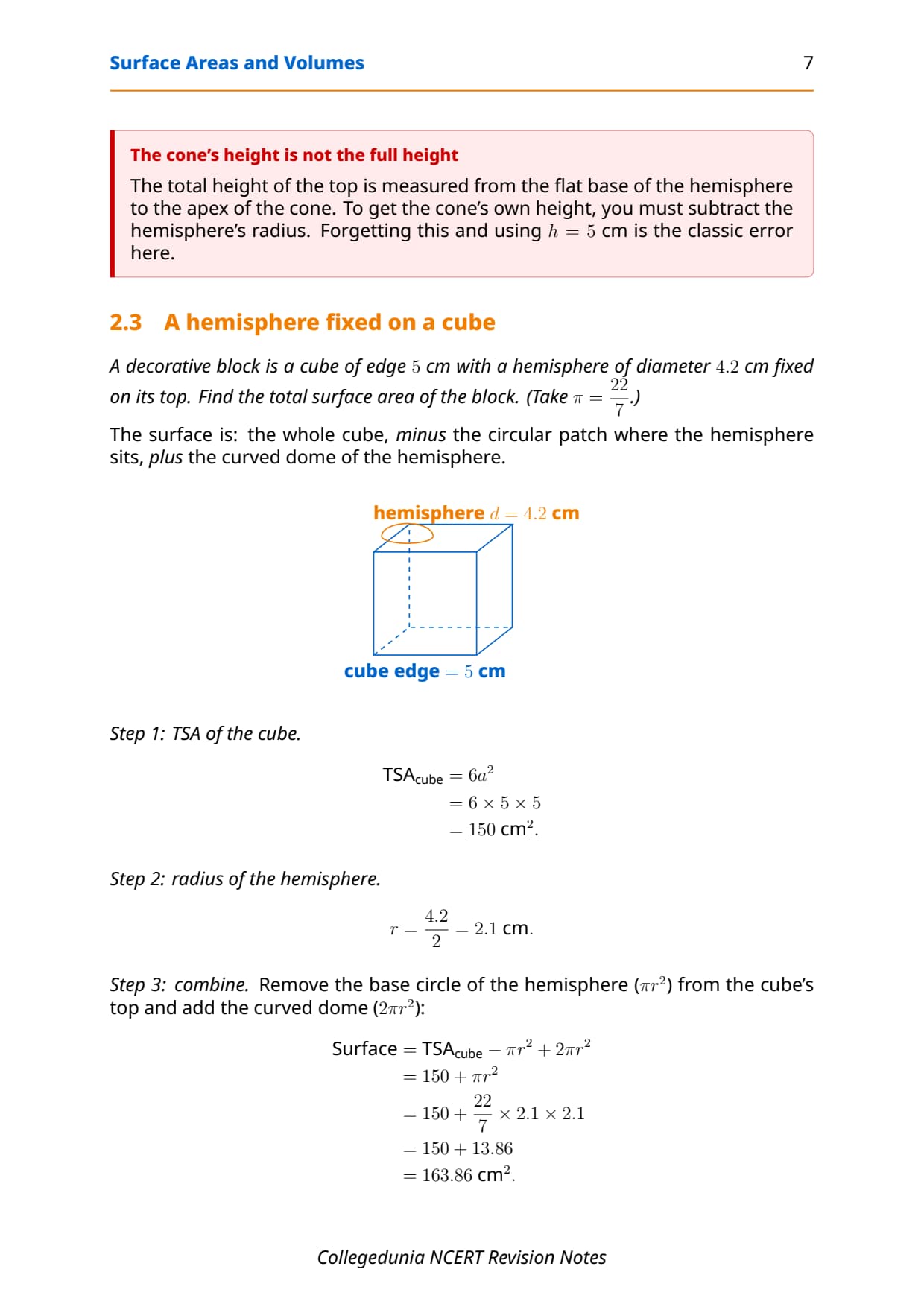
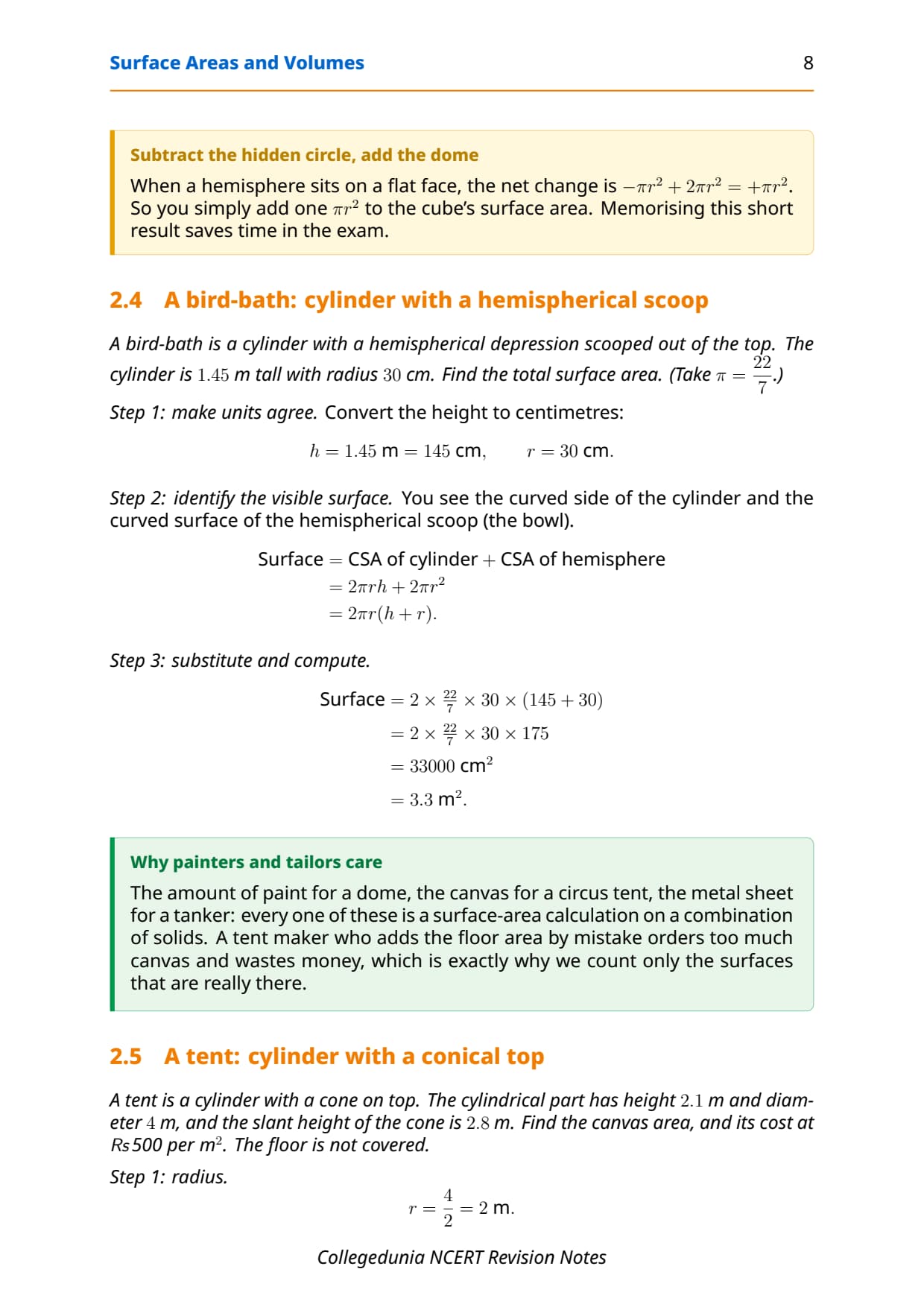
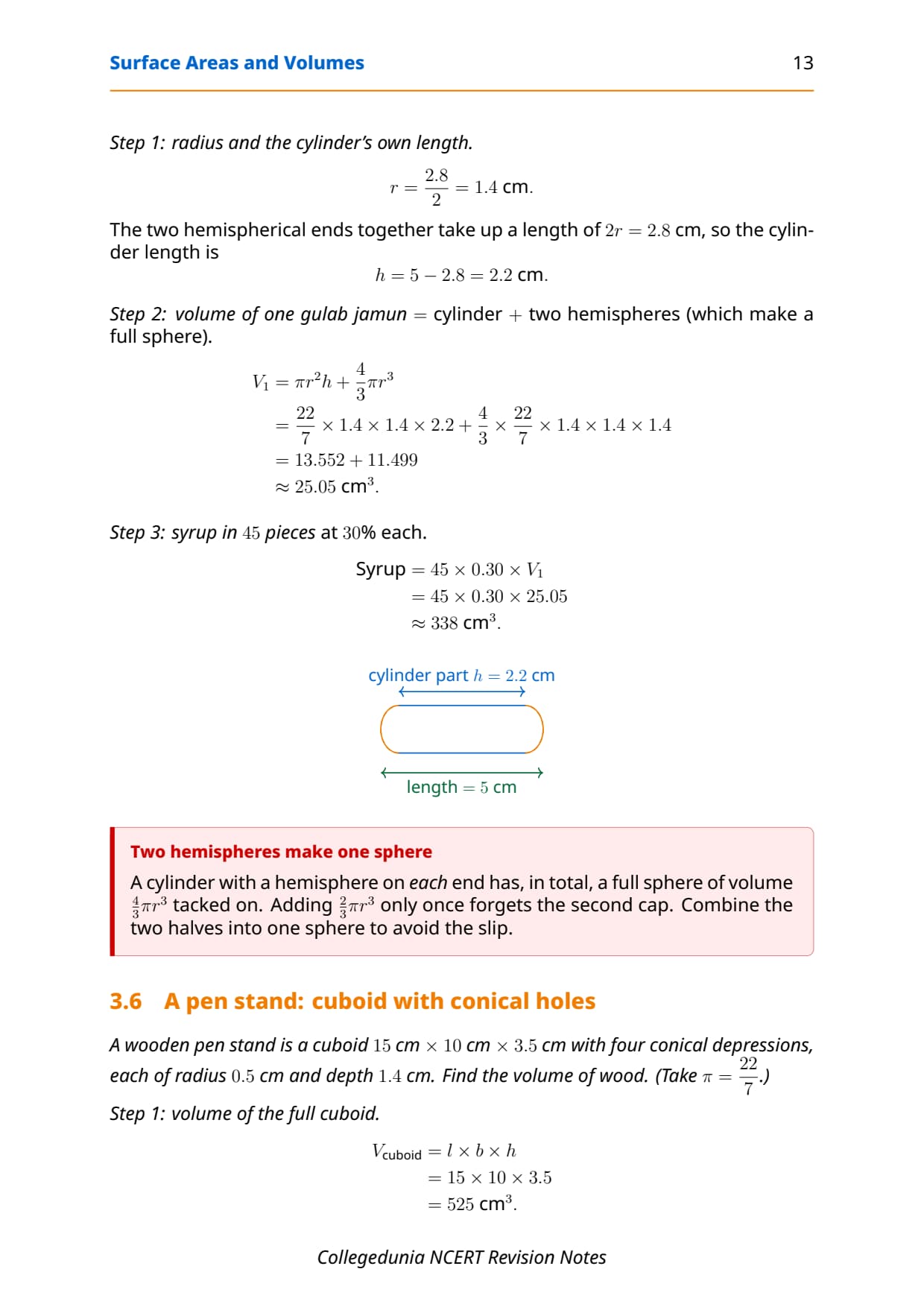
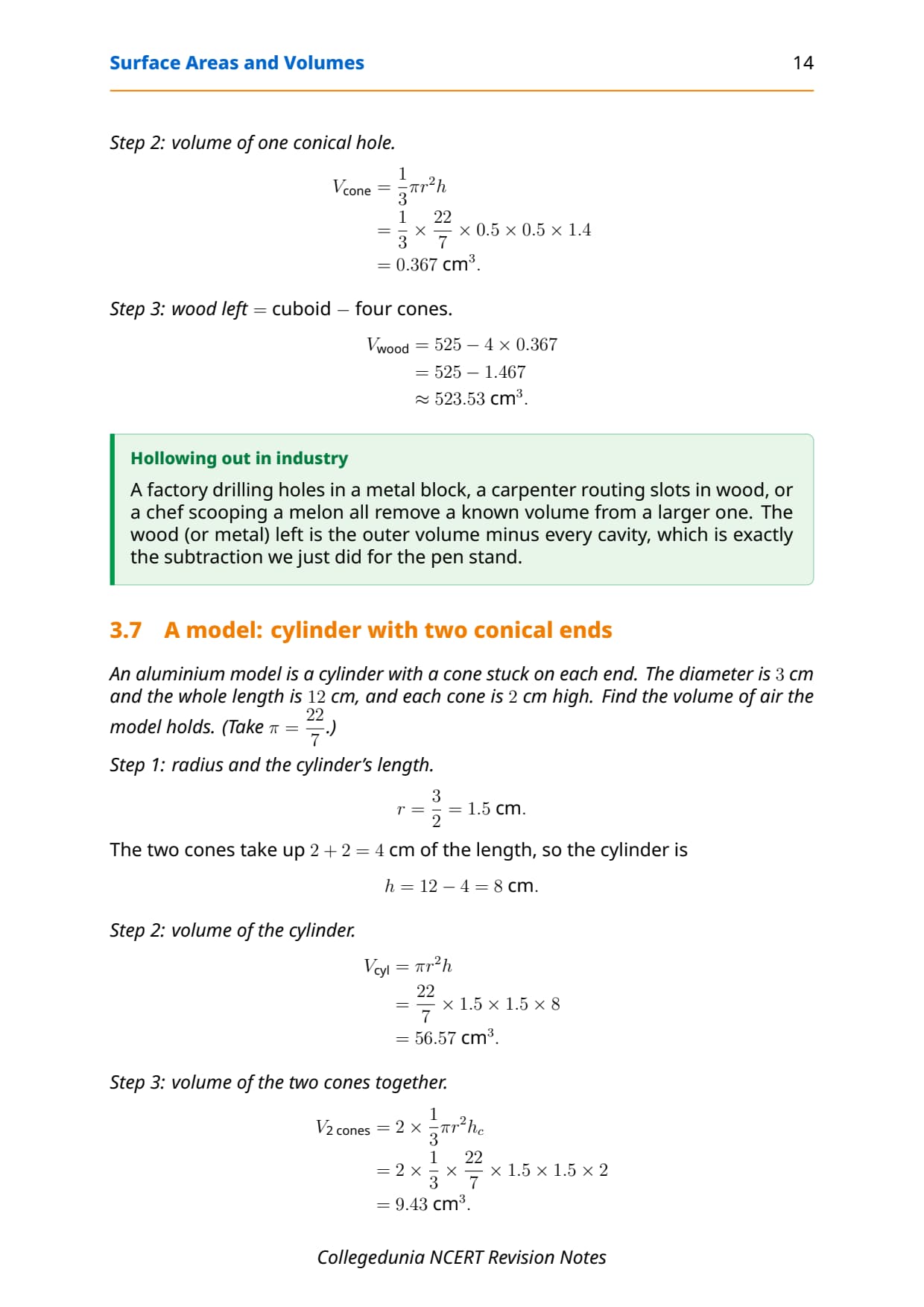
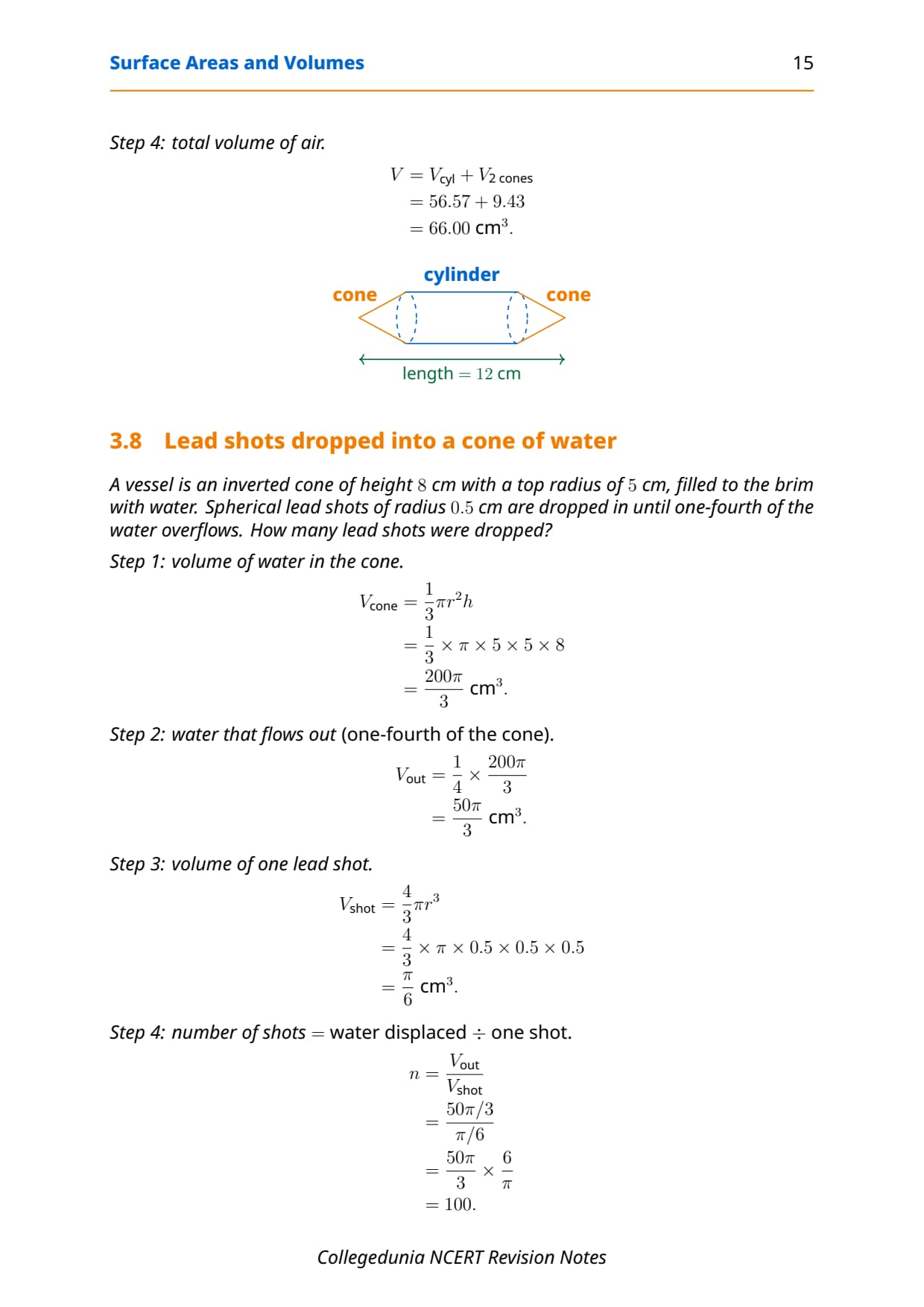
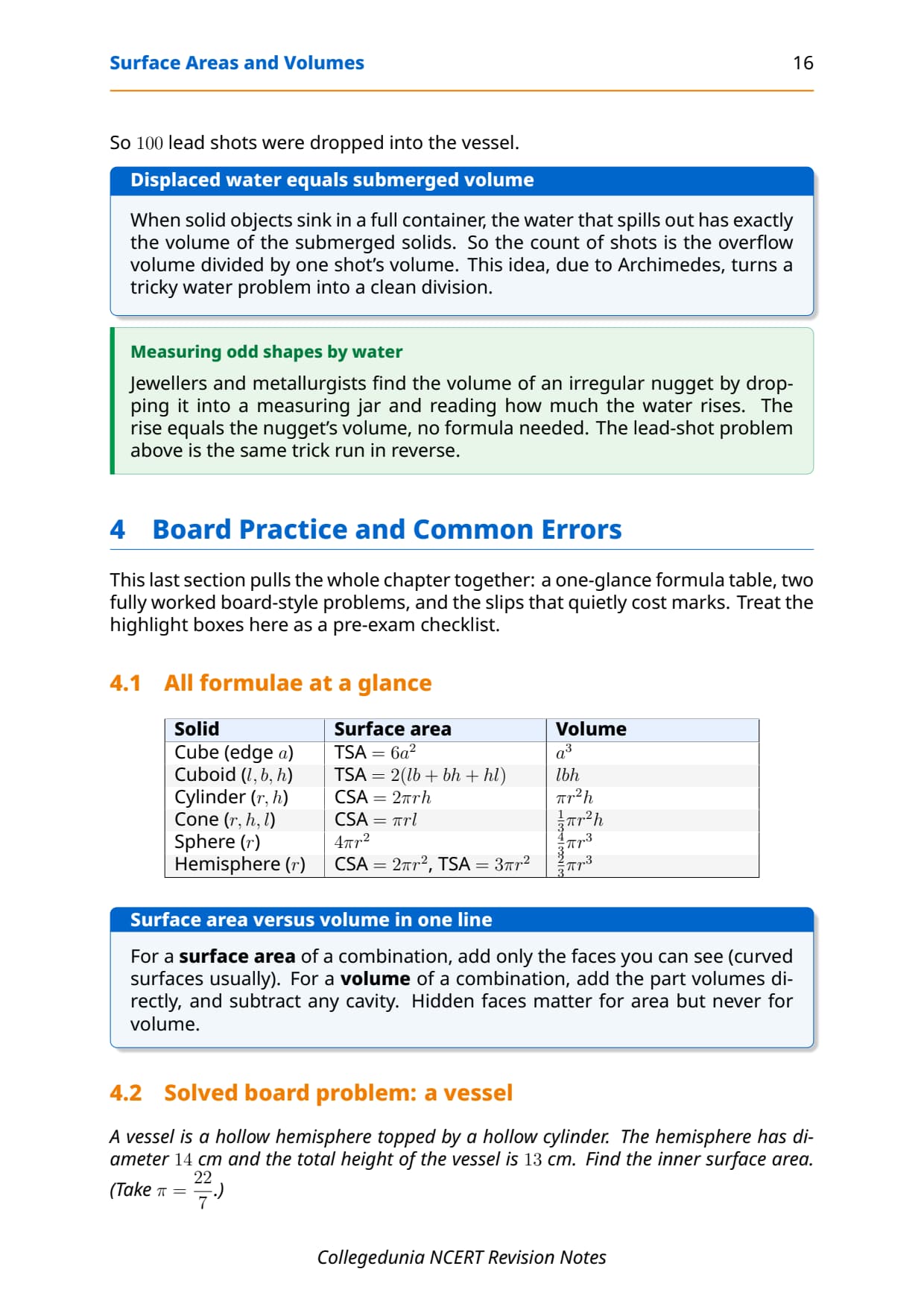
- All key formulas covered: cube, cuboid, cylinder, cone, sphere, hemisphere, frustum, and combinations, with board-style worked examples.
- Standard combinations, a cone on a cylinder or a hemisphere on a cylinder, are broken into steps that show which formula to use and when.
- This chapter is worth 10 to 12 marks in every board paper, so the notes are written to help you score full marks.
These notes are written by Maths experts from the 2026-27 NCERT textbook and checked against the last five years of CBSE Class 10 board papers.
Student Feedback: What 9,200 students told us about this chapter
78% of Class 10 students said one habit saved them marks here: draw the 3D shape and label every given dimension before writing any formula. Students who skipped the diagram often used the wrong value, like slant height in place of vertical height. 4 out of 5 students who lost marks did so in combination problems, where they added the total surface area of each shape instead of only the exposed surface.
Top scorers said this chapter rewards neat working more than raw formula memory. There are about 15 core formulas, but the real skill is knowing which surfaces to count when shapes are joined. Students who wrote clear steps (shape, formula, values, answer with units) scored 3 to 4 marks more.
Source: 2026-27 Class 10 Maths student poll, 9,200 students from CBSE schools in 14 states, before the 2026 boards.
Watch Surface Areas and Volumes Class 10 Maths Explained
Source: Ritik Mishra - 9th & 10th on YouTube
What These Notes Cover
This chapter builds on Class 9. You already know the surface area and volume of a single solid (cube, cuboid, cylinder, cone, sphere). Here you learn two new skills: combinations of joined solids, and the frustum of a cone (a cone cut by a plane parallel to its base).
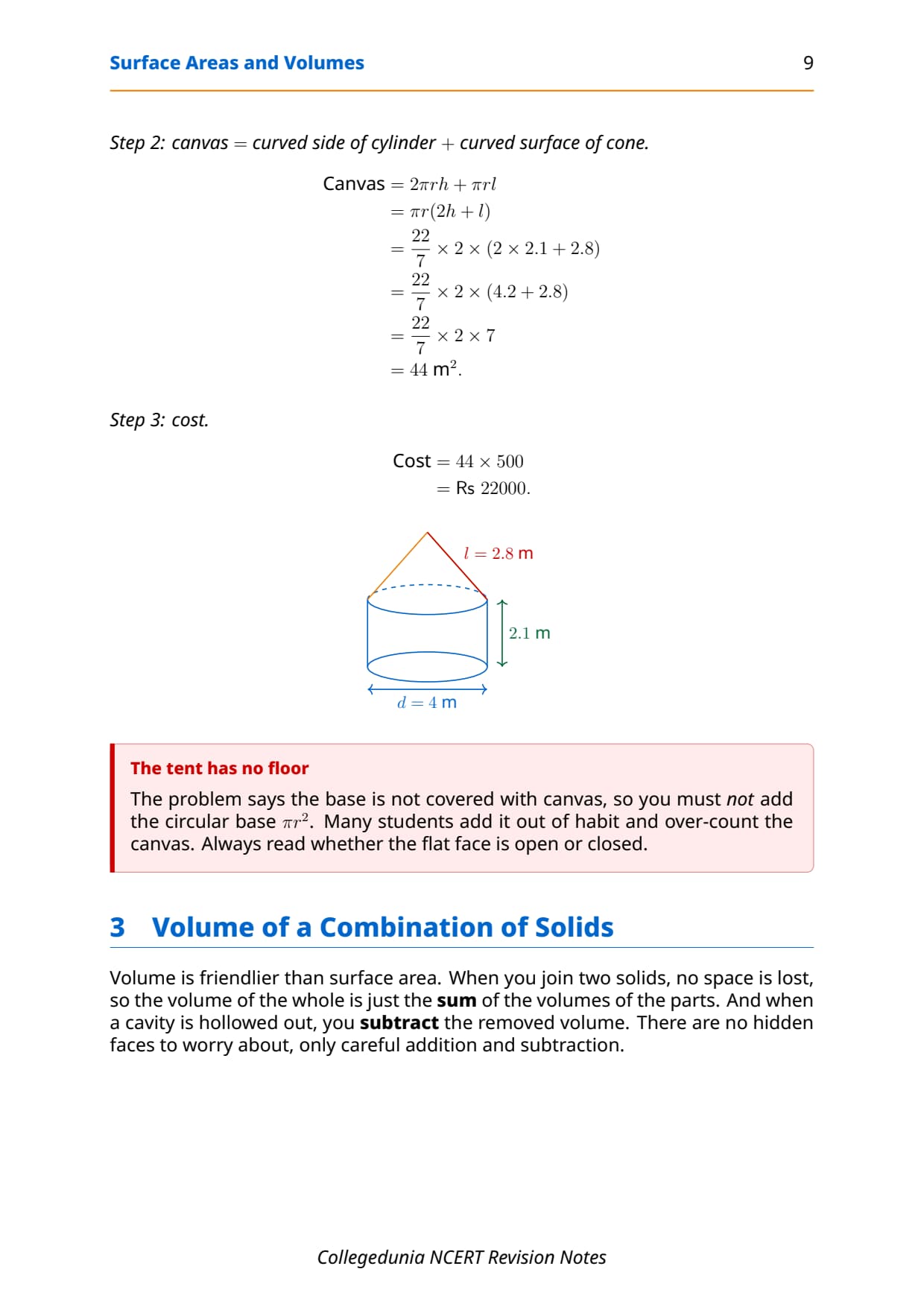
- Combination of solids: real objects like a tent (cylinder plus cone) or a toy (hemisphere on a cylinder). When two solids join, the joining face is hidden, so you subtract it.
- Conversion of solids: one solid is melted and recast into another. The volume stays the same.
- Frustum of a cone: a cone with the top cut off, with two circular faces (radii R and r) and a slant surface. Exercise 12.1 covers combinations; Exercise 12.2 covers frustum and conversion.
Surface Area Formulas: Cube, Cuboid, Cylinder, Cone, Sphere
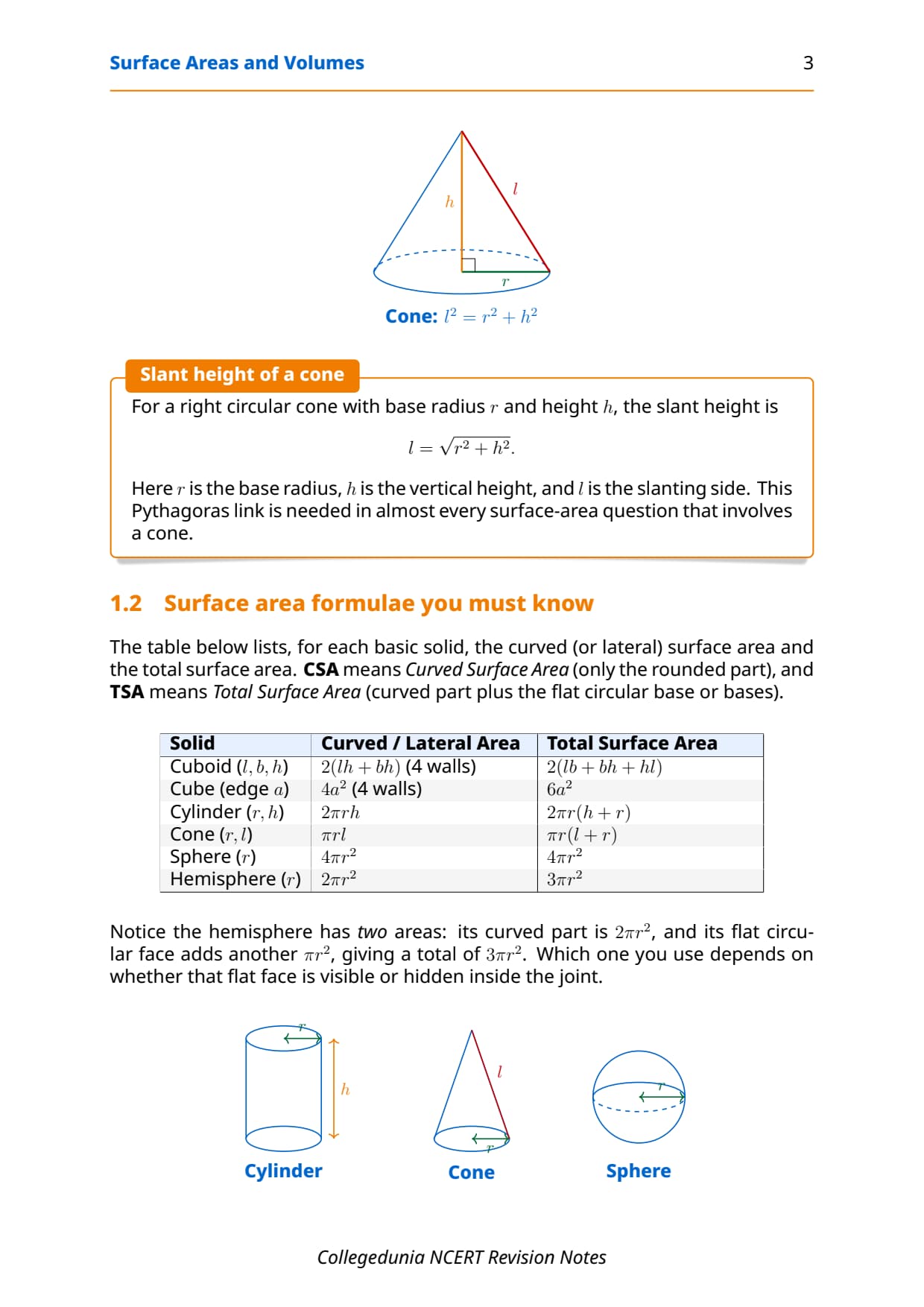
The table below lists every surface area formula used in this chapter. Every board problem uses one or more of these.
| Solid | Curved/Lateral Surface Area | Total Surface Area |
|---|---|---|
| Cylinder (r, h) | 2πrh | 2πr(r + h) |
| Cone (r, h, l) | πrl | πr(r + l) |
| Sphere (r) | 4πr2 | 4πr2 |
| Hemisphere (r) | 2πr2 | 3πr2 |
| Frustum (R, r, l, h) | πl(R + r) | πl(R + r) + πR2 + πr2 |
For the cone, l = √(r2 + h2): find l before using πrl. For the frustum, l = √(h2 + (R - r)2), where R, r are the two end radii. A hemisphere has TSA = 3πr2 (curved bowl + flat base), but when it sits on a cylinder the flat face is hidden, so use only the curved surface area (2πr2).
Volume Formulas: Cylinder, Cone, Sphere, Hemisphere, Frustum
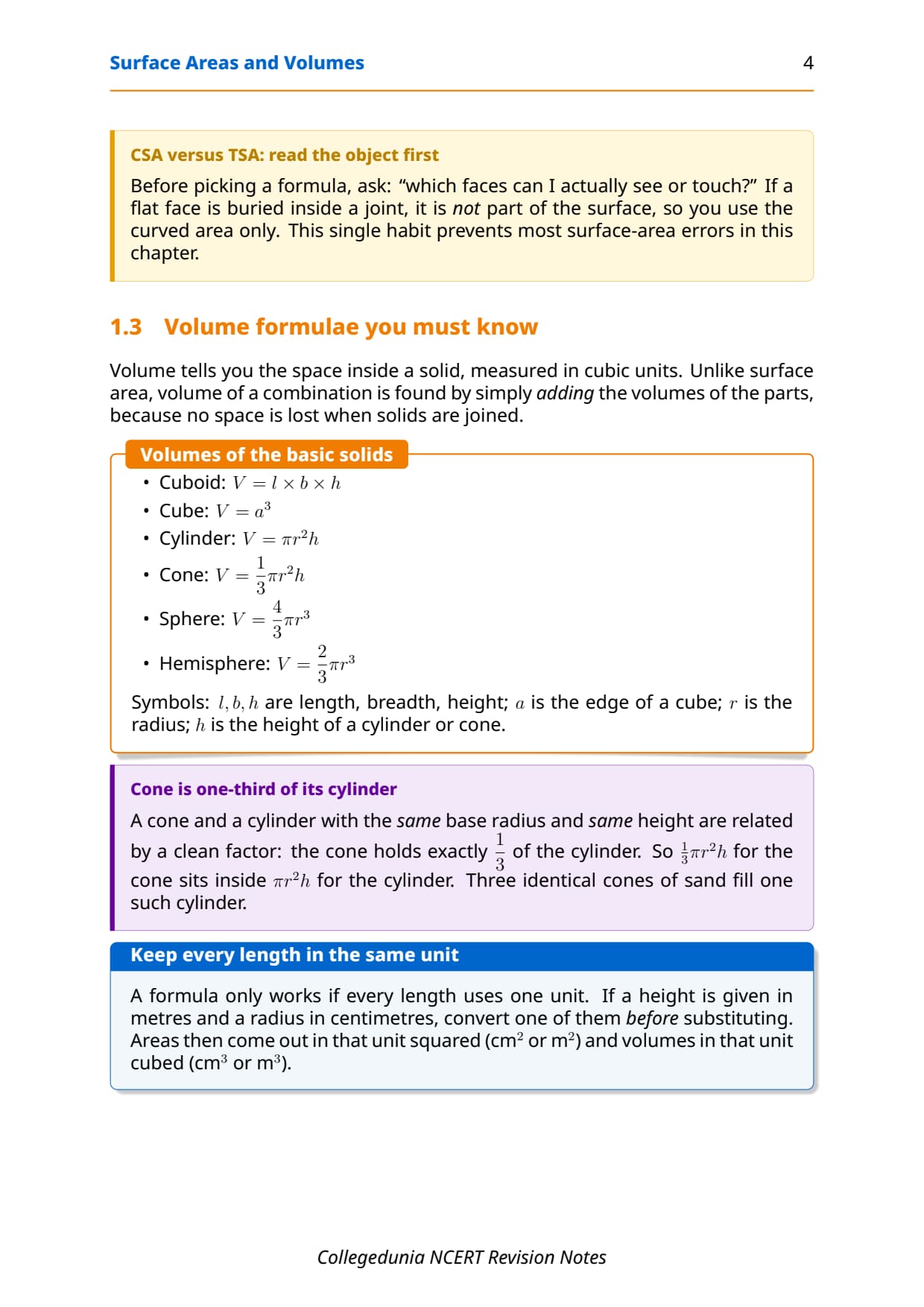
The rule is simple: total volume of a combination = sum of the individual volumes. Nothing is subtracted for hidden faces.
| Solid | Volume Formula | Key variables |
|---|---|---|
| Cylinder | πr2h | r = radius, h = height |
| Cone | (1/3)πr2h | r = base radius, h = vertical height |
| Sphere | (4/3)πr3 | r = radius |
| Hemisphere | (2/3)πr3 | r = radius |
| Frustum | (πh/3)(R2 + Rr + r2) | R = larger base radius, r = smaller base radius, h = vertical height |
A cone holds one-third the volume of a cylinder with the same base and height, so the answer to "how many cones fill one cylinder?" is always 3. For conversion problems, set the volumes equal: volume of original shape = volume of new shape.
Frustum of a Cone: Surface Area and Volume
A frustum is what is left when a cone is cut by a plane parallel to its base, like a bucket or flower pot. It is almost certain in the board paper. Three formulas are needed, all using the slant height l = √[h2 + (R − r)2]. Always find l first.
The three frustum formulas
| Quantity | Formula | What it measures |
|---|---|---|
| Curved Surface Area | πl(R + r) | The slanted outer surface only, no flat ends |
| Total Surface Area | πl(R + r) + πR2 + πr2 | Curved surface + two circular ends |
| Volume | (πh/3)(R2 + Rr + r2) | Capacity of the frustum solid |
A bucket problem asks for the curved surface area plus the base circle (the larger one), leaving out the open top: πl(R + r) + πR2. Always check which radius is R (larger) and which is r (smaller).
Combinations of Solids: Surface Area & Volume
The hardest problems join two or more solids and fill most of Exercise 12.1. The key skill is spotting which surfaces stay visible after joining and which are hidden inside.
Standard combination types and their surface area approach
| Combination type | Exposed surfaces to include | Hidden surfaces (do NOT include) |
|---|---|---|
| Cone on a cylinder | CSA of cone + CSA of cylinder + base circle of cylinder | Base of cone = top circle of cylinder |
| Hemisphere on a cylinder | CSA of hemisphere + CSA of cylinder + base circle of cylinder | Flat face of hemisphere = top circle of cylinder |
| Two hemispheres + cylinder (capsule) | 2 × CSA of hemisphere + CSA of cylinder | 2 circular faces where hemispheres join the cylinder |
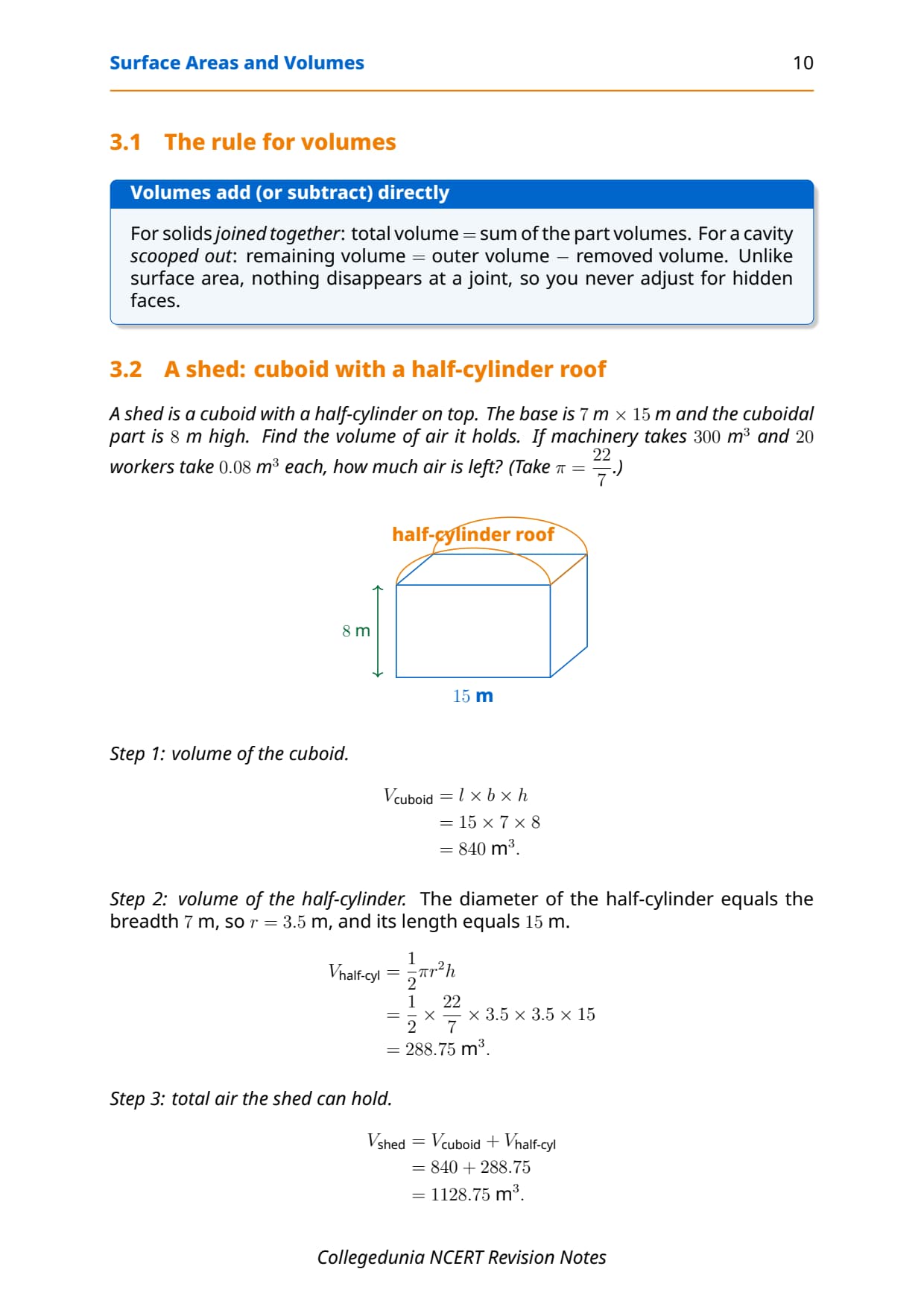
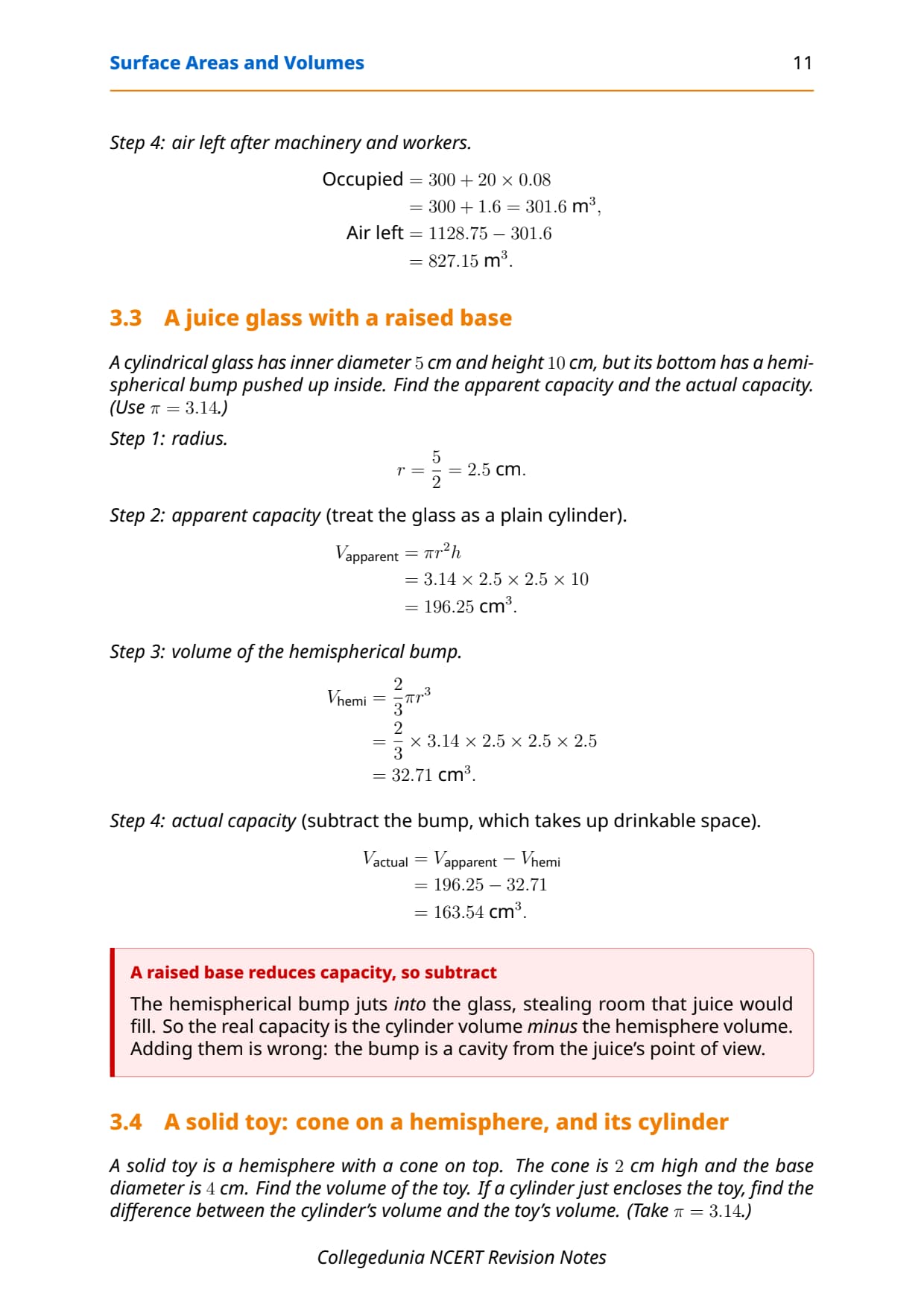
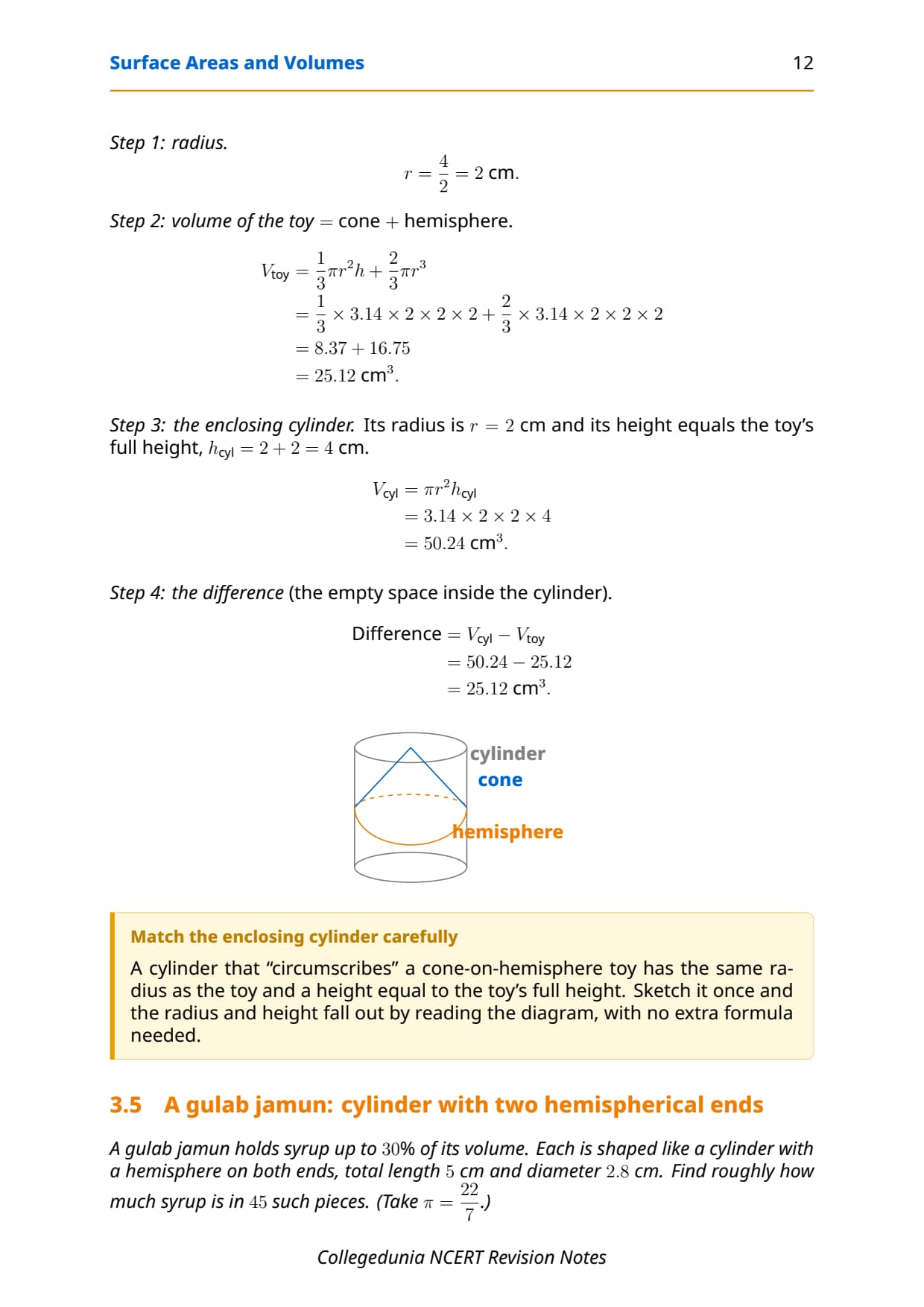
For the volume of any combination, just add the individual volumes; there is no hidden volume to subtract. A toy from a cylinder and a hemisphere has volume = πr2h + (2/3)πr3.
Conversion of solids: the equal-volume rule
When one solid is melted and recast into another, the volume stays the same. Set the two volume expressions equal and solve. For a large sphere melted into n small spheres, n = (R/r)3.
Worked Board Problems
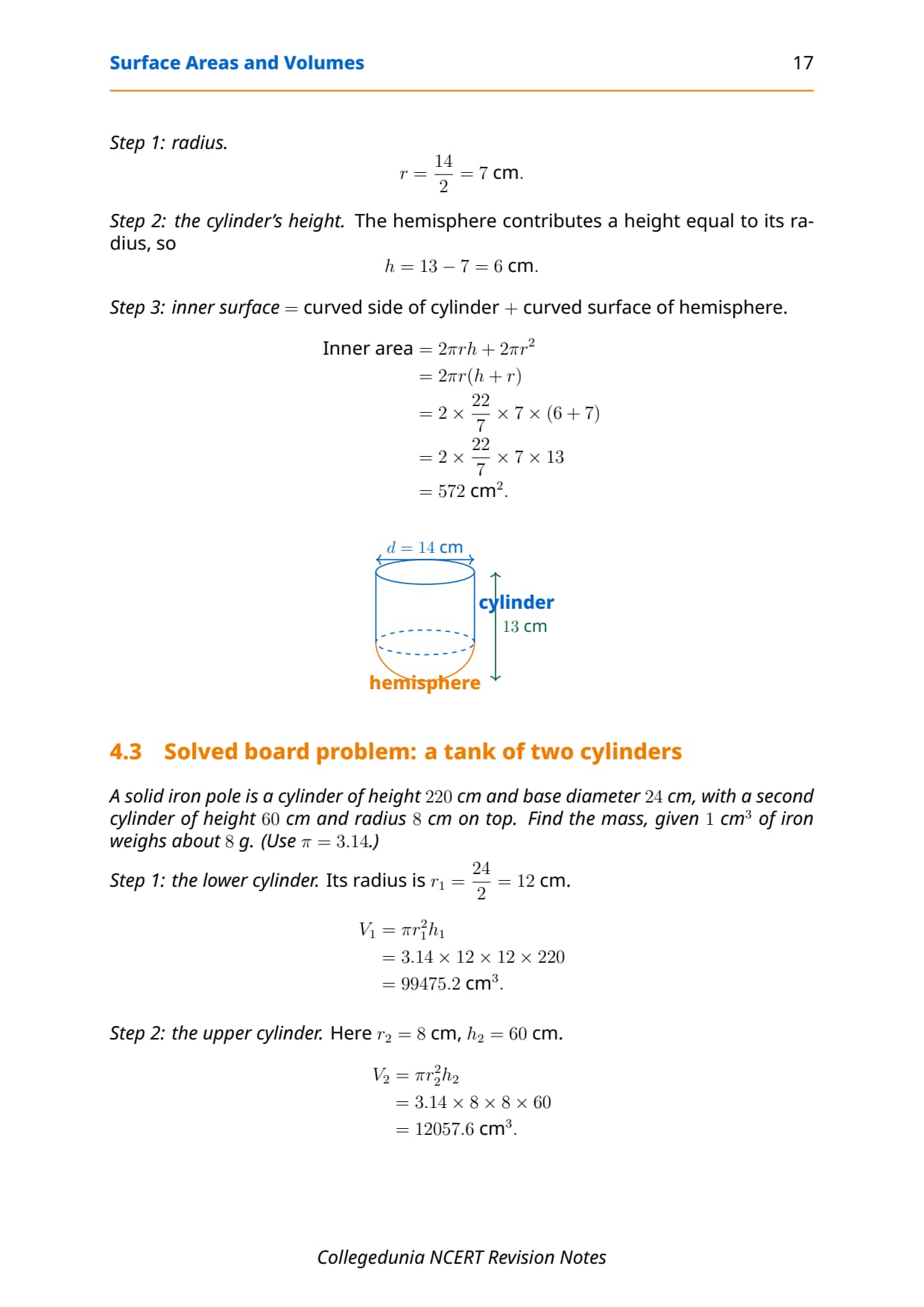
This covers a question type the board repeats often. Write the formula before any substitution, since examiners give a method mark for it.
Worked example: Frustum bucket
Given: A bucket in the form of a frustum with larger radius R = 20 cm, smaller radius r = 8 cm, and height h = 16 cm. Find the curved surface area and the capacity.
- Slant height: l = √[h2 + (R − r)2] = √[256 + 144] = √400 = 20 cm.
- Curved surface area = πl(R + r) = (22/7) × 20 × 28 = 1760 cm2.
- Volume = (πh/3)(R2 + Rr + r2) = ((22/7) × 16/3) × (400 + 160 + 64) = ((22/7) × 16/3) × 624.
- Volume = (22 × 16 × 624) / 21 = 10,459.43 cm3 ≈ 10.46 litres.
Common Mistakes to Avoid
Most lost marks come from a short list of errors that show up every year. Spot them now and dodge them in the exam.
The most common mistakes in board answers:
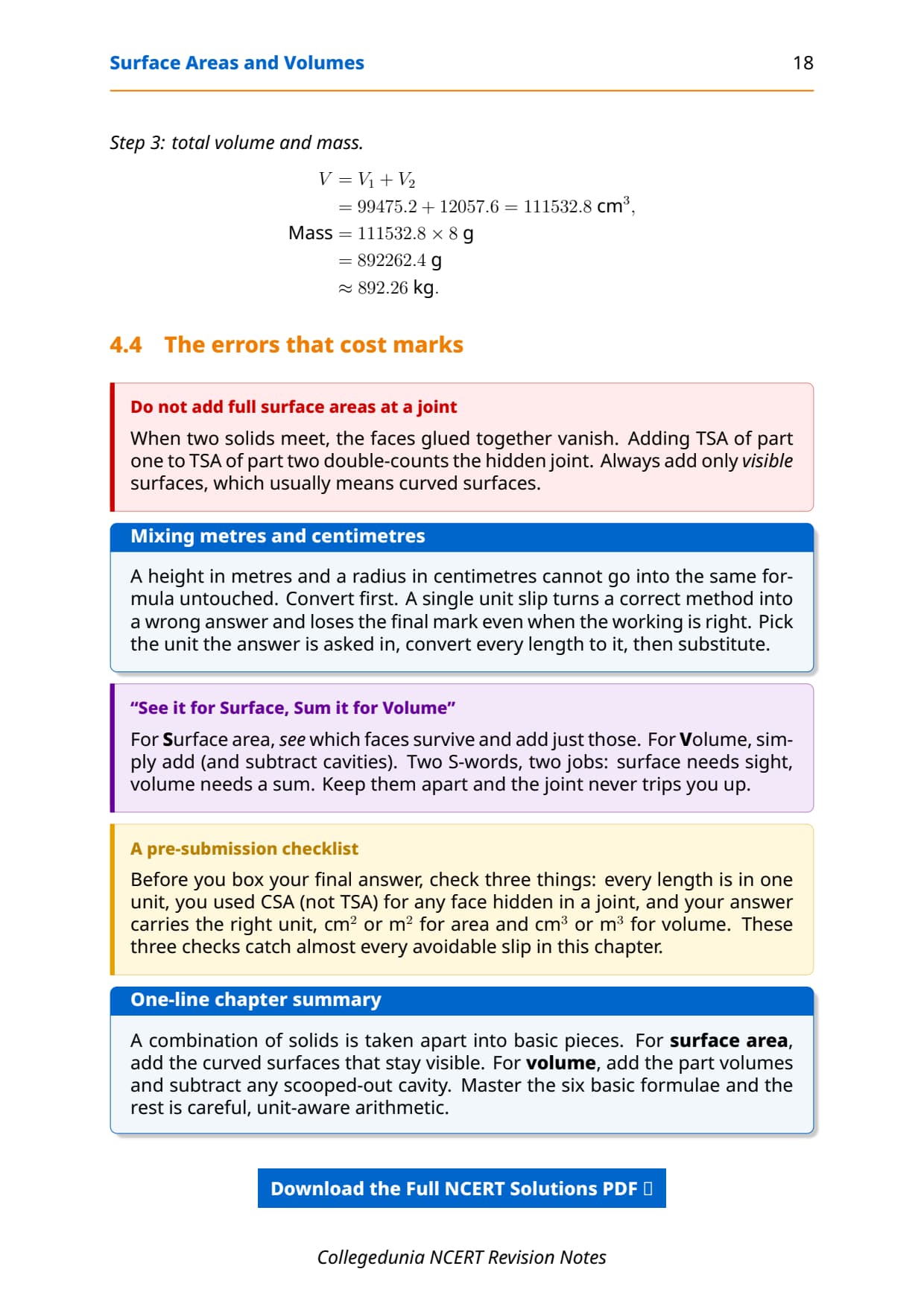
- Adding total surface areas instead of exposed ones: the biggest source of lost marks. When two solids join, the touching faces are hidden, so use only the curved or exposed area of each part.
- Skipping the slant height before πrl: if h is given, find l = √(r2 + h2) first; for a frustum use l = √[h2 + (R − r)2], not √(h2 + R2).
- Not writing the formula first: the board gives 1 mark for the formula step on its own. Write it out before you substitute.
- Omitting units or mixing 3.14 and 22/7: areas need cm2, volumes cm3 or litres; use the value of π the question gives.
Previous Year Question Trends
This is one of the highest-weightage chapters in the board paper. It usually brings two or three questions of 3 to 5 marks each, about 10 to 12 marks in most years. The question types are steady year on year.
| Year | Question type asked | Marks |
|---|---|---|
| 2025 | Frustum bucket: find curved surface area and volume, given R, r, and h | 5 |
| 2024 | Toy made of hemisphere + cylinder: find total surface area | 4 |
| 2023 | Sphere melted into small cones: find number of cones | 3 |
| 2022 | Cone on top of cylinder: find total volume and curved surface area | 4 |
| 2021 | Frustum-shaped vessel: find capacity in litres | 3 |
Also Check: The complete set of step-by-step NCERT exercise solutions for Chapter 12 is at the Chapter 12 Surface Areas and Volumes NCERT Solutions page.
Quick Revision Summary
Use this the night before the exam as a one-stop lookup for every formula in the chapter.
All formulas in one place
- Cylinder: CSA = 2πrh; TSA = 2πr(r + h); V = πr2h
- Cone: CSA = πrl; TSA = πr(r + l); V = (1/3)πr2h; l = √(r2 + h2)
- Sphere: SA = 4πr2; V = (4/3)πr3
- Hemisphere: CSA = 2πr2; TSA = 3πr2; V = (2/3)πr3
- Frustum: l = √[h2 + (R − r)2]; CSA = πl(R + r); TSA = πl(R + r) + πR2 + πr2; V = (πh/3)(R2 + Rr + r2)
- Combination surface area: Add exposed surfaces only (subtract joined faces)
- Combination volume: Add all individual volumes
- Conversion: Volumeoriginal = Volumenew
Other Resources for This Chapter
Pair these notes with the matching NCERT Solutions, formula sheet, handwritten notes, and the official NCERT book chapter. All Chapter 12 resources are linked below.
| Resource | What it covers | Open |
|---|---|---|
| Notes | Concept-first revision notes on surface area formulas, volume formulas, frustum, combinations of solids, worked board problems, and a full revision summary. | You are here |
| NCERT Solutions | Step-by-step answers to all Exercise 12.1 and Exercise 12.2 questions, with full formula-substitution working for every combination and frustum problem. | Class 10 Maths Chapter 12 NCERT Solutions |
| Formula Sheet | One-page reference with all surface area and volume formulas for Chapter 12, including frustum formulas and slant-height derivations. | Class 10 Maths Chapter 12 Formula Sheet |
| Handwritten Notes | Scanned-style handwritten pages covering all surface area and volume formulas, combination-of-solids method, and frustum worked examples for Chapter 12. | Class 10 Maths Chapter 12 Handwritten Notes |
| NCERT Book PDF | Official NCERT Maths Chapter 12 Surface Areas and Volumes textbook in PDF form, with all figures and Exercise 12.1 and 12.2 questions. | Class 10 Maths Chapter 12 NCERT Book PDF |
| Exemplar Solutions | Worked answers to the harder NCERT Exemplar problems on Surface Areas and Volumes for deeper board practice and understanding. | Class 10 Maths Chapter 12 Exemplar Solutions |
Notes for Class 10 Maths: All Chapters
Related Links: Use the table below to open the revision notes for the other chapters of Class 10 Maths. Every chapter comes with the same concept-first notes style, full PDF download, and a revision FAQ.
| Chapter | Notes link |
|---|---|
| Chapter 1 | Real Numbers Notes |
| Chapter 2 | Polynomials Notes |
| Chapter 3 | Pair of Linear Equations in Two Variables Notes |
| Chapter 4 | Quadratic Equations Notes |
| Chapter 5 | Arithmetic Progressions Notes |
| Chapter 6 | Triangles Notes |
| Chapter 7 | Coordinate Geometry Notes |
| Chapter 8 | Introduction to Trigonometry Notes |
| Chapter 9 | Some Applications of Trigonometry Notes |
| Chapter 10 | Circles Notes |
| Chapter 11 | Areas Related to Circles Notes |
| Chapter 12 | Surface Areas and Volumes Notes (You are here) |
| Chapter 13 | Statistics Notes |
| Chapter 14 | Probability Notes |
Notes Class 10 Maths Chapter 12 Surface Areas and Volumes FAQs
Ques. What does Chapter 12 Surface Areas and Volumes cover in Class 10 Maths?
Ans. It covers two topics beyond Class 9. First, combinations of solids: shapes made by joining two or more standard solids (cylinder + cone, hemisphere + cylinder, frustum) and finding their surface area and volume. Second, the frustum of a cone, a cone cut parallel to its base, with three formulas: CSA = πl(R + r), TSA = πl(R + r) + πR2 + πr2, and volume = (πh/3)(R2 + Rr + r2). It has Exercise 12.1 (combinations) and Exercise 12.2 (frustum and conversions).
Ques. What is the formula for the volume of a frustum in Class 10?
Ans. The volume is V = (πh/3)(R2 + Rr + r2), where R is the larger base radius, r is the smaller base radius, and h is the vertical height. The slant height, needed for surface area, is l = √[h2 + (R − r)2]. This formula is given in the NCERT textbook and is tested in the board paper, usually as a bucket or flower-pot shape.
Ques. How do you find the surface area of a combination of solids?
Ans. It is the sum of the exposed surfaces of all the parts. Any surface hidden by a join is not counted. For a hemisphere on a cylinder, the hemisphere's flat base and the cylinder top are joined and hidden. So you count only: CSA of hemisphere (2πr2) + CSA of cylinder (2πrh) + base circle of cylinder (πr2). Never add the two total surface areas, as that double-counts the joining face and gives too large an answer.
Ques. What is the difference between surface area and volume of a combination of solids?
Ans. They behave differently. For volume, just add the volumes of all the parts; nothing is subtracted, since each part fills space on its own. For surface area, drop the joining faces, because the surfaces where two shapes touch are hidden. So volume = V1 + V2 (always add), while surface area = exposed surfaces of shape 1 + exposed surfaces of shape 2, using only the curved or relevant areas, not the full total of each shape.
Ques. Where can I download the Chapter 12 Surface Areas and Volumes Notes PDF?
Ans. Use the Download button at the top of this page. Both the regular and handwritten versions are free. The PDF covers all surface area and volume formulas, the frustum formulas, combination worked problems, and a full revision summary, set to the 2026-27 CBSE syllabus.
Ques. Is Chapter 12 Surface Areas and Volumes important for CBSE Class 10 board exams?
Ans. Yes. It is one of the most important chapters in the board paper, worth 10 to 12 marks across two or three questions. These are almost always 3-mark or 5-mark problems on combinations (hemisphere on cylinder, cone on cylinder) or the frustum (bucket problems). The types repeat each year, so practising the last five years of these problems pays off.
Ques. What is the slant height of a cone and how is it different from the slant height of a frustum?
Ans. For a cone, l = √(r2 + h2), where r is the base radius and h is the vertical height. It runs along the slope from the apex to the base circle. For a frustum it is different: l = √[h2 + (R − r)2], where R and r are the two base radii. The difference is the (R − r) term, since the frustum has no point at the top. Using the cone formula for a frustum gives a wrong answer and loses CSA marks.
Ques. How many pages is the Class 10 Maths Chapter 12 Notes PDF?
Ans. The Notes PDF runs about 20 to 22 pages. It covers all surface area and volume formulas, the frustum formulas and derivations, combination worked examples, a common-mistakes section, and a last-day revision summary with every formula in one place, set to the 2026-27 CBSE syllabus.



Comments