




These agriculture class 10 notes compress the whole of NCERT Chapter 4 of Geography (Contemporary India II) into one printable revision sheet: the four types of farming, the three cropping seasons (rabi, kharif and zaid), every major crop with its geographical conditions and producing states, the technological and institutional reforms after Independence, and the impact of globalisation on Indian agriculture.
Chapter4AgricultureNotes.pdf?page=1&dpi=150)
Chapter4AgricultureNotes.pdf?page=2&dpi=150)
Chapter4AgricultureNotes.pdf?page=3&dpi=150)
Chapter4AgricultureNotes.pdf?page=4&dpi=150)
Chapter4AgricultureNotes.pdf?page=5&dpi=150)
Chapter4AgricultureNotes.pdf?page=6&dpi=150)
Chapter4AgricultureNotes.pdf?page=7&dpi=150)
Chapter4AgricultureNotes.pdf?page=8&dpi=150)
Chapter4AgricultureNotes.pdf?page=9&dpi=150)
Chapter4AgricultureNotes.pdf?page=10&dpi=150)
Chapter4AgricultureNotes.pdf?page=11&dpi=150)
Chapter4AgricultureNotes.pdf?page=12&dpi=150)
Chapter4AgricultureNotes.pdf?page=13&dpi=150)
Chapter4AgricultureNotes.pdf?page=14&dpi=150)
Chapter4AgricultureNotes.pdf?page=15&dpi=150)
Chapter4AgricultureNotes.pdf?page=16&dpi=150)
Chapter4AgricultureNotes.pdf?page=17&dpi=150)
Chapter4AgricultureNotes.pdf?page=18&dpi=150)
Chapter4AgricultureNotes.pdf?page=19&dpi=150)
Chapter4AgricultureNotes.pdf?page=20&dpi=150)
Chapter4AgricultureNotes.pdf?page=21&dpi=150)
The file is built to carry a student from a cold start back to chapter-fluency in about thirty minutes the night before the board exam, according to the latest 2026-27 CBSE syllabus.
- Concept-first revision for the full chapter: types of farming, cropping seasons, foodgrains, beverage and fibre crops, reforms and globalisation.
- Every crop linked to its season, climatic conditions and leading states, with the exact one-line facts CBSE markers reward, including the Bhoodan-Gramdan movement.
- Cross-pointers to the matching NCERT Solutions, Handwritten Notes and NCERT Book PDF for Class 10 Geography Chapter 4 Agriculture.
Every line in these agriculture class 10 notes is written by Collegedunia geography experts, based on the 2026-27 NCERT Contemporary India II textbook, and checked against the last five years of CBSE Class 10 Social Science board papers.
Student Feedback: What 12,600 students told us about revising this chapter
71% of Class 10 students said matching each crop to its correct season and producing states was the single most-confused area when they sat down to revise this chapter. 3 out of 4 students rated the geographical conditions for rice and wheat and the technological reforms section as the parts most worth revising from a printable notes sheet.
Toppers reported that pairing these agriculture class 10 notes with the matching NCERT Solutions PDF added 2 to 3 marks per 5-mark answer in mock tests. The average student finished the full notes revision in 30 minutes against a one-hour budget for the chapter.
Source: 2026-27 Class 10 Social Science student poll. Sample of 12,600 students from CBSE schools across 15 states, conducted before the 2026 boards.
Quick Concept Recap: Agriculture at a Glance
Chapter 4 explains why agriculture is the backbone of the Indian economy. About two-thirds of India's population depends on farming, a primary activity that feeds the country and supplies raw material to industry. The chapter covers types of farming, cropping seasons, major crops, reforms and globalisation.
- Four types of farming: primitive subsistence, intensive subsistence, commercial and plantation.
- Three cropping seasons: rabi (winter), kharif (monsoon) and zaid (short summer).
- Major crops: rice, wheat, millets, maize, pulses; sugarcane, oilseeds, tea, coffee, rubber, cotton and jute.
- Reforms: land reforms, Green Revolution, White Revolution, Kisan Credit Card, MSP, plus Bhoodan-Gramdan and globalisation.
Read these notes first, then drop into the matching NCERT Solutions for Class 10 Geography Chapter 4 Agriculture for the exercise drill.
Agriculture Class 10 Explained in Simple Language
Source: Magnet Brains on YouTube
The Four Types of Farming in India Every Class 10 Student Must Master
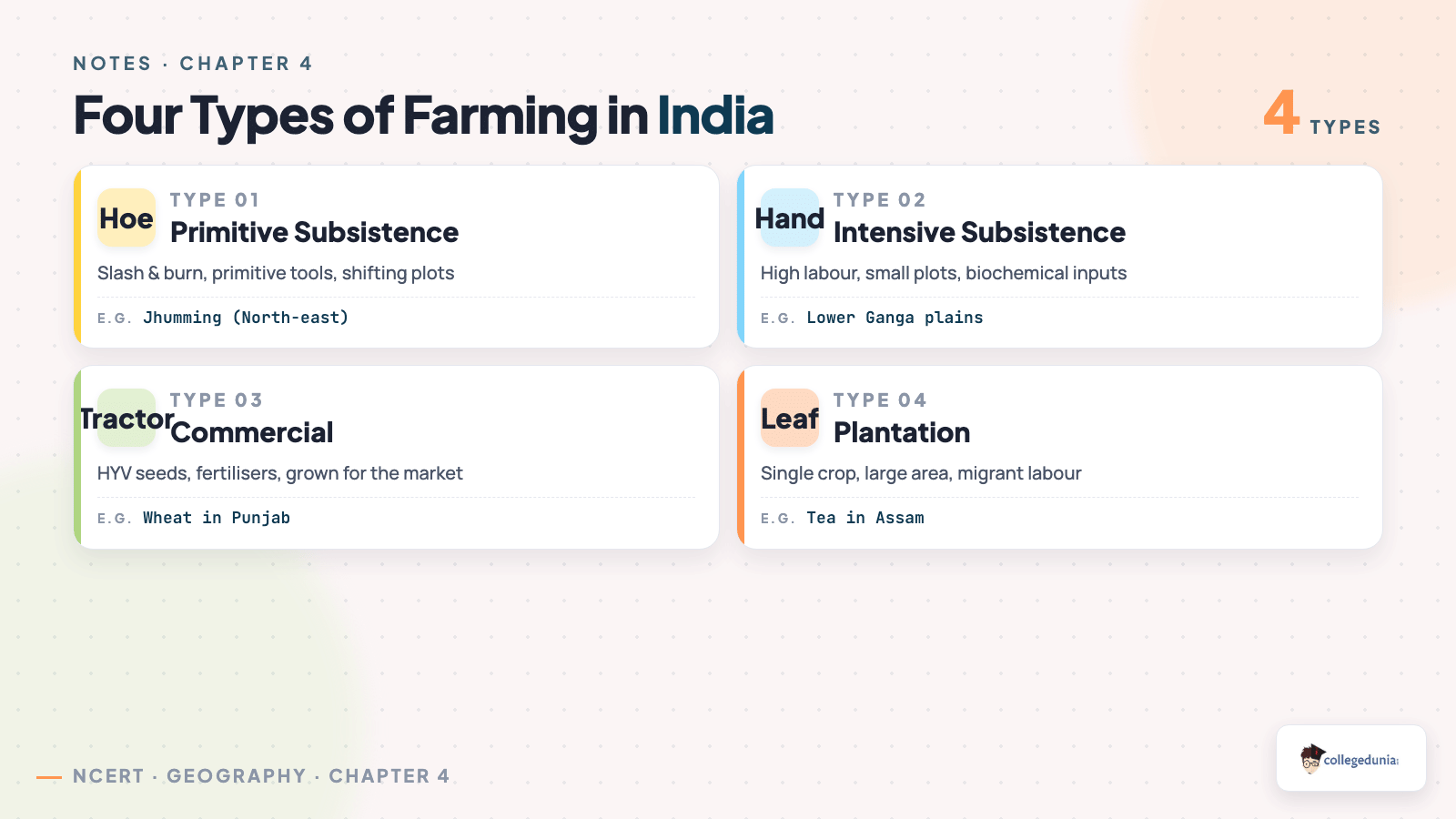
NCERT describes four major types of farming based on tools, inputs and whether produce is grown for the family or the market. Telling them apart is a frequently asked part of agriculture class 10.
| Type of Farming | Key Feature | Example |
|---|---|---|
| Primitive Subsistence | Slash-and-burn agriculture using primitive tools (hoe, dao, digging sticks) and family labour; farmers shift to a fresh patch when soil fertility falls. | Jhumming (North-east India) |
| Intensive Subsistence | Practised on small plots under high population pressure; labour-intensive with high doses of biochemical inputs and irrigation. | Lower Ganga plains |
| Commercial | Uses higher doses of modern inputs like HYV seeds, fertilisers and pesticides to raise productivity, mainly for the market. | Wheat in Punjab and Haryana |
| Plantation | A single crop grown on a large area with capital-intensive inputs and migrant labour; an interface of agriculture and industry. | Tea in Assam, coffee in Karnataka |
- Slash-and-burn farming has many local names: Jhumming in the North-east, Bewar or Dahiya in Madhya Pradesh, Podu or Penda in Andhra Pradesh, Kumari in the Western Ghats and Kuruwa in Jharkhand.
- A crop is not always commercial or subsistence: rice is a commercial crop in Punjab and Haryana but a subsistence crop in Odisha.
Cropping Seasons in India: Rabi, Kharif and Zaid
India has three cropping seasons, and the season decides when a crop is sown and harvested. Wheat is the flagship rabi crop and rice is the flagship kharif crop.
| Season | Sown / Harvested | Main Crops |
|---|---|---|
| Rabi | Sown Oct to Dec, harvested Apr to Jun; helped by winter western temperate cyclones. | Wheat, barley, peas, gram, mustard |
| Kharif | Sown with the onset of the monsoon, harvested in September and October. | Paddy (rice), maize, jowar, bajra, tur, cotton, jute, groundnut, soyabean |
| Zaid | A short summer season between rabi and kharif, grown with irrigation. | Watermelon, muskmelon, cucumber, vegetables, fodder |
- Rabi crops are grown mainly in the north and north-west: Punjab, Haryana, Himachal Pradesh, Jammu and Kashmir, Uttarakhand and Uttar Pradesh; the Green Revolution boosted them.
- Kharif crops like rice dominate Assam, West Bengal, coastal Odisha, Andhra Pradesh, Tamil Nadu, Kerala and Maharashtra's Konkan coast.
- If a question asks the season of wheat, the answer is rabi; for rice, the answer is kharif.
Major Foodgrains: Rice, Wheat, Millets, Maize and Pulses
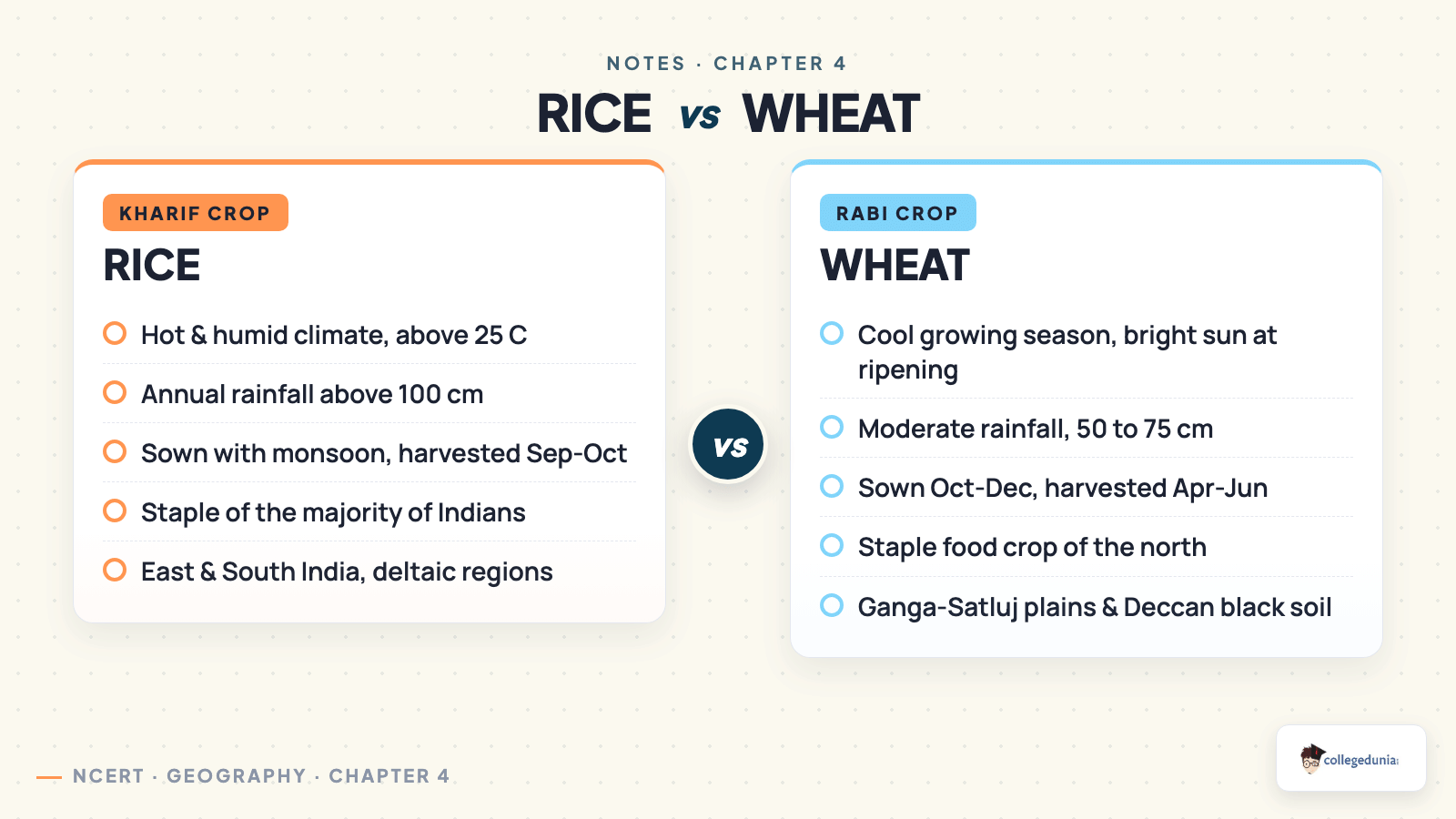
For each foodgrain the board expects you to know the season, the climatic conditions and the leading producing states. The rice-versus-wheat contrast below is the single most tested comparison.
| Crop | Season | Conditions | Leading States |
|---|---|---|---|
| Rice | Kharif | Above 25 degrees C, high humidity, rainfall over 100 cm; irrigation in drier areas. | West Bengal, Punjab, Uttar Pradesh, Odisha |
| Wheat | Rabi | Cool growing season, bright sun at ripening, 50 to 75 cm rainfall. | Punjab, Haryana, Uttar Pradesh, Madhya Pradesh |
| Jowar | Kharif | Rain-fed, grown in moist areas. | Maharashtra, Karnataka, Andhra Pradesh |
| Bajra | Kharif | Grows on sandy and shallow black soil. | Rajasthan, Uttar Pradesh, Gujarat, Haryana |
| Ragi | Kharif | Dry regions; red, black, sandy and loamy soils; rich in iron and calcium. | Karnataka, Tamil Nadu, Uttarakhand |
| Maize | Kharif | 21 to 27 degrees C with old alluvial soil; rabi in Bihar. | Karnataka, Madhya Pradesh, Bihar |
| Pulses | Both | Need less moisture, dry tolerant; leguminous, fix nitrogen. | Madhya Pradesh, Rajasthan, Maharashtra |
- India is the second largest producer of rice after China; in Assam, West Bengal and Odisha three crops of paddy (Aus, Aman, Boro) are grown a year.
- India is the largest producer and consumer of pulses in the world; all pulses except arhar are leguminous and fix nitrogen, so they are grown in rotation with cereals.
Common mistake: rice is a kharif crop, not rabi, needing rainfall above 100 cm in east and south India; wheat is the rabi staple with 50 to 75 cm of rain in the north-west. CBSE tests this swap almost every year.
Food Crops Other than Grains: Sugarcane, Oilseeds, Tea and Coffee
Beyond cereals and pulses, India grows sugarcane and oilseeds, the beverage crops tea and coffee, and a wide range of horticulture crops. Their producing belts are favourite board questions.
| Crop | Conditions | Leading States / Facts |
|---|---|---|
| Sugarcane | Hot and humid, 21 to 27 degrees C, 75 to 100 cm rainfall; needs manual labour. | Uttar Pradesh, Maharashtra, Karnataka; India is 2nd after Brazil. |
| Oilseeds | Cover about 12 per cent of total cropped area; groundnut is a kharif crop. | Gujarat (largest groundnut), Rajasthan, Tamil Nadu. |
| Tea | Warm, moist, frost-free climate, deep humus-rich soil; labour-intensive plantation crop. | Assam, Darjeeling and Jalpaiguri (West Bengal), Tamil Nadu, Kerala. |
| Coffee | Arabica variety, originally brought from Yemen; began on the Baba Budan Hills. | Nilgiri belt of Karnataka, Kerala and Tamil Nadu. |
- Sugarcane is the main source of sugar, gur (jaggery), khandsari and molasses.
- India is the second largest producer of fruits and vegetables after China.
- Two coffee facts are always tested: the variety is Arabica and cultivation began on the Baba Budan Hills.
Non-Food and Fibre Crops: Rubber, Cotton and Jute
Non-food crops supply industrial raw material. The chapter highlights rubber plus four fibre crops: cotton, jute, hemp and natural silk. Rearing silkworms for silk fibre is called sericulture. Their soils and growing belts are commonly asked.
| Crop | Conditions / Soil | Leading States |
|---|---|---|
| Rubber | Equatorial crop; rainfall over 200 cm and temperature above 25 degrees C. | Kerala, Tamil Nadu, Karnataka, Andaman and Nicobar Islands, Garo Hills. |
| Cotton | Black cotton (regur) soil of the dry Deccan; kharif crop needing 210 frost-free days. | Maharashtra, Gujarat, Telangana, Punjab, Haryana. |
| Jute | The golden fibre; renewed alluvial soil of moist flood plains, high temperature. | West Bengal, Bihar, Assam, Odisha, Meghalaya. |
- India is the original home of the cotton plant and the second largest producer of cotton after China.
- Jute, the golden fibre, is used in gunny bags, mats, ropes and carpets, but faces competition from synthetic substitutes.
Common mistake: never swap the soils. Cotton grows on black cotton (regur) soil of the dry Deccan; jute grows on renewed alluvial soil of moist flood plains.
Reforms, Bhoodan-Gramdan and the Globalisation of Indian Agriculture
Sustained use of land without matching change slowed agricultural development, so technical and institutional reforms were needed after Independence. This is the high-mark portion of the chapter, often asked as a 5-mark question.
Technological and institutional reforms after Independence:
- Land reforms: collectivisation, consolidation of holdings and abolition of zamindari, the focus of the First Five Year Plan.
- Green and White Revolution: HYV seed technology in the 1960s-70s, and Operation Flood for milk.
- Credit and insurance: Grameen banks, cooperatives, the Kisan Credit Card (KCC), PAIS and crop insurance against drought, flood and disease.
- Price support: the Minimum Support Price (MSP) to check exploitation by middlemen.
Bhoodan-Gramdan: The Bloodless Revolution
Mahatma Gandhi declared Vinoba Bhave his spiritual heir. At Pochampally in Telangana, Shri Ram Chandra Reddy offered 80 acres to landless villagers; this act was called Bhoodan. When zamindars later offered whole villages, it became Gramdan. The movement is also known as the Bloodless Revolution.
Globalisation and Food Security
After the 1990 reforms, Indian farmers faced global competition from cheaper, often subsidised imports that threatened cotton, oilseeds and pulses. To stay competitive, India needs improved seeds, better irrigation, organic farming and crop diversification. Food security means the availability, accessibility and affordability of food to all people at all times.
Other Resources for Class 10 Geography Chapter 4 Agriculture
Pair these revision notes with the matching NCERT Solutions, handwritten notes and the official NCERT book chapter. The cross-resource table below links to every Collegedunia file for Class 10 Geography Chapter 4.
| Resource | What it covers | Open |
|---|---|---|
| Notes | Concept-first revision notes covering types of farming, cropping seasons, major crops, reforms and globalisation. | You are here |
| NCERT Solutions | Step-by-step answers to every exercise question, including the 5-mark answers with full detail. | Class 10 Geography Chapter 4 NCERT Solutions |
| Handwritten Notes | Scanned-style handwritten revision pages for last-minute board exam practice. | Class 10 Geography Chapter 4 Handwritten Notes |
| NCERT Book PDF | Official NCERT Contemporary India II Chapter 4 textbook in PDF form. | Class 10 Geography Chapter 4 NCERT Book PDF |
All Chapters Notes for Class 10 Geography Contemporary India II
Related Links: Use the table below to reach the Notes for the other chapters of Class 10 Geography Contemporary India II. Every chapter ships with the same revision-friendly structure, key definitions and FAQ block.
| Chapter | Topic | Notes link |
|---|---|---|
| Chapter 1 | Resources and Development | Class 10 Geography Chapter 1 Notes |
| Chapter 2 | Forest and Wildlife Resources | Class 10 Geography Chapter 2 Notes |
| Chapter 3 | Water Resources | Class 10 Geography Chapter 3 Notes |
| Chapter 4 | Agriculture | You are here |
| Chapter 5 | Minerals and Energy Resources | Class 10 Geography Chapter 5 Notes |
| Chapter 6 | Manufacturing Industries | Class 10 Geography Chapter 6 Notes |
| Chapter 7 | Lifelines of National Economy | Class 10 Geography Chapter 7 Notes |
NCERT Notes Class 10 Geography Chapter 4 Agriculture FAQs
Ques. What do the agriculture class 10 notes cover?
Ans. The agriculture class 10 notes are a concept-first revision file that compress the entire NCERT Chapter 4 of Class 10 Geography Contemporary India II into a printable study guide. They cover the four types of farming (primitive subsistence, intensive subsistence, commercial and plantation), the three cropping seasons of rabi, kharif and zaid, the major crops with their geographical conditions and producing states, the technological and institutional reforms after Independence, the Bhoodan-Gramdan movement, and the globalisation of Indian agriculture. Students typically use these notes for a 30-minute first-pass revision and a 20-minute night-before pass; the worked answers to the NCERT exercise questions live in the matching NCERT Solutions PDF.
Ques. What are the four types of farming in Class 10 Geography Chapter 4?
Ans. The four types of farming are primitive subsistence, intensive subsistence, commercial and plantation farming. Primitive subsistence farming is slash-and-burn agriculture using primitive tools and shifting plots, such as Jhumming in the North-east. Intensive subsistence farming is practised on small plots under high population pressure with high labour and biochemical inputs. Commercial farming uses HYV seeds, fertilisers and pesticides to grow crops for the market, such as wheat in Punjab. Plantation farming grows a single crop on a large area with capital-intensive inputs and migrant labour, such as tea in Assam and coffee in Karnataka.
Ques. What is the difference between rabi and kharif crops?
Ans. Rabi and kharif are two of the three cropping seasons in India. Rabi crops are sown in winter from October to December and harvested in summer from April to June; they include wheat, barley, peas, gram and mustard, and are grown mainly in the north and north-west with the help of winter western temperate cyclones. Kharif crops are sown with the onset of the monsoon and harvested in September and October; they include rice (paddy), maize, jowar, bajra, cotton, jute and groundnut. Wheat is the flagship rabi crop and rice is the flagship kharif crop. The third season, zaid, is a short summer season for crops like watermelon and cucumber.
Ques. What are the geographical conditions required for the growth of rice?
Ans. Rice needs a high temperature above 25 degrees C throughout the growing period, high humidity and annual rainfall above 100 cm. In areas of less rainfall it is grown with the help of canal and tubewell irrigation, as in Punjab, Haryana and western Uttar Pradesh. It grows best in deep clayey and loamy soils, such as deltaic and alluvial soils, that can retain water. As a kharif crop it needs abundant cheap labour from sowing to harvesting. India is the second largest producer of rice in the world after China, and in Assam, West Bengal and Odisha three crops of paddy, Aus, Aman and Boro, are grown in a year.
Ques. Why are pulses called leguminous crops in Class 10 Geography?
Ans. Pulses such as tur (arhar), urad, moong, masur, peas and gram are leguminous crops, which means that, except arhar, they restore soil fertility by fixing nitrogen from the air through bacteria in their root nodules. Because of this, pulses are grown in rotation with other crops like wheat and rice, cutting the need for chemical fertilisers. Pulses also need less moisture and survive in dry conditions, and they are the major source of protein in a vegetarian diet. India is both the largest producer and the largest consumer of pulses in the world, with Madhya Pradesh, Rajasthan, Maharashtra, Uttar Pradesh and Karnataka as leading producers.
Ques. What were the technological and institutional reforms in Indian agriculture?
Ans. After Independence the government took several institutional and technical reforms to increase agricultural production. The institutional reforms included the abolition of zamindari, the consolidation of holdings, cooperation and land reforms, which were the main focus of the First Five Year Plan. The technical reforms included the Green Revolution with HYV seeds, fertilisers and irrigation, and the White Revolution or Operation Flood for milk. Other steps were crop insurance against drought, flood, cyclone, fire and disease, Grameen banks and cooperative societies, the Kisan Credit Card (KCC), the Personal Accident Insurance Scheme (PAIS), special weather bulletins on radio and television, and the Minimum Support Price (MSP) to protect farmers from exploitation by middlemen.
Ques. Are these agriculture class 10 notes updated for the 2026-27 session?
Ans. Yes. These agriculture class 10 notes are based on the 2026-27 NCERT Contemporary India II textbook and the latest CBSE Class 10 Social Science sample paper. The chapter structure is unchanged for the current cycle, and the CBSE marking scheme continues to reward well-organised answers with clear cause-and-effect links for the 5-mark questions on rice conditions and government reforms. Students should use these notes for both the short-answer and long-answer parts of the chapter, then move to the matching NCERT Solutions PDF for full worked answers.



Comments