




Class 12 English Vistas Chapter 6 Memories of Childhood Handwritten Notes by Collegedunia are notebook-style revision pages built for the last-week refresh before the CBSE Class 12 English Core Board paper. The PDF compresses the paired autobiographical extracts by Zitkala-Sa and Bama into 17 notebook pages covering both parts in full (the Carlisle dining-room and hair-cutting scene; the Tamil-village bazaar walk, the parcel-by-the-string, and the irrigation-tank caste-screening), Annan's education programme, the comparative reading, a 12-line quote bank and a CBSE PYQ map - all aligned to the 2026-27 syllabus.
- CBSE Board Weightage: 6 marks (one 6-mark LA from this chapter is a high-frequency item in Section C)
- Best Use: 30-minute last-pass refresh before the paper; covers all three Reading with Insight questions and the comparative reading
- Format: notebook-page layout - one focused topic per page, marked-up keywords, inline tip / recall / watch-out callouts, framed thesis lines ("one of many little animals", "we too are human beings")
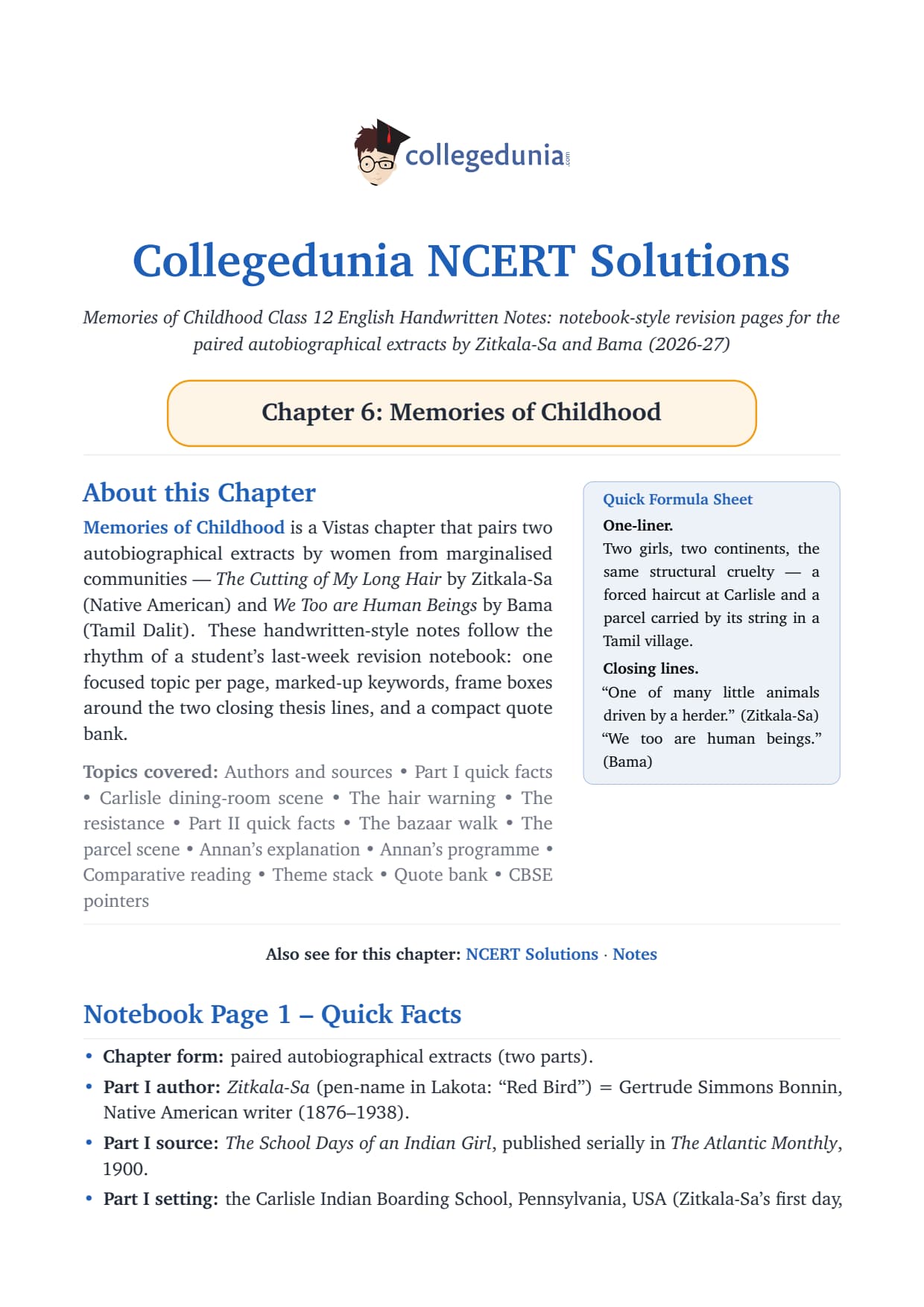
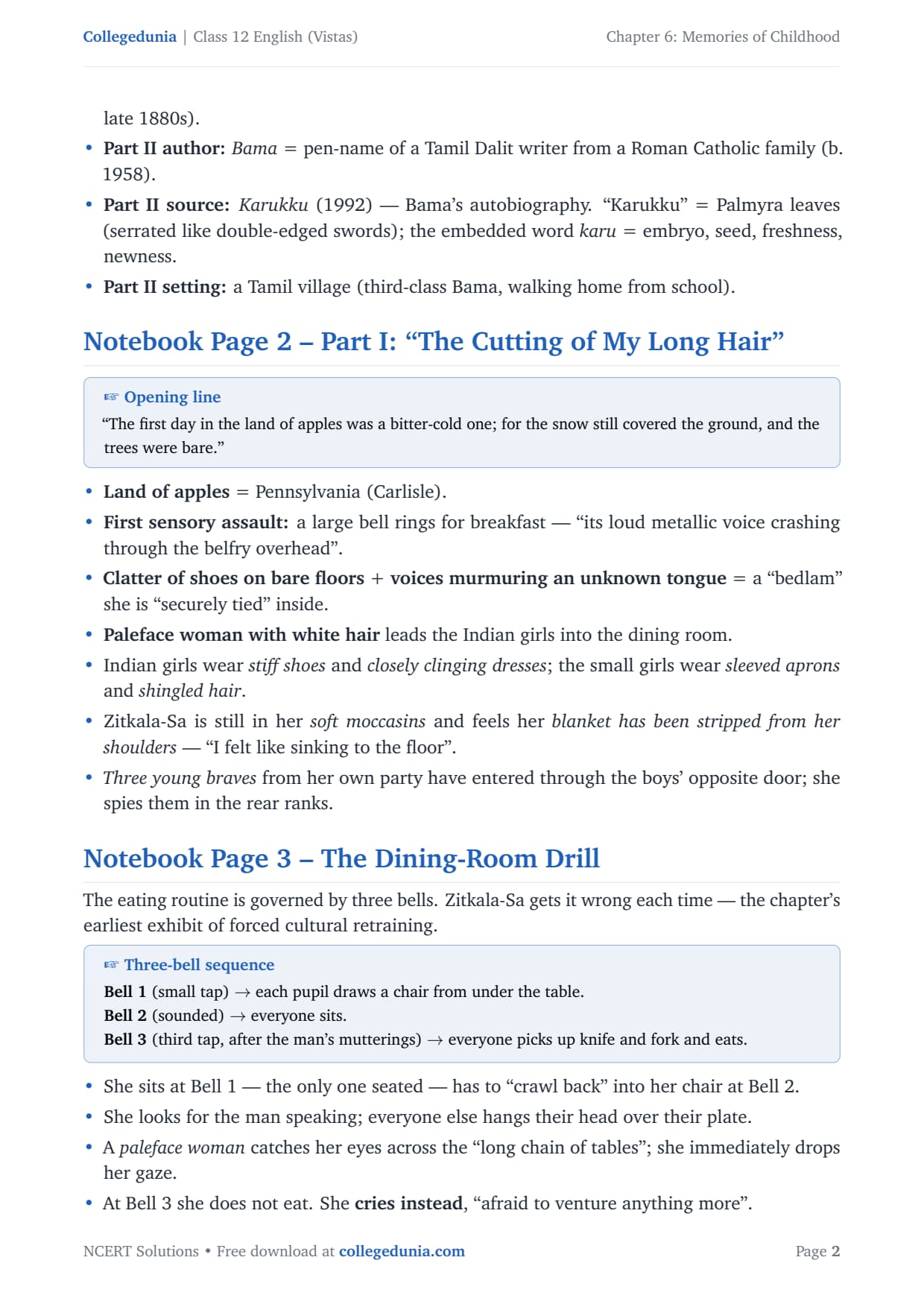


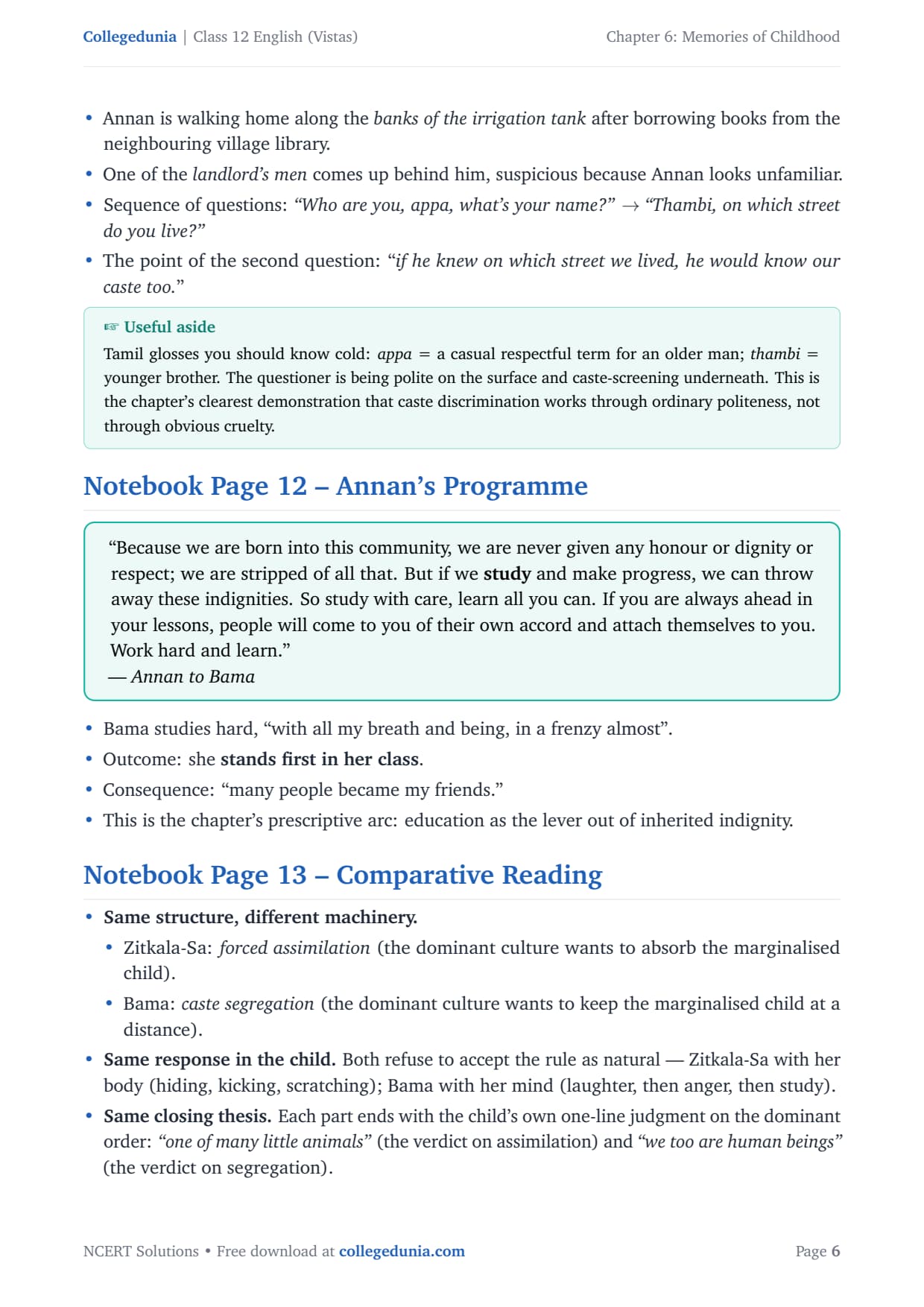

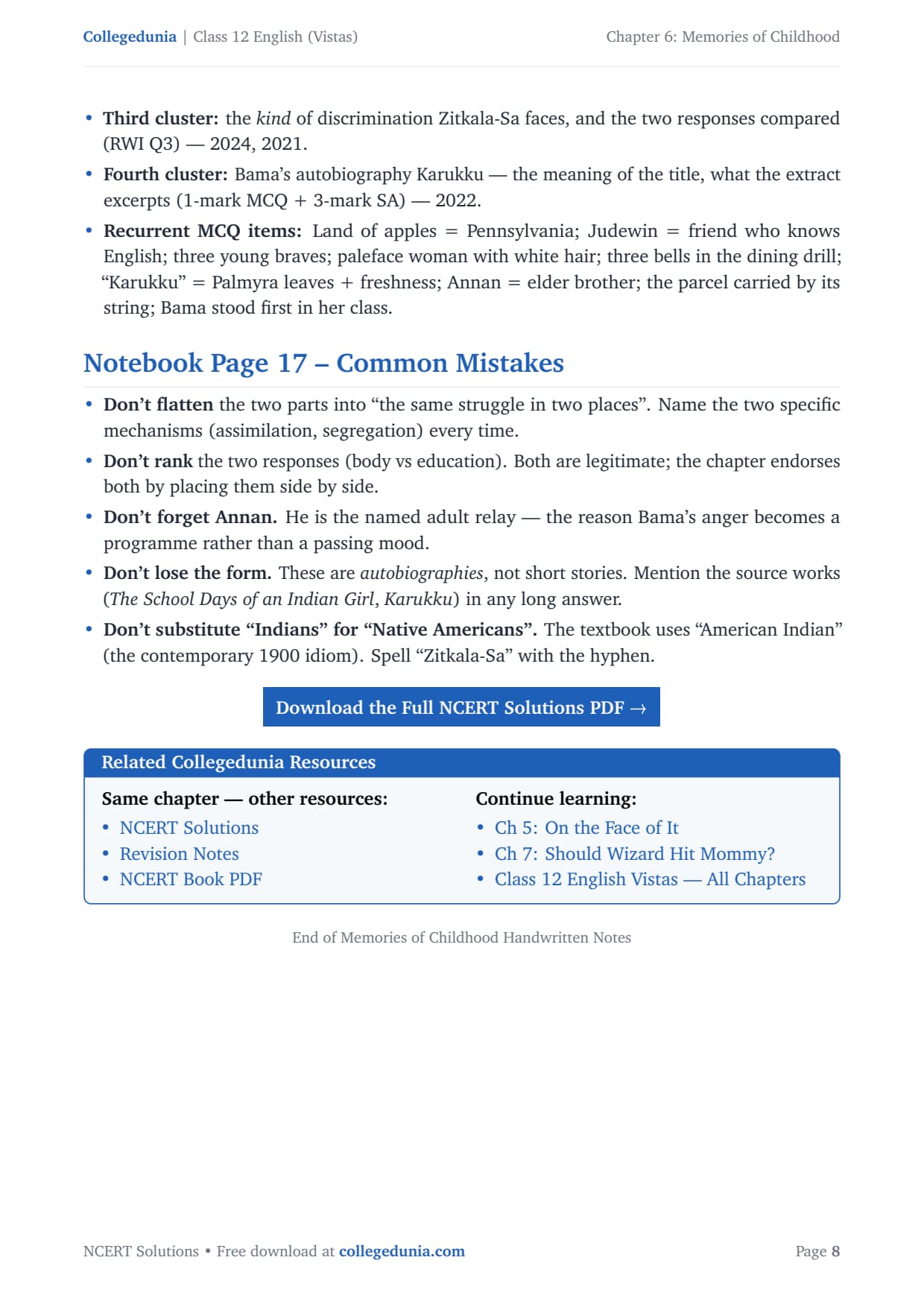
The handwritten-style PDF below contains 17 notebook pages: Quick Facts (authors and sources); Part I in five pages (opening scene, three-bell dining drill, the hair warning, the resistance and cutting, the closing); Part II in six pages (quick facts, the bazaar catalogue, the threshing-floor and parcel, Annan's explanation, the irrigation-tank "which street" episode, Annan's programme); Comparative Reading; Theme Stack; Quote Bank; CBSE Board Pointers; Common Mistakes.
These handwritten notes are designed by Collegedunia English faculty, mapped to the 2026-27 Vistas chapter, and benchmarked against the last five CBSE Board sittings.
Also Check:
Class 12 English Vistas Chapter 6 Handwritten Notes - Page-by-Page Map
The 17-page handwritten notebook follows the chapter's two-part structure. The table groups the pages by section and shows what each cluster covers.
| Notebook Pages | Focus | Why It Matters for Boards |
|---|---|---|
| 1: Quick Facts | Zitkala-Sa (1876-1938) = Gertrude Simmons Bonnin; Bama (b. 1958); source works (School Days of an Indian Girl 1900, Atlantic Monthly; Karukku 1992); settings; meaning of Karukku (Palmyra + karu) | 1-mark MCQ recall (authors, dates, source works) |
| 2-6: Part I - The Cutting of My Long Hair | Land-of-apples opening; paleface woman with white hair; soft moccasins vs stiff shoes; three-bell dining drill; Judewin's warning; the cultural code (mourners and cowards); "No, I will not submit! I will struggle first!"; the room with three white beds and dark green curtains; gnawing-off the braid; closing image of "little animals driven by a herder" | Anchor for Q3 (kind of discrimination Zitkala-Sa faces); supplies the body-resistance side of the comparative answer |
| 7-12: Part II - We Too are Human Beings | The 10-to-30-minute walk; the full bazaar catalogue (narikkuravan, Maariyaata temple, pongal, payasam, almond tree); threshing floor with muzzled cattle; parcel-by-the-string; Annan's pollution explanation; "Why should we have to fetch and carry for these people?"; the irrigation-tank "which street do you live on?" caste-screening; Annan's "study with care, learn all you can" programme | Anchor for Q1 (commonality of theme) and Q3 (Bama's response); supplies the Karukku-meaning MCQ cluster |
| 13-14: Comparative Reading and Theme Stack | Assimilation vs segregation; body-response vs mind-response; same closing-thesis structure; the five themes (discrimination, identity and the body, childhood as a political site, resistance, education as liberation) | Theme-tagged answers for any 6-mark LA; the Q1 commonality answer is built directly here |
| 15-17: Quote Bank, PYQ Map, Common Mistakes | Twelve must-memorise lines, year-wise PYQ rotation (2021-2025), five common errors (flattening, ranking, forgetting Annan, losing the autobiographical form, "Indians" vs "Native Americans") | Direct quotation evidence for Section C answers; the mistakes block is the audit before submission |
Memories of Childhood Video Walkthrough
Source: Magnet Brains on YouTube
Setting Map: The Page-1 Skeleton
Page 1 of the notebook lays the chapter's framing in two halves - the Carlisle Indian Boarding School (Pennsylvania, late 1880s) on the Part I side, and the Tamil-Nadu village (Bama's third-class years) on the Part II side. The handwritten quick-facts block summarises the seven anchors that drive the chapter and that CBSE tests in 1-mark MCQs.
Part I - The Haircut: The Notebook Walk-Through
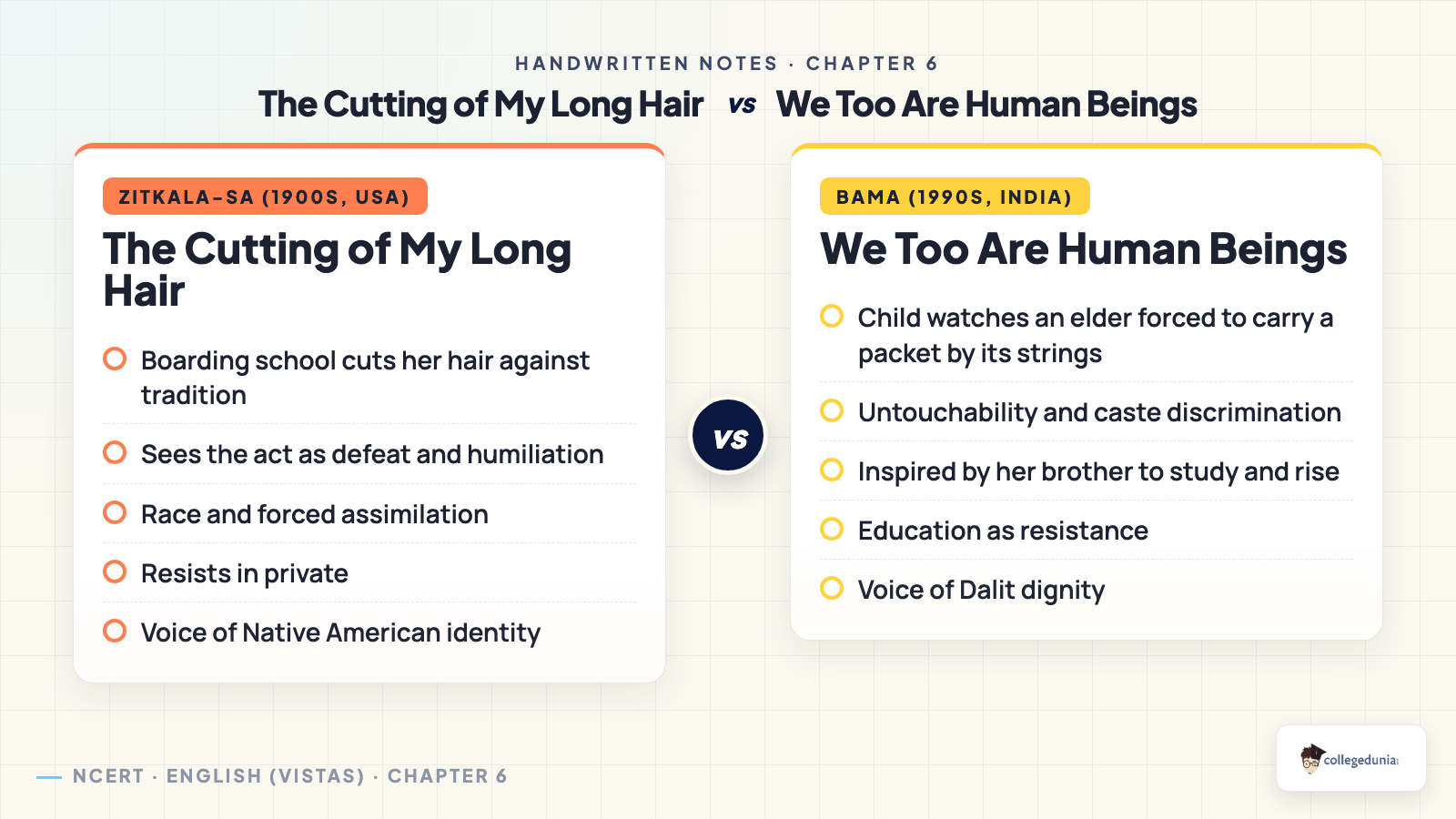
Pages 2-6 walk Zitkala-Sa's Part I in five hand-arrowed beats. Beat 1 (Page 2): arrival in the "land of apples" and the sensory assault (the breakfast bell, the clatter of shoes on bare floors, the unknown tongue, the paleface woman with white hair leading them past the boys' opposite door). Beat 2 (Page 3): the three-bell dining drill (small tap = pull out chair; sounded bell = sit; third tap after the man's mutterings = eat) - she gets every cue wrong and ends up crying instead of eating. Beat 3 (Page 4): Judewin's warning that the paleface woman is going to cut their hair, and the cultural code Zitkala-Sa was raised in (short hair = mourners, shingled hair = cowards); her refusal: "No, I will not submit! I will struggle first!" Beat 4 (Page 5): the resistance scene - she hides under the bed in a large room with three white beds and dark green curtains; is dragged out, tied to a chair, kicks and scratches, and hears the scissors gnaw off one of her thick braids. Beat 5 (Page 6): the closing - she moans for her mother and no one comes; the framed thesis line "one of many little animals driven by a herder" closes Part I.
Part II - The Parcel: The Notebook Walk-Through
Pages 7-12 walk Bama's Part II in six beats. Beat 1 (Page 7): she is in the third class; she had already "seen, felt, experienced and been humiliated by" untouchability without yet hearing the word; the ten-minute walk takes her thirty minutes to an hour because the street is a gallery. Beat 2 (Page 8): the full bazaar catalogue - the performing monkey, the snake-charmer, the cyclist with rupee notes pinned on his shirt, the spinning wheels, the Maariyaata temple with its huge bell and the pongal offerings cooked in front of it, the dried-fish stall by the statue of Gandhi, the narikkuravan hunter-gypsy with his wild lemur, the almond tree, the seasonal fruit list, and the payasam and halva stalls. Beat 3 (Page 9): the threshing-floor scene - the landlord on his sacking-covered stone ledge; "our people" driving muzzled cattle in pairs round and round; the village elder bringing a small oil-stained packet by its string and bowing low, cupping the string-holding hand with his other hand. Beat 4 (Page 10): Annan's explanation - "Everybody believed that they were upper caste and therefore must not touch us. If they did, they would be polluted" - and Bama's emotional arc, laughter to sadness to anger. Beat 5 (Page 11): the irrigation-tank episode - the landlord's man approaches Annan with two polite questions ("Who are you, appa, what's your name?" then "Thambi, on which street do you live?") and Bama notes that the second question is the real one because the street fixes the caste. Beat 6 (Page 12): Annan's programme - "Because we are born into this community, we are never given any honour or dignity or respect; we are stripped of all that. But if we study and make progress, we can throw away these indignities" - Bama studies in a frenzy and stands first in her class; the framed thesis line "We too are human beings" closes Part II.
Comparative Reading and Themes: The Page 13-14 Cheatsheet
Page 13 lays out the chapter's central comparative argument in three lines: same structure with different machinery (forced assimilation in Carlisle vs caste segregation in the Tamil village), same response in the child (refusal to accept the rule as natural), same closing thesis (each part ends with the child's own one-line judgment on the dominant order). Page 14 carries the five-theme stack - discrimination, cultural identity and the body, childhood as a political site, resistance (embodied and discursive), and education as liberation - that the CBSE 6-mark LA leans on.
Quote Bank, PYQ Map and Mistakes: The Page 15-17 Recall Strip
Pages 15-17 are the exam-morning recall strip. Page 15 carries the 12-line quote bank (both opening lines, the cultural-code line, the two refusals, the parcel image, both closing thesis lines, and Annan's programme). Page 16 carries the year-wise CBSE PYQ rotation for 2021-2025 mapped to the three Reading-with-Insight questions. Page 17 is the five-item common-mistakes block - the audit you run before submitting.
What Makes These Handwritten Notes Different from Regular Notes
- One topic per page. Each notebook page picks a single focused idea (the dining-room drill, the hair warning, the bazaar catalogue, the irrigation-tank exchange, Annan's programme) and lays it out without crowding.
- Framed thesis lines. "One of many little animals driven by a herder" (Zitkala-Sa) and "We too are human beings" (Bama) are the chapter's two thesis sentences. Each is boxed in its own page-end callout so the eye returns to it.
- Marked-up keywords. Every load-bearing phrase (Carlisle, Lakota, paleface, Judewin, moccasins, Karukku, Annan, narikkuravan, Maariyaata, Palmyra, Atlantic Monthly) is rendered in the brand-blue keyword style for one-glance recognition.
- Inline callouts. Useful asides, recall blocks, and "watch out" warnings sit beside the bullet they qualify - so the diagnosis travels with the fact, not separately at the end.
- Quote-anchored. Every claim made in the notes can be traced to a specific line in the NCERT source, and the 12-line quote bank at the back lets you memorise the exact wording for Section C answers.
Why Handwritten Notes Work for CBSE Vistas
- Visual memory: each thesis line sits in its own framed box, which is faster to recall than the same sentence buried inside a paragraph.
- Spaced repetition: the 17 themed pages mirror the chapter's natural exam slots (context, Part I, Part II, comparative reading, themes, quotes, PYQ, mistakes) so each glance is a small practice session.
- One-word triggers: keyword highlighting carries a sparse set of triggers (CARLISLE, JUDEWIN, BRAIDS, VADAI, ANNAN, KARUKKU) that you can scan in under thirty seconds.
- Comparative anchor: the comparative-reading page lays out the assimilation-vs-segregation argument as a side-by-side block, so the chapter's central thesis lands at a glance.
How to Use These Handwritten Notes - the 30-Minute Pre-Board Routine
- Minute 0-3: Open Page 1 and recite the four anchors - Zitkala-Sa (1876-1938) = Gertrude Simmons Bonnin, Bama (b. 1958), source works (School Days of an Indian Girl 1900, Karukku 1992), and the meaning of Karukku (Palmyra leaves + karu, freshness).
- Minute 3-12: Pages 2-6 - walk through Part I in order. Lock in the three-bell sequence, the cultural code (mourners and cowards), "No, I will not submit! I will struggle first!", the room with three white beds and dark green curtains, the scissors gnawing off the braid, and the closing "little animals driven by a herder" image.
- Minute 12-22: Pages 7-12 - walk through Part II. Memorise the bazaar catalogue's most quotable items (narikkuravan, Maariyaata temple, pongal, payasam), the parcel-by-the-string scene, Annan's pollution explanation, the irrigation-tank "which street" exchange, and Annan's programme ("study with care, learn all you can").
- Minute 22-26: Pages 13-14 - the comparative reading (assimilation vs segregation) and the five-theme stack. This is the framework for any 6-mark LA on commonality of theme.
- Minute 26-30: Pages 15-17 - quote bank, PYQ map, and the five common mistakes. Cover the right side of the quote-bank page and recite each line from memory; then read the mistakes list as a pre-submission audit.
Key Lines to Memorise from Memories of Childhood
- "The first day in the land of apples was a bitter-cold one." (Zitkala-Sa, opening)
- "We have to submit, because they are strong." (Judewin)
- "No, I will not submit! I will struggle first!" (Zitkala-Sa)
- "Short hair was worn by mourners, and shingled hair by cowards." (Zitkala-Sa)
- "One of many little animals driven by a herder." (closing of Part I)
- "He came along, holding out the packet by its string, without touching it." (Bama)
- "If they did, they would be polluted." (Annan, explaining)
- "Why should we have to fetch and carry for these people?" (Bama)
- "But we too are human beings." (closing of Part II)
- "Study with care, learn all you can." (Annan)
CBSE Previous Year Question Map (Page 16)
The Page-16 recall strip carries the year-wise CBSE Vistas long-answer rotation for Memories of Childhood. The 6-mark Long Answer slot rotates predictably between Q1 (commonality of theme), Q3 (comparison of the two discriminations), and Q2 (children noticing injustice).
| Year | Long Answer Focus | Marks |
|---|---|---|
| 2025 | Commonality of theme between Zitkala-Sa and Bama (Q1) | 6 |
| 2024 | Zitkala-Sa's discrimination; comparing the two responses (Q3) | 6 |
| 2023 | Children notice injustice; seeds of rebellion (Q2) | 6 |
| 2022 | Bama's Karukku and her response to caste discrimination | 5-6 |
| 2021 | Zitkala-Sa's resistance at the Carlisle Indian Boarding School | 5 |
Related Resources for Class 12 English Vistas Chapter 6
- Memories of Childhood NCERT Solutions
- Memories of Childhood Revision Notes
- Memories of Childhood NCERT Book PDF
FAQs on Memories of Childhood Class 12 Handwritten Notes
FAQs on Memories of Childhood Class 12 Handwritten Notes
How long does it take to revise Memories of Childhood with these handwritten notes?
About 30 minutes for a complete revision. The notebook is built for the last-week refresh - 17 focused pages, roughly two minutes per page. After two passes you should be able to reconstruct both extracts, the comparative reading, and the full 12-line quote bank from memory.
Are these handwritten notes aligned to the 2026-27 NCERT Vistas syllabus?
Yes. The 17-page notebook is mapped to the current NCERT 2026-27 reprint of Vistas Chapter 6, including all three Reading with Insight questions. The PYQ map covers the last five CBSE Class 12 English Core Board papers (2021-2025).
Who are the authors of Memories of Childhood?
The chapter is a paired autobiographical extract by Zitkala-Sa (Gertrude Simmons Bonnin, 1876-1938), a Native American writer, and Bama (b. 1958), the pen-name of a Tamil Dalit writer. The extracts are from Zitkala-Sa's The School Days of an Indian Girl (Atlantic Monthly, 1900) and Bama's Karukku (1992).
What is the central comparison in Memories of Childhood?
The chapter compares two cruelties - the settler-colonial assimilation programme at the Carlisle Indian Boarding School (the forced haircut as the small embodied form) and the caste segregation in a Tamil village (the parcel-by-the-string as the small daily ritual). Two distant cultures, the same structural cruelty against the marginalised body.



Comments