


Stanza-based extracts on this poem appear in almost every CBSE Class 12 English Board paper (3 of the last 5 years), and CUET (UG) English sets one device-identification MCQ per cycle. Class 12 English Chapter 7 Flamingo Poetry: My Mother at Sixty-Six is a high-yield short poem, and these class 12 english handwritten notes chapter 7 Flamingo Poetry: My Mother at Sixty-Six condense it into a one-look notebook PDF.
- CBSE Weightage: 6 marks, typically one stanza-based extract (3 marks) plus one short or long answer on theme or device (3 to 6 marks)
- CUET (UG) Relevance: 1 to 2 questions on poetic devices and theme in Section IA English
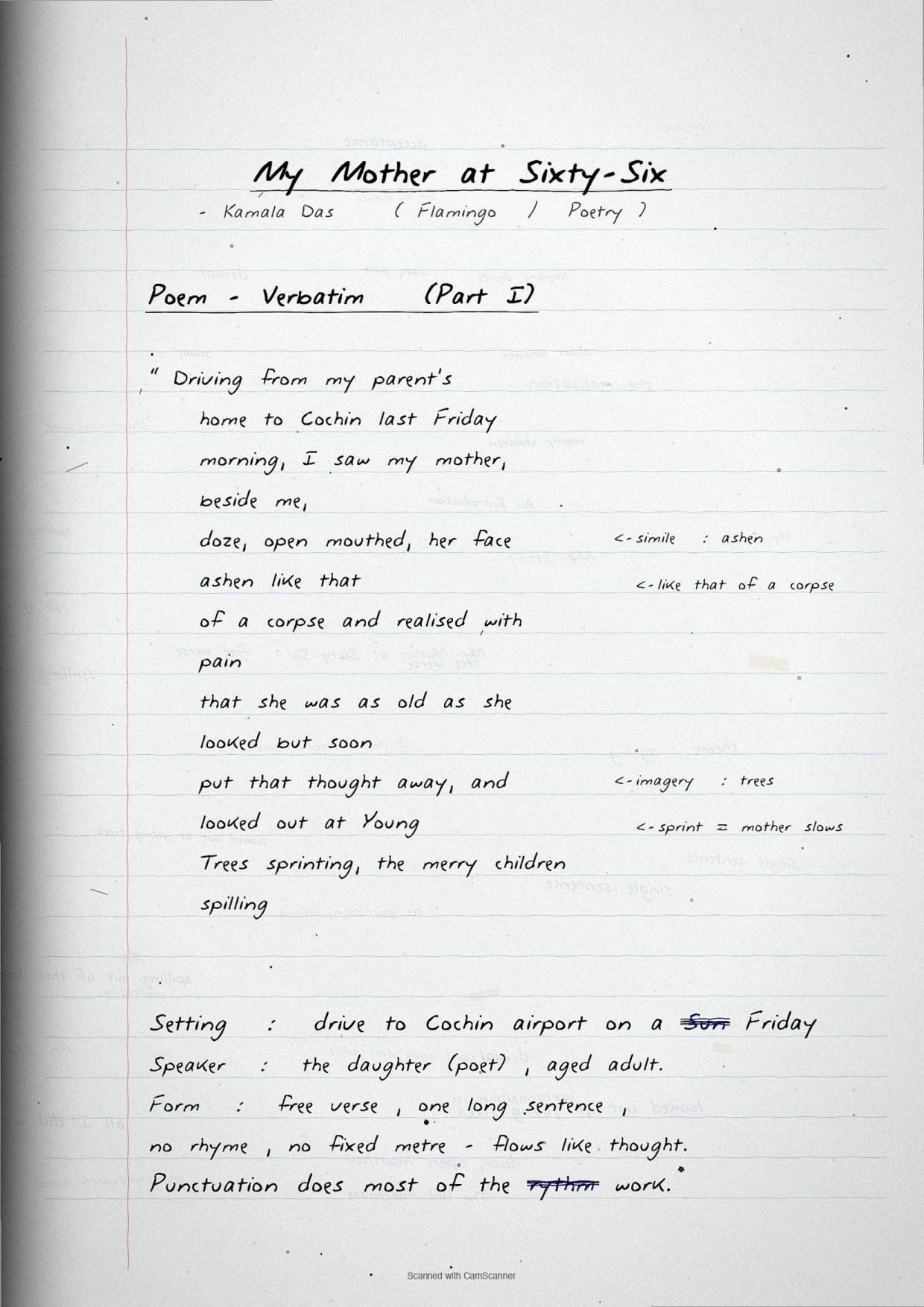


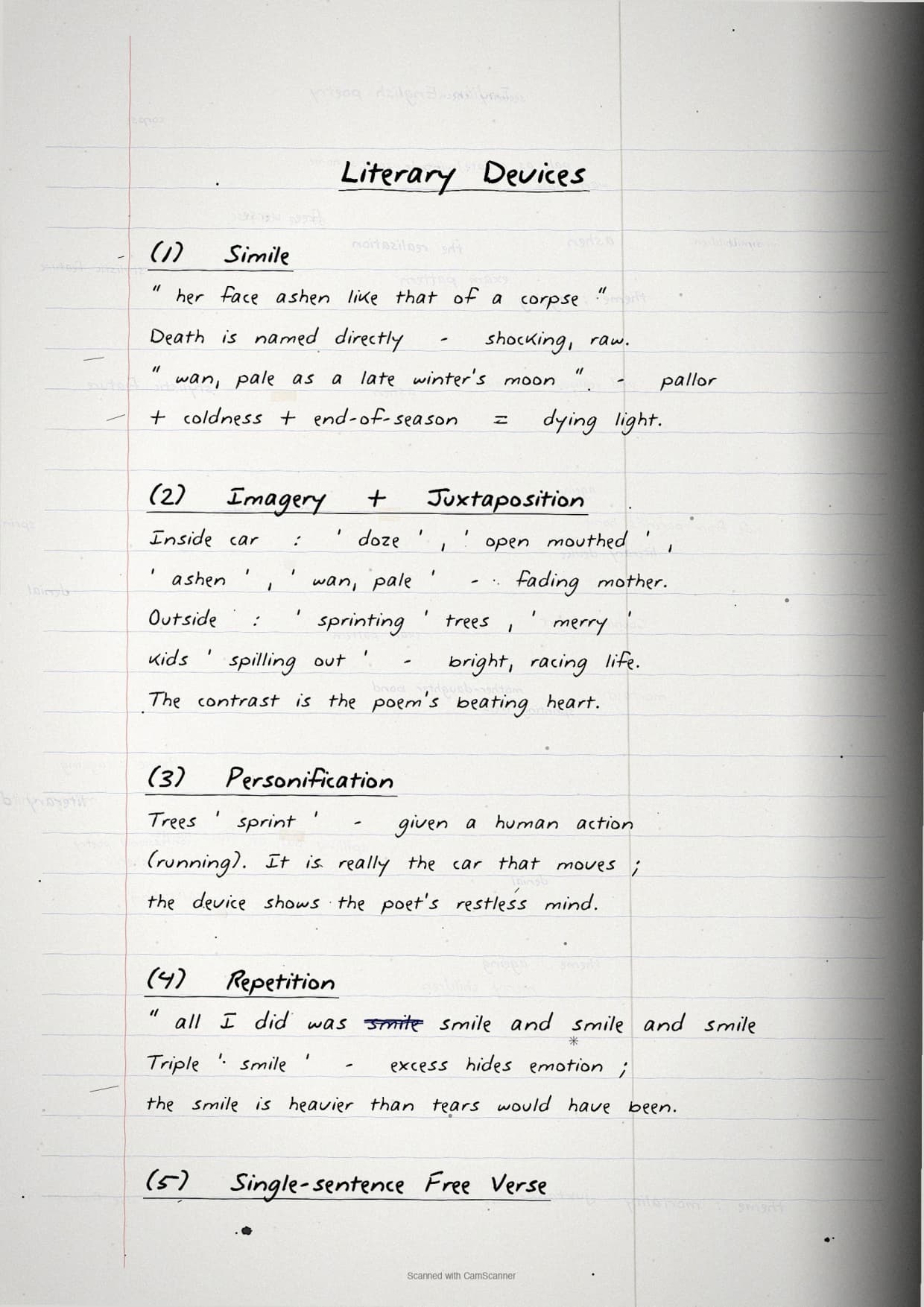
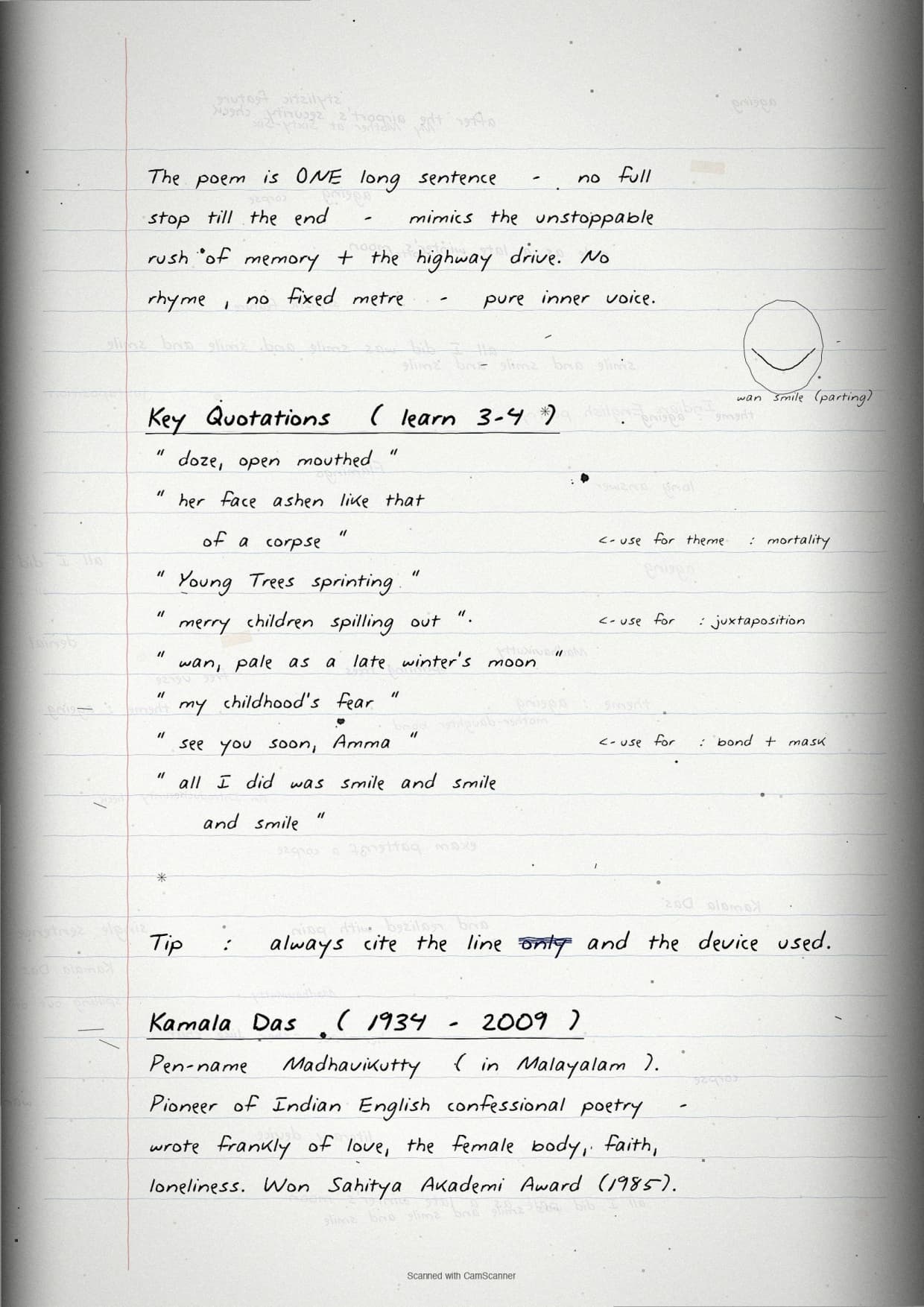
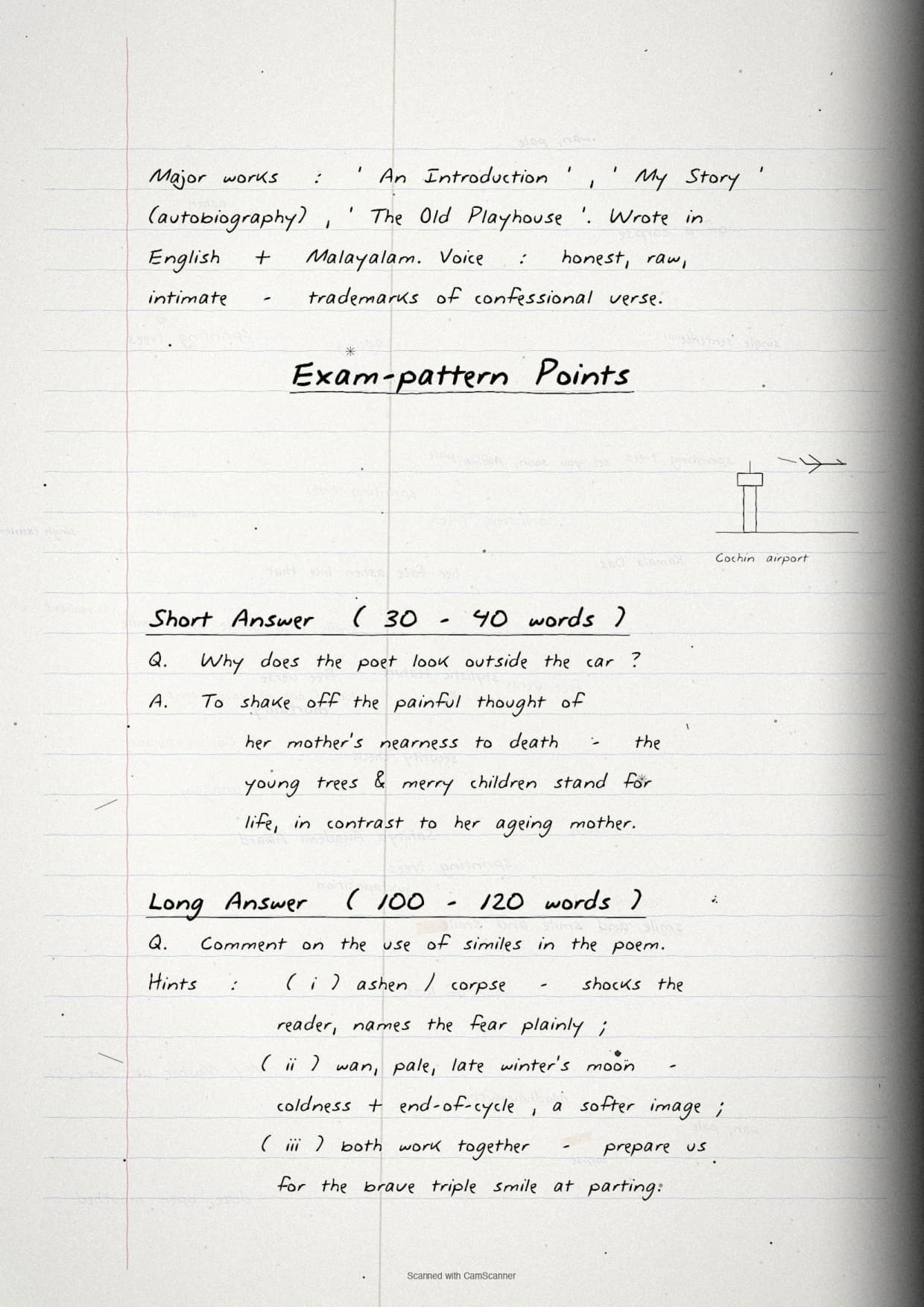

These My Mother at Sixty-Six handwritten notes are produced by Collegedunia's CBSE English educators in scanned-notebook format, mapped to the 2026-27 NCERT Flamingo print, and built around the device and image phrases CBSE quotes most often.
The handwritten format pairs short blocks of pen-style text with hand-drawn arrows, colour boxes for devices, and a one-page revision sheet at the end. The full Notes article carries the line-by-line summary in typed form.
Also Check:
- My Mother at Sixty-Six Class 12 English Notes (typed)
- My Mother at Sixty-Six Class 12 English NCERT Solutions

Why Choose Handwritten Notes for Class 12 English Handwritten Notes Chapter 7 Flamingo Poetry: My Mother at Sixty-Six
The handwritten version solves three specific problems with poetry revision.
- Memorable quote anchors. The four core phrases ("ashen like that of a corpse", "wan, pale as a late winter's moon", "young trees sprinting", "see you soon, Amma") are circled in pen and boxed, so they fix in memory faster than typed bold.
- Device colour coding. Similes are highlighted in yellow, personification in green, contrast pairs in red arrows. The colour itself becomes the recall cue in the exam hall.
- One-page revision sheet. The final page is the entire poem analysis compressed onto one sheet, ready for the last twenty minutes before the paper.
- Looks like a topper's notebook. Pen strokes, ruled paper, and margin doodles trigger the same scanning behaviour as your own notes, so the brain reads the page faster.
Flamingo Poetry My Mother At Sixty Six Video Walkthrough
Source: Magnet Brains on YouTube
How will Collegedunia's Handwritten Notes Help You Memorise My Mother at Sixty-Six
The notebook format is built specifically for last-week revision.
- Same line numbering as the NCERT print. Every block in the notebook cites the line it sits on, so you can flip between this PDF and the textbook without losing your place.
- Quotable phrases in handwritten boxes. Four core quotes are framed in pen-style boxes, exactly the phrases CBSE expects in any 3-mark or 6-mark answer.
- Margin mnemonics. Tiny scribbled mnemonics in the margin help recall the order of similes (A-W-L = Ashen, Wan, Late winter).
- Visual contrast arrows. A two-column page maps the "inside the car" images against the "outside the car" images with hand-drawn arrows, making the central contrast click visually.
What's Inside the Class 12 English Handwritten Notes Chapter 7 Flamingo Poetry: My Mother at Sixty-Six PDF
The PDF runs eight pages with the colour-coding legend on page one.
| Page | Block | Colour Code |
|---|---|---|
| 1 | Title sheet and colour legend | All colours used in the PDF |
| 2 | Full poem with line numbers | Black ink with yellow simile highlights |
| 3 | "Inside the car" image map | Red arrows for contrast cues |
| 4 | "Outside the car" image map | Green personification highlight |
| 5 | Themes and theme tree | Blue ink for theme nodes |
| 6 | CBSE pattern questions with brief answers | Black ink, key phrases boxed |
| 7 | Mnemonic page and quote bank | Margin doodles, boxed quotes |
| 8 | Last 24-hour revision card | One-page summary in pen |
Memory Mnemonics for My Mother at Sixty-Six
The five mnemonics below are written in the margins of the handwritten PDF and lock the chapter into memory in under ten minutes.
- A-W-L = Ashen, Wan, Late winter: the three pale images in the order they appear.
- SPM = Sprinting trees, spilling children, dozing Mother: the contrast trio that drives the poem.
- CHAS = Childhood ache hidden by a smile: the central emotional move of the closing lines.
- SS = Single Sentence: the entire poem is one sentence; recall this when CBSE asks about structure.
- KD-66-Cochin: Kamala Das, mother aged sixty-six, drive to Cochin airport. Three facts that hold the whole context.
My Mother at Sixty-Six Diagram Inventory
Every hand-drawn diagram in the PDF is listed below with the page it sits on.
| Diagram | Page | What It Shows |
|---|---|---|
| Inside vs Outside contrast sketch | 3-4 | Two-column sketch with red arrows linking image pairs |
| Theme tree | 5 | Central node "ageing and loss" branching into four sub-themes |
| Device colour key | 1 | Sample of every highlight colour used and what it codes |
| Quote bank (boxed) | 7 | Four boxed quote panels with CBSE year tags |
| One-page revision card | 8 | Hand-drawn summary covering devices, themes, and key quotes |
My Mother at Sixty-Six Class 12 Self-Assessment Quiz
Q1. What does the poet compare her mother's face to?
(a) A setting sun (b) A late winter's moon (c) A withered leaf (d) An ashen sky
Answer: (b) A late winter's moon, which is pale and on the edge of disappearing.
Q2. Which device is used in "young trees sprinting"?
(a) Simile (b) Metaphor (c) Personification (d) Oxymoron
Answer: (c) Personification: trees are given the human action of sprinting.
Q3. What is the speaker doing in the poem?
(a) Returning from a holiday (b) Driving her mother to Cochin airport (c) Visiting her mother at home (d) Travelling alone
Answer: (b) She is driving with her mother to Cochin airport.
Q4. The smile at the end of the poem is best described as:
(a) A genuine smile of joy (b) A mask hiding fear of separation (c) A nervous laugh (d) A smile of relief
Answer: (b) A mask hiding fear of separation.
Q5. How is the entire poem structured?
(a) Four quatrains (b) A sonnet (c) A single sentence in free verse (d) Rhyming couplets
Answer: (c) A single sentence written in free verse with enjambment across lines.
Class 12 English Handwritten Notes Chapter 7 Flamingo Poetry: My Mother at Sixty-Six Last 24-Hour Revision Card
Skim these eight points the night before the exam.
- Poet: Kamala Das (1934-2009), pen name Madhavikutty.
- Setting: A drive from parents' home to Cochin airport, last Friday morning.
- Three similes: ashen like a corpse, pale as a late winter's moon, wan and pale moon.
- One personification: young trees sprinting.
- Central contrast: still mother inside vs. lively trees and children outside.
- Central emotion: the old familiar ache, the childhood fear of losing the mother.
- Closing image: the smile and "see you soon, Amma", a mask over real grief.
- Structure: a single sentence in free verse, with enjambment across nearly every line break.
Related Links:
More My Mother at Sixty-Six English Class 12 Resources
NCERT Handwritten Notes for Class 12 English Core: All Flamingo Chapters
The full Flamingo set sits below for the rest of your revision plan.
| Chapter | Resource |
|---|---|
| Chapter 1 | The Last Lesson Handwritten Notes |
| Chapter 2 | Lost Spring Handwritten Notes |
| Chapter 3 | Deep Water Handwritten Notes |
| Chapter 4 | The Rattrap Handwritten Notes |
| Chapter 5 | Indigo Handwritten Notes |
| Chapter 6 | Poets and Pancakes Handwritten Notes |
| Chapter 8 | Keeping Quiet Handwritten Notes |
My Mother at Sixty-Six Class 12 English Handwritten Notes FAQs
Ques. Where can I download My Mother at Sixty-Six Class 12 English Handwritten Notes PDF?
Ans. You can download the My Mother at Sixty-Six Class 12 English Handwritten Notes PDF directly from this page. The PDF is in scanned-notebook format with pen-style writing and colour-coded device highlights.
Ques. Is this PDF aligned with the 2026-27 NCERT Flamingo print?
Ans. Yes. The notebook reflects the current 2026-27 syllabus for Class 12 English Core. The poem is retained in full in the new edition with no lines trimmed.
Ques. How many pages is the Class 12th English My Mother at Sixty-Six Handwritten Notes PDF?
Ans. The Handwritten Notes PDF runs eight pages, with the colour legend on page one, the line-by-line analysis on pages two to five, theme tree on page five, CBSE-pattern Q&A on page six, mnemonics on page seven, and the one-page revision card on page eight.
Ques. Are the handwritten notes only useful for last-minute revision?
Ans. No. They work as a first read, too. The colour coding and margin notes help map devices and themes during the first pass, and the one-page revision card on the final page is built for the last twenty minutes before the exam.
Ques. What is the difference between the typed Notes PDF and the Handwritten Notes PDF?
Ans. The typed Notes PDF carries the full line-by-line summary, theme map, and topic-wise weightage table. The Handwritten Notes PDF compresses the same content into a shorter notebook-style file with pen-drawn highlights, mnemonics, and a one-page revision card, tuned for fast memorisation.



Comments