




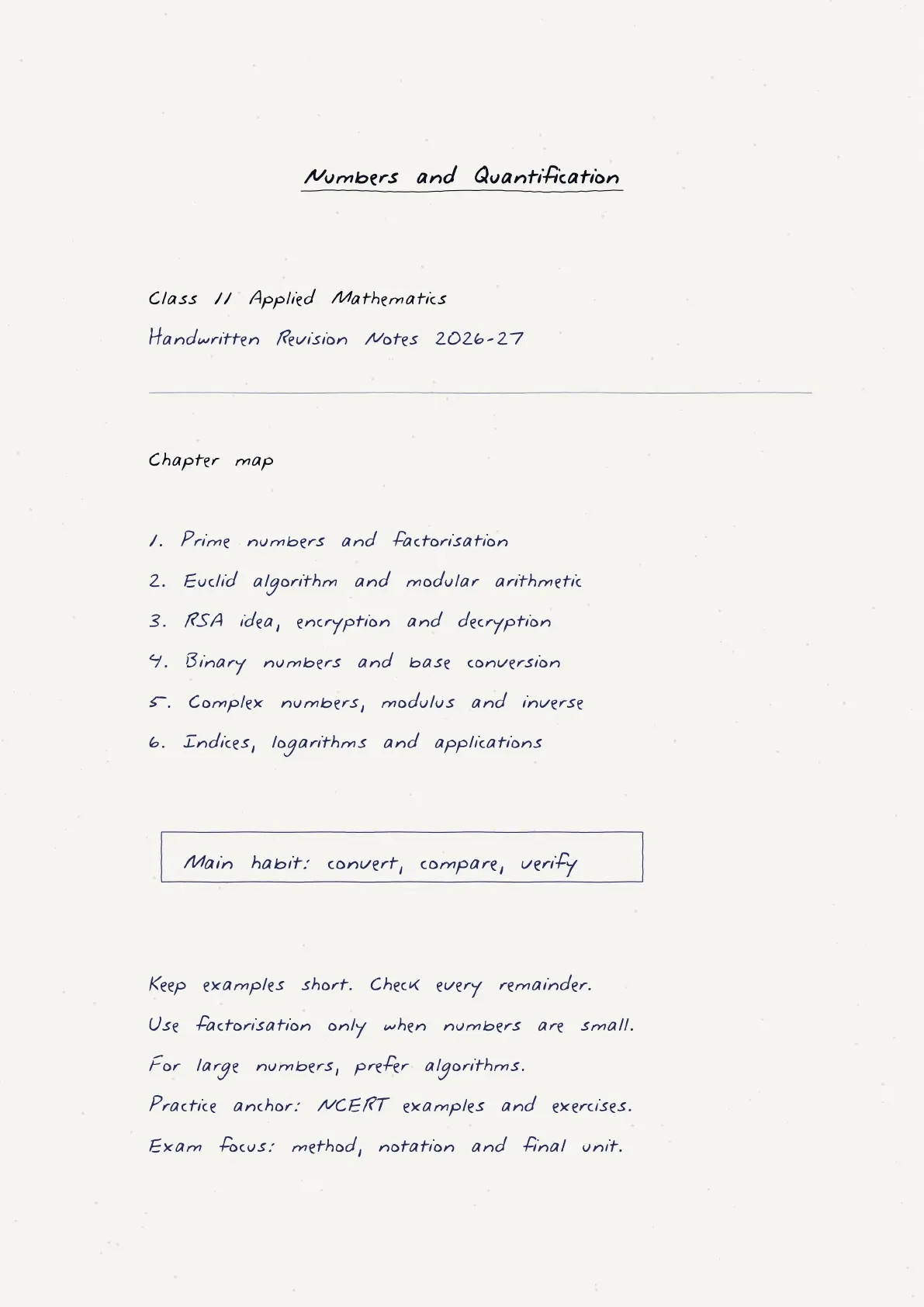
Class 11 Applied Mathematics Chapter 1 Numbers and Quantification handwritten notes give students a compact visual revision path for the 2026-27 CBSE syllabus. The chapter begins with number systems and prime numbers, then moves into binary conversion, modular arithmetic, complex numbers, indices, logarithms and practical growth scales.
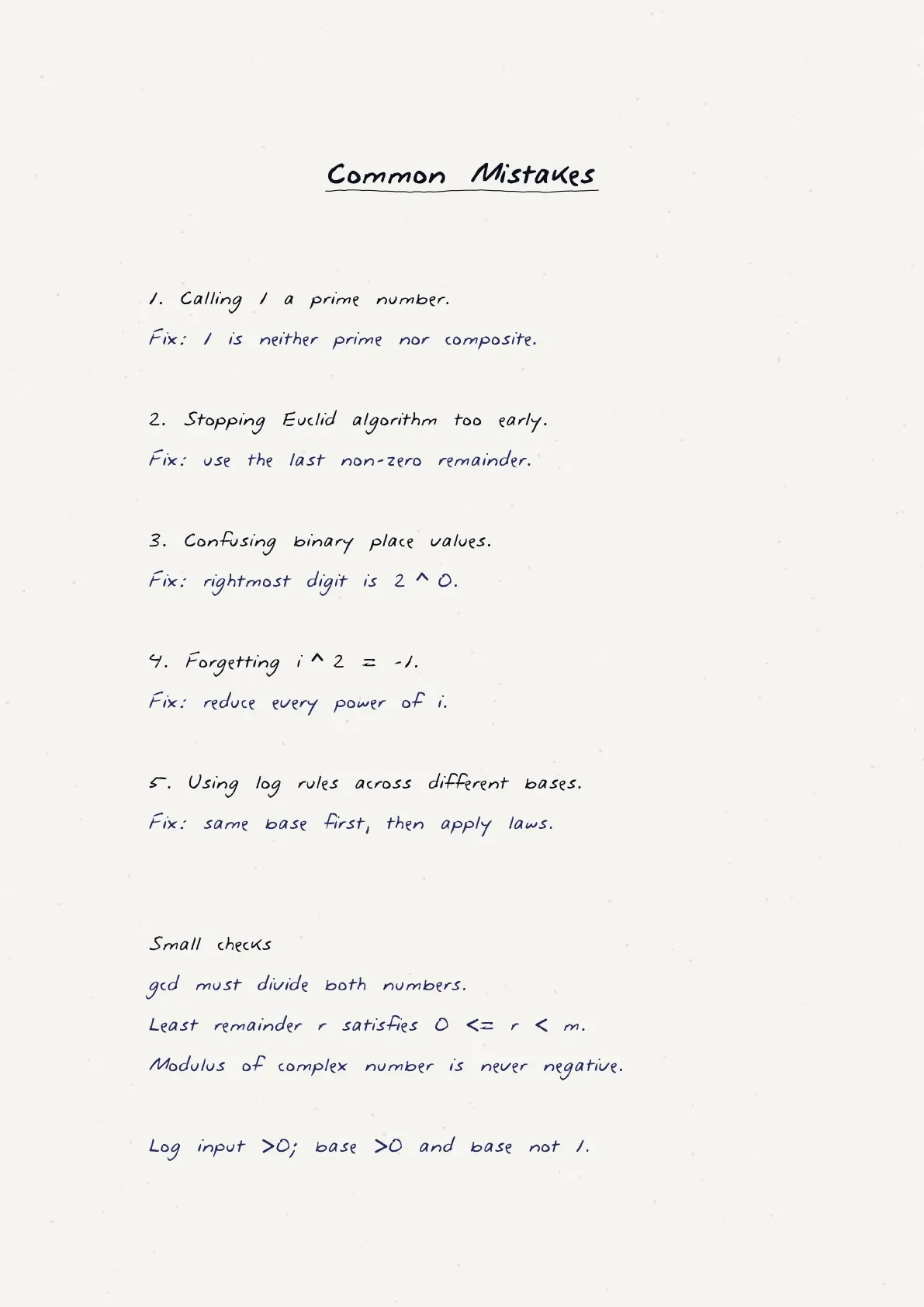
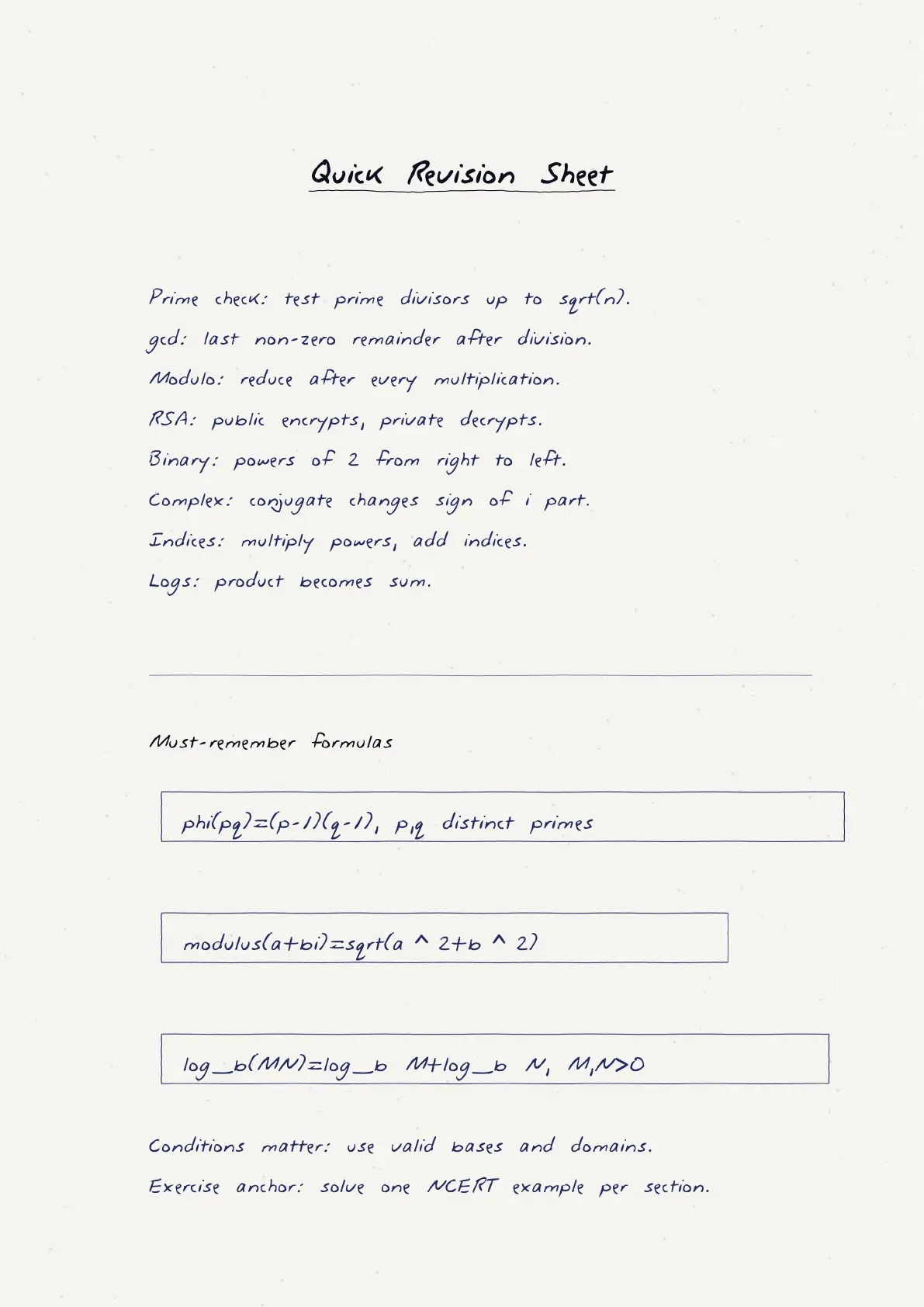
Student Feedback: More than 10,000 students using Collegedunia NCERT resources prefer Chapter 1 notes that separate conversion rules, prime tests and logarithm laws into small visual blocks. Students said the 2026-27 revision becomes easier when every formula is paired with one worked check.
- Best for rapid revision: one PDF covers prime factorisation, HCF, LCM, binary numbers, complex numbers, indices and logarithms.
- Aligned to 2026-27: the notes follow the current Class 11 Applied Mathematics scope for Numbers and Quantification.
- Practice ready: examples highlight where students usually lose marks in signs, base conversion and log simplification.
What Class 11 Applied Mathematics Chapter 1 Covers
Numbers and Quantification is the foundation chapter for Class 11 Applied Mathematics. It connects familiar arithmetic with precise mathematical language, so students can handle later chapters that use percentages, growth rates, matrices, statistics and financial mathematics. The handwritten notes begin with natural numbers, whole numbers, integers and rational numbers, then move towards prime numbers and divisibility. This order matters because every later calculation depends on knowing whether a number can be split, reduced, compared or rewritten in another form.
The chapter also introduces quantification, which means describing a situation with the right numerical measure. Students see this in binary numbers, complex numbers, logarithmic scales and modular arithmetic. A small error in notation can change the meaning, so the notes keep definitions, formulas and examples close together. Revision tip: whenever a formula appears, write one example below it before moving to the next rule.
| Block | Main skill | Quick check |
|---|---|---|
| Prime numbers | Testing divisibility and factorisation | Try prime divisors only up to the square root |
| HCF and LCM | Using prime powers correctly | HCF takes common lowest powers, LCM takes highest powers |
| Binary numbers | Converting between base 2 and base 10 | Read place values from right to left |
| Complex numbers | Working with real and imaginary parts | Use i2 = -1 |
| Indices and logarithms | Simplifying powers and logs | Apply rules only when bases or arguments allow it |
Numbers and Quantification Quick Revision
Source: PW Commerce Wallah Class 11 on YouTube
Prime Numbers, HCF and LCM in Handwritten Form
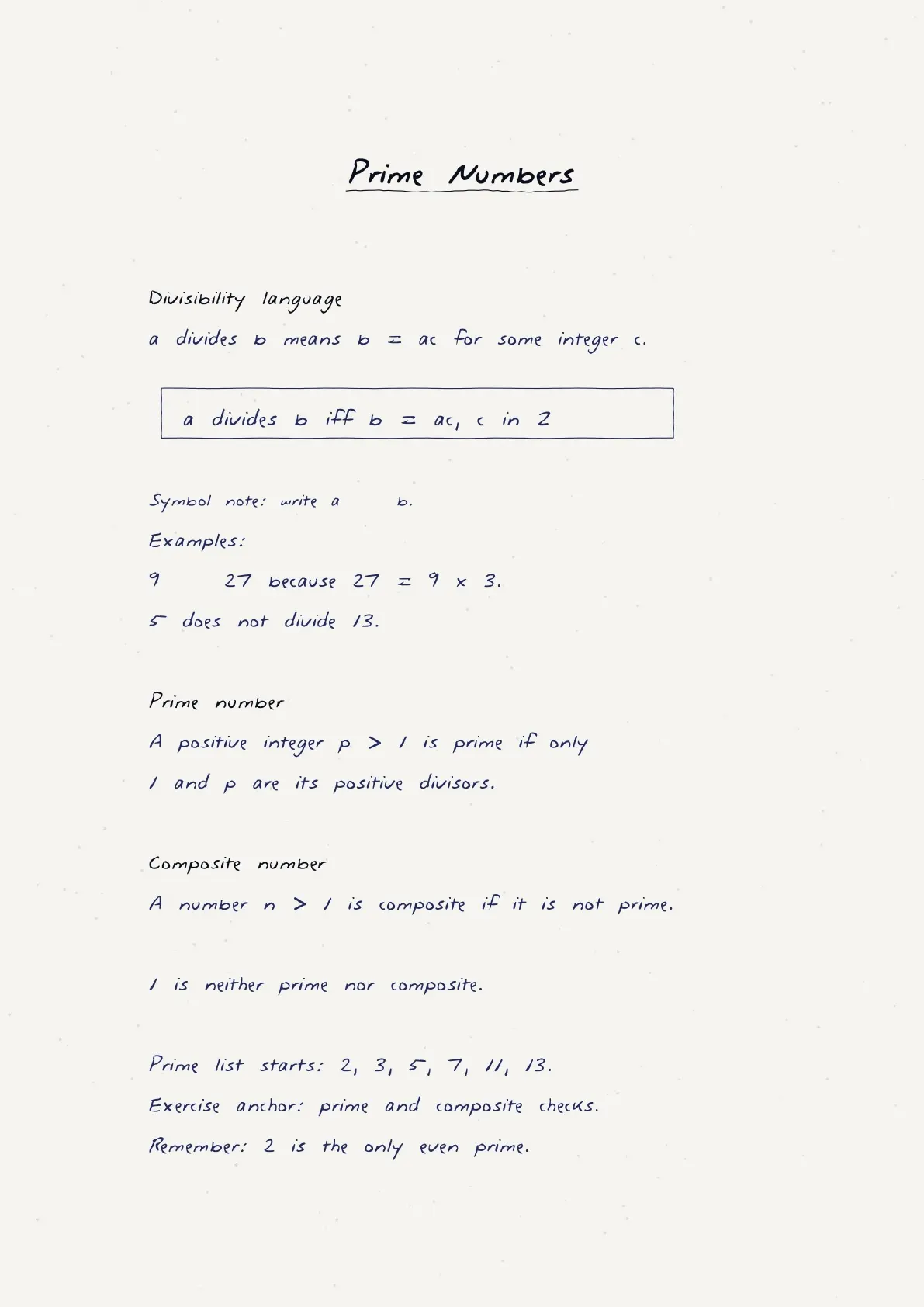
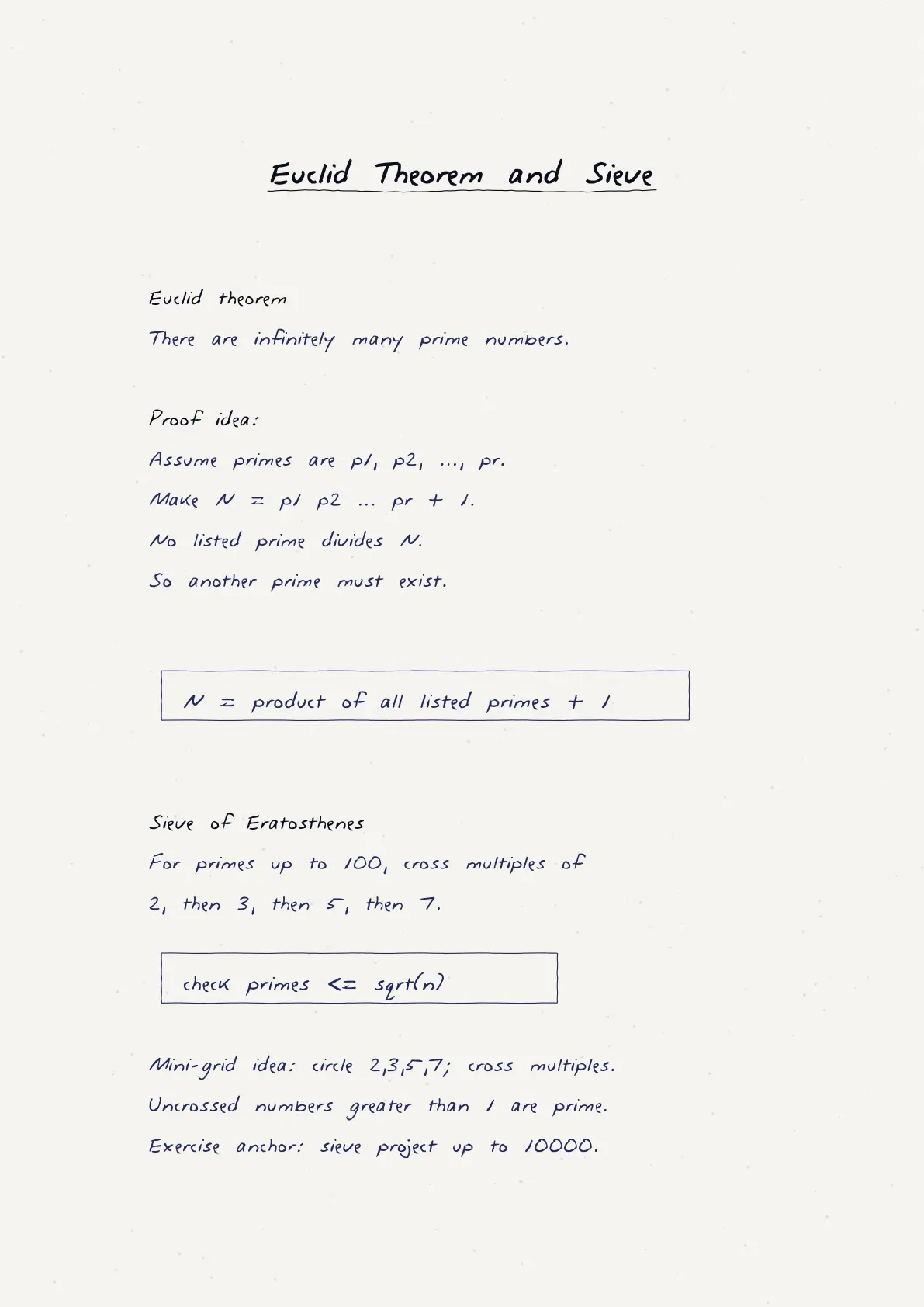
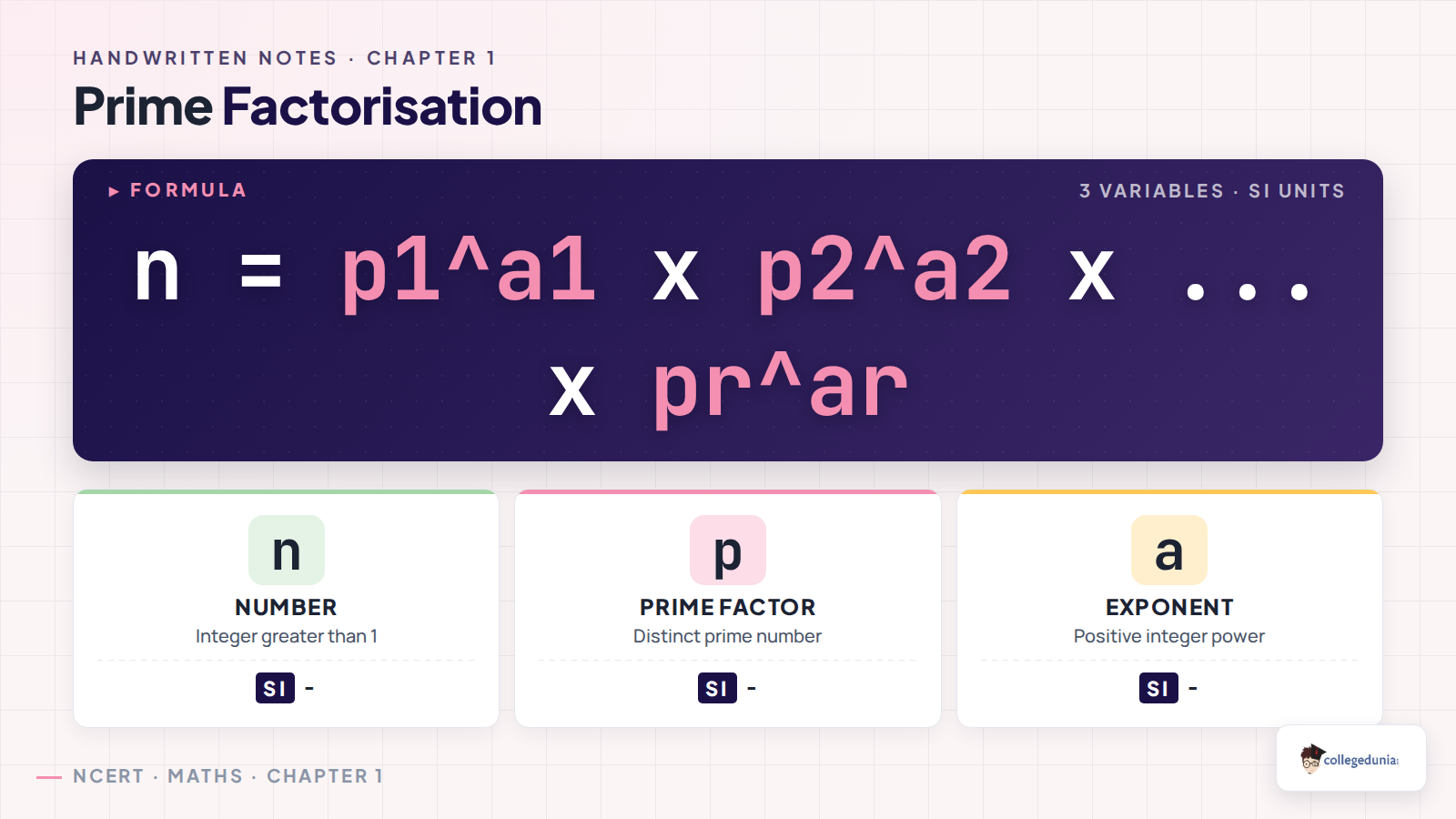
The first revision block helps students distinguish prime numbers, composite numbers, factors and multiples. A prime number has exactly two factors: 1 and itself. The number 1 is not prime because it has only one factor. This small detail is tested often because many students include 1 in prime lists by habit. The clean method is to test divisibility by 2, 3, 5, 7, 11 and the next primes only until the square of the prime is greater than the number being tested.
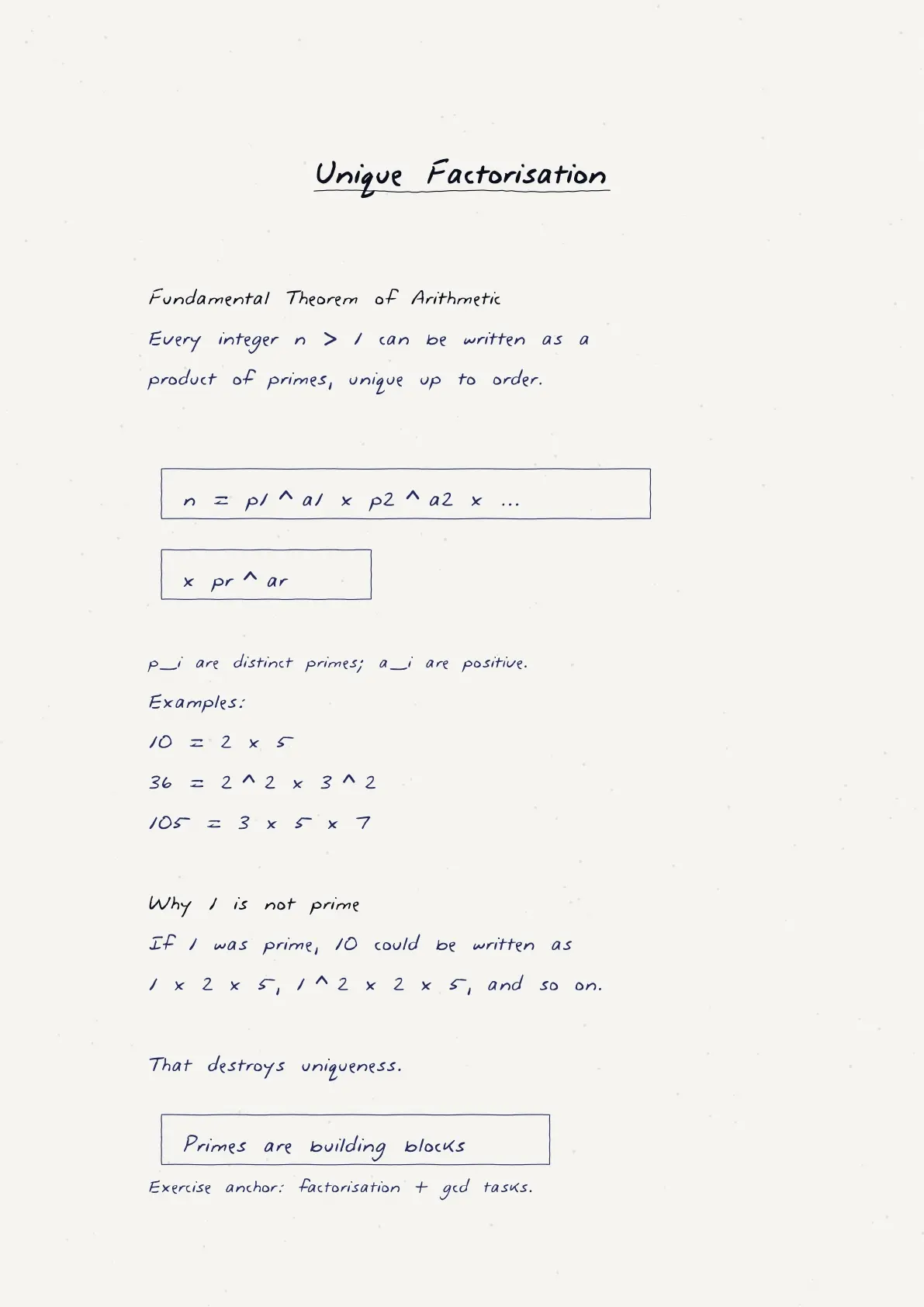
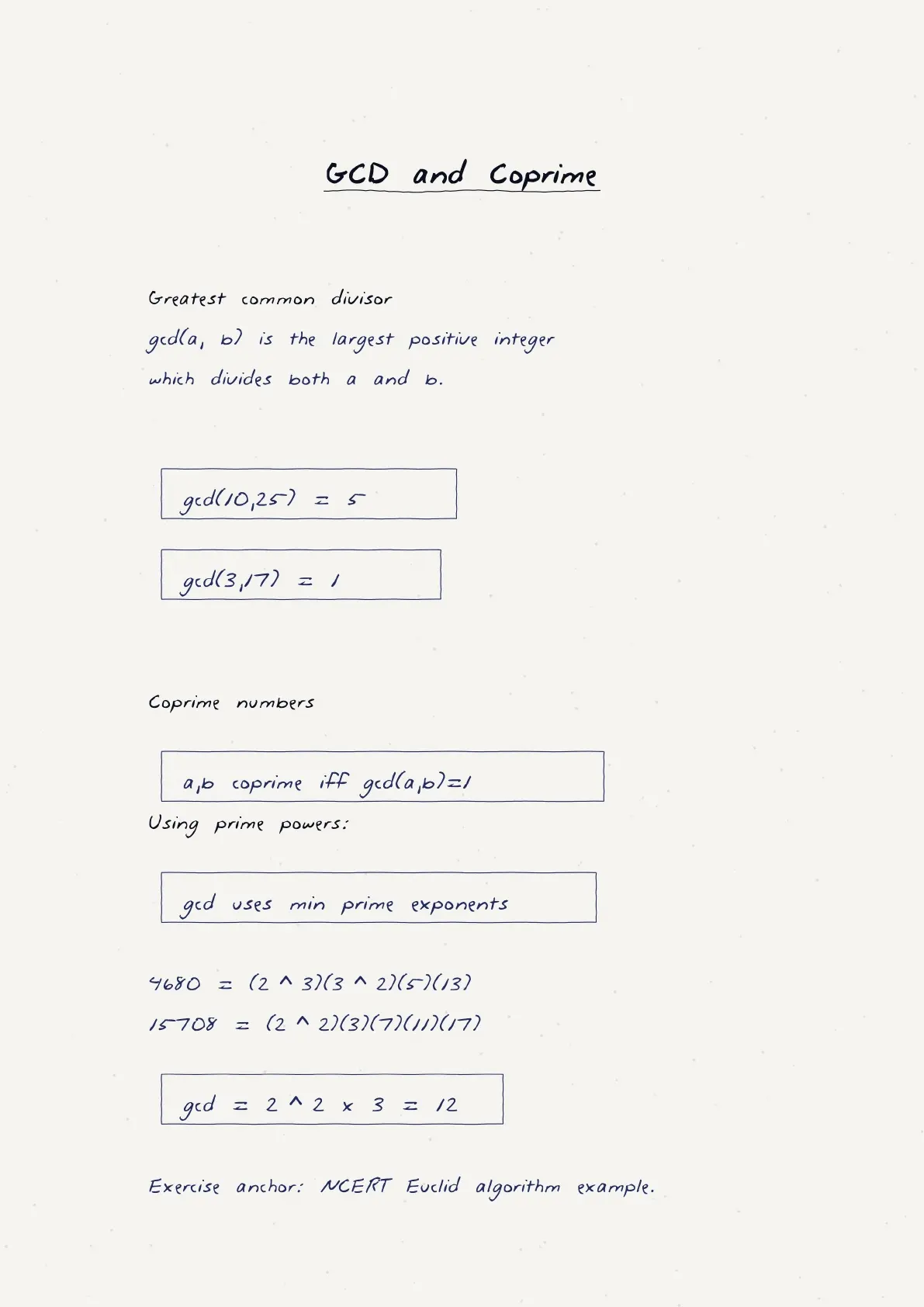
For HCF and LCM, the notes use the prime factorisation method because it is visual and reliable. In prime factor form, the HCF is built from common prime factors with their lowest powers. The LCM is built from all prime factors with their highest powers. This one comparison table prevents most mistakes in word problems.
- HCF cue: common factors, lowest powers.
- LCM cue: all factors, highest powers.
- Sanity check: HCF is never greater than the smallest given number, and LCM is never smaller than the largest given number.
Binary Numbers and Base Conversion Notes
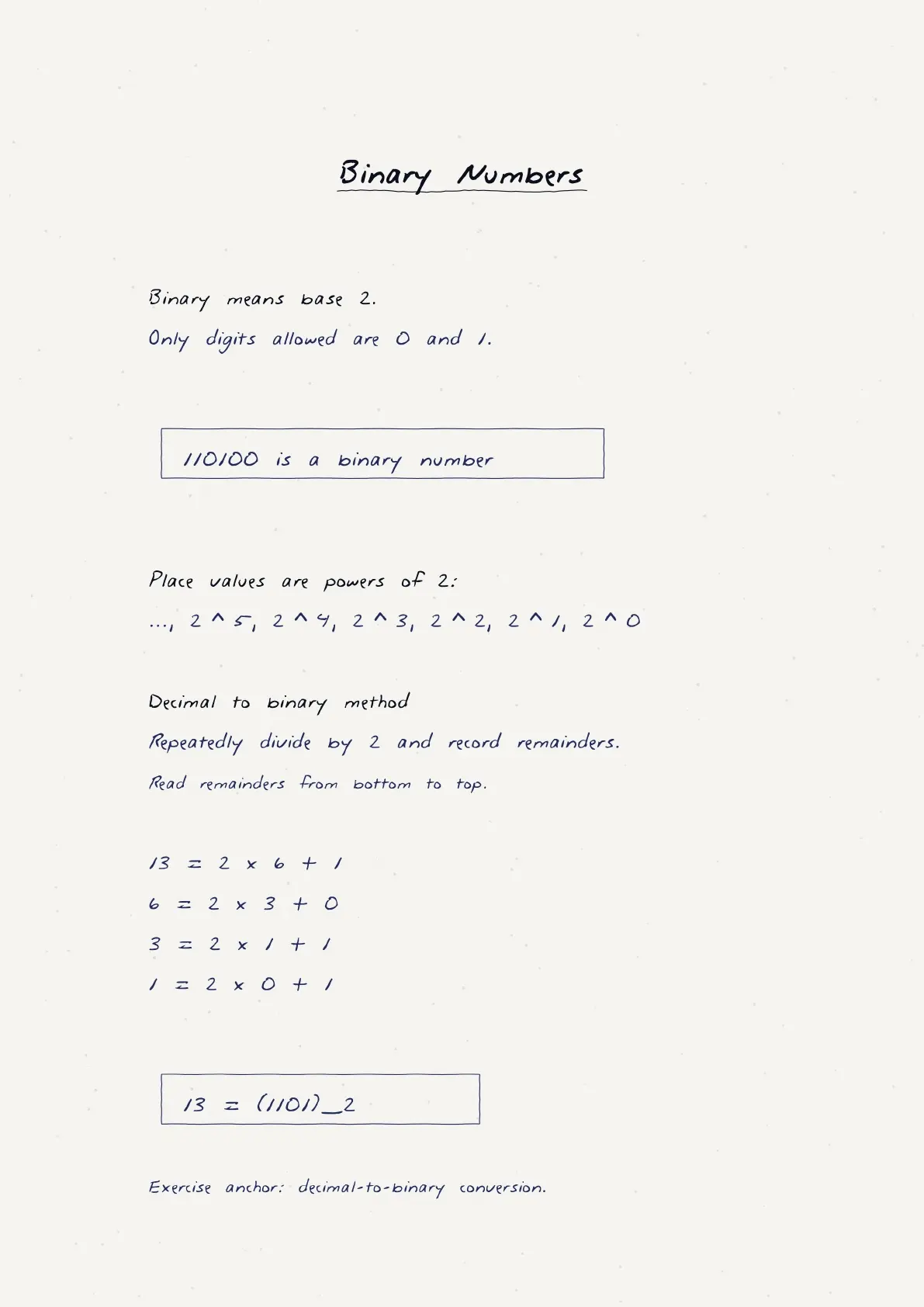
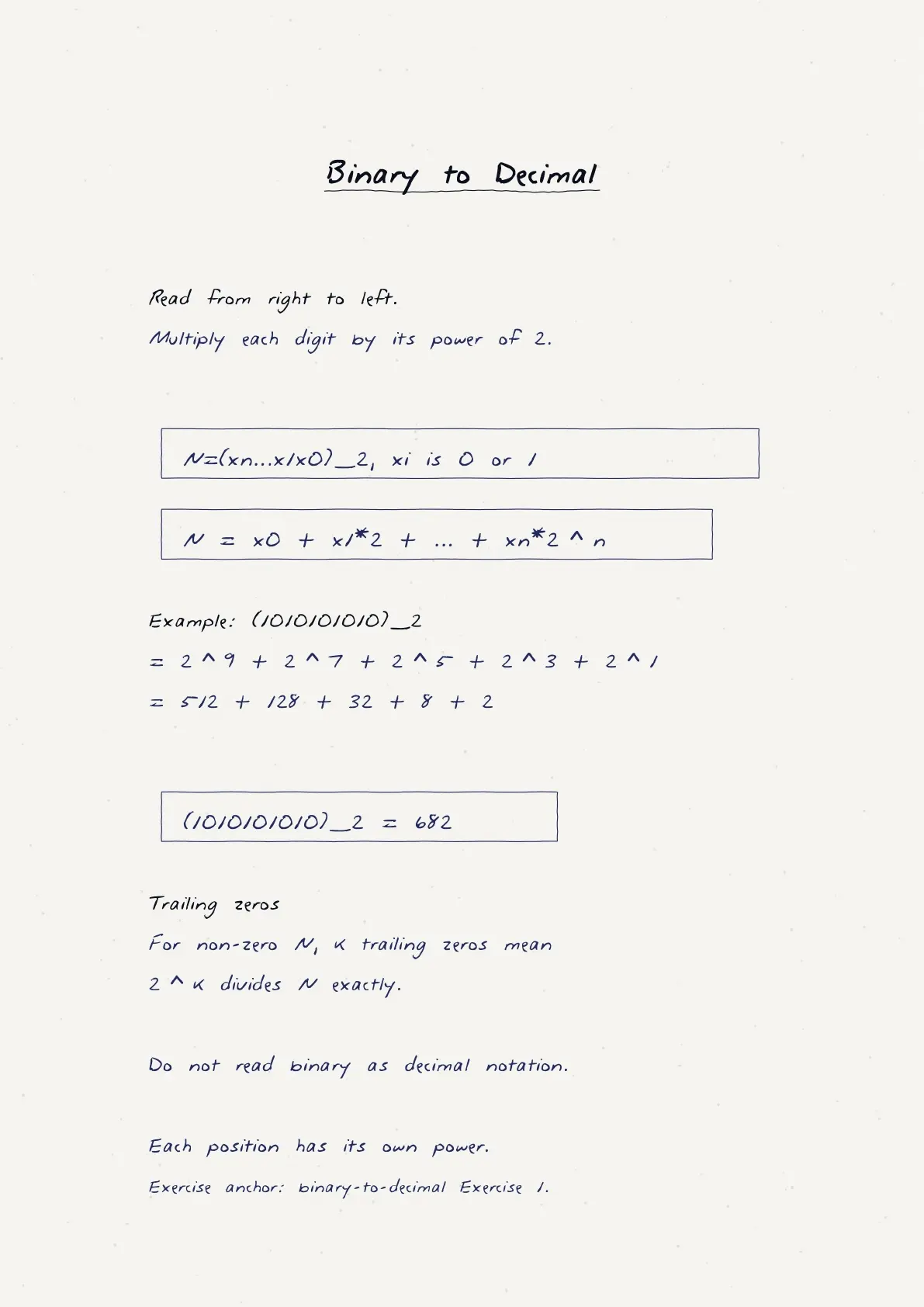
Binary numbers use only two digits, 0 and 1. Each place is a power of 2, so students must read the expansion from the rightmost digit. For example, the rightmost digit carries place value 20, then 21, 22, 23 and so on. The handwritten notes show decimal to binary conversion through repeated division by 2, and binary to decimal conversion through place-value addition.
The most useful habit is to write the powers of 2 as a header row before converting. This turns a long-looking binary number into a simple selection problem: keep the powers under the 1s and ignore the powers under the 0s. For decimal to binary conversion, the remainders are read from bottom to top, not top to bottom.
| Conversion type | Method | Common mistake |
|---|---|---|
| Binary to decimal | Add powers of 2 under the digit 1 | Starting place value at 2 instead of 1 |
| Decimal to binary | Divide by 2 repeatedly and read remainders upward | Reading remainders in the original order |
| Binary addition | Use 1 + 1 = 10 in base 2 | Carrying like decimal addition |
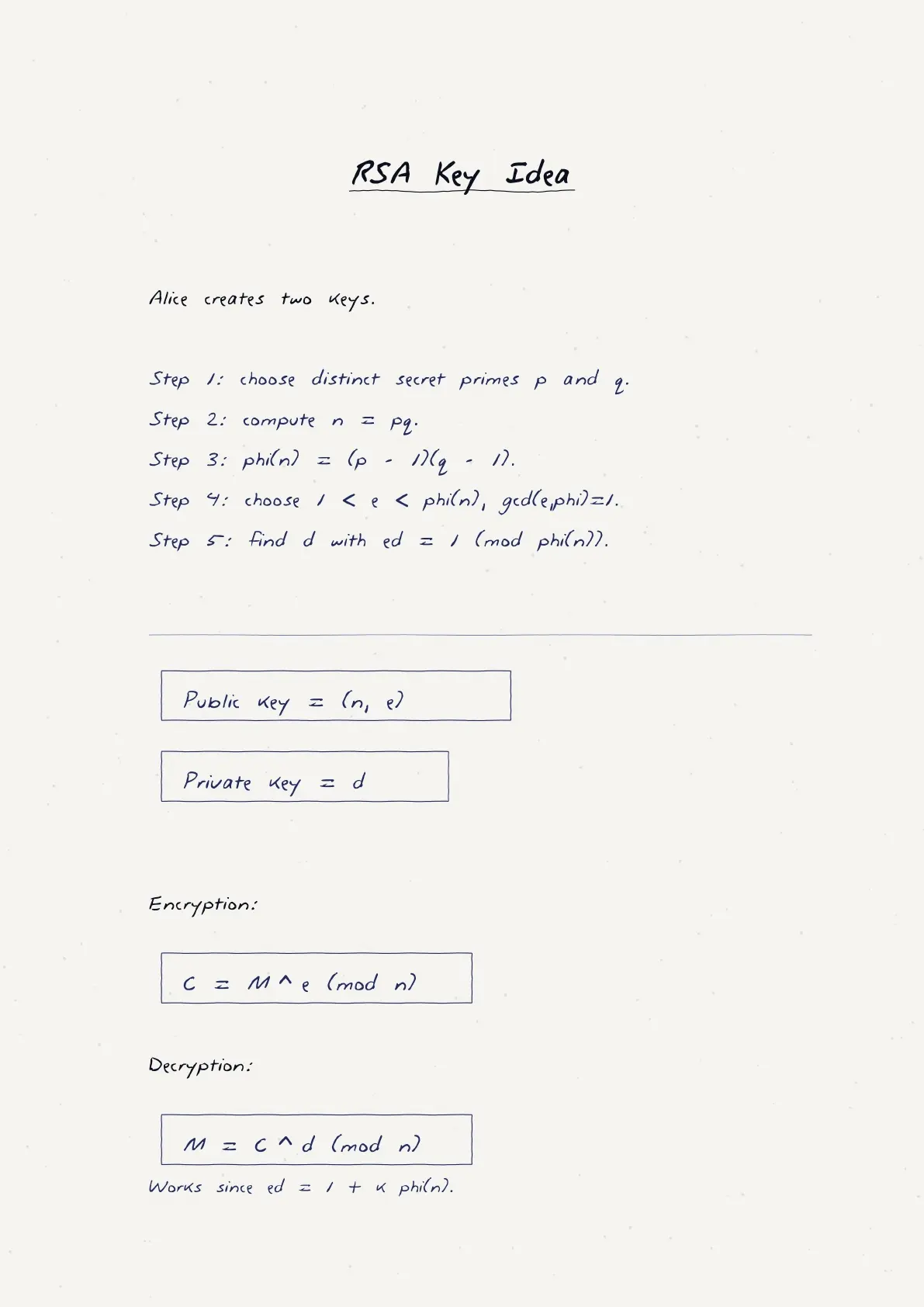
Modular Arithmetic and RSA Ideas in Chapter 1
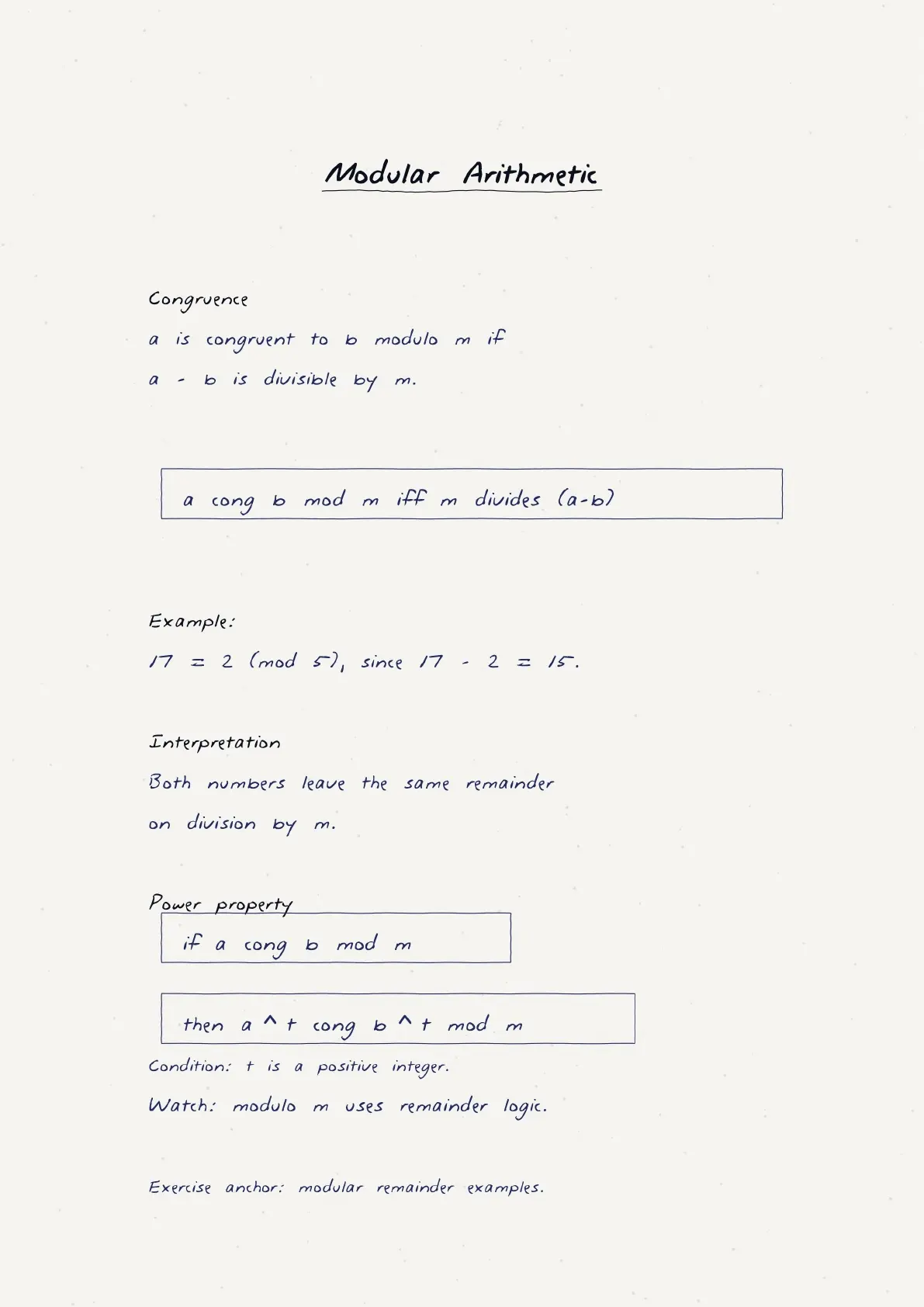
Modular arithmetic is a compact way to study remainders. When a number is reduced modulo m, only its remainder after division by m matters. This idea looks new at first, but it is the same thinking students use when they say a clock wraps after 12 hours. The notes present congruence notation carefully: two numbers are congruent modulo m when they leave the same remainder on division by m.
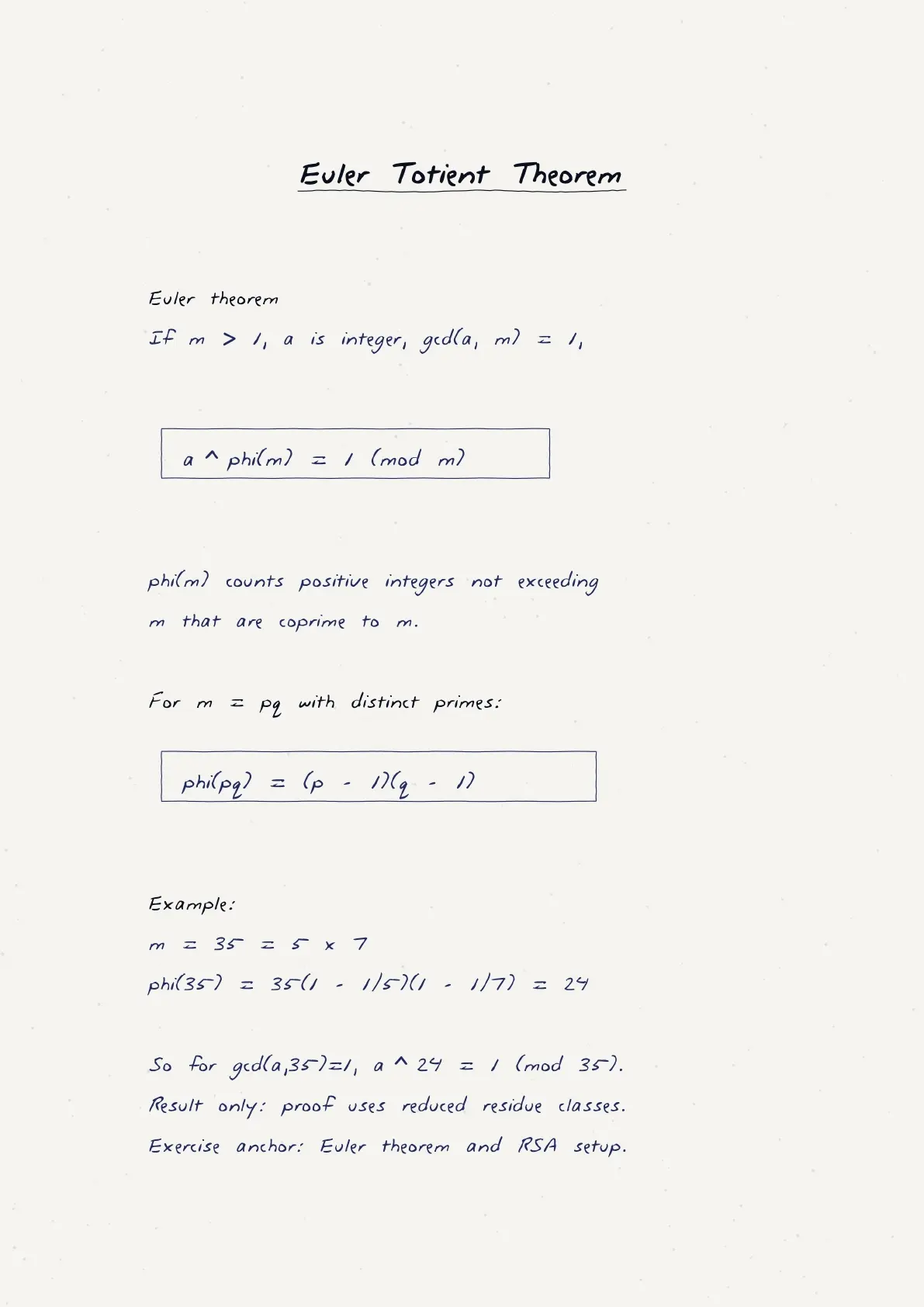
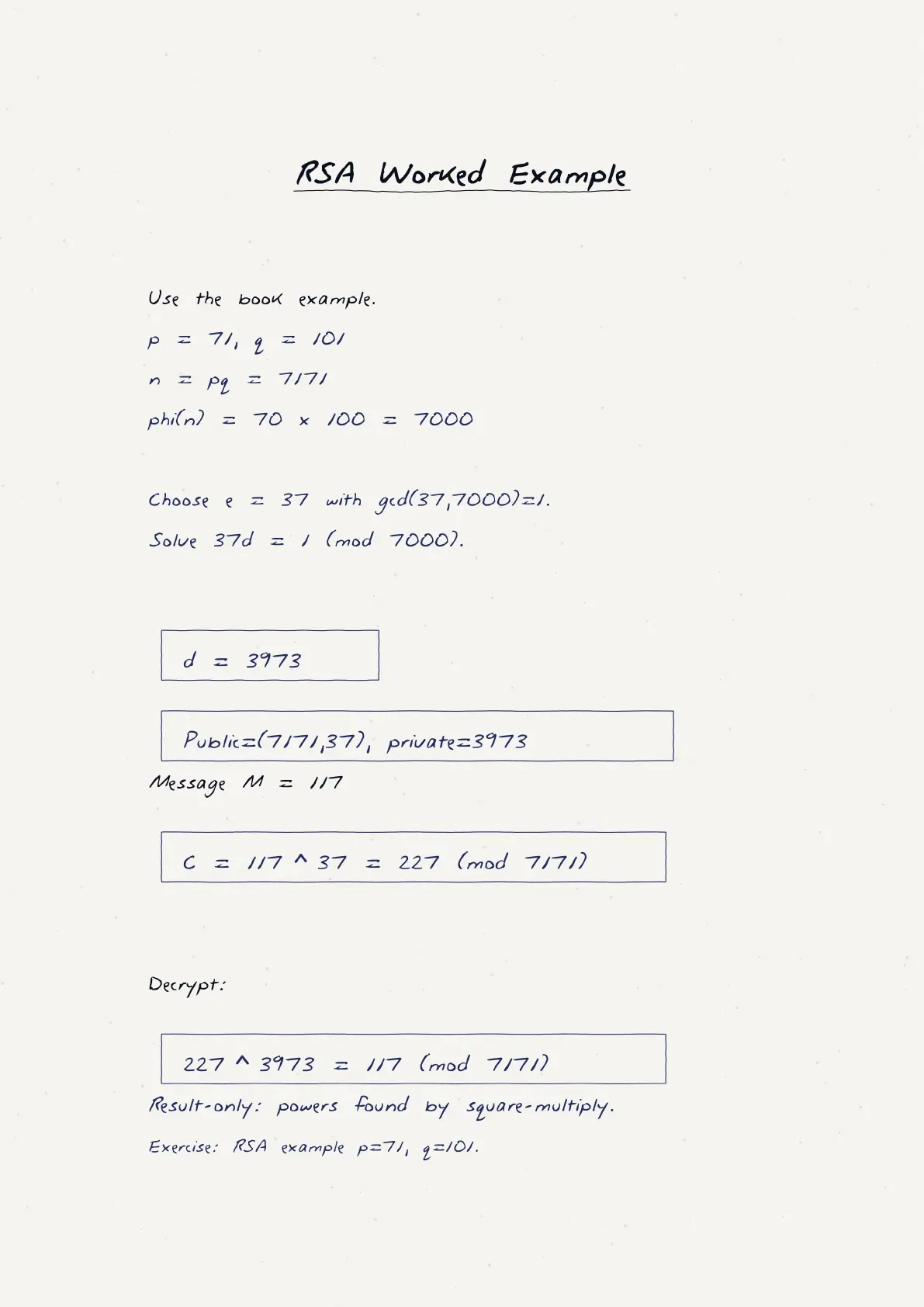
This block also introduces the basic number-theory idea behind simple encryption examples. Students do not need advanced cryptography here. They need to know how primes, remainders and powers work together. The strongest revision path is to practise one small numerical example and check every remainder line.
Notebook checkpoint for modular arithmetic
After each congruence line, divide the original number by the modulus and confirm the remainder. This small check prevents incorrect RSA-style tables from carrying forward.
Complex Numbers, Argand Plane and Conjugates
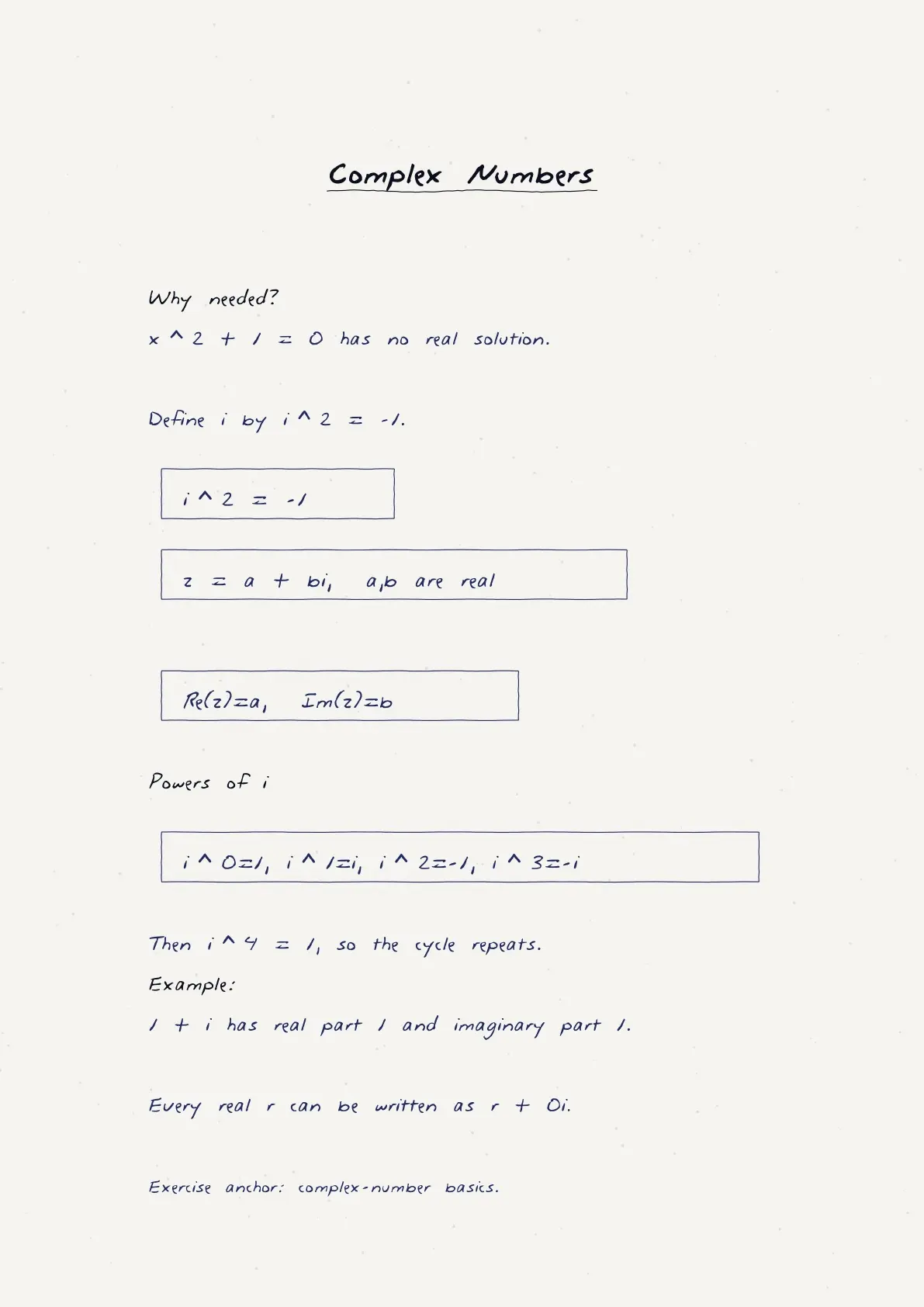
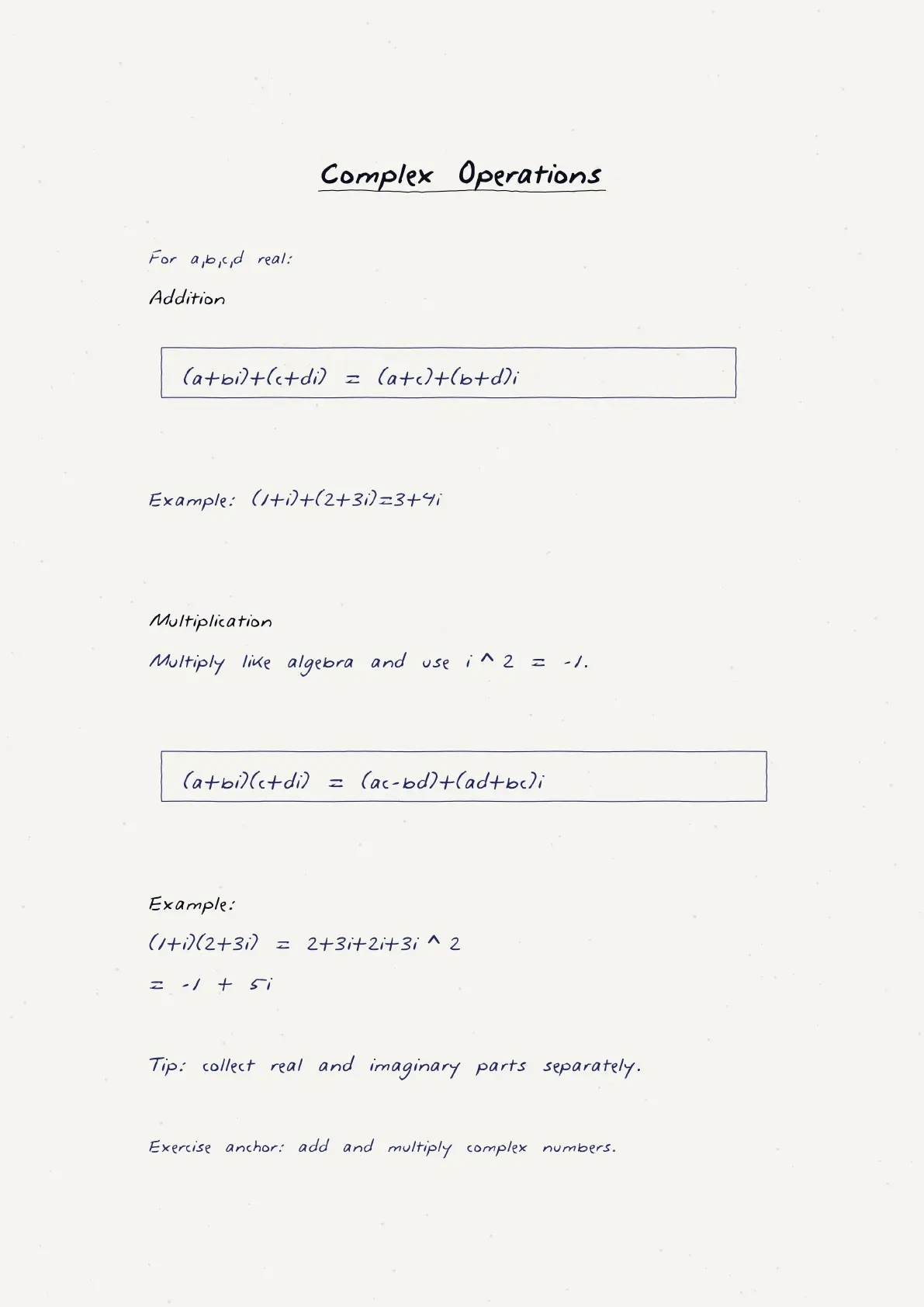
Complex numbers are written in the form a + bi, where a is the real part and b is the imaginary part. The key identity is i2 = -1. The handwritten notes separate addition, subtraction, multiplication and division so students can see which operations affect real and imaginary parts. For division, multiply numerator and denominator by the conjugate of the denominator.
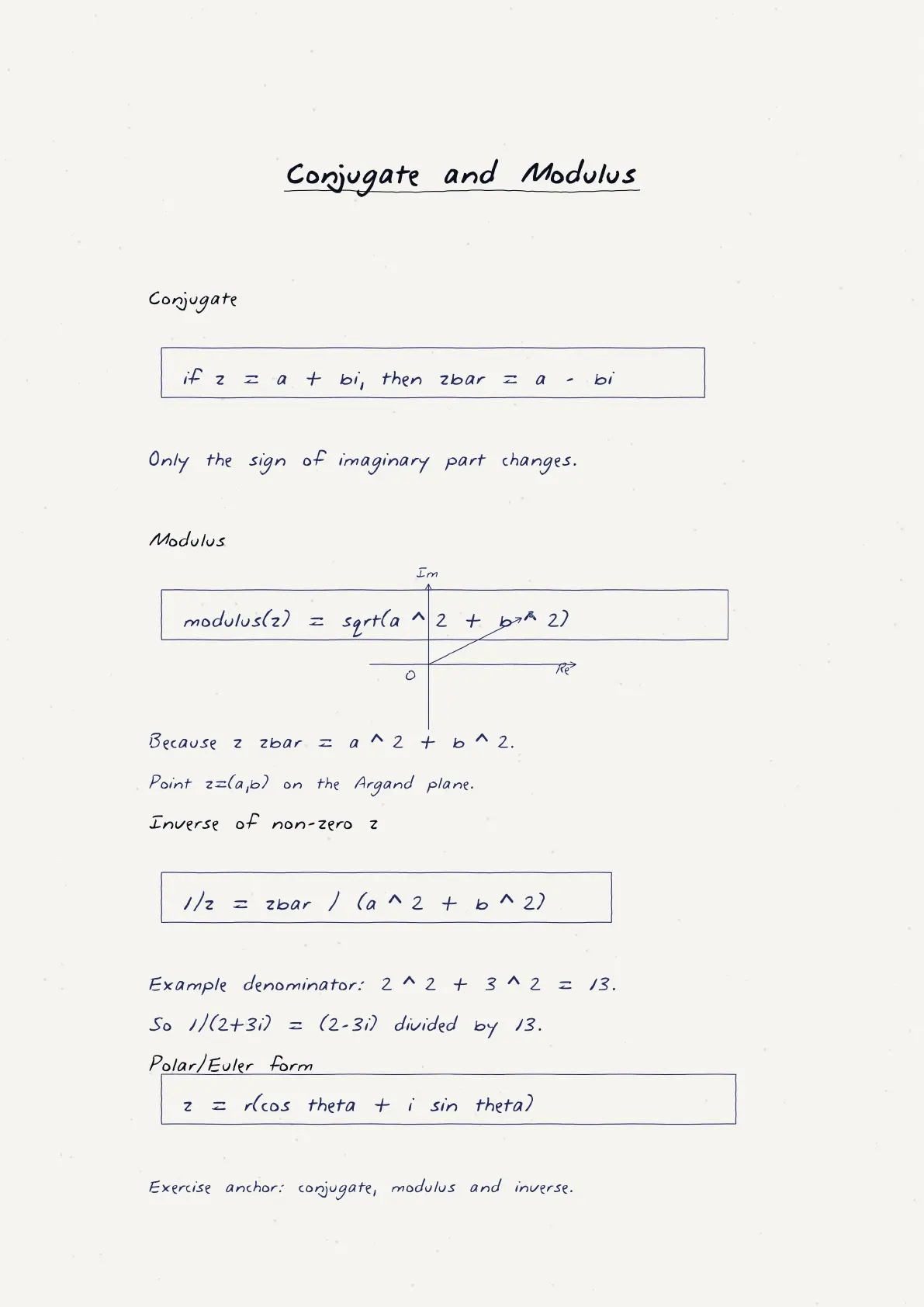
The Argand plane gives a visual meaning to complex numbers. The horizontal axis shows the real part and the vertical axis shows the imaginary part. The modulus of a + bi is the distance from the origin, equal to square root of a2 plus b2. The argument is the angle the line from the origin makes with the positive real axis. These notes keep the diagram and formula together so students do not memorise symbols without the picture.
- Conjugate: change the sign of the imaginary part only.
- Modulus: use square root of a2 plus b2.
- Division: multiply by the conjugate, then simplify using i2 = -1.
Indices and Logarithms for Quick Revision

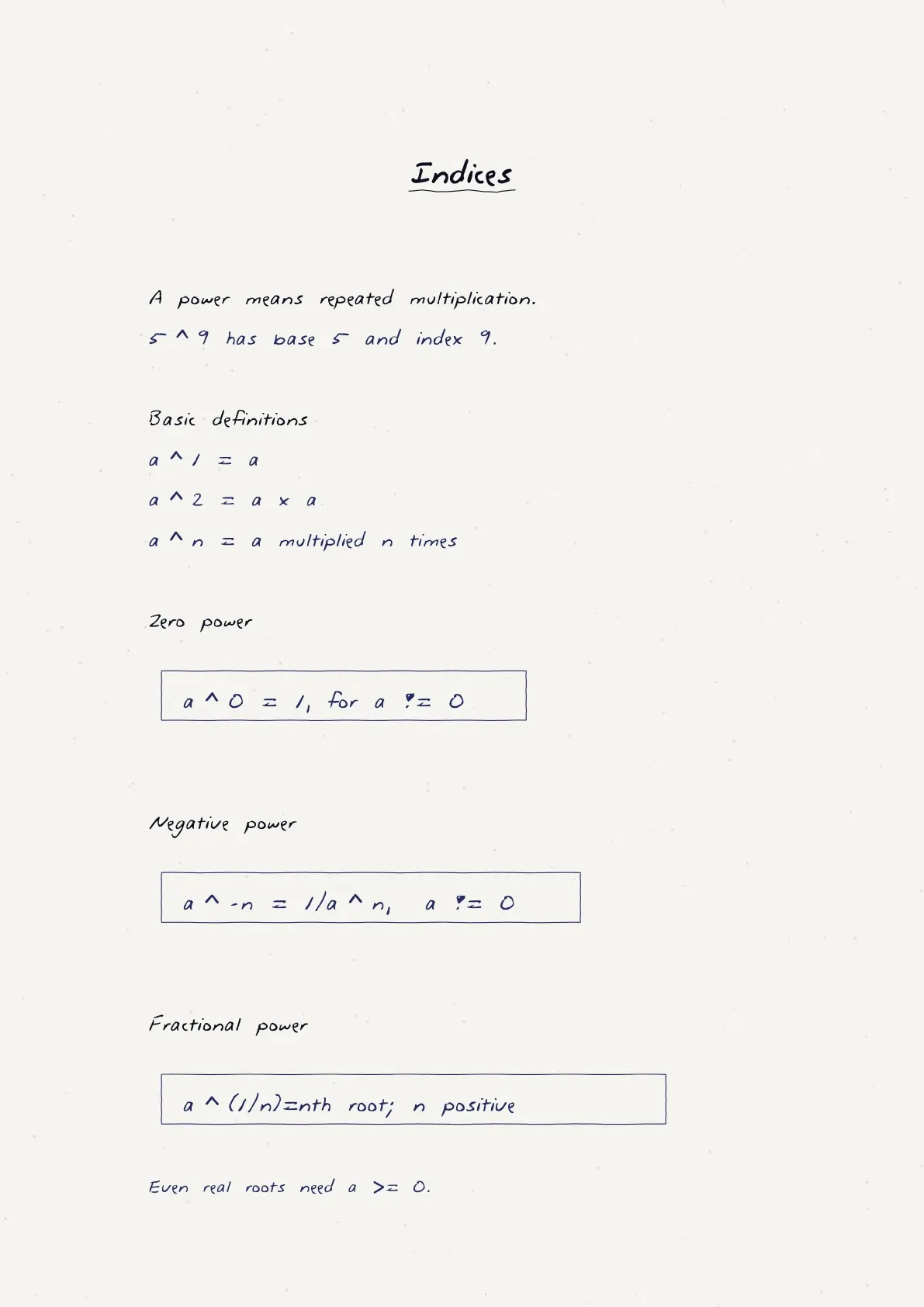
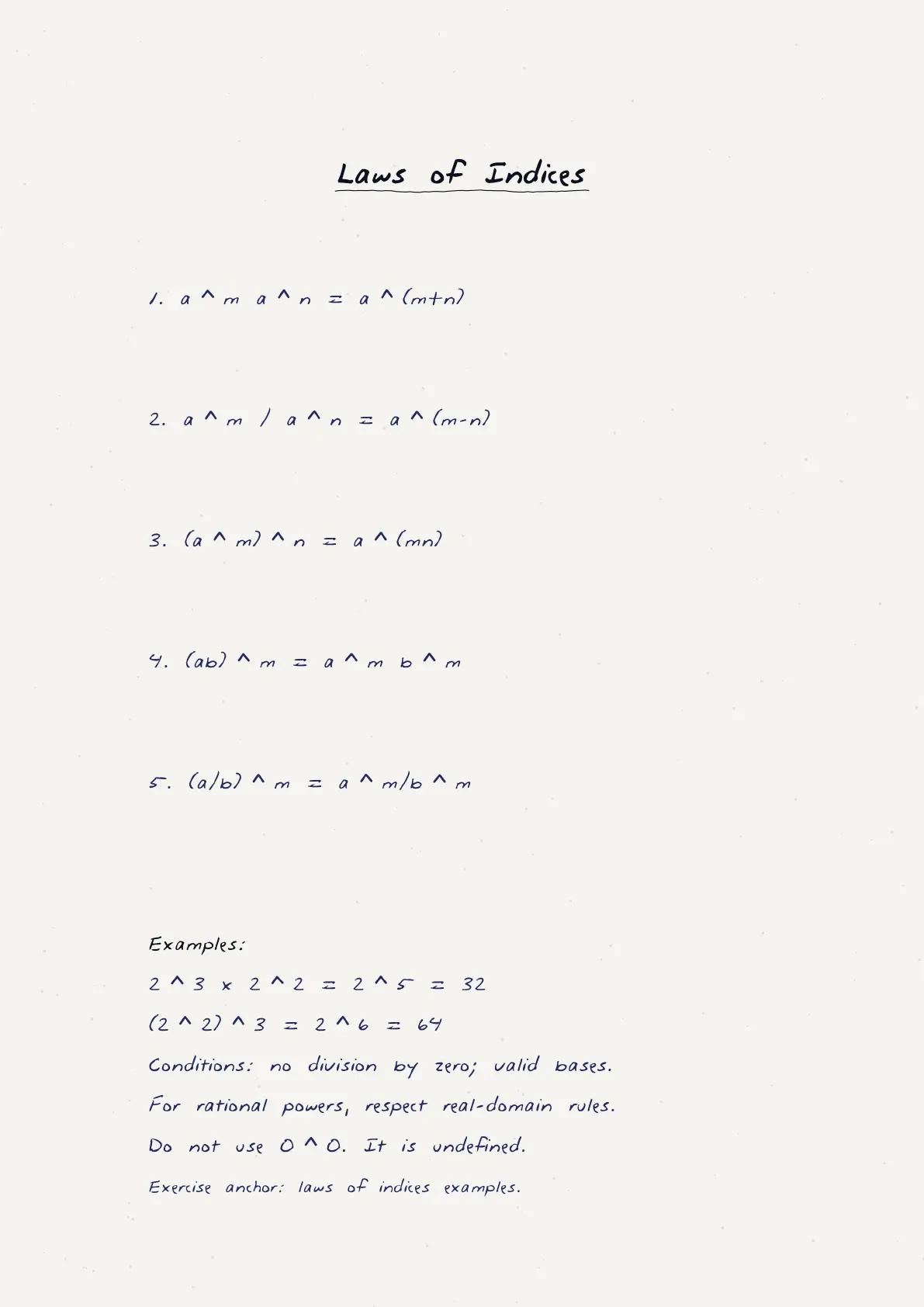
Indices and logarithms appear near the end of the chapter, but they are used across Applied Mathematics. The index laws work when the base conditions are respected. For the same base, multiplying powers means adding exponents, and dividing powers means subtracting exponents. A power raised to another power means multiplying exponents. The notes use side-by-side examples so students can compare each law with a non-example.
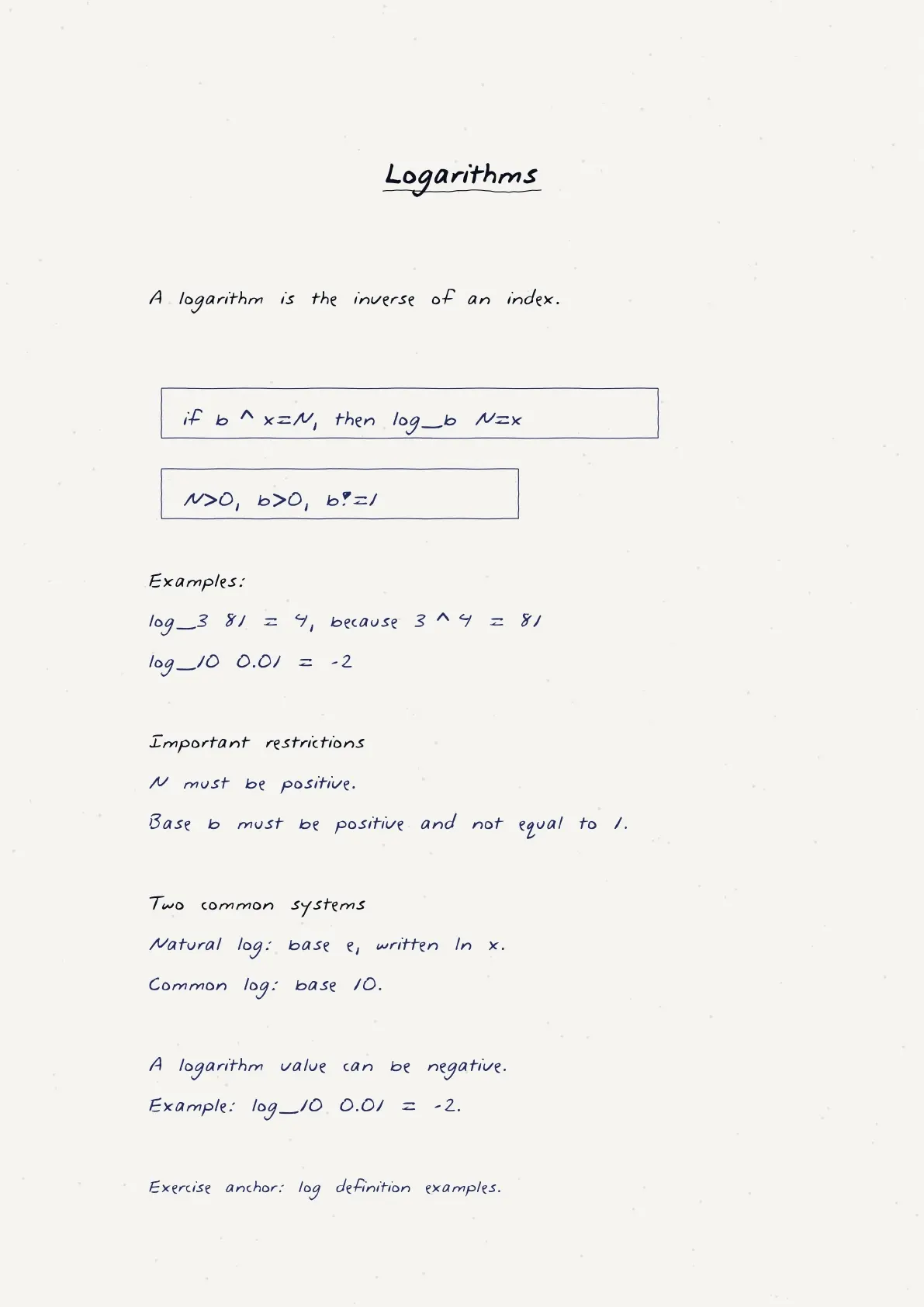
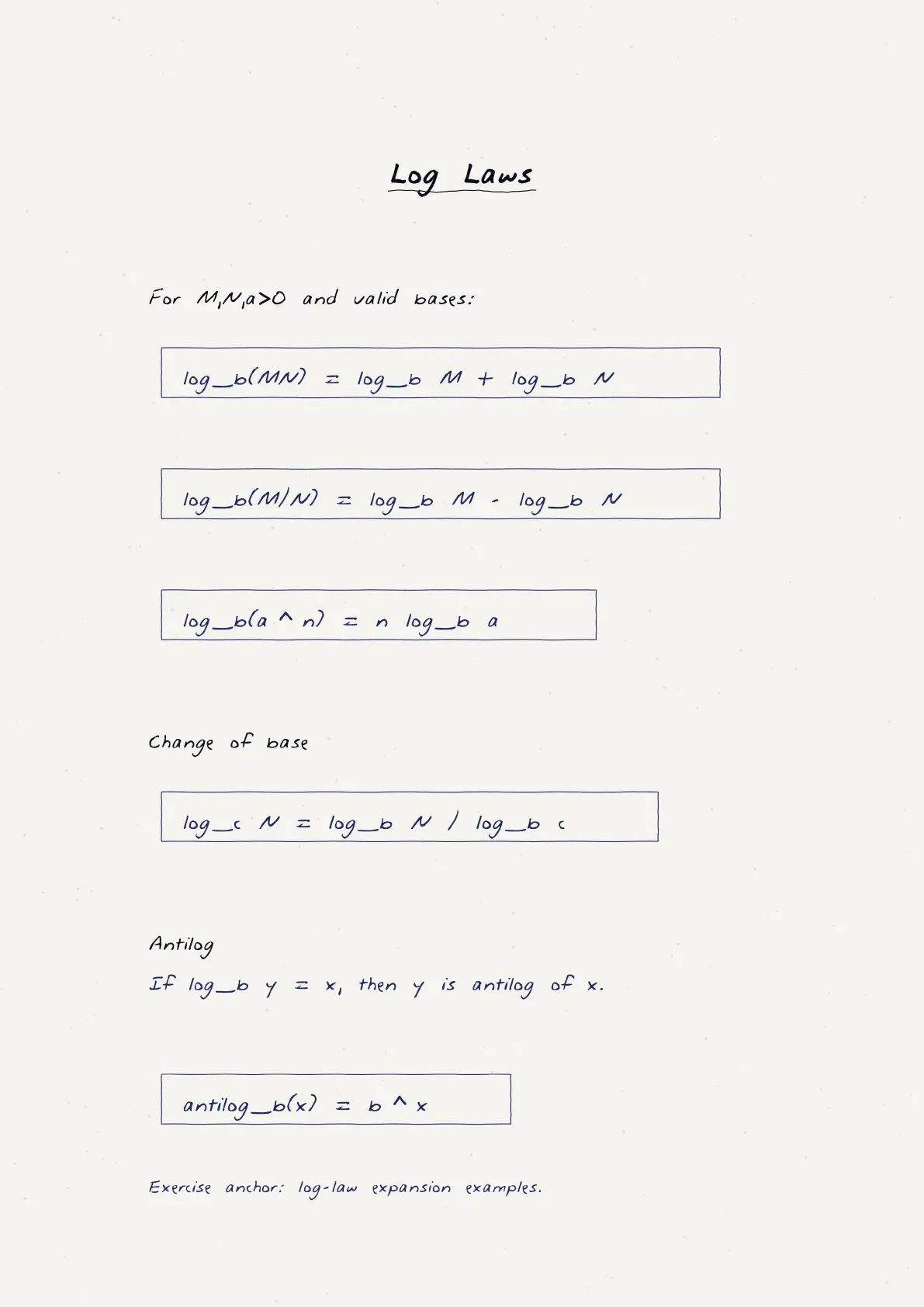
Logarithms reverse exponentiation. If ax = N, then log base a of N equals x. The common rules are product, quotient and power rules. The most frequent error is writing log of a sum as the sum of logs. That is not a valid rule. Students should write log(MN) = log M + log N, but never write log(M + N) in that form.
| Rule type | Safe form | Warning |
|---|---|---|
| Product | log(MN) = log M + log N | Works for multiplication, not addition |
| Quotient | log(M/N) = log M - log N | M and N must be positive |
| Power | log(Mr) = r log M | Do not move a coefficient unless it is an exponent |
| Index power | (am)n = amn | Multiply exponents, do not add them |
How to Use These Handwritten Notes Before Tests
Use the PDF in two passes. In the first pass, read each formula box and copy only the highlighted rule into your own notebook. In the second pass, solve the example below each rule without looking at the next line. If the answer does not match, mark the exact place where the setup changed. This is more useful than rereading the full page repeatedly.
For a one-hour revision session, spend 10 minutes on primes and HCF-LCM, 10 minutes on binary conversion, 15 minutes on modular arithmetic, 15 minutes on complex numbers, and 10 minutes on indices and logarithms. Before closing the PDF, write three danger points on a sticky note: 1 is not prime, i2 is negative, and log of a sum is not the sum of logs.
- For school tests: revise definitions first, then do short conversion drills.
- For homework: use the notes beside the NCERT book so the printed question wording stays visible.
- For final revision: focus on boxed checks and common mistakes instead of copying full solutions again.
Related Resources for Numbers and Quantification
| Resource | Use it for | Link |
|---|---|---|
| NCERT Book PDF | Official definitions, examples and printed exercises | Numbers and Quantification Class 11 NCERT Book PDF |
| NCERT Solutions | Step-by-step answers for exercise questions | Numbers and Quantification Class 11 NCERT Solutions |
| Notes | Clean theory recap before practice | Numbers and Quantification Class 11 Notes |
| Handwritten Notes | Visual formula revision and last-session recall | Numbers and Quantification Class 11 Handwritten Notes |
Class 11 Applied Mathematics Handwritten Notes for All Chapters
Numbers and Quantification Class 11 Applied Mathematics FAQs
Ques. What is included in Class 11 Applied Mathematics Chapter 1 Numbers and Quantification handwritten notes?
Ans. The notes include number systems, prime numbers, HCF, LCM, binary conversion, modular arithmetic, complex numbers, indices, logarithms and quick revision checks for the 2026-27 syllabus.
Ques. Are these handwritten notes useful before school tests?
Ans. Yes. They are designed for fast revision because formulas, common mistakes and worked checkpoints are grouped visually, making them useful before class tests and homework review.
Ques. What is the most common mistake in this chapter?
Ans. Common mistakes include treating 1 as a prime number, reading binary remainders in the wrong order, writing i2 as positive 1 and applying logarithm rules to sums.
Ques. How should students revise binary numbers from these notes?
Ans. Students should write powers of 2 above the digits, add only the powers below 1s for binary to decimal conversion, and read remainders upward for decimal to binary conversion.



Comments