




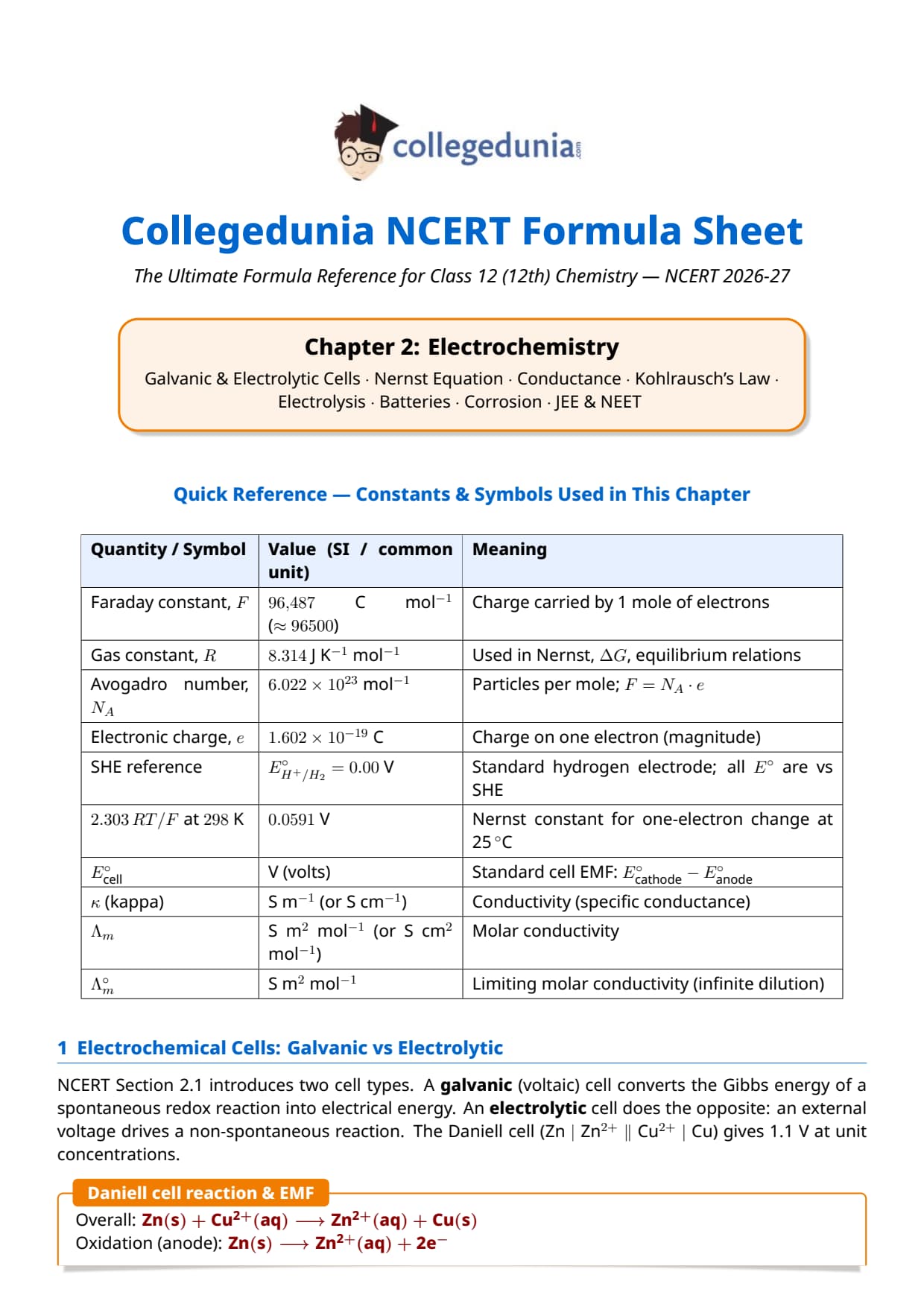
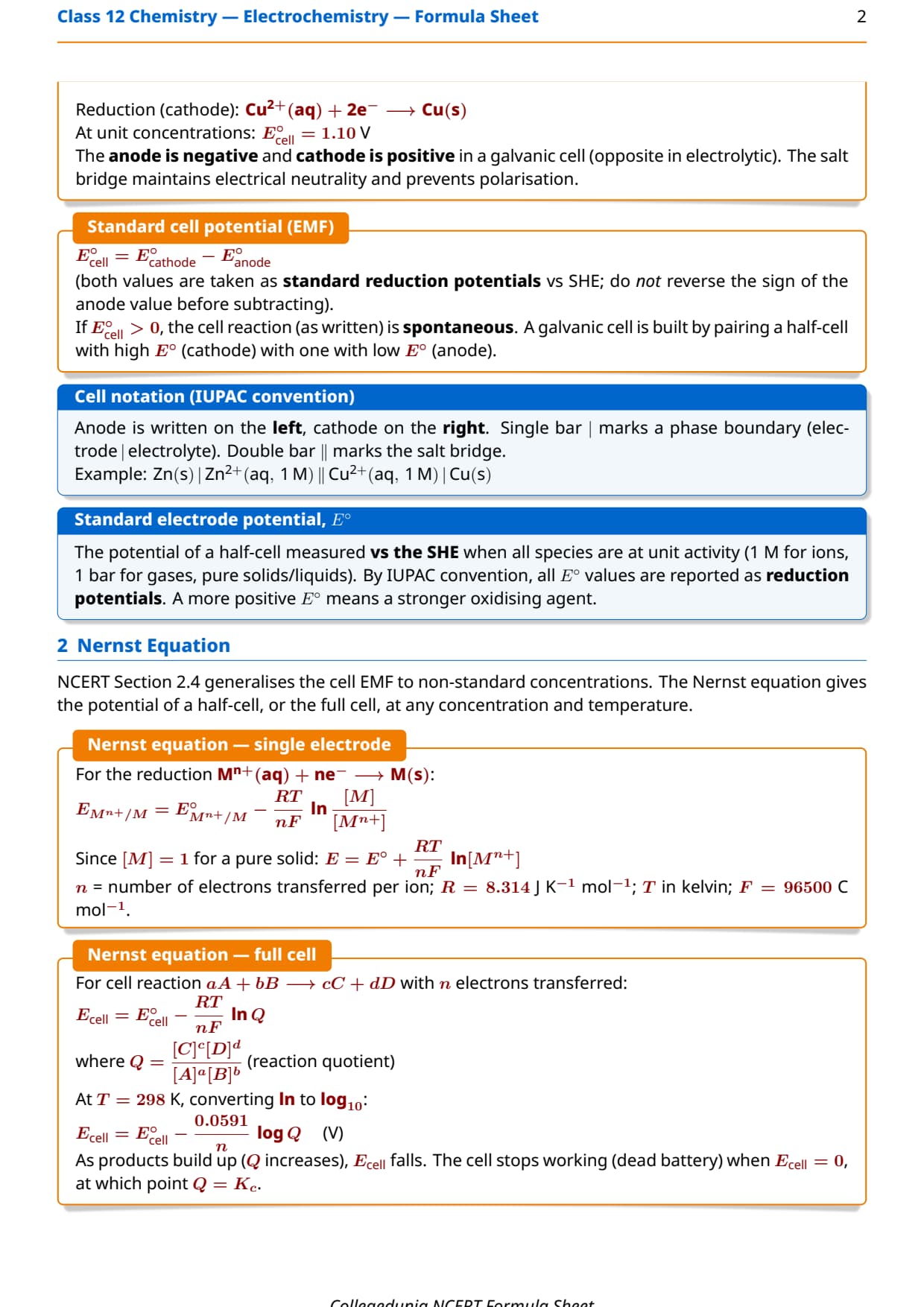
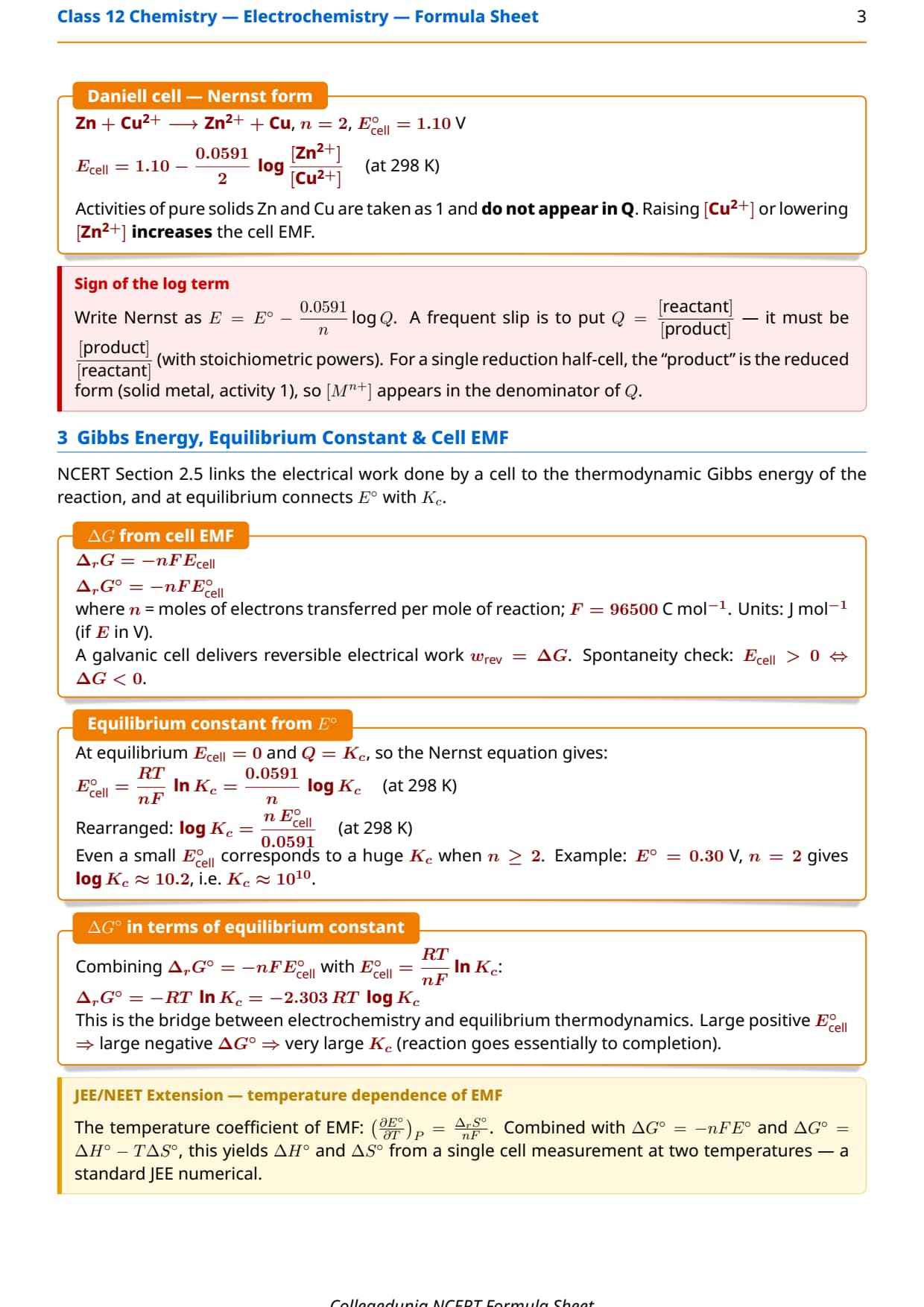
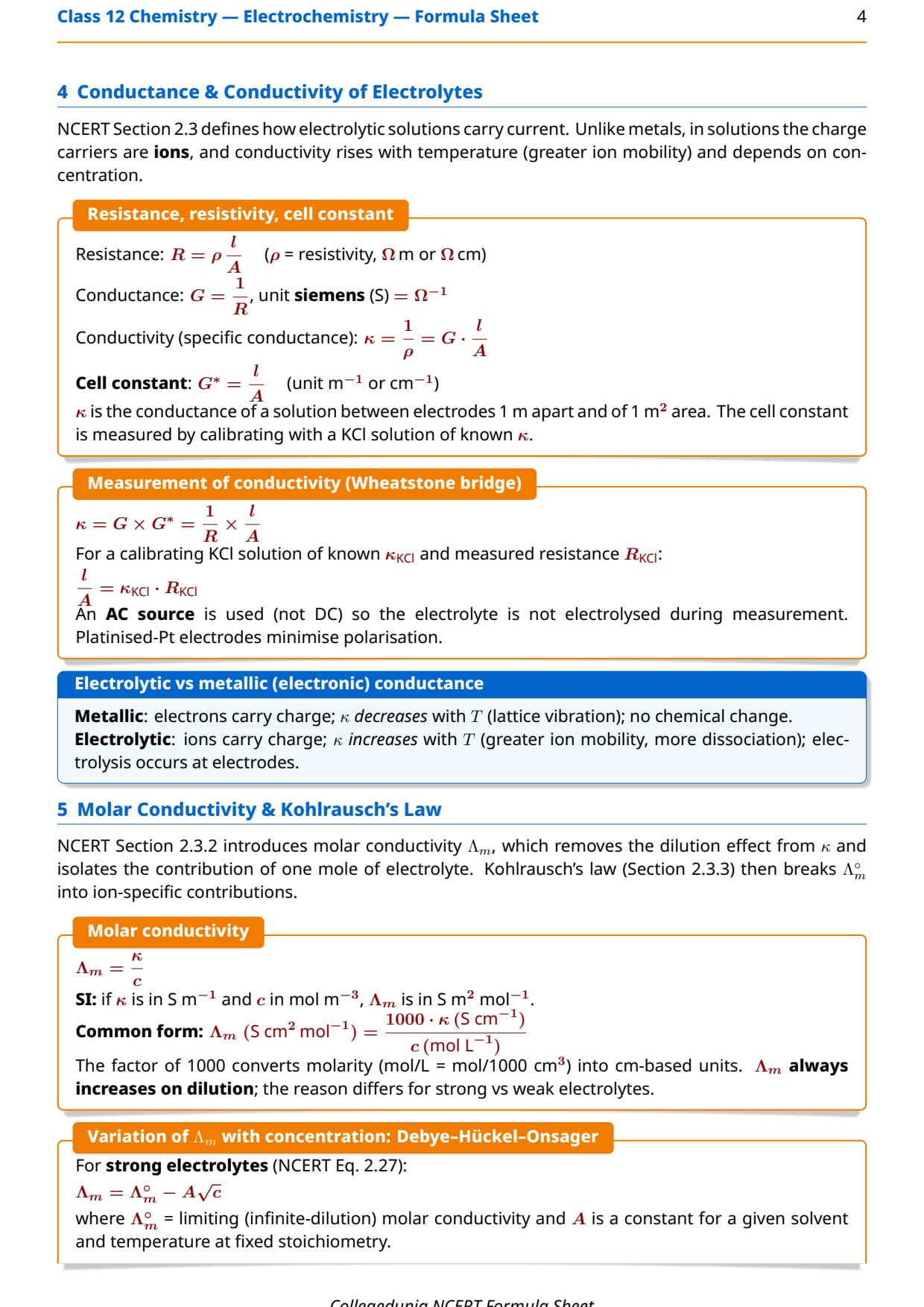
Class 12 Chemistry Chapter 2 Electrochemistry is one of the highest-yield Physical Chemistry chapters. This page hosts the Formula Sheet PDF and a master formula table mapped to the 2026-27 NCERT.
- CBSE Weightage: 7–9 marks (averaged across the last 5 board papers)
- JEE Main Weightage: 4–5% (2–3 questions per shift)
- NEET Weightage: 2–3 questions per year
This Formula Sheet is curated by subject experts, mapped to the 2026-27 NCERT, and refined against the last five years of CBSE Board, JEE Main and NEET papers.
Also Check:
Why Electrochemistry Carries the Heaviest Weight in Physical Chemistry 12th Std
Electrochemistry gives roughly 3 JEE Main questions per shift and a 5-mark CBSE long answer almost every year, built on the Nernst equation, molar conductivity or Faraday's laws. Correct formula recall closes most numericals in under three minutes.
Electrochemistry Class 12 Chemistry Explained
Source: Magnet Brains on YouTube
How will Collegedunia's Electrochemistry Formula Sheet Help You with Class 12 Chemistry Chapter 2?
The sheet groups the EMF, conductance and electrolysis blocks in NCERT chapter order.
- 2026-27 NCERT alignment: every equation matches the current print, including the sign convention for E∘cell .
- Units column: every formula carries its SI unit, so you never drop the 1-mark unit slip CBSE penalises.
- Section reference: each formula shows its NCERT section number for quick derivation lookup.
Memory Mnemonics for Electrochemistry Formulas Class 12 Chemistry
Use these in the last 24 hours before any exam.
Electrochemistry Class 12 Chemistry: Complete Formula Reference
Every Electrochemistry formula in the 2026-27 NCERT, grouped by sub-topic, for Boards, JEE and NEET.
| Concept | Formula | Units | NCERT Ref | Common Use |
|---|---|---|---|---|
| A. EMF and Electrode Potentials | ||||
| Cell EMF (standard) | E∘cell = E∘cathode - E∘anode | V | 2.2 | Direction check |
| Gibbs energy | Δ G∘ = -nFE∘cell | J mol-1 | 2.4 | Feasibility |
| Equilibrium constant | log Kc = nE∘cell0.0591 at 298 K | - | 2.4 | Kc from EMF |
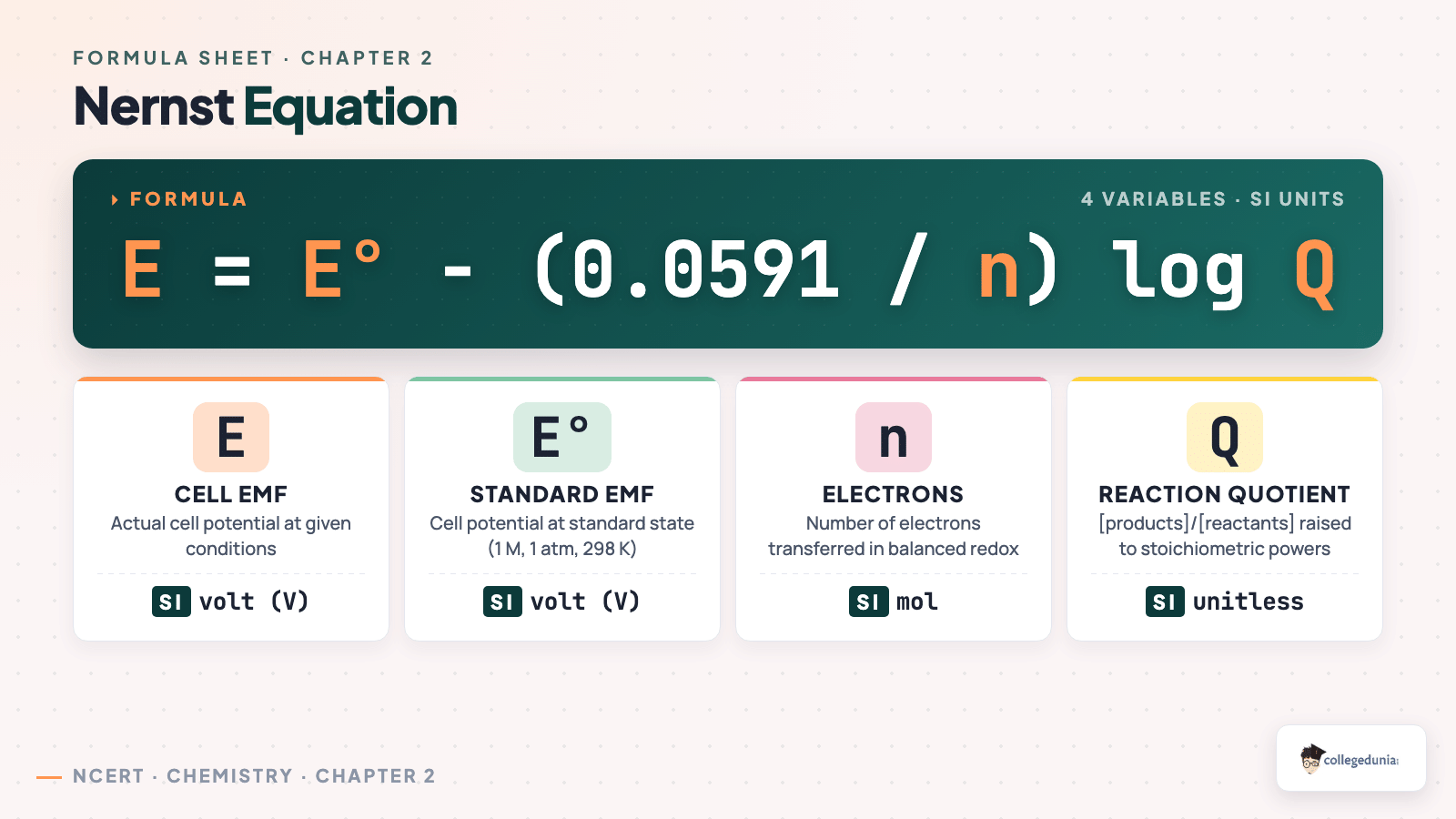
| Nernst (full cell) | Ecell = E∘cell - 0.0591nlog Q at 298 K | V | 2.3 | Non-standard EMF |
| Nernst (electrode) | EMn+/M = E∘Mn+/M + 0.0591nlog[Mn+] | V | 2.3 | Half-cell potential |
| Concentration cell | Ecell = 0.0591nlog C2C1 , C2>C1 | V | 2.3 | Two concentrations |
| B. Conductance and Resistance | ||||
| Resistance | R = ρ lA | Ω | 2.5 | Cell setup |
| Conductance | G = 1R | S | 2.5 | Reciprocal of R |
| Conductivity | κ = 1ρ = G · lA | S m-1 | 2.5 | Material property |
| Cell constant | G* = lA = κ R | m-1 | 2.5 | Conductance cell |
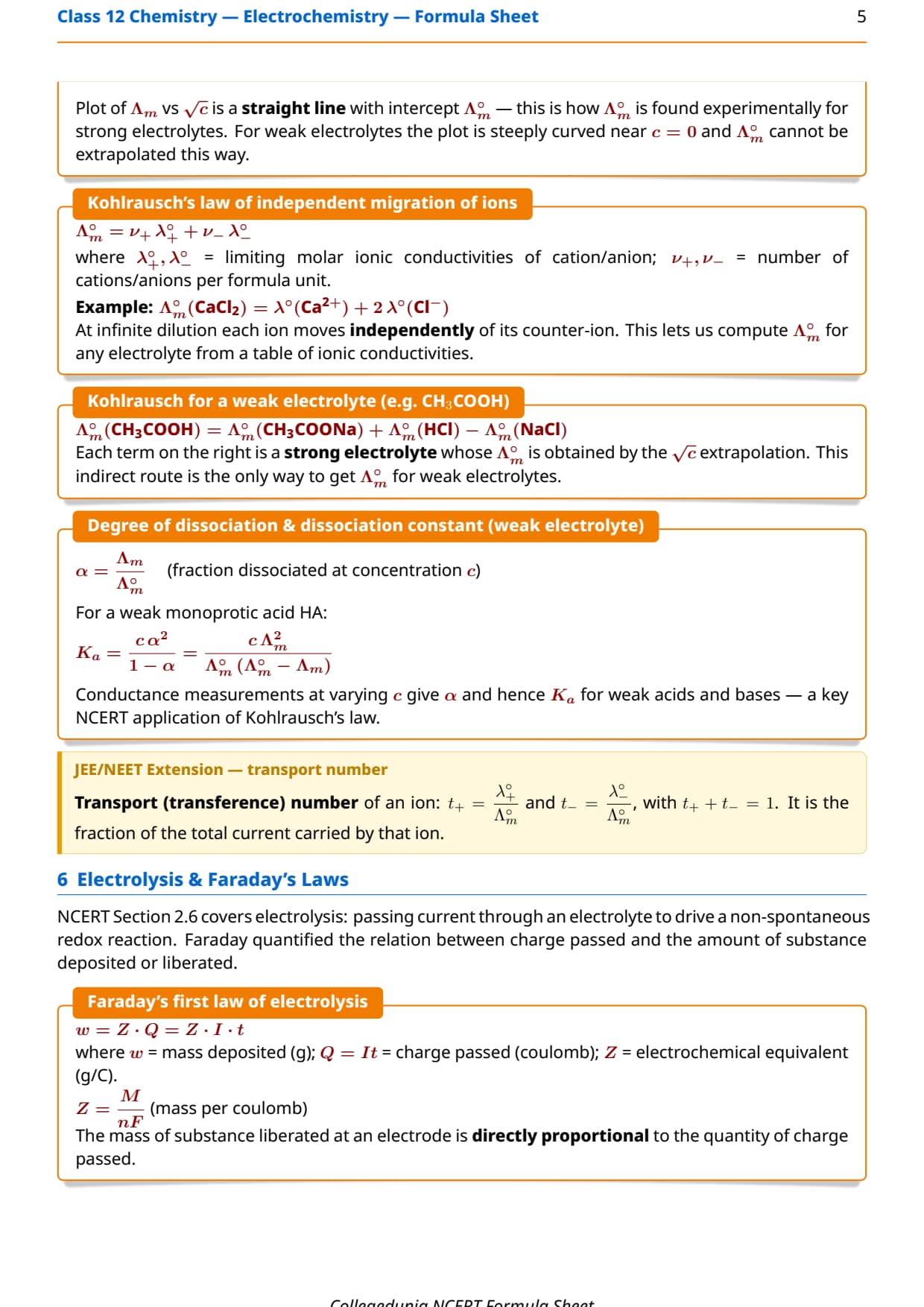
| Molar conductivity | m = κ × 1000c , c in mol L-1 | S cm2 mol-1 | 2.6 | Vs √c for strong electrolytes |
| Debye-Hückel-Onsager | m = Λ∘m - A√c | S cm2 mol-1 | 2.6 | Strong electrolyte extrapolation |
| Kohlrausch's law | Λ∘m = + λ∘+ + - λ∘- | S cm2 mol-1 | 2.6 | Weak electrolyte Λ∘m |
| Degree of dissociation | α = mΛ∘m | - | 2.6 | Weak electrolytes |
| Ostwald's dilution | Ka = cα21-α | mol L-1 | 2.6 | Weak acid |
| C. Electrolysis and Faraday's Laws | ||||
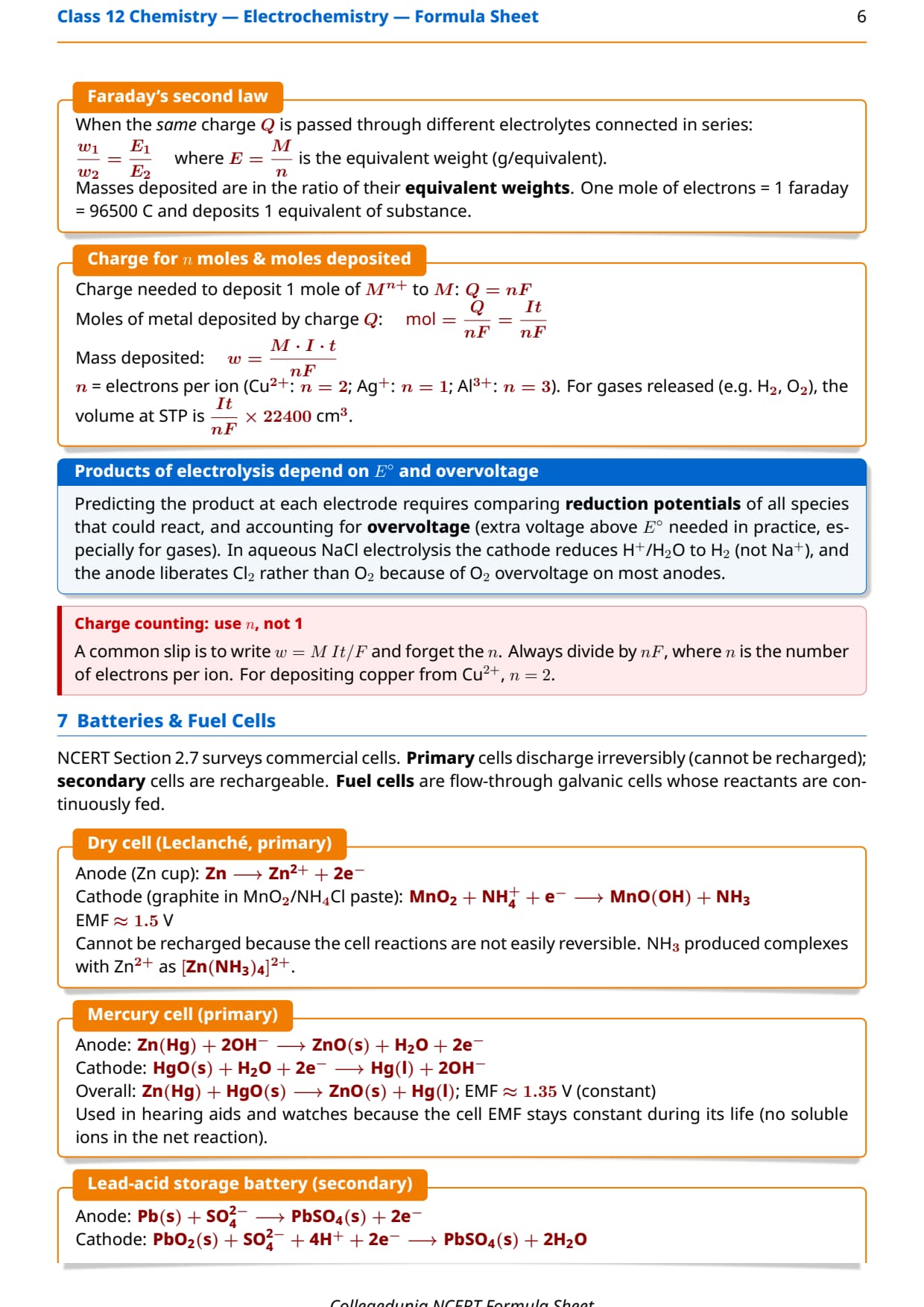
| Faraday I law | m = Z · I · t | g | 2.7 | Mass ∝ charge |
| EC equivalent | Z = MnF | g C-1 | 2.7 | M = molar mass |
| Faraday II law | m1m2 = E1E2 , same Q | - | 2.7 | Cells in series |
| Charge per mole | Q = nF , F = 96,485 C mol-1 | C | 2.7 | Faraday constant |
| D. Batteries and Fuel Cells (theory-only sub-topic) | ||||
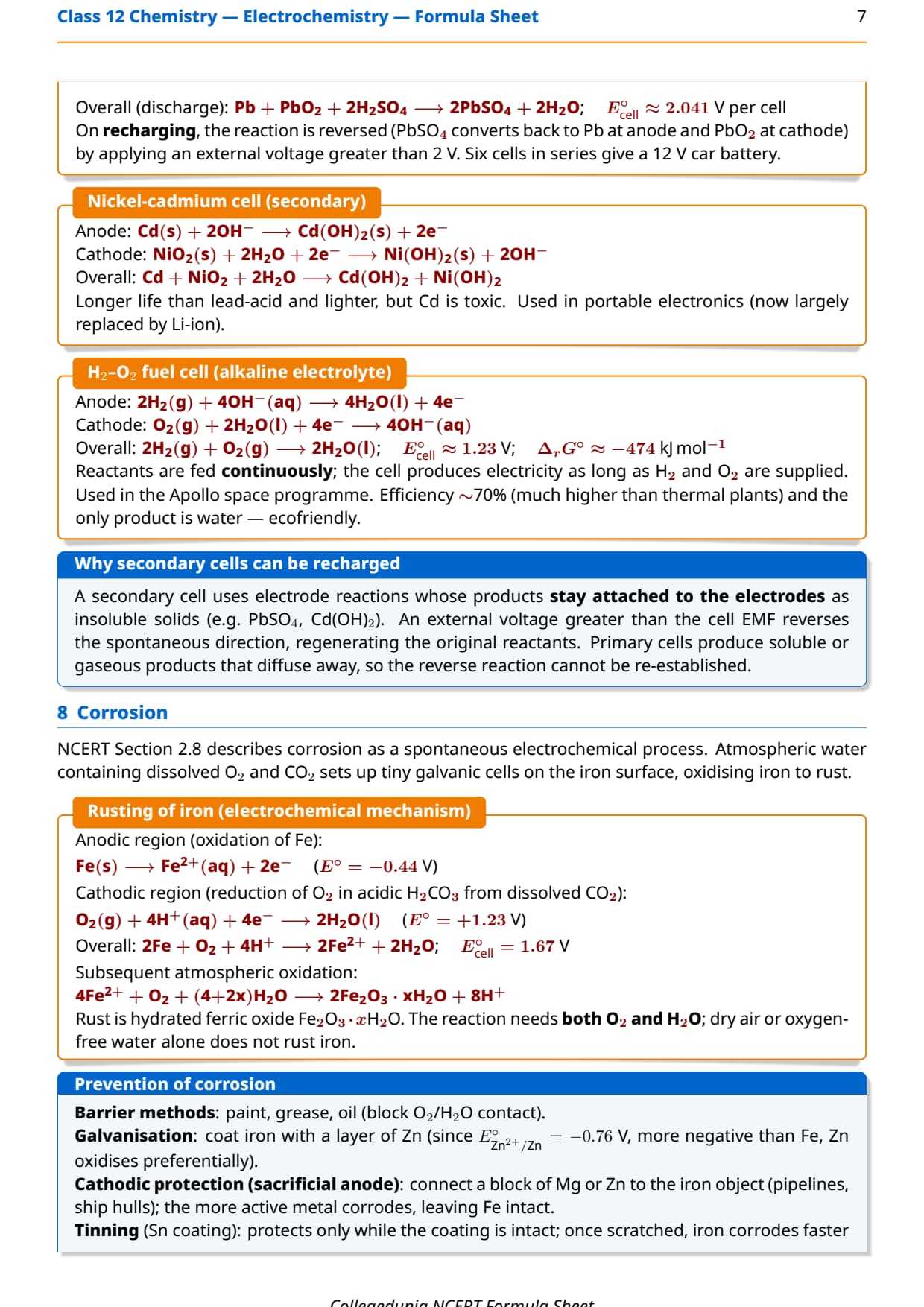
| Lead storage cell | ~ 2.0 V per cell; six in series = 12 V battery | V | 2.8 | Pb + PbO2 + 2H2SO4 → 2PbSO4 + 2H2O |
| H2-O2 fuel cell | ~ 1.23 V at 298 K | V | 2.8 | 2H2 + O2 → 2H2O |
Roughly 85% of CBSE Electrochemistry numericals reduce to one of the 22 formulas above.
When to Use Which Formula in Electrochemistry Class 12 Chemistry
Three Nernst variants look almost identical. Use this decision list to pick the right one.
- Standard conditions? E∘cell = E∘cathode - E∘anode .
- Non-standard, full cell? Ecell = E∘cell - 0.0591nlog Q .
- Same electrode, two concentrations? Concentration cell: E = 0.0591nlog C2C1 , no E∘ term.
- Equilibrium constant? log Kc = nE∘cell0.0591 .
- Weak electrolyte? Get m = κ × 1000c , then α = m/Λ∘m .
- Mass deposited? Faraday: m = M · I · tnF .
Electrochemistry Quick-Fact Cards for MCQ Recall
Atomic facts that unlock most one-mark MCQs. Units are part of the answer.
Symbol Glossary for Electrochemistry Class 12 Chemistry
The same Greek letter can mean two quantities. Lock these down before the exam.
| Symbol | Quantity | SI Unit |
|---|---|---|
| Ecell | Cell EMF at given conditions | V |
| E∘cell | Standard EMF (1 M, 1 atm, 298 K) | V |
| Δ G∘ | Standard Gibbs energy | J mol-1 |
| F | Faraday constant | C mol-1 |
| n | Electrons transferred | - |
| κ (kappa) | Conductivity | S m-1 |
| ρ (rho) | Resistivity | Ω m |
| m | Molar conductivity at c | S m2 mol-1 |
| Λ∘m | Limiting molar conductivity (c → 0) | S m2 mol-1 |
| λ∘+, λ∘- | Limiting ionic conductivities | S m2 mol-1 |
| α (alpha) | Degree of dissociation | 0–1 |
| Q | Reaction quotient or charge | varies |
| Z | Electrochemical equivalent | g C-1 |
One-Shot Revision Tips for Electrochemistry Class 12 Chemistry
Use these on revision day. Each locks in a high-yield formula.
- Write the Daniell cell notation Zn | Zn2+ || Cu2+ | Cu once: anode left, single bar = phase boundary, double bar = salt bridge.
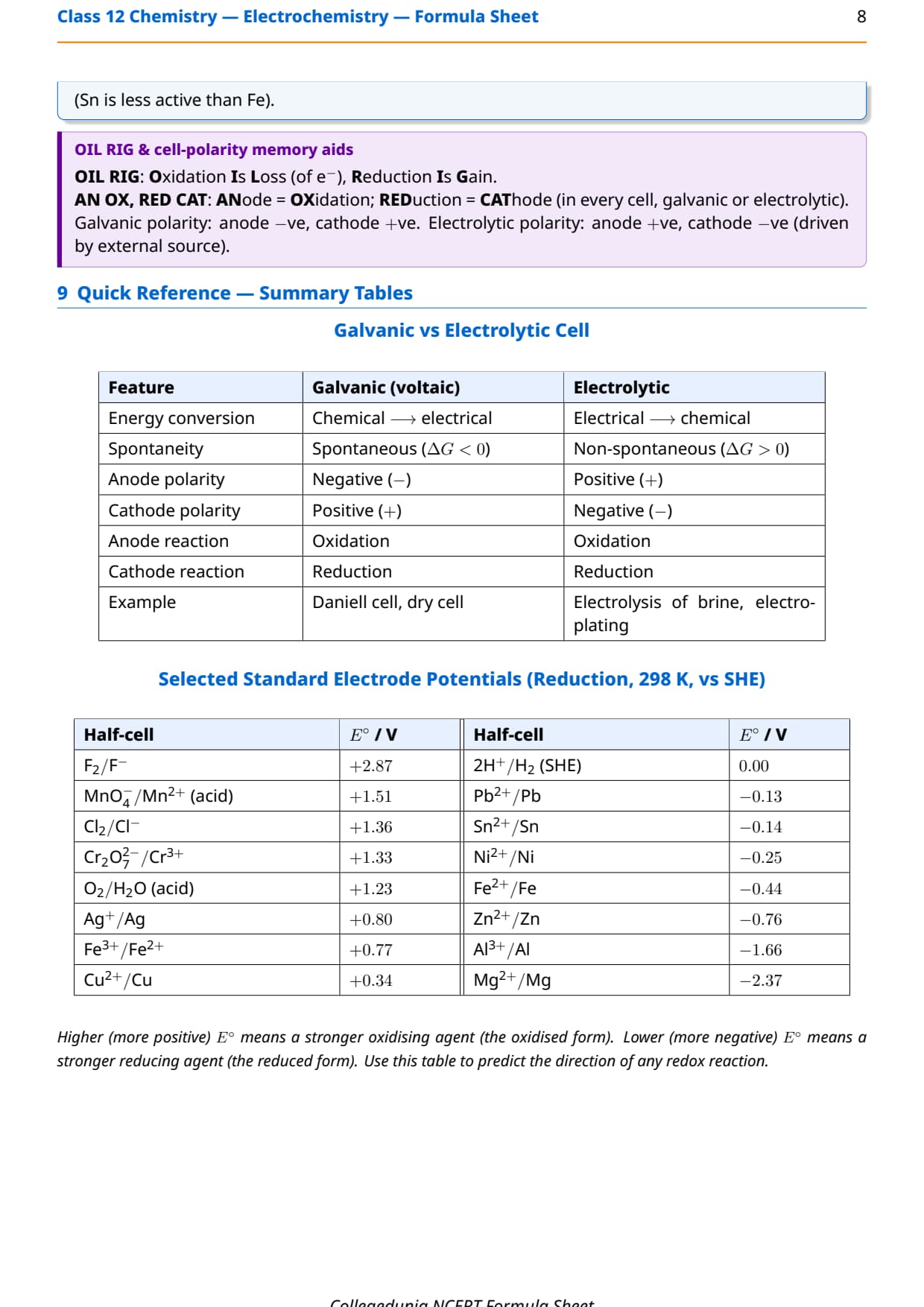
- Memorise the standard reduction potential series from K+/K (−2.93 V) to F2/F- (+2.87 V).
- Sketch the m vs √c graph for KCl (strong, linear) and CH3COOH (weak, sharp rise near c = 0).
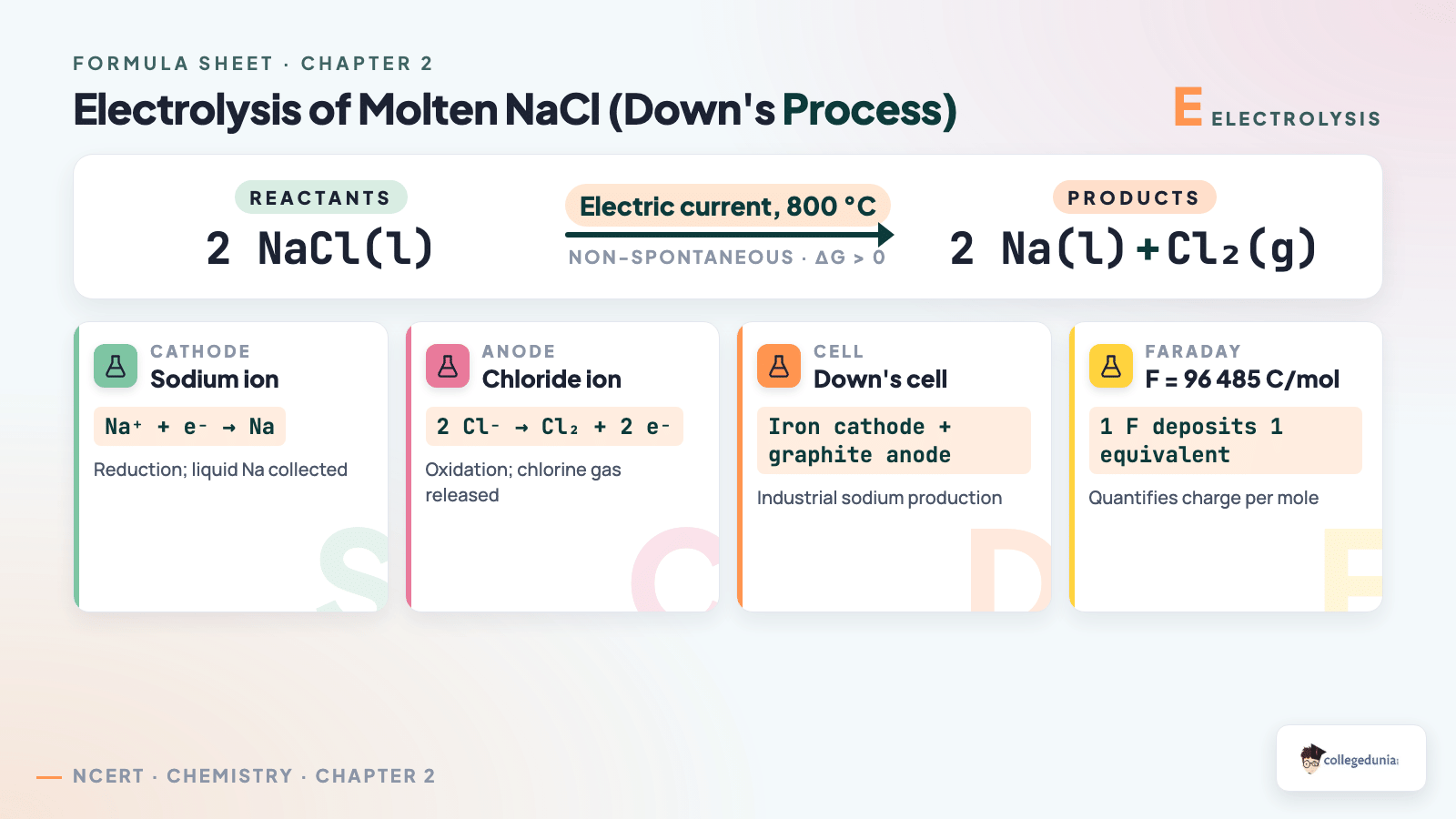
- Recall aqueous vs molten NaCl electrolysis: aqueous gives H2 and Cl2, molten gives Na and Cl2.
- Lock the "× 1000" step in m = κ × 1000c , the most-missed step in CBSE answer keys.
Student Feedback
In a Collegedunia poll of 900 Class 12 students, 78% said the Nernst-equation rows and the "× 1000" molar-conductivity reminder were the parts of this Electrochemistry sheet they revised most before Boards.
Other Resources for Electrochemistry Class 12 Chemistry
- Electrochemistry Class 12 Chemistry Formula Sheet
- Electrochemistry Class 12 Chemistry NCERT Solutions
- Electrochemistry Class 12 Chemistry Notes
- Electrochemistry Class 12 Chemistry NCERT Book PDF
- Electrochemistry Class 12 Chemistry NCERT Exemplar Book PDF
- Electrochemistry Class 12 Chemistry NCERT Exemplar Solutions
- Electrochemistry Class 12 Chemistry Handwritten Notes
NCERT Formula Sheet for Class 12 Chemistry: All Chapters
Use the Collegedunia chapter-wise Formula Sheets below for every chapter of the 2026-27 NCERT.
| Chapter | Resource |
|---|---|
| Chapter 1 | Solutions Formula Sheet |
| Chapter 3 | Chemical Kinetics Formula Sheet |
| Chapter 4 | The d- and f-Block Elements Formula Sheet |
| Chapter 5 | Coordination Compounds Formula Sheet |
| Chapter 6 | Haloalkanes and Haloarenes Formula Sheet |
| Chapter 7 | Alcohols, Phenols and Ethers Formula Sheet |
| Chapter 8 | Aldehydes, Ketones and Carboxylic Acids Formula Sheet |
| Chapter 9 | Amines Formula Sheet |
Electrochemistry Class 12 Chemistry Formula Sheet FAQs
Ques. Where can I download the Electrochemistry Class 12 Chemistry Formula Sheet PDF?
Ans. You can download the Electrochemistry Class 12 Chemistry Formula Sheet PDF directly from this page. Both the Normal and HD versions are available, and both are free. The sheet covers every formula from Sections 2.2 to 2.8 of the 2026-27 NCERT.
Ques. Is this Formula Sheet aligned with the 2026-27 NCERT?
Ans. Yes. This page reflects the current 2026-27 syllabus for Class 12 Chemistry. The new NCERT edition keeps the entire Electrochemistry chapter intact, with all 22 formulas in this sheet still in print and still examinable.
Ques. How many pages is the Class 12th Chemistry Electrochemistry Formula Sheet PDF?
Ans. The Formula Sheet PDF runs approximately 7 pages and covers EMF and electrode potentials, the Nernst equation in all three forms, conductance and molar conductivity, Kohlrausch's law, Faraday's laws of electrolysis, and the lead storage battery plus H2-O2 fuel cell EMFs.
Ques. Which is the most important formula in Electrochemistry for CBSE Class 12 boards?
Ans. The Nernst equation Ecell = E∘cell - 0.0591nlog Q at 298 K is the single most-tested formula in this chapter. CBSE has set a Nernst-equation numerical worth 3 to 5 marks in every year from 2022 onwards. The supporting formula log Kc = nE∘cell0.0591 is the second most-asked.
Ques. How does Electrochemistry weightage compare in JEE Main vs NEET?
Ans. Electrochemistry contributes about 4 to 5% in JEE Main (typically 2 to 3 questions every shift) and 2 to 3 questions per year in NEET. JEE Main favours Nernst-equation and conductance numericals; NEET leans more on Kohlrausch's-law calculations and Faraday's-law mass-deposit problems. Both exams test the same 22-formula core covered in this Formula Sheet.
Ques. What is the difference between conductivity and molar conductivity?
Ans. Conductivity κ (S m-1) is a material property and depends on the number of charge carriers per unit volume. Molar conductivity m (S m2 mol-1) is κ divided by molar concentration, so it adjusts for how many ions are present per mole. As dilution increases, κ decreases (fewer carriers per m3) but m increases (each mole spreads further and contributes more conductance).
Ques. Is the Electrochemistry Formula Sheet enough for the CBSE Class 12 Chemistry board exam?
Ans. The Formula Sheet covers every quantitative tool the chapter needs, but you should pair it with the Collegedunia Electrochemistry Notes for the conceptual derivations (Daniell cell, salt-bridge function, products of electrolysis) and with the NCERT Solutions for marking-scheme-aligned answer formats. Together the three resources are enough for the full 7 to 9 marks this chapter contributes.
Ques. Why is Kohlrausch's law important for weak electrolytes?
Ans. Weak electrolytes never reach their limiting molar conductivity Λ∘m by extrapolation, because the m vs √c curve diverges sharply near c = 0. Kohlrausch's law lets you build Λ∘m for a weak electrolyte by adding the limiting ionic conductivities λ∘+ and λ∘- of its ions, which can themselves be measured from strong electrolytes that share those ions. This is the only way to determine α and Ka for weak acids and weak bases in Class 12.
Ques. What is the Debye-Huckel-Onsager equation and when is it used?
Ans. The Debye-Huckel-Onsager equation m = Λ∘m - A√c describes how the molar conductivity of a strong electrolyte falls linearly with the square root of concentration. It lets you extrapolate the line back to c → 0 to read off Λ∘m directly from the y-intercept. The constant A depends on the solvent and ion charges, and the equation fails for weak electrolytes because their α is not 1 at low c.
Ques. How do you derive log Kc from E°cell in Electrochemistry?
Ans. At equilibrium Ecell = 0 and the reaction quotient Q = Kc . Substituting into the Nernst equation Ecell = E∘cell - 0.0591nlog Q gives 0 = E∘cell - 0.0591nlog Kc , so log Kc = n E∘cell0.0591 at 298 K. This is the highest-frequency 3-mark CBSE derivation linking electrochemistry with equilibrium.
Ques. What is Ostwald's dilution law and how does it use Kohlrausch's law?
Ans. Ostwald's dilution law gives the dissociation constant of a weak electrolyte as Ka = cα21-α . Kohlrausch's law supplies α = mΛ∘m at a given concentration, where Λ∘m is built by adding limiting ionic conductivities. Together they let you compute Ka for weak acids like CH3COOH from conductivity data, a 3-mark CBSE numerical that recurs in JEE Main almost every year.



Comments