




The Class 10 Maths Chapter 14 Probability formula sheet puts every definition, formula and result on one page. The chapter is built on theoretical probability, where each outcome of a random experiment is equally likely. It covers simple events, complementary events, impossible and certain events, and the range of probability values. All formulas follow the 2026-27 CBSE syllabus.
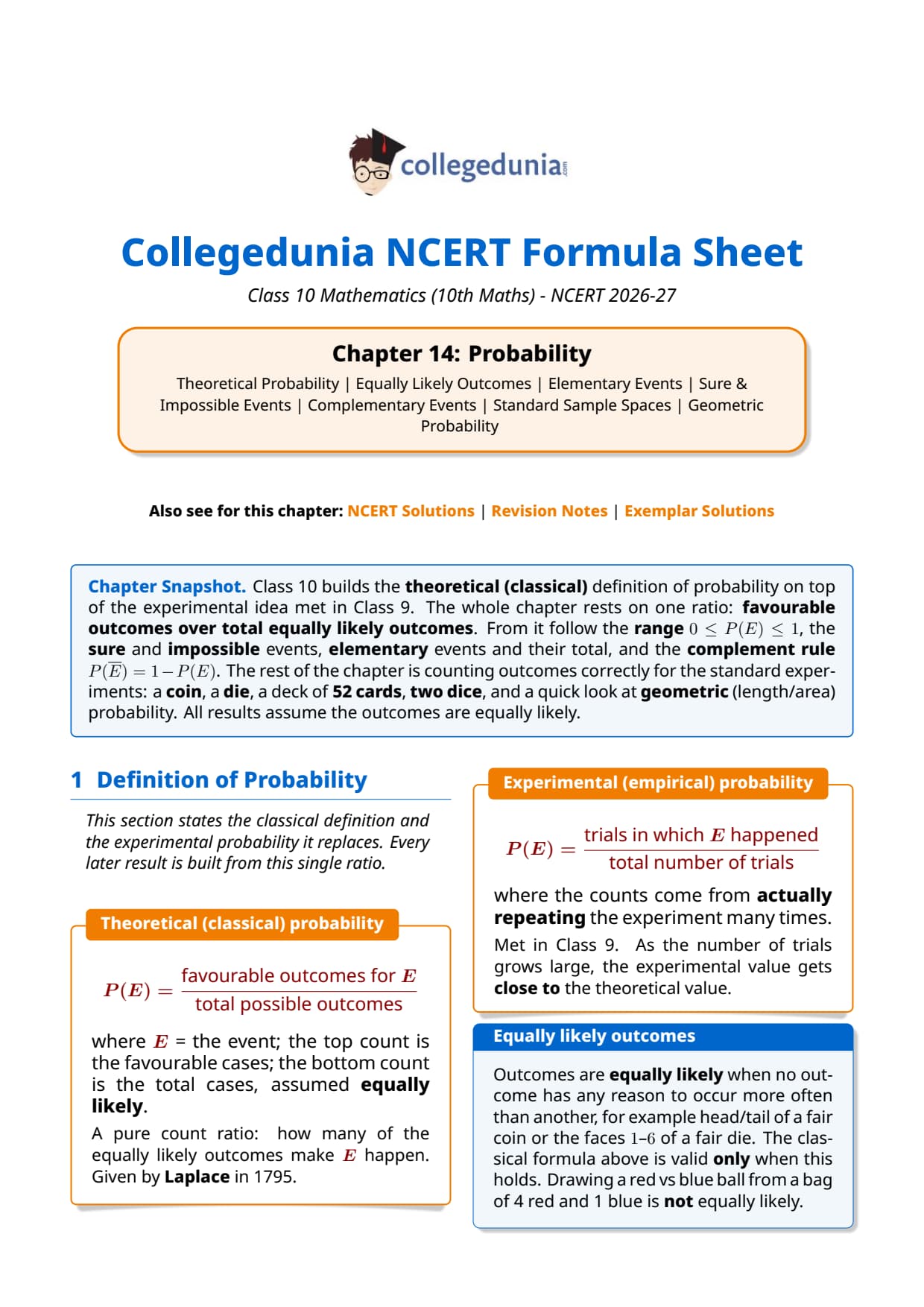
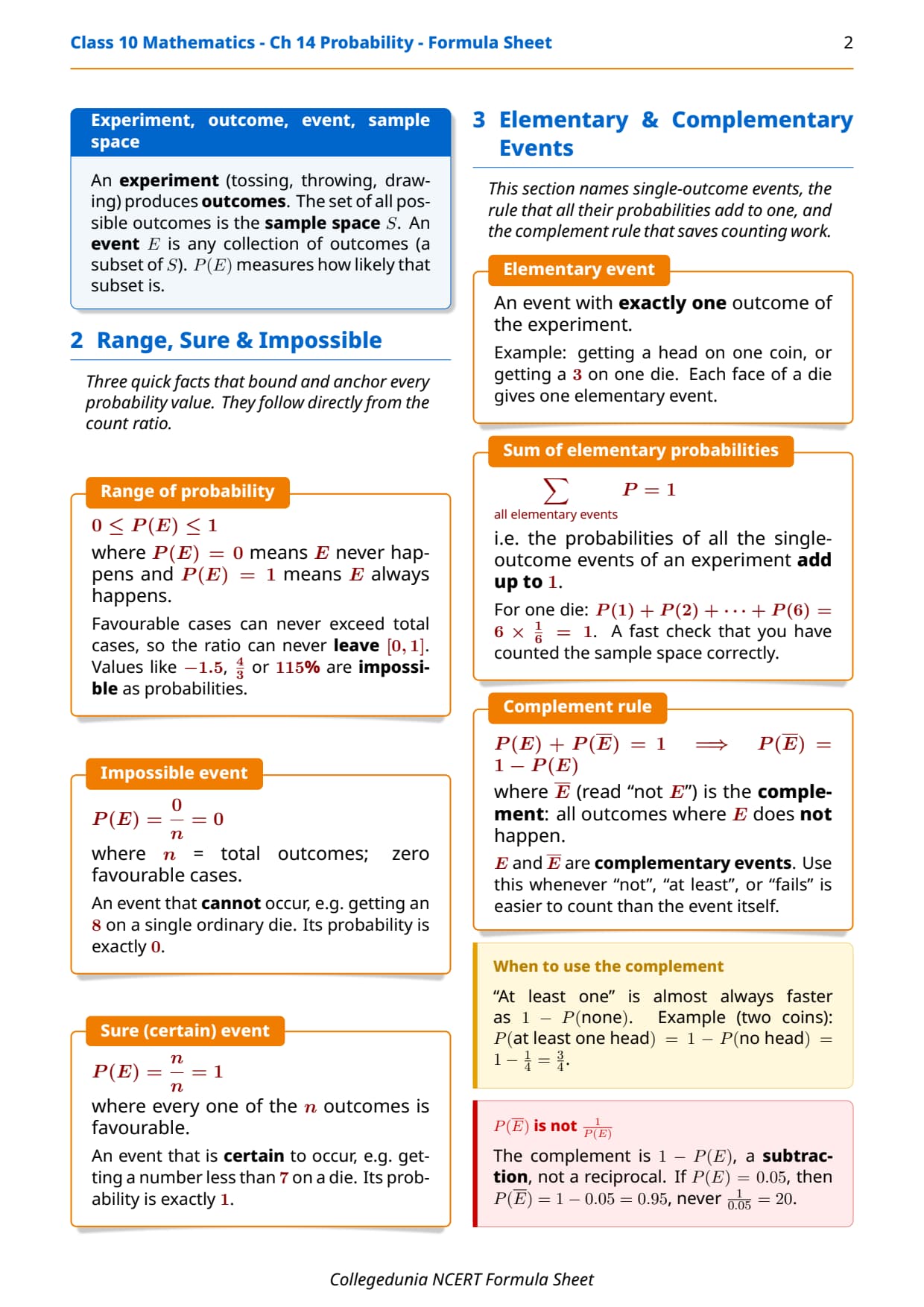
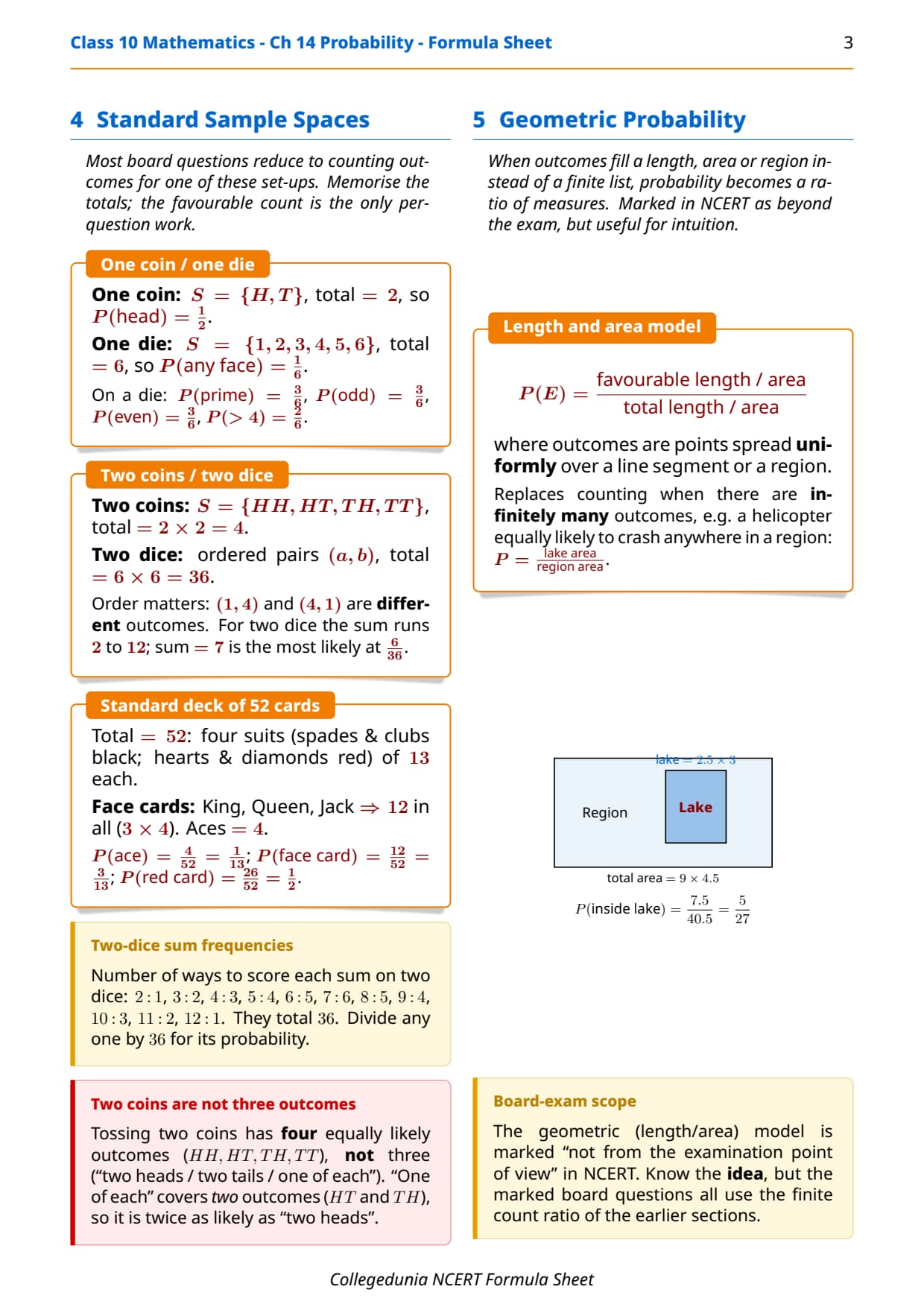
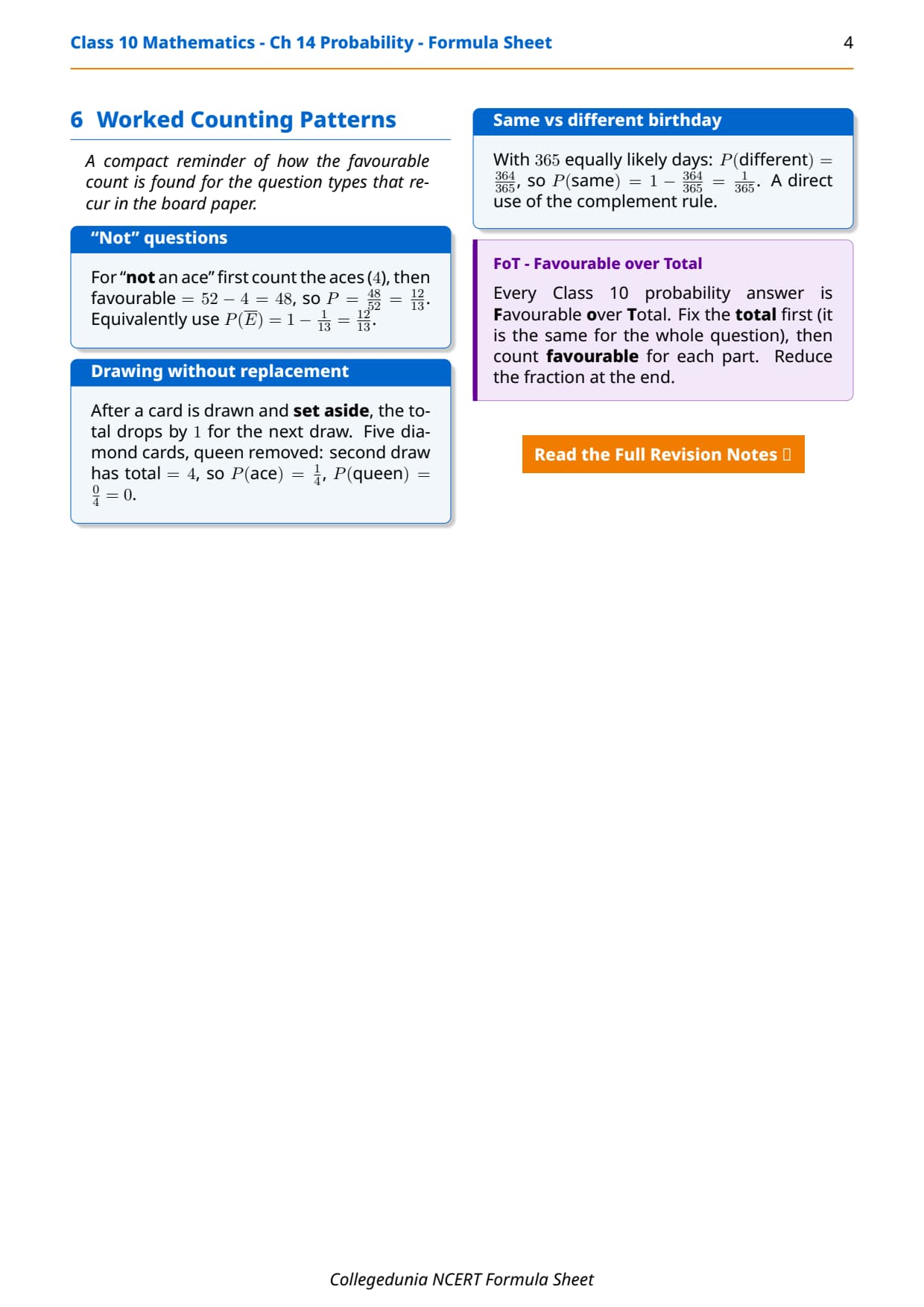
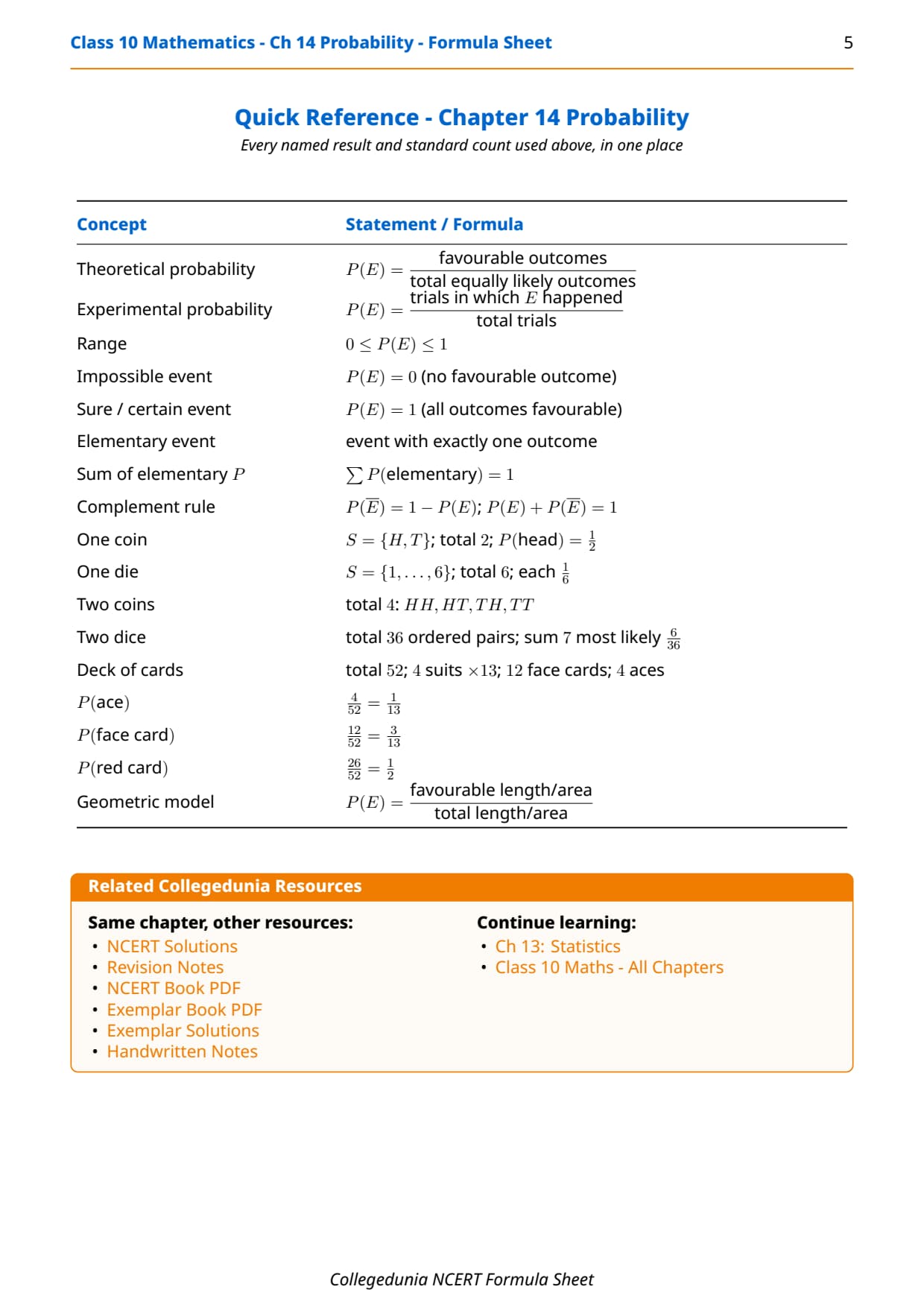
- Core topics: theoretical probability, complementary events, impossible and certain events, and the rule P(E) + P(not E) = 1.
- Board context: Probability brings 4 to 6 marks per paper, mostly through probability and complementary-event questions.
Student Feedback: In a Collegedunia poll of 2,400 Class 10 students before the 2026 boards, 79% of students said they forgot to count the total outcomes before writing the fraction. Students who listed the sample space first solved Probability problems in under 2 minutes on average.
Watch Probability Class 10 Maths Explained
Source: Magnet Brains on YouTube
Complete Formula List
The table below lists every formula and result for Probability. The whole chapter rests on one formula: P(E) = outcomes favourable to E / total equally likely outcomes. The complement rule, the range of probability, and impossible and certain events all come from this. Once you see why the denominator must list equally likely outcomes, you get every board question right.
| Concept | Formula / Definition | Usage Note |
|---|---|---|
| Random experiment | Outcome cannot be predicted in advance; outcomes are equally likely | Tossing a coin, rolling a die, drawing a card |
| Sample space (S) | The set of all possible outcomes | Always list S first |
| Event (E) | Any subset of the sample space | The outcomes you want |
| Theoretical (classical) probability | P(E) = (outcomes favourable to E) / (total equally likely outcomes) | Core formula; both counts come from S |
| Range of probability | 0 ≤ P(E) ≤ 1 | Never negative, never above 1 |
| Impossible event | P(E) = 0; no favourable outcomes | Getting 7 on a die |
| Certain (sure) event | P(E) = 1; every outcome favourable | Getting a number ≤ 6 on a die |
| Complementary event | P(not E) = 1 − P(E), i.e. P(E) + P(not E) = 1 | Use when "not E" is easier to count |
| Equally likely outcomes | Each outcome has an equal chance | Required for the classical formula |
| Sum of all probabilities | P(E1) + … + P(En) = 1 for mutually exclusive, exhaustive events | All outcomes always sum to 1 |
Core probability formulas for Chapter 14, with the complementary rule P(E) + P(not E) = 1 as the most-tested.
Theoretical Probability: Definition & Main Formula
Theoretical (or classical) probability finds P(E) by counting outcomes, not by repeating experiments:
P(E) = (outcomes favourable to E) / (total equally likely outcomes)
The key phrase is equally likely outcomes: every outcome has the same chance, like Head and Tail on a fair coin or each of the 52 cards in a well-shuffled deck. If outcomes are not equally likely, this formula does not apply.
| Experiment | Sample space | Probability |
|---|---|---|
| Two fair coins | S = {HH, HT, TH, TT} | P(exactly one Head) = 2/4 = 1/2 |
| One card from 52 | 52 outcomes | P(King) = 4/52 = 1/13 |
Complementary Events & the P(E) + P(not E) = 1 Rule
The complementary event ("not E") is all outcomes in S not in E. Since E and not-E cover every outcome once, P(E) + P(not E) = 1, which rearranges to P(not E) = 1 − P(E). This is the most tested formula in board questions. Use it when "not E" is easier to count.
| Situation | Direct approach | Complementary approach | When to use complement |
|---|---|---|---|
| P(at least one Head in two coin tosses) | Count HH, HT, TH = 3; P = 3/4 | 1 − P(TT) = 1 − 1/4 = 3/4 | Use for "at least one" |
| P(card that is not a spade) | Count non-spades = 39; P = 39/52 | 1 − P(spade) = 1 − 1/4 = 3/4 | Complement is faster |
Impossible, Certain & Equally Likely Events
An impossible event can never happen: 0 favourable outcomes, so P(E) = 0, like rolling a 7 on a die. A certain event always happens: every outcome favourable, so P(E) = 1, like rolling a number from 1 to 6. Both P(E) = 0 and P(E) = 1 are valid answers; they are the two endpoints of the scale.
| Type of event | Probability value | Meaning | Example |
|---|---|---|---|
| Impossible event | P(E) = 0 | Cannot happen | Getting 8 on a die |
| Certain (sure) event | P(E) = 1 | Always happens | Number < 7 on a die |
| Any other event | 0 < P(E) < 1 | Happens for some outcomes | Even number on a die (1/2) |
| Equally likely events | Same P value each | No outcome favoured | Head, Tail on a fair coin |
Sample Spaces for Common Random Experiments in Class 10 Probability
Board questions almost always use one of four standard experiments: tossing coins, rolling a die, drawing cards from a 52-card deck, or drawing balls from a bag. Knowing each sample space by heart saves time.
| Experiment | Total outcomes | Key subsets (must know) |
|---|---|---|
| One fair coin | 2 (H, T) | Head = 1, Tail = 1 |
| Two fair coins | 4 (HH, HT, TH, TT) | 2 Heads = 1; 1 Head = 2; 0 Heads = 1 |
| Three fair coins | 8 | 3 Heads = 1; 2 = 3; 1 = 3; 0 = 1 |
| One fair die | 6 (1 to 6) | Even/odd = 3 each; prime = 3 (2,3,5); square = 2 (1,4) |
| 52-card deck | 52 | 13 per suit; face cards = 12; aces = 4; red = 26; black = 26 |
| Bag of balls | Total balls | Favourable = balls of the required type |
CBSE board exam weightage for Chapter 14 Probability: a reliable 4 to 6 marks per paper through direct probability and complementary-event questions.
Quick-Fact Cards for Chapter 14 MCQ Recall
Keep these facts ready for short MCQ and fill-in-the-blank items in the board exam.
CBSE Board Exam Weightage for Chapter 14 Probability
Chapter 14 is a consistent source of 2-mark and 3-mark questions, testing formula recall and the ability to list the sample space and count favourable outcomes.
| Topic | Typical Question Type | Usual Marks |
|---|---|---|
| Theoretical probability (coins or dice) | Find P(E) for an event | 2 marks |
| Cards from a standard deck | P(card with a given property) | 2 to 3 marks |
| Complementary events | Given P(E), find P(not E) | 2 marks |
| Balls in a bag | P(object with a given property) | 2 to 3 marks |
| Impossible and certain events | Confirm P(E) = 0 or P(E) = 1 | 1 to 2 marks |
Chapter 14 typically contributes 4 to 6 marks per paper. Card-drawing and complementary-event questions are the most common in recent CBSE papers, and both are covered by this sheet.
Common Mistakes in Class 10 Probability Problems
Mistake 1: Not assuming the coin, die or deck is fair. Board questions always use fair, unbiased experiments unless stated otherwise.
Mistake 2: Confusing face cards with all picture cards. Face cards are only Jack, Queen and King (12 total). Ace is a rank but not a face card.
Mistake 3: Writing probability greater than 1. If the numerator exceeds the denominator, you have miscounted; recount both from the sample space.
Mistake 4: Treating HT and TH as the same outcome for two coins. They are distinct, so the sample space has 4 elements, not 3.
Mistake 5: Forgetting to subtract with the complement: P(not E) = 1 − P(E), not P(E) or 1 + P(E).
Each of these slips costs 1 to 2 marks in the board exam.
More Class 10 Probability Resources
Use this formula sheet alongside the other Chapter 14 resources below. Each covers a different aspect of the chapter, so together they give complete board preparation.
| Resource | Best Used For |
|---|---|
| Probability NCERT Solutions | Step-by-step answers to all textbook questions |
| Probability Notes | Full chapter explanation with solved examples |
| Probability Handwritten Notes | Quick visual revision in a notebook style |
| Probability NCERT Book PDF | The official textbook chapter to read |
| Probability NCERT Exemplar Solutions | Harder practice questions with solutions |
| Probability NCERT Exemplar Book PDF | The official Exemplar problems to attempt |
NCERT Formula Sheets for Class 10 Maths: All Chapters
Jump to the formula sheet for any other chapter using the table below.
| Chapter | Formula Sheet |
|---|---|
| Chapter 1 | Real Numbers Formula Sheet |
| Chapter 2 | Polynomials Formula Sheet |
| Chapter 3 | Pair of Linear Equations in Two Variables Formula Sheet |
| Chapter 4 | Quadratic Equations Formula Sheet |
| Chapter 5 | Arithmetic Progressions Formula Sheet |
| Chapter 6 | Triangles Formula Sheet |
| Chapter 7 | Coordinate Geometry Formula Sheet |
| Chapter 8 | Introduction to Trigonometry Formula Sheet |
| Chapter 9 | Some Applications of Trigonometry Formula Sheet |
| Chapter 10 | Circles Formula Sheet |
| Chapter 11 | Areas Related to Circles Formula Sheet |
| Chapter 12 | Surface Areas and Volumes Formula Sheet |
| Chapter 13 | Statistics Formula Sheet |
| Chapter 14 | Probability Formula Sheet (this page) |
Class 10 Maths Chapter 14 Probability Formula Sheet FAQs
Ques. What formulas are in the Class 10 Chapter 14 Probability formula sheet?
Ans. The sheet covers the theoretical (classical) probability formula P(E) = (Number of favourable outcomes) / (Total number of equally likely outcomes), the range rule 0 ≤ P(E) ≤ 1, the definition of impossible events (P = 0) and certain events (P = 1), the complementary event rule P(E) + P(not E) = 1, and the definitions of sample space, equally likely outcomes and elementary events. Sample spaces for common experiments (coins, dice, cards, bags of objects) are also listed.
Ques. What is the formula for theoretical probability in Class 10?
Ans. The formula for theoretical probability is P(E) = (Number of outcomes favourable to E) / (Total number of equally likely outcomes). Both counts are taken from the sample space S, which lists all possible outcomes of the experiment. The formula works only when every outcome is equally likely, which is why the coin must be fair, the die must be unbiased and the deck must be well-shuffled in board questions.
Ques. What is the complementary event rule and when should students use it?
Ans. The complementary event rule states P(E) + P(not E) = 1, which rearranges to P(not E) = 1 − P(E). Use it when the question asks for "at least one", "not", "none" or "all" events, because it is often easier to count the outcomes you do not want and then subtract from 1 than to count every outcome you do want. For example, if P(getting a defective item) = 3/20, then P(not getting a defective item) = 1 − 3/20 = 17/20.
Ques. How many face cards are in a standard deck of 52 cards?
Ans. There are 12 face cards in a standard deck: Jack, Queen and King for each of the four suits (Spades, Hearts, Diamonds and Clubs), giving 3 × 4 = 12 face cards. Ace is not a face card. The deck has 4 suits with 13 cards each: Ace, 2, 3, 4, 5, 6, 7, 8, 9, 10, Jack, Queen, King. Red cards = 26 (Hearts + Diamonds); Black cards = 26 (Spades + Clubs).
Ques. What is the probability of an impossible event and a certain event?
Ans. The probability of an impossible event is 0, because there are no favourable outcomes. For example, the probability of getting a 7 on a standard six-faced die is 0. The probability of a certain (sure) event is 1, because every outcome is favourable. For example, the probability of getting a number from 1 to 6 on a standard die is 6/6 = 1. All other events have a probability strictly between 0 and 1.
Ques. Is this formula sheet aligned with the 2026-27 NCERT syllabus?
Ans. Yes. This page reflects the current 2026-27 CBSE Class 10 Mathematics syllabus. Chapter 14 Probability is retained in full in the 2026-27 edition, covering theoretical probability, complementary events, impossible and certain events, and sample spaces for standard experiments (coins, dice, cards, bags of objects). All formulas on this sheet match the exercises, examples and definitions in the current NCERT textbook for Class 10 Maths.



Comments