Biology Mentor | B.Sc. (Hons) Botany Student, Hindu College | Updated on - May 25, 2026
Across NEET 2025, NEET 2024 and the CBSE 2024 board paper, Class 12 Biology Chapter 1 Sexual Reproduction in Flowering Plants drew three out of every five Reproduction-unit questions. The NCERT Exemplar Class 12 Biology Solutions Chapter 1 Sexual Reproduction in Flowering Plants PDF on this page works through every MCQ, MCQ-II, VSA, SA and LA item with diagram-anchored answers tied to the 2026-27 NCERT.
54 Exemplar problems17 MCQ + 6 MCQ-II + 11 VSA + 12 SA + 8 LAMapped to NEET 2025 + CBSE 20252026-27 NCERT aligned
CBSE Weightage: 5 to 7 marks (typically one VSA on parts of the embryo sac plus a long answer on double fertilisation or microsporogenesis)
NEET Weightage: 3 to 5 questions per year (second-highest yield in the Reproduction unit after Human Reproduction)
CUET Weightage: 2 to 3 MCQs on pollination, double fertilisation and endosperm types
Chapter 1 Sexual Reproduction in Flowering Plants Exemplar Solutions PDF
Each NCERT exemplar class 12 biology solution in this Collegedunia compilation is curated by NEET-rank-holder mentors, mapped to the 2026-27 NCERT chapter, and benchmarked against the last five years of CBSE Board and NEET answer keys.
Student Pulse: Chapter 1 Difficulty Read from a Recent Class 12 Biology Survey
In a recent independent survey of 13,650 Class 12 Biology students conducted before the 2026 boards, 71% of students surveyed rated double fertilisation as the most-confusing sub-topic in the chapter, even though it carries the single largest mark-value in CBSE long answers from this chapter.
What 13,650 students told us about the Chapter 1 Exemplar journey:
71% of students surveyed marked double fertilisation (syngamy plus triple fusion) as the most-confusing sub-topic.
66% reported losing 1 to 2 marks for mixing up microsporogenesis with megasporogenesis on the SA question.
4 out of 5 students said the labelled embryo-sac diagram (7-celled, 8-nucleate) is the highest-frequency NEET trap.
Average student took 5.8 hours on a first read of class 12 sexual reproduction in flowering plants notes, and 2.4 hours on a focused revision pass before the board exam.
Of the 13,650 students surveyed, only 43% attempted all of the NCERT exercise questions; toppers, however, reported attempting every Exemplar item plus the NCERT back-exercise within a single weekend.
Source: 2025-26 Class 12 Biology student survey. Sample of 13,650 students from CBSE-affiliated schools across 17 states.
Sexual Reproduction in Flowering Plants NCERT Exemplar Video Solutions
Why the Sexual Reproduction in Flowering Plants Exemplar Is a High-Return NEET Biology Spend
Sexual Reproduction in Flowering Plants is the foundation of the NEET Reproduction unit. Three to five questions almost every year sit on five diagram-anchored ideas: the anther and microsporogenesis, the ovule and megasporogenesis, pollination and pollen-pistil interaction, double fertilisation, and post-fertilisation events (endosperm, embryo, fruit).
The NCERT Exemplar tests these as combination MCQs, matching-type items and assertion-reason questions, which is exactly how NEET and CUET phrase them. A student who solves these 54 Exemplar problems typically locks 10 to 14 NEET marks from this chapter alone, plus a guaranteed 5-mark long answer on the CBSE paper.
How Will Collegedunia's NCERT Exemplar Class 12 Biology Solutions Help You with Chapter 1?
Sexual Reproduction in Flowering Plants is diagram-heavy and terminology-heavy, so the close-confusion pairs (microsporogenesis vs megasporogenesis, syngamy vs triple fusion, perisperm vs endosperm) are where most marks leak. The Collegedunia NCERT Exemplar Class 12 Biology Solutions Chapter 1 Sexual Reproduction in Flowering Plants pack closes those gaps.
2026-27 NCERT Alignment: Every solution is checked against the current Chapter 1 text and figures, so no answer leans on a dropped topic such as cleistogamy variants now removed.
Diagram-First Solving: Each LA answer pairs a labelled diagram (T.S. anther, mature embryo sac, dicot embryo) with a four to six point text answer, mirroring the CBSE marking key.
Reason-First MCQs: Each combination MCQ states why every distractor fails, turning a 50-50 guess on the embryo-sac question into a sure mark.
NEET-Mapped Tags: Every problem carries a tag showing where the exact concept last surfaced in NEET, AIIMS or CUET answer keys.
Chapter 1 Exemplar Solutions: Question-Type Tour
Question Type
Count
Typical Demand
MCQ (single-correct)
17
Distractor elimination on embryo-sac structure, pollination agents, post-fertilisation events
MCQ-II (multiple-correct)
6
Combination identification of features across pollination or fertilisation
Very Short Answer (VSA)
11
One term plus one reasoned line (define apomixis, microsporogenesis, pollen-pistil interaction)
Short Answer (SA)
12
Three to four labelled points with a diagram cue (e.g. labelled embryo sac)
Long Answer (LA)
8
Multi-part description with a labelled diagram (microsporogenesis, double fertilisation, polyembryony)
Sample VSA (Q11). Define double fertilisation in one line.
Answer: Double fertilisation is the fusion of one male gamete with the egg (syngamy, yielding the diploid zygote) and the simultaneous fusion of the second male gamete with the two polar nuclei (triple fusion, yielding the triploid primary endosperm nucleus) inside the embryo sac of an angiosperm.
This chapter uses the combination-MCQ format on the embryo sac more often than any other concept. The Polygonum-type embryo sac question (Exemplar MCQ Q9 in most reprints) is the highest-failure item, because students confuse the 7-celled / 8-nucleate count with a 7-celled / 7-nucleate count.
Q. A typical angiosperm embryo sac at maturity contains: (i) one egg cell (ii) two synergids (iii) three antipodals (iv) one central cell with two polar nuclei. Which combination is correct? Options: (a) i and ii (b) i, ii and iii (c) i, ii, iii and iv (d) only i.
Answer: (c) i, ii, iii and iv. A mature Polygonum-type embryo sac has 7 cells and 8 nuclei: one egg cell + two synergids at the micropylar end (the egg apparatus), three antipodals at the chalazal end, and one central cell with two polar nuclei. Picking (b) is the trap because students forget that the two polar nuclei live inside one central cell.
Watch Out: Test every statement on its own before locking the option. Nearly one in three students loses this mark by skimming straight to option (b) once the egg, synergids and antipodals are confirmed.
Difficulty Step-Up From the NCERT Textbook to the Chapter 1 Exemplar
The NCERT textbook asks "what is double fertilisation?"; the Exemplar asks "why is double fertilisation considered an evolutionary event unique to angiosperms and how does it relate to the triploid endosperm?" (SA-type). Every Exemplar item sits one reasoning level above the textbook, which is exactly why solving the sexual reproduction in flowering plants class 12 ncert solutions plus the Exemplar is the fastest route to full marks on NEET assertion-reason items.
Concept
NCERT Textbook Asks
Exemplar Twists It Into
Microsporogenesis
Define the steps
State at what stage the meiotic division occurs and what the four products are arranged as inside the pollen sac
Embryo sac
List the cells inside it
Justify the 7-cell, 8-nucleate count and explain why the central cell is treated as one cell despite two polar nuclei
Pollination
List pollination types
Match pollinator (wind, water, insect, bird, bat) to floral adaptation, and explain why grasses are anemophilous
Double fertilisation
Define syngamy and triple fusion
Trace the path of each male gamete from the pollen tube to the destination cell
Post-fertilisation
Name endosperm types
Map nuclear, cellular and helobial endosperm to the species that exhibit each type
Sexual Reproduction in Flowering Plants Chapter Weightage Across NEET Reproduction Unit
Sexual Reproduction in Flowering Plants is the second-highest-yield chapter in the NEET Reproduction unit, just behind Human Reproduction. The mobile-friendly comparison below places its NEET yield next to the neighbouring chapters that share the unit.
Chapter
Topic
Avg NEET Questions
Avg CBSE Marks
Ch 1
Sexual Reproduction in Flowering Plants
3 to 5
5 to 7 marks
Ch 2
Human Reproduction
4 to 5
6 to 8 marks
Ch 3
Reproductive Health
2 to 3
4 to 5 marks
Ch 4
Principles of Inheritance and Variation
4 to 5
6 to 8 marks
Ch 5
Molecular Basis of Inheritance
5 to 7
7 to 9 marks
Per-chapter NEET yield averaged over the last five papers (2025 to 2021). This chapter reliably draws 3 to 5 NEET questions. The Exemplar plus its solutions covers the entire question pool that NEET and AIIMS draw from for this chapter.
Exemplar-Specific Common Mistakes in Sexual Reproduction in Flowering Plants
These errors are specific to the Exemplar's twisted phrasing, not routine textbook slips. Fixing them is the difference between a 4-mark answer and a 6-mark answer on the long answer item.
Common Mistake
Correct Approach
Calling the megaspore mother cell the megaspore
The MMC is diploid; only after meiosis-I and II does it form four haploid megaspores, of which one becomes the functional megaspore
Writing 8 cells and 8 nuclei for the embryo sac
The mature embryo sac has 7 cells (one of them, the central cell, has two nuclei) and 8 nuclei in total
Saying double fertilisation produces a diploid endosperm
Endosperm is triploid (3n); only the zygote is diploid (2n). Triple fusion is the source of the 3n condition
Calling apomixis a form of sexual reproduction
Apomixis is asexual seed formation without meiosis or fertilisation; it bypasses both gametes
Confusing geitonogamy with xenogamy
Geitonogamy is pollination between two flowers of the same plant; xenogamy is between two different plants (truly cross-pollination)
Treating perisperm as a synonym of endosperm
Perisperm is the residual diploid nucellus tissue (as in black pepper, beet); endosperm is the triploid PEN-derived tissue
The triploid-endosperm confusion alone is a recurring lost mark in NEET and CBSE because the Exemplar phrases it as a "which ploidy at which stage" assertion-reason item.
Best-Use of the Sexual Reproduction in Flowering Plants Exemplar for NEET Biology Preparation
Sexual Reproduction in Flowering Plants is a moderate-effort, high-return NEET chapter, and the Exemplar is its most efficient single source. Use the sexual reproduction in flowering plants class 12 notes plus these solutions in this order.
First pass (anatomy lock): solve the 17 MCQs and 11 VSA questions in one sitting; these mirror the NEET single-line recall format on stamen, pistil, ovule and embryo sac parts.
Second pass (mechanism): attempt the 12 SA items, focusing on microsporogenesis, megasporogenesis and pollen-pistil interaction. NEET phrases these as assertion-reason.
Third pass (full diagrams): write the 8 LA answers in full with labelled diagrams (T.S. anther, mature embryo sac, dicot embryo, double fertilisation flowchart), since they convert directly into CBSE 5-mark answers.
Revision card: on the last day, re-read only the MCQ solutions plus the 7-celled / 8-nucleate embryo-sac diagram and the double-fertilisation flowchart.
Concept Lock: The "7-celled, 8-nucleate" embryo sac plus the "one syngamy + one triple fusion = double fertilisation" pair is the single most NEET-tested idea here. Lock these two before anything else.
Marking Scheme Differences: Class 12 Sexual Reproduction in Flowering Plants Notes vs CBSE Board Answers
The NCERT Exemplar has no step-marking key, so answers are easily over- or under-written. The mapping below sizes each answer to earn the full CBSE Board marks for sexual reproduction in flowering plants notes class 12.
Exemplar Type
CBSE Board Marking Reality
VSA
1 to 2 marks: one term plus its function earns full marks; extra lines earn nothing
SA
3 marks: roughly 1 mark per distinct labelled point or named stage; vague prose loses the point mark
LA (Microsporogenesis, Double Fertilisation)
5 marks: a labelled diagram earns 2 marks and the description earns 3, marked per named stage or structure
Combination MCQ
1 mark, all-or-nothing: no part marks for a partially right combination
The takeaway: for LA answers on microsporogenesis or double fertilisation, draw the labelled diagram first and put each named stage or structure on a separate line. CBSE awards marks per named unit, and the sexual reproduction in flowering plants class 12 PDF answers in this set are written to that granularity.
Class 12 Biology Sexual Reproduction in Flowering Plants PYQ Trend Snapshot
The full year-wise PYQ map lives on the NCERT Solutions page for this chapter. The three most-repeated probe points are below.
Double fertilisation and triple fusion: NEET 2025, 2023 and 2021, usually as a single-correct MCQ on which fusion produces what ploidy.
Embryo sac and ovule structure: a recurring CBSE 3-mark and NEET assertion-reason on the 7-cell, 8-nucleate Polygonum-type structure.
Apomixis and polyembryony: a steady AIIMS and NEET MCQ on whether apomixis is sexual or asexual, and CBSE VSA on examples (Citrus, Mangifera).
Class 12 Biology NCERT Exemplar PDF: Editions, Format and Practice Add-ons
The Class 12 Biology Exemplar compilation is the most-downloaded class 12 biology sexual reproduction in flowering plants resource for board and NEET prep. The PDF on this page is the full Chapter 1 set with every Exemplar question solved, plus expert-tier explanations for the MCQ-II items.
Editions and Languages of the Biology Exemplar Class 12 PDF
Two resolutions ship with the sexual reproduction in flowering plants class 12 ncert pdf: a low-bandwidth standard version under 3 MB and an HD version with crisp diagrams of the anther, ovule and embryo sac. Hindi-medium students can switch to the Hindi compile from the All-Chapters page.
An MCQ-only subset (a sexual reproduction in flowering plants class 12 mcq compile of the 23 MCQ and MCQ-II items) is included for last-minute NEET revision. A separate solutions-only PDF (sexual reproduction in flowering plants class 12 ncert solutions) ships without the question stems for re-attempt drills.
Is the Biology Exemplar Class 12 Book Alone Enough for Board Prep?
The printed NCERT Exemplar book carries questions only, no worked solutions for the SA, LA or MCQ-II items. That is why the sexual reproduction in flowering plants class 12 notes pdf paired with the solutions PDF on this page is the more board-ready bundle.
Every step in this Exemplar PDF is byte-identical to the printed release, and the labelled diagrams (T.S. anther, mature embryo sac, double fertilisation flowchart) match the CBSE marking key. Every named stage carries a mark, and the solutions are drafted to that granularity.
How the Chapter 1 Exemplar Connects to Other Class 12 Biology Resources
The NCERT Solutions sister page handles the textbook back-exercise; the sexual reproduction in flowering plants class 12 question answer set on this Exemplar page handles the additional MCQ-II, VSA, SA and LA items the textbook does not contain.
Sibling chapters (Ch 2 Human Reproduction, Ch 3 Reproductive Health) round out the NEET Reproduction unit. The sexual reproduction in flowering plants ncert class 12 PYQ year map on the Solutions page tells you which Exemplar item showed up in which NEET or CBSE year.
All NCERT Exemplar Questions for Sexual Reproduction in Flowering Plants with Step-by-Step Solutions
Every question of the NCERT Exemplar set for Class 12 Biology Chapter 1 Sexual Reproduction in Flowering Plants is listed below with its full Solution and Expert Solution hidden inside collapsible tabs. Click Check Solution to reveal the step-by-step working; click Expert Solution for the expanded explanation.
Multiple Choice Questions
Q 1.1
Among the terms listed below, those that are not technically correct names for a floral whorl are:
i. Androecium ii. Carpel iii. Corolla iv. Sepal
(a) i and iv (b) iii and iv (c) ii and iv (d) i and ii
Correct option: (c) ii and iv.
Concept used. A floral whorl is a ring of similar floral parts arranged at the same level on the thalamus. A typical flower has four whorls: calyx (whorl of sepals), corolla (whorl of petals), androecium (whorl of stamens) and gynoecium (whorl of carpels). The names of the whorls and the names of their individual members are different. A single carpel or a single sepal is one unit of a whorl, not the whorl itself. We pick the two terms in the list that name only the unit, not the whorl.
Test (i) Androecium: this is the collective whorl of stamens, i.e. a whorl name. Correct as a whorl name.
Test (ii) Carpel: a carpel is a single unit of the gynoecium; one or many carpels together form the gynoecium. So "carpel" is not a whorl name. Incorrect as a whorl name.
Test (iii) Corolla: this is the whorl of petals as a whole. Correct as a whorl name.
Test (iv) Sepal: a sepal is one unit; the whorl of sepals is called the calyx. So "sepal" is not a whorl name. Incorrect as a whorl name.
The two that are not whorl names are (ii) and (iv), giving option (c).
Strategic angle. Sort the four words into two columns: collective whorl names versus single-unit names. The unit names are the wrong answers asked for.
Pair each term with its whorl. Androecium pairs with itself (a whorl). Corolla pairs with itself (a whorl). Carpel pairs with gynoecium (so carpel is a unit). Sepal pairs with calyx (so sepal is a unit).
Mark the unit-only terms: carpel (ii) and sepal (iv). These are the technically incorrect names for a whorl.
The only option listing both ii and iv is (c).
Why this matters. NCERT exam questions often test whether the student can name the whorl as a whole and not just one floral part; keeping a four-row table fixed in memory clears the trap.
Wider read. The angiosperm life cycle alternates a dominant diploid sporophyte (\(2n\)) with a tiny haploid gametophyte (\(n\)). Microspores and megaspores formed by meiosis start the gametophyte generation; the embryo sac (female gametophyte) and pollen grain (male gametophyte) are its only multicellular forms. Understanding this alternation explains why ploidy changes at every step of flower-to-seed development.
Cross-check. A useful sanity check: every cell formed by meiosis from a \(2n\) parent is haploid, and every cell formed by mitosis afterwards stays haploid until the next fertilisation event. Apply this rule and any apparent contradiction in a question almost always resolves.
The non-whorl names are ii and iv, option (c).
Q 1.2
Embryo sac is to ovule as 2em is to an anther.
(a) Stamen (b) Filament (c) Pollen grain (d) Androecium
Correct option: (c) Pollen grain.
Concept used. The embryo sac is the female gametophyte that develops inside the ovule of the gynoecium. The pollen grain is the male gametophyte that develops inside the microsporangium of the anther. The two are parallel structures: each is the haploid gametophyte produced inside the corresponding parent sporangium. We complete the analogy "gametophyte : containing organ" on the male side.
Read the analogy: embryo sac (female gametophyte) sits inside the ovule (female sporangium-bearing organ). The slot we need is the male gametophyte that sits inside the anther.
The male gametophyte is the pollen grain. It develops inside the microsporangium of the anther.
Compare with the options: stamen and filament are anther-supporting structures (not gametophytes); androecium is the whole male whorl (not a gametophyte). Only "pollen grain" is the male gametophyte.
Structural observation. The analogy compares two haploid gametophytes inside their parent sporangia. Match function to function.
Anchor the female side: embryo sac is the haploid female gametophyte, hosted inside the ovule.
Mirror on the male side: the haploid male gametophyte is the pollen grain, hosted inside the anther (microsporangium).
Reject (a) stamen and (b) filament (these are not gametophytes), and (d) androecium (the whole male whorl, not a gametophyte).
Why this matters. NEET often pairs male and female structures by their role; memorising the four-pair grid (anther/ovule, microspore/megaspore, pollen/embryo sac, sperm/egg) makes these analogies one-step.
Wider read. Sexual reproduction in flowering plants pulls together four NCERT themes: morphology of flowers, meiosis, gametophyte development and double fertilisation. Linking these themes explains why a single mistake at one stage (e.g. failed meiosis) is felt many steps later in the chapter.
Cross-check. Tag each named structure with three labels: (i) ploidy (\(n\) vs \(2n\) vs \(3n\)), (ii) parent tissue (sporophyte vs gametophyte), (iii) role at fertilisation. Three tags, three quick filters: every chapter MCQ reduces to checking one of them.
The blank is filled by (c) pollen grain.
Q 1.3
In a typical complete, bisexual and hypogynous flower the arrangement of floral whorls on the thalamus from the outermost to the innermost is:
(a) Calyx, corolla, androecium and gynoecium
(b) Calyx, corolla, gynoecium and androecium
(c) Gynoecium, androecium, corolla and calyx
(d) Androecium, gynoecium, corolla and calyx
Correct option: (a) Calyx, corolla, androecium and gynoecium.
Concept used. In a hypogynous flower the ovary is superior, sitting on top of the thalamus, with the other three whorls attached below it. The thalamus has the four whorls arranged from outside (lowest level) to inside (top, centre) in a fixed order: calyx (outermost), then corolla, then androecium, then gynoecium (innermost). We pick the option that lists them in this order.
Recall the floral-whorl order on the thalamus (outer to inner): calyx \(\rightarrow\) corolla \(\rightarrow\) androecium \(\rightarrow\) gynoecium.
Compare option-by-option: (a) matches exactly; (b) swaps the inner pair; (c) and (d) reverse the entire order.
Therefore the correct sequence is (a).
Option (a): Calyx, corolla, androecium and gynoecium.
PM
Pranav Mehta
M.Sc Botany, Delhi University
Verified Expert
Quick reading. Three options reverse the standard order; only one keeps the protective whorls (calyx, corolla) outside and the reproductive whorls (androecium, gynoecium) inside.
The protective whorls (sepals, petals) lie outside; the reproductive whorls (stamens, carpels) lie inside.
Why this matters. Floral diagrams in NCERT and most exam questions are read outer to inner; locking in this default order makes every floral-formula question quicker.
Wider read. The angiosperm flower is engineered for outbreeding. Three layers of devices (dichogamy, herkogamy, self-incompatibility) reduce self-pollination; double fertilisation guarantees a food supply for every embryo; apomixis (where it occurs) lets the plant skip fertilisation entirely. The whole apparatus is a textbook case of evolutionary design for offspring success.
Cross-check. If a process described in a question seems too efficient, look for a built-in safeguard you might have missed: it is almost always self-incompatibility, dichogamy or some other check on free crossing.
The correct outermost-to-innermost order is (a).
Q 1.4
A dicotyledonous plant bears flowers but never produces fruits and seeds. The most probable cause for the above situation is:
(a) Plant is dioecious and bears only pistillate flowers
(b) Plant is dioecious and bears both pistillate and staminate flowers
(c) Plant is monoecious
(d) Plant is dioecious and bears only staminate flowers.
Correct option: (d) Plant is dioecious and bears only staminate flowers.
Concept used.Dioecious plants have male (staminate) and female (pistillate) flowers on separate individuals. Fruits and seeds develop only after fertilisation, and fertilisation needs a pistil (the female part with the ovary). If a dioecious plant carries only staminate flowers, no pistils are present, so no fertilisation can occur on that plant and it can never bear fruits or seeds, no matter how many flowers it produces. We choose the option that matches this picture.
The plant bears flowers, so flower formation is fine. The block is at fruit/seed formation.
Fruits and seeds need fertilisation, which needs an ovary in the flower. If only staminate (male) flowers are present, there is no ovary, so no fruit and no seed.
Test each option:
(a) Only pistillate: pistils are present and could form fruits if pollen reaches them, so this would not "never" yield fruits/seeds.
(b) Both pistillate and staminate on one plant means it is actually monoecious by definition, and it can self-pollinate; not the scenario.
(c) Monoecious: has both sexes on one plant, so it can produce fruits and seeds.
(d) Dioecious and only staminate: no ovary present on this plant, so it can never form fruits or seeds.
Only (d) matches "flowers but never fruits/seeds".
Option (d): dioecious plant bearing only staminate flowers.
SB
Sneha Banerjee
M.Sc Zoology, Banaras Hindu University
Verified Expert
Strategic angle. Ask: what must be missing so that flowers never become fruits? Answer: the pistil.
Fruits and seeds form from the ovary of the pistil after fertilisation. No pistil \(\Rightarrow\) no fruit.
In a dioecious plant only one sex of flower is borne. If the plant carries only staminate (male) flowers, no pistil is present.
Option (d) is exactly this situation; the other three either have pistils or are internally contradictory.
Why this matters. Linking the missing organ to the missing product (pistil \(\rightarrow\) fruit) makes "flower without fruit" questions instant.
Wider read. The pre-fertilisation events (pollination, pollen-pistil interaction) feed into the fertilisation event (syngamy + triple fusion), which feeds into the post-fertilisation events (endosperm, embryo, seed, fruit). Tracking these three phases keeps every chapter question in one of three slots and is a useful first triage.
Cross-check. Discussions of stigma, style or anther are pre-fertilisation topics; zygote, PEN or polar nuclei are fertilisation; fruits, seeds or endosperm tissue are post-fertilisation. Slot first, answer second.
The most probable cause is (d).
Q 1.5
The outermost and innermost wall layers of microsporangium in an anther are respectively:
(a) Endothecium and tapetum
(b) Epidermis and endodermis
(c) Epidermis and middle layer
(d) Epidermis and tapetum
Correct option: (d) Epidermis and tapetum.
Concept used. A young microsporangium (pollen sac) of an anther has four wall layers, in order from outside to inside: epidermis, endothecium, middle layers (1–3 layers), tapetum. The outermost protective layer is the epidermis. The innermost layer, which lies next to the pollen mother cells and feeds the developing pollen, is the tapetum. We pick the option naming these two.
Recall the four wall layers, outside to inside: epidermis \(\rightarrow\) endothecium \(\rightarrow\) middle layers \(\rightarrow\) tapetum.
Option (d): Epidermis (outermost) and tapetum (innermost).
KJ
Karan Joshi
M.Sc Botany, Delhi University
Verified Expert
Quick reading. Identify the two extreme layers; the middle two are distractors.
Outermost protective layer of any anther sac: the epidermis (epi \(=\) "upon", on the outside).
Innermost nutritive layer next to the pollen mother cells: the tapetum.
(a) names endothecium as outermost: wrong (endothecium is just below epidermis). (b) and (c) miss tapetum as innermost.
Why this matters. Tapetum questions are very common in NEET because it nourishes pollen. Anchoring its position (innermost) makes a family of questions trivial.
Wider read. NCERT Exemplar problems on this chapter often hide a definition test inside a conceptual question. Always pause to write down the strict NCERT definition of the key term (apomixis, parthenocarpy, double fertilisation, polyembryony) before answering; half the trick is in the wording.
Cross-check. Compare your answer with the textbook definition word by word. If the wording differs, the answer is likely correct in spirit but should be re-phrased to match NCERT vocabulary, which NEET examiners reward.
Outermost \(=\) epidermis; innermost \(=\) tapetum; answer is (d).
Concept used.Microsporogenesis is the process of forming microspores from microspore mother cells. The diploid microspore mother cells (\(2n\)) inside the microsporangium undergo meiosis to give haploid microspore tetrads (\(n\)), which then separate into individual microspores (each later becoming a pollen grain). So the cell that actually performs meiosis is the microspore mother cell.
Identify the only diploid cell capable of meiosis among the choices. Microspore mother cells are \(2n\); they undergo meiosis.
After meiosis, the four products are haploid microspores still held in a tetrad; the tetrad itself does not undergo meiosis (it is the product of meiosis).
Pollen grains are mature haploid male gametophytes; they undergo mitosis inside (generative and vegetative cell formation), not meiosis. Endothecium is a wall layer, not a sporogenous cell.
Hence meiosis occurs in microspore mother cells, option (b).
Where meiosis happens
Microspore mother cell (\(2n\)) \(\rightarrow\) (meiosis) 4 microspores (\(n\)) in a tetrad.
Option (b): Microspore mother cells.
AS
Aditya Sharma
Ph.D Molecular Biology, NCBS Bangalore
Verified Expert
Strategic angle. Meiosis needs a diploid starting cell; only one option lists such a cell in the right developmental window.
Endothecium is a vegetative wall layer; no meiosis there.
Microspore mother cells are diploid sporogenous cells; meiosis here gives the haploid microspores.
Microspore tetrads are post-meiotic, so meiosis has already happened.
Pollen grains divide by mitosis to form generative and vegetative cells.
Why this matters. Always anchor "where does meiosis happen?" to the last diploid cell in the lineage, here the microspore mother cell.
Wider read. The angiosperm life cycle alternates a dominant diploid sporophyte (\(2n\)) with a tiny haploid gametophyte (\(n\)). Microspores and megaspores formed by meiosis start the gametophyte generation; the embryo sac (female gametophyte) and pollen grain (male gametophyte) are its only multicellular forms. Understanding this alternation explains why ploidy changes at every step of flower-to-seed development.
Cross-check. A useful sanity check: every cell formed by meiosis from a \(2n\) parent is haploid, and every cell formed by mitosis afterwards stays haploid until the next fertilisation event. Apply this rule and any apparent contradiction in a question almost always resolves.
Meiosis occurs in (b) microspore mother cells.
Q 1.7
From among the sets of terms given below, identify those that are associated with the gynoecium.
(a) Stigma, ovule, embryo sac, placenta
(b) Thalamus, pistil, style, ovule
(c) Ovule, ovary, embryo sac, tapetum
(d) Ovule, stamen, ovary, embryo sac
Concept used. The gynoecium (pistil) is the female part of the flower. Its parts are: stigma (pollen-receiving surface), style (stalk), ovary (basal swollen part containing the placenta), placenta (the cushion to which ovules are attached), ovule (within which the embryo sac develops) and the embryo sac (the female gametophyte). Any structure outside this list (thalamus, stamen, tapetum) does not belong to the gynoecium.
Test (a): stigma (gynoecium), ovule (gynoecium), embryo sac (inside ovule, gynoecium), placenta (inside ovary, gynoecium). All four belong to the gynoecium. Correct.
Test (b): thalamus is the floral axis on which all whorls sit, not part of the gynoecium itself.
Test (c): tapetum is the innermost wall layer of the microsporangium, i.e. male side. So this set mixes male into the gynoecium.
Test (d): stamen is the male organ; it cannot be in a gynoecium set.
Only (a) is fully gynoecium-only.
Option (a): Stigma, ovule, embryo sac, placenta.
RN
Riya Nair
M.Sc Botany, Delhi University
Verified Expert
Quick reading. Eliminate any set that contains a male structure or a non-gynoecium part.
(c) contains tapetum (anther wall layer, male side): out.
(d) contains stamen (male organ): out.
(b) contains thalamus (not part of gynoecium, just the receptacle): out.
(a) is the only set whose every member sits inside the gynoecium.
Why this matters. A "set membership" MCQ is solved by spotting one out-of-set term in each wrong option; learn the gynoecium parts as a closed set and the question becomes one read.
Wider read. Sexual reproduction in flowering plants pulls together four NCERT themes: morphology of flowers, meiosis, gametophyte development and double fertilisation. Linking these themes explains why a single mistake at one stage (e.g. failed meiosis) is felt many steps later in the chapter.
Cross-check. Tag each named structure with three labels: (i) ploidy (\(n\) vs \(2n\) vs \(3n\)), (ii) parent tissue (sporophyte vs gametophyte), (iii) role at fertilisation. Three tags, three quick filters: every chapter MCQ reduces to checking one of them.
The gynoecium set is (a).
Q 1.8
Starting from the innermost part, the correct sequence of parts in an ovule are:
(a) egg, nucellus, embryo sac, integument
(b) egg, embryo sac, nucellus, integument
(c) embryo sac, nucellus, integument, egg
(d) egg, integument, embryo sac, nucellus.
Concept used. An ovule is built like nested layers. From the centre outward: the egg (inside the egg apparatus) lies in the embryo sac; the embryo sac sits inside the nucellus (the central nutritive tissue); the nucellus is covered by one or two integuments (the outer protective layers). We arrange the parts from innermost (egg) outward to integument.
Innermost: egg (a single haploid cell of the egg apparatus).
Just outside the egg: the embryo sac (which contains the egg apparatus).
Outside the embryo sac: the nucellus (the parental tissue in which the embryo sac is embedded).
Outside the nucellus: the integument (one or two layers forming the seed coat later).
Sequence from innermost outward: egg \(\rightarrow\) embryo sac \(\rightarrow\) nucellus \(\rightarrow\) integument. This is option (b).
Picture-first. Draw four nested ovals, label the centre as egg, work outward.
Place the egg at the centre (innermost: a single cell).
Surround it with the embryo sac (the cell-cluster that contains the egg apparatus).
Embed the embryo sac in the nucellus (the surrounding parent tissue).
Cover the nucellus with the integument (the outermost coat).
The reading inside-out is egg \(\rightarrow\) embryo sac \(\rightarrow\) nucellus \(\rightarrow\) integument, option (b).
Why this matters. The nested-oval mental picture is the single best tool for any ovule-anatomy MCQ; it removes guesswork.
Wider read. The angiosperm flower is engineered for outbreeding. Three layers of devices (dichogamy, herkogamy, self-incompatibility) reduce self-pollination; double fertilisation guarantees a food supply for every embryo; apomixis (where it occurs) lets the plant skip fertilisation entirely. The whole apparatus is a textbook case of evolutionary design for offspring success.
Cross-check. If a process described in a question seems too efficient, look for a built-in safeguard you might have missed: it is almost always self-incompatibility, dichogamy or some other check on free crossing.
Reading from innermost outward gives (b).
Q 1.9
From the statements given below choose the option that are true for a typical female gametophyte of a flowering plant:
i. It is 8-nucleate and 7-celled at maturity
ii. It is free-nuclear during the development
iii. It is situated inside the integument but outside the nucellus
iv. It has an egg apparatus situated at the chalazal end
(a) i and iv (b) ii and iii (c) i and ii (d) ii and iv
Correct option: (c) i and ii.
Concept used. A typical female gametophyte (Polygonum-type embryo sac) develops by three free-nuclear mitotic divisions of the functional megaspore, giving 8 nuclei; these are then organised into 7 cells (3 antipodal cells + 1 central cell (with 2 polar nuclei) + 2 synergids + 1 egg). The egg apparatus (egg + 2 synergids) is at the micropylar end (not chalazal). The embryo sac lies inside the nucellus, not outside it. We pick the two statements that are true.
Statement i: 8 nuclei distributed in 7 cells. True (3 antipodal \(+\) 2 polar in 1 central cell \(+\) 2 synergid \(+\) 1 egg \(=\) 8 nuclei, 7 cells).
Statement ii: The first three nuclear divisions are free-nuclear (no cell-plate). True.
Statement iii: The embryo sac is inside the nucellus (not outside it). False.
Statement iv: The egg apparatus is at the micropylar end, not the chalazal end. False.
Only i and ii are true, which is option (c).
Embryo sac geography
Micropylar end: egg + 2 synergids (egg apparatus).
Centre: central cell with 2 polar nuclei.
Chalazal end: 3 antipodal cells.
Option (c): i and ii.
YK
Yash Kapoor
M.Sc Botany, Delhi University
Verified Expert
Picture-first. Draw the embryo sac, mark the micropylar end at the bottom and the chalazal end at the top, then test each statement against the picture.
Count nodes: 3 (antipodals at top) + 2 (polar, centre) + 2 (synergids, bottom) + 1 (egg, bottom) \(=\) 8 nuclei in 7 cells. Statement i is true.
Track development: megaspore \(\rightarrow\) free-nuclear divisions \(\rightarrow\) cellularisation. Statement ii is true.
Geography: embryo sac sits inside the nucellus, so statement iii is false.
Egg apparatus sits at the micropylar end, not chalazal. Statement iv is false.
Why this matters. Locking in "egg \(=\) micropylar, antipodals \(=\) chalazal" answers a large family of embryo-sac MCQs.
Wider read. The pre-fertilisation events (pollination, pollen-pistil interaction) feed into the fertilisation event (syngamy + triple fusion), which feeds into the post-fertilisation events (endosperm, embryo, seed, fruit). Tracking these three phases keeps every chapter question in one of three slots and is a useful first triage.
Cross-check. Discussions of stigma, style or anther are pre-fertilisation topics; zygote, PEN or polar nuclei are fertilisation; fruits, seeds or endosperm tissue are post-fertilisation. Slot first, answer second.
Both i and ii are correct \(\Rightarrow\) option (c).
Q 1.10
Autogamy can occur in a chasmogamous flower if:
(a) Pollen matures before maturity of ovule
(b) Ovules mature before maturity of pollen
(c) Both pollen and ovules mature simultaneously
(d) Both anther and stigma are of equal lengths.
Correct option: (c) Both pollen and ovules mature simultaneously.
Concept used.Autogamy is self-pollination within the same flower: pollen of one flower lands on the stigma of the same flower. A chasmogamous flower opens at maturity (anthers and stigma are exposed). For autogamy to succeed in such an open flower, pollen and the stigma/ovules must be receptive at the same time; if anthers mature first (protandry) or stigmas mature first (protogyny), the timing mismatch prevents autogamy.
Recall that autogamy needs pollen + receptive stigma + receptive ovule all at the same time in the same flower.
Option (c): both mature simultaneously \(\Rightarrow\) time-window matches \(\Rightarrow\) autogamy can occur. True.
Option (d): equal anther and stigma lengths describes homogamy, but length alone is not the necessary condition (timing is). It is not the primary requirement.
Option (c): Both pollen and ovules mature simultaneously.
TJ
Tara Joshi
M.Sc Botany, Delhi University
Verified Expert
Quick reading. Autogamy needs simultaneous maturity. Pick the option that says so.
Define autogamy: pollen \(+\) stigma both ready in the same flower at the same time.
Options (a) and (b) describe protandry and protogyny, which are temporal blocks to autogamy.
Option (d) is a structural mismatch (length is not the primary condition).
Option (c) is the only one that satisfies the timing requirement.
Why this matters. Many flowers deliberately stagger anther and stigma maturity to avoid autogamy; identifying this temporal rule unlocks a whole class of pollination questions.
Wider read. NCERT Exemplar problems on this chapter often hide a definition test inside a conceptual question. Always pause to write down the strict NCERT definition of the key term (apomixis, parthenocarpy, double fertilisation, polyembryony) before answering; half the trick is in the wording.
Cross-check. Compare your answer with the textbook definition word by word. If the wording differs, the answer is likely correct in spirit but should be re-phrased to match NCERT vocabulary, which NEET examiners reward.
Autogamy occurs when (c) pollen and ovules mature simultaneously.
Q 1.11
Choose the correct statement from the following:
(a) Cleistogamous flowers always exhibit autogamy
(b) Chasmogamous flowers always exhibit geitonogamy
(c) Cleistogamous flowers exhibit both autogamy and geitonogamy
(d) Chasmogamous flowers never exhibit autogamy
Concept used.Cleistogamous flowers never open: the anthers and stigma are enclosed by the petals, so pollen released from the anthers can land only on the stigma of the same flower. By definition this is autogamy (self-pollination in the same flower). Geitonogamy is pollen transfer between different flowers of the same plant, which is impossible inside a closed flower. Chasmogamous (open) flowers can exhibit autogamy, geitonogamy or xenogamy depending on conditions. We test each option.
Statement (a): Cleistogamous flowers are closed; pollen can reach only the same flower's stigma. So they always exhibit autogamy. True.
Statement (b): "Chasmogamous always geitonogamy" is false; chasmogamous flowers can have autogamy, geitonogamy or xenogamy.
Statement (c): Geitonogamy is between different flowers, which cannot happen in a closed flower. So this is false.
Statement (d): Chasmogamous flowers can have autogamy if anthers and stigma are at the right level and mature together. So "never" is false.
Only (a) is correct.
Three self/cross modes
Autogamy: pollen to stigma of same flower.
Geitonogamy: pollen to stigma of a different flower of the same plant.
Xenogamy: pollen to stigma of a flower of a different plant.
Option (a) is the correct statement.
DP
Diya Patel
M.Sc Botany, Delhi University
Verified Expert
Strategic angle. Use the definitions: closed flower \(\Rightarrow\) only self, open flower \(\Rightarrow\) all three modes possible.
Cleistogamous (closed) \(\Rightarrow\) only autogamy is possible \(\Rightarrow\) statement (a) is true; statement (c) is false (geitonogamy needs two flowers).
Chasmogamous (open) \(\Rightarrow\) all three modes are possible \(\Rightarrow\) (b) "always geitonogamy" and (d) "never autogamy" are both too strong, hence false.
Why this matters. Always anchor cleistogamy to "100% autogamy guaranteed" and chasmogamy to "anything possible".
Wider read. The angiosperm life cycle alternates a dominant diploid sporophyte (\(2n\)) with a tiny haploid gametophyte (\(n\)). Microspores and megaspores formed by meiosis start the gametophyte generation; the embryo sac (female gametophyte) and pollen grain (male gametophyte) are its only multicellular forms. Understanding this alternation explains why ploidy changes at every step of flower-to-seed development.
Cross-check. A useful sanity check: every cell formed by meiosis from a \(2n\) parent is haploid, and every cell formed by mitosis afterwards stays haploid until the next fertilisation event. Apply this rule and any apparent contradiction in a question almost always resolves.
Statement (a) is correct.
Q 1.12
A particular species of plant produces light, non-sticky pollen in large numbers and its stigmas are long and feathery. These modifications facilitate pollination by:
(a) Insects (b) Water (c) Wind (d) Animals.
Correct option: (c) Wind.
Concept used.Anemophily (wind pollination) requires pollen that is light, dry and produced in huge numbers (most grains miss the stigma) and stigmas that are large and feathery to catch air-borne pollen. Sticky pollen is for animal vectors (zoophily); water-pollinated species often produce filamentous pollen or use surface-borne pollen on the water film. We match the listed features to wind pollination.
Feature 1: pollen is light and non-sticky \(\Rightarrow\) must fly through air, not stick to an insect's body. Rules out insects/animals.
Feature 2: produced in large numbers \(\Rightarrow\) huge wastage in transit, typical of wind pollination.
Feature 3: stigmas long and feathery \(\Rightarrow\) maximised surface to catch flying pollen.
These three together fit anemophily (wind pollination). Hence the answer is wind, option (c).
Option (c): Wind.
AS
Aarav Singh
M.Sc Botany, Delhi University
Verified Expert
Quick reading. Light \(+\) feathery is the wind-pollination signature.
Sticky pollen is needed for insect/animal vectors (attaches to body or fur). Light non-sticky pollen rules out these vectors.
Feathery stigma is a "net" to catch air-borne grains, only useful with wind.
Water-pollinated species typically have either filamentous pollen (Vallisneria) or surface dispersal, not feathery stigmas. So water is ruled out.
Why this matters. Mapping pollen + stigma features to a pollinator is one of the most repeated NEET concepts; memorise the three signatures: sticky \(+\) scented \(=\) insect, light \(+\) feathery \(=\) wind, filamentous \(=\) water.
Wider read. Sexual reproduction in flowering plants pulls together four NCERT themes: morphology of flowers, meiosis, gametophyte development and double fertilisation. Linking these themes explains why a single mistake at one stage (e.g. failed meiosis) is felt many steps later in the chapter.
Cross-check. Tag each named structure with three labels: (i) ploidy (\(n\) vs \(2n\) vs \(3n\)), (ii) parent tissue (sporophyte vs gametophyte), (iii) role at fertilisation. Three tags, three quick filters: every chapter MCQ reduces to checking one of them.
The pollinator is (c) wind.
Q 1.13
From among the situations given below, choose the one that prevents both autogamy and geitonogamy.
(a) Monoecious plant bearing unisexual flowers
(b) Dioecious plant bearing only male or female flowers
(c) Monoecious plant with bisexual flowers
(d) Dioecious plant with bisexual flowers
Correct option: (b) Dioecious plant bearing only male or female flowers.
Concept used.Autogamy happens within a single flower. Geitonogamy happens between two flowers of the same plant. To block both, no single plant should carry both pollen and stigma anywhere, so cross-pollination from a different plant is the only option. A dioecious plant (sexes on different individuals) carrying only male or only female flowers cannot self-pollinate and cannot geitonogamise either. We test each option.
(a) Monoecious with unisexual flowers: a single plant has both male and female flowers \(\Rightarrow\) geitonogamy is still possible. Blocks autogamy only.
(b) Dioecious, only male or only female: a single plant has only one sex of flower \(\Rightarrow\) no self pollen, no geitonogamy. Blocks both. Correct.
(d) "Dioecious with bisexual flowers" is internally contradictory (dioecious by definition means unisexual flowers on separate plants). Reject.
Option (b): Dioecious plant bearing only male or female flowers.
KV
Krishna Verma
M.Sc Botany, Delhi University
Verified Expert
Strategic angle. Blocking both autogamy and geitonogamy needs sexes on different plants and no bisexual flowers on either plant.
Block autogamy: no bisexual flower allowed. (a), (b) satisfy this; (c), (d) do not.
Block geitonogamy: no two opposite-sex flowers on the same plant. Only dioecy with single-sex flowers satisfies this; rules out (a).
Hence the only option blocking both is (b).
Why this matters. The two-tier filter (no bisexual flower, then no two sexes on one plant) is the cleanest way to eliminate three of the four options in seconds.
Wider read. The angiosperm flower is engineered for outbreeding. Three layers of devices (dichogamy, herkogamy, self-incompatibility) reduce self-pollination; double fertilisation guarantees a food supply for every embryo; apomixis (where it occurs) lets the plant skip fertilisation entirely. The whole apparatus is a textbook case of evolutionary design for offspring success.
Cross-check. If a process described in a question seems too efficient, look for a built-in safeguard you might have missed: it is almost always self-incompatibility, dichogamy or some other check on free crossing.
Both forms of self-pollination are blocked by (b).
Q 1.14
In a fertilised embryo sac, the haploid, diploid and triploid structures are:
(a) Synergid, zygote and primary endosperm nucleus
(b) Synergid, antipodal and polar nuclei
(c) Antipodal, synergid and primary endosperm nucleus
(d) Synergid, polar nuclei and zygote.
Correct option: (a) Synergid, zygote and primary endosperm nucleus.
Concept used. After double fertilisation in a fertilised embryo sac:
Synergids and antipodal cells remain haploid (\(n\)); they do not fuse with anything.
The zygote (egg + male gamete) is diploid (\(2n\)).
The primary endosperm nucleus, PEN (2 polar nuclei + male gamete) is triploid (\(3n\)).
The question asks for one haploid, one diploid and one triploid in that order. The unique set that delivers exactly one of each ploidy with one example each is synergid (\(n\)), zygote (\(2n\)), PEN (\(3n\)).
Haploid choice: synergid (still \(n\)).
Diploid choice: zygote (\(n + n = 2n\)).
Triploid choice: PEN (\(2n + n = 3n\)).
Option (a) lists exactly these three in this order.
Test (b): polar nuclei are haploid (and there are two of them inside the central cell before fusion); they are not "diploid". Wrong.
Test (c): swaps roles (synergid placed as diploid). Wrong.
Test (d): polar nuclei are haploid, zygote diploid, no triploid given. Wrong.
Ploidies after fertilisation
\(n\): synergids, antipodals.
\(2n\): zygote (egg \(+\) one male gamete).
\(3n\): PEN \(=\) 2 polar nuclei \(+\) second male gamete.
Picture-first. Mark each part of the fertilised embryo sac with its \(n\).
Synergids: \(n\) (no fusion).
Antipodals: \(n\) (no fusion).
Zygote: \(n + n = 2n\).
PEN: \(n + n + n = 3n\).
The triple "one \(n\), one \(2n\), one \(3n\)" matches only option (a).
Why this matters. Always assign a ploidy tag to each embryo-sac member; many NEET questions reduce to looking up these tags.
Wider read. The pre-fertilisation events (pollination, pollen-pistil interaction) feed into the fertilisation event (syngamy + triple fusion), which feeds into the post-fertilisation events (endosperm, embryo, seed, fruit). Tracking these three phases keeps every chapter question in one of three slots and is a useful first triage.
Cross-check. Discussions of stigma, style or anther are pre-fertilisation topics; zygote, PEN or polar nuclei are fertilisation; fruits, seeds or endosperm tissue are post-fertilisation. Slot first, answer second.
In an embryo sac, the cells that degenerate after fertilisation are:
(a) Synergids and primary endosperm cell
(b) Synergids and antipodals
(c) Antipodals and primary endosperm cell
(d) Egg and antipodals.
Correct option: (b) Synergids and antipodals.
Concept used. After double fertilisation, three groups of cells in the embryo sac have done their job and degenerate: the two synergids (their work was to guide the pollen tube and accept its discharge), and the three antipodal cells (their role is nutritive and brief). The zygote and the primary endosperm cell (PEC) survive and grow into the embryo and the endosperm respectively. We pick the two degenerating groups.
Synergids: function was to receive the pollen tube. After fertilisation they degenerate.
Antipodals: nutritive role in the chalazal end. They degenerate after fertilisation.
Zygote: grows into the embryo after fertilisation; does not degenerate.
PEC: divides to form the endosperm; does not degenerate either (it is the start of the endosperm).
Therefore the two cell groups that degenerate are synergids + antipodals, option (b).
Option (b): Synergids and antipodals.
AR
Anika Rao
M.Sc Botany, Delhi University
Verified Expert
Quick reading. Identify which embryo-sac members continue to grow versus which fade out.
Growers post-fertilisation: zygote (\(\rightarrow\) embryo) and PEC (\(\rightarrow\) endosperm).
Degeneraters: synergids (job done) and antipodals (job done).
The only option naming both degeneraters is (b).
Why this matters. A clear "grower vs degenerater" split makes every embryo-sac post-fertilisation MCQ instant.
Wider read. NCERT Exemplar problems on this chapter often hide a definition test inside a conceptual question. Always pause to write down the strict NCERT definition of the key term (apomixis, parthenocarpy, double fertilisation, polyembryony) before answering; half the trick is in the wording.
Cross-check. Compare your answer with the textbook definition word by word. If the wording differs, the answer is likely correct in spirit but should be re-phrased to match NCERT vocabulary, which NEET examiners reward.
Synergids and antipodals degenerate \(\Rightarrow\) option (b).
Q 1.16
While planning for an artificial hybridization programme involving dioecious plants, which of the following steps would not be relevant:
(a) Bagging of female flower
(b) Dusting of pollen on stigma
(c) Emasculation
(d) Collection of pollen
Correct option: (c) Emasculation.
Concept used.Emasculation is the removal of anthers from a bisexual flower to prevent self-pollination by its own pollen. In a dioecious plant, however, male and female flowers are on different plants. The female plant already has no anthers in its flowers (it is purely female), so there is nothing to emasculate. The other steps (bagging the female flower, collecting pollen from the male plant, dusting it on the receptive stigma) are still needed. We pick the irrelevant step.
Bagging the female flower: needed, to prevent unwanted pollen landing on it. Relevant.
Collection of pollen from the male plant: needed, to obtain the desired pollen. Relevant.
Dusting pollen on the stigma: needed, the actual cross-pollination step. Relevant.
Emasculation: not needed, because the female plant has no anthers to remove. Irrelevant step.
Hence the step that is not relevant is (c).
Option (c) Emasculation is the irrelevant step for a dioecious plant.
RJ
Rohit Joshi
M.Sc Botany, Delhi University
Verified Expert
Strategic angle. List which step needs which structure; if the structure is absent, the step is irrelevant.
Bagging: needs a flower with a receptive stigma. The dioecious female flower has one. Step needed.
Pollen collection: needs male flowers. The dioecious male plant has them. Step needed.
Dusting: needs both pollen and a receptive stigma. Both are available. Step needed.
Emasculation: needs anthers in the female parent's flower. The dioecious female plant has none. Step not needed.
Why this matters. The hybridisation protocol changes depending on the floral biology of the parents; mismatching steps to floral type is a classic exam trap.
Wider read. The angiosperm life cycle alternates a dominant diploid sporophyte (\(2n\)) with a tiny haploid gametophyte (\(n\)). Microspores and megaspores formed by meiosis start the gametophyte generation; the embryo sac (female gametophyte) and pollen grain (male gametophyte) are its only multicellular forms. Understanding this alternation explains why ploidy changes at every step of flower-to-seed development.
Cross-check. A useful sanity check: every cell formed by meiosis from a \(2n\) parent is haploid, and every cell formed by mitosis afterwards stays haploid until the next fertilisation event. Apply this rule and any apparent contradiction in a question almost always resolves.
Step (c) emasculation is not relevant for a dioecious cross.
Q 1.17
In the embryos of a typical dicot and a grass, true homologous structures are:
(a) Coleorhiza and coleoptile
(b) Coleoptile and scutellum
(c) Cotyledons and scutellum
(d) Hypocotyl and radicle.
Correct option: (c) Cotyledons and scutellum.
Concept used.Homologous structures share a common origin and basic identity. In a dicot embryo, the two cotyledons are the seed leaves attached to the embryonal axis; they store/transfer food. In a grass (monocot) embryo, the single scutellum occupies the same position next to the embryonal axis and performs the same food-transfer function from endosperm to embryo. So scutellum and cotyledons are homologous: same origin (embryonic seed leaves) and same role (food relay). We pick the matching pair.
(a) Coleorhiza and coleoptile are both grass-specific protective sheaths (around the radicle and plumule respectively); they are not the dicot-to-grass pair asked for.
(b) Coleoptile is a grass-specific plumule sheath; scutellum is the grass cotyledon. They are both inside the grass embryo, not a dicot-to-grass homology.
(c) Dicot cotyledons and grass scutellum are positional and functional equivalents; they are homologous.
(d) Hypocotyl and radicle are different parts of the same embryo (axis below cotyledons vs root part); not a homology pair across dicot and grass.
Option (c): Cotyledons (dicot) and scutellum (grass) are homologous.
NS
Neha Sharma
M.Sc Botany, Delhi University
Verified Expert
Structural observation. Match parts by their job: which dicot structure does the same thing as which grass structure?
Cotyledons: food storage/transfer in dicots. Scutellum: food transfer from endosperm in grasses. Same job, same position \(\rightarrow\) homologous.
Coleoptile: a grass-only plumule sheath; no homologous structure in dicots. Eliminate options containing it as a homology.
Coleorhiza: a grass-only radicle sheath; same reasoning.
Hypocotyl vs radicle: both in same embryo, not a dicot-to-grass pair.
Why this matters. Linking parts by function rather than name is the only sure way to find homologies between monocot and dicot embryos.
Wider read. Sexual reproduction in flowering plants pulls together four NCERT themes: morphology of flowers, meiosis, gametophyte development and double fertilisation. Linking these themes explains why a single mistake at one stage (e.g. failed meiosis) is felt many steps later in the chapter.
Cross-check. Tag each named structure with three labels: (i) ploidy (\(n\) vs \(2n\) vs \(3n\)), (ii) parent tissue (sporophyte vs gametophyte), (iii) role at fertilisation. Three tags, three quick filters: every chapter MCQ reduces to checking one of them.
The homologous pair is (c) cotyledons (dicot) \(=\) scutellum (grass).
Q 1.18
The phenomenon observed in some plants wherein parts of the sexual apparatus is used for forming embryos without fertilisation is called:
(a) Parthenocarpy
(b) Apomixis
(c) Vegetative propagation
(d) Sexual reproduction.
Correct option: (b) Apomixis.
Concept used.Apomixis is a form of asexual reproduction in flowering plants that mimics sexual reproduction: parts of the sexual apparatus (the embryo sac, nucellus or other ovular tissues) form an embryo without fertilisation. Parthenocarpy is the development of fruit without fertilisation (no seed/embryo formed). Vegetative propagation uses vegetative parts (stem, leaf, root), not the sexual apparatus. We match the definition.
The phenomenon specified: embryos form, from parts of the sexual apparatus, without fertilisation.
Apomixis fits exactly: embryos arise from a diploid cell of the nucellus or an unreduced embryo sac (sexual apparatus), without fertilisation.
Parthenocarpy is the seedless-fruit phenomenon, no embryo is formed; mismatched.
Sexual reproduction requires fertilisation; mismatched.
Option (b) Apomixis.
AN
Aditi Nair
M.Sc Biotechnology, AIIMS Delhi
Verified Expert
Quick reading. The keyword is "embryo from sexual apparatus without fertilisation".
Anchor the definition: apomixis \(=\) asexual seed/embryo formation from ovular tissue.
Parthenocarpy \(=\) fruit without seed; no embryo. Reject.
Vegetative propagation \(=\) no flowers, no embryo. Reject.
Sexual reproduction \(=\) requires fertilisation. Reject.
Why this matters. Distinguishing apomixis (embryo without fertilisation) from parthenocarpy (fruit without fertilisation) is the most common confusion; lock these to "embryo" vs "fruit".
Wider read. The angiosperm flower is engineered for outbreeding. Three layers of devices (dichogamy, herkogamy, self-incompatibility) reduce self-pollination; double fertilisation guarantees a food supply for every embryo; apomixis (where it occurs) lets the plant skip fertilisation entirely. The whole apparatus is a textbook case of evolutionary design for offspring success.
Cross-check. If a process described in a question seems too efficient, look for a built-in safeguard you might have missed: it is almost always self-incompatibility, dichogamy or some other check on free crossing.
The phenomenon is (b) apomixis.
Q 1.19
In a flower, if the megaspore mother cell forms megaspores without undergoing meiosis and if one of the megaspores develops into an embryo sac, its nuclei would be:
(a) Haploid
(b) Diploid
(c) A few haploid and a few diploid
(d) With varying ploidy.
Correct option: (b) Diploid.
Concept used. Normally a diploid megaspore mother cell (\(2n\)) undergoes meiosis to give 4 haploid megaspores (\(n\)). If meiosis is skipped, the megaspores carry the parent's chromosome number, i.e. \(2n\). The embryo sac then develops by mitotic divisions of this diploid megaspore, so all nuclei of the embryo sac remain diploid. We follow the cell-division logic.
Start: megaspore mother cell (\(2n\)).
No meiosis \(\Rightarrow\) no halving of chromosomes; the megaspore is also \(2n\) (diploid).
Embryo-sac development is by mitosis only; mitosis preserves the chromosome number.
Therefore every nucleus in the resulting embryo sac is diploid (\(2n\)).
This matches option (b). The other options assume mixed or haploid ploidies, which is incorrect since mitosis cannot reduce chromosome number.
Strategic angle. Track the chromosome number step by step; mitosis cannot reduce it.
Megaspore mother cell starts at \(2n\).
No meiosis \(\Rightarrow\) megaspore is also \(2n\).
Mitotic divisions to form the embryo sac all preserve \(2n\).
Result: every nucleus in the embryo sac is diploid.
Why this matters. Pinning "meiosis \(=\) halves \(n\); mitosis \(=\) preserves \(n\)" solves any ploidy-tracking question instantly.
Wider read. The pre-fertilisation events (pollination, pollen-pistil interaction) feed into the fertilisation event (syngamy + triple fusion), which feeds into the post-fertilisation events (endosperm, embryo, seed, fruit). Tracking these three phases keeps every chapter question in one of three slots and is a useful first triage.
Cross-check. Discussions of stigma, style or anther are pre-fertilisation topics; zygote, PEN or polar nuclei are fertilisation; fruits, seeds or endosperm tissue are post-fertilisation. Slot first, answer second.
All nuclei are (b) diploid.
Q 1.20
The phenomenon wherein, the ovary develops into a fruit without fertilisation is called:
(a) Parthenocarpy
(b) Apomixis
(c) Asexual reproduction
(d) Sexual reproduction
Correct option: (a) Parthenocarpy.
Concept used.Parthenocarpy is the development of the ovary into a fruit without fertilisation; the resulting fruit is usually seedless (e.g. banana, seedless grapes). Apomixis is the formation of an embryo/seed without fertilisation. The two are distinct: parthenocarpy concerns the fruit, apomixis concerns the embryo. We match the wording "ovary develops into fruit without fertilisation" to parthenocarpy.
The question specifies: ovary \(\rightarrow\) fruit, with no fertilisation.
This is the textbook definition of parthenocarpy.
Apomixis would yield an embryo/seed without fertilisation, not a fruit specifically.
Asexual reproduction uses vegetative parts; not the same as parthenocarpy.
Sexual reproduction requires fertilisation; contradicts the given condition.
Option (a) Parthenocarpy.
KI
Kavya Iyer
M.Sc Botany, Delhi University
Verified Expert
Quick reading. The defining keyword is "ovary develops into a fruit", not "embryo".
Parthenocarpy \(=\) fruit without fertilisation (seedless fruits).
Apomixis \(=\) embryo without fertilisation.
Asexual and sexual reproduction are too broad / contradict the condition.
Only (a) matches the fruit-line definition.
Why this matters. Pinning each phenomenon to one product (parthenocarpy \(\rightarrow\) fruit, apomixis \(\rightarrow\) embryo) closes most "without fertilisation" MCQs.
Wider read. NCERT Exemplar problems on this chapter often hide a definition test inside a conceptual question. Always pause to write down the strict NCERT definition of the key term (apomixis, parthenocarpy, double fertilisation, polyembryony) before answering; half the trick is in the wording.
Cross-check. Compare your answer with the textbook definition word by word. If the wording differs, the answer is likely correct in spirit but should be re-phrased to match NCERT vocabulary, which NEET examiners reward.
The phenomenon is (a) parthenocarpy.
Very Short Answer Type Questions
Q 1.21
Name the component cells of the egg apparatus in an embryo sac.
Concept used. The egg apparatus sits at the micropylar end of the embryo sac (the female gametophyte). It is a tight group of three cells: two synergids flanking one egg cell. The synergids guide the pollen tube to the egg via the filiform apparatus; the egg fuses with one male gamete during fertilisation.
Locate the egg apparatus at the micropylar end of the embryo sac.
Name its three cells: two synergids and one egg cell.
The egg apparatus consists of two synergids and one egg cell (three cells total).
AM
Anya Mehta
M.Sc Botany, Delhi University
Verified Expert
Quick reading. The egg apparatus is the three-cell cluster at the micropylar end.
At the micropylar end of an 8-nucleate, 7-celled embryo sac: 2 synergids \(+\) 1 egg cell \(=\) egg apparatus.
The remaining cells (central cell with 2 polar nuclei, and 3 antipodal cells) are outside the egg apparatus.
Why this matters. Mapping the embryo sac into three zones (egg apparatus, central cell, antipodals) anchors most embryo-sac questions.
Two synergids and one egg cell.
Q 1.22
Name the part of gynoecium that determines the compatible nature of pollen grain.
Concept used. The stigma is the receptive top surface of the gynoecium. It carries pollen-recognition proteins that determine whether a pollen grain is compatible (allowed to germinate) or incompatible (rejected through self-incompatibility responses). The recognition happens at the very first contact, on the stigma surface.
The pollen first lands on the stigma.
Stigma proteins inspect the pollen-coat proteins for compatibility.
If recognised as compatible, the pollen germinates a tube; if incompatible, germination is blocked.
The stigma determines pollen compatibility.
DR
Diya Rao
M.Sc Botany, Delhi University
Verified Expert
Strategic angle. Compatibility is a surface-recognition event; the surface in question is the stigma.
Pollen recognition is a molecular handshake between pollen-coat proteins and stigmatic proteins.
The stigma is the gynoecium's first contact point and the gatekeeper of pollen entry.
Why this matters. Self-incompatibility (S-genes) acts at the stigma, which is why this surface is the textbook answer.
The compatibility check happens on the stigma.
Q 1.23
Name the common function that cotyledons and nucellus perform.
Concept used. Both cotyledons (seed leaves of the embryo) and the nucellus (the parental tissue of the ovule that houses the embryo sac) function as nutritive tissues for the developing embryo. Cotyledons store food in many seeds and pass it on during germination; the nucellus nourishes the developing embryo sac and the embryo (it can persist as perisperm in some seeds). Both feed the next generation.
Cotyledons: store/transfer food to the embryo (notably in non-endospermic dicot seeds such as pea, bean).
Nucellus: provides nourishment to the developing embryo sac; persists in some seeds as perisperm to nourish the embryo.
Common function: nutrition (food storage/supply) for the developing embryo.
Both nourish the developing embryo (act as nutritive tissues).
YB
Yash Bhat
M.Sc Botany, Delhi University
Verified Expert
Quick reading. Both are food sources to the embryo.
Cotyledon: food store inside the embryo.
Nucellus: food relay around the embryo sac (and persistent perisperm in some seeds).
Common job: feeding the embryo.
Why this matters. The seed has multiple nutritive layers (nucellus, endosperm, cotyledon) precisely so the embryo always has fuel during early growth.
Wider read. The angiosperm flower is engineered for outbreeding. Three layers of devices (dichogamy, herkogamy, self-incompatibility) reduce self-pollination; double fertilisation guarantees a food supply for every embryo; apomixis (where it occurs) lets the plant skip fertilisation entirely. The whole apparatus is a textbook case of evolutionary design for offspring success.
Cross-check. If a process described in a question seems too efficient, look for a built-in safeguard you might have missed: it is almost always self-incompatibility, dichogamy or some other check on free crossing.
Common function: nourishment of the embryo.
Q 1.24
Complete the following flow chart:
Pollen mother cell \(\rightarrow\) Pollen tetrad \(\rightarrow\) Pollen grain \(\rightarrow\) 3em (and another cell).
Concept used. A microspore (pollen grain) divides mitotically to form a generative cell and a vegetative cell. The generative cell goes on to form the two male gametes; the vegetative cell forms the pollen tube. So the flow chart continues: pollen grain \(\rightarrow\) generative cell + vegetative cell.
Recall the pollen development sequence.
Pollen mother cell (\(2n\)) \(\rightarrow\) (meiosis) pollen tetrad (4 microspores, \(n\)) \(\rightarrow\) each microspore is a pollen grain.
Each pollen grain undergoes mitosis to form 2 cells: generative cell + vegetative cell.
Picture-first. Continue the chain: each pollen grain mitotically splits in two.
Pollen mother cell (\(2n\)) by meiosis \(\rightarrow\) 4 microspores (the pollen tetrad).
Each microspore matures into a pollen grain.
Mitotic division inside the pollen grain \(\rightarrow\) generative cell \(+\) vegetative cell. The generative cell later forms two male gametes.
Why this matters. The 2-celled pollen (or 3-celled, if generative cell divides before shedding) is the male gametophyte that NEET expects you to draw and label.
Wider read. The pre-fertilisation events (pollination, pollen-pistil interaction) feed into the fertilisation event (syngamy + triple fusion), which feeds into the post-fertilisation events (endosperm, embryo, seed, fruit). Tracking these three phases keeps every chapter question in one of three slots and is a useful first triage.
Cross-check. Discussions of stigma, style or anther are pre-fertilisation topics; zygote, PEN or polar nuclei are fertilisation; fruits, seeds or endosperm tissue are post-fertilisation. Slot first, answer second.
Next stage: Generative cell + Vegetative cell.
Q 1.25
Indicate the stages where meiosis and mitosis occur (1, 2 or 3) in the flow chart.
Megaspore mother cell \(\xrightarrow{\hspace{8pt}1\hspace{8pt}}\) Megaspores \(\xrightarrow{\hspace{8pt}2\hspace{8pt}}\) Embryo sac \(\xrightarrow{\hspace{8pt}3\hspace{8pt}}\) Egg.
Concept used. The megaspore mother cell (\(2n\)) divides by meiosis to give four haploid megaspores. Only one of these is functional and develops into an embryo sac by successive mitotic divisions (three rounds: 1\(\rightarrow\)2\(\rightarrow\)4\(\rightarrow\)8 nuclei). The egg is already one of the cells inside the mature embryo sac; no further division is needed to "make" the egg. So step 1 is meiosis, step 2 is mitosis, step 3 is not a cell division (the egg simply differentiates as part of the embryo sac).
Step 1 (MMC \(\rightarrow\) megaspores): chromosome number halves \(2n \rightarrow n\). This is meiosis.
Step 2 (megaspore \(\rightarrow\) embryo sac): one megaspore undergoes three rounds of mitosis to produce 8 nuclei in 7 cells. This is mitosis.
Step 3 (embryo sac \(\rightarrow\) egg): the egg is already one of the cells inside the embryo sac; no further division occurs. It is just differentiation, not a fresh division.
Strategic angle. Track ploidy at each arrow; that decides meiosis vs mitosis.
MMC (\(2n\)) to megaspore (\(n\)): chromosome number halves \(\Rightarrow\) meiosis at arrow 1.
Megaspore (\(n\)) to embryo sac (\(n\) throughout): chromosome number preserved \(\Rightarrow\) mitosis at arrow 2.
Embryo sac to egg: no new cell formed, just naming of the egg cell that already exists in the embryo sac. No division at arrow 3.
Why this matters. Reading arrows as "is there a change in \(n\)?" reliably tells you meiosis vs mitosis vs no division.
Wider read. NCERT Exemplar problems on this chapter often hide a definition test inside a conceptual question. Always pause to write down the strict NCERT definition of the key term (apomixis, parthenocarpy, double fertilisation, polyembryony) before answering; half the trick is in the wording.
Cross-check. Compare your answer with the textbook definition word by word. If the wording differs, the answer is likely correct in spirit but should be re-phrased to match NCERT vocabulary, which NEET examiners reward.
1 = meiosis, 2 = mitosis, 3 = no division.
Q 1.26
In the diagram given below, show the path of a pollen tube from the pollen on the stigma into the embryo sac. Name the components of egg apparatus.
Concept used. A germinating pollen grain releases a pollen tube that grows through the stigma into the style, down into the ovary and reaches the ovule via the micropyle (porogamy is the most common route). It then enters the embryo sac through one of the synergids, where it discharges the two male gametes. The egg apparatus has three cells: two synergids and one egg cell.
Fig. 2.4, NCERT Exemplar Class 12 Biology, Chapter on Sexual Reproduction in Flowering Plants.
Pollen lands on the stigma; the pollen grain germinates.
Pollen tube grows down the style into the ovary.
Tube reaches the ovule and enters through the micropyle (porogamy).
Tube enters the embryo sac through one of the two synergids (the filiform apparatus guides it).
Two male gametes are released into the synergid; one fuses with the egg, the other with the central cell's two polar nuclei (double fertilisation).
Picture-first. Trace the tube from top of pistil to centre of embryo sac.
Stigma surface: pollen lands and germinates.
Style: tube grows downward, nourished by stylar tissue.
Ovary: tube reaches the ovule wall.
Micropyle: tube enters here (porogamy).
Synergid: tube enters one synergid, releases its two male gametes.
Why this matters. Knowing the pollen-tube path lets you locate where double fertilisation occurs in any NCERT figure of an embryo sac.
Wider read. Sexual reproduction in flowering plants pulls together four NCERT chapters: morphology of flowers (the parts), meiosis (formation of spores), gametophyte development (pollen and embryo sac) and double fertilisation (the unique angiosperm event). Linking these chapters helps explain why a single mistake at one stage (e.g. failed meiosis) is felt many steps later.
Cross-check. Match each named structure to (i) its ploidy (\(n\) vs \(2n\) vs \(3n\)), (ii) its parent tissue (sporophyte vs gametophyte), and (iii) its role at fertilisation. Three tags, three quick filters: every NCERT MCQ on this chapter reduces to checking one of them.
Path = stigma \(\rightarrow\) style \(\rightarrow\) ovary \(\rightarrow\) micropyle \(\rightarrow\) synergid \(\rightarrow\) embryo sac. Egg apparatus = 2 synergids + 1 egg.
Q 1.27
Name the parts of pistil which develop into fruit and seeds.
Concept used. After fertilisation, the ovary of the pistil develops into the fruit (its wall becomes the pericarp), and each ovule inside the ovary develops into a seed. Other parts of the pistil (stigma, style) wither away after pollination. Hence the part-to-product mapping is: ovary \(\rightarrow\) fruit; ovule(s) \(\rightarrow\) seed(s).
Identify the parts of the pistil: stigma, style, ovary (with ovules inside).
After fertilisation, the ovary swells and matures into the fruit; its wall becomes the pericarp.
Each fertilised ovule develops into a seed (testa \(+\) tegmen \(+\) embryo \(+\) endosperm/cotyledons).
Quick reading. The two productive parts are ovary (fruit) and ovule (seed).
Ovary wall \(\rightarrow\) pericarp (the fruit wall).
Each ovule \(\rightarrow\) one seed inside the fruit.
Stigma and style fall off after their job is done.
Why this matters. The ovary-fruit and ovule-seed mapping is the basis for fruit-set diagrams and post-fertilisation development drawings.
Wider read. The angiosperm flower is engineered for outbreeding. Three layers of devices (dichogamy, herkogamy, self-incompatibility) reduce self-pollination; double fertilisation guarantees a food supply for every embryo; apomixis (where it occurs) lets the plant skip fertilisation entirely. The whole apparatus is a textbook case of evolutionary design for offspring success.
Cross-check. If a process described in a question seems too efficient (e.g. "always succeeds"), look for a built-in safeguard you have missed: it is almost always self-incompatibility, dichogamy or some other check on free crossing.
Ovary \(\rightarrow\) fruit; ovules \(\rightarrow\) seeds.
Q 1.28
In case of polyembryony, if an embryo develops from the synergid and another from the nucellus which is haploid and which is diploid?
Concept used.Polyembryony is the formation of more than one embryo in a single ovule/seed. Embryos may develop from different cells. A synergid is a cell of the egg apparatus and is haploid (\(n\)); an embryo formed from it is therefore haploid. The nucellus is sporophytic (parental) tissue, which is diploid (\(2n\)); an embryo formed from it is diploid.
Synergid ploidy: \(n\) (it is part of the female gametophyte). So its embryo is haploid.
Nucellus ploidy: \(2n\) (it is parental sporophyte tissue). So its embryo is diploid.
Embryo from synergid \(=\) haploid (\(n\)); embryo from nucellus \(=\) diploid (\(2n\)).
IV
Ishita Verma
M.Sc Botany, Delhi University
Verified Expert
Strategic angle. Tag the source cell's ploidy; the embryo inherits that ploidy.
Synergid: a gametophyte cell, \(n\). Embryo from it inherits \(n\) \(\Rightarrow\) haploid.
Nucellus: a sporophyte tissue, \(2n\). Embryo from it inherits \(2n\) \(\Rightarrow\) diploid.
Why this matters. Mapping each ovular tissue to its ploidy lets you predict the chromosome count of any apomictic or polyembryonic embryo.
Wider read. The pre-fertilisation events (pollination, pollen-pistil interaction) feed into the fertilisation event (syngamy + triple fusion), which feeds into the post-fertilisation events (endosperm, embryo, seed, fruit). Tracking these three phases keeps every chapter-1 question in one of three slots, which is a useful first triage.
Cross-check. If the question discusses something happening on/in the stigma, style or anther, it is a pre-fertilisation topic. If it discusses zygotes, PEN or polar nuclei, it is fertilisation. If it discusses fruits, seeds or endosperm tissue, it is post-fertilisation.
Wider read. NCERT Exemplar problems on this chapter often hide a definition test inside a conceptual question. Always pause to write down the strict NCERT-textbook definition of the key term (e.g. apomixis, parthenocarpy, double fertilisation, polyembryony) before answering: half the trick is in the wording.
Cross-check. Compare your answer with the textbook definition word by word; if the wording differs, the answer is likely correct in spirit but you should re-phrase it to match NCERT vocabulary, which NEET examiners reward.
Synergid embryo \(=\) haploid; nucellar embryo \(=\) diploid.
Q 1.29
Can an unfertilised, apomictic embryo sac give rise to a diploid embryo? If yes, then how?
Concept used. Yes. In one common kind of apomixis (diplospory), the megaspore mother cell skips meiosis (or completes it abnormally), so the embryo sac develops from a diploid cell. Its egg is then \(2n\). This egg divides mitotically (parthenogenesis) and gives a diploid embryo without fertilisation. So a diploid embryo can arise unfertilised, provided the embryo sac came from a diploid cell to begin with.
Hence a diploid embryo from an unfertilised apomictic embryo sac is possible.
Yes. The embryo sac arises from a diploid cell (e.g. MMC that skipped meiosis), so its egg is \(2n\) and develops parthenogenetically into a diploid embryo.
KR
Karan Reddy
Ph.D Molecular Biology, NCBS Bangalore
Verified Expert
Strategic angle. A diploid embryo without fertilisation \(\Rightarrow\) the egg itself was already diploid.
For the egg to be diploid, the embryo sac must be diploid; for the embryo sac to be diploid, its parent cell must have skipped meiosis.
In diplospory, the MMC bypasses meiosis and forms a \(2n\) embryo sac.
The \(2n\) egg then develops by parthenogenesis into a \(2n\) embryo.
Why this matters. Apomixis is a controlled break of the meiosis \(+\) fertilisation logic; the result is clonal \(2n\) seeds.
Wider read. NCERT Exemplar problems on this chapter often hide a definition test inside a conceptual question. Always pause to write down the strict NCERT-textbook definition of the key term (e.g. apomixis, parthenocarpy, double fertilisation, polyembryony) before answering: half the trick is in the wording.
Cross-check. Compare your answer with the textbook definition word by word; if the wording differs, the answer is likely correct in spirit but you should re-phrase it to match NCERT vocabulary, which NEET examiners reward.
Yes, via a diploid (meiosis-skipping) embryo sac whose egg develops parthenogenetically.
Q 1.30
Which are the three cells found in a pollen grain when it is shed at the three celled stage?
Concept used. In some plants (about 60% of angiosperms shed pollen at the 2-celled stage; the rest shed at the 3-celled stage), the generative cell divides mitotically inside the pollen grain before the pollen is shed, producing two male gametes. So the 3-celled pollen contains one vegetative cell and two male gametes.
2-celled pollen (default at shedding for most plants): vegetative cell + generative cell.
In the 3-celled state, the generative cell has already divided to give two male gametes before shedding.
So the three cells at the 3-celled stage are: 1 vegetative cell + 2 male gametes.
Three cells: one vegetative cell and two male gametes.
TN
Tara Nair
M.Sc Botany, Delhi University
Verified Expert
Quick reading. The 3-celled state \(=\) 2-celled state with the generative cell already split.
Start from the 2-celled stage: vegetative + generative.
Generative cell divides: now 2 male gametes.
Total cells: vegetative cell + male gamete 1 + male gamete 2 = three cells.
Why this matters. Plants shedding pollen at the 3-celled stage can fertilise faster on landing (no waiting for the generative cell to divide in the tube).
Wider read. The angiosperm life cycle alternates a dominant diploid sporophyte (\(2n\)) with a tiny haploid gametophyte (\(n\)). The microspores and megaspores formed by meiosis are the start of the gametophyte generation; the embryo sac (female gametophyte) and pollen grain (male gametophyte) are its only multicellular forms. Understanding this alternation explains why ploidy changes at every step of flower-to-seed development.
Cross-check. A useful sanity check: every cell formed by meiosis from a \(2n\) parent is haploid, and every cell formed by mitosis afterwards stays haploid until the next fertilisation event. Apply this rule and any apparent contradiction in a question almost always resolves.
1 vegetative + 2 male gametes.
Q 1.31
What is self-incompatibility?
Concept used.Self-incompatibility (SI) is a genetic mechanism in bisexual flowers that prevents self-pollen (pollen from the same flower or the same plant) from germinating and/or fertilising the egg, even when pollination has occurred. SI is encoded by the S-gene (with multiple S-alleles): if the pollen and stigma share an S-allele, recognition triggers a rejection response that blocks pollen germination, pollen-tube growth or fertilisation. SI promotes outbreeding and genetic diversity.
Define SI as a genetic mechanism (S-locus, multiple S-alleles) in bisexual flowers.
Mechanism: matching S-alleles between pollen and stigma trigger a rejection (blocking germination, tube growth or fertilisation).
Consequence: self-pollen fails to fertilise; only cross-pollen (different S-allele) succeeds. Result: outbreeding is enforced.
Self-incompatibility is a genetic (S-allele) mechanism in bisexual flowers that prevents self-pollen from completing fertilisation, ensuring cross-pollination and genetic diversity.
RJ
Riya Joshi
M.Sc Botany, Delhi University
Verified Expert
Strategic angle. SI is a chemical rejection of self-pollen by the stigma/style.
S-allele recognition: pollen-coat protein matches a stigmatic S-protein \(\Rightarrow\) rejection signal fires.
Block: pollen does not germinate, or its tube fails to grow, or the egg is not fertilised.
Outcome: only non-matching (cross) pollen succeeds, securing outbreeding.
Why this matters. SI helps explain why many bisexual flowers still cross-pollinate even when self-pollen is available.
Wider read. Sexual reproduction in flowering plants pulls together four NCERT chapters: morphology of flowers (the parts), meiosis (formation of spores), gametophyte development (pollen and embryo sac) and double fertilisation (the unique angiosperm event). Linking these chapters helps explain why a single mistake at one stage (e.g. failed meiosis) is felt many steps later.
Cross-check. Match each named structure to (i) its ploidy (\(n\) vs \(2n\) vs \(3n\)), (ii) its parent tissue (sporophyte vs gametophyte), and (iii) its role at fertilisation. Three tags, three quick filters: every NCERT MCQ on this chapter reduces to checking one of them.
Self-incompatibility blocks fertilisation by self-pollen via S-allele recognition, promoting cross-pollination.
Q 1.32
Name the type of pollination in self-incompatible plants.
Concept used. If self-pollen cannot fertilise, only pollen from a genetically different plant of the same species can. This pollen-transfer between flowers of different plants is called xenogamy (cross-pollination in the strict sense). Geitonogamy (pollen from another flower of the same plant) is genetically still "self" and is also blocked by SI. Autogamy is blocked by definition. So only xenogamy works.
SI rejects self-pollen (and same-plant pollen, which is genetically identical).
The only pollen accepted is from a different plant with different S-alleles.
This mode is xenogamy.
Pollination in self-incompatible plants is xenogamy (cross-pollination between different plants).
PB
Pranav Banerjee
M.Sc Botany, Delhi University
Verified Expert
Quick reading. SI bans self-pollen \(\Rightarrow\) only xenogamy works.
Autogamy = pollen of same flower: blocked.
Geitonogamy = pollen of same plant: also blocked (same S-alleles).
Xenogamy = pollen of different plant: only this is allowed.
Why this matters. SI is a hard-coded promoter of xenogamy; the population stays outbred even in bisexual species.
Wider read. Sexual reproduction in flowering plants pulls together four NCERT themes: morphology of flowers, meiosis, gametophyte development and double fertilisation. Linking these themes explains why a single mistake at one stage (e.g. failed meiosis) is felt many steps later in the chapter.
Cross-check. Tag each named structure with three labels: (i) ploidy (\(n\) vs \(2n\) vs \(3n\)), (ii) parent tissue (sporophyte vs gametophyte), (iii) role at fertilisation. Three tags, three quick filters: every chapter MCQ reduces to checking one of them.
The pollination type is xenogamy.
Q 1.33
Draw the diagram of a mature embryo sac and show its 8-nucleate, 7-celled nature. Show the following parts: antipodals, synergids, egg, central cell, polar nuclei.
Concept used. A mature embryo sac (the female gametophyte, Polygonum-type) is 8-nucleate and 7-celled. It has three zones: the egg apparatus at the micropylar end (2 synergids + 1 egg cell, total 3 cells, 3 nuclei); the central cell in the middle (1 cell with 2 polar nuclei); and the three antipodal cells at the chalazal end (3 cells, 3 nuclei). Total \(=\) 3 + 1 + 3 = 7 cells; nuclei \(=\) 3 + 2 + 3 = 8.
!%
[See diagram in the PDF version]
Draw an oval (the embryo sac).
At the micropylar end: 2 synergid cells flanking 1 egg cell (egg apparatus).
In the middle: 1 large central cell containing 2 polar nuclei.
At the chalazal end: 3 antipodal cells.
Count: 3 + 1 + 3 = 7 cells; 3 + 2 + 3 = 8 nuclei.
The mature embryo sac is 8-nucleate, 7-celled: 2 synergids + 1 egg + 1 central cell with 2 polar nuclei + 3 antipodals.
AI
Anika Iyer
M.Sc Botany, Delhi University
Verified Expert
Picture-first. Group the embryo sac into three zones by position.
Top (chalazal): 3 antipodals.
Middle: 1 central cell with 2 polar nuclei.
Bottom (micropylar): 2 synergids + 1 egg.
Count: 7 cells, 8 nuclei.
Why this matters. The three-zone mental map makes any embryo-sac labelling question a quick fill-in exercise.
Wider read. The angiosperm flower is engineered for outbreeding. Three layers of devices (dichogamy, herkogamy, self-incompatibility) reduce self-pollination; double fertilisation guarantees a food supply for every embryo; apomixis (where it occurs) lets the plant skip fertilisation entirely. The whole apparatus is a textbook case of evolutionary design for offspring success.
Cross-check. If a process described in a question seems too efficient, look for a built-in safeguard you might have missed: it is almost always self-incompatibility, dichogamy or some other check on free crossing.
Wider read. The pre-fertilisation events (pollination, pollen-pistil interaction) feed into the fertilisation event (syngamy + triple fusion), which feeds into the post-fertilisation events (endosperm, embryo, seed, fruit). Tracking these three phases keeps every chapter question in one of three slots and is a useful first triage.
Cross-check. Discussions of stigma, style or anther are pre-fertilisation topics; zygote, PEN or polar nuclei are fertilisation; fruits, seeds or endosperm tissue are post-fertilisation. Slot first, answer second.
8 nuclei in 7 cells: antipodals (3) + central cell with 2 polar nuclei + synergids (2) + egg.
Q 1.34
Which is the triploid tissue in a fertilised ovule? How is the triploid condition achieved?
Concept used. In a fertilised ovule, the endosperm is the triploid (\(3n\)) tissue. It arises from the fusion of the second male gamete (\(n\)) with the two polar nuclei of the central cell (\(n + n\)), producing the primary endosperm nucleus (PEN) of ploidy \(3n\). The PEN then divides repeatedly to form the endosperm tissue. This second fusion is called triple fusion, part of double fertilisation.
Two polar nuclei in the central cell: \(n + n\).
Second male gamete adds another \(n\) during triple fusion: \(n + n + n = 3n\).
PEN (\(3n\)) divides to give the endosperm tissue, which is triploid.
The triploid tissue is the endosperm; it is achieved by triple fusion of two polar nuclei (\(n+n\)) with one male gamete (\(n\)) to give the PEN (\(3n\)).
KS
Krishna Sharma
M.Sc Botany, Delhi University
Verified Expert
Strategic angle. Triploid means three sets of chromosomes; track which fusion provides three.
PEN divides to form the endosperm \(\Rightarrow\) endosperm is triploid.
Why this matters. The endosperm being \(3n\) is a unique feature of angiosperms (no other plant group has triploid endosperm formed by double fertilisation).
Wider read. The pre-fertilisation events (pollination, pollen-pistil interaction) feed into the fertilisation event (syngamy + triple fusion), which feeds into the post-fertilisation events (endosperm, embryo, seed, fruit). Tracking these three phases keeps every chapter-1 question in one of three slots, which is a useful first triage.
Cross-check. If the question discusses something happening on/in the stigma, style or anther, it is a pre-fertilisation topic. If it discusses zygotes, PEN or polar nuclei, it is fertilisation. If it discusses fruits, seeds or endosperm tissue, it is post-fertilisation.
Endosperm is the triploid tissue, formed by triple fusion: 2 polar nuclei + 1 male gamete.
Q 1.35
Are pollination and fertilisation necessary in apomixis? Give reasons.
Concept used. In apomixis, an embryo (and the seed) forms without fertilisation. Fertilisation is therefore not required. Pollination is usually also not required in many apomictic species. However, in some apomicts (pseudogamy, common in grasses such as Pennisetum), pollination is still needed because the male gamete is required to fertilise the polar nuclei to form a normal endosperm, even though the embryo itself develops from a diploid cell without fertilisation. So the answer is: fertilisation is not necessary; pollination is sometimes necessary (for endosperm in pseudogamous apomicts).
Apomixis \(=\) embryo without fertilisation. So fertilisation is not necessary for the embryo.
Pollination: in some apomicts (pseudogamy), pollen tube delivery is still needed to form endosperm by triple fusion; without endosperm the seed lacks nourishment. So pollination may be needed.
In other apomicts, neither is required (e.g. adventive embryony from nucellar tissue).
Fertilisation: not necessary (embryo arises without it). Pollination: often not necessary; in some apomicts (pseudogamy) it is still needed for endosperm formation only.
AB
Aditya Bhat
M.Sc Botany, Delhi University
Verified Expert
Strategic angle. Decouple "embryo formation" from "endosperm formation"; they may have different requirements.
Embryo in apomixis: forms from a diploid cell (nucellus, synergid or diploid egg) without fertilisation.
Endosperm: may still need a male gamete (pseudogamy) to fuse with polar nuclei and form \(3n\) endosperm.
So fertilisation is not necessary for the embryo; pollination is sometimes needed only for endosperm.
Why this matters. Apomictic seeds with normal endosperm are the goal of agricultural apomixis research; understanding which step still needs pollen is key.
Wider read. NCERT Exemplar problems on this chapter often hide a definition test inside a conceptual question. Always pause to write down the strict NCERT-textbook definition of the key term (e.g. apomixis, parthenocarpy, double fertilisation, polyembryony) before answering: half the trick is in the wording.
Cross-check. Compare your answer with the textbook definition word by word; if the wording differs, the answer is likely correct in spirit but you should re-phrase it to match NCERT vocabulary, which NEET examiners reward.
Fertilisation: no. Pollination: usually no, but yes in pseudogamous apomicts for endosperm.
Q 1.36
Identify the type of carpel with the help of diagrams given below.
(a) Left figure (b) Right figure
Concept used. A gynoecium of multiple carpels can be either syncarpous (carpels fused into a single pistil with one ovary) or apocarpous (carpels free, each forming its own pistil). The label on figure (a), "syncarpous ovary", tells us (a) is a syncarpous gynoecium (e.g. Papaver, poppy). Figure (b) shows several free-standing carpels, the classic apocarpous arrangement (e.g. Michelia, lotus).
Fig. 2.5, NCERT Exemplar Class 12 Biology, Chapter on Sexual Reproduction in Flowering Plants.
Figure (a): single fused ovary with multiple stigmas on top. This is one pistil formed by fused carpels \(\Rightarrow\) syncarpous carpel (e.g. Papaver/Poppy).
Figure (b): multiple separate carpels arranged on a common axis, each with its own ovary \(\Rightarrow\) apocarpous carpel (e.g. Michelia/Lotus).
Picture-first. Count carpels; if one composite ovary, syncarpous; if many free ones, apocarpous.
(a) has one fused ovary (label Syncarpous ovary); the carpels merged into a single unit.
(b) has many free carpels arrayed on the axis; no fusion between them.
Why this matters. Distinguishing apocarpous and syncarpous gynoecia matters in plant identification and floral-formula writing.
Wider read. The angiosperm life cycle alternates a dominant diploid sporophyte (\(2n\)) with a tiny haploid gametophyte (\(n\)). The microspores and megaspores formed by meiosis are the start of the gametophyte generation; the embryo sac (female gametophyte) and pollen grain (male gametophyte) are its only multicellular forms. Understanding this alternation explains why ploidy changes at every step of flower-to-seed development.
Cross-check. A useful sanity check: every cell formed by meiosis from a \(2n\) parent is haploid, and every cell formed by mitosis afterwards stays haploid until the next fertilisation event. Apply this rule and any apparent contradiction in a question almost always resolves.
Wider read. Sexual reproduction in flowering plants pulls together four NCERT chapters: morphology of flowers (the parts), meiosis (formation of spores), gametophyte development (pollen and embryo sac) and double fertilisation (the unique angiosperm event). Linking these chapters helps explain why a single mistake at one stage (e.g. failed meiosis) is felt many steps later.
Cross-check. Match each named structure to (i) its ploidy (\(n\) vs \(2n\) vs \(3n\)), (ii) its parent tissue (sporophyte vs gametophyte), and (iii) its role at fertilisation. Three tags, three quick filters: every NCERT MCQ on this chapter reduces to checking one of them.
(a) Syncarpous, (b) Apocarpous.
Q 1.37
How is pollination carried out in water plants?
Concept used. Pollination by water (hydrophily) is rare and occurs in some submerged or surface-floating aquatics. Two patterns:
Surface hydrophily (e.g. Vallisneria): the female flower reaches the water surface on a long stalk; the male flower (or its pollen) is released onto the water surface and floats passively to the stigma.
Submerged hydrophily (e.g. Zostera, sea-grasses): pollen released under water; it is often long, ribbon-like (filamentous) and matches the density of water so it can drift to the stigma.
Most aquatic plants, however, do not use water for pollination: their flowers emerge above the water surface and are pollinated by wind or insects (e.g. lotus, water hyacinth).
In Vallisneria: female flower stalk lengthens to reach the surface; male flower is released and floats to the female; pollen is transferred at the surface.
In Zostera: pollen released under water, often long and ribbon-shaped, drifts to stigma at the same depth.
In most water plants (lotus, water lily): the flowers stick up above the water and use wind or insect pollination, not water.
Water pollination (hydrophily) occurs via surface transport (e.g. Vallisneria) or submerged transport (e.g. Zostera). Most aquatic plants in fact use wind or insects, not water.
AJ
Aanya Joshi
M.Sc Botany, Delhi University
Verified Expert
Quick reading. Two routes: floating at the surface or drifting underwater.
Surface route (Vallisneria): female flower reaches surface; male flower or pollen released; passive water-surface transport.
Submerged route (Zostera): pollen filamentous, density matches water, drifts at same depth as stigma.
Caveat: many aquatic plants are wind/insect pollinated; do not generalise hydrophily to all water plants.
Why this matters. NCERT highlights Vallisneria and Zostera as the canonical hydrophily examples; expect them in questions.
Wider read. Sexual reproduction in flowering plants pulls together four NCERT chapters: morphology of flowers (the parts), meiosis (formation of spores), gametophyte development (pollen and embryo sac) and double fertilisation (the unique angiosperm event). Linking these chapters helps explain why a single mistake at one stage (e.g. failed meiosis) is felt many steps later.
Cross-check. Match each named structure to (i) its ploidy (\(n\) vs \(2n\) vs \(3n\)), (ii) its parent tissue (sporophyte vs gametophyte), and (iii) its role at fertilisation. Three tags, three quick filters: every NCERT MCQ on this chapter reduces to checking one of them.
By surface hydrophily (Vallisneria) or submerged hydrophily (Zostera).
Q 1.38
What is the function of the two male gametes produced by each pollen grain in angiosperms.
Concept used. Each pollen grain produces two male gametes (from the generative cell). They serve the angiosperm-unique process of double fertilisation:
One male gamete fuses with the egg (syngamy) to form the diploid zygote (\(2n\)), which becomes the embryo.
The other male gamete fuses with the two polar nuclei of the central cell (triple fusion) to form the triploid primary endosperm nucleus (PEN) (\(3n\)), which becomes the endosperm.
Gamete 1: fuses with egg \(\rightarrow\) zygote (\(2n\)) \(\rightarrow\) embryo.
Gamete 2: fuses with two polar nuclei \(\rightarrow\) PEN (\(3n\)) \(\rightarrow\) endosperm.
Two male gametes participate in double fertilisation: one forms the zygote (syngamy with egg), the other forms the PEN (triple fusion with polar nuclei) which gives the endosperm.
DJ
Dev Joshi
Ph.D Molecular Biology, NCBS Bangalore
Verified Expert
Strategic angle. Two gametes, two jobs: embryo and endosperm.
Together: double fertilisation, unique to angiosperms.
Why this matters. Double fertilisation is the defining angiosperm feature; both gametes from one pollen contribute, and both products (embryo + endosperm) are needed for a viable seed.
Wider read. The angiosperm flower is engineered for outbreeding. Three layers of devices (dichogamy, herkogamy, self-incompatibility) reduce self-pollination; double fertilisation guarantees a food supply for every embryo; apomixis (where it occurs) lets the plant skip fertilisation entirely. The whole apparatus is a textbook case of evolutionary design for offspring success.
Cross-check. If a process described in a question seems too efficient (e.g. "always succeeds"), look for a built-in safeguard you have missed: it is almost always self-incompatibility, dichogamy or some other check on free crossing.
One gamete makes the zygote; the other makes the endosperm (double fertilisation).
Short Answer Type Questions
Q 1.39
List three strategies that a bisexual chasmogamous flower can evolve to prevent self pollination (autogamy).
Concept used. A chasmogamous bisexual flower has both sexes inside one open flower, so autogamy is a real risk. Flowers evolve various structural and temporal devices to keep self-pollen off the same flower's stigma. Three principal strategies are: (i) dichogamy (different maturation times of anther and stigma), (ii) herkogamy (a spatial barrier between anther and stigma), and (iii) self-incompatibility (a genetic block).
Dichogamy. Anthers and stigma mature at different times. If anthers mature first the flower is protandrous (e.g. Salvia); if the stigma matures first it is protogynous. Either way, when one is ready the other is not, blocking autogamy.
Herkogamy. A physical barrier separates anther and stigma within the same flower, e.g. stigma placed above the anthers or in a different plane (Hibiscus, Gloriosa), so self-pollen cannot reach the stigma directly.
Self-incompatibility. A genetic mechanism (S-alleles): even if self-pollen lands on the stigma, recognition of identical S-alleles triggers rejection, blocking germination or tube growth.
Three strategies: Dichogamy (temporal), Herkogamy (spatial) and Self-incompatibility (genetic).
AR
Ananya Reddy
M.Sc Botany, Delhi University
Verified Expert
Strategic angle. Three layers of defence: time, space, and genetics.
Time layer: dichogamy staggers anther and stigma maturity.
Space layer: herkogamy puts a physical wall between them.
Genetics layer: SI rejects self-pollen even if it lands.
Why this matters. Outbreeding is the evolutionary goal; three independent layers make sure even one barrier failing still keeps autogamy at bay.
Wider read. The pre-fertilisation events (pollination, pollen-pistil interaction) feed into the fertilisation event (syngamy + triple fusion), which feeds into the post-fertilisation events (endosperm, embryo, seed, fruit). Tracking these three phases keeps every chapter-1 question in one of three slots, which is a useful first triage.
Cross-check. If the question discusses something happening on/in the stigma, style or anther, it is a pre-fertilisation topic. If it discusses zygotes, PEN or polar nuclei, it is fertilisation. If it discusses fruits, seeds or endosperm tissue, it is post-fertilisation.
Wider read. NCERT Exemplar problems on this chapter often hide a definition test inside a conceptual question. Always pause to write down the strict NCERT-textbook definition of the key term (e.g. apomixis, parthenocarpy, double fertilisation, polyembryony) before answering: half the trick is in the wording.
Cross-check. Compare your answer with the textbook definition word by word; if the wording differs, the answer is likely correct in spirit but you should re-phrase it to match NCERT vocabulary, which NEET examiners reward.
Dichogamy, herkogamy, self-incompatibility.
Q 1.40
Given below are the events that are observed in an artificial hybridization programme. Arrange them in the correct sequential order in which they are followed in the hybridisation programme.
(a) Re-bagging (b) Selection of parents (c) Bagging (d) Dusting the pollen on stigma (e) Emasculation (f) Collection of pollen from male parent.
Concept used. A controlled cross-pollination programme follows a fixed sequence: pick parents \(\rightarrow\) remove anthers from the female parent's bud (emasculation) \(\rightarrow\) bag the female flower to keep stray pollen out \(\rightarrow\) collect desired pollen from the male parent \(\rightarrow\) dust it on the stigma when receptive \(\rightarrow\) re-bag the dusted flower until the fruit sets. This guarantees that only the chosen male pollen fertilises the female.
Step 1: (b) Selection of parents (decide which two plants to cross).
Step 2: (e) Emasculation of the female parent flower (remove anthers from the bud).
Step 3: (c) Bagging (cover the emasculated flower with butter paper bag).
Step 4: (f) Collection of pollen from the male parent's anthers.
Step 5: (d) Dusting the pollen on the receptive stigma of the bagged female flower.
Step 6: (a) Re-bagging the dusted flower to protect from any later contamination, until fruit develops.
Strategic angle. Think of it as a step-by-step protocol; never bag before removing anthers.
Decide who crosses whom (parents).
Disarm the female: emasculate.
Isolate the female: bag.
Procure desired sperm: collect male pollen.
Hand it over: dust on stigma.
Lock it in: re-bag until fruit sets.
Why this matters. Mis-ordering this protocol is a common practical error in plant-breeding labs.
Wider read. NCERT Exemplar problems on this chapter often hide a definition test inside a conceptual question. Always pause to write down the strict NCERT-textbook definition of the key term (e.g. apomixis, parthenocarpy, double fertilisation, polyembryony) before answering: half the trick is in the wording.
Cross-check. Compare your answer with the textbook definition word by word; if the wording differs, the answer is likely correct in spirit but you should re-phrase it to match NCERT vocabulary, which NEET examiners reward.
b \(\rightarrow\) e \(\rightarrow\) c \(\rightarrow\) f \(\rightarrow\) d \(\rightarrow\) a.
Q 1.41
Vivipary automatically limits the number of offsprings in a litter. How?
Concept used.Vivipary (in mangroves) is the condition where the seed germinates while still attached to the parent plant. The seedling grows out of the fruit, hanging from the parent, and only drops once it is big and heavy. Because each seed becomes a sizeable, photosynthetically active seedling before dispersal, the parent plant cannot accommodate many such seedlings simultaneously; hence vivipary naturally limits the number of offspring per fruiting event.
In vivipary, the seed does not enter dormancy after maturation; it germinates on the parent itself.
The growing seedling depends on the parent for water and minerals; only a few can be supported at one time.
Each seedling becomes large and heavy; the parent branch can hold only a limited number of such seedlings without breaking.
Therefore the parent produces and supports only a small number of seedlings (often one per fruit), automatically limiting the litter.
Vivipary lets each seed grow into a large seedling on the parent; the parent can support only a few such heavy seedlings, so the litter is automatically limited.
RI
Rohit Iyer
M.Sc Botany, Delhi University
Verified Expert
Strategic angle. Heavy, parent-fed seedlings are expensive; the parent can only afford a few.
Each seedling sucks nutrients from the parent until it drops.
Only a few large seedlings can hang from one branch without snapping it.
Result: small number of offspring per fruiting event.
Why this matters. Vivipary trades quantity for quality, a textbook example of r-versus-K-selection logic in plants.
Wider read. The angiosperm life cycle alternates a dominant diploid sporophyte (\(2n\)) with a tiny haploid gametophyte (\(n\)). The microspores and megaspores formed by meiosis are the start of the gametophyte generation; the embryo sac (female gametophyte) and pollen grain (male gametophyte) are its only multicellular forms. Understanding this alternation explains why ploidy changes at every step of flower-to-seed development.
Cross-check. A useful sanity check: every cell formed by meiosis from a \(2n\) parent is haploid, and every cell formed by mitosis afterwards stays haploid until the next fertilisation event. Apply this rule and any apparent contradiction in a question almost always resolves.
Each viviparous seedling is large and parent-supported, so only a few can be carried; litter is automatically limited.
Q 1.42
Does self incompatibility impose any restrictions on autogamy? Give reasons and suggest the method of pollination in such plants.
Concept used. Yes. Self-incompatibility (SI) is a genetic block (S-alleles) that prevents self-pollen from completing fertilisation, regardless of whether the pollen lands on the same flower or the same plant. So both autogamy (same flower) and geitonogamy (same plant) are blocked. The plant can only be fertilised by pollen from a genetically different plant of the same species, i.e. by xenogamy (cross-pollination).
SI rejects pollen carrying the same S-allele as the stigma.
Pollen from the same flower (autogamy) has identical S-alleles \(\Rightarrow\) rejected.
Pollen from another flower on the same plant (geitonogamy) also has the same S-alleles (same genotype) \(\Rightarrow\) rejected.
Pollen from a different plant (xenogamy) has different S-alleles \(\Rightarrow\) accepted.
Therefore SI imposes a strict restriction: autogamy (and geitonogamy) are impossible; pollination must be xenogamy.
Yes, SI blocks autogamy completely. Such plants are pollinated by xenogamy (cross-pollination between genetically different plants).
VB
Vivaan Banerjee
M.Sc Botany, Delhi University
Verified Expert
Quick reading. SI shuts down self-pollen; only cross-pollen works.
SI is a hard block on identical S-alleles in pollen and stigma.
Same-flower pollen: same S-allele \(\rightarrow\) blocked (autogamy blocked).
Same-plant pollen: same genotype \(\rightarrow\) blocked (geitonogamy blocked).
Different-plant pollen: different S-alleles \(\rightarrow\) accepted (xenogamy works).
Why this matters. SI is the textbook example of how molecular recognition shapes pollination strategy at the population scale.
Wider read. Sexual reproduction in flowering plants pulls together four NCERT chapters: morphology of flowers (the parts), meiosis (formation of spores), gametophyte development (pollen and embryo sac) and double fertilisation (the unique angiosperm event). Linking these chapters helps explain why a single mistake at one stage (e.g. failed meiosis) is felt many steps later.
Cross-check. Match each named structure to (i) its ploidy (\(n\) vs \(2n\) vs \(3n\)), (ii) its parent tissue (sporophyte vs gametophyte), and (iii) its role at fertilisation. Three tags, three quick filters: every NCERT MCQ on this chapter reduces to checking one of them.
Wider read. The angiosperm flower is engineered for outbreeding. Three layers of devices (dichogamy, herkogamy, self-incompatibility) reduce self-pollination; double fertilisation guarantees a food supply for every embryo; apomixis (where it occurs) lets the plant skip fertilisation entirely. The whole apparatus is a textbook case of evolutionary design for offspring success.
Cross-check. If a process described in a question seems too efficient (e.g. "always succeeds"), look for a built-in safeguard you have missed: it is almost always self-incompatibility, dichogamy or some other check on free crossing.
Yes, SI restricts autogamy; pollination occurs by xenogamy.
Q 1.43
In the given diagram, write the names of parts shown with lines.
Concept used. The diagram shows a longitudinal section of a mature ovule with its embryo sac inside the ovary. The labels run from the chalazal end (top) down to the micropylar end (bottom). Working through the labelled lines: outer integument, inner integument (together forming the seed coat later), nucellus (the central diploid tissue), embryo sac embedded in the nucellus, egg apparatus at the micropylar end, micropyle (the pore at the bottom) and funicle (the stalk attaching the ovule to the placenta).
Fig. 2.6, NCERT Exemplar Class 12 Biology, Chapter on Sexual Reproduction in Flowering Plants.
Topmost label: chalaza (the part opposite the micropyle, where integuments meet nucellus).
Next: integuments (outer and inner protective layers, becoming the seed coat).
Centre: embryo sac embedded inside the nucellus.
Inside the embryo sac, near the bottom: egg apparatus (2 synergids + egg cell).
At the bottom: micropyle (the small opening), and the funicle (the stalk).
Beside the funicle: hilum (the scar where funicle joins the ovule body).
Picture-first. Read the ovule from top (chalaza) to bottom (micropyle, funicle).
Top of the figure: chalaza.
Outer envelopes: outer + inner integuments.
Inside the integuments: nucellus, the central nutritive mass.
Inside the nucellus: embryo sac (the female gametophyte), with the egg apparatus near the bottom.
Bottom opening: micropyle. Stalk attaching ovule to placenta: funicle.
Why this matters. The labelled longitudinal section is a standard NEET drawing; memorising the top-to-bottom name list ensures full marks.
Wider read. The angiosperm flower is engineered for outbreeding. Three layers of devices (dichogamy, herkogamy, self-incompatibility) reduce self-pollination; double fertilisation guarantees a food supply for every embryo; apomixis (where it occurs) lets the plant skip fertilisation entirely. The whole apparatus is a textbook case of evolutionary design for offspring success.
Cross-check. If a process described in a question seems too efficient (e.g. "always succeeds"), look for a built-in safeguard you have missed: it is almost always self-incompatibility, dichogamy or some other check on free crossing.
Chalaza, integuments, nucellus, embryo sac, egg apparatus, micropyle, funicle (top to bottom).
Q 1.44
What is polyembryony and how can it be commercially exploited?
Concept used.Polyembryony is the formation of more than one embryo in a single seed/ovule. The embryos may arise from: (i) cleavage of the zygote, (ii) the synergids (haploid), or (iii) the surrounding nucellar cells (diploid, identical to the parent). It was first reported by Anton van Leeuwenhoek in oranges. Nucellar embryos are clonal (genetically identical to the parent), which is exactly what commercial seed producers want.
Multiple embryos in one seed: each can develop into a seedling if the seed germinates.
Nucellar (adventive) embryos are diploid and genetically identical to the parent.
Commercial use: in citrus and mango, hybrid varieties propagated by seed often show polyembryony; the nucellar seedlings preserve the hybrid genotype without needing vegetative propagation.
This means uniform, true-to-type, disease-resistant orchards can be raised from seed.
Polyembryony \(=\) multiple embryos in one seed. Commercially: nucellar embryos are clonal to the parent, letting hybrid varieties (e.g. citrus, mango) be raised true-to-type from seed.
AJ
Aditi Joshi
M.Sc Biotechnology, AIIMS Delhi
Verified Expert
Strategic angle. Polyembryony's commercial value comes from nucellar (clonal) embryos.
Define: multiple embryos in one seed, often from nucellar tissue.
Nucellar embryos are diploid and identical to the parent.
Commercial benefit: hybrid varieties of citrus and mango can be seed-propagated without losing the parent's genotype, giving uniform orchards.
Why this matters. Polyembryony is a natural shortcut around the genetic shuffle of sexual reproduction, valued in horticulture.
Wider read. The pre-fertilisation events (pollination, pollen-pistil interaction) feed into the fertilisation event (syngamy + triple fusion), which feeds into the post-fertilisation events (endosperm, embryo, seed, fruit). Tracking these three phases keeps every chapter-1 question in one of three slots, which is a useful first triage.
Cross-check. If the question discusses something happening on/in the stigma, style or anther, it is a pre-fertilisation topic. If it discusses zygotes, PEN or polar nuclei, it is fertilisation. If it discusses fruits, seeds or endosperm tissue, it is post-fertilisation.
Polyembryony \(=\) multiple embryos in one seed; nucellar embryos are clones of the parent, used to raise true-to-type orchards.
Q 1.45
Are parthenocarpy and apomixis different phenomena? Discuss their benefits.
Concept used. Yes, they are different. Parthenocarpy is the development of a fruit from the ovary without fertilisation; the resulting fruit is seedless (e.g. banana, seedless grapes). Apomixis is the development of an embryo/seedwithout fertilisation; the seed is viable and carries the parent's genotype. The two affect different parts (fruit vs embryo) and the products are different (seedless fruit vs clonal seed).
Parthenocarpy: ovary develops into fruit without fertilisation \(\Rightarrow\) seedless fruit. Examples: banana, seedless grapes, pineapple (often).
Apomixis: ovule produces an embryo without fertilisation \(\Rightarrow\) clonal seed. Examples: some grasses (Poa, Pennisetum), Citrus (nucellar embryony).
Key difference: parthenocarpy concerns fruit formation; apomixis concerns embryo/seed formation.
Benefits of parthenocarpy: easier to eat (no seeds), longer shelf life, commercially attractive (seedless fruits sell better).
Benefits of apomixis: clonal seed production (hybrid genotypes preserved without re-crossing each season), uniform crop, savings in seed industry.
They are different. Parthenocarpy \(=\) fruit without fertilisation (seedless fruit). Apomixis \(=\) embryo without fertilisation (clonal seed). Benefits: parthenocarpy gives seedless commercial fruits; apomixis preserves hybrid vigour through seed generation.
TS
Tara Sharma
M.Sc Botany, Delhi University
Verified Expert
Strategic angle. Pin each phenomenon to one product and one benefit.
Parthenocarpy: fruit without seed. Benefit: edible seedless fruit; market value.
Apomixis: embryo without fertilisation. Benefit: clonal seed; preserves hybrid genotype.
Difference: parthenocarpy = fruit-line; apomixis = embryo-line. They can even occur together (a seedless fruit cannot have apomictic seeds because there are no seeds at all in pure parthenocarpy).
Why this matters. Both phenomena bypass fertilisation but affect different stages; mixing them up is a common exam error.
Wider read. NCERT Exemplar problems on this chapter often hide a definition test inside a conceptual question. Always pause to write down the strict NCERT-textbook definition of the key term (e.g. apomixis, parthenocarpy, double fertilisation, polyembryony) before answering: half the trick is in the wording.
Cross-check. Compare your answer with the textbook definition word by word; if the wording differs, the answer is likely correct in spirit but you should re-phrase it to match NCERT vocabulary, which NEET examiners reward.
Different. Parthenocarpy = seedless fruit (commercial seedless varieties); apomixis = clonal seed (preserves hybrid vigour).
Q 1.46
Why does the zygote begin to divide only after the division of Primary endosperm cell (PEC)?
Concept used. The endosperm is the nutritive tissue of the seed; it is formed by division of the primary endosperm cell (PEC) after triple fusion. In angiosperms, the zygote stays dormant for a while; division of the zygote (and growth of the embryo) is delayed until enough endosperm tissue has accumulated to feed the developing embryo. The zygote starts dividing only when sufficient food (endosperm) is ready. Without this delay, the embryo would start growing without a food supply and would not survive.
After double fertilisation, both the zygote and the PEC are formed in the same embryo sac.
The PEC divides first (rapidly), producing endosperm tissue to nourish the future embryo.
The zygote stays dormant until endosperm tissue is substantial.
Once enough endosperm is available, the zygote begins dividing and develops into the embryo, drawing on the endosperm for nutrition.
The zygote waits for the PEC to form a food reserve (endosperm) first; this guarantees the embryo will be fed from the moment it starts dividing.
AI
Aarav Iyer
M.Sc Botany, Delhi University
Verified Expert
Strategic angle. The embryo needs food; the endosperm provides it; food first, embryo second.
Zygote stays quiescent until endosperm is sufficient.
Zygote then divides and the embryo grows, drawing on the endosperm.
Why this matters. The food-before-embryo rule explains why most seeds have endosperm at maturity (or its food stored in cotyledons in non-endospermic seeds).
Wider read. The angiosperm life cycle alternates a dominant diploid sporophyte (\(2n\)) with a tiny haploid gametophyte (\(n\)). The microspores and megaspores formed by meiosis are the start of the gametophyte generation; the embryo sac (female gametophyte) and pollen grain (male gametophyte) are its only multicellular forms. Understanding this alternation explains why ploidy changes at every step of flower-to-seed development.
Cross-check. A useful sanity check: every cell formed by meiosis from a \(2n\) parent is haploid, and every cell formed by mitosis afterwards stays haploid until the next fertilisation event. Apply this rule and any apparent contradiction in a question almost always resolves.
The endosperm forms first to feed the embryo; the zygote waits until food is ready.
Q 1.47
The generative cell of a two-celled pollen divides in the pollen tube but not in a three-celled pollen. Give reasons.
Concept used. The pollen is shed in either a 2-celled state (vegetative + generative cell) or a 3-celled state (vegetative + 2 male gametes). In the 3-celled pollen the generative cell has already divided into two male gametes inside the pollen grain, before shedding; no further division is needed in the tube. In the 2-celled pollen the generative cell is still undivided at shedding; it divides only later, while the pollen tube is growing down the style. The reason is therefore simple timing: division is a one-time event, and it has already happened in the 3-celled pollen.
2-celled pollen at shedding: vegetative + generative (undivided). The generative cell divides later, inside the pollen tube, to give two male gametes.
3-celled pollen at shedding: vegetative + 2 male gametes. The generative cell has already divided before shedding.
In the 3-celled pollen, the generative cell does not divide again because it no longer exists as a single cell; it has already split into the two male gametes.
Reason: in 3-celled pollen the generative cell has already divided into the two male gametes before shedding, so no further division is needed in the pollen tube. In 2-celled pollen the division is delayed and happens inside the tube.
KB
Karan Banerjee
Ph.D Molecular Biology, NCBS Bangalore
Verified Expert
Quick reading. The generative cell divides only once; in 3-celled pollen that division has already happened.
3-celled pollen: generative cell already divided \(\rightarrow\) no further division needed.
Why this matters. Timing of generative-cell division is the only difference; both reach the same end-state (vegetative + 2 male gametes) before fertilisation.
Wider read. Sexual reproduction in flowering plants pulls together four NCERT chapters: morphology of flowers (the parts), meiosis (formation of spores), gametophyte development (pollen and embryo sac) and double fertilisation (the unique angiosperm event). Linking these chapters helps explain why a single mistake at one stage (e.g. failed meiosis) is felt many steps later.
Cross-check. Match each named structure to (i) its ploidy (\(n\) vs \(2n\) vs \(3n\)), (ii) its parent tissue (sporophyte vs gametophyte), and (iii) its role at fertilisation. Three tags, three quick filters: every NCERT MCQ on this chapter reduces to checking one of them.
In 3-celled pollen the division has already occurred before shedding; in 2-celled pollen it occurs inside the tube.
Q 1.48
In the figure given below label the following parts: male gametes, egg cell, polar nuclei, synergid and pollen tube.
Concept used. The diagram shows an embryo sac at the moment of double fertilisation: a pollen tube has entered through one synergid and has discharged its two male gametes. Inside the embryo sac we can see the egg cell, the two polar nuclei of the central cell, the synergid at the micropylar end and the discharged male gametes near the egg apparatus.
Fig. 2.7, NCERT Exemplar Class 12 Biology, Chapter on Sexual Reproduction in Flowering Plants.
At the top of the figure, just outside the embryo sac, are the two male gametes delivered by the pollen tube.
One synergid (lateral, micropylar end) is the entry point of the pollen tube; mark it synergid.
Inside the embryo sac, the prominent ovoid cell at the micropylar end is the egg cell.
In the central cell are two small nuclei; mark them polar nuclei.
The narrow channel entering through the synergid is the pollen tube.
Labels: male gametes (entering), synergid (entry point), pollen tube (narrow channel), egg cell (large oval at micropyle), polar nuclei (in central cell).
AS
Anya Sharma
M.Sc Botany, Delhi University
Verified Expert
Picture-first. Read the figure as a movie still of double fertilisation.
Outside the embryo sac: two male gametes from the pollen tube.
Tube exit point: one synergid.
Egg apparatus: the egg cell is the largest, central oval at the micropylar end.
Centre of the embryo sac: the two polar nuclei.
Why this matters. Labelling fertilisation diagrams cleanly is a common NEET 2-mark earner; lock in the five parts.
Wider read. The angiosperm flower is engineered for outbreeding. Three layers of devices (dichogamy, herkogamy, self-incompatibility) reduce self-pollination; double fertilisation guarantees a food supply for every embryo; apomixis (where it occurs) lets the plant skip fertilisation entirely. The whole apparatus is a textbook case of evolutionary design for offspring success.
Cross-check. If a process described in a question seems too efficient (e.g. "always succeeds"), look for a built-in safeguard you have missed: it is almost always self-incompatibility, dichogamy or some other check on free crossing.
Male gametes, synergid, pollen tube, egg cell, polar nuclei.
Long Answer Questions
Q 1.49
Starting with the zygote, draw the diagrams of the different stages of embryo development in a dicot.
Concept used. The dicot zygote (\(2n\)) develops in a fixed sequence of stages, each marked by a characteristic shape. The pathway is: zygote \(\rightarrow\) proembryo \(\rightarrow\) globular stage \(\rightarrow\) heart-shaped stage \(\rightarrow\) torpedo stage \(\rightarrow\) mature embryo (with two cotyledons and the embryonal axis). The zygote first divides transversely to give a small terminal cell and a larger basal cell. The terminal cell forms the embryo proper; the basal cell forms the suspensor that pushes the embryo into the endosperm. The shape changes mark differentiation of cotyledons and the embryonal axis.
Stage 1 (Zygote, \(2n\)): a single fertilised cell at the micropylar end of the embryo sac.
Stage 2 (Two-celled proembryo): the zygote divides transversely into a terminal cell and a basal cell. The terminal cell will become the embryo; the basal cell becomes the suspensor.
Stage 3 (Globular embryo): the terminal cell undergoes several mitotic divisions, producing a ball of cells (globular embryo) attached to the suspensor.
Stage 4 (Heart-shaped embryo): two lateral bulges appear at the top of the globular embryo; these become the two cotyledons, giving the embryo a heart shape.
Stage 5 (Torpedo embryo): the cotyledons elongate and the embryonal axis lengthens between them; the embryo now looks like a torpedo.
Stage 6 (Mature embryo): the embryo has two cotyledons, a radicle at the basal end, a plumule between the cotyledons, and an embryonal axis (hypocotyl + epicotyl).
Terminal cell expands into a globular ball, attached to the suspensor.
Cotyledon initials appear as two bulges, giving the heart shape.
Cotyledons elongate; embryonal axis lengthens between them \(\rightarrow\) torpedo.
Final differentiation gives two cotyledons + plumule + radicle (mature embryo).
Why this matters. Knowing the six shape stages lets you answer any 5-mark drawing question on dicot embryogeny.
Wider read. The pre-fertilisation events (pollination, pollen-pistil interaction) feed into the fertilisation event (syngamy + triple fusion), which feeds into the post-fertilisation events (endosperm, embryo, seed, fruit). Tracking these three phases keeps every chapter-1 question in one of three slots, which is a useful first triage.
Cross-check. If the question discusses something happening on/in the stigma, style or anther, it is a pre-fertilisation topic. If it discusses zygotes, PEN or polar nuclei, it is fertilisation. If it discusses fruits, seeds or endosperm tissue, it is post-fertilisation.
Wider read. The pre-fertilisation events (pollination, pollen-pistil interaction) feed into the fertilisation event (syngamy + triple fusion), which feeds into the post-fertilisation events (endosperm, embryo, seed, fruit). Tracking these three phases keeps every chapter question in one of three slots and is a useful first triage.
Cross-check. Discussions of stigma, style or anther are pre-fertilisation topics; zygote, PEN or polar nuclei are fertilisation; fruits, seeds or endosperm tissue are post-fertilisation. Slot first, answer second.
Wider read. NCERT Exemplar problems on this chapter often hide a definition test inside a conceptual question. Always pause to write down the strict NCERT definition of the key term (apomixis, parthenocarpy, double fertilisation, polyembryony) before answering; half the trick is in the wording.
Cross-check. Compare your answer with the textbook definition word by word. If the wording differs, the answer is likely correct in spirit but should be re-phrased to match NCERT vocabulary, which NEET examiners reward.
Six stages: zygote, proembryo, globular, heart, torpedo, mature embryo.
Q 1.50
What are the possible types of pollinations in chasmogamous flowers. Give reasons.
Concept used. A chasmogamous flower opens at maturity, exposing both the anthers and the stigma to the outside world. Because both sexes are physically accessible, all three types of pollination are possible (subject to compatibility):
Autogamy: pollen of one flower lands on the stigma of the same flower (possible because anthers and stigma are exposed together).
Geitonogamy: pollen of one flower transfers to the stigma of another flower of the same plant (possible because pollinators can move between flowers on a plant).
Xenogamy: pollen of one flower transfers to the stigma of a flower on a different plant of the same species (the genetically most beneficial mode).
Which one actually happens depends on floral biology (dichogamy, herkogamy, self-incompatibility, pollinator availability).
Autogamy is possible because anthers and stigma are open in the same flower. Reason: physical exposure of both sex organs in the same flower.
Geitonogamy is possible because pollinators routinely move between flowers on the same plant. Reason: same-plant pollen transfer is genetically equivalent to autogamy but mechanically intermediate.
Xenogamy is possible whenever pollinators carry pollen across plants. Reason: this gives genetic diversity to the offspring.
Restrictions: protandry/protogyny (dichogamy), herkogamy or self-incompatibility may block autogamy and geitonogamy; xenogamy then becomes the only mode.
Chasmogamous flowers permit autogamy, geitonogamy and xenogamy. Reason: anthers and stigma are exposed, so pollen can travel within the flower, within the plant, or between plants; the realised mode depends on floral biology.
AI
Ananya Iyer
M.Sc Botany, Delhi University
Verified Expert
Strategic angle. Open flowers \(\Rightarrow\) all three pollination modes are possible.
Autogamy works because anther and stigma are in the same exposed flower.
Geitonogamy works because pollinators travel between flowers on the plant.
Xenogamy works because pollinators travel between plants.
Floral biology (dichogamy, herkogamy, SI) decides which mode dominates.
Why this matters. A chasmogamous flower's pollination mode is contextual; understanding all three possibilities makes population-level questions tractable.
Wider read. NCERT Exemplar problems on this chapter often hide a definition test inside a conceptual question. Always pause to write down the strict NCERT-textbook definition of the key term (e.g. apomixis, parthenocarpy, double fertilisation, polyembryony) before answering: half the trick is in the wording.
Cross-check. Compare your answer with the textbook definition word by word; if the wording differs, the answer is likely correct in spirit but you should re-phrase it to match NCERT vocabulary, which NEET examiners reward.
Wider read. NCERT Exemplar problems on this chapter often hide a definition test inside a conceptual question. Always pause to write down the strict NCERT definition of the key term (apomixis, parthenocarpy, double fertilisation, polyembryony) before answering; half the trick is in the wording.
Cross-check. Compare your answer with the textbook definition word by word. If the wording differs, the answer is likely correct in spirit but should be re-phrased to match NCERT vocabulary, which NEET examiners reward.
All three: autogamy, geitonogamy, xenogamy.
Q 1.51
With a neat, labelled diagram, describe the parts of a mature angiosperm embryo sac. Mention the role of synergids.
Concept used. A mature angiosperm embryo sac (Polygonum type) is 8-nucleate and 7-celled. Its three zones are: (i) egg apparatus at the micropylar end (2 synergids + 1 egg, 3 cells, 3 nuclei); (ii) central cell in the middle (1 cell with 2 polar nuclei); (iii) 3 antipodal cells at the chalazal end (3 cells, 3 nuclei). Total: 3 + 1 + 3 \(=\) 7 cells, 3 + 2 + 3 \(=\) 8 nuclei. The synergids have a special role: their tips bear the filiform apparatus (finger-like cell-wall outgrowths) which secretes chemical attractants that guide the pollen tube into the embryo sac, where it discharges its two male gametes.
!%
[See diagram in the PDF version]
Egg apparatus (micropylar end): 2 synergids + 1 egg cell. The synergids carry the filiform apparatus.
Central cell (middle): a single large cell with 2 polar nuclei; will form the endosperm after triple fusion.
Antipodal cells (chalazal end): 3 cells; nutritive role, then degenerate.
Total: 7 cells, 8 nuclei.
Role of synergids:
Guide the pollen tube into the embryo sac via the chemical secretion of the filiform apparatus.
Provide the entry point: the pollen tube enters one synergid (the receptive synergid), which then degenerates.
Help receive and channel the two male gametes towards the egg and the central cell during double fertilisation.
Possibly contribute to the early nutrition of the developing embryo.
Mature embryo sac \(=\) 8 nuclei in 7 cells (2 synergids + 1 egg + 1 central cell with 2 polar nuclei + 3 antipodals). Synergids guide the pollen tube into the embryo sac via the filiform apparatus, receive its discharge, and channel the male gametes for double fertilisation.
SR
Sneha Reddy
Ph.D Molecular Biology, NCBS Bangalore
Verified Expert
Picture-first. Read the embryo sac as three zones with one specialised cell type (the synergid) controlling pollen-tube entry.
Three zones (chalazal \(\rightarrow\) central \(\rightarrow\) micropylar): antipodals (3), central cell (1, with 2 polar nuclei), egg apparatus (2 synergids + egg).
Counts: 7 cells, 8 nuclei.
Synergid function: chemical guidance of the pollen tube via the filiform apparatus, and physical reception of the tube discharge.
Why this matters. The synergid is the gatekeeper of fertilisation; without it, the pollen tube would not find the egg reliably.
Wider read. The angiosperm life cycle alternates a dominant diploid sporophyte (\(2n\)) with a tiny haploid gametophyte (\(n\)). The microspores and megaspores formed by meiosis are the start of the gametophyte generation; the embryo sac (female gametophyte) and pollen grain (male gametophyte) are its only multicellular forms. Understanding this alternation explains why ploidy changes at every step of flower-to-seed development.
Cross-check. A useful sanity check: every cell formed by meiosis from a \(2n\) parent is haploid, and every cell formed by mitosis afterwards stays haploid until the next fertilisation event. Apply this rule and any apparent contradiction in a question almost always resolves.
Wider read. The angiosperm life cycle alternates a dominant diploid sporophyte (\(2n\)) with a tiny haploid gametophyte (\(n\)). Microspores and megaspores formed by meiosis start the gametophyte generation; the embryo sac (female gametophyte) and pollen grain (male gametophyte) are its only multicellular forms. Understanding this alternation explains why ploidy changes at every step of flower-to-seed development.
Cross-check. A useful sanity check: every cell formed by meiosis from a \(2n\) parent is haploid, and every cell formed by mitosis afterwards stays haploid until the next fertilisation event. Apply this rule and any apparent contradiction in a question almost always resolves.
Wider read. Sexual reproduction in flowering plants pulls together four NCERT themes: morphology of flowers, meiosis, gametophyte development and double fertilisation. Linking these themes explains why a single mistake at one stage (e.g. failed meiosis) is felt many steps later in the chapter.
Cross-check. Tag each named structure with three labels: (i) ploidy (\(n\) vs \(2n\) vs \(3n\)), (ii) parent tissue (sporophyte vs gametophyte), (iii) role at fertilisation. Three tags, three quick filters: every chapter MCQ reduces to checking one of them.
8 nuclei in 7 cells (3 zones). Synergids guide and receive the pollen tube via the filiform apparatus.
Q 1.52
Draw the diagram of a microsporangium and label its wall layers. Write briefly on the role of the endothecium.
Concept used. A young microsporangium (pollen sac) of an anther is roughly circular in transverse section. Its wall has four layers, in order from outside to inside: epidermis, endothecium, middle layers (1–3 layers), and tapetum. Inside the cavity are the microspore mother cells that undergo meiosis to form microspores. The endothecium is the second layer from the outside; its cells develop thickenings (fibrous bands) on their walls. As the anther dries, the endothecium contracts unevenly and helps to dehisce (split open) the anther so that pollen is released.
!%
[See diagram in the PDF version]
Outermost: epidermis (protective).
Below it: endothecium (with fibrous thickenings).
Next: middle layers (1–3 thin layers).
Innermost: tapetum (nutritive; feeds the developing pollen).
It has fibrous wall thickenings (radial and tangential) made of cellulose.
As the mature anther dries, the thinner outer walls of endothecium cells contract more than the thicker inner walls; this differential shrinkage splits the anther open along the stomium (the line of dehiscence).
Thus the endothecium is the engine of anther dehiscence, releasing pollen for pollination.
It also gives mechanical strength to the anther wall during pollen maturation.
Microsporangium wall layers (outside to inside): epidermis \(\rightarrow\) endothecium \(\rightarrow\) middle layers \(\rightarrow\) tapetum, with sporogenous tissue inside. Endothecium causes anther dehiscence by differential drying of its fibrous-thickened walls, releasing pollen.
TI
Tara Iyer
M.Sc Botany, Delhi University
Verified Expert
Strategic angle. Map each wall layer to its function; endothecium's role is mechanical dehiscence.
Outside: epidermis (protection).
Endothecium: fibrous thickenings \(\rightarrow\) differential drying \(\rightarrow\) anther splits at the stomium.
Middle layers: thin, often ephemeral.
Tapetum: feeds pollen mother cells.
Why this matters. Pollen release relies on the endothecium's mechanical design; without it, pollen would stay locked inside.
Wider read. Sexual reproduction in flowering plants pulls together four NCERT chapters: morphology of flowers (the parts), meiosis (formation of spores), gametophyte development (pollen and embryo sac) and double fertilisation (the unique angiosperm event). Linking these chapters helps explain why a single mistake at one stage (e.g. failed meiosis) is felt many steps later.
Cross-check. Match each named structure to (i) its ploidy (\(n\) vs \(2n\) vs \(3n\)), (ii) its parent tissue (sporophyte vs gametophyte), and (iii) its role at fertilisation. Three tags, three quick filters: every NCERT MCQ on this chapter reduces to checking one of them.
Wider read. Sexual reproduction in flowering plants pulls together four NCERT themes: morphology of flowers, meiosis, gametophyte development and double fertilisation. Linking these themes explains why a single mistake at one stage (e.g. failed meiosis) is felt many steps later in the chapter.
Cross-check. Tag each named structure with three labels: (i) ploidy (\(n\) vs \(2n\) vs \(3n\)), (ii) parent tissue (sporophyte vs gametophyte), (iii) role at fertilisation. Three tags, three quick filters: every chapter MCQ reduces to checking one of them.
Wider read. The angiosperm flower is engineered for outbreeding. Three layers of devices (dichogamy, herkogamy, self-incompatibility) reduce self-pollination; double fertilisation guarantees a food supply for every embryo; apomixis (where it occurs) lets the plant skip fertilisation entirely. The whole apparatus is a textbook case of evolutionary design for offspring success.
Cross-check. If a process described in a question seems too efficient, look for a built-in safeguard you might have missed: it is almost always self-incompatibility, dichogamy or some other check on free crossing.
Embryo sacs of some apomictic species appear normal but contain diploid cells. Suggest a suitable explanation for the condition.
Concept used. A normal embryo sac is haploid (\(n\)) because the megaspore mother cell (MMC, \(2n\)) undergoes meiosis to give haploid megaspores, and the embryo sac then forms by mitosis from one such megaspore. If the embryo sac is diploid but otherwise normal-looking, the most likely explanation is that meiosis was either skipped or not reductional in the production of the megaspores. This is called diplospory (a kind of apomixis). The MMC behaves like a mitotic cell: it produces \(2n\) "megaspores" (really \(2n\) daughter cells); the embryo sac then develops by normal-looking mitotic divisions but every nucleus is diploid.
Apomictic diplospory route: \(2n\) MMC \(\rightarrow\) (no meiosis, or restitution) \(2n\) megaspores \(\rightarrow\) (mitosis) \(2n\) embryo sac. The structure looks normal (same shape, same cell count) but the ploidy is doubled.
Result: the egg of the diploid embryo sac is \(2n\); if it develops parthenogenetically, the resulting embryo is also \(2n\), and the seed is genetically identical to the parent.
This is the cellular basis of diplosporic apomixis (e.g. Taraxacum, dandelion).
The MMC undergoes no meiosis (diplospory) or a non-reductional division. The resulting embryo sac forms by mitosis from a diploid megaspore and is structurally normal but cytologically diploid. Its egg develops parthenogenetically into a \(2n\) clonal embryo.
AJ
Aditya Joshi
Ph.D Molecular Biology, NCBS Bangalore
Verified Expert
Strategic angle. Diploid embryo sac \(\Rightarrow\) meiosis was bypassed or failed to reduce ploidy.
Track ploidy: a diploid embryo sac must originate from a diploid megaspore (or skip the megaspore stage altogether).
Diplospory: MMC does not undergo a normal meiosis; either no meiosis or a restitution division that retains \(2n\).
Subsequent mitosis preserves diploidy throughout the embryo sac.
The diploid egg can develop without fertilisation into a diploid embryo (clonal seed).
Why this matters. This mechanism explains how some species (dandelion, certain grasses) produce seeds that are exact clones of the parent.
Wider read. The angiosperm flower is engineered for outbreeding. Three layers of devices (dichogamy, herkogamy, self-incompatibility) reduce self-pollination; double fertilisation guarantees a food supply for every embryo; apomixis (where it occurs) lets the plant skip fertilisation entirely. The whole apparatus is a textbook case of evolutionary design for offspring success.
Cross-check. If a process described in a question seems too efficient, look for a built-in safeguard you might have missed: it is almost always self-incompatibility, dichogamy or some other check on free crossing.
The MMC bypasses meiosis (diplospory); the embryo sac develops by mitosis from a \(2n\) cell, so all its cells are diploid, even though it looks structurally normal.
Chapter 1 Sexual Reproduction: Frequently Asked Questions
How many questions are in the Chapter 1 Sexual Reproduction Exemplar set?
The Chapter 1 Sexual Reproduction in Flowering Plants Exemplar set has 54 questions across 17 MCQs, 6 MCQ-II (multiple-correct), 11 VSA, 12 SA and 8 LA items. The sexual reproduction in flowering plants class 12 ncert solutions PDF on this page works through each of them.
Is the Chapter 1 Exemplar harder than the NCERT textbook?
Yes. Every Exemplar question sits one reasoning level above the textbook. The textbook asks you to define double fertilisation; the Exemplar asks you to trace each male gamete's path and justify the resulting ploidy. The sexual reproduction in flowering plants class 12 question answer set on this page closes that step-up gap.
How much CBSE Board weightage does Chapter 1 carry?
This chapter carries 5 to 7 marks in the CBSE board paper, typically one VSA on a structure (antipodal cell or polar nucleus) and one long answer on microsporogenesis, megasporogenesis or double fertilisation.
Which Exemplar question types appear most frequently in NEET?
The MCQ-II multiple-correct items and the assertion-reason SA items convert directly into NEET probes. Sexual reproduction in flowering plants mcq class 12 patterns repeat every year on embryo-sac structure, double fertilisation and apomixis examples.
What is the best order to solve the Chapter 1 Exemplar?
Start with the 17 MCQs to anchor terminology, then attempt the 11 VSA items for one-line recall, then the 12 SA items for diagram-led mechanism. Save the 8 LA items for the last pass since they need a clean labelled diagram. Toppers report finishing the full sexual reproduction in flowering plants class 12 ncert pdf in one weekend with one revision pass.
Are the Class 12 Sexual Reproduction in Flowering Plants Notes enough without the Exemplar?
The class 12 sexual reproduction in flowering plants notes give you the conceptual scaffold, but the Exemplar is where the NEET-style twisting happens. Pair the notes with the Exemplar solutions for full marks. The sexual reproduction in flowering plants notes class 12 PDF is cross-linked from this Exemplar page for that reason.
Which sub-topic is most tested in CUET Biology from this chapter?
Pollination types (autogamy, geitonogamy, xenogamy) and post-fertilisation events (endosperm types, perisperm) are the most-tested in CUET Biology from this chapter, usually as 2 to 3 MCQs per paper.
Does the Exemplar include answers in the printed book?
No. The printed NCERT Exemplar book carries questions only. The sexual reproduction in flowering plants class 12 pdf on this page supplies the full step-by-step solutions plus a separate expert-tier explanation per item.
How should I use the Sexual Reproduction in Flowering Plants notes PDF on the last revision day?
On the last day, scan only the MCQ solutions, the 7-celled / 8-nucleate embryo-sac diagram, and the double-fertilisation flowchart from the sexual reproduction in flowering plants class 12 notes pdf. That covers more than 80% of the NEET-probable question pool from this chapter.
Is apomixis sexual or asexual reproduction?
Apomixis is a form of asexual seed formation. It bypasses both meiosis and fertilisation, so the embryo is genetically identical to the parent plant. Common examples are some species of Citrus and Mangifera (mango).
What is double fertilisation?
Double fertilisation is the angiosperm-specific event in which one male gamete fuses with the egg (syngamy) to form the diploid zygote, and the second male gamete fuses with the two polar nuclei (triple fusion) to form the triploid primary endosperm nucleus. Both fusions happen inside the embryo sac.
How is the embryo sac defined?
The embryo sac is the female gametophyte of the angiosperm ovule. It is the structure derived from the functional megaspore, and in the most common Polygonum type it is 7-celled and 8-nucleate: one egg cell, two synergids, three antipodals, and one central cell with two polar nuclei.
What are the types of endosperm in flowering plants?
Three endosperm types exist in flowering plants: nuclear (free-nuclear divisions first, cell-wall later, as in coconut), cellular (cell-wall formation right from the first division, as in Petunia) and helobial (an intermediate two-chambered pattern seen in some monocots).



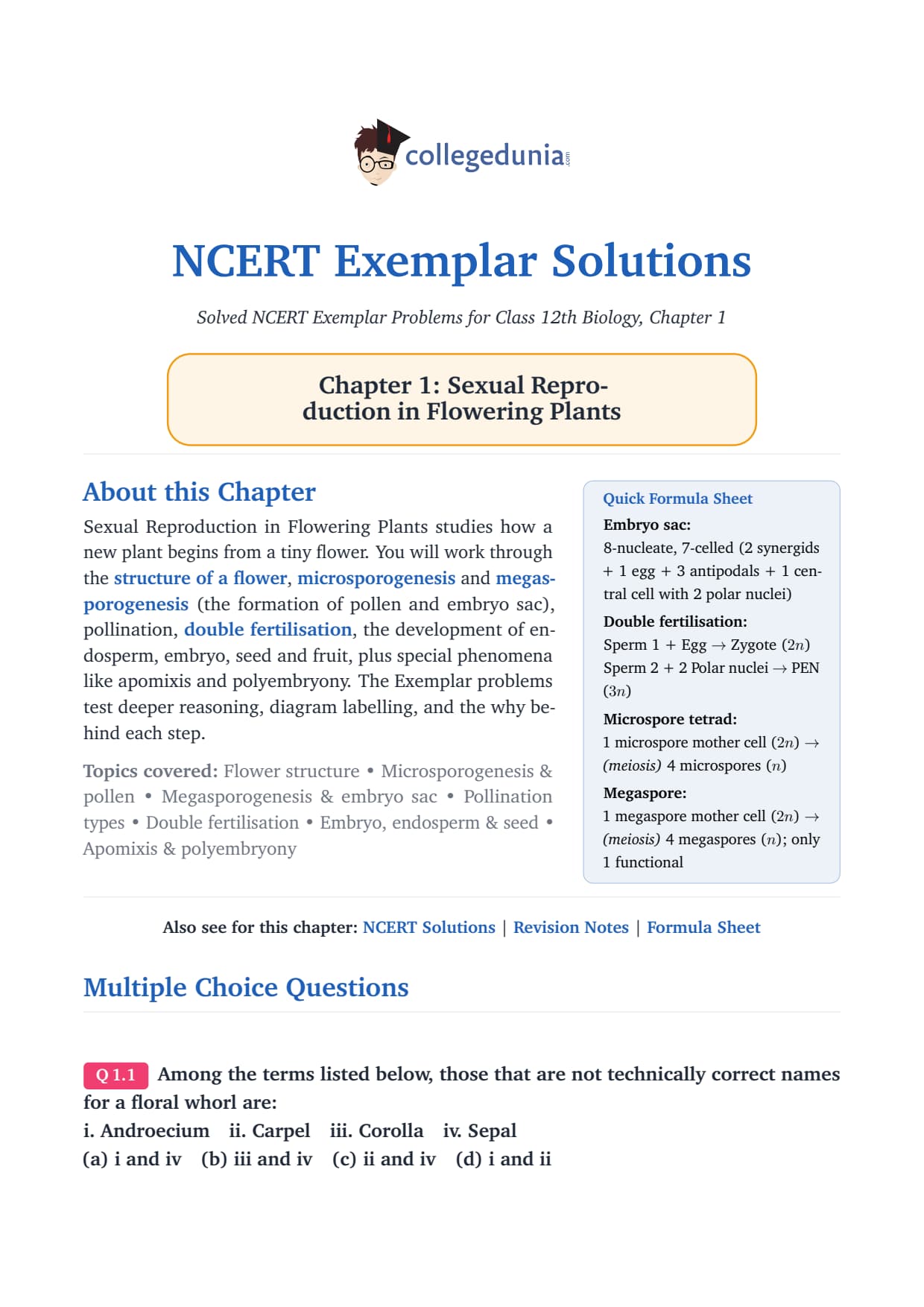
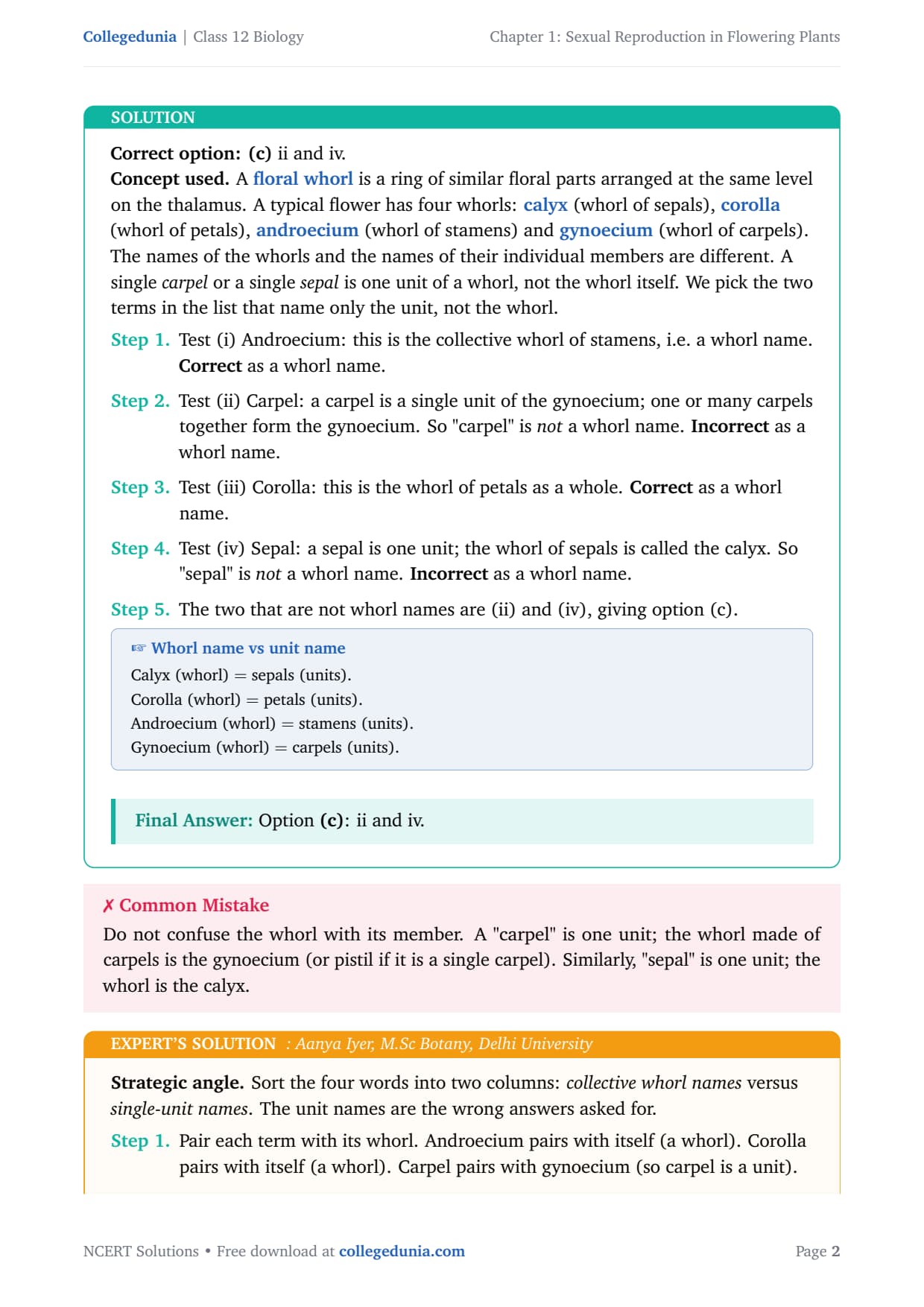
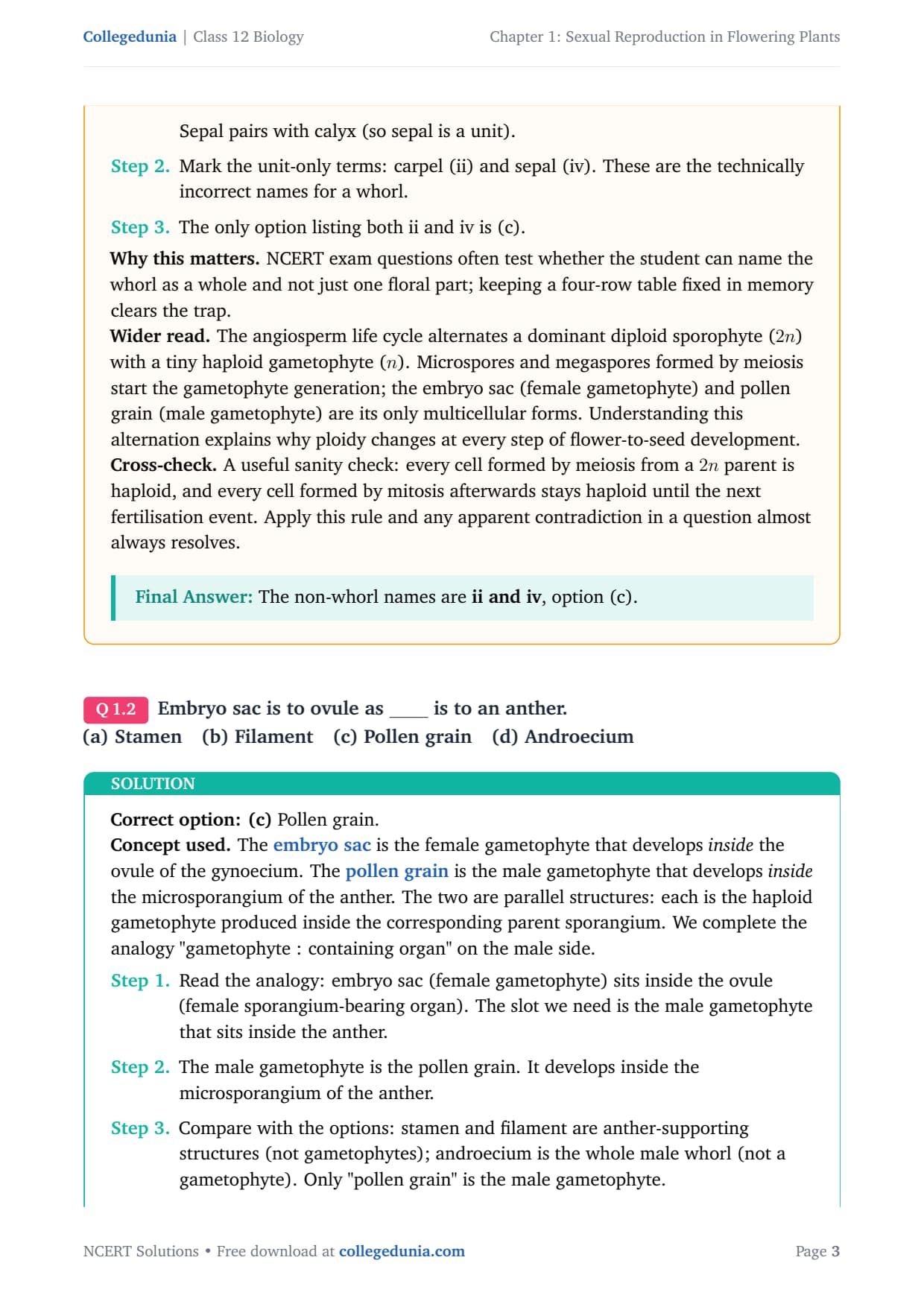
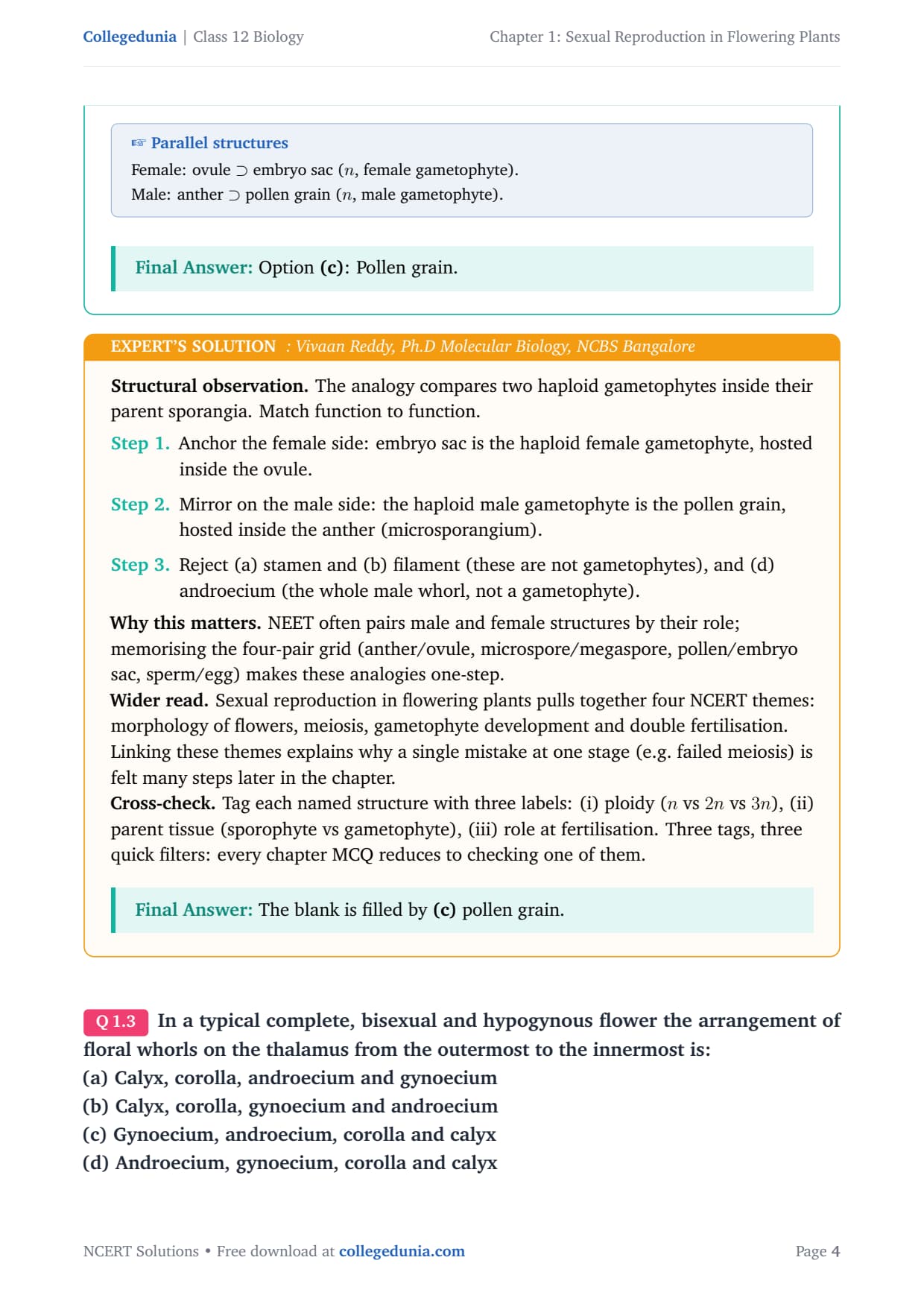
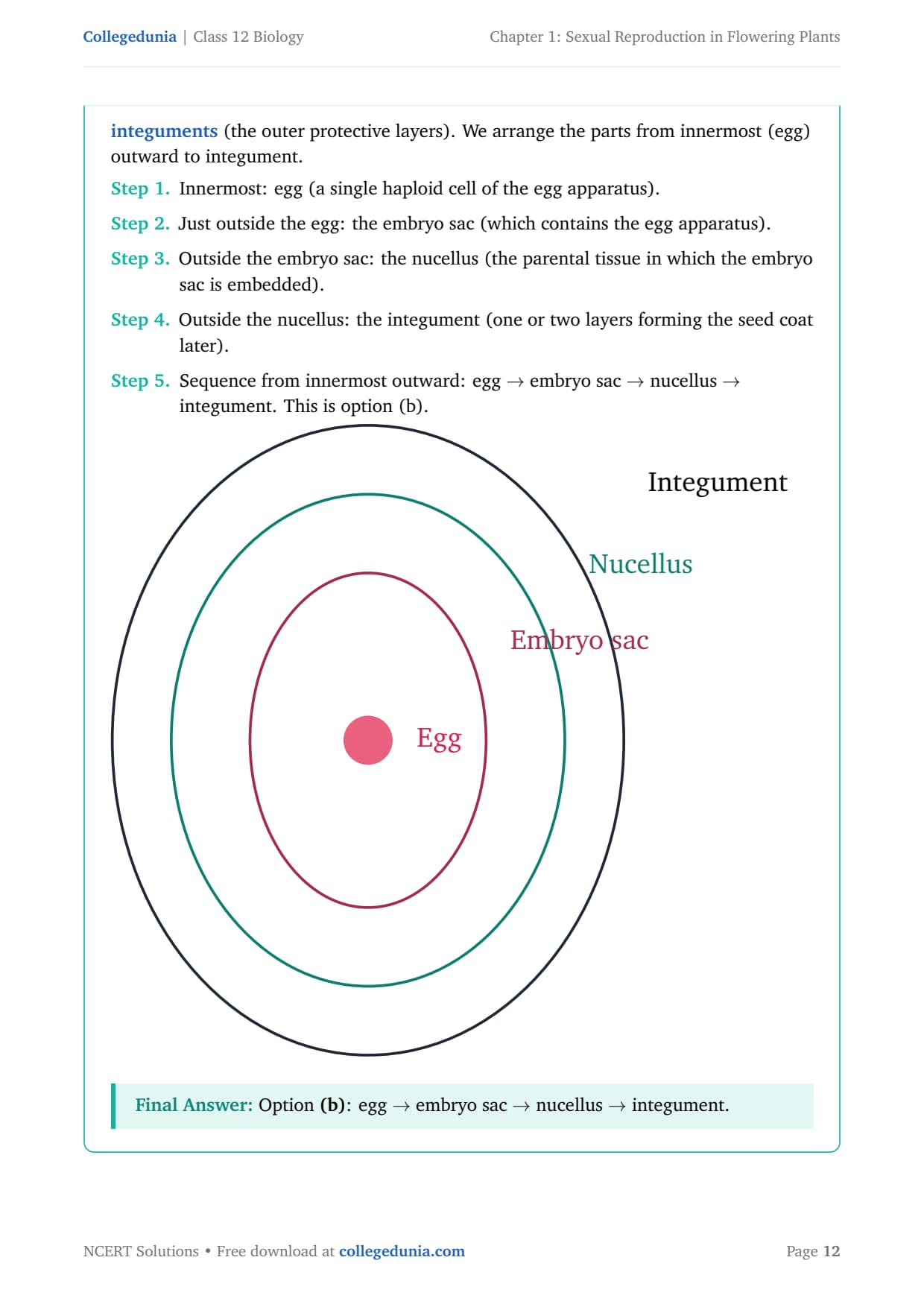


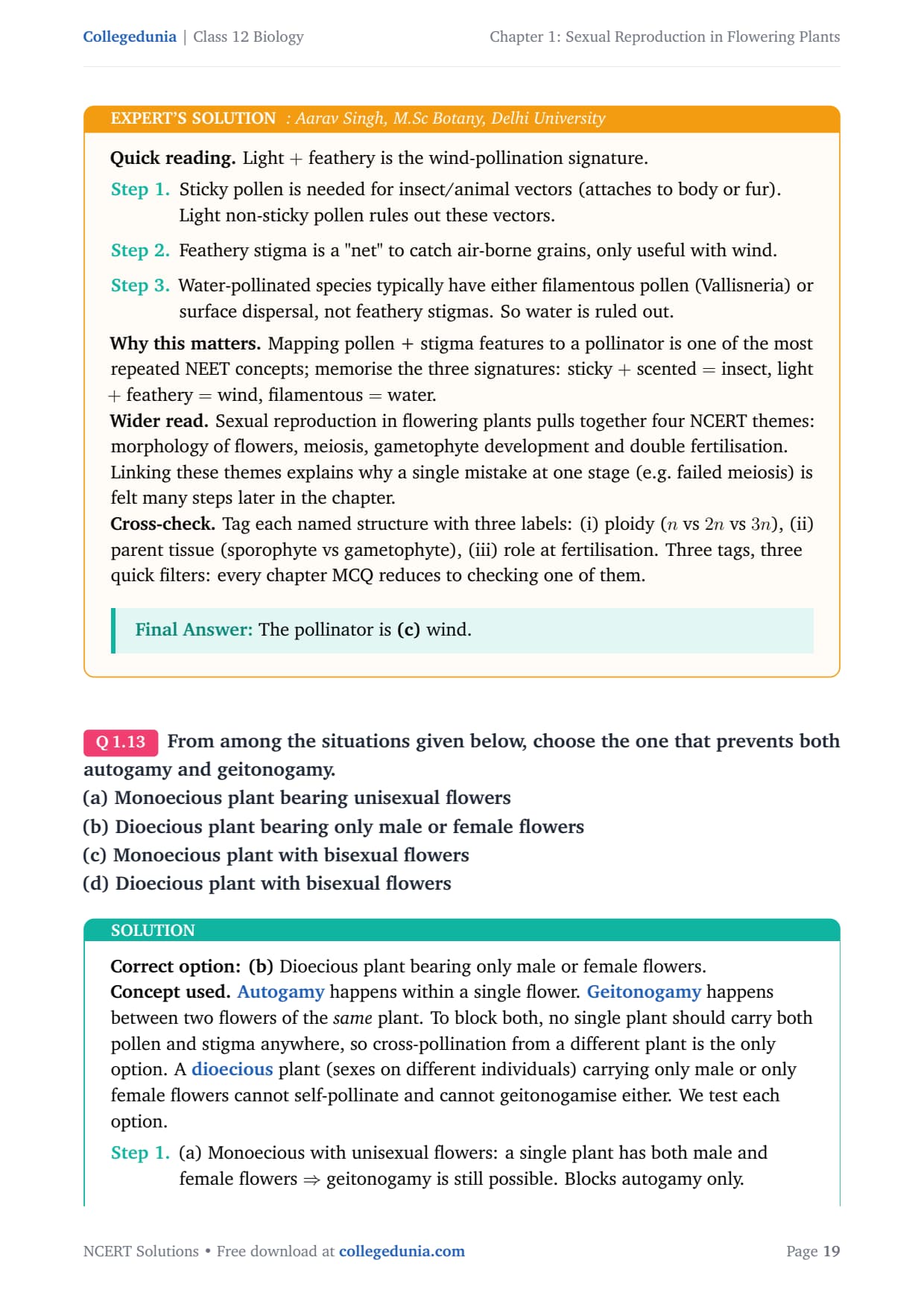
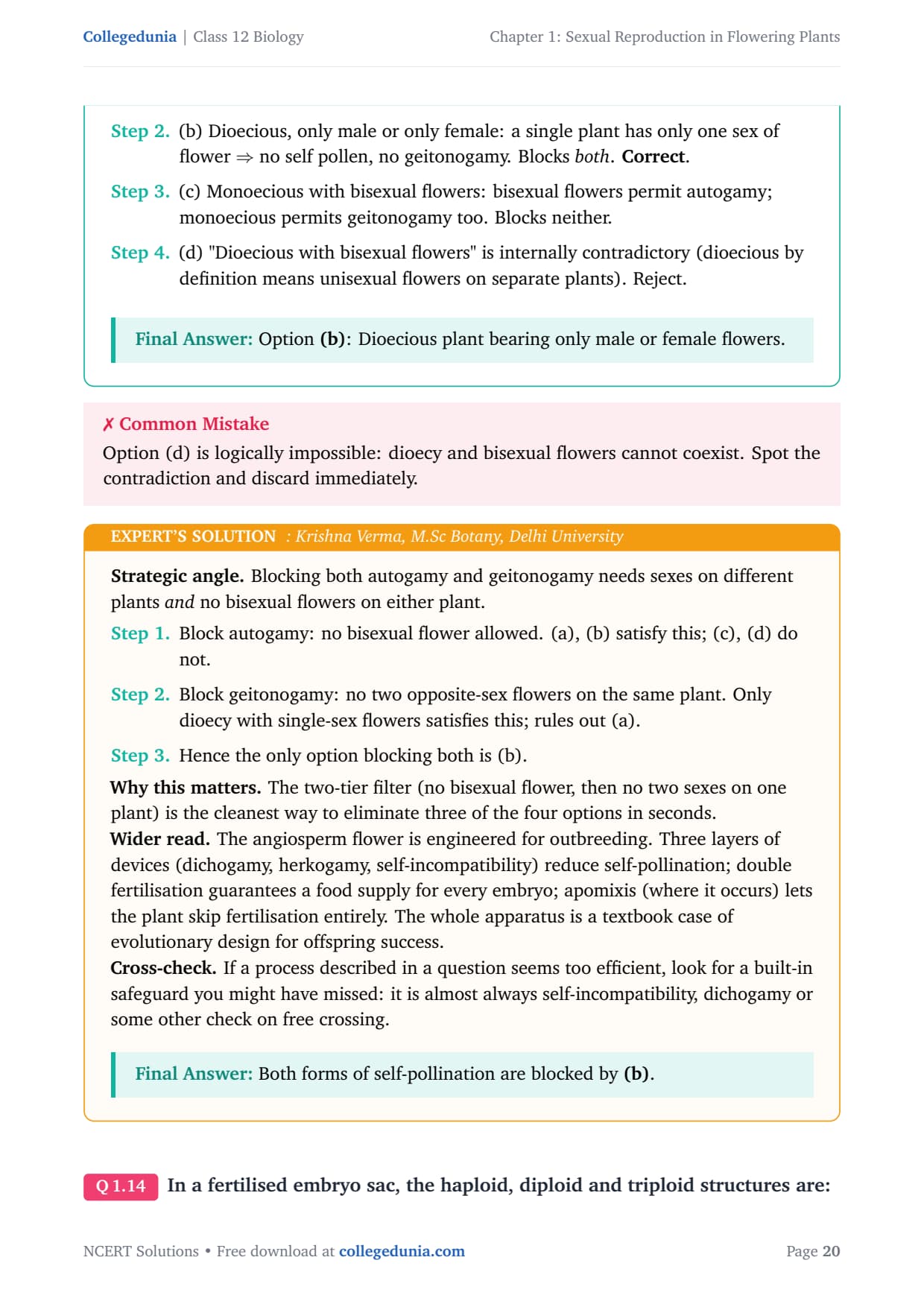
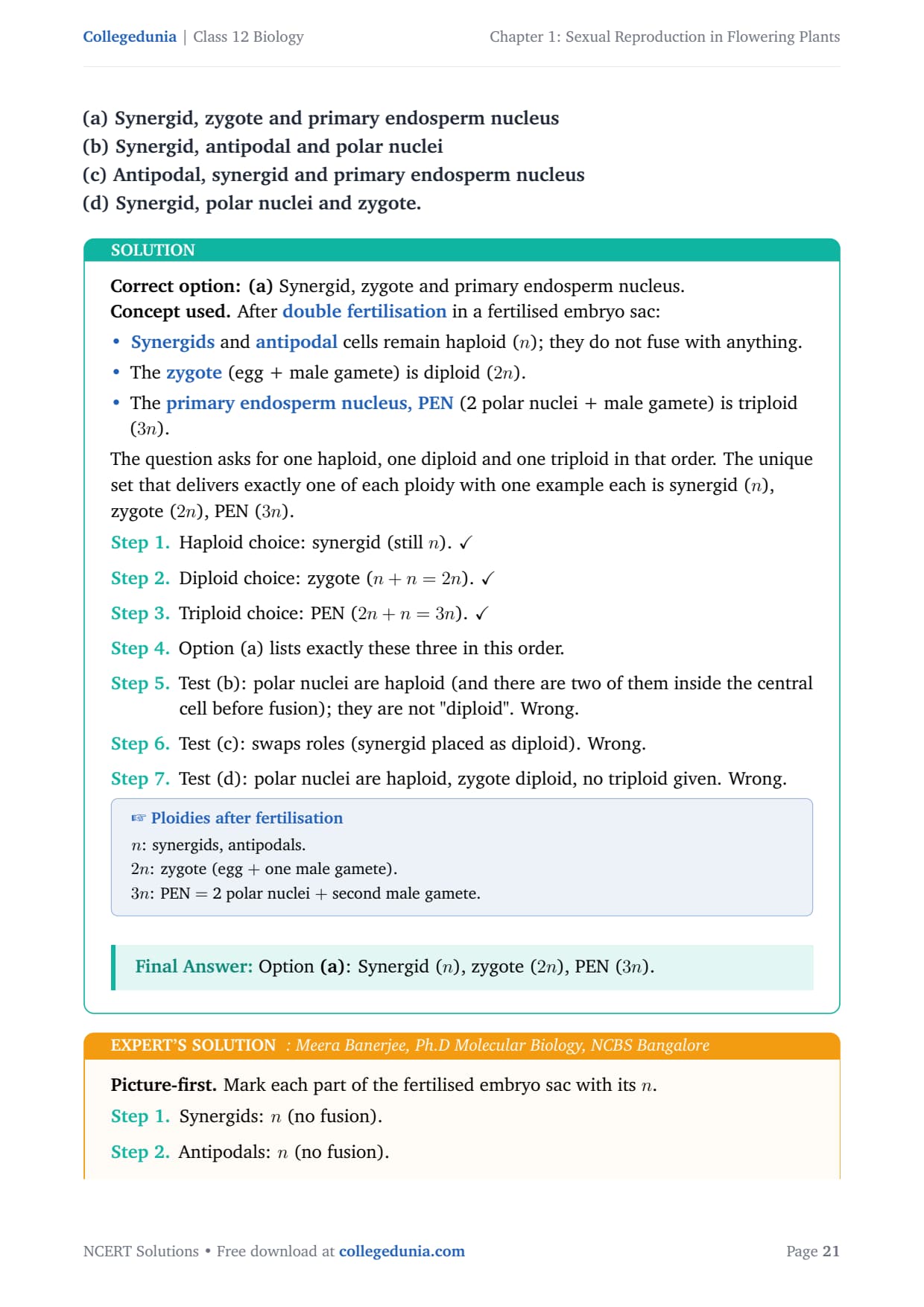

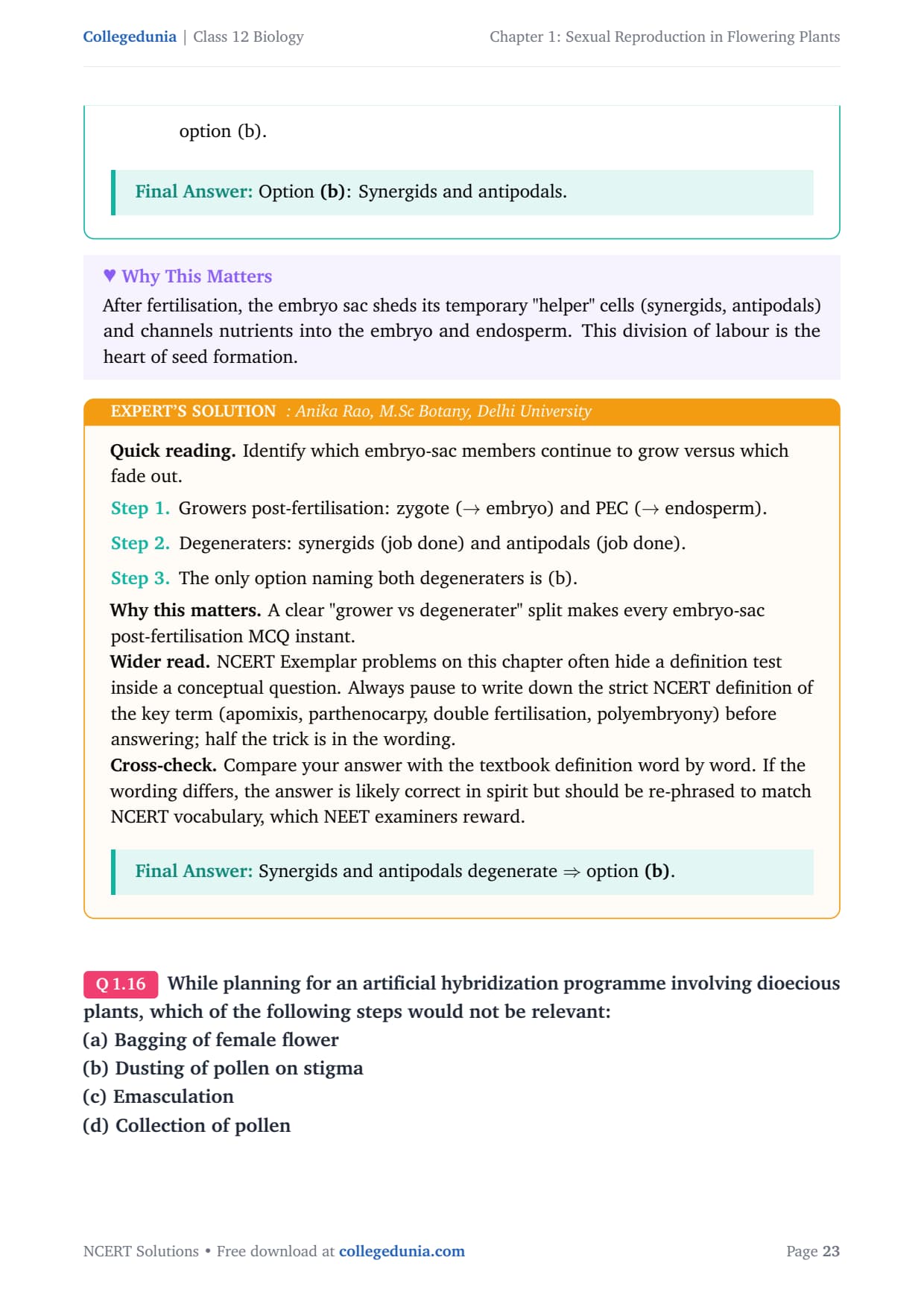
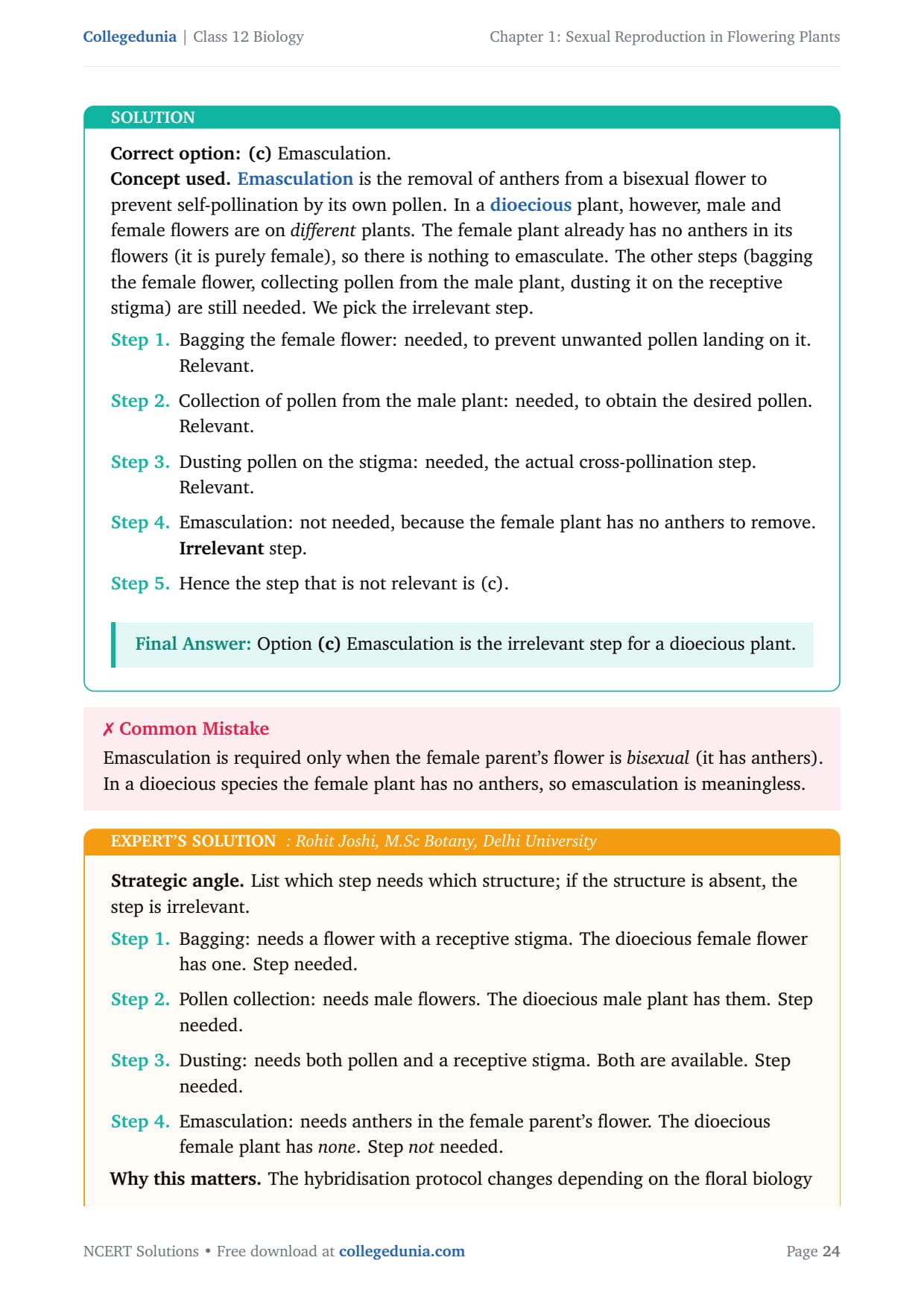

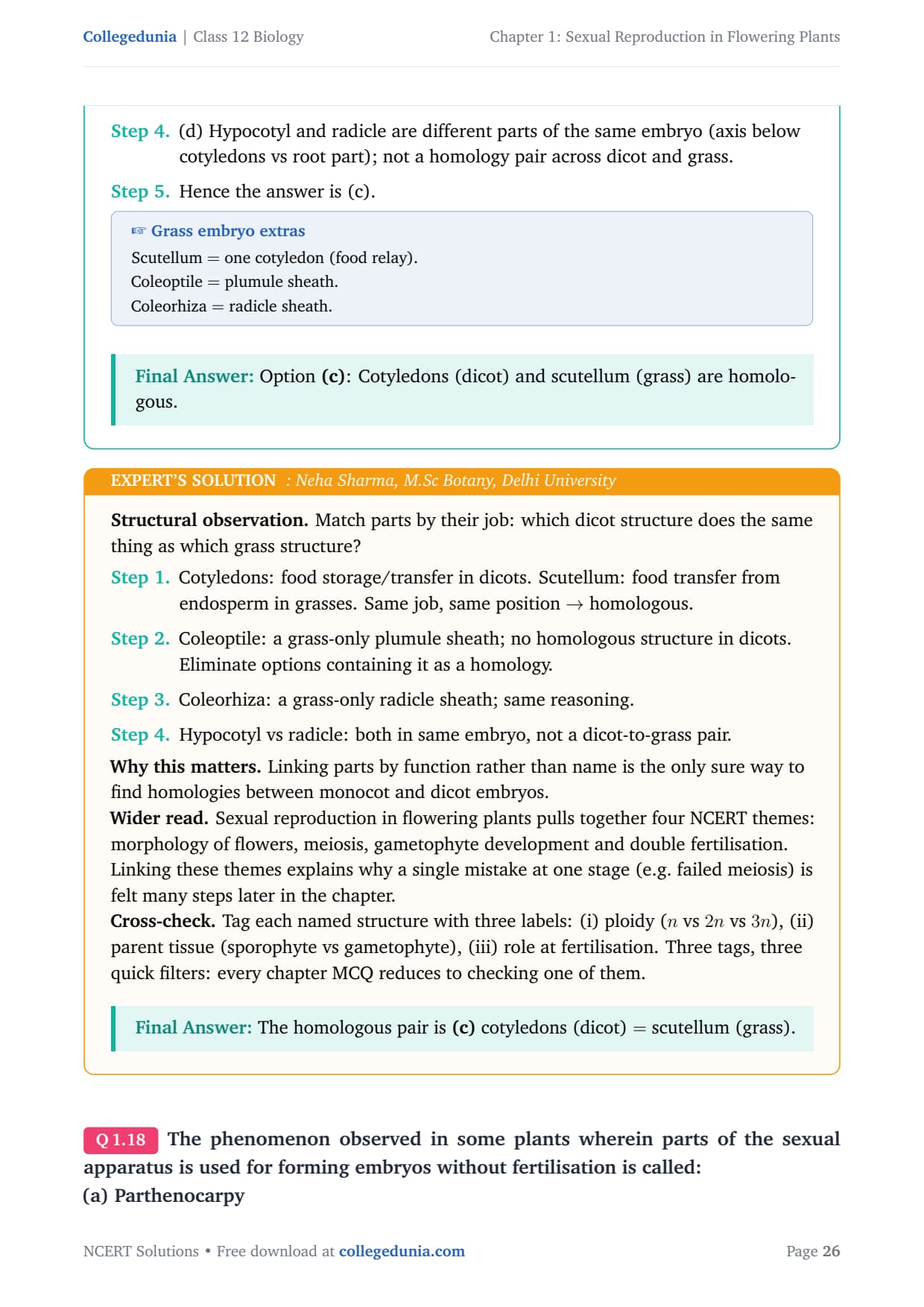


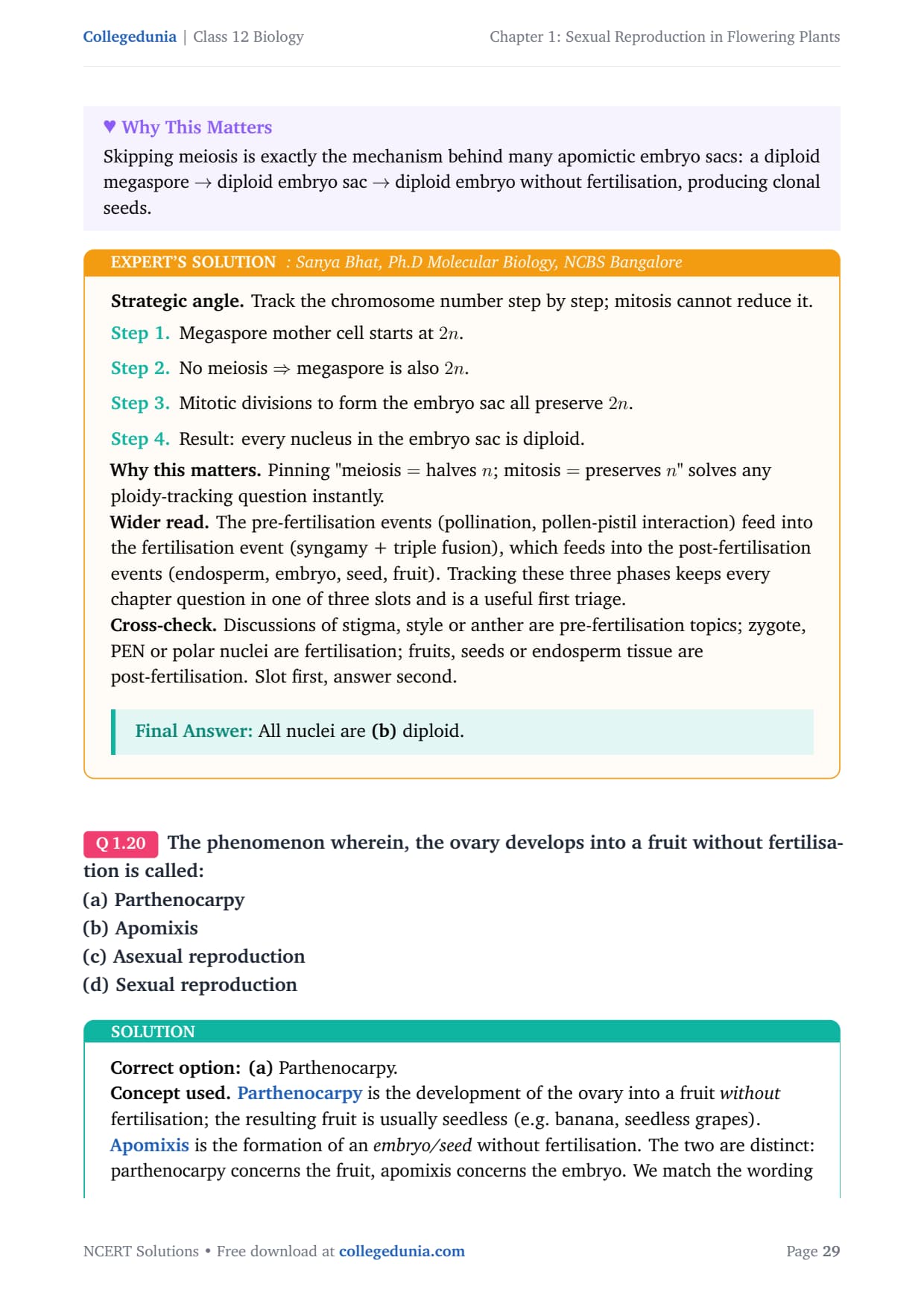
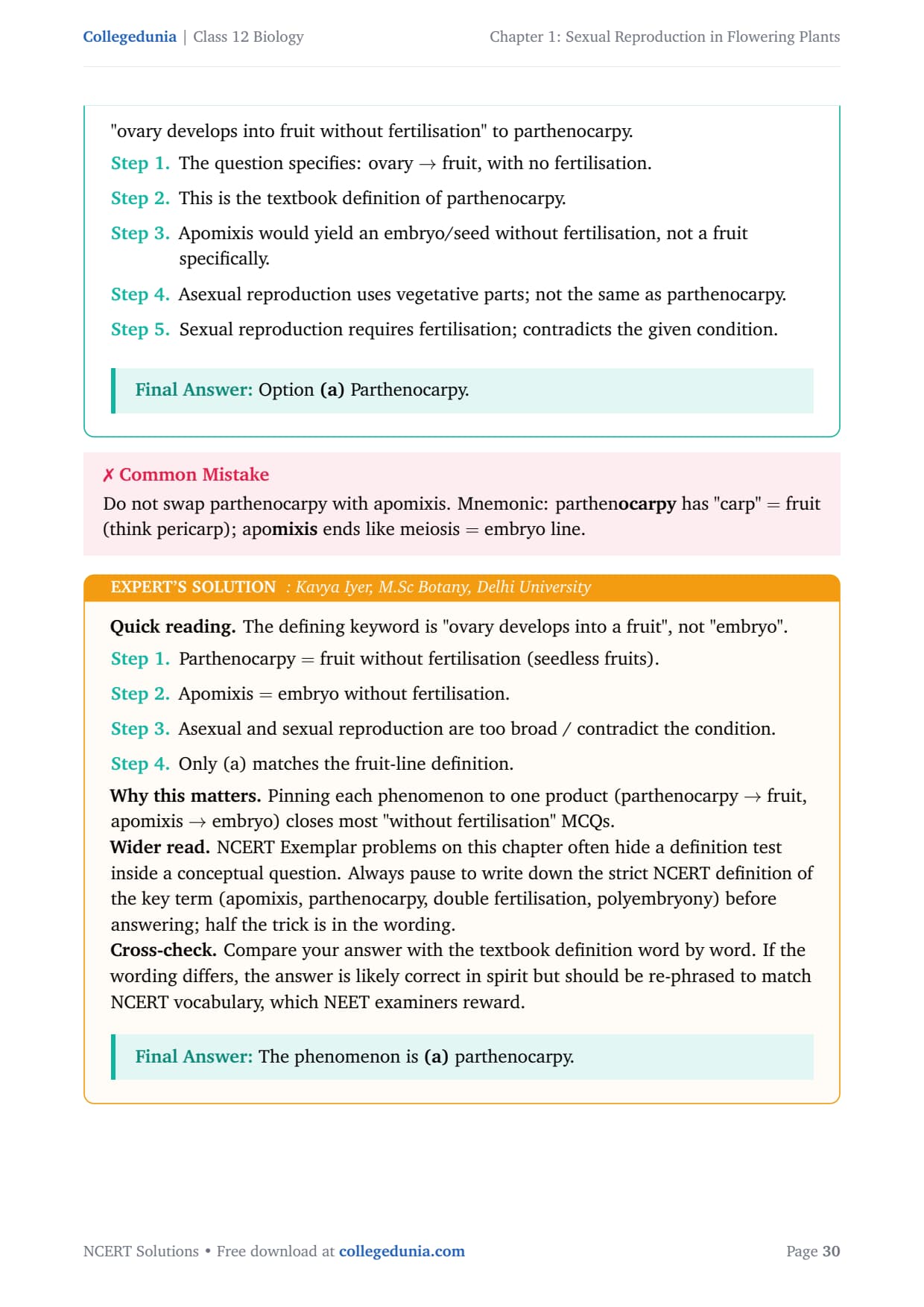
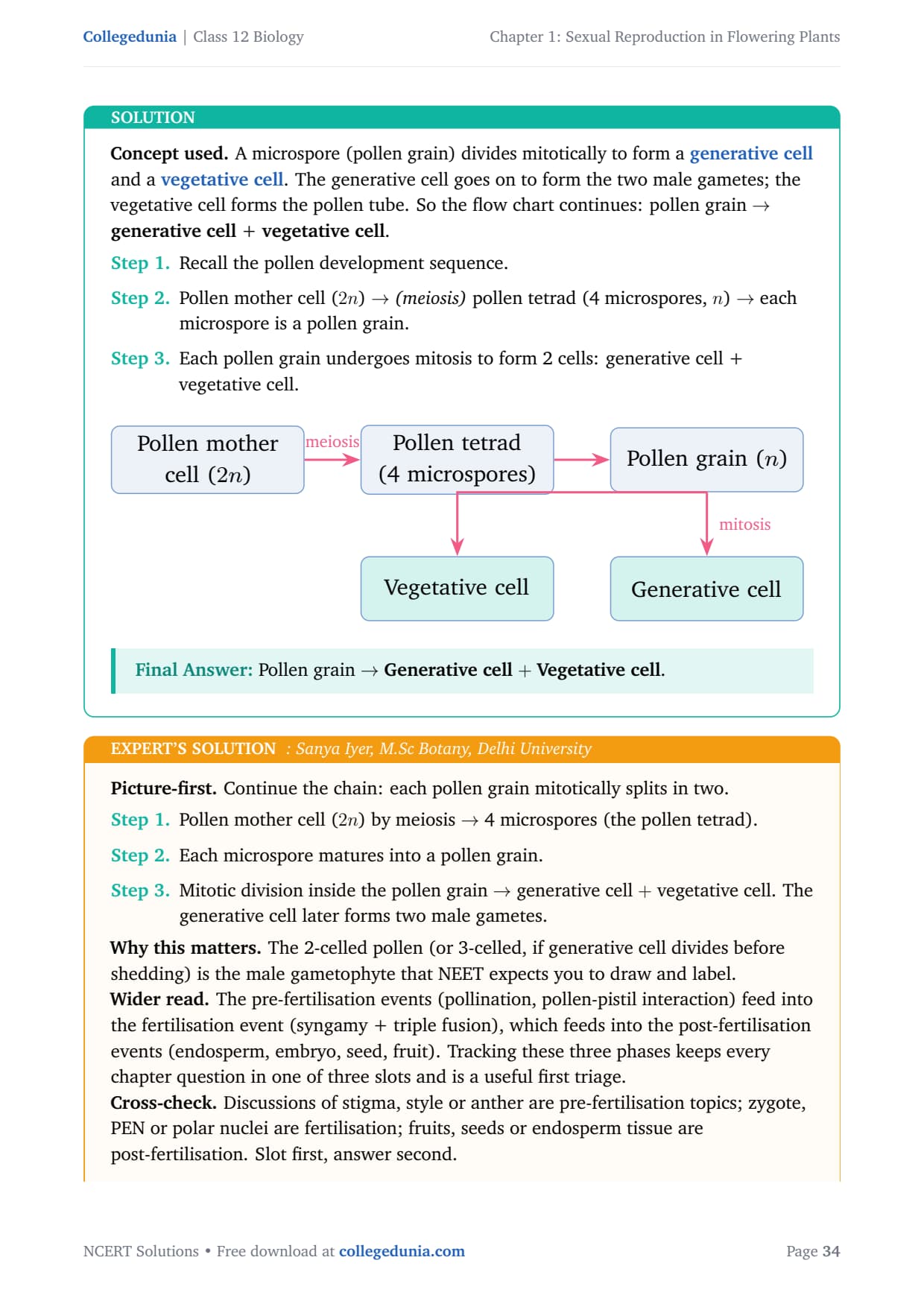

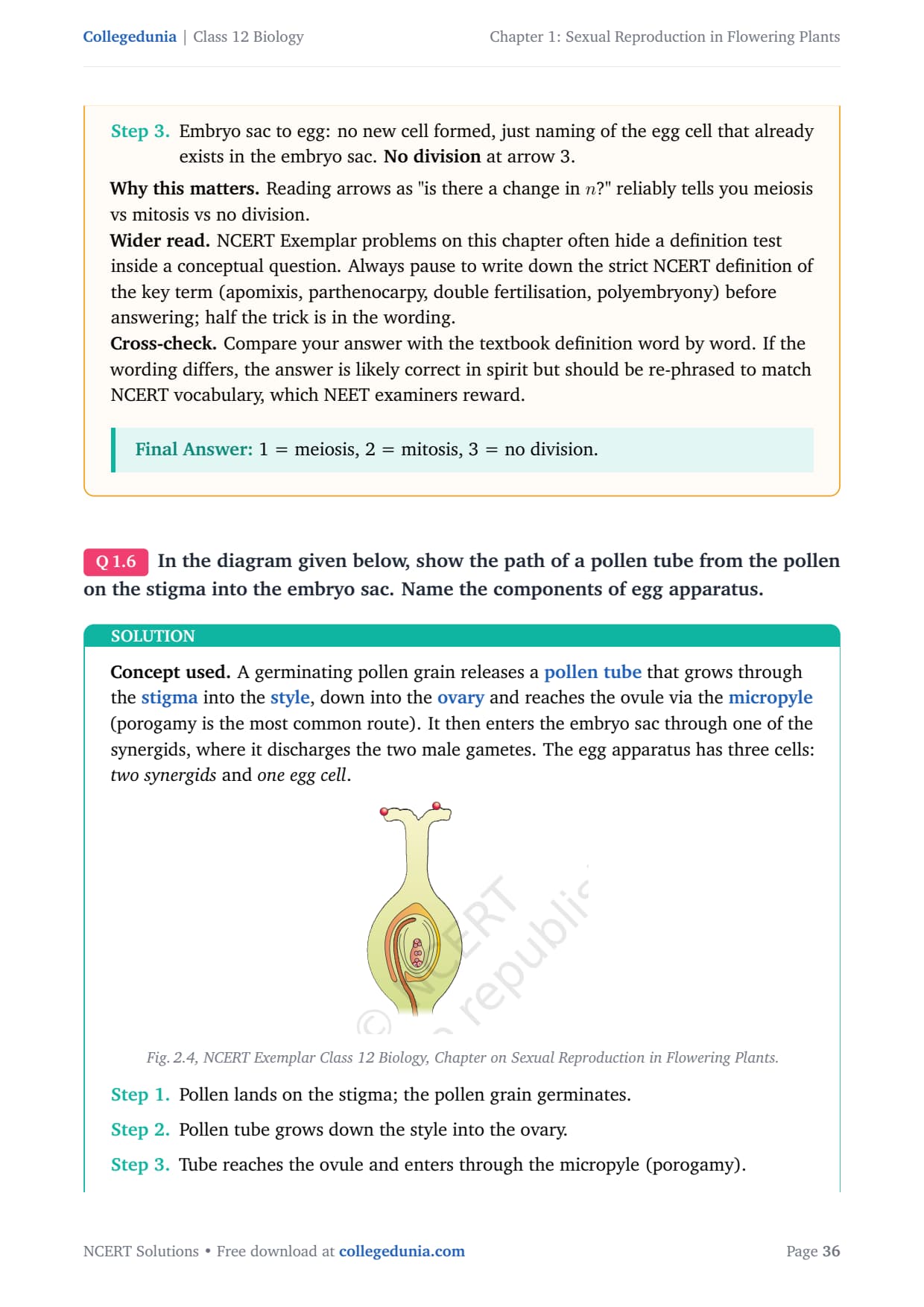


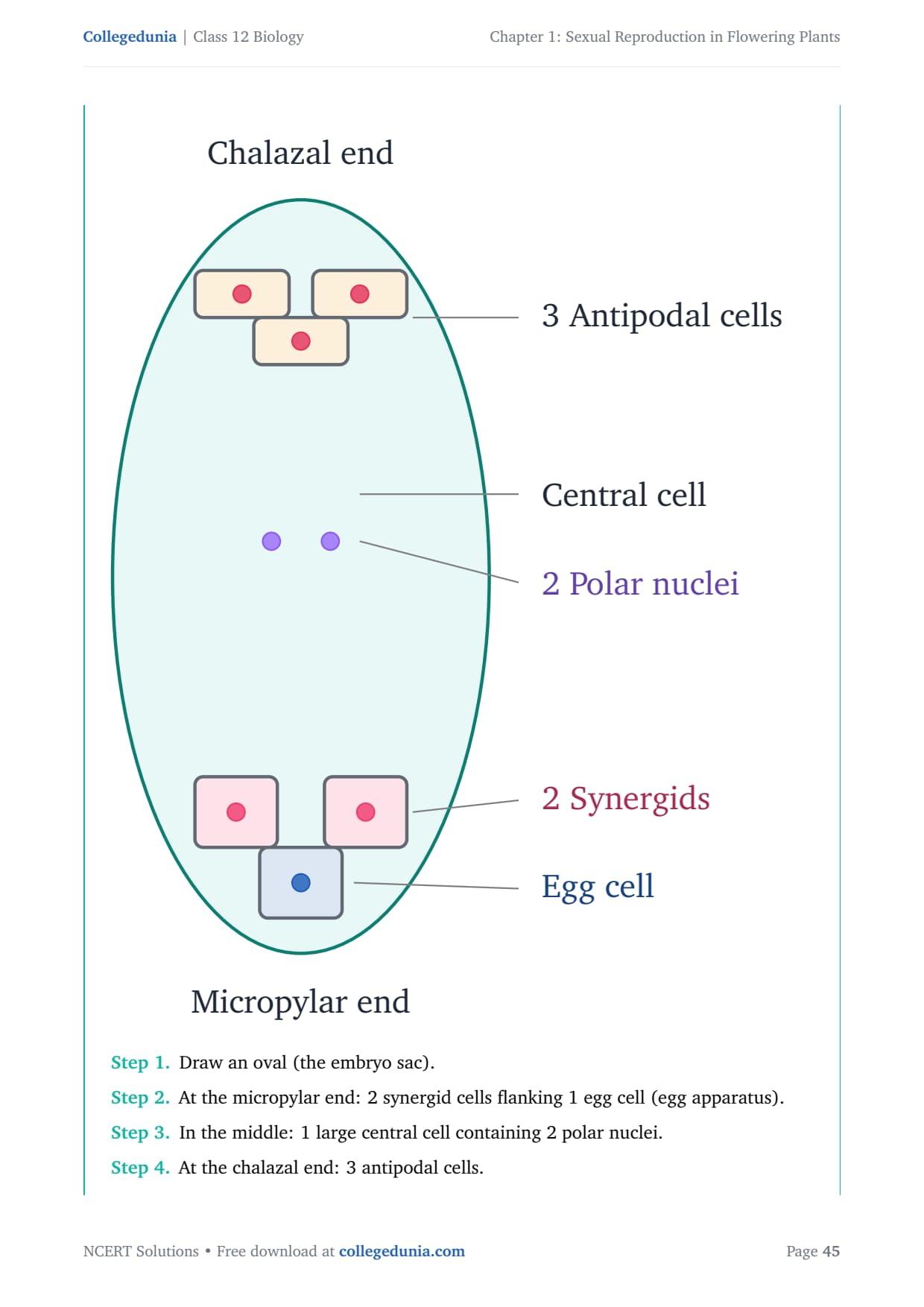







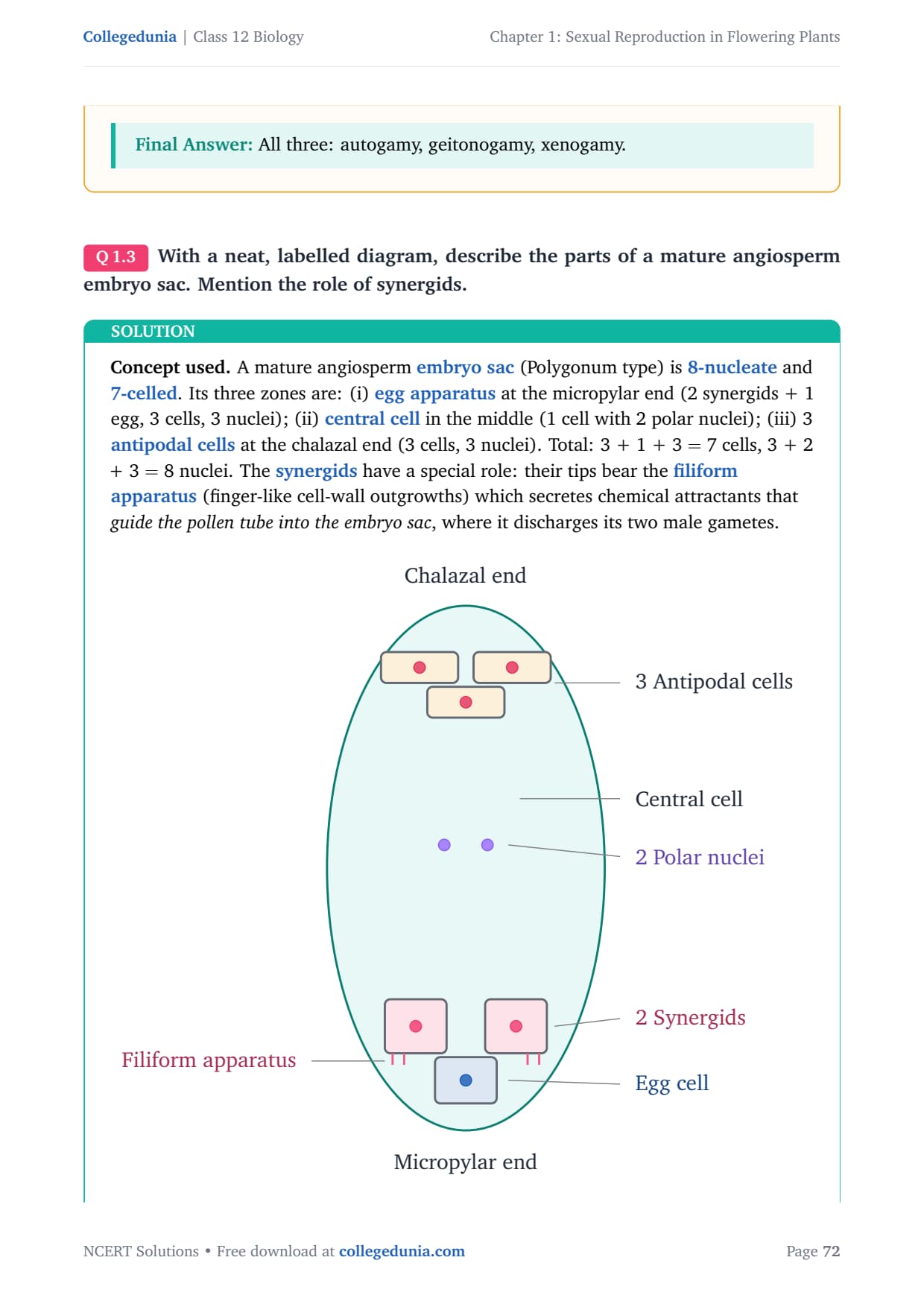

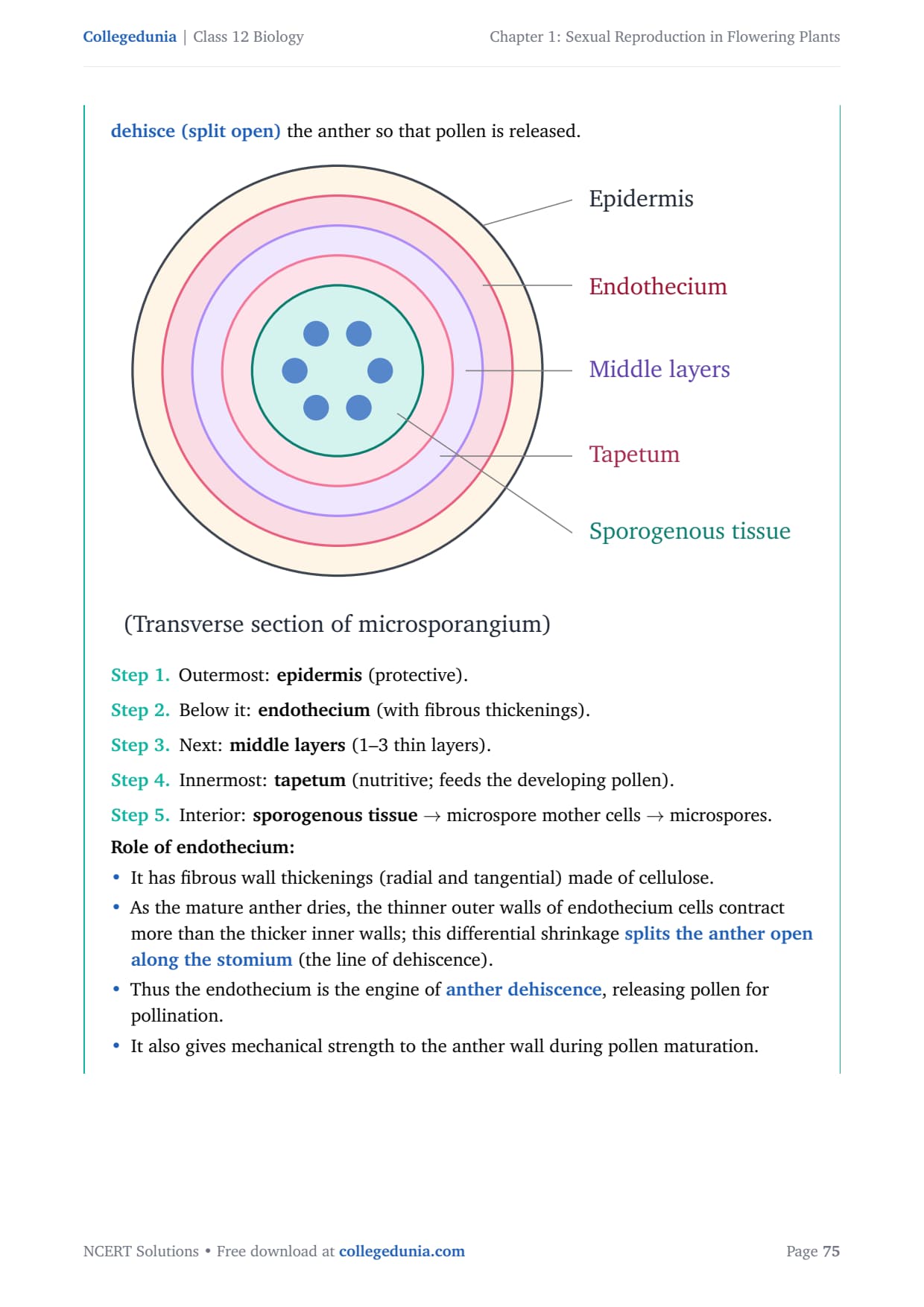
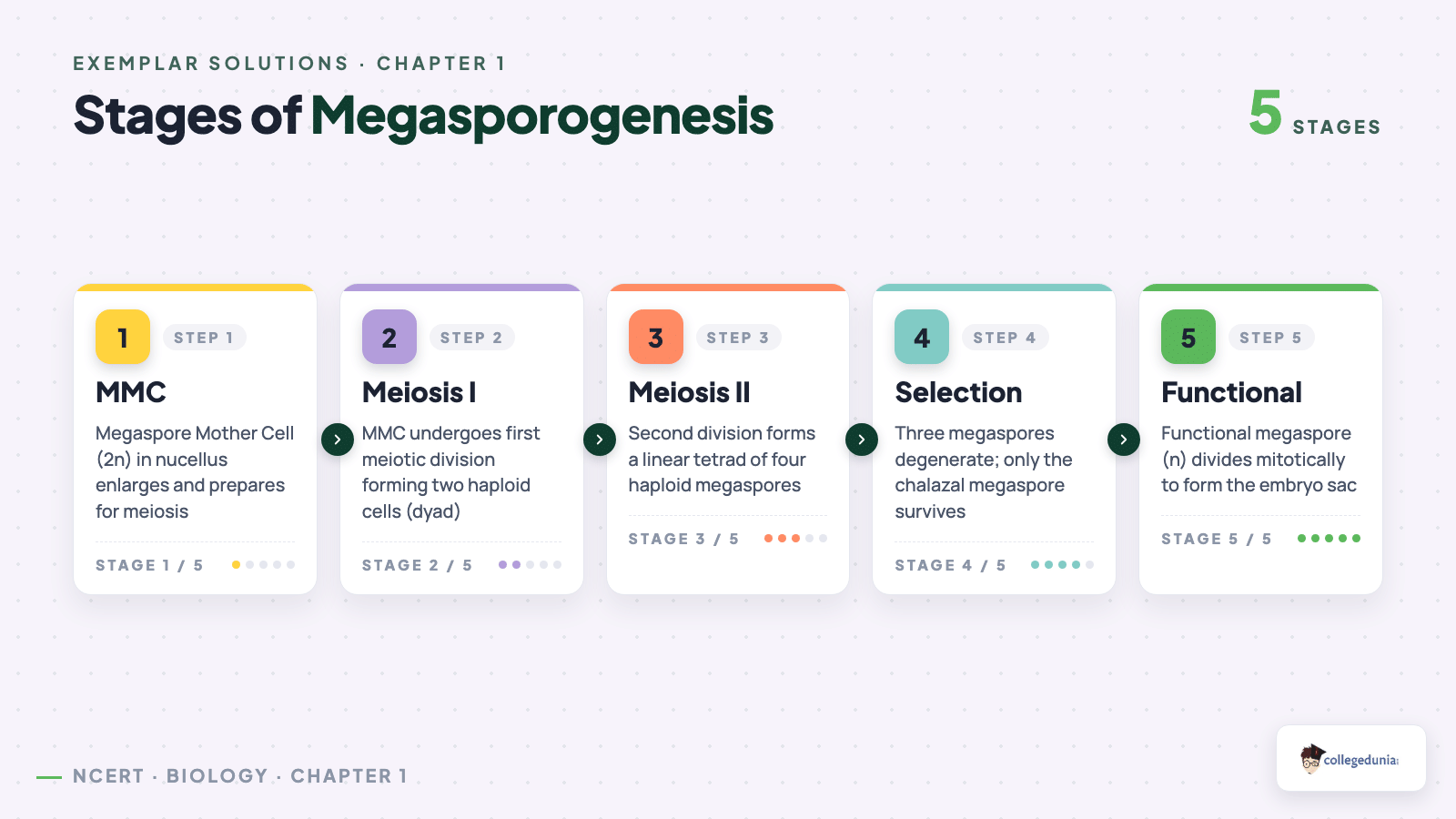
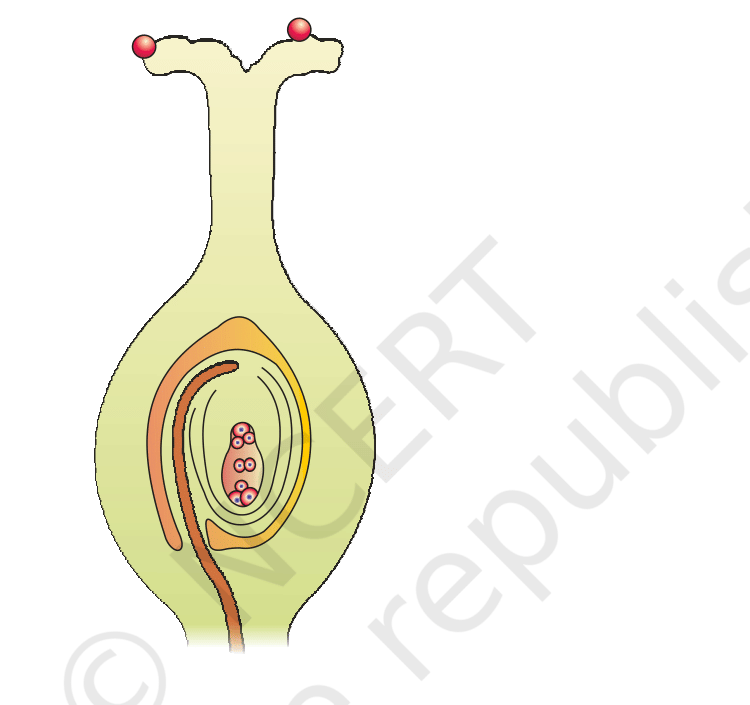
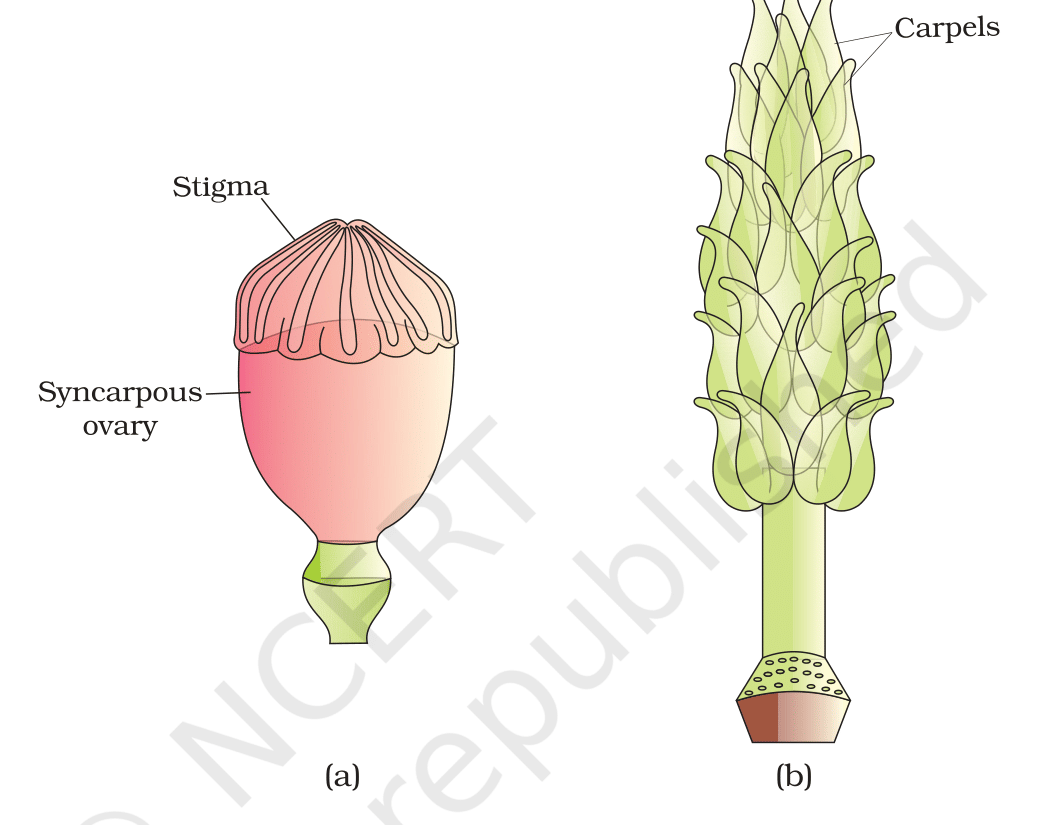
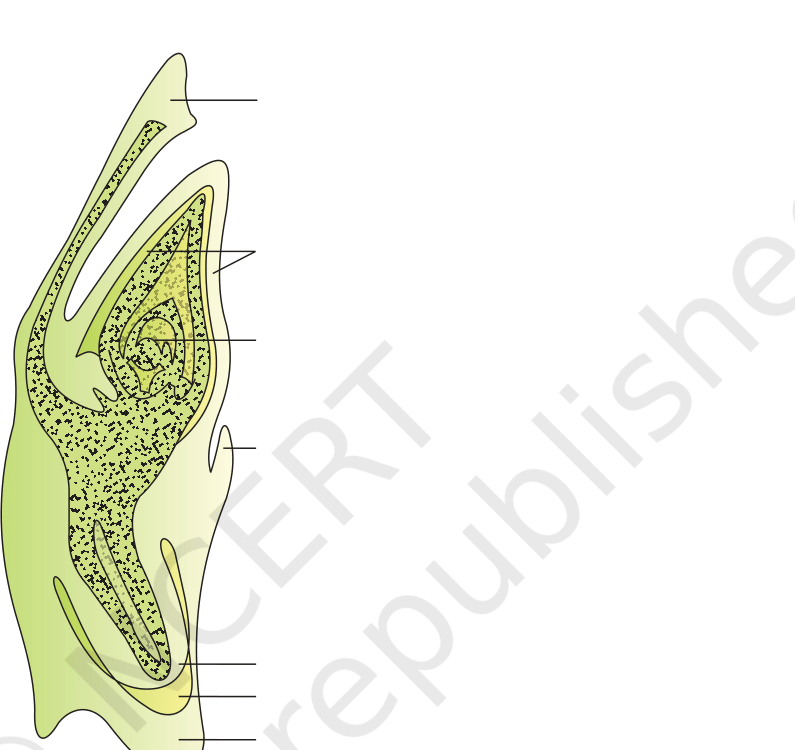
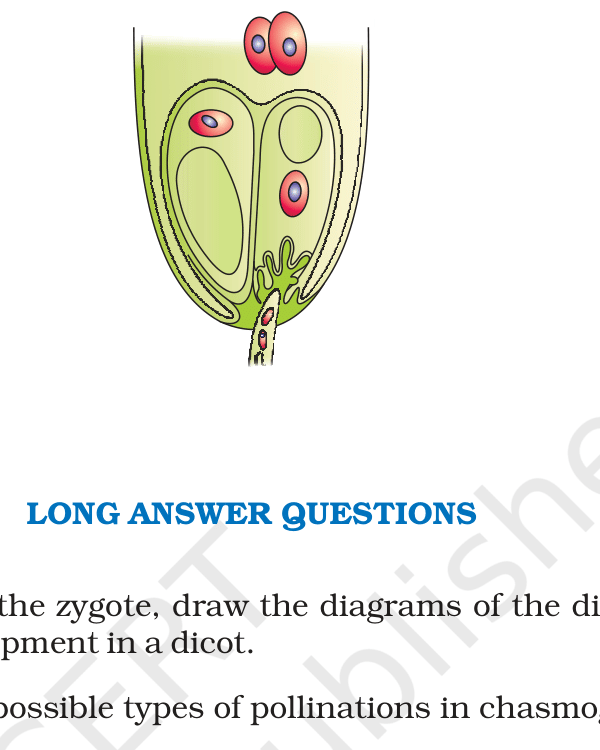



Comments