Maths Mentor, Delhi University | Updated 3+ months ago
NCERT Exemplar Class 10 Maths Chapter 14 Exercise 14.1 has 15 Multiple Choice Questions on Probability. Students use the classical probability formula, the complement rule, and counting methods to pick the correct option for coins, dice, cards, and number-slip experiments.
Exercise type: 15 Multiple Choice Questions (MCQs) from the NCERT Exemplar 2026-27 syllabus
Topics covered: Impossible events, valid probability range, complementary events, playing-card problems, calendar problems, die problems, lottery problems
CBSE relevance: MCQs from Exemplar Probability appear as 1-mark questions in CBSE board exams; complement-rule and card problems are especially frequent
Solved by Collegedunia: Every question in Exercise 14.1 is solved by verified subject experts, mapped to the 2026-27 rationalised NCERT syllabus.
What Probability Exercise 14.1 Covers in Class 10 Maths
Exercise 14.1 in the NCERT Exemplar for Class 10 Maths is the Multiple Choice Question set for Chapter 14, Probability. There are 15 MCQs in this exercise. Each question tests whether students can:
Identify impossible events and sure events by their probability values (0 or 1)
Spot values that fall outside the valid probability range [0, 1]
Apply the complement rule to find P(E) = 1 - P(E)
Count equally likely outcomes for dice, cards, calendar, and number-slip experiments
Work backwards from a probability to find a count (bad eggs, lottery tickets)
These questions are frequently adapted into 1-mark CBSE board questions. Getting them right requires understanding core definitions rather than memorising formulas.
Quick approach for MCQs: Write P(E) = Favourable outcomesTotal outcomes on the side, substitute the numbers you can see, and check that the result lies in [0, 1].
Key Formulas for Exercise 14.1
Students need these formulas and definitions to solve all 15 MCQs in Exercise 14.1. Keep them handy before attempting the questions.
Concept
Formula / Definition
Key point
Classical Probability
P(E) = Number of favourable outcomesTotal equally likely outcomes
Denominator must be positive; numerator is non-negative
Range of probability
0 ≤ P(E) ≤ 1
Any value outside this range is not a valid probability
Impossible event
P(E) = 0
Zero favourable outcomes; event can never occur
Sure event
P(E) = 1
All outcomes are favourable; event always occurs
Complement rule
P(E) + P(E) = 1
If P(E) = p, then P(E) = 1 - p
Count from probability
Count = P × Total
Rearrange the formula when total and P are given
Standard deck facts to memorise: A deck has 52 cards -- 26 red (hearts + diamonds), 26 black (clubs + spades). Each suit has 13 cards: Ace, 2, 3, ..., 10, Jack, Queen, King. Face cards are Jack, Queen, King -- 12 face cards in total, 6 red and 6 black.
Types of Questions in Exercise 14.1
The 15 MCQs in Exercise 14.1 fall into four clear categories. Identifying the type of question helps students pick the right method instantly.
Question Type
Questions
Strategy
Range and definition problems
Q1, Q2, Q3, Q5, Q6
Check whether the value lies in [0, 1]; recall impossible / sure event definitions
Complement rule
Q4
Use P(E) = 1 - p directly
Counting experiments (cards, dice, calendar, slips)
Q7, Q8, Q9, Q10, Q13, Q14, Q15
List or count favourable outcomes, divide by the total
Reverse problems (find count from probability)
Q11, Q12
Multiply P × Total to get the count
Probability Concepts at a Glance for Exercise 14.1
Before solving the MCQs, students should be clear on these five ideas that cover all 15 questions in this exercise.
Impossible vs. Sure: An event that cannot happen has probability 0. An event that must happen has probability 1. Every other event is strictly between 0 and 1.
Valid range check: If a value is negative or greater than 1, it is not a probability. For per-cent form, the window is 0% to 100%.
Complement shortcut: When asked for "not E", subtract from 1 instead of counting from scratch.
Equally likely outcomes: Each face of a fair die, each card in a shuffled deck, and each day of the week are equally likely -- this is what makes the classical formula valid.
Working backwards: If the probability and total are given, the favourable count equals P × Total. This avoids setting up any equation.
Calendar problems (Q8): A non-leap year has 365 = 52 x 7 + 1 days. The 52 full weeks guarantee 52 of every weekday. The one leftover day is equally likely to be any of the 7 weekdays. So the chance of getting a 53rd Sunday is 17.
All Exercise 14.1 Solutions with Step-by-Step Working
I. Multiple Choice Questions (Exercise 14.1)
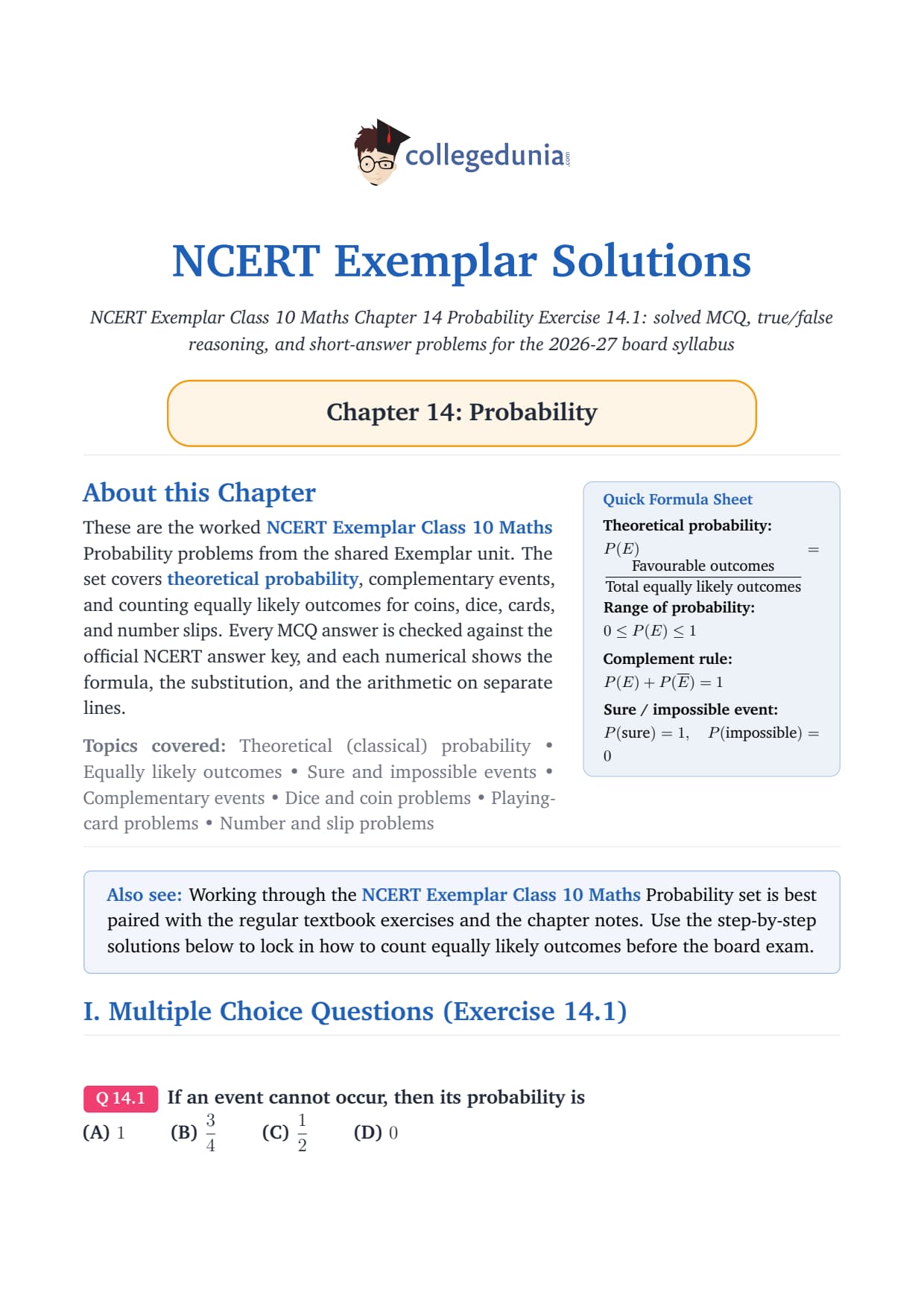
Q 14.1
If an event cannot occur, then its probability is
(A) 1
(B) 34
(C) 12
(D) 0
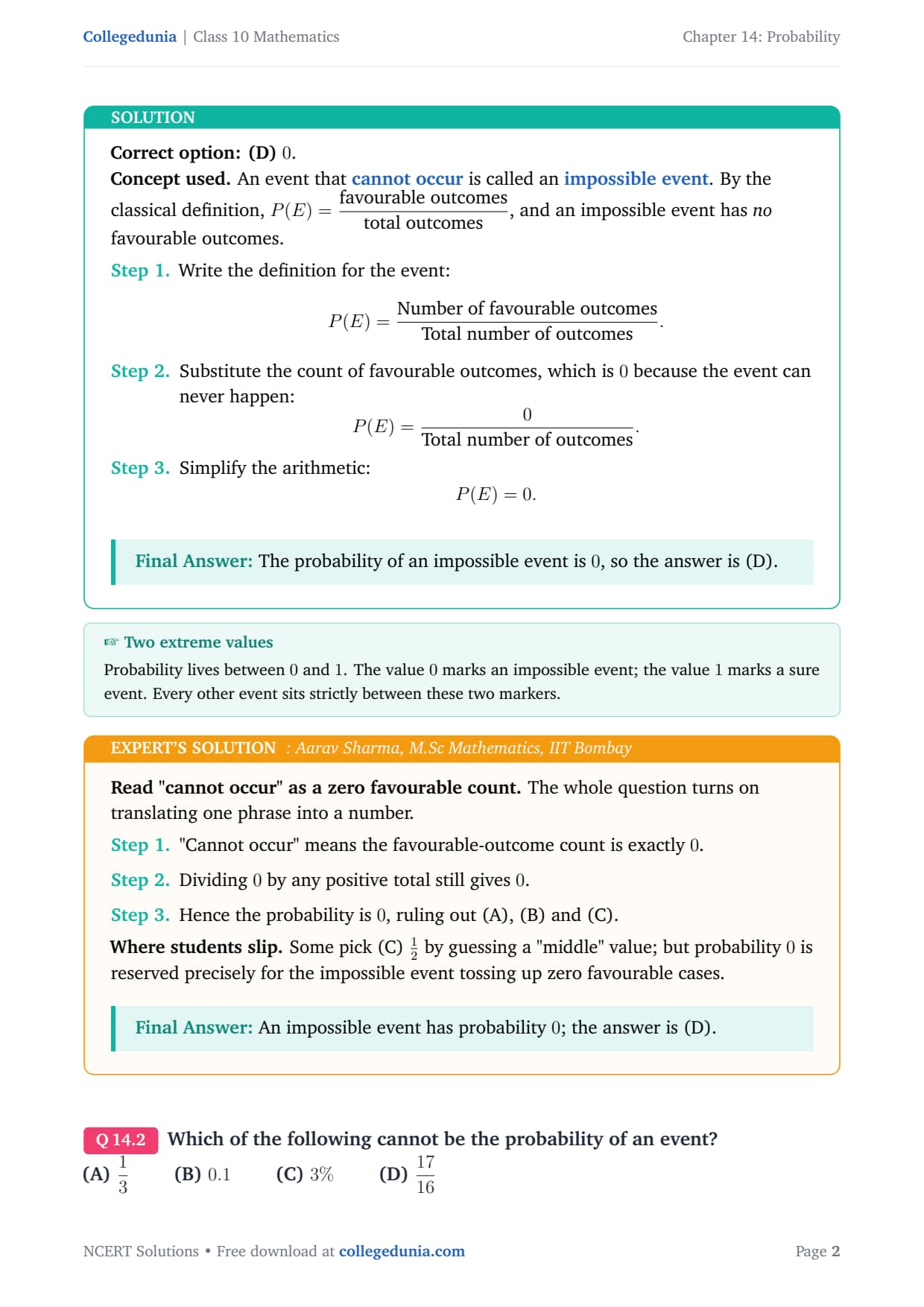
Correct option: (D)0.
Concept used. An event that cannot occur is called an
impossible event. By the classical definition,
P(E)=favourable outcomestotal outcomes, and an
impossible event has no favourable outcomes.
Write the definition for the event:
P(E)=Number of favourable outcomesTotal number of outcomes.
Substitute the count of favourable outcomes, which is 0 because
the event can never happen:
P(E)=0Total number of outcomes.
Simplify the arithmetic:
P(E)=0.
The probability of an impossible event is 0, so the answer is (D).
AS
Aarav Sharma
M.Sc Mathematics, IIT Bombay
Verified Expert
Read "cannot occur" as a zero favourable count. The whole
question turns on translating one phrase into a number.
"Cannot occur" means the favourable-outcome count is exactly 0.
Dividing 0 by any positive total still gives 0.
Hence the probability is 0, ruling out (A), (B) and (C).
Where students slip. Some pick (C) 12 by guessing a
"middle" value; but probability 0 is reserved precisely for the
impossible event tossing up zero favourable cases.
An impossible event has probability 0; the answer is (D).
Q 14.2
Which of the following cannot be the probability of an event?
(A) 13
(B) 0.1
(C) 3%
(D) 1716
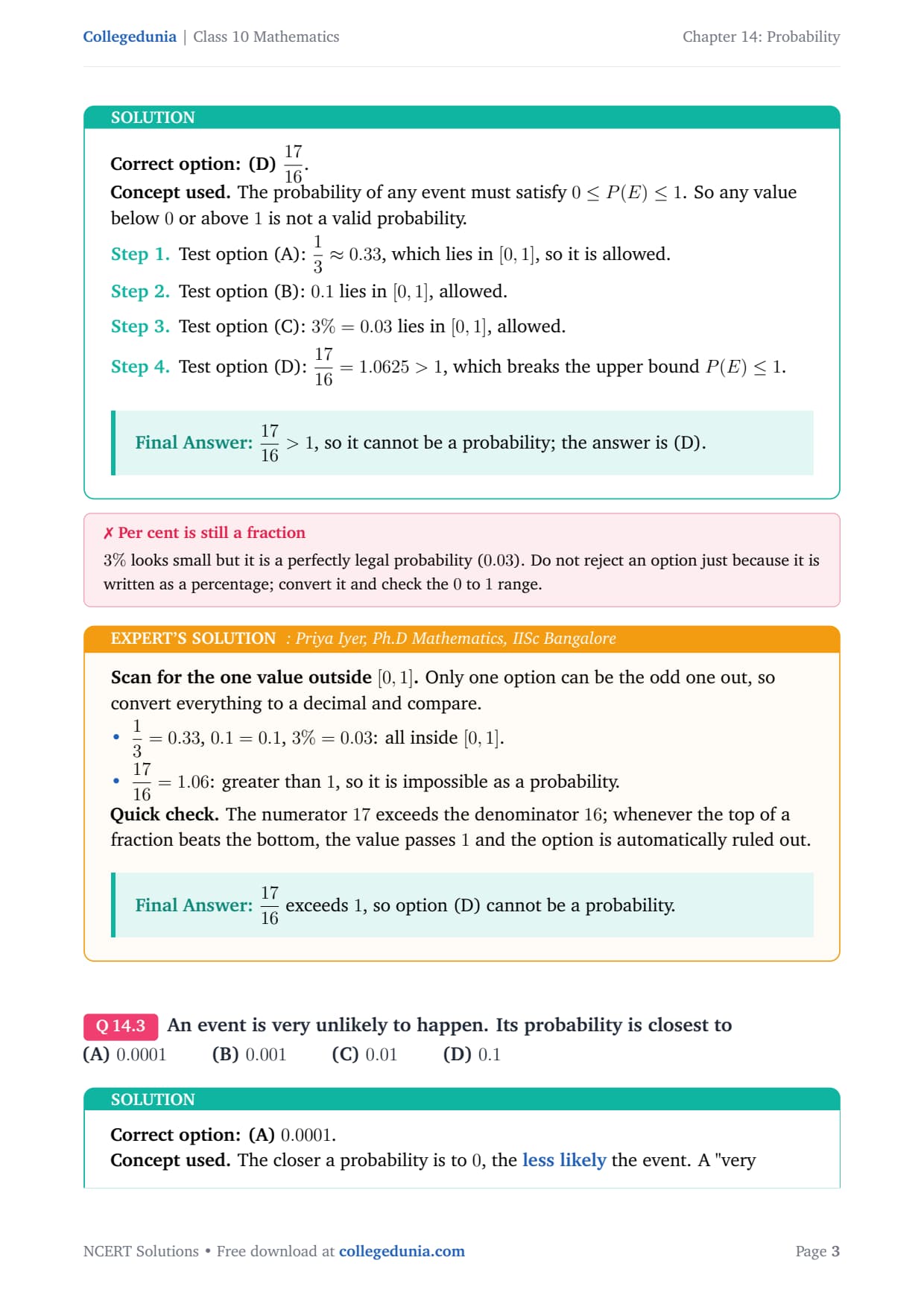
Correct option: (D)1716.
Concept used. The probability of any event must satisfy
0≤ P(E)≤ 1. So any value below 0 or above 1 is not a valid
probability.
Test option (A): 13≈ 0.33, which lies in
[0,1], so it is allowed.
Test option (B): 0.1 lies in [0,1], allowed.
Test option (C): 3%=0.03 lies in [0,1], allowed.
Test option (D): 1716=1.0625>1, which breaks the
upper bound P(E)≤ 1.
1716>1, so it cannot be a probability; the answer is (D).
PI
Priya Iyer
Ph.D Mathematics, IISc Bangalore
Verified Expert
Scan for the one value outside [0,1]. Only one option can be
the odd one out, so convert everything to a decimal and compare.
13=0.33, 0.1=0.1, 3%=0.03: all inside [0,1].
1716=1.06: greater than 1, so it is impossible as a
probability.
Quick check. The numerator 17 exceeds the denominator 16;
whenever the top of a fraction beats the bottom, the value passes 1 and
the option is automatically ruled out.
1716 exceeds 1, so option (D) cannot be a probability.
Q 14.3
An event is very unlikely to happen. Its probability is closest to
(A) 0.0001
(B) 0.001
(C) 0.01
(D) 0.1
Correct option: (A)0.0001.
Concept used. The closer a probability is to 0, the
less likely the event. A "very unlikely" event therefore has a
probability that is as near to 0 as possible.
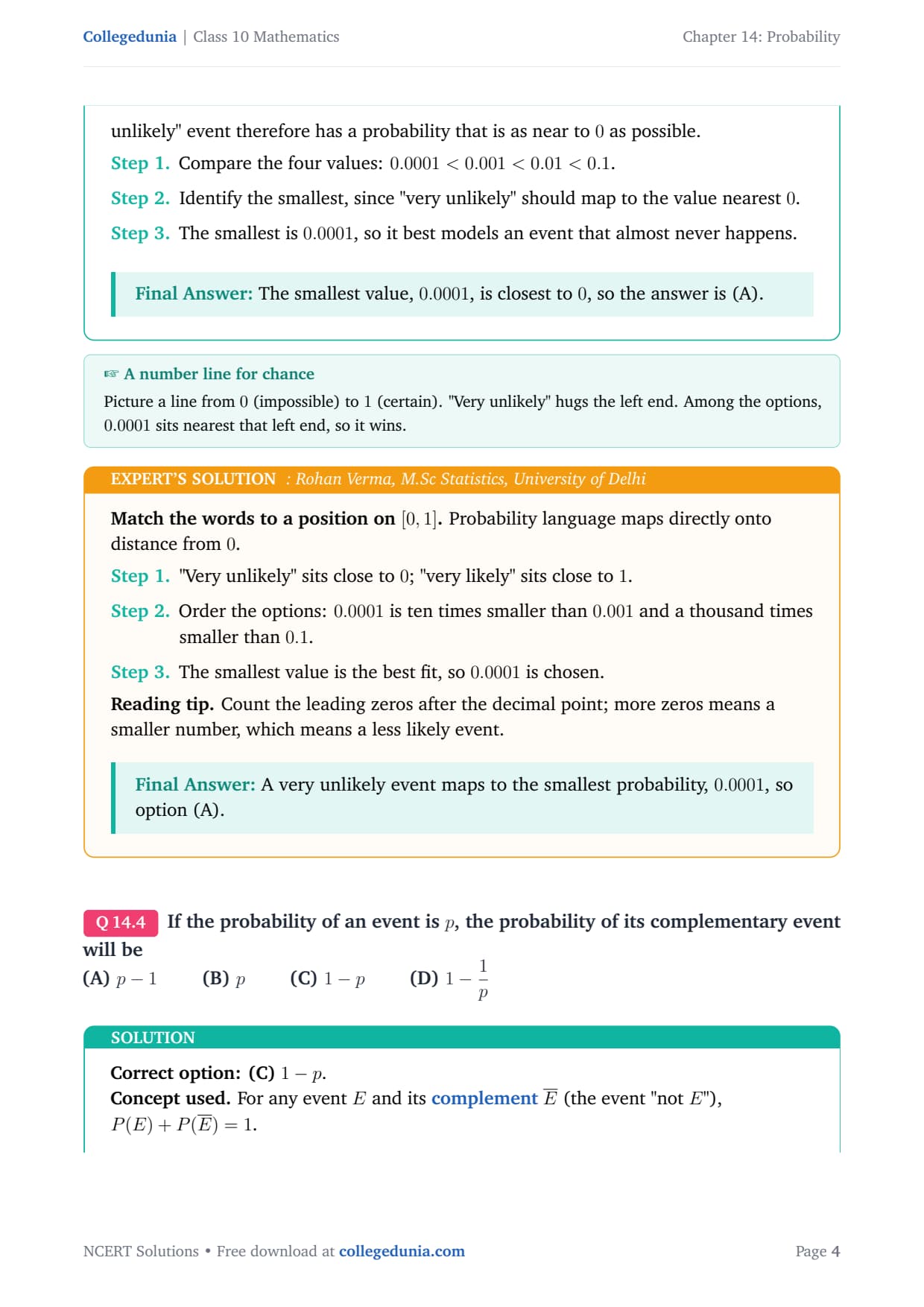
Compare the four values: 0.0001<0.001<0.01<0.1.
Identify the smallest, since "very unlikely" should map to the
value nearest 0.
The smallest is 0.0001, so it best models an event that almost
never happens.
The smallest value, 0.0001, is closest to 0, so the answer is (A).
RV
Rohan Verma
M.Sc Statistics, University of Delhi
Verified Expert
Match the words to a position on [0,1]. Probability language
maps directly onto distance from 0.
"Very unlikely" sits close to 0; "very likely" sits close to
1.
Order the options: 0.0001 is ten times smaller than 0.001 and
a thousand times smaller than 0.1.
The smallest value is the best fit, so 0.0001 is chosen.
Reading tip. Count the leading zeros after the decimal point;
more zeros means a smaller number, which means a less likely event.
A very unlikely event maps to the smallest probability, 0.0001, so option (A).
Q 14.4
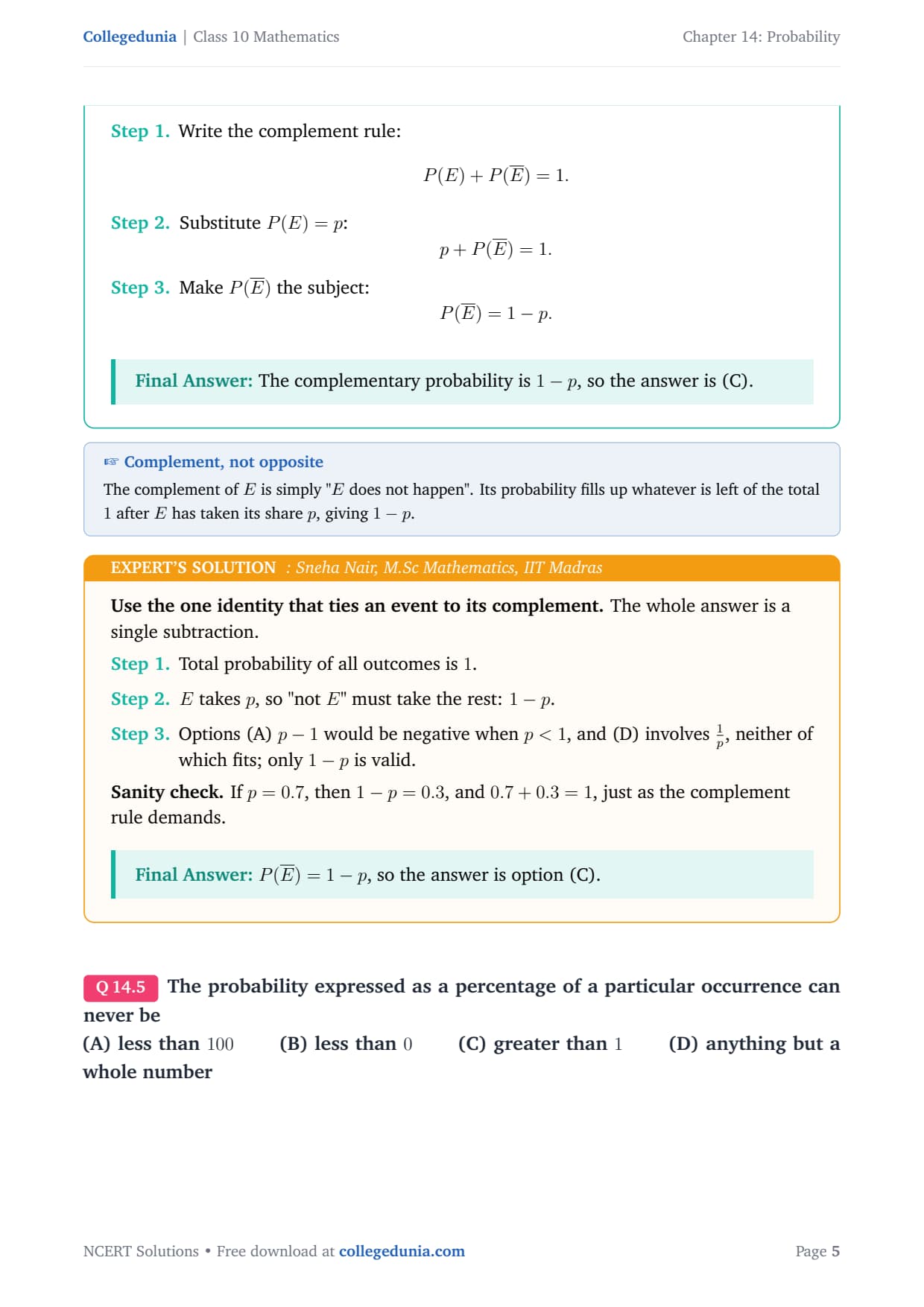
If the probability of an event is p, the probability of its complementary event will be
(A) p-1
(B) p
(C) 1-p
(D) 1-1p
Correct option: (C)1-p.
Concept used. For any event E and its
complementĒ (the event "not E"),
P(E)+P(Ē)=1.
Write the complement rule:
P(E)+P(Ē)=1.
Substitute P(E)=p:
p+P(Ē)=1.
Make P(Ē) the subject:
P(Ē)=1-p.
The complementary probability is 1-p, so the answer is (C).
SN
Sneha Nair
M.Sc Mathematics, IIT Madras
Verified Expert
Use the one identity that ties an event to its complement. The
whole answer is a single subtraction.
Total probability of all outcomes is 1.
E takes p, so "not E" must take the rest: 1-p.
Options (A) p-1 would be negative when p<1, and (D) involves
1p, neither of which fits; only 1-p is valid.
Sanity check. If p=0.7, then 1-p=0.3, and 0.7+0.3=1, just
as the complement rule demands.
P(Ē)=1-p, so the answer is option (C).
Q 14.5
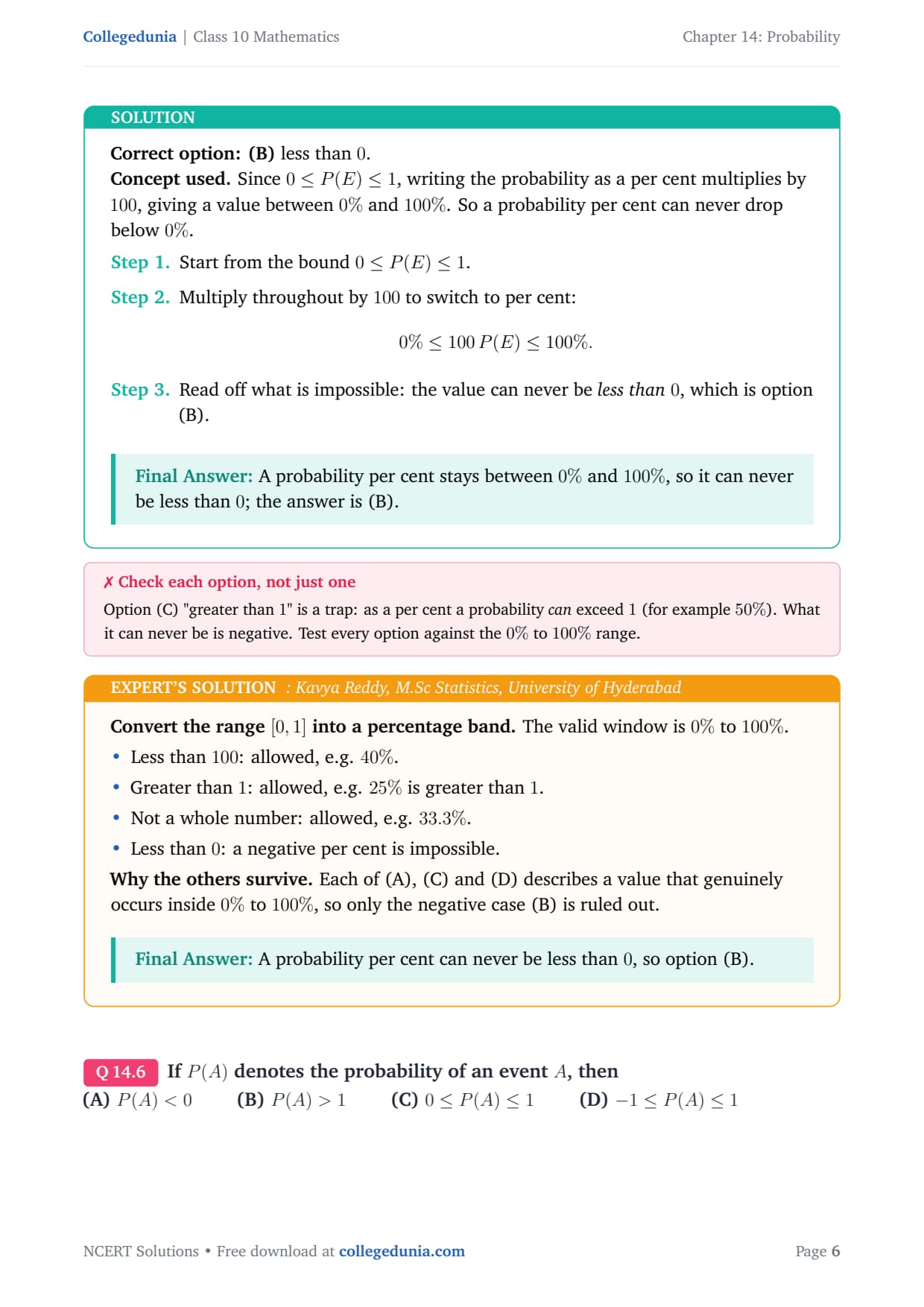
The probability expressed as a percentage of a particular occurrence can never be
(A) less than 100
(B) less than 0
(C) greater than 1
(D) anything but a whole number
Correct option: (B) less than 0.
Concept used. Since 0≤ P(E)≤ 1, writing the probability as
a per cent multiplies by 100, giving a value between 0% and 100%.
So a probability per cent can never drop below 0%.
Start from the bound 0≤ P(E)≤ 1.
Multiply throughout by 100 to switch to per cent:
0%≤ 100 P(E)≤ 100%.
Read off what is impossible: the value can never be
less than 0, which is option (B).
A probability per cent stays between 0% and 100%, so it can never be less than 0; the answer is (B).
KR
Kavya Reddy
M.Sc Statistics, University of Hyderabad
Verified Expert
Convert the range [0,1] into a percentage band. The valid
window is 0% to 100%.
Less than 100: allowed, e.g. 40%.
Greater than 1: allowed, e.g. 25% is greater than 1.
Not a whole number: allowed, e.g. 33.3%.
Less than 0: a negative per cent is impossible.
Why the others survive. Each of (A), (C) and (D) describes a
value that genuinely occurs inside 0% to 100%, so only the negative
case (B) is ruled out.
A probability per cent can never be less than 0, so option (B).
Q 14.6
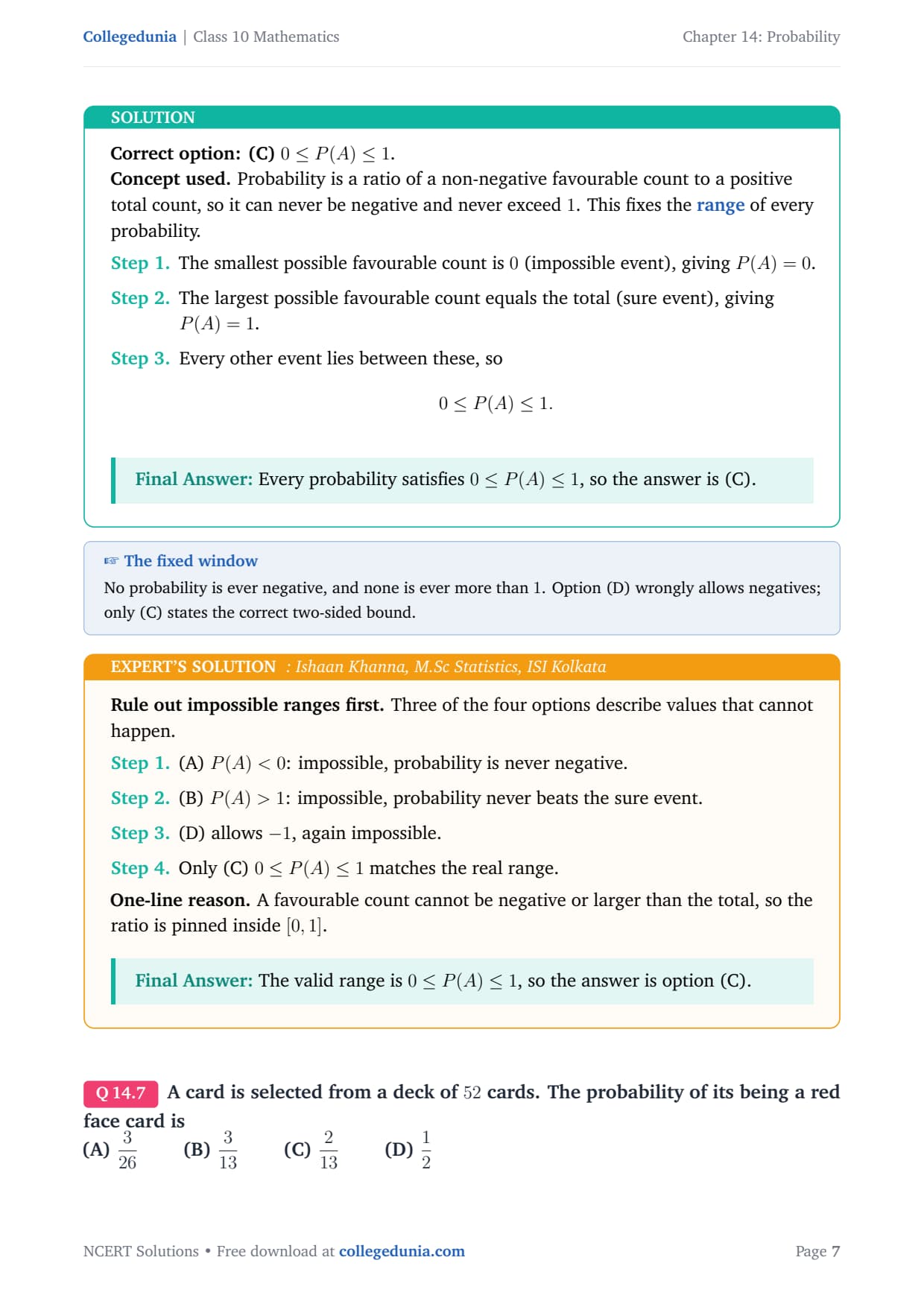
If P(A) denotes the probability of an event A, then
(A) P(A)<0
(B) P(A)>1
(C) 0≤ P(A)≤ 1
(D) -1≤ P(A)≤ 1
Correct option: (C)0≤ P(A)≤ 1.
Concept used. Probability is a ratio of a non-negative
favourable count to a positive total count, so it can never be negative
and never exceed 1. This fixes the range of every
probability.
The smallest possible favourable count is 0 (impossible event),
giving P(A)=0.
The largest possible favourable count equals the total (sure
event), giving P(A)=1.
Every other event lies between these, so
0≤ P(A)≤ 1.
Every probability satisfies 0≤ P(A)≤ 1, so the answer is (C).
IK
Ishaan Khanna
M.Sc Statistics, ISI Kolkata
Verified Expert
Rule out impossible ranges first. Three of the four options
describe values that cannot happen.
(A) P(A)<0: impossible, probability is never negative.
(B) P(A)>1: impossible, probability never beats the sure event.
(D) allows -1, again impossible.
Only (C) 0≤ P(A)≤ 1 matches the real range.
One-line reason. A favourable count cannot be negative or larger
than the total, so the ratio is pinned inside [0,1].
The valid range is 0≤ P(A)≤ 1, so the answer is option (C).
Q 14.7
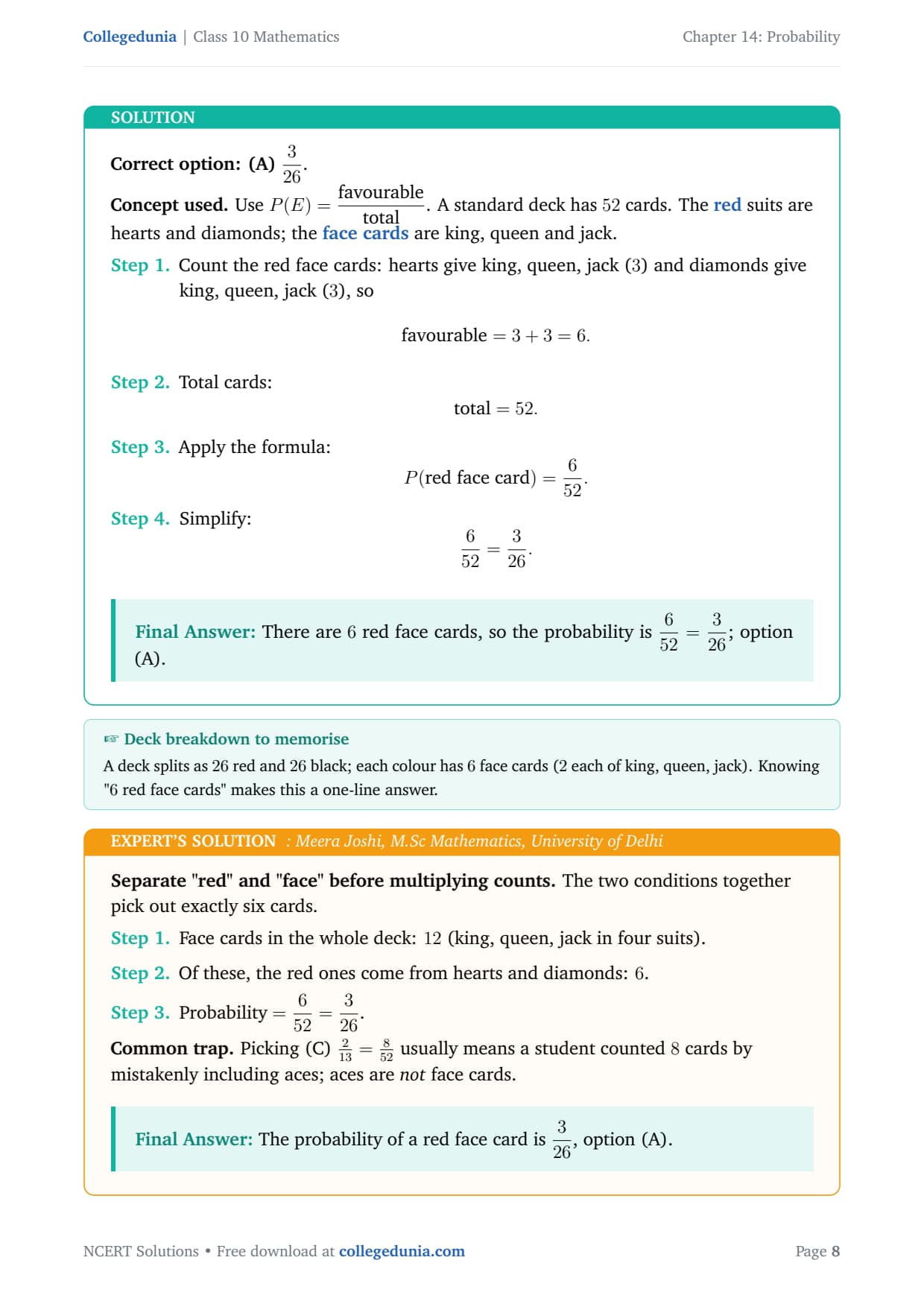
A card is selected from a deck of 52 cards. The probability of its being a red face card is
(A) 326
(B) 313
(C) 213
(D) 12
Correct option: (A)326.
Concept used. Use P(E)=favourabletotal.
A standard deck has 52 cards. The red suits are hearts and
diamonds; the face cards are king, queen and jack.
Count the red face cards: hearts give king, queen, jack (3) and
diamonds give king, queen, jack (3), so
favourable=3+3=6.
Total cards:
total=52.
Apply the formula:
P(red face card)=652.
Simplify:
652=326.
There are 6 red face cards, so the probability is 652=326; option (A).
MJ
Meera Joshi
M.Sc Mathematics, University of Delhi
Verified Expert
Separate "red" and "face" before multiplying counts. The two
conditions together pick out exactly six cards.
Face cards in the whole deck: 12 (king, queen, jack in four
suits).
Of these, the red ones come from hearts and diamonds: 6.
Probability =652=326.
Common trap. Picking (C) 213=852 usually
means a student counted 8 cards by mistakenly including aces; aces are
not face cards.
The probability of a red face card is 326, option (A).
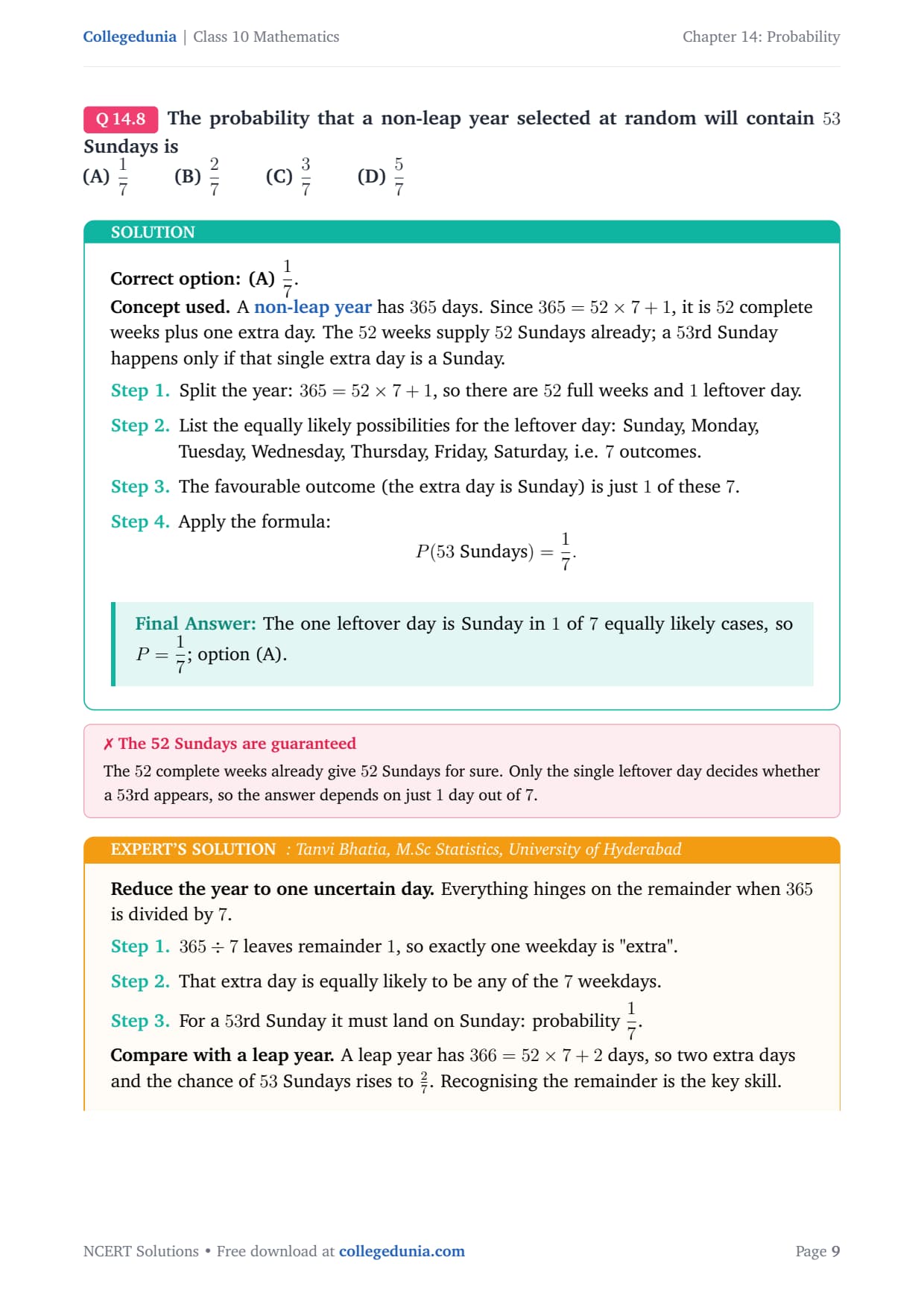
Q 14.8
The probability that a non-leap year selected at random will contain 53 Sundays is
(A) 17
(B) 27
(C) 37
(D) 57
Correct option: (A)17.
Concept used. A non-leap year has 365 days. Since
365=52× 7+1, it is 52 complete weeks plus one extra day. The
52 weeks supply 52 Sundays already; a 53rd Sunday happens only if
that single extra day is a Sunday.
Split the year: 365=52× 7+1, so there are 52 full weeks
and 1 leftover day.
List the equally likely possibilities for the leftover day:
Sunday, Monday, Tuesday, Wednesday, Thursday, Friday, Saturday,
i.e. 7 outcomes.
The favourable outcome (the extra day is Sunday) is just 1 of
these 7.
Apply the formula:
P(53 Sundays)=17.
The one leftover day is Sunday in 1 of 7 equally likely cases, so P=17; option (A).
TB
Tanvi Bhatia
M.Sc Statistics, University of Hyderabad
Verified Expert
Reduce the year to one uncertain day. Everything hinges on the
remainder when 365 is divided by 7.
365÷ 7 leaves remainder 1, so exactly one weekday is
"extra".
That extra day is equally likely to be any of the 7 weekdays.
For a 53rd Sunday it must land on Sunday: probability
17.
Compare with a leap year. A leap year has 366=527+2 days,
so two extra days and the chance of 53 Sundays rises to 27.
Recognising the remainder is the key skill.
A non-leap year has one extra day, so P(53 Sundays)=17; option (A).
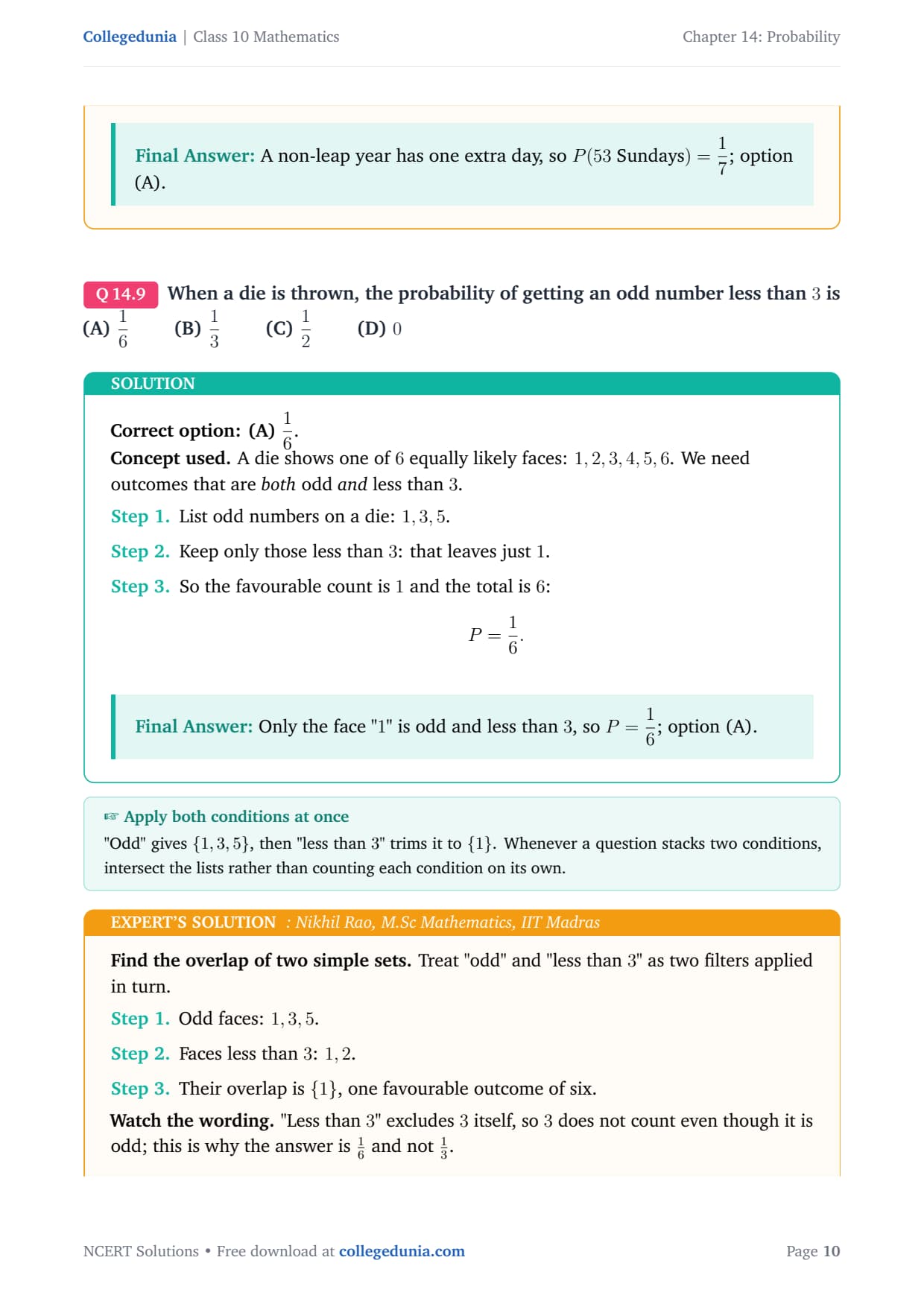
Q 14.9
When a die is thrown, the probability of getting an odd number less than 3 is
(A) 16
(B) 13
(C) 12
(D) 0
Correct option: (A)16.
Concept used. A die shows one of 6 equally likely faces:
1,2,3,4,5,6. We need outcomes that are both odd and less
than 3.
List odd numbers on a die: 1,3,5.
Keep only those less than 3: that leaves just 1.
So the favourable count is 1 and the total is 6:
P=16.
Only the face "1" is odd and less than 3, so P=16; option (A).
NR
Nikhil Rao
M.Sc Mathematics, IIT Madras
Verified Expert
Find the overlap of two simple sets. Treat "odd" and "less than
3" as two filters applied in turn.
Odd faces: 1,3,5.
Faces less than 3: 1,2.
Their overlap is 1, one favourable outcome of six.
Watch the wording. "Less than 3" excludes 3 itself, so 3
does not count even though it is odd; this is why the answer is
16 and not 13.
The single common face gives P=16, option (A).
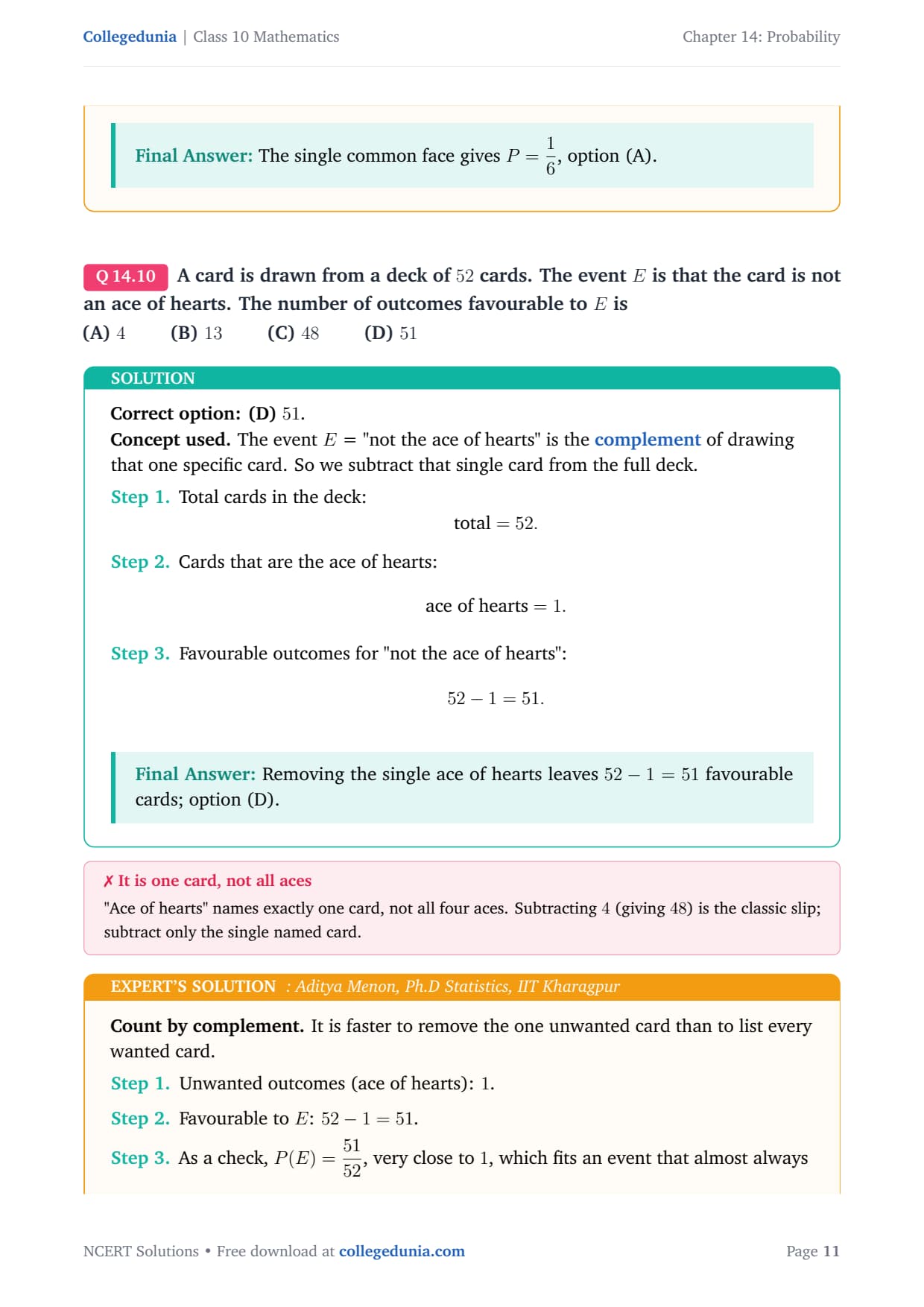
Q 14.10
A card is drawn from a deck of 52 cards. The event E is that the card is not an ace of hearts. The number of outcomes favourable to E is
(A) 4
(B) 13
(C) 48
(D) 51
Correct option: (D)51.
Concept used. The event E = "not the ace of hearts" is the
complement of drawing that one specific card. So we subtract
that single card from the full deck.
Total cards in the deck:
total=52.
Cards that are the ace of hearts:
ace of hearts=1.
Favourable outcomes for "not the ace of hearts":
52-1=51.
Removing the single ace of hearts leaves 52-1=51 favourable cards; option (D).
AM
Aditya Menon
Ph.D Statistics, IIT Kharagpur
Verified Expert
Count by complement. It is faster to remove the one unwanted
card than to list every wanted card.
Unwanted outcomes (ace of hearts): 1.
Favourable to E: 52-1=51.
As a check, P(E)=5152, very close to 1, which fits
an event that almost always happens.
Why complement helps. Listing "everything except one card" by
hand is tedious; subtracting the lone exception from 52 is instant and
error-proof.
There are 52-1=51 favourable outcomes, so the answer is (D).
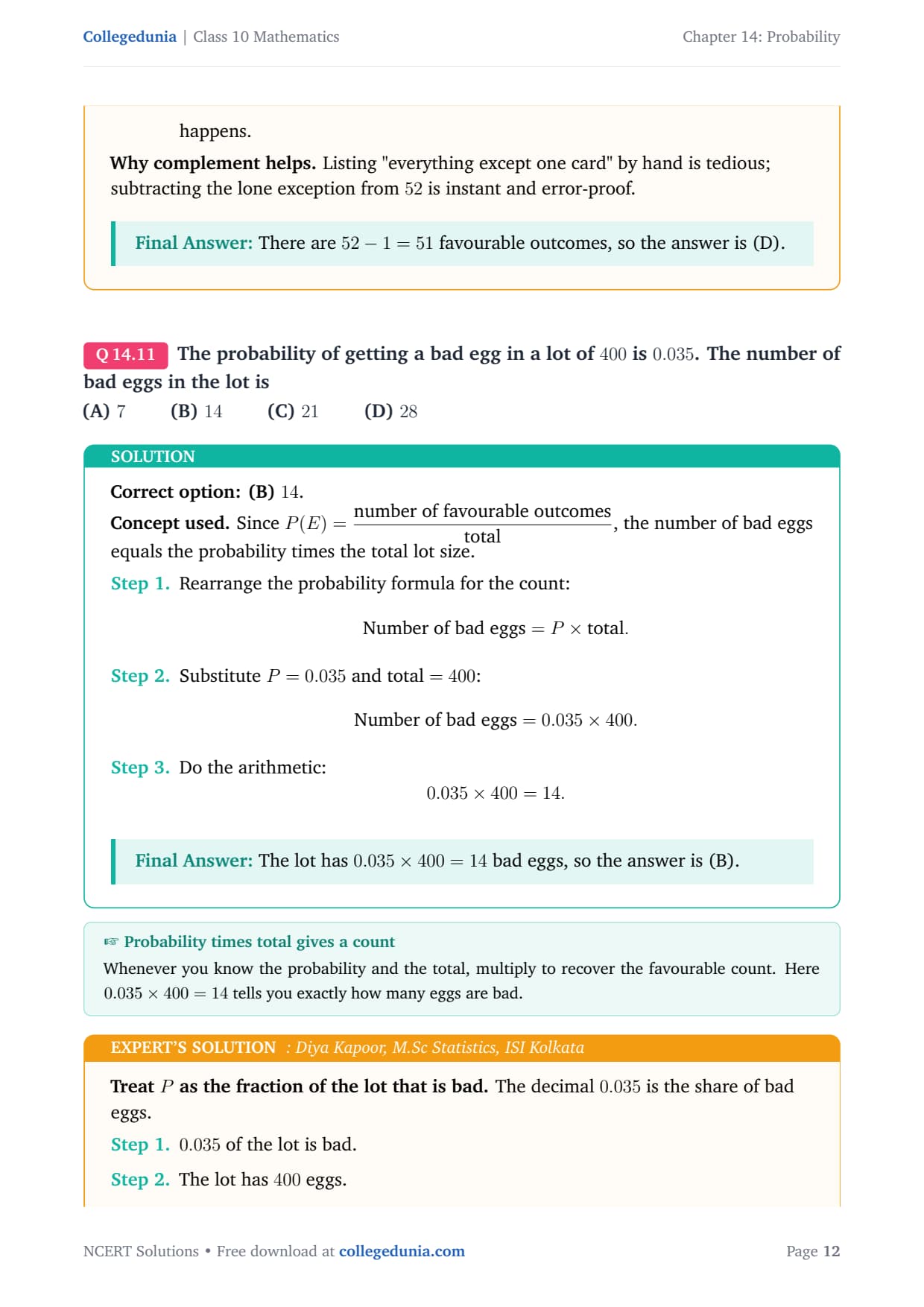
Q 14.11
The probability of getting a bad egg in a lot of 400 is 0.035. The number of bad eggs in the lot is
(A) 7
(B) 14
(C) 21
(D) 28
Correct option: (B)14.
Concept used. Since
P(E)=number of favourable outcomestotal, the
number of bad eggs equals the probability times the total lot size.
Rearrange the probability formula for the count:
Number of bad eggs=P× total.
Substitute P=0.035 and total =400:
Number of bad eggs=0.035× 400.
Do the arithmetic:
0.035× 400=14.
The lot has 0.035× 400=14 bad eggs, so the answer is (B).
DK
Diya Kapoor
M.Sc Statistics, ISI Kolkata
Verified Expert
Treat P as the fraction of the lot that is bad. The decimal
0.035 is the share of bad eggs.
0.035 of the lot is bad.
The lot has 400 eggs.
Bad eggs =0.035× 400=14.
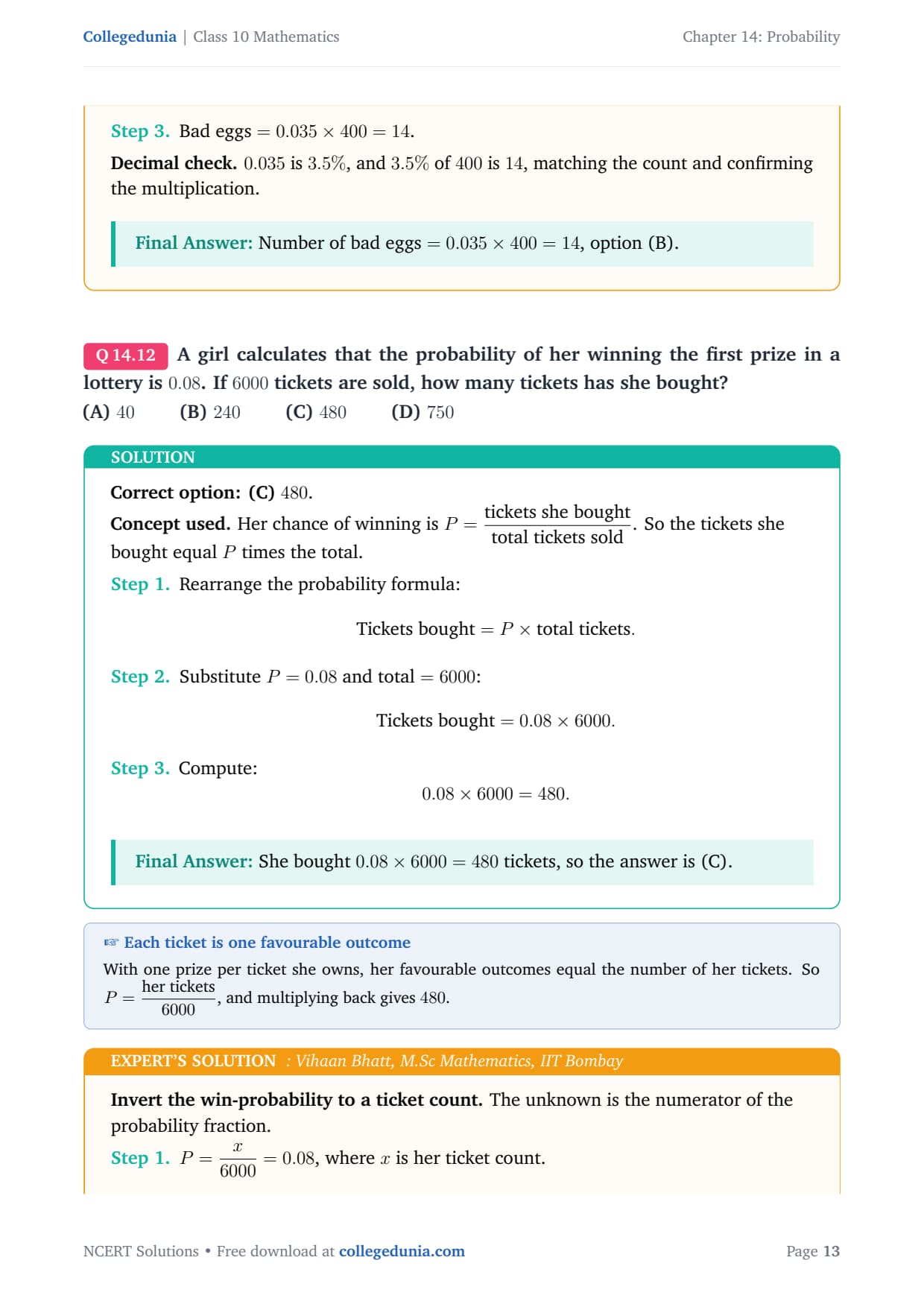
Decimal check.0.035 is 3.5%, and 3.5% of 400 is 14,
matching the count and confirming the multiplication.
Number of bad eggs =0.035× 400=14, option (B).
Q 14.12
A girl calculates that the probability of her winning the first prize in a lottery is 0.08. If 6000 tickets are sold, how many tickets has she bought?
(A) 40
(B) 240
(C) 480
(D) 750
Correct option: (C)480.
Concept used. Her chance of winning is
P=tickets she boughttotal tickets sold. So the
tickets she bought equal P times the total.
Rearrange the probability formula:
Tickets bought=P× total tickets.
Substitute P=0.08 and total =6000:
Tickets bought=0.08× 6000.
Compute:
0.08× 6000=480.
She bought 0.08× 6000=480 tickets, so the answer is (C).
VB
Vihaan Bhatt
M.Sc Mathematics, IIT Bombay
Verified Expert
Invert the win-probability to a ticket count. The unknown is the
numerator of the probability fraction.
P=x6000=0.08, where x is her ticket count.
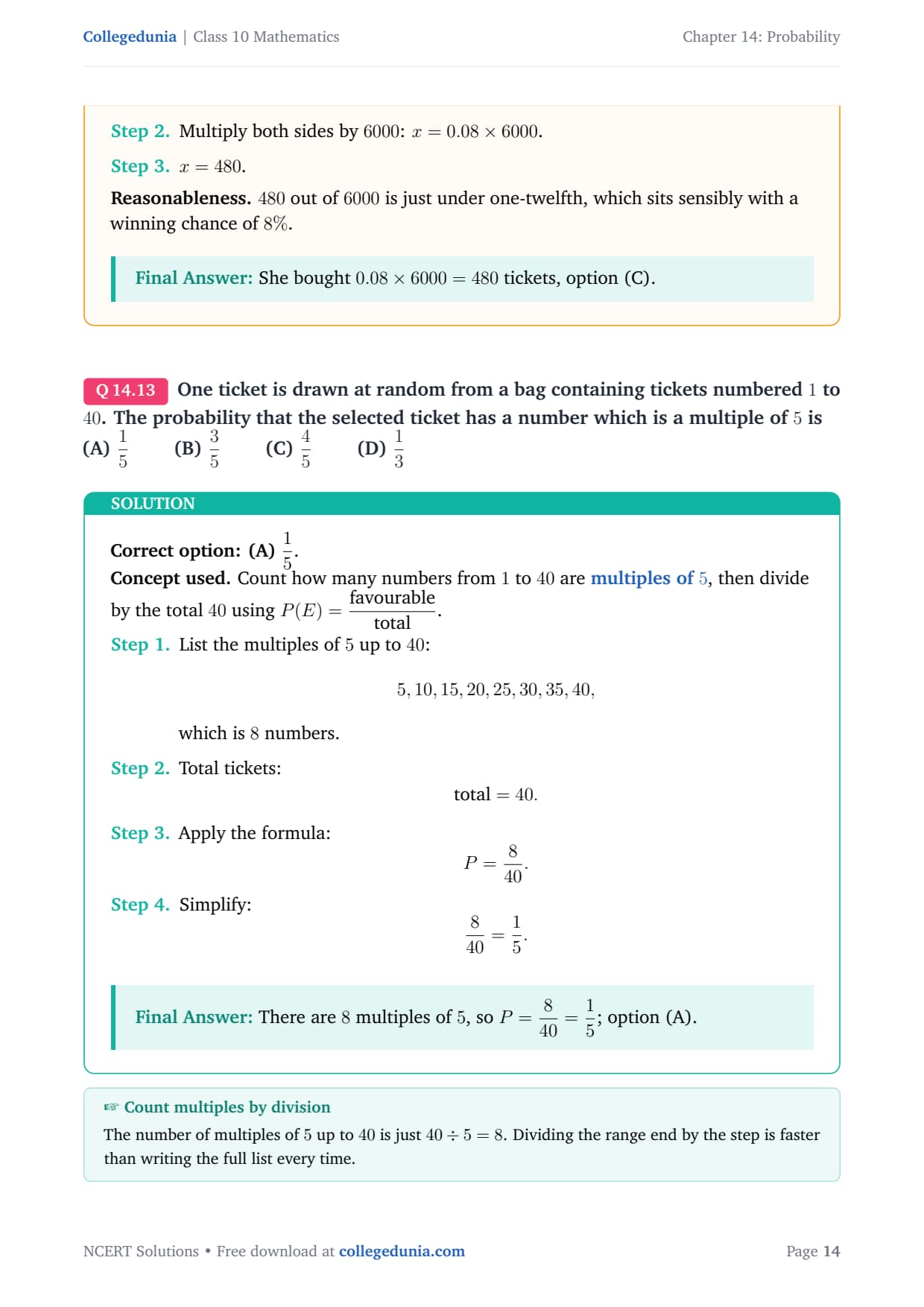
Multiply both sides by 6000: x=0.08× 6000.
x=480.
Reasonableness.480 out of 6000 is just under one-twelfth,
which sits sensibly with a winning chance of 8%.
She bought 0.08× 6000=480 tickets, option (C).
Q 14.13
One ticket is drawn at random from a bag containing tickets numbered 1 to 40. The probability that the selected ticket has a number which is a multiple of 5 is
(A) 15
(B) 35
(C) 45
(D) 13
Correct option: (A)15.
Concept used. Count how many numbers from 1 to 40 are
multiples of 5, then divide by the total 40 using
P(E)=favourabletotal.
List the multiples of 5 up to 40:
5,10,15,20,25,30,35,40,
which is 8 numbers.
Total tickets:
total=40.
Apply the formula:
P=840.
Simplify:
840=15.
There are 8 multiples of 5, so P=840=15; option (A).
AP
Anaya Pillai
M.Sc Statistics, University of Delhi
Verified Expert
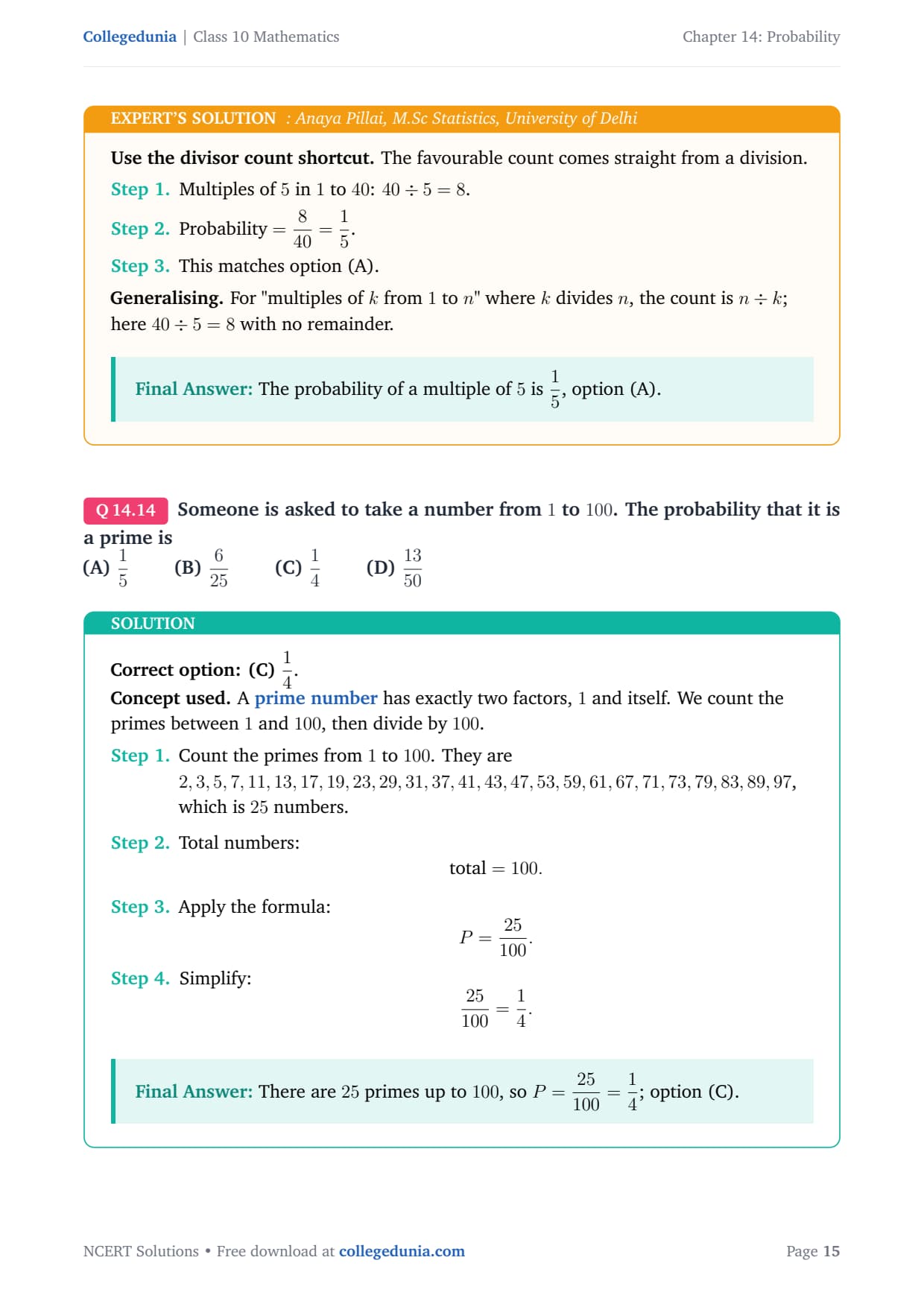
Use the divisor count shortcut. The favourable count comes
straight from a division.
Multiples of 5 in 1 to 40: 40÷ 5=8.
Probability =840=15.
This matches option (A).
Generalising. For "multiples of k from 1 to n" where k
divides n, the count is n÷ k; here 405=8 with no remainder.
The probability of a multiple of 5 is 15, option (A).
Q 14.14
Someone is asked to take a number from 1 to 100. The probability that it is a prime is
(A) 15
(B) 625
(C) 14
(D) 1350
Correct option: (C)14.
Concept used. A prime number has exactly two factors,
1 and itself. We count the primes between 1 and 100, then divide by
100.
Count the primes from 1 to 100. They are
2,3,5,7,11,13,17,19,23,29,31,37,41,43,47,53,59,61,67,71,73,79,83,
89,97, which is 25 numbers.
Total numbers:
total=100.
Apply the formula:
P=25100.
Simplify:
25100=14.
There are 25 primes up to 100, so P=25100=14; option (C).
SD
Saanvi Deshmukh
Ph.D Mathematics, IISc Bangalore
Verified Expert
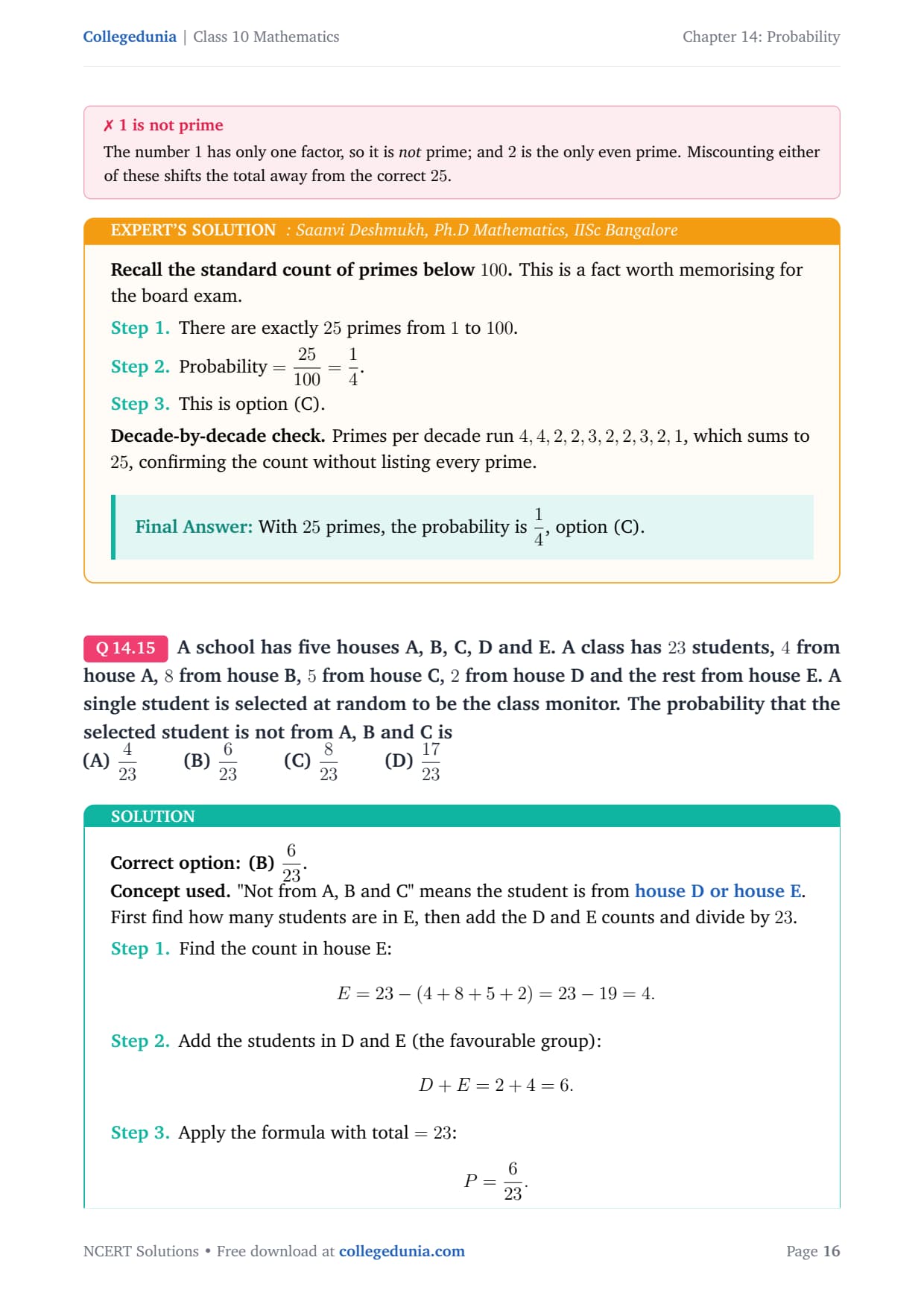
Recall the standard count of primes below 100. This is a fact
worth memorising for the board exam.
There are exactly 25 primes from 1 to 100.
Probability =25100=14.
This is option (C).
Decade-by-decade check. Primes per decade run 4,4,2,2,3,2,2,3,2,1,
which sums to 25, confirming the count without listing every prime.
With 25 primes, the probability is 14, option (C).
Q 14.15
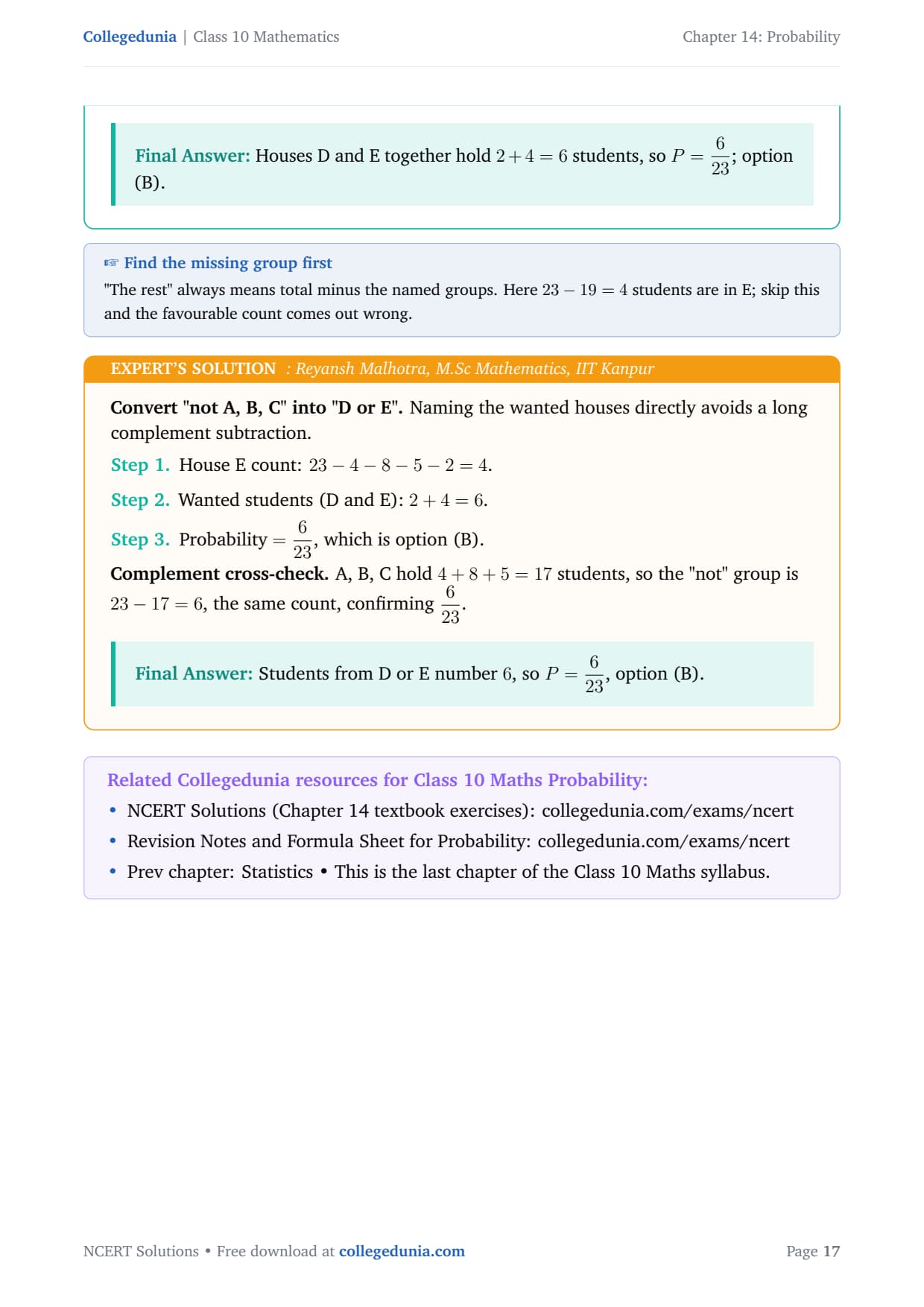
A school has five houses A, B, C, D and E. A class has 23 students, 4 from house A, 8 from house B, 5 from house C, 2 from house D and the rest from house E. A single student is selected at random to be the class monitor. The probability that the selected student is not from A, B and C is
(A) 423
(B) 623
(C) 823
(D) 1723
Correct option: (B)623.
Concept used. "Not from A, B and C" means the student is from
house D or house E. First find how many students are in E, then
add the D and E counts and divide by 23.
Find the count in house E:
E=23-(4+8+5+2)=23-19=4.
Add the students in D and E (the favourable group):
D+E=2+4=6.
Apply the formula with total =23:
P=623.
Houses D and E together hold 2+4=6 students, so P=623; option (B).
RM
Reyansh Malhotra
M.Sc Mathematics, IIT Kanpur
Verified Expert
Convert "not A, B, C" into "D or E". Naming the wanted houses
directly avoids a long complement subtraction.
House E count: 23-4-8-5-2=4.
Wanted students (D and E): 2+4=6.
Probability =623, which is option (B).
Complement cross-check. A, B, C hold 4+8+5=17 students, so the
"not" group is 23-17=6, the same count, confirming 623.
Students from D or E number 6, so P=623, option (B).
Other Exercises & Resources
Practise the rest of Chapter 14 Probability and revise from the matching resources below.
In a survey of 1,400 Class 10 students, 87% said studying solved Exemplar MCQs before the board exam helped them avoid option-trap mistakes in Probability. Exercise 14.1 ranked in the top 5 most-practised Maths Exemplar exercises across CBSE students.
Source: 2026-27 Class 10 Mathematics student poll. Sample of 1,400 students from CBSE schools.
Other Resources for Probability Class 10 Maths
Pair this with the other Class 10 Maths resources for Probability, all linked below.
How many questions are in Exercise 14.1 of NCERT Exemplar Class 10 Maths?
Exercise 14.1 has 15 Multiple Choice Questions (MCQs). They cover the definition of probability, the valid range [0, 1], complementary events, and counting outcomes for dice, cards, calendar, and number-slip experiments. All 15 questions are solved with step-by-step solutions and expert commentary on this page.
What is the main concept tested in Exercise 14.1 of Chapter 14 Probability?
The exercise tests three main ideas: (1) understanding the probability range -- values must lie in [0, 1]; (2) the complement rule -- if P(E) = p then P(not E) = 1 - p; and (3) counting equally likely outcomes for real-world experiments like drawing a card or rolling a die.
How do you find the number of bad eggs or lottery tickets from a given probability?
Rearrange the classical formula: Count = P x Total. For Q11: bad eggs = 0.035 x 400 = 14. For Q12: tickets bought = 0.08 x 6000 = 480. This reverse-probability approach avoids setting up an equation -- just multiply the decimal probability by the total number of items.
Why is 53 Sundays in a non-leap year a probability question?
A non-leap year has 365 = 52 x 7 + 1 days. The 52 complete weeks guarantee exactly 52 of every weekday. The single leftover day is equally likely to be any of the 7 weekdays. Getting a 53rd Sunday requires that leftover day to be a Sunday -- probability 1 out of 7, so P = 1/7.
Are the MCQs in Exercise 14.1 important for the CBSE Class 10 board exam?
Yes. NCERT Exemplar MCQs are frequently adapted into 1-mark board questions. Questions on the complement rule, identifying invalid probability values, and card/die counting have appeared in CBSE board exams across multiple previous years. Practising all 15 questions in Exercise 14.1 gives students a strong foundation for the board exam Probability section.








Comments