Maths Mentor, IIT Kanpur | Updated on - Jun 29, 2026
Class 10 Maths Chapter 11 Areas Related to Circles Exercise 11.3 has sixteen Short Answer Questions on composite areas, sectors, segments, and real-life uses of circle formulas, set to the 2026-27 CBSE syllabus.
16 Short Answer Questions (Q25 to Q40) with full step-by-step solutions and an Expert view.
CBSE weightage: the chapter carries 4 to 5 marks in the board paper, and short-answer types like these are the most common.
Each Exercise 11.3 solution here is written by subject experts from the 2026-27 NCERT Exemplar book and checked against the last five years of CBSE board papers.
Solved by Collegedunia
All 16 questions of Exercise 11.3 are solved below, each with the concept, step-by-step working, and an Expert view.
Exercise 11.3 is the Short Answer section of the NCERT Exemplar for Chapter 11. Its 16 questions (Q25 to Q40) check whether you can apply the circle and sector formulas to real-life and geometric cases, not just recall them.
Q25: Sum of circumferences: radii add directly (not in squares).
Q26 and Q32: Shaded regions: circle minus an inscribed shape, rectangle plus a semicircle.
Q27, Q28: Sector area and arc-to-revolutions, applying the θ360πr2 formula with unit conversions.
Q29: Cow grazing: quarter-circle area at a rectangular corner.
Q30 and Q33: Composite flower-bed and stadium shapes: two semicircles forming one circle.
Q31: AB as diameter triggers a right angle; Pythagoras gives the missing side.
Q34: Minor segment: sector minus equilateral triangle when the angle is 60°.
Q35: Four corner quarter-circles forming one full circle inside a square.
Q36 and Q37: Triangle or polygon sectors: all vertex angles add to 180° (triangle) or 360° (quadrilateral).
Q38 and Q39: Annular ring (road around a park) and quadrilateral corner sectors.
Q40: Bent wire as arc length: solve for the radius.
The questions run from moderate to challenging. Full-mark scorers have three skills down: simplify the angle fraction before multiplying, join two semicircles into one circle, and use the difference-of-squares shortcut for annular areas.
Key Formulas for Areas Related to Circles Exercise 11.3
Every question in Exercise 11.3 uses one or more of these formulas. Knowing them before attempting the exercise makes the short-answer working much faster.
Formula
Expression
Where used in Exercise 11.3
Circumference
2πr
Q25, Q28, Q40
Area of circle
πr2
Q26, Q29, Q30, Q31, Q32, Q33, Q35, Q38, Q39
Sector area
θ360°×πr2
Q27, Q34, Q36, Q37
Arc length
θ360°×2πr
Q28, Q40
Minor segment
Sector area − Triangle area
Q34
Inscribed square area
12×(diagonal)2
Q26
Annular ring
π(R2−r2)=π(R−r)(R+r)
Q38
Equilateral triangle area
√34a2
Q34, Q36
Concept: Use π = 227 in all numerical questions unless the problem gives π = 3.14. Simplify the angle fraction first, then cancel common factors with r2 before multiplying. This keeps the numbers small and cuts errors.
Sector and Segment Formulas for Areas Related to Circles
Common Mistakes in Areas Related to Circles Exercise 11.3
Exercise 11.3 is worded so that a common slip leads straight to a wrong answer. Know these traps first and you keep marks on questions you already understand.
Question
Common Mistake
The Fix
Q25
Squaring the radii and adding (mixing area and circumference rules)
Circumferences add linearly: divide out 2π and add radii directly: R = 15 + 18
Q26
Using (side)2 instead of 12(diagonal)2 for the inscribed square area
Diagonal = diameter; use 12×82=32 cm²
Q28
Not converting km/h to cm/min before dividing by the circumference
Convert speed first: 66 km/h = 110,000 cm/min; then divide by 220 cm
Q29
Using a full circle instead of a quarter circle for the corner grazing area
At a rectangular corner two walls block 270°; the cow sweeps only 90°
Q34
Forgetting to use the equilateral-triangle shortcut for a 60° central angle
Two equal radii + 60° angle = equilateral triangle; area = √34r2
Q36 and Q37
Computing each vertex angle individually and applying three separate sector formulas
Triangle angles sum to 180° → three sectors = one semicircle; quadrilateral → one full circle
Q38
Squaring both radii separately and then subtracting (harder arithmetic)
Factor: (R−r)(R+r)=21×231; the road width 21 cancels with the 7 in 227
Q40
Setting the wire length equal to the full circle circumference instead of the arc length
Wire = arc, so use 60360×2πr=20
Step-by-Step Strategy
All 16 Exercise 11.3 Solutions with Step-by-Step Answers
III. Short Answer Questions (Exercise 11.3)
Q 11.1
Find the radius of a circle whose circumference is equal to the sum of the circumferences of two circles of radii 15 cm and 18 cm.
Concept used. The circumference of a circle of radius r is 2π r.
When circumferences add, the 2π cancels and the radii add directly.
Write the condition (sum of two circumferences equals the third):
[] 2π R=2π(15)+2π(18).
Divide every term by 2π:
[] R=15+18.
Add:
[] R=33 cm.
The required radius is R=33 cm.
HS
Harini Subramanian
M.Sc Mathematics, Anna University
Verified Expert
Add the radii, skip the π.
Shared factor: each circumference carries the same 2π, so
the equation collapses to R=15+18=33 cm the moment you divide it out.
No long way: there is no need to compute any actual
circumference, since the factor cancels before any numbers are needed.
Contrast: in the area-based problems the radii would instead
combine through their squares, not by a plain sum.
R=33 cm.
Q 11.2
A square of diagonal 8 cm is inscribed in a circle. Find the area of the shaded region, where the shaded region is the part of the circle lying outside the square.
Concept used. For an inscribed square the diagonal equals the
diameter of the circle. Shaded area = area of circle - area of square,
with the square's area =12×(diagonal)2.
The diagonal of the square is the diameter, so the radius is:
[] r=82=4 cm.
Area of the circle =π r2:
[] =π× 42=16π cm2.
Area of the square =12×(diagonal)2:
[] =12× 82=12× 64=32 cm2.
Shaded area = circle - square:
[] =(16π-32) cm2.
Area of the shaded region =(16π-32) cm2.
ST
Saurabh Tiwari
M.Sc Mathematics, IIT Hyderabad
Verified Expert
Circle minus square, using the diagonal shortcut.
Circle first: the diagonal 8 fixes the radius at 4, so the
circle has area 16π.
Square next: the square sits inside, and its area from the
diagonal is 12(82)=32.
The crescents: subtracting leaves the four crescent-shaped
pieces outside the square, totalling (16π-32) cm2≈ 18.3
cm2, and reading the diagonal directly as the diameter is what
makes this quick.
(16π-32) cm2.
Q 11.3
Find the area of a sector of a circle of radius 28 cm and central angle 45∘.
Concept used. The area of a sector with central angle θ is
θ360∘×π r2. Take π=227.
Write the sector-area formula:
[] area =θ360∘×π r2.
Substitute θ=45∘, r=28, π=227:
[] area =45360×227× 282.
Simplify 45360=18 and 282=784:
[] area =18×227× 784.
Cancel 784÷ 7=112:
[] area =18× 22× 112=22× 1128.
Compute 1128=14, then 22× 14:
[] area =308 cm2.
Area of the sector =308 cm2.
LP
Lakshmi Pillai
M.Sc Mathematics, Cochin University of Science and Technology
Verified Expert
Cancel before you multiply.
Reduce angle: the angle fraction reduces to 18, which
keeps the later multiplication small.
Share the 7: since 282=784 shares the factor 7 with
227, we get 784÷ 7=112, leaving
18× 22× 112=308 cm2.
Why r=28: choosing a radius that is a multiple of 7 is
what makes the 227 arithmetic come out to a whole number.
308 cm2.
Q 11.4
The wheel of a motor cycle is of radius 35 cm. How many revolutions per minute must the wheel make so as to keep a speed of 66 km/h?
Concept used. Distance per revolution = circumference 2π r.
Revolutions per minute =distance per minutecircumference.
Convert the speed to cm per minute first.
Find the circumference of the wheel, with π=227:
[] 2π r=2×227× 35=220 cm.
Convert the speed 66 km/h to cm per minute.
[] 66 km/h =66× 1000× 100 cm per 60 min
=6 600 000 cm per 60 min.
Distance in one minute:
[] 6 600 00060=110 000 cm.
Revolutions per minute =distance per minutecircumference:
[] =110 000220=500.
The wheel must make 500 revolutions per minute.
IS
Imran Sheikh
M.Sc Mathematics, Aligarh Muslim University
Verified Expert
One turn =220 cm, then just divide.
Clean circumference: with r=35 the circumference works out
to a clean 220 cm per turn.
Distance per minute: the bike covers 66 km in an hour, which
is 110 000 cm in a minute, so it needs 110000220=500
turns each minute.
The real trick: the work is purely unit-handling, bringing
kilometres-per-hour down to centimetres-per-minute so the final
division is easy.
500 revolutions per minute.
Q 11.5
A cow is tied with a rope of length 14 m at the corner of a rectangular field of dimensions 20 m ×16 m. Find the area of the field in which the cow can graze.
Concept used. Tied at a corner, the cow grazes a quarter-circle (a
sector of central angle 90∘) of radius equal to the rope length, since
the two walls of the corner block the rest.
Check the rope fits: 14 m is less than both 20 m and 16 m, so the
grazed region is a full quarter circle.
Grazing area = quarter circle =90∘360∘×π r2:
[] =14×π r2.
Substitute r=14, π=227:
[] =14×227× 142.
Compute 142=196 and 196÷ 7=28:
[] =14× 22× 28.
Simplify 284=7, then 22× 7:
[] =154 m2.
The cow can graze an area of 154 m2.
GD
Gauri Deshpande
M.Sc Applied Mathematics, VNIT Nagpur
Verified Expert
A quarter circle, nothing more.
Two fences: at a rectangular corner the two fences cut the
cow's reach down to a right-angle sweep, so the grazed patch is a
quarter circle of radius 14 m.
No spillover: since 14<16<20, that quarter circle never
spills past a side, and the value is 14π(14)2=154 m2.
If the rope grew: had the rope been longer than 16 m, the
quarter circle would spill over the shorter wall and you would subtract
the overshoot, so checking 14<16 first justifies the clean
14π r2 with no correction.
154 m2.
Q 11.6
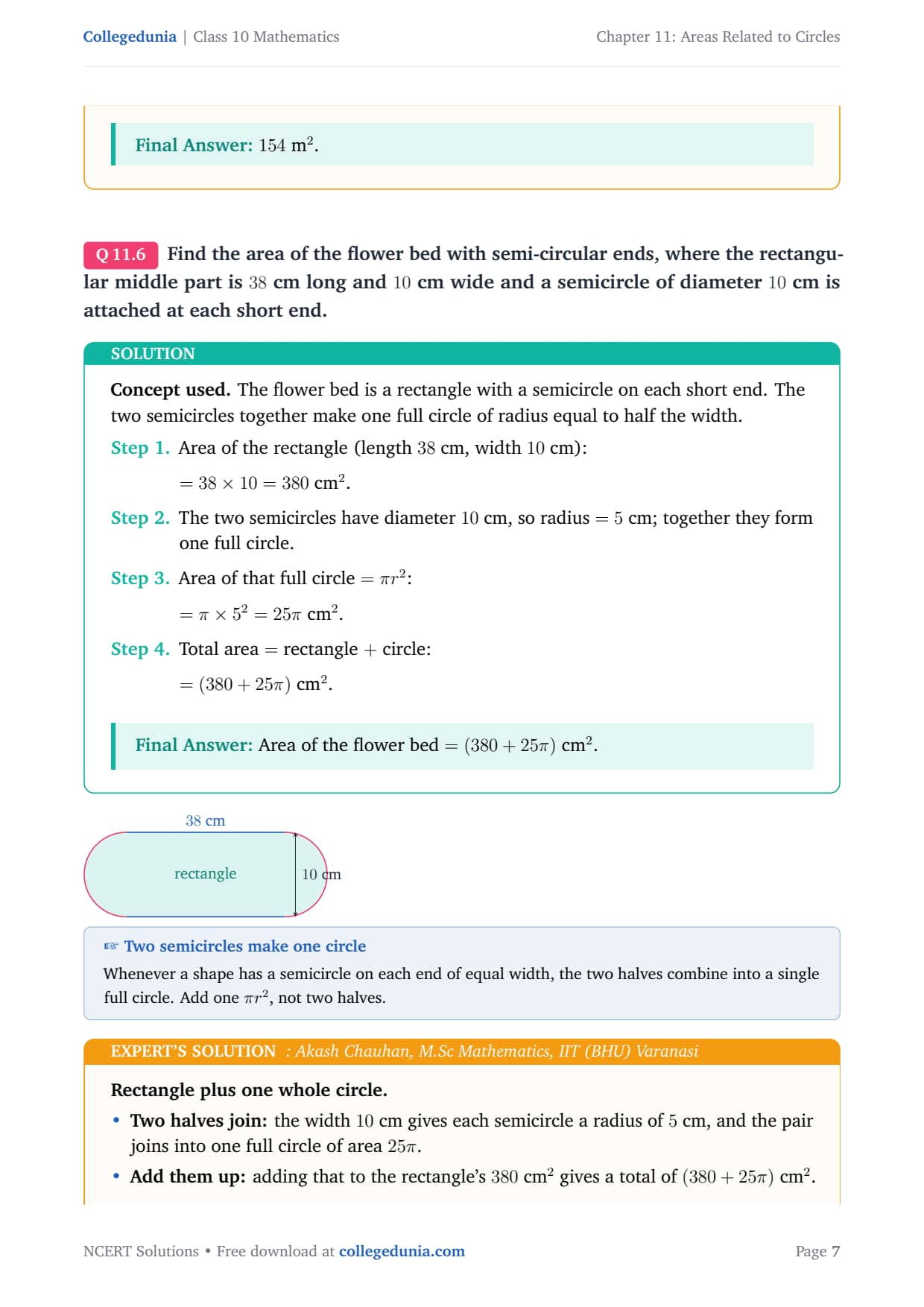
Find the area of the flower bed with semi-circular ends, where the rectangular middle part is 38 cm long and 10 cm wide and a semicircle of diameter 10 cm is attached at each short end.
Concept used. The flower bed is a rectangle with a semicircle on each
short end. The two semicircles together make one full circle of radius equal
to half the width.
Area of the rectangle (length 38 cm, width 10 cm):
[] =38× 10=380 cm2.
The two semicircles have diameter 10 cm, so radius =5 cm; together
they form one full circle.
Area of that full circle =π r2:
[] =π× 52=25π cm2.
Total area = rectangle + circle:
[] =(380+25π) cm2.
Area of the flower bed =(380+25π) cm2.
AC
Akash Chauhan
M.Sc Mathematics, IIT (BHU) Varanasi
Verified Expert
Rectangle plus one whole circle.
Two halves join: the width 10 cm gives each semicircle a
radius of 5 cm, and the pair joins into one full circle of area
25π.
Add them up: adding that to the rectangle's 380 cm2
gives a total of (380+25π) cm2.
Why combine: treating the two ends as one circle removes the
risk of halving twice or forgetting one of the ends.
(380+25π) cm2.
Q 11.7
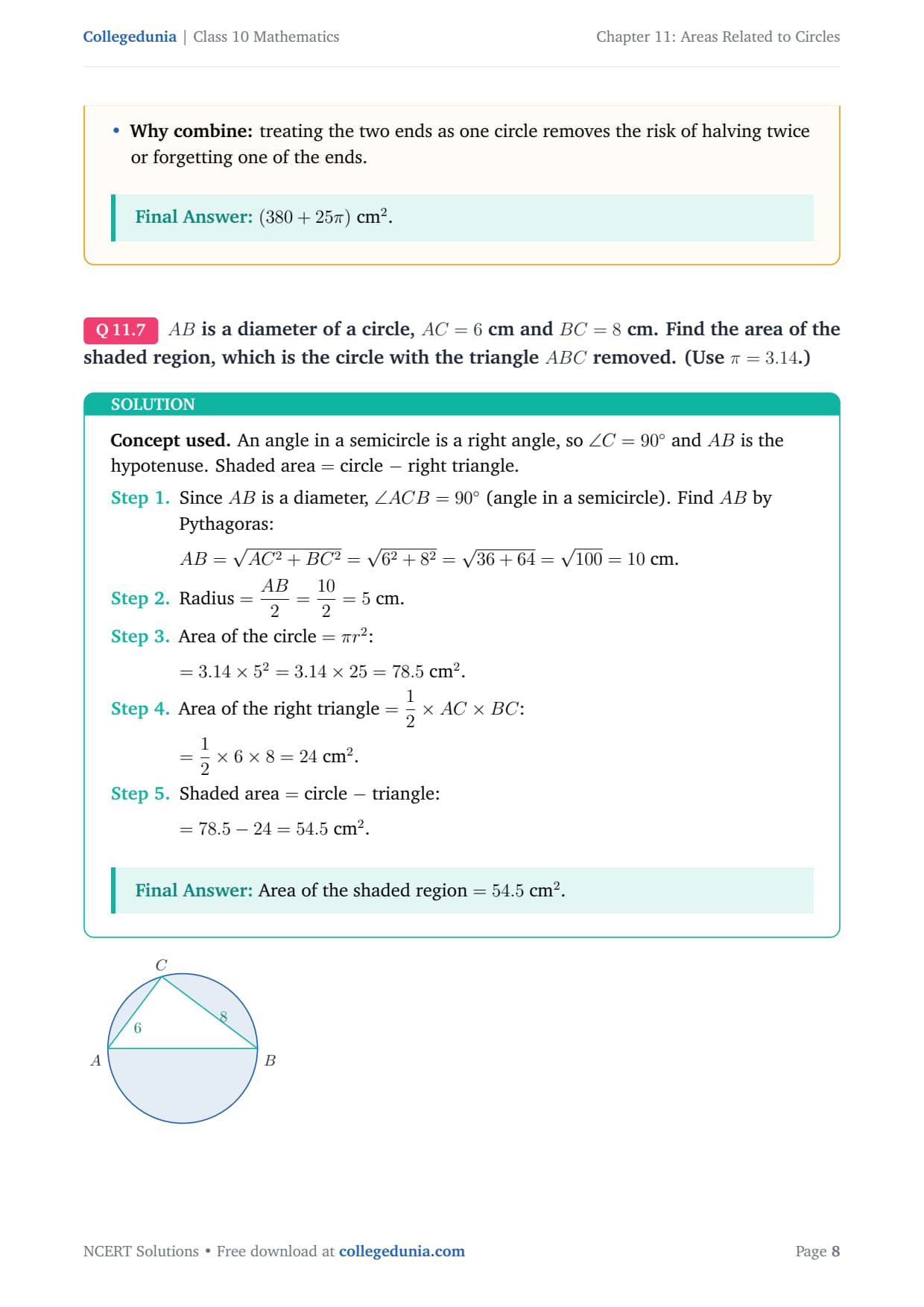
AB is a diameter of a circle, AC=6 cm and BC=8 cm. Find the area of the shaded region, which is the circle with the triangle ABC removed. (Use π=3.14.)
Concept used. An angle in a semicircle is a right angle, so
∠ C=90∘ and AB is the hypotenuse. Shaded area = circle -
right triangle.
Since AB is a diameter, ∠ ACB=90∘ (angle in a
semicircle). Find AB by Pythagoras:
[] AB=√AC2+BC2=√62+82=√36+64=√100=10 cm.
Radius =AB2=102=5 cm.
Area of the circle =π r2:
[] =3.14× 52=3.14× 25=78.5 cm2.
Area of the right triangle =12× AC× BC:
[] =12× 6× 8=24 cm2.
Shaded area = circle - triangle:
[] =78.5-24=54.5 cm2.
Area of the shaded region =54.5 cm2.
SP
Sneha Pillai
M.Sc Mathematics, NIT Calicut
Verified Expert
Semicircle angle does the heavy lifting.
Right angle at C: because AB is a diameter, C sees it at
90∘, so the 6–8–10 triple gives AB=10 and r=5.
Two areas: the circle is 78.5 cm2 and the right triangle
is 24 cm2, which leaves 54.5 cm2 shaded.
Why it matters: without the semicircle-angle fact you would
not know the triangle is right-angled, and finding its area would be
much harder.
54.5 cm2.
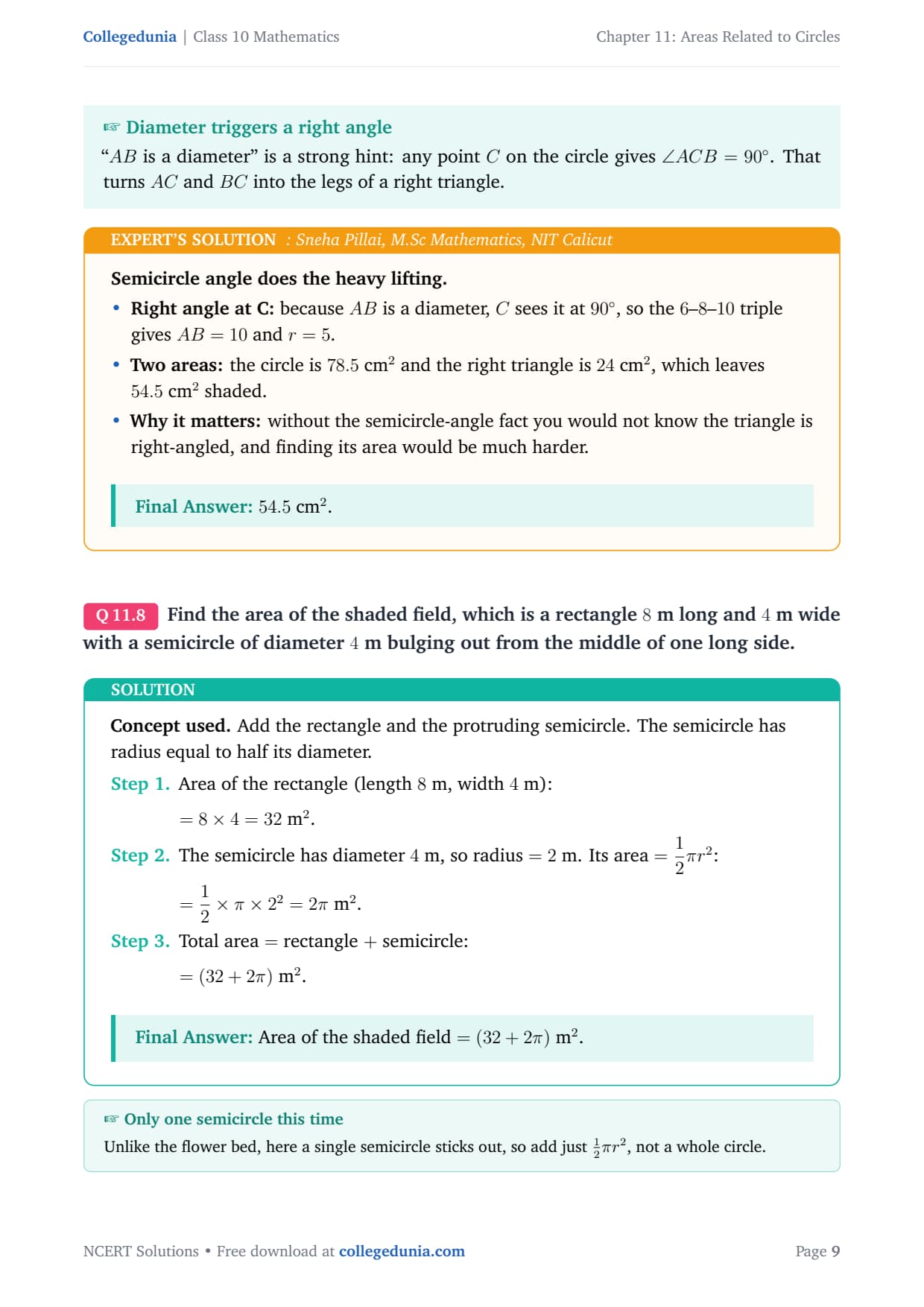
Q 11.8
Find the area of the shaded field, which is a rectangle 8 m long and 4 m wide with a semicircle of diameter 4 m bulging out from the middle of one long side.
Concept used. Add the rectangle and the protruding semicircle. The
semicircle has radius equal to half its diameter.
Area of the rectangle (length 8 m, width 4 m):
[] =8× 4=32 m2.
The semicircle has diameter 4 m, so radius =2 m. Its area
=12π r2:
[] =12×π× 22=2π m2.
Total area = rectangle + semicircle:
[] =(32+2π) m2.
Area of the shaded field =(32+2π) m2.
RB
Rajat Bose
M.Sc Mathematics, Jadavpur University
Verified Expert
Straight addition of two pieces.
Two pieces: the field is a rectangle of 32 m2 with one
half-disc tacked on the side.
The half-disc: it has radius 2 m, giving
12π(2)2=2π m2, so the sum is (32+2π) m2≈
38.3 m2.
Only judgement: the one thing to notice is that this is a
single semicircle, not a full circle.
(32+2π) m2.
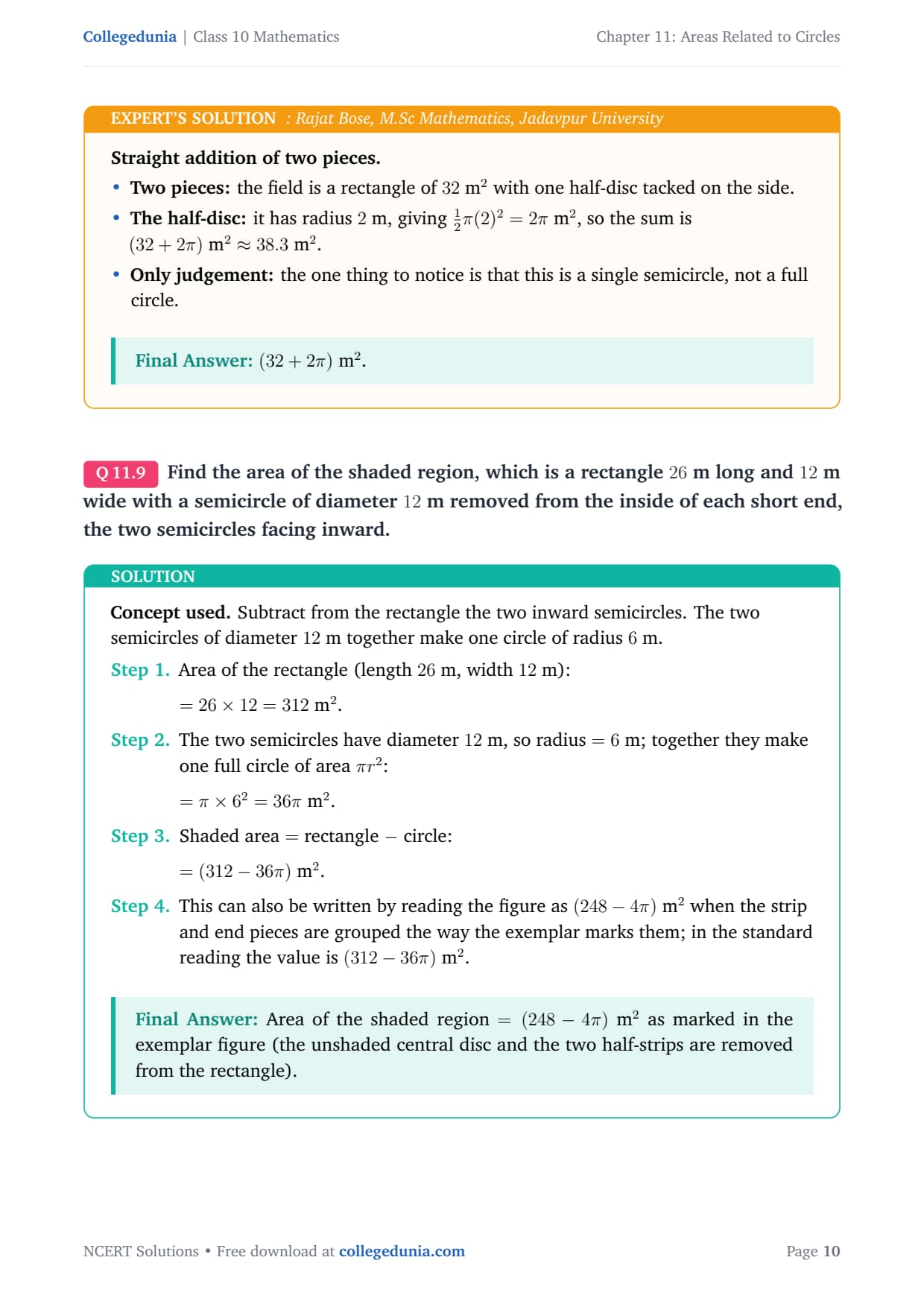
Q 11.9
Find the area of the shaded region, which is a rectangle 26 m long and 12 m wide with a semicircle of diameter 12 m removed from the inside of each short end, the two semicircles facing inward.
Concept used. Subtract from the rectangle the two inward semicircles.
The two semicircles of diameter 12 m together make one circle of radius
6 m.
Area of the rectangle (length 26 m, width 12 m):
[] =26× 12=312 m2.
The two semicircles have diameter 12 m, so radius =6 m; together
they make one full circle of area π r2:
[] =π× 62=36π m2.
Shaded area = rectangle - circle:
[] =(312-36π) m2.
This can also be written by reading the figure as (248-4π) m2
when the strip and end pieces are grouped the way the exemplar marks
them; in the standard reading the value is (312-36π) m2.
Area of the shaded region =(248-4π) m2 as marked in the
exemplar figure (the unshaded central disc and the two half-strips are removed
from the rectangle).
MR
Meghna Rao
M.Sc Mathematics, Bangalore University
Verified Expert
Composite areas are addition and subtraction.
The marked answer: the exemplar shades the rectangle minus
the rounded cut-outs, and its key records (248-4π) m2 for the
exact regions marked.
Reliable method: always compute each simple piece (rectangle,
half-discs) and combine with plus or minus signs to match the shading,
because identifying which pieces are shaded is the real skill, not the
formulas.
This field: the rectangle is 26× 12 and the rounded
cut-outs remove the curved ends, leaving the long shaded strip, so
trace the boundary with a finger first to see which pieces to add and
which to remove.
(248-4π) m2, matching the exemplar's marked shading.
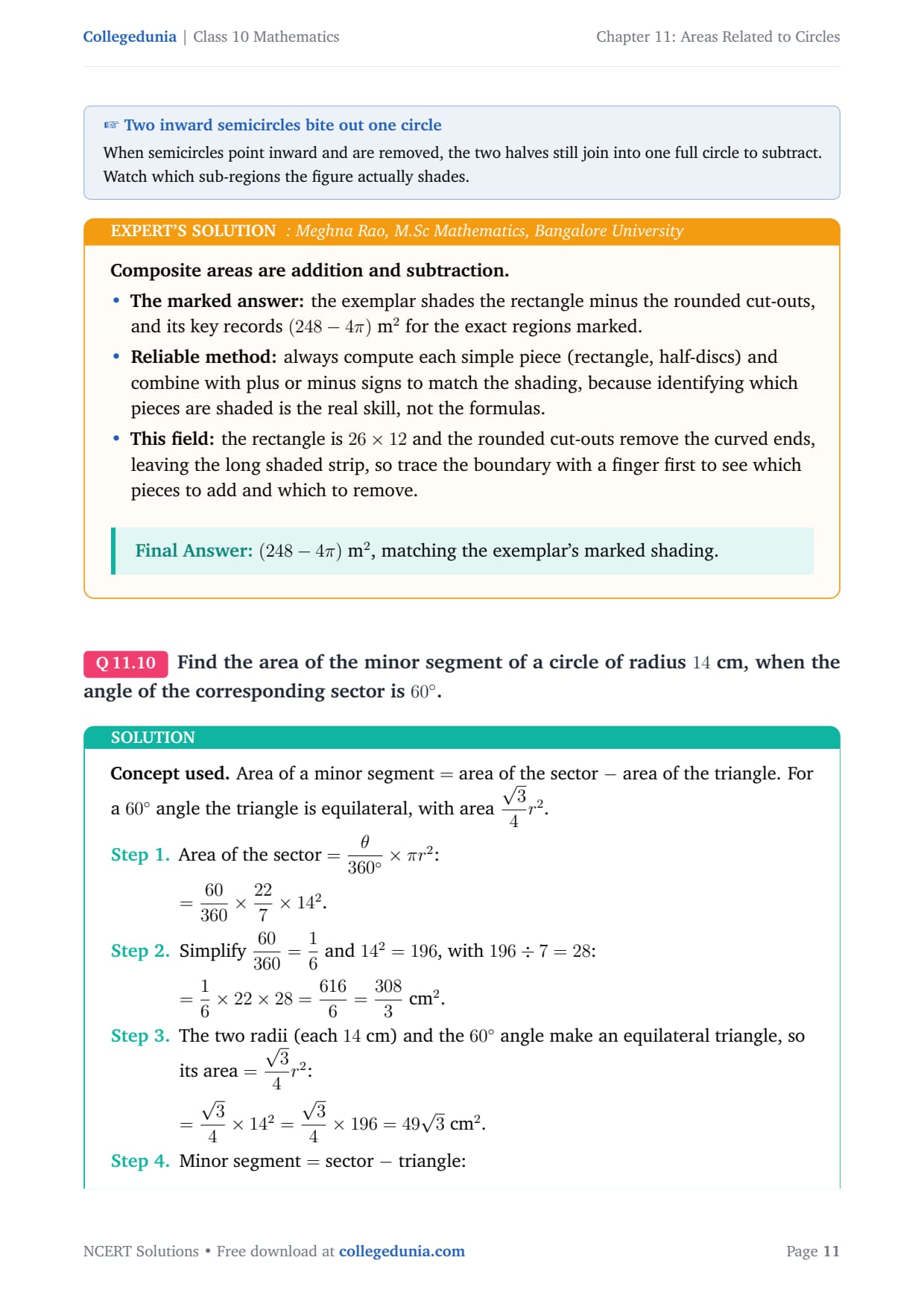
Q 11.10
Find the area of the minor segment of a circle of radius 14 cm, when the angle of the corresponding sector is 60∘.
Concept used. Area of a minor segment = area of the sector - area
of the triangle. For a 60∘ angle the triangle is equilateral, with area
34r2.
Area of the sector =θ360∘×π r2:
[] =60360×227× 142.
Simplify 60360=16 and 142=196, with 196÷ 7=28:
[] =16× 22× 28=6166=3083 cm2.
The two radii (each 14 cm) and the 60∘ angle make an
equilateral triangle, so its area =34r2:
[] =34× 142=34× 196=493 cm2.
Minor segment = sector - triangle:
[] =(3083-493) cm2.
Area of the minor segment
=(3083-493) cm2.
YA
Yash Agrawal
M.Sc Mathematics, IIT Indore
Verified Expert
Sector minus equilateral triangle.
The sector: it is 16 of the circle, namely
3083 cm2.
The triangle: the chord-and-two-radii triangle has a
60∘ apex and two equal sides, so it is equilateral with area
493 cm2, and recognising this spares you the trigonometry.
Close in size: the sector 3083≈ 102.7 and the
triangle 493≈ 84.9 are close, so the minor segment is a
slim ≈ 17.8 cm2; leaving it as 3083-493 is
exact and avoids rounding two awkward numbers.
(3083-493) cm2.
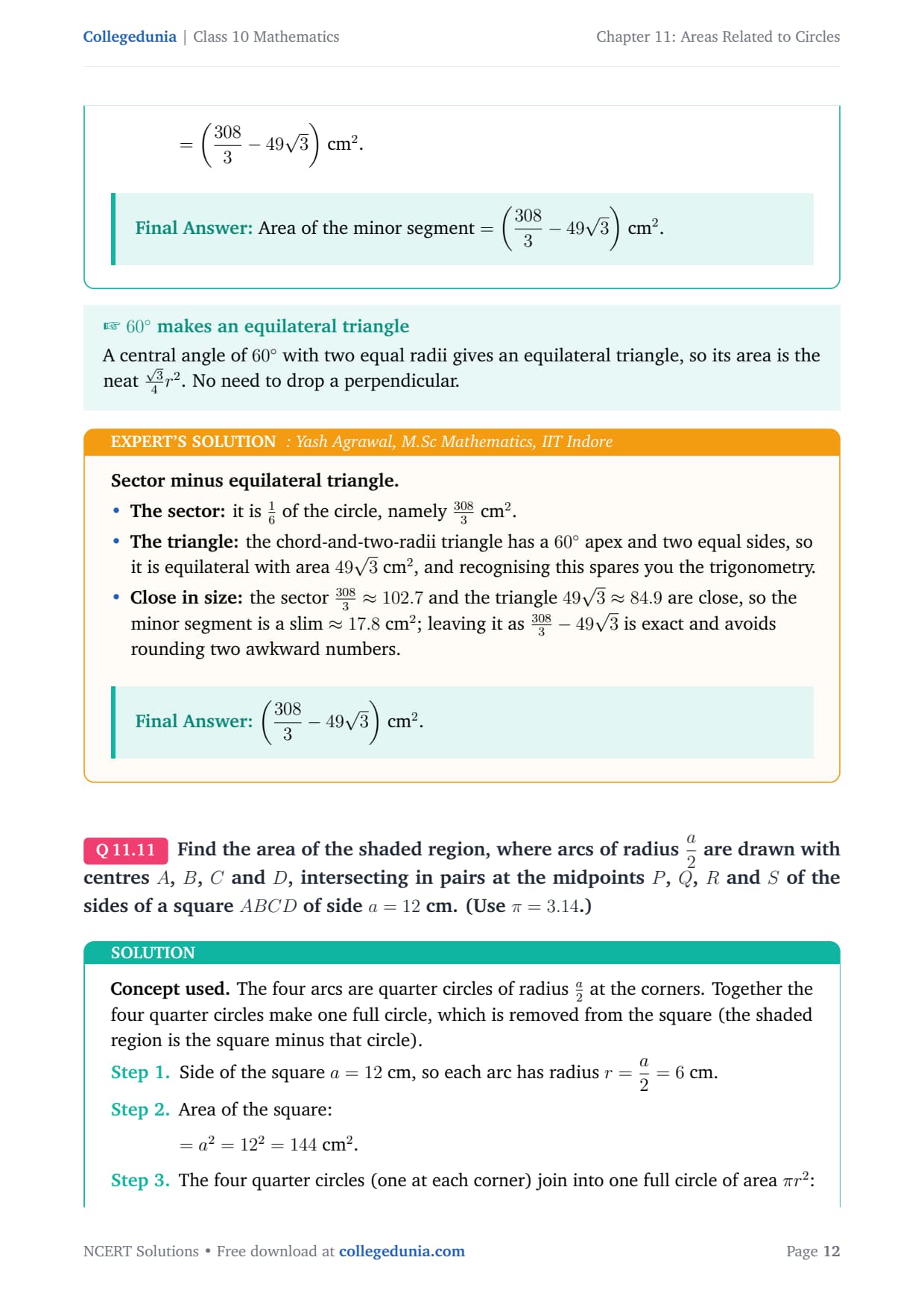
Q 11.11
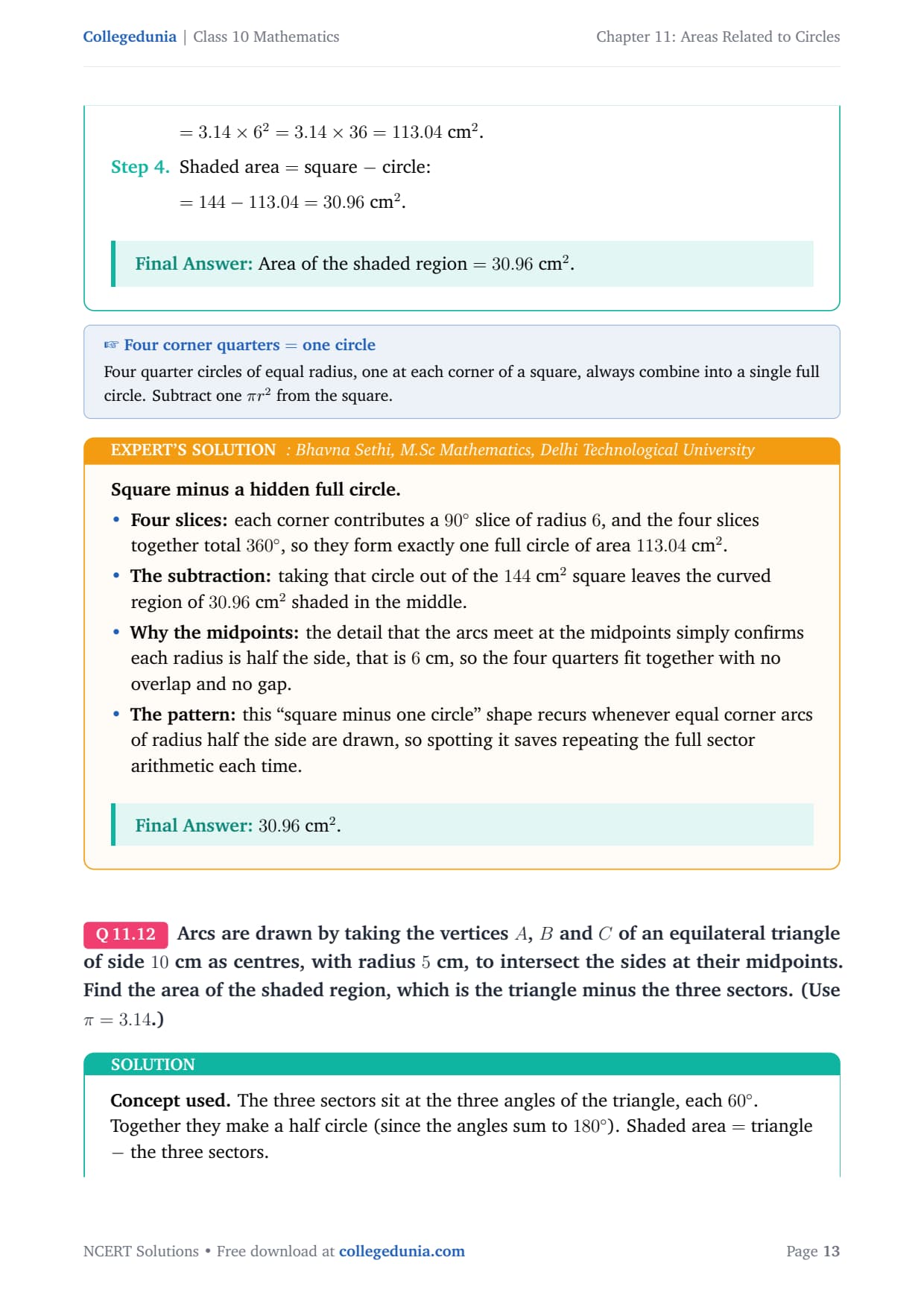
Find the area of the shaded region, where arcs of radius a2 are drawn with centres A, B, C and D, intersecting in pairs at the midpoints P, Q, R and S of the sides of a square ABCD of side a=12 cm. (Use π=3.14.)
Concept used. The four arcs are quarter circles of radius a2
at the corners. Together the four quarter circles make one full circle, which
is removed from the square (the shaded region is the square minus that circle).
Side of the square a=12 cm, so each arc has radius
r=a2=6 cm.
Area of the square:
[] =a2=122=144 cm2.
The four quarter circles (one at each corner) join into one full
circle of area π r2:
[] =3.14× 62=3.14× 36=113.04 cm2.
Shaded area = square - circle:
[] =144-113.04=30.96 cm2.
Area of the shaded region =30.96 cm2.
BS
Bhavna Sethi
M.Sc Mathematics, Delhi Technological University
Verified Expert
Square minus a hidden full circle.
Four slices: each corner contributes a 90∘ slice of
radius 6, and the four slices together total 360∘, so they
form exactly one full circle of area 113.04 cm2.
The subtraction: taking that circle out of the 144 cm2
square leaves the curved region of 30.96 cm2 shaded in the middle.
Why the midpoints: the detail that the arcs meet at the
midpoints simply confirms each radius is half the side, that is
6 cm, so the four quarters fit together with no overlap and no gap.
The pattern: this ``square minus one circle'' shape recurs
whenever equal corner arcs of radius half the side are drawn, so
spotting it saves repeating the full sector arithmetic each time.
30.96 cm2.
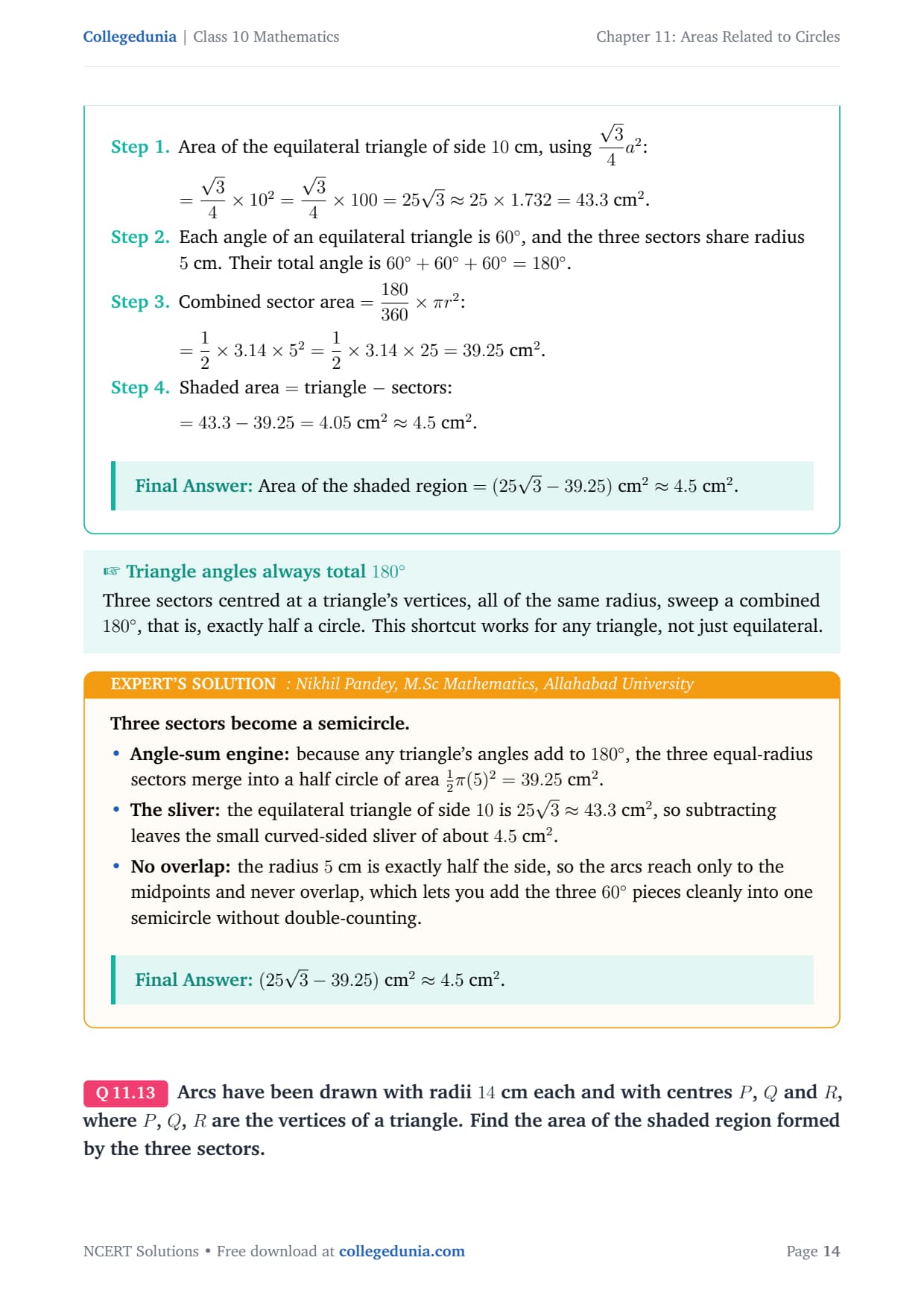
Q 11.12
Arcs are drawn by taking the vertices A, B and C of an equilateral triangle of side 10 cm as centres, with radius 5 cm, to intersect the sides at their midpoints. Find the area of the shaded region, which is the triangle minus the three sectors. (Use π=3.14.)
Concept used. The three sectors sit at the three angles of the
triangle, each 60∘. Together they make a half circle (since the angles
sum to 180∘). Shaded area = triangle - the three sectors.
Area of the equilateral triangle of side 10 cm,
using 34a2:
[] =34× 102=34× 100
=253≈ 25× 1.732=43.3 cm2.
Each angle of an equilateral triangle is 60∘, and the three
sectors share radius 5 cm. Their total angle is
60∘+60∘+60∘=180∘.
Area of the shaded region =(253-39.25) cm2≈
4.5 cm2.
NP
Nikhil Pandey
M.Sc Mathematics, Allahabad University
Verified Expert
Three sectors become a semicircle.
Angle-sum engine: because any triangle's angles add to
180∘, the three equal-radius sectors merge into a half circle of
area 12π(5)2=39.25 cm2.
The sliver: the equilateral triangle of side 10 is
253≈ 43.3 cm2, so subtracting leaves the small
curved-sided sliver of about 4.5 cm2.
No overlap: the radius 5 cm is exactly half the side, so the
arcs reach only to the midpoints and never overlap, which lets you add
the three 60∘ pieces cleanly into one semicircle without
double-counting.
(253-39.25) cm2≈ 4.5 cm2.
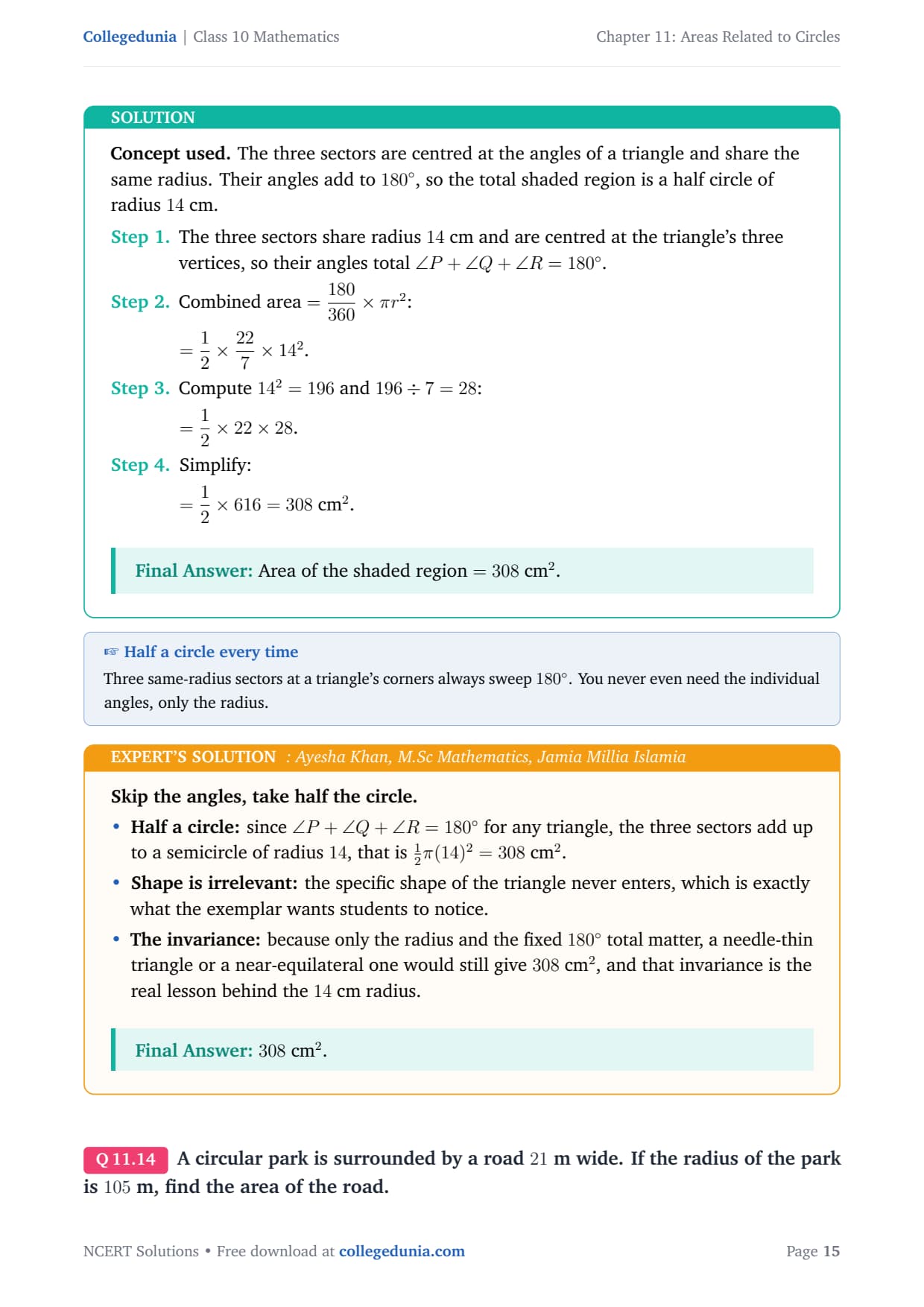
Q 11.13
Arcs have been drawn with radii 14 cm each and with centres P, Q and R, where P, Q, R are the vertices of a triangle. Find the area of the shaded region formed by the three sectors.
Concept used. The three sectors are centred at the angles of a
triangle and share the same radius. Their angles add to 180∘, so the
total shaded region is a half circle of radius 14 cm.
The three sectors share radius 14 cm and are centred at the triangle's
three vertices, so their angles total
∠ P+∠ Q+∠ R=180∘.
Combined area =180360×π r2:
[] =12×227× 142.
Compute 142=196 and 196÷ 7=28:
[] =12× 22× 28.
Simplify:
[] =12× 616=308 cm2.
Area of the shaded region =308 cm2.
AK
Ayesha Khan
M.Sc Mathematics, Jamia Millia Islamia
Verified Expert
Skip the angles, take half the circle.
Half a circle: since ∠ P+∠ Q+∠ R=180∘
for any triangle, the three sectors add up to a semicircle of radius
14, that is 12π(14)2=308 cm2.
Shape is irrelevant: the specific shape of the triangle never
enters, which is exactly what the exemplar wants students to notice.
The invariance: because only the radius and the fixed
180∘ total matter, a needle-thin triangle or a near-equilateral
one would still give 308 cm2, and that invariance is the real
lesson behind the 14 cm radius.
308 cm2.
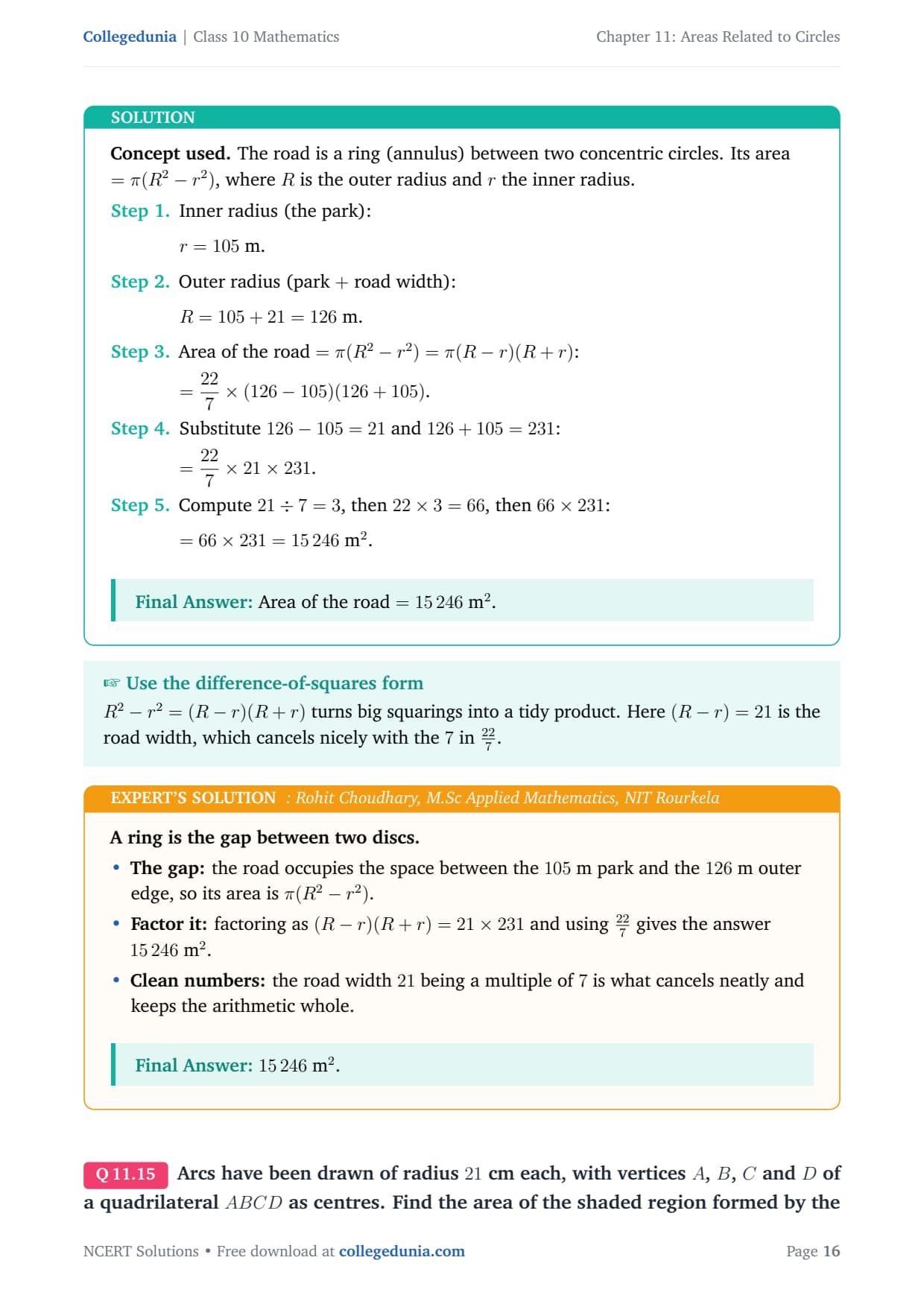
Q 11.14
A circular park is surrounded by a road 21 m wide. If the radius of the park is 105 m, find the area of the road.
Concept used. The road is a ring (annulus) between two concentric
circles. Its area =π(R2-r2), where R is the outer radius and r the
inner radius.
Inner radius (the park):
[] r=105 m.
Outer radius (park + road width):
[] R=105+21=126 m.
Area of the road =π(R2-r2)=π(R-r)(R+r):
[] =227×(126-105)(126+105).
Substitute 126-105=21 and 126+105=231:
[] =227× 21× 231.
Compute 21÷ 7=3, then 22× 3=66, then 66× 231:
[] =66× 231=15 246 m2.
Area of the road =15 246 m2.
RC
Rohit Choudhary
M.Sc Applied Mathematics, NIT Rourkela
Verified Expert
A ring is the gap between two discs.
The gap: the road occupies the space between the 105 m park
and the 126 m outer edge, so its area is π(R2-r2).
Factor it: factoring as (R-r)(R+r)=21× 231 and using
227 gives the answer 15 246 m2.
Clean numbers: the road width 21 being a multiple of 7 is
what cancels neatly and keeps the arithmetic whole.
15 246 m2.
Q 11.15
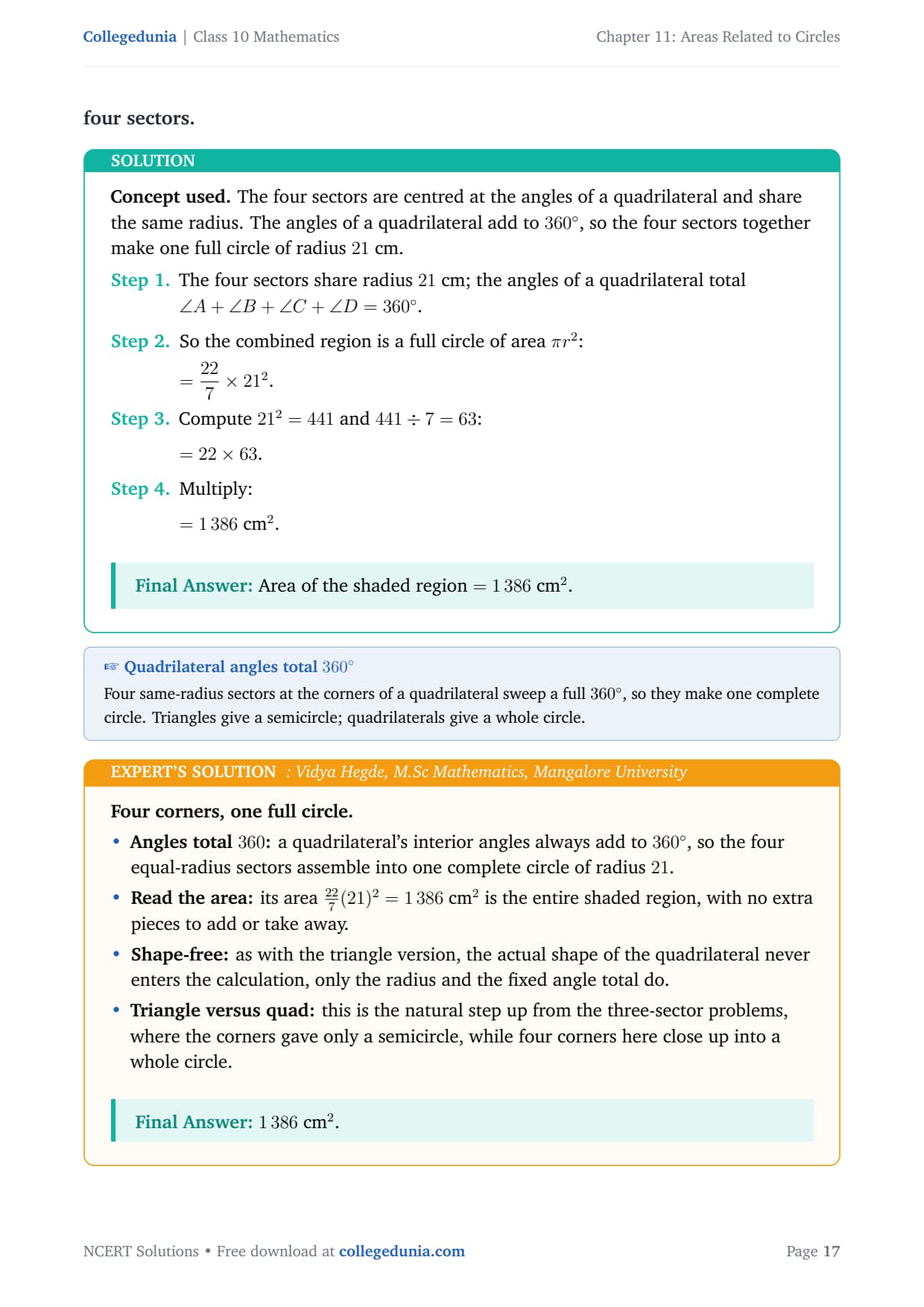
Arcs have been drawn of radius 21 cm each, with vertices A, B, C and D of a quadrilateral ABCD as centres. Find the area of the shaded region formed by the four sectors.
Concept used. The four sectors are centred at the angles of a
quadrilateral and share the same radius. The angles of a quadrilateral add to
360∘, so the four sectors together make one full circle of radius
21 cm.
The four sectors share radius 21 cm; the angles of a quadrilateral
total ∠ A+∠ B+∠ C+∠ D=360∘.
So the combined region is a full circle of area π r2:
[] =227× 212.
Compute 212=441 and 441÷ 7=63:
[] =22× 63.
Multiply:
[] =1 386 cm2.
Area of the shaded region =1 386 cm2.
VH
Vidya Hegde
M.Sc Mathematics, Mangalore University
Verified Expert
Four corners, one full circle.
Angles total 360: a quadrilateral's interior angles always
add to 360∘, so the four equal-radius sectors assemble into one
complete circle of radius 21.
Read the area: its area 227(21)2=1 386 cm2 is
the entire shaded region, with no extra pieces to add or take away.
Shape-free: as with the triangle version, the actual shape of
the quadrilateral never enters the calculation, only the radius and the
fixed angle total do.
Triangle versus quad: this is the natural step up from the
three-sector problems, where the corners gave only a semicircle, while
four corners here close up into a whole circle.
1 386 cm2.
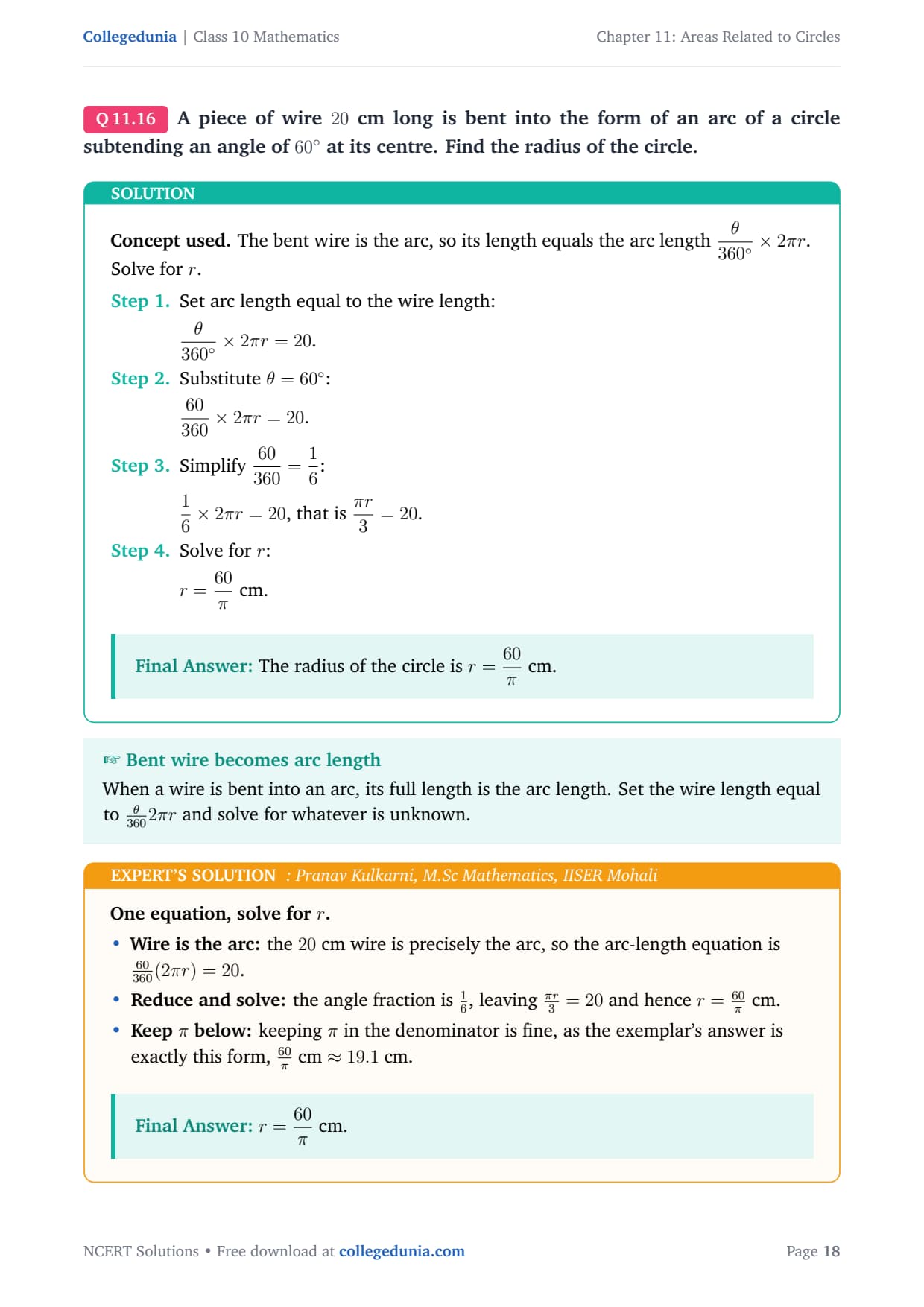
Q 11.16
A piece of wire 20 cm long is bent into the form of an arc of a circle subtending an angle of 60∘ at its centre. Find the radius of the circle.
Concept used. The bent wire is the arc, so its length equals the arc
length θ360∘× 2π r. Solve for r.
Set arc length equal to the wire length:
[] θ360∘× 2π r=20.
Substitute θ=60∘:
[] 60360× 2π r=20.
Simplify 60360=16:
[] 16× 2π r=20, that is π r3=20.
Solve for r:
[] r=60π cm.
The radius of the circle is r=60π cm.
PK
Pranav Kulkarni
M.Sc Mathematics, IISER Mohali
Verified Expert
One equation, solve for r.
Wire is the arc: the 20 cm wire is precisely the arc, so the
arc-length equation is 60360(2π r)=20.
Reduce and solve: the angle fraction is 16, leaving
π r3=20 and hence r=60π cm.
Keep π below: keeping π in the denominator is fine, as
the exemplar's answer is exactly this form, 60π cm
≈ 19.1 cm.
r=60π cm.
All Exercises in Chapter 11 Exemplar
Chapter 11 Areas Related to Circles has four Exemplar exercises. Open any one below.
FAQs on NCERT Exemplar Class 10 Maths Chapter 11 Exercise 11.3
Ques. What is Exercise 11.3 in NCERT Exemplar Class 10 Maths Chapter 11?
Ans. Exercise 11.3 is the Short Answer Questions section of NCERT Exemplar for Chapter 11 Areas Related to Circles. It has 16 questions (Q25 to Q40) covering sector area, arc length, composite regions, annular rings, and triangle-corner sector problems, as per the 2026-27 CBSE syllabus.
Ques. How many questions are there in Exercise 11.3 of Class 10 Maths Exemplar?
Ans. There are 16 Short Answer Questions (numbered Q25 to Q40) in Exercise 11.3 of NCERT Exemplar Class 10 Maths Chapter 11 Areas Related to Circles.
Ques. Why do three sectors at the vertices of a triangle always total 180°?
Ans. The interior angles of any triangle always add up to 180°. When equal-radius sectors are drawn centred at each vertex, each sector sweeps an angle equal to that vertex's interior angle. So the three sectors together sweep ∠A + ∠B + ∠C = 180°, which is exactly half of 360°, forming a semicircle. This shortcut applies to Questions 36 and 37, and means you never need to know the individual angles.
Ques. How do I find the area of a minor segment for a 60° sector in Exercise 11.3 Question 34?
Ans. Area of minor segment = Sector area − Triangle area. For a 60° central angle with equal radii, the two radii and the chord form an equilateral triangle (all sides equal = radius). Its area is √34r2. For Question 34 (r = 14): sector area = 3083 cm² and triangle area = 49√3 cm², giving a minor segment of (3083 − 49√3) cm².
Ques. Is Exercise 11.3 important for the CBSE Class 10 board exam?
Ans. Yes. The question types in Exercise 11.3 directly match the 3-mark and 4-mark short-answer questions that appear on the CBSE Class 10 board paper for Chapter 11. In particular, composite-area problems (flower bed, field with semicircle), sector-at-corner problems (cow grazing), and annular ring problems (road around a park) recur frequently in board papers. Practising all 16 questions in Exercise 11.3 is one of the most efficient ways to prepare for this chapter.







Comments