Class 10 Maths Chapter 11 Areas Related to Circles Exercise 11.1 has ten Multiple Choice Questions. They test circumference, area, sectors, segments, inscribed shapes, and composite regions, set to the 2026-27 CBSE syllabus.
10 MCQs with step-by-step Collegedunia solutions and an Expert view for each.
Concepts tested: circle area π r2, circumference 2π r, inscribed square and circle, and Pythagorean triples in area problems.
CBSE weightage: Areas Related to Circles carries 4 to 5 marks in the board paper, usually one short and one long question.
Each Exercise 11.1 solution here is written by subject experts from the 2026-27 NCERT Exemplar book and checked against the last five years of CBSE board papers.
Solved by Collegedunia
All 10 questions of Exercise 11.1 are solved below, each with the concept, step-by-step working, and an Expert view.
What Areas Related to Circles Class 10 Maths Exercise 11.1 Covers
Exercise 11.1 is the MCQ section of the NCERT Exemplar for Chapter 11. Its 10 questions check whether you understand the core circle and area formulas at a concept level, not just by routine.
Questions 1 and 2 contrast area addition (squares of radii) with circumference addition (radii directly).
Questions 3 and 5 compare circle and square areas at equal perimeter, the classic isoperimetric result.
Questions 4, 7 and 8 use inscribed and circumscribed shapes: circles in squares and squares in circles.
Questions 6, 9 and 10 apply Pythagorean triples (6-8-10 and 7-24-25) to area and circumference.
The level is moderate. Most lost marks come from mixing the area rule (squares of radii) with the circumference rule (radii directly), or from forgetting to double the radius for the diameter in Question 10.
Key Formulas for Areas Related to Circles Class 10 Maths
Every question in Exercise 11.1 flows from these five formulas. Know them cold and the MCQs go fast.
Formula
Expression
Where used in Exercise 11.1
Area of circle
π r2
Q1, Q3, Q5, Q6, Q10
Circumference of circle
2π r
Q2, Q3, Q5, Q9
Perimeter of square (side a)
4a
Q3, Q5
Inscribed circle (in square of side a)
radius = a/2
Q7
Inscribed square (in circle of radius r)
area = 12(2r)2 = 2r2 OR 12d2
Q8
Use π = 227 in all numerical MCQs unless told otherwise. Keep the ratio in symbols and substitute at the very end to keep the arithmetic clean.
Areas Related to Circles Class 10 Maths Formula Overview
Common Mistakes in Areas Related to Circles Class 10 Maths
In Exercise 11.1, every wrong option matches a real student mistake. Know the traps in advance and you keep marks on questions you already understand.
Question
Common Mistake
The Fix
Q1
Choosing R1 + R2 = R (linear sum) instead of R12 + R22 = R2
Areas add as squares of radii, not radii themselves
Q3 and Q5
Thinking the circle and square have equal areas when perimeters are equal
The circle always encloses more area for the same perimeter
Q7
Using the side as the radius (not diameter) of the inscribed circle
Diameter = side of square, so radius = side/2
Q8
Finding the side of the square first, then squaring (longer path, more error)
Use area = 12 × d2 directly; d = 2r = 16 cm
Q9
Adding diameters (36 + 20 = 56) and getting 56 cm
Halve the diameters first to get radii (18 + 10 = 28 cm)
Q10
Stopping at the radius (25 cm) instead of doubling to get the diameter (50 cm)
Always re-read what the question asks: radius or diameter
MCQ Strategy for Areas Related to Circles Class 10 Maths
All 10 Exercise 11.1 Solutions with Step-by-Step Answers
I. Multiple Choice Questions (Exercise 11.1)
Q 11.1
If the sum of the areas of two circles with radii R1 and R2 is equal to the area of a circle of radius R, then
(A) R1+R2=R (B) R12+R22=R2
(C) R1+R2 (D) R12+R222
Correct option: (B)R12+R22=R2.
Concept used. The area of a circle of radius r is π r2.
``Sum of two areas equals a third area'' becomes an equation in the squares
of the radii.
Write the three areas:
[] area1=π R12, area2=π R22, area=π R2.
Set the sum of the first two equal to the third:
[] π R12+π R22=π R2.
Divide every term by π:
[] R12+R22=R2.
The radii satisfy R12+R22=R2; option (B).
AM
Aarav Mehta
M.Sc Mathematics, IIT Kanpur
Verified Expert
Cancel the common π and read off the relation.
Why π goes: every circle here carries the same factor
π, so the moment you write area as π r2 that factor divides
out of the whole equation and only the squared radii are left.
The clue: this is why the answer is the Pythagoras-looking
R12+R22=R2 and not the tempting linear R1+R2=R.
The trap: adding radii directly would be correct for
perimeters, not for areas, so option (A) catches the unwary while
(B) is the clean truth.
Option (B), R12+R22=R2.
Q 11.2
If the sum of the circumferences of two circles with radii R1 and R2 is equal to the circumference of a circle of radius R, then
(A) R1+R2=R (B) R1+R2>R
(C) R1+R2 (D) Nothing definite can be said about the relation among R1, R2 and R.
Correct option: (A)R1+R2=R.
Concept used. The circumference of a circle of radius r is
2π r. Here the lengths add, so set up the sum of circumferences.
Write the three circumferences:
[] 2π R1, 2π R2, 2π R.
Set the sum of the first two equal to the third:
[] 2π R1+2π R2=2π R.
Divide every term by 2π:
[] R1+R2=R.
The radii satisfy R1+R2=R; option (A).
PN
Priya Nair
M.Sc Mathematics, University of Delhi
Verified Expert
The 2π cancels, leaving a plain sum.
Linear in radius: because circumference is linear in the
radius, dividing through by the shared 2π turns the length
equation into R1+R2=R exactly.
No ambiguity: there is no inequality and nothing undecided
here, so options (B), (C) and (D) are all wrong.
The pairing: setting this beside Question 1 is deliberate, as
squares add for areas while radii add for circumferences.
Option (A), R1+R2=R.
Q 11.3
If the circumference of a circle and the perimeter of a square are equal, then
(A) Area of the circle = Area of the square
(B) Area of the circle > Area of the square
(C) Area of the circle < Area of the square
(D) Nothing definite can be said about the relation between the areas of the circle and square.
Correct option: (B) Area of the circle > Area of the square.
Concept used. For a fixed perimeter, the circle encloses the most
area of any shape. We can also prove it directly by comparing the two areas.
Let the common length be P. For the circle, 2π r=P, so
r=P2π.
Area of the circle:
[] π r2=π(P2π)2=P24π.
For the square, 4a=P, so a=P4.
Area of the square:
[] a2=(P4)2=P216.
Compare the two areas, using π≈ 3.14:
[] circle =P24π≈P212.57,
square =P216.
A larger denominator gives the smaller value. Since
12.57<16, the circle's area is the bigger one.
For equal perimeter, area of the circle > area of the square;
option (B).
RV
Rohan Verma
M.Sc Mathematics, IIT Bombay
Verified Expert
Same fence, more land for the circle.
The picture: think of P as a length of fencing; bent into a
circle it traps area P24π, but folded into a square it
traps only P216.
The winner: since 4π≈ 12.57 is smaller than 16,
the circle encloses more, which is why round pipes, tanks and manhole
covers are so common.
Without numbers: start with the square and round off its
corners at fixed perimeter, and every rounding pushes the boundary
outward into new area until the limit is the circle, so it must
out-enclose the square.
Option (B), the circle has the larger area.
Q 11.4
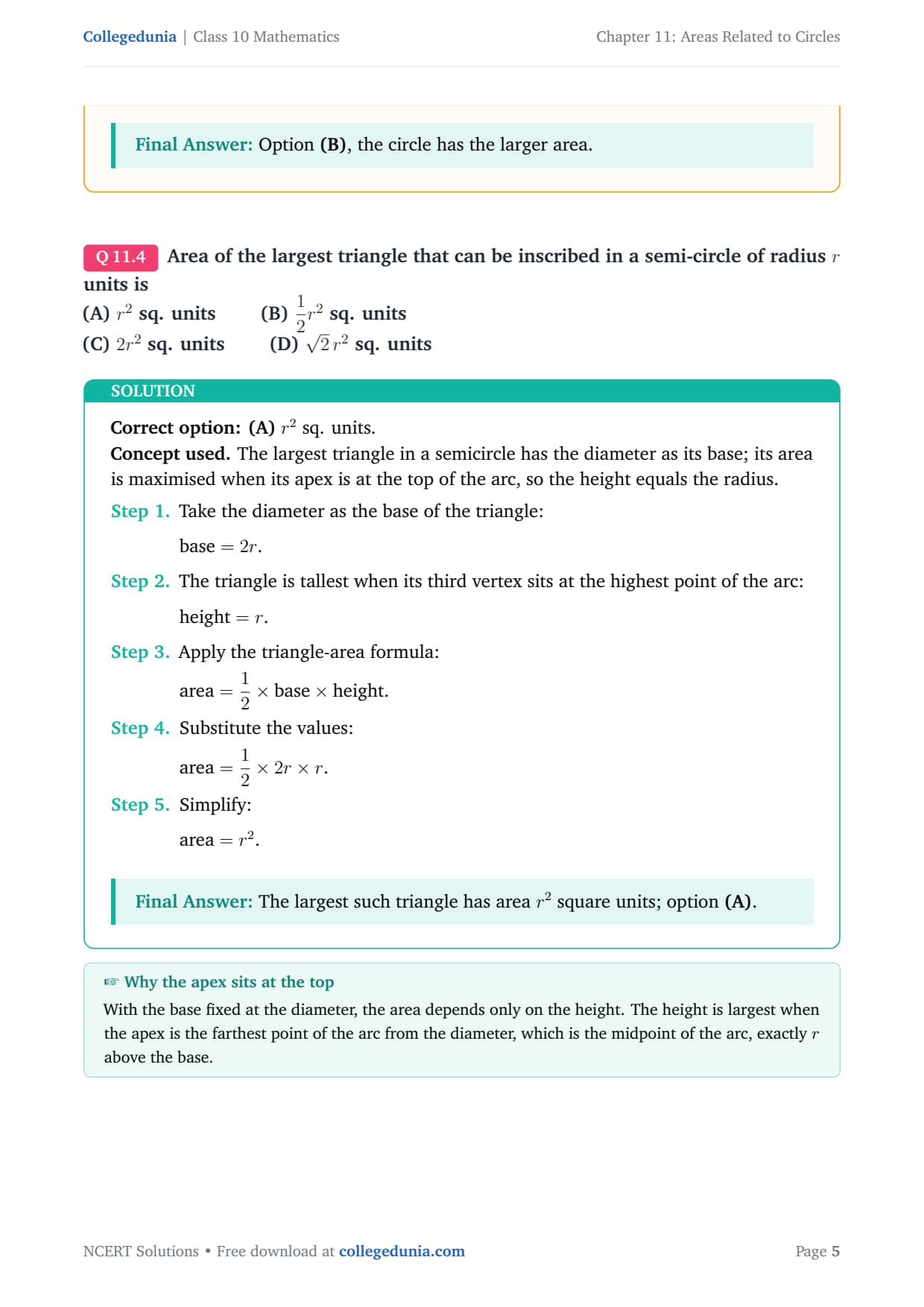
Area of the largest triangle that can be inscribed in a semi-circle of radius r units is
(A) r2 sq. units (B) 12r2 sq. units
(C) 2r2 sq. units (D) √2 r2 sq. units
Correct option: (A)r2 sq. units.
Concept used. The largest triangle in a semicircle has the diameter
as its base; its area is maximised when its apex is at the top of the arc, so
the height equals the radius.
Take the diameter as the base of the triangle:
[] base =2r.
The triangle is tallest when its third vertex sits at the highest
point of the arc:
[] height =r.
Apply the triangle-area formula:
[] area =12.
Substitute the values:
[] area =12× 2r× r.
Simplify:
[] area =r2.
The largest such triangle has area r2 square units;
option (A).
SK
Sneha Kulkarni
M.Sc Mathematics, IISc Bangalore
Verified Expert
Fix the base, push the top up.
Natural base: the diameter 2r is the longest chord
available, so it is the natural base to build the triangle on.
Tallest apex: once the base is locked in, only the height can
grow, and the tallest the apex can reach inside a semicircle of radius
r is a height of r.
The maximum: plugging into 12 bh gives
12(2r)(r)=r2, and any other inscribed triangle is shorter or
narrower, so r2 is genuinely the largest possible.
Option (A), r2 square units.
Q 11.5
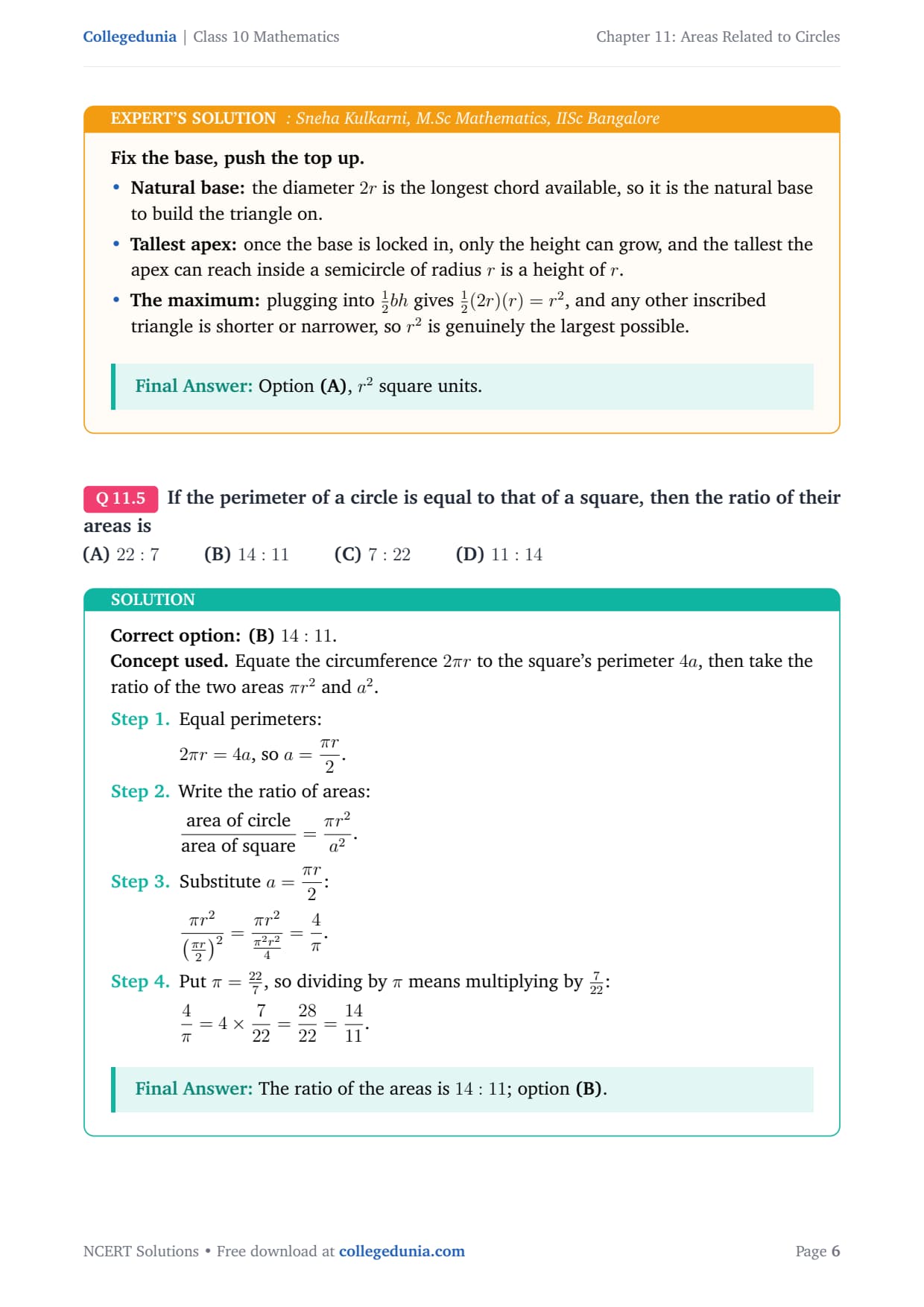
If the perimeter of a circle is equal to that of a square, then the ratio of their areas is
(A) 22:7 (B) 14:11 (C) 7:22 (D) 11:14
Correct option: (B)14:11.
Concept used. Equate the circumference 2π r to the square's
perimeter 4a, then take the ratio of the two areas π r2 and a2.
Equal perimeters:
[] 2π r=4a, so a=π r2.
Write the ratio of areas:
[] area of circlearea of square
=π r2a2.
Substitute a=π r2:
[] π r2(π r2)2
=π r2π2 r24=4π.
Put π=227, so dividing by π means multiplying by
722:
[] 4π=4×722=2822=1411.
The ratio of the areas is 14:11; option (B).
AI
Ananya Iyer
M.Sc Mathematics, ISI Kolkata
Verified Expert
The whole ratio collapses to 4/π.
Radius cancels: because the radius drops out, the answer is
independent of size, so any circle and square with equal perimeters
have areas in the ratio 4:π.
Numerical form: converting π to 227 turns this
into 14:11, which also confirms Question 3 because 14>11 tells us
the circle's area is the larger one.
A fact to store: keep 4:π≈ 1.27 in mind, since for
equal perimeters the circle always beats the square by about 27%,
and the same 14:11 holds for a tiny coin or a huge field alike.
Option (B), 14:11.
Q 11.6
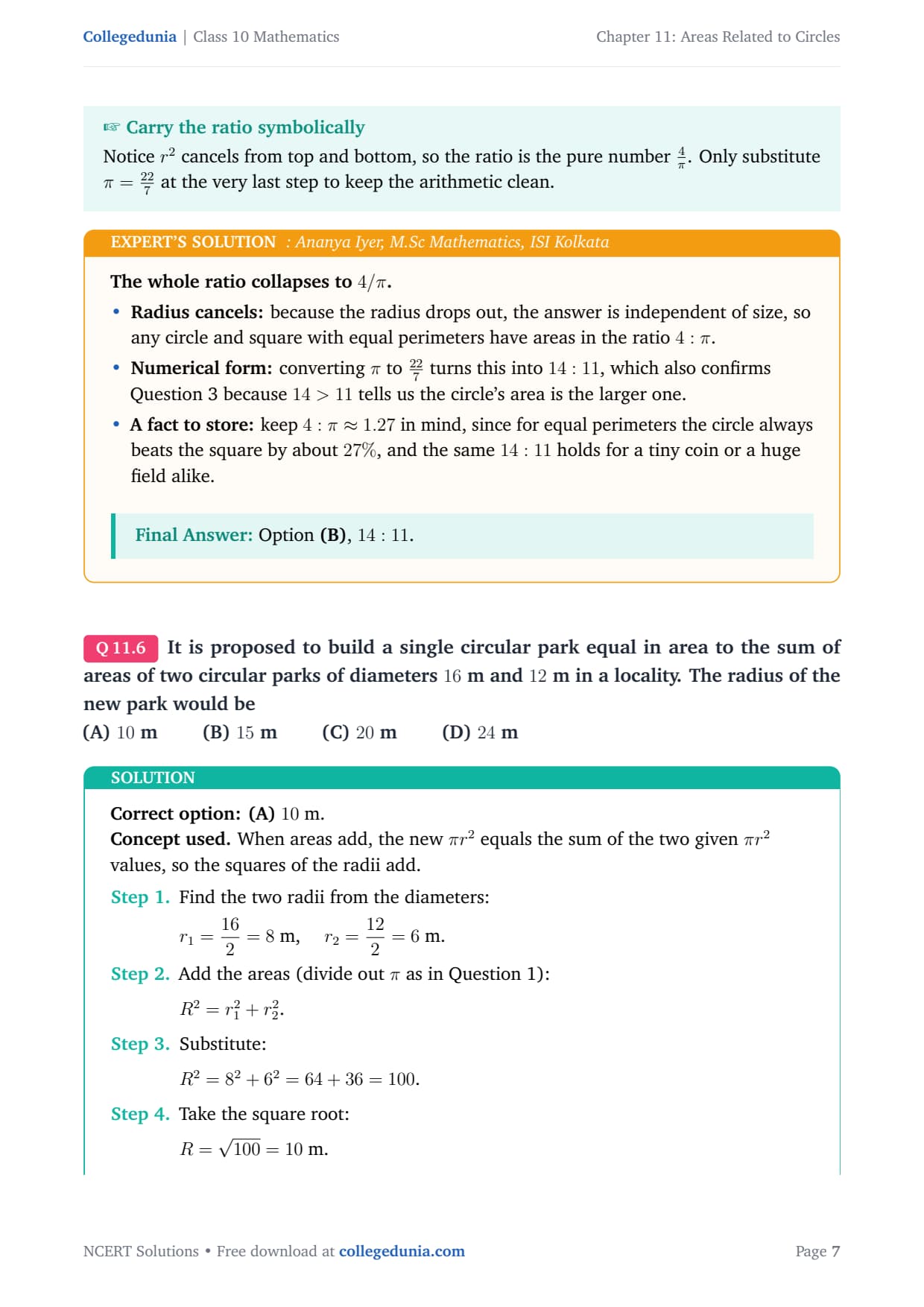
It is proposed to build a single circular park equal in area to the sum of areas of two circular parks of diameters 16 m and 12 m in a locality. The radius of the new park would be
(A) 10 m (B) 15 m (C) 20 m (D) 24 m
Correct option: (A)10 m.
Concept used. When areas add, the new π r2 equals the sum of the
two given π r2 values, so the squares of the radii add.
Find the two radii from the diameters:
[] r1=162=8 m, r2=122=6 m.
Add the areas (divide out π as in Question 1):
[] R2=r12+r22.
Substitute:
[] R2=82+62=64+36=100.
Take the square root:
[] R=√100=10 m.
The new park has radius 10 m; option (A).
KR
Karthik Reddy
M.Sc Mathematics, IIT Madras
Verified Expert
Diameters first, then squares.
The trap: the tempting mistake here is to add the diameters
or the radii straight off, which is wrong for areas.
Squares add: areas combine through R2=r12+r22, so
R2=64+36=100 and the new radius is R=10 m.
The signal: the numbers were chosen as the 6,8,10
Pythagorean set, a nice cue that you have applied the squares-add rule
rather than a linear shortcut.
Option (A), 10 m.
Q 11.7
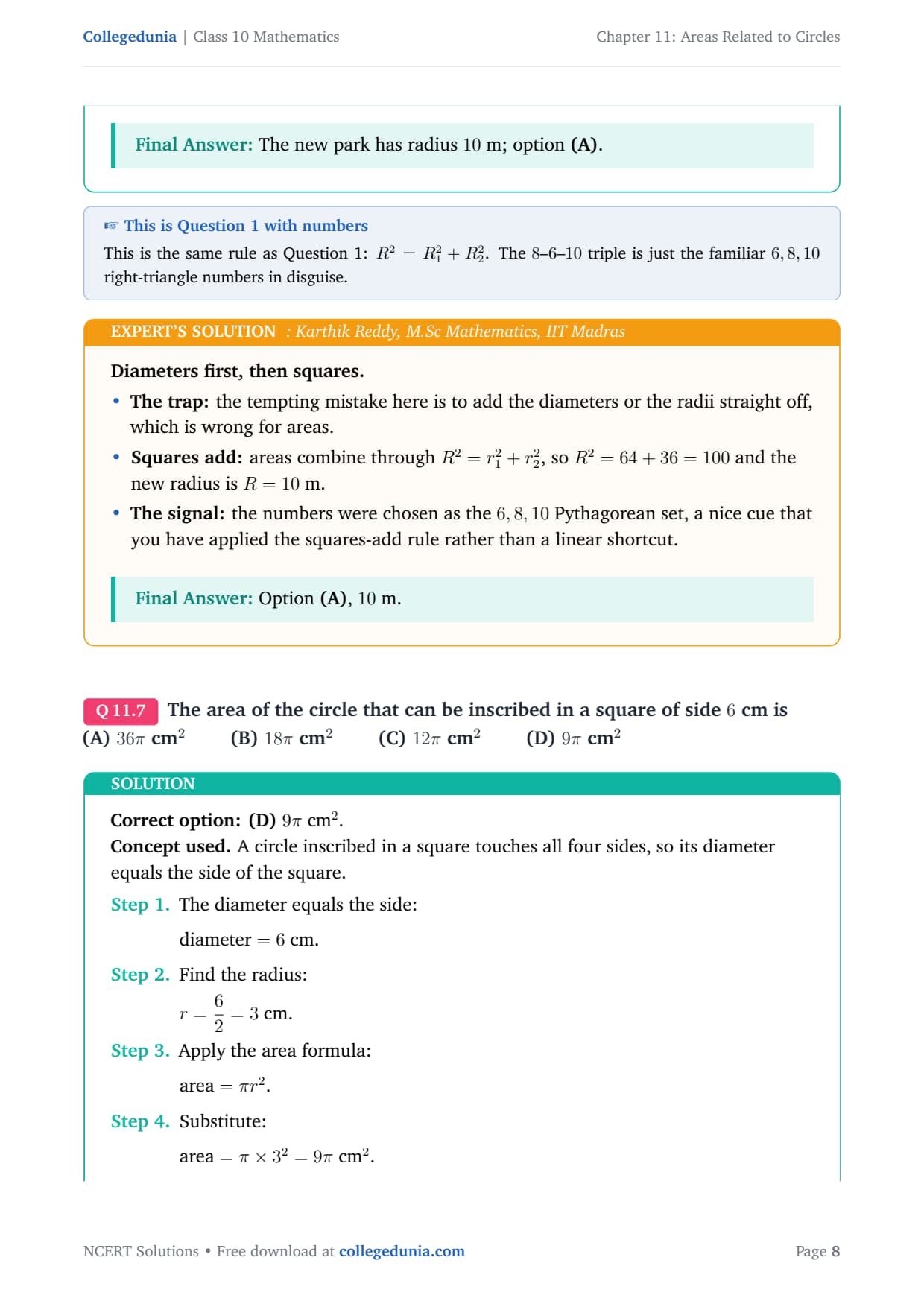
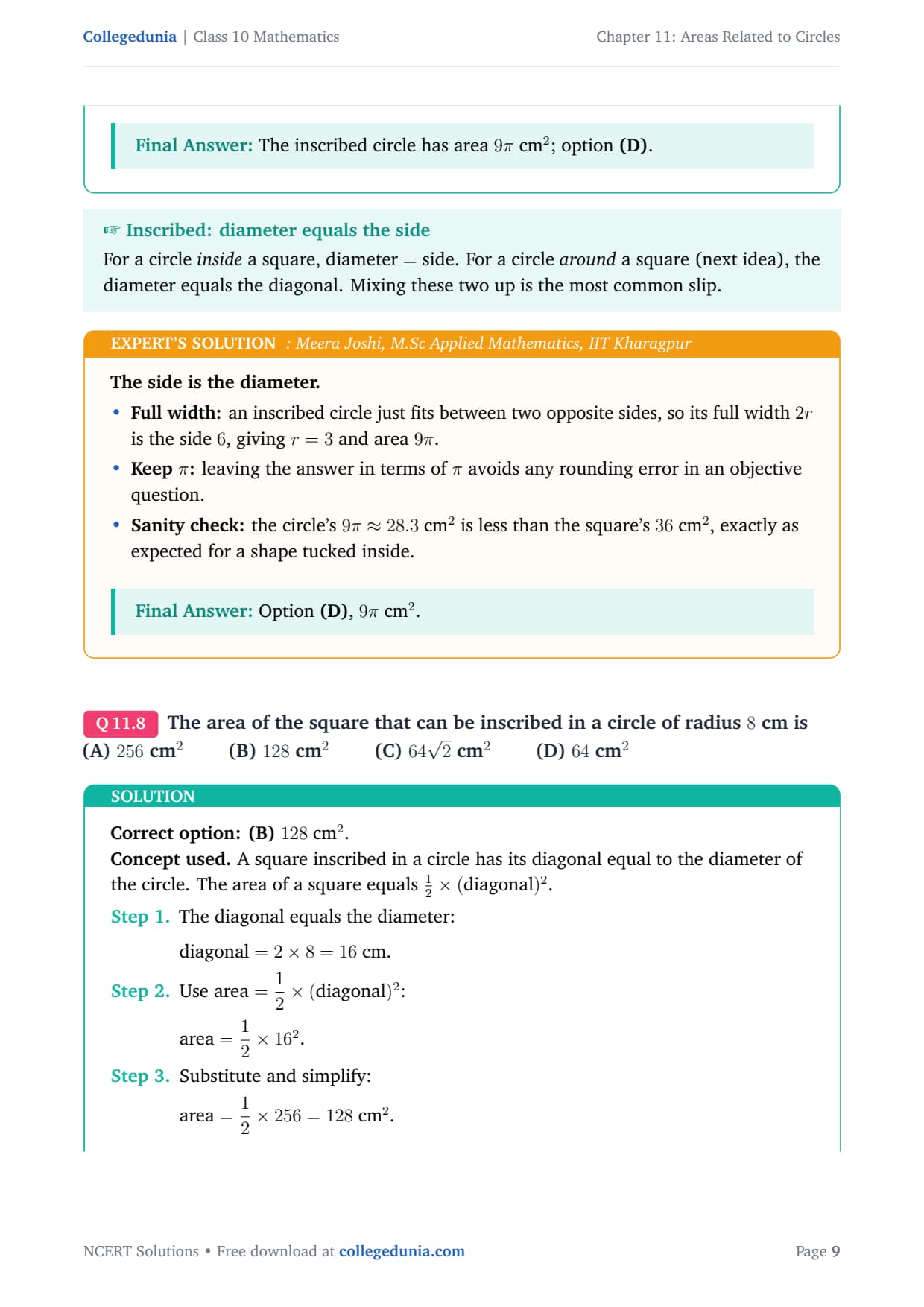
The area of the circle that can be inscribed in a square of side 6 cm is
(A) 36π cm2 (B) 18π cm2 (C) 12π cm2 (D) 9π cm2
Correct option: (D)9π cm2.
Concept used. A circle inscribed in a square touches all four sides,
so its diameter equals the side of the square.
The diameter equals the side:
[] diameter =6 cm.
Find the radius:
[] r=62=3 cm.
Apply the area formula:
[] area =π r2.
Substitute:
[] area =π× 32=9π cm2.
The inscribed circle has area 9π cm2; option (D).
MJ
Meera Joshi
M.Sc Applied Mathematics, IIT Kharagpur
Verified Expert
The side is the diameter.
Full width: an inscribed circle just fits between two opposite
sides, so its full width 2r is the side 6, giving r=3 and area
9π.
Keep π: leaving the answer in terms of π avoids any
rounding error in an objective question.
Sanity check: the circle's 9π≈ 28.3 cm2 is less
than the square's 36 cm2, exactly as expected for a shape tucked
inside.
Option (D), 9π cm2.
Q 11.8
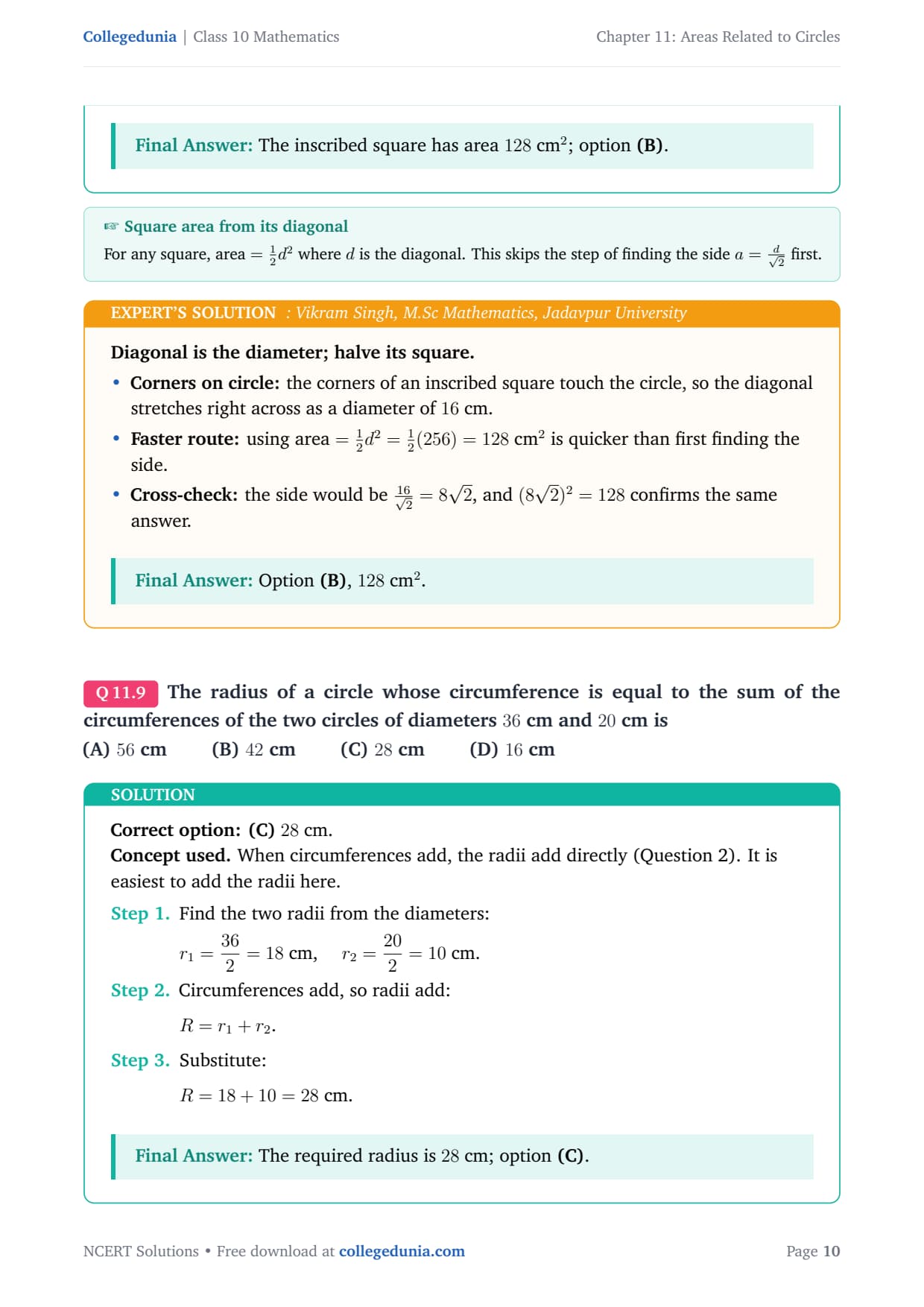
The area of the square that can be inscribed in a circle of radius 8 cm is
(A) 256 cm2 (B) 128 cm2 (C) 64√2 cm2 (D) 64 cm2
Correct option: (B)128 cm2.
Concept used. A square inscribed in a circle has its diagonal equal
to the diameter of the circle. The area of a square equals
12×(diagonal)2.
The diagonal equals the diameter:
[] diagonal =2× 8=16 cm.
Use area =12×(diagonal)2:
[] area =12× 162.
Substitute and simplify:
[] area =12× 256=128 cm2.
The inscribed square has area 128 cm2; option (B).
VS
Vikram Singh
M.Sc Mathematics, Jadavpur University
Verified Expert
Diagonal is the diameter; halve its square.
Corners on circle: the corners of an inscribed square touch
the circle, so the diagonal stretches right across as a diameter of
16 cm.
Faster route: using area =12 d2=12(256)=128
cm2 is quicker than first finding the side.
Cross-check: the side would be 162=82,
and (82)2=128 confirms the same answer.
Option (B), 128 cm2.
Q 11.9
The radius of a circle whose circumference is equal to the sum of the circumferences of the two circles of diameters 36 cm and 20 cm is
(A) 56 cm (B) 42 cm (C) 28 cm (D) 16 cm
Correct option: (C)28 cm.
Concept used. When circumferences add, the radii add directly
(Question 2). It is easiest to add the radii here.
Find the two radii from the diameters:
[] r1=362=18 cm, r2=202=10 cm.
Circumferences add, so radii add:
[] R=r1+r2.
Substitute:
[] R=18+10=28 cm.
The required radius is 28 cm; option (C).
DM
Divya Menon
M.Sc Mathematics, University of Hyderabad
Verified Expert
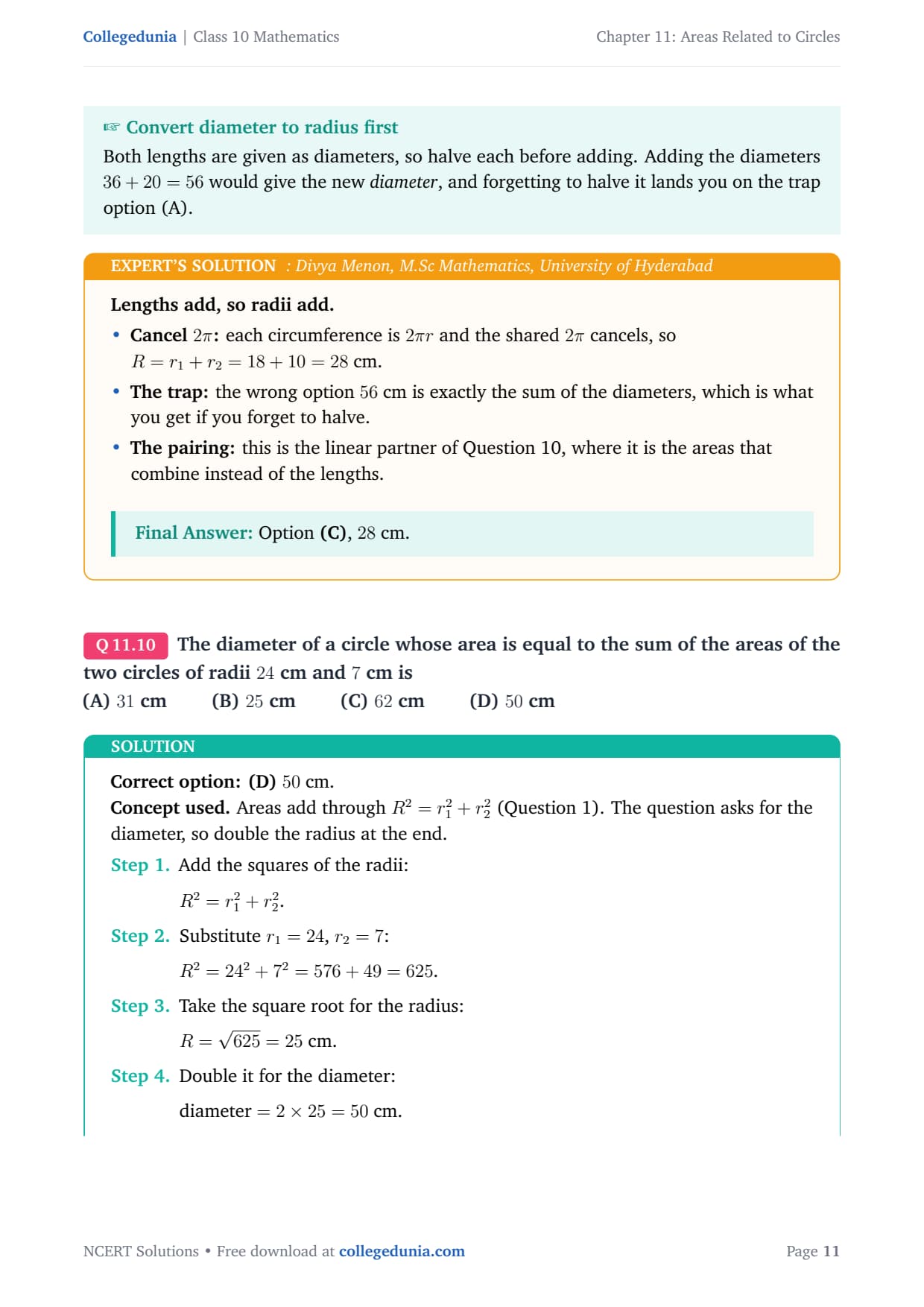
Lengths add, so radii add.
Cancel 2π: each circumference is 2π r and the shared
2π cancels, so R=r1+r2=18+10=28 cm.
The trap: the wrong option 56 cm is exactly the sum of the
diameters, which is what you get if you forget to halve.
The pairing: this is the linear partner of Question 10, where
it is the areas that combine instead of the lengths.
Option (C), 28 cm.
Q 11.10
The diameter of a circle whose area is equal to the sum of the areas of the two circles of radii 24 cm and 7 cm is
(A) 31 cm (B) 25 cm (C) 62 cm (D) 50 cm
Correct option: (D)50 cm.
Concept used. Areas add through R2=r12+r22 (Question 1). The
question asks for the diameter, so double the radius at the end.
Add the squares of the radii:
[] R2=r12+r22.
Substitute r1=24, r2=7:
[] R2=242+72=576+49=625.
Take the square root for the radius:
[] R=√625=25 cm.
Double it for the diameter:
[] diameter =2× 25=50 cm.
The required diameter is 50 cm; option (D).
IR
Ishita Roy
M.Sc Mathematics, Calcutta University
Verified Expert
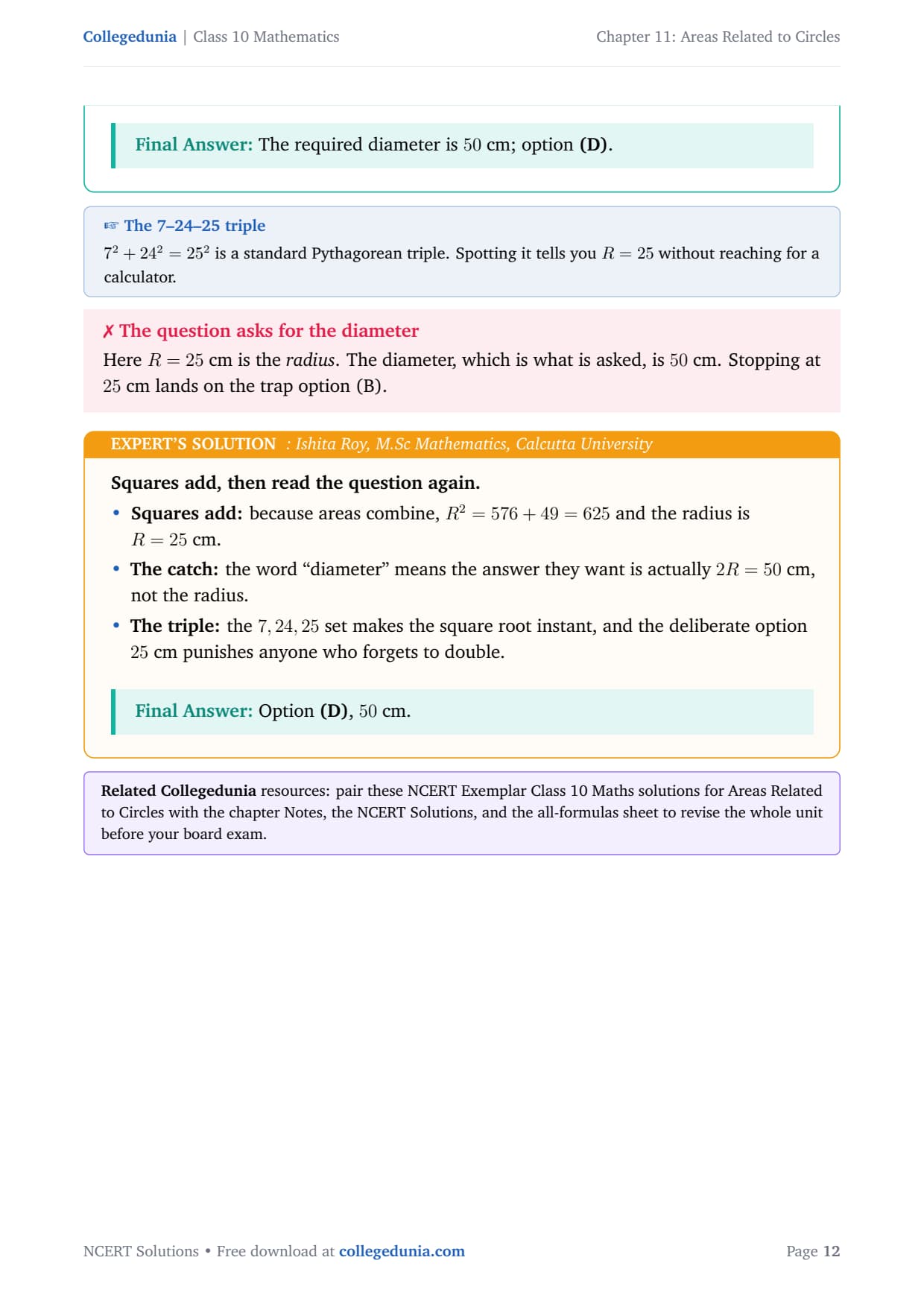
Squares add, then read the question again.
Squares add: because areas combine, R2=576+49=625 and the
radius is R=25 cm.
The catch: the word ``diameter'' means the answer they want
is actually 2R=50 cm, not the radius.
The triple: the 7,24,25 set makes the square root instant,
and the deliberate option 25 cm punishes anyone who forgets to
double.
Option (D), 50 cm.
All Exercises in Chapter 11 Exemplar
Chapter 11 Areas Related to Circles has four Exemplar exercises. Open any one below.
FAQs on NCERT Exemplar Class 10 Maths Chapter 11 Exercise 11.1
Ques. What is Exercise 11.1 in NCERT Exemplar Class 10 Maths Chapter 11?
Ans. Exercise 11.1 is the MCQ section of the NCERT Exemplar for Chapter 11 Areas Related to Circles. It has 10 MCQs on circle area, circumference, inscribed shapes, and Pythagorean triples, set to the 2026-27 CBSE syllabus.
Ques. How many questions are there in Exercise 11.1 of Class 10 Maths Exemplar?
Ans. There are 10 Multiple Choice Questions in Exercise 11.1 of NCERT Exemplar Class 10 Maths Chapter 11 Areas Related to Circles.
Ques. What is the difference between how areas and circumferences add for circles?
Ans. When areas add, the squares of the radii add: R2 = R12 + R22. When circumferences add, the radii add directly: R = R1 + R2. This is the central conceptual test of Questions 1, 2, 6, 9 and 10 in Exercise 11.1.
Ques. Why is the area of the circle greater than the area of the square when their perimeters are equal (Q3 and Q5)?
Ans. Among all shapes with the same perimeter, the circle encloses the maximum area (the Isoperimetric Inequality). For equal perimeter P: circle area = P24π ≈ P212.57 and square area = P216. Since 12.57 < 16, the circle's area is larger. This is why the answer to Question 5 is 14:11 (circle : square), not 1:1.
Ques. How do I find the area of a square inscribed in a circle for Class 10 Exemplar Exercise 11.1 Question 8?
Ans. For a square inscribed in a circle of radius r: the diagonal of the square equals the diameter 2r. Use area = 12 × (diagonal)2 = 12 × (2r)2 = 2r2. For Question 8, r = 8 cm, so area = 2 × 64 = 128 cm². This is faster than finding the side first.







Comments