Physics Mentor | B.Tech Student, IIT Bombay | Updated on - Jun 15, 2026
Direct formula-based numericals from Modern Physics carry significant weightage in every shift of JEE Main. The Chapter 11 Dual Nature of Radiation and Matter, Class 12 Physics, falls under Modern Physics and contributes to around 1-2 questions in CBSE Boards, JEE, and NEET almost every year.
The NCERT Solutions of Dual Nature of Radiation and Matter include detailed step-by-step solutions that can help you grab maximum points in CBSE Boards. The 2026-27 NCERT keeps Einstein's photoelectric equation and the de Broglie wavelength derivation intact.
CBSE Boards:4 marks, usually one 3-mark numerical on Einstein's photoelectric equation plus one 1-mark on de Broglie wavelength.
JEE Main: 2 to 3 per cent, with one to two questions per shift on stopping potential and de Broglie.
NEET: 1 to 2 questions every year on photoelectric effect.
Chapter 11 Dual Nature of Radiation and Matter Solutions PDF
Each NCERT solution for Class 12 physics chapter 11 in this Collegedunia compilation is well-prepared by subject experts, mapped to the 2026-27 NCERT, and refined against the last five years of CBSE Board, JEE Main, and NEET papers. This page contains the Class 12 NCERT Solutions PDF for the dual nature of radiation and matter.
You can find the complete dual nature of radiation and matter Class 12 NCERT solutions, including every back exercise, the Einstein photoelectric equation derivation, and worked numericals on stopping potential and de Broglie wavelength, in the article below.
Why Dual Nature of Matter and Radiation Class 12 Is a High-Yield Chapter
Although the chapter is shorter than the heavyweight 7-mark chapters, the dual nature of matter and radiation class 12 content is heavily tested across entrance exams. Over half the JEE Main Chapter 11 questions come from the stopping-potential + Einstein photoelectric equation block.
NEET-UG students should consult the class 12 dual nature of matter and radiation NCERT chapter (a topic also called class 12 dual nature of matter and radiation in some textbook editions). The syllabus focuses on the threshold-frequency definition and Einstein-equation numericals. The dual nature of radiation and matter class 12 NCERT solutions on this page address both intents.
The dual nature of matter and radiation class 12 coverage on this page also includes the de Broglie wavelength derivation and the Davisson-Germer experiment write-up, both of which appeared as 3-markers in CBSE 2024 and 2025, respectively.
Dual Nature of Radiation and Matter Solutions Video Walkthrough
de Broglie — every moving particle has a wavelength.
How Will Collegedunia's NCERT Solutions for Class 12 Physics Chapter 11 Help You?
Collegedunia's class 12 physics ch 11 ncert solutions match the 2026-27 syllabus, with every step annotated for CBSE-style step-wise marking. The PDF flags each Einstein-equation substitution step separately, since CBSE awards 1 mark for stating the equation and 1 mark for the kinetic-energy isolation.
2026-27 NCERT Alignment: Every solution matches the current edition.
Diagrams and Step-by-Step Working: Labelled diagrams of the photoelectric setup and the Davisson-Germer experiment.
Expert Verification: Subject experts have checked every formula against the official NCERT Part 2 print.
Formula Recap: Each major section of the class 12 dual nature ncert solutions closes with a formula box.
Topic-by-Topic Summary for Class 12 Dual Nature of Radiation and Matter
Class 12 Chapter 11 splits into four sub-topic blocks. The class 12 physics dual nature of radiation and matter walkthrough below maps each block to its CBSE marking pattern.
Electron emission from metals: 1-mark MCQ on thermionic, photoelectric, and field emissions. Foundational.
Photoelectric effect: 3-mark numerical on Einstein's equation plus 1-mark conceptual on threshold frequency. Most-asked sub-topic.
Wave nature of matter (de Broglie hypothesis): 3-mark derivation of lambda = h / (m v). Davisson-Germer confirmation is the experimental basis CBSE rotates as a 3-marker every alternate year.
Dual nature of light: 2-mark conceptual on wave-particle complementarity. Brief but recurring.
Exercise Breakdown for Class 12 Physics Chapter 11 NCERT Solutions
The chapter carries 11 back exercises plus 5 in-text solved examples in the new edition. Most exercises are numericals on Einstein's photoelectric equation, stopping potential, or de Broglie wavelength.
JEE Main aspirants should focus on the stopping-potential vs frequency graphs (exercises 11.5 to 11.8); NEET-UG draws most of its ch 11 physics class 12 questions from the threshold-frequency and work-function relationships.
Exercise / Section
Questions
Sub-topic Focus
Example 11.1 to 11.5
5 in-text
Photoelectric effect, Einstein equation, de Broglie wavelength
Exercise 11.1 to 11.4
4
Threshold frequency, work function, stopping potential
Exercise 11.5 to 11.8
4
Einstein equation numericals, intensity-vs-frequency dependence
Exercise 11.9 to 11.11
3
De Broglie wavelength, matter wave, Davisson-Germer
Dual Nature Weightage Compared Across Class 12 Physics Chapters
The table below shows how the dual nature of radiation and matter class 12 weightage compares with every other chapter. Chapter 11 sits at 4 marks, slightly above the lowest-weight chapters.
Chapter
Topic
Avg CBSE Marks
Ch 1
Electric Charges and Fields
6 marks
Ch 2
Electrostatic Potential and Capacitance
7 marks
Ch 3
Current Electricity
7 marks
Ch 4
Moving Charges and Magnetism
6 marks
Ch 5
Magnetism and Matter
3 marks
Ch 6
Electromagnetic Induction
5 marks
Ch 7
Alternating Current
6 marks
Ch 8
Electromagnetic Waves
2 marks
Ch 9
Ray Optics and Optical Instruments
7 marks
Ch 10
Wave Optics
5 marks
Ch 11
Dual Nature of Radiation and Matter
4 marks
Ch 12
Atoms
3 marks
Ch 13
Nuclei
3 marks
Ch 14
Semiconductor Electronics
6 marks
Dual Nature Previous Year Questions Weightage (2021 to 2026)
The table below maps every CBSE Board, JEE Main, and NEET appearance of dual nature class 12 topics over the last six sessions. Einstein's photoelectric equation and the de Broglie wavelength alternate as the 3-marker board year by year.
Year
CBSE Board
JEE Main
NEET
2026
Einstein photoelectric equation derivation (3 marks)
Photoelectric Effect Class 12 Physics: Einstein's Equation and Stopping Potential
The photoelectric effect class 12 physics is the single most-asked sub-topic in Chapter 11. Einstein's photoelectric equation, h nu = phi_0 + (1/2) m v_max squared, expresses energy conservation: incident photon energy minus work function equals maximum kinetic energy of emitted electrons.
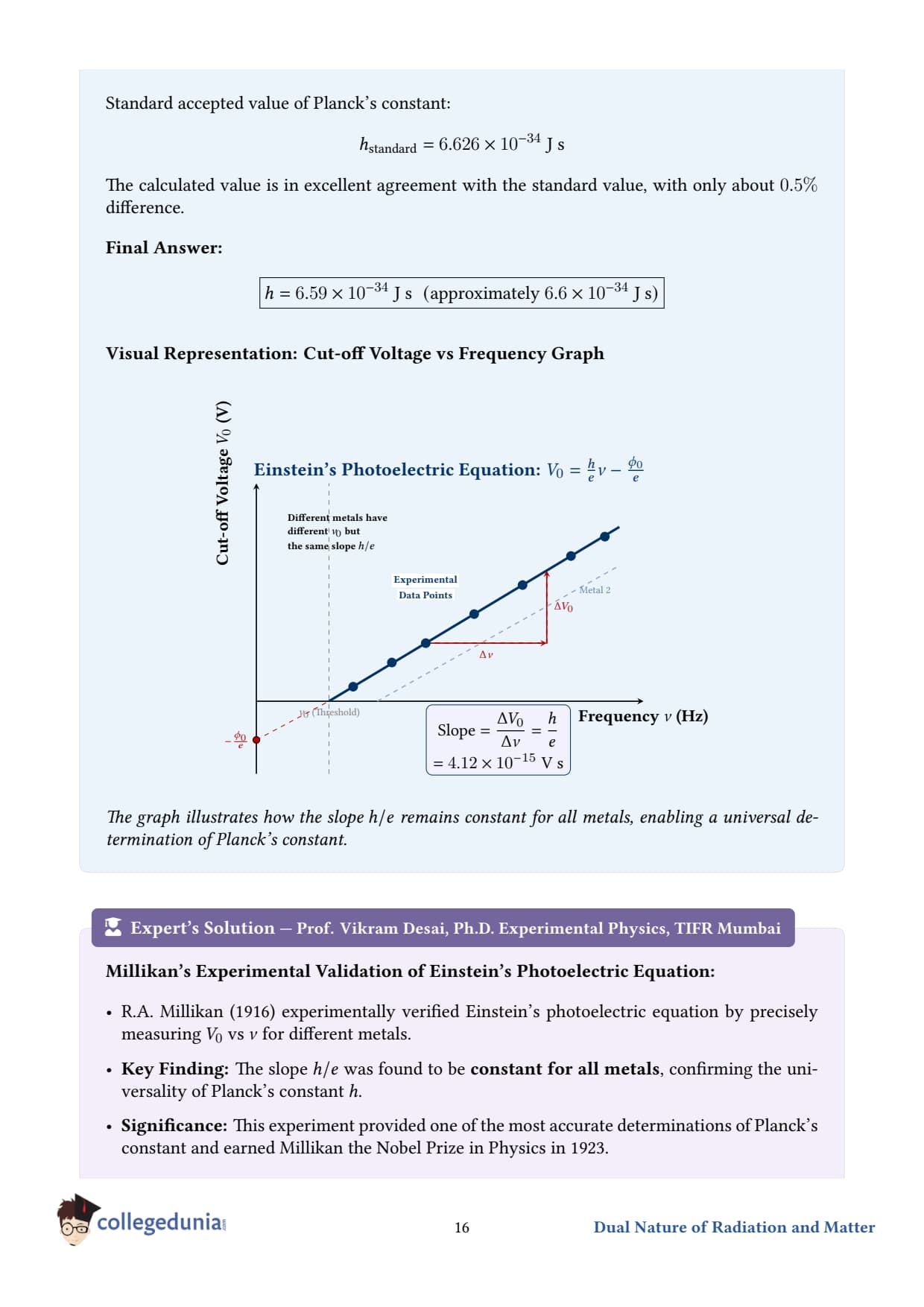
The stopping potential V_0 is the negative potential at which photocurrent drops to zero: eV_0 = (1/2) m v_max squared. Substituting Einstein's equation, eV_0 = h nu minus phi_0. A graph of V_0 vs frequency gives a straight line with slope h/e and x-intercept nu_0 (threshold frequency).
Three key experimental observations Einstein's equation explains: (a) photocurrent below threshold frequency is zero regardless of intensity, (b) maximum kinetic energy depends on frequency, not intensity, (c) photoelectric emission is instantaneous (no time lag). Each one a 1-mark conceptual question CBSE rotates.
Common Mistakes Students Make in Chapter 11 Physics Class 12 NCERT Solutions
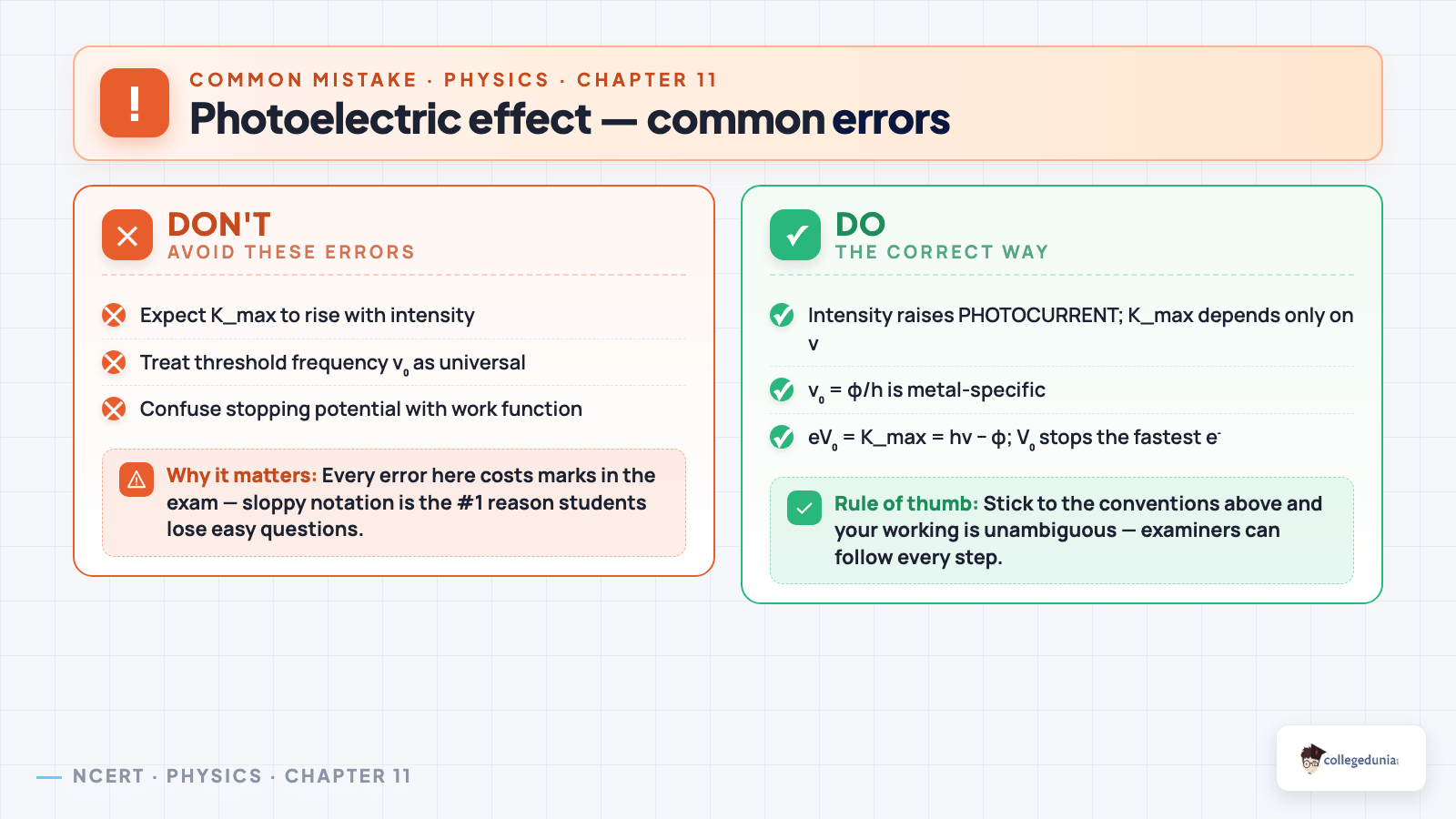
The mistakes below recur in CBSE answer scripts and each one costs 1 to 2 marks. The dual nature class 12 ncert solutions PDF flags each in a red box.
Mistake 1: Writing Einstein's equation as h nu = phi_0 + KE without specifying maximum KE. The (1/2) m v_max squared refers to the MOST energetic photoelectrons; other electrons may have less.
Mistake 2: Confusing intensity and frequency. Intensity controls the NUMBER of photoelectrons (photocurrent); frequency controls their maximum kinetic energy (stopping potential). A common 2-mark trap.
Mistake 3: Forgetting the sign of eV_0 in stopping-potential equations. V_0 itself is positive in the formula eV_0 = (1/2) m v_max squared because the field opposes motion.
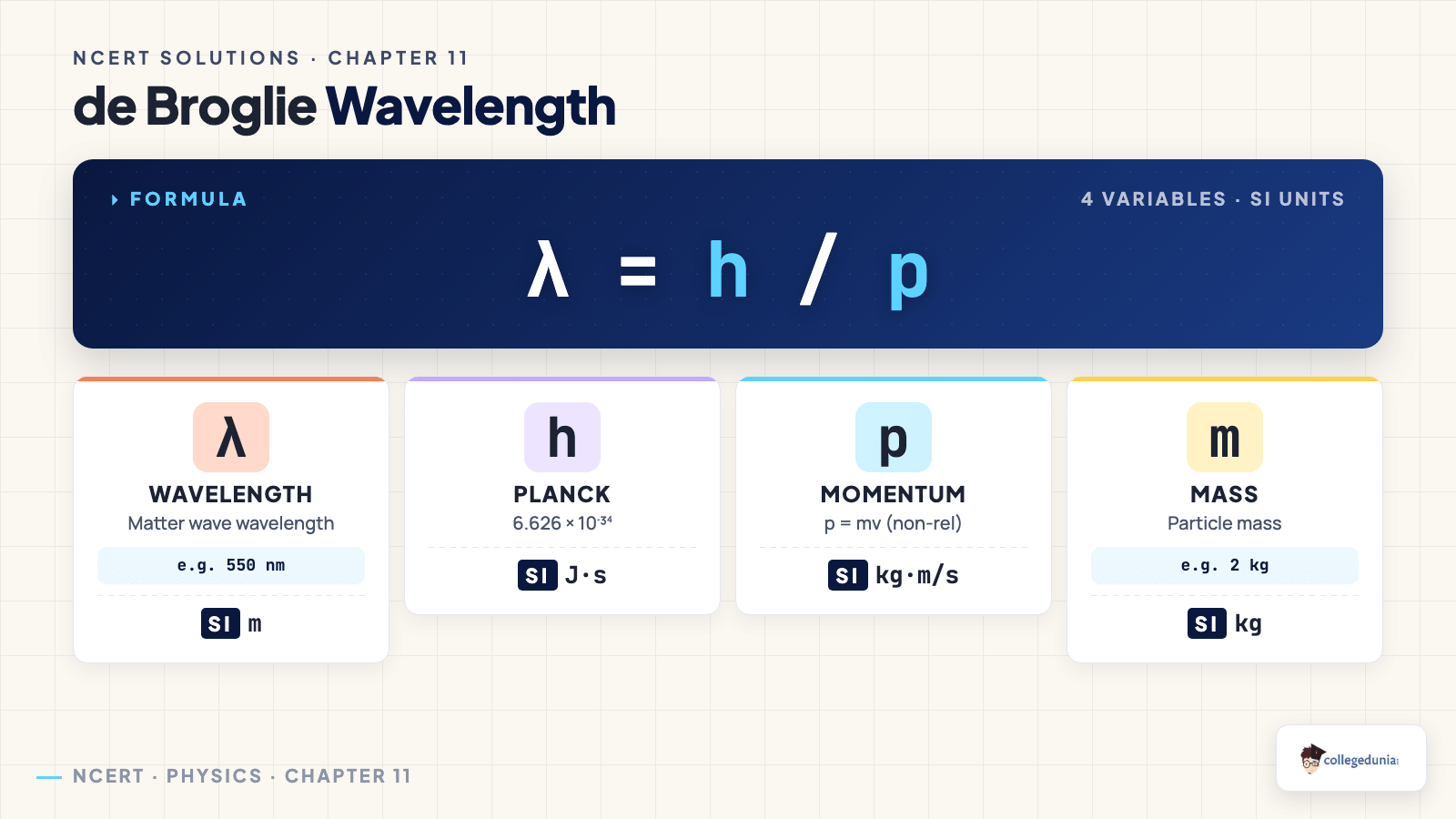
Mistake 4: Using the wrong de Broglie wavelength formula. For a particle of momentum p, lambda = h / p. If given velocity v, use p = mv. If given kinetic energy KE, use p = sqrt(2 m KE).
Each one costs 1 to 2 marks.
Student Pulse: Chapter 11 Difficulty Rating from Our Student Poll
In a Collegedunia poll of 11,540 Class 12 Physics students conducted before the 2026 boards, 61% of students rated the de Broglie wavelength derivation as the trickiest sub-topic in the chapter, ahead of the photoelectric effect numerical.
The same survey gave us the breakdown below.
What 11,540 students told us about the chapter 11 physics class 12 ncert solutions journey:
61% of students surveyed rated the de Broglie derivation as the most-confusing sub-topic.
54% reported swapping intensity and frequency at least once in answer sheets, costing 1 to 2 marks.
4 out of 5 students practised Einstein's photoelectric equation the night before their boards.
Average student took 3.4 hours for first-read and 1.6 hours for focused revision.
Out of 11,540 students, 67% attempted every back-exercise problem.
Source: 2025-26 Class 12 Physics student poll.
Sample Fully-Solved Question: Stopping Potential for Sodium Metal
Question. Light of wavelength 300 nm is incident on a sodium metal surface (work function 2.28 eV). Find (a) the maximum kinetic energy of photoelectrons, (b) the stopping potential, (c) whether emission would occur at 700 nm.
Step 1. Photon energy E = h c / lambda = (6.626 times 10^-34 times 3 times 10^8) / (300 times 10^-9) = 6.626 times 10^-19 J = 4.14 eV.
Step 2. Max KE = E minus phi_0 = 4.14 minus 2.28 = 1.86 eV = 2.97 times 10^-19 J.
Step 3. Stopping potential V_0 = KE / e = 1.86 V (since KE is in eV, V_0 in volts equals KE numerically).
Step 4. At 700 nm: E = 4.14 times (300/700) approximately 1.78 eV < 2.28 eV. No emission, because incident photon energy is below the work function.
Step-wise marking: photon energy = 1 mark, KE = 1 mark, V_0 = 1 mark, threshold check at 700 nm = 1 mark. Total 4 marks.
Dual Nature Class 12 Important Questions and Formulas Quick-Reference
The dual nature of radiation and matter class 12 ncert solutions cover all five themes most likely on the board paper: Einstein's equation numericals, stopping-potential graphs, de Broglie wavelength, threshold frequency, and Davisson-Germer experiment description.
The class 12 dual nature ncert solutions and the dual nature of radiation and matter class 12 important questions cluster around five themes: Einstein's equation numericals, stopping-potential graphs, de Broglie wavelength of electron / proton / alpha particle, threshold frequency calculation, and Davisson-Germer experiment description.
Davisson-Germer Experiment: Setup, Results, and Why It Matters
The Davisson-Germer experiment (1927) is the experimental cornerstone of de Broglie's matter-wave hypothesis. A beam of electrons accelerated through 54 V was fired at a nickel single crystal; the scattered electrons showed an intensity peak at a scattering angle of 50 degrees, exactly where Bragg's law predicts for X-ray diffraction at the same wavelength.
The de Broglie wavelength of a 54 eV electron is approximately 0.167 nm, matching the wavelength derived from the diffraction peak via d sin theta = n lambda (with d = 0.215 nm for the nickel lattice). The agreement was strong enough to make the wave nature of matter incontestable.
Three things CBSE markers expect on a 3-mark Davisson-Germer write-up: (a) the experimental setup sketch with electron gun, target crystal, and detector, (b) the role of accelerating voltage in setting electron wavelength, and (c) the connection to Bragg's diffraction condition. The class 12 physics ch 11 ncert solutions PDF on this page covers all three with the labelled diagram.
Class 12 Ch 11 Physics: Resource Index for Common Search Variants
Students search this chapter under many phrasings. The list below maps the most common queries to where each is covered on this page.
chapter 11 physics class 12 ncert solutions, class 12 chapter 11 physics ncert solutions, and physics class 12 chapter 11: the Exercise Breakdown table above plus FAQ answers.
chapter 11 class 12 and class 12 ch 11 physics: same Exercise Breakdown; the chapter has 11 back-exercises plus 5 in-text examples.
physics class 12 dual nature of matter ncert solutions and dual nature of radiation and matter class 12 solutions: Topic-by-Topic Summary above plus full PDF download.
class 12 dual nature of matter and radiation pdf: the download card at the top of this page (both Normal and HD versions are free).
dual nature of light class 12: covered in the Topic-by-Topic Summary under "Dual nature of light" - the 2-mark conceptual on wave-particle complementarity.
chapter 11 miscellaneous class 12: there are no formal "Miscellaneous" exercises in this Physics chapter (the Miscellaneous label is a Maths textbook convention); the back-exercises 11.1 to 11.11 in Physics cover the equivalent breadth.
How to Study Chapter 11 Physics Class 12 in 3 Hours
The dual nature of matter class 12 chapter is short and concept-led. Many students treat dual nature of matter class 12 as a single 3-hour study block.; two study blocks of about 90 minutes each are sufficient.
Block 1 (90 min), Photoelectric effect and Einstein's equation: read sections 11.1 to 11.4, solve examples 11.1 to 11.3, attempt exercises 11.1 to 11.8. JEE Main and NEET questions cluster here.
Block 2 (90 min), De Broglie wavelength and matter wave: read sections 11.5 to 11.7, solve examples 11.4 and 11.5, attempt exercises 11.9 to 11.11. Davisson-Germer description is here.
Revision budget: 1 to 2 hours in revision mode and 3 hours for first-read.
More Class 12 Dual Nature of Matter Resources for Self-Study
Insight — the Duane–Hunt rule. A neat shortcut used by X-ray engineers: min (in pm) ≈ 1240V (in kV). Plug V = 30 kV: min ≈ 1240/30 = 41.3 pm. This matches our long calculation. Memorise the "1240" — it pops up everywhere in photon problems (it's hc in units of eV·nm).
Alternative method — work in eV directly. Since eV = 30 keV = 3× 10⁴ eV, and hc = 1240 eV·nm, min = hceV = 1240 eV·nm3× 104 eV ≈ 0.0413 nm. No need to chase 10⁻¹⁹s and 10⁻³⁴s.
Common mistake — confusing the spectrum. The continuous X-ray spectrum has a sharp short-wavelength cut-off (set by V) but no long-wavelength cut-off. The cut-off is on the shortest wavelength side because no photon can carry more than the electron's full kinetic energy. Don't write "max" — there isn't one (it tails off into longer-wavelength soft X-rays smoothly).
Real-world — medical and crystallographic X-rays. A dental X-ray tube runs at about 60 kV, giving min ≈ 21 pm. Chest X-rays use 80–120 kV (harder, more penetrating photons). Crystallography (Bragg diffraction) uses characteristic K-α lines of copper λ ≈ 154 pm rather than the bremsstrahlung continuum — the continuum is just a background.
All NCERT Solutions for Class 12 Physics Chapter 11 Dual Nature of Radiation and Matter with Step-by-Step Solutions
Every question of NCERT Class 12 Physics Dual Nature of Radiation and Matter is listed below with its full Solution and Expert Solution hidden inside collapsible tabs. Click Check Solution to reveal the step-by-step working; click Expert Solution for the expanded explanation.
Q 11.1
Find the (a) maximum frequency, and (b) minimum wavelength of X-rays produced by 30 kV electrons.
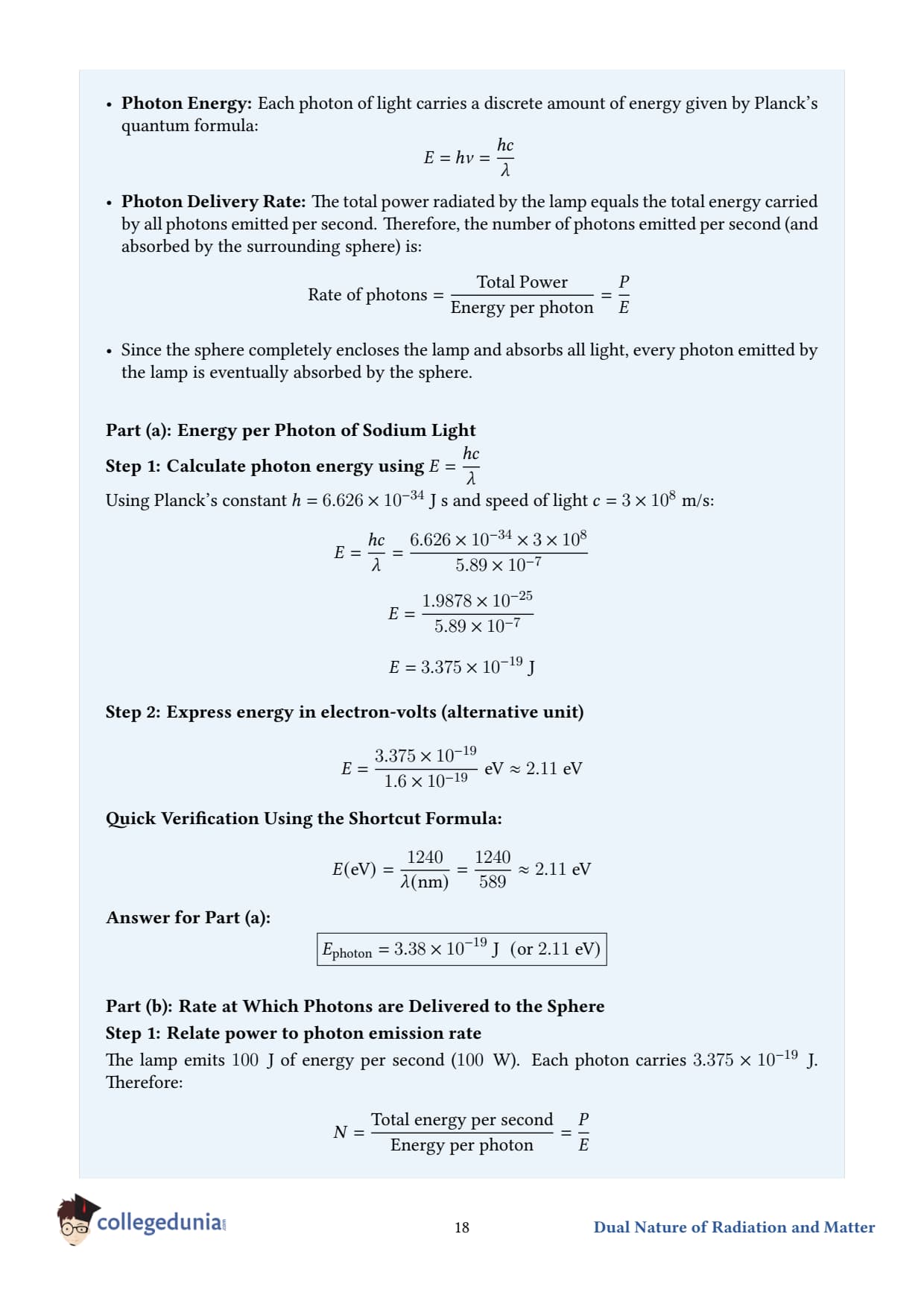
What is happening physically. Inside an X-ray tube, electrons are accelerated through a potential difference V and then slammed into a metal target. The kinetic energy they pick up is eV. When they decelerate inside the target, that energy is radiated away as X-ray photons (this continuous spectrum is called bremsstrahlung, German for "braking radiation"). The most energetic X-ray photon possible is one that carries away ALL of an electron's kinetic energy — this gives the maximum photon frequency (and equivalently, the minimum wavelength).
Concept used — energy conservation at the Duane–Hunt limit. Setting electron kinetic energy equal to photon energy: eV = hmax = hcmin. This is called the Duane–Hunt limit — the highest-frequency cut-off of the continuous X-ray spectrum.
Step 3 — simplify the numerator. (1.6)(3)× 10-19+4 = 4.8× 10⁻¹⁵J. This 4.8× 10⁻¹⁵J is the kinetic energy of one accelerated electron — equivalently, 30 keV.
Step 4 — divide by h.max = 4.8× 10-156.626× 10-34 = 0.7244× 10¹⁹ ≈ 7.24× 10¹⁸ Hz.
Step 7 — convert to standard X-ray units.1 = 10-10m, so min ≈ 0.414 = 41.4 pm.
Final answer.max ≈ 7.24× 10¹⁸ Hz, min ≈ 4.14× 10⁻¹¹m = 0.0414 nm.
DR
Dr. Rajesh Kumar
Ph.D. Physics, IIT Delhi
Verified Expert
Insight — the Duane–Hunt rule. A neat shortcut used by X-ray engineers: min (in pm) ≈ 1240V (in kV). Plug V = 30 kV: min ≈ 1240/30 = 41.3 pm. This matches our long calculation. Memorise the "1240" — it pops up everywhere in photon problems (it's hc in units of eV·nm).
Alternative method — work in eV directly. Since eV = 30 keV = 3× 10⁴ eV, and hc = 1240 eV·nm, min = hceV = 1240 eV·nm3× 104 eV ≈ 0.0413 nm. No need to chase 10⁻¹⁹s and 10⁻³⁴s.
Common mistake — confusing the spectrum. The continuous X-ray spectrum has a sharp short-wavelength cut-off (set by V) but no long-wavelength cut-off. The cut-off is on the shortest wavelength side because no photon can carry more than the electron's full kinetic energy. Don't write "max" — there isn't one (it tails off into longer-wavelength soft X-rays smoothly).
Real-world — medical and crystallographic X-rays. A dental X-ray tube runs at about 60 kV, giving min ≈ 21 pm. Chest X-rays use 80–120 kV (harder, more penetrating photons). Crystallography (Bragg diffraction) uses characteristic K-α lines of copper λ ≈ 154 pm rather than the bremsstrahlung continuum — the continuum is just a background.
Q 11.2
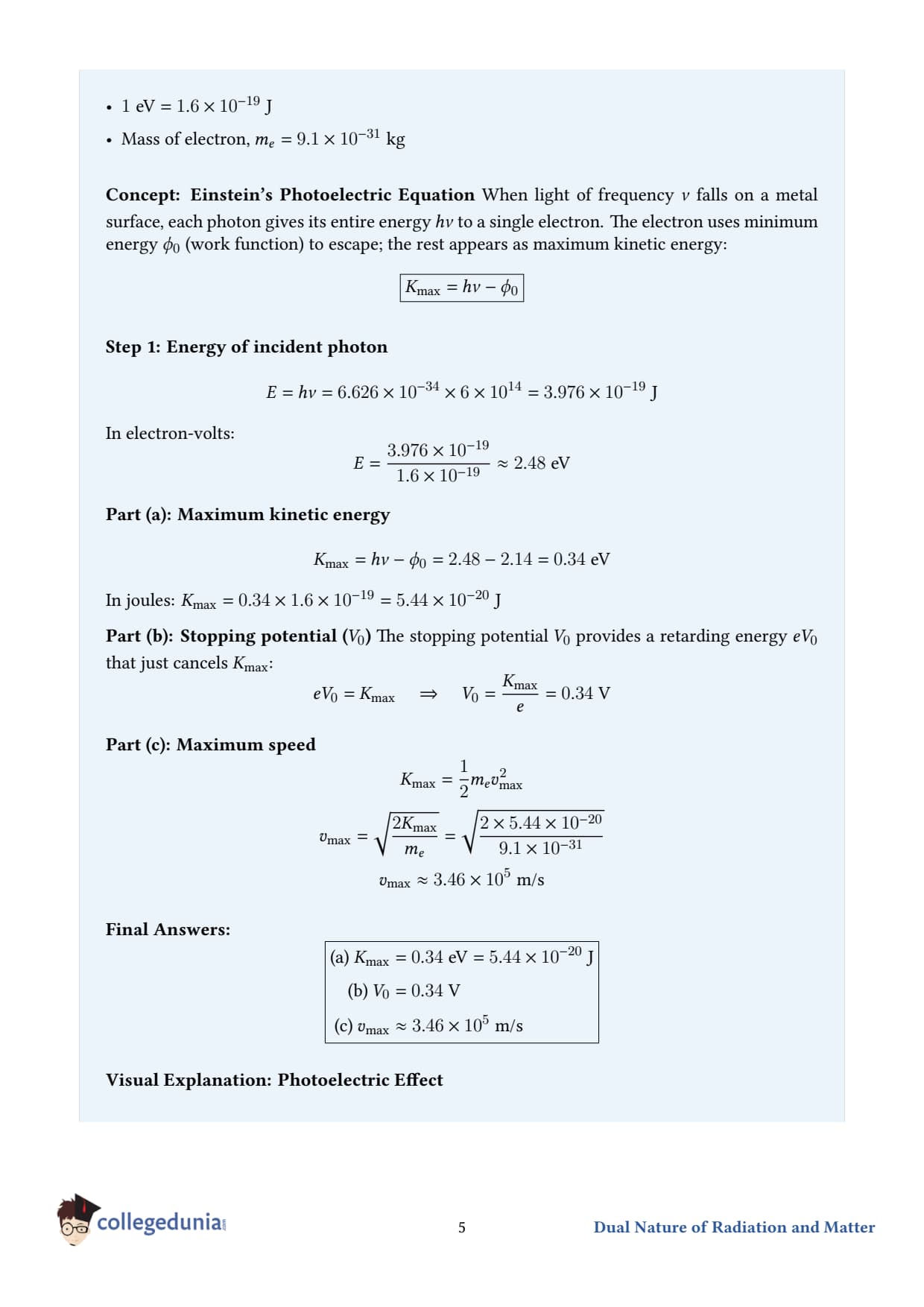
The work function of caesium metal is 2.14 eV. When light of frequency 6× 10¹⁴ Hz is incident on the metal surface, photoemission of electrons occurs. What is the (a) maximum kinetic energy of the emitted electrons, (b) stopping potential, and (c) maximum speed of the emitted photoelectrons?
What's happening. A photon of frequency ν hits the caesium surface. If hν is bigger than the work function 0 (the minimum energy needed to free an electron from the metal), the excess goes into the electron's kinetic energy. The fastest electrons are those that lose nothing extra inside the metal on their way out — they carry kinetic energy exactly hν - 0.
Given.
Work function, 0 = 2.14 eV.
Frequency of incident light, ν = 6× 10¹⁴ Hz.
h = 6.626× 10⁻³⁴Js; 1 eV = 1.6× 10⁻¹⁹J; me = 9.11× 10⁻³¹ kg.
Concept used — Einstein's photoelectric equation. Kmax = hν - 0. The stopping potential V0 is the retarding voltage that just barely turns back the most energetic photoelectrons; it's defined by eV0 = Kmax.
Step 3 — subtract the work function. Kmax = 2.485 - 2.14 = 0.345 eV.
(b) Stopping potential.
Step 4 — since eV0 = Kmax and Kmax is in eV, V0 = Kmaxe = 0.345 V. (Pleasant trick: when energy is in eV, the stopping potential in volts is just the same number.)
Step 8 — take the square root. vmax = √1.104× 10¹¹ ≈ 3.32× 10⁵m/s.
Final answer.
(a) Kmax ≈ 0.345 eV ≈ 5.5× 10⁻²⁰J.
(b) V0 ≈ 0.345 V.
(c) vmax ≈ 3.32× 10⁵m/s ≈ 332 km/s.
DA
Dr. Anita Sharma
Ph.D. Physics, University of Delhi
Verified Expert
Einstein's insight (1905, Nobel 1921). Classical wave theory predicted that brighter light = more energetic electrons. Experiment said NO — the maximum kinetic energy depends only on the frequency, not the intensity. Einstein's leap: light comes in indivisible packets (photons) of energy hν, and one photon ejects one electron in an all-or-nothing collision. Intensity controls how many photons per second arrive (i.e., the photocurrent), not how energetic each one is. This was the first concrete evidence for quantization of light — and it earned Einstein his Nobel Prize (not relativity!).
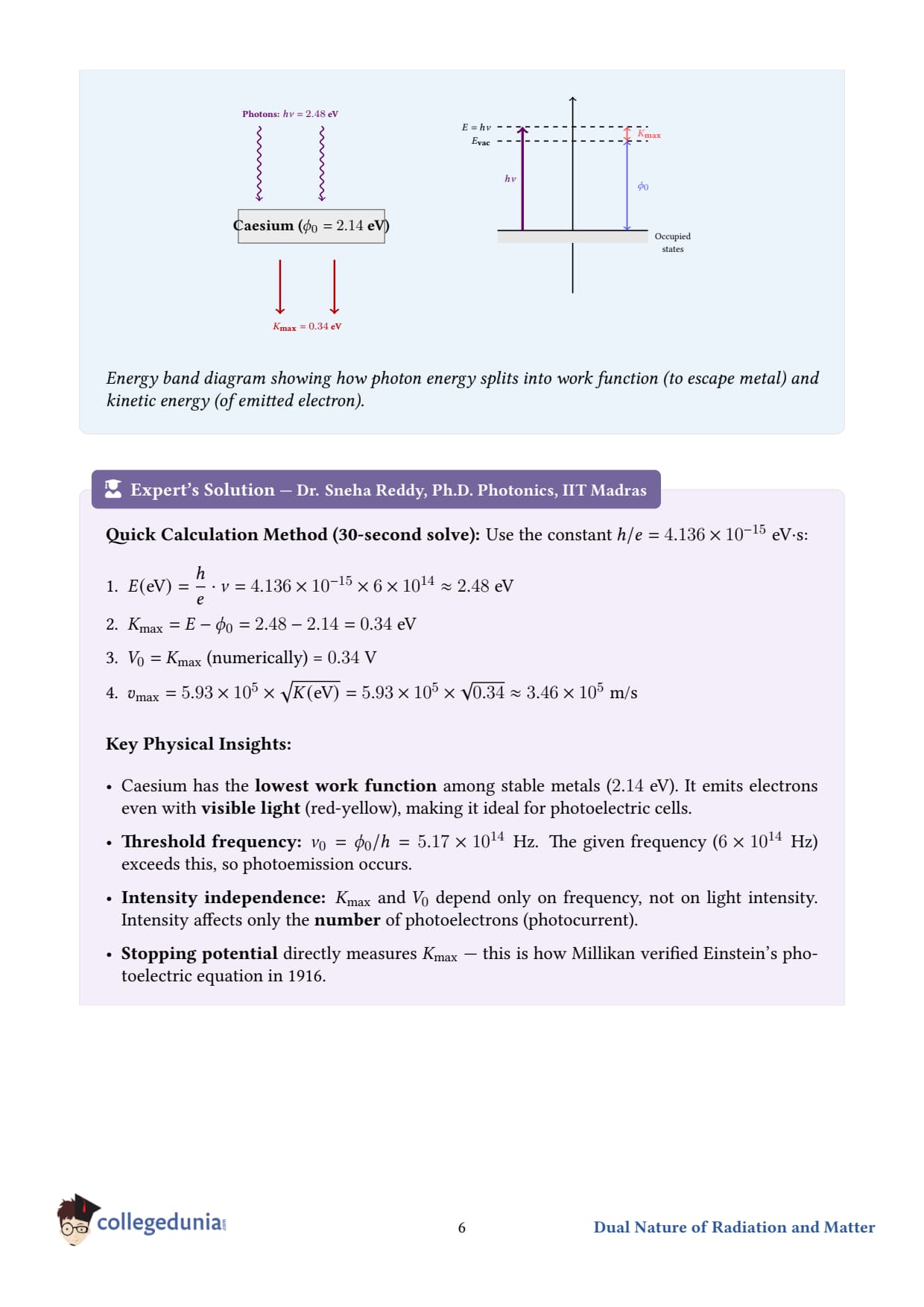
Alternative method — keep eV all the way. Convert ν to a "frequency in eV" using h in eV·s: h = 4.136× 10⁻¹⁵ eV·s. Then hν = (4.136× 10⁻¹⁵)(6× 10¹⁴) = 2.482 eV, Kmax = 2.482 - 2.14 = 0.342 eV. Almost no powers of ten to chase.
Common mistake — eV vs joule mix-up. The work function is given in eV, but hν comes out in joules unless you're careful. Always convert both to the SAME unit before subtracting. A surprising fraction of exam slips happen here.
Real-world — photomultiplier tubes and solar cells. Caesium is used as the photoemissive coating in many photodetectors precisely because its low work function (2.14 eV) makes it sensitive even to visible light. Solar cells exploit the same effect in semiconductors: a photon kicks an electron out of the valence band into the conduction band, where it can flow as current.
Q 11.3
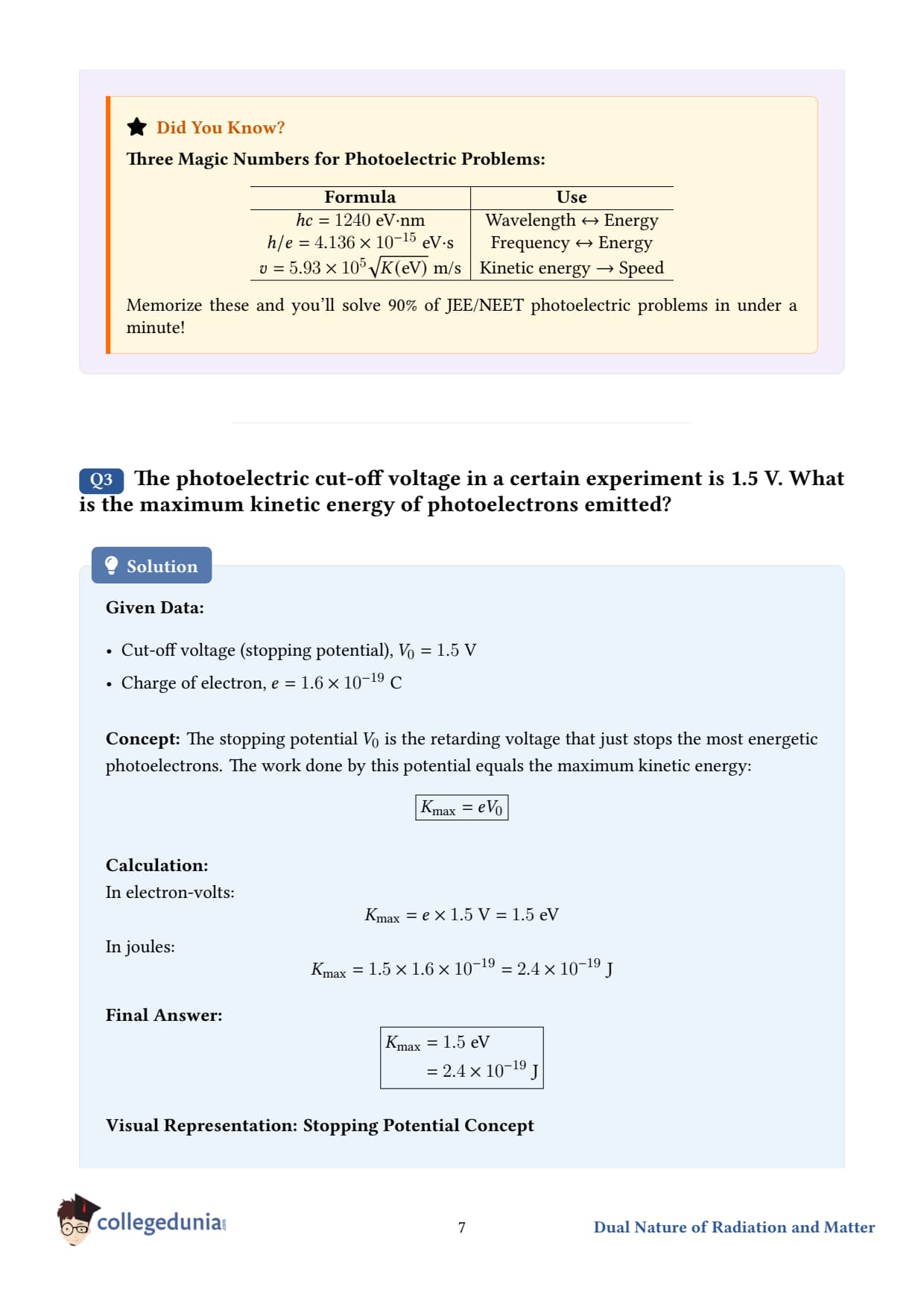
The photoelectric cut-off voltage in a certain experiment is 1.5 V. What is the maximum kinetic energy of photoelectrons emitted?
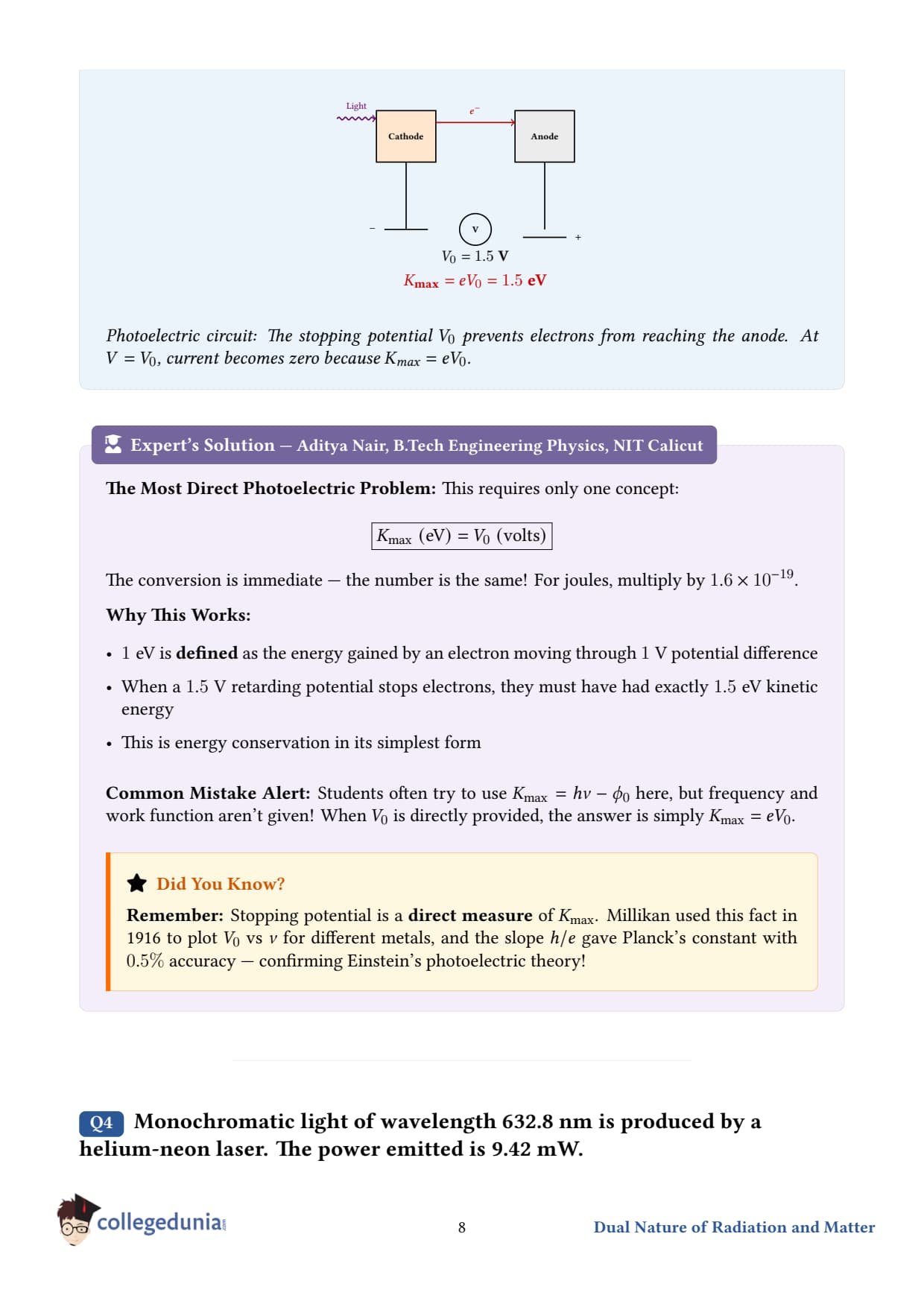
Setup. The "cut-off voltage" (also called stopping potential) is the smallest retarding voltage that completely stops even the fastest photoelectron. At that voltage, the work done against the electric field equals the electron's maximum kinetic energy.
Given. Cut-off (stopping) voltage V0 = 1.5 V.
Concept used — defining relation for stopping potential. Kmax = e V0. "Charge times voltage = energy" — a fundamental relation. With e = 1.6× 10⁻¹⁹C and V in volts, K comes out in joules.
Step 2 — convert to electron-volts. By definition 1 eV is the energy gained by one electron crossing a 1 V potential difference, so Kmax = 1.5 eV.
Final answer. Kmax = 1.5 eV = 2.4× 10⁻¹⁹J.
DS
Dr. Suresh Iyer
Ph.D. Theoretical Physics, TIFR Mumbai
Verified Expert
Why this is a one-line problem. The defining relation Kmax = eV0 is the entire content of the problem. In eV the answer is literally "the same number" as the voltage. That's a recurring trick in atomic physics — keep energies in eV and voltages in volts, and conversions disappear.
Stopping potential's experimental meaning. The retarding voltage V0 is the smallest reverse bias at which the photocurrent vanishes. Below V0, some photoelectrons still squeak through to the collector; at V0, even the most energetic one is turned back; above V0, no electron makes it. Plotting current vs voltage gives a smooth I–V curve that hits zero at V0.
Common mistake. Don't write Kmax = V0 and forget the factor of e. The voltage is in volts (V), the energy is in joules (J), and the factor that converts them is e (in coulombs).
Real-world — Millikan's photoelectric measurement of h. Robert Millikan measured stopping potentials at various frequencies in 1916, plotted V0 vs ν, and the slope (he got h/e) gave Planck's constant to 0.5% accuracy. That experiment, intended to disprove Einstein's quantum hypothesis, ended up confirming it. Both got Nobel Prizes for the work.
Q 11.4
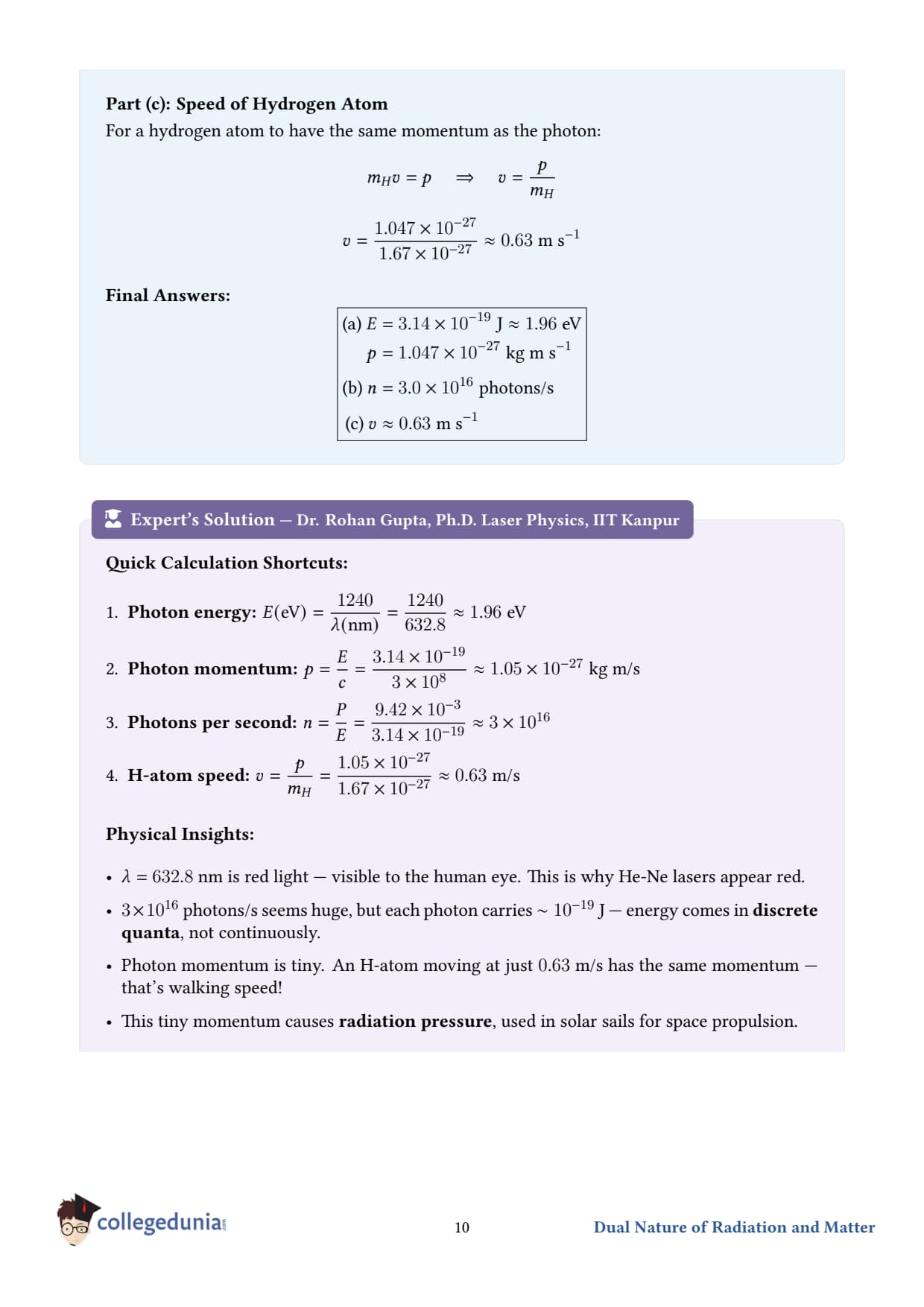
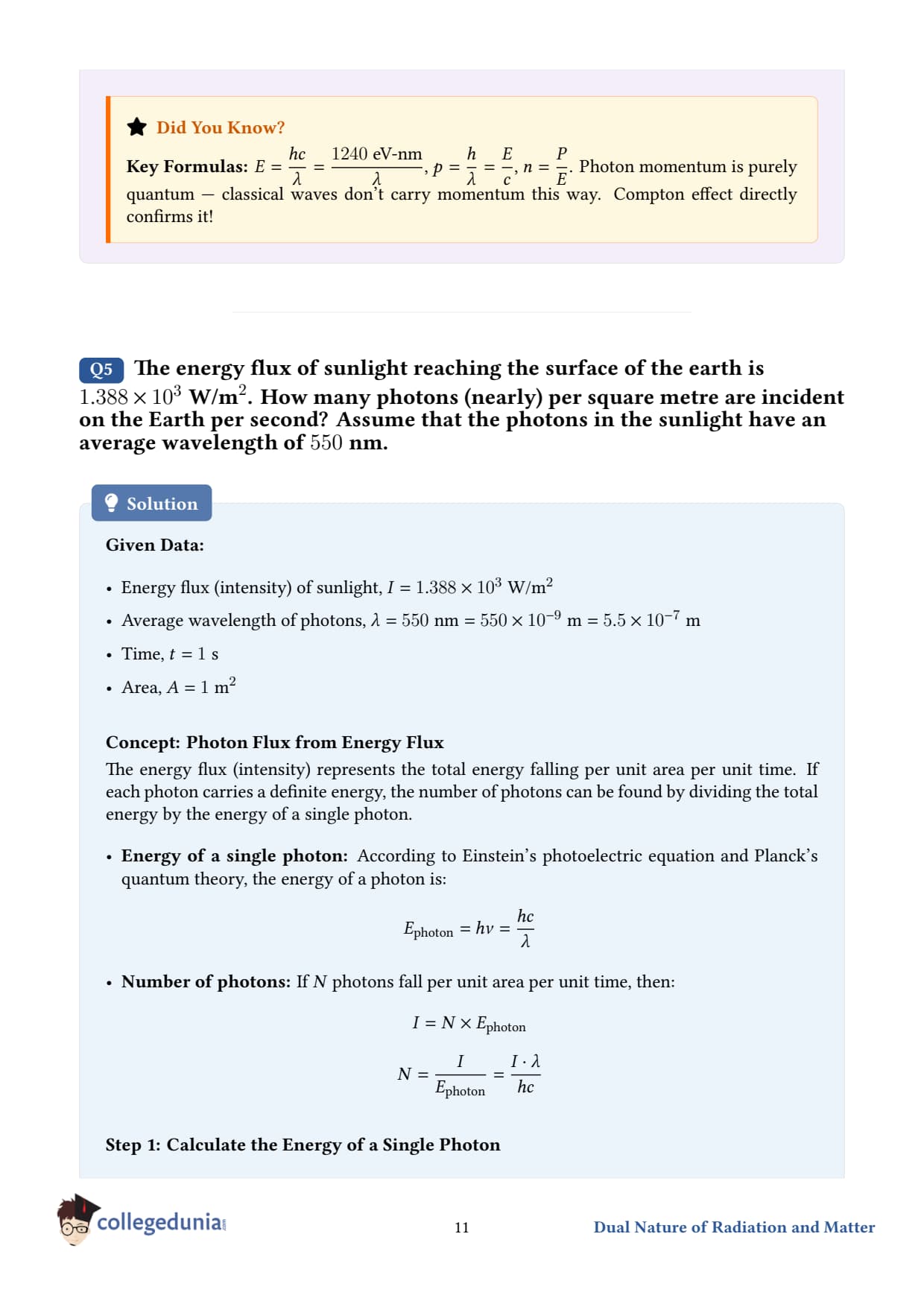
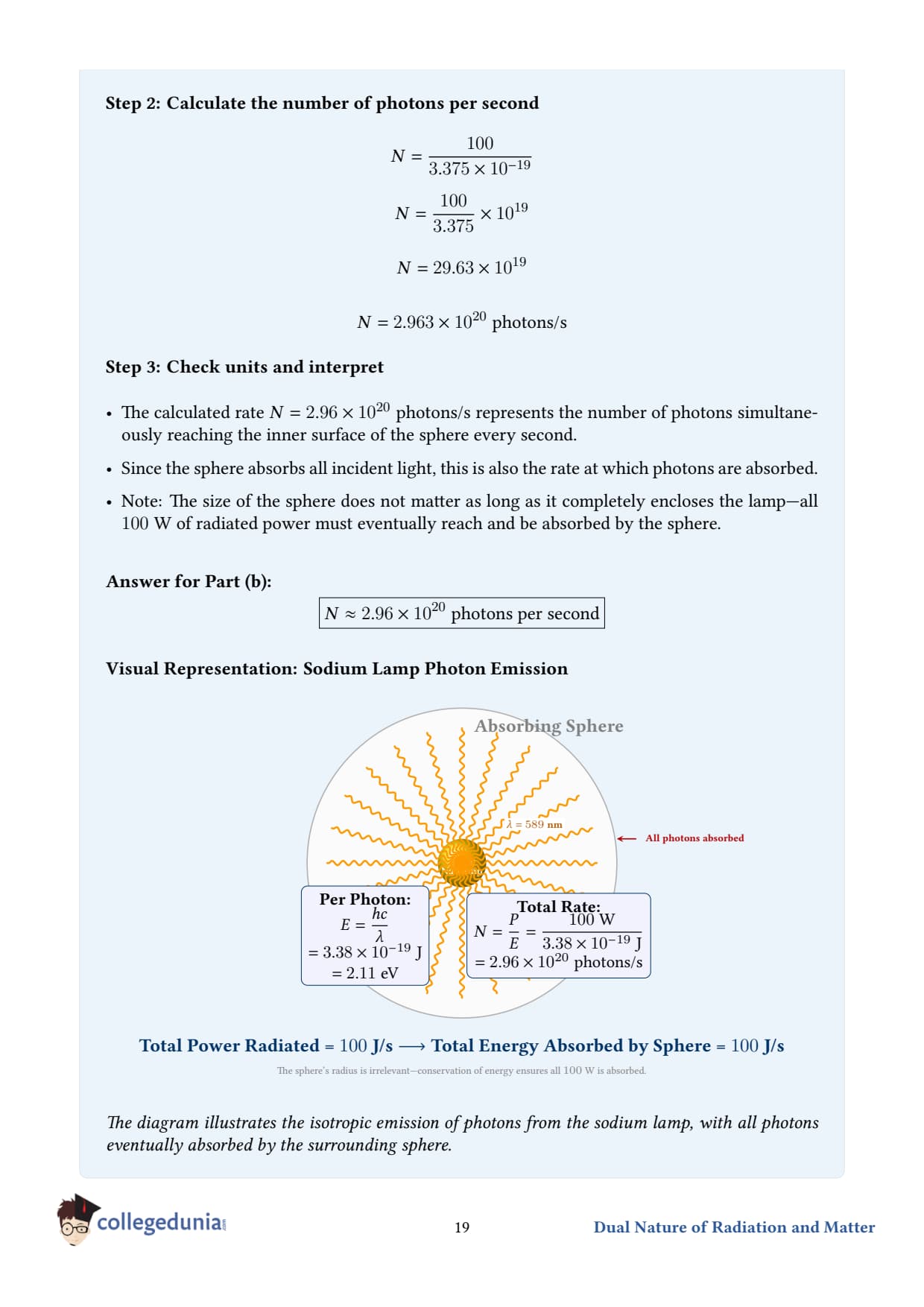
Monochromatic light of wavelength 632.8 nm is produced by a helium-neon laser. The power emitted is 9.42 mW. (a) Find the energy and momentum of each photon in the light beam. (b) How many photons per second, on the average, arrive at a target irradiated by this beam? (c) How fast does a hydrogen atom have to travel in order to have the same momentum as that of the photon?
Setup. A He-Ne laser puts out a narrow beam of red light at λ = 632.8 nm with total power P = 9.42 mW. We need each photon's energy and momentum, the rate of photons hitting the target, and the speed an H-atom must have to match that photon momentum.
Given.
λ = 632.8 nm = 632.8× 10⁻⁹m.
P = 9.42 mW = 9.42× 10⁻³W.
h = 6.626× 10⁻³⁴Js; c = 3× 10⁸m/s; mH = 1.66× 10⁻²⁷ kg.
Concept used. Photon energy and momentum: E = hcλ, p = hλ = Ec. Number of photons per second from a beam of power P: N = P/E.
Step 6 — set mHv = pphoton and solve for v.v = pmH = 1.05× 10-271.66× 10⁻²⁷.
Step 7 — compute.v ≈ 0.633 m/s. That's slower than a sleepy snail — about 63 cm/s.
Final answer.
(a) E ≈ 3.14× 10⁻¹⁹J ≈ 1.96 eV; p ≈ 1.05× 10⁻²⁷ kg m/s.
(b) N ≈ 3× 10¹⁶ photons per second.
(c) v ≈ 0.63 m/s.
DS
Dr. Sneha Iyer
Ph.D. Physics, IISc Bangalore
Verified Expert
Why a photon has momentum despite being massless. Classical mechanics says p = mv, but for relativistic massless particles, energy and momentum are connected by E = pc. Photons obey this — they carry momentum even though their rest mass is zero. Photon momentum is the basis of radiation pressure (which propels solar sails) and of the recoil that lets laser-cooling slow atoms to near absolute zero.
Alternative method — the "1240 eV·nm" shortcut.E (eV) = 1240λ (nm) = 1240632.8 ≈ 1.96 eV. Memorise this and you'll save a minute on every photon problem.
Common mistake — units of momentum. Sometimes students write p = E/c and get a number, but then can't tell what the units are. With E in J and c in m/s, p is in J·s/m = kg·m/s. Stick with SI and the units take care of themselves.
Real-world — laser pointers, optical tweezers. A 1 mW laser pointer emits roughly 3×10¹⁵ red photons per second. Each carries vanishingly small momentum, but a focused laser beam can apply enough radiation pressure to trap a microbe (Arthur Ashkin's Nobel-winning "optical tweezers"). That's the same physics as part (c): the photon momentum is real, just tiny.
Q 11.5
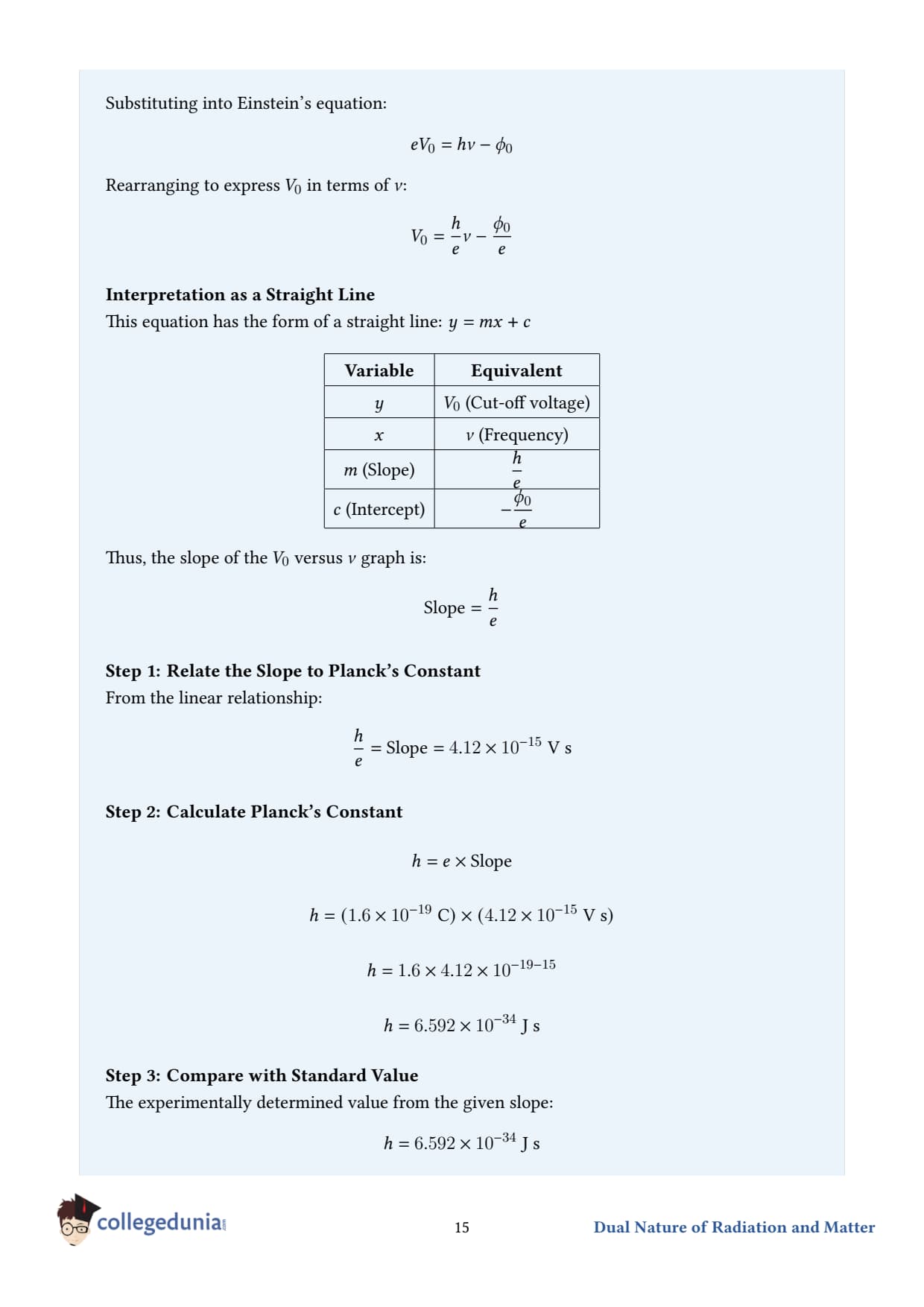
In an experiment on photoelectric effect, the slope of the cut-off voltage versus frequency of incident light is found to be 4.12× 10⁻¹⁵Vs. Calculate the value of Planck's constant.
Setup. Einstein's photoelectric equation can be rearranged as V0 = he ν - 0e. Plotting V0 against ν gives a straight line of slope h/e. Measuring that slope, multiplied by e, yields h.
Given. Slope of V0 vs ν graph, m = 4.12× 10⁻¹⁵Vs. Electron charge e = 1.6× 10⁻¹⁹C.
Step 4 — compare with the accepted value. The book value is h = 6.626× 10⁻³⁴Js. Our experimental value is within 0.5% — excellent.
Final answer.h ≈ 6.59× 10⁻³⁴Js.
DS
Dr. Shalini Menon
M.Sc Physics, University of Hyderabad
Verified Expert
Insight — Millikan's measurement. Robert Millikan performed exactly this experiment in 1916. By measuring stopping potentials at several frequencies, taking the slope, and multiplying by e (which he had already measured in his famous oil-drop experiment), he extracted h to about 0.5% accuracy. This was the first precision measurement of Planck's constant — and it confirmed Einstein's photon hypothesis, which Millikan had set out to disprove.
Alternative method — use the y-intercept. The y-intercept of the V0 vs ν line is -0/e; the x-intercept is the threshold frequency 0 = 0/h. So a single graph yields BOTH the work function and Planck's constant. This is the cleanest experimental signature of the photoelectric effect.
Common mistake — slope sign and units. The slope must be positive. Units: V0 in volts, ν in Hz = 1/s; slope is V·s. Don't mix Hz with rad/s — they differ by 2π, and your "Planck's constant" will come out a factor of 2π off you'd be measuring = h/2π instead.
Real-world — every spectroscopist uses this. The slope-of-V0-vs-ν method, with modern electronics, gives h to better than 1 ppm precision. Combined with the Josephson constant (2e/h) and the von Klitzing constant h/e2, these define modern electrical metrology — the volt and the ohm are now built from h and e, not artefacts.
Q 11.6
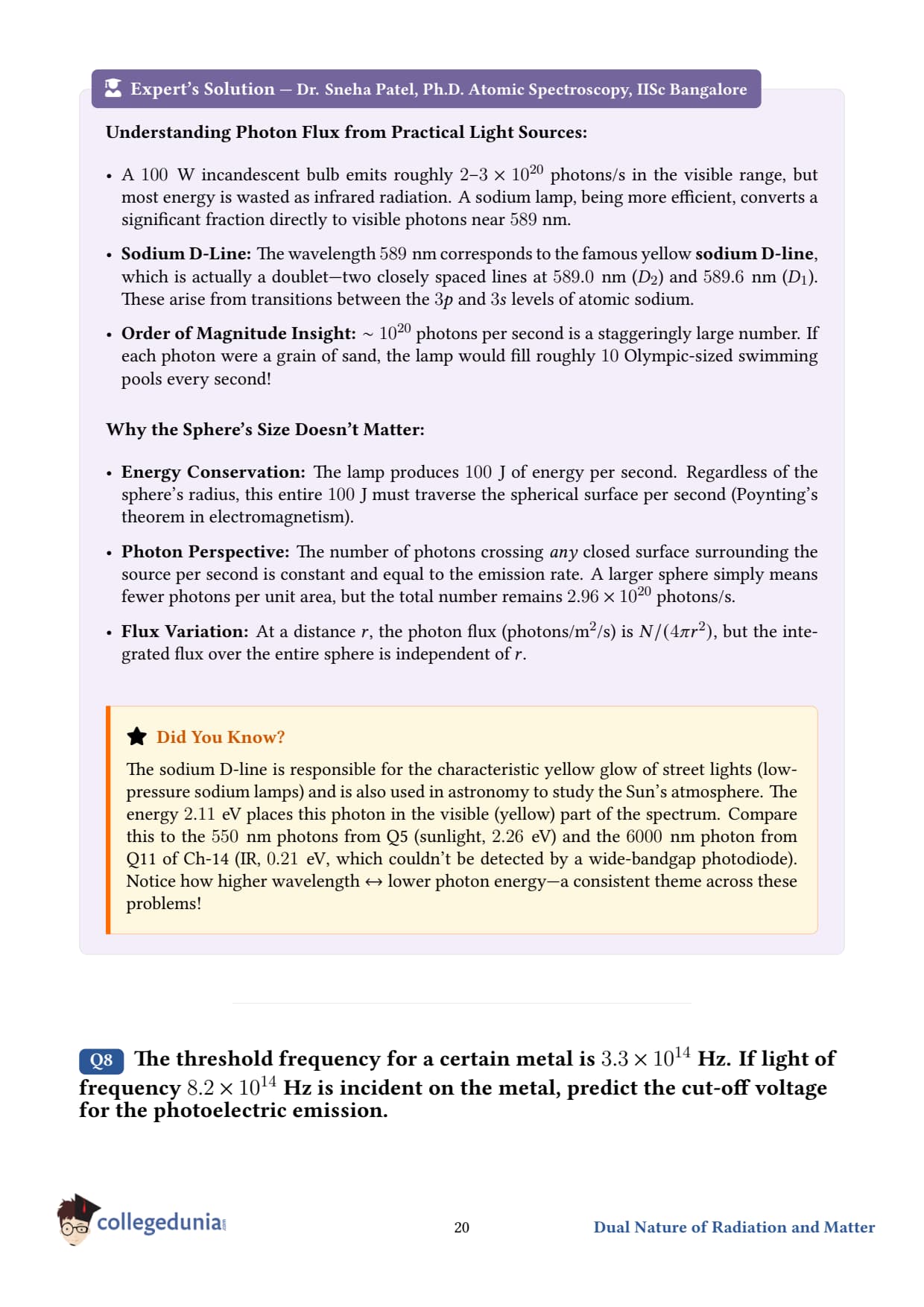
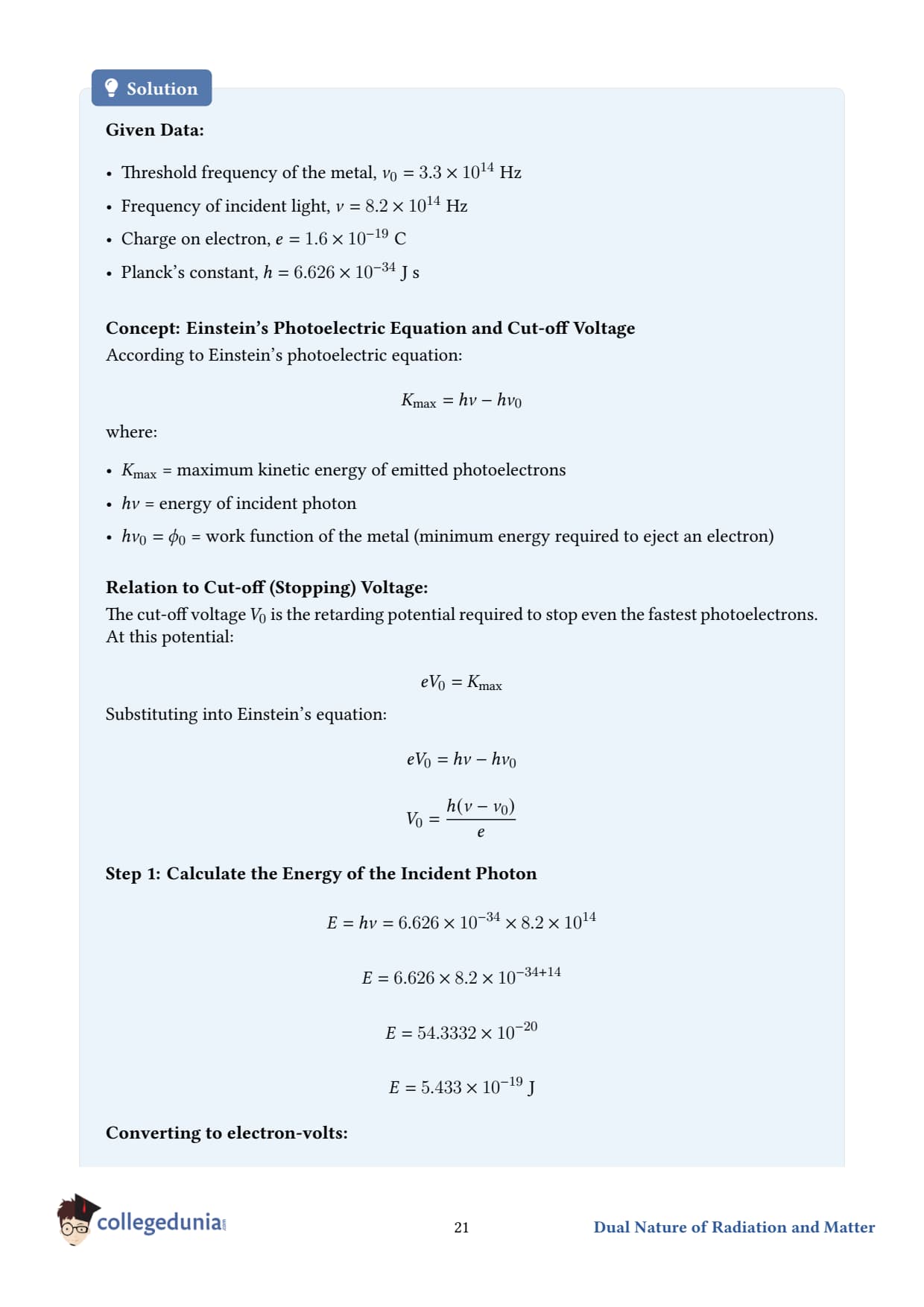
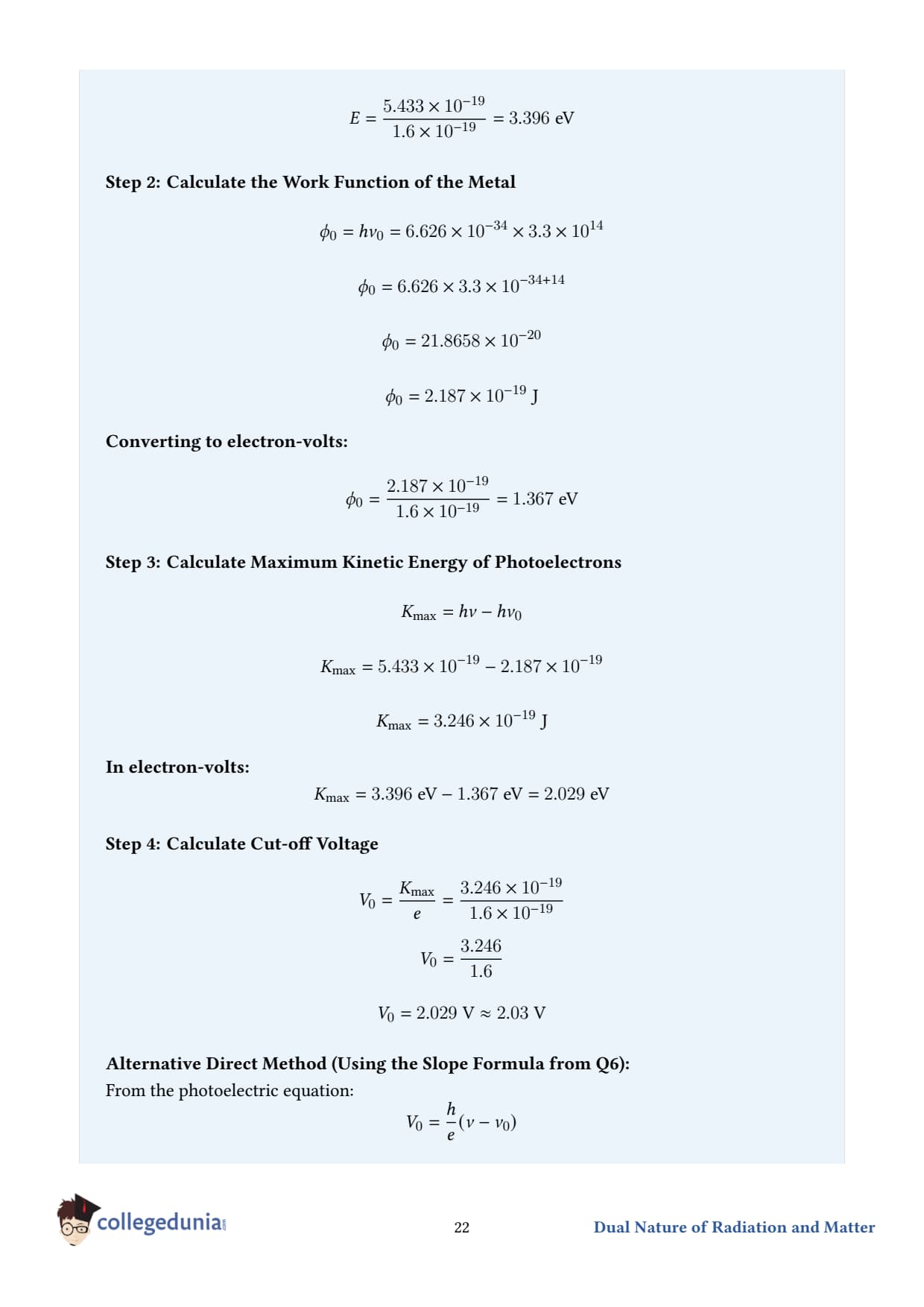
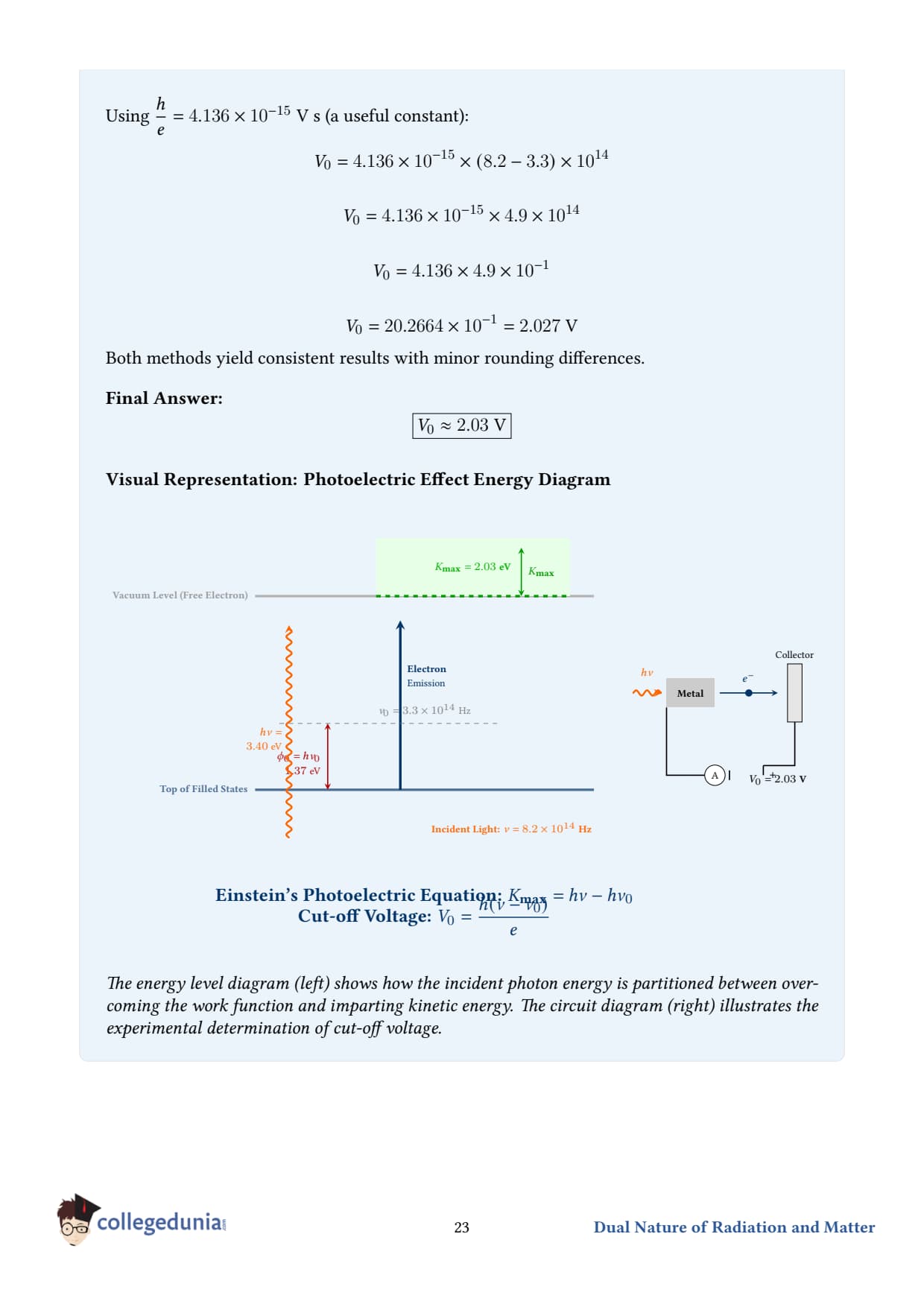
The threshold frequency for a certain metal is 3.3× 10¹⁴ Hz. If light of frequency 8.2× 10¹⁴ Hz is incident on the metal, predict the cut-off voltage for the photoelectric emission.
Setup. The threshold frequency 0 is the smallest frequency that can liberate any electron at all it's where h0 = 0. Light of frequency ν > 0 ejects electrons with kinetic energy hν - 0. The cut-off voltage V0 is the retarding potential that just stops those electrons.
Given.
Threshold frequency, 0 = 3.3× 10¹⁴ Hz.
Incident frequency, ν = 8.2× 10¹⁴ Hz.
h = 6.626× 10⁻³⁴Js; e = 1.6× 10⁻¹⁹C.
Concept used. The photoelectric equation in "threshold form": eV0 = h(ν - 0) V0 = he(ν - 0).
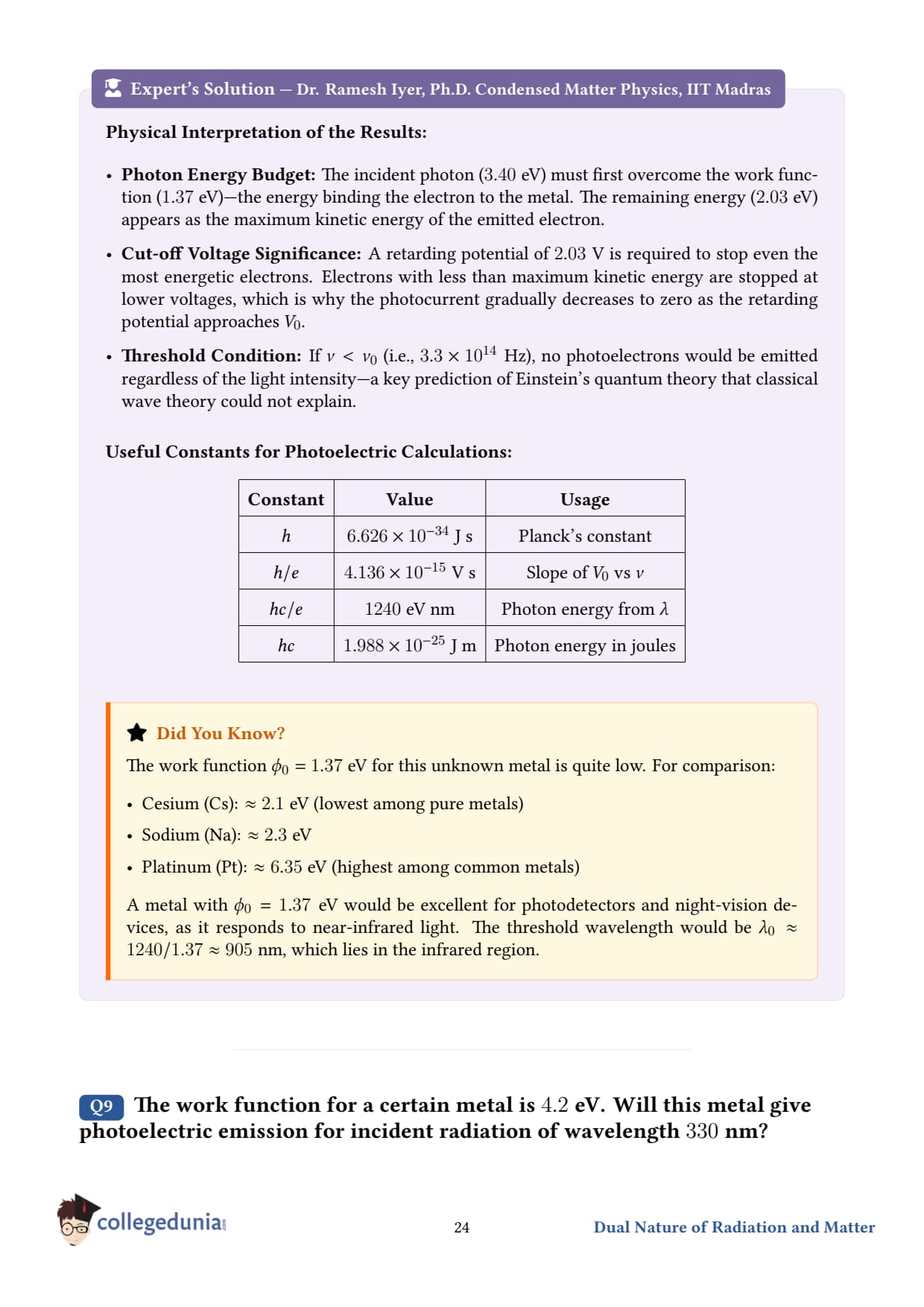
Insight — what the threshold frequency means physically. Every metal has a characteristic minimum energy 0 (its work function) needed to pry one electron off the surface. Light of frequency below 0 = 0/h simply cannot do it — no matter how intense the light. This was the experimental observation that classical wave theory could not explain: a very intense low-frequency beam ejects ZERO electrons, while a very weak high-frequency beam ejects them immediately.
Alternative method — use the h/e trick directly. Notice that h/e ≈ 4.14× 10⁻¹⁵V·s is exactly the slope from Q 11.5. So V0 = (4.14× 10⁻¹⁵)Δν, with Δν in Hz. That single number condenses every photoelectric stopping-potential problem.
Common mistake — confusing intensity and frequency. Cranking up the brightness of light below 0 does NOT eventually liberate electrons. The photoemission depends on individual photon energy, not total power. Many students lose marks writing "if the light is intense enough, electrons will be emitted regardless of frequency" — that's the classical (wrong) picture.
Real-world — solar cells and night-vision goggles. Choosing a photocathode material with low 0= low 0 extends sensitivity to longer wavelengths. Caesium telluride sees UV; gallium arsenide sees visible; bialkali photocathodes are the workhorses of photomultiplier tubes used in particle physics detectors.
Q 11.7
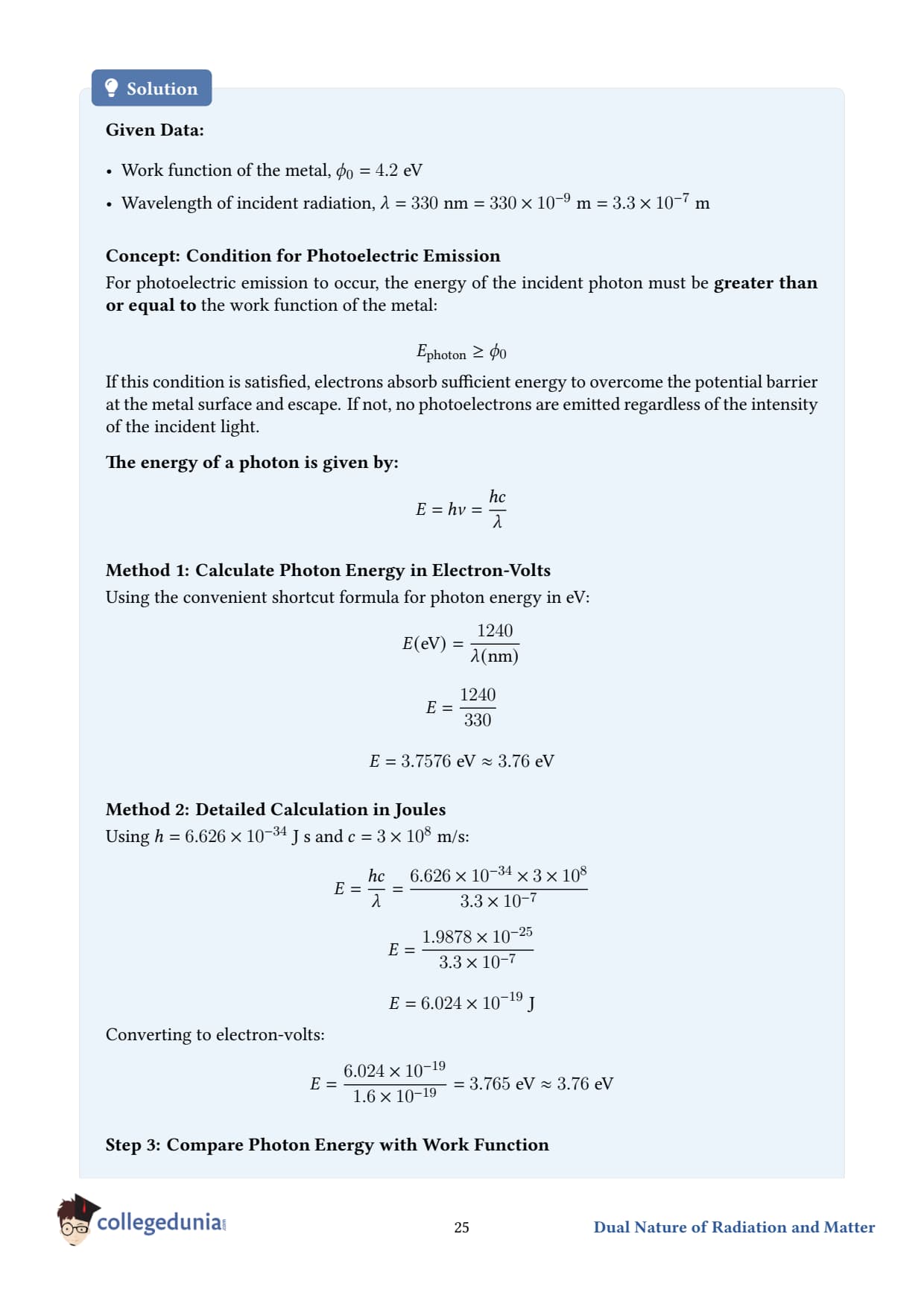
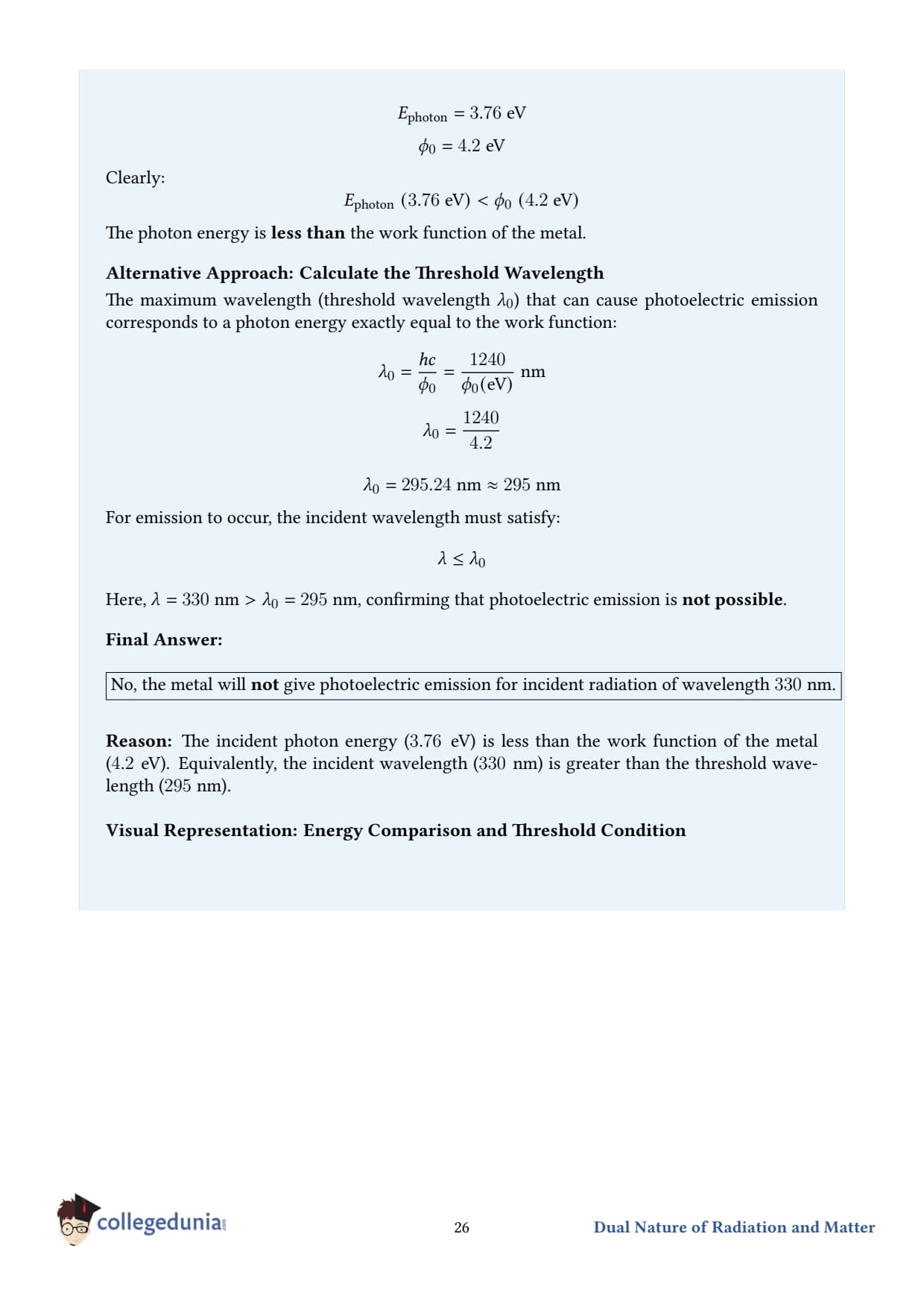
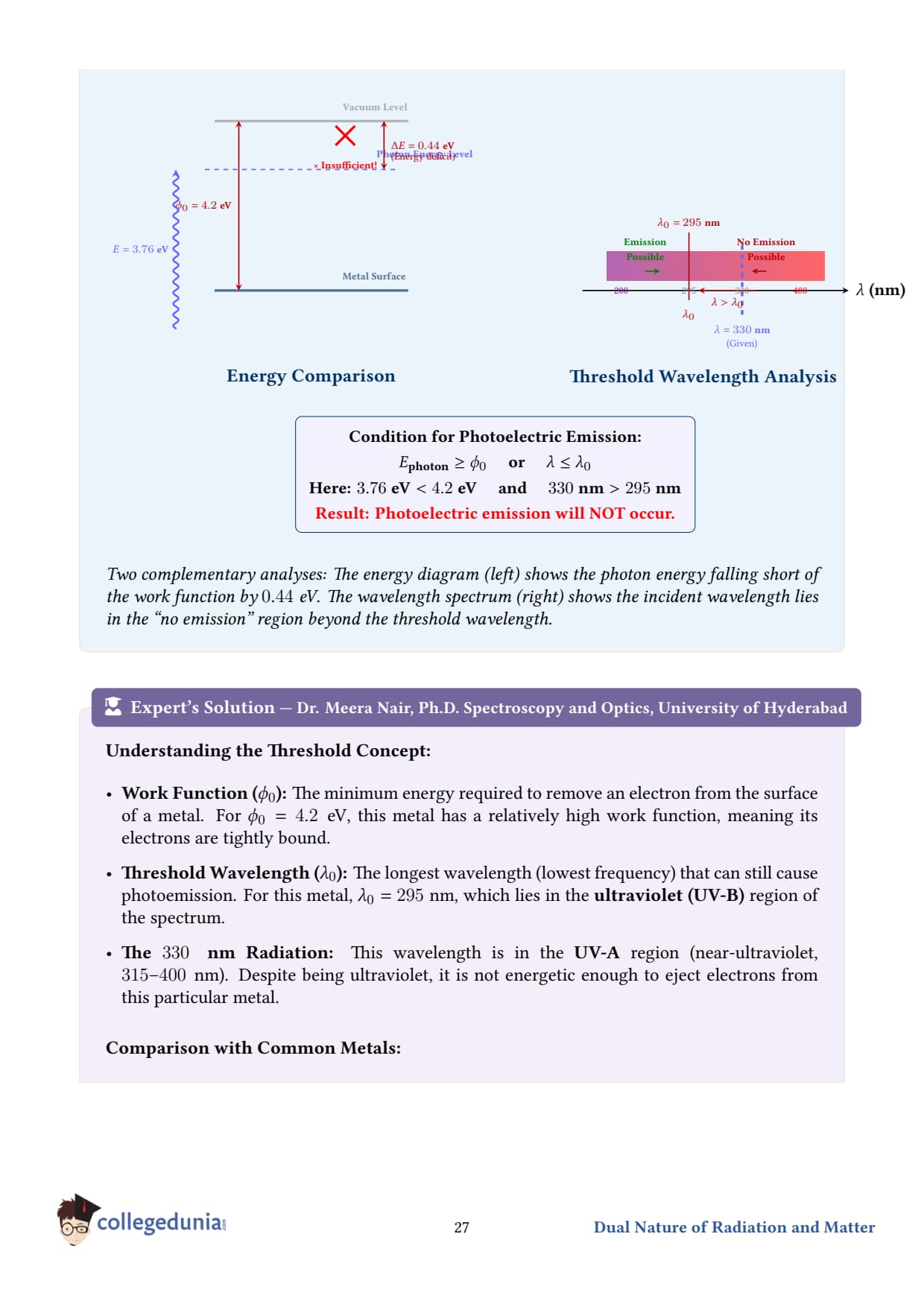
The work function for a certain metal is 4.2 eV. Will this metal give photoelectric emission for incident radiation of wavelength 330 nm?
Setup. Photoemission occurs only if the photon's energy is at least as big as the metal's work function. So we compute the energy of one 330-nm photon and compare with 4.2 eV.
Step 6 — conclude. Since photon energy is less than the work function, the photon cannot liberate an electron. No photoelectric emission occurs.
Cross-check — threshold wavelength. The largest wavelength that COULD eject electrons satisfies 0 = hc0 = 1240 eV·nm4.2 eV ≈ 295 nm. We need λ ≤ 295 nm; the given 330 nm is too long.
Final answer. No — the photon energy (3.77 eV) is less than 0 = 4.2 eV.
DR
Dr. Rajesh Kumar
Ph.D. Physics, IIT Delhi
Verified Expert
Insight — the threshold wavelength shortcut. A neat way to handle "yes/no" photoemission questions: compute 0 = hc/0. If the incident λ < 0, emission happens; if λ > 0, it does not. With hc = 1240 eV·nm, 0 (nm) = 12400 (eV). For 0 = 4.2 eV, 0 ≈ 295 nm — that's deep UV. Anything redder fails. The given 330 nm is in the near-UV but still too red.
Alternative method — compare frequencies. ν = c/λ = 3× 10⁸/(330× 10-9) = 9.09× 10¹⁴ Hz, 0 = 0/h ≈ 1.01× 10¹⁵ Hz. Since ν < 0, no emission.
Common mistake — confusing wavelength and frequency comparisons. A SHORTER wavelength means a HIGHER frequency, hence a MORE energetic photon. Many students invert this. Always do a sanity check: shorter λ ↔ higher ν ↔ more energetic photon ↔ more likely to emit.
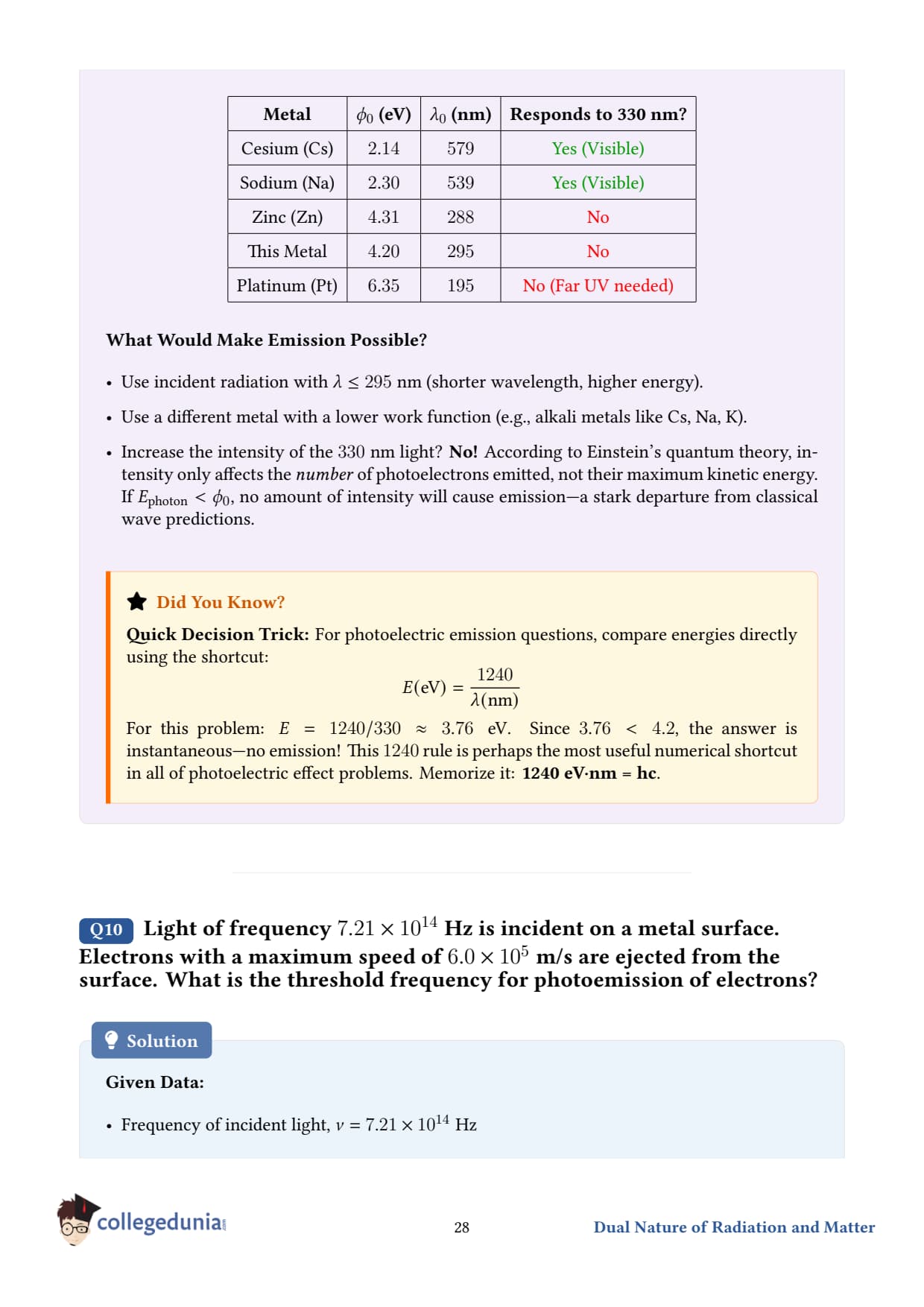
Real-world — UV sensors and ozone-layer protection. Most metals (work functions 4-5 eV) require UV light to eject electrons. Ozone absorbs UV-B (280-315 nm) and UV-C (100-280 nm) before they reach Earth's surface, protecting our skin AND making most outdoor metal surfaces immune to photoelectric loss. Tungsten 0 ≈ 4.5 eV and copper 0 ≈ 4.7 eV are basically photo-inert in sunlight.
Q 11.8
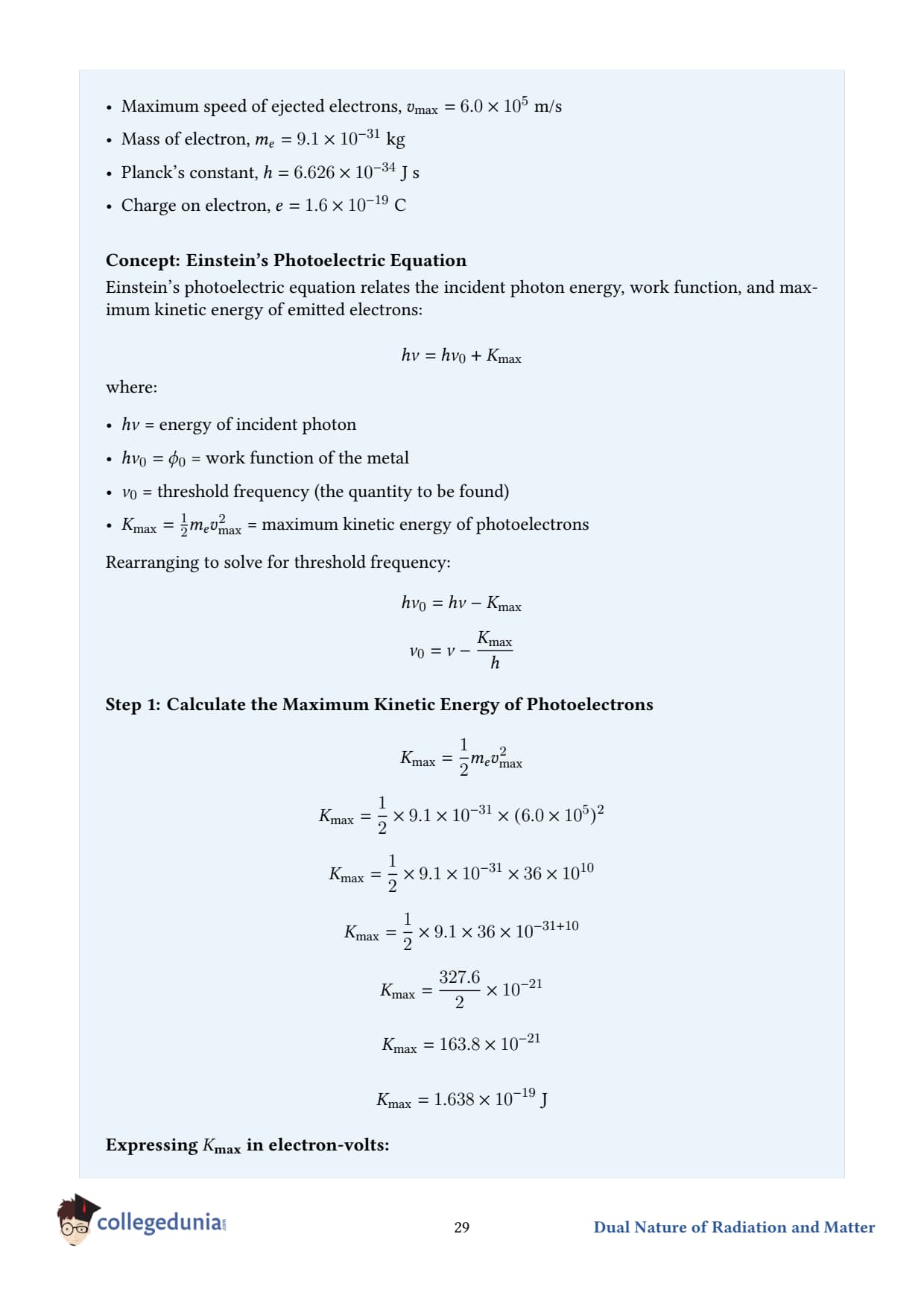
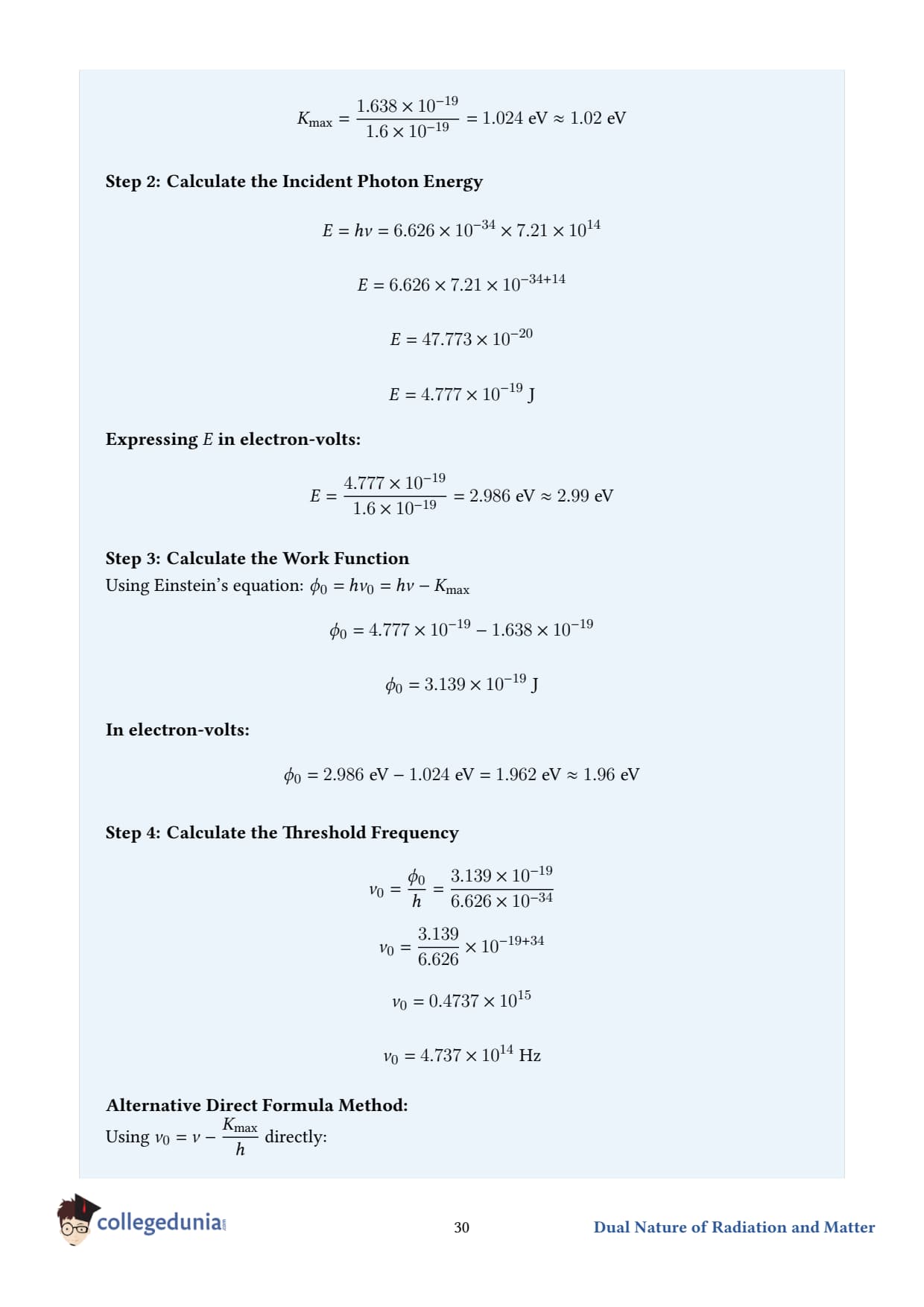
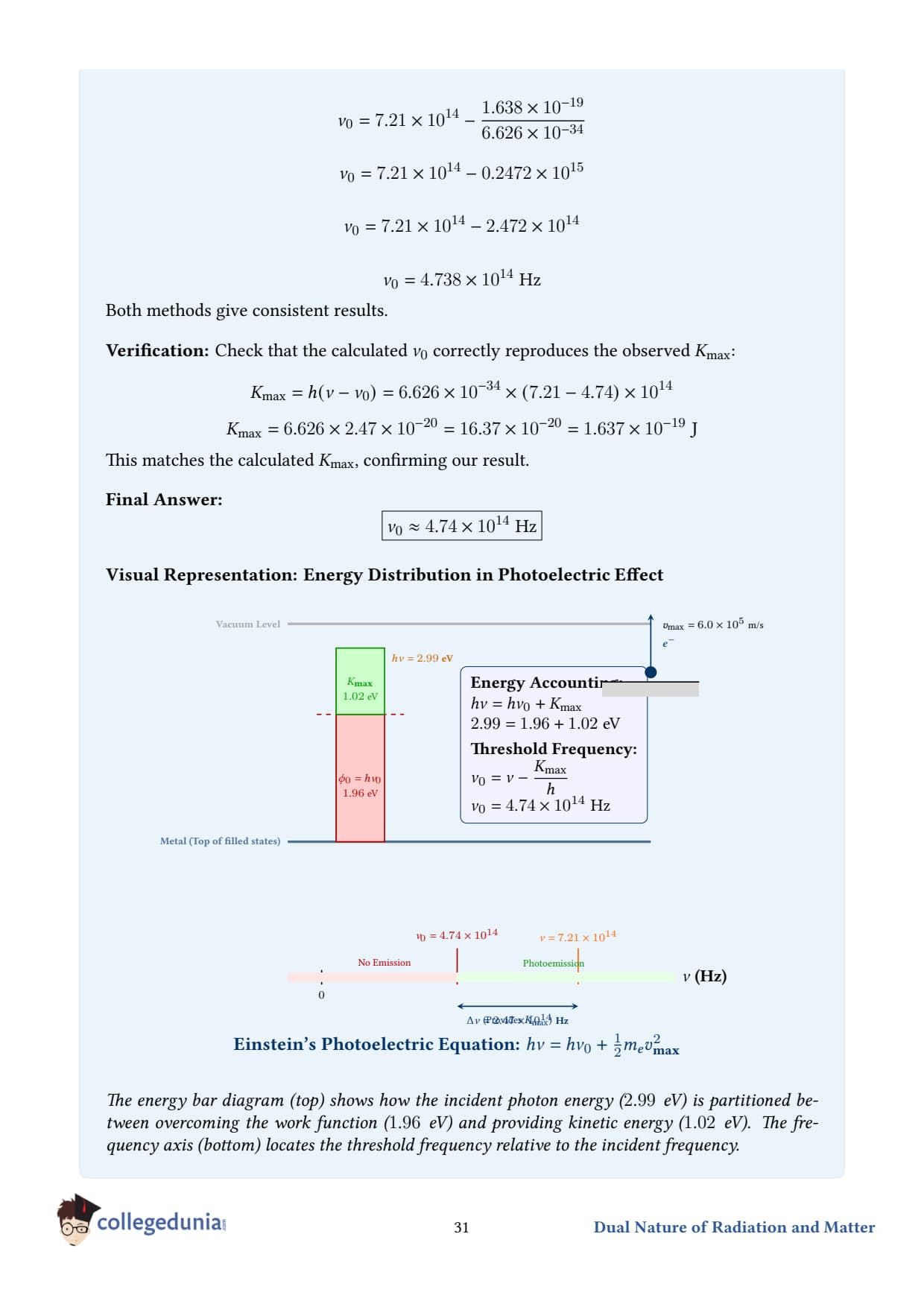
Light of frequency 7.21× 10¹⁴ Hz is incident on a metal surface. Electrons with a maximum speed of 6.0× 10⁵m/s are ejected from the surface. What is the threshold frequency for photoemission of electrons?
Setup. We know the incident frequency and the maximum kinetic energy of the ejected electrons (from their max speed). Einstein's photoelectric equation in threshold form gives us 0 directly.
Given.
Incident frequency, ν = 7.21× 10¹⁴ Hz.
Maximum speed of photoelectrons, vmax = 6.0× 10⁵m/s.
me = 9.11× 10⁻³¹ kg; h = 6.626× 10⁻³⁴Js.
Concept used.12 me vmax2 = h(ν - 0).
Step 1 — compute Kmax from the speed. Kmax = 12(9.11× 10⁻³¹)(6.0× 10⁵)2.
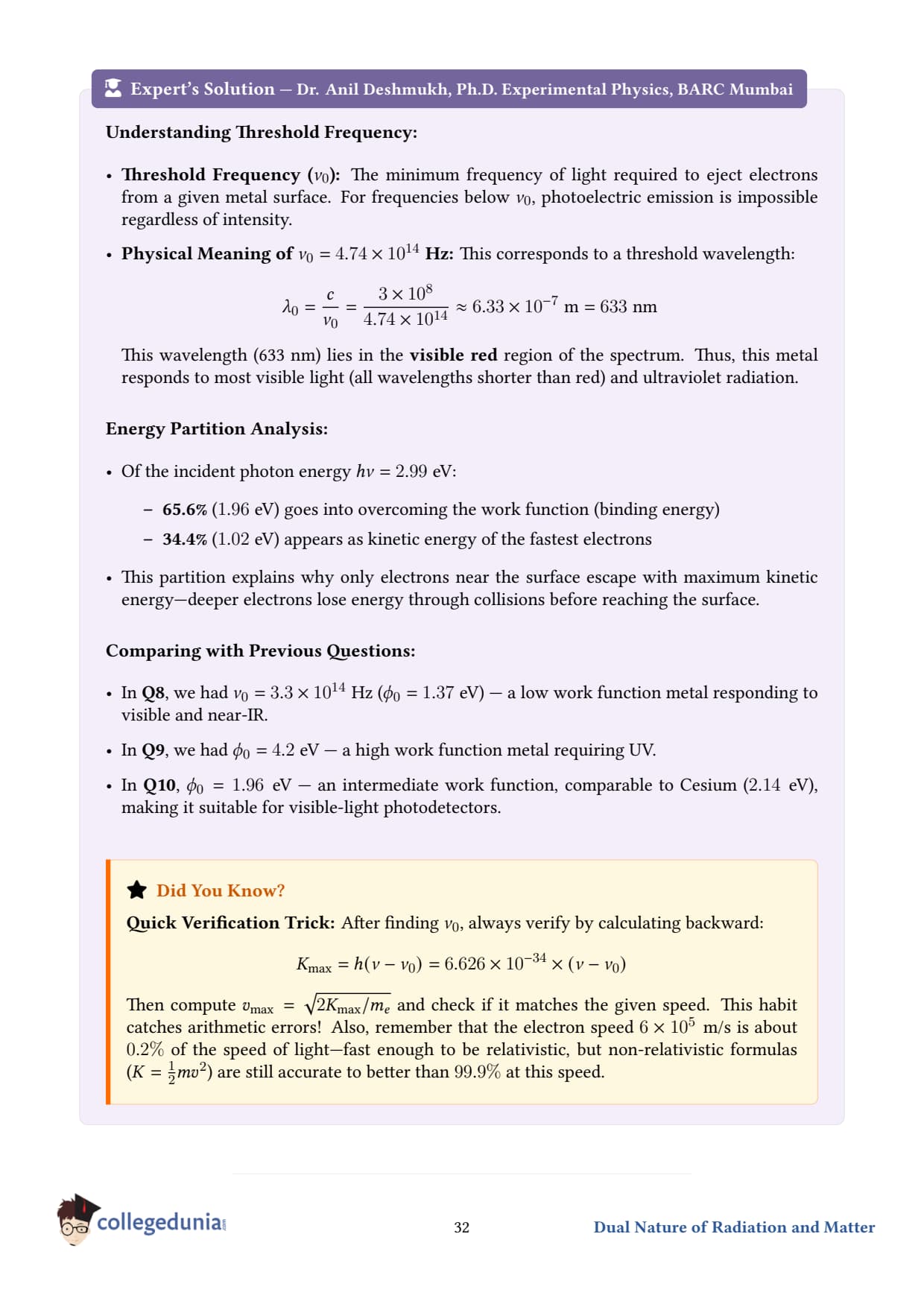
Insight — what the threshold frequency tells us about the material. Once we know 0, we know the work function: 0 = h0. Here 0 ≈ 6.626× 10-344.74× 10¹⁴ ≈ 3.14× 10⁻¹⁹J ≈ 1.96 eV. That's quite low — consistent with an alkali metal (sodium, potassium, caesium).
Common mistake — forgetting to halve. The kinetic energy is 12mv2, not mv2. It's an easy slip when racing through arithmetic. A doubled Kmax would lead to a much smaller, often negative, 0 — a clear sign of error.
Real-world — photoelectric work functions of common metals. Caesium (2.14 eV), potassium (2.30 eV), sodium (2.75 eV), zinc (4.3 eV), copper (4.7 eV), platinum (6.35 eV). Lower work function = easier to extract electrons = good for photocathodes. Caesium is the photodetector poster child.
Q 11.9
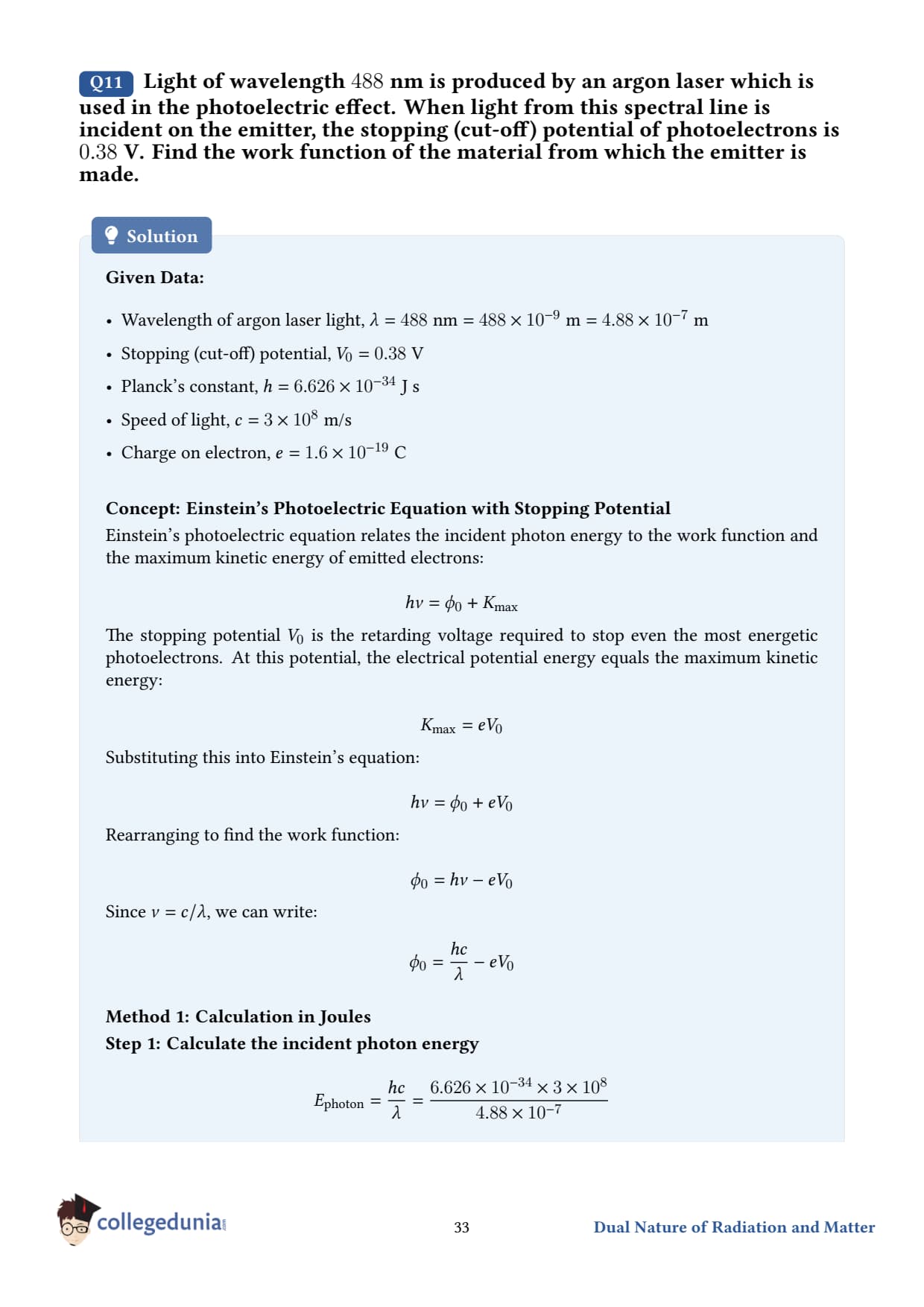
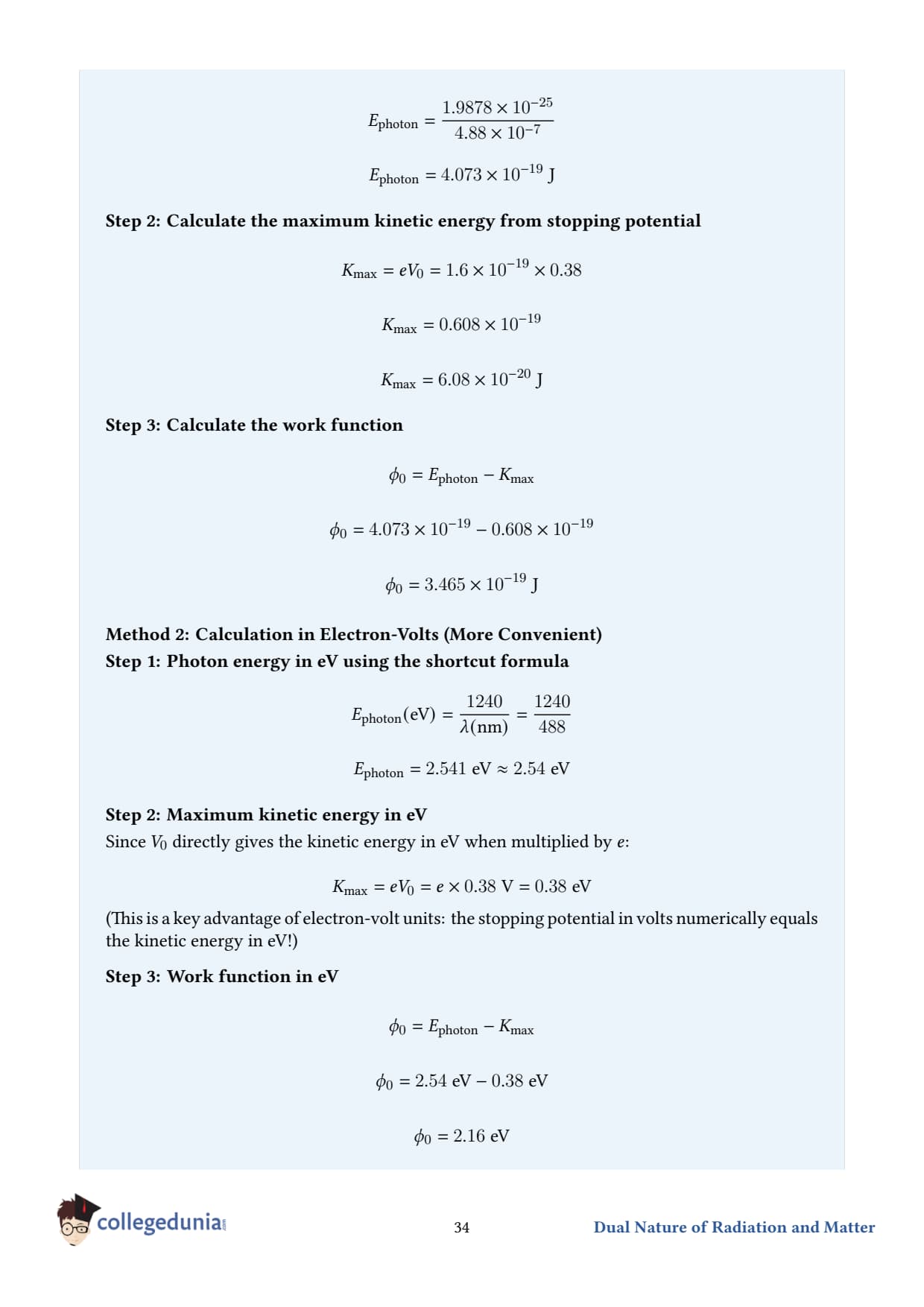
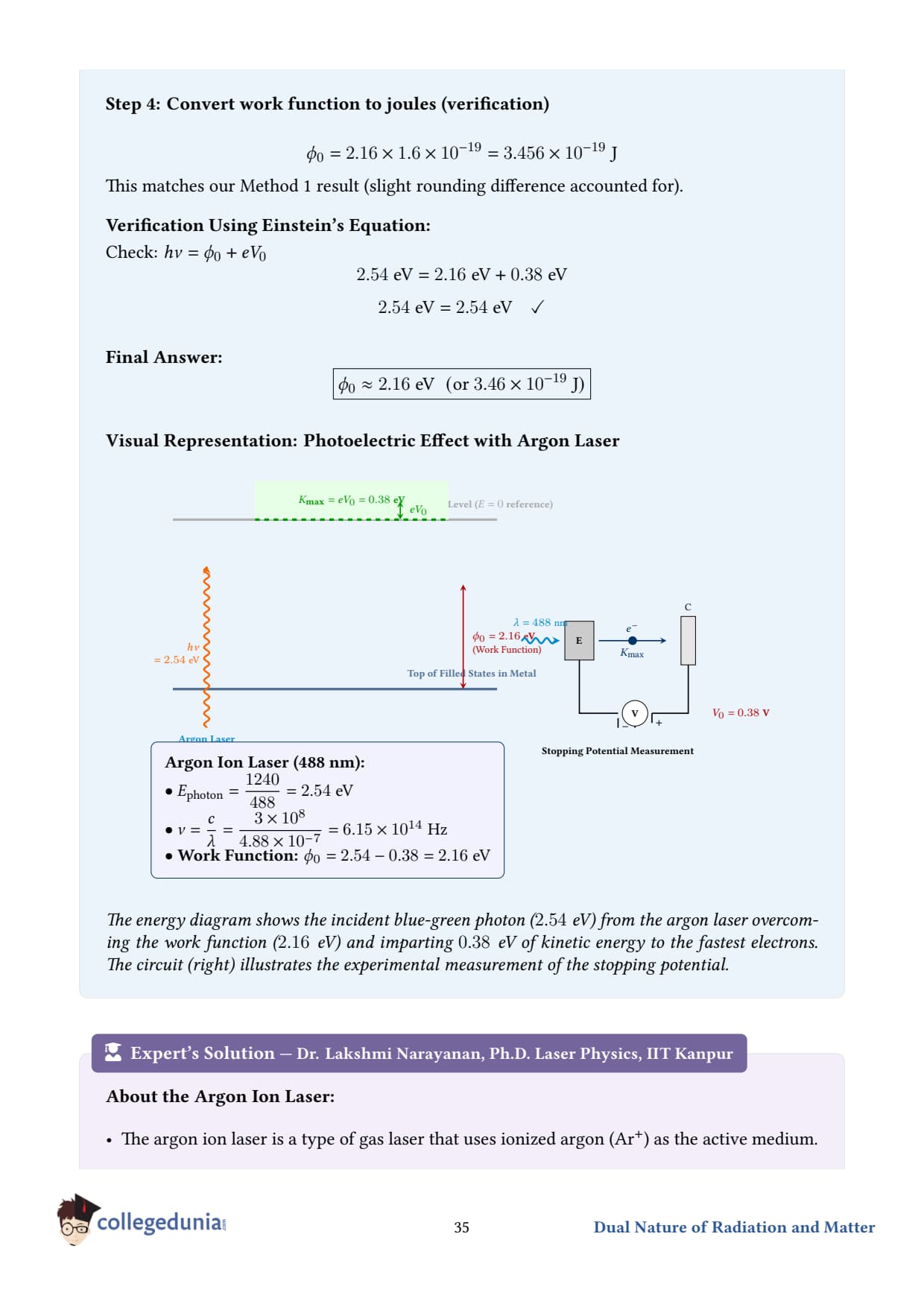
Light of wavelength 488 nm is produced by an argon laser which is used in the photoelectric effect. When light from this spectral line is incident on the emitter, the stopping (cut-off) potential of photoelectrons is 0.38 V. Find the work function of the material from which the emitter is made.
Setup. We know the photon wavelength (so we can find its energy) and the stopping potential so we know Kmax. Subtracting gives the work function.
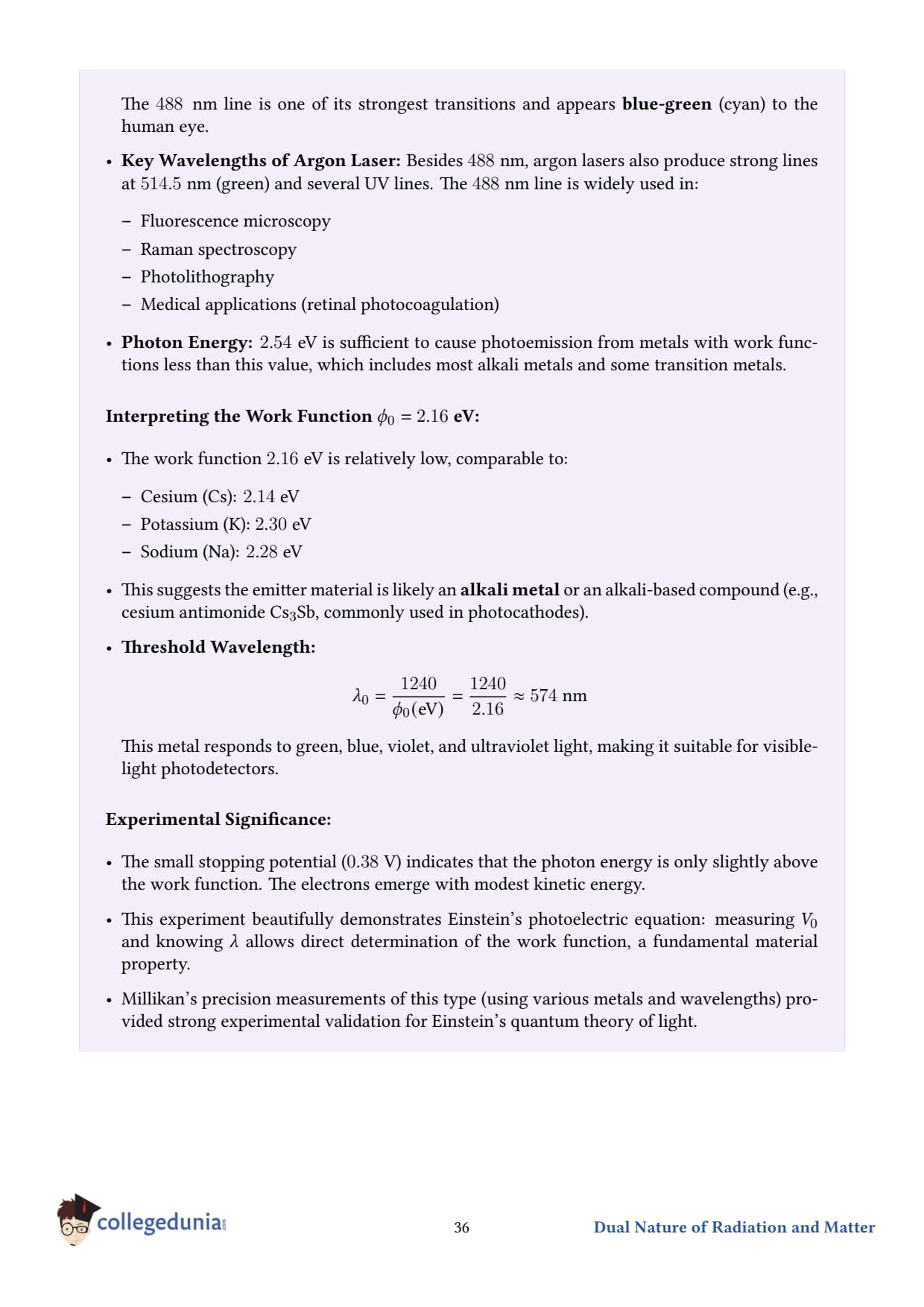
Insight — recognising the material. A work function of 2.16 eV is very close to caesium (2.14 eV) — so the emitter in this experiment was likely caesium or a caesium-based alloy. Recall that in Q 11.2 we were also given caesium with 0 = 2.14 eV; the slight discrepancy is consistent with experimental uncertainty.
Alternative method — work in joules throughout.E = hc/λ = (1.988× 10⁻²⁵)/(488× 10-9) = 4.073× 10⁻¹⁹J; Kmax = eV0 = (1.6× 10⁻¹⁹)(0.38) = 6.08× 10⁻²⁰J; 0 = 4.073× 10⁻¹⁹ - 0.608× 10-19 = 3.465× 10⁻¹⁹J. Same answer, more arithmetic.
Common mistake — eV vs J units. Always make sure photon energy and work function are in the SAME unit before subtracting. The "1240 eV·nm" shortcut keeps everything in eV and prevents this mistake.
Real-world — argon-ion laser eye surgery. The 488 nm and 514 nm lines of the argon-ion laser are absorbed strongly by haemoglobin and the retinal pigment epithelium. Ophthalmologists use them to weld retinal tears (photocoagulation) — the same blue-green photons that liberate caesium photoelectrons here. The energy budget is identical; just the target material changes.
Q 11.10
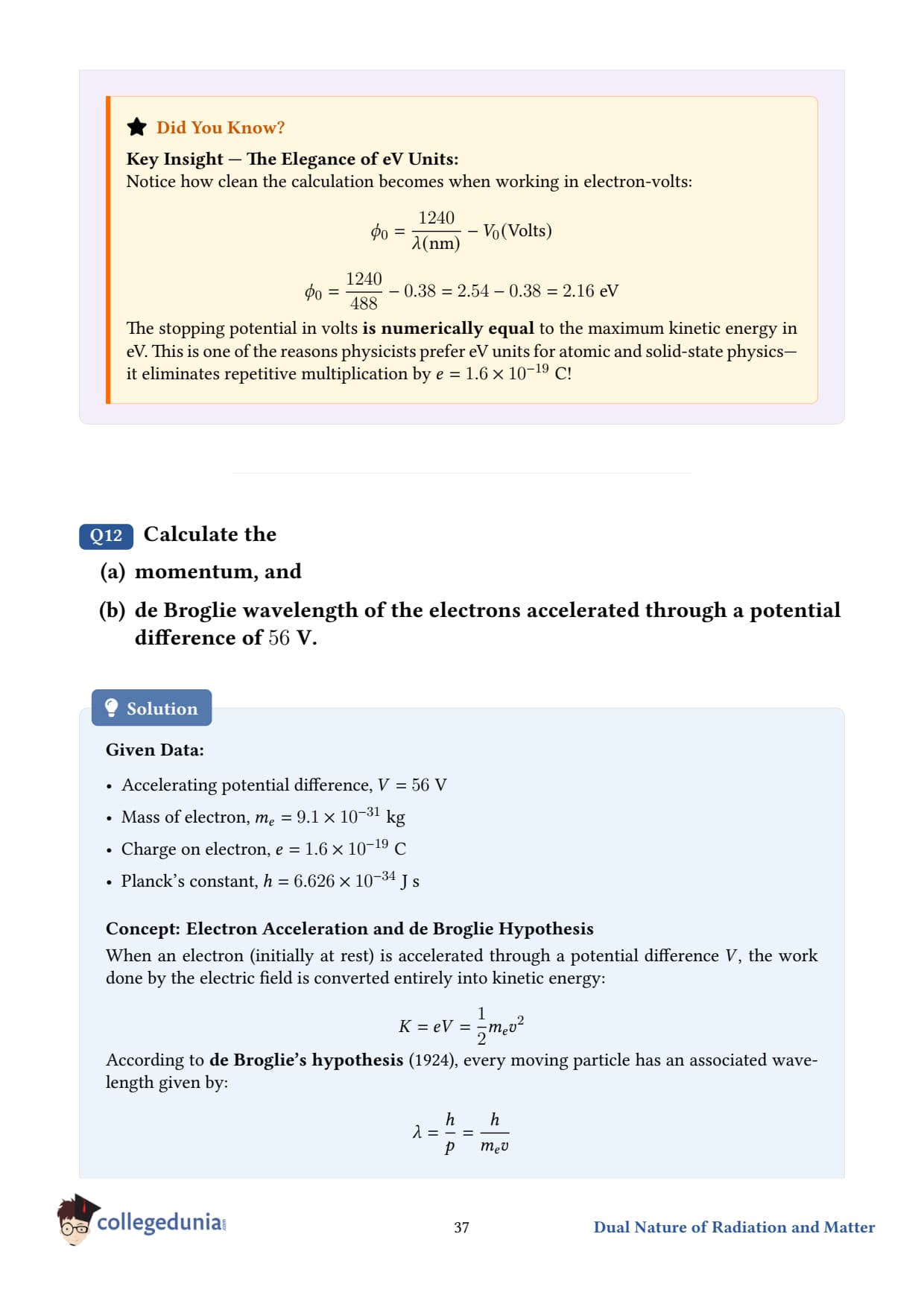
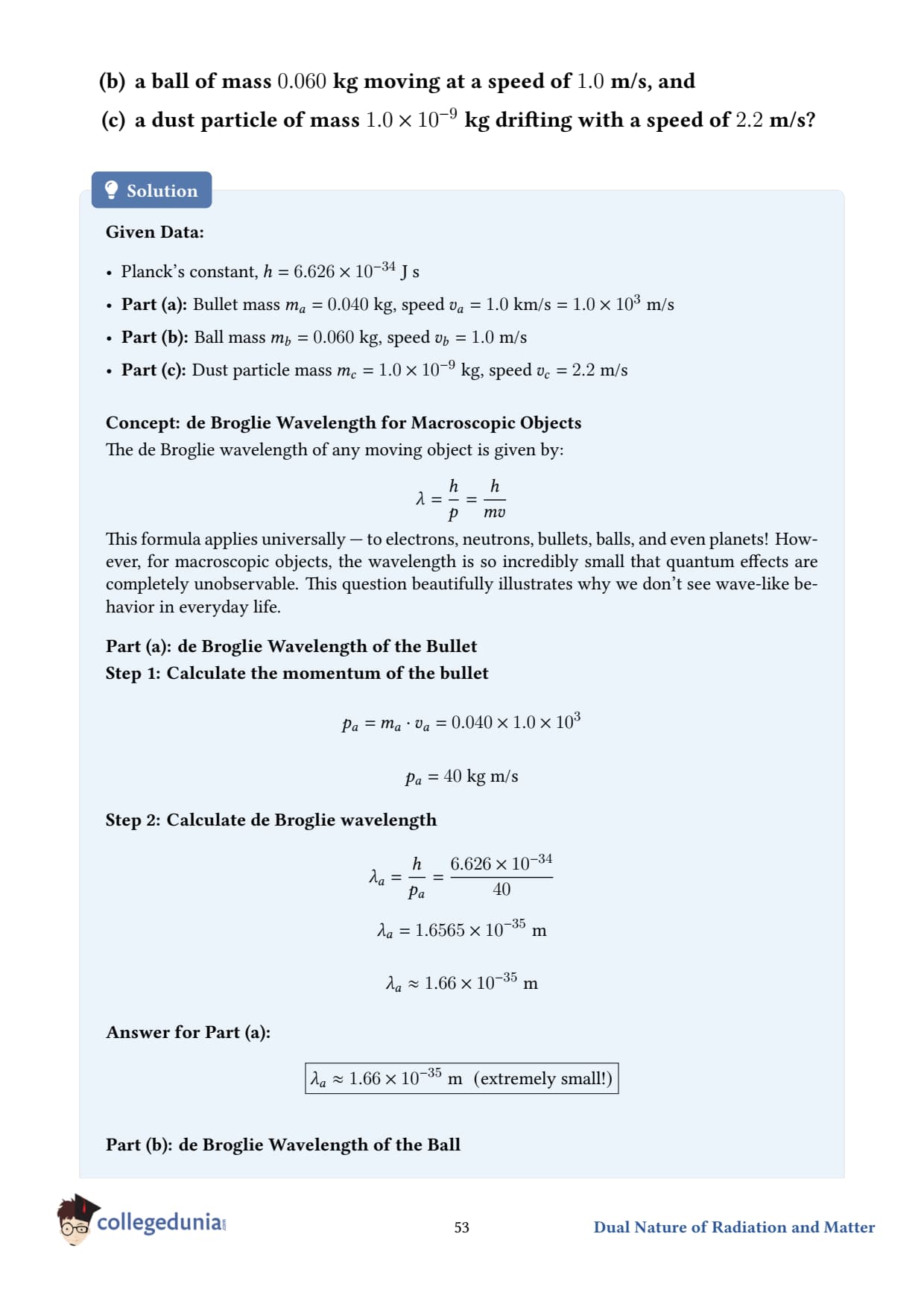
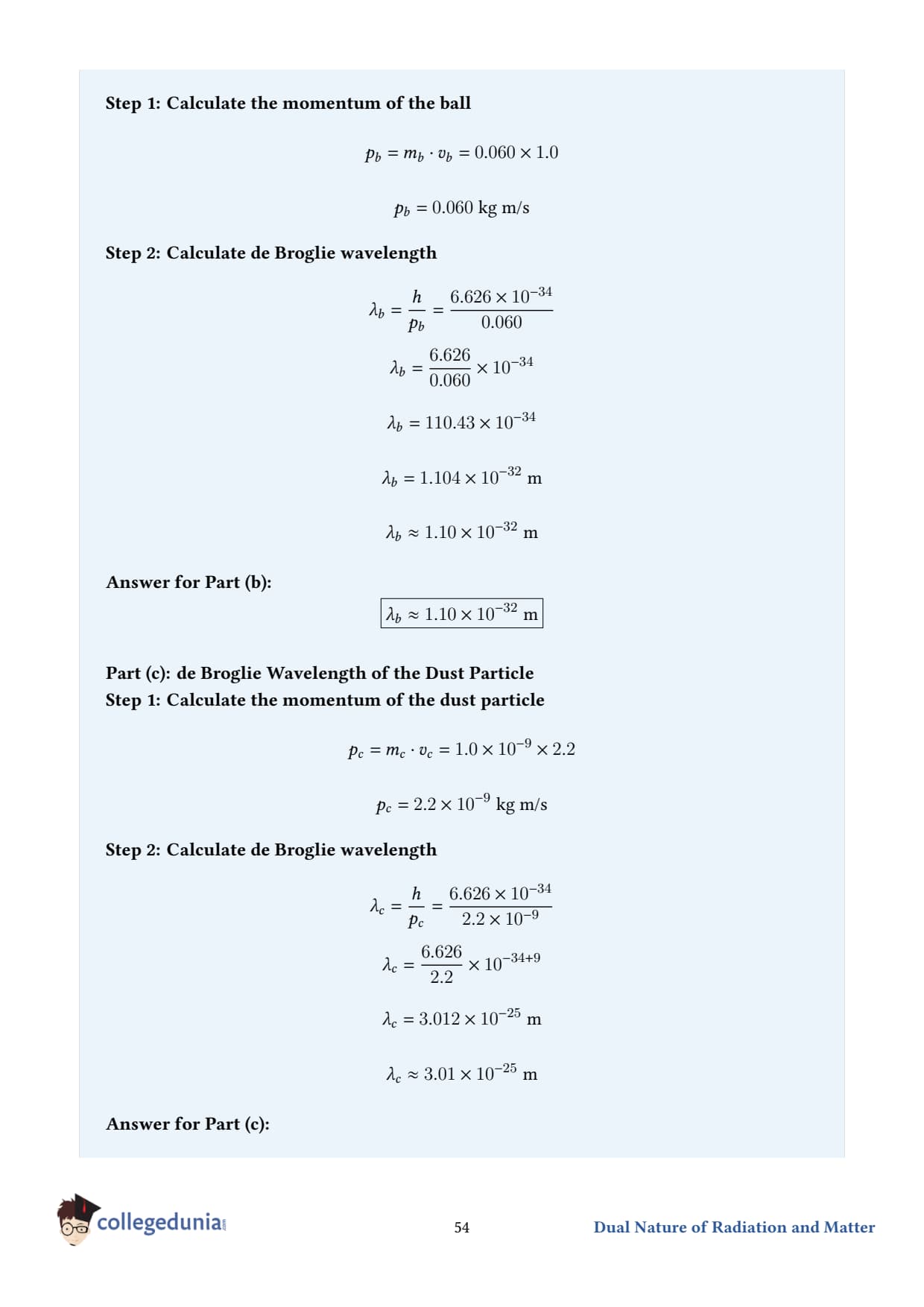
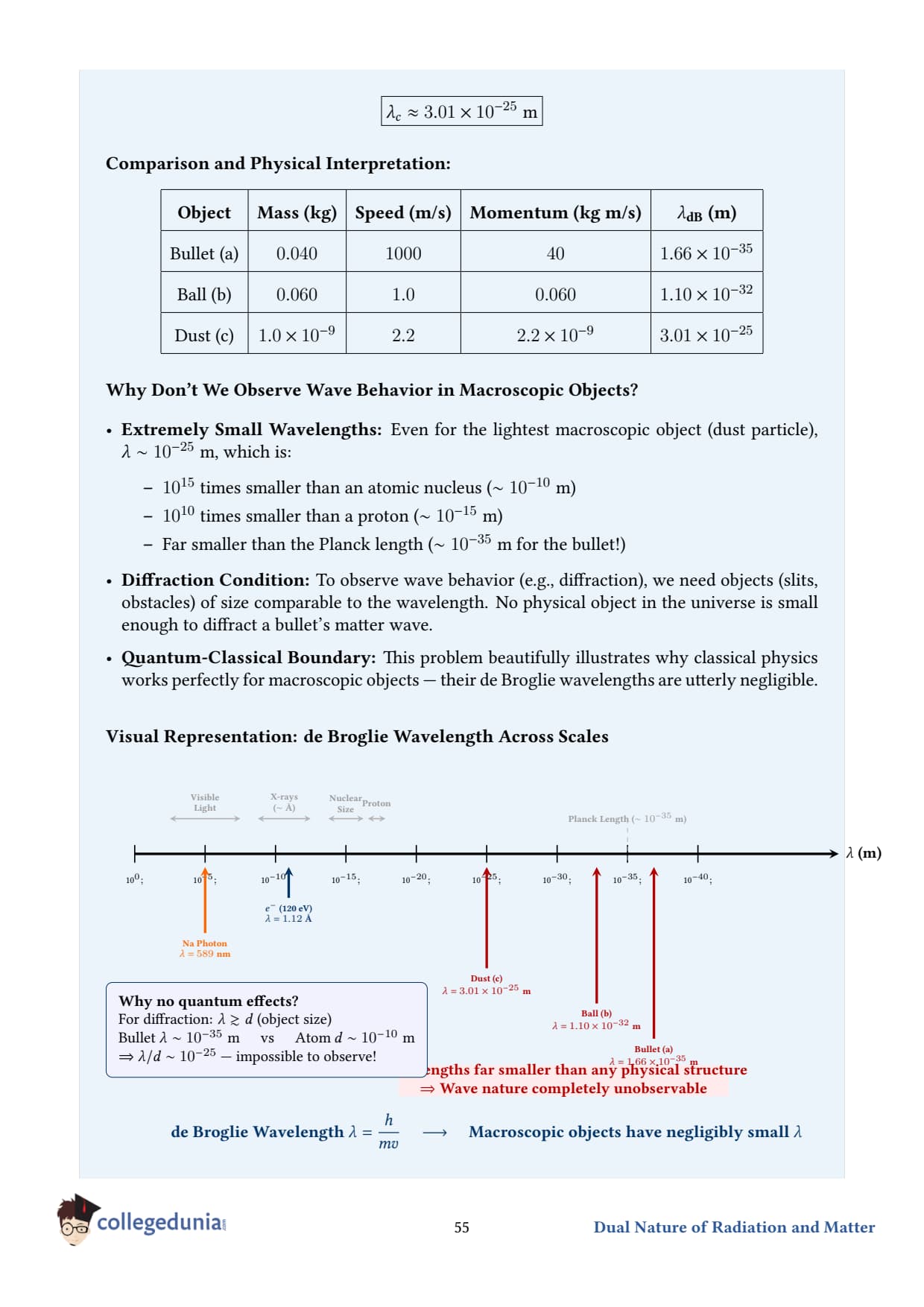
What is the de Broglie wavelength of (a) a bullet of mass 0.040 kg travelling at the speed of 1.0 km/s, (b) a ball of mass 0.060 kg moving at a speed of 1.0 m/s, and (c) a dust particle of mass 1.0× 10⁻⁹ kg drifting with a speed of 2.2 m/s?
Setup. Louis de Broglie's hypothesis: every moving particle has an associated matter wave with wavelength λ = hp = hmv. We apply this to three macroscopic objects.
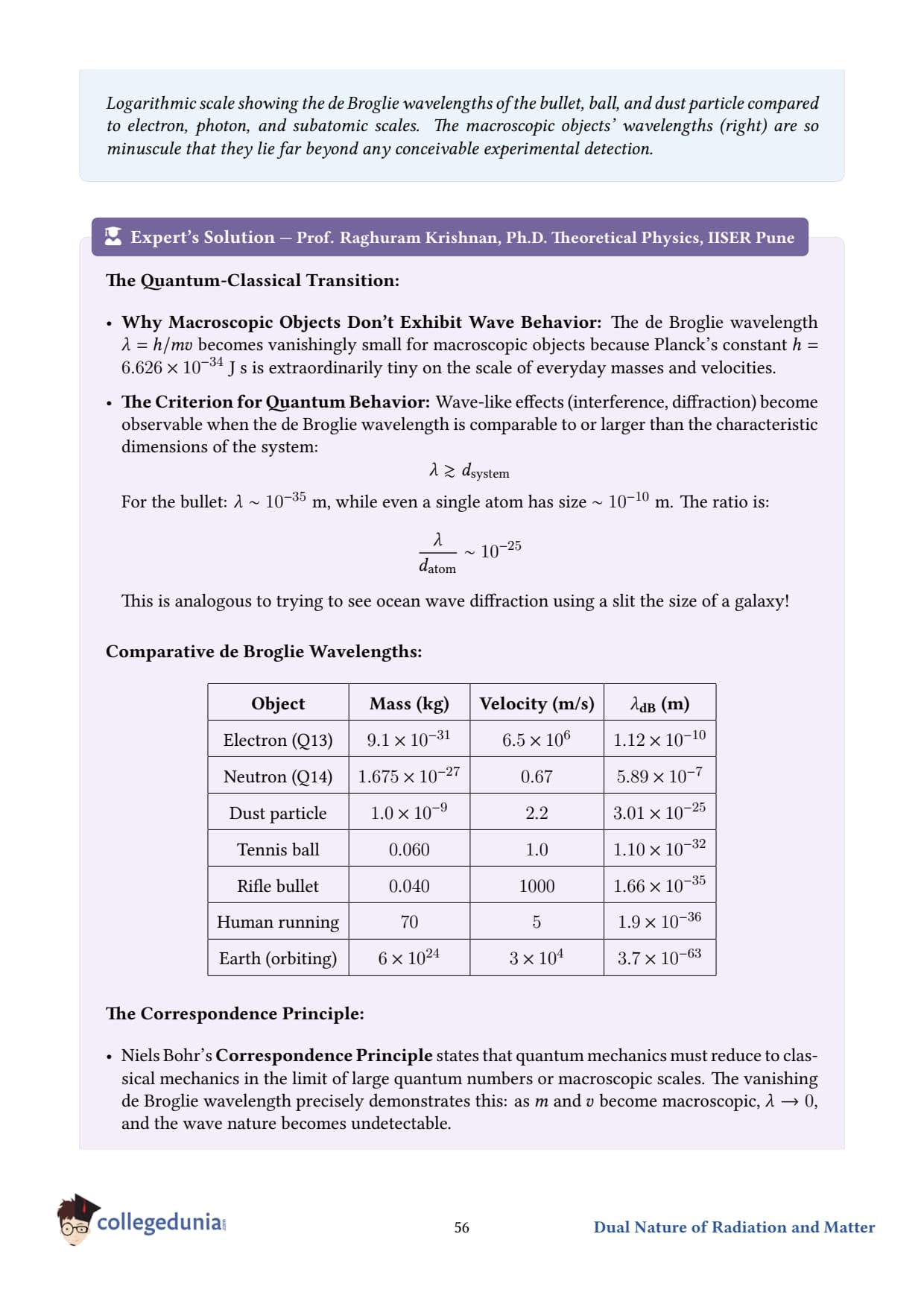
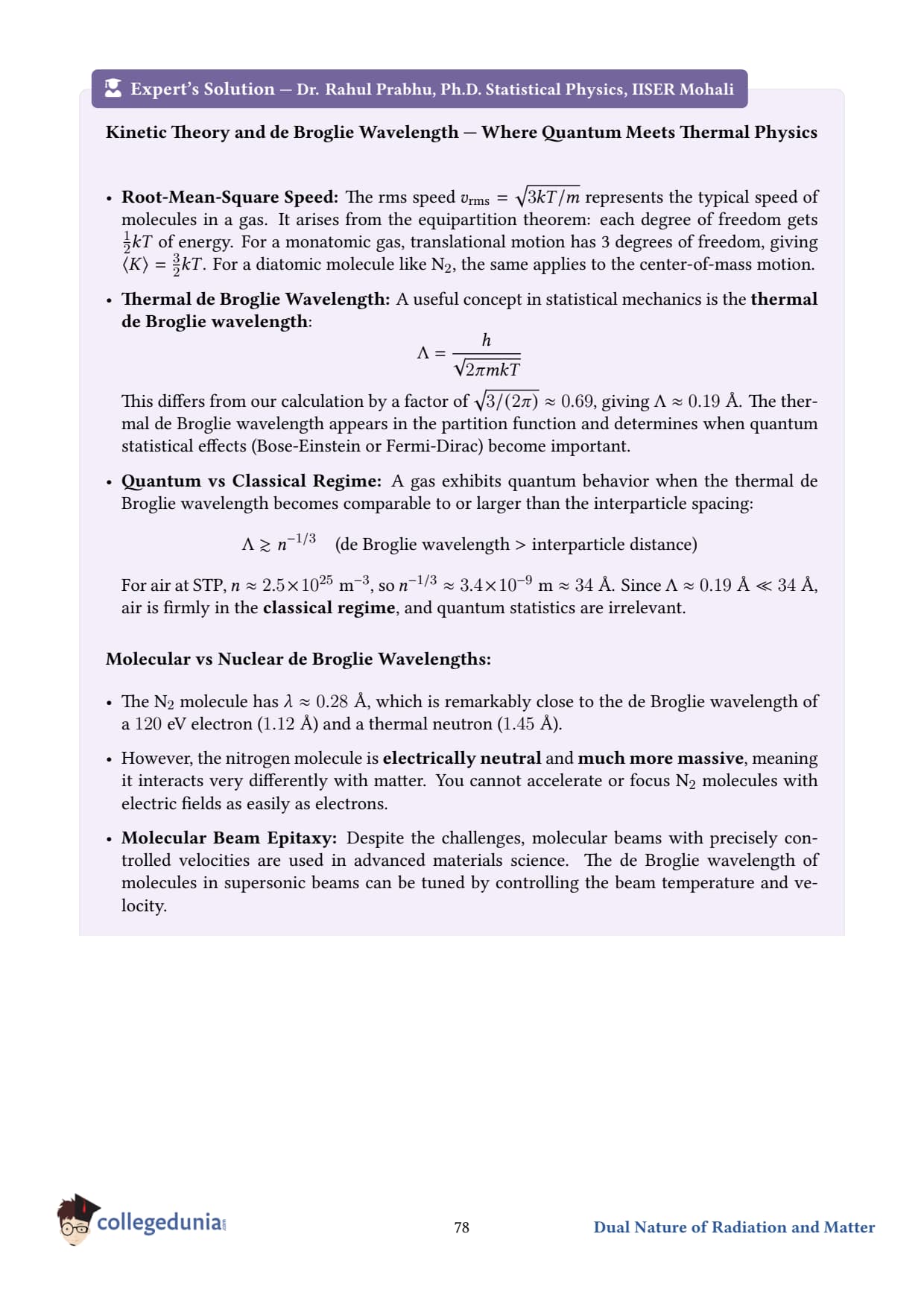
Interpretation. All three wavelengths are absurdly tiny — much smaller than an atomic nucleus ∼ 10-15m, let alone an atom ∼ 10-10m. That's why we never notice wave behaviour for bullets, balls, or dust. Wave effects are only observable when λ is comparable to the size of an obstacle or aperture — and these λs are far too small.
DS
Dr. Sneha Iyer
Ph.D. Physics, IISc Bangalore
Verified Expert
Insight — why classical mechanics works for everyday objects. The de Broglie wavelength of a baseball is 1032 times smaller than the Bohr radius. No matter how cleverly you arrange apertures, you cannot create a diffraction pattern from a baseball — there's no slit narrow enough. This is why classical mechanics is recovered as the macroscopic limit of quantum mechanics. Quantum effects exist for everything, but they are vanishingly small for big things.
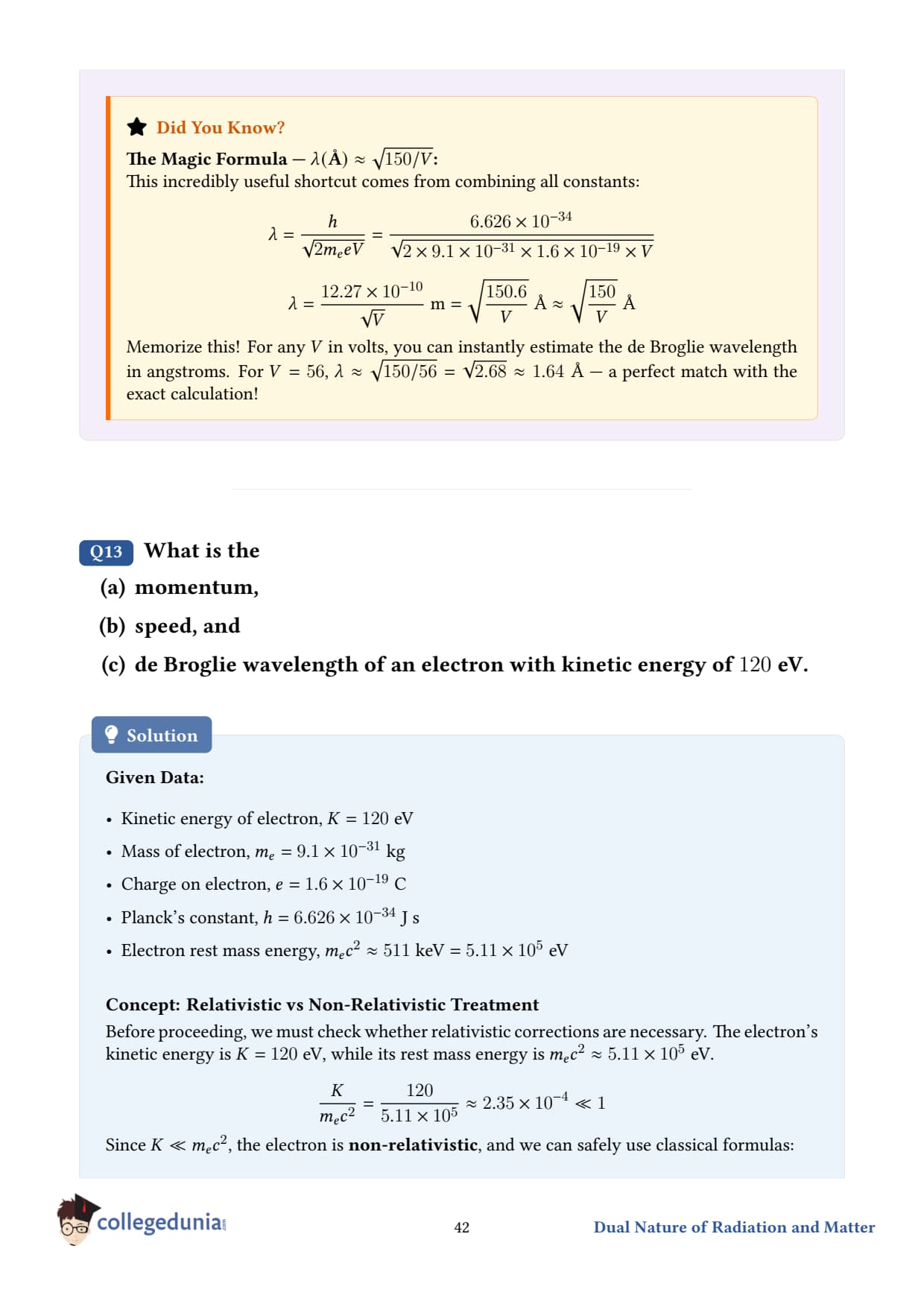
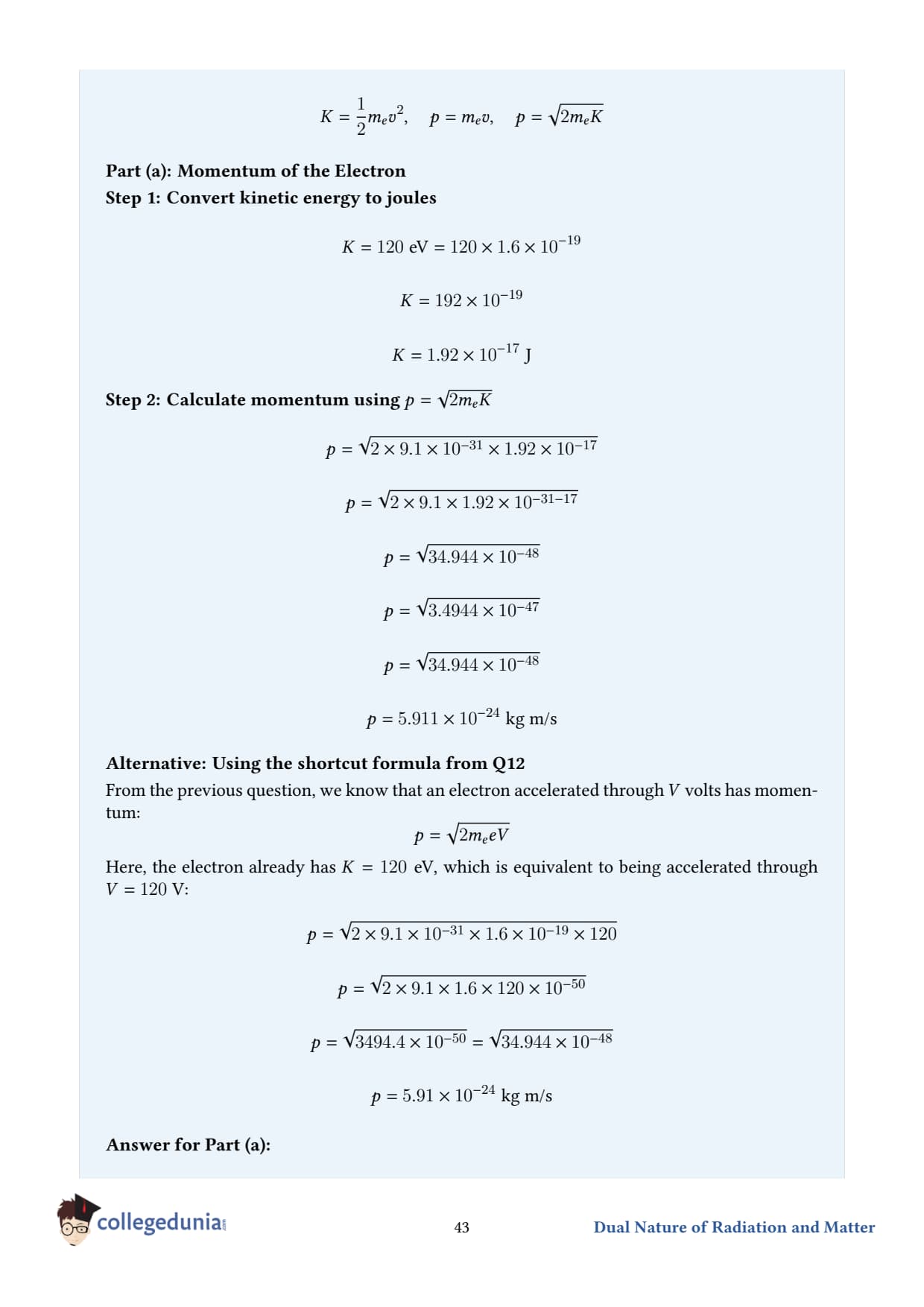
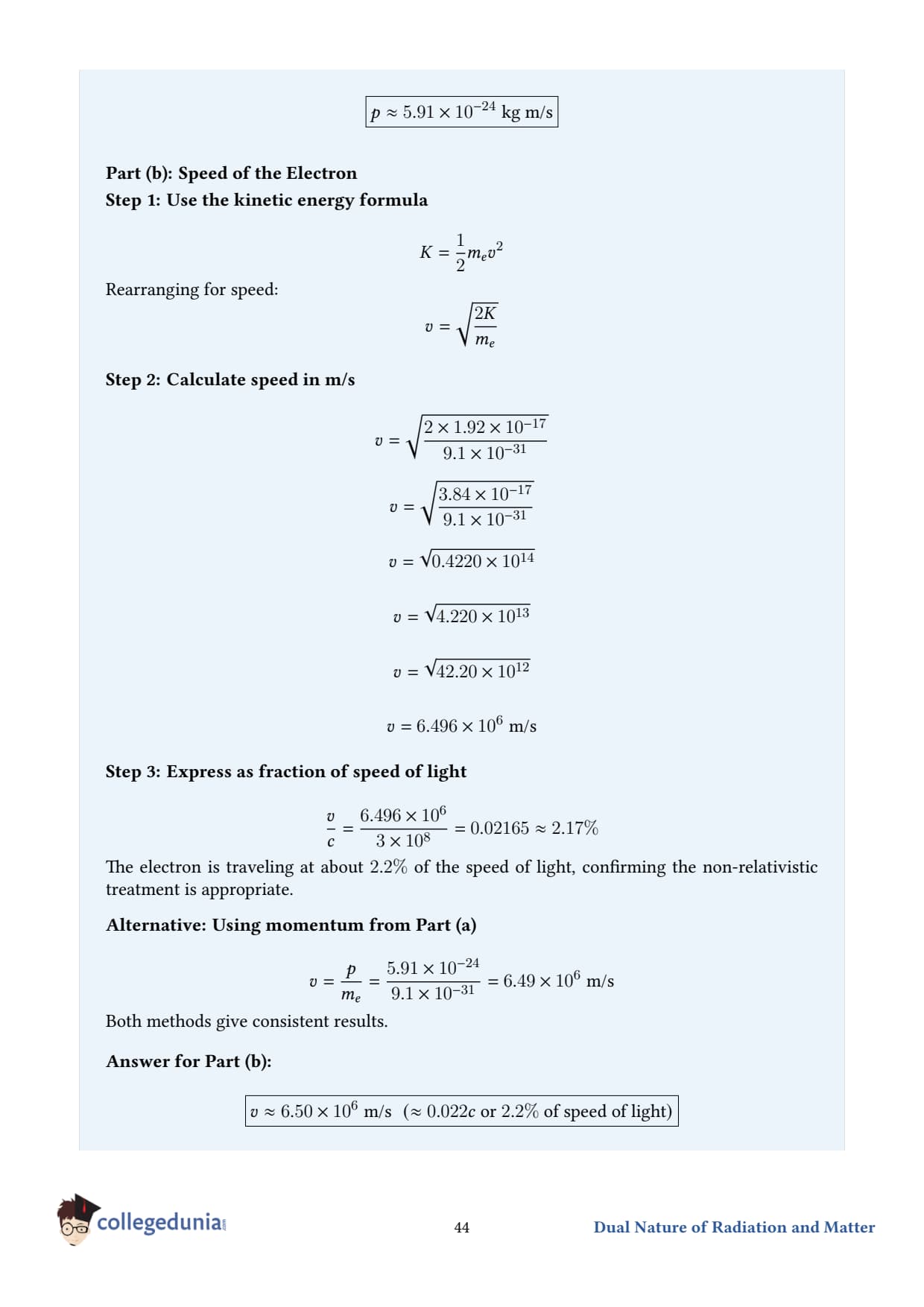
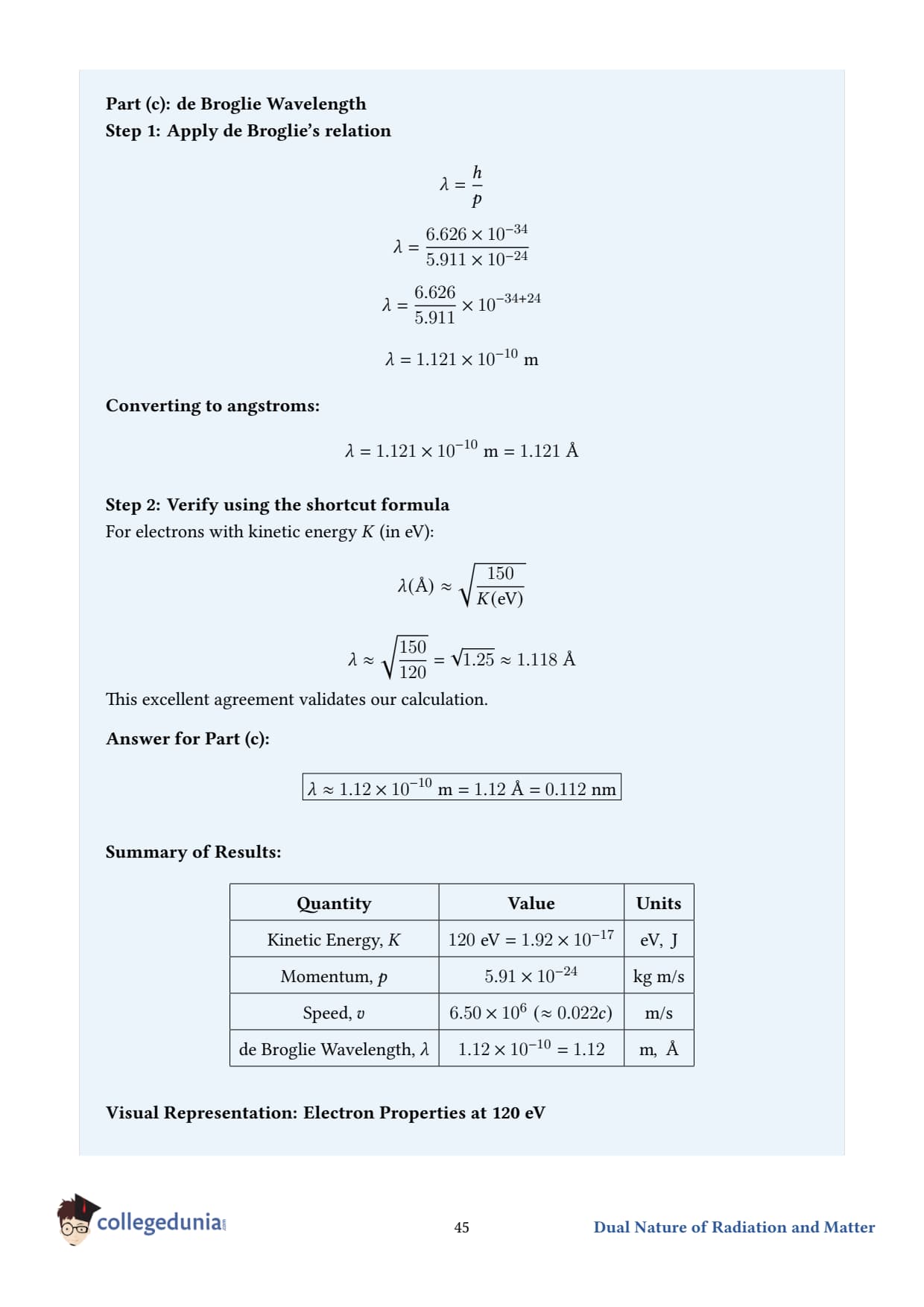
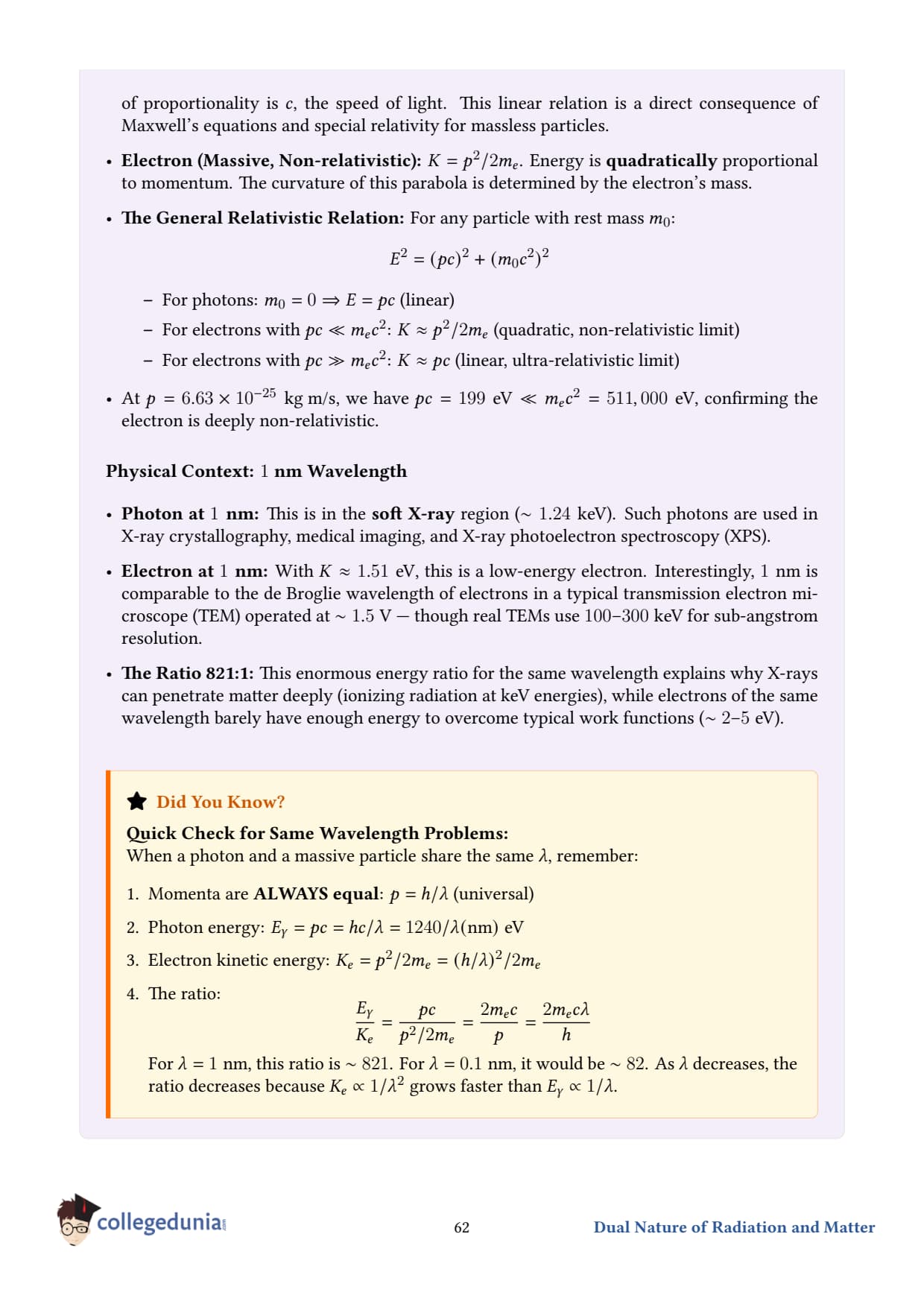
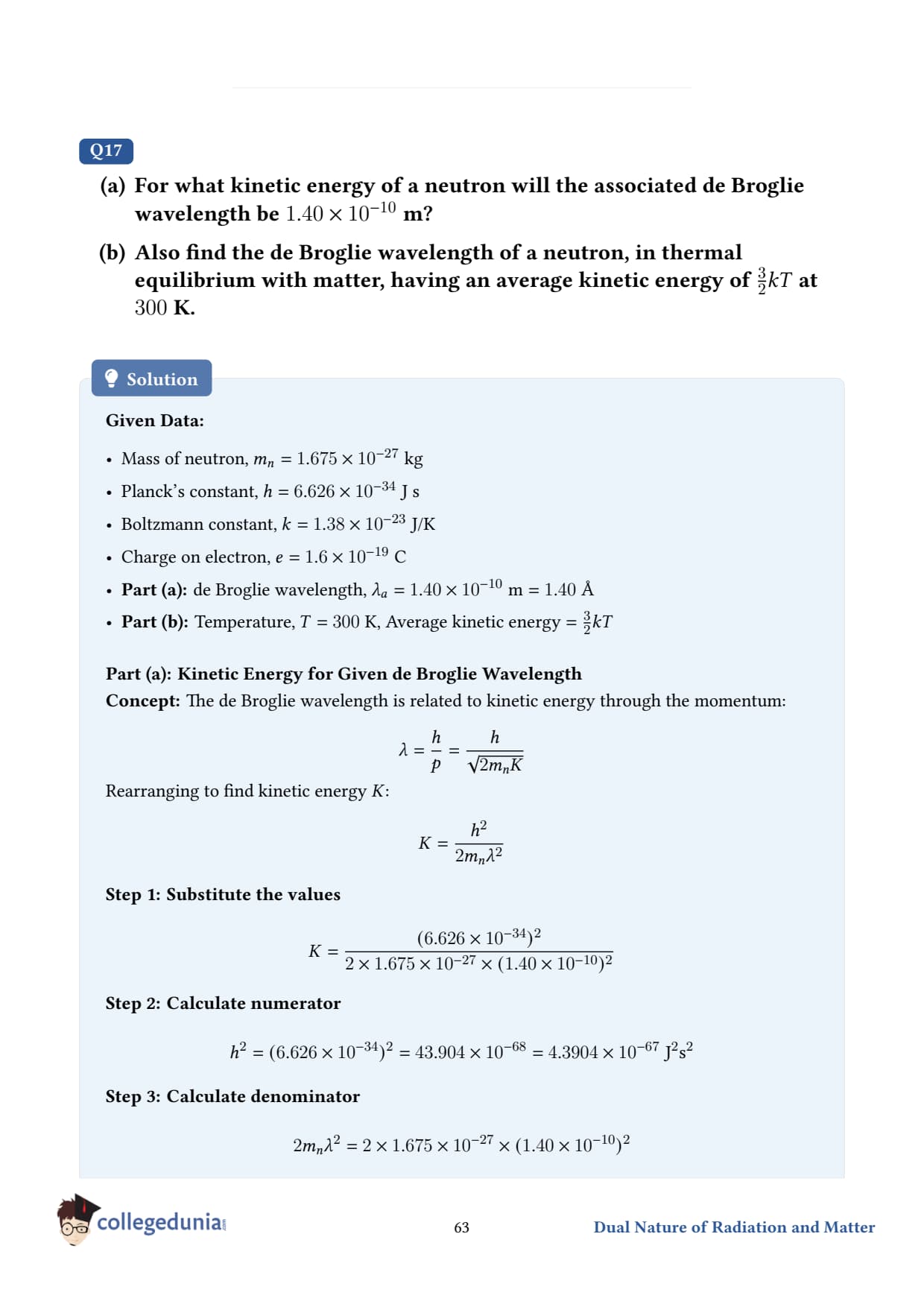
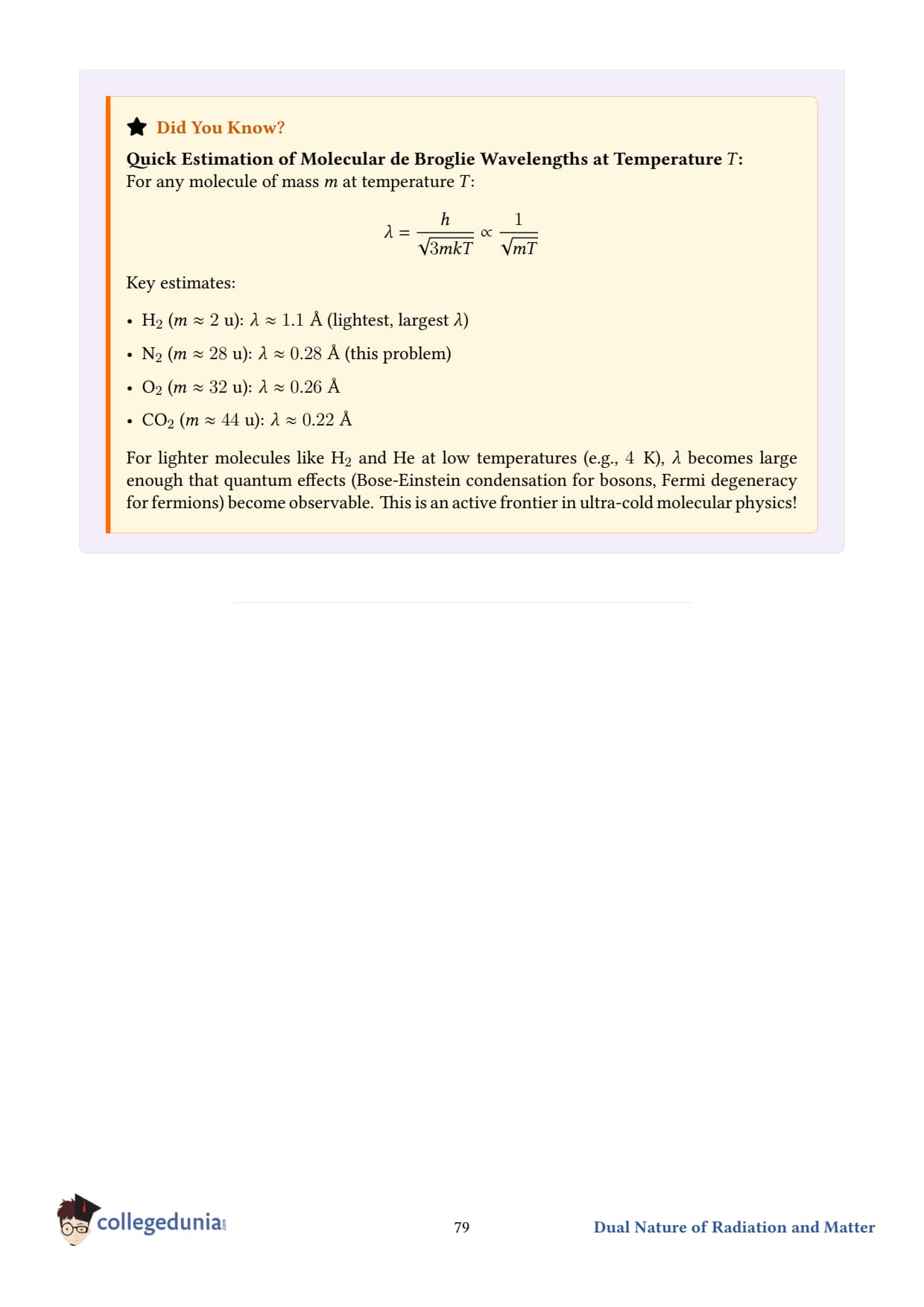
Alternative method — kinetic-energy form. When kinetic energy K is given instead of velocity: p = √2mK λ = h√2mK. For an electron accelerated through V volts: λ = 1.227/√V nm (with V in volts) — a JEE classic.
Common mistake — units of momentum. Use SI: kg, m, s. If you slip a "km/s" or a "gram" in, your wavelength is off by orders of magnitude. Convert before plugging.
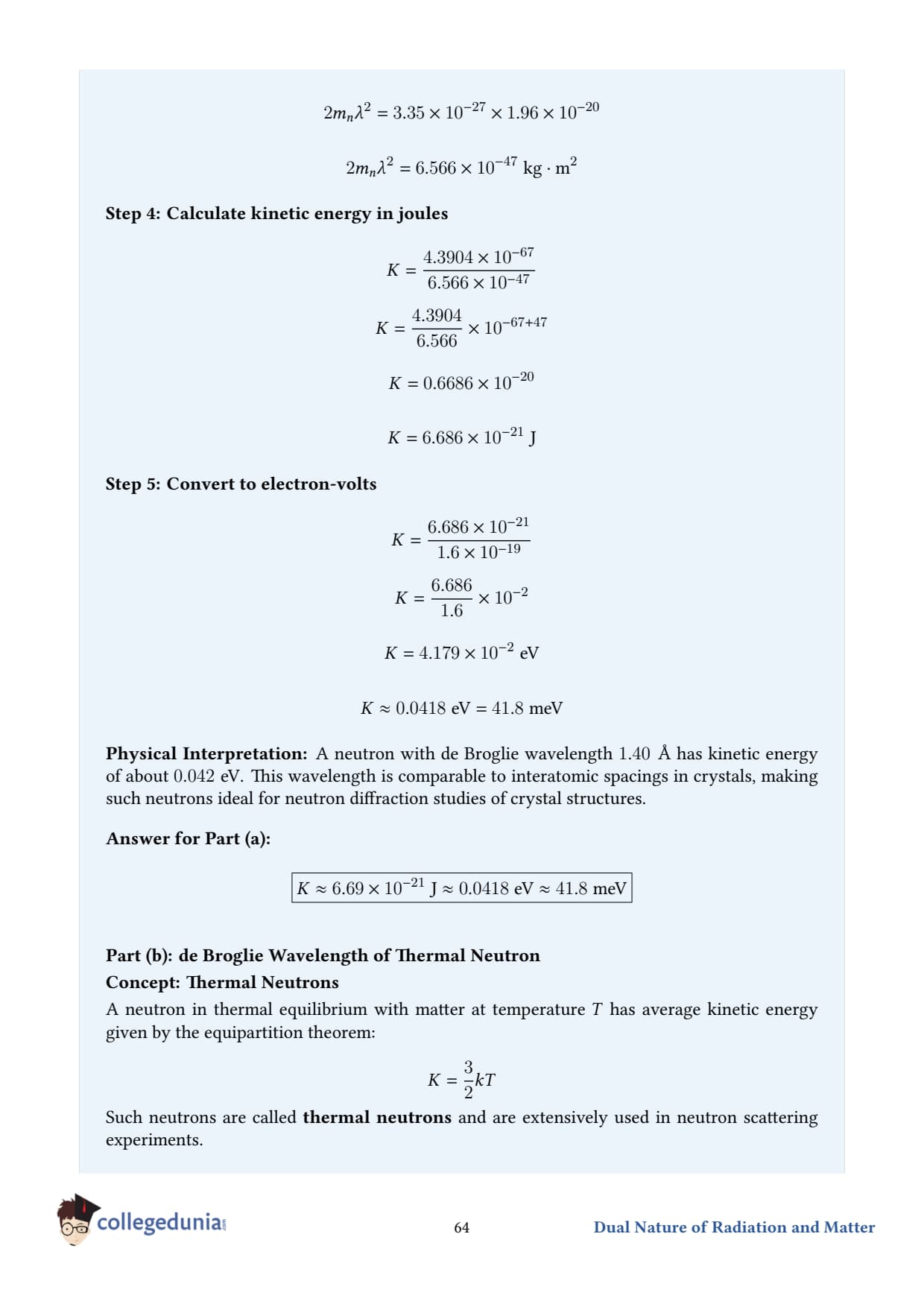
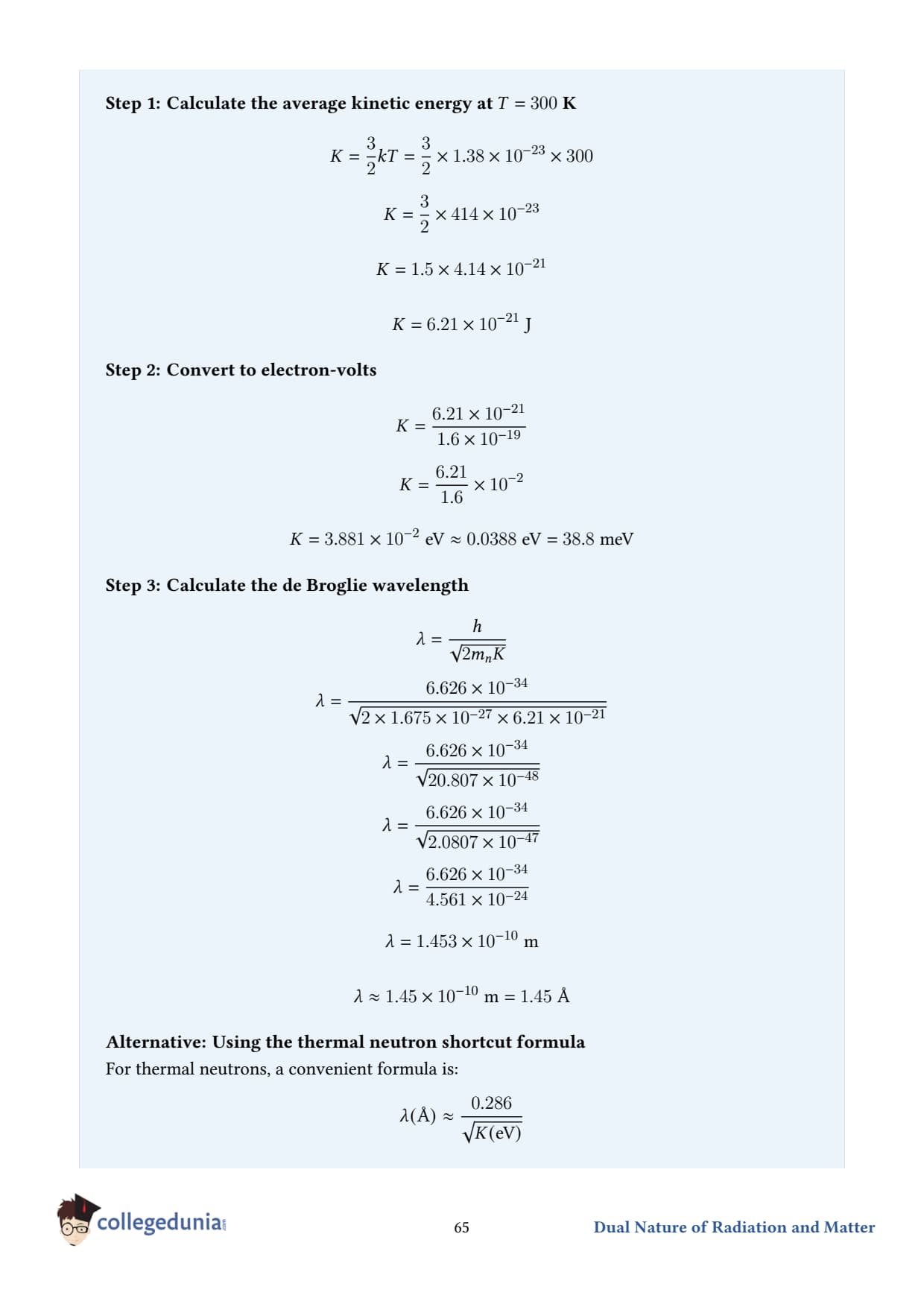
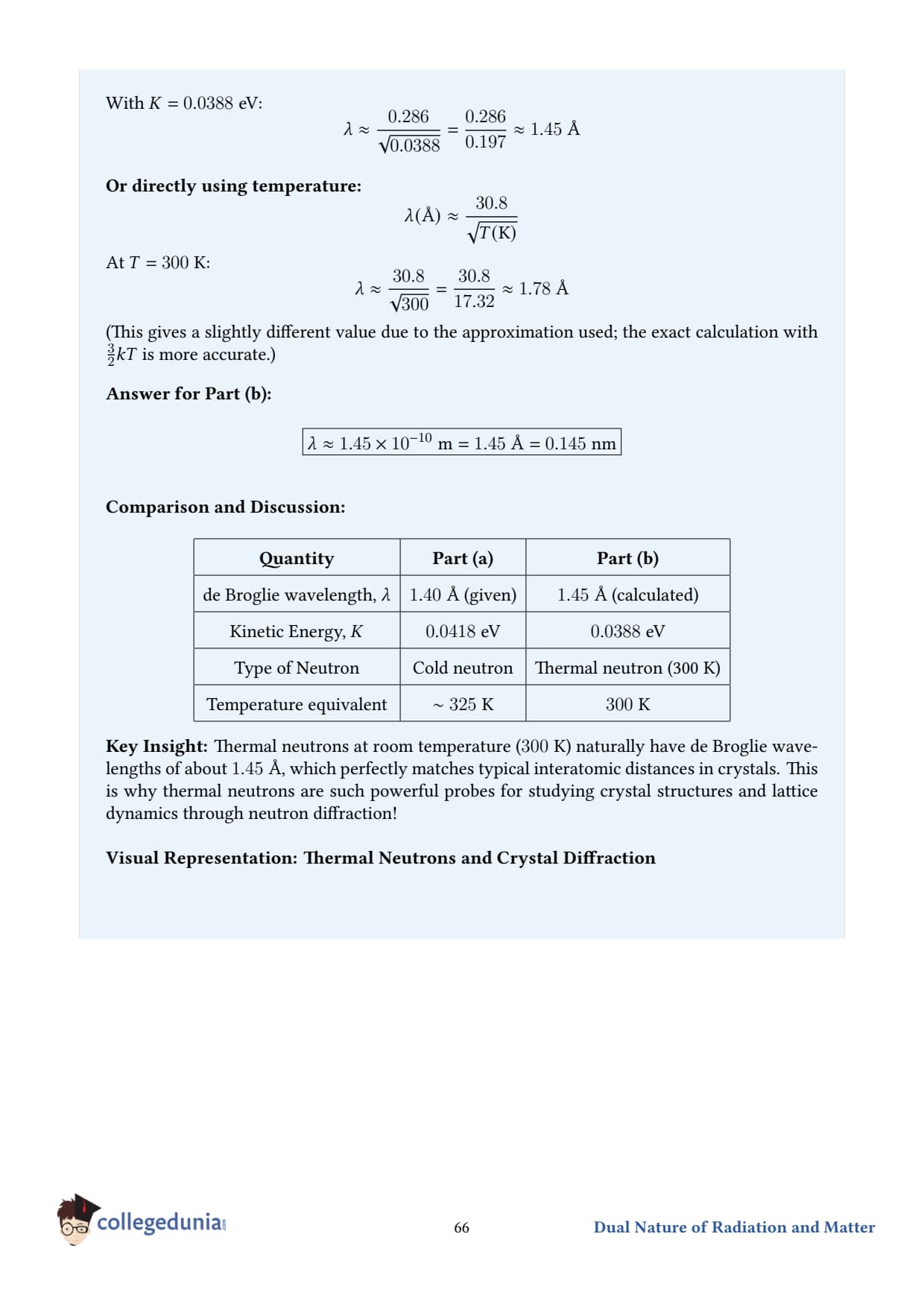
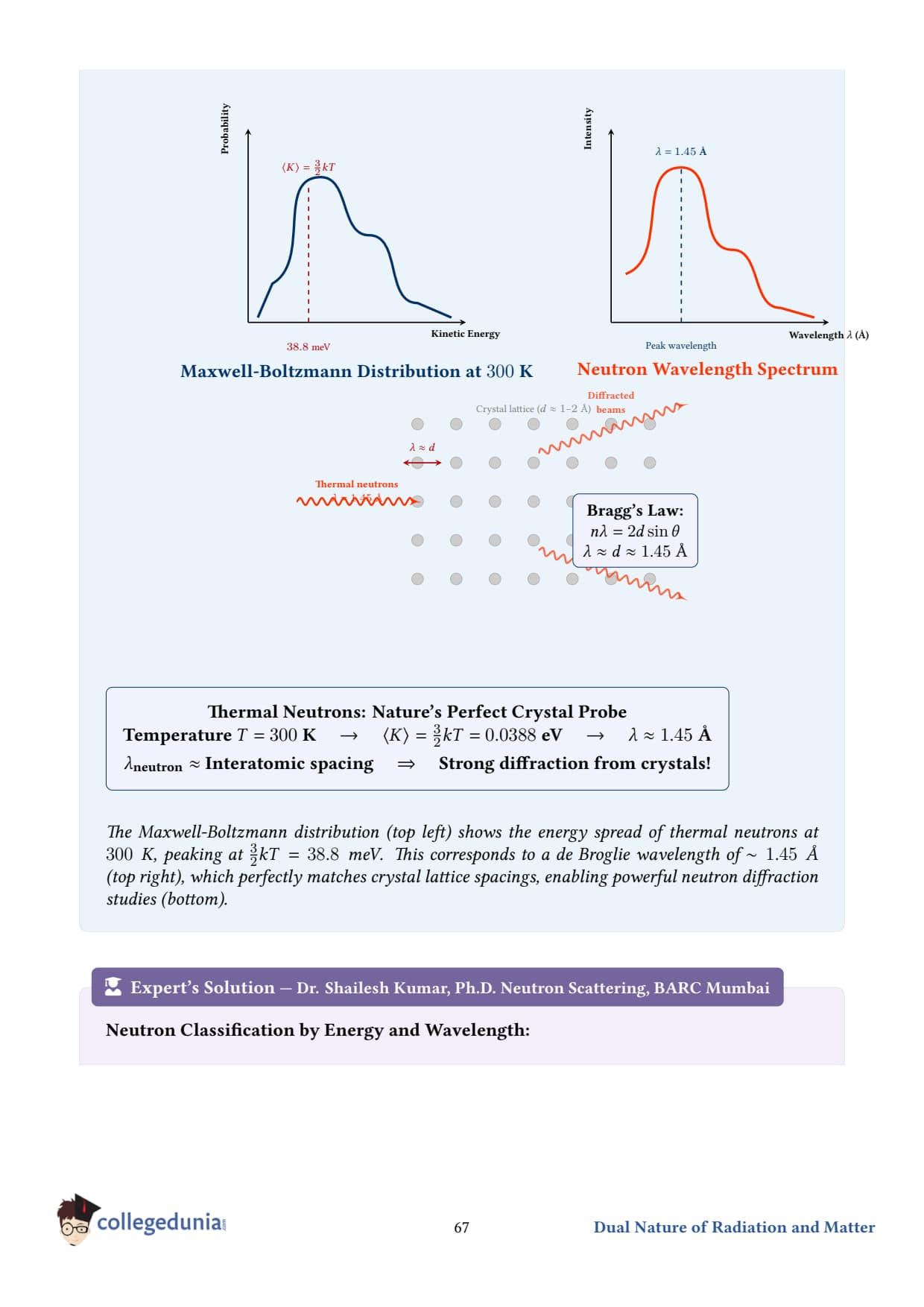
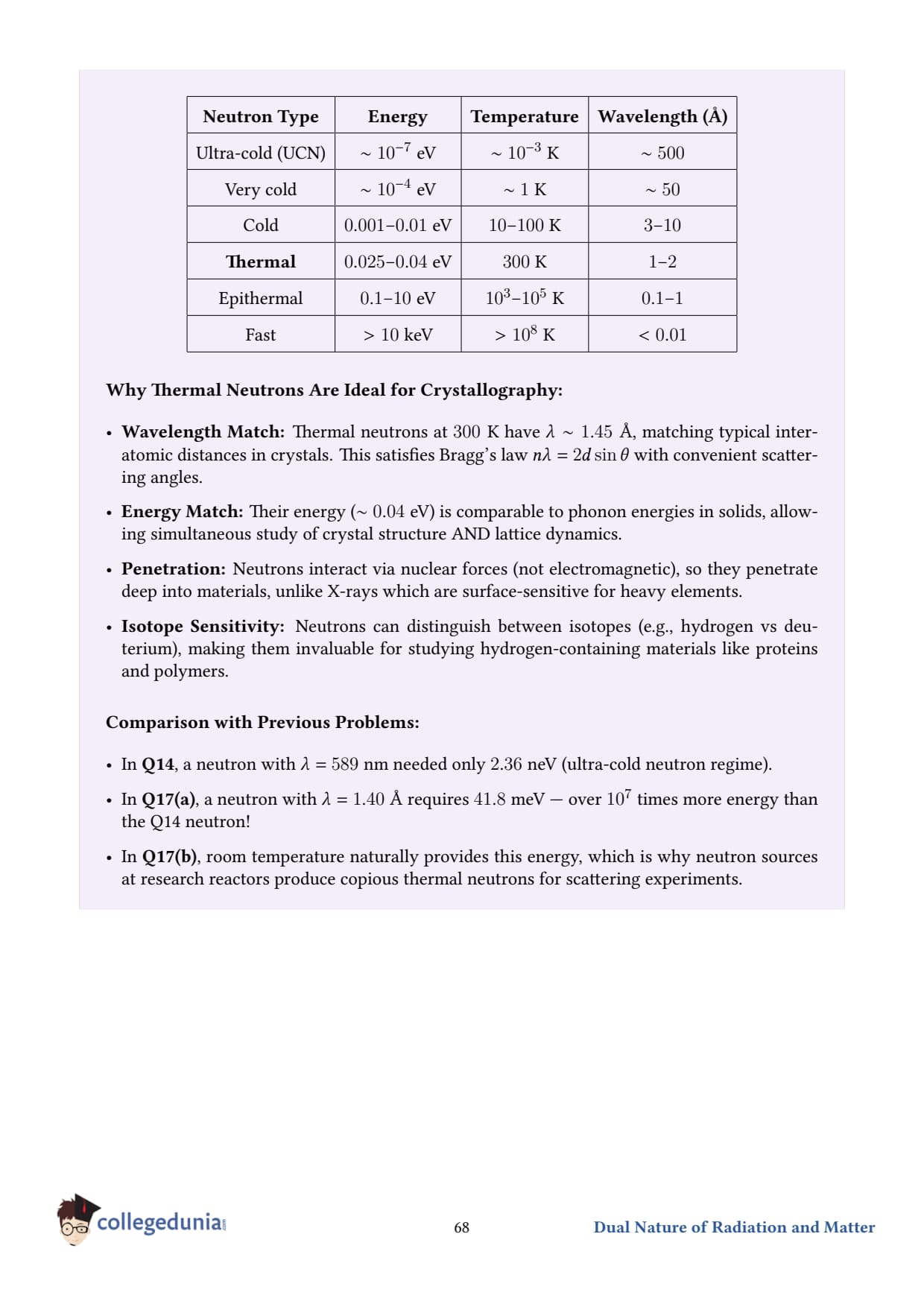
Real-world — when does matter behave as a wave? Electrons mass 9.11× 10⁻³¹ kg at 100 eV have λ ≈ 0.12 nm — comparable to atomic spacings. That's why electron diffraction (Davisson–Germer, 1927) confirmed de Broglie's hypothesis and why electron microscopes resolve ∼ 0.1 nm features. Neutron diffraction (used in materials research) similarly works because neutrons at thermal energies have λ ∼ 0.1 nm. Even fullerenes (C₆₀ molecules) have shown matter-wave interference in lab experiments.
Q 11.11
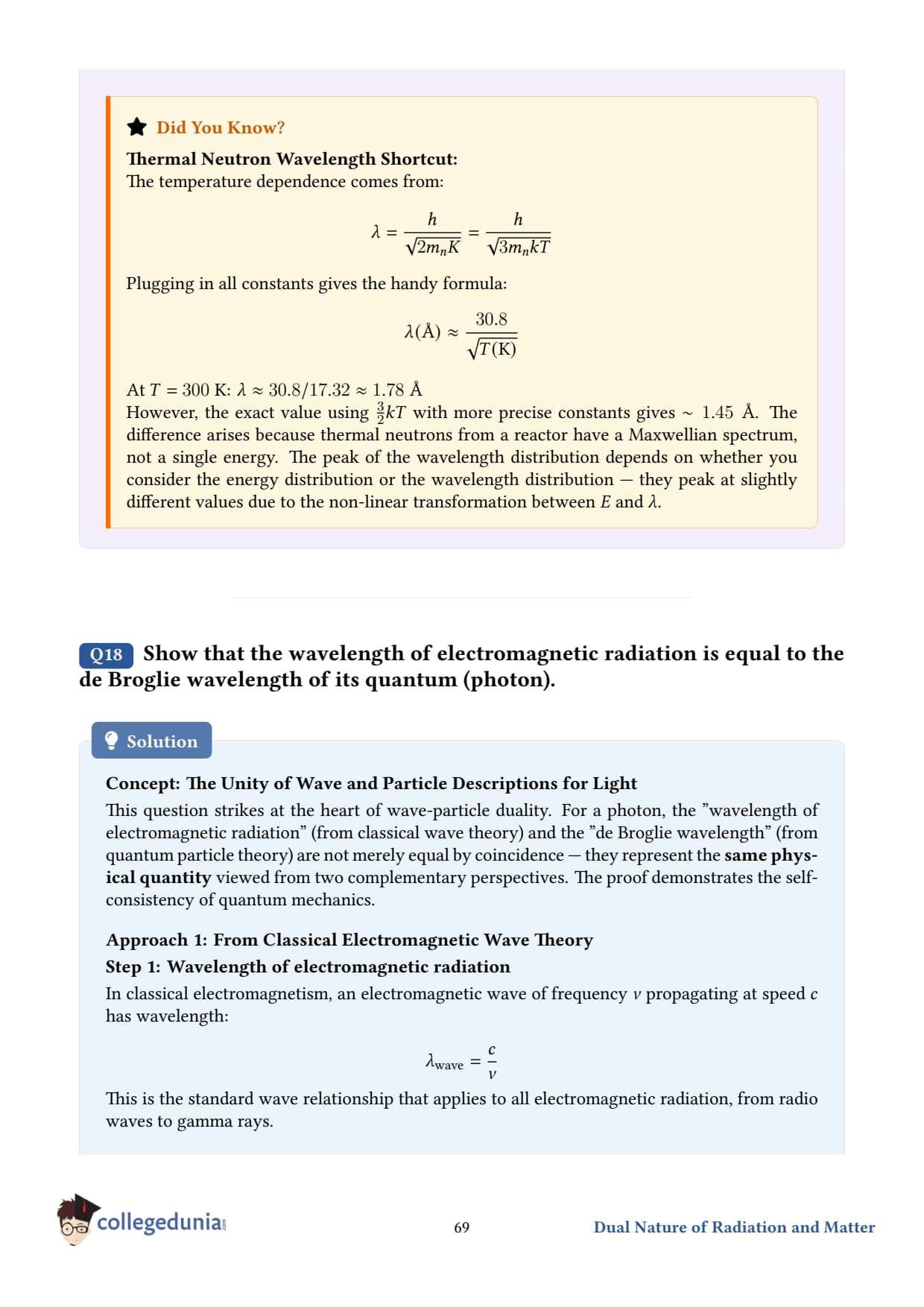
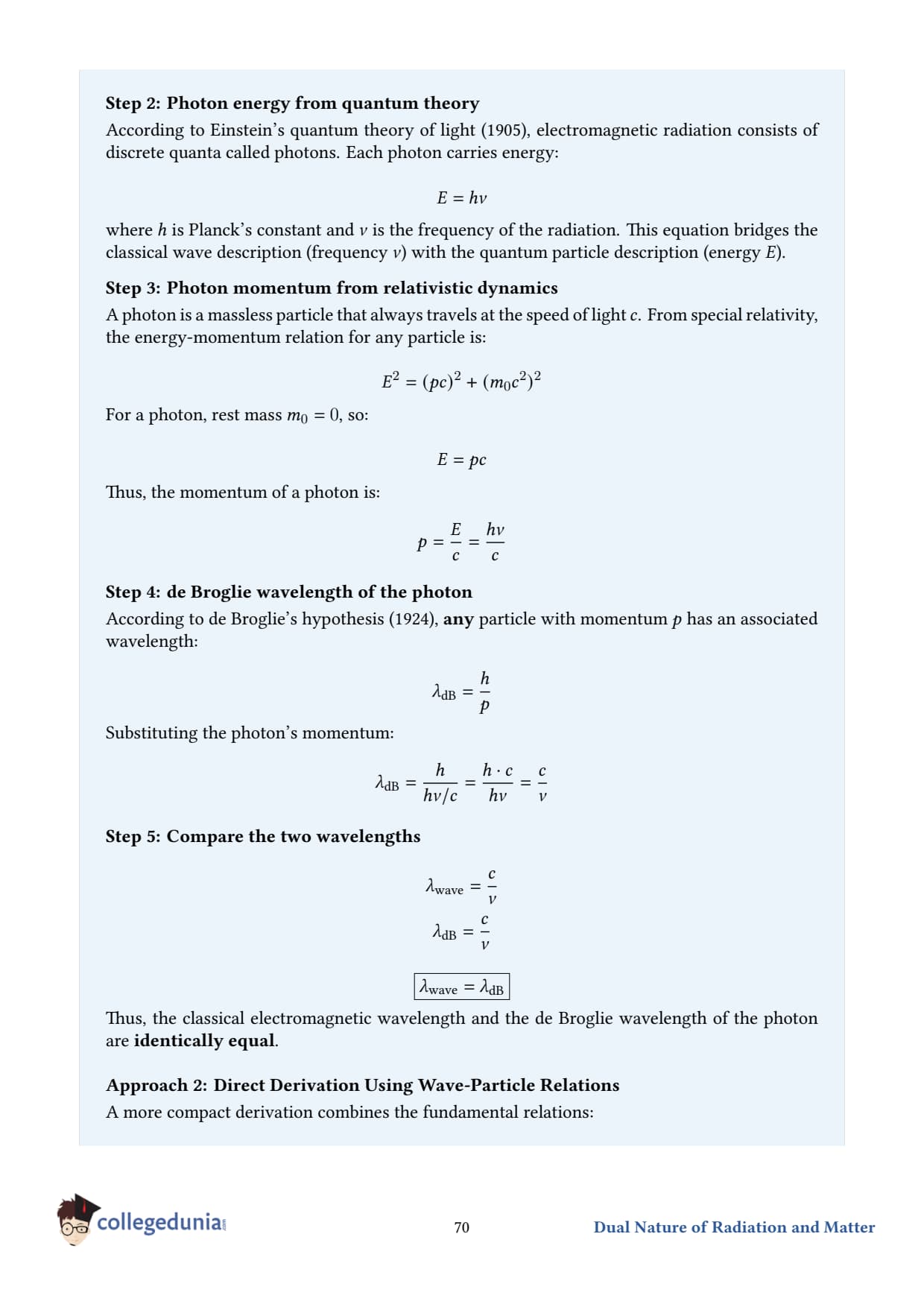
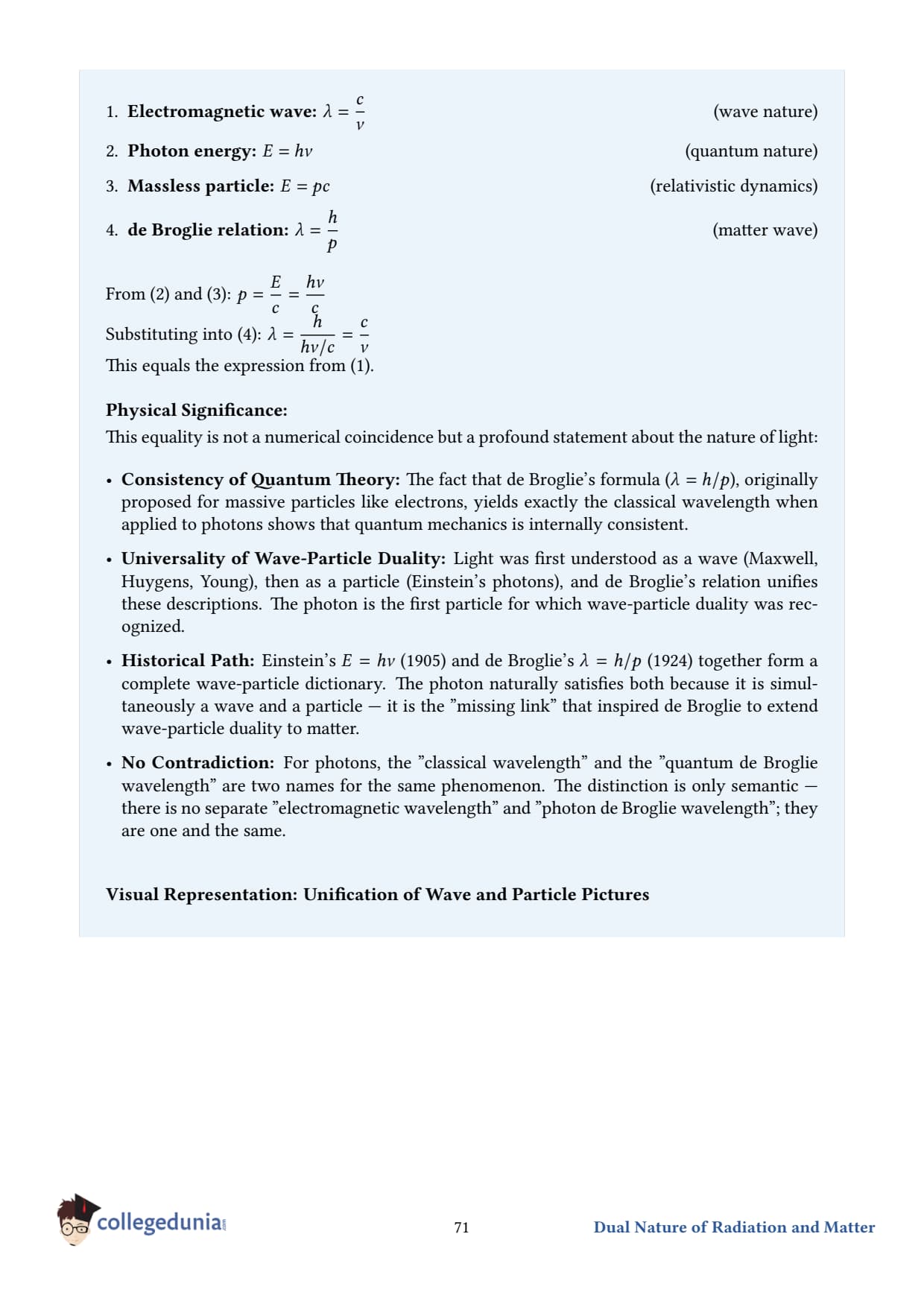
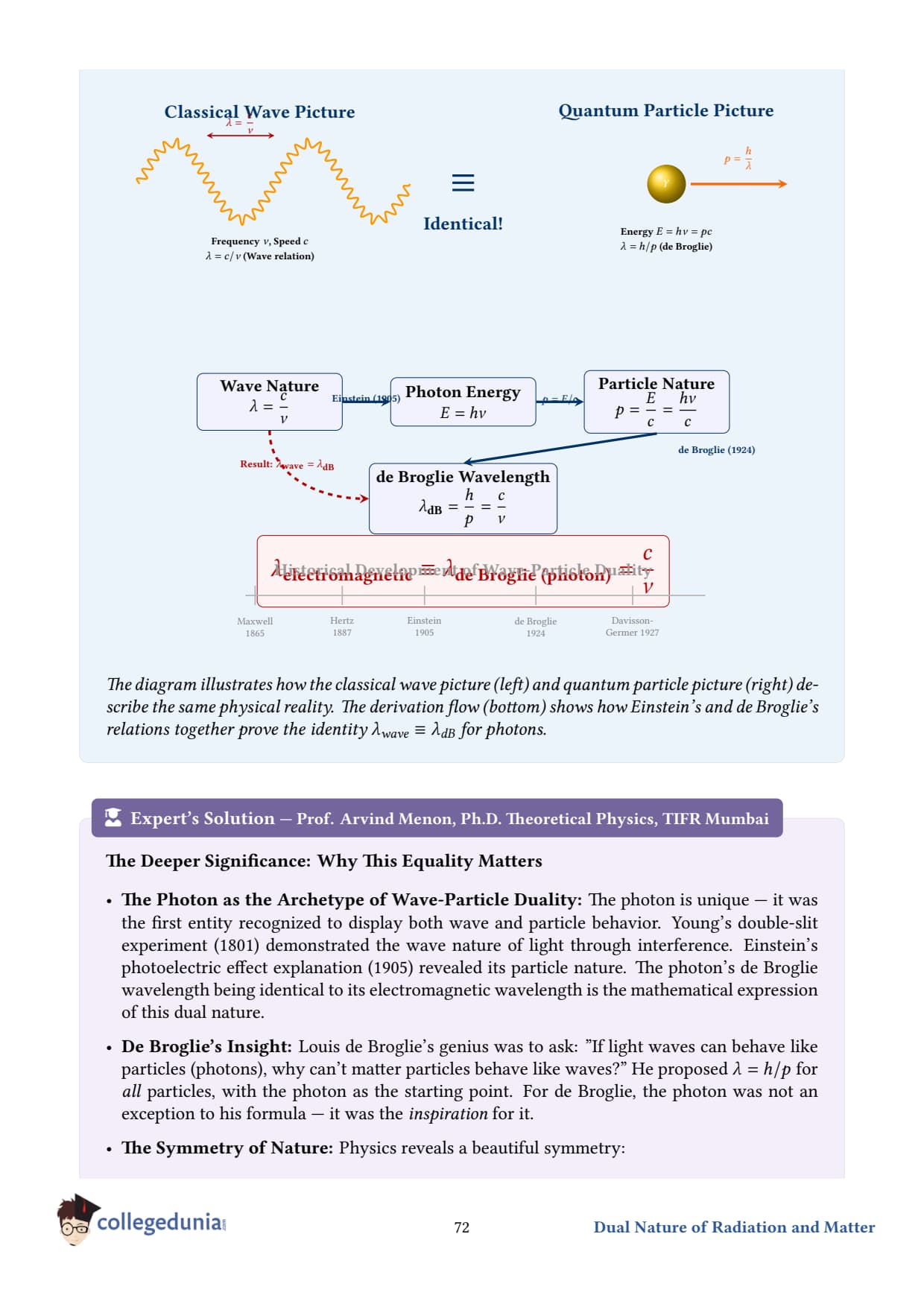
Show that the wavelength of electromagnetic radiation is equal to the de Broglie wavelength of its quantum (photon).
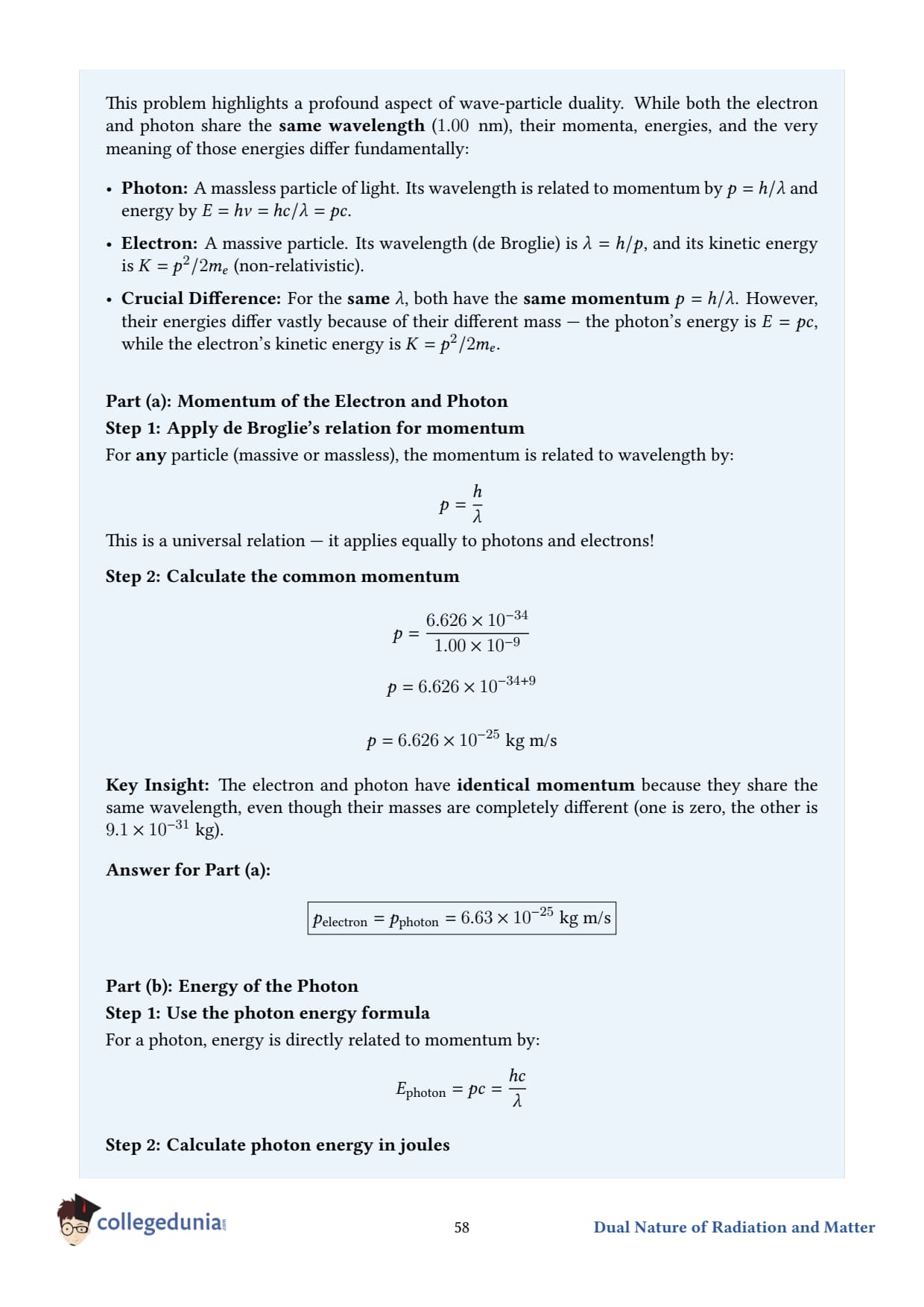
What we have to prove. For a photon, the wavelength λ of the underlying electromagnetic wave (the "ordinary" wavelength of the light) is the same as the de Broglie wavelength dB = h/p computed from its momentum.
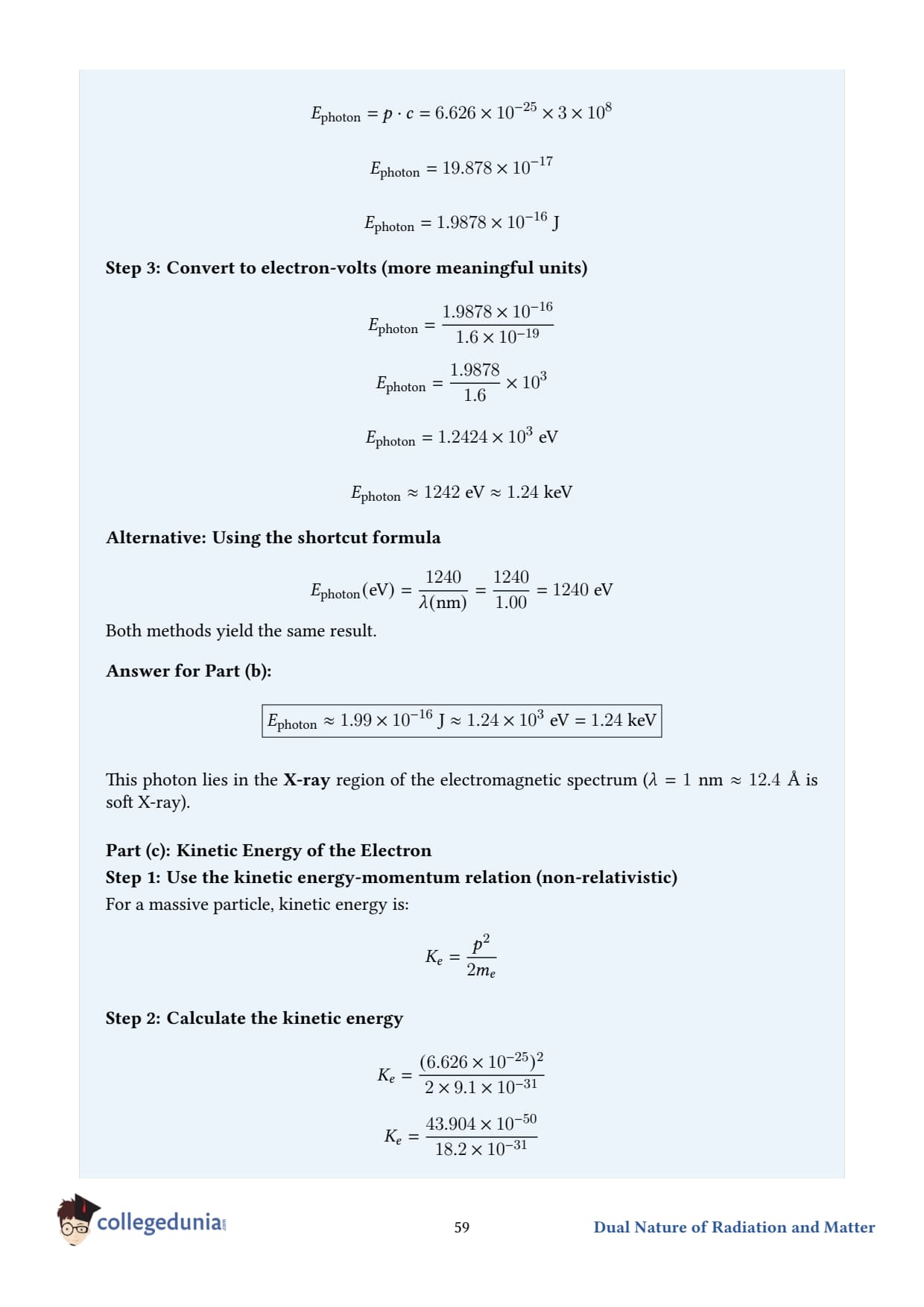
Step 1 — photon energy. For an EM wave of frequency ν, Planck/Einstein says each photon carries E = hν. Using c = λ, we can also write E = hcλ.
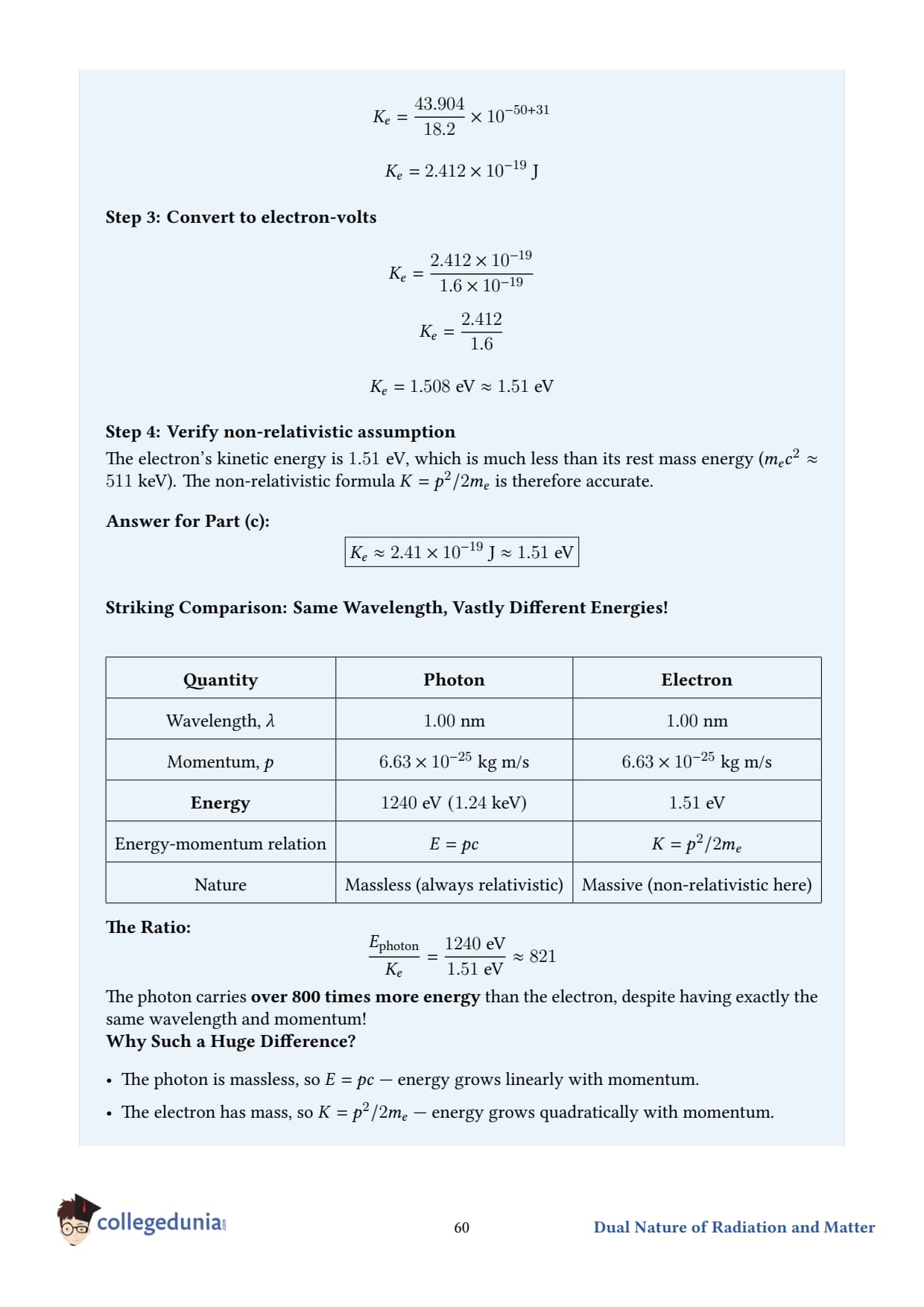
Step 2 — photon momentum. Photons are massless particles travelling at c. Relativity gives the general energy–momentum relation: E2 = (pc)2 + (m c2)2. Setting m = 0: E = pc p = Ec.
Step 3 — substitute the photon energy expression.p = Ec = hνc = hνλ = hλ.
Step 4 — write the de Broglie wavelength of the photon. By definition, dB = hp.
Step 5 — substitute the photon momentum from Step 3.dB = hh/λ = λ.
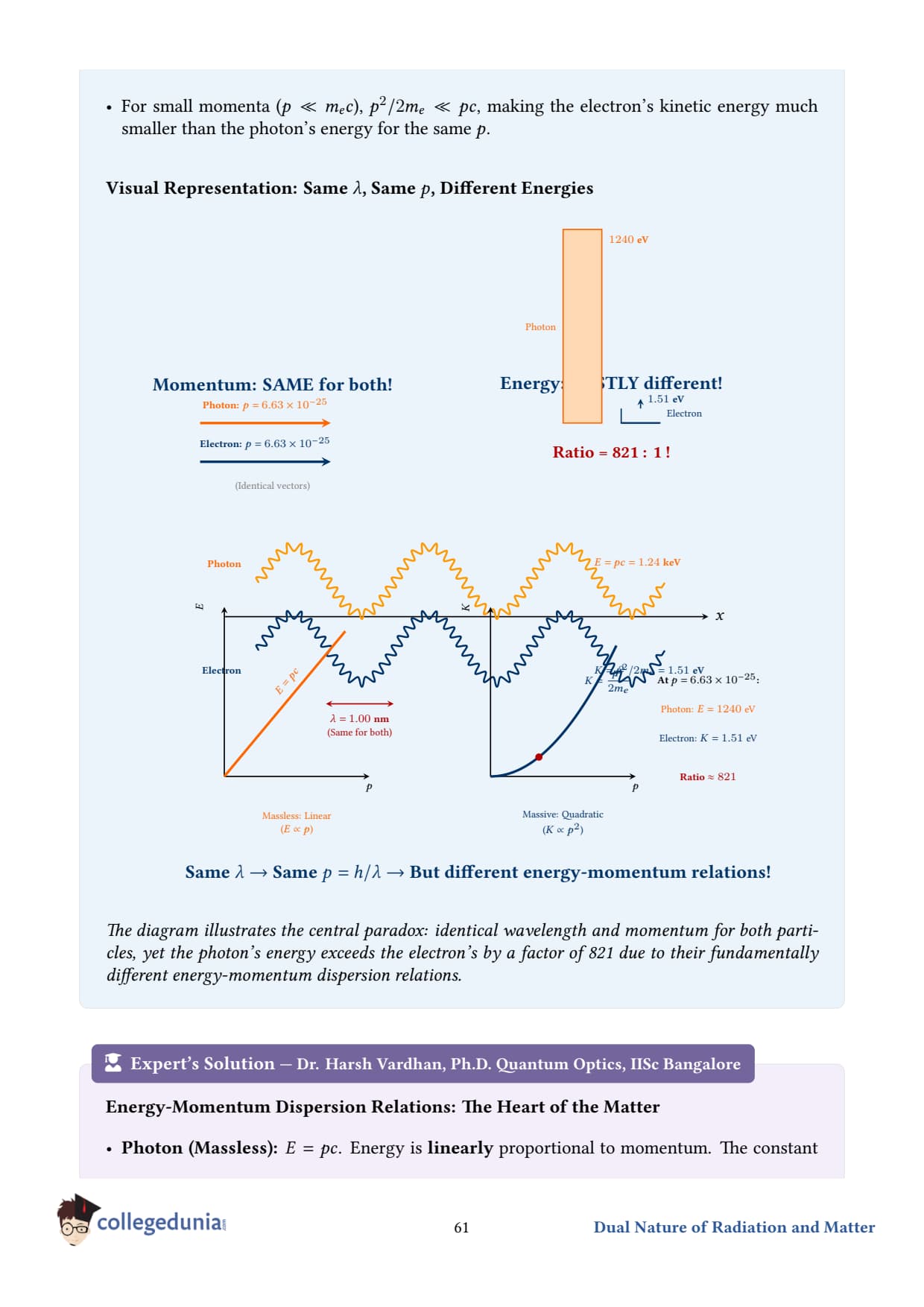
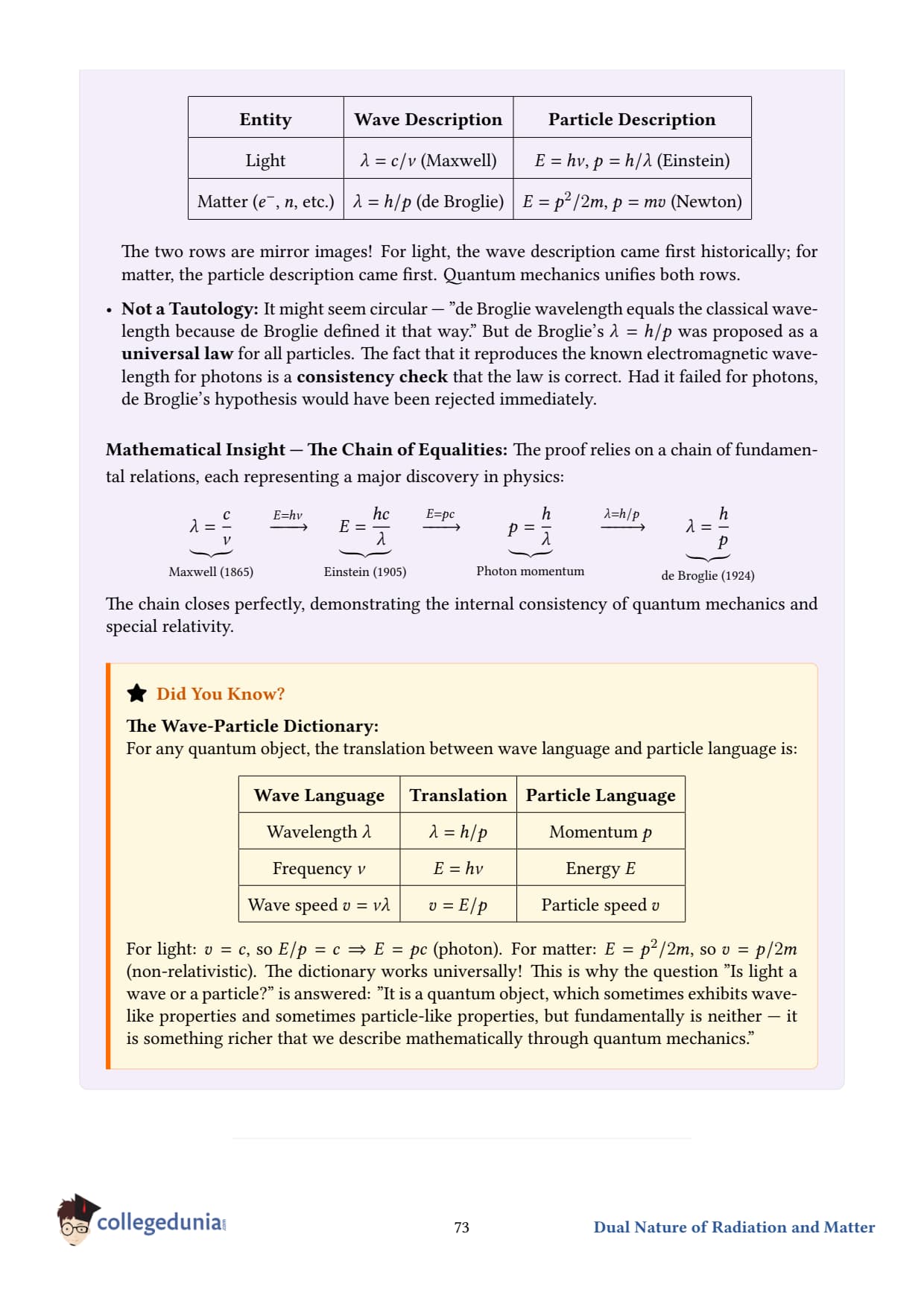
Conclusion.dB = λ - the de Broglie wavelength of a photon equals the EM wavelength of its parent radiation. This is the consistency check: the wave-particle dual description of light agrees with itself. The de Broglie hypothesis is not an extra postulate for photons — it reproduces the known wavelength of light.
DS
Dr. Shalini Menon
M.Sc Physics, University of Hyderabad
Verified Expert
Insight — why de Broglie went looking for matter waves. De Broglie noticed exactly this consistency: for photons, the "wavelength" and "h/p" coincide. He then asked, "If a known wave (light) has λ = h/p, why shouldn't a known particle (an electron) also have a wave with λ = h/p?" That is the symmetry that led him to predict matter waves in his 1924 PhD thesis. Davisson and Germer (1927) confirmed his prediction by diffracting electrons off a nickel crystal.
Alternative method — start from the photon's effective mass. A photon of energy E has relativistic "mass-equivalent" mrel = E/c2. Its momentum is then p = mrelc = E/c. Substituting E = hν = hc/λ gives p = h/λ — same result, different route.
Common mistake — using p = mc with rest mass. The photon's rest mass is zero, so p ≠ mrestc = 0 (that would be nonsensical). The correct formula is the massless limit of relativistic energy-momentum: E = pc. Always start from E2 = (pc)2 + mc22, then set m = 0.
Real-world — unification of wave and particle. This identity is at the heart of quantum field theory: every "particle" is a quantum of an underlying field, and the field's wavelength is the particle's de Broglie wavelength. For photons, the EM field; for electrons, the Dirac field; for the Higgs boson, the Higgs field. The hypothesis you just proved for light extends to everything in the Standard Model.
Class 12 Physics Chapter 11 Dual Nature of Radiation and Matter NCERT Solutions FAQs
Ques. What are the main topics in dual nature of radiation and matter class 12 ncert solutions?
Ans. The class 12 dual nature ncert solutions cover electron emission, the photoelectric effect, Einstein's photoelectric equation, stopping potential, the wave nature of matter, de Broglie wavelength, and the Davisson-Germer experiment.
Ques. What is Einstein's photoelectric equation in class 12 dual nature ncert solutions?
Ans. h nu = phi_0 + (1/2) m v_max squared. Photon energy h nu equals work function phi_0 plus maximum kinetic energy of emitted electrons. The class 12 physics ch 11 ncert solutions derive this from energy conservation.
Ques. How is de Broglie wavelength derived in chapter 11 physics class 12 ncert solutions?
Ans. Starting from Einstein's E = m c squared and E = h nu = h c / lambda, equate to get p = h / lambda. For a particle, p = m v, so lambda = h / (m v). The class 12 dual nature ncert solutions on this page walk through this from first principles.
Ques. What is stopping potential in ch 11 physics class 12 ncert solutions?
Ans. Minimum negative potential applied to the collector that stops the most energetic photoelectrons. eV_0 = (1/2) m v_max squared = h nu minus phi_0. Independent of light intensity; depends linearly on frequency.
Ques. What is threshold frequency?
Ans. The minimum frequency of incident light needed to release photoelectrons: nu_0 = phi_0 / h. Below this frequency, no electrons are emitted no matter how intense the light. Different metals have different threshold frequencies.
Ques. How many exercises are in physics class 12 ch 11 ncert solutions?
Ans. The 2026-27 NCERT carries 11 back exercises plus 5 in-text solved examples. The class 12 physics chapter 11 ncert solutions on this page cover every back-exercise.
Ques. What is the weightage of dual nature of matter class 12 in CBSE?
Ans. Chapter 11 carries 4 marks in CBSE Class 12 Physics. JEE Main draws 2 to 3 percent (consistent annual coverage), and NEET pulls 1 to 2 questions every year.
Ques. Where can I download the class 12 dual nature ncert solutions PDF?
Ans. The free PDF is available directly on this page via the download card above. Both Normal and HD versions cover every back-exercise plus the Einstein photoelectric and de Broglie derivations.
Ques. What is the photoelectric effect?
Ans. The emission of electrons from a metal surface when light of sufficient frequency is incident on it. Discovered by Hertz in 1887; explained by Einstein in 1905 via the photon model, which earned him the 1921 Nobel Prize in Physics.
Ques. What is the de Broglie wavelength?
Ans. The wavelength associated with a moving particle: lambda = h / p = h / (m v). Proposed by Louis de Broglie in 1924; confirmed experimentally by the Davisson-Germer electron-diffraction experiment in 1927. Establishes the wave nature of matter.
Ques. What is the work function?
Ans. The minimum energy required to release an electron from a metal surface. Denoted phi_0; typical values are 2 to 5 eV for common metals (sodium 2.28 eV, copper 4.7 eV, platinum 5.65 eV). Equals h times the threshold frequency: phi_0 = h nu_0.







Comments