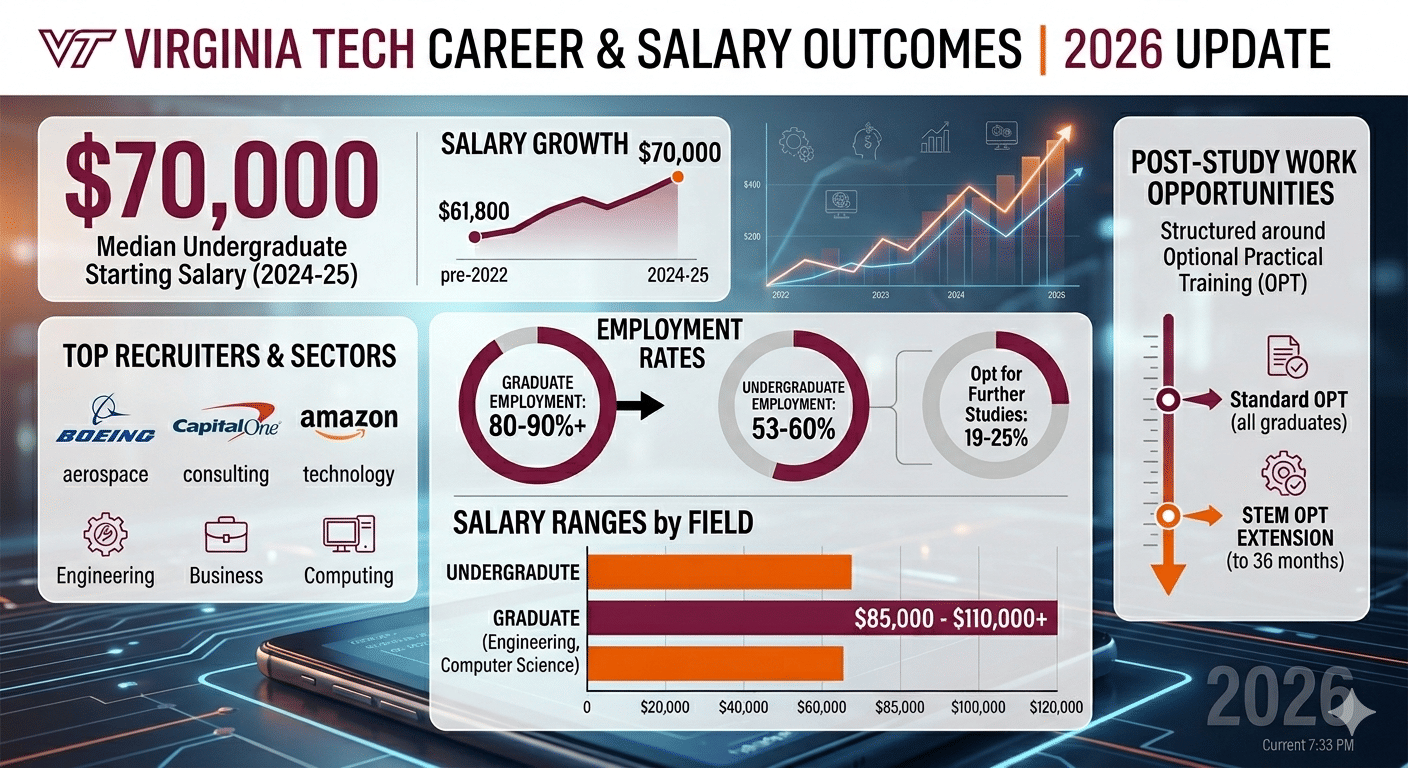
Virginia Tech reports median starting salaries of around $70,000 | ₹66.66 Lakhs (2024–25). The top Recruiters show consistent hiring from sectors such as aerospace, consulting, and technology. Companies like Boeing, Capital One, and Amazon are actively recruiting across engineering, business, and computing roles at Virginia Tech.
- Graduate-level salaries (especially in Engineering and Computer Science) typically range between $85,000–$110,000+ | ₹80.95-₹104.75+ Lakhs.
- Median salaries have increased steadily from about $61,800 | ₹58.85 Lakhs (pre-2022) to recent higher levels.
- Undergraduate employment rate (survey-based) is around 53–60%
- About 19–25% of undergraduate students opt for further studies instead of immediate employment.
- Graduate employment outcomes are significantly higher, with 80–90%+ placed in full-time roles or postdoctoral positions.
Post-study work opportunities are structured around Optional Practical Training (OPT) for all graduates. OPT is extendable to 36 months for STEM fields.
Learn about the Indian students' guide to studying in the US
![Infographic titled “Career & Salary Outcomes | 2026 Update” for Virginia Tech highlighting graduate outcomes. It shows a median undergraduate starting salary of $70,000 with growth from $61,800 pre-2022 to $70,000 in 2024–25. Top recruiters include Boeing, Capital One, and Amazon across sectors like aerospace, consulting, and technology. Employment rates are shown as 80–90%+ for graduates and 53–60% for undergraduates, with 19–25% pursuing further studies. Salary ranges indicate undergraduate earnings around $65,000–$70,000 and graduate (Engineering/Computer Science) salaries of $85,000–$110,000+. A side panel explains post-study work options through Optional Practical Training (OPT), including standard OPT and STEM OPT extension up to 36 months.]()
Virginia Tech Median Salary 2026
Virginia Tech University publishes its First Destination Survey outcomes every year. It surveys how the Virginia Tech students' careers turn out after graduation.
- Undergraduate full-time employment rate (2024): 53–60%
- 19–25% of students pursue further studies after graduation
- Around 20–25% students are still seeking jobs at the time of the survey
- Overall median starting salary: $70,000 | ₹66.66 Lakhs
- Engineering graduates earn higher medians: $75,000–$90,000+ | ₹71.42- ₹85.71+ Lakhs (varies by major like Computer/Aerospace)
Median salaries have improved consistently over the years. Growth driven by demand in Engineering, Computer Science, and Business fields. Engineering consistently reports the highest salary outcomes.
| Year |
Median Starting Salary (Full-time employed) |
Notes |
| 2024–2025 |
$70,000
(₹66.66 Lakhs)
|
Latest available
(mean ~$69,739 | ₹66.41 Lakhs)
|
| 2023–2024 |
~$68,000 – $70,000 range
(₹64.76-₹66.66 Lakhs)
|
Strong outcomes, especially in Engineering |
| 2022–2023 |
Around $65,000 – $68,000
(₹61.90-₹64.76 Lakhs)
|
Continued growth post-pandemic |
| Older (pre-2022) |
$61,800 (₹58.85 Lakhs) |
Steady upward trend |
Check out the popular courses and fees at Virginia Tech
Virginia Tech University Top Recruiters 2026
Students from the College of Engineering, the Pamplin College of Business, and the Computer Science major are hired by top industry recruiters such as Boeing, Capital One, and Deloitte.
- Common roles across industries include Aerospace Engineer, Systems Engineer, Software Engineer, Consulting, and Assurance.
- Hiring spans engineering, technology, and business-related functions.
- The university also employs graduates in roles like Graduate Assistant and Research Associate.
As per the official First Destination Reports, the top companies recruiting Virginia Tech graduates include:
| Recruiter |
Main Programs / Colleges They Hire From |
Common Roles |
| Boeing |
College of Engineering
(Aerospace, Mechanical, Electrical, Computer, Industrial, Systems)
|
Aerospace Engineer, Systems Engineer, Stress Engineer, Manufacturing Engineer, Software Engineer, Supply Chain, Operations |
| Northrop Grumman |
College of Engineering + some Cyber/Computer Science |
Systems Engineer, Mission Systems Engineer, Software Engineer, Electronics Engineer, Cybersecurity roles |
| HII / Newport News Shipbuilding |
College of Engineering
(Aerospace, Mechanical, Electrical, Civil, Nuclear)
|
Ship Design Engineer, Structural Engineer, Mechanical Engineer, Electrical Engineer, Project Engineer |
| Capital One |
Pamplin College of Business
(Finance, BIT, Marketing) + Computer Science, Data Analytics
|
Software Engineer, Data Analyst, Business Analyst, Technology Analyst, Product Manager, Risk Analyst |
| Accenture, IBM, and Amazon |
Computer Science, Engineering, Business (BIT), Information Technology |
Technology Consultant, Software Developer, Systems Analyst, Digital Transformation roles, Software Development Engineer |
| Deloitte, EY (Ernst & Young), and PwC |
Pamplin College of Business, Accounting, Finance, Computer Science, Engineering, Economics |
Assurance, Consulting (Technology Risk, Cybersecurity), Tax, Advisory Analyst, Audit |
| CACI |
Engineering (especially Computer/Electrical), Computer Science, Cyber |
Systems Engineer, Software Developer, Cybersecurity Analyst, Intelligence Analyst |
| Virginia Tech (itself) |
Research, admin, or entry-level staff |
Graduate Assistant, Research Associate, Administrative roles, Instructor |
Check out the admission process at Virginia Tech
Virginia Tech Graduate Career Outcomes
As per the Virginia Tech Graduate Exit Survey, after graduation, Virginia Tech students get better income options than post-undergraduation.
- Employment Rate: Typically, 80–90%+ of graduate respondents report being employed full-time or in postdoctoral positions shortly after graduation.
- Salaries: Graduate-level salaries are significantly higher than undergraduate. It ranges from $85,000 – $110,000+ (₹80.95-₹104.75+ Lakhs) median for Engineering and CS-related master’s programs.
The starting salary after graduating from Virginia Tech, and the mean salary is $69,739 (₹66.41 Lakhs) yearly, and the median salary is $70,000 (₹66.66 Lakhs) yearly. Most Virginia Tech University students work in the US after graduation. Over 99.45% students work in the US, the second most popular work location is the UK, with 0.14% of students in total.
Check out the accommodation options at Virginia Tech
Virginia Tech US Working Visa and Jobs
Optional Practical Training (OPT) is the option that all international students get to pursue work in the US. OPT is one year in duration, generally. The students serve OPT after graduating from the university.
- CPT (Curricular Practical Training) allows students to work off-campus during studies.
- Work under CPT must be directly related to the student’s academic program.
- CPT does not reduce the 1-year OPT duration, as long as it is under 12 months. It includes internships, co-ops, and project-based work
- STEM students get a 24-month extension apart from the one-year initial OPT, making the total OPT duration up to 3 years.
Virginia Tech has strong rankings in Engineering (#51–100) and Computer Science (#130) (QS). These fields are commonly aligned with higher recruiter demand and hiring trends.
The US recruiters sponsor the students’ working visa during the OPT duration, via the H1-B lottery system. Virginia Tech itself also sponsors H-1B for faculty/staff, but for students, it depends on the hiring company. H-1B sponsorship is not guaranteed and depends on the lottery system.
Check out the global Rankings of Virginia Tech University
How to Apply for CPT/OPT Jobs At Virginia Tech?
Getting CPT authorization follows from securing a job or internship offer. Then get approval from your academic advisor, confirming the role is related to your program. Finally, submit a CPT request to the Cranwell International Center at international.vt.edu. Once approved, you can legally begin working.
Handshake is Virginia Tech's main career platform. It is the most direct way to find CPT/OPT-eligible roles. Virginia Tech also hosts Career Fairs multiple times a year. The Engineering and Tech fairs in Fall and Spring are particularly active. Many recruiters attending these fairs are open to sponsoring international students.
Top recruiters like Boeing and Northrop Grumman post Intern and Co-op roles directly on their websites. Hokie Hire and department mailing lists are additional sources worth monitoring.
Check out the job opportunities in the US for Indian students
US Job Market for Indian students
Students can start looking for jobs 90 days before the program ends. CPT experience via 1-2 internships during studies significantly improves the chances of getting a full-time job early on. Most full-time offers come to students who already have US work experience.
- VT’s international student office and career advisors note that Defense, aerospace, and government contractors are generally more open to H-1B sponsorship than consumer tech firms.
- Attending career fairs and joining clubs like IEEE or ASME helps improve recruiter visibility.
- Many students rely on 1–3 years of OPT (including STEM extension) while applying.
- Strong outcomes for students with good GPAs, at least one CPT internship, and solid projects.
Typical job search duration is 3–6 months after graduation (with active effort). Using career services and gaining US work experience improves success rates.
Explore which one the Indian students should go for: CPT or OPT
Based on First Destination and Graduate Exit data, Virginia Tech demonstrates stable salary growth, higher graduate employability (80–90%+), and strong recruiter engagement in technical fields. Undergraduate outcomes appear lower in surveys (53–60%), but are influenced by mixed post-graduation paths. Overall outcomes depend on degree type, internship exposure, and post-study work options such as OPT and H-1B sponsorship.










%20-%20Sayantan%20Sarkar.jpeg)
%20-%20Sayantan%20Sarkar.jpeg)
%20-%20Sayantan%20Sarkar.jpeg)
%20-%20Sayantan%20Sarkar.jpeg)
%20-%20Sayantan%20Sarkar.jpeg)
%20-%20Sayantan%20Sarkar.jpeg)











Comments