


Education Journalist | Study Abroad Strategy Lead | Updated On - Mar 11, 2026
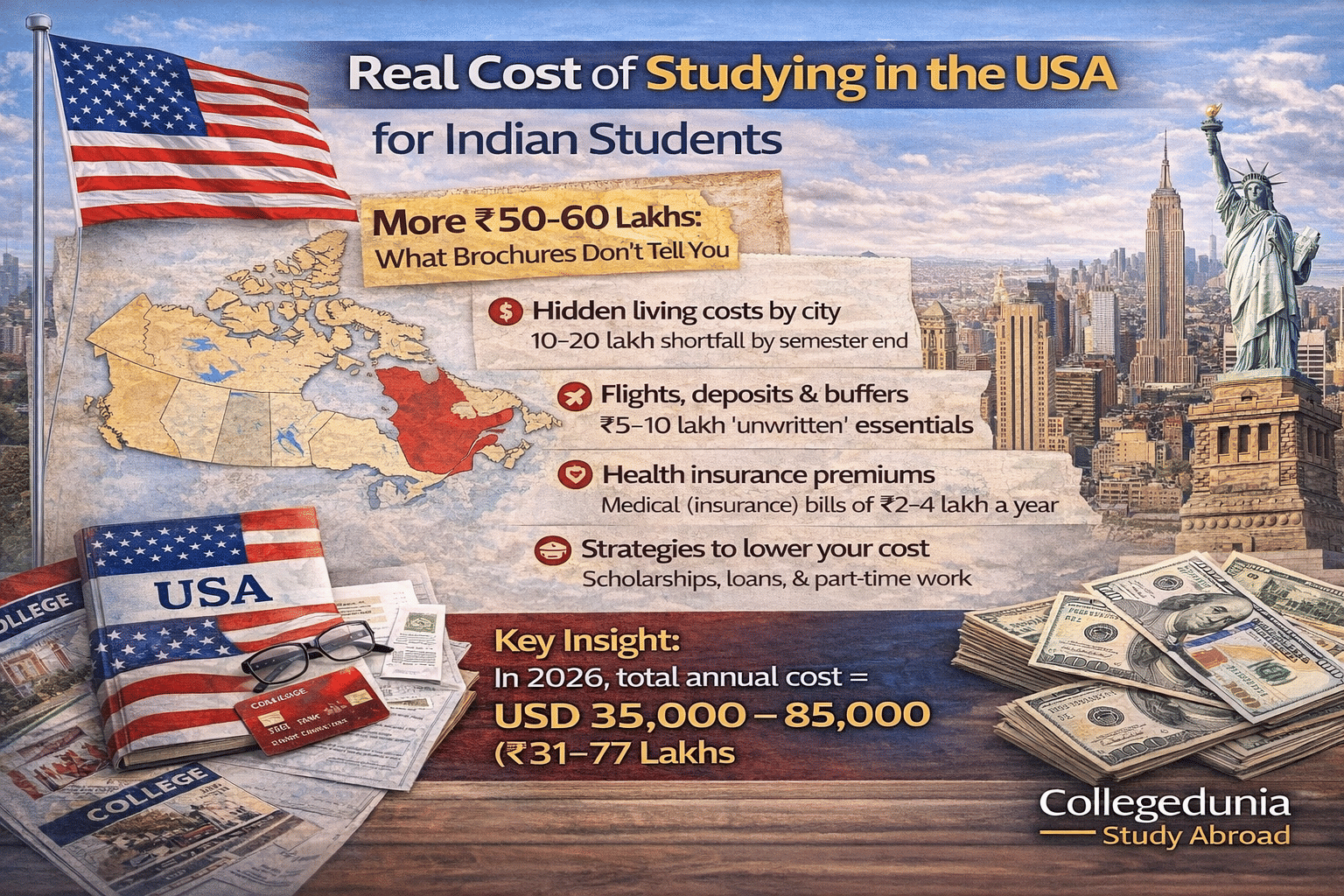
Most Indian students budget ₹50-60 lakhs for a US degree, and still run short. Here's what the brochures don't tell you.
The real cost of studying in the USA goes far beyond tuition. It includes mandatory health insurance, housing deposits, winter clothing, flights home, and an emergency buffer that many students often overlook. By the time the first semester ends, many Indian students realise their budget was off by ₹10-20 lakhs.
In this guide, you'll discover:
- Exact tuition costs at public vs private US universities
- The real monthly living budget Indian students need, broken down city by city
- Hidden costs that blindside first-year students
- Scholarships, TA/RA assistantships, and education loans that can cut your total cost significantly
- ROI analysis of whether a US degree is worth the investment in 2026
The short answer: The total annual cost of studying in the USA for Indian students in 2026 ranges from USD 35,000 to USD 85,000 (₹31.6 lakh – ₹76.8 lakh), covering tuition, living expenses, health insurance, and pre-arrival costs. Public universities are significantly cheaper than private ones, and your city of study can swing your annual budget by ₹10–20 lakh.
Check Out: Top Universities in USA for Indian Students in 2026
- Cost of Studying in USA for Indian Students — 2026 Overview
- Cost of Studying in USA at Public vs Private Universities
- Degree-Wise Cost of Studying in USA for Indian Students
- Cost of Living in USA for Indian Students
- Pre-Arrival Costs to Study in USA from India
- Hidden Costs of Studying in USA Nobody Tells You
- Scholarships to Reduce Cost of Studying in USA
- Education Loans for Studying in USA from India
- Is Studying in USA Worth It for Indian Students?
- How to Reduce Cost of Studying in USA?
- FAQs
Cost of Studying in USA for Indian Students — 2026 Overview
The total annual cost of studying in the USA for Indian students in 2026 ranges from USD 35,000 to USD 85,000. The exact amount depends on your university type, degree level, and city of study.
| Expense Category | Annual Cost (USD) | Annual Cost (INR) |
|---|---|---|
| Public University Tuition (Out-of-State) | 26,000–46,500 | ₹23.5 lakh – ₹42 lakh |
| Private University Tuition | 46,500–67,500 | ₹42 lakh – ₹61 lakh |
| Ivy League / Elite University Tuition | 63,000–88,000+ | ₹56.9 lakh – ₹79.5 lakh |
| Living Expenses (Rent, Food, Utilities) | 12,500–24,000 | ₹11.3 lakh – ₹21.7 lakh |
| Mandatory Health Insurance | 2,300–4,500 | ₹2.1 lakh – ₹4.1 lakh |
| Pre-Departure Costs (Tests, Visa, Flights) | 2,500–4,000 | ₹2.3 lakh – ₹3.6 lakh |
Note: All INR conversions use 1 USD = ₹90.32 (March 2026). Actual costs may vary with currency fluctuations.
Two students at similarly ranked US universities can face a ₹15–25 lakh difference in first-year cost purely due to location, housing choice, and financial planning. Understanding each cost category in detail is the first step to building a realistic budget.
Key Factors that affect your total cost
Several variables determine where your total cost lands within the range above:
- University type: Public universities cost significantly less than private ones for international students
- Degree level: PhD programs are largely funded; MS and UG programs are mostly self-funded
- City of study: New York and San Francisco cost 2-3× more than Texas or Midwest university towns
- Accommodation choice: Off-campus shared housing can save ₹5-10 lakh per year vs on-campus dorms
- Scholarships and assistantships: TA/RA positions can cover tuition + provide a monthly stipend
Cost of Studying in USA at Public vs Private Universities
Public universities are the most cost-effective option for Indian students, with out-of-state tuition averaging 26,000–46,500 (₹23.5–42 lakh) per year. Private universities charge 46,500–67,500 (₹42–61 lakh) annually, though some offer generous financial aid that can bring the net cost below that of public institutions.
According to the College Board's Trends in College Pricing 2025 report, average published tuition and fees for 2025–26 are:
- Public four-year (out-of-state): $31,880 — up 3.4% from 2024–25
- Private nonprofit four-year: $45,000 — up 4.0% from 2024–25
These are baseline figures. International students at top-ranked public universities often pay significantly more.
Public University Fees for Indian Students
Public universities in USA are state-funded institutions. Indian students pay out-of-state rates, which are higher than in-state rates but still lower than most private universities. The trade-off is strong academic quality at a more manageable cost.
| University | QS Rank 2026 | Annual Tuition (USD) | Annual Tuition (INR) | Popular Programs |
|---|---|---|---|---|
| University of California, Berkeley | 17 | 32,000–41,500 | ₹28.9 lakh – ₹37.5 lakh | CS, Data Science, Economics |
| University of Michigan, Ann Arbor | 45 | 32,425–60,634 | ₹29.3 lakh – ₹54.8 lakh | Business, Engineering, Medicine |
| UCLA | 46 | 27,864–40,000 | ₹25.1 lakh – ₹36.1 lakh | Psychology, CS, Business Analytics |
| University of Texas at Austin | 68 | 17,312–45,000 | ₹15.6 lakh – ₹40.6 lakh | CS, Finance, Engineering |
| University of Washington | 81 | 33,171–48,000 | ₹30 lakh – ₹43.4 lakh | CS, Nursing, Public Health |
| Georgia Tech | 97 | 30,000–52,222 | ₹27.1 lakh – ₹47.2 lakh | Engineering, CS, Business |
| Purdue University | 109 | 9,992–28,794 | ₹9 lakh – ₹26 lakh | Engineering, Agriculture, CS |
Public universities in affordable states like Texas, Indiana, and Georgia offer exceptional value, strong rankings, industry connections, and significantly lower tuition than coastal counterparts.
Private University Fees for Indian Students
Private universities in USA rely on tuition and endowments rather than state funding. While sticker prices are higher, many elite private universities offer substantial financial aid packages that can reduce the net cost considerably. Harvard, for instance, meets 100% of demonstrated financial need for admitted students.
| University | QS Rank 2026 | Annual Tuition (USD) | Annual Tuition (INR) | Popular Programs |
|---|---|---|---|---|
| MIT | 1 | 57,000–93,834 | ₹51.5 lakh – ₹84.8 lakh | CS, Aerospace, Economics |
| Stanford University | 3 | 40,080–61,308 | ₹36.2 lakh – ₹55.4 lakh | CS, Statistics, Engineering |
| Harvard University | 4 | 45,024–78,120 | ₹40.7 lakh – ₹70.6 lakh | Law, Medicine, Public Admin |
| Caltech | 10 | 65,622–68,250 | ₹59.3 lakh – ₹61.6 lakh | Aeronautics, Bioengineering |
| University of Pennsylvania | 11 | 43,174–84,840 | ₹39 lakh – ₹76.6 lakh | Finance (Wharton), Data Science |
| Columbia University | 22 | 62,000–70,000 | ₹56 lakh – ₹63.2 lakh | Journalism, Business, CS |
| Yale University | 28 | 55,000–65,000 | ₹49.7 lakh – ₹58.7 lakh | Law, Medicine, Arts |
Note: Tuition figures are for graduate programs unless stated. Undergraduate fees may differ. Verify on official university websites.
Important caveat: A Reddit user on r/Indians_StudyAbroad noted: "My friends attending a private university with a sticker price of 80k USD per year pay around $20k to $30k per year depending on their financial aid." This is the reality at need-blind institutions, the sticker price is rarely what you pay.
Degree-Wise Cost of Studying in USA for Indian Students
The cost of studying in the USA varies significantly by degree level. Bachelor's and Master's programs are largely self-funded, while PhD programs are almost always fully funded. Here is the degree-wise breakdown for 2026:
| Degree Type | Average Annual Cost (USD) | Average Annual Cost (INR) | Funding Availability |
|---|---|---|---|
| Bachelor's Degree (4 years) | 32,000–65,000 | ₹28.9 lakh – ₹58.7 lakh | Limited; merit scholarships available |
| Master's Degree / MS (2 years) | 25,000–66,500 | ₹22.6 lakh – ₹60.1 lakh | TA/RA assistantships possible |
| MBA (2 years) | 60,000–100,000+ | ₹54.2 lakh – ₹90.3 lakh+ | Partial scholarships; fellowships |
| PhD (4–6 years) | $0 + stipend | Fully funded | 70–90% of programs funded |
| Associate Degree (2 years) | 4,050–10,000 | ₹3.7 lakh – ₹9 lakh | Community college pathway |
Bachelor's Degree Cost in USA for Indian Students
A 4-year bachelor's degree in the USA is the most expensive option for Indian students. Total program costs (4 years) range from ₹1.15 crore to ₹2.35 crore at top universities.
As one Reddit user on r/Indians_StudyAbroad bluntly put it: "Undergrad is really expensive and usually costs around USD 40 to 60k per year in tuition, and maybe living combined."
The good news: many top private universities offer need-based financial aid that can reduce costs by 50–70%. Public universities in affordable states (Texas, Indiana, Florida) offer the best cost-to-quality ratio for undergraduate study.
MS/Master's Degree Cost in USA
The Master's degree, particularly MS in Computer Science, Data Science, and Engineering, is the most popular choice for Indian students. Total 2-year program costs range from ₹45 lakh to ₹1.2 crore depending on the university and city.
Key insight: STEM MS programs at public universities (Georgia Tech, UT Austin, Purdue) offer the best ROI, strong rankings, lower tuition, and STEM OPT eligibility for 3 years of post-graduation work.
Check Out: Masters Universities in USA
MBA Cost in USA
An MBA from a top US business school is among the most expensive degrees globally. Two-year program costs at elite schools (Wharton, Harvard Business School, Booth) range from ₹1.08 crore to ₹1.8 crore+ including living expenses. However, post-MBA salaries at top firms average 150,000-200,000, making the ROI compelling for the right profile.
Check: MBA universities in USA
PhD Cost in USA — Mostly Funded
This is the most underappreciated fact about US education: most PhD programs are fully funded. Universities provide tuition waivers plus monthly stipends of 1,500–3,500 in exchange for teaching or research assistantship work. For Indian students with strong research profiles, a funded PhD is the most financially sound path to a US degree.
Cost of Living in USA for Indian Students
The cost of living in the USA for Indian students ranges from USD 1,200 to USD 3,800 per month (₹1.08 lakh – ₹3.43 lakh), depending on city and lifestyle. This is often the most underestimated part of the budget, and the most variable.
Your zip code matters more than your university when it comes to monthly expenses. A student at UT Austin spends roughly half what a student at NYU spends on rent alone.
Monthly Living Budget Breakdown
| Expense Category | Monthly Cost (USD) | Monthly Cost (INR) |
|---|---|---|
| Rent (Shared/Dorm) | 700–1,500 | ₹63,224 – ₹1.35 lakh |
| Food & Groceries | 250–500 | ₹22,580 – ₹45,160 |
| Utilities & Internet | 100–200 | ₹9,032 – ₹18,064 |
| Transportation | 60–150 | ₹5,419 – ₹13,548 |
| Health Insurance | 125–375 | ₹11,290 – ₹33,870 |
| Books & Supplies | 80–150 | ₹7,226 – ₹13,548 |
| Miscellaneous / Personal | 100–200 | ₹9,032 – ₹18,064 |
| Total Monthly | 1,415–3,075 | ₹1.28 lakh – ₹2.78 lakh |
Cooking at home (₹18,000–₹36,000/month) vs eating out or using meal plans (₹67,000+/month) is one of the biggest levers Indian students have to control costs.
Check out detailed cost of Living in USA
City-Wise Cost of Living in USA for Indian Students
Location is the single biggest variable in your living budget. Here is a realistic city-by-city breakdown:
| City / Region | Key Universities | Monthly Living Cost (USD) | Monthly Living Cost (INR) |
|---|---|---|---|
| New York City | NYU, Columbia | 2,500–4,000 | ₹2.26 lakh – ₹3.61 lakh |
| San Francisco / Bay Area | Stanford, UC Berkeley | 2,800–4,500 | ₹2.53 lakh – ₹4.06 lakh |
| Boston / Cambridge | MIT, Harvard, Northeastern | 2,300–3,300 | ₹2.08 lakh – ₹2.98 lakh |
| Chicago | University of Chicago, Northwestern | 1,800–2,800 | ₹1.63 lakh – ₹2.53 lakh |
| Seattle | University of Washington | 1,900–3,000 | ₹1.72 lakh – ₹2.71 lakh |
| Austin, Texas | UT Austin | 1,300–2,200 | ₹1.17 lakh – ₹1.99 lakh |
| Atlanta, Georgia | Georgia Tech, Emory | 1,200–2,000 | ₹1.08 lakh – ₹1.81 lakh |
| Columbus / Ann Arbor (Midwest) | Ohio State, U Michigan | 1,100–2,000 | ₹99,352 – ₹1.81 lakh |
| West Lafayette / Purdue | Purdue University | 950–1,500 | ₹85,804 – ₹1.35 lakh |
Strategic insight: Choosing a university in Texas, Georgia, or the Midwest over a coastal city can save ₹10–20 lakh per year in living costs alone — without sacrificing academic quality.
On-Campus vs Off-Campus Accommodation Costs
| Accommodation Type | Monthly Cost (USD) | Monthly Cost (INR) | Best For |
|---|---|---|---|
| On-Campus Dorm (shared) | 1,000–1,800 | ₹90,320 – ₹1.62 lakh | First-year students |
| Off-Campus (shared apartment) | 700–1,200 | ₹63,224 – ₹1.08 lakh | Year 2 onwards |
| Off-Campus (private apartment) | 1,500–2,500 | ₹1.35 lakh – ₹2.26 lakh | Students with higher budgets |
Off-campus shared housing with 2–3 roommates is the most popular cost-saving strategy among Indian students. It can reduce accommodation costs by 30–40% compared to on-campus dorms.
Check Out: Compare affordable universities in the USA by location and fees
Pre-Arrival Costs to Study in USA from India
Before you board your flight, expect to spend USD 2,500–4,000 (₹2.3 lakh – ₹3.6 lakh) on pre-arrival expenses. These are one-time costs that many students forget to include in their budget, and they add up quickly.
Pre-arrival costs include entrance exam fees, university application fees, visa and SEVIS fees, and airfare. Here is the complete breakdown:
Entrance Exam Fees
| Exam | Official Fee (USD) | Official Fee (INR) | Required For |
|---|---|---|---|
| GRE General Test | $220 | ₹19,870 | MS, PhD programs |
| GMAT Focus Edition | $275 | ₹24,838 | MBA programs |
| TOEFL iBT | $205 | ₹18,500 | English proficiency |
| IELTS Academic | $200 | ₹18,000 | English proficiency |
| SAT (Digital) | 111–131 | ₹10,000 – ₹11,830 | Undergraduate programs |
F-1 Visa & SEVIS Fees in 2026
The F-1 student visa is the standard visa for Indian students pursuing full-time academic programs in the USA. As of 2026, the total visa-related costs are:
| Fee | Amount (USD) | Amount (INR) | Notes |
|---|---|---|---|
| SEVIS I-901 Fee | $350 | ₹31,612 | Paid before visa interview |
| F-1 Visa Application (DS-160 / MRV Fee) | $185 | ₹16,709 | Non-refundable |
| Visa Issuance Fee | $0 | ₹0 | Indian students are exempt |
| Total Visa Cost | $535 | ₹48,321 | - |
Note: A proposed fee hike in 2026 may increase the total visa application cost to approximately $472 for the MRV fee alone. Verify the latest fee at travel.state.gov before applying.
Proof of Funds Requirement: For an F-1 visa, you must demonstrate liquid funds covering at least one full year of tuition and living costs — typically USD 50,000–80,000 (₹45–72 lakh) in your bank account or education loan sanction letter.
Airfare & First-Month Setup Costs
| Expense | Cost (USD) | Cost (INR) |
|---|---|---|
| One-Way Airfare (India → USA) | 720–1,440 | ₹65,000 – ₹1.30 lakh |
| University Application Fees (per school) | 65–155 | ₹5,870 – ₹14,000 |
| First-Month Rent Deposit | 700–2,000 | ₹63,224 – ₹1.81 lakh |
| Initial Grocery & Setup | 300–600 | ₹27,096 – ₹54,192 |
Hidden Costs of Studying in USA Nobody Tells You
Most cost guides stop at tuition and rent. The hidden costs of studying in the USA can add ₹3–8 lakh to your first-year budget if you're not prepared. These are the expenses that blindside Indian students in their first 90 days.
Here is what to budget for beyond the standard estimates:
| Hidden Cost | Typical Cost (USD) | Cost (INR) | Why It Matters |
|---|---|---|---|
| Housing Deposit & Advance Rent | 1,000–4,000 | ₹90,320 – ₹3.61 lakh | Due before you arrive |
| Winter Clothing & Climate Setup | 300–600 | ₹27,096 – ₹54,192 | Essential in cold states |
| Apartment Setup (Furniture, Basics) | 500–1,200 | ₹45,160 – ₹1.08 lakh | One-time first-year cost |
| Travel Back to India (Annual) | 1,200–2,000 | ₹1.08 lakh – ₹1.81 lakh | Often forgotten in budgets |
| Emergency Buffer Fund | 3,000–5,000 | ₹2.71 lakh – ₹4.52 lakh | Medical, repairs, unexpected |
| Health Insurance Waiver Processing | 50–100 | ₹4,516 – ₹9,032 | If opting out of university plan |
| Laptop / Tech Upgrade | 800–1,500 | ₹72,256 – ₹1.35 lakh | Often needed for STEM programs |
The most common mistake: Indian students budget for tuition and rent but forget the housing deposit (often 2 months' rent upfront), winter clothing (essential in states like Michigan, Illinois, Massachusetts), and the cost of flying home during summer break.
Pro tip: Build a minimum ₹3–5 lakh emergency buffer into your first-year budget. This is not optional — it is the financial cushion that prevents a medical bill or unexpected expense from derailing your studies.
Scholarships to Reduce Cost of Studying in USA
Scholarships can reduce the cost of studying in the USA by ₹5–30 lakh per year. However, full scholarships covering all expenses are rare — less than 2% of international students receive them. Most Indian students receive partial aid, and the key is stacking multiple sources.
Merit-Based Scholarships for Indian Students
Many US universities offer merit-based scholarships to international students based on academic excellence, GRE/GMAT scores, and research potential.
| Scholarship | Award Amount | Eligibility | Type |
|---|---|---|---|
| Fulbright-Nehru Fellowship | Full funding (tuition + living) | Indian citizens; research/academic excellence | Government |
| Tata Scholarship (Cornell) | Up to $25,000/year | Indian undergraduates at Cornell | University-specific |
| Stanford Knight-Hennessy Scholars | Full funding | Graduate students; leadership focus | University-specific |
| AAUW International Fellowships | 18,000–30,000 | Women pursuing graduate study | External |
| Inlaks Shivdasani Foundation | Up to $100,000 | Indian students at top global universities | External |
| University Merit Scholarships | 5,000–25,000 | Varies by university | University-specific |
Note: Scholarship availability and amounts change annually. Verify on official university financial aid pages.
Explore government-funded scholarships for Indian students in the USA
TA/RA Assistantships — The Real Cost-Cutter
For graduate students, Teaching Assistantships (TA) and Research Assistantships (RA) are the most powerful cost-reduction tools available. They typically provide:
- Full or partial tuition waiver (saving ₹20–40 lakh over 2 years)
- Monthly stipend of 1,500–2,500 (covering most living expenses)
- Valuable professional experience
TA/RA positions are most commonly available in STEM fields and are awarded after admission. Applying to universities with strong research programs and expressing research interest in your SOP significantly improves your chances.
Fulbright-Nehru & Government Scholarships
The Fulbright-Nehru Fellowship, administered by the US-India Educational Foundation (USIEF), is the most prestigious scholarship for Indian students. It covers tuition, living expenses, health insurance, and travel. Applications open annually — check usief.org.in for current cycles.
Education Loans for Studying in USA from India
Most Indian students fund their US education through a combination of savings, education loans, and scholarships. For the 2026–27 cycle, education loans remain the primary funding mechanism, with Indian public banks and NBFCs offering competitive products.
Indian Bank Loans vs NBFCs — Interest Rate Comparison
| Lender Type | Key Lenders | Interest Rate (2026) | Max Loan Amount | Key Feature |
|---|---|---|---|---|
| Public Banks | SBI (Global Ed-Vantage), Bank of Baroda | 8.65% – 11.15% | Up to ₹1.5 crore | Lower rates; 0.5% discount for women |
| Private Banks | HDFC Bank, Axis Bank | 10.5% – 13.5% | Up to ₹75 lakh | Faster processing |
| NBFCs | HDFC Credila, Avanse, Auxilo | 9.75% – 12.5% | Up to ₹75 lakh (unsecured for top schools) | No collateral for top universities |
Interest rates are indicative for 2026. Verify current rates directly with lenders before applying.
How Much Loan Is Too Much?
This is the question Reddit's r/Indians_StudyAbroad debates most fiercely. One user put it starkly: "Think of the 70th ranked college in India. That is what you are going to in the US, with a 50 lakh loan."
A practical rule of thumb: Keep your total education loan within 1.0–1.5× your expected first-year salary in the USA. For STEM graduates targeting 90,000–110,000 starting salaries, a loan of ₹60–80 lakh is manageable. For non-STEM fields with lower starting salaries, the math gets harder.
Key loan planning principles:
- Build a 10% INR buffer for currency fluctuation (the rupee has depreciated ~3–5% annually vs USD historically)
- Assume zero income in the first 4–6 months after arrival
- Cover tuition, living, insurance, and emergencies fully before relying on part-time work
Is Studying in USA Worth It for Indian Students?
For the right profile and the right program, studying in the USA delivers one of the highest ROIs of any global education investment. The key word is "right" — a STEM MS from a top-50 university is a fundamentally different financial proposition than a non-STEM degree from a lower-ranked school.
ROI – Salary vs Loan Repayment Timeline
| Career Phase | Work Authorization | Typical Salary (2026) | Loan Recovery Timeline |
|---|---|---|---|
| Post-Graduation (Year 1) | OPT: 12 months | 85,000–105,000 (₹76.8 lakh – ₹94.8 lakh) | Begin repayment |
| STEM Extension (Years 2–3) | STEM OPT: +24 months | 110,000–145,000+ (₹99.3 lakh – ₹1.31 crore) | Accelerated repayment |
| H-1B / Long-term (Year 4+) | H-1B visa | 130,000–180,000+ | Loan fully recovered |
For a STEM MS graduate with a ₹60 lakh loan, full loan recovery typically takes 3–5 years of US employment. Over a 10-year career, the income premium over an equivalent India-based role can exceed ₹2–3 crore.
STEM OPT Extension — The 3-Year Earning Advantage
The STEM OPT extension allows graduates of STEM programs to work in the USA for up to 36 months (12 months standard OPT + 24 months STEM extension) without an H-1B visa. This is one of the most significant financial advantages of a US STEM degree — three years of US-level salaries before the H-1B lottery.
Note: OPT does not guarantee employment. Outcomes depend on field, skills, and job market conditions.
USA vs UK vs Canada — Cost & Outcome Comparison 2026
| Factor | USA | UK | Canada |
|---|---|---|---|
| Annual Tuition (International) | 25,000–65,000 | £15,000 – £35,000 | CAD 20,000 – CAD 45,000 |
| Annual Living Costs | 12,000–24,000 | £12,000 – £18,000 | CAD 12,000 – CAD 20,000 |
| Post-Study Work Rights | OPT: 12–36 months (STEM) | Graduate Route: 24 months | PGWP: Up to 36 months |
| Average Starting Salary | 85,000–130,000 | £30,000 – £55,000 | CAD 55,000 – CAD 85,000 |
| PR Pathway | Difficult (H-1B lottery) | Moderate | Easier (Express Entry) |
| Primary Advantage | Highest earning potential | Shorter degrees (1 year MS) | PR stability + lower costs |
The bottom line: The USA costs more upfront but offers the highest earning potential. Canada offers a more affordable path with a clearer PR route. The UK offers shorter (1-year) master's programs at moderate cost. Your choice should align with your career goals, not just the cost.
How to Reduce Cost of Studying in USA?
Smart planning can reduce your total cost of studying in the USA by ₹10–25 lakh without compromising on academic quality. Here are the most effective strategies:
- Choose Public Universities in Affordable States
Universities in Texas (UT Austin, Texas A&M), Georgia (Georgia Tech), Indiana (Purdue), and Florida (University of Florida) offer top-ranked programs at significantly lower tuition and living costs than coastal counterparts. Georgia Tech's MS in CS, for example, is consistently ranked in the top 10 nationally at a fraction of the cost of MIT or Stanford.
- Target TA/RA Assistantships
Aggressively Apply to universities with strong research programs and express specific research interests in your SOP. A TA/RA position can save ₹20–40 lakh in tuition over 2 years plus provide a monthly stipend.
- Use Health Insurance Waivers
University health insurance plans can cost 2,300–4,500 per year. If you find a university-approved private plan for 350–900, you can submit a waiver and save up to ₹3.2 lakh annually. Always check your university's waiver policy before enrolling.
- Live Off-Campus with Roommates
Shared off-campus housing with 2–3 roommates can reduce rent by 30–40% compared to on-campus dorms. Most Indian students move off-campus after their first year. Platforms like Zillow, Apartments.com, and university Facebook groups are the most common ways to find shared housing.
- Cook at Home
Home cooking costs 200–400 per month vs 600–900+ for university meal plans or regular restaurant dining. This single habit can save ₹3–5 lakh per year.
- Maximise On-Campus Part-Time Work
Under an F-1 visa, you can work up to 20 hours per week on campus during semesters and 40 hours during official breaks. Most roles pay 10–18 per hour, covering groceries, transport, and personal expenses. Important caveat: part-time work can supplement living costs but cannot fund tuition. Do not build your financial plan around part-time income.
- Apply for External Scholarships
Early Scholarships like the Fulbright-Nehru Fellowship, Inlaks Foundation, and AAUW International Fellowships have application deadlines 12–18 months before your program start date. Start researching in your penultimate year of undergraduate study.
- Consider Community College
Transfer Pathway For undergraduate study, starting at a community college (average tuition: $4,050/year) and transferring to a 4-year university after 2 years can save ₹20–30 lakh on total degree costs. Many top public universities have formal transfer agreements with community colleges.
FAQs — Cost of Studying in USA for Indian Students
Ques. What is the total cost of studying in the USA for Indian students in 2026?
Ans. The total annual cost of studying in the USA for Indian students in 2026 ranges from USD 35,000 to USD 85,000 (₹31.6 lakh – ₹76.8 lakh), covering tuition, living expenses, health insurance, and pre-arrival costs. Public universities typically cost ₹31–55 lakh per year all-inclusive, while private universities range from ₹55–85 lakh. The exact figure depends on your university type, degree level, and city of study.
Ques. How much does an MS degree in the USA cost for Indian students?
Ans. A 2-year MS degree in the USA costs between USD 50,000 and USD 130,000 (₹45 lakh – ₹1.17 crore) in total, including tuition and living expenses. Public university MS programs (e.g., Georgia Tech, UT Austin, Purdue) cost ₹45–70 lakh for the full 2 years, while private university MS programs (e.g., MIT, Stanford, Carnegie Mellon) can exceed ₹1 crore. TA/RA assistantships can significantly reduce these costs.
Ques. What is the monthly living cost in the USA for Indian students?
Ans. Indian students typically need USD 1,200 to USD 3,000 per month (₹1.08 lakh – ₹2.71 lakh) for living expenses, depending on the city. Affordable university towns in Texas, Georgia, and the Midwest cost 1,200–1,800/month, while high-cost cities like New York, Boston, and San Francisco cost 2,500–4,000/month. Shared off-campus housing and home cooking are the two biggest levers to reduce monthly costs.
Ques. How much bank balance is required for an F-1 student visa from India?
Ans. For an F-1 visa, you must demonstrate liquid funds covering at least one full year of tuition and living costs — typically USD 50,000–80,000 (₹45–72 lakh). This can be shown through a combination of personal savings, a parent's bank statement, and an education loan sanction letter. The visa officer assesses your ability to fund your entire program, not just the first year.
Ques. Can Indian students work part-time to cover expenses in the USA?
Ans. Yes, F-1 visa holders can work up to 20 hours per week on campus during semesters and 40 hours during official breaks. At 10–18/hour, this generates 800–1,500/month — enough to cover groceries, transport, and personal expenses. However, part-time work cannot fund tuition and should not be the primary financial plan. Off-campus work requires CPT or OPT authorisation.
Ques. Is health insurance mandatory for Indian students in the USA?
Ans. Yes, health insurance is mandatory for all F-1 international students in the USA. University health plans cost 2,300–4,500 per year (₹2.1–4.1 lakh). However, most universities allow students to submit a health insurance waiver if they purchase an equivalent approved private plan, which can cost as little as 350–900/year. Always check your university's waiver policy — this is one of the easiest ways to save ₹1–3 lakh annually.
Ques. Is studying in the USA worth it for Indian students in 2026?
Ans. For STEM-aligned programs at reputable universities, yes — the ROI is strong. STEM MS graduates in the USA earn 85,000–130,000 in their first year, and the STEM OPT extension provides 36 months of US work authorisation. For a ₹60 lakh loan, full recovery typically takes 3–5 years of US employment. For non-STEM programs at lower-ranked universities, the ROI calculation is less favourable and requires careful evaluation before committing.
Ques. What are the hidden costs of studying in the USA that students miss?
Ans. The most commonly missed costs include: housing deposits (1–2 months' rent upfront, 700–4,000), winter clothing and climate setup (300–600), apartment furnishing (500–1,200), annual flights back to India (1,200–2,000), and an emergency buffer fund (3,000–5,000). These hidden costs can add ₹3–8 lakh to your first-year budget. Always build a contingency buffer into your financial plan.
Ques. Which is cheaper for Indian students — USA, UK, or Canada?
Ans. Canada is generally the most affordable option, with annual costs of CAD 32,000–65,000 (₹20–40 lakh) and a clearer PR pathway. The UK offers 1-year master's programs that reduce total program costs despite similar annual fees. The USA is the most expensive upfront but offers the highest earning potential, especially for STEM graduates with STEM OPT eligibility. Your choice should align with your career goals and risk tolerance.
Ques. What is the cheapest way to study in the USA for Indian students?
Ans. The most cost-effective path to a US degree combines: (1) choosing a public university in an affordable state (Texas, Georgia, Indiana), (2) securing a TA/RA assistantship for tuition waiver + stipend, (3) living off-campus with roommates, (4) using a health insurance waiver, and (5) cooking at home. A well-planned MS at Purdue or UT Austin with a TA position can cost as little as ₹15–25 lakh total — a fraction of the sticker price.
Ques. What is the SEVIS fee for Indian students in 2026?
Ans. The SEVIS I-901 fee for F-1 students is USD 350 (₹31,612) as of 2026. This is paid online at fmjfee.com before your visa interview. In addition, the F-1 visa application (MRV/DS-160) fee is USD 185 (₹16,709). Indian students are exempt from the visa issuance fee. Total mandatory visa costs: approximately USD 535 (₹48,321).
Ques. How much does a bachelor's degree in the USA cost for Indian students?
Ans. A 4-year bachelor's degree in the USA costs Indian students between USD 128,000 and USD 260,000 (₹1.15 crore – ₹2.35 crore) in total, including tuition and living expenses. Public universities in affordable states are significantly cheaper (₹1.15–1.5 crore total) than elite private universities (₹1.8–2.35 crore+). Need-based financial aid at top private universities can reduce costs by 50–70% for eligible students.








Comments