Imperial College London placements data show 73% of taught master's graduates and 66% of undergraduates in employment 15 months after graduating, for the 2024 cohort. Computing graduates of 2023-24 reported a median salary of GBP 55,000 (INR 69.87 Lakhs) at 15 months. That is the highest Imperial subject figure in the government's Discover Uni data.
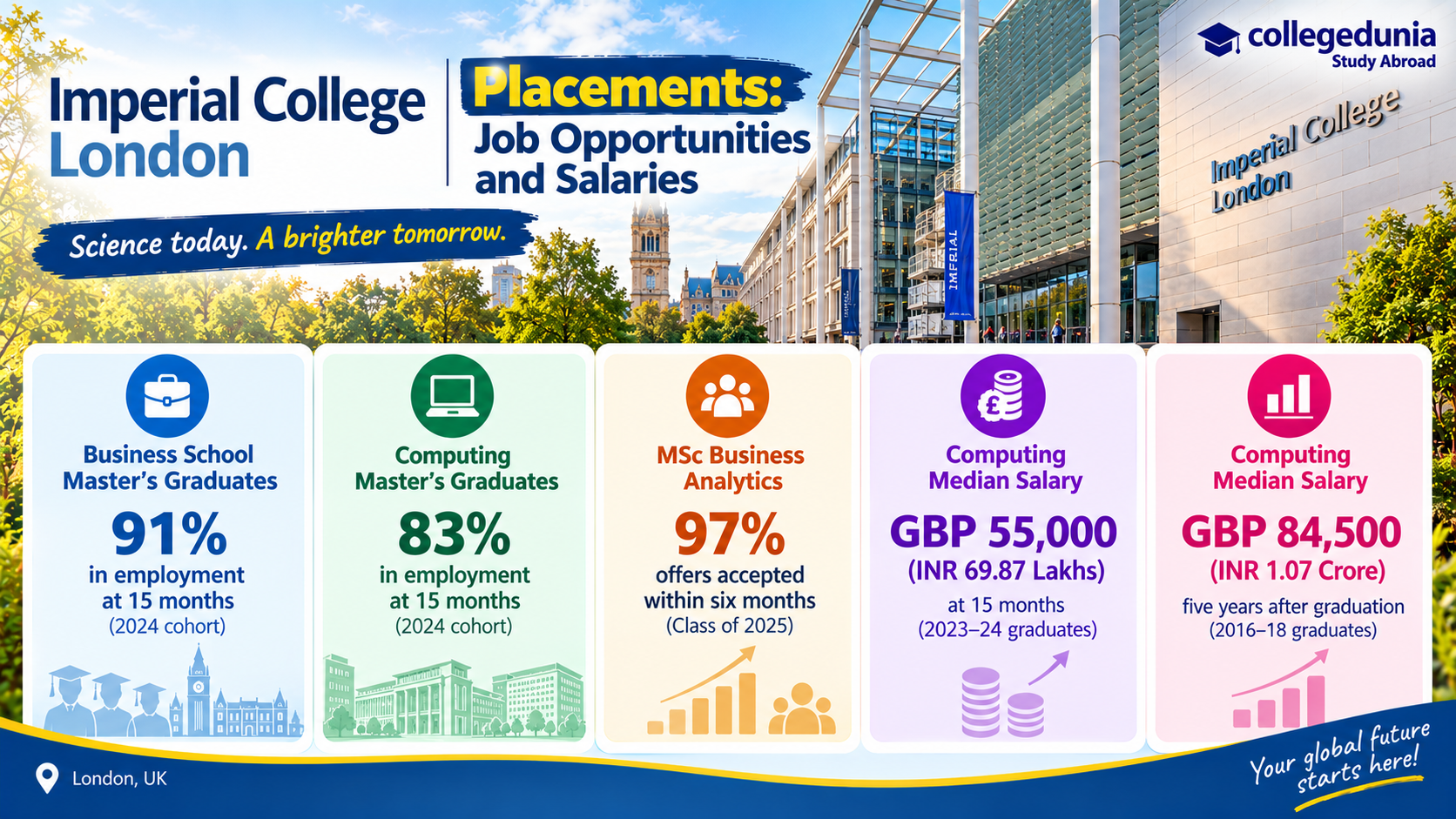
- Business School taught master's in employment at 15 months (2024 cohort): 91%
- Computing taught master's in employment at 15 months (2024 cohort): 83%
- MSc Business Analytics offers accepted within six months (Class of 2025): 97%
- Computing median salary 15 months after (2023-24 graduates): GBP 55,000 (INR 69.87 Lakhs)
- Computing median salary five years after (2016-18 graduates): GBP 84,500 (INR 1.07 Crore)
Imperial, in London, UK, reports graduate outcomes rather than campus placements. The figures come from the national Graduate Outcomes survey, which Imperial publishes by department, and from the Business School's own six-month surveys. They cover all graduates unless a line says otherwise.
Currency Note: All INR figures use the rates of GBP 1 = INR 127.03 and USD 1 = INR 94.93 as of 23 October 2026.
![]()
Also Check: Imperial College London Admissions 2027
Imperial College London Placements and Employment Rate 2024
In the Graduate Outcomes survey of Imperial's 2024 graduating cohort, 73% of taught master's graduates and 85% of doctoral graduates had entered employment 15 months after finishing. Undergraduates sat at 66% employed because a further 20% went into study, training or research.
| Activity 15 months after graduating (2024 cohort) |
Undergraduate |
Taught master's |
Doctoral |
| Entered employment |
66% |
73% |
85% |
| Further study, training or research |
20% |
14% |
4% |
| Running own business or self-employed |
3% |
5% |
3% |
| Unemployed and looking for work |
5% |
4% |
4% |
| Travelling, portfolio, voluntary work or other |
6% |
4% |
4% |
- Add employment, self-employment and study together and 89% of undergraduates and 92% of taught master's graduates had a confirmed activity at 15 months.
- The 4% to 5% unemployment line is the figure to compare across universities, because the employment line falls whenever more graduates choose study.
- Imperial does not split these figures by nationality, so international graduates sit inside the same totals.
Source: Imperial College London Careers Service, What do Imperial graduates do, undergraduate and postgraduate destinations pages, Graduate Outcomes survey, 2024 graduating cohort, pages updated August 2026.
Note: Imperial rounds every count to the nearest five graduates and suppresses any percentage based on fewer than 22.5 people, which is why some departments show no figure. The college does not publish its overall response rate, so these are shares of respondents, not of the whole cohort.
Also Check: Study in UK 2027
Imperial College London Average Salary After Graduation
Median salaries 15 months after an Imperial undergraduate degree start at GBP 36,000 (INR 45.73 Lakhs) in Chemical Engineering. Computing tops the list at GBP 55,000 (INR 69.87 Lakhs). Those are 2023-24 graduates. Five years out, the government's LEO tax-record data puts Computing graduates of 2016-18 at GBP 84,500 (INR 1.07 Crore).
| Subject (full-time undergraduate courses) |
Median salary 15 months after (GBP), 2023-24 graduates |
15 months after (INR) |
Median salary 5 years after (GBP), 2016-18 graduates |
5 years after (INR) |
| Computing |
GBP 55,000 |
INR 69.87 Lakhs |
GBP 84,500 |
INR 1.07 Crore |
| Electrical and electronic engineering |
GBP 43,000 |
INR 54.62 Lakhs |
GBP 58,500 |
INR 74.31 Lakhs |
| Mathematical sciences |
GBP 40,000 |
INR 50.81 Lakhs |
GBP 68,000 |
INR 86.38 Lakhs |
| Mechanical engineering |
GBP 38,500 |
INR 48.91 Lakhs |
GBP 50,000 |
INR 63.52 Lakhs |
| Chemical, process and energy engineering |
GBP 36,000 |
INR 45.73 Lakhs |
GBP 60,500 |
INR 76.85 Lakhs |
- Computing's typical range at 15 months runs from GBP 40,000 (INR 50.81 Lakhs) to GBP 90,000 (INR 1.14 Crore), a wide spread into quant roles.
- Mathematics starts below Electrical Engineering but overtakes it by year five, which matters for a finance-bound applicant.
- Every figure is a median of those who reported, so half earned more and half earned less.
Source: Discover Uni course pages for Imperial College London, read on 23 October 2026. Graduate Outcomes survey, 2023-24 graduates; Longitudinal Education Outcomes dataset, 2016-18 graduates.
Note: The 15-month medians rest on 20 to 45 respondents per subject at response rates of 50% to 65%. The five-year figures use tax records for 55 to 110 people. Imperial publishes no salary in its own outcomes tables, so these government figures are the only official pay data for the college.
Key Insight: The Computing median of GBP 55,000 (INR 69.87 Lakhs) clears the Skilled Worker threshold of GBP 41,700 (INR 52.97 Lakhs) with room to spare. Engineering medians of GBP 36,000 to GBP 43,000 (INR 45.73 Lakhs to INR 54.62 Lakhs) do not. An engineering graduate therefore depends on the Graduate visa window to reach sponsorship.
Also Check: Imperial College London Courses and Fees
Imperial College London Placements by Course and Salary
Business School taught master's graduates lead Imperial's departments with 91% in employment at 15 months for the 2024 cohort, against 83% for Computing and 73% for Electrical and Electronic Engineering. The table pairs each department's employment figure with the Business School's six-month offer rates and the Discover Uni undergraduate medians.
| Department or programme |
In employment 15 months after (2024 cohort) |
Further study |
Seeking work |
Undergraduate median salary at 15 months (GBP), 2023-24 |
Median (INR) |
| Business School taught master's |
91% |
1% |
3% |
Not published by subject |
Not published by subject |
| Computing taught master's |
83% |
12% |
4% |
GBP 55,000 |
INR 69.87 Lakhs |
| Computing undergraduate |
84% |
4% |
5% |
GBP 55,000 |
INR 69.87 Lakhs |
| Mechanical Engineering taught master's |
78% |
13% |
3% |
GBP 38,500 |
INR 48.91 Lakhs |
| Electrical and Electronic Engineering taught master's |
73% |
21% |
3% |
GBP 43,000 |
INR 54.62 Lakhs |
- Electrical Engineering's lower employment figure comes with a 21% further-study share, so its seeking-work rate of 3% matches the others.
- Salary cells use the undergraduate subject median from Discover Uni, because Imperial publishes no master's salary by department.
- The Business School's own six-month surveys add 97% accepted offers for MSc Business Analytics and 94% for both MSc Finance and MSc Management, Class of 2025.
Source: Imperial College London Careers Service departmental Graduate Outcomes tables, 2024 cohort; Imperial Business School career impact pages, Class of 2025; Discover Uni, Graduate Outcomes survey, 2023-24 graduates.
Tip for Indian Students: For an MSc in Computing, the published pair is 83% employed at 15 months and a GBP 55,000 (INR 69.87 Lakhs) subject median. That is the strongest combination at Imperial. Engineering master's applicants should plan on the 15-month window, since a fifth of those graduates chose further study instead of a job.
Also Check:
Imperial College London MBA Placements and Salary 2025
The Imperial Full-Time MBA Class of 2025 reported an average salary of USD 124,363 (INR 1.18 Crore) in purchasing-power terms. That is a 40% rise on pre-MBA pay. Imperial publishes no three-month or six-month employment rate for the MBA, so the figures below cover pay, sector and location only.
| Full-Time MBA measure (Class of 2025, graduates seeking work who shared data) |
Figure |
| Average post-MBA salary, purchasing power parity dollars |
USD 124,363 (INR 1.18 Crore) |
| Salary increase, pre-MBA to post-MBA |
40% |
| Employed in the technology sector |
35% |
| Employed in the UK |
73% |
Amazon, Boston Consulting Group, Capco, Deloitte, EY, HSBC, IBM, Microsoft, PwC, SAP and Uber are named by the school as employers of the class. Over the last three years it also names Capital One, Mastercard and Revolut.
Source: Imperial College Business School, Full-Time MBA employment report page, Class of 2025, page updated 7 October 2026.
Key Insight: The USD 124,363 (INR 1.18 Crore) average is a purchasing-power figure, which raises salaries earned in cheaper countries to a US equivalent. A graduate paid in London pounds will see a lower nominal number, so compare it with the GBP medians above rather than with a US school's dollar median.
Also Check: UK Scholarships for Indian Students 2026-27: Full Guide
Top Recruiters Hiring Imperial College London Graduates
Goldman Sachs, JP Morgan, McKinsey, Morgan Stanley, Barclays, Amazon, Arm, Bloomberg and Shell are named by Imperial as employers of its 2024 and 2025 graduates. The college lists them as examples, not as a ranking, and publishes no hire counts.
| Sector |
Employers named by Imperial |
Department or programme page naming them |
| Investment banking and markets |
Goldman Sachs, JP Morgan, Morgan Stanley, Bloomberg, BNP Paribas, Barclays, NatWest Group, Bank of America, Citigroup |
Business School PGT tables 2024, Computing tables 2024, MSc Finance Class of 2025 |
| Consulting and professional services |
McKinsey and Company, Boston Consulting Group, Bain and Company, Kearney, Accenture, Deloitte, EY, KPMG, PwC, Capco |
Business School PGT tables 2024, MSc Management and MBA Class of 2025, EEE PGT tables 2024 |
| Technology |
Amazon, Google, Microsoft, IBM, Arm, SAP, Uber, ByteDance, Tencent, Huawei, Capital One |
Computing tables 2024, MSc Business Analytics, MSc Management and MBA Class of 2025 |
| Energy, engineering and industry |
Shell, Arup, Baker Hughes, ASML, Balfour Beatty, E.ON Next, BAE Systems, Amentum |
Business School, Mechanical and EEE PGT tables 2024, Computing PGT tables 2024 |
| Consumer and health |
Procter and Gamble, Coca-Cola, Mastercard, HSBC, Revolut, NHS |
MSc Business Analytics and MBA Class of 2025, Business School PGT tables 2024 |
- Computing graduates appear at trading and finance firms as often as at technology companies, which fits the 26% finance share in the undergraduate sector data.
- An employer named as an example proves at least one hire in that cohort, not an annual campus visit.
Source: Imperial College London Careers Service departmental Graduate Outcomes tables, 2024 cohort. Imperial Business School career impact pages for the MBA, MSc Finance, MSc Management and MSc Business Analytics, Class of 2025.
Also Check: Imperial College London Scholarships
Imperial College London Placements by Sector and Job Role
Information and communications took 42% of employed Computing master's graduates and finance a further 18% in the 2024 cohort, while finance took 30% of Business School master's graduates. The sector mix changes sharply by department.
| Department (2024 cohort, employed graduates) |
Largest sector |
Second sector |
Third sector |
| Computing taught master's |
Information and communications 42% |
Financial and insurance 18% |
Other services 11% |
| Computing undergraduate |
Information and communications 40% |
Financial and insurance 26% |
Other services 15% |
| Business School taught master's |
Financial and insurance 30% |
Professional, scientific and technical 20% |
Information and communications 12% |
| Mechanical Engineering taught master's |
Professional, scientific and technical 40% |
Financial and insurance 16% |
Other services 12% |
| Electrical and Electronic Engineering taught master's |
Manufacture 29% |
Professional, scientific and technical 21% |
Electricity, gas and water 13% |
| All taught master's |
Professional, scientific and technical 20% |
Financial and insurance 16% |
Human health and social work 11% |
Job titles follow the same pattern. Computing master's graduates list Software Engineer, Data Scientist, Machine Learning Engineer, Quantitative Analyst and Cyber Security Analyst. Business School graduates list Data Analyst, Strategy Consultant, Research Analyst and Wealth Management Analyst. Business Analytics graduates of 2025 split 35% finance, 22% technology and 20% consulting.
Source: Imperial College London Careers Service departmental Graduate Outcomes tables, 2024 cohort; Imperial Business School MSc Business Analytics career impact page, Class of 2025.
Tip for Indian Students: A Computing degree at Imperial feeds finance almost as strongly as technology, with 18% of master's and 26% of undergraduate hires in financial services. If a quant or trading role is the aim, Computing or Mathematics is the published route, not the Business School.
Also Check: How to Apply to UK Universities as an Indian Student
Where Imperial College London Graduates Work: UK and Abroad
73% of Full-Time MBA graduates, 67% of MSc Business Analytics graduates and 51% of MSc Finance graduates from the Class of 2025 were employed in the UK. The Business School is the only part of Imperial that publishes a UK share, and it publishes no city split.
| Programme (Class of 2025, graduates who shared employment data) |
Employed in the UK |
Employed outside the UK |
| Full-Time MBA |
73% |
27% |
| MSc Business Analytics |
67% |
33% |
| MSc Management and MSc International Management |
56% |
44% |
| MSc Finance |
51% |
49% |
- Half of MSc Finance graduates left the UK, which fits a class drawn from banks and regulators across Asia and the Middle East.
- Staying in the UK past the Graduate visa depends on a sponsored job at the salary thresholds in the visa section below.
Source: Imperial College Business School career impact pages for the MBA, MSc Business Analytics, MSc Management and MSc Finance, Class of 2025.
Also Check: Cheapest Universities in UK for Indian Students 2026
Imperial College London Placement Trend by Year
Computing master's employment at 15 months rose from 79% for the 2022 cohort to 83% for 2024. Business School master's employment slipped from 94% to 91% over the same three cohorts. Imperial publishes the three-year series in each department's outcomes table.
| Department (entered employment 15 months after graduating) |
2024 cohort |
2023 cohort |
2022 cohort |
Change 2022 to 2024 |
| Business School taught master's |
91% |
93% |
94% |
Down 3 points |
| Computing undergraduate |
84% |
89% |
79% |
Up 5 points |
| Computing taught master's |
83% |
81% |
79% |
Up 4 points |
- Computing undergraduate employment swung by 10 points between 2022 and 2023, so one cohort's figure should not be read as a trend on its own.
- Engineering departments suppressed their 2022 and 2023 figures for low response, which is why they are absent here.
Source: Imperial College London Careers Service, Business School, Computing undergraduate and Computing taught master's Graduate Outcomes tables, 2022 to 2024 cohorts.
Key Insight: The Business School's slide from 94% to 91% is small, but it moved in the opposite direction to Computing's rise to 83%. An applicant choosing between an MSc Management and an MSc Computing in 2027 is choosing between a high but softening rate and a lower but rising one.
Also Check: UK Universities with Best ROI for Indian Students 2026
Imperial College London Career Services for International Students
The Careers Service publishes outcome tables for every department and runs employer events, one-to-one appointments and application reviews for all students. The Business School runs its own careers team with programme-level employment reports. These are services, not outcomes, and neither promises a job.
- Department outcome tables list example employers and job titles for each degree, which is the quickest way to check whether a course leads where you want.
- Student visa holders may work up to 20 hours a week in term time and full time in vacations, which the service helps students use for internships.
- Business School graduates reported 97% offer acceptance within six months for MSc Business Analytics in 2025, with the school's own careers team behind that figure.
Post-Study Work After Imperial College London for Indian Students
The Graduate visa lets an Imperial master's or bachelor's graduate stay and work in most jobs for two years if the application is made on or before 31 December 2026. Applications on or after 1 January 2027 get 18 months, and a PhD graduate gets three years. No employer sponsorship is needed.
- The Graduate visa costs GBP 937 (INR 1.19 Lakhs) plus the Immigration Health Surcharge of GBP 1,035 (INR 1.31 Lakhs) a year.
- A Skilled Worker visa needs a sponsored job paying at least GBP 41,700 (INR 52.97 Lakhs) a year or the going rate for the role.
- Some roles outside healthcare and education qualify at a lower floor of GBP 33,400 (INR 42.43 Lakhs) a year.
- During the course, Student visa holders may work up to 20 hours a week in term time and full time in vacations.
An Imperial Computing graduate on the GBP 55,000 (INR 69.87 Lakhs) median already clears the sponsorship threshold. An engineering graduate on GBP 36,000 to GBP 43,000 (INR 45.73 Lakhs to INR 54.62 Lakhs) needs the Graduate visa window to get there.
Also Check: How to Apply for the UK Graduate Route Visa
Imperial College London’s placement data may help applicants targeting software, quantitative finance or consulting roles in the UK. 83% of Computing master’s graduates in the 2024 cohort were employed after 15 months, with a subject median salary of GBP 55,000 (INR 69.87 Lakhs). The Business School reports 94–97% offer acceptance within six months.
These figures have limitations: they cover different graduate groups, salary data outside the Business School may not be available for every master’s programme, and some subject samples are small. Check the Graduate visa rules and deadline against your course end date before applying.
FAQs
Ques. What is the Imperial College London placement rate?
Ans. Imperial reports graduate outcomes, not placements. In the 2024 cohort, 73% of taught master's graduates and 66% of undergraduates were in employment 15 months after graduating, with a further 14% and 20% in study. The Business School reached 91% employment for its master's graduates.
Ques. What is the average salary after Imperial College London?
Ans. Median salaries 15 months after an undergraduate degree run from GBP 36,000 (INR 45.73 Lakhs) in Chemical Engineering to GBP 55,000 (INR 69.87 Lakhs) in Computing. Those are 2023-24 graduates. Five years out, Computing graduates of 2016-18 reached GBP 84,500 (INR 1.07 Crore).
Ques. What is the Imperial MBA salary?
Ans. The Full-Time MBA Class of 2025 reported an average of USD 124,363 (INR 1.18 Crore) in purchasing-power dollars, a 40% rise on pre-MBA pay. Imperial publishes no pound median and no employment rate for the MBA.
Ques. Is MSc Computing at Imperial good for placements?
Ans. Yes on the published data. 83% of Computing master's graduates in the 2024 cohort were employed at 15 months, up from 79% in 2022. The undergraduate Computing median was GBP 55,000 (INR 69.87 Lakhs). Imperial publishes no separate master's salary.
Ques. Which companies hire Imperial College London graduates?
Ans. Imperial names Goldman Sachs, JP Morgan, Morgan Stanley, McKinsey, Boston Consulting Group, Amazon, Google, Microsoft, Arm, Bloomberg and Shell among employers of its 2024 and 2025 graduates. The college lists them as examples and publishes no hire counts.
Ques. Can Indian students work in the UK after Imperial?
Ans. Yes. The Graduate visa gives two years of work rights for applications on or before 31 December 2026 and 18 months from 1 January 2027, with no sponsor needed. Switching to a Skilled Worker visa needs a sponsored job at GBP 41,700 (INR 52.97 Lakhs) or the going rate.










































Comments