



Education Journalist | Study Abroad Lead | Updated On - Aug 24, 2026
UCAS (Universities and Colleges Admissions Service) is the official application portal for applying to undergraduate programs at over 350 universities and colleges across the UK. While UCAS is mainly for undergraduate admissions, some universities also use it for specific postgraduate programs. For example, Durham University accepts UCAS applications for its MS Accounting course.
UCAS allows you to apply to up to 5 courses with a single application, and the fee is £34.50 (₹4,505) for the 2027 cycle, making it one of the most efficient and cost-effective ways to explore multiple options at once. The single fee also covers additional pathways like UCAS Extra and UCAS Clearing. UCAS Extra is for students who used all 5 choices but didn’t receive any offers, while UCAS Clearing helps you find available spots in universities after the main deadlines. These options give students more flexibility and second chances to secure admission in the same academic year.
The UCAS application for 2027 entry opened for filling on May 13, 2026. Completed applications can be submitted from September 1, 2026. The main equal consideration deadline is January 13, 2027, at 6pm UK time (11:30pm IST), while Oxford, Cambridge, medicine, dentistry, and veterinary courses close on October 15, 2026. Applying at least 6 months before course commencement is advisable to get enough time for the CAS, visa, travel arrangements, accommodation, and finances.
Also Read:
- UCAS Application Deadline 2027: All Key Dates
- Fully funded Scholarships for Indian Students to Study Abroad
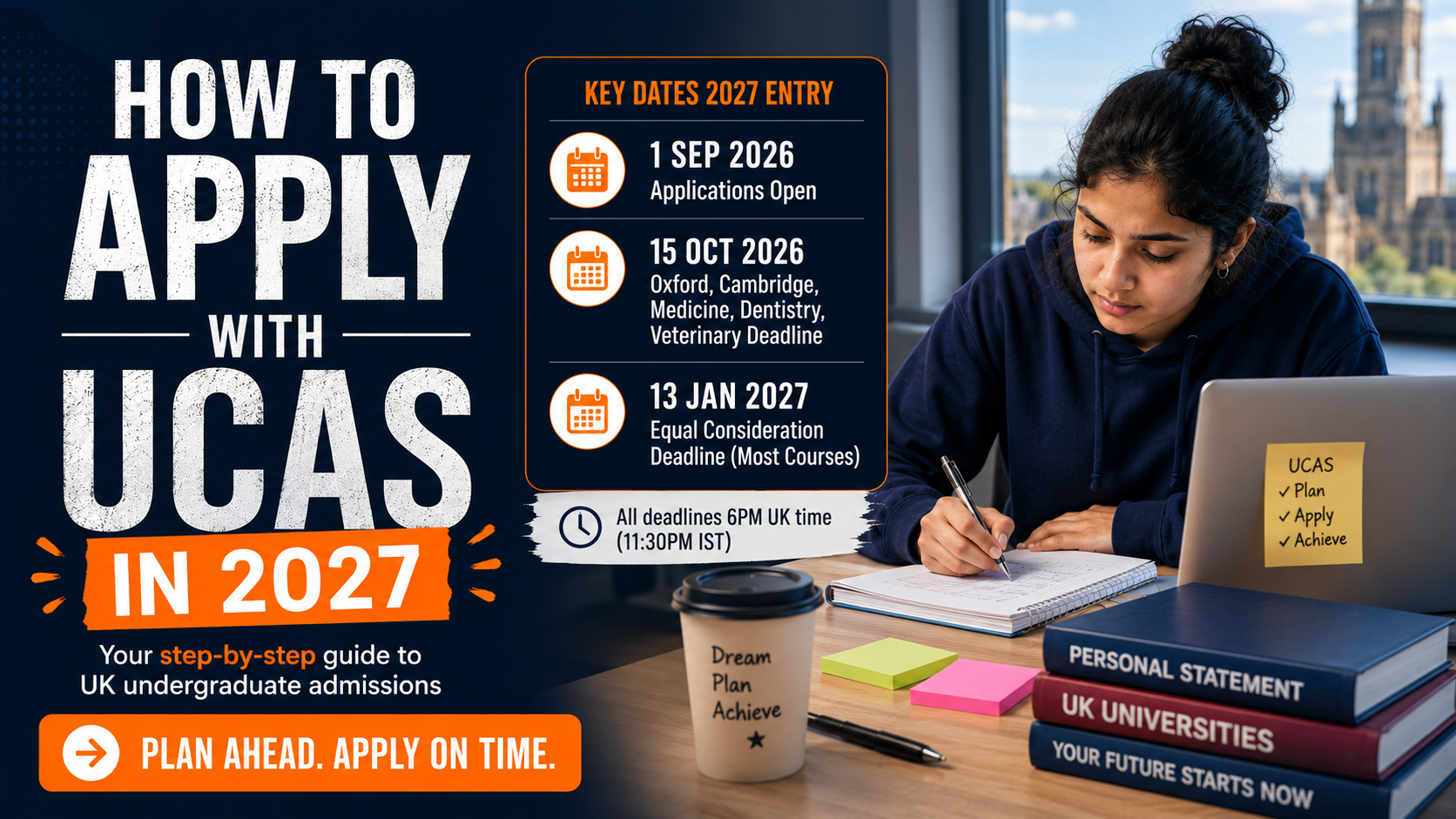
In this guide, we’ll walk you through everything you need to know about applying through UCAS, from eligibility and documents to key deadlines, fees, and post-application steps like Extra and Clearing.
- What is UCAS?
1.1 Benefits of Applying Through UCAS
1.2 What Makes a Strong UCAS Application?
- UCAS Eligibility & Requirements
- Apply with UCAS: Step-by-Step Process (2027)
- UCAS Application Fee for 2027 Entry
- UCAS Application Deadlines for 2027 Entry
- What is UCAS Equal Consideration?
- What Happens If You Miss the UCAS Deadlines?
7.1 UCAS Extra
7.2 UCAS Clearing
7.3 What if You Miss the UCAS Deadlines Completely?
- UCAS Application: Steps to Follow After Applying
- FAQs
What is UCAS?
UCAS acts as a bridge between students who want to study in the UK and the universities and colleges that offer those courses. UCAS is a central organization that handles all the admission processes for students applying to UK higher education institutions. It also helps by providing advice, guidance, and information about colleges, careers, and professional opportunities.
Benefits of Applying Through UCAS
Here are some key benefits of using the UCAS to apply to universities in the UK.
- Apply to up to 5 universities for different or the same courses, or to one university for multiple courses, using just one application form.
- Save time by filling out only one application instead of several, so you can focus on other important steps for your study abroad journey.
- Use a single set of personal statement answers for all 5 courses/universities.
- The UCAS portal provides clear guidelines on application deadlines and procedures, helping you avoid missing important dates.
- Pay one application fee that covers all 5 choices plus UCAS Extra and Clearing, with no further UCAS charges in the cycle.
- UCAS applications are the main route for UG applications in the UK.
What Makes a Strong UCAS Application?
According to UCAS, universities in the UK evaluate several important aspects of your application before making an offer. These include:
- Academic Qualifications: Your past academic records, including transcripts and grades, are carefully reviewed against the course entry requirements.
- Personal Statement Answers: Since 2026 entry, the statement is 3 set questions instead of one essay. Universities assess your motivation, preparation, and enthusiasm for the course through your answers. A strong personal statement shows passion, relevant skills, and clarity about your academic journey.
- Reference: A written recommendation from a teacher or adviser provides insight into your strengths, achievements, and potential, helping universities evaluate you beyond grades.
- Course Knowledge and Commitment: Admissions officers look for students who understand the course and can explain why it aligns with their goals.
- Communication of Skills and Experience: Your ability to clearly express your experiences and strengths gives universities a sense of your fit and potential.
UCAS Eligibility & Requirements
Before you can start your UCAS application, it’s essential to ensure you meet the eligibility requirements. To apply through UCAS, you must:
- Have completed or are in the process of completing your secondary education.
- Meet the entry requirements of the chosen courses and universities.
- Provide proof of English language proficiency (if required by the universities).
- Have a valid passport or identification document for international students.
- Register and sit any admissions tests your courses need. UCAT covers most medicine courses, while some Oxford and Cambridge courses need the TARA, TMUA, or ESAT, with registration deadlines in September. Test requirements change every cycle, so verify on each course page.
Check the various English language proficiency tests accepted by UK universities:
Apply with UCAS: Step-by-Step Process (2027)
The UCAS application process can be slightly more detailed compared to applying directly to individual universities. The entire form must be completed carefully and thoroughly, as it's submitted as a single package. All applications are submitted online through the UCAS Hub. You can save your progress and return anytime, but submission opens only on September 1, 2026.
Also Read: How to Apply to UK Universities?
The biggest advantage? You can apply to up to 5 universities or courses with just one application. Below is the step-by-step process to apply for undergraduate courses in the UK through UCAS for the 2027 intake.
1. Registration:
- To begin your UCAS application, you must first register on the UCAS Hub. Visit the official UCAS website, hover over the “Discover” tab, and select “UCAS Hub”. Then, choose 2027 as your year of entry and the level of study you wish to pursue.
- Next, open the application form and answer the registration questions. Make sure that the name you enter matches exactly with your official documents, such as your passport, academic certificates, or birth certificate.
- You must complete all required sections of the form, and skipping questions is not allowed. However, you can save your progress at any point and return later by logging in with your UCAS credentials.
- Make sure to enter a valid and active email address, as all important communication regarding your application will be sent there.
2. Education & Employment Details:
- You’ll need to enter details of all your qualifications, starting from your secondary education, even if your final results haven’t been announced yet. This helps universities check if you meet their entry requirements.
- You’ll also need to provide your employment history, if any. This includes any full-time or part-time paid jobs you’ve done.
3. Select Courses:
- You can choose up to 5 courses when applying through UCAS. However, if you're applying for medicine, dentistry, veterinary medicine, or veterinary science, you can choose only 4 courses in those subjects.
- There’s no need to rank your choices, as UCAS doesn’t ask for a preference order. Also, universities won’t see where else you’ve applied until you reply to the offers you receive.
- If one choice has the October 15, 2026 deadline, only that choice must meet the October date. The rest follow the January 13, 2027 deadline.
Tip: How to Choose the Right Study Abroad Program
4. Answering the 3 Personal Statement Questions:
- Since 2026 entry, the single personal statement essay has been replaced by 3 set questions. Your answers are a key part of your UCAS application, so make them as specific and evidence-based as possible.
- The 3 questions are: Why do you want to study this course or subject? How have your qualifications and studies helped you prepare for it? What else have you done outside of education to prepare, and why is it useful?
- The total limit is 4,000 characters including spaces, with a minimum of 350 characters per answer. You can split the remaining characters across the 3 answers as you like.
- One set of answers goes to all 5 choices, so keep them focused on the subject, not any single university.
Check: How to Write the UCAS Personal Statement
5. Add Your Reference:
- A reference is a required part of your UCAS application. It should be a written recommendation from someone who knows your academic strengths, like a teacher, counselor, or academic advisor. Your application cannot be submitted without it.
- Brief your referee at least 4 to 6 weeks early. Schools also run their own internal checking deadlines, which land earlier than UCAS dates.
6. Pay the Fee and Submit Your Application:
- Once you’ve filled in all the required sections, you’ll get a chance to review your entire application. You can make edits if needed and ensure that all the information is accurate and complete.
- The UCAS application fee is £34.50 (₹4,505) for the 2027 entry, which covers up to 5 course choices along with Extra and Clearing.
- Finally, you’ll be asked to agree to a declaration. After that, UCAS will send your application to the universities you’ve selected.
Learn About UCAS Points
UCAS Application Fee for 2027 Entry
The UCAS application fee for the 2027 cycle is £34.50 (₹4,505), up from £28.95 in the 2026 cycle. One fee covers up to 5 course choices (6 for conservatoires) and includes UCAS Extra and Clearing, so there is no second UCAS payment later in the cycle. There is no lower single-choice price, so applying to 1 course costs the same as 5.
| UCAS Application Fees for Up to 5 Course Choices | |
|---|---|
| 2027 Entry | £34.50 (₹4,505) |
| 2026 Entry (previous cycle) | £28.95 (₹3,780) |
Conversions based on a GBP-INR rate of ₹130.57 as of August 24, 2026. Rates fluctuate; check the current rate before financial planning.
Also Read
Student Guide to Study in the UKUCAS Application Deadlines for 2027 Entry
UCAS applications for the 2027 entry opened on May 13, 2026, but cannot be finally submitted until September 1, 2026. Every deadline is 6pm UK time, which is 11:30pm IST. Below are the detailed dates and deadlines for the UCAS application for the 2027 intake:
| Date | Event |
|---|---|
| September 1, 2026 | Completed undergraduate applications can be submitted |
| October 1, 2026 | Deadline for most conservatoire music courses |
| October 15, 2026 | Deadline for Oxford, Cambridge, medicine, dentistry, and veterinary |
| January 13, 2027 | The equal consideration date for most undergraduate courses |
| February 25, 2027 | Extra opens |
| June 30, 2027 | Last date to send applications to universities. Applications received after this date will automatically enter into Clearing. |
| Early July 2027 | Last day to add an Extra choice; Clearing opens |
| Around October 19, 2027 | Last date to add a Clearing choice for 2027 entry |
All dates are based on official UCAS information. Late-cycle Extra and Clearing dates are indicative until UCAS confirms them. Your school’s internal deadline lands earlier than every UCAS date, so plan around your school.
Must-Read
UCAS Application Deadline 2027: All Key DatesWhat is UCAS Equal Consideration?
Submitting your application before the equal consideration deadline ensures it will be reviewed alongside all other "on-time" applications. An application submitted in September and one submitted on deadline day are treated identically. Applications submitted after the deadline may not be considered and can be rejected, though many universities will still accept them on a first-come, first-served basis, especially where seats remain.
The UCAS Equal Consideration deadline for the 2027 entry is January 13, 2027, at 6pm UK time.
Note: Many websites still list January 14 as the main deadline. UCAS has confirmed January 13, 2027 for this cycle, so always verify dates on the official UCAS page before planning.
What Happens If You Miss the UCAS Deadlines?
Missing a deadline doesn’t always mean you can’t apply to a university. While it’s best to apply on time, you still have options even after the main UCAS deadlines. These include things like UCAS Extra and Clearing, which let you apply later or find another course if needed.
UCAS Extra
If you used all 5 choices and don’t get any offers, you can still apply through UCAS Extra. This lets you apply for courses that still have spaces available.
UCAS Extra runs from February 25, 2027, to early July 2027. You can apply to one course at a time during this period. If you don’t get an offer or change your mind, you can apply to a different course. It’s a second chance to get a place at university, even if your first applications didn’t work out, and it costs nothing extra.
UCAS Clearing
UCAS Clearing is for students who didn’t get any offers, didn’t meet their offer conditions, or want to change their course after getting their results.
For 2027 entry, Clearing starts in early July 2027 and ends around October 19, 2027. During this time, universities list courses that still have spaces. You can search for these courses, contact the universities, and apply through UCAS.
Clearing is a good way to find a university place later in the year, but it can be more competitive because it depends on what courses still have space. Clearing 2026 is live right now for September 2026 starts, and several UK universities run dedicated Clearing hotlines for Indian students.
What if You Miss the UCAS Deadlines Completely?
If you miss the final UCAS deadline and Clearing has ended, you might still be able to apply directly to some universities. Some universities accept late applications outside of UCAS, but this depends on each one. It’s best to contact them directly to ask about their late application options. The practical fallback is applying early in the next cycle, which opens each May.
UCAS Application: Steps to Follow After Applying
Once you’ve submitted your UCAS application, there are a few important steps to follow:
- Check your application status regularly on the UCAS website or UCAS Hub.
- Update your details if needed (like your address, phone number, date of birth, or passport number).
- You might be invited for an interview before the university makes a final decision.
- Wait for your offer, which can be:
- Conditional (you need to meet certain requirements), or
- Unconditional (you’ve already met all requirements).
- You’ll hear back:
- By mid-May 2027, if you applied by the January deadline, or
- By mid-July 2027, if you applied by the June deadline.
- Once you get an offer, confirm your place on time to avoid delays in getting your CAS letter (Confirmation of Acceptance for Studies).
- After you receive your CAS letter, you can apply for your UK student visa. The visa can be filed no more than 3 months before your course starts, so an early offer gives you a calmer timeline.
(Read a full guide on how to apply for a UK student visa)
How to Reply to an Offer?
Once you get the final decision on your application, you must respond within the given time by signing in to your UCAS account.

Types of Reply:
If you receive an offer, you’ll need to reply in one of the following ways:
- Unconditional offer: You should accept it right away to confirm your place.
- Conditional offer: You must meet the conditions before your place is confirmed.
Here are the types of replies you can make:
- Firm acceptance: Choose this to accept your main offer (either conditional or unconditional).
- Insurance acceptance: If your firm choice is conditional, you can pick a second option with lower requirements in case you don’t meet the conditions of your first choice.
- Decline: You must decline all other offers once you’ve made your firm and (if applicable) insurance choices.
Also Read:
- Education Loan for Studying Abroad
- Education Loans in India and Abroad
- Student Working Hours in the UK
UCAS is a simple and affordable way for international students to apply to universities in the UK. With one application and a fee of £34.50 (₹4,505), you can apply to up to 5 courses at over 350 universities. Submissions for 2027 entry open on September 1, 2026, with the main deadline on January 13, 2027. Even if you miss the main deadlines, UCAS Extra and Clearing keep the cycle open until October 2027. To improve your chances, make sure your grades, personal statement answers, and reference are strong. If you stay on track and follow the steps, UCAS can help you get into a UK university.
FAQs
Ques. What is the UCAS application fee for 2027 entry?
Ans. The fee is £34.50 (₹4,505) for up to 5 course choices, up from £28.95 in the 2026 cycle. The single fee also covers UCAS Extra and Clearing.
Ques. When can I submit my UCAS application for 2027 entry?
Ans. Completed applications can be submitted from September 1, 2026. The form opened for filling on May 13, 2026, so you can complete every section now and submit the day the window opens.
Ques. How has the UCAS personal statement changed?
Ans. Since 2026 entry, the single essay is replaced by 3 set questions: why this course, how your studies prepared you, and what you have done outside education. The limit is 4,000 characters total with at least 350 per answer.
Ques. Can I apply to the same university for more than one course through UCAS?
Ans. Yes, you can apply to multiple courses at the same university, and it will count as separate choices out of your total 5.
Ques. Will I need to submit separate personal statements for each course?
Ans. No, UCAS sends one set of personal statement answers to all your choices, so keep them relevant to the subject rather than any single university.
Ques. Can I change my course choices after submitting the UCAS application?
Ans. You get a short window after submission to swap a choice. After that, changes happen through UCAS Extra or Clearing, or by withdrawing and reapplying.
Ques. Do UK universities require entrance exams through UCAS?
Ans. Some courses do. Medicine needs the UCAT, law needs the LNAT, and some Oxford and Cambridge courses need the TARA, TMUA, or ESAT. These are registered for separately from the UCAS form.
Ques. What happens if I get offers from all 5 choices?
Ans. You’ll need to choose one firm choice and one insurance choice, and decline the rest.
Ques. Is it mandatory to accept an offer right away?
Ans. No, UCAS will give you a deadline by which you must respond. You can take time to decide before confirming your place.
Ques. Is the UCAS deadline the same for Indian students?
Ans. Yes, international applicants follow the same dates, with January 13, 2027 as the main deadline. Apply early anyway to leave time for the CAS, visa funds, and travel.



Comments