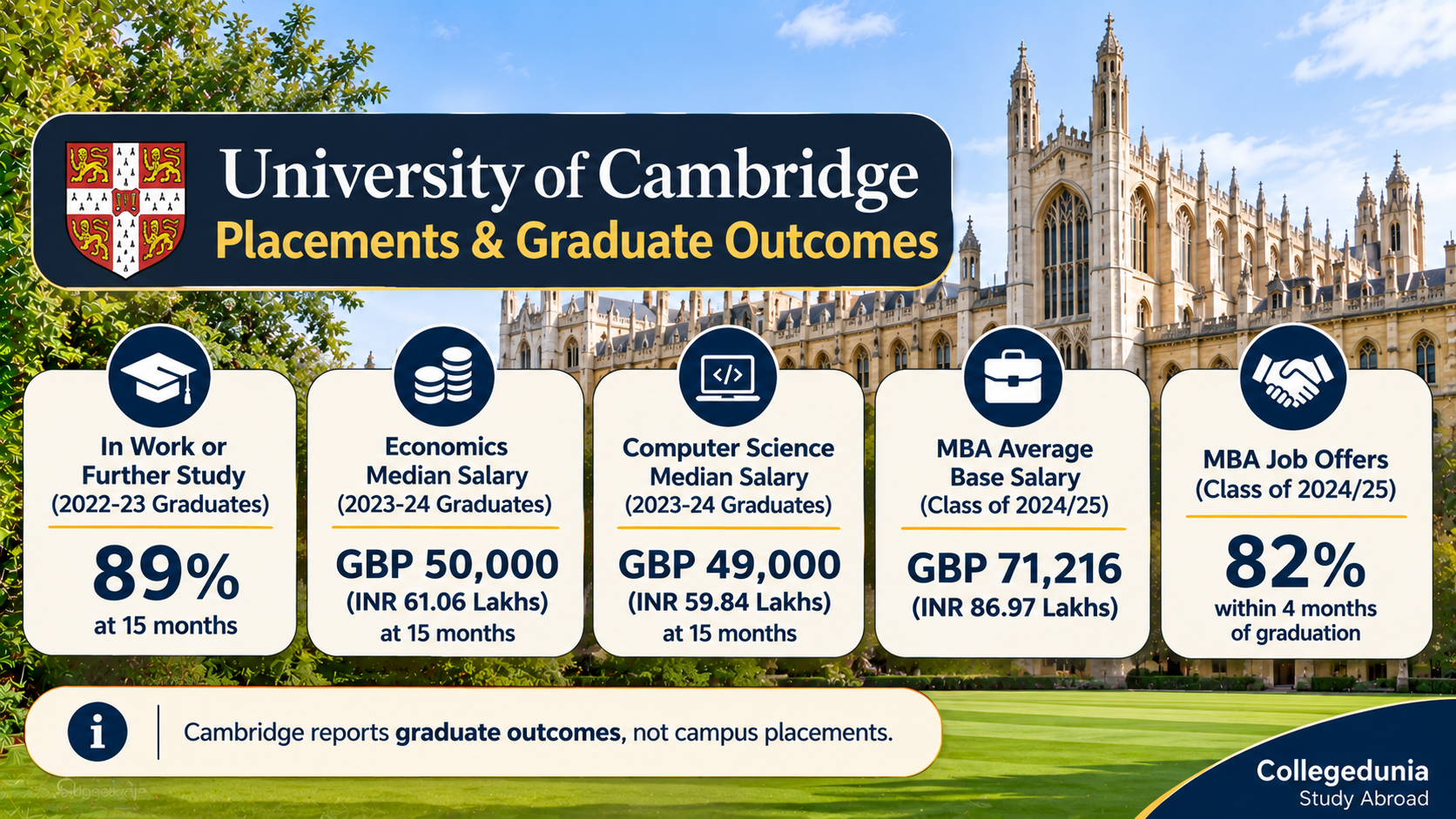
University of Cambridge placements data comes from the UK Graduate Outcomes survey, which found 89% of responding 2022-23 graduates in work or further study within 15 months. The university is in Cambridge, England, and its 2024/25 MBA class reported an average base salary of GBP 71,216 (INR 86.97 Lakhs).
- In work or further study (2022-23 graduates): 89% of survey respondents at 15 months
- Economics median salary (2023-24 graduates): GBP 50,000 (INR 61.06 Lakhs) at 15 months
- Computer science median salary (2023-24 graduates): GBP 49,000 (INR 59.84 Lakhs) at 15 months
- MBA average base salary (class of 2024/25): GBP 71,216 (INR 86.97 Lakhs)
- MBA job offers (class of 2024/25): 82% of job seekers within four months of graduation
Cambridge reports graduate outcomes, not campus placements. The figures below come from the university's own pages, the Cambridge Judge Business School employment reports and the official Discover Uni course pages.
Currency Note: All INR figures used in the article use GBP 1 = INR 122.12 on 20 November 2026.
![]()
Also Check: University of Cambridge Admission 2027 for Indian Students
University of Cambridge Placements and Employment Rate 2022-23
Of Cambridge students who answered the Graduate Outcomes survey, 89% were in work or further study within 15 months of graduating. The cohort completed its studies between August 2022 and July 2023, and 40% of graduates responded. Graduate Outcomes is the national survey that contacts UK graduates about 15 months after they finish.
In the UK, a placement means a work term during a degree, not a campus hiring drive. Cambridge publishes no placement percentage on the pages read, so the outcomes rate is the closest official measure. It combines work and further study and should not be read as a job rate.
| Measure (Graduate Outcomes survey) |
University of Cambridge |
| In work or further study within 15 months |
89% of respondents |
| Survey response rate |
40% of graduates |
| Cohort surveyed |
Students who completed between August 2022 and July 2023 |
- The 89% counts survey respondents only, so six in ten graduates of that year sit outside the figure.
- The published rate is not split by domicile, so it is not an international or Indian-student rate.
- For 2023-24 graduates, Discover Uni shows course rates from 81% for Law to 90% for Computer Science.
Source: University of Cambridge undergraduate study pages, Graduate Outcomes survey of students completing between August 2022 and July 2023. Discover Uni course pages, 2023-24 graduates.
Note: The rate mixes jobs and further study, and the university's page gives no separate share for each. It also covers survey respondents only, at a 40% response rate, so treat it as a broad signal.
Also Check: University of Cambridge Rankings 2026
University of Cambridge Average Salary After Graduation 2023-24
Cambridge Economics graduates of 2023-24 reported a median of GBP 50,000 (INR 61.06 Lakhs) 15 months after finishing. Computer science followed at GBP 49,000 (INR 59.84 Lakhs). A median is the middle salary of those who replied, so half earned more and half earned less.
The pages read for this article give no university-wide median salary. Discover Uni, the official UK course-comparison site, publishes subject medians for full-time undergraduate courses from the Graduate Outcomes survey.
| Subject at Cambridge (full-time undergraduate) |
Median salary 15 months after (GBP) |
INR |
Typical range (GBP) |
Graduates in the data |
| Economics |
GBP 50,000 |
INR 61.06 Lakhs |
GBP 39,500 to GBP 70,000 |
35 |
| Computer science |
GBP 49,000 |
INR 59.84 Lakhs |
GBP 41,000 to GBP 71,000 |
30 |
| Engineering |
GBP 40,000 |
INR 48.85 Lakhs |
GBP 34,000 to GBP 48,000 |
65 |
| Physical sciences (Natural Sciences course) |
GBP 35,000 |
INR 42.74 Lakhs |
GBP 31,000 to GBP 40,000 |
35 |
| Law |
GBP 34,000 |
INR 41.52 Lakhs |
GBP 26,000 to GBP 47,000 |
35 |
- Each median rests on 30 to 65 graduates, so a few replies can move a figure.
- The subject labels are Discover Uni's and pool every full-time undergraduate course in that subject at Cambridge.
- Discover Uni shows no 15-month earnings figure for Mathematics at Cambridge.
- These are undergraduate figures, because Discover Uni compares undergraduate courses only.
Source: Discover Uni, course pages for the University of Cambridge, Graduate Outcomes survey earnings, 2023-24 graduates.
Note: Discover Uni states that its earnings figures are nominal, meaning they are not adjusted for inflation. Each median covers between 50% and 62% of the graduates asked.
University of Cambridge Placements by Course and Salary
Computer Science BA shows the highest course rate, with 90% of 2023-24 graduates in work or study 15 months after finishing. Economics BA and Engineering MEng follow at 89%. In each of the five courses below, at least 90% of those in work held highly skilled jobs.
The table adds a longer view from LEO (Longitudinal Education Outcomes), the dataset Discover Uni uses for later earnings. Its five-year medians cover earlier cohorts, 2015-17 or 2016-18 graduates, and are not adjusted for inflation.
| Course at Cambridge |
In work or study at 15 months |
In highly skilled work |
Median five years after (GBP) |
INR |
| Economics BA |
89% |
95% |
GBP 89,500 |
INR 1.09 Crore |
| Computer Science BA |
90% |
95% |
GBP 88,500 |
INR 1.08 Crore |
| Law BA |
81% |
95% |
GBP 70,500 |
INR 86.09 Lakhs |
| Engineering MEng |
89% |
94% |
GBP 49,500 |
INR 60.45 Lakhs |
| Natural Sciences BA (physical sciences) |
88% |
90% |
GBP 46,000 |
INR 56.18 Lakhs |
- Law has the lowest 15-month rate at 81%, yet its five-year median of GBP 70,500 (INR 86.09 Lakhs) is the third highest.
- Mathematics BA has no 15-month data, but its five-year median is GBP 63,500 (INR 77.55 Lakhs) for 2015-17 graduates.
- The course rates rest on 45 to 225 respondents, between 52% and 62% of those asked.
- The five-year figures describe graduates who left before the current fee and visa rules, so read them as context.
Source: Discover Uni, course pages for the University of Cambridge: Graduate Outcomes survey, 2023-24 graduates, and LEO earnings, 2015-17 and 2016-18 graduates.
Key Insight: Five years after graduating, the Economics median was GBP 89,500 (INR 1.09 Crore) and the Computer science median GBP 88,500 (INR 1.08 Crore). Both sit well above the Engineering median of GBP 49,500 (INR 60.45 Lakhs), so subject choice matters more than the university headline.
Also Check: University of Cambridge Courses and Fees 2027
University of Cambridge MBA Placements and Salary 2024/25
The Cambridge MBA class of 2024/25 reported an average base salary of GBP 71,216 (INR 86.97 Lakhs). Of graduates seeking work, 82% received a full-time offer within four months of graduation. The figures come from The Cambridge MBA Employment Report 2026, published by Cambridge Judge Business School.
The school also reports on its Master of Finance. The table compares the two classes of 2024/25 at three and four months after the course.
| Measure |
MBA class of 2024/25 |
Master of Finance class of 2024/25 |
| Had a job offer three months after |
80% |
94% |
| Employed three months after |
73% |
85% |
| Employed four months after |
76% |
89% |
- The MBA report page states that 88% of the class switched at least one of country, job function or industry.
- MBA graduates took jobs in 24 countries.
- Half of Master of Finance students turned a summer internship into a job offer.
- The MBA report gives one average base salary and no median, bonus or response count.
Source: Cambridge Judge Business School, The Cambridge MBA Employment Report 2026 and the Master of Finance Employment Report 2026, class of 2024/25.
Key Insight: An average base salary of GBP 71,216 (INR 86.97 Lakhs) sits above both Skilled Worker salary thresholds listed in the visa section. It is an average, so a few high salaries can lift it above what a typical graduate earns.
Top Recruiters Hiring University of Cambridge Graduates
Boston Consulting Group, Bayer, PwC and TikTok employed the most Cambridge MBAs from the class of 2024/25, as the employment report states. A university careers feature adds that one of the biggest employers of Cambridge graduates is the university itself.
The pages read for this article carry no university-wide ranked employer list. The table groups the employers named in the two official sources.
| Official source |
Employers named |
| MBA Employment Report 2026: companies employing the most Cambridge MBAs |
Boston Consulting Group, Bayer, PwC, TikTok |
| MBA Employment Report 2026: other employers in the recruiter list |
Accenture, Amazon, Amazon Web Services, American Express, ArcelorMittal, Arthur D. Little, Bain & Company, Bank of America, BP, BYD |
| University careers feature, March 2026: employers quoted on hiring Cambridge graduates |
Cambridge Kinetics, AVEVA, Charles River Associates |
- The MBA recruiter list is alphabetical and covers one class, so it shows who hired, not how many.
- The three employers in the careers feature describe hiring Cambridge graduates in their own words.
- Neither source gives hires per employer for the whole university.
Source: Cambridge Judge Business School, The Cambridge MBA Employment Report 2026, class of 2024/25. University of Cambridge careers feature, 25 March 2026.
University of Cambridge Placements by Sector and Job Role
Among 2022/23 Cambridge graduates in work, Teaching and Education was the largest sector at 15%, followed by Finance, Accounting and Insurance at 14%. The university published the split in March 2026 from Graduate Outcomes data.
| Sector (2022/23 graduates in work) |
Share |
| Teaching and Education |
15% |
| Finance, Accounting and Insurance |
14% |
| Science, Engineering and Manufacturing |
11% |
| Public Sector and NGOs |
8% |
| Creative Industries and Communications |
8% |
- The five sectors listed add up to 56%, and the feature does not name the rest.
- The split covers all graduates in work, not international graduates alone.
Source: University of Cambridge careers feature, 25 March 2026, Graduate Outcomes data for 2022/23 graduates.
The MBA class of 2024/25 looks different. The business school's report page puts 55% of the class in industry roles such as technology, healthcare and energy. A further 23% joined finance and 19% went into consulting.
Where University of Cambridge Graduates Work: UK and Abroad
The UK was the largest destination for the Cambridge MBA class of 2024/25, taking 43% of post-MBA jobs. Southeast Asia followed at 18%, and South Asia took 7%. The pages read for this article carry no university-wide location split, so the business school reports are the only official view. They cover two programmes, not the whole university.
| Region of post-MBA job (class of 2024/25) |
Share of class |
| United Kingdom |
43% |
| Southeast Asia |
18% |
| North America |
10% |
| East Asia |
9% |
| South Asia |
7% |
| Middle East and North Africa |
5% |
| Australasia |
3% |
| Western Europe, excluding the UK |
3% |
| Latin America and Caribbean |
1% |
| Central Asia |
1% |
- Master of Finance graduates of 2024/25 work in 12 countries, with 39% of roles in Asia.
- Of Master of Finance students who accepted a UK offer, 48% came from outside the UK.
- Half of Master of Finance students returned to their pre-course country after graduating.
Source: Cambridge Judge Business School, The Cambridge MBA Employment Report 2026 and the Master of Finance Employment Report 2026, class of 2024/25.
Tip for Indian Students: Read the 43% as the share of one MBA class with prior work experience, not a university-wide rate. If you want a UK job, plan around the Graduate visa first, because it falls to 18 months for applications from 1 January 2027.
Also Check: University of Cambridge Scholarships 2027 for Indian Students
University of Cambridge Career Services for International Students
The Cambridge Careers Service runs over 200 careers events each year, including around 13 major careers fairs. It also offers more than 50 employment-related skills sessions. The pages read for this article describe one service for all students, with no separate track for international students.
- The Careers Service points staff and students to the university's Graduate Outcomes summaries.
- The International Student Office publishes the work rules for Student visa holders, covered in the next section.
- Cambridge Judge Business School publishes separate employment reports for its MBA and Master of Finance.
These are services, not outcomes. The outcome figures for Cambridge sit in the sections above.
Post-Study Work After University of Cambridge for Indian Students
The Graduate visa lets Cambridge graduates stay and work in most jobs. It lasts 2 years for applications made on or before 31 December 2026 and 18 months for applications from 1 January 2027. PhD graduates get 3 years.
- Application fee: GBP 937 (INR 1.14 Lakhs), paid once.
- Healthcare surcharge: usually GBP 1,035 (INR 1.26 Lakhs) for each year of the visa.
- During the degree, a Student visa allows at most 20 hours of work a week in term time.
- Cambridge is stricter: undergraduates and full-time taught postgraduates are not expected to take paid work during term.
- Skilled Worker visa afterwards: the standard minimum salary is GBP 41,700 (INR 50.92 Lakhs) a year, as gov.uk states.
- A lower Skilled Worker minimum of GBP 33,400 (INR 40.79 Lakhs) a year can apply outside healthcare and education.
You must apply from inside the UK on a Student visa, after Cambridge reports your completion to the Home Office. Check gov.uk on the day you apply, because the rules change often.
Also Check: Graduate Immigration Route to UK: Post-Study Work Guide
Cambridge can be a worthwhile investment, but the outcome depends on your course, career plans, and where you want to work after graduation. 89% of responding graduates from 2022–23 were employed or pursuing further studies within 15 months, while subject-wise median salaries for 2023–24 graduates ranged from GBP 34,000 (INR 41.52 Lakhs) to GBP 50,000 (INR 61.06 Lakhs). However, these figures need context, as only 40% of graduates responded, the employment rate includes further study, and salary data is not separately available for Indian students.
Before applying, compare the median salary for your subject with the total course cost and consider your expected career path after graduation. You should also check the Graduate visa duration applicable to your intake, as it can affect how long you can stay and work in the UK after completing your degree.
FAQs
Ques. What is the placement rate at the University of Cambridge?
Ans. Cambridge publishes a graduate outcomes rate, not a placement rate. 89% of responding 2022-23 graduates were in work or further study within 15 months, at a 40% survey response rate.
Ques. What is the average salary after graduating from the University of Cambridge?
Ans. The pages read give no university-wide figure. Discover Uni subject medians at 15 months run from GBP 34,000 (INR 41.52 Lakhs) for Law to GBP 50,000 (INR 61.06 Lakhs) for Economics. The cohort is 2023-24 graduates.
Ques. What is the University of Cambridge MBA salary?
Ans. The Cambridge MBA class of 2024/25 reported an average base salary of GBP 71,216 (INR 86.97 Lakhs). Of graduates seeking work, 82% had a full-time offer within four months of graduation.
Ques. Which companies hire University of Cambridge graduates?
Ans. The MBA Employment Report 2026 names Boston Consulting Group, Bayer, PwC and TikTok as the companies employing the most MBAs from the class of 2024/25. A university feature adds that the university itself is among the biggest employers of its graduates.
Ques. What is the Cambridge Computer Science graduate salary?
Ans. Discover Uni shows a median of GBP 49,000 (INR 59.84 Lakhs) 15 months after graduating for 2023-24 Computer science graduates. Five years after, the median for 2016-18 graduates was GBP 88,500 (INR 1.08 Crore), and 95% of those in work held highly skilled jobs.
























Comments