



Study Abroad Content Writer | Updated On - May 19, 2026
The UK higher education system is one of the most structured and internationally recognised in the world. For Indian students, it offers a distinct advantage: shorter degree durations. A Bachelor's degree takes 3 years (4 in Scotland), a Master's takes just 1 year, and a PhD takes 3–4 years. This means you spend less time and money compared to equivalent degrees in the USA or Australia. The UK has 17 universities in the QS World University Rankings 2026 Top 100, including Imperial College London (#2), Oxford (#4) and Cambridge (#6).
- The 1-year Master's is the UK's biggest draw for Indian students: A postgraduate degree that takes 2 years in the USA or Australia takes just 12 months in the UK. This saves one full year of tuition fees and living costs (₹25–50 lakh in total savings depending on the university and city).
- The Graduate Route visa is changing from January 2027: Indian students who apply for the Graduate Route visa on or before December 31, 2026, receive 2 years of post-study work rights. From January 1, 2027, this reduces to 18 months for Bachelor's and Master's graduates. PhD graduates continue to receive 3 years.
- A 2:1 degree classification is the minimum standard most employers and postgraduate programs require: The UK grades degrees differently from India. A First Class (70%+) and Upper Second Class (2:1, 60–69%) are the two grades that open doors to competitive jobs and further study. Understanding this grading system before you start is essential.
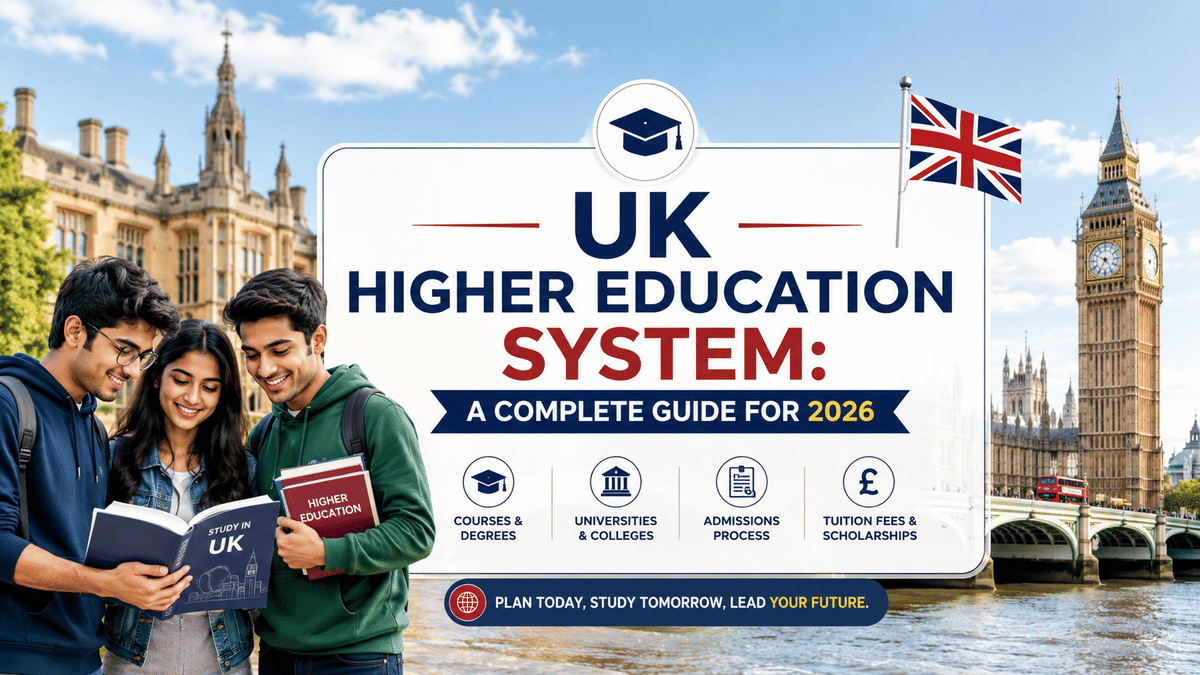
- How the UK Higher Education System is Structured
- Degrees and Qualifications: What You Can Study in the UK
- UK Grading System: How Your Degree is Classified
- Top UK Universities by QS Rankings 2026
- How to Apply: UCAS and Direct Applications
- Tuition Fees and Cost of Studying in the UK
- Scholarships for Indian Students in the UK
- Post-Study Work: Graduate Route Visa 2026 Update
- FAQs
How the UK Higher Education System is Structured
The UK higher education system covers all studies after secondary school (Class 12 equivalent). It is divided into undergraduate, postgraduate and doctoral levels. Each has specific entry requirements, durations and qualifications.
- Undergraduate level: Includes Bachelor's degrees, Foundation degrees and Higher National Diplomas (HND). Entry requires completion of Class 12 or equivalent. Most Bachelor's degrees take 3 years in England, Wales and Northern Ireland, and 4 years in Scotland.
- Postgraduate level: Includes taught Master's degrees (MA, MSc, MBA), research Master's degrees (MRes, MPhil) and Postgraduate Diplomas/Certificates. Entry requires a Bachelor's degree. Most taught Master's programs take 1 year – this is the key difference from the USA and Australia.
- Doctoral level: Includes PhD and DPhil degrees. Entry typically requires a Master's degree (though some programs accept direct entry from a strong Bachelor's). Duration is 3–4 years.
One important difference from the Indian system: UK undergraduate degrees are highly specialised from day one. You choose your subject before applying and study it exclusively throughout your degree. There is no general education requirement or elective system like in the USA. This means you need to be clear about your subject before applying.
Degrees and Qualifications: What You Can Study in the UK
The UK offers a wider range of qualification types than most Indian students are aware of. Beyond the standard Bachelor's and Master's, there are foundation programs, integrated degrees and vocational qualifications that serve different academic and career goals.
| Qualification | Duration | Entry Requirement | What It Is |
|---|---|---|---|
| Foundation Year / Foundation Degree | 1–2 years | Class 12 (may not meet direct Bachelor's entry) |
Preparatory program for students who do not meet direct Bachelor's entry requirements. Successful completion leads to Year 1 of a Bachelor's degree. |
| Higher National Diploma (HND) | 2 years | Class 12 | Vocational qualification focused on practical skills. Can lead directly to employment or to Year 2/3 of a Bachelor's degree at some universities. |
| Bachelor's Degree (BA, BSc, BEng, LLB) |
3 years (4 in Scotland) |
Class 12 with strong grades; English proficiency | Standard undergraduate degree. Highly specialised, you study one subject (or two in joint honours) throughout. |
| Integrated Master's (MEng, MChem, MMath) | 4 years (5 in Scotland) |
Class 12 with strong grades | Combines Bachelor's and Master's in one program. Common in engineering, chemistry and mathematics. Saves one year compared to doing them separately. |
| Postgraduate Certificate / Diploma (PGCert / PGDip) | 9 months – 1 year | Bachelor's degree | Shorter postgraduate qualification. Does not require a dissertation. Useful for professional development or as a stepping stone to a full Master's. |
| Master's Degree (MA, MSc, MBA, LLM) | 1 year (taught); 1–2 years (research) | Bachelor's degree (typically 2:1 or above) |
The most popular qualification for Indian students. Taught Master's involves coursework and a dissertation. Research Master's (MRes, MPhil) is research-focused. |
| PhD / DPhil | 3–4 years | Master's degree (or strong Bachelor's for some programs) |
Original research leading to a thesis. Supervised by a faculty member. Many PhD programs in the UK are fully funded for domestic students; international funding is competitive. |
Key difference from India: In India, a Master's degree typically takes 2 years. In the UK, a taught Master's takes 1 year — covering the same academic content in a more intensive format. This is one of the primary reasons Indian students choose the UK for postgraduate study.
Read our guide on Foundation Courses in the UK: What They Are and Who Should Consider Them?
UK Grading System: How Your Degree is Classified
UK universities do not use a GPA system. Instead, undergraduate degrees are awarded a classification based on your overall performance across all years of study. This classification is what employers and postgraduate programs look at — not individual module grades.
| Classification | Marks Range | What It Means |
|---|---|---|
| First Class Honours (1st) | 70% and above | Highest classification. Required for most competitive graduate jobs and PhD programs. Equivalent to distinction. |
| Upper Second Class Honours (2:1) | 60–69% | The standard minimum for most graduate employers and postgraduate programs. Most Indian students target this as their minimum. |
| Lower Second Class Honours (2:2) | 50–59% | Accepted by many employers, but limits options for competitive roles and further study. Some Master's programs require a 2:1 minimum. |
| Third Class Honours (3rd) | 40–49% | Minimum passing grade. Significantly limits graduate employment and further study options. |
| Fail | Below 40% | Does not meet passing standard. May require resitting exams or assignments. |
For postgraduate (Master's) degrees, the classification system is different:
- Distinction: Typically 70% and above
- Merit: Typically 60–69%
- Pass: Typically 50–59%
- Fail: Below 50%
A common misconception among Indian students: "Getting 70% in the UK feels low compared to India where 90%+ is expected. But 70% in the UK is a First Class — the highest grade. The marking is much stricter." UK universities rarely award marks above 80%, and a score of 75% is considered exceptional.
Read our complete guide on the UK Grading System for UG and PG Programs.
Top UK Universities by QS Rankings 2026
The UK has 17 universities in the QS World University Rankings 2026 Top 100 — more than any other country except the USA. The table below shows the top UK universities by QS 2026 global rank.
| QS Rank 2026 | University | Location | Known For |
|---|---|---|---|
| #2 | Imperial College London | London | Engineering, Science, Medicine, Business |
| #4 | University of Oxford | Oxford | Law, Medicine, Humanities, Sciences, PPE |
| #6 | University of Cambridge | Cambridge | Sciences, Engineering, Mathematics, Law |
| #9 | University College London (UCL) | London | Architecture, Law, Medicine, Social Sciences |
| #31 | King's College London | London | Law, Medicine, Humanities, Social Sciences |
| #34 | University of Edinburgh | Edinburgh | Medicine, Law, Business, Arts |
| #35 | University of Manchester | Manchester | Engineering, Business, Sciences, Social Sciences |
| #51 | University of Bristol | Bristol | Engineering, Law, Sciences, Arts |
| #56 | London School of Economics (LSE) | London | Economics, Finance, Law, Political Science |
| #74 | University of Warwick | Coventry | Business, Economics, Engineering, Mathematics |
Explore the full list of Top Universities in the UK 2026.
How to Apply: UCAS and Direct Applications
The application process in the UK differs depending on whether you are applying for undergraduate or postgraduate study.
- Undergraduate applications (Bachelor's degrees): All undergraduate applications in the UK go through UCAS (Universities and Colleges Admissions Service). You can apply to a maximum of 5 universities in one application. The UCAS 2027 entry cycle opened on May 12, 2026. The deadline for Oxford, Cambridge, medicine, dentistry and veterinary science is October 15, 2026. The main UCAS deadline for all other courses is January 29, 2027.
- Postgraduate applications (Master's and PhD): Most postgraduate programs require direct applications to the university — not through UCAS. Each university has its own application portal and deadlines. There is no single centralised system for postgraduate applications.
| Application Step | Undergraduate (UCAS) | Postgraduate (Direct) |
|---|---|---|
| Application portal | UCAS (ucas.com) | The university's own portal |
| Number of applications | Maximum 5 universities | No limit |
| Personal statement | One statement for all 5 choices | Separate statement per university |
| References | 1 academic reference | Typically, 2 academic references |
| Key deadline (2026–27) | Oct 15, 2026 (Oxbridge/medicine); Jan 29, 2027 (others) | Varies by university and program |
| English proficiency | IELTS 6.0–7.0 or TOEFL 80–100 (varies by university) | IELTS 6.5–7.5 or TOEFL 90–110 (varies by program) |
Read our complete guide on the UCAS Application: How to Apply to UK Universities.
Tuition Fees and Cost of Studying in the UK
UK tuition fees for international students vary significantly by university, program and level of study. London-based universities are generally more expensive than those in other cities.
| Program Type | Tuition Fees Per Year (GBP) | Tuition Fees Per Year (INR approx.) |
|---|---|---|
| Undergraduate (Bachelor's) | £10,000–£38,000 | ~₹12.9 lakh–₹48.9 lakh |
| Postgraduate Taught (Master's) | £12,000–£35,000 | ~₹15.4 lakh–₹45 lakh |
| MBA | £20,000–£50,000 | ~₹25.7 lakh–₹64.3 lakh |
| PhD / Research Degree | £14,000–£30,000 | ~₹18 lakh–₹38.6 lakh |
| Foundation Year | £8,000–£20,000 | ~₹10.3 lakh–₹25.7 lakh |
Beyond tuition, Indian students must budget for living costs and the Immigration Health Surcharge (IHS).
- Living costs: £9,000–£15,000/year (₹11.6 lakh–₹19.3 lakh) outside London; £12,000–£18,000/year (₹15.4 lakh–₹23.1 lakh) in London.
- Immigration Health Surcharge (IHS): £776/year (around ₹99,800/year) – this rose 65% from April 8, 2026. It must be paid upfront for the full duration of your visa when applying. For a 1-year Master's visa, this is approximately £776 (₹99,800). For a 3-year Bachelor's visa, it is approximately £2,328 (₹2,99,400).
- Student visa fee: £490 (around ₹63,000) for applications from outside the UK.
- Part-time work: International students can work up to 20 hours per week during term time and full-time during official holidays. This can offset living costs by £400–£800/month depending on the role and location.
Read our guide on Cost of Living in the UK for International Students.
Scholarships for Indian Students in the UK
Several major scholarships are specifically available to Indian students applying to UK universities. The table below covers the most significant ones.
| Scholarship | Who Can Apply | Coverage |
|---|---|---|
| Chevening Scholarship | Indian citizens with 2+ years of work experience applying for a 1-year Master's | Full tuition, living expenses, return airfare, visa fee |
| Commonwealth Scholarship | Indian citizens for postgraduate study at UK universities | Full tuition, airfare, and living expenses |
| GREAT Scholarship | Indian students for UG or PG programs at participating UK universities | £10,000 towards tuition fees |
| Felix Scholarship | Indian students with a First Class Bachelor's degree for postgraduate study at Oxford, SOAS or Reading | Full tuition, living expenses |
| Rhodes Scholarship | Indian students under 25 for postgraduate study at the University of Oxford | Full tuition, living expenses, travel |
| Charles Wallace India Trust Scholarship | Indian mid-career professionals in arts, heritage and humanities for research or doctoral programs | Living expenses, some tuition, travel |
| University-Specific Scholarships | Varies by university — typically merit-based for international students | Partial tuition fee reduction (£2,000–£10,000 typically) |
Note: The Chevening Scholarship application for 2027 entry opens in August 2026 and closes in November 2026. It is one of the most competitive scholarships available to Indian students – apply early and invest time in your personal statement and references.
Read our complete guide on UK Scholarships for Indian Students.
Post-Study Work: Graduate Route Visa 2026 Update
The UK Graduate Route visa allows international students to stay and work in the UK after completing their degree – but the rules are changing from January 2027. This is the most important policy update for Indian students planning to study in the UK.
- If you apply for the Graduate Route visa on or before December 31, 2026, you will receive 2 years of post-study work rights (Bachelor's and Master's graduates) or 3 years (PhD graduates).
- If you apply for the Graduate Route visa from January 1, 2027 onwards, Bachelor's and Master's graduates receive only 18 months. PhD graduates continue to receive 3 years.
- The Graduate Route visa allows you to work in any job at any salary level – there is no minimum salary requirement and no employer sponsorship needed during this period.
- After the Graduate Route period, you can switch to a Skilled Worker visa if you have a job offer with a salary of at least £25,000/year (around ₹32.1 lakh/year) from a licensed sponsor employer.
| Degree Level | Graduate Route Duration (Apply by Dec 31, 2026) | Graduate Route Duration (Apply from Jan 1, 2027) |
|---|---|---|
| Bachelor's degree | 2 years | 18 months |
| Master's degree (taught or research) | 2 years | 18 months |
| PhD / Doctoral degree | 3 years | 3 years (unchanged) |
Read our guide on UK Student Visa: Requirements, Process and Documents.
The UK higher education system offers Indian students a structured, time-efficient pathway to globally recognised qualifications. A 3-year Bachelor's, a 1-year Master's and a 3–4 year PhD – all at universities with strong global rankings – make the UK one of the most cost-effective Western study destinations when measured by years of study. The Graduate Route visa currently gives 2 years of post-study work rights, reducing to 18 months from January 2027 for Bachelor's and Master's graduates. With 17 universities in the QS 2026 Top 100 and major scholarships like Chevening and Commonwealth available to Indian students, the UK remains a strong choice – but requires careful planning around visa timelines, IHS costs and the Graduate Route deadline.
FAQs
Ques. How is the UK higher education system structured?
Ans. The UK higher education system has three main levels: undergraduate (Bachelor's degrees, Foundation degrees, HND), postgraduate (taught Master's, research Master's, Postgraduate Diplomas) and doctoral (PhD/DPhil). A Bachelor's degree takes 3 years in England, Wales and Northern Ireland and 4 years in Scotland. A taught Master's takes 1 year. A PhD takes 3–4 years. UK undergraduate degrees are highly specialised – you study one subject from day one, with no general education requirements or elective system.
Ques. What is the UK grading system for degrees?
Ans. UK undergraduate degrees are classified as First Class Honours (70%+), Upper Second Class (2:1, 60–69%), Lower Second Class (2:2, 50–59%), Third Class (40–49%) or Fail (below 40%). A 2:1 is the minimum standard required by most graduate employers and postgraduate programs. For Master's degrees, the classifications are Distinction (70%+), Merit (60–69%) and Pass (50–59%). UK marking is strict – scores above 80% are rare, and 70% is considered excellent.
Ques. What are the top universities in the UK for Indian students in 2026?
Ans. The top UK universities by QS World University Rankings 2026 are Imperial College London (#2), University of Oxford (#4), University of Cambridge (#6), UCL (#9), King's College London (#31), University of Edinburgh (#34), University of Manchester (#35), University of Bristol (#51), London School of Economics (#56) and University of Warwick (#74). The UK has 17 universities in the QS 2026 Top 100 — more than any country except the USA.
Ques. How do I apply to UK universities as an Indian student?
Ans. For undergraduate programs, all applications go through UCAS (ucas.com). You can apply to a maximum of 5 universities. The UCAS 2027 entry cycle opened May 12, 2026. The deadline for Oxford, Cambridge, medicine, dentistry and veterinary science is October 15, 2026. The main deadline for all other courses is January 29, 2027. For postgraduate programs, you apply directly to each university through their own portal — there is no centralised system for Master's or PhD applications.
Ques. What is the Graduate Route visa and how long does it last?
Ans. The Graduate Route visa allows international students to stay and work in the UK after completing their degree. For students who apply on or before December 31, 2026, it lasts 2 years for Bachelor's and Master's graduates and 3 years for PhD graduates. From January 1, 2027, it reduces to 18 months for Bachelor's and Master's graduates. PhD graduates continue to receive 3 years. During the Graduate Route period, you can work in any job at any salary without employer sponsorship. Source: UK Government official website, gov.uk/graduate-visa.
Ques. How much does it cost to study in the UK for Indian students?
Ans. Tuition fees for international students range from £10,000–£38,000/year (around ₹12.9 lakh–₹48.9 lakh) for Bachelor's programs and £12,000–£35,000/year (around ₹15.4 lakh–₹45 lakh) for Master's programs. Living costs add £9,000–£15,000/year (₹11.6 lakh–₹19.3 lakh) outside London and more in London. The Immigration Health Surcharge (IHS) is £776/year (around ₹99,800/year) — paid upfront for the full visa duration. The student visa fee is £490 (around ₹63,000).
Ques. What scholarships are available for Indian students in the UK?
Ans. The main scholarships for Indian students in the UK are the Chevening Scholarship (full funding for a 1-year Master's, requires 2 years of work experience), Commonwealth Scholarship (full funding for postgraduate study), GREAT Scholarship (£10,000 towards tuition), Felix Scholarship (full funding for postgraduate study at Oxford, SOAS or Reading) and the Rhodes Scholarship (full funding for postgraduate study at Oxford). Most UK universities also offer merit-based partial scholarships for international students.
Ques. What is the difference between Russell Group and post-1992 universities in the UK?
Ans. Russell Group universities are 24 research-intensive institutions known for academic excellence, strong research output and high graduate employability. They include Oxford, Cambridge, Imperial, UCL, Manchester and Edinburgh. Post-1992 universities are former polytechnics that gained university status after 1992. They have a more vocational and practical focus, more accessible entry requirements and are generally less competitive for admission. For Indian students targeting competitive graduate employment or further research, Russell Group universities carry stronger global recognition.
Ques. Can Indian students work while studying in the UK?
Ans. Yes. International students on a UK Student visa can work up to 20 hours per week during term time and full-time during official university holidays. This applies to students enrolled in degree-level programs at universities. Students on foundation programs or at further education colleges may have different work restrictions. Part-time work in the UK typically pays £11–£15/hour, which can offset £400–£800/month of living costs depending on hours worked and location.


1718112873.jpg?tr=w-305,h-145,c-force?h=40&w=40&mode=stretch)


1718112873.jpg?tr=w-305,h-145,c-force?h=175&w=350&mode=stretch)



Comments