



| Updated On - Jun 26, 2026
The UK grading system classifies degrees as First, 2:1, 2:2, or Third for undergraduates, and Distinction, Merit or Pass for master's. A UK 70 percent is a top grade, not a moderate one.
- The UK grades degrees as First, 2:1, 2:2, or Third, not by GPA or percentage alone.
- In the UK, 70 percent is exceptional, unlike in India, where it is moderate.
- Most UK master's need a 2:1 equivalent, about an Indian 60 percent or CGPA 6.5.
- Scotland differs, with a 4-year honours degree and its own structure.
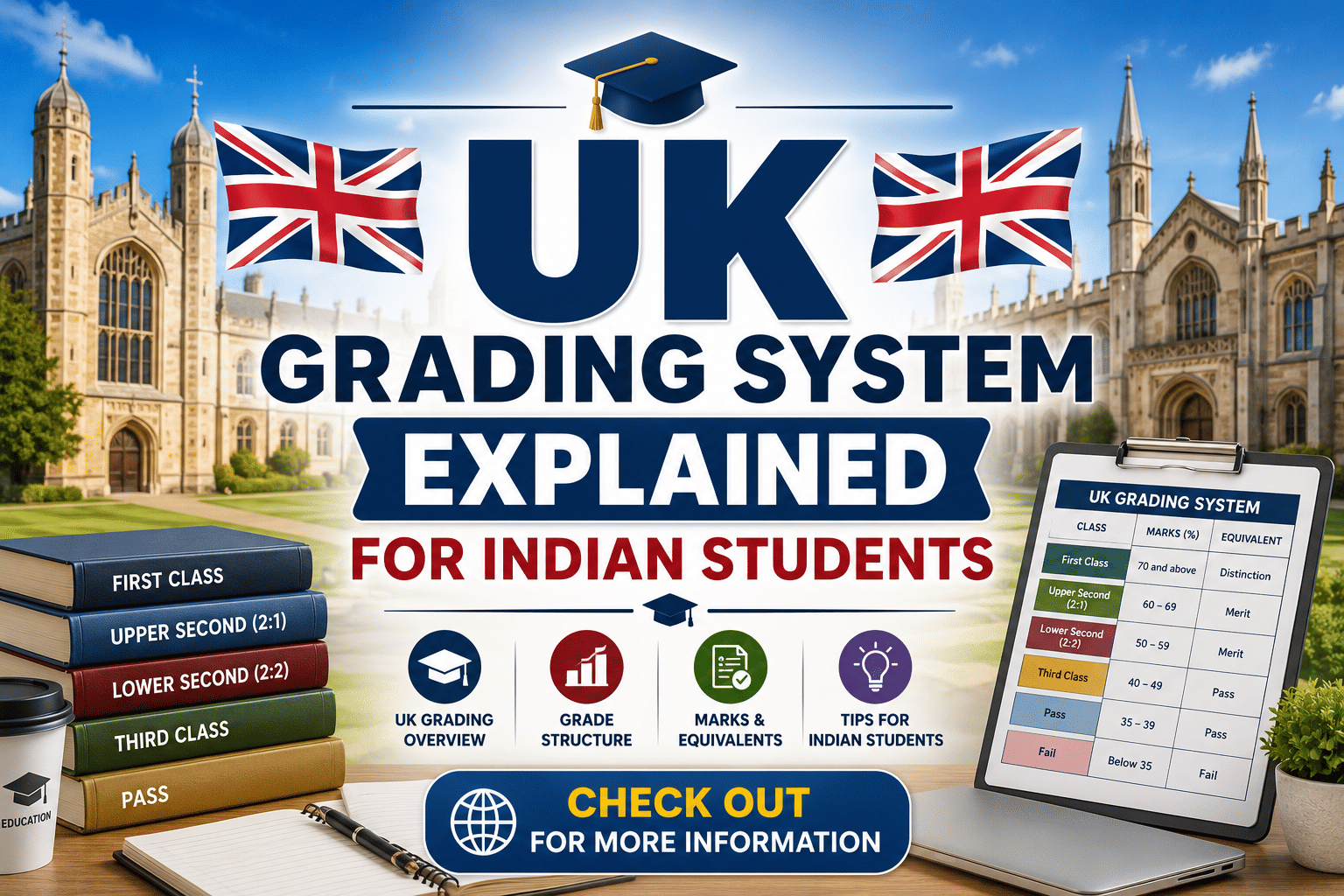
Indian students often misread UK grades, where a 70 percent is a top mark, so understanding the system early is key to checking eligibility. Knowing how the UK grading system maps to your Indian percentage or CGPA tells you which universities and courses you can realistically target.
| Parameter | Detail |
|---|---|
| Undergraduate grades | First, 2:1, 2:2, Third |
| Postgraduate grades | Distinction, Merit, Pass |
| First or Distinction | 70 percent and above |
| 2:1 or Merit | 60 to 69 percent |
| Master's entry | Usually a 2:1 equivalent |
| Indian 2:1 equivalent | About 60 percent of a CGPA of 6.5 |
| Pass mark | 40 percent (UG), 50 percent (PG) |
| Scotland | 4-year honours degree, own structure |
Read More:
- UK universities guide for Indian students
- Intakes in the UK: September, January, May Intakes and Timelines
- Study in the UK: Top Universities, Courses, Intakes, Scholarships, and Job Outcomes
How the UK Grading System Works
The UK grading system uses degree classifications based on a weighted percentage average of your modules, not a GPA like the US or a single final exam. Later years carry more weight.
Your final class comes from a credit-weighted average across modules, with the final year weighted most heavily and the first year often counting little. A look at where these grades can take you sits in this list of QS-ranked UK universities.
What a UK 70 percent means and what it does not:
- Means: an exceptional First or Distinction, the highest grade band.
- Does not mean: a moderate score, the way 70 percent often reads in India.
Also Read,
UK Grading System for Undergraduate Degrees
UK undergraduate degrees are graded as First-Class, Upper Second (2:1), Lower Second (2:2), or Third-Class Honours, based on your overall percentage. The 2:1 is the most common class.
These honours classifications appear on your final degree, with the boundaries below standard across most universities. About 30 percent of UK students earn a First, and nearly half earn a 2:1.
| Classification | Percentage | What it means |
|---|---|---|
| First-Class Honours (1st) | 70% and above | Exceptional, the highest class |
| Upper Second (2:1) | 60 to 69% | Strong is the most common class |
| Lower Second (2:2) | 50 to 59% | Satisfactory, still honours |
| Third-Class (3rd) | 40 to 49% | The lowest honours grade |
| Ordinary or Pass | 35 to 39% | A degree without honours |
The undergraduate pass mark is 40 percent, and anything below that is usually a fail, which means resitting the module or year.
Also Read,
UK Grading System for Postgraduate Degrees
UK master's degrees use Distinction, Merit, and Pass instead of honours classes, with a 50 percent pass mark and stricter marking than undergraduate study. The dissertation matters a lot. A Distinction roughly equals a First, and a Merit a 2:1. Scholarships like Chevening and most UK university awards ask for a 2:1 equivalent, as covered in this guide to UK government scholarships.
| Grade | Percentage | Roughly equals |
|---|---|---|
| Distinction | 70% and above | A First at the undergraduate level |
| Merit | 60 to 69% | A 2:1 at the undergraduate level |
| Pass | 50 to 59% | A 2:2 at the undergraduate level |
| Fail | Below 50% | Below the pass mark |
Note: The dissertation usually counts for 30 to 50 percent of a master's grade and often decides Merit versus Distinction. Indian students most commonly drop a class here, so strong dissertation planning from early in the year matters as much as your taught modules.
Convert Indian Grades to UK Grades
To check UK eligibility, map your Indian percentage or CGPA to a UK class, where a 2:1, the common master's requirement, is about an Indian 60 percent or CGPA 6.5. Treat this as a guide only.
UK universities read Indian grades in context, weighing your institution and course, so the table below is a starting point, not a fixed rule. Once you know your band, the next step is in this guide on how to apply for the September intake.
| UK class | UK percentage | Indian percentage | Indian CGPA (out of 10) |
|---|---|---|---|
| First or Distinction | 70%+ | 70%+ (60%+ from top institutes) | 8.0 and above |
| 2:1 or Merit | 60 to 69% | 60 to 74% | 6.5 to 7.9 |
| 2:2 or Pass | 50 to 59% | 55 to 60% | 6.0 to 6.5 |
| Third | 40 to 49% | 50 to 55% | 5.0 to 6.0 |
If you studied at a top Indian institution, then a given CGPA reads as stronger. That means a 6.8 from an IIT can outweigh the same score from a lesser-known college.
What the conversion table shows and what it does not:
- Shows: a general band to judge which UK courses you can realistically target.
- Does not show: a guaranteed cutoff, since each university decides in context.
Grading System in Scotland
The grading system in Scotland uses the same First, 2:1, 2:2 and Third classes, but its degree structure differs, with a 4-year honours degree instead of three. The classes themselves match the rest of the UK.
Scotland runs its own education framework, so the structure around the grades changes even though the honours classes are the same. Many Scottish universities sit in top rankings, including the Russell Group universities. The key differences are:
- The honours degree takes 4 years in Scotland, against 3 in England, Wales and Northern Ireland, with broader early years.
- The ordinary degree is 3 years and a full qualification in its own right, not a failed honours degree.
- Ordinary degrees are graded as Pass, Merit or Distinction, while honours degrees use First, 2:1, 2:2 and Third.
- School qualifications differ, using the SQA National 5, Higher and Advanced Higher with grades A to D, not A-Levels.
- Some Scottish universities mark work on a grade-point or band scale, but the final degree class stays the same.
- The Scottish MA is an undergraduate degree, not a master's, at ancient universities like Edinburgh and Glasgow.
Note: For Indian students, a Scottish 4-year honours degree maps neatly onto the common four-year bachelor's standard expected for further study in some countries. The grade conversion works exactly as it does for the rest of the UK, since the classes are identical.
The UK grading system looks unfamiliar at first, but it is simple once you see that a 70 percent is a top grade, not a moderate one. Map your Indian percentage or CGPA to a UK class, aim for a 2:1 equivalent for most master's, and remember that universities judge your grades in context, so your institution matters. Watch the dissertation closely at master's level, and keep Scotland's 4-year structure in mind if you apply there. With a clear read of where your grades stand, you can shortlist UK courses with confidence and apply only where you genuinely meet the bar.
FAQs
Ques. What is the UK grading system?
Ans. It classifies undergraduate degrees as First, 2:1, 2:2 or Third, and master's as Distinction, Merit or Pass, based on a weighted percentage average of your modules rather than a GPA.
Ques. Is a UK 70 percent the same as an Indian 70 percent?
Ans. No. In the UK, 70 percent is exceptional and earns a First or Distinction, since markers reserve the top of the scale for outstanding work. In India, 70 percent is usually a moderate score.
Ques. What is a 2:1 in the UK grading system?
Ans. A 2:1, or Upper Second-Class Honours, is an overall mark of 60 to 69 percent. It is the most common UK degree class and the usual minimum requirement for master's programs and graduate jobs.
Ques. What Indian percentage is equal to a UK 2:1?
Ans. A UK 2:1 is broadly equal to an Indian 60 to 74 percent or a CGPA of 6.5 to 7.9 out of 10. The exact figure depends on your university and the reputation of your Indian institution.
Ques. How is the UK postgraduate grading system different?
Ans. Master's degrees use Distinction (70%+), Merit (60 to 69%) and Pass (50 to 59%) instead of honours classes, with a 50 percent pass mark. The dissertation often counts for 30 to 50 percent of the grade.
Ques. What CGPA do I need for a UK master's?
Ans. Most UK master's require a 2:1 equivalent, about a CGPA of 6.5 or higher out of 10, or roughly 60 percent. Top universities may ask for more, while some accept a 2:2 equivalent around CGPA 6.0.
Ques. How is the grading system in Scotland different?
Ans. Scotland uses the same First, 2:1, 2:2 and Third classes, but its honours degree takes 4 years instead of three, the ordinary degree is a 3-year qualification in its own right, and schools use SQA Highers rather than A-Levels.
Ques. Does the UK use GPA?
Ans. No. The UK uses degree classifications, not a GPA. Your final class comes from a credit-weighted average of module marks, with later years weighted more heavily than the first year.
Ques. What is the pass mark in the UK grading system?
Ans. The pass mark is 40 percent for undergraduate modules and 50 percent for postgraduate ones. Marks below these usually mean a fail, with a resit or resubmission, often capped at the pass mark.
Ques. How do UK universities convert Indian grades?
Ans. They assess your Indian percentage or CGPA in context, weighing your institution's reputation and course rigour rather than using a fixed table. A score from a top institute like an IIT often reads as stronger than the same score elsewhere.



Comments