



| Updated On - Jul 24, 2026
UCAS personal statement writing is different for 2027 entry: three set questions share 4,000 characters, and the old single essay is gone. Most guides Indian students find still teach the retired format. For Indian Class 12 students, the new structure is genuinely easier, once you stop writing for the old one. This guide covers the change, how to answer each question, the format, samples, and the 2027 timeline.
- From the 2026 cycle onwards, including 2027 entry, you answer three official questions, not one essay.
- The pool is 4,000 characters including spaces, with a 350-character minimum per answer.
- One statement goes to all five choices, so never name a university.
- This guide includes 3 downloadable PDFs and an annotated example image.
| Parameter | Detail |
|---|---|
| Format for 2027 entry | Three structured questions, one shared statement |
| Character rules | 4,000 total including spaces, minimum 350 per answer |
| What counts | Your typed answers only, not the question text |
| Length in words | Roughly 550 to 650 words in total |
| Reach | One statement to all five UCAS choices |
| Application fee | About GBP 28.50 (about INR 3,600), as last published |
| 2027 key dates | Opens September 2026; main deadline 13 January 2027 |
Currency conversions use GBP 1 = INR 126 as of July 2, 2026, and move with the exchange rate.
Read More:
- Top universities in the UK
- What is UCAS?
- How to Apply With UCAS in 2026? A Complete Guide
- UK Universities Hit Record 124830 International Applications
What Changed for 2027 Entry
UCAS retired the single free-text essay from the 2026 entry, replacing it with three fixed questions that scaffold what admissions teams always wanted to see. The 2027 cycle uses the same structure. The three official questions:
| Question | What it is really asking |
|---|---|
| 1. Why do you want to study this course or subject? | Your genuine motivation, shown through specific moments |
| 2. How have your qualifications and studies helped you to prepare for this course or subject? | How your Class 11-12 work maps to the course |
| 3. What else have you done outside of education to prepare, and why are these experiences useful? | Activities beyond the classroom, tied to skills the course needs |
What stayed and what went:
- Stayed: the 4,000-character total including spaces, and admissions teams reading everything together as one statement.
- Went: the free-form structure and the old 47-line limit, replaced by the 350-character minimum per answer with no per-question maximum.
Note: There is no fourth question. Early drafts and some third-party guides described a four-question format with a careers section, and students still search for it, but the final structure UCAS adopted has exactly three. If a template you find shows four boxes, it is teaching a format that never went live.
Read More:
- September 2027 Intake in the UK
- Study in UK For Indian Students After 12th
- MBBS in UK: Fees 2027, Top Universities and Requirements
How to Answer the Three Questions
Each question has a job: question one proves the interest is real, question two proves your studies back it, and question three proves you built something beyond the syllabus. A common split is 1,200 to 1,500 characters for the first two and 1,000 to 1,300 for the third. The wider UG journey sits in this guide on studying abroad after Class 12. Question by question:
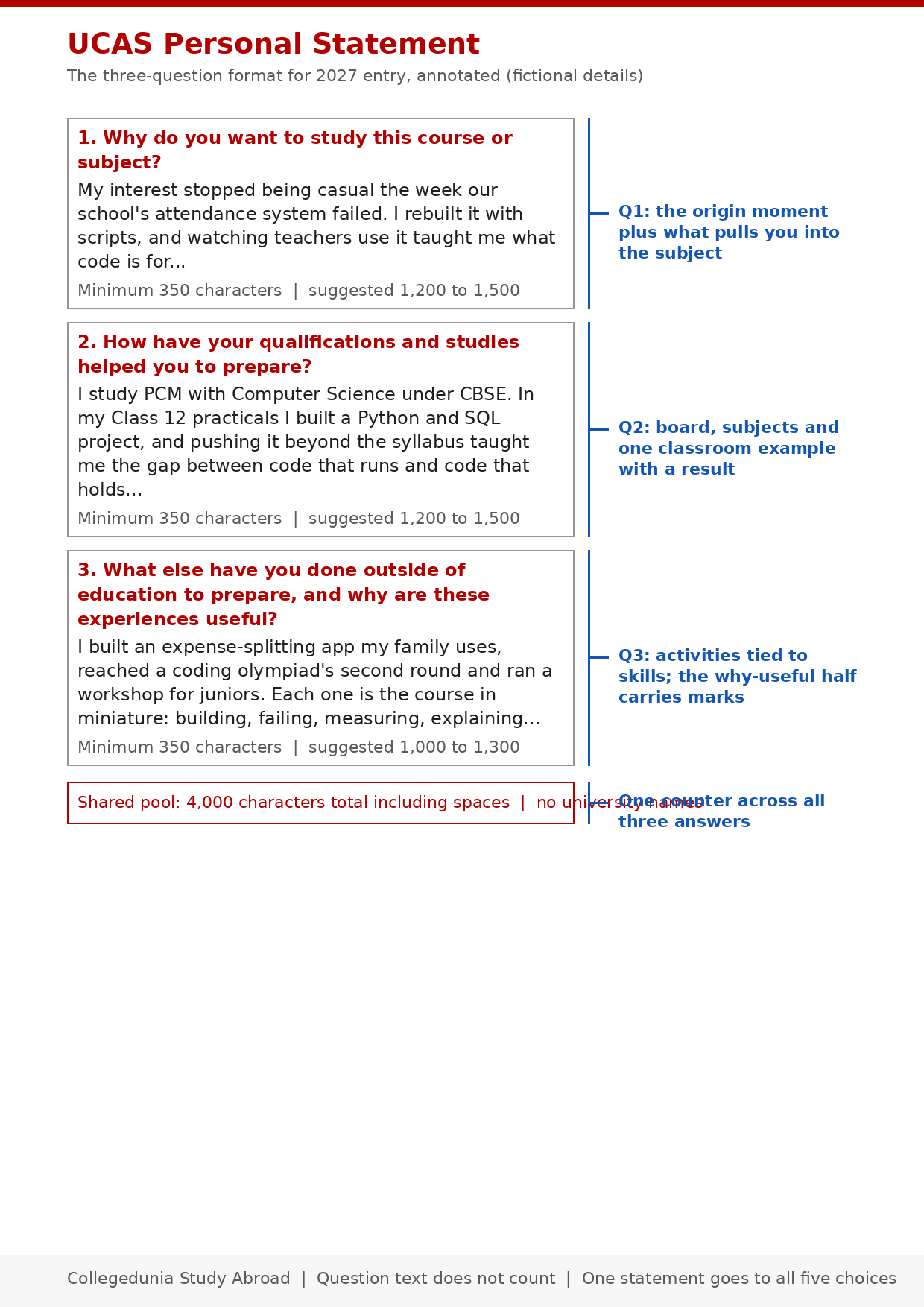
- Question 1, the origin and the pull: open with the specific moment your interest became real, a project, a problem, a competition, then name the parts of the subject you want to go deeper into. Course-focused, never university-focused, since one statement serves all five choices.
- Question 2, the academic map: state your board and subjects, then connect two or three topics to the course with one classroom or practical example carrying a result. CBSE, ISC and State board work translates perfectly when you show the skill, not just the syllabus line.
- Question 3, the evidence beyond school: pick two or three activities, projects, olympiads, clubs, volunteering, self-taught skills or family responsibilities, and spend half the space on why each is useful for this course. The why-useful half is where the marks live.
Format and Contents with Example
The layout is three answer boxes under one shared counter, and the annotated example below shows what goes where, with the character rules marked. Study it before drafting
Students can also take the reference of this document:
The pack carries the question-by-question content table, the fixed rules and a fill-in planning worksheet built for Indian applicants, from board and stream lines to the final checks. Plan in rough notes first, draft second, and count characters throughout, since spaces and punctuation all count and 4,000 characters is only about 550 to 650 words.
What the statement covers and what it does not:
- Covers: your motivation, academic preparation and outside-education evidence, in your own voice.
- Does not: your grades and predicted grades, which your school's reference carries separately, so the statement should spend its characters on what the reference cannot say.
Samples and the Indian Context
The two samples below show the format working for different fields, and the Indian-context rules underneath keep a Class 12 profile competitive against applicants from any system. Use them for structure, never sentences.
Students can also take the reference of this document:
Both use fictional CBSE and ISC applicants and show the same craft: an origin moment in question 1, a board-to-course map with one evidenced example in question 2 and activities tied to named skills in question 3. The Indian-context rules, including for applicants aiming at selective institutions covered in this guide to the Russell Group of universities in the UK:
- Translate, do not just name: a UK reader may not know what ISC Accounts or a CBSE practical involves, so state the skill it built in the same sentence.
- Balance the entrance-exam years: preparation for Indian entrance exams shows discipline, but frame it as depth in mathematics or physics rather than making coaching the identity of the statement.
- Small and real beats big and vague: a newsletter with sixty readers, a family shop's accounts or a rebuilt school system evidences more than a titled role you cannot describe.
- Write in your own English: admissions teams read thousands of statements, and borrowed template polish reads as exactly that.
Note: The new format quietly favours Indian applicants who do things. The old essay rewarded elegant prose; the three questions reward evidence sorted into the right boxes, and a student with one genuine project, one mapped syllabus and one explained activity now outscores a beautifully written statement with nothing inside it.
Mistakes and the 2027 Timeline
The recurring mistakes are naming universities, repeating material across boxes, adjectives without examples and character overruns, while the 2027 calendar leaves clear room to avoid all of them. Draft in autumn, not deadline week.
The mistakes:
- Naming a university or city: the statement reaches all five choices, so a named favourite alienates four readers.
- Repeating across answers: one project, one box; the three answers are read as a single statement.
- Adjectives without evidence: passionate, fascinated and hardworking spend characters that examples should.
- Quote and dictionary openings: famous-quote starts are the most recycled lines in the pool.
- Generic AI filler: fluent paragraphs with no checkable detail read as borrowed and invite scrutiny.
- Overrunning the count: spaces and punctuation count, so draft against a live character counter, not a word count.
The 2027-entry calendar, alongside the application windows covered in this guide on the September intake in the USA, UK, Canada and Germany:
| When | What happens |
|---|---|
| July to August 2026 | Plan with the worksheet, gather examples, first drafts |
| September 2026 | Applications open for 2027 entry; finalise with your referee |
| Mid-October 2026 | Deadline for Oxford, Cambridge, medicine, dentistry and veterinary courses, per the UCAS calendar |
| 13 January 2027 | Main UCAS deadline for most courses |
| After submission | Your school's reference and predicted grades travel with the statement |
Also Check:
The UCAS personal statement for 2027 is three honest answers wearing one character budget: why this course, how your studies prepared you and what you built beyond them. Plan with the worksheet, keep each example in one box, translate your Indian schooling into skills and hold the whole thing under 4,000 characters with room to breathe. Draft in autumn, brief your referee early and submit ahead of 13 January. Do that, and the format change most guides have not caught up with becomes your quiet advantage.
FAQs
Ques. What is the UCAS personal statement format for 2027 entry?
Ans. Three structured questions sharing one statement: why this course, how your qualifications prepared you and what you did outside education. The format replaced the single essay from 2026 entry and applies fully to the 2027 cycle.
Ques. What are the character limits?
Ans. 4,000 characters total including spaces and punctuation, with a 350-character minimum per answer and no per-question maximum. The question text does not count, and the total works out to roughly 550 to 650 words.
Ques. Is there a fourth question about career plans?
Ans. No. Early drafts and some third-party guides described four questions, but the final UCAS structure has exactly three. Career direction fits naturally inside question 1, where your motivation points forward.
Ques. How should I split the 4,000 characters?
Ans. Any split clearing the minimums works, and a common allocation is 1,200 to 1,500 characters each for questions 1 and 2, and 1,000 to 1,300 for question 3. Let your strongest material take the extra room.
Ques. Can I mention the universities I am applying to?
Ans. No. One statement goes to all five choices, so a named university alienates the other four readers. Write about the course and subject, and let the course choices themselves show the fit.
Ques. How should Indian students present CBSE, ISC or State board studies?
Ans. Translate the work into skills in the same sentence: name the board and subjects in question 2, then connect topics and practicals to the course with one evidenced example, since a UK reader knows the skill even when the syllabus label is unfamiliar.



Comments