



Study Abroad Content Specialist
UK is considered to be one of the top choices of international students for higher studies. University and Colleges Admission Services, also known as UCAS, acts as a gateway for international applicants to discover the best of UK undergraduate and postgraduate universities. For international applicants, it becomes difficult and confusing when applying to UK Universities, and thus UCAS helps them out. It acts as a bridge between UK Universities and the applicants.UCAS not only acts as an intermediary between universities and applicants, but also helps in the application process.
The deadline to apply for UCAS applications 2025 is September 24, 2025.UCAS uses a points-based system to simplify applications. Academic qualifications are converted into UCAS Tariff points, which help universities evaluate applicants. You can add upto 5 choices while applying throug UCAS. The deadline to add your clear choice in the UCAS is October 20,2025
What is UCAS?
UCAS is an organisation that simplifies the application process for those international applicants who are willing to apply to UK universities. Following are some benefits of applying through UCAS:
- There is 1 fee of EUR 28.95 (INR 3455), which allows you to choose 5 universities at one time.
- There is a fairness in reviewing applications; all those have the same deadlines and, same requirements.
- The applications of the students are reviewed based on merit and not on their ability to pay for the place.
- UCAS provides access to various resources to help students make the best decisions.
UCAS Application
UCAS is a platform where you can apply to 5 UK Universities at one go. Applying to universities through UCAS requires you to follow certain steps. Before starting to apply, you must research the university that you want to apply to.
- Register with UCAS: Create an account with UCAS. Ensure that you fill correct personal details and keep your login details secure. You’ll need them to check your progress, respond to offers, and update details if needed.
- Complete the personal information: After logging in, you will be asked for details like name, Date of birth, Residency status, and Details about any funding or support you may need. For international students, UCAS will ask about visa status and language proficiency.
- Educational Details: List all your educational qualifications, including school names and addresses, translate non-UK qualifications into UK equivalents using UCAS guidelines, and upload transcripts or certificates if applicable.
- Work Experience: Detail any work or volunteer experience that you have; this can help enhance your application.
- Choose your courses: You can apply to up to 5 courses or universities on a single UCAS application. They can all be for the same subject or vary, depending on your interests.
- Personal Statement: Write a personal statement in 4000 characters, including spaces. If you’re applying to start university in 2026, the personal statement is changing from one long piece of text to 3 questions.
- References: All applications require a reference from someone who isn’t a family member, friend, partner, or ex-partner.
- Adding choices: In your application, you can choose up to 5 choices. These can be the same or different courses from the same or different university or college.
- Pay the application fee: Before submitting the application, you need to pay an application fee of EUR 28.95 (INR 3455).
Also check UCAS Application Guide for International Students in 2025
UCAS Deadline 2025
The key dates to be kept in mind for the UCAS Applications 2025 are:
September 10, 2025: If applicants receive all decisions by 1 August, they must reply by 10 September; otherwise, their application will be declined by default
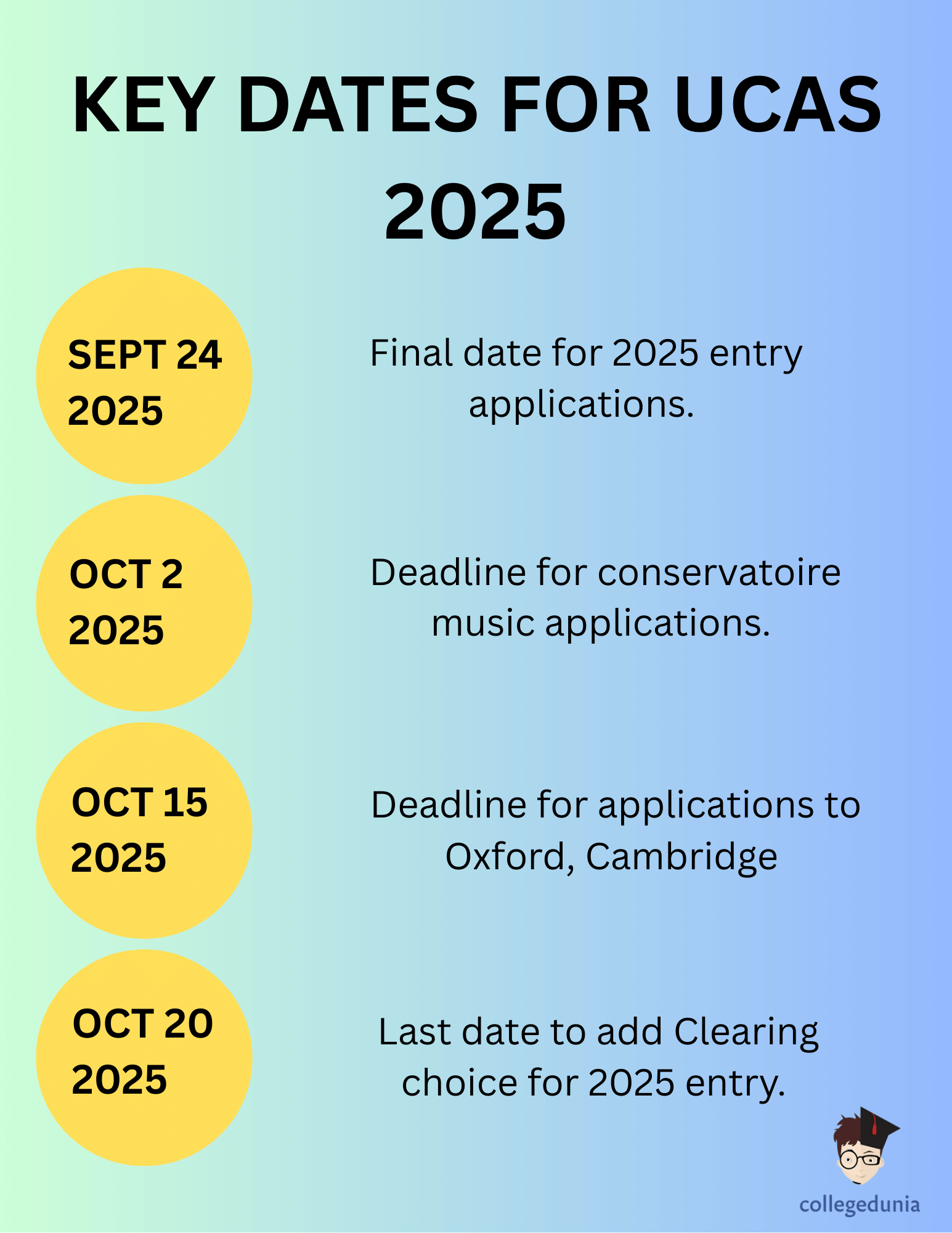
September 24, 2025: Final date for 2025 entry applications
October 15, 2025:Deadline for applications to the universities of Oxford and Cambridge, and for most courses in medicine, dentistry, and veterinary medicine/science
October 20, 2025: Last date to add 2025 entry Clearing choice
January 29, 2026: Equal consideration date for applications for most undergraduate courses
UCAS Key Dates 2026
Below are the key dates for 2026 entries via UCAS:
| Date | Event |
|---|---|
| Sep 02, 2025 | Completed undergraduate applications can be submitted |
| Oct 02, 2025 (18:00) | Deadline for conservatoire music applications |
| Oct 15, 2025 (18:00) | Deadline for Oxford, Cambridge, medicine, dentistry, and veterinary |
| Jan 14, 2026 (18:00) | Equal consideration date for most undergraduate & conservatoire dance/drama/musical theatre |
| Feb 10, 2026 | Conservatoires applicants decline by default (DBD) deadline |
| Feb 26, 2026 | Extra opens |
| Apr 07, 2026 | Conservatoires applicants decline by default (DBD) deadline |
| May 06, 2026 | Undergraduate applicant declines by default (DBD) deadline |
| May 13, 2026 | Undergraduate reject by default (RBD) deadline |
| Jun 02, 2026 | Conservatoires applicant decline by default (DBD) deadline |
| Jun 03, 2026 | Undergraduate applicant declines by default (DBD) deadline |
| Jun 30, 2026 (18:00) | Last date to send applications to universities |
| Jul 04, 2026 | Last day to add an Extra choice |
| Jul 05, 2026 | Clearing opens |
| Jul 07, 2026 | Conservatoires reject by default (RBD) deadline |
| Jul 15, 2026 | Undergraduate reject by default (RBD) deadline |
| Jul 22, 2026 | Undergraduate applicant declines by default (DBD) deadline |
| Jul 29, 2026 | Conservatoires applicant decline by default (DBD) deadline |
| Jul 30, 2026 | Conservatoires reject by default (RBD) deadline |
| Sep 08, 2026 | Conservatoires applicants decline by default (DBD) deadline |
| Sep 24, 2026 | Final date for 2026 entry applications |
| Oct 19, 2026 | Last date to add 2026 entry Clearing choice |
UCAS Tariff
UCAS Tariff points translate your qualifications and grades into a numerical value. The UCAS Tariff provides a way for universities and colleges to draw comparisons between the wide range of qualifications on their applications. Some universities and colleges also use UCAS points in their entry requirements and offers. You can calculate your Tariff scores using the UCAS Tariff Calculator.
Also check Top Universities in UK
After Applying to UCAS
After you apply to UCAS, you must track your application status by logging into your UCAS portal.
- Universities will review the application and thus decide whether to send you an offer or an interview invitation.
- Not all course providers will send you an interview invitation via UCAS. After you've attended the interview, they'll decide if they're going to make you an offer.
- Adding an Extra choice might be possible if you have no offers from your initial selections.
- Once you receive an offer, you can start replying to them based on the deadlines you receive.
UCAS Scholarships
UCAS Scholarships are provided to those with low family income, students from underrepresented backgrounds, and disabled students. You should always check the financial aid and scholarships that Universities provide. Before applying for the scholarships, you must check your eligibility and save time if you are not eligible.
- Award: Check the amount of scholarships, what funds they cover.
- Eligibility criteria: Ensure you meet all conditions, which relate to the course, subject, or personal background.
- Application process: Some awards are grade-based, while others require an application, essay, or interview
- Documents: Make sure you have all the required documents that are needed for applying to scholarships.
- Deadline: Know the application deadline to avoid last-minute chaos and confusion.
Tips to Apply Through UCAS
Here are some tips for international students when applying through UCAS:
- Start Early: Take plenty of time to research the pros and cons of Universities before applying.
- Check the Deadlines: Understand the timeline and deadlines of the UCAS Application.
- Use all 5 choices wisely: While selecting the choices, make sure you are confident about your choices.
- Stay Organised: Keep a checklist of documents, deadlines, and application progress.
Also check How to Write the UCAS Personal Statement in 2025?
Applying to UK Universities through UCAS is a straightforward and easier process. International students need to worry less about each university individually. Before applying, Applicants just need to have a thorough understanding of the process and timelines of UCAS. International applicants must also focus on a good and enhanced Personal statement to increase the chances of an offer. By taking advantage of the help and resources from UCAS, you can actually get into one of your preferred UK Universities.
FAQs
Ques 1: Is UCAS used by all universities in the UK for applications?
Ans: Most of the Universities, like the University of Oxford, the University of Cambridge, use UCAS as the standard platform for undergraduate applications. However, not all institutions or courses accept UCAS. Most postgraduate courses require you to apply directly to the university.
Ques 2: How do I apply for scholarships via UCAS?
Ans: Some scholarships are awarded automatically based on grades, while others require a separate application, essay, interview, or portfolio.
Ques 3: How can international students get their UCAS application waived?
Ans: Currently, UCAS does not offer an application fee waiver. However, students can check the colleges/universities that provide scholarships and cover all costs.
Ques 4: How do I choose the right course before applying through UCAS?
Ans: Research is the answer. Applicants are advised to start early so that they can choose and narrow down their 5 choices of University before applying via UCAS.



Comments