


Education Journalist | Study Abroad Strategy Lead
Indian students heading to the UK for postgraduate STEM programs must secure the ATAS Certificate (Academic Technology Approval Scheme) before applying for their student visa. This clearance is issued by the UK Foreign, Commonwealth & Development Office (FCDO) and is designed to ensure that your chosen field of study does not pose national security risks.
Because universities will not issue a Confirmation of Acceptance for Studies (CAS Letter) without ATAS clearance, and visa applications are refused if ATAS is missing, this document becomes one of the first steps after receiving a conditional or unconditional offer.
Check Out: Study in UK - Ultimate Guide for Indian Students
What is the ATAS Certificate?
The ATAS Certificate is a security screening process required for students enrolling in specific postgraduate courses that involve sensitive knowledge areas such as:
- Advanced engineering
- Nuclear sciences
- Aerospace systems
- Artificial intelligence
- Materials science
- Biotechnology & life sciences
- Advanced computing and data systems
Although it originated as a tool to prevent the misuse of knowledge related to Weapons of Mass Destruction (WMD), the ATAS process now primarily functions as an academic-intent verification system.
Check Out:
Why ATAS Matters for Your Student Visa?
- No ATAS, No CAS (Confirmation of Acceptance for Studies): Most UK universities will not issue your CAS (the primary document for your visa application) until you have provided them with a valid ATAS certificate.
- No ATAS, Visa Refusal: Your UK Student Visa application will be refused if your course requires ATAS clearance and you do not provide a valid certificate.
- Applies to Other Visas Too: The ATAS requirement is not exclusive to the Student Visa route. It may also be required for a Skilled Worker Visa or a Government Authorised Exchange (GAE) visa if the employment or research role is in a sensitive field.
CAH3 Codes That Require ATAS
ATAS is required for some of the following courses that are popular among Indian students –
| CAH3 Code | Subject Area |
Examples of Programs
|
|---|---|---|
| CAH11-01-01 | Computer Science | |
| CAH11-01-05 | Data Science | |
| CAH11-01-03 | Cybersecurity |
MS in Cybersecurity in UK
|
| CAH11-01-04 | Artificial Intelligence | |
| CAH10-01-02 | Mechanical Engineering | |
| CAH10-01-08 | Electrical Engineering | |
| CAH10-01-03 | Aerospace Engineering | |
| CAH10-01-07 | Materials Science |
MSc Materials Engineering
|
| CAH02-02-01 | Biotechnology | |
| CAH02-03-01 | Biochemistry | |
| CAH12-01-01 | Civil Engineering |
Courses that DO NOT need ATAS:
Who Needs an ATAS Certificate?
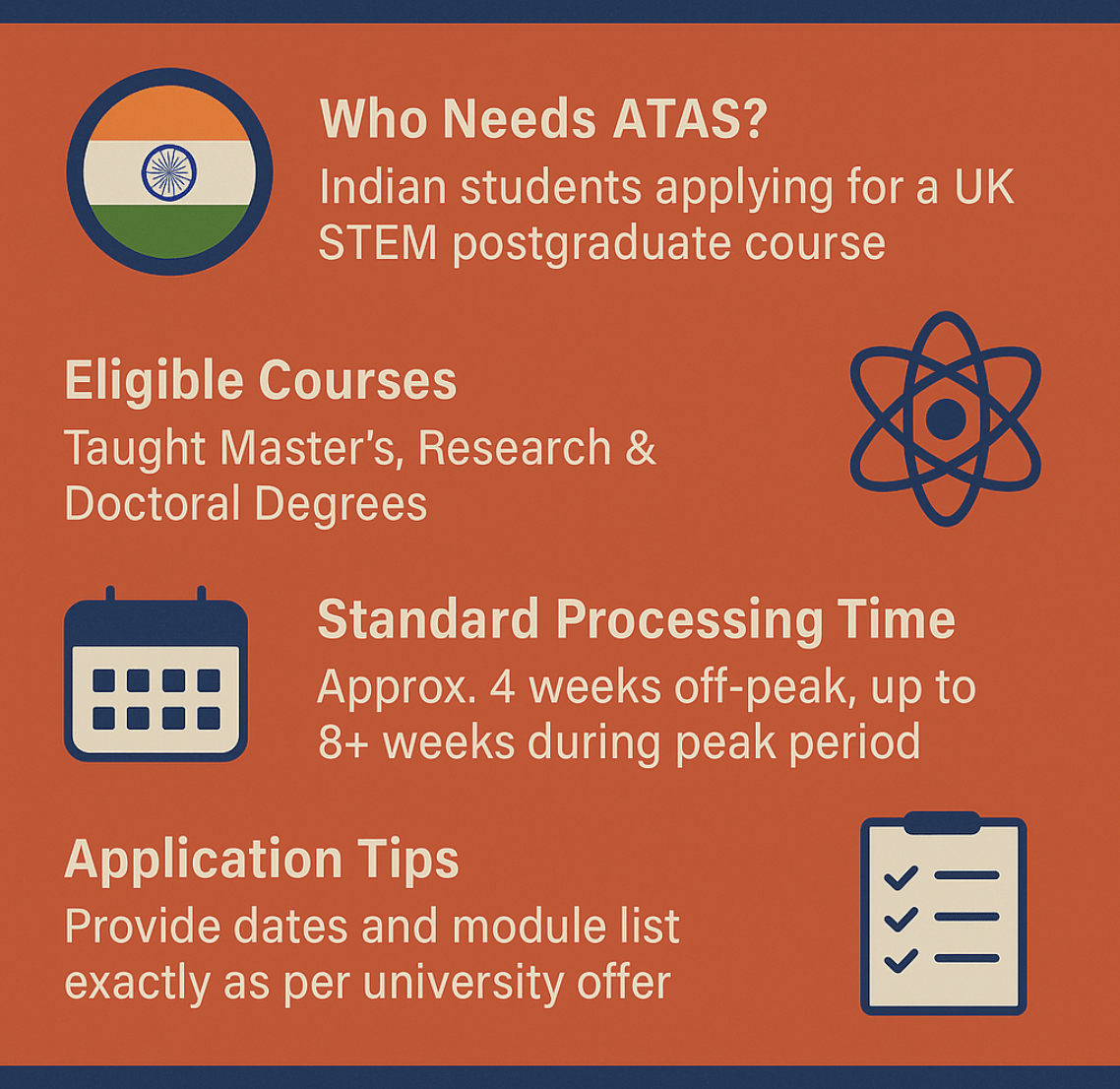
ATAS is mandatory for non-exempt nationals, including Indian students, pursuing:
- MSc / MA / MEng (selected subjects)
- MPhil / MRes
- PhD / EngD
- Integrated Masters (ATAS applies only for the final year)
- Visiting researchers (any duration)
How to Check if Your Course Requires ATAS?
Your university offer letter includes a CAH3 (Common Aggregate Hierarchy) code — this code determines whether ATAS is required.
Example CAH3 codes:
- CAH10-01-08 → Electrical & Electronic Engineering
- CAH02-03-01 → Biotechnology
- CAH11-01-04 → Artificial Intelligence
Locate the CAH3 code on your offer letter. If your course has one of the sensitive CAH3 codes, ATAS is required.
Dual Nationality Rule
If you hold dual citizenship and one nationality is from an exempt country (US, Canada, EU/EEA, Australia), then you do not need ATAS — provided you apply using that passport.
How to apply for the ATAS Certificate?
The application is free and takes about 45–60 minutes.
Important: You cannot save progress and return later, so keep all documents ready.
| Information Needed | Details to Provide | Pitfall to Avoid |
|---|---|---|
| Course Details | CAH3 Code, Official Course Title, Exact Start & End Dates (from offer letter). |
Using estimated dates. The dates must match your offer/CAS.
|
| Study Content | Taught Masters: A comprehensive list of all compulsory and optional modules. PhD/MPhil: The detailed, university-approved Research Statement/Abstract (at least 5-8 descriptive lines). |
Vague descriptions. The FCDO needs technical details to assess security risk.
|
| Personal Identity | Current Passport details (the one you will use for your visa). |
Expired passport details. Get your new passport before applying for ATAS.
|
| Educational History | All university-level study (Undergraduate and Postgraduate, including dates and institutions). Do not include high school. |
Missing degrees. Include every post-high school qualification.
|
| Employment History | All jobs held since leaving school (including long-term voluntary work). If none, clearly state "Not Applicable." |
Unexplained Gaps. Use the text box to clearly explain any significant gaps (e.g., preparing for competitive exams).
|
| Referees | Full name and contact details for two referees known for at least three years. At least one should ideally be an academic from your home country. |
Using family members. Family is not accepted. Ensure contact details are active.
|
| Supervisor/HOD | Research Students: The full name of your Primary Supervisor. Taught Students: Typically, the Head of Department (HOD) or Course Director (confirm with your university). |
Guessing the name. Use the exact name provided in your offer letter/ATAS guidance sheet.
|
When asked for the Supervisor name, do not leave it blank. For taught programs (MSc, MEng), you must typically enter the name of the Head of Department (HOD). Your university will usually specify this in their ATAS guidance.
ATAS Processing Time for Indian Students (2026 Intake)
The timeline for ATAS certification is as follows:
| Period | Estimated Processing Time (Working Days) |
Corresponding Calendar Weeks
|
|---|---|---|
| Standard/Off-Peak | 20 working days |
4 calendar weeks
|
| Peak Season (Apr-Sep) | 30 to 40+ working days |
6 to 8+ calendar weeks
|
If applying for the September 2026 intake, submit ATAS by mid-May 2026 to avoid delays in CAS and visa timelines.
Check Out:
Validity of the ATAS Certificate
- Validity for Visa: Your ATAS certificate is valid for 6 months from the date of issue.
- Visa Application Deadline: You must submit your Student Visa application before this 6-month window expires. If the certificate expires, you must apply for a new one, and the entire processing time restarts.
- Validity for CAS: The certificate is valid to be presented to your university for your CAS for the full duration of your course (i.e., you can get your CAS issued right up to the start date), provided the course content remains unchanged.
How does ATAS link to Your Visa Application?
When applying for your Student Visa online, you will be prompted to provide your ATAS Certificate Reference Number.
- Your visa application will proceed as a standard application, but the Entry Clearance Officer (ECO) will verify the details of your ATAS certificate against the information provided by your university on your CAS.
- You will also be asked to upload a copy of the ATAS Certificate PDF in the supporting documents section of the visa application portal.
Check Out:
What to do if Your ATAS Application is Delayed or Refused?
Delay Escalation
- Self-Initiated Delays: If you made a mistake (e.g., incorrect CAH3 code, vague research statement), the FCDO will contact you for clarification, which will restart your processing time. This is why accuracy is paramount.
- Systemic Delays: If the 6-week window passes during peak season:
- Contact your University: They often have a dedicated team that can follow up with the FCDO ATAS unit, sometimes facilitating a faster response, though they cannot guarantee it.
- Email FCDO: You can contact the ATAS team directly at ATAS@fcdo.gov.uk for an update, quoting your ATAS reference number.
Check: UK Student Visa Processing Time
Refusal (Rare but Possible)
ATAS refusals are rare but usually stem from serious concerns regarding the stated research topic or its connection to previous education/employment history.
Contact your university's Visa and Immigration Support Team immediately. They will advise if you can appeal the decision or if you need to submit a brand-new application with a corrected or clarified research statement/module list.
If you are refused, you must wait 90 days before reapplying for the same course at the same institution with the same CAH3 code.
Recommended Reads:
| Cost of Living in UK for Indian Students | Student Accommodation in UK | |
| High Demand Jobs in UK for Indians | Jobs after MS in UK |
FAQ
Ques. Does ATAS apply to all Master's courses?
Ans. No. It only applies to Master's (MSc, MPhil, etc.) and PhD degrees in subjects that deal with knowledge that could potentially be used in Weapons of Mass Destruction (WMD) or Advanced Conventional Military Technology (ACMT).
Ques. Is there any fee for ATAS?
Ans. No. ATAS is free of cost.
Ques. My course changed. Do I need a new ATAS?
Ans. Yes. Any change in course, modules, research topic, or university requires a fresh ATAS.
Ques. If I made a mistake on the ATAS form, can I edit it?
Ans. No, you cannot edit the form after submission. For major errors (like an incorrect course name or CAH3 code), you must withdraw the faulty application and submit a new one.








Comments