




Nagaland Board is conducting the Class 12 Psychology Board Exam 2026 on February 19, 2026. Class 12 Psychology Question Paper with Solution PDF is available here for download.
The official question paper of Nagaland Board Class 12 Psychology Board Exam 2026 is provided below. Students can download the official paper in PDF format for reference.
Nagaland Board Class 12, 2026 Psychology Question Paper with Solution PDF
| Nagaland Board Class 12 Psychology Question Paper 2026 |  Download Download |
Check Solutions |

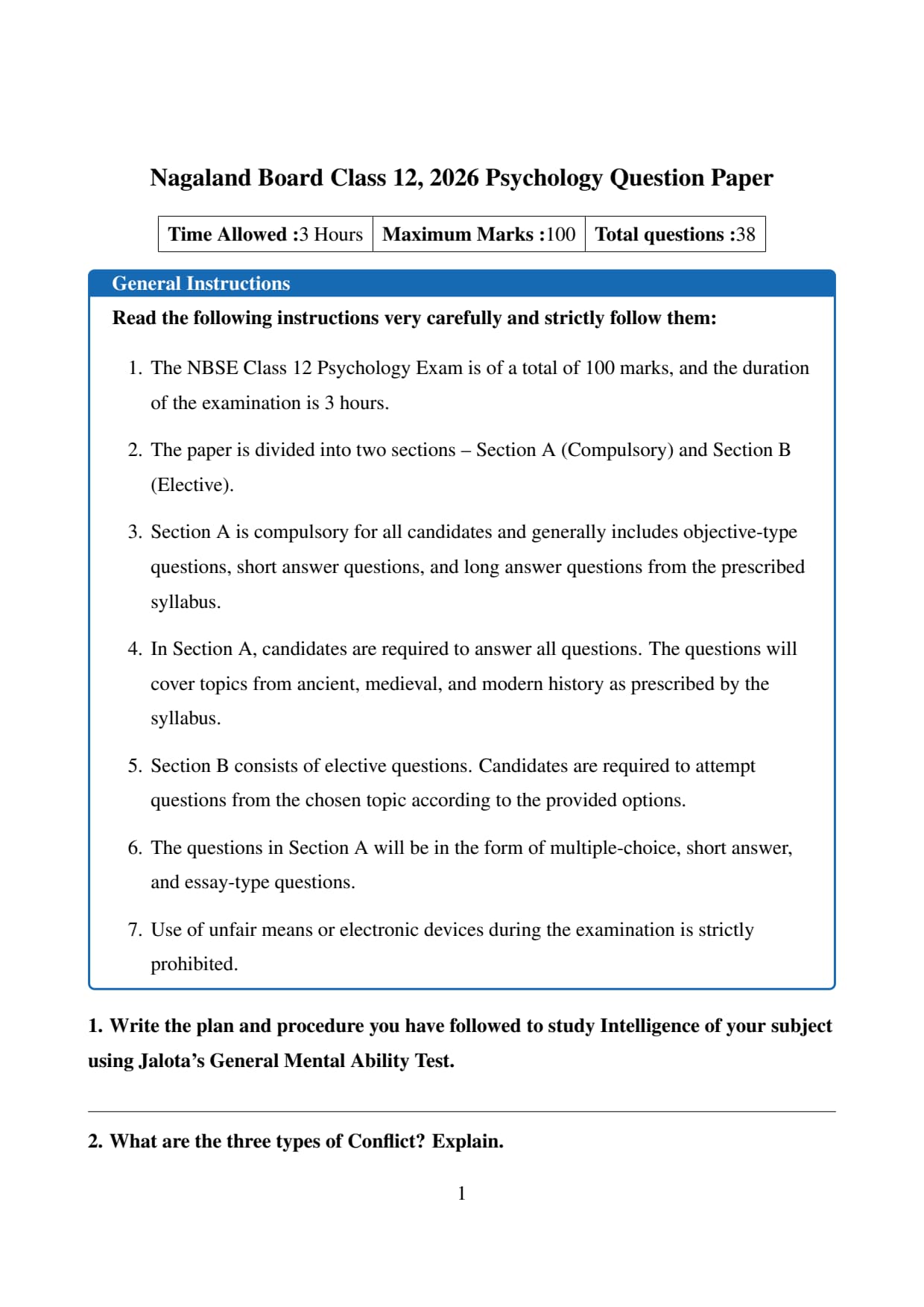
Write the plan and procedure you have followed to study Intelligence of your subject using Jalota's General Mental Ability Test.
View Solution
The study of intelligence using Jalota's General Mental Ability Test involves a systematic procedure that includes the following steps:
1. Selection of Subjects: The first step is to select a group of subjects based on the relevant criteria for the study. The subjects could be students or individuals from different age groups, depending on the objectives of the test. It is essential to ensure that the subjects meet the requirements for the study.
2. Administration of the Test: Jalota's General Mental Ability Test is then administered to the selected subjects. The test consists of various sections that assess different aspects of mental ability, such as reasoning, memory, and problem-solving. The test is designed to be administered under controlled conditions, and the subjects are given clear instructions before starting the test.
3. Scoring and Analysis: Once the test is completed, the responses of the subjects are scored according to the scoring rubric provided by the test. The scores are then analyzed to determine the subjects' overall mental ability. Various statistical tools can be used to analyze the data and draw meaningful conclusions.
4. Interpretation of Results: The results of the test are interpreted to gain insights into the mental abilities of the subjects. The findings can be compared with standard norms to determine the relative intelligence levels of the subjects. This step helps in understanding the strengths and weaknesses of each subject.
5. Conclusion and Recommendations: Based on the analysis and interpretation of the results, conclusions are drawn about the subjects' intelligence. Recommendations for improvement or further studies may also be provided, depending on the objectives of the research. Quick Tip: Ensure that the test is administered in a controlled environment to minimize distractions and biases in the results. This ensures more accurate findings.
What are the three types of Conflict? Explain.
View Solution
There are three main types of conflict:
1. Approach-Approach Conflict: This type of conflict occurs when a person faces two desirable goals or options and must choose between them. Since both options are positive, the person experiences tension due to the difficulty of making a decision. An example could be choosing between two exciting job offers.
2. Avoidance-Avoidance Conflict: In this type, a person is faced with two undesirable options and must choose the lesser of the two evils. The conflict arises from the negative nature of both alternatives. For example, choosing between two unpleasant tasks, such as studying for exams or doing household chores.
3. Approach-Avoidance Conflict: This occurs when a person is drawn to an option that has both positive and negative aspects. The conflict arises because the individual is both attracted to and repelled by the same situation. For example, accepting a high-paying job that involves long hours and stressful work.
Quick Tip: The key to resolving conflicts is to weigh the pros and cons of each option carefully and make a decision that aligns with personal values and long-term goals.
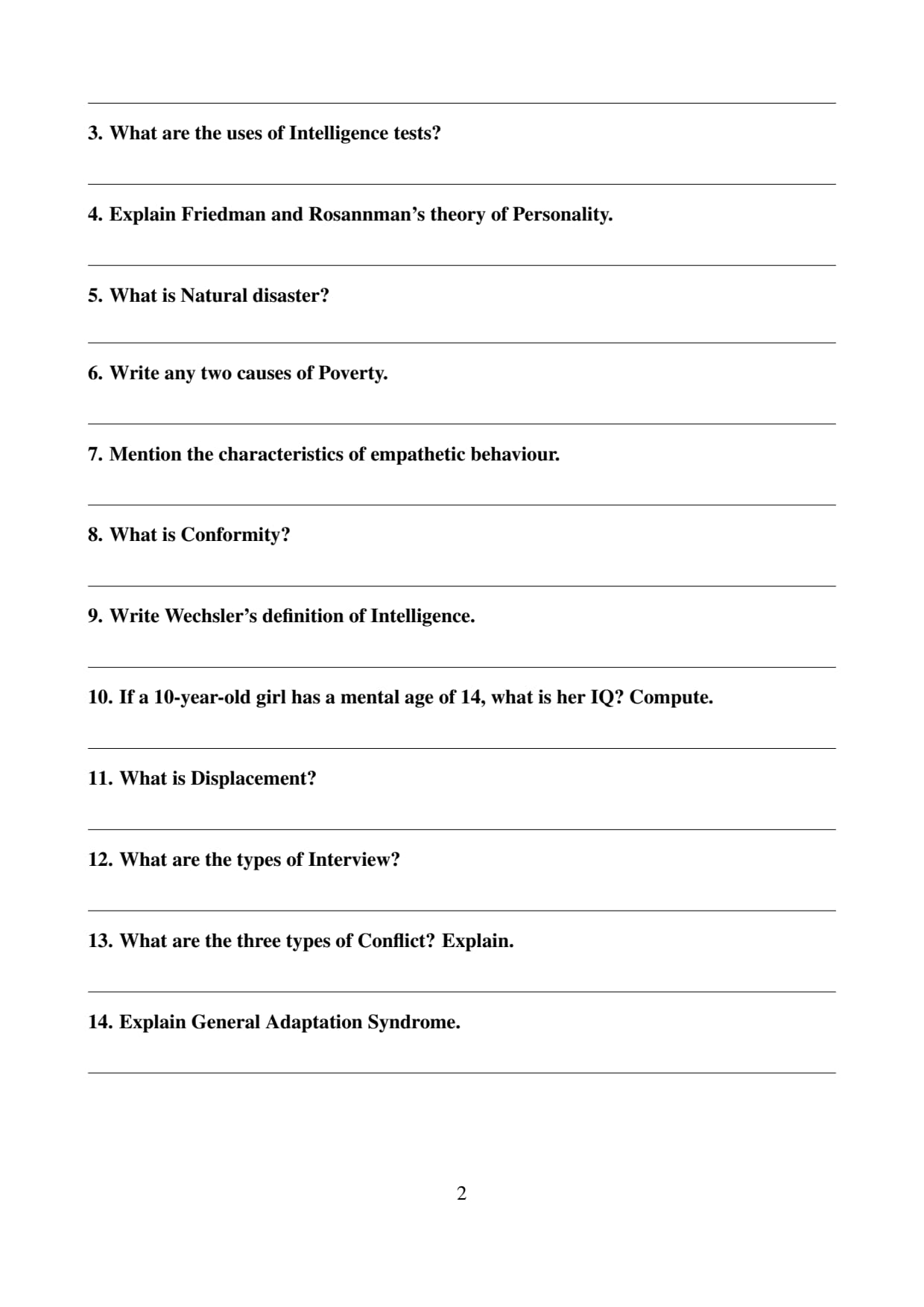
Explain General Adaptation Syndrome.
View Solution
General Adaptation Syndrome (GAS) is a three-stage process that describes the body's reaction to stress. It was first described by Hans Selye and includes the following stages:
1. Alarm Reaction: In this stage, the body detects the stressor and prepares for a fight-or-flight response. This involves the release of stress hormones such as adrenaline and cortisol, which increase heart rate, blood pressure, and energy levels.
2. Resistance: During this stage, the body attempts to adapt to the ongoing stressor. The initial fight-or-flight response subsides, but the body continues to function at a heightened state, trying to cope with the stressor. The body uses its resources to try and maintain normal functioning while managing the stress.
3. Exhaustion: If the stress continues for an extended period, the body's resources become depleted. The body can no longer sustain the heightened state of alertness, leading to physical and mental exhaustion. If this stage is not managed, it can result in burnout, illness, or other health problems.
Quick Tip: Managing stress through relaxation techniques, exercise, and proper sleep can help prevent reaching the exhaustion stage of GAS and improve overall well-being.
What are the uses of Intelligence tests?
View Solution
Intelligence tests have a wide range of applications, including the following:
1. Educational Purpose: Intelligence tests are widely used in educational settings to identify students' learning capabilities. These tests help educators understand the intellectual strengths and weaknesses of students, enabling them to create tailored educational plans to meet individual needs.
2. Career Guidance: Intelligence tests play a significant role in career counseling. By assessing a person's cognitive abilities, career advisors can recommend suitable career paths based on the individual’s mental strengths.
3. Psychological Assessment: In clinical psychology, intelligence tests are used to assess cognitive abilities, identify learning disabilities, and diagnose mental health conditions. They are also essential for evaluating intellectual impairments and determining suitable treatments.
4. Research Studies: Intelligence tests are valuable tools in psychological and sociological research. Researchers use these tests to study various factors that influence intelligence, such as genetics, environment, and educational experiences.
5. Forensic Use: Intelligence tests are sometimes used in legal settings to evaluate a person’s mental capacity. This can be relevant in cases of criminal responsibility, where a defendant’s ability to understand their actions is under scrutiny. Quick Tip: Intelligence tests are valuable tools not only for diagnosing and assessing cognitive abilities but also for helping tailor education and career guidance based on individual mental strengths.
Explain Friedman and Rosannman's theory of Personality.
View Solution
Friedman and Rosenman’s theory of personality primarily focuses on how certain personality traits are related to stress and health, particularly in relation to heart disease. The theory is based on their research into the Type A and Type B personality types.
1. Type A Personality: Individuals with a Type A personality are characterized by high levels of competitiveness, impatience, aggressiveness, and a constant sense of urgency. They tend to be driven, goal-oriented, and are often under stress due to their perfectionist tendencies. Studies have shown that Type A individuals are more prone to stress-related health issues, especially heart disease.
2. Type B Personality: In contrast, individuals with a Type B personality are more relaxed, less competitive, and less prone to stress. They tend to be more patient and laid-back. Type B individuals generally exhibit a healthier approach to life, and they are less likely to suffer from stress-related health conditions.
3. Research Findings: Friedman and Rosenman found a strong link between Type A personality and higher risks of cardiovascular problems. Their research emphasized the importance of managing stress and adopting a more balanced approach to life for better health outcomes. Quick Tip: Adopting a Type B personality’s more relaxed and patient approach may contribute to better mental and physical health, particularly in reducing the risk of stress-related conditions like heart disease.
What is Natural disaster?
View Solution
A natural disaster is a catastrophic event caused by natural forces or processes that result in significant damage to life, property, and the environment. These disasters can occur suddenly or develop over time and are often beyond human control. Some common types of natural disasters include:
1. Earthquakes: Sudden shaking of the Earth's surface caused by tectonic plate movements. Earthquakes can cause destruction, loss of life, and create tsunamis.
2. Hurricanes and Typhoons: Powerful tropical storms that bring heavy rains, strong winds, and flooding. They often lead to widespread damage and displacement of communities.
3. Floods: Occur when water exceeds normal levels, often due to heavy rains, storms, or the melting of snow. Flooding can damage property, infrastructure, and result in loss of life.
4. Wildfires: Uncontrolled fires in forests or grasslands, often fueled by dry conditions and strong winds. Wildfires can spread rapidly and cause significant damage to ecosystems and communities. Quick Tip: Natural disasters can have devastating impacts on communities and environments. Effective preparedness and disaster management strategies are essential for minimizing their effects.
Write any two causes of Poverty.
View Solution
Poverty is a complex issue with multiple causes, often interrelated. Here are two significant causes:
1. Lack of Education: Education plays a crucial role in breaking the cycle of poverty. Without access to quality education, individuals have fewer opportunities to secure well-paying jobs and improve their living standards. Education equips people with the skills needed to participate in the economy and contribute to society.
2. Unemployment: High rates of unemployment or underemployment contribute directly to poverty. Without stable and well-paying jobs, individuals and families struggle to meet basic needs such as food, shelter, and healthcare. Lack of employment opportunities is often compounded by factors such as economic instability, globalization, and discrimination. Quick Tip: Addressing the root causes of poverty, such as improving access to education and creating job opportunities, is essential to effectively reducing poverty in the long term.
Mention the characteristics of empathetic behaviour.
View Solution
Empathetic behavior refers to the ability to understand and share the feelings of others. It is a key aspect of emotional intelligence and involves several important characteristics:
1. Active Listening: Empathetic individuals listen carefully to others without interrupting, showing they value and understand the speaker’s emotions. They focus on the person’s words, tone, and body language.
2. Compassion: Compassion is the ability to not only understand someone’s feelings but also to care about their well-being. Empathetic people genuinely want to help others who are struggling.
3. Perspective-Taking: This characteristic involves trying to see the world from the other person’s point of view. Empathetic people are able to understand how the other person feels and what they might be going through.
4. Emotional Regulation: People with empathetic behavior can manage their own emotions effectively. They don’t let their own feelings cloud their judgment or reactions to others' emotions.
5. Non-Judgmental: Empathetic individuals do not judge others based on their feelings or experiences. They remain open-minded and understanding, even in difficult or unfamiliar situations.
Quick Tip: Empathy can be developed by practicing active listening and trying to put yourself in others' shoes. It helps build stronger relationships and improves communication.
What is Conformity?
View Solution
Conformity is the act of adjusting one’s behavior, beliefs, or attitudes to match those of a group or social norms. It is influenced by social pressure and is often a result of the desire to fit in or avoid rejection. There are several types of conformity:
1. Informational Conformity: This occurs when individuals look to others for guidance because they believe others have accurate information. It is driven by the desire to be correct and informed.
2. Normative Conformity: This happens when individuals conform to social norms to be accepted or liked by a group. It is primarily driven by the fear of rejection or disapproval.
3. Identification: This form of conformity occurs when individuals adopt the behaviors and attitudes of a group they want to be associated with, even if they don’t always agree with the group's beliefs.
Quick Tip: While conformity can help maintain social harmony, it's important to balance it with independent thinking and personal values to avoid blind obedience.
Write Wechsler's definition of Intelligence.
View Solution
Wechsler defines intelligence as the global capacity of an individual to act purposefully, think rationally, and deal effectively with the environment. According to him, intelligence is not just the ability to reason logically, but also the ability to adapt to new situations, solve problems, and understand complex ideas. It involves both cognitive processes and practical skills, allowing individuals to function successfully in various aspects of life. Quick Tip: Wechsler’s definition emphasizes a broad and adaptable view of intelligence, integrating both reasoning and practical problem-solving abilities in real-life contexts.
If a 10-year-old girl has a mental age of 14, what is her IQ? Compute.
View Solution
To calculate the IQ, we use the following formula:
\[ IQ = \left( \frac{Mental Age}{Chronological Age} \right) \times 100 \]
Given that the mental age (MA) is 14 and the chronological age (CA) is 10, we can substitute the values into the formula:
\[ IQ = \left( \frac{14}{10} \right) \times 100 = 1.4 \times 100 = 140 \]
Thus, the IQ of the 10-year-old girl with a mental age of 14 is **140**. Quick Tip: The IQ formula compares mental age to chronological age and is used to assess intellectual development relative to age. A higher IQ indicates above-average intellectual functioning.
What is Displacement?
View Solution
Displacement is a psychological defense mechanism in which an individual redirects their feelings or emotions from the original source to a less threatening target. This often occurs when a person feels unable to express their emotions directly toward the original object or person due to fear, anxiety, or social norms. Displacement is commonly observed in both everyday life and clinical settings. An example of displacement could be when an employee, who is angry with their boss, expresses their frustration by arguing with a family member or friend.
Quick Tip: Displacement can help reduce emotional tension temporarily, but it may cause issues in relationships or lead to unaddressed underlying feelings.
What are the types of Interview?
View Solution
There are several types of interviews used for different purposes in various settings. The main types of interviews include:
1. Structured Interview: In a structured interview, the interviewer follows a specific set of pre-determined questions. This type of interview is commonly used in job hiring processes to maintain consistency and fairness when evaluating candidates.
2. Unstructured Interview: Unlike the structured interview, an unstructured interview is more flexible and conversational. The interviewer may ask open-ended questions and adapt based on the responses, allowing for a more natural flow of conversation.
3. Semi-structured Interview: A semi-structured interview combines elements of both structured and unstructured formats. The interviewer has a set of prepared questions but is open to follow-up questions or diverging from the script to explore topics more deeply.
4. Behavioral Interview: In this type of interview, candidates are asked to provide specific examples from their past experience to demonstrate how they have handled various situations. It is commonly used to assess skills such as problem-solving, teamwork, and conflict resolution.
5. Panel Interview: A panel interview involves multiple interviewers who question the candidate at the same time. This type is typically used for high-stakes positions and provides a more rounded perspective on the candidate's suitability.
6. Group Interview: A group interview involves multiple candidates being interviewed simultaneously. This interview format is often used to assess how candidates interact with each other and work in group settings.
Quick Tip: Prepare for any interview by researching the format and practicing responses. For structured and behavioral interviews, focus on providing clear examples of your skills and experiences.
What are the three types of Conflict? Explain.
View Solution
There are three primary types of conflict, each involving different emotional and psychological dynamics:
1. Approach-Approach Conflict: This type of conflict occurs when an individual is faced with two attractive alternatives and must choose one. The decision is difficult because both options seem desirable. An example might be choosing between two enjoyable vacations.
2. Avoidance-Avoidance Conflict: In this type, the individual is faced with two unattractive alternatives and must choose between them. This type of conflict often causes stress and anxiety because neither choice is appealing. An example could be choosing between two unpleasant tasks at work.
3. Approach-Avoidance Conflict: This type involves a single goal or option that has both positive and negative aspects. The person feels attracted to the goal but is also repelled by its negative consequences. For example, someone might feel the desire to accept a high-paying job that requires relocation, but they might also dislike leaving their home city. Quick Tip: Understanding the type of conflict an individual is experiencing can help in identifying better solutions to resolve it. Each type requires different coping strategies.
Explain General Adaptation Syndrome.
View Solution
General Adaptation Syndrome (GAS) is a three-stage physiological response to stress, developed by Hans Selye. It describes how the body reacts to stress and attempts to return to a state of balance. The three stages are:
1. Alarm Reaction: This is the initial response to a stressor, where the body reacts to the threat by triggering the fight-or-flight response. Hormones like adrenaline and cortisol are released, increasing heart rate, blood pressure, and energy levels. This prepares the body to deal with the immediate stressor.
2. Resistance: If the stressor persists, the body enters the resistance stage, where it attempts to adapt to the stress. The body's physiological responses stabilize, and it continues to function while trying to cope with the stress. If the stress is managed well, the body can continue to function normally for a while.
3. Exhaustion: If the stress continues for an extended period, the body's resources become depleted, and it can no longer maintain its adaptive responses. The body becomes vulnerable to illness, fatigue, and burnout. This stage can lead to serious health problems if the stress is not managed. Quick Tip: Chronic stress can lead to exhaustion and serious health issues. Regular relaxation and coping strategies can help prevent the negative effects of stress and support long-term well-being.



Comments