




Nagaland Board is conducting the Class 12 Education Board Exam 2026 on February 19, 2026. Class 12 Education Question Paper with Solution PDF is available here for download.
The official question paper of Nagaland Board Class 12 Education Board Exam 2026 is provided below. Students can download the official paper in PDF format for reference.
Nagaland Board Class 12, 2026 Education Question Paper with Solution PDF
| Nagaland Board Class 12 Education Question Paper 2026 |  Download Download |
Check Solutions |

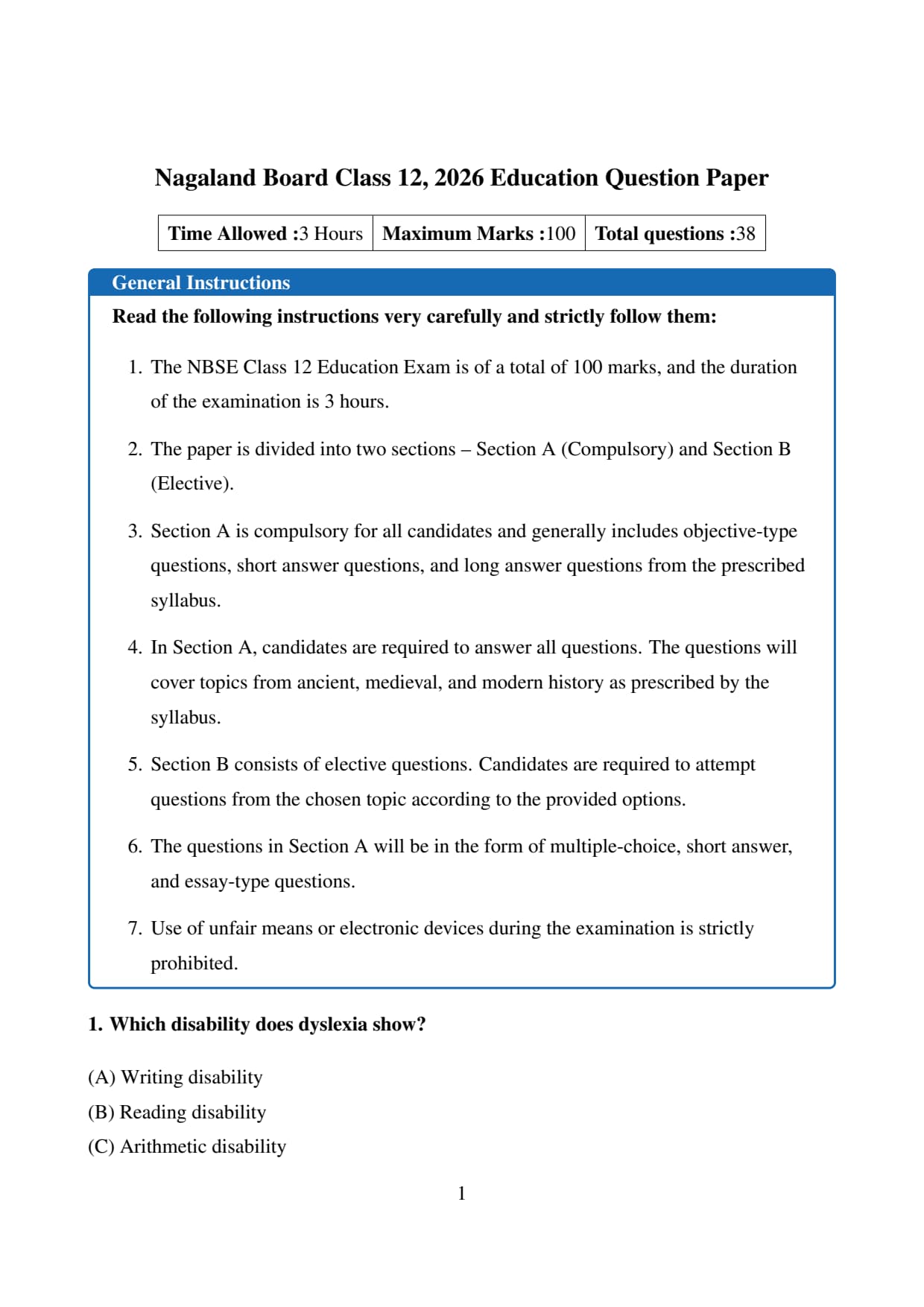
Which disability does dyslexia show?
View Solution
Dyslexia is a reading disorder that involves difficulty in reading, spelling, and decoding words despite having normal intelligence. It primarily affects reading and language processing, making it a reading disability. It is not related to writing or arithmetic disabilities.
Step 1: Analyze the options.
(A) Writing disability: While people with dyslexia may struggle with writing due to related difficulties in reading and language processing, dyslexia specifically refers to a reading disability.
(B) Reading disability: This is the correct answer. Dyslexia is a reading disability that impacts the ability to read and understand written language.
(C) Arithmetic disability: Dyslexia is not associated with arithmetic disabilities; it is a specific learning disorder related to reading.
(D) Mental disability: Dyslexia is not a mental disability but a neurodevelopmental disorder affecting reading abilities.
Step 2: Conclusion.
The correct answer is (B), as dyslexia is a reading disability that specifically impacts reading skills.
Final Answer: \[ \boxed{(B) \, Reading disability} \] Quick Tip: Dyslexia is a learning disorder primarily affecting reading skills, making it crucial to identify early for effective interventions.
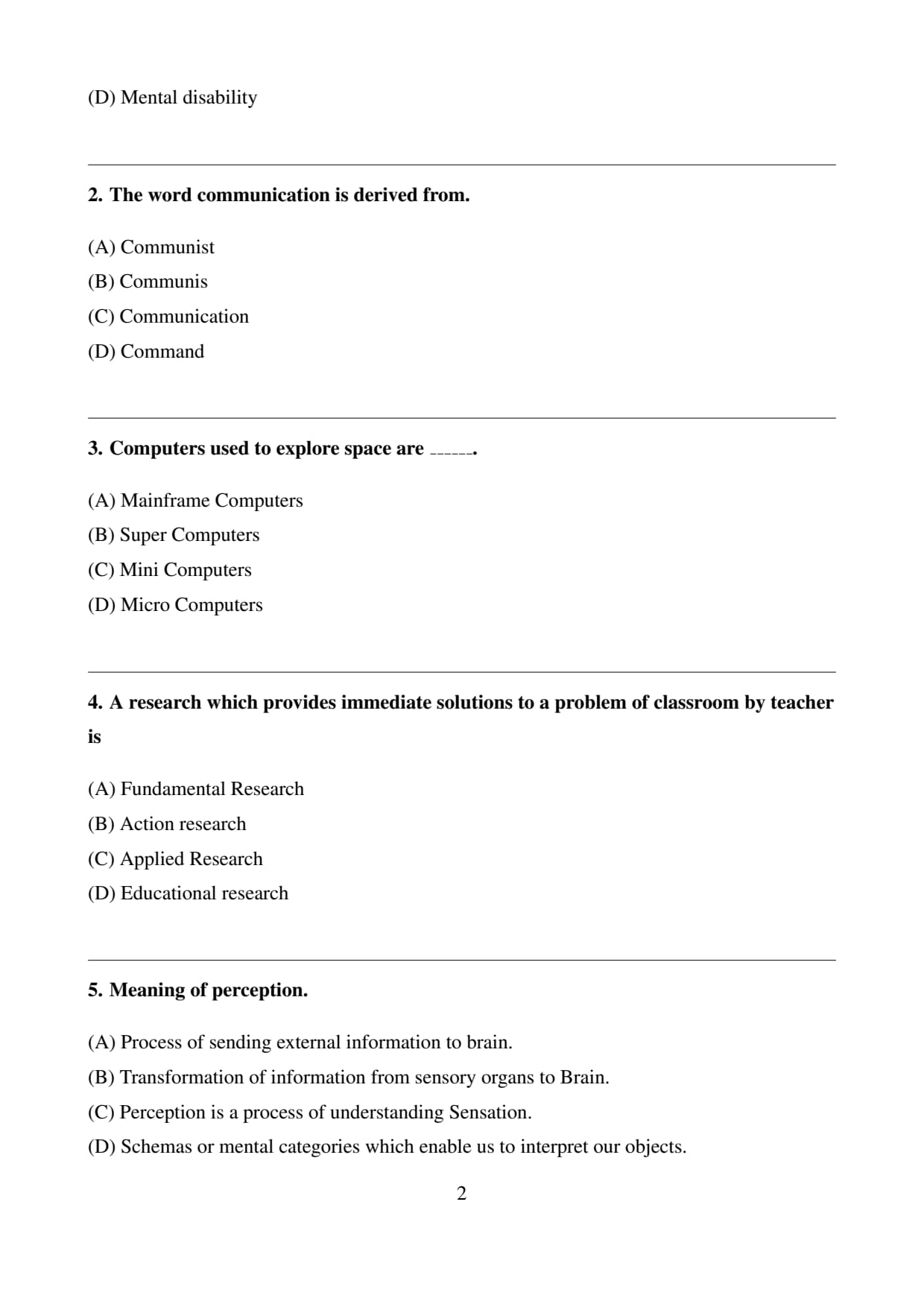
The word communication is derived from.
View Solution
The word "communication" is derived from the Latin word "communis," which means "common" or "shared." Communication involves sharing information between individuals or groups, which aligns with the meaning of "communis."
Step 1: Analyze the options.
(A) Communist: The word "communist" is unrelated to the root of "communication."
(B) Communis: This is the correct answer. The word "communication" comes from the Latin word "communis," meaning common or shared.
(C) Communication: This is the modern word, but it is not the root from which the term is derived.
(D) Command: Command is unrelated to the derivation of the word "communication."
Step 2: Conclusion.
The correct answer is (B), as "communication" comes from the Latin word "communis."
Final Answer: \[ \boxed{(B) \, Communis} \] Quick Tip: The term communication comes from the Latin "communis," meaning "shared," reflecting the essence of sharing information.
Computers used to explore space are ______.
View Solution
Supercomputers are the most powerful computers used for complex simulations and calculations, such as those required in space exploration. These computers are capable of processing large amounts of data at high speeds, making them essential for tasks like simulating space missions, analyzing astronomical data, and supporting scientific research in space.
Step 1: Analyze the options.
(A) Mainframe Computers: Mainframe computers are powerful but are not typically used for space exploration. They are used for large-scale business and government operations.
(B) Super Computers: This is the correct answer. Supercomputers are used for complex tasks like space exploration due to their immense processing power.
(C) Mini Computers: Mini computers are less powerful than supercomputers and are not used for space exploration.
(D) Micro Computers: Microcomputers are used in personal computing and are not suitable for high-performance tasks like space exploration.
Step 2: Conclusion.
The correct answer is (B), as supercomputers are used for space exploration due to their high computational capabilities.
Final Answer: \[ \boxed{(B) \, Super Computers} \] Quick Tip: Supercomputers are essential for space exploration because they can process massive amounts of data quickly, making complex space simulations and calculations possible.
A research which provides immediate solutions to a problem of classroom by teacher is
View Solution
Action research is a research methodology used by teachers to find immediate solutions to problems in the classroom. It involves a process of identifying a problem, implementing a solution, and reflecting on the outcomes. It is often conducted by teachers in their own classrooms with the goal of improving their teaching practice and the learning environment for their students.
Step 1: Analyze the options.
(A) Fundamental Research: Fundamental research is theoretical and is conducted to build a body of knowledge without immediate application. It is not focused on solving classroom problems directly.
(B) Action research: This is the correct answer. Action research is specifically designed to address immediate classroom problems and is conducted by teachers to improve their practice.
(C) Applied Research: Applied research is practical research aimed at solving specific problems, but it is broader and not necessarily focused on the classroom environment.
(D) Educational research: Educational research can be related to various educational topics but does not specifically focus on immediate classroom solutions like action research does.
Step 2: Conclusion.
The correct answer is (B), action research, as it focuses on solving immediate classroom issues.
Final Answer: \[ \boxed{(B) \, Action research} \] Quick Tip: Action research is an effective tool for teachers to improve their own classroom practice through practical and immediate problem-solving.
Meaning of perception.
View Solution
Perception is the process by which we interpret and organize sensory information to give it meaning. It involves not just receiving sensory data, but also understanding and making sense of it. This process goes beyond just transmitting information to the brain or transforming sensory data; it's about interpreting the sensations and making sense of them. The correct option highlights the essence of perception, which is the understanding of sensations.
Step 1: Analyze the options.
(A) Process of sending external information to brain: This is not accurate, as perception involves not just sending information but also interpreting and understanding it.
(B) Transformation of information from sensory organs to Brain: This is part of the process, but it misses the aspect of understanding the information, which is a key element of perception.
(c) Perception is a process of understanding Sensation: This is the correct answer. Perception is about interpreting and understanding sensory information.
(D) Schemas or mental categories which enable us to interpret our objects: While schemas are part of the process of perception, they are not a comprehensive definition of perception itself.
Step 2: Conclusion.
The correct answer is (C), as it captures the essence of perception as understanding sensations.
Final Answer: \[ \boxed{(C) \, Perception is a process of understanding Sensation.} \] Quick Tip: Perception involves both the sensory reception of information and the interpretation of that information to create meaning.
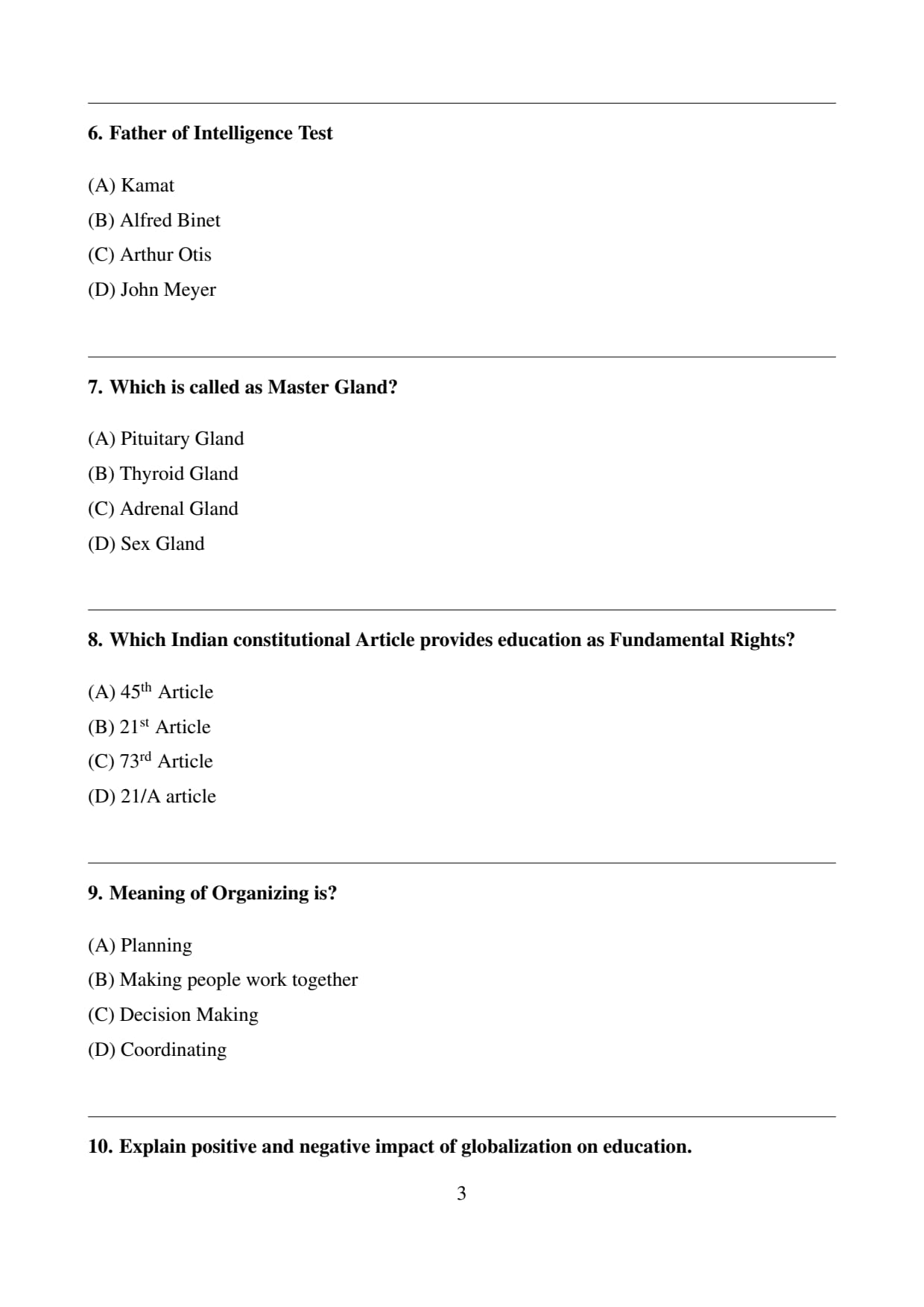
Father of Intelligence Test
View Solution
Alfred Binet is considered the father of the intelligence test. In the early 20th century, he developed the first practical intelligence test to help identify children who needed special education. His work laid the foundation for modern IQ testing. Binet's test focused on measuring cognitive abilities such as memory, problem-solving, and reasoning.
Step 1: Analyze the options.
(A) Kamat: Kamat was a prominent figure in psychology but is not credited with developing the first intelligence test.
(B) Alfred Binet: This is the correct answer. Alfred Binet is the pioneer in the field of intelligence testing.
(C) Arthur Otis: Arthur Otis was involved in the development of group intelligence tests, but he did not develop the first intelligence test.
(D) John Meyer: John Meyer is not associated with the development of intelligence tests.
Step 2: Conclusion.
The correct answer is (B), as Alfred Binet is recognized as the father of intelligence testing.
Final Answer: \[ \boxed{(B) \, Alfred Binet} \] Quick Tip: Alfred Binet's work with intelligence testing focused on helping children with special educational needs, and his methods are still influential today.
Which is called as Master Gland?
View Solution
The Pituitary Gland is called the "master gland" because it controls and regulates the functions of other endocrine glands in the body. It produces hormones that influence growth, metabolism, and reproduction. It is located at the base of the brain and is often referred to as the master controller of the endocrine system.
Step 1: Analyze the options.
(A) Pituitary Gland: This is the correct answer. The pituitary gland controls other glands, earning it the title of the "master gland."
(B) Thyroid Gland: The thyroid regulates metabolism but is not called the master gland.
(C) Adrenal Gland: The adrenal glands produce hormones that help manage stress and regulate metabolism but are not referred to as the master gland.
(D) Sex Gland: Sex glands (gonads) are responsible for reproduction and hormone production but are not called the master gland.
Step 2: Conclusion.
The correct answer is (A), the pituitary gland, which controls and regulates other endocrine glands.
Final Answer: \[ \boxed{(A) \, Pituitary Gland} \] Quick Tip: The pituitary gland is crucial in regulating growth, metabolism, and reproduction by controlling other endocrine glands.
Which Indian constitutional Article provides education as Fundamental Rights?
View Solution
Article 21/A of the Indian Constitution provides the right to education as a fundamental right for children between the ages of 6 and 14 years. This was added through the 86th Constitutional Amendment in 2002. It mandates that the State shall provide free and compulsory education to children in this age group.
Step 1: Analyze the options.
(A) 45th Article: This article originally provided for free and compulsory education, but it was later replaced by Article 21/A.
(B) 21st Article: This article does not relate to education as a fundamental right.
(C) 73rd Article: This article deals with powers of Panchayats, not education.
(D) 21/A article: This is the correct answer. Article 21/A provides the right to education as a fundamental right for children.
Step 2: Conclusion.
The correct answer is (D), Article 21/A.
Final Answer: \[ \boxed{(D) \, 21/A article} \] Quick Tip: Article 21/A makes education a fundamental right for children between the ages of 6 to 14, ensuring free and compulsory education for all.
Meaning of Organizing is?
View Solution
Organizing refers to the process of arranging resources and tasks in a structured way to achieve a specific goal. In a management context, organizing often involves making people work together efficiently to accomplish tasks and objectives. It is the second step in the management process after planning.
Step 1: Analyze the options.
(A) Planning: Planning is the process of setting objectives and deciding on the actions to achieve them. It is an essential function but not the same as organizing.
(B) Making people work together: This is the correct answer. Organizing involves coordinating tasks and people to work towards a common objective.
(C) Decision Making: Decision-making is a critical part of management, but it is not the definition of organizing.
(D) Coordinating: While coordinating is an important part of organizing, organizing itself is a broader concept that includes more than just coordination.
Step 2: Conclusion.
The correct answer is (B), making people work together. Organizing is about arranging resources and tasks effectively to achieve objectives.
Final Answer: \[ \boxed{(B) \, Making people work together} \] Quick Tip: Organizing is a critical management function that ensures resources, including human resources, are effectively arranged to achieve organizational goals.
Explain positive and negative impact of globalization on education.
View Solution
Globalization has significantly impacted education in both positive and negative ways. The effects include:
Positive Impacts:
Access to Information: Globalization has made a wealth of information accessible to students and teachers through the internet, online resources, and international collaborations. This helps improve the quality of education worldwide.
Cultural Exchange: Students are exposed to diverse cultures and educational practices, enriching their learning experiences and broadening their perspectives.
Educational Opportunities: Globalization has led to the expansion of international student exchange programs, making it easier for students to study abroad and gain global exposure.
Improved Technology Use: The integration of modern technology in education has improved learning methods, making education more interactive and efficient.
Negative Impacts:
Cultural Homogenization: The dominance of Western education models may lead to the erosion of local cultures and educational values.
Inequality: Access to global education resources is often unequal, with students in developing countries having limited access to high-quality education and technology.
Commercialization of Education: Globalization has turned education into a commodity, leading to the commercialization of higher education, where education may become more about profit than learning. Quick Tip: While globalization offers many benefits, it is important to address its challenges, such as cultural impact and inequality in access to resources.
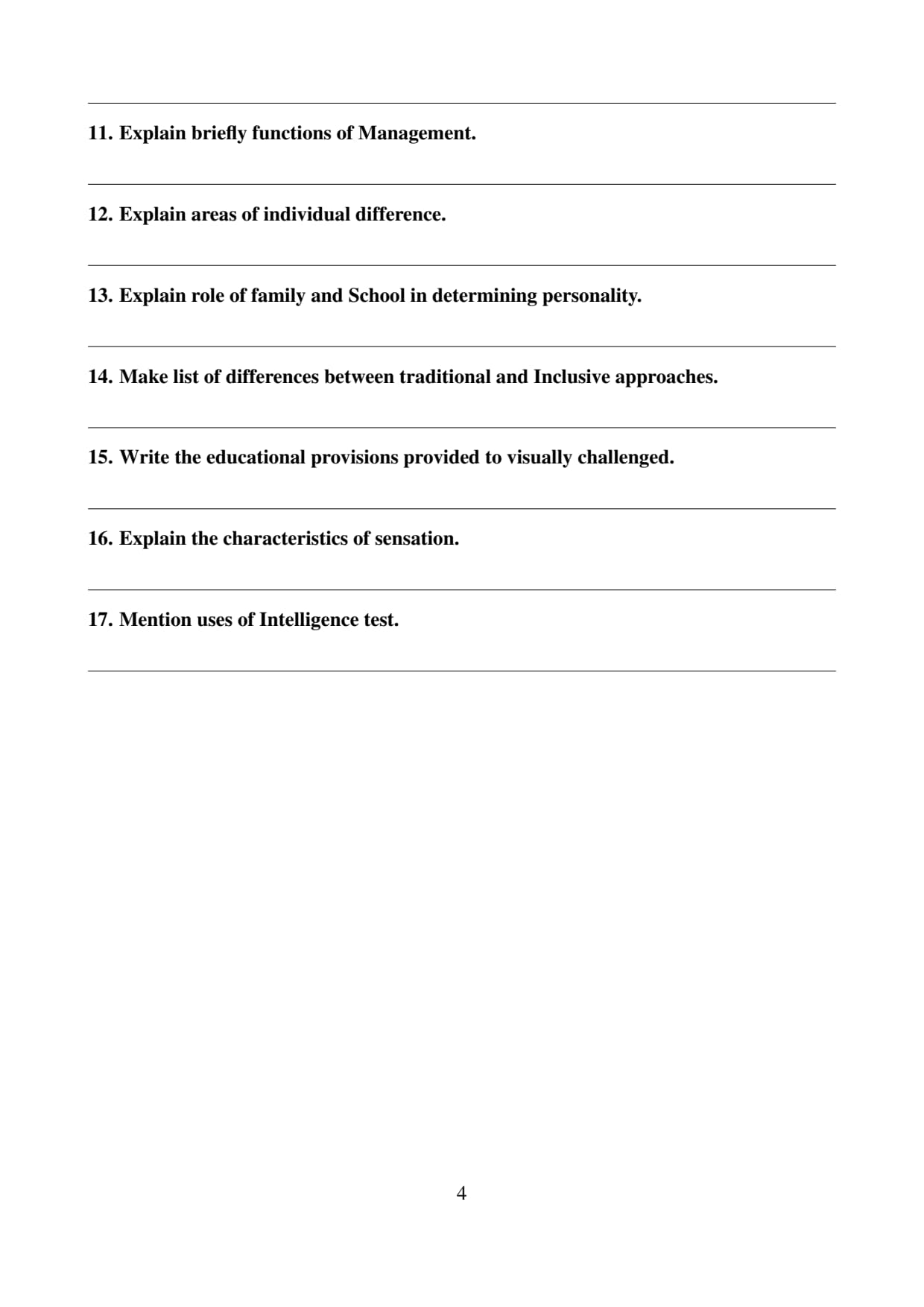
Explain briefly functions of Management.
View Solution
Management involves coordinating and overseeing the activities of an organization to achieve its goals. The key functions of management are:
1. Planning: This involves setting objectives and determining the best course of action to achieve those objectives. Effective planning ensures that resources are used efficiently and that goals are met on time.
2. Organizing: This function involves arranging resources, tasks, and people in a way that supports the execution of the plan. Organizing includes determining what tasks need to be done, who will do them, how the tasks will be carried out, and who will report to whom.
3. Leading: Leading involves motivating and directing the team to achieve the goals set during the planning stage. This includes providing guidance, resolving conflicts, and ensuring that everyone is working towards a common objective.
4. Controlling: This function involves monitoring progress and making adjustments as needed to ensure that the organization’s goals are being met. Controlling includes setting performance standards, comparing actual performance with these standards, and taking corrective actions when necessary. Quick Tip: Effective management is a dynamic process that requires constant planning, organizing, leading, and controlling to ensure the organization meets its goals.
Explain areas of individual difference.
View Solution
Step 1: Understanding Individual Differences.
Individual differences refer to the variations in traits, behaviors, attitudes, and other characteristics that make people unique. These differences can be physical, psychological, or both and can manifest in various forms, such as cognitive abilities, emotional regulation, personality traits, and even preferences or interests. The concept of individual differences is crucial in psychology because it helps in understanding how and why people behave in different ways. Some of the key areas of individual differences include:
1. Cognitive Abilities: Cognitive abilities refer to a person’s intellectual functioning, such as memory, reasoning, problem-solving, and intelligence. People vary in their cognitive abilities, which influence their academic performance, learning styles, and problem-solving skills.
2. Personality Traits: Personality is another major area of individual differences. Traits such as extraversion, introversion, openness to experience, agreeableness, and emotional stability vary from person to person. These traits influence how individuals interact with others, respond to stress, and make decisions.
3. Emotional Regulation: Emotional regulation refers to an individual’s ability to manage and respond to their emotions in a healthy and appropriate manner. People differ in how they regulate their emotions, which can impact their mental health, relationships, and overall well-being.
4. Social Skills and Interpersonal Behavior: People vary in their social skills, which include their ability to communicate, collaborate, and navigate social situations. These differences can influence how people form relationships, interact in groups, and function in both personal and professional settings.
5. Interests and Preferences: Individual preferences, such as career aspirations, hobbies, and values, also contribute to individual differences. These preferences shape how people pursue their goals and interact with the world around them.
Step 2: Conclusion.
In conclusion, individual differences play a significant role in shaping behavior, thoughts, and emotional responses. Understanding these differences is essential for providing personalized care, education, and interventions in various fields, including psychology, education, and workplace environments.
Quick Tip: Recognizing individual differences helps in tailoring approaches in education, therapy, and workplace settings to better meet the needs of individuals.
Explain role of family and School in determining personality.
View Solution
Step 1: Role of Family in Determining Personality.
The family is the first and most influential environment where a child’s personality begins to form. The family plays a crucial role in shaping various aspects of personality, including behavior, values, and emotional responses. The parenting style, family dynamics, and the interactions between family members significantly impact a child’s development. The following are key ways in which the family influences personality development:
1. Parenting Style: The way parents raise their children can have a lasting impact on their personality. For example, authoritative parents, who are supportive yet firm, tend to raise children who are confident, socially competent, and emotionally stable. In contrast, authoritarian or permissive parenting styles can lead to children who may struggle with self-regulation, responsibility, and social interactions.
2. Family Environment and Interaction: A warm and supportive family environment fosters emotional security and self-esteem, while a dysfunctional or neglectful family environment can lead to personality traits such as low self-confidence, anxiety, or trust issues. The way family members communicate and interact with each other also teaches children how to form and maintain relationships.
3. Cultural and Value Transmission: Families are the primary source of cultural and value transmission. The values, norms, and beliefs instilled by family members influence how children view the world and behave in social settings. These values become deeply embedded in their personality as they grow.
Step 2: Role of School in Determining Personality.
School is another influential environment that significantly contributes to personality development, especially during adolescence. It provides opportunities for socialization, academic growth, and the development of various skills. The school environment shapes personality in several ways:
1. Peer Interactions and Socialization: Schools expose children to a wide range of peers, helping them develop social skills and form their social identity. Positive interactions with peers can enhance self-confidence and improve communication skills, while negative experiences, such as bullying, can lead to low self-esteem and social anxiety.
2. Teacher Influence: Teachers play an essential role in shaping a child's academic and emotional development. A supportive and encouraging teacher can boost a child’s confidence and motivation, while an unsupportive or critical teacher may contribute to anxiety or a negative self-image. Teachers also impart values, discipline, and work ethics that influence personality traits such as responsibility and perseverance.
3. Academic and Extracurricular Activities: The school provides an avenue for students to develop interests, skills, and hobbies. These activities help shape personality traits such as creativity, leadership, teamwork, and time management. Students who participate in extracurricular activities may develop a strong sense of self-worth and personal identity.
Step 3: Conclusion.
In conclusion, both the family and school play pivotal roles in determining an individual’s personality. The family shapes the foundation of personality through parenting styles, emotional support, and value transmission, while the school influences personality through peer interactions, teacher influence, and academic challenges. Together, these environments provide a comprehensive framework for personality development during childhood and adolescence.
Quick Tip: Both family and school environments are essential in shaping a child’s personality. Positive reinforcement in both settings can contribute to healthy personality development.
Make list of differences between traditional and Inclusive approaches.
View Solution
Step 1: Understanding Traditional and Inclusive Approaches.
Traditional and inclusive approaches in education represent two different models of teaching and learning. While the traditional approach focuses on the one-size-fits-all method, the inclusive approach emphasizes diversity, recognizing the varied needs of students. Here are the key differences between these two approaches:
1. Focus on Diversity:
- Traditional Approach: The traditional approach often follows a uniform model where students are expected to conform to the same curriculum and methods of instruction. It does not typically account for the diversity in learners' abilities or needs.
- Inclusive Approach: The inclusive approach embraces diversity in the classroom. It recognizes that students have varying abilities, learning styles, and needs, and aims to cater to these differences by modifying teaching methods, content, and assessments to ensure all students can participate and learn effectively.
2. Teaching Methodology:
- Traditional Approach: The traditional approach is teacher-centered, where the teacher is the primary source of knowledge, and students are passive recipients of information. The focus is usually on lectures and textbooks.
- Inclusive Approach: In contrast, the inclusive approach is student-centered. It encourages active participation from students, collaborative learning, and interaction with diverse teaching materials and strategies. The teacher acts as a facilitator, guiding students through personalized learning experiences.
3. Curriculum Design:
- Traditional Approach: The curriculum is rigid and structured, with little flexibility to accommodate the individual needs of students. The content is generally the same for all students, with little adaptation for those with learning difficulties.
- Inclusive Approach: The inclusive approach involves flexible curricula designed to accommodate students with different abilities and learning needs. This may include differentiated instruction, alternative assessments, and various instructional strategies to support all learners.
4. Classroom Environment:
- Traditional Approach: The classroom environment is often segregated, with a clear divide between students who excel academically and those who struggle. This may lead to stigmatization of students with learning difficulties.
- Inclusive Approach: In an inclusive classroom, all students are encouraged to learn together, promoting a sense of belonging and reducing the divide between different groups of students. It fosters a supportive and collaborative environment for diverse learners.
Step 2: Conclusion.
In conclusion, the traditional approach focuses on standardized teaching for all students, whereas the inclusive approach recognizes and celebrates the diversity of learners and strives to create an equitable learning environment. The inclusive approach has been shown to improve engagement and achievement among all students, especially those with disabilities or learning challenges.
Quick Tip: The inclusive approach values diversity and provides tailored educational experiences for all students, whereas the traditional approach often follows a one-size-fits-all model.
Write the educational provisions provided to visually challenged.
View Solution
Step 1: Understanding the Educational Needs of Visually Challenged Individuals.
Visually challenged individuals, including those who are blind or have low vision, require specialized provisions and accommodations in education to ensure they can participate fully in the learning process. These provisions are designed to enhance accessibility, independence, and academic success. Some of the key educational provisions provided to visually challenged individuals include:
1. Braille Literacy:
Braille is a tactile writing system that allows visually impaired individuals to read and write using raised dots. Schools and institutions provide braille textbooks and materials, enabling students to access the same information as their sighted peers. Braille instruction is often a crucial part of the education of visually challenged students.
2. Assistive Technology:
There are various assistive technologies designed to aid visually challenged students. These include screen readers, which read aloud text from a computer screen, and magnification software, which enlarges text for those with low vision. Other tools include audio books, voice recognition software, and digital note-taking devices, which help visually challenged students complete assignments and engage with course materials.
3. Specialized Teachers and Support Staff:
In many educational settings, specialized teachers and support staff, such as mobility instructors and orientation trainers, are employed to help visually impaired students navigate their learning environment. These professionals assist with braille training, adaptive technologies, and other services to ensure that students receive the support they need.
4. Modified Classroom Materials:
Visually challenged students often require materials that have been modified for accessibility. This includes large print books, audio recordings, tactile diagrams, and braille versions of written materials. Teachers are often trained to adapt lesson plans to accommodate students with visual impairments, ensuring that they can access the same curriculum as their peers.
5. Physical and Environmental Modifications:
The physical classroom environment is also modified to accommodate visually challenged students. This includes ensuring that the classroom layout is accessible, with clear pathways and appropriate lighting. Schools may also provide special seating arrangements and furniture to assist with mobility and comfort.
6. Mobility Training and Independent Living Skills:
Visually challenged students are often taught mobility training and independent living skills, including how to use a white cane, navigate public spaces, and perform daily activities safely and independently. These skills are vital for fostering autonomy and confidence in the learning environment and beyond.
Step 2: Conclusion.
In conclusion, there are various educational provisions and support systems available for visually challenged students. These provisions ensure that students with visual impairments can receive an equitable education and have access to the same learning opportunities as their sighted peers. With the right accommodations and resources, visually challenged individuals can succeed academically and lead independent lives.
Quick Tip: Providing specialized educational provisions, such as braille literacy, assistive technologies, and classroom modifications, ensures that visually challenged students can fully participate in the learning process.
Explain the characteristics of sensation.
View Solution
Sensation is the process by which our sensory organs detect and respond to stimuli from the environment. The characteristics of sensation include:
1. Threshold: The threshold is the minimum amount of stimulus required for a sensation to be perceived. It can be categorized into the absolute threshold (the smallest detectable stimulus) and the difference threshold (the smallest difference between two stimuli that can be detected).
2. Intensity: Sensations vary in intensity, depending on the strength of the stimulus. Strong stimuli produce more intense sensations, while weak stimuli produce less intense sensations.
3. Quality: Sensations have distinct qualities that allow us to differentiate them. For example, the quality of a sound might be high-pitched or low-pitched, while a taste may be sweet or sour.
4. Duration: Sensations have different durations, which refer to how long the stimulus is perceived. Some sensations may be brief, while others may last longer.
5. Adaptation: Sensory adaptation is the process by which our sensory receptors become less responsive to continuous or unchanging stimuli. For example, we may stop feeling the sensation of clothes touching our skin after a while.
Quick Tip: Understanding the characteristics of sensation helps in studying how we perceive and interpret sensory stimuli in our environment.
Mention uses of Intelligence test.
View Solution
Intelligence tests are widely used for various purposes in education, psychology, and employment. Some of the primary uses include:
1. Educational Placement: Intelligence tests help in identifying students who may require special educational programs or those who are gifted. This helps in placing students in suitable classes for their cognitive abilities.
2. Career Counseling: These tests are used to assess an individual's cognitive strengths and weaknesses, helping in guiding them towards a career that aligns with their abilities.
3. Psychological Diagnosis: Intelligence tests are often used to diagnose intellectual disabilities or cognitive impairments, which can assist in determining the appropriate treatments or interventions.
4. Research: Intelligence tests are used in psychological and educational research to study cognitive development, intelligence factors, and learning processes.
5. Job Selection: Some employers use intelligence tests during the recruitment process to evaluate candidates' problem-solving abilities, cognitive skills, and potential to perform in a given role.
Quick Tip: Intelligence tests should be used with caution, as they only measure certain aspects of cognitive abilities and do not capture the full range of human intelligence.
Online Assignment for Class 12 | Subject Education



Comments