




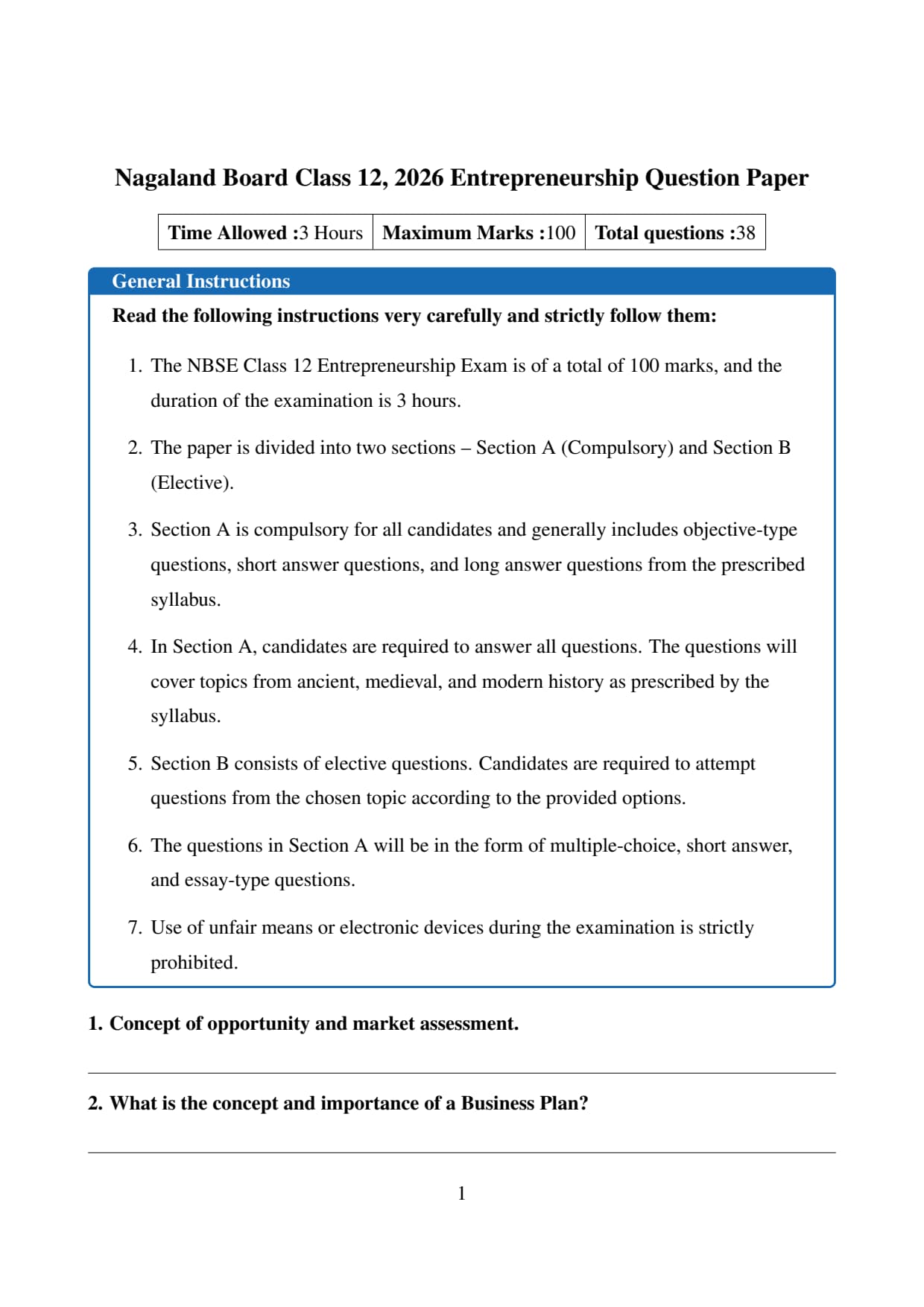
Nagaland Board is conducting the Class 12 Entrepreneurship Board Exam 2026 on February 19, 2026. Class 12 Entrepreneurship Question Paper with Solution PDF is available here for download.
The official question paper of Nagaland Board Class 12 Entrepreneurship Board Exam 2026 is provided below. Students can download the official paper in PDF format for reference.
Nagaland Board Class 12, 2026 Entrepreneurship Question Paper with Solution PDF
| Nagaland Board Class 12 Entrepreneurship Question Paper 2026 |  Download Download |
Check Solutions |

Concept of opportunity and market assessment.
View Solution
The concept of opportunity and market assessment involves identifying and evaluating the potential for success in a specific market or industry. It is a critical step in business strategy and entrepreneurship, as it helps businesses determine where to invest resources and which markets to target for growth. The process includes:
1. Opportunity Identification: The first step is recognizing the opportunities that exist in the market. These opportunities can arise from new technologies, changing customer needs, or emerging trends. A business must identify these opportunities early to gain a competitive edge.
2. Market Research: Once an opportunity is identified, businesses conduct market research to gather data about the target market. This includes understanding customer preferences, market size, competitors, and potential barriers to entry. Effective market research helps to assess the viability of the opportunity.
3. Evaluating Market Demand: A key component of market assessment is determining the level of demand for a product or service. Businesses need to analyze factors such as customer interest, purchasing behavior, and the overall potential for growth in the market.
4. Competitor Analysis: Understanding the competitive landscape is crucial in assessing the opportunity. Businesses need to analyze competitors' strengths, weaknesses, pricing strategies, and market share to determine how they can position themselves effectively.
5. Risk Assessment: Evaluating the risks associated with pursuing the opportunity is an important aspect of market assessment. This includes considering financial risks, operational challenges, and external factors such as economic downturns or regulatory changes.
6. Feasibility Study: A comprehensive feasibility study is conducted to determine whether the opportunity can be successfully pursued. This includes assessing the required resources, costs, timeframes, and expected return on investment. Quick Tip: Market assessment is a continuous process that helps businesses stay ahead by identifying opportunities, analyzing market trends, and adapting to changes in customer needs and competitive forces.
What is the concept and importance of a Business Plan?
View Solution
A business plan is a formal written document that outlines the goals, strategies, and financial projections of a business. It serves as a roadmap for the company's operations, guiding the business from its inception through its growth and development. The concept and importance of a business plan are as follows:
1. Concept of a Business Plan:
A business plan provides a detailed description of the business, including its mission, target market, competitive landscape, and operational structure. It outlines both short-term and long-term goals, as well as the strategies to achieve them. It may include sections such as an executive summary, market analysis, marketing strategy, operational plan, and financial projections.
2. Importance of a Business Plan:
- Direction and Strategy: A business plan provides clear direction for the company, helping the entrepreneur stay focused on key objectives and avoid unnecessary distractions.
- Securing Funding: A well-structured business plan is essential for securing financing from investors or lenders, as it demonstrates the viability of the business idea and outlines how funds will be utilized.
- Risk Management: By identifying potential challenges and offering solutions, a business plan helps mitigate risks that could hinder the business's success.
- Tracking Performance: The business plan serves as a benchmark for measuring the company’s performance and adjusting strategies as needed.
Quick Tip: Regularly revising and updating your business plan as your business evolves can help you stay on track and make informed decisions.
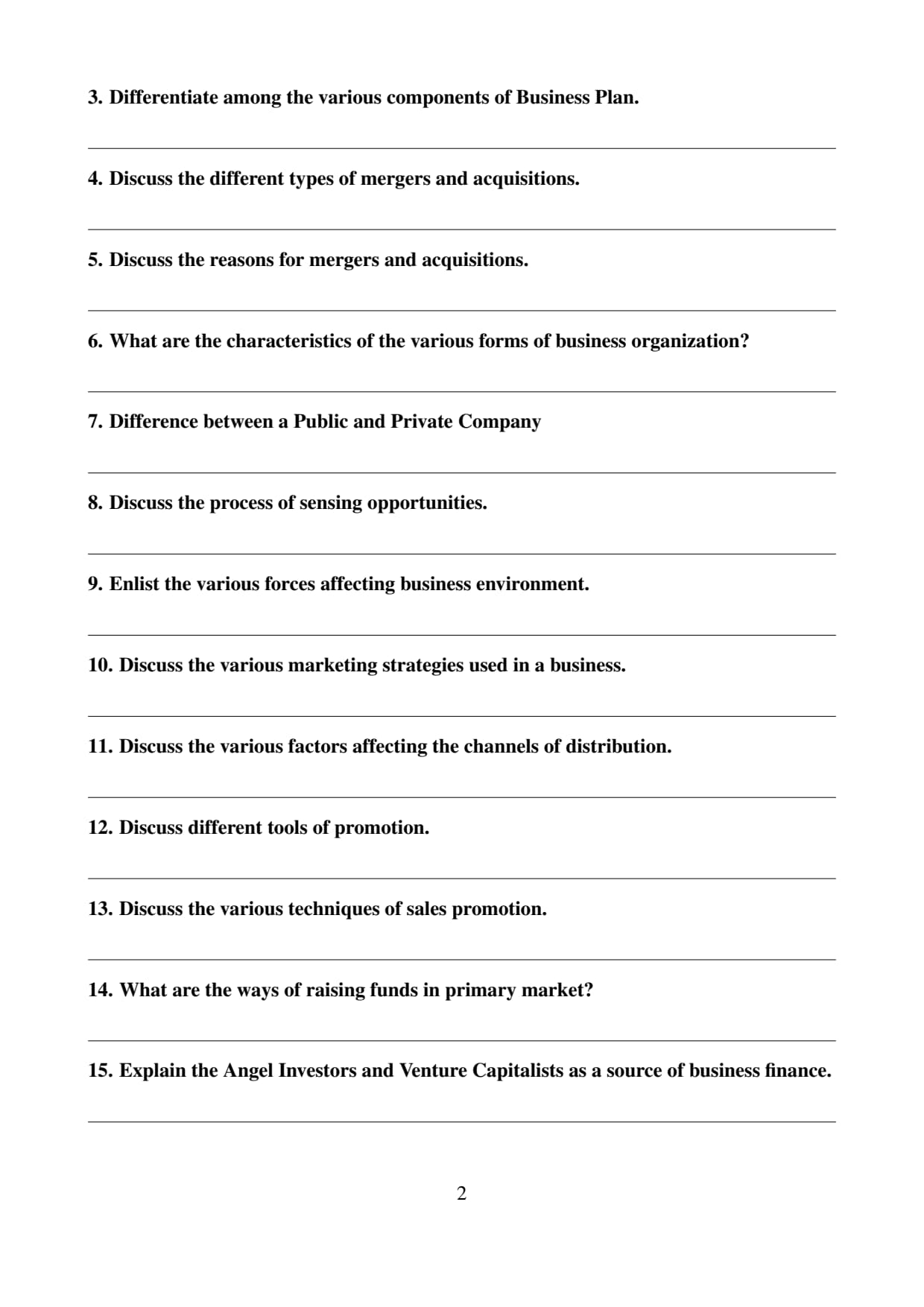
Differentiate among the various components of Business Plan.
View Solution
A business plan consists of several key components that work together to provide a comprehensive view of the business. The primary components are:
1. Executive Summary:
This is a concise overview of the entire business plan, summarizing the business idea, objectives, market, and financial projections. It provides readers with a quick understanding of the business and its potential.
2. Company Description:
This section provides detailed information about the business, including its mission, vision, structure, and the products or services offered. It explains the purpose of the business and the problem it aims to solve.
3. Market Analysis:
The market analysis examines the industry, target market, and competitors. It helps identify potential opportunities and challenges within the market and assesses the business’s position relative to others.
4. Marketing Strategy:
This section outlines the strategies for promoting the business, including pricing, sales tactics, advertising, and distribution channels. It defines how the business will attract and retain customers.
5. Organizational Structure:
This component describes the management team, roles, and responsibilities within the company. It includes information about key personnel and their qualifications.
6. Product Line or Services Offered:
This section explains the products or services the business will offer, highlighting their features, benefits, and any competitive advantages they may have.
7. Financial Projections:
This is a critical part of the business plan, outlining the expected revenue, expenses, profits, and cash flow. It helps assess the financial viability of the business and is often required by investors and lenders.
8. Funding Requirements:
If the business requires external funding, this section specifies how much capital is needed, how it will be used, and the expected return on investment.
Quick Tip: A strong business plan should provide a clear, realistic, and data-backed plan for business growth and development. Be sure to back up assumptions with solid research and analysis.
Discuss the different types of mergers and acquisitions.
View Solution
Mergers and acquisitions (M&A) are business strategies used to combine two companies into one or to acquire control of another company. There are several types of M&As, each serving different business goals:
1. Horizontal Merger: This type of merger occurs between two companies operating in the same industry and at the same stage of production. The goal is usually to increase market share, reduce competition, and achieve economies of scale. An example would be two car manufacturing companies merging.
2. Vertical Merger: A vertical merger takes place between two companies at different stages of production or supply chain in the same industry. This type of merger allows the companies to control more of the production process and increase efficiencies. For instance, a manufacturer might merge with a supplier of raw materials.
3. Conglomerate Merger: This occurs when two companies from unrelated industries merge. The goal is to diversify business operations, reduce risk by entering new markets, and gain financial strength. An example could be a merger between a food company and a tech company.
4. Reverse Merger: In a reverse merger, a private company acquires a public company to gain access to public markets without going through the lengthy and expensive process of an initial public offering (IPO).
5. Acquisition: An acquisition occurs when one company buys another company. This could be a friendly acquisition, where both parties agree, or a hostile acquisition, where the acquiring company takes control without the target company’s consent. The acquiring company gains control over the target’s assets and operations. Quick Tip: M&As can offer strategic advantages such as increased market power, reduced costs, and diversification. However, they also come with risks like integration challenges and regulatory hurdles.
Discuss the reasons for mergers and acquisitions.
View Solution
Mergers and acquisitions (M&A) are driven by various strategic reasons. Companies pursue M&As to achieve growth, improve efficiency, and enhance their competitive position. The main reasons include:
1. Market Expansion: Companies may pursue M&As to enter new geographical markets or expand their product offerings. By acquiring or merging with a company that operates in a new market, a business can quickly gain access to a larger customer base.
2. Economies of Scale: Merging with or acquiring another company can help reduce costs and increase efficiency through economies of scale. The combined entity can often operate more cost-effectively, benefiting from shared resources, reduced overhead, and bulk purchasing.
3. Increased Market Power: Companies merge or acquire others to increase their market share, reduce competition, and strengthen their position in the industry. This gives them more leverage over suppliers, customers, and competitors.
4. Diversification: Diversification helps mitigate risk by entering new markets or industries. Companies pursue M&As to reduce their reliance on a single market or product line and to spread their risks across different areas.
5. Tax Benefits: In some cases, a company may acquire another company to take advantage of tax benefits, such as tax credits or the ability to offset losses against profits.
6. Talent Acquisition: M&As can help companies acquire skilled employees, intellectual property, or proprietary technologies that they lack internally. The merger or acquisition allows access to a pool of talent that can drive innovation. Quick Tip: While M&As can create significant opportunities for growth and market dominance, they must be approached carefully due to the risks involved in integration and culture alignment.
What are the characteristics of the various forms of business organization?
View Solution
There are several forms of business organizations, each with its unique characteristics. The most common forms include:
1. Sole Proprietorship: This is a business owned and operated by a single individual. The owner has full control over decision-making but is also personally responsible for any debts or liabilities. It is easy to set up and run, with minimal legal requirements.
2. Partnership: A partnership is a business owned by two or more individuals who share profits, liabilities, and decision-making. There are two main types: general partnerships (where all partners share responsibility) and limited partnerships (where some partners have limited liability).
3. Corporation: A corporation is a separate legal entity from its owners (shareholders). It provides limited liability protection, meaning the shareholders are not personally responsible for the company’s debts. Corporations are more complex to set up and are regulated by government rules.
4. Limited Liability Company (LLC): An LLC combines elements of both partnerships and corporations. It offers limited liability like a corporation but allows more flexibility in management and tax treatment. LLCs are popular for small and medium-sized businesses.
5. Cooperative: A cooperative is owned and operated by its members, who share the profits and decision-making responsibilities. Cooperatives are common in industries like agriculture, retail, and housing.
Quick Tip: Each business form has its advantages and disadvantages. Consider factors like liability, tax implications, and management control when deciding which structure suits your needs.
Difference between a Public and Private Company
View Solution
The main difference between a public and private company lies in their ownership structure and how they are regulated:
1. Ownership:
- A public company is owned by shareholders who can buy or sell shares on public stock exchanges.
- A private company is owned by a small group of investors, and its shares are not available to the public.
2. Regulatory Requirements:
- Public companies are subject to stringent regulatory requirements, including filing financial statements with government agencies like the SEC.
- Private companies face fewer regulatory obligations, making them easier and cheaper to operate.
3. Disclosure:
- A public company is required to disclose financial information to the public regularly, ensuring transparency.
- A private company has less disclosure responsibility, which allows it to maintain greater privacy in its operations.
4. Access to Capital:
- Public companies can raise funds by issuing stock to the public, which provides access to a larger pool of capital.
- Private companies may have to rely on private investments, loans, or other means to raise capital.
5. Control:
- Private companies often retain more control with a smaller group of owners and fewer shareholders.
- Public companies may have more dispersed ownership, leading to less direct control by the founders or initial investors.
Quick Tip: While public companies benefit from access to capital and greater visibility, private companies enjoy more flexibility and privacy in their operations.
Discuss the process of sensing opportunities.
View Solution
Sensing opportunities is an essential skill for any business or entrepreneur. It involves recognizing potential areas for growth, improvement, or innovation. The process can be broken down into the following stages:
1. Environmental Scanning: This involves collecting and analyzing information about the external environment to detect changes and emerging trends. Businesses must continuously monitor market trends, consumer behaviors, technological advancements, and regulatory changes.
2. Identifying Gaps: Once environmental scanning is done, the next step is identifying gaps or areas where needs are not being met or where existing solutions are insufficient. This could be in the form of unmet customer needs or inefficiencies in existing systems.
3. Idea Generation: After identifying the gaps, businesses need to generate ideas that can fill these gaps or address the emerging trends. This can be done through brainstorming, market research, or customer feedback.
4. Opportunity Evaluation: Once ideas are generated, they must be evaluated to assess their feasibility, market potential, and alignment with the company’s goals and capabilities. The most viable opportunities are selected for further exploration.
5. Taking Action: After evaluating opportunities, businesses need to take action by designing, testing, and launching new products, services, or strategies to capitalize on the identified opportunity. Quick Tip: Effective opportunity sensing requires constant market observation and a willingness to innovate. A keen understanding of industry trends can provide a competitive edge in identifying growth opportunities.
Enlist the various forces affecting business environment.
View Solution
The business environment is influenced by various forces that can be broadly classified into internal and external factors. These forces are constantly changing and have a significant impact on business operations. The main forces affecting the business environment are:
1. Economic Forces: Economic factors such as inflation, interest rates, exchange rates, and economic growth rates influence business decisions. These factors determine consumer spending behavior, investment decisions, and overall market conditions.
2. Political and Legal Forces: The political environment, including government policies, laws, regulations, and taxation, significantly impacts businesses. Changes in laws or government leadership can affect business operations, such as labor laws, trade restrictions, and industry regulations.
3. Social and Cultural Forces: Social trends, cultural norms, demographics, and consumer preferences influence the demand for products and services. Businesses must adapt to societal shifts such as changes in family structures, income distribution, and lifestyle preferences.
4. Technological Forces: Advances in technology have a profound effect on business. Technological innovations can lead to new business models, improved processes, and enhanced customer experiences. Companies must stay updated on new technological developments to remain competitive.
5. Environmental Forces: Environmental factors such as climate change, sustainability concerns, and natural disasters can impact businesses, especially in industries like agriculture, manufacturing, and energy. Companies must adopt environmentally sustainable practices to meet consumer demand for eco-friendly products.
6. Competitive Forces: The actions of competitors and the competitive landscape can influence a business's strategy and decisions. Market share, pricing strategies, and innovation levels of competitors impact the business’s ability to attract customers and remain profitable. Quick Tip: Businesses must constantly monitor the various forces affecting the environment to stay adaptable and responsive. Proactively responding to these forces can help businesses maintain a competitive edge.
Discuss the various marketing strategies used in a business.
View Solution
Marketing strategies are essential for businesses to position their products and services effectively in the market. Some common marketing strategies include:
1. Product Differentiation:
This strategy focuses on distinguishing a product from competitors by emphasizing unique features, quality, or benefits. It aims to create a competitive advantage by offering something that others do not.
2. Cost Leadership:
A cost leadership strategy involves becoming the lowest-cost producer in an industry. By producing at lower costs, businesses can offer lower prices to customers, making their products more attractive in terms of value.
3. Focus Strategy:
A focus strategy targets a specific segment of the market, focusing on a niche audience rather than trying to appeal to a broader market. This strategy is used to gain a competitive edge within a specific demographic or geographic area.
4. Diversification:
Diversification involves expanding a business’s product offerings or entering new markets to reduce dependence on a single product line or market. It helps mitigate risks and opens up new revenue streams.
5. Digital Marketing:
This includes the use of online platforms like social media, search engines, email, and websites to reach a wide audience. It includes strategies like content marketing, SEO (Search Engine Optimization), PPC (Pay-Per-Click), and influencer marketing.
6. Relationship Marketing:
This strategy focuses on building long-term relationships with customers to foster loyalty and repeat business. It involves personalized communication and offering excellent customer service.
7. Viral Marketing:
Viral marketing uses social networks to spread promotional content rapidly. The goal is to create content that resonates strongly enough with users that they share it with their network, causing the content to "go viral."
Quick Tip: Choosing the right marketing strategy depends on your business goals, target market, and available resources. Regularly assess and adjust strategies based on performance and market changes.
Discuss the various factors affecting the channels of distribution.
View Solution
Distribution channels play a vital role in delivering products to customers. Several factors can influence the effectiveness and choice of distribution channels, including:
1. Market Size and Location:
The size and geographical location of the target market influence the distribution strategy. Larger markets may require multiple channels, including retail, online, and wholesale, while smaller markets may be served by fewer channels.
2. Product Characteristics:
The nature of the product—whether it is perishable, bulky, or requires specialized handling—affects the choice of distribution channel. For example, perishable goods require faster distribution through efficient channels, while bulky goods may require specialized transport.
3. Cost Factors:
The costs associated with different distribution channels, such as shipping, warehousing, and commissions, must be considered. Companies often seek cost-effective distribution methods that can help maximize profits while minimizing expenses.
4. Market Type and Customer Preferences:
Understanding the market type (B2B or B2C) and customer preferences helps in choosing the right distribution channels. For example, consumers who prefer convenience may prefer e-commerce platforms, while business customers might rely on wholesalers or direct sales representatives.
5. Competition:
The competitive landscape influences distribution decisions. A business might need to adopt unique distribution channels or enhance its existing channels to stand out from competitors.
6. Legal and Regulatory Factors:
Government regulations regarding distribution, such as import/export laws, tariffs, and product safety regulations, can impact how products are distributed in different regions or countries.
7. Technology:
Advancements in technology have led to the development of digital distribution channels such as e-commerce and online marketplaces. These technologies provide new opportunities for reaching global markets and offering products efficiently.
Quick Tip: Understanding the factors affecting distribution channels helps businesses design efficient supply chains that can deliver products to customers on time, at a lower cost, and with high customer satisfaction.
Discuss different tools of promotion.
View Solution
Promotion is an essential component of the marketing mix that aims to inform, persuade, and remind customers about a brand, product, or service. The tools of promotion are various techniques that companies use to achieve their promotional objectives. The primary tools of promotion include:
1. Advertising: Advertising involves paid, non-personal communication through various media channels such as TV, radio, newspapers, and digital platforms. It is used to reach a large audience and create brand awareness.
2. Personal Selling: Personal selling is a face-to-face communication process where a salesperson engages directly with a potential customer. It allows for personalized interaction and helps address specific customer needs.
3. Public Relations (PR): Public relations involve managing the spread of information between the company and the public. PR activities include press releases, media coverage, events, and corporate social responsibility (CSR) initiatives aimed at building a positive image.
4. Direct Marketing: Direct marketing involves communicating directly with consumers through channels such as emails, phone calls, or direct mail. It aims to generate a direct response or immediate action from the target audience.
5. Sales Promotion: Sales promotions are short-term incentives to encourage the purchase or sale of a product or service. Techniques such as discounts, coupons, samples, and contests are commonly used in sales promotions.
6. Digital Marketing: Digital marketing includes using online channels such as social media, search engines, websites, and email to promote products. It offers targeted reach and measurable results for businesses. Quick Tip: Effective promotion tools must align with a company’s goals, target audience, and budget. Combining different tools of promotion can create a well-rounded strategy.
Discuss the various techniques of sales promotion.
View Solution
Sales promotion refers to short-term incentives designed to encourage the purchase or sale of a product or service. It is used to boost sales, attract customers, and create brand awareness. Some common techniques of sales promotion include:
1. Discounts and Price Reductions: Offering temporary reductions in price to encourage customers to make a purchase. This is one of the most commonly used techniques, as it directly impacts the customer’s decision-making process.
2. Coupons: Coupons are vouchers that provide customers with a discount or offer a special deal when they make a purchase. Coupons can be distributed through newspapers, magazines, or online platforms.
3. Samples: Offering free samples of a product allows potential customers to try the product before making a purchase decision. This technique is often used for new products or to promote a product’s features.
4. Contests and Sweepstakes: Contests and sweepstakes are promotional activities where customers participate for a chance to win a prize. These techniques create excitement and engagement around the brand.
5. Loyalty Programs: Loyalty programs reward repeat customers by offering points, discounts, or special deals based on their purchasing behavior. This technique is designed to increase customer retention and encourage repeat purchases.
6. Trade Promotions: These promotions target retailers or wholesalers and offer them incentives such as volume discounts, allowances, or free goods in exchange for stocking or promoting the product.
7. Point-of-Sale (POS) Displays: These are special displays placed in retail locations to attract attention and encourage customers to buy the product at the point of purchase. They are often used for impulse buying. Quick Tip: Sales promotions are effective when used strategically and tailored to the target audience. The key is to create a sense of urgency or added value that drives immediate action.
What are the ways of raising funds in primary market?
View Solution
Raising funds in the primary market involves the sale of new securities directly to investors. Companies or organizations typically raise capital in the primary market through the following ways:
1. Initial Public Offering (IPO): An IPO is the process where a company issues new shares to the public for the first time. This method is commonly used by companies looking to raise substantial amounts of capital for expansion or debt repayment. It allows the company to list its shares on a stock exchange and make them available to the general public.
2. Rights Issue: A rights issue is an offer to existing shareholders to buy additional shares at a discounted price, typically in proportion to their current holdings. This is often used by companies to raise capital without the need to find new investors.
3. Preferential Allotment: Under preferential allotment, a company issues shares to select investors, usually institutional investors or promoters, at a fixed price. This is a quicker and more flexible way to raise funds.
4. Private Placement: In private placement, a company sells securities to a select group of investors, such as private equity firms, venture capitalists, or accredited investors. This method allows companies to raise funds without the regulatory requirements of an IPO.
5. Public Deposits: Companies may also raise funds through public deposits by offering fixed deposits to the public at attractive interest rates. This is a short-term method used mainly by non-banking financial companies (NBFCs). Quick Tip: The primary market is crucial for companies seeking to raise capital for growth and expansion. Investors should carefully assess the risk and reward before investing in new securities.
Explain the Angel Investors and Venture Capitalists as a source of business finance.
View Solution
Angel investors and venture capitalists are two important sources of business finance, particularly for start-ups and early-stage companies. Both offer funding in exchange for equity or convertible debt, but they differ in terms of their investment strategies and involvement in the business.
1. Angel Investors: Angel investors are individuals who provide financial backing to start-ups or early-stage businesses in exchange for equity ownership or debt. Typically, angel investors are successful entrepreneurs or high-net-worth individuals who invest their personal funds. Their investment is often in the range of a few thousand to a few million dollars. In addition to capital, angel investors may provide valuable mentorship and guidance to entrepreneurs.
2. Venture Capitalists (VC): Venture capitalists are professional investors who manage pooled funds from various sources, including institutional investors and wealthy individuals. They provide funding to businesses with high growth potential in exchange for equity, typically in later stages of business development than angel investors. VCs tend to invest larger sums, often in the millions of dollars, and expect significant returns on their investment. In addition to financial support, venture capitalists may also offer strategic advice, access to networks, and help with business scaling. Quick Tip: Angel investors and venture capitalists play a key role in the development of start-ups by providing necessary funding and expertise. Entrepreneurs should carefully assess which source aligns with their business needs and growth stage.



Comments