




Nagaland Board is conducting the Class 12 History Board Exam 2026 on March 2, 2026. Class 12 History Question Paper with Solution PDF is available here for download.
The official question paper of Nagaland Board Class 12 History Board Exam 2026 is provided below. Students can download the official paper in PDF format for reference.
Nagaland Board Class 12 2026 History Question Paper with Solution PDF
| Nagaland Board Class 12 2026 History Question Paper with Solution PDF | Download PDF | Check Solutions |

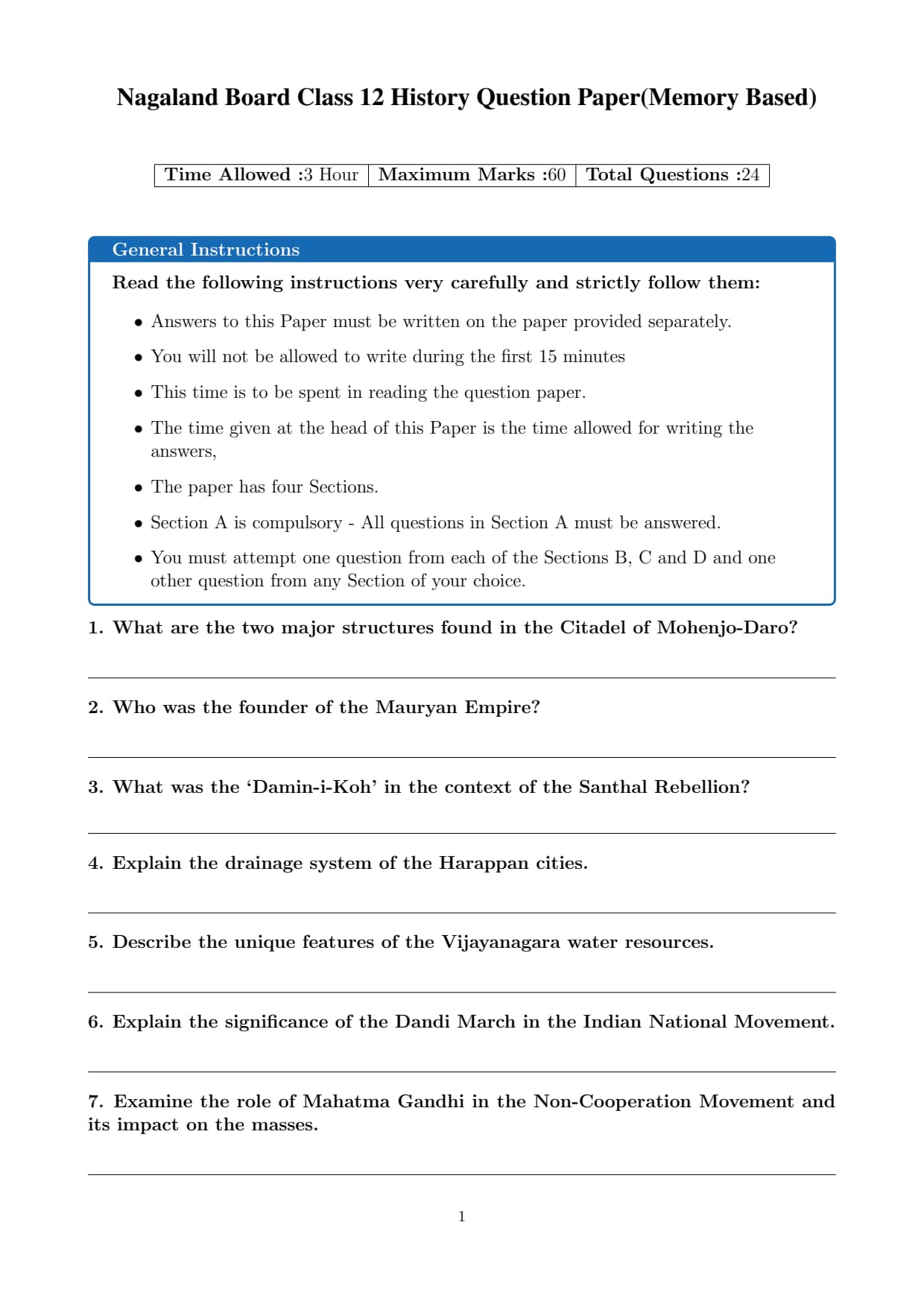
What are the two major structures found in the Citadel of Mohenjo-Daro?
View Solution
Concept:
The Citadel of Mohenjo-Daro was the elevated western part of the city, built on a massive mud-brick platform. It contained important public buildings used for religious, administrative, or ceremonial purposes. The structures found here reflect the advanced urban planning of the Indus Valley Civilization.
Step 1: Identifying the most prominent structure — The Great Bath.
The Great Bath is one of the most famous structures of the Indus Valley Civilization. It was a large rectangular tank made of baked bricks, with steps leading down into it and an advanced drainage system. This indicates its probable use for ritual bathing.
Step 2: Recognizing the Granary as a major structure.
Another important structure found in the Citadel is the Granary. It was a large building believed to have been used for storing surplus grain, showing organized economic planning.
Conclusion:
Thus, the two major structures found in the Citadel of Mohenjo-Daro are the Great Bath and the Granary. Quick Tip: The Citadel area of Harappan cities usually contained important public buildings such as baths, granaries, and assembly halls — indicating organized civic life.
Who was the founder of the Mauryan Empire?
View Solution
Concept:
The Mauryan Empire was one of the largest and most powerful empires in ancient India. Its foundation marked the beginning of a centralized political authority over a large part of the Indian subcontinent.
Step 1: Identifying the founder.
Chandragupta Maurya established the Mauryan Empire in 322 BCE after overthrowing the Nanda dynasty with the guidance of his mentor Chanakya (Kautilya).
Step 2: Understanding his significance.
He laid the foundation of a vast empire that was later expanded by his grandson Ashoka. His administration became a model of efficient governance in ancient India. Quick Tip: Chandragupta Maurya founded the Mauryan Empire in 322 BCE with the help of Chanakya, who also authored the Arthashastra.
What was the ‘Damin-i-Koh’ in the context of the Santhal Rebellion?
View Solution
Concept:
The Santhal Rebellion (1855–56) was a major tribal uprising against British colonial rule and exploitative zamindars and moneylenders. Understanding the term \textit{Damin-i-Koh is important in tracing the origins of this revolt.
Step 1: Meaning of Damin-i-Koh.
The term \textit{Damin-i-Koh means “skirts of the hills.” It referred to a forested tract of land in present-day Jharkhand.
Step 2: Its role in the rebellion.
The British created this region in the early 19th century and encouraged the Santhals to settle there to clear forests and cultivate land. However, over time, the Santhals faced exploitation by moneylenders, traders, and zamindars, leading to resentment.
Step 3: Connection with the Santhal Rebellion.
The injustices faced by the Santhals in the Damin-i-Koh region became a major cause of the Santhal Rebellion of 1855–56, led by Sidhu and Kanhu Murmu. Quick Tip: Damin-i-Koh was a forest region reserved by the British for Santhal settlement, but exploitation there led to the Santhal Rebellion (1855–56).
Explain the drainage system of the Harappan cities.
View Solution
Concept:
The Indus Valley Civilization is famous for its advanced urban planning. One of its most remarkable features was the highly developed drainage system, which reflects scientific planning and concern for sanitation.
Step 1: Household drainage.
Almost every house in Harappan cities had a bathroom and sometimes a private well. Wastewater from houses flowed through small drains made of baked bricks.
Step 2: Street drainage system.
These small drains were connected to larger street drains that ran along the roads. The drains were constructed with baked bricks and were carefully sloped to allow smooth flow of wastewater.
Step 3: Covered drains and inspection holes.
Most drains were covered with stone slabs or bricks, which helped prevent foul smell and accidents. Inspection holes or manholes were also provided at intervals for cleaning and maintenance.
Step 4: Soak pits and waste disposal.
In some places, soak pits or cesspits were used to collect solid waste, preventing blockage of the drainage system.
Conclusion:
The Harappan drainage system was highly organized, scientific, and far ahead of its time, showing the civilization’s emphasis on hygiene and urban planning. Quick Tip: The Harappans built one of the world’s earliest urban sanitation systems with covered drains, manholes, and house-to-street drainage connections.
Describe the unique features of the Vijayanagara water resources.
View Solution
Concept:
The Vijayanagara Empire (14th–16th century) developed a highly sophisticated water management system. Due to its semi-arid location, the rulers invested heavily in storing and efficiently distributing water for agriculture, urban needs, and religious purposes.
Step 1: Large tanks and reservoirs.
One of the most prominent features was the construction of massive tanks and reservoirs. These were created by building embankments across valleys to store rainwater and river water for year-round use.
Step 2: Canals and irrigation networks.
A network of canals carried water from rivers like the Tungabhadra to agricultural fields and urban areas. This supported intensive cultivation and sustained a large population.
Step 3: Check dams and anicuts.
The Vijayanagara rulers built check dams (anicuts) across streams to regulate water flow and increase groundwater recharge.
Step 4: Integration with urban planning.
Water systems were closely integrated with the city layout. Stepwells, temple tanks, and channels supplied water to palaces, gardens, and temples, showing a blend of utility and aesthetics.
Step 5: Use of natural landscape.
Engineers skillfully used the rocky terrain of Hampi to channel water through gravity-based systems, minimizing mechanical effort.
Conclusion:
The Vijayanagara water resources were unique for their scale, engineering efficiency, and integration with agriculture and urban life, reflecting advanced knowledge of hydrology and planning. Quick Tip: Vijayanagara’s water system combined tanks, canals, and check dams, using natural terrain and gravity flow to support agriculture and urban life.
Explain the significance of the Dandi March in the Indian National Movement.
View Solution
Concept:
The Dandi March (1930) was a major event in India’s struggle for independence led by Mahatma Gandhi. It was a non-violent protest against the British salt tax and became a symbol of resistance against colonial rule.
Step 1: Beginning of the Civil Disobedience Movement.
The march marked the formal launch of the Civil Disobedience Movement. Gandhi and his followers openly broke the salt law, challenging British authority through peaceful means.
Step 2: Mass participation.
The movement inspired widespread participation from peasants, women, students, and workers across India. It transformed the freedom struggle into a true mass movement.
Step 3: Symbolic challenge to British rule.
Salt was a basic necessity of life, and the British monopoly on it affected all sections of society. By breaking the salt law, Gandhi turned a simple act into a powerful symbol of defiance.
Step 4: Global attention.
The Dandi March attracted international media coverage, drawing global attention to India’s freedom struggle and exposing the injustices of British colonial rule.
Step 5: Strengthening non-violent resistance.
It reinforced the effectiveness of non-violent methods (Satyagraha) and established civil disobedience as a key strategy in the independence movement.
Conclusion:
The Dandi March was a turning point that broadened the base of the Indian National Movement, strengthened non-violent resistance, and weakened the legitimacy of British rule. Quick Tip: The Dandi March (1930) launched the Civil Disobedience Movement and turned the freedom struggle into a nationwide mass movement.
Examine the role of Mahatma Gandhi in the Non-Cooperation Movement and its impact on the masses.
View Solution
Concept:
The Non-Cooperation Movement (1920–22) was the first large-scale mass movement led by Mahatma Gandhi against British rule. It aimed at attaining self-rule (Swaraj) through peaceful and non-violent means.
Step 1: Leadership and ideology.
Mahatma Gandhi provided strong moral and ideological leadership to the movement. He emphasized non-violence (Ahimsa) and truth (Satyagraha) as the guiding principles of resistance against British rule.
Step 2: Programme of Non-Cooperation.
Gandhi called for the boycott of British institutions and goods. This included:
Boycott of government schools and colleges
Surrender of titles and honours
Boycott of foreign cloth and promotion of khadi
Resignation from government services and law courts
Step 3: Mobilizing the masses.
Gandhi successfully mobilized different sections of society — peasants, students, women, traders, and workers. For the first time, the national movement became deeply rooted in rural India.
Step 4: Promotion of Swadeshi and self-reliance.
He encouraged spinning and weaving of khadi as symbols of self-reliance. This created a sense of unity and national identity among the people.
Step 5: Impact and withdrawal.
The movement shook British authority and demonstrated the power of mass resistance. However, Gandhi called off the movement in 1922 after the Chauri Chaura incident, where violence broke out, reaffirming his commitment to non-violence.
Conclusion:
Gandhi’s role in the Non-Cooperation Movement was transformative. He turned the freedom struggle into a mass-based movement and instilled confidence among ordinary Indians, making them active participants in the fight for independence. Quick Tip: The Non-Cooperation Movement (1920–22) under Gandhi marked the first mass-based national movement based on non-violence and boycott of British institutions.
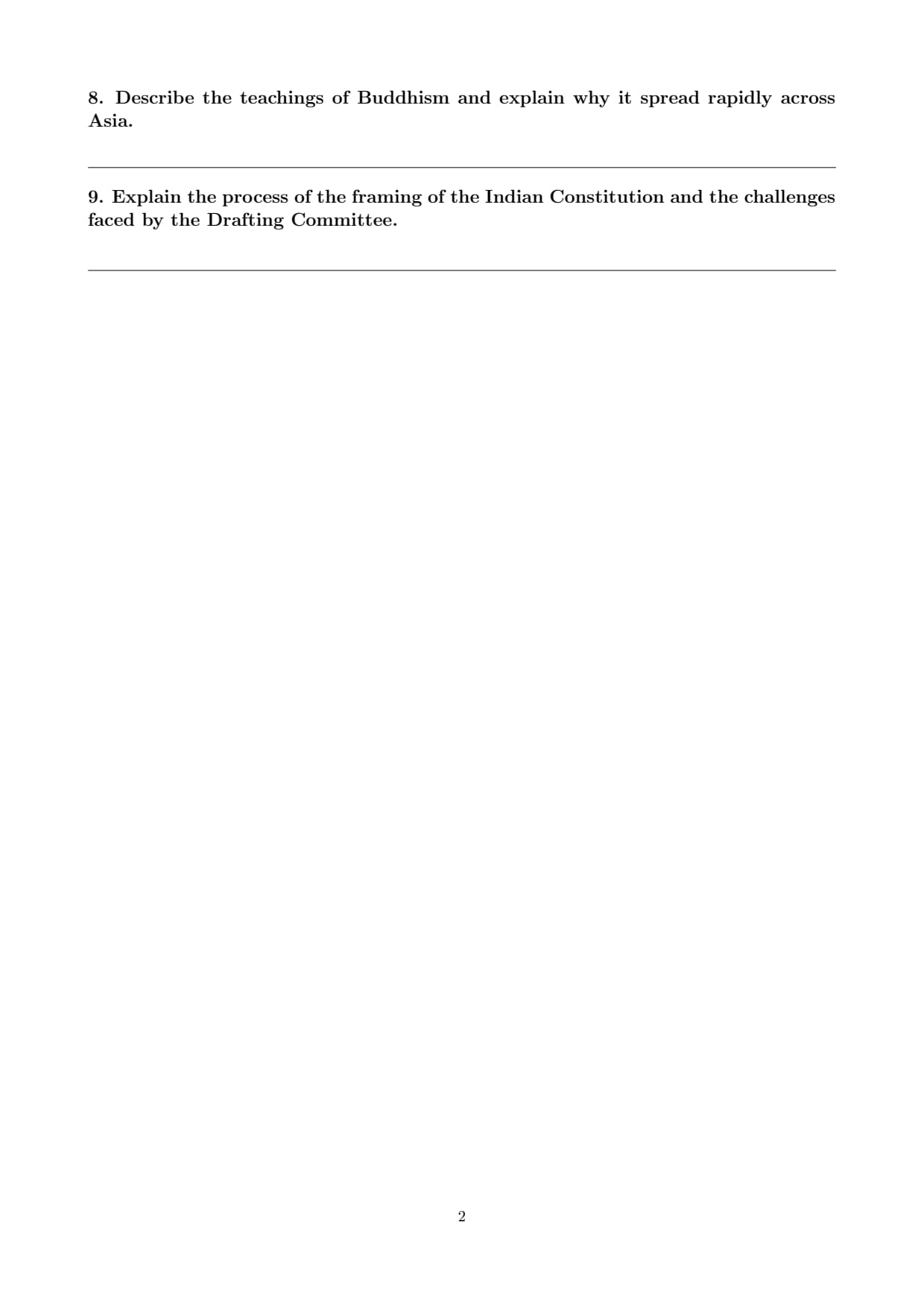
Describe the teachings of Buddhism and explain why it spread rapidly across Asia.
View Solution
Concept:
Buddhism, founded by Gautama Buddha in the 6th century BCE, emerged as a reform movement against ritualism and social inequalities. Its practical teachings and universal appeal helped it spread widely across Asia.
Step 1: Core teachings — The Four Noble Truths.
The foundation of Buddhism lies in the Four Noble Truths:
Life is full of suffering (Dukkha)
Suffering is caused by desire (Tanha)
Suffering can be ended by overcoming desire
The path to end suffering is the Eightfold Path
Step 2: The Eightfold Path.
The Eightfold Path provided a practical guide to ethical living and spiritual growth. It included right view, right intention, right speech, right action, right livelihood, right effort, right mindfulness, and right concentration.
Step 3: Other important teachings.
The Middle Path — avoiding extreme luxury and severe asceticism
Emphasis on non-violence (Ahimsa) and compassion
Rejection of caste distinctions
Importance of moral conduct and meditation
Step 4: Reasons for rapid spread across Asia.
Simplicity of teachings: Easy to understand and practical for common people
Use of local languages: Buddha preached in Pali and Prakrit instead of Sanskrit
Royal patronage: Support from rulers like Emperor Ashoka helped institutional expansion
Missionary activities: Monks and traders carried Buddhism to Sri Lanka, Central Asia, China, and Southeast Asia
Trade routes: Spread through Silk Route and maritime trade networks
Conclusion:
Buddhism’s ethical teachings, universal appeal, and strong institutional support enabled it to spread far beyond India and become one of the major religions of Asia. Quick Tip: Buddhism spread rapidly due to simple teachings, royal patronage (especially Ashoka), missionary monks, and trade routes like the Silk Road.
Explain the process of the framing of the Indian Constitution and the challenges faced by the Drafting Committee.
View Solution
Concept:
The Indian Constitution is the longest written constitution in the world. It was framed after India gained independence, reflecting democratic ideals, social justice, and unity in diversity.
Step 1: Formation of the Constituent Assembly.
The Constituent Assembly was formed in 1946 under the Cabinet Mission Plan. It included representatives from provinces and princely states and held its first meeting on 9 December 1946.
Step 2: Drafting process.
Several committees were formed to handle different aspects of the Constitution. The most important was the Drafting Committee, chaired by Dr. B.R. Ambedkar, which prepared the final draft.
Step 3: Deliberations and adoption.
The Assembly debated various provisions like fundamental rights, federalism, secularism, and parliamentary democracy. After nearly three years of discussions, the Constitution was adopted on 26 November 1949 and came into effect on 26 January 1950.
Step 4: Challenges faced by the Drafting Committee.
Partition of India: Communal tensions and refugee crisis created instability.
Integration of princely states: Ensuring political unity across diverse regions.
Social and economic inequalities: Addressing caste discrimination, poverty, and illiteracy.
Diversity of India: Balancing linguistic, cultural, and religious differences.
Choosing a governance model: Adapting global constitutional ideas to Indian conditions.
Conclusion:
Despite enormous challenges, the Drafting Committee successfully created a comprehensive Constitution that established India as a sovereign, democratic republic committed to justice, liberty, equality, and fraternity. Quick Tip: The Indian Constitution was framed between 1946–1950 under Dr. B.R. Ambedkar’s leadership, overcoming challenges like partition, diversity, and integration of princely states.



Comments