




Nagaland Board is conducting the Class 12 Accountancy Board Exam 2026 on March 2, 2026. Class 12 Accountancy Question Paper with Solution PDF is available here for download.
The official question paper of Nagaland Board Class 12 Accountancy Board Exam 2026 is provided below. Students can download the official paper in PDF format for reference.
Nagaland Board Class 12 2026 Accountancy Question Paper with Solution PDF
| Nagaland Board Class 12 2026 Accountancy Question Paper with Solution PDF | Download PDF | Check Solutions |

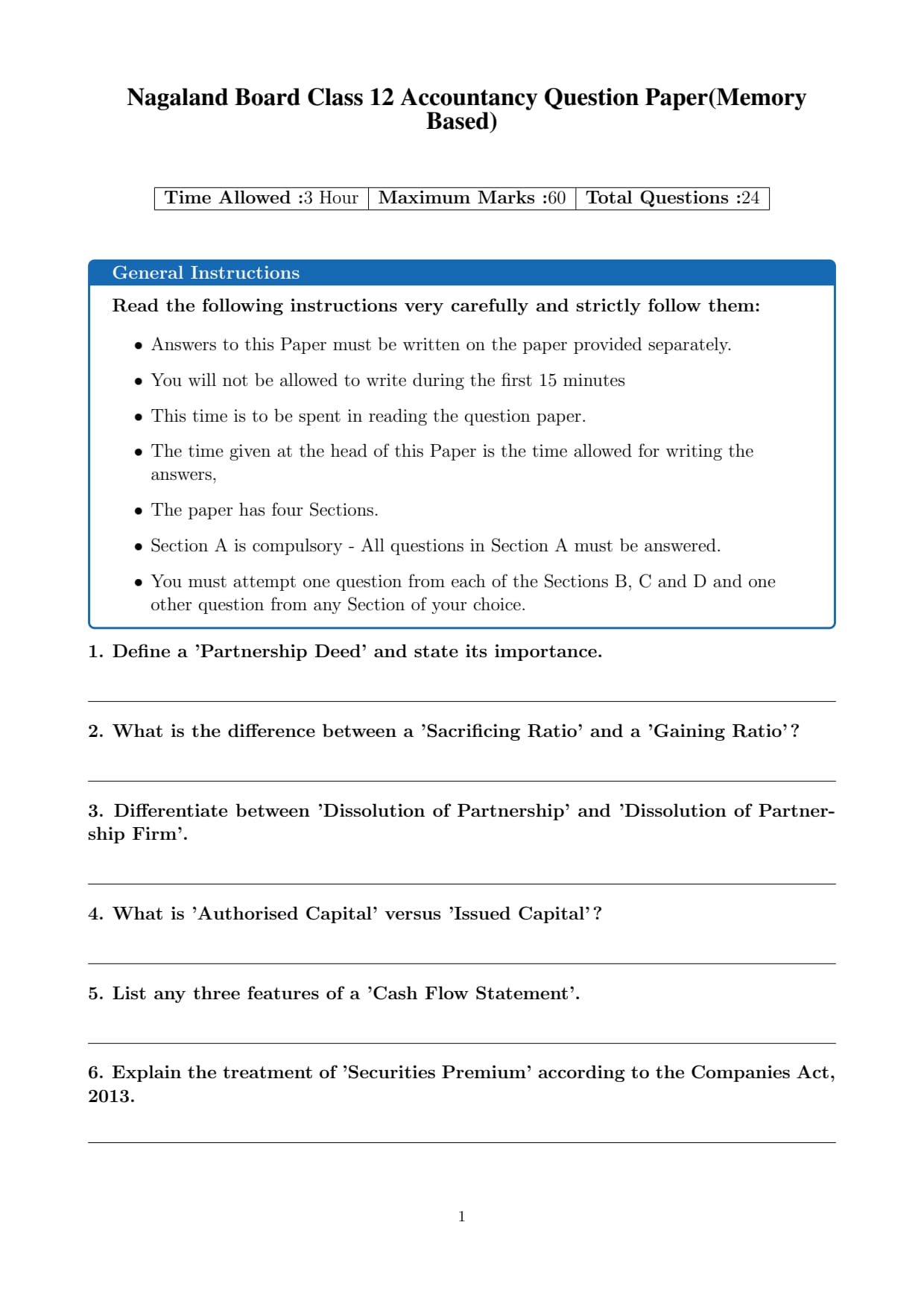
Define a 'Partnership Deed' and state its importance.
View Solution
Concept:
A partnership is formed when two or more persons agree to carry on a business and share profits. To avoid disputes and ensure clarity, the terms of the partnership are usually written in a legal document known as a Partnership Deed.
Step 1: Definition of Partnership Deed.
A Partnership Deed is a written agreement between partners that outlines the rights, duties, responsibilities, and profit-sharing ratio of each partner in the firm.
Step 2: Contents of a Partnership Deed.
It generally includes:
Name and address of the firm and partners
Capital contribution of each partner
Profit and loss sharing ratio
Duties and powers of partners
Interest on capital and drawings
Admission, retirement, and dissolution rules
Step 3: Importance of Partnership Deed.
Prevents disputes: Clearly defines roles and responsibilities.
Legal clarity: Serves as legal evidence in case of disagreements.
Smooth functioning: Ensures proper management of business operations.
Guides decision-making: Provides rules for profit sharing and conflict resolution.
Conclusion:
A Partnership Deed is an essential document that provides a legal and operational framework for a partnership firm, ensuring transparency and smooth functioning. Quick Tip: A written Partnership Deed helps avoid misunderstandings by clearly defining profit-sharing ratios, duties, and rules of the partnership.
What is the difference between a 'Sacrificing Ratio' and a 'Gaining Ratio'?
View Solution
Concept:
In partnership accounting, changes in partnership structure such as admission or retirement of a partner affect profit-sharing ratios. Sacrificing and gaining ratios help determine compensation for goodwill and adjustment of profits among partners.
Step 1: Sacrificing Ratio.
The Sacrificing Ratio refers to the ratio in which existing (old) partners give up a portion of their profit share in favour of a new partner at the time of admission. \[ Sacrificing Ratio = Old Ratio - New Ratio \]
Step 2: Gaining Ratio.
The Gaining Ratio refers to the ratio in which remaining partners gain the share of a retiring or deceased partner. It is calculated as: \[ Gaining Ratio = New Ratio - Old Ratio \]
Step 3: Key Differences.
Situation: Sacrificing ratio is used during admission of a partner, while gaining ratio is used during retirement or death.
Purpose: Sacrificing ratio helps calculate goodwill to be compensated by the new partner; gaining ratio helps distribute goodwill of the retiring partner.
Partners involved: Sacrificing involves old partners giving up share; gaining involves remaining partners acquiring share.
Conclusion:
Sacrificing and gaining ratios are essential tools in partnership accounting that ensure fair adjustment of profits and goodwill during changes in partnership structure. Quick Tip: Sacrificing Ratio applies during admission of a partner, while Gaining Ratio applies during retirement or death of a partner.
Differentiate between 'Dissolution of Partnership' and 'Dissolution of Partnership Firm'.
View Solution
Concept:
In partnership accounting, dissolution may refer either to a change in the partnership arrangement or to the complete closure of the firm. Understanding the distinction is important for legal and accounting treatment.
Step 1: Dissolution of Partnership.
Dissolution of partnership means a change in the existing partnership agreement due to events like admission, retirement, or death of a partner. The business may continue with a reconstituted partnership.
Step 2: Dissolution of Partnership Firm.
Dissolution of a partnership firm refers to the complete termination of the business. All partners cease their relationship, assets are realized, liabilities are paid off, and accounts are settled.
Step 3: Key Differences.
Meaning:
Dissolution of partnership = change in partnership structure;
Dissolution of firm = closure of business.
Continuation of business:
Business continues in dissolution of partnership but stops in dissolution of firm.
Partners' relationship:
Partnership is reconstituted in the former; completely terminated in the latter.
Accounting treatment:
Revaluation and adjustment entries are made in dissolution of partnership, while realization accounts and final settlement are prepared in dissolution of firm.
Conclusion:
Dissolution of partnership involves a reorganization of partners without ending the business, whereas dissolution of a partnership firm results in complete winding up of the business. Quick Tip: Dissolution of partnership changes the partnership structure, but dissolution of the firm ends the business entirely.
What is 'Authorised Capital' versus 'Issued Capital'?
View Solution
Concept:
In company accounts, share capital is classified into different categories based on how much capital is permitted and how much is actually issued. Authorised and issued capital are two fundamental concepts in this classification.
Step 1: Authorised Capital.
Authorised Capital (also called Nominal or Registered Capital) is the maximum amount of share capital that a company is legally permitted to issue as stated in its Memorandum of Association. It sets the upper limit for issuing shares.
Step 2: Issued Capital.
Issued Capital is the portion of the authorised capital that the company actually offers to the public or investors for subscription. It may be equal to or less than the authorised capital.
Step 3: Key Differences.
Meaning:
Authorised Capital = Maximum permitted capital;
Issued Capital = Capital offered to investors.
Legal limit:
Issued capital cannot exceed authorised capital.
Disclosure:
Authorised capital is mentioned in the company’s charter documents, while issued capital appears in financial statements and share records.
Flexibility:
Authorised capital can be increased by legal procedures, and issued capital can vary depending on funding needs.
Conclusion:
Authorised capital defines the legal ceiling for raising funds, whereas issued capital represents the actual portion of shares offered to investors. Quick Tip: Authorised Capital = Maximum capital allowed by law; Issued Capital = Part of it actually offered to investors.
List any three features of a 'Cash Flow Statement'.
View Solution
Concept:
A Cash Flow Statement is a financial statement that records the inflow and outflow of cash and cash equivalents during an accounting period. It helps users understand how a business manages its cash position.
Step 1: Shows cash inflows and outflows.
It records all sources and uses of cash, including receipts from operations and payments for expenses, investments, and financing activities.
Step 2: Classified into three activities.
The statement is divided into:
Operating activities (core business operations)
Investing activities (purchase/sale of assets)
Financing activities (issue of shares, loans, dividends)
Step 3: Indicates liquidity and solvency.
It helps assess the ability of a business to meet short-term obligations, maintain operations, and plan future investments.
Conclusion:
A Cash Flow Statement is essential for evaluating the financial health and liquidity of an enterprise. Quick Tip: A Cash Flow Statement tracks cash movements and is divided into operating, investing, and financing activities.
Explain the treatment of 'Securities Premium' according to the Companies Act, 2013.
View Solution
Concept:
When a company issues shares at a price higher than their face value, the excess amount is called Securities Premium. The Companies Act, 2013 provides strict rules for its utilization to ensure transparency and protection of investors.
Step 1: Meaning of Securities Premium.
Securities Premium arises when shares are issued at a premium, i.e., issue price \(>\) face value. \[ Securities Premium = Issue Price - Face Value \]
The amount received is credited to a separate account called the Securities Premium Reserve.
Step 2: Treatment as per Companies Act, 2013 (Section 52).
The Securities Premium Reserve cannot be distributed as dividend and must be shown under the head \textit{Reserves and Surplus in the balance sheet.
Step 3: Permitted uses of Securities Premium.
As per the Act, it can be used only for the following purposes:
Issuing fully paid bonus shares to existing shareholders
Writing off preliminary expenses of the company
Writing off expenses or commission on issue of shares/debentures
Providing premium payable on redemption of preference shares or debentures
Buy-back of shares (as per prescribed rules)
Step 4: Restriction on usage.
It cannot be used for general business purposes or distributed as profits, ensuring capital protection.
Conclusion:
Under the Companies Act, 2013, Securities Premium is treated as a capital reserve with restricted utilization and must be used only for legally specified purposes. Quick Tip: Securities Premium is a capital reserve under Section 52 and can be used only for specific purposes like bonus shares, issue expenses, or redemption premium.



Comments