




Nagaland Board is conducting the Class 12 Chemistry Board Exam 2026 on March 2, 2026. Class 12 Chemistry Question Paper with Solution PDF is available here for download.
The official question paper of Nagaland Board Class 12 Chemistry Board Exam 2026 is provided below. Students can download the official paper in PDF format for reference.
Nagaland Board Class 12 2026 Chemistry Question Paper with Solution PDF
| Nagaland Board Class 12 2026 Chemistry Question Paper with Solution PDF | Download PDF | Check Solutions |

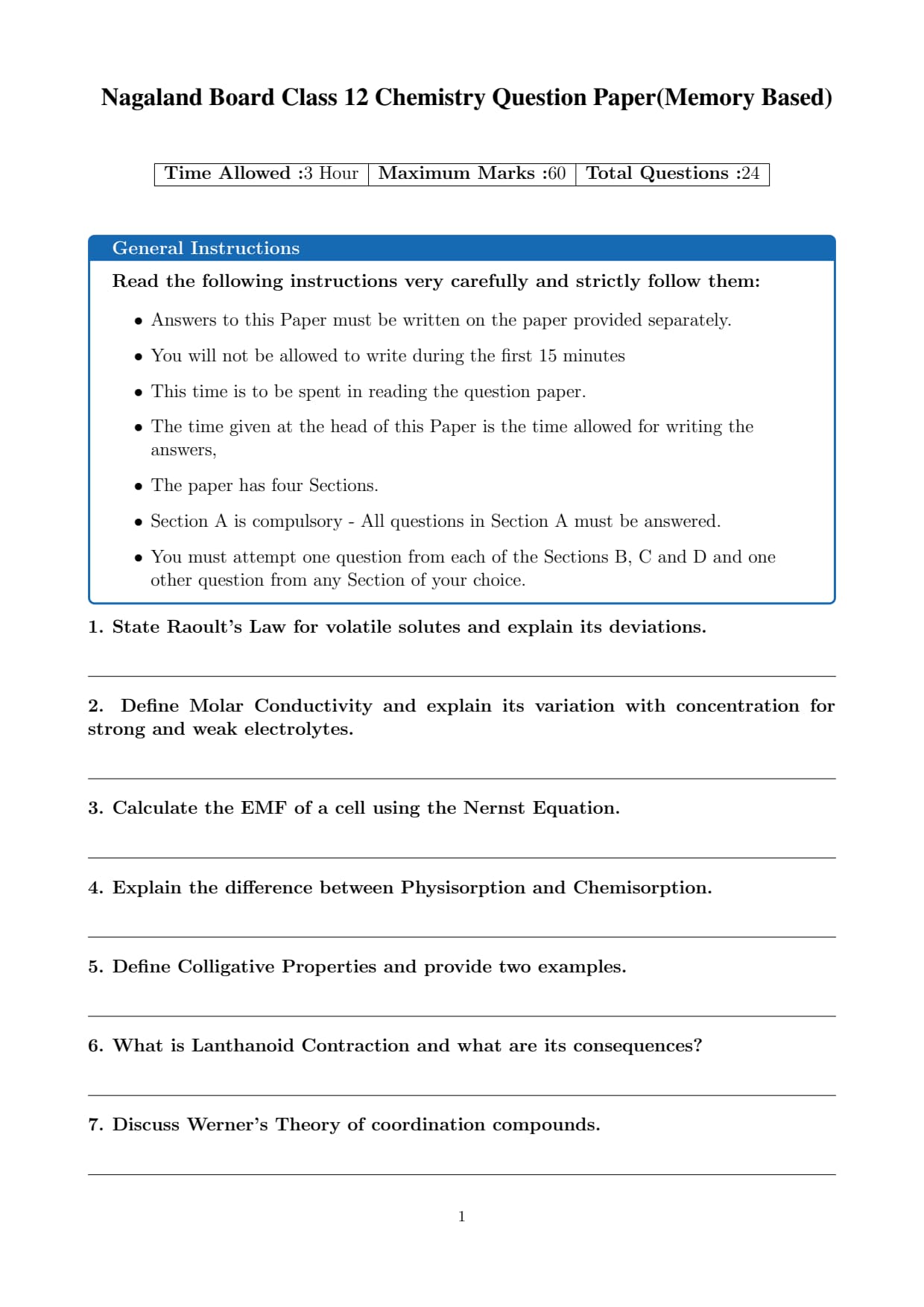
State Raoult’s Law for volatile solutes and explain its deviations.
View Solution
Concept:
Raoult’s Law describes the vapor pressure behavior of ideal solutions containing volatile components. It relates the partial vapor pressure of each component to its mole fraction in the liquid phase.
Step 1: Statement of Raoult’s Law.
For a solution of volatile liquids, the partial vapor pressure of each component is proportional to its mole fraction in the solution. \[ p_A = x_A p_A^\circ \quad and \quad p_B = x_B p_B^\circ \]
where \(p_A^\circ\) and \(p_B^\circ\) are vapor pressures of pure components and \(x_A, x_B\) are their mole fractions.
Total vapor pressure: \[ P = p_A + p_B \]
Step 2: Ideal solution behavior.
Raoult’s Law is strictly followed by ideal solutions where:
Intermolecular forces between unlike molecules are similar to those between like molecules
No heat change on mixing
Volume of solution is additive
Step 3: Positive deviation from Raoult’s Law.
Occurs when intermolecular attractions between unlike molecules are weaker than those in pure components.
Vapor pressure becomes higher than predicted
Boiling point decreases
Example: Ethanol–acetone mixture
Step 4: Negative deviation from Raoult’s Law.
Occurs when intermolecular attractions between unlike molecules are stronger than those in pure components.
Vapor pressure becomes lower than expected
Boiling point increases
Example: Chloroform–acetone mixture
Conclusion:
Raoult’s Law explains vapor pressure behavior in ideal solutions, while deviations arise due to differences in intermolecular interactions, leading to positive or negative deviations. Quick Tip: Positive deviation = weaker intermolecular forces and higher vapor pressure; Negative deviation = stronger forces and lower vapor pressure.
Define Molar Conductivity and explain its variation with concentration for strong and weak electrolytes.
View Solution
Concept:
Molar conductivity measures the ability of an electrolyte solution to conduct electricity per mole of electrolyte. It depends on the number of ions and their mobility in solution.
Step 1: Definition of Molar Conductivity.
Molar conductivity (\(\Lambda_m\)) is defined as the conductance of the volume of solution containing one mole of electrolyte placed between two electrodes. \[ \Lambda_m = \frac{\kappa}{c} \]
where \(\kappa\) = conductivity and \(c\) = molar concentration.
Unit: S cm\(^2\) mol\(^{-1}\).
Step 2: Variation with concentration.
Molar conductivity increases on dilution because:
Interionic attractions decrease
Ionic mobility increases
Degree of ionization may increase
Step 3: Strong electrolytes.
Strong electrolytes (e.g., HCl, NaCl) are almost completely ionized even at higher concentrations.
\(\Lambda_m\) increases slightly with dilution
Increase is mainly due to reduced interionic interactions
Variation follows Kohlrausch’s law:
\[ \Lambda_m = \Lambda_m^\circ - A\sqrt{c} \]
Step 4: Weak electrolytes.
Weak electrolytes (e.g., CH\(_3\)COOH, NH\(_4\)OH) are partially ionized.
\(\Lambda_m\) increases sharply with dilution
Ionization increases significantly at low concentration
At infinite dilution, they approach \(\Lambda_m^\circ\)
Conclusion:
Molar conductivity increases with dilution for all electrolytes, but the rise is small for strong electrolytes and large for weak electrolytes due to increased ionization. Quick Tip: Strong electrolytes show a slight increase in molar conductivity on dilution, while weak electrolytes show a sharp increase due to increased ionization.
Calculate the EMF of a cell using the Nernst Equation.
View Solution
Concept:
The Nernst Equation is used to calculate the EMF (electromotive force) of an electrochemical cell under non-standard conditions by considering ion concentrations or partial pressures.
Step 1: General form of Nernst Equation.
At temperature \(T\) (in Kelvin): \[ E = E^\circ - \frac{RT}{nF} \ln Q \]
where \(E\) = cell EMF, \(E^\circ\) = standard EMF, \(R\) = gas constant, \(T\) = temperature, \(n\) = number of electrons transferred, \(F\) = Faraday constant, \(Q\) = reaction quotient.
Step 2: At 298 K (room temperature).
The equation simplifies to: \[ E = E^\circ - \frac{0.0591}{n} \log Q \]
Step 3: Steps to calculate EMF.
Write the balanced cell reaction
Determine \(E^\circ\) using standard electrode potentials
Calculate reaction quotient \(Q\) using concentrations or pressures
Substitute values into the Nernst equation
Step 4: Illustrative example.
For the cell: \[ Zn|Zn^{2+} (0.01\,M) || Cu^{2+} (1\,M)|Cu \]
Given \(E^\circ = 1.10\,V\) and \(n=2\): \[ Q = \frac{[Zn^{2+}]}{[Cu^{2+}]} = \frac{0.01}{1} = 0.01 \] \[ E = 1.10 - \frac{0.0591}{2} \log(0.01) \] \[ E = 1.10 - \frac{0.0591}{2} (-2) = 1.10 + 0.0591 = 1.1591\,V \]
Conclusion:
The Nernst Equation helps calculate cell EMF under non-standard conditions by incorporating concentration or pressure effects. Quick Tip: At 298 K, use \(E = E^\circ - \frac{0.0591}{n} \log Q\) to quickly calculate EMF under non-standard conditions.
Explain the difference between Physisorption and Chemisorption.
View Solution
Concept:
Adsorption is the accumulation of molecules on the surface of a solid or liquid. Based on the nature of forces involved, adsorption is classified into physisorption and chemisorption.
Step 1: Physisorption.
Physisorption (physical adsorption) occurs due to weak intermolecular forces such as van der Waals forces.
Low enthalpy of adsorption
Reversible in nature
Occurs at low temperatures
Multilayer adsorption possible
No specific surface requirement
Step 2: Chemisorption.
Chemisorption (chemical adsorption) involves formation of strong chemical bonds between adsorbate and adsorbent.
High enthalpy of adsorption
Usually irreversible
Occurs at higher temperatures
Only monolayer adsorption
Highly specific in nature
Step 3: Key Differences.
Nature of forces:
Physisorption — weak van der Waals forces;
Chemisorption — strong chemical bonds.
Reversibility:
Physisorption is reversible; chemisorption is usually irreversible.
Temperature dependence:
Physisorption favored at low temperature; chemisorption at higher temperature.
Layer formation:
Physisorption forms multilayers; chemisorption forms a monolayer.
Conclusion:
Physisorption and chemisorption differ mainly in the strength of interaction and reversibility, with physisorption being weak and reversible and chemisorption being strong and specific. Quick Tip: Physisorption = weak, reversible, multilayer; Chemisorption = strong, specific, monolayer adsorption.
Define Colligative Properties and provide two examples.
View Solution
Concept:
Colligative properties are physical properties of solutions that depend only on the number of solute particles present, rather than their chemical identity. These properties are especially significant for dilute solutions.
Step 1: Definition.
Colligative properties are those properties of a solution that depend on the ratio of the number of solute particles to solvent molecules, regardless of the nature of the solute.
Step 2: Key characteristic.
They depend on concentration (number of particles) and not on:
Chemical nature of solute
Molecular structure
Type of bonding
Step 3: Examples of colligative properties.
Any two examples:
Lowering of vapor pressure
Elevation of boiling point
Depression of freezing point
Osmotic pressure
Conclusion:
Colligative properties are important in understanding solution behavior and depend solely on the number of solute particles present. Quick Tip: Colligative properties depend only on the number of solute particles — not their identity.
What is Lanthanoid Contraction and what are its consequences?
View Solution
Concept:
The lanthanoids (elements from La to Lu) show a steady decrease in size across the series. This phenomenon is known as lanthanoid contraction and plays an important role in determining periodic properties.
Step 1: Definition of Lanthanoid Contraction.
Lanthanoid contraction refers to the gradual decrease in atomic and ionic radii of lanthanoid elements with increase in atomic number from La (57) to Lu (71).
Step 2: Cause of Lanthanoid Contraction.
It occurs due to:
Poor shielding effect of 4f electrons
Increase in nuclear charge across the series
Greater attraction between nucleus and outer electrons
Step 3: Consequences of Lanthanoid Contraction.
Similarity between 4d and 5d transition elements:
Elements like Zr and Hf have nearly identical sizes and properties.
Difficulty in separation of lanthanoids:
Very small differences in ionic radii make their separation challenging.
Effect on basic strength of hydroxides:
Basicity of lanthanoid hydroxides decreases across the series.
Higher density and hardness:
Due to decreasing size and increasing effective nuclear charge.
Conclusion:
Lanthanoid contraction significantly influences periodic trends, transition metal similarities, and chemical behavior of elements in the periodic table. Quick Tip: Lanthanoid contraction occurs due to poor shielding by 4f electrons and leads to similar properties of 4d and 5d elements like Zr and Hf.
Discuss Werner’s Theory of coordination compounds.
View Solution
Concept:
Werner’s Theory, proposed by Alfred Werner in 1893, laid the foundation of modern coordination chemistry. It explained the structure, bonding, and properties of coordination compounds that earlier theories failed to describe.
Step 1: Main postulates of Werner’s Theory.
Werner proposed that metals in coordination compounds exhibit two types of valencies:
Primary valency (ionizable valency)
Secondary valency (non-ionizable valency)
Step 2: Primary valency.
Corresponds to the oxidation state of the metal
Satisfied by negative ions
Ionizable and can be detected in solution
Example: Cl\(^-\) ions outside the coordination sphere
Step 3: Secondary valency.
Corresponds to the coordination number of the metal
Satisfied by ligands (neutral molecules or anions)
Non-ionizable and remain within the coordination sphere
Responsible for geometry of the complex
Step 4: Spatial arrangement of ligands.
Werner suggested that ligands attached through secondary valencies occupy fixed positions in space, giving definite geometries such as:
Octahedral (coordination number 6)
Square planar (coordination number 4)
Tetrahedral (coordination number 4)
Step 5: Example.
In \(CoCl_3 \cdot 6NH_3\):
Three Cl\(^-\) satisfy primary valency
Six NH\(_3\) molecules satisfy secondary valency
Significance:
Werner’s Theory successfully explained:
Ionization behavior of complexes
Existence of coordination numbers
Isomerism in coordination compounds
Geometry of complexes
Conclusion:
Werner’s Theory revolutionized coordination chemistry by introducing the concepts of primary and secondary valencies and explaining the structure and bonding of coordination compounds. Quick Tip: Werner’s Theory distinguishes primary (ionizable) and secondary (non-ionizable) valencies and explains coordination number and geometry of complexes.
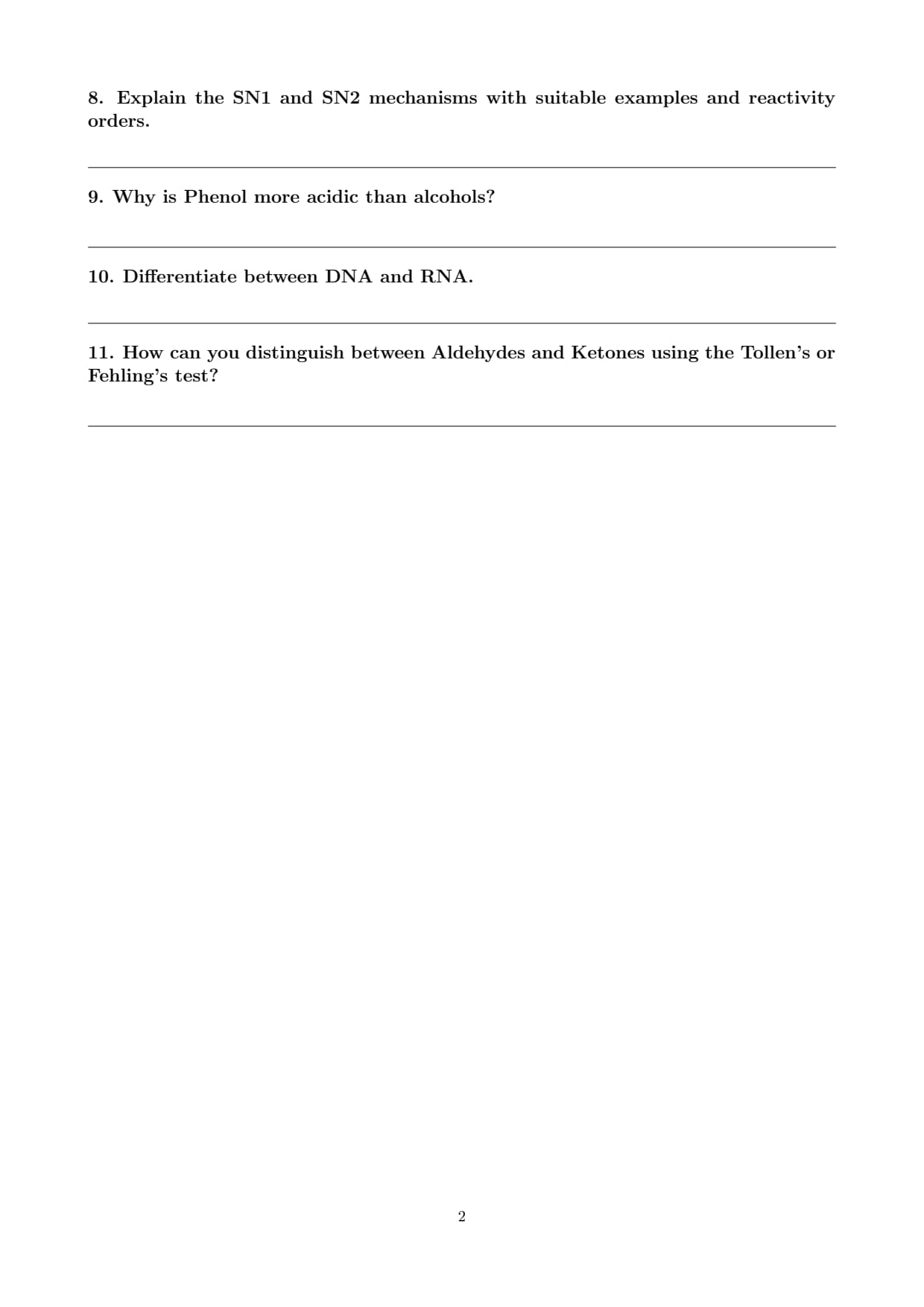
Explain the SN1 and SN2 mechanisms with suitable examples and reactivity orders.
View Solution
Concept:
Nucleophilic substitution reactions involve the replacement of a leaving group by a nucleophile. Based on the reaction mechanism and kinetics, they are classified as SN1 and SN2 reactions.
Step 1: SN1 Mechanism (Unimolecular Nucleophilic Substitution).
Occurs in two steps:
Formation of a carbocation intermediate (slow, rate-determining step)
Attack by nucleophile (fast step)
Rate depends only on substrate concentration:
\[ Rate = k[R–X] \]
Favored by tertiary substrates and polar protic solvents
Example:
Hydrolysis of tert-butyl bromide: \[ (CH_3)_3C–Br \rightarrow (CH_3)_3C^+ \rightarrow (CH_3)_3C–OH \]
Reactivity order (SN1): \[ 3^\circ > 2^\circ > 1^\circ > methyl \]
Step 2: SN2 Mechanism (Bimolecular Nucleophilic Substitution).
Occurs in a single concerted step
Nucleophile attacks from the backside while leaving group departs
Leads to inversion of configuration (Walden inversion)
Rate depends on both substrate and nucleophile:
\[ Rate = k[R–X][Nu^-] \]
Favored by primary substrates and polar aprotic solvents
Example:
Reaction of methyl bromide with hydroxide ion: \[ CH_3Br + OH^- \rightarrow CH_3OH + Br^- \]
Reactivity order (SN2): \[ methyl > 1^\circ > 2^\circ > 3^\circ \]
Step 3: Key Differences.
Mechanism: SN1 is two-step; SN2 is one-step.
Intermediate: SN1 forms carbocation; SN2 has no intermediate.
Kinetics: SN1 first-order; SN2 second-order.
Stereochemistry: SN1 gives racemization; SN2 gives inversion.
Substrate preference: SN1 favors tertiary; SN2 favors primary.
Conclusion:
SN1 and SN2 reactions differ fundamentally in mechanism, kinetics, stereochemistry, and substrate preference, making them essential concepts in organic reaction mechanisms. Quick Tip: SN1: two-step, carbocation, \(3^\circ\) favored; \quad SN2: one-step, backside attack, methyl and \(1^\circ\) favored.
Why is Phenol more acidic than alcohols?
View Solution
Concept:
Acidity depends on the stability of the conjugate base formed after the loss of a proton. Greater stability of the conjugate base leads to higher acidity.
Step 1: Formation of conjugate bases.
Phenol loses H\(^+\) to form phenoxide ion (C\(_6\)H\(_5\)O\(^-\))
Alcohols lose H\(^+\) to form alkoxide ions (RO\(^-\))
Step 2: Resonance stabilization in phenol.
The negative charge on the oxygen atom in the phenoxide ion is delocalized over the aromatic ring through resonance.
This distribution of charge stabilizes the conjugate base.
Step 3: Lack of resonance in alcohols.
Alkoxide ions do not have resonance stabilization. The negative charge remains localized on the oxygen atom, making them less stable.
Step 4: Effect of hybridization.
In phenol, the oxygen is attached to an sp\(^2\)-hybridized carbon of the benzene ring, which has a higher electronegativity than the sp\(^3\) carbon in alcohols, further stabilizing the phenoxide ion.
Conclusion:
Due to resonance stabilization and the influence of the aromatic ring, phenoxide ions are more stable than alkoxide ions, making phenol more acidic than alcohols. Quick Tip: Phenol is more acidic because its conjugate base is resonance-stabilized, while alcohols form unstable alkoxide ions.
Differentiate between DNA and RNA.
View Solution
Concept:
DNA (Deoxyribonucleic Acid) and RNA (Ribonucleic Acid) are nucleic acids that play crucial roles in genetic information storage and expression. They differ in structure, composition, and function.
Step 1: Structural differences.
DNA is double-stranded and forms a double helix.
RNA is usually single-stranded.
Step 2: Sugar component.
DNA contains deoxyribose sugar.
RNA contains ribose sugar.
Step 3: Nitrogenous bases.
DNA bases: Adenine (A), Guanine (G), Cytosine (C), Thymine (T).
RNA bases: Adenine (A), Guanine (G), Cytosine (C), Uracil (U).
Step 4: Function.
DNA stores and transmits genetic information.
RNA helps in protein synthesis (mRNA, tRNA, rRNA).
Step 5: Location.
DNA is mainly found in the nucleus (also mitochondria).
RNA is found in nucleus and cytoplasm.
Conclusion:
DNA serves as the genetic blueprint of life, whereas RNA plays a functional role in expressing this genetic information through protein synthesis. Quick Tip: DNA = double-stranded, deoxyribose, thymine, genetic storage; RNA = single-stranded, ribose, uracil, protein synthesis.
How can you distinguish between Aldehydes and Ketones using the Tollen’s or Fehling’s test?
View Solution
Concept:
Aldehydes and ketones both contain the carbonyl group, but aldehydes are easily oxidized while ketones are resistant to mild oxidation. This difference is used in qualitative tests like Tollen’s and Fehling’s tests.
Step 1: Tollen’s Test (Silver Mirror Test).
Reagent: Ammoniacal silver nitrate (Tollen’s reagent).
Aldehydes reduce Ag\(^+\) to metallic silver, forming a shiny silver mirror on the test tube.
Ketones generally do not give this reaction.
Observation:
Aldehyde → Silver mirror formed
Ketone → No reaction
Step 2: Fehling’s Test.
Reagent: Fehling’s solution (alkaline Cu\(^{2+}\) complex).
Aldehydes reduce Cu\(^{2+}\) to Cu\(_2\)O, forming a brick-red precipitate.
Ketones usually do not react (except some \(\alpha\)-hydroxy ketones).
Observation:
Aldehyde → Brick-red precipitate
Ketone → No precipitate
Step 3: Reason for difference.
Aldehydes contain a hydrogen atom attached to the carbonyl carbon, making them easily oxidizable. Ketones lack this hydrogen and are resistant to mild oxidizing agents.
Conclusion:
Tollen’s and Fehling’s tests help distinguish aldehydes from ketones based on the ease of oxidation of aldehydes. Quick Tip: Aldehydes give silver mirror (Tollen’s) and red precipitate (Fehling’s), while ketones generally give negative results.



Comments