




The passing marks out of 80 in CBSE class 10 Science are 26.4. According to official CBSE guidelines 33% in the external examination needs to pass. Class 10 subjects follow the 80+20 format. 80 for externals and 20 for internals.
- 33% in the external examination needs to be scored out of 80 in CBSE Class 10 Science.
- This rule applies to all subjects of CBSE Class 10.
- 33% out of 80 is 26.4, which is rounded up to 26.
Also Read
Key Summary
- 26 out of 80 is the passing mark for CBSE Class 10 Science.
- Aiming for a minimum of 27 suggested.
- Out of 500, 165 is needed to pass in all subjects together.
- 33% out of 80 is the official threshold to pass in each subject.
What is the passing mark out of 80 in CBSE class 10 Science
- 26.4 out of 80 is your passing mark in CBSE class 10 in Science.
- Add this 26 to your internal score, you will for sure pass the Science subject in class 10 CBSE.
- You need to get a minimum 33% out of 80, which is 26.4, rounded upto to 26.
- Overall, out of 100, 33 is needed.
- Let’s say you score 15 in internals and got 26 in externals. You will easily score 40 out of 80.
- In external examination, scoring 33% out of 80 is a must to pass.
- Anyway, aim for 40+, and think you get 3-5 grace marks, and have 15 in internals. You can easily move above 50.
- Scoring passing marks is very possible in science; every diagram, every factual answer, every formula adds to scoring the minimum.
- Anyway, why talk about minimum marks when you can score above 50 with a proper study plan?
| Section | Externals | Internal |
|---|---|---|
| Physics | 23-25 marks | 20 |
| Chemistry | 22-24 marks | |
| Biology | 30-32 marks | |
| Total | 80 marks | 20 marks |
Also Read
What is the passing mark out of 100 in CBSE class 10 Science
- You need 33 marks out of 100 to pass in Class 10 CBSE Science.
- 1/3rd of 100 is all you need to pass the paper.
- There is no minimum passing mark set by the CBSE Board as a passing mark in internals.
- For example, out of 80, you need 26.4 or a safe 27+ marks. In the internals, anyway, you will get 12-15 marks from your Science teacher. So 26+15 gives you 37 out of 100. And you Pass!.
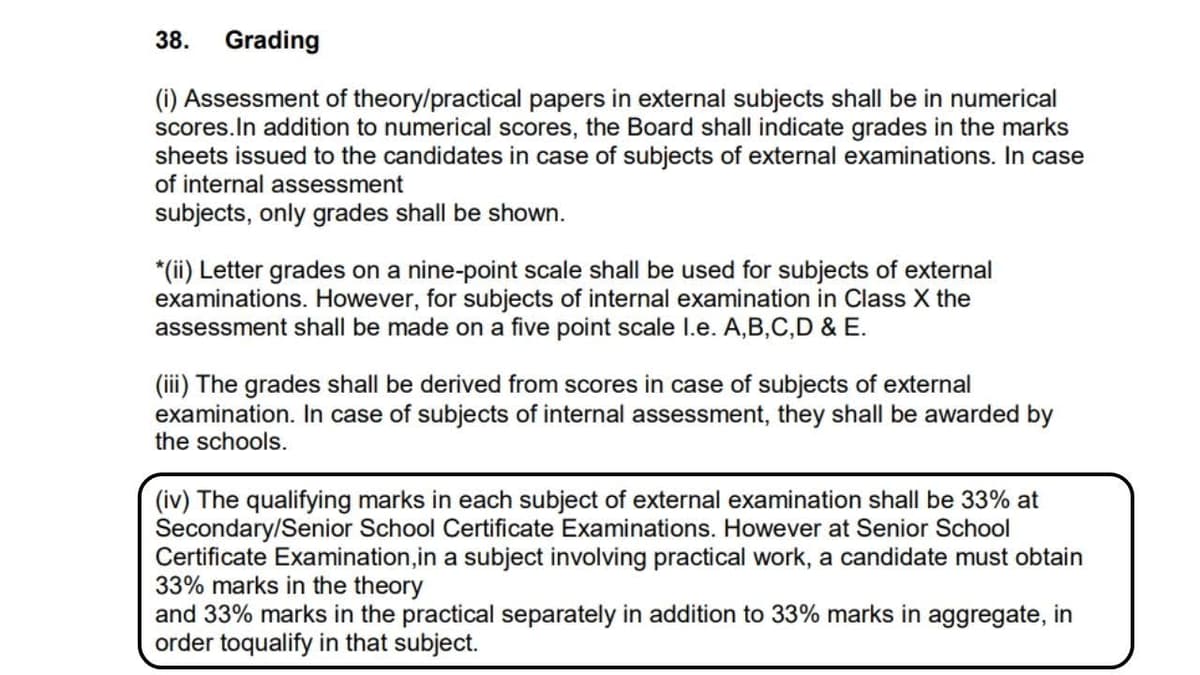
- Let’s see what the official guidelines say in Point IV of Rule 38, passing in individual subjects.
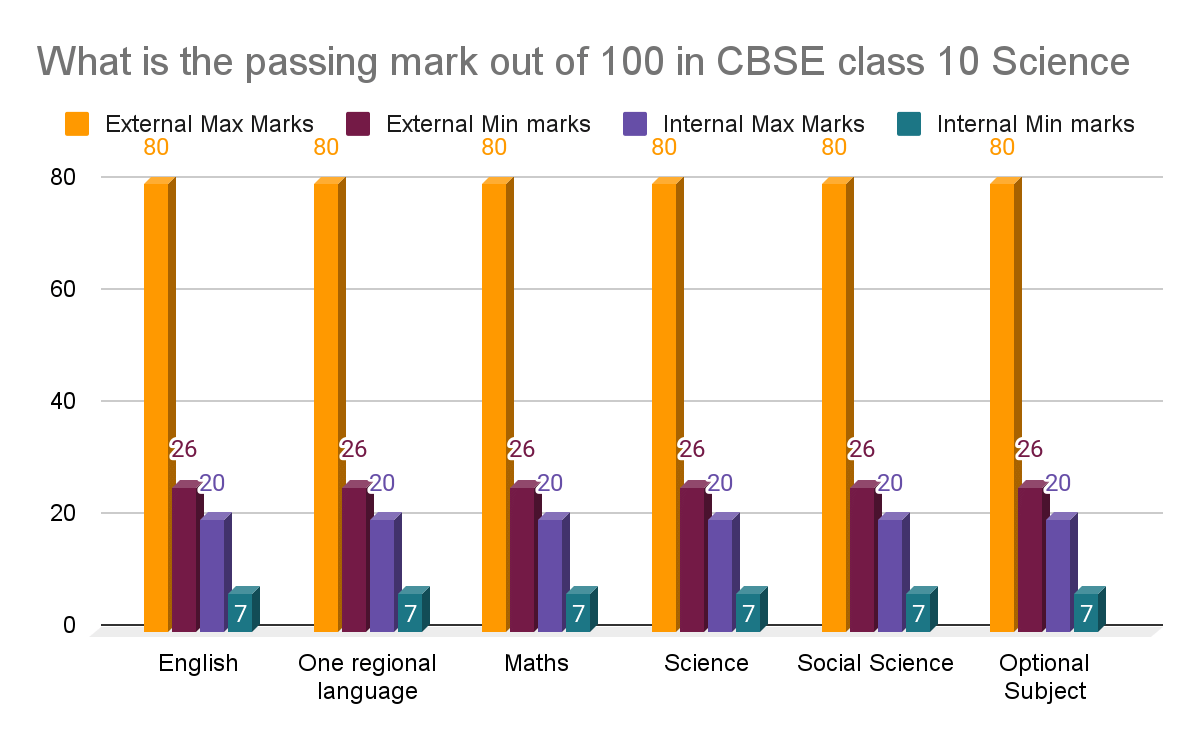
- The table below shows the ideal minimum marks required to reach 33 to pass each subject.
| Subjects | Externals | Internals | ||
|---|---|---|---|---|
| Max Marks | Min marks | Max Marks | Min marks | |
| English | 80 | 26 | 20 | 7 |
| One regional language | 80 | 26 | 20 | 7 |
| Maths | 80 | 26 | 20 | 7 |
| Science | 80 | 26 | 20 | 7 |
| Social Science | 80 | 26 | 20 | 7 |
| Optional Subject | 80 | 26 | 20 | 7 |
Also Read
Class 10 Science NotesWhat is the passing mark out of 100
- Across all the subjects, all you need is just 33 out of 100 to pass the class 10 subjects in CBSE.
- Whether it's SST, Math, Science, or Language, 33 is your passing score.
- Internals and Externals out of 100 aggregate should be 33 to pass.
- You might wonder, if I score zero in internals and 33 in externals, will I still pass? Well, NO. The minimum of 33 should be the aggregate from both internal and external examinations. 17 internals + 26 externals = 33 total, you will clear your subject.
- All class 10 subjects have an external exam for 80, so your safe boundary is 26.4.
- The table below shows you the grading system of CBSE.
- With 33 minimum in all subjects, added together 165/5,00, you will get D2.
| Grade | Percentage of candidates |
|---|---|
| A1 | Top 1/8th of the passed candidates |
| A2 | Next 1/8th of the passed candidates |
| B1 | Next 1/8th of the passed candidates |
| B2 | Next 1/8th of the passed candidates |
| C1 | Next 1/8th of the passed candidates |
| C2 | Next 1/8th of the passed candidates |
| D1 | Next 1/8th of the passed candidates |
| D2 | Next 1/8th of the passed candidates |
| E | Essential Repeat |
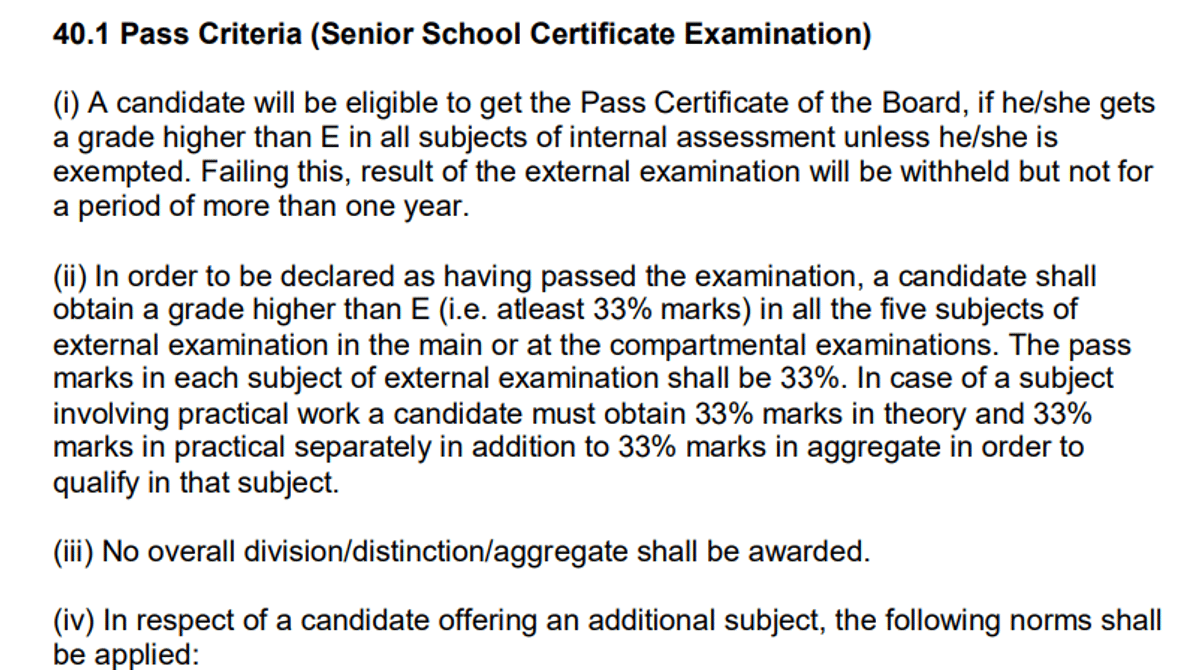
- Also, let’s see what the official CBSE guideline says about the overall aggregate.
- CBSE officially does not give any overall percentage, but only grades.
- All subjects together, a candidate must score more than grade E, which is 165/500.
CBSE 10th total marks 500 or 600.
- Confused about whether CBSE Class 10 total marks are 500 or 600, let’s clear it.
- It is 500, yes, even if you write 6 subjects, it is still 500.
- Wonder how? CBSE follows the ‘Best of 5 rule’.
- Generally, students take 5 subjects, so the total marks come to 500.
- Well, there is a provision to take a 6th subject. What happens then is a jackpot.
- Let’s say, apart from 5 standard subjects, you take 1 more, let that be IT or language, or any other subject, you will write the exam for 6 subjects, and when the final grade is given, the board will consider the 5 best-scoring subjects out of 6.
CBSE Class 10 Science Important Topics
- Ready for scoring above the minimum? The following chapters are all time important.
- Biology usually has more questions around 12-15. The questions are memory-based and diagram-based.
- Physics and Chemistry contribute around 23 each.
- Case study questions generally come from Biology and Physics.
- Numerical questions are of 7-8 marks from Physics.
- Concept-based questions usually come from Chemistry, weighing 10-12 marks.
| Sections | Topics | Expected Questions |
|---|---|---|
| PHYSICS | Light-Reflection and Refraction | 4-5 |
| The Human Eye and The Colourful World | 2-3 | |
| Electricity | 4-5 | |
| Magnetic Effects of Electric Current | 3-4 | |
| CHEMISTRY | Chemical Reactions and Equations | 3-4 |
| Acids, Bases and Salts | 3-4 | |
| Metals and Non-Metals | 3-4 | |
| Carbon and Its Compounds | 4-5 | |
| Periodic Classification of Elements | 2-3 | |
| BIOLOGY | Life Processes | 5-6 |
| Control and Coordination | 3-4 | |
| How do Organisms Reproduce? | 4-5 | |
| Heredity and Evolution | 3-4 | |
| Our Environment | 2-3 | |
| Natural Resource Management | 2-3 |
CBSE Class 10 Science Preparation Tips and Study Plan
Also Read
CBSE Class 10 Science Download Previous Year Papers with Solutions (2024-2020)| PREPARATION TIPS | |
|---|---|
| Rules | Description |
| Rule 1 | NCERT is your Bible- study line by line |
| Rule 2 | Write your own notes and diagrams.Prepare flowcharts for your understanding |
| Rule 3 | Practice past 7-10 years Board papers |
| Rule 4 | Don’t skip competency-based questions. Practice 2-3 daily. |
| Rule 5 | Use “Pomodoro”-25 min study and 5 min break.Follow this cycle for 3-4 hours daily. |
| Rule 6 | Revise weekly without skipping. |
| Rule 7 | Make your own study group.Doing group Studies helps you with case analysis, MCQs, etc |
| Rule 8 | Let your wall be filled with formulas, Diagrams, and cheat sheets. |
| Rule 9 | Beat yourself, take mocks and practice tests often. |
| Rule 10 | Solve Exemplars Check NCERT Exemplar |
| STUDY PLAN | ||
|---|---|---|
| Time | Task Description | |
| 2 hours | For Science | Dedicate 2 hours to Science daily. |
| Per week | Chapter test | Take 3 chapter-wise tests from each section |
| Per month | Revise+ Section Test | Revise regularlyTake section-wise tests of completed chapters |
| Weekly | Take 50 MCQs and 2-3 Case studies | |
| Weekends | Take full-length tests on chapters.Sleep-Get refreshed-Start again for the next week. | |
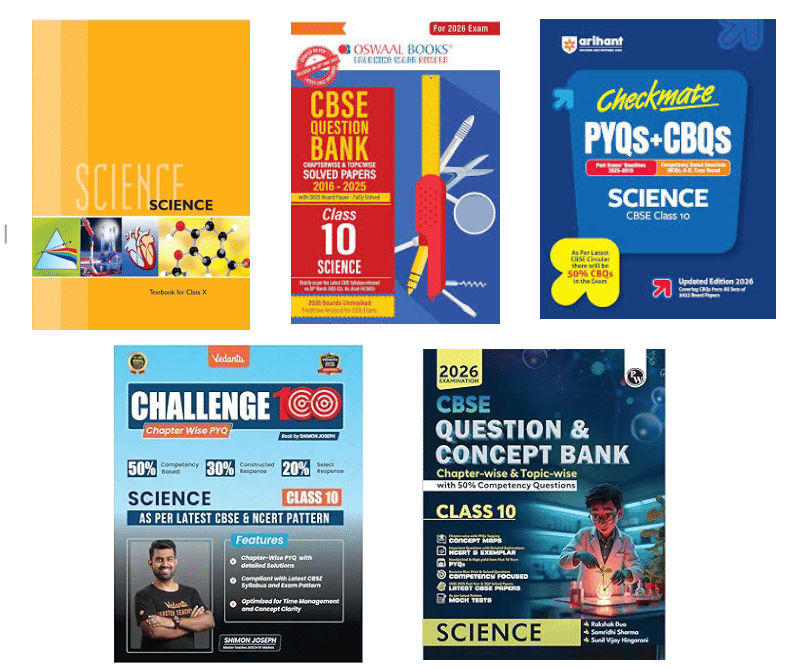
Best Books for CBSE Class 10 Science
What are the passing marks out of 80 in CBSE Class 10 FAQs
Ques. What are the passing marks out of 80 in CBSE 10th?
Ans. 26.4 or rounded to 27 is the passing mark out of 80 in CBSE 10th.
- 33% minimum out of 80 needs to be scored to pass.
Ques. Is 27 out of 80 a pass or a fail?
Ans. 27 out of 80 is a passing mark
- As per official criteria, 33% of 80 needs to be scored to pass.
- 27 out of 80 is the minimum passing mark.
Ques. What is the ‘best 5 rule’ of CBSE Class 10?
Ans. The best of 5 rule in CBSE means, your top 5 subjects will be considered for the final percentage or grading.
- Final percentage will be calculated using your 5 highest-scoring subjects; the low-scoring subject will be left out.
Ques. Will CBSE pass everyone in 2025?
Ans.CBSE does not pass any candidate on its own.
- CBSE conducts the exam, and passing is in the hands of the candidates.
- CBSE just facilitates the exam, evaluation, and scoring criteria.
Also Read



Comments