




CBSE Class 10 total marks are 500. Overall grading is given for 5 subjects. Each subject has a total of 100 marks, rounding up to 500 maximum. CBSE follows the ‘Best of rule’ for the overall aggregate, which means, while taking the aggregate, even if a student has written 6 subjects, the scores of the top 5 subjects are considered.
CBSE Class 10 total marks are 100 for each subject. The 100 marks are distributed as 80+20, 80 for external examinations and 20 for internal examinations.
- Each subject is assessed for a total of 100 marks.
- 80+20 format is followed to cover a total of 100 marks.
- The external examination total mark is 80 is a written examination consisting of MCQs and Descriptive questions
- 20 internal marks are given based on projects, periodic assessments, portfolios, and seminars.
- 33% of 80 is required to pass each subject.
- There is no minimum score required for internals.
Also Read

Key Summary
- CBSE Class 10 total marks are 500.
- 165/500 is required to pass.
- Each subject is assessed out of 100.
- Every subject has an 80+20 format. 80 for external examination and 20 for internal assessment.
- 33% of 80 in all subjects is required to pass.
- If any student scores less than 165, he/she has to retake the exam.
- As CBSE follows the ‘Best of 5’ rule, even if a student writes the exam for 6 subjects, the top 5 scores from the subjects scored will be considered for the final aggregate.
CBSE 10th Total Marks 500 or 600
- Confused about whether CBSE Class 10 total marks are 500 or 600, let’s clear it.
- It is 500, yes, even if you write 6 subjects, it is still 500 because CBSE follows the ‘Best of 5 rule’.
- Generally, students take 5 subjects, so the total marks come to 500.
- Let’s say, apart from 5 standard subjects, you take 1 more, let that be IT or language, or any other subject, you will write the exam for 6 subjects, and when the final grade is given, the board will consider the 5 best-scoring subjects out of 6.
Class 10th Total Marks: Subject-wise External and Internal Marking
| Subjects | Externals | Internals | ||
|---|---|---|---|---|
| Max Marks | Min marks | Max Marks | Min marks | |
| English | 80 | 26 | 20 | 7 |
| One regional language | 80 | 26 | 20 | 7 |
| Maths | 80 | 26 | 20 | 7 |
| Science | 80 | 26 | 20 | 7 |
| Social Science | 80 | 26 | 20 | 7 |
| Optional Subject | 80 | 26 | 20 | 7 |
| Grade | Percentage of candidates |
|---|---|
| A1 | Top 1/8th (12.5%) of the passed candidates |
| A2 | Next 1/8th (12.5%)of the passed candidates |
| B1 | Next 1/8th (12.5%) of the passed candidates |
| B2 | Next 1/8th (12.5%) of the passed candidates |
| C1 | Next 1/8th (12.5%) of the passed candidates |
| C2 | Next 1/8th (12.5%) of the passed candidates |
| D1 | Next 1/8th (12.5%) of the passed candidates |
| D2 | Next 1/8th (12.5%) of the passed candidates |
| E | Essential Repeat |
Also Read
CBSE Class 10 Question Paper 2025CBSE 10th Total Marks Calculation
- CBSE 10th total marks calculator includes adding 80+20 of the external examination and internal assessment, respectively.
Let’s take the scenario below;
| Subjects | Internal marks | External marks | Total | |||
|---|---|---|---|---|---|---|
| Max | Scored | Max | Min | Scored | ||
| English | 20 | 19 | 80 | 26 | 59 | 78 |
| Kannada | 20 | 19 | 80 | 26 | 76 | 95 |
| Mathematics | 20 | 17 | 80 | 26 | 75 | 92 |
| Science | 20 | 18 | 80 | 26 | 78 | 96 |
| Social Science | 20 | 16 | 80 | 26 | 70 | 86 |
| Total | 100 | 89 | 400 | 130 | 358 | 447 |
- A minimum 33% is the external examination out of 80 required to pass.
- 26.4, rounded up to 26, is considered the minimum score.
- All scores of internal+external of all subjects are then summed.
- Grading is allotted on the basis of the total number of candidates.
- The top 12.5% of high-scoring candidates will get A1, 12.5% of the next remaining candidates will get A2, and the same is followed till D2.
- Any candidate getting an E and below he/she has to retake to pass.
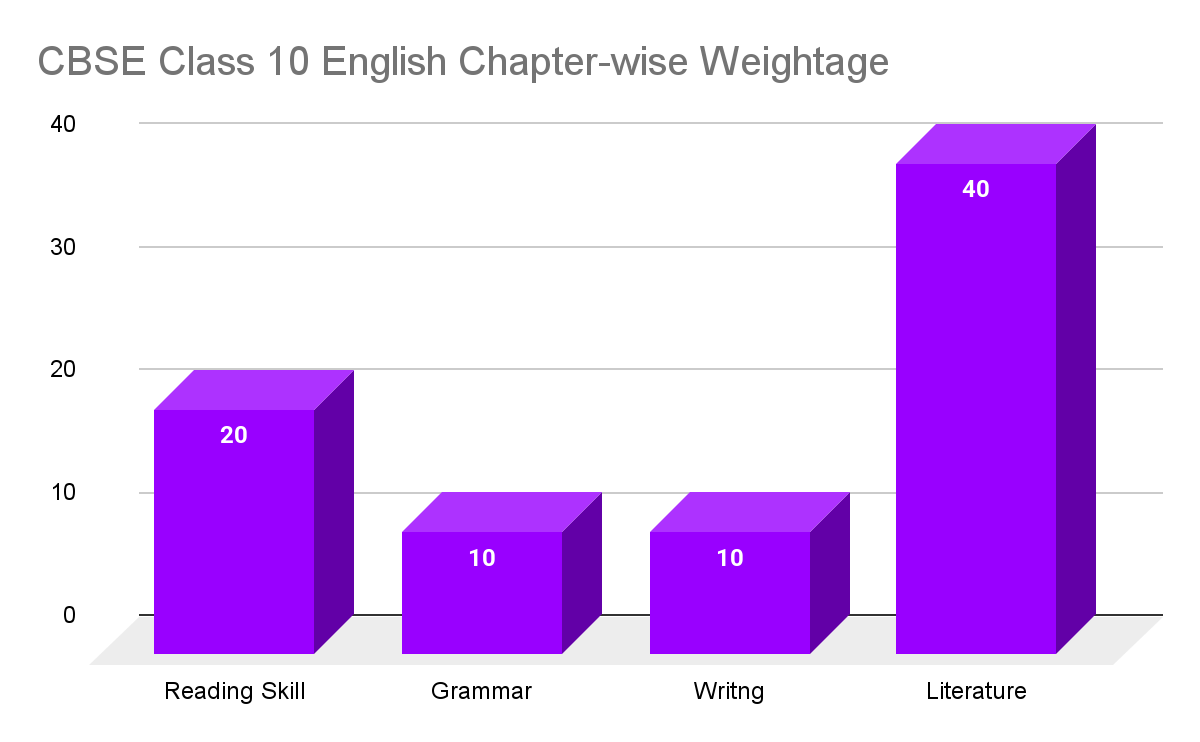
CBSE Class 10 English Chapter-wise Weightage
| Sections | Weightage |
|---|---|
| Reading Skill | 20 |
| Grammar | 10 |
| Writng | 10 |
| Literature | 40 |
| Total | 80 |
CBSE Class 10 English Chapter-wise Expected No. of Questions
| Chapters/Poets | Expected No of Questions |
|---|---|
| First Flight-Prose | 5-6 |
| A letter to God | |
| Nelson Mandela-Long Walk to Freedom | |
| Two stories about Flying | |
| From the Diary of Anne Frank | |
| Glimpses of India | |
| Mijbil the Otter | |
| Madam rides the bus | |
| The Sermon at Benaras | |
| The Proposal | |
| First Flight-Poems | 2-3 |
| Dust of Snow | |
| Fire and Ice | |
| A Tiger in the Zoo | |
| How to tell Wild Animals | |
| The Ball Poem | |
| Amanda | |
| The Trees | |
| Fog | |
| The Tale of Custurd the Dragon | |
| For Anne Gregory | |
| Footprints without Feet | ~3 |
| The Triumph of Surgery | |
| The Thief’s Story | |
| The Midnight Visitor | |
| A Question of Trust | |
| Footprint without Feet | |
| The Making of a Scientist | |
| The Necklace | |
| Bholi | |
| The Book that saved the Earth | |
Also Read
CBSE Class 10 Compartment Exam 2025CBSE Class 10 Social Science Chapter-wise Weightage
| Chapters/Poets | Expected marks | Map marks |
|---|---|---|
| The Rise of Nationalism in Europe | 18 | 2 |
| Nationalism in India | ||
| The Making of a Global World( Subtopics 1-1.3) | ||
| The Age of Industrialization | ||
| Print Culture and the Modern World | Only for Periodic Assessment | |
| Resources and Development | 17 | 3 |
| Forest and Wildlife Resources | ||
| Water Resources | ||
| Agriculture | ||
| Minerals and Energy Resources | ||
| Manufacturing Industries | ||
| LIfelines of the National Economy | Only Map Pointing | |
| Power Sharing | 20 | - |
| Federalism | - | |
| Gender, Religion, and Caste | - | |
| Political Parties | - | |
| Outcomes of Democracy | - | |
| Development | 20 | - |
| Sectors of the Indian Economy | - | |
| Money and Credit | - | |
| Globalization and the Indian Economy | - | |
| Consumer Rights | Project work | |
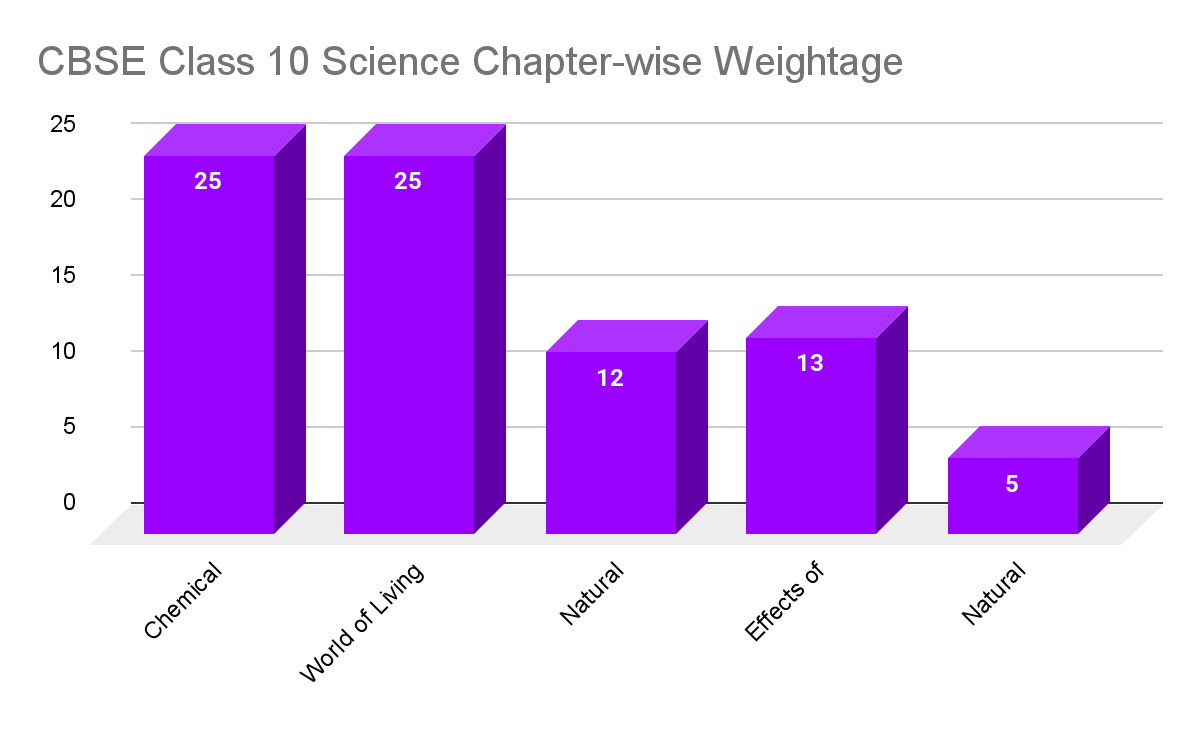
CBSE Class 10 Science Chapter-wise Weightage
| Chapters/Poets | Marks weightage |
|---|---|
| Chemical substances-Nature & Behaviour | 25 |
| World of Living | 25 |
| Natural Phenomena | 12 |
| Effects of Currents | 13 |
| Natural Resources | 05 |
| Total | 80 |
| Section | Externals | Internal |
|---|---|---|
| Physics | 23-25 marks | 20 |
| Chemistry | 22-24 marks | |
| Biology | 30-32 marks | |
| Total | 80 marks | 20 marks |
CBSE Class 10 Science Important Topics
| Sections | Topics | Expected Questions |
|---|---|---|
| PHYSICS | Light-Reflection and Refraction | 4-5 |
| The Human Eye and The Colourful World | 2-3 | |
| Electricity | 4-5 | |
| Magnetic Effects of Electric Current | 3-4 | |
| CHEMISTRY | Chemical Reactions and Equations | 3-4 |
| Acids, Bases and Salts | 3-4 | |
| Metals and Non-Metals | 3-4 | |
| Carbon and Its Compounds | 4-5 | |
| Periodic Classification of Elements | 2-3 | |
| BIOLOGY | Life Processes | 5-6 |
| Control and Coordination | 3-4 | |
| How do Organisms Reproduce? | 4-5 | |
| Heredity and Evolution | 3-4 | |
| Our Environment | 2-3 | |
| Natural Resource Management | 2-3 |
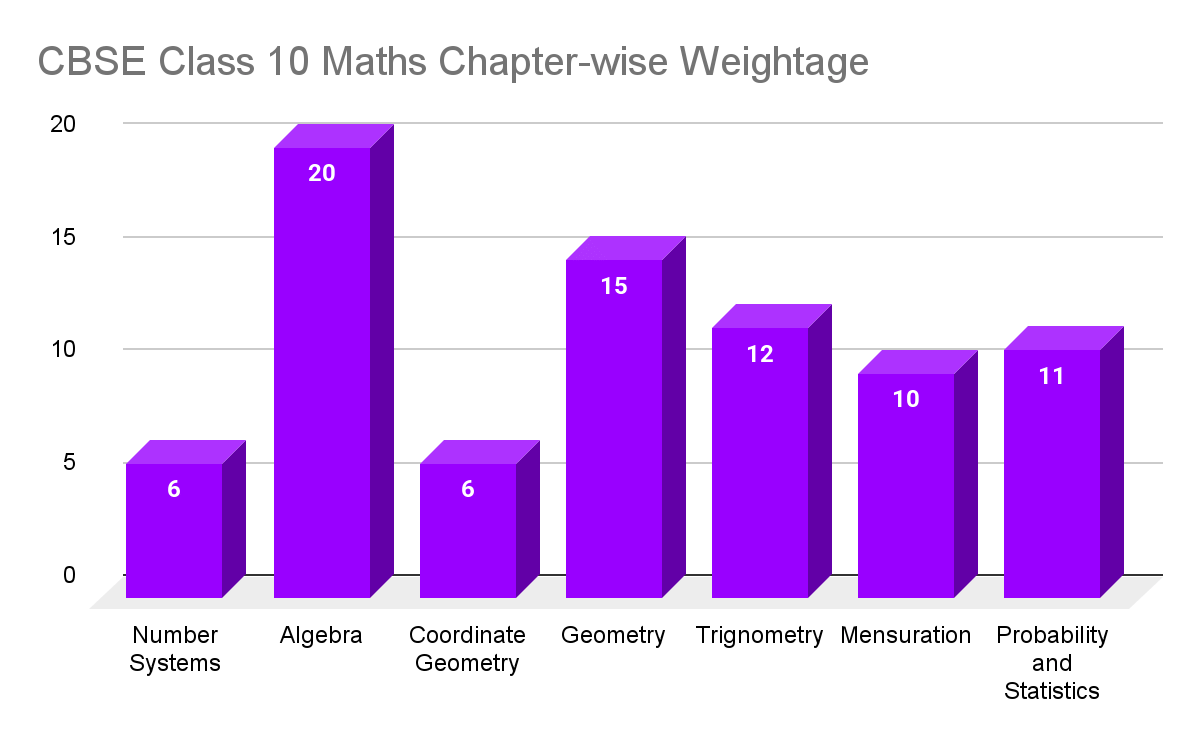
CBSE Class 10 Maths Chapter-wise Weightage
| Chapters | Marks weightage |
|---|---|
| Number Systems | 6 |
| Algebra | 20 |
| Coordinate Geometry | 6 |
| Geometry | 15 |
| Trignometry | 12 |
| Mensuration | 10 |
| Probability and Statistics | 11 |
| Total | 80 |
State Board Class 10 Total Marks 500 or 600
| States | Boards | Total Marks for Class 10 |
| Andra Pradesh | BSEAP | 600 |
| Arunachal Pradesh | APBSE | 500 |
| Assam | ASSEB | 600 |
| Bihar | BSEB | 500 |
| Chhattisgarh | CGBSE | 600 |
| Goa | GBSHSE | 500 |
| Gujarat | GSEB | 600 |
| Haryana | HBSE/BSEH | 500 |
| Himachal Pradesh | HPBOSE | 700 |
| Jharkhand | JAC | 500 |
| Karnataka | KSEAB | 625 |
| Kerala | KBPE | 600 |
| Madhya Pradesh | MPBSE | 500 |
| Maharashtra | MSBSHSE | 500 |
| Manipur | BSEM | 600 |
| Meghalaya | MBOSE | 500 |
| Mizoram | MBSE | 500 |
| Nagaland | NBSE | 600 |
| Odisha | BSEO | 600 |
| Punjab | PSEB | 650 |
| Rajasthan | RBSE | 500 |
| Sikkim | SBOS | 500 |
| Tamil Nadu | TNBSE | 500 |
| Telangana | BSET | 600 |
| Tripura | TBSE | 500 |
| Uttar Pradesh | UPMSP | 600 |
| Uttarakhand | UBSE | 500 |
| West Bengal | WBBSE | 700 |
| Andaman Nicobar | CBSE/NIOS | 500 |
| Chandigarh | CBSE/PSEB | 500 |
| Dadra & Nagaravelli and Daman & Diu | CBSE/NIOS | 500 |
| Delhi | DBSE | 500 |
| Jammu and Kashmir | JKBOSE | 500 |
| Ladakh | JKBOSE/CBSE/NIOS | 500 |
| Lakshadweep | CBSE/NIOS | 500 |
| Puddhucheri | CBSE/NIOS | 500 |
CBSE Class 10 Total Marks FAQs
Ques: Are CBSE marks out of 500 or 600?
Ans: CBSE total score is 500.
- Overall grading is calculated against 500.
- As CBSE follows the ‘Best of 5 rule’, even if students attempt 6 papers, the top 5 scored subjects will be considered for overall grading.
Ques: What are the passing marks out of 500 in CBSE Class 10?
Ans: 165 out of 500 is the passing mark in CBSE Class 10.
- 33% in each subject is required to pass.
- 5 subjects’ minimum score together adds up to 165.
- In the grading, if any student falls to E and below, the student has to retake the exam.
Ques: Does CBSE give a certificate for 100 marks?
Ans: Yes, CBSE gives merit certificates to the students who score 100 in any subject or an overall perfect score.
- These certificates are awarded to the top 0.1% of the students.
- If fewer than 500 candidates pass in a subject, no merit certificate will be given.
Ques: Is the internal mark added to the Class 10 percentage?
Ans: Yes, internal marks are added to the Class 10 percentage.
- Though the CBSE board sets no minimum score to pass internals, the internal scores are added to the final grading.
- Also, CBSE does not publish or give percentages.
- It assigns grades A1-E. A1 being the best and E indicating fail.
Ques: Will CBSE pass everyone in 2025?
Ans: CBSE does not pass any candidate on its own.
- CBSE conducts the exam, and passing is in the hands of the candidates.
- CBSE just facilitates the exam, evaluation, and scoring criteria.
Ques. What is the ‘best 5 rule’ of CBSE Class 10?
Ans: The best of 5 rule in CBSE means that your top 5 subjects will be considered for the final percentage or grading.
- Final percentage will be calculated using your 5 highest-scoring subjects; the low-scoring subject will be left out.
Also Read



Comments