




CBSE is conducting the Class 10 Home Science Board Exam 2026 on February 18, 2026. Class 10 Home Science Question Paper with Solution PDF is available here for download.
The official question paper of CBSE Class 10 Home Science Board Exam 2026 is provided below. Students can download the official paper in PDF format for reference.
CBSE Class 10, 2026 Home Science Question Paper with Solution PDF (Memory Based)
| CBSE Class 10 Home Science Question Paper 2026 |  Download Download |
Check Solutions |
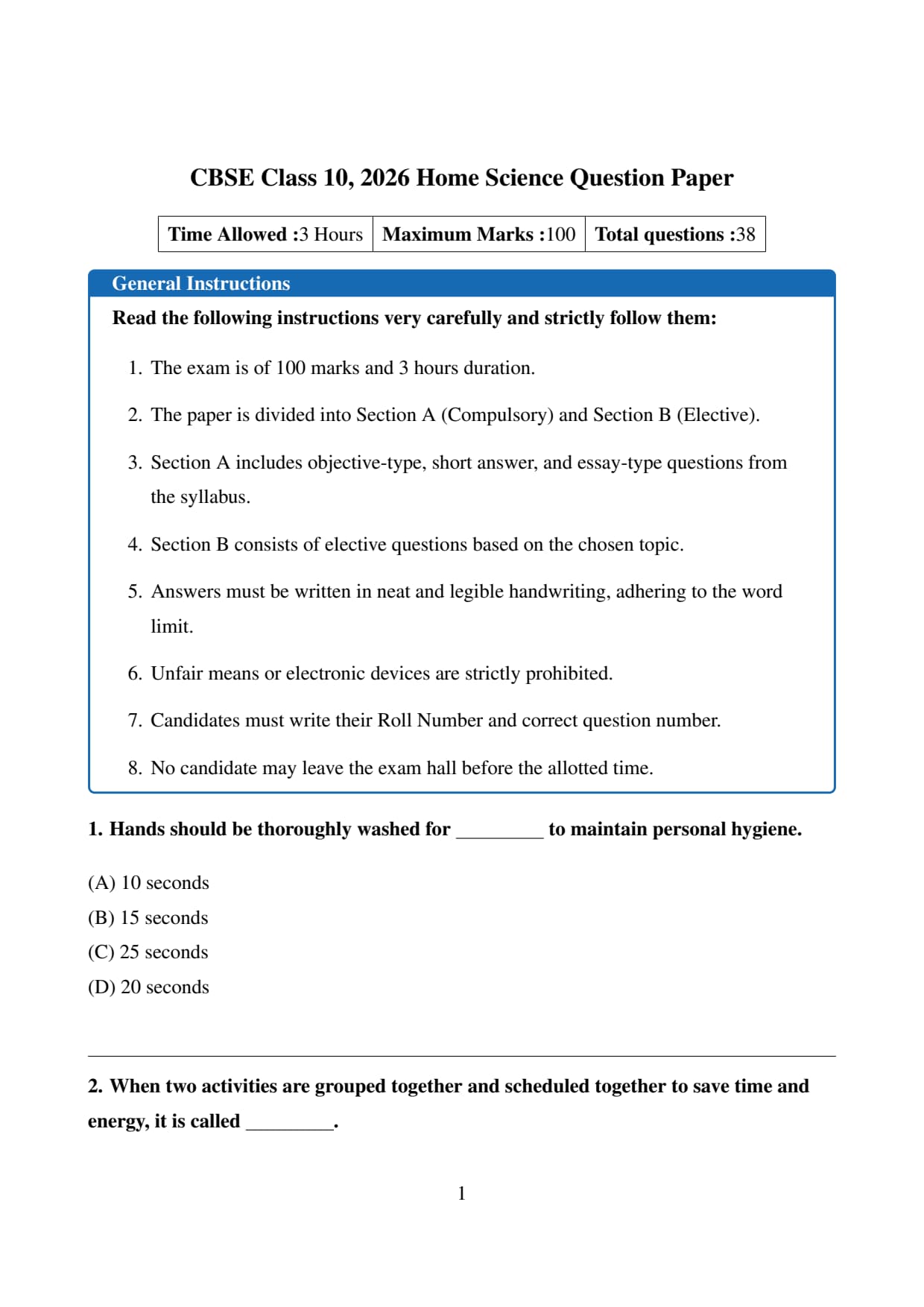
Hands should be thoroughly washed for _______ to maintain personal hygiene.
View Solution
For proper hand hygiene, it is recommended that hands be thoroughly washed for at least 15 seconds to ensure the removal of dirt, germs, and harmful bacteria.
Step 1: Analyze the options.
- (A) 10 seconds: While washing hands for 10 seconds is beneficial, it may not be sufficient for thorough cleaning.
- (B) 15 seconds: This is the correct recommendation as it allows sufficient time for proper handwashing.
- (C) 25 seconds: While longer washing may be effective, 25 seconds is not the universally recommended time.
- (D) 20 seconds: Although this time is acceptable, 15 seconds is widely acknowledged as the most common recommendation.
Step 2: Conclusion.
The correct answer is (B) 15 seconds, as it is the optimal time for handwashing according to health guidelines.
Final Answer: \[ \boxed{(B) \, 15 seconds} \] Quick Tip: Wash your hands for at least 15 seconds to ensure the removal of harmful bacteria and viruses.
When two activities are grouped together and scheduled together to save time and energy, it is called \hspace{2cm}.
View Solution
The term Dovetailing is used when two activities are grouped together and scheduled in a way that saves time and energy. It involves overlapping tasks to maximize efficiency.
Step 1: Analyze the options.
- (A) Fatigue: This is unrelated to scheduling or grouping activities. Fatigue refers to tiredness or exhaustion.
- (B) Time Plan: This refers to a general plan or schedule but does not specifically refer to grouping activities for efficiency.
- (C) Labour saving: While labor-saving methods are used to improve efficiency, it does not specifically describe the process of grouping activities together.
- (D) Dovetailing: This is the correct term, referring to the efficient scheduling and grouping of activities to save time and energy.
Step 2: Conclusion.
The correct answer is (D) Dovetailing, which is a method of efficient task scheduling.
Final Answer: \[ \boxed{(D) \, Dovetailing} \] Quick Tip: Dovetailing is an effective time-management technique that involves overlapping or combining tasks to maximize efficiency and reduce idle time.
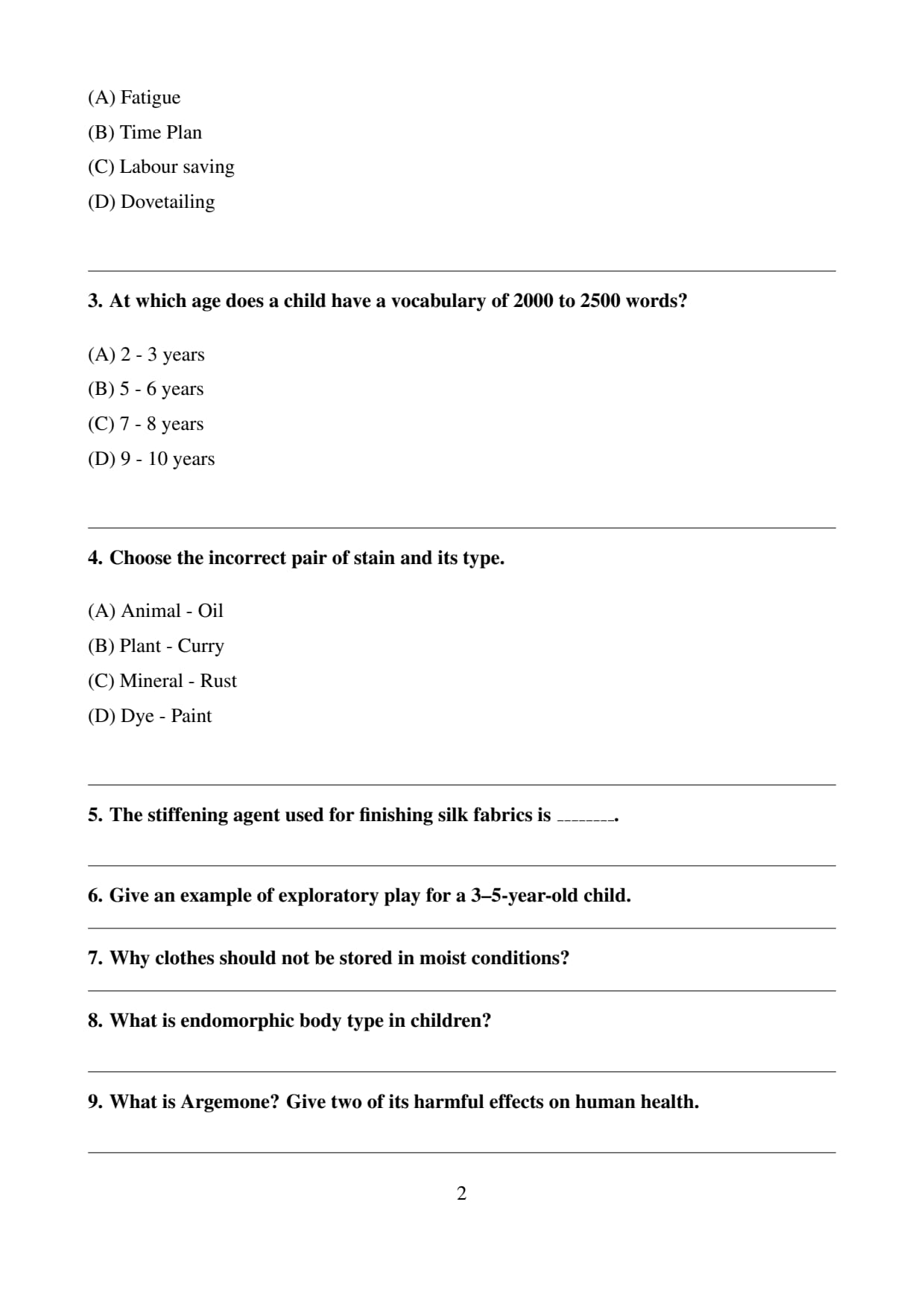
At which age does a child have a vocabulary of 2000 to 2500 words?
View Solution
Children typically acquire a vocabulary of about 2000 to 2500 words between the ages of 5 - 6 years. During this age, their language skills rapidly develop as they begin to understand more complex words and phrases.
Step 1: Analyze the options.
- (A) 2 - 3 years: Children at this age typically have a vocabulary of around 200-1000 words.
- (B) 5 - 6 years: This is the correct answer, as children between 5 and 6 years old tend to have a vocabulary ranging from 2000 to 2500 words.
- (C) 7 - 8 years: While children’s vocabulary continues to expand, they typically have more than 2500 words by this age.
- (D) 9 - 10 years: By this age, a child would have a vocabulary well beyond 2500 words.
Step 2: Conclusion.
The correct answer is (B) 5 - 6 years, as this is the typical range for vocabulary development.
Final Answer: \[ \boxed{(B) \, 5 - 6 years} \] Quick Tip: By the age of 5-6 years, a child’s vocabulary typically includes 2000 to 2500 words. Encourage language development through conversation and reading.
Choose the incorrect pair of stain and its type.
View Solution
We need to identify the incorrect pair of stain and its type. The correct classification of stains is based on their origin: animal, plant, mineral, or dye.
Step 1: Analyze the options.
- (A) Animal - Oil: This is a correct pairing as oils from animals are classified as animal stains.
- (B) Plant - Curry: This is a correct pairing as curry is derived from plants, and plant-based stains are common.
- (C) Mineral - Rust: This is also correct as rust is a mineral-based stain.
- (D) Dye - Paint: This is incorrect because paint is not classified as a dye stain. Paint is a man-made product, and dyes are natural or synthetic substances used to color materials.
Step 2: Conclusion.
The incorrect pair is (D) Dye - Paint, as paint is not a type of dye stain.
Final Answer: \[ \boxed{(D) \, Dye - Paint} \] Quick Tip: Remember that stains are categorized based on their origin—animal, plant, mineral, or dye—and it’s essential to correctly identify them.
The stiffening agent used for finishing silk fabrics is ________.
View Solution
The stiffening agent commonly used for finishing silk fabrics is gelatin. Silk is a delicate, lightweight fabric, and finishing it requires special care to maintain its natural shine while providing adequate stiffness for structure and texture. Gelatin, a natural protein derived from animal collagen, is used as a stiffening agent because it is able to coat the fibers of the fabric and give them a firm yet pliable texture.
The process of using gelatin as a stiffening agent involves dissolving the gelatin in warm water and applying it to the fabric. As the gelatin sets, it bonds to the fibers and provides a soft yet firm finish, which helps the fabric maintain its shape, especially for garments or items that need to stand up to wear or movement, such as collars, cuffs, or decorative trims.
Gelatin is particularly preferred because it is biodegradable and safe for use on natural fibers like silk. Unlike synthetic stiffening agents, gelatin imparts a subtle, natural texture to the fabric, making it ideal for preserving the integrity and delicacy of the silk. Additionally, gelatin's application is simple and cost-effective, making it a popular choice in textile finishing.
It is important to note that gelatin can be used in varying concentrations depending on the desired level of stiffness. For instance, a higher concentration of gelatin will result in a firmer finish, whereas a lower concentration will create a softer, more flexible fabric. Quick Tip: Gelatin is a natural stiffening agent that works effectively for silk, providing firmness without compromising the delicate texture of the fabric.
Give an example of exploratory play for a 3–5-year-old child.
View Solution
An example of exploratory play for a 3–5-year-old child could be building with blocks. At this stage in a child's development, they are rapidly improving their fine motor skills, hand-eye coordination, and spatial awareness. Building blocks offer an ideal medium for exploratory play, allowing the child to manipulate the blocks in various ways, experimenting with balance, symmetry, and creativity.
When a child engages in building with blocks, they are actively exploring the world around them. This form of play is both structured and unstructured; the child may follow a mental blueprint to create a particular shape or structure, or they may simply experiment with stacking and arranging the blocks in different configurations. In either case, the child is learning valuable lessons in problem-solving, cause-and-effect relationships, and understanding basic engineering concepts like stability and support.
Beyond cognitive development, building with blocks also encourages social development. If the child is playing with other children, they will often collaborate to create larger structures, which promotes communication, sharing, and teamwork. Additionally, children in this age group begin to use blocks as part of symbolic play, where they may pretend the blocks are buildings, vehicles, or other objects, expanding their imagination and creativity.
Block play is also an excellent way for children to develop their language skills. As they describe what they are building or narrate stories about the blocks, they practice vocabulary, sentence construction, and conversational skills.
In summary, building with blocks is an example of exploratory play that encourages cognitive, social, and emotional development. It allows the child to explore their physical environment, experiment with different shapes and structures, and foster creativity and problem-solving abilities. Quick Tip: Building with blocks is an ideal form of exploratory play that enhances a child's cognitive, motor, and social development while encouraging creativity and problem-solving.
Why clothes should not be stored in moist conditions?
View Solution
Clothes should not be stored in moist conditions because moisture can lead to various problems that damage the fabric and reduce its lifespan. The key reasons for avoiding moisture storage are:
1. Mould and Mildew Growth:
Moist conditions promote the growth of mould and mildew, which can cause unsightly stains and produce an unpleasant odor. These fungi thrive in damp, poorly ventilated environments and can quickly spread, damaging fabric fibers. Mould can also cause health issues, particularly respiratory problems for individuals with sensitivities.
2. Fabric Deterioration:
When clothes are stored in a damp environment, the fibers of the fabric can weaken and degrade over time. The moisture can break down the integrity of the fibers, leading to thinning, tearing, and overall wear and tear of the fabric. This can especially affect natural fibers like cotton, linen, and wool.
3. Color Fading:
Moisture can cause fabrics, particularly those dyed with natural or non-fast dyes, to lose their color. The colors can run or fade, making clothes look older and less vibrant. In some cases, the fabric may also experience uneven color distribution, leading to blotchy or discolored patches.
4. Unpleasant Odors:
Moisture trapped in fabric can lead to musty odors that are difficult to remove. These odors often result from bacterial growth or the lingering presence of mildew, which can permeate the fibers of the clothing.
For these reasons, it is important to store clothes in a cool, dry, and well-ventilated space to ensure their longevity and maintain their condition. Quick Tip: Storing clothes in moist conditions can lead to mould growth, fabric degradation, and unpleasant odors. Always store clothes in a dry, ventilated space to maintain their quality.
What is endomorphic body type in children?
View Solution
The endomorphic body type in children is characterized by a rounder physique, with more fat and less muscle mass. This body type is one of the three basic somatotypes (along with ectomorph and mesomorph) used to describe an individual's physique. Key characteristics of the endomorphic body type in children include:
1. Rounded Physique:
Children with an endomorphic body type tend to have a rounder face and body shape, with a softer, fuller appearance. Their body tends to store fat more easily than the other body types, giving them a broader appearance.
2. Higher Body Fat:
Endomorphic children tend to have a higher percentage of body fat, especially in the abdominal and hip areas. This can make them appear heavier even if they are not necessarily overweight.
3. Slower Metabolism:
Children with this body type often have a slower metabolism, meaning they burn calories more slowly than other children. This can contribute to the accumulation of body fat if they do not engage in physical activity or follow a balanced diet.
4. Less Muscle Definition:
Endomorphic children generally have less muscle definition compared to mesomorphic or ectomorphic children. Their muscles may appear softer, and they may have less muscle tone, but this does not imply a lack of strength or ability.
5. Tendencies:
Endomorphic children may be more prone to gaining weight if their caloric intake is high or if they are not very physically active. However, with proper exercise and diet, they can achieve a healthy balance between body fat and muscle. Quick Tip: Endomorphic children tend to have a rounder body shape with higher body fat, slower metabolism, and less muscle definition. Regular physical activity and a balanced diet can help maintain a healthy physique.
What is Argemone? Give two of its harmful effects on human health.
View Solution
Argemone is a genus of flowering plants in the poppy family (Papaveraceae), and the most commonly known species is Argemone mexicana. This plant is often found in tropical and subtropical regions and is commonly considered a weed. Although it has some medicinal uses in traditional medicine, it is largely known for its harmful effects, particularly when it comes into contact with humans or is consumed unknowingly. The harmful effects of Argemone on human health include:
1. Toxic Effects on Human Health:
Argemone contains toxic alkaloids, primarily berberine, which can cause various health issues when consumed. These alkaloids can lead to food poisoning if mixed with food grains, particularly wheat or rice, which are often contaminated with Argemone seeds. Consumption of Argemone-contaminated food can result in symptoms such as vomiting, diarrhea, and abdominal pain. In severe cases, it can cause damage to vital organs, including the liver and kidneys, leading to liver damage or kidney failure.
2. Skin Irritation and Allergic Reactions:
Handling or coming into contact with Argemone plants can lead to skin irritation or allergic reactions, particularly for individuals who are sensitive to the plant's compounds. The sap of the plant, when it comes into contact with the skin, can cause rashes, dermatitis, and irritation. In some cases, it may even lead to more severe allergic reactions, including swelling and itching. If the sap enters the eyes, it can lead to conjunctivitis or eye irritation.
Precautionary Measures: It is important to avoid direct contact with Argemone plants and ensure food grains are properly cleaned and checked to avoid contamination by Argemone seeds. Quick Tip: Argemone is toxic and can cause food poisoning and skin irritation. Always ensure food grains are free from Argemone seeds to avoid health risks.
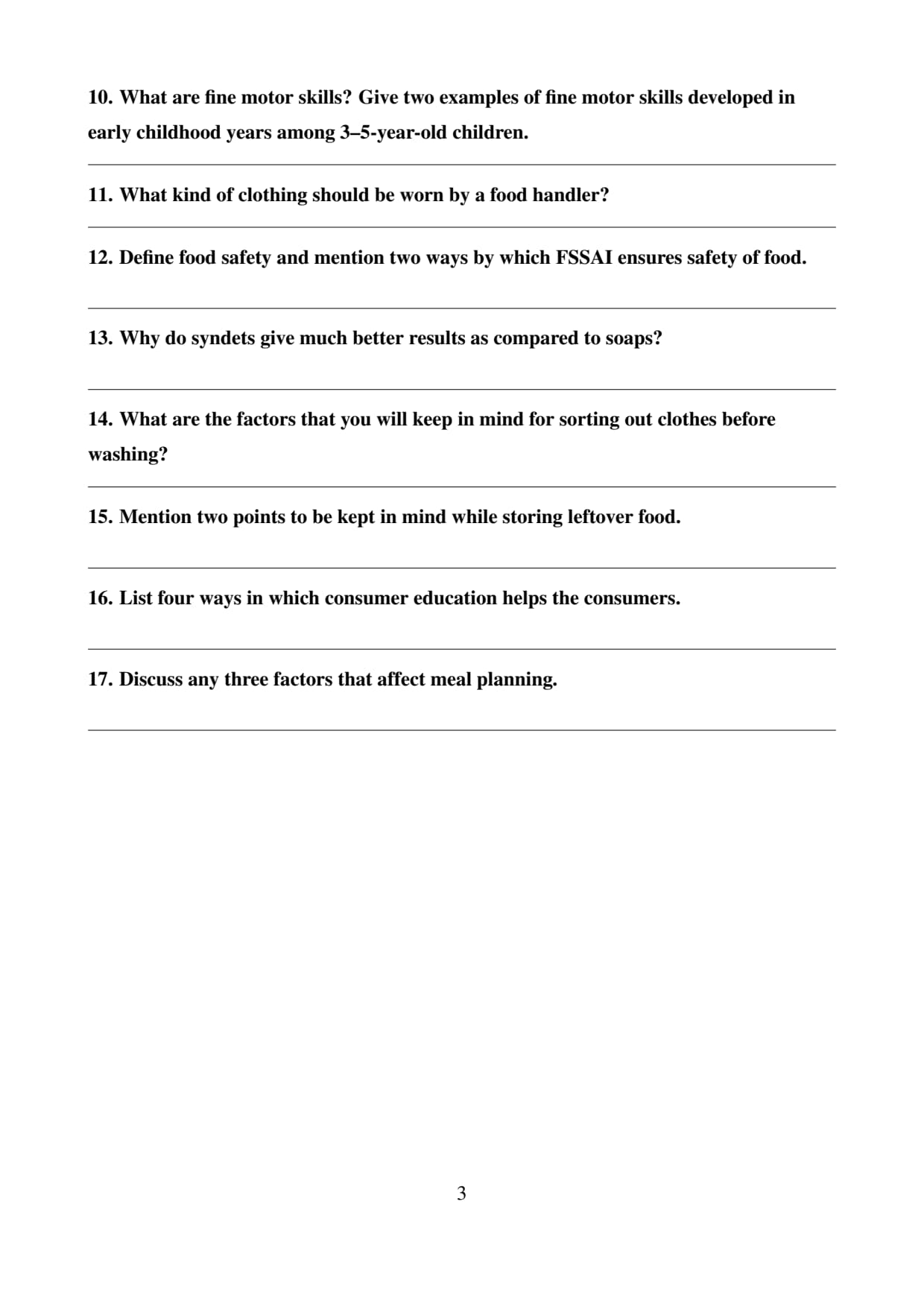
What are fine motor skills? Give two examples of fine motor skills developed in early childhood years among 3–5-year-old children.
View Solution
Fine motor skills refer to the ability to perform small, precise movements using the hands, fingers, and wrists. These skills are essential for tasks such as writing, drawing, and manipulating small objects. In early childhood (3-5 years old), fine motor skills are critical as they lay the foundation for later abilities such as writing, buttoning a shirt, or using utensils properly. Fine motor skills require coordination between the brain and muscles, and they develop progressively as children grow. Two examples of fine motor skills developed in early childhood years include:
1. Drawing and Writing:
At this stage, children begin to develop the ability to hold a pencil or crayon and make basic shapes, such as circles, lines, and later letters. This skill involves the small muscles of the hands and fingers and is an important precursor to writing. By the age of 3–5 years, children typically start drawing recognizable shapes and even attempt to write their names.
2. Manipulating Small Objects:
Children in this age group also begin to develop the ability to manipulate small objects, such as stacking blocks, threading beads, or turning the pages of a book. These activities help improve hand-eye coordination and finger dexterity, both essential components of fine motor development.
In summary, fine motor skills are crucial for children as they enable them to engage in many everyday tasks, and these skills evolve through regular practice and interaction with their environment. Quick Tip: Fine motor skills in young children are developed through activities like drawing, writing, and manipulating small objects, which help improve hand-eye coordination and finger dexterity.
What kind of clothing should be worn by a food handler?
View Solution
A food handler is responsible for ensuring that food is prepared, served, and stored in a sanitary and safe manner. Wearing the right kind of clothing is essential for maintaining hygiene and preventing contamination. The following clothing should be worn by a food handler:
1. Clean Uniforms:
Food handlers should wear clean, protective uniforms made from materials that are easy to clean and sanitize. These uniforms should be free from contaminants and should be washed regularly to prevent the spread of germs or bacteria.
2. Hair Covering:
Food handlers should wear hairnets or hats to prevent hair from falling into the food. This is especially important for preventing cross-contamination in food preparation areas. The hair covering should be secure and cover all hair.
3. Gloves:
Disposable gloves should be worn when handling ready-to-eat food, particularly if the food handler has cuts, wounds, or any illness that could be transferred to the food. Gloves should be changed regularly and whenever they become contaminated.
4. Aprons:
An apron or similar protective gear should be worn to protect clothing from spills, stains, and contamination. Aprons should be changed if they become soiled to ensure food safety.
5. Closed-Toe Shoes:
Food handlers should wear closed-toe shoes with non-slip soles to prevent injuries and to reduce the risk of slipping on wet or greasy surfaces. Shoes should also be easy to clean and should not allow contaminants to enter the food preparation area.
In conclusion, food handlers should wear clean, protective, and hygienic clothing to prevent contamination and ensure the safe handling of food. Quick Tip: Food handlers should wear clean uniforms, hair coverings, gloves, aprons, and closed-toe shoes to maintain hygiene and prevent contamination.
Define food safety and mention two ways by which FSSAI ensures safety of food.
View Solution
Food safety refers to the practices and precautions taken to ensure that food is free from harmful contaminants and pathogens that could cause illness or injury. It involves maintaining cleanliness and hygiene throughout the food production process, from farm to table. Food safety ensures that food is safe for consumption by preventing foodborne illnesses caused by bacteria, viruses, parasites, or chemical substances.
The Food Safety and Standards Authority of India (FSSAI) is responsible for regulating and monitoring food safety standards in India. FSSAI plays a crucial role in ensuring the safety of food by:
1. Establishing Standards:
FSSAI sets guidelines for food safety standards, including limits for harmful chemicals, preservatives, additives, and contaminants. These standards are enforced through regulations that food manufacturers, suppliers, and vendors must adhere to. FSSAI ensures that only safe and approved ingredients are used in food production.
2. Food Licensing and Registration:
FSSAI mandates that food businesses in India obtain licenses and registrations to operate legally. This system ensures that food handlers meet safety and hygiene standards. FSSAI conducts inspections and audits to ensure compliance with food safety regulations, thereby preventing unsafe food from entering the market. Quick Tip: FSSAI ensures food safety by setting standards for food quality and requiring food businesses to comply with licensing and registration regulations.
Why do syndets give much better results as compared to soaps?
View Solution
Syndets (synthetic detergents) are cleaning agents made from synthetic materials and are used as an alternative to traditional soaps. Syndets provide better results than soaps for several reasons:
1. pH Balance:
Soaps are alkaline in nature, and their high pH can sometimes irritate sensitive skin, especially if the skin is already dry or damaged. Syndets, on the other hand, are formulated to be pH-balanced, which makes them gentler on the skin. The pH of syndets is closer to that of natural skin, which helps maintain the skin's natural moisture and protective barrier.
2. Mild and Effective Cleaning:
Syndets contain surfactants (detergent agents) that are more efficient at removing dirt, oil, and grease compared to traditional soap. They are also more effective in hard water because they are designed to interact with the minerals in the water without forming insoluble salts, which soap can do. This makes syndets more effective for cleaning in areas with hard water and prevents the formation of soap scum.
In summary, syndets are more effective, gentle on the skin, and better suited for modern cleaning needs compared to soaps. Quick Tip: Syndets are pH-balanced and more effective at cleaning than soaps, making them gentler on the skin and ideal for use in hard water areas.
What are the factors that you will keep in mind for sorting out clothes before washing?
View Solution
When sorting clothes before washing, several important factors should be kept in mind to ensure the clothes are cleaned effectively while also maintaining their quality. These factors include:
1. Fabric Type:
Clothes made from different fabrics (cotton, wool, synthetic, delicate fabrics) may require different washing conditions. For example, delicate fabrics like silk or lace should be washed separately and with gentle cycles, while sturdier fabrics like cotton can be washed together on a normal cycle.
2. Color:
Sorting clothes based on color is essential to avoid color bleeding, which can ruin clothes. Dark-colored clothes should be washed with similar dark-colored garments, while light-colored clothes should be washed with other light colors to maintain the vibrancy of the fabrics. It is also recommended to wash new clothes separately, as they might release excess dye.
3. Degree of Soiling:
Clothes with heavy stains or dirt should be sorted out from lightly soiled garments. Heavily soiled clothes may need pre-treatment before washing, such as soaking or using stain removers. Lightly soiled clothes can be washed together in a regular load.
4. Washing Instructions:
Always check the care labels on clothes. Some garments may require cold water washing or a specific wash cycle, while others may need to be washed at a higher temperature. It is important to follow these instructions to avoid damage to the fabric.
5. Size and Weight of Clothes:
It’s also important to consider the size and weight of the clothes. Large or heavy items, such as towels or blankets, may require a longer wash cycle and should be washed separately to avoid overloading the machine.
In summary, sorting clothes based on fabric type, color, degree of soiling, care instructions, and size helps achieve effective cleaning while preserving the fabric quality. Quick Tip: Sort clothes by fabric type, color, degree of soiling, and care instructions to ensure effective cleaning and to avoid damage during the wash.
Mention two points to be kept in mind while storing leftover food.
View Solution
When storing leftover food, it is important to ensure that it remains safe to eat and retains its flavor and nutritional value. The following are two important points to keep in mind:
1. Proper Cooling:
Before storing leftover food, it should be cooled to a safe temperature quickly to prevent the growth of bacteria. Food should be cooled to room temperature within two hours of cooking and then transferred to the refrigerator or freezer. It is best to store food in shallow containers to allow quicker cooling.
2. Correct Storage Temperature:
Leftover food should always be stored at the correct temperature. Food that is to be consumed within a few days should be stored in the refrigerator at or below 40°F (4°C). For longer-term storage, food should be frozen at 0°F (-18°C) or lower. Storing food at the correct temperature prevents the growth of harmful bacteria that can cause foodborne illness.
In summary, always ensure leftover food is cooled quickly and stored at the correct temperature to maintain its safety and quality. Quick Tip: Cool leftover food quickly and store it at the correct temperature to ensure food safety and maintain its quality.
List four ways in which consumer education helps the consumers.
View Solution
Consumer education plays a vital role in helping consumers make informed decisions and protect their rights in the marketplace. It enables consumers to understand their responsibilities and become aware of their rights, thus allowing them to make better choices regarding the products and services they purchase. The following are four ways in which consumer education benefits consumers:
1. Informed Decision Making:
Consumer education provides individuals with the necessary knowledge to make informed purchasing decisions. This includes understanding product labels, knowing the quality and value of products, and being able to compare prices and features of similar goods. By educating consumers, they can avoid being misled by false claims or advertisements.
2. Consumer Rights Awareness:
Education teaches consumers about their rights, such as the right to safety, the right to be informed, the right to choose, and the right to redress. With this knowledge, consumers can assert their rights in cases of faulty products, unethical marketing practices, or poor customer service. This also encourages businesses to uphold ethical standards.
3. Protection Against Fraud:
Consumer education helps individuals identify fraudulent schemes and deceptive practices in the marketplace. This includes understanding how to detect counterfeit goods, recognizing scams, and knowing how to report fraudulent activity. Educated consumers are less likely to fall victim to fraud and can take necessary actions to avoid being exploited.
4. Promotes Fair Trade and Competition:
Educated consumers are more likely to support businesses that adhere to ethical practices, offer fair pricing, and provide high-quality products. By encouraging consumers to make ethical choices, consumer education helps promote fair trade practices and enhances competition, leading to better goods and services in the market. Quick Tip: Consumer education empowers individuals to make informed choices, understand their rights, and avoid fraudulent practices, leading to a safer and more competitive marketplace.
Discuss any three factors that affect meal planning.
View Solution
Meal planning is an essential part of managing time, health, and nutrition. It involves selecting and organizing meals in advance to meet the dietary needs of individuals or families. Several factors influence meal planning, and three important ones are:
1. Nutritional Needs:
The most important factor in meal planning is ensuring that the meals provide the necessary nutrients for good health. This includes balancing proteins, carbohydrates, fats, vitamins, and minerals according to the individual's age, activity level, and health conditions. For example, a growing child needs more calories and protein, while an elderly person may require a diet low in sodium. Proper meal planning helps meet these specific nutritional needs.
2. Budget:
Meal planning is also influenced by the budget available for purchasing food. Consumers must consider how to buy healthy, nutritious foods without exceeding their financial limits. Budget-friendly meal planning often involves buying in bulk, choosing seasonal or local produce, and reducing food waste by utilizing leftovers. Meal planners must also evaluate the cost of ingredients and aim for balanced meals within their budget constraints.
3. Time and Convenience:
The amount of time available for meal preparation is another factor that affects meal planning. Busy individuals or families may prefer meals that are quick to prepare or that can be cooked in advance and stored for later use. Additionally, convenience plays a role in selecting easy-to-cook ingredients or ready-made meals that still maintain nutritional quality. For those with limited time, meal planning might involve batch cooking or using time-saving kitchen appliances such as slow cookers or pressure cookers.
In conclusion, effective meal planning takes into account the nutritional needs of individuals, the available budget, and the time constraints of the household. Balancing these factors ensures that meals are both healthy and practical. Quick Tip: When planning meals, consider the nutritional needs, budget, and time constraints to ensure a balanced, healthy, and cost-effective diet.



Comments