




COMEDK UGET 2023 Question Paper Shift 2 will be available here for download. COMEDK UGET 2023 Question Paper May 28 Shift 2 2 PM to 5 PM will be conducted for Physics, Chemistry and Mathematics Paper.
COMEDK UGET 2023 Question Paper will include 60 MCQ-based questions in three subjects each. Each candidate will be awarded +1 for correct answers, however, there will be no negative marking for incorrect responses. Students will get 3 hours to attempt COMEDK UGET 2023 Question Paper.
Related Links:
COMEDK UGET 2023 Question Paper with Answer Key PDF Shift 2
| COMEDK UGET 2023 (Shift 2) Question Paper With Answer Key |  Download Download |
Check Solution |

Question 1:
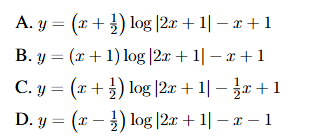
The particular solution of \( e^{\frac{dy}{dx}} = 2x + 1 \) given that \( y = 1 \) when \( x = 0 \) is:
View Solution
If \( A = \left( \begin{matrix} 1 & 2
0 & 1 \end{matrix} \right), \, P = \left( \begin{matrix} \cos \theta & \sin \theta
-\sin \theta & \cos \theta \end{matrix} \right), \, Q = P^T A P \), then \( PQ^{2014} \) is:

View Solution
\( A \) and \( B \) are invertible matrices of the same order such that \( (AB)^{-1} = 8 \), if \( |A| = 2 \), then \( |B| \) is:
A. 6
B. 16
C. 4
D. 1/16
View Solution
The centre of the circle passing through \( (0, 0) \) and \( (1, 0) \) and touching the circle \( x^2 + y^2 = 9 \) is:

View Solution
If the direction ratios of two lines are given by \( 3lm - 4ln + mn = 0 \) and \( l + 2m + 3n = 0 \), then the angle between the lines is:

View Solution

If the conjugate of \( (x + iy)(1 - 2i) \) be \( 1 + i \), then:

View Solution
If the length of the major axis of an ellipse is 3 times the length of the minor axis, then its eccentricity is:

View Solution
A die is thrown twice and the sum of numbers appearing is observed to be 8. What is the conditional probability that the number 5 has appeared at least once?

View Solution

The minimum value of \( Z = 3x + 5y \), given subject to the constraints \( x + y \geq 2 \), \( x + 3y \geq 3 \), \( x, y \geq 0 \), is:
A. 6
B. 8
C. 9
D. 7
View Solution

The coordinates of the vertices of the triangle are \( A(-2, 3, 6) \), \( B(-4, 4, 9) \), and \( C(0, 5, 8) \). The direction cosines of the median \( BE \) are:

View Solution
How many factors of \( 2^5 \times 3^6 \times 5^2 \) are perfect squares?
A. 16
B. 24
C. 12
D. 22
View Solution
The general solution of the differential equation \[ (1 + y^2) \, dx = ( \tan^{-1} y - x ) \, dy \]
is:

View Solution
The function \( f(x) = \frac{x}{2} + \frac{2}{x} \) has a local minimum at:

View Solution
The scalar components of a unit vector which is perpendicular to each of the vectors \( \hat{i} + 2\hat{j} - \hat{k} \) and \( 3\hat{i} - \hat{j} + 2\hat{k} \) are:

View Solution
A candidate is required to answer 7 questions out of 12 questions which are divided into two groups, each containing 6 questions. He is not permitted to attempt more than 5 questions from either group. The number of ways in which he can choose the 7 questions is:
A. 1272
B. 780
C. 640
D. 820
View Solution
Evaluate the integral \[ \int \sqrt{\csc x - 1} \, dx = \]
View Solution
Evaluate the integral \[ \int_0^2 x^2 + 2x - 3 \, dx \]
View Solution
Bag A contains 3 white and 2 red balls. Bag B contains only 1 white ball. A fair coin is tossed. If head appears then 1 ball is drawn at random from bag A and put into bag B. However if tail appears then 2 balls are drawn at random from bag A and put into bag B. Now one ball is drawn at random from bag B. Given that the drawn ball from B is white, the probability that head appeared on the coin is
View Solution
Let \( X \) and \( Y \) be the set of all positive divisors of 400 and 1000 respectively (including 1 and the number). Then \( n(X \cap Y) \) is equal to
View Solution
In a 12 storey house, 10 people enter a lift cabin. It is known that they will leave the lift in pre-decided groups of 2, 3, and 5 people at different storeys. The number of ways they can do so if the lift does not stop up to the second storey is
View Solution
If three numbers \( a, b, c \) constitute both an A.P and G.P, then
View Solution
cos\(^6\) A - sin\(^6\) A is equal to
View Solution
The distance between the foci of a hyperbola is 16 and its eccentricity is \( \sqrt{2} \). Then its equation is
View Solution
The ratio in which the line \( 3x + 4y + 2 = 0 \) divides the distance between the lines \( 3x + 4y + 5 = 0 \) and \( 3x + 4y - 5 = 0 \) is
View Solution
If \( 2A + 3B = \begin{bmatrix} 2 & -1 & 4
3 & 2 & 5 \end{bmatrix} \) and \( A + 2B = \begin{bmatrix} 5 & 0 & 3
1 & 6 & 2 \end{bmatrix} \), then \( B = \)
If \( \csc(90^\circ + A) + x \cos A \cot(90^\circ + A) = \sin(90^\circ + A) \), then the value of
View Solution
P is a point on the line segment joining the points \( (3, 2, -1) \) and \( (6, 2, -1) \).
View Solution
The area of the upper half of the circle whose equation is \( (x - 1)^2 + y^2 = 1 \) is given by
View Solution
In the set \( W \) of whole numbers, an equivalence relation \( R \) is defined as follows: \( a R b \) iff both \( a \) and \( b \) leave the same remainder when divided by 5. The equivalence class of 1 is given by
View Solution
If \( P(B) = \frac{3}{5} \), \( P(A/B) = \frac{1}{2} \), and \( P(A \cup B) = \frac{4}{5} \), then \( P(A \cup B)' + P(A') \) is
View Solution
The function defined by \[ f(x) = \begin{cases} \frac{\sin x}{x} + \cos x & if x > 0
-5k & if x = 0
\frac{4(1 - \sqrt{1 - x})}{x} & if x < 0 \end{cases} \]
is continuous at
View Solution
If \[ f(x) = 2x - \tan^{-1} x - \log(x + \sqrt{x^2 + 1}) \]
is monotonically increasing, then
View Solution
Consider the first 10 natural numbers. If we multiply each number by \( -1 \) and add 1 to each number, the variance of the numbers so obtained is
View Solution
A triangular park is enclosed on two sides by a fence and on the third side by a straight river bank. The two sides having fence are of same length \( x \). The maximum area enclosed by the park is
View Solution
Let \[ f(x) = \cos^{-1}(3x - 1) \]
then the domain of \( f(x) \) is equal to
View Solution
The solution of the differential equation \[ \frac{dy}{dx} + y \cos x = \frac{1}{2} \sin 2x \]
is
View Solution
The area bounded by the curve \[ y^2 = 4a^2(x - 1) \]
and the lines \[ x = 1, \quad y = 4a \]
is
View Solution
If \[ f(x) = \sin^{-1} \left( \frac{2x+1}{1+4x^2} \right) \]
then \( f'(0) \) is equal to
View Solution
If \[ \begin{bmatrix} 2 + x & 3 & 4
1 & -1 & 2
x & 1 & -5 \end{bmatrix} \]
is a singular matrix, then \( x \) is
View Solution
The sum of the degree and order of the following differential equation \[ \left( 1 - \left( \frac{dy}{dx} \right)^2 \right)^{\frac{3}{2}} = kx \frac{d^2y}{dx^2} \]
is
View Solution
Solution of \[ x - y + z = 4, \quad x - 2y + 2z = 9, \quad 2x + y + 3z = 1 \]
is
View Solution
Solution of \[ x - y + z = 4, \quad x - 2y + 2z = 9, \quad 2x + y + 3z = 1 \]
is
View Solution
If \[ \cos \alpha = k \cos \beta \]
then \[ \cot \left( \frac{\alpha + \beta}{2} \right) \]
is equal to
View Solution
The integral \[ \int e^x \left( 1 + \tan x + \tan^2 x \right) dx \]
is equal to
View Solution
In a \( \triangle ABC \), if coordinates of point A are \( (1, 2) \) and the equations of the medians through B and C are \[ x + y = 5 \quad and \quad x = 4 \quad respectively, then the coordinates of B are \]
View Solution
The distance of the point \( (2, 3, 4) \) from the line \[ 1 - x = \frac{y}{2} = \frac{1}{3}(1 + z) \]
is
View Solution
The altitude of a cone is 20 cm and its semi vertical angle is 30°.
If the semi vertical angle is increasing at the rate of 2° per second, then the radius of the base is increasing at the rate of
View Solution
If the position vector of a point A is \( \vec{A} = \vec{a} + 2\vec{b} \) and \( \vec{a} \) divides \( AB \) in the ratio 2 : 3, then the position vector of B is
View Solution
The value of \[ \sin^{-1} \left[ \cos \left( \frac{39\pi}{5} \right) \right] \]
is
View Solution
The probability distribution of a discrete random variable \( X \) is given as \[ \begin{array}{|c|c|c|c|c|c|} \hline X & 1 & 2 & 4 & 2A & 3A & 5A
\hline P(X) & \frac{1}{2} & \frac{1}{5} & \frac{3}{25} & K & \frac{1}{25} & \frac{1}{25}
\hline \end{array} \]
Then the value of \( A \) if \( E(X) = 2.94 \) is
View Solution
18 Points are indicated on the perimeter of a triangle ABC as shown below. If three points are chosen then probability that it will form a triangle is
View Solution
If \( \vec{a} \) and \( \vec{b} \) are unit vectors, then the angle between \( \vec{a} \) and \( \vec{b} \) for which \( \vec{a} - \vec{b} = 0 \)
View Solution
If the volume of a sphere is increasing at a constant rate, then the rate at which its radius is increasing is
View Solution
What can be said regarding a line if its slope is negative?
View Solution
The range of \( x \) which satisfy the inequality \[ -5 \leq \frac{2 - 3x}{4} \leq 9 \]
is
View Solution
Evaluate the integral \[ \int \frac{\cos 4x + 1}{\cot x - \tan x} \, dx \]
View Solution
Let \( x \) be the arithmetic mean and \( y, z \) be the two geometric means between any two positive numbers, then \[ \frac{y^3 + z^3}{x y z} = ---------- \]
View Solution
Identify the starting compound from the following data: \[ C_6H_{14}O(X) on reaction with HI yields a haloalkane (A) and an alcohol (B). \]
Compound (A) on reaction with aqueous NaOH gives an alcohol (C).
Compounds (B) and (C) on reaction with CrO\(_3\) in anhydrous medium yields Butanone and Ethanal respectively.
View Solution
5.8 g of a gas maintained at 95\(^\circ C\) occupies the same volume as 0.368 g of hydrogen gas maintained at a temperature of 17\(^\circ C\) and pressure being the same atmospheric pressure for both the gases. What is the molecular mass of the unknown gas?
View Solution
A first order reaction proceeds to 90% completion. What will be the approximate time taken for 90% completion in relation to \(t_{1/2}\) of the reaction?
View Solution
What would be the volume of water required to dissolve 0.2 g of PbCl\(_2\) of molar mass 278 g/mol to prepare a saturated solution of the salt? (K\(_{sp}\) of PbCl\(_2\) = 3.2 \(\times\) 10\(^{-8}\))
View Solution
Which one of the following compounds would not undergo Aldol condensation?
View Solution
Match the following characteristics of transition metals given in Column I with the examples listed in Column II

View Solution
Gaseous Nitrous oxide decomposes at 298 K to form Nitrogen gas and Oxygen gas. The \Delta H \text{ for the reaction at 1.0 atm pressure and 298 K is -163.15 \text{ kJ. Calculate Internal energy change for the decomposition of 100 g of Nitrous oxide gas under the same conditions of temperature and pressure.
View Solution
In neutral medium KMnO\(_4\) oxidises MnSO\(_4\) to __________
View Solution
What would be the van't Hoff factor for a solution prepared by dissolving 3.42 g of CaCl\(_2\) in 2500 ml of water having an Osmotic pressure equal to 0.75 atm at 27°C? Molar mass of CaCl\(_2\) = 111 amu.
View Solution
The Molar conductivity of 0.05M solution of MgCl\(_2\) is 194.5 ohm\(^{-1}\) cm\(^2\) per mole at room temperature. A Conductivity cell with electrodes having 3.0 cm\(^2\) surface area and 1.0 cm apart is filled with the solution of MgCl\(_2\). What would be the resistance offered by the conductivity cell?
View Solution
The equilibrium constants for the reactions a, b, and c are as given:
a) N\(_2\) + 3H\(_2\) = 2NH\(_3\) : K\(_1\)
b) N\(_2\) + O\(_2\) = 2NO : K\(_2\)
c) 2H\(_2\) + O\(_2\) = 2H\(_2\)O : K\(_3\)
What would be the equilibrium constant for the reaction:
4NH\(_3\) + 5O\(_2\) = 4NO + 6H\(_2\)O; K\(_x\)
View Solution
Identify the correct IUPAC name of [CoCl\(_2\)(NO\(_2\))(NH\(_3\))\(_3\)]
View Solution
From among the following, identify the compound which forms two moles of a ketone on ozonolysis.
View Solution
If electrolysis of water is carried out for a time duration of 2 hours, how much electric current in amperes would be required to liberate 100 ml of O\(_2\) gas measured under standard conditions of temperature and pressure?
View Solution
For a reaction of the type, \( 2X + Y \rightarrow A + B \), the following is the data collected:

View Solution
Select the strongest base from the given compounds:

View Solution
The conversion of Propyne to Benzene can be brought out in 4 steps.
Choose the reagents to be used, in the proper sequential order, to bring out the conversion.
View Solution
Para and ortho hydrogen differ in:
View Solution
What is the mole fraction of solute in a 5 m aqueous solution?
View Solution
Identify the reagents X, Y and Z used to bring out the following reactions.

View Solution
A proton having mass equal to \(1.66 \times 10^{-27}\) kg is accelerated to one tenth of the velocity of light. If its velocity can be measured to an accuracy of \(\pm 2%\), what would be the uncertainty in its position?
View Solution
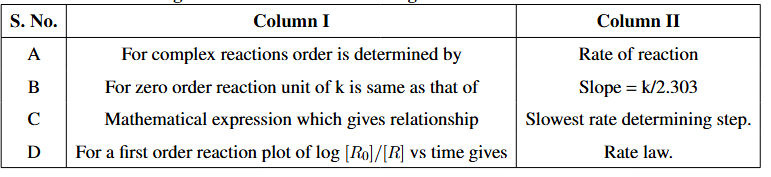
Match the details given in Column I with those given in Column II:
View Solution
Match the items in Column I with their description in Column II:

View Solution
Choose the incorrect statement.
View Solution
The group number of the element in the periodic table with the electronic configuration \((n - 1)d^2 ns^2\). For \(n = 4\) is:
View Solution
Identify the final product formed during the course of the given reactions.

View Solution
Which one of the following will give a positive result when it is warmed with Chloroform and alcoholic solution of KOH?
View Solution
Choose the incorrect statement:
View Solution
What would be the products obtained when a mixture of p-Methoxy benzaldehyde and Methanal are heated with 50% concentrated Caustic soda solution?
View Solution
Which of the following will show geometrical isomerism?
View Solution
Identify the compounds A, B, C, and D.


View Solution
Match the Coordination compounds given in Column I with their characteristic features listed in Column II.
View Solution
Choose the correct order of increasing acidic strength of the following compounds.
View Solution
Mg(OH)\(_2\) is used as an antacid. If a person, suffering from acidity, produces 2.5 L of Gastric juice in a day, approximately how many antacid tablets, each containing 600 mg of Mg(OH)\(_2\), will be required to completely neutralize the whole HCl produced in the stomach in one day? (Gastric juice contains 3.0 g of HCl per L). (Atomic masses: Mg = 24 g/mol, O = 16 g/mol, and H = 1 g/mol.)
View Solution
Given below are graphs showing the variation in velocity constant with temperature on the Kelvin scale. Identify the graph which represents the Arrhenius equation.

View Solution
Given below are graphs showing the variation in velocity constant with temperature on the Kelvin scale. Identify the graph which represents the Arrhenius equation.
View Solution
Identify the correct statement describing the characteristics of \(C_2\) molecule.
View Solution
One among the 4 Vitamins belonging to B Complex, can be stored in our body. Identify the Vitamin.
View Solution
Which one of the following statements is correct?
View Solution
In the given Redox equation, identify the stoichiometric coefficients w, x, y, and z.
The given equation: \[ ClO_3^{-} + wCl^{-} + xH^{+} \rightarrow yH_2O + zCl_2 \]
View Solution
In the following question, Assertion (A) is given followed by a statement of Reason (R). Choose the correct answer.
% Assertion
Assertion (A): \(\pi (2p_{z}), \pi (2p_{y}), \pi^{*} (2p_{z}), \pi^{*} (2p_{y})\) molecular orbitals have one nodal plane each.
% Reason
Reason (R): All the molecular orbitals formed by the sideways overlapping have one nodal plane.
View Solution
Structures of 3 Monosaccharides are given below. Two of them are Anomers. Identify the two Anomers.

View Solution
Which one of the following is an incorrect statement pertaining to the properties of Coordination compounds?
View Solution
X is an electrolyte with a concentration of 0.04M whose formula is of the type X\(_2\)A. Y is a non-electrolyte solution with a concentration of 0.2M and has an osmotic pressure equal to P\(_2\) at room temperature. What is the relationship between the Osmotic pressure \(\pi\) of X and P\(_2\)?
View Solution
Identify the catalyst used in the reaction between iodide and persulphate ions.
View Solution
Find the correct matches of the substances, given in Column I, from their characteristic properties given in Column II.
\begin{array{|c|c|
\hline
S. No. & Column I & S. No. & Column II
\hline
W & T1 & A & \text{Decomposes steam to form its dioxide and dihydrogen gas.
X & CCl_4 & B & \text{Consists of twenty 6-membered rings and twelve 5-membered rings.
Y & Sn & C & \text{+3 oxidation state is highly oxidising.
Z & C_{60 & D & \text{Electron precise species, neither acts as electron donor nor as electron acceptor.
\hline
\end{array
View Solution
- W = T1 (Titanium)
Titanium (\(Ti_1\)) is known to decompose steam to form its oxide and dihydrogen gas. This matches with statement A, so W = C.
- X = CCl₄ (Carbon tetrachloride)
Carbon tetrachloride (\(CCl_4\)) is a tetrahedral molecule consisting of twenty 6-membered rings and twelve 5-membered rings. This matches with statement B, so X = D.
- Y = Sn (Tin)
Tin (\(Sn\)) in its +3 oxidation state is highly oxidizing. This matches with statement C, so Y = A.
- Z = C₆₀ (Buckminsterfullerene) \(C_{60}\), also known as Buckminsterfullerene, is an electron-precise species and does not act as either an electron donor or acceptor. This matches with statement D, so Z = B.
Thus, the correct matching is W = C, X = D, Y = A, Z = B, which corresponds to option A. Quick Tip: The oxidation states of metals and non-metals in compounds can greatly influence their reactivity and stability. For example, in the case of Sn, the +3 oxidation state is highly oxidizing.
A gas taken in a closed vessel is heated from 54°C to 1254°C. The pressure of the gas becomes __________ times its original pressure \( P_1 \).
View Solution
Which one of the following correctly represents the decreasing order of acidic nature of the given carboxylic acids:
[A] 2-Hydroxybenzoic acid
[B] Benzoic acid
[C] 3-Hydroxybenzoic acid
[D] 4-Hydroxybenzoic acid
View Solution
If the depression in freezing point of an aqueous solution containing a solute, which is neither dissociated nor associated, is \(aK\) with \(K_f = b \ K \cdot kg mol^{-1}\), what would be the elevation in boiling point (\(X\)) for this solution if its \(K_b = K \ K \cdot kg mol^{-1}\)?
View Solution
The rate constant for a First order reaction at 560 K is \(1.5 \times 10^{-6}\) per second. If the reaction is allowed to take place for 20 hours, what percentage of the initial concentration would have converted to products?
View Solution
What would be the final product [X] formed when p-Toluene undergoes the following series of reactions?
View Solution
The energy of an electron in the ground state of Hydrogen atom is \(-2.18 \times 10^{-18}\) J. What would be the energy associated with the second excited state of Li\(^+\)?
View Solution
Identify the incorrect statement.
View Solution
Choose the incorrect statement regarding Cellulose.
View Solution
Which one of the following Coordination entities exhibits Facial and Meridional isomerism?
View Solution
Arrange the following in the decreasing order of their Dipole moments.
a. Chlorobenzene
b. 1,2-Dichlorobenzene
c. 1,3-Dichlorobenzene
d. 1,4-Dichlorobenzene
View Solution
The reactions taking place with 2 - Phenyl - 2 - bromopropane as the starting material is shown below. Identify [A] and [B] formed in the reaction.
C\textsubscript{6H\textsubscript{5 - C(Br)C\textsubscript{2H\textsubscript{5 \xrightarrow{\text{KOH Alcoholic [A]
[A] + HBr \(\to\) [B]
View Solution
The reaction taking place in a galvanic cell is as given
A(s) + B\textsuperscript{2+ (11100\textsuperscript{-3M) \(\rightarrow\) B(s) + A\textsuperscript{2+ (0.1M)
The emf of the cell is +2.651 V. If the standard emf of the cell is +2.71 V, what is the value of X?
View Solution
Which one of the following will undergo Nucleophilic substitution, by \(S_N^1\) mechanism, fastest?
View Solution
A man grows into a giant such that his height increases to 8 times his original height. Assuming that his density remains the same, the stress in the leg will change by a factor of
View Solution
The mass number of two nuclei P and Q are 27 and 125 respectively. The ratio of their radii \( R_P : R_Q \) is given by:
View Solution
The current sensitivity of a galvanometer having 20 divisions is \( 10 \mu A / div \). If the resistance of the galvanometer is 100Ω, then the value of the resistance to be used to convert this galvanometer into a voltmeter to read up to 1 V is:
View Solution
In a nuclear reaction, 2 deuteron nuclei combine to form a helium nucleus. The energy released in MeV will be: (Given mass of deuteron = 2.01355 amu and mass of helium nucleus = 4.0028 amu.)
View Solution
Two point charges \( 20 \, \mu C \) and \( -10 \, \mu C \) are separated by a distance of 1 m in air. At what point on the line joining the two charges, the electric potential is zero.
View Solution
The critical angle of a medium having the refractive index \( \sqrt{2} \) is:
View Solution
A spherical metal ball of density \( \rho \) and radius \( r \) is immersed in a liquid of density \( \sigma \). When an electric field is applied in the upward direction the metal ball remains just suspended in the liquid. Then the expression for the charge on the metal ball is:
View Solution
In an adiabatic expansion of air, the volume is increased by 6.2%. The percentage change in pressure is (\( \gamma = 1.4 \))
View Solution
Water from a tap of cross-sectional area \(1 \, cm^2\), falls vertically downwards at \(2 \, m/s\). The cross-sectional area of the stream, 20 cm below the tap is (assume that pressure is constant throughout and the flow is streamlined; \(g = 10 \, m/s^2\)).
View Solution
In the figure, first the capacitors are fully charged by closing the key K. Then after opening the Key, a dielectric material with dielectric constant \( \kappa = 2 \) is filled in the space between the plates of both the capacitors. At this state the ratio of the charge on the capacitor \(C_1\) to that of \(C_2\) is:

View Solution
The energy gap between valence band and the conduction band for a given material is 6 eV. What would be the energy associated with the second excited state of Li?
View Solution
PQRS is square of side 1 m. A charge of \(100 \, \mu C\) is placed at the centre of the square. Then the work done to take \(3 \, \mu C\) charge from the corner P to the corner R.
View Solution
When the angle of incidence on one face of the equilateral glass prism is \(\frac{3}{4}\) of the angle of the prism, the ray of light undergoes minimum deviation. If the velocity of light in vacuum is \(c\), then the velocity of light in the glass is:
View Solution
If the ratio of specific heat of a gas at constant pressure to that at constant volume is \( \gamma \), the change in internal energy of a mass of a gas when the volume changes from \( V \) to 3\( V \) at constant pressure is:
View Solution
A magnetic field does not interact with:
View Solution
A magnetic field does not interact with:
View Solution
If reaction is \(R\) and coefficient of friction is \(\mu\), what is the work done against friction in moving a body by distance \(d\)?
View Solution
The electric flux from a cube of side 1 m is \(\Phi\). When the side of the cube is made 3 m and the charge enclosed by the cube is made one-third of the original value, then the flux from the bigger cube will be:
View Solution
An uniform sphere of mass \( M \) and radius \( R \) exerts a force of \( F \) on a small mass \( m \) placed at a distance of \( 3R \) from the centre of the sphere. A spherical portion of diameter \( R \) is cut from the sphere as shown in the fig. The force of attraction between the remaining part of the disc and the mass \( m \) is:

View Solution
The magnetic permeability \( \mu \) of a paramagnetic substance is:
View Solution
A lens of power \( +1 \, D \) is made in contact with another lens of power \( -2 \, D \). The combination will then act as:
View Solution
A particle at rest decays into two particles of mass \( m_1 \) and \( m_2 \) and move with velocities \( v_1 \) and \( v_2 \). The ratio of their de Broglie wave lengths \( \lambda_1 : \lambda_2 \) is:
View Solution
An electron and a proton having mass \( m_e \) and \( m_p \) respectively, initially at rest, move through the same distance \( s \) in a uniform electric field \( E \). If the time taken by them to cover that distance is \( t_e \) and \( t_p \) respectively, then \( \frac{t_e}{t_p} \) is equal to:
View Solution
220 V ac is more dangerous than 220 V dc. Why?
View Solution
The ground state energy of hydrogen atom is -13.6 eV. If the electron jumps from the 3rd excited state to the ground state, then the energy of the radiation emitted will be:
View Solution
In the Young's double slit experiment the fringe width of the interference pattern is found to be \(3.2 \times 10^{-4}\) m, when the light of wavelength 6400 \(Å\) is used. What will be the change in fringe width if the light is replaced with a light of wavelength 4800 \(Å\)?
View Solution
What will be the change in wave length, if a light of wave length 600 nm travels from air enters a medium of refractive index 1.5 and continues its journey through that medium?
View Solution
A resistor of wire 24 cm length and resistance 8Ω is stretched into a uniform wire of 48 cm length, then the new resistance will be:
View Solution
A metallic rod of 10 cm is rotated with a frequency 100 revolution per second about an axis perpendicular to its length and passing through its one end in a uniform transverse magnetic field of strength 1 T. The emf developed across its ends is:
View Solution
Two open organ pipes A and B of length 22 cm and 22.5 cm respectively produce 2 beats per sec when sounded together. The frequency of the shorter pipe is:
View Solution
The time dependence of a physical quantity \(P\) is given by \[ P = P_0 \exp(-\alpha t^2) \]
where \(\alpha\) is a constant and \(t\) is time. The constant \(\alpha\) will:
View Solution
The molecules of a given mass of a gas have root mean square speed of 120 m/s at 88°C and 1 atmospheric pressure. The root mean square speed of the molecules at 127°C and 2 atmospheric pressure is:
View Solution
The acceleration due to gravity at a height of 7 km above the earth is the same as at a depth \( d \) below the surface of the earth. Then \( d \) is:
View Solution
A tentative explanation of observations without assuming that it is true is called:
View Solution
Find the pole strength of a magnet of length 2 cm, if the magnetic field strength \( B \) at distance 10 cm from the centre of a magnet on the axial line of the magnet is \( 10^{-4} \, T \).
View Solution
In the head-on collision of two alpha particles \( \alpha_1 \) and \( \alpha_2 \) with the gold nucleus, the closest approaches are 31.4 fermi and 94.2 fermi respectively. Then the ratio of the energy possessed by the alpha particles \( \alpha_2 / \alpha_1 \) is:
View Solution
Two black bodies P and Q have equal surface areas and are kept at temperatures \( 127^\circ C \) and \( 27^\circ C \) respectively. The ratio of thermal power radiated by A to that by B is:
View Solution
The SI unit of electrical conductivity is:
View Solution
What should be the inductance of an inductor connected to 200 V, 50 Hz source so that the maximum current of \( \sqrt{2} \, A \) flows through it?
View Solution
The nucleus of a helium atom travels along the inside of a straight hollow tube 4 m long which forms part of a particle accelerator. If one assumes uniform acceleration, how long is the particle in the tube if it enters at a speed of 2000 m/s and leaves at 8000 m/s?
View Solution
In the given circuit the diode \( D_1 \) and \( D_2 \) have the forward resistance 250 \(\Omega\) and infinite backward resistance. When they are connected to the source as shown, the current passing through the 175 \(\Omega\) resistor is:

View Solution
The radius of the current carrying circular coil is doubled keeping the current passing through it the same. Then the ratio of the magnetic field produced at the centre of the coil before the doubling of the radius to the magnetic field after doubling of the radius is:
View Solution
If the resultant of all external forces acting on a system of particles is zero, then from an inertial frame one can surely say that:
View Solution
The reverse current in the semiconductor diode changes from 20 \(\muA\) to 40 \(\muA\) when the reverse potential is changed from 10 V to 15 V, then the reverse resistance of the junction diode will be:
View Solution
A drone is flying due west, a little above the train, with a speed of 10 m/s. A 270 meter long train is moving due east at a speed of 20 m/s. The time taken by the drone to cross the train is:
View Solution
\( F_A, F_B, \) and \( F_C \) are three forces acting at point \( P \) as shown in the figure. The whole system is in equilibrium state. The magnitude of \( F_A \) is:

View Solution
A wheel is free to rotate about a horizontal axis through \( O \). A force of 200 N is applied at a point \( P_2 \) from the center \( O \). \( OP \) makes an angle of 55° with the \( x \)-axis and the force is in the plane of the wheel making an angle of 25° with the horizontal axis. What is the torque?
View Solution
A hockey player hits the ball at an angle of 37° from the horizontal with an initial speed of 40 m/s (a right-angled triangle with one of the angles being 37° and their sides in the ratio of 6 : 8 : 10). Assume that the ball is in a vertical plane. The time at which the ball reaches the highest point of its path is:
View Solution
What feature of the infrared waves make it useful for the haze photography?
View Solution
A spring of force constant \( k \) is cut into lengths of ratio \( 1 : 3 : 4 \). They are connected in series and the new force constant is \( k' \). Then they are connected in parallel and force constant is \( k'' \). Then \( k' : k'' \) is:
View Solution
A light having wavelength 6400 \( \AA \) is incident normally on a slit of width 2 mm. Then the linear width of the central maximum on the screen kept 2 m from the slit is:
View Solution
Which of the following statement is true when a gamma decay occurs from the nucleus of an atom?
View Solution
The current passing through the 100\(\Omega\) resistor in the given electrical circuit is:

View Solution
The force between two electric point charges at rest in air is \( F_1 \). When the same arrangement is kept inside water, the force between them is \( F_2 \). Which of the following statement is correct?
View Solution
A neutron makes a head-on elastic collision with a lead nucleus. The ratio of nuclear mass to neutron mass is 206. The fractional change in kinetic energy of a neutron is:
View Solution
A battery is made of 12 cells having emf 5 V each. If three cells are unknowingly connected wrong, the resultant emf of the battery will be:
View Solution
A circular loop of area 0.04 m\(^2\) carrying a current of 10 A is held with its plane perpendicular to a magnetic field induction of 0.4 T. Then the torque acting on the circular loop is:
View Solution
In the photoelectric experiment, the frequency of the incident radiation is doubled. What will be its effect on the photoelectric current?
View Solution
One volt induced emf is produced in the secondary coil when the current through the primary coil is changed from 3 A to 1 A in 100 milliseconds. The mutual inductance of the two coils is:
View Solution
The current drawn by the primary coil of an ideal transformer, which steps up 22 V into 220 V, to operate a device having a load resistance of 110 \(\Omega\) is:
View Solution





Comments