




The SNAP 2006 Question Paper is now available for download with answer key and detailed solutions PDF. SNAP is conducted as a computer‑based test and divided into three sections: General English, Quantitative, Data Interpretation & Logical Reasoning. There is no sectional time limit, and each correct answer is awarded one mark, while each incorrect answer incurs a penalty of 0.25 marks.
SNAP 2006 Question Paper with Solutions PDF
| SNAP 2006 Question Paper | Download PDF | Check Solutions |

SNAP 2006 Questions with Solutions
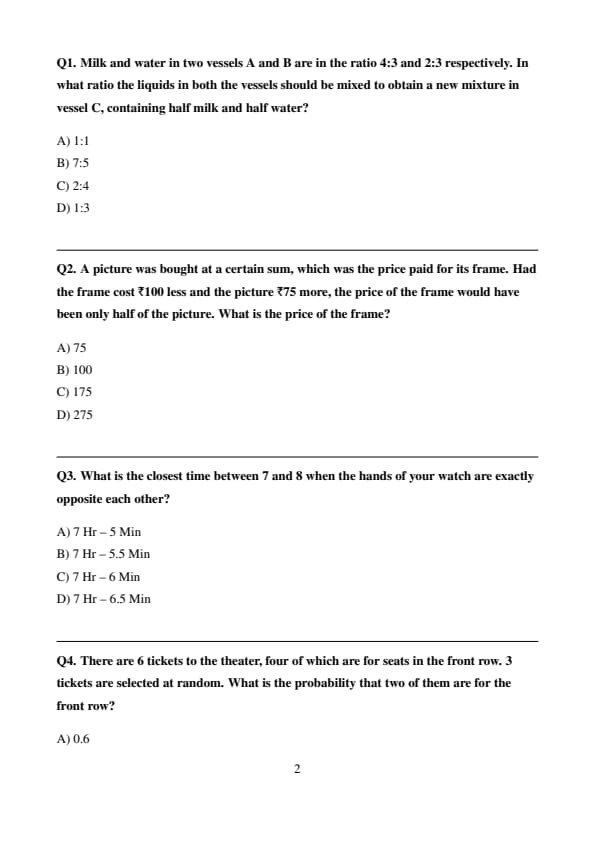
Milk and water in two vessels A and B are in the ratio 4:3 and 2:3 respectively. In what ratio the liquids in both the vessels should be mixed to obtain a new mixture in vessel C, containing half milk and half water?
View Solution
A picture was bought at a certain sum, which was the price paid for its frame. Had the frame cost Rs. 100 less and the picture Rs. 75 more, the price of the frame would have been only half of the picture. What is the price of the frame?
View Solution
What is the closest time between 7 and 8 when the hands of your watch are exactly opposite each other?
View Solution
There are 6 tickets to the theater, four of which are for seats in the front row. 3 tickets are selected at random. What is the probability that two of them are for the front row?
View Solution
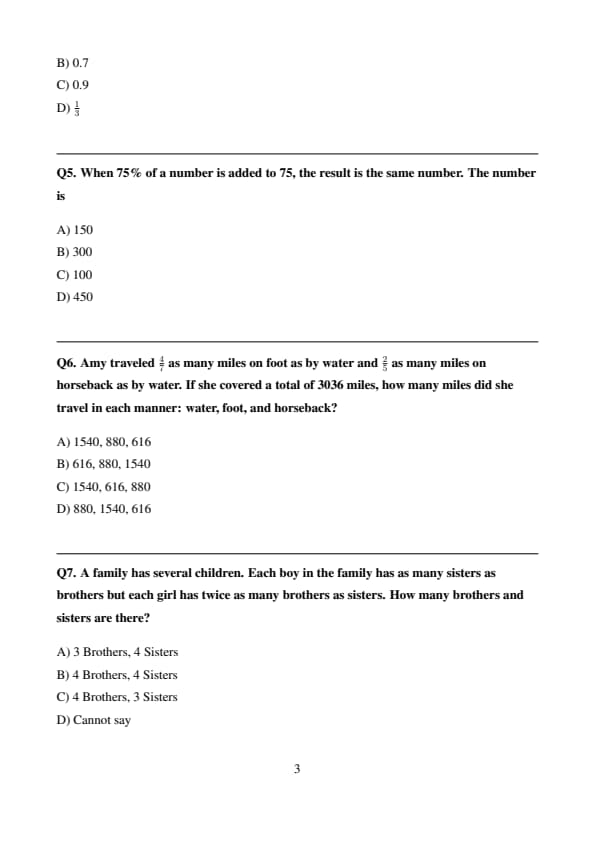
When 75% of a number is added to 75, the result is the same number. The number is
View Solution
Amy traveled \(\tfrac{4}{7}\) as many miles on foot as by water and \(\tfrac{2}{5}\) as many miles on horseback as by water. If she covered a total of 3036 miles, how many miles did she travel in each manner: water, foot, and horseback?
View Solution
A family has several children. Each boy in the family has as many sisters as brothers but each girl has twice as many brothers as sisters. How many brothers and sisters are there?
View Solution
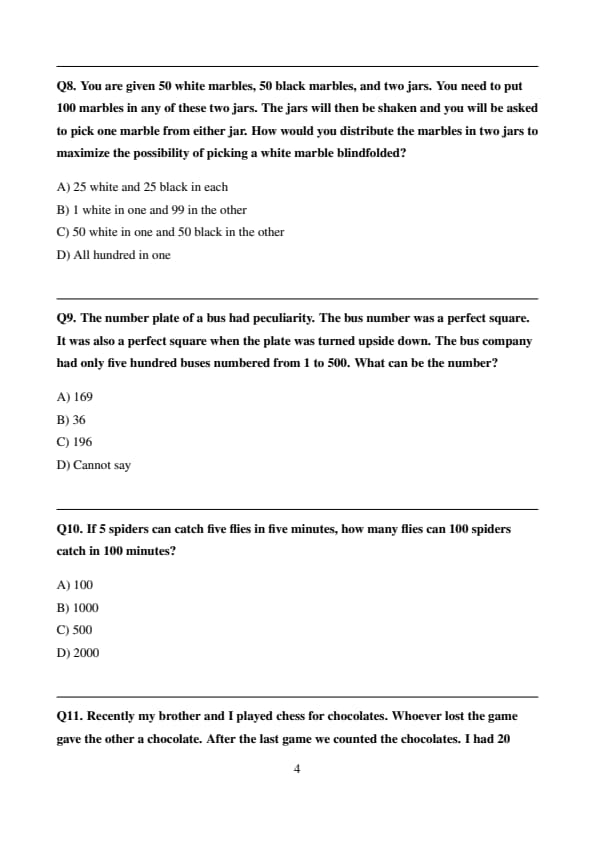
You are given 50 white marbles, 50 black marbles, and two jars. You need to put 100 marbles in any of these two jars. The jars will then be shaken and you will be asked to pick one marble from either jar. How would you distribute the marbles in two jars to maximize the possibility of picking a white marble blindfolded?
View Solution
The number plate of a bus had peculiarity. The bus number was a perfect square. It was also a perfect square when the plate was turned upside down. The bus company had only five hundred buses numbered from 1 to 500. What can be the number?
View Solution
If 5 spiders can catch five flies in five minutes, how many flies can 100 spiders catch in 100 minutes?
View Solution
Recently my brother and I played chess for chocolates. Whoever lost the game gave the other a chocolate. After the last game we counted the chocolates. I had 20 more chocolates than I started with, although he won 7 games. There is no draw. How many games did we play?
View Solution
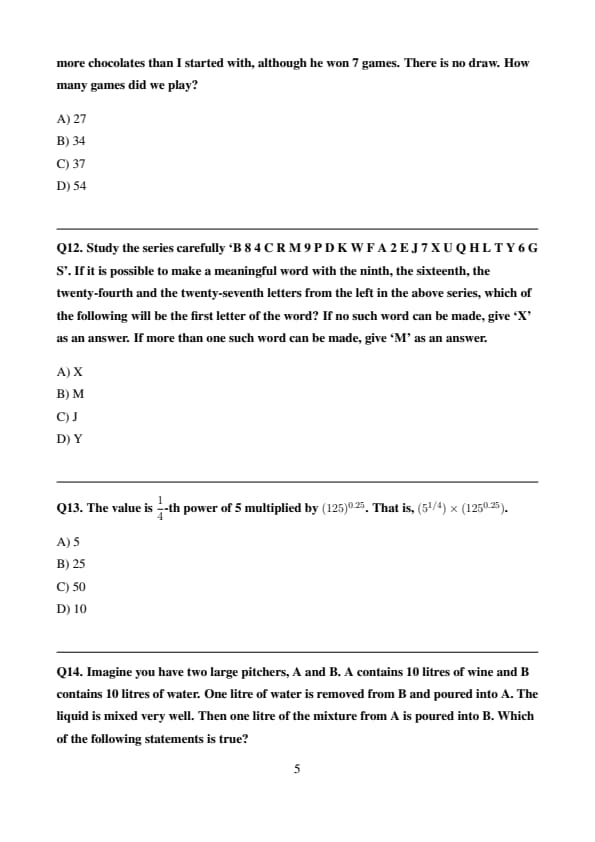
Study the series carefully ‘B 8 4 C R M 9 P D K W F A 2 E J 7 X U Q H L T Y 6 G S’. If it is possible to make a meaningful word with the ninth, the sixteenth, the twenty-fourth and the twenty-seventh letters from the left in the above series, which of the following will be the first letter of the word? If no such word can be made, give ‘X’ as an answer. If more than one such word can be made, give ‘M’ as an answer.
View Solution
The value is \(\dfrac{1}{4}\)-th power of 5 multiplied by \((125)^{0.25}\). That is, \((5^{1/4}) \times (125^{0.25})\).
View Solution
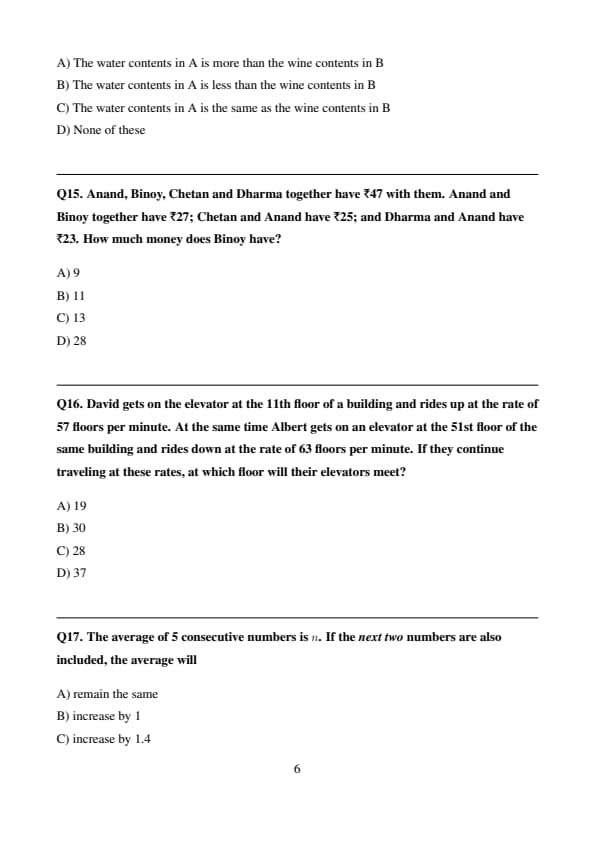
Imagine you have two large pitchers, A and B. A contains 10 litres of wine and B contains 10 litres of water. One litre of water is removed from B and poured into A. The liquid is mixed very well. Then one litre of the mixture from A is poured into B. Which of the following statements is true?
View Solution
Anand, Binoy, Chetan and Dharma together have Rs. 47 with them. Anand and Binoy together have Rs. 27; Chetan and Anand have Rs. 25; and Dharma and Anand have Rs. 23. How much money does Binoy have?
View Solution
David gets on the elevator at the 11th floor of a building and rides up at the rate of 57 floors per minute. At the same time Albert gets on an elevator at the 51st floor of the same building and rides down at the rate of 63 floors per minute. If they continue traveling at these rates, at which floor will their elevators meet?
View Solution
The average of 5 consecutive numbers is \(n\). If the next two numbers are also included, the average will
View Solution
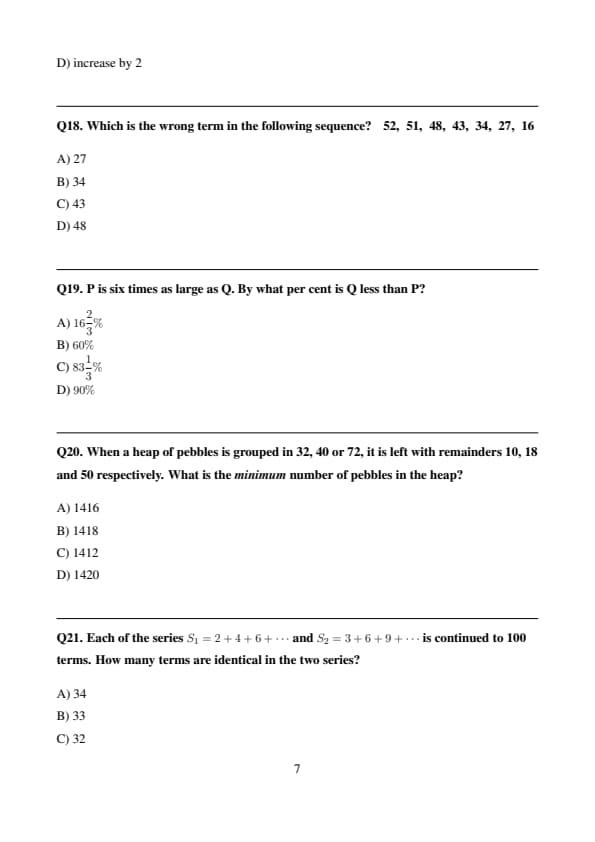
Which is the wrong term in the following sequence? 52, 51, 48, 43, 34, 27, 16
View Solution
P is six times as large as Q. By what per cent is Q less than P?
View Solution
When a heap of pebbles is grouped in 32, 40 or 72, it is left with remainders 10, 18 and 50 respectively. What is the minimum number of pebbles in the heap?
View Solution
Each of the series \(S_1=2+4+6+\cdots\) and \(S_2=3+6+9+\cdots\) is continued to 100 terms. How many terms are identical in the two series?
View Solution
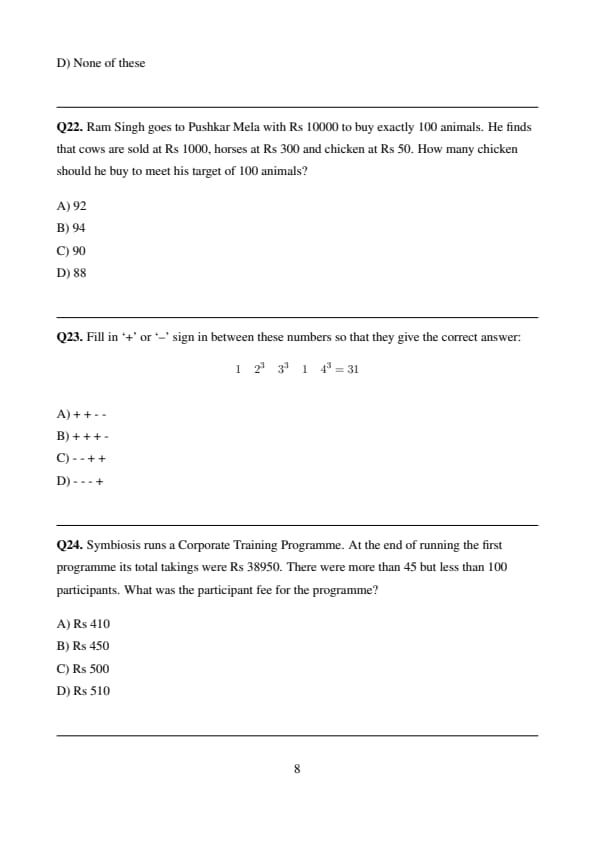
Ram Singh goes to Pushkar Mela with Rs 10000 to buy exactly 100 animals. He finds that cows are sold at Rs 1000, horses at Rs 300 and chicken at Rs 50. How many chicken should he buy to meet his target of 100 animals?
View Solution
Fill in ‘+’ or ‘–’ sign in between these numbers so that they give the correct answer: \[ 1 \quad 2^3 \quad 3^3 \quad 1 \quad 4^3 = 31 \]
View Solution
Symbiosis runs a Corporate Training Programme. At the end of running the first programme its total takings were Rs 38950. There were more than 45 but less than 100 participants. What was the participant fee for the programme?
View Solution
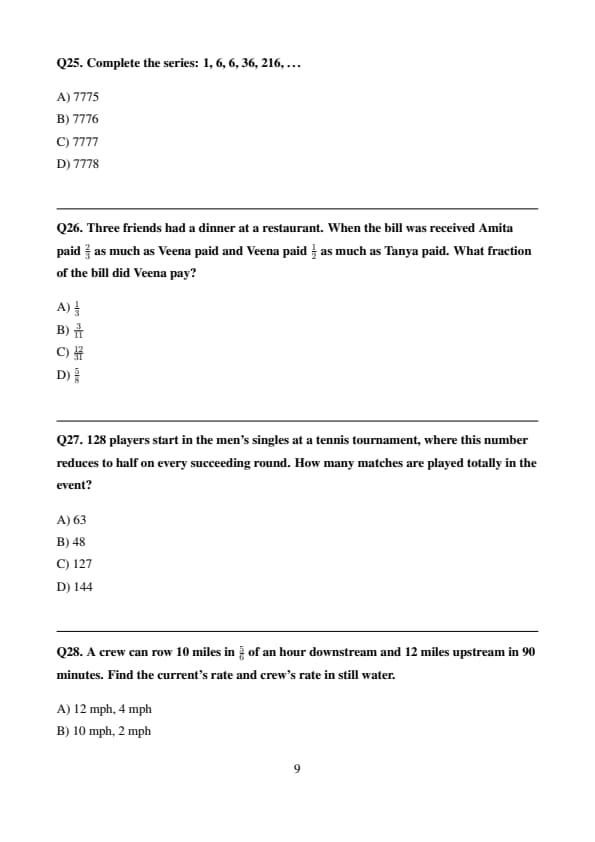
Complete the series: 1, 6, 6, 36, 216, \ldots
View Solution
Three friends had a dinner at a restaurant. When the bill was received Amita paid \(\tfrac{2}{3}\) as much as Veena paid and Veena paid \(\tfrac{1}{2}\) as much as Tanya paid. What fraction of the bill did Veena pay?
View Solution
128 players start in the men's singles at a tennis tournament, where this number reduces to half on every succeeding round. How many matches are played totally in the event?
View Solution
A crew can row 10 miles in \(\tfrac{5}{6}\) of an hour downstream and 12 miles upstream in 90 minutes. Find the current's rate and crew's rate in still water.
View Solution
If Swamy has two children and he truthfully answers yes to the question "Is at least one of your children a girl?" what is the probability that both his children are girls?
View Solution
Starting from his house one day, a student walks at a speed of \(2\tfrac{1}{2}\) kmph and reaches his school 6 minutes late. Next day he increases his speed by 1 kmph and reaches his school 6 minutes early. How far is the school from the house?
View Solution
What year comes next in the sequence 1973, 1979, 1987, 1993, 1997, 1999, \ldots ?
View Solution
The numbers of students studying Physics, Chemistry and Zoology in a college were in the ratio \(4:3:5\). If the numbers in these disciplines increased by \(50%\), \(25%\) and \(10%\) respectively in the next year, what is the new respective ratio?
View Solution
A man earns Rs. 20 on the first day and spends Rs. 15 on the next day. He again earns Rs. 20 on the third day and spends Rs. 15 on the fourth day, and so on. If he continues like this, how soon will he have Rs. 60 in hand?
View Solution
A game of football with 11 players lasts exactly 90 minutes. There are four substitutes that alternate equally. If each player plays for the same length of time, what is the duration?
View Solution
A, B and C start a business each investing Rs. 20,000. After 5 months A withdrew Rs. 5,000, B withdrew Rs. 4,000 and C invested Rs. 6,000 more. At the end of the year the total profit is Rs. 69,900. What is B’s share of profit?
View Solution
The current birth rate is 32 per thousand and the death rate is 11 per thousand. What is the population growth rate (in %)?
View Solution
A difference between two numbers is 1365. When the larger number is divided by the smaller one, the quotient is 6 and the remainder is 15. What is the smaller number?
View Solution
Two vertical poles are 40 metres apart and the height of one is double that of the other. From the middle point of the line joining their feet, an observer finds the angular elevations of their tops to be complementary. Find their heights.
View Solution
Meera and Sameera start moving from the same point. Meera goes 4 km west followed by 3 km north. Sameera goes 4 km east and then takes a right turn and goes 3 km. What is the shortest distance between them?
View Solution
A boy was asked to multiply a certain number by 53. He multiplied it by 35 and got his answer less than the correct one by 1206. Find the number to be multiplied.
View Solution
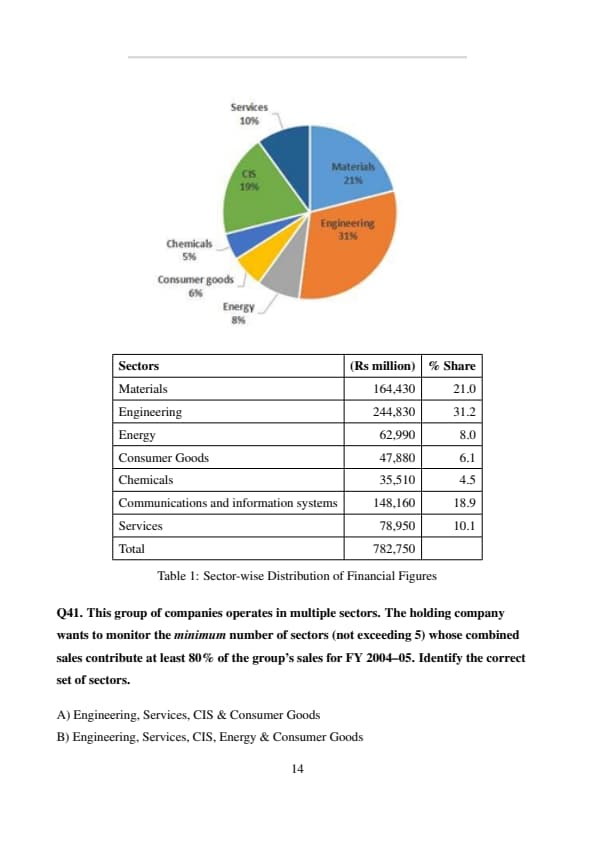
Study the sector wise sales of a group of companies for the financial year 2004 - 2005 and answer the following questions.
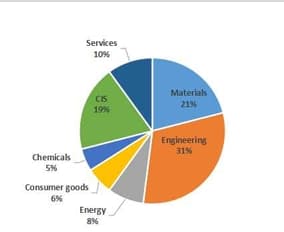
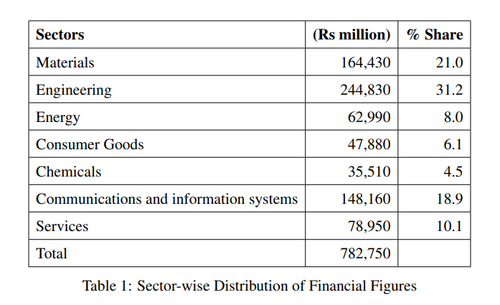
Question 41:
This group of companies operates in multiple sectors. The holding company wants to monitor the minimum number of sectors (not exceeding 5) whose combined sales contribute at least 80% of the group’s sales for FY 2004–05. Identify the correct set of sectors.
View Solution
The overall average profit margin across all sectors is \(10%\). Engineering’s margin is \(12%\) and CIS’s margin is \(20%\). What is the average profit margin across the remaining sectors?
View Solution
The mean temperature of Monday to Wednesday was 37◦C and of Tuesday to Thursday was 34◦C. What was the temperature on Thursday?
Statements:
I. The temperature on Thursday was \(\tfrac{4}{5}\) that of Monday.
II. The mean temperature of Monday and Thursday was 40.5◦C.
III. The difference between the temperature on Monday and that on Thursday was 9◦C.
View Solution
What will be the sum of two numbers?
Statements:
I. Among the two numbers, the bigger number is greater than the smaller number by 6.
II. \(40%\) of the smaller number equals \(30%\) of the bigger number.
III. The ratio of half of the bigger number to one third of the smaller number is \(2:1\).
View Solution
A tank is fitted with two taps A and B. In how much time will the tank be full if both taps are opened together?
Statements:
I. A is 50% more efficient than B.
II. A alone takes 16 hours to fill the tank.
III. B alone takes 24 hours to fill the tank.
View Solution
What is the principal sum?
Statements:
I. The interest amount after 30 months is half the interest amount after 5 years.
II. The sum amounts to Rs. 750 in five years at simple interest.
III. The rate of interest is \(8%\) p.a.
View Solution
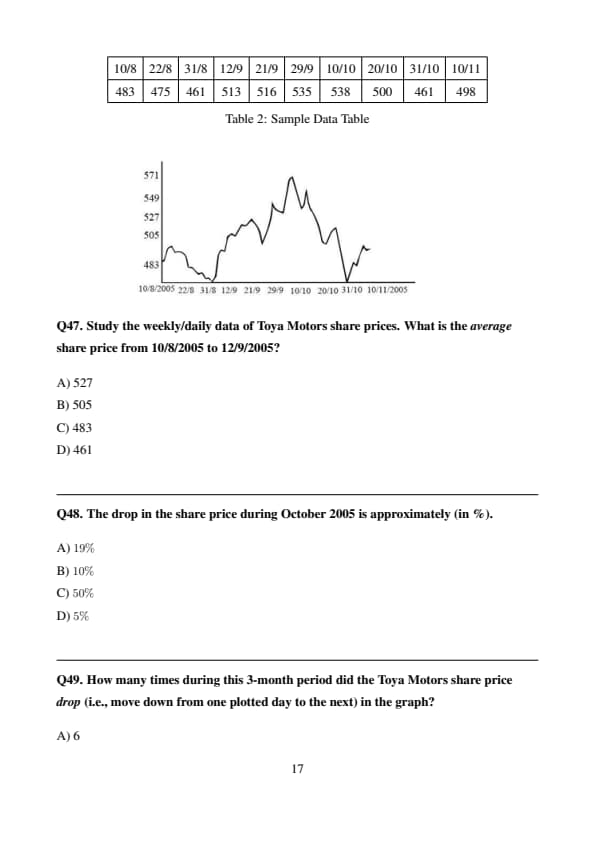
Study the weekly data table and daily data graph for Toya Motors share prices at the National Stock Exchange and answer the following questions. Toya Motors NSE Share prices for 3 months.
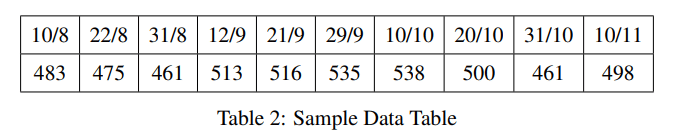
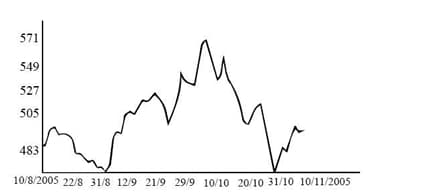
Question 47:
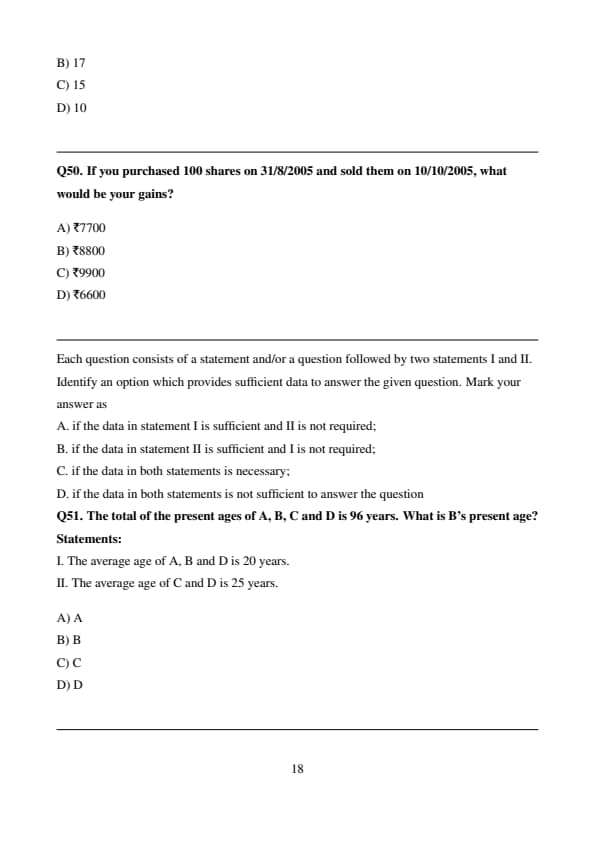
Study the weekly/daily data of Toya Motors share prices. What is the average share price from 10/8/2005 to 12/9/2005?
View Solution
The drop in the share price during October 2005 is approximately (in %).
View Solution
How many times during this 3-month period did the Toya Motors share price drop (i.e., move down from one plotted day to the next) in the graph?
View Solution
If you purchased 100 shares on 31/8/2005 and sold them on 10/10/2005, what would be your gains?
View Solution
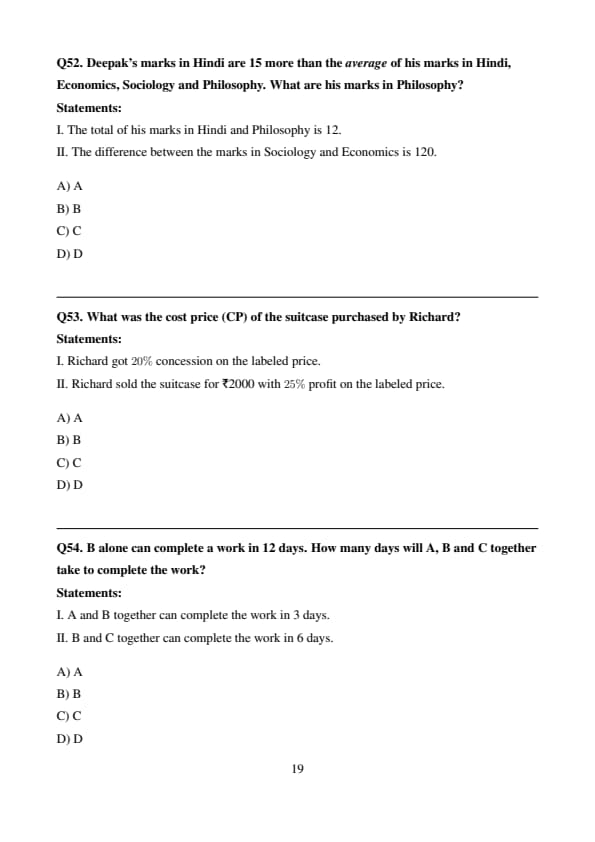
The total of the present ages of A, B, C and D is 96 years. What is B's present age?
Statements:
I. The average age of A, B and D is 20 years.
II. The average age of C and D is 25 years.
View Solution
Deepak's marks in Hindi are 15 more than the average of his marks in Hindi, Economics, Sociology and Philosophy. What are his marks in Philosophy?
Statements:
I. The total of his marks in Hindi and Philosophy is 12.
II. The difference between the marks in Sociology and Economics is 120.
View Solution
What was the cost price (CP) of the suitcase purchased by Richard?
Statements:
I. Richard got \(20%\) concession on the labeled price.
II. Richard sold the suitcase for Rs. 2000 with \(25%\) profit on the labeled price.
View Solution
B alone can complete a work in 12 days. How many days will A, B and C together take to complete the work?
Statements:
I. A and B together can complete the work in 3 days.
II. B and C together can complete the work in 6 days.
View Solution
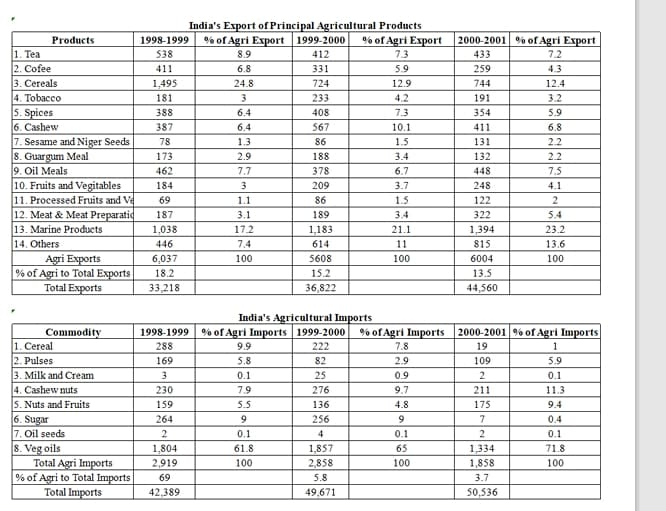
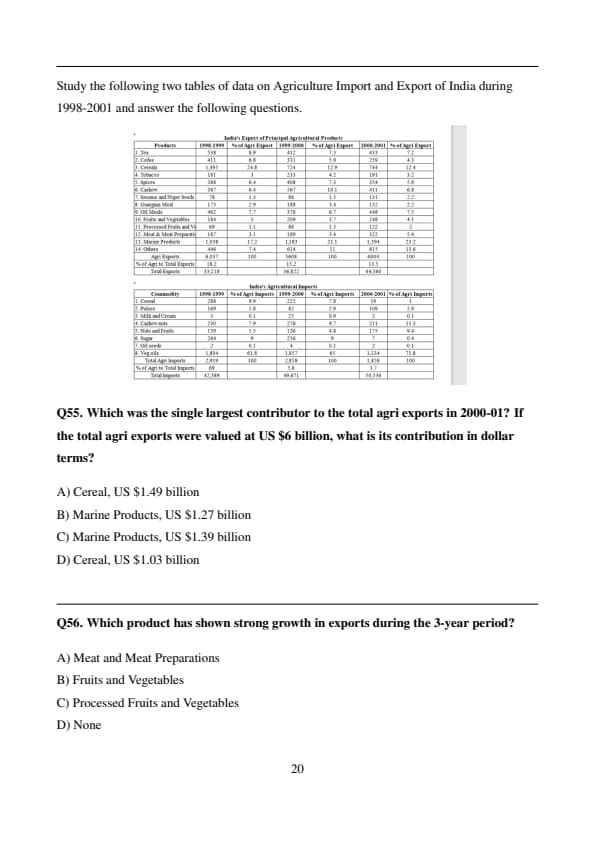
Study the following two tables of data on Agriculture Import and Export of India during 1998-2001 and answer the following questions.
Question 55:
Which was the single largest contributor to the total agri exports in 2000-01? If the total agri exports were valued at US
(6 billion, what is its contribution in dollar terms?
Which product has shown strong growth in exports during the 3-year period?
View Solution
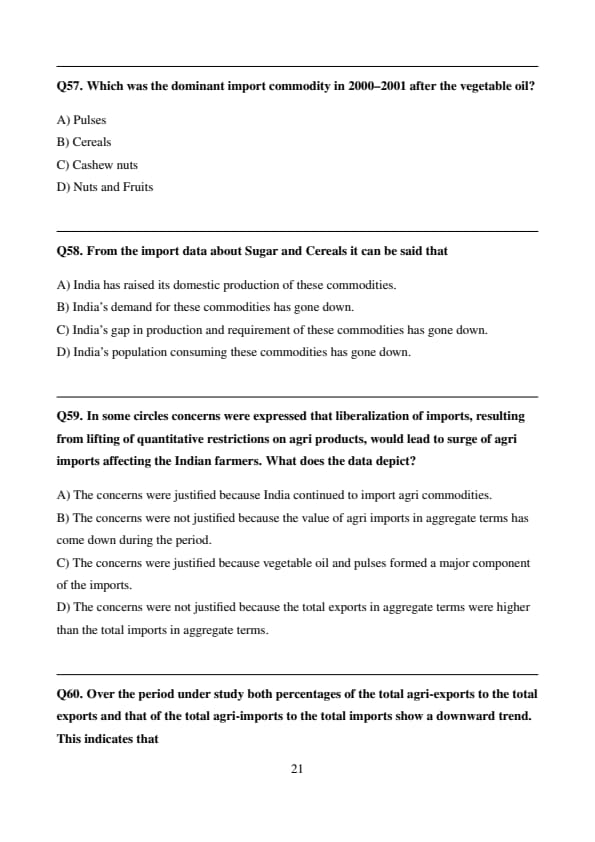
Which was the dominant import commodity in 2000–2001 after the vegetable oil?
View Solution
From the import data about Sugar and Cereals it can be said that
View Solution
In some circles concerns were expressed that liberalization of imports, resulting from lifting of quantitative restrictions on agri products, would lead to surge of agri imports affecting the Indian farmers. What does the data depict?
View Solution
Over the period under study both percentages of the total agri-exports to the total exports and that of the total agri-imports to the total imports show a downward trend. This indicates that
View Solution
Nalini, her brother, her daughter and her son are tennis players and are playing a game of doubles. Their positions on the court are as follows: Nalini's brother is directly across the net from her daughter. Her son is diagonally across the net from the worst player's sibling. The best player and the worst player are on the same side of the net. Who is the best player?
View Solution
In a certain code language ‘PROMOTION’ is written as ‘QSP89’. How will you write ‘DEMOTION’?
View Solution
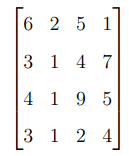
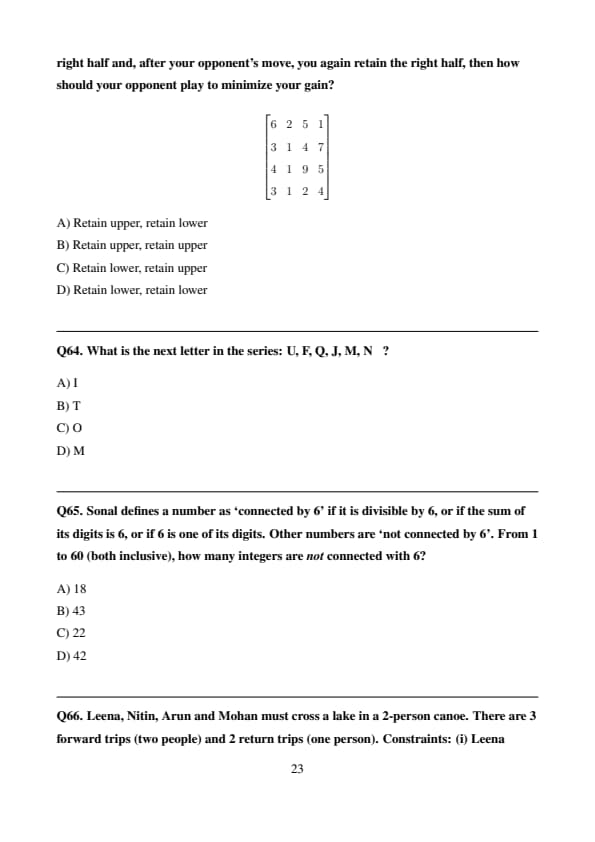
Study this matrix. In this game there are two players. The first player can split the matrix vertically into two equal halves and choose one half for further play. The next move on this half is by the other player who will split it only horizontally and choose one half for further play. The game continues likewise (vertical by Player–1, horizontal by Player–2). The last number left is Player–1’s gain. If you start, retain the right half and, after your opponent’s move, you again retain the right half, then how should your opponent play to minimize your gain?
View Solution
What is the next letter in the series: U, F, Q, J, M, N \; ?
View Solution
Sonal defines a number as ‘connected by 6’ if it is divisible by 6, or if the sum of its digits is 6, or if 6 is one of its digits. Other numbers are ‘not connected by 6’. From 1 to 60 (both inclusive), how many integers are not connected with 6?
View Solution
Leena, Nitin, Arun and Mohan must cross a lake in a 2-person canoe. There are 3 forward trips (two people) and 2 return trips (one person). Constraints:
View Solution
A, B, C, D, E, F and G are the members of a family consisting of 4 adults and 3 children, two of whom, F and G are girls. A and D are brothers and A is a doctor. E is an engineer married to one of the brothers and has two children. B is married to D and G is their child. Who is C?
View Solution
If every alternative letter of the English alphabet from B onwards (including (B) is written in lower case and the remaining letters are capitalized, how will the first month of the second half of the year be written?
View Solution
A rich merchant says: “If I divide my gold coins into two unequal numbers, then 48 times the difference between them equals the difference of their squares.” How many coins does he have?
View Solution
An enterprising businessman earns an income of Rs. 1 on the first day of his business. On every subsequent day, he earns an income which is just double of that made on the previous day. On the 10th day of business, his income is
View Solution
Three boys steal a basket of apples (fewer than 100). In the night each boy wakes up in turn. Each time, he finds that if he first takes one apple for himself, the remaining can be divided into three equal parts. He then takes one apple and bags one–third of the rest, hides them, and goes back to sleep. All three boys do this in sequence. In the morning the remaining apples again total “1 more than a multiple of 3”. How many apples did they steal?
View Solution
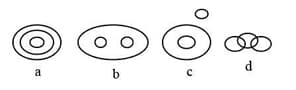
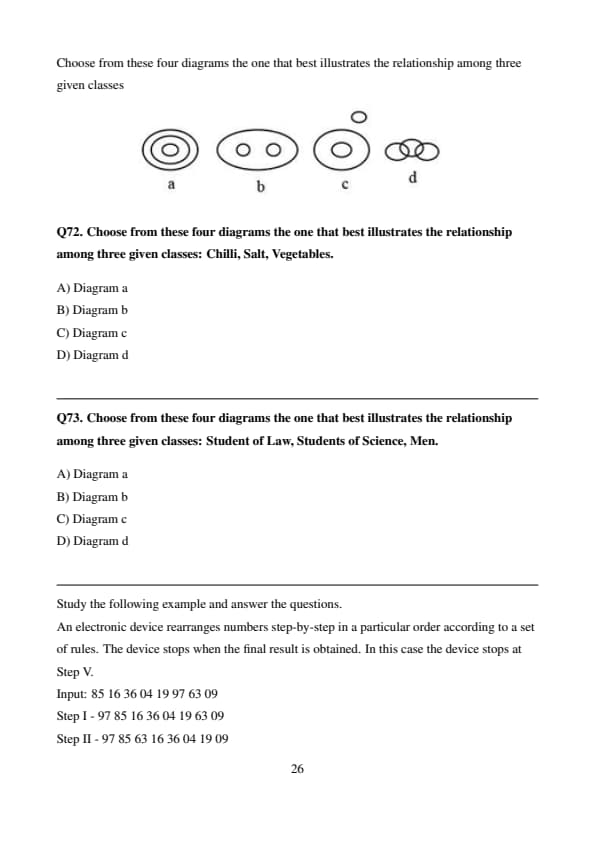
Choose from these four diagrams the one that best illustrates the relationship among three given classes
Question 72:
Choose from these four diagrams the one that best illustrates the relationship among three given classes: Chilli, Salt, Vegetables.
View Solution
Choose from these four diagrams the one that best illustrates the relationship among three given classes: Student of Law, Students of Science, Men.
View Solution
Study the device rule from the example and determine Step III for the input below.
Input: 09 25 16 30 32 18 17 06
View Solution
What is the last step for the input below under the same device rule?
Input: 16 09 25 27 06 05
View Solution
What is the output of Step V for the input below?
Input: \; 25 \; 08 \; 35 \; 11 \; 88 \; 67 \; 23
View Solution
Which one of the following would be last step for the input below?
Input: 03 31 43 22 11 09
View Solution
If the output of Step IV is as given below, what was the input?
Step IV: 92 86 71 69 15 19 06 63 58
View Solution
Read the following information and answer the question.
P \# Q means P is the father of Q; \quad
P + Q means P is the mother of Q; \quad
P - Q means P is the brother of Q; \quad
P * Q means P is the sister of Q.
If \(\;A + B \; \# \; C - D\), then A is D's ___ ?
View Solution
Which of the following shows that A is the Aunt of E?
(Use the same code: \# = father, \(+\) = mother, \(-\) = brother, \(*\) = sister.)
View Solution
Read the following passage and answer (c) how climatic changes led to the founding of the earliest the 7 questions following the same.
As the climate in the Middle East changed beginning around 7000 B.C.E., conditions emerged that were conducive to a more complex and advanced form Question of civilization in both Egypt and Mesopotamia. The process began when the swampy valleys of the Nile in Egypt and of the Tigris and Euphrates Rivers in Mesopotamia became driver, producing reverine lands that were both habitable and fertile, and attracting settlers armed with the newly developed techniques of agriculture. This migration was further encouraged by the gradual transformation of the once-hospitable grasslands of these regions into deserts. Human population became increasingly concentrated into pockets of settlement scattered along the banks of the great rivers.
These rivers profoundly shaped the way of life along their banks. In Mesopotamia, the management of water in conditions of unpredictable drought, flood and storm became the central economic and social challenge. Villagers began early to build simple earthworks, dikes, canals, and ditches to control the waters and reduce the opposing dangers of drought during the dry season (usually the spring) and flooding at harvest time.
Such efforts required a degree of cooperation among large numbers of people that had not previously existed. The individual village, containing only a dozen or so houses and families, was economically vulnerable; but when several villages, probably under the direction of a council of elders, learned to share their human resources in the building of a coordinated network of water-control systems, the safety, stability, and prosperity of all improved. In this new cooperation, the seeds of the great Mesopotamian civilizations were being sown.
Technological and mathematical invention, too, were stimulated by life along rivers. Such devices as the noria (a primitive waterwheel) and the Archimedean screw (a device for raising water from the low riverbanks to the high ground where it was needed), two forerunners of many more varied and complex machines, were first developed here for use in irrigation systems. Similarly, the earliest methods of measurement and computation and the first developments in geometry were stimulated by the need to keep track of land holdings and boundaries in fields that were periodically inundated.
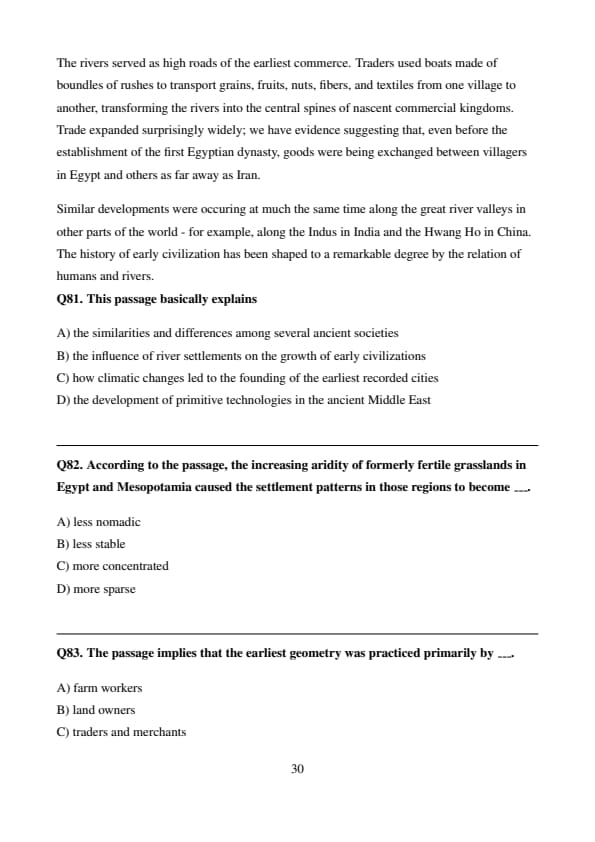
The rivers served as high roads of the earliest commerce. Traders used boats made of boundles of rushes to transport grains, fruits, nuts, fibers, and textiles from one village to another, transforming the rivers into the central spines of nascent commercial kingdoms. Trade expanded surprisingly widely; we have evidence suggesting that, even before the establishment of the first Egyptian dynasty, goods were being exchanged between villagers in Egypt and others as far away as Iran.
Similar developments were occuring at much the same time along the great river valleys in other parts of the world - for example, along the Indus in India and the Hwang Ho in China. The history of early civilization has been shaped to a remarkable degree by the relation of humans and rivers.
Question 81:
This passage basically explains
View Solution
According to the passage, the increasing aridity of formerly fertile grasslands in Egypt and Mesopotamia caused the settlement patterns in those regions to become ___.
View Solution
The passage implies that the earliest geometry was practiced primarily by ___.
View Solution
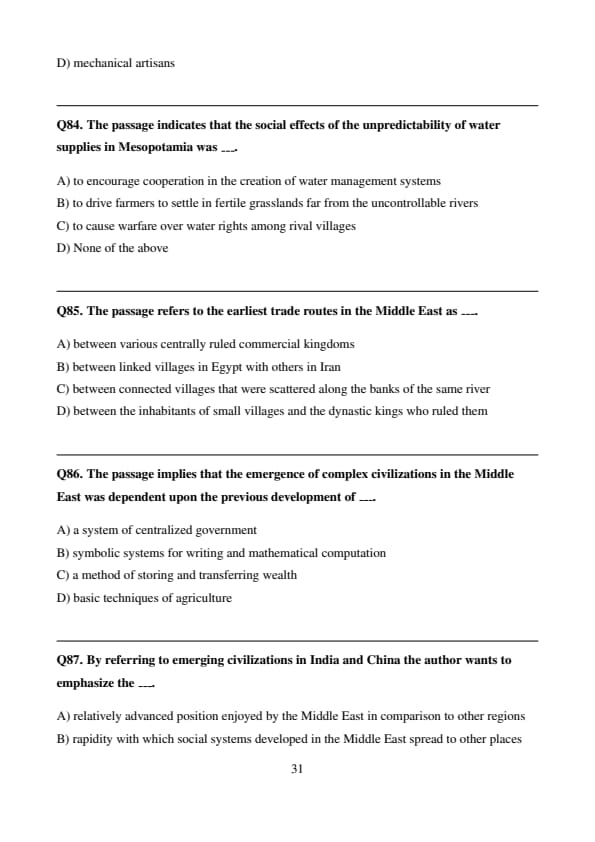
The passage indicates that the social effects of the unpredictability of water supplies in Mesopotamia was ___.
View Solution
The passage refers to the earliest trade routes in the Middle East as ___.
View Solution
The passage implies that the emergence of complex civilizations in the Middle East was dependent upon the previous development of ___.
View Solution
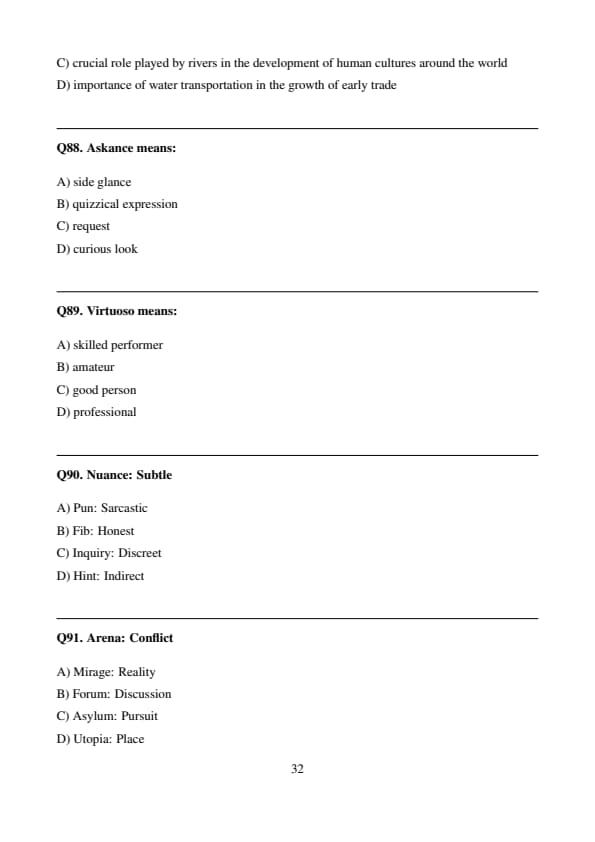
By referring to emerging civilizations in India and China the author wants to emphasize the ___.
View Solution
Askance means:
View Solution
Virtuoso means:
View Solution
Nuance: Subtle
View Solution
Arena: Conflict
View Solution
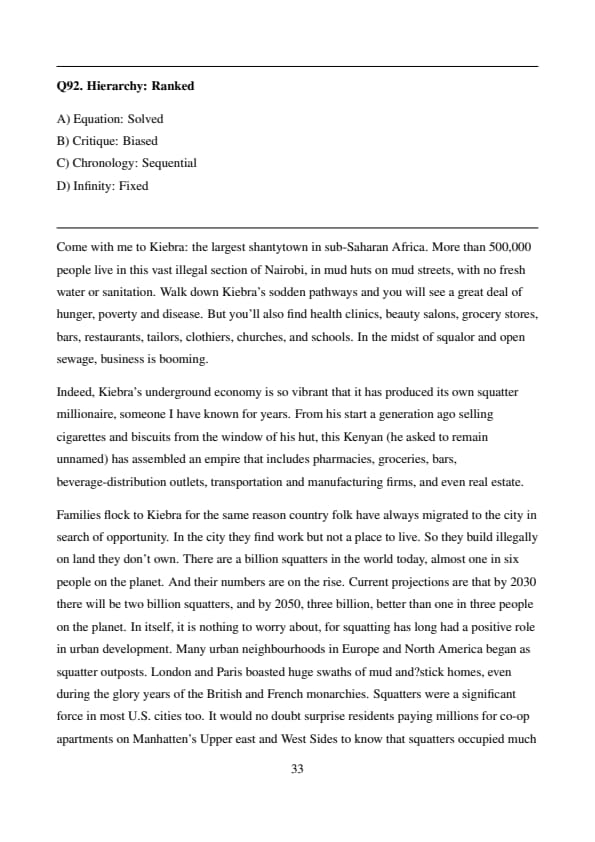
Hierarchy: Ranked
View Solution
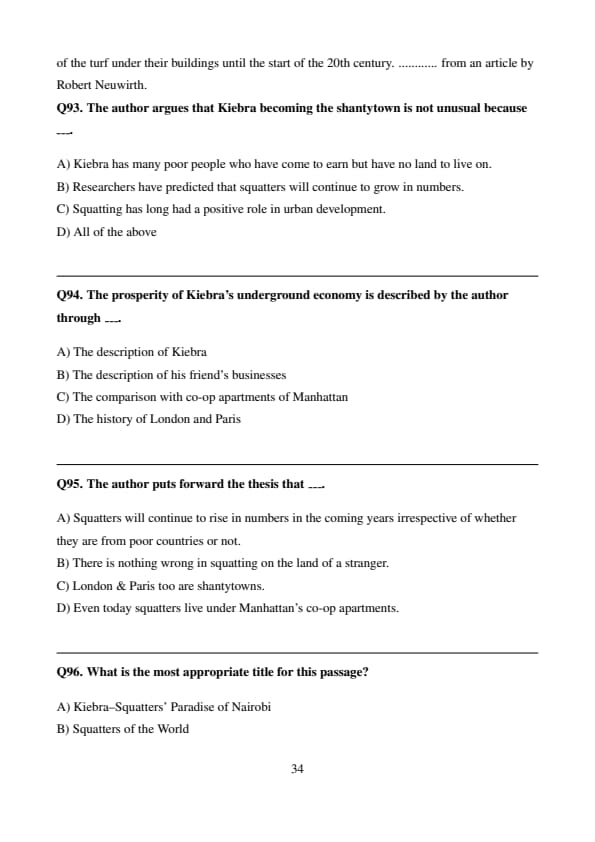
Come with me to Kiebra: the largest shantytown in sub-Saharan Africa. More than 500,000 people live in this vast illegal section of Nairobi, in mud huts on mud streets, with no fresh water or sanitation. Walk down Kiebra’s sodden pathways and you will see a great deal of hunger, poverty and disease. But you’ll also find health clinics, beauty salons, grocery stores, bars, restaurants, tailors, clothiers, churches, and schools. In the midst of squalor and open sewage, business is booming.
Indeed, Kiebra’s underground economy is so vibrant that it has produced its own squatter millionaire, someone I have known for years. From his start a generation ago selling cigarettes and biscuits from the window of his hut, this Kenyan (he asked to remain unnamed) has assembled an empire that includes pharmacies, groceries, bars, beverage-distribution outlets, transportation and manufacturing firms, and even real estate.
Families flock to Kiebra for the same reason country folk have always migrated to the city in search of opportunity. In the city they find work but not a place to live. So they build illegally on land they don’t own. There are a billion squatters in the world today, almost one in six people on the planet. And their numbers are on the rise. Current projections are that by 2030 there will be two billion squatters, and by 2050, three billion, better than one in three people on the planet. In itself, it is nothing to worry about, for squatting has long had a positive role in urban development. Many urban neighbourhoods in Europe and North America began as squatter outposts. London and Paris boasted huge swaths of mud and?stick homes, even during the glory years of the British and French monarchies. Squatters were a significant force in most U.S. cities too. It would no doubt surprise residents paying millions for co-op apartments on Manhatten’s Upper east and West Sides to know that squatters occupied much of the turf under their buildings until the start of the 20th century. ............ from an article by Robert Neuwirth.
Question 93:
The author argues that Kiebra becoming the shantytown is not unusual because ___.
View Solution
The prosperity of Kiebra's underground economy is described by the author through ___.
View Solution
The author puts forward the thesis that ___.
View Solution
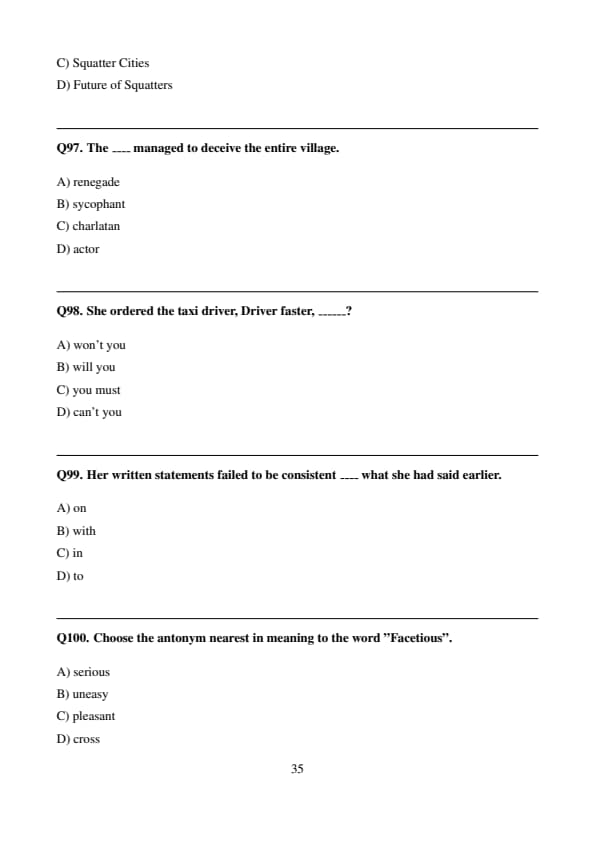
What is the most appropriate title for this passage?
View Solution
The ____ managed to deceive the entire village.
View Solution
She ordered the taxi driver, Driver faster, ______?
View Solution
Her written statements failed to be consistent ____ what she had said earlier.
View Solution
Choose the antonym nearest in meaning to the word "Facetious".
View Solution
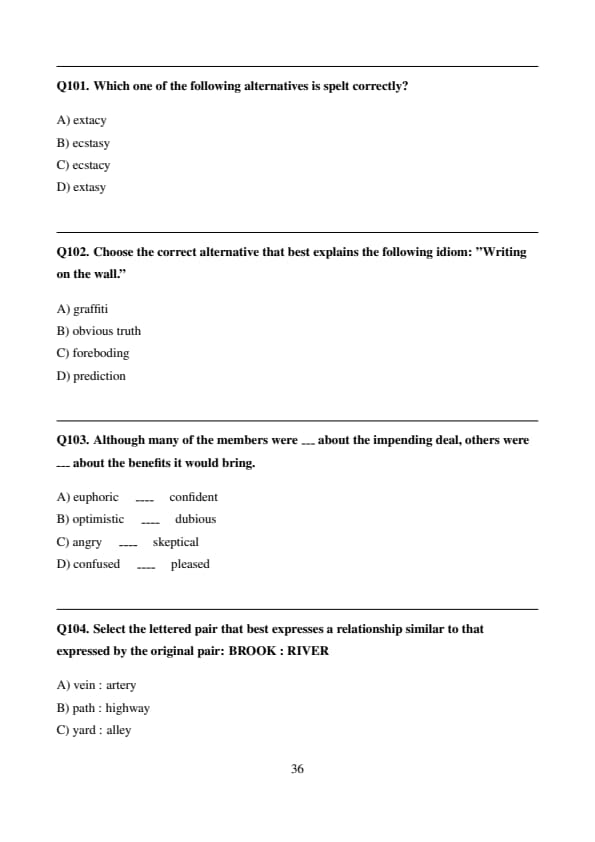
Which one of the following alternatives is spelt correctly?
View Solution
Choose the correct alternative that best explains the following idiom: "Writing on the wall."
View Solution
Although many of the members were ___ about the impending deal, others were ___ about the benefits it would bring.
View Solution
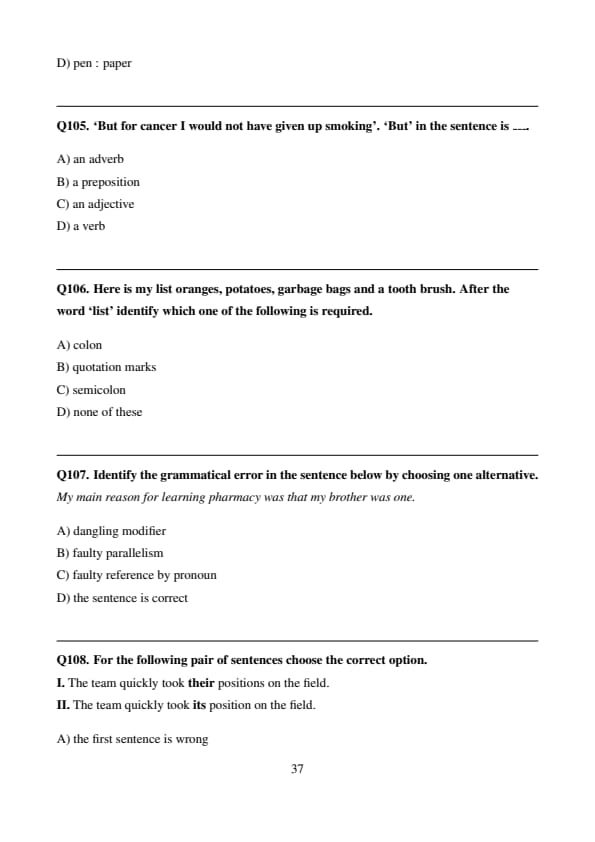
Select the lettered pair that best expresses a relationship similar to that expressed by the original pair: BROOK : RIVER
View Solution
`But for cancer I would not have given up smoking'. `But' in the sentence is ___.
View Solution
Here is my list oranges, potatoes, garbage bags and a tooth brush. After the word `list' identify which one of the following is required.
View Solution
Identify the grammatical error in the sentence below by choosing one alternative.
My main reason for learning pharmacy was that my brother was one.
View Solution
For the following pair of sentences choose the correct option.
I. The team quickly took their positions on the field.
II. The team quickly took its position on the field.
View Solution
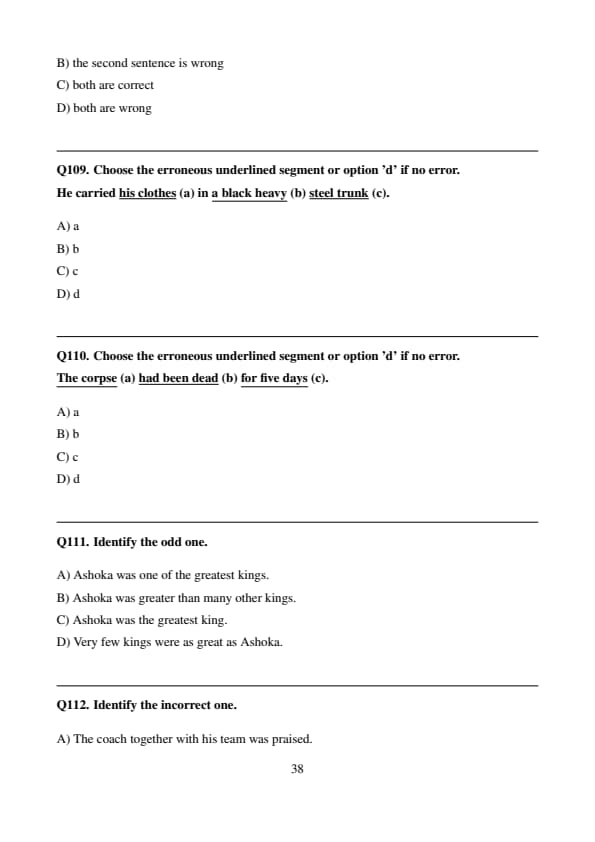
Choose the erroneous underlined segment or option 'd' if no error.
He carried his clothes (a) in a black heavy (b) steel trunk (c).
View Solution
Choose the erroneous underlined segment or option 'd' if no error.
The corpse (a) had been dead (b) for five days (c).
View Solution
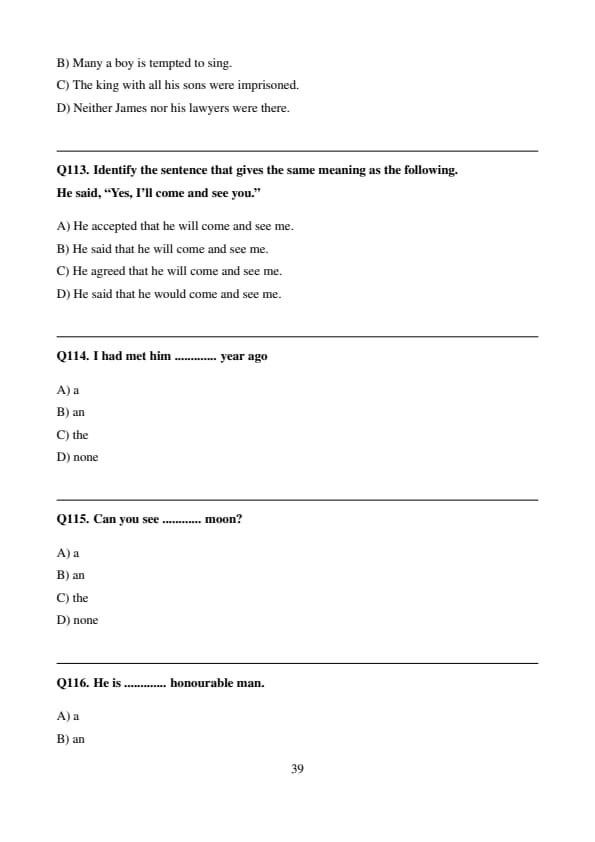
Identify the odd one.
View Solution
Identify the incorrect one.
View Solution
Identify the sentence that gives the same meaning as the following.
He said, “Yes, I’ll come and see you.”
View Solution
I had met him ............. year ago
View Solution
Can you see ............ moon?
View Solution
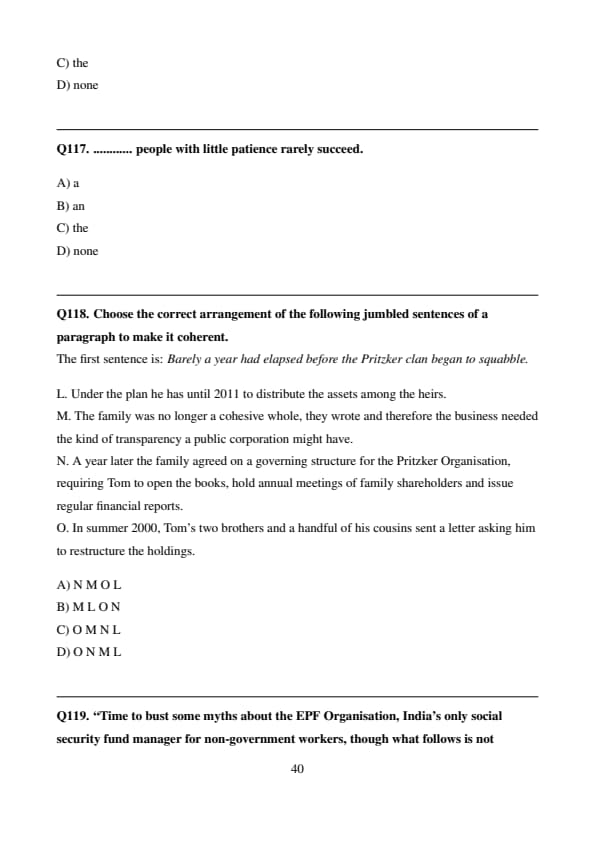
He is ............. honourable man.
View Solution
............ people with little patience rarely succeed.
View Solution
Choose the correct arrangement of the following jumbled sentences of a paragraph to make it coherent.
The first sentence is:
\(\textit{Barely a year had elapsed before the Pritzker clan began to squabble}\).
L. Under the plan he has until 2011 to distribute the assets among the heirs.
M. The family was no longer a cohesive whole, they wrote and therefore the business needed the kind of transparency a public corporation might have.
N. A year later the family agreed on a governing structure for the Pritzker Organisation, requiring Tom to open the books, hold annual meetings of family shareholders and issue regular financial reports.
O. In summer 2000, Tom’s two brothers and a handful of his cousins sent a letter asking him to restructure the holdings.
View Solution
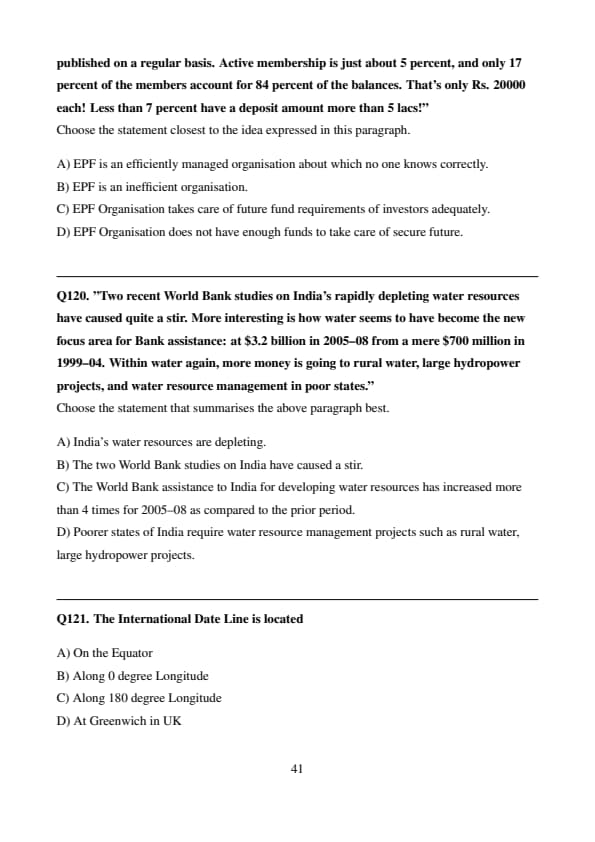
“Time to bust some myths about the EPF Organisation, India’s only social security fund manager for non-government workers, though what follows is not published on a regular basis. Active membership is just about 5 percent, and only 17 percent of the members account for 84 percent of the balances. That’s only Rs. 20000 each! Less than 7 percent have a deposit amount more than 5 lacs!”
Choose the statement closest to the idea expressed in this paragraph.
View Solution
"Two recent World Bank studies on India’s rapidly depleting water resources have caused quite a stir. More interesting is how water seems to have become the new focus area for Bank assistance: at
(3.2 billion in 2005–08 from a mere
)700 million in 1999–04. Within water again, more money is going to rural water, large hydropower projects, and water resource management in poor states."
Choose the statement that summarises the above paragraph best.
View Solution
The International Date Line is located
View Solution
The Ramon Magsaysay Award is named after the former President of?
View Solution
What level of noise is considered permissible in human habitats?
View Solution
The Indian city which has a natural harbour and is also one of the largest Indian ports is
View Solution
If saccharine, an artificial sweetener which is 70 times sweeter than sugar, is kept in the open, which one of these insects will it attract first?
View Solution
When a Pepsi bottle is opened, the gas fizzes out because it obeys
View Solution
Television signals from transmission towers are restricted to a limited area because
View Solution
Who is the author of Food, Nutrition and Poverty in India?
View Solution
Internet is controlled by
View Solution
Identify the incorrect statement.
View Solution
The largest chunk of revenue for the Union government comes from
View Solution
India test-fired three medium range surface-to-air missiles in Oct. 2005. Name the missile.
View Solution
How many calories are there in one litre of water?
View Solution
The city closest to the epicenter of the devastating earthquake that hit Pakistan \& India in October 2005 is
View Solution
The CDMA mobile services from BSNL is
View Solution
The highest ranking country for 2005–06 in "Global Competitiveness Report" of the World Economic Forum is
View Solution
Which two independent nations does the 17th Parallel separate?
View Solution
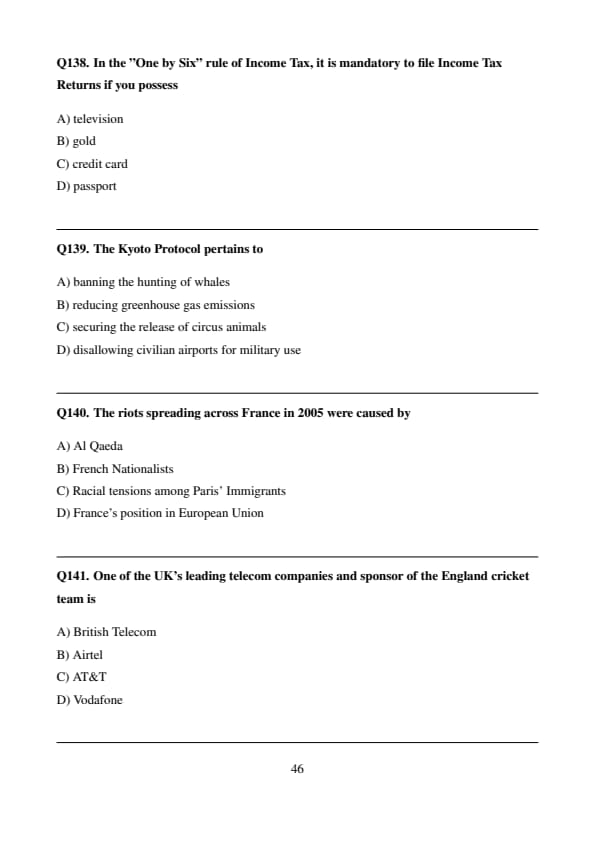
In the "One by Six" rule of Income Tax, it is mandatory to file Income Tax Returns if you possess
View Solution
The Kyoto Protocol pertains to
View Solution
The riots spreading across France in 2005 were caused by
View Solution
One of the UK's leading telecom companies and sponsor of the England cricket team is
View Solution
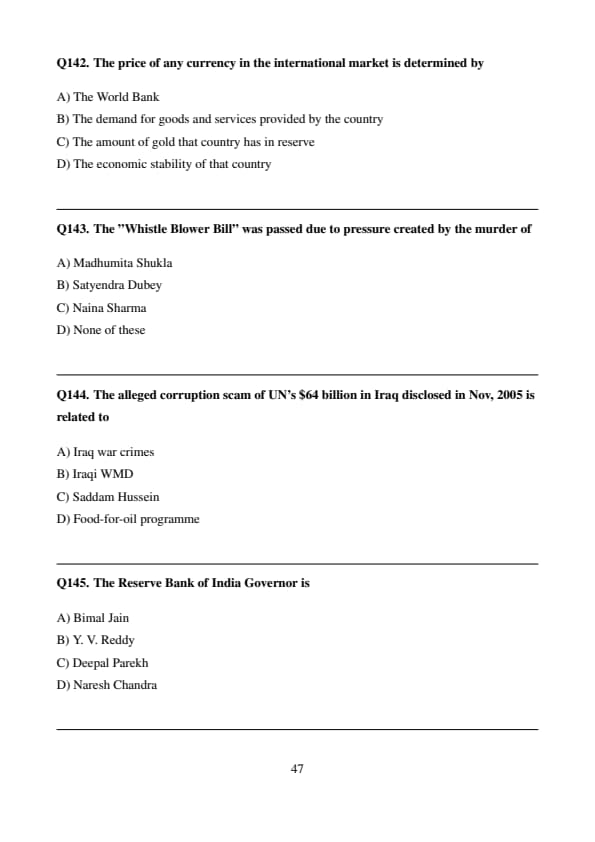
The price of any currency in the international market is determined by
View Solution
The "Whistle Blower Bill" was passed due to pressure created by the murder of
View Solution
The alleged corruption scam of UN’s
(64 billion in Iraq disclosed in Nov, 2005 is related to
View Solution
The Reserve Bank of India Governor is
View Solution
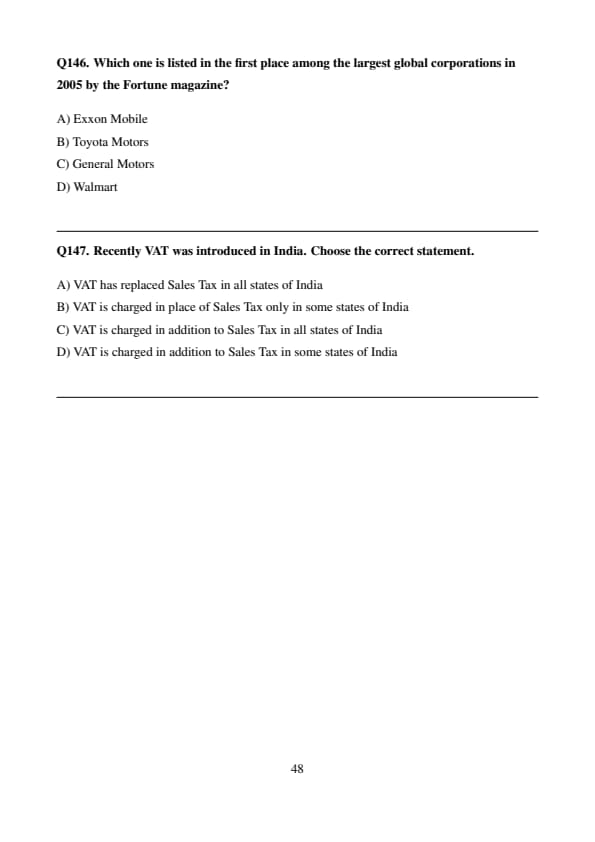
Which one is listed in the first place among the largest global corporations in 2005 by the Fortune magazine?
View Solution
Recently VAT was introduced in India. Choose the correct statement.
View Solution



Comments