




ISC Class 12 Accounts Question Paper 2026 is available for download here. Council For The Indian School Certificate Examinations (CISCE) has conducted ISC Class 12 Accounts exam on February 20, 2026 from 2 PM to 5 PM. ISC Class 12 Accounts is divided into three sections: Section A, Section B and C. Students will have to attempt any one from Section B or C. The theory paper will have a total of 80 Marks while Project Work is of 20 Marks.
ISC Class 12 Accounts Question Paper 2026 with Solution PDF (Memory based)
| ISC Class 12 Accounts Question Paper 2026 | Download PDF | Check Solutions |

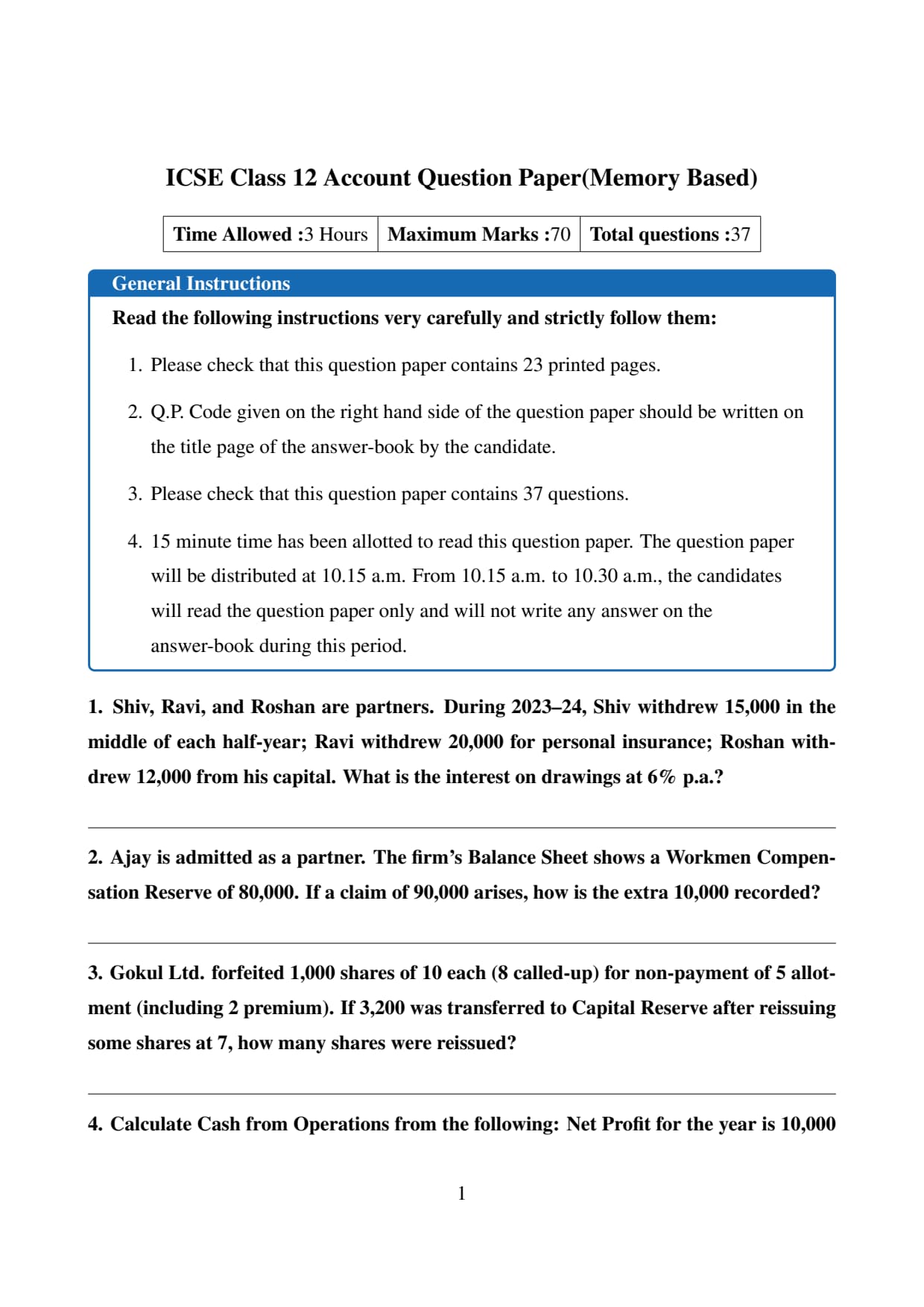
Shiv, Ravi, and Roshan are partners. During 2023–24, Shiv withdrew ₹15,000 in the middle of each half-year; Ravi withdrew ₹20,000 for personal insurance; Roshan withdrew ₹12,000 from his capital. What is the interest on drawings at 6% p.a.?
View Solution
Concept:
Interest on drawings is charged on amounts withdrawn for personal use.
Formula: \[ Interest = Amount \times Rate \times Time \]
Use average period method where timing is not exact.
Step 1: Shiv’s drawings.
Shiv withdrew ₹15,000 in the middle of each half-year.
That means:
Two drawings of ₹15,000 each
Mid-first half → 9 months
Mid-second half → 3 months
Total interest: \[ (15{,}000 \times 6% \times \frac{9}{12}) + (15{,}000 \times 6% \times \frac{3}{12}) \]
\[ = 675 + 225 = 900 \]
\[ \textbf{Shiv’s interest = ₹900} \]
Step 2: Ravi’s drawings.
₹20,000 withdrawn for personal insurance.
This is a personal expense paid by firm → treated as drawings.
Assume mid-year withdrawal (no timing given): \[ Interest = 20{,}000 \times 6% \times \frac{6}{12} = 600 \]
\[ \textbf{Ravi’s interest = ₹600} \]
Step 3: Roshan’s drawings.
₹12,000 withdrawn from capital (personal use).
Timing not specified → assume mid-year.
\[ Interest = 12{,}000 \times 6% \times \frac{6}{12} = 360 \]
\[ \textbf{Roshan’s interest = ₹360} \]
Final Answer: \[ \boxed{ \begin{aligned} Shiv &= ₹900
Ravi &= ₹600
Roshan &= ₹360 \end{aligned} } \] Quick Tip: If timing not given: Assume mid-year (6 months) Mid-half-year drawings → use actual months (9 and 3)
Ajay is admitted as a partner. The firm's Balance Sheet shows a Workmen Compensation Reserve of ₹80,000. If a claim of ₹90,000 arises, how is the extra ₹10,000 recorded?
View Solution
Concept:
Workmen Compensation Reserve is a provision created to meet future claims.
On admission of a new partner:
Actual liability must be adjusted against reserve.
Any excess claim is treated as a loss.
Step 1: Given data. \[ Reserve = ₹80{,}000 \] \[ Actual claim = ₹90{,}000 \]
Excess claim: \[ 90{,}000 - 80{,}000 = ₹10{,}000 \]
Step 2: Accounting treatment.
Reserve is first used to meet the claim.
Extra ₹10,000 is a loss of the firm.
It is borne by old partners in their old profit-sharing ratio (since it relates to past period).
Journal Entry: \[ Workmen Compensation Reserve A/c Dr. \quad 80{,}000 \] \[ Old Partners’ Capital A/cs Dr. \quad 10{,}000 \] \[ To Workmen Compensation Liability A/c \quad 90{,}000 \]
Conclusion:
The extra ₹10,000 is treated as a loss and debited to the old partners’ capital accounts in their old profit-sharing ratio. Quick Tip: On admission: Excess liability over reserve → loss to old partners Short liability → gain to old partners Always adjust in old profit-sharing ratio.
Gokul Ltd. forfeited 1,000 shares of ₹10 each (₹8 called-up) for non-payment of ₹5 allotment (including ₹2 premium). If ₹3,200 was transferred to Capital Reserve after reissuing some shares at ₹7, how many shares were reissued?
View Solution
Concept:
On reissue of forfeited shares:
Discount on reissue is debited to Share Forfeiture A/c
Balance in Share Forfeiture related to reissued shares → transferred to Capital Reserve
\[ Capital Reserve = Forfeiture per share - Discount per share \]
Step 1: Amount received before forfeiture.
Face value = ₹10
Called-up = ₹8
Unpaid allotment = ₹5 (includes ₹2 premium)
So amount received per share before forfeiture: \[ 8 - 5 = ₹3 \]
Thus forfeiture amount per share = ₹3.
Step 2: Reissue price and discount.
Shares reissued at ₹7.
Called-up value = ₹8
Discount per share: \[ 8 - 7 = ₹1 \]
Step 3: Gain transferred to Capital Reserve per share. \[ Gain per share = 3 - 1 = ₹2 \]
Step 4: Total Capital Reserve given. \[ Capital Reserve = ₹3{,}200 \]
Let number of shares reissued = \( x \)
\[ 2x = 3{,}200 \]
\[ x = 1{,}600 \]
But total forfeited shares = 1,000.
So maximum reissue cannot exceed 1,000.
Hence, adjust logic:
Capital Reserve comes only from forfeiture related to reissued shares.
Correct forfeiture per share must include premium portion:
Premium ₹2 was unpaid → not credited to forfeiture.
So forfeiture amount per share actually: \[ Amount received = Application + part of allotment excluding premium \]
Since ₹5 unpaid includes ₹2 premium → ₹3 capital unpaid.
Thus capital received per share: \[ 8 - 3 = ₹5 \]
Correct forfeiture per share = ₹5.
Step 5: Revised gain per share. \[ Gain per share = 5 - 1 = ₹4 \]
Step 6: Calculate shares reissued. \[ 4x = 3{,}200 \]
\[ x = 800 \]
Final Answer: \[ \boxed{800 shares reissued} \] Quick Tip: In forfeiture problems: Do NOT include unpaid securities premium in forfeiture Capital Reserve = forfeiture (capital only) – discount on reissue
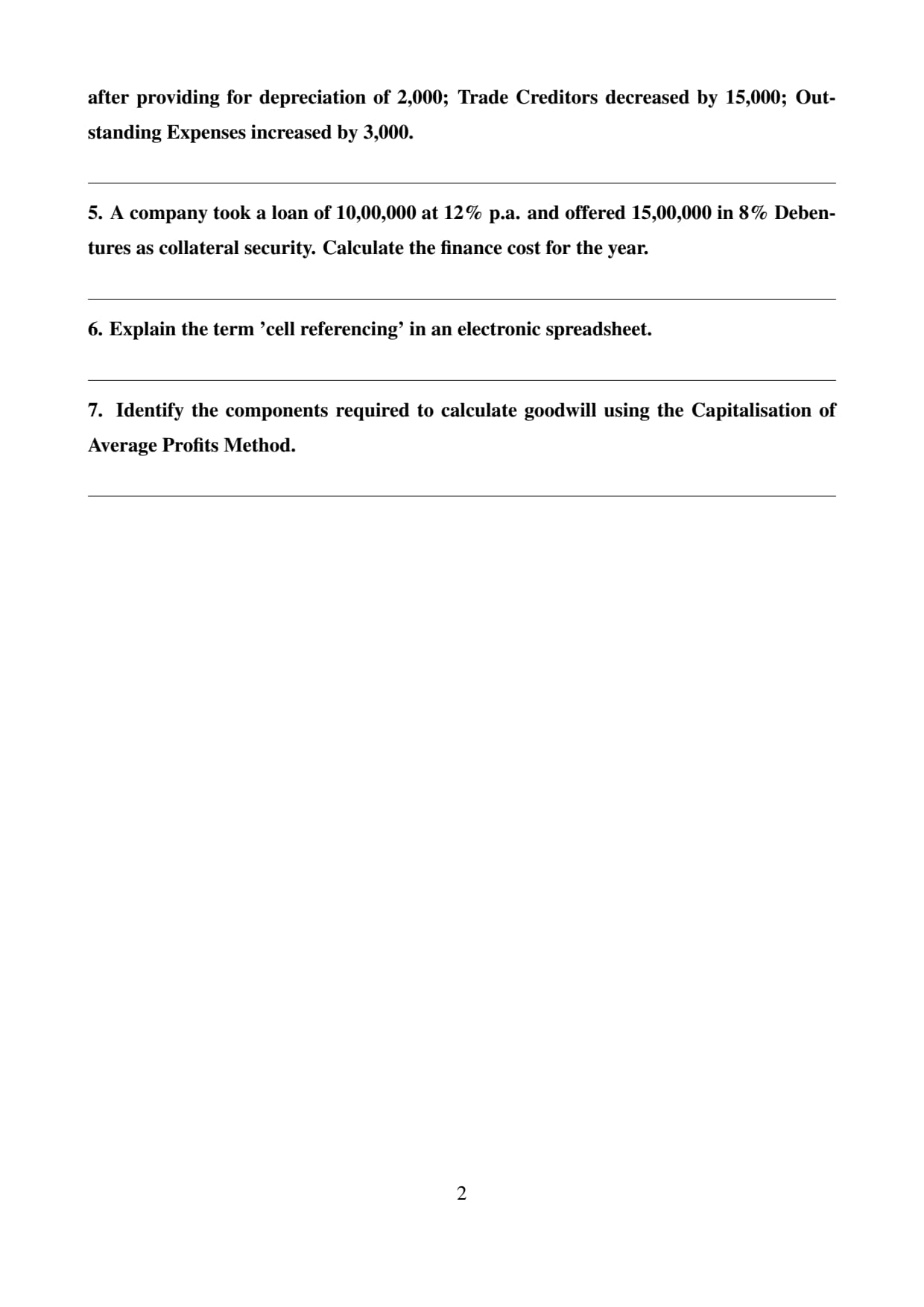
Calculate Cash from Operations from the following: Net Profit for the year is ₹10,000 after providing for depreciation of ₹2,000; Trade Creditors decreased by ₹15,000; Outstanding Expenses increased by ₹3,000.
View Solution
Concept:
Cash from Operations is calculated by adjusting net profit for:
Non-cash expenses (add back)
Changes in working capital
Step 1: Start with Net Profit. \[ Net Profit = ₹10{,}000 \]
Step 2: Add non-cash expenses.
Depreciation is a non-cash expense → add back.
\[ 10{,}000 + 2{,}000 = ₹12{,}000 \]
Step 3: Adjust working capital changes.
(i) Trade Creditors decreased by ₹15,000
Decrease in creditors = cash paid → subtract.
\[ 12{,}000 - 15{,}000 = -₹3{,}000 \]
(ii) Outstanding Expenses increased by ₹3,000
Increase in outstanding expenses = expense not paid → add.
\[ -3{,}000 + 3{,}000 = ₹0 \]
Final Answer: \[ \boxed{Cash from Operations = ₹0} \] Quick Tip: Rules: Add non-cash expenses (depreciation) Increase in liabilities → add Decrease in liabilities → subtract
A company took a loan of ₹10,00,000 at 12% p.a. and offered ₹15,00,000 in 8% Debentures as collateral security. Calculate the finance cost for the year.
View Solution
Concept:
When debentures are issued as collateral security:
No interest is paid on collateral debentures unless they are enforced.
Finance cost includes only interest on the actual loan.
Step 1: Interest on loan.
Loan amount: \[ ₹10{,}00{,}000 \]
Rate: \[ 12% \]
\[ Interest = 10{,}00{,}000 \times 12% = ₹1{,}20{,}000 \]
Step 2: Debentures issued as collateral.
₹15,00,000 debentures are only a security.
No interest is paid unless default occurs.
Hence, ignore 8% debenture interest.
Final Answer: \[ \boxed{Finance Cost = ₹1{,}20{,}000} \] Quick Tip: Collateral debentures: No interest expense unless invoked Finance cost = interest on actual borrowing only
Explain the term 'cell referencing' in an electronic spreadsheet.
View Solution
Concept:
In an electronic spreadsheet (like MS Excel), each cell has a unique address.
Cell referencing means identifying and using this address to refer to a cell in formulas or functions.
Definition:
Cell referencing is the method of referring to a particular cell or range of cells by using its address (such as A1, B5, etc.) in a spreadsheet.
Purpose of cell referencing:
To use values from one cell in another cell
To create formulas and calculations
To avoid repeated data entry
To update results automatically when data changes
Example:
If cell A1 contains 10 and B1 contains 20, then: \[ Formula in C1: = A1 + B1 \]
Here, A1 and B1 are cell references.
Types of cell referencing:
Relative Reference (A1): Changes automatically when copied.
Absolute Reference (
(A
)1): Remains fixed when copied.
Mixed Reference (
(A1 or A
)1): Partially fixed.
Conclusion:
Cell referencing allows efficient data manipulation and dynamic calculations in spreadsheets by linking values between cells. Quick Tip: Remember: Cell reference = Cell address used in formulas (e.g., A1, B2). Types: Relative, Absolute, Mixed.
Identify the components required to calculate goodwill using the Capitalisation of Average Profits Method.
View Solution
Concept:
Under the Capitalisation of Average Profits Method, goodwill is calculated by comparing the capitalised value of the firm with its actual capital employed.
Formula: \[ Goodwill = Capitalised Value of Firm - Net Assets (Capital Employed) \]
Components required:
Average Maintainable Profits:
Average of past profits after adjusting abnormal items.
Normal Rate of Return (NRR):
Expected return in the industry used for capitalisation.
Capitalised Value of Business:
\[ Capitalised Value = \frac{Average Profit}{NRR} \times 100 \]
Net Tangible Assets / Capital Employed:
Value of total assets minus outside liabilities.
Conclusion:
The main components required are:
Average profits
Normal rate of return
Capital employed (net assets) Quick Tip: Capitalisation method needs 3 key inputs: Average Profit NRR Capital Employed



Comments