




Vellore Institute of Technology (VIT) has started the VITEEE 2027 application process for candidates seeking BTech admission for the 2027–28 academic session.
The registration process began on October 20, 2026, and candidates can submit their applications until March 31, 2027, through the official website, viteee.vit.ac.in. The application fee is ₹1,450 for all categories.
| Click here to register for VITEEE 2027 (Activated) |
- The VITEEE 2027 examination is tentatively scheduled from April 27 to May 2, 2027.
- The VITEEE 2027 result is expected in the second week of May 2027, followed by the counselling process.
- VIT has revised the VITEEE 2027 exam pattern, reducing the examination duration to 2 hours and changing the number of questions in the Mathematics, Chemistry, English and Aptitude sections.
- The Mathematics/Biology section will have 40 questions; the Physics and Chemistry sections are reported to have 25 questions each, while English and Aptitude have 5 questions each.
- VIT has also introduced fixed section-wise time limits and real-time photo capture during registration for VITEEE 2027.
The Vellore Institute of Technology Engineering Entrance Examination (VITEEE) is conducted for admission to eligible BTech programmes at VIT campuses in Vellore, Chennai, Andhra Pradesh and Bhopal. The admission process includes registration, slot booking, the entrance examination, result declaration and counselling.
This guide covers VITEEE 2027 exam dates, eligibility criteria, minimum qualifying marks, syllabus, exam pattern, application process and preparation tips.
Related Links:
- VITEEE Application Form 2027: Direct Link, Application Fee, Important Dates, and Eligibility Criteria
- VITEEE Eligibility Criteria: Age, Qualification, Qualifying Marks, & Reservation
Key Summary
- VITEEE is conducted for BTech admissions at VIT Vellore, Chennai, Andhra Pradesh and Bhopal campuses.
- VITEEE 2027 registration began on October 20, 2026, and the last date to apply is March 31, 2027.
- The examination is tentatively scheduled for April 27–May 2, 2027.
- The VITEEE 2026 exam pattern included 120 questions and a duration of 2 hours.
- The previous marking scheme awarded 4 marks for each correct answer and deducted 1 mark for each incorrect answer; candidates should verify the 2027 scheme in the official brochure.
- Admission is based on VITEEE merit rank and the subsequent online counselling process.
What is VITEEE 2027?
VITEEE stands for VIT Engineering Entrance Examination. VIT conducts this exam every year for admission to undergraduate B.Tech programmes at its four campuses.
- VIT Vellore: 400+ marks (for Category 1 CSE and top specialisations)
- VIT Chennai: 380+ marks (for Category 1 CSE)
- VIT-AP (Amaravati): 280–300+ marks (for CSE in Category 1)
- VIT Bhopal: 250–280+ marks (for CSE in Category 1)
Why choose VIT through VITEEE?
VIT offers B.Tech programmes, including CSE, AI/ML and ECE, across its four campuses — Vellore, Chennai, Bhopal and Amaravati.
- The exam provides a dedicated pathway for students, with flexible ranking and category-based fee options that make quality education more accessible.
- VIT is known for its strong placement opportunities and modern campus facilities.
- Its industry-focused curriculum helps students build practical skills and improve their career prospects.
What's New in VITEEE 2027?
VIT has announced several changes to the VITEEE 2027 examination pattern and application process. These include a revised examination duration of 2 hours, changes in the number of questions in selected sections, fixed section-wise time limits and real-time photo capture during registration. Candidates should refer to the official VITEEE website for the final confirmed details.
| Particulars | VITEEE 2027 Details |
|---|---|
| Examination duration | 2 hours |
| Mathematics / Biology | 50 minutes |
| Physics | 30 minutes |
| Chemistry | 30 minutes |
| English and Aptitude | 10 minutes |
| Mathematics questions | 40 (reported) |
| Physics questions | 40 (reported) |
| Chemistry questions | 25 (reported) |
| English questions | 5 (reported) |
| Aptitude questions | 5 (reported) |
| Application fee | ₹1,450 for all categories |
| Registration update | Real-time photo capture introduced |
What is MPCES & BPCEA in VITEEE 2027?
VITEEE offers two subject combinations depending on the candidate's Class 12 background and intended B.Tech programme. In the 20276 pattern, these were MPCEA and BPCEA.
- MPCEA includes Mathematics, Physics, Chemistry, English and Aptitude. It is the relevant combination for candidates seeking admission to most conventional engineering programmes.
- BPCEA includes Biology, Physics, Chemistry, English and Aptitude. It is intended for candidates seeking admission to eligible biology-related programmes.
- Both combinations had 100 questions and a duration of 2 hours.
- Candidates must verify the programmes available under each combination in the 2027 admission guidelines.
| Stream | Full Form | Subjects | Who Should Choose It? | Suitable For |
|---|---|---|---|---|
| MPCEA | Mathematics + Physics + Chemistry + English + Aptitude | Maths (40), Physics (25), Chemistry (25), Aptitude (5), English (5) | Students with PCM background | All regular B.Tech branches (CSE, ECE, Mechanical, etc.) |
| BPCEA | Biology + Physics + Chemistry + English + Aptitude | Biology (40), Physics (25), Chemistry (25), Aptitude (5), English (5) | Students with PCB background | Bio-related B.Tech programmes (Biotechnology, Biomedical, Bioinformatics, etc.) |

Ques. What does MPCES stand for in VITEEE 2027?
Ans. MPCES stands for Mathematics, Physics, Chemistry, English, and Aptitude. Candidates choosing B.Tech programmes must appear for this paper, except for Biotechnology-related courses.
Ques. What is BPCEA in VITEEE 2027?
Ans. BPCEA stands for Biology, Physics, Chemistry, English, and Aptitude. It is meant for candidates seeking admission to B.Tech Biotechnology, Bioengineering, Biomedical Engineering, and related programmes.
Ques. Which paper should I choose: MPCES or BPCEA?
Ans. Choose MPCES if you have studied Mathematics in Class 12 and want admission to regular B.Tech programmes. Choose BPCEA if you have studied Biology and are applying for Biotechnology or other biology-related engineering courses.
VITEEE 2027 Exam Date
VIT has published the application start date and deadline along with tentative dates for the remaining examination events. Candidates should check the official portal regularly for any revisions.
| Event | VITEEE 2027 Date |
|---|---|
| Online Application Begins | October 20, 2026 |
| Last Date to Apply Online | March 31, 2027 |
| Admit Card Download | April 25–30, 2027 (Tentative) |
| VITEEE 2027 Examination | April 27–May 2, 2027 (Tentative) |
| Result Declaration | Second week of May 2027 (Tentative) |
| Online Counselling Begins | Second week of May 2027 (Tentative) |
Also Read: VITEEE Exam Dates 2027: Check Dates for Registration, Exam, Result, and Counselling
VITEEE 2027 Registration Last Date: When Will Applications Close?
The last date to submit the VITEEE 2027 application form is March 31, 2027. Candidates should complete registration and payment well before the deadline to avoid technical issues or last-minute delays.
Do not assume that VIT will extend the deadline. Any extension or change should be confirmed through the official website.
Related Link: VITEEE 2027 Notification: Verify Official Release Date and Application Status
VITEEE 2027 Eligibility Criteria
Students must meet the VITEEE 2027 eligibility conditions before they fill the application form. VIT checks these details again at the time of counselling, so students should not skip any part of the criteria.
- PCB candidates can apply only for Biotechnology, Bioengineering, and CS with Bioinformatics.
- They are not eligible for core engineering branches that require Mathematics.
| Eligibility Criteria | Requirement |
|---|---|
| Nationality | Must be an Indian National, NRI, OCI, or PIO holder. |
| Age Limit | Date of birth should be on or after July 1, 2005. |
| Educational Qualification | Must have passed or be appearing for Class 12 (or equivalent) in 2027. |
| PCM Eligibility | Minimum 60% aggregate in Physics, Chemistry, and Mathematics, with at least 50% in Mathematics. |
| PCB Eligibility | Minimum 60% aggregate in Physics, Chemistry, and Biology, with at least 50% in Biology. |
| Relaxation for Reserved Categories | SC/ST candidates and applicants from Jammu & Kashmir, Ladakh, and the Northeastern states need only 50% aggregate in PCM/PCB. |
Also Read: VITEEE 2027 Eligibility criteria for NRI/Foreign Students
VITEEE 2027: How to Apply for Registration?
The VITEEE 2027 application process began on October 20, 2026. Candidates must complete the online registration, enter their personal and academic details, upload the required documents and pay the application fee before the deadline.
You can complete your VITEEE application form only in online mode. Here is the process you should follow once the portal opens:
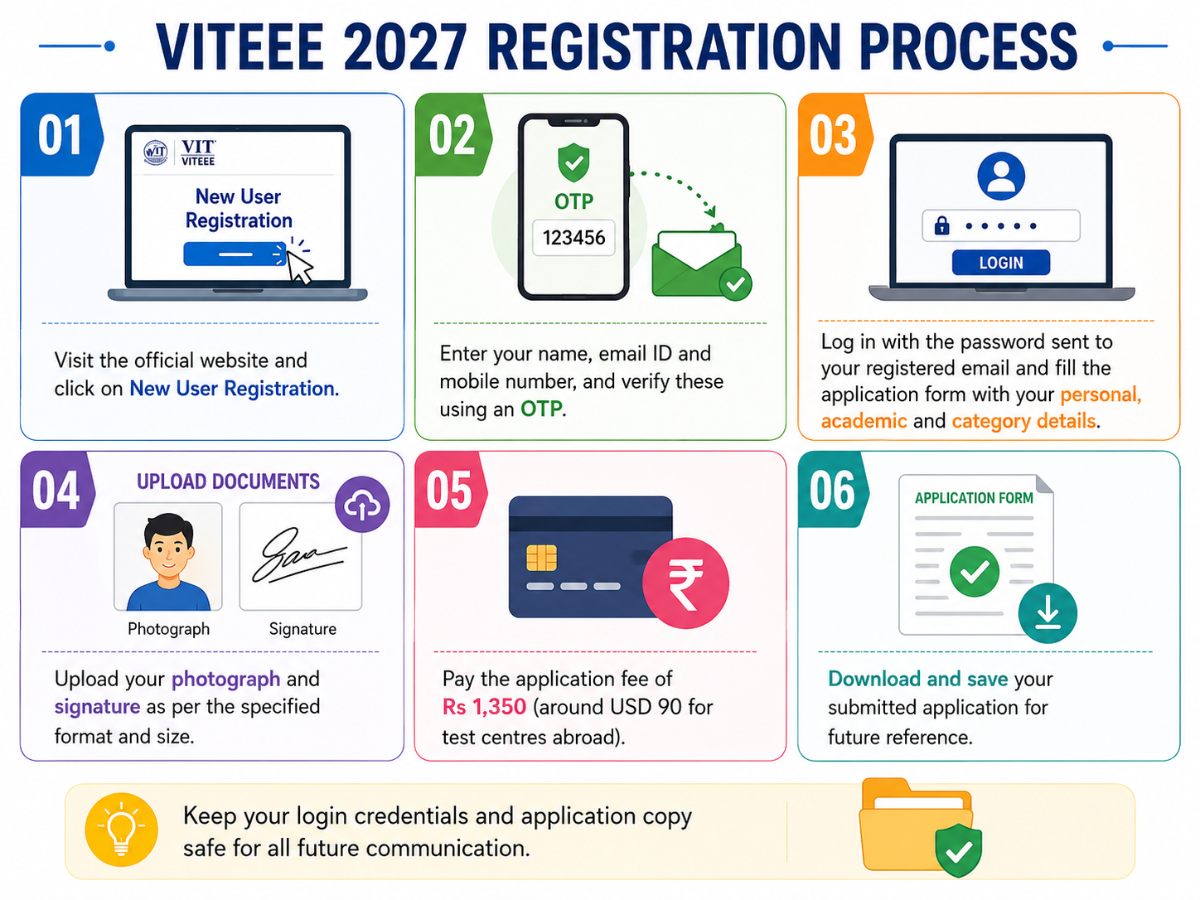
Students should keep their application number safe, since it is required for every future step, including slot booking and login.
Check: How to Apply for VITEEE 2027: Step-by-Step Registration Guide
Ques. Can I edit the VITEEE application form after submission?
Ans. Yes, VIT usually provides a limited correction window after the registration period. Candidates can edit certain fields during this time. It is advised to fill the form carefully to avoid major errors.
VITEEE 2027 Application Fees
The VITEEE application fee is expected to remain ₹1,450 for Indian candidates (same for all categories) and is non-refundable. International applicants appearing at foreign centres usually pay the equivalent of $90.
| Category / Test Centre | Application Fee | Payment Mode |
|---|---|---|
| Indian Test Centres | ₹1,450 | Net Banking, Credit Card, Debit Card, UPI/Paytm |
| Overseas Test Centres | USD 90 (or equivalent in INR) | Online Payment |
| Refund Policy | Non-refundable | Applicable to all candidates |
Ques. How can I pay the VITEEE 2027 application fee?
Ans. The fee can be paid online only through net banking, debit card, credit card, or UPI. Offline payment modes are not accepted.
Ques. Is there any fee concession for reserved category candidates?
Ans. No, VIT does not provide any category-based fee concession. The application fee remains the same for General, OBC, SC, ST, EWS, and PwD candidates.
How to Pay the VITEEE 2027 Application Fee Online
In the previous cycle, candidates could pay through online methods such as net banking, credit cards, debit cards and Paytm. Available options for 2027 will be shown on the application portal.
After payment, candidates should verify whether the transaction status is successful and save the confirmation. If money is deducted but the application portal does not show successful payment, check the official portal's instructions before making another payment.
Check: VITEEE 2027 Application Fee Payment Modes and Fee Structure
VITEEE 2027 Exam Pattern
The VITEEE 2027 exam pattern includes two subject combinations: MPCEA for candidates choosing Mathematics and BPCEA for candidates choosing Biology. According to the available exam-pattern details, the examination has 100 questions and a duration of 2 hours, with fixed time limits for each section.
VITEEE 2027 Subject-Wise Number of Questions
| Subject | MPCEA (Mathematics) | BPCEA (Biology) |
|---|---|---|
| Mathematics | 40 | — |
| Biology | — | 40 |
| Physics | 25 | 25 |
| Chemistry | 25 | 25 |
| English | 5 | 5 |
| Aptitude | 5 | 5 |
| Total Questions | 100 | 100 |
VITEEE 2027 Exam Duration and Section Timings
The VITEEE examination has a total duration of 2 hours. Candidates must complete each section within its allotted time.
| Subject / Section | Time Allotted |
|---|---|
| Mathematics / Biology | 50 minutes |
| Physics | 30 minutes |
| Chemistry | 30 minutes |
| English and Aptitude | 10 minutes |
| Total Duration | 120 minutes |
VITEEE 2027 Total Marks and Negative Marking
The 2026 VITEEE paper carried a maximum of 500 marks. Candidates received 4 marks for each correct answer and lost 1 mark for each incorrect answer. Unanswered questions and questions marked for review received zero marks.
| Marking Parameter | 2026 Pattern |
|---|---|
| Total Questions | 125 |
| Maximum Marks | 500 |
| Correct Answer | +4 |
| Incorrect Answer | −1 |
| Unanswered Question | 0 |
| Question Marked for Review | 0 if left unanswered |
Also Read: VITEEE Exam Pattern: Check Total Marks, Subject-Wise Weightage, Marks vs Rank
VITEEE 2027 Syllabus
The VITEEE 2027 exam syllabus closely follows the Class 11 and 12 CBSE curriculum, so most of your school preparation directly applies here.
VIT usually releases subject-wise syllabus PDFs on the official website once the notification is out.
| Subject | Important Topics |
|---|---|
| Physics | Laws of Motion, Electrostatics, Optics, Modern Physics, Current Electricity, Semiconductor Devices |
| Chemistry | Atomic Structure, p-Block & d-Block Elements, Organic Chemistry, Electrochemistry, Chemical Kinetics |
| Mathematics | Calculus, Vector Algebra, Three-Dimensional Geometry, Probability, Differential Equations |
| Biology (PCB) | Genetics, Human Physiology, Plant Physiology, Ecology, Biotechnology |
| Aptitude | Numerical Ability, Logical Reasoning, Data Interpretation |
| English | Reading Comprehension, Grammar, Pronunciation-based Questions |
Also Read:
- VITEEE Chapter Wise Weightage 2026: Check Subject-Wise Weightage and Previous Year Question Paper
- VITEEE Paper Analysis 2026: Check Difficulty Level, Question Paper, and Previous Year papers analysis
Ques. Is the VITEEE syllabus the same as JEE Main?
Ans. The core topics in Physics, Chemistry, and Mathematics are largely similar to JEE Main. However, VITEEE also includes Aptitude (10 questions) and English (5 questions), which are not part of JEE Main.
Ques. Is NCERT enough for VITEEE preparation?
Ans. Yes, NCERT Class 11 and 12 books are the primary and most important resources for VITEEE. Strengthening concepts from NCERT and practising previous year questions is generally sufficient.
VITEEE 2027 Documents Required
Keep all the required documents ready before filling out the VITEEE 2027 application form and counselling process to avoid delays.
- Having the correct documents in the prescribed format ensures a smooth registration, verification, and admission process.
| Document | Purpose / Requirement |
|---|---|
| Passport-size Photograph | Recent colour photograph with a white or off-white background. |
| Scanned Signature | Signature on white paper using dark blue or black ink. |
| Class 10 Mark Sheet | Required for date of birth and academic verification. |
| Class 12 Mark Sheet | Required for eligibility and academic verification. |
| Government Photo ID | A valid Aadhaar Card, PAN Card, Passport, or other government-issued ID. |
| Category Certificate (if applicable) | Required for candidates applying under SC/ST or state-specific quota. |
Ques. Are original documents mandatory for VITEEE admission?
Ans. Yes, candidates must carry original documents along with self-attested photocopies for verification during campus reporting. Admission is confirmed only after successful document verification.
Ques. Is a category certificate required for VITEEE 2027?
Ans. A valid category certificate (SC/ST/OBC/EWS) is required only if the candidate is claiming reservation benefits. General category candidates do not need to submit any caste certificate.
VITEEE 2027 Admit Card and Slot Booking
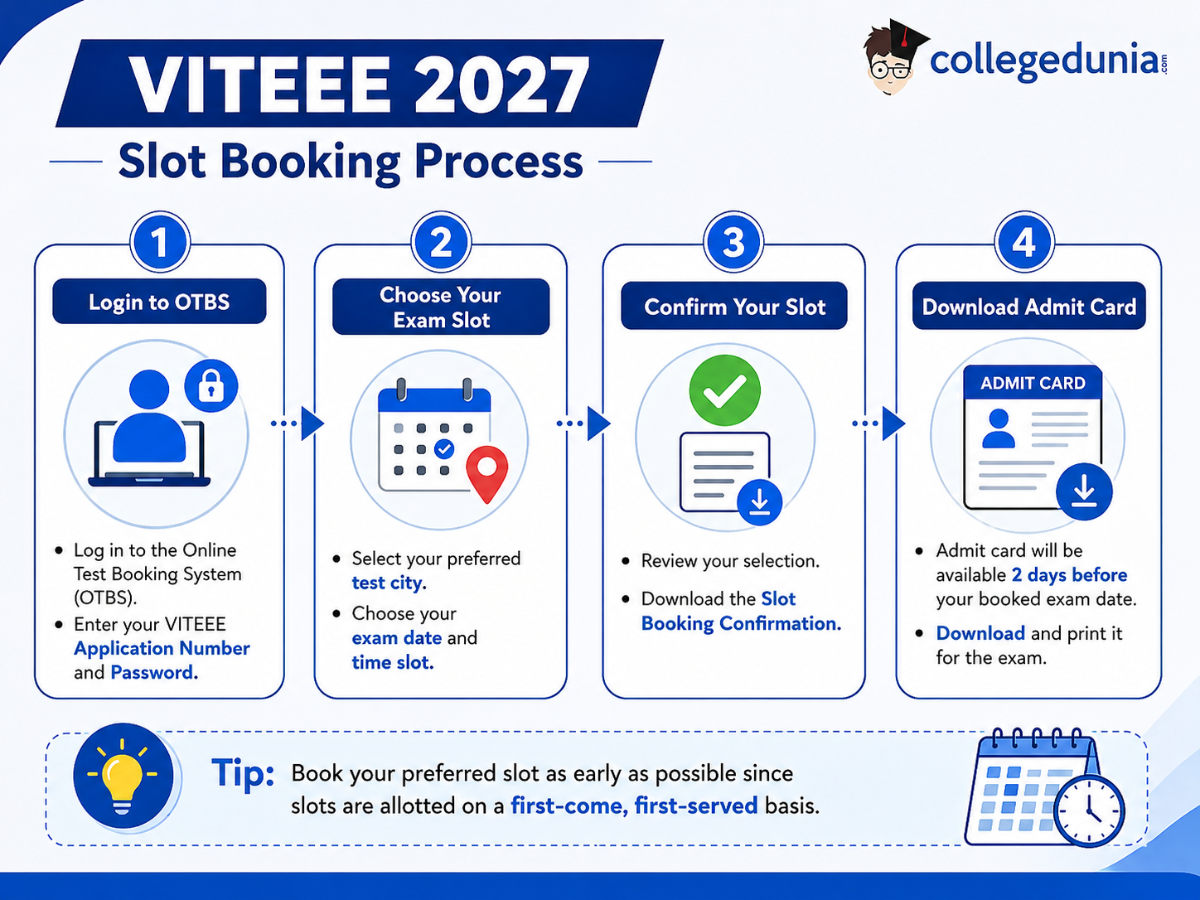
Once the application is complete, students will need to book their exam slot through VIT's Online Test Booking System (OTBS).
- Slot booking works on a first-come, first-served basis, so you should complete it as soon as the window opens.
Also Read:
- VITEEE Admit Card 2027: Direct Link to download hall ticket at vit.ac.in
- VITEEE 2027 Exam Centers List Out: Check State-wise and International Test Centers
When Will VITEEE 2027 Slot Booking Start?
Slot booking is expected before the examination, likely in April 2027 based on the previous cycle. The exact dates and booking rules must be confirmed through the official VIT website.
Candidates should book carefully and check the rules for changing a slot or centre before submitting their choice.
Ques. What details are mentioned on the VITEEE admit card?
Ans. The admit card generally includes the candidate's name, application number, photograph, exam date and time, test centre address and examination instructions.
Ques. Can I change my VITEEE exam slot after booking?
Ans. Slot-change rules depend on the instructions issued by VIT. Check the applicable terms before confirming your booking.
VITEEE 2027 Preparation Tips
Since VITEEE questions are largely formula- and concept-based, a focused revision plan works better than trying to solve overly difficult problems.
- Finish your NCERT Class 11 and 12 textbooks before moving to reference books.
- Give equal attention to PCM/Biology, since each carries significant weightage.
- Practise previous year VITEEE papers to understand the difficulty level and question style.
- Do not ignore the Aptitude and English sections, since they add 15 easy marks if you prepare well.
- Take at least one full-length mock test every week in the final two months before the exam.
- Since wrong answers cost you 1 mark, avoid guessing questions you are unsure about.
VITEEE 2026 Month-Wise Preparation Plan
| Time Period | Preparation Focus |
|---|---|
| October–November 2026 | Check the official syllabus, assess current preparation and build a subject-wise timetable |
| December 2026–January 2027 | Complete remaining topics and practise chapter-wise MCQs |
| February 2027 | Revise concepts, solve previous-year questions and take sectional tests |
| March 2027 | Attempt full-length mock tests and analyse recurring mistakes |
| April 2027 | Increase timed practice, revise formulas and check official examination updates |
| Final Week | Revise short notes, practise selected questions and avoid starting large new topics |

Source: Reddit
The student on Reddit is asking how difficult the VITEEE exam is and whether its level is closer to JEE Main or the CBSE Class 12 board exams. They also want guidance from current VIT students to understand what to expect.
Ans. VITEEE is generally considered easier than JEE Main but slightly more application-based than the CBSE Class 12 board exams. A strong grasp of NCERT concepts, regular MCQ practice, and mock tests are usually enough to secure a good score. If your JEE preparation was decent, you already have a solid foundation for VITEEE.
Also Read:
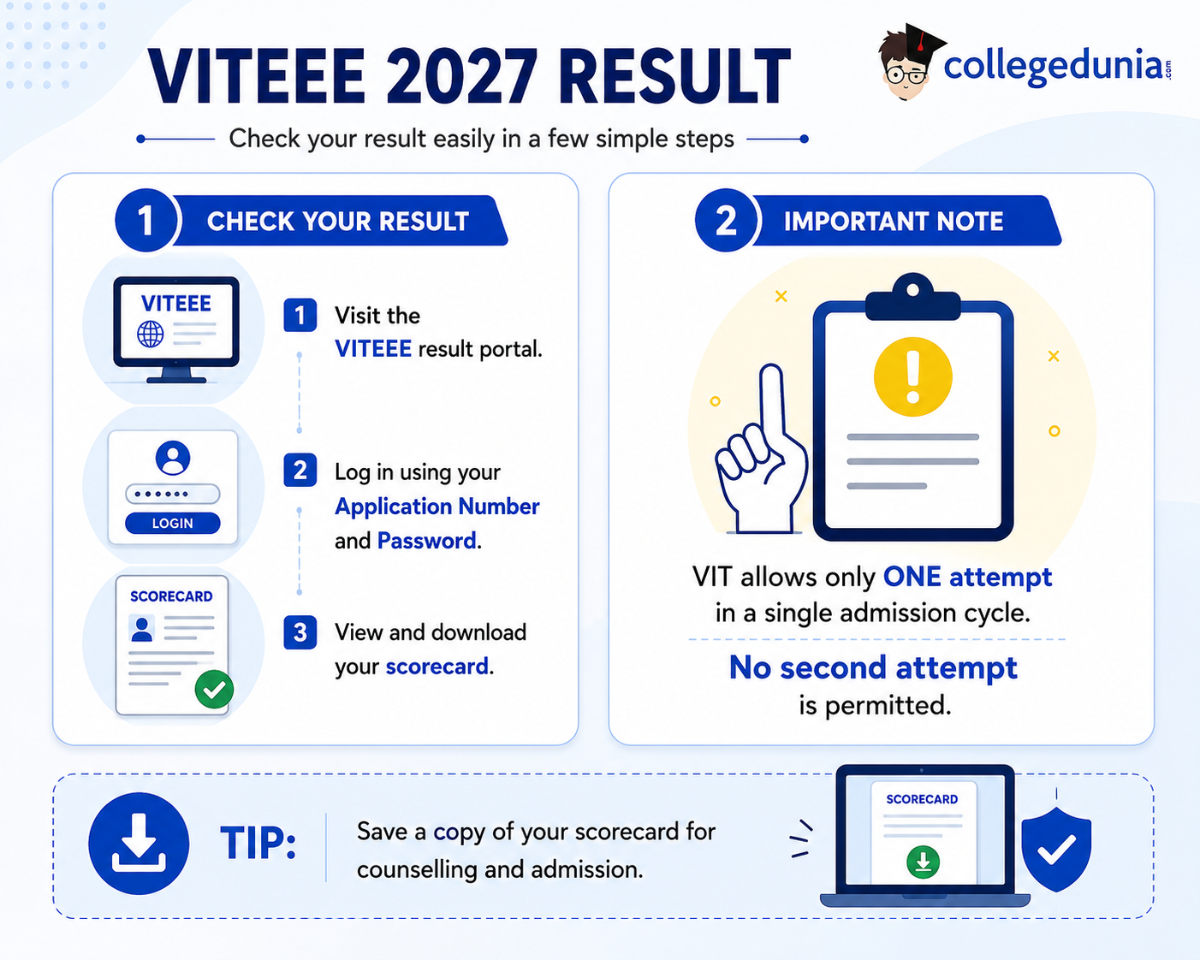
VITEEE 2027 Result and Rank Calculation
VIT does not release a separate merit list.
- Instead, it uses the equi-percentile method to normalise your score if you appear in a session on a different date or shift than other candidates.
- Your final rank card includes your VITEEE score, percentile, and overall rank.
Also Read:
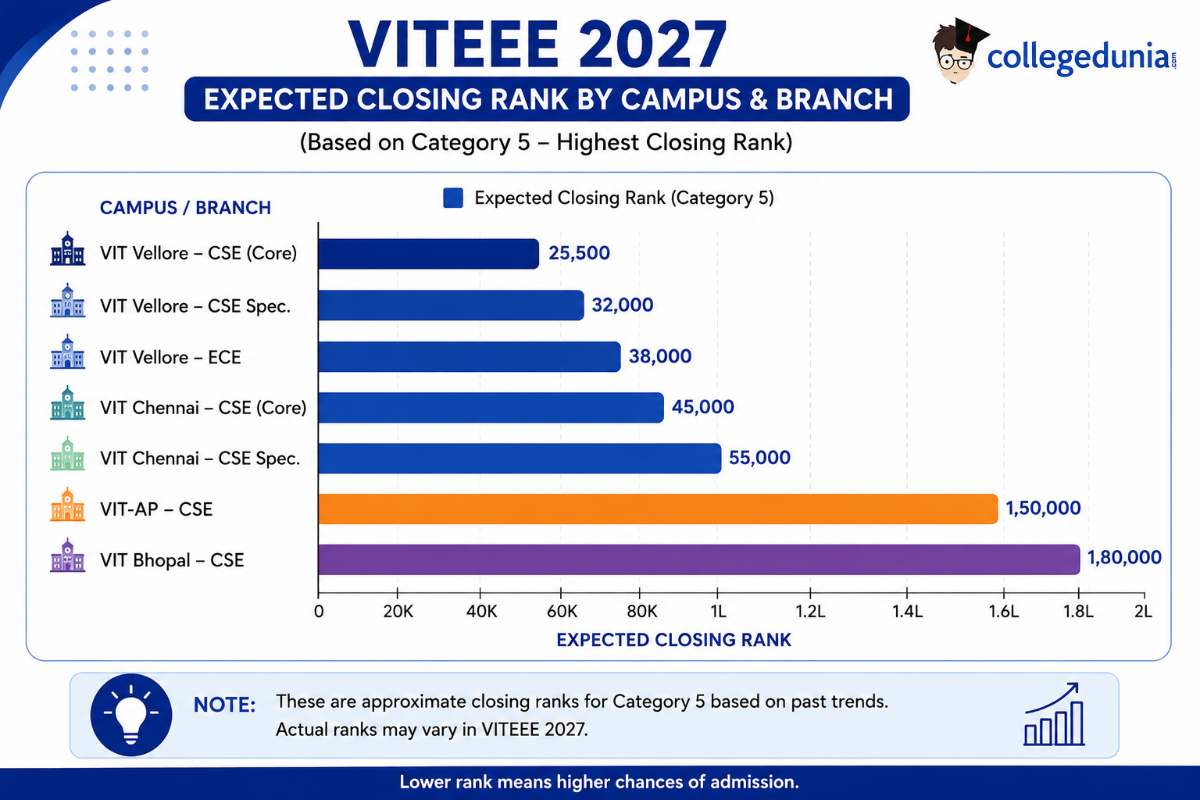
VITEEE 2027 Cutoff: Category-wise Cutoff
VIT does not publish an official VITEEE cutoff. Based on previous year trends, here is a rough sense of where things stand:
| Campus / Branch | Category 1 | Category 2 | Category 3 | Category 4 | Category 5 |
|---|---|---|---|---|---|
| VIT Vellore – CSE (Core) | 500 – 1,500 | 1,500 – 3,500 | 8,000 – 19,000 | 14,000 – 22,000 | 19,000 – 25,500 |
| VIT Vellore – CSE Spec. | 1,500 – 3,000 | 3,000 – 6,000 | 10,000 – 23,000 | 18,000 – 27,000 | 23,000 – 32,000 |
| VIT Vellore – ECE | 3,000 – 6,000 | 6,000 – 12,000 | 15,000 – 25,000 | 22,000 – 30,000 | 28,000 – 38,000 |
| VIT Chennai – CSE (Core) | 4,000 – 8,000 | 8,000 – 15,000 | 18,000 – 28,000 | 25,000 – 35,000 | 32,000 – 45,000 |
| VIT Chennai – CSE Spec. | 6,000 – 12,000 | 12,000 – 20,500 | 22,000 – 35,000 | 32,000 – 45,000 | 42,000 – 55,000 |
| VIT-AP – CSE | 15,000 – 30,000 | 30,000 – 65,000 | 65,000 – 1,10,000 | 1,10,000 – 1.35L | Up to ~1.5L |
| VIT Bhopal – CSE | 20,000 – 40,000 | 45,000 – 75,000 | 75,000 – 1,15,000 | 1,15,000 – 1.4L | Up to ~1.5–1.8L |
Also Read:
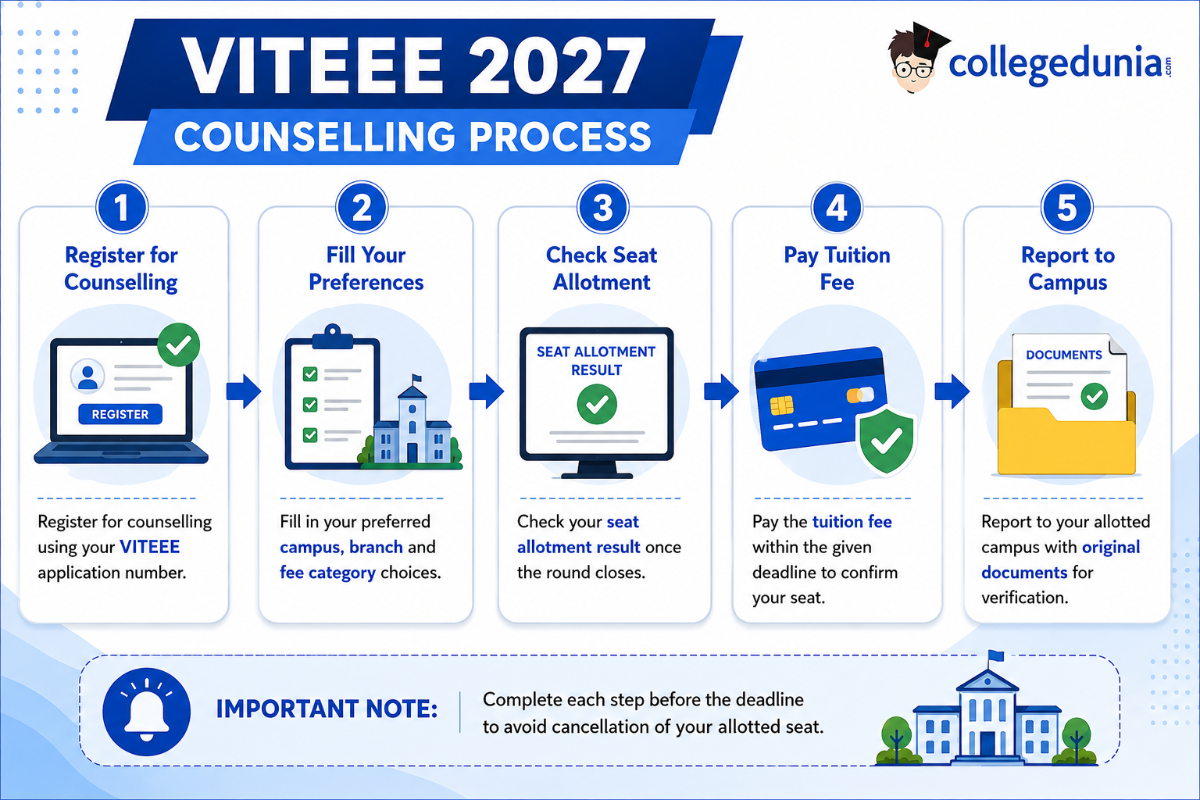
VITEEE 2027 Counselling Process
Once results are declared, VIT starts online counselling based on your rank. The VITEEE counselling process usually runs across five rounds.
Also Read:
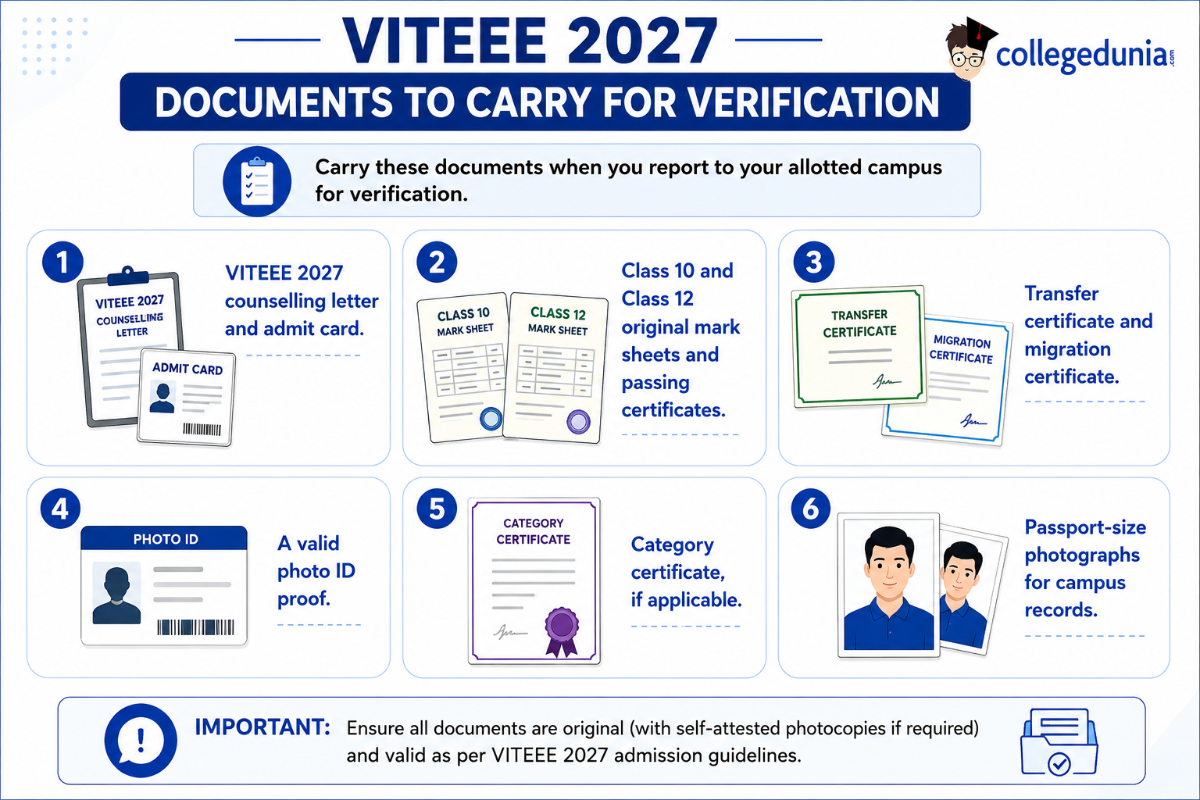
VITEEE 2027: Counselling Document Verification
Carry these documents when you report to your allotted campus for verification:
| Document | Purpose / Requirement |
|---|---|
| VITEEE 2027 Counselling Letter & Admit Card | Required for counselling and campus reporting. |
| Class 10 & Class 12 Mark Sheets and Passing Certificates | Original documents for academic verification. |
| Transfer Certificate (TC) & Migration Certificate | Required to complete the admission process. |
| Valid Photo ID Proof | Aadhaar Card, PAN Card, Passport, or any government-issued photo ID. |
| Category Certificate (if applicable) | Required for candidates claiming category benefits. |
| Passport-size Photographs | Needed for campus records and admission formalities. |
Also Read:
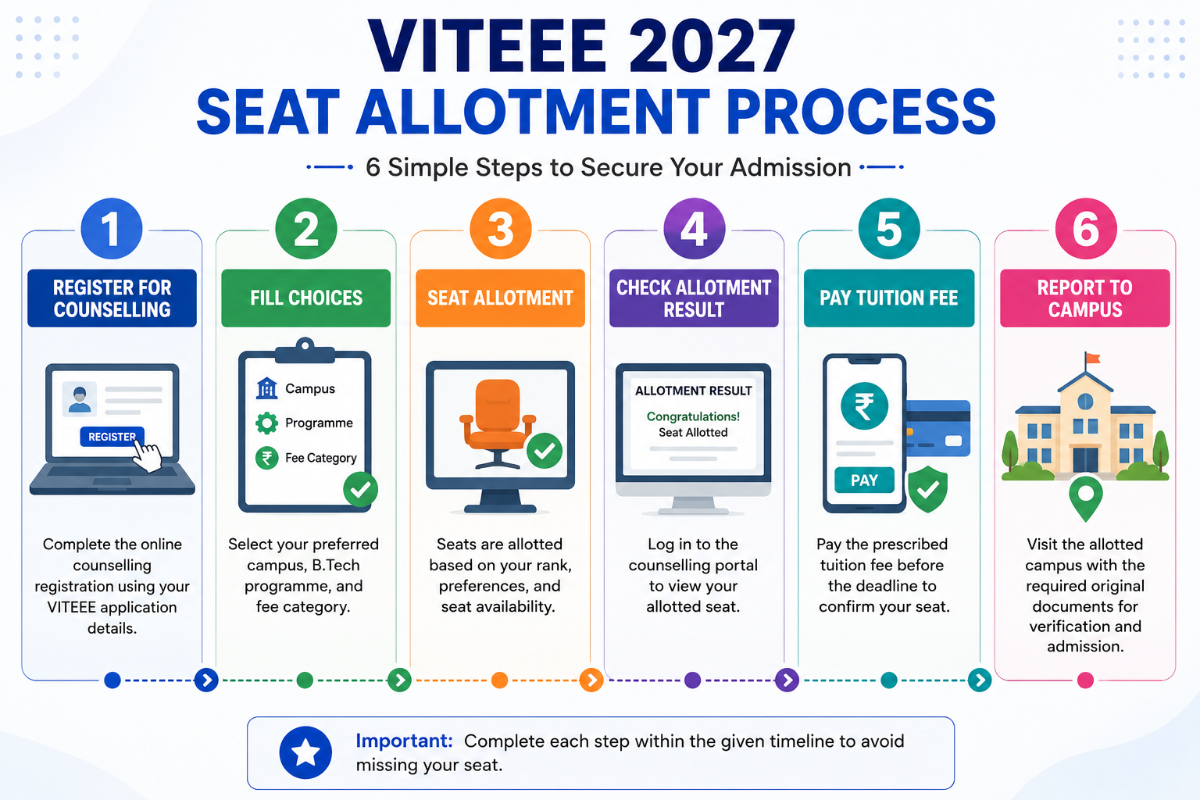
VITEEE 2027: Seat Allotment
VITEEE 2027 seat allotment is based on your rank, choices, fee category, and seat availability.
- Candidates who receive a seat must pay the required tuition fee within the given deadline to confirm their admission.
- Failure to pay the fee on time may result in cancellation of the allotted seat.
| Step | Details |
|---|---|
| 1. Register for Counselling | Complete the online counselling registration using your VITEEE application details. |
| 2. Fill Choices | Select your preferred campus, B.Tech programme, and fee category. |
| 3. Seat Allotment | Seats are allotted based on your rank, preferences, and seat availability. |
| 4. Check Allotment Result | Log in to the counselling portal to view your allotted seat. |
| 5. Pay Tuition Fee | Pay the prescribed tuition fee before the deadline to confirm your seat. |
| 6. Report to Campus | Visit the allotted campus with the required original documents for verification and admission. |
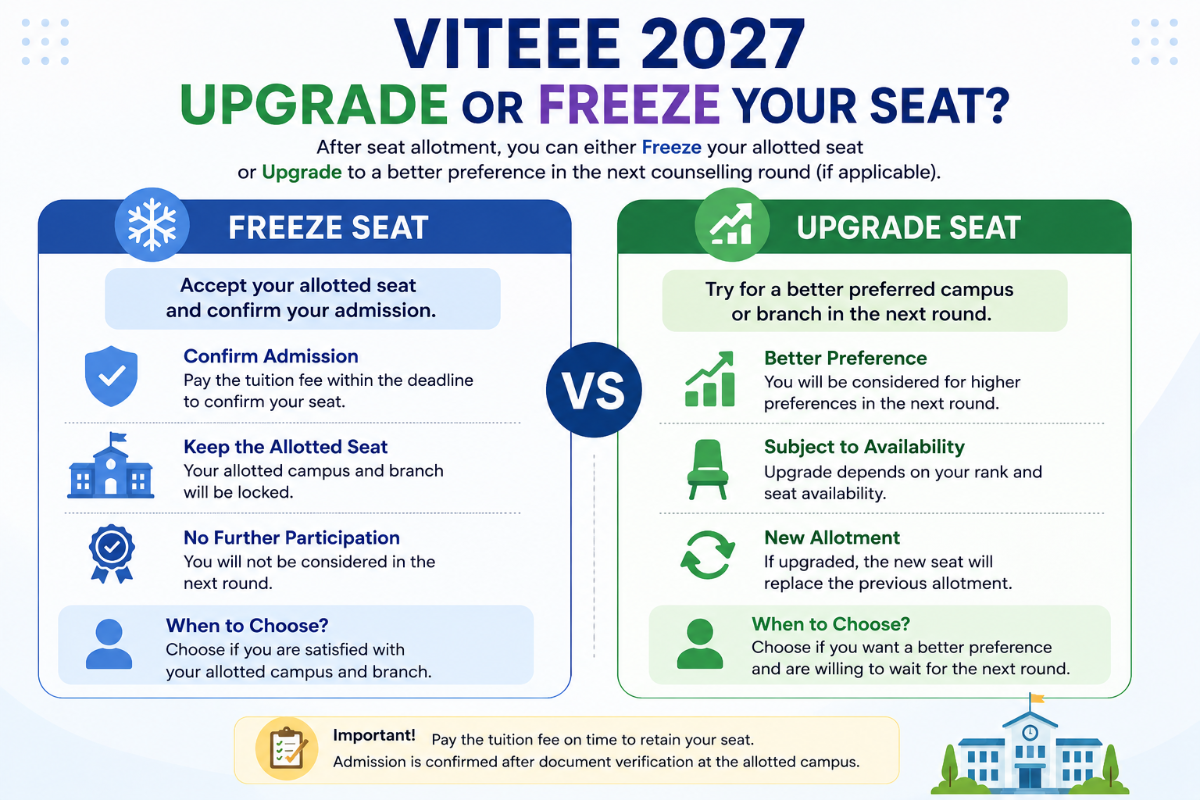
Upgrade or Freeze the Seat in the VITEEE 2027?
After the VITEEE 2027 seat allotment, candidates can either freeze their allotted seat or upgrade to a better preference in the next counselling round (if applicable).
- The decision depends on whether you are satisfied with your allotted campus and branch.
- Upgrading is subject to seat availability and your VITEEE rank.
| Option | What It Means | When to Choose |
|---|---|---|
| Freeze Seat | Accept the allotted seat and confirm admission by paying the tuition fee. | Choose this if you are satisfied with the allotted campus and branch. |
| Upgrade Seat | Participate in the next counselling round for a higher preferred campus or branch. | Choose this if you want a better preference and are willing to wait for the next round. |
Also Read: VITEEE Upgrade or Freeze Seat in Phase V Counselling: When to Wait for a Better Allotment
VIT Campuses and Courses Offered Through VITEEE 2027
VITEEE gives you access to four campuses, each offering a different mix of programmes and specialisations.
- Across VIT campuses, you can choose core branches like CSE, ECE, Mechanical, Civil, and EEE.
- You can also opt for specialisations such as AI & ML, Cyber Security, and Data Science.
| VIT Campus | Location | Popular B.Tech Courses Offered |
|---|---|---|
| VIT Vellore | Vellore, Tamil Nadu | Computer Science (CSE), CSE Specialisations, Electronics & Communication (ECE), Electrical & Electronics (EEE), Mechanical, Civil, Biotechnology, Chemical Engineering and more |
| VIT Chennai | Chennai, Tamil Nadu | Computer Science (CSE), CSE Specialisations, Electronics & Communication (ECE), Electrical & Electronics (EEE), Mechanical and other engineering programmes |
| VIT-AP | Amaravati, Andhra Pradesh | Computer Science (CSE), Electronics & Communication (ECE), Mechanical, Civil, Electrical & Electronics (EEE), AI & Data Science and other B.Tech courses |
| VIT Bhopal | Sehore, Madhya Pradesh | Computer Science (CSE), CSE Specialisations, Electronics & Communication (ECE), Mechanical, Civil, Electrical & Electronics (EEE), AI & ML, Cyber Security and other B.Tech programmes |
Also Read:
VITEEE 2027 vs JEE Main 2027: Which Exam Should You Prioritise?
Many students preparing for JEE Main also register for VITEEE as a backup option.
- VITEEE shares much of the JEE Main syllabus, but its questions are more formula-based and easier.
- If you're prepared for JEE Main, you only need to practise the VITEEE pattern and aptitude section.
- If your goal is a government-funded institute, you should prioritise JEE Main preparation first.
- Treat VITEEE as a parallel backup that needs comparatively less additional effort.
| Parameter | VITEEE 2027 | JEE Main 2027 |
|---|---|---|
| Conducting Body | VIT University | National Testing Agency (NTA) |
| Purpose | Admission to VIT campuses | Admission to NITs, IIITs, GFTIs, and JEE Advanced |
| Exam Mode | Computer-Based Test (CBT) | Computer-Based Test (CBT) |
| Exam Frequency | Once a year | Twice a year (January & April, expected) |
| Subjects | Physics, Chemistry, Mathematics/Biology, Aptitude, English | Physics, Chemistry, Mathematics |
| Question Difficulty | Moderate and formula-based | Moderate to difficult with conceptual questions |
| Syllabus | Similar to Class 11 & 12 NCERT; overlaps with JEE Main | Based on Class 11 & 12 NCERT with deeper concepts |
| Negative Marking | No negative marking | Yes, for MCQs |
| Exam Duration | 2 hours 30 minutes | 3 hours |
| Colleges Through Exam | VIT Vellore, Chennai, AP, and Bhopal | NITs, IIITs, GFTIs, and JEE Advanced eligibility |
| Competition Level | High | Very High |
| Best For | Students seeking admission to VIT campuses | Students targeting top government engineering colleges |
VITEEE 2027 FAQs
Ques. When to apply for VITEEE 2027?
Ans. The VITEEE 2027 application process began on October 20, 2026, and candidates can apply until March 31, 2027.
Ques. What is the VITEEE 2027 marking scheme?
Ans. You get 4 marks for every correct answer and lose 1 mark for every wrong answer. Unanswered or review-marked questions carry zero marks.
Ques. Is VITEEE held twice a year?
Ans. No. VITEEE is conducted once a year by VIT for admission to its B.Tech programmes. Candidates get only one attempt in each admission cycle.
Ques. Does VIT release an official VITEEE cutoff?
Ans. No, VIT does not release an official cutoff. It only prepares a rank-based counselling list, and closing ranks vary every year by branch and campus.
Ques. Can I apply for VITEEE 2027 if I studied Physics, Chemistry and Biology?
Ans. Yes, but you can only apply for a limited set of programmes such as Biotechnology, Bioengineering and Computer Science with Bioinformatics, and not the core engineering branches.
Ques. Is 18,000 a good rank for VITEEE?
Ans. Yes, 18,000 is generally considered a good VITEEE rank and can offer admission to many popular branches, depending on the campus and fee category. You may also have a chance for CSE specialisations, ECE, and other sought-after courses, especially at VIT Chennai, VIT-AP, or VIT Bhopal.
Ques. Does VIT offer admission through management quota?
Ans. No, VIT does not have a management quota. All B Tech admissions are based purely on your VITEEE rank.
Ques. Which is the best campus among VIT Vellore, Chennai, AP and Bhopal?
Ans. VIT Vellore and Chennai are the older, more established campuses with stronger placement records, while VIT-AP and Bhopal are newer campuses that are still building their placement history.
Ques. Where can I download the VITEEE 2027 syllabus?
Ans. You can download the subject-wise VITEEE 2027 syllabus PDF from the official website once VIT releases the notification.
Ques. What documents should I carry for VITEEE counselling?
Ans. You should carry your counselling letter, admit card, Class 10 and 12 original mark sheets, transfer certificate, a valid photo ID and your category certificate, if applicable.
Ques. Can I change my exam city after slot booking?
Ans. No, once you complete your VITEEE slot booking, you cannot change your test city, date, or time.











Comments
Found 93 Comments
Yes, in the VITEEE, an onscreen calculator is provided within the exam interface. Candidates are not allowed to carry physical calculators. The built-in calculator helps solve numerical questions easily, so it’s important to practice using a basic virtual calculator beforehand.
The Collegedunia app provides access to mock tests, sample papers, and practice questions for various entrance exams. Users can attempt these tests directly on the app to evaluate performance, understand exam patterns, and improve preparation, though availability may vary depending on the specific course or exam selected.
You can check here for the VITEEE previous year question papers with solutions PDF: Download Question Paper PDF
You can check VITEEE mock test results on Collegedunia by visiting the VITEEE section. Go to mock tests, log in with your details, and view your score or performance analysis. Results are shown instantly after submission. You can also compare rankings and review correct answers for better preparation.
You can check here for the VITEEE previous year question papers with solutions pdf: Download Question Paper PDF (2025-2017)
To start easy-level aptitude for VITEEE using Collegedunia, visit collegedunia.com and search “VITEEE aptitude preparation.” Begin with the basics of quantitative aptitude, logical reasoning, and verbal ability. Practice beginner questions, read concept explanations, attempt mock tests, and gradually increase difficulty to build speed, accuracy, and confidence
You can check here for the VITEEE previous year question papers with solutions pdf: Download Question Paper PDF (2025-2017)
You can check here for the VITEEE 2025 Question Paper (Available): Download Previous Year Question Paper with Solution PDF
You can check here for the VITEEE previous year question papers with solutions pdf: Download Question Paper PDF (2025-2017)
To join VIT, first complete Class 12 with Physics, Chemistry, and Mathematics. Register for the VITEEE exam on the official VIT website, prepare well, and appear for the entrance test. After the results, attend counseling, choose your campus and course, complete document verification, and pay the admission fee.
To apply for JEE Main and VITEEE, visit their official websites. Register online, fill out the application form, upload the required documents, and pay the application fee. JEE Main is conducted by NTA, while VITEEE is conducted by VIT University separately.
You can check here for the VITEEE Mock Test 2026: Practice Free Chapter-Wise Questions. To give the VITEEE mock test on Collegedunia, visit collegedunia.com and search for “VITEEE Mock Test.” Register with your basic details, choose the desired test mode, and start the online practice test. It simulates the actual VITEEE exam pattern, helping students assess their preparation and improve speed and accuracy before the main exam.
You can check here for the VITEEE previous year question papers with solutions pdf: Download Question Paper PDF (2025-2017)
B.Tech Computer Science and Engineering at VIT Chennai is a 4-year, full-time degree program offered On Campus.
Admissions to B.Tech Computer Science and Engineering at VIT Chennai are based on VITEEE. Candidates must have completed 10+2 with 60% + VITEEE to be eligible for admission
You can check here for the VITEEE Mock Test 2026: Practice Free Chapter-Wise Questions
You can check here for the VITEEE previous year question papers with solutions pdf: Download Question Paper PDF (2025-2017)
You can check here for the VITEEE Preparation Tips, Syllabus Weightage, Best Books, and Tips by Toppers. VIT University aims to assess candidates based on speed, time-management, and decision-making power, besides their academic knowledge.
A natural number is a positive integer used for counting and ordering. It starts from 1, 2, 3, 4, … and goes on infinitely. The natural numbers are whole numbers greater than zero with no fractions or decimals. They are used in everyday counting like “3 apples” or “5 books.”
As an average student, focus smartly in the last 10 days for VITEEE. Revise the NCERT basics of Physics, Chemistry, Maths/Biology. Practice previous-year VITEEE questions, formulas, and shortcuts daily. Strengthen easy topics, take mock tests, analyze mistakes, manage time, and stay consistent.