



Content Writer
Biological classification is the process of identifying traits in living organisms and arranging them according to their characteristics. The study of living organism classification helps to study the common features of the group.
- Biological Classification helps in the identification of new organisms.
- It helps to understand the relationships between various groups of species.
- The term used for naming and classifying organisms biologically is called taxonomy.
- The process of classification helps to study about the process of evolution.
- History of biological classification dates back to Aristotle.
- Later, scientists began to classify plants and animals based on attributes and characteristics.
- The concept can be explained by imagining a dog and a snake.
- Dogs come into the category of mammals, whereas snakes come into the category of reptiles.
Read More: Biological Classification Important Questions
Key Terms: Biological Classification, Species, Genus, Kingdom, Phylum, Class, Order, Family, Taxonomy, Living Organisms, Bacteria, Monera, Protesta, Fungi, Plantae, Animalia, Virus
What is Biological Classification?
[Click Here for Sample Questions]
Biological Classification is defined as a process of arranging into hirearchy of groups and sub-groups based on characteristics and attributes. Carolus Linnaeus, a biologist is responsible for dividing the organisms into two kingdoms namely plants and animals.
- Animals are classified on the basis of aquatic, aerial and terrestrial.
- Similarly, plants are classified on the basis of herbs, shrubs and trees.
- Biological classification has been represented by different ways by different scientists.
- The properties of alloting a category of living organisms changes with respect to time.
- In 1969, R.H. Whittaker proposed the idea of Five Kingdom Classification.
- The criteria used for biological classification includes cell structure, body organisation, mode of nutrition, reproduction and phylogenetic relationships.
- The five kindom proposed were Monera, Protesta, Fungi, Plantae, and Animalia.
Read More:
Kingdom Monera
[Click Here for Sample Questions]
Kingdom Monera consists of a single member namely a microbe that can be found anywhere. Bacteria are found in icy places, deep oceans, and hot springs and can survive in adverse weather conditions.
- They can even survive on the bodies of other living organisms, such as parasites.
- The structure of bacteria is fairly simple, but their behaviour is complicated.
- They are divided into two groups based on their shape: spherical and cylindrical.
- Coccus (cocci), Bacillus (bacilli), Vibrium (vibrio), and Spirulina (spirulina) are types of bacteria.
- Bacteria can be heterotrophic or autotrophic.
Autotrophic bacteria may produce their food from inorganic materials. For sustenance, heterotrophic bacteria rely on other live species or dead substances. The cell wall structure of archaebacteria distinguishes them from other bacteria.
- In the guts of ruminating mammals, methanogens, a type of archaebacteria, live.
- Eubacteria, also known as 'real bacteria,' are single-celled prokaryotic microbes.
- Some of them serve critical roles in milk curdling, nutrition recycling, and nitrogen fixation in legume roots.
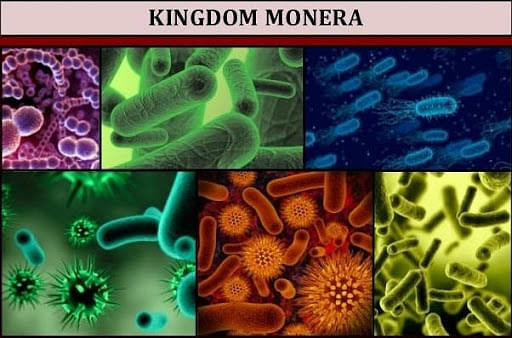
Kingdom Monera Classification
Read More: Biological Classification MCQs
Kingdom Protista
[Click Here for Sample Questions]
Kingdom Protista includes single-celled eukaryotes. They are typically found in the water. In aquatic ecosystems, algae, for example, are the primary producers. They are eukaryotic creatures with only one cell.
- They have a true core that is separated from the rest of the cell by the nuclear membrane.
- These organisms can move by cilia and flagella; they can breathe both aerobically and anaerobically.
- Protista can reproduce both sexually and asexually.
They are divided into five categories namely Chrysophytes, Dinoflagellates, Euglenoids, Slime molds, and Protozoans which are discussed in detail in below section.
Read More: Prokaryotic and Eukaryotic microorganisms
Chrysophytes
Chrysophytes includes diatoms and golden algae. They are found in both freshwater and marine settings. In nature, they are photosynthetic. Their cell walls are made of silica.
- They are the most important producers in the oceans.
- Most of them are unicellular flagellates.
- They are amoeboids.
Dinoflagellates
Dinoflagellates are photosynthetic organisms that live in the sea. They can be yellow, green, brown, blue, or red, depending on the cell pigment. The outside surface of their cell walls is covered in cellulose plates, making them rigid.
Euglenoids
Euglenoids are frequently found in stagnant water and are freshwater creatures. They make use of their photosynthetic nature when exposed to sunshine. They eat smaller organisms when they are deprived of sunshine.
Read More: Sexual Reproduction in Fungi
Slime Moulds
Slime Moulds feed on rotting twigs, leaves, and organic waste and are saprophytic. Even in the face of adversity, they can live for a long time.
Protozoans
All protozoans are parasite-eating predators. Amoeboid protozoans, Flagellated protozoans, Ciliated protozoans, and Sporozoans are the four types of protozoans.
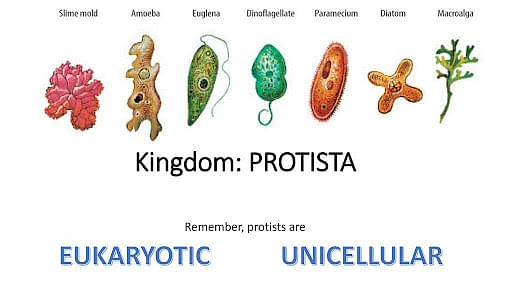
Kingdom Protista Classification
Read More: Prions
Kingdom Fungi
[Click Here for Sample Questions]
Fungi are eukaryotic organisms that include yeasts, moulds, mushrooms, and other microorganisms. These organisms belong to the kingdom of fungi. The organisms in the Kingdom Fungi have a cell wall and are widely distributed.
- Among living organisms, they are categorized as heterotrophs.
- Fungi include the formation of black spots on bread that have been left outside for several days.
- Mushrooms and yeast cells are often employed to create beer and bread.
- They're also present in the majority of skin infections and fungal illnesses.
Looking closely, we can see that all of the instances we gave contain damp circumstances. As a result, we can conclude that fungi thrive in damp, warm environments.
Read More: Fungus Life Cycle

Kingdom Fungi
Kingdom Fungi are divided into different classes which are as follows:
Phycomycetes
In phycomcytes, asexual reproduction is carried out via zoospores. Zoospores are mobile spores, and aplanospores are static spores. The sporangium is where the spores are formed.
- The gametes fuse to create the zygospore.
- The mycelium is multicellular and coenocytic (many nuclei).
- They are also known as lower fungi.
Example of PhycomcetesExample: Mucor, Rhizopus, and Albugo. |
Ascomycetes
Ascomycetes can be both saprophytic and parasitic. Conidia are used for asexual reproduction. Ascomycetes, such as Penicillium, Aspergillus, Claviceps, and others, reproduce sexually through ascospores.
- These organisms have branching and septate mycelium.
- They are also known as sac fungi.
Read More: Difference between Autotrophs and heterotrophs
Basidiomycetes
The process of fragmentation is used in vegetative reproduction. Sexual organs are missing in these types of fungi.
- The creation of the basidium is caused by plasmogamy between two vegetative or somatic cells.
- They are also known as club fungi.
Example of BasidiomycetesExample: Agaricus (mushrooms), Ustilago (fire rot), and so on, the basidium goes through karyogamy and meiosis to create four basidiospores. |
Deuteromycetes
Deuteromycetes are generally referred to be "imperfect fungus" because they do not reproduce sexually at any point in their lives. Conidia are used to reproduce sexually. Alternaria, Trichoderma, and other fungi have septate and branching mycelium.
Read More: Two Kingdom Classification
Kingdom Plantae
[Click Here for Sample Questions]
All organisms under Kingdom Plantae contain chlorophyll and prepare food on their own.
- They are eukaryotes, and their cells have a nuclear envelope.
- This category of organisms is made of cellulose.
- Only insectivorous plants (Venus flytrap) and parasitic plants (Cuscuta) are partially heterotrophic.
- All algae, bryophytes, pteridophytes, gymnosperms, and angiosperms belong to this kingdom.
- Plants go through two stages in their life cycle: diploid gametophyte and haploid sporophyte.
- The duration of the diploid and haploid phases differs amongst plant groups.
- Alternation of generation is the phrase for this phenomenon.

Kingdom Plantae
Read More: Notes for the Plant kingdom
Kingdom Animalia
[Click Here for Sample Questions]
The creatures in this category are heterotrophic and eukaryotic. Some of the characteristics of Kingdom Animalia members are as follows:
- In animalia, the nucleus is protected by a nuclear envelope in eukaryotes.
- Although they are multicellular, they lack a cell wall.
- They are either directly or indirectly reliant on plants for nourishment.
- Their food is stored in the form of glycogen or lipids.
- They digest food in a cavity inside the body.
Read More: Invertebrate
Kingdom Animalia growth pattern is defined by the fact that animals mature into adults with a specific shape, size, and structure. Sensory and neuromotor systems have been developed in some cases.

Kingdom Animalia Classification
Read More: Where Do Microorganisms Live
Viruses
[Click Here for Sample Questions]
Viruses are acellular entities made up of nucleic acid (DNA or RNA) encased in a protein sheath. Only a host cell can grow and proliferate these viruses.
- Viruses reside outside of the host cell as crystals.
- They infect the host and cause significant damage.
Read More: Bacterial Transformation
Example of VirusesExample: Cold, flu, polio, AIDS, and other viruses are examples of common viruses |
Read More: Deuteromycetes
Viroid
[Click Here for Sample Questions]
A viroid is a type of infectious particle that is smaller than any known virus and is a cause of certain plant diseases. The particle is made up entirely of a very small circular RNA (ribonucleic acid) molecule that lacks the virus's protein coat.
- Viroid are small stranded infectious pathogens.
- They are inhabitated from angiosperms.
- Viroids are made up of nuclei acid but they do not have any type of protein.
- Potato spindle tubule disease is the first category of viroid.
- They are smaller in size and contain only RNA.
- Viroid have the capability to reproduce in the host cell they are residing.
Read More:
| Class 11 Biology Related Concepts | ||
|---|---|---|
| Mendelian Inheritance | Endangered Species | Structure of RNA |
| Biological Classification | Numerical Taxonomy | Chromosomal Theory of Inheritance |
Lichens
[Click Here for Sample Questions]
Lichens are a complex living form resulting from a symbiotic relationship between two organisms: a fungus and an alga. The fungus is the dominant partner, providing the majority of the lichen's traits, from its thallus shape to its fruiting bodies.
- They act as a producer in the nutrient cycle.
- Lichens come in various sizes and colours.
- In these organisms, filaments are closely packed to form a cortex.
- They are estimated to cover approximately 6-8% of earth's surface.
- Lichens are used in the preparation of traditional medicine.
- They are highly sensitive to sulfur and nitrogen.
Read More: Difference Between Fungi and Lichens
Things to Remember
- Biological Classification uses physical and genetic evidence to classify organisms.
- Genetic information is exchanged in Eubacteria via bi-directional or unidirectional DNA transfer.
- The capsid protein coat, which is made up of tiny subunits called capsomeres, shields the nucleic acid in viruses.
- Oospores, ascospores, and basidiospores are the three types of spores used in sexual reproduction.
- In fungi, the reproductive cycle consists of three steps: protoplasmic fusing, nucleoplasmic fusion and the zygote production.
- Zygote undergoes meiosis, which results in the creation of spores.
- The vegetative component of the fungus is known as the Mycelium.
- Mycelium is the name for the hypha network.
Read More: Economic Importance of Fungi
Sample Questions
Ques. How are red tides signified with algal bloom? (2 Marks)
Ans. Algal blooms are referred to as red tides. The name "red tides" comes from the fact that some species of algae in these blooms release photosynthetic pigments that cause their color to change from brown to red.
- These, like all other algal blooms, are usually triggered by a sudden injection of nutrients into the ocean's surface.
- Algal blooms, in general, are harmful to all forms of life, including people.
Ques. What is plasmogamy? (2 Marks)
Ans. One of the stages in the sexual reproduction of fungi is plasmogamy. The two-parent cells fuse without fusing their nuclei at this stage, thus putting two haploid nuclei into one cell, but the nuclei have not yet merged.
Ques. What are Euglenoids? (3 Marks)
Ans. Euglenoids are organisms that live in stagnant water and are protected by a pellicle, which is a layer of rich protein. These creatures also have one short and one long flagellum.
- Euglena, which is both autotrophic and heterotrophic, is an example of such an organism.
- Furthermore, a large proportion of euglenoids have chloroplast.
- It aids in the production of their food and is known as Paramylon (a type of carbohydrate).
Ques. How did different classification systems change over time? (2 Marks)
Ans. Over time, the classification systems have undergone many alterations. This approach, however, failed to distinguish between unicellular and multicellular creatures, as well as between eukaryotes and prokaryotes.
- As a result, a huge number of creatures could not be categorized into either of the two kingdoms.
- Linnaeus' two-kingdom classification system (plants and animals) has to be constantly updated to reflect new findings.
Ques. How are viroids different from viruses? (2 Marks)
Ans. Viruses can have either RNA or DNA molecules enclosed in a protein coat, whereas viroids are free RNA molecules with low molecular weight and no protein coat.
- Viroids are smaller than viruses in size. Viruses infect only plants, but viroids infect all living things.
- A protein coat is missing in viroids, whereas a protein covering or coat termed capsid is present surrounding the genetic material in viruses.
Ques. How long can fungi live? (2 Marks)
Ans. Fungi have a short life period in general, though this varies widely amongst species. Some varieties can live as little as a day, while others can live for a week to a month. A fungus' life cycle starts with a spore and ends with germination. Fungi, unlike plants, lack the green pigment chlorophyll and hence are unable to perform photosynthesis.
Ques. Does Monera have cell walls? (3 Marks)
Ans. The world's most abundant and ubiquitous creatures. They're prokaryotic, which means they don't have a nucleus or any other membrane-bound organelles.
- Outside of the plasma membrane, the cell wall is made up in part of peptidoglycan, a complex structural substance not found in eukaryotic cells.
- It lacks a well-defined nucleus and other membrane-bound cell organelles such as mitochondria.
- Golgi apparatus, and chloroplast, the nuclear membrane is lacking in Monera.
Ques. Do protists require oxygen? (3 Marks)
Ans. Although most protists (obligate aerobes) require oxygen, some may or must rely on anaerobic metabolism, such as parasitic forms that survive in areas where free oxygen is scarce and some bottom-dwelling (benthic) ciliates that live in the sulphide zone of some marine and freshwater sediments.
- Aquatic organisms make up the majority of protists.
- They require a wet environment to thrive.
- It can be found in regions with plenty of water, such as marshes, puddles, damp soil, lakes, and the ocean.
Ques. What is the criteria used for the classification of five kingdom classification? (3 marks)
Ans. The criteria used for the classification of five kingdom classification are as follows:
- Firstly is is based on the structure of cell.
- It is based on the organisation of body.
- Next, it is based on the mode of nourishment of organisms.
- The classification is based on the mode of reproduction.
- Lastly it is based on the phylogenetic linkages or relationships.
Ques. Differentiate between between each category of five kingdom? (5 marks)
Ans. The difference between each category of five kingdom are as follows:
| Category | Monera | Protista | Fungi | Plantae | Animalia |
|---|---|---|---|---|---|
| Type of cell used | Monera are unicellular organisms that consists of prokaryotes cells. | Protista are unicellular organisms that consists of eukaryotic cells. | Fungi are multicellular organisms that consists of eukaryotic cells. | Plantae are multicellular organisms that consists of eukaryotic cells. | Animalia are multicellular organisms that consists of eukaryotic cells. |
| Presence of nucleus | They do not have nucleus. | They have nucleus. | They have nucleus. | They have nucleus. | They have nucleus. |
| Organisation of body | The organisation of body is cellular. | The organisation of body is cellular. | The organisation of body is multicellular with loose tissues. | The organisation of body is based on tissue and organ level. | The organisation of body is based on tissue and organ level. |
| Mode of nourishment | In this the mode of nourishment is autotrophic and heterotrophic. | In this the mode of nourishment is autotrophic and heterotrophic. | In this the mode of nourishment is saprophytic. | In this the mode of nourishment is autotrophic. | In this the mode of nourishment is heterotrophic. |
| Examples | Bacteria | Spirogyra | Agaricus | Herb | Frog and fish |
Ques. What are Archaebacteria? (3 marks)
Ans.Archaebacteria is a special bacteria that belongs to the kingdom Monera. They can withstand extremely harmful weather conditions. These types of organisms have different types of cell walls. They are divided into three categories, which are as follows:
- Thermoacidophiles: Thermoacidophiles are found in the area of hot springs.
- Halophiles: Halophiles are found in areas of salt.
- Methanogens: Methanogens are found in marshy areas.
Read More:



Comments