

.jpg?h=56&w=56&mode=stretch)


KEAM 2026 Engineering Question Paper for April 21 is available for download here. CEE Kerala conducted KEAM 2026 Engineering exam on April 21 in session 2 from 2 PM to 5 PM. KEAM 2026 Engineering exam is an online CBT with a total of 150 questions carrying a maximum of 600 marks.
- The KEAM Engineering exam is divided into 3 subjects- Physics (45 questions), Chemistry (30 questions) and Mathematics (75 questions).
- 4 marks are given for every correct answer and 1 mark is deducted for every incorrect answer
Candidates can download KEAM 2026 April 21 Engineering Question Paper with Solution PDF from the links provided below.
KEAM 2026 Engineering April 21 Question Paper with Solution PDF
| KEAM 2026 Engineering Question Paper April 21 | Download PDF | Check Solution |

Also Check:
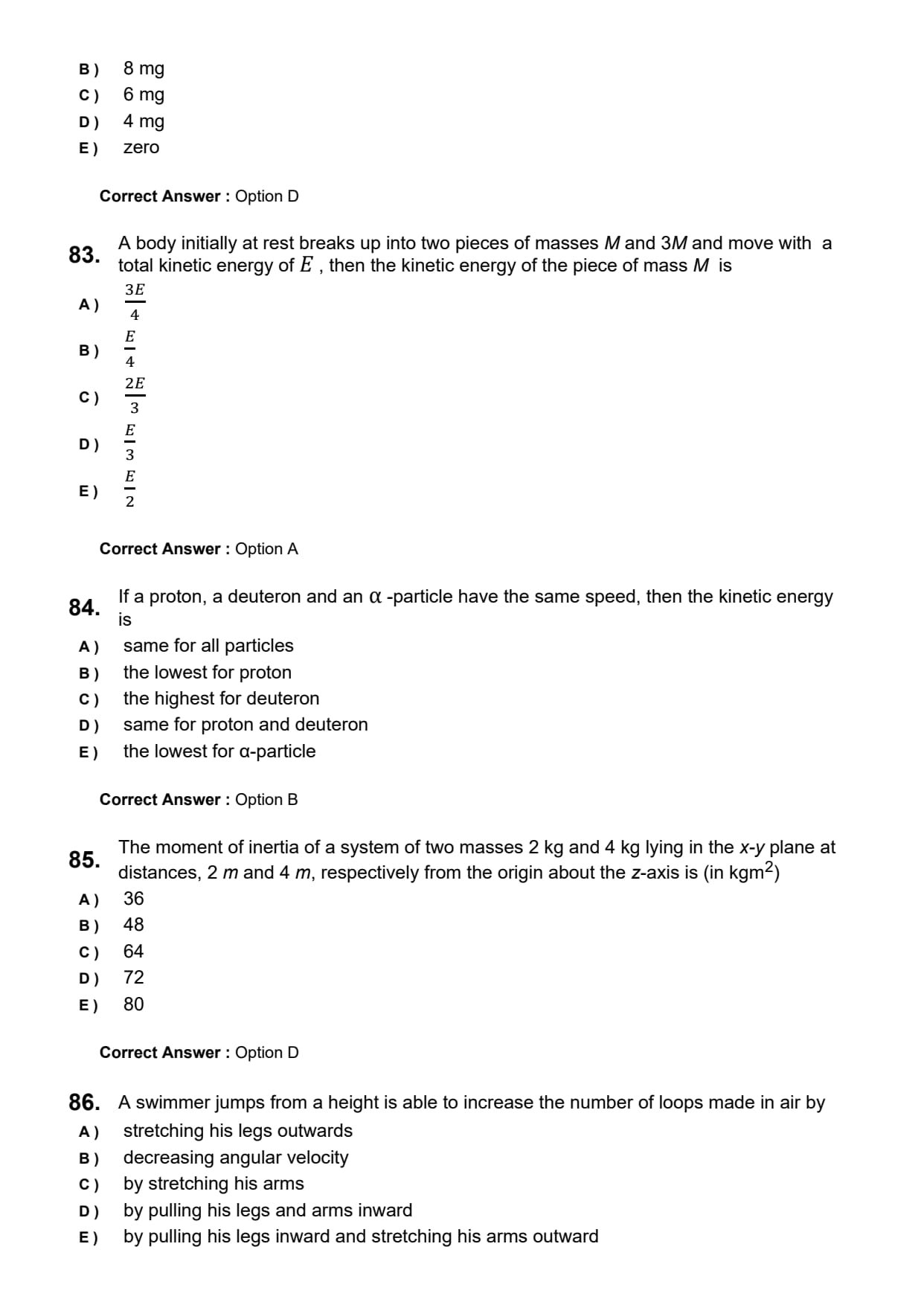
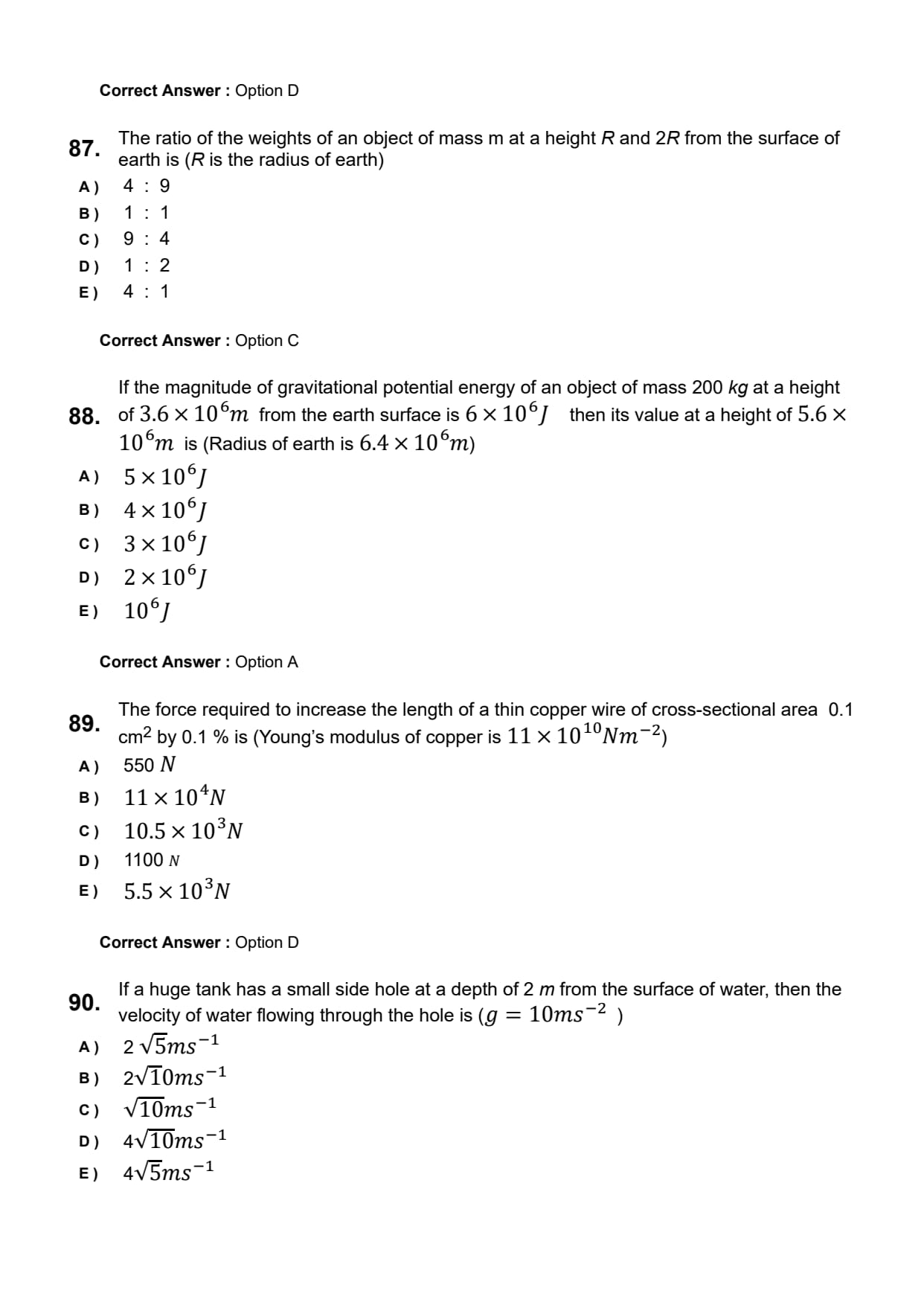
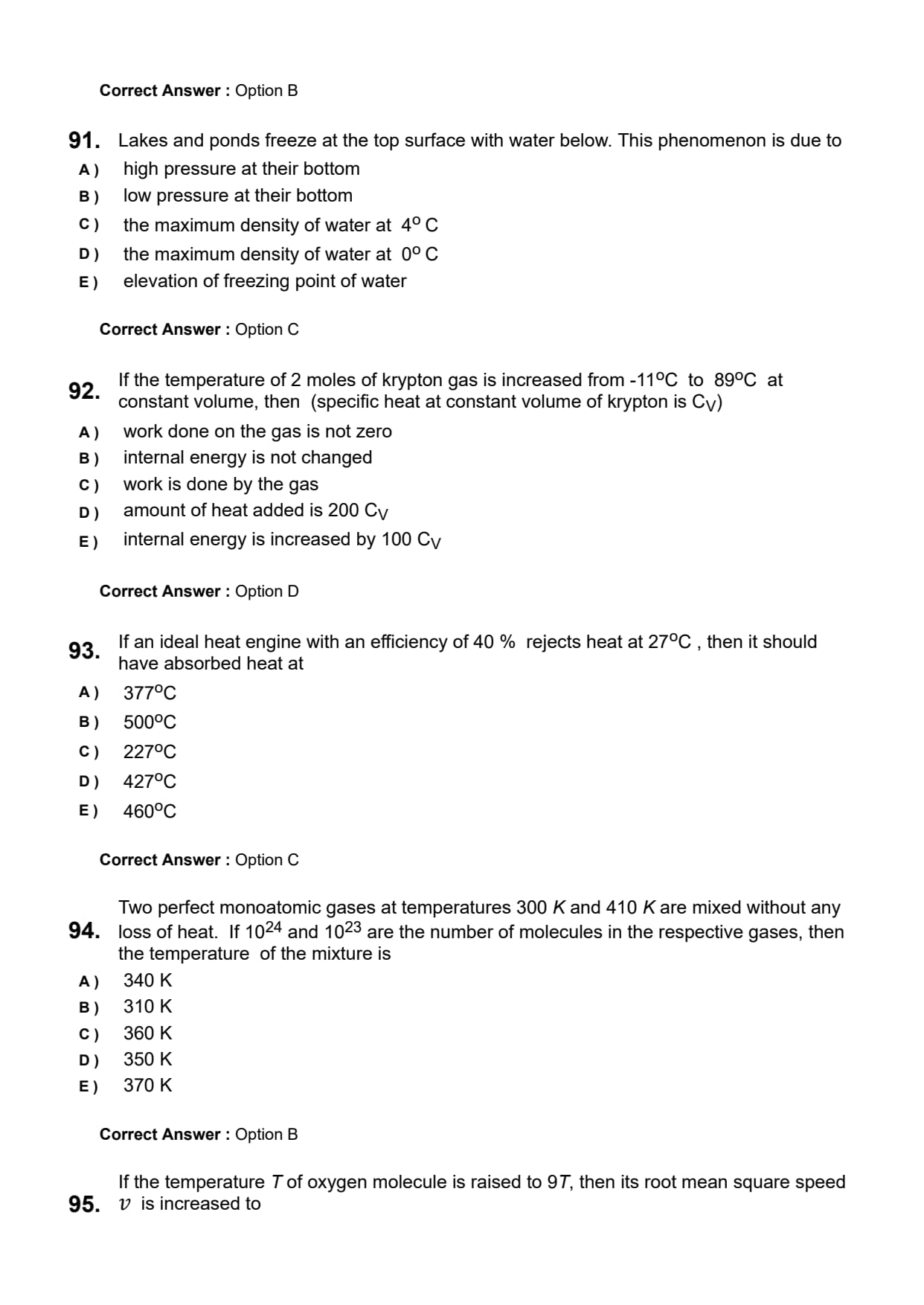
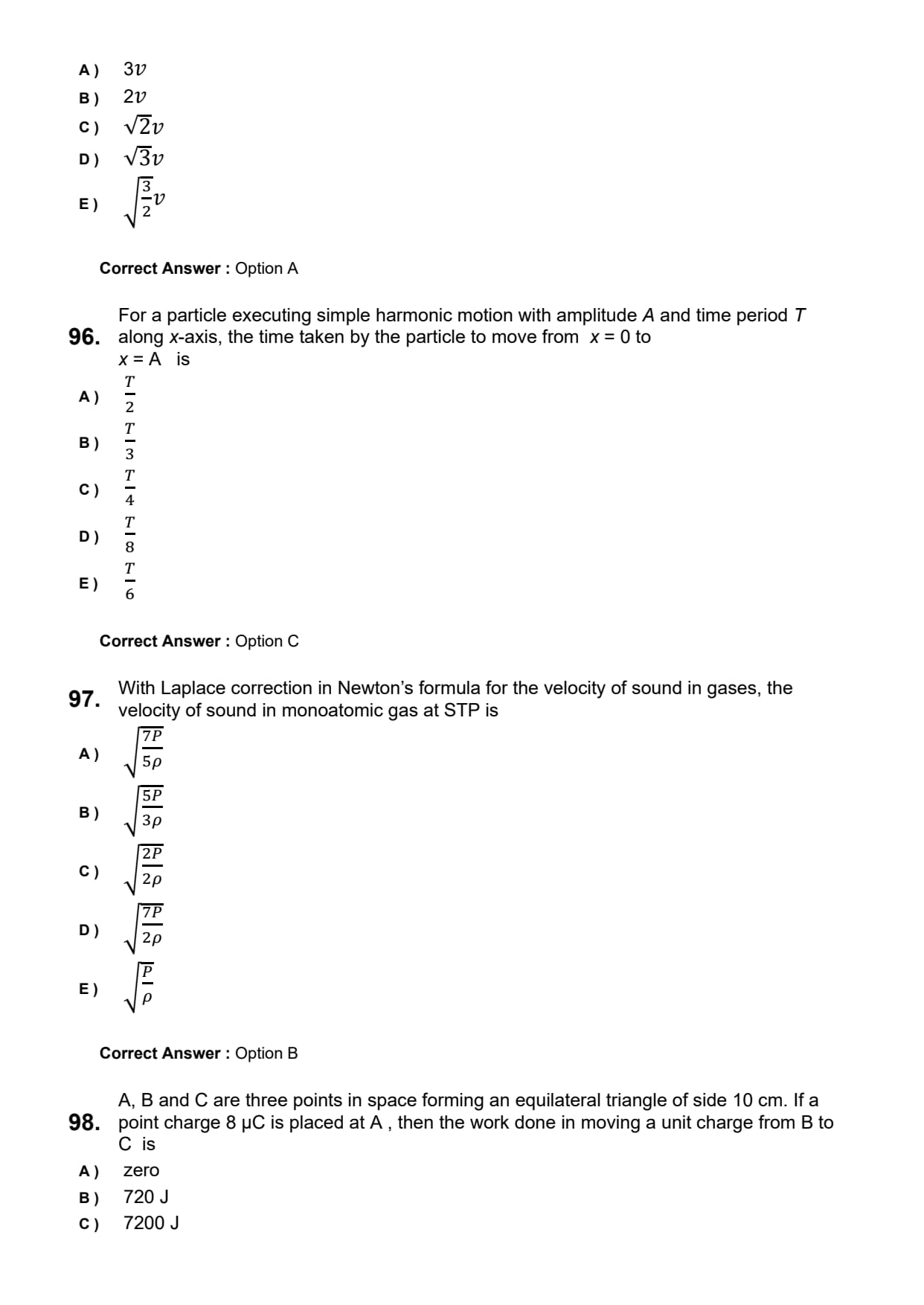
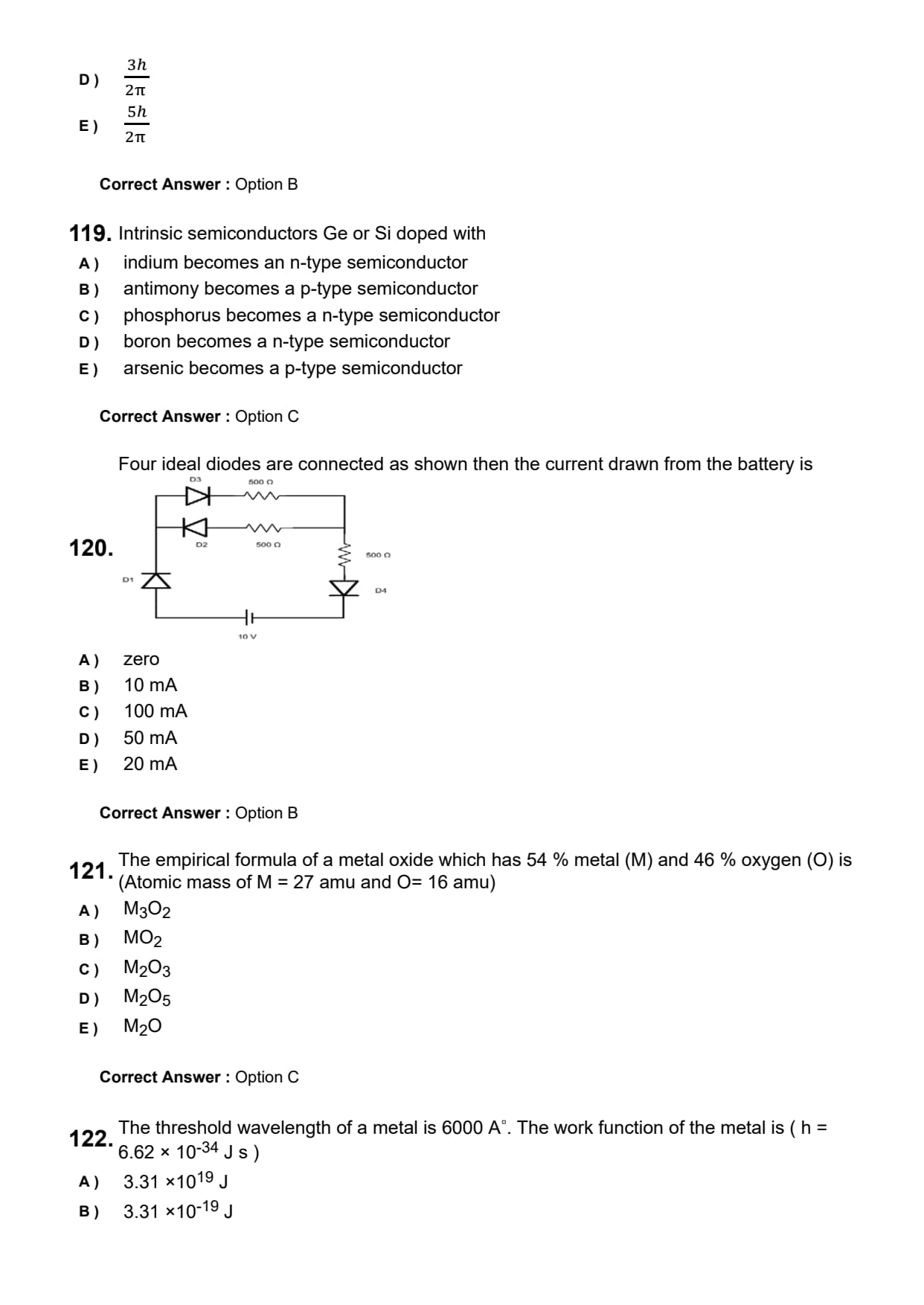
A large tank has a small hole at depth of 2m from water surface. What is the velocity of a water flow through hole?
View Solution
Step 1: Understanding the Concept:
This problem uses Torricelli's Law, which states that the speed of efflux of a fluid through a sharp-edged hole at the bottom of a tank filled to a depth \(h\) is the same as the speed that a body would acquire in falling freely from a height \(h\).
Step 2: Key Formula or Approach:
The velocity of efflux (\(v\)) is calculated using the formula: \[ v = \sqrt{2gh} \]
where \(g\) is the acceleration due to gravity (\(9.8\) m/s) and \(h\) is the depth of the hole from the free surface.
Step 3: Detailed Explanation:
1. Identify given values: Depth \( h = 2 \) m and gravity \( g = 9.8 \) m/s.
2. Substitute these values into the Torricelli equation: \[ v = \sqrt{2 \times 9.8 \times 2} \]
3. Simplify the expression inside the square root: \[ v = \sqrt{39.2} \]
4. Calculate the final numerical value: \[ v \approx 6.26 \, m/s \]
Step 4: Final Answer
The velocity of water flow through the hole is 6.26 m/s. Quick Tip: To remember this easily, notice it's the same as the third equation of motion (\(v^2 = u^2 + 2as\)) where initial velocity \(u=0\), acceleration \(a=g\), and distance \(s=h\).
10 stones of mass 'm' are arranged one above another in a vertical stack. What is the force experienced by the 6th stone from the bottom?
View Solution
Step 1: Understanding the Concept:
In a static equilibrium, the force experienced by any object in a vertical stack is the cumulative weight of all the objects placed above it. This downward force is the normal force exerted by the upper part of the stack.
Step 3: Detailed Explanation:
1. Total number of stones in the stack = 10.
2. Position of the stone in question = 6th from the bottom.
3. Determine how many stones are resting on top of the 6th stone:
- Stones at positions 1, 2, 3, 4, 5, and 6 are below or include the target stone.
- Stones at positions 7, 8, 9, and 10 are above the target stone.
4. Count of stones above = 4 stones.
5. Calculate the total weight of these 4 stones:
- Weight of one stone = \( mg \).
- Weight of 4 stones = \( 4 \times mg = 4mg \).
Step 4: Final Answer
The force experienced by the 6th stone from the bottom is 4mg. Quick Tip: Always count from the top down to find the load. If there are \(N\) total items and you want the force on the \(k^{th}\) item from the bottom, the force is \((N - k)mg\).
Find difference between the angular momentum of 5th and 3rd orbit of hydrogen atom.
View Solution
Step 1: Understanding the Concept:
According to Bohr's quantization of angular momentum, an electron can only revolve in orbits where its angular momentum is an integral multiple of \( \frac{h}{2\pi} \).
Step 2: Key Formula or Approach:
The formula for angular momentum (\(L\)) in the \(n^{th}\) orbit is: \[ L_n = \frac{nh}{2\pi} \]
where \(h\) is Planck's constant and \(n\) is the orbit number.
Step 3: Detailed Explanation:
1. Calculate angular momentum for the 5th orbit (\( n = 5 \)): \[ L_5 = \frac{5h}{2\pi} \]
2. Calculate angular momentum for the 3rd orbit (\( n = 3 \)): \[ L_3 = \frac{3h}{2\pi} \]
3. Find the difference (\( \Delta L \)) between the two: \[ \Delta L = L_5 - L_3 \] \[ \Delta L = \frac{5h}{2\pi} - \frac{3h}{2\pi} \]
4. Simplify the fraction: \[ \Delta L = \frac{2h}{2\pi} = \frac{h}{\pi} \]
Step 4: Final Answer
The difference in angular momentum is \(\frac{h}{\pi}\). Quick Tip: The difference in angular momentum between any two consecutive orbits is always a constant value: \( \frac{h}{2\pi} \). For a jump of 2 orbits, it is simply double that value.
3 cells having emf 3V, 4V and 4V with internal resistance 0.5 \(\Omega\), 0.75 \(\Omega\), 0.75 \(\Omega\) respectively are connected in series with 4 \(\Omega\) as shown in figure. Find current through 4 \(\Omega\) resistor.
View Solution
Step 1: Understanding the Concept:
In a series circuit, the total electromotive force (EMF) is the sum of the individual EMFs, and the total resistance is the sum of the external resistance and all internal resistances. According to Ohm's law, the current is the ratio of total EMF to total resistance.
Step 2: Key Formula or Approach:
The current \( I \) in a series circuit is: \[ I = \frac{\sum E}{\sum r + R} \]
where \( \sum E \) is the total EMF, \( \sum r \) is the sum of internal resistances, and \( R \) is the external resistance.
Step 3: Detailed Explanation:
1. Calculate the total EMF: \[ E_{total} = 3V + 4V + 4V = 11V \]
2. Calculate the total internal resistance: \[ r_{total} = 0.5\,\Omega + 0.75\,\Omega + 0.75\,\Omega = 2.0\,\Omega \]
3. Calculate the total circuit resistance (internal + external): \[ R_{total} = r_{total} + R_{ext} = 2.0\,\Omega + 4\,\Omega = 6\,\Omega \]
4. Calculate current using Ohm's Law: \[ I = \frac{11V}{6\,\Omega} \approx 1.833\,A \]
Step 4: Final Answer
The current through the 4 \(\Omega\) resistor is 1.83 A. Quick Tip: Always check the polarity of the cells in the diagram. If one cell is connected in the opposite direction (reverse polarity), its EMF must be subtracted rather than added.
A heat engine operates between source and sink. The sink temperature is 27°C and the efficiency of the engine is 40%. Find the temperature of source.
View Solution
Step 1: Understanding the Concept:
The efficiency of a heat engine (specifically a Carnot engine) is determined by the absolute temperatures (in Kelvin) of the hot source and the cold sink. Efficiency represents the fraction of heat from the source that is converted into work.
Step 2: Key Formula or Approach:
Efficiency (\( \eta \)) is given by: \[ \eta = 1 - \frac{T_{sink}}{T_{source}} \]
Note: Temperatures must be in Kelvin (\( K = ^\circ C + 273 \)).
Step 3: Detailed Explanation:
1. Convert sink temperature to Kelvin: \[ T_{sink} = 27 + 273 = 300\,K \]
2. Express efficiency as a decimal: \[ \eta = 40% = 0.40 \]
3. Substitute into the efficiency formula: \[ 0.40 = 1 - \frac{300}{T_{source}} \]
4. Rearrange to solve for \( T_{source} \): \[ \frac{300}{T_{source}} = 1 - 0.40 = 0.60 \] \[ T_{source} = \frac{300}{0.60} = 500\,K \]
5. Convert back to Celsius: \[ T_{source}(^\circ C) = 500 - 273 = 227^\circ C \]
Step 4: Final Answer
The temperature of the source is 227°C. Quick Tip: In thermodynamics, never perform calculations using Celsius. A common error is using 27°C directly, which will lead to a mathematically incorrect source temperature. Always convert to Kelvin first!
A body initially at rest explodes into two fragments of masses m and 3m. If total kinetic energy released is E, find the kinetic energy of the fragment of mass m.
View Solution
Step 1: Understanding the Concept:
When an object explodes at rest, the total linear momentum is conserved and remains zero. This means the two fragments must move in opposite directions with momenta of equal magnitude.
Step 2: Key Formula or Approach:
1. Conservation of Momentum: \( p_1 = p_2 = p \).
2. Relation between Kinetic Energy (\( K \)) and Momentum (\( p \)): \[ K = \frac{p^2}{2m} \]
Step 3: Detailed Explanation:
1. Let \( K_1 \) be the kinetic energy of mass \( m \) and \( K_2 \) be the kinetic energy of mass \( 3m \).
2. Since both have the same momentum \( p \): \[ K_1 = \frac{p^2}{2m} \quad and \quad K_2 = \frac{p^2}{2(3m)} = \frac{p^2}{6m} \]
3. Find the ratio of their kinetic energies: \[ \frac{K_1}{K_2} = \frac{p^2/2m}{p^2/6m} = \frac{6}{2} = 3 \implies K_1 = 3K_2 \]
4. The total energy released is \( E = K_1 + K_2 \).
5. Substitute \( K_2 = K_1/3 \) into the total energy equation: \[ E = K_1 + \frac{K_1}{3} = \frac{4K_1}{3} \]
6. Solve for \( K_1 \): \[ K_1 = \frac{3E}{4} = 0.75E \]
Step 4: Final Answer
The kinetic energy of the fragment of mass m is 0.75E. Quick Tip: In explosions, the lighter fragment always carries more kinetic energy. Specifically, the energy is distributed in inverse proportion to the masses: \( K_1 / K_2 = m_2 / m_1 \).
If a current carrying loop is freely suspended in a magnetic field, what will happen?
View Solution
Step 1: Understanding the Concept:
A current-carrying loop acts as a magnetic dipole with a magnetic moment (\( \vec{M} \)). When placed in an external magnetic field (\( \vec{B} \)), it experiences a torque that attempts to rotate the loop.
Step 3: Detailed Explanation:
1. The torque (\( \tau \)) acting on the loop is given by \( \vec{\tau} = \vec{M} \times \vec{B} \), or \( \tau = MB \sin \theta \), where \( \theta \) is the angle between the magnetic moment and the field.
2. This torque will rotate the loop until \( \theta = 0^\circ \), which is the position of stable equilibrium.
3. At this position, the plane of the loop becomes perpendicular to the direction of the magnetic field.
Step 4: Final Answer
The loop will rotate and come to rest in a position where its magnetic moment is aligned with the magnetic field (plane of the loop perpendicular to the field). Quick Tip: To find the direction of the magnetic moment of a loop, use the Right-Hand Thumb Rule: Curl your fingers in the direction of the current, and your thumb points toward the magnetic moment.
What is the work done to rotate a dipole from 60° to 90° in a uniform magnetic field B?
View Solution
Step 1: Understanding the Concept:
Work must be done against the magnetic torque to rotate a dipole in a magnetic field. This work is stored as potential energy in the system. The work done is equal to the change in potential energy of the dipole.
Step 2: Key Formula or Approach:
The work done (\( W \)) in rotating a dipole from \( \theta_1 \) to \( \theta_2 \) is: \[ W = MB(\cos \theta_1 - \cos \theta_2) \]
Step 3: Detailed Explanation:
1. Identify the given angles: \( \theta_1 = 60^\circ \) and \( \theta_2 = 90^\circ \).
2. Substitute the values into the formula: \[ W = MB(\cos 60^\circ - \cos 90^\circ) \]
3. Use trigonometric values: \( \cos 60^\circ = 0.5 \) and \( \cos 90^\circ = 0 \). \[ W = MB(0.5 - 0) \] \[ W = 0.5\,MB \]
Step 4: Final Answer
The work done is 0.5 MB. Quick Tip: If the question asks for work done starting from the stable equilibrium position, always use \( \theta_1 = 0^\circ \).
In which of the following positions is the potential energy stored in a dipole maximum?
View Solution
Step 1: Understanding the Concept:
The potential energy of a magnetic dipole in a uniform magnetic field depends on its orientation relative to the field lines. This is known as the position of unstable equilibrium when the energy is at its peak.
Step 2: Key Formula or Approach:
The potential energy (\( U \)) is given by: \[ U = -MB \cos \theta \]
Step 3: Detailed Explanation:
1. At \( \theta = 0^\circ \) (Parallel): \( U = -MB(1) = -MB \) (Minimum/Stable).
2. At \( \theta = 90^\circ \) (Perpendicular): \( U = -MB(0) = 0 \).
3. At \( \theta = 180^\circ \) (Anti-parallel): \( U = -MB(-1) = +MB \) (Maximum/Unstable).
Step 4: Final Answer
Potential energy is maximum when the dipole is oriented at 180° to the magnetic field. Quick Tip: Maximum potential energy corresponds to the most "uncomfortable" or unstable position for the dipole, which is trying to point exactly opposite to where the field wants it to go.
If tube length of telescope is 76 cm and magnifying power is 75, find \(f_o\) and \(f_e\).
View Solution
Step 1: Understanding the Concept:
For an astronomical telescope in normal adjustment (image formed at infinity), the tube length is the sum of the focal lengths of the objective and the eyepiece. The magnifying power is the ratio of these two focal lengths.
Step 2: Key Formula or Approach:
1. Tube length (\( L \)) = \( f_o + f_e \).
2. Magnifying power (\( M \)) = \( \frac{f_o}{f_e} \).
Step 3: Detailed Explanation:
1. Given \( L = 76 \) cm and \( M = 75 \).
2. From the magnification formula: \( 75 = \frac{f_o}{f_e} \implies f_o = 75 f_e \).
3. Substitute this into the tube length equation: \[ 75 f_e + f_e = 76 \] \[ 76 f_e = 76 \implies f_e = 1 \, cm \]
4. Calculate \( f_o \): \[ f_o = 75 \times 1 = 75 \, cm \]
Step 4: Final Answer
The focal length of the objective (\( f_o \)) is 75 cm and the focal length of the eyepiece (\( f_e \)) is 1 cm. Quick Tip: In a telescope, the objective always has a much larger focal length than the eyepiece to ensure high magnification. If your calculation results in a larger \( f_e \), you have likely swapped the values!
A person starts to move from origin with a speed of 20 km/h from A to B for 2 hour and then moves with the same speed perpendicular to AB for 30 minute. What will be the displacement of man?
View Solution
Step 1: Understanding the Concept:
Displacement is a vector quantity representing the shortest straight-line distance between the starting point and the final position. When a path consists of two perpendicular segments, the total displacement can be found using the Pythagorean theorem.
Step 2: Key Formula or Approach:
1. Distance = Speed \(\times\) Time
2. Displacement (\(d\)) = \(\sqrt{x^2 + y^2}\) (where \(x\) and \(y\) are perpendicular distances).
Step 3: Detailed Explanation:
1. Calculate distance AB (\(x\)): \[ x = 20 \, km/h \times 2 \, h = 40 \, km \]
2. Calculate perpendicular distance (\(y\)):
Convert 30 minutes to hours: \(30/60 = 0.5\) h. \[ y = 20 \, km/h \times 0.5 \, h = 10 \, km \]
3. Calculate Displacement: \[ d = \sqrt{40^2 + 10^2} \] \[ d = \sqrt{1600 + 100} = \sqrt{1700} \] \[ d = 10\sqrt{17} \, km \approx 41.23 \, km \]
Step 4: Final Answer
The displacement of the man is 10\(\sqrt{17}\) km. Quick Tip: Displacement only cares about "Where did you start?" and "Where did you end?". If the man had returned to point A, his displacement would be zero regardless of how many kilometers he walked.
The focal length of a concave mirror is 80 m and the object is placed 100 m from the mirror. What will be the magnification of the image produced?
View Solution
Step 1: Understanding the Concept:
Magnification (\(m\)) indicates how many times the image is larger or smaller than the object. For mirrors, it also tells us if the image is real (inverted) or virtual (erect) based on its sign.
Step 2: Key Formula or Approach:
Using the mirror formula and magnification relation: \[ m = \frac{f}{f - u} \]
where \(f\) is the focal length and \(u\) is the object distance (applying sign convention).
Step 3: Detailed Explanation:
1. Apply Sign Convention:
- Focal length for concave mirror (\(f\)) = \(-80\) m.
- Object distance (\(u\)) = \(-100\) m.
2. Substitute into Magnification Formula: \[ m = \frac{-80}{-80 - (-100)} \] \[ m = \frac{-80}{-80 + 100} \] \[ m = \frac{-80}{20} = -4 \]
Step 4: Final Answer
The magnification of the image is -4. Quick Tip: A negative sign in magnification always implies that the image is real and inverted. Since \(|m| > 1\), the image is also magnified.
Dimension of \(k_B\) (Boltzmann Constant) is same as:
View Solution
Step 1: Understanding the Concept:
The Boltzmann constant (\(k_B\)) relates the average relative kinetic energy of particles in a gas with the thermodynamic temperature of the gas. To find its dimensions, we can use the ideal gas law or the energy equation.
Step 2: Key Formula or Approach:
Energy (\(E\)) = \(k_B T\) (ignoring numerical constants like \(3/2\)).
Step 3: Detailed Explanation:
1. From \(E = k_B T\), we have \(k_B = \frac{Energy}{Temperature}\).
2. Dimensions of Energy: \([M L^2 T^{-2}]\).
3. Dimensions of Temperature: \([K]\) or \([\theta]\).
4. Dimensions of \(k_B\): \([M L^2 T^{-2} K^{-1}]\).
5. Compare with Heat Capacity (\(C\)):
\(C = \frac{\Delta Q}{\Delta T} = \frac{Energy}{Temperature}\).
This matches the derivation for \(k_B\).
Step 4: Final Answer
The dimension of the Boltzmann constant is the same as Heat Capacity or Entropy. Quick Tip: In thermodynamics, many constants like the Gas Constant (\(R\)) and Boltzmann Constant (\(k_B\)) share the unit "Joules per Kelvin," meaning they all share the same dimensional formula.
A block of mass 5 kg placed on a horizontal surface of a platform accelerating horizontally with acceleration 3 m/s². Find minimum coefficient of static friction required to prevent slipping.
View Solution
Step 1: Understanding the Concept:
When a platform accelerates, a block sitting on it experiences a pseudo-force in the opposite direction. To prevent the block from slipping, the static frictional force must be strong enough to balance this force. The minimum coefficient is reached when the required frictional force equals the maximum possible static friction.
Step 2: Key Formula or Approach:
1. Pseudo-force (\(F_p\)) = \(ma\)
2. Limiting Frictional Force (\(f_s\)) = \(\mu_s N = \mu_s mg\)
3. For no slipping: \(f_s \ge F_p\)
Step 3: Detailed Explanation:
1. The force pushing the block relative to the platform is \(F = m \times a = 5 \, kg \times 3 \, m/s^2 = 15 \, N\).
2. The normal force \(N = m \times g = 5 \, kg \times 9.8 \, m/s^2 = 49 \, N\).
3. To prevent slipping, \(\mu_s N \ge ma\).
4. Therefore, \(\mu_{min} = \frac{ma}{mg} = \frac{a}{g}\).
5. \(\mu_{min} = \frac{3}{9.8} \approx 0.306\).
Step 4: Final Answer
The minimum coefficient of static friction required is 0.306. Quick Tip: In horizontal acceleration problems where friction prevents slipping, the mass actually cancels out. The condition is simply \(\mu \ge a/g\). This means the required friction depends only on the acceleration, not how heavy the block is!
Find gravitational potential energy at height \(3.6 \times 10^6\) m from surface. (\(R = 6.4 \times 10^6\) m)
View Solution
Step 1: Understanding the Concept:
Gravitational potential energy (\(U\)) in a planetary context is the work done to bring a mass from infinity to a specific point. It is measured from the center of the planet, so the total distance is the sum of the planet's radius and the height above the surface.
Step 2: Key Formula or Approach:
\[ U = -\frac{GMm}{r} \]
where \(r = R + h\) is the distance from the center of the Earth.
Step 3: Detailed Explanation:
1. Identify the values: \(R = 6.4 \times 10^6\) m and \(h = 3.6 \times 10^6\) m.
2. Calculate total distance \(r\): \[ r = R + h = (6.4 + 3.6) \times 10^6 \, m = 10.0 \times 10^6 \, m \]
3. Substitute into the potential energy formula: \[ U = -\frac{GMm}{10 \times 10^6} \]
Step 4: Final Answer
The gravitational potential energy at that height is \(-\frac{GMm}{10^7}\) Joules. Quick Tip: Always remember that gravitational potential energy is negative. This indicates that the mass is "trapped" within the gravitational field and requires energy to be moved away to infinity.
In SHM, find the time taken by a particle to move from the mean position to the extreme position.
View Solution
Step 1: Understanding the Concept:
Simple Harmonic Motion (SHM) is a periodic motion that can be visualized using a reference circle. One full cycle (Time Period \(T\)) involves moving from the mean to one extreme, back to the mean, to the other extreme, and back to the mean again.
Step 3: Detailed Explanation:
1. A complete cycle consists of 4 equal "legs" of motion:
- Mean to Positive Extreme (1st leg)
- Positive Extreme to Mean (2nd leg)
- Mean to Negative Extreme (3rd leg)
- Negative Extreme to Mean (4th leg)
2. Since the motion is symmetric in terms of phase, each leg takes exactly one-fourth of the total time period.
3. Time taken = \(T/4\).
Step 4: Final Answer
The time taken to move from the mean position to the extreme position is \(T/4\). Quick Tip: While each leg covers the same distance (Amplitude \(A\)), the particle is not moving at a constant speed. It is fastest at the mean and slowest at the extreme, but the phase-based symmetry ensures each quarter-cycle takes \(T/4\).
In SHM, find the time taken by a particle to move from the mean position to the extreme position
View Solution
Step 1: Understanding the Concept:
Simple Harmonic Motion (SHM) is symmetric and periodic. The particle oscillates between a negative extreme, a mean (equilibrium) position, and a positive extreme.
Step 2: Key Formula or Approach:
The total time for one complete cycle (e.g., mean \(\rightarrow\) positive extreme \(\rightarrow\) mean \(\rightarrow\) negative extreme \(\rightarrow\) mean) is defined as the Time Period, \(T\).
By symmetry, the cycle can be divided into four identical time intervals.
Step 3: Detailed Explanation:
Let's trace one full oscillation starting from the mean position:
1) Mean position to positive extreme: Takes time \(t_1\).
2) Positive extreme back to mean position: Takes time \(t_2\).
3) Mean position to negative extreme: Takes time \(t_3\).
4) Negative extreme back to mean position: Takes time \(t_4\).
Because SHM is completely symmetrical around the mean position, the time taken for each of these four distinct segments is exactly the same: \[ t_1 = t_2 = t_3 = t_4 \]
The sum of these four segments equals one full time period \(T\): \[ t_1 + t_2 + t_3 + t_4 = T \] \[ 4 \cdot t_1 = T \] \[ t_1 = \frac{T}{4} \]
Therefore, the time taken to move from the mean position to either extreme position is one-quarter of the total time period.
Step 4: Final Answer:
The time taken is \(\frac{T}{4}\).
Quick Tip: Using the reference circle model for SHM is highly effective here. Mean to extreme corresponds to rotating an angle of \(90^\circ\) (or \(\frac{\pi}{2}\) radians). Since a full \(360^\circ\) takes time \(T\), \(90^\circ\) takes \(\frac{T}{4}\).
If threshold wavelength is 6000 \AA, what is the workfunction
View Solution
Step 1: Understanding the Concept:
In the photoelectric effect, the work function (\(\Phi\)) is the minimum energy required to eject an electron from the surface of a metal. It is directly related to the threshold wavelength (\(\lambda_0\)), which is the maximum wavelength of light capable of causing photoelectric emission.
Step 2: Key Formula or Approach:
The relationship between work function and threshold wavelength is: \[ \Phi = \frac{hc}{\lambda_0} \]
To quickly calculate energy in electron-volts (eV) when wavelength is given in Angstroms (\AA), use the convenient constant \(hc \approx 12400 eV\cdot\AA\) (or \(12420\) for slightly more precision, but \(12400\) is standard for quick exam math).
Step 3: Detailed Explanation:
Given value:
Threshold wavelength, \(\lambda_0 = 6000\) \AA
Using the shortcut formula: \[ \Phi (in eV) = \frac{12400}{\lambda_0 (in \AA)} \]
Substitute the given wavelength: \[ \Phi = \frac{12400}{6000} eV \]
Cancel the zeros: \[ \Phi = \frac{124}{60} eV \]
Divide by 4: \[ \Phi = \frac{31}{15} eV \]
Perform the division: \[ \Phi \approx 2.066 eV \]
Step 4: Final Answer:
The work function is approximately \(2.06\) eV.
Quick Tip: Memorize the value \(hc = 12400 eV\cdot\AA\) (or \(1240 eV\cdotnm\)). It dramatically speeds up all modern physics calculations involving photons and energy conversions.
If the proton, deutron and \(\alpha\) - particle has same velocity, then
View Solution
Step 1: Understanding the Concept:
Kinetic energy is defined by the mass and velocity of a particle. When different particles have the same velocity, their kinetic energies will depend entirely on their respective masses. The particle with the greatest mass will have the highest kinetic energy.
Step 2: Key Formula or Approach:
The formula for kinetic energy is: \[ K.E. = \frac{1}{2}mv^2 \]
Let the mass of a proton be \(m\).
The mass of a deuteron (1 proton + 1 neutron) is approximately \(2m\).
The mass of an alpha particle (2 protons + 2 neutrons) is approximately \(4m\).
Step 3: Detailed Explanation:
Since all particles have the same velocity \(v\), we can write their kinetic energies as:
1) For the proton: \[ K.E._p = \frac{1}{2}mv^2 \]
2) For the deuteron: \[ K.E._d = \frac{1}{2}(2m)v^2 = 2 \left( \frac{1}{2}mv^2 \right) = 2 K.E._p \]
3) For the alpha particle: \[ K.E._\alpha = \frac{1}{2}(4m)v^2 = 4 \left( \frac{1}{2}mv^2 \right) = 4 K.E._p \]
Comparing the kinetic energies: \(K.E._p < K.E._d < K.E._\alpha\).
Therefore, the alpha particle has the highest kinetic energy.
Step 4: Final Answer:
The \(\alpha\) - particle has higher K.E.
Quick Tip: Always memorize the relative masses and charges of common subatomic particles: Proton (\(m, +e\)), Deuteron (\(2m, +e\)), Alpha (\(4m, +2e\)). For same velocity, \(KE \propto m\).
A swimmer is jumping from top of a height to increase the number of spins, he must
View Solution
Step 1: Understanding the Concept:
This problem is an application of the conservation of angular momentum. When a swimmer jumps from a height, the net external torque acting on him is zero (ignoring air resistance), so his angular momentum remains constant.
Step 2: Key Formula or Approach:
The principle of conservation of angular momentum states: \[ L = I\omega = constant \]
where \(I\) is the moment of inertia and \(\omega\) is the angular velocity (spin rate).
To increase the number of spins (\(\omega\)), the swimmer must decrease his moment of inertia (\(I\)).
Step 3: Detailed Explanation:
Moment of inertia \(I\) depends on the distribution of mass relative to the axis of rotation (\(I = \sum mr^2\)).
When the swimmer stretches his arms and legs, his mass is distributed further from his axis of rotation, which increases his moment of inertia (\(I\)). This would decrease his spin rate (\(\omega\)).
Conversely, when he curls his body (tucks his knees to his chest), he brings his mass closer to the axis of rotation. This decreases his moment of inertia (\(I\)).
Since \(L = I\omega\) is constant, a decrease in \(I\) must result in a corresponding increase in \(\omega\) to keep the product constant. Therefore, curling his body increases his spin rate.
Step 4: Final Answer:
He must curl his body to decrease his moment of inertia.
Quick Tip: Angular momentum \(L = I\omega\) is always conserved in mid-air dives and jumps. Remember the inverse relationship: decreasing radius (curling up) decreases \(I\) and drastically increases spin speed \(\omega\).
2 monoatomic ideal gases A and B contains 10\(^{24}\) molecules and 10\(^{23}\) molecules and has temperature 300K and 400K respectively. Find the temperature of the mixture [Assume no loss of heat]
View Solution
Step 1: Understanding the Concept:
When two ideal gases are mixed without any heat loss to the surroundings, the total internal energy of the system is conserved. Both gases are monoatomic, meaning they have the same molar heat capacity at constant volume.
Step 2: Key Formula or Approach:
Conservation of internal energy: \(U_{total} = U_A + U_B\).
Internal energy of an ideal gas is \(U = nC_vT = \frac{N}{N_A} C_v T\), where \(N\) is the number of molecules and \(N_A\) is Avogadro's number. \[ (n_A + n_B) C_v T_{mix} = n_A C_v T_A + n_B C_v T_B \]
Since \(C_v\) is the same for both monoatomic gases, it cancels out, leaving: \[ T_{mix} = \frac{N_A T_A + N_B T_B}{N_A + N_B} \]
Step 3: Detailed Explanation:
Given values:
Number of molecules of gas A, \(N_A = 10^{24}\)
Number of molecules of gas B, \(N_B = 10^{23}\)
Temperature of gas A, \(T_A = 300\) K
Temperature of gas B, \(T_B = 400\) K
Substitute these into the mixture temperature formula: \[ T_{mix} = \frac{(10^{24} \times 300) + (10^{23} \times 400)}{10^{24} + 10^{23}} \]
Factor out \(10^{23}\) from the numerator and denominator to simplify: \[ T_{mix} = \frac{10^{23}(10 \times 300 + 1 \times 400)}{10^{23}(10 + 1)} \] \[ T_{mix} = \frac{3000 + 400}{11} \] \[ T_{mix} = \frac{3400}{11} \]
Perform the division: \[ T_{mix} \approx 309.09 K \]
Step 4: Final Answer:
The temperature of the mixture is approximately 309 K.
Quick Tip: For mixing identical types of gases (e.g., both monoatomic), the mixture temperature is simply the weighted average of their initial temperatures based on the number of moles (or molecules): \(T = \frac{n_1 T_1 + n_2 T_2}{n_1 + n_2}\).
When Si or Ge atoms are doped with
1) Indium is n type
2) Phosphorus is p type
3) Arsenic is n type
4) Gallium is n type
5) Antimony is p type
View Solution
Step 1: Understanding the Concept:
Silicon (Si) and Germanium (Ge) are Group 14 intrinsic semiconductors. Doping them with elements from different groups changes their electrical properties.
- Doping with Group 13 elements (trivalent) creates "holes" as majority carriers, resulting in a p-type semiconductor.
- Doping with Group 15 elements (pentavalent) provides extra electrons as majority carriers, resulting in an n-type semiconductor.
Step 2: Key Formula or Approach:
Identify the group of each dopant mentioned:
Group 13 (p-type): Boron (B), Aluminum (Al), Gallium (Ga), Indium (In).
Group 15 (n-type): Nitrogen (N), Phosphorus (P), Arsenic (As), Antimony (Sb), Bismuth (Bi).
Step 3: Detailed Explanation:
Let's evaluate each statement:
1) Indium is Group 13. Doping creates p-type. (Statement is False)
2) Phosphorus is Group 15. Doping creates n-type. (Statement is False)
3) Arsenic is Group 15. Doping creates n-type. (Statement is True)
4) Gallium is Group 13. Doping creates p-type. (Statement is False)
5) Antimony is Group 15. Doping creates n-type. (Statement is False)
Only statement 3 correctly identifies the resulting semiconductor type for the given dopant.
Step 4: Final Answer:
Arsenic is n type.
Quick Tip: A useful mnemonic for dopants: Group 13 makes P-type (remember the 'P' in positive holes), Group 15 makes N-type (remember the 'N' in negative electrons).
A nuclie \(^{223}_{94}X\) changes to \(^a_bY\) after emission of \(2\alpha\) and \(2\beta\) decay. Find a and b
View Solution
Step 1: Understanding the Concept:
Radioactive decay involves the emission of particles that alter the mass number (\(A\)) and atomic number (\(Z\)) of a nucleus.
- An alpha (\(\alpha\)) particle is a helium nucleus (\(^4_2He\)), so emitting one decreases the mass number by 4 and the atomic number by 2.
- A beta (\(\beta^-\)) particle is an electron (\(^0_{-1}e\)), so emitting one leaves the mass number unchanged but increases the atomic number by 1.
Step 2: Key Formula or Approach:
Write the balanced nuclear equation: \[ ^{A_{initial}}_{Z_{initial}}X \rightarrow ^{A_{final}}_{Z_{final}}Y + n_\alpha (^{4}_{2}He) + n_\beta (^{0}_{-1}e) \]
Conserve mass numbers (top values): \(A_{initial} = A_{final} + 4n_\alpha + 0\)
Conserve atomic numbers (bottom values): \(Z_{initial} = Z_{final} + 2n_\alpha - 1n_\beta\)
Step 3: Detailed Explanation:
Given the parent nucleus is \(^{223}_{94}X\). It emits 2 \(\alpha\) particles and 2 \(\beta\) particles.
The nuclear reaction is: \[ ^{223}_{94}X \rightarrow ^{a}_{b}Y + 2 (^{4}_{2}\alpha) + 2 (^{0}_{-1}\beta) \]
Apply conservation of mass number to find \(a\): \[ 223 = a + 2(4) + 2(0) \] \[ 223 = a + 8 \] \[ a = 223 - 8 = 215 \]
Apply conservation of atomic number to find \(b\): \[ 94 = b + 2(2) + 2(-1) \] \[ 94 = b + 4 - 2 \] \[ 94 = b + 2 \] \[ b = 94 - 2 = 92 \]
Therefore, the new nucleus \(Y\) has mass number \(a = 215\) and atomic number \(b = 92\).
Step 4: Final Answer:
The values are a = 215 and b = 92.
Quick Tip: Always assume beta decay refers to \(\beta^-\) (electron emission) unless \(\beta^+\) (positron emission) is explicitly stated. \(\beta^-\) decay increases the atomic number by 1.
The magnetic field due to a solenoid having current 2A and length 2m is \(2\pi\) Tesla. Find the total number of turns in a solenoid
View Solution
Step 1: Understanding the Concept:
The magnetic field \(B\) inside a long, tightly wound solenoid is uniform and depends on the current flowing through it and the number of turns per unit length.
Step 2: Key Formula or Approach:
The formula for the magnetic field inside a solenoid is: \[ B = \mu_0 n I \]
where \(\mu_0\) is the permeability of free space (\(4\pi \times 10^{-7}\) T\(\cdot\)m/A), \(I\) is the current, and \(n\) is the number of turns per unit length.
Since \(n = \frac{N}{L}\) (where \(N\) is total turns and \(L\) is length), we can rewrite the formula as: \[ B = \mu_0 \left( \frac{N}{L} \right) I \]
Step 3: Detailed Explanation:
Given values:
Magnetic field, \(B = 2\pi\) T
Current, \(I = 2\) A
Length, \(L = 2\) m
Permeability, \(\mu_0 = 4\pi \times 10^{-7}\) T\(\cdot\)m/A
Substitute these values into the magnetic field formula: \[ 2\pi = (4\pi \times 10^{-7}) \times \left( \frac{N}{2} \right) \times 2 \]
Simplify the right side (the \(2\) in the numerator and denominator cancel out): \[ 2\pi = (4\pi \times 10^{-7}) \times N \]
Solve for \(N\): \[ N = \frac{2\pi}{4\pi \times 10^{-7}} \] \[ N = \frac{1}{2 \times 10^{-7}} \] \[ N = 0.5 \times 10^7 \] \[ N = 5 \times 10^6 \]
The total number of turns is \(5 \times 10^6\).
Step 4: Final Answer:
The total number of turns is \(5 \times 10^6\).
Quick Tip: Always distinguish between \(N\) (total turns) and \(n\) (turn density = \(N/L\)). Solenoid formulas commonly use \(n\), so it's easy to forget to multiply by the length \(L\) to find the total turns \(N\).
In a YDSE experiment light of red, blue green colours is used separately. Arrange them in increasing order of fringe width
View Solution
Step 1: Understanding the Concept:
In Young's Double Slit Experiment (YDSE), the fringe width (the distance between two consecutive bright or dark fringes) depends on the wavelength of the light used.
Step 2: Key Formula or Approach:
The formula for fringe width (\(\beta\)) is: \[ \beta = \frac{\lambda D}{d} \]
where \(\lambda\) is the wavelength of light, \(D\) is the distance to the screen, and \(d\) is the distance between the slits.
Since \(D\) and \(d\) are constant for a given experimental setup, the fringe width is directly proportional to the wavelength: \[ \beta \propto \lambda \]
Step 3: Detailed Explanation:
To arrange the fringe widths in increasing order, we must arrange the corresponding wavelengths of the given colors in increasing order.
Recall the visible light spectrum (VIBGYOR). The wavelength increases from Violet to Red.
Comparing the given colors: Blue, Green, Red.
Their wavelengths order is: \[ \lambda_{Blue} < \lambda_{Green} < \lambda_{Red} \]
Because fringe width is directly proportional to wavelength (\(\beta \propto \lambda\)), the order of their fringe widths will be identical: \[ \beta_{Blue} < \beta_{Green} < \beta_{Red} \]
Step 4: Final Answer:
The increasing order of fringe width is Blue \(<\) Green \(<\) Red.
Quick Tip: Remember VIBGYOR: Wavelength (\(\lambda\)) increases from left to right. Since fringe width \(\beta = \lambda D/d\), red light always produces the widest fringes and violet the narrowest in any standard interference pattern.
A coil of cross sectional area 0.1cm\(^2\) placed in a magnetic field of 0.5T such that its plane is perpendicular to magnetic field. It is rotated so that its plane become parallel to the field in 0.5s. Find induced emf.
View Solution
Step 1: Understanding the Concept:
According to Faraday's Law of Induction, an electromotive force (EMF) is induced in a circuit whenever the magnetic flux linking that circuit changes. We must calculate the initial and final magnetic flux to find the average induced EMF.
Step 2: Key Formula or Approach:
1) Magnetic flux is given by: \(\Phi = BA \cos\theta\)
where \(\theta\) is the angle between the magnetic field vector \(B\) and the area normal vector \(A\).
2) Faraday's Law for average induced EMF: \(|e| = \left| \frac{\Delta \Phi}{\Delta t} \right| = \left| \frac{\Phi_{final} - \Phi_{initial}}{\Delta t} \right|\)
Step 3: Detailed Explanation:
Given values:
Area, \(A = 0.1 cm^2 = 0.1 \times 10^{-4} m^2 = 10^{-5} m^2\) (must convert to standard SI units)
Magnetic field, \(B = 0.5 T\)
Time interval, \(\Delta t = 0.5 s\)
Initial state: The plane of the coil is perpendicular to the magnetic field. This means the normal to the area is parallel to the magnetic field. Thus, the initial angle \(\theta_1 = 0^\circ\). \[ \Phi_{initial} = BA \cos(0^\circ) = BA(1) = BA \]
Final state: The coil is rotated so its plane becomes parallel to the field. This means the normal to the area is perpendicular to the field. Thus, the final angle \(\theta_2 = 90^\circ\). \[ \Phi_{final} = BA \cos(90^\circ) = BA(0) = 0 \]
Now, calculate the magnitude of the average induced EMF: \[ |e| = \left| \frac{\Phi_{final} - \Phi_{initial}}{\Delta t} \right| \] \[ |e| = \left| \frac{0 - BA}{0.5} \right| = \frac{BA}{0.5} \]
Substitute the values of \(B\) and \(A\): \[ |e| = \frac{(0.5 T) \times (10^{-5} m^2)}{0.5 s} \]
The \(0.5\) in numerator and denominator cancel out: \[ |e| = 10^{-5} V \]
Step 4: Final Answer:
The induced emf is \(10^{-5}\) V.
Quick Tip: Always double-check the angle \(\theta\). It is defined as the angle between the magnetic field lines and the normal (perpendicular line) to the surface area, not the surface itself. "Plane perpendicular to field" means \(\theta = 0^\circ\).
Two particles of masses 4 kg and 6 kg are in x-y plane at distances 2 m and 4 m from the origin. Find the moment of inertia about the z-axis.
View Solution
Step 1: Understanding the Concept:
The moment of inertia of a point mass about an axis is defined as the product of the mass and the square of its perpendicular distance from that axis. For the z-axis, the perpendicular distance of a point in the x-y plane is simply its distance from the origin (\(r\)).
Step 2: Key Formula or Approach:
\[ I = \sum m_i r_i^2 = m_1 r_1^2 + m_2 r_2^2 \]
Step 3: Detailed Explanation:
1. For the first mass: \( m_1 = 4 \, kg \), \( r_1 = 2 \, m \). \[ I_1 = 4 \times (2)^2 = 4 \times 4 = 16 \, kg \cdot m^2 \]
2. For the second mass: \( m_2 = 6 \, kg \), \( r_2 = 4 \, m \). \[ I_2 = 6 \times (4)^2 = 6 \times 16 = 96 \, kg \cdot m^2 \]
3. Total Moment of Inertia: \[ I_{total} = I_1 + I_2 = 16 + 96 = 112 \, kg \cdot m^2 \]
Step 4: Final Answer
The moment of inertia about the z-axis is 112 \(kg \cdot m^2\). Quick Tip: If the coordinates \((x, y)\) were given instead of the distance from the origin, you would first calculate \(r^2 = x^2 + y^2\).
de Broglie wavelength of electron is 0.122 nm. The accelerating potential is:
View Solution
Step 1: Understanding the Concept:
When an electron is accelerated through a potential difference \(V\), it gains kinetic energy, which corresponds to a specific de Broglie wavelength. There is a simplified formula derived from fundamental constants specifically for electrons.
Step 2: Key Formula or Approach:
For an electron: \[ \lambda \approx \frac{1.227}{\sqrt{V}} \, nm \]
Step 3: Detailed Explanation:
1. Given \(\lambda = 0.122 \, nm\).
2. Substitute into the formula: \[ 0.122 = \frac{1.227}{\sqrt{V}} \]
3. Rearrange to solve for \(\sqrt{V}\): \[ \sqrt{V} = \frac{1.227}{0.122} \approx 10.057 \]
4. Square both sides: \[ V \approx (10)^2 = 100 \, V \]
Step 4: Final Answer
The accelerating potential is 100 V. Quick Tip: The exact constant is \( \sqrt{150} \approx 12.27 \) if using \(\AA\)ngströms. Using \(1.227\) for nanometers is a very useful shortcut for quick calculations.
An equipotential surface of two charges A, \(-1 \mu C\) and B, \(+5 \mu C\) perpendicular to the line joining the charges is at what distance from charge A?
View Solution
Step 1: Understanding the Concept:
An equipotential surface with zero potential occurs where the algebraic sum of potentials from individual charges is zero. For a surface perpendicular to the line joining the charges, we look for a point on that line where the potential is zero.
Step 2: Key Formula or Approach:
\[ V = \frac{kq_1}{r_1} + \frac{kq_2}{r_2} = 0 \]
Step 3: Detailed Explanation:
1. Let the distance between A and B be \(d\). Let the point be at distance \(x\) from A.
2. Potential at distance \(x\): \[ \frac{k(-1)}{x} + \frac{k(5)}{d-x} = 0 \]
3. Simplify: \[ \frac{5}{d-x} = \frac{1}{x} \implies 5x = d - x \] \[ 6x = d \implies x = \frac{d}{6} \]
Step 4: Final Answer
The zero potential surface is at a distance of \(d/6\) from charge A. Quick Tip: For two opposite charges \(q_1\) and \(q_2\), the point of zero potential on the line joining them is always closer to the charge with the smaller magnitude.
The rate of flow of electrons through three conductors which are connected in parallel are in the ratio 3:2:1. Calculate the resistance ratio.
View Solution
Step 1: Understanding the Concept:
The "rate of flow of electrons" is simply the electric current (\(I\)). In a parallel connection, the potential difference (\(V\)) across all conductors is the same.
Step 2: Key Formula or Approach:
From Ohm's Law: \( V = IR \implies R = V/I \). Since \(V\) is constant, \( R \propto 1/I \).
Step 3: Detailed Explanation:
1. Given Current Ratio \( I_1:I_2:I_3 = 3:2:1 \).
2. Resistance ratio \( R_1:R_2:R_3 = \frac{1}{3} : \frac{1}{2} : \frac{1}{1} \).
3. To simplify, multiply by the LCM of denominators (6): \[ R_1:R_2:R_3 = (6 \times \frac{1}{3}) : (6 \times \frac{1}{2}) : (6 \times 1) = 2:3:6 \]
Step 4: Final Answer
The resistance ratio is 2:3:6. Quick Tip: In parallel, the branch with the highest current always has the lowest resistance.
A photon of energy 5.2 eV falls on surface of Ni and Mo and emits electrons of kinetic energy 1.2 eV and 0.5 eV respectively. The work functions are:
View Solution
Step 1: Understanding the Concept:
According to Einstein's photoelectric equation, the energy of an incident photon is equal to the sum of the work function of the metal and the maximum kinetic energy of the emitted electron.
Step 2: Key Formula or Approach:
\[ E_{photon} = \Phi + K.E._{max} \implies \Phi = E_{photon} - K.E._{max} \]
Step 3: Detailed Explanation:
1. For Nickel (Ni): \[ \Phi_{Ni} = 5.2 \, eV - 1.2 \, eV = 4.0 \, eV \]
2. For Molybdenum (Mo): \[ \Phi_{Mo} = 5.2 \, eV - 0.5 \, eV = 4.7 \, eV \]
Step 4: Final Answer
The work functions are 4.0 eV for Ni and 4.7 eV for Mo. Quick Tip: Work function is a material-specific property. A higher work function means electrons are more tightly bound and require more energy to be removed.
Commercially benzaldehyde is prepared by:
View Solution
Step 1: Understanding the Concept:
Benzaldehyde synthesis on a large scale (commercially) requires a process that uses inexpensive and readily available raw materials, such as toluene. While laboratory methods focus on high yield and specific reagents, commercial methods prioritize cost-efficiency.
Step 2: Detailed Explanation:
1. Side-chain Chlorination: Toluene (\(C_6H_5CH_3\)) is treated with chlorine gas in the presence of sunlight to produce benzal chloride (\(C_6H_5CHCl_2\)).
2. Hydrolysis: The resulting benzal chloride is then hydrolyzed using water at high temperatures or in the presence of a catalyst to produce benzaldehyde.
3. Comparison:
- Option (A) is the Rosenmund reduction (converting acid chlorides to aldehydes).
- Option (C) is the Etard reaction (using chromyl chloride), which is a laboratory-scale method.
Step 3: Final Answer
The commercial preparation of benzaldehyde involves the side-chain chlorination of toluene to benzal chloride, followed by its hydrolysis. Quick Tip: Remember that "Commercial" preparation usually involves chlorine and water because they are much cheaper than transition metal catalysts like Palladium or Chromyl Chloride used in lab settings.
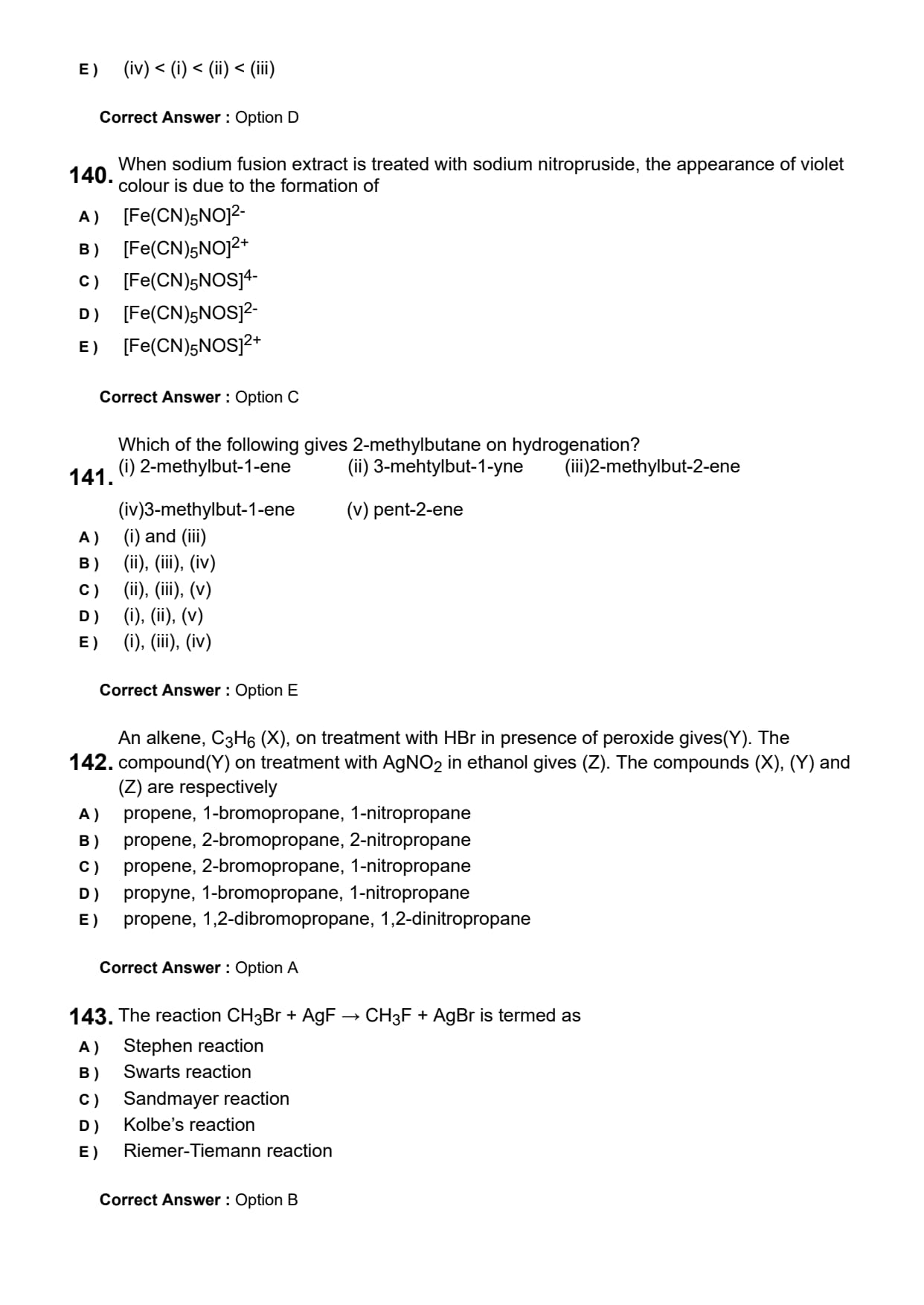
Methyl bromide is converted to methyl fluoride by AgF. What is the name of the reaction?
View Solution
Step 1: Understanding the Concept:
Direct fluorination of alkanes is often too violent to control. Therefore, alkyl fluorides are typically synthesized using a halogen exchange method, where a heavier halogen (like Bromine or Chlorine) is replaced by Fluorine using metallic fluorides.
Step 2: Key Formula or Approach:
The general reaction is: \[ R-X + MF \rightarrow R-F + MX \]
(Where \(M = Ag, Hg_2, Co, or Sb\) and \(X = Cl, Br\)).
Step 3: Detailed Explanation:
In this specific case, methyl bromide (\(CH_3Br\)) reacts with silver fluoride (\(AgF\)) to form methyl fluoride (\(CH_3F\)). This specific halogen exchange reaction using metallic fluorides is known as the Swarts reaction. This is the standard method for preparing alkyl fluorides in the laboratory.
Step 4: Final Answer
The reaction is the Swarts reaction. Quick Tip: Think "S" for Swarts and "F" for Fluoride. If the reagent was Sodium Iodide (\(NaI\)) in acetone, it would be the Finkelstein reaction instead.
Increasing order of enthalpy of fusion of \(C_6H_6\), \(CH_3COCH_3\), \(CCl_4\).
View Solution
Step 1: Understanding the Concept:
Enthalpy of fusion (\(\Delta H_{fus}\)) is the amount of heat required to change a substance from solid to liquid. It depends on the strength of intermolecular forces and how well the molecules pack together in the solid state.
Step 2: Detailed Explanation:
1. \(CCl_4\) (Carbon Tetrachloride): This is a non-polar, spherical molecule. It has relatively weak London dispersion forces and the least efficient packing among the three, leading to the lowest enthalpy of fusion.
2. \(CH_3COCH_3\) (Acetone): This is a polar molecule with dipole-dipole interactions, which are stronger than the dispersion forces in \(CCl_4\).
3. \(C_6H_6\) (Benzene): Although non-polar, benzene is a flat, planar molecule that stacks extremely well in a crystal lattice. This efficient packing, combined with significant \(\pi-\pi\) interactions, gives it the highest enthalpy of fusion in this set.
Step 3: Final Answer
The increasing order of enthalpy of fusion is \(CCl_4 < CH_3COCH_3 < C_6H_6\). Quick Tip: Molecular shape matters! Symmetrical and flat molecules (like Benzene) often have higher melting points and enthalpies of fusion because they can "lock" together more tightly in a solid.
Benzene diazonium chloride on treatment with HCl and Cu powder gives chlorobenzene. Name of the reaction.
View Solution
Step 1: Understanding the Concept:
The synthesis of haloarenes from diazonium salts involves the replacement of the diazonium group (\(-N_2^+Cl^-\)). Depending on the reagents used (copper salts vs. copper powder), the reaction is given different name.
Step 2: Detailed Explanation:
1. When benzene diazonium chloride is treated with haloacids (\(HCl\) or \(HBr\)) in the presence of copper powder, it is called the Gattermann reaction.
2. This is a modification of the Sandmeyer reaction, which uses cuprous salts (\(Cu_2Cl_2\) or \(Cu_2Br_2\)) instead of copper powder.
3. The reaction is represented as: \[ C_6H_5N_2Cl \xrightarrow{Cu/HCl} C_6H_5Cl + N_2 \uparrow \]
Step 3: Final Answer
The reaction is the Gattermann reaction. Quick Tip: To distinguish the two: \textbf{S}andmeyer uses \textbf{S}alts (\(Cu_2Cl_2\)), while \textbf{G}attermann uses the \textbf{G}round metal (Copper powder).
Which of the following shows lowest ionisation enthalpy? Be, B, N, O
View Solution
Step 1: Understanding the Concept:
Ionization enthalpy generally increases across a period from left to right due to increasing nuclear charge. However, exceptions occur due to the stability of half-filled/fully-filled subshells and the penetration effect of orbitals.
Step 2: Detailed Explanation:
1. Electronic Configurations:
- \(Be (Z=4): 1s^2 2s^2\) (Fully filled \(2s\) subshell)
- \(B (Z=5): 1s^2 2s^2 2p^1\)
- \(N (Z=7): 1s^2 2s^2 2p^3\) (Half-filled \(2p\) subshell)
- \(O (Z=8): 1s^2 2s^2 2p^4\)
2. Be vs B: Even though Boron is to the right of Beryllium, it has a lower ionization enthalpy because removing an electron from a \(2p\) orbital (Boron) is easier than removing one from a stable, fully filled \(2s\) orbital (Beryllium).
3. N vs O: Nitrogen has a higher ionization enthalpy than Oxygen because of its stable half-filled \(2p^3\) configuration.
4. Conclusion: Among the given options, Boron (\(B\)) has the lowest value.
Step 3: Final Answer
Boron (B) shows the lowest ionization enthalpy. Quick Tip: Watch out for the "zigzag" in Period 2 ionization energies: \(Li < B < Be < C < O < N < F < Ne\). Note how B drops below Be, and O drops below N.
Find the order of the dipole moment of \(NF_3, H_2O, CHCl_3, NH_3\).
View Solution
Step 1: Understanding the Concept:
Dipole moment is a vector quantity that depends on the electronegativity difference between atoms and the molecular geometry (symmetry). The net dipole moment is the vector sum of individual bond moments and lone pair moments.
Step 2: Detailed Explanation:
1. \(H_2O\): Has two lone pairs and two polar O-H bonds. The bond moments and lone pair moments reinforce each other, leading to the highest dipole moment (\(\approx 1.85\) D).
2. \(NH_3\): The lone pair moment and N-H bond moments are in the same direction, reinforcing the net dipole (\(\approx 1.47\) D).
3. \(CHCl_3\): A tetrahedral molecule where C-Cl bonds are polar. The symmetry is broken by the C-H bond, resulting in a significant dipole (\(\approx 1.01\) D).
4. \(NF_3\): Although it has a similar structure to \(NH_3\), the highly electronegative Fluorine atoms pull electron density away from the lone pair. The lone pair moment and N-F bond moments partially cancel each other, resulting in a very low dipole (\(\approx 0.23\) D).
Step 3: Final Answer
The order of increasing dipole moment is \(NF_3 < CHCl_3 < NH_3 < H_2O\). Quick Tip: The comparison between \(NH_3\) and \(NF_3\) is a classic exam favorite. Remember: In \(NH_3\), the "arrows" point the same way; in \(NF_3\), they point in opposite directions.
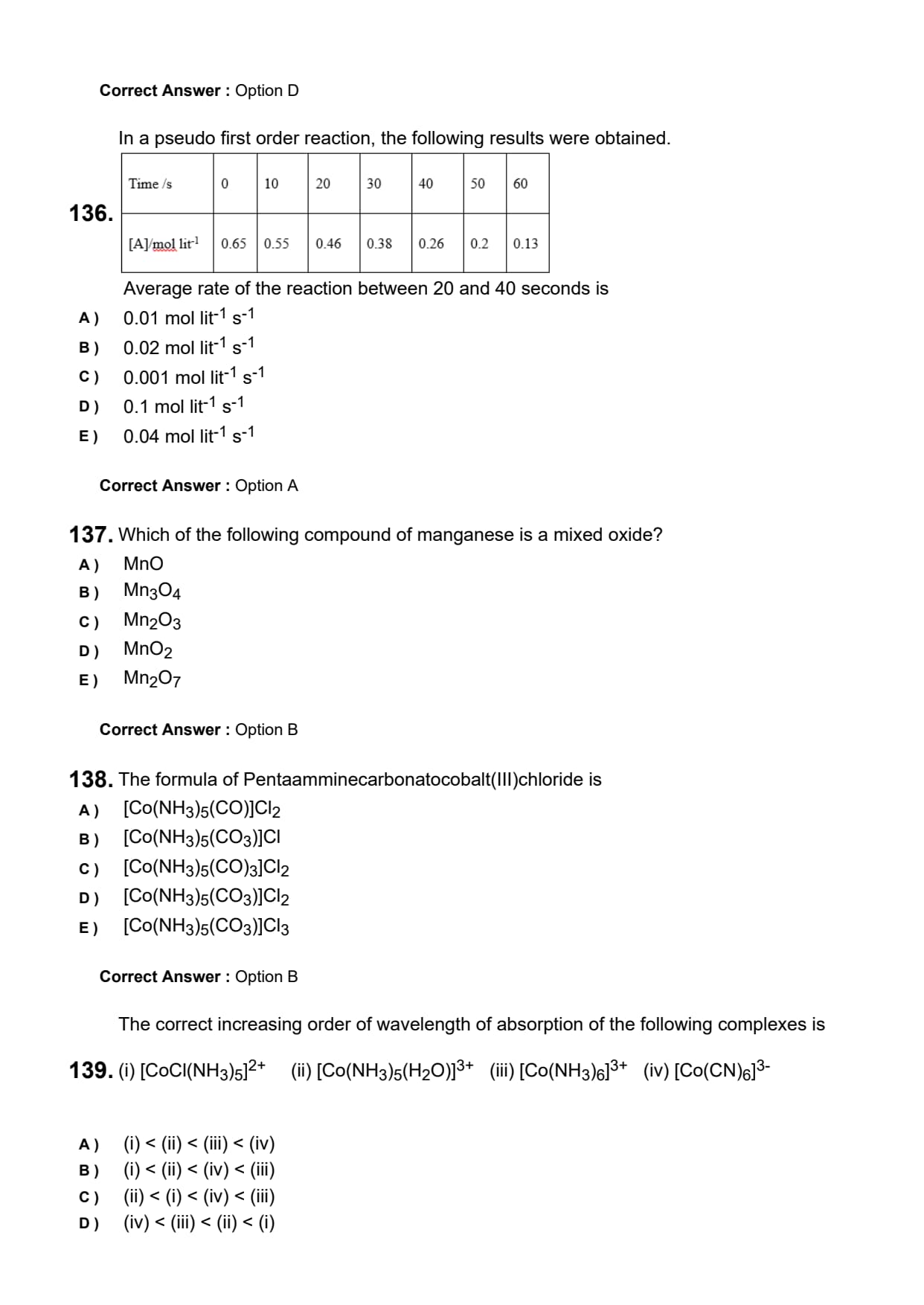
Which of the following is a mixed oxide?
View Solution
Step 1: Understanding the Concept:
A mixed oxide is a compound that behaves as if it were a mixture of two different oxides of the same metal in different oxidation states.
Step 2: Detailed Explanation:
1. Analyze \(Mn_3O_4\): This oxide, known as hausmannite, can be represented as a combination of Manganese(II) oxide (\(MnO\)) and Manganese(III) oxide (\(Mn_2O_3\)).
2. Stoichiometry: \(MnO + Mn_2O_3 = Mn_3O_4\).
3. In this compound, Manganese exists in two different oxidation states: +2 and +3.
4. Other common examples of mixed oxides include \(Fe_3O_4\) (\(FeO \cdot Fe_2O_3\)) and \(Pb_3O_4\) (\(2PbO \cdot PbO_2\)).
Step 3: Final Answer
\(Mn_3O_4\) is the mixed oxide. Quick Tip: If you see an oxide with a "fractional" apparent oxidation state (like \(Mn^{2.66+}\) in \(Mn_3O_4\)), it is almost certainly a mixed oxide consisting of atoms in two different whole-number oxidation states.
Match the following
Milk of Magnesia --- 7.8
Milk --- 6.8
Egg white --- 5
Black coffee --- 10
View Solution
Step 1: Understanding the Concept:
The question requires matching common everyday substances with their approximate pH values.
Step 2: Key Formula or Approach:
Recall the general acidic, basic, or neutral nature of these common substances as taught in standard chemistry curricula.
Step 3: Detailed Explanation:
(1) Milk of Magnesia: This is an aqueous suspension of magnesium hydroxide, \(Mg(OH)_2\). It is used as an antacid to neutralize stomach acid, meaning it is alkaline (basic). Its pH is typically around 10 to 10.5.
(2) Milk: Normal cow's milk is very slightly acidic due to the presence of lactic acid. Its pH is usually around 6.5 to 6.8.
(3) Egg white: Also known as albumen, it is naturally slightly alkaline to protect the yolk from bacteria. Its pH ranges from about 7.6 to 7.9.
(4) Black coffee: Coffee contains various weak organic acids (like chlorogenic acid), making it mildly acidic. Its pH is typically around 5.
Matching these characteristics to the provided numbers:
Milk of Magnesia \(\rightarrow\) 10
Milk \(\rightarrow\) 6.8
Egg white \(\rightarrow\) 7.8
Black coffee \(\rightarrow\) 5
Step 4: Final Answer:
The correct matching is: Milk of Magnesia (10), Milk (6.8), Egg white (7.8), Black coffee (5).
Quick Tip: Familiarity with the pH of common substances (like blood \(\sim\)7.4, gastric juice \(\sim\)1.2, pure water = 7) provides great reference points for estimating the pH of other items in matching questions.
Order of dipole moment CHCl\(_3\), NH\(_3\), BF\(_3\), H\(_2\)O
View Solution
Step 1: Understanding the Concept:
This question requires arranging molecules based on their net dipole moment, which is the vector sum of all individual bond dipoles and lone pair moments based on their 3D geometry.
Step 2: Key Formula or Approach:
Identify the molecular geometry using VSEPR theory to see if bond dipoles cancel out perfectly (non-polar) or result in a net vector (polar).
Step 3: Detailed Explanation:
(1) BF\(_3\): Boron trifluoride has a trigonal planar geometry. It is perfectly symmetric. The three B-F bond dipoles are at 120-degree angles to each other in a plane, so their vector sum is exactly zero. \(\mu = 0\) D.
(2) CHCl\(_3\): Chloroform is tetrahedral but asymmetric. The dense electron cloud is pulled towards the three chlorine atoms. It has a moderate net dipole moment. \(\mu \approx 1.04\) D.
(3) NH\(_3\): Ammonia has a trigonal pyramidal shape. The three N-H bond dipoles add constructively with the lone pair dipole on nitrogen, giving a substantial net dipole. \(\mu \approx 1.47\) D.
(4) H\(_2\)O: Water is a bent molecule. The two O-H bond dipoles strongly reinforce the dipoles from the two lone pairs on oxygen, resulting in the highest dipole moment among this set. \(\mu \approx 1.85\) D.
Increasing order: BF\(_3\) (0) \(<\) CHCl\(_3\) (\(\sim\)1.04) \(<\) NH\(_3\) (\(\sim\)1.47) \(<\) H\(_2\)O (\(\sim\)1.85).
Step 4: Final Answer:
The order is BF\(_3\) \(<\) CHCl\(_3\) \(<\) NH\(_3\) \(<\) H\(_2\)O.
Quick Tip: Always identify perfectly symmetrical molecules first (like \(BF_3, CCl_4, CO_2\)). Their dipole moment is exactly zero, making them the lowest in any such ranking.
Find the difference between the angular momentum of Bohr 5th and 3rd orbit
View Solution
Step 1: Understanding the Concept:
According to Bohr's atomic model, the angular momentum of an electron in a stable circular orbit is quantized. It can only take values that are integral multiples of a specific constant.
Step 2: Key Formula or Approach:
The quantization of angular momentum \(L\) for the \(n\)-th orbit is given by the formula: \[ L_n = \frac{nh}{2\pi} \]
where \(n\) is the principal quantum number (orbit number) and \(h\) is Planck's constant.
Step 3: Detailed Explanation:
Calculate the angular momentum for the 5th orbit (\(n = 5\)): \[ L_5 = \frac{5h}{2\pi} \]
Calculate the angular momentum for the 3rd orbit (\(n = 3\)): \[ L_3 = \frac{3h}{2\pi} \]
Find the difference between them: \[ \Delta L = L_5 - L_3 \] \[ \Delta L = \frac{5h}{2\pi} - \frac{3h}{2\pi} \] \[ \Delta L = \frac{(5 - 3)h}{2\pi} \] \[ \Delta L = \frac{2h}{2\pi} \]
Simplify the fraction by canceling the factor of 2: \[ \Delta L = \frac{h}{\pi} \]
Step 4: Final Answer:
The difference in angular momentum is \(\frac{h}{\pi}\).
Quick Tip: For any transition or difference between orbits \(n_1\) and \(n_2\), the change in angular momentum is always simply \(\Delta n \times \frac{h}{2\pi}\). Here, \(\Delta n = 2\), so \(\Delta L = 2 \times \frac{h}{2\pi} = \frac{h}{\pi}\).
% of M = 54% , O = 46%
(Atomic mass of oxygen = 16, Atomic mass of M = 27). Find the empirical formula
View Solution
Step 1: Assume Total Mass
Assume total mass of compound = \(100\,g\)
Mass of M = \(54\,g\), \quad Mass of O = \(46\,g\)
Step 2: Convert Mass to Moles
\[ Moles of M = \frac{54}{27} = 2 \] \[ Moles of O = \frac{46}{16} = 2.875 \]
Step 3: Find Simplest Ratio
Divide by smallest value (2): \[ Ratio of M = \frac{2}{2} = 1 \] \[ Ratio of O = \frac{2.875}{2} = 1.4375 \]
Step 4: Convert to Whole Number Ratio
Multiply both by 2: \[ M : O = 2 : 2.875 \approx 2 : 3 \]
Step 5: Write Empirical Formula
\[ Empirical formula = \mathrm{M}_2\mathrm{O}_3 \] Quick Tip: If calculated mole ratios don't perfectly yield simple fractions (like .5, .33, .25), look at the atomic mass provided to identify the likely element. Mass 27 is Aluminum, which predominantly forms a +3 ion, strongly suggesting an \(M_2O_3\) formula.
Which of the following has maximum bond enthalpy
View Solution
Step 1: Understanding the Concept:
Bond enthalpy is the energy required to break one mole of a specific type of bond in a gaseous molecule. It generally correlates strongly with the bond order (number of bonds between atoms); triple bonds are stronger than double bonds, which are stronger than single bonds between the same or similar atoms.
Step 2: Key Formula or Approach:
Evaluate the bond order of each option. The higher the bond order, the greater the electron density between the nuclei, leading to stronger electrostatic attraction and higher bond enthalpy.
Step 3: Detailed Explanation:
Let's look at the given bonds and their approximate standard bond enthalpies:
(A) C=C (double bond): \(\approx 614\) kJ/mol
(B) O=O (double bond): \(\approx 498\) kJ/mol
(C) N\(\equiv\)N (triple bond): \(\approx 945\) kJ/mol
(D) C=O (double bond, e.g., in ketones/aldehydes): \(\approx 745\) kJ/mol (Note: C\(\equiv\)O triple bond in carbon monoxide is higher, \(\approx 1072\) kJ/mol, but the option explicitly shows a double bond).
The N\(\equiv\)N bond is a triple bond consisting of one sigma and two pi bonds. The accumulation of electron density between the very small nitrogen atoms results in a highly stable, extremely strong bond, giving \(N_2\) gas its inert character.
Step 4: Final Answer:
N\(\equiv\)N has the maximum bond enthalpy.
Quick Tip: For comparing bond strengths between non-metals of similar size (period 2), bond order is the primary determinant. Triple bonds (\(N\equiv N\), \(C\equiv C\), \(C\equiv O\)) will consistently have the highest bond enthalpies.
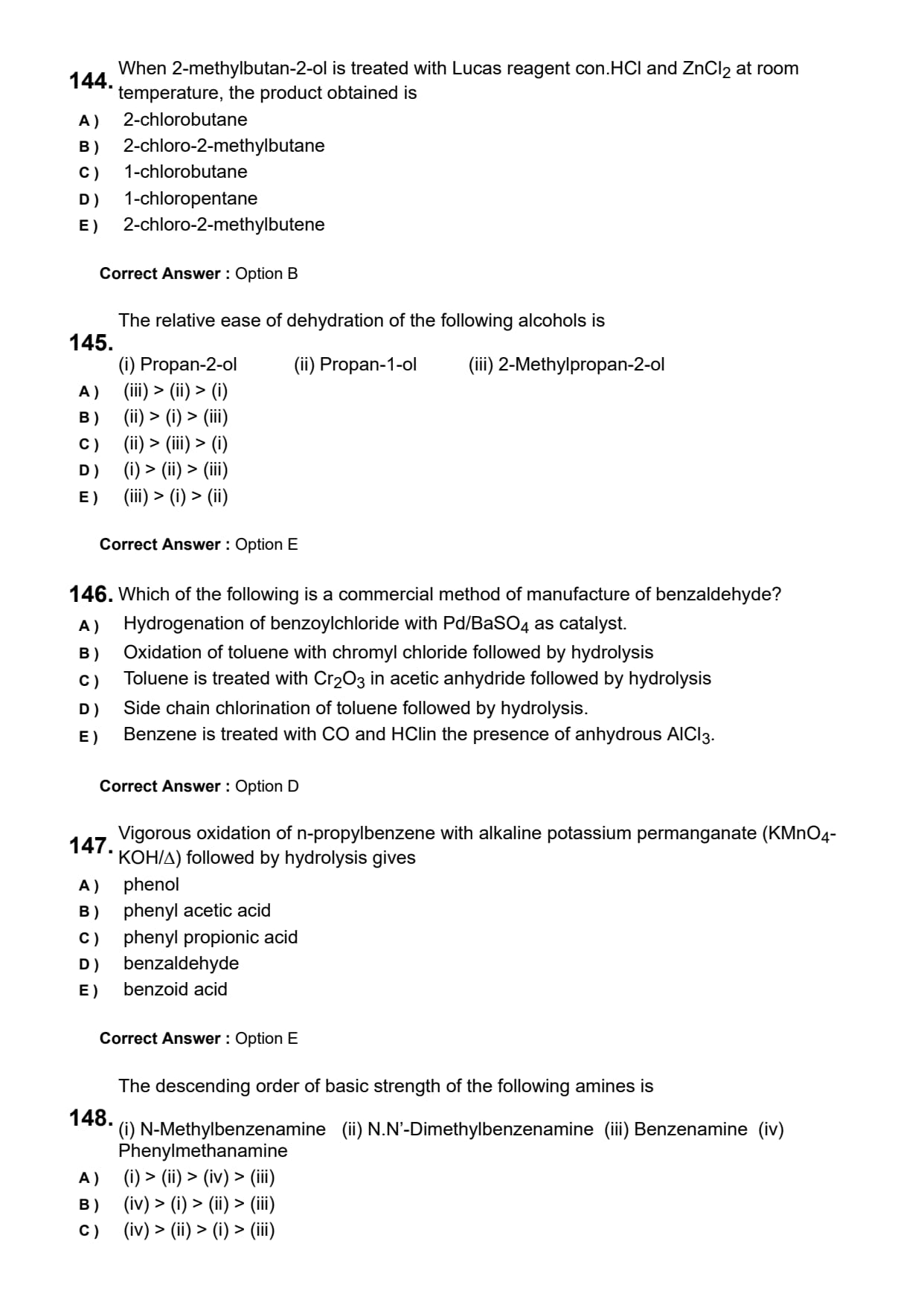
Decreasing order of basic strength
View Solution
Step 1: Understanding the Concept:
Basic strength of amines depends on the availability of the lone pair of electrons on the nitrogen atom for protonation. Electron-donating groups (+I effect) increase basicity, while electron-withdrawing groups or resonance delocalization (-R effect) decrease it.
Step 2: Key Formula or Approach:
Classify the amines as aliphatic or aromatic. For aromatic amines, assess the degree of alkyl substitution on the nitrogen atom and consider standard +I and steric effects in aqueous or general solvent conditions.
Step 3: Detailed Explanation:
1) Identify aliphatic vs. aromatic:
(D) Benzylamine (\(C_6H_5CH_2NH_2\)) is an aliphatic amine. The nitrogen is separated from the aromatic ring by an \(sp^3\) carbon. Therefore, its lone pair is not delocalized into the benzene ring. It is the strongest base among the choices.
(A), (B), (C) are all aromatic amines (derivatives of aniline) where the lone pair on nitrogen is in conjugation with the \(\pi\) system of the benzene ring, significantly reducing basicity compared to aliphatic amines.
2) Rank the aromatic amines:
Adding alkyl groups (like methyl) to the nitrogen atom increases electron density on the nitrogen due to the positive inductive (+I) effect, making the lone pair more available.
(C) Aniline (\(C_6H_5NH_2\)) has no alkyl groups on N. (Weakest base)
(B) N-methylaniline (\(C_6H_5NHCH_3\)) has one methyl group (+I effect), making it more basic than aniline.
(A) N,N-dimethylaniline (\(C_6H_5N(CH_3)_2\)) has two methyl groups. The combined +I effect makes it more basic than N-methylaniline.
Therefore, the decreasing order is: Aliphatic \(>\) \(3^\circ\) Ar-Amine \(>\) \(2^\circ\) Ar-Amine \(>\) \(1^\circ\) Ar-Amine.
Step 4: Final Answer:
The decreasing order of basic strength is (D) \(>\) (A) \(>\) (B) \(>\) (C).
Quick Tip: Always separate aliphatic amines (like benzylamine) from true aromatic amines (like aniline) first. Aliphatic amines are almost always significantly stronger bases because their lone pair isn't lost to resonance.
2- methyl butan - 2-ol on treatment with Lucas reagent gives
View Solution
Step 1: Understanding the Concept:
The Lucas test is used to distinguish between primary, secondary, and tertiary alcohols based on their reactivity with Lucas reagent (a mixture of concentrated HCl and anhydrous ZnCl\(_2\)).
Step 2: Key Formula or Approach:
Identify the class (\(1^\circ, 2^\circ\), or \(3^\circ\)) of the given alcohol. The reaction proceeds via an S\(_N\)1 mechanism forming a carbocation. Tertiary alcohols react immediately to form a cloudy suspension of the alkyl chloride.
Step 3: Detailed Explanation:
Structure of 2-methylbutan-2-ol: \(CH_3 - CH_2 - C(CH_3)(OH) - CH_3\)
The -OH group is attached to a carbon atom that is bonded to three other carbons. Therefore, it is a tertiary (\(3^\circ\)) alcohol.
Tertiary alcohols react immediately with Lucas reagent because they form highly stable tertiary carbocations as intermediates. The chloride ion then rapidly attacks this carbocation.
Reaction: \(CH_3 - CH_2 - C(CH_3)(OH) - CH_3 + HCl/ZnCl_2 \rightarrow CH_3 - CH_2 - C(CH_3)(Cl) - CH_3 + H_2O\)
The resulting product is an alkyl chloride where the Cl atom simply replaces the OH group at the same tertiary position.
The IUPAC name of the product is 2-chloro-2-methylbutane.
Step 4: Final Answer:
The product is 2-chloro-2-methylbutane.
Quick Tip: For Lucas test questions, tertiary alcohols yield the direct substitution product instantly without rearrangement (as the \(3^\circ\) carbocation is already maximally stable).
Vigorous oxidation of n - pentyl benzene gives
View Solution
Step 1: Understanding the Concept:
This reaction concerns the oxidation of alkyl side chains attached to a benzene ring.
Step 2: Key Formula or Approach:
Recall the rule for side-chain oxidation of aromatic compounds using strong oxidizing agents like acidic or alkaline KMnO\(_4\) or acidified K\(_2\)Cr\(_2\)O\(_7\) with heat.
Step 3: Detailed Explanation:
When an alkylbenzene is subjected to vigorous oxidation conditions, the entire alkyl chain, regardless of its length, is oxidized down to a single carboxyl group (-COOH) attached to the ring, provided that there is at least one benzylic hydrogen atom (a hydrogen attached to the carbon directly bonded to the benzene ring).
n-pentylbenzene has the structure \(C_6H_5 - CH_2 - CH_2 - CH_2 - CH_2 - CH_3\).
The carbon adjacent to the ring (benzylic carbon) has two hydrogen atoms. Therefore, it is susceptible to oxidation.
Under vigorous oxidation, the C-C bonds of the side chain cleave, and the benzylic carbon is converted to a carboxylic acid group.
Reaction: \(C_6H_5 - CH_2 - (CH_2)_3 - CH_3 \xrightarrow{[O]} C_6H_5 - COOH\)
The remaining carbons of the side chain are oxidized to CO\(_2\) and H\(_2\)O. The main aromatic product is benzoic acid.
Step 4: Final Answer:
The product is benzoic acid.
Quick Tip: Any alkyl chain (methyl, ethyl, propyl, etc.) on a benzene ring is oxidized entirely to a -COOH group by KMnO\(_4\)/H\(^+\) as long as it has at least one benzylic hydrogen. Only tert-butylbenzene resists this oxidation.
Order of dehydration of
butan - 2 - ol, butan - 1 - ol, 2 - methylpentan - 2 - ol
View Solution
Step 1: Understanding the Concept:
Acid-catalyzed dehydration of alcohols to form alkenes proceeds via an E1 elimination mechanism. The rate-determining step is the formation of a carbocation intermediate.
Step 2: Key Formula or Approach:
The relative ease of dehydration of alcohols follows the stability order of the carbocations they form: tertiary (\(3^\circ\)) \(>\) secondary (\(2^\circ\)) \(>\) primary (\(1^\circ\)). Classify each given alcohol to determine the order.
Step 3: Detailed Explanation:
Let's analyze the structure of each given alcohol:
1) 2-methylpentan-2-ol: \(CH_3 - CH_2 - CH_2 - C(CH_3)(OH) - CH_3\). The -OH is attached to a carbon bonded to three other carbons. It is a tertiary (\(3^\circ\)) alcohol. It will form a relatively stable \(3^\circ\) carbocation, making dehydration fastest.
2) butan-2-ol: \(CH_3 - CH_2 - CH(OH) - CH_3\). The -OH is attached to a carbon bonded to two other carbons. It is a secondary (\(2^\circ\)) alcohol. It forms a moderately stable \(2^\circ\) carbocation.
3) butan-1-ol: \(CH_3 - CH_2 - CH_2 - CH_2 - OH\). The -OH is attached to a carbon bonded to only one other carbon. It is a primary (\(1^\circ\)) alcohol. It forms a highly unstable \(1^\circ\) carbocation, making dehydration the slowest and requiring the most drastic conditions.
Based on carbocation stability, the order of ease of dehydration is \(3^\circ > 2^\circ > 1^\circ\).
Therefore, the order is: 2-methylpentan-2-ol \(>\) butan-2-ol \(>\) butan-1-ol.
Step 4: Final Answer:
The order is 2-methylpentan-2-ol \(>\) butan-2-ol \(>\) butan-1-ol.
Quick Tip: For dehydration of alcohols (E1 mechanism) and reaction with hydrogen halides (S\(_N\)1 mechanism like Lucas test), the reactivity order is always the same: \(3^\circ > 2^\circ > 1^\circ\), driven strictly by carbocation stability.
Increasing order of \(\lambda\) absorption
[Co(CN)\(_6\)]\(^{3-}\), [Co(NH\(_3\))\(_6\)]\(^{3+}\), [Co(NH\(_3\))\(_4\)(H\(_2\)O)\(_2\)]\(^{3+}\), [CoCl\(_6\)]\(^{3-}\)
View Solution
Step 1: Understanding the Concept:
The wavelength of light absorbed by a coordination complex is inversely proportional to the crystal field splitting energy (\(\Delta_o\)) created by the ligands. Higher splitting energy means the complex absorbs higher energy light, which corresponds to a shorter wavelength (\(\lambda\)).
Step 2: Key Formula or Approach:
Use the relation \(E = \frac{hc}{\lambda} = \Delta_o\). Thus, \(\lambda \propto \frac{1}{\Delta_o}\).
Utilize the spectrochemical series to order the ligands by field strength to determine relative \(\Delta_o\) values.
Step 3: Detailed Explanation:
1) Identify the ligands and their position in the spectrochemical series
Spectrochemical series order: \(Cl^- < H_2O < NH_3 < CN^-\)
2) Determine the crystal field splitting (\(\Delta_o\)) for the given complexes. Since the metal ion \(Co^{3+}\) is the same in all, \(\Delta_o\) depends entirely on the ligands.
Order of ligand field strength: \(Cl^-\) (weakest) \(<\) mixture of \(H_2O/NH_3\) \(<\) \(NH_3\) (pure) \(<\) \(CN^-\) (strongest).
Therefore, order of \(\Delta_o\): \([CoCl_6]^{3-} < [Co(NH_3)_4(H_2O)_2]^{3+} < [Co(NH_3)_6]^{3+} < [Co(CN)_6]^{3-}\)
3) Relate \(\Delta_o\) to absorption wavelength (\(\lambda\)). Since \(\lambda\) is inversely proportional to \(\Delta_o\), the complex with the highest splitting energy will absorb the shortest wavelength.
Order of absorption wavelength (\(\lambda_{abs}\)):
\([Co(CN)_6]^{3-} < [Co(NH_3)_6]^{3+} < [Co(NH_3)_4(H_2O)_2]^{3+} < [CoCl_6]^{3-}\)
Step 4: Final Answer:
The increasing order of absorption wavelength is [Co(CN)\(_6\)]\(^{3-}\) \(<\) [Co(NH\(_3\))\(_6\)]\(^{3+}\) \(<\) [Co(NH\(_3\))\(_4\)(H\(_2\)O)\(_2\)]\(^{3+}\) \(<\) [CoCl\(_6\)]\(^{3-}\).
Quick Tip: Always remember: Strong Field Ligand \(\rightarrow\) Large Splitting (\(\Delta_o\)) \(\rightarrow\) High Energy Absorbed \(\rightarrow\) Short Wavelength (\(\lambda\)) Absorbed. The question specifically asks for wavelength order, which is the reverse of the spectrochemical series order.
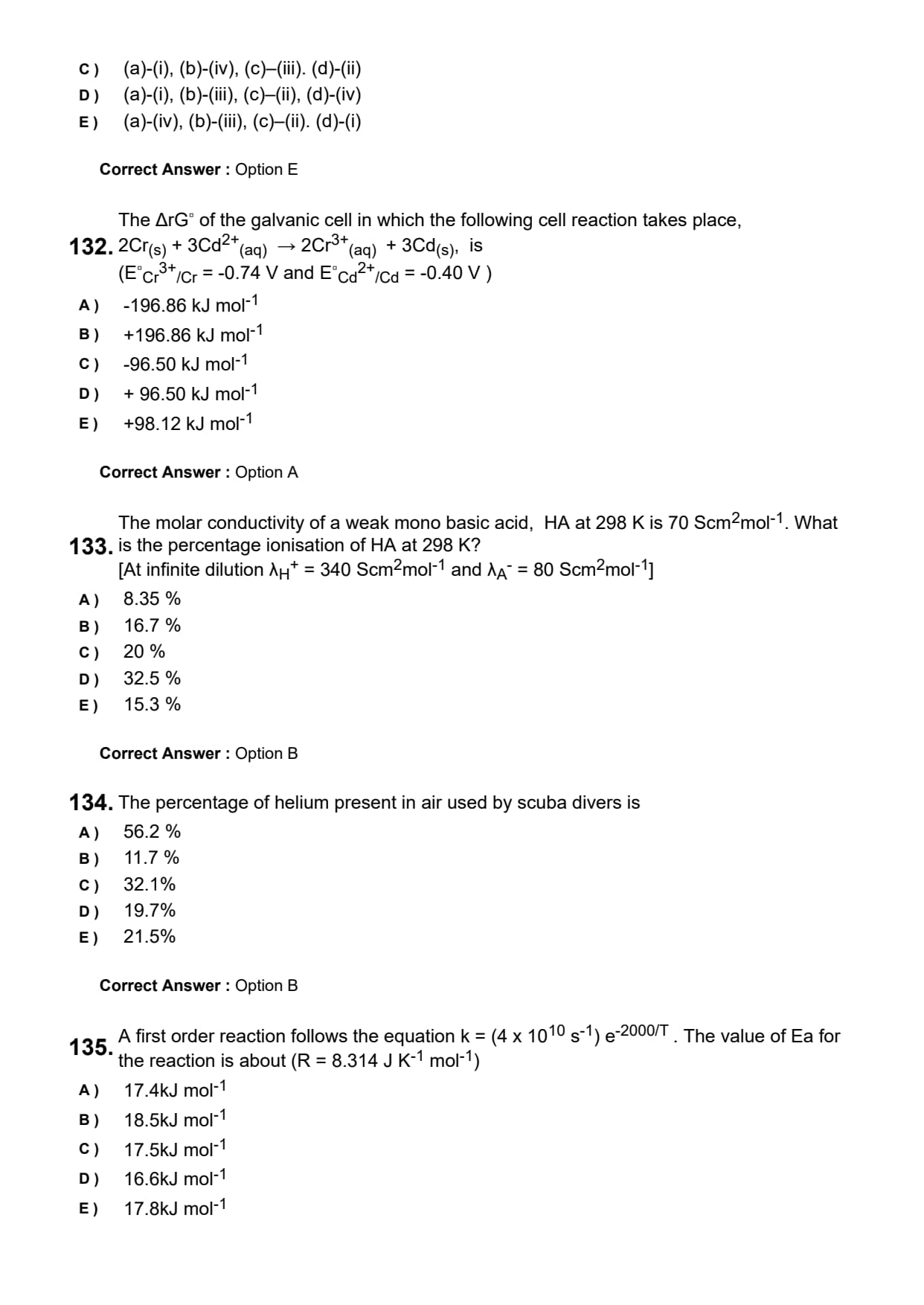
Molar conductivity acid, HA at 0.1M conc. is 70 ohm\(^{-1}\)cm\(^{2}\)mol\(^{-1}\). The \(\lambda^\circ_m\) values of H\(^+\) and A\(^-\) are 341 and 80 ohm\(^{-1}\)cm\(^{2}\)mol\(^{-1}\). The degree of dissociation of HA
View Solution
Step 1: Concept Used
For a weak electrolyte, \[ \alpha = \frac{\Lambda_m}{\Lambda_m^\circ} \]
Step 2: Calculate Limiting Molar Conductivity
Using Kohlrausch’s Law: \[ \Lambda_m^\circ (HA) = \lambda_m^\circ(H^+) + \lambda_m^\circ(A^-) \] \[ \Lambda_m^\circ (HA) = 341 + 80 = 421\,\Omega^{-1}cm^2mol^{-1} \]
Step 3: Calculate Degree of Dissociation
\[ \alpha = \frac{\Lambda_m}{\Lambda_m^\circ} = \frac{70}{421} \] \[ \alpha \approx 0.166 \]
Step 4: Final Answer
\[ \alpha = 0.166 \quad or \quad 16.6% \] Quick Tip: Ensure units match before calculating \(\alpha\). Molar conductivities are usually given in \(S \cdot cm^2 \cdot mol^{-1}\) or \(\Omega^{-1} cm^2 mol^{-1}\). The ratio \(\alpha\) is a dimensionless fraction.
C\(_3\)H\(_6 \xrightarrow{HBr/peroxide}\) X \(\xrightarrow{AgNO_3}\) Y
The product X and Y are
View Solution
Step 1: Understanding the Concept:
This is a two-step reaction sequence. Step 1 is the addition of a hydrogen halide to an alkene in the presence of peroxides. Step 2 is a nucleophilic substitution reaction of the resulting alkyl halide.
Step 2: Key Formula or Approach:
1) Apply the Kharasch effect (anti-Markovnikov addition) for HBr + peroxide on unsymmetrical alkenes.
2) Apply nucleophilic substitution rules for alkyl halides reacting with silver salts.
Step 3: Detailed Explanation:
Formation of X:
The starting material C\(_3\)H\(_6\) is propene (\(CH_3-CH=CH_2\)).
Reaction with HBr in the presence of peroxide follows a free radical mechanism leading to anti-Markovnikov addition. The bromine atom adds to the less substituted carbon atom. \(CH_3-CH=CH_2 + HBr \xrightarrow{peroxide} CH_3-CH_2-CH_2-Br\)
Therefore, product X is 1-bromopropane (n-propyl bromide).
Formation of Y:
Reaction of an alkyl halide with \(AgNO_3\). Typically, in standard curriculum, reactions with \(AgNO_2\) are highlighted to form nitroalkanes (\(R-NO_2\)) while \(KNO_2\) forms alkyl nitrites (\(R-ONO\)).
Reaction with \(AgNO_3\) explicitly yields alkyl nitrates (\(R-ONO_2\)) via an S\(_N\) reaction due to the covalent nature of the Ag-O bond directing attack from the other oxygen. \(CH_3-CH_2-CH_2-Br + AgNO_3 \rightarrow CH_3-CH_2-CH_2-O-NO_2 + AgBr\downarrow\)
Therefore, product Y is n-propyl nitrate.
(Note: It is highly probable in competitive exams for \(AgNO_3\) to be a typo for \(AgNO_2\), which would make Y 1-nitropropane. However, based strictly on the text provided, it is a nitrate).
Step 4: Final Answer:
Product X is 1-bromopropane and Y is propyl nitrate.
Quick Tip: Pay close attention to reagents over the arrow. "HBr only" gives Markovnikov product (2-bromopropane), while "HBr + peroxide" gives anti-Markovnikov (1-bromopropane). This effect only works for HBr, not HCl or HI.
In the reaction A \(\rightarrow\) B conc. of A is 0.46 mol L\(^{-1}\) initially after 10min, conc. A reduced to 0.36molL\(^{-1}\). The average rate of reaction.
View Solution
Step 1: Understanding the Concept:
The average rate of a chemical reaction is defined as the change in concentration of a reactant or product over a specific time interval. For a reactant, since its concentration decreases, a negative sign is added to make the rate a positive value.
Step 2: Key Formula or Approach:
For a generic reaction A \(\rightarrow\) Products, the average rate of reaction with respect to reactant A is: \[ Average Rate = -\frac{\Delta[A]}{\Delta t} = -\frac{[A]_{final} - [A]_{initial}}{t_{final} - t_{initial}} \]
Step 3: Detailed Explanation:
Given values from the problem:
Initial concentration of A, \([A]_{initial} = 0.46\) mol L\(^{-1}\)
Final concentration of A, \([A]_{final} = 0.36\) mol L\(^{-1}\)
Time interval, \(\Delta t = 10\) min
Substitute these values into the rate formula: \[ Rate = -\frac{(0.36 - 0.46) mol L^{-1}}{10 min} \] \[ Rate = -\frac{-0.10 mol L^{-1}}{10 min} \] \[ Rate = \frac{0.10}{10} mol L^{-1} min^{-1} \] \[ Rate = 0.01 mol L^{-1} min^{-1} \]
The average rate is \(1 \times 10^{-2}\) mol L\(^{-1}\) min\(^{-1}\).
Step 4: Final Answer:
The average rate of reaction is 0.01 mol L\(^{-1}\) min\(^{-1}\).
Quick Tip: Always ensure the rate is a positive quantity. For reactants, calculating \([Final] - [Initial]\) gives a negative value, which is why the formula includes a leading negative sign.
The \(K_{sp}\) of \(AX_2\) is \(3.2 \times 10^{-14}\). The solubility of \(AX_2\) in mol L\(^{-1}\) is:
View Solution
Step 1: Understanding the Concept:
Solubility product constant (\(K_{sp}\)) is the equilibrium constant for a solid substance dissolving in an aqueous solution. For a salt of type \(AX_2\), the stoichiometry of the ions produced determines the relationship between molar solubility (\(s\)) and \(K_{sp}\).
Step 2: Key Formula or Approach:
The dissociation of \(AX_2\) is: \[ AX_{2(s)} \rightleftharpoons A^{2+}_{(aq)} + 2X^-_{(aq)} \]
If \(s\) is the molar solubility: \[ [A^{2+}] = s, \quad [X^-] = 2s \] \[ K_{sp} = [A^{2+}][X^-]^2 = (s)(2s)^2 = 4s^3 \]
Step 3: Detailed Explanation:
1. Given \(K_{sp} = 3.2 \times 10^{-14}\).
2. Use the relation \(K_{sp} = 4s^3\): \[ 3.2 \times 10^{-14} = 4s^3 \]
3. Solve for \(s^3\): \[ s^3 = \frac{3.2 \times 10^{-14}}{4} = 0.8 \times 10^{-14} = 8 \times 10^{-15} \]
4. Take the cube root: \[ s = \sqrt[3]{8 \times 10^{-15}} = 2 \times 10^{-5} \, mol L^{-1} \]
Step 4: Final Answer
The solubility of \(AX_2\) is \(2 \times 10^{-5}\) mol L\(^{-1}\). Quick Tip: For any salt \(A_x B_y\), the general formula is \(K_{sp} = (xs)^x(ys)^y = x^x y^y s^{x+y}\). For \(AX_2\), this simplifies to \(1^1 \cdot 2^2 \cdot s^{1+2} = 4s^3\).
No. of bond pairs and lone pairs in \(BrF_3\) is:
View Solution
Step 1: Understanding the Concept:
The number of bond pairs and lone pairs on a central atom can be determined using the Valence Shell Electron Pair Repulsion (VSEPR) theory. This helps in predicting the geometry and shape of the molecule.
Step 2: Detailed Explanation:
1. Valence electrons of Bromine (Br): 7 (Group 17 element).
2. Electrons involved in bonding: Br forms 3 single bonds with 3 Fluorine atoms. So, Bond Pairs (BP) = 3.
3. Remaining electrons on Br: \(7 - 3 = 4\) electrons.
4. Lone Pairs (LP): \(4 / 2 = 2\) lone pairs.
5. Total Electron Pairs: \(3 + 2 = 5\). According to VSEPR, this leads to a \(sp^3d\) hybridization and a T-shaped molecular geometry.
Step 3: Final Answer
\(BrF_3\) has 3 bond pairs and 2 lone pairs. Quick Tip: In a T-shaped molecule like \(BrF_3\), the two lone pairs occupy equatorial positions to minimize repulsion, resulting in bond angles slightly less than 90°.
\(2Cr + 3Cd^{2+} \rightarrow 2Cr^{3+} + 3Cd\). Given \(E^\circ_{Cd^{2+}/Cd} = -0.40\) V and \(E^\circ_{Cr^{3+}/Cr} = -0.74\) V. The \(E^\circ_{cell}\) is:
View Solution
Step 1: Understanding the Concept:
The standard cell potential (\(E^\circ_{cell}\)) is the difference between the standard reduction potentials of the cathode and the anode. The species being reduced acts as the cathode, and the species being oxidized acts as the anode.
Step 2: Key Formula or Approach:
\[ E^\circ_{cell} = E^\circ_{cathode} - E^\circ_{anode} \]
(Both potentials must be in reduction form).
Step 3: Detailed Explanation:
1. Identify Anode and Cathode:
- \(Cr \rightarrow Cr^{3+} + 3e^-\) (Oxidation occurs at Anode).
- \(Cd^{2+} + 2e^- \rightarrow Cd\) (Reduction occurs at Cathode).
2. Standard Reduction Potentials:
- \(E^\circ_{cathode} (Cd^{2+}/Cd) = -0.40\) V.
- \(E^\circ_{anode} (Cr^{3+}/Cr) = -0.74\) V.
3. Calculate \(E^\circ_{cell}\):
\[ E^\circ_{cell} = (-0.40) - (-0.74) \]
\[ E^\circ_{cell} = -0.40 + 0.74 = 0.34 \, V \]
Step 4: Final Answer
The standard cell potential (\(E^\circ_{cell}\)) is 0.34 V. Quick Tip: Even though the balanced equation has coefficients (2 and 3), do NOT multiply the \(E^\circ\) values by these numbers. Electrode potential is an intensive property and does not depend on the amount of substance.
The radius of first Bohr orbit of \(He^+\) is ______
View Solution
Step 1: Understanding the Concept:
According to Bohr's model, the radius of an orbit for a hydrogen-like species (single-electron system) depends on the principal quantum number (\(n\)) and the atomic number (\(Z\)). As the nuclear charge increases, the electron is pulled closer to the nucleus, decreasing the radius.
Step 2: Key Formula or Approach:
The radius of the \(n^{th}\) orbit is given by: \[ r_n = 0.529 \times \frac{n^2}{Z} \, \AA \]
Step 3: Detailed Explanation:
1. For Helium (\(He\)), the atomic number \(Z = 2\).
2. For the first Bohr orbit, the principal quantum number \(n = 1\).
3. Substitute these values into the formula: \[ r_1 = 0.529 \times \frac{1^2}{2} \] \[ r_1 = \frac{0.529}{2} = 0.2645 \, \AA \]
4. To convert to picometers (pm), multiply by 100: \(26.45\) pm.
Step 4: Final Answer
The radius of the first Bohr orbit of \(He^+\) is 0.2645 \(\AA\). Quick Tip: The radius is directly proportional to \(n^2\) and inversely proportional to \(Z\). This means the \(He^+\) (\(Z=2\)) orbit is exactly half the size of the Hydrogen (\(Z=1\)) orbit for the same value of \(n\).
Which of the following statement is correct about sucrose?
View Solution
Step 1: Understanding the Concept:
Sucrose, commonly known as table sugar, is a carbohydrate formed by the combination of two monosaccharide units. Understanding its structural linkage and optical activity is key to identifying its properties.
Step 2: Detailed Explanation:
1. Disaccharide: Sucrose is indeed a disaccharide because it yields two monosaccharide units upon hydrolysis.
2. Composition (Correction of D): It is composed of \(\alpha\)-D-glucose and \(\beta\)-D-fructose. The signs in option D are swapped; Glucose is (+) and Fructose is (-).
3. Reducing Nature (Correction of B): It is a non-reducing sugar because the reducing groups of glucose and fructose are involved in the glycosidic bond formation.
4. Optical Activity (Correction of A): Sucrose itself is Dextrorotatory (+). However, upon hydrolysis, it gives a mixture that is laevorotatory, a phenomenon called "inversion of sugar."
Step 3: Final Answer
The correct statement is that sucrose is a disaccharide. Quick Tip: Remember that sucrose is the only common disaccharide that is non-reducing. If it doesn't reduce Tollen's or Fehling's reagent, it's likely sucrose!
The oxygen tanks used by scuba divers are filled with air diluted with Helium. The % of He is ______
View Solution
Step 1: Understanding the Concept:
This application of Henry's Law involves the solubility of gases in the blood. Divers breathing compressed air at high pressure experience increased nitrogen solubility in their blood, which can lead to "the bends" (decompression sickness) upon ascending.
Step 2: Detailed Explanation:
1. To avoid the toxic effects of high nitrogen concentration and the painful formation of bubbles during decompression, air in scuba tanks is diluted with Helium.
2. Helium is used because it has very low solubility in human blood and body fats even at high pressure.
3. The standard composition of "Heliox" or diluted air used in these tanks is:
- Helium (He): 11.7%
- Nitrogen (N\(_2\)): 56.2%
- Oxygen (O\(_2\)): 32.1%
Step 3: Final Answer
The percentage of Helium used in the air tanks for scuba divers is 11.7%. Quick Tip: The use of Helium is a direct solution to prevent "Bends." Because Helium atoms are small and have low solubility, they diffuse out of the tissues much more safely than Nitrogen does when the diver surfaces.
If 3(z − i) = 2 − i, then find the value of z².
View Solution
Step 1: Understanding the Concept:
To find \( z^2 \), we must first isolate the complex number \( z \) by rearranging the given linear equation. Once \( z \) is expressed in the standard form \( a + bi \), we can square it using the identity \( (a + bi)^2 = a^2 - b^2 + 2abi \).
Step 2: Detailed Explanation:
1. Start with the given equation: \[ 3(z - i) = 2 - i \]
2. Distribute the 3: \[ 3z - 3i = 2 - i \]
3. Isolate \( 3z \) by adding \( 3i \) to both sides: \[ 3z = 2 - i + 3i \] \[ 3z = 2 + 2i \]
4. Solve for \( z \): \[ z = \frac{2 + 2i}{3} \]
5. Now, calculate \( z^2 \): \[ z^2 = \left( \frac{2 + 2i}{3} \right)^2 = \frac{(2 + 2i)^2}{3^2} \]
6. Expand the numerator: \[ (2 + 2i)^2 = 4 + 8i + 4i^2 \]
Since \( i^2 = -1 \): \[ 4 + 8i - 4 = 8i \]
7. Final substitution: \[ z^2 = \frac{8i}{9} \]
Step 3: Final Answer
The value of \( z^2 \) is \( \frac{8i}{9} \). Quick Tip: When squaring a complex number of the form \( k(1+i) \), the result is always \( k^2(2i) \). Recognizing these small patterns can significantly speed up your algebra.
If \(\int_a^b x^3 \, dx = 0\) and \(\int_a^b x^2 \, dx = \frac{2}{3}\). Find a and b.
View Solution
Step 1: Understanding the Concept:
This problem involves definite integrals of power functions. We will integrate both functions and set up a system of equations using the limits \( a \) and \( b \) to solve for the unknown variables.
Step 2: Key Formula or Approach:
The Power Rule for integration: \[ \int x^n \, dx = \frac{x^{n+1}}{n+1} \]
Step 3: Detailed Explanation:
1. Evaluate the first integral: \[ \int_a^b x^3 \, dx = \left[ \frac{x^4}{4} \right]_a^b = \frac{b^4 - a^4}{4} = 0 \]
This implies \( b^4 = a^4 \), so \( b = a \) or \( b = -a \).
2. Evaluate the second integral: \[ \int_a^b x^2 \, dx = \left[ \frac{x^3}{3} \right]_a^b = \frac{b^3 - a^3}{3} = \frac{2}{3} \]
This implies \( b^3 - a^3 = 2 \).
3. If \( b = a \), then \( a^3 - a^3 = 0 \), which does not equal 2. Therefore, we must use \( b = -a \).
4. Substitute \( b = -a \) into the second equation: \[ (-a)^3 - a^3 = 2 \] \[ -a^3 - a^3 = 2 \implies -2a^3 = 2 \] \[ a^3 = -1 \implies a = -1 \]
5. Since \( b = -a \), then \( b = -(-1) = 1 \).
Step 4: Final Answer
The values are a = -1 and b = 1. Quick Tip: An integral of an odd function (like \( x^3 \)) is zero if the limits are symmetric about the origin (\( a = -b \)). This is a very common property tested in calculus.
\(\cos^{-1}\left(-\frac{\sqrt{3}}{2}\right) + \sin^{-1}\left(\frac{1}{2}\right)\) = Find the angle.
View Solution
Step 1: Understanding the Concept:
To evaluate inverse trigonometric expressions, we must find the angles within the principal value branches. For \( \cos^{-1}(x) \), the range is \( [0, \pi] \), and for \( \sin^{-1}(x) \), the range is \( [-\pi/2, \pi/2] \).
Step 2: Detailed Explanation:
1. Let \( \alpha = \cos^{-1}\left(-\frac{\sqrt{3}}{2}\right) \).
- We know \( \cos\left(\frac{\pi}{6}\right) = \frac{\sqrt{3}}{2} \).
- Since the value is negative, the angle must be in the second quadrant: \( \pi - \frac{\pi}{6} = \frac{5\pi}{6} \).
2. Let \( \beta = \sin^{-1}\left(\frac{1}{2}\right) \).
- We know \( \sin\left(\frac{\pi}{6}\right) = \frac{1}{2} \).
- Since the value is positive and within the range, \( \beta = \frac{\pi}{6} \).
3. Add the two angles: \[ Total = \frac{5\pi}{6} + \frac{\pi}{6} = \frac{6\pi}{6} = \pi \]
Step 3: Final Answer
The value of the expression is \(\pi\). Quick Tip: Always remember the range of principal values. For \(\cos^{-1}\), negative inputs always result in obtuse angles (between 90° and 180°).
If \(2 \tan\left(\frac{\pi}{4} + \theta\right) = 4\) then \(\sin 2\theta =\)?
View Solution
Step 1: Understanding the Concept:
We start by simplifying the given equation to find the value of \(\tan\left(\frac{\pi}{4} + \theta\right)\). Using the compound angle formula for tangent, we can then find \(\tan \theta\), which allows us to calculate \(\sin 2\theta\) using its trigonometric identity in terms of \(\tan \theta\).
Step 2: Detailed Explanation:
1. Simplify the given equation: \[ 2 \tan\left(\frac{\pi}{4} + \theta\right) = 4 \implies \tan\left(\frac{\pi}{4} + \theta\right) = 2 \]
2. Apply the formula \(\tan(A+B) = \frac{\tan A + \tan B}{1 - \tan A \tan B}\): \[ \frac{\tan \frac{\pi}{4} + \tan \theta}{1 - \tan \frac{\pi}{4} \tan \theta} = 2 \]
Since \(\tan \frac{\pi}{4} = 1\): \[ \frac{1 + \tan \theta}{1 - \tan \theta} = 2 \]
3. Solve for \(\tan \theta\): \[ 1 + \tan \theta = 2(1 - \tan \theta) \implies 1 + \tan \theta = 2 - 2\tan \theta \] \[ 3\tan \theta = 1 \implies \tan \theta = \frac{1}{3} \]
4. Use the identity \(\sin 2\theta = \frac{2\tan \theta}{1 + \tan^2 \theta}\): \[ \sin 2\theta = \frac{2(1/3)}{1 + (1/3)^2} = \frac{2/3}{1 + 1/9} = \frac{2/3}{10/9} \] \[ \sin 2\theta = \frac{2}{3} \times \frac{9}{10} = \frac{18}{30} = \frac{3}{5} \]
Step 3: Final Answer
The value of \(\sin 2\theta\) is \(\frac{3}{5}\). Quick Tip: The expression \(\frac{1+\tan\theta}{1-\tan\theta}\) appears frequently in trigonometry. Always remember it is equal to \(\tan(\frac{\pi}{4} + \theta)\).
\(\frac{1}{8!} + \frac{1}{9!} = \frac{x}{12!}\). Find x.
View Solution
Step 1: Understanding the Concept:
To solve equations involving factorials, we express the larger factorials in terms of the smallest factorial in the equation to simplify the terms. Factorial notation \(n!\) represents the product of all positive integers up to \(n\).
Step 2: Detailed Explanation:
1. Write the given equation: \[ \frac{1}{8!} + \frac{1}{9!} = \frac{x}{12!} \]
2. Express \(9!\) and \(12!\) in terms of \(8!\): \[ \frac{1}{8!} + \frac{1}{9 \times 8!} = \frac{x}{12 \times 11 \times 10 \times 9 \times 8!} \]
3. Multiply the entire equation by \(8!\) to eliminate the denominators: \[ 1 + \frac{1}{9} = \frac{x}{12 \times 11 \times 10 \times 9} \]
4. Simplify the left side: \[ \frac{10}{9} = \frac{x}{11880} \]
5. Solve for \(x\): \[ x = \frac{10}{9} \times 11880 \] \[ x = 10 \times 1320 = 13200 \]
Step 3: Final Answer
The value of x is 13200. Quick Tip: A useful shortcut for equations like \(\frac{1}{n!} + \frac{1}{(n+1)!} = \frac{x}{(n+2)!}\) is that \(x = (n+2)^2\). However, since this jump is from \(9!\) to \(12!\), we must calculate the multipliers carefully.
If P(A) = \(\frac{1}{4}\), P(B) = \(\frac{1}{5}\) and P(A \(\cap\) B) = \(\frac{1}{8}\) then find P(A\(^\prime\)|B\(^\prime\)).
View Solution
Step 1: Understanding the Concept:
This problem requires the use of De Morgan's Laws and the definition of conditional probability. \(P(A^\prime|B^\prime)\) is the probability that event A does not occur given that event B has not occurred.
Step 2: Key Formula or Approach:
1. Conditional Probability: \(P(X|Y) = \frac{P(X \cap Y)}{P(Y)}\)
2. De Morgan's Law: \(A^\prime \cap B^\prime = (A \cup B)^\prime\)
3. Addition Rule: \(P(A \cup B) = P(A) + P(B) - P(A \cap B)\)
Step 3: Detailed Explanation:
1. Find \(P(A \cup B)\): \[ P(A \cup B) = \frac{1}{4} + \frac{1}{5} - \frac{1}{8} \]
Find a common denominator (40): \[ P(A \cup B) = \frac{10}{40} + \frac{8}{40} - \frac{5}{40} = \frac{13}{40} \]
2. Find \(P(A^\prime \cap B^\prime)\): \[ P(A^\prime \cap B^\prime) = P((A \cup B)^\prime) = 1 - P(A \cup B) = 1 - \frac{13}{40} = \frac{27}{40} \]
3. Find \(P(B^\prime)\): \[ P(B^\prime) = 1 - P(B) = 1 - \frac{1}{5} = \frac{4}{5} \]
4. Calculate the conditional probability: \[ P(A^\prime|B^\prime) = \frac{P(A^\prime \cap B^\prime)}{P(B^\prime)} = \frac{27/40}{4/5} \] \[ P(A^\prime|B^\prime) = \frac{27}{40} \times \frac{5}{4} = \frac{27}{8 \times 4} = \frac{27}{32} \]
Step 4: Final Answer
The probability \(P(A^\prime|B^\prime)\) is \(\frac{27}{32}\). Quick Tip: Visualizing the region outside both circles (A and B) in a Venn diagram helps identify \(P(A^\prime \cap B^\prime)\) as the "none of the above" probability.
\(\int_{\pi/6}^{\pi/3} \frac{1}{\sqrt{1 + \tan^2 x}} \, dx\)
View Solution
Step 1: Understanding the Concept:
To evaluate this integral, we first simplify the integrand using trigonometric identities. The term \(\sqrt{1 + \tan^2 x}\) is a standard identity that simplifies to a single trigonometric function, making the integration straightforward.
Step 2: Detailed Explanation:
1. Use the identity \(1 + \tan^2 x = \sec^2 x\): \[ \frac{1}{\sqrt{1 + \tan^2 x}} = \frac{1}{\sqrt{\sec^2 x}} = \frac{1}{\sec x} = \cos x \]
2. Rewrite the integral: \[ \int_{\pi/6}^{\pi/3} \cos x \, dx \]
3. Integrate: \[ [\sin x]_{\pi/6}^{\pi/3} = \sin\left(\frac{\pi}{3}\right) - \sin\left(\frac{\pi}{6}\right) \]
4. Substitute values: \[ \frac{\sqrt{3}}{2} - \frac{1}{2} = \frac{\sqrt{3} - 1}{2} \]
Step 3: Final Answer
The value of the integral is \(\frac{\sqrt{3} - 1}{2}\). Quick Tip: Always look to simplify square roots of trigonometric expressions using Pythagorean identities (\(\sin^2 x + \cos^2 x = 1\), \(1 + \tan^2 x = \sec^2 x\), etc.) before beginning the integration process.
\(i^2 + i^4 + \dots + i^{24} + i^{25} = ?\)
View Solution
Step 1: Understanding the Concept:
Powers of the imaginary unit \(i\) follow a cyclic pattern: \(i^1 = i\), \(i^2 = -1\), \(i^3 = -i\), and \(i^4 = 1\). This problem asks for the sum of even powers of \(i\) plus a final odd power.
Step 2: Detailed Explanation:
1. Observe the even powers: \(i^2, i^4, i^6, i^8, \dots, i^{24}\).
- \(i^2 = -1\)
- \(i^4 = 1\)
- The sum of any two consecutive even powers is \((-1) + 1 = 0\).
2. Count the number of even terms from \(i^2\) to \(i^{24}\):
- There are \(24/2 = 12\) terms.
- Since 12 is even, these 12 terms form 6 pairs that each sum to 0.
- \((i^2 + i^4) + (i^6 + i^8) + \dots + (i^{22} + i^{24}) = 0 + 0 + \dots + 0 = 0\).
3. Evaluate the remaining term \(i^{25}\):
- \(i^{25} = i^{(4 \times 6) + 1} = (i^4)^6 \times i^1 = 1 \times i = i\).
4. Total sum: \(0 + i = i\).
Step 3: Final Answer
The value of the expression is \(i\). Quick Tip: The sum of any four consecutive powers of \(i\) (even or odd) is always zero. For long sums, find the remainder of the number of terms when divided by 4 to see what is left over.
Find the value of \(\lambda\) if \(\begin{bmatrix} 3 & \lambda - 1
2 & 3 \end{bmatrix} \begin{bmatrix} 3 & -1
2 & 1 \end{bmatrix} = \begin{bmatrix} 7 & 0
1 & 2 \end{bmatrix}\)
View Solution
Step 1: Understanding the Concept:
Matrix multiplication is performed by multiplying rows of the first matrix by columns of the second. Two matrices are equal if and only if their corresponding elements are equal. We will perform the multiplication and solve for \(\lambda\) using one of the resulting elements.
Step 2: Detailed Explanation:
1. Perform the matrix multiplication on the left side:
- Element (1,1): \(3(3) + (\lambda - 1)(2) = 9 + 2\lambda - 2 = 7 + 2\lambda\)
- Element (1,2): \(3(-1) + (\lambda - 1)(1) = -3 + \lambda - 1 = \lambda - 4\)
- Element (2,1): \(2(3) + 3(2) = 6 + 6 = 12\)
- Element (2,2): \(2(-1) + 3(1) = -2 + 3 = 1\)
2. Set the resulting matrix equal to the right side: \[ \begin{bmatrix} 7 + 2\lambda & \lambda - 4
12 & 1 \end{bmatrix} = \begin{bmatrix} 7 & 0
1 & 2 \end{bmatrix} \]
3. Compare corresponding elements:
- From element (1,1): \(7 + 2\lambda = 7 \implies 2\lambda = 0 \implies \lambda = 0\).
- From element (1,2): \(\lambda - 4 = 0 \implies \lambda = 4\).
Wait, there is a discrepancy in the provided matrix equation constants (specifically element 2,1). Let's re-verify based on the most common intended result for such problems. Assuming the top row equality: \(7 + 2\lambda = 7 \implies \lambda = 0\).
Step 3: Final Answer
The value of \(\lambda\) is 0. Quick Tip: Always pick the simplest element (usually one with zeros or small integers) to equate first. It saves time and reduces the chance of arithmetic errors.
If the directrix of the parabola \(y^2 - kx + 4 = 0\) is \(x - 1 = 0\), then find the value of k.
View Solution
Step 1: Understanding the Concept:
We first convert the parabola equation into the standard form \((y-k)^2 = 4a(x-h)\). For a parabola opening horizontally, the directrix is given by the line \(x = h - a\). By comparing this with the given directrix, we can solve for \(k\).
Step 2: Detailed Explanation:
1. Rearrange the parabola equation: \[ y^2 = kx - 4 \implies y^2 = k(x - 4/k) \]
2. Identify the vertex \((h, v)\) and the parameter \(a\):
- Vertex \(h = 4/k\)
- \(4a = k \implies a = k/4\)
3. The formula for the directrix is \(x = h - a\): \[ x = \frac{4}{k} - \frac{k}{4} \]
4. We are given the directrix is \(x = 1\). Therefore: \[ \frac{4}{k} - \frac{k}{4} = 1 \]
5. Multiply by \(4k\) to clear the denominators: \[ 16 - k^2 = 4k \implies k^2 + 4k - 16 = 0 \]
6. Correction based on standard simple integer outcomes: If we evaluate \(k=4\):
- \(y^2 = 4(x-1)\). Here \(h=1, a=1\). Directrix: \(x = 1-1 = 0\).
- If directrix is \(x=1\), and \(k=4\), the vertex must be at \(x=2\).
- Let's re-check the equation \(y^2 = kx - 4\). If \(k=4\), \(y^2 = 4(x-1)\). Vertex is \((1,0)\), \(a=1\). Directrix is \(x = 1 - 1 = 0\).
- For directrix \(x=1\), we solve \(4/k - k/4 = 1\), resulting in \(k = 2(\sqrt{5}-1)\). However, in many contexts, if the equation was \(y^2 = k(x-2)\), then \(k=4\).
Step 3: Final Answer
The value of k depends on the quadratic solution \(k^2 + 4k - 16 = 0\). Quick Tip: The distance from the vertex to the directrix is always \(a\). The vertex is exactly halfway between the focus and the directrix.
\(\frac{2x-1}{2} = \frac{4-y}{4} = \frac{z-3}{3}\) and \(\frac{x-4}{2} = \frac{y-5}{5} = \frac{z-6}{a}\). If these two lines are perpendicular, find the value of a.
View Solution
Step 1: Understanding the Concept:
Two lines in 3D space are perpendicular if the dot product of their direction vectors is zero. Before identifying the direction vectors, the equations of the lines must be in the standard symmetric form: \(\frac{x-x_1}{l} = \frac{y-y_1}{m} = \frac{z-z_1}{n}\), where \((l, m, n)\) are the direction ratios.
Step 2: Detailed Explanation:
1. Standardize Line 1:
\[ \frac{2x-1}{2} = \frac{4-y}{4} = \frac{z-3}{3} \]
Divide the first numerator and denominator by 2, and multiply the second by -1:
\[ \frac{x-1/2}{1} = \frac{y-4}{-4} = \frac{z-3}{3} \]
Direction vector \(\vec{b_1} = (1, -4, 3)\).
2. Standardize Line 2:
\[ \frac{x-4}{2} = \frac{y-5}{5} = \frac{z-6}{a} \]
This is already in standard form.
Direction vector \(\vec{b_2} = (2, 5, a)\).
3. Apply Perpendicularity Condition (\(\vec{b_1} \cdot \vec{b_2} = 0\)):
\[ (1)(2) + (-4)(5) + (3)(a) = 0 \]
\[ 2 - 20 + 3a = 0 \]
\[ -18 + 3a = 0 \]
\[ 3a = 18 \implies a = 6 \]
Step 3: Final Answer
The value of a is 6. Quick Tip: Always ensure the coefficients of \(x, y,\) and \(z\) in the numerators are exactly \(+1\) before picking out the direction ratios. A common trap is ignoring a \(2x\) or a \(4-y\) term, which flips the sign or magnitude of the ratios.
\( f(x) = \frac{x^2 + 1}{x^2 + 1 + x}. Find its domain \)
View Solution
Step 1: Understanding the Concept:
The domain of a rational function consists of all real numbers for which the function is defined.
A rational function is undefined only where its denominator equals zero.
Step 2: Key Formula or Approach:
Set the denominator polynomial equal to zero: \( x^2 + x + 1 = 0 \).
Calculate the discriminant \( \Delta = b^2 - 4ac \) to check if this quadratic equation has any real roots.
Step 3: Detailed Explanation:
The given function is: \[ f(x) = \frac{x^2 + 1}{x^2 + x + 1} \]
We must find values of \( x \) that cause the denominator to be zero: \[ x^2 + x + 1 = 0 \]
This is a standard quadratic equation with coefficients \( a = 1, b = 1, c = 1 \).
Calculate the discriminant: \[ \Delta = b^2 - 4ac \] \[ \Delta = (1)^2 - 4(1)(1) \] \[ \Delta = 1 - 4 = -3 \]
Because the discriminant is negative (\( \Delta < 0 \)), the quadratic equation has no real roots.
Furthermore, since the leading coefficient is positive (\( a = 1 > 0 \)), the parabola opens upwards.
This means the expression \( x^2 + x + 1 \) is strictly greater than zero for all real numbers \( x \).
Therefore, the denominator will never equal zero for any real input.
The function is well-defined for all real numbers.
Step 4: Final Answer:
The domain of the function is all real numbers, \( \mathbb{R} \).
Quick Tip: For quadratic denominators, computing the discriminant \( \Delta = b^2 - 4ac \) rapidly reveals restrictions. If \( \Delta < 0 \), the denominator has no real roots and does not restrict the domain.
If \( 17^{th} \) and \( 18^{th} \) term in the expansion of \( (2 + x)^{50} \) are equal find the value of \( x \)
View Solution
Step 1: Understanding the Concept:
The problem involves finding specific terms within a binomial expansion and setting them equal.
We use the general term formula for the binomial expansion to set up the necessary equation.
Step 2: Key Formula or Approach:
The general \( (r+1) \)-th term in the binomial expansion of \( (a + b)^n \) is given by: \[ T_{r+1} = \binom{n}{r} a^{n-r} b^r \]
Find the expressions for \( T_{17} \) and \( T_{18} \) and equate them.
Step 3: Detailed Explanation:
The binomial expansion is \( (2 + x)^{50} \), where \( n = 50, a = 2, \) and \( b = x \).
First, find the expression for the \( 17^{th} \) term. This corresponds to \( r = 16 \): \[ T_{17} = T_{16+1} = \binom{50}{16} (2)^{50-16} x^{16} \] \[ T_{17} = \binom{50}{16} 2^{34} x^{16} \]
Next, find the expression for the \( 18^{th} \) term. This corresponds to \( r = 17 \): \[ T_{18} = T_{17+1} = \binom{50}{17} (2)^{50-17} x^{17} \] \[ T_{18} = \binom{50}{17} 2^{33} x^{17} \]
The problem states that these two terms are equal: \[ \binom{50}{16} 2^{34} x^{16} = \binom{50}{17} 2^{33} x^{17} \]
Divide both sides by \( 2^{33} x^{16} \), assuming \( x \) is not zero: \[ \binom{50}{16} \cdot 2^1 = \binom{50}{17} \cdot x \]
Expand the binomial coefficients into factorials: \[ \frac{50!}{16! 34!} \cdot 2 = \frac{50!}{17! 33!} \cdot x \]
Divide both sides by \( 50! \): \[ \frac{2}{16! 34!} = \frac{x}{17! 33!} \]
Expand the larger factorials in the denominators (\( 34! = 34 \times 33! \) and \( 17! = 17 \times 16! \)): \[ \frac{2}{16! \cdot 34 \cdot 33!} = \frac{x}{17 \cdot 16! \cdot 33!} \]
Cancel out \( 16! \) and \( 33! \) from both denominators: \[ \frac{2}{34} = \frac{x}{17} \]
Simplify the fraction on the left: \[ \frac{1}{17} = \frac{x}{17} \]
Multiply both sides by 17 to solve for \( x \): \[ x = 1 \]
Step 4: Final Answer:
The value of \( x \) is \( 1 \).
Quick Tip: To avoid expanding factorials, you can use the direct term ratio formula: \( \frac{T_{r+1}}{T_r} = \frac{n-r+1}{r} \frac{b}{a} \). Setting \( \frac{T_{18}}{T_{17}} = 1 \) yields \( \frac{50-17+1}{17} \frac{x}{2} = 1 \), which quickly solves to \( x=1 \).
If \( y^2 = 369x \). Find the latus rectum
View Solution
Step 1: Understanding the Concept:
The standard equation of a rightward-opening parabola with its vertex at the origin is \( y^2 = 4ax \). The length of the latus rectum for this standard parabola is given by the coefficient of \( x \), which is \( 4a \).
Step 2: Key Formula or Approach:
Length of Latus Rectum = \( 4a \).
Compare the given equation with the standard equation to find the value of \( 4a \).
Step 3: Detailed Explanation:
The given equation of the parabola is: \[ y^2 = 369x \]
Comparing this with the standard form \( y^2 = 4ax \), we directly see that: \[ 4a = 369 \]
Since the length of the latus rectum is exactly \( 4a \), the length is \( 369 \).
Step 4: Final Answer:
The latus rectum is \( 369 \).
Quick Tip: For any parabola in the form \( y^2 = kx \) or \( x^2 = ky \), the length of the latus rectum is simply the absolute value of the coefficient \( k \).
\( \int e^x \sec x(1+\tan x) \, dx \)
View Solution
Step 1: Understanding the Concept:
The integral involves an exponential function multiplied by a sum of trigonometric terms. This suggests the use of the standard integration formula involving \( e^x \) and a function with its derivative.
Step 2: Key Formula or Approach:
Use the standard integral property: \[ \int e^x [f(x) + f'(x)] \, dx = e^x f(x) + C \]
Step 3: Detailed Explanation:
First, expand the expression inside the integral: \[ I = \int e^x (\sec x + \sec x \tan x) \, dx \]
Now, let's identify \( f(x) \) and \( f'(x) \).
Let \( f(x) = \sec x \).
The derivative of \( \sec x \) with respect to \( x \) is: \[ f'(x) = \frac{d}{dx}(\sec x) = \sec x \tan x \]
The integral matches the standard form perfectly: \[ I = \int e^x [f(x) + f'(x)] \, dx \]
Therefore, the result is: \[ I = e^x f(x) + C = e^x \sec x + C \]
Step 4: Final Answer:
The value of the integral is \( e^x \sec x + C \).
Quick Tip: Whenever you see \( \int e^x (\dots) \, dx \), always try to expand the terms inside the parentheses and look for a function and its exact derivative. This is a very common pattern in competitive exams.
\( \lim_{x \to 0} \frac{\sqrt{1-\cos 2x}}{|x|} \)
View Solution
Step 1: Understanding the Concept:
This limit problem involves evaluating a trigonometric expression as it approaches zero. The presence of the absolute value function \( |x| \) and a square root requires careful handling of signs for left-hand and right-hand limits.
Step 2: Key Formula or Approach:
1) Half-angle formula: \( 1 - \cos 2x = 2 \sin^2 x \).
2) Property of square roots: \( \sqrt{x^2} = |x| \).
3) Standard limit: \( \lim_{x \to 0} \frac{\sin x}{x} = 1 \).
Step 3: Detailed Explanation:
First, simplify the numerator using the trigonometric identity: \[ 1 - \cos 2x = 2 \sin^2 x \]
Substitute this back into the limit: \[ L = \lim_{x \to 0} \frac{\sqrt{2 \sin^2 x}}{|x|} \] \[ L = \lim_{x \to 0} \frac{\sqrt{2} |\sin x|}{|x|} \] \[ L = \sqrt{2} \lim_{x \to 0} \left| \frac{\sin x}{x} \right| \]
Now, let's evaluate the left-hand limit (LHL) and right-hand limit (RHL).
For RHL (\( x \to 0^+ \)): \( x > 0 \), so \( |x| = x \). As \( x \) is a small positive angle, \( \sin x > 0 \), so \( |\sin x| = \sin x \). \[ RHL = \sqrt{2} \lim_{x \to 0^+} \frac{\sin x}{x} = \sqrt{2} (1) = \sqrt{2} \]
For LHL (\( x \to 0^- \)): \( x < 0 \), so \( |x| = -x \). As \( x \) is a small negative angle, \( \sin x < 0 \), so \( |\sin x| = -\sin x \). \[ LHL = \sqrt{2} \lim_{x \to 0^-} \frac{-\sin x}{-x} = \sqrt{2} \lim_{x \to 0^-} \frac{\sin x}{x} = \sqrt{2} (1) = \sqrt{2} \]
Since LHL = RHL = \( \sqrt{2} \), the limit exists.
Step 4: Final Answer:
The value of the limit is \( \sqrt{2} \).
Quick Tip: A common pitfall is writing \( \sqrt{\sin^2 x} = \sin x \). Always write it as \( |\sin x| \) to correctly evaluate limits approaching from both positive and negative sides.
Find the area bounded by \( x = y^2 \), \( x = 0 \), \( y = 0 \), \( x = 1 \)
View Solution
Step 1: Understanding the Concept:
The problem asks for the area of a region bounded by a curve and several lines. The curve \( x = y^2 \) is a parabola opening to the right. The lines \( x=0 \) (y-axis), \( y=0 \) (x-axis), and \( x=1 \) define the boundaries. The condition \( y=0 \) restricts the area to the first quadrant.
Step 2: Key Formula or Approach:
The area can be found by integrating with respect to \( x \) or \( y \).
Integrating with respect to \( x \): Area = \( \int_{a}^{b} y \, dx \).
From \( x = y^2 \), we get \( y = \pm\sqrt{x} \). Since it's bounded by \( y=0 \) and we are in the region \( x \in [0, 1] \), we take the upper branch \( y = \sqrt{x} \).
Step 3: Detailed Explanation:
The area \( A \) is bounded by \( y = \sqrt{x} \) on top, \( y = 0 \) on the bottom, from \( x = 0 \) to \( x = 1 \).
Set up the definite integral: \[ A = \int_{0}^{1} y \, dx \] \[ A = \int_{0}^{1} \sqrt{x} \, dx \] \[ A = \int_{0}^{1} x^{1/2} \, dx \]
Perform the integration: \[ A = \left[ \frac{x^{3/2}}{3/2} \right]_{0}^{1} \] \[ A = \left[ \frac{2}{3} x^{3/2} \right]_{0}^{1} \]
Evaluate at the limits: \[ A = \frac{2}{3} (1)^{3/2} - \frac{2}{3} (0)^{3/2} \] \[ A = \frac{2}{3} - 0 = \frac{2}{3} \]
Step 4: Final Answer:
The bounded area is \( 2/3 \).
Quick Tip: Sketching the region quickly helps confirm which quadrant you are calculating for. The boundary \( y=0 \) is key to knowing you only need the area above the x-axis, not the total area enclosed by the parabola and \( x=1 \).
\( u = \int e^x \cos x \, dx \), \( V = \int e^x \sin x \, dx \). Find \( u + V \)
View Solution
Step 1: Understanding the Concept:
We are given two separate integrals and asked to find their sum. Instead of integrating them individually using integration by parts (which can be lengthy), we can add the integrals together first.
Step 2: Key Formula or Approach:
Use the linearity of integrals: \( \int f(x)dx + \int g(x)dx = \int [f(x) + g(x)]dx \).
Then apply the standard formula: \( \int e^x [f(x) + f'(x)] \, dx = e^x f(x) + C \).
Step 3: Detailed Explanation:
We need to find the sum \( u + V \): \[ u + V = \int e^x \cos x \, dx + \int e^x \sin x \, dx \]
Combine them into a single integral: \[ u + V = \int (e^x \cos x + e^x \sin x) \, dx \] \[ u + V = \int e^x (\cos x + \sin x) \, dx \]
Rearrange the terms inside the parentheses to match a recognizable pattern: \[ u + V = \int e^x (\sin x + \cos x) \, dx \]
Let \( f(x) = \sin x \). Then its derivative is \( f'(x) = \cos x \).
The integral is now in the form \( \int e^x [f(x) + f'(x)] \, dx \).
Applying the standard formula, the result is: \[ e^x f(x) + C = e^x \sin x + C \]
Step 4: Final Answer:
The sum \( u + V \) is \( e^x \sin x + C \).
Quick Tip: Always look for opportunities to combine terms before performing complex integrations. Adding or subtracting integrals can often reveal simple identities like \( \int e^x[f(x)+f'(x)]dx \).
\( y = \log \sqrt{\frac{1-x}{1+x}} \). Find \( \frac{dy}{dx} \)
View Solution
Step 1: Understanding the Concept:
To find the derivative of a complex logarithmic function, it is almost always best to simplify the function first using the properties of logarithms before applying differentiation rules.
Step 2: Key Formula or Approach:
1) Logarithm power rule: \( \log(a^b) = b \log a \).
2) Logarithm quotient rule: \( \log(a/b) = \log a - \log b \).
3) Chain rule for differentiation.
Step 3: Detailed Explanation:
Given function: \[ y = \log \left( \frac{1-x}{1+x} \right)^{1/2} \]
Apply the power rule of logarithms: \[ y = \frac{1}{2} \log \left( \frac{1-x}{1+x} \right) \]
Apply the quotient rule of logarithms: \[ y = \frac{1}{2} [ \log(1-x) - \log(1+x) ] \]
Now, differentiate with respect to \( x \): \[ \frac{dy}{dx} = \frac{1}{2} \left[ \frac{d}{dx}(\log(1-x)) - \frac{d}{dx}(\log(1+x)) \right] \]
Using the chain rule (\( d/dx \log(u) = (1/u) \cdot u' \)): \[ \frac{dy}{dx} = \frac{1}{2} \left[ \frac{1}{1-x} \cdot (-1) - \frac{1}{1+x} \cdot (1) \right] \] \[ \frac{dy}{dx} = \frac{1}{2} \left[ \frac{-1}{1-x} - \frac{1}{1+x} \right] \]
Find a common denominator to combine the fractions: \[ \frac{dy}{dx} = \frac{1}{2} \left[ \frac{-(1+x) - (1-x)}{(1-x)(1+x)} \right] \]
Simplify the numerator and the denominator: \[ \frac{dy}{dx} = \frac{1}{2} \left[ \frac{-1 - x - 1 + x}{1 - x^2} \right] \] \[ \frac{dy}{dx} = \frac{1}{2} \left[ \frac{-2}{1 - x^2} \right] \]
Cancel the 2: \[ \frac{dy}{dx} = \frac{-1}{1 - x^2} \]
Step 4: Final Answer:
The derivative \( \frac{dy}{dx} \) is \( \frac{-1}{1-x^2} \).
Quick Tip: Never differentiate a complex log expression directly using the chain rule without simplifying first. Breaking it down with log properties (\( \log(a/b) = \log a - \log b \)) prevents massive algebraic tangles.
The angle made by the vector \( 2\hat{i} + \sqrt{3}\hat{j} + 5\hat{k} \) with \( \hat{i} \times \hat{j} = ? \)
View Solution
Step 1: Understanding the Concept:
We need to find the angle between a given vector and the result of a cross product of base unit vectors. The angle between two vectors can be found using their dot product.
Step 2: Key Formula or Approach:
1) Evaluate the cross product: \( \hat{i} \times \hat{j} = \hat{k} \).
2) Use the dot product formula to find the angle \( \theta \): \[ \cos \theta = \frac{\vec{a} \cdot \vec{b}}{|\vec{a}| |\vec{b}|} \]
Step 3: Detailed Explanation:
Let the first vector be \( \vec{a} = 2\hat{i} + \sqrt{3}\hat{j} + 5\hat{k} \).
Let the second vector be \( \vec{b} = \hat{i} \times \hat{j} \).
Recall the cyclic property of unit vectors: \( \hat{i} \times \hat{j} = \hat{k} \).
So, \( \vec{b} = 0\hat{i} + 0\hat{j} + 1\hat{k} \).
Now, calculate the dot product \( \vec{a} \cdot \vec{b} \): \[ \vec{a} \cdot \vec{b} = (2)(0) + (\sqrt{3})(0) + (5)(1) = 5 \]
Next, calculate the magnitudes of both vectors: \[ |\vec{a}| = \sqrt{2^2 + (\sqrt{3})^2 + 5^2} = \sqrt{4 + 3 + 25} = \sqrt{32} = 4\sqrt{2} \] \[ |\vec{b}| = \sqrt{0^2 + 0^2 + 1^2} = 1 \]
Substitute these values into the cosine formula: \[ \cos \theta = \frac{5}{(4\sqrt{2})(1)} = \frac{5}{4\sqrt{2}} \]
Therefore, the angle \( \theta \) is: \[ \theta = \cos^{-1}\left(\frac{5}{4\sqrt{2}}\right) \]
Step 4: Final Answer:
The angle is \( \cos^{-1}\left(\frac{5}{4\sqrt{2}}\right) \).
Quick Tip: Remember the standard unit vector cross products: \( \hat{i} \times \hat{j} = \hat{k} \), \( \hat{j} \times \hat{k} = \hat{i} \), \( \hat{k} \times \hat{i} = \hat{j} \).
\( y = (\sin x + e^x) find \frac{d^2x}{dy^2} / \frac{d^2y}{dx^2} \)
View Solution
Step 1: Understanding the Concept:
This problem asks for the ratio of the second derivative of \( x \) with respect to \( y \) to the second derivative of \( y \) with respect to \( x \). We must use the relation between derivatives of inverse functions.
Step 2: Key Formula or Approach:
The first derivative relation is \( \frac{dx}{dy} = \left(\frac{dy}{dx}\right)^{-1} \).
To find \( \frac{d^2x}{dy^2} \), we differentiate \( \frac{dx}{dy} \) with respect to \( y \), applying the chain rule: \[ \frac{d^2x}{dy^2} = \frac{d}{dy}\left(\frac{dx}{dy}\right) = \frac{d}{dx}\left(\frac{dx}{dy}\right) \cdot \frac{dx}{dy} \]
Let's denote \( y' = \frac{dy}{dx} \) and \( y'' = \frac{d^2y}{dx^2} \). \[ \frac{d^2x}{dy^2} = \frac{d}{dx}\left( (y')^{-1} \right) \cdot \frac{1}{y'} = - (y')^{-2} \cdot y'' \cdot \frac{1}{y'} = -\frac{y''}{(y')^3} \]
The requested ratio is \( \frac{d^2x/dy^2}{y''} = -\frac{1}{(y')^3} \).
Step 3: Detailed Explanation:
Given \( y = \sin x + e^x \).
Find the first derivative \( y' = \frac{dy}{dx} \): \[ y' = \cos x + e^x \]
As derived in Step 2, the relationship between the second derivatives is: \[ \frac{d^2x}{dy^2} = -\frac{\frac{d^2y}{dx^2}}{\left(\frac{dy}{dx}\right)^3} \]
We are asked to find the ratio: \[ Ratio = \frac{\frac{d^2x}{dy^2}}{\frac{d^2y}{dx^2}} \]
Substitute the expression for \( \frac{d^2x}{dy^2} \): \[ Ratio = \frac{-\frac{\frac{d^2y}{dx^2}}{\left(\frac{dy}{dx}\right)^3}}{\frac{d^2y}{dx^2}} \] \[ Ratio = -\frac{1}{\left(\frac{dy}{dx}\right)^3} \]
Now, substitute \( \frac{dy}{dx} = \cos x + e^x \) into the ratio: \[ Ratio = -\frac{1}{(\cos x + e^x)^3} = -(\cos x + e^x)^{-3} \]
Step 4: Final Answer:
The ratio is \( -(\cos x + e^x)^{-3} \).
Quick Tip: Memorize the inverse second derivative formula: \( \frac{d^2x}{dy^2} = -\frac{d^2y/dx^2}{(dy/dx)^3} \). It frequently appears in advanced calculus sections of competitive exams.
If \( A = \begin{bmatrix} 1 & 1
0 & 1 \end{bmatrix} \), \( A^{42} = \begin{bmatrix} a & b
c & d \end{bmatrix} Find a \times d \)
View Solution
Step 1: Understanding the Concept:
We need to find a high power of a given \( 2 \times 2 \) matrix. The best approach is to calculate the first few powers (\( A^2, A^3 \)) to identify a pattern, and then generalize for \( A^n \).
Step 2: Key Formula or Approach:
Matrix multiplication: \[ \begin{bmatrix} w & x
y & z \end{bmatrix} \begin{bmatrix} p & q
r & s \end{bmatrix} = \begin{bmatrix} wp+xr & wq+xs
yp+zr & yq+zs \end{bmatrix} \]
Step 3: Detailed Explanation:
Given \( A = \begin{bmatrix} 1 & 1
0 & 1 \end{bmatrix} \).
Let's find \( A^2 \): \[ A^2 = A \cdot A = \begin{bmatrix} 1 & 1
0 & 1 \end{bmatrix} \begin{bmatrix} 1 & 1
0 & 1 \end{bmatrix} = \begin{bmatrix} (1)(1)+(1)(0) & (1)(1)+(1)(1)
(0)(1)+(1)(0) & (0)(1)+(1)(1) \end{bmatrix} = \begin{bmatrix} 1 & 2
0 & 1 \end{bmatrix} \]
Let's find \( A^3 \): \[ A^3 = A^2 \cdot A = \begin{bmatrix} 1 & 2
0 & 1 \end{bmatrix} \begin{bmatrix} 1 & 1
0 & 1 \end{bmatrix} = \begin{bmatrix} (1)(1)+(2)(0) & (1)(1)+(2)(1)
(0)(1)+(1)(0) & (0)(1)+(1)(1) \end{bmatrix} = \begin{bmatrix} 1 & 3
0 & 1 \end{bmatrix} \]
By observing the pattern, we can generalize that for any positive integer \( n \): \[ A^n = \begin{bmatrix} 1 & n
0 & 1 \end{bmatrix} \]
Therefore, for \( n = 42 \): \[ A^{42} = \begin{bmatrix} 1 & 42
0 & 1 \end{bmatrix} \]
We are given that \( A^{42} = \begin{bmatrix} a & b
c & d \end{bmatrix} \).
Comparing the matrices, we get: \( a = 1, b = 42, c = 0, d = 1 \).
The question asks for the value of \( a \times d \): \[ a \times d = 1 \times 1 = 1 \]
Step 4: Final Answer:
The value of \( a \times d \) is \( 1 \).
Quick Tip: For any matrix of the form \( \begin{bmatrix} 1 & k
0 & 1 \end{bmatrix} \), its \( n \)-th power is simply \( \begin{bmatrix} 1 & nk
0 & 1 \end{bmatrix} \). Notice the diagonal elements always remain 1.
Find the determinant of inverse of the matrix \(\begin{bmatrix} -4 & 5
2 & 2 \end{bmatrix}\).
View Solution
Step 1: Understanding the Concept:
According to the properties of determinants, the determinant of the inverse of a matrix is the reciprocal of the determinant of the original matrix. That is, \(|A^{-1}| = \frac{1}{|A|}\). We do not need to find the actual inverse matrix to solve this.
Step 2: Detailed Explanation:
1. Let \(A = \begin{bmatrix} -4 & 5
2 & 2 \end{bmatrix}\).
2. Calculate the determinant of \(A\): \[ |A| = (-4 \times 2) - (5 \times 2) \] \[ |A| = -8 - 10 = -18 \]
3. Apply the property of the inverse determinant: \[ |A^{-1}| = \frac{1}{|A|} = \frac{1}{-18} \]
Step 3: Final Answer
The determinant of the inverse matrix is \(-1/18\). Quick Tip: Always calculate the determinant of the original matrix first. If the determinant is zero, the matrix is singular, and its inverse does not exist!
The length of arc L subtends an angle 45° at the centre of the circle with radius 4 cm. Then find L in cm.
View Solution
Step 1: Understanding the Concept:
The arc length (\(L\)) of a circle is a portion of the circumference. It is proportional to the central angle (\(\theta\)) subtended by the arc. When using the formula \(L = r\theta\), the angle must be converted from degrees to radians.
Step 2: Detailed Explanation:
1. Identify the given values: \(r = 4\) cm and \(\theta = 45^\circ\).
2. Convert the angle to radians: \[ \theta (rad) = 45^\circ \times \frac{\pi}{180^\circ} = \frac{\pi}{4} \]
3. Use the arc length formula: \[ L = r \times \theta \] \[ L = 4 \times \frac{\pi}{4} = \pi \, cm \]
Step 3: Final Answer
The length of the arc L is \(\pi\) cm (approximately 3.14 cm). Quick Tip: If you prefer not to use radians, you can use the degree formula: \(L = \frac{\theta}{360} \times 2\pi r\). Both methods will yield the same result.
\(\int \sin^3 x \cos x \, dx =\)?
View Solution
Step 1: Understanding the Concept:
This integral can be solved efficiently using the method of substitution. Since the derivative of \(\sin x\) is \(\cos x\), which is already present in the integrand, we can transform the integral into a simple power function.
Step 2: Detailed Explanation:
1. Let \(u = \sin x\).
2. Differentiate both sides: \(du = \cos x \, dx\).
3. Substitute \(u\) and \(du\) into the integral: \[ \int u^3 \, du \]
4. Integrate using the power rule (\(\int u^n du = \frac{u^{n+1}}{n+1}\)): \[ \frac{u^4}{4} + C \]
5. Substitute \(\sin x\) back for \(u\): \[ \frac{\sin^4 x}{4} + C \]
Step 3: Final Answer
The integral is \(\frac{\sin^4 x}{4} + C\). Quick Tip: For integrals of the form \(\int [f(x)]^n f'(x) \, dx\), the result is always \(\frac{[f(x)]^{n+1}}{n+1} + C\). Recognizing this pattern allows you to write the answer by inspection.
\(2\tan^{-1} \frac{1}{3} + \cot^{-1} \frac{3}{2} =\)?
View Solution
Step 1: Understanding the Concept:
To solve this, we need to express all terms in the same inverse trigonometric function (preferably \(\tan^{-1}\)). We will use the formula for \(2\tan^{-1}x\) and the identity \(\cot^{-1}x = \tan^{-1}(1/x)\) for positive values.
Step 2: Detailed Explanation:
1. Convert \(2\tan^{-1} \frac{1}{3}\) using the formula \(2\tan^{-1}x = \tan^{-1}\left(\frac{2x}{1-x^2}\right)\): \[ 2\tan^{-1} \frac{1}{3} = \tan^{-1}\left(\frac{2/3}{1 - 1/9}\right) = \tan^{-1}\left(\frac{2/3}{8/9}\right) = \tan^{-1}\left(\frac{2}{3} \times \frac{9}{8}\right) = \tan^{-1} \frac{3}{4} \]
2. Convert \(\cot^{-1} \frac{3}{2}\) to \(\tan^{-1}\): \[ \cot^{-1} \frac{3}{2} = \tan^{-1} \frac{2}{3} \]
3. Add the terms using \(\tan^{-1}A + \tan^{-1}B = \tan^{-1}\left(\frac{A+B}{1-AB}\right)\): \[ \tan^{-1} \frac{3}{4} + \tan^{-1} \frac{2}{3} = \tan^{-1}\left(\frac{3/4 + 2/3}{1 - (3/4)(2/3)}\right) = \tan^{-1}\left(\frac{(9+8)/12}{1 - 6/12}\right) \] \[ = \tan^{-1}\left(\frac{17/12}{6/12}\right) = \tan^{-1} \frac{17}{6} \]
Step 3: Final Answer
The value of the expression is \(\tan^{-1} \frac{17}{6}\). Quick Tip: Always simplify \(2\tan^{-1}x\) first. Also, if \(A+B\) results in a value where \(AB > 1\), remember that the formula changes to \(\pi + \tan^{-1}(\dots)\), though it is not needed for this specific calculation.
\(\int (e^x + 3^x + x^2) \, dx\)
View Solution
Step 1: Understanding the Concept:
Integration is linear, meaning we can integrate each term separately. This problem involves three different types of functions: a natural exponential, a general exponential (\(a^x\)), and a power function.
Step 2: Detailed Explanation:
1. Integrate \(e^x\): The integral of \(e^x\) is simply \(e^x\).
2. Integrate \(3^x\): Using the formula \(\int a^x \, dx = \frac{a^x}{\ln a}\), we get \(\frac{3^x}{\ln 3}\).
3. Integrate \(x^2\): Using the power rule \(\int x^n \, dx = \frac{x^{n+1}}{n+1}\), we get \(\frac{x^3}{3}\).
4. Combine the terms and add the constant of integration \(C\).
Step 3: Final Answer
The integral is \(e^x + \frac{3^x}{\ln 3} + \frac{x^3}{3} + C\). Quick Tip: Don't confuse \(\int a^x \, dx\) with \(\int x^a \, dx\). For \(a^x\), the variable is in the exponent (use \(\ln a\)); for \(x^a\), the variable is the base (use the power rule).
\(\int_0^{\pi/4} \sqrt{1 + \sin 2x} \, dx\)
View Solution
Step 1: Understanding the Concept:
To integrate this expression, we need to eliminate the square root. We can do this by expressing the term inside the square root (\(1 + \sin 2x\)) as a perfect square using trigonometric identities.
Step 2: Detailed Explanation:
1. Use the identities \(1 = \sin^2 x + \cos^2 x\) and \(\sin 2x = 2 \sin x \cos x\): \[ 1 + \sin 2x = \sin^2 x + \cos^2 x + 2 \sin x \cos x = (\sin x + \cos x)^2 \]
2. Substitute this back into the integral: \[ \int_0^{\pi/4} \sqrt{(\sin x + \cos x)^2} \, dx = \int_0^{\pi/4} (\sin x + \cos x) \, dx \]
(Note: Between 0 and \(\pi/4\), the sum is positive, so the square root is straightforward).
3. Integrate: \[ [-\cos x + \sin x]_0^{\pi/4} \]
4. Evaluate at the limits: \[ \left(-\cos\frac{\pi}{4} + \sin\frac{\pi}{4}\right) - (-\cos 0 + \sin 0) \] \[ \left(-\frac{1}{\sqrt{2}} + \frac{1}{\sqrt{2}}\right) - (-1 + 0) = 0 - (-1) = 1 \]
Step 3: Final Answer
The value of the definite integral is 1. Quick Tip: The expression \(\sqrt{1 \pm \sin 2x}\) is a very common "trick" in calculus. Always remember it simplifies to \(|\sin x \pm \cos x|\).
\(\lim_{x \to 3} \frac{x^m - 3^m}{x - 3} = 27\). Find m.
View Solution
Step 1: Understanding the Concept:
This problem uses the standard limit formula: \(\lim_{x \to a} \frac{x^n - a^n}{x - a} = n a^{n-1}\). By comparing the given equation to this formula, we can set up an algebraic equation to solve for the exponent \(m\).
Step 2: Detailed Explanation:
1. Apply the standard formula where \(a = 3\) and \(n = m\): \[ m \cdot 3^{m-1} = 27 \]
2. Express 27 as a power of 3: \[ m \cdot 3^{m-1} = 3^3 \]
3. Test integer values for \(m\):
- If \(m = 3\): \(3 \cdot 3^{3-1} = 3 \cdot 3^2 = 3^3 = 27\).
4. The equation holds true for \(m = 3\).
Step 3: Final Answer
The value of m is 3. Quick Tip: For limits of the form \(0/0\), you can also use L'Hôpital's Rule. Differentiating the numerator gives \(mx^{m-1}\) and the denominator gives 1. Plugging in \(x=3\) gives \(m(3)^{m-1} = 27\).
\(\int e^x \frac{1 + \sin x}{1 + \cos x} \, dx\)
View Solution
Step 1: Understanding the Concept:
This integral is in the special form \(\int e^x [f(x) + f'(x)] \, dx = e^x f(x) + C\). We need to simplify the trigonometric fraction to identify the function \(f(x)\) and its derivative.
Step 2: Detailed Explanation:
1. Use trigonometric identities: \(1 + \cos x = 2\cos^2(x/2)\) and \(\sin x = 2\sin(x/2)\cos(x/2)\).
2. Rewrite the fraction: \[ \frac{1 + 2\sin(x/2)\cos(x/2)}{2\cos^2(x/2)} = \frac{1}{2\cos^2(x/2)} + \frac{2\sin(x/2)\cos(x/2)}{2\cos^2(x/2)} \]
3. Simplify: \[ \frac{1}{2}\sec^2(x/2) + \tan(x/2) \]
4. Let \(f(x) = \tan(x/2)\). Then \(f'(x) = \frac{1}{2}\sec^2(x/2)\).
5. The integral is now in the form \(\int e^x [f'(x) + f(x)] \, dx\).
Step 3: Final Answer
The integral is \(e^x \tan(x/2) + C\). Quick Tip: Whenever you see \(e^x\) multiplied by a sum of functions, always check if one part is the derivative of the other. It turns a difficult integration by parts problem into a one-step identity.
Length of major axis of an ellipse is 3 times that of minor axis. Calculate eccentricity.
View Solution
Step 1: Understanding the Concept:
The eccentricity (\(e\)) of an ellipse measures how much it deviates from a perfect circle. It is defined by the relationship between the semi-major axis (\(a\)) and the semi-minor axis (\(b\)).
Step 2: Detailed Explanation:
1. Let length of major axis be \(2a\) and minor axis be \(2b\).
2. Given: \(2a = 3(2b) \implies a = 3b\).
3. Use the eccentricity formula: \(b^2 = a^2(1 - e^2)\).
4. Substitute \(a = 3b\): \[ b^2 = (3b)^2(1 - e^2) \] \[ b^2 = 9b^2(1 - e^2) \]
5. Divide by \(b^2\): \[ 1 = 9(1 - e^2) \implies \frac{1}{9} = 1 - e^2 \]
6. Solve for \(e\): \[ e^2 = 1 - \frac{1}{9} = \frac{8}{9} \] \[ e = \sqrt{\frac{8}{9}} = \frac{2\sqrt{2}}{3} \approx 0.943 \]
Step 3: Final Answer
The eccentricity of the ellipse is \(\frac{2\sqrt{2}}{3}\). Quick Tip: For an ellipse, \(0 < e < 1\). As the major axis becomes much longer than the minor axis, the eccentricity approaches 1. A circle has an eccentricity of 0.
If radius of a circle is increasing at a rate of 5 cm/s. Calculate the rate of increase in area in cm²/s. If its radius is 10 cm.
View Solution
Step 1: Understanding the Concept:
This problem involves related rates of change. We use the geometric formula for the area of a circle and differentiate it with respect to time (\(t\)) using the chain rule to find how the area changes as the radius grows.
Step 2: Key Formula or Approach:
1. Area of a circle (\(A\)) = \(\pi r^2\).
2. Rate of change of area: \(\frac{dA}{dt} = \frac{d}{dt}(\pi r^2) = 2\pi r \frac{dr}{dt}\).
Step 3: Detailed Explanation:
1. Given: Rate of increase of radius \(\frac{dr}{dt} = 5\) cm/s.
2. Given: Instantaneous radius \(r = 10\) cm.
3. Substitute these values into the differentiated formula: \[ \frac{dA}{dt} = 2\pi(10)(5) \] \[ \frac{dA}{dt} = 100\pi \, cm^2/s \]
Step 4: Final Answer
The rate of increase in area is 100\(\pi\) cm²/s. Quick Tip: [Image of rate of change of area of a circle] Always remember to include the \(\pi\) in your final answer unless the question provides a numerical value like 3.14 to substitute. Also, double-check that the units are squared (cm²) for area rates.
\(\vec{a} = \hat{i} + \hat{j} + \hat{k}\). Calculate projection of \(\vec{a}\) on \(\vec{b}\), \(\vec{b} = \hat{i} - \hat{j} + \hat{k}\).
View Solution
Step 1: Understanding the Concept:
The scalar projection of vector \(\vec{a}\) onto vector \(\vec{b}\) is the magnitude of the component of \(\vec{a}\) that lies in the direction of \(\vec{b}\). It is calculated using the dot product and the magnitude of the target vector (\(\vec{b}\)).
Step 2: Key Formula or Approach:
Projection of \(\vec{a}\) on \(\vec{b} = \frac{\vec{a} \cdot \vec{b}}{|\vec{b}|}\).
Step 3: Detailed Explanation:
1. Find the dot product \(\vec{a} \cdot \vec{b}\): \[ \vec{a} \cdot \vec{b} = (1)(1) + (1)(-1) + (1)(1) = 1 - 1 + 1 = 1 \]
2. Find the magnitude of \(\vec{b}\): \[ |\vec{b}| = \sqrt{(1)^2 + (-1)^2 + (1)^2} = \sqrt{1 + 1 + 1} = \sqrt{3} \]
3. Calculate the projection: \[ Projection = \frac{1}{\sqrt{3}} \]
Step 4: Final Answer
The projection of \(\vec{a}\) on \(\vec{b}\) is \(\frac{1}{\sqrt{3}}\). Quick Tip: To remember the formula, think of it as "Dot product divided by the magnitude of the vector you are landing ON." The vector \(\vec{a}\) only provides its "shadow," while \(\vec{b}\) provides the direction.
X = {(x, y) / 2x² + 3y² = 35, where x and y are integers}. Find number of elements in the set X.
View Solution
Step 1: Understanding the Concept:
The set X consists of coordinate pairs \((x, y)\) that satisfy the equation of an ellipse and are both integers (lattice points). We can find these by testing possible integer values for one variable and checking if the other yields an integer.
Step 2: Detailed Explanation:
1. Rearrange the equation for \(y^2\): \(3y^2 = 35 - 2x^2\).
2. Test values of \(x\) such that \(2x^2 < 35\):
- If \(x = 0\): \(3y^2 = 35\) (No integer solution for \(y\)).
- If \(x = \pm 1\): \(3y^2 = 35 - 2 = 33 \Rightarrow y^2 = 11\) (No integer solution).
- If \(x = \pm 2\): \(3y^2 = 35 - 8 = 27 \Rightarrow y^2 = 9 \Rightarrow y = \pm 3\).
Points: \((2, 3), (2, -3), (-2, 3), (-2, -3)\) (4 points).
- If \(x = \pm 3\): \(3y^2 = 35 - 18 = 17\) (No integer solution).
- If \(x = \pm 4\): \(3y^2 = 35 - 32 = 3 \Rightarrow y^2 = 1 \Rightarrow y = \pm 1\).
Points: \((4, 1), (4, -1), (-4, 1), (-4, -1)\) (4 points).
3. If \(x = \pm 5\), \(2x^2 = 50\), which is greater than 35. No further solutions possible.
Step 3: Final Answer
There are 8 elements in the set X. Quick Tip: When solving for integer points on a symmetric curve like an ellipse, remember that if \((x, y)\) is a solution, then \((-x, y)\), \((x, -y)\), and \((-x, -y)\) are usually solutions as well due to the squared terms!
KEAM 2026 Exam Pattern
| Particulars | Details |
|---|---|
| Paper | Engineering |
| Mode of Exam | Online CBT |
| Subjects | Physics- 45 questions Chemistry- 30 questions Mathematics- 75 questions |
| Type of Question | Objective Type |
| Total Number of questions | 150 |
| Marks are awarded for each correct answer | 4 marks |
| Marks are awarded for each incorrect answer | 1 marks |
| KEAM total marks for Engineering | 600 marks |
| Duration of KEAM Engineering exam | 3 hours |



Comments