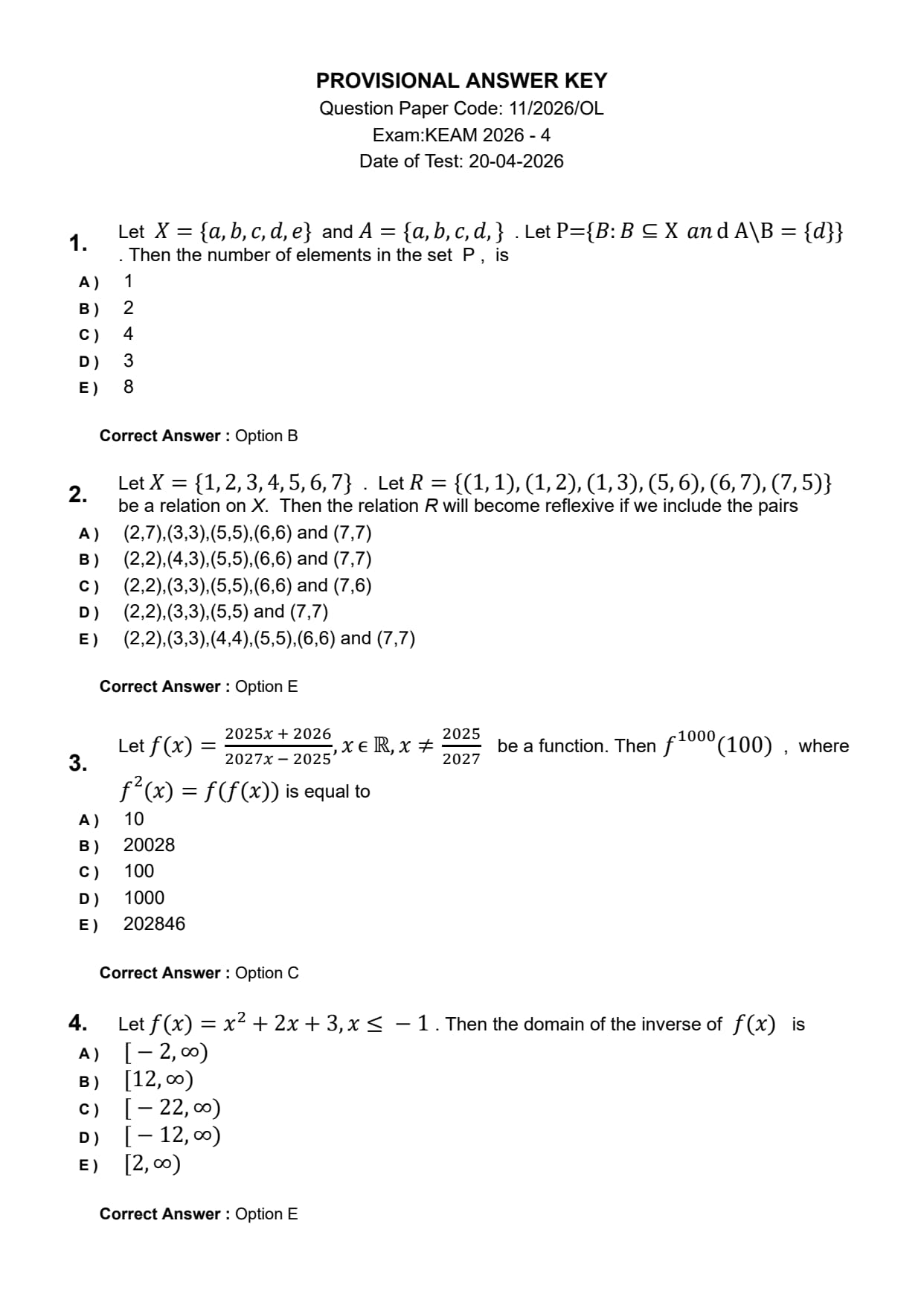
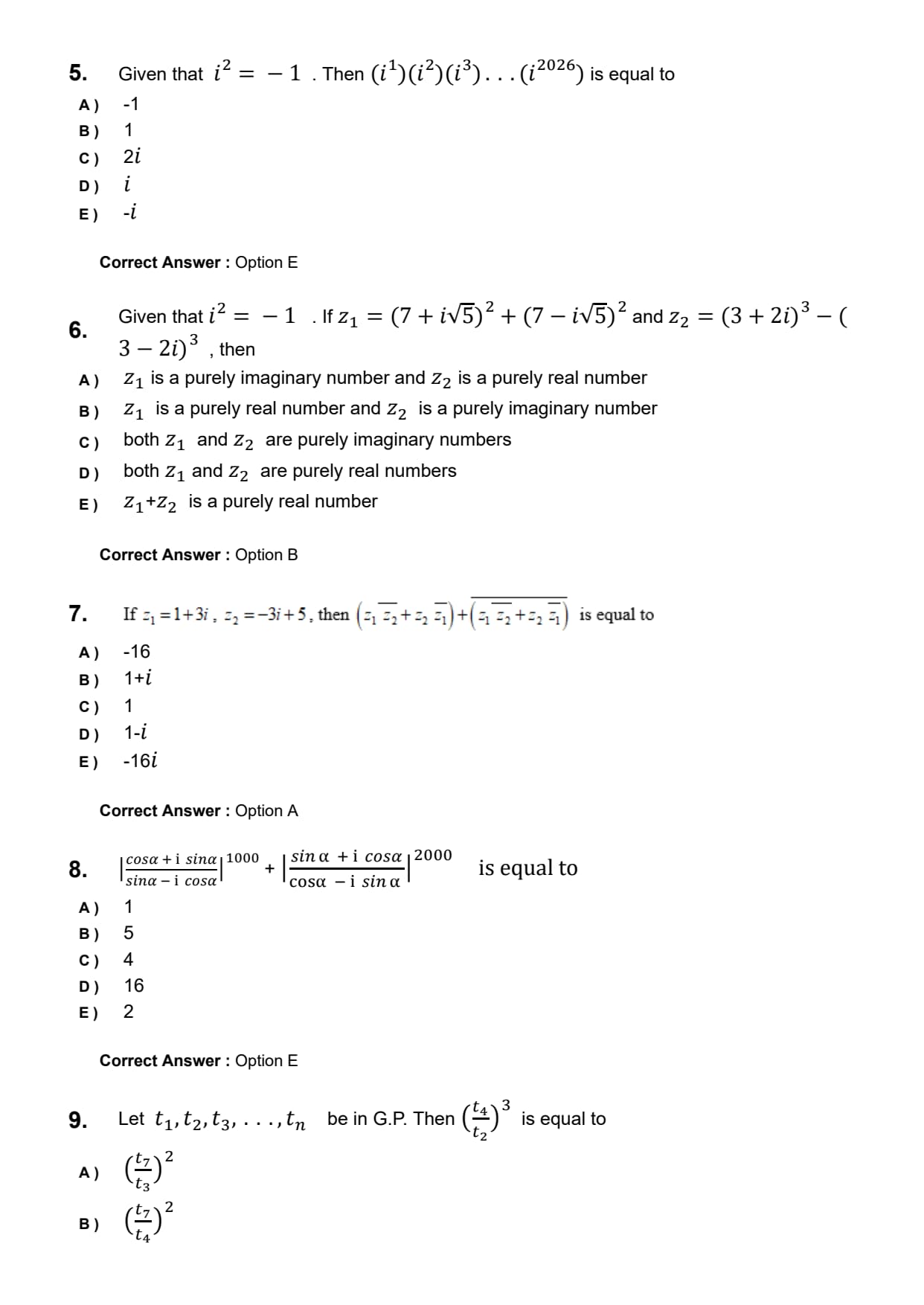
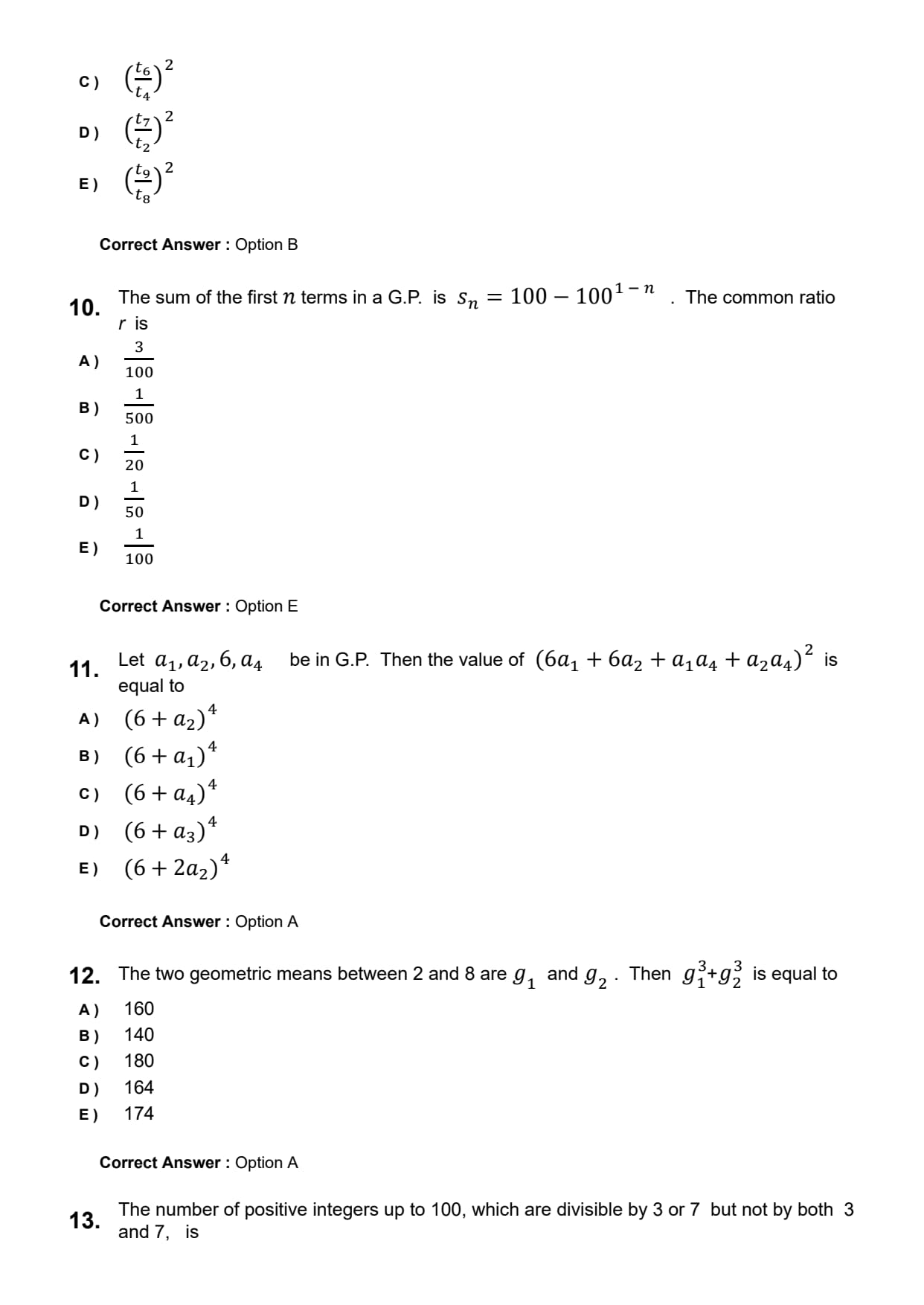
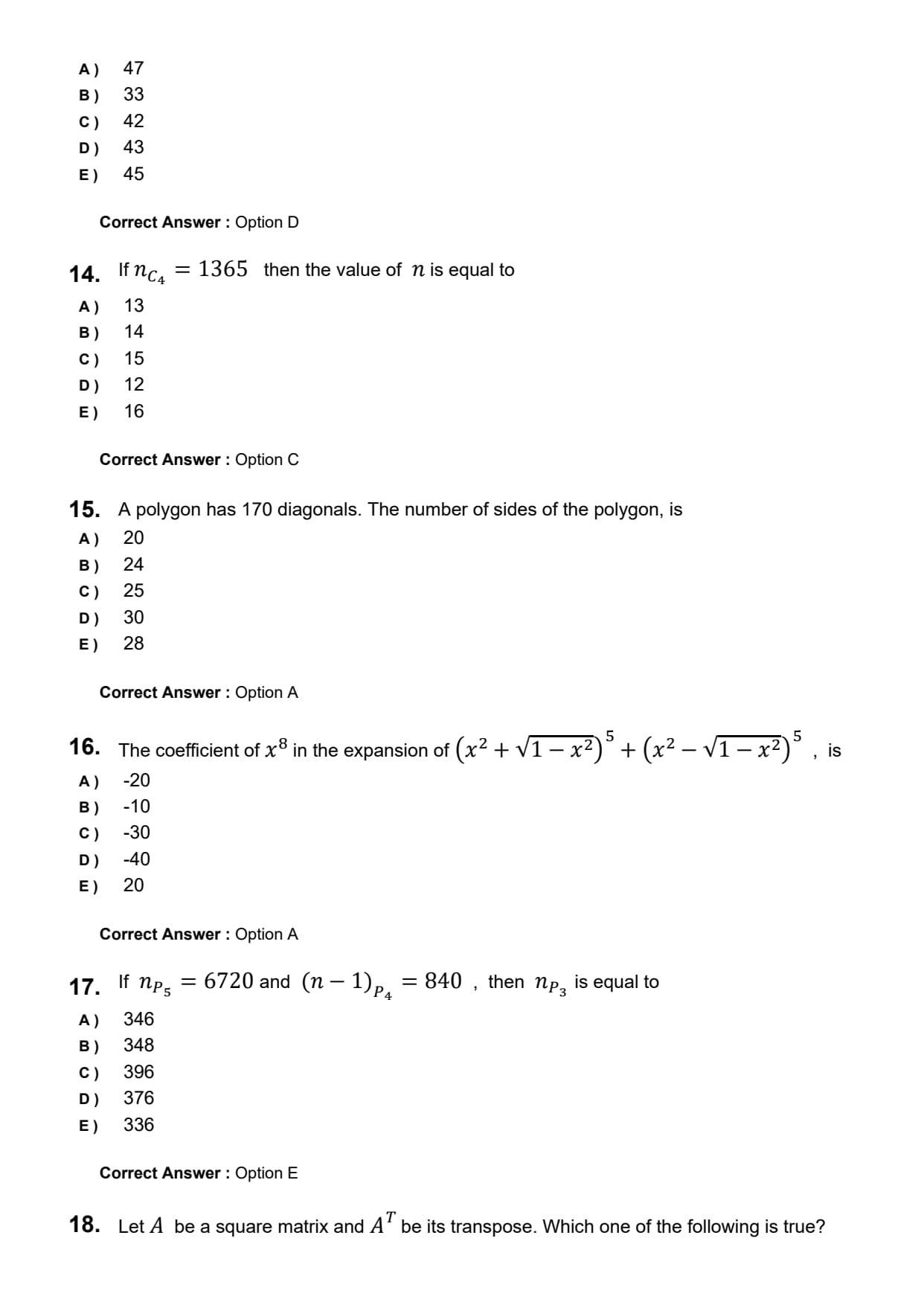
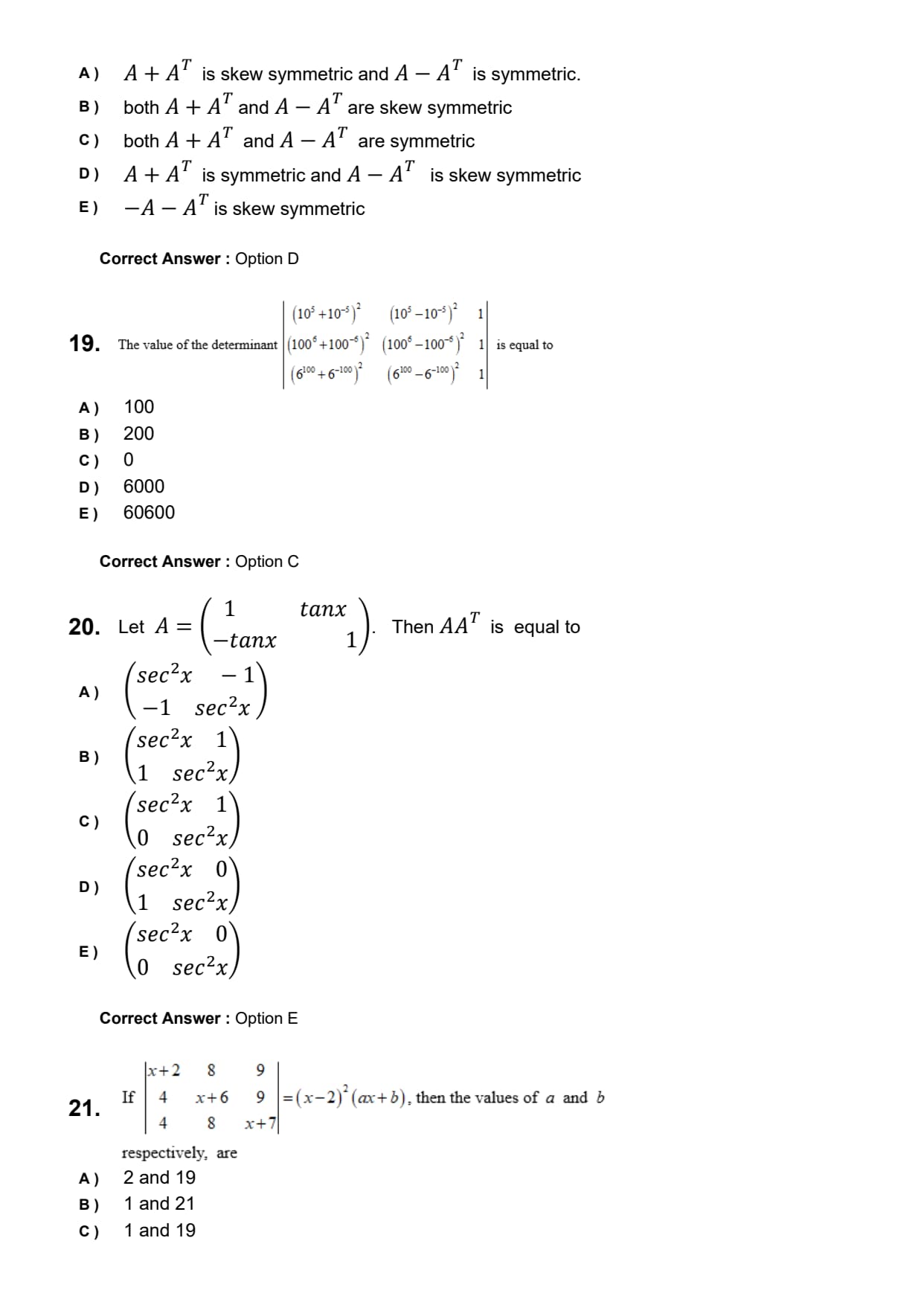
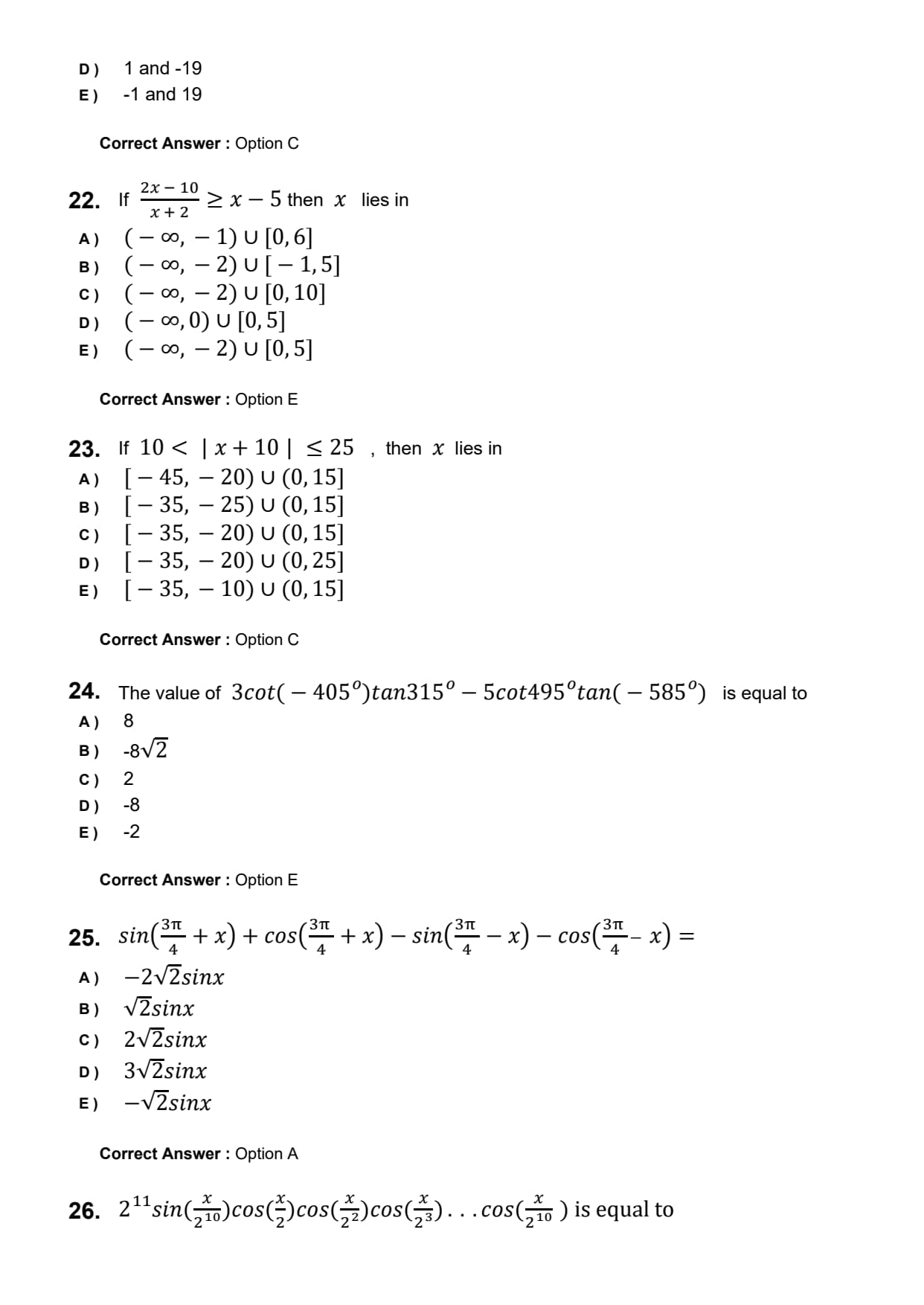
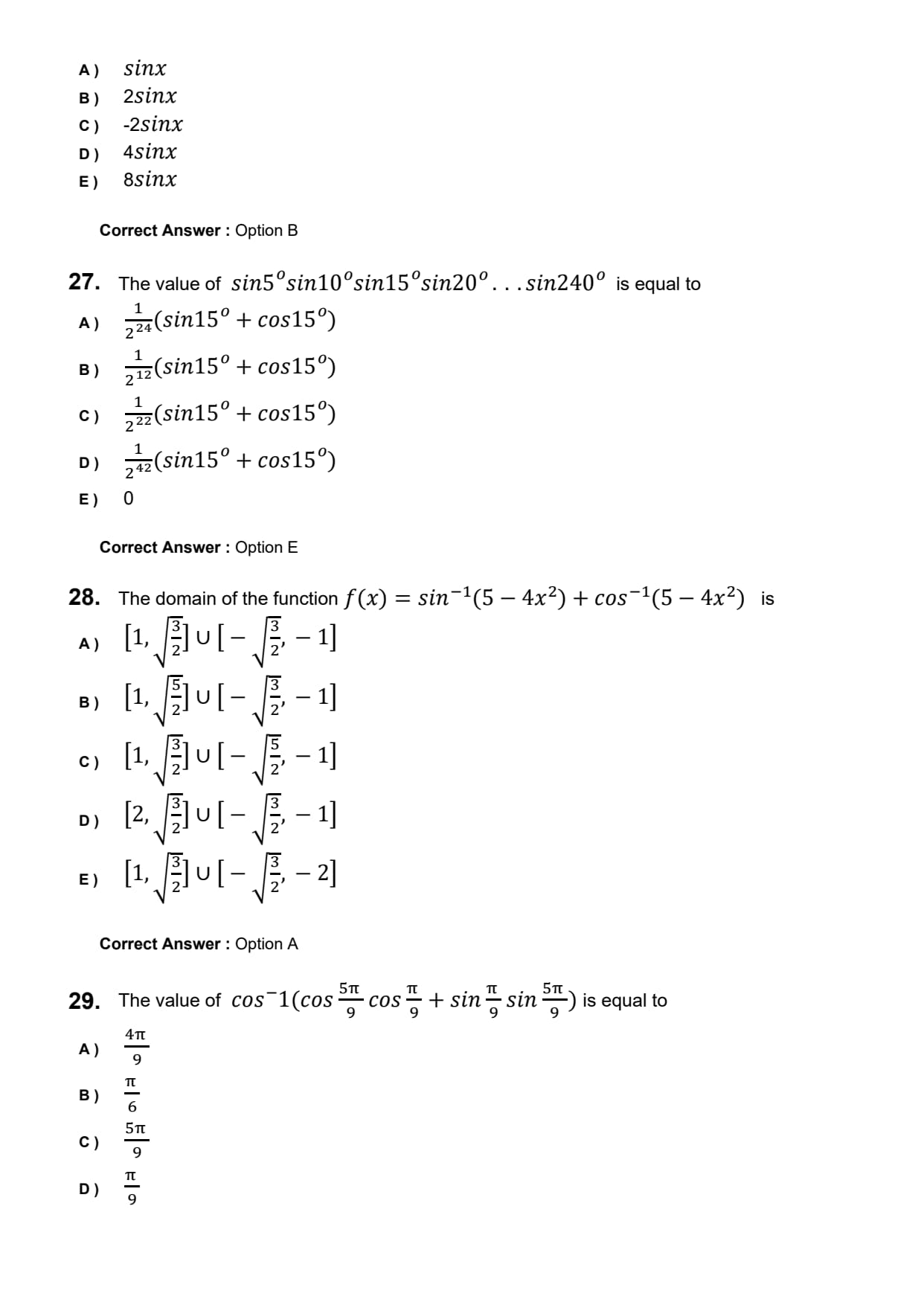
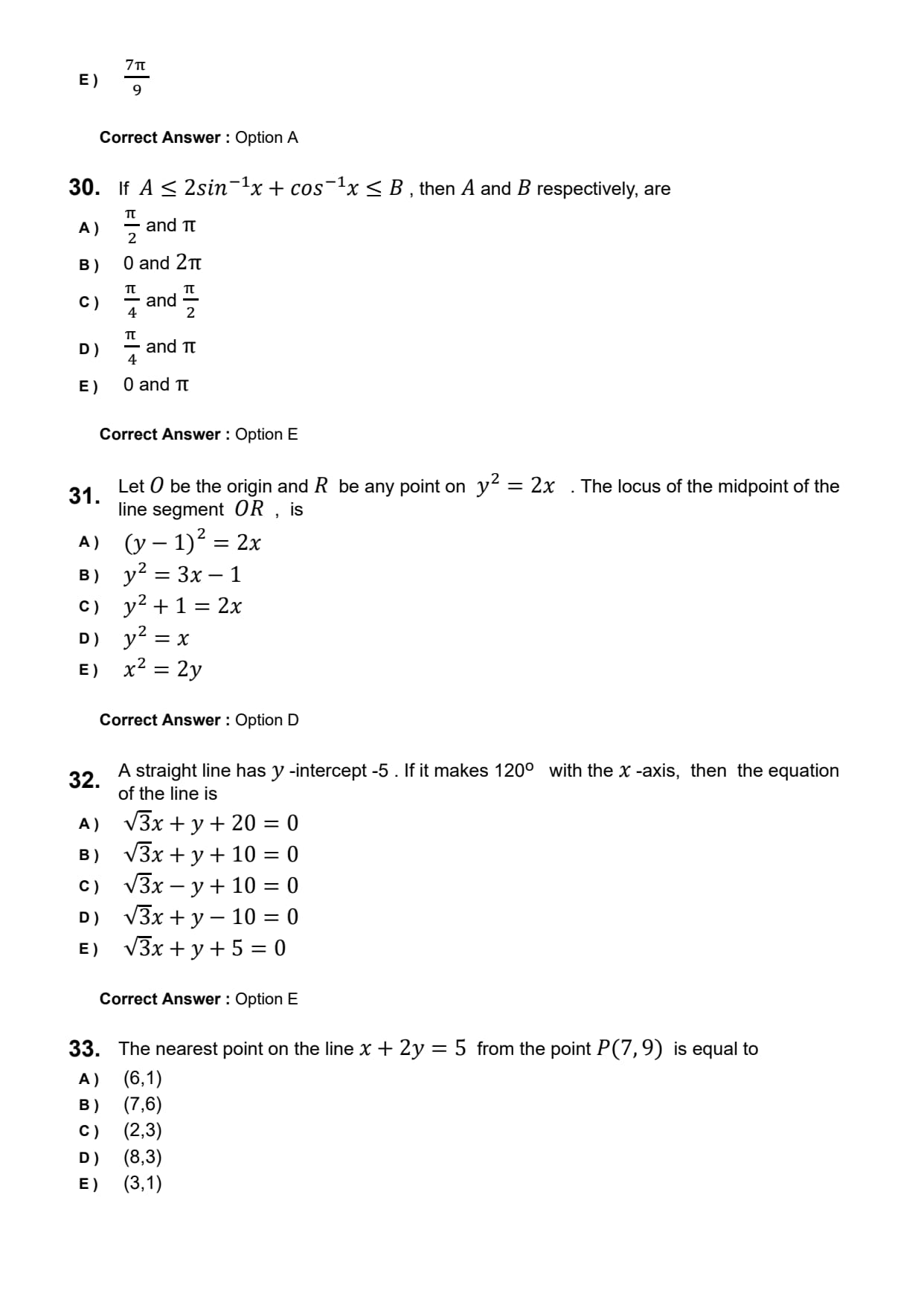
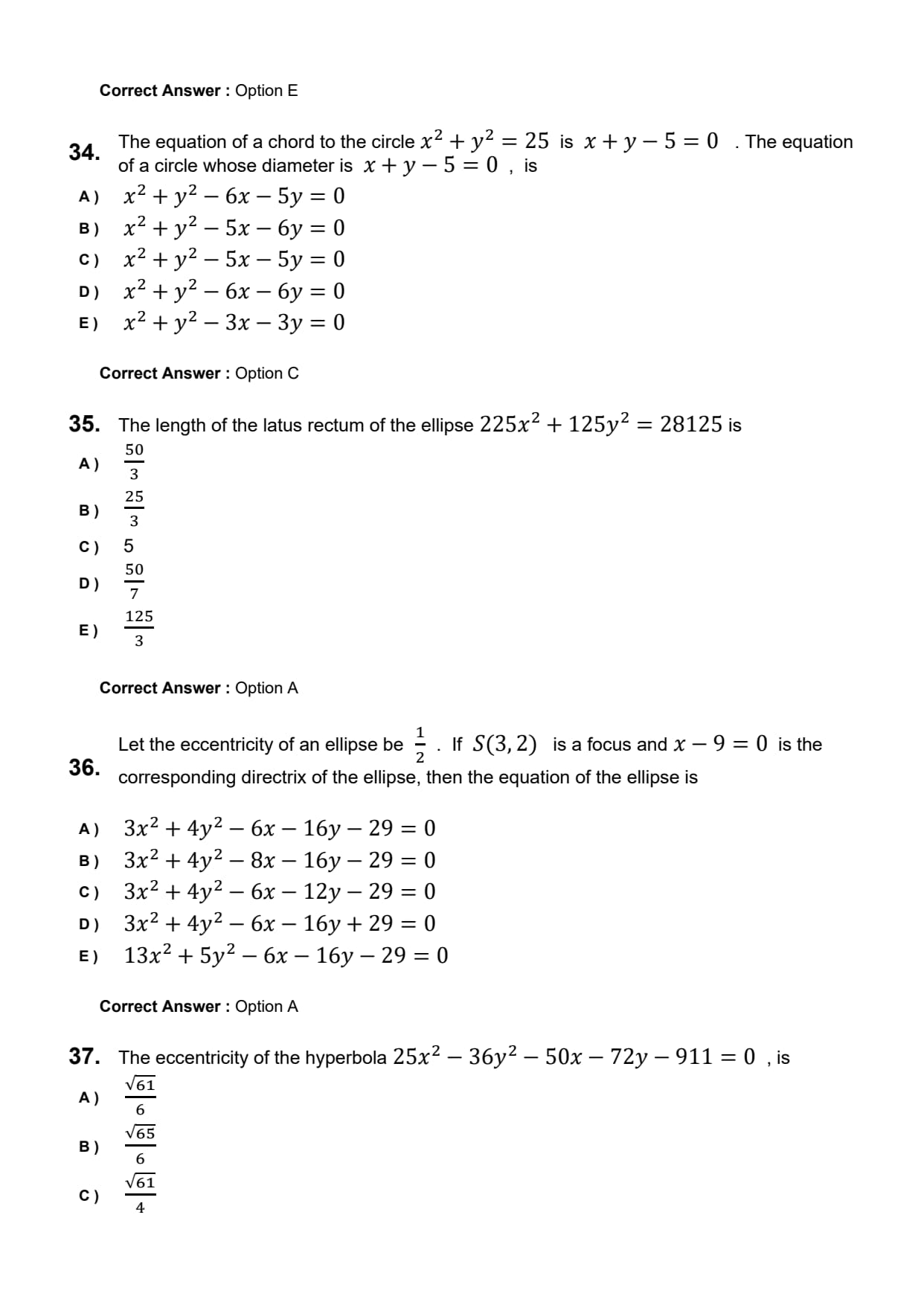
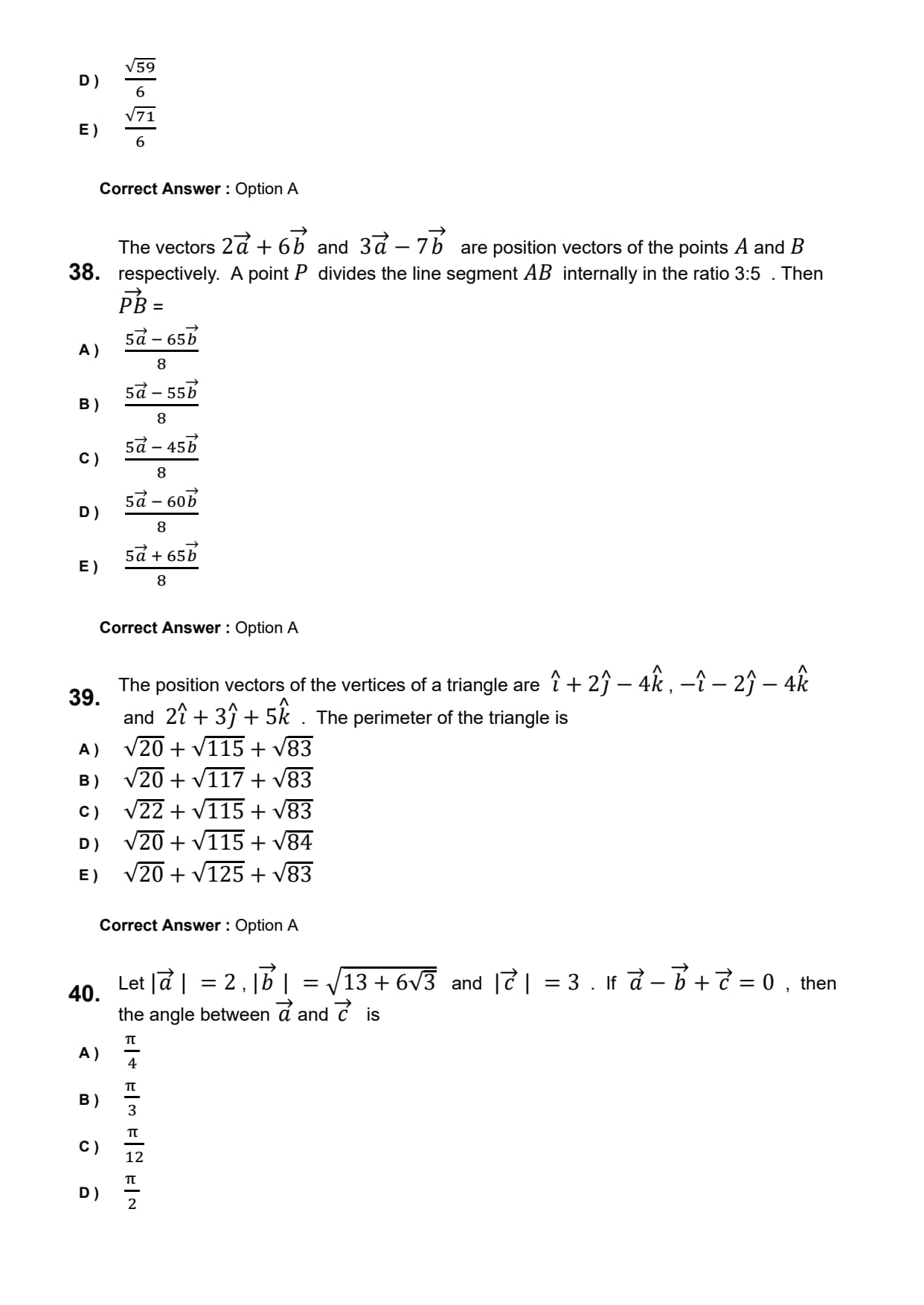
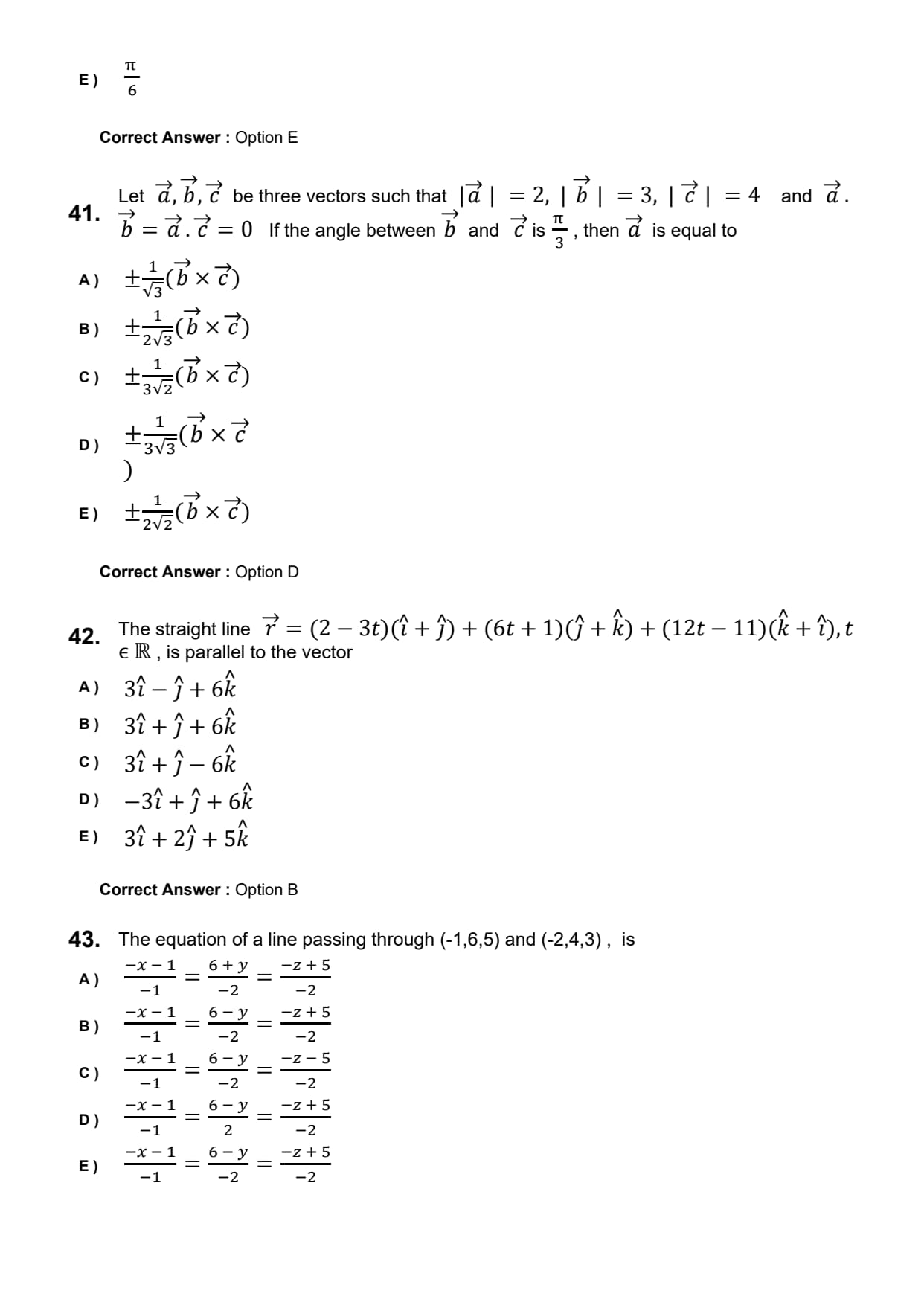
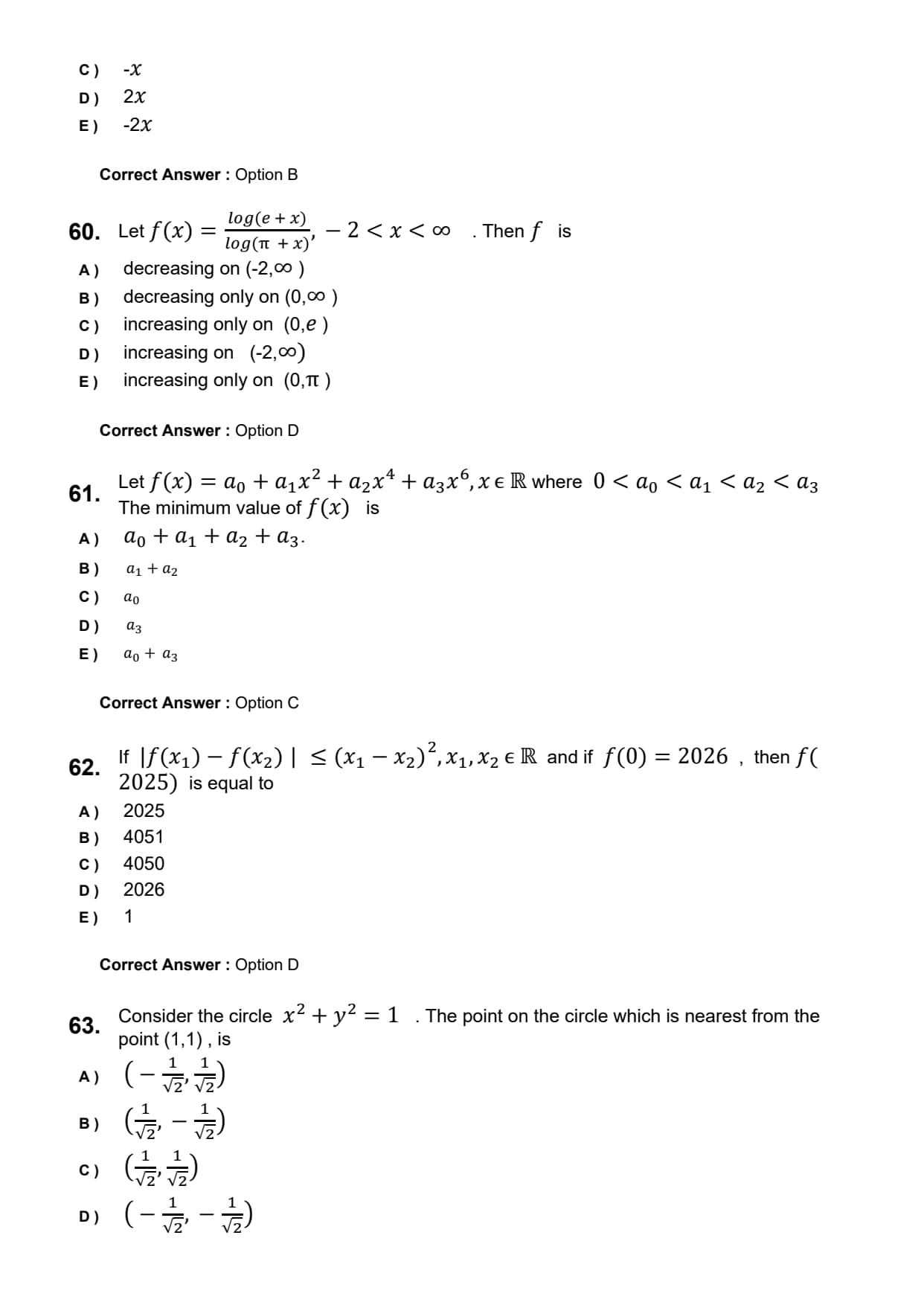
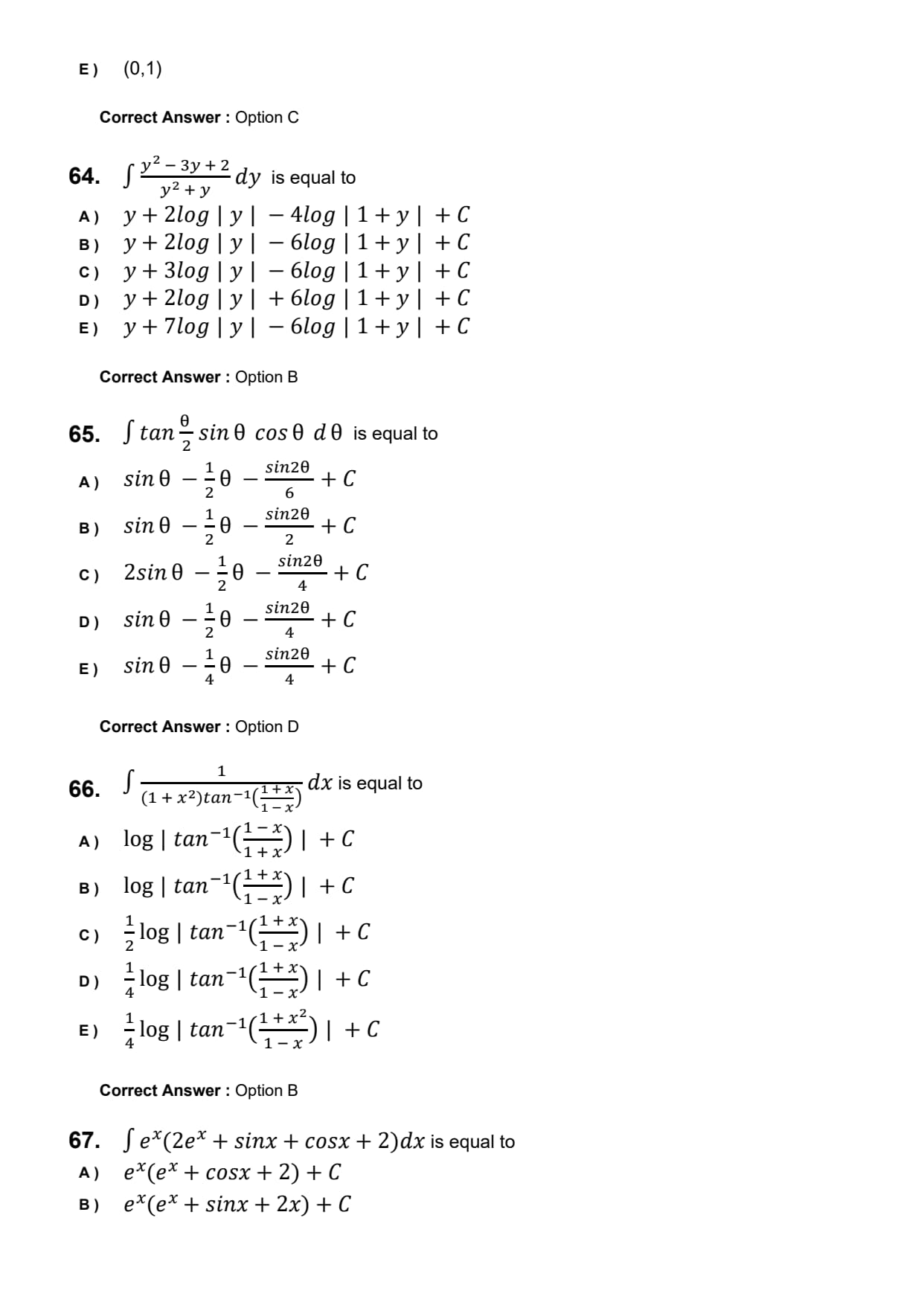
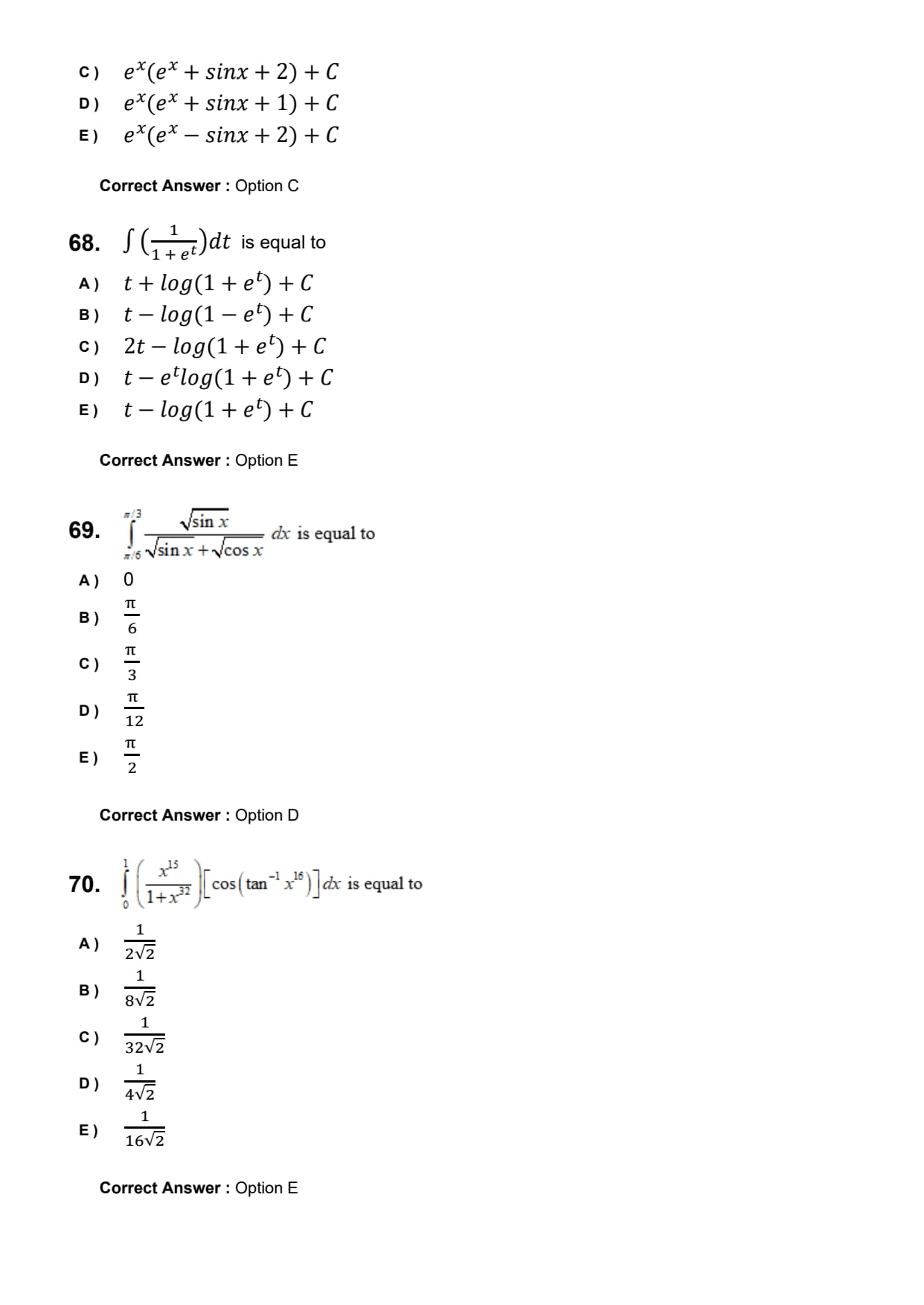
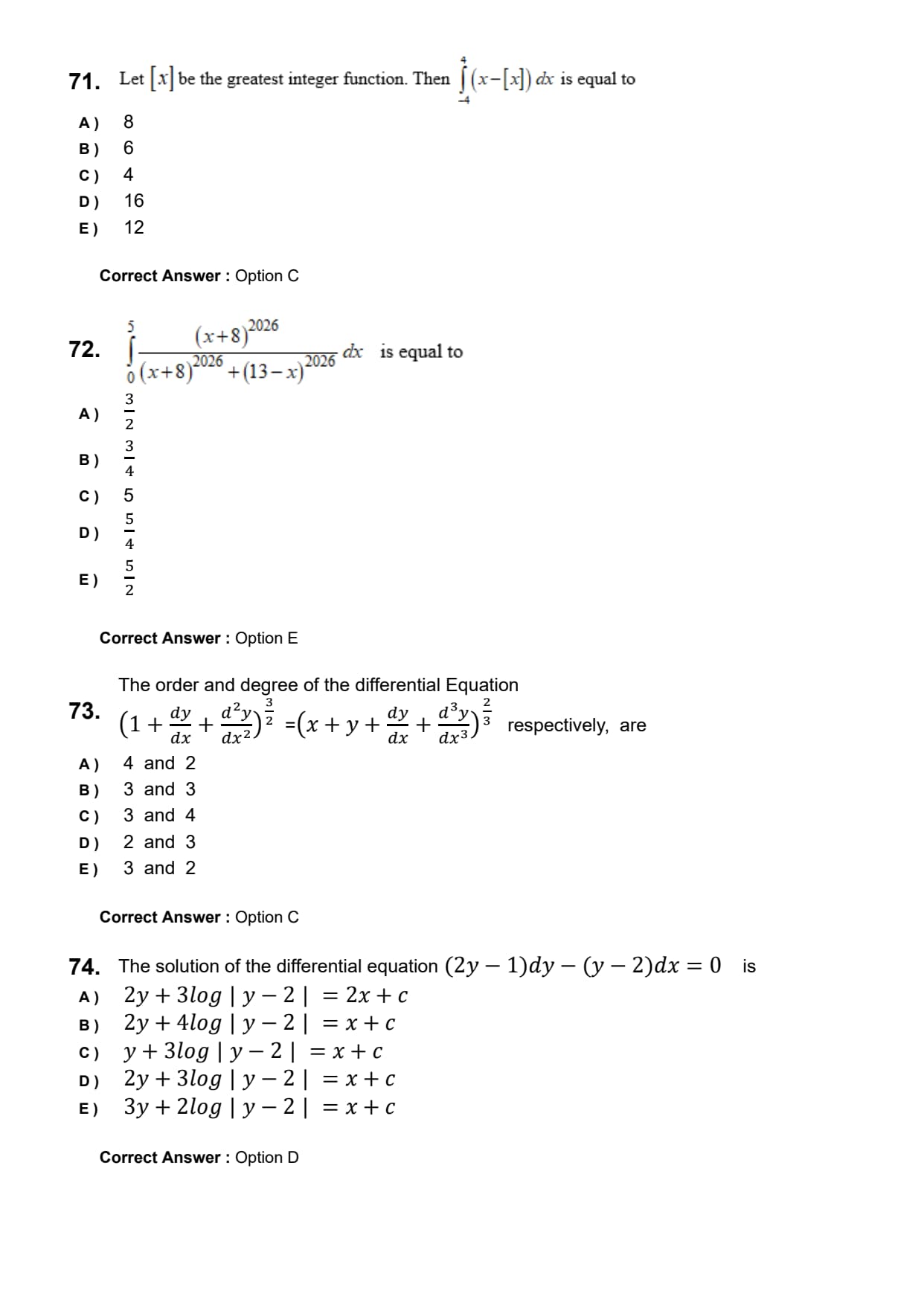
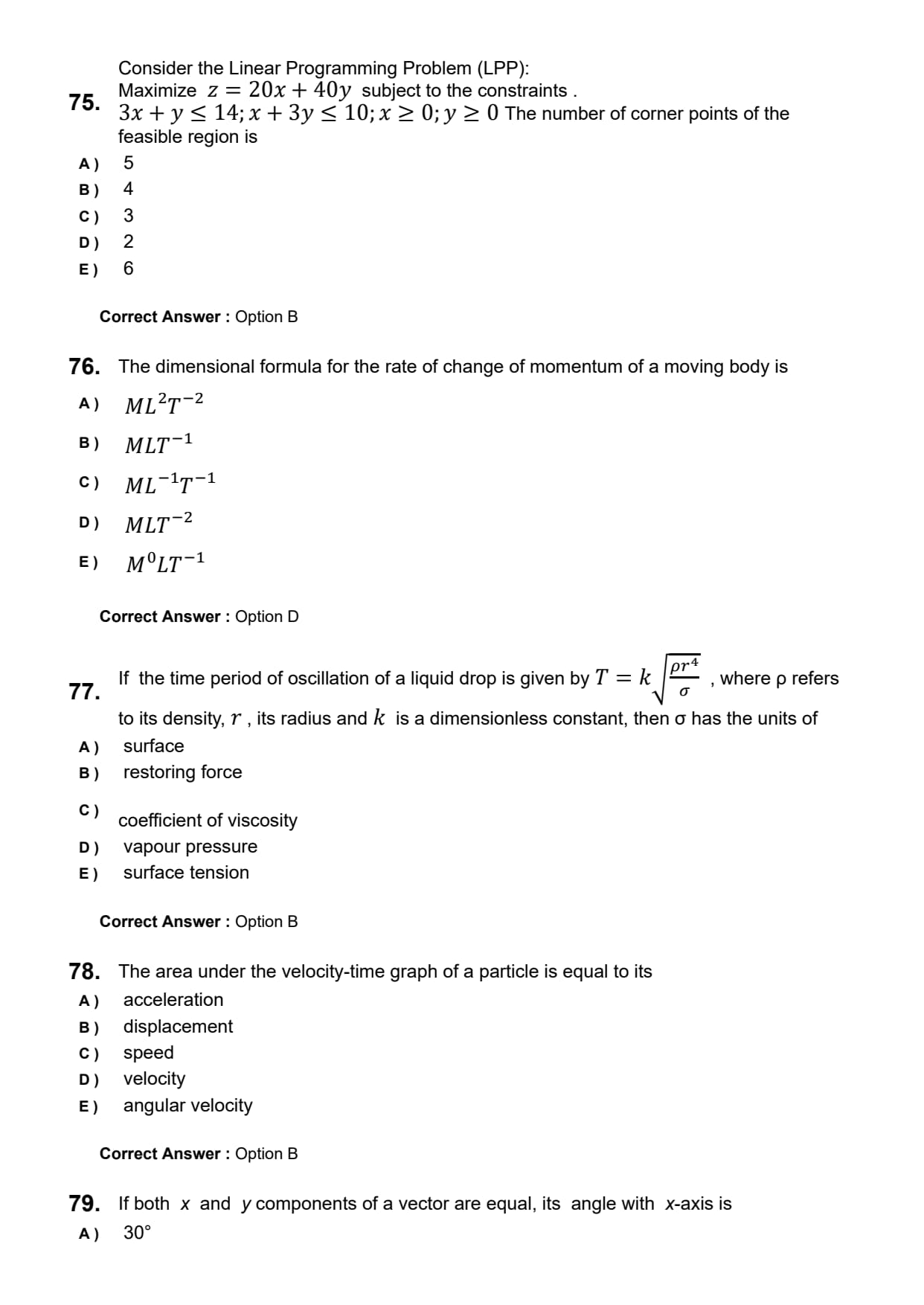
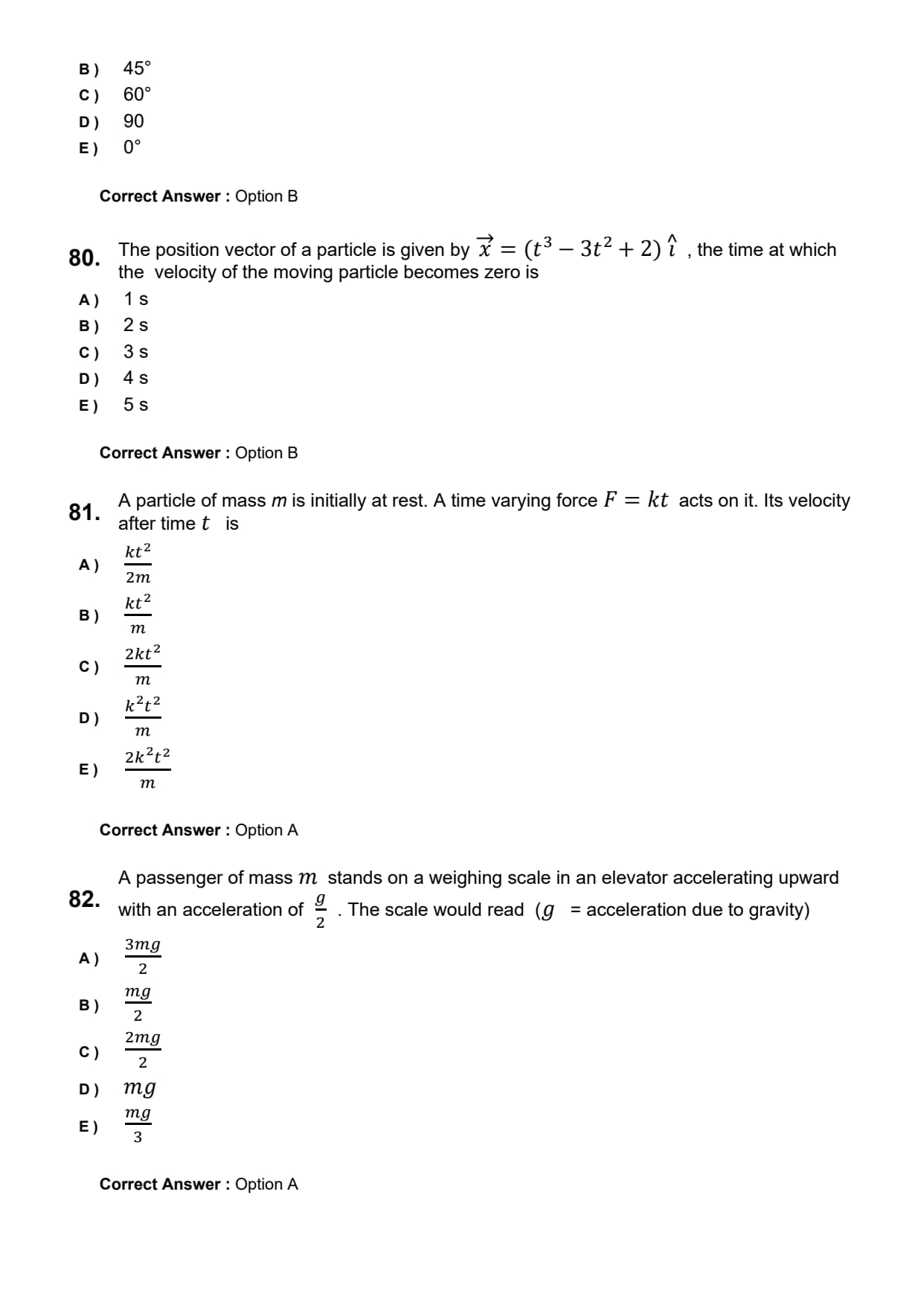
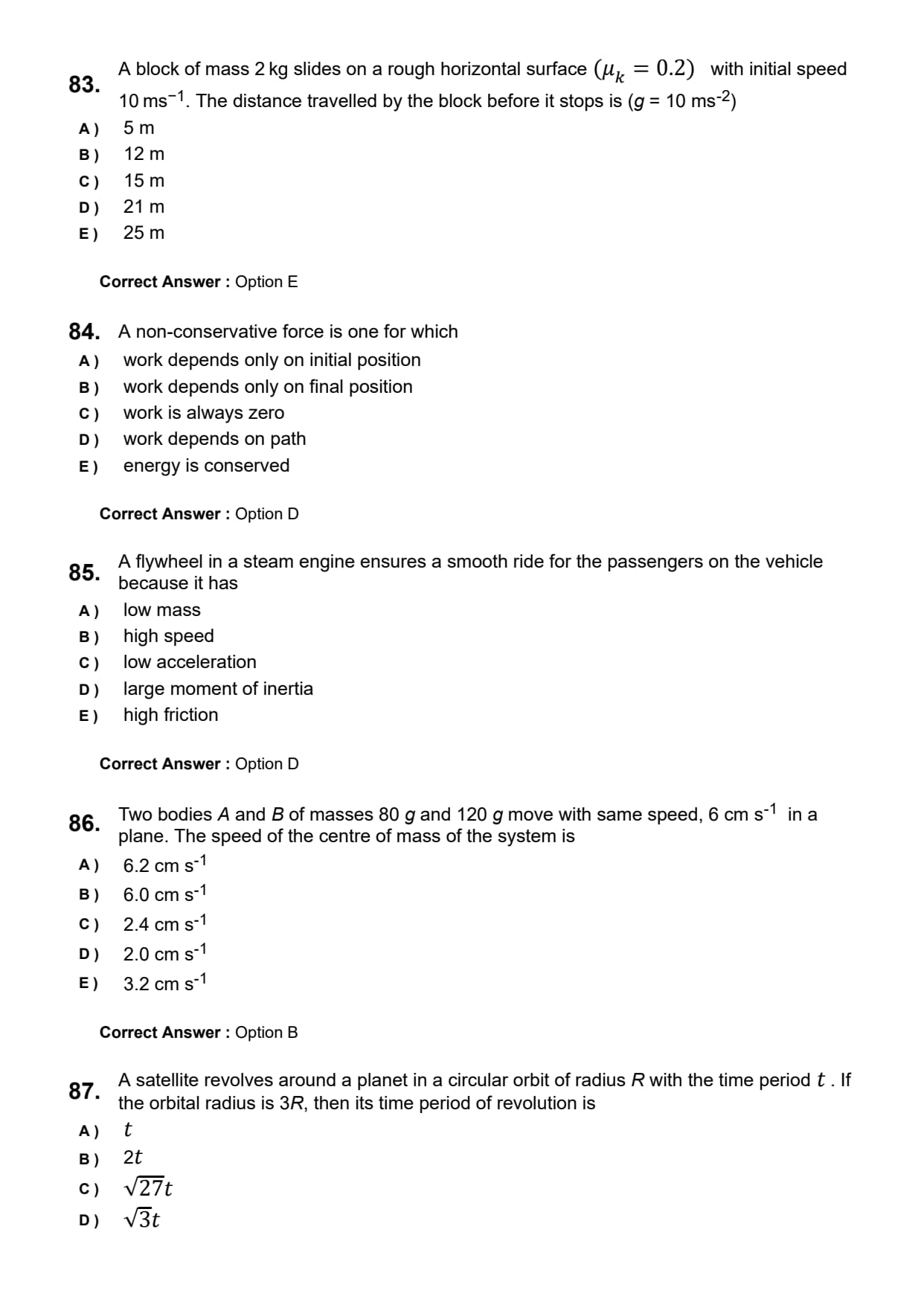
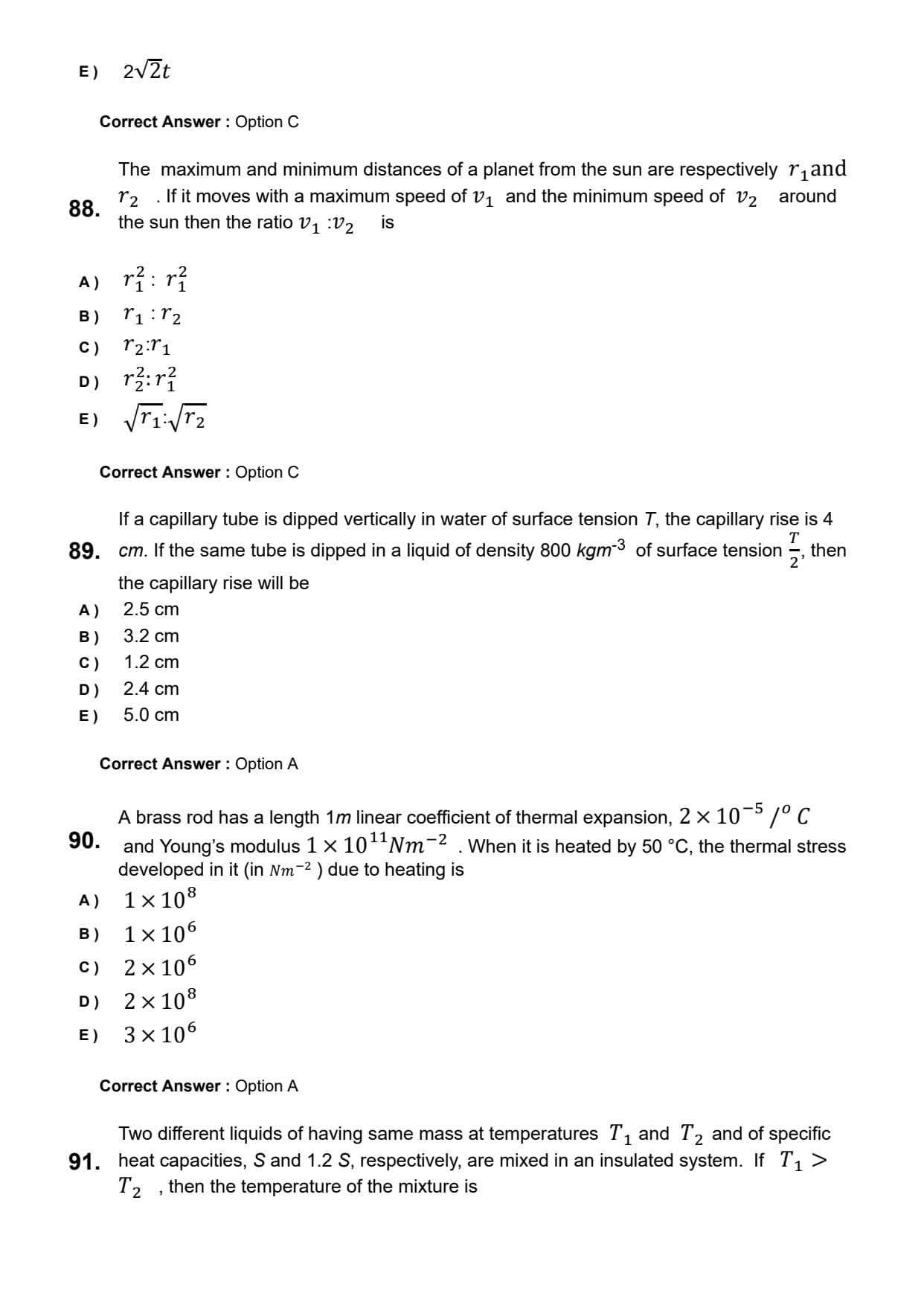
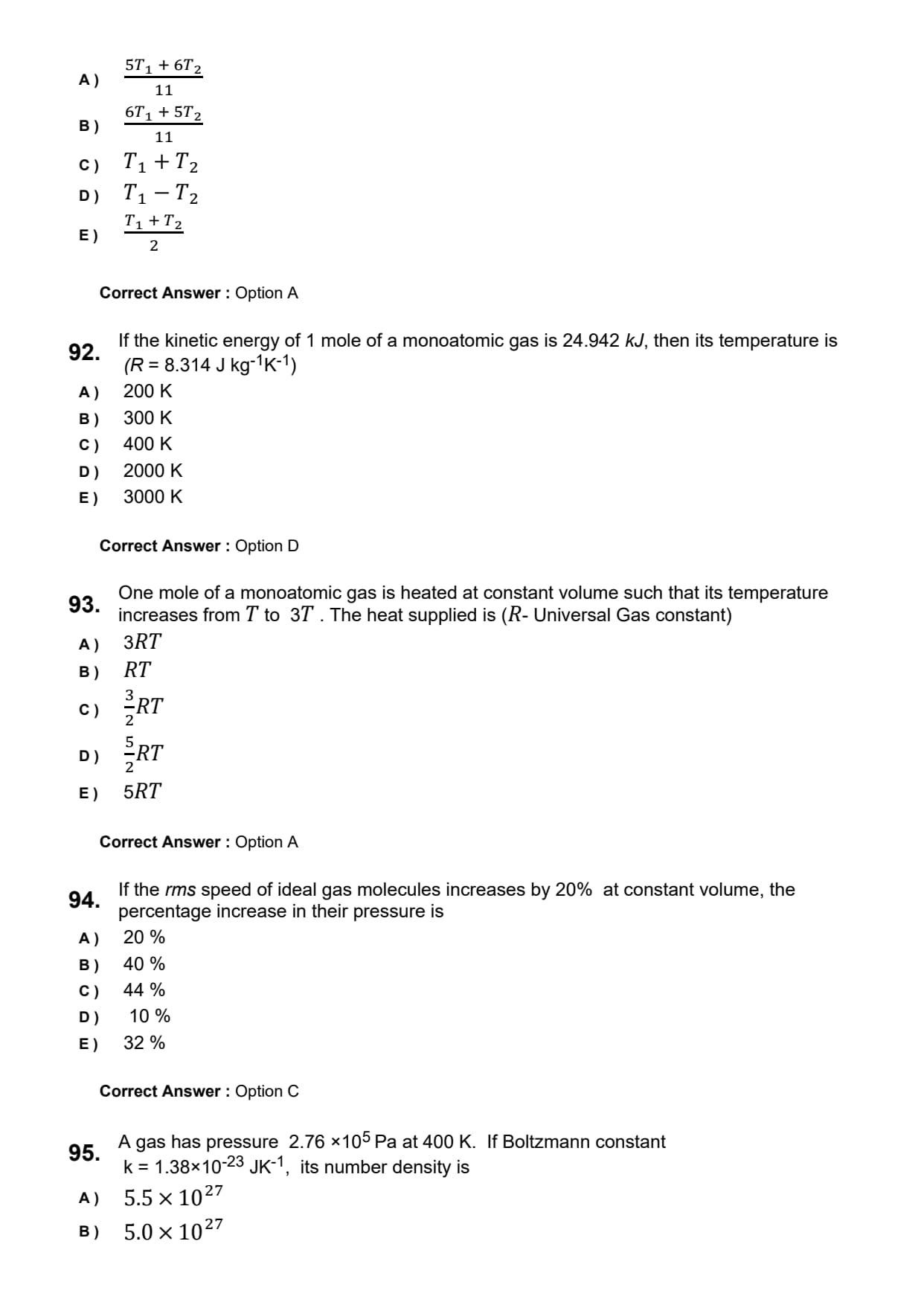
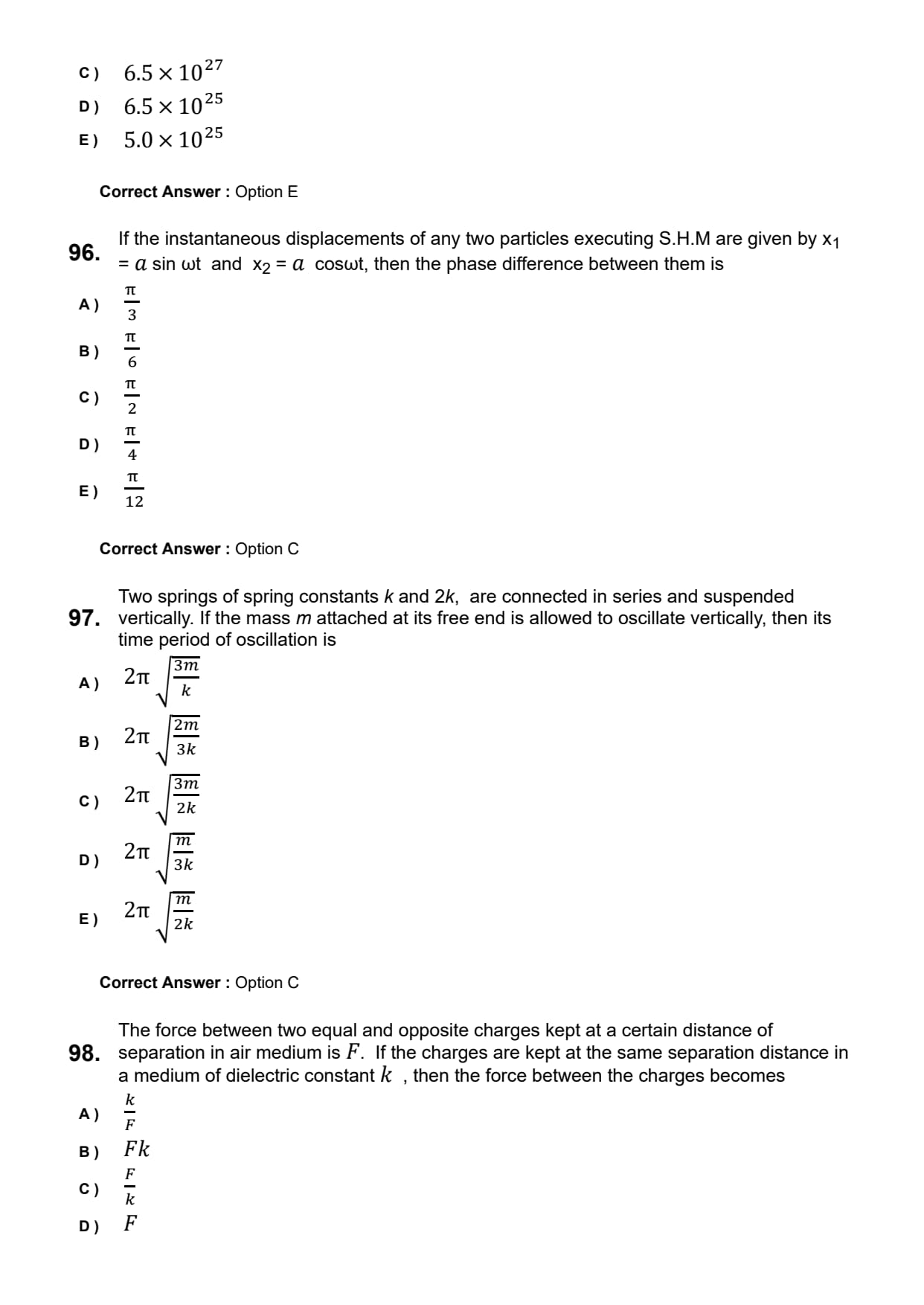
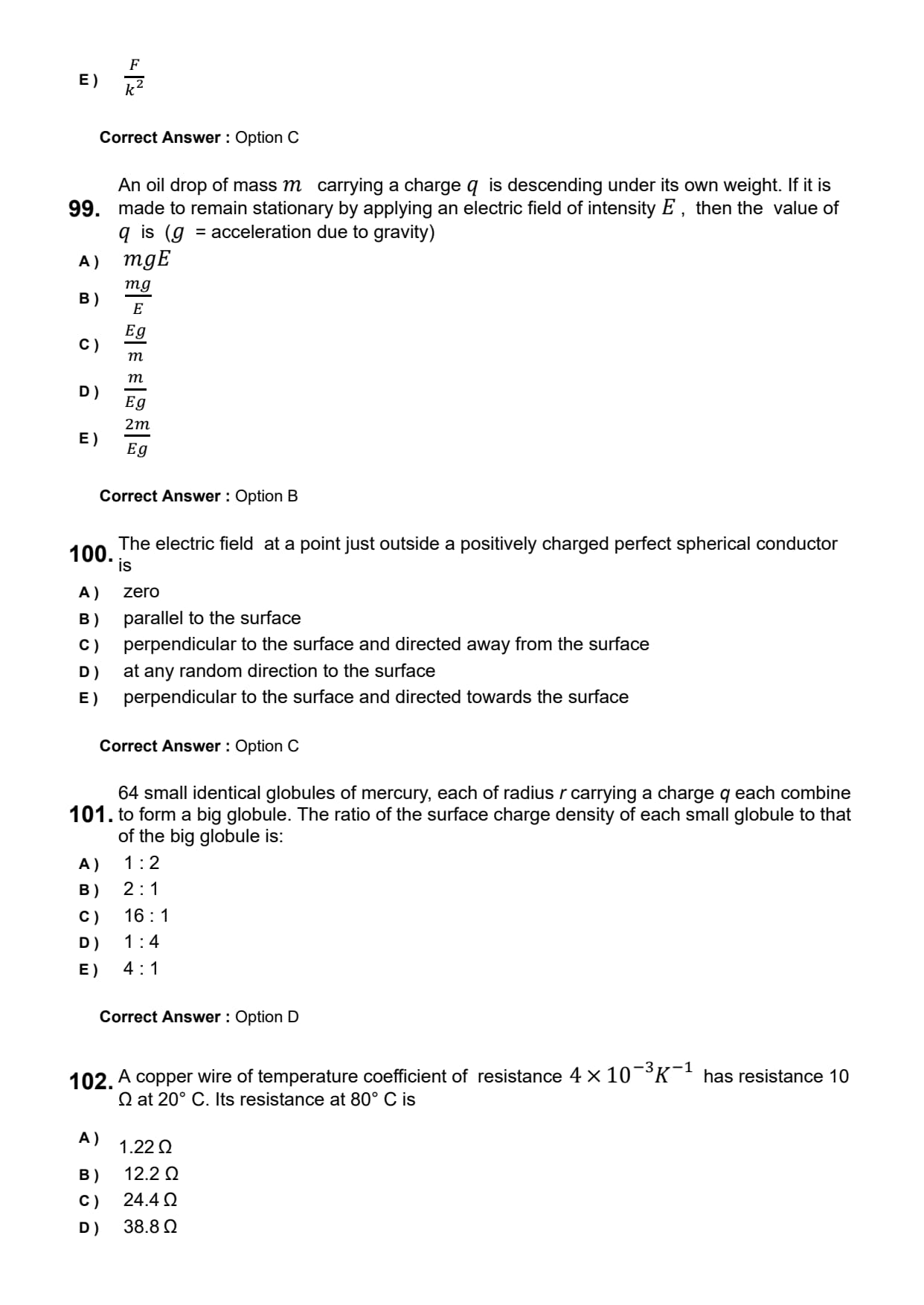
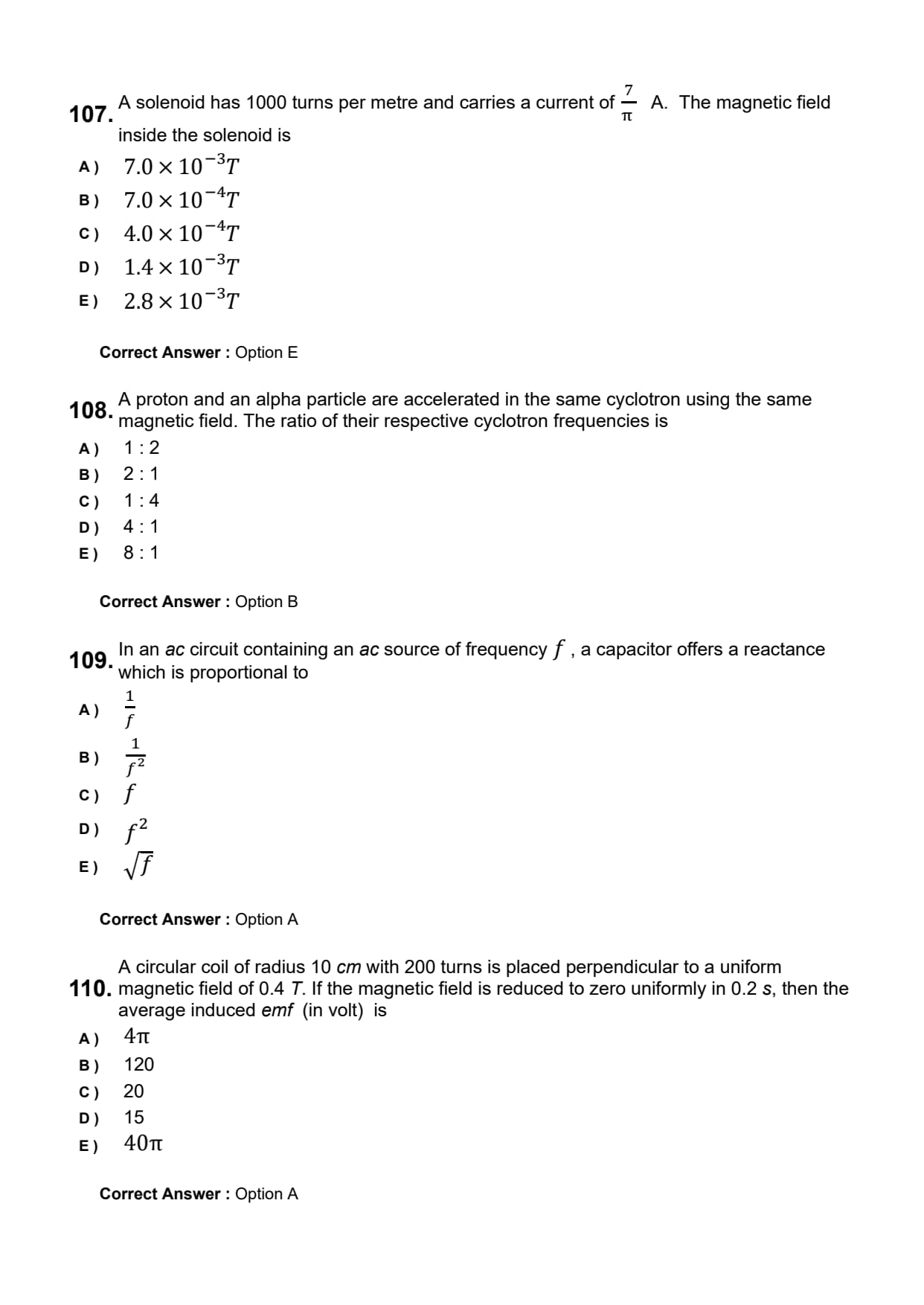
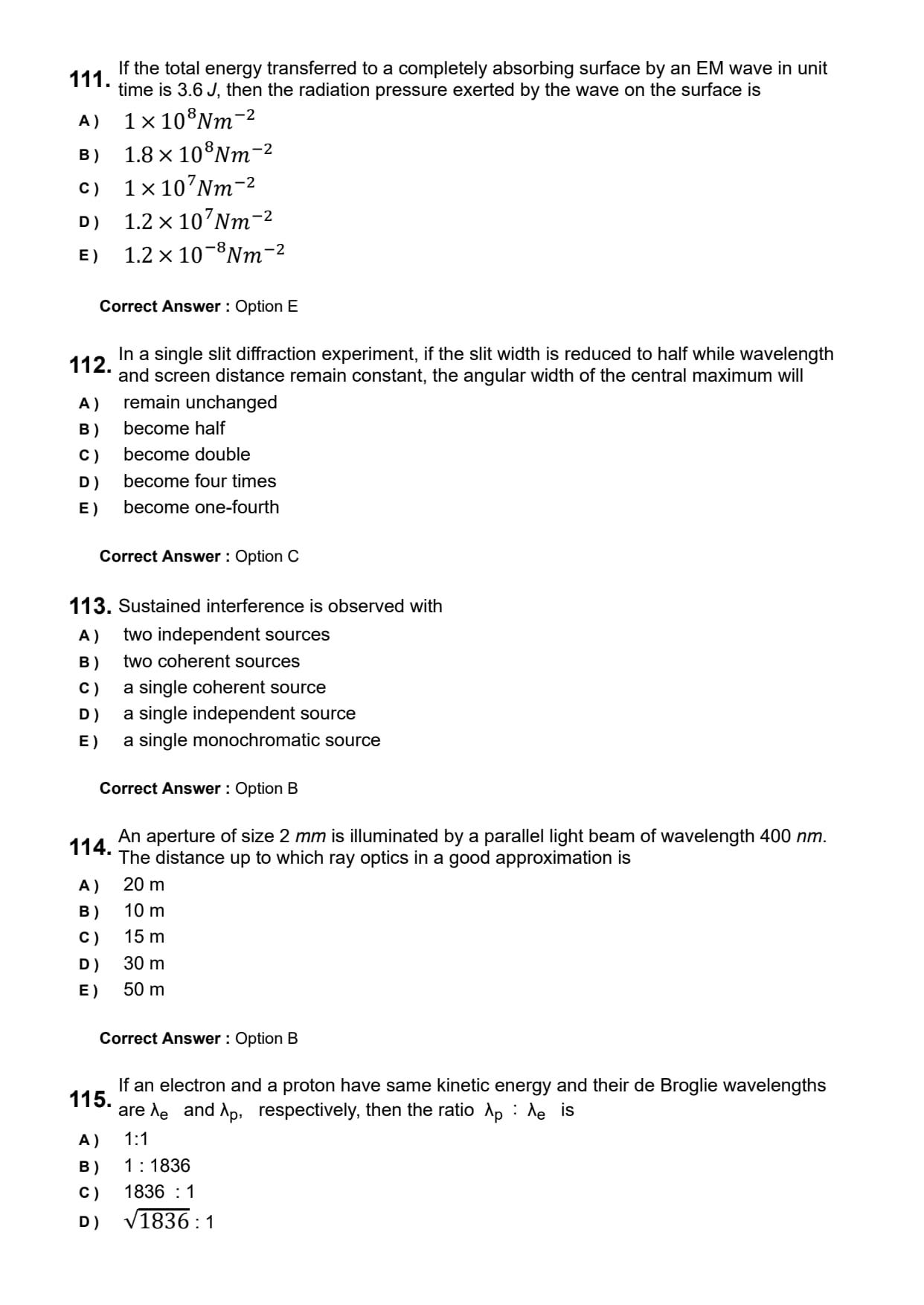
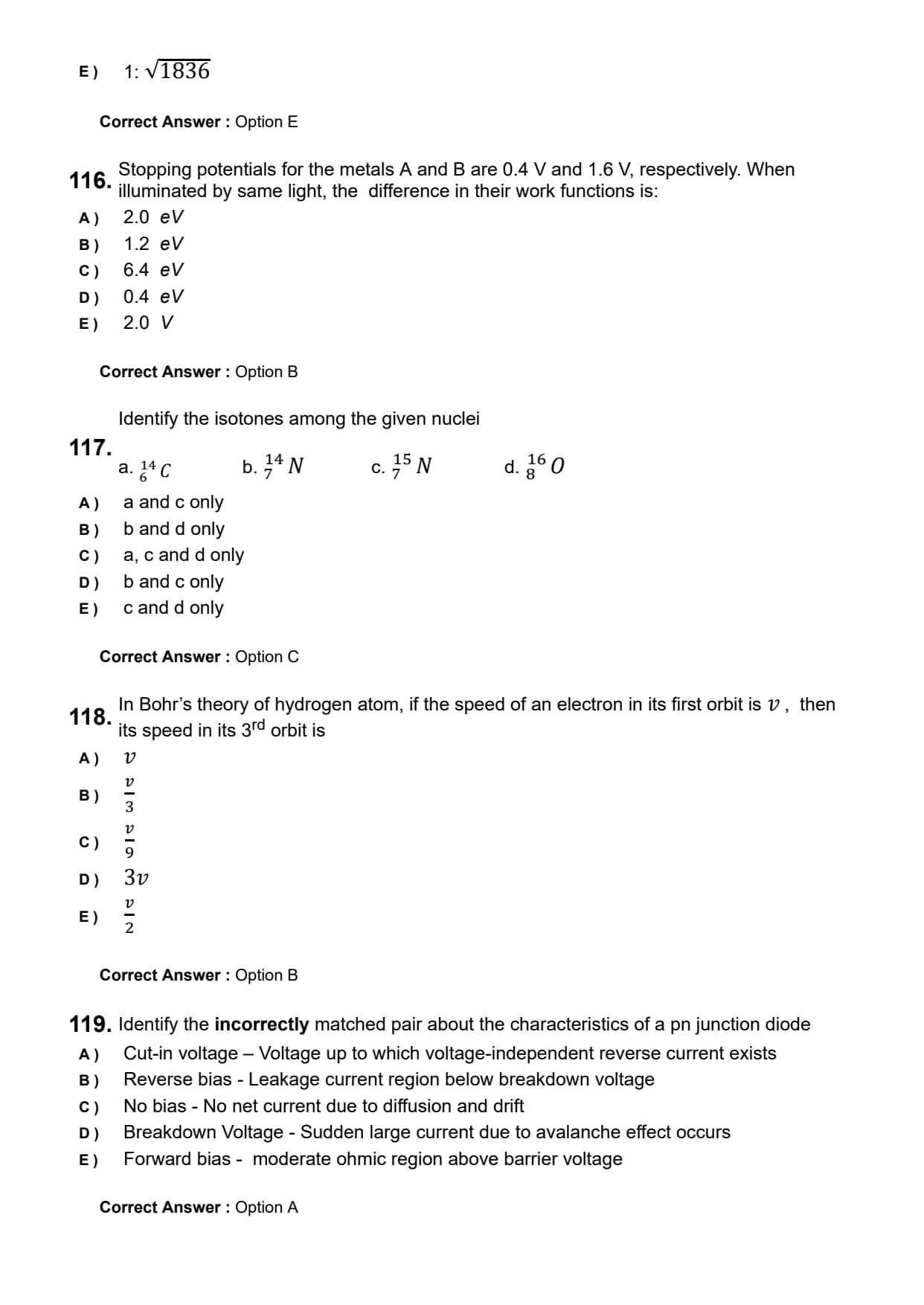
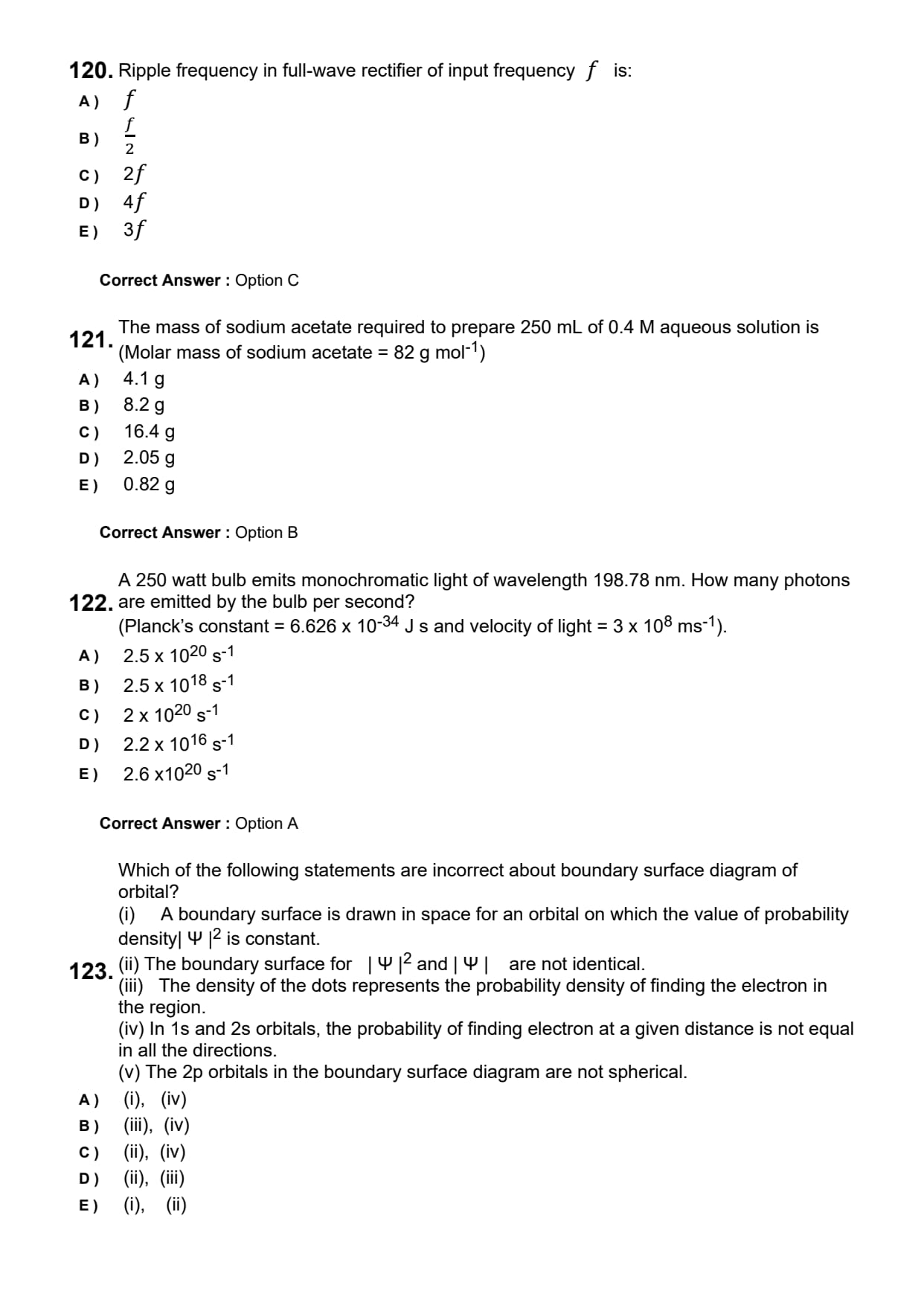
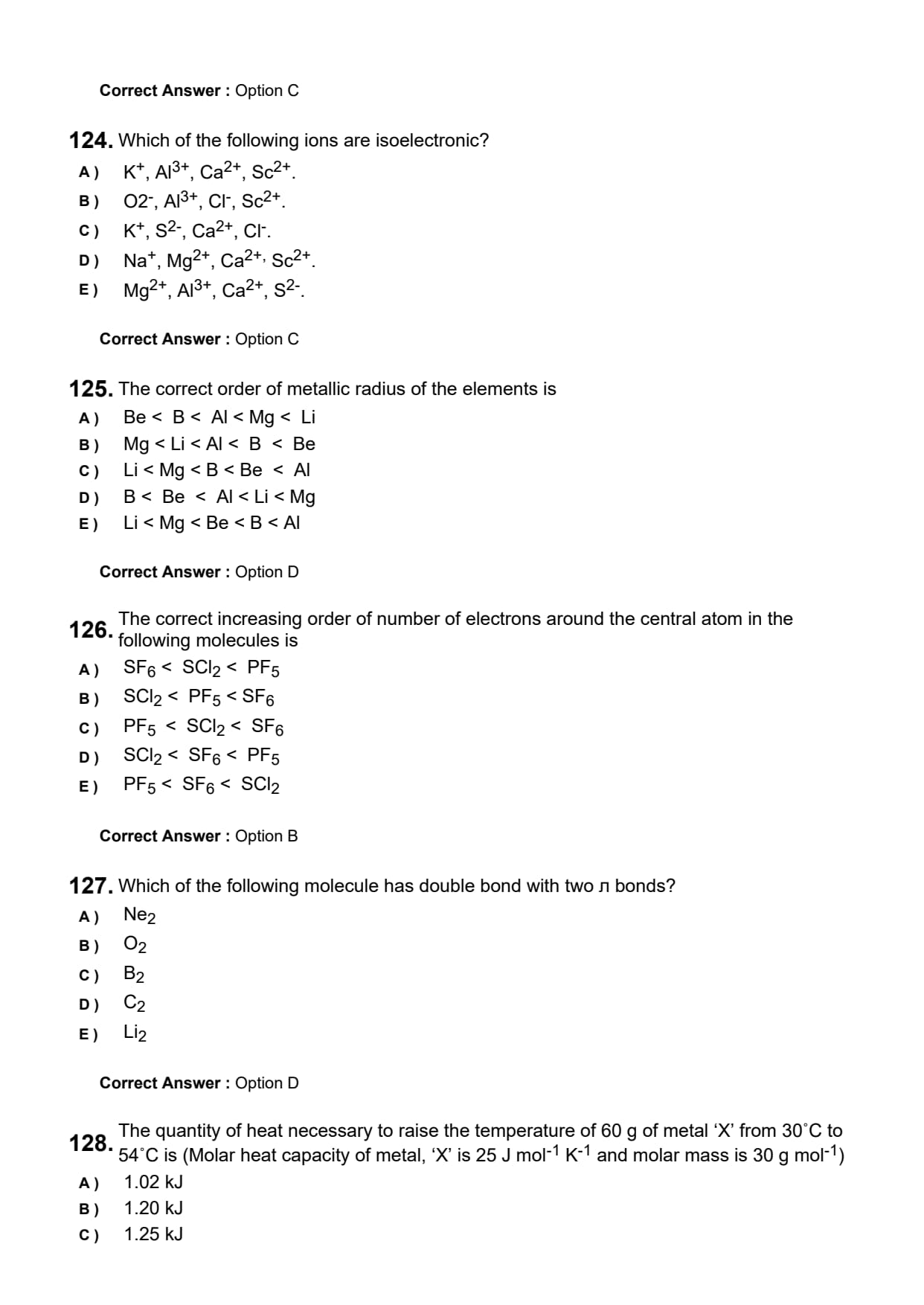
KEAM 2026 Engineering Question Paper for April 20 is available for download here. CEE Kerala conducted KEAM 2026 Engineering exam on April 20 in session 2 from 2 PM to 5 PM. KEAM 2026 Engineering exam is an online CBT with a total of 150 questions carrying a maximum of 600 marks.

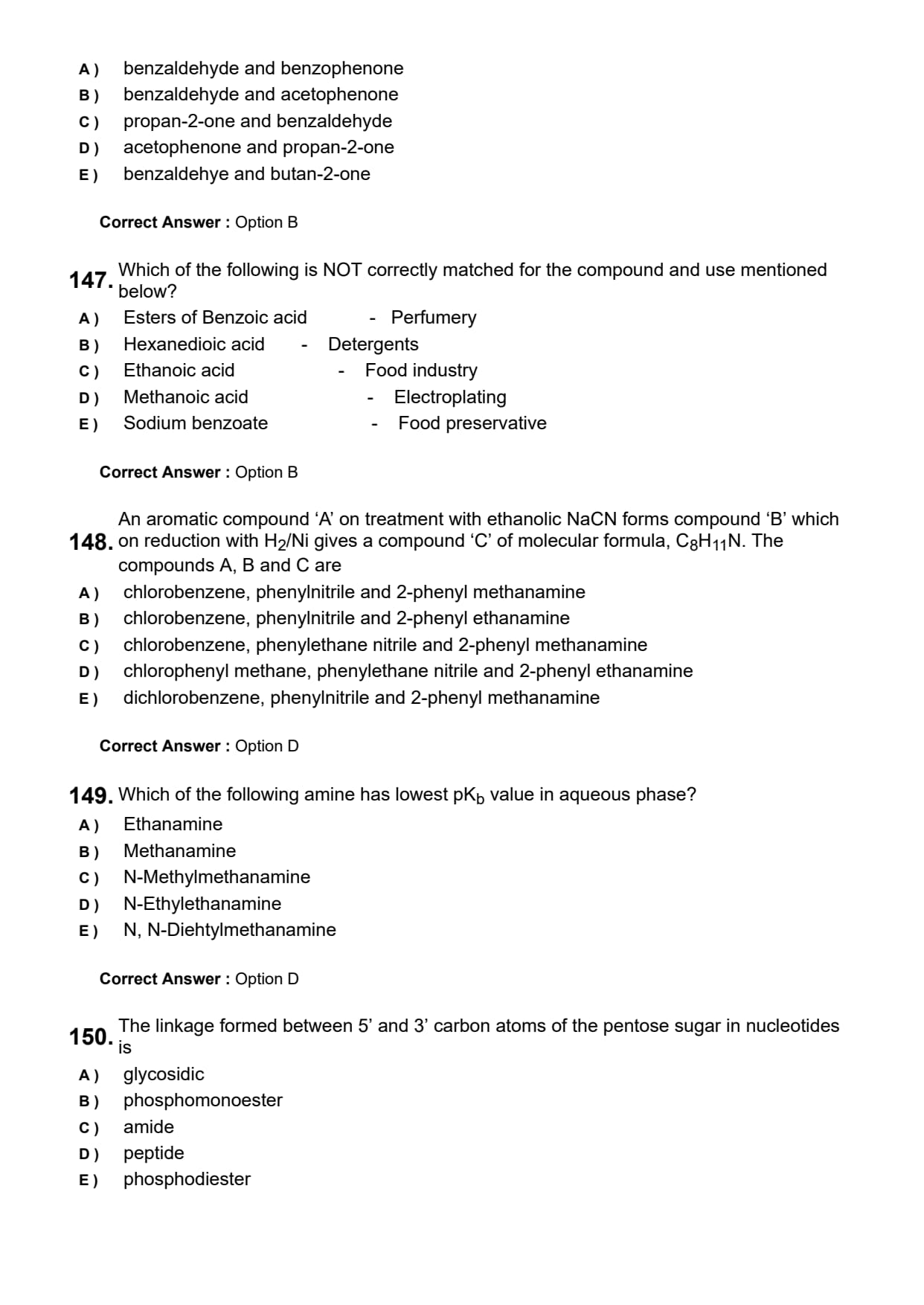
  • The KEAM Engineering exam is divided into 3 subjects- Physics (45 questions), Chemistry (30 questions) and Mathematics (75 questions).
  • 4 marks are given for every correct answer and 1 mark is deducted for every incorrect answer

Candidates can download KEAM 2026 April 20 Engineering Question Paper with Solution PDF from the links provided below.

KEAM 2026 Engineering April 20 Question Paper with Solution PDF

KEAM 2026 Engineering Question Paper April 20 Download PDF Check Solution
KEAM 2026 Engineering April 20 Question Paper with Solutions

Also Check:


Question 1:

Let \(R\) be a relation in \(\mathbb{N}\) defined by \(\{(x,y): x + 3y = 10, x,y \in \mathbb{N}\}\). Then the range of \(R\) is

  • (A) \(\{1,2,3,4\}\)
  • (B) \(\{2,3,4\}\)
  • (C) \(\{1,3,4\}\)
  • (D) \(\{1,2,3\}\)
  • (E) \(\{1,3\}\)

Question 2:

The domain of \(f(x) = \frac{x^2 + 1}{x^2 + x + 1}\) is

  • (A) \(\mathbb{R}\)
  • (B) \(\mathbb{R} - \{2\}\)
  • (C) \(\mathbb{R} - \{1\}\)
  • (D) \(\mathbb{R} - \{0\}\)
  • (E) \(\mathbb{R} - \{1,-1\}\)

Question 3:

Let \(A\) and \(B\) be two sets of having 3 and 2 elements respectively. Then the number of subsets of \(A \times B\) having at least three elements is

  • (A) 24
  • (B) 52
  • (C) 42
  • (D) 64
  • (E) 60

Question 4:

The number of elements in the set \(\{(x,y): 2x^2 + 3y^2 = 35, x,y \in \mathbb{Z}\}\), where \(\mathbb{Z}\) is the set of all integers, is

  • (A) 4
  • (B) 6
  • (C) 16
  • (D) 12
  • (E) 8

Question 5:

If \(|z + 4| = 2|z + 1|\), where \(z\) is a complex number then \(|z|\) is equal to

  • (A) 0
  • (B) 2
  • (C) 4
  • (D) 8
  • (E) 16

Question 6:

If \(z(3 - i) = 2 + i\), then \(z^2 =\)

  • (A) \(\frac{i}{2}\)
  • (B) \(-\frac{i}{2}\)
  • (C) \(\frac{1}{2}\)
  • (D) \(-\frac{1}{2}\)
  • (E) \(\frac{1+i}{2}\)

Question 7:

The imaginary part of \(\frac{1 - i\sqrt{3}}{1 + i\sqrt{3}}\) is

  • (A) \(-\frac{1}{2}\)
  • (B) \(\frac{1}{2}\)
  • (C) \(\frac{\sqrt{3}}{2}\)
  • (D) \(-\frac{\sqrt{3}}{2}\)
  • (E) \(\frac{\sqrt{3}}{4}\)

Question 8:

The sum of \(i^2 + i^4 + \cdots\) upto 25 terms is equal to

  • (A) 0
  • (B) \(i\)
  • (C) \(-i\)
  • (D) 1
  • (E) \(-1\)

Question 9:

In a geometric progression of positive terms, if any term is equal to the sum of the next two terms, then the common ratio of the geometric progression is equal to

  • (A) \(\frac{\sqrt{5}+1}{2}\)
  • (B) \(\frac{\sqrt{5}-1}{2}\)
  • (C) \(\frac{\sqrt{5}-1}{4}\)
  • (D) \(\frac{\sqrt{5}+1}{4}\)
  • (E) \(\frac{\sqrt{5}}{2}\)

Question 10:

A geometric progression has an even number of terms. If the sum of all terms is five times the sum of all odd terms, then the common ratio is equal to

  • (A) \(\frac{4}{5}\)
  • (B) \(\frac{2}{5}\)
  • (C) \(2\)
  • (D) \(\frac{1}{5}\)
  • (E) \(\frac{4}{5}\)

Question 11:

If \(a,b,c\) are three unequal numbers such that \(a,b,c\) are in arithmetic progression and \(b-a, c-b, a-b\) are in geometric progression, then \(a:b:c\) is

  • (A) \(3:4:5\)
  • (B) \(1:2:3\)
  • (C) \(1:3:2\)
  • (D) \(2:1:3\)
  • (E) \(1:4:3\)

Question 12:

If three geometric means are inserted between 2 and 32, then the three numbers are

  • (A) \(4,6,8\)
  • (B) \(6,8,10\)
  • (C) \(4,8,32\)
  • (D) \(4,6,12\)
  • (E) \(4,8,16\)

Question 13:

If \(\frac{{}^nP_{r-1}}{a} = \frac{{}^nP_r}{b} = \frac{{}^nP_{r+1}}{c}\), then

  • (A) \(c^2 = b(a + c)\)
  • (B) \(b^2 = a(a + b)\)
  • (C) \(b^2 = a(b + c)\)
  • (D) \(a^2 = b(a + c)\)
  • (E) \(a^2 = c(a + b)\)

Question 14:

The number of ways in which we can choose a committee from 3 men and 6 women so that the committee includes at least two men and exactly twice as many women as men is

  • (A) 35
  • (B) 42
  • (C) 46
  • (D) 52
  • (E) 55

Question 15:

If \(\frac{1}{8!} + \frac{1}{9!} = \frac{x}{12!}\), then the value of \(x\) is equal to

  • (A) 100
  • (B) 80
  • (C) 90
  • (D) 72
  • (E) 120

Question 16:

There are two women participants in a badminton tournament. The number of games the men played between themselves exceeds by 12 the number of games they played with women. If each player played one game with each other, then the number of men in the tournament was

  • (A) 4
  • (B) 6
  • (C) 7
  • (D) 8
  • (E) 10

Question 17:

If the 17th and 18th term in the expansion of \((2 + x)^{50}\) are equal, then the value of \(x\) is equal to

  • (A) 1
  • (B) 2
  • (C) 4
  • (D) 6
  • (E) 8

Question 18:

Let \(f(x) = \begin{vmatrix} x & 1
\sin 2\pi x & 2x^2 \end{vmatrix}\). If \(f(x)\) is an odd function, \(f(-x)=g(x)\) and \(\lambda f(1)g(1)=4\), then the value of \(\lambda\) is equal to

  • (A) 1
  • (B) -4
  • (C) 0
  • (D) 4
  • (E) -1

Question 19:

The value of the determinant of the inverse of the matrix \(\begin{bmatrix} -4 & -5
2 & 2 \end{bmatrix}\) is

  • (A) \(\frac{1}{4}\)
  • (B) \(\frac{1}{2}\)
  • (C) \(-\frac{1}{4}\)
  • (D) \(1\)
  • (E) \(2\)

Question 20:

If \(A=\begin{bmatrix}3 & \lambda-3
-1 & 1\end{bmatrix}\) and \(B=\begin{bmatrix}3 & 2
2 & 1\end{bmatrix}\) and \(AB=\begin{bmatrix}7 & 1
-1 & -1\end{bmatrix}\), then \(\lambda\) is equal to

  • (A) 2
  • (B) 4
  • (C) 6
  • (D) 7
  • (E) 8

Question 21:

If \(A=\begin{bmatrix}1 & 1
0 & i\end{bmatrix}\) and \(A^{42}=\begin{bmatrix}a & b
c & d\end{bmatrix}\) then \(a+d\) is equal to

  • (A) 0
  • (B) \(i\)
  • (C) \(-i\)
  • (D) 1
  • (E) -1

Question 22:

If \((x-1)(x^2 - 5x + 7) < (x-1)\), then \(x\) belongs to

  • (A) \((-\infty,-1)\cup(2,3)\)
  • (B) \((-\infty,-1]\cup[2,3]\)
  • (C) \((-\infty,1)\cup(2,3)\)
  • (D) \((-\infty,1)\cup[2,3]\)
  • (E) \((-\infty,1]\cup(2,3]\)

Question 23:

The solution set of \(|x + \frac{1}{x}| > 2\) is

  • (A) \(\mathbb{R}\)
  • (B) \(\mathbb{R} - \{0\}\)
  • (C) \(\mathbb{R} - \{1,-1\}\)
  • (D) \(\mathbb{R} - \{-1\}\)
  • (E) \(\mathbb{R} - \{-1,0,1\}\)

Question 24:

Let \(L\) be an arc of a circle which subtends \(45^\circ\) at the centre. If the radius of circle is \(4\) cm, then the length of \(L\) in centimeter is

  • (A) \(\frac{\pi}{6}\)
  • (B) \(\pi\)
  • (C) \(\frac{\pi}{4}\)
  • (D) \(\frac{\pi}{2}\)
  • (E) \(\frac{\pi}{3}\)

Question 25:

If \(A = \begin{bmatrix} 1 & \sin\theta & 1
\sin\theta & 1 & \sin\theta
-1 & -\sin\theta & 1 \end{bmatrix}\), \((0 \leq \theta \leq 2\pi)\), then the minimum value of \(|A|\) is

  • (A) 2
  • (B) 0
  • (C) 1
  • (D) -1
  • (E) 4

Question 26:

If \(\tan\left(\frac{\pi}{4} + \theta\right) = \frac{1}{2}\) then the value of \(\sin 2\theta\) is

  • (A) \(-\frac{1}{5}\)
  • (B) \(\frac{2}{5}\)
  • (C) \(-\frac{3}{5}\)
  • (D) \(\frac{4}{5}\)
  • (E) 1

Question 27:

If \(1 + \cos x = \alpha\), \(0 \leq x \leq \frac{\pi}{2}\), then \(\sin \frac{x}{2}\) is equal to

  • (A) \(\sqrt{\frac{2+\alpha}{2}}\)
  • (B) \(\sqrt{\frac{2-\alpha}{2}}\)
  • (C) \(\sqrt{\frac{2-\alpha}{2}}\)
  • (D) \(\sqrt{\frac{1+\alpha}{2}}\)
  • (E) \(\sqrt{\frac{1-\alpha}{2}}\)

Question 28:

The value of \(\cos^{-1}\left(-\frac{\sqrt{3}}{2}\right) + \sin^{-1}\left(\frac{1}{2}\right)\) is equal to

  • (A) \(\frac{\pi}{3}\)
  • (B) \(\frac{\pi}{4}\)
  • (C) \(\frac{\pi}{6}\)
  • (D) \(\frac{\pi}{2}\)
  • (E) \(\pi\)

Question 29:

The value of \(2\tan^{-1}\left(\frac{1}{3}\right) + \cot^{-1}\left(\frac{3}{4}\right)\) is

  • (A) \(\frac{\pi}{3}\)
  • (B) \(\frac{2\pi}{3}\)
  • (C) \(\frac{\pi}{4}\)
  • (D) \(\frac{\pi}{6}\)
  • (E) \(\frac{\pi}{2}\)

Question 30:

If \(\alpha\) and \(\beta\) are respectively the minimum and maximum values of \(\frac{\pi^2}{8} + 2\left(\sin^{-1}x - \frac{\pi}{4}\right)^2\), then \(\frac{\beta}{\alpha}\) is:

  • (A) \(10 \)
  • (B) \(4 \)
  • (C) \(6 \)
  • (D) \(2 \)
  • (E) \(12 \)

Question 31:

If the points \((3,-2)\), \((a,2)\), \((8,8)\) are collinear, then the value of \(a\) is:

  • (A) \(0 \)
  • (B) \(2 \)
  • (C) \(4 \)
  • (D) \(5 \)
  • (E) \(6 \)

Question 32:

If the slope of the line joining the points \((3,4)\) and \((-2,a)\) is equal to \(-\frac{2}{5}\), then the value of \(a\) is:

  • (A) \(0 \)
  • (B) \(2 \)
  • (C) \(3 \)
  • (D) \(4 \)
  • (E) \(6 \)

Question 33:

The distance of the point \(P(1,-3)\) from the line \(2y - 3x = 4\) is:

  • (A) \(\sqrt{13} units \)
  • (B) \(13 units \)
  • (C) \(7 units \)
  • (D) \(\sqrt{7} units \)
  • (E) \(2\sqrt{13} units \)

Question 34:

The line \(x - 1 = 0\) is the directrix of the parabola \(y^2 - kx + 8 = 0\). Then, the values of \(k\) are:

  • (A) \(8,4 \)
  • (B) \(8,-4 \)
  • (C) \(-8,-4 \)
  • (D) \(8 \)
  • (E) \(-8,4 \)

Question 35:

The length of the latus rectum of \(x^2 = -9y\) is equal to:

  • (A) \(9 units \)
  • (B) \(\frac{3}{2} units \)
  • (C) \(4 units \)
  • (D) \(3 units \)
  • (E) \(\frac{9}{4} units \)

Question 36:

The centre and radius of the circle \(x^2 + y^2 - 2x + 4y = 8\) respectively are:

  • (A) \((1,2), \sqrt{13} \)
  • (B) \((-1,2), \sqrt{13} \)
  • (C) \((-1,-1), \sqrt{13} \)
  • (D) \((1,-2), \sqrt{13} \)
  • (E) \((2,1), \sqrt{13} \)

Question 37:

If the length of the major axis of an ellipse is thrice the length of the minor axis, then its eccentricity is equal to:

  • (A) \(\frac{2\sqrt{2}}{3} \)
  • (B) \(\frac{\sqrt{2}}{\sqrt{3}} \)
  • (C) \(\frac{1}{2} \)
  • (D) \(\frac{1}{\sqrt{2}} \)
  • (E) \(\frac{1}{2\sqrt{2}} \)

Question 38:

Let \(\vec{a}, \vec{b}, \vec{c}\) be such that if \(\vec{a} + \vec{b} + \vec{c} = 0\). If \(|\vec{a}| = 3, |\vec{b}| = 4, |\vec{c}| = 5\) then \(|\vec{a}\cdot\vec{b} + \vec{b}\cdot\vec{c} + \vec{c}\cdot\vec{a}|\) is:

  • (A) \(20 \)
  • (B) \(24 \)
  • (C) \(25 \)
  • (D) \(30 \)
  • (E) \(35 \)

Question 39:

If \(\theta\) is the angle between two vectors \(\vec{a}\) and \(\vec{b}\) such that \(|\vec{a}| = 7, |\vec{b}| = 1\) and \(|\vec{a}\times\vec{b}|^2 = k^2 - (\vec{a}\cdot\vec{b})^2\) then the value(s) of \(k\) is/are:

  • (A) \(5 \)
  • (B) \(-5 \)
  • (C) \(3 \)
  • (D) \(-3 \)
  • (E) \(\pm 7 \)

Question 40:

If \(O\) is the origin and \(C\) is the midpoint of \(A(-2,1)\) and \(B(4,-3)\), then \(\vec{OC}\) is:

  • (A) \(\hat{i} + \hat{j} \)
  • (B) \(-\hat{i} + \hat{j} \)
  • (C) \(\frac{1}{2}\hat{i} + \frac{1}{2}\hat{j} \)
  • (D) \(\hat{i} - \hat{j} \)
  • (E) \(-\hat{i} - \hat{j} \)

Question 41:

If \(\vec{a} = \hat{i} + \hat{j} + \hat{k}\) and \(\vec{b} = \hat{i} - \hat{j} + \hat{k}\), then the projection of \(\vec{a}\) on \(\vec{b}\) is:

  • (A) \(\sqrt{3} \)
  • (B) \(\frac{1}{\sqrt{3}} \)
  • (C) \(-\frac{1}{\sqrt{3}} \)
  • (D) \(-\sqrt{3} \)
  • (E) \(\frac{1}{3} \)

Question 42:

If the lines \(\frac{2x-1}{2} = \frac{3-y}{1} = \frac{z-1}{3}\) and \(\frac{x+3}{2} = \frac{y+2}{5} = \frac{z+1}{a}\) are perpendicular to each other, then the value of \(a\) is:

  • (A) \(\frac{1}{4} \)
  • (B) \(\frac{3}{4} \)
  • (C) \(\frac{1}{2} \)
  • (D) \(2 \)
  • (E) \(1 \)

Question 43:

The equation of straight line passing through \((a,b,c)\) and parallel to x-axis is:

  • (A) \(\frac{x-a}{1} = \frac{y-b}{0} = \frac{z-c}{0} \)
  • (B) \(\frac{x-a}{0} = \frac{y-b}{1} = \frac{z-c}{1} \)
  • (C) \(\frac{x-a}{1} = \frac{y-b}{0} = \frac{z-c}{1} \)
  • (D) \(\frac{x-a}{1} = \frac{y-b}{1} = \frac{z-c}{-1} \)
  • (E) \(\frac{x-a}{0} = \frac{y-b}{1} = \frac{z-c}{0} \)

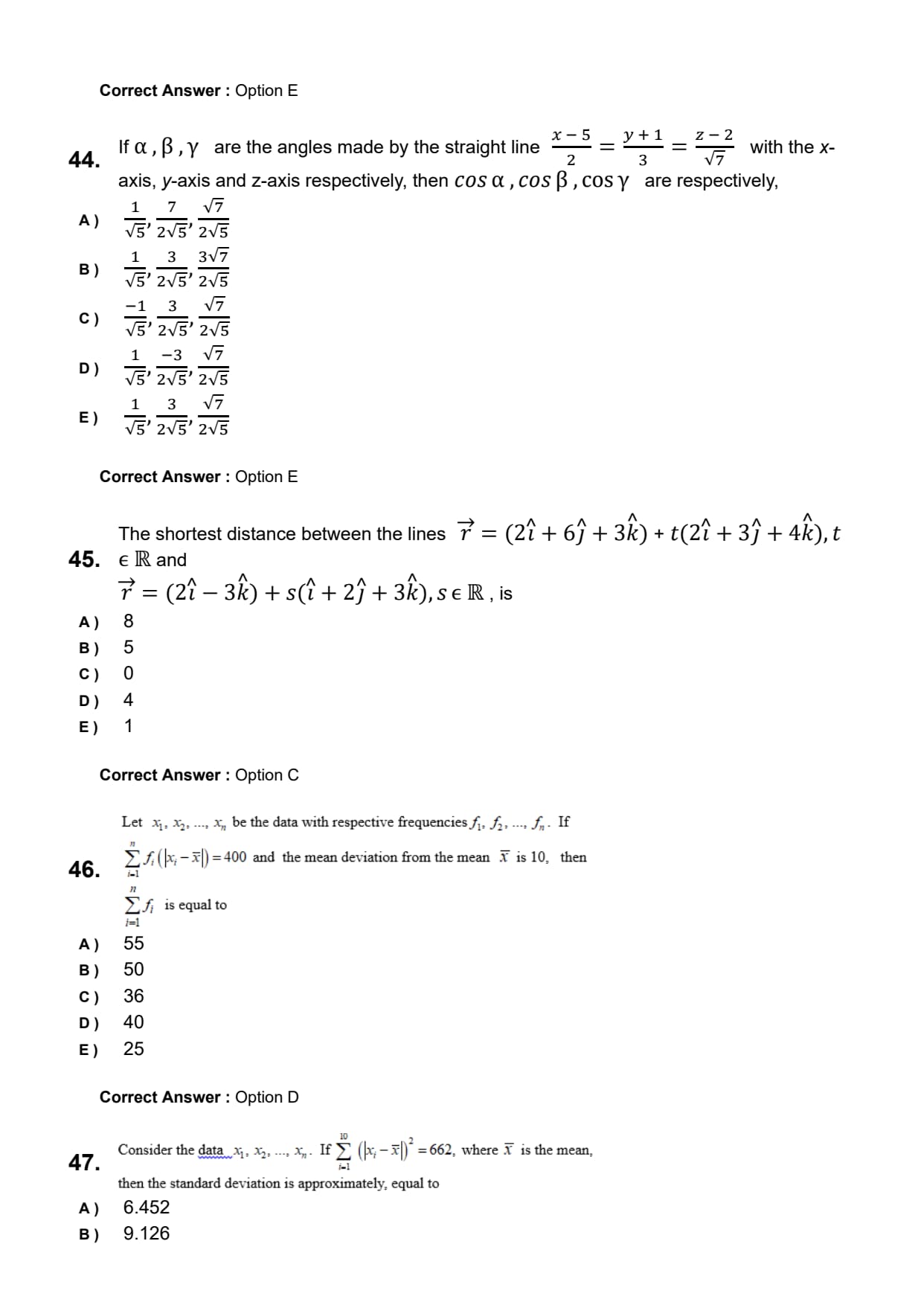
Question 44:

The equation of a line passing through the point \((1,-2,3)\) and equally inclined to the axes are:

  • (A) \(x+1 = y-2 = z+3 \)
  • (B) \(x+1 = y-2 = z-3 \)
  • (C) \(x-1 = y-2 = z+3 \)
  • (D) \(x-1 = y+2 = z+3 \)
  • (E) \(x-1 = y+2 = z-3 \)

Question 45:

The vector equation of the straight line \(\frac{x-2}{3} = \frac{y+1}{2} = \frac{z-3}{2}\) is:

  • (A) \((2\hat{i} - \hat{j} - 3\hat{k}) + \mu(3\hat{i} - 2\hat{j} - 2\hat{k}) \)
  • (B) \((2\hat{i} - \hat{j} + 3\hat{k}) + \mu(3\hat{i} + 2\hat{j} + 2\hat{k}) \)
  • (C) \((3\hat{i} - 2\hat{j} - 2\hat{k}) + \mu(2\hat{i} - \hat{j} - 3\hat{k}) \)
  • (D) \((3\hat{i} + 2\hat{j} + 2\hat{k}) + \mu(2\hat{i} - \hat{j} + 3\hat{k}) \)
  • (E) \((3\hat{i} + 2\hat{j} + 2\hat{k}) + \mu(2\hat{i} + \hat{j} + 3\hat{k}) \)

Question 46:

A dice is thrown three times. If the first throw is five, the probability of getting 14 as the sum is:

  • (A) \(\frac{1}{9} \)
  • (B) \(\frac{1}{3} \)
  • (C) \(\frac{2}{9} \)
  • (D) \(\frac{2}{3} \)
  • (E) \(\frac{1}{5} \)

Question 47:

If the variance of \(1,2,3,\ldots,n\) is 10, then the value of \(n\) is:

  • (A) \(5 \)
  • (B) \(9 \)
  • (C) \(11 \)
  • (D) \(13 \)
  • (E) \(15 \)

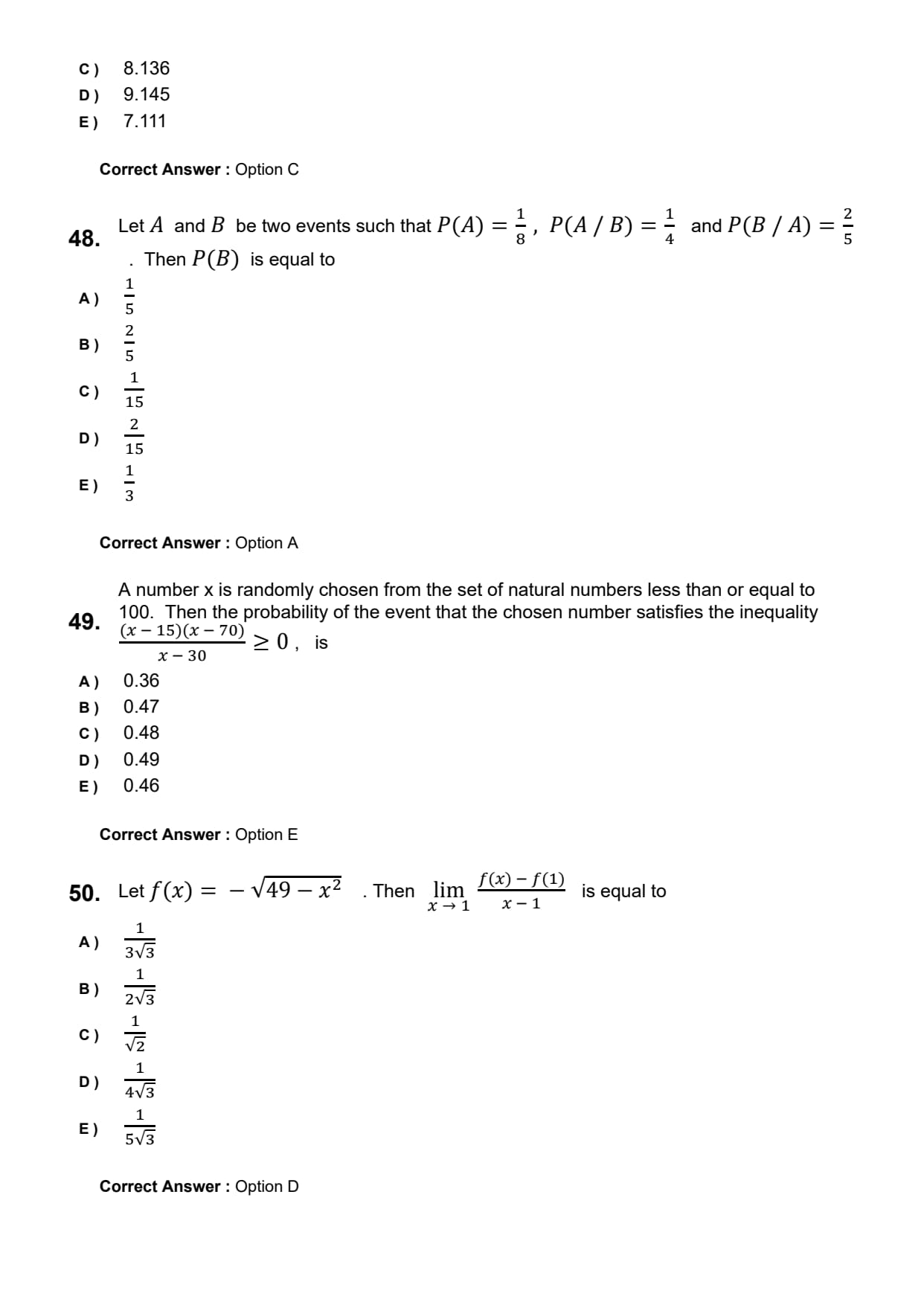
Question 48:

If \(P(A)=\frac{1}{4}, P(B)=\frac{1}{5}\) and \(P(A \cap B)=\frac{1}{8}\), then \(P(A' \cup B')\) is:

  • (A) \(\frac{27}{32} \)
  • (B) \(\frac{23}{32} \)
  • (C) \(\frac{25}{32} \)
  • (D) \(\frac{21}{32} \)
  • (E) \(\frac{29}{32} \)

Question 49:

We have two data sets each of size 5. The variances are 4 and 5 and the corresponding means are 2 and 4 respectively. Then the variance of the combined data set is:

  • (A) \(\frac{1}{2} \)
  • (B) \(\frac{5}{2} \)
  • (C) \(6 \)
  • (D) \(\frac{11}{2} \)
  • (E) \(\frac{13}{2} \)

Question 50:

The value of \(\lim_{x \to 5} \left( \frac{25 - x^2}{4 - \sqrt{x^2 - 9}} \right)\) is:

  • (A) \(32 \)
  • (B) \(16 \)
  • (C) \(8 \)
  • (D) \(4 \)
  • (E) \(0 \)

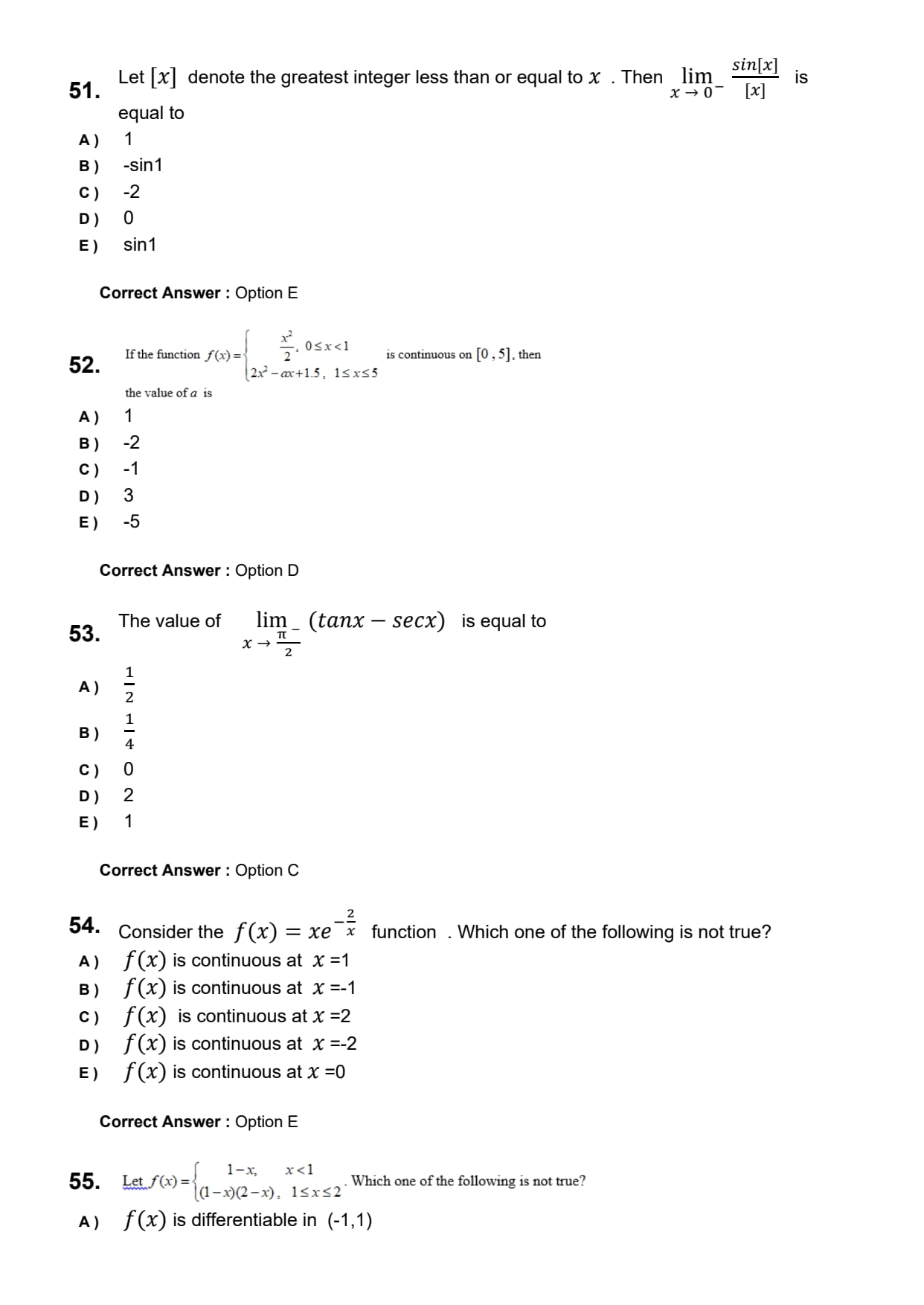
Question 51:

The value of \(\lim_{x \to 0} \frac{\sqrt{1 - \cos 2x}}{|x|}\) is equal to

  • (A) \(-2\)
  • (B) \(-\sqrt{2}\)
  • (C) \(\sqrt{2}\)
  • (D) \(1\)
  • (E) \(2\)

Question 52:

The positive integer \(n\), such that \(\lim_{x \to 3} \frac{x^n - 3^n}{x - 3} = 108\)

  • (A) \(3\)
  • (B) \(12\)
  • (C) \(6\)
  • (D) \(9\)
  • (E) \(4\)

Question 53:

Let \(\lim_{x \to a} f(x)g(x) = 16\) and \(\lim_{x \to a} \frac{f(x)}{g(x)} = 4\). If both \(\lim_{x \to a} f(x)\) and \(\lim_{x \to a} g(x)\) exist, then \(\lim_{x \to a} [f(x)+g(x)]\) is

  • (A) \(\pm 10\)
  • (B) \(-16\)
  • (C) \(\pm 2\)
  • (D) \(16\)
  • (E) \(\pm 4\)

Question 54:

If \(f(1)=2,\ f'(1)=1\), then \(\lim_{x \to 1} \frac{x f(1) - f(x)}{x-1}\) is

  • (A) \(0\)
  • (B) \(-2\)
  • (C) \(-1\)
  • (D) \(2\)
  • (E) \(1\)

Question 55:

Let \(f(x)\) and \(g(x)\) be twice differentiable functions defined on \([0,2]\) such that \(f''(x) - g''(x) = 0\), \(f'(1)=4,\ g'(1)=2,\ f(2)=9,\ g(2)=3\). At \(x=\frac{3}{2}\), \(f(x)-g(x)\) is

  • (A) \(2\)
  • (B) \(3\)
  • (C) \(5\)
  • (D) \(8\)
  • (E) \(10\)

Question 56:

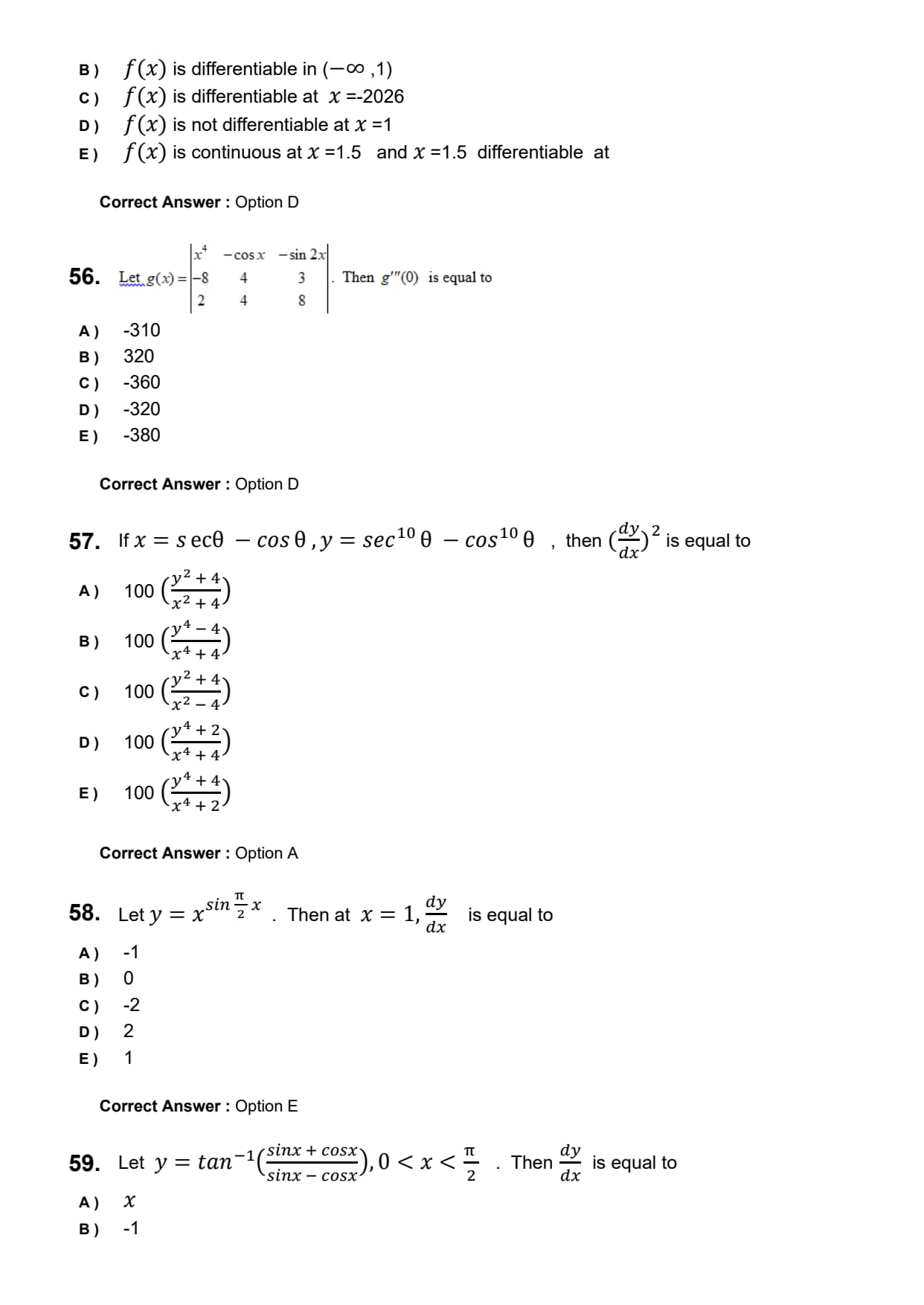
If \(y = \log \sqrt{\frac{x-1}{x+2}}\), then \(\frac{dy}{dx}\) is

  • (A) \(\frac{1}{2(x-1)(x+2)}\)
  • (B) \(\frac{3}{2(x-1)(x+2)}\)
  • (C) \(\frac{3}{(x-1)(x+2)}\)
  • (D) \(\frac{1}{(x-1)(x+2)}\)
  • (E) \(\frac{1}{3(x-1)(x+2)}\)

Question 57:

If \(y = 3^x + e^x + x^x + x^3\), then \(\frac{dy}{dx}\) at \(x=3\) is equal to

  • (A) \(e^3 + 27\log_e 3 + 54\)
  • (B) \(e^3 + 27\log_e 3 + 27\)
  • (C) \(e^3 + 54\log_e 3 + 27\)
  • (D) \(e^3 + 54\log_e 3 + 54\)
  • (E) \(e^3 + 54\log_e 3 + 54\)

Question 58:

If \(y = \sin x + e^x\), then \(\frac{d^2 x}{dy^2}\) is equal to

  • (A) \(\frac{e^x - \sin x}{(\cos x + e^x)^2}\)
  • (B) \(\frac{e^x + \sin x}{(\cos x + e^x)^2}\)
  • (C) \(\frac{e^x - \sin x}{(\cos x + e^x)^3}\)
  • (D) \(\frac{\sin x - e^x}{(\cos x + e^x)^2}\)
  • (E) \(\frac{\sin x - e^x}{(\cos x + e^x)^3}\)

Question 59:

If \(y = \log_{10} x + \log_e x\), then \(\frac{dy}{dx}\) is equal to

  • (A) \(\frac{1 - \log_{10} e}{x}\)
  • (B) \(\frac{1 + \log_e 10}{x}\)
  • (C) \(x + \log_{10} e\)
  • (D) \(x + \log_e 10\)
  • (E) \(\frac{1}{x}\left[\frac{1}{\log_e 10} + 1\right]\)

Question 60:

The function \(f(x) = x^4 - 2x^2\) is strictly increasing on

  • (A) \((-2,0)\) and \([1,\infty)\)
  • (B) \([-1,0]\) and \([2,\infty)\)
  • (C) \([-1,0]\) and \([1,\infty)\)
  • (D) \((-2,0]\) and \([0,\infty)\)
  • (E) \([-2,0]\) and \((1,\infty)\)

Question 61:

If the rate of increase of the radius of a circle is \(5\) cm/sec, then the rate of increase of its area when the radius is \(20\) cm, will be

  • (A) \(10\pi \ cm^2/sec\)
  • (B) \(20\pi \ cm^2/sec\)
  • (C) \(100\pi \ cm^2/sec\)
  • (D) \(200\pi \ cm^2/sec\)
  • (E) \(400\pi \ cm^2/sec\)

Question 62:

If the function \(f(x) = x^2 + ax + 1\) is increasing on \([1,2]\), then \(a\) is greater than or equal to

  • (A) \(-2\)
  • (B) \(-5\)
  • (C) \(-4\)
  • (D) \(-7\)
  • (E) \(-3\)

Question 63:

The absolute maximum value of the function \(f(x) = x^3 - 3x + 2\) in \([0,2]\) is

  • (A) \(0\)
  • (B) \(1\)
  • (C) \(2\)
  • (D) \(3\)
  • (E) \(4\)

Question 64:

If \(\int \left(3t^2\sin\left(\frac{1}{t}\right) - t\cos\left(\frac{1}{t}\right)\right) dt = f(t)\sin\left(\frac{1}{t}\right) + c\) then \(f(2)\) is equal to

  • (A) \(-2\)
  • (B) \(2\)
  • (C) \(4\)
  • (D) \(8\)
  • (E) \(16\)

Question 65:

If \(\int \frac{2^{1/x}}{x^2} \, dx = k\,2^{1/x} + c\) then \(k\) is equal to

  • (A) \(\frac{1}{\log 2}\)
  • (B) \(\log 4\)
  • (C) \(\frac{1}{\log 3}\)
  • (D) \(-\frac{1}{\log 3}\)
  • (E) \(-\frac{1}{\log 2}\)

Question 66:

\(\int e^x \left(\frac{1 - \sin x}{1 - \cos x}\right) dx =\)

  • (A) \(e^x \cot x + C\)
  • (B) \(-e^x \cot x + C\)
  • (C) \(e^x \cot \frac{x}{2} + C\)
  • (D) \(-e^x \cot \frac{x}{2} + C\)
  • (E) \(2e^x \cot \frac{x}{2} + C\)

Question 67:

If \(u = \int e^x \cos x \, dx,\; v = \int e^x \sin x \, dx\), then \(u + v =\)

  • (A) \(-u' + C\)
  • (B) \(u' + C\)
  • (C) \(-v' + C\)
  • (D) \(v' + C\)
  • (E) \(2v' + C\)

Question 68:

\(\int \sin^3 x \, e^{\log \cos x} \, dx =\)

  • (A) \(\frac{\cos^4 x}{4} + C\)
  • (B) \(-\frac{\cos^4 x}{4} + C\)
  • (C) \(\frac{x\cos^4 x}{4} + C\)
  • (D) \(\frac{\sin^4 x}{4} + C\)
  • (E) \(-\frac{\sin^4 x}{4} + C\)

Question 69:

If \(\int_a^b x^3 \, dx = 0\) and \(\int_a^b x^2 \, dx = \frac{2}{3}\), then the values of \(a\) and \(b\) respectively are

  • (A) \(1\) and \(1\)
  • (B) \(0\) and \(1\)
  • (C) \(1\) and \(-1\)
  • (D) \(-1\) and \(0\)
  • (E) \(-1\) and \(1\)

Question 70:

\(\int_{0}^{\pi/3} \frac{dx}{1 + \sqrt{\tan x}} =\)

  • (A) \(\frac{\pi}{6}\)
  • (B) \(\frac{\pi}{4}\)
  • (C) \(\frac{\pi}{3}\)
  • (D) \(\frac{\pi}{12}\)
  • (E) \(\frac{\pi}{2}\)

Question 71:

The area of the region bounded by the lines, \(y = x + 2\), \(x = 0\), \(x = 1\) and \(y = 0\) is

  • (A) \(2\) sq.units
  • (B) \(\frac{5}{2}\) sq.units
  • (C) \(\frac{9}{2}\) sq.units
  • (D) \(9\) sq.units
  • (E) \(12\) sq.units

Question 72:

\(\int_{0}^{\pi/4} \sqrt{1 + \sin 2x}\,dx =\)

  • (A) \(1\)
  • (B) \(\sqrt{2} + 1\)
  • (C) \(\sqrt{2} - 1\)
  • (D) \(1 - \sqrt{2}\)
  • (E) \(-\sqrt{2}\)

Question 73:

The solution of \((e^y + 1)\cos x\,dx + e^y \sin x\,dy = 0\) is

  • (A) \((e^y + 1)\sin x = C\)
  • (B) \((e^y + 1) = C\sin x\)
  • (C) \(e^y = C\sin x\)
  • (D) \((e^y - 1)\sin x = C\)
  • (E) \((e^y + 1)\cos x = C\)

Question 74:

The function \(y = be^x + ae^{-x}\), \(a\) and \(b\) are constants, is a solution of

  • (A) \(y'' + y = 0\)
  • (B) \(y'' - y = 0\)
  • (C) \(y'' + x = 0\)
  • (D) \(y'' - 2y = 0\)
  • (E) \(y'' + xy = 0\)

Question 75:

Which one of the following point is not in a feasible region bounded by the inequalities \(x \leq 4\), \(y \leq 6\), \(x + y \leq 6\), \(x \geq 0\), \(y \geq 0\)

  • (A) \((0,0)\)
  • (B) \((4,0)\)
  • (C) \((4,2)\)
  • (D) \((0,6)\)
  • (E) \((6,0)\)

Question 76:

A physical quantity that has the same dimensions as those of Boltzmann constant is

  • (A) energy
  • (B) bulk modulus
  • (C) power
  • (D) gas constant \(R\)
  • (E) thermal conductivity

Question 77:

Taking into consideration of significant figures, in the conversion relation \(2.0\ m s^{-2} = X\ km h^{-2}\), the value of \(X\) is

  • (A) \(2.6 \times 10^4\)
  • (B) \(2.592 \times 10^4\)
  • (C) \(2 \times 10^4\)
  • (D) \(2.592 \times 10^5\)
  • (E) \(2.60 \times 10^5\)

Question 78:

A body starts moving from the origin along a straight line at a speed of \(20\ km h^{-1}\) for \(1\) hour. Then it turns perpendicular to its path and moves with the same velocity for \(30\) minutes. Then the magnitude of its displacement is

  • (A) \(10\) km
  • (B) \(20\) km
  • (C) \(10\sqrt{5}\) km
  • (D) \(10\sqrt{2}\) km
  • (E) \(20\sqrt{5}\) km

Question 79:

If the angular speed of a particle moving in a circular path of radius \(1.2\) m is increased from \(2\ rad s^{-1}\) to \(4\ rad s^{-1}\) keeping its radius constant, then its linear speed is increased by

  • (A) \(1.6\ m s^{-1}\)
  • (B) \(2.4\ m s^{-1}\)
  • (C) \(3.6\ m s^{-1}\)
  • (D) \(4.8\ m s^{-1}\)
  • (E) \(6\ m s^{-1}\)

Question 80:

If the position vector of a particle is \(\vec{r} = 2t\hat{i} + \sqrt{3}t^2\hat{j} + 5\hat{k}\) with \(\vec{r}\) in m and \(t\) in s, then at \(t = 1\)s the angle made by the velocity vector with x-axis is

  • (A) \(30^\circ\)
  • (B) \(45^\circ\)
  • (C) \(60^\circ\)
  • (D) \(120^\circ\)
  • (E) \(90^\circ\)

Question 81:

If the maximum acceleration of a moving platform to keep a box of mass \(5\) kg on it without sliding is \(3\ m s^{-1}\), then the static friction between the box and floor of the platform is (\(g = 10\ m s^{-2}\))

  • (A) \(0.15\)
  • (B) \(0.25\)
  • (C) \(0.30\)
  • (D) \(0.35\)
  • (E) \(0.4\)

Question 82:

If \(10\) identical silver coins each of mass \(m\) are placed one over the other, then force on the \(6^{th}\) coin from the bottom is

  • (A) \(10mg\)
  • (B) \(8mg\)
  • (C) \(6mg\)
  • (D) \(4mg\)
  • (E) zero

Question 83:

A body initially at rest breaks up into two pieces of masses \(M\) and \(3M\) and move with a total kinetic energy of \(E\), then the kinetic energy of the piece of mass \(M\) is

  • (A) \(\frac{3E}{4}\)
  • (B) \(\frac{E}{4}\)
  • (C) \(\frac{2E}{3}\)
  • (D) \(\frac{E}{3}\)
  • (E) \(\frac{E}{2}\)

Question 84:

If a proton, a deuteron and an \(\alpha\)-particle have the same speed, then the kinetic energy is

  • (A) same for all particles
  • (B) the lowest for proton
  • (C) the highest for deuteron
  • (D) same for proton and deuteron
  • (E) the lowest for \(\alpha\)-particle

Question 85:

The moment of inertia of a system of two masses \(2\) kg and \(4\) kg lying in the x-y plane at distances, \(2\) m and \(4\) m, respectively from the origin about the z-axis is (in \(kg m^2\))

  • (A) \(36\)
  • (B) \(48\)
  • (C) \(64\)
  • (D) \(72\)
  • (E) \(80\)

Question 86:

A swimmer jumps from a height is able to increase the number of loops made in air by

  • (A) stretching his legs outwards
  • (B) decreasing angular velocity
  • (C) by stretching his arms
  • (D) by pulling his legs and arms inward
  • (E) by pulling his legs inward and stretching his arms outward

Question 87:

The ratio of the weights of an object of mass \(m\) at a height \(R\) and \(2R\) from the surface of earth is (\(R\) is the radius of earth)

  • (A) \(4:9\)
  • (B) \(1:1\)
  • (C) \(9:4\)
  • (D) \(1:2\)
  • (E) \(4:1\)

Question 88:

If the magnitude of gravitational potential energy of an object of mass \(200\) kg at a height of \(3.6 \times 10^6\) m from the earth surface is \(6 \times 10^6\) J then its value at a height of \(5.6 \times 10^6\) m is (Radius of earth is \(6.4 \times 10^6\) m)

  • (A) \(5 \times 10^6\) J
  • (B) \(4 \times 10^6\) J
  • (C) \(3 \times 10^6\) J
  • (D) \(2 \times 10^6\) J
  • (E) \(10^6\) J

Question 89:

The force required to increase the length of a thin copper wire of cross-sectional area \(0.1\ cm^2\) by \(0.1%\) is (Young’s modulus of copper is \(11 \times 10^{10}\ N m^{-2}\))

  • (A) \(550\ N\)
  • (B) \(11 \times 10^4\ N\)
  • (C) \(10.5 \times 10^3\ N\)
  • (D) \(1100\ N\)
  • (E) \(5.5 \times 10^3\ N\)

Question 90:

If a huge tank has a small side hole at a depth of \(2\) m from the surface of water, then the velocity of water flowing through the hole is (\(g = 10\ m s^{-2}\))

  • (A) \(2\sqrt{5}\ m s^{-1}\)
  • (B) \(2\sqrt{10}\ m s^{-1}\)
  • (C) \(\sqrt{10}\ m s^{-1}\)
  • (D) \(4\sqrt{10}\ m s^{-1}\)
  • (E) \(4\sqrt{5}\ m s^{-1}\)

Question 91:

Lakes and ponds freeze at the top surface with water below. This phenomenon is due to

  • (A) high pressure at their bottom
  • (B) low pressure at their bottom
  • (C) the maximum density of water at \(4^\circ\)C
  • (D) the maximum density of water at \(0^\circ\)C
  • (E) elevation of freezing point of water

Question 92:

If the temperature of \(2\) moles of krypton gas is increased from \(-11^\circ\)C to \(89^\circ\)C at constant volume, then (specific heat at constant volume of krypton is \(C_V\))

  • (A) work done on the gas is not zero
  • (B) internal energy is not changed
  • (C) work is done by the gas
  • (D) amount of heat added is \(200\,C_V\)
  • (E) internal energy is increased by \(100\,C_V\)

Question 93:

If an ideal heat engine with an efficiency of \(40%\) rejects heat at \(27^\circ\)C, then it should have absorbed heat at

  • (A) \(377^\circ\)C
  • (B) \(500^\circ\)C
  • (C) \(227^\circ\)C
  • (D) \(427^\circ\)C
  • (E) \(460^\circ\)C

Question 94:

Two perfect monoatomic gases at temperatures \(300\) K and \(410\) K are mixed without any loss of heat. If \(10^{24}\) and \(10^{23}\) are the number of molecules in the respective gases, then the temperature of the mixture is

  • (A) \(340\) K
  • (B) \(310\) K
  • (C) \(360\) K
  • (D) \(350\) K
  • (E) \(370\) K

Question 95:

If the temperature \(T\) of oxygen molecule is raised to \(9T\), then its root mean square speed \(v\) is increased to

  • (A) \(3v\)
  • (B) \(2v\)
  • (C) \(\sqrt{2}v\)
  • (D) \(\sqrt{3}v\)
  • (E) \(\sqrt{\frac{3}{2}}v\)

Question 96:

For a particle executing simple harmonic motion with amplitude \(A\) and time period \(T\) along x-axis, the time taken by the particle to move from \(x = 0\) to \(x = A\) is

  • (A) \(\frac{T}{2}\)
  • (B) \(\frac{T}{3}\)
  • (C) \(\frac{T}{4}\)
  • (D) \(\frac{T}{8}\)
  • (E) \(\frac{T}{6}\)

Question 97:

With Laplace correction in Newton’s formula for the velocity of sound in gases, the velocity of sound in monoatomic gas at STP is

  • (A) \(\sqrt{\frac{7P}{5\rho}}\)
  • (B) \(\sqrt{\frac{5P}{3\rho}}\)
  • (C) \(\sqrt{\frac{2P}{\rho}}\)
  • (D) \(\sqrt{\frac{7P}{2\rho}}\)
  • (E) \(\sqrt{\frac{P}{\rho}}\)

Question 98:

\(A\), \(B\) and \(C\) are three points in space forming an equilateral triangle of side \(10\) cm. If a point charge \(8\,\mu C\) is placed at \(A\), then the work done in moving a unit charge from \(B\) to \(C\) is

  • (A) zero
  • (B) \(720\) J
  • (C) \(7200\) J
  • (D) \(360\) J
  • (E) \(3600\) J

Question 99:

Three capacitors \(A,B,C\) with respective capacitance of \(1\,\mu F\), \(2\,\mu F\) and \(3\,\mu F\) are connected as shown. For a given voltage source \(V\) connected across them, the combination that can store the maximum energy is

  • (A)
  • (B)
  • (C)
  • (D)
  • (E)

Question 100:

The equipotential surface of a system of two point charge \(5\,\mu C\) and \(-5\,\mu C\) at points \(A\) and \(B\) separated by \(80\) cm is a plane perpendicular to the line connecting \(A\) and \(B\) at

  • (A) \(0.4\) m from \(A\)
  • (B) \(0.6\) m from \(A\)
  • (C) \(0.5\) m from \(A\)
  • (D) \(0.6\) m from \(B\)
  • (E) \(0.5\) m from \(B\)

Question 101:

If an infinitely long uniformly charged wire produces an electric field of intensity \(E\) at a distance \(d\) from it, then the linear charge density \(\lambda\) of the wire is

  • (A) \(\pi \varepsilon_0 Ed\)
  • (B) \(\frac{\pi}{2}\varepsilon_0 Ed\)
  • (C) \(\frac{1}{2}\varepsilon_0 Ed\)
  • (D) \(2\pi \varepsilon_0 Ed\)
  • (E) \(\varepsilon_0 Ed\)

Question 102:

The ratio of the rate of flow of electrons through three resistors connected in parallel to a voltage source \(V\) is \(3 : 2 : 1\), then the ratio of their respective resistance values is

  • (A) \(1 : 1 : 1\)
  • (B) \(6 : 3 : 2\)
  • (C) \(2 : 3 : 6\)
  • (D) \(9 : 4 : 1\)
  • (E) \(\sqrt{6} : \sqrt{4} : \sqrt{2}\)

Question 103:

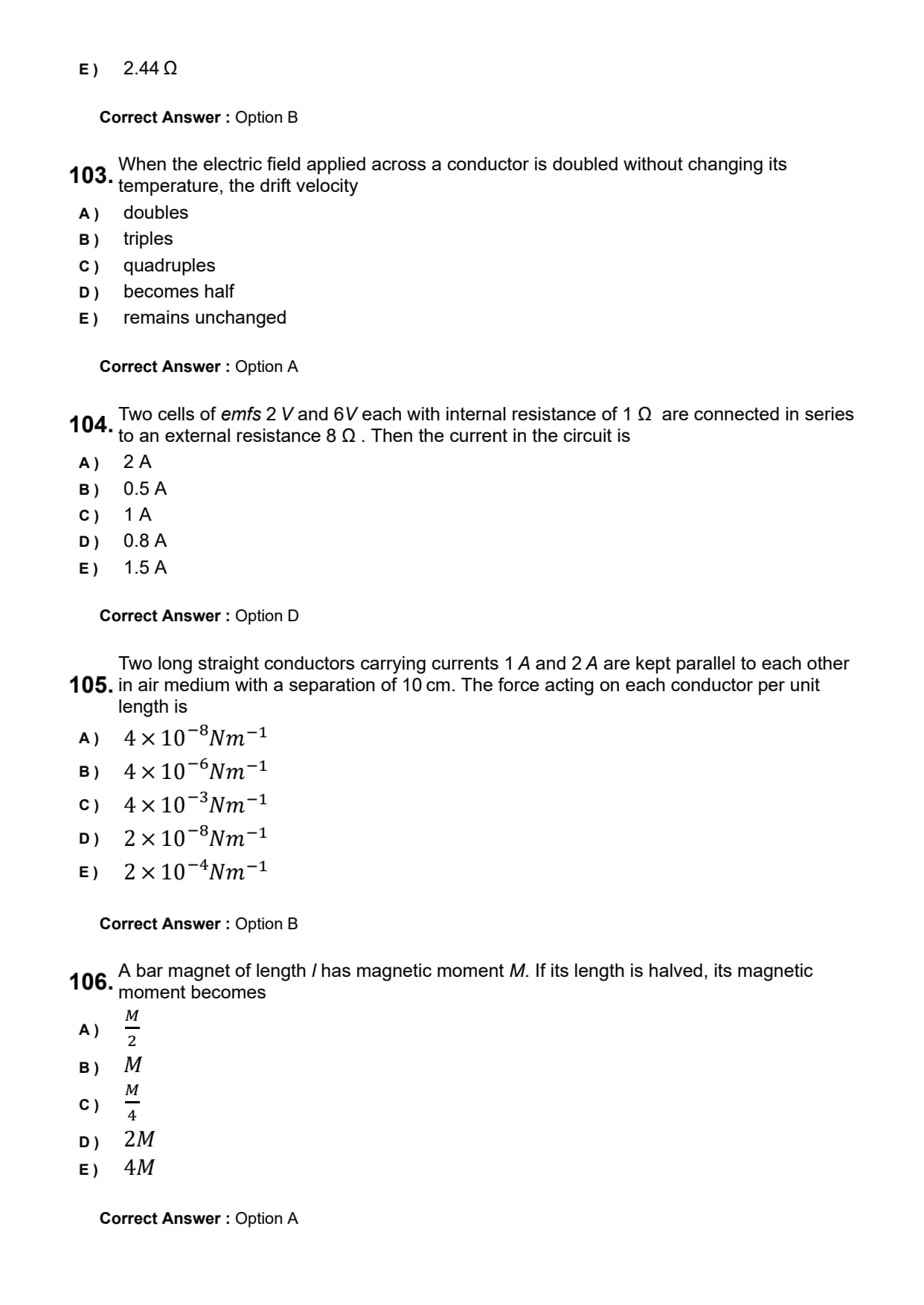
The ratio of the heat produced in a \(2\,\Omega\) and a \(4\,\Omega\) resistor connected in series with a voltage source of \(12\) V is

  • (A) \(2:1\)
  • (B) \(1:4\)
  • (C) \(4:1\)
  • (D) \(1:2\)
  • (E) \(1:8\)

Question 104:

Three cells of \(3\) V, \(4\) V and \(4\) V with respective internal resistances \(0.5\,\Omega\), \(0.75\,\Omega\) and \(0.75\,\Omega\) are connected in series to a resistor of \(4\,\Omega\). Then the current in the circuit is

  • (A) \(1\) A
  • (B) \(0.5\) A
  • (C) \(0.25\) A
  • (D) \(0.75\) A
  • (E) \(0.67\) A

Question 105:

If a current carrying circular loop is suspended in a uniform magnetic field \(\vec{B}\), then

  • (A) a couple will act on the loop
  • (B) the loop will start to rotate
  • (C) areal vector of the loop will be set in the direction of \(\vec{B}\)
  • (D) areal vector of the loop will be perpendicular to the direction of \(\vec{B}\)
  • (E) loop will be deflected away from the field \(\vec{B}\)

Question 106:

In a uniform magnetic field \(\vec{B}\), a bar magnet of magnetic moment \(M\) is kept suspended at an angle of \(60^\circ\) with respect to \(\vec{B}\). The work done to turn it from \(60^\circ\) to \(90^\circ\) with respect to the field is

  • (A) \(MB\)
  • (B) \(\sqrt{2}MB\)
  • (C) \(0\)
  • (D) \(2MB\)
  • (E) \(\frac{MB}{2}\)

Question 107:

The flow of current of \(2\) A through a straight solenoid of length \(2\) m produces a magnetic field of \(2\pi \times 10^{-4}\) T at its centre. Then the number of turns in the solenoid is

  • (A) \(600\)
  • (B) \(500\)
  • (C) \(3500\)
  • (D) \(5000\)
  • (E) \(700\)

Question 108:

A wire of length \(4\) m carrying a current of \(1\) A is bent to form a circular loop. The magnetic moment of the loop (in A m\(^2\)) is

  • (A) \(\frac{4}{\pi^2}\)
  • (B) \(\frac{2}{\pi^2}\)
  • (C) \(\frac{2}{\pi}\)
  • (D) \(\frac{4}{\pi}\)
  • (E) \(4\pi\)

Question 109:

The plane of a circular loop of area \(150\ cm^2\) is perpendicular to a uniform magnetic field of \(0.5\) T. If the loop is turned such that its plane is in the direction of the field in \(0.5\) s, then the induced emf produced is

  • (A) \(25\) mV
  • (B) \(10\) mV
  • (C) \(2.5\) mV
  • (D) \(15\) mV
  • (E) \(7.5\) mV

Question 110:

Two identical transformers \(A\) and \(B\) each with \(\dfrac{N_p}{N_s} = 2\) are connected such that the secondary output obtained from \(A\) is given as the primary input voltage for \(B\). If the primary ac voltage of \(A\) is \(200\) V, then the secondary voltage from \(B\) is

  • (A) \(100\) V
  • (B) \(200\) V
  • (C) \(50\) V
  • (D) \(400\) V
  • (E) \(500\) V

Question 111:

Microwaves are

  • (A) used in radio and television communications
  • (B) having frequency range from \(54\) MHz to \(890\) MHz
  • (C) short wavelength radio waves
  • (D) produced by hot bodies and molecules
  • (E) absorbed by ordinary glass

Question 112:

An object placed at \(10\) cm in front of a concave mirror of focal length \(8\) cm gives image of magnification of

  • (A) \(4\)
  • (B) \(6\)
  • (C) \(8\)
  • (D) \(2\)
  • (E) \(10\)

Question 113:

The magnifying power of a telescope of length \(76\) cm in the normal adjustment is \(75\). Then the focal lengths of the objective and eyepiece lenses are, respectively,

  • (A) \(50\) cm, \(25\) cm
  • (B) \(70\) cm, \(5\) cm
  • (C) \(75\) cm, \(1\) cm
  • (D) \(73\) cm, \(2\) cm
  • (E) \(60\) cm, \(15\) cm

Question 114:

The fringe width obtained in a given Young’s double slit experimental set up for red light, blue light and green light are, respectively, \(\beta_R\), \(\beta_B\) and \(\beta_G\). Then

  • (A) \(\beta_B > \beta_R\)
  • (B) \(\beta_R > \beta_G\)
  • (C) \(\beta_G > \beta_R\)
  • (D) \(\beta_B > \beta_R\)
  • (E) \(\beta_R = \beta_B = \beta_G\)

Question 115:

If the de Broglie wavelength associated with an electron is \(0.1227\) nm, then its accelerating potential is

  • (A) \(64\) V
  • (B) \(200\) V
  • (C) \(100\) V
  • (D) \(160\) V
  • (E) \(36\) V

Question 116:

If a radiation of energy \(5.2\) eV falls on the photosensitive surfaces of Mo and Ni, they emit photoelectrons with maximum kinetic energy of \(0.5\) eV and \(1\) eV, respectively. Then the work function of

  • (A) Mo is \(2.6\) eV
  • (B) Ni is \(6.2\) eV
  • (C) Mo is \(6.2\) eV
  • (D) Ni is \(4.2\) eV
  • (E) Mo is \(4.2\) eV

Question 117:

If a radioactive parent nucleus \({}^{236}_{94}X\) emits two alpha particles and two \(\beta\) particles successively to reach the daughter nucleus \({}^{a}_{b}Y\), then the values of \(a\) and \(b\) are

  • (A) \(224\) and \(90\)
  • (B) \(220\) and \(94\)
  • (C) \(228\) and \(92\)
  • (D) \(230\) and \(92\)
  • (E) \(226\) and \(92\)

Question 118:

The difference in magnitudes of angular momentum of the electrons revolving in \(5^{th}\) Bohr’s orbit and \(3^{rd}\) Bohr’s orbit of hydrogen atom is

  • (A) \(\frac{2h}{\pi}\)
  • (B) \(\frac{h}{\pi}\)
  • (C) \(\frac{h}{2\pi}\)
  • (D) \(\frac{3h}{2\pi}\)
  • (E) \(\frac{5h}{2\pi}\)

Question 119:

Intrinsic semiconductors Ge or Si doped with

  • (A) indium becomes an n-type semiconductor
  • (B) antimony becomes a p-type semiconductor
  • (C) phosphorus becomes a n-type semiconductor
  • (D) boron becomes a n-type semiconductor
  • (E) arsenic becomes a p-type semiconductor

Question 120:

Four ideal diodes are connected as shown then the current drawn from the battery is

  • (A) zero
  • (B) \(10\) mA
  • (C) \(100\) mA
  • (D) \(50\) mA
  • (E) \(20\) mA

Question 121:

The empirical formula of a metal oxide which has \(54%\) metal (M) and \(46%\) oxygen (O) is (Atomic mass of M = \(27\) amu and O = \(16\) amu)

  • (A) \(\mathrm{M_3O_2}\)
  • (B) \(\mathrm{MO_2}\)
  • (C) \(\mathrm{M_2O_3}\)
  • (D) \(\mathrm{M_2O_5}\)
  • (E) \(\mathrm{M_2O}\)

Question 122:

The threshold wavelength of a metal is \(6000\ \AA\). The work function of the metal is (\(h = 6.62 \times 10^{-34}\) J s)

  • (A) \(3.31 \times 10^{19}\) J
  • (B) \(3.31 \times 10^{-19}\) J
  • (C) \(13.2 \times 10^{-19}\) J
  • (D) \(13.2 \times 10^{19}\) J
  • (E) \(1.5 \times 10^{-19}\) J

Question 123:

The radius of the first orbit of \(\mathrm{He^+}\) is

  • (A) \(52.9\) pm
  • (B) \(13.24\) pm
  • (C) \(211.6\) pm
  • (D) \(105.8\) pm
  • (E) \(26.45\) pm

Question 124:

In Mosley experiment, the X-ray spectrum is obtained by plotting

  • (A) square root of frequency vs atomic mass
  • (B) square root of frequency vs atomic number
  • (C) square root of frequency vs atomic mass
  • (D) square root of wavelength vs atomic number
  • (E) square root of wavelength vs atomic mass

Question 125:

Which of the following elements have the highest and the lowest first ionization enthalpy?

(i) Be \quad (ii) B \quad (iii) C \quad (iv) N \quad (v) O

  • (A) (ii) and (iv)
  • (B) (i) and (v)
  • (C) (i) and (iii)
  • (D) (ii) and (iii)
  • (E) (i) and (ii)

Question 126:

The correct increasing order of dipole moment of the following molecules is

  • (A) \(\mathrm{NF_3 < CHCl_3 < NH_3 < H_2O}\)
  • (B) \(\mathrm{NF_3 < CHCl_3 < H_2O < NH_3}\)
  • (C) \(\mathrm{H_2O < NF_3 < CHCl_3 < NH_3}\)
  • (D) \(\mathrm{CHCl_3 < NF_3 < H_2O < NH_3}\)
  • (E) \(\mathrm{NH_3 < NF_3 < CHCl_3 < H_2O}\)

Question 127:

The number of bonding pairs and lone pairs of electrons in \(\mathrm{BrF_5}\) molecule are respectively

  • (A) \(4\) and \(2\)
  • (B) \(3\) and \(2\)
  • (C) \(4\) and \(1\)
  • (D) \(5\) and \(1\)
  • (E) \(3\) and \(1\)

Question 128:

Which of the following bond has highest mean bond enthalpy?

  • (A) \(\mathrm{N{=}N}\)
  • (B) \(\mathrm{O{=}O}\)
  • (C) \(\mathrm{N{\equiv}N}\)
  • (D) \(\mathrm{C{\equiv}C}\)
  • (E) \(\mathrm{C{\equiv}O}\)

Question 129:

The correct increasing order of enthalpy of fusion of \(\Delta_{fus}H^\circ\) (in kJ mol\(^{-1}\)) of the following compounds is

  • (A) \(\mathrm{CH_3COCH_3 < CCl_4 < C_6H_6}\)
  • (B) \(\mathrm{CH_3COCH_3 < C_6H_6 < CCl_4}\)
  • (C) \(\mathrm{CCl_4 < C_6H_6 < CH_3COCH_3}\)
  • (D) \(\mathrm{CCl_4 < CH_3COCH_3 < C_6H_6}\)
  • (E) \(\mathrm{C_6H_6 < CH_3COCH_3 < CCl_4}\)

Question 130:

The solubility product, \(K_{sp}\) of a sparingly soluble salt, \(\mathrm{AX_2}\), is \(3.2 \times 10^{-14}\) mol\(^3\) lit\(^{-3}\). Its solubility is

  • (A) \(4 \times 10^{-3}\) mol lit\(^{-1}\)
  • (B) \(2 \times 10^{-2}\) mol lit\(^{-1}\)
  • (C) \(2 \times 10^{-5}\) mol lit\(^{-1}\)
  • (D) \(8 \times 10^{-4}\) mol lit\(^{-1}\)
  • (E) \(2 \times 10^{-3}\) mol lit\(^{-1}\)

Question 131:

Match the correct pH value with the following substances:

(a) Milk of magnesia \quad (i) pH = 6.8

(b) Black coffee \quad (ii) pH = 7.8

(c) Egg white \quad (iii) pH = 5

(d) Milk \quad (iv) pH = 10

  • (A) (a)-(iv), (b)-(ii), (c)-(i), (d)-(ii)
  • (B) (a)-(iv), (b)-(ii), (c)-(iii), (d)-(i)
  • (C) (a)-(i), (b)-(iv), (c)-(iii), (d)-(ii)
  • (D) (a)-(i), (b)-(iii), (c)-(ii), (d)-(iv)
  • (E) (a)-(iv), (b)-(iii), (c)-(ii), (d)-(i)

Question 132:

The \(\Delta_r G^\circ\) of the galvanic cell in which the following cell reaction takes place, \[ 2\mathrm{Cr(s)} + 3\mathrm{Cd^{2+}(aq)} \rightarrow 2\mathrm{Cr^{3+}(aq)} + 3\mathrm{Cd(s)} \]
is (\(E^\circ_{\mathrm{Cr^{3+}/Cr}} = -0.74\) V and \(E^\circ_{\mathrm{Cd^{2+}/Cd}} = -0.40\) V)

  • (A) \(-196.86\ kJ mol^{-1}\)
  • (B) \(+196.86\ kJ mol^{-1}\)
  • (C) \(-96.50\ kJ mol^{-1}\)
  • (D) \(+96.50\ kJ mol^{-1}\)
  • (E) \(+98.12\ kJ mol^{-1}\)

Question 133:

The molar conductivity of a weak monobasic acid, HA at 298 K is \(70\ S cm^2 mol^{-1}\). What is the percentage ionisation of HA at 298 K?

At infinite dilution \(\lambda^\circ_{H^+} = 340\ S cm^2 mol^{-1}\) and \(\lambda^\circ_{A^-} = 80\ S cm^2 mol^{-1}\)

  • (A) \(8.35\ %\)
  • (B) \(16.7\ %\)
  • (C) \(20\ %\)
  • (D) \(32.5\ %\)
  • (E) \(15.3\ %\)

Question 134:

The percentage of helium present in air used by scuba divers is

  • (A) \(56.2%\)
  • (B) \(11.7%\)
  • (C) \(32.1%\)
  • (D) \(19.7%\)
  • (E) \(21.5%\)

Question 135:

A first order reaction follows the equation \(k = (4 \times 10^{10}\ s^{-1}) e^{-2000/T}\). The value of \(E_a\) for the reaction is about (\(R = 8.314\ J K^{-1} mol^{-1}\))

  • (A) \(17.4\ kJ mol^{-1}\)
  • (B) \(18.5\ kJ mol^{-1}\)
  • (C) \(17.5\ kJ mol^{-1}\)
  • (D) \(16.6\ kJ mol^{-1}\)
  • (E) \(17.8\ kJ mol^{-1}\)

Question 136:

In a pseudo first order reaction, the following results were obtained.


\begin{tabular{|c|c|c|c|c|c|c|c|
\hline
Time / s & 0 & 10 & 20 & 30 & 40 & 50 & 60

\hline \([A]\)/mol lit\(^{-1}\) & 0.65 & 0.55 & 0.46 & 0.38 & 0.26 & 0.20 & 0.13

\hline
\end{tabular


Average rate of the reaction between 20 and 40 seconds is

  • (A) \(0.01\ mol lit^{-1} s^{-1}\)
  • (B) \(0.02\ mol lit^{-1} s^{-1}\)
  • (C) \(0.001\ mol lit^{-1} s^{-1}\)
  • (D) \(0.1\ mol lit^{-1} s^{-1}\)
  • (E) \(0.04\ mol lit^{-1} s^{-1}\)

Question 137:

Which of the following compound of manganese is a mixed oxide?

  • (A) \(\mathrm{MnO}\)
  • (B) \(\mathrm{Mn_3O_4}\)
  • (C) \(\mathrm{Mn_2O_3}\)
  • (D) \(\mathrm{MnO_2}\)
  • (E) \(\mathrm{Mn_2O_7}\)

Question 138:

The formula of pentaamminecarbonatocobalt(III) chloride is

  • (A) \([\mathrm{Co(NH_3)_5(CO)}]\mathrm{Cl_2}\)
  • (B) \([\mathrm{Co(NH_3)_5(CO_3)}]\mathrm{Cl}\)
  • (C) \([\mathrm{Co(NH_3)_5(CO_3)}]\mathrm{Cl_2}\)
  • (D) \([\mathrm{Co(NH_3)_5(CO_3)}]\mathrm{Cl_2}\)
  • (E) \([\mathrm{Co(NH_3)_5(CO_3)}]\mathrm{Cl_3}\)

Question 139:

The correct increasing order of wavelength of absorption of the following complexes is

(i) \([\mathrm{CoCl(NH_3)_5}]^{2+}\) \quad (ii) \([\mathrm{Co(NH_3)_5(H_2O)}]^{3+}\) \quad (iii) \([\mathrm{Co(NH_3)_6}]^{3+}\) \quad (iv) \([\mathrm{Co(CN)_6}]^{3-}\)

  • (A) (i) \(<\) (ii) \(<\) (iii) \(<\) (iv)
  • (B) (i) \(<\) (ii) \(<\) (iv) \(<\) (iii)
  • (C) (ii) \(<\) (i) \(<\) (iv) \(<\) (iii)
  • (D) (iv) \(<\) (iii) \(<\) (ii) \(<\) (i)
  • (E) (iv) \(<\) (i) \(<\) (ii) \(<\) (iii)

Question 140:

When sodium fusion extract is treated with sodium nitroprusside, the appearance of violet colour is due to the formation of

  • (A) \([\mathrm{Fe(CN)_5NO}]^{2-}\)
  • (B) \([\mathrm{Fe(CN)_5NO}]^{2+}\)
  • (C) \([\mathrm{Fe(CN)_5NOS}]^{4-}\)
  • (D) \([\mathrm{Fe(CN)_5NOS}]^{2-}\)
  • (E) \([\mathrm{Fe(CN)_5NOS}]^{2+}\)

Question 141:

Which of the following gives 2-methylbutane on hydrogenation?

(i) 2-methylbut-1-ene \quad (ii) 3-methylbut-1-yne \quad (iii) 2-methylbut-2-ene

(iv) 3-methylbut-1-ene \quad (v) pent-2-ene

  • (A) (i) and (iii)
  • (B) (ii), (iii), (iv)
  • (C) (ii), (iii), (v)
  • (D) (i), (ii), (v)
  • (E) (i), (iii), (iv)

Question 142:

An alkene, \(\mathrm{C_3H_6}\) (X), on treatment with HBr in presence of peroxide gives (Y). The compound (Y) on treatment with \(\mathrm{AgNO_2}\) in ethanol gives (Z). The compounds (X), (Y) and (Z) are respectively

  • (A) propene, 1-bromopropane, 1-nitropropane
  • (B) propene, 2-bromopropane, 2-nitropropane
  • (C) propene, 2-bromopropane, 1-nitropropane
  • (D) propyne, 1-bromopropane, 1-nitropropane
  • (E) propene, 1,2-dibromopropane, 1,2-dinitropropane

Question 143:

The reaction \(\mathrm{CH_3Br + AgF \rightarrow CH_3F + AgBr}\) is termed as

  • (A) Stephen reaction
  • (B) Swarts reaction
  • (C) Sandmeyer reaction
  • (D) Kolbe’s reaction
  • (E) Reimer-Tiemann reaction

Question 144:

When 2-methylbutan-2-ol is treated with Lucas reagent (conc. HCl and \(\mathrm{ZnCl_2}\)) at room temperature, the product obtained is

  • (A) 2-chlorobutane
  • (B) 2-chloro-2-methylbutane
  • (C) 1-chlorobutane
  • (D) 1-chloropentane
  • (E) 2-chloro-2-methylbutene

Question 145:

The relative ease of dehydration of the following alcohols is

(i) Propan-2-ol \quad (ii) Propan-1-ol \quad (iii) 2-Methylpropan-2-ol

  • (A) (iii) \(>\) (ii) \(>\) (i)
  • (B) (ii) \(>\) (i) \(>\) (iii)
  • (C) (ii) \(>\) (iii) \(>\) (i)
  • (D) (i) \(>\) (ii) \(>\) (iii)
  • (E) (iii) \(>\) (i) \(>\) (ii)

Question 146:

Which of the following is a commercial method of manufacture of benzaldehyde?

  • (A) Hydrogenation of benzoyl chloride with \(\mathrm{Pd/BaSO_4}\) as catalyst.
  • (B) Oxidation of toluene with chromyl chloride followed by hydrolysis
  • (C) Toluene is treated with \(\mathrm{Cr_2O_3}\) in acetic anhydride followed by hydrolysis
  • (D) Side chain chlorination of toluene followed by hydrolysis
  • (E) Benzene is treated with CO and HCl in the presence of anhydrous \(\mathrm{AlCl_3}\)

Question 147:

Vigorous oxidation of n-propylbenzene with alkaline potassium permanganate (\(\mathrm{KMnO_4/KOH/\Delta}\)) followed by hydrolysis gives

  • (A) phenol
  • (B) phenyl acetic acid
  • (C) phenyl propionic acid
  • (D) benzaldehyde
  • (E) benzoic acid

Question 148:

The descending order of basic strength of the following amines is

(i) N-Methylbenzenamine \quad (ii) N,N'-Dimethylbenzenamine \quad (iii) Benzenamine \quad (iv) Phenylmethanamine

  • (A) (i) \(>\) (ii) \(>\) (iv) \(>\) (iii)
  • (B) (iv) \(>\) (i) \(>\) (ii) \(>\) (iii)
  • (C) (iv) \(>\) (ii) \(>\) (i) \(>\) (iii)
  • (D) (iv) \(>\) (iii) \(>\) (ii) \(>\) (i)
  • (E) (i) \(>\) (iv) \(>\) (ii) \(>\) (iii)

Question 149:

Benzene diazonium chloride on treatment with HCl in the presence of copper powder gives chlorobenzene. This reaction is termed as

  • (A) Sandmeyer reaction
  • (B) Gattermann reaction
  • (C) Stephen reaction
  • (D) Gattermann Koch reaction
  • (E) Etard reaction

Question 150:

Which of the following statements are true about sucrose?

(i) It is a disaccharide

(ii) It is a reducing sugar

(iii) It is laevorotatory

(iv) Sucrose on hydrolysis gives equimolar mixture of D(+) glucose and D(-)-fructose

(v) In sucrose, two monosaccharides are held together by a glycosidic linkage

  • (A) (i), (ii), (iii)
  • (B) (i), (ii), (v)
  • (C) (ii), (iii), (v)
  • (D) (i), (iii), (v)
  • (E) (i), (iv), (v)

KEAM 2026 Exam Pattern

Particulars Details
Paper Engineering
Mode of Exam Online CBT
Subjects Physics- 45 questions
Chemistry- 30 questions
Mathematics- 75 questions
Type of Question Objective Type
Total Number of questions 150
Marks are awarded for each correct answer 4 marks
Marks are awarded for each incorrect answer 1 marks
KEAM total marks for Engineering 600 marks
Duration of KEAM Engineering exam 3 hours

KEAM 2026 Final Revision