




CBSE Class 10 Science Question Paper 2026 Set 3 - (31/1/3) is now available for download. CBSE conducted the Class 10 Science examination on Feb 25, 2026, from 10:30 AM to 1:30 PM.
The question paper consists of 35 questions carrying a total of 80 marks. Part A is compulsory for all candidates. Part B has two options. Candidates have to attempt only one of the given options. Option I: Physics and Option II: Chemistry. The Science question paper 2026 was rated moderately easy by the students.
Candidates can use the link below to download the CBSE Class 10 Science 2026 Set 3 - (31/1/3) Question Paper with detailed solutions.
CBSE Class 10 Science Set 3 - (31/1/3) Question Paper 2026 with Solution PDF
| CBSE Class 10 Science Set 3 - (31/1/3) Question Paper 2026 | Download PDF | Check Solution |








Identify the correct statement for spirogyra, leishmania and hydra:
Which structure in a leaf is mainly responsible for gaseous exchange?
Pancreas secretes pancreatic juice which contain enzyme that helps in digestion of food. Choose the correct option from the following:
From the given situations, identify 'Chemotropic' and 'Geotropic' movements in parts of plants, respectively:
(i) Growth of pollen tube towards ovule.
(ii) Movement of sunflower towards sunlight.
(iii) Movement of root towards Earth/Gravity.
(iv) Movement of leaves due to breeze.
Which of the following group is not 'biodegradable'?
Study the given diagram of the heart, with blood vessels marked '1' and '2'.
From the following statements, establish the relationship between heart and/or the two blood vessels:
(i) Blood vessel 1 - It carries carbon dioxide rich blood to the lungs.
(ii) Blood vessel 2 - It carries oxygen rich blood from the lungs.
(iii) Blood vessel 2 - Left atrium relaxes as it receives blood from this blood vessel.
(iv) Blood vessel 1 - Right atrium has thick wall as it has to pump blood to this vessel.

The option with correct statements is:
Plants use variety of techniques to get rid of their waste materials. Some are mentioned below. Identify the incorrect one:
Assertion (A): Reflex actions do not involve thinking.
Reason (R): Most reflex actions are controlled by the spinal cord.
Assertion (A): Ozone at higher levels of atmosphere is a product of UV radiation acting on oxygen molecule.
Reason (R): The higher energy of UV splits apart some molecular \( O_2 \).
(a) Why is bile juice considered to be very important for digestion, even though it doesn't contain any digestive enzymes?
(b) Name some substances present in initial filtrate and subsequently selectively reabsorbed in the tubules of nephron.
Draw a neat diagram to show germination of pollen on the female reproductive part of the flower. Name and label only the following parts:
(a) The part that receives the pollen grain.
(b) The structure that carries the male germ cell to reach the female germ cell.
State two differences between the act of chewing food and salivation on sight of food.
State two differences between pollination and fertilization.
Give differences between the following :
(a) Nephron and neuron
(b) Sensory nerve and motor nerve
(c) Consumers and decomposers
Given below is a pyramid showing various trophic levels in an ecosystem:
(a) From the organisms listed below, identify which one is to be placed at which trophic level:
Deer, Grass, Lion, Snake, Rabbit
(b) Discuss the reason why primary consumers will have more energy as compared to secondary consumers?
(c) Why is the base of the pyramid broad?

Why only tall pea plants were observed in \( F_1 \) progeny?
By which method did Mendel obtain \( F_2 \) progeny?
Write one difference between dominant and recessive trait.
Write two observations made by Mendel about \( F_1 \) progeny.
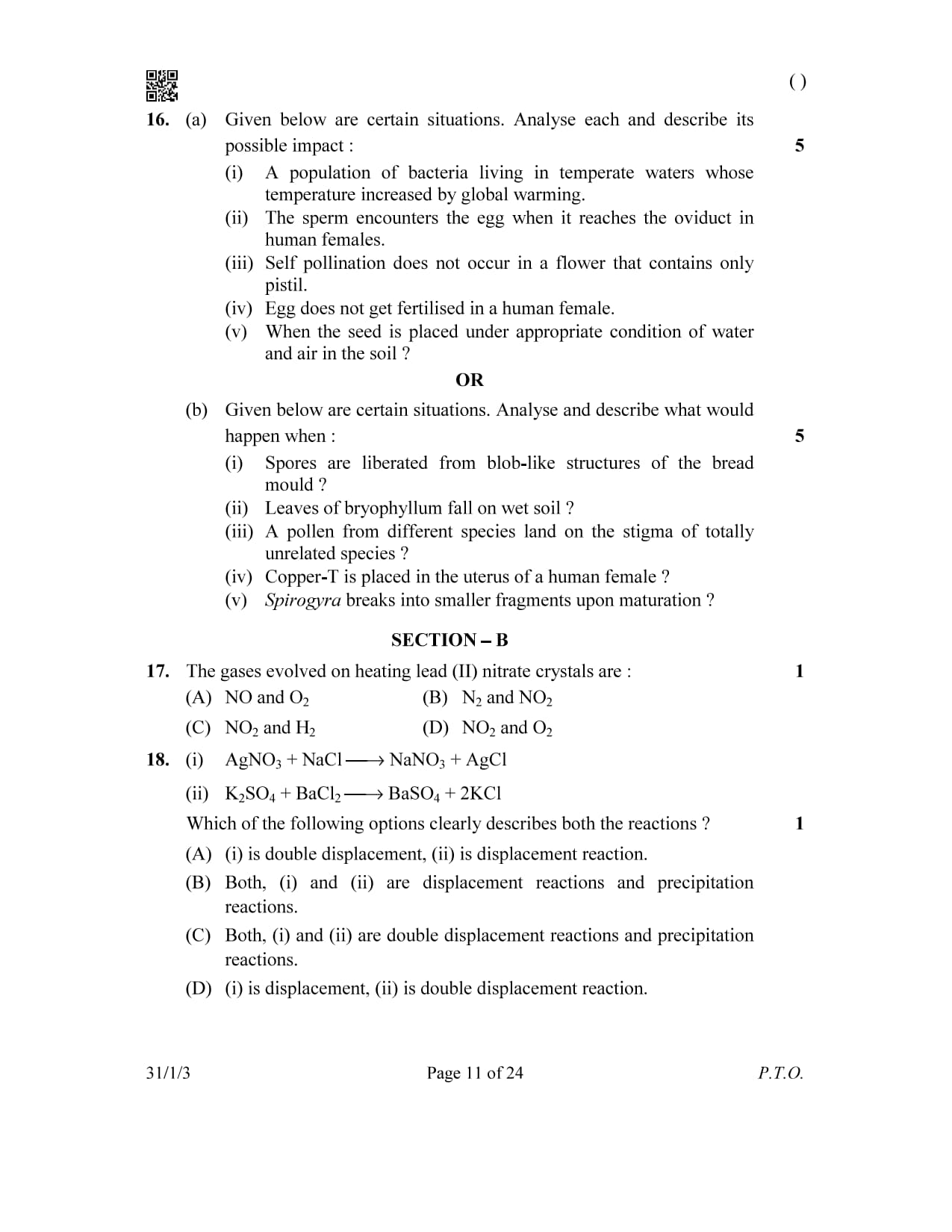
(a) Given below are certain situations. Analyse each and describe its possible impact:
(i) A population of bacteria living in temperate waters whose temperature increased by global warming.
(ii) The sperm encounters the egg when it reaches the oviduct in human females.
(iii) Self pollination does not occur in a flower that contains only pistil.
(iv) Egg does not get fertilised in a human female.
(v) When the seed is placed under appropriate condition of water and air in the soil?
(b) Given below are certain situations. Analyse and describe what would happen when:
(i) Spores are liberated from blob-like structures of the bread mould?
(ii) Leaves of bryophyllum fall on wet soil?
(iii) A pollen from different species land on the stigma of totally unrelated species?
(iv) Copper-T is placed in the uterus of a human female?
(v) Spirogyra breaks into smaller fragments upon maturation?
The gases evolved on heating lead (II) nitrate crystals are :
(i) \( AgNO_3 + NaCl \rightarrow NaNO_3 + AgCl \)
(ii) \( K_2SO_4 + BaCl_2 \rightarrow BaSO_4 + 2KCl \)
Which of the following options clearly describes both the reactions?
Which one of the following can be used as an acid-base indicator by a visually impaired (blind) student?
The hydrocarbons with general formula \( C_nH_{2n} \) represents:
When an element 'X' reacts with water, it starts floating. Identify the element 'X':
Which of the following is a poor conductor of electricity?
The natural sources of oxalic acid, lactic acid and methanoic acid respectively are:
Assertion (A): Carbon shares its valence electrons with other atoms of carbon or with atoms of other elements.
Reason (R): The shared electrons belong to the outermost shells of both the atoms and lead to both atoms attaining the noble gas configuration.
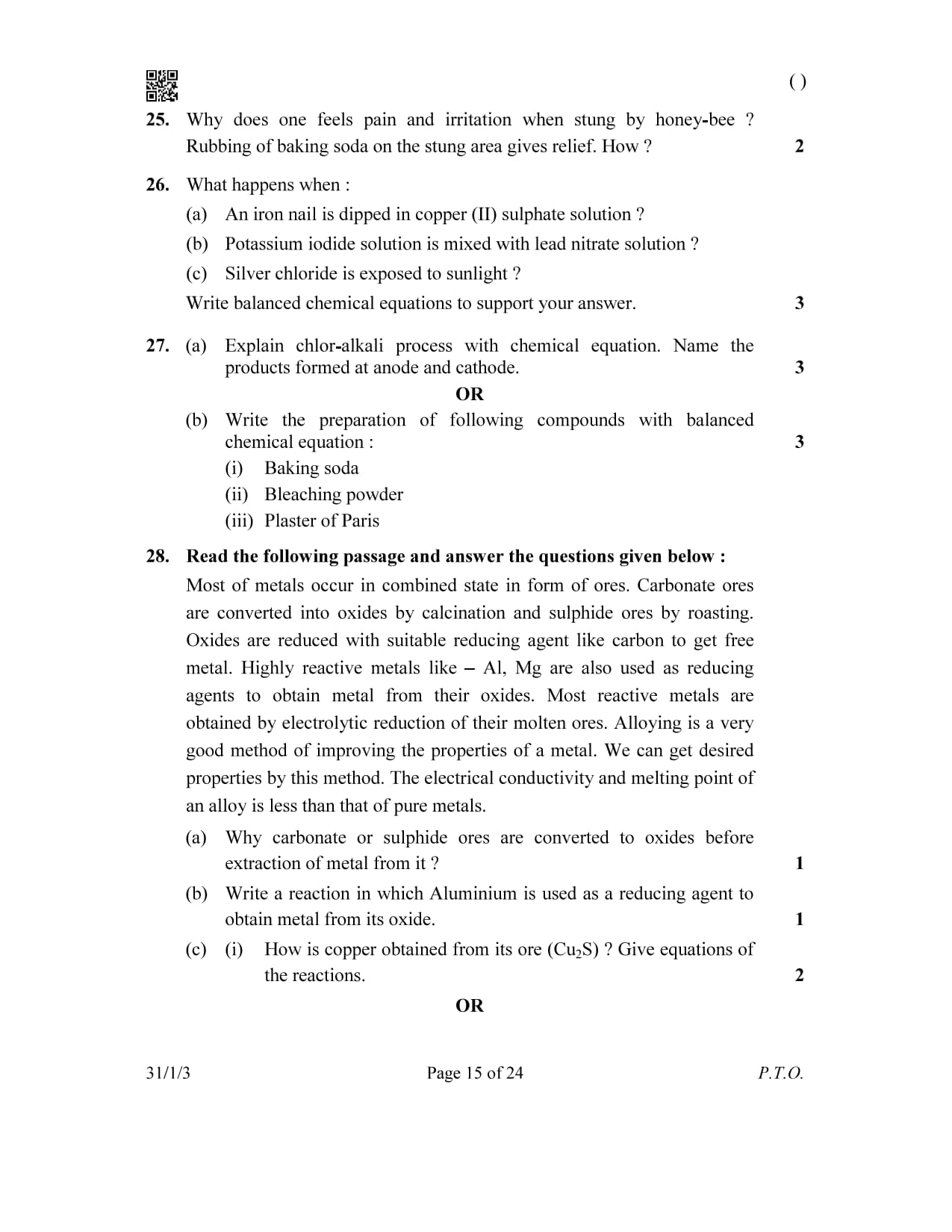
Why does one feels pain and irritation when stung by honey-bee?
Rubbing of baking soda on the stung area gives relief. How?
What happens when :
(a) An iron nail is dipped in copper (II) sulphate solution ?
(b) Potassium iodide solution is mixed with lead nitrate solution ?
(c) Silver chloride is exposed to sunlight ?
Write balanced chemical equations to support your answer.
Explain chlor-alkali process with chemical equation. Name the products formed at anode and cathode.
Read the following passage and answer the questions given below:
Most of metals occur in combined state in form of ores. Carbonate ores are converted into oxides by calcination and sulphide ores by roasting. Oxides are reduced with suitable reducing agent like carbon to get free metal. Highly reactive metals like – Al, Mg are also used as reducing agents to obtain metal from their oxides. Most reactive metals are obtained by electrolytic reduction of their molten ores. Alloying is a very good method of improving the properties of a metal. We can get desired properties by this method. The electrical conductivity and melting point of an alloy is less than that of pure metals.
(a) Why carbonate or sulphide ores are converted to oxides before extraction of metal from it?
Write a reaction in which Aluminium is used as a reducing agent to obtain metal from its oxide.
How is copper obtained from its ore (Cu₂S) ? Give equations of the reactions.
Why highly reactive metals cannot be obtained from their oxides by using carbon as a reducing agent?
Why solder, an alloy of lead and tin, is used for welding electrical wires together?
Give reasons for the following:
(I) Covalent compounds are poor conductor of electricity.
(II) Soap does not form lather in hard water.
(III) Carbon shows catenation but silicon does not.
Write chemical equations for the following :
(I) Oxidation of ethanol by acidified K₂Cr₂O₇.
(II) Hydrogenation of ethene.
Mohan heated ethanol with a compound 'X' in the presence of a few drops of conc. \( H_2SO_4 \) and observed a sweet smelling compound 'Y' is formed. When 'Y' is treated with sodium hydroxide it gives back ethanol and a compound 'Z'.
(i) Identify 'X', 'Y' and 'Z'.
(ii) Write the role of conc. \( H_2SO_4 \) in the reaction.
(iii) Write the chemical equations involved and name the reactions.
A convex lens of focal length 15 cm, is forming a real image. If the size of image is same as the size of object, then position of object and position of image will be, respectively :
When you look at an object very close to your eyes, the:
Assertion (A): When rays of white light pass through a prism, on emerging they give spectrum of seven colours.
Reason (R): It is due to the scattering of light that red light bends minimum and violet light bends the maximum.
Draw the ray diagram for the image formation by a lens which shows a magnification of +2.
(a) The resistance of a wire of 0.01 cm radius and 1.0 cm length is \( 7 \, \Omega \).
Calculate its resistivity.
OR
(b) An electric heater is rated 220 V; 11 A. Calculate the power consumed if the heater is operated at 200 V.
The pattern of magnetic field due to a current carrying wire depends upon the shape made by that wire. Justify.
A current carrying straight wire AB is shown in the given diagram. Out of X, Y and Z on which point will the strength of magnetic field be maximum and why?

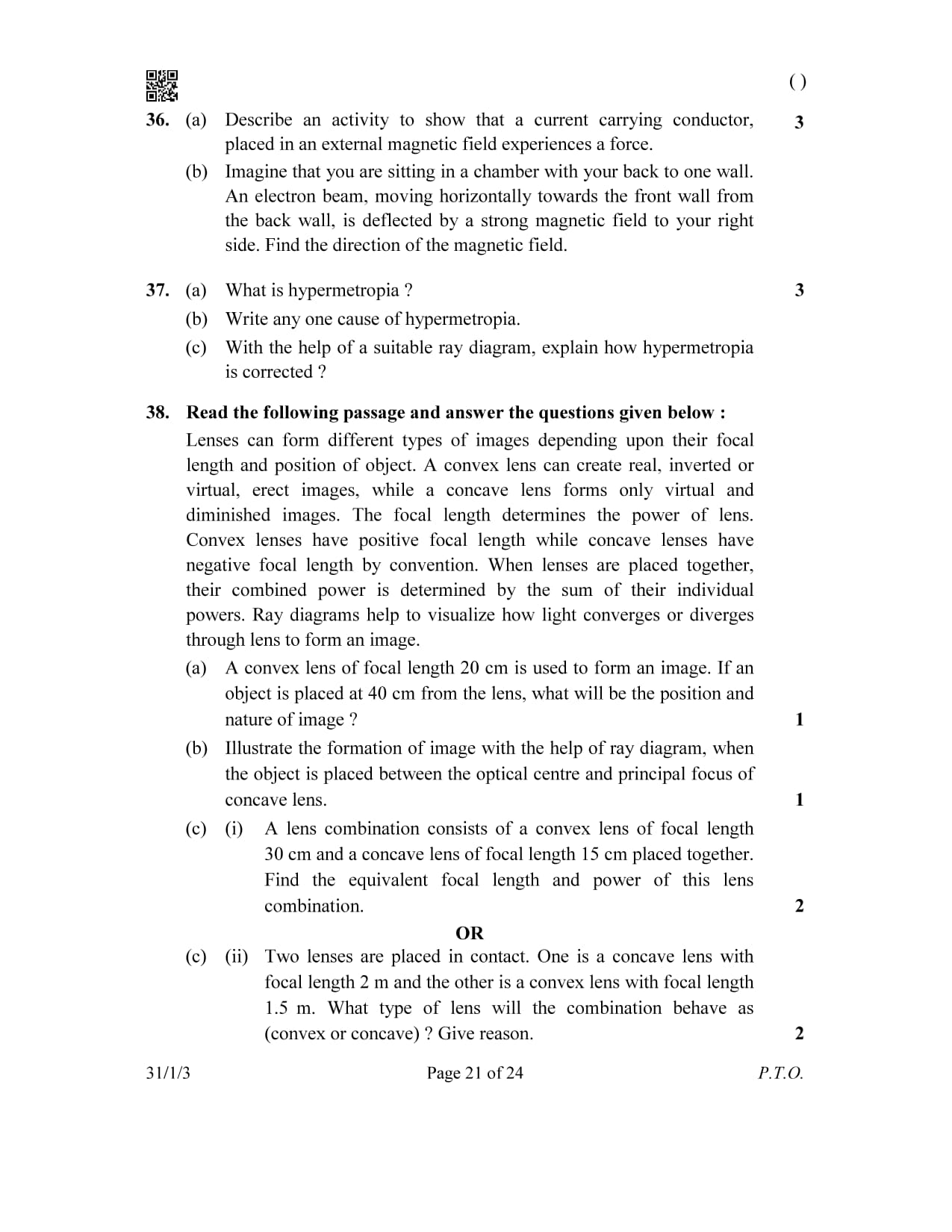
Describe an activity to show that a current carrying conductor, placed in an external magnetic field experiences a force.
Imagine that you are sitting in a chamber with your back to one wall. An electron beam, moving horizontally towards the front wall from the back wall, is deflected by a strong magnetic field to your right side. Find the direction of the magnetic field.
(a) What is hypermetropia?
(b) Write any one cause of hypermetropia.
(c) With the help of a suitable ray diagram, explain how hypermetropia is corrected?
Read the following passage and answer the questions given below:
Lenses can form different types of images depending upon their focal length and position of object. A convex lens can create real, inverted or virtual, erect images, while a concave lens forms only virtual and diminished images. The focal length determines the power of lens. Convex lenses have positive focal length while concave lenses have negative focal length by convention. When lenses are placed together, their combined power is determined by the sum of their individual powers. Ray diagrams help to visualize how light converges or diverges through lens to form an image.
(a) A convex lens of focal length 20 cm is used to form an image. If an object is placed at 40 cm from the lens, what will be the position and nature of image?
Illustrate the formation of image with the help of ray diagram, when the object is placed between the optical centre and principal focus of concave lens.
A lens combination consists of a convex lens of focal length 30 cm and a concave lens of focal length 15 cm placed together. Find the equivalent focal length and power of this lens combination.
Two lenses are placed in contact. One is a concave lens with focal length 2 m and the other is a convex lens with focal length 1.5 m. What type of lens will the combination behave as (convex or concave)? Give reason.
(a) Study the given electric circuit in which 2 A electric current is flowing between points X and Y.
(i) Using the battery, key, voltmeter and ammeter in this given electric circuit, redraw a circuit diagram in which 2 \(\Omega\) and 4 \(\Omega\) resistors are connected between X and Y in parallel combination.
(ii) Circuit drawn by you, in which resistors are connected in parallel combination, calculate the electric current flowing through 4 \(\Omega\) resistor.

Two lamps 'A' and 'B' of rating 50 W; 220 V and 100 W, 220 V are connected in series combination. Find out the ratio of the resistances (\(R_A : R_B\)) of these lamps.
Derive the expression for the equivalent resistance of three resistors \( R_1 \), \( R_2 \) and \( R_3 \) connected in parallel combination.



Comments