COMEDK UGET 2022 was held on June 19, 2022 in 2 shifts. COMEDK UGET question paper carries 180 questions with a weightage of 180 marks to be completed in a time period of 3 hours. COMEDK UGET 2022 Question Paper PDF is available for download here.  Candidates appearing for the upcoming COMEDK UGET exam can download and practice the question paper to test their exam prep level.

Check: COMEDK Previous Year Question Paper with Solution  

COMEDK UGET 2022 Question Paper PDF Download

COMEDK UGET 2022 Question Paper With Answer Key download icon Download Check Solution

Question 1:

During the phenomenon of resonance

  • (A) the amplitude of oscillation becomes large
  • (B) the frequency of oscillation becomes large
  • (C) the time period of oscillation becomes large
  • (D) All of the above
Correct Answer: (A) the amplitude of oscillation becomes large
View Solution

Question 2:

If the Earth were to spin faster, acceleration due to gravity at the poles

  • (A) increases
  • (B) decreases
  • (C) remains the same
  • (D) depends on how fast it spins
Correct Answer: (C) remains the same
View Solution

Question 3:

During the phenomenon of resonance, the amplitude of oscillation becomes large. The variation of g with angular velocity \( \omega \) is given by \[ g' = g - R\omega^2 \]
If Earth were to spin faster, that is, angular velocity increases, then except at poles, the weight of bodies will decrease at all places.

  • (A) 1
  • (B) 0.5
  • (C) 0.25
  • (D) 2
Correct Answer: (B) 0.5
View Solution

Question 4:

If a heat engine is filled at temperature \( 27^\circ C \) and heat of 100 kcal is taken from the source at temperature \( 677^\circ C \), work done (in J) is

  • (A) \( 0.28 \times 10^6 \)
  • (B) \( 2.8 \times 10^6 \)
  • (C) \( 28 \times 10^6 \)
  • (D) \( 0.028 \times 10^6 \)
Correct Answer: (A) \( 0.28 \times 10^6 \)
View Solution

Question 5:

During \( \alpha \)-decay, the atomic mass of parent nuclei is

  • (A) decreased by 2 units
  • (B) increased by 2 units
  • (C) decreased by 4 units
  • (D) increased by 4 units
Correct Answer: (C) decreased by 4 units
View Solution

Question 6:

A point object is placed on the optic axis of a convex lens of focal length \( f \) at a distance of \( 2f \) to the left of it. The diameter of the lens is \( d \). An eye is placed at a distance of \( 3f \) to the right of the lens and a distance \( h \) below the optic axis. The maximum value of \( h \) to see the image is

  • (A) \( d \)
  • (B) \( \frac{d}{2} \)
  • (C) \( \frac{d}{3} \)
  • (D) \( \frac{d}{4} \)
Correct Answer: (D) \( \frac{d}{4} \)
View Solution

Question 7:

For a CE transistor amplifier, the audio signal voltage across the collector resistance of \( 4 \, k\Omega \) is 5V. If the current amplification factor of the transistor is 100 and the base resistance is \( 2 \, k\Omega \), then the input signal voltage is

  • (A) 75 mV
  • (B) 25 mV
  • (C) 20 mV
  • (D) 50 mV
Correct Answer: (B) 25 mV
View Solution

Question 8:

From the following \( p-V \) diagram, an ideal gas undergoing a change of state from A to B. Four different processes I, II, III, and IV as shown in the figure may lead to the same change of state.

  • (A) Work done is maximum in case I
  • (B) Change in internal energy is the same in all the four cases
  • (C) Change in internal energy is the same in III and IV cases, but not in I and II
  • (D) Work done is minimum in case II
Correct Answer: (B) Change in internal energy is the same in all the four cases
View Solution

Question 9:

A copper and a steel wire of same diameter are connected end to end. A deforming force \( F_1 \) is applied to the wire which causes an elongation of 1 cm. The two wires will have

  • (A) the same stress
  • (B) different stress
  • (C) the same strain
  • (D) different strain
Correct Answer: (D) different strain
View Solution

Question 10:

If kinetic energy of a body is increased by 300%, then the percentage change in momentum will be

  • (A) 100%
  • (B) 150%
  • (C) 265%
  • (D) 73.2%
Correct Answer: (A) 100%
View Solution

Question 11:

Which of the following diagram represents the variation of the electric field with distance \( r \) from the centre of a uniformly charged non-conducting sphere of radius \( R \)?

  • (A)
  • (B)
  • (C)
  • (D)
Correct Answer: (C)
View Solution

Question 12:

A DC ammeter and a hot wire ammeter are connected to a circuit in series. When a direct current is passed through the circuit, the DC ammeter shows 6A. When AC current flows through the circuit, what is the average reading in DC ammeter and the AC ammeter, if DC and AC currents flow simultaneously through the circuit?

  • (A) DC = 6A, AC = 10A
  • (B) DC = 3A, AC = 5A
  • (C) DC = 5A, AC = 8A
  • (D) DC = 2A, AC = 3A
Correct Answer: (A) DC = 6A, AC = 10A
View Solution

Question 13:

A bullet of mass \( m \) hits a mass \( M \) and gets embedded in it. If the block rises to a height \( h \) as a result of this collision, the velocity of the bullet before collision is

  • (A) \( v = \sqrt{2gh} \)
  • (B) \( v = \sqrt{2gh \left(1 + \frac{m}{M}\right)} \)
  • (C) \( v = \sqrt{2gh \left(1 + \sqrt{\frac{m}{M}}\right)} \)
  • (D) \( v = \sqrt{2gh \left(1 - \frac{m}{M}\right)} \)
Correct Answer: (C) \( v = \sqrt{2gh \left(1 + \sqrt{\frac{m}{M}}\right)} \)
View Solution

Question 14:

A particle of mass \( m \) is moving in a horizontal circle of radius \( r \) under a centripetal force given by \( \left( \frac{-K}{r^2} \right) \), where \( K \) is a constant. Then

  • (A) the total energy of the particle is \( \left( \frac{-K}{2r} \right) \)
  • (B) the kinetic energy of the particle is \( \frac{K}{r} \)
  • (C) the potential energy of the particle is \( \frac{K}{2r} \)
  • (D) the kinetic energy of the particle is \( \frac{-K}{r} \)
Correct Answer: (A) the total energy of the particle is \( \left( \frac{-K}{2r} \right) \)
View Solution

Question 15:

The height at which the acceleration due to gravity becomes \( \frac{g}{16} \) (where \( g \) is the acceleration due to gravity on the surface of the earth) in terms of \( R \), if \( R \) is the radius of the Earth.

  • (A) \( 2R \)
  • (B) \( 3R \)
  • (C) \( \sqrt{2}R \)
  • (D) \( \sqrt{3}R \)
Correct Answer: (B) \( 3R \)
View Solution

Question 16:

Which of the following series spectrum of hydrogen atom lies in ultraviolet region?

  • (A) Paschen series
  • (B) Brackett series
  • (C) Pfund series
  • (D) Lyman series
Correct Answer: (D) Lyman series
View Solution

Question 17:

Speed of electromagnetic wave in a medium having relative permittivity \( \epsilon_r \) and relative permeability \( \mu_r \) is (speed of light in air, \( c = 3 \times 10^8 \, m/s \))

  • (A) \( \frac{1}{\sqrt{\mu_r \epsilon_r}} \)
  • (B) \( \frac{c}{\sqrt{\mu_r \epsilon_r}} \)
  • (C) \( c \sqrt{\frac{\mu_r}{\epsilon_r}} \)
  • (D) \( \frac{c}{\mu_r \epsilon_r} \)
Correct Answer: (B) \( \frac{c}{\sqrt{\mu_r \epsilon_r}} \)
View Solution

Question 18:

The wavelength of the second line of the Balmer series is 486.4 nm. What is the wavelength of the first line of Lyman series?

  • (A) 78.8 nm
  • (B) 121.6 nm
  • (C) 418.2 nm
  • (D) 610.5 nm
Correct Answer: (B) 121.6 nm
View Solution

Question 19:

A bat emitting an ultrasonic wave of frequency \( 4.5 \times 10^4 \, Hz \) at speed of \( 6 \, m/s \) between two parallel walls. The two frequencies heard by the bat will be

  • (A) \( 4.67 \times 10^4 \, Hz, 4.34 \times 10^4 \, Hz \)
  • (B) \( 4.34 \times 10^4 \, Hz, 4.67 \times 10^4 \, Hz \)
  • (C) \( 4.5 \times 10^4 \, Hz, 5.4 \times 10^4 \, Hz \)
  • (D) \( 4.67 \times 10^3 \, Hz, 4.34 \times 10^4 \, Hz \)
Correct Answer: (A) \( 4.67 \times 10^4 \, \text{Hz}, 4.34 \times 10^4 \, \text{Hz} \)
View Solution

Question 20:

A disc of moment of inertia 4 kg \( m^2 \) revolving with 16 rad/s is placed on another disc of moment of inertia 8 kg \( m^2 \) revolving with 4 rad/s. The angular frequency of the composite disc is

  • (A) 4 rad/s
  • (B) \( \frac{3}{16} \) rad/s
  • (C) 8 rad/s
  • (D) \( \frac{16}{3} \) rad/s
Correct Answer: (C) 8 rad/s
View Solution

Question 21:

An electric current \( I \) enters and leaves a uniform circular wire of radius \( r \) through diametrically opposite points. A charged particle \( q \) moves along the axis of the circular wire and passes through its center with speed \( v \). The magnetic force on the particle when it passes through the center has a magnitude

  • (A) \( \frac{qv\mu_0 I}{2\pi r} \)
  • (B) \( \frac{qv\mu_0 I}{\pi r} \)
  • (C) \( \frac{qv\mu_0 I}{r} \)
  • (D) 0
Correct Answer: (D) 0
View Solution

Question 22:

Television frequencies are of the order of 100 MHz, while radio frequencies are of the order of 1 MHz. Using these as typical frequencies, the ratio of the emf generated in a loop antenna by a television wave to that generated by a radio wave, if both have equal electric field intensities, is

  • (A) 1
  • (B) 10
  • (C) 100
  • (D) 66.6
Correct Answer: (C) 100
View Solution

Question 23:

A particle is performing simple harmonic motion. Equation of its motion is \( x = 5 \sin \left( 4t - \frac{\pi}{6} \right) \), \( x \) being the displacement from the mean position. Velocity (in ms\(^{-1}\)) of the particle at the instant when its displacement is 3, will be

  • (A) \( \frac{2\pi}{3} \)
  • (B) \( \frac{5\pi}{6} \)
  • (C) 20
  • (D) 16
Correct Answer: (D) 16
View Solution

Question 24:

A raft of density 600 g/m\(^3\) and mass 120 kg floats in water. How much weight can be put on the raft to make it just sink?

  • (A) 120 kg
  • (B) 200 kg
  • (C) 40 kg
  • (D) 80 kg
Correct Answer: (D) 80 kg
View Solution

Question 25:

The displacement \( x \) of a particle in a straight line motion is given by \( x = 1 - t - t^2 \). The correct representation of the motion is

Correct Answer: (B)
View Solution

Question 26:

A galvanometer having a resistance of 4 \( \Omega \) is shunted by a wire of resistance 2 \( \Omega \). If the total current is 1.5 A, the current passing through the shunt is

  • (A) 1.25 A
  • (B) 1 A
  • (C) 0.75 A
  • (D) 0.5 A
Correct Answer: (B) 1 A
View Solution

Question 27:

In Young's double slit experiment, the two slits are separated by 0.2 mm and they are 1m from the screen. The wavelength of the light used is 500 nm. The distance between 6th maxima and 10th minima on the screen is closest to

  • (A) 12 mm
  • (B) 10 mm
  • (C) 14 mm
  • (D) 8 mm
Correct Answer: (D) 8 mm
View Solution

Question 28:

A series L-C-R circuit is connected to an AC source of 220V and 50 Hz shown in figure. If the readings of the three voltmeters \( V_1, V_2, \) and \( V_3 \) are 65V, 415V, and 204V respectively, the value of inductance and capacitance will be


  • (A) 2.0 H, 5 \( \mu \)F
  • (B) 1.0 H, 5 \( \mu \)F
  • (C) 4.0 H, 6 \( \mu \)F
  • (D) 1.0 H, 2 \( \mu \)F
Correct Answer: (B) 1.0 H, 5 \( \mu \)F
View Solution

Question 29:

A regular hexagon of side \( m \), which is a wire of length 24 m, is coiled on that hexagon. If current in hexagon is \( I \), then the magnetic moment is


  • (A) \( 6\sqrt{3} I \, m^2 \)
  • (B) \( 3\sqrt{3} I \, m^2 \)
  • (C) \( 3\sqrt{2} I \, m^2 \)
  • (D) \( 6 I \, m^2 \)
Correct Answer: (A) \( 6\sqrt{3} I \, \text{m}^2 \)
View Solution

Question 30:

Which of the following gate gives the similar output as the output of the circuit diagram shown in the figure?


  • (A) AND gate
  • (B) OR gate
  • (C) NOR gate
  • (D) NAND gate
Correct Answer: (A) AND gate
View Solution

Question 31:

Water is poured in a tank through a cylindrical tube of area of cross-section \( A \) and ejecting water at a constant speed 4 m/s. The tank contains a hole of area \( \frac{A}{2} \) at the bottom. The level of water in the tank will not go up beyond

  • (A) 5.6 m
  • (B) 4.8 m
  • (C) 3.2 m
  • (D) 1.8 m
Correct Answer: (C) 3.2 m
View Solution

Question 32:

If \( R \) and \( C \) denote resistance and capacitance of a material, then the dimension of \( CR \) will be

  • (A) [MLT]
  • (B) [M\(^0\)L\(^0\)T]
  • (C) [M\(^0\)L\(^0\)T\(^2\)]
  • (D) [M\(^2\)L\(^0\)T]
Correct Answer: (B) [M\(^0\)L\(^0\)T]
View Solution

Question 33:

An ideal gas is taken through the cycle \( A \to B \to C \to A \), as shown in the figure. If the net heat supplied to the gas in the cycle is 5 J, the work done by the gas in the process \( C \to A \) is

  • (A) \(-5 \, J\)
  • (B) \(-10 \, J\)
  • (C) \(-15 \, J\)
  • (D) \(-20 \, J\)
Correct Answer: (A) \(-5 \, \text{J}\)
View Solution

Question 34:

From a circular disc of radius \( R \), a square is cut out with a radius as its diagonal. The centre of mass of the remaining portion is at a distance (from the centre)

  • (A) \( \frac{R}{4\pi - 2} \)
  • (B) \( \frac{R}{2\pi} \)
  • (C) \( \frac{R}{\pi - 2} \)
  • (D) \( \frac{R}{2\pi - 2} \)
Correct Answer: (A) \( \frac{R}{4\pi - 2} \)
View Solution

Question 35:

A bar magnet of length 6 cm is placed in the magnetic meridian with N pole, pointing towards the geographical north. Two neutral points, separated by a distance of 8 cm are obtained on the equatorial axis of the magnet. If \( B_H = 1.2 \times 10^{-5} \, T \), then the pole strength of the magnet is

  • (A) 0.75 A-m\(^2\)
  • (B) 0.25 A-m\(^2\)
  • (C) 0.50 A-m\(^2\)
  • (D) 1.50 A-m\(^2\)
Correct Answer: (B) 0.25 A-m\(^2\)
View Solution

Question 36:

A force \( F \) applied on the wire of radius \( r \) and length \( L \) and change in the length of the wire is \( l \). If the same force \( F \) is applied on the wire of the same material and radius \( 4r \) and length \( 4L \), then change in length of the other wire is

  • (A) \( \frac{l}{4} \)
  • (B) \( 2l \)
  • (C) \( \frac{l}{2} \)
  • (D) \( 4l \)
Correct Answer: (A) \( \frac{l}{4} \)
View Solution

Question 37:

A 30 mW laser beam has a cross-sectional area of 15 mm\(^2\). The magnitude of the maximum electric field in this electromagnetic wave is given by:  

Permittivity of space, \varepsilon_0 = 9 \times 10^{-12},  Speed of light, c = 3 \times 10^8 m/s 

  • (A) \( 1.22 kV/m \)
  • (B) \( 12 kV/m \)
  • (C) \( 10 kV/m \)
  • (D) \( 201 kV/m \)
Correct Answer: (A) \( 1.22 \text{ kV/m} \)
View Solution

Question 38:

The average kinetic energy of a molecule in air at room temperature of 20\(^\circ\)C

  • (A) \( 6 \times 10^{-22} \) J
  • (B) \( 7.06 \times 10^{-21} \) J
  • (C) \( 6.07 \times 10^{-21} \) J
  • (D) \( 6.70 \times 10^{-21} \) J
Correct Answer: (C) \( 6.07 \times 10^{-21} \) J
View Solution

Question 39:

Two guns P and Q can fire bullets at speeds 2 km/s and 4 km/s, respectively. From a point on a horizontal ground, they are fired in all possible directions. The ratio of maximum or areas covered by the bullets fired by the two guns, on the ground is

  • (A) 1 : 2
  • (B) 1 : 4
  • (C) 1 : 8
  • (D) 1 : 16
Correct Answer: (D) 1 : 16
View Solution

Question 40:

A cell of emf 2V is connected with a load of resistance 1.5Ω. The power delivered by the cell to the load is maximum, then power transferred to the load is

  • (A) 0.33 W
  • (B) 2.67 W
  • (C) 1.33 W
  • (D) 3.25 W
Correct Answer: (A) 0.33 W
View Solution

Question 41:

A plane glass mirror of thickness 3 cm of material of \(\mu = \frac{3}{2}\) is silvered on the black surface. When a point object is placed 9 cm from the front surface of the mirror, then the position of the brightest image from the front surface is

  • (A) 9 cm
  • (B) 11 cm
  • (C) 12 cm
  • (D) 13 cm
Correct Answer: (D) 13 cm
View Solution

Question 42:

Ultraviolet light of wavelength 99 mm falls on a metal plate of work function 1.0 eV. If the mass of the electron is \(9.1 \times 10^{-31}\) kg, the wavelength of the fastest photoelectron emitted is

  • (A) 0.63 mm
  • (B) 0.66 nm
  • (C) 0.33 nm
  • (D) 0.36 nm
Correct Answer: (D) 0.36 nm
View Solution

Question 43:

In Young's double slit experiment, the fringe width is found to be 0.4 mm. If the whole apparatus is immersed in a liquid of refractive index \(\frac{4}{3}\) without changing geometrical arrangement, the new fringe width will be

  • (A) 0.45 mm
  • (B) 0.4 mm
  • (C) 0.53 mm
  • (D) 0.30 mm
Correct Answer: (D) 0.30 mm
View Solution

Question 44:

There are two identical containers \(C_1\) and \(C_2\) containing identical gases. Gas in \(C_1\) is reduced to half of its original volume adiabatically, while the gas in container \(C_2\) is also reduced to half of its initial volume isothermally. Find the ratio of final pressure in these containers. \(\gamma\) be the adiabatic constant)

  • (A) 2:1
  • (B) 1:2
  • (C) \(2^{\gamma - 1}:1\)
  • (D) \(2^{\gamma}:1\)
Correct Answer: (D) \(2^{\gamma}:1\)
View Solution

Question 45:

If \(K_1\) and \(K_2\) are maximum kinetic energies of photoelectrons emitted when lights of wavelengths \(\lambda_1\) and \(\lambda_2\), respectively incident on a metallic surface and \(\lambda_1 = 3\lambda_2\), then

  • (A) \(K_1 > \frac{K_2}{3}\)
  • (B) \(K_1 < \frac{K_2}{3}\)
  • (C) \(K_1 = 2K_2\)
  • (D) \(K_2 = 2K_1\)
Correct Answer: (B) \(K_1 < \frac{K_2}{3}\)
View Solution

Question 46:

A car is moving with a speed of 54 km / h. If after 3 s, the driver applies brakes and it stops, then how much distance is covered by the car before coming to rest?

  • (1) 22.5 m
  • (2) 20 m
  • (3) 25 m
  • (4) 45.2 m
Correct Answer: (1) 22.5 m
View Solution

Question 47:

A source of sound emits sound waves at frequency \( f_0 \). It is moving towards an observer with fixed speed \( v_s \) (\( v_s < v \), where \( v \) is the speed of sound in air). If the observers were to move towards the source with speed \( v_0 \), one of the following two graphs (A and B) will give the correct variation of the frequency \( f \) heard by the observer as \( v_0 \) changes.

  • (1) Graph A with slope \( \frac{f_0}{v + v_s} \)
  • (2) Graph B with slope \( \frac{f_0}{v - v_s} \)
  • (3) Graph A with slope \( \frac{f_0}{v - v_s} \)
  • (4) Graph B with slope \( \frac{f_0}{v + v_s} \)
Correct Answer: (3) Graph A with slope \( \frac{f_0}{v - v_s} \)
View Solution

Question 48:

In which mode of transmission, the heat waves travel along straight line with the speed of light?

  • (1) Thermal radiation
  • (2) Forced convection
  • (3) Natural convection
  • (4) Thermal conduction
Correct Answer: (1) Thermal radiation
View Solution

Question 49:

The escape velocity of a projectile on the earth's surface is 11.2 km/s. A body is projected out with thrice this speed. The speed of the body far away from the earth will be?

  • (1) 22.4 km/s
  • (2) 31.7 km/s
  • (3) 33.6 km/s
  • (4) None of these
Correct Answer: (2) 31.7 km/s
View Solution

Question 50:

Consider a compound slab consisting of two different materials having equal lengths, thickness and thermal conductivities \( K \) and \( 2K \) respectively. The equivalent thermal conductivity of the slab is

  • (1) \( \sqrt{2}K \)
  • (2) \( 3K \)
  • (3) \( \frac{4}{3}K \)
  • (4) \( \frac{2}{3}K \)
Correct Answer: (3) \( \frac{4}{3}K \)
View Solution

Question 51:

A circular coil of 20 turns and radius 10 cm is placed in a uniform magnetic field of 0.10 T normal to the plane of the coil. If the current in the coil is 5 A, then the average force on each electron in the coil due to the magnetic field is

  • (1) \( 2.5 \times 10^{-25} \, N \)
  • (2) \( 4.5 \times 10^{-25} \, N \)
  • (3) \( 5 \times 10^{-25} \, N \)
  • (4) \( 5.5 \times 10^{-25} \, N \)
Correct Answer: (3) \( 5 \times 10^{-25} \, \text{N} \)
View Solution

Question 52:

With what minimum acceleration can a fireman slide down a rope while breaking strength of the rope is \( \frac{2}{3} \) of the weight?

  • (1) \( \frac{2}{3}g \)
  • (2) \( g \)
  • (3) \( \frac{1}{3}g \)
  • (4) zero
Correct Answer: (3) \( \frac{1}{3}g \)
View Solution

Question 53:

The string of length 2 m is fixed at both ends. If the string vibrates in its fourth normal mode with a frequency of 500 Hz, then the waves would travel on it with a velocity of

  • (1) \(125 \, m/s\)
  • (2) \(250 \, m/s\)
  • (3) \(500 \, m/s\)
  • (4) \(1000 \, m/s\)
Correct Answer: (3) \(500 \, \text{m/s}\)
View Solution

Question 54:

An alternating voltage \( V = 200\sin(100t) \) is applied to a series combination of \( R = 30\Omega \) and an inductor of \( 400 \, mH \). The power factor of the circuit is,

  • (1) \( 0.01 \)
  • (2) \( 0.6 \)
  • (3) \( 0.05 \)
  • (4) \( 0.042 \)
Correct Answer: (2) \( 0.6 \)
View Solution

Question 55:

In the network shown in figure, the equivalent capacitance between points P and Q is


  • (1) \(1 \, \mu\text{F}\)
  • (2) \(2 \, \mu\text{F}\)
  • (3) \(3 \, \mu\text{F}\)
  • (4) \(4 \, \mu\text{F}\)
Correct Answer: (1) \(1 \, \mu\text{F}\)
View Solution

Question 56:

The resultant of two forces acting at an angle of \( 120^\circ \) is \( 10 \, kg-W \) and is perpendicular to one of the forces. That force is

  • (1) \( \frac{10}{\sqrt{3}} \, kg-W \)
  • (2) \( 10 \, kg-W \)
  • (3) \( 20\sqrt{3} \, kg-W \)
  • (4) \( 10\sqrt{3} \, kg-W \)
Correct Answer: (1) \( \frac{10}{\sqrt{3}} \, \text{kg-W} \)
View Solution

Question 57:

Choose the incorrect statements.

  • (1) Silicon is used in the fabrication of LED.
  • (2) LED works on the principle of electroluminescence.
  • (3) LED is a power efficient device.
  • (4) LED is fabricated with direct band gap semiconductor.
Correct Answer: (1) Silicon is used in the fabrication of LED.
View Solution

Question 58:

Charge on electron is

  • (1) \( 3.2 \times 10^{-19} \, C \)
  • (2) \( 1.6 \times 10^{-19} \, C \)
  • (3) \( -1.6 \times 10^{-19} \, C \)
  • (4) \( -3.2 \times 10^{-19} \, C \)
Correct Answer: (3) \( -1.6 \times 10^{-19} \, \text{C} \)
View Solution

Question 59:

Two charged spheres of \( -20\, \mu\text{C} \) and \( 60\, \mu\text{C} \) are kept at a certain distance. They are touched and kept again at the same distance. What is the ratio of force experienced before and after?

  • (1) \( 1 : 3 \)
  • (2) \( 3 : 1 \)
  • (3) \( 2 : 1 \)
  • (4) \( 1 : 2 \)
Correct Answer: (2) \( 3 : 1 \)
View Solution

Question 60:

The AC voltage across a resistance can be measured using a

  • (1) hot wire voltmeter
  • (2) moving coil galvanometer
  • (3) potential coil galvanometer
  • (4) moving magnet galvanometer
Correct Answer: (2) moving coil galvanometer
View Solution

Question 61:

............. is unstable at cooking temperature, whereas the control of sweetness of food is difficult while using ..........

  • (1) Alitame and aspartame
  • (2) Aspartame and sucralose
  • (3) Aspartame and alitame
  • (4) Alitame and sucralose
Correct Answer: (3) Aspartame and alitame
View Solution

Question 62:

The chemical formula of Lucas reagent is

  • (1) Anhy. \( ZnCl_2 / HCl \)
  • (2) \( C_6H_5SO_2Cl \)
  • (3) NaOH + CaO
  • (4) HNO\(_2\)
Correct Answer: (1) Anhy. \( \text{ZnCl}_2 / \text{HCl} \)
View Solution

Question 63:

Give the correct order of acidity of

  • (1) \( HClO_4 < HClO_3 < HClO_2 < HClO \)
  • (2) \( HClO < HClO_2 < HClO_3 < HClO_4 \)
  • (3) \( HClO_4 < HClO_2 < HClO < HClO_3 \)
  • (4) \( HClO < HClO_3 < HClO_2 < HClO_4 \)
Correct Answer: (2) \( \text{HClO} < \text{HClO}_2 < \text{HClO}_3 < \text{HClO}_4 \)
View Solution

Question 64:

The process of aggregation of colloidal particles into an insoluble precipitate by the addition of suitable electrolyte is called

  • (1) coagulation
  • (2) diffusion
  • (3) peptisation
  • (4) electrolysis
Correct Answer: (1) coagulation
View Solution

Question 65:

Alkyl halides undergoing \( S_N2 \) reaction do inverse

  • (1) racemic mixture
  • (2) retention of configuration
  • (3) formation of carbocation
  • (4) inversion of configuration
Correct Answer: (4) inversion of configuration
View Solution

Question 66:

X and Y in the following reactions are:

(CH\(_3\)–CH\(_2\))\(_2\)C=O \xrightarrow{HCN/KCN X \xrightarrow{LiAlH_4 (CH\(_3\))\(_2\)C(OH)CH\(_2\)NH\(_2\)

  • (A) X = (CH\(_3\))\(_2\)CHCH\(_2\)CN, Y = NaBH\(_4\)
  • (B) X = (CH\(_3\))\(_2\)CCOONH\(_2\), Y = CH\(_3\)NH\(_2\)
  • (C) X = (CH\(_3\))\(_2\)C(CN)CH\(_2\)OH, Y = LiAlH\(_4\)
  • (D) X = (CH\(_3\)CH\(_2\))\(_2\)C(CN)CH\(_2\)OH, Y = CH\(_3\)NH\(_2\)
Correct Answer: (C) X = (CH\(_3\))\(_2\)C(CN)CH\(_2\)OH, Y = LiAlH\(_4\)
View Solution

Question 67:

Doping of silicon (Si) with indium (In) leads to the formation of

  • (A) n-type semiconductor
  • (B) metal
  • (C) p-type semiconductor
  • (D) insulator
Correct Answer: (C) p-type semiconductor
View Solution

Question 68:

For the reaction, H\(_2\)(g) + I\(_2\)(g) ⇌ 2 HI(g), the position of equilibrium can be shifted to the right by

  • (A) addition of HI
  • (B) addition of both I\(_2\) and HI
  • (C) increasing temperature
  • (D) addition of I\(_2\)
Correct Answer: (D) addition of I\(_2\)
View Solution

Question 69:

Which of the following are not path functions?


I. H – T S

II. W

III. q

IV. q + W

  • (A) I and III
  • (B) I, II, IV
  • (C) II, III and IV
  • (D) I and IV
Correct Answer: (D) I and IV
View Solution

Question 70:

The system that forms maximum boiling azeotropes is

  • (A) acetone-chloroform
  • (B) ethyl alcohol-water
  • (C) benzene-toluene
  • (D) CS\(_2\) + acetone
Correct Answer: (A) acetone-chloroform
View Solution

Question 71:

KMnO\(_4\) acts as an oxidising agent in acidic medium. The number of moles of KMnO\(_4\) that will be required to react with one mole of oxalate ions (to form CO\(_2\)) in acidic solution is:

  • (A) \(\dfrac{2}{5}\)
  • (B) \(\dfrac{5}{2}\)
  • (C) 5
  • (D) \(\dfrac{5}{4}\)
Correct Answer: (A) \(\dfrac{2}{5}\)
View Solution

Question 72:

What can be A and B in the following reaction?

  • (A) HBr, al
  • (B) KOH
  • (C) HBr, Peroxide alc. KOH
  • (D) HBr, Peroxide aq. KOH, \(\Delta\)
Correct Answer: (C) HBr, Peroxide alc. KOH
View Solution

Question 73:

Which of the following is a false statement?

  • (A) Methoxymethane has higher boiling point than ethanol.
  • (B) Alcohols are more soluble in water than hydrocarbons of comparable molecular mass.
  • (C) ortho- and para-nitrophenols are more acidic than phenols.
  • (D) Phenol is more acidic than alcohol.
Correct Answer: (A) Methoxymethane has higher boiling point than ethanol.
View Solution

Question 74:

Which of the following molecules does not exhibit dipole moment?

(i) CCl\(_4\)

(ii) CO\(_2\)

(iii) NH\(_3\)

(iv) CHCl\(_3\)

(v) H\(_2\)O

(vi) CH\(_3\)–O–CH\(_3\)

  • (A) (ii), (v), (iv)
  • (B) (i), (iii), (vi)
  • (C) (i), (ii)
  • (D) (iii), (iv), (vi)
Correct Answer: (C) (i), (ii)
View Solution

Question 75:

Which of the following is highly basic?

  • (A) Diphenylamine
  • (B) Benzylamine
  • (C) Aniline
  • (D) Triphenylamine
Correct Answer: (B) Benzylamine
View Solution

Question 76:

The relation between work done in reversible and irreversible process is

  • (A) \( W_{irr} > W_{rev} \)
  • (B) \( W_{irr} < W_{rev} \)
  • (C) \( W_{irr} = W_{rev} \)
  • (D) \( W_{irr} \ne W_{rev} \)
Correct Answer: (B) \( W_{\text{irr}} < W_{\text{rev}} \)
View Solution

Question 77:

What is the function of platelets?

  • (A) It binds to oxygen
  • (B) It binds to carbon dioxide
  • (C) It forms cyanide in body
  • (D) It leads to coagulation of blood
Correct Answer: (D) It leads to coagulation of blood
View Solution

Question 78:

The monosaccharides of maltose is

  • (A) \( \alpha \)-D-glucose and \( \alpha \)-D-glucose
  • (B) \( \beta \)-D-glucose and \( \alpha \)-D-glucose
  • (C) \( \alpha \)-D-glucose and \( \alpha \)-D-fructose
  • (D) \( \alpha \)-D-glucose and \( \beta \)-D-fructose
Correct Answer: (A) \( \alpha \)-D-glucose and \( \alpha \)-D-glucose
View Solution

Question 79:

Which of the following does not affect solubility of a gas in liquid?

  • (A) Nature of gas and liquid
  • (B) Pressure
  • (C) Concentration
  • (D) Temperature
Correct Answer: (C) Concentration
View Solution

Question 80:

Which of the following statement is incorrect for \( \mathrm{H_2O_2} \) structure?

  • (A) It has an open book structure
  • (B) Its dihedral angle is \( 180^\circ \)
  • (C) O–O bond length is 145.8 pm and O–H is 98.8 pm
  • (D) Angle between both planes is 90.2°
Correct Answer: (B) Its dihedral angle is \( 180^\circ \)
View Solution

Question 81:

A newly prepared radioactive nuclide has a decay constant of 6.93 s\(^{-1}\). What is the half-life of the nuclide?

  • (1) 0.1 s
  • (2) 0.2 s
  • (3) 0.3 s
  • (4) 0.4 s
Correct Answer: (1) 0.1 s
View Solution

Question 82:

Which of the following show both Frenkel and Schottky defect?

  • (1) ZnS
  • (2) AgBr
  • (3) NaCl
  • (4) AgCl
Correct Answer: (2) AgBr
View Solution

Question 83:

The essential amino acid are

(i) Leucine

(ii) Glutamic acid

(iii) Asparagine

(iv) Valine


Choose the correct option from the following:

  • (A) (i), (ii)
  • (B) (ii), (iii)
  • (C) (iii), (iv)
  • (D) (i), (iv)
Correct Answer: (D) (i), (iv)
View Solution

Question 84:

Increasing order of bond order of oxygen and its ions is

  • (A) \( O_2^{+} < O_2^{2-} < O_2^{-} < O_2 \)
  • (B) \( O_2^{-} < O_2^{2-} < O_2^{+} < O_2 \)
  • (C) \( O_2^{+} < O_2 < O_2^{-} < O_2^{2-} \)
  • (D) \( O_2^{2-} < O_2^{-} < O_2^{+} < O_2 \)
Correct Answer: (D) \( O_2^{2-} < O_2^{-} < O_2^{+} < O_2 \)
View Solution

Question 85:

Minimum number of nodes are present in

  • (A) 2s
  • (B) 3s
  • (C) 4s
  • (D) 5s
Correct Answer: (A) 2s
View Solution

Question 86:

pH of \(10^{-3}\) M solution of KOH is

  • (A) 7.01
  • (B) 2
  • (C) 11
  • (D) 9
Correct Answer: (C) 11
View Solution

Question 87:

Barbiturates are used to treat

  • (A) fatigue
  • (B) hallucinations
  • (C) allergies
  • (D) depression
Correct Answer: (D) depression
View Solution

Question 88:

Which of the product is not possible in Wurtz reaction?

  • (A) Methane
  • (B) Ethane
  • (C) Propane
  • (D) Butane
Correct Answer: (A) Methane
View Solution

Question 89:

The colour of \( CrO_4^{2-} \) changes to \( Cr_2O_7^{2-} \) is

  • (A) yellow to orange
  • (B) orange to yellow
  • (C) yellow to blue
  • (D) orange to blue
Correct Answer: (A) yellow to orange
View Solution

Question 90:

On treatment of glucose with bromine water the product formed is

  • (A) saccharic acid
  • (B) gluconic acid
  • (C) glutamic acid
  • (D) acetic acid
Correct Answer: (B) gluconic acid
View Solution

Question 91:

Which among the following forms minimum boiling azeotropes?

(i) Heptane + Octane

(ii) Water + Nitric acid

(iii) Ethanol + Water

(iv) Acetone + Carbon dioxide

  • (A) (i), (ii), (iv)
  • (B) (i), (ii) only
  • (C) (i), (iii), (iv)
  • (D) (iv) only
Correct Answer: (C) (i), (iii), (iv)
View Solution

Question 92:

Which of the following statement is incorrect about activation energy? Higher the activation energy slower is the rate of reaction.

  • (A) Higher the activation energy slower is the rate of reaction.
  • (B) Catalyst decreases the activation energy.
  • (C) SI unit of activation energy is J/mol/K.
  • (D) Activation energy depends upon the rate of reaction.
Correct Answer: (C) SI unit of activation energy is J/mol/K.
View Solution

Question 93:

The P – O bond order in \( PO_4^{3-} \) is

  • (A) 1
  • (B) 1.5
  • (C) 1.45
  • (D) 1.25
Correct Answer: (D) 1.25
View Solution

Question 94:

O\(_2^{−}\), F\(^−\), Mg\(^{2+}\), Al\(^{3+}\), O\(_2\), F\(_2\). How many of the species given above are isoelectronic?

  • (A) 4
  • (B) 2
  • (C) 3
  • (D) 5
Correct Answer: (A) 4
View Solution

Question 95:

How many atoms are present in hcp per unit cell?

  • (A) 4
  • (B) 2
  • (C) 1
  • (D) 6
Correct Answer: (D) 6
View Solution

Question 96:

The equilibrium constant, \(K_C\) for \(3C_2H_2(g) \rightleftharpoons C_6H_6(g)\) is 4 L\(^2\)mol\(^{-2}\). If the equilibrium concentration of benzene is 0.5 mol/L, then what is the value of concentration of ethylene?

  • (A) 0.05 mol/L
  • (B) 0.5 mol/L
  • (C) 0.25 mol/L
  • (D) 0.025 mol/L
Correct Answer: (B) 0.5 mol/L
View Solution

Question 97:

Which of the following artificial sweeteners can be used in soft drinks only?

  • (A) Alitame
  • (B) Aspartame
  • (C) Sucralose
  • (D) Saccharine
Correct Answer: (B) Aspartame
View Solution

Question 98:

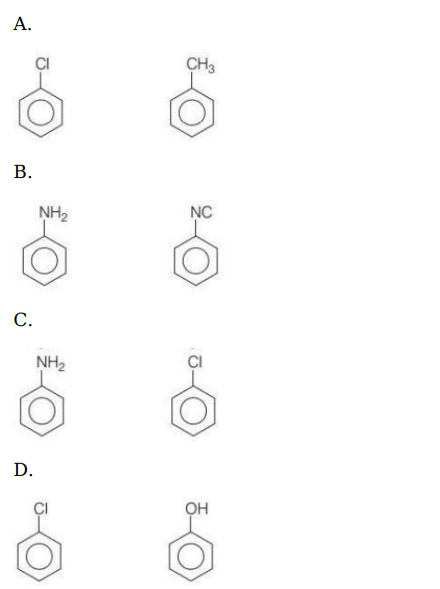
Identify the product formed in the given reaction.


Correct Answer: (B) 
View Solution

Question 99:

Which of the following gas readily de-colourises the acidified KMnO\(_4\) solution?

  • (A) CO\(_2\)
  • (B) SO\(_2\)
  • (C) P\(_2\)O\(_5\)
  • (D) NO\(_2\)
Correct Answer: (B) SO\(_2\)
View Solution

Question 100:

Which of the following gas readily de-colourises the acidified KMnO\(_4\) solution?

  • (A) CO\(_2\)
  • (B) SO\(_2\)
  • (C) P\(_2\)O\(_5\)
  • (D) NO\(_2\)
Correct Answer: (B) SO\(_2\)
View Solution

Question 101:

Which of the following is used to prepare the inner lining of a blast furnace?

  • (A) Graphite bricks
  • (B) Silica bricks
  • (C) Fire clay bricks
  • (D) Basic bricks
Correct Answer: (C) Fire clay bricks
View Solution

Question 102:

What will be the emf of the following cell at 25°C?
\[ Fe \, / \, Fe^{2+}(0.001M) \, || \, H^{+}(0.01M) \, | \, H_2(g) \, (1 \, Bar) \, | \, Pt(s) \]
Given: \[ E_{Fe^{2+} / Fe}^\circ = -0.44V, \quad E_{H^{+} / H_2}^\circ = 0.00V \]

  • (A) 0.44V
  • (B) -0.44V
  • (C) 0.41V
  • (D) -0.41V
Correct Answer: (C) 0.41V
View Solution

Question 103:

Which of the following vitamin is responsible for beri-beri disease?

  • (A) A
  • (B) B\(_1\)
  • (C) K
  • (D) D
Correct Answer: (B) B\(_1\)
View Solution

Question 104:

Find the product formed for the given reaction.
\[ C_6H_5CHO + H_3C-CH_2CHO \xrightarrow{Dil. NaOH/Δ} Product \]

  • (A) C\(_2\)H\(_5\)-CH=CH-CHO
  • (B) C\(_6\)H\(_5\)-CH\(_2\)CH\(_2\)CHO
  • (C) C\(_6\)H\(_5\)-CH\(_2\)-C\(_2\)CHO
  • (D) C\(_6\)H\(_5\)-CH=CH-CHO
Correct Answer: (D) C\(_6\)H\(_5\)-CH=CH-CHO
View Solution

Question 105:

In which of the following changes, entropy decreases?

  • (A) Rusting of iron
  • (B) Melting of ice
  • (C) Vaporisation of camphor
  • (D) Crystallisation of sucrose from solution
Correct Answer: (D) Crystallisation of sucrose from solution
View Solution

Question 106:

Which of the following is added to soaps to impart antiseptic properties?

  • (A) Iodine
  • (B) Furacine
  • (C) Bithiol
  • (D) Terpineol
Correct Answer: (C) Bithiol
View Solution

Question 107:

Which among the following will not liberate nitrogen on reaction with nitrous acid?

  • (A) Dimethylamine
  • (B) 2-aminopropane
  • (C) Ethylamine
  • (D) Methylamine
Correct Answer: (A) Dimethylamine
View Solution

Question 108:

The complex which does not show optical isomerism is

  • (A) cis-[Co(en)\(_2\)Cl\(_2\)]Cl
  • (B) cis-[CrCl\(_2\)(ox)\(_2\)]\(^{3-}\)
  • (C) cis-[CoCl\(_2\)(en)\(_2\)]\(^{2+}\)
  • (D) cis-[Co(NH\(_3\))\(_4\)Cl\(_2\)]\(^{+}\)
Correct Answer: (D) cis-[Co(NH\(_3\))\(_4\)Cl\(_2\)]\(^{+}\)
View Solution

Question 109:

What will be the density of \( N_2 \) gas at 230°C and 3 atm pressure? (Given \( R = 0.082 \, L atm \, mol^{-1} \, K^{-1} \))

  • (A) 3.41 g/mL
  • (B) 2.03 g/mL
  • (C) 4.30 g/mL
  • (D) 0.27 g/mL
Correct Answer: (B) 2.03 g/mL
View Solution

Question 110:

The solution which has the lowest freezing point is

  • (A) 0.2M K\(_2\)SO\(_4\)
  • (B) 0.2M KCl
  • (C) 0.2M NaNO\(_3\)
  • (D) 0.2M MgSO\(_4\)
Correct Answer: (A) 0.2M K\(_2\)SO\(_4\)
View Solution

Question 111:

Calculate the molar conductance of 0.025M aqueous solution of calcium chloride at 25°C. The specific conductance of calcium chloride is \( 12.04 \times 10^{-2} \, S \, m^{-1} \)

Correct Answer: (D) \( 481.6 \times 10^{-5} \, \text{S} \, \text{m}^2 \, \text{mol}^{-1} \)
View Solution

Question 112:

For the reaction \( 2 N_2O_5 \rightarrow 4 NO_2 + O_2 \). If initial pressure is 100 atm and rate constant \( k \) is \( 3.38 \times 10^{-5} \, s^{-1} \), After 20 min the final pressure of \( N_2O_5 \) will be:

  • (A) 96 atm
  • (B) 50 atm
  • (C) 70 atm
  • (D) 60 atm
Correct Answer: (A) 96 atm
View Solution

Question 113:

The difference between heat capacity at constant pressure and heat capacity at constant volume is

  • (A) \( R \)
  • (B) \( \frac{R}{T} \)
  • (C) \( \frac{R}{V} \)
  • (D) 1
Correct Answer: (A) \( R \)
View Solution

Question 114:

Which of the following gases is responsible for acid rain?

  • (A) Sulphur dioxide and nitrous oxide
  • (B) Sulphur dioxide and carbon monoxide
  • (C) Sulphur dioxide and carbon dioxide
  • (D) Sulphur dioxide and nitrogen oxide
Correct Answer: (D) Sulphur dioxide and nitrogen oxide
View Solution

Question 115:

Which of the following compounds does not exist?

  • (A) \(NC_3\)
  • (B) \(NC_5\)
  • (C) \(SbCl_3\)
  • (D) \(NI_3\)
Correct Answer: (B) \(NC_5\)
View Solution

Question 116:

The major product in the given reaction is

  • (A) toluene
  • (B) p-methyl toluene
  • (C) benzene
  • (D) o-methyl benzene
Correct Answer: (C) benzene
View Solution

Question 117:

The spectrum of He\(^+\) is similar to

  • (A) H
  • (B) Li\(^+\)
  • (C) Na
  • (D) He\(^+\)
Correct Answer: (A) H
View Solution

Question 118:

The Paschen series of hydrogen spectrum lies in which region?

  • (A) UV region
  • (B) IR region
  • (C) Visible region
  • (D) Microwave region
Correct Answer: (B) IR region
View Solution

Question 119:

The oxidation state of nickel in [Ni(CO)_4] is

  • (A) 1
  • (B) 2
  • (C) 3
  • (D) 0
Correct Answer: (D) 0
View Solution

Question 120:

The correct condition for physical adsorption is

  • (A) High T and high p
  • (B) High T and low p
  • (C) Low T and high p
  • (D) T and p do not affect
Correct Answer: (C) Low T and high p
View Solution

Question 121:

The value of \( 3\log_5{5} - 5\log_4{3} \) is

  • (A) 0
  • (B) 1
  • (C) 2
  • (D) 4
Correct Answer: (A) 0
View Solution

Question 122:

If the tangent to the curve \( xy + ax + by = 0 \) at \( (1, 1) \) is inclined at an angle \( \tan^{-1}{2} \) with the X-axis, then

  • (A) \( a = 1, b = 2 \)
  • (B) \( a = 1, b = -2 \)
  • (C) \( a = -1, b = 2 \)
  • (D) \( a = -1, b = -2 \)
Correct Answer: (B) \( a = 1, b = -2 \)
View Solution

Question 123:

If \( \lim_{x \to 0} \frac{(1 + a^3)^x + 8e^{1/x}}{1 + (1 - b^3)^x e^{1/x}} = 2 \), then

  • (A) \( a = 1, b = 2 \)
  • (B) \( a = 1, b = -3^{1/3} \)
  • (C) \( a = 2, b = 3^{1/3} \)
  • (D) None of these
Correct Answer: (B) \( a = 1, b = -3^{1/3} \)
View Solution

Question 124:

If two circles \( (x - 1)^2 + (y - 3)^2 = r^2 \) and \( x^2 + y^2 - 8x + 2y + 8 = 0 \) are given, then

  • (A) \( 2 < r < 8 \)
  • (B) \( r < 2 \)
  • (C) \( r = 2 \)
  • (D) \( r > 2 \)
Correct Answer: (A) \( 2 < r < 8 \)
View Solution

Question 125:

The approximate value of \( (0.007)^{1/3} \) is

  • (A) \( \frac{21}{120} \)
  • (B) \( \frac{23}{120} \)
  • (C) \( \frac{29}{120} \)
  • (D) \( \frac{31}{120} \)
Correct Answer: (B) \( \frac{23}{120} \)
View Solution

Question 126:

The circle \( x^2 + y^2 + 4x - 7y + 12 = 0 \) cuts an intercept on the Y-axis of length

  • (A) 3
  • (B) 4
  • (C) 7
  • (D) 1
Correct Answer: (D) 1
View Solution

Question 127:

Let \( f(x) = a - (x-3)^{8/9} \), then the maxima of \( f(x) \) is

  • (A) 3
  • (B) \( a - 3 \)
  • (C) \( a \)
  • (D) None
Correct Answer: (C) \( a \)
View Solution

Question 128:

If the derivative of the function \( f(x) = \begin{cases} b x^2 + ax + 4; & x \geq -1
a x^2 + b; & x < -1 \end{cases} \) is everywhere continuous, then

  • (A) \( a = 2, b = 3 \)
  • (B) \( a = 3, b = 2 \)
  • (C) \( a = -2, b = -3 \)
  • (D) \( a = -3, b = -2 \)
Correct Answer: (A) \( a = 2, b = 3 \)
View Solution

Question 129:

If \( \lim_{x \to \infty} \left( 1 + \frac{a}{x} + \frac{b}{x^2} \right)^{2x} = e^2 \), then

  • (A) \( a = 1, b = 2 \)
  • (B) \( a = 2, b = 1 \)
  • (C) \( a = 1, b \in \mathbb{R} \)
  • (D) None of these
Correct Answer: (C) \( a = 1, b \in \mathbb{R} \)
View Solution

Question 130:

The point \( (-3, -2) \) lies

  • (A) inside \( S' \) only
  • (B) inside \( S \) only
  • (C) inside \( S \) and \( S' \)
  • (D) outside \( S \) and \( S' \)
Correct Answer: (A) inside \( S' \) only
View Solution

Question 131:

The probability of choosing randomly a number \( c \) from the set \( \{1, 2, 3, \dots, 9\} \) such that the quadratic equation \( x^2 + 4x + c = 0 \) has real roots, is

  • (A) \( \frac{1}{9} \)
  • (B) \( \frac{2}{9} \)
  • (C) \( \frac{3}{9} \)
  • (D) \( \frac{4}{9} \)
Correct Answer: (D) \( \frac{4}{9} \)
View Solution

Question 132:

Shade the feasible region for the inequalities
\( 6x + 4y \leq 120 \), \( 3x + 10y \leq 180 \), \( x, y \geq 0 \) in a rough figure.

  • (A)
  • (B)
  • (C)
  • (D)
Correct Answer: (B)
View Solution

Question 133:

The maximum of \( Z \) is where, \( Z = 4x + 2y \) subject to constraints \[ 4x + 2y \geq 46, \quad x + 3y \leq 24, \quad x, y \geq 0 \]

  • (A) 46
  • (B) 96
  • (C) 52
  • (D) None of these
Correct Answer: (B) 96
View Solution

Question 134:

If for any \( 2 \times 2 \) square matrix \( A \), \( A(adj A) = \begin{bmatrix} 8 & 0
0 & 8 \end{bmatrix} \), then find the value of det(A).

  • (A) 6
  • (B) 7
  • (C) 8
  • (D) 5
Correct Answer: (C) 8
View Solution

Question 135:

If \( A = \begin{bmatrix} a & 0 & 0
0 & a & 0
0 & 0 & a \end{bmatrix} \), then \( |A| \cdot adj(A) \) is equal to:

  • (A) \( a^{3n} \)
  • (B) \( a^{-3n} \)
  • (C) \( -a^{3n} \)
  • (D) \( 2a^{3n} \)
Correct Answer: (A) \( a^{3n} \)
View Solution

Question 136:

If \( A = \begin{bmatrix} 2 - k & 2
1 & 3 - k \end{bmatrix} \) is a singular matrix, then the value of \( 5k - k^2 \) is:

  • (A) 0
  • (B) 6
  • (C) -6
  • (D) 4
Correct Answer: (D) 4
View Solution

Question 137:

If \( \theta \) be the angle between the vectors \( a = 2\hat{i} + 2\hat{j} - \hat{k} \) and \( b = 6\hat{i} - 3\hat{j} + 2\hat{k} \), then

  • (A) \( \cos \theta = \frac{4}{21} \)
  • (B) \( \cos \theta = \frac{3}{19} \)
  • (C) \( \cos \theta = \frac{2}{19} \)
  • (D) \( \cos \theta = \frac{5}{21} \)
Correct Answer: (A) \( \cos \theta = \frac{4}{21} \)
View Solution

Question 138:

If \( x, y \) and \( z \) are non-zero real numbers and \( a = x\hat{i} + 2\hat{j}, b = y\hat{j} + 3\hat{k} \) and \( c = x\hat{i} + y\hat{j} + z\hat{k} \) are such that \( a \times b = z\hat{i} - 3\hat{j} + \hat{k} \), then \( [abc] \) is equal to

  • (A) 3
  • (B) 10
  • (C) 9
  • (D) 6
Correct Answer: (C) 9
View Solution

Question 139:

Maximum value of \( z = 12x + 3y \), subject to constraints \( x \geq 0, y \geq 0, x + y \leq 5 \) and \( 3x + y \leq 9 \) is

  • (A) 15
  • (B) 36
  • (C) 60
  • (D) 40
Correct Answer: (B) 36
View Solution

Question 140:

If \( p = \hat{i} + \hat{j}, q = 4\hat{k} - \hat{j} \) and \( r = \hat{i} + \hat{k} \), then the unit vector in the direction of \( 3p + q - 2r \) is

  • (A) \( \frac{1}{3} (\hat{i} + 2\hat{j} + 2\hat{k}) \)
  • (B) \( \frac{1}{3} (\hat{i} - 2\hat{j} - 2\hat{k}) \)
  • (C) \( \frac{1}{3} (\hat{i} - 2\hat{j} + 2\hat{k}) \)
  • (D) \( \hat{i} + 2\hat{j} + 2\hat{k} \)
Correct Answer: (A) \( \frac{1}{3} (\hat{i} + 2\hat{j} + 2\hat{k}) \)
View Solution

Question 141:

The line \( \frac{x-3}{4} = \frac{y-4}{5} = \frac{z-5}{6} \) is parallel to the plane.

  • (A) \( 3x + 4y + 5z = 7 \)
  • (B) \( x + y + z = 2 \)
  • (C) \( x - 2y + z = 0 \)
  • (D) \( 2x + 3y + 4z = 0 \)
Correct Answer: (C) \( x - 2y + z = 0 \)
View Solution

Question 142:

Evaluate the integral \( \int \frac{1}{x \sqrt{ax^2 - x^2}} \, dx \)

  • (A) \( -\frac{3}{a} \sqrt{\frac{a - x}{x}} + C \)
  • (B) \( -\frac{2}{a} \sqrt{\frac{x}{a - x}} + C \)
  • (C) \( -\frac{2}{a} \sqrt{\frac{a - x}{x}} + C \)
  • (D) None of these
Correct Answer: (C) \( -\frac{2}{a} \sqrt{\frac{a - x}{x}} + C \)
View Solution

Question 143:

Evaluate the integral \( 3 \int \frac{3^x}{\sqrt{1 - 9^x}} \, dx \)

  • (A) \( (\log 3)\sin^{-1}(3^x) + C \)
  • (B) \( \frac{1}{3} \sin^{-1}(3^x) + C \)
  • (C) \( \frac{1}{\log 3} \sin^{-1}(3^x) + C \)
  • (D) \( 3 \log 3 \sin^{-1}(3^x) + C \)
Correct Answer: (C) \( \frac{1}{\log 3} \sin^{-1}(3^x) + C \)
View Solution

Question 144:

Evaluate the integral \( \int_{-\frac{\pi}{2}}^{\frac{\pi}{2}} \cos x \, dx \)

  • (A) 2
  • (B) 0
  • (C) -1
  • (D) 5
Correct Answer: (A) 2
View Solution

Question 145:

The angle between the lines \( \frac{x+4}{3} = \frac{y-1}{5} = \frac{z+3}{4} \) and \( \frac{x+1}{1} = \frac{y-4}{1} = \frac{z-5}{2} \)

  • (A) 30°
  • (B) \( \cos^{-1} \left( \frac{3}{2\sqrt{2}} \right) \)
  • (C) \( \cos^{-1} \left( \frac{8}{5\sqrt{3}} \right) \)
  • (D) None of these
Correct Answer: (C) \( \cos^{-1} \left( \frac{8}{5\sqrt{3}} \right) \)
View Solution

Question 146:

The point of intersection of the lines \( \frac{x - 1}{1} = \frac{y - 1}{2} = \frac{z - 2}{3} \) and \( \frac{x - 5}{2} = \frac{y - 2}{1} = \frac{z - 5}{2} \)

  • (A) \( (1, -2, 0) \)
  • (B) \( (3, 1, 0) \)
  • (C) \( (-2, -5, -7) \)
  • (D) None of these
Correct Answer: (D) None of these
View Solution

Question 147:

Five persons A, B, C, D and E are in queue at a shop. The probability that A and B are always together is.

  • (A) \( \frac{2}{5} \)
  • (B) \( \frac{1}{4} \)
  • (C) \( \frac{3}{5} \)
  • (D) \( \frac{2}{3} \)
Correct Answer: (A) \( \frac{2}{5} \)
View Solution

Question 148:

If the probability for A to fail in an examination is 0.2 and that for B is 0.3, then the probability that either A or B fail is.

  • (A) 0.38
  • (B) 0.44
  • (C) 0.50
  • (D) 0.94
Correct Answer: (B) 0.44
View Solution

Question 149:

Three vertices are chosen randomly from the seven vertices of a regular 7-sided polygon. The probability that they form the vertices of an isosceles triangle is.

  • (A) \( \frac{1}{7} \)
  • (B) \( \frac{1}{3} \)
  • (C) \( \frac{3}{7} \)
  • (D) \( \frac{3}{5} \)
Correct Answer: (D) \( \frac{3}{5} \)
View Solution

Question 150:

If A, B, and C are three mutually exclusive and exhaustive events such that \( P(A) = 2P(B) = 3P(C) \). What is \( P(B) \)?

  • (A) \( \frac{6}{11} \)
  • (B) \( \frac{6}{22} \)
  • (C) \( \frac{1}{6} \)
  • (D) \( \frac{1}{3} \)
Correct Answer: (B) \( \frac{6}{22} \)
View Solution

Question 151:

If \( U_{n+1} = 3U_n - 2U_{n-1} \) and \( U_0 = 2, U_1 = 3 \), then \( U_n \) is equal to

  • (1) \( 1 - 2^n \)
  • (2) \( 2^n + 1 \)
  • (3) \( 2^n - 1 \)
  • (4) \( 2^n + 2 \)
Correct Answer: (2) \( 2^n + 1 \)
View Solution

Question 152:

If \( 4^n + 15n + P \) is divisible by 9 for all \( n \in \mathbb{N} \), then the least negative integral value of \( P \) is

  • (1) -1
  • (2) -2
  • (3) -3
  • (4) -4
Correct Answer: (1) -1
View Solution

Question 153:

\( (2^{3n} - 1) \) is divisible by

  • (1) 6
  • (2) 7
  • (3) 8
  • (4) 9
Correct Answer: (2) 7
View Solution

Question 154:

If \( S = \frac{2^2 - 1}{2} + \frac{3^2 - 2}{6} + \frac{4^2 - 3}{12} + \ldots\) \text{ upto 10 terms, then S is equal to

  • (1) \( \frac{120}{11} \)
  • (2) \( \frac{13}{11} \)
  • (3) \( \frac{110}{11} \)
  • (4) \( \frac{19}{11} \)
Correct Answer: (1) \( \frac{120}{11} \)
View Solution

Question 155:

\( \sum_{n=1}^{m} n \cdot n! \) is equal to

  • (1) \( m! - 1 \)
  • (2) \( (m - 1)! - 1 \)
  • (3) \( (m + 1)! - 1 \)
  • (4) \( m! (m - 1)! \)
Correct Answer: (3) \( (m + 1)! - 1 \)
View Solution

Question 156:

The first and fifth terms of an A.P. are -14 and 2 respectively and the sum of its \(n\) terms is 40. The value of \(n\) is

  • (1) 8
  • (2) 12
  • (3) 10
  • (4) 13
Correct Answer: (3) 10
View Solution

Question 157:

The solution of the differential equation \( \frac{d^2y}{dx^2} = 0 \) represents

  • (1) all circles in a plane
  • (2) all straight lines in a plane
  • (3) all parabolas in a plane
  • (4) all ellipses in a plane
Correct Answer: (2) all straight lines in a plane
View Solution

Question 158:

The solution of the differential equation \( \frac{dy}{dx} + \sqrt{\frac{1 - y^2}{1 - x^2}} = 0 \) is

  • (1) \( \cos^{-1}x + \cos^{-1}y = c \)
  • (2) \( \sin^{-1}x + \sin^{-1}y = c \)
  • (3) \( \cosh^{-1}x + \cosh^{-1}y = c \)
  • (4) \( \sinh^{-1}x + \sinh^{-1}y = c \)
Correct Answer: (2) \( \sin^{-1}x + \sin^{-1}y = c \)
View Solution

Question 159:

The solution of the differential equation \( x \frac{dy}{dx} = \cot y \) is

  • (1) \( y \cos x = c \)
  • (2) \( x \cos y = c \)
  • (3) \( \log(x \cos y) = c \)
  • (4) \( \log(y \cos x) = c \)
Correct Answer: (2) \( x \cos y = c \)
View Solution

Question 160:

If \( ^nC_3 = 220 \), then \( n = \ ? \)

  • (1) 11
  • (2) 12
  • (3) 10
  • (4) 9
Correct Answer: (2) 12
View Solution

Question 161:

A multiple choice examination has 5 questions. Each question has three alternative answers of which exactly one is correct. The probability that a student will get 4 or more correct answers just by guessing is

  • (A) \( \frac{13}{3^5} \)
  • (B) \( \frac{11}{3^5} \)
  • (C) \( \frac{10}{3^5} \)
  • (D) \( \frac{17}{3^5} \)
Correct Answer: (B) \( \frac{11}{243} \)
View Solution

Question 162:

If \( \sin A + \sin B = a \) and \( \cos A + \cos B = b \), then \( \cos(A + B) \) equals?

  • (A) \( \frac{a^2 + b^2}{b^2 - a^2} \)
  • (B) \( \frac{2ab}{a^2 + b^2} \)
  • (C) \( \frac{b^2 - a^2}{a^2 + b^2} \)
  • (D) \( \frac{a^2 - b^2}{a^2 + b^2} \)
Correct Answer: (C) \( \frac{b^2 - a^2}{a^2 + b^2} \)
View Solution

Question 163:

What is \( \frac{\cos \theta}{1 - \tan \theta} + \frac{\sin \theta}{1 - \cot \theta} \) equal to?

  • (A) \( \sin \theta - \cos \theta \)
  • (B) \( 2 \sin \theta \)
  • (C) \( \sin \theta + \cos \theta \)
  • (D) \( 2 \cos \theta \)
Correct Answer: (C) \( \sin \theta + \cos \theta \)
View Solution

Question 164:

Find the general solution of \( \sin 2x + \cos x = 0 \).

  • (A) \( (n \pm 1)\frac{\pi}{2} \)
  • (B) \( n\pi \pm \frac{\pi}{2} \)
  • (C) \( n\pi + (-1)^n \frac{7\pi}{6} \) or \( (2n + 1)\frac{\pi}{2} \)
  • (D) None of the above
Correct Answer: (C) \( n\pi + (-1)^n \frac{7\pi}{6} \) or \( (2n + 1)\frac{\pi}{2} \)
View Solution

Question 165:

If \( f(x) + 2f(1 - x) = x^2 + 5 \) for all real values of \( x \), then \( f(x) \) is given by:

  • (A) \( x^2 - 5 \)
  • (B) \( 2 \)
  • (C) \( \frac{(x - 2)^2 + 3}{3} \)
  • (D) None of these
Correct Answer: (C) \( \frac{(x - 2)^2 + 3}{3} \)
View Solution

Question 166:

If \(A = \{3, 5, 7\}\) and \(B = \{1, 2, 3, 5\}\), then \(A \times B \cap B \times A\) is equal to

  • (A) \(\{(3, 3), (5, 3), (2, 7), (7, 2)\}\)
  • (B) \(\{(3, 3), (3, 5), (5, 3), (5, 5)\}\)
  • (C) \(\{(3, 3), (5, 5)\}\)
  • (D) \(\{(3, 5), (5, 5), (5, 3)\}\)
Correct Answer: (B) \(\{(3, 3), (3, 5), (5, 3), (5, 5)\}\)
View Solution

Question 167:

Total number of elements in the power set of a set \(A\) containing 17 elements is

  • (A) \(2^{17+1}\)
  • (B) \(2^{17 - 1}\)
  • (C) \(17^2 - 1\)
  • (D) \(2^{17}\)
Correct Answer: (D) \(2^{17}\)
View Solution

Question 168:

The argument of \(\dfrac{1 - i\sqrt{3}}{1 + i\sqrt{3}}\) is

  • (A) \(\dfrac{\pi}{3}\)
  • (B) \(\dfrac{2\pi}{3}\)
  • (C) \(\dfrac{4\pi}{3}\)
  • (D) \(-\dfrac{2\pi}{3}\)
Correct Answer: (D) \(-\dfrac{2\pi}{3}\)
View Solution

Question 169:

Evaluate \(\left[i^{22} + \left(\dfrac{1}{i}\right)^{25}\right]^3\)

  • (A) \(4(i - 1)\)
  • (B) \(2 - 7i\)
  • (C) \(i - 1\)
  • (D) \(2(1 - i)\)
Correct Answer: (D) \(2(1 - i)\)
View Solution

Question 170:

\((i + \sqrt{3})^{100} + (i - \sqrt{3})^{100} + 2^{100}\) is equal to

  • (A) 0
  • (B) 1
  • (C) -1
  • (D) \(2^{101}\)
Correct Answer: (A) 0
View Solution

Question 171:

There are 12 points in a plane out of which 3 points are collinear. How many straight lines can be drawn by joining any two of them?

  • (1) 60
  • (2) 64
  • (3) 72
  • (4) 84
Correct Answer: (2) 64
View Solution

Question 172:

How many numbers greater than 50000 can be formed by using digits 2, 5, 5, 6, 7?

  • (1) 60
  • (2) 48
  • (3) 52
  • (4) 42
Correct Answer: (2) 48
View Solution

Question 173:

A regular polygon of \( n \) sides has 170 diagonals. Then \( n \) is equal to:

  • (1) -20
  • (2) -17
  • (3) 24
  • (4) 20
Correct Answer: (4) 20
View Solution

Question 174:

The equation of the pair of angle bisectors of the line \( x^2 - 4xy - 5y^2 = 0 \) is:

  • (1) \( x^2 - 3xy + y^2 = 0 \)
  • (2) \( x^2 + 4xy - y^2 = 0 \)
  • (3) \( x^2 + 3xy - y^2 = 0 \)
  • (4) \( x^2 - 3xy - y^2 = 0 \)
Correct Answer: (3) \( x^2 + 3xy - y^2 = 0 \)
View Solution

Question 175:

The distance of point \( (1, 2) \) from line \( x + y + 2 = 0 \) measured along the line parallel to \( 2x - y = 5 \) is equal to:

  • (1) \( \frac{125}{3} \)
  • (2) \( \frac{125}{\sqrt{3}} \)
  • (3) \( \frac{5\sqrt{5}}{3} \)
  • (4) \( \frac{5\sqrt{3}}{3} \)
Correct Answer: (3) \( \frac{5\sqrt{5}}{3} \)
View Solution

Question 176:

The slope of lines which makes an angle \( 45^\circ \) with the line \( 2x - y = -7 \)

  • (1) \( \frac{1}{3}, -3 \)
  • (2) \( -1, 1 \)
  • (3) \( 3, -\frac{1}{3} \)
  • (4) \( 1, \frac{1}{3} \)
Correct Answer: (1) \( \frac{1}{3}, -3 \)
View Solution

Question 177:

If 2 and 3 are intercepts of a line \( L = 0 \), then the distance of \( L \equiv 0 \) from the origin is

  • (1) \( \frac{5}{\sqrt{13}} \)
  • (2) \( \frac{\sqrt{13}}{6} \)
  • (3) \( \frac{6}{\sqrt{13}} \)
  • (4) \( 1 \)
Correct Answer: (3) \( \frac{6}{\sqrt{13}} \)
View Solution

Question 178:

The total number of terms in the expansion of \( (x + y)^{100} + (x - y)^{100} \)

  • (1) 49
  • (2) 50
  • (3) 51
  • (4) 99
Correct Answer: (3) 51
View Solution

Question 179:

The coefficient of \( x^{20} \) in the expansion of \( (1 + 3x + 3x^2 + x^3)^{20} \)

  • (1) \( \binom{60}{40} \)
  • (2) \( \binom{30}{20} \)
  • (3) \( \binom{15}{2} \)
  • (4) None of these
Correct Answer: (1) \( \binom{60}{40} \)
View Solution

Question 180:

In the expansion of \( (1 - 3x + 3x^2 - x^3)^{2n} \), the middle term is

  • (1) \( (n+1)^th \) term
  • (2) \( (2n+1)^th \) term
  • (3) \( (3n+1)^th \) term
  • (4) None of these
Correct Answer: (3) \( (3n + 1)^\text{th} \) term
View Solution

COMEDK UGET 2022 Paper Analysis

The COMEDK UGET 2022 exam was moderately difficult, with Mathematics being the most difficult. There were 180 questions, with 60 questions each in Physics, Chemistry, and Mathematics. Physics and Chemistry were relatively easier as they had a lot of simple conceptual questions; however, Mathematics was difficult and time-consuming due to the level of difficulty, particularly with Calculus and Coordinate Geometry. Time management was very important due to the time it took to solve moderate-to-difficult Math questions. In summary, students who had studied the core concepts and practiced problems extensively did a better job as the exam was testing both concepts and problems.

Also Check: