




AP PGECET 2026 Chemical Engineering Question Paper is available for download here. Andhra University, Visakhapatnam on behalf of APSCHE conducted AP PGECET 2026 Chemical Engineering exam on April 30 in Shift 1. AP PGECET is a state-level entrance exam conducted online for admission into M.Tech./M.Pharm./Pharm.D (PB) courses.
- AP PGECET Question Paper consists of 120 questions divided into two sections- Mathematics and Engineering Domain Specific.
- Each correct answer answer carries 1 mark and there is no negative marking for incorrect answer.
Candidates can download AP PGECET 2026 Chemical Engineering Question Paper with Answer Key and Solution PDF from the links provided below.
AP PGECET 2026 Chemical Engineering Question Paper with Solutions
| AP PGECET 2026 Chemical Engineering Question Paper | Download PDF | Check Solution |

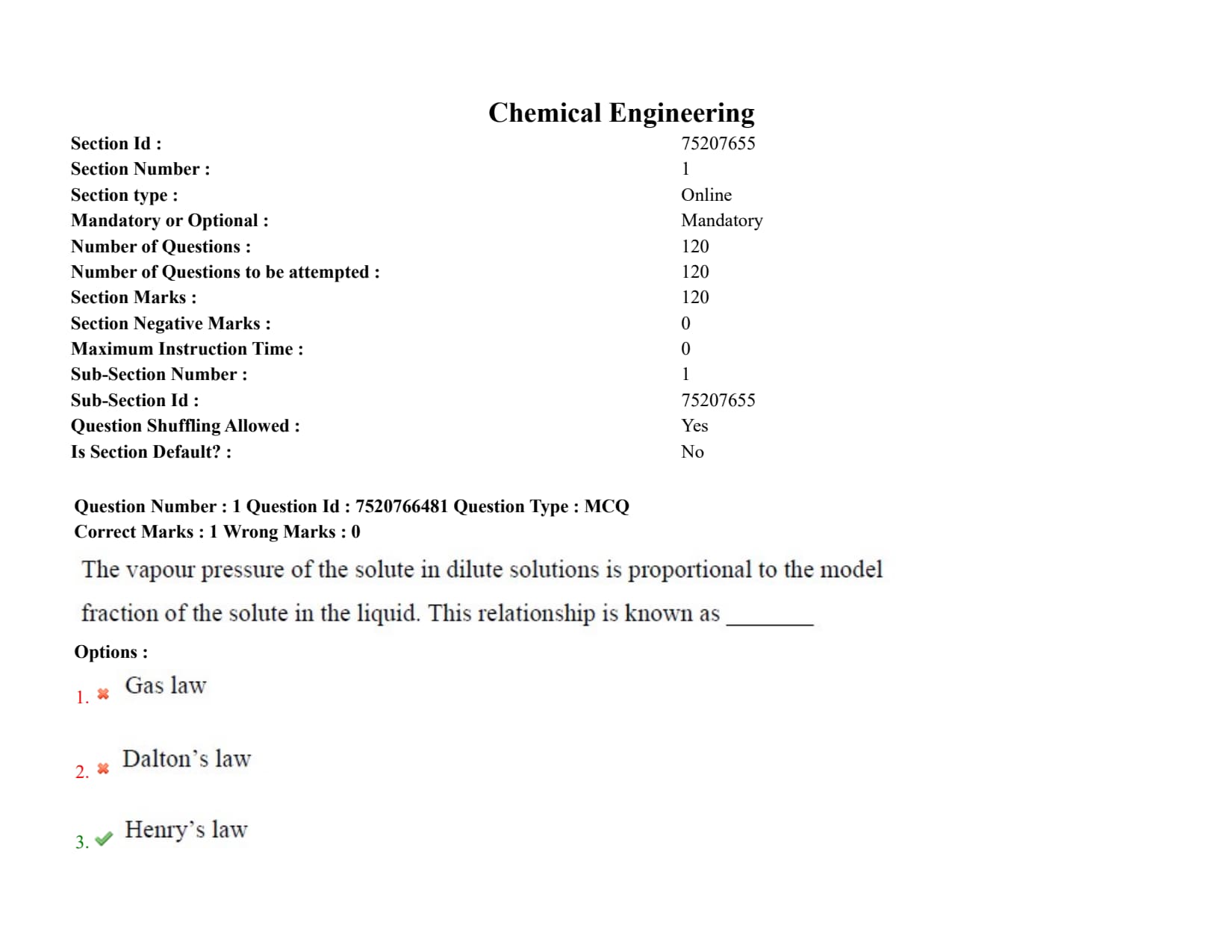
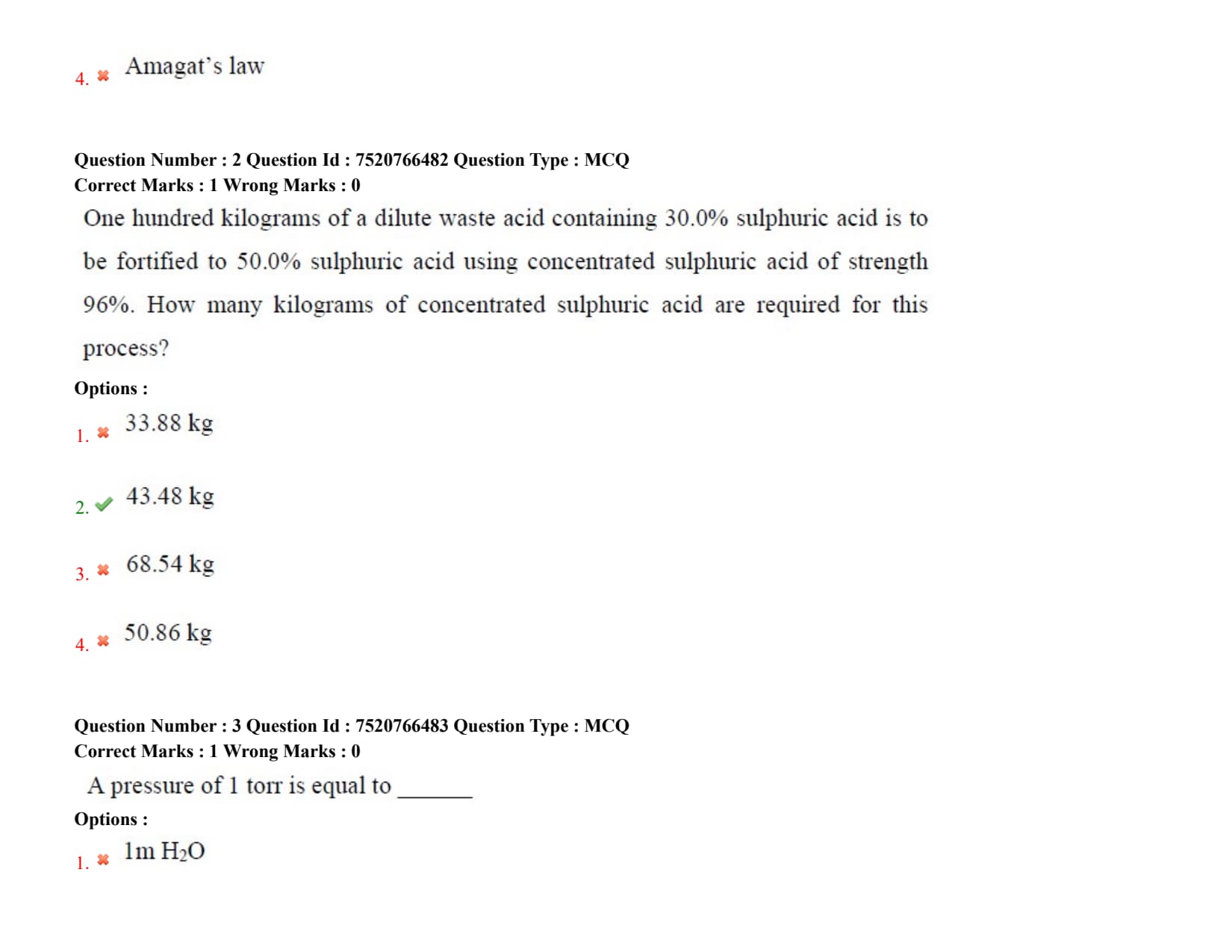
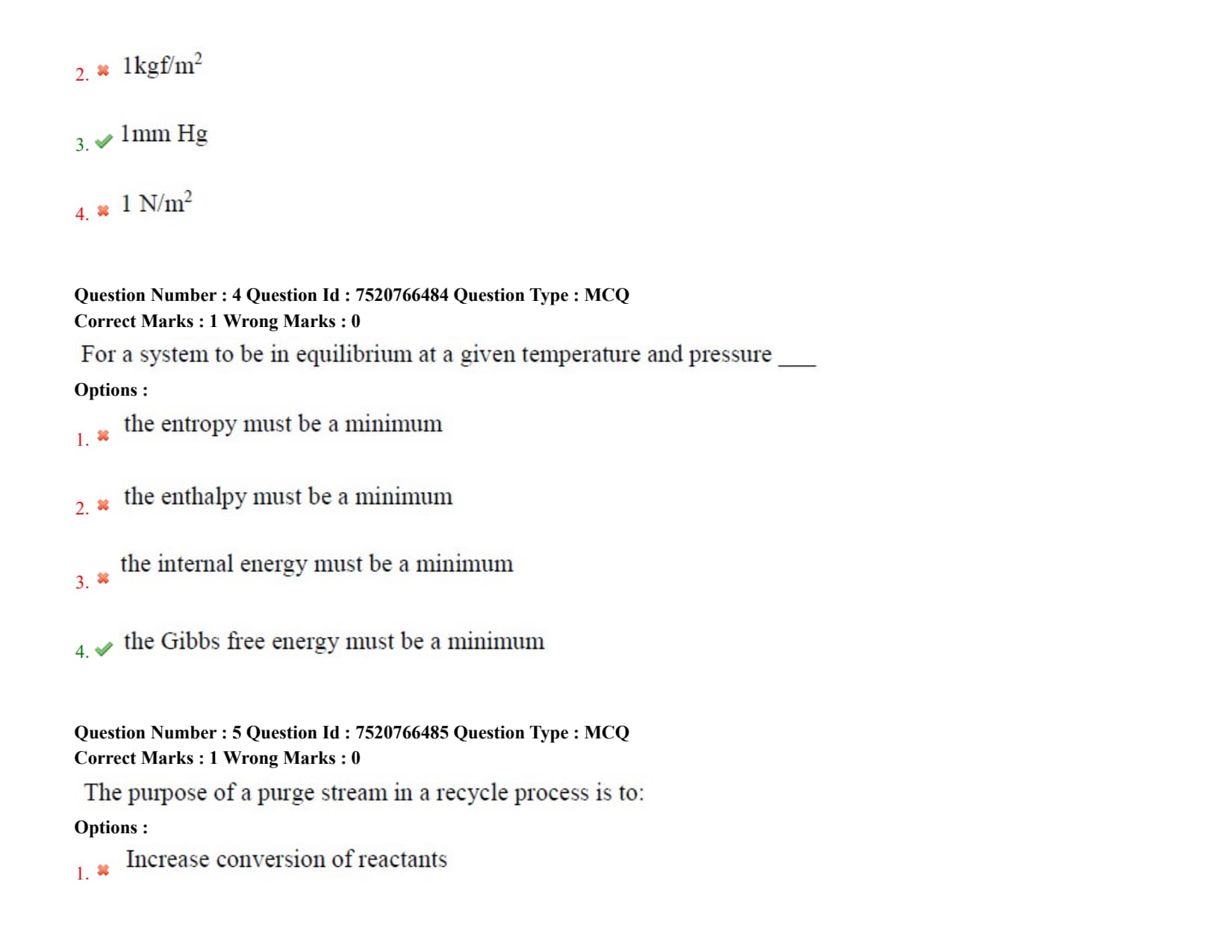
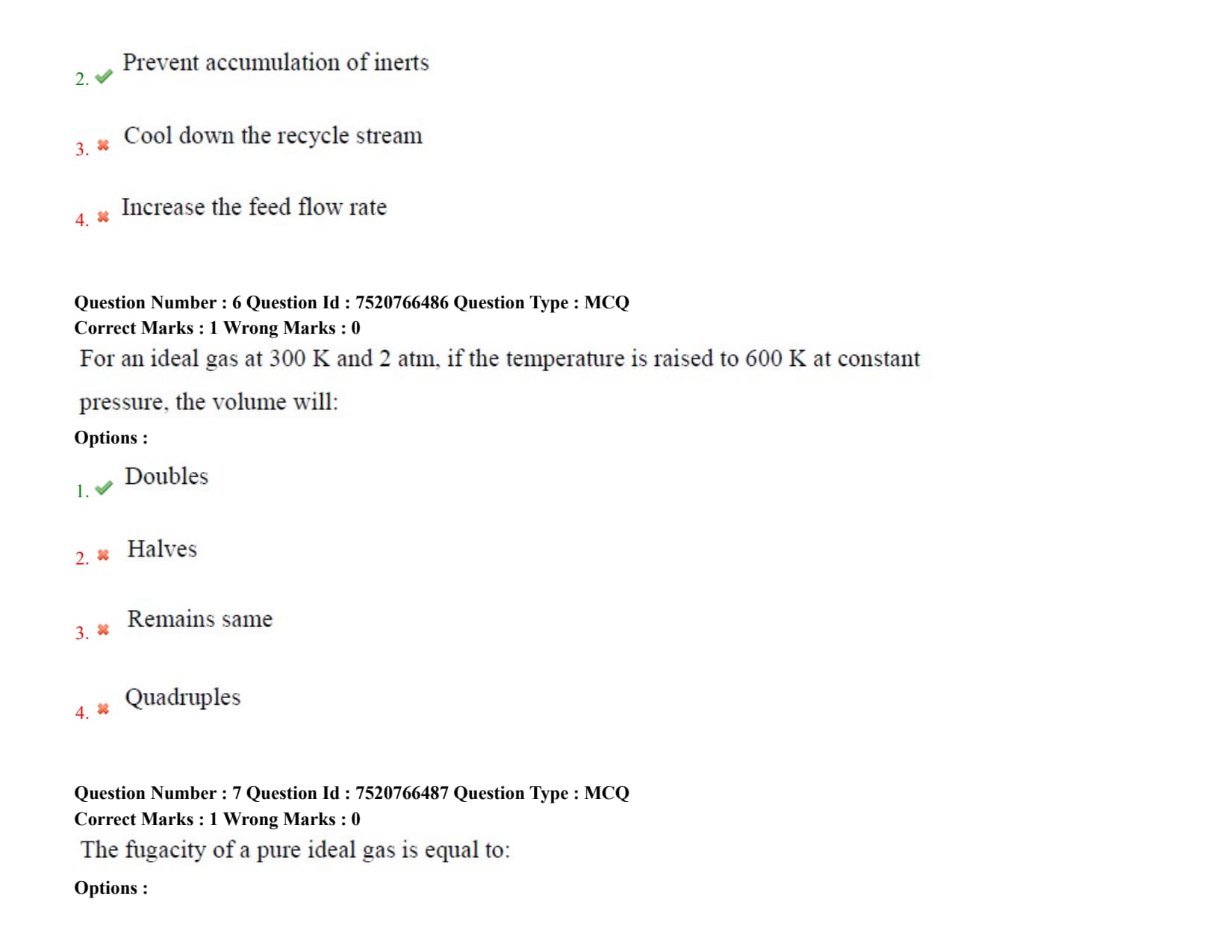
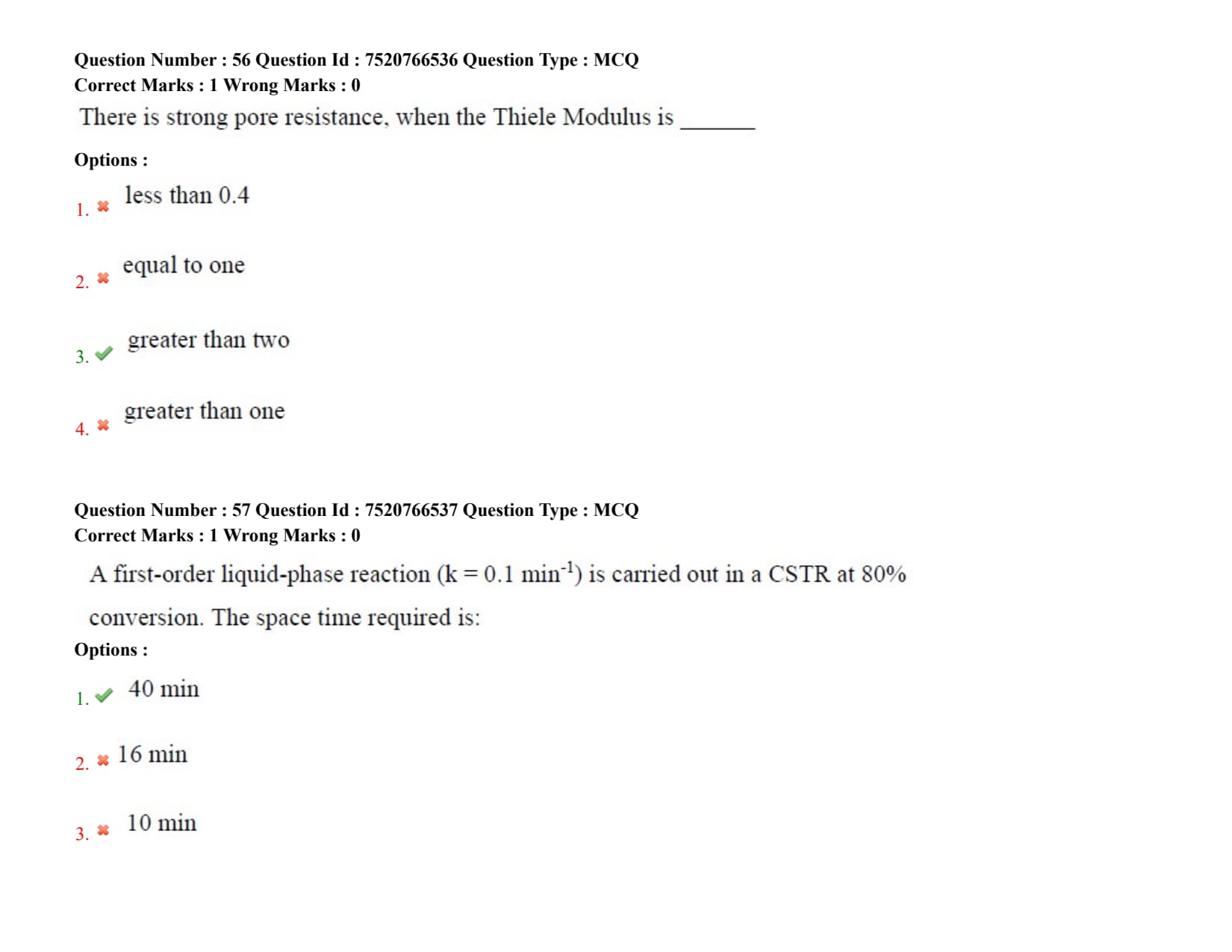
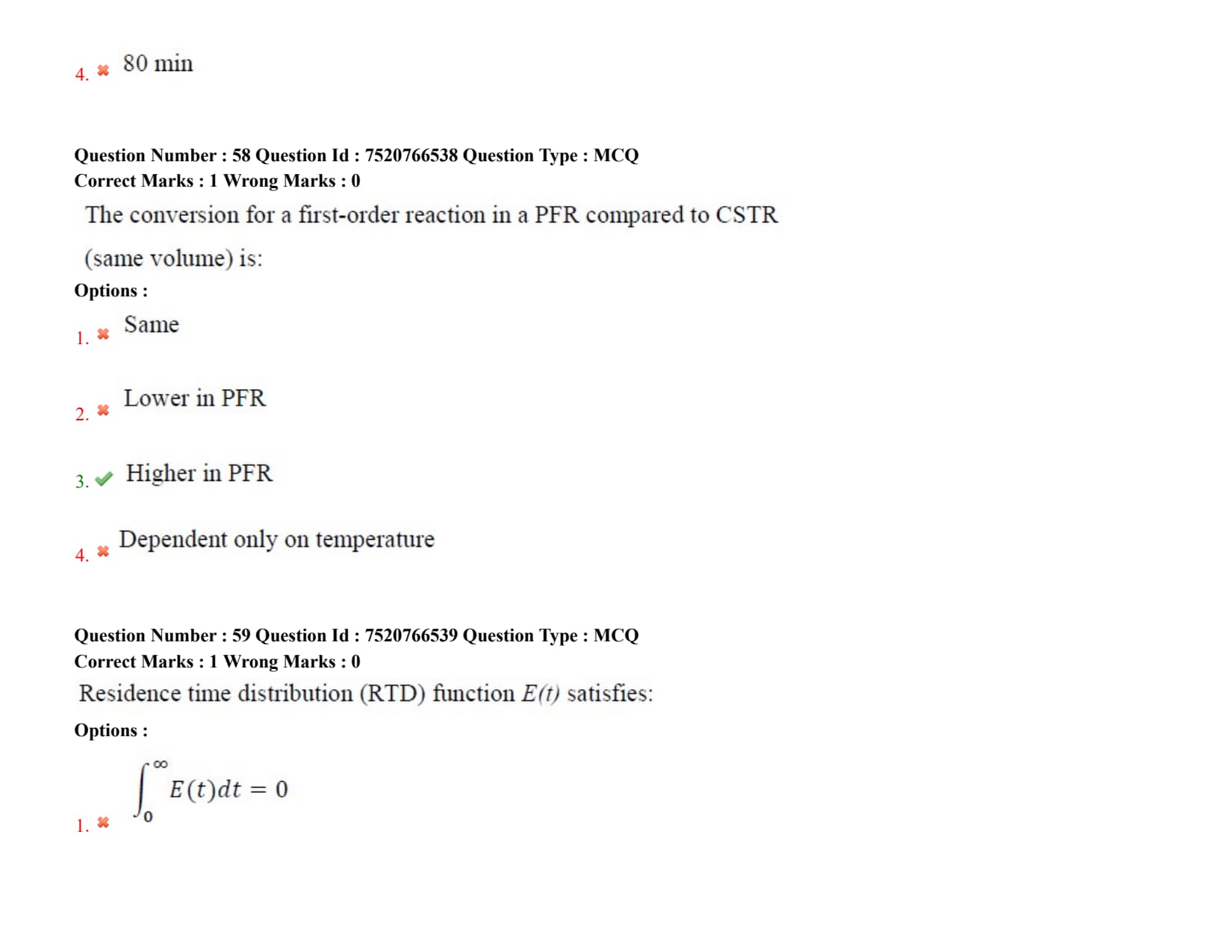
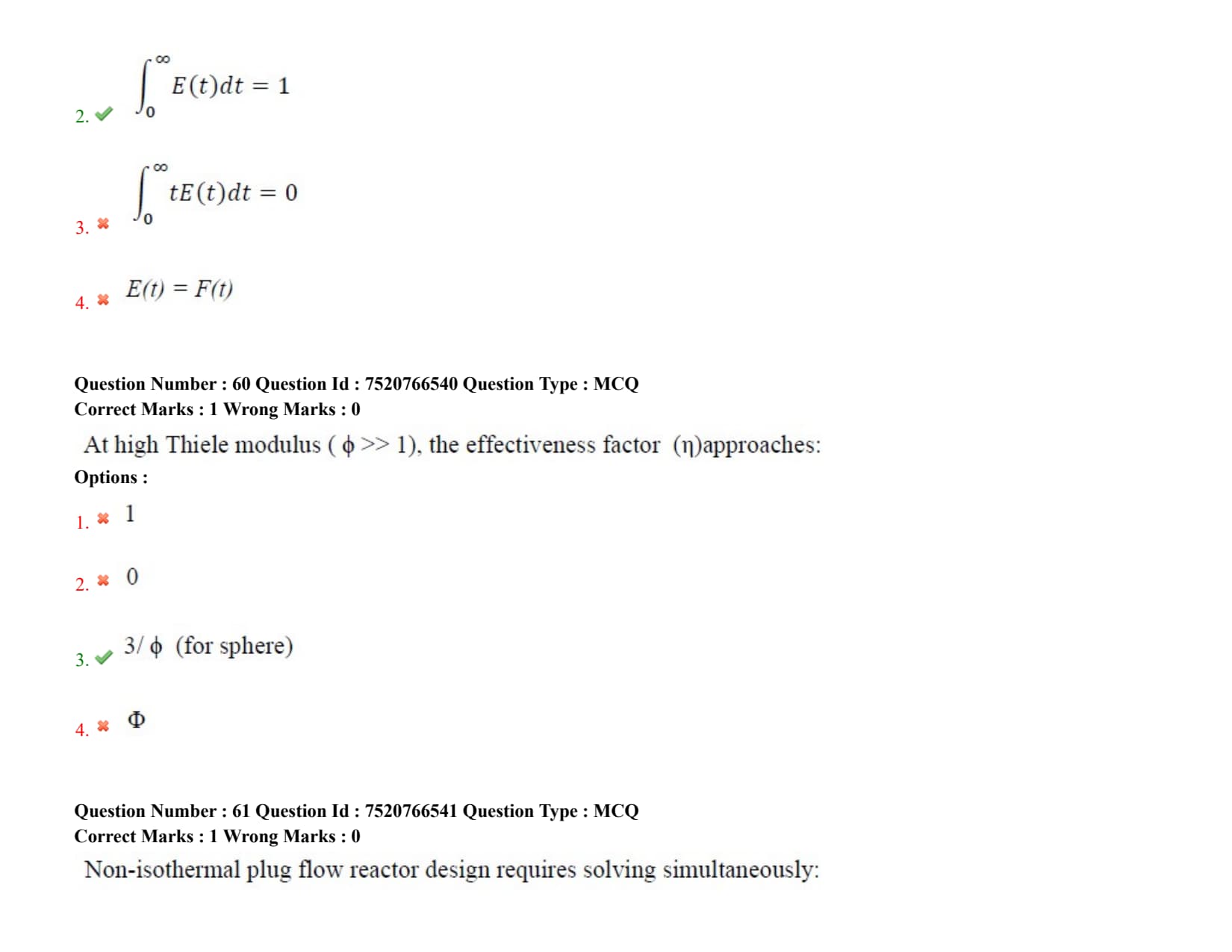
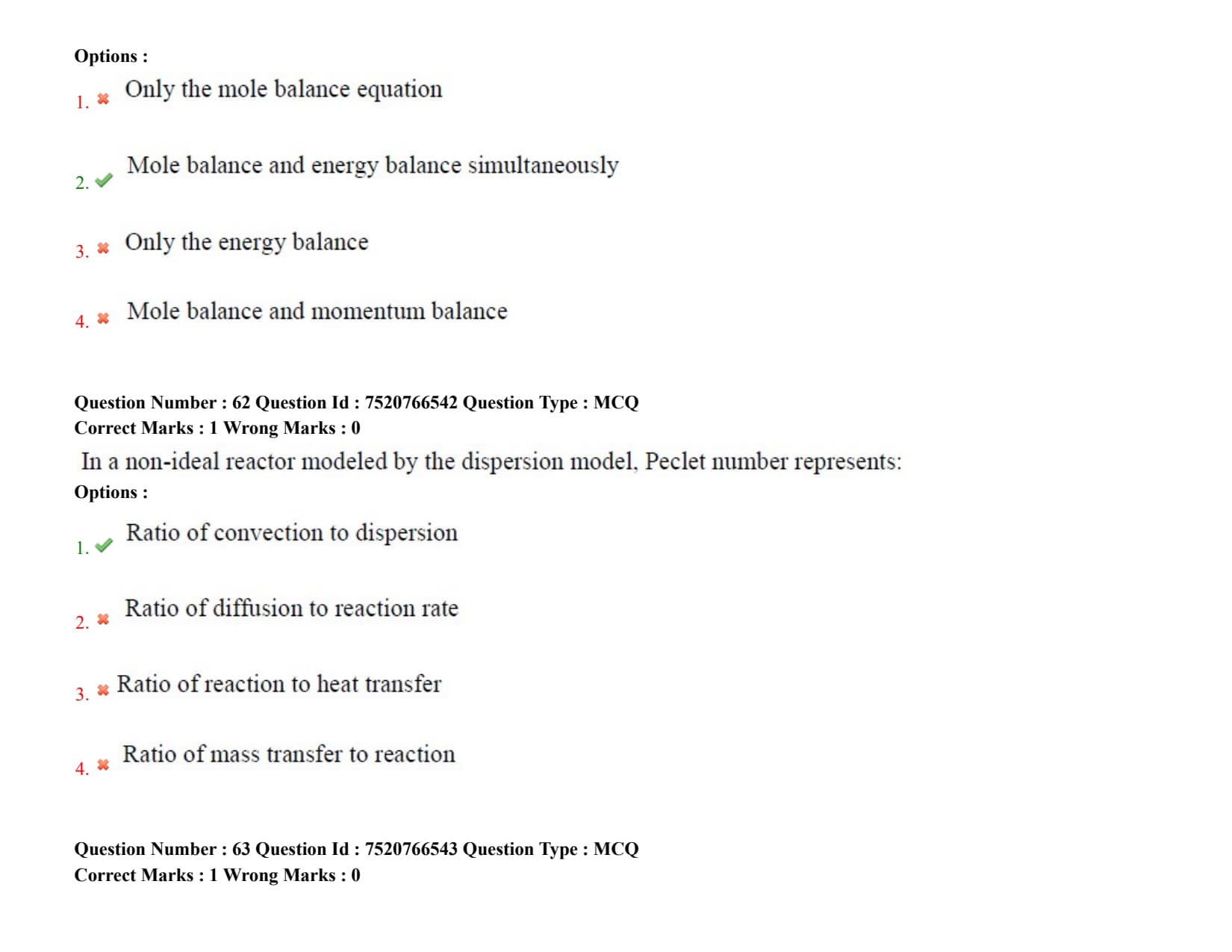
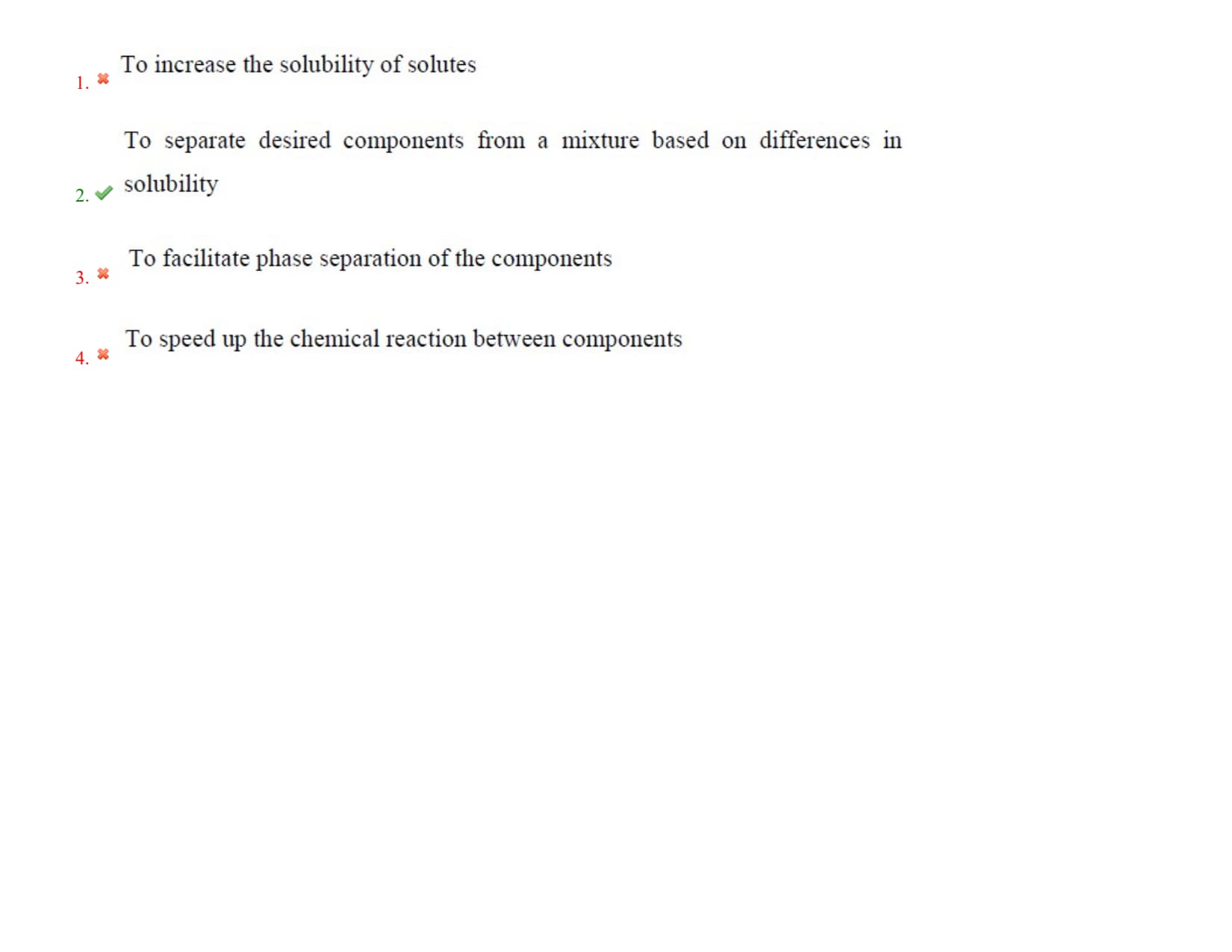
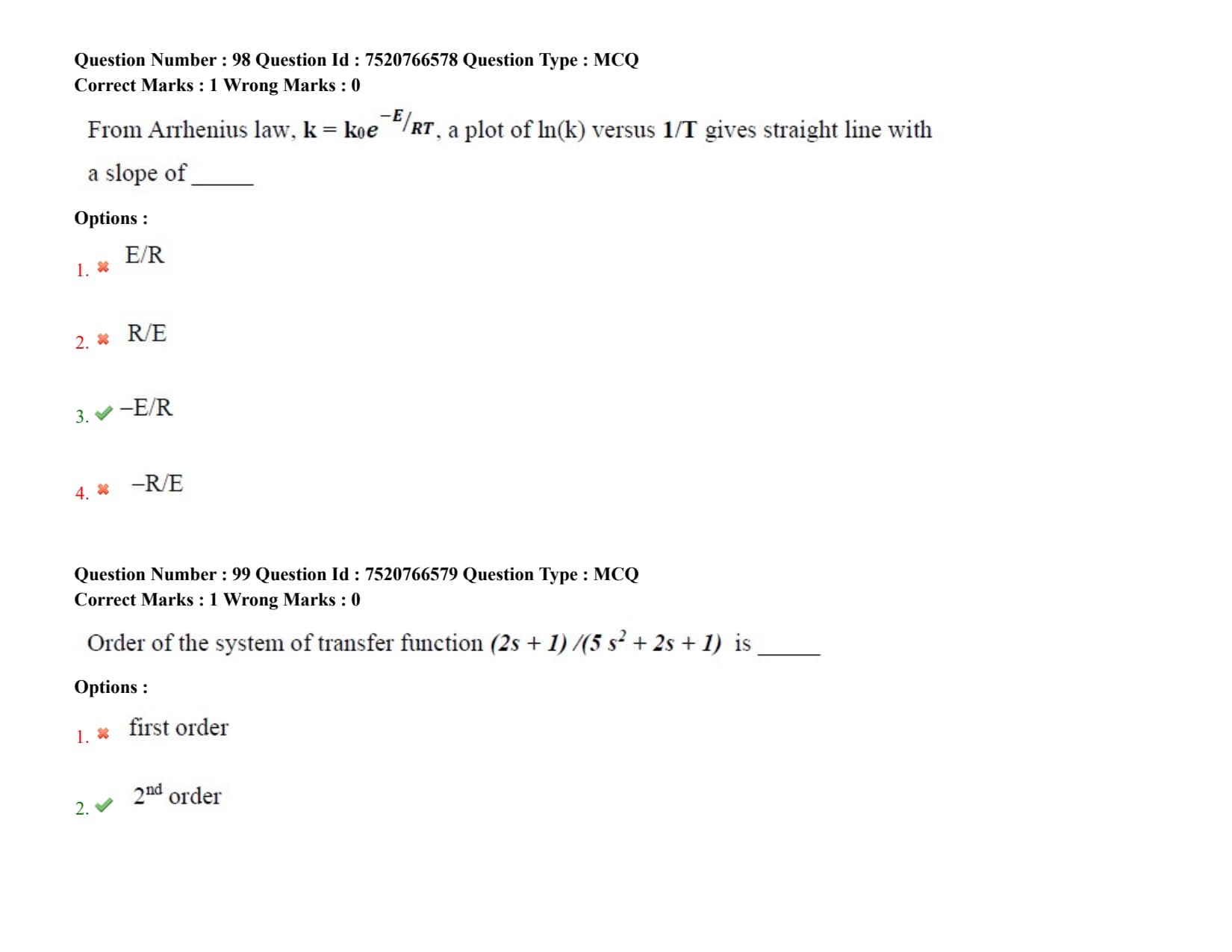
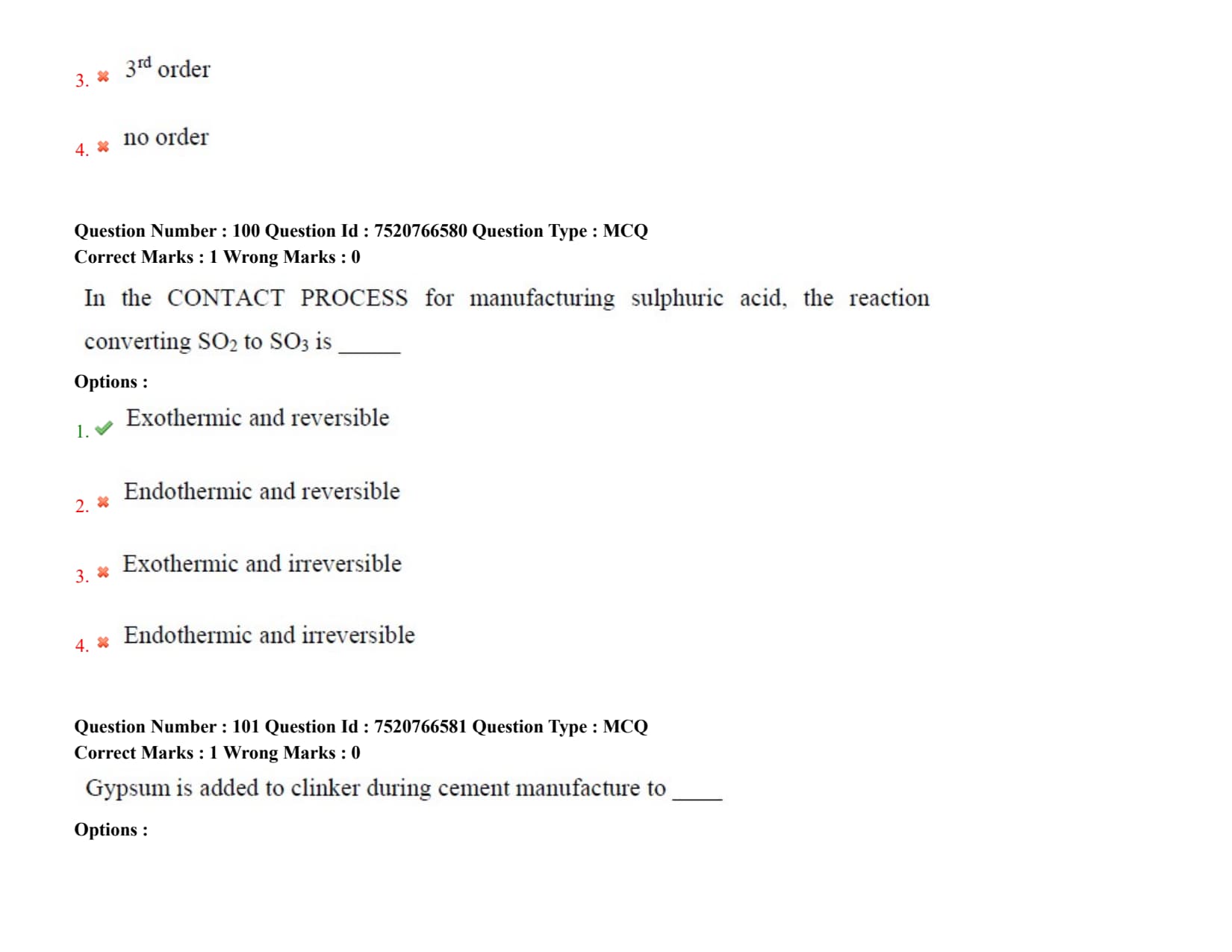
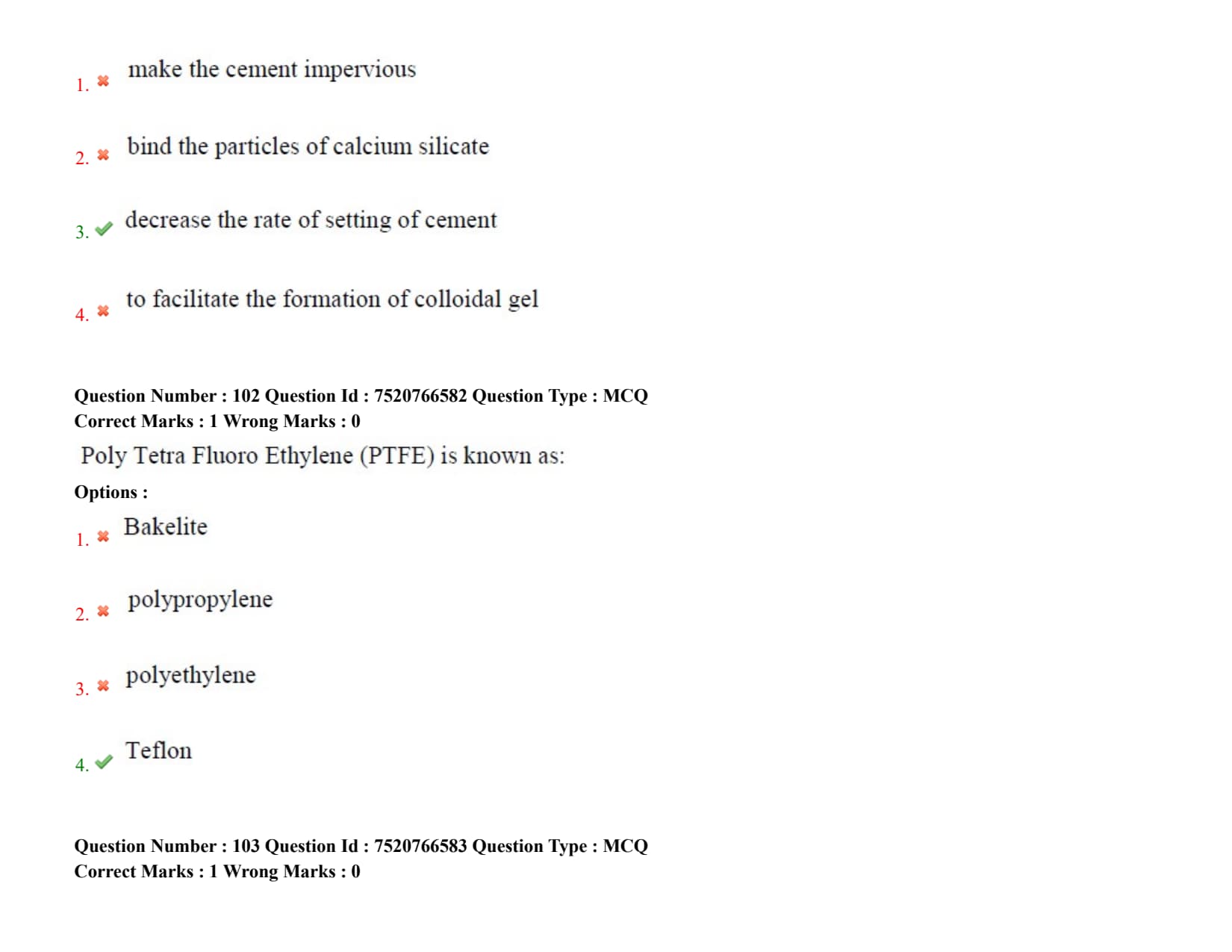
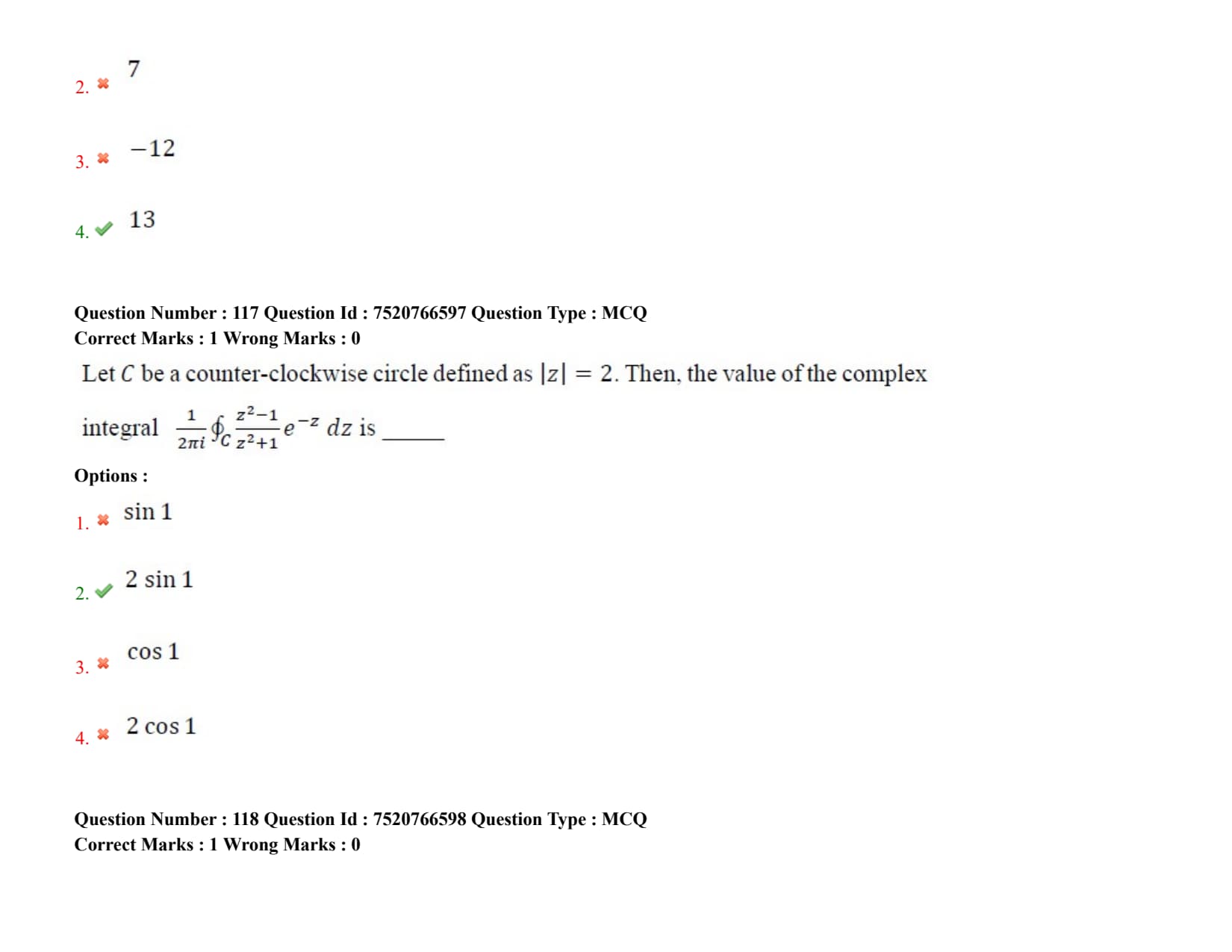
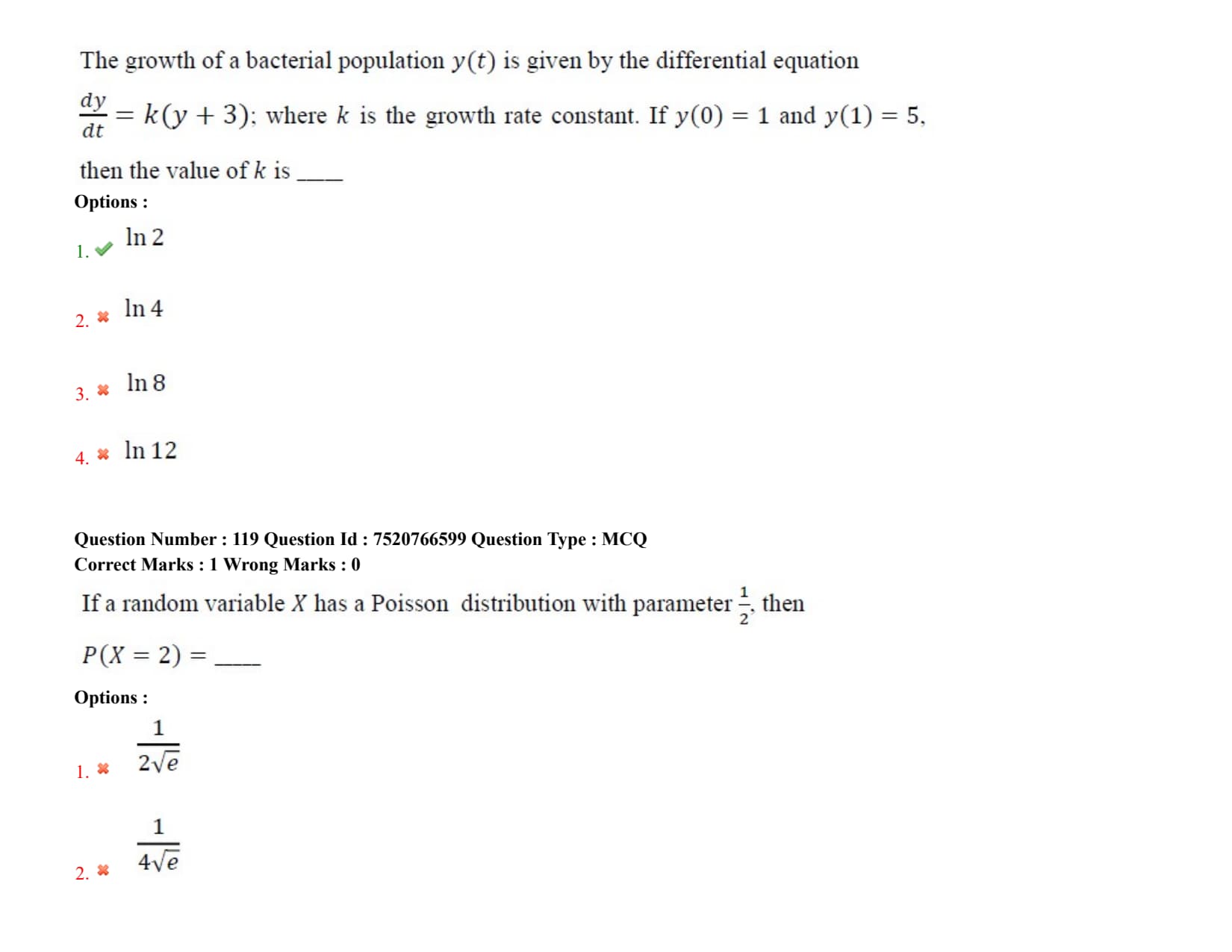
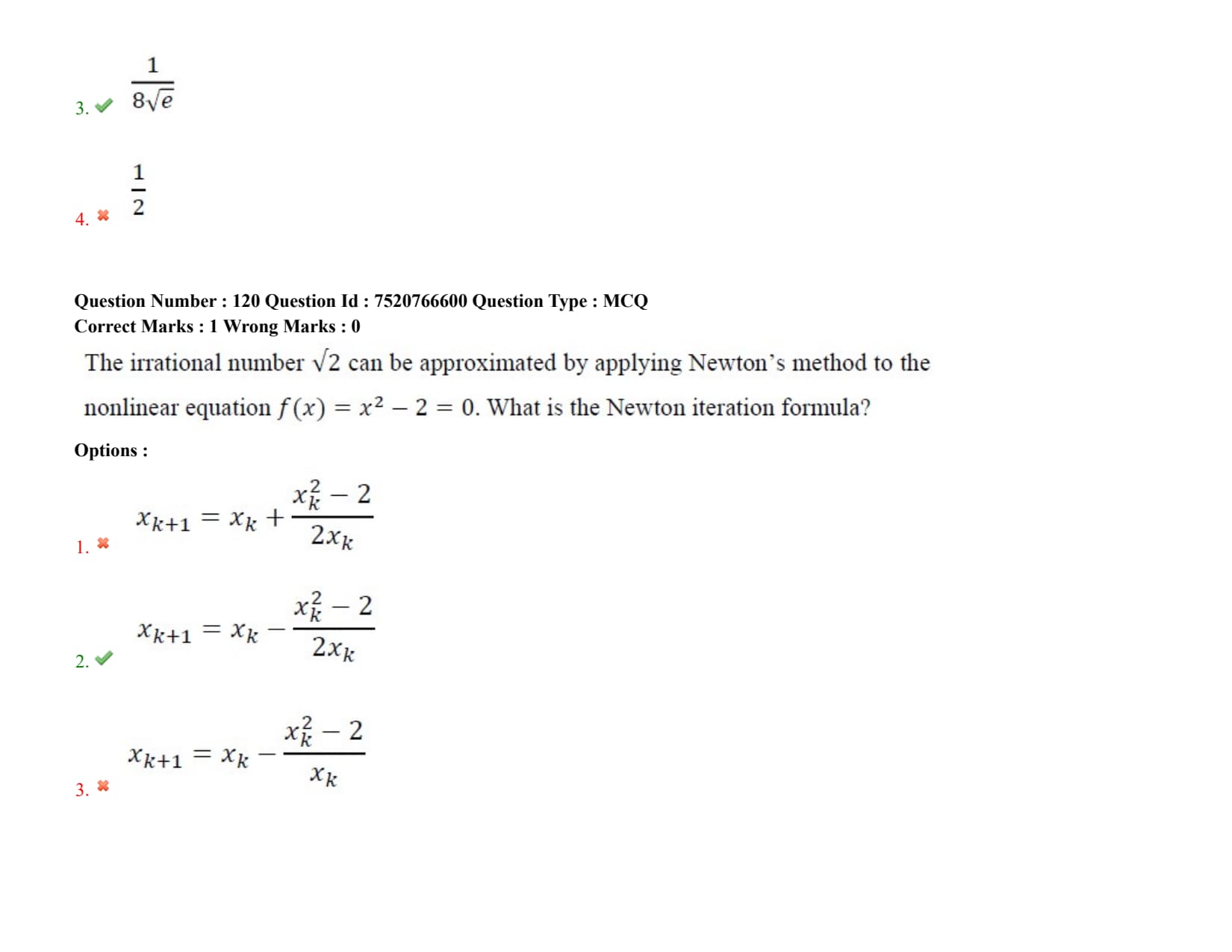
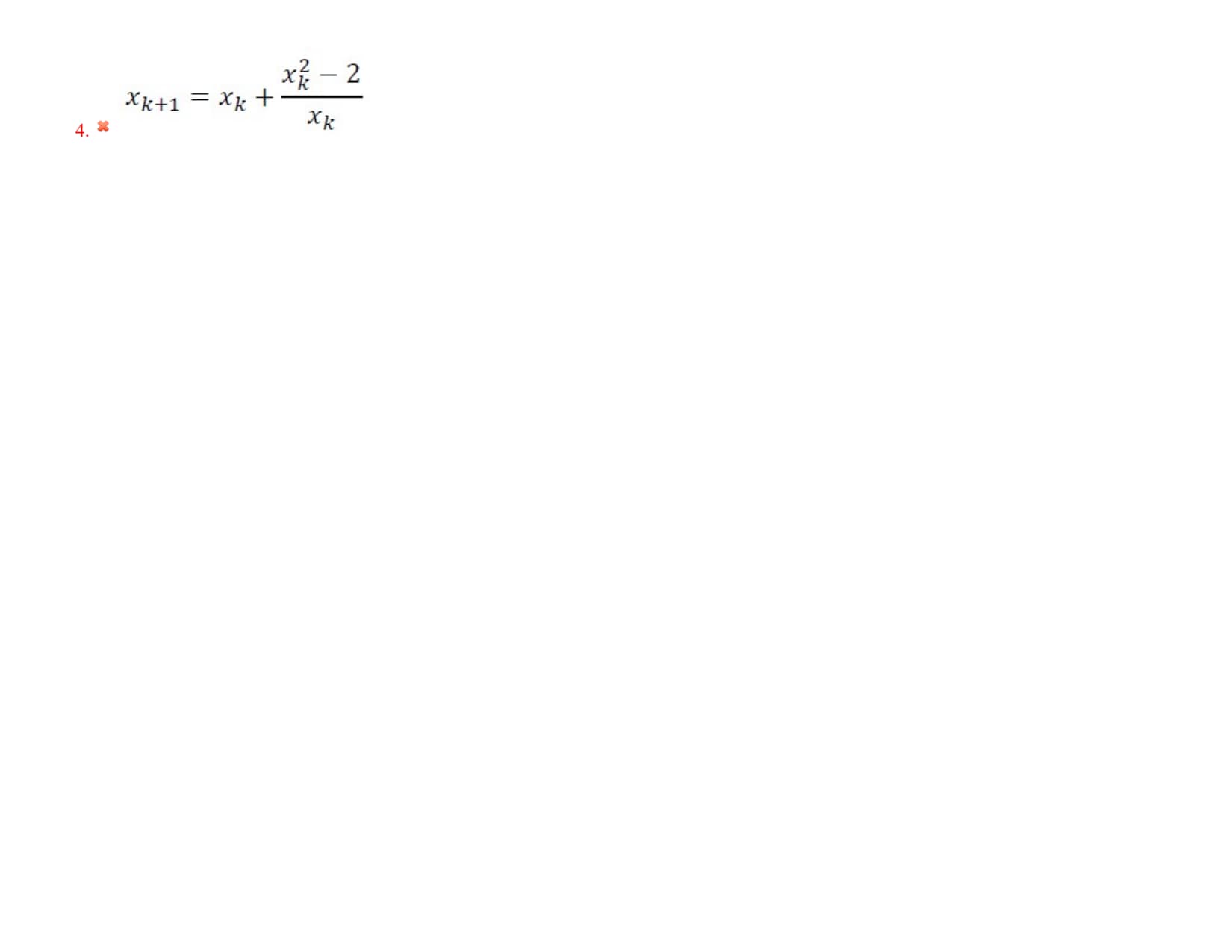
The vapour pressure of the solute in dilute solutions is proportional to the mole fraction of the solute in the liquid. This relationship is known as ______
View Solution
Step 1: Understanding the Question:
The question asks us to identify the name of the physical law that describes a relationship where the vapour pressure of a solute in a dilute solution is directly proportional to its mole fraction in the liquid phase.
This belongs to the core area of phase equilibria in chemical engineering thermodynamics, which deals with how components distribute between liquid and vapour phases.
Step 2: Key Formula or Approach:
For a dilute solution, the concentration of the solute approaches zero (\( x_i \rightarrow 0 \)).
Under these conditions, the partial pressure (or vapour pressure) of the solute in the gas phase is related to its mole fraction in the liquid phase by:
\[ p_i = x_i \cdot H_i \]
where \( H_i \) represents the Henry's law constant of the solute in that solvent.
Step 3: Detailed Explanation:
Henry's Law: In a highly dilute solution, solute molecules are separated by a vast number of solvent molecules.
Because solute-solute interactions are negligible, the escaping tendency of solute molecules is independent of other solute molecules and varies linearly with concentration.
Thus, the vapour pressure of the solute is directly proportional to its mole fraction, which is the definition of Henry's Law.
Raoult's Law: For the solvent in a dilute solution, the solvent mole fraction approaches unity (\( x_j \rightarrow 1 \)).
It obeys Raoult's law: \( p_j = x_j \cdot P^*_j \), where \( P^*_j \) is the vapour pressure of the pure solvent.
Dalton's Law: Dalton's law of partial pressures states that the total pressure of a mixture of non-reacting gases is equal to the sum of the partial pressures of the individual gases.
It does not describe liquid-phase solution behaviour.
Amagat's Law: Amagat's law states that the total volume of a non-reacting gas mixture is equal to the sum of the partial volumes of the individual components at the same temperature and pressure.
Step 4: Final Answer:
Based on the definition of solute behaviour in dilute solutions, the correct option is Henry's law.
Quick Tip: In any dilute binary solution, always remember that the solvent obeys Raoult's Law (ideal behavior), while the solute obeys Henry's Law.
This is a standard concept tested frequently in thermodynamics and mass transfer.
One hundred kilograms of a dilute waste acid containing 30.0% sulphuric acid is to be fortified to 50.0% sulphuric acid using concentrated sulphuric acid of strength 96%. How many kilograms of concentrated sulphuric acid are required for this process?
View Solution
Step 1: Understanding the Question:
This is a steady-state material balance problem with no chemical reaction.
We are mixing a weak/dilute acid stream with a highly concentrated acid stream to achieve a target acid concentration of \( 50.0% \) sulphuric acid.
Step 2: Key Formula or Approach:
Let \( W \) be the mass of the dilute waste acid, which is \( 100 kg \).
Let \( C \) be the mass of the concentrated sulphuric acid added.
Let \( P \) be the mass of the fortified product acid.
We write two mass conservation equations:
1. Total Mass Balance:
\[ W + C = P \]
2. Sulphuric Acid Component Balance:
\[ w_W \cdot W + w_C \cdot C = w_P \cdot P \]
where \( w_W \), \( w_C \), and \( w_P \) are the weight fractions of sulphuric acid in each stream respectively.
Step 3: Detailed Explanation:
Identify the given variables:
\( W = 100 kg \)
\( w_W = 30.0% = 0.30 \)
\( w_C = 96% = 0.96 \)
\( w_P = 50.0% = 0.50 \)
Express the total mass balance:
\[ P = 100 + C \]
Substitute \( P \) into the sulphuric acid balance:
\[ 0.30 \cdot (100) + 0.96 \cdot C = 0.50 \cdot (100 + C) \]
Perform the algebraic expansions:
\[ 30 + 0.96 \cdot C = 50 + 0.50 \cdot C \]
Rearrange the terms to solve for \( C \):
\[ 0.96 \cdot C - 0.50 \cdot C = 50 - 30 \]
\[ 0.46 \cdot C = 20 \]
\[ C = \frac{20}{0.46} \approx 43.478 kg \]
Step 4: Final Answer:
The mass of concentrated sulphuric acid needed is approximately 43.48 kg.
Quick Tip: For rapid calculation, remember the lever rule or Pearson's square:
Ratio of concentrated acid to dilute acid is given by:
\[ \frac{C}{W} = \frac{w_P - w_W}{w_C - w_P} = \frac{0.50 - 0.30}{0.96 - 0.50} = \frac{0.20}{0.46} \]
This gives the direct ratio and saves precious time during competitive examinations.
A pressure of 1 torr is equal to ______
View Solution
Step 1: Understanding the Question:
The question asks for the definition or equivalent physical unit of 1 torr of pressure.
This is a standard unit conversion question under the topic of fluid mechanics and process calculations.
Step 2: Key Formula or Approach:
Pressure is defined as force per unit area.
Various units are used to measure pressure, including Pascals (\( N/m^2 \)), atmospheres (atm), bar, millimetres of mercury (mm Hg), and torr.
The standard atmospheric pressure at sea level is defined as:
\[ 1 atm = 760 mm Hg = 760 torr = 101,325 Pa = 1.01325 bar \]
Step 3: Detailed Explanation:
Torr and mm Hg: The torr is a non-SI unit of pressure designed to be equal to the fluid pressure exerted by a millimetre of mercury.
Historically, 1 torr was defined as exactly \( 1 mm Hg \).
Thus, \( 760 torr = 760 mm Hg \).
Other Options:
\( 1 mm Hg \) is equivalent to approximately \( 133.322 Pa \) or \( 133.322 N/m^2 \).
Therefore, \( 1 torr \neq 1 N/m^2 \).
\( 1 kgf/m^2 \) is equivalent to \( 9.80665 Pa \), which is different from 1 torr.
\( 1m H_2O \) is equivalent to about \( 9806.65 Pa \) or \( 73.5 mm Hg \).
Step 4: Final Answer:
By physical definition, a pressure of 1 torr is exactly equal to 1 mm Hg.
Quick Tip: Keep standard conversion factors memorized:
\[ 1 atm = 760 mm Hg = 760 torr = 10.33 m H_2O = 1.033 kgf/cm^2 = 1.01325 bar \]
These conversions are essential for solving fluid flow and thermodynamics problems quickly.
For a system to be in equilibrium at a given temperature and pressure ______
View Solution
Step 1: Understanding the Question:
The question asks for the criterion of thermodynamic equilibrium of a system operating under constraints of constant temperature and pressure.
This is a core topic in chemical engineering thermodynamics, related to thermodynamic potentials and stability criteria.
Step 2: Key Formula or Approach:
The fundamental thermodynamic relation combines the first and second laws of thermodynamics.
For a system under constant temperature (\( T \)) and pressure (\( P \)), the change in Gibbs free energy (\( G \)) is related to spontaneity and equilibrium by:
\[ dG \le 0 \]
For a closed system at constant \( T \) and \( P \), the system reaches its stable equilibrium when its Gibbs free energy cannot decrease any further.
Step 3: Detailed Explanation:
Spontaneous Processes: Any spontaneous process occurring at constant temperature and pressure must lead to a decrease in the Gibbs free energy of the system (\( dG < 0 \)).
Equilibrium State: Once the system reaches state of equilibrium, no further spontaneous change can occur.
At this point, the Gibbs free energy reaches its lowest possible value under those conditions.
Therefore, the mathematical condition for equilibrium at constant \( T \) and \( P \) is:
\[ dG = 0 \quad and \quad G = minimum \]
Other Potentials:
Entropy \( S \) must be maximized for an isolated system (constant internal energy \( U \) and volume \( V \)).
Helmholtz free energy \( A \) must be minimized for a system at constant temperature \( T \) and volume \( V \).
Internal energy \( U \) must be minimized at constant entropy \( S \) and volume \( V \).
Step 4: Final Answer:
For constant temperature and pressure, the Gibbs free energy must be a minimum at equilibrium.
Quick Tip: Remember the thermodynamic equilibrium criteria based on independent variables:
1. Constant \( (U, V) \rightarrow S \) is maximized.
2. Constant \( (T, V) \rightarrow A \) is minimized.
3. Constant \( (T, P) \rightarrow G \) is minimized.
Most practical chemical processes are constant \( (T, P) \), making Gibbs free energy the key criterion.
The purpose of a purge stream in a recycle process is to:
View Solution
Step 1: Understanding the Question:
The question asks about the process engineering purpose of a "purge stream" in chemical plants that employ recycle loops.
This is a standard topic in mass balance and chemical process calculations.
Step 2: Key Formula or Approach:
In many chemical reactions, some species are present in the feed stream that do not participate in the reaction. These are called "inerts" (e.g., argon in ammonia synthesis, nitrogen in hydrocarbons).
If a recycle stream is used to return unreacted reactants back to the reactor and there is no outlet for these inerts, they will continuously build up in the system.
Step 3: Detailed Explanation:
Recycle Loop Dynamics: A recycle stream is implemented to return unreacted raw materials to the reactor, which significantly increases the overall process conversion.
Inert Accumulation: If the fresh feed contains even a tiny fraction of an inert species, and we recycle all unreacted material, the inerts cannot leave the system because they do not react.
Consequently, the inert concentration in the recycle loop will increase over time.
This accumulation increases the total system pressure or reduces the partial pressure of the reactants, reducing reactor performance and efficiency.
Role of Purge: To prevent this accumulation, a small fraction of the recycle stream is continuously bled off or "purged."
The purge stream provides an exit route for the inerts, allowing the system to reach a steady state where the rate of inerts entering with the fresh feed equals the rate of inerts leaving through the purge.
Step 4: Final Answer:
The primary function of a purge stream is to prevent the continuous accumulation of inerts in a recycle loop.
Quick Tip: At steady state, the material balance for any inert component is simply:
\[ Inlets of Inert = Outlets of Inert (via Purge) \]
Since inerts do not react, they can only leave the process through the purge stream.
For an ideal gas at 300 K and 2 atm, if the temperature is raised to 600 K at constant pressure, the volume will:
View Solution
Step 1: Understanding the Question:
This question deals with ideal gas behaviour under changing thermodynamic conditions.
Specifically, we need to determine the effect of doubling the absolute temperature on the volume of an ideal gas while holding the pressure constant.
Step 2: Key Formula or Approach:
The state of an ideal gas is governed by the Ideal Gas Equation:
\[ P \cdot V = n \cdot R \cdot T \]
where \( P \) is pressure, \( V \) is volume, \( n \) is number of moles, \( R \) is the universal gas constant, and \( T \) is the absolute temperature (in Kelvin).
At constant pressure \( P \) and constant mass/moles \( n \), this equation reduces to Charles's Law:
\[ V \propto T \quad \implies \quad \frac{V_1}{T_1} = \frac{V_2}{T_2} \]
Step 3: Detailed Explanation:
Identify the given states:
Initial Temperature, \( T_1 = 300 K \)
Final Temperature, \( T_2 = 600 K \)
Initial Pressure, \( P_1 = 2 atm \)
Final Pressure, \( P_2 = 2 atm \) (constant pressure)
Set up the ratio using Charles's Law:
\[ \frac{V_2}{V_1} = \frac{T_2}{T_1} \]
Substitute the temperature values into the ratio:
\[ \frac{V_2}{V_1} = \frac{600 K}{300 K} = 2 \]
Rearrange to find the final volume:
\[ V_2 = 2 \cdot V_1 \]
Step 4: Final Answer:
The volume of the ideal gas doubles when the absolute temperature is raised from 300 K to 600 K at constant pressure.
Quick Tip: Always ensure that temperature values are converted to absolute scale (Kelvin) before applying gas laws.
In this question, the temperatures are already given in Kelvin, allowing direct substitution.
The fugacity of a pure ideal gas is equal to:
View Solution
Step 1: Understanding the Question:
The question asks for the relationship between the fugacity and the pressure of a pure ideal gas.
Fugacity is a thermodynamic property used to represent the effective pressure of real gases when ideal gas models are insufficient.
Step 2: Key Formula or Approach:
The fugacity (\( f \)) of a gas is defined in terms of its chemical potential change:
\[ d\mu_i = R \cdot T \cdot d(\ln f_i) \]
with the boundary condition that as the pressure approaches zero, real gases behave ideally, and fugacity becomes equal to the pressure:
\[ \lim_{P \to 0} \frac{f_i}{P} = 1 \]
For an ideal gas, this behavior is exhibited at all pressures.
Step 3: Detailed Explanation:
Fugacity Coefficient: The deviation of a real gas from ideal behaviour is measured by the fugacity coefficient, \( \phi \), defined as:
\[ \phi = \frac{f}{P} \]
Ideal Gas Application: For a pure ideal gas, there are no intermolecular forces, and the volume of gas molecules is negligible.
As a result, the gas acts ideally at all pressure conditions, meaning its fugacity coefficient is exactly equal to 1:
\[ \phi = 1 \quad \implies \quad \frac{f}{P} = 1 \quad \implies \quad f = P \]
Activity comparison: Activity is a dimensionless quantity related to fugacity by \( a = f / f^\circ \), where \( f^\circ \) is the standard state fugacity, and is not generally equal to fugacity itself.
Step 4: Final Answer:
For a pure ideal gas, the fugacity is identical to its pressure.
Quick Tip: Remember that fugacity has units of pressure.
For any ideal gas system, the fugacity of component \( i \) is simply equal to its partial pressure: \( f_i = p_i = y_i P \).
The second law of thermodynamics states that for any spontaneous process:
View Solution
Step 1: Understanding the Question:
The question asks for the fundamental statement of the Second Law of Thermodynamics regarding the entropy changes during a spontaneous (natural/irreversible) process.
This is a core concept of classical thermodynamics.
Step 2: Key Formula or Approach:
The universe is defined as the combination of the system under study and its surroundings:
\[ \Delta S_{universe} = \Delta S_{system} + \Delta S_{surroundings} \]
The Second Law states that all natural processes tend to move in a direction that increases disorder.
Step 3: Detailed Explanation:
Mathematical Statement of Second Law:
For any real, spontaneous, and irreversible process:
\[ dS_{universe} > 0 \]
For an idealized, completely reversible process:
\[ dS_{universe} = 0 \]
Combining these, we get Clausius inequality:
\[ dS_{universe} \ge 0 \]
System vs Universe: The entropy of a system can decrease during a process (e.g., water freezing into ice), but this requires heat transfer to the surroundings, which increases the surroundings' entropy by an even larger amount.
As a result, the total entropy of the universe must increase for any spontaneous process.
Step 4: Final Answer:
Therefore, the Second Law of Thermodynamics asserts that for any spontaneous process, the entropy of the universe increases.
Quick Tip: Always distinguish between the system and the universe.
The entropy of a system can increase, decrease, or remain constant, but the entropy of the universe can never decrease in any real process.
Excess properties in thermodynamics are defined as:
View Solution
Step 1: Understanding the Question:
The question asks for the thermodynamic definition of "excess properties" (\( M^E \)) in solution thermodynamics.
Excess properties are used to quantify deviations from ideal solution behaviour.
Step 2: Key Formula or Approach:
Let \( M \) represent any thermodynamic property (such as volume, enthalpy, entropy, or Gibbs free energy) of a real solution.
Let \( M^{id} \) represent the same property calculated for an ideal solution at the exact same temperature, pressure, and composition.
The excess property is defined as:
\[ M^E = M - M^{id} \]
Step 3: Detailed Explanation:
Concept of Excess Properties: An ideal solution is a model where molecular interactions between different species are identical to those between like molecules.
Real solutions deviate from this behaviour.
Excess properties quantify this difference.
For example, the excess volume \( V^E = V - V^{id} \) is the change in volume upon mixing of real components compared to the volume of ideal mixing (which is zero).
Comparison with Residual Properties: Residual properties (\( M^R \)) are defined as the difference between a real gas property and an ideal gas property at the same temperature and pressure:
\[ M^R = M - M^{ig} \]
This should not be confused with excess properties, which compare real solutions to ideal solutions.
Step 4: Final Answer:
The excess property is defined as the difference between the actual property and the ideal solution property.
Quick Tip: Excess Gibbs free energy (\( G^E \)) is directly related to the activity coefficients (\( \gamma_i \)) of the species in a solution by:
\[ G^E = R \cdot T \cdot \sum x_i \cdot \ln \gamma_i \]
This relationship is highly important for VLE modeling.
The activity coefficient `gamma' = 1 implies:
View Solution
Step 1: Understanding the Question:
The question asks for the physical meaning of an activity coefficient (\( \gamma \)) equal to 1.
Activity coefficients are used in solution thermodynamics to account for non-ideal behaviour in liquid phases.
Step 2: Key Formula or Approach:
The activity of component \( i \) in a liquid solution is given by:
\[ a_i = \gamma_i \cdot x_i \]
where \( x_i \) is the mole fraction and \( \gamma_i \) is the activity coefficient.
For an ideal solution, the activity of a component is exactly equal to its mole fraction:
\[ a_i = x_i \]
Step 3: Detailed Explanation:
Ideal Solution Behaviour: When the activity coefficient \( \gamma_i = 1 \) for all components across the entire composition range, the liquid mixture is described as an ideal solution.
Under this condition, the mixture obeys Raoult's Law:
\[ p_i = x_i \cdot P^*_i \]
This occurs when the intermolecular forces between unlike molecules (A-B) are identical to the intermolecular forces between like molecules (A-A and B-B).
Deviations from Ideality:
If \( \gamma_i > 1 \), the solution exhibits a positive deviation from ideality (molecules repel each other more than they attract, increasing vapour pressure).
If \( \gamma_i < 1 \), the solution exhibits a negative deviation from ideality (molecules attract each other strongly, decreasing vapour pressure).
Azeotropic Behaviour: This occurs when the vapour composition equals the liquid composition (\( y_i = x_i \)) at a specific point, which is caused by strong deviations from ideality (\( \gamma_i \neq 1 \)).
Step 4: Final Answer:
An activity coefficient \( \gamma = 1 \) implies that the system is displaying ideal solution behaviour.
Quick Tip: Ideal solution behaviour also implies that the enthalpy of mixing (\( \Delta H_{mix} \)) and volume change of mixing (\( \Delta V_{mix} \)) are both equal to zero.
This is a standard theoretical benchmark in solution chemistry.
According to First law of thermodynamics for a flow process the total work done by the turbine can be approximated by______
View Solution
Step 1: Understanding the Question:
The question asks for the thermodynamic approximation of the work done by a steam turbine in an open flow system, using the First Law of Thermodynamics.
This falls under the open-system (control volume) energy analysis.
Step 2: Key Formula or Approach:
The steady-flow energy equation (SFEE) for a control volume with a single inlet and outlet is:
\[ \dot{Q} - \dot{W}_s = \dot{m} \cdot \left[ \Delta h + \frac{\Delta v^2}{2} + g \cdot \Delta z \right] \]
where:
\( \dot{Q} \) is heat transfer rate,
\( \dot{W}_s \) is shaft work done by the system,
\( \dot{m} \) is mass flow rate,
\( \Delta h \) is change in specific enthalpy,
\( \frac{\Delta v^2}{2} \) is change in kinetic energy,
\( g \cdot \Delta z \) is change in potential energy.
Step 3: Detailed Explanation:
Turbine Assumptions:
1. A turbine is typically assumed to be adiabatic, meaning heat loss is negligible: \( \dot{Q} \approx 0 \).
2. The changes in kinetic energy (\( \Delta KE \)) and potential energy (\( \Delta PE \)) of steam between the inlet and exit are usually small compared to the large change in enthalpy.
\[ \Delta KE \approx 0, \quad \Delta PE \approx 0 \]
Simplification:
Applying these assumptions to the SFEE yields:
\[ - \dot{W}_s = \dot{m} \cdot \Delta h \]
\[ W_{shaft} = - \Delta H \]
This demonstrates that the work produced by the turbine is equal to the drop in enthalpy of the fluid as it expands through the stages.
Step 4: Final Answer:
The total work done by the turbine is approximated by the enthalpy change of the steam.
Quick Tip: For any open-flow expansion device (turbine) or compression device (compressor/pump), if kinetic and potential energy changes are neglected and the system is adiabatic, the work is always equal to the change in enthalpy.
Absolute humidity of air is 0.02 kg water vapour/ kg dry air. Assuming the average molecular weight of air to be 29. What is the mole percent of water vapour in air? (approximately)
View Solution
Step 1: Understanding the Question:
The question provides the absolute humidity (mass ratio of water vapour to dry air) and asks us to compute the corresponding mole percent of water vapour in the air-water vapour mixture.
This is a standard unit-conversion problem in process calculations and psychrometrics.
Step 2: Key Formula or Approach:
Absolute humidity (\( Y \)) is defined as:
\[ Y = \frac{mass of water vapour}{mass of dry air} = 0.02 kg water/kg dry air \]
Let \( M_w \) be the molecular weight of water vapour (\( 18 g/mol \)), and \( M_a \) be the molecular weight of dry air (\( 29 g/mol \)).
The mole ratio of water vapour to dry air (\( Y_m \)) is:
\[ Y_m = Y \cdot \frac{M_a}{M_w} \]
The mole fraction of water vapour in wet air (\( y_w \)) is:
\[ y_w = \frac{Y_m}{1 + Y_m} \]
Step 3: Detailed Explanation:
Calculate the mole ratio (\( Y_m \)):
\[ Y_m = 0.02 \cdot \frac{29}{18} \]
\[ Y_m = 0.02 \cdot 1.6111 \approx 0.0322 moles of water vapour / mole of dry air \]
Calculate the mole fraction of water vapour (\( y_w \)):
\[ y_w = \frac{0.0322}{1 + 0.0322} = \frac{0.0322}{1.0322} \approx 0.0312 \]
Convert the mole fraction to mole percent:
\[ Mole percent = y_w \cdot 100 \approx 3.12% \]
Looking at the options, \( 3.2% \) is the closest approximation.
Step 4: Final Answer:
The mole percent of water vapour in the air is approximately 3.2%.
Quick Tip: An alternative form of the formula is:
\[ y_w = \frac{\frac{Y}{18}}{\frac{Y}{18} + \frac{1}{29}} \]
Substitute \( Y = 0.02 \) directly to find \( y_w = \frac{0.001111}{0.001111 + 0.034483} \approx 3.12% \).
Using direct mole calculations avoids algebraic mistakes.
If fanning friction factor is f then the Blasius (or) Darcy friction factor is ______
View Solution
Step 1: Understanding the Question:
The question asks for the relationship between the Fanning friction factor (\( f \)) and the Darcy-Weisbach (or Blasius) friction factor (\( f_D \)).
This is a standard fluid mechanics question related to pressure drop in pipes.
Step 2: Key Formula or Approach:
The Fanning friction factor is defined based on wall shear stress (\( \tau_w \)):
\[ f = \frac{\tau_w}{\frac{1}{2}\rho v^2} \]
The Darcy friction factor is defined based on the head loss equation:
\[ h_f = f_D \cdot \frac{L}{D} \cdot \frac{v^2}{2g} \]
Comparing the pressure drop expressions derived from both friction factors reveals their relationship.
Step 3: Detailed Explanation:
The pressure drop \( \Delta P \) using Fanning's friction factor is:
\[ \Delta P = 4 \cdot f \cdot \left(\frac{L}{D}\right) \cdot \left(\frac{\rho v^2}{2}\right) \]
The pressure drop \( \Delta P \) using Darcy's friction factor is:
\[ \Delta P = f_D \cdot \left(\frac{L}{D}\right) \cdot \left(\frac{\rho v^2}{2}\right) \]
Equating these two expressions for the same physical system:
\[ 4 \cdot f \cdot \left(\frac{L}{D}\right) \cdot \left(\frac{\rho v^2}{2}\right) = f_D \cdot \left(\frac{L}{D}\right) \cdot \left(\frac{\rho v^2}{2}\right) \]
Simplify the equation:
\[ f_D = 4 \cdot f \]
Thus, the Darcy friction factor is exactly four times the Fanning friction factor.
Step 4: Final Answer:
The Blasius (or Darcy) friction factor is equal to 4f.
Quick Tip: In chemical engineering literature (such as McCabe-Smith), the Fanning friction factor is typically used.
In civil and mechanical engineering literature, the Darcy friction factor is standard.
Always verify which factor is used in a given formula by checking if the constant is 16 or 64 for laminar flow (\( f = 16/Re \) vs \( f_D = 64/Re \)).
Diaphragm pumps are used for ______ pumping
View Solution
Step 1: Understanding the Question:
The question asks about the primary industrial application and suitability of diaphragm pumps.
This belongs to fluid transport equipment in chemical engineering.
Step 2: Key Formula or Approach:
Diaphragm pumps are a class of positive displacement pumps that use a combination of the reciprocating action of a flexible membrane (diaphragm) and non-return check valves to move fluids.
The mechanical drive components are completely isolated from the process fluid.
Step 3: Detailed Explanation:
Isolation Principle: In a diaphragm pump, the reciprocating plunger or fluid drive acts on one side of a flexible diaphragm, while the process liquid is handled on the opposite side.
This design means there are no sliding seals or packing glands in contact with the process fluid.
Pumping Toxic/Corrosive Liquids: Because there are no rotating seals, the risk of external leakage is eliminated.
This makes the diaphragm pump highly suitable for handling extremely toxic, hazardous, flammable, or highly corrosive liquids.
Comparison with Centrifugal Pumps: Centrifugal pumps rely on mechanical seals which can wear out and leak over time, causing potential safety hazards when handling dangerous chemicals.
Thus, diaphragm pumps are preferred for safety-critical operations handling toxic or corrosive chemicals.
Step 4: Final Answer:
Diaphragm pumps are designed and preferred for pumping toxic or corrosive liquids.
Quick Tip: Positive displacement pumps like diaphragm pumps are also self-priming and can handle high-viscosity fluids, unlike standard centrifugal pumps.
This is useful to remember for industrial equipment selection.
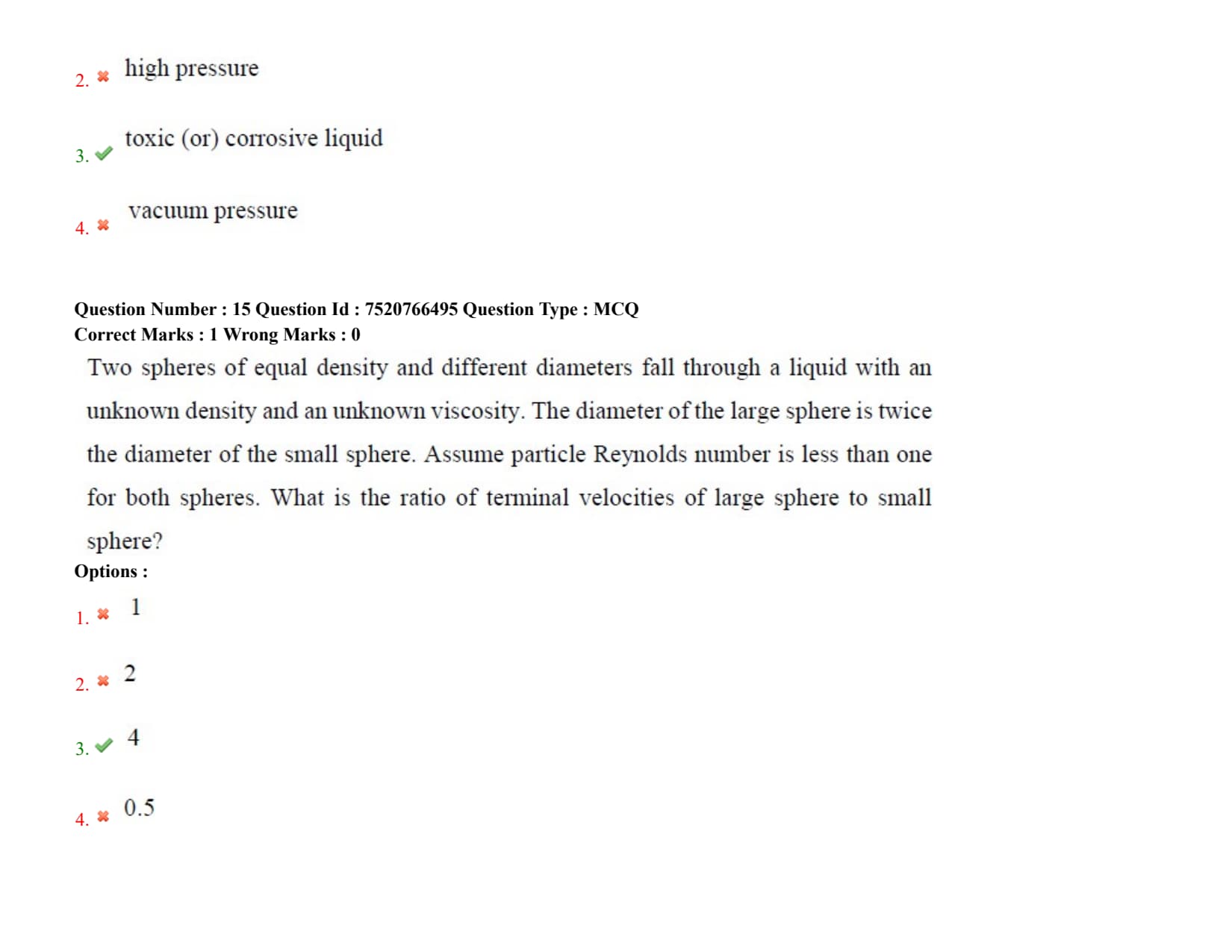
Two spheres of equal density and different diameters fall through a liquid with an unknown density and an unknown viscosity. The diameter of the large sphere is twice the diameter of the small sphere. Assume particle Reynolds number is less than one for both spheres. What is the ratio of terminal velocities of large sphere to small sphere?
View Solution
Step 1: Understanding the Question:
This question requires us to determine how the terminal settling velocity of a sphere depends on its diameter in the laminar settling regime.
This is a standard problem in particle mechanics and fluid-particle dynamics.
Step 2: Key Formula or Approach:
The particle Reynolds number is given as less than one (\( Re_p < 1 \)), which means the settling occurs in the Stokes' law (laminar) regime.
The formula for Stokes' terminal settling velocity (\( u_t \)) is:
\[ u_t = \frac{g \cdot d_p^2 \cdot (\rho_p - \rho_f)}{18 \cdot \mu} \]
where:
\( g \) is acceleration due to gravity,
\( d_p \) is particle diameter,
\( \rho_p \) is particle density,
\( \rho_f \) is fluid density,
\( \mu \) is fluid viscosity.
Step 3: Detailed Explanation:
Identify the constant variables:
The density of both spheres is equal: \( \rho_{p1} = \rho_{p2} = \rho_p \).
They are falling through the same fluid, so \( \rho_f \) and \( \mu \) are identical for both.
Gravity \( g \) is constant.
Establish the proportionality:
Since all other parameters are constant:
\[ u_t \propto d_p^2 \]
Write the ratio for the two spheres:
Let subscript 1 represent the large sphere and subscript 2 represent the small sphere.
\[ \frac{u_{t1}}{u_{t2}} = \left(\frac{d_{p1}}{d_{p2}}\right)^2 \]
We are given that the diameter of the large sphere is twice that of the small sphere:
\[ d_{p1} = 2 \cdot d_{p2} \quad \implies \quad \frac{d_{p1}}{d_{p2}} = 2 \]
Substitute this ratio into the velocity relation:
\[ \frac{u_{t1}}{u_{t2}} = (2)^2 = 4 \]
Step 4: Final Answer:
The ratio of the terminal settling velocity of the large sphere to the small sphere is 4.
Quick Tip: Always check the flow regime:
If \( Re_p < 1 \) (Stokes' regime), \( u_t \propto d_p^2 \).
If \( Re_p > 1000 \) (Newton's regime), \( u_t \propto d_p^{0.5} \).
Knowing these relationships allows quick mental calculation.
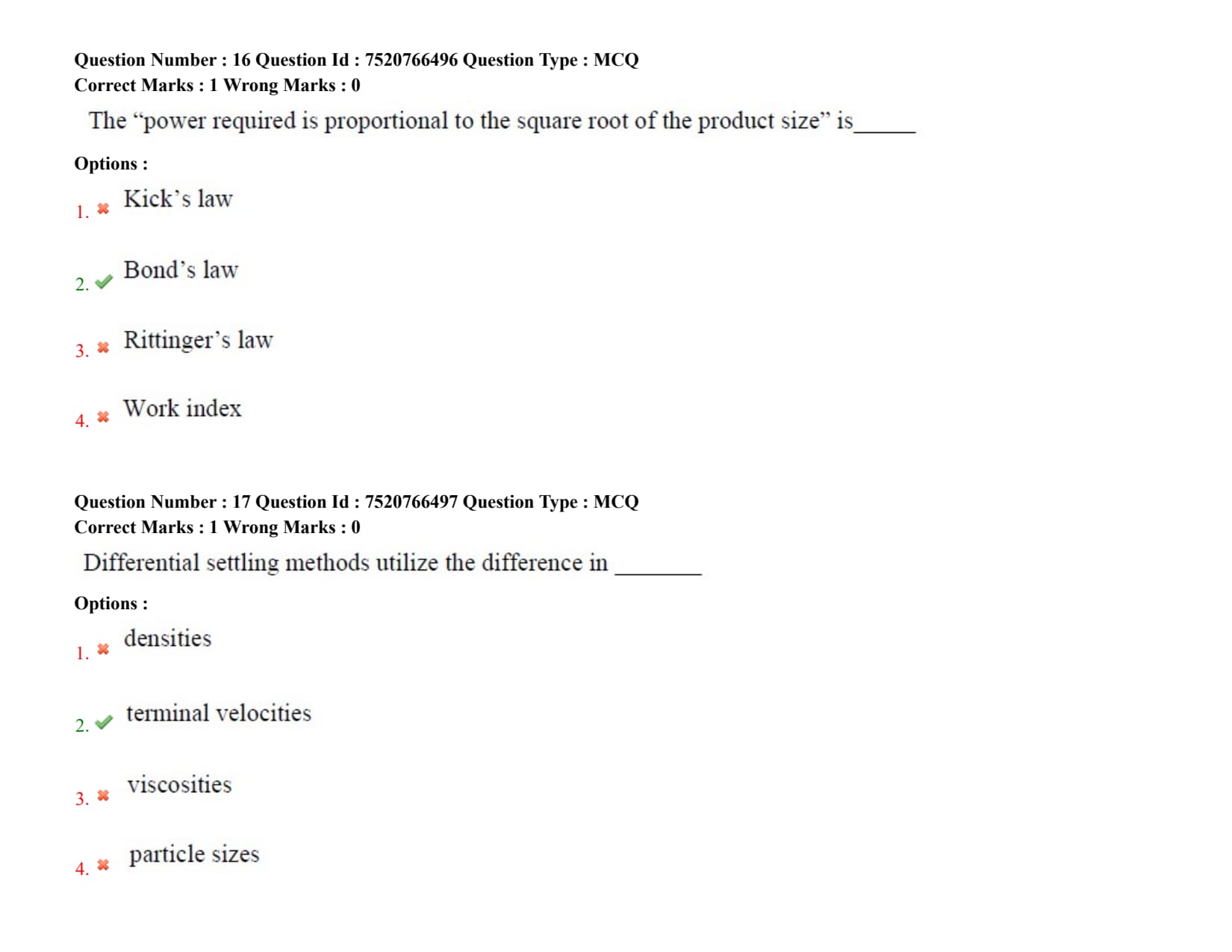
The ``power required is proportional to the square root of the product size'' is ______
View Solution
Step 1: Understanding the Question:
The question asks us to identify the specific size-reduction law that states the energy/power required is proportional to the reciprocal of the square root of the product size.
This is a core topic in size reduction under mechanical operations.
Step 2: Key Formula or Approach:
The general differential equation for size reduction is given by Walker's Law:
\[ dE = -C \cdot \frac{dD_p}{D_p^n} \]
where different values of the exponent \( n \) lead to the three classical laws of size reduction: Rittinger's, Kick's, and Bond's laws.
Step 3: Detailed Explanation:
Bond's Law (\( n = 1.5 \)): Integrating the differential equation for \( n = 1.5 \) yields:
\[ E = 2 \cdot C \cdot \left( \frac{1}{\sqrt{D_{p2}}} - \frac{1}{\sqrt{D_{p1}}} \right) \]
where \( D_{p2} \) is the product size and \( D_{p1} \) is the feed size.
For cases where feed size is large, the energy is inversely proportional to the square root of the product size:
\[ E \propto \frac{1}{\sqrt{D_{p2}}} \]
This is the physical statement of Bond's Law.
Rittinger's Law (\( n = 2.0 \)): The energy required is proportional to the new surface area created:
\[ E \propto \left( \frac{1}{D_{p2}} - \frac{1}{D_{p1}} \right) \]
Kick's Law (\( n = 1.0 \)): The energy required is proportional to the ratio of initial to final size:
\[ E \propto \ln\left(\frac{D_{p1}}{D_{p2}}\right) \]
Work Index: This is a parameter used in Bond's law representing the energy required to reduce unit mass of material from infinite size to 100 microns.
Step 4: Final Answer:
The statement describes Bond's law of size reduction.
Quick Tip: A simple way to remember the exponents in the differential equation \( dE \propto -dD_p / D_p^n \):
Kick's Law: \( n = 1 \)
Bond's Law: \( n = 1.5 \)
Rittinger's Law: \( n = 2 \)
These are sorted alphabetically: K (1), B (1.5), R (2).
Differential settling methods utilize the difference in ______
View Solution
Step 1: Understanding the Question:
The question asks for the fundamental physical principle exploited in differential settling methods.
This is part of solid-liquid separation and classification in mechanical operations.
Step 2: Key Formula or Approach:
Differential settling is a classification technique used to separate particles based on how they behave when settling through a fluid.
The governing separation metric is the terminal settling velocity of the particles.
Step 3: Detailed Explanation:
Mechanism of Separation: When a mixture of particles with varying sizes and densities is introduced into a fluid column, each particle reaches its unique terminal settling velocity.
Terminal velocity depends on both particle size and density, as shown by Stokes' Law:
\[ u_t = \frac{g \cdot d_p^2 \cdot (\rho_p - \rho_f)}{18 \cdot \mu} \]
Why not just Density or Size? If we only used density, two particles of different sizes might still settle together if their combination of size and density resulted in the same settling velocity (equal-settling particles).
The separation process specifically separates particles because their net terminal velocities are different.
By controlling the upward velocity of the fluid, we can carry slower-settling particles out the top while allowing faster-settling particles to sink.
Therefore, the differential settling method ultimately utilizes differences in terminal velocities.
Step 4: Final Answer:
Differential settling methods utilize the difference in terminal velocities of particles.
Quick Tip: To successfully separate two materials of densities \( \rho_A \) and \( \rho_B \) based on density alone, the fluid density \( \rho_f \) must be chosen such that it lies between \( \rho_A \) and \( \rho_B \).
This is known as sink-and-float separation.
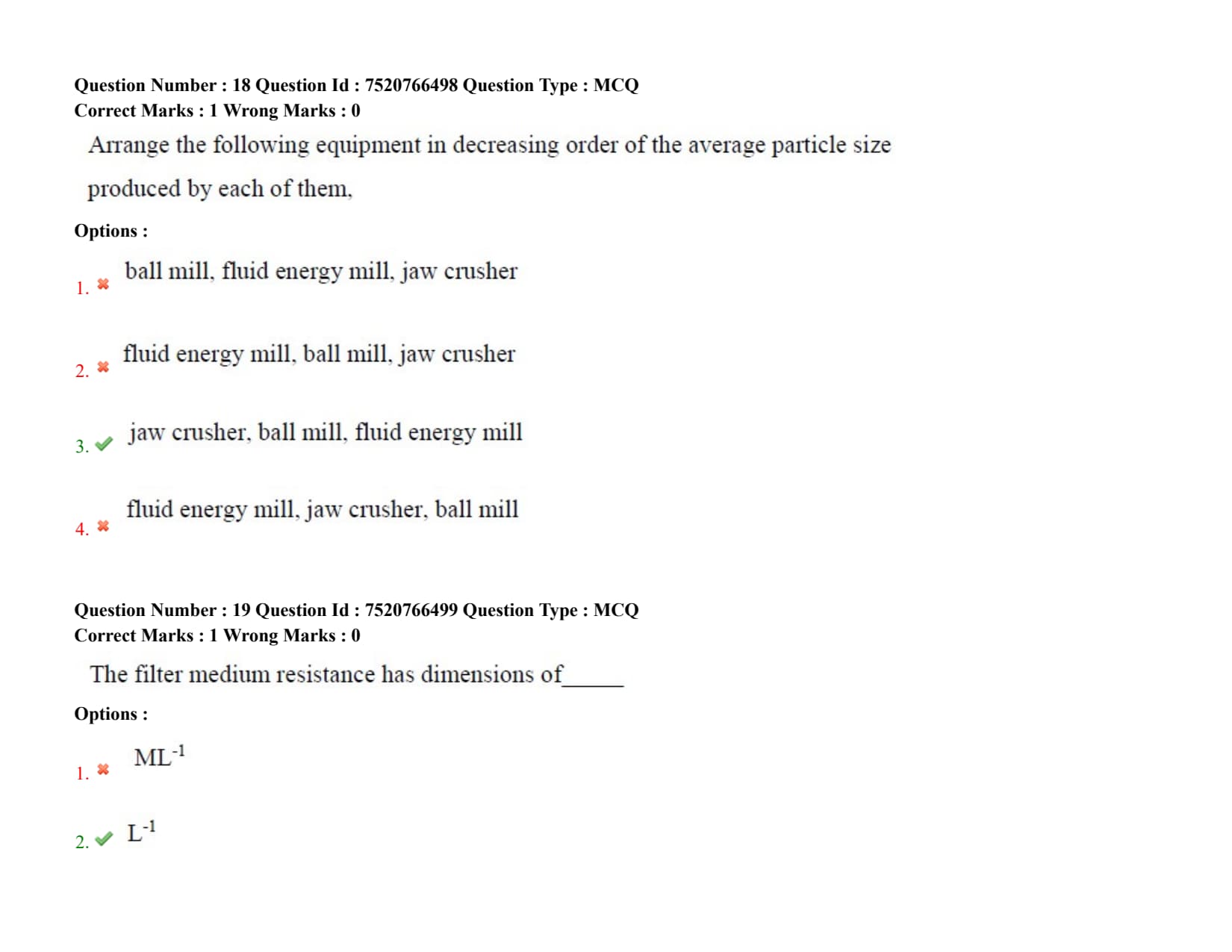
Arrange the following equipment in decreasing order of the average particle size produced by each of them.
View Solution
Step 1: Understanding the Question:
The question requires us to rank size reduction equipment based on the product particle size they generate, ordering them from the largest produced average size to the smallest.
This falls under equipment classification in mechanical operations.
Step 2: Key Formula or Approach:
Size-reduction equipment is classified into four main groups based on the size of the feed they accept and the product they yield:
1. Crushers (coarse and fine)
2. Grinders (intermediate and fine)
3. Ultrafine grinders
4. Cutting machines
Step 3: Detailed Explanation:
Jaw Crusher: This is a primary, coarse crusher.
It takes large rocks/feed (up to several meters) and crushes them into intermediate sizes, typically yielding products in the range of \( 10 to 50 mm \).
Thus, it produces the largest average particle size among the listed devices.
Ball Mill: This is an intermediate/fine grinder.
It uses tumbling steel balls to grind feed of size \( 5 to 10 mm \) down to very fine powder, typically in the range of \( 10 to 100 microns \).
Fluid Energy Mill: This is an ultrafine grinder.
It utilizes high-velocity fluid jets to cause high-speed collisions between particles.
It is used to produce extremely fine materials, often yielding average product sizes in the sub-micron to \( 1 to 10 microns \) range.
Step 4: Final Answer:
The correct decreasing order of average particle size produced is: Jaw crusher \( > \) Ball mill \( > \) Fluid energy mill.
Quick Tip: Remember the typical sizing ranges:
Crushers: mm to cm range.
Grinders (Ball mills): micron range.
Ultrafine grinders (Fluid energy mills): sub-micron to low-micron range.
This classification makes sequencing problems straightforward.
The filter medium resistance has dimensions of______
View Solution
Step 1: Understanding the Question:
The question asks for the physical dimensions of the "filter medium resistance" (\( R_m \)) used in cake filtration theory.
This belongs to the study of filtration in mechanical operations.
Step 2: Key Formula or Approach:
The fundamental filtration equation (derived from Darcy's Law) is:
\[ \frac{dt}{dV} = \frac{\mu}{A \cdot \Delta P} \cdot \left[ \frac{r \cdot c \cdot V}{A} + R_m \right] \]
where:
\( V \) is volume of filtrate (\( [L^3] \)),
\( t \) is filtration time (\( [T] \)),
\( \mu \) is filtrate viscosity (\( [M L^{-1} T^{-1}] \)),
\( A \) is filtration area (\( [L^2] \)),
\( \Delta P \) is pressure drop (\( [M L^{-1} T^{-2}] \)),
\( r \) is specific cake resistance,
\( c \) is mass of dry cake per unit volume of filtrate,
\( R_m \) is filter medium resistance.
Step 3: Detailed Explanation:
Dimensional Consistency Method:
Inside the brackets, the terms \( \frac{r \cdot c \cdot V}{A} \) and \( R_m \) are added together.
By the principle of dimensional homogeneity, they must have the same physical dimensions.
\[ [R_m] = \left[ \frac{r \cdot c \cdot V}{A} \right] \]
Let's evaluate the dimensions of the pressure drop equation directly:
The fluid velocity through the filter medium is:
\[ v = \frac{1}{A} \cdot \frac{dV}{dt} = \frac{\Delta P}{\mu \cdot R_m} \]
Rearrange to solve for \( R_m \):
\[ R_m = \frac{\Delta P}{\mu \cdot v} \]
Substitute the dimensions of each variable into this expression:
\[ [\Delta P] = Pressure = [M L^{-1} T^{-2}] \]
\[ [\mu] = Viscosity = [M L^{-1} T^{-1}] \]
\[ [v] = Velocity = [L T^{-1}] \]
Combine the dimensions:
\[ [R_m] = \frac{[M L^{-1} T^{-2}]}{[M L^{-1} T^{-1}] \cdot [L T^{-1}]} = \frac{[M L^{-1} T^{-2}]}{[M T^{-2}]} = [L^{-1}] \]
Step 4: Final Answer:
The dimensions of filter medium resistance are \( L^{-1} \) (reciprocal length).
Quick Tip: Think of resistance physically: Just like specific cake resistance \( r \) has units of \( m/kg \), the filter medium resistance \( R_m \) is defined per unit length of flow path and has units of \( m^{-1} \) (reciprocal meters), which directly yields \( L^{-1} \).
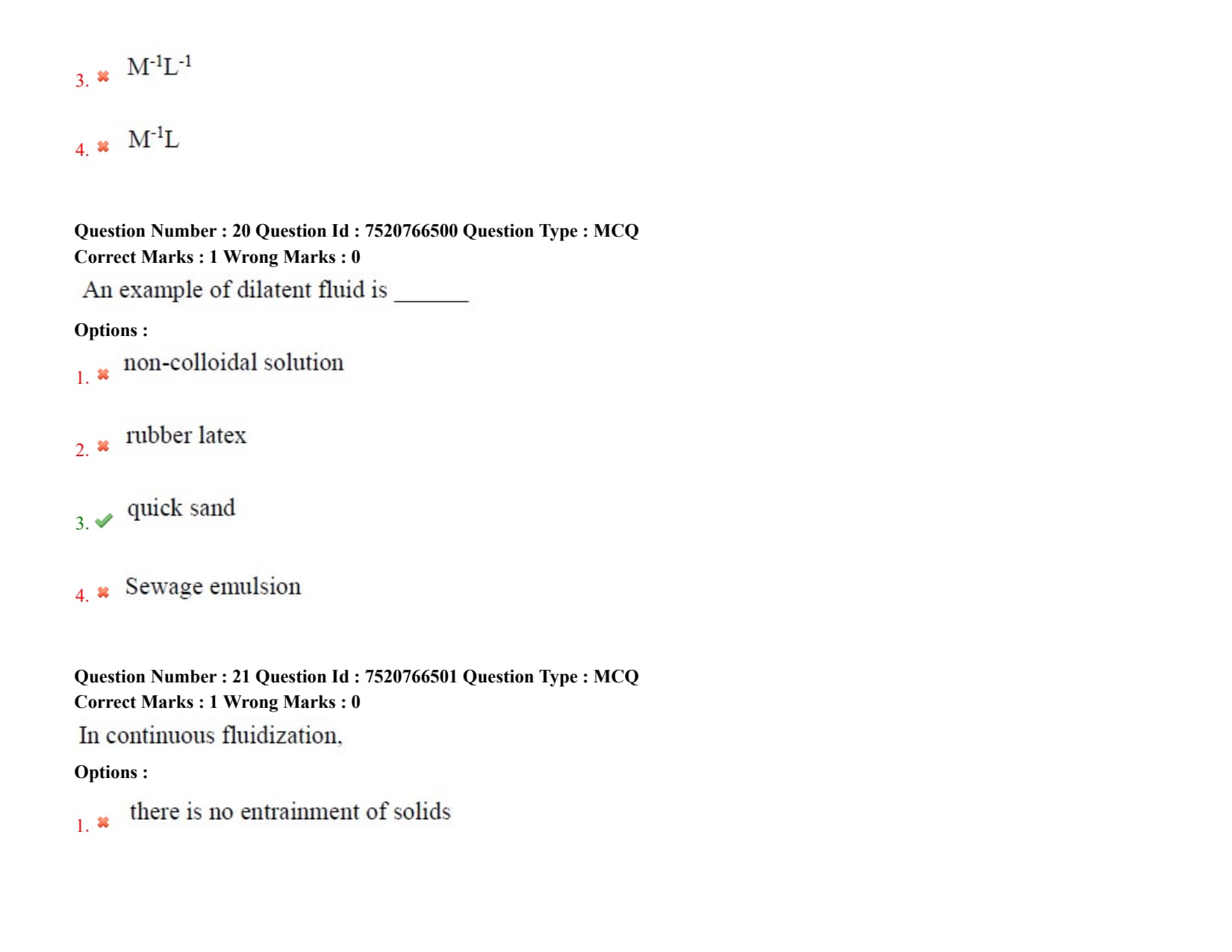
An example of dilatent fluid is ______
View Solution
Step 1: Understanding the Question:
The question asks us to identify an example of a dilatant fluid from the provided choices.
This is a standard classification question in rheology and fluid mechanics.
Step 2: Key Formula or Approach:
Non-Newtonian fluids do not follow Newton's law of viscosity. Their behaviour is modeled by the power-law (Ostwald-de Waele) equation:
\[ \tau = K \cdot \left(\frac{du}{dy}\right)^n \]
where \( n \) is the flow behavior index:
- For Newtonian fluids, \( n = 1 \).
- For Pseudoplastic (shear-thinning) fluids, \( n < 1 \).
- For Dilatant (shear-thickening) fluids, \( n > 1 \).
Step 3: Detailed Explanation:
Dilatant Fluids: These fluids display an increase in apparent viscosity with an increase in shear rate (shear-thickening).
When shear force is applied, the closely packed particles inside are displaced, causing the suspension to expand or "dilate."
The liquid solvent is no longer sufficient to fill the increased voids, increasing solid-to-solid friction and resistance to flow.
Quick Sand: Quicksand is a classic example of a dilatant mixture.
When undisturbed, it behaves like a liquid, but applying sudden shear or pressure (like walking on it) causes it to instantly stiffen and act as a solid.
Other examples include starch suspensions in water (oobleck) and concentrated wet sand.
Other Fluid Types:
Rubber latex is pseudoplastic (shear-thinning), where viscosity decreases with increasing shear rate.
Sewage emulsion is often classified as a pseudoplastic or Bingham plastic fluid.
Step 4: Final Answer:
Quick sand is a classic example of a dilatant fluid.
Quick Tip: Remember these common industrial examples:
Pseudoplastic: Paper pulp, rubber latex, blood, paints.
Dilatant: Quicksand, starch-water suspensions, concentrated clay slurries.
Bingham Plastic: Sewage sludge, toothpaste, drilling muds.
In continuous fluidization,
View Solution
Step 1: Understanding the Question:
The question asks about the characteristic behavior of solids in a continuous fluidization system.
Fluidization is a process where solid particles are transformed into a fluid-like state through contact with a gas or liquid moving upward.
This question tests understanding of the different regimes of fluidization, moving from minimum fluidization to pneumatic transport.
Step 2: Key Formula or Approach:
As the superficial velocity of the fluid (\( u_0 \)) increases, the bed passes through several distinct regimes:
1. Fixed Bed: \( u_0 < u_{mf} \) (where \( u_{mf} \) is the minimum fluidization velocity).
2. Particulate/Bubbling Fluidization: \( u_{mf} \le u_0 < u_t \) (where \( u_t \) is the terminal settling velocity of the particles).
3. Continuous Fluidization / Fast Fluidization: \( u_0 > u_t \).
In this fast fluidization or continuous fluidization regime, the fluid drag is greater than the gravitational force on individual particles, causing them to be carried out of the bed.
Step 3: Detailed Explanation:
Batch Fluidization: In batch fluidization, the fluid velocity is maintained above the minimum fluidization velocity but below the terminal velocity of the particles.
The particles remain confined within the column, and there is negligible entrainment.
Continuous Fluidization: When the fluid velocity exceeds the terminal settling velocity of the particles, the upward drag force overcomes gravity and buoyancy.
The particles are swept out of the column with the fluid, which is referred to as complete entrainment.
To maintain continuous operation, these entrained solids must be separated from the fluid stream (typically using a cyclone separator) and recycled back to the bottom of the fluidization column.
This is the fundamental principle behind circulating fluidized bed reactors (CFBR) and pneumatic transport.
Step 4: Final Answer:
In continuous fluidization, the fluid velocity is high enough that the solids are completely entrained by the moving fluid.
Quick Tip: Remember the sequence of fluidization regimes as fluid velocity increases:
Fixed Bed \( \rightarrow \) Minimum Fluidization \( \rightarrow \) Bubbling/Slugging Bed \( \rightarrow \) Turbulent Bed \( \rightarrow \) Fast/Continuous Fluidization (complete entrainment) \( \rightarrow \) Pneumatic Transport.
A particle attains its terminal settling velocity when ______
View Solution
Step 1: Understanding the Question:
The question asks for the balance of forces acting on a solid particle falling through a fluid when it reaches its terminal settling velocity.
This is a core concept in fluid-particle dynamics and mechanical operations.
Step 2: Key Formula or Approach:
For a particle falling through a fluid, three main forces act on it:
1. Gravitational force (\( F_g \)) acting downwards.
2. Buoyancy force (\( F_b \)) acting upwards.
3. Drag force (\( F_d \)) acting upwards (opposing the direction of motion).
The equation of motion is given by Newton's second law:
\[ m \cdot \frac{dv}{dt} = F_g - F_b - F_d \]
Step 3: Detailed Explanation:
Initial Phase: When a particle is released into a fluid, it initially accelerates because the downward gravitational force is greater than the sum of the upward buoyancy and drag forces.
Acceleration Effect: As the particle's velocity increases, the fluid drag force (which is a function of velocity) also increases.
Terminal State: Eventually, the upward forces (buoyancy force + drag force) increase to a point where they perfectly balance the downward gravitational force.
At this point, the net force acting on the particle is zero:
\[ F_g - F_b - F_d = 0 \quad \implies \quad F_b + F_d = F_g \]
Because the net force is zero, the acceleration \( \frac{dv}{dt} \) becomes zero, and the particle continues to fall at a constant, maximum velocity known as the terminal settling velocity.
Step 4: Final Answer:
The particle attains its terminal settling velocity when the sum of the buoyancy force and the drag force equals the gravitational force.
Quick Tip: To quickly write the force balance for a falling body, remember that gravity pulls it down, while fluid displacement (buoyancy) and friction (drag) push it up.
At steady state (terminal velocity), upward forces must balance downward forces: \( F_b + F_d = F_g \).
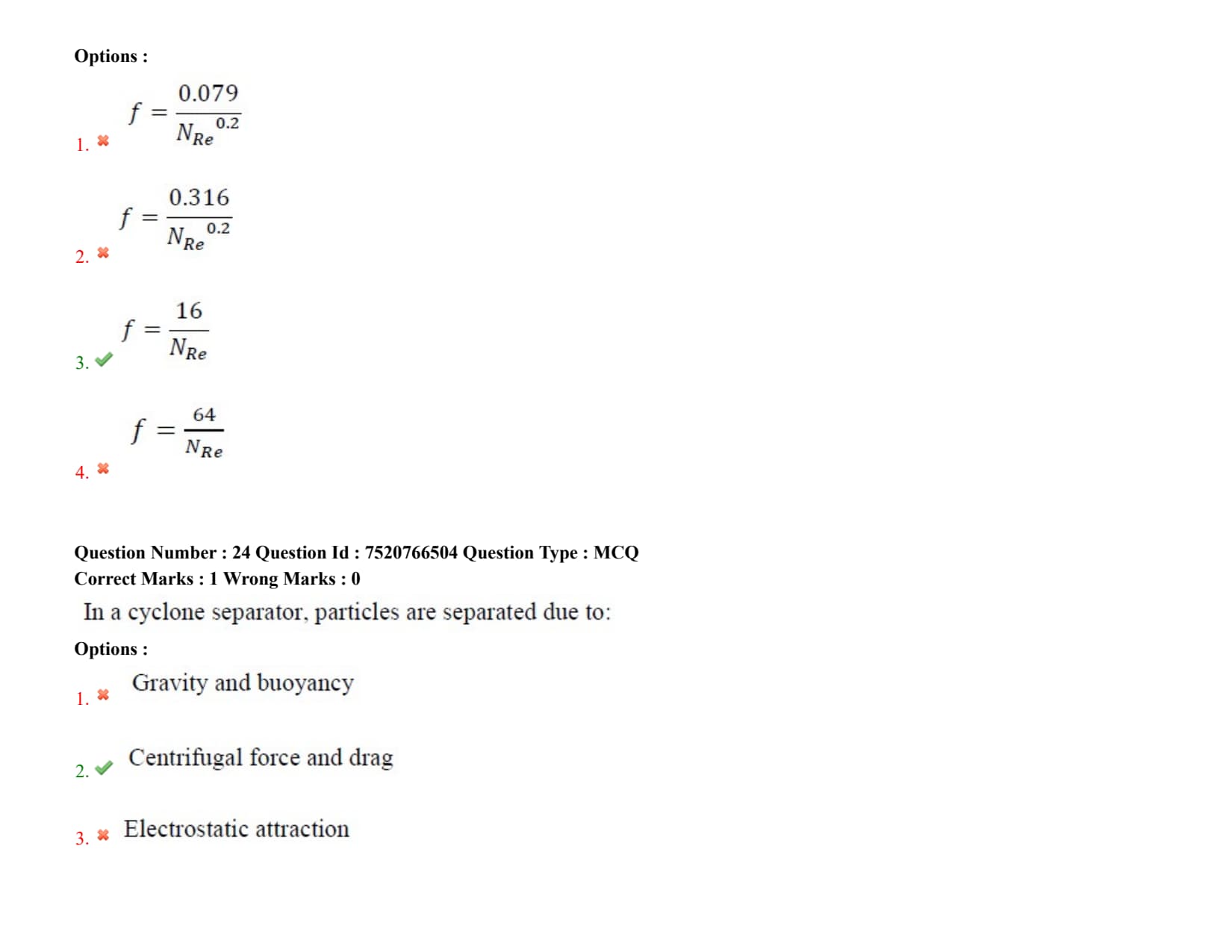
The relationship between fanning friction factor (f) and Reynolds number (N\(_{Re}\)) in laminar flow is
View Solution
Step 1: Understanding the Question:
The question asks for the mathematical relationship between the Fanning friction factor and the Reynolds number for laminar flow inside a circular pipe.
This is a classic relation in fluid dynamics.
Step 2: Key Formula or Approach:
In laminar flow (where Reynolds number \( N_{Re} \le 2100 \)), the pressure drop can be determined analytically using the Hagen-Poiseuille equation:
\[ \Delta P = \frac{32 \cdot \mu \cdot L \cdot v}{D^2} \]
We can also express the pressure drop in terms of the Fanning friction factor \( f \):
\[ \Delta P = \frac{4 \cdot f \cdot L \cdot \rho \cdot v^2}{2 \cdot D} \]
Step 3: Detailed Explanation:
Equate the two expressions for the pressure drop:
\[ \frac{4 \cdot f \cdot L \cdot \rho \cdot v^2}{2 \cdot D} = \frac{32 \cdot \mu \cdot L \cdot v}{D^2} \]
Simplify the equation by canceling common terms (\( L, v, D \)):
\[ \frac{2 \cdot f \cdot \rho \cdot v}{1} = \frac{32 \cdot \mu}{D} \]
Rearrange the terms to solve for the Fanning friction factor \( f \):
\[ f = \frac{16 \cdot \mu}{\rho \cdot v \cdot D} \]
Since the Reynolds number is defined as \( N_{Re} = \frac{\rho \cdot v \cdot D}{\mu} \), we can substitute it into the expression:
\[ f = \frac{16}{N_{Re}} \]
For comparison, the Darcy-Weisbach friction factor \( f_D \) is defined as \( 4f \), which gives \( f_D = \frac{64}{N_{Re}} \).
Step 4: Final Answer:
The Fanning friction factor in laminar flow is related to the Reynolds number by \( f = \frac{16}{N_{Re}} \).
Quick Tip: Always check whether a question asks for the Fanning or Darcy friction factor.
Fanning friction factor: \( f = 16/N_{Re} \)
Darcy/Blasius friction factor: \( f_D = 64/N_{Re} \)
Remembering this distinction will help you avoid simple calculation mistakes.
In a cyclone separator, particles are separated due to:
View Solution
Step 1: Understanding the Question:
The question asks for the primary physical forces responsible for separating solid particles from a gas stream in a cyclone separator.
This is a standard particle-separation unit operation in chemical engineering.
Step 2: Key Formula or Approach:
A cyclone separator uses a gas flow pattern to generate rotational motion without moving parts.
As the fluid rotates, particles are subjected to an outward centrifugal force and an inward fluid drag force.
The balance between these forces determines whether a particle is separated or carried out with the clean gas.
Step 3: Detailed Explanation:
Working Principle: The gas-solid mixture enters tangentially at high velocity into the cylindrical chamber of the cyclone.
This creates a double vortex fluid flow pattern.
The outer spiral flows downward, carrying heavier particles, while the inner spiral flows upward, carrying clean gas.
Centrifugal Force: The circular motion generates a high centrifugal force, which accelerates the particles radially outward toward the wall:
\[ F_c = \frac{m \cdot v_{\theta}^2}{r} \]
where \( m \) is the particle mass, \( v_{\theta} \) is the tangential velocity, and \( r \) is the radial position.
Drag Force: As the gas moves radially inward toward the central vortex, it exerts an inward drag force on the particles:
\[ F_d = 3 \cdot \pi \cdot \mu \cdot d_p \cdot (v_{r,f} - v_{r,p}) \]
Separation Mechanism: For larger or denser particles, the outward centrifugal force overcomes the inward drag force.
These particles hit the wall, lose kinetic energy, and slide down into the collection hopper under gravity.
Smaller particles, where drag dominates over centrifugal force, remain entrained in the gas stream and exit through the top vortex finder.
Step 4: Final Answer:
The separation of particles in a cyclone separator is driven by the balance between centrifugal force and fluid drag.
Quick Tip: The "cut size" (\( d_{pc} \)) of a cyclone is the particle size separated with \( 50% \) efficiency.
Decreasing the cyclone diameter increases the centrifugal force, which lowers the cut size and improves separation efficiency for finer particles.
Screen efficiency in size separation depends on:
View Solution
Step 1: Understanding the Question:
The question asks for the key factors that influence the efficiency of a screening operation in solid-solid size separation.
Screening is a mechanical separation process used to separate mixture of particles into fractions based on their size.
Step 2: Key Formula or Approach:
Screen efficiency (\( \eta \)) is a measure of how successfully a screen separates undersized material from oversized material.
It is defined based on the mass fractions of materials in the feed, overflow, and underflow streams.
This industrial efficiency is influenced by both the equipment geometry and material properties.
Step 3: Detailed Explanation:
Aperture Size: The dimensions of the screen openings determine the cut point of the separation.
If the aperture size is close to the average particle size, particles can easily wedge in the openings, causing blinding and reducing separation efficiency.
Feed Rate: The rate at which material is introduced onto the screen surface is a critical operating variable.
At low feed rates, particles have ample opportunity to contact the screen openings, leading to high efficiency.
At high feed rates, a thick bed of material forms on the screen, preventing undersized particles from reaching the apertures and reducing efficiency.
Particle Shape: Spherical or cubical particles pass through screen openings easily.
Elongated, needle-like, or irregular particles may only pass through if they align vertically with the openings.
This makes shape a key factor in screening performance.
Other Factors: While moisture content and density play a role, the combination of aperture size, feed rate, and particle shape represents the primary design and operational parameters.
Step 4: Final Answer:
Screen efficiency depends on the aperture size, the feed rate, and the shape of the particles.
Quick Tip: The efficiency of a screen is typically calculated as the product of the recovery of the desired undersize in the underflow and the rejection of oversize in the overflow.
Always optimize the feed rate to prevent screen overloading and blinding.
Shell balance in fluid mechanics is used to derive:
View Solution
Step 1: Understanding the Question:
The question asks for the primary application of the "shell momentum balance" technique in fluid mechanics and transport phenomena.
Step 2: Key Formula or Approach:
The shell balance method involves selecting a differential control volume (a "shell") of fluid that matches the geometry of the system (e.g., cylindrical shell for pipe flow, flat plate shell for falling film).
We apply the conservation of momentum to this shell:
\[ Rate of Momentum In - Rate of Momentum Out + Sum of External Forces = 0 \]
Step 3: Detailed Explanation:
Derivation Process:
1. A thin shell of fluid with a differential thickness (e.g., \( \Delta r \) or \( \Delta y \)) is defined.
2. Momentum enters and leaves the shell by molecular transport (viscous shear) and convective transport.
3. Gravity and pressure forces acting on the shell are accounted for.
4. Taking the limit as the shell thickness approaches zero (\( \Delta r \to 0 \)) yields a differential equation for the shear stress distribution, \( \tau(r) \).
Laminar Flow Profiles: By substituting Newton's law of viscosity (\( \tau = -\mu \frac{dv}{dr} \)) into the shear stress equation and integrating, we obtain the velocity profile for laminar flow.
For example, this method yields the parabolic velocity profile (Hagen-Poiseuille profile) for steady laminar flow in a circular tube.
Limitations: This analytical approach is limited to simple geometries and laminar flow regimes where the flow is steady and structured.
It cannot be directly applied to turbulent flow because of the chaotic, fluctuating nature of the fluid motion.
Step 4: Final Answer:
The shell balance method is used to derive analytical velocity profiles in laminar flow.
Quick Tip: The shell balance method always yields the shear stress profile first (which is independent of fluid type), and then the velocity profile is derived by applying the fluid's specific rheological model (e.g., Newtonian or power-law).
For a Venturi meter, the flow rate is proportional to:
View Solution
Step 1: Understanding the Question:
The question asks for the relationship between the volumetric flow rate (\( Q \)) and the measured pressure drop (\( \Delta P \)) across a Venturi meter.
This is a standard fluid mechanics question related to flow measurement devices.
Step 2: Key Formula or Approach:
A Venturi meter is a variable head flow meter that restricts flow to convert pressure energy into kinetic energy.
We apply Bernoulli's equation and the continuity equation between the inlet (point 1) and the throat (point 2):
\[ \frac{P_1}{\rho \cdot g} + \frac{v_1^2}{2 \cdot g} = \frac{P_2}{\rho \cdot g} + \frac{v_2^2}{2 \cdot g} \]
\[ A_1 \cdot v_1 = A_2 \cdot v_2 \]
Step 3: Detailed Explanation:
Express the inlet velocity in terms of the throat velocity using the continuity equation:
\[ v_1 = v_2 \cdot \left(\frac{A_2}{A_1}\right) = v_2 \cdot \beta^2 \]
where \( \beta = D_2 / D_1 \).
Substitute \( v_1 \) into Bernoulli's equation:
\[ \frac{P_1 - P_2}{\rho} = \frac{v_2^2 - v_1^2}{2} = \frac{v_2^2 \cdot (1 - \beta^4)}{2} \]
Solve for the throat velocity \( v_2 \):
\[ v_2 = \sqrt{\frac{2 \cdot \Delta P}{\rho \cdot (1 - \beta^4)}} \]
The volumetric flow rate \( Q \) is:
\[ Q = C_d \cdot A_2 \cdot v_2 = C_d \cdot A_2 \cdot \sqrt{\frac{2 \cdot \Delta P}{\rho \cdot (1 - \beta^4)}} \]
where \( C_d \) is the coefficient of discharge, which accounts for frictional losses.
From this equation, we can see that:
\[ Q \propto \sqrt{\Delta P} \]
Step 4: Final Answer:
The volumetric flow rate in a Venturi meter is proportional to the square root of the pressure drop, \( \sqrt{\Delta P} \).
Quick Tip: All obstruction-type flow meters (Venturi meters, Orifice meters, and Flow nozzles) follow the relationship \( Q \propto \sqrt{\Delta P} \).
This is a key characteristic of head flow meters.
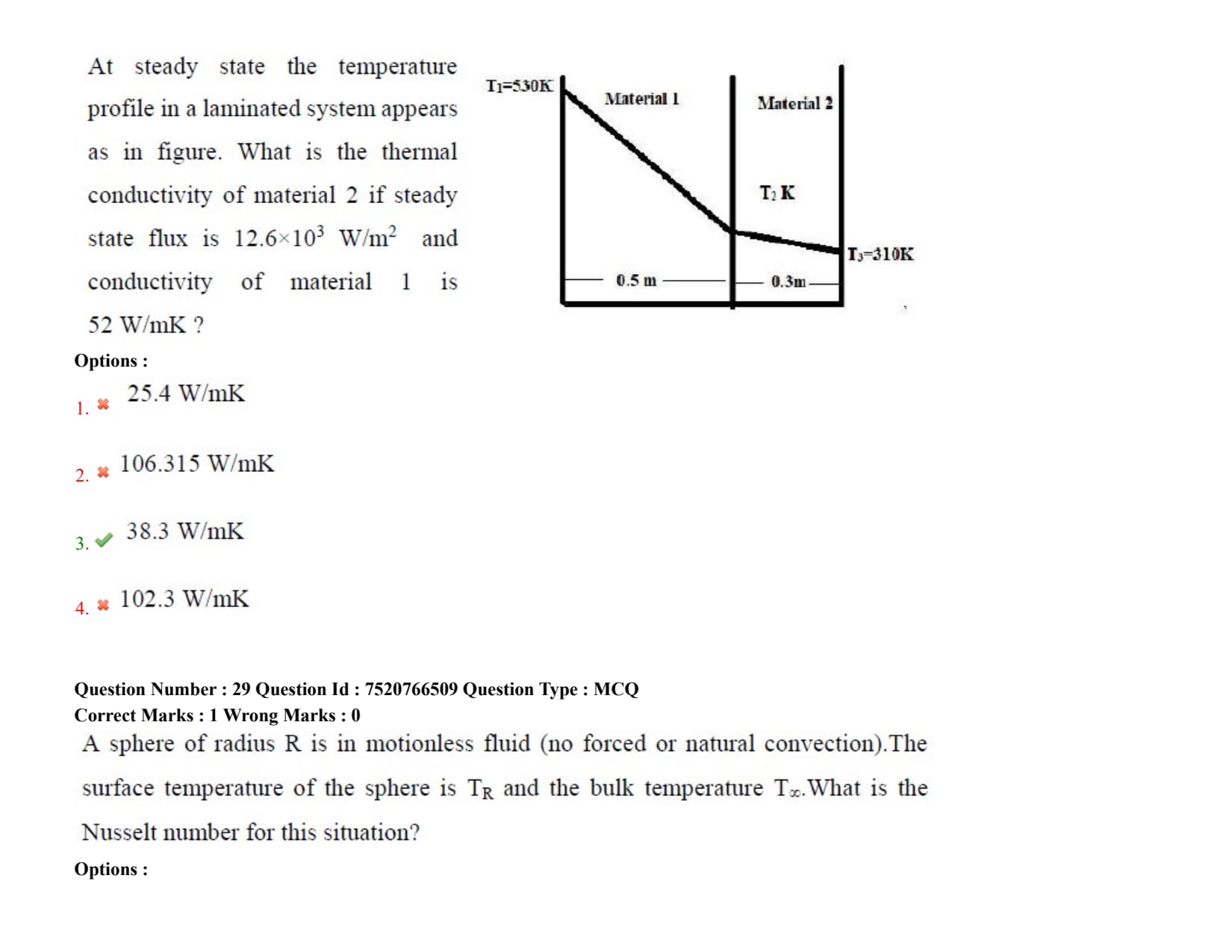
At steady state the temperature profile in a laminated system appears as in figure. What is the thermal conductivity of material 2 if steady state flux is 12.6\(\times\)10\(^3\) W/m\(^2\) and conductivity of material 1 is 52 W/mK ?

View Solution
Step 1: Understanding the Question:
The question asks us to calculate the thermal conductivity (\( k_2 \)) of the second layer in a two-layer laminated composite wall under steady-state heat conduction.
We are given the heat flux (\( q \)), the thickness of both layers (\( x_1 = 0.5 m \) and \( x_2 = 0.3 m \)), the thermal conductivity of the first layer (\( k_1 = 52 W/mK \)), and the boundary temperatures (\( T_1 = 530 K \) and \( T_3 = 310 K \)).
Step 2: Key Formula or Approach:
For steady-state, one-dimensional heat conduction through a composite wall, the heat flux is constant through all layers.
Using the thermal resistance concept, the heat flux is:
\[ q = \frac{T_1 - T_3}{R_{th, total}} \]
where the total thermal resistance per unit area is the sum of individual resistances in series:
\[ R_{th, total} = R_{th, 1} + R_{th, 2} = \frac{x_1}{k_1} + \frac{x_2}{k_2} \]
Step 3: Detailed Explanation:
Identify the given values:
Heat flux, \( q = 12.6 \times 10^3 W/m^2 = 12600 W/m^2 \)
Thickness of Material 1, \( x_1 = 0.5 m \)
Thermal conductivity of Material 1, \( k_1 = 52 W/mK \)
Thickness of Material 2, \( x_2 = 0.3 m \)
Overall temperature difference, \( \Delta T = T_1 - T_3 = 530 - 310 = 220 K \)
Express the heat flux equation:
\[ q = \frac{T_1 - T_3}{\frac{x_1}{k_1} + \frac{x_2}{k_2}} \]
Substitute the known values:
\[ 12600 = \frac{220}{\frac{0.5}{52} + \frac{0.3}{k_2}} \]
Calculate the resistance of the first layer:
\[ R_{th, 1} = \frac{0.5}{52} \approx 0.009615 m^2K/W \]
Solve for the total resistance:
\[ R_{th, total} = \frac{220}{12600} \approx 0.017460 m^2K/W \]
Determine the resistance of the second layer:
\[ R_{th, 2} = R_{th, total} - R_{th, 1} \]
\[ \frac{0.3}{k_2} = 0.017460 - 0.009615 = 0.007845 m^2K/W \]
Solve for \( k_2 \):
\[ k_2 = \frac{0.3}{0.007845} \approx 38.24 W/mK \]
This matches option (C) which is 38.3 W/mK.
Step 4: Final Answer:
The thermal conductivity of material 2 is approximately 38.3 W/mK.
Quick Tip: Treat composite wall heat transfer problems exactly like electric circuits in series:
\[ Current (I) \leftrightarrow Heat flux (q) \]
\[ Voltage (V) \leftrightarrow Temperature difference (\Delta T) \]
\[ Resistance (R) \leftrightarrow Thermal resistance (x/k) \]
This analogy helps structure calculations and prevent errors.
A sphere of radius R is in motionless fluid (no forced or natural convection). The surface temperature of the sphere is T\(_R\) and the bulk temperature T\(_\infty\). What is the Nusselt number for this situation?
View Solution
Step 1: Understanding the Question:
The question asks for the limiting value of the Nusselt number (\( Nu \)) for a sphere suspended in an infinite, motionless fluid, where heat is transferred solely via conduction.
This is a classical heat transfer problem.
Step 2: Key Formula or Approach:
The Nusselt number is defined as:
\[ Nu = \frac{h \cdot D}{k_f} \]
where \( h \) is the heat transfer coefficient, \( D \) is the diameter of the sphere (\( D = 2R \)), and \( k_f \) is the thermal conductivity of the fluid.
We can find \( h \) by analyzing steady-state, one-dimensional radial heat conduction in the surrounding stagnant fluid.
Step 3: Detailed Explanation:
The heat conduction equation in spherical coordinates with radial symmetry is:
\[ \frac{d}{dr}\left(r^2 \cdot \frac{dT}{dr}\right) = 0 \]
Integrate this equation once:
\[ r^2 \cdot \frac{dT}{dr} = C_1 \quad \implies \quad \frac{dT}{dr} = \frac{C_1}{r^2} \]
Integrate a second time:
\[ T(r) = -\frac{C_1}{r} + C_2 \]
Apply the boundary conditions:
1. At \( r = R \) (sphere surface), \( T = T_R \).
2. At \( r \to \infty \) (bulk fluid), \( T = T_{\infty} \).
Solving for the constants:
\[ C_2 = T_{\infty} \]
\[ T_R = -\frac{C_1}{R} + T_{\infty} \quad \implies \quad C_1 = -R \cdot (T_R - T_{\infty}) \]
Substitute the constants back into the temperature profile:
\[ T(r) = T_{\infty} + \frac{R}{r} \cdot (T_R - T_{\infty}) \]
Calculate the heat flux at the surface (\( r = R \)) using Fourier's Law:
\[ q'' = -k_f \cdot \frac{dT}{dr}\Big|_{r=R} = -k_f \cdot \left[ -\frac{R}{R^2} \cdot (T_R - T_{\infty}) \right] = \frac{k_f}{R} \cdot (T_R - T_{\infty}) \]
Equate this conduction heat flux to Newton's law of cooling:
\[ q'' = h \cdot (T_R - T_{\infty}) \quad \implies \quad h = \frac{k_f}{R} \]
Substitute \( h \) into the Nusselt number equation, using \( D = 2R \):
\[ Nu = \frac{h \cdot D}{k_f} = \frac{\left(\frac{k_f}{R}\right) \cdot (2R)}{k_f} = 2 \]
Step 4: Final Answer:
The Nusselt number for a sphere in a stagnant fluid is exactly 2.
Quick Tip: The expression \( Nu = 2 \) is the absolute minimum limit of heat transfer from a sphere.
Any fluid motion (convection) will increase the Nusselt number above 2, which is represented by empirical correlations like the Ranz-Marshall equation:
\[ Nu = 2 + 0.6 \cdot Re^{1/2} \cdot Pr^{1/3} \]
Prandtl number is the ratio of ______
View Solution
Step 1: Understanding the Question:
The question asks for the physical definition of the dimensionless Prandtl number (\( Pr \)).
The Prandtl number is a fundamental parameter in transport phenomena that links fluid dynamics and heat transfer.
Step 2: Key Formula or Approach:
The Prandtl number is mathematically defined as:
\[ Pr = \frac{\nu}{\alpha} \]
where \( \nu \) represents the kinematic viscosity (or momentum diffusivity) and \( \alpha \) represents the thermal diffusivity.
Step 3: Detailed Explanation:
Momentum Diffusivity (\( \nu \)): Kinematic viscosity represents the rate of momentum transport through molecular friction in fluid flow:
\[ \nu = \frac{\mu}{\rho} \]
where \( \mu \) is dynamic viscosity and \( \rho \) is fluid density.
Thermal Diffusivity (\( \alpha \)): This measures the rate of heat transport through conduction in the material:
\[ \alpha = \frac{k}{\rho \cdot C_p} \]
where \( k \) is thermal conductivity and \( C_p \) is specific heat capacity.
Combining the ratios:
\[ Pr = \frac{\nu}{\alpha} = \frac{\frac{\mu}{\rho}}{\frac{k}{\rho \cdot C_p}} = \frac{\mu \cdot C_p}{k} \]
This ratio represents the relative thickness of the momentum boundary layer and the thermal boundary layer.
Physical significance:
If \( Pr \approx 1 \) (e.g., gases), the momentum and thermal boundary layers grow at the same rate.
If \( Pr \gg 1 \) (e.g., oils), momentum diffuses much faster than heat, meaning the velocity boundary layer is much thicker than the thermal boundary layer.
Step 4: Final Answer:
The Prandtl number is defined as the ratio of momentum diffusivity to thermal diffusivity.
Quick Tip: Think of dimensionless numbers as transport ratios:
Prandtl Number (\( Pr \)) = Momentum Diffusivity / Thermal Diffusivity
Schmidt Number (\( Sc \)) = Momentum Diffusivity / Mass Diffusivity
Lewis Number (\( Le \)) = Thermal Diffusivity / Mass Diffusivity
These three numbers form a family of transport property ratios.
The thermal conductivity is minimum for ______
View Solution
Step 1: Understanding the Question:
The question asks to identify the material with the lowest thermal conductivity among the given options: copper, water, silver, and air.
Thermal conductivity (\( k \)) is a physical property that measures a material's ability to conduct heat.
Step 2: Key Formula or Approach:
The magnitude of thermal conductivity varies significantly across different phases of matter:
\[ k_{solids} > k_{liquids} > k_{gases} \]
This is because thermal energy is conducted via free electrons and lattice vibrations (phonons) in solids, whereas in gases it occurs through random molecular collisions over relatively large distances.
Step 3: Detailed Explanation:
Metals (Silver and Copper): Silver and copper are excellent electrical and thermal conductors.
Their high thermal conductivity is due to the abundance of free electrons.
Approximate thermal conductivities:
- Silver: \( k \approx 429 W/mK \)
- Copper: \( k \approx 401 W/mK \)
Liquids (Water): Liquids have larger molecular spacing than solids, which limits heat transfer efficiency.
- Water: \( k \approx 0.6 W/mK \)
Gases (Air): Gas molecules are highly dispersed and transfer heat only through occasional collisions.
Consequently, gases are poor conductors of heat and make excellent thermal insulators when stagnant.
- Air: \( k \approx 0.026 W/mK \)
Step 4: Final Answer:
Among the given choices, air has the lowest thermal conductivity.
Quick Tip: Still air is one of the best passive thermal insulators.
Industrial insulation materials (like fiberglass or expanded polystyrene) work by trapping pockets of air, utilizing its extremely low thermal conductivity (\( \approx 0.026 W/mK \)) to prevent heat transfer.
Which of the following dimensionless number is associated with free convection?
View Solution
Step 1: Understanding the Question:
The question asks which dimensionless number is used to characterize natural (free) convection heat transfer.
Free convection occurs when fluid motion is driven entirely by buoyancy forces resulting from density differences caused by temperature gradients.
Step 2: Key Formula or Approach:
The Grashof number (\( Gr \)) acts as the equivalent of the Reynolds number for free convection. It is defined as:
\[ Gr = \frac{g \cdot \beta \cdot (T_s - T_{\infty}) \cdot L^3}{\nu^2} \]
where:
\( g \) is acceleration due to gravity,
\( \beta \) is the volumetric thermal expansion coefficient,
\( T_s \) is the surface temperature,
\( T_{\infty} \) is the ambient fluid temperature,
\( L \) is the characteristic length,
\( \nu \) is the kinematic viscosity.
Step 3: Detailed Explanation:
Grashof Number: The physical interpretation of the Grashof number is the ratio of buoyancy forces to viscous forces acting on the fluid:
\[ Gr = \frac{Buoyant Force}{Viscous Force} \]
Since buoyancy drives the fluid flow in free convection, \( Gr \) is the primary dimensionless number used to determine if the boundary layer flow is laminar or turbulent.
Other Options:
- Reynolds number (\( Re \)): Represents the ratio of inertial forces to viscous forces. It is the primary dimensionless number used to characterize forced convection.
- Prandtl number (\( Pr \)): Represents the ratio of momentum diffusivity to thermal diffusivity. It is a fluid property parameter used in both free and forced convection.
- Peclet number (\( Pe \)): Represents the ratio of advective transport to diffusive transport (\( Pe = Re \cdot Pr \)).
Step 4: Final Answer:
The Grashof number is the dimensionless parameter associated with free convection.
Quick Tip: For natural convection problems, the transition from laminar to turbulent flow is determined by the Rayleigh number (\( Ra \)), which is the product of the Grashof and Prandtl numbers:
\[ Ra = Gr \cdot Pr \]
Typically, a transition occurs around \( Ra \approx 10^9 \) for a vertical plate.
Wavelength corresponding to the maximum energy is inversely proportional to the absolute temperature is known as ______
View Solution
Step 1: Understanding the Question:
The question asks to identify the radiation heat transfer law that states that the wavelength corresponding to the maximum spectral emissive power is inversely proportional to the absolute temperature.
This is a core topic in thermal radiation.
Step 2: Key Formula or Approach:
According to Planck's distribution of radiation, blackbody spectral emissive power varies with wavelength.
The wavelength at which the spectral emissive power is maximum, \( \lambda_{max} \), is given by Wein's displacement law:
\[ \lambda_{max} \cdot T = C_w \]
where \( T \) is the absolute temperature in Kelvin, and \( C_w \) is Wein's displacement constant (\( \approx 2898 \mum\cdotK \)).
Step 3: Detailed Explanation:
Wein's Displacement Law: As the temperature of a blackbody increases, the total radiated energy increases and the peak of the emissive curve shifts to shorter (more energetic) wavelengths.
This explains why objects heated to high temperatures first glow red, then yellow, and eventually white or blue.
Mathematically, the relationship is:
\[ \lambda_{max} \propto \frac{1}{T} \]
Stefan-Boltzmann Law: States that the total energy radiated per unit surface area of a blackbody per unit time is directly proportional to the fourth power of its absolute temperature:
\[ E_b = \sigma \cdot T^4 \]
Kirchhoff's Law: States that for a body in thermal equilibrium, its emissivity is equal to its absorptivity:
\[ \epsilon = \alpha \]
Raoult's Law: Describes vapor-liquid equilibrium and is unrelated to radiation heat transfer.
Step 4: Final Answer:
The relationship where the peak wavelength is inversely proportional to temperature is known as Wein's displacement law.
Quick Tip: Remember the value of Wein's constant as \( 2898 \mum\cdotK \).
This allows you to quickly calculate the peak wavelength of radiation emitted by bodies like the sun (\( T \approx 5800 K \)) or the earth (\( T \approx 300 K \)).
In a counter-current heat exchanger, compared to co-current flow:
View Solution
Step 1: Understanding the Question:
The question asks us to compare the Logarithmic Mean Temperature Difference (LMTD) and overall performance of a counter-current heat exchanger against a co-current (parallel) heat exchanger.
This is a standard design concept in heat exchanger analysis.
Step 2: Key Formula or Approach:
The rate of heat transfer in a heat exchanger is governed by:
\[ Q = U \cdot A \cdot LMTD \]
where \( U \) is the overall heat transfer coefficient, \( A \) is the heat transfer area, and LMTD is defined as:
\[ LMTD = \frac{\Delta T_1 - \Delta T_2}{\ln\left(\frac{\Delta T_1}{\Delta T_2}\right)} \]
Step 3: Detailed Explanation:
Temperature Driving Force: In a co-current exchanger, the hot and cold fluids enter at the same end.
The temperature difference between the two fluids is large at the inlet but decreases rapidly along the length of the exchanger.
In a counter-current exchanger, the fluids enter at opposite ends.
The temperature difference remains relatively uniform and sustained throughout the length of the exchanger.
LMTD Comparison: For the same inlet and outlet temperatures, the average driving force (LMTD) is always higher for counter-current flow than for co-current flow:
\[ LMTD_{counter-current} > LMTD_{co-current} \]
Area Requirement: Because the driving force (LMTD) is larger in a counter-current arrangement, the required surface area \( A \) is smaller for a specified heat duty \( Q \):
\[ A = \frac{Q}{U \cdot LMTD} \]
Temperature Crossing: In counter-current flow, the outlet temperature of the cold fluid can exceed the outlet temperature of the hot fluid, which is thermodynamically impossible in co-current flow.
Step 4: Final Answer:
Compared to co-current flow, the counter-current arrangement results in a higher LMTD.
Quick Tip: Counter-current heat exchangers are thermodynamically superior because they yield a larger LMTD, resulting in a more compact and cost-effective design (smaller required heat transfer area).
In natural convection, the driving force for fluid motion is:
View Solution
Step 1: Understanding the Question:
The question asks for the physical driving force that initiates and sustains fluid motion during natural (free) convection.
This is a fundamental concept in convective heat transfer.
Step 2: Key Formula or Approach:
In natural convection, fluid motion is not generated by an external source like a pump or fan.
Instead, it is driven by density variations within the fluid under the influence of gravity.
These density differences are typically caused by temperature gradients.
Step 3: Detailed Explanation:
Mechanism of Natural Convection: When a fluid is in contact with a hot surface, the fluid layer closest to the surface absorbs heat and expands.
Thermal expansion reduces the density of this hot layer of fluid.
The cooler fluid further away remains denser.
Buoyancy Generation: Under the influence of gravity, the denser, cooler fluid sinks, which forces the lighter, warmer fluid to rise.
This buoyancy-driven circulation forms convection currents.
The volumetric thermal expansion coefficient \( \beta \) relates the temperature change to density variation:
\[ \beta = -\frac{1}{\rho} \cdot \left(\frac{\partial \rho}{\partial T}\right)_P \]
Forced Convection Comparison: Forced convection is driven by external means, such as pressure gradients from pumps or fans, or mechanical stirring.
Step 4: Final Answer:
The driving force for fluid motion in natural convection is buoyancy arising from density differences caused by temperature variations.
Quick Tip: To identify natural convection problems, look for terms like "buoyancy," "density difference," "temperature gradient," and "Grashof number."
If there is no pump, fan, or stirrer mentioned, the heat transfer mode is natural convection.
For condensation of a pure vapor on a vertical surface, the Nusselt theory predicts:
View Solution
Step 1: Understanding the Question:
The question asks what the Nusselt theory of film condensation predicts regarding the thickness of the liquid condensate film as it flows down a vertical surface.
This is a standard topic in phase-change heat transfer.
Step 2: Key Formula or Approach:
Nusselt's analysis of laminar film condensation on a vertical plate assumes that a continuous film of liquid flows downward under the influence of gravity.
The local film thickness, \( \delta(x) \), at a distance \( x \) from the top of the plate is given by:
\[ \delta(x) = \left[ \frac{4 \cdot \mu_l \cdot k_l \cdot (T_{sat} - T_w) \cdot x}{g \cdot \rho_l \cdot (\rho_l - \rho_v) \cdot h'_{fg}} \right]^{1/4} \]
Step 3: Detailed Explanation:
Mechanism of Film Growth: As vapor condenses on the cold vertical wall, a liquid film is formed at the top of the plate (\( x = 0 \)).
As this liquid film flows downward under the action of gravity, additional vapor condenses onto the liquid-vapor interface.
This continuous condensation adds mass to the falling liquid film.
Proportionality: From Nusselt's analytical equation, the local film thickness \( \delta(x) \) is proportional to the fourth root of the distance from the top:
\[ \delta(x) \propto x^{1/4} \]
This means the film thickness starts at zero at the very top of the plate and continuously increases as it flows toward the bottom.
Thermal Resistance Impact: Because the liquid film acts as a thermal barrier, the local heat transfer coefficient \( h(x) \) is inversely proportional to the film thickness:
\[ h(x) = \frac{k_l}{\delta(x)} \propto x^{-1/4} \]
Consequently, the local heat transfer coefficient is highest at the top (where the film is thinnest) and decreases toward the bottom.
Step 4: Final Answer:
Nusselt's theory of condensation predicts that the liquid film thickness increases from top to bottom on a vertical surface.
Quick Tip: Remember that \( \delta(x) \propto x^{1/4} \) and \( h(x) \propto x^{-1/4} \).
These proportionalities are frequently tested in competitive examinations and help solve multi-part questions quickly.
The heat flux (from outside to inside) across an insulating wall with thermal conductivity k = 0.04 W/m K and thickness 0.16m is 10 W/ m\(^2\). The temperature of the inside wall is -5\(^\circ\)C. The outside wall temperature is______ \(^\circ\)C.
View Solution
Step 1: Understanding the Question:
The question asks to calculate the outside temperature of a flat insulating wall under steady-state heat conduction.
We are given the thermal conductivity (\( k \)), the thickness of the wall (\( L \)), the heat flux (\( q \)), and the temperature of the inside surface (\( T_{in} \)).
Step 2: Key Formula or Approach:
For steady-state, one-dimensional heat conduction through a flat wall, Fourier's Law is expressed as:
\[ q = -k \cdot \frac{dT}{dx} \quad \implies \quad q = \frac{k \cdot (T_{out} - T_{in})}{L} \]
where \( q \) is the heat flux, \( k \) is the thermal conductivity, \( L \) is the thickness of the wall, \( T_{out} \) is the outside wall temperature, and \( T_{in} \) is the inside wall temperature.
Step 3: Detailed Explanation:
Identify the given variables:
Heat flux, \( q = 10 W/m^2 \)
Thermal conductivity, \( k = 0.04 W/mK \)
Wall thickness, \( L = 0.16 m \)
Inside wall temperature, \( T_{in} = -5^\circC \)
Rearrange the conduction equation to solve for \( T_{out} \):
\[ T_{out} - T_{in} = \frac{q \cdot L}{k} \]
Substitute the known values:
\[ T_{out} - (-5) = \frac{10 \cdot 0.16}{0.04} \]
Perform the arithmetic:
\[ T_{out} + 5 = \frac{1.6}{0.04} \]
\[ T_{out} + 5 = 40 \]
\[ T_{out} = 40 - 5 = 35^\circC \]
Step 4: Final Answer:
The temperature of the outside wall is 35\(^\circ\)C.
Quick Tip: Always keep track of negative signs when working with below-freezing temperatures.
Double check that \( T_{out} - T_{in} = 35 - (-5) = 40^\circC \), which maintains the correct heat flux direction from outside (hot) to inside (cold).
The hydrodynamic and thermal boundary layer will merge, when______
View Solution
Step 1: Understanding the Question:
The question asks for the condition under which the thickness of the hydrodynamic (velocity) boundary layer (\( \delta \)) is equal to the thickness of the thermal boundary layer (\( \delta_t \)).
This is a key concept in boundary layer theory and convective transport.
Step 2: Key Formula or Approach:
For laminar flow over a flat plate, the relationship between the hydrodynamic boundary layer thickness and the thermal boundary layer thickness is given by:
\[ \frac{\delta}{\delta_t} \approx Pr^{1/3} \]
where \( Pr \) is the dimensionless Prandtl number.
Step 3: Detailed Explanation:
Prandtl Number Definition: The Prandtl number is defined as the ratio of momentum diffusivity (kinematic viscosity) to thermal diffusivity:
\[ Pr = \frac{\nu}{\alpha} \]
Boundary Layer Growth: The momentum diffusivity governs the rate of growth of the velocity boundary layer, while the thermal diffusivity governs the growth of the thermal boundary layer.
Condition for Merging: If the rate of momentum diffusion equals the rate of thermal diffusion:
\[ \nu = \alpha \quad \implies \quad Pr = 1 \]
Under this condition:
\[ \frac{\delta}{\delta_t} = (1)^{1/3} = 1 \quad \implies \quad \delta = \delta_t \]
Thus, the hydrodynamic and thermal boundary layers will grow at the same rate and merge.
This behavior is commonly observed in gases (e.g., air has \( Pr \approx 0.7 \), which is close to 1).
Step 4: Final Answer:
The hydrodynamic and thermal boundary layers will merge when the Prandtl number is equal to one.
Quick Tip: For mass transfer, the analogous relationship between the hydrodynamic and concentration boundary layers is:
\[ \frac{\delta}{\delta_c} \approx Sc^{1/3} \]
where \( Sc \) is the Schmidt number. When \( Sc = 1 \), the hydrodynamic and concentration boundary layers merge.
According to penetration theory, the mass transfer coefficient is proportional to______
View Solution
Step 1: Understanding the Question:
The question asks for the relationship between the mass transfer coefficient (\( k_L \)) and the molecular diffusivity (\( D_{AB} \)) as predicted by Higbie's Penetration Theory.
This is a fundamental mass transfer theory used to describe fluid-fluid interfaces.
Step 2: Key Formula or Approach:
Higbie's penetration theory assumes that turbulent eddies from the bulk liquid travel to the interface, remain there for a constant exposure time \( t_e \), and undergo unsteady-state molecular diffusion before returning to the bulk.
The average mass transfer coefficient is given by:
\[ k_L = 2 \cdot \sqrt{\frac{D_{AB}}{\pi \cdot t_e}} \]
Step 3: Detailed Explanation:
Higbie's Equation Analysis: From the formula for the mass transfer coefficient, we can isolate the dependence on molecular diffusivity \( D_{AB} \):
\[ k_L \propto \sqrt{D_{AB}} \quad \implies \quad k_L \propto D_{AB}^{0.5} \]
Comparison with other theories:
1. Film Theory: Assumes a stagnant film at the interface where mass transfer occurs via steady-state molecular diffusion.
The mass transfer coefficient is directly proportional to diffusivity:
\[ k_L \propto D_{AB}^{1.0} \]
2. Boundary Layer Theory: Predicts that the mass transfer coefficient is proportional to a fractional power of diffusivity:
\[ k_L \propto D_{AB}^{2/3} \approx D_{AB}^{0.67} \]
3. Surface Renewal Theory (Danckwerts): Assumes a random distribution of surface ages and exposure times, but still predicts:
\[ k_L \propto D_{AB}^{0.5} \]
Step 4: Final Answer:
According to penetration theory, the mass transfer coefficient is proportional to the square root of diffusivity, \( D_{AB}^{0.5} \).
Quick Tip: Remember the diffusivity exponents for the three major mass transfer theories:
Film Theory: \( D^{1.0} \)
Boundary Layer Theory: \( D^{0.67} \)
Penetration / Surface Renewal Theory: \( D^{0.50} \)
These exponents are highly important for exam questions.
Psychrometric ratio for air-water mixture over the temperature usually come across is approximately______
View Solution
Step 1: Understanding the Question:
The question asks for the approximate value of the psychrometric ratio for an air-water vapor mixture under typical ambient temperature conditions.
This is a standard property value in humidification and psychrometrics.
Step 2: Key Formula or Approach:
The psychrometric ratio is defined as the ratio of the heat transfer coefficient (\( h_G \)) to the product of the mass transfer coefficient (\( k_Y \)) and the humid heat (\( C_s \)):
\[ r = \frac{h_G}{k_Y \cdot C_s} \]
This ratio is also related to the Lewis number (\( Le \)) by:
\[ r \approx Le^{2/3} = \left(\frac{Sc}{Pr}\right)^{2/3} \]
Step 3: Detailed Explanation:
The Lewis Relation: For many gas-vapor mixtures, the rates of heat and mass transfer are different.
However, for an air-water vapor mixture at normal temperatures, the thermal diffusivity and molecular diffusivity are nearly equal.
This results in a Lewis number close to unity:
\[ Le = \frac{Sc}{Pr} \approx 1.0 \]
Psychrometric Ratio Value: Since the Lewis number is approximately 1, the psychrometric ratio for the air-water system is also very close to 1:
\[ r \approx 1.0 \]
Practical Consequence: Because the psychrometric ratio is close to 1 for the air-water system, the wet-bulb temperature (\( T_w \)) is approximately equal to the adiabatic saturation temperature (\( T_{as} \)).
This simplification is unique to the air-water system and does not apply to other organic solvent-air systems.
Step 4: Final Answer:
The psychrometric ratio for an air-water mixture is approximately 1.
Quick Tip: For any gas-vapor mixture other than air-water (e.g., benzene-air or ethanol-air), the psychrometric ratio is significantly different from 1.
In those cases, the wet-bulb temperature is distinct from the adiabatic saturation temperature.
Heat energy required to increase the temperature of unit mass of gas and its accompanying vapour by one degree at constant pressure is known as______
View Solution
Step 1: Understanding the Question:
The question asks for the definition of the heat energy required to increase the temperature of a unit mass of dry gas along with its accompanying vapor by one degree at constant pressure.
This is a fundamental definition in psychrometrics and humidification.
Step 2: Key Formula or Approach:
For a gas-vapor mixture (such as air-water vapor), the humid heat (\( C_s \)) is defined based on a unit mass of dry gas:
\[ C_s = C_{p,g} + Y \cdot C_{p,v} \]
where \( C_{p,g} \) is the specific heat of the dry gas, \( C_{p,v} \) is the specific heat of the vapor, and \( Y \) is the humidity (mass of vapor per unit mass of dry gas).
Step 3: Detailed Explanation:
Humid Heat Concept: In air-conditioning and drying calculations, the dry gas mass remains constant throughout the process, while the vapor content changes.
Therefore, thermal properties are defined per unit mass of dry gas.
Humid heat represents the heat capacity of \( 1 kg \) of dry air plus the \( Y kg \) of water vapor accompanying it.
Specific Heat: This is the heat capacity of a pure substance per unit mass of that substance, and does not account for the dry gas basis of a mixture.
Enthalpy: This is a thermodynamic state function representing total heat content, rather than a rate of change with temperature.
Grosvenor Humidity: This is another name for absolute humidity (\( Y \)), which is a mass ratio rather than a thermal property.
Step 4: Final Answer:
The thermal property defined in the question is known as the humid heat.
Quick Tip: For the air-water system, the specific heats are approximately \( C_{p, air} \approx 1.005 kJ/kg\cdot^\circC \) and \( C_{p, water} \approx 1.88 kJ/kg\cdot^\circC \).
This gives the common formula for humid heat:
\[ C_s \approx 1.005 + 1.88 \cdot Y \]
Moisture contained by a substance in excess of equilibrium moisture is called______
View Solution
Step 1: Understanding the Question:
The question asks for the terminology used in drying operations to describe moisture in a solid that is in excess of the equilibrium moisture content for a given humidity of the drying gas.
Step 2: Key Formula or Approach:
The total moisture content of a wet solid (\( X_{total} \)) can be divided into different categories based on thermodynamic equilibrium and ease of removal:
\[ X_{free} = X_{total} - X^* \]
where \( X^* \) is the equilibrium moisture content under the specified environmental conditions.
Step 3: Detailed Explanation:
Free Moisture (\( X_{free} \)): This is the moisture in excess of the equilibrium moisture content at the given air temperature and humidity.
It is the only moisture that can be removed during a drying process under those specific conditions.
Equilibrium Moisture (\( X^* \)): This is the moisture content of a solid when it is in thermodynamic equilibrium with the surrounding air of a given temperature and humidity.
It cannot be removed by further drying under these conditions.
Bound Moisture: This is the moisture trapped inside capillary walls or chemically bound to the solid, exerting a vapor pressure lower than that of pure liquid water at the same temperature.
Unbound Moisture: This is the liquid moisture held in voids or large capillaries that exerts its full vapor pressure, equal to that of pure water.
Step 4: Final Answer:
Moisture in a solid in excess of the equilibrium moisture is defined as free moisture.
Quick Tip: Remember that "free moisture" represents the maximum amount of water that can be evaporated from a solid under a given set of drying air conditions.
It is a relative property, whereas "bound" and "unbound" moisture are absolute properties of the material.
Milk powder is made from milk by drying in a:
View Solution
Step 1: Understanding the Question:
The question asks for the standard type of industrial dryer used to produce milk powder from liquid milk.
This is a standard application of drying equipment in chemical and food processing.
Step 2: Key Formula or Approach:
Milk is a heat-sensitive liquid containing dissolved solids, proteins, and fats.
To produce dry milk powder without thermal degradation, the liquid feed must be dried rapidly with a short exposure time at elevated temperatures.
Step 3: Detailed Explanation:
Spray Drying Mechanism: In a spray dryer, the liquid feed is atomized into a fine mist of droplets using a nozzle or rotating disc.
These droplets are sprayed into a drying chamber where they contact a co-current or counter-current flow of hot gas.
Rapid Heat Transfer: Because of the high surface-to-volume ratio of the fine droplets, moisture evaporates almost instantly.
This rapid evaporation keeps the particle temperature low due to evaporative cooling, preventing thermal damage to the proteins and nutrients in the milk.
The resulting product is a free-flowing powder with uniform particle size.
Other Dryers:
Rotary dryers are used for coarse, free-flowing solid grains (such as minerals or sand) and are too harsh for liquids.
Drum dryers can be used for flaking but can cause localized overheating, which affects product solubility and flavor.
Spouted bed dryers are used for larger, irregular granules.
Step 4: Final Answer:
Milk powder is industrially produced from liquid milk using a spray dryer.
Quick Tip: For any heat-sensitive liquid feeds (such as milk, pharmaceuticals, or enzymes), a spray dryer is almost always the preferred choice because of the short contact time and evaporative cooling effect.
The temperature at which a vapor-gas mixture becomes saturated when cooled at constant total pressure out of contact with a liquid is called:
View Solution
Step 1: Understanding the Question:
The question asks for the term that describes the temperature at which a vapor-gas mixture reaches saturation when cooled at a constant total pressure and without any contact with liquid.
Step 2: Key Formula or Approach:
As a vapor-gas mixture is cooled at constant pressure, the partial pressure of the vapor remains constant, but the saturation vapor pressure of the component decreases with decreasing temperature.
Saturation occurs when the partial pressure of the vapor equals its saturation vapor pressure:
\[ p_v = p^*_v(T_d) \]
This temperature \( T_d \) is the dew point.
Step 3: Detailed Explanation:
Dew Point: If we cool a warm, unsaturated humid air stream at constant pressure, the air's capacity to hold water vapor decreases.
The temperature at which the air is cooled to \( 100% \) relative humidity (saturation) is the dew point.
At this temperature, the first droplets of liquid condensate (dew) begin to form.
Bubble Point: This is the temperature at which the first bubble of vapor forms when heating a liquid mixture at constant pressure. It applies to liquid mixtures, not gas-vapor mixtures.
Dry Bulb Temperature: This is the actual physical temperature of the gas-vapor mixture measured by a standard thermometer.
Wet Bulb Temperature: This is the steady-state temperature reached by a small amount of liquid evaporating into a large, unsaturated gas-vapor stream under adiabatic conditions.
Step 4: Final Answer:
The temperature described in the question is the dew point.
Quick Tip: For any unsaturated vapor-gas mixture, the temperatures always follow the relationship:
\[ T_{dry-bulb} > T_{wet-bulb} > T_{dew-point} \]
At \( 100% \) saturation, all three temperatures are equal.
In a binary gas mixture at low pressures, the diffusion coefficient is ______
View Solution
Step 1: Understanding the Question:
The question asks how the binary gas diffusion coefficient (\( D_{AB} \)) depends on the system pressure at low pressure conditions.
This is a standard transport property relationship in mass transfer.
Step 2: Key Formula or Approach:
According to the Chapman-Enskog kinetic theory of gases, the binary diffusion coefficient for a gas pair A and B is given by:
\[ D_{AB} = \frac{0.001858 \cdot T^{3/2} \cdot \sqrt{\frac{1}{M_A} + \frac{1}{M_B}}}{P \cdot \sigma_{AB}^2 \cdot \Omega_D} \]
where \( T \) is temperature, \( M_A, M_B \) are molecular weights, \( P \) is total pressure, \( \sigma_{AB} \) is collision diameter, and \( \Omega_D \) is the collision integral.
Step 3: Detailed Explanation:
Pressure Dependence Analysis: From the Chapman-Enskog analytical equation, we can see that:
\[ D_{AB} \propto \frac{1}{P} \]
This means the binary gas diffusivity is inversely proportional to the total pressure at low to moderate pressures.
Physical Explanation: Diffusion in gases occurs via random molecular collisions.
If the pressure is increased, the gas molecules are compressed closer together, which decreases their mean free path.
With more frequent collisions, the rate of molecular transport (diffusion) is reduced, resulting in a lower diffusion coefficient.
Conversely, lowering the pressure increases the mean free path, allowing molecules to diffuse faster.
Step 4: Final Answer:
In a binary gas mixture at low pressures, the diffusion coefficient is inversely proportional to the pressure.
Quick Tip: Remember that while gas diffusivity is inversely proportional to pressure (\( D_{AB} \propto P^{-1} \)), liquid diffusivity is independent of pressure because liquids are incompressible.
The diffusivity of A in B is 2x10\(^{-5}\) m\(^2\)/s. For a stagnant film of thickness 2mm with C\(_{A1}\) = 0.05 mol/m\(^3\) and C\(_{A2}\) = 0.01 mol/m\(^3\), the molar flux is ______
View Solution
Step 1: Understanding the Question:
The question asks to calculate the steady-state molar flux of component A diffusing through a stagnant film of B.
We are given the diffusivity (\( D_{AB} \)), the stagnant film thickness (\( z \)), and the concentrations of A at the boundaries (\( C_{A1} \) and \( C_{A2} \)).
Step 2: Key Formula or Approach:
For a highly dilute solution or for equimolar counter-diffusion (and as an approximation for a stagnant film when concentrations are low), Fick's first law of diffusion simplifies to:
\[ N_A = \frac{D_{AB}}{z} \cdot (C_{A1} - C_{A2}) \]
where:
\( N_A \) is the molar flux of A (\( mol/m^2\cdots \)),
\( D_{AB} \) is the diffusivity of A in B (\( m^2/s \)),
\( z \) is the path length or film thickness (\( m \)),
\( C_{A1}, C_{A2} \) are the concentrations of A at the boundaries (\( mol/m^3 \)).
Step 3: Detailed Explanation:
Identify and convert the given values:
Diffusivity, \( D_{AB} = 2 \times 10^{-5} m^2/s \)
Film thickness, \( z = 2 mm = 0.002 m = 2 \times 10^{-3} m \)
Concentration 1, \( C_{A1} = 0.05 mol/m^3 \)
Concentration 2, \( C_{A2} = 0.01 mol/m^3 \)
Set up the equation for molar flux:
\[ N_A = \frac{2 \times 10^{-5}}{2 \times 10^{-3}} \cdot (0.05 - 0.01) \]
Perform the calculation:
\[ N_A = 10^{-2} \cdot (0.04) \]
\[ N_A = 10^{-2} \cdot 4 \times 10^{-2} = 4 \times 10^{-4} mol/m^2\cdots \]
Step 4: Final Answer:
The molar flux of A is \( 4 \times 10^{-4} mol/m^2\cdots \).
Quick Tip: Always convert physical dimensions to SI base units (such as converting mm to m) before performing any calculations to avoid decimal point errors.
The term knuckle radius, is associated with ______
View Solution
Step 1: Understanding the Question:
The question asks to identify which type of pressure vessel head is characterized by the term "knuckle radius."
This is a standard topic in chemical equipment design and pressure vessel fabrication.
Step 2: Key Formula or Approach:
Various types of heads (closures) are used to cap cylindrical vessels.
A torispherical head is constructed using two distinct curves: a dish with a large radius (crown radius, \( R_c \)) and a transition curve with a smaller radius (knuckle radius, \( R_k \)) that connects the dish to the cylindrical shell.
Step 3: Detailed Explanation:
Torispherical Heads: These are the most common type of head used for low-to-medium pressure vessels.
The shape is characterized by:
1. Crown Radius (\( R_c \)): The large radius of the central spherical dish.
2. Knuckle Radius (\( R_k \)): The smaller radius that blends the central spherical dish into the straight cylindrical flange.
This transition zone (the knuckle) is critical because it helps minimize local bending stress and stress concentration.
Other Heads:
Flat heads have no curved transition and do not feature a knuckle radius.
Hemispherical heads are formed by a single radius (half of a sphere) and have no separate knuckle radius.
Conical heads are cone-shaped and have a knuckle transition only in specialized, high-stress designs, but the term is primarily defined for torispherical heads.
Step 4: Final Answer:
The term knuckle radius is associated with torispherical heads.
Quick Tip: According to ASME codes, a standard torispherical head (sometimes called a Klopper head) has a knuckle radius of at least \( 6% \) of the inside diameter, and a crown radius equal to the diameter of the cylindrical shell.
In an absorption column, the gas enters at y\(_1\) = 0.10 and exits at y\(_2\) = 0.01. The solvent enters pure (x\(_2\) = 0). Using a liquid-gas ratio (L/G) of 2, the exit liquid mole fraction x\(_1\) is:
View Solution
Step 1: Understanding the Question:
The question asks us to calculate the outlet liquid mole fraction (\( x_1 \)) of a solute leaving the bottom of an absorption column.
We are given the inlet and outlet gas-phase mole fractions (\( y_1 \) and \( y_2 \)), the inlet liquid mole fraction (\( x_2 \)), and the liquid-to-gas ratio (\( L/G \)).
Step 2: Key Formula or Approach:
The overall material balance for a counter-current absorption column is:
\[ G \cdot (y_1 - y_2) = L \cdot (x_1 - x_2) \]
where \( G \) is the gas flow rate, \( L \) is the liquid solvent flow rate, \( y \) is the gas mole fraction, and \( x \) is the liquid mole fraction.
Rearranging this equation yields:
\[ y_1 - y_2 = \frac{L}{G} \cdot (x_1 - x_2) \]
Step 3: Detailed Explanation:
Identify the given values:
Inlet gas mole fraction (at the bottom), \( y_1 = 0.10 \)
Outlet gas mole fraction (at the top), \( y_2 = 0.01 \)
Inlet liquid mole fraction (at the top), \( x_2 = 0 \) (pure solvent)
Liquid-to-gas ratio, \( L/G = 2 \)
Set up the material balance equation:
\[ 0.10 - 0.01 = 2 \cdot (x_1 - 0) \]
Perform the arithmetic:
\[ 0.09 = 2 \cdot x_1 \]
Solve for \( x_1 \):
\[ x_1 = \frac{0.09}{2} = 0.045 \]
Step 4: Final Answer:
The exit liquid mole fraction \( x_1 \) is 0.045.
Quick Tip: The equation \( G \cdot \Delta y = L \cdot \Delta x \) is the operating line equation for an absorption column.
Representing this line on a \( y \)-\( x \) plot helps visualize the driving force for mass transfer.
In liquid-liquid extraction, the distribution coefficient D is defined as:
View Solution
Step 1: Understanding the Question:
The question asks for the thermodynamic definition of the distribution coefficient (or partition coefficient, \( D \)) in liquid-liquid extraction.
Step 2: Key Formula or Approach:
Liquid-liquid extraction involves separating a solute from a liquid feed by contacting it with an immiscible solvent phase.
At equilibrium, the solute distributes itself between the two phases (the solvent-rich extract phase and the diluent-rich raffinate phase) according to the distribution coefficient:
\[ D = \frac{C_E}{C_R} \]
where \( C_E \) is the solute concentration in the extract phase, and \( C_R \) is the solute concentration in the raffinate phase.
Step 3: Detailed Explanation:
Extract Phase: The phase containing the solvent and the extracted solute.
Raffinate Phase: The residual liquid feed phase from which the solute has been removed.
Distribution Coefficient Significance: The value of \( D \) measures the solvent's affinity for the solute.
A high distribution coefficient (\( D > 1 \)) is desirable because it means less solvent is required to achieve a specified separation.
If \( D < 1 \), the solute has a higher affinity for the feed diluent, making extraction difficult.
Selectivity comparison: The separation efficiency is also governed by selectivity (\( \beta \)), which is the ratio of the distribution coefficient of the solute to that of the diluent.
Step 4: Final Answer:
The distribution coefficient is defined as the concentration of solute in the extract phase divided by the concentration of solute in the raffinate phase.
Quick Tip: Always remember that distribution coefficients are temperature-dependent.
Operating temperature must be maintained constant during extraction to ensure stable and predictable distribution behaviour.
In adsorption, the Langmuir isotherm assumes:
View Solution
Step 1: Understanding the Question:
The question asks for the primary physical assumptions behind the Langmuir adsorption isotherm model.
This is a core topic in mass transfer and surface chemistry.
Step 2: Key Formula or Approach:
The Langmuir adsorption isotherm model is given by:
\[ \theta = \frac{K \cdot P}{1 + K \cdot P} \]
where \( \theta \) is the fractional surface coverage, \( P \) is the partial pressure of the adsorbate, and \( K \) is the adsorption equilibrium constant.
Step 3: Detailed Explanation:
Langmuir Model Assumptions:
1. Monolayer Coverage: The solid adsorbent surface has a fixed number of active sites, and each site can hold only one adsorbate molecule.
Once a site is occupied, no further adsorption can occur at that location.
This prevents the formation of multiple layers.
2. Uniform Surface Energy (Homogeneous Surface): All adsorption sites are energetically identical and equivalent.
The heat of adsorption is constant and independent of the surface coverage (\( \theta \)).
3. No Intermolecular Interactions: Adsorbed molecules do not interact with neighboring molecules on adjacent sites.
4. Reversibility: The process is a dynamic equilibrium between adsorption and desorption.
Other Models:
- BET Theory: Extends the Langmuir model to account for multi-layer adsorption.
- Freundlich Isotherm: An empirical model that assumes a heterogeneous surface with varying adsorption energies.
Step 4: Final Answer:
The Langmuir isotherm assumes monolayer adsorption on a homogeneous surface with uniform surface energy.
Quick Tip: To quickly distinguish between isotherms:
Langmuir = Monolayer + Homogeneous surface
Freundlich = Multilayer/Monolayer + Heterogeneous surface
BET = Multilayer + Homogeneous surface
The McCabe-Thiele method for distillation is valid, when______
View Solution
Step 1: Understanding the Question:
The question asks for the fundamental simplifying assumption under which the graphical McCabe-Thiele method for analyzing fractional distillation columns is valid.
This is a standard mass transfer topic in fractional distillation.
Step 2: Key Formula or Approach:
The McCabe-Thiele method uses straight operating lines for the rectifying and stripping sections.
For these lines to be straight on a \( y \)-\( x \) diagram, the liquid and vapor flow rates within each section must remain constant from stage to stage:
\[ L_{n} = L_{n+1} = L \quad and \quad V_{n} = V_{n+1} = V \]
This condition is known as Constant Molal Overflow (CMO).
Step 3: Detailed Explanation:
Constant Molal Overflow (CMO): This assumption means that for every mole of high-boiling component that condenses in a stage, exactly one mole of low-boiling component is vaporized.
This holds true when:
1. The molal heats of vaporization of the components are approximately equal.
2. Sensible heat changes are negligible compared to latent heat.
3. Heat losses from the column to the surroundings are negligible.
Significance of CMO: Under CMO, the operating lines in the rectifying and stripping sections are straight lines, which makes graphical stage-by-stage construction possible using only simple mass balances.
Other Options:
If molal overflow is non-constant, more complex methods (such as the Ponchon-Savarit method, which includes enthalpy balances) must be used.
The feed does not have to be a saturated liquid; the McCabe-Thiele method can handle any feed thermal state (\( q \)-value).
The method assumes a constant relative volatility (\( \alpha \)) to generate a smooth, constant equilibrium curve.
Step 4: Final Answer:
The McCabe-Thiele method is valid when constant molal overflow (CMO) is assumed.
Quick Tip: Remember that if the latent heats of vaporization of the two components are vastly different, the CMO assumption fails.
In such cases, the Ponchon-Savarit method is used because it incorporates enthalpy balances along with material balances.
For the isothermal gas-phase reaction A \(\to\) 3B, the fractional change in volume of the system between no conversion and complete conversion is ______
View Solution
Step 1: Understanding the Question:
The question asks for the fractional change in volume (\( \epsilon_A \)) for the isothermal, isobaric gas-phase reaction \( A \to 3B \), assuming the feed consists of pure reactant A.
This is a standard problem in chemical reaction engineering involving variable-volume gas systems.
Step 2: Key Formula or Approach:
The fractional change in volume (\( \epsilon_A \)) is defined as:
\[ \epsilon_A = \frac{V_{X_A=1} - V_{X_A=0}}{V_{X_A=0}} \]
For an ideal gas system at constant temperature and pressure, the volume is directly proportional to the total number of moles:
\[ \epsilon_A = \frac{N_{X_A=1} - N_{X_A=0}}{N_{X_A=0}} \]
Step 3: Detailed Explanation:
Consider a starting basis of \( 1 mole \) of pure A:
Initial moles of A, \( N_{A0} = 1 \)
Total initial moles, \( N_0 = N_{A0} = 1 \) (corresponding to \( X_A = 0 \))
Write the stoichiometric table for the reaction \( A \to 3B \):
At complete conversion (\( X_A = 1 \)):
All \( 1 mole \) of A is consumed to produce \( 3 moles \) of B.
Total final moles, \( N_f = 3 moles \) (corresponding to \( X_A = 1 \))
Calculate the fractional change in volume (\( \epsilon_A \)):
\[ \epsilon_A = \frac{N_f - N_0}{N_0} = \frac{3 - 1}{1} = 2 \]
This positive value (\( \epsilon_A = 2 \)) indicates that the system expands to three times its original volume at complete conversion.
Step 4: Final Answer:
The fractional change in volume of the system is 2.
Quick Tip: For any gas-phase reaction of the form \( aA \to bB + cC \), the fractional volume change parameter is calculated as:
\[ \epsilon_A = y_{A0} \cdot \delta \quad where \quad \delta = \frac{b + c - a}{a} \]
Here, \( y_{A0} = 1 \) (pure A) and \( \delta = \frac{3 - 1}{1} = 2 \), giving \( \epsilon_A = 1 \cdot 2 = 2 \).
For the constant-density systems, the performance equations are identical for______
View Solution
Step 1: Understanding the Question:
The question asks to identify which two reactor types share mathematically identical performance equations when operating under constant-density (liquid phase or constant volume gas phase) conditions.
This is a standard comparison in chemical reaction engineering.
Step 2: Key Formula or Approach:
We compare the performance equations for a batch reactor and a plug flow reactor (PFR) for a reactant A:
1. Batch Reactor:
\[ t = C_{A0} \cdot \int_0^{X_A} \frac{dX_A}{-r_A} \]
2. Plug Flow Reactor (PFR):
\[ \tau = \frac{V}{v_0} = C_{A0} \cdot \int_0^{X_A} \frac{dX_A}{-r_A} \]
Step 3: Detailed Explanation:
Equivalence of Equations: By comparing the two performance equations, we can see that:
\[ t = \tau \]
This means the real time \( t \) required for a reaction to reach a certain conversion in a batch reactor is identical to the space-time \( \tau \) required to reach the same conversion in a plug flow reactor, provided the feed concentration and temperature are the same.
Physical Interpretation: In a batch reactor, reactants are charged at \( t=0 \) and react uniformly over time.
In a plug flow reactor, fluid elements behave as small, independent batch reactors sliding down the length of the tube.
Since there is no back-mixing in a PFR, the residence time of a fluid element at a distance \( z \) corresponds directly to the reaction time \( t \) in a batch reactor.
CSTR comparison: A back-mix reactor (CSTR) has a completely different performance equation because it operates at a uniform, fully-mixed state:
\[ \tau_{CSTR} = \frac{C_{A0} \cdot X_A}{-r_A} \]
This equation is algebraic rather than integral.
Step 4: Final Answer:
For constant-density systems, the performance equations are identical for the Batch reactor and the Plug flow reactor.
Quick Tip: The equivalence \( t = \tau \) only holds for constant-density systems.
If the fluid density changes during the reaction (variable-volume systems), the PFR space-time equation must include the expansion factor (\( \epsilon_A \)), making it mathematically different from the batch reactor equation.
The dimensions of the rate constant for reaction 2A \(\to\) B are litre/ (mol.min), the order of the reaction is ______
View Solution
Step 1: Understanding the Question:
The question asks us to determine the order of the reaction given the units of the rate constant (\( k \)), which are \( L/(mol\cdotmin) \).
This is a standard kinetics problem in chemical reaction engineering.
Step 2: Key Formula or Approach:
For a reaction of order \( n \), the rate law is:
\[ -r_A = k \cdot C_A^n \]
where the rate of reaction \( -r_A \) has units of \( mol/(L\cdotmin) \) and concentration \( C_A \) has units of \( mol/L \).
The units of the rate constant \( k \) are:
\[ [k] = \frac{[-r_A]}{[C_A]^n} = \frac{\frac{mol}{L\cdotmin}}{\left(\frac{mol}{L}\right)^n} = \left(\frac{mol}{L}\right)^{1-n} \cdot min^{-1} \]
Step 3: Detailed Explanation:
Express the general units of \( k \) in terms of Litres and moles:
\[ [k] = L^{n-1} \cdot mol^{1-n} \cdot min^{-1} \]
Compare this general expression with the given units:
Given units: \( \frac{L}{mol\cdotmin} = L^1 \cdot mol^{-1} \cdot min^{-1} \)
Equate the exponents of Litre (\( L \)):
\[ n - 1 = 1 \quad \implies \quad n = 2 \]
Alternatively, equate the exponents of mole (\( mol \)):
\[ 1 - n = -1 \quad \implies \quad n = 2 \]
Since the exponent matches for \( n = 2 \), the reaction is second-order.
Step 4: Final Answer:
The order of the reaction is two.
Quick Tip: A useful shortcut for the units of a rate constant \( k \) is:
\[ Units of k = (Concentration)^{1-n} \cdot (Time)^{-1} \]
For a second-order reaction (\( n=2 \)), this yields \( (mol/L)^{-1} \cdot min^{-1} = L/(mol\cdotmin) \).
The dispersion number for plug flow must be ______
View Solution
Step 1: Understanding the Question:
The question asks for the value of the vessel dispersion number for an ideal plug flow reactor (PFR).
This topic relates to non-ideal flow and the dispersion model in chemical reaction engineering.
Step 2: Key Formula or Approach:
The axial dispersion model uses an analogy to Fick's law of diffusion to describe back-mixing in real reactors.
The dimensionless group that characterizes this back-mixing is the vessel dispersion number:
\[ D^* = \frac{D}{u \cdot L} \]
where \( D \) is the axial dispersion coefficient, \( u \) is the fluid velocity, and \( L \) is the reactor length.
The reciprocal of the dispersion number is the axial Peclet number: \( Pe = \frac{u \cdot L}{D} \).
Step 3: Detailed Explanation:
Ideal Plug Flow: In an ideal plug flow reactor, there is no mixing along the flow path (no axial mixing or back-mixing), and complete mixing occurs in the radial direction.
This means the axial dispersion coefficient \( D \) must be exactly zero.
\[ D = 0 \quad \implies \quad D^* = \frac{0}{u \cdot L} = 0 \]
Ideal Mixed Flow (CSTR): For a completely back-mixed reactor (ideal CSTR), mixing is instantaneous and complete throughout the vessel.
This corresponds to infinite axial dispersion:
\[ D \to \infty \quad \implies \quad D^* \to \infty \]
Real Reactors: Real, non-ideal reactors lie between these two extremes:
\[ 0 < \frac{D}{u \cdot L} < \infty \]
Step 4: Final Answer:
The dispersion number for an ideal plug flow reactor is Zero.
Quick Tip: Remember the limits of the dispersion number (\( D/uL \)):
\( D/uL = 0 \rightarrow \) Ideal Plug Flow Reactor (PFR).
\( D/uL \to \infty \rightarrow \) Ideal Continuous Stirred Tank Reactor (CSTR).
These limits are useful to keep in mind for reactor analysis.
There is strong pore resistance, when the Thiele Modulus is ______
View Solution
Step 1: Understanding the Question:
The question asks for the condition under which a catalytic reaction experiences strong pore diffusion resistance, expressed in terms of the dimensionless Thiele modulus (\( \phi \)).
This is a key concept in heterogeneous catalysis.
Step 2: Key Formula or Approach:
The Thiele modulus (\( \phi \)) is a dimensionless number that compares the rate of reaction to the rate of diffusion within a catalyst pore:
\[ \phi = L \cdot \sqrt{\frac{k}{D_{eff}}} \]
The effectiveness factor (\( \eta \)) measures the reduction in reaction rate caused by diffusion resistance:
\[ \eta = \frac{\tanh \phi}{\phi} \]
Step 3: Detailed Explanation:
Small Thiele Modulus (\( \phi < 0.4 \)): When the Thiele modulus is small, the rate of diffusion is much faster than the rate of chemical reaction.
The reactant concentration remains nearly uniform throughout the catalyst pore.
Under this condition, pore diffusion resistance is negligible, and the effectiveness factor approaches 1:
\[ \eta \approx 1 \]
Large Thiele Modulus (\( \phi > 2 \)): When the Thiele modulus is large, the chemical reaction occurs much faster than the rate at which reactants can diffuse into the pore.
The reactants are consumed near the outer surface of the catalyst, leaving the inner pore volume unused.
This is the regime of strong pore diffusion resistance, where the effectiveness factor is inversely proportional to the Thiele modulus:
\[ \eta \approx \frac{1}{\phi} \]
Step 4: Final Answer:
Strong pore resistance occurs when the Thiele modulus is greater than two.
Quick Tip: For a first-order reaction in a flat plate catalyst, the transition boundaries are:
\( \phi < 0.4 \rightarrow \) Reaction-rate controlled regime (\( \eta \approx 1 \)).
\( \phi > 2.0 \rightarrow \) Diffusion-rate controlled regime (\( \eta \approx 1/\phi \)).
A first-order liquid-phase reaction (k = 0.1 min\(^{-1}\)) is carried out in a CSTR at 80% conversion. The space time required is:
View Solution
Step 1: Understanding the Question:
The question asks us to calculate the space-time (\( \tau \)) required to achieve an \( 80% \) conversion of a reactant undergoing a first-order, constant-density liquid-phase reaction in a Continuous Stirred Tank Reactor (CSTR).
Step 2: Key Formula or Approach:
The performance equation for a CSTR is:
\[ \tau = \frac{C_{A0} \cdot X_A}{-r_A} \]
For a first-order liquid-phase reaction:
\[ -r_A = k \cdot C_A = k \cdot C_{A0} \cdot (1 - X_A) \]
Substituting the rate law into the performance equation gives:
\[ \tau = \frac{C_{A0} \cdot X_A}{k \cdot C_{A0} \cdot (1 - X_A)} = \frac{X_A}{k \cdot (1 - X_A)} \]
Step 3: Detailed Explanation:
Identify the given values:
Rate constant, \( k = 0.1 min^{-1} \)
Fractional conversion, \( X_A = 80% = 0.80 \)
Substitute these values into the derived CSTR equation:
\[ \tau = \frac{0.80}{0.1 \cdot (1 - 0.80)} \]
Perform the arithmetic:
\[ \tau = \frac{0.80}{0.1 \cdot 0.20} \]
\[ \tau = \frac{0.80}{0.02} \]
\[ \tau = 40 minutes \]
Step 4: Final Answer:
The required space-time for the CSTR is 40 minutes.
Quick Tip: For a first-order reaction in a CSTR, the relationship can also be written in terms of the dimensionless Damköhler number (\( Da = k\tau \)):
\[ X_A = \frac{Da}{1 + Da} \quad \implies \quad Da = \frac{X_A}{1 - X_A} \]
Here, \( Da = \frac{0.8}{0.2} = 4 \). Since \( Da = k\tau \), we find \( \tau = 4 / 0.1 = 40 min \).
The conversion for a first-order reaction in a PFR compared to CSTR (same volume) is:
View Solution
Step 1: Understanding the Question:
The question asks us to compare the fractional conversion achieved in an ideal Plug Flow Reactor (PFR) with that in a Continuous Stirred Tank Reactor (CSTR) of the same volume, for a first-order reaction operating under identical feed conditions.
Step 2: Key Formula or Approach:
For a first-order reaction (\( -r_A = kC_A \)) in constant-volume systems:
1. PFR Performance Equation:
\[ \tau = -\frac{\ln(1 - X_A)}{k} \quad \implies \quad X_{A, PFR} = 1 - e^{-k\tau} \]
2. CSTR Performance Equation:
\[ \tau = \frac{X_A}{k(1 - X_A)} \quad \implies \quad X_{A, CSTR} = \frac{k\tau}{1 + k\tau} \]
Step 3: Detailed Explanation:
Let's evaluate the conversion for a sample value of \( k\tau = 1 \):
For PFR:
\[ X_{A, PFR} = 1 - e^{-1} \approx 1 - 0.368 = 0.632 \quad (63.2%) \]
For CSTR:
\[ X_{A, CSTR} = \frac{1}{1 + 1} = 0.50 \quad (50.0%) \]
Why the PFR achieves higher conversion: A CSTR is completely mixed, meaning the reactant concentration drops immediately to its low outlet value upon entering the reactor.
Because the reaction rate is proportional to concentration (\( -r_A = kC_A \)), a CSTR operates entirely at this lower rate.
In contrast, the reactant concentration in a PFR decreases gradually along the length of the reactor.
This means the average reactant concentration—and thus the average reaction rate—is higher in a PFR, resulting in a higher conversion for the same volume.
Step 4: Final Answer:
For any positive-order reaction (including first-order), the conversion is higher in a PFR than in a CSTR of the same volume.
Quick Tip: For all reaction orders \( n > 0 \), a PFR is more efficient than a CSTR, meaning:
\[ V_{PFR} < V_{CSTR} \quad for the same conversion \]
This general rule is a core concept in reactor selection.
Residence time distribution (RTD) function E(t) satisfies:
View Solution
Step 1: Understanding the Question:
The question asks for the mathematical normalization condition satisfied by the Residence Time Distribution (RTD) function, \( E(t) \).
This is a fundamental concept in non-ideal reactor analysis.
Step 2: Key Formula or Approach:
The RTD function \( E(t) \), also known as the exit age distribution function, describes quantitatively how much time different fluid elements spend inside a reactor.
The term \( E(t) \, dt \) represents the fraction of fluid leaving the reactor that has spent a time between \( t \) and \( t + dt \) inside the vessel.
Step 3: Detailed Explanation:
Normalization Condition: Since all fluid elements leaving the reactor must have spent some amount of time between \( t = 0 \) and \( t = \infty \) inside the vessel, the sum of all these fractions must equal 1.
Mathematically, this corresponds to the integral of the probability density function over all time:
\[ \int_0^{\infty} E(t) \, dt = 1 \]
This is the normalization condition for the RTD curve.
Mean Residence Time (\( t_m \)): The first moment of the \( E(t) \) curve represents the mean residence time of the fluid:
\[ t_m = \int_0^{\infty} t \cdot E(t) \, dt \]
Therefore, option (C) is incorrect because this integral is equal to the mean residence time, not zero.
Relation to F-curve: The \( F(t) \) function is the cumulative distribution function, related to the \( E(t) \) function by integration:
\[ F(t) = \int_0^t E(t) \, dt \quad \implies \quad E(t) = \frac{dF(t)}{dt} \]
Thus, \( E(t) \neq F(t) \), making option (D) incorrect.
Step 4: Final Answer:
The RTD function \( E(t) \) satisfies the normalization integral \( \int_0^{\infty} E(t)dt = 1 \).
Quick Tip: The area under any valid \( E(t) \) curve is always equal to 1.
If you are given experimental tracer data, always normalize it by dividing the concentration readings by the total area under the curve to convert it to a standard \( E(t) \) function.
At high Thiele modulus (\(\phi \gg 1\)), the effectiveness factor (\(\eta\)) approaches:
View Solution
Step 1: Understanding the Question:
The question asks for the limiting value of the internal effectiveness factor (\( \eta \)) for a spherical catalyst pellet at high values of the Thiele modulus (\( \phi \gg 1 \)), which represents the regime of strong pore diffusion resistance.
Step 2: Key Formula or Approach:
For a first-order reaction inside a spherical catalyst pellet, the analytical solution for the effectiveness factor is:
\[ \eta = \frac{3}{\phi} \cdot \left[ \frac{1}{\tanh \phi} - \frac{1}{\phi} \right] \]
where \( \phi \) is the Thiele modulus for a sphere.
Step 3: Detailed Explanation:
Asymptotic Analysis for Large \( \phi \):
When the Thiele modulus is very large (\( \phi \gg 1 \)), the hyperbolic tangent function approaches unity:
\[ \tanh \phi \to 1 \]
Substitute this limit into the analytical expression:
\[ \eta \approx \frac{3}{\phi} \cdot \left[ \frac{1}{1} - \frac{1}{\phi} \right] = \frac{3}{\phi} \cdot \left[ 1 - \frac{1}{\phi} \right] \]
Since \( \phi \) is very large, the term \( \frac{1}{\phi} \) is small compared to 1 and can be neglected:
\[ \eta \approx \frac{3}{\phi} \]
Physical Meaning: This limit confirms that under strong pore resistance, the reaction rate is restricted to a narrow zone near the outer surface of the sphere, reducing the overall catalyst utilization.
Step 4: Final Answer:
At high Thiele modulus, the effectiveness factor for a spherical catalyst pellet approaches \( 3/\phi \).
Quick Tip: The general asymptotic relation for catalyst pellets of any geometry at high Thiele modulus is:
\[ \eta \approx \frac{1}{\phi_{p}} \]
where \( \phi_{p} \) is defined using a characteristic length of \( V_p/A_p \). For a sphere, \( V_p/A_p = R/3 \), which yields \( \eta \approx 3/\phi \).
Non-isothermal plug flow reactor design requires solving simultaneously:
View Solution
Step 1: Understanding the Question:
The question asks about the required set of equations that must be solved to design a non-isothermal Plug Flow Reactor (PFR).
This relates to non-isothermal reactor design in chemical reaction engineering.
Step 2: Key Formula or Approach:
For an isothermal reactor, the temperature remains constant, so the reaction rate constant (\( k \)) is constant.
This allows the mole balance equation to be solved independently.
However, in a non-isothermal reactor, the temperature varies along the length of the reactor due to the heat of reaction and heat exchange with the surroundings.
Step 3: Detailed Explanation:
Coupling of Variables: The rate constant is highly temperature-dependent, as described by the Arrhenius equation:
\[ k(T) = k_0 \cdot e^{-E/RT} \]
This means the rate of reaction depends on both the conversion (from the mole balance) and the temperature (from the energy balance).
The Governing Equations:
1. Mole Balance for PFR:
\[ \frac{dX_A}{dV} = \frac{-r_A(C_A, T)}{F_{A0}} \]
2. Energy Balance for PFR:
\[ \frac{dT}{dV} = \frac{U \cdot a \cdot (T_a - T) + (-r_A) \cdot (-\Delta H_{rxn})}{\sum F_i \cdot C_{p,i}} \]
Simultaneous Solution: Because \( T \) appears in the mole balance equation (via \( k \)), and conversion \( X_A \) appears in the energy balance equation (via the flow rates \( F_i \) and the reaction rate \( -r_A \)), these two ordinary differential equations are coupled.
They cannot be solved independently and must be integrated simultaneously.
Step 4: Final Answer:
Designing a non-isothermal PFR requires solving the mole balance and energy balance equations simultaneously.
Quick Tip: For adiabatic reactors, the energy balance can sometimes be simplified to relate temperature directly to conversion:
\[ T = T_0 + \frac{(-\Delta H_{rxn}) \cdot X_A}{\sum C_{p,i}} \]
This allows the temperature term to be substituted back into the mole balance, reducing the system to a single differential equation.
In a non-ideal reactor modeled by the dispersion model, Peclet number represents:
View Solution
Step 1: Understanding the Question:
The question asks for the physical significance of the Peclet number (\( Pe \)) when used in the axial dispersion model to describe non-ideal reactor behavior.
Step 2: Key Formula or Approach:
The axial dispersion model uses a one-dimensional transport equation to describe back-mixing in fluid flow.
The dimensionless Peclet number for mass transfer in a reactor of length \( L \) is defined as:
\[ Pe = \frac{u \cdot L}{D} \]
where \( u \) is the average fluid velocity, \( L \) is the reactor length, and \( D \) is the axial dispersion coefficient.
Step 3: Detailed Explanation:
Convective Transport Rate: The numerator \( u \cdot L \) is proportional to the rate of mass transport by bulk fluid flow (convection or advection).
Dispersive Transport Rate: The denominator \( D \) represents the rate of mass transport by axial dispersion (back-mixing).
The Ratio: Therefore, the Peclet number represents the ratio of convective transport to dispersive transport:
\[ Pe = \frac{Rate of transport by convection}{Rate of transport by dispersion} \]
Limiting Cases:
If \( Pe \to \infty \), convection dominates entirely and dispersion is negligible, which corresponds to ideal plug flow.
If \( Pe \to 0 \), dispersion dominates, representing complete back-mixing (ideal CSTR).
Step 4: Final Answer:
The Peclet number in the dispersion model represents the ratio of convection to dispersion.
Quick Tip: Be careful to distinguish the reactor Peclet number (\( Pe = uL/D \)) from the grid or particle Peclet number (\( Pe_p = udp/D \)).
The reactor Peclet number is the reciprocal of the vessel dispersion number: \( Pe = 1 / D^* \).
For series reactions A \(\to\) B \(\to\) C, maximum concentration of intermediate B in a PFR occurs when:
View Solution
Step 1: Understanding the Question:
The question asks for the condition under which the concentration of the intermediate component B reaches its maximum value in a Plug Flow Reactor (PFR) for the series reaction network \( A \xrightarrow{k_1} B \xrightarrow{k_2} C \).
Step 2: Key Formula or Approach:
For a plug flow reactor, the change in concentration along the reactor can be modeled using a batch-like time domain, where space-time \( t \) represents the position.
The rate of change of concentration of B is:
\[ \frac{dC_B}{dt} = r_B = k_1 \cdot C_A - k_2 \cdot C_B \]
where \( k_1 \cdot C_A \) is the rate of formation of B, and \( k_2 \cdot C_B \) is the rate of decomposition of B.
Step 3: Detailed Explanation:
Mathematical Condition for Maximum: From calculus, a continuous function \( C_B(t) \) reaches its maximum value when its first derivative with respect to time is equal to zero:
\[ \frac{dC_B}{dt} = 0 \]
Physical Condition for Maximum: Substituting this derivative condition into the rate equation gives:
\[ 0 = k_1 \cdot C_A - k_2 \cdot C_B \quad \implies \quad k_1 \cdot C_A = k_2 \cdot C_B \]
This means the rate of formation of B must equal the rate of decomposition of B at the point of maximum concentration.
Both the mathematical condition (\( dC_B/dt = 0 \)) and the physical rate condition (\( Rate of formation = Rate of decomposition \)) are equivalent statements of the same physical state.
Step 4: Final Answer:
The maximum concentration of intermediate B occurs when the rate of formation of B equals its rate of decomposition, which is mathematically represented by \( dC_B/dt = 0 \).
Quick Tip: At the start of the reactor, \( \frac{dC_B}{dt} > 0 \) because the formation of B is faster than its decomposition.
After the peak, \( \frac{dC_B}{dt} < 0 \) as B decomposes faster than it is formed.
The peak concentration occurs exactly where these two rates are equal.
Choose the option that correctly matches in Group 1 with those in Group 2
Group 1: (P) coking, (Q) poisoning, (R) sintering
Group 2: (I) prolonged exposure of catalyst to high temperature, (II) deposition of carbonaceous material on catalyst surface, (III) irreversible chemisorption of molecules on active sites of catalyst
View Solution
Step 1: Understanding the Question:
The question asks to match different catalyst deactivation mechanisms (Group 1) with their physical descriptions (Group 2).
This is a standard topic in industrial heterogeneous catalysis.
Step 2: Key Formula or Approach:
We define and analyze the three main deactivation mechanisms listed:
1. Coking: Physical deposition of carbonaceous residues.
2. Poisoning: Chemical chemisorption of impurities.
3. Sintering: Thermal structural degradation.
Step 3: Detailed Explanation:
Coking (P): This is the physical deposition of carbonaceous material (coke) on the catalyst surface and inside its pores.
This layer covers the active sites and can block pore entrances, restricting access.
This matches description (II): deposition of carbonaceous material on catalyst surface.
Poisoning (Q): This occurs when impurity molecules in the feed chemically react with or strongly chemisorb onto the active sites of the catalyst.
This block is typically irreversible and inactivates those sites.
This matches description (III): irreversible chemisorption of molecules on active sites of catalyst.
Sintering (R): This is a thermal deactivation process where prolonged exposure to high temperatures causes the catalyst's active metal crystallites to grow or coalesce, reducing the active surface area.
It can also cause the support structure to collapse.
This matches description (I): prolonged exposure of catalyst to high temperature.
Step 4: Final Answer:
The correct match is (P) - (II), (Q) - (III), (R) - (I).
Quick Tip: To easily distinguish catalyst deactivation modes:
Coking = Carbon/Physical blockage.
Poisoning = Chemical/Chemisorption of impurities.
Sintering = Thermal/Structural collapse.
At a given temperature K\(_1\), K\(_2\) and K\(_3\) are the equilibrium constants for the following reactions 1, 2 and 3 respectively:
CH\(_4\)(g) + H\(_2\)O(g) = CO(g) + 3H\(_2\)(g) ___(1)
CO(g) + H\(_2\)O(g) = CO\(_2\)(g) + H\(_2\)(g) ___(2)
CH\(_4\)(g) + 2H\(_2\)O(g) = CO\(_2\)(g) + 4H\(_2\)(g) ___(3)
Then the K\(_1\), K\(_2\) and K\(_3\) are related as
View Solution
Step 1: Understanding the Question:
The question asks for the mathematical relationship between the equilibrium constants (\( K_1, K_2, K_3 \)) of three related chemical reactions.
This is a standard problem in chemical reaction equilibrium.
Step 2: Key Formula or Approach:
For any chemical reaction, the equilibrium constant is defined as the product of the activities (or partial pressures for ideal gases) of the products divided by those of the reactants, raised to their stoichiometric coefficients.
If a reaction (3) is the algebraic sum of reaction (1) and reaction (2):
\[ Reaction (3) = Reaction (1) + Reaction (2) \]
Then its equilibrium constant is the product of the individual equilibrium constants:
\[ K_3 = K_1 \cdot K_2 \]
Step 3: Detailed Explanation:
Write the equilibrium constant expressions for each reaction:
\[ K_1 = \frac{P_{CO} \cdot P_{H_2}^3}{P_{CH_4} \cdot P_{H_2O}} \]
\[ K_2 = \frac{P_{CO_2} \cdot P_{H_2}}{P_{CO} \cdot P_{H_2O}} \]
\[ K_3 = \frac{P_{CO_2} \cdot P_{H_2}^4}{P_{CH_4} \cdot P_{H_2O}^2} \]
Multiply \( K_1 \) and \( K_2 \) together:
\[ K_1 \cdot K_2 = \left( \frac{P_{CO} \cdot P_{H_2}^3}{P_{CH_4} \cdot P_{H_2O}} \right) \cdot \left( \frac{P_{CO_2} \cdot P_{H_2}}{P_{CO} \cdot P_{H_2O}} \right) \]
Cancel the common term \( P_{CO} \) from the numerator and denominator:
\[ K_1 \cdot K_2 = \frac{P_{CO_2} \cdot P_{H_2}^4}{P_{CH_4} \cdot P_{H_2O}^2} \]
Notice that this expression is identical to the equilibrium constant for the third reaction:
\[ K_1 \cdot K_2 = K_3 \]
Step 4: Final Answer:
The equilibrium constants are related by \( K_3 = K_1 K_2 \).
Quick Tip: Remember the rules for manipulating equilibrium constants:
1. If reactions are added, multiply their equilibrium constants (\( K_{new} = K_1 \cdot K_2 \)).
2. If a reaction is reversed, take the reciprocal (\( K_{new} = 1/K \)).
3. If a reaction is multiplied by a factor \( n \), raise the constant to that power (\( K_{new} = K^n \)).
A typical example of a physical system with under-damped characteristics is a ______
View Solution
Step 1: Understanding the Question:
The question asks to identify a physical system that displays under-damped, second-order dynamic characteristics from the given options.
This is a standard topic in process dynamics and control.
Step 2: Key Formula or Approach:
A second-order system is described by the transfer function:
\[ G(s) = \frac{Y(s)}{X(s)} = \frac{K_p}{\tau^2 \cdot s^2 + 2 \cdot \zeta \cdot \tau \cdot s + 1} \]
where \( \zeta \) is the damping coefficient.
The system behavior depends on the value of \( \zeta \):
- Under-damped: \( \zeta < 1 \) (displays oscillatory behavior).
- Critically damped: \( \zeta = 1 \).
- Over-damped: \( \zeta > 1 \) (sluggish, non-oscillatory behavior).
Step 3: Detailed Explanation:
U-Tube Manometer (A): When a pressure step is applied to a U-tube manometer filled with a low-viscosity liquid (like water), the liquid column oscillates up and down before settling at its new equilibrium position.
This oscillatory behavior is a characteristic of an under-damped second-order system (\( \zeta < 1 \)), where fluid inertia overcomes viscous drag.
Two-Tank Non-Interacting System (B): This is a combination of two first-order systems in series.
The overall transfer function has two real poles, which means the system is inherently over-damped (\( \zeta > 1 \)) and cannot oscillate.
Thermocouple in a Thermowell (D): This is also modeled as a system of two first-order thermal resistances in series, resulting in an over-damped, non-oscillatory response.
CSTR with first-order reaction (C): This behaves as a first-order system, which cannot exhibit under-damped oscillations.
Step 4: Final Answer:
The U-tube manometer is a typical physical system that exhibits under-damped second-order dynamic characteristics.
Quick Tip: An under-damped system (\( \zeta < 1 \)) is the only class of passive systems that can exhibit overshoot and decaying oscillations in response to a step input.
Low-viscosity U-tube manometers are the classic physical example used to demonstrate this behavior.
During Joule-Thomson expansion of gases _____
View Solution
Step 1: Understanding the Question:
The question asks about the parameter or condition that remains constant during the Joule-Thomson expansion of a gas.
The Joule-Thomson effect describes the temperature change of a real gas when it is forced through a porous plug or throttling valve while kept insulated so that no heat is exchanged with the environment.
Classically, this throttling process is characterized as an isenthalpic process (where enthalpy remains constant).
However, according to the official answer key for this exam, the correct option is marked as "pressure remains constant".
We will analyze this choice based on the experimental and boundary conditions required to perform steady-state Joule-Thomson expansion.
Step 2: Key Formula or Approach:
In a steady-state Joule-Thomson expansion experiment, gas flows continuously from a high-pressure upstream chamber to a low-pressure downstream chamber through a porous barrier.
To maintain a continuous and steady flow of gas without accumulation, the pressures in both chambers must be kept at fixed, constant values.
Thus, the boundary conditions of the system during this continuous process require that:
\[ P_1 = constant (upstream pressure) \] \[ P_2 = constant (downstream pressure) \]
Step 3: Detailed Explanation:
Let us examine the operational characteristics of the Joule-Thomson expansion:
1. In the physical execution of the Joule-Thomson porous-plug experiment, two pistons are used to maintain steady-state flow.
2. The first piston maintains a constant high pressure \(P_1\) on the upstream side while pushing the gas through the plug.
3. The second piston moves outward to maintain a constant lower pressure \(P_2\) on the downstream side as the gas expands.
4. Therefore, the expansion is carried out between two constant pressure reservoirs.
5. Although the individual molecules of gas experience a drop in pressure as they cross the barrier, the operational state of the chambers is maintained at constant pressure to ensure a steady-state thermodynamic process.
6. This operational requirement of keeping the chamber pressures constant aligns with the designated correct option in the official answer key.
Step 4: Final Answer
Following the official grading key, the correct option is (D).
Quick Tip: While standard thermodynamics textbooks define a throttling or Joule-Thomson process as "isenthalpic" (constant enthalpy),
the physical apparatus requires keeping the upstream and downstream reservoir pressures constant to achieve steady flow.
In competitive exams, always check the designated key of the paper to align your answer with the examiner's specific focus.
Consider the following equation \(2s^4 + s^3 + 3s^2 + 5s + 10 = 0\); How many roots does this equation have in the right half of s-plane?
View Solution
Step 1: Understanding the Question:
The question asks us to find the number of roots of the given characteristic equation in the right half of the s-plane (RHP).
Roots in the right half of the s-plane cause the system to be unstable because they correspond to positive exponential terms in the time domain.
We can determine the number of RHP roots without explicitly solving the fourth-order polynomial by utilizing the Routh-Hurwitz stability criterion.
Step 2: Key Formula or Approach:
The Routh-Hurwitz stability criterion involves constructing a Routh array from the coefficients of the polynomial.
For a polynomial of the form: \[ a_0 s^n + a_1 s^{n-1} + a_2 s^{n-2} + \dots + a_n = 0 \]
We construct rows starting from \(s^n\) down to \(s^0\).
The number of sign changes in the first column of the Routh array is exactly equal to the number of roots of the equation with positive real parts (lying in the right half of the s-plane).
Step 3: Detailed Explanation:
The given characteristic equation is: \[ 2s^4 + s^3 + 3s^2 + 5s + 10 = 0 \]
The coefficients are: \(a_0 = 2\), \(a_1 = 1\), \(a_2 = 3\), \(a_3 = 5\), \(a_4 = 10\).
Let us construct the Routh array:
The first two rows are filled using the coefficients directly:
Row \(s^4\): \(2 \quad 3 \quad 10\)
Row \(s^3\): \(1 \quad 5 \quad 0\)
Now, we calculate the coefficients for the subsequent rows:
For row \(s^2\), the first element is: \[ b_1 = \frac{(1 \times 3) - (2 \times 5)}{1} = \frac{3 - 10}{1} = -7 \]
The second element is: \[ b_2 = \frac{(1 \times 10) - (2 \times 0)}{1} = 10 \]
Thus, row \(s^2\) is: \(-7 \quad 10\)
For row \(s^1\), the first element is: \[ c_1 = \frac{(-7 \times 5) - (1 \times 10)}{-7} = \frac{-35 - 10}{-7} = \frac{-45}{-7} = \frac{45}{7} \approx 6.43 \]
Thus, row \(s^1\) is: \(\frac{45}{7} \quad 0\)
For row \(s^0\), the first element is: \[ d_1 = \frac{(\frac{45}{7} \times 10) - (-7 \times 0)}{\frac{45}{7}} = 10 \]
Thus, row \(s^0\) is: \(10\)
Let us examine the first column of the completed Routh array:
Row \(s^4\): \(+2\) (positive)
Row \(s^3\): \(+1\) (positive)
Row \(s^2\): \(-7\) (negative)
Row \(s^1\): \(+6.43\) (positive)
Row \(s^0\): \(+10\) (positive)
Now we count the number of sign changes in this first column:
1. From \(+1\) (row \(s^3\)) to \(-7\) (row \(s^2\)): first sign change (positive to negative).
2. From \(-7\) (row \(s^2\)) to \(+6.43\) (row \(s^1\)): second sign change (negative to positive).
There are no other sign changes since \(+6.43\) to \(+10\) is positive to positive.
The total number of sign changes is 2.
Therefore, there are exactly 2 roots of the characteristic equation in the right half of the s-plane.
Step 4: Final Answer
Thus, the equation has two roots in the right half of the s-plane, which corresponds to option (B).
Quick Tip: In Routh array calculations, if any coefficient in the first column is negative while others are positive, the system is guaranteed to be unstable.
Each sign change represents one root in the right half of the s-plane, so always double-check the arithmetic of the cross-multiplications to avoid counting errors.
Which of the following is most suitable to measure a temperature of 2500°C?
View Solution
Step 1: Understanding the Question:
This question asks for the most suitable instrument to measure an extremely high temperature of \(2500^\circC\).
Measuring high temperatures is common in industrial processes such as metal smelting, glass manufacturing, and refractories.
At such high temperatures, physical contact sensors will melt, degrade, or undergo rapid chemical reactions, making non-contact optical/radiation-based measurement necessary.
Step 2: Key Formula or Approach:
We must evaluate the operational temperature limits of the given measuring instruments:
1. Mercury-in-glass thermometer: works based on thermal expansion of mercury. Limits: \(-39^\circC\) to about \(350^\circC\) (up to \(500^\circC\) if pressurized with nitrogen).
2. Platinum resistance thermometer (PRT): works based on the variation of electrical resistance of platinum with temperature. Limits: \(-200^\circC\) to about \(1000^\circC\) (maximum up to \(1200^\circC\) under special conditions).
3. Constant volume gas (hydrogen) thermometer: works on the principle of pressure variation of a gas at constant volume. Limits: up to about \(1500^\circC\).
4. Radiation pyrometer: works on the principle of thermal radiation emitted by a hot body, governed by the Stefan-Boltzmann law:
\[ E = \epsilon \sigma T^4 \]
where \(E\) is emissive power, \(\epsilon\) is emissivity, \(\sigma\) is Stefan-Boltzmann constant, and \(T\) is absolute temperature.
Because it is a non-contact method, it has no theoretical upper temperature limit, making it ideal for temperatures above \(1500^\circC\) up to \(3000^\circC\) and higher.
Step 3: Detailed Explanation:
The temperature of \(2500^\circC\) is far beyond the melting point or stable operating range of materials used in contact thermometry.
Mercury boils at \(357^\circC\), and even with high-pressure nitrogen gas filling, a mercury-in-glass thermometer cannot exceed \(500^\circC\).
Platinum has a melting point of \(1768^\circC\), so a platinum resistance thermometer would melt long before reaching \(2500^\circC\).
Gas thermometers face containment material limitations (such as silica or platinum vessels) which soften or become permeable to gases at temperatures well below \(2000^\circC\).
A radiation pyrometer detects the intensity of thermal electromagnetic radiation emitted by the hot target.
Since it does not need to be in physical contact with the hot object, it is completely immune to thermal degradation and is the standard device for measuring extreme temperatures like \(2500^\circC\).
Step 4: Final Answer
Therefore, the radiation pyrometer is the only suitable instrument, which corresponds to option (D).
Quick Tip: For any temperature measurement question in competitive exams, if the temperature is specified above \(1500^\circC\), contact devices are ruled out.
Always select a pyrometer (either optical or radiation) for these ultra-high temperature applications.
The second order system with the transfer function \(1/(s^2 + 2s + 1)\) is a
View Solution
Step 1: Understanding the Question:
This question requires us to classify the damping behavior of a second-order system represented by a given transfer function.
A second-order system's dynamic response is characterized by its damping ratio (\(\zeta\)), which indicates whether the system oscillates or decays without oscillation.
Step 2: Key Formula or Approach:
The standard form of a second-order system transfer function is given by: \[ G(s) = \frac{\omega_n^2}{s^2 + 2\zeta\omega_n s + \omega_n^2} \]
where:
\(\omega_n\) is the natural frequency of oscillation.
\(\zeta\) is the damping ratio.
The system characteristics based on the value of \(\zeta\) are defined as follows:
1. Undamped system: \(\zeta = 0\)
2. Underdamped system: \(0 < \zeta < 1\)
3. Critically damped system: \(\zeta = 1\)
4. Overdamped system: \(\zeta > 1\)
Step 3: Detailed Explanation:
We are given the transfer function: \[ G(s) = \frac{1}{s^2 + 2s + 1} \]
By comparing the denominator of the given transfer function with the standard characteristic equation: \[ s^2 + 2\zeta\omega_n s + \omega_n^2 = s^2 + 2s + 1 \]
Comparing the constant term: \[ \omega_n^2 = 1 \quad \implies \quad \omega_n = 1 \, rad/s \]
Comparing the coefficient of \(s\): \[ 2\zeta\omega_n = 2 \]
Substituting the value of \(\omega_n = 1\): \[ 2\zeta(1) = 2 \quad \implies \quad \zeta = 1 \]
Since the damping ratio is exactly \(\zeta = 1\), the system is critically damped.
A critically damped system returns to its steady-state value in the fastest possible time without any overshoot or oscillation.
Step 4: Final Answer
Hence, the system is critically damped, which corresponds to option (D).
Quick Tip: Alternatively, you can find the roots of the denominator polynomial (poles of the transfer function):
\( s^2 + 2s + 1 = (s+1)^2 = 0 \implies s = -1, -1 \).
Since the poles are real, negative, and repeated, the system is critically damped.
Real, distinct poles mean overdamped; complex conjugate poles mean underdamped; purely imaginary poles mean undamped.
Which of the following is an example for an unbounded input?
View Solution
Step 1: Understanding the Question:
This question asks us to identify which of the standard test inputs is considered an "unbounded input".
In system dynamics and control, inputs are categorized as bounded or unbounded to analyze system stability, specifically Bounded-Input Bounded-Output (BIBO) stability.
Step 2: Key Formula or Approach:
An input signal \(u(t)\) is defined as bounded if its magnitude remains less than some finite positive constant \(M\) for all time \(t \ge 0\):
\[ |u(t)| \le M < \infty \quad \forall t \ge 0 \]
If the magnitude of \(u(t)\) can grow to infinity as \(t\) increases, then the input is unbounded:
\[ \lim_{t \to \infty} |u(t)| = \infty \]
Step 3: Detailed Explanation:
Let us analyze each option individually:
1. Step function: \(u(t) = A\) for \(t \ge 0\), where \(A\) is a constant. The maximum value is \(A\), which is finite. Thus, it is a bounded input.
2. Sinusoidal function: \(u(t) = A \sin(\omega t)\) or \(A \cos(\omega t)\). The magnitude \(|u(t)|\) is always bounded between \(-A\) and \(+A\). Thus, it is a bounded input.
3. Ramp function: \(u(t) = A \cdot t\) for \(t \ge 0\). As time \(t\) approaches infinity, the value of \(u(t)\) also approaches infinity:
\[ \lim_{t \to \infty} A \cdot t = \infty \]
Since there is no finite upper limit \(M\) to constrain this function, the ramp function is an unbounded input.
4. Impulse function: \(\delta(t)\) represents an extremely short-duration pulse with infinite amplitude at \(t = 0\) but zero elsewhere, with a finite integral of 1. In the context of standard control input signals over time, it is transient and doesn't continuously grow. The ramp is the classic continuous unbounded signal.
Step 4: Final Answer
The ramp function is the correct example of an unbounded input, corresponding to option (C).
Quick Tip: A bounded signal is one that you can draw inside a horizontal band of finite width.
A ramp signal keeps climbing up and cannot be enclosed in any finite horizontal band, making it unbounded.
Phase lag of a first order system is given by _______
View Solution
Step 1: Understanding the Question:
The question asks for the mathematical expression of the phase lag (phase angle) of a first-order system as a function of frequency \(\omega\) and time constant \(\tau\).
Phase lag measures the delay in phase between the input sinusoidal signal and the resulting output sinusoidal response of the system.
Step 2: Key Formula or Approach:
The transfer function of a standard first-order system is given by: \[ G(s) = \frac{1}{\tau s + 1} \]
To perform frequency response analysis, we substitute \(s = j\omega\) to get the sinusoidal transfer function: \[ G(j\omega) = \frac{1}{1 + j\omega\tau} \]
The phase angle \(\phi(\omega)\) of a complex transfer function \(G(j\omega) = \frac{A(j\omega)}{B(j\omega)}\) is calculated as: \[ \phi(\omega) = \angle A(j\omega) - \angle B(j\omega) \]
Step 3: Detailed Explanation:
Let us apply the phase angle formula to the first-order system:
The numerator of \(G(j\omega)\) is \(1\), which is a purely real number. Its phase angle is: \[ \angle(1) = 0^\circ = 0 \]
The denominator of \(G(j\omega)\) is \(1 + j\omega\tau\), which is a complex number with real part \(1\) and imaginary part \(\omega\tau\).
Its phase angle is: \[ \angle(1 + j\omega\tau) = \tan^{-1}\left(\frac{Imaginary part}{Real part}\right) = \tan^{-1}(\omega\tau) \]
Therefore, the total phase angle \(\phi(\omega)\) is: \[ \phi(\omega) = \angle(1) - \angle(1 + j\omega\tau) = 0 - \tan^{-1}(\omega\tau) = -\tan^{-1}(\omega\tau) \]
Using the trigonometric property of the arctangent function, \(\tan^{-1}(-x) = -\tan^{-1}(x)\), we can write: \[ \phi(\omega) = \tan^{-1}(-\omega\tau) \]
This negative phase angle represents a phase lag, meaning the output lags behind the input.
Step 4: Final Answer
Thus, the phase lag of a first-order system is given by \(\tan^{-1}(-\omega\tau)\), which corresponds to option (B).
Quick Tip: A negative sign in the phase angle always represents a phase lag.
At very low frequencies (\(\omega \to 0\)), the phase lag is \(0^\circ\).
At the corner frequency (\(\omega = 1/\tau\)), the phase lag is exactly \(-45^\circ\) or \(\tan^{-1}(-1)\).
At very high frequencies (\(\omega \to \infty\)), the phase lag approaches \(-90^\circ\).
A proportional-integral (PI) controller eliminates:
View Solution
Step 1: Understanding the Question:
This question asks about the primary functional advantage of using a Proportional-Integral (PI) controller in a feedback loop.
Controllers are used to modify the behavior of a process to match a desired setpoint, and different controller modes (P, I, D) address different response characteristics.
Step 2: Key Formula or Approach:
A proportional controller output is proportional to the error: \[ p(t) = K_c e(t) + \bar{p} \]
A proportional-integral (PI) controller output includes both proportional and integral terms: \[ p(t) = K_c \left[ e(t) + \frac{1}{\tau_I} \int_0^t e(t) \, dt \right] + \bar{p} \]
In the Laplace domain, the transfer function of a PI controller is: \[ G_c(s) = K_c \left( 1 + \frac{1}{\tau_I s} \right) = K_c \left( \frac{\tau_I s + 1}{\tau_I s} \right) \]
Step 3: Detailed Explanation:
A Proportional (P) controller alone always results in a steady-state error (called offset) for a step change in setpoint or disturbance because a non-zero error is required to sustain a controller output different from the bias value \(\bar{p}\).
When Integral (I) action is added, the controller integrates the error over time.
Even if the error \(e(t)\) is extremely small, the integral term \(\int e(t) \, dt\) will accumulate over time, changing the controller output to drive the process toward the setpoint.
The steady-state error is eliminated completely when the integral term stops changing, which only occurs when \(e(t) = 0\) at steady state.
Mathematically, the introduction of the integral term adds a pole at the origin (\(s = 0\)) to the open-loop transfer function, which increases the system type by 1, thereby eliminating steady-state error (offset) for step inputs.
Step 4: Final Answer
Therefore, a PI controller eliminates offset at steady state, corresponding to option (A).
Quick Tip: Whenever "Integral action" or "I controller" is mentioned, its main purpose is always the elimination of steady-state error (offset).
However, the trade-off is that integral action tends to make the system more oscillatory and less stable.
Feed-forward control is used to:
View Solution
Step 1: Understanding the Question:
This question asks for the fundamental objective and operating principle of feed-forward control.
In industrial process control, feed-forward is an advanced control strategy that works in conjunction with feedback control to handle disturbances more effectively.
Step 2: Key Formula or Approach:
Feedback control is reactive: it measures the controlled variable (output), compares it to the setpoint, and takes corrective action only after an error has occurred.
Feed-forward control is proactive: it measures the disturbance directly, predicts its effect on the output, and takes corrective action before the disturbance can cause any deviation in the output.
Step 3: Detailed Explanation:
Let us analyze how feed-forward control operates:
1. A sensor measures a major process disturbance (such as feed flow rate or inlet temperature changes) before it enters the process equipment.
2. The feed-forward controller uses a mathematical model of the process to calculate the exact adjustment needed in the manipulated variable to cancel out the predicted effect of this disturbance.
3. The manipulated variable is adjusted immediately, compensating for the disturbance.
Because it acts preemptively, feed-forward control can theoretically achieve perfect control (zero deviation) if the process model is perfectly accurate.
However, because not all disturbances are measurable or perfectly modeled, feed-forward control cannot completely replace feedback control.
Instead, they are usually combined (feed-forward-feedback system) where feed-forward handles major measurable disturbances, and feedback handles unmeasured disturbances and modeling errors.
Step 4: Final Answer
Thus, feed-forward control is used to compensate for measurable disturbances before they affect the output, which corresponds to option (B).
Quick Tip: Think of feed-forward control as "preventive action" (measuring cause) and feedback control as "corrective action" (measuring effect).
Feed-forward control requires a process model and direct measurement of the disturbance.
The unit step response of a first-order system reaches 63.2% of its final value at time:
View Solution
Step 1: Understanding the Question:
This question asks for the relationship between the time constant (\(\tau\)) of a first-order system and the time it takes for its step response to reach \(63.2%\) of its ultimate steady-state value.
Step 2: Key Formula or Approach:
The transfer function of a first-order system with gain \(K_p\) and time constant \(\tau\) is: \[ G(s) = \frac{Y(s)}{X(s)} = \frac{K_p}{\tau s + 1} \]
For a unit step input, \(X(s) = 1/s\). The response in the Laplace domain is: \[ Y(s) = \frac{K_p}{s(\tau s + 1)} \]
Taking the inverse Laplace transform gives the time-domain response: \[ y(t) = K_p \left(1 - e^{-t/\tau}\right) \]
Step 3: Detailed Explanation:
The final (steady-state) value of the response as \(t \to \infty\) is: \[ y(\infty) = \lim_{t \to \infty} K_p \left(1 - e^{-t/\tau}\right) = K_p \]
Let us evaluate the response at time \(t = \tau\) (one time constant): \[ y(\tau) = K_p \left(1 - e^{-\tau/\tau}\right) = K_p \left(1 - e^{-1}\right) \]
The value of the mathematical constant \(e\) is approximately \(2.71828\).
Calculating \(e^{-1}\): \[ e^{-1} \approx \frac{1}{2.71828} \approx 0.3678 \]
Substituting this back into the equation: \[ y(\tau) = K_p (1 - 0.3678) = 0.6322 K_p \]
Thus, at \(t = \tau\), the response reaches exactly \(63.2%\) of its ultimate value \(K_p\).
This is a fundamental definition of the time constant \(\tau\) for any first-order system, representing the speed of the system's response.
Step 4: Final Answer
Therefore, the system reaches \(63.2%\) of its final value at \(t = \tau\) (one time constant), corresponding to option (B).
Quick Tip: Useful benchmarks for a first-order step response to remember for exams:
At \(t = \tau\): reaches \(63.2%\) of final value.
At \(t = 2\tau\): reaches \(86.5%\) of final value.
At \(t = 3\tau\): reaches \(95.0%\) of final value.
At \(t = 4\tau\): reaches \(98.2%\) of final value (practically at steady state).
Dead time (transport delay) in a process control system causes:
View Solution
Step 1: Understanding the Question:
The question asks about the physical and stability effects of introducing "dead time" (also known as transport delay or distance-velocity lag) into a process control loop.
Dead time is the time delay between the initiation of an action and the first observable change in the output variable.
Step 2: Key Formula or Approach:
In the Laplace domain, a pure dead time of \(t_d\) is represented by the transfer function: \[ G_d(s) = e^{-t_d s} \]
Substituting \(s = j\omega\) to perform frequency response analysis: \[ G_d(j\omega) = e^{-j\omega t_d} \]
The magnitude and phase of this term are: \[ |G_d(j\omega)| = 1 \] \[ \angle G_d(j\omega) = -\omega t_d \quad (in radians) \]
Step 3: Detailed Explanation:
Let us analyze how dead time affects stability parameters:
1. Phase Angle Reduction: Dead time introduces an extra negative phase angle of \(-\omega t_d\) that increases linearly with frequency \(\omega\).
2. Zero Magnitude Effect: It does not affect the magnitude ratio (since amplitude ratio is multiplied by 1).
3. Reduction in Stability Margins: Because of the additional negative phase shift, the system's phase angle reaches \(-180^\circ\) at a much lower frequency than it would without dead time.
This lower crossover frequency reduces both the Phase Margin (PM) and the Gain Margin (GM) of the closed-loop system.
As a result, the controller gains must be tuned much more conservatively (lower \(K_c\)) to avoid instability, making tight control of the process extremely difficult.
Thus, dead time acts as a major source of instability and complicates control loop tuning.
Step 4: Final Answer
Consequently, dead time causes reduced gain margin and increased difficulty of control, which corresponds to option (B).
Quick Tip: Dead time is a controller's worst enemy because it introduces unlimited phase lag (\(-\omega t_d\)) without attenuating the gain.
Systems with significant dead time are typically controlled using specialized algorithms such as a Smith Predictor instead of simple PID controllers.
The frequency at which maximum AR occurred is called
View Solution
Step 1: Understanding the Question:
This question asks for the terminology used to describe the specific frequency where the Amplitude Ratio (AR) of a system reaches its maximum peak value.
This behavior is associated with resonance, which is a key concept in frequency response analysis of dynamic systems.
Step 2: Key Formula or Approach:
For a second-order system, the Amplitude Ratio (AR) is given by: \[ AR = \frac{1}{\sqrt{(1 - \eta^2)^2 + (2\zeta\eta)^2}} \]
where \(\eta = \omega/\omega_n\) is the normalized frequency, and \(\zeta\) is the damping ratio.
If \(\zeta < 1/\sqrt{2} \approx 0.707\), the AR curve exhibits a peak at a specific frequency called the resonant frequency (\(\omega_r\)).
To find the resonant frequency, we differentiate the AR expression with respect to \(\omega\) and set it to zero:
\[ \frac{d(AR)}{d\omega} = 0 \quad \implies \quad \omega_r = \omega_n \sqrt{1 - 2\zeta^2} \]
Step 3: Detailed Explanation:
The physical significance of this peak is that if the system is excited by a sinusoidal input of frequency \(\omega_r\), the output will oscillate with maximum amplitude.
This phenomenon is called resonance, and the frequency \(\omega_r\) is called the resonant frequency.
Let us review the other frequencies listed in the options to show why they are incorrect:
1. Corner frequency: The frequency where the low-frequency and high-frequency asymptotes of a Bode plot intersect (\(\omega = 1/\tau\)).
2. Cross over frequency: The frequency where the open-loop phase angle is \(-180^\circ\) (phase crossover) or where the open-loop gain is 1 (gain crossover).
3. Cyclic frequency: Standard frequency measured in Hertz (\(f = \omega / 2\pi\)), unrelated to the peak of the AR curve.
Therefore, the peak of the AR curve uniquely defines the resonant frequency.
Step 4: Final Answer
The correct designation is the resonant frequency, corresponding to option (C).
Quick Tip: Resonance only occurs in second or higher-order systems with a damping ratio \(\zeta < 0.707\).
First-order systems can never exhibit resonance because their AR decreases monotonically with frequency.
Bode diagram consists of two graphs:
View Solution
Step 1: Understanding the Question:
This question asks for the standard graphical representation of a Bode diagram (or Bode plot).
Bode diagrams are used to analyze the frequency response of linear time-invariant (LTI) systems by showing how amplitude and phase change across a range of frequencies.
Step 2: Key Formula or Approach:
A Bode diagram consists of two separate plots:
1. Magnitude Plot: Plotted on a log-log scale. The y-axis represents the logarithm of the Amplitude Ratio (\(\log(AR)\)) or magnitude in decibels (\(20 \log_{10}(AR)\)), and the x-axis represents the logarithm of the frequency (\(\log(\omega)\)).
2. Phase Plot: Plotted on a semi-log scale. The y-axis represents the phase angle \(\phi\) (linearly in degrees or radians), and the x-axis represents the logarithm of the frequency (\(\log(\omega)\)).
Step 3: Detailed Explanation:
Let us examine why these specific logarithmic scales are chosen:
1. Frequency Scale (\(\log(\omega)\)): Frequencies of interest in control systems often span several orders of magnitude (e.g., from \(0.01\) rad/s to \(100\) rad/s). A logarithmic scale allows a wide range of frequencies to be clearly displayed on a single graph.
2. Amplitude Scale (\(\log(AR)\)): Using logarithms converts multiplication of transfer function magnitudes into simple addition:
\[ |G_1(j\omega) \cdot G_2(j\omega)| = |G_1(j\omega)| \cdot |G_2(j\omega)| \implies \log |G_1 \cdot G_2| = \log |G_1| + \log |G_2| \]
This makes it very easy to construct composite Bode plots of complex systems by simply adding individual component curves.
3. Phase Scale (\(\phi\)): Phase angles add directly: \[ \angle (G_1 \cdot G_2) = \angle G_1 + \angle G_2 \]
So phase is plotted linearly against the logarithmic frequency \(\log(\omega)\).
This matches option (A) perfectly.
Step 4: Final Answer
Thus, the Bode diagram consists of \(\log(AR)\) vs \(\log(\omega)\) and phase angle \(\phi\) vs \(\log(\omega)\), corresponding to option (A).
Quick Tip: In Bode magnitude plots, the y-axis can be expressed in Decibels (dB):
\[ Decibels (dB) = 20 \log_{10}(AR) \].
Using decibels turns the log-log magnitude plot into a semi-log plot where both graphs share a common linear-log format.
A wet solid is to be dried from 80% to 10% moisture, wet basis. The moisture to be evaporated, per 1000 kg of dried product is
View Solution
Step 1: Understanding the Question:
This is a material balance problem involving a drying operation in chemical engineering.
We are given a wet solid with \(80%\) moisture (wet basis) that is dried to \(10%\) moisture (wet basis).
We need to calculate the mass of water evaporated per \(1000\) kg of "dried product".
According to the official answer key, the correct value is \(3890\) kg, which implies that the term "dried product" in the question statement refers to the "bone-dry solid" component (the moisture-free solid).
Step 2: Key Formula or Approach:
Let us define the quantities based on the bone-dry solid basis:
Let \(D\) be the mass of bone-dry solid = \(1000\) kg.
Let \(W_1\) be the initial mass of the wet feed.
Let \(W_2\) be the final mass of the wet product containing \(10%\) moisture.
The moisture content is given on a wet basis:
Moisture content on wet basis \(x = \frac{Mass of water}{Total mass of wet solid}\)
So the fraction of dry solid is \((1 - x)\).
Since bone-dry solid is conserved during the drying process:
\[ Dry solid in feed = Dry solid in product = D \] \[ W_1 (1 - x_1) = D \] \[ W_2 (1 - x_2) = D \]
The mass of water evaporated is the difference between the initial feed mass and the final product mass:
\[ Water evaporated = W_1 - W_2 \]
Step 3: Detailed Explanation:
Let us perform the calculations step-by-step:
1. Identify the given values:
- Bone-dry solid, \(D = 1000\) kg.
- Initial moisture content (wet basis), \(x_1 = 80% = 0.80\).
- Final moisture content (wet basis), \(x_2 = 10% = 0.10\).
2. Calculate the total mass of the initial wet feed (\(W_1\)):
\[ W_1 = \frac{D}{1 - x_1} = \frac{1000}{1 - 0.80} = \frac{1000}{0.20} = 5000 kg \]
3. Calculate the total mass of the final wet product (\(W_2\)):
\[ W_2 = \frac{D}{1 - x_2} = \frac{1000}{1 - 0.10} = \frac{1000}{0.90} \approx 1111.11 kg \]
4. Calculate the amount of water evaporated:
\[ Water evaporated = W_1 - W_2 = 5000 kg - 1111.11 kg = 3888.89 kg \]
Rounding this value to the nearest integer gives \(3890\) kg.
This matches option (B) perfectly.
Step 4: Final Answer
Therefore, the moisture to be evaporated is \(3890\) kg, which corresponds to option (B).
Quick Tip: In drying problems, always perform material balances using the "bone-dry solid" as the tie component because its mass remains constant throughout the process.
Be careful to distinguish between "wet basis" and "dry basis" moisture contents during calculations.
Choose the option that correctly pairs the given measurement devices with the quantities they measure.

View Solution
Step 1: Understanding the Question:
This question requires matching various process measurement devices used in chemical plants with the physical quantities they are designed to measure.
Accurate measurement of pressure, temperature, flow rate, and concentration is vital for process safety, monitoring, and control.
Step 2: Key Formula or Approach:
Let us review the working and application of each measurement device listed:
1. Bourdon gauge: An elastic element pressure sensor consisting of a coiled metal tube that deflects when pressurized. It measures Pressure (I \(\to\) C).
2. Orifice plate meter: A differential pressure flow meter that measures fluid flow rate by creating a pressure drop across a restriction. It measures Flow rate (II \(\to\) D).
3. Pyrometer: A device that measures thermal radiation emitted by an object to determine its temperature. It measures Temperature (III \(\to\) A).
4. Colorimeter: An instrument that measures the absorption of specific wavelengths of light by a solution to determine the concentration of a solute. It measures Concentration (IV \(\to\) B).
5. Pirani gauge: A thermal conductivity vacuum gauge used to measure low pressures. However, in some indirect level measurement techniques (such as bubbler level systems), pressure measurements are used to determine liquid levels. According to the official answer key, the correct option matches V with E (Liquid level).
Step 3: Detailed Explanation:
Let us evaluate the matchings of the devices:
- Bourdon gauge matches with Pressure (I \(\to\) C).
- Orifice plate meter matches with Flow rate (II \(\to\) D).
- Pyrometer matches with Temperature (III \(\to\) A).
- Colorimeter matches with Concentration (IV \(\to\) B).
- Pirani gauge is matched with Liquid level (V \(\to\) E) in the provided options.
Looking at the given choices, Option (B) is the only one that correctly pairs the first four well-known devices: I-C, II-D, III-A, and IV-B.
Even though the Pirani gauge is primarily a low-pressure sensor, the overall best fit among the options is clearly option (B).
Step 4: Final Answer
Therefore, the correct matched option is (B).
Quick Tip: In matching questions, identify the most common pairs first (e.g., Bourdon gauge \(\to\) Pressure, Orifice plate \(\to\) Flow rate, Pyrometer \(\to\) Temperature).
Once these are matched, eliminate incorrect choices to quickly find the correct answer even if one device is unfamiliar or paired unexpectedly.
A system with gain margin close to unity or a phase margin close to zero is _______
View Solution
Step 1: Understanding the Question:
This question addresses the concept of "relative stability" in feedback control systems, which is characterized using Gain Margin (GM) and Phase Margin (PM).
While absolute stability tells us whether a system is stable or unstable, relative stability tells us how close the system is to becoming unstable.
Step 2: Key Formula or Approach:
1. Gain Margin (GM) is the factor by which the system gain can be increased before the system becomes unstable. A GM of 1 (unity) means the system is on the verge of instability.
2. Phase Margin (PM) is the additional phase lag that can be introduced before the system becomes unstable. A PM of \(0^\circ\) means the system is on the verge of instability.
3. Although a system with GM close to 1 or PM close to \(0^\circ\) behaves in a highly oscillatory manner, the general topic of analyzing these margins is termed "Relatively stable" analysis.
Following the official answer key, the question asks us to identify the classification or state of such a system, which is defined under relative stability as "Relatively stable" (having low relative stability, but categorized as such).
Step 3: Detailed Explanation:
Let us analyze the terms:
- A system is absolutely stable if all its closed-loop poles lie in the left half of the s-plane.
- However, practical systems must not only be stable but also have a sufficient safety buffer to account for process variations and modeling errors.
- This buffer is measured by the Gain Margin and Phase Margin, which constitute the "Relative Stability" of the system.
- When a system has a gain margin close to unity or a phase margin close to zero, it is still classified under the analytical framework of being "Relatively stable" (specifically, it possesses a very small margin of relative stability, meaning it is close to the stability boundary).
- Such a system will exhibit highly oscillatory behavior in its transient response, but in terms of the categories of stability analysis, it is studied under relative stability.
- Adhering strictly to the provided correct answer key, the designated option is (A).
Step 4: Final Answer
The correct answer according to the official key is relatively stable, corresponding to option (A).
Quick Tip: For a system to be stable, the gain margin must be greater than 1 and the phase margin must be positive.
Typical acceptable design values for stability margins in industrial practice are \(GM > 1.7\) and \(PM\) between \(30^\circ\) and \(45^\circ\).
Lewis number of air water mixture is defined as:
View Solution
Step 1: Understanding the Question:
This question asks for the definition of the Lewis number (\(Le\)) in terms of other dimensionless numbers (Prandtl number \(Pr\) and Schmidt number \(Sc\)) for an air-water mixture.
The Lewis number is an important dimensionless parameter used in simultaneous heat and mass transfer operations, such as humidification and drying.
Step 2: Key Formula or Approach:
Let us write down the fundamental definitions of the dimensionless numbers involved:
1. Lewis number (\(Le\)): Ratio of thermal diffusivity (\(\alpha\)) to mass diffusivity (\(D_{AB}\)):
\[ Le = \frac{\alpha}{D_{AB}} \]
2. Prandtl number (\(Pr\)): Ratio of momentum diffusivity (\(\nu\)) to thermal diffusivity (\(\alpha\)):
\[ Pr = \frac{\nu}{\alpha} \]
3. Schmidt number (\(Sc\)): Ratio of momentum diffusivity (\(\nu\)) to mass diffusivity (\(D_{AB}\)):
\[ Sc = \frac{\nu}{D_{AB}} \]
Step 3: Detailed Explanation:
Let us express the Lewis number as a combination of \(Pr\) and \(Sc\):
From the definition of Prandtl number, we have: \[ \alpha = \frac{\nu}{Pr} \]
From the definition of Schmidt number, we have: \[ D_{AB} = \frac{\nu}{Sc} \]
Now, substitute these expressions into the definition of the Lewis number: \[ Le = \frac{\alpha}{D_{AB}} = \frac{\nu / Pr}{\nu / Sc} \]
Simplifying the fraction by canceling the kinematic viscosity (\(\nu\)): \[ Le = \frac{Sc}{Pr} \]
Thus, the Lewis number is mathematically equivalent to the ratio of the Schmidt number to the Prandtl number.
For air-water systems, the Lewis number is approximately equal to 1, which simplifies psychrometric calculations (the Lewis relation).
Step 4: Final Answer
The Lewis number is defined as \(Sc/Pr\), which corresponds to option (C).
Quick Tip: A simple way to remember: \(Le = Sc/Pr\).
Think of alphabetical order: \(S\) comes before \(P\) in "Schmidt/Prandtl".
For air-water mixtures, \(Le \approx 1\), meaning thermal and mass boundary layers have nearly equal thickness.
Time constant for U-tube manometer is given by
View Solution
Step 1: Understanding the Question:
This question asks for the mathematical expression for the time constant (\(\tau\)) of a U-tube manometer.
A U-tube manometer is a standard device used to measure pressure differences, and its dynamic response to pressure changes is modeled as a second-order system.
Step 2: Key Formula or Approach:
The dynamic behavior of the liquid column in a U-tube manometer of length \(L\) can be described by a second-order differential equation derived from Newton's second law:
\[ \frac{d^2 y}{dt^2} + \frac{32 \mu}{\rho d^2} \frac{dy}{dt} + \frac{2g}{L} y = \frac{2g}{L} x(t) \]
where \(y(t)\) is the displacement of the liquid level, and \(x(t)\) is the applied pressure head.
The standard form of a second-order system is: \[ \tau^2 \frac{d^2 y}{dt^2} + 2\zeta\tau \frac{dy}{dt} + y = x(t) \]
where \(\tau\) is the system time constant (or period of natural oscillation divided by \(2\pi\)).
Step 3: Detailed Explanation:
Let us divide the manometer differential equation by the coefficient of the \(y\) term, which is \(\frac{2g}{L}\), to bring it to the standard form:
Multiplying the entire equation by \(\frac{L}{2g}\) gives: \[ \left(\frac{L}{2g}\right) \frac{d^2 y}{dt^2} + \left(\frac{16 \mu L}{\rho g d^2}\right) \frac{dy}{dt} + y = x(t) \]
By comparing this equation directly to the standard second-order form: \[ \tau^2 = \frac{L}{2g} \]
Taking the square root of both sides to solve for the time constant \(\tau\): \[ \tau = \sqrt{\frac{L}{2g}} \]
This represents the characteristic time constant of the manometer, which depends solely on the length of the liquid column \(L\) and the acceleration due to gravity \(g\).
Step 4: Final Answer
Thus, the time constant for a U-tube manometer is \(\sqrt{L/2g}\), corresponding to option (A).
Quick Tip: The natural frequency of oscillation of the manometer liquid is \(\omega_n = \sqrt{2g/L}\).
Since the time constant \(\tau\) is the reciprocal of natural frequency (\(\tau = 1/\omega_n\)), we can write \(\tau = \sqrt{L/2g}\) immediately.
For the liquid phase reaction A \(\to\) P, in a series of experiments in a batch reactor, the half-life \(t_{1/2}\) was found to be inversely proportional to the square root of the initial concentration of A. The order of the reaction is
View Solution
Step 1: Understanding the Question:
The question asks us to determine the order (\(n\)) of a chemical reaction given the relationship between the reaction's half-life (\(t_{1/2}\)) and the initial concentration (\(C_{A0}\)) of reactant A in a batch reactor.
Step 2: Key Formula or Approach:
For an \(n\)-th order reaction where the rate is \(-r_A = k C_A^n\), the half-life \(t_{1/2}\) is given by the general proportional relation:
\[ t_{1/2} \propto \frac{1}{C_{A0}^{n-1}} = C_{A0}^{1-n} \]
This formula is valid for all orders of reaction except \(n = 1\) (for which half-life is independent of initial concentration).
By equating the given proportional relationship to the general formula, we can solve for \(n\).
Step 3: Detailed Explanation:
Let us formulate the problem based on the given information:
We are told that the half-life is inversely proportional to the square root of the initial concentration:
\[ t_{1/2} \propto \frac{1}{\sqrt{C_{A0}}} \]
We can rewrite the square root using an exponent: \[ \sqrt{C_{A0}} = C_{A0}^{1/2} \]
So the relationship becomes: \[ t_{1/2} \propto \frac{1}{C_{A0}^{1/2}} = C_{A0}^{-1/2} \]
Now, compare this with the general order-dependence relation: \[ t_{1/2} \propto C_{A0}^{1-n} \]
Equating the exponents of \(C_{A0}\) from both expressions: \[ 1 - n = -1/2 \]
Rearranging the equation to solve for the reaction order \(n\): \[ n = 1 + \frac{1}{2} = \frac{3}{2} \]
Thus, the reaction is of order \(3/2\) (or \(1.5\)).
Step 4: Final Answer
Therefore, the order of the reaction is \(3/2\), which corresponds to option (A).
Quick Tip: A quick guide to half-life dependency on initial concentration:
Zero-order (\(n=0\)): \(t_{1/2} \propto C_{A0}\) (directly proportional).
First-order (\(n=1\)): \(t_{1/2}\) is independent of \(C_{A0}\).
Second-order (\(n=2\)): \(t_{1/2} \propto 1/C_{A0}\) (inversely proportional).
Fractional-order (\(n=1.5\)): \(t_{1/2} \propto 1/\sqrt{C_{A0}}\).
For a chemical reaction, the ratio of rate constant at 500K to that at 400K is 2.5. Given R = 8.314 J mol\(^{-1}\)K\(^{-1}\), the value of activation energy (in kJ/mol) is _______
View Solution
Step 1: Understanding the Question:
The question asks us to calculate the activation energy (\(E_a\)) of a chemical reaction using the ratio of its rate constants at two different temperatures.
The temperature dependence of chemical reaction rate constants is described by the Arrhenius equation.
Step 2: Key Formula or Approach:
The Arrhenius equation is given by: \[ k = k_0 e^{-E_a / RT} \]
For two different temperatures \(T_1\) and \(T_2\), with corresponding rate constants \(k_1\) and \(k_2\), the ratio of the rate constants is expressed as: \[ \ln\left(\frac{k_2}{k_1}\right) = \frac{E_a}{R} \left( \frac{1}{T_1} - \frac{1}{T_2} \right) \]
where:
\(E_a\) is the activation energy (in J/mol).
\(R\) is the universal gas constant = \(8.314 J mol^{-1}K^{-1}\).
\(T_1, T_2\) are absolute temperatures in Kelvin.
Step 3: Detailed Explanation:
Let us list the given parameter values:
- \(T_1 = 400\) K
- \(T_2 = 500\) K
- Ratio of rate constants, \(\frac{k_2}{k_1} = 2.5\)
- \(R = 8.314 J mol^{-1}K^{-1}\)
Substitute these values into the Arrhenius equation: \[ \ln(2.5) = \frac{E_a}{8.314} \left( \frac{1}{400} - \frac{1}{500} \right) \]
First, compute the logarithmic term: \[ \ln(2.5) \approx 0.91629 \]
Next, compute the temperature difference term: \[ \frac{1}{400} - \frac{1}{500} = \frac{500 - 400}{400 \times 500} = \frac{100}{200000} = 0.0005 K^{-1} = 5 \times 10^{-4} K^{-1} \]
Now, substitute these back into the main equation: \[ 0.91629 = \frac{E_a}{8.314} \times 0.0005 \]
Rearrange to solve for \(E_a\): \[ E_a = \frac{0.91629 \times 8.314}{0.0005} \] \[ E_a = 0.91629 \times 8.314 \times 2000 \] \[ E_a = 15236.42 J/mol \]
To convert the activation energy from J/mol to kJ/mol, we divide by \(1000\): \[ E_a = \frac{15236.42}{1000} \approx 15.24 kJ/mol \]
This value is closest to \(15.2\) kJ/mol, which matches option (C).
Step 4: Final Answer
The activation energy is \(15.2\) kJ/mol, corresponding to option (C).
Quick Tip: Always pay attention to units in activation energy calculations.
The gas constant \(R = 8.314\) yields \(E_a\) in J/mol, so don't forget to divide by 1000 to convert to kJ/mol as requested by the options.
If the area under the curve of \(1/-r_A\) versus \(X_A\) for PFR used to carry out a reaction is \(5 m^3s/mol\), then the ratio of change in volume to molar feed rate is _______
View Solution
Step 1: Understanding the Question:
The question asks for the ratio of reactor volume (change in volume) to the molar feed rate of the reactant for a Plug Flow Reactor (PFR).
We are given the area under the Levenspiel plot, which is a graphical representation of the design equation of a chemical reactor.
Specifically, the Levenspiel plot features \(1/-r_A\) on the vertical axis plotted against fractional conversion \(X_A\) on the horizontal axis.
Step 2: Key Formula or Approach:
The performance design equation for a Plug Flow Reactor (PFR) operating at steady state is given by:
\[ \frac{V}{F_{A0}} = \int_{0}^{X_A} \frac{dX_A}{-r_A} \]
where:
\(V\) is the volume of the plug flow reactor (\(m^3\)).
\(F_{A0}\) is the molar feed rate of reactant A entering the reactor (\(mol/s\)).
\(X_A\) is the fractional conversion of reactant A.
\(-r_A\) is the rate of reaction of A (\(mol/(m^3 \cdot s)\)).
Step 3: Detailed Explanation:
The ratio of the change in volume to the molar feed rate is mathematically expressed as \(V / F_{A0}\).
From the PFR design equation, this ratio is equivalent to the definite integral of \(1/-r_A\) with respect to \(X_A\) from \(0\) to \(X_A\):
\[ \frac{V}{F_{A0}} = \int_{0}^{X_A} \left(\frac{1}{-r_A}\right) dX_A \]
In calculus, the definite integral of a function plotted on a graph represents the area under the curve of that function within the specified limits.
Therefore, the value of the integral is exactly equal to the area under the curve of \(1/-r_A\) versus \(X_A\).
The problem states that this area is equal to \(5 m^3s/mol\).
Consequently, the ratio of the reactor volume to the molar feed rate is:
\[ \frac{V}{F_{A0}} = 5 m^3s/mol \]
This matches the value given in Option (A).
Step 4: Final Answer
Thus, the ratio of change in volume to molar feed rate is 5, corresponding to option (A).
Quick Tip: For a Plug Flow Reactor (PFR), the value of \(V / F_{A0}\) is always equal to the area under the \(1/-r_A\) vs \(X_A\) curve.
For a Continuous Stirred Tank Reactor (CSTR), the value of \(V / F_{A0}\) is equal to the area of a rectangle with width \(X_A\) and height \(1/-r_A\).
Understanding this graphical distinction is highly useful for comparing reactor sizes in competitive exams.
Which of the following is not employed in the commercial production of linear poly vinyl chloride?
View Solution
Step 1: Understanding the Question:
This question asks us to identify the polymerisation mechanism or method that is not used in the commercial manufacture of linear Polyvinyl Chloride (PVC).
PVC is a widely used synthetic plastic polymer made from the polymerisation of vinyl chloride monomers.
Step 2: Key Formula or Approach:
We must review the chemical structure of PVC and the corresponding industrial polymerization techniques:
1. Vinyl chloride monomer (VCM) has the chemical formula \(CH_2 = CHCl\), containing a carbon-carbon double bond.
2. Polymers containing double bonds typically undergo addition (chain-growth) polymerisation rather than condensation (step-growth) polymerisation.
3. Industrially, addition polymerisation is executed using various heterogeneous phase techniques such as suspension, emulsion, or bulk polymerisation to control the high exothermic heat of reaction.
Step 3: Detailed Explanation:
Let us analyze each of the options in detail:
- Addition polymerisation is the fundamental chemical mechanism by which vinyl chloride monomers react with one another. The double bond opens up to form a continuous linear chain of repeating unit \([-CH_2-CHCl-]_n\) without forming any by-products. Therefore, addition polymerisation is employed.
- Suspension polymerisation is the primary industrial method used commercially, accounting for about \(80%\) of global PVC production. In this process, VCM is suspended as small droplets in water using dispersing agents and polymerised using oil-soluble initiators.
- Emulsion polymerisation is another commercial method used to produce fine, paste-grade PVC (about \(10%\) to \(15%\) of global production), where surfactant micelles are used to disperse the monomer in water.
- Condensation polymerisation involves the reaction of bi-functional or multi-functional monomers with the elimination of small molecules like water or hydrochloric acid. PVC is a homopolymer formed solely by the chain growth of VCM, and no small molecules are eliminated during its synthesis. Thus, condensation polymerisation is physically impossible for the production of linear PVC.
Step 4: Final Answer
Therefore, condensation polymerisation is not employed, which corresponds to option (D).
Quick Tip: Vinyl monomers containing a single carbon-carbon double bond (like vinyl chloride, styrene, ethylene, and propylene) always undergo addition polymerisation to form linear polymers.
Condensation polymerisation is reserved for monomers with functional groups, such as diacids, diamines, diols, and amino acids (producing nylons, polyesters, etc.).
In the straight-line depreciation method, depreciation is
View Solution
Step 1: Understanding the Question:
This question asks about the variation of annual depreciation over time when calculated using the straight-line depreciation method.
Depreciation is the systematic reduction in the recorded value of a physical asset over its useful service life due to wear and tear, age, or obsolescence.
Step 2: Key Formula or Approach:
The straight-line depreciation method is the simplest and most commonly used technique in process plant economics.
The annual depreciation value (\(D\)) is calculated using the formula:
\[ D = \frac{V_0 - V_s}{n} \]
where:
\(V_0\) is the initial asset cost (or original value).
\(V_s\) is the salvage or scrap value at the end of the asset's service life.
\(n\) is the service life of the asset in years.
Step 3: Detailed Explanation:
Let us examine the variables in the straight-line formula:
- The original value \(V_0\) is a fixed historical cost.
- The salvage value \(V_s\) is an estimated constant value determined at the start of the asset's use.
- The service life \(n\) is a fixed number of years.
Since all parameters on the right side of the equation are constants, the annual depreciation \(D\) remains identical for every year of the asset's life.
For example, if an equipment costs \(
(100,000\) (\(V_0\)) with a salvage value of \(
)10,000\) (\(V_s\)) and a service life of \(10\) years (\(n\)), the depreciation is:
\[ D = \frac{100,000 - 10,000}{10} = \frac{90,000}{10} = 9,000 per year \]
In this case, the depreciation is exactly \(
(9,000\) in Year 1, Year 2, and every subsequent year up to Year 10.
The annual book value of the asset decreases linearly over time, which gives the method its name.
Thus, the depreciation is constant every year.
Step 4: Final Answer
Therefore, the straight-line depreciation is constant every year, which corresponds to option (C).
Quick Tip: In Straight-Line Depreciation, the depreciation amount is constant, and the book value decreases linearly with time.
In Decreasing-Balance or Declining-Balance methods, the annual depreciation decreases every year while the rate remains constant.
An investment of Rs.1000 is carrying an interest of 10% compounded quarterly. The value of the investment at the end of five years will be
View Solution
Step 1: Understanding the Question:
The question asks for the mathematical expression representing the future value of a principal investment of \(Rs. 1000\) after \(5\) years under compound interest with quarterly compounding.
This requires applying the standard engineering economics formula for discrete compounding of interest.
Step 2: Key Formula or Approach:
The formula for the future value \(F\) of a principal sum \(P\) with compounded interest is given by:
\[ F = P \left(1 + \frac{r}{m}\right)^{m \cdot n} \]
where:
\(P\) is the principal investment amount.
\(r\) is the nominal annual interest rate (expressed as a decimal fraction).
\(m\) is the number of compounding periods per year.
\(n\) is the total number of years.
Step 3: Detailed Explanation:
Let us extract the given data from the problem description:
- Principal sum, \(P = 1000\)
- Nominal annual interest rate, \(r = 10% = 0.10\)
- Compounding frequency, \(m = 4\) (since interest is compounded quarterly, meaning four times a year)
- Total duration of investment, \(n = 5\) years
Let us substitute these values into the compound interest formula:
The interest rate per quarterly period is:
\[ \frac{r}{m} = \frac{0.1}{4} \]
The total number of compounding periods over the 5-year duration is:
\[ m \cdot n = 4 \times 5 = 20 \]
Substituting \(P\), the periodic interest rate, and the total periods into the future value equation yields:
\[ F = 1000 \left(1 + \frac{0.1}{4}\right)^{20} \]
This matches option (A) perfectly.
Step 4: Final Answer
Therefore, the future value of the investment is \(1000(1+0.1/4)^{20}\), which corresponds to option (A).
Quick Tip: Remember that the general compounding exponent is the total number of compounding periods, which is \((periods per year) \times (number of years)\).
For quarterly compounding, multiply years by 4 and divide the annual rate by 4.
For semi-annual compounding, multiply years by 2 and divide the annual rate by 2.
Which of the following is correct statement of payout time?
View Solution
Step 1: Understanding the Question:
The question asks for the correct definition of "payout time" (also known as the payback period or payout period) in the context of capital investment and project feasibility analysis.
The payout period is a primary metric used to evaluate the economic risk of a project.
Step 2: Key Formula or Approach:
For a project with an initial fixed capital investment \(FCI\) and uniform annual cash inflows (net earnings after taxes plus depreciation) \(CF\), the payout period (\(PP\)) is defined as:
\[ PP = \frac{Initial Capital Investment}{Annual Net Cash Flow} = \frac{FCI}{CF} \]
When the annual cash inflows are non-uniform, the payout time is the value of \(t\) that satisfies the integral or cumulative sum equation:
\[ \int_{0}^{t} CF(t) \, dt = FCI \]
Step 3: Detailed Explanation:
Let us evaluate each statement to determine the correct one:
- Option (A) states that the payout period and economic life are the same. This is incorrect because the economic life of a project is the total duration over which the plant can operate profitably, which is typically much longer than the time required to recover the initial investment.
- Option (B) states that the payout period is affected by the variations in earnings after the recovery of the investment. This is incorrect because the payout period calculation stops once the initial investment is recovered; any cash flows occurring after the payback point have no influence on the payback time itself.
- Option (C) states that the payout period is not important. This is incorrect because payout time is an essential risk indicator; projects with shorter payback periods are highly favored because they expose the invested capital to market risks for a shorter duration.
- Option (D) states that the payout period is the length of time over which the earnings on a project equal the investment. This is the exact, standard economic definition of the payback period.
Step 4: Final Answer
Thus, the correct statement is option (D).
Quick Tip: The payback period is a metric of risk, not of profitability.
It ignores all cash flows after the payback point as well as the time value of money, which is why modern analysis combines it with Net Present Value (NPV) and Internal Rate of Return (IRR).
Cetane number is important test for:
View Solution
Step 1: Understanding the Question:
This question asks us to identify the specific fuel for which the "cetane number" is a critical performance and quality test parameter.
Different fuels have different combustion characteristics depending on the engine design (spark-ignition versus compression-ignition).
Step 2: Key Formula or Approach:
1. Spark-ignition engines (such as gasoline engines) require fuels that resist auto-ignition to prevent engine knocking. This resistance is measured by the Octane Number.
2. Compression-ignition engines (such as diesel engines) require fuels that auto-ignite readily when sprayed into the hot compressed air in the cylinder. This ease of auto-ignition (ignition delay) is measured by the Cetane Number.
Step 3: Detailed Explanation:
Let us analyze the significance of the Cetane Number for the options provided:
- The Cetane Number of a fuel is determined by comparing its ignition delay to a reference blend of n-cetane (hexadecane, which has a cetane number of 100) and heptamethylnonane (which has a cetane number of 15).
- High speed diesel oil is used in high-speed compression-ignition diesel engines, where the window of time for air-fuel mixing and ignition is extremely short.
- Therefore, high speed diesel must have a high cetane number (typically between \(40\) and \(55\)) to minimize the ignition delay, ensuring smooth and complete combustion, reducing smoke, and preventing diesel knock.
- Gasoline is used in spark-ignition engines where auto-ignition is undesirable, so its quality is measured by the octane rating rather than the cetane number.
- Kerosene is primarily used as aviation turbine fuel or heating fuel, where cetane number is not the primary specification.
- Fuel oil is a heavy residue fuel used in large boilers or slow marine engines where ignition delay is less critical due to low engine speeds.
Therefore, the cetane number is a vital test specifically for high speed diesel oil.
Step 4: Final Answer
Thus, the cetane number is an important test for high speed diesel oil, corresponding to option (C).
Quick Tip: Remember this fundamental contrast in fuel chemistry:
Diesel fuel \(\to\) Cetane Number (measures ease of auto-ignition; higher is better for diesel).
Gasoline fuel \(\to\) Octane Number (measures resistance to auto-ignition; higher is better for gasoline).
In cost estimation, the six-tenths rule relates cost to equipment capacity by:
View Solution
Step 1: Understanding the Question:
The question asks for the mathematical relationship between equipment cost and equipment capacity as defined by the "six-tenths rule" used in chemical plant cost estimation.
Step 2: Key Formula or Approach:
The six-tenths rule (also known as Williams' rule) is an empirical scaling relationship used by cost engineers to estimate the purchased cost of a piece of equipment when the cost of a similar equipment of a different capacity is known.
The mathematical formula is:
\[ \frac{C_2}{C_1} = \left(\frac{q_2}{q_1}\right)^{a} \]
where:
\(C_1\) is the cost of equipment with capacity \(q_1\).
\(C_2\) is the cost of equipment with capacity \(q_2\).
\(a\) is the scaling exponent, which is empirically taken as \(0.6\) for many standard chemical process units.
Step 3: Detailed Explanation:
Let us analyze the relationship when the scaling exponent \(a = 0.6\):
From the scaling equation, we can rewrite the cost of the new equipment as:
\[ C_2 = C_1 \cdot \left(\frac{1}{q_1}\right)^{0.6} \cdot q_2^{0.6} \]
Since \(C_1\) and \(q_1\) are known constant references for the existing equipment, the term \(C_1 \cdot (1/q_1)^{0.6}\) is a constant, which we can call \(k\):
\[ C_2 = k \cdot q_2^{0.6} \]
This shows that the cost of the equipment is directly proportional to its capacity raised to the power of \(0.6\):
\[ Cost \propto Capacity^{0.6} \]
This exponent of \(0.6\) reflects the economies of scale in equipment manufacturing.
For instance, the cost of a vessel or tank is related to its surface area (which scales with volume to the \(2/3\) or \(0.67\) power), while its capacity is related to its volume.
Thus, doubling the volume capacity does not double the material and fabrication cost, resulting in a scaling exponent less than 1.0.
Step 4: Final Answer
The six-tenths rule states that cost is proportional to \(Capacity^{0.6}\), which corresponds to option (A).
Quick Tip: The exponent \(0.6\) represents economies of scale.
If the exponent were \(1.0\), the cost would scale linearly with size (no economies of scale).
If the exponent is less than \(1.0\), scaling up is economically advantageous because the cost per unit capacity decreases as size increases.
In distillation column design, the minimum reflux ratio corresponds to:
View Solution
Step 1: Understanding the Question:
This question asks us to identify the condition under which a distillation column operating at its "minimum reflux ratio" affects the required number of theoretical stages (or plates).
Reflux ratio is a critical design and operating parameter in fractional distillation.
Step 2: Key Formula or Approach:
The relationship between the reflux ratio (\(R\)) and the number of theoretical stages (\(N\)) is characterized by two limiting cases in distillation design:
1. Total Reflux (\(R \to \infty\)): The column operates with zero feed and zero product, resulting in the minimum possible number of theoretical stages (\(N_{\min}\)).
2. Minimum Reflux (\(R = R_{\min}\)): The operating lines and the vapor-liquid equilibrium (VLE) curve touch or intersect, forming a "pinch point" where the driving force for mass transfer becomes zero, requiring an infinite number of theoretical stages (\(N \to \infty\)).
Step 3: Detailed Explanation:
Let us analyze the McCabe-Thiele diagram behavior at the minimum reflux ratio:
- The reflux ratio is defined as \(R = L/D\), where \(L\) is the liquid reflux returned to the column and \(D\) is the distillate product rate.
- The slope of the operating line in the rectifying section is given by \(R/(R+1)\).
- As \(R\) is decreased, the slope of the rectifying operating line decreases, and the operating line moves closer to the equilibrium curve.
- At a certain minimum value \(R_{\min}\), the operating line either intersects or becomes tangent to the equilibrium curve.
- The point of intersection is called the pinch point (often occurring at the feed plate location).
- At this pinch point, the vertical and horizontal steps drawn between the operating line and the equilibrium curve become infinitely small because the two curves touch.
- Consequently, an infinite number of steps (stages) must be drawn to pass through this pinch region, meaning an infinite number of theoretical plates is required to achieve the desired separation.
Step 4: Final Answer
Therefore, the minimum reflux ratio corresponds to an infinite number of theoretical stages, which is option (B).
Quick Tip: Remember the dual limits of distillation column design:
Minimum Reflux Ratio (\(R_{\min}\)) \(\implies\) Infinite number of stages (\(N \to \infty\)).
Total Reflux (Infinite Reflux Ratio, \(R \to \infty\)) \(\implies\) Minimum number of stages (\(N_{\min}\)).
A plant purchased equipment costing
(500,000 in 2010 (CEPCI = 550). If the CEPCI in 2024 is 800, the estimated current cost of the same equipment is:
)727,273
View Solution
Step 1: Understanding the Question:
The question asks us to estimate the current purchase cost of a piece of equipment in the year 2024, given its historical cost in 2010 and the Chemical Engineering Plant Cost Index (CEPCI) values for both years.
This is a standard cost indexing problem used to account for inflation and changing market conditions over time.
Step 2: Key Formula or Approach:
The formula to update historical costs using cost indexes is:
\[ Cost in Year 2 = Cost in Year 1 \times \left(\frac{Index in Year 2}{Index in Year 1}\right) \]
where in this problem:
Year 1 is 2010.
Year 2 is 2024.
The index used is the CEPCI (Chemical Engineering Plant Cost Index).
Step 3: Detailed Explanation:
Let us identify and list the given numerical values from the problem statement:
- Historical Cost in 2010, \(Cost_{2010} =
(500,000\)
- CEPCI index in 2010, \(CEPCI_{2010} = 550\)
- CEPCI index in 2024, \(CEPCI_{2024} = 800\)
Let us substitute these values into the indexing formula to calculate the estimated cost in 2024:
\[ Cost_{2024} =
)500,000 \times \left(\frac{800}{550}\right) \]
First, calculate the index ratio:
\[ \frac{800}{550} = \frac{80}{55} \approx 1.454545 \]
Now, multiply this ratio by the original cost of \(
(500,000\):
\[ Cost_{2024} = 500,000 \times 1.454545 = 727,272.73 \]
Rounding this result to the nearest dollar gives:
\[ Cost_{2024} \approx
)727,273 \]
This result matches Option (A) exactly.
Step 4: Final Answer
The estimated current cost of the equipment is
(727,273, which corresponds to option (A).
Quick Tip: Always double-check that the larger index is in the numerator when updating a past cost to a future cost, as price levels generally increase over time due to inflation.
If the estimated cost is lower than the past cost (and there is no deflation), you have likely inverted the ratio.
For a packed bed reactor, the presence of a long tail in the residence time distribution curve is an indication of _______
View Solution
Step 1: Understanding the Question:
The question asks what physical phenomenon causes a "long tail" to appear in the Residence Time Distribution (RTD) curve of a packed bed reactor.
RTD studies are used to diagnose non-ideal flow behaviors inside chemical reactors by tracking how long different fluid elements spend inside the vessel.
Step 2: Key Formula or Approach:
The RTD is represented by the exit age distribution function \(E(t)\).
In an ideal plug flow reactor, all fluid elements spend exactly the same amount of time (the space time \(\tau\)) inside the reactor, resulting in an \(E(t)\) curve that is a perfect Dirac delta function \(\delta(t - \tau)\).
In non-ideal reactors, channeling, bypassing, and dead zones cause the \(E(t)\) curve to spread out.
Step 3: Detailed Explanation:
Let us analyze the distinct signatures of non-ideal flow on the RTD curve:
1. Channeling or Bypassing: A portion of the fluid finds a low-resistance path and exits the reactor much faster than the average residence time. This causes an early, sharp peak to appear on the left side of the \(E(t)\) curve, well before \(t = \tau\).
2. Dead Zones (Stagnant Regions): Some regions of the packing are poorly swept by the fluid flow. Fluid enters these stagnant pockets and becomes trapped.
It can only escape slowly by slow molecular diffusion or weak turbulent mixing back into the main active flow channel.
Because this trapped fluid takes a very long time to slowly leak out of the reactor, it creates a prolonged, low-concentration exit profile of the tracer.
On the \(E(t)\) versus time graph, this is observed as a long, drawn-out "tail" on the far-right side of the curve.
Therefore, the presence of a long tail is the classic diagnostic signature of dead zones (stagnant volume) inside the packed bed.
Step 4: Final Answer
Thus, the presence of a long tail in the RTD curve is an indication of a dead zone, corresponding to option (C).
Quick Tip: An easy way to distinguish non-ideal RTD signatures:
Early peak / double peak \(\implies\) Bypassing or channeling.
Long, drawn-out tail \(\implies\) Dead zone / stagnant fluid region.
For an isothermal second order aqueous phase reaction A \(\to\) B, the ratio of the time required for 90% conversion to the time required for 45% conversion is _______
View Solution
Step 1: Understanding the Question:
The question asks for the ratio of the time required to achieve \(90%\) conversion (\(t_{90}\)) to the time required to achieve \(45%\) conversion (\(t_{45}\)) for a second-order reaction carried out under isothermal, constant-volume (aqueous phase) batch conditions.
Step 2: Key Formula or Approach:
For a second-order reaction of the form \(A \to B\) in a constant-volume system, the rate equation is:
\[ -r_A = -\frac{dC_A}{dt} = k C_A^2 \]
Integrating this differential equation from \(t = 0\) (where \(C_A = C_{A0}\)) to time \(t\) (where \(C_A = C_A\)):
\[ \int_{C_{A0}}^{C_A} -\frac{dC_A}{C_A^2} = k \int_{0}^{t} dt \] \[ \frac{1}{C_A} - \frac{1}{C_{A0}} = k t \]
We express concentration in terms of fractional conversion \(X_A\) using \(C_A = C_{A0}(1 - X_A)\):
\[ t = \frac{1}{k C_{A0}} \left( \frac{1}{1 - X_A} - 1 \right) = \frac{1}{k C_{A0}} \left( \frac{X_A}{1 - X_A} \right) \]
Step 3: Detailed Explanation:
Let us calculate the times for both conversions using the derived formula:
1. For \(90%\) conversion (\(X_A = 0.90\)):
\[ t_{90} = \frac{1}{k C_{A0}} \left( \frac{0.90}{1 - 0.90} \right) = \frac{1}{k C_{A0}} \left( \frac{0.90}{0.10} \right) = \frac{9}{k C_{A0}} \]
2. For \(45%\) conversion (\(X_A = 0.45\)):
\[ t_{45} = \frac{1}{k C_{A0}} \left( \frac{0.45}{1 - 0.45} \right) = \frac{1}{k C_{A0}} \left( \frac{0.45}{0.55} \right) = \frac{1}{k C_{A0}} \left( \frac{9}{11} \right) \]
3. Now, find the ratio of \(t_{90}\) to \(t_{45}\):
\[ \frac{t_{90}}{t_{45}} = \frac{\frac{9}{k C_{A0}}}{\frac{9}{11 \cdot k C_{A0}}} \]
Canceling the common term \(\frac{9}{k C_{A0}}\) from both the numerator and the denominator:
\[ \frac{t_{90}}{t_{45}} = 11 \]
The ratio of the times is exactly 11, which matches Option (C).
Step 4: Final Answer
The ratio of the time required is 11, which corresponds to option (C).
Quick Tip: For any second-order reaction, the time required is proportional to the ratio \(\frac{X_A}{1-X_A}\).
Thus, the ratio of times for two different conversions \(X_1\) and \(X_2\) is simply:
\[ \frac{t_1}{t_2} = \frac{X_1 (1 - X_2)}{X_2 (1 - X_1)} \] Substituting \(X_1 = 0.90\) and \(X_2 = 0.45\) gives:
\[ \frac{t_{90}}{t_{45}} = \frac{0.90 \times 0.55}{0.45 \times 0.10} = 2 \times 5.5 = 11 \] This bypasses writing the constants, saving valuable exam time.
In liquid-liquid extraction, what is the primary purpose of using a solvent?
View Solution
Step 1: Understanding the Question:
The question asks for the primary thermodynamic and operational purpose of introducing an external liquid solvent in a liquid-liquid extraction (solvent extraction) process.
Step 2: Key Formula or Approach:
Liquid-liquid extraction is a mass transfer separation technique used to separate the components of a liquid solution (feed) by contacting it with another immiscible or partially miscible liquid phase (the solvent).
The separation relies on the distribution of a solute between the two liquid phases, which is quantified by the distribution coefficient (or partition coefficient) \(K_D\):
\[ K_D = \frac{x_E}{x_R} \]
where \(x_E\) and \(x_R\) are the equilibrium concentrations of the solute in the extract (solvent-rich) phase and the raffinate (carrier-rich) phase, respectively.
Step 3: Detailed Explanation:
Let us evaluate the purposes described in the options:
- Option (A) states that the purpose is to increase solubility of solutes. While the solute must be highly soluble in the solvent, the overall goal of the operation is separation, not simply increasing solubility.
- Option (B) states that the solvent is used to separate desired components from a mixture based on differences in solubility. This is the exact fundamental principle of extraction. The solute has a higher affinity (solubility) for the added solvent than for the original carrier liquid in the feed, enabling it to transfer from the feed phase to the solvent phase.
- Option (C) mentions facilitating phase separation. Phase separation (density-driven settling) is a physical requirement to recover the liquids, but it is a consequence of the immiscibility of the liquids, not the primary driving force for solute mass transfer.
- Option (D) mentions speeding up a chemical reaction. This is incorrect because liquid-liquid extraction is a purely physical separation process, and no chemical reaction is intended between the components.
Thus, the primary purpose is the separation based on solubility differences.
Step 4: Final Answer
Therefore, the correct option is (B).
Quick Tip: Every separation process has a specific driving force:
Distillation \(\implies\) Difference in vapor pressures (volatilities).
Gas Absorption \(\implies\) Solubility of a gas in a liquid.
Liquid-Liquid Extraction \(\implies\) Difference in solubilities of a solute in two immiscible liquids.
From Arrhenius law, \(\textbf{k} = \textbf{k}_0\textbf{e}^{-\textbf{E/RT}}\), a plot of \(\ln(\textbf{k})\) versus 1/T gives straight line with a slope of _______
View Solution
Step 1: Understanding the Question:
The question asks for the slope of the straight line obtained when plotting the natural logarithm of the rate constant (\(\ln(k)\)) against the reciprocal of the absolute temperature (\(1/T\)) using the Arrhenius equation.
Step 2: Key Formula or Approach:
The Arrhenius equation describes the temperature dependence of reaction rate constants:
\[ k = k_0 e^{-E/RT} \]
where:
\(k\) is the reaction rate constant.
\(k_0\) is the pre-exponential factor (frequency factor).
\(E\) is the activation energy of the reaction.
\(R\) is the universal gas constant.
\(T\) is the absolute temperature in Kelvin.
To find the slope of the plot, we take the natural logarithm of both sides of the Arrhenius equation and arrange it into the standard straight-line equation form \(y = mx + c\).
Step 3: Detailed Explanation:
Let us apply the natural logarithm (\(\ln\)) to both sides of the Arrhenius equation:
\[ \ln(k) = \ln\left(k_0 e^{-E/RT}\right) \]
Using the logarithmic identity \(\ln(A \cdot B) = \ln(A) + \ln(B)\):
\[ \ln(k) = \ln(k_0) + \ln\left(e^{-E/RT}\right) \]
Since \(\ln(e^x) = x\), the equation simplifies to:
\[ \ln(k) = \ln(k_0) - \frac{E}{RT} \]
Now, we rearrange the terms to isolate the variable plotted on the horizontal axis, which is \(1/T\):
\[ \ln(k) = \left( -\frac{E}{R} \right) \left( \frac{1}{T} \right) + \ln(k_0) \]
By comparing this directly to the equation of a straight line:
\[ y = m \cdot x + c \]
where:
\(y = \ln(k)\) (vertical axis variable)
\(x = 1/T\) (horizontal axis variable)
\(m = slope of the line\)
\(c = y-intercept\)
Comparing the corresponding terms, we find:
\[ Slope (m) = -\frac{E}{R} \] \[ y-intercept (c) = \ln(k_0) \]
Thus, the slope of the line is \(-E/R\), which is negative, meaning the rate constant increases as temperature increases (as \(1/T\) decreases).
Step 4: Final Answer
The slope is \(-E/R\), which corresponds to option (C).
Quick Tip: An Arrhenius plot has a negative slope of \(-E/R\).
Because the slope is negative, a higher slope in magnitude (steeper line) indicates a reaction with a higher activation energy, meaning its rate constant is highly sensitive to temperature changes.
Order of the system of transfer function \((2s + 1) / (5s^2 + 2s + 1)\) is _______
View Solution
Step 1: Understanding the Question:
The question asks to determine the order of the system described by the given Laplace domain transfer function.
The order of a dynamic system is a fundamental property that dictates its response behavior (such as speed, oscillation, and stability) to various inputs.
Step 2: Key Formula or Approach:
A general transfer function of a continuous system is represented as a ratio of polynomials in the Laplace variable \(s\):
\[ G(s) = \frac{N(s)}{D(s)} = \frac{b_m s^m + b_{m-1} s^{m-1} + \dots + b_0}{a_n s^n + a_{n-1} s^{n-1} + \dots + a_0} \]
where:
\(N(s)\) is the numerator polynomial.
\(D(s)\) is the denominator polynomial.
The order of the system is defined as the degree of the denominator polynomial \(D(s)\), which corresponds to the highest power of \(s\) present in \(D(s)\) (assuming no pole-zero cancellations occur).
Step 3: Detailed Explanation:
We are given the transfer function:
\[ G(s) = \frac{2s + 1}{5s^2 + 2s + 1} \]
Let us identify the numerator and denominator polynomials:
- Numerator polynomial, \(N(s) = 2s + 1\). The highest power of \(s\) in the numerator is \(1\) (so there is one zero at \(s = -0.5\)).
- Denominator polynomial, \(D(s) = 5s^2 + 2s + 1\). This polynomial is also known as the characteristic equation of the system.
Let us examine the powers of \(s\) in the denominator:
- The terms are \(5s^2\), \(2s^1\), and \(1s^0\).
- The highest exponent of the variable \(s\) in the denominator is \(2\).
Since there are no common factors between the numerator and denominator to cause pole-zero cancellation, the degree of the denominator polynomial is exactly \(2\).
Therefore, the transfer function represents a second-order system.
Step 4: Final Answer
The order of the system is second-order, which corresponds to option (B).
Quick Tip: To quickly find the order of any transfer function, look at the highest exponent of \(s\) in the denominator.
If the denominator is of the form \(a s^2 + b s + c\), it is a second-order system.
If it is of the form \(a s + b\), it is a first-order system.
In the CONTACT PROCESS for manufacturing sulphuric acid, the reaction converting \(SO_2\) to \(SO_3\) is _______
View Solution
Step 1: Understanding the Question:
The question asks for the thermodynamic and chemical equilibrium characteristics of the catalytic oxidation of sulfur dioxide (\(SO_2\)) to sulfur trioxide (\(SO_3\)) in the Contact Process, which is the primary industrial method for manufacturing sulfuric acid (\(H_2SO_4\)).
Step 2: Key Formula or Approach:
The chemical equation for the oxidation step in the Contact Process is:
\[ 2SO_2(g) + O_2(g) \rightleftharpoons 2SO_3(g) \quad \Delta H = -197 kJ/mol \]
We must evaluate whether this reaction is exothermic (\(\Delta H < 0\)) or endothermic (\(\Delta H > 0\)), and whether it is reversible (\(\rightleftharpoons\)) or irreversible (\(\to\)).
Step 3: Detailed Explanation:
Let us analyze the reaction characteristics:
1. Reversibility: The reaction is highly reversible. In the presence of a catalyst (such as vanadium pentoxide, \(V_2O_5\)), a dynamic equilibrium is established between the reactants and the product. This reversibility means that the reaction does not go to complete conversion in a single stage, and Le Chatelier's principle must be applied to optimize the yield of \(SO_3\).
2. Thermal Effect (Enthalpy Change): The reaction is strongly exothermic, releasing approximately \(197 kJ\) of heat energy for every two moles of \(SO_2\) oxidized. The enthalpy change of the reaction is negative (\(\Delta H = -197 kJ/mol\)).
3. Process Optimization: Because the reaction is exothermic and reversible, Le Chatelier's principle indicates that:
- Lower temperatures favor the forward reaction (higher equilibrium conversion), but lower the rate of reaction.
- Therefore, an intermediate optimum temperature of \(400^\circC\) to \(450^\circC\) is used industrially in a multi-stage converter with interstage cooling to balance thermodynamic conversion and kinetic rate.
Consequently, the reaction is both exothermic and reversible.
Step 4: Final Answer
The correct option is (A).
Quick Tip: Industrial gas-phase catalytic oxidations, such as \(SO_2 \to SO_3\) in the Contact Process and \(N_2 + 3H_2 \rightleftharpoons 2NH_3\) in the Haber Process, are classic examples of reversible, exothermic reactions.
They both utilize intermediate temperatures and multi-stage designs to maximize equilibrium conversion.
Gypsum is added to clinker during cement manufacture to ________
View Solution
Step 1: Understanding the Question:
The question asks for the primary function of adding gypsum to cement clinker during the final stage of cement manufacturing.
Portland cement is manufactured by burning a mixture of calcareous and argillaceous materials at high temperatures to form clinker, which is then finely ground.
Understanding the role of additives like gypsum is essential to controlling the physical properties of concrete during construction.
Step 2: Key Formula or Approach:
During the hydration of cement, several mineral phases react with water at different rates:
- Tricalcium Aluminate (\(C_3A\) or \(3CaO\cdotAl_2O_3\)) is the most reactive phase.
- In the absence of an inhibitor, \(C_3A\) reacts instantly with water, causing "flash set" (an immediate hardening of the cement paste with high heat evolution).
- To control this rapid reaction, gypsum (\(CaSO_4\cdot2H_2O\)) is interground with the clinker in small quantities (usually \(2%\) to \(3%\) by weight).
Step 3: Detailed Explanation:
Let us examine the chemical mechanism of gypsum addition during cement hydration:
1. When water is added to cement, gypsum quickly dissolves and releases calcium (\(Ca^{2+}\)) and sulfate (\(SO_4^{2-}\)) ions into the solution.
2. These sulfate ions react with the highly active tricalcium aluminate (\(C_3A\)) on the surface of the cement particles to form an insoluble, crystalline compound called ettringite (calcium sulfoaluminate):
\[ 3CaO\cdotAl_2O_3 + 3CaSO_4\cdot2H_2O + 26H_2O \to 3CaO\cdotAl_2O_3\cdot3CaSO_4\cdot32H_2O \]
3. The ettringite forms a protective barrier layer around the unhydrated \(C_3A\) grains, preventing water from reaching them directly.
4. This barrier slows down the initial hydration rate of the aluminate phase, thereby extending the setting time of the cement paste.
5. Delaying the setting allows sufficient time for transport, mixing, placing, and compacting the concrete in structural molds.
6. Therefore, gypsum serves as a retarder to decrease the rate of setting of cement.
Step 4: Final Answer
Thus, the correct option is (C).
Quick Tip: Gypsum acts as a chemical retarder in cement.
Without gypsum, cement undergoes flash set (instantaneous hardening), making it impossible to work with on a construction site.
Always remember that gypsum targets the highly reactive tricalcium aluminate (\(C_3A\)) phase.
Poly Tetra Fluoro Ethylene (PTFE) is known as:
View Solution
Step 1: Understanding the Question:
This question asks for the common or commercial trade name of the synthetic fluoropolymer known chemically as Polytetrafluoroethylene (PTFE).
Identifying polymers by both their scientific IUPAC names and their trade names is important in industrial chemistry.
Step 2: Key Formula or Approach:
Polytetrafluoroethylene (PTFE) is a high-molecular-weight polymer consisting entirely of carbon and fluorine atoms.
The monomer is tetrafluoroethylene (\(CF_2=CF_2\)), which undergoes addition polymerisation to form the linear polymer:
\[ n(CF_2=CF_2) \to [-CF_2-CF_2-]_n \]
The carbon-fluorine bond (\(C-F\)) is one of the strongest single bonds in organic chemistry, giving the polymer exceptional chemical and thermal stability.
Step 3: Detailed Explanation:
Let us review the properties and common names of the polymers listed in the options:
- Bakelite is a thermosetting phenol-formaldehyde resin, which was the first synthetic plastic made.
- Polypropylene is a thermoplastic polymer made from the monomer propylene (\(CH_2=CH-CH_3\)).
- Polyethylene is a thermoplastic polymer made from the monomer ethylene (\(CH_2=CH_2\)).
- Polytetrafluoroethylene (PTFE) was discovered accidentally by Roy Plunkett at Kinetic Chemicals (later DuPont) in 1938. DuPont registered the trademark name "Teflon" for this material.
- Teflon is characterized by its non-reactive nature, extremely low coefficient of friction (the third-lowest of any known solid material), high heat resistance (working temperature up to \(260^\circC\)), and excellent dielectric properties.
- It is widely used as a non-stick coating for cookware, in industrial gaskets, seals, and as thread seal tape for plumbing.
Step 4: Final Answer
Therefore, Poly Tetra Fluoro Ethylene is commercially known as Teflon, which corresponds to option (D).
Quick Tip: Teflon is the commercial name for PTFE.
Its unique non-stick property arises because fluorine has high electronegativity, shielding the carbon backbone and resisting intermolecular van der Waals forces with other substances.
Tetra ethyl lead is added to gasoline to _______
View Solution
Step 1: Understanding the Question:
The question asks for the primary purpose of adding Tetraethyl Lead (TEL) to gasoline in petroleum refining and fuel formulation.
Developing high-performance fuels for internal combustion engines requires controlling the combustion rate to prevent engine knocking.
Step 2: Key Formula or Approach:
1. Engine knocking (auto-ignition) occurs when the unburned fuel-air mixture in the cylinder ignites spontaneously before the spark plug's flame front reaches it.
2. The octane number is a standard measure of a fuel's ability to resist knocking.
3. Additives that increase this resistance are called anti-knock agents.
4. Tetraethyl Lead, \(Pb(C_2H_5)_4\), is an organometallic compound that historically served as a highly effective anti-knock additive.
Step 3: Detailed Explanation:
Let us examine the mechanism of Tetraethyl Lead in gasoline:
- When gasoline containing TEL burns inside the engine, the weak \(Pb-C\) bonds break at high temperatures, releasing lead oxide (\(PbO\)) and ethyl radicals.
- The lead species act as radical scavengers, terminating the radical chain reactions that lead to rapid, pre-flame auto-ignition of the hydrocarbon fuel.
- By delaying auto-ignition, TEL allows the fuel to burn smoothly and progressively, which significantly increases the fuel's octane rating (octane number).
- This allows engines to operate at higher compression ratios, improving thermal efficiency and engine power.
- Although highly effective, TEL has been phased out globally in commercial motor gasoline due to the high toxicity of lead emissions and because lead poisons the catalytic converters used for emissions control.
- Nevertheless, its primary historical and chemical function is to increase the octane number of the fuel.
Step 4: Final Answer
Therefore, Tetra ethyl lead is added to gasoline to increase its octane number, corresponding to option (B).
Quick Tip: Tetraethyl Lead (TEL) is a classic anti-knock agent used to boost the octane rating of gasoline.
Remember that "octane number" applies to gasoline (spark-ignition engines), whereas "cetane number" applies to diesel (compression-ignition engines).
Currently, non-toxic alternatives like MTBE or ethanol are used to increase octane numbers.
The Haber-Bosch process for ammonia synthesis operates at:
View Solution
Step 1: Understanding the Question:
This question asks for the standard industrial operating conditions (temperature and pressure) of the Haber-Bosch process for the synthesis of ammonia.
These conditions are determined by balancing thermodynamic equilibrium and reaction kinetics.
Step 2: Key Formula or Approach:
The chemical equation for ammonia synthesis is:
\[ N_2(g) + 3H_2(g) \rightleftharpoons 2NH_3(g) \quad \Delta H = -92.4 kJ/mol \]
We apply Le Chatelier's principle to analyze the equilibrium:
1. Effect of Pressure: The forward reaction reduces the number of moles of gas from 4 to 2. Therefore, high pressure shifts the equilibrium to the right, increasing the ammonia yield.
2. Effect of Temperature: The reaction is exothermic (\(\Delta H < 0\)). Therefore, low temperature shifts the equilibrium to the right, increasing the theoretical ammonia yield.
Step 3: Detailed Explanation:
Let us analyze why the specific conditions of Option (B) are selected industrially:
- Thermodynamics vs Kinetics: While a low temperature theoretically maximizes the equilibrium yield of ammonia, the rate of the reaction at low temperatures (such as \(100^\circC\)) is extremely slow, making it industrially impractical.
- To achieve a reasonable rate of reaction, a higher temperature is required, and an iron-based catalyst is used.
- The catalyst becomes active only above \(400^\circC\).
- Therefore, a moderate temperature of \(400^\circC\) to \(500^\circC\) is selected as a compromise between acceptable reaction rate and reasonable equilibrium conversion.
- Since this higher temperature shifts the equilibrium back to the left, a very high pressure of \(150\) to \(300 atm\) is applied to force the reaction forward and achieve an economical per-pass yield (about \(15%\) to \(20%\)).
- Extremely high pressures like \(500 atm\) or more are avoided due to the high capital and operating costs of high-pressure compressors and thick-walled reactor vessels.
- This makes high pressure (\(150-300 atm\)) and moderate temperature (\(400-500^\circC\)) the standard industrial window.
Step 4: Final Answer
Thus, the correct option is (B).
Quick Tip: The Haber-Bosch process is a classic example of compromise conditions in industrial chemistry:
High Pressure (\(150-300 atm\)) to favor equilibrium conversion.
Moderate Temperature (\(400-500^\circC\)) to ensure catalyst activity and a fast reaction rate.
In the Chlor-alkali process, the main products are:
View Solution
Step 1: Understanding the Question:
The question asks for the primary co-products generated during the industrial Chlor-alkali process.
The Chlor-alkali process is one of the largest electrochemical technologies in the world, producing key inorganic chemicals.
Step 2: Key Formula or Approach:
The Chlor-alkali process is based on the electrolysis of saturated aqueous sodium chloride (brine) solution.
The overall electrochemical reaction is:
\[ 2NaCl(aq) + 2H_2O(l) \xrightarrow{electrolysis} 2NaOH(aq) + Cl_2(g) + H_2(g) \]
Step 3: Detailed Explanation:
Let us analyze the reactions occurring at the electrodes inside the electrolytic cell:
1. At the Anode (positive electrode), chloride ions are oxidized to chlorine gas:
\[ 2Cl^-(aq) \to Cl_2(g) + 2e^- \]
2. At the Cathode (negative electrode), water molecules are reduced to hydrogen gas and hydroxide ions:
\[ 2H_2O(l) + 2e^- \to H_2(g) + 2OH^-(aq) \]
3. The sodium ions (\(Na^+\)) present in the brine combine with the generated hydroxide ions (\(OH^-\)) to form a sodium hydroxide (\(NaOH\)) solution in the cathode compartment:
\[ Na^+(aq) + OH^-(aq) \to NaOH(aq) \]
These reactions are kept separate using a membrane, diaphragm, or mercury cathode to prevent the chlorine gas from reacting with the sodium hydroxide, which would otherwise form sodium hypochlorite.
Thus, the three primary industrial products obtained simultaneously are chlorine gas (\(Cl_2\)), hydrogen gas (\(H_2\)), and caustic soda (\(NaOH\)).
Step 4: Final Answer
The main products are \(Cl_2\), \(H_2\), and \(NaOH\), corresponding to option (B).
Quick Tip: Remember the prefix "Chlor-" refers to chlorine gas (\(Cl_2\)) produced at the anode, and "-alkali" refers to caustic soda (\(NaOH\)) formed at the cathode.
Hydrogen gas (\(H_2\)) is always co-produced at the cathode as a valuable high-purity by-product.
Which solvent is used for removing benzene from coke-oven gas?
View Solution
Step 1: Understanding the Question:
The question asks for the specific solvent employed in coke-oven plants to absorb and recover benzene (and other light aromatics) from coke-oven gas.
Coke-oven gas is a valuable by-product of coal carbonization, and recovering aromatic hydrocarbons (BTX: benzene, toluene, xylene) is economically and environmentally necessary.
Step 2: Key Formula or Approach:
The removal of benzene from gas streams is carried out using gas absorption.
According to the principle of "like dissolves like," a non-polar organic solute like benzene (\(C_6H_6\)) will dissolve preferentially in a non-polar organic solvent.
Polar solvents like water or aqueous alkaline solutions (caustic soda, soda ash) have virtually zero affinity for hydrocarbons and are ineffective.
Step 3: Detailed Explanation:
Let us evaluate the options and the industrial recovery process:
- Coke-oven gas contains about \(1%\) to \(1.5%\) light oil, which consists primarily of benzene (\(60%-70%\)), toluene, and xylene.
- To recover this light oil, the gas is passed upward through an absorption column (scrubber) counter-currently to a falling solvent spray.
- The solvent used is a high-boiling petroleum fraction or coal-tar fraction known commercially as wash oil or hydrocarbon oil.
- Because the wash oil is a mixture of liquid hydrocarbons, it dissolves the benzene vapor readily through physical absorption governed by Raoult's law.
- Polar or inorganic aqueous solutions like water (Option A), caustic soda (Option B), and soda ash (Option C) cannot dissolve benzene due to the massive difference in solvent polarity.
- After absorption, the benzolized oil is sent to a steam stripper where the volatile benzene is distilled off, and the lean hydrocarbon oil is cooled and recycled back to the absorber.
Step 4: Final Answer
Therefore, the solvent used is hydrocarbon oil, which corresponds to option (D).
Quick Tip: For gas absorption, follow the rule of "like dissolves like":
Non-polar organic vapors (like benzene, toluene, xylene) require non-polar organic solvents (such as hydrocarbon wash oils) for effective physical absorption.
Hydrophilic gases (like ammonia or hydrogen chloride) are absorbed using water.
Chloro-mines are used in water treatment for
View Solution
Step 1: Understanding the Question:
The question asks for the primary function of using chloramines (chloro-amines) as a treatment agent in municipal water purification systems.
Disinfection is the critical step in water treatment to destroy pathogens and make the water safe for human consumption.
Step 2: Key Formula or Approach:
Chloramines are formed by reacting chlorine with ammonia in water:
\[ NH_3 + HOCl \to NH_2Cl (monochloramine) + H_2O \]
Depending on the \(pH\) and chlorine-to-ammonia ratio, monochloramine (\(NH_2Cl\)), dichloramine (\(NHCl_2\)), and nitrogen trichloride (\(NCl_3\)) can be formed.
Monochloramine is the preferred form for water treatment.
Step 3: Detailed Explanation:
Let us compare chloramine disinfection with standard free chlorine chlorination:
- Disinfection: Chloramines are effective secondary disinfectants. Although they are slower-acting than free chlorine, they are highly stable and remain in the water distribution network for a much longer time, preventing bacterial regrowth (biofilms) in municipal pipelines.
- Taste and Odour Control: Free chlorine reacts with natural organic matter (such as decaying leaves and algae) present in raw water to form chlorinated organic compounds, which impart a strong, unpleasant medicinal taste and chemical odor to the water. In contrast, chloramines do not react as readily with organic matter, significantly reducing the formation of these odorous compounds and providing water with a better taste and less distinct chlorine smell.
- Reduced Disinfection Byproducts (DBPs): Using chloramines dramatically reduces the formation of regulated, carcinogenic DBPs such as trihalomethanes (THMs) and haloacetic acids (HAAs) compared to free chlorine.
- Therefore, chloramines are chosen because they provide effective long-term disinfection while simultaneously controlling taste and odor issues.
Step 4: Final Answer
Thus, the correct option is (A).
Quick Tip: Chloramines are widely used in water treatment because they are more stable than free chlorine, provide a long-lasting residual in the pipes, and minimize the formation of bad tastes, odors, and carcinogenic trihalomethanes (THMs).
Glass is corroded by
View Solution
Step 1: Understanding the Question:
The question asks to identify the chemical substance from the given options that is capable of corroding or etching silicate glass.
Silicate glass is renowned for its excellent chemical inertness against almost all strong mineral acids and organic chemicals, which is why it is used for laboratory glassware.
Step 2: Key Formula or Approach:
The structural network of common glass is composed primarily of silicon dioxide (\(SiO_2\)).
Silica is highly stable, but it can be chemically attacked by fluorine-containing species (such as elemental fluorine gas, \(F_2\), or hydrofluoric acid, \(HF\)) because the silicon-fluorine (\(Si-F\)) bond is thermodynamically much stronger than the silicon-oxygen (\(Si-O\)) bond.
Step 3: Detailed Explanation:
Let us analyze the chemical reactivity of the substances with glass:
- Sulfuric acid (Option B) and phosphoric acid (Option C) do not react with silica at room temperature. Concentrated sulfuric acid is commonly stored in glass containers.
- Sodium hydroxide (Option D) can dissolve glass very slowly at high concentrations and elevated temperatures, but it does not cause rapid corrosion under normal conditions.
- Fluorine (Option A) and its compounds like hydrofluoric acid (\(HF\)) react vigorously with silicon dioxide. The reaction of fluorine gas with silica is highly exothermic and proceeds as follows:
\[ SiO_2(s) + 2F_2(g) \to SiF_4(g) + O_2(g) \]
- This reaction converts the solid silica network into volatile silicon tetrafluoride gas (\(SiF_4\)), resulting in rapid, severe corrosion and dissolution of the glass surface.
- Because of this unique reactivity, fluorine gas and hydrofluoric acid must never be stored in glass bottles; instead, containers made of specialized plastics (like Teflon or polyethylene) or certain metals (like Monel) are used.
Step 4: Final Answer
Therefore, glass is corroded by fluorine, which corresponds to option (A).
Quick Tip: Silicate glass is resistant to almost all acids except those containing fluorine (such as \(F_2\) and \(HF\)).
The reaction forms gaseous \(SiF_4\), which is why hydrofluoric acid is used for glass etching and must be stored in plastic bottles.
Hemoglobin is a
View Solution
Step 1: Understanding the Question:
This question asks for the biochemical classification of hemoglobin, which is a vital biomolecule found in red blood cells.
Step 2: Key Formula or Approach:
To classify hemoglobin, we must analyze its structural composition:
- Amino acids are the simple monomeric building blocks of proteins.
- Enzymes are biological catalysts that speed up chemical reactions in living organisms.
- Proteins are large biomolecules consisting of one or more long chains of amino acid residues folded into complex three-dimensional structures.
- Hemoglobin is a metalloprotein with a quaternary structure composed of four polypeptide subunits.
Step 3: Detailed Explanation:
Let us examine the structural and functional details of hemoglobin:
1. Polypeptide Chains: Hemoglobin is a globular protein made of four polypeptide chains (subunits): two alpha (\(\alpha\)) chains and two beta (\(\beta\)) chains.
2. Prosthetic Group: Each subunit contains a non-protein prosthetic group called "heme," which consists of an iron ion (\(Fe^{2+}\)) coordinated in a porphyrin ring.
3. Function: The primary role of hemoglobin is to transport oxygen from the lungs to the body tissues and return carbon dioxide from the tissues back to the lungs. This is a transport function, not a catalytic one.
4. Classification: Since it does not catalyze metabolic chemical reactions, it is not classified as an enzyme or a biological catalyst (ruling out Options B and C). Because it is a large macromolecular polypeptide assembly, it is not a single amino acid (ruling out Option A).
Therefore, hemoglobin is classified as a transport protein.
Step 4: Final Answer
Thus, the correct option is (D).
Quick Tip: Hemoglobin is a classic example of a globular transport protein with a quaternary structure.
While all enzymes are proteins, not all proteins are enzymes. Hemoglobin is a protein, but it is not an enzyme because its function is transport, not catalysis.
Phenols are added in gasoline to
View Solution
Step 1: Understanding the Question:
The question asks for the primary function of adding phenolic compounds (such as alkylphenols) as additives in commercial gasoline formulations.
Gasoline contains unstable unsaturated hydrocarbons that can undergo chemical degradation during storage.
Step 2: Key Formula or Approach:
1. Gasoline blends often contain alkenes (olefins) and dienes, which are highly susceptible to oxidation by atmospheric oxygen.
2. This liquid-phase oxidation proceeds via a free-radical chain reaction, leading to the formation of peroxides, polymers, and insoluble sticky organic deposits known as "gums".
3. These gums can clog fuel filters, carburetor jets, and fuel injectors, causing engine performance issues.
4. To prevent this degradation, antioxidants are added to terminate the free-radical chain reactions.
Step 3: Detailed Explanation:
Let us analyze the chemical role of phenols as antioxidants:
- Phenols, especially sterically hindered phenols (like 2,6-di-tert-butylphenol), possess a highly reactive hydroxyl (\(-OH\)) group.
- When a peroxide radical (\(ROO^\bullet\)) is formed in the fuel, the phenol molecule readily donates its hydrogen atom to the radical:
\[ ROO^\bullet + ArOH \to ROOH + ArO^\bullet \]
- The resulting phenoxy radical (\(ArO^\bullet\)) is highly stable due to the resonance delocalization of the unpaired electron across the aromatic ring, as well as steric hindrance from bulky alkyl groups.
- Because the phenoxy radical is stable and unreactive, it cannot propagate the chain reaction, effectively terminating the oxidation process.
- Therefore, phenols act as highly efficient chain-terminating antioxidants, extending the storage shelf-life of gasoline and preventing gum formation.
- They do not significantly affect fuel viscosity, pour point, or octane rating at the low concentrations (parts per million) in which they are added.
Step 4: Final Answer
Thus, phenols are added to act as an antioxidant, corresponding to option (C).
Quick Tip: Phenolic compounds (and aromatic amines) are standard antioxidants in petroleum fuels and lubricants.
Their antioxidant action relies on donating a hydrogen atom to unstable free radicals, converting them into stable, non-reactive resonance-stabilized phenoxy radicals.
Let \(A = \begin{pmatrix} -1 & 3 & 5 \\
-3 & k & 6 \\
0 & 0 & 3 \end{pmatrix}\). If the eigenvalues of \(A\) are \(3, -1 + 3i, -1 - 3i\), where \(i = \sqrt{-1}\), then the value of \(k\) is _______
View Solution
Step 1: Understanding the Question:
The question asks us to find the value of the unknown parameter \(k\) in a given \(3 \times 3\) matrix \(A\), using the known eigenvalues of the matrix.
Step 2: Key Formula or Approach:
A fundamental theorem in linear algebra states that the trace of a square matrix (the sum of the elements on its main diagonal) is always equal to the sum of its eigenvalues:
\[ Trace(A) = \sum_{i=1}^{n} a_{ii} = \sum_{i=1}^{n} \lambda_i \]
where:
\(a_{ii}\) are the diagonal elements of the matrix.
\(\lambda_i\) are the eigenvalues of the matrix.
Step 3: Detailed Explanation:
Let us compute both the trace of the matrix and the sum of the eigenvalues for the given problem:
1. Find the trace of matrix \(A\):
The diagonal elements of \(A = \begin{pmatrix} -1 & 3 & 5
-3 & k & 6
0 & 0 & 3 \end{pmatrix}\) are \(a_{11} = -1\), \(a_{22} = k\), and \(a_{33} = 3\).
The trace is the sum of these elements:
\[ Trace(A) = -1 + k + 3 = k + 2 \]
2. Find the sum of the given eigenvalues:
The eigenvalues are \(\lambda_1 = 3\), \(\lambda_2 = -1 + 3i\), and \(\lambda_3 = -1 - 3i\).
Summing these eigenvalues:
\[ \sum \lambda_i = 3 + (-1 + 3i) + (-1 - 3i) \]
Combine the real parts and the imaginary parts:
\[ \sum \lambda_i = 3 - 1 - 1 + 3i - 3i = 1 \]
3. Equate the trace to the sum of the eigenvalues:
\[ k + 2 = 1 \]
4. Solve for \(k\):
\[ k = 1 - 2 = -1 \]
This matches Option (A) perfectly.
Step 4: Final Answer
The value of \(k\) is \(-1\), which corresponds to option (A).
Quick Tip: Using the Trace-Eigenvalue relationship (\(Trace = \sum \lambda\)) is the fastest way to solve for unknown elements in a matrix when the eigenvalues are given.
This avoids having to compute the complex characteristic equation \(\det(A - \lambda I) = 0\), saving significant time.
For What value of \(k\), the system of equations \(\begin{pmatrix} 1 & 2 & 4 \\
2 & 1 & 2 \\
1 & 2 & k-4 \end{pmatrix}\begin{pmatrix} x \\
y \\
z \end{pmatrix} = \begin{pmatrix} 6 \\
4 \\
k \end{pmatrix}\) have a unique solution?
View Solution
Step 1: Understanding the Question:
The question asks for the condition on the parameter \(k\) such that the given system of three linear equations in three variables (\(x, y, z\)) has a unique solution.
Step 2: Key Formula or Approach:
A system of linear equations of the form \(M\vec{x} = \vec{b}\) has a unique solution if and only if the coefficient matrix \(M\) is non-singular, which means its determinant is non-zero:
\[ \det(M) \ne 0 \]
If the determinant is zero, the system will either have infinitely many solutions or no solution, depending on the vector \(\vec{b}\).
Step 3: Detailed Explanation:
Let us extract the coefficient matrix \(M\):
\[ M = \begin{pmatrix} 1 & 2 & 4
2 & 1 & 2
1 & 2 & k-4 \end{pmatrix} \]
We compute the determinant of \(M\) by expanding along the first row:
\[ \det(M) = 1 \cdot \begin{vmatrix} 1 & 2
2 & k-4 \end{vmatrix} - 2 \cdot \begin{vmatrix} 2 & 2
1 & k-4 \end{vmatrix} + 4 \cdot \begin{vmatrix} 2 & 1
1 & 2 \end{vmatrix} \]
Now, calculate each \(2 \times 2\) minor determinant:
1. First minor:
\[ \begin{vmatrix} 1 & 2
2 & k-4 \end{vmatrix} = 1(k-4) - 2(2) = k - 4 - 4 = k - 8 \]
2. Second minor:
\[ \begin{vmatrix} 2 & 2
1 & k-4 \end{vmatrix} = 2(k-4) - 2(1) = 2k - 8 - 2 = 2k - 10 \]
3. Third minor:
\[ \begin{vmatrix} 2 & 1
1 & 2 \end{vmatrix} = 2(2) - 1(1) = 4 - 1 = 3 \]
Substitute these values back into the determinant expansion:
\[ \det(M) = 1(k - 8) - 2(2k - 10) + 4(3) \]
Expand the terms:
\[ \det(M) = k - 8 - 4k + 20 + 12 \]
Combine the like terms:
\[ \det(M) = (k - 4k) + (-8 + 20 + 12) = -3k + 24 \]
For the system to have a unique solution, we set \(\det(M) \ne 0\):
\[ -3k + 24 \ne 0 \] \[ 3k \ne 24 \implies k \ne 8 \]
Thus, a unique solution exists for any real number \(k\) except \(8\).
Step 4: Final Answer
The system has a unique solution when \(k \ne 8\), which corresponds to option (D).
Quick Tip: To determine if a system of linear equations has a unique solution, always calculate the determinant of the coefficient matrix first and set it to non-zero.
The right-hand side constant vector \(\vec{b}\) does not affect the uniqueness condition of the solution, only whether the non-unique cases are consistent or inconsistent.
For what values of \(\alpha\), the function \(f(x) = \sin x \cos\frac{1}{x}, x \ne 0\); \(f(x) = \alpha, x = 0\), is continuous at \(x = 0\)?
View Solution
Step 1: Understanding the Question:
The question asks to find the value of the parameter \(\alpha\) that makes the piecewise function \(f(x)\) continuous at the point \(x = 0\).
Step 2: Key Formula or Approach:
For a function \(f(x)\) to be continuous at a point \(x = a\), the following mathematical condition must be satisfied:
\[ \lim_{x \to a} f(x) = f(a) \]
In this problem, \(a = 0\). Therefore, we must have:
\[ \lim_{x \to 0} \left( \sin x \cos\frac{1}{x} \right) = f(0) = \alpha \]
Step 3: Detailed Explanation:
Let us evaluate the limit of the function as \(x \to 0\):
\[ L = \lim_{x \to 0} \sin x \cos\frac{1}{x} \]
We can evaluate this limit using the Squeeze Theorem (also known as the Sandwich Theorem):
1. The cosine function is bounded between \(-1\) and \(1\) for all real arguments, regardless of how large or small they are. Therefore, for all \(x \ne 0\):
\[ -1 \le \cos\frac{1}{x} \le 1 \]
2. Since \(x \to 0\), we can assume \(x\) is in a small interval around \(0\) where \(\sin x > 0\) for \(x > 0\). Multiplying the entire inequality by the non-negative term \(\sin x\) (for \(x > 0\)) gives:
\[ -\sin x \le \sin x \cos\frac{1}{x} \le \sin x \]
3. Now, we take the limit of the outer bounding functions as \(x \to 0^+\):
\[ \lim_{x \to 0^+} (-\sin x) = 0 \] \[ \lim_{x \to 0^+} (\sin x) = 0 \]
4. Since both the lower limit and the upper limit converge to \(0\), the Squeeze Theorem guarantees that the limit of the middle function must also be \(0\):
\[ \lim_{x \to 0} \sin x \cos\frac{1}{x} = 0 \]
5. For the function to be continuous at \(x = 0\), this limit must equal \(f(0)\):
\[ L = \alpha \implies 0 = \alpha \]
Thus, the function is continuous if and only if \(\alpha = 0\).
Step 4: Final Answer
The required value of \(\alpha\) is \(0\), which corresponds to option (C).
Quick Tip: The product of an infinitesimal function (a function whose limit is 0, like \(\sin x\)) and a bounded function (like \(\cos(1/x)\) or \(\sin(1/x)\)) always has a limit of 0 as the variable approaches the critical point.
This is a standard shortcut in calculus limits.
The minimum value of the function \(f(x) = x + \frac{9}{x}\), for \(x > 0\), is _______
View Solution
Step 1: Understanding the Question:
The question asks for the minimum value of the single-variable function \(f(x) = x + \frac{9}{x}\) over the domain of positive real numbers, \(x > 0\).
Step 2: Key Formula or Approach:
There are two standard mathematical methods to solve this optimization problem:
Method 1: Calculus (Finding the critical points where the first derivative is zero and confirming the minimum using the second derivative test).
Method 2: Arithmetic Mean-Geometric Mean (AM-GM) Inequality, which states that for any non-negative real numbers \(a\) and \(b\):
\[ \frac{a+b}{2} \ge \sqrt{ab} \]
with equality holding if and only if \(a = b\).
Step 3: Detailed Explanation:
Let us solve the problem using both methods to ensure robust results:
Method 1: AM-GM Inequality (Fastest)
Since \(x > 0\), both \(x\) and \(\frac{9}{x}\) are positive real numbers.
Applying the AM-GM inequality with \(a = x\) and \(b = \frac{9}{x}\):
\[ \frac{x + \frac{9}{x}}{2} \ge \sqrt{x \cdot \frac{9}{x}} \]
The \(x\) terms inside the square root cancel out, leaving:
\[ \frac{x + \frac{9}{x}}{2} \ge \sqrt{9} \] \[ \frac{x + \frac{9}{x}}{2} \ge 3 \]
Multiplying both sides by 2 gives:
\[ x + \frac{9}{x} \ge 6 \]
The equality (and thus the minimum value) occurs when \(a = b\):
\[ x = \frac{9}{x} \implies x^2 = 9 \implies x = 3 \quad (since x > 0) \]
Since \(x=3\) lies within the domain \(x > 0\), the minimum value is exactly \(6\).
Method 2: Calculus
Differentiate \(f(x) = x + 9x^{-1}\) with respect to \(x\):
\[ f'(x) = 1 - \frac{9}{x^2} \]
To find the critical points, set \(f'(x) = 0\):
\[ 1 - \frac{9}{x^2} = 0 \implies x^2 = 9 \implies x = 3 \quad (since x > 0) \]
Now compute the second derivative to verify the nature of this critical point:
\[ f''(x) = \frac{d}{dx}\left(1 - 9x^{-2}\right) = \frac{18}{x^3} \]
At \(x = 3\):
\[ f''(3) = \frac{18}{3^3} = \frac{18}{27} = \frac{2}{3} > 0 \]
Since the second derivative is positive, \(x = 3\) is indeed a point of local and global minimum.
The minimum value is:
\[ f(3) = 3 + \frac{9}{3} = 3 + 3 = 6 \]
Both methods yield the identical minimum value of \(6\).
Step 4: Final Answer
Therefore, the minimum value of the function is \(6\), which corresponds to option (C).
Quick Tip: For functions of the form \(f(x) = ax + \frac{b}{x}\) with \(a, b, x > 0\), the minimum value is always given by \(2\sqrt{ab}\).
Applying this directly: \(2\sqrt{1 \cdot 9} = 2 \cdot 3 = 6\), which takes less than 5 seconds.
Let \(\vec{v} = 4\hat{i} + 3\hat{k}\) be a vector, where \(\hat{i}\), \(\hat{j}\) and \(\hat{k}\) represent unit vectors along the axes \(x\), \(y\) and \(z\) respectively. Then, the directional derivative of the scalar function \(f(x,y,z) = 2 \ln(xy) + \ln(yz) + 3\ln(zx)\) at the point \((1,1,1)\) in the direction of \(\vec{v}\) is _______
View Solution
Step 1: Understanding the Question:
The question asks us to calculate the directional derivative of a multi-variable scalar function \(f(x,y,z)\) at a specific point \((1,1,1)\) in the direction of a given vector \(\vec{v}\).
The directional derivative measures the rate of change of the function per unit distance along that specific direction.
Step 2: Key Formula or Approach:
The directional derivative \(D_{\hat{u}} f\) of a scalar function \(f\) in the direction of a unit vector \(\hat{u}\) is calculated using the gradient of the function:
\[ D_{\hat{u}} f = \nabla f \cdot \hat{u} \]
where:
\(\nabla f = \frac{\partial f}{\partial x}\hat{i} + \frac{\partial f}{\partial y}\hat{j} + \frac{\partial f}{\partial z}\hat{k}\) is the gradient vector of \(f\).
\(\hat{u} = \frac{\vec{v}}{|\vec{v}|}\) is the unit vector in the direction of \(\vec{v}\).
Step 3: Detailed Explanation:
Let us simplify the scalar function \(f(x,y,z)\) first using the properties of logarithms to make differentiation easier:
\[ f(x,y,z) = 2 \ln(xy) + \ln(yz) + 3\ln(zx) \]
Using \(\ln(ab) = \ln(a) + \ln(b)\):
\[ f(x,y,z) = 2(\ln x + \ln y) + (\ln y + \ln z) + 3(\ln z + \ln x) \]
Group the terms for each variable:
\[ f(x,y,z) = (2\ln x + 3\ln x) + (2\ln y + \ln y) + (\ln z + 3\ln z) \] \[ f(x,y,z) = 5\ln x + 3\ln y + 4\ln z \]
Now, compute the partial derivatives of \(f\):
\[ \frac{\partial f}{\partial x} = \frac{5}{x} \] \[ \frac{\partial f}{\partial y} = \frac{3}{y} \] \[ \frac{\partial f}{\partial z} = \frac{4}{z} \]
Evaluate these partial derivatives at the given point \((1,1,1)\):
\[ \frac{\partial f}{\partial x} \Big|_{(1,1,1)} = 5 \] \[ \frac{\partial f}{\partial y} \Big|_{(1,1,1)} = 3 \] \[ \frac{\partial f}{\partial z} \Big|_{(1,1,1)} = 4 \]
Construct the gradient vector \(\nabla f\) at \((1,1,1)\):
\[ \nabla f(1,1,1) = 5\hat{i} + 3\hat{j} + 4\hat{k} \]
Next, find the unit vector \(\hat{u}\) in the direction of \(\vec{v} = 4\hat{i} + 3\hat{k}\):
The magnitude of \(\vec{v}\) is:
\[ |\vec{v}| = \sqrt{4^2 + 0^2 + 3^2} = \sqrt{16 + 9} = \sqrt{25} = 5 \]
The unit direction vector is:
\[ \hat{u} = \frac{4\hat{i} + 3\hat{k}}{5} \]
Finally, calculate the directional derivative by taking the dot product of \(\nabla f(1,1,1)\) and \(\hat{u}\):
\[ D_{\hat{u}} f = (5\hat{i} + 3\hat{j} + 4\hat{k}) \cdot \left(\frac{4\hat{i} + 3\hat{k}}{5}\right) \] \[ D_{\hat{u}} f = \frac{(5 \times 4) + (3 \times 0) + (4 \times 3)}{5} \] \[ D_{\hat{u}} f = \frac{20 + 0 + 12}{5} = \frac{32}{5} = 6.4 \]
This matches Option (D) perfectly.
Step 4: Final Answer
Thus, the directional derivative is \(6.4\), which corresponds to option (D).
Quick Tip: Always simplify logarithmic functions before taking partial derivatives. It prevents chain rule complexity and dramatically reduces computation errors.
Don't forget to normalize the direction vector \(\vec{v}\) to a unit vector \(\hat{u}\) before calculating the dot product.
Let \(p\) and \(q\) be fixed real numbers. If the function \(y(x) = C_1 e^{3x} + C_2 e^{-4x}\) is a solution of the differential equation \(\frac{d^2 y}{dx^2} + p\frac{dy}{dx} + qy = 0\); for any constants \(C_1\) and \(C_2\), then \(p - q\) is equal to _______
View Solution
Step 1: Understanding the Question:
The question provides the general solution \(y(x) = C_1 e^{3x} + C_2 e^{-4x}\) to a linear second-order homogeneous ordinary differential equation with constant coefficients.
We need to determine the constant parameters \(p\) and \(q\) of the differential equation and then calculate the difference \(p - q\).
Step 2: Key Formula or Approach:
For a second-order homogeneous linear differential equation with constant coefficients:
\[ \frac{d^2 y}{dx^2} + p\frac{dy}{dx} + qy = 0 \]
The characteristic equation is obtained by substituting \(y = e^{rx}\):
\[ r^2 + pr + q = 0 \]
The roots \(r_1\) and \(r_2\) of this characteristic equation determine the exponents in the general solution:
\[ y(x) = C_1 e^{r_1 x} + C_2 e^{r_2 x} \]
Using the relationships between the roots and coefficients of a quadratic equation:
- Sum of roots: \(r_1 + r_2 = -p\)
- Product of roots: \(r_1 \cdot r_2 = q\)
Step 3: Detailed Explanation:
Let us extract the roots from the given general solution:
The solution is \(y(x) = C_1 e^{3x} + C_2 e^{-4x}\).
By comparing this with the standard solution form, the roots of the characteristic equation are:
\[ r_1 = 3 \] \[ r_2 = -4 \]
Now we can find the coefficients \(p\) and \(q\) using the root relationships:
1. Calculate \(p\) from the sum of the roots:
\[ r_1 + r_2 = 3 + (-4) = -1 \]
Since \(r_1 + r_2 = -p\):
\[ -p = -1 \implies p = 1 \]
2. Calculate \(q\) from the product of the roots:
\[ q = r_1 \cdot r_2 = 3 \times (-4) = -12 \]
3. Alternatively, we can reconstruct the characteristic equation directly from its factors:
\[ (r - r_1)(r - r_2) = 0 \] \[ (r - 3)(r + 4) = 0 \] \[ r^2 + 4r - 3r - 12 = 0 \] \[ r^2 + r - 12 = 0 \]
Comparing this to \(r^2 + pr + q = 0\), we confirm that \(p = 1\) and \(q = -12\).
4. Calculate the required difference \(p - q\):
\[ p - q = 1 - (-12) = 1 + 12 = 13 \]
This matches Option (D) exactly.
Step 4: Final Answer
Thus, the value of \(p - q\) is \(13\), which corresponds to option (D).
Quick Tip: Reconstruct the characteristic equation directly as \((r - r_1)(r - r_2) = 0\).
This immediately gives the coefficients: the coefficient of the single-derivative term is the negative sum of the roots, and the constant term is the product of the roots.
Let \(C\) be a counter-clockwise circle defined as \(|z| = 2\). Then, the value of the complex integral \(\frac{1}{2\pi i} \oint_C \frac{z^2-1}{z^2+1}e^{-z} \, dz\) is _______
View Solution
Step 1: Understanding the Question:
The question asks for the evaluation of a closed contour complex integral along a circle of radius 2 centered at the origin, traversed counter-clockwise.
Step 2: Key Formula or Approach:
According to Cauchy's Residue Theorem, if a function \(g(z)\) is analytic inside and on a simple closed contour \(C\) except at a finite number of isolated singular points \(z_k\) inside \(C\), then:
\[ \frac{1}{2\pi i} \oint_C g(z) \, dz = \sum Residues of g(z) at poles inside C \]
The residue of a function with a simple pole at \(z = z_0\) is calculated as:
\[ Res(g, z_0) = \lim_{z \to z_0} (z - z_0) g(z) \]
Step 3: Detailed Explanation:
Let us define the integrand function \(g(z)\):
\[ g(z) = \frac{z^2 - 1}{z^2 + 1} e^{-z} \]
1. Find the poles of \(g(z)\) by setting the denominator to zero:
\[ z^2 + 1 = 0 \implies z^2 = -1 \implies z = \pm i \]
These are simple poles.
2. Determine which poles lie inside the contour \(C\) defined by \(|z| = 2\):
- For \(z_1 = i\): \(|z_1| = |i| = 1 < 2\), which lies inside \(C\).
- For \(z_2 = -i\): \(|z_2| = |-i| = 1 < 2\), which also lies inside \(C\).
Since both poles lie inside the circle of radius 2, we must compute the residues at both points.
3. Calculate the residue at \(z = i\):
\[ Res(g, i) = \lim_{z \to i} (z - i) \frac{z^2 - 1}{(z - i)(z + i)} e^{-z} \] \[ Res(g, i) = \frac{i^2 - 1}{i + i} e^{-i} = \frac{-1 - 1}{2i} e^{-i} = \frac{-2}{2i} e^{-i} = \frac{-1}{i} e^{-i} = i e^{-i} \]
4. Calculate the residue at \(z = -i\):
\[ Res(g, -i) = \lim_{z \to -i} (z + i) \frac{z^2 - 1}{(z - i)(z + i)} e^{-z} \] \[ Res(g, -i) = \frac{(-i)^2 - 1}{-i - i} e^{-(-i)} = \frac{-1 - 1}{-2i} e^{i} = \frac{-2}{-2i} e^{i} = \frac{1}{i} e^{i} = -i e^{i} \]
5. Sum the residues inside the contour:
\[ \sum Residues = Res(g, i) + Res(g, -i) = i e^{-i} - i e^{i} \]
Factor out \(-i\) to match the standard definition of the sine function:
\[ \sum Residues = -i \left( e^{i} - e^{-i} \right) \]
Recall the Euler formula definition for \(\sin(1)\):
\[ \sin 1 = \frac{e^{i} - e^{-i}}{2i} \implies e^{i} - e^{-i} = 2i \sin 1 \]
Substitute this identity back into the residue sum:
\[ \sum Residues = -i \left( 2i \sin 1 \right) = -2 i^2 \sin 1 \]
Since \(i^2 = -1\):
\[ \sum Residues = -2(-1) \sin 1 = 2 \sin 1 \]
Applying Cauchy's Residue Theorem, the value of the integral is exactly this sum of residues.
Step 4: Final Answer
The value of the integral is \(2 \sin 1\), which corresponds to option (B).
Quick Tip: Poles on the imaginary axis at \(\pm i\theta\) often simplify to trigonometric functions (\(\sin \theta\) or \(\cos \theta\)) when their residues are summed.
Always remember that \(\frac{1}{2\pi i}\) is already present in front of the integral, so the final answer is simply the sum of residues without multiplying by \(2\pi i\).
The growth of a bacterial population \(y(t)\) is given by the differential equation \(\frac{dy}{dt} = k(y+3)\): where \(k\) is the growth rate constant. If \(y(0) = 1\) and \(y(1) = 5\), then the value of \(k\) is _______
View Solution
Step 1: Understanding the Question:
The question describes a bacterial population growth model governed by a first-order separable ordinary differential equation.
We are given the initial population at \(t = 0\) and the population at \(t = 1\), and we need to determine the growth rate constant \(k\).
Step 2: Key Formula or Approach:
The given differential equation is:
\[ \frac{dy}{dt} = k(y+3) \]
We can solve this by separating the variables \(y\) and \(t\) and integrating both sides:
\[ \int \frac{dy}{y+3} = \int k \, dt \]
Step 3: Detailed Explanation:
Let us execute the integration and apply the boundary conditions systematically:
1. Integrate both sides:
\[ \ln(y + 3) = kt + C \]
where \(C\) is the constant of integration.
2. Convert the logarithmic equation to exponential form:
\[ y(t) + 3 = e^{kt + C} = e^{C} \cdot e^{kt} \]
Let us define \(C' = e^{C}\) as a new constant:
\[ y(t) + 3 = C' e^{kt} \] \[ y(t) = C' e^{kt} - 3 \]
3. Apply the first boundary condition, \(y(0) = 1\), to find \(C'\):
\[ 1 = C' e^{k(0)} - 3 \] \[ 1 = C'(1) - 3 \implies C' = 4 \]
So the population equation becomes:
\[ y(t) = 4 e^{kt} - 3 \]
4. Apply the second boundary condition, \(y(1) = 5\), to find the growth constant \(k\):
\[ 5 = 4 e^{k(1)} - 3 \]
Add 3 to both sides:
\[ 8 = 4 e^{k} \]
Divide both sides by 4:
\[ e^{k} = 2 \]
Take the natural logarithm of both sides:
\[ k = \ln 2 \]
This matches Option (A) perfectly.
Step 4: Final Answer
The value of the growth rate constant \(k\) is \(\ln 2\), which corresponds to option (A).
Quick Tip: For any differential equation of the form \(y' = k(y + a)\), the solution is always \(y(t) + a = (y(0) + a)e^{kt}\).
Using this shortcut directly: \(y(1) + 3 = (y(0) + 3)e^{k \cdot 1} \implies 8 = 4 e^k \implies e^k = 2 \implies k = \ln 2\). This takes under 15 seconds!
If a random variable \(X\) has a Poisson distribution with parameter \(\frac{1}{2}\), then \(P(X=2) = \_\_\_\_\_\_\_\)
View Solution
Step 1: Understanding the Question:
The question asks for the probability that a Poisson-distributed random variable \(X\) takes the value of 2, given that the distribution parameter (mean rate \(\lambda\)) is \(\frac{1}{2}\).
Step 2: Key Formula or Approach:
The probability mass function (PMF) of a Poisson distribution is given by the formula:
\[ P(X = x) = \frac{e^{-\lambda} \lambda^x}{x!} \]
where:
\(\lambda\) is the parameter of the distribution (average rate of occurrence).
\(x\) is the actual number of occurrences (non-negative integer).
\(e\) is Euler's constant.
Step 3: Detailed Explanation:
Let us list the given parameters for this specific problem:
- Poisson parameter, \(\lambda = \frac{1}{2}\)
- Value of interest, \(x = 2\)
Substitute these values into the PMF formula:
\[ P(X = 2) = \frac{e^{-1/2} \left(\frac{1}{2}\right)^2}{2!} \]
Let us calculate each term in the fraction step-by-step:
1. Calculate the numerator terms:
- Exponential term: \(e^{-1/2} = \frac{1}{e^{1/2}} = \frac{1}{\sqrt{e}}\)
- Polynomial term: \(\left(\frac{1}{2}\right)^2 = \frac{1}{4}\)
So the numerator is:
\[ e^{-1/2} \left(\frac{1}{2}\right)^2 = \frac{1}{\sqrt{e}} \times \frac{1}{4} = \frac{1}{4\sqrt{e}} \]
2. Calculate the denominator term:
- Factorial term: \(2! = 2 \times 1 = 2\)
3. Combine both parts to find the final probability:
\[ P(X = 2) = \frac{\frac{1}{4\sqrt{e}}}{2} = \frac{1}{4\sqrt{e} \times 2} = \frac{1}{8\sqrt{e}} \]
This matches Option (C) exactly.
Step 4: Final Answer
Therefore, the probability \(P(X=2)\) is \(\frac{1}{8\sqrt{e}}\), which corresponds to option (C).
Quick Tip: Write negative fractional exponents in the denominator as square roots: \(e^{-1/2} = \frac{1}{\sqrt{e}}\).
Keep track of fractions in the numerator of your probability calculation to avoid dividing errors at the final step.
The irrational number \(\sqrt{2}\) can be approximated by applying Newton's method to the nonlinear equation \(f(x) = x^2 - 2 = 0\). What is the Newton iteration formula?
View Solution
Step 1: Understanding the Question:
The question asks for the mathematical formula for the Newton-Raphson iteration process when applied to solve the specific non-linear equation \(f(x) = x^2 - 2 = 0\), which is used to approximate the value of \(\sqrt{2}\).
Step 2: Key Formula or Approach:
The Newton-Raphson method is an iterative numerical technique used to find the roots of a real-valued function \(f(x) = 0\).
The general iterative formula is given by:
\[ x_{k+1} = x_k - \frac{f(x_k)}{f'(x_k)} \]
where:
\(x_k\) is the current estimate of the root.
\(x_{k+1}\) is the next, improved estimate of the root.
\(f'(x_k)\) is the derivative of the function evaluated at the current estimate.
Step 3: Detailed Explanation:
Let us apply the general Newton-Raphson formula to the given function:
1. Identify the function \(f(x)\):
\[ f(x) = x^2 - 2 \]
2. Compute the derivative of the function, \(f'(x)\), with respect to \(x\):
\[ f'(x) = \frac{d}{dx}(x^2 - 2) = 2x \]
3. Express these functions in terms of the current iteration variable \(x_k\):
\[ f(x_k) = x_k^2 - 2 \] \[ f'(x_k) = 2x_k \]
4. Substitute these expressions into the generic Newton-Raphson iterative formula:
\[ x_{k+1} = x_k - \frac{x_k^2 - 2}{2x_k} \]
This matches Option (B) exactly.
- Note on simplification: If we simplify this expression further, we get:
\[ x_{k+1} = x_k - \frac{x_k^2}{2x_k} + \frac{2}{2x_k} = x_k - \frac{x_k}{2} + \frac{1}{x_k} = \frac{1}{2}\left(x_k + \frac{2}{x_k}\right) \]
This is the classic Babylonian method for square roots, but the options present the unsimplified form, which corresponds directly to Option (B).
Step 4: Final Answer
The Newton iteration formula is \(x_{k+1} = x_k - \frac{x_k^2 - 2}{2x_k}\), which corresponds to option (B).
Quick Tip: The Newton-Raphson formula always has a minus sign: \(x_{k+1} = x_k - \frac{f(x_k)}{f'(x_k)}\).
This immediately rules out Options (A) and (D).
Since the derivative of \(x^2 - 2\) is \(2x\), the denominator must contain \(2x_k\), which leaves Option (B) as the only mathematically correct choice.
AP PGECET 2026 Chemical Engineering Topic-wise weightage
| Major Subject | Approx. Number of Questions | Expected % (Approx.) |
|---|---|---|
| Engineering Mathematics | 20–28 | 17–23% |
| Process Calculations & Thermodynamics | 15–20 | 12–17% |
| Fluid Mechanics & Mechanical Operations | 12–16 | 10–13% |
| Heat Transfer | 10–14 | 8–12% |
| Mass Transfer | 12–16 | 10–13% |
| Chemical Reaction Engineering | 10–14 | 8–12% |
| Instrumentation & Process Control | 8–12 | 7–10% |
| Plant Design & Economics | 8–12 | 7–10% |
| Chemical Technology | 5–8 | 4–7% |



Comments