AP PGECET 2026 Nano Technology Question Paper is available for download here. Andhra University, Visakhapatnam on behalf of APSCHE conducted AP PGECET 2026 Nano Technology exam on April 30 in Shift 2. AP PGECET is a state-level entrance exam conducted online for admission into M.Tech./M.Pharm./Pharm.D (PB) courses.
- AP PGECET Question Paper consists of 120 questions divided into two sections- Mathematics and Engineering Domain Specific.
- Each correct answer answer carries 1 mark and there is no negative marking for incorrect answer.
Candidates can download AP PGECET 2026 Nano Technology Question Paper with Answer Key and Solution PDF from the links provided below.
AP PGECET 2026 Nano Technology Question Paper with Solutions
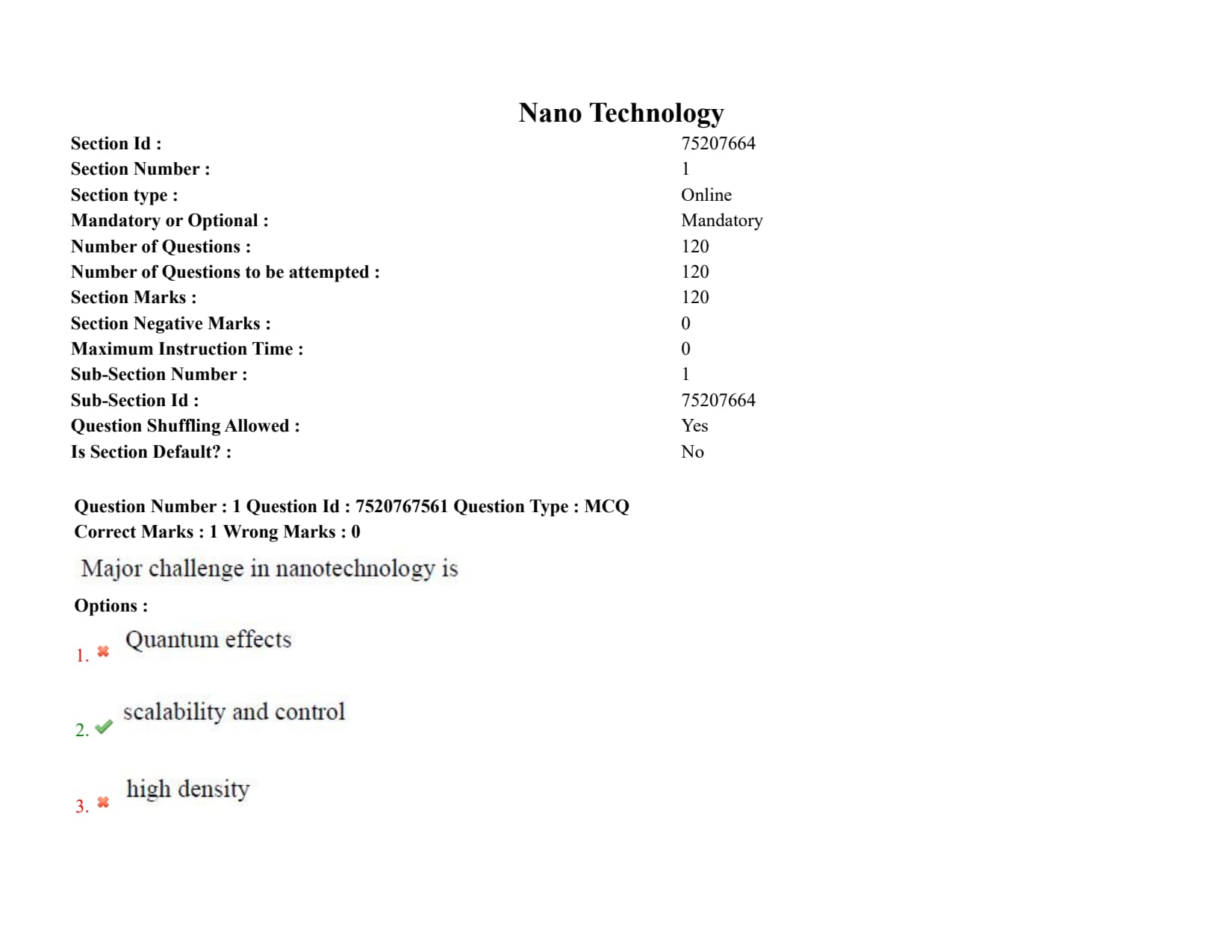
Question 1:
Major challenge in nanotechnology is
- (A) Quantum effects
- (B) scalability and control
- (C) high density
- (D) low reactivity
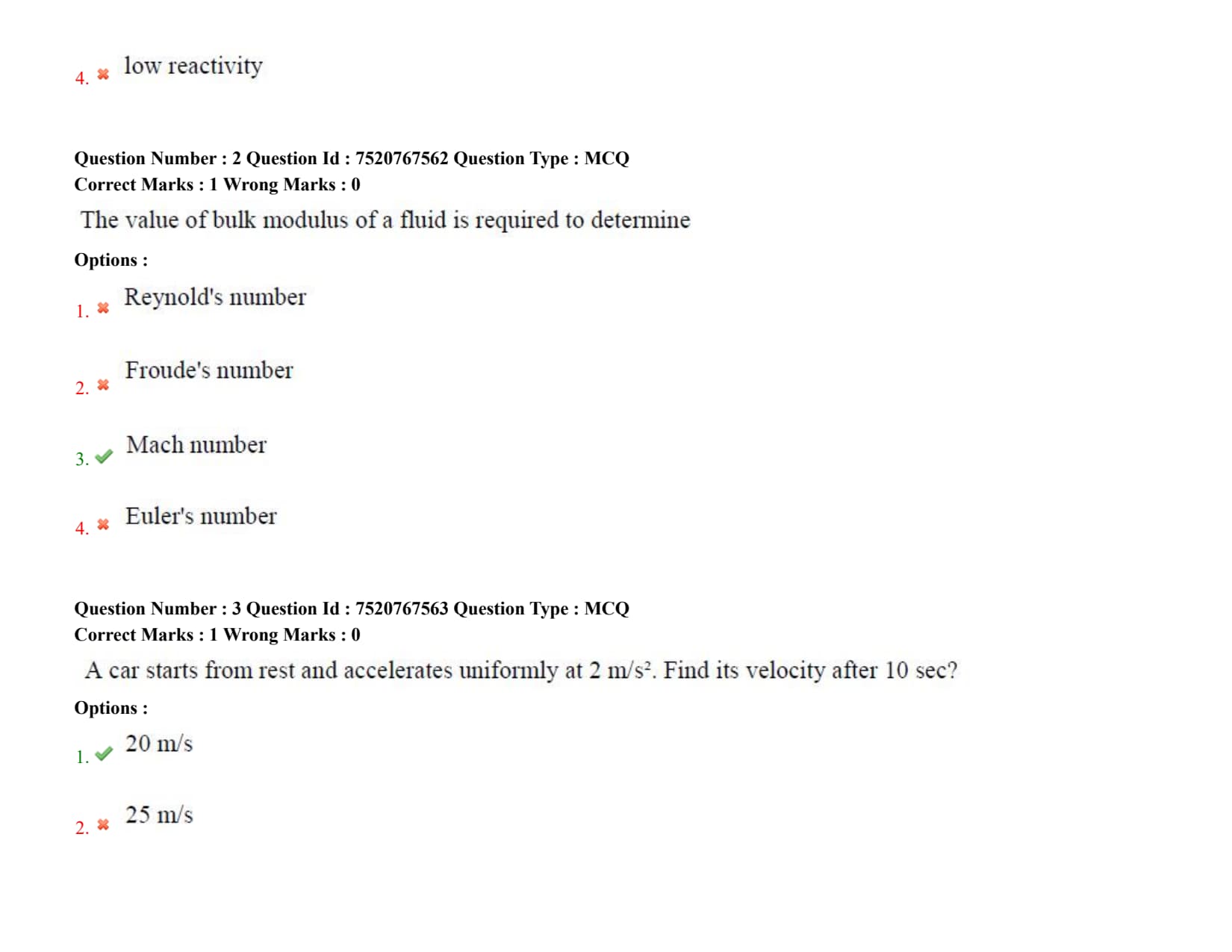
Question 2:
The value of bulk modulus of a fluid is required to determine
- (A) Reynold's number
- (B) Froude's number
- (C) Mach number
- (D) Euler's number
Question 3:
A car starts from rest and accelerates uniformly at 2 m/s\(^2\). Find its velocity after 10 sec?
- (A) 20 m/s
- (B) 25 m/s
- (C) 15 m/s
- (D) 30 m/s
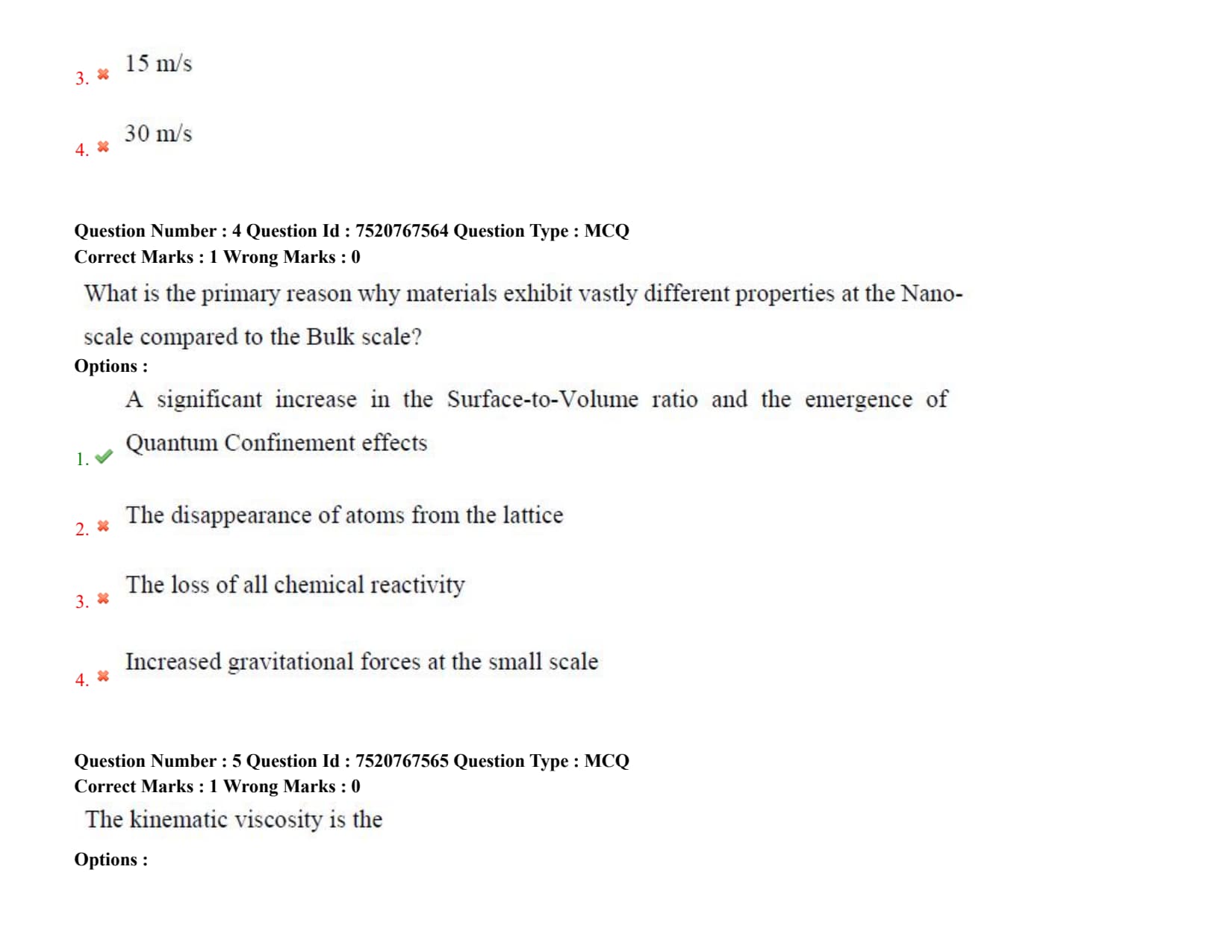
Question 4:
What is the primary reason why materials exhibit vastly different properties at the Nano-scale compared to the Bulk scale?
- (A) A significant increase in the Surface-to-Volume ratio and the emergence of Quantum Confinement effects
- (B) The disappearance of atoms from the lattice
- (C) The loss of all chemical reactivity
- (D) Increased gravitational forces at the small scale
Question 5:
The kinematic viscosity is the
- (A) ratio of absolute viscosity to the density of the liquid
- (B) ratio of density of the liquid to the absolute viscosity
- (C) product of absolute viscosity and density of the liquid
- (D) product of absolute viscosity and mass of the liquid
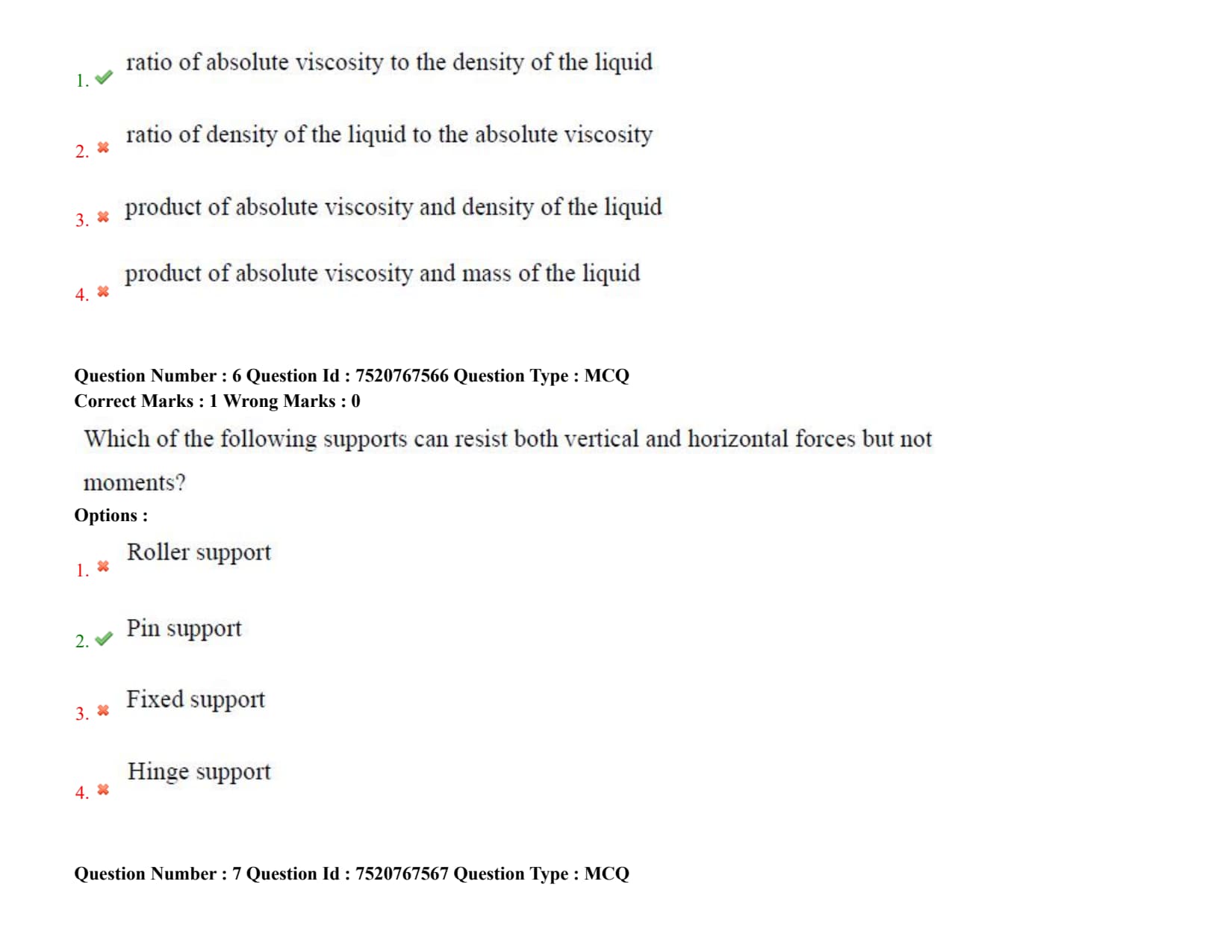
Question 6:
Which of the following supports can resist both vertical and horizontal forces but not moments?
- (A) Roller support
- (B) Pin support
- (C) Fixed support
- (D) Hinge support
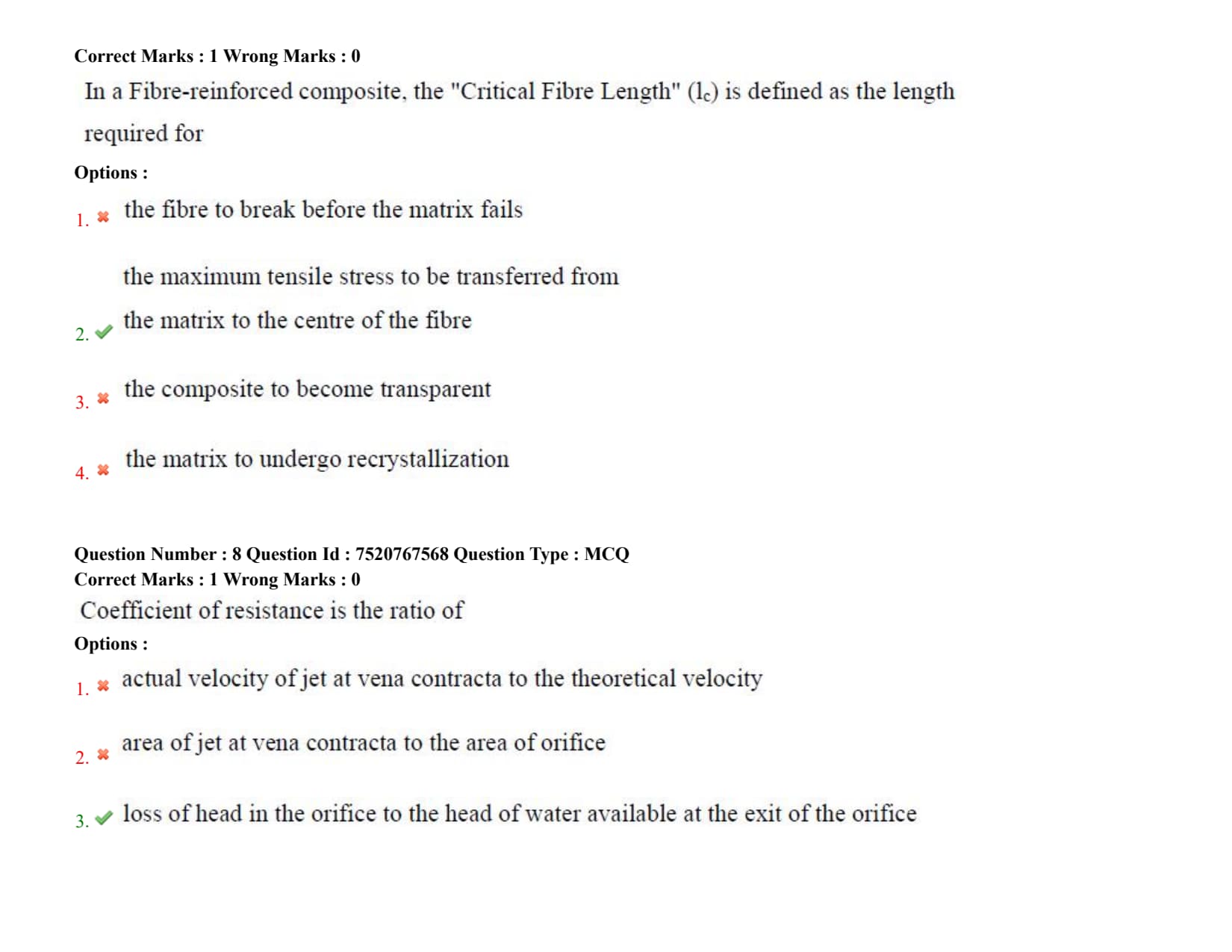
Question 7:
In a Fibre-reinforced composite, the "Critical Fibre Length" (\(l_c\)) is defined as the length required for
- (A) the fibre to break before the matrix fails
- (B) the maximum tensile stress to be transferred from the matrix to the centre of the fibre
- (C) the composite to become transparent
- (D) the matrix to undergo recrystallization
Question 8:
Coefficient of resistance is the ratio of
- (A) actual velocity of jet at vena contracta to the theoretical velocity
- (B) area of jet at vena contracta to the area of orifice
- (C) loss of head in the orifice to the head of water available at the exit of the orifice
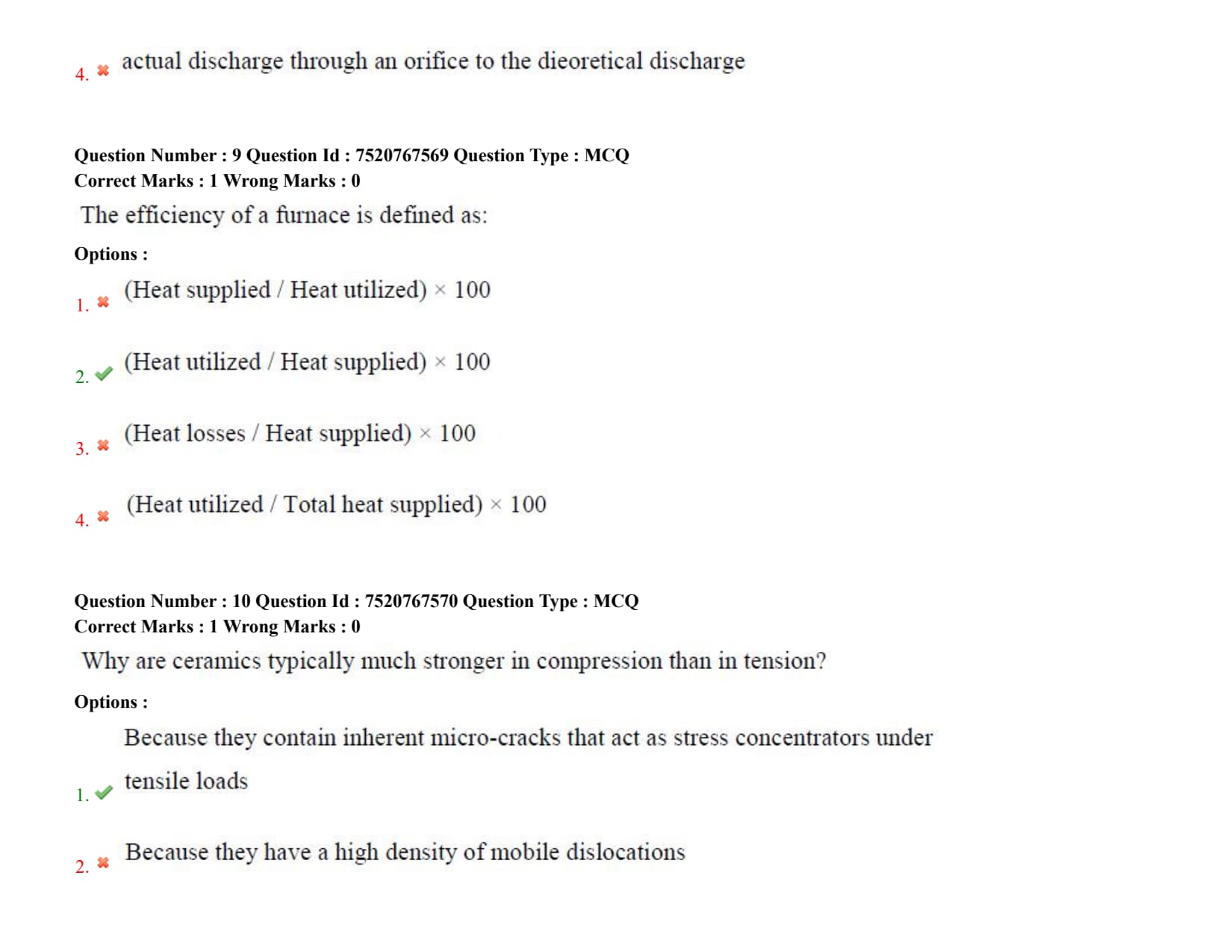
- (D) actual discharge through an orifice to the theoretical discharge
Question 9:
The efficiency of a furnace is defined as:
- (A) (Heat supplied / Heat utilized) \(\times\) 100
- (B) (Heat utilized / Heat supplied) \(\times\) 100
- (C) (Heat losses / Heat supplied) \(\times\) 100
- (D) (Heat utilized / Total heat supplied) \(\times\) 100
Question 10:
Why are ceramics typically much stronger in compression than in tension?
- (A) Because they contain inherent micro-cracks that act as stress concentrators under tensile loads
- (B) Because they have a high density of mobile dislocations
- (C) Because their ionic bonds are only stable under compressive forces
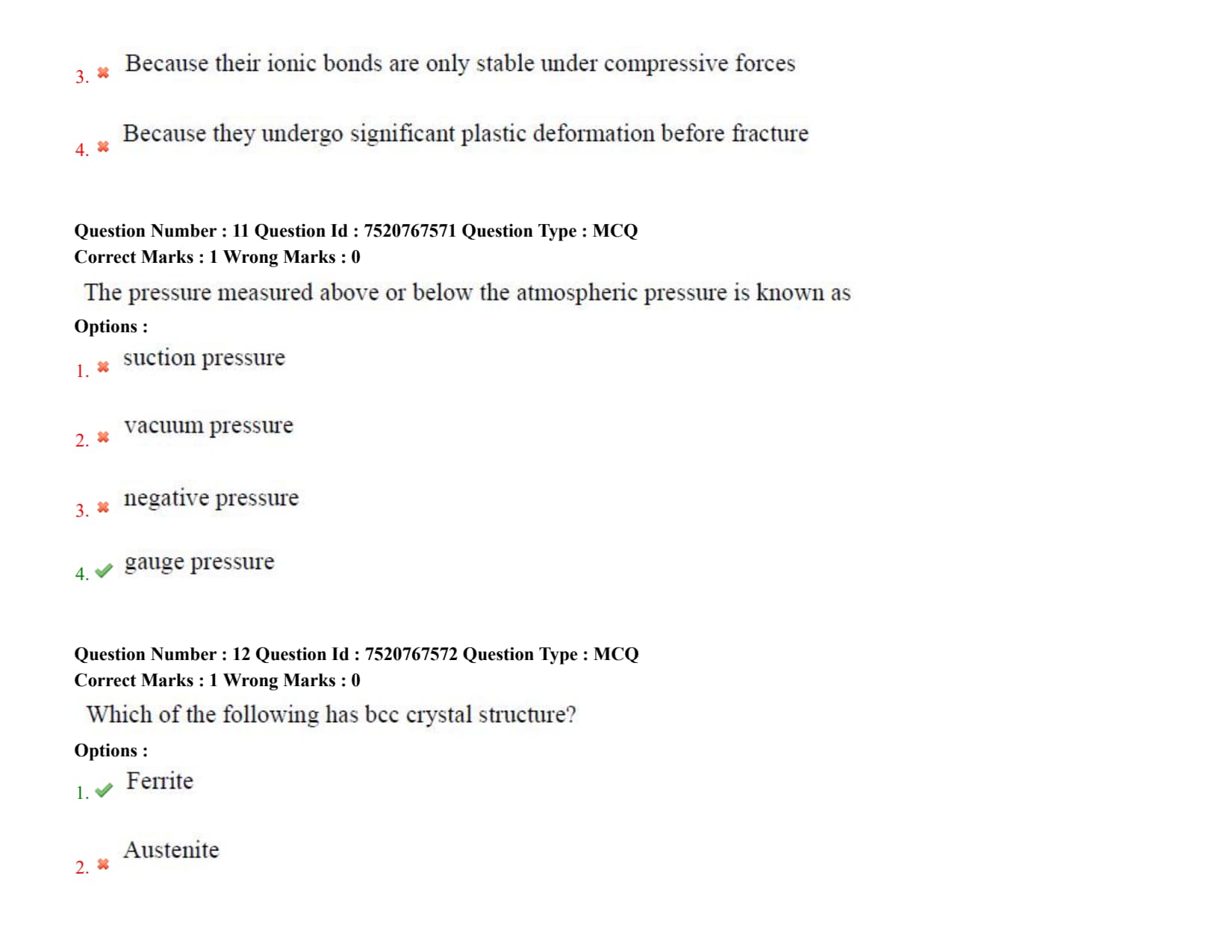
- (D) Because they undergo significant plastic deformation before fracture
Question 11:
The pressure measured above or below the atmospheric pressure is known as
- (A) suction pressure
- (B) vacuum pressure
- (C) negative pressure
- (D) gauge pressure
Question 12:
Which of the following has bcc crystal structure?
- (A) Ferrite
- (B) Austenite
- (C) Martensite
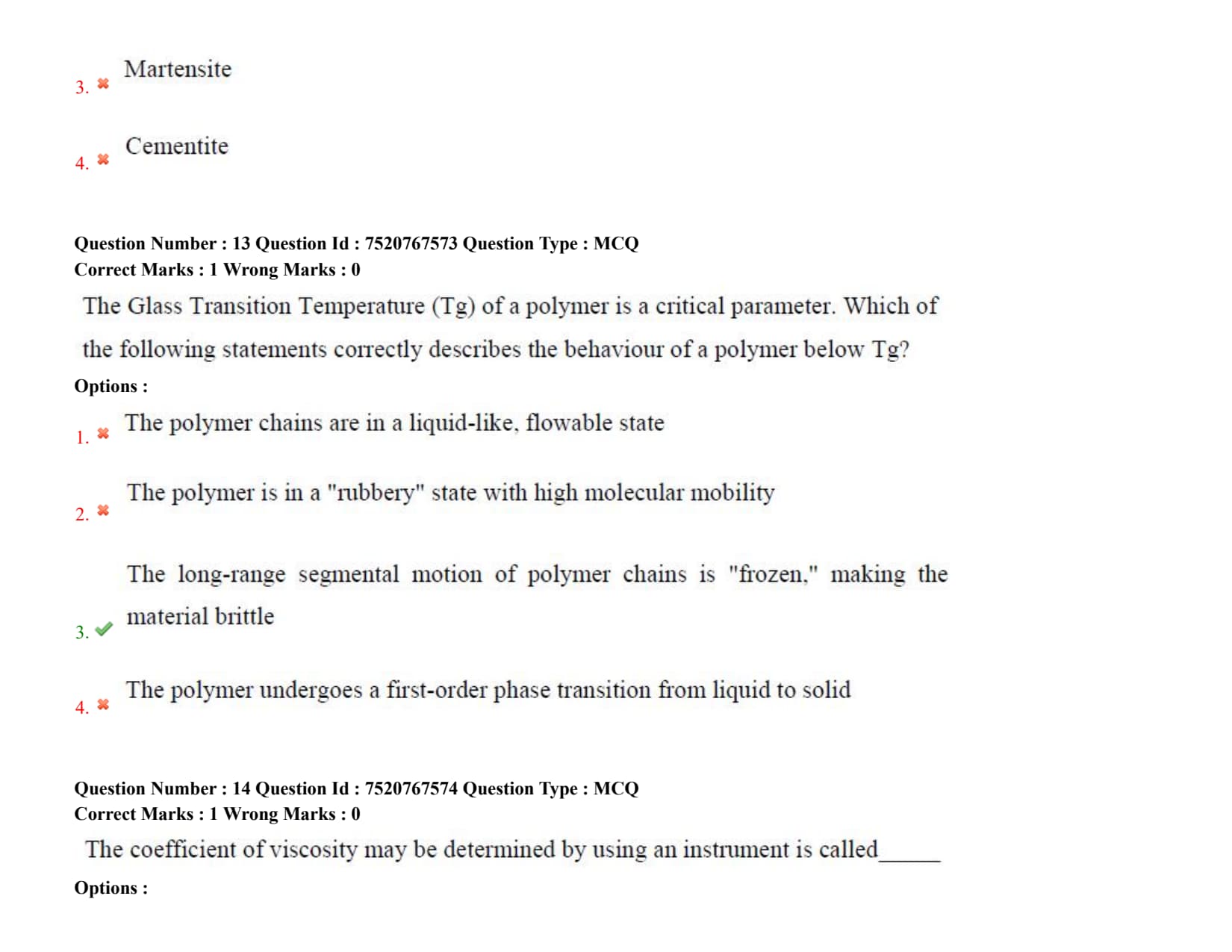
- (D) Cementite
Question 13:
The Glass Transition Temperature (Tg) of a polymer is a critical parameter. Which of the following statements correctly describes the behaviour of a polymer below Tg?
- (A) The polymer chains are in a liquid-like, flowable state
- (B) The polymer is in a "rubbery" state with high molecular mobility
- (C) The long-range segmental motion of polymer chains is "frozen," making the material brittle
- (D) The polymer undergoes a first-order phase transition from liquid to solid
Question 14:
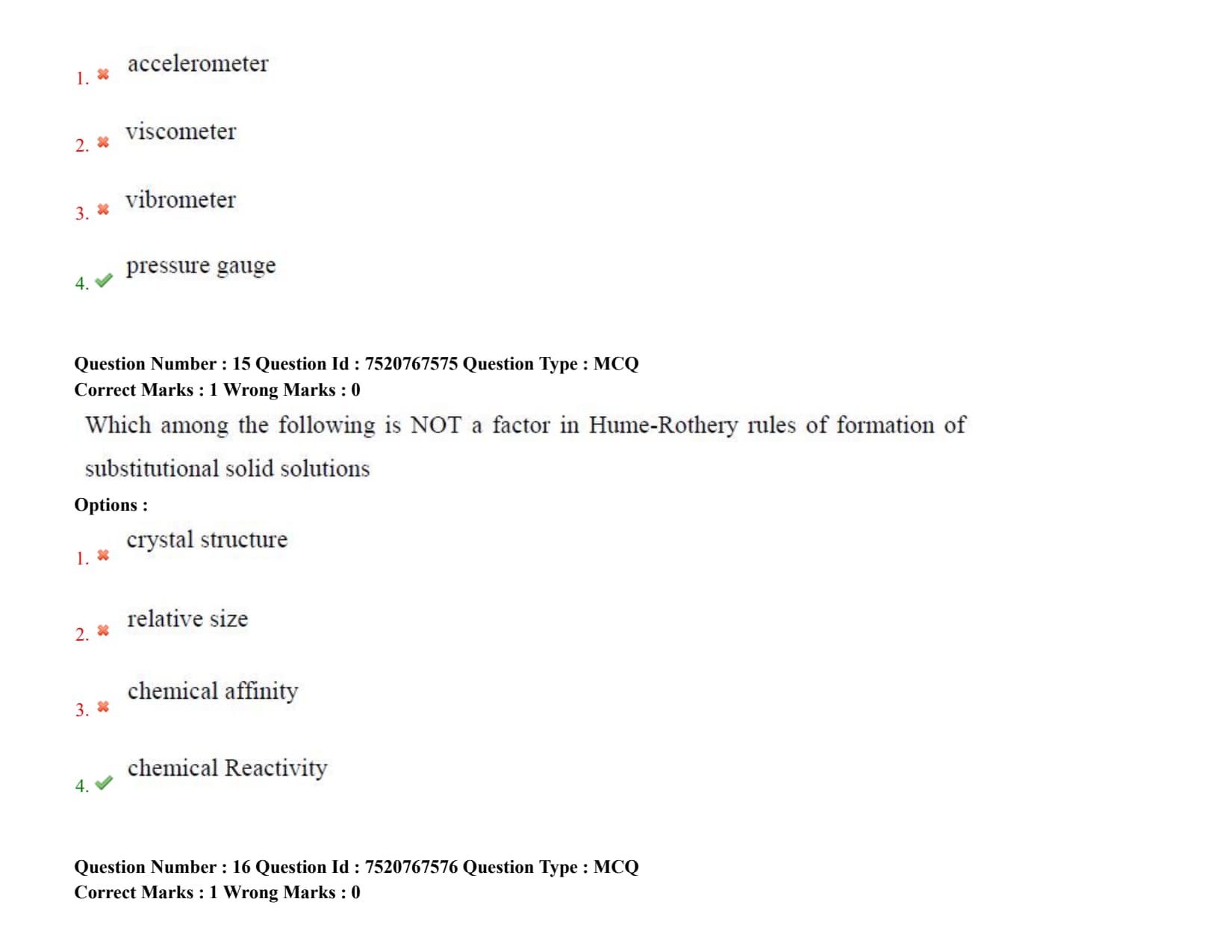
The coefficient of viscosity may be determined by using an instrument is called_______
- (A) accelerometer
- (B) viscometer
- (C) vibrometer
- (D) pressure gauge
Question 15:
Which among the following is NOT a factor in Hume-Rothery rules of formation of substitutional solid solutions
- (A) crystal structure
- (B) relative size
- (C) chemical affinity
- (D) chemical Reactivity
Question 16:
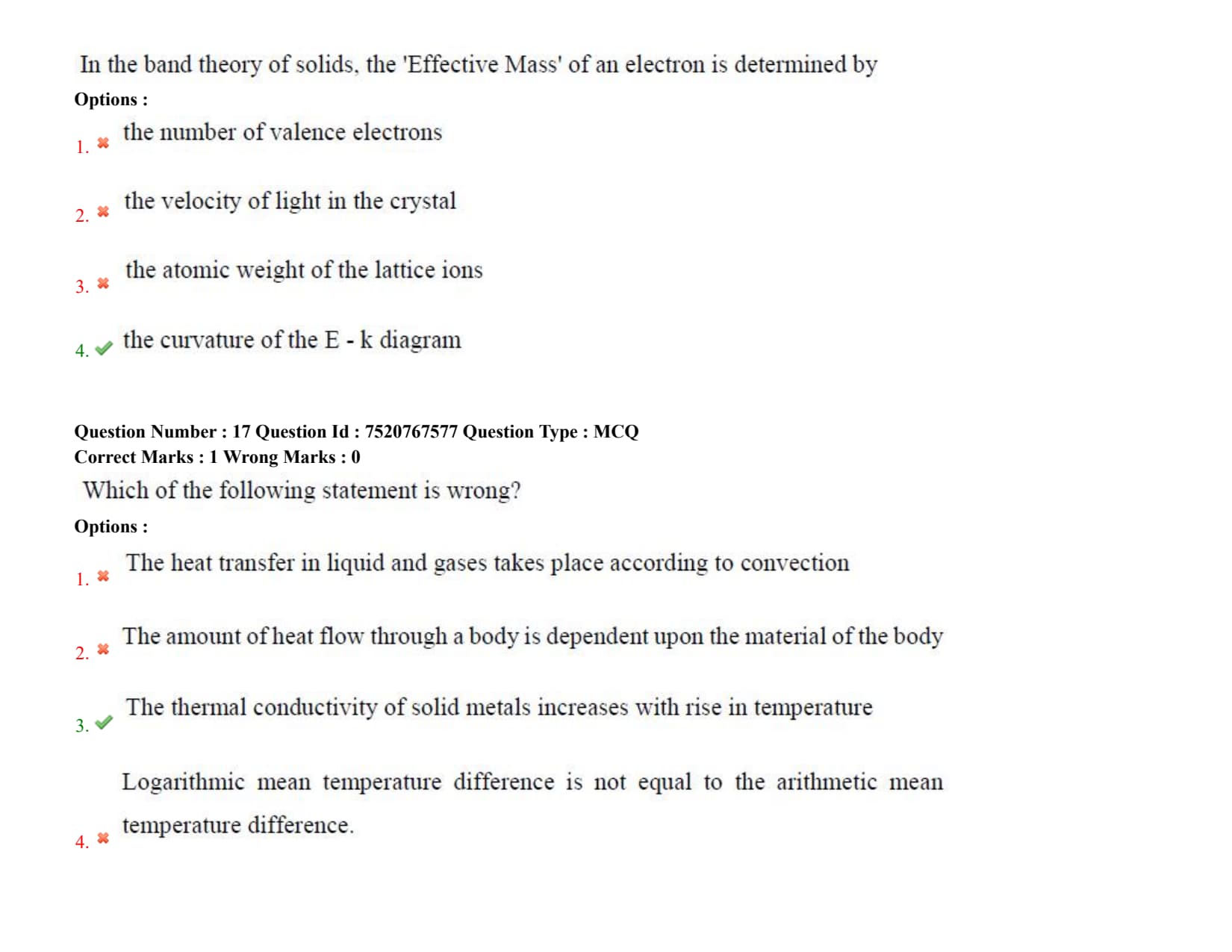
In the band theory of solids, the 'Effective Mass' of an electron is determined by
- (A) the number of valence electrons
- (B) the velocity of light in the crystal
- (C) the atomic weight of the lattice ions
- (D) the curvature of the E - k diagram
Question 17:
Which of the following statement is wrong?
- (A) The heat transfer in liquid and gases takes place according to convection
- (B) The amount of heat flow through a body is dependent upon the material of the body
- (C) The thermal conductivity of solid metals increases with rise in temperature
- (D) Logarithmic mean temperature difference is not equal to the arithmetic mean temperature difference.
Question 18:
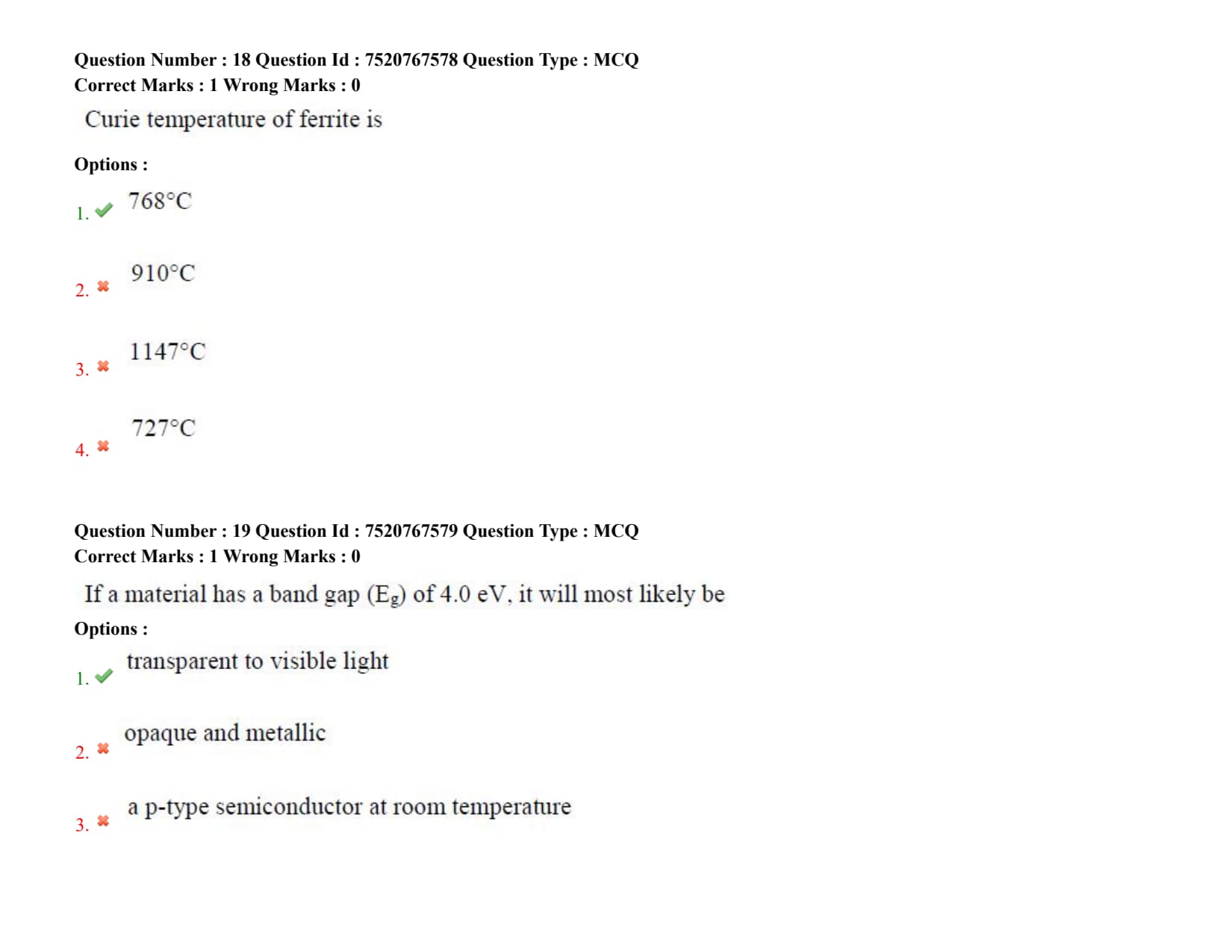
Curie temperature of ferrite is
- (A) 768 \(^\circ\)C
- (B) 910 \(^\circ\)C
- (C) 1147 \(^\circ\)C
- (D) 727 \(^\circ\)C
Question 19:
If a material has a band gap (\(E_g\)) of 4.0 eV, it will most likely be
- (A) transparent to visible light
- (B) opaque and metallic
- (C) a p-type semiconductor at room temperature
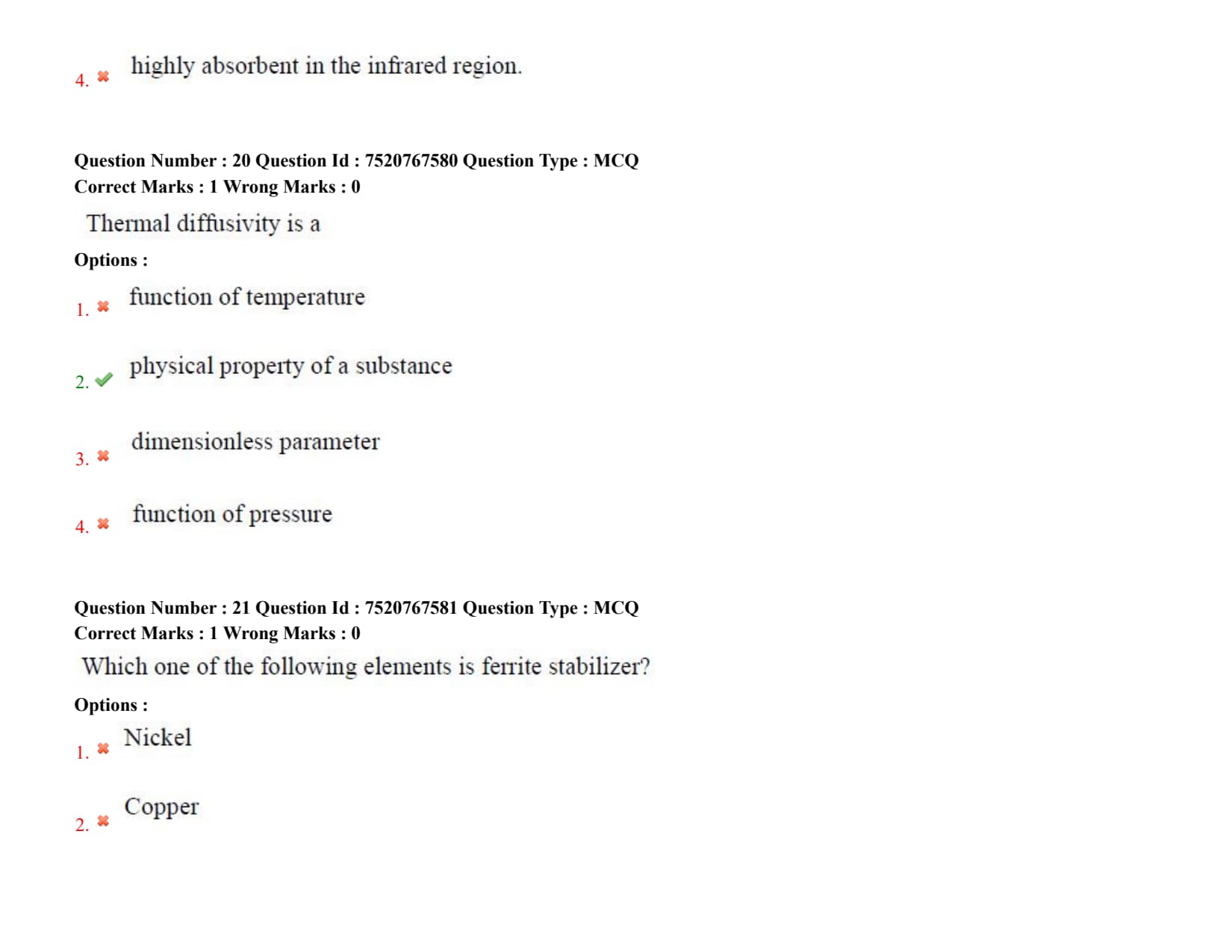
- (D) highly absorbent in the infrared region
Question 20:
Thermal diffusivity is a
- (A) function of temperature
- (B) physical property of a substance
- (C) dimensionless parameter
- (D) function of pressure
Question 21:
Which one of the following elements is ferrite stabilizer?
- (A) Nickel
- (B) Copper
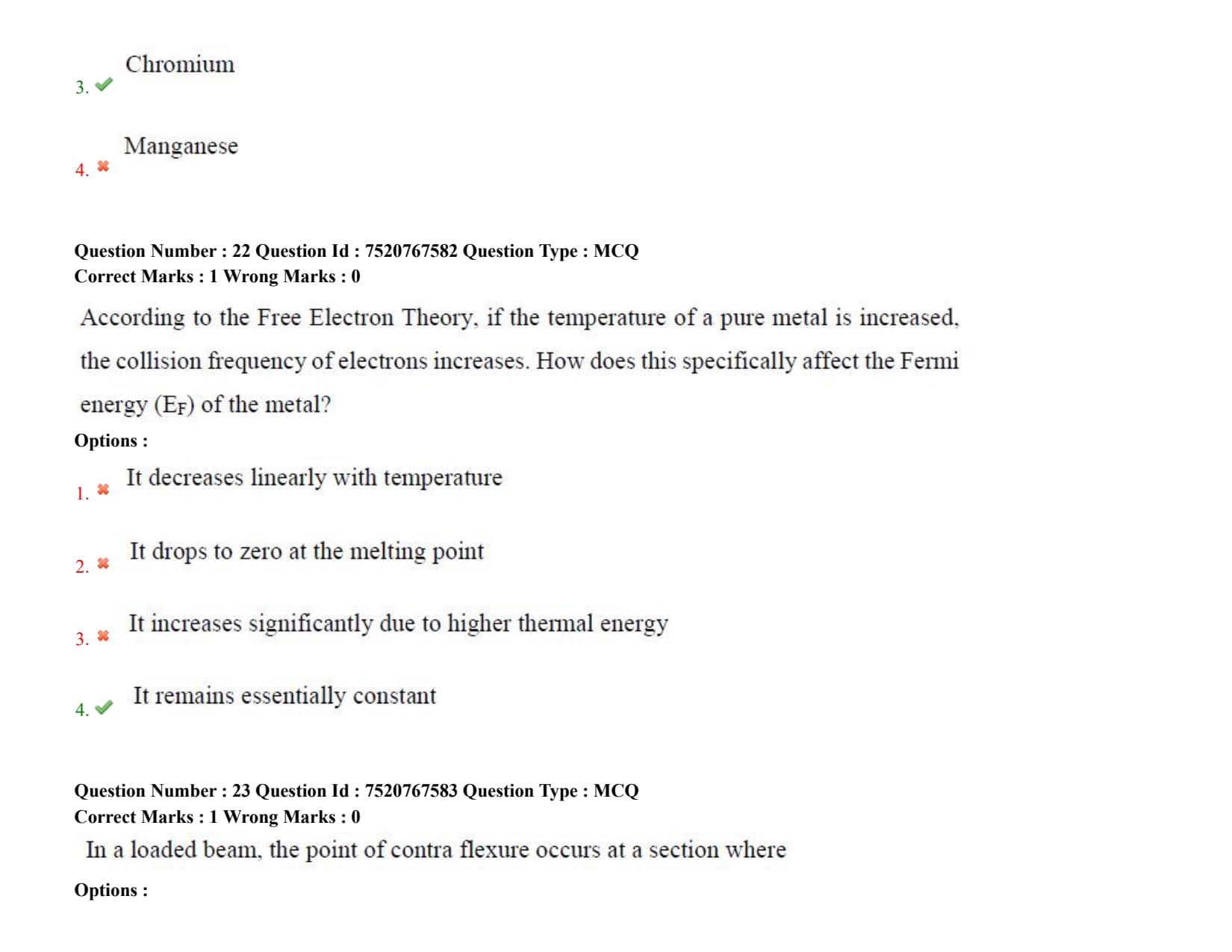
- (C) Chromium
- (D) Manganese
Question 22:
According to the Free Electron Theory, if the temperature of a pure metal is increased, the collision frequency of electrons increases. How does this specifically affect the Fermi energy (\(E_F\)) of the metal?
- (A) It decreases linearly with temperature
- (B) It drops to zero at the melting point
- (C) It increases significantly due to higher thermal energy
- (D) It remains essentially constant
Question 23:
In a loaded beam, the point of contra flexure occurs at a section where
- (A) bending moment is minimum
- (B) bending moment is zero or changes sign
- (C) bending moment is maximum
- (D) shearing force is maximum
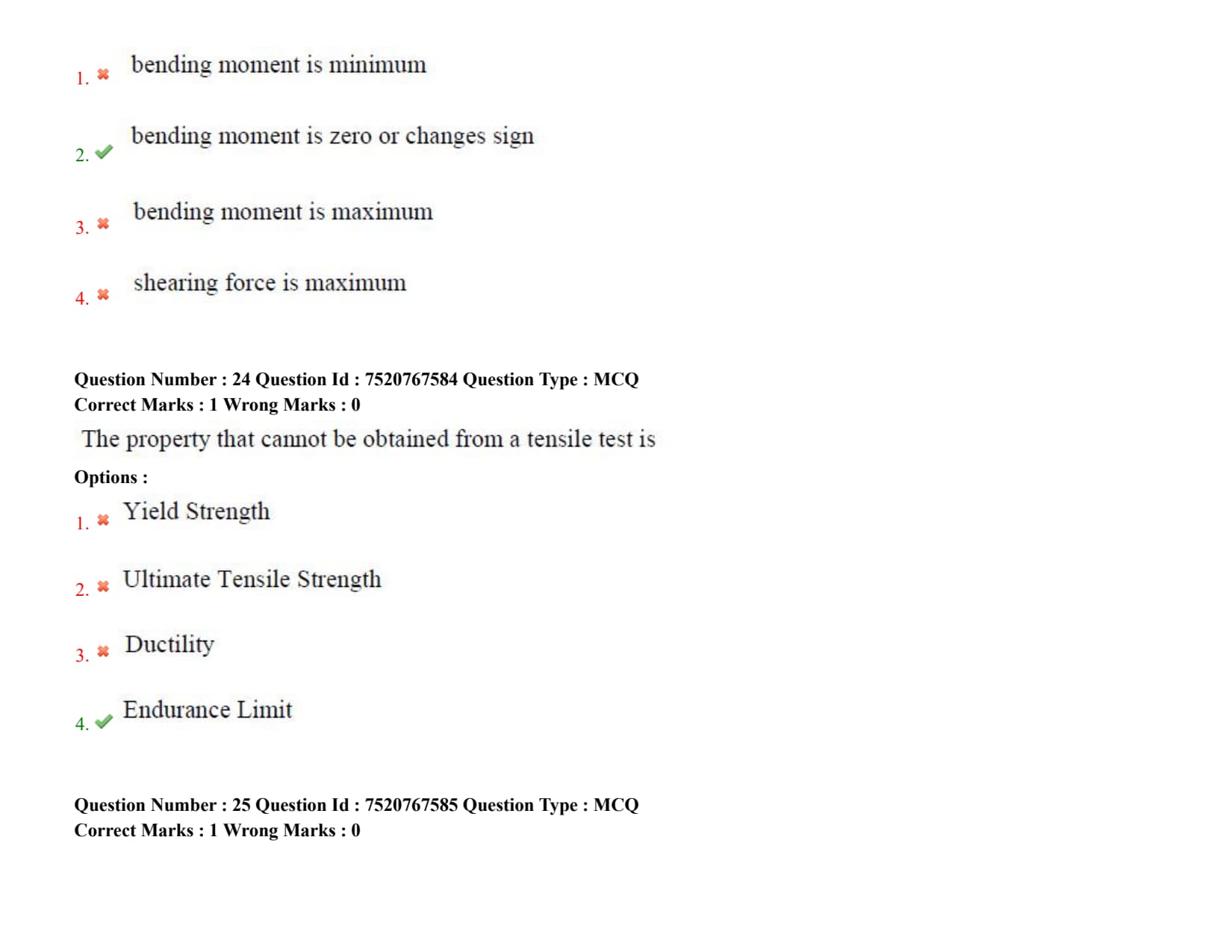
Question 24:
The property that cannot be obtained from a tensile test is
- (A) Yield Strength
- (B) Ultimate Tensile Strength
- (C) Ductility
- (D) Endurance Limit
Question 25:
In a combustion process, the "Theoretical Adiabatic Flame Temperature" is the maximum temperature the products can reach. This temperature is lower in practice because
- (A) real reactions are always endothermic
- (B) part of the energy is consumed by the dissociation of product molecules
- (C) the heat capacity of the products decreases at high temperatures
- (D) the nitrogen in the air acts as a catalyst, absorbing energy
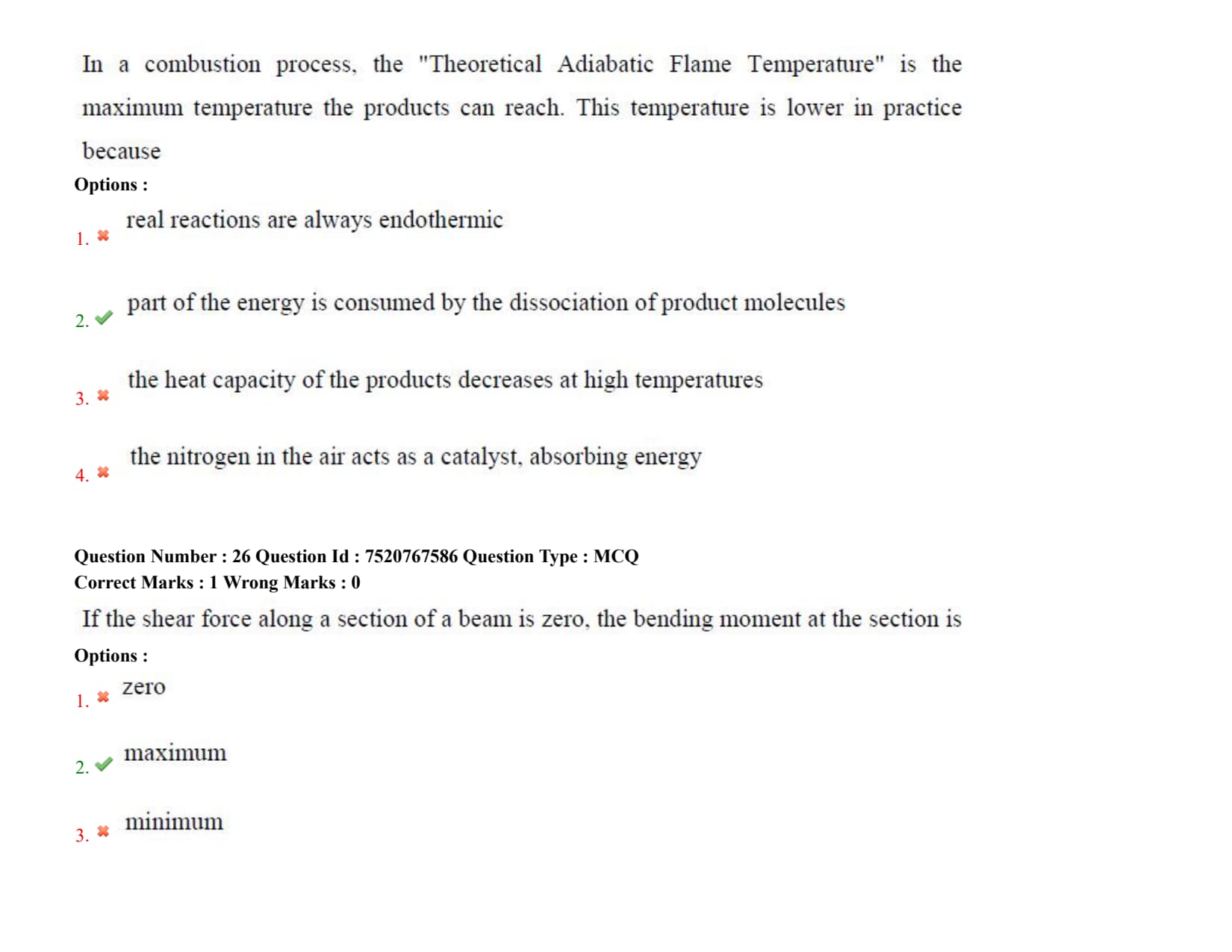
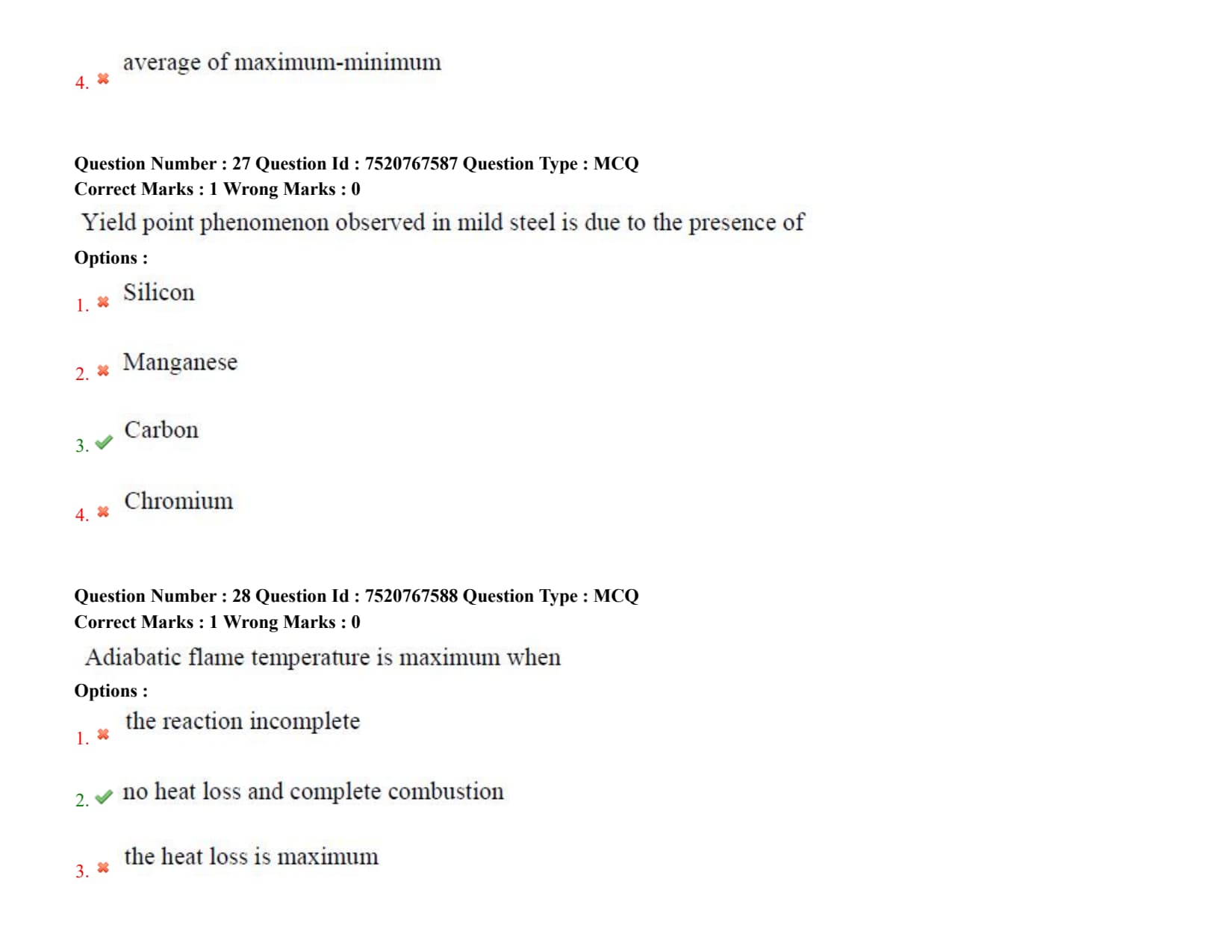
Question 26:
If the shear force along a section of a beam is zero, the bending moment at the section is
- (A) zero
- (B) maximum
- (C) minimum
- (D) average of maximum-minimum
Question 27:
Yield point phenomenon observed in mild steel is due to the presence of
- (A) Silicon
- (B) Manganese
- (C) Carbon
- (D) Chromium
Question 28:
Adiabatic flame temperature is maximum when
- (A) the reaction incomplete
- (B) no heat loss and complete combustion
- (C) the heat loss is maximum
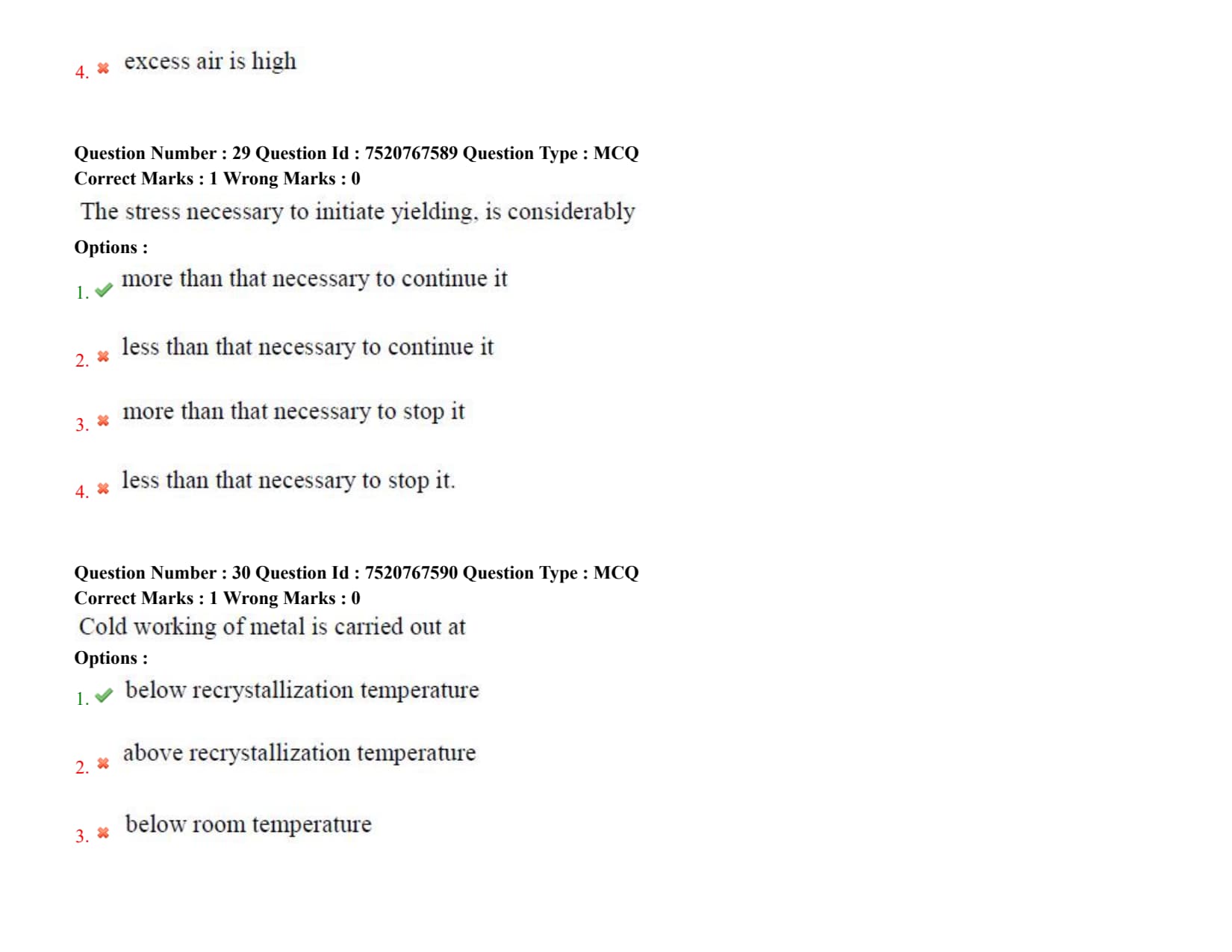
- (D) excess air is high
Question 29:
The stress necessary to initiate yielding, is considerably
- (A) more than that necessary to continue it
- (B) less than that necessary to continue it
- (C) more than that necessary to stop it
- (D) less than that necessary to stop it
Question 30:
Cold working of metal is carried out at
- (A) below recrystallization temperature
- (B) above recrystallization temperature
- (C) below room temperature
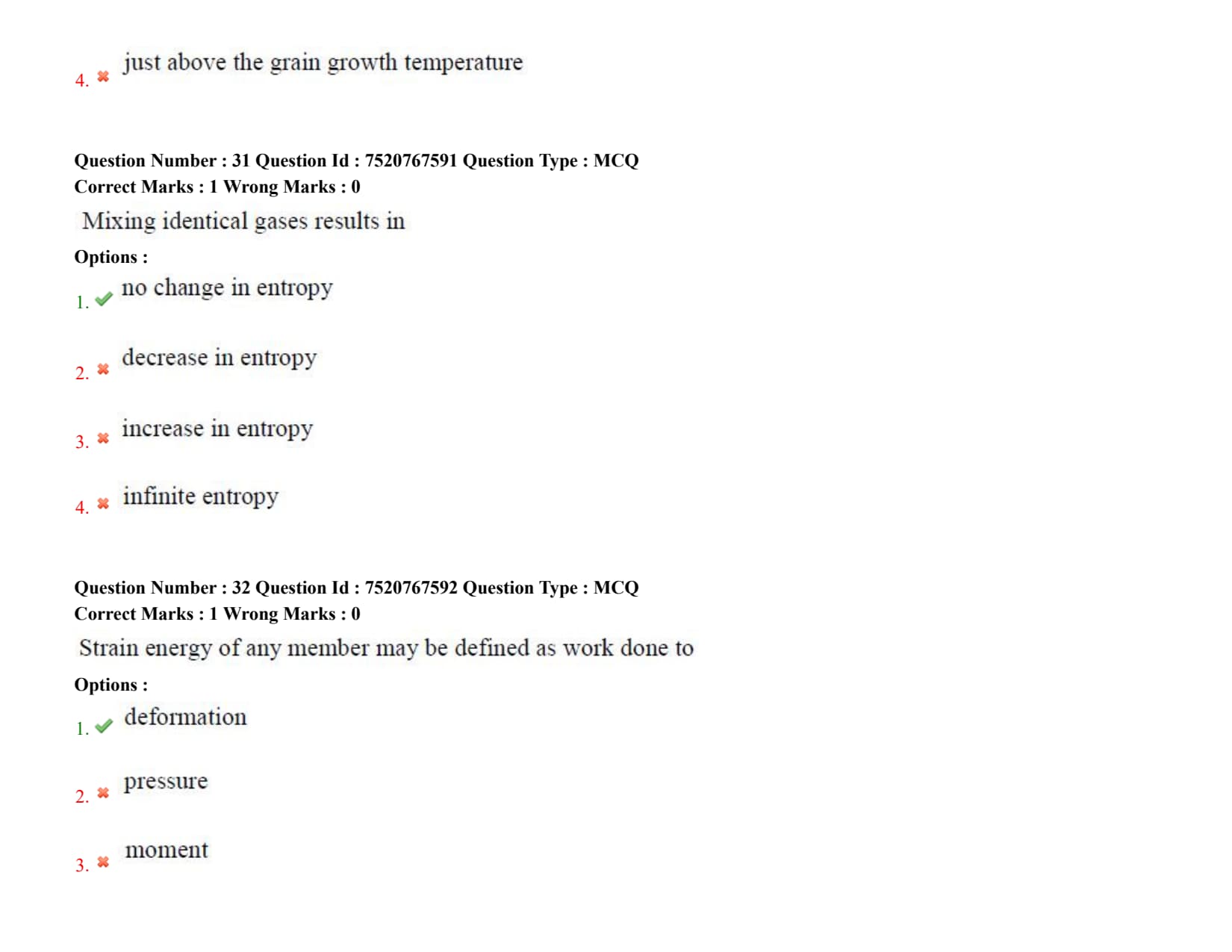
- (D) just above the grain growth temperature
Question 31:
Mixing identical gases results in
- (A) no change in entropy
- (B) decrease in entropy
- (C) increase in entropy
- (D) infinite entropy
Question 32:
Strain energy of any member may be defined as work done to
- (A) deformation
- (B) pressure
- (C) moment
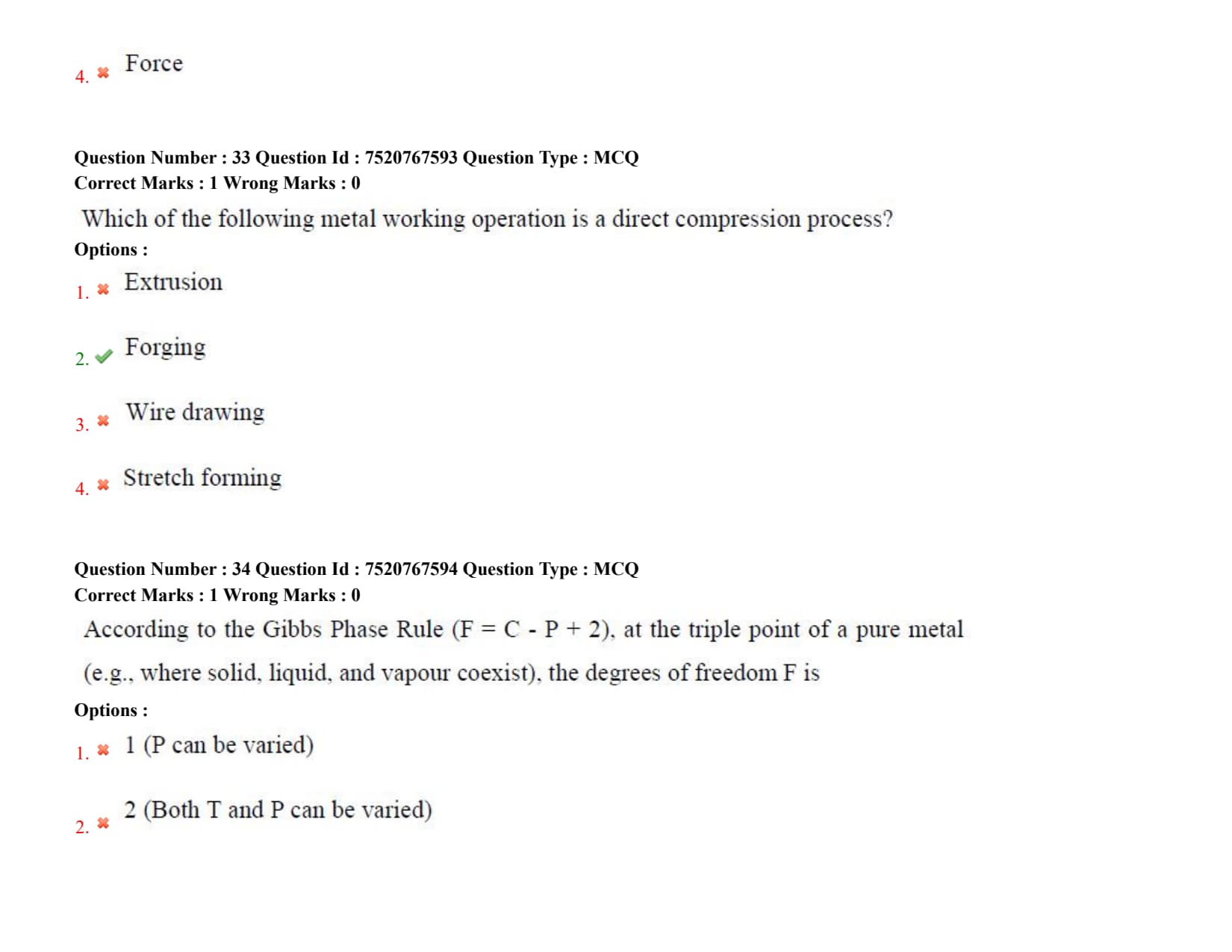
- (D) Force
Question 33:
Which of the following metal working operation is a direct compression process?
- (A) Extrusion
- (B) Forging
- (C) Wire drawing
- (D) Stretch forming
Question 34:
According to the Gibbs Phase Rule (F = C - P + 2), at the triple point of a pure metal (e.g., where solid, liquid, and vapour coexist), the degrees of freedom F is
- (A) 1 (P can be varied)
- (B) 2 (Both T and P can be varied)
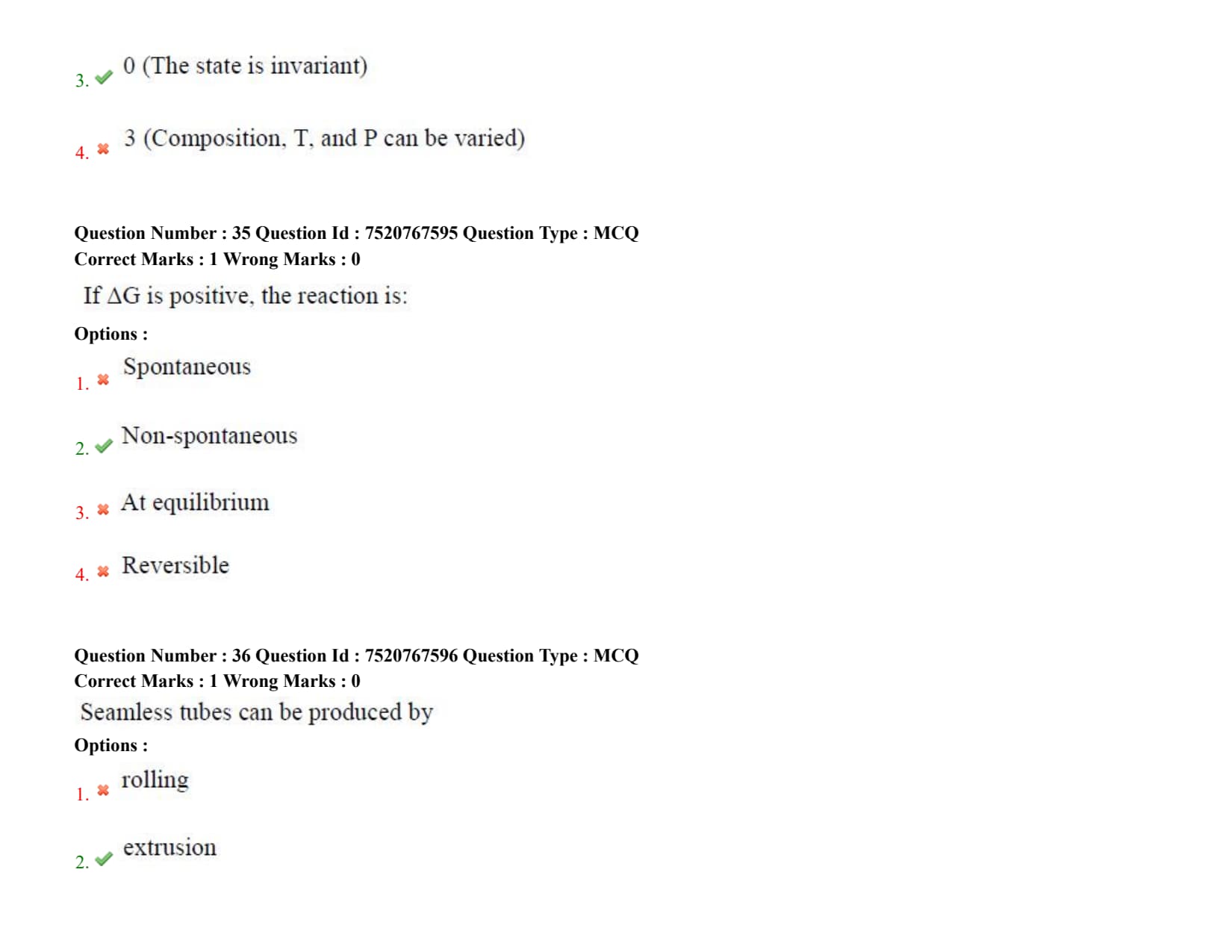
- (C) 0 (neither T nor P can be varied)
- (D) 3
Question 35:
If \(\Delta G\) is positive, the reaction is:
- (A) Spontaneous
- (B) Non-spontaneous
- (C) At equilibrium
- (D) Reversible
Question 36:
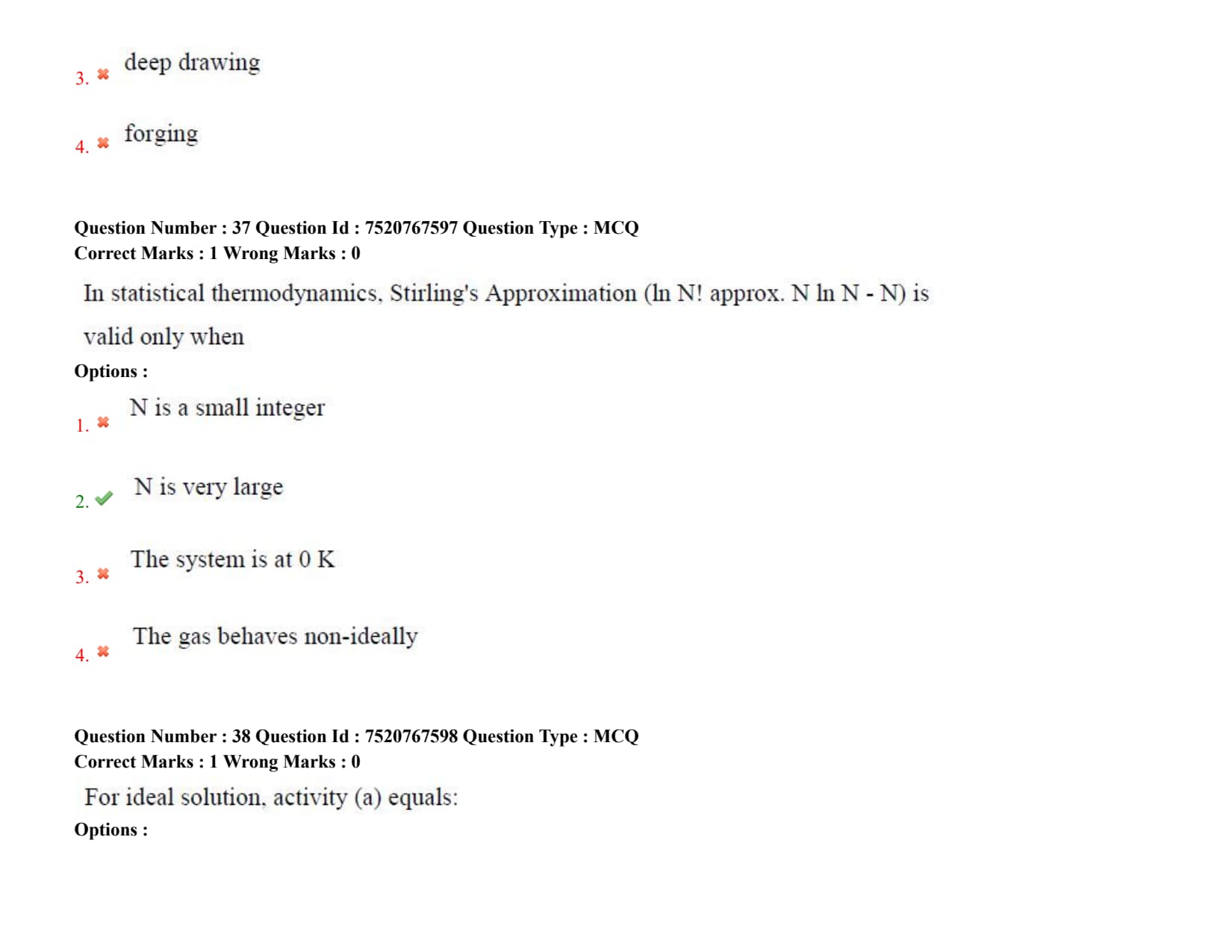
Seamless tubes can be produced by
- (A) rolling
- (B) extrusion
- (C) deep drawing
- (D) forging
Question 37:
In statistical thermodynamics, Stirling's Approximation (\(\ln N! \approx N \ln N - N\)) is valid only when
- (A) N is a small integer
- (B) N is very large
- (C) The system is at 0 K
- (D) The gas behaves non-ideally
Question 38:
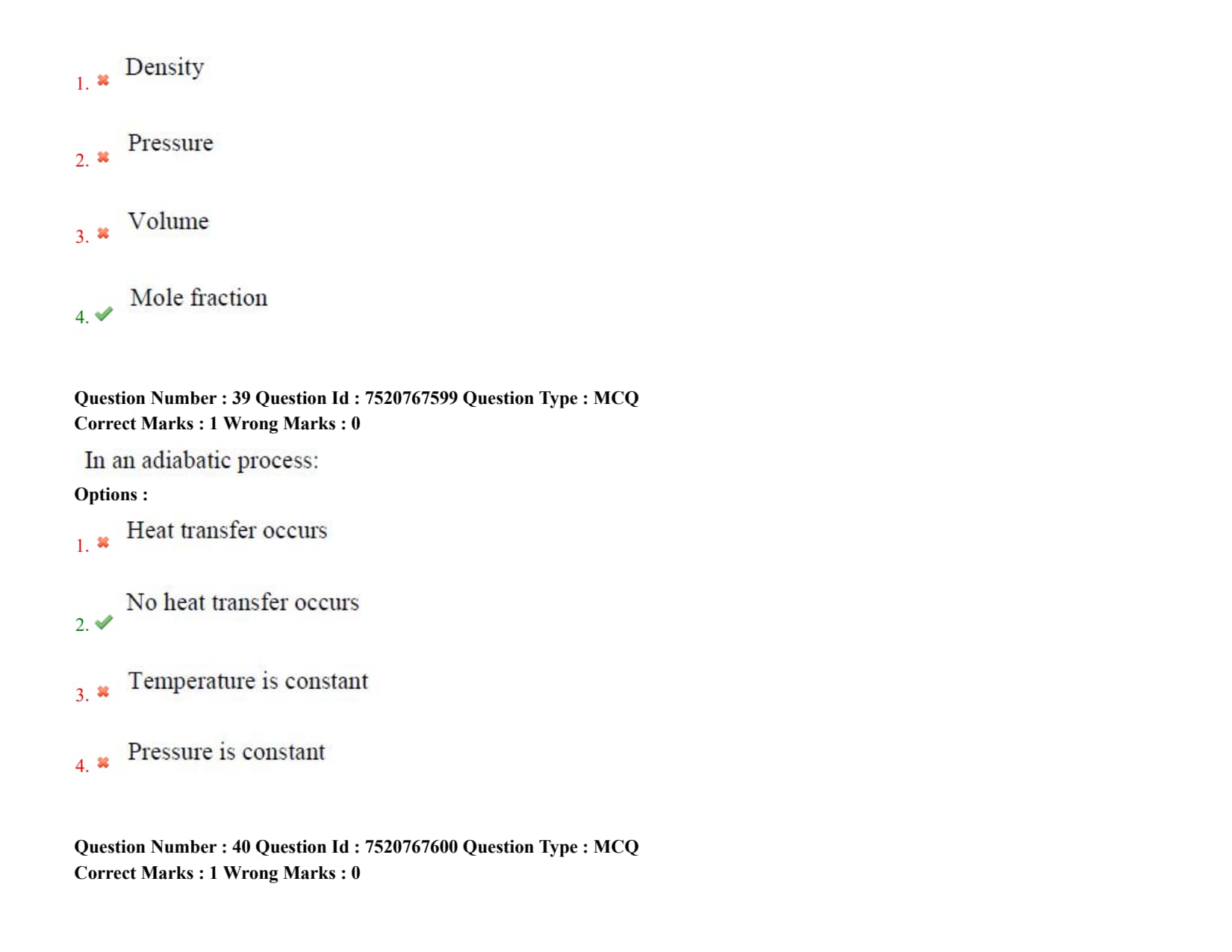
For ideal solution, activity (a) equals:
- (A) Density
- (B) Pressure
- (C) Volume
- (D) Mole fraction
Question 39:
In an adiabatic process:
- (A) Heat transfer occurs
- (B) No heat transfer occurs
- (C) Temperature is constant
- (D) Pressure is constant
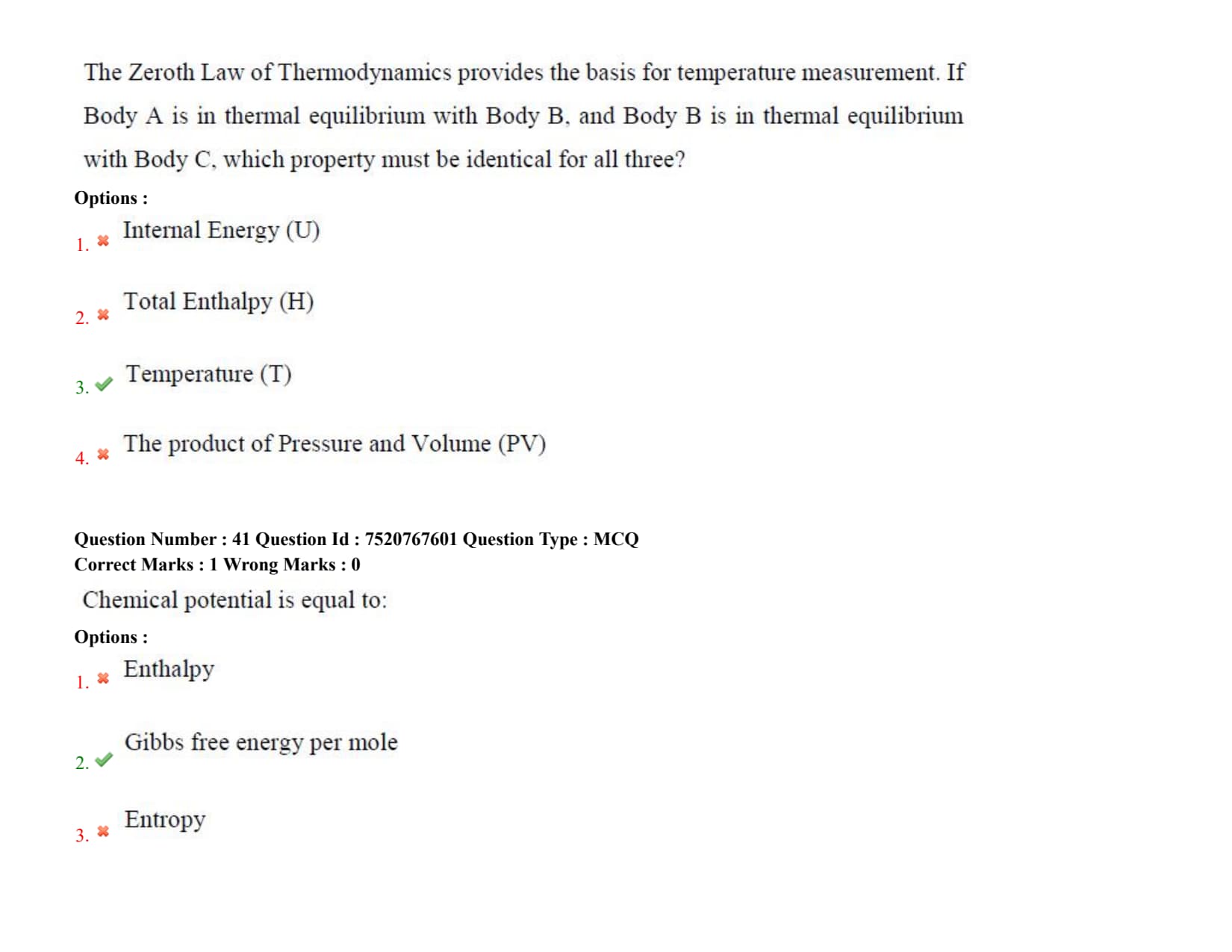
Question 40:
The Zeroth Law of Thermodynamics provides the basis for temperature measurement. If Body A is in thermal equilibrium with Body B, and Body B is in thermal equilibrium with Body C, which property must be identical for all three?
- (A) Internal Energy (U)
- (B) Total Enthalpy (H)
- (C) Temperature (T)
- (D) The product of Pressure and Volume (PV)
Question 41:
Chemical potential is equal to:
- (A) Enthalpy
- (B) Gibbs free energy per mole
- (C) Entropy
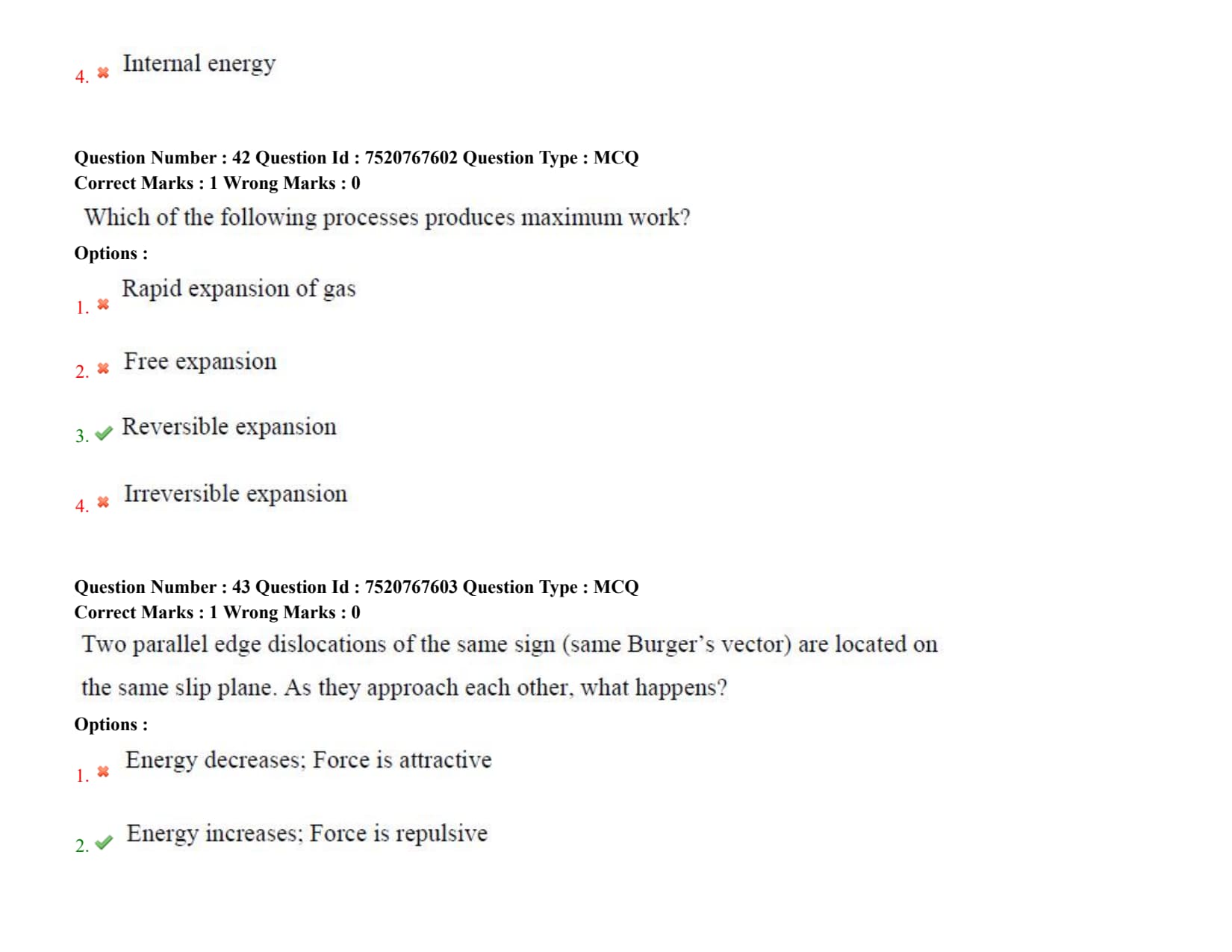
- (D) Internal energy
Question 42:
Which of the following processes produces maximum work?
- (A) Rapid expansion of gas
- (B) Free expansion
- (C) Reversible expansion
- (D) Irreversible expansion
Question 43:
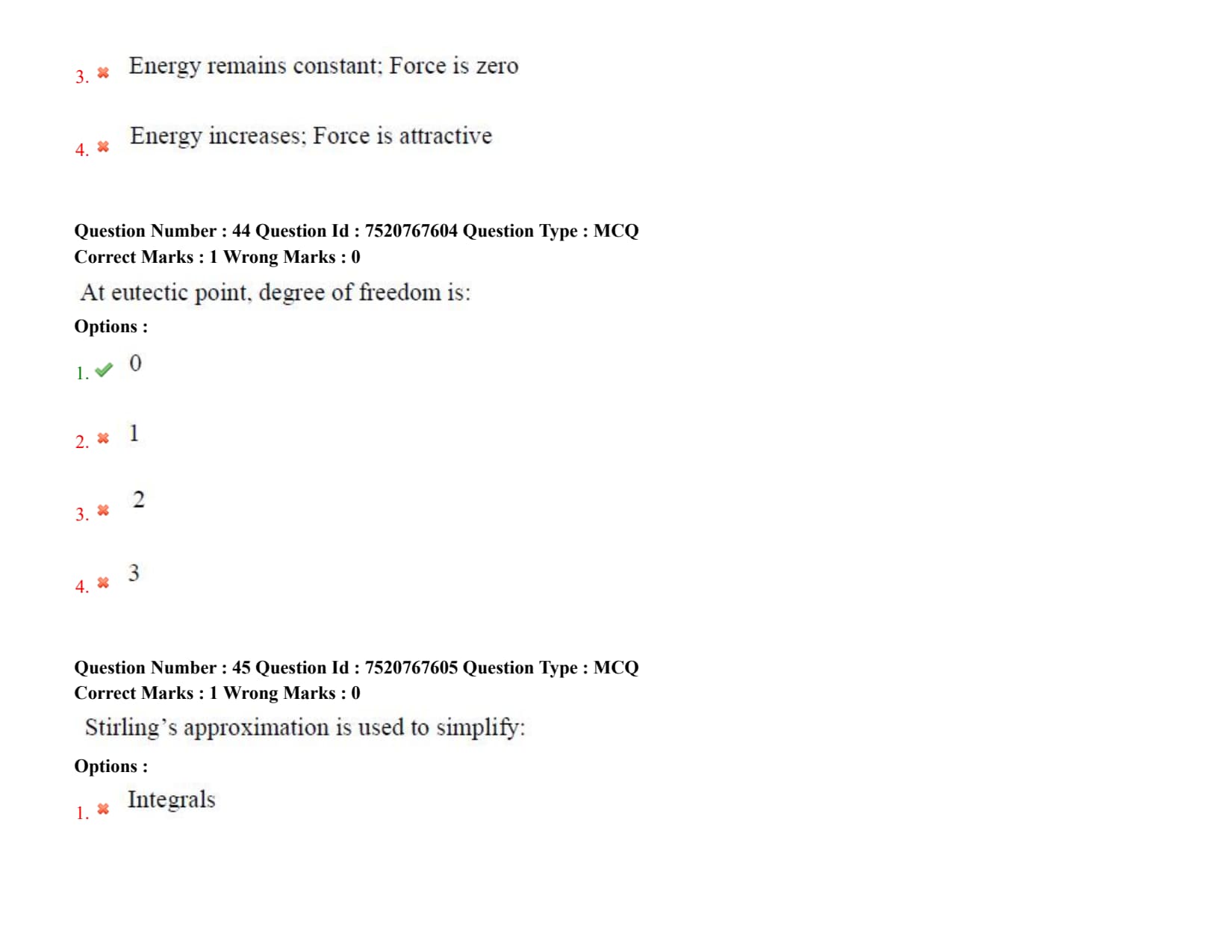
Two parallel edge dislocations of the same sign (same Burger's vector) are located on the same slip plane. As they approach each other, what happens?
- (A) Energy decreases; Force is attractive
- (B) Energy increases; Force is repulsive
- (C) Energy remains constant; Force is zero
- (D) Energy increases; Force is attractive
Question 44:
At eutectic point, degree of freedom is:
Question 45:
Stirling's approximation is used to simplify:
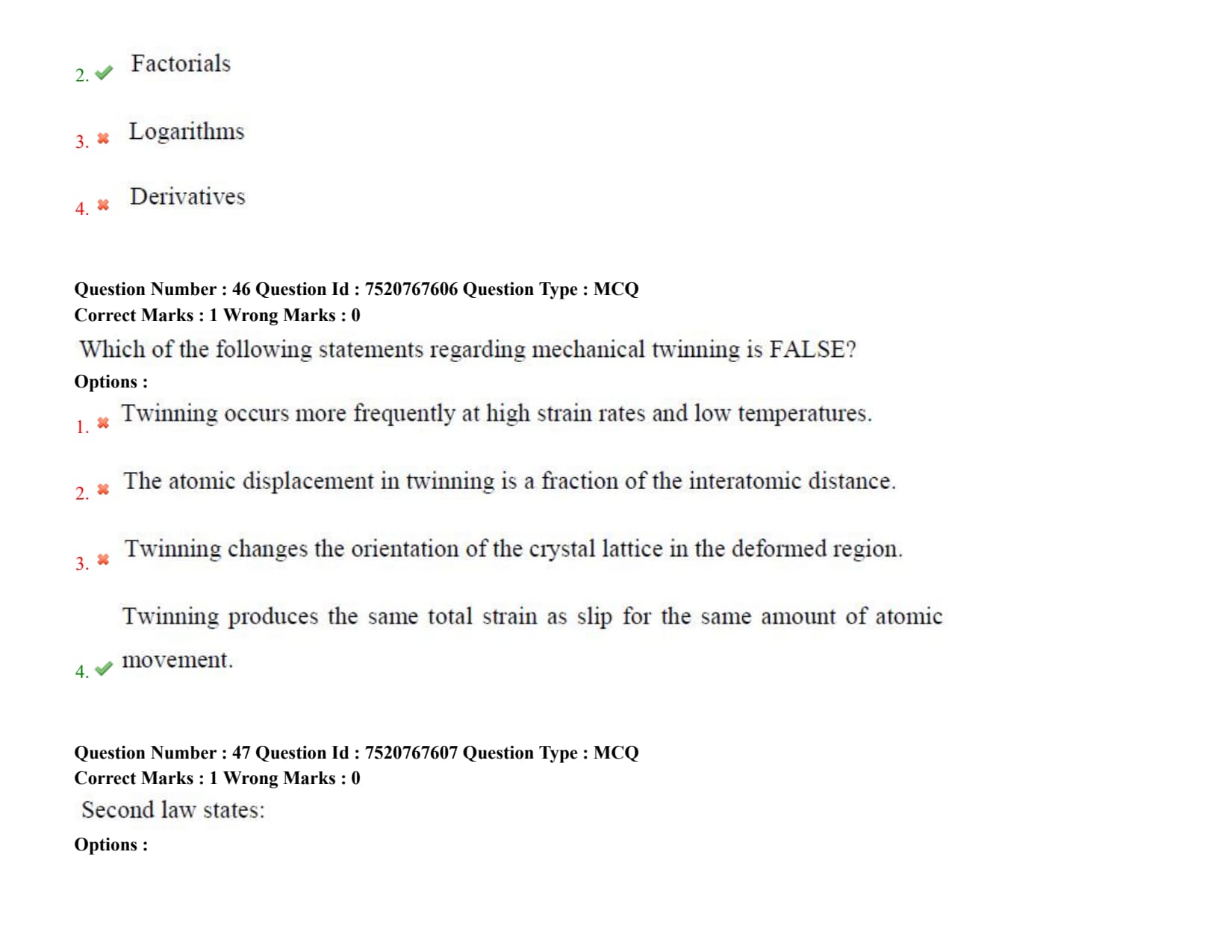
- (A) Integrals
- (B) Factorials
- (C) Logarithms
- (D) Derivatives
Question 46:
Which of the following statements regarding mechanical twinning is FALSE?
- (A) Twinning occurs more frequently at high strain rates and low temperatures.
- (B) The atomic displacement in twinning is a fraction of the interatomic distance.
- (C) Twinning changes the orientation of the crystal lattice in the deformed region.
- (D) Twinning produces the same total strain as slip for the same amount of atomic movement.
Question 47:
Second law states:
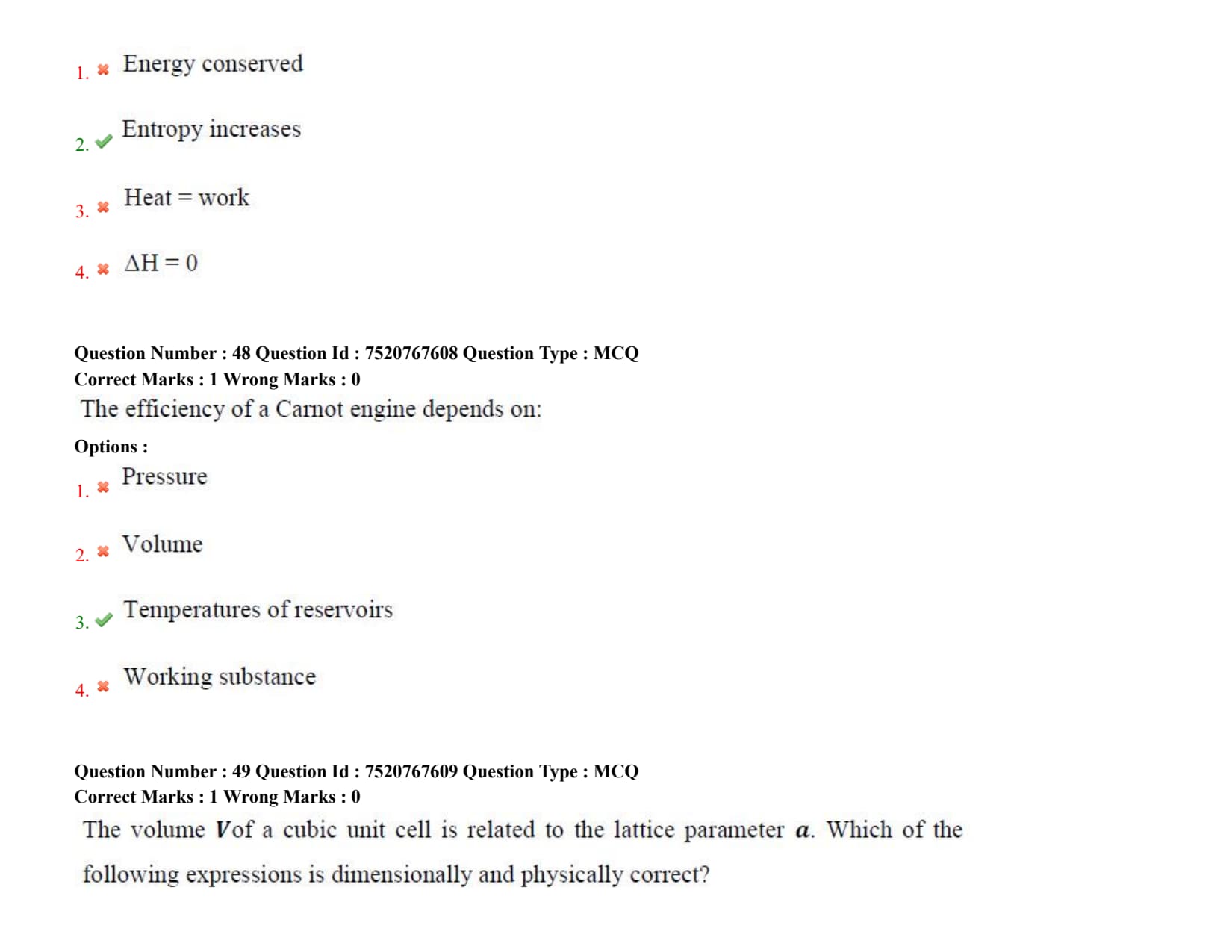
- (A) Energy conserved
- (B) Entropy increases
- (C) Heat = work
- (D) \(\Delta H = 0\)
Question 48:
The efficiency of a Carnot engine depends on:
- (A) Pressure
- (B) Volume
- (C) Temperatures of reservoirs
- (D) Working substance
Question 49:
The volume \(V\) of a cubic unit cell is related to the lattice parameter \(a\). Which of the following expressions is dimensionally and physically correct?
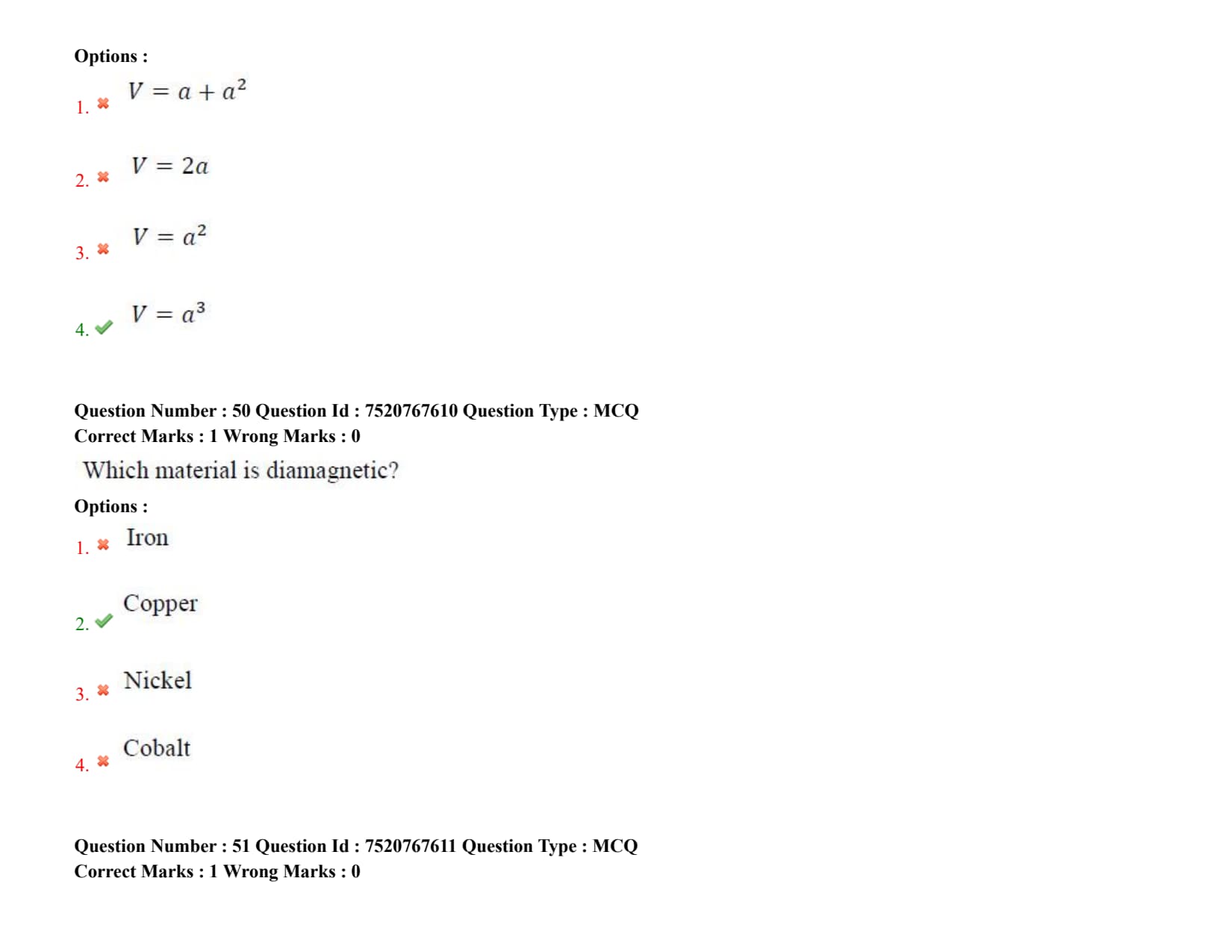
- (A) \(V = a + a^2\)
- (B) \(V = 2a\)
- (C) \(V = a^2\)
- (D) \(V = a^3\)
Question 50:
Which material is diamagnetic?
- (A) Iron
- (B) Copper
- (C) Nickel
- (D) Cobalt
Question 51:
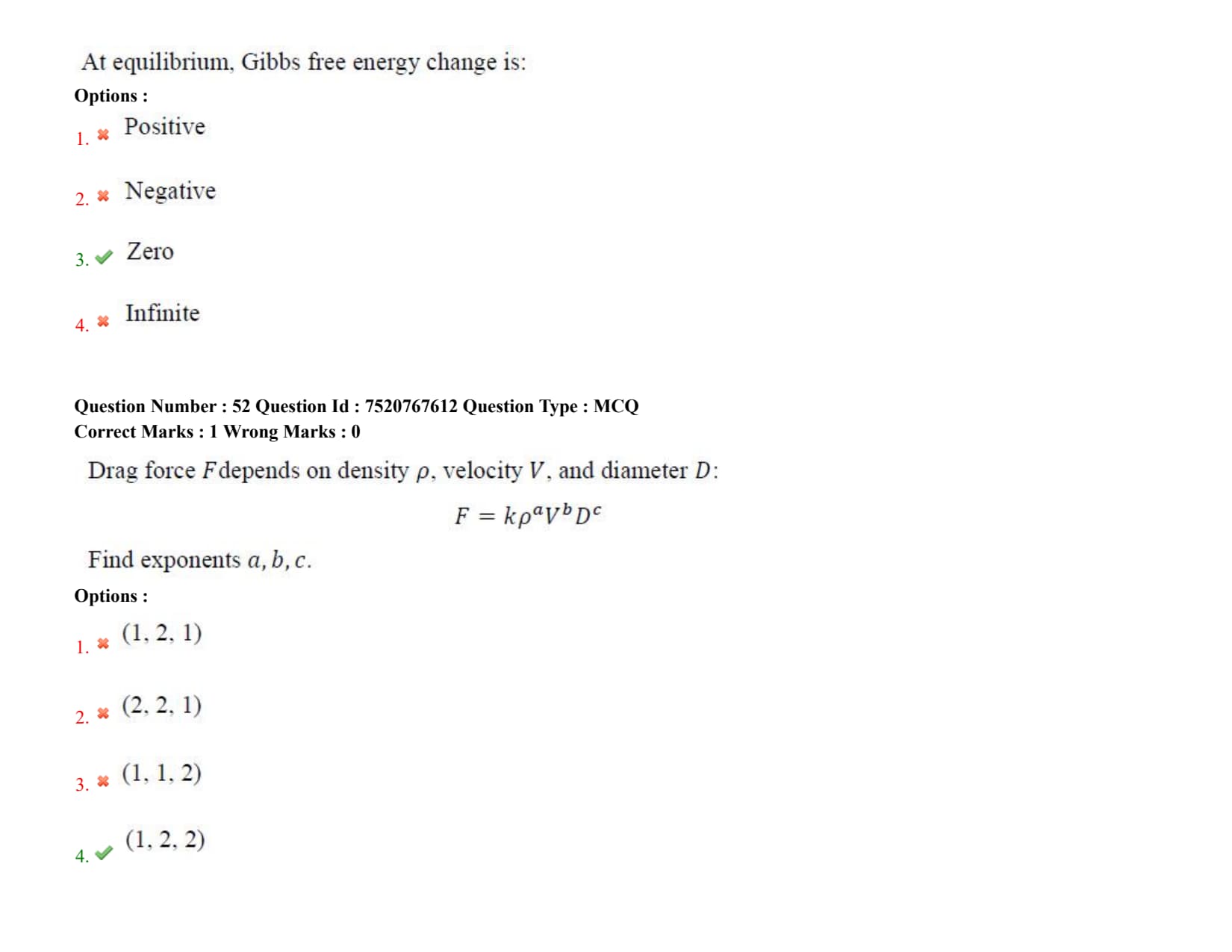
At equilibrium, Gibbs free energy change is:
- (A) Positive
- (B) Negative
- (C) Zero
- (D) Infinite
Question 52:
Drag force \(F\) depends on density \(\rho\), velocity \(V\), and diameter \(D\): \(F = k \rho^a V^b D^c\). Find exponents \(a, b, c\).
- (A) \((1, 2, 1)\)
- (B) \((2, 2, 1)\)
- (C) \((1, 1, 2)\)
- (D) \((1, 2, 2)\)
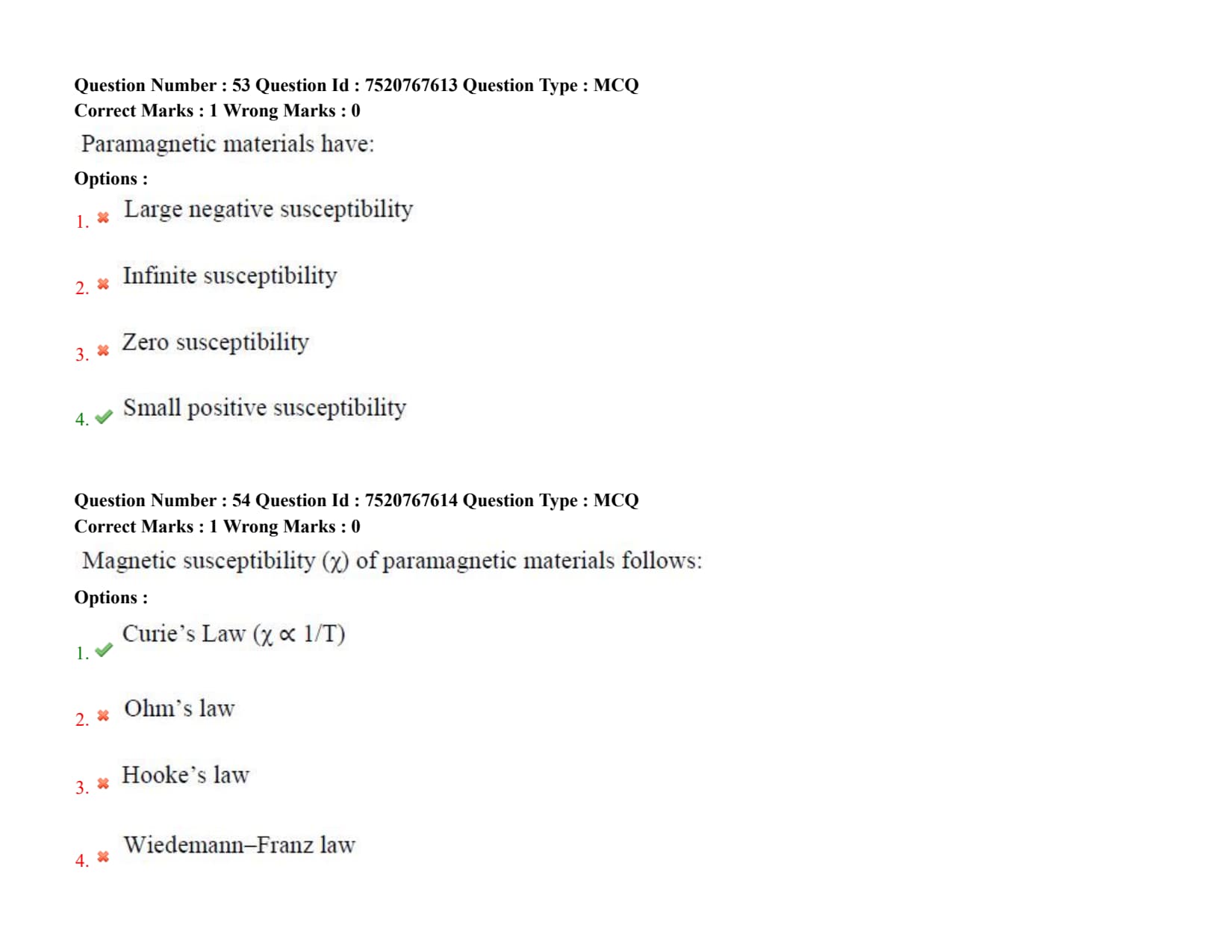
Question 53:
Paramagnetic materials have:
- (A) Large negative susceptibility
- (B) Infinite susceptibility
- (C) Zero susceptibility
- (D) Small positive susceptibility
Question 54:
Magnetic susceptibility (\(\chi\)) of paramagnetic materials follows:
- (A) Curie's Law (\(\chi \propto 1/T\))
- (B) Ohm's law
- (C) Hooke's law
- (D) Wiedemann–Franz law
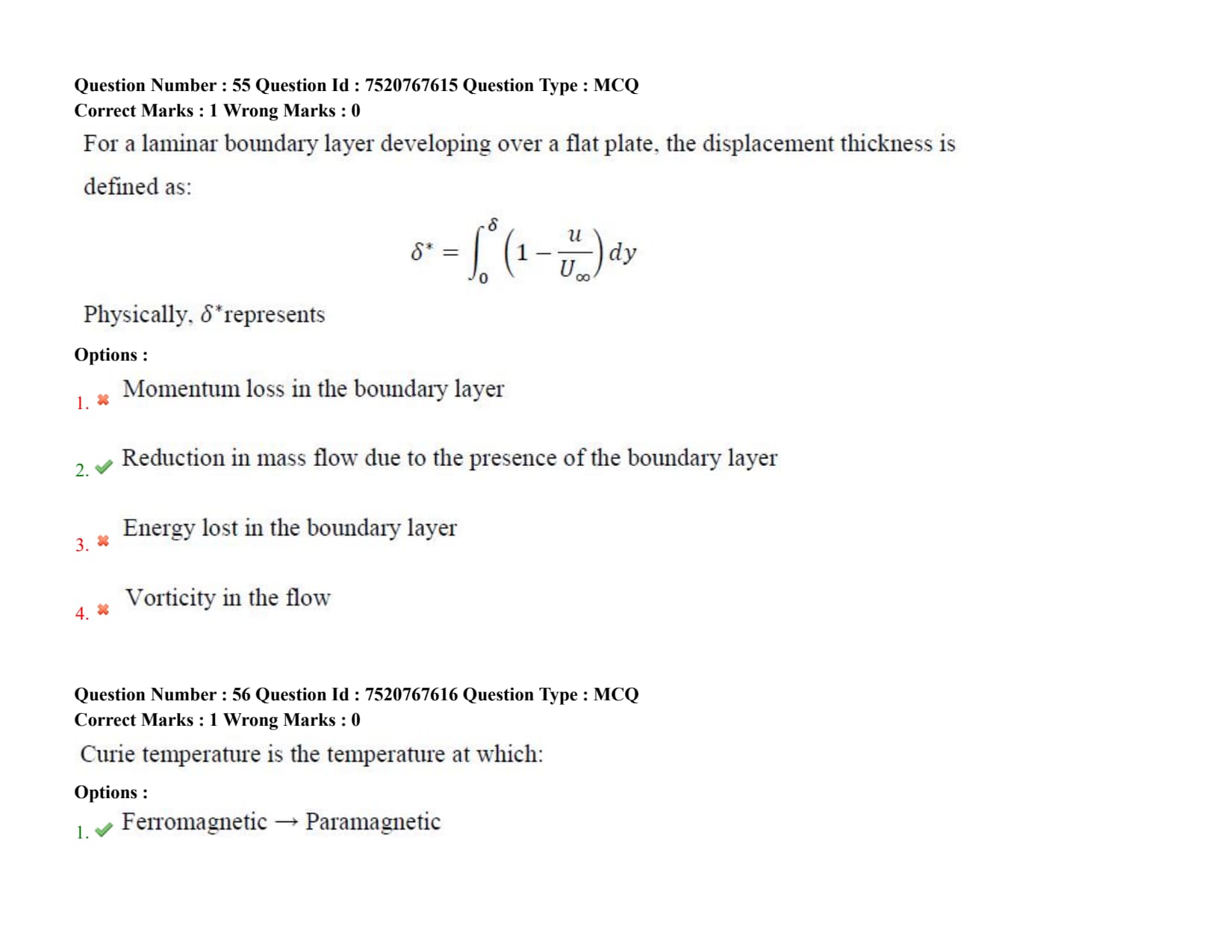
Question 55:
For a laminar boundary layer developing over a flat plate, the displacement thickness is defined as: \(\delta^* = \int_0^\delta \left(1 - \frac{u}{U_\infty}\right) dy\). Physically, \(\delta^*\) represents
- (A) Momentum loss in the boundary layer
- (B) Reduction in mass flow due to the presence of the boundary layer
- (C) Energy lost in the boundary layer
- (D) Vorticity in the flow
Question 56:
Curie temperature is the temperature at which:
- (A) Ferromagnetic \(\rightarrow\) Paramagnetic
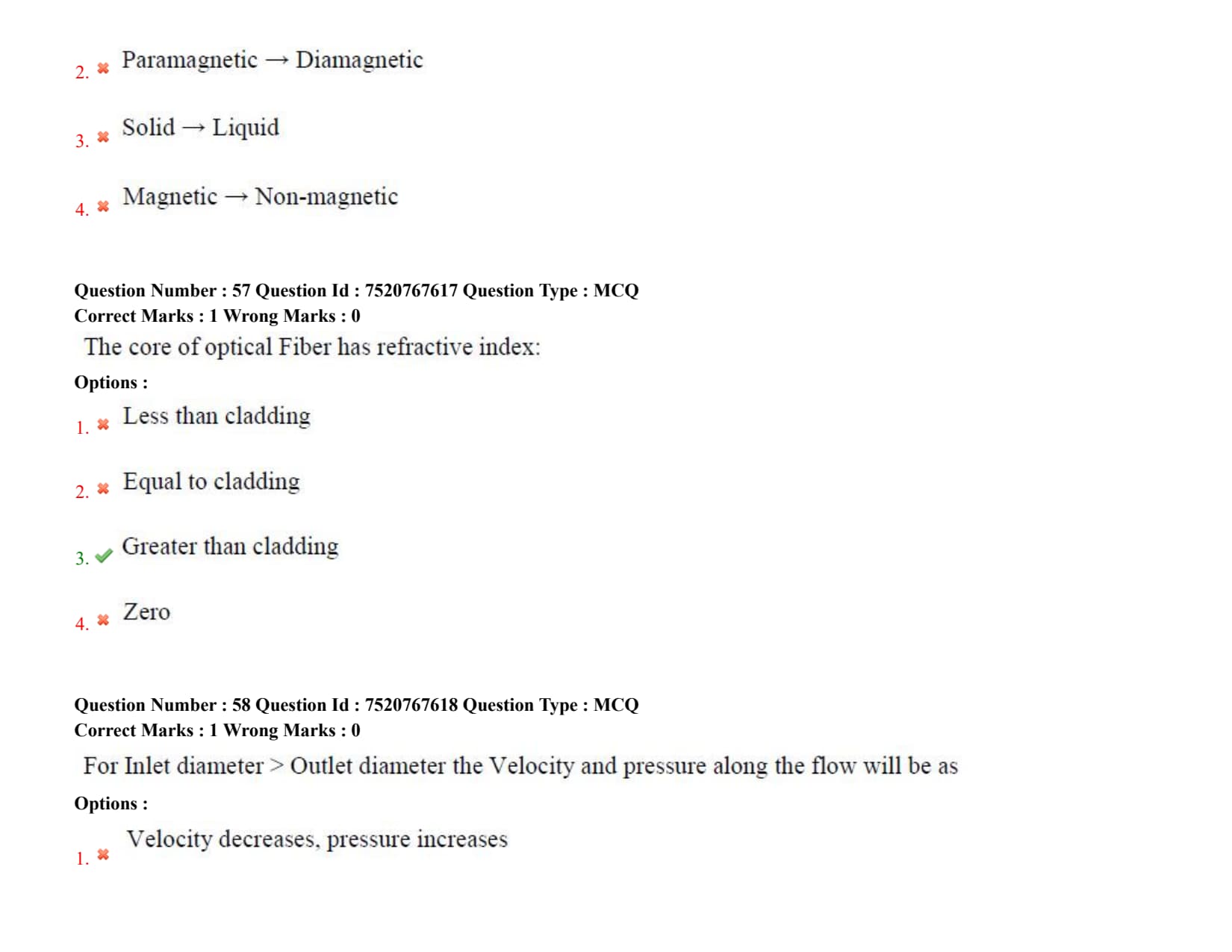
- (B) Paramagnetic \(\rightarrow\) Diamagnetic
- (C) Solid \(\rightarrow\) Liquid
- (D) Magnetic \(\rightarrow\) Non-magnetic
Question 57:
The core of optical Fiber has refractive index:
- (A) Less than cladding
- (B) Equal to cladding
- (C) Greater than cladding
- (D) Zero
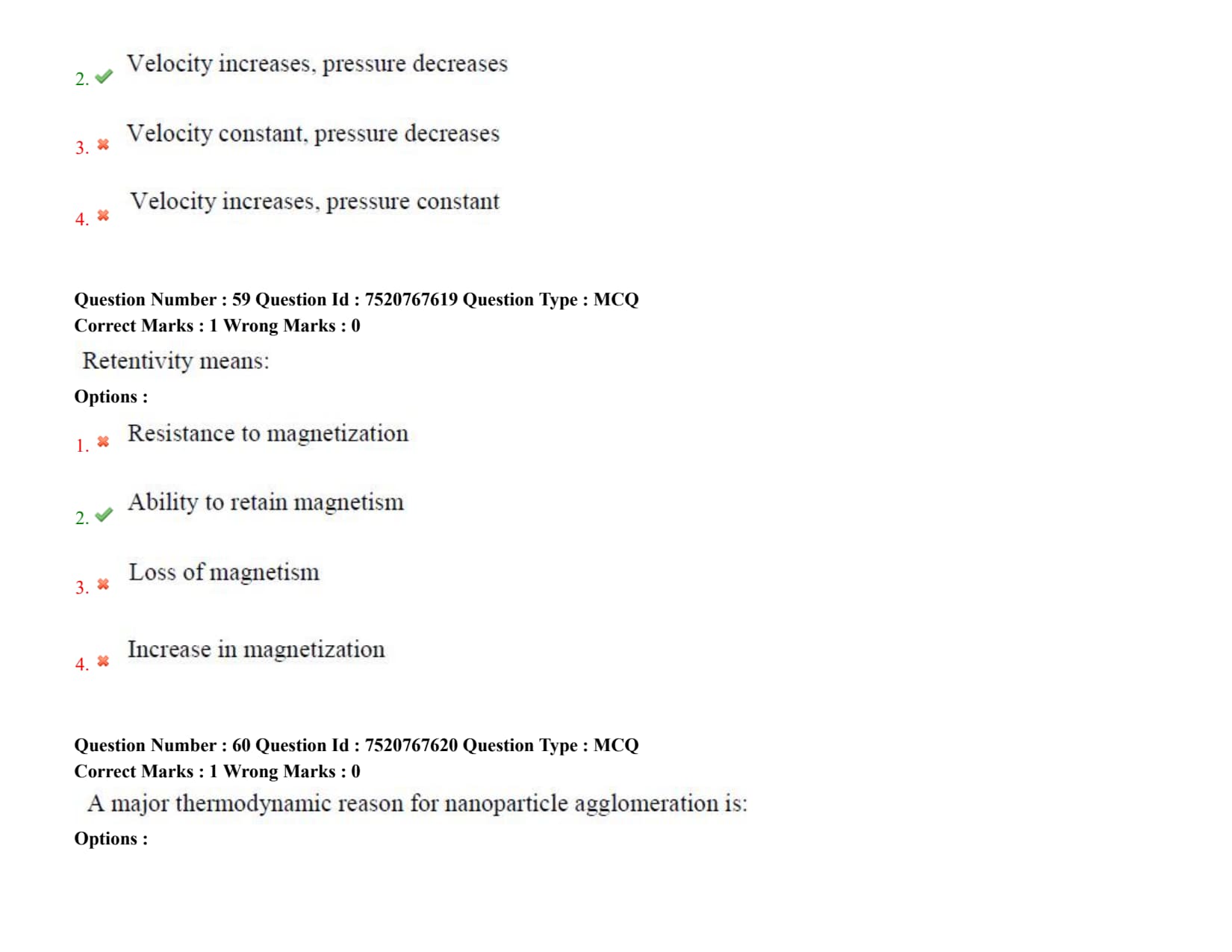
Question 58:
For Inlet diameter \(>\) Outlet diameter the Velocity and pressure along the flow will be as
- (A) Velocity decreases, pressure increases
- (B) Velocity increases, pressure decreases
- (C) Velocity constant, pressure decreases
- (D) Velocity increases, pressure constant
Question 59:
Retentivity means:
- (A) Resistance to magnetization
- (B) Ability to retain magnetism
- (C) Loss of magnetism
- (D) Increase in magnetization
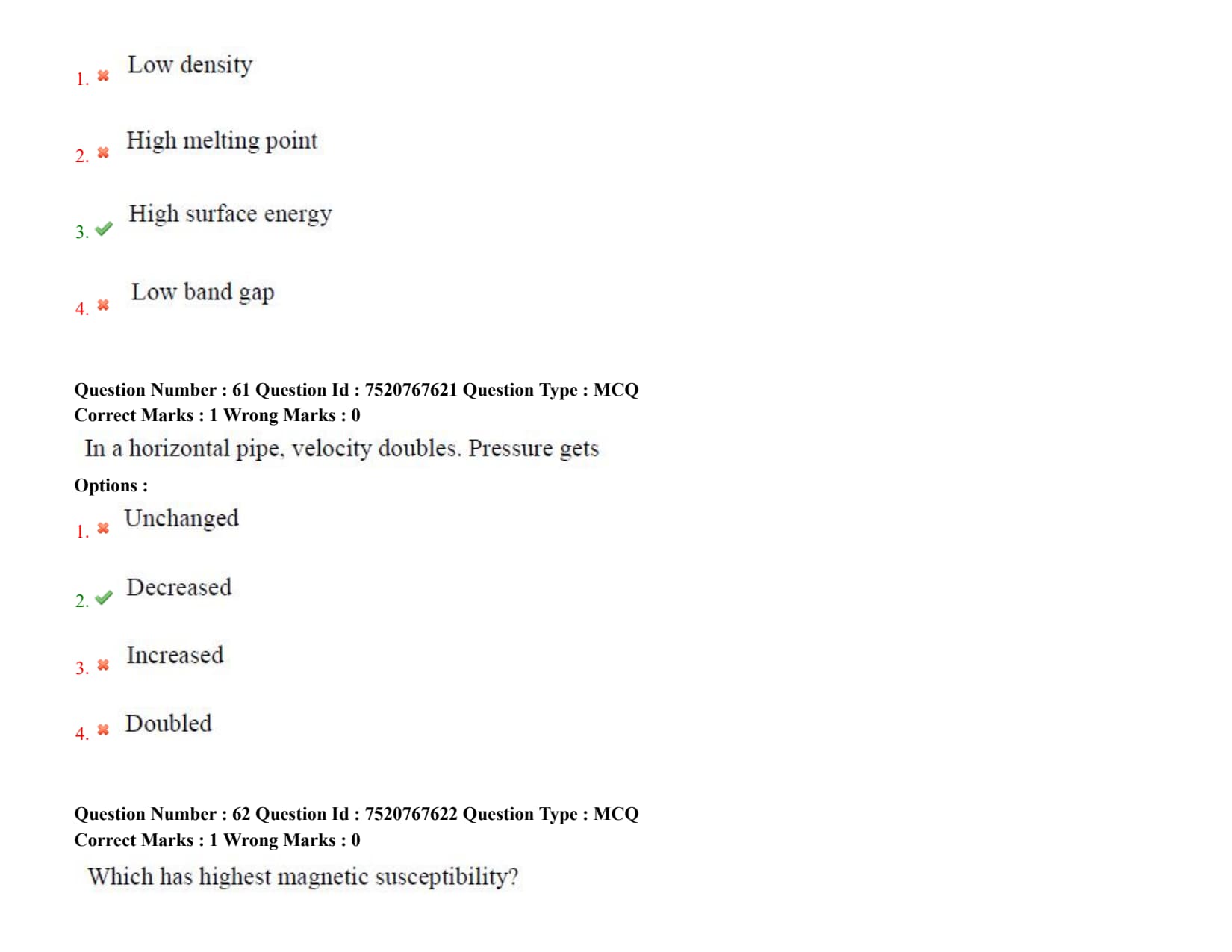
Question 60:
A major thermodynamic reason for nanoparticle agglomeration is:
- (A) Low density
- (B) High melting point
- (C) High surface energy
- (D) Low band gap
Question 61:
In a horizontal pipe, velocity doubles. Pressure gets
- (A) Unchanged
- (B) Decreased
- (C) Increased
- (D) Doubled
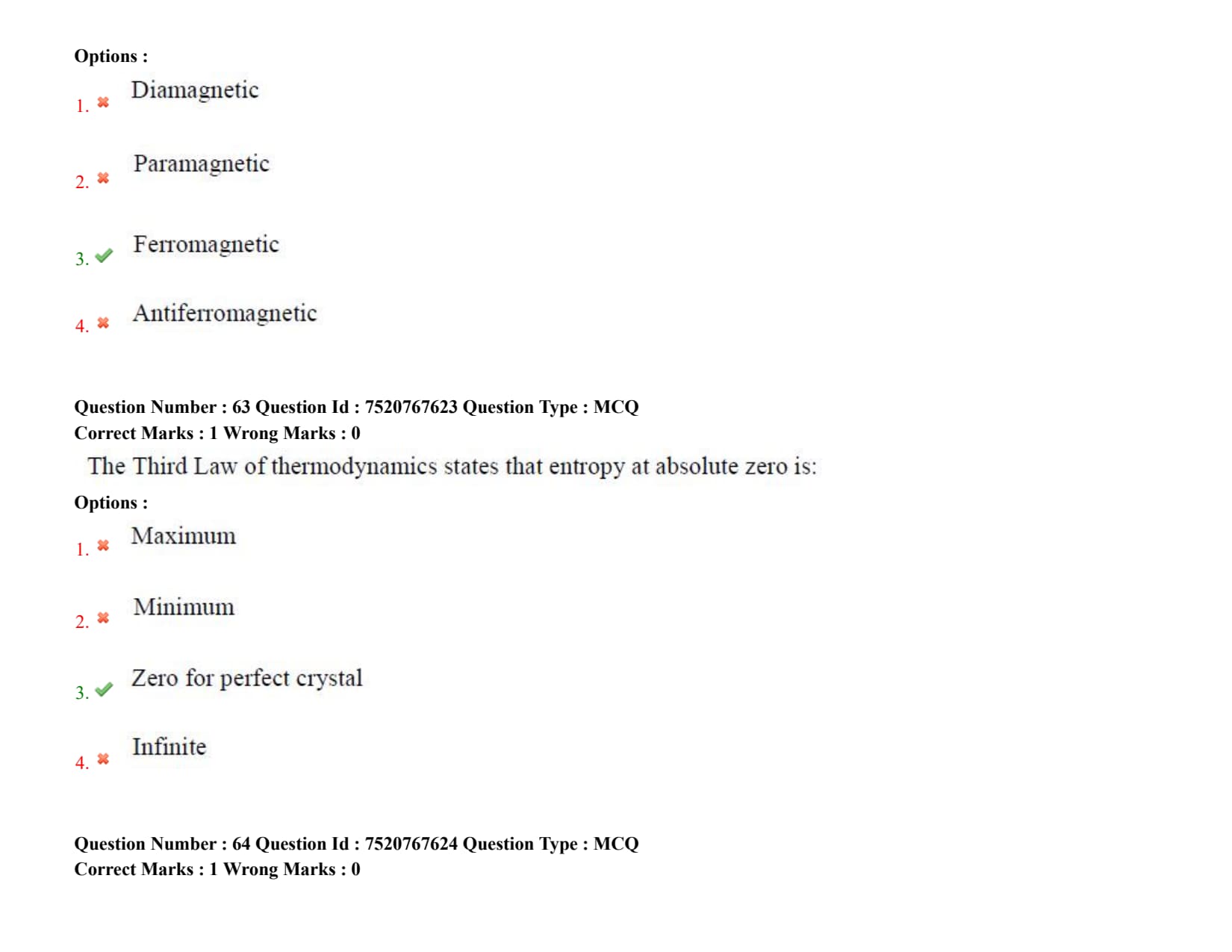
Question 62:
Which has highest magnetic susceptibility?
- (A) Diamagnetic
- (B) Paramagnetic
- (C) Ferromagnetic
- (D) Antiferromagnetic
Question 63:
The Third Law of thermodynamics states that entropy at absolute zero is:
- (A) Maximum
- (B) Minimum
- (C) Zero for perfect crystal
- (D) Infinite
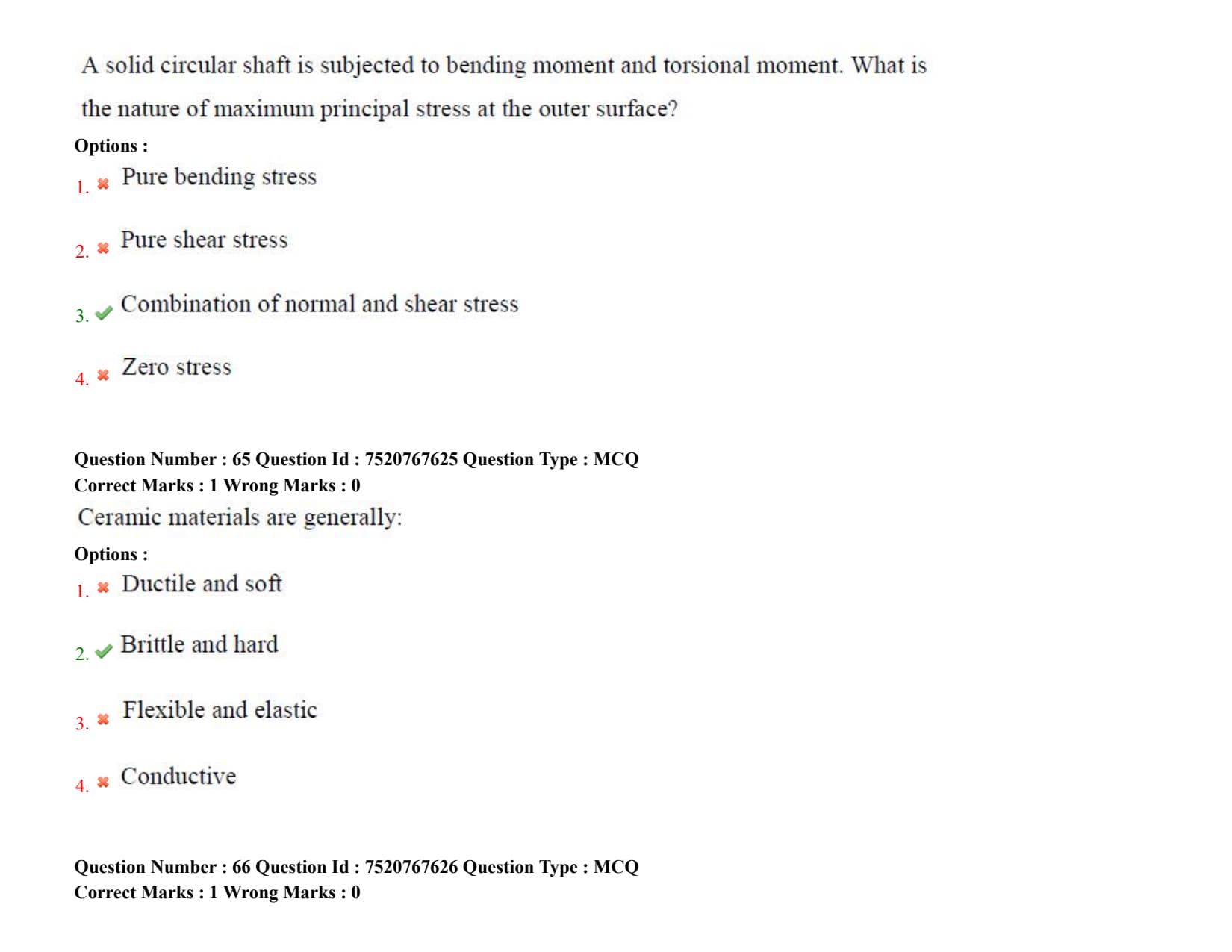
Question 64:
A solid circular shaft is subjected to bending moment and torsional moment. What is the nature of maximum principal stress at the outer surface?
- (A) Pure bending stress
- (B) Pure shear stress
- (C) Combination of normal and shear stress
- (D) Zero stress
Question 65:
Ceramic materials are generally:
- (A) Ductile and soft
- (B) Brittle and hard
- (C) Flexible and elastic
- (D) Conductive
Question 66:
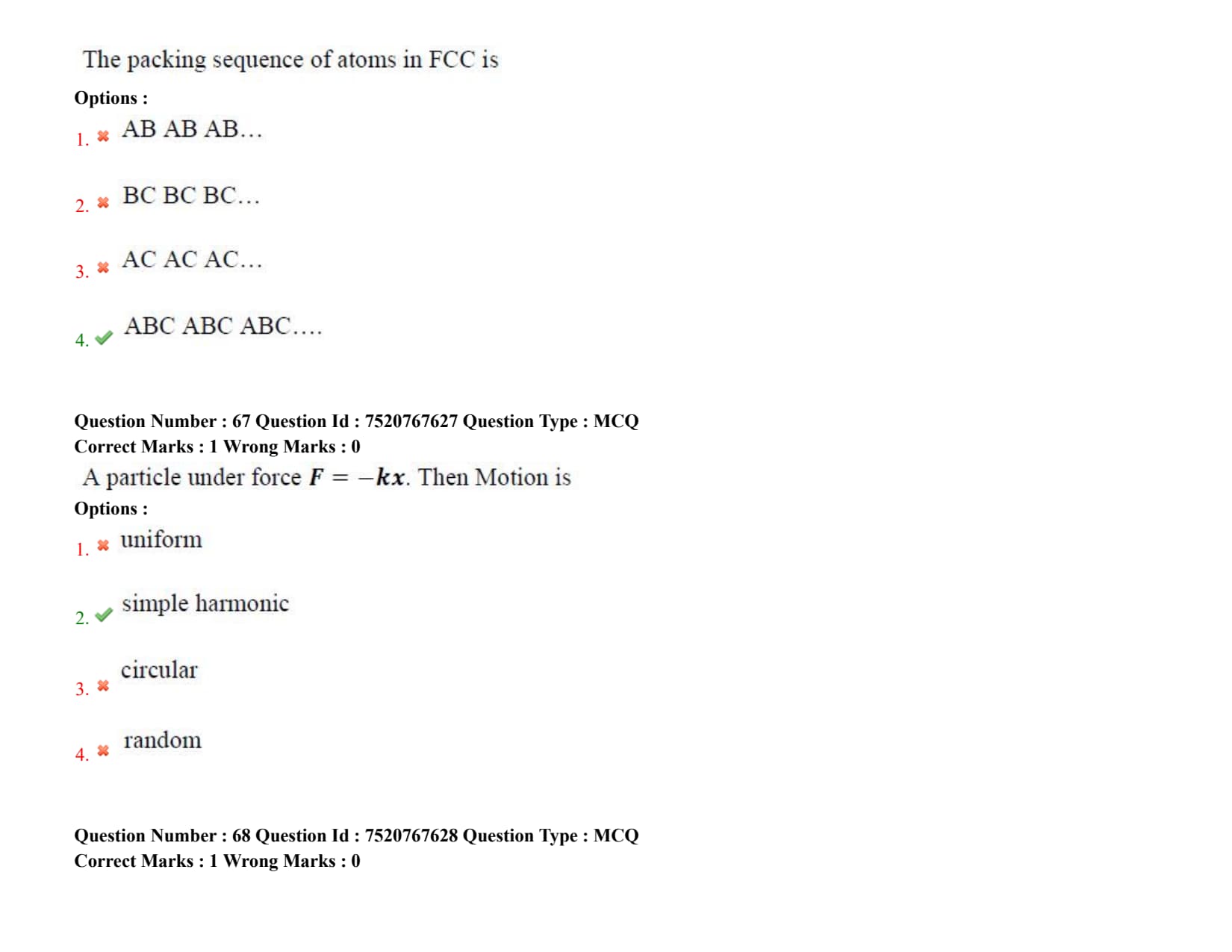
The packing sequence of atoms in FCC is
- (A) AB AB AB...
- (B) BC BC BC...
- (C) AC AC AC...
- (D) ABC ABC ABC....
Question 67:
A particle under force \(F = -kx\). Then Motion is
- (A) uniform
- (B) simple harmonic
- (C) circular
- (D) random
Question 68:
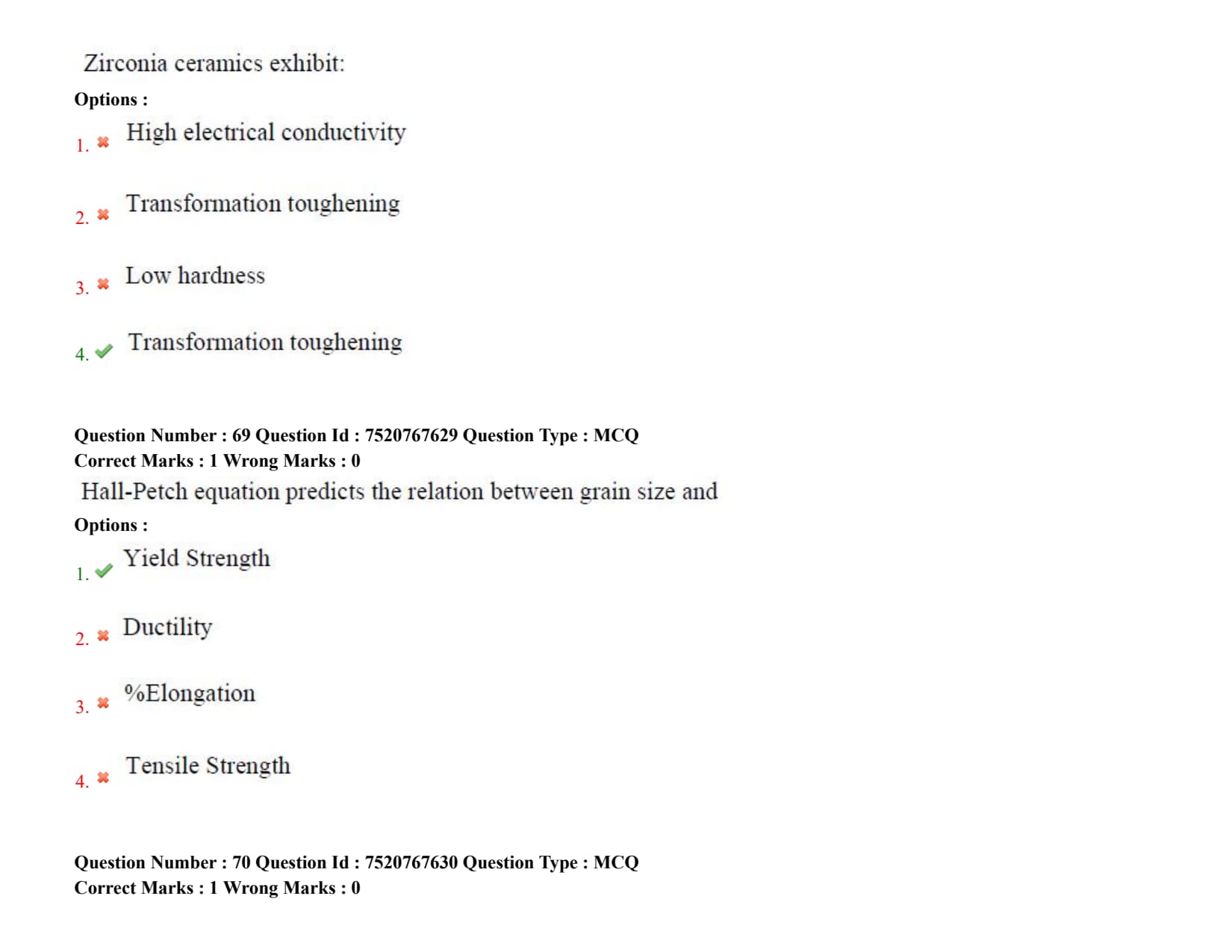
Zirconia ceramics exhibit:
- (A) High electrical conductivity
- (B) High hardness
- (C) Low hardness
- (D) Transformation toughening
Question 69:
Hall-Petch equation predicts the relation between grain size and
- (A) Yield Strength
- (B) Ductility
- (C) %Elongation
- (D) Tensile Strength
Question 70:
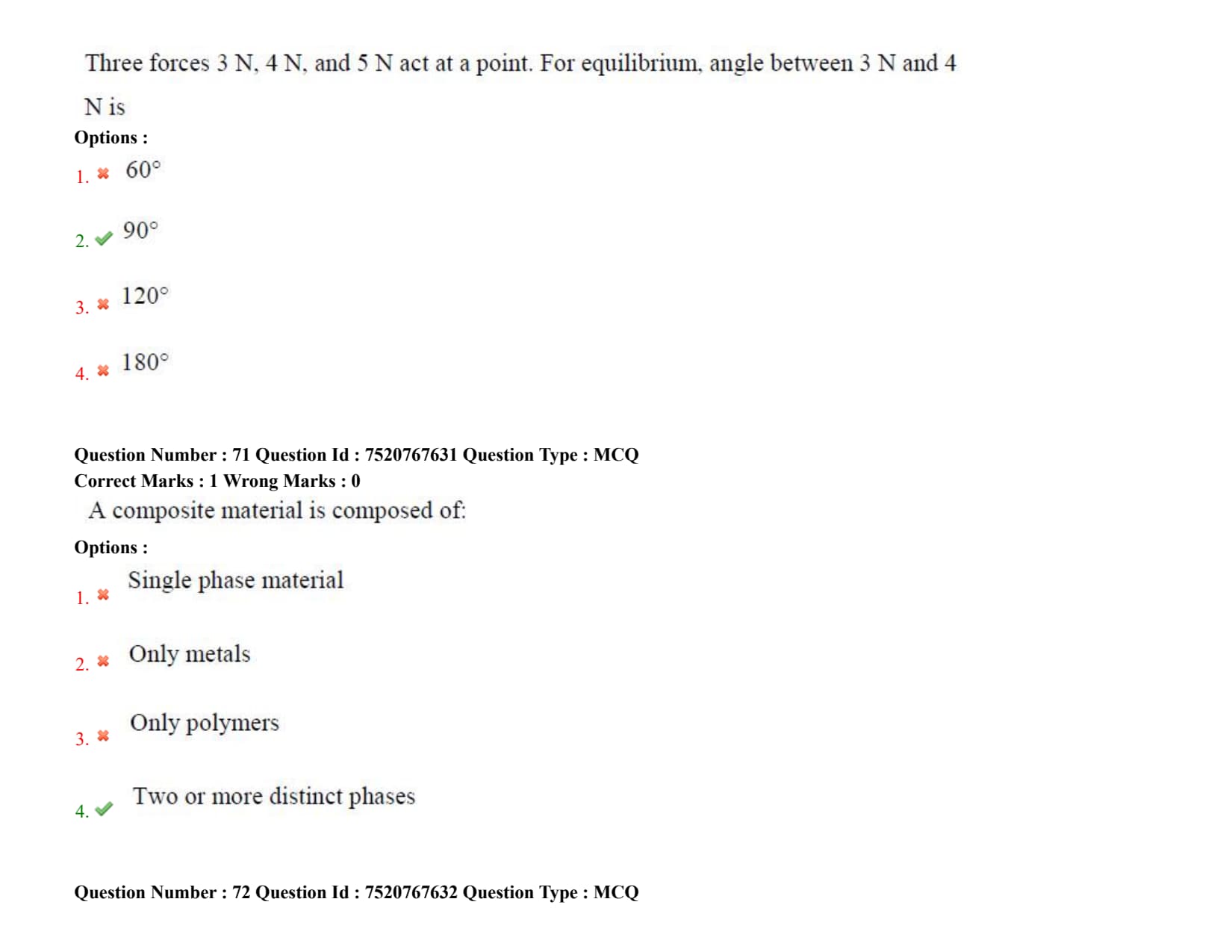
Three forces 3 N, 4 N, and 5 N act at a point. For equilibrium, angle between 3 N and 4 N is
- (A) \(60^\circ\)
- (B) \(90^\circ\)
- (C) \(120^\circ\)
- (D) \(180^\circ\)
Question 71:
A composite material is composed of:
- (A) Single phase material
- (B) Only metals
- (C) Only polymers
- (D) Two or more distinct phases
Question 72:
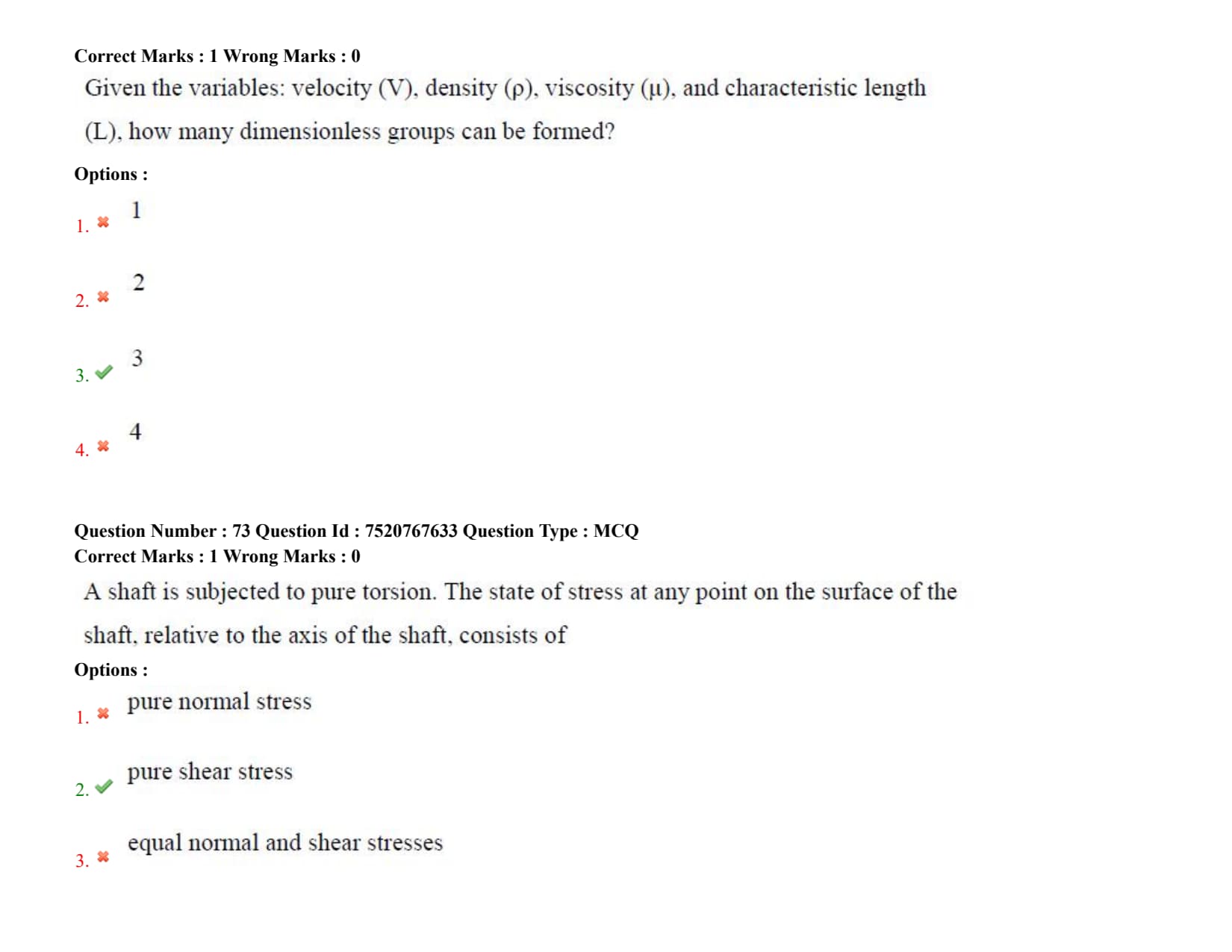
Given the variables: velocity (V), density (\(\rho\)), viscosity (\(\mu\)), and characteristic length (L), how many dimensionless groups can be formed?
Question 73:
A shaft is subjected to pure torsion. The state of stress at any point on the surface of the shaft, relative to the axis of the shaft, consists of
- (A) pure normal stress
- (B) pure shear stress
- (C) equal normal and shear stresses
- (D) zero stress
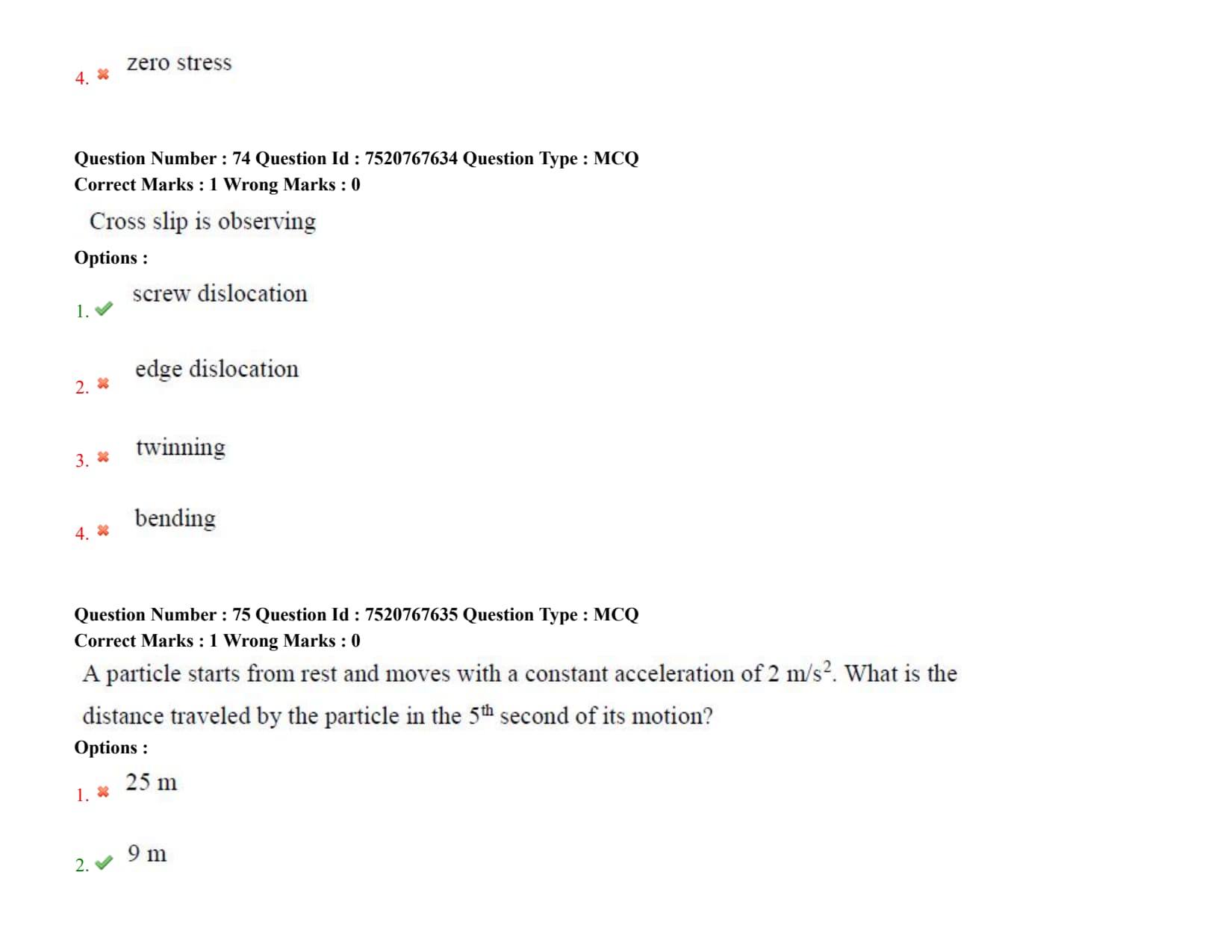
Question 74:
Cross slip is observing
- (A) screw dislocation
- (B) edge dislocation
- (C) twinning
- (D) bending
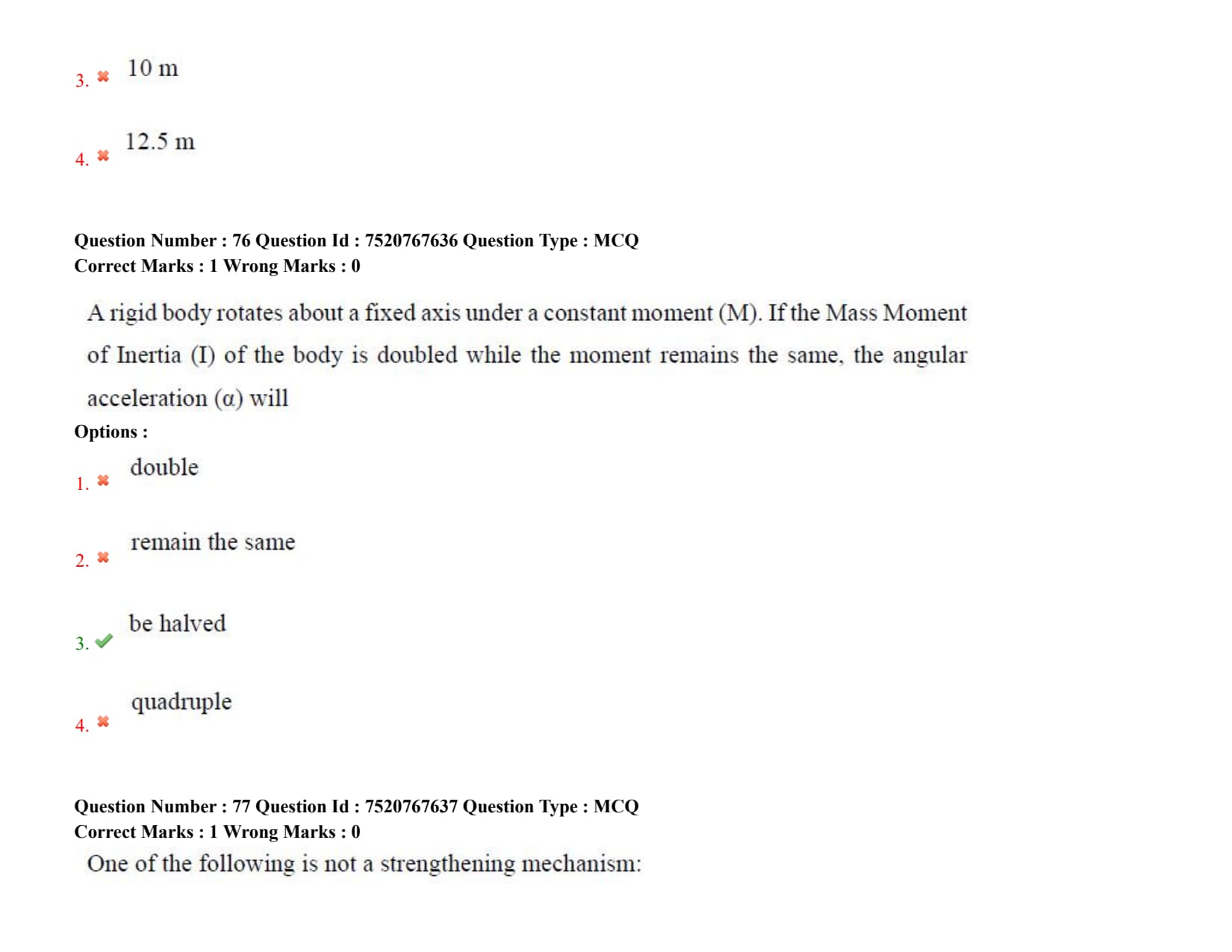
Question 75:
A particle starts from rest and moves with a constant acceleration of \(2 m/s^2\). What is the distance traveled by the particle in the \(5^{th}\) second of its motion?
- (A) \(25 m\)
- (B) \(9 m\)
- (C) \(10 m\)
- (D) \(12.5 m\)
Question 76:
A rigid body rotates about a fixed axis under a constant moment (M). If the Mass Moment of Inertia (I) of the body is doubled while the moment remains the same, the angular acceleration (\(\alpha\)) will
- (A) double
- (B) remain the same
- (C) be halved
- (D) quadruple
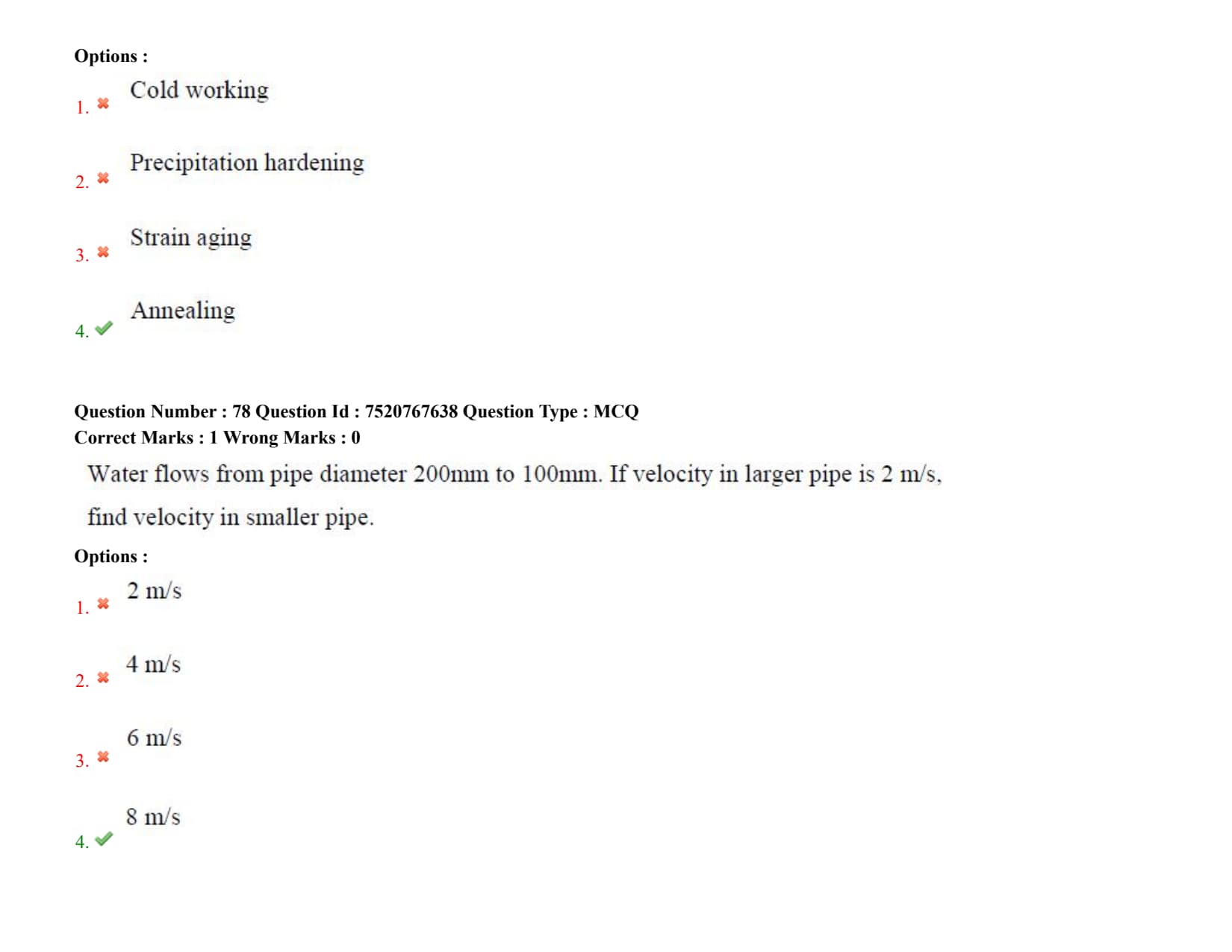
Question 77:
One of the following is not a strengthening mechanism:
- (A) Cold working
- (B) Precipitation hardening
- (C) Strain aging
- (D) Annealing
Question 78:
Water flows from pipe diameter \(200 mm\) to \(100 mm\). If velocity in larger pipe is \(2 m/s\), find velocity in smaller pipe.
- (A) \(2 m/s\)
- (B) \(4 m/s\)
- (C) \(6 m/s\)
- (D) \(8 m/s\)
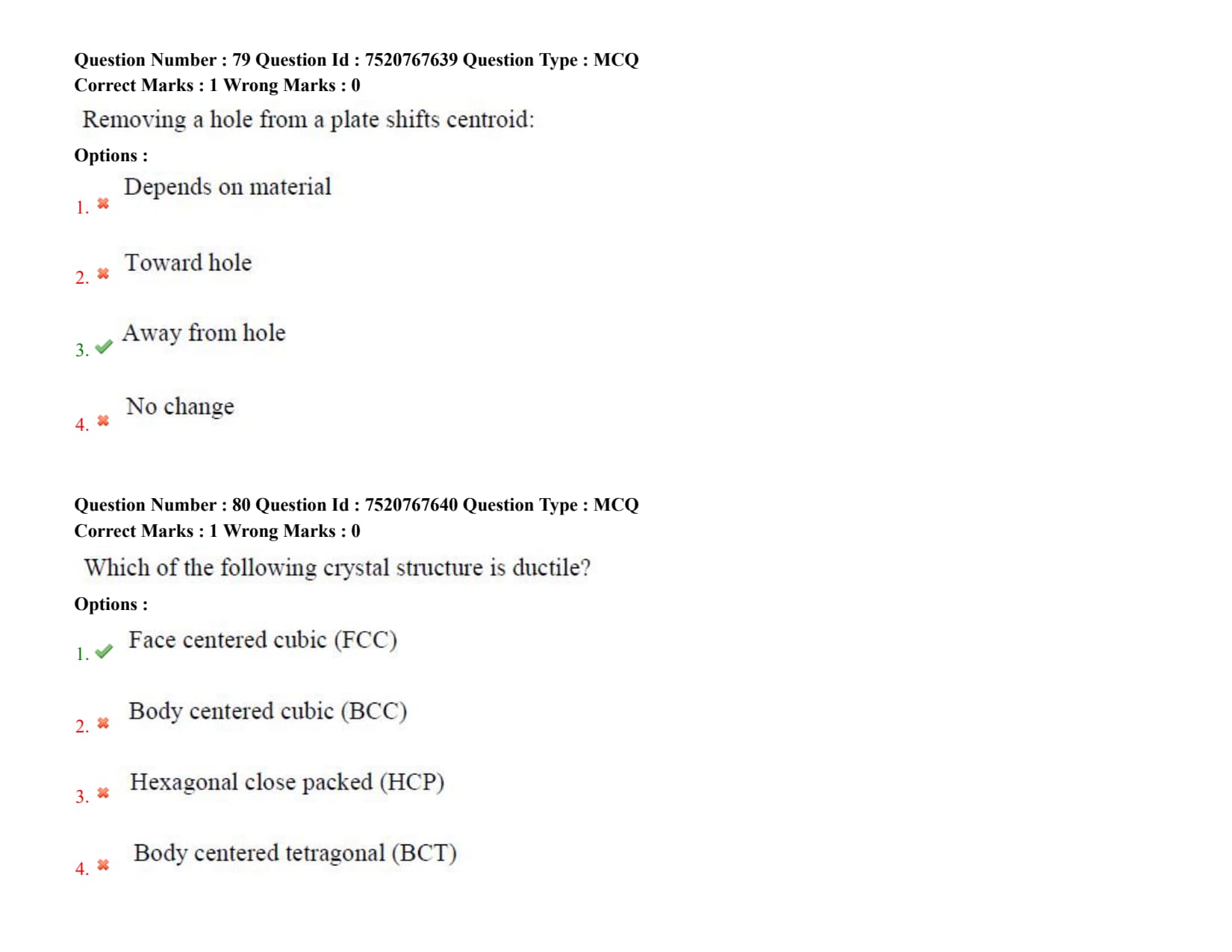
Question 79:
Removing a hole from a plate shifts centroid:
- (A) Depends on material
- (B) Toward hole
- (C) Away from hole
- (D) No change
Question 80:
Which of the following crystal structure is ductile?
- (A) Face centered cubic (FCC)
- (B) Body centered cubic (BCC)
- (C) Hexagonal close packed (HCP)
- (D) Body centered tetragonal (BCT)
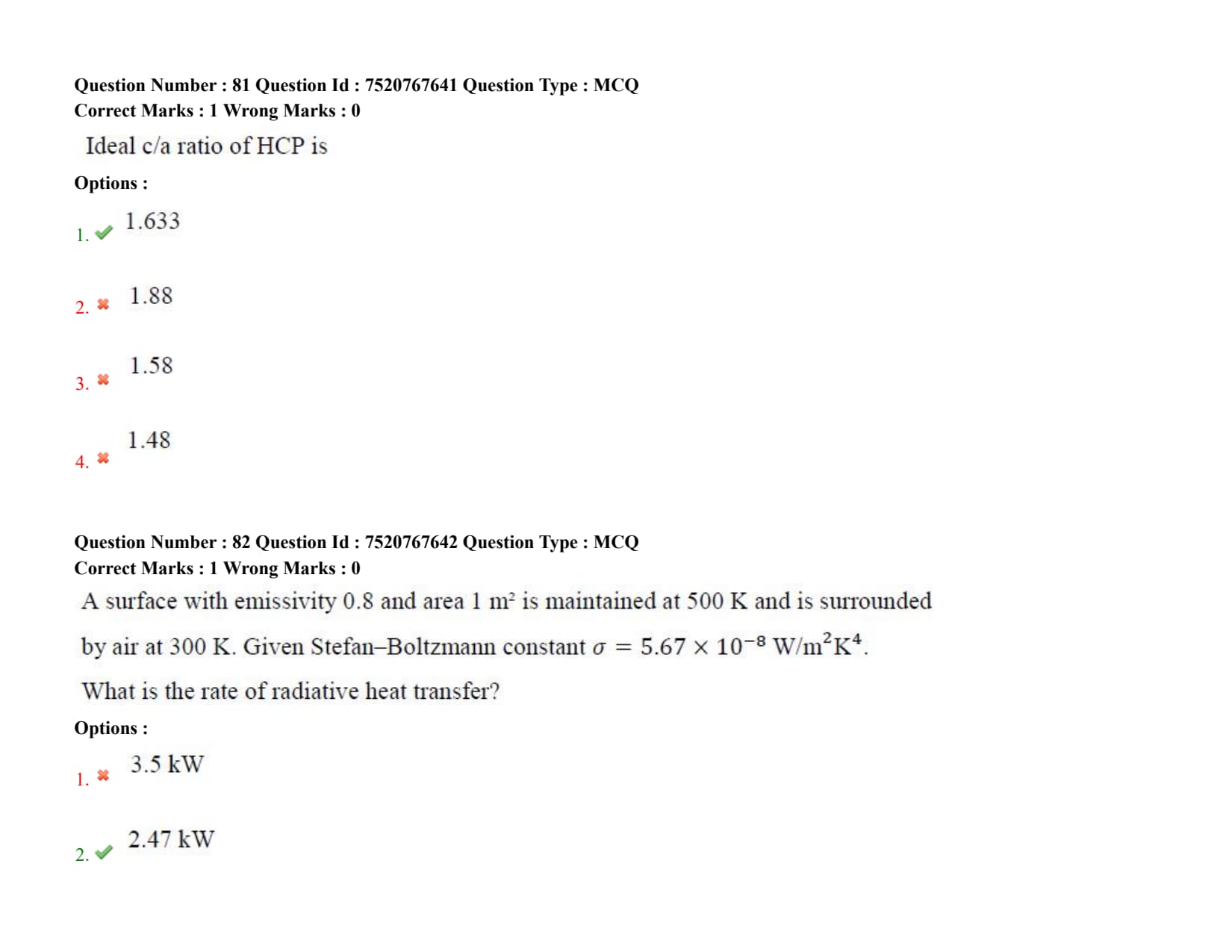
Question 81:
Ideal c/a ratio of HCP is
- (A) 1.633
- (B) 1.88
- (C) 1.58
- (D) 1.48
Question 82:
A surface with emissivity 0.8 and area \(1 m^2\) is maintained at \(500 K\) and is surrounded by air at \(300 K\). Given Stefan–Boltzmann constant \(\sigma = 5.67 \times 10^{-8} W/m^2K^4\). What is the rate of radiative heat transfer?
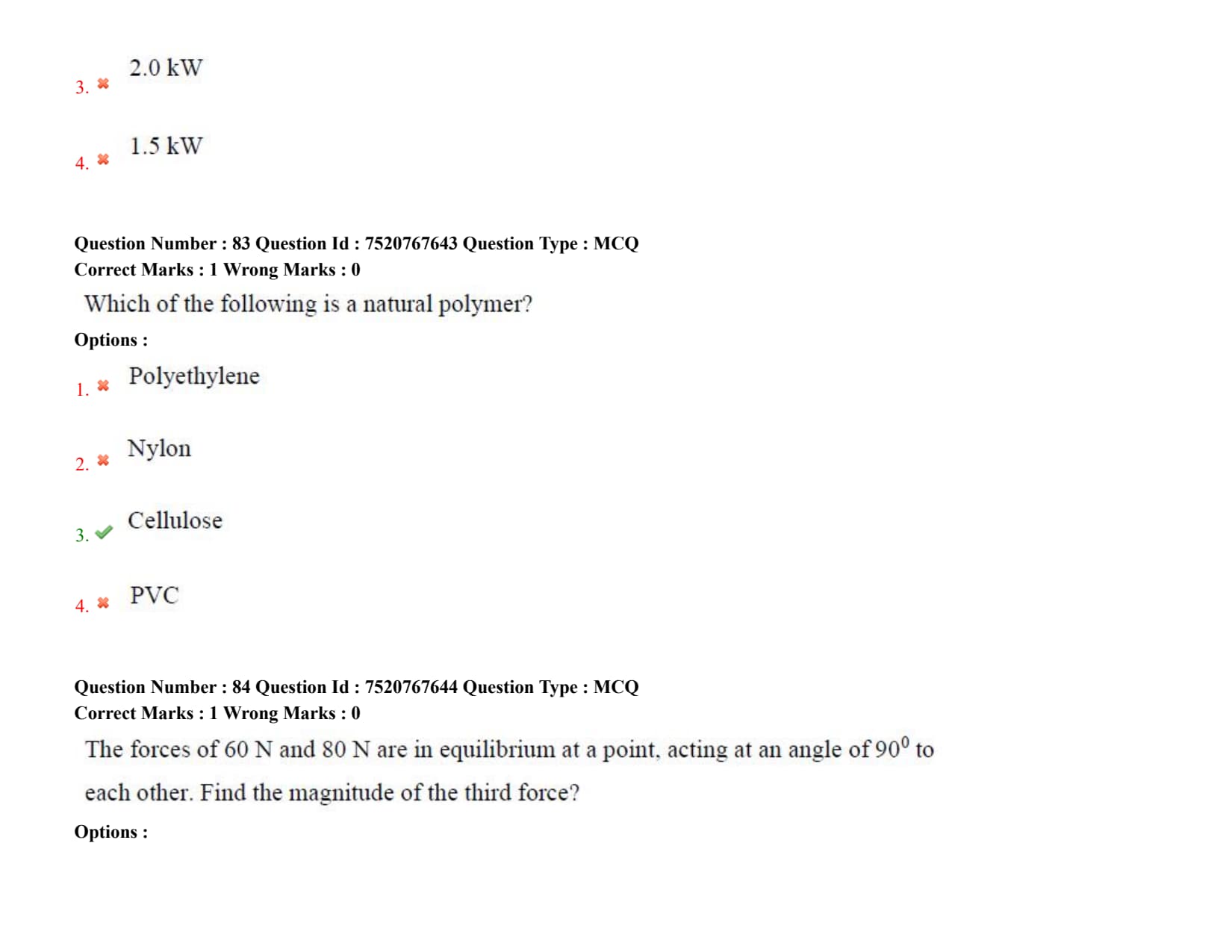
- (A) \(3.5 kW\)
- (B) \(2.47 kW\)
- (C) \(2.0 kW\)
- (D) \(1.5 kW\)
Question 83:
Which of the following is a natural polymer?
- (A) Polyethylene
- (B) Nylon
- (C) Cellulose
- (D) PVC
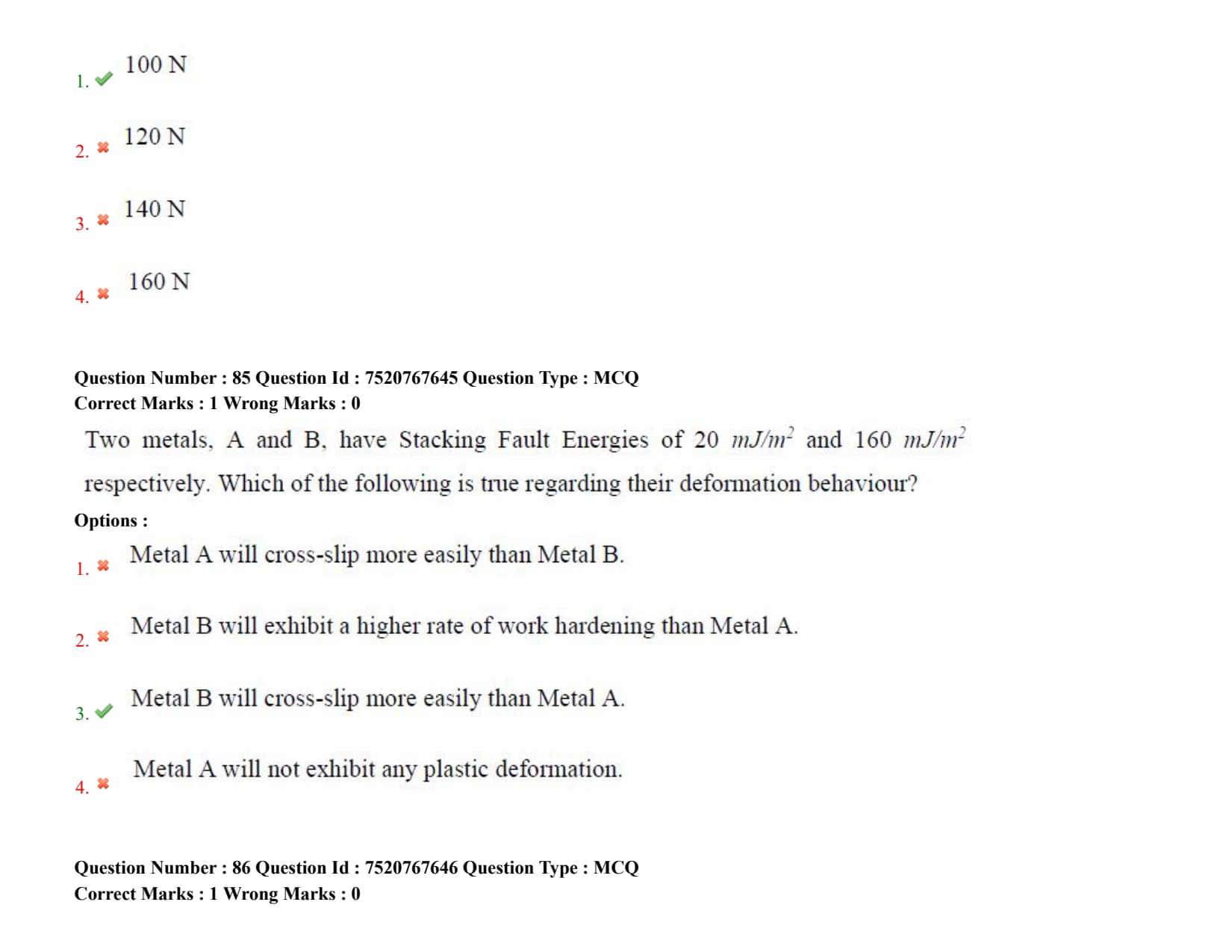
Question 84:
The forces of \(60 N\) and \(80 N\) are in equilibrium at a point, acting at an angle of \(90^\circ\) to each other. Find the magnitude of the third force?
- (A) \(100 N\)
- (B) \(120 N\)
- (C) \(140 N\)
- (D) \(160 N\)
Question 85:
Two metals, A and B, have Stacking Fault Energies of \(20 mJ/m^2\) and \(160 mJ/m^2\) respectively. Which of the following is true regarding their deformation behaviour?
- (A) Metal A will cross-slip more easily than Metal B.
- (B) Metal B will exhibit a higher rate of work hardening than Metal A.
- (C) Metal B will cross-slip more easily than Metal A.
- (D) Metal A will not exhibit any plastic deformation.
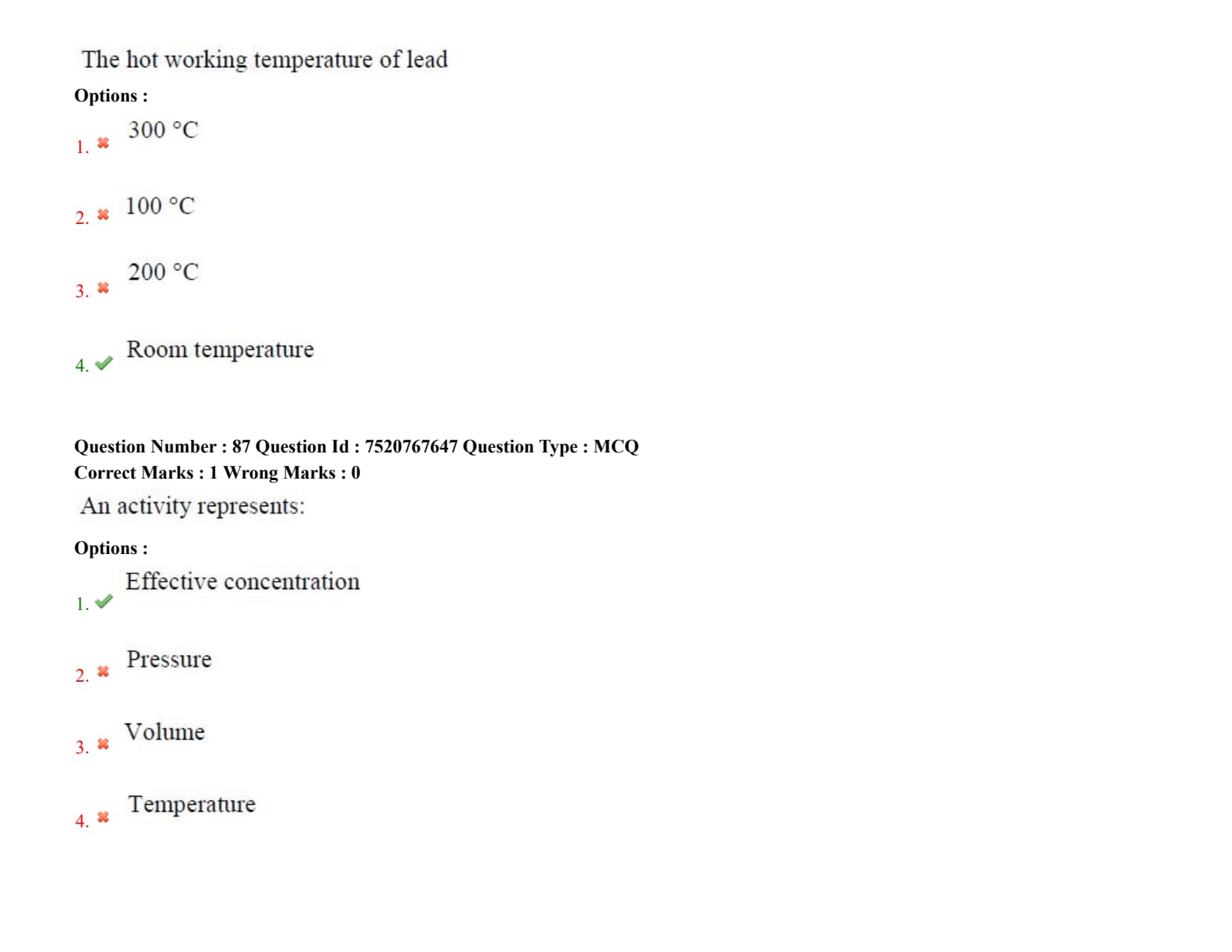
Question 86:
The hot working temperature of lead
- (A) \(300°C\)
- (B) \(100°C\)
- (C) \(200°C\)
- (D) Room temperature
Question 87:
An activity represents:
- (A) Effective concentration
- (B) Pressure
- (C) Volume
- (D) Temperature
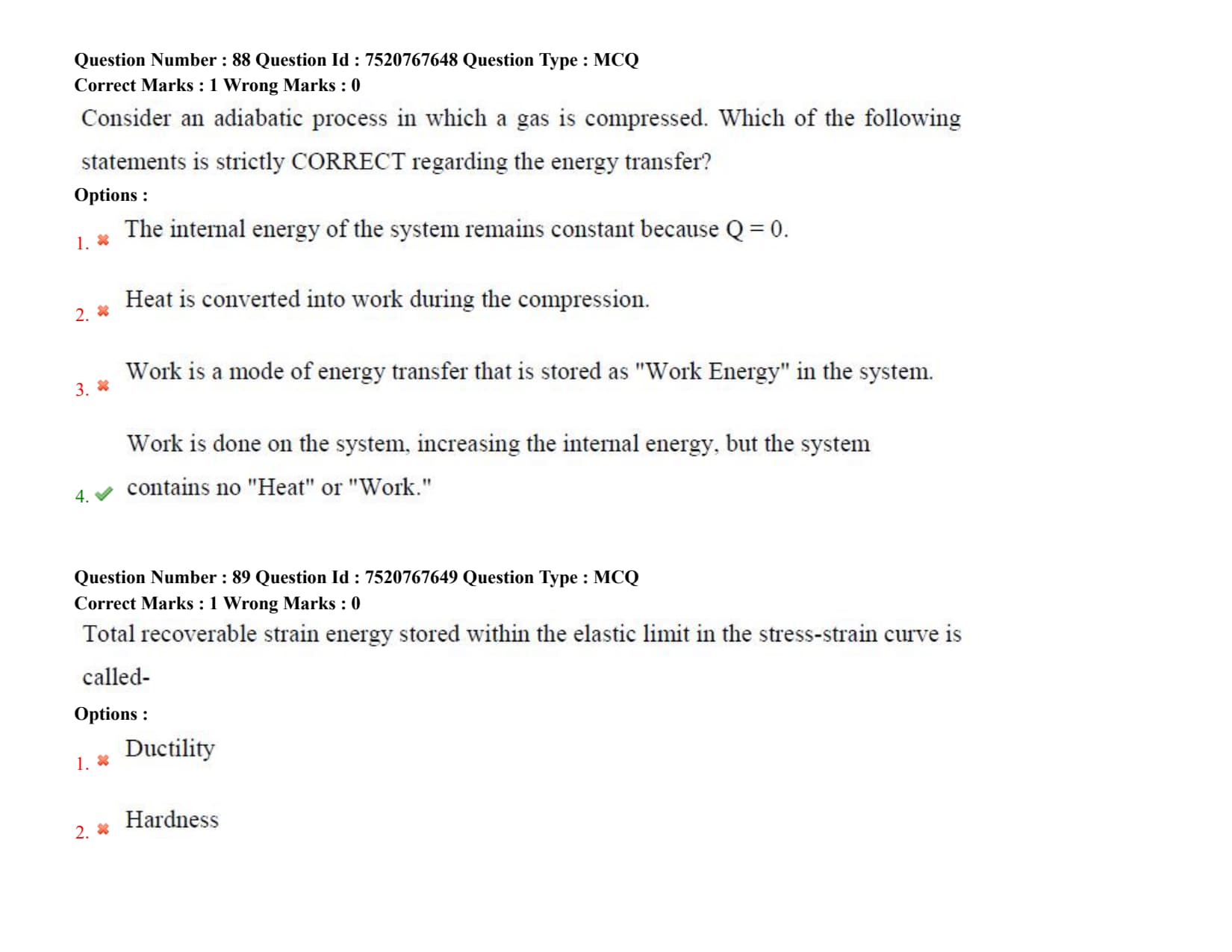
Question 88:
Consider an adiabatic process in which a gas is compressed. Which of the following statements is strictly CORRECT regarding the energy transfer?
- (A) The internal energy of the system remains constant because Q = 0.
- (B) Heat is converted into work during the compression.
- (C) Work is a mode of energy transfer that is stored as "Work Energy" in the system.
- (D) Work is done on the system, increasing the internal energy, but the system contains no "Heat" or "Work."
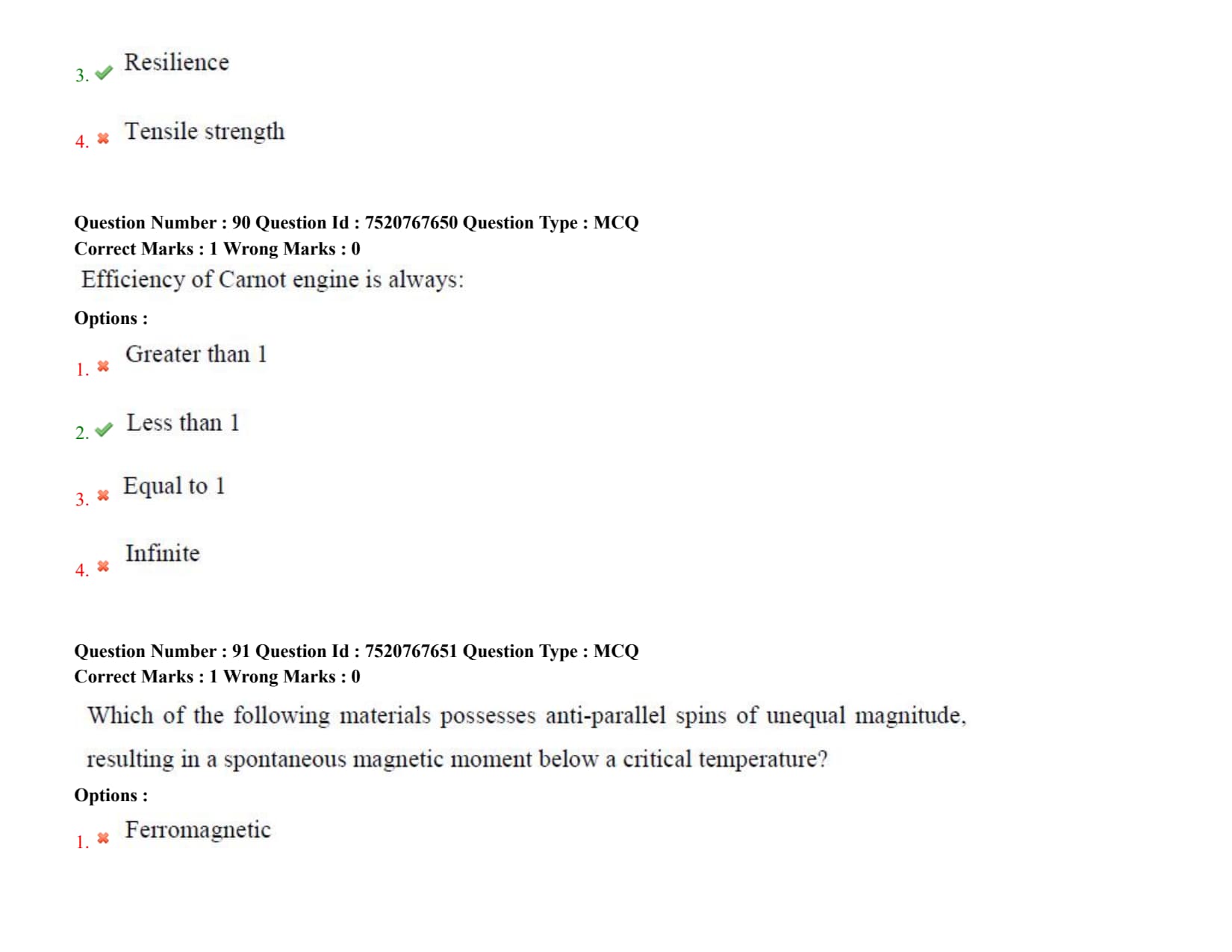
Question 89:
Total recoverable strain energy stored within the elastic limit in the stress-strain curve is called-
- (A) Ductility
- (B) Hardness
- (C) Resilience
- (D) Tensile strength
Question 90:
Efficiency of Carnot engine is always:
- (A) Greater than 1
- (B) Less than 1
- (C) Equal to 1
- (D) Infinite
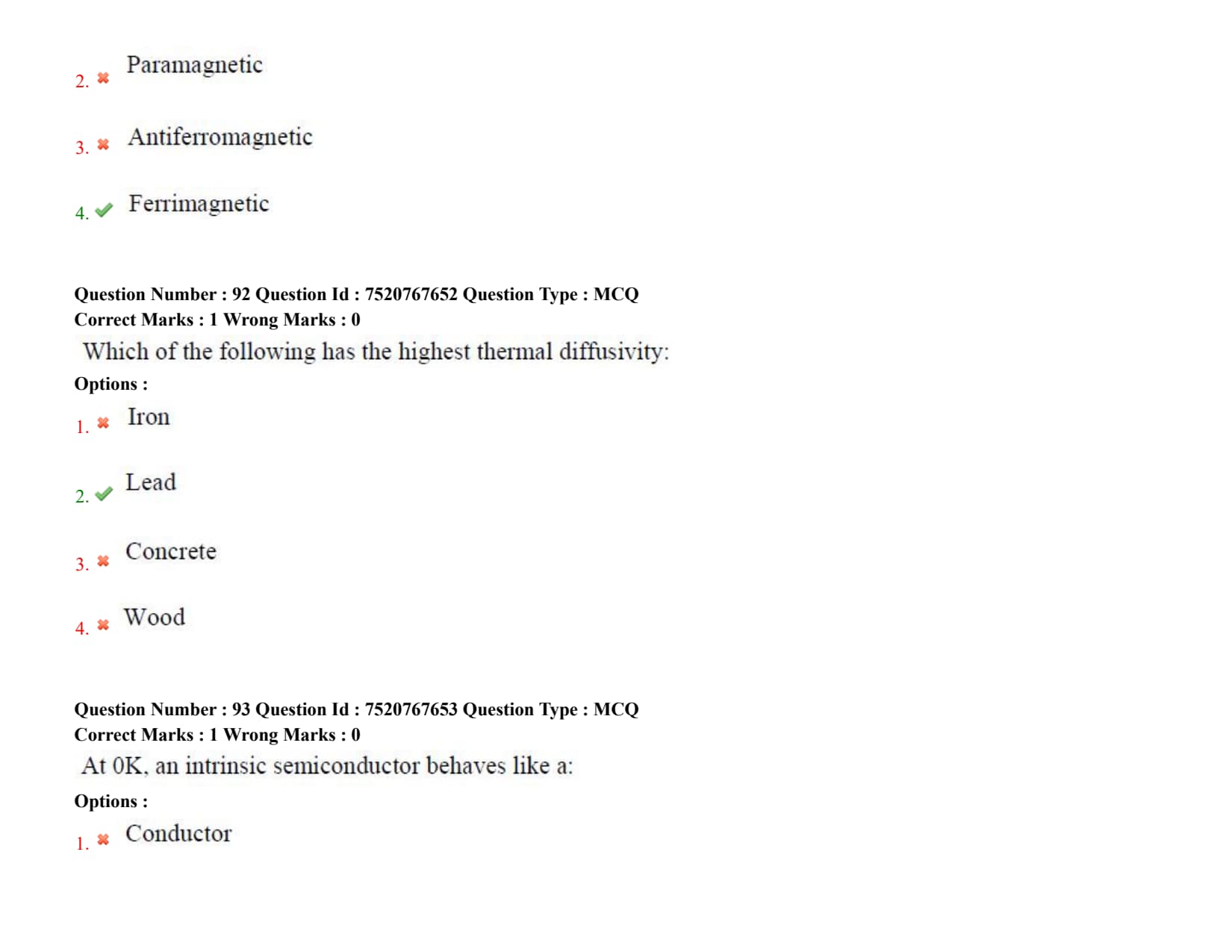
Question 91:
Which of the following materials possesses anti-parallel spins of unequal magnitude, resulting in a spontaneous magnetic moment below a critical temperature?
- (A) Ferromagnetic
- (B) Paramagnetic
- (C) Antiferromagnetic
- (D) Ferrimagnetic
Question 92:
Which of the following has the highest thermal diffusivity:
- (A) Iron
- (B) Lead
- (C) Concrete
- (D) Wood
Question 93:
At 0K, an intrinsic semiconductor behaves like a:
- (A) Conductor
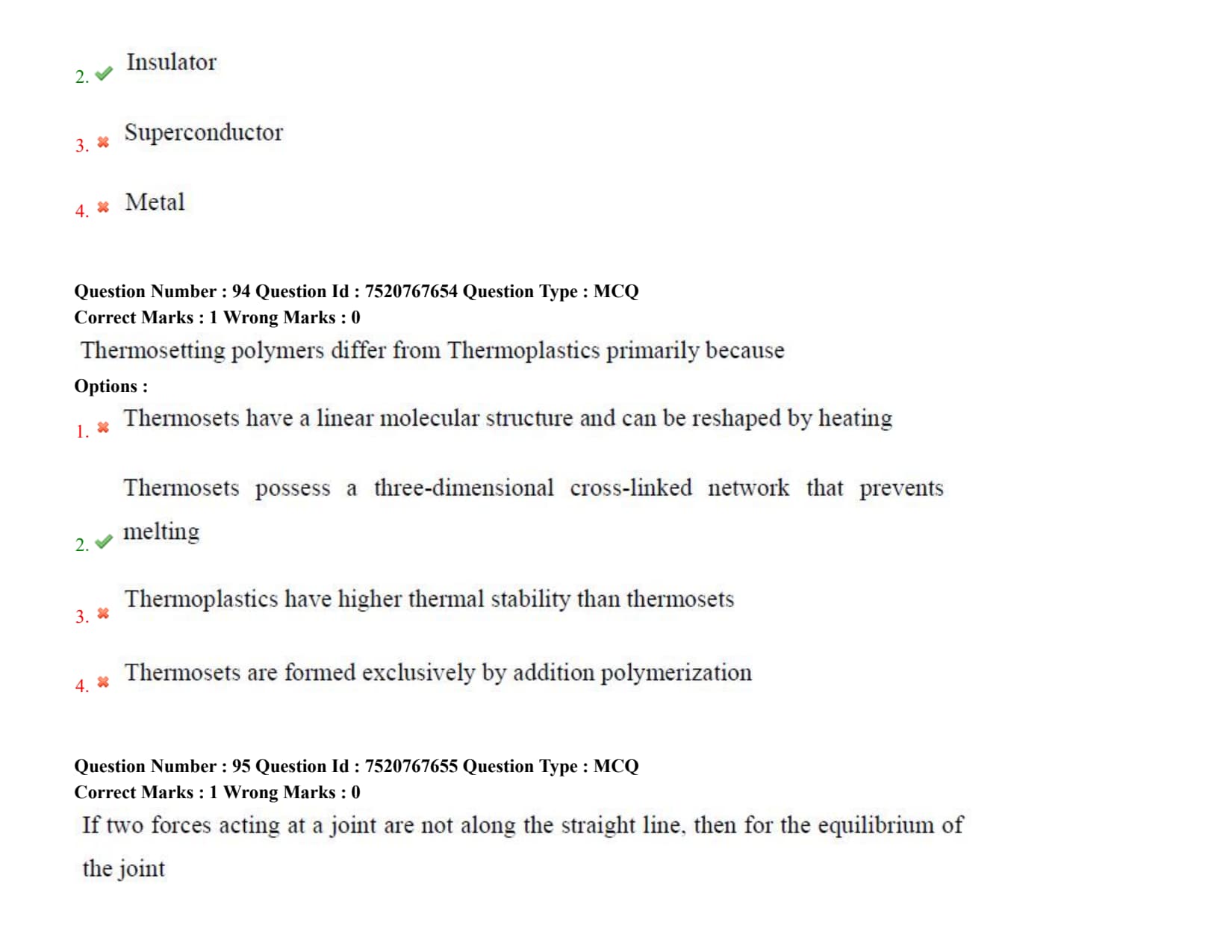
- (B) Insulator
- (C) Superconductor
- (D) Metal
Question 94:
Thermosetting polymers differ from Thermoplastics primarily because
- (A) Thermosets have a linear molecular structure and can be reshaped by heating
- (B) Thermosets possess a three-dimensional cross-linked network that prevents melting
- (C) Thermoplastics have higher thermal stability than thermosets
- (D) Thermosets are formed exclusively by addition polymerization
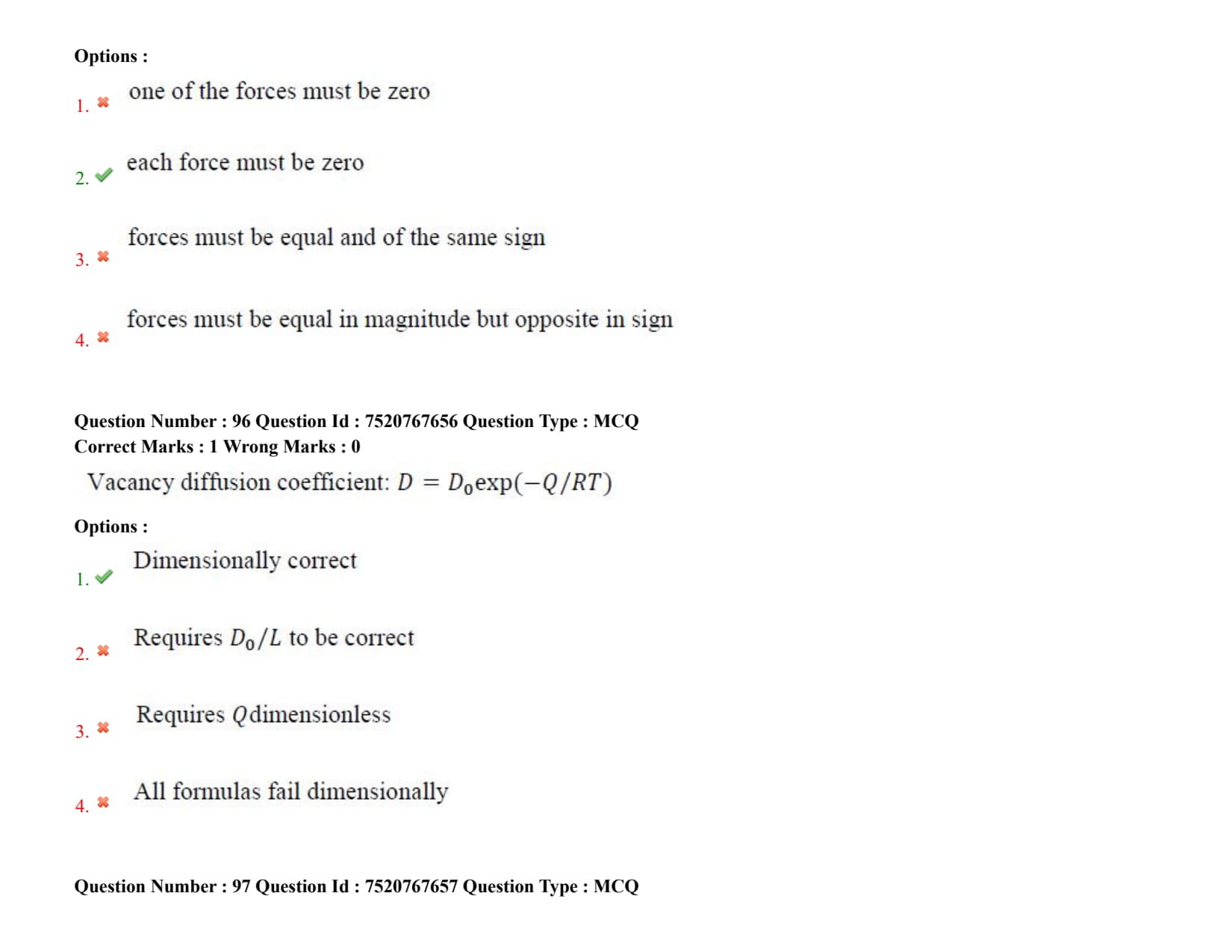
Question 95:
If two forces acting at a joint are not along the straight line, then for the equilibrium of the joint
- (A) one of the forces must be zero
- (B) each force must be zero
- (C) forces must be equal and of the same sign
- (D) forces must be equal in magnitude but opposite in sign
Question 96:
Vacancy diffusion coefficient: \(D = D_0 \exp(-Q/RT)\)
- (A) Dimensionally correct
- (B) Requires \(D_0/L\) to be correct
- (C) Requires Q dimensionless
- (D) All formulas fail dimensionally
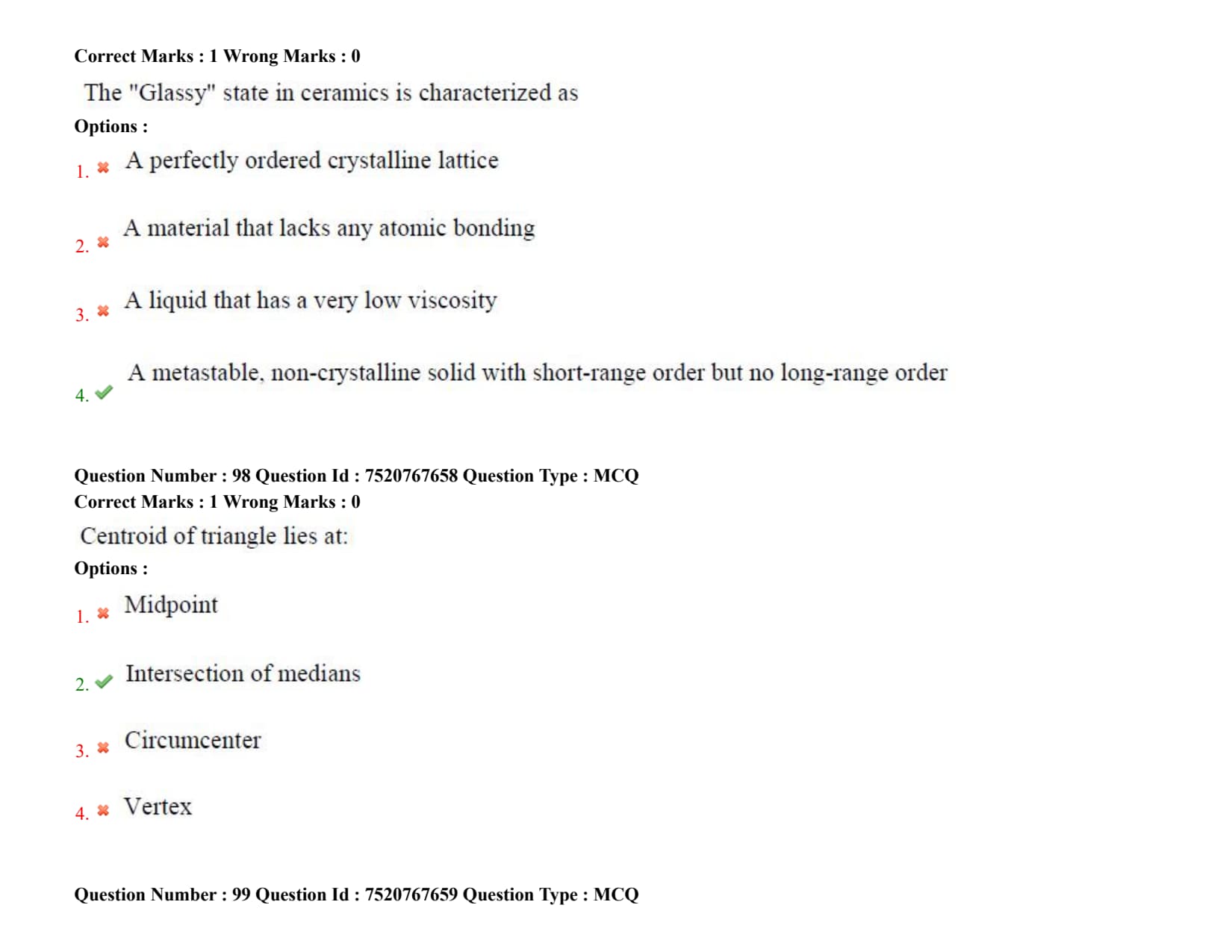
Question 97:
The "Glassy" state in ceramics is characterized as
- (A) A perfectly ordered crystalline lattice
- (B) A material that lacks any atomic bonding
- (C) A liquid that has a very low viscosity
- (D) A metastable, non-crystalline solid with short-range order but no long-range order
Question 98:
Centroid of triangle lies at:
- (A) Midpoint
- (B) Intersection of medians
- (C) Circumcenter
- (D) Vertex
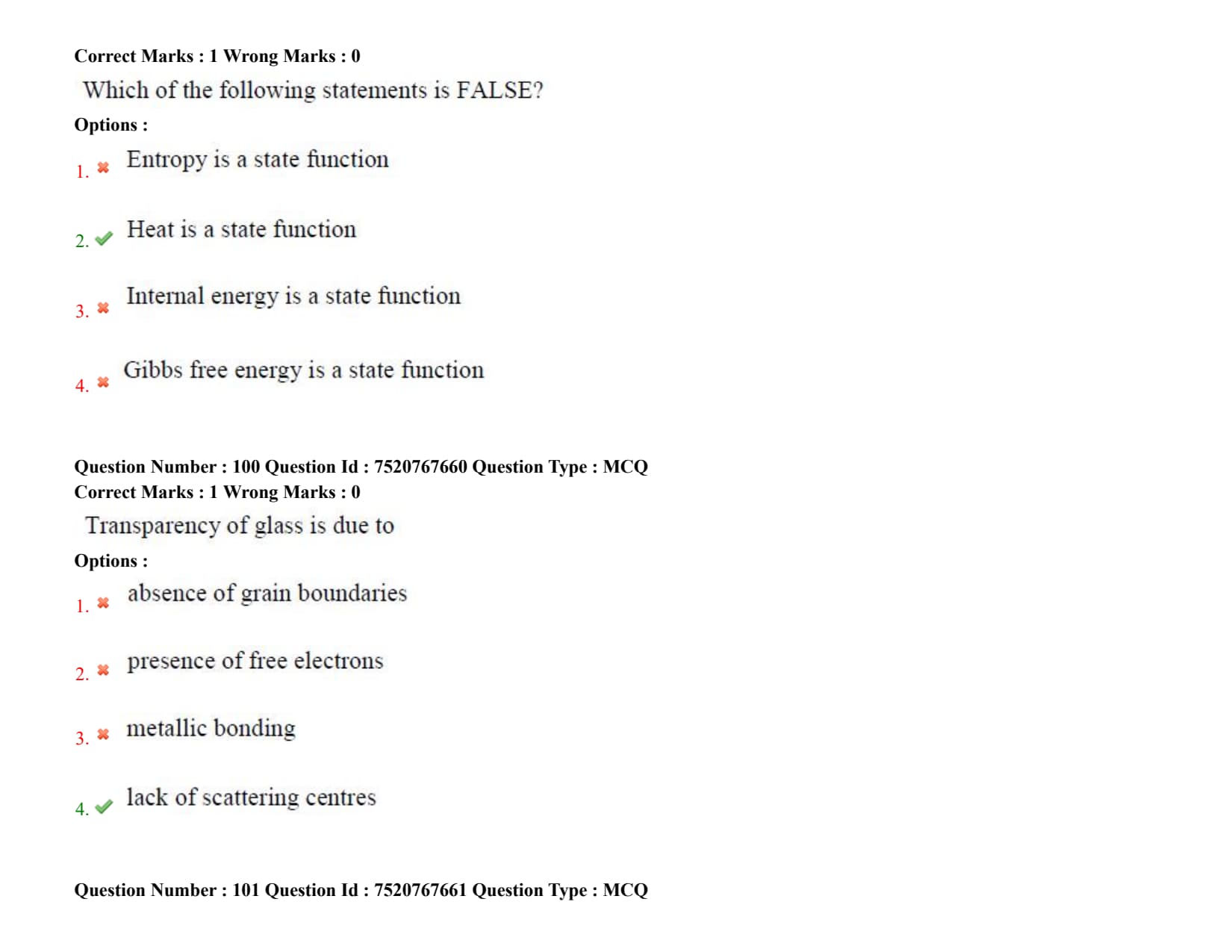
Question 99:
Which of the following statements is FALSE?
- (A) Entropy is a state function
- (B) Heat is a state function
- (C) Internal energy is a state function
- (D) Gibbs free energy is a state function
Question 100:
Transparency of glass is due to
- (A) absence of grain boundaries
- (B) presence of free electrons
- (C) metallic bonding
- (D) lack of scattering centres
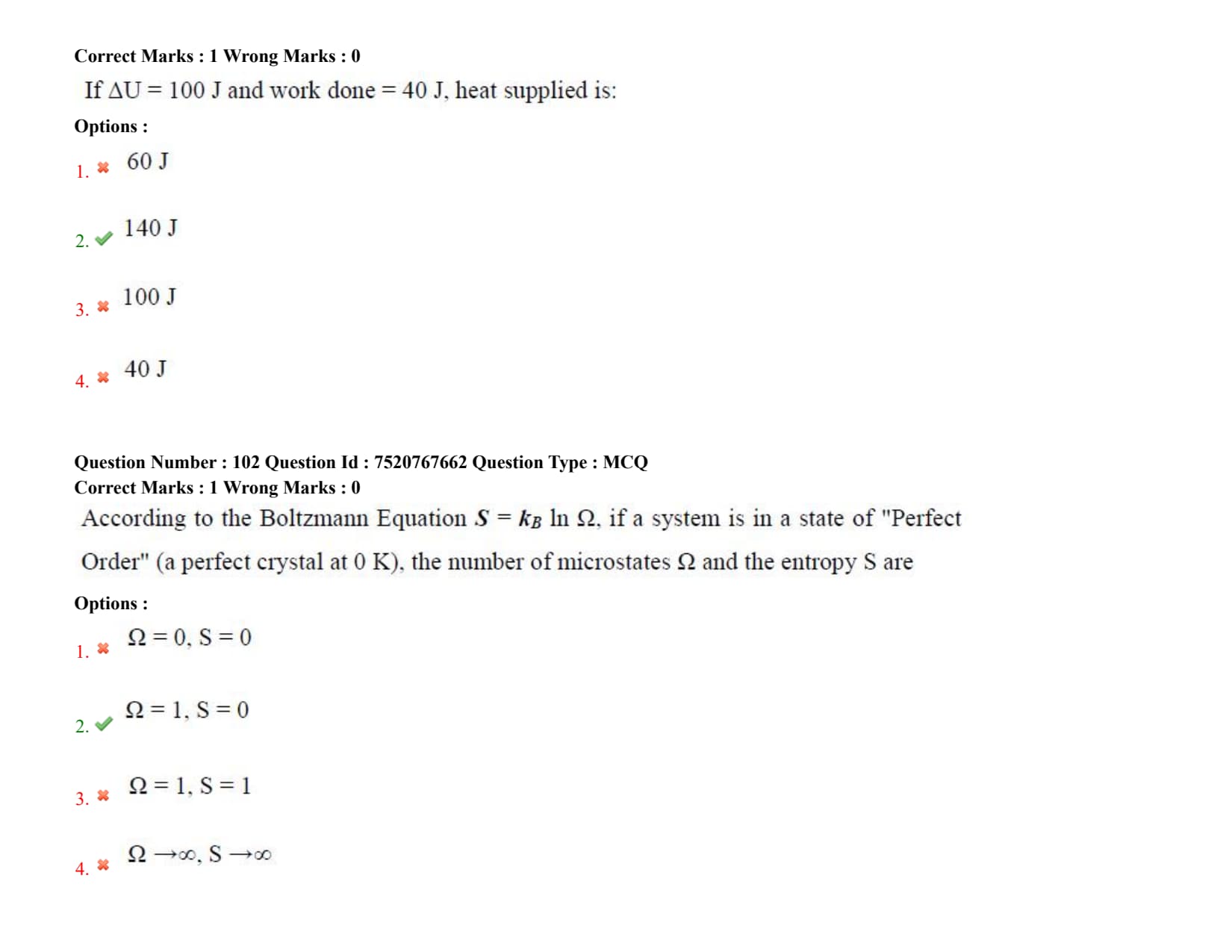
Question 101:
If \(\Delta U = 100 J\) and work done = \(40 J\), heat supplied is:
- (A) \(60 J\)
- (B) \(140 J\)
- (C) \(100 J\)
- (D) \(40 J\)
Question 102:
According to the Boltzmann Equation \(S = k_B \ln \Omega\), if a system is in a state of "Perfect Order" (a perfect crystal at \(0 K\)), the number of microstates \(\Omega\) and the entropy \(S\) are
- (A) \(\Omega = 0, S = 0\)
- (B) \(\Omega = 1, S = 0\)
- (C) \(\Omega = 1, S = 1\)
- (D) \(\Omega \to \infty, S \to \infty\)
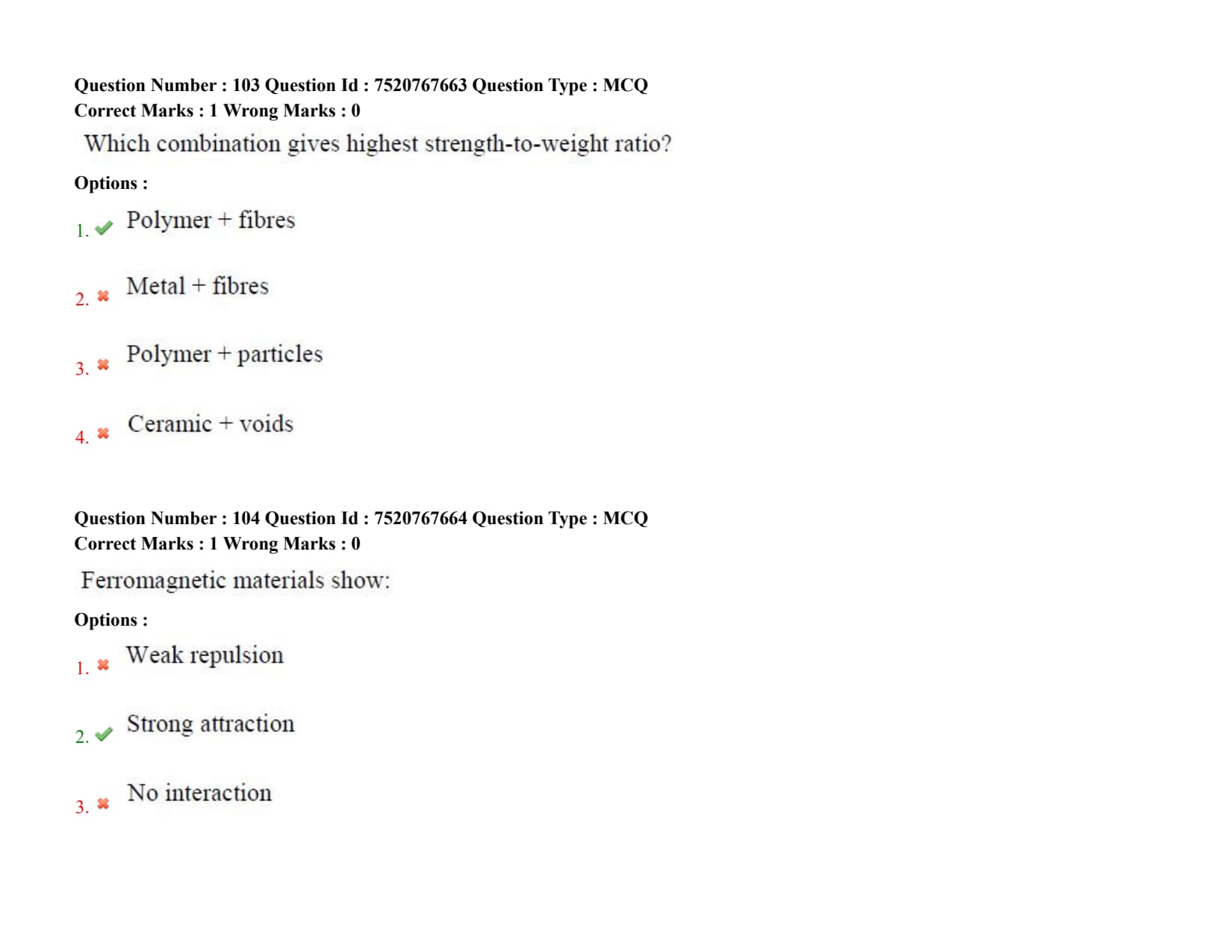
Question 103:
Which combination gives highest strength-to-weight ratio?
- (A) Polymer + fibres
- (B) Metal + fibres
- (C) Polymer + particles
- (D) Ceramic + voids
Question 104:
Ferromagnetic materials show:
- (A) Weak repulsion
- (B) Strong attraction
- (C) No interaction
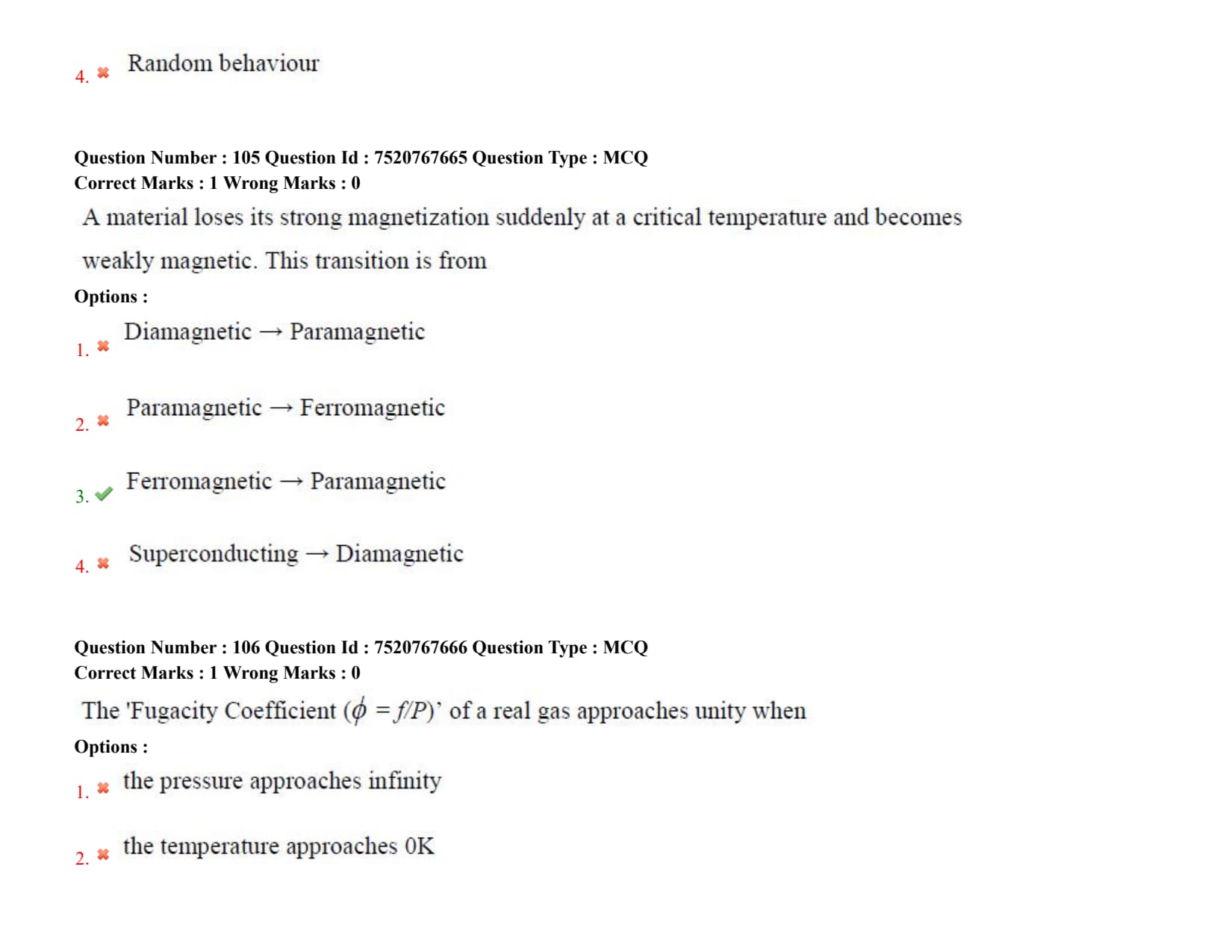
- (D) Random behaviour
Question 105:
A material loses its strong magnetization suddenly at a critical temperature and becomes weakly magnetic. This transition is from
- (A) Diamagnetic \(\to\) Paramagnetic
- (B) Paramagnetic \(\to\) Ferromagnetic
- (C) Ferromagnetic \(\to\) Paramagnetic
- (D) Superconducting \(\to\) Diamagnetic
Question 106:
The 'Fugacity Coefficient (\(\phi = f/P\))' of a real gas approaches unity when
- (A) the pressure approaches infinity
- (B) the temperature approaches \(0 K\)
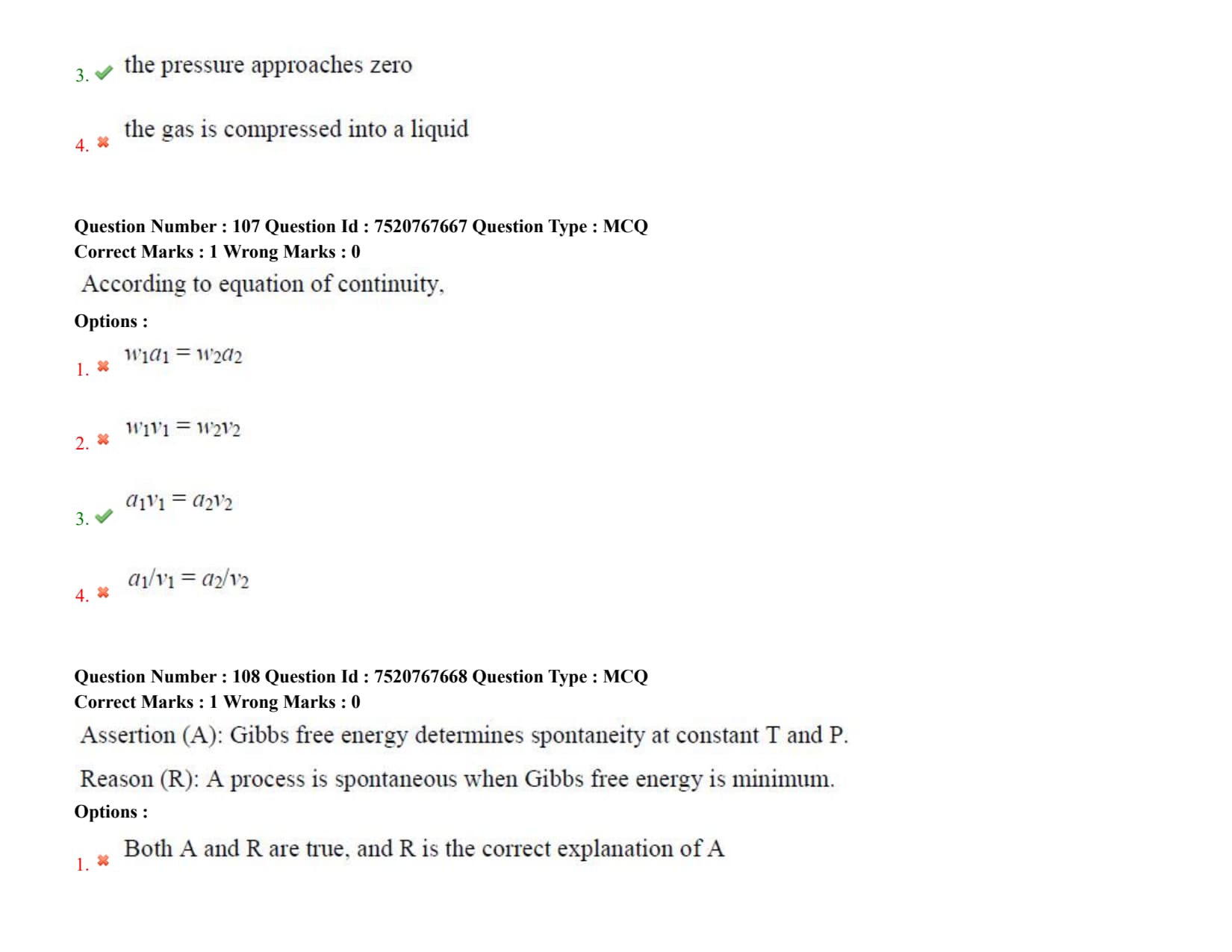
- (C) the pressure approaches zero
- (D) the gas is compressed into a liquid
Question 107:
According to equation of continuity,
- (A) \(w_1 a_1 = w_2 a_2\)
- (B) \(w_1 v_1 = w_2 v_2\)
- (C) \(a_1 v_1 = a_2 v_2\)
- (D) \(a_1/v_1 = a_2/v_2\)
Question 108:
Assertion (A): Gibbs free energy determines spontaneity at constant T and P.
Reason (R): A process is spontaneous when Gibbs free energy is minimum.
- (A) Both A and R are true, and R is the correct explanation of A
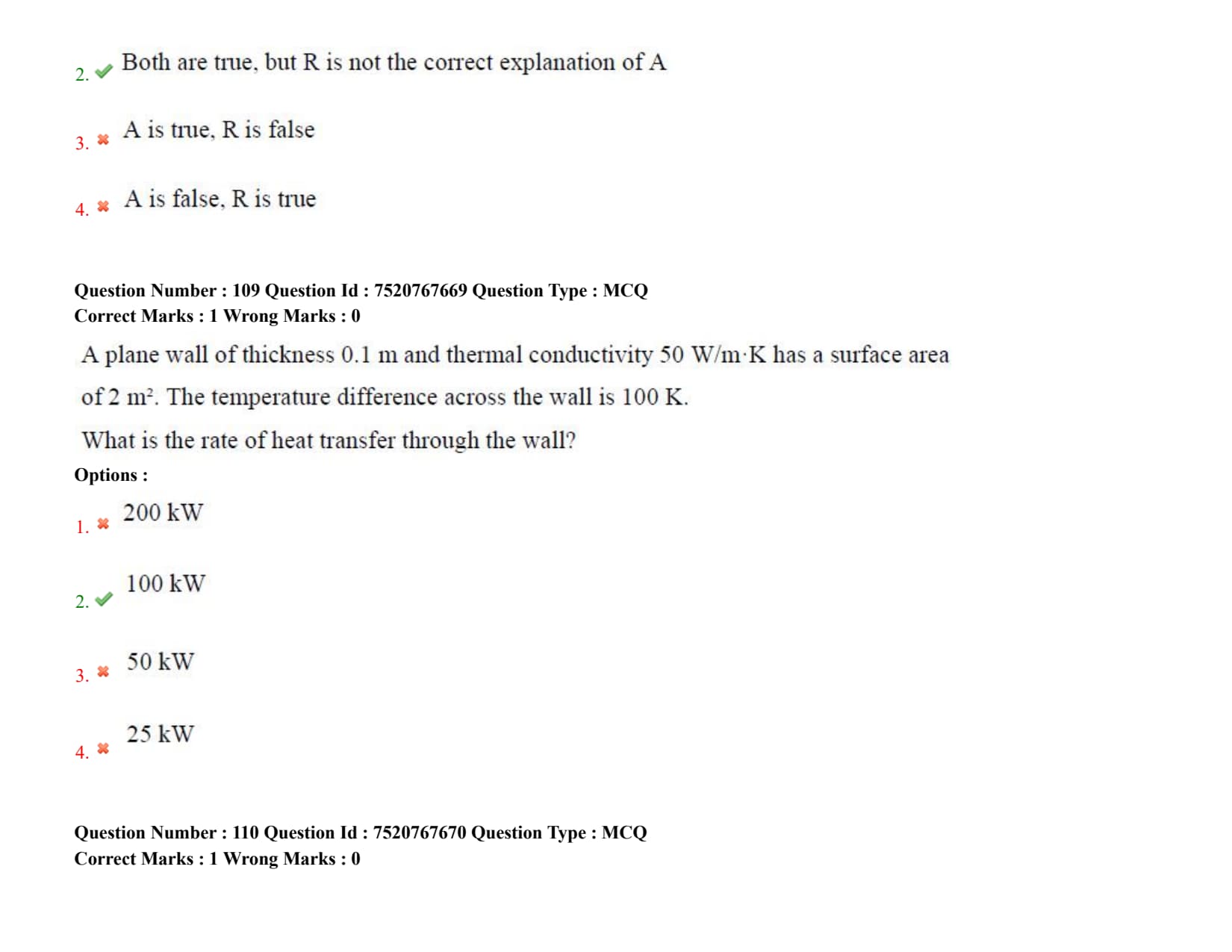
- (B) Both are true, but R is not the correct explanation of A
- (C) A is true, R is false
- (D) A is false, R is true
Question 109:
A plane wall of thickness \(0.1 m\) and thermal conductivity 50 W/m·K has a surface area of \(2 m^2\). The temperature difference across the wall is \(100 K\). What is the rate of heat transfer through the wall?
- (A) \(200 kW\)
- (B) \(100 kW\)
- (C) \(50 kW\)
- (D) \(25 kW\)
Question 110:
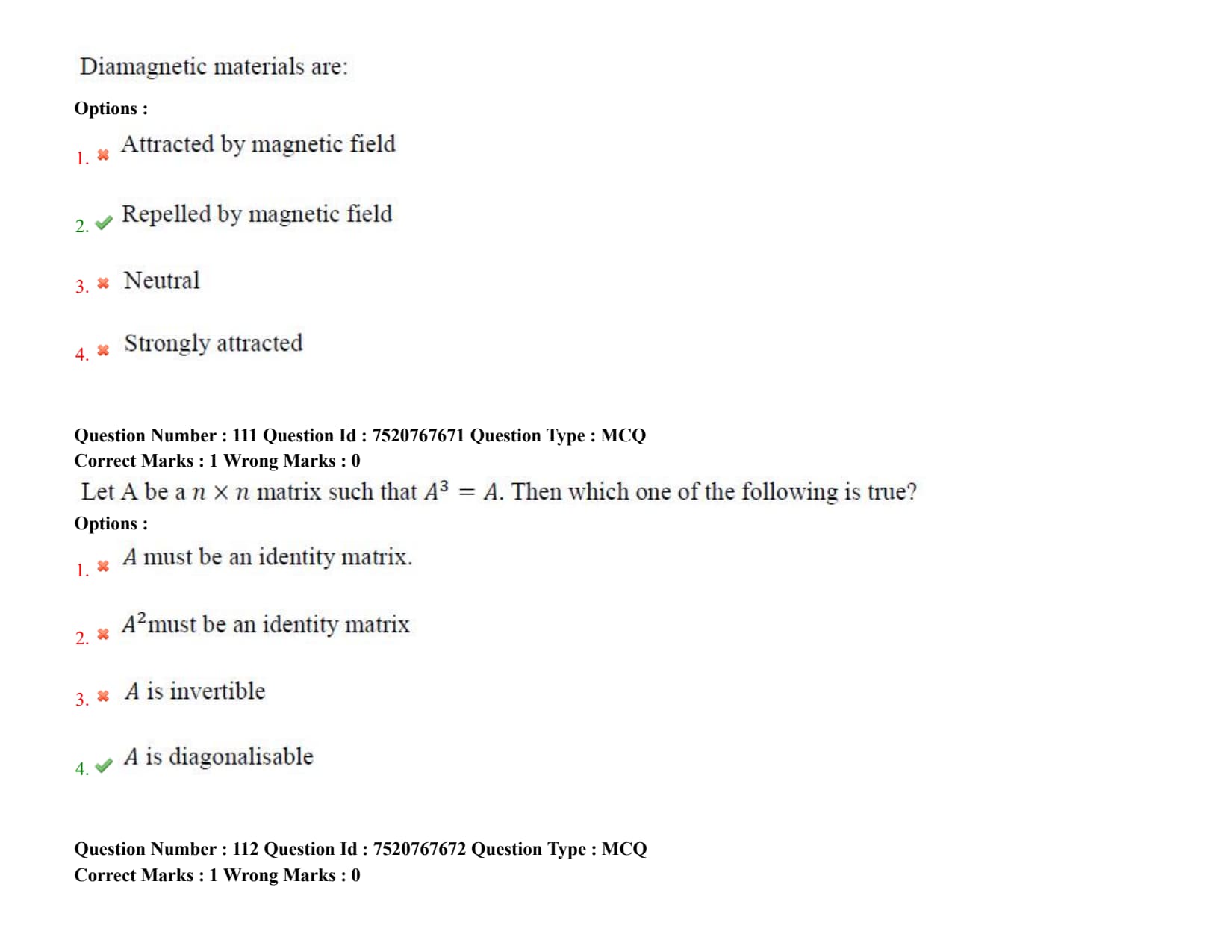
Diamagnetic materials are:
- (A) Attracted by magnetic field
- (B) Repelled by magnetic field
- (C) Neutral
- (D) Strongly attracted
Question 111:
Let \(A\) be an \(n \times n\) matrix such that \(A^3 = A\). Then which one of the following is true?
- (A) \(A\) must be an identity matrix.
- (B) \(A^2\) must be an identity matrix.
- (C) \(A\) is invertible.
- (D) \(A\) is diagonalisable.
Question 112:
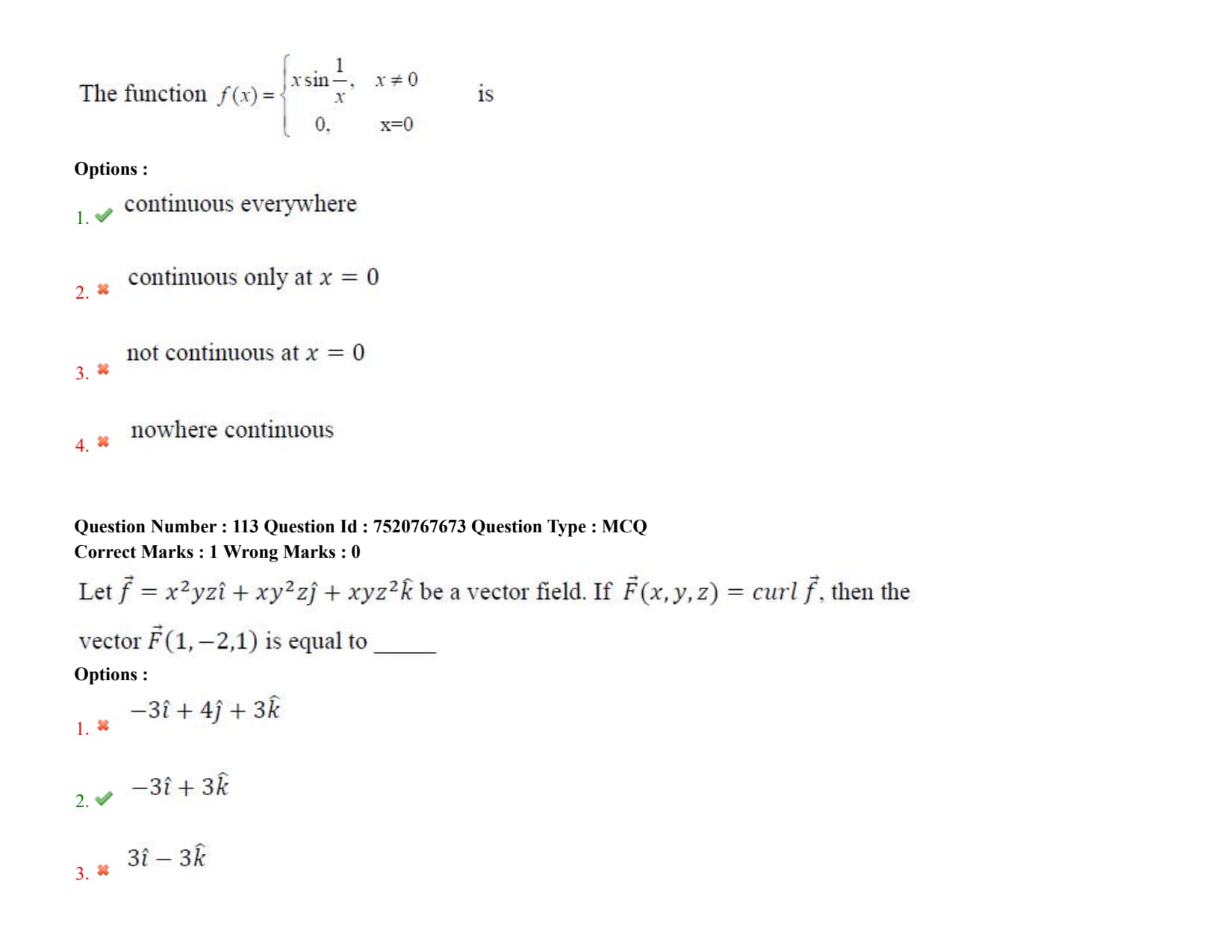
The function \(f(x) = \begin{cases} x \sin\frac{1}{x}, & x \neq 0
0, & x = 0 \end{cases}\) is
- (A) continuous everywhere
- (B) continuous only at \(x = 0\)
- (C) not continuous at \(x = 0\)
- (D) nowhere continuous
Question 113:
Let \(\vec{f} = x^2 y z \hat{i} + x y^2 z \hat{j} + x y z^2 \hat{k}\) be a vector field. If \(\vec{F}(x,y,z) = curl \vec{f}\), then the vector \(\vec{F}(1,-2,1)\) is equal to _______
- (A) \(-3\hat{i} + 4\hat{j} + 3\hat{k}\)
- (B) \(-3\hat{i} + 3\hat{k}\)
- (C) \(3\hat{i} - 3\hat{k}\)
- (D) \(-3\hat{i} - 4\hat{j} + 3\hat{k}\)
Question 114:
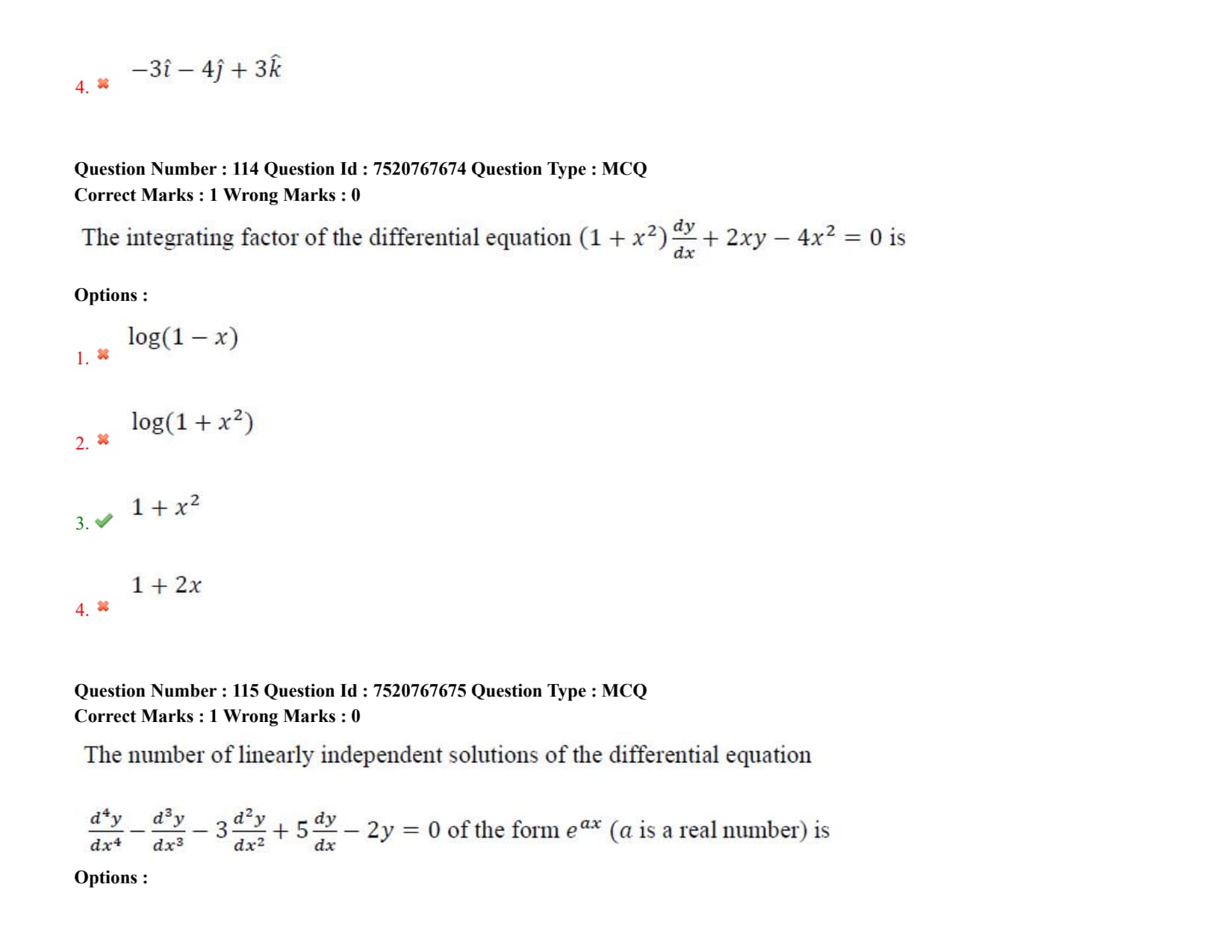
The integrating factor of the differential equation \((1 + x^2)\frac{dy}{dx} + 2xy - 4x^2 = 0\) is
- (A) \(\log(1 - x)\)
- (B) \(\log(1 + x^2)\)
- (C) \(1 + x^2\)
- (D) \(1 + 2x\)
Question 115:
The number of linearly independent solutions of the differential equation \(\frac{d^4y}{dx^4} - \frac{d^3y}{dx^3} - 3\frac{d^2y}{dx^2} + 5\frac{dy}{dx} - 2y = 0\) of the form \(e^{ax}\) (\(a\) is a real number) is
Question 116:
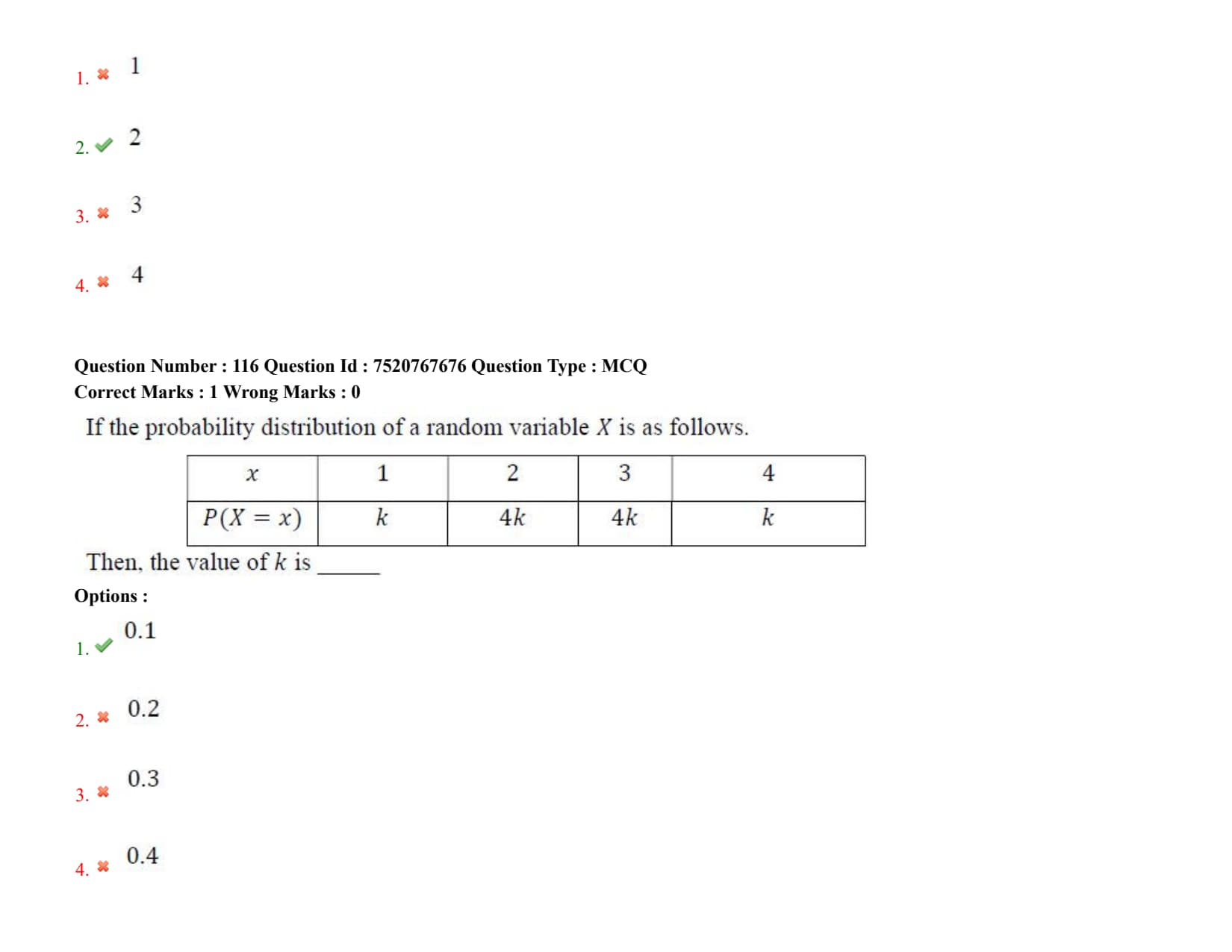
If the probability distribution of a random variable X is as follows.
![]()
Then, the value of k is _______
- (A) 0.1
- (B) 0.2
- (C) 0.3
- (D) 0.4
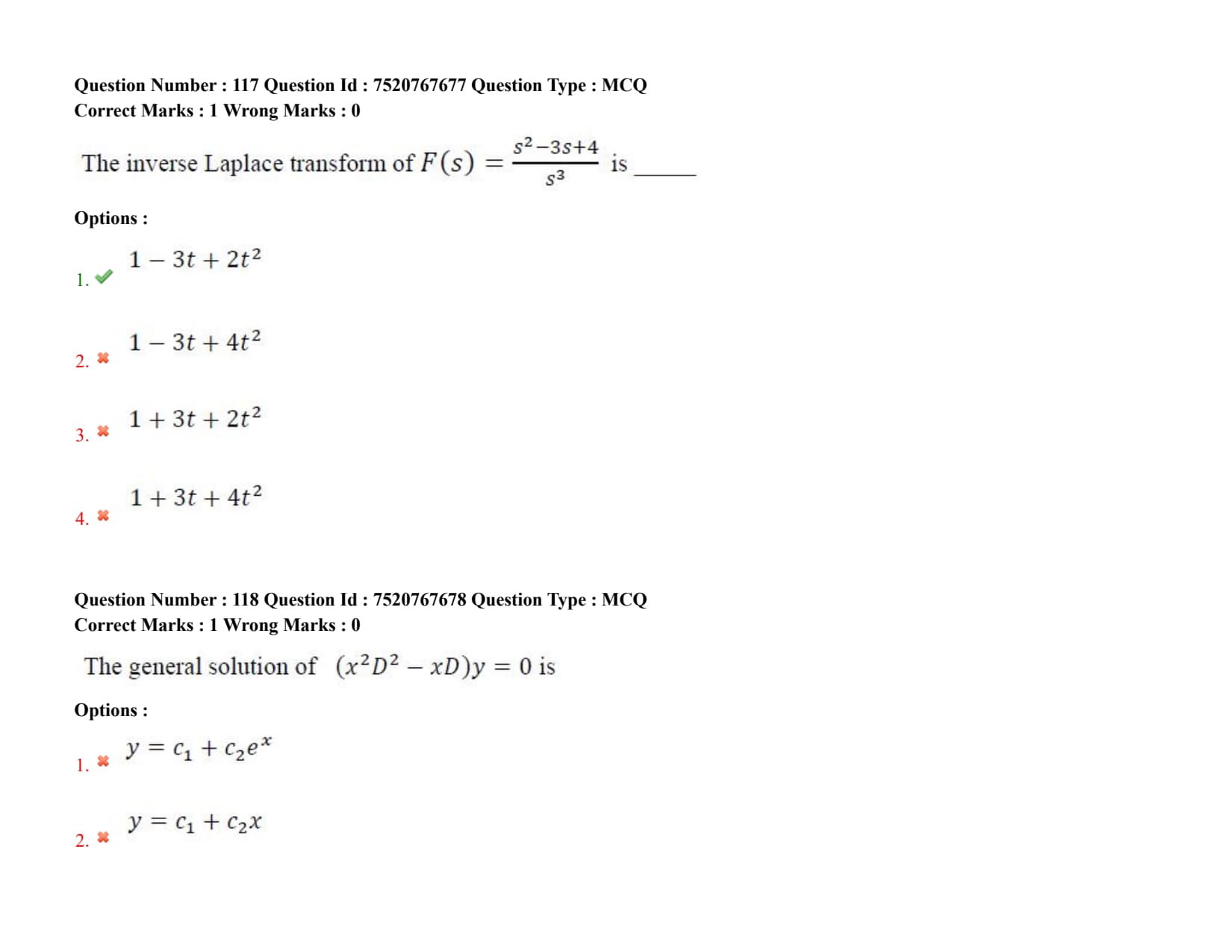
Question 117:
The inverse Laplace transform of \(F(s) = \frac{s^2 - 3s + 4}{s^3}\) is _______
- (A) \(1 - 3t + 2t^2\)
- (B) \(1 - 3t + 4t^2\)
- (C) \(1 + 3t + 2t^2\)
- (D) \(1 + 3t + 4t^2\)
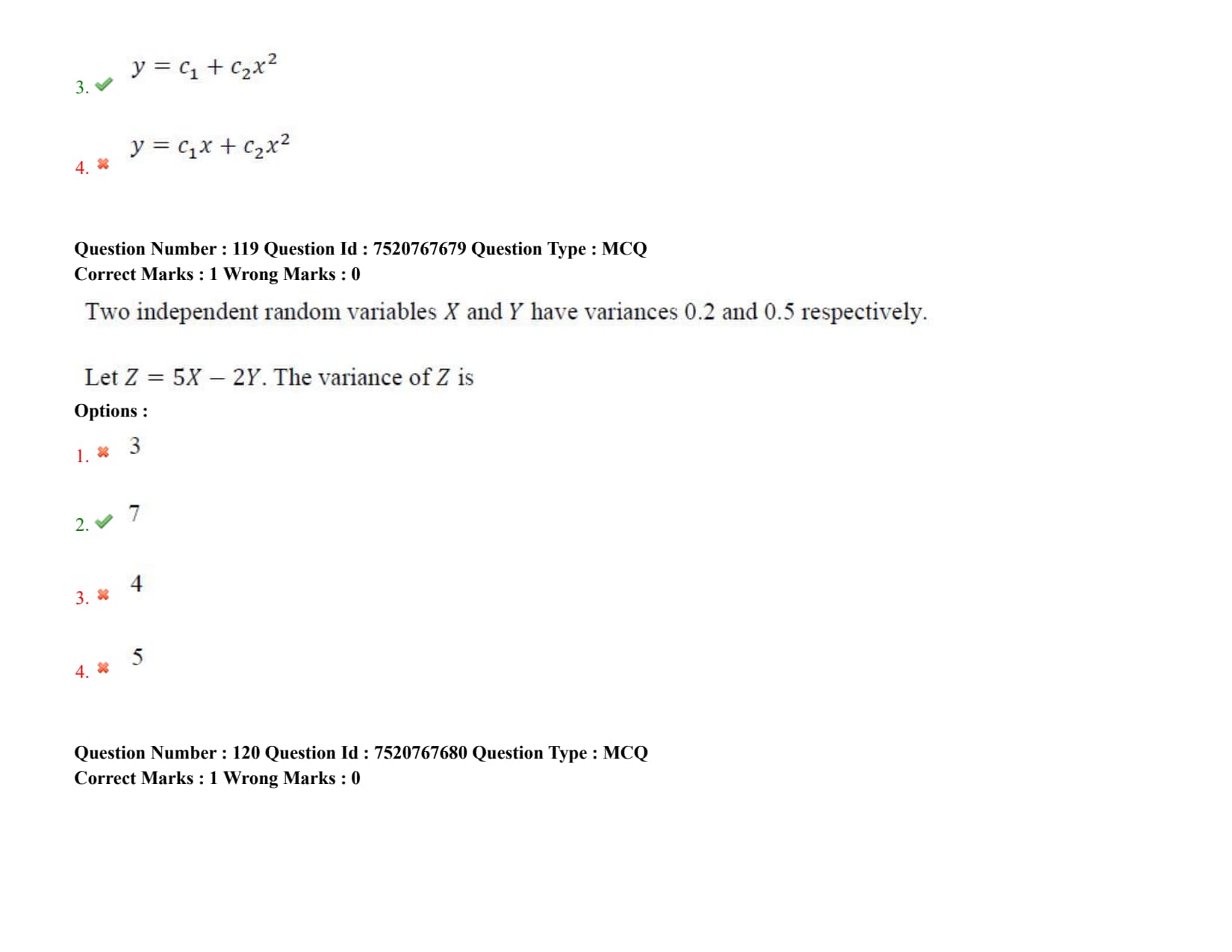
Question 118:
The general solution of \((x^2 D^2 - xD)y = 0\) is
- (A) \(y = c_1 + c_2 e^x\)
- (B) \(y = c_1 + c_2 x\)
- (C) \(y = c_1 + c_2 x^2\)
- (D) \(y = c_1 x + c_2 x^2\)
Question 119:
Two independent random variables X and Y have variances 0.2 and 0.5 respectively. Let Z = 5X - 2Y. The variance of Z is
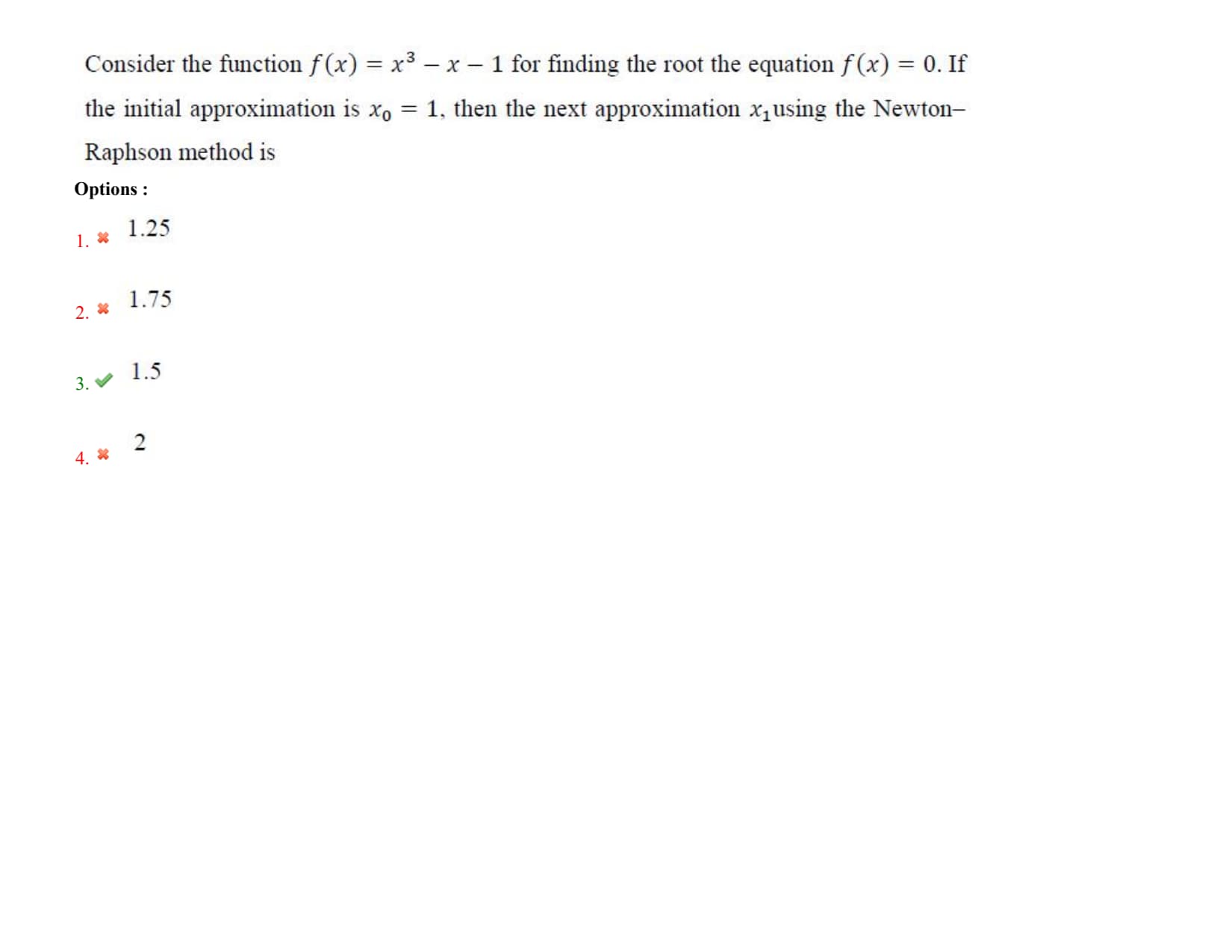
Question 120:
Consider the function \(f(x) = x^3 - x - 1\) for finding the root the equation \(f(x) = 0\). If the initial approximation is \(x_0 = 1\), then the next approximation \(x_1\) using the Newton-Raphson method is
- (A) 1.25
- (B) 1.75
- (C) 1.5
- (D) 2
AP PGECET 2026 Nano Technology Topic-wise weightage
| Major Subject |
Approx. Number of Questions |
Expected % (Approx.) |
| Engineering Mathematics |
28–32 |
23–27% |
| Engineering Mechanics & Strength of Materials |
16–20 |
13–17% |
| Fluid Mechanics & Heat Transfer |
22–26 |
18–22% |
| Elements of Material Science |
10–14 |
8–12% |
| Metallurgical Thermodynamics |
16–20 |
13–17% |
| Advanced Material Science |
16–20 |
13–17% |
AP PGECET 2026 Preparation Strategy









Comments