




SNAP RC Passage Types and Approach notes, free to download as a 20-page PDF. The topic is worth about 4 to 6 marks in General English and takes roughly a week to learn, so it is one of the first worth finishing.
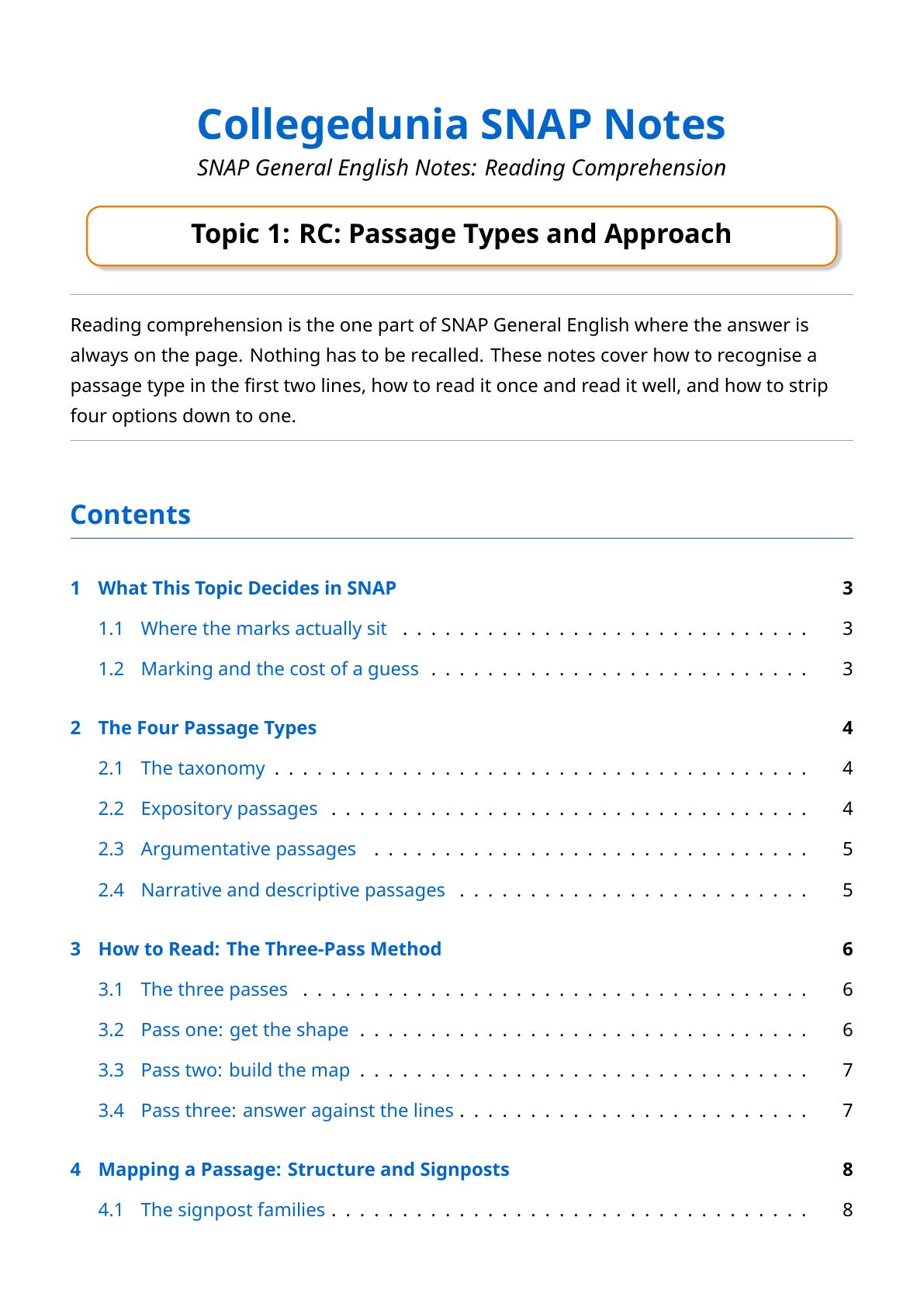
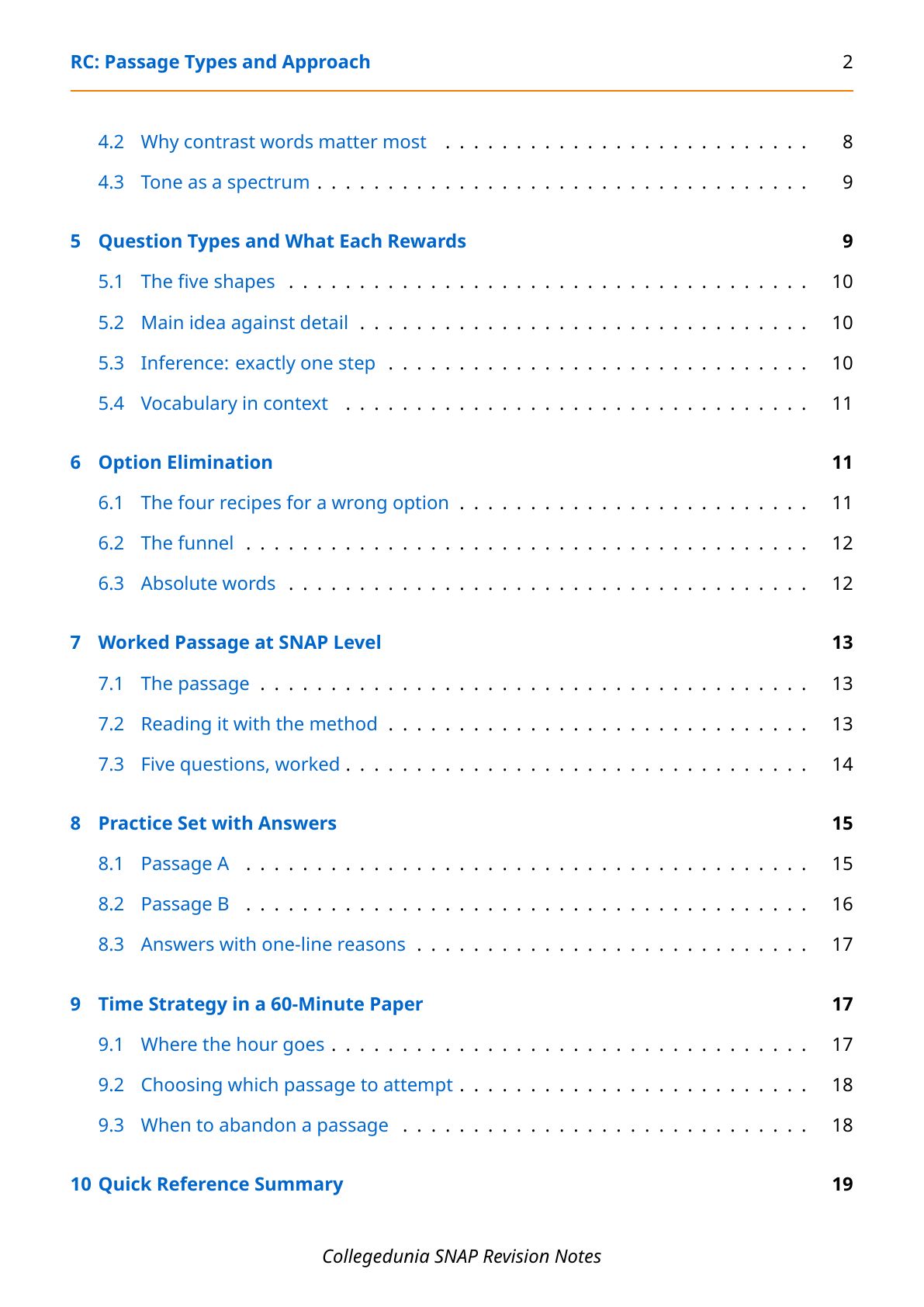
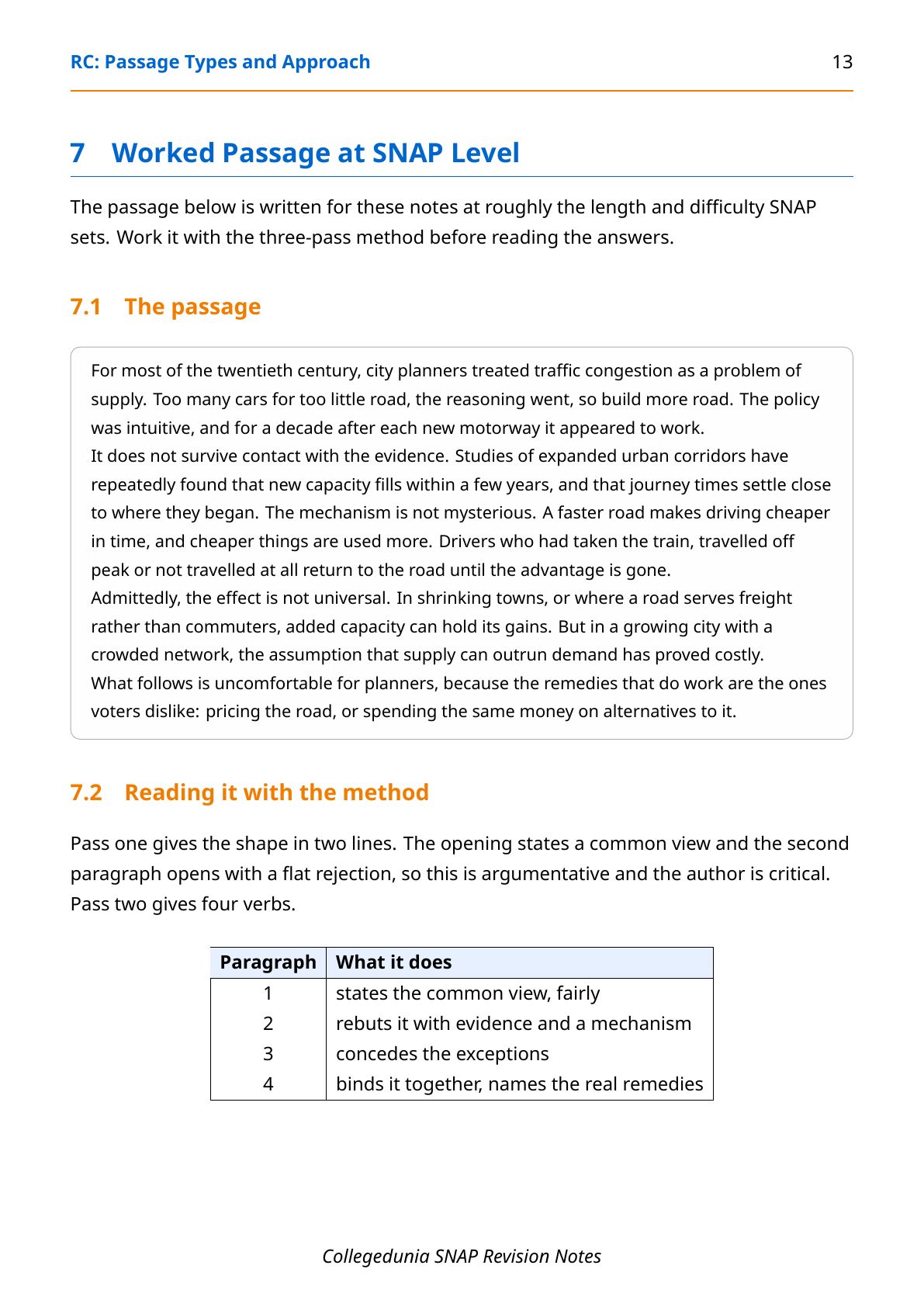
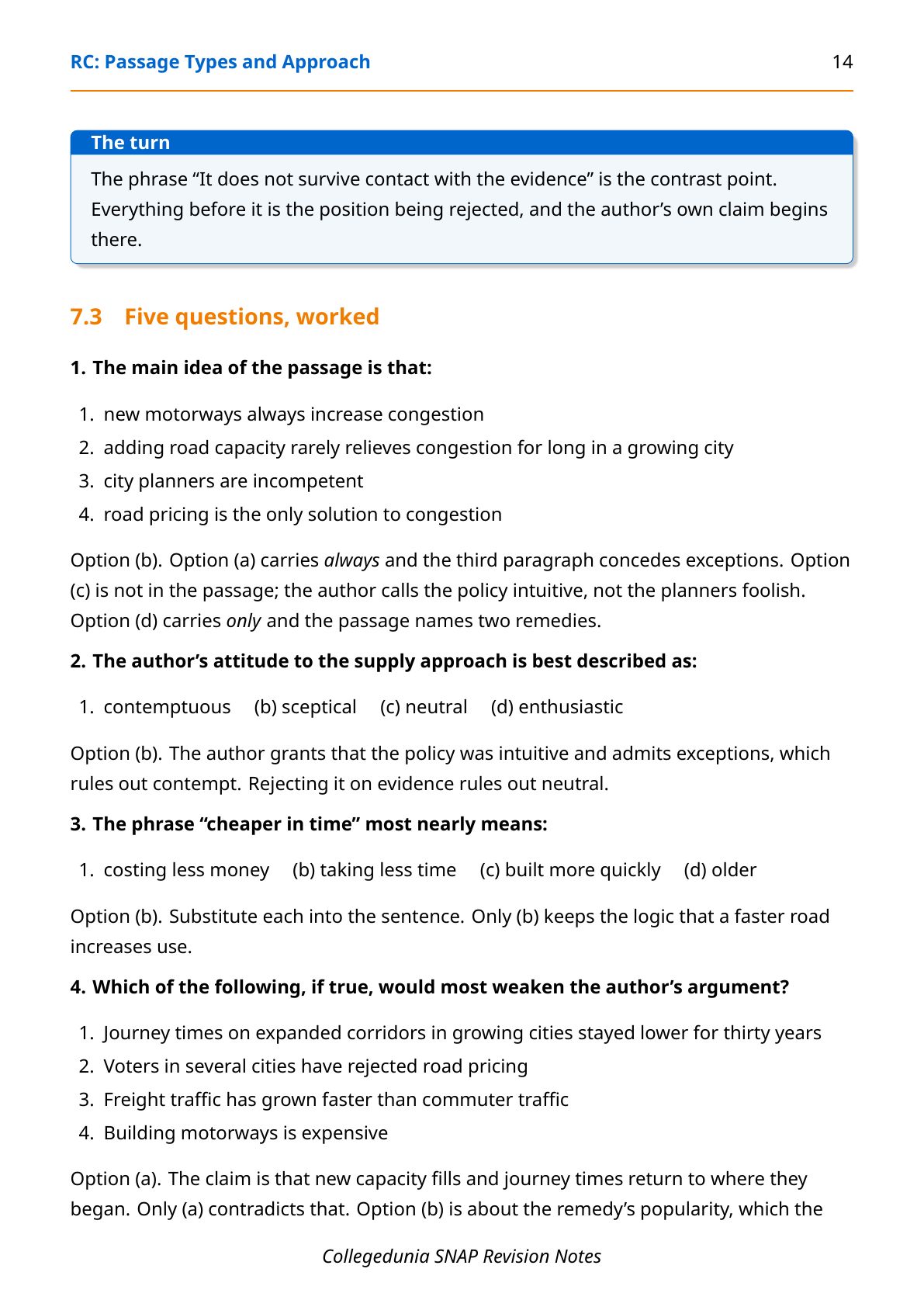
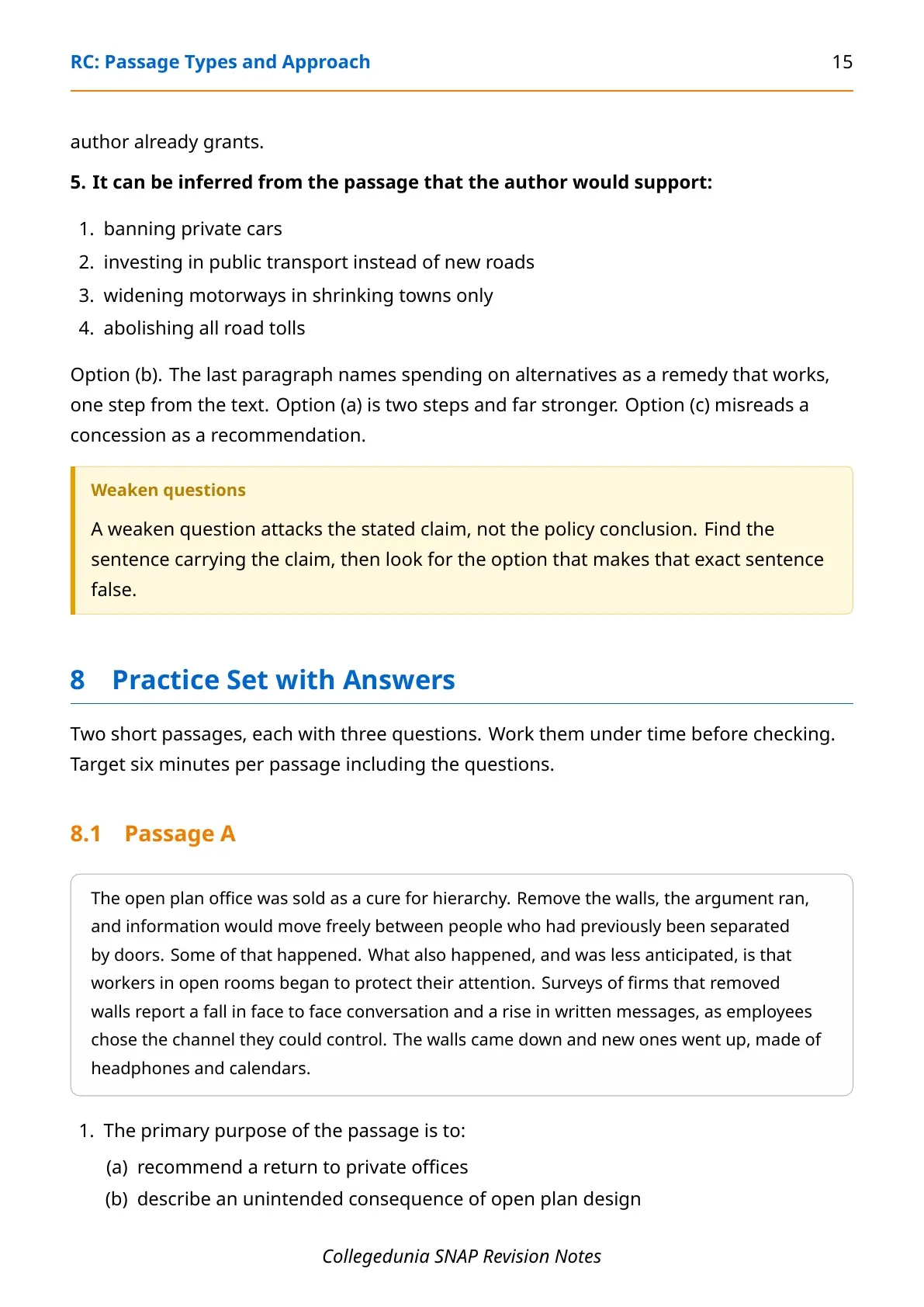
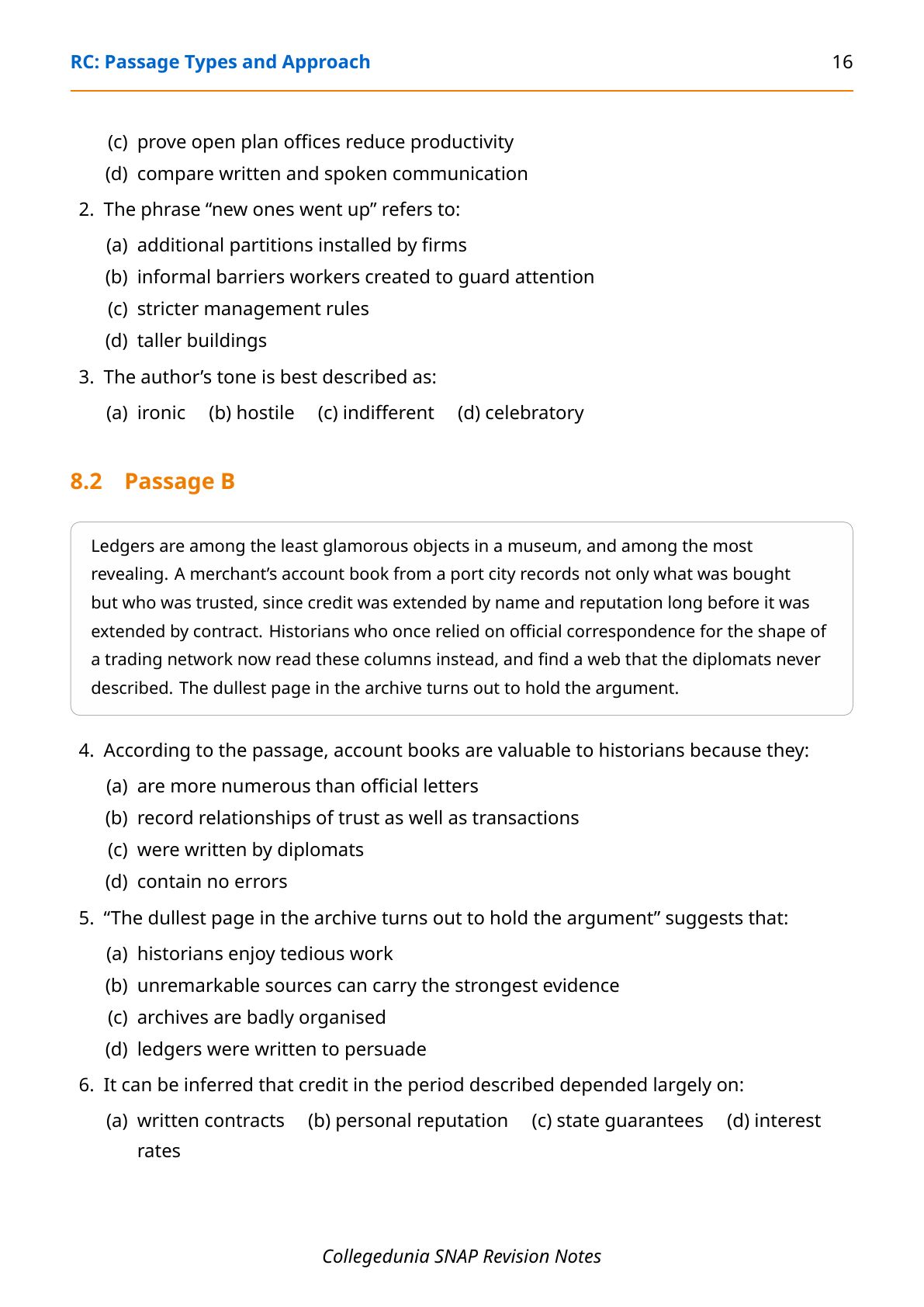
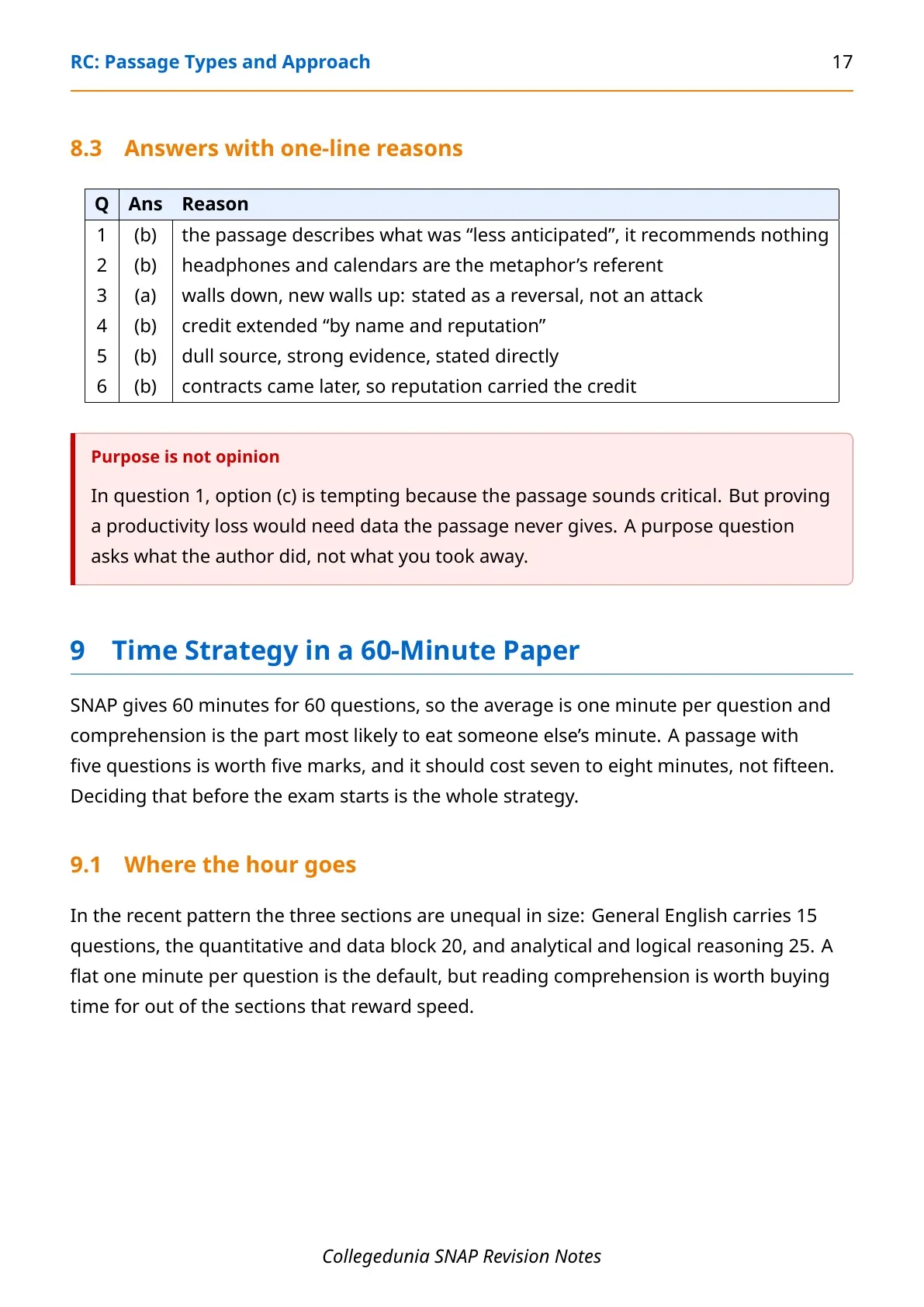
These notes build the topic as a method rather than a reading list: name the passage type, map it in one pass, then answer against the lines. Thirteen diagrams carry the structure.
What Reading Comprehension Decides in SNAP
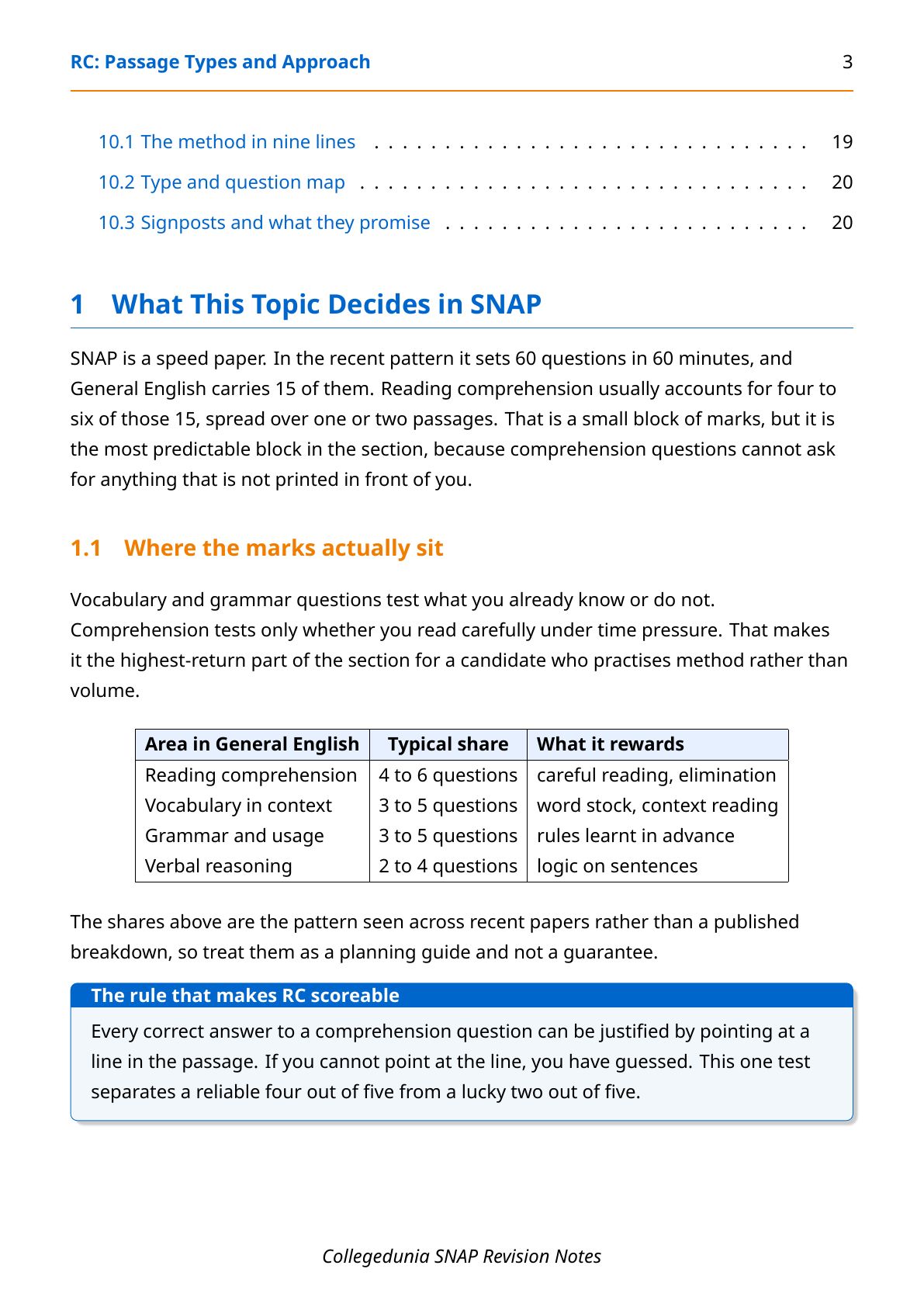
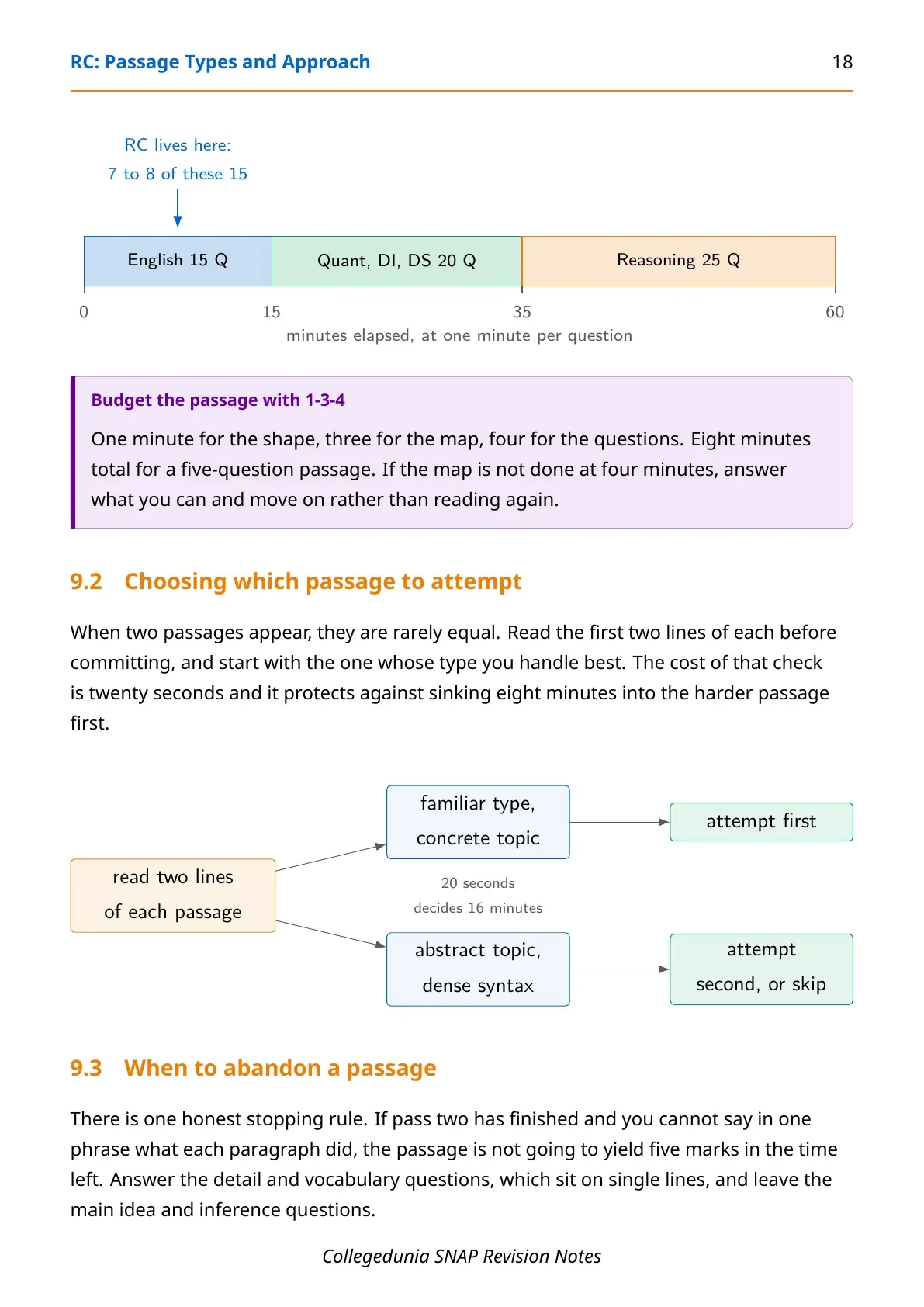
SNAP sets 60 questions in 60 minutes. General English carries 15 of them, and reading comprehension usually accounts for four to six, spread over one or two passages.
It is the most predictable block in the section. A comprehension question cannot ask for anything that is not printed in front of you, so nothing has to be recalled.
- Reading comprehension: 4 to 6 questions
- Vocabulary in context: 3 to 5 questions
- Grammar and usage: 3 to 5 questions
- Verbal reasoning: 2 to 4 questions
Those shares are the pattern across recent papers rather than a published breakdown, so treat them as a planning guide.
The Four Passage Types
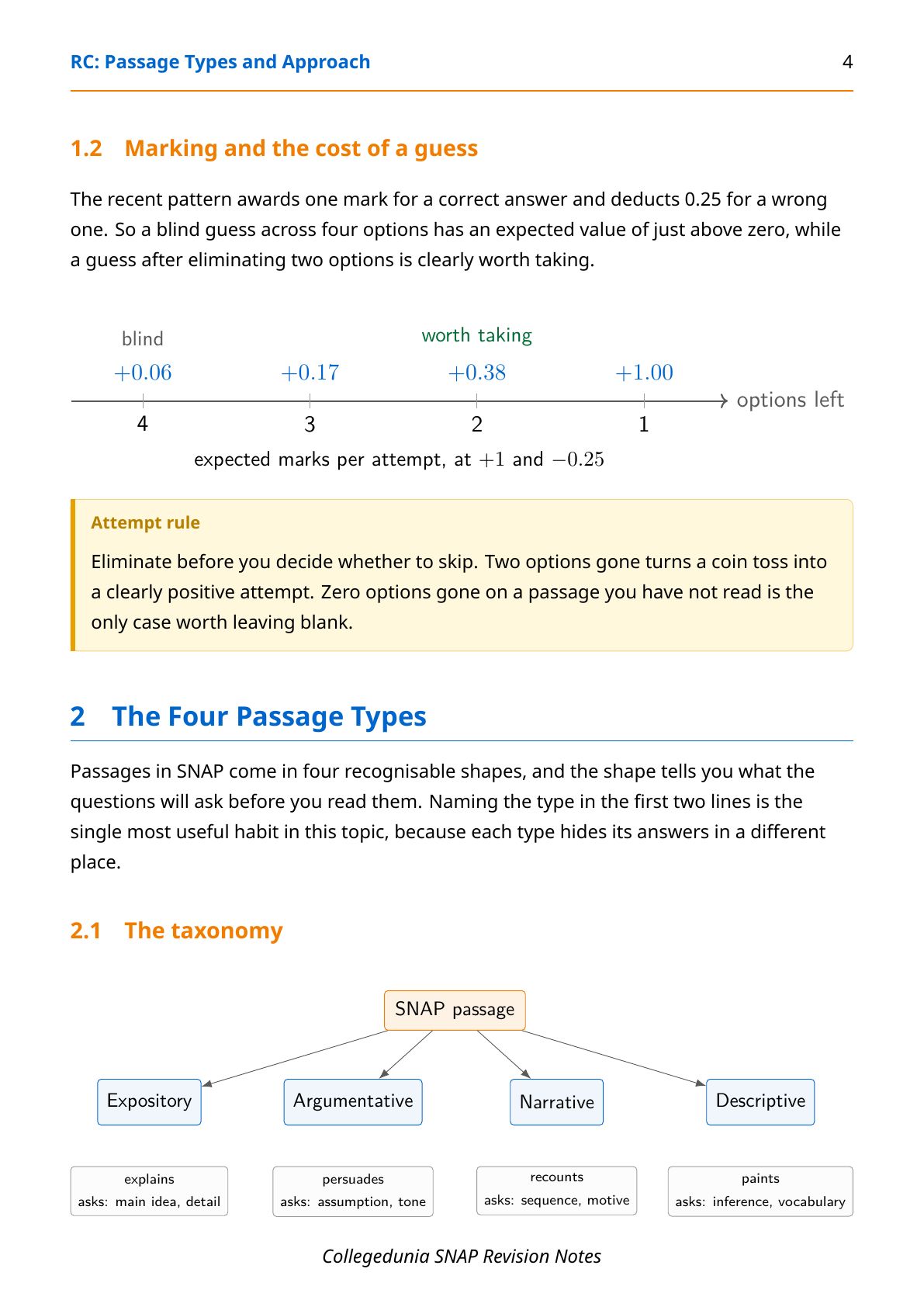
Passages arrive in four recognisable shapes, and the shape predicts the questions. Naming the type from the first two lines is the single most useful habit in this topic.
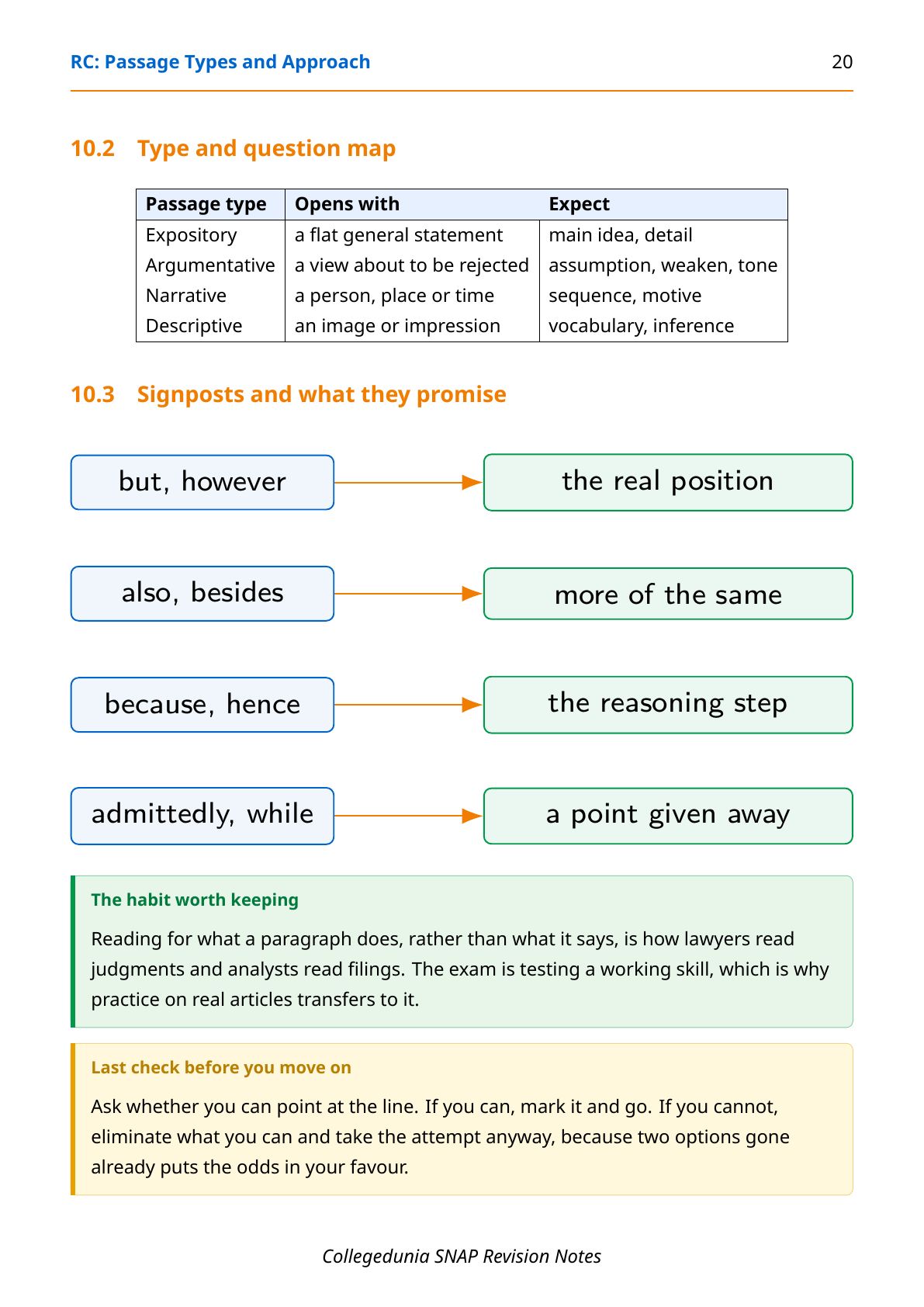
- Expository: explains something, flat voice, asks main idea and detail
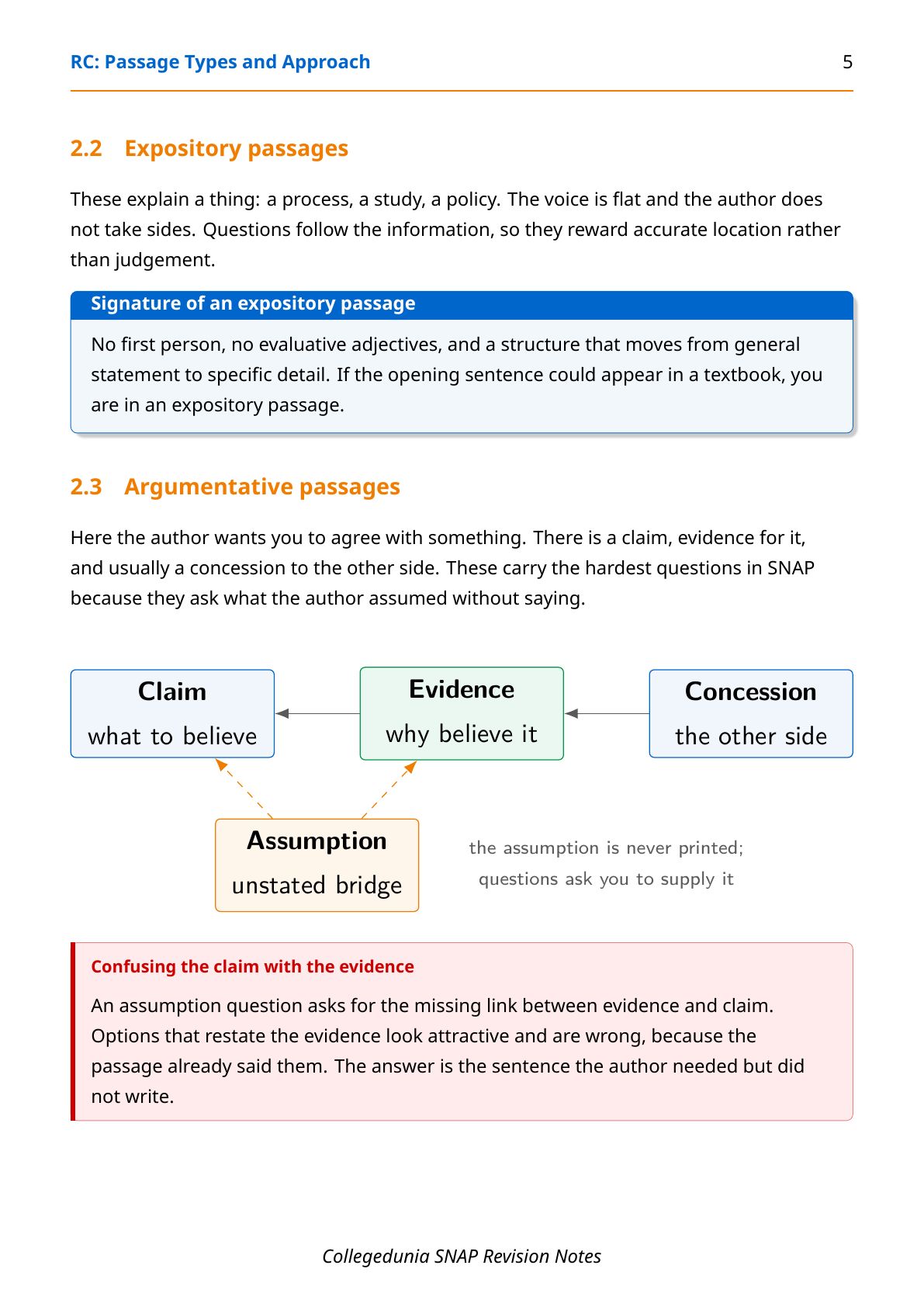
- Argumentative: persuades, asks assumption and tone
- Narrative: recounts, asks sequence and motive
- Descriptive: builds an impression, asks vocabulary and inference
Argumentative passages carry the hardest questions, because they ask what the author assumed without writing it. The assumption is the unstated bridge between the evidence and the claim.
The Three-Pass Method
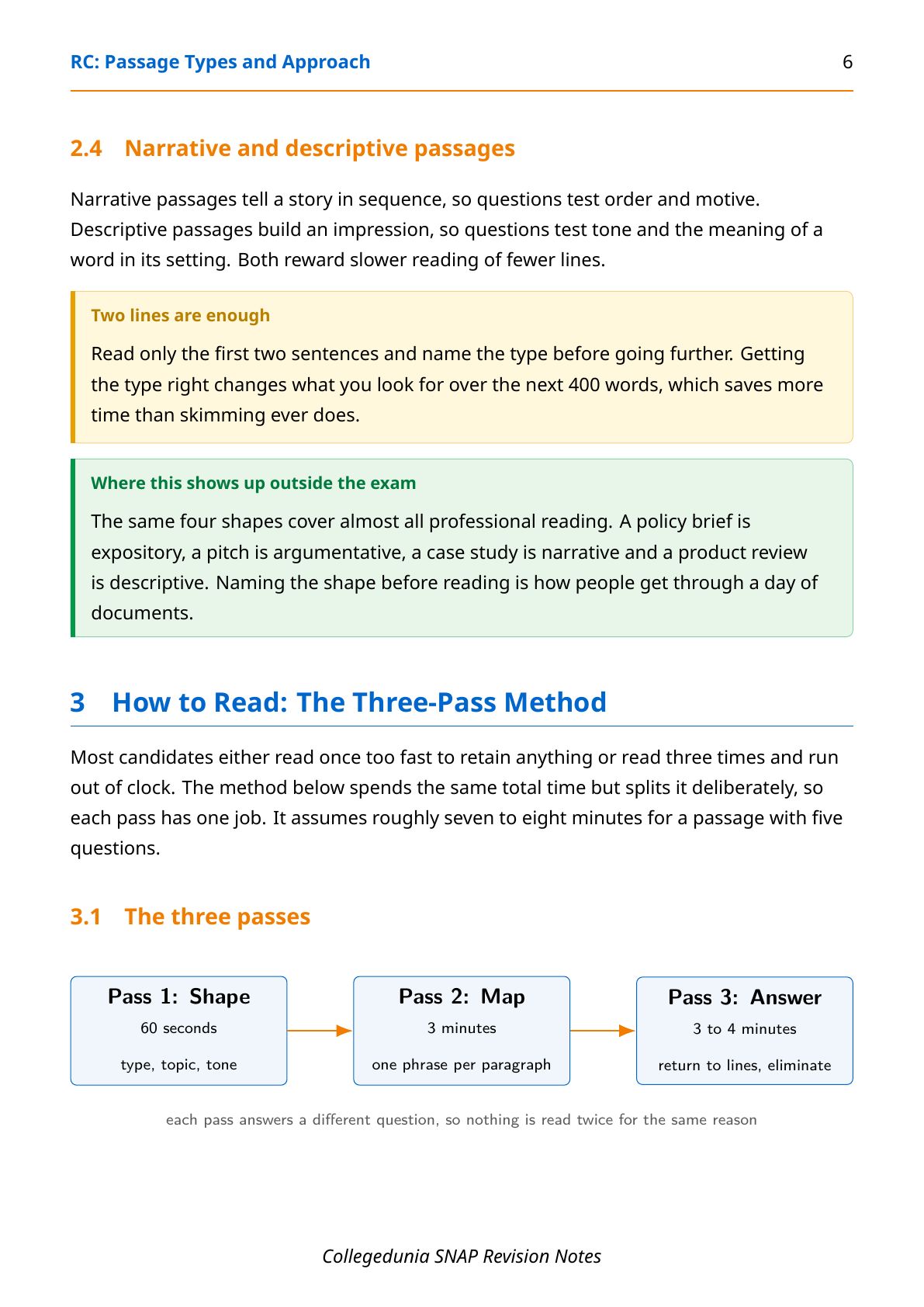
Most candidates either read once too fast to retain anything or read three times and run out of clock. Splitting the same eight minutes into three passes gives each one a single job.
- Pass one, 60 seconds: type, topic in five words, tone. No detail
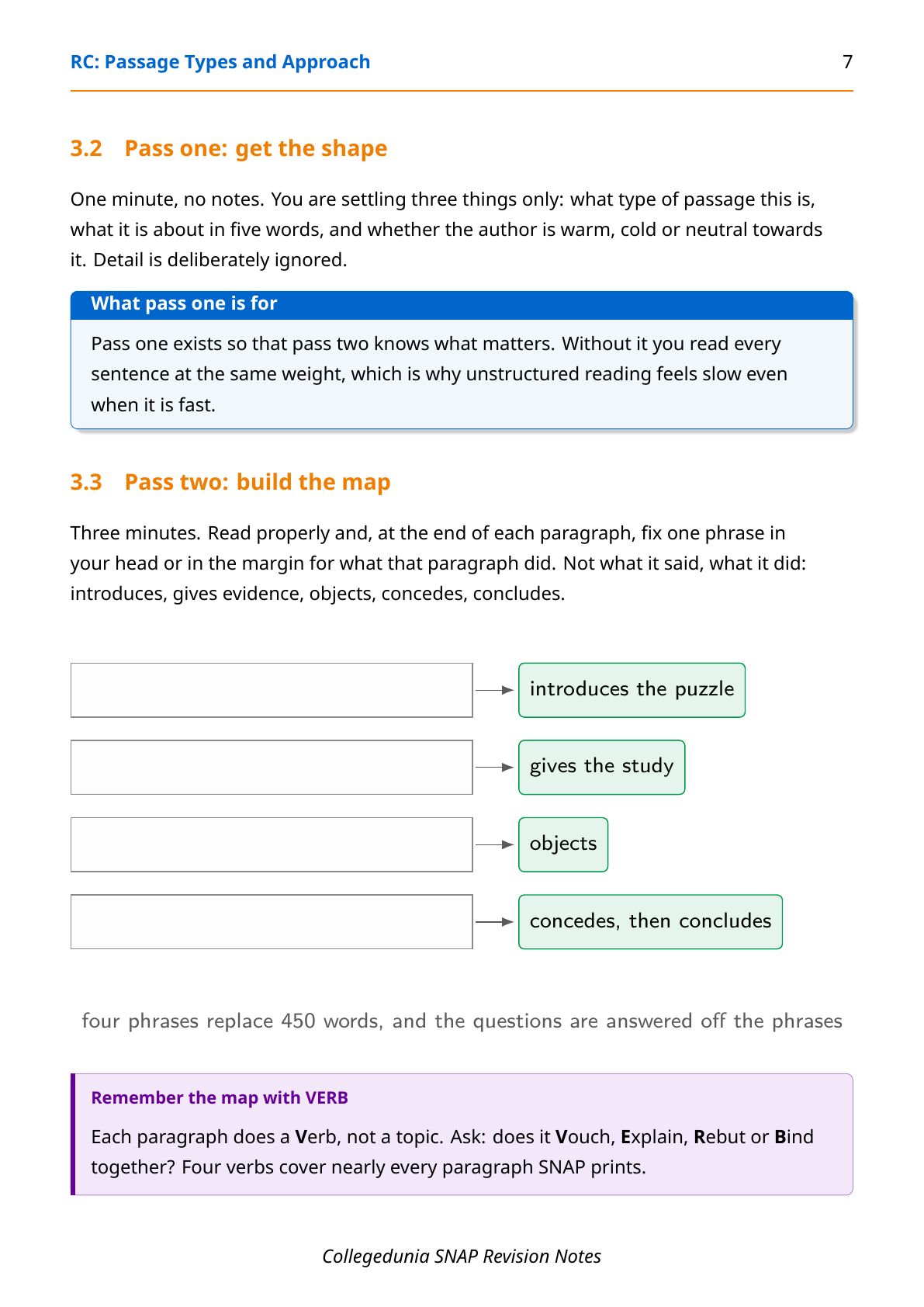
- Pass two, 3 minutes: one phrase per paragraph for what it did
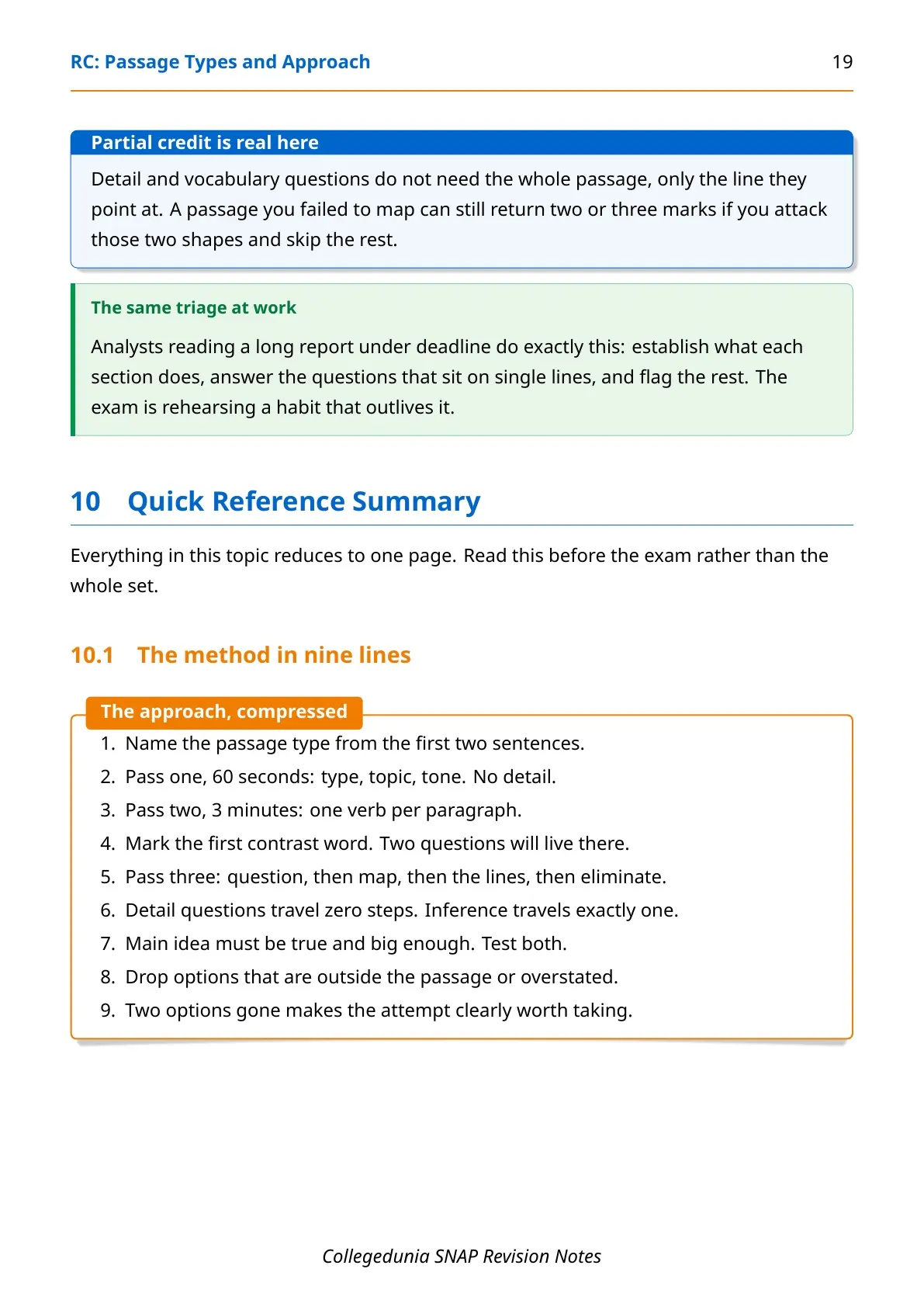
- Pass three, 4 minutes: question, then map, then the lines, then eliminate
Pass two is the one that pays. Record what a paragraph did rather than what it said: introduces, gives evidence, objects, concedes, concludes. Four phrases replace 450 words.
Signposts and the Turn
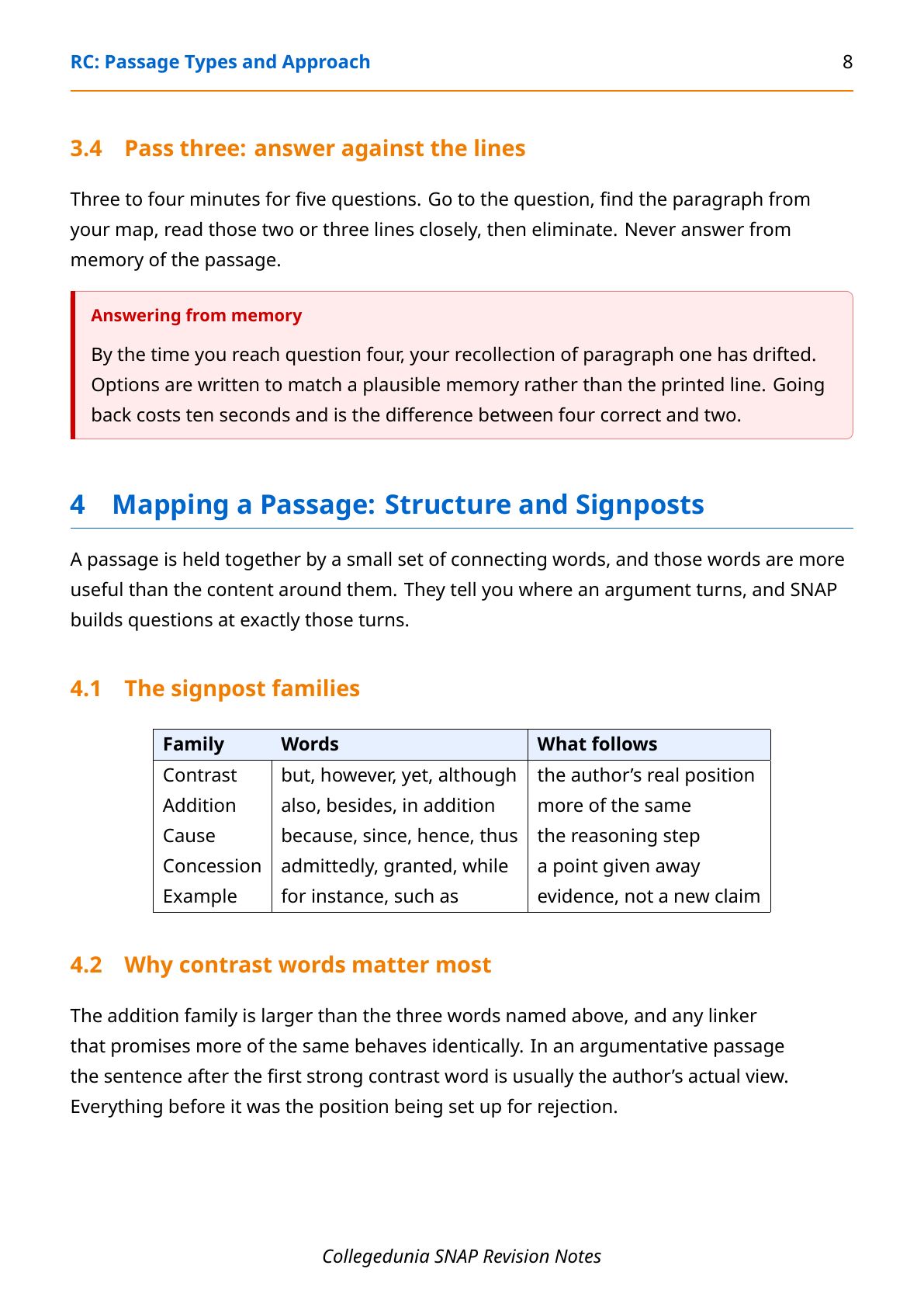
A small set of connecting words holds a passage together, and they matter more than the content around them. Contrast words are the most useful of all.
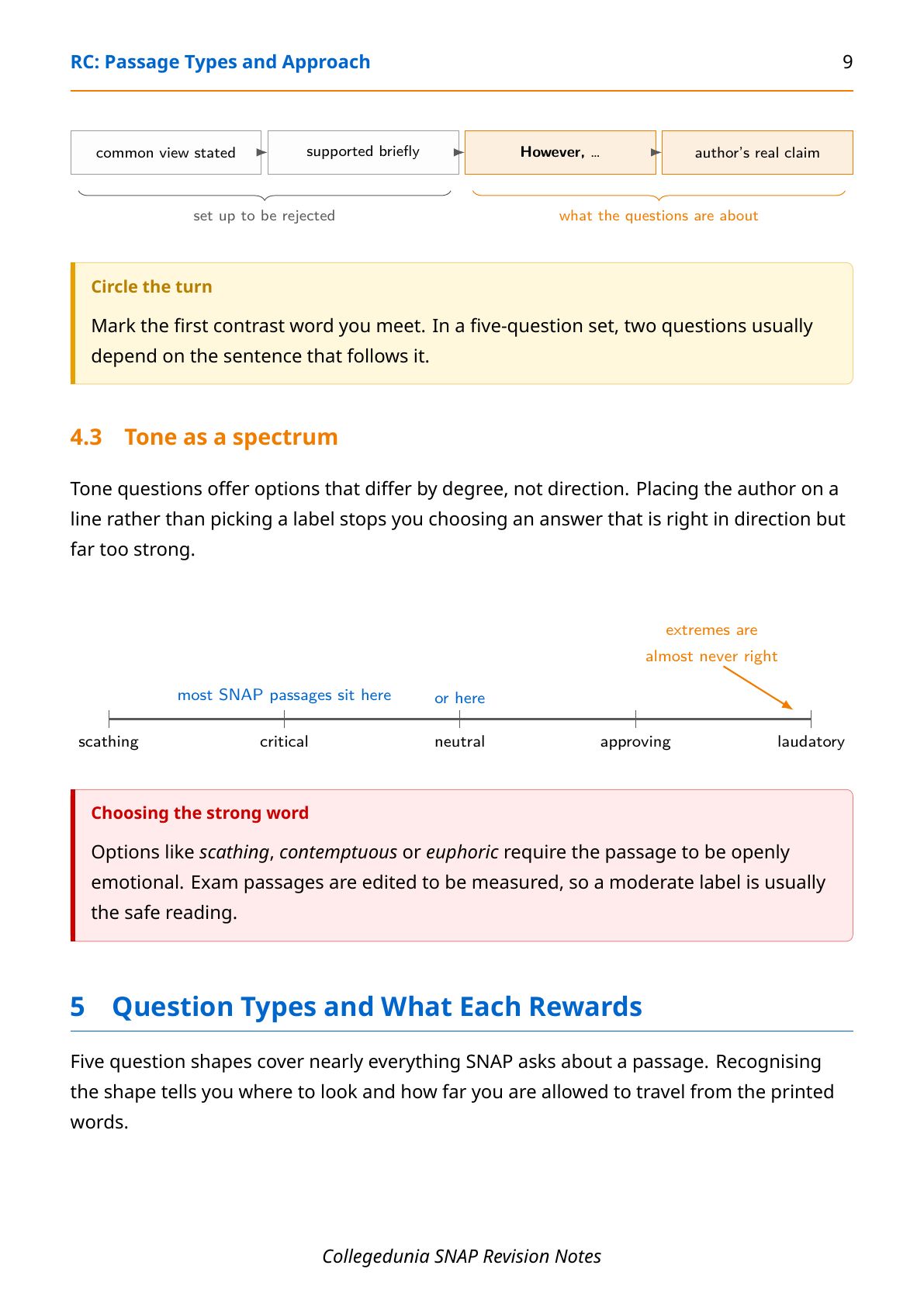
In an argumentative passage, the sentence after the first strong contrast word is usually the author's real position. Everything before it was set up to be rejected, and two questions in a five-question set often live there.
- but, however, yet: the author's real position follows
- because, hence, thus: the reasoning step
- admittedly, while: a point being given away
- for instance: evidence, never a new claim
How Far Each Question Lets You Travel
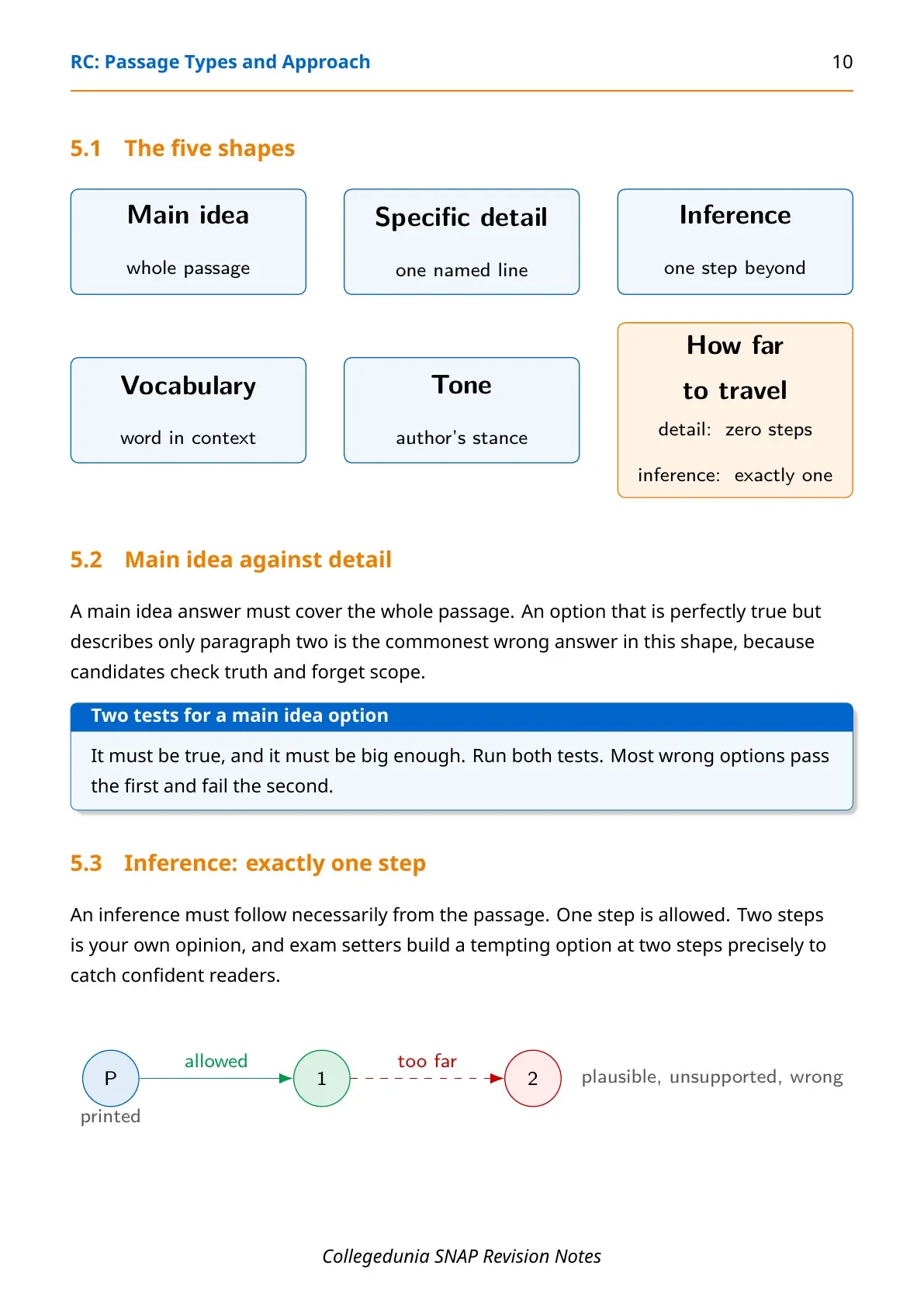
Five question shapes cover nearly everything asked. What separates them is how far you may move from the printed words.
- Detail: zero steps, the answer is on a named line
- Inference: exactly one step, and never two
- Main idea: must be true and must cover the whole passage
- Vocabulary: what the word means here, not usually
- Tone: place the author on a spectrum, not a label
An option that is perfectly true but describes only one paragraph is the commonest wrong answer to a main idea question, because candidates check truth and forget scope.
Eliminating Three Options
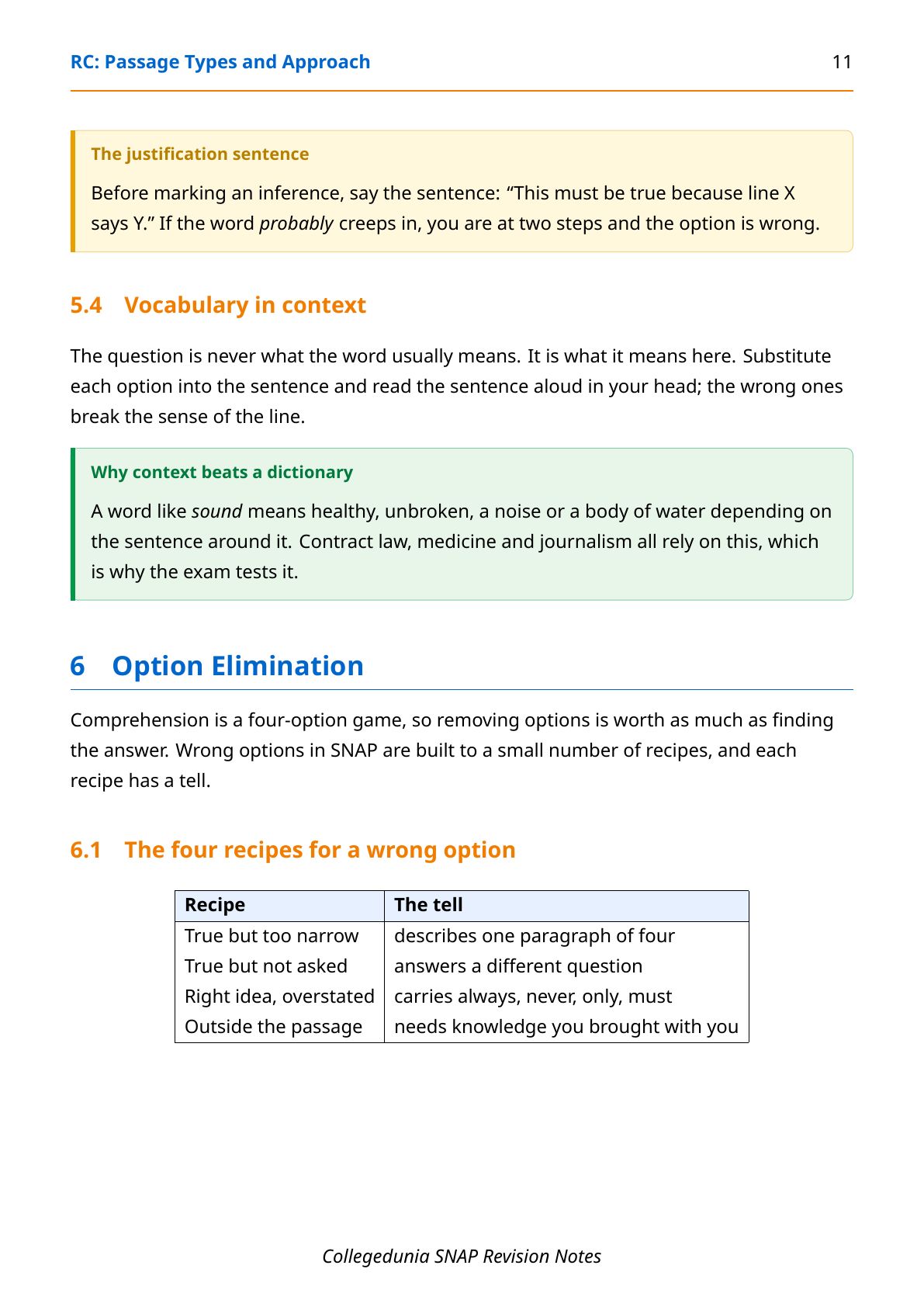
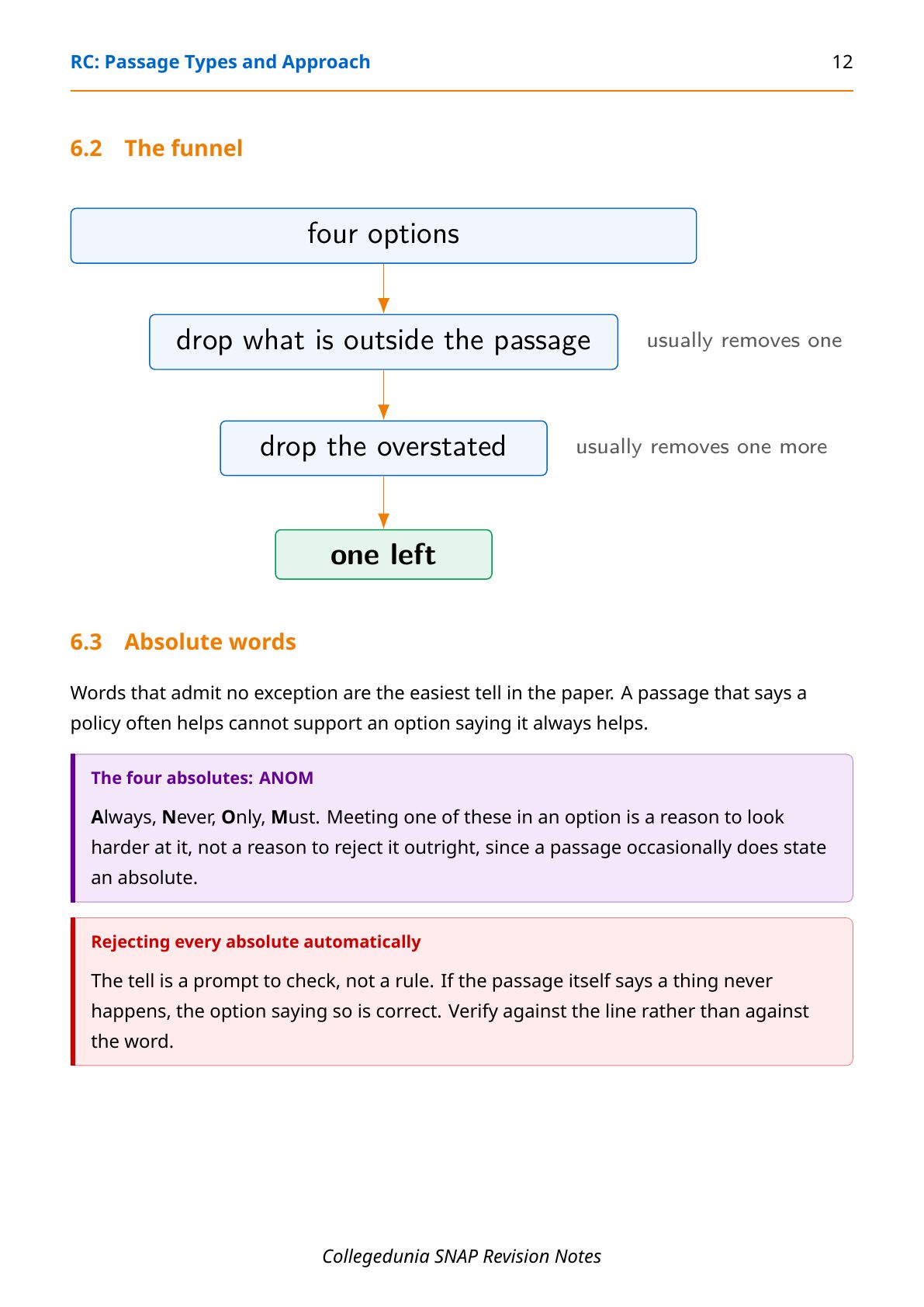
Wrong options are built to a few recipes, and each has a tell. Removing two options turns a coin toss into an attempt clearly worth taking at plus one and minus 0.25.
- True but too narrow: describes one paragraph of four
- True but not asked: answers a different question
- Right idea, overstated: carries always, never, only or must
- Outside the passage: needs knowledge you brought with you
Treat an absolute word as a prompt to check rather than a rule to reject. If the passage itself states an absolute, the option saying so is correct.
Watch an RC Passage Worked on a Board
Source: CATKing
Where Students Lose Marks Here
- Answering from memory instead of returning to the line
- Taking an inference two steps beyond the text
- Choosing a main idea that covers only part of the passage
- Picking the strongest tone word when exam passages are measured
- Rejecting every option containing an absolute automatically
- Reading the passage three times and running out of clock
Time Strategy and When to Abandon
A five-question passage is worth five marks and should cost seven to eight minutes, not fifteen. Read two lines of each passage before committing, and start with the familiar type on a concrete topic.
There is one honest stopping rule. If pass two is finished and you cannot say what each paragraph did, the passage will not yield five marks in the time left.
Then take partial credit deliberately: answer the detail and vocabulary questions, which sit on single lines, and leave the main idea and inference questions. A passage you failed to map can still return two or three marks.
How to Use These Notes
Read once slowly, then keep the quick reference page as the revision set. Work the two practice passages closed book before checking the one-line reasons.
If you prefer notes in a handwritten format, the same topic is available as SNAP RC handwritten notes, with three worked passages written out by hand.
Point at the line. If you cannot, you guessed, and that single test is what separates a reliable four out of five from a lucky two.
SNAP Reading Comprehension FAQs
Ques. How many reading comprehension questions come in SNAP?
Ans. Usually four to six, inside the 15 General English questions, spread over one or two passages. The exact split varies by paper, but comprehension has been a fixture of the section.
Ques. How much time should one passage take?
Ans. Seven to eight minutes for a five-question passage. Split it one minute for the shape, three to map the paragraphs and four for the questions. Spending fifteen minutes on five marks is the commonest way to lose the section.
Ques. What is the difference between a detail question and an inference question?
Ans. A detail question is answered by a line you can point at, so it travels zero steps from the text. An inference travels exactly one step and must follow necessarily. Two steps is your own opinion, and there is usually an option waiting there.
Ques. Is it worth guessing when SNAP has negative marking?
Ans. After eliminating two options, yes. At plus one and minus 0.25 a two-way guess is clearly positive. A blind four-way guess is barely above zero, so eliminate before deciding whether to skip.
Ques. Can these notes be downloaded for free?
Ans. Yes. The full 20 page PDF can be read on this page and downloaded at no cost, so it can be printed or kept on a phone for revision.



Comments