




The SNAP 2015 Combined question paper is available here with detailed solutions for free download. SNAP 2015 was conducted by Symbiosis International (Deemed University), Pune on December 20, 2015, as a 150-question paper-pen test of 2 hours.
| SNAP 2015 Combined Question Paper with Solutions | Download PDF | Check Solutions |
SNAP 2015 Combined Paper Questions with Solutions
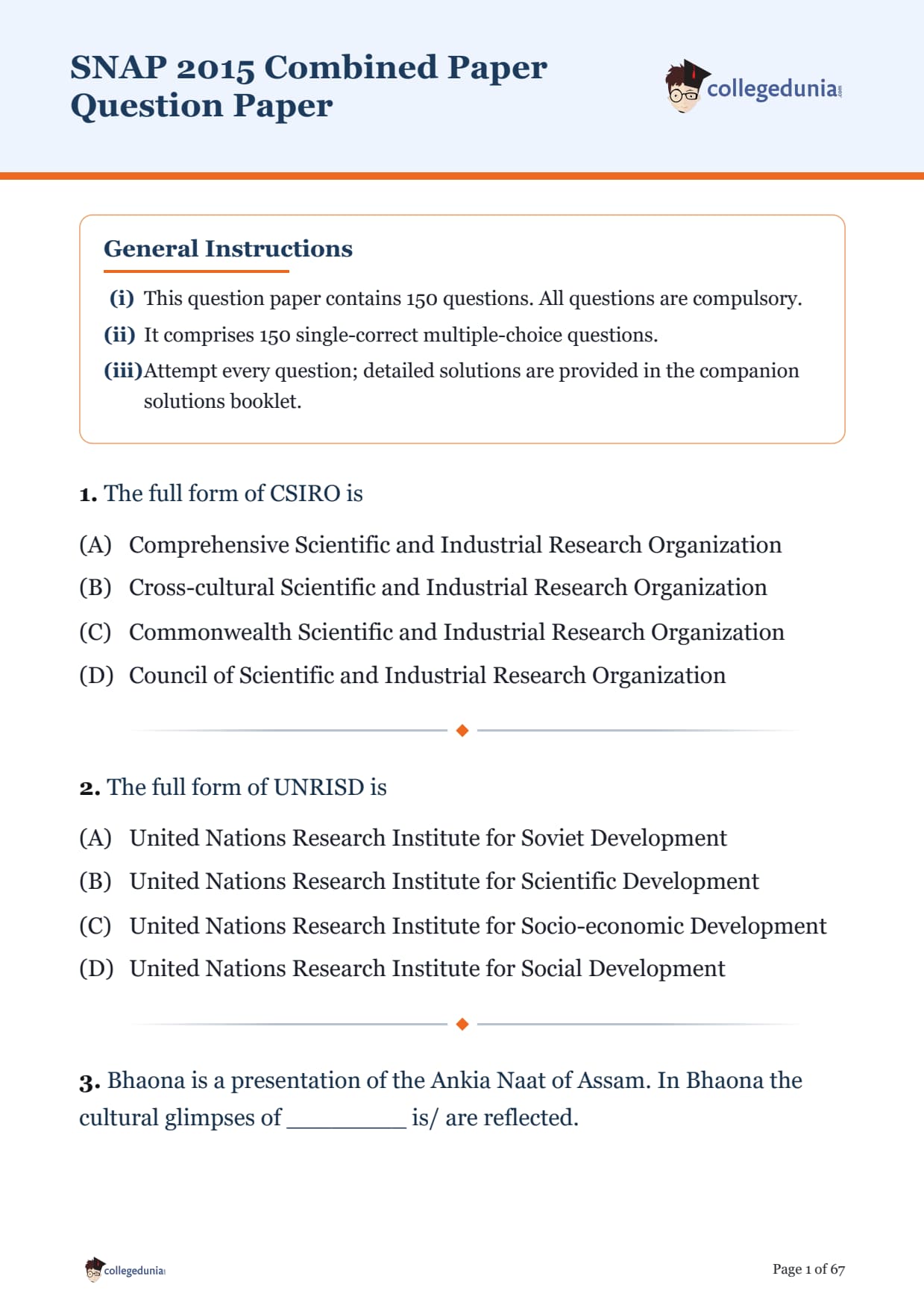
The full form of CSIRO is
The full form of UNRISD is
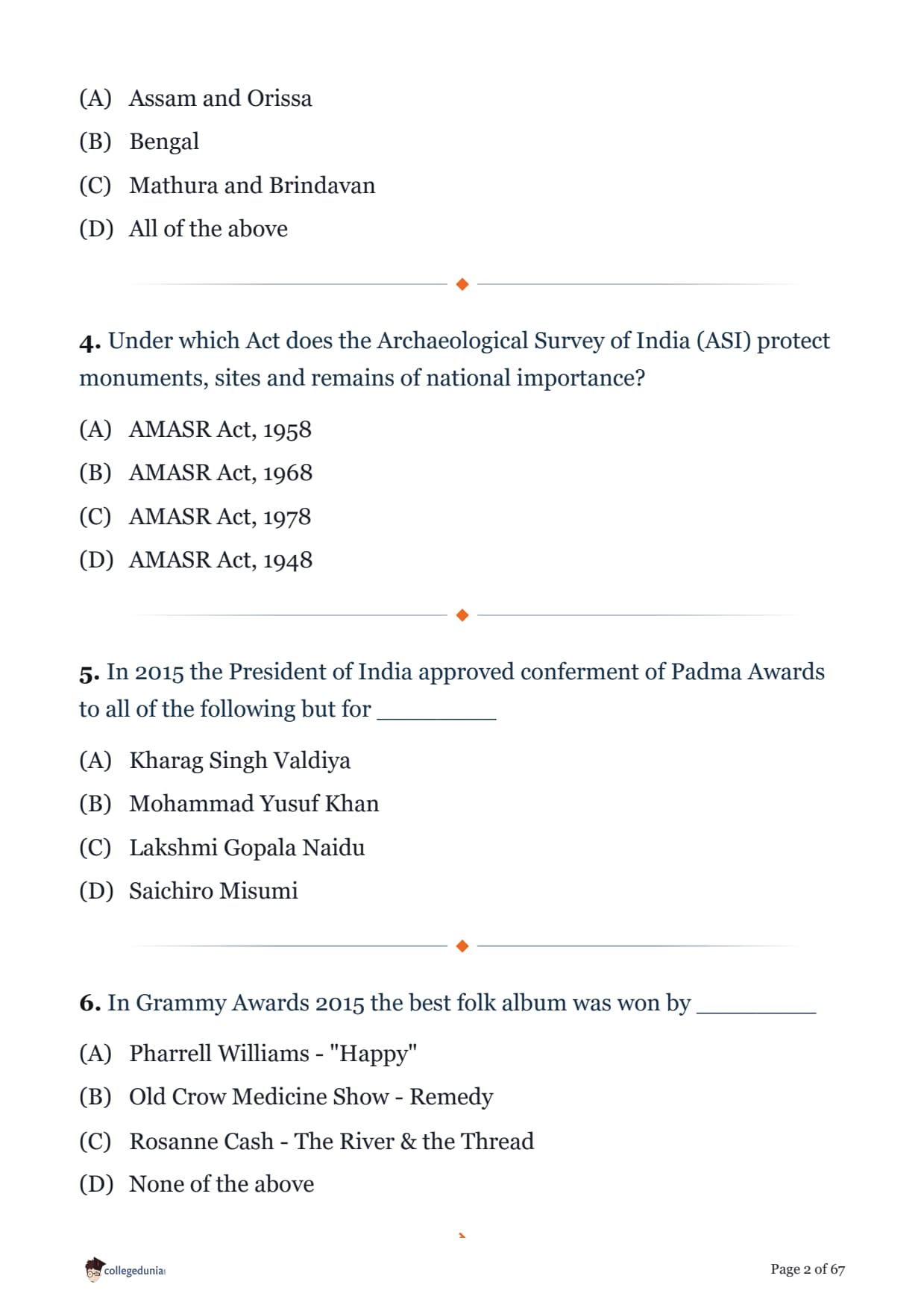
Bhaona is a presentation of the Ankia Naat of Assam. In Bhaona the cultural glimpses of ________ is/ are reflected.
Under which Act does the Archaeological Survey of India (ASI) protect monuments, sites and remains of national importance?
In 2015 the President of India approved conferment of Padma Awards to all of the following but for ________
In Grammy Awards 2015 the best folk album was won by ________
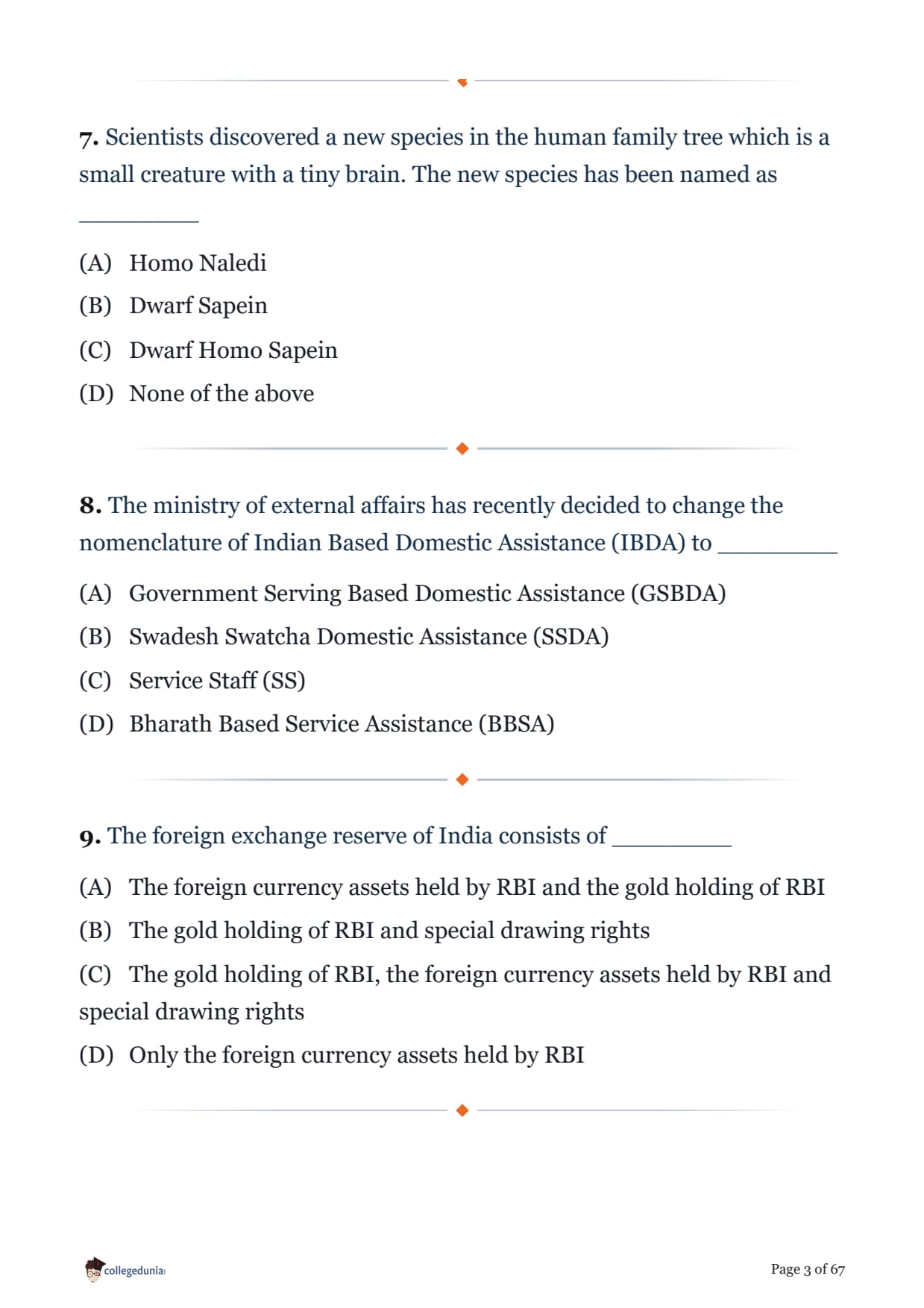
Scientists discovered a new species in the human family tree which is a small creature with a tiny brain. The new species has been named as ________
The ministry of external affairs has recently decided to change the nomenclature of Indian Based Domestic Assistance (IBDA) to ________
The foreign exchange reserve of India consists of ________
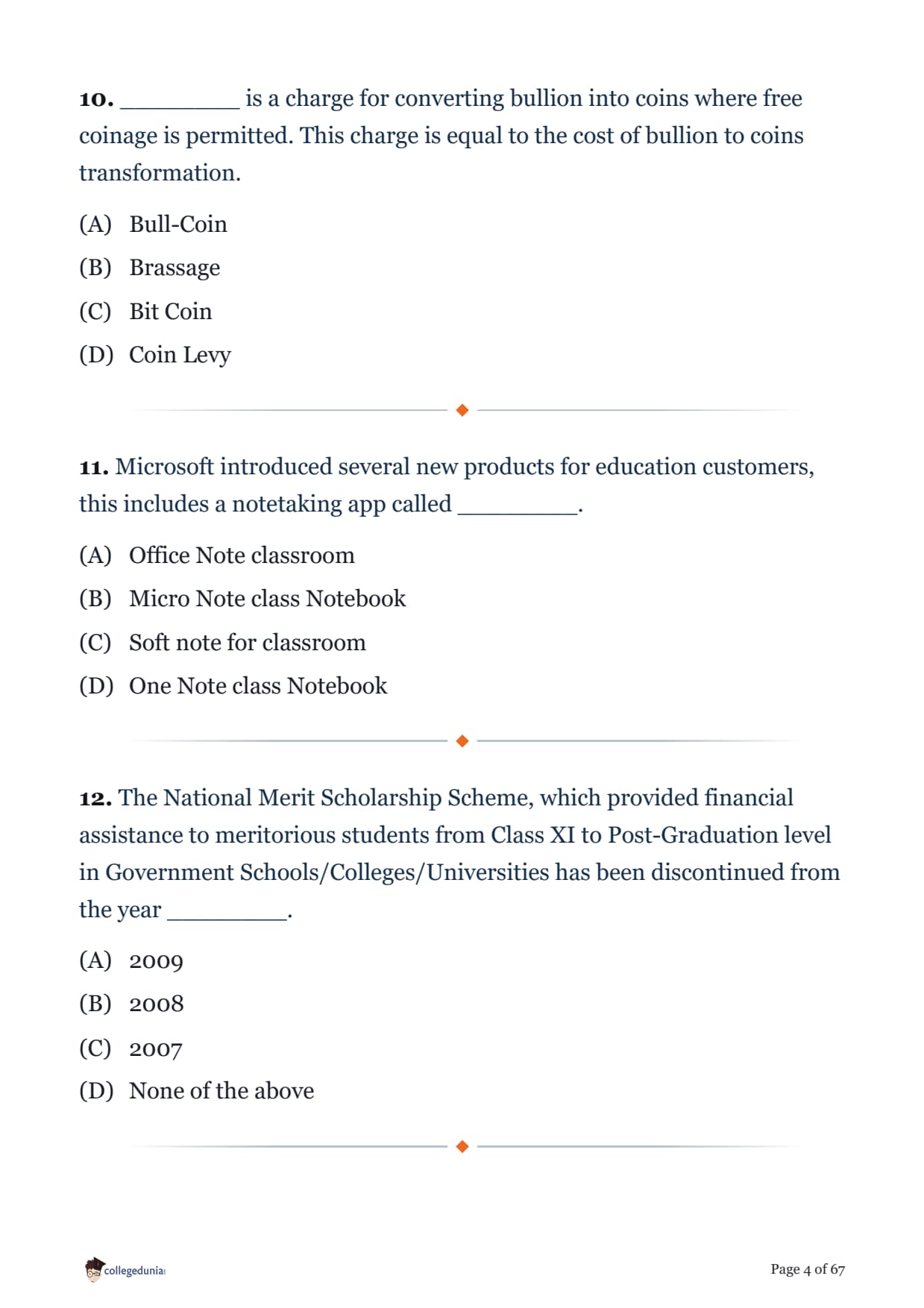
________ is a charge for converting bullion into coins where free coinage is permitted. This charge is equal to the cost of bullion to coins transformation.
Microsoft introduced several new products for education customers, this includes a notetaking app called ________.
The National Merit Scholarship Scheme, which provided financial assistance to meritorious students from Class XI to Post-Graduation level in Government Schools/Colleges/Universities has been discontinued from the year ________.
The symbol used for reusable microwaveable plastic ware is ________
The agency that estimates national income in India is
Super Blood Moon, which is a rare astronomical phenomenon hasn't happened since ________, and won't happen again until ________
The galaxy ________ was initially discovered with NASA's Spitzer Space Telescope in infrared light and is believed to be at least 9 billion years old.
In the year 2014 Facebook bought Whatsapp for ________ US Dollars.
Shri Narendra Modi was sworn in as the Prime Minister of India on ________ at the Rashtrapati Bhavan in New Delhi.
Where is the doldrums belt located?
The air quality in Singapore deteriorated to a hazardous level in September 2015, forcing the city-state to shut its schools for the first time in 12 years. This was due to
In 1347 during the reign of Muhammed Tuglak an Afghan officer named ________ setup an independent kingdom called Bahmani Kingdom.
The task of consolidating Mughal Kingdom was left to Akbar who was only ________ years old at the time of his accession of the throne.
Smoking in public places was prohibited nationwide from ________
A constitutional right can be ________ recognized and established by a sovereign State or union of States.
In Nepal the festival of lights i.e. Diwali is celebrated by some Buddhists as ______
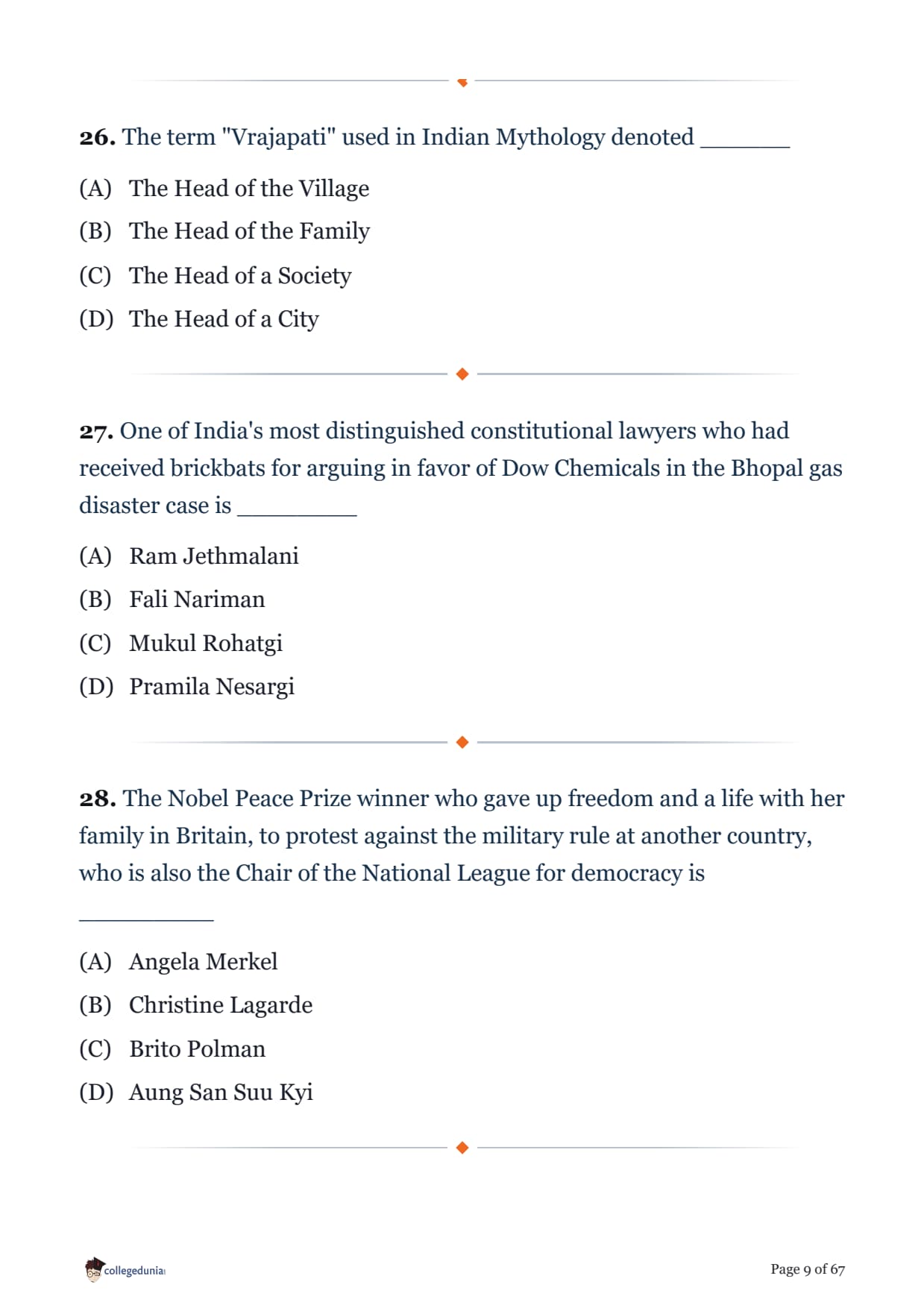
The term "Vrajapati" used in Indian Mythology denoted ______
One of India's most distinguished constitutional lawyers who had received brickbats for arguing in favor of Dow Chemicals in the Bhopal gas disaster case is ________
The Nobel Peace Prize winner who gave up freedom and a life with her family in Britain, to protest against the military rule at another country, who is also the Chair of the National League for democracy is _________
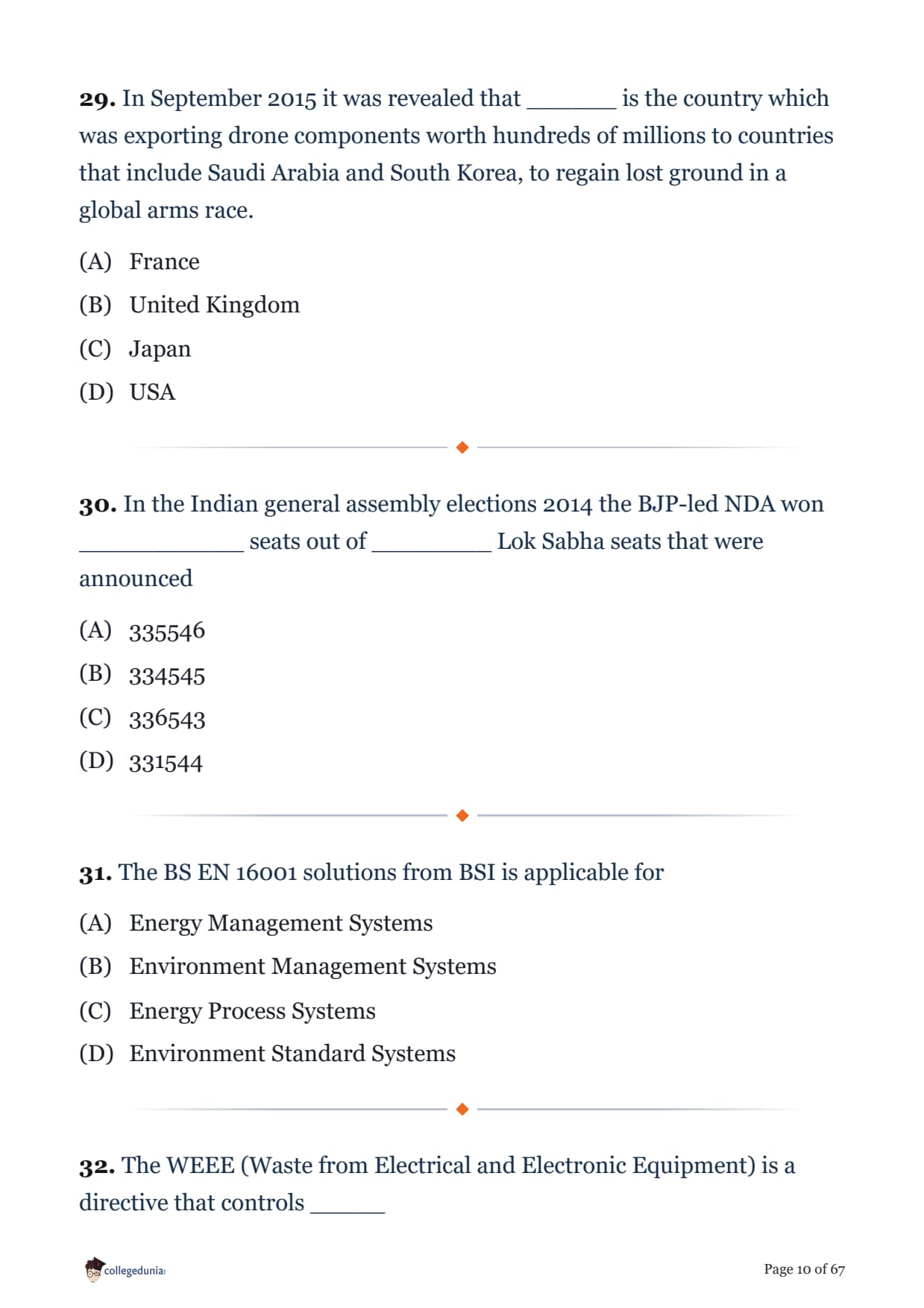
In September 2015 it was revealed that ______ is the country which was exporting drone components worth hundreds of millions to countries that include Saudi Arabia and South Korea, to regain lost ground in a global arms race.
In the Indian general assembly elections 2014 the BJP-led NDA won ___________ seats out of ________ Lok Sabha seats that were announced
The BS EN 16001 solutions from BSI is applicable for
The WEEE (Waste from Electrical and Electronic Equipment) is a directive that controls _____
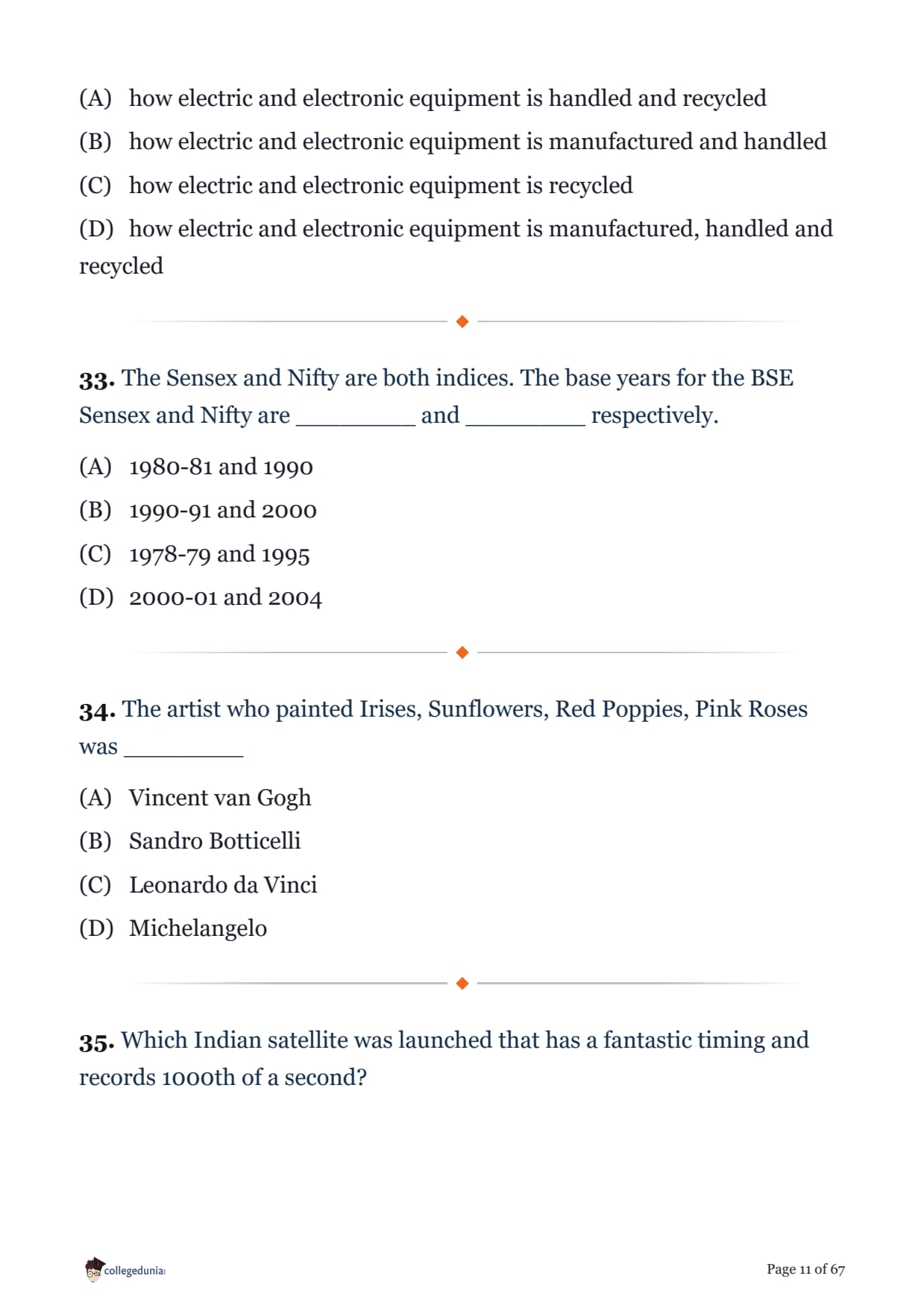
The Sensex and Nifty are both indices. The base years for the BSE Sensex and Nifty are ________ and ________ respectively.
The artist who painted Irises, Sunflowers, Red Poppies, Pink Roses was ________
Which Indian satellite was launched that has a fantastic timing and records 1000th of a second?
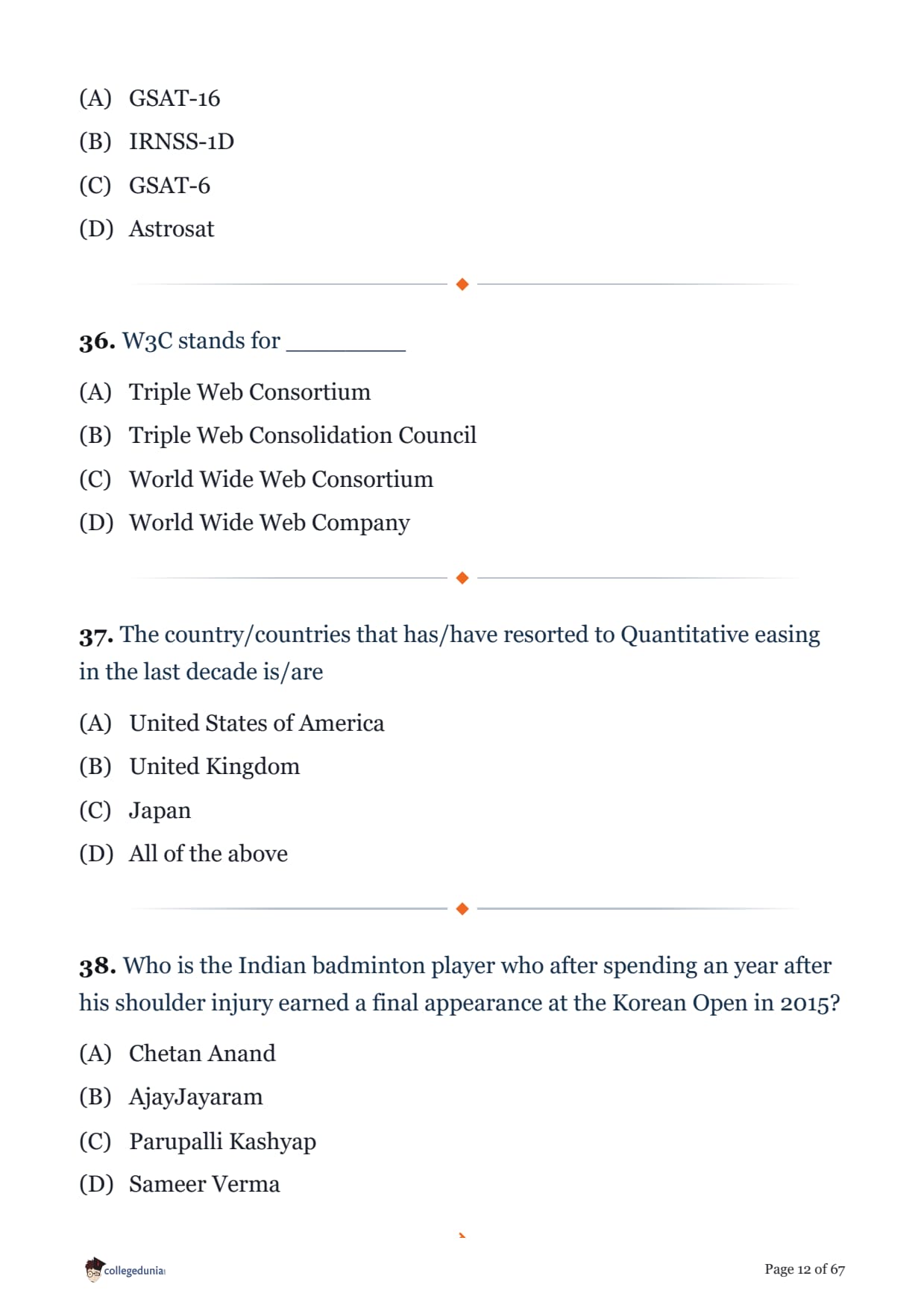
W3C stands for ________
The country/countries that has/have resorted to Quantitative easing in the last decade is/are
Who is the Indian badminton player who after spending an year after his shoulder injury earned a final appearance at the Korean Open in 2015?
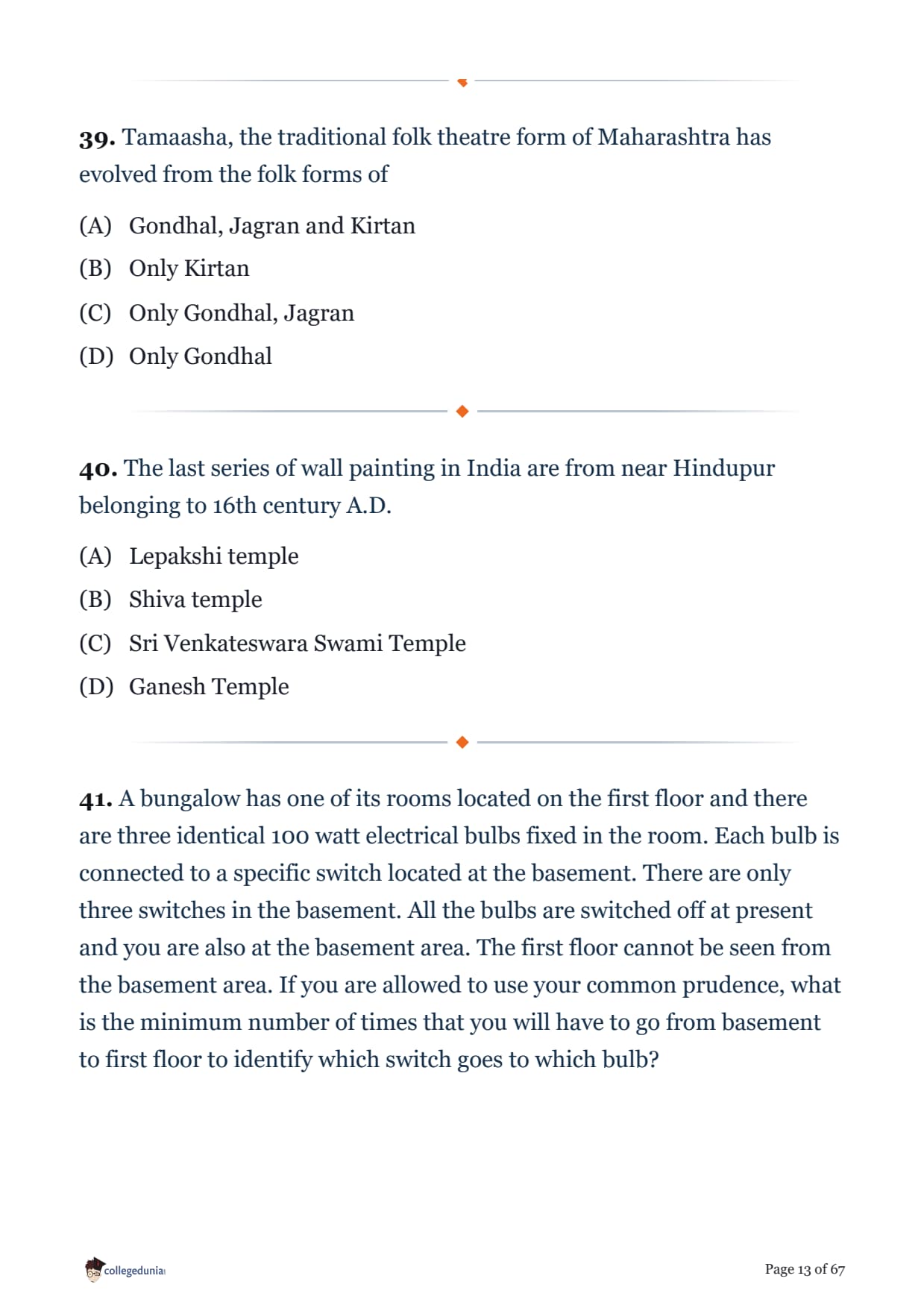
Tamaasha, the traditional folk theatre form of Maharashtra has evolved from the folk forms of
The last series of wall painting in India are from near Hindupur belonging to 16th century A.D.
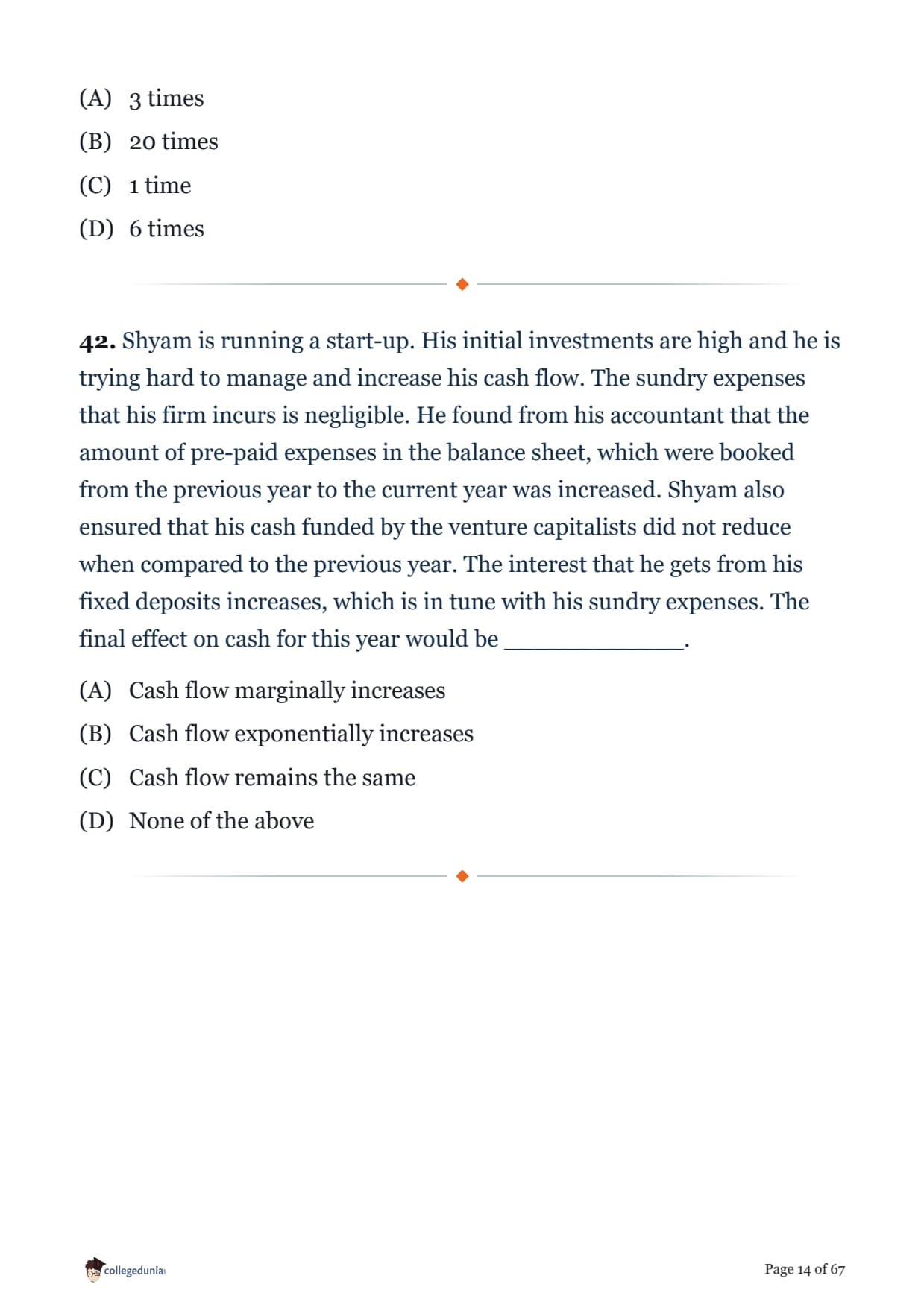
A bungalow has one of its rooms located on the first floor and there are three identical 100 watt electrical bulbs fixed in the room. Each bulb is connected to a specific switch located at the basement. There are only three switches in the basement. All the bulbs are switched off at present and you are also at the basement area. The first floor cannot be seen from the basement area. If you are allowed to use your common prudence, what is the minimum number of times that you will have to go from basement to first floor to identify which switch goes to which bulb?
Shyam is running a start-up. His initial investments are high and he is trying hard to manage and increase his cash flow. The sundry expenses that his firm incurs is negligible. He found from his accountant that the amount of pre-paid expenses in the balance sheet, which were booked from the previous year to the current year was increased. Shyam also ensured that his cash funded by the venture capitalists did not reduce when compared to the previous year. The interest that he gets from his fixed deposits increases, which is in tune with his sundry expenses. The final effect on cash for this year would be ____________.
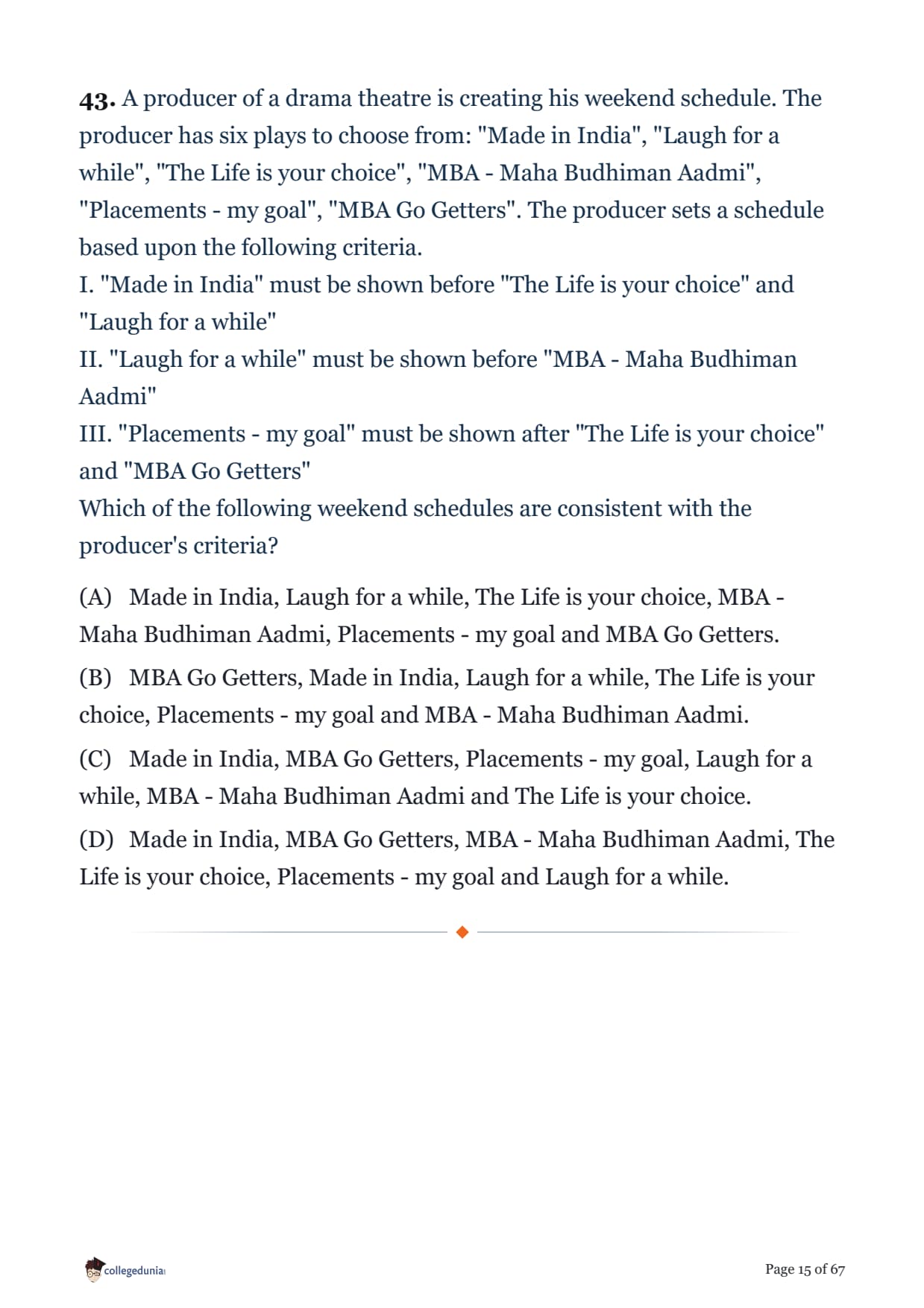
A producer of a drama theatre is creating his weekend schedule. The producer has six plays to choose from: "Made in India", "Laugh for a while", "The Life is your choice", "MBA - Maha Budhiman Aadmi", "Placements - my goal", "MBA Go Getters". The producer sets a schedule based upon the following criteria.
I. "Made in India" must be shown before "The Life is your choice" and "Laugh for a while"
II. "Laugh for a while" must be shown before "MBA - Maha Budhiman Aadmi"
III. "Placements - my goal" must be shown after "The Life is your choice" and "MBA Go Getters"
Which of the following weekend schedules are consistent with the producer's criteria?
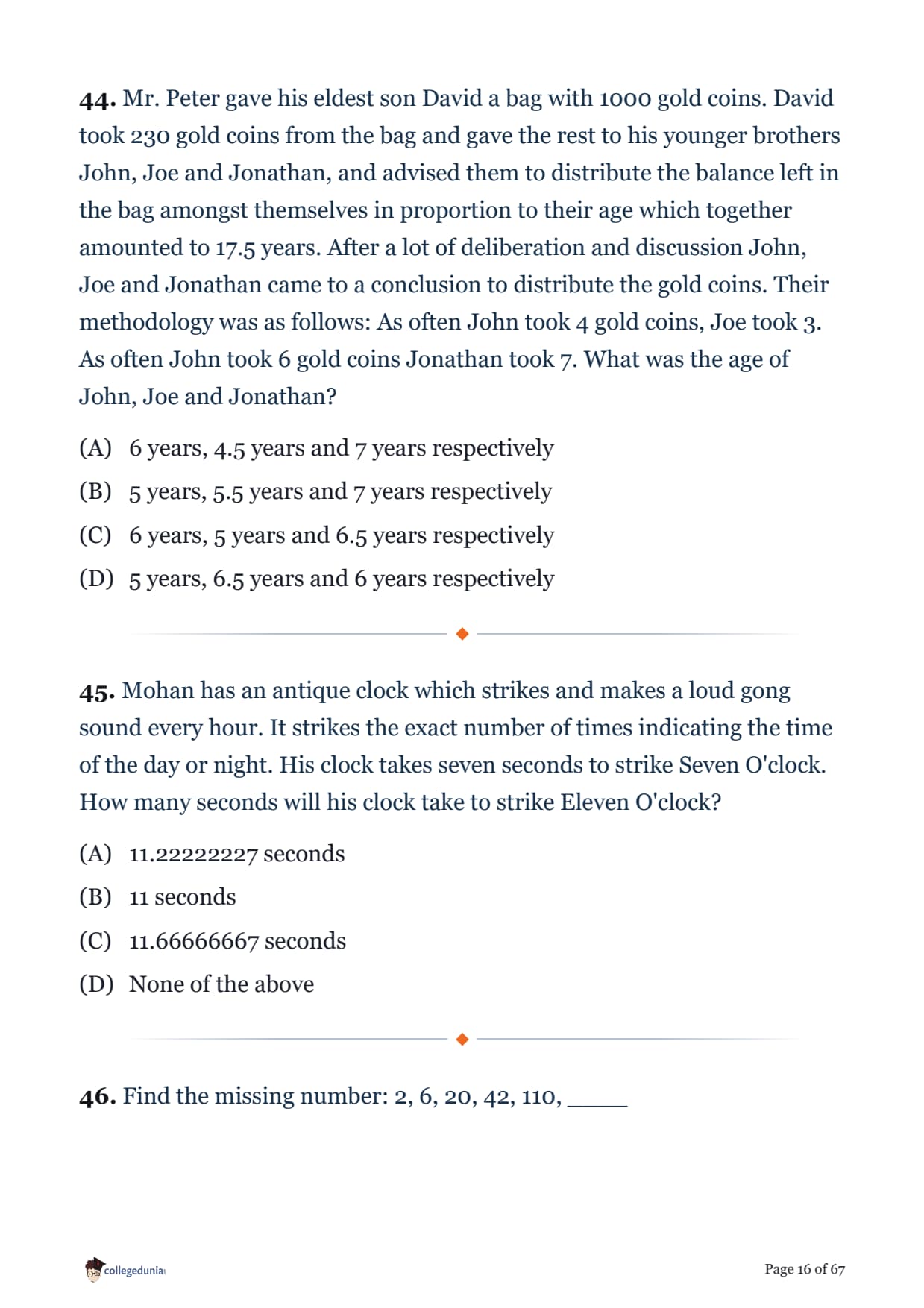
Mr. Peter gave his eldest son David a bag with 1000 gold coins. David took 230 gold coins from the bag and gave the rest to his younger brothers John, Joe and Jonathan, and advised them to distribute the balance left in the bag amongst themselves in proportion to their age which together amounted to 17.5 years. After a lot of deliberation and discussion John, Joe and Jonathan came to a conclusion to distribute the gold coins. Their methodology was as follows: As often John took 4 gold coins, Joe took 3. As often John took 6 gold coins Jonathan took 7. What was the age of John, Joe and Jonathan?
Mohan has an antique clock which strikes and makes a loud gong sound every hour. It strikes the exact number of times indicating the time of the day or night. His clock takes seven seconds to strike Seven O'clock. How many seconds will his clock take to strike Eleven O'clock?
Find the missing number: 2, 6, 20, 42, 110, ____
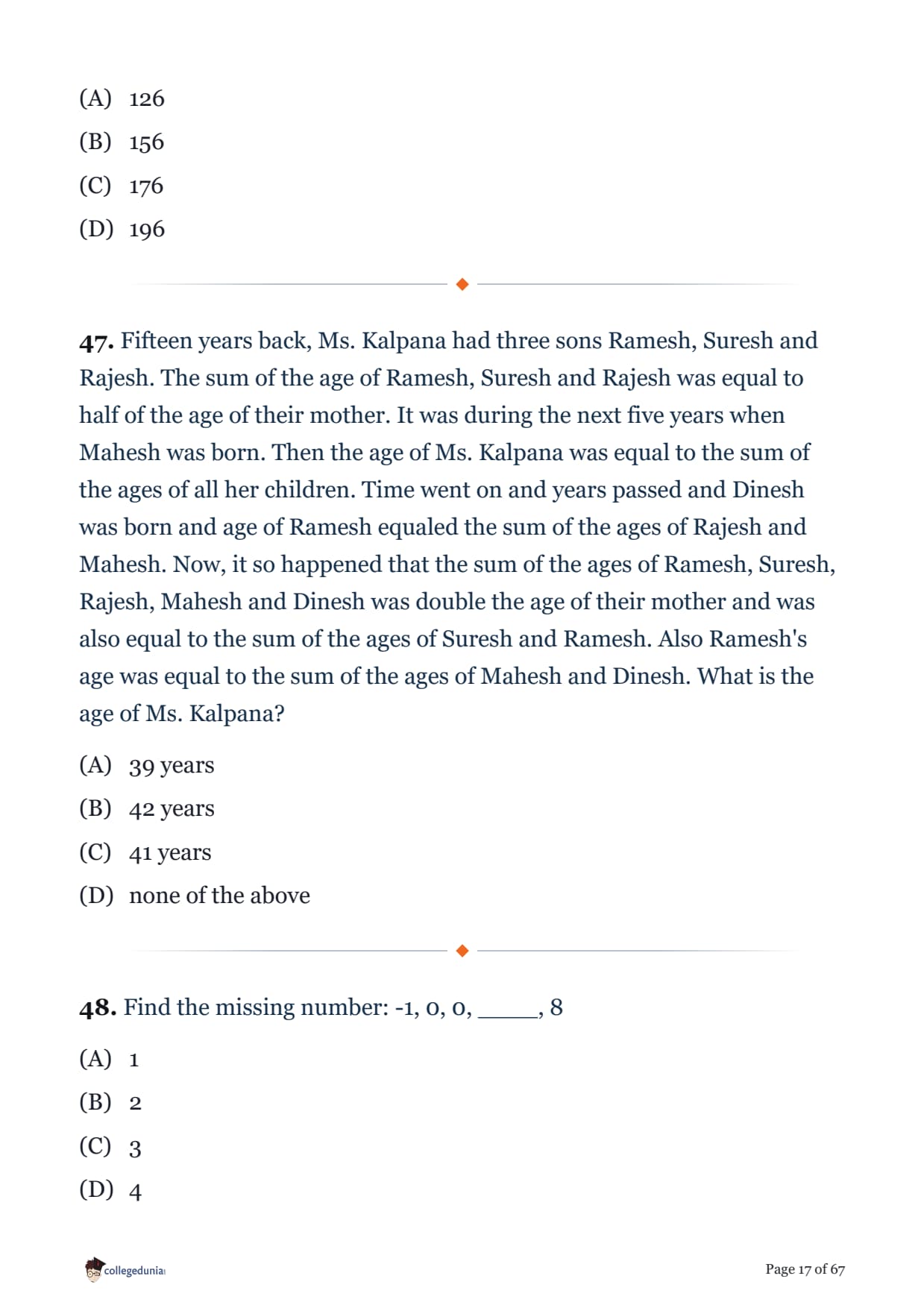
Fifteen years back, Ms. Kalpana had three sons Ramesh, Suresh and Rajesh. The sum of the age of Ramesh, Suresh and Rajesh was equal to half of the age of their mother. It was during the next five years when Mahesh was born. Then the age of Ms. Kalpana was equal to the sum of the ages of all her children. Time went on and years passed and Dinesh was born and age of Ramesh equaled the sum of the ages of Rajesh and Mahesh. Now, it so happened that the sum of the ages of Ramesh, Suresh, Rajesh, Mahesh and Dinesh was double the age of their mother and was also equal to the sum of the ages of Suresh and Ramesh. Also Ramesh's age was equal to the sum of the ages of Mahesh and Dinesh. What is the age of Ms. Kalpana?
Find the missing number: -1, 0, 0, ____, 8
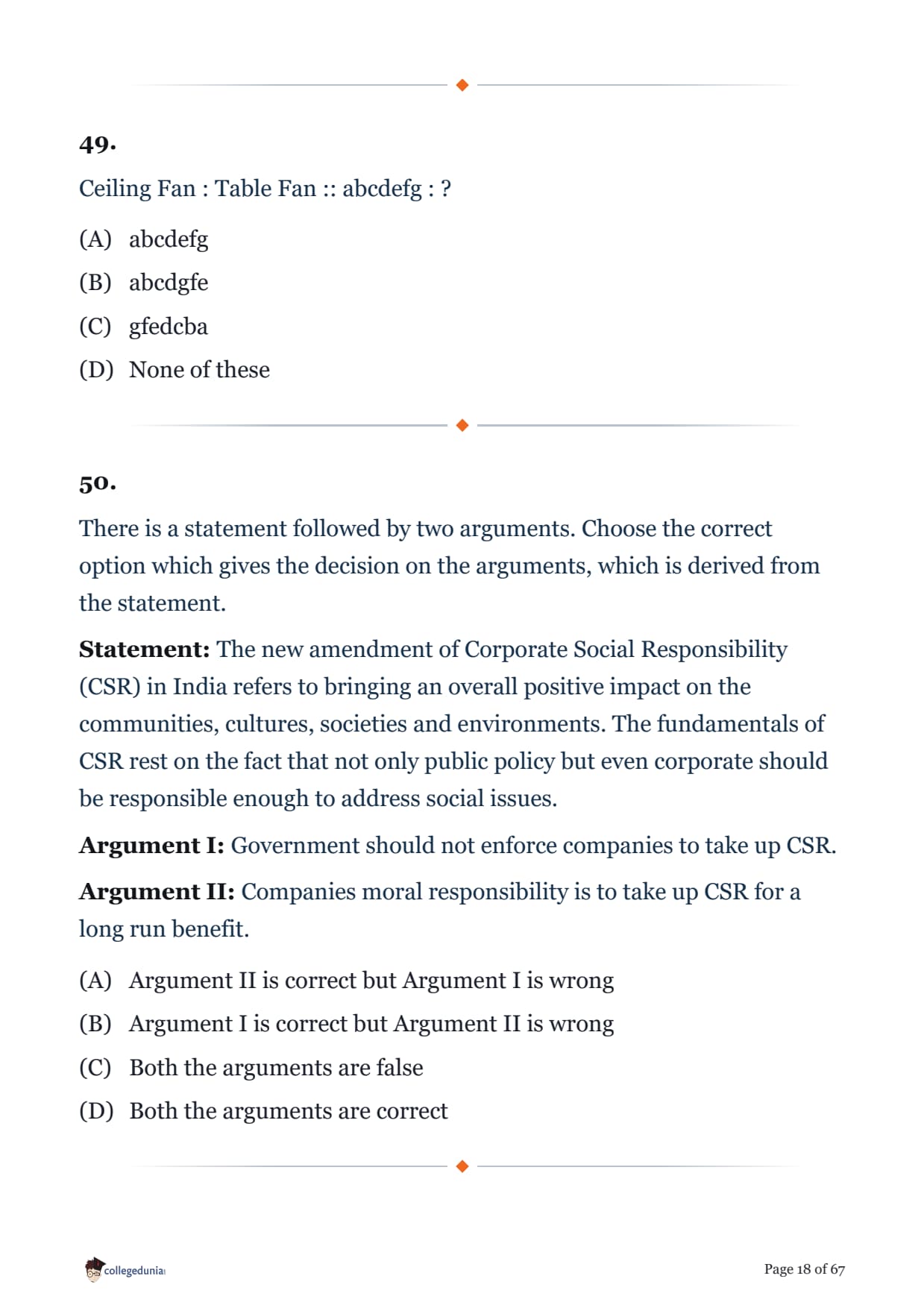
There is a statement followed by two arguments. Choose the correct option which gives the decision on the arguments, which is derived from the statement.
Statement: The new amendment of Corporate Social Responsibility (CSR) in India refers to bringing an overall positive impact on the communities, cultures, societies and environments. The fundamentals of CSR rest on the fact that not only public policy but even corporate should be responsible enough to address social issues.
Argument I: Government should not enforce companies to take up CSR.
Argument II: Companies moral responsibility is to take up CSR for a long run benefit.
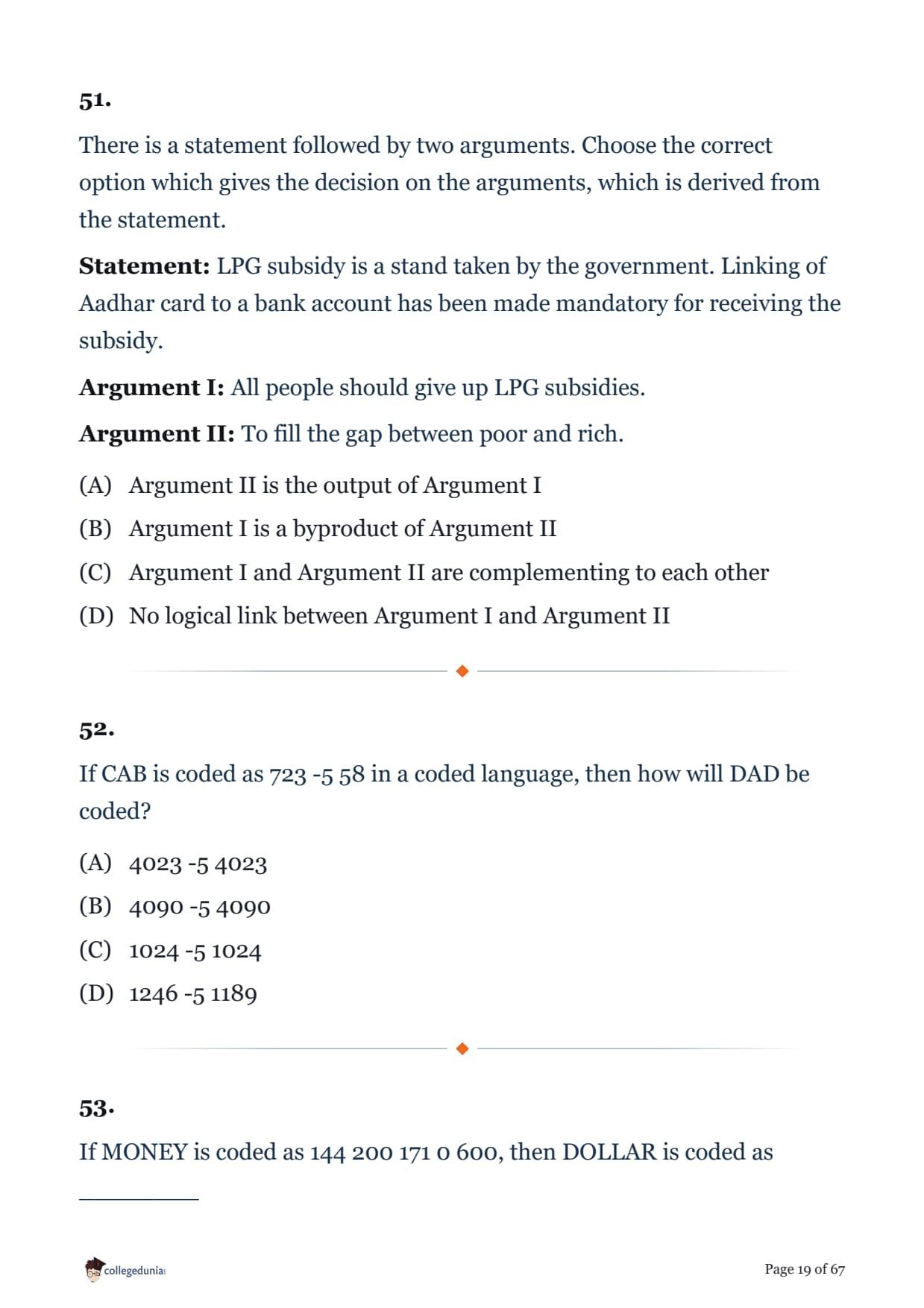
There is a statement followed by two arguments. Choose the correct option which gives the decision on the arguments, which is derived from the statement.
Statement: LPG subsidy is a stand taken by the government. Linking of Aadhar card to a bank account has been made mandatory for receiving the subsidy.
Argument I: All people should give up LPG subsidies.
Argument II: To fill the gap between poor and rich.
If CAB is coded as 723 -5 58 in a coded language, then how will DAD be coded?
If MONEY is coded as 144 200 171 0 600, then DOLLAR is coded as ________
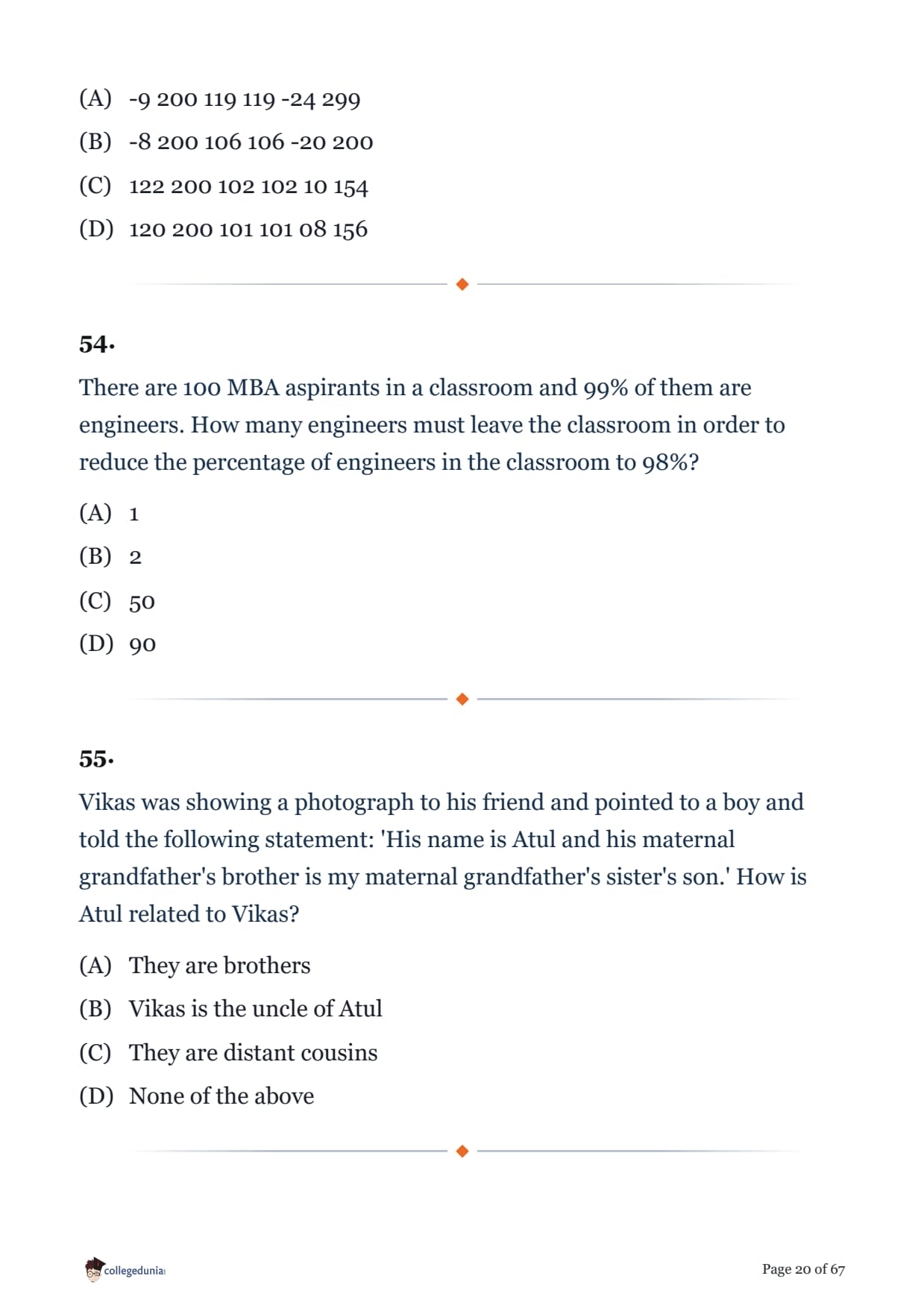
There are 100 MBA aspirants in a classroom and 99% of them are engineers. How many engineers must leave the classroom in order to reduce the percentage of engineers in the classroom to 98%?
Vikas was showing a photograph to his friend and pointed to a boy and told the following statement: 'His name is Atul and his maternal grandfather's brother is my maternal grandfather's sister's son.' How is Atul related to Vikas?
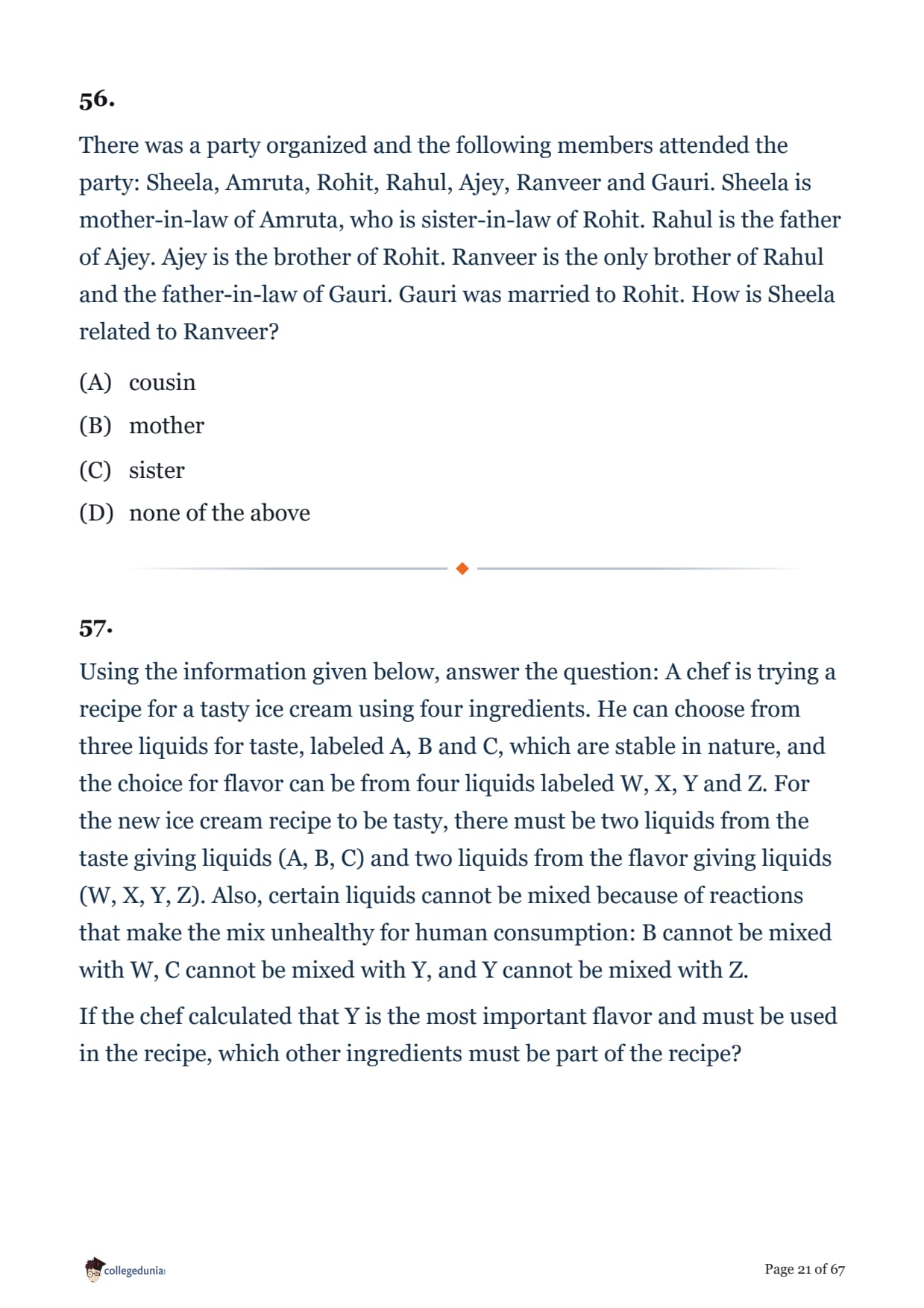
There was a party organized and the following members attended the party: Sheela, Amruta, Rohit, Rahul, Ajey, Ranveer and Gauri. Sheela is mother-in-law of Amruta, who is sister-in-law of Rohit. Rahul is the father of Ajey. Ajey is the brother of Rohit. Ranveer is the only brother of Rahul and the father-in-law of Gauri. Gauri was married to Rohit. How is Sheela related to Ranveer?
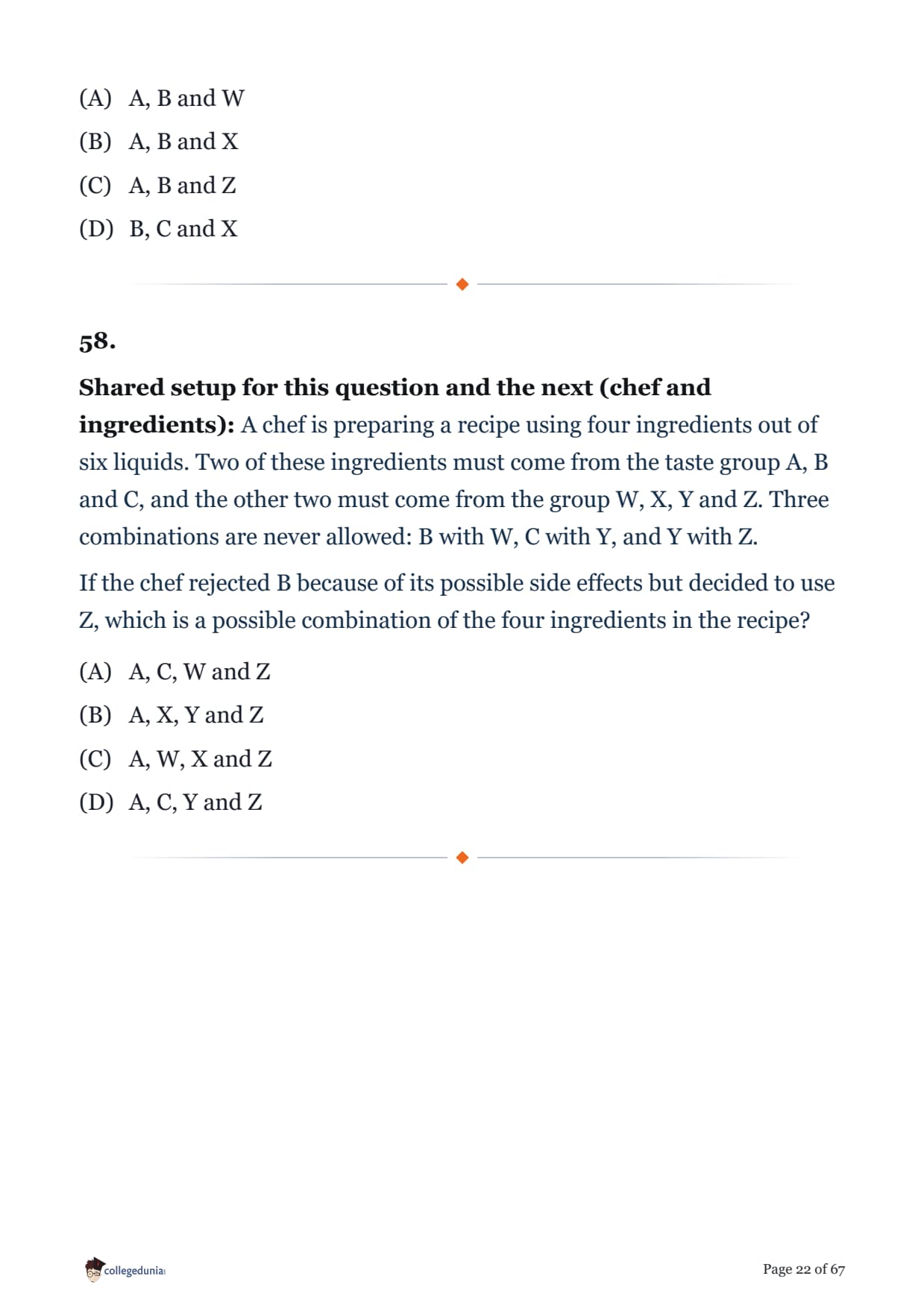
Using the information given below, answer the question: A chef is trying a recipe for a tasty ice cream using four ingredients. He can choose from three liquids for taste, labeled A, B and C, which are stable in nature, and the choice for flavor can be from four liquids labeled W, X, Y and Z. For the new ice cream recipe to be tasty, there must be two liquids from the taste giving liquids (A, B, C) and two liquids from the flavor giving liquids (W, X, Y, Z). Also, certain liquids cannot be mixed because of reactions that make the mix unhealthy for human consumption: B cannot be mixed with W, C cannot be mixed with Y, and Y cannot be mixed with Z.
If the chef calculated that Y is the most important flavor and must be used in the recipe, which other ingredients must be part of the recipe?
Shared setup for this question and the next (chef and ingredients): A chef is preparing a recipe using four ingredients out of six liquids. Two of these ingredients must come from the taste group A, B and C, and the other two must come from the group W, X, Y and Z. Three combinations are never allowed: B with W, C with Y, and Y with Z.
If the chef rejected B because of its possible side effects but decided to use Z, which is a possible combination of the four ingredients in the recipe?
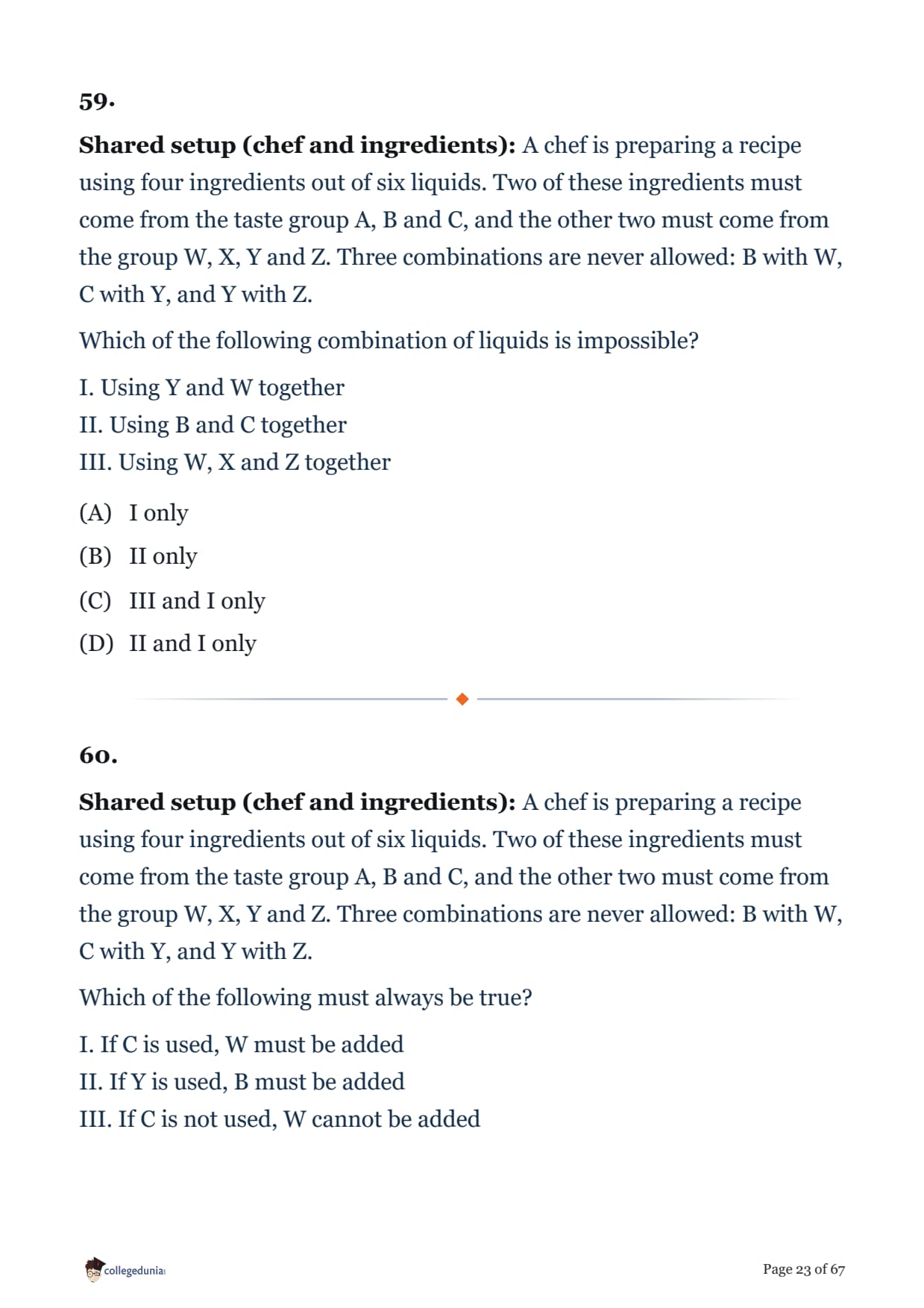
Shared setup (chef and ingredients): A chef is preparing a recipe using four ingredients out of six liquids. Two of these ingredients must come from the taste group A, B and C, and the other two must come from the group W, X, Y and Z. Three combinations are never allowed: B with W, C with Y, and Y with Z.
Which of the following combination of liquids is impossible?
I. Using Y and W together
II. Using B and C together
III. Using W, X and Z together
Shared setup (chef and ingredients): A chef is preparing a recipe using four ingredients out of six liquids. Two of these ingredients must come from the taste group A, B and C, and the other two must come from the group W, X, Y and Z. Three combinations are never allowed: B with W, C with Y, and Y with Z.
Which of the following must always be true?
I. If C is used, W must be added
II. If Y is used, B must be added
III. If C is not used, W cannot be added
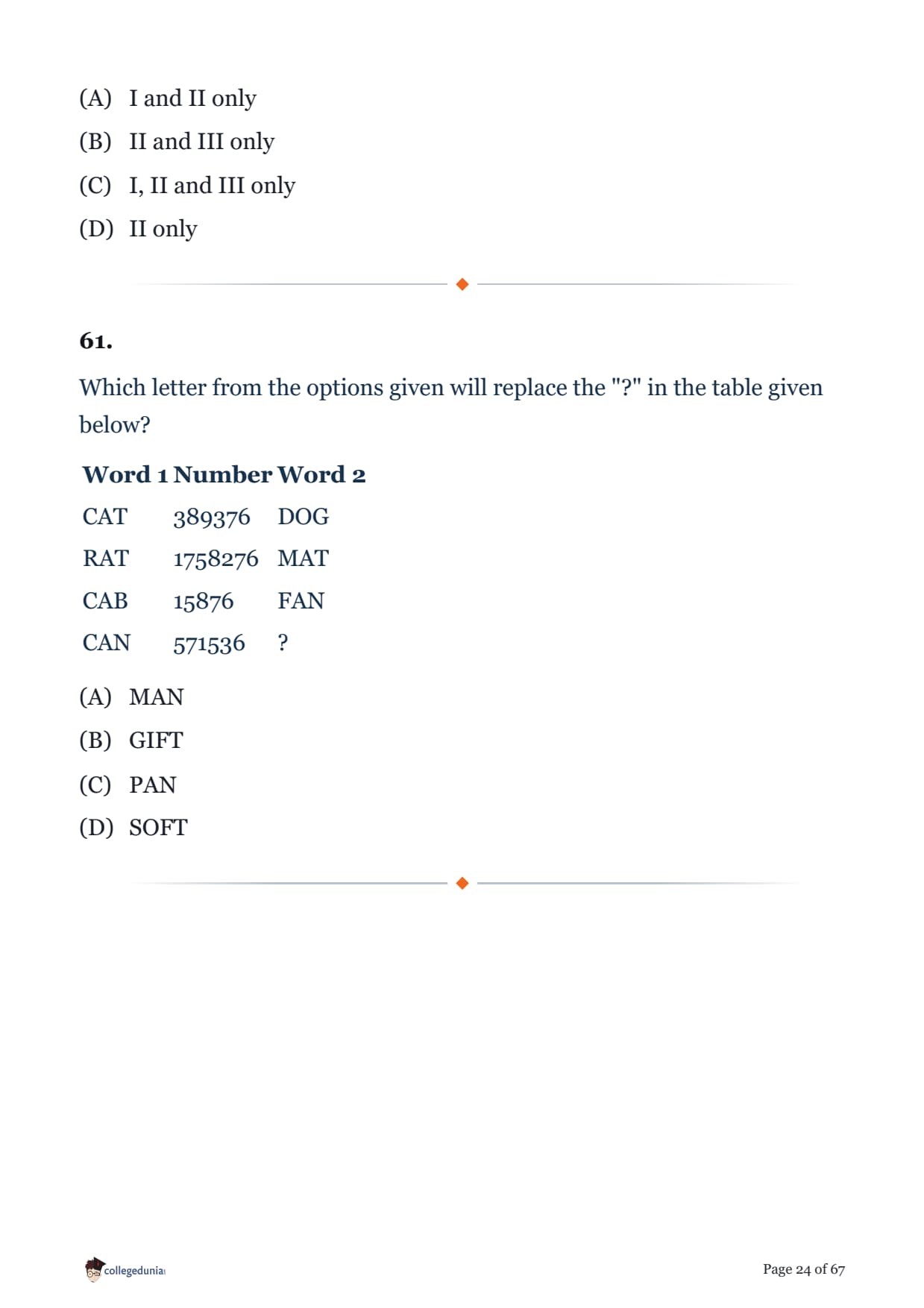
Which letter from the options given will replace the "?" in the table given below?
| Word 1 | Number | Word 2 |
|---|---|---|
| CAT | 389376 | DOG |
| RAT | 1758276 | MAT |
| CAB | 15876 | FAN |
| CAN | 571536 | ? |
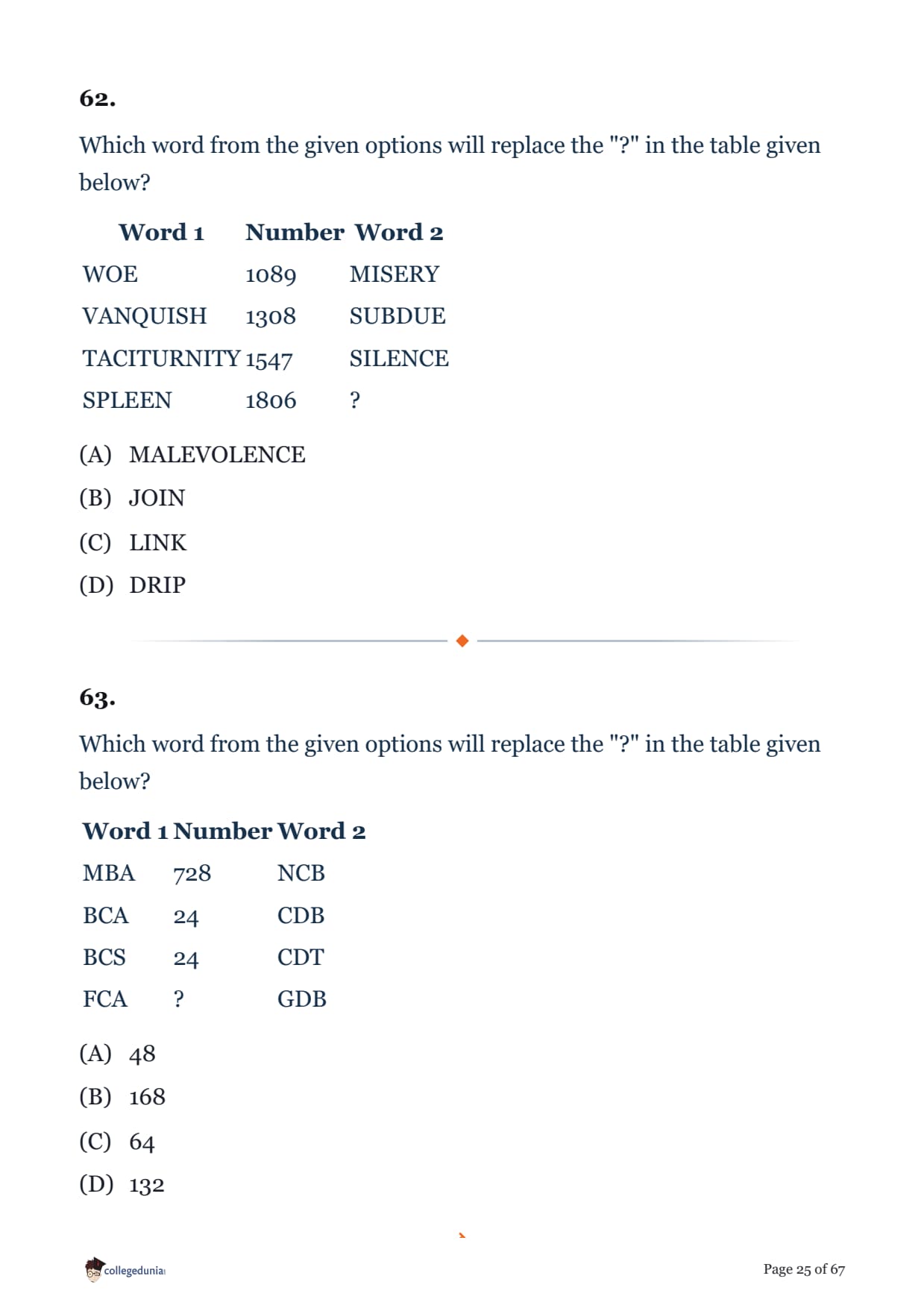
Which word from the given options will replace the "?" in the table given below?
| Word 1 | Number | Word 2 |
|---|---|---|
| WOE | 1089 | MISERY |
| VANQUISH | 1308 | SUBDUE |
| TACITURNITY | 1547 | SILENCE |
| SPLEEN | 1806 | ? |
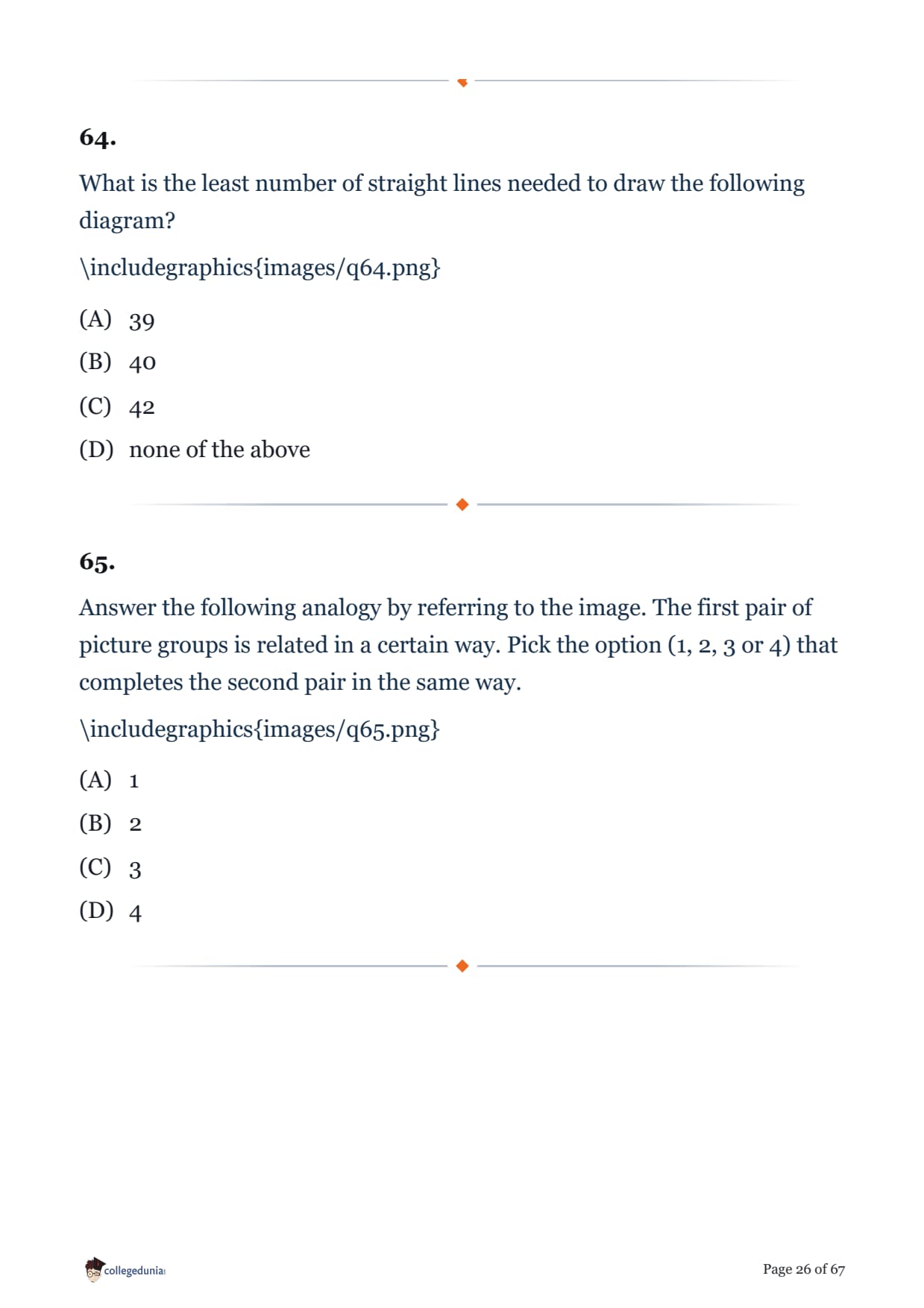
Which word from the given options will replace the "?" in the table given below?
| Word 1 | Number | Word 2 |
|---|---|---|
| MBA | 728 | NCB |
| BCA | 24 | CDB |
| BCS | 24 | CDT |
| FCA | ? | GDB |
What is the least number of straight lines needed to draw the following diagram?
\includegraphics{images/q64.png}Answer the following analogy by referring to the image. The first pair of picture groups is related in a certain way. Pick the option (1, 2, 3 or 4) that completes the second pair in the same way.
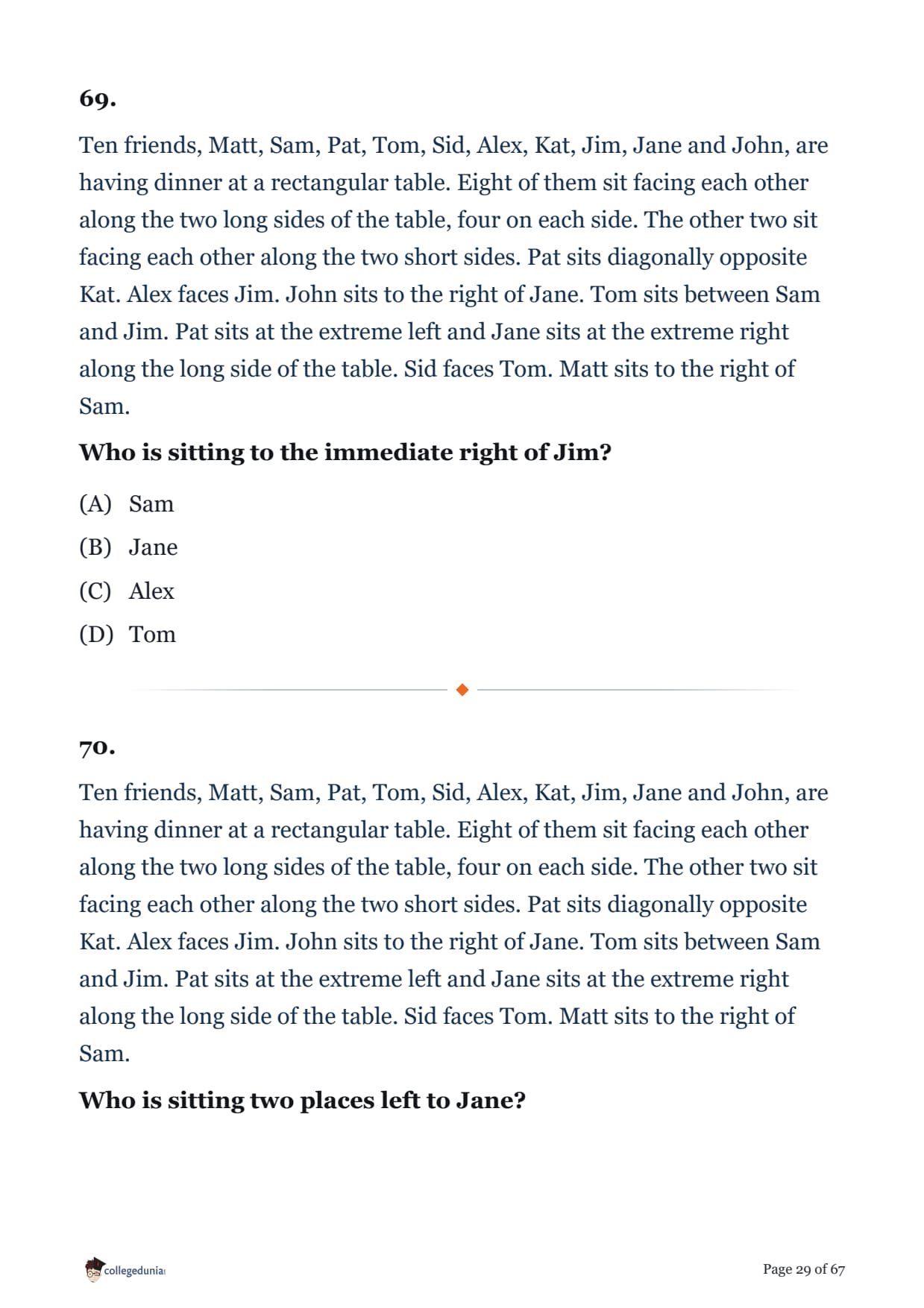
\includegraphics{images/q65.png}Ten friends, Matt, Sam, Pat, Tom, Sid, Alex, Kat, Jim, Jane and John, are having dinner at a rectangular table. Eight of them sit facing each other along the two long sides of the table, four on each side. The other two sit facing each other along the two short sides. Pat sits diagonally opposite Kat. Alex faces Jim. John sits to the right of Jane. Tom sits between Sam and Jim. Pat sits at the extreme left and Jane sits at the extreme right along the long side of the table. Sid faces Tom. Matt sits to the right of Sam.
Who is sitting in front of each other along the small sides of the table?
Ten friends, Matt, Sam, Pat, Tom, Sid, Alex, Kat, Jim, Jane and John, are having dinner at a rectangular table. Eight of them sit facing each other along the two long sides of the table, four on each side. The other two sit facing each other along the two short sides. Pat sits diagonally opposite Kat. Alex faces Jim. John sits to the right of Jane. Tom sits between Sam and Jim. Pat sits at the extreme left and Jane sits at the extreme right along the long side of the table. Sid faces Tom. Matt sits to the right of Sam.
Sid is sitting between which of the following two?
Ten friends, Matt, Sam, Pat, Tom, Sid, Alex, Kat, Jim, Jane and John, are having dinner at a rectangular table. Eight of them sit facing each other along the two long sides of the table, four on each side. The other two sit facing each other along the two short sides. Pat sits diagonally opposite Kat. Alex faces Jim. John sits to the right of Jane. Tom sits between Sam and Jim. Pat sits at the extreme left and Jane sits at the extreme right along the long side of the table. Sid faces Tom. Matt sits to the right of Sam.
Who are sitting diagonally opposite to each other?
Ten friends, Matt, Sam, Pat, Tom, Sid, Alex, Kat, Jim, Jane and John, are having dinner at a rectangular table. Eight of them sit facing each other along the two long sides of the table, four on each side. The other two sit facing each other along the two short sides. Pat sits diagonally opposite Kat. Alex faces Jim. John sits to the right of Jane. Tom sits between Sam and Jim. Pat sits at the extreme left and Jane sits at the extreme right along the long side of the table. Sid faces Tom. Matt sits to the right of Sam.
Who is sitting to the immediate right of Jim?
Ten friends, Matt, Sam, Pat, Tom, Sid, Alex, Kat, Jim, Jane and John, are having dinner at a rectangular table. Eight of them sit facing each other along the two long sides of the table, four on each side. The other two sit facing each other along the two short sides. Pat sits diagonally opposite Kat. Alex faces Jim. John sits to the right of Jane. Tom sits between Sam and Jim. Pat sits at the extreme left and Jane sits at the extreme right along the long side of the table. Sid faces Tom. Matt sits to the right of Sam.
Who is sitting two places left to Jane?
"To catch a tartar" means ____.
A leopard can't change its ____.
"So sober sometimes serious Sam smiles on silly things" is a/an ____.
"The strength given by my mother is bigger than the cosmic energy in this cosmos" is ____.
The buzzing of bees is an example of ____.
The word CACTI is of Latin origin. It can also be replaced by ____.
The word TROUSSEAUX is of French origin. It can also be replaced by ____.
The singular of the word SCARVES is spelt as ____.
The "Drawing Pins" in British English is referred to as ________ in American English.
"Aubergine" in Britain is referred to as ________ in the United States of America.
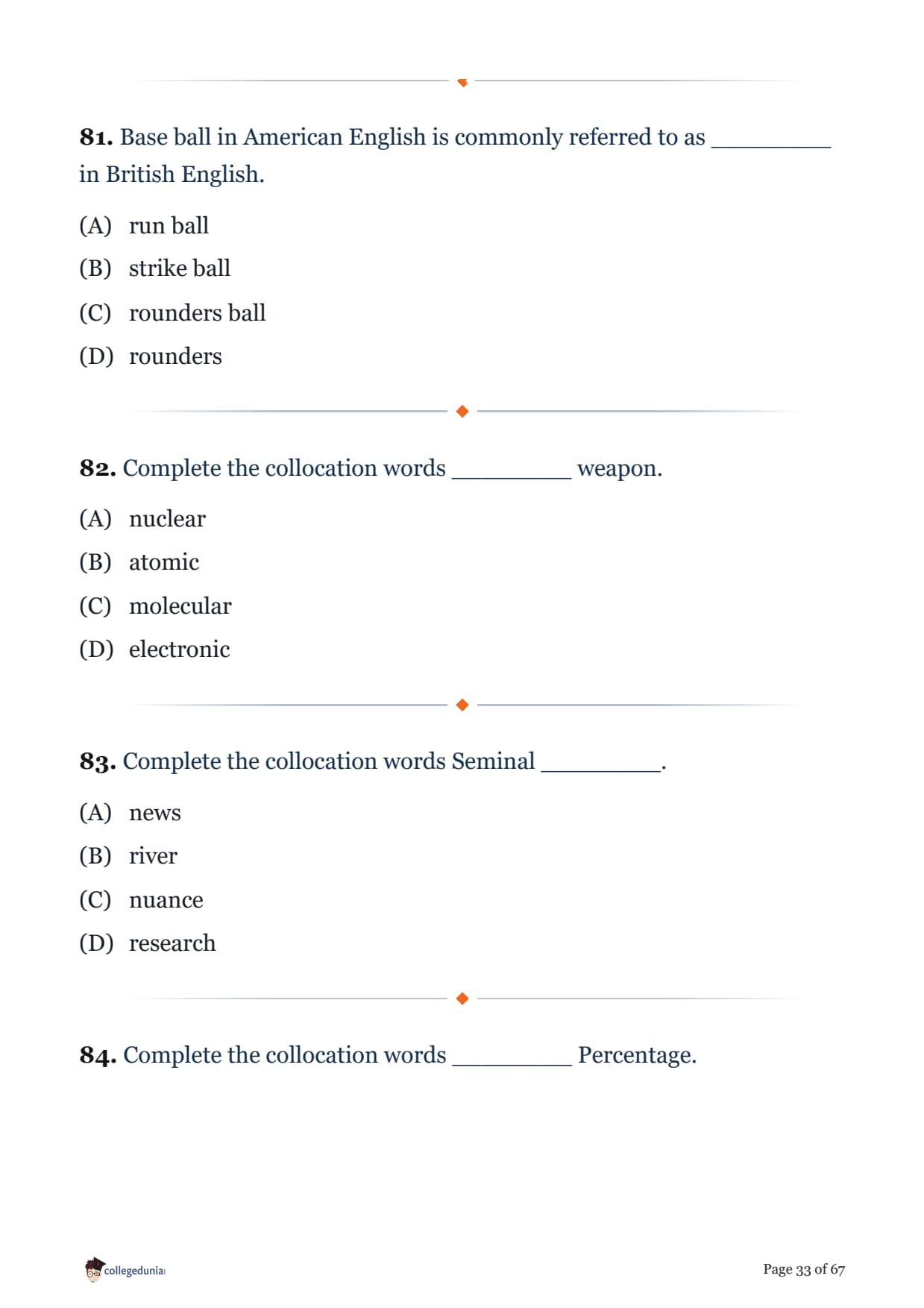
Base ball in American English is commonly referred to as ________ in British English.
Complete the collocation words ________ weapon.
Complete the collocation words Seminal ________.
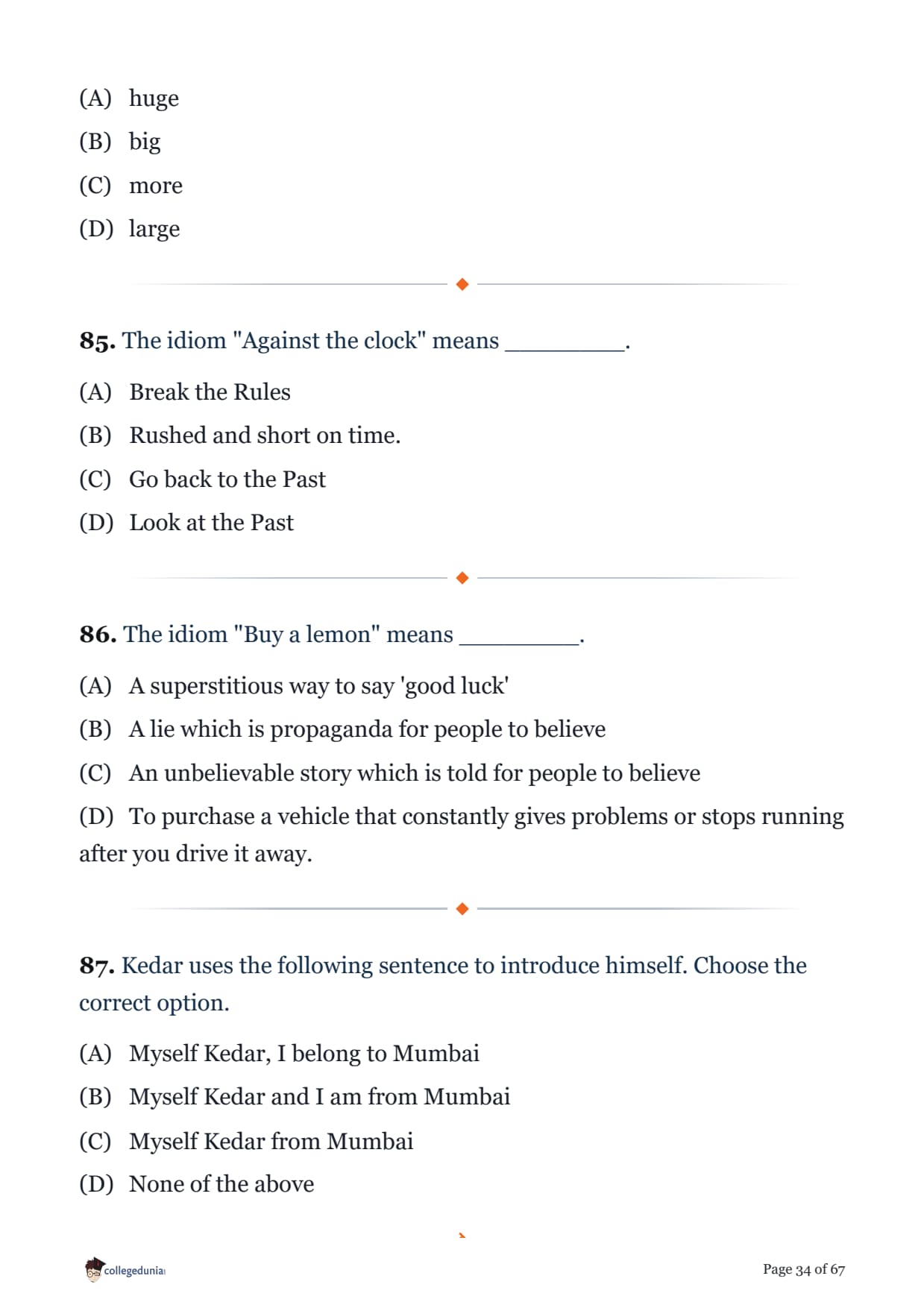
Complete the collocation words ________ Percentage.
The idiom "Against the clock" means ________.
The idiom "Buy a lemon" means ________.
Kedar uses the following sentence to introduce himself. Choose the correct option.
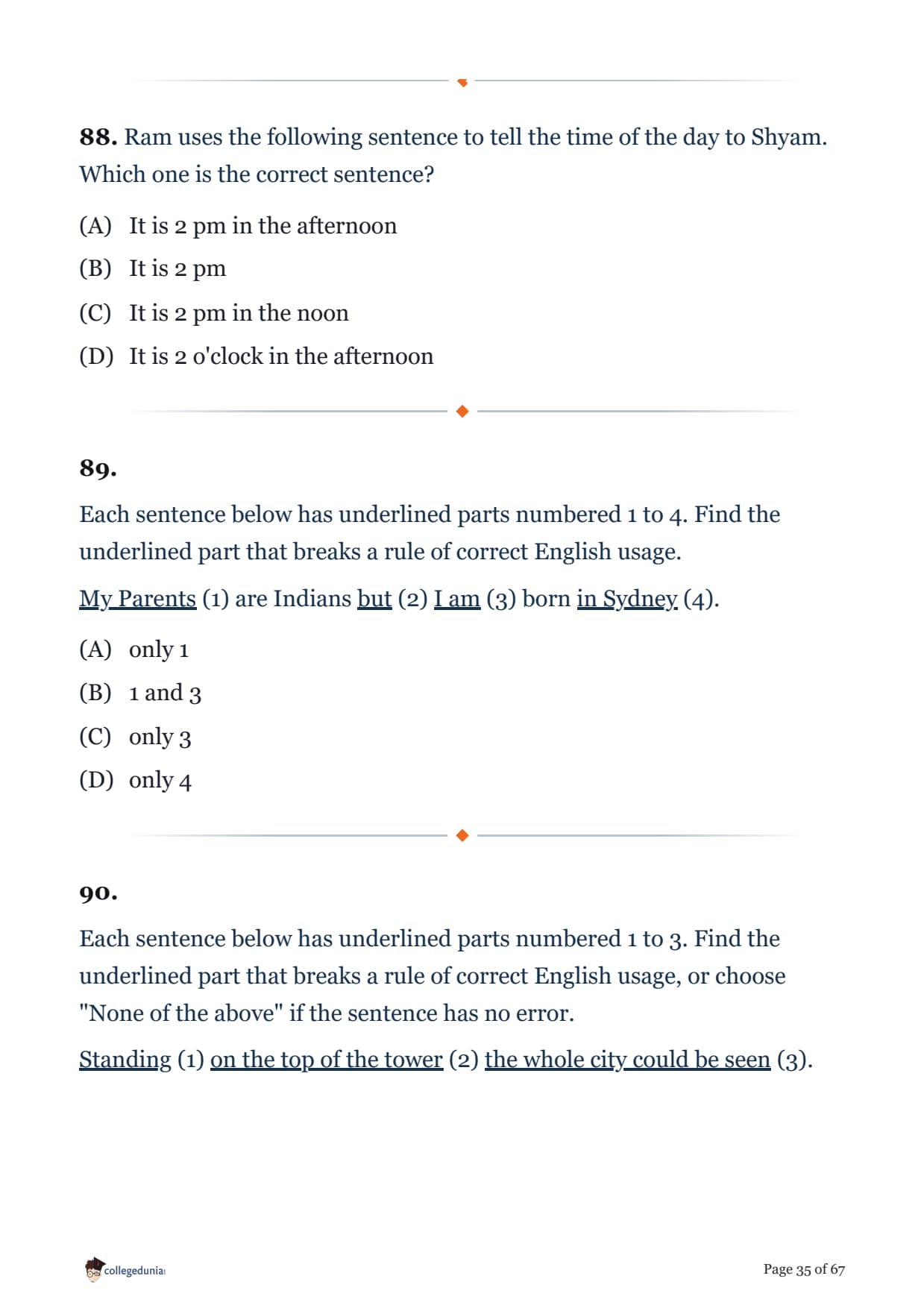
Ram uses the following sentence to tell the time of the day to Shyam. Which one is the correct sentence?
Each sentence below has underlined parts numbered 1 to 4. Find the underlined part that breaks a rule of correct English usage.
My Parents (1) are Indians but (2) I am (3) born in Sydney (4).
Each sentence below has underlined parts numbered 1 to 3. Find the underlined part that breaks a rule of correct English usage, or choose "None of the above" if the sentence has no error.
Standing (1) on the top of the tower (2) the whole city could be seen (3).
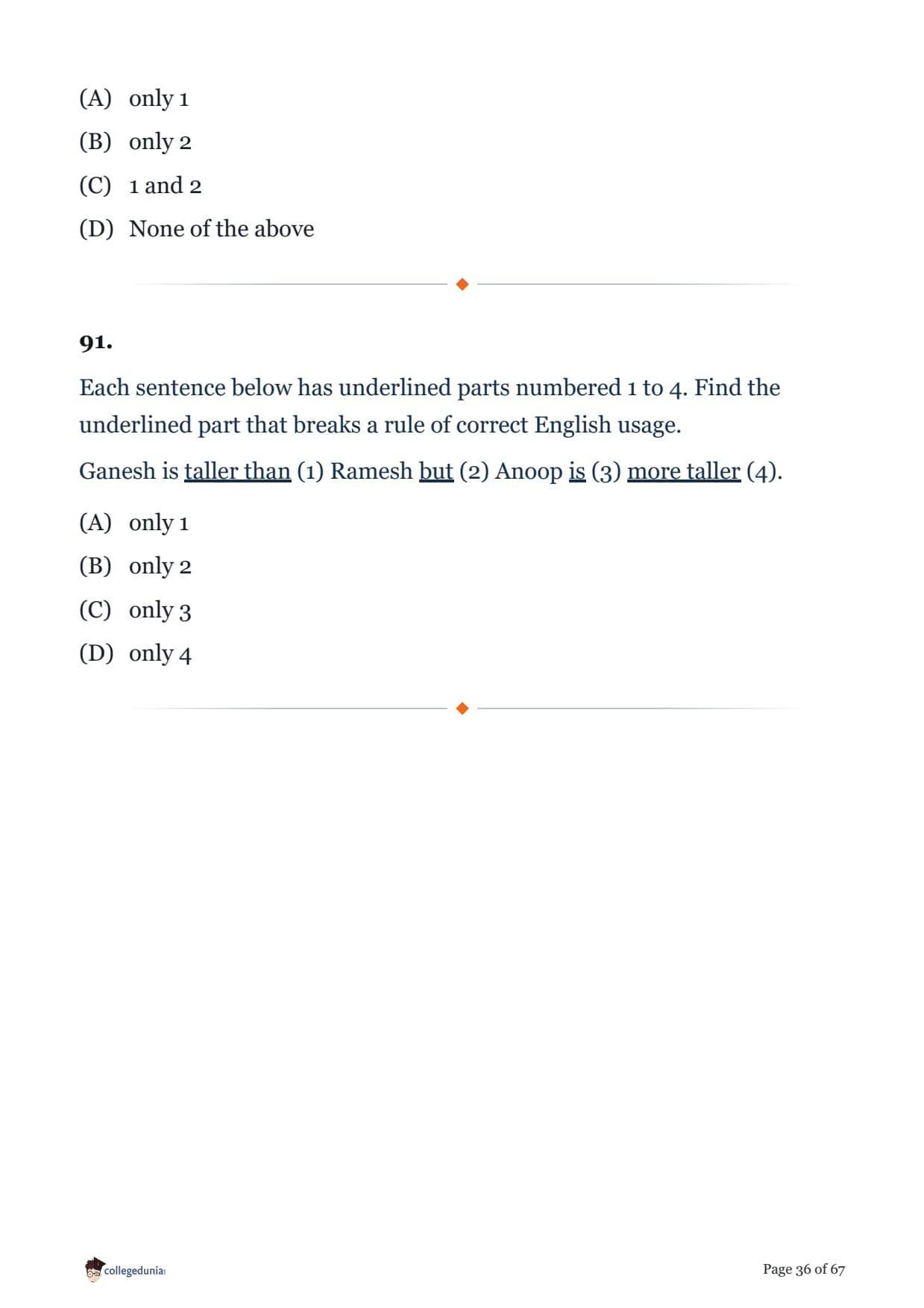
Each sentence below has underlined parts numbered 1 to 4. Find the underlined part that breaks a rule of correct English usage.
Ganesh is taller than (1) Ramesh but (2) Anoop is (3) more taller (4).
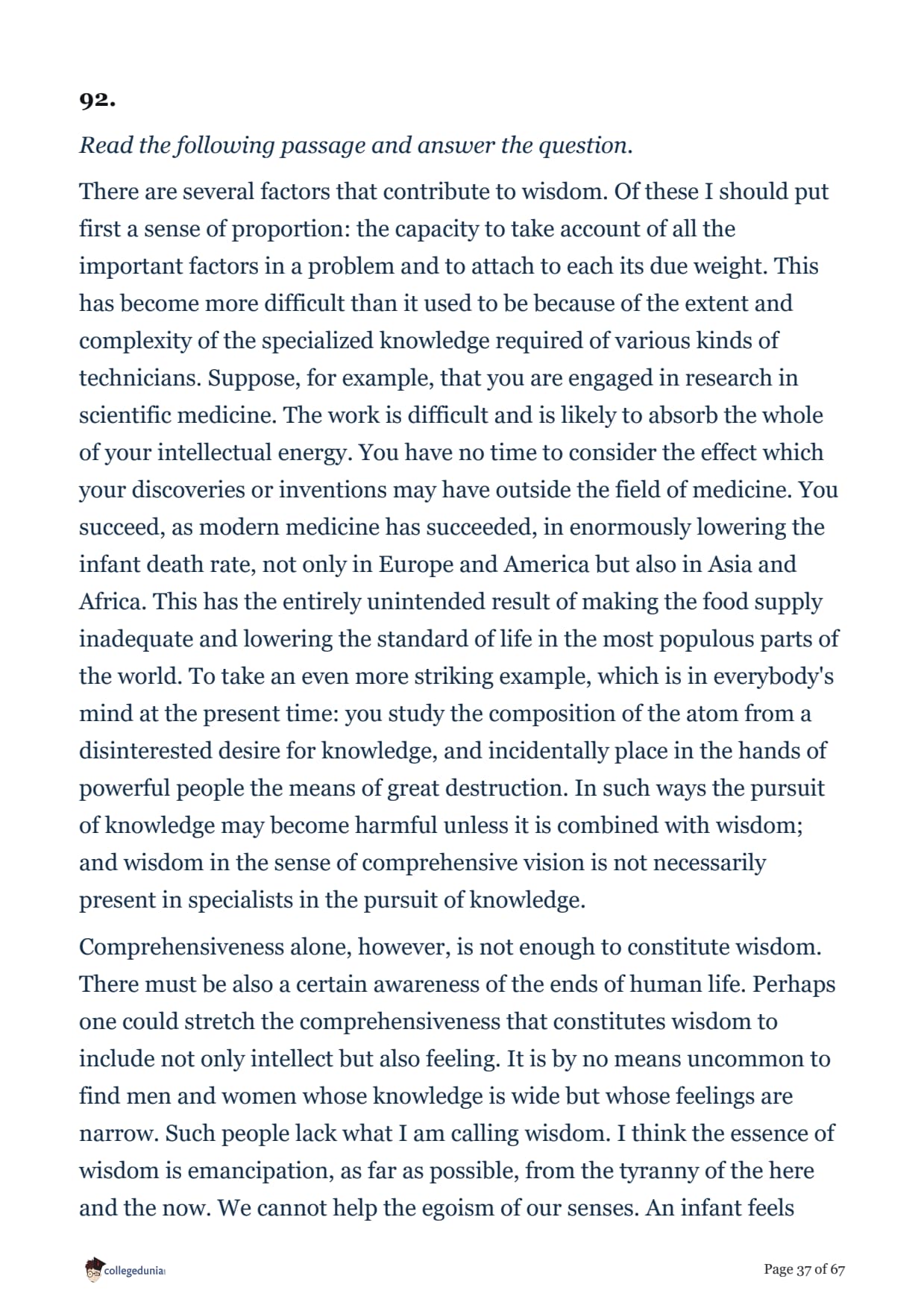
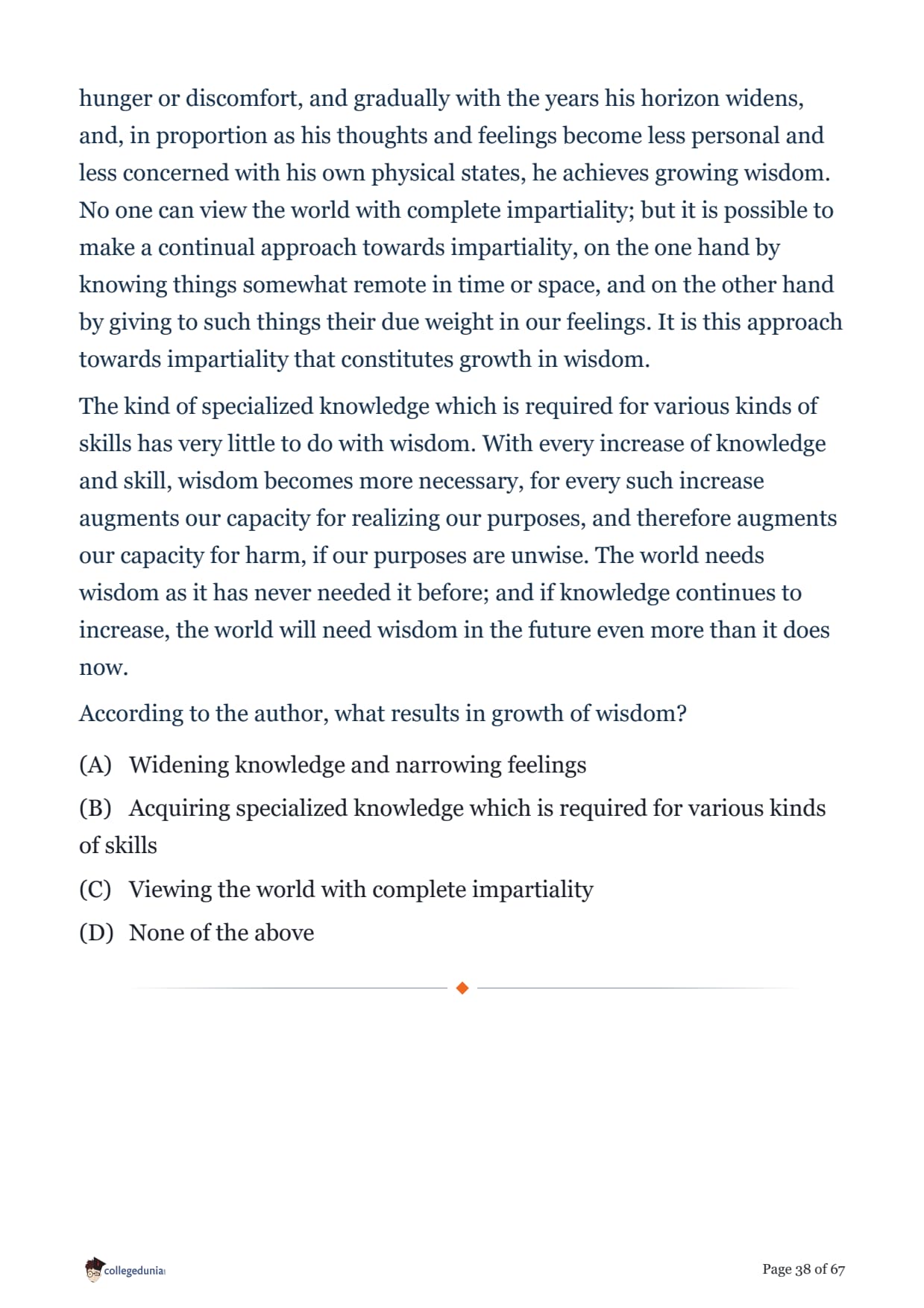
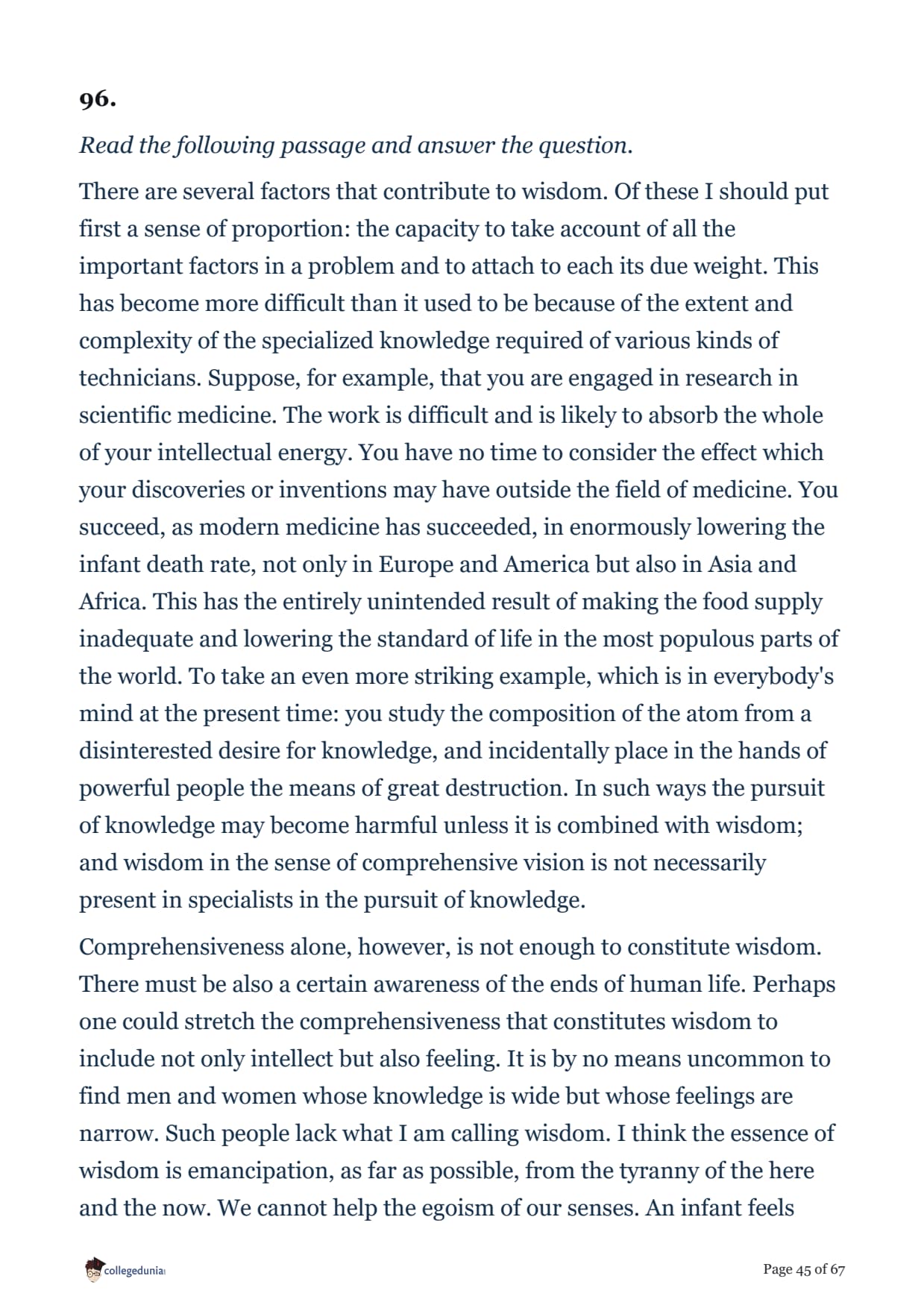
Read the following passage and answer the question.
There are several factors that contribute to wisdom. Of these I should put first a sense of proportion: the capacity to take account of all the important factors in a problem and to attach to each its due weight. This has become more difficult than it used to be because of the extent and complexity of the specialized knowledge required of various kinds of technicians. Suppose, for example, that you are engaged in research in scientific medicine. The work is difficult and is likely to absorb the whole of your intellectual energy. You have no time to consider the effect which your discoveries or inventions may have outside the field of medicine. You succeed, as modern medicine has succeeded, in enormously lowering the infant death rate, not only in Europe and America but also in Asia and Africa. This has the entirely unintended result of making the food supply inadequate and lowering the standard of life in the most populous parts of the world. To take an even more striking example, which is in everybody's mind at the present time: you study the composition of the atom from a disinterested desire for knowledge, and incidentally place in the hands of powerful people the means of great destruction. In such ways the pursuit of knowledge may become harmful unless it is combined with wisdom; and wisdom in the sense of comprehensive vision is not necessarily present in specialists in the pursuit of knowledge.
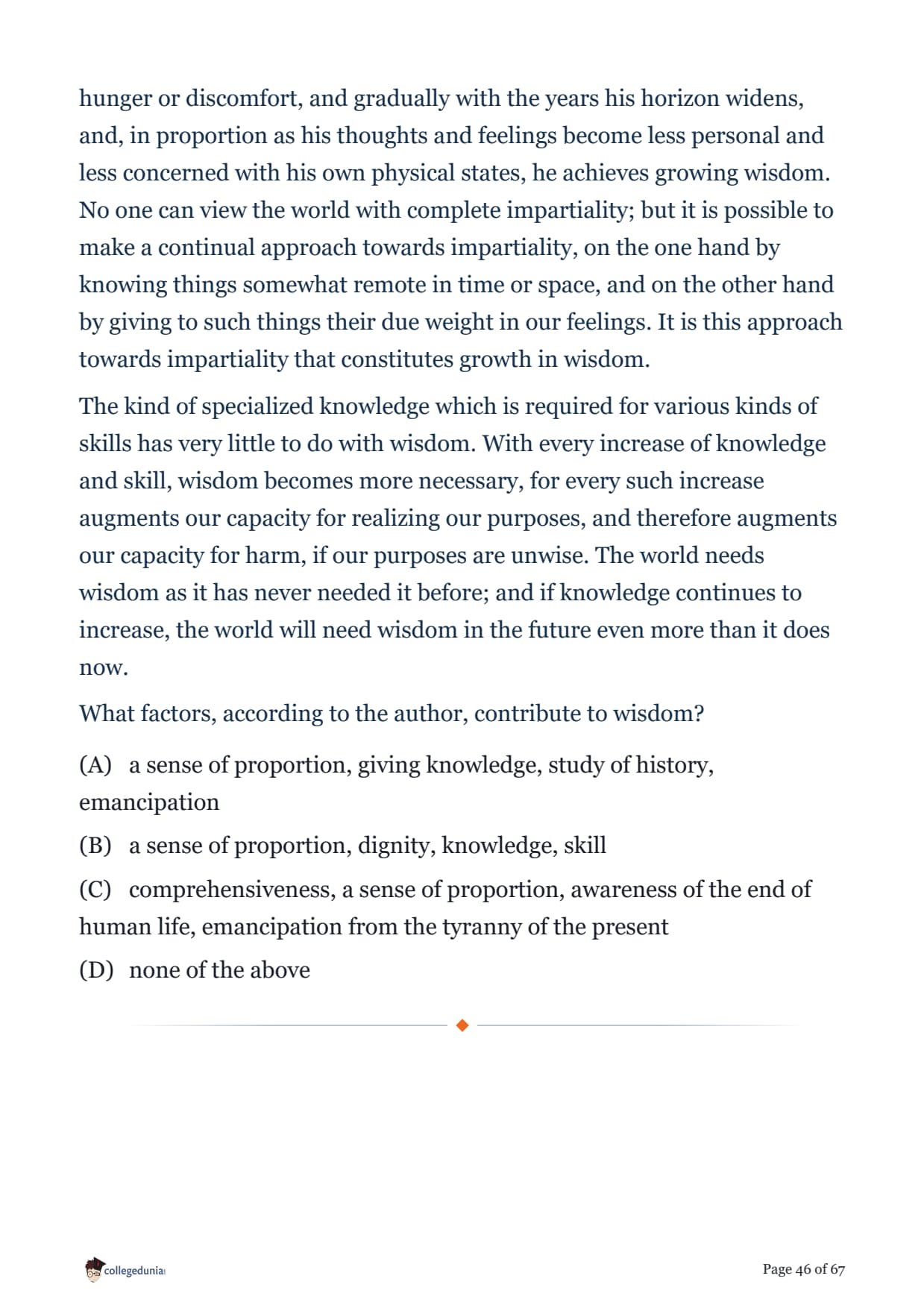
Comprehensiveness alone, however, is not enough to constitute wisdom. There must be also a certain awareness of the ends of human life. Perhaps one could stretch the comprehensiveness that constitutes wisdom to include not only intellect but also feeling. It is by no means uncommon to find men and women whose knowledge is wide but whose feelings are narrow. Such people lack what I am calling wisdom. I think the essence of wisdom is emancipation, as far as possible, from the tyranny of the here and the now. We cannot help the egoism of our senses. An infant feels hunger or discomfort, and gradually with the years his horizon widens, and, in proportion as his thoughts and feelings become less personal and less concerned with his own physical states, he achieves growing wisdom. No one can view the world with complete impartiality; but it is possible to make a continual approach towards impartiality, on the one hand by knowing things somewhat remote in time or space, and on the other hand by giving to such things their due weight in our feelings. It is this approach towards impartiality that constitutes growth in wisdom.
The kind of specialized knowledge which is required for various kinds of skills has very little to do with wisdom. With every increase of knowledge and skill, wisdom becomes more necessary, for every such increase augments our capacity for realizing our purposes, and therefore augments our capacity for harm, if our purposes are unwise. The world needs wisdom as it has never needed it before; and if knowledge continues to increase, the world will need wisdom in the future even more than it does now.
According to the author, what results in growth of wisdom?
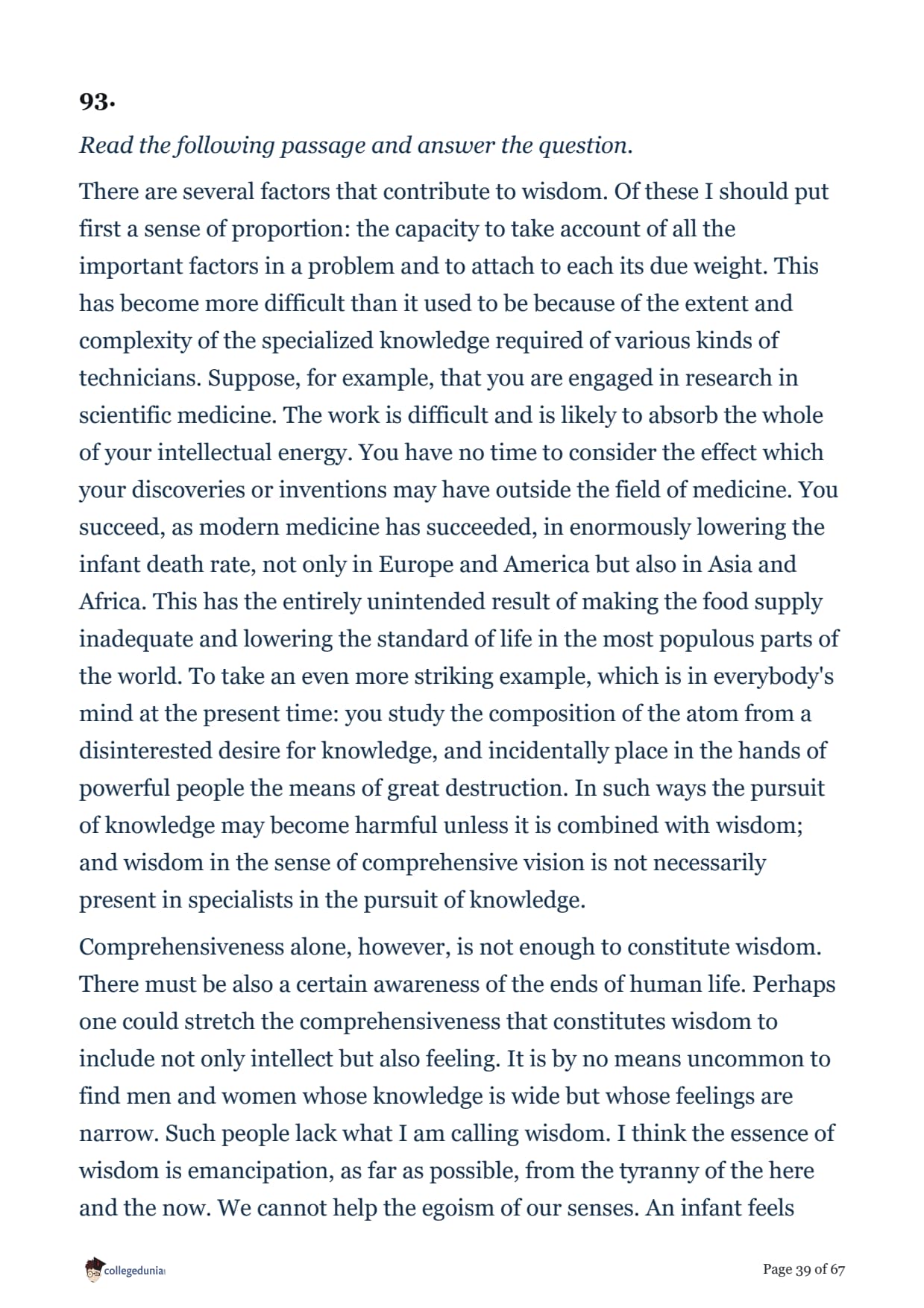
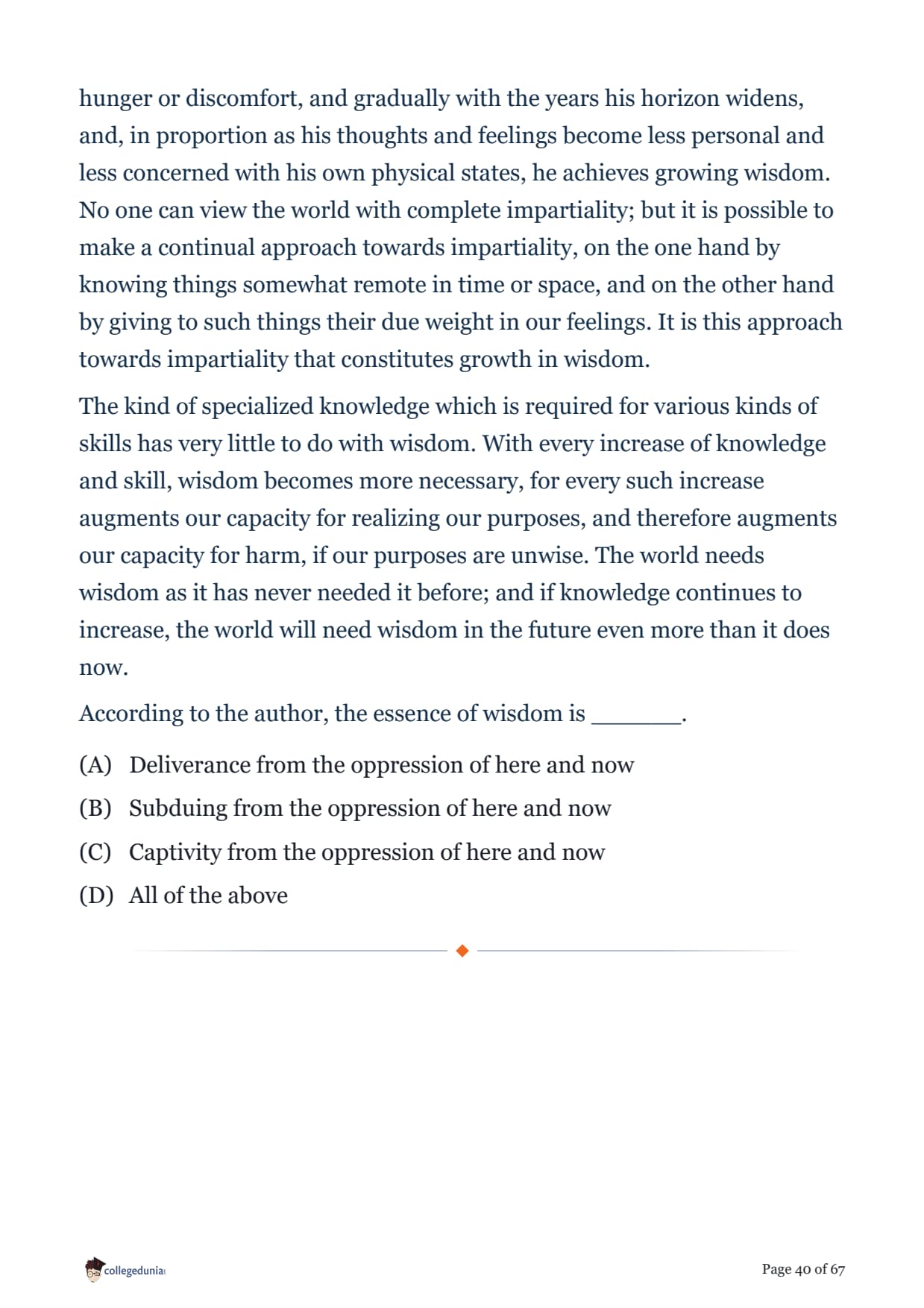
Read the following passage and answer the question.
There are several factors that contribute to wisdom. Of these I should put first a sense of proportion: the capacity to take account of all the important factors in a problem and to attach to each its due weight. This has become more difficult than it used to be because of the extent and complexity of the specialized knowledge required of various kinds of technicians. Suppose, for example, that you are engaged in research in scientific medicine. The work is difficult and is likely to absorb the whole of your intellectual energy. You have no time to consider the effect which your discoveries or inventions may have outside the field of medicine. You succeed, as modern medicine has succeeded, in enormously lowering the infant death rate, not only in Europe and America but also in Asia and Africa. This has the entirely unintended result of making the food supply inadequate and lowering the standard of life in the most populous parts of the world. To take an even more striking example, which is in everybody's mind at the present time: you study the composition of the atom from a disinterested desire for knowledge, and incidentally place in the hands of powerful people the means of great destruction. In such ways the pursuit of knowledge may become harmful unless it is combined with wisdom; and wisdom in the sense of comprehensive vision is not necessarily present in specialists in the pursuit of knowledge.
Comprehensiveness alone, however, is not enough to constitute wisdom. There must be also a certain awareness of the ends of human life. Perhaps one could stretch the comprehensiveness that constitutes wisdom to include not only intellect but also feeling. It is by no means uncommon to find men and women whose knowledge is wide but whose feelings are narrow. Such people lack what I am calling wisdom. I think the essence of wisdom is emancipation, as far as possible, from the tyranny of the here and the now. We cannot help the egoism of our senses. An infant feels hunger or discomfort, and gradually with the years his horizon widens, and, in proportion as his thoughts and feelings become less personal and less concerned with his own physical states, he achieves growing wisdom. No one can view the world with complete impartiality; but it is possible to make a continual approach towards impartiality, on the one hand by knowing things somewhat remote in time or space, and on the other hand by giving to such things their due weight in our feelings. It is this approach towards impartiality that constitutes growth in wisdom.
The kind of specialized knowledge which is required for various kinds of skills has very little to do with wisdom. With every increase of knowledge and skill, wisdom becomes more necessary, for every such increase augments our capacity for realizing our purposes, and therefore augments our capacity for harm, if our purposes are unwise. The world needs wisdom as it has never needed it before; and if knowledge continues to increase, the world will need wisdom in the future even more than it does now.
According to the author, the essence of wisdom is ______.
Read the following passage and answer the question.
There are several factors that contribute to wisdom. Of these I should put first a sense of proportion: the capacity to take account of all the important factors in a problem and to attach to each its due weight. This has become more difficult than it used to be because of the extent and complexity of the specialized knowledge required of various kinds of technicians. Suppose, for example, that you are engaged in research in scientific medicine. The work is difficult and is likely to absorb the whole of your intellectual energy. You have no time to consider the effect which your discoveries or inventions may have outside the field of medicine. You succeed, as modern medicine has succeeded, in enormously lowering the infant death rate, not only in Europe and America but also in Asia and Africa. This has the entirely unintended result of making the food supply inadequate and lowering the standard of life in the most populous parts of the world. To take an even more striking example, which is in everybody's mind at the present time: you study the composition of the atom from a disinterested desire for knowledge, and incidentally place in the hands of powerful people the means of great destruction. In such ways the pursuit of knowledge may become harmful unless it is combined with wisdom; and wisdom in the sense of comprehensive vision is not necessarily present in specialists in the pursuit of knowledge.
Comprehensiveness alone, however, is not enough to constitute wisdom. There must be also a certain awareness of the ends of human life. Perhaps one could stretch the comprehensiveness that constitutes wisdom to include not only intellect but also feeling. It is by no means uncommon to find men and women whose knowledge is wide but whose feelings are narrow. Such people lack what I am calling wisdom. I think the essence of wisdom is emancipation, as far as possible, from the tyranny of the here and the now. We cannot help the egoism of our senses. An infant feels hunger or discomfort, and gradually with the years his horizon widens, and, in proportion as his thoughts and feelings become less personal and less concerned with his own physical states, he achieves growing wisdom. No one can view the world with complete impartiality; but it is possible to make a continual approach towards impartiality, on the one hand by knowing things somewhat remote in time or space, and on the other hand by giving to such things their due weight in our feelings. It is this approach towards impartiality that constitutes growth in wisdom.
The kind of specialized knowledge which is required for various kinds of skills has very little to do with wisdom. With every increase of knowledge and skill, wisdom becomes more necessary, for every such increase augments our capacity for realizing our purposes, and therefore augments our capacity for harm, if our purposes are unwise. The world needs wisdom as it has never needed it before; and if knowledge continues to increase, the world will need wisdom in the future even more than it does now.
What, according to the author, is the relationship between knowledge and wisdom?
Read the following passage and answer the question.
There are several factors that contribute to wisdom. Of these I should put first a sense of proportion: the capacity to take account of all the important factors in a problem and to attach to each its due weight. This has become more difficult than it used to be because of the extent and complexity of the specialized knowledge required of various kinds of technicians. Suppose, for example, that you are engaged in research in scientific medicine. The work is difficult and is likely to absorb the whole of your intellectual energy. You have no time to consider the effect which your discoveries or inventions may have outside the field of medicine. You succeed, as modern medicine has succeeded, in enormously lowering the infant death rate, not only in Europe and America but also in Asia and Africa. This has the entirely unintended result of making the food supply inadequate and lowering the standard of life in the most populous parts of the world. To take an even more striking example, which is in everybody's mind at the present time: you study the composition of the atom from a disinterested desire for knowledge, and incidentally place in the hands of powerful people the means of great destruction. In such ways the pursuit of knowledge may become harmful unless it is combined with wisdom; and wisdom in the sense of comprehensive vision is not necessarily present in specialists in the pursuit of knowledge.
Comprehensiveness alone, however, is not enough to constitute wisdom. There must be also a certain awareness of the ends of human life. Perhaps one could stretch the comprehensiveness that constitutes wisdom to include not only intellect but also feeling. It is by no means uncommon to find men and women whose knowledge is wide but whose feelings are narrow. Such people lack what I am calling wisdom. I think the essence of wisdom is emancipation, as far as possible, from the tyranny of the here and the now. We cannot help the egoism of our senses. An infant feels hunger or discomfort, and gradually with the years his horizon widens, and, in proportion as his thoughts and feelings become less personal and less concerned with his own physical states, he achieves growing wisdom. No one can view the world with complete impartiality; but it is possible to make a continual approach towards impartiality, on the one hand by knowing things somewhat remote in time or space, and on the other hand by giving to such things their due weight in our feelings. It is this approach towards impartiality that constitutes growth in wisdom.
The kind of specialized knowledge which is required for various kinds of skills has very little to do with wisdom. With every increase of knowledge and skill, wisdom becomes more necessary, for every such increase augments our capacity for realizing our purposes, and therefore augments our capacity for harm, if our purposes are unwise. The world needs wisdom as it has never needed it before; and if knowledge continues to increase, the world will need wisdom in the future even more than it does now.
The example used by the author to explain the ways in which the pursuit of knowledge can be harmful, unless combined with wisdom, is
Read the following passage and answer the question.
There are several factors that contribute to wisdom. Of these I should put first a sense of proportion: the capacity to take account of all the important factors in a problem and to attach to each its due weight. This has become more difficult than it used to be because of the extent and complexity of the specialized knowledge required of various kinds of technicians. Suppose, for example, that you are engaged in research in scientific medicine. The work is difficult and is likely to absorb the whole of your intellectual energy. You have no time to consider the effect which your discoveries or inventions may have outside the field of medicine. You succeed, as modern medicine has succeeded, in enormously lowering the infant death rate, not only in Europe and America but also in Asia and Africa. This has the entirely unintended result of making the food supply inadequate and lowering the standard of life in the most populous parts of the world. To take an even more striking example, which is in everybody's mind at the present time: you study the composition of the atom from a disinterested desire for knowledge, and incidentally place in the hands of powerful people the means of great destruction. In such ways the pursuit of knowledge may become harmful unless it is combined with wisdom; and wisdom in the sense of comprehensive vision is not necessarily present in specialists in the pursuit of knowledge.
Comprehensiveness alone, however, is not enough to constitute wisdom. There must be also a certain awareness of the ends of human life. Perhaps one could stretch the comprehensiveness that constitutes wisdom to include not only intellect but also feeling. It is by no means uncommon to find men and women whose knowledge is wide but whose feelings are narrow. Such people lack what I am calling wisdom. I think the essence of wisdom is emancipation, as far as possible, from the tyranny of the here and the now. We cannot help the egoism of our senses. An infant feels hunger or discomfort, and gradually with the years his horizon widens, and, in proportion as his thoughts and feelings become less personal and less concerned with his own physical states, he achieves growing wisdom. No one can view the world with complete impartiality; but it is possible to make a continual approach towards impartiality, on the one hand by knowing things somewhat remote in time or space, and on the other hand by giving to such things their due weight in our feelings. It is this approach towards impartiality that constitutes growth in wisdom.
The kind of specialized knowledge which is required for various kinds of skills has very little to do with wisdom. With every increase of knowledge and skill, wisdom becomes more necessary, for every such increase augments our capacity for realizing our purposes, and therefore augments our capacity for harm, if our purposes are unwise. The world needs wisdom as it has never needed it before; and if knowledge continues to increase, the world will need wisdom in the future even more than it does now.
What factors, according to the author, contribute to wisdom?
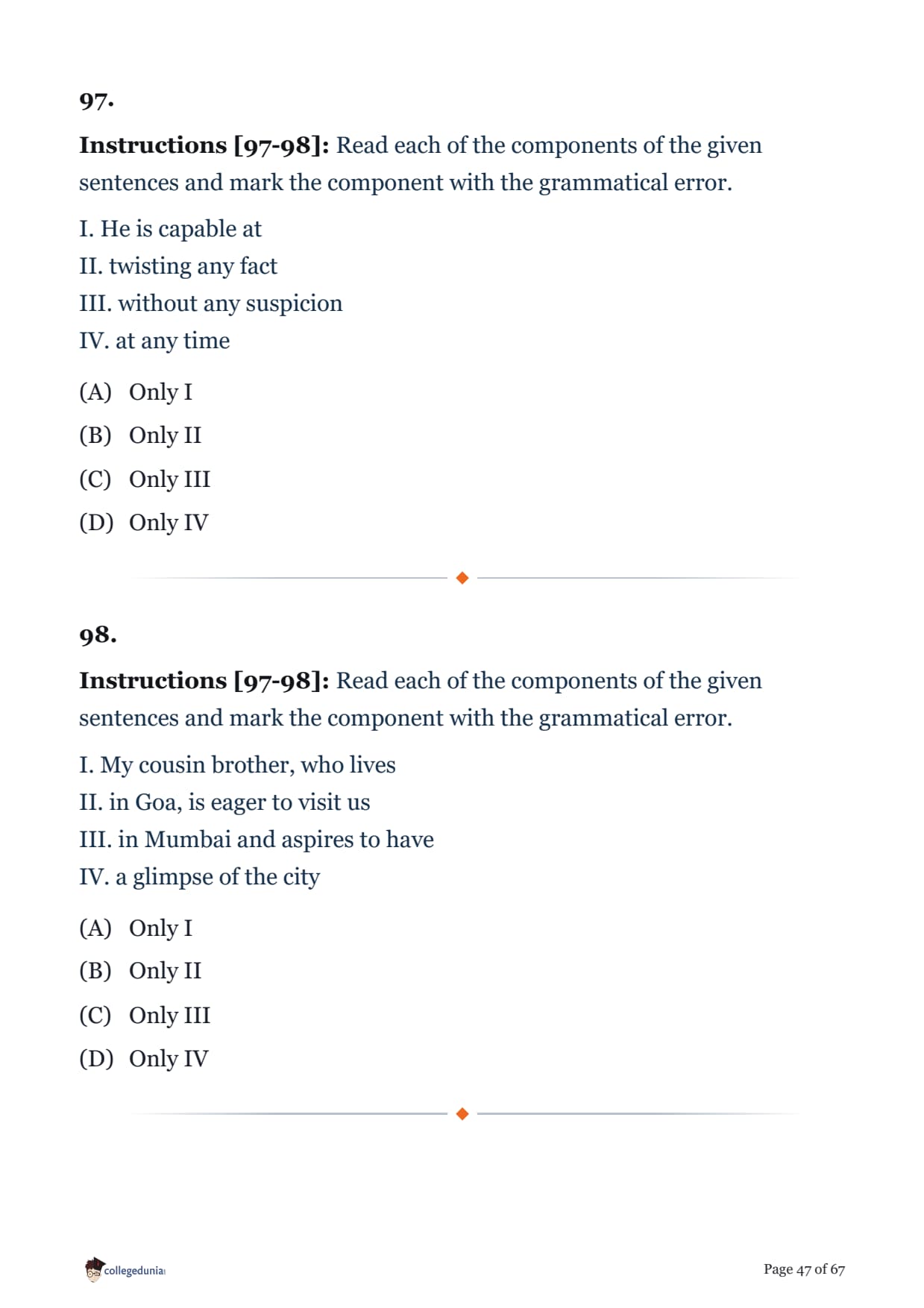
Instructions [97-98]: Read each of the components of the given sentences and mark the component with the grammatical error.
I. He is capable at
II. twisting any fact
III. without any suspicion
IV. at any time
Instructions [97-98]: Read each of the components of the given sentences and mark the component with the grammatical error.
I. My cousin brother, who lives
II. in Goa, is eager to visit us
III. in Mumbai and aspires to have
IV. a glimpse of the city
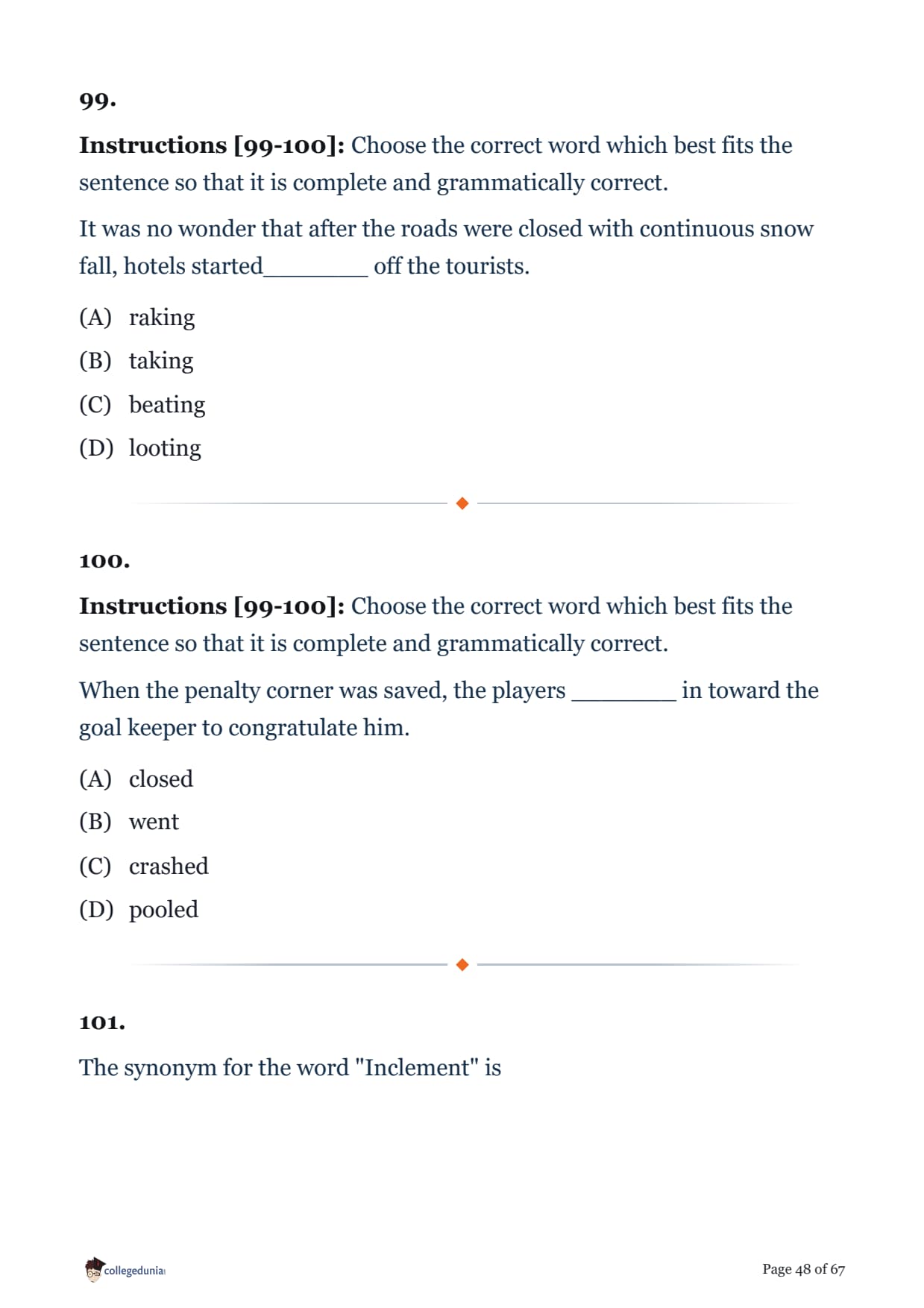
Instructions [99-100]: Choose the correct word which best fits the sentence so that it is complete and grammatically correct.
It was no wonder that after the roads were closed with continuous snow fall, hotels started_______ off the tourists.
Instructions [99-100]: Choose the correct word which best fits the sentence so that it is complete and grammatically correct.
When the penalty corner was saved, the players _______ in toward the goal keeper to congratulate him.
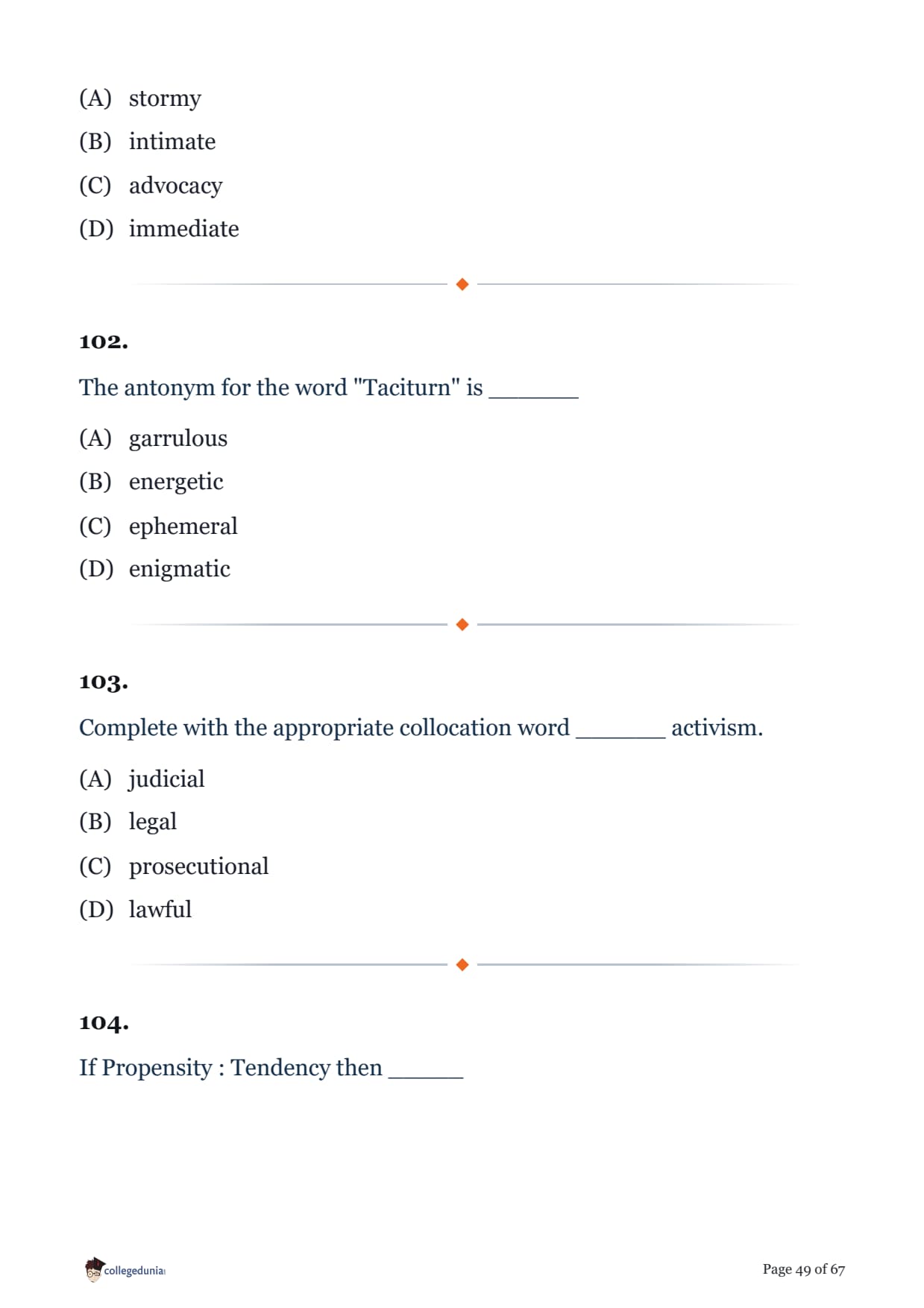
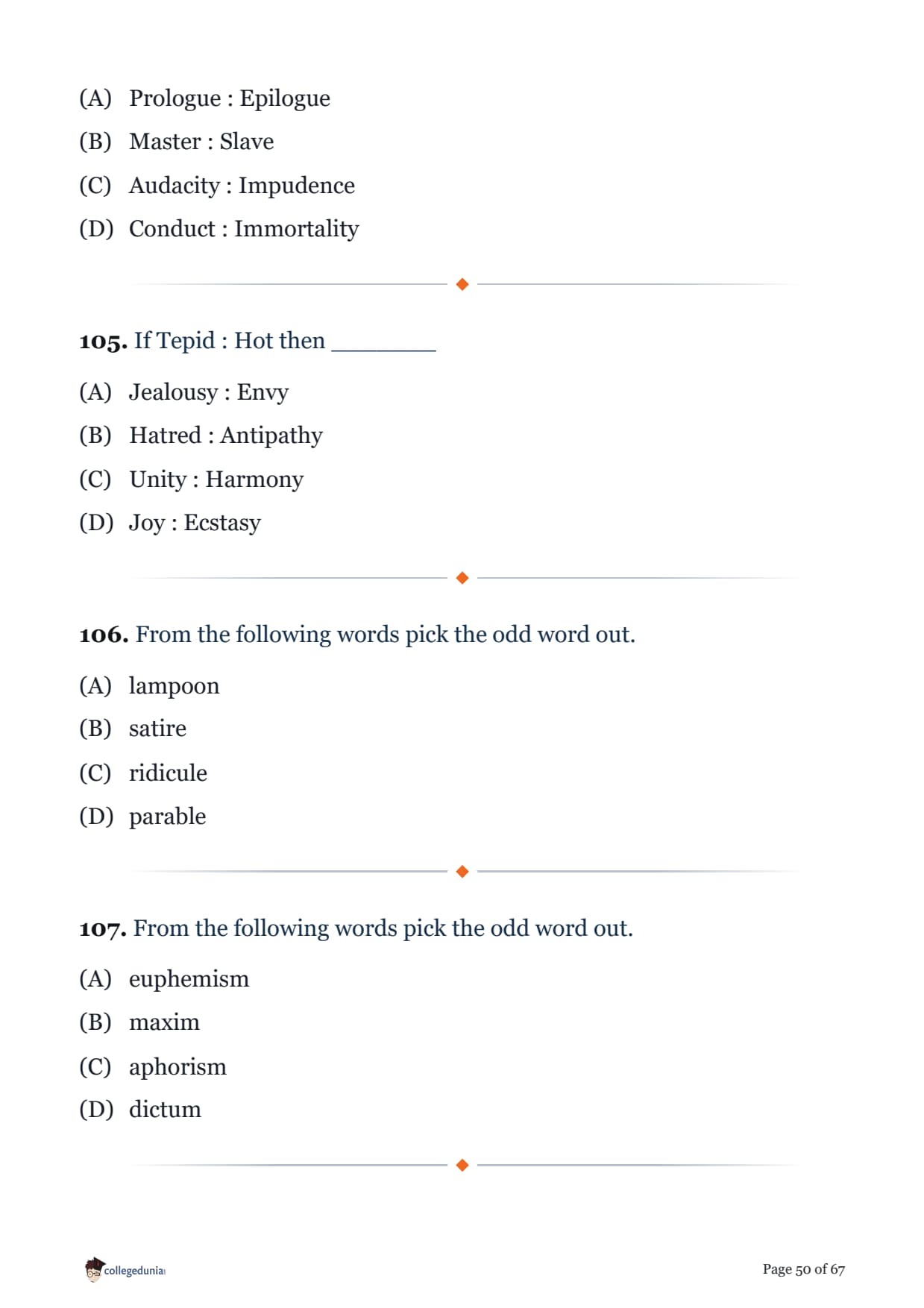
If Tepid : Hot then _______
From the following words pick the odd word out.
From the following words pick the odd word out.
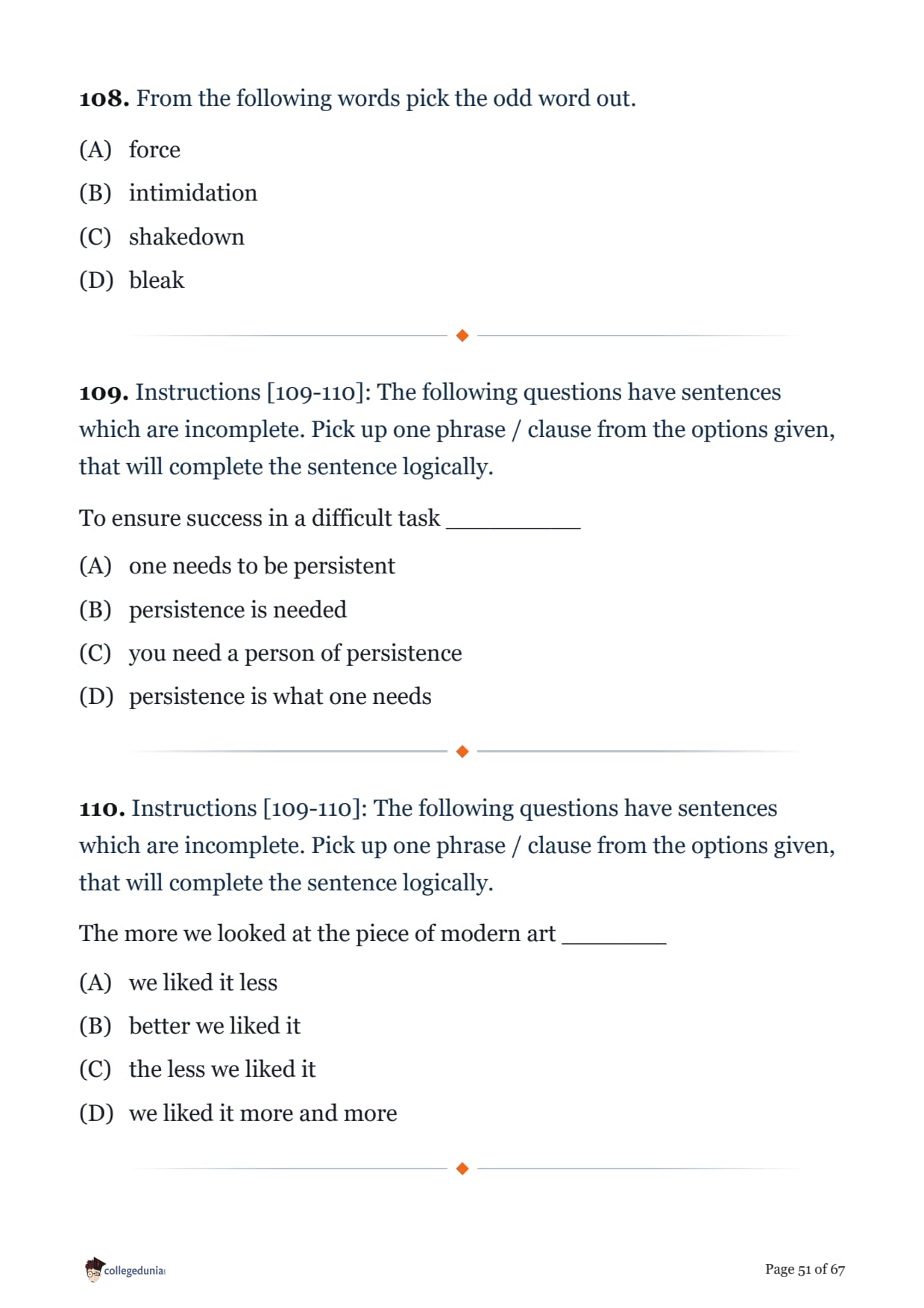
From the following words pick the odd word out.
Instructions [109-110]: The following questions have sentences which are incomplete. Pick up one phrase / clause from the options given, that will complete the sentence logically.
Instructions [109-110]: The following questions have sentences which are incomplete. Pick up one phrase / clause from the options given, that will complete the sentence logically.
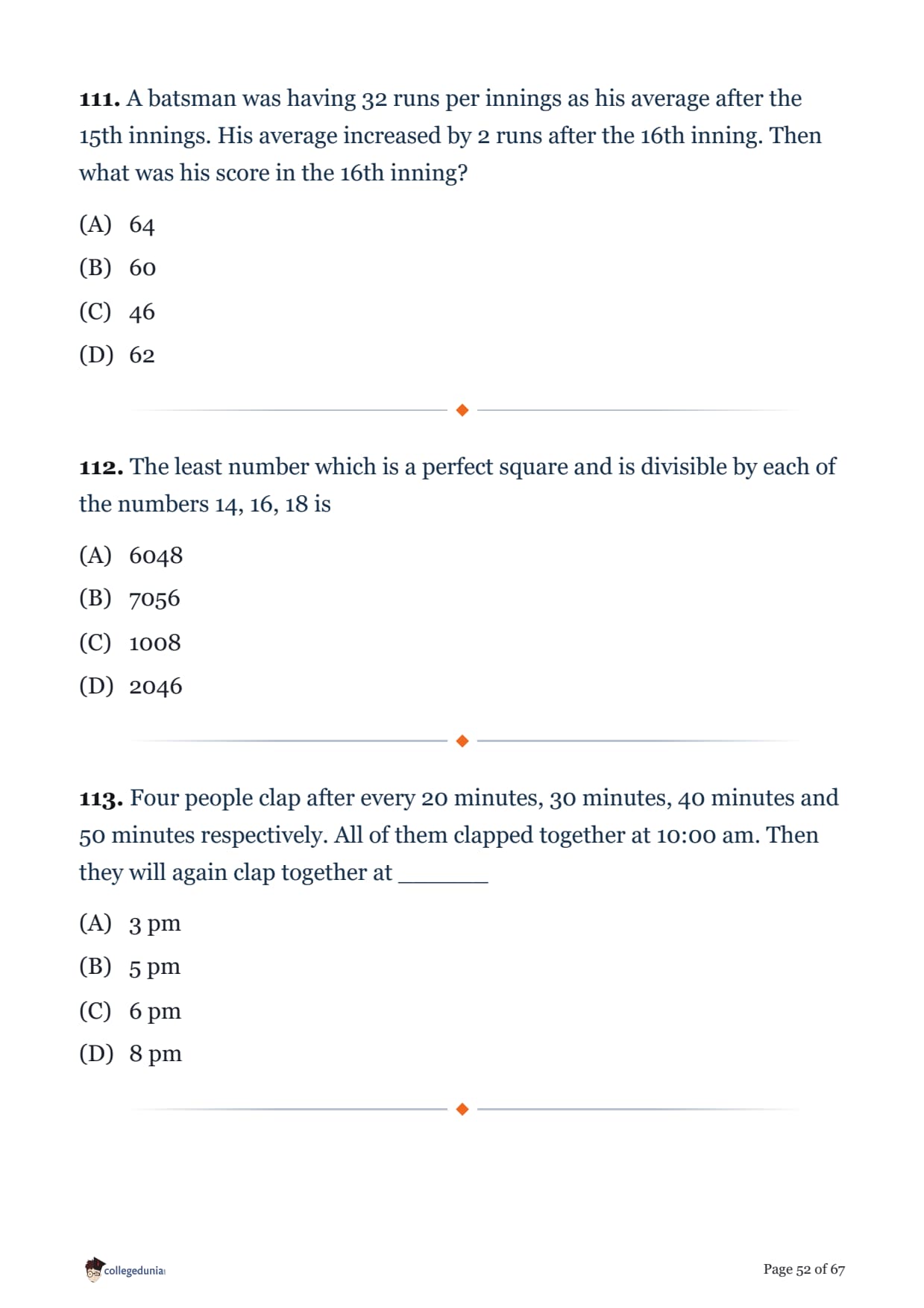
A batsman was having 32 runs per innings as his average after the 15th innings. His average increased by 2 runs after the 16th inning. Then what was his score in the 16th inning?
The least number which is a perfect square and is divisible by each of the numbers 14, 16, 18 is
Four people clap after every 20 minutes, 30 minutes, 40 minutes and 50 minutes respectively. All of them clapped together at 10:00 am. Then they will again clap together at ______
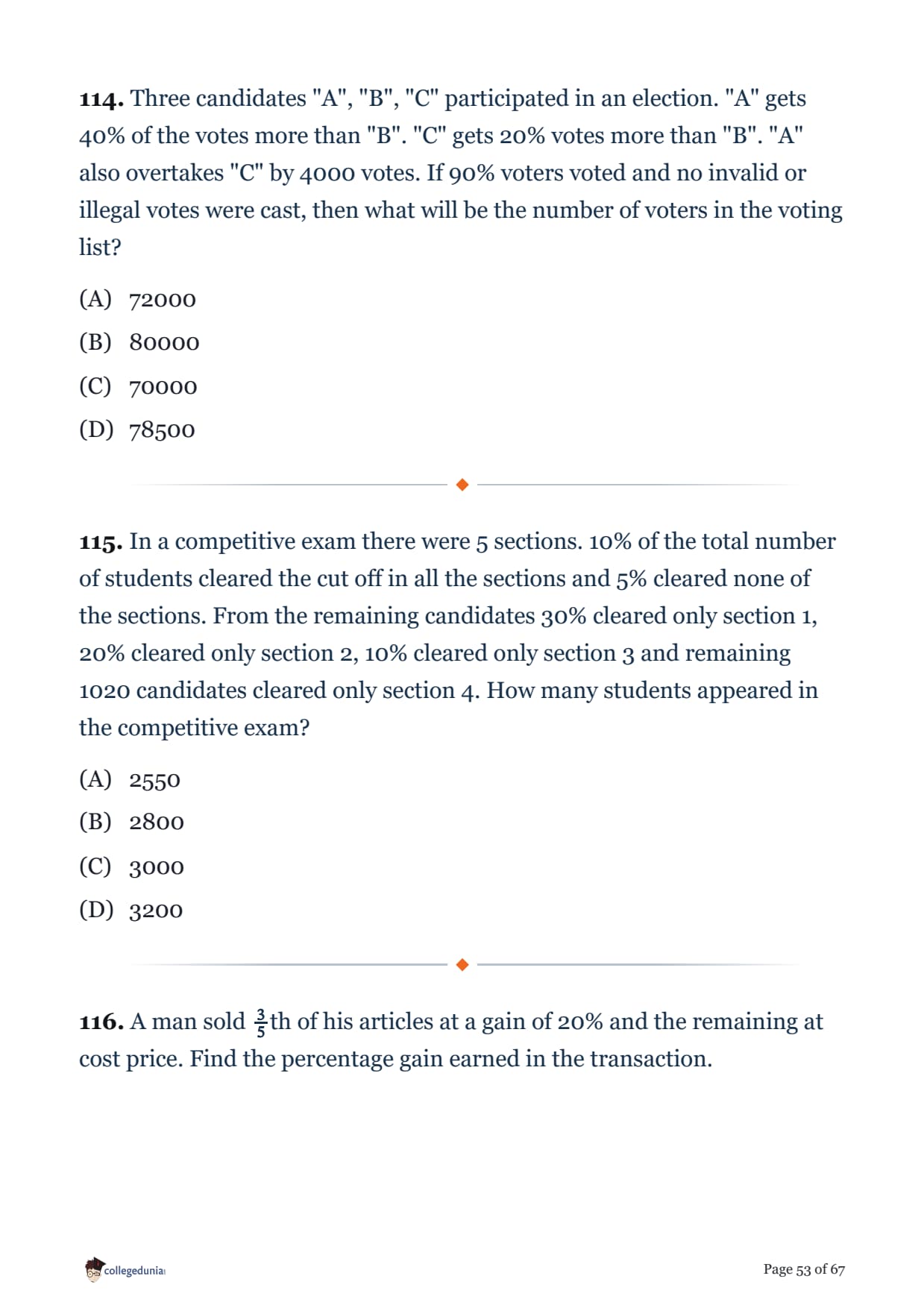
Three candidates "A", "B", "C" participated in an election. "A" gets 40% of the votes more than "B". "C" gets 20% votes more than "B". "A" also overtakes "C" by 4000 votes. If 90% voters voted and no invalid or illegal votes were cast, then what will be the number of voters in the voting list?
In a competitive exam there were 5 sections. 10% of the total number of students cleared the cut off in all the sections and 5% cleared none of the sections. From the remaining candidates 30% cleared only section 1, 20% cleared only section 2, 10% cleared only section 3 and remaining 1020 candidates cleared only section 4. How many students appeared in the competitive exam?
A man sold \(\frac{3}{5}\)th of his articles at a gain of 20% and the remaining at cost price. Find the percentage gain earned in the transaction.
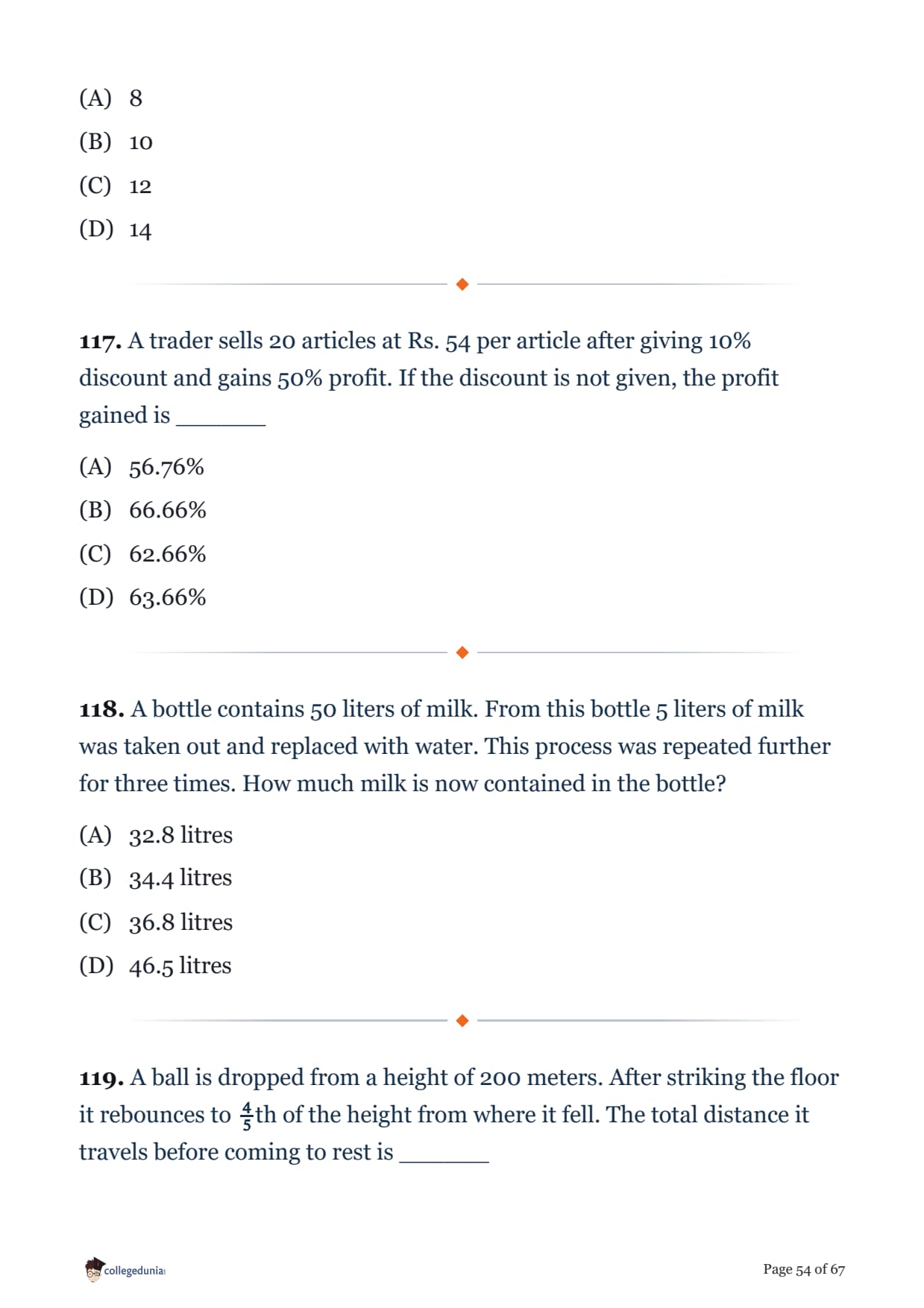
A trader sells 20 articles at Rs. 54 per article after giving 10% discount and gains 50% profit. If the discount is not given, the profit gained is ______
A bottle contains 50 liters of milk. From this bottle 5 liters of milk was taken out and replaced with water. This process was repeated further for three times. How much milk is now contained in the bottle?
A ball is dropped from a height of 200 meters. After striking the floor it rebounces to \(\frac{4}{5}\)th of the height from where it fell. The total distance it travels before coming to rest is ______
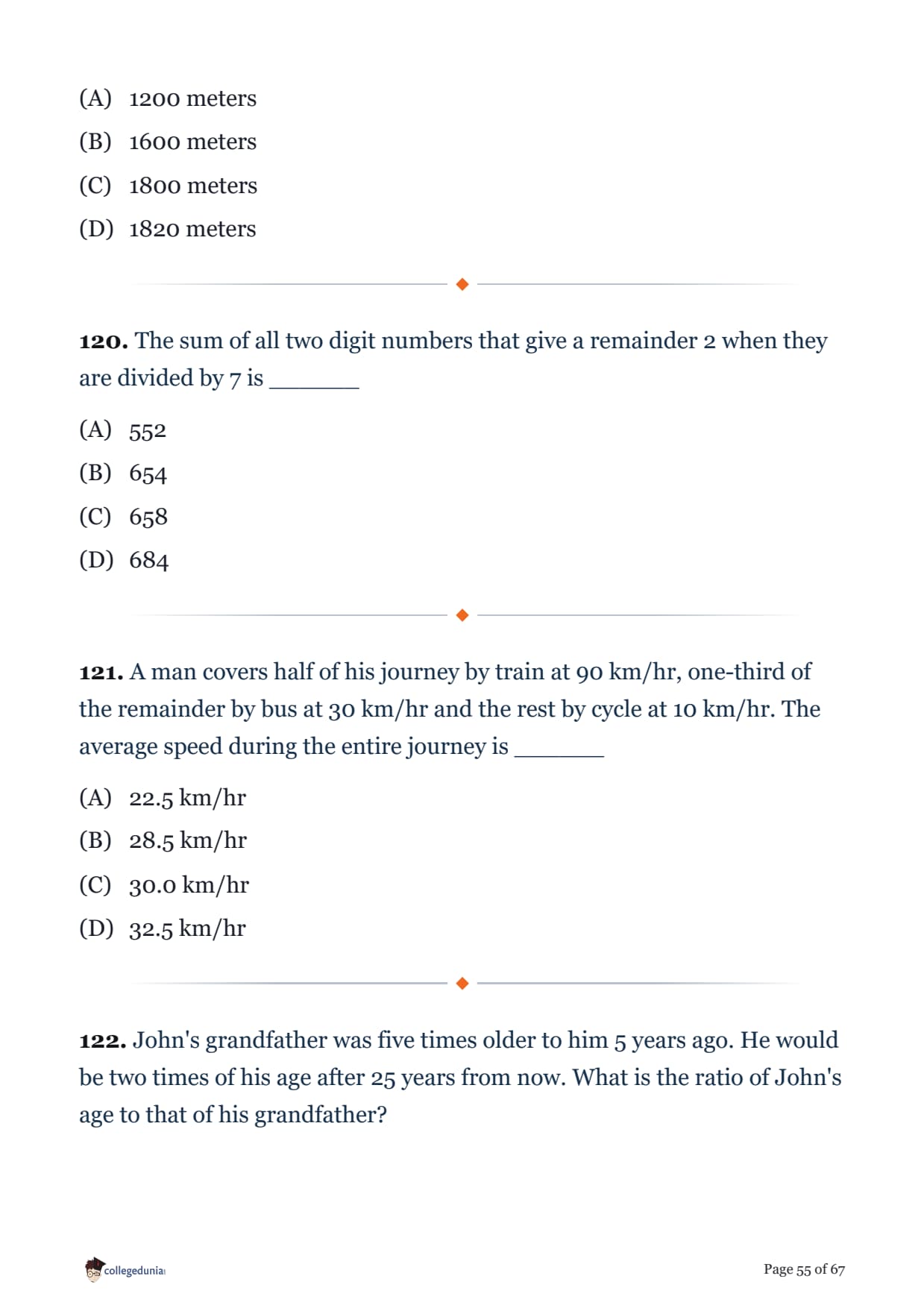
The sum of all two digit numbers that give a remainder 2 when they are divided by 7 is ______
A man covers half of his journey by train at 90 km/hr, one-third of the remainder by bus at 30 km/hr and the rest by cycle at 10 km/hr. The average speed during the entire journey is ______
John's grandfather was five times older to him 5 years ago. He would be two times of his age after 25 years from now. What is the ratio of John's age to that of his grandfather?
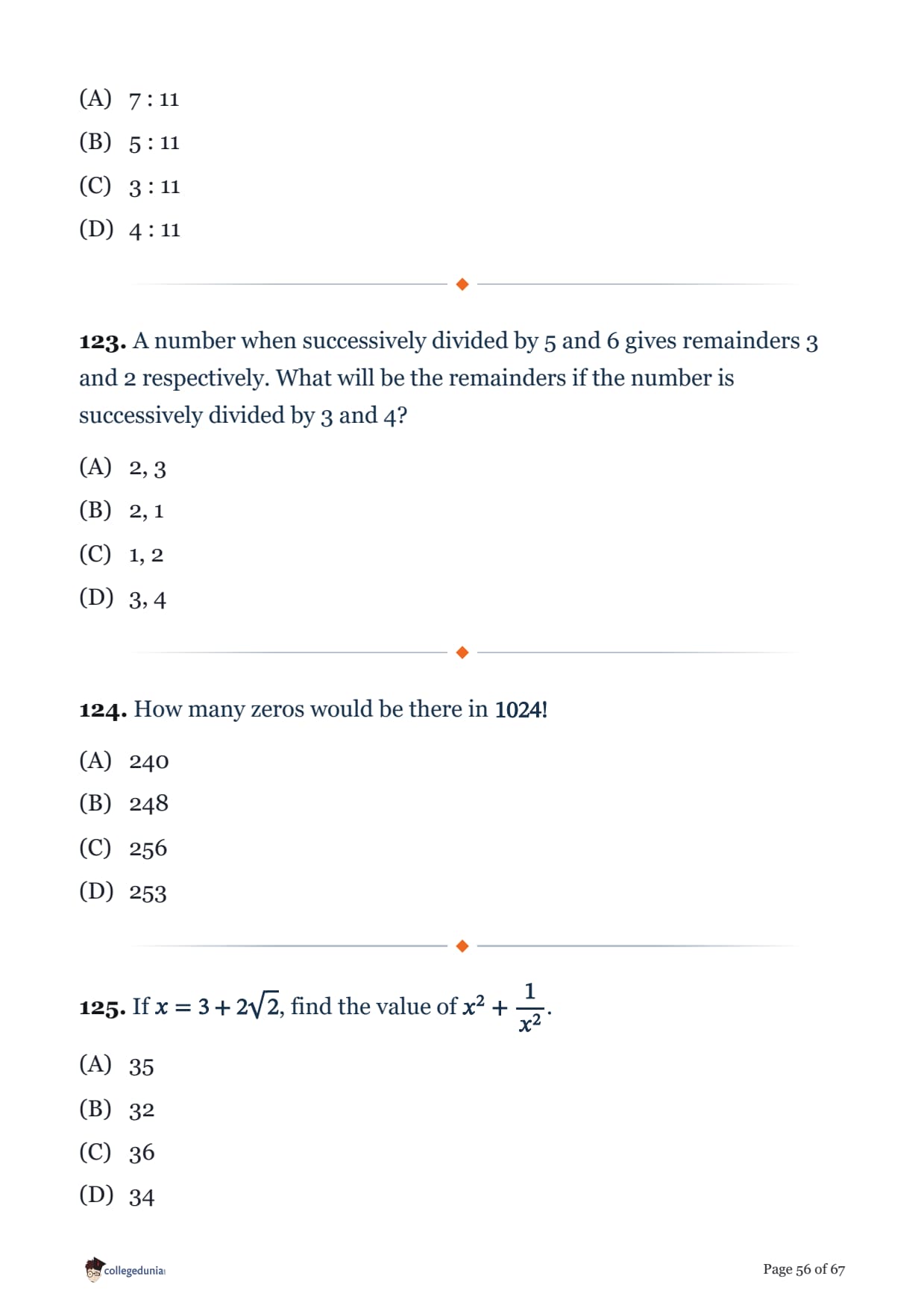
A number when successively divided by 5 and 6 gives remainders 3 and 2 respectively. What will be the remainders if the number is successively divided by 3 and 4?
How many zeros would be there in \(1024!\)
If \(x = 3 + 2\sqrt{2}\), find the value of \(x^2 + \dfrac{1}{x^2}\).
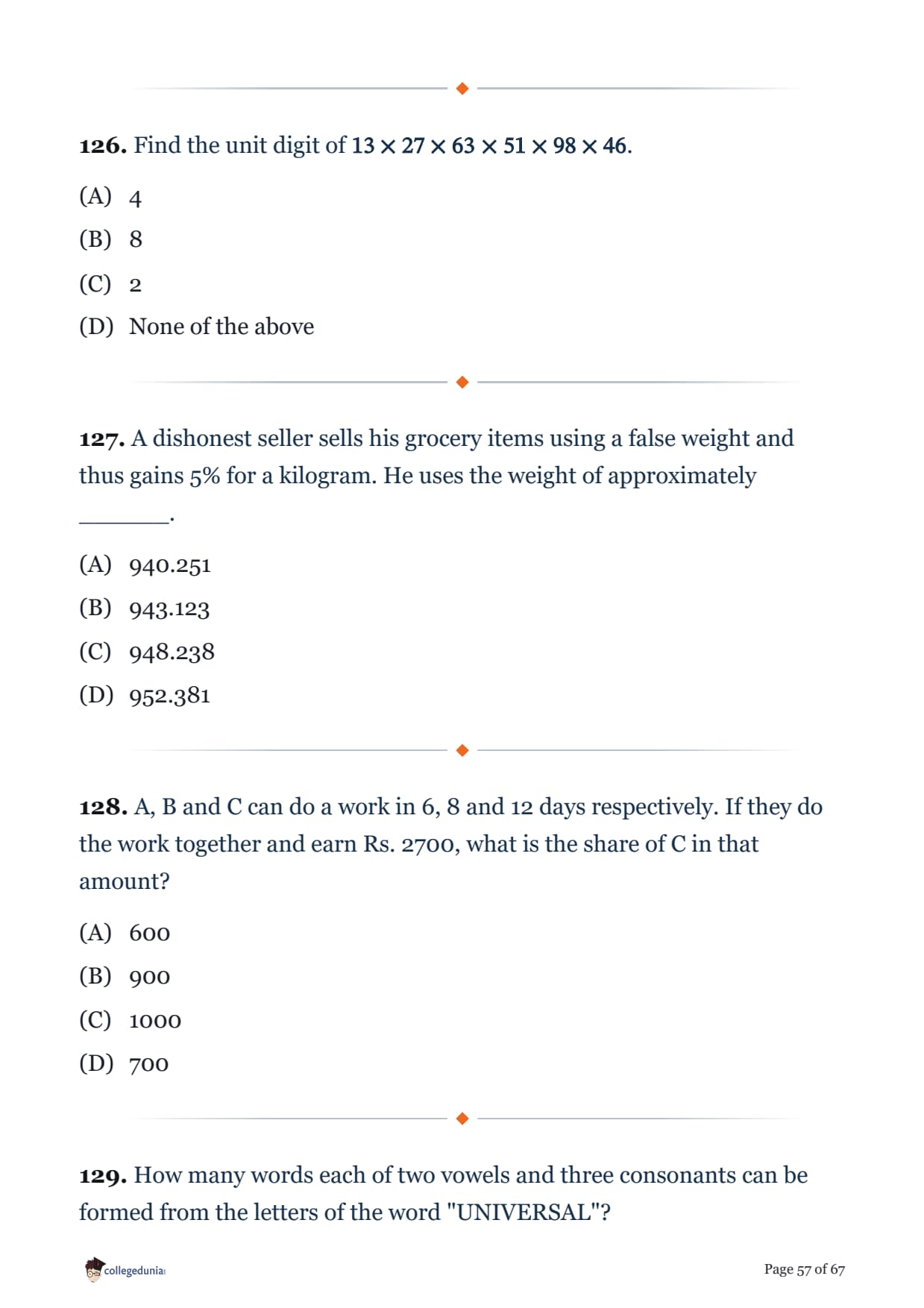
Find the unit digit of \(13 \times 27 \times 63 \times 51 \times 98 \times 46\).
A dishonest seller sells his grocery items using a false weight and thus gains 5% for a kilogram. He uses the weight of approximately ______.
A, B and C can do a work in 6, 8 and 12 days respectively. If they do the work together and earn Rs. 2700, what is the share of C in that amount?
How many words each of two vowels and three consonants can be formed from the letters of the word "UNIVERSAL"?
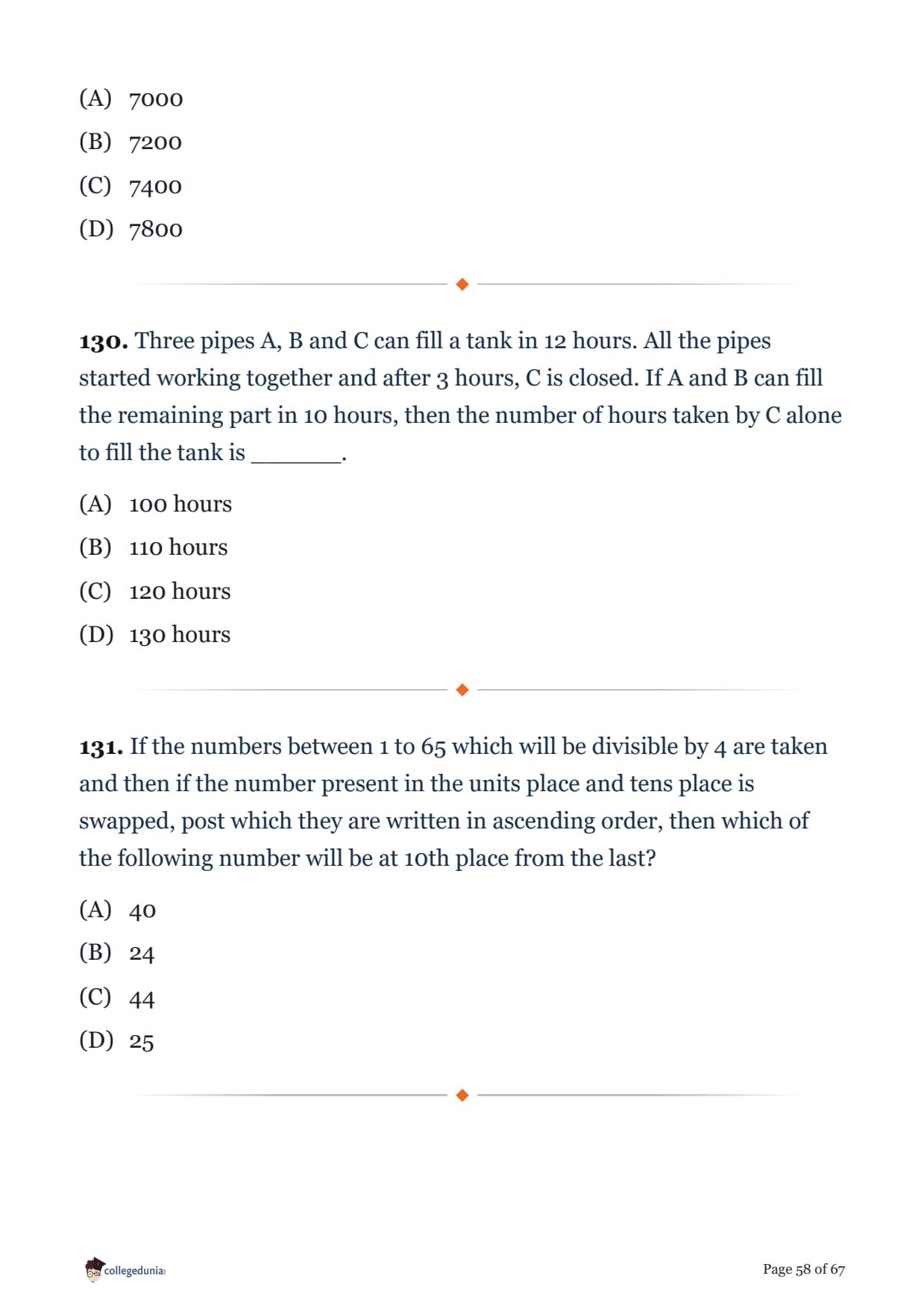
Three pipes A, B and C can fill a tank in 12 hours. All the pipes started working together and after 3 hours, C is closed. If A and B can fill the remaining part in 10 hours, then the number of hours taken by C alone to fill the tank is ______.
If the numbers between 1 to 65 which will be divisible by 4 are taken and then if the number present in the units place and tens place is swapped, post which they are written in ascending order, then which of the following number will be at 10th place from the last?
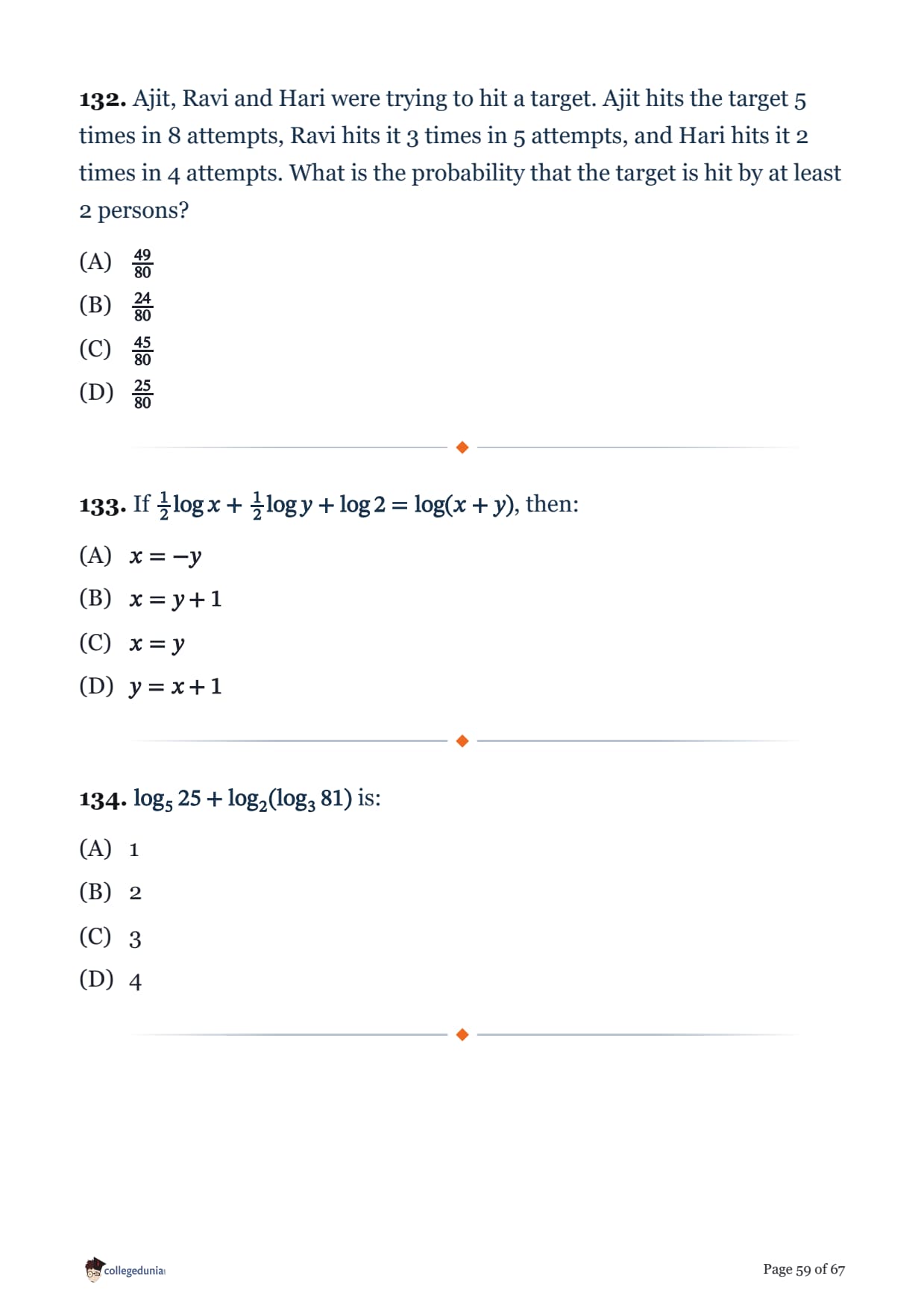
Ajit, Ravi and Hari were trying to hit a target. Ajit hits the target 5 times in 8 attempts, Ravi hits it 3 times in 5 attempts, and Hari hits it 2 times in 4 attempts. What is the probability that the target is hit by at least 2 persons?
If \(\frac{1}{2}\log x + \frac{1}{2}\log y + \log 2 = \log(x+y)\), then:
\(\log_5 25 + \log_2(\log_3 81)\) is:
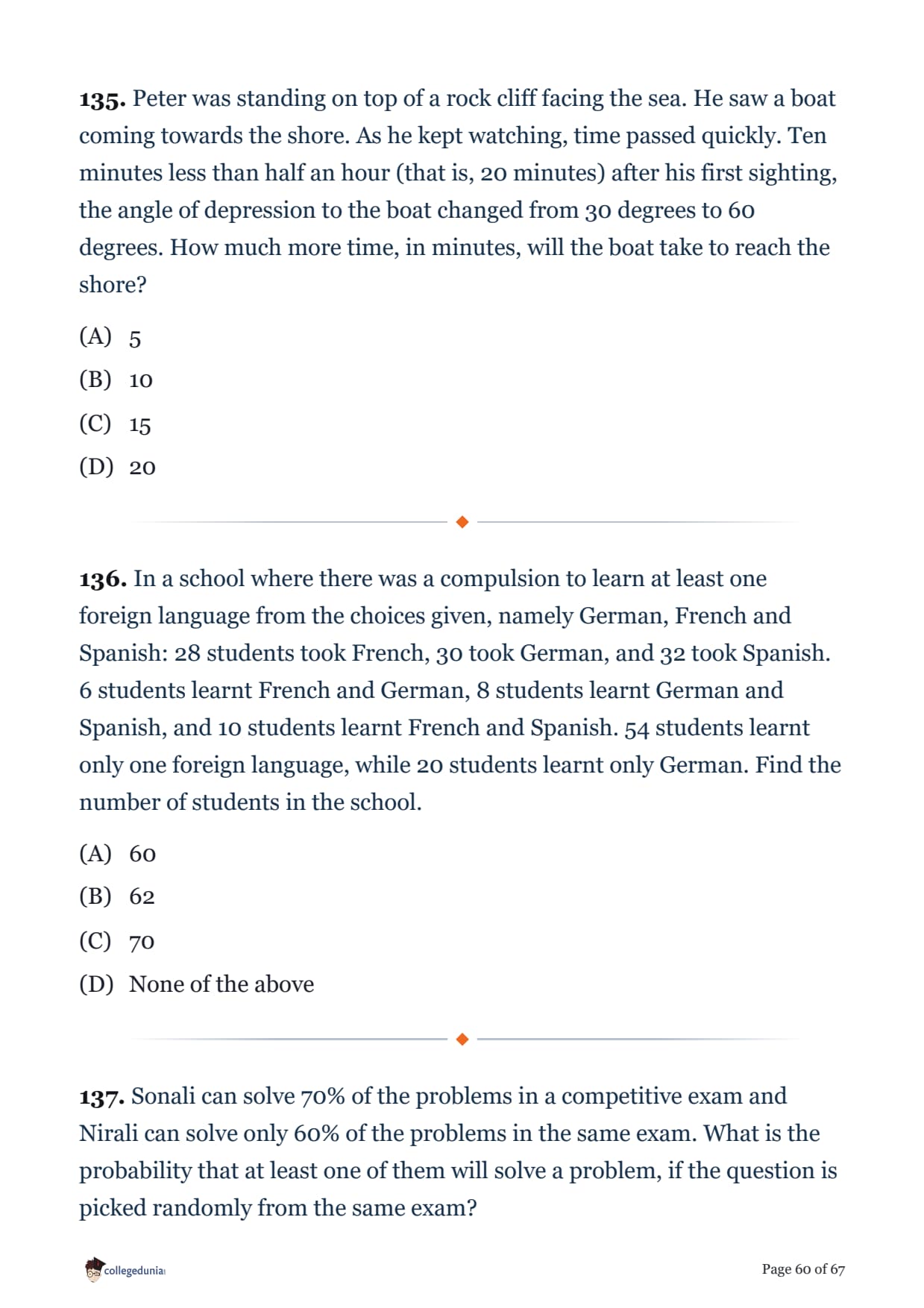
Peter was standing on top of a rock cliff facing the sea. He saw a boat coming towards the shore. As he kept watching, time passed quickly. Ten minutes less than half an hour (that is, 20 minutes) after his first sighting, the angle of depression to the boat changed from 30 degrees to 60 degrees. How much more time, in minutes, will the boat take to reach the shore?
In a school where there was a compulsion to learn at least one foreign language from the choices given, namely German, French and Spanish: 28 students took French, 30 took German, and 32 took Spanish. 6 students learnt French and German, 8 students learnt German and Spanish, and 10 students learnt French and Spanish. 54 students learnt only one foreign language, while 20 students learnt only German. Find the number of students in the school.
Sonali can solve 70% of the problems in a competitive exam and Nirali can solve only 60% of the problems in the same exam. What is the probability that at least one of them will solve a problem, if the question is picked randomly from the same exam?
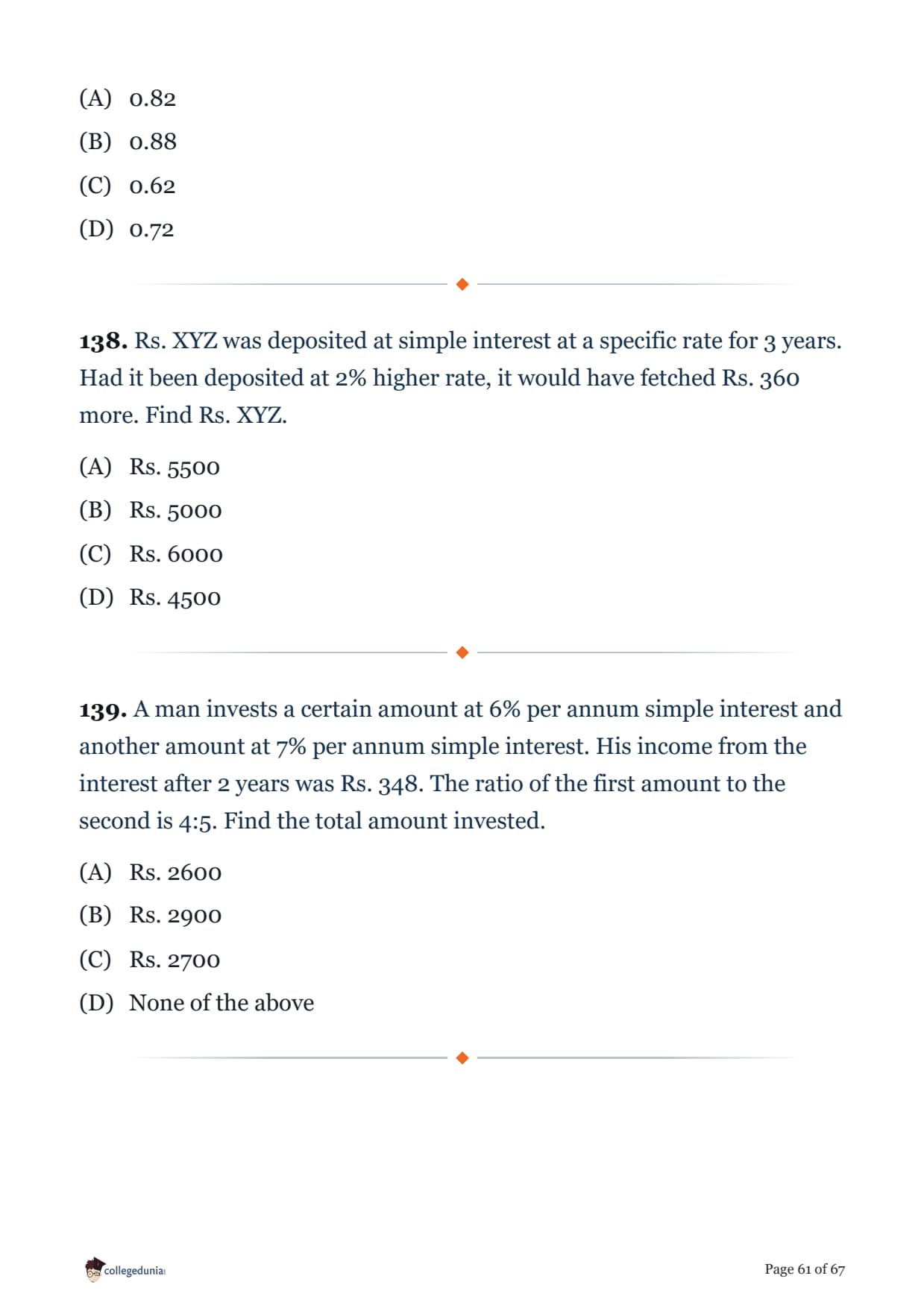
Rs. XYZ was deposited at simple interest at a specific rate for 3 years. Had it been deposited at 2% higher rate, it would have fetched Rs. 360 more. Find Rs. XYZ.
A man invests a certain amount at 6% per annum simple interest and another amount at 7% per annum simple interest. His income from the interest after 2 years was Rs. 348. The ratio of the first amount to the second is 4:5. Find the total amount invested.
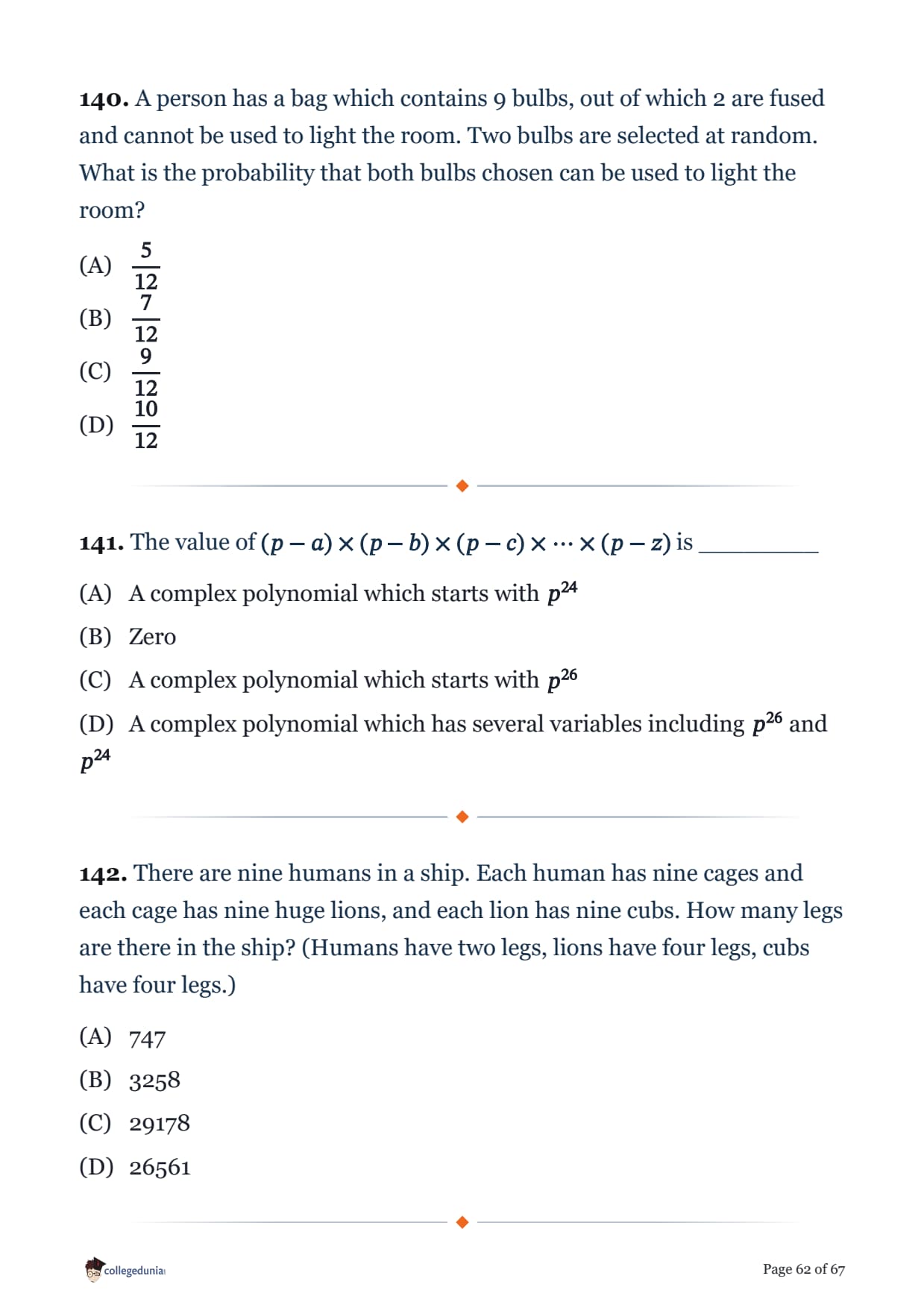
A person has a bag which contains 9 bulbs, out of which 2 are fused and cannot be used to light the room. Two bulbs are selected at random. What is the probability that both bulbs chosen can be used to light the room?
The value of \((p-a) \times (p-b) \times (p-c) \times \cdots \times (p-z)\) is ________
There are nine humans in a ship. Each human has nine cages and each cage has nine huge lions, and each lion has nine cubs. How many legs are there in the ship? (Humans have two legs, lions have four legs, cubs have four legs.)
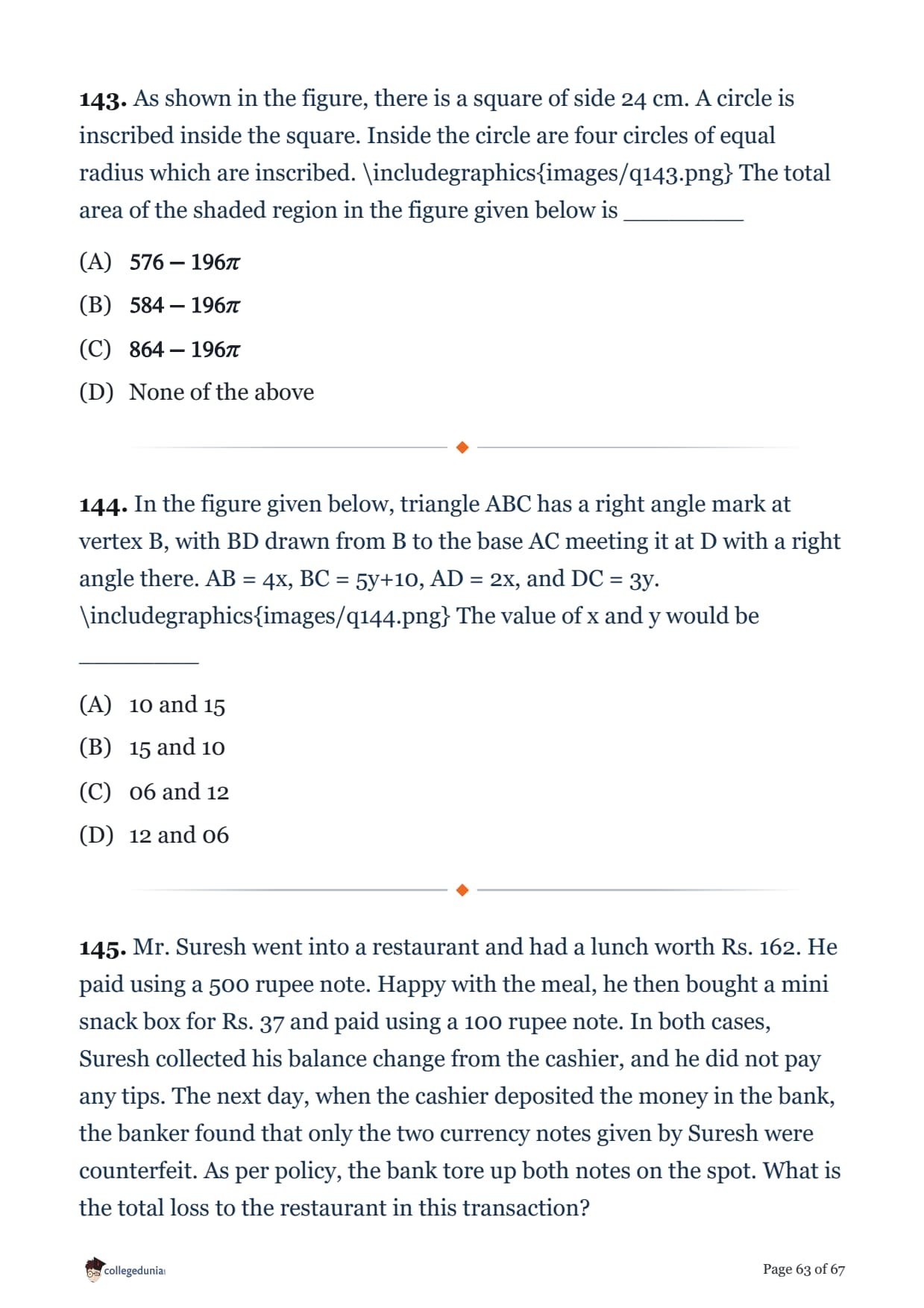
As shown in the figure, there is a square of side 24 cm. A circle is inscribed inside the square. Inside the circle are four circles of equal radius which are inscribed. \includegraphics{images/q143.png} The total area of the shaded region in the figure given below is ________
In the figure given below, triangle ABC has a right angle mark at vertex B, with BD drawn from B to the base AC meeting it at D with a right angle there. AB = 4x, BC = 5y+10, AD = 2x, and DC = 3y. \includegraphics{images/q144.png} The value of x and y would be ________
Mr. Suresh went into a restaurant and had a lunch worth Rs. 162. He paid using a 500 rupee note. Happy with the meal, he then bought a mini snack box for Rs. 37 and paid using a 100 rupee note. In both cases, Suresh collected his balance change from the cashier, and he did not pay any tips. The next day, when the cashier deposited the money in the bank, the banker found that only the two currency notes given by Suresh were counterfeit. As per policy, the bank tore up both notes on the spot. What is the total loss to the restaurant in this transaction?
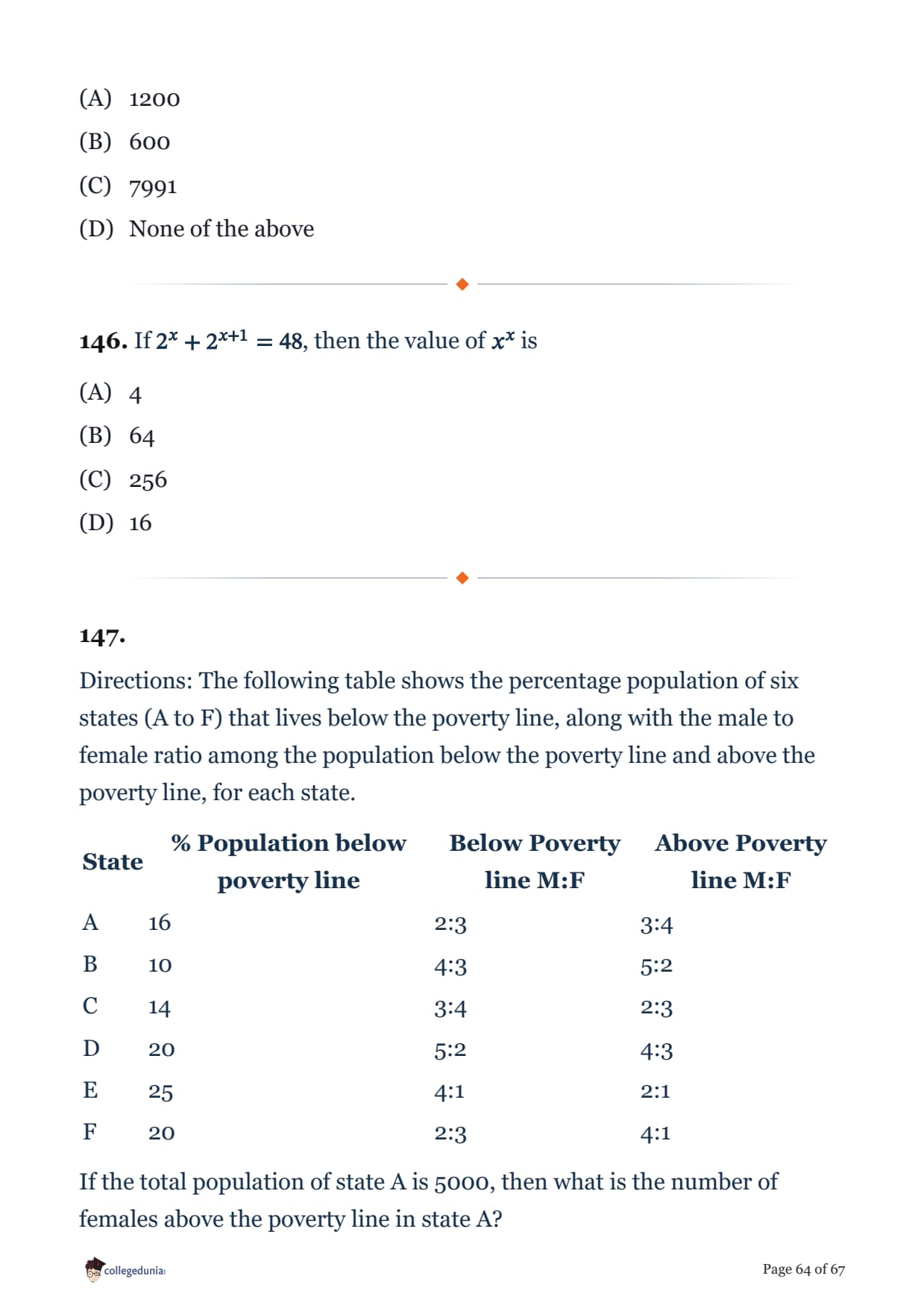
If \(2^x + 2^{x+1} = 48\), then the value of \(x^x\) is
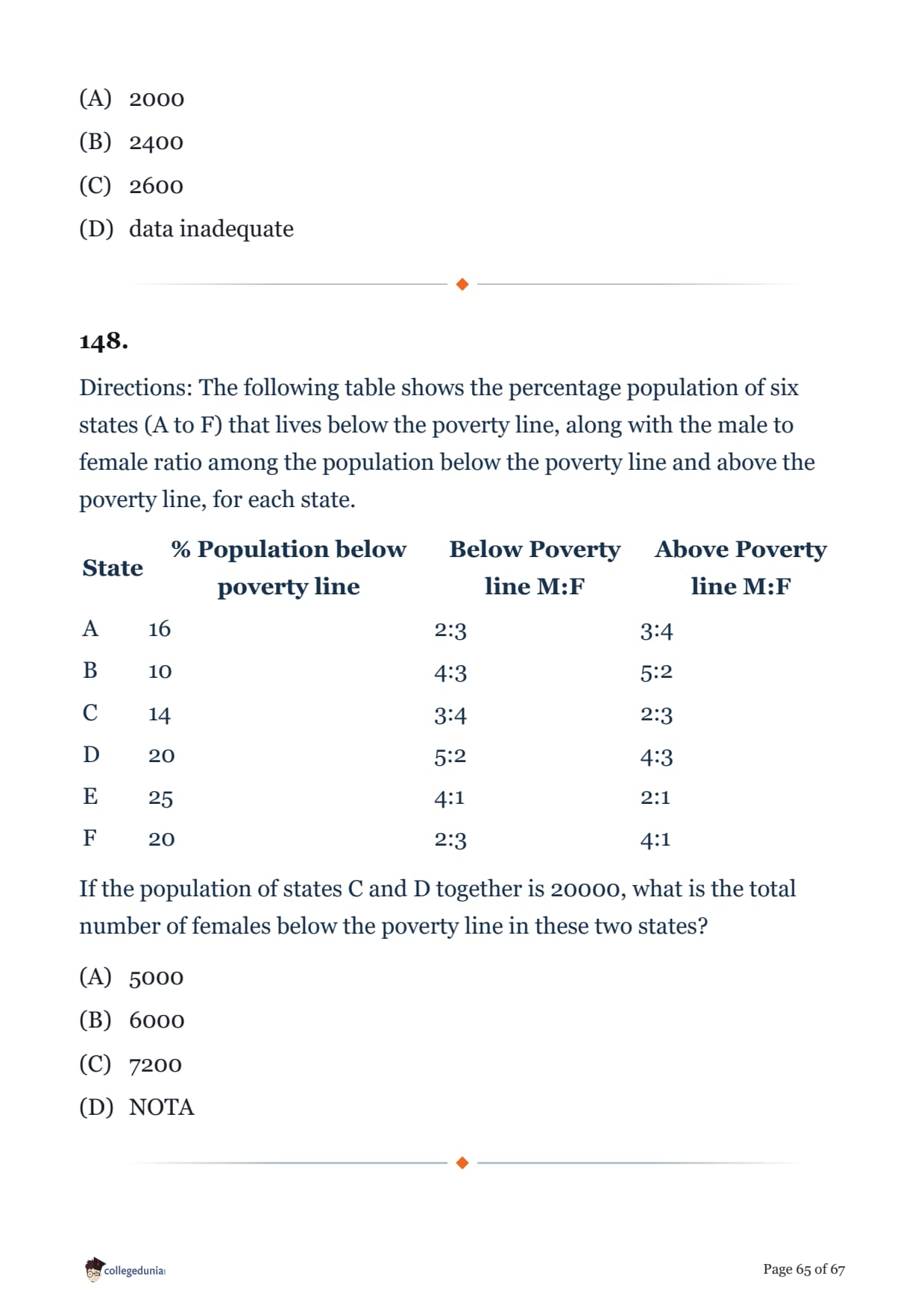
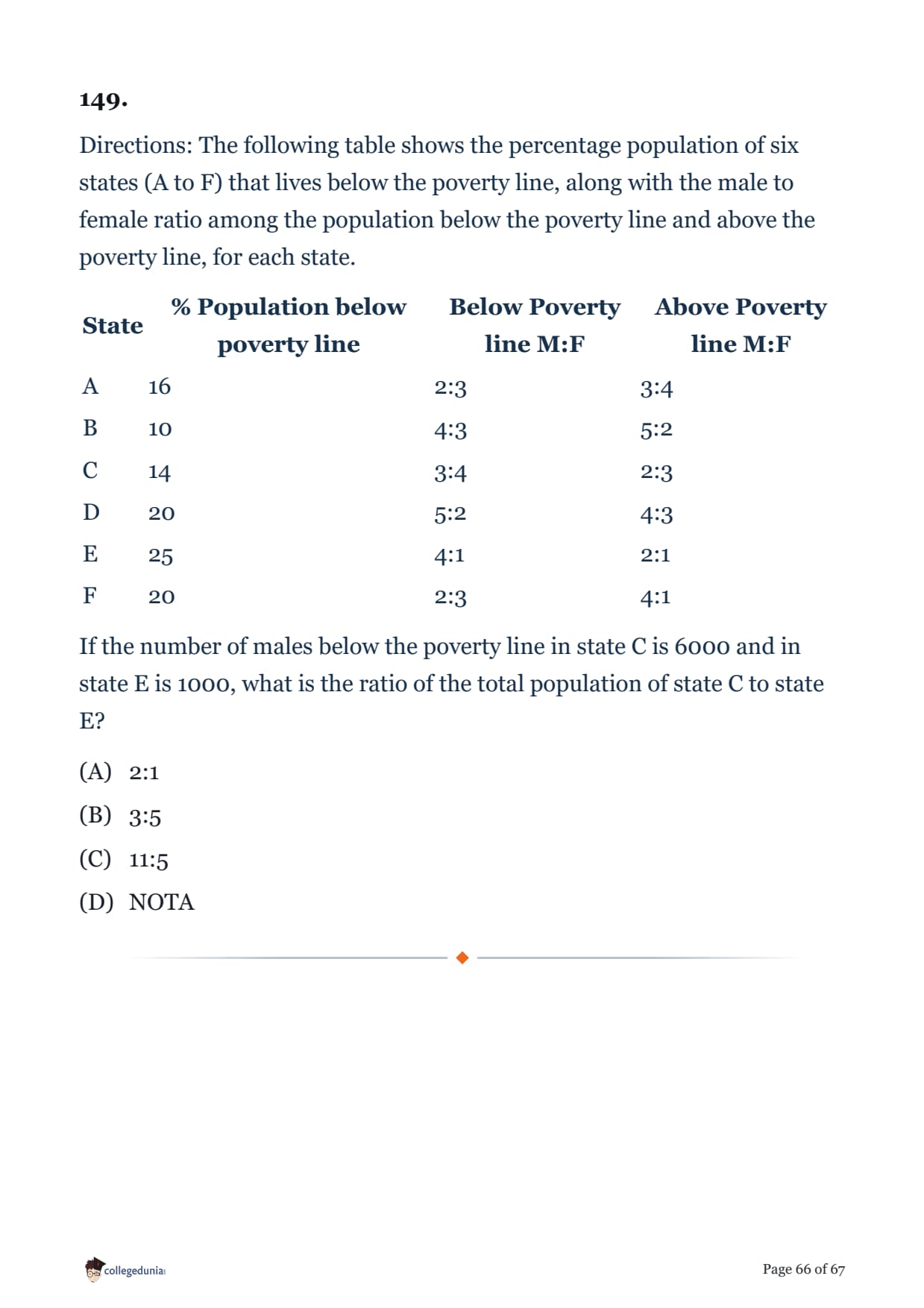
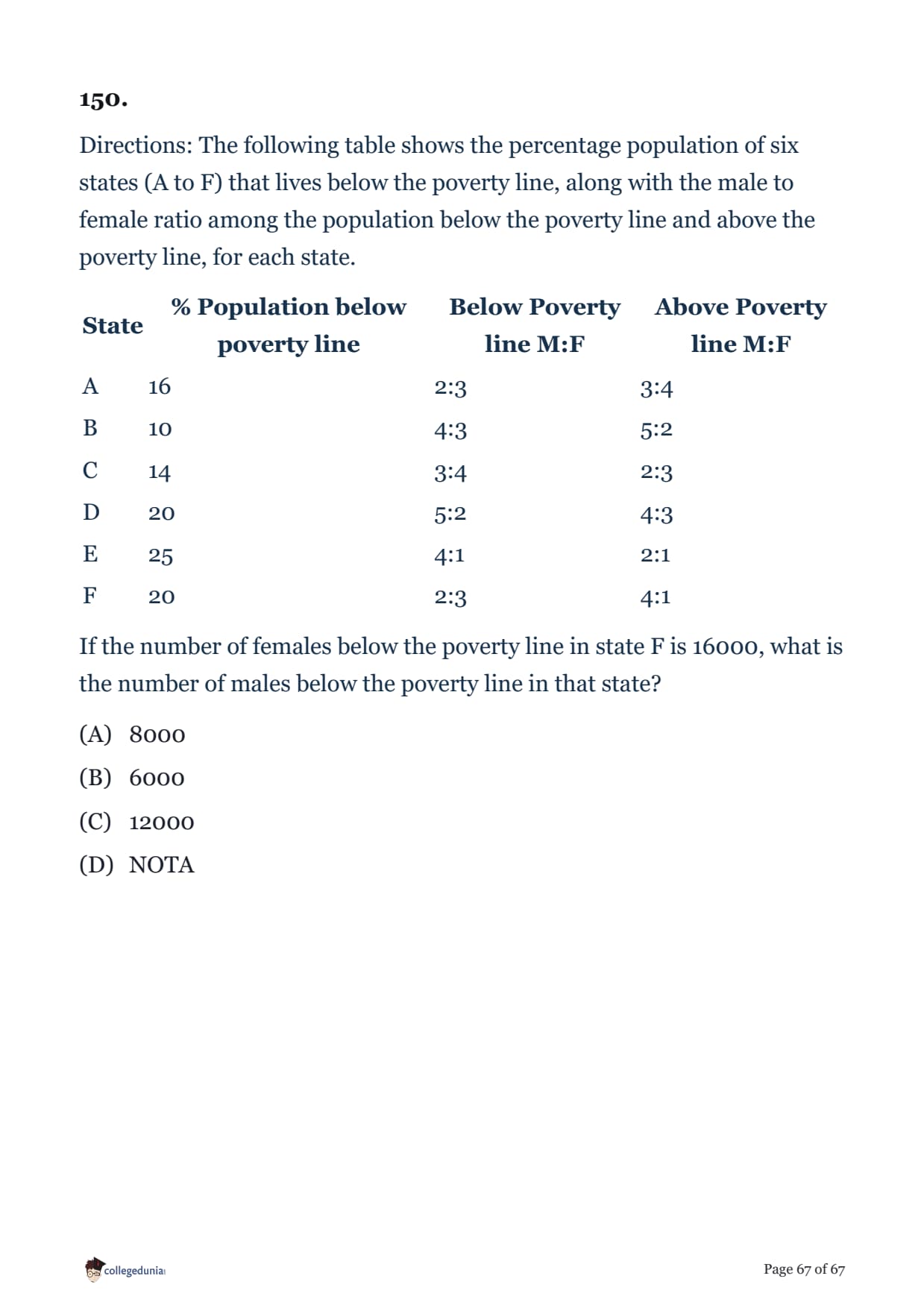
Directions: The following table shows the percentage population of six states (A to F) that lives below the poverty line, along with the male to female ratio among the population below the poverty line and above the poverty line, for each state.
| State | % Population below poverty line | Below Poverty line M:F | Above Poverty line M:F |
|---|---|---|---|
| A | 16 | 2:3 | 3:4 |
| B | 10 | 4:3 | 5:2 |
| C | 14 | 3:4 | 2:3 |
| D | 20 | 5:2 | 4:3 |
| E | 25 | 4:1 | 2:1 |
| F | 20 | 2:3 | 4:1 |
If the total population of state A is 5000, then what is the number of females above the poverty line in state A?
Directions: The following table shows the percentage population of six states (A to F) that lives below the poverty line, along with the male to female ratio among the population below the poverty line and above the poverty line, for each state.
| State | % Population below poverty line | Below Poverty line M:F | Above Poverty line M:F |
|---|---|---|---|
| A | 16 | 2:3 | 3:4 |
| B | 10 | 4:3 | 5:2 |
| C | 14 | 3:4 | 2:3 |
| D | 20 | 5:2 | 4:3 |
| E | 25 | 4:1 | 2:1 |
| F | 20 | 2:3 | 4:1 |
If the population of states C and D together is 20000, what is the total number of females below the poverty line in these two states?
Directions: The following table shows the percentage population of six states (A to F) that lives below the poverty line, along with the male to female ratio among the population below the poverty line and above the poverty line, for each state.
| State | % Population below poverty line | Below Poverty line M:F | Above Poverty line M:F |
|---|---|---|---|
| A | 16 | 2:3 | 3:4 |
| B | 10 | 4:3 | 5:2 |
| C | 14 | 3:4 | 2:3 |
| D | 20 | 5:2 | 4:3 |
| E | 25 | 4:1 | 2:1 |
| F | 20 | 2:3 | 4:1 |
If the number of males below the poverty line in state C is 6000 and in state E is 1000, what is the ratio of the total population of state C to state E?
Directions: The following table shows the percentage population of six states (A to F) that lives below the poverty line, along with the male to female ratio among the population below the poverty line and above the poverty line, for each state.
| State | % Population below poverty line | Below Poverty line M:F | Above Poverty line M:F |
|---|---|---|---|
| A | 16 | 2:3 | 3:4 |
| B | 10 | 4:3 | 5:2 |
| C | 14 | 3:4 | 2:3 |
| D | 20 | 5:2 | 4:3 |
| E | 25 | 4:1 | 2:1 |
| F | 20 | 2:3 | 4:1 |
If the number of females below the poverty line in state F is 16000, what is the number of males below the poverty line in that state?
SNAP 2015 Combined Paper Exam Pattern and Marking Scheme
SNAP 2015 was a single paper of 150 objective questions split across four sections, and the Analytical & Logical Reasoning section carried double marks, so it decided most results.
- Total questions: 150 MCQs across 4 sections
- Duration: 2 hours (120 minutes), no sectional time limit
- Section split: General English 40, Quantitative + Data Interpretation + Data Sufficiency 40, General Awareness 40, Analytical & Logical Reasoning 30
- Marks: 1 mark per question in the first three sections, 2 marks each in Analytical & Logical Reasoning, so 180 marks in total
- Negative marking: 25% (0.25 of the marks allotted) cut for every wrong answer
SNAP later moved to a 60-question format from 2019, so this 2015 paper follows the older, longer pattern that ran till 2018.
High-Weightage Areas in the SNAP 2015 Combined Paper
SNAP 2015 was rated tougher than SNAP 2014, mainly because General Awareness and the verbal part of English pulled scores down. Here is where the marks actually sat.
- Analytical & Logical Reasoning (60 marks): the highest-weight section at 2 marks a question, so 30 questions were worth as much as any other full section
- Quantitative, DI & DS (40 marks): heavily tilted to Arithmetic with very little Algebra, plus one easy 5-question DI set on population below the poverty line
- General English (40 marks): verbal-heavy with just one Reading Comprehension passage of 5 questions; the rest were idioms, synonyms, antonyms, analogies, odd-one-out and error spotting
- General Awareness (40 marks): a hard mix of static GK and current affairs, several from low-coverage topics with very close answer choices
SNAP 2015 Question Paper Solution Walkthrough Video
Source: Mathological
How to Use the SNAP 2015 Question Paper for Practice
Treat this paper as a timed mock first, then review with the solutions PDF above. The scoring pattern rewards accuracy over raw attempts.
- Solve all 150 questions in one 120-minute sitting to build real exam stamina
- Give the Analytical & Logical Reasoning set extra time, since each question there is worth two marks
- In Quantitative, clear the Arithmetic questions and the DI set first, as that is where most easy marks were
- Skip low-coverage General Awareness questions with close options instead of guessing into negative marking
SNAP 2015 Good Attempts and Score Benchmark
- A strong student attempted around 28 to 30 questions in Quantitative in about 40 minutes
- General English gave a decent return at roughly 20 to 23 correct
- In Analytical & Logical Reasoning, a score above 30 out of 60 was considered good given the double marking
- General Awareness was a low-return section; picking the easier 15 to 20 and leaving the rest was the safer call
SNAP 2015 Combined Question Paper FAQs
Ques. Was the SNAP 2015 paper tougher than SNAP 2014?
Ans. Yes. Quant stayed at about the same level as 2014, but General Awareness and the verbal-heavy English section were harder and acted as score dampeners, so overall SNAP 2015 was rated more difficult.
Ques. How many questions were there in SNAP 2015 and what was the marking scheme?
Ans. SNAP 2015 had 150 questions for 180 marks. General English, Quant/DI/DS and General Awareness carried 1 mark each, Analytical & Logical Reasoning carried 2 marks each, and 0.25 marks were deducted for every wrong answer.
Ques. Which section had the highest weightage in SNAP 2015?
Ans. Analytical & Logical Reasoning. Its 30 questions carried 2 marks each for 60 marks, the same as any other full section, so it decided most results and deserved the most time.
Ques. How many questions should I attempt in SNAP 2015 Quant for a good score?
Ans. A good student attempted around 28 to 30 of the 40 Quant questions in about 40 minutes. The section leaned on Arithmetic with an easy 5-question DI set, so accuracy there was very achievable.
Ques. Where can I download the SNAP 2015 question paper with solutions PDF for free?
Ans. Use the download table above on Collegedunia for the SNAP 2015 question paper and the full solutions booklet. For official notifications and updates, visit the Symbiosis website at snaptest.org.
Ques. Is the SNAP 2015 pattern the same as the current SNAP exam?
Ans. No. SNAP 2015 had 150 questions in 2 hours. From 2019 the exam moved to a shorter 60-question format, so use this paper to practise concepts and question types rather than the exact current structure.



Comments