




The SNAP 2013 question paper with solutions is available here for free download. SNAP 2013 was conducted by Symbiosis International (Deemed University) on December 15, 2013, as a 150-question pen-and-paper test split across Quantitative Aptitude, Analytical & Logical Reasoning, General English, and General Awareness.
| SNAP 2013 Combined Paper Question Paper with Solutions | Download PDF | Check Solutions |
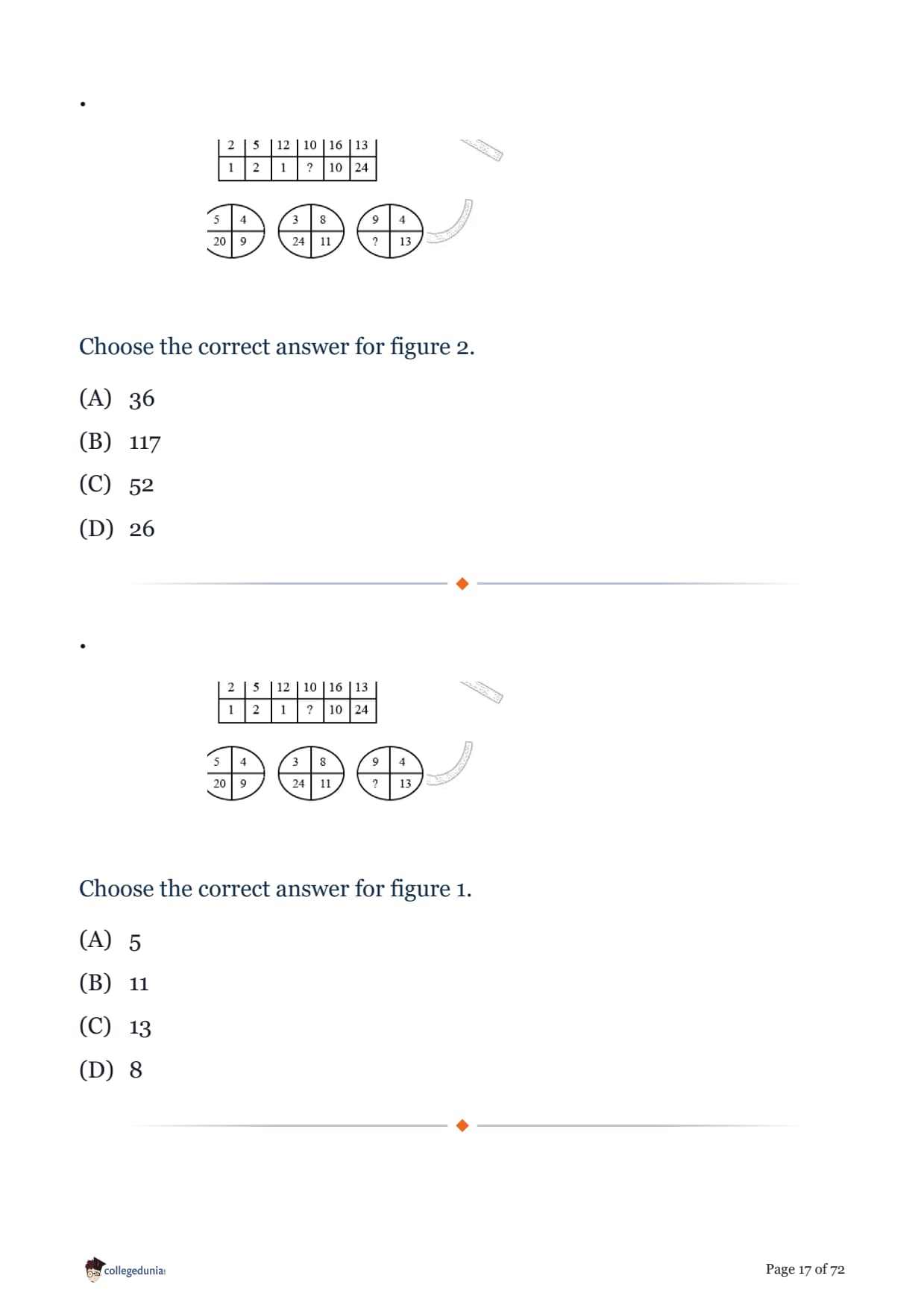
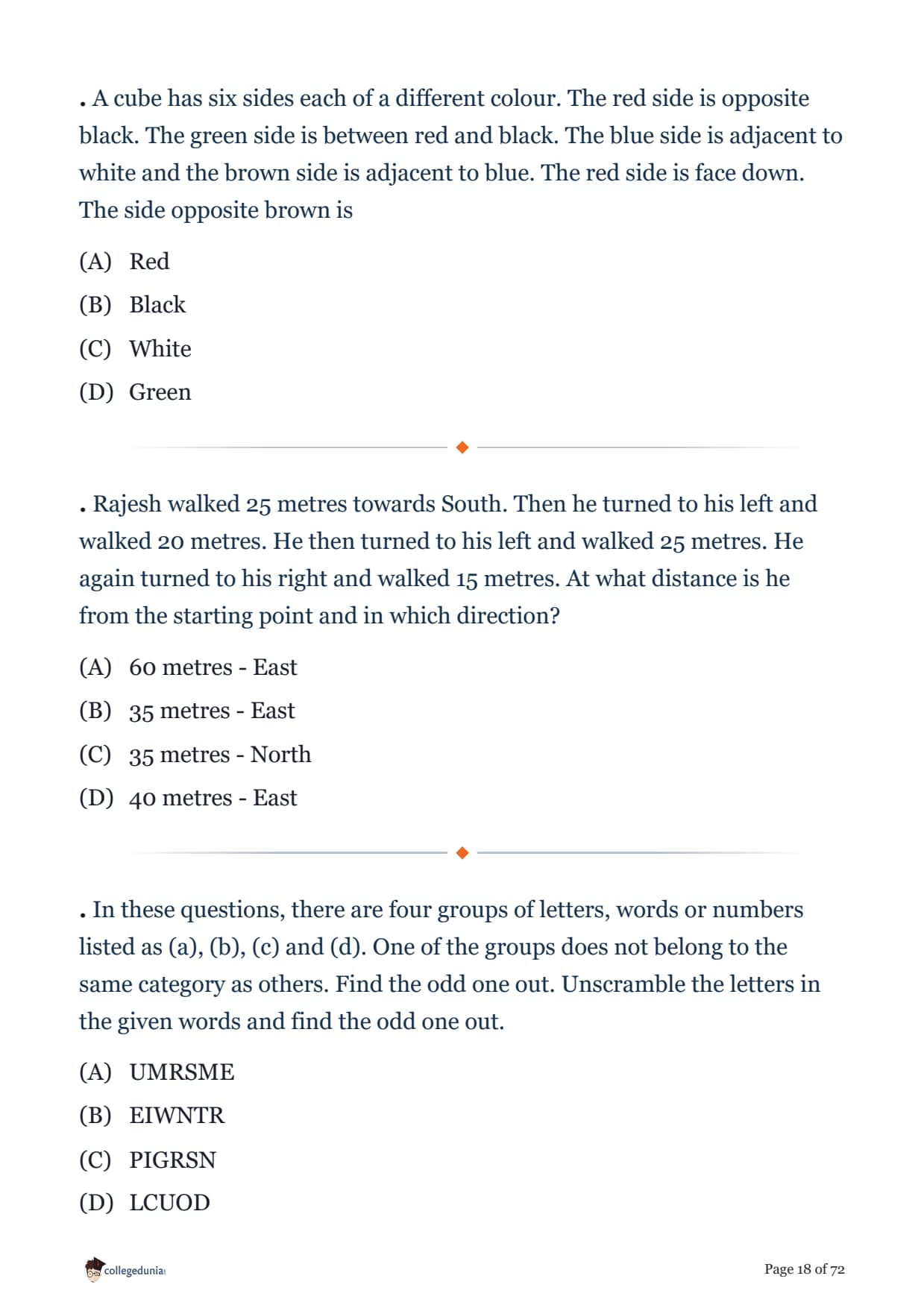


SNAP 2013 Combined Paper Questions with Solutions
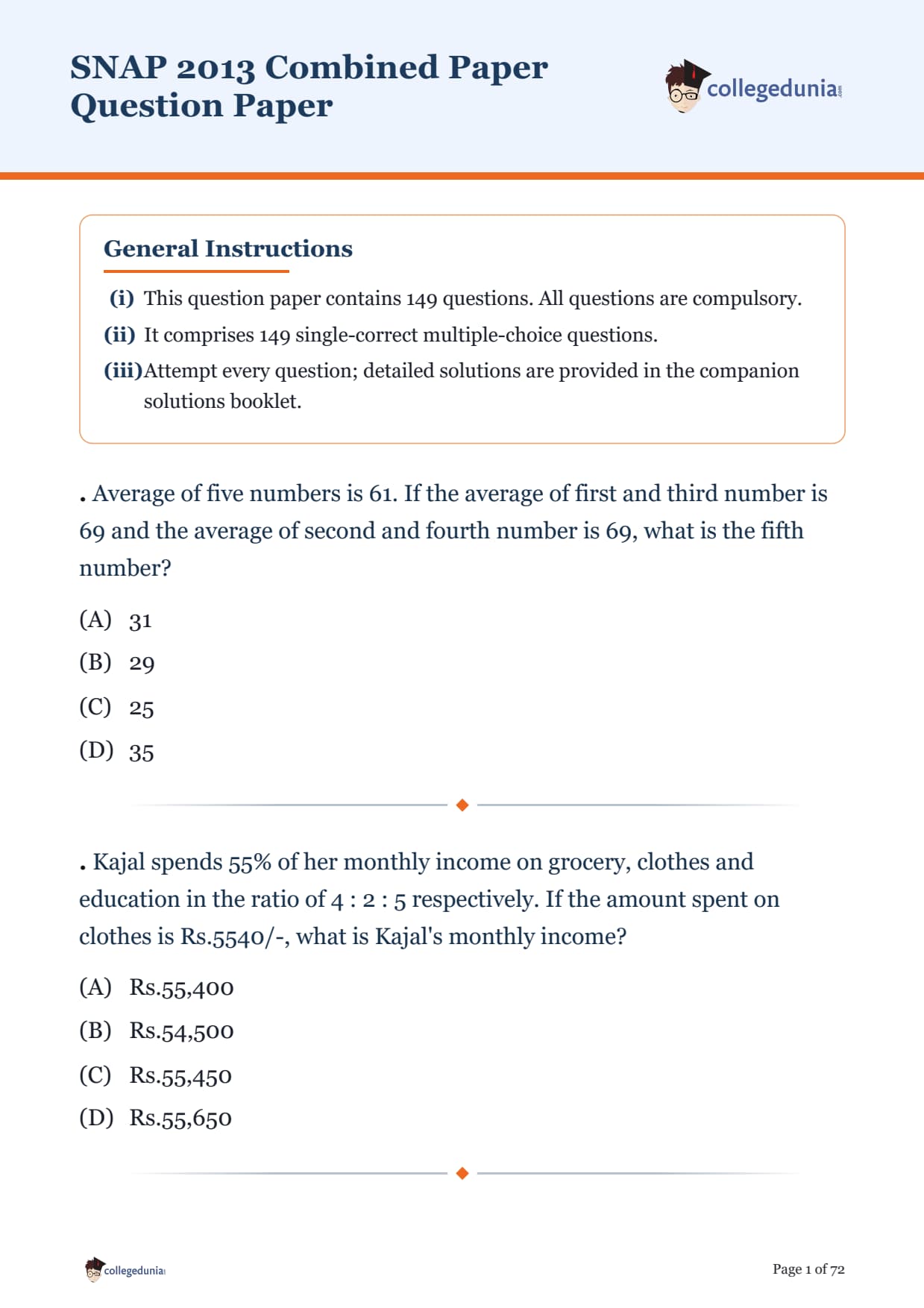
Average of five numbers is 61. If the average of first and third number is 69 and the average of second and fourth number is 69, what is the fifth number?
Kajal spends 55% of her monthly income on grocery, clothes and education in the ratio of 4 : 2 : 5 respectively. If the amount spent on clothes is Rs.5540/-, what is Kajal's monthly income?
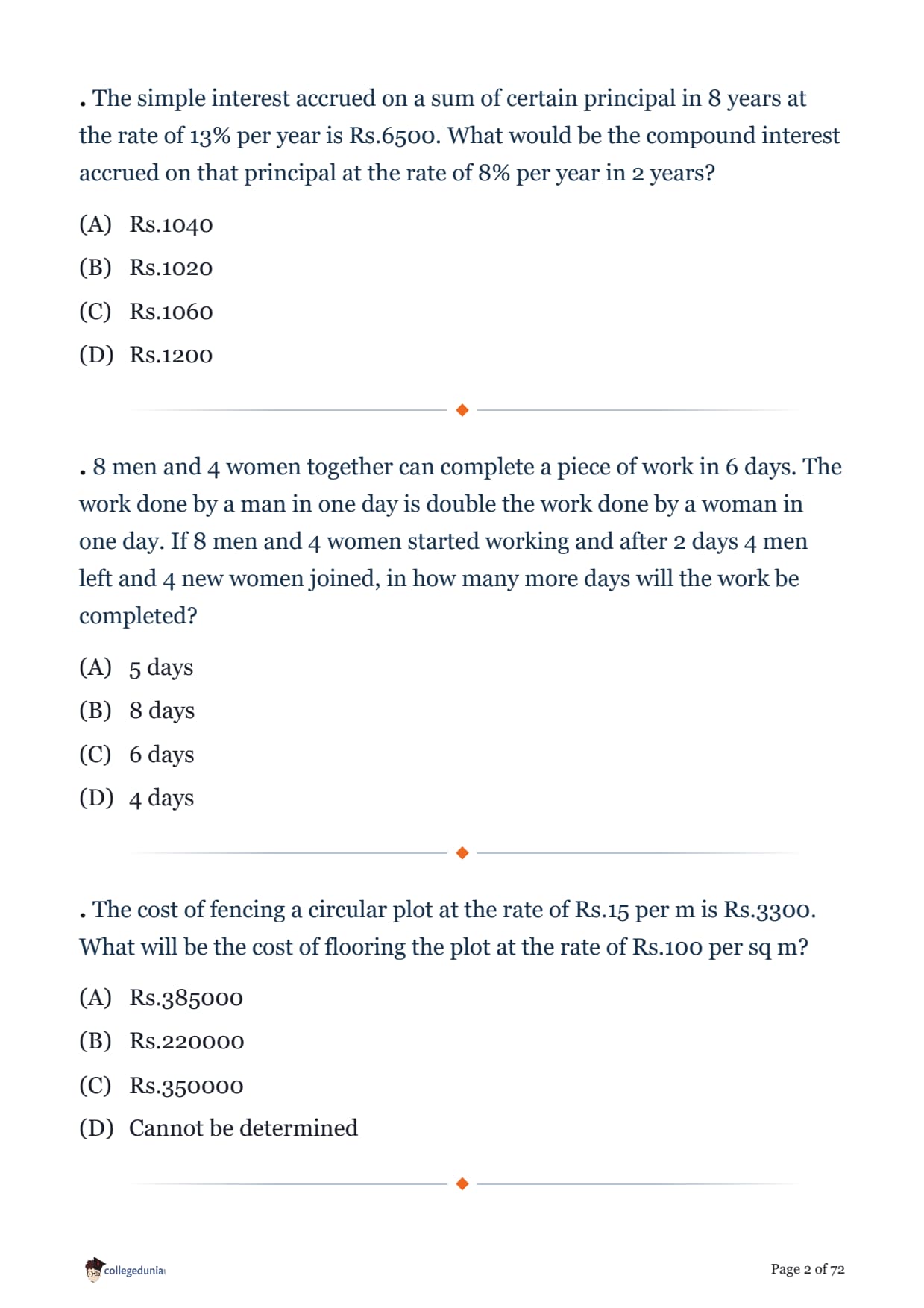
The simple interest accrued on a sum of certain principal in 8 years at the rate of 13% per year is Rs.6500. What would be the compound interest accrued on that principal at the rate of 8% per year in 2 years?
8 men and 4 women together can complete a piece of work in 6 days. The work done by a man in one day is double the work done by a woman in one day. If 8 men and 4 women started working and after 2 days 4 men left and 4 new women joined, in how many more days will the work be completed?
The cost of fencing a circular plot at the rate of Rs.15 per m is Rs.3300. What will be the cost of flooring the plot at the rate of Rs.100 per sq m?
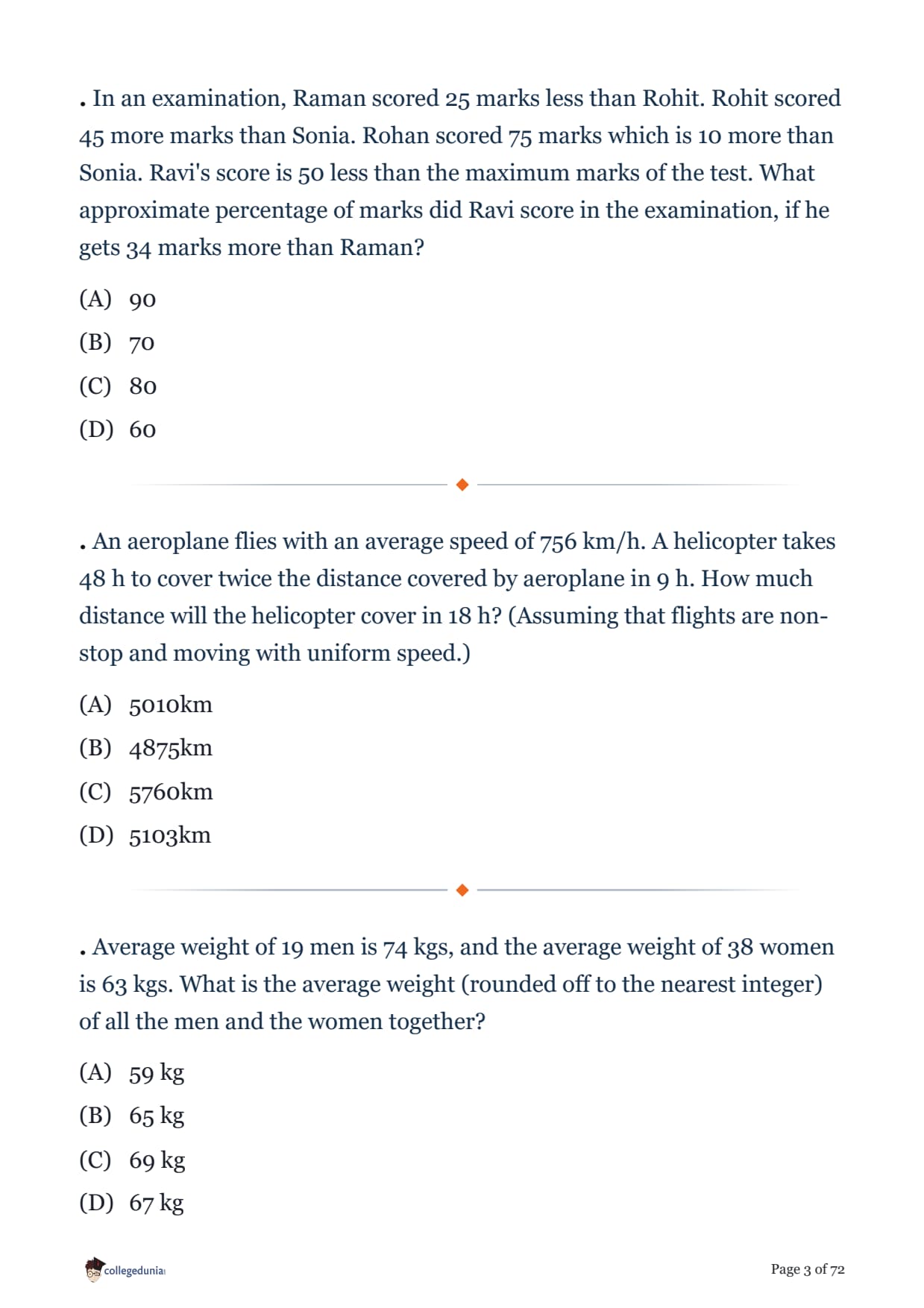
In an examination, Raman scored 25 marks less than Rohit. Rohit scored 45 more marks than Sonia. Rohan scored 75 marks which is 10 more than Sonia. Ravi's score is 50 less than the maximum marks of the test. What approximate percentage of marks did Ravi score in the examination, if he gets 34 marks more than Raman?
An aeroplane flies with an average speed of 756 km/h. A helicopter takes 48 h to cover twice the distance covered by aeroplane in 9 h. How much distance will the helicopter cover in 18 h? (Assuming that flights are non-stop and moving with uniform speed.)
Average weight of 19 men is 74 kgs, and the average weight of 38 women is 63 kgs. What is the average weight (rounded off to the nearest integer) of all the men and the women together?
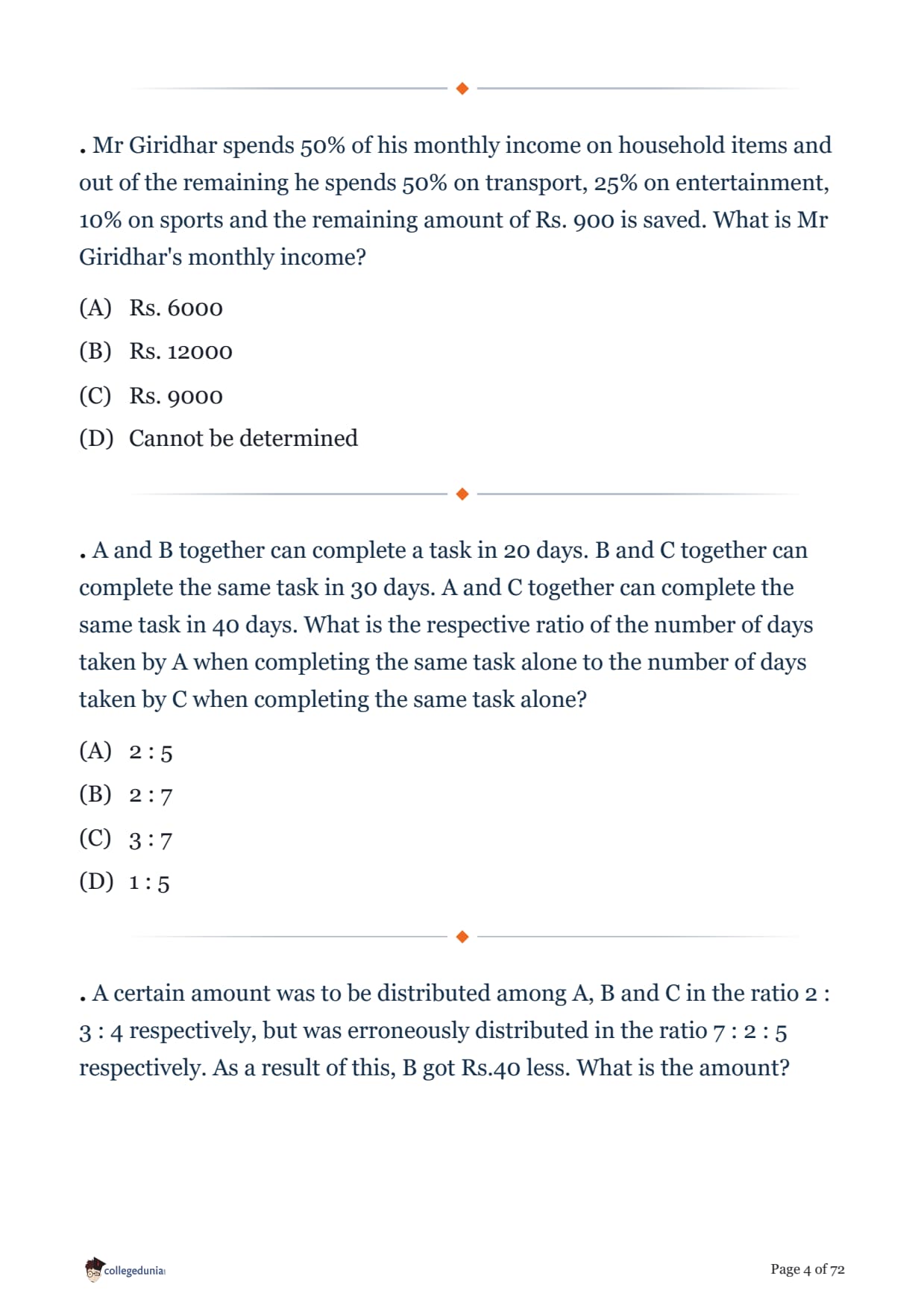
Mr Giridhar spends 50% of his monthly income on household items and out of the remaining he spends 50% on transport, 25% on entertainment, 10% on sports and the remaining amount of Rs. 900 is saved. What is Mr Giridhar's monthly income?
A and B together can complete a task in 20 days. B and C together can complete the same task in 30 days. A and C together can complete the same task in 40 days. What is the respective ratio of the number of days taken by A when completing the same task alone to the number of days taken by C when completing the same task alone?
A certain amount was to be distributed among A, B and C in the ratio 2 : 3 : 4 respectively, but was erroneously distributed in the ratio 7 : 2 : 5 respectively. As a result of this, B got Rs.40 less. What is the amount?
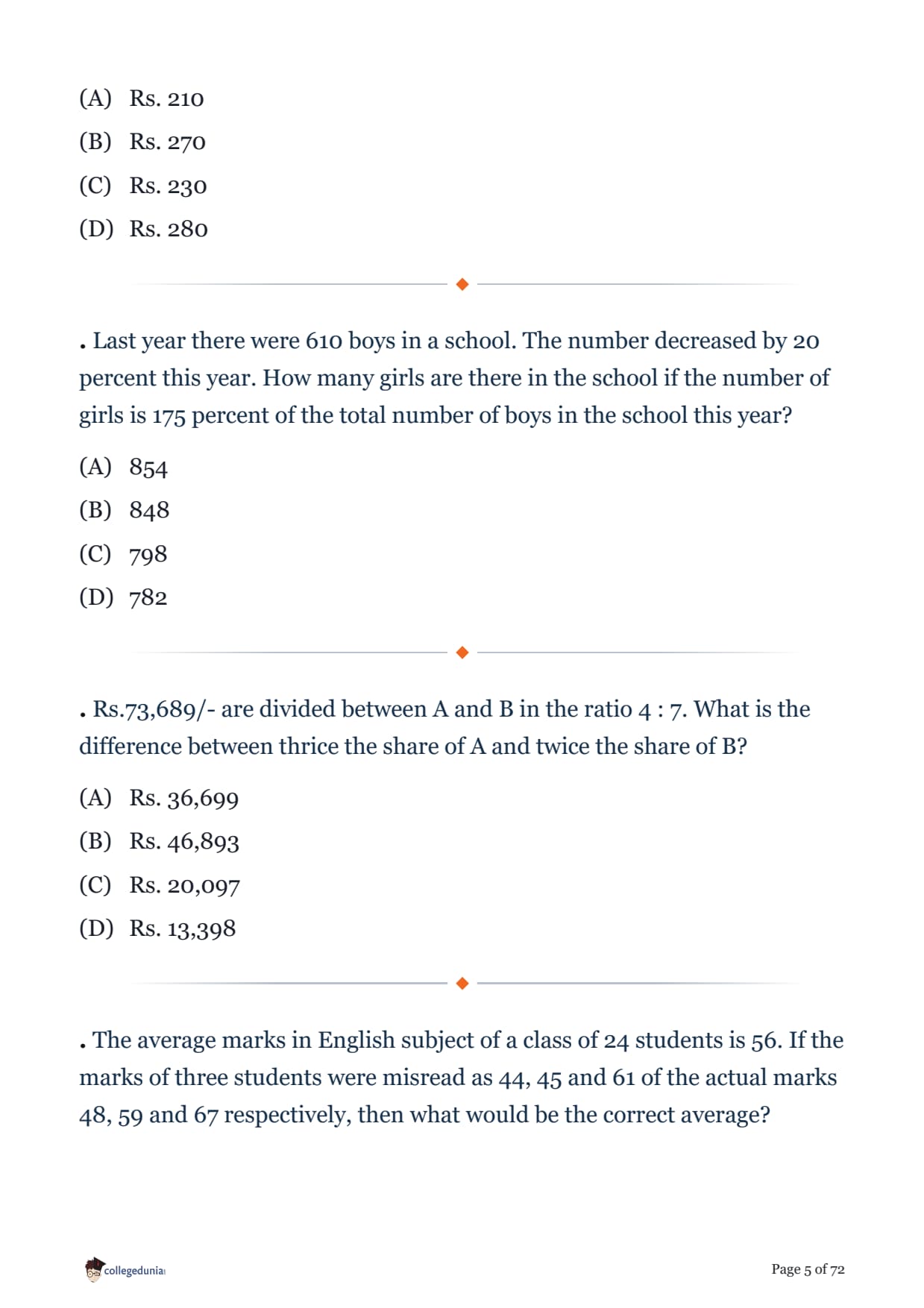
Last year there were 610 boys in a school. The number decreased by 20 percent this year. How many girls are there in the school if the number of girls is 175 percent of the total number of boys in the school this year?
Rs.73,689/- are divided between A and B in the ratio 4 : 7. What is the difference between thrice the share of A and twice the share of B?
The average marks in English subject of a class of 24 students is 56. If the marks of three students were misread as 44, 45 and 61 of the actual marks 48, 59 and 67 respectively, then what would be the correct average?
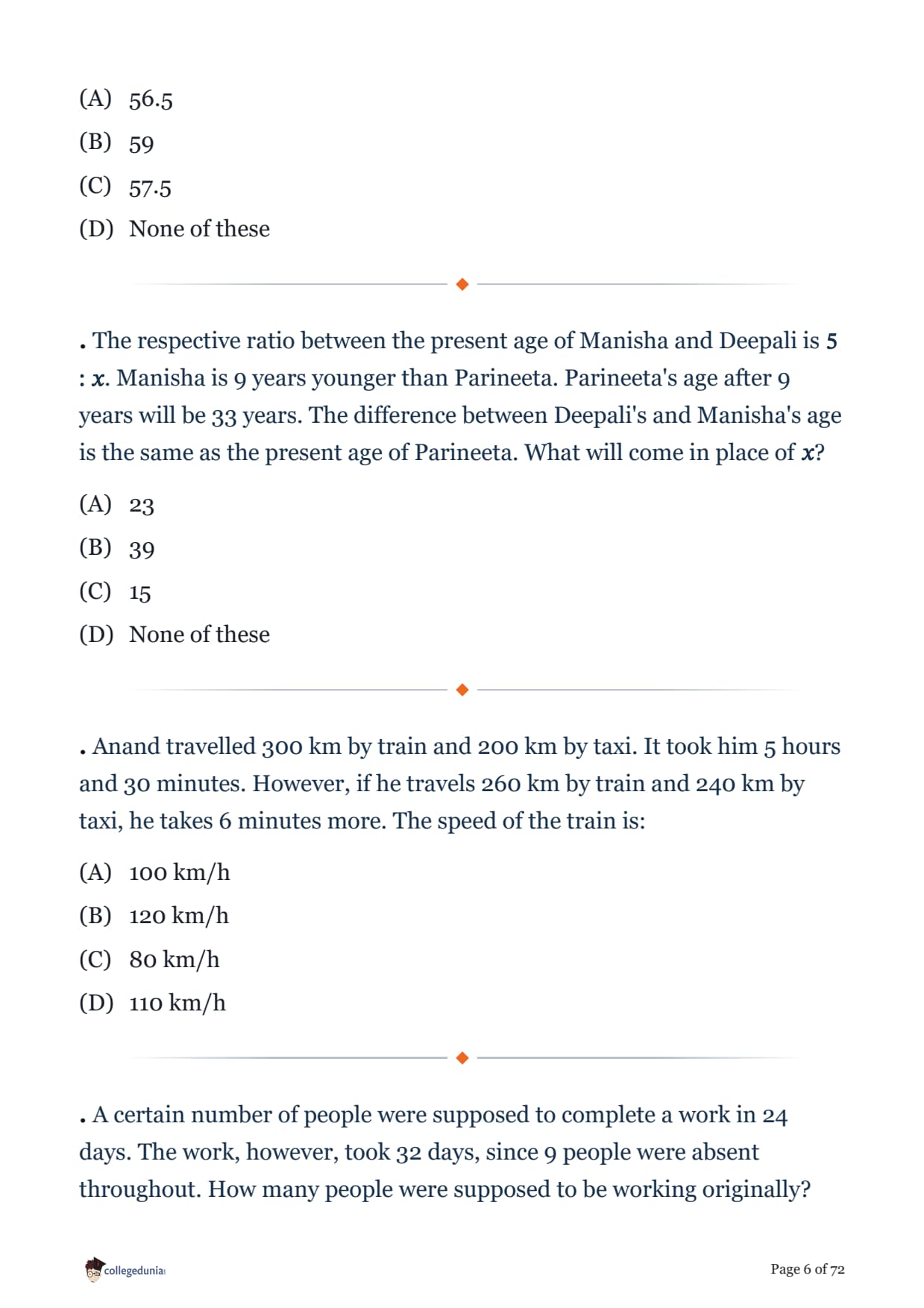
The respective ratio between the present age of Manisha and Deepali is \(5 : x\). Manisha is 9 years younger than Parineeta. Parineeta's age after 9 years will be 33 years. The difference between Deepali's and Manisha's age is the same as the present age of Parineeta. What will come in place of \(x\)?
Anand travelled 300 km by train and 200 km by taxi. It took him 5 hours and 30 minutes. However, if he travels 260 km by train and 240 km by taxi, he takes 6 minutes more. The speed of the train is:
A certain number of people were supposed to complete a work in 24 days. The work, however, took 32 days, since 9 people were absent throughout. How many people were supposed to be working originally?
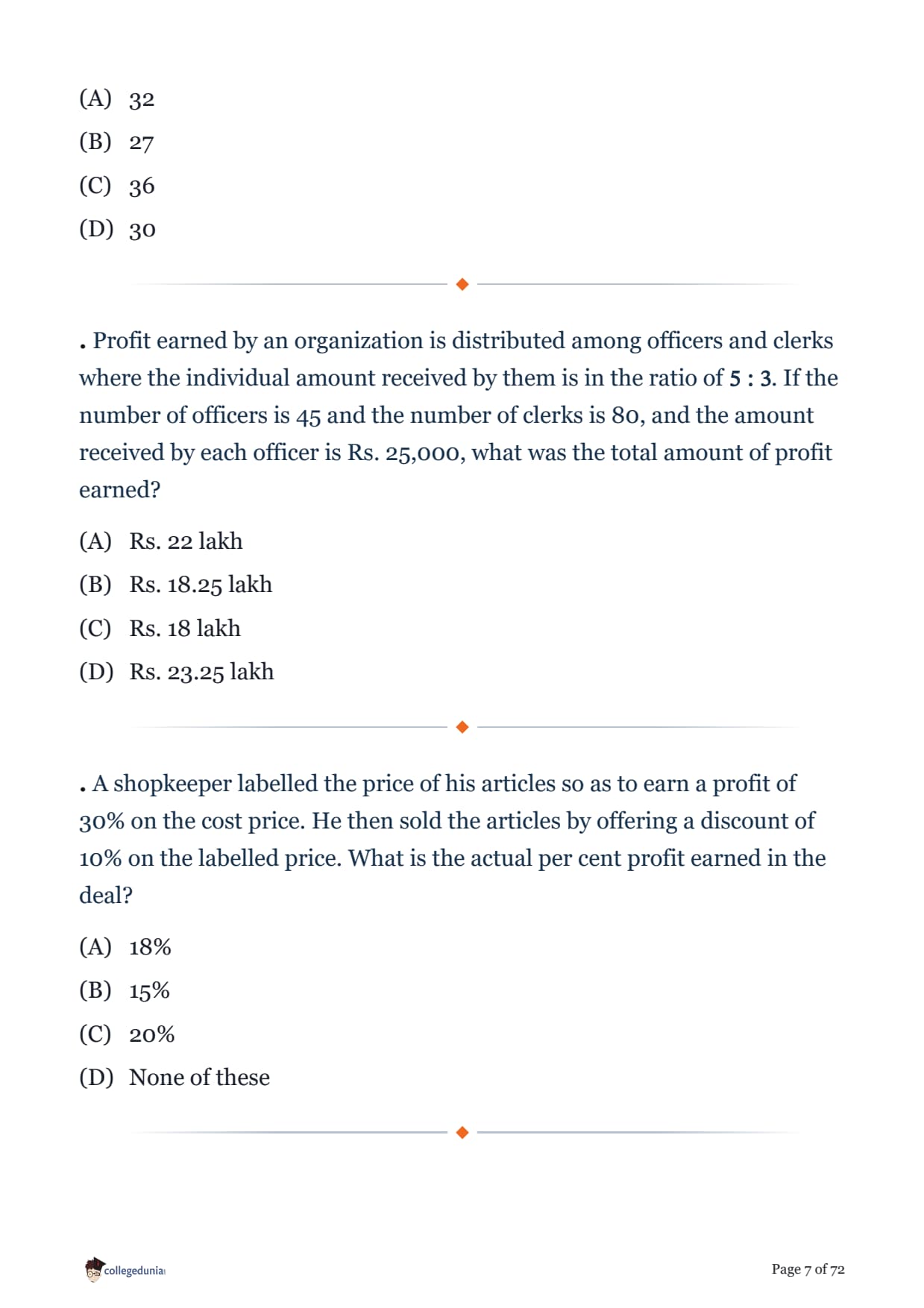
Profit earned by an organization is distributed among officers and clerks where the individual amount received by them is in the ratio of \(5 : 3\). If the number of officers is 45 and the number of clerks is 80, and the amount received by each officer is Rs. 25,000, what was the total amount of profit earned?
A shopkeeper labelled the price of his articles so as to earn a profit of 30% on the cost price. He then sold the articles by offering a discount of 10% on the labelled price. What is the actual per cent profit earned in the deal?
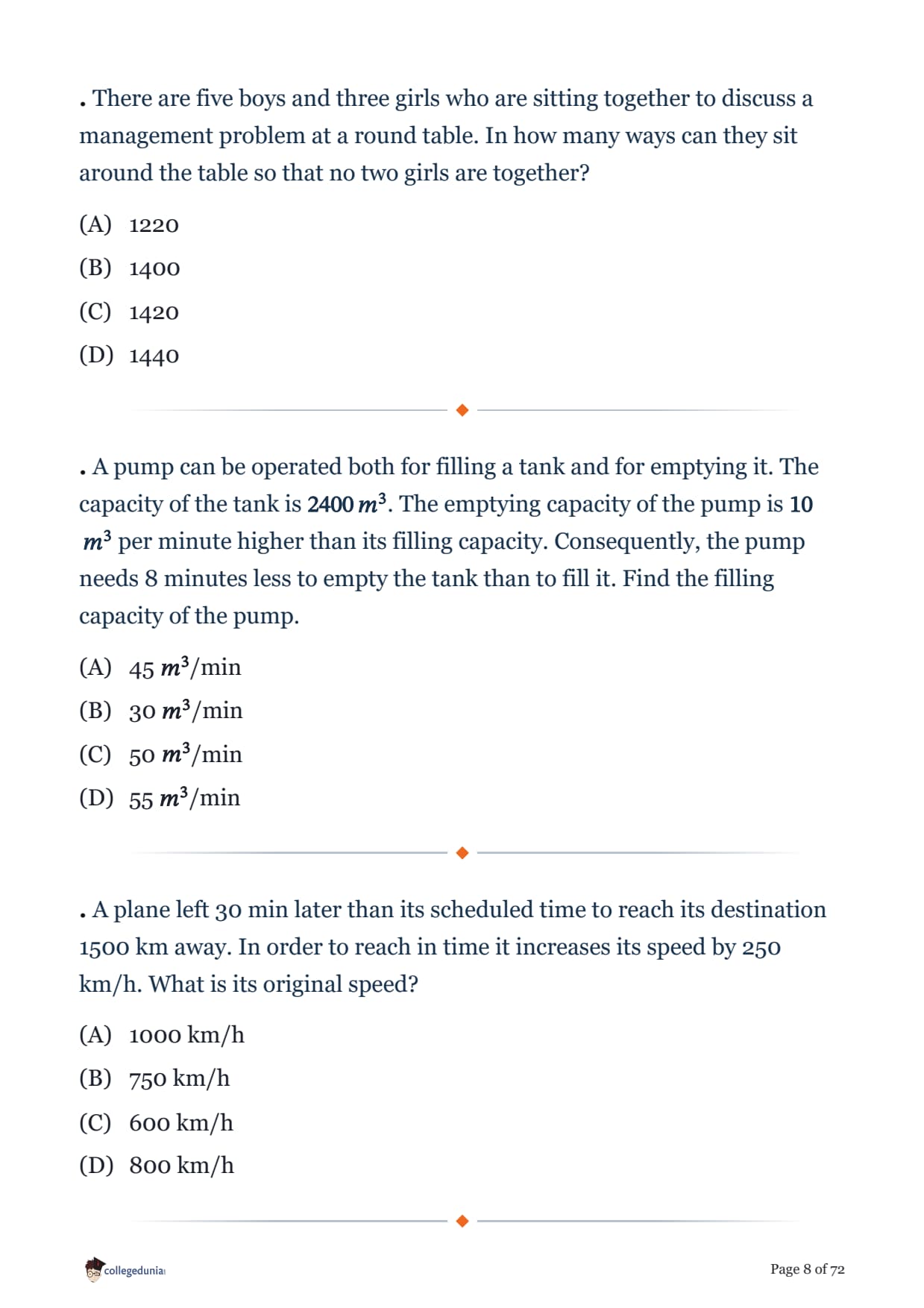
There are five boys and three girls who are sitting together to discuss a management problem at a round table. In how many ways can they sit around the table so that no two girls are together?
A pump can be operated both for filling a tank and for emptying it. The capacity of the tank is \(2400 \, m^3\). The emptying capacity of the pump is \(10 \, m^3\) per minute higher than its filling capacity. Consequently, the pump needs 8 minutes less to empty the tank than to fill it. Find the filling capacity of the pump.
A plane left 30 min later than its scheduled time to reach its destination 1500 km away. In order to reach in time it increases its speed by 250 km/h. What is its original speed?
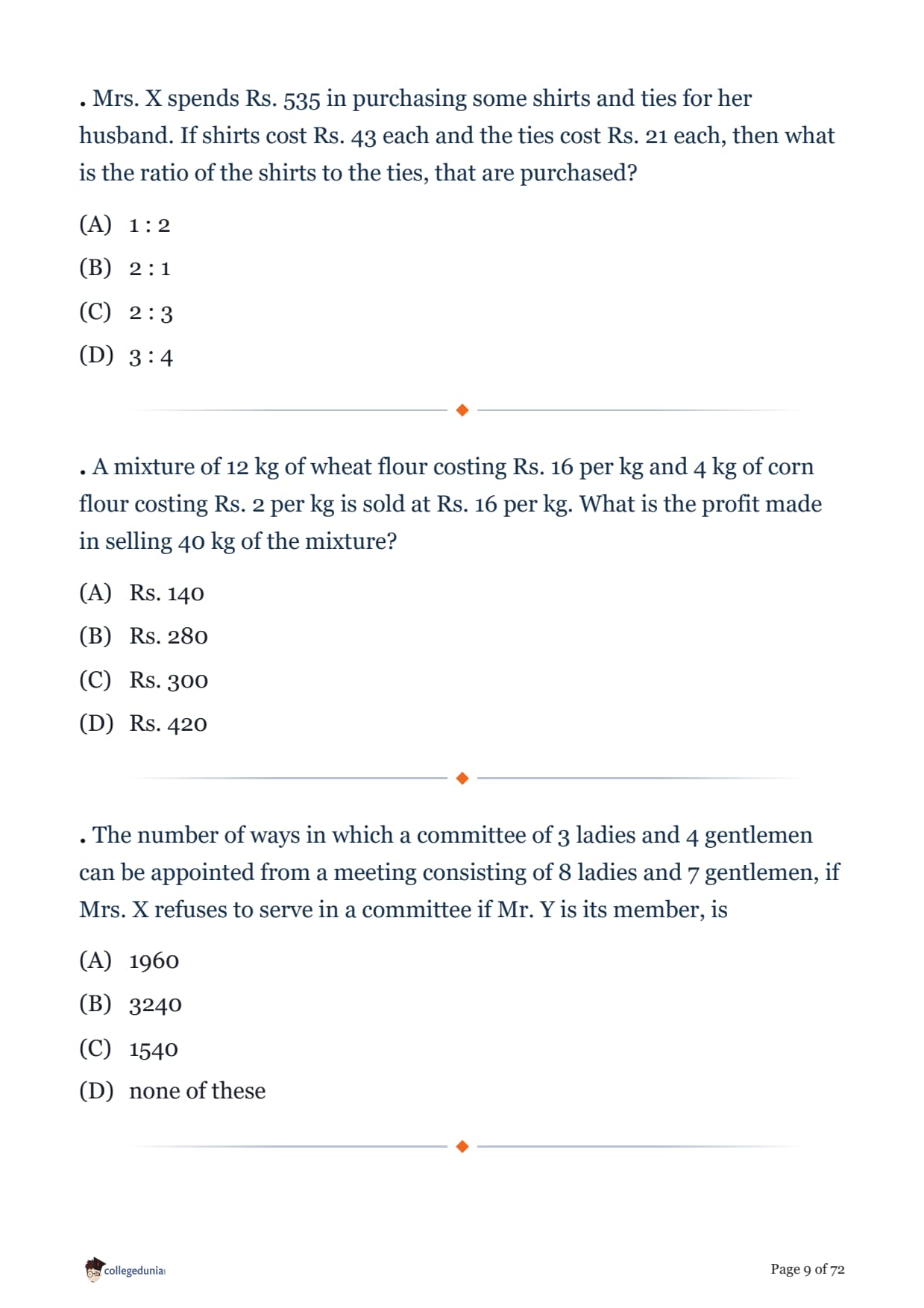
Mrs. X spends Rs. 535 in purchasing some shirts and ties for her husband. If shirts cost Rs. 43 each and the ties cost Rs. 21 each, then what is the ratio of the shirts to the ties, that are purchased?
A mixture of 12 kg of wheat flour costing Rs. 16 per kg and 4 kg of corn flour costing Rs. 2 per kg is sold at Rs. 16 per kg. What is the profit made in selling 40 kg of the mixture?
The number of ways in which a committee of 3 ladies and 4 gentlemen can be appointed from a meeting consisting of 8 ladies and 7 gentlemen, if Mrs. X refuses to serve in a committee if Mr. Y is its member, is
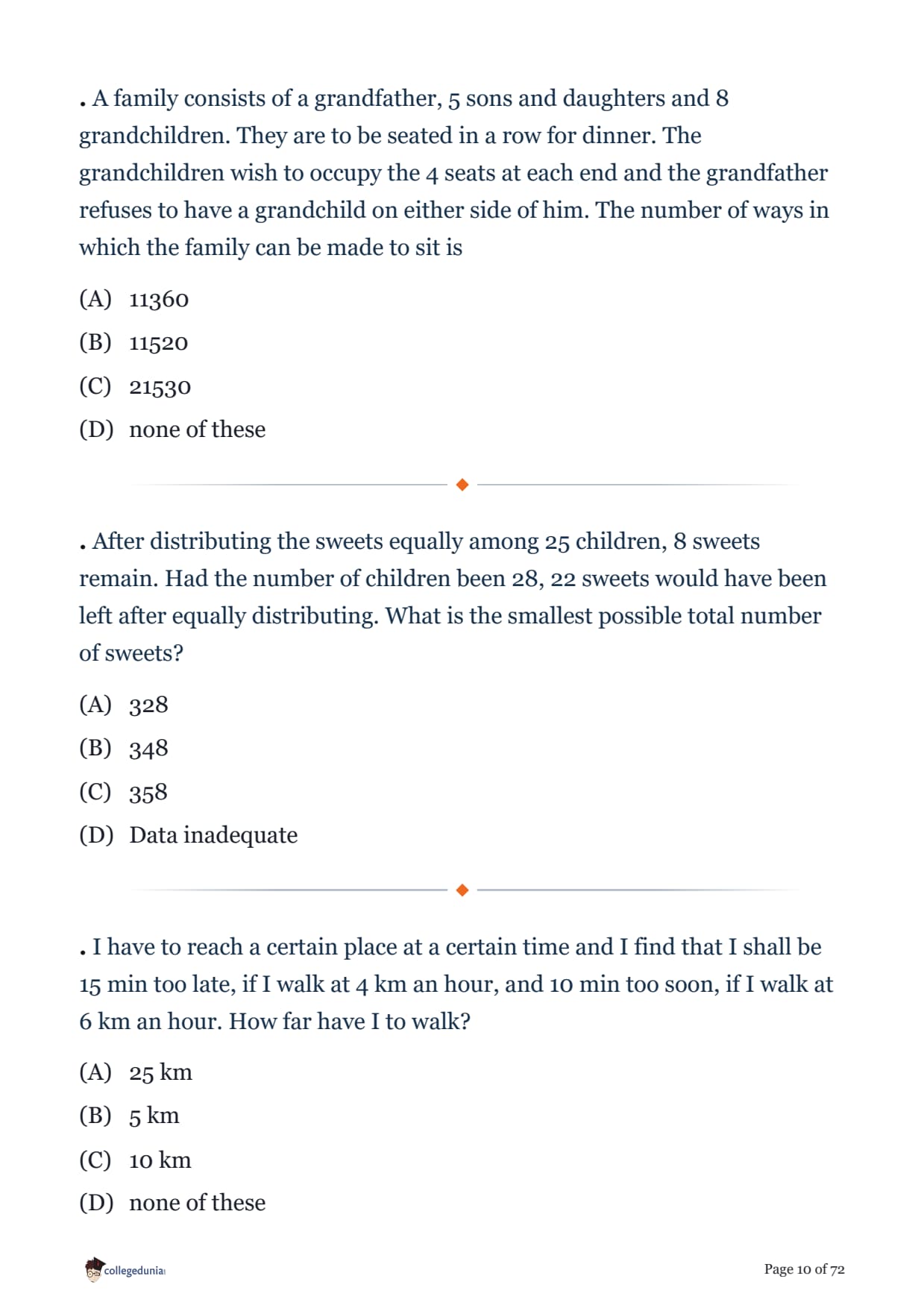
A family consists of a grandfather, 5 sons and daughters and 8 grandchildren. They are to be seated in a row for dinner. The grandchildren wish to occupy the 4 seats at each end and the grandfather refuses to have a grandchild on either side of him. The number of ways in which the family can be made to sit is
After distributing the sweets equally among 25 children, 8 sweets remain. Had the number of children been 28, 22 sweets would have been left after equally distributing. What is the smallest possible total number of sweets?
I have to reach a certain place at a certain time and I find that I shall be 15 min too late, if I walk at 4 km an hour, and 10 min too soon, if I walk at 6 km an hour. How far have I to walk?
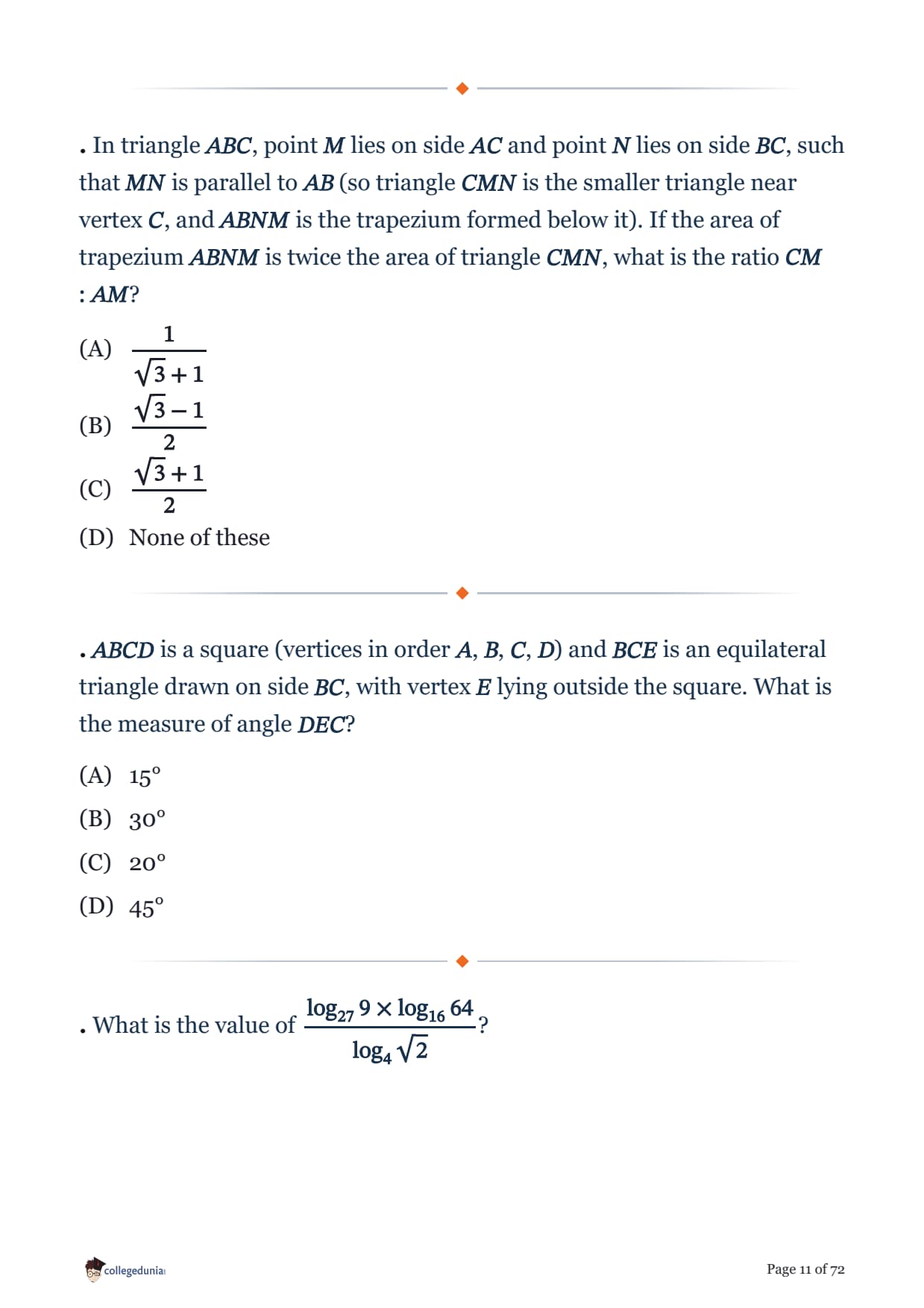
In triangle \(ABC\), point \(M\) lies on side \(AC\) and point \(N\) lies on side \(BC\), such that \(MN\) is parallel to \(AB\) (so triangle \(CMN\) is the smaller triangle near vertex \(C\), and \(ABNM\) is the trapezium formed below it). If the area of trapezium \(ABNM\) is twice the area of triangle \(CMN\), what is the ratio \(CM : AM\)?
\(ABCD\) is a square (vertices in order \(A\), \(B\), \(C\), \(D\)) and \(BCE\) is an equilateral triangle drawn on side \(BC\), with vertex \(E\) lying outside the square. What is the measure of angle \(DEC\)?
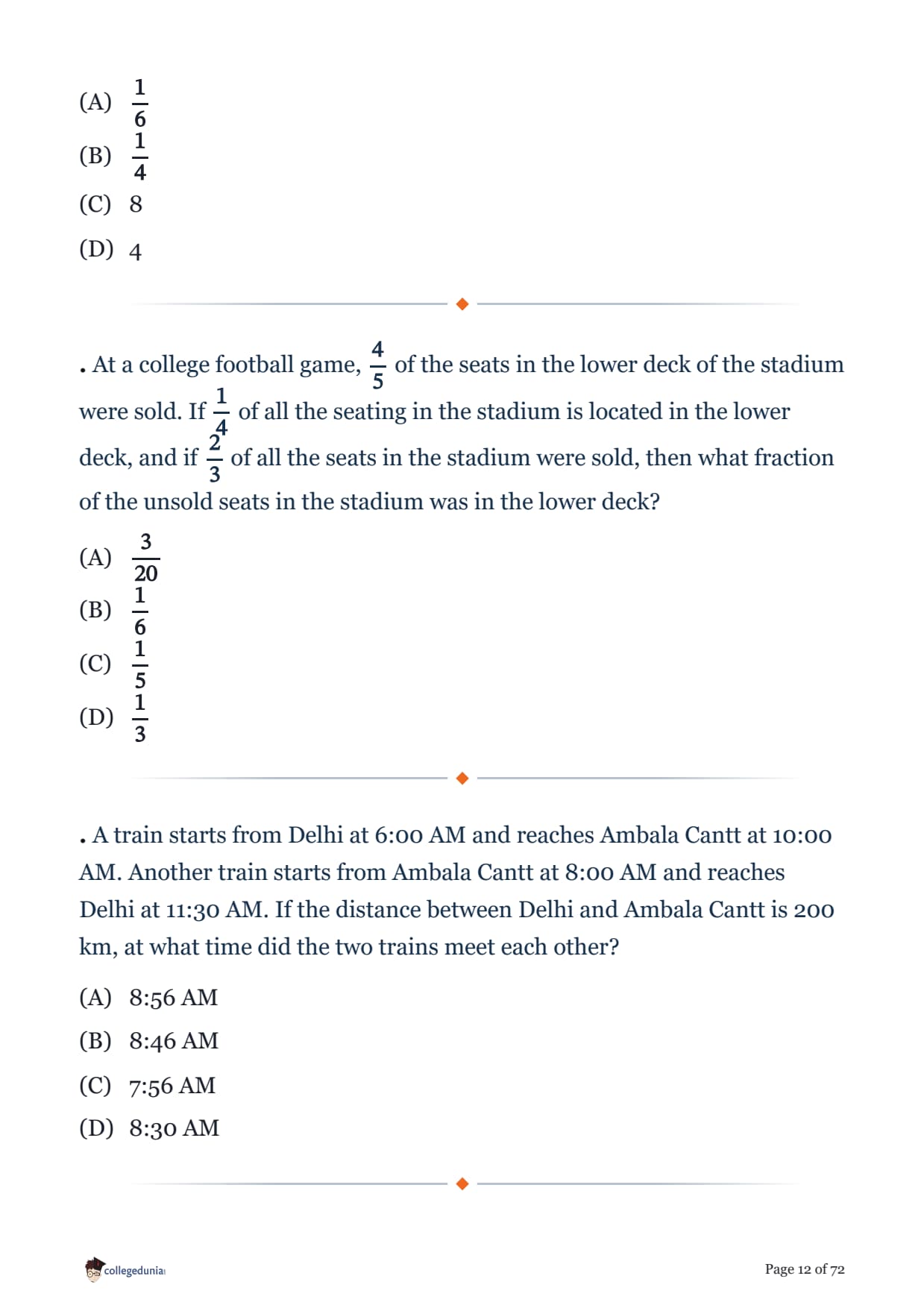
What is the value of \(\dfrac{\log_{27}9 \times \log_{16}64}{\log_4\sqrt2}\)?
At a college football game, \(\dfrac{4}{5}\) of the seats in the lower deck of the stadium were sold. If \(\dfrac{1}{4}\) of all the seating in the stadium is located in the lower deck, and if \(\dfrac{2}{3}\) of all the seats in the stadium were sold, then what fraction of the unsold seats in the stadium was in the lower deck?
A train starts from Delhi at 6:00 AM and reaches Ambala Cantt at 10:00 AM. Another train starts from Ambala Cantt at 8:00 AM and reaches Delhi at 11:30 AM. If the distance between Delhi and Ambala Cantt is 200 km, at what time did the two trains meet each other?
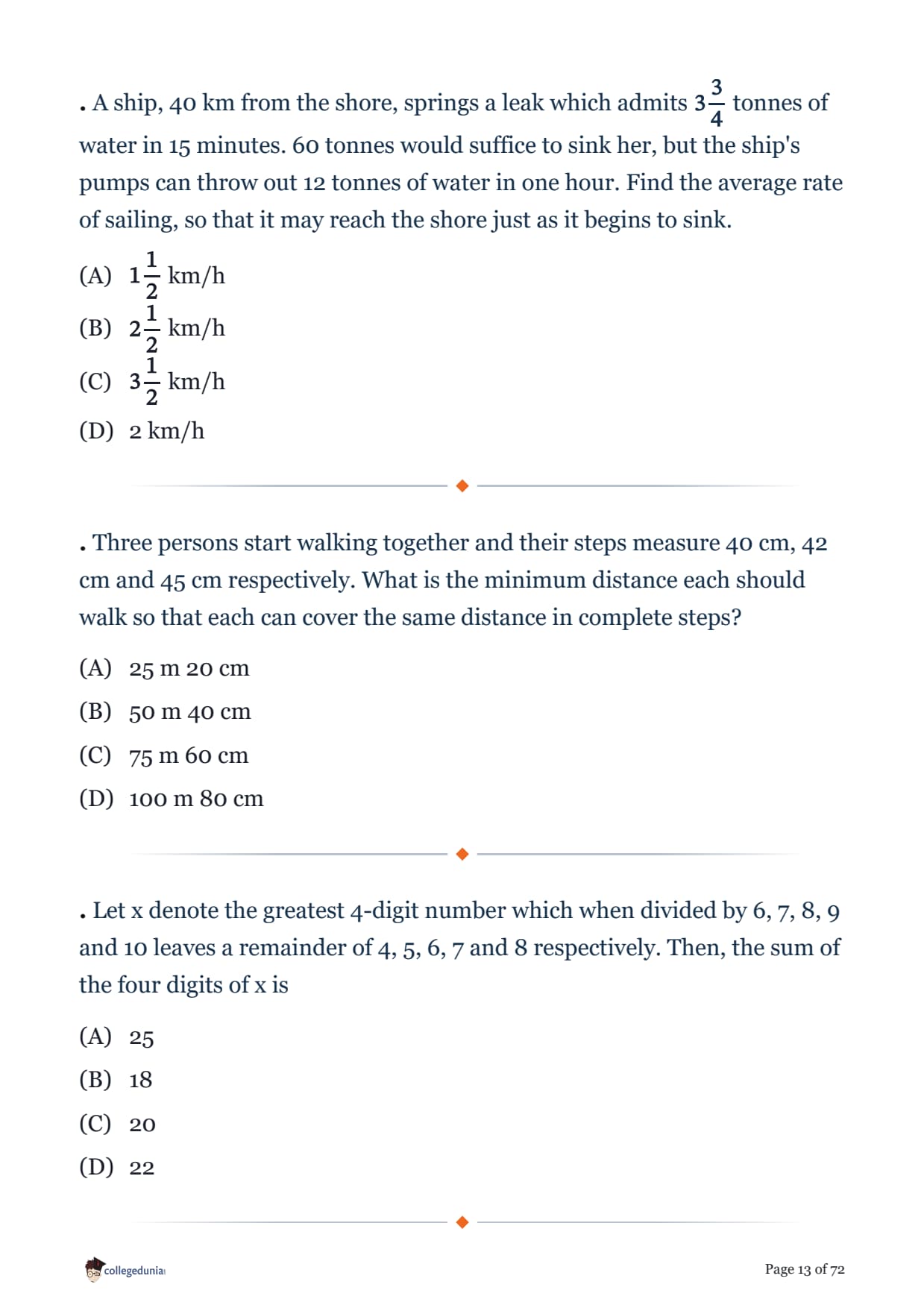
A ship, 40 km from the shore, springs a leak which admits \(3\dfrac{3}{4}\) tonnes of water in 15 minutes. 60 tonnes would suffice to sink her, but the ship's pumps can throw out 12 tonnes of water in one hour. Find the average rate of sailing, so that it may reach the shore just as it begins to sink.
Three persons start walking together and their steps measure 40 cm, 42 cm and 45 cm respectively. What is the minimum distance each should walk so that each can cover the same distance in complete steps?
Let x denote the greatest 4-digit number which when divided by 6, 7, 8, 9 and 10 leaves a remainder of 4, 5, 6, 7 and 8 respectively. Then, the sum of the four digits of x is
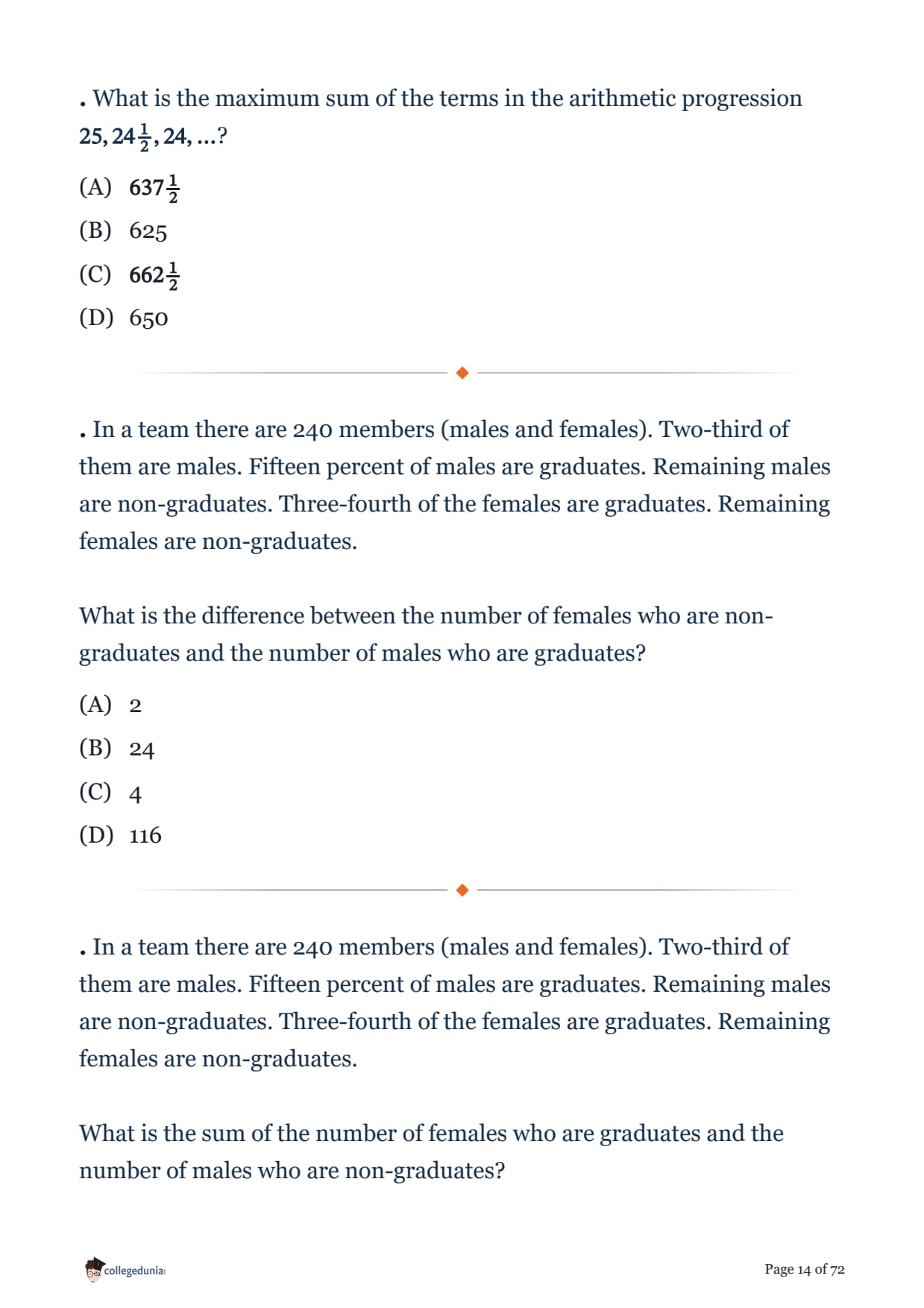
What is the maximum sum of the terms in the arithmetic progression \(25, 24\frac{1}{2}, 24, \ldots\)?
In a team there are 240 members (males and females). Two-third of them are males. Fifteen percent of males are graduates. Remaining males are non-graduates. Three-fourth of the females are graduates. Remaining females are non-graduates.
What is the difference between the number of females who are non-graduates and the number of males who are graduates?
In a team there are 240 members (males and females). Two-third of them are males. Fifteen percent of males are graduates. Remaining males are non-graduates. Three-fourth of the females are graduates. Remaining females are non-graduates.
What is the sum of the number of females who are graduates and the number of males who are non-graduates?
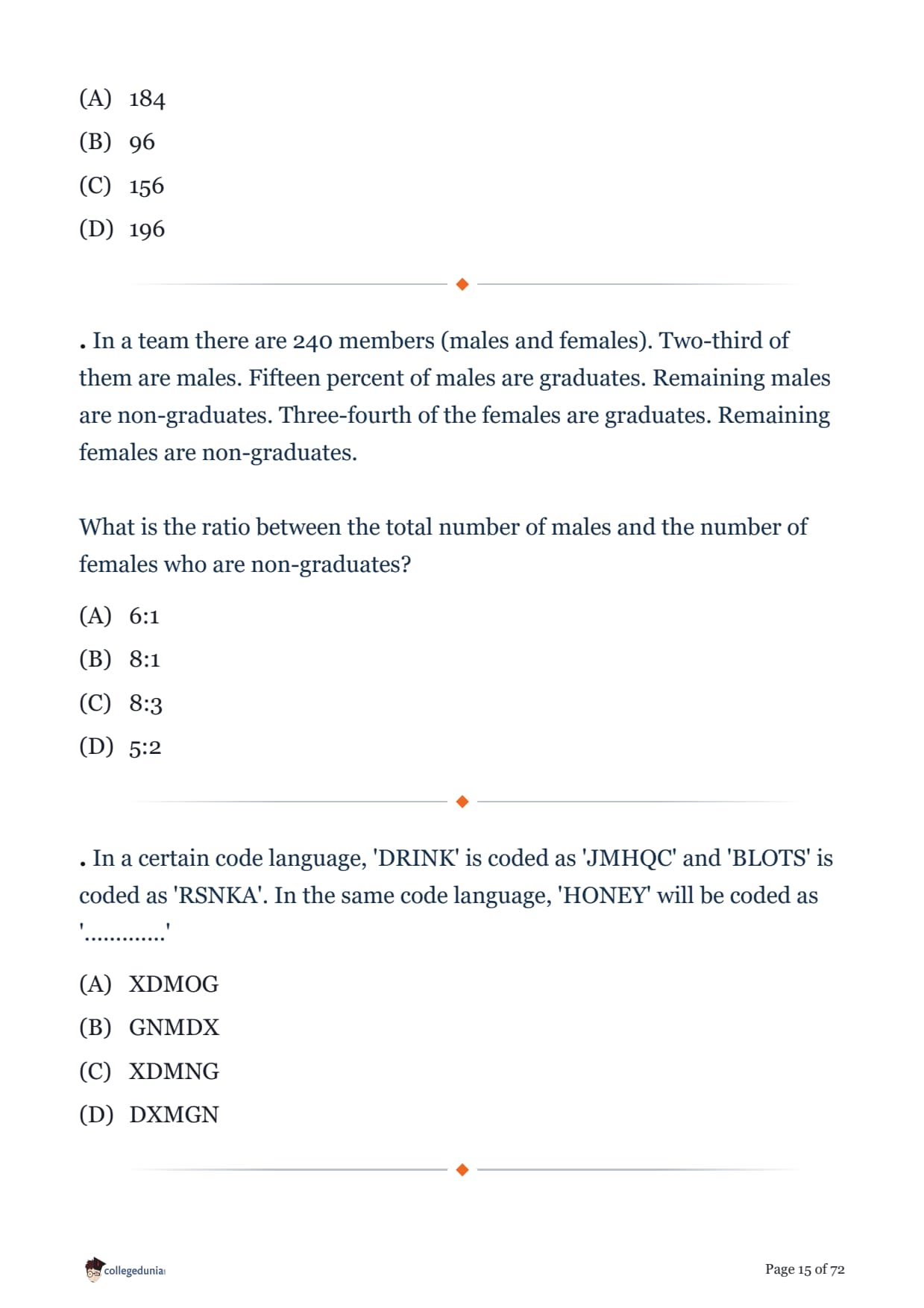
In a team there are 240 members (males and females). Two-third of them are males. Fifteen percent of males are graduates. Remaining males are non-graduates. Three-fourth of the females are graduates. Remaining females are non-graduates.
What is the ratio between the total number of males and the number of females who are non-graduates?
In a certain code language, 'DRINK' is coded as 'JMHQC' and 'BLOTS' is coded as 'RSNKA'. In the same code language, 'HONEY' will be coded as '.............'
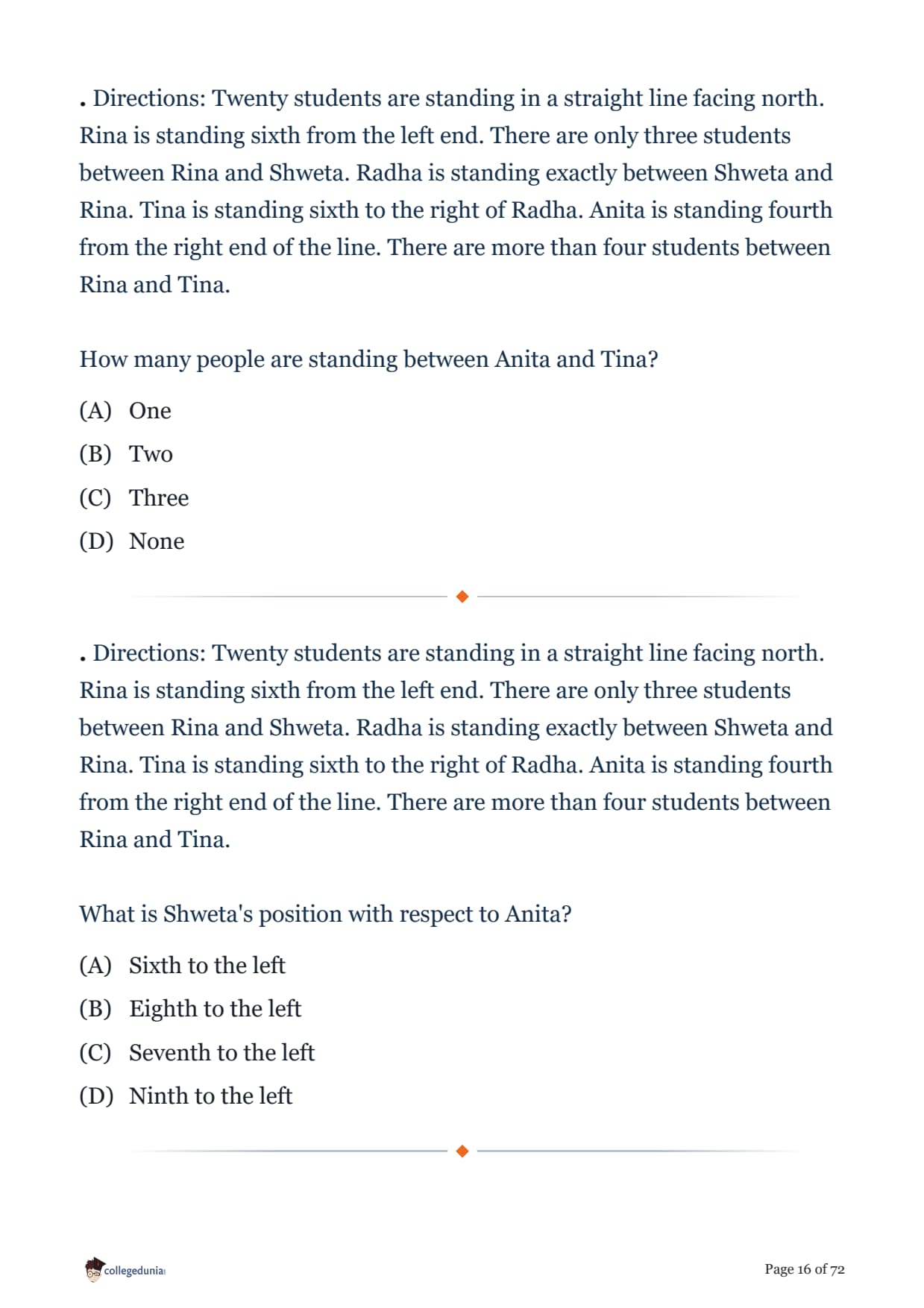
Directions: Twenty students are standing in a straight line facing north. Rina is standing sixth from the left end. There are only three students between Rina and Shweta. Radha is standing exactly between Shweta and Rina. Tina is standing sixth to the right of Radha. Anita is standing fourth from the right end of the line. There are more than four students between Rina and Tina.
How many people are standing between Anita and Tina?
Directions: Twenty students are standing in a straight line facing north. Rina is standing sixth from the left end. There are only three students between Rina and Shweta. Radha is standing exactly between Shweta and Rina. Tina is standing sixth to the right of Radha. Anita is standing fourth from the right end of the line. There are more than four students between Rina and Tina.
What is Shweta's position with respect to Anita?

A cube has six sides each of a different colour. The red side is opposite black. The green side is between red and black. The blue side is adjacent to white and the brown side is adjacent to blue. The red side is face down. The side opposite brown is
Rajesh walked 25 metres towards South. Then he turned to his left and walked 20 metres. He then turned to his left and walked 25 metres. He again turned to his right and walked 15 metres. At what distance is he from the starting point and in which direction?
In these questions, there are four groups of letters, words or numbers listed as (a), (b), (c) and (d). One of the groups does not belong to the same category as others. Find the odd one out. Unscramble the letters in the given words and find the odd one out.
Shyam's house, his office and his gym are all equidistant from each other. The distance between any 2 of them is 4 km. Shyam starts walking from his gym in a direction parallel to the road connecting his office and his house and stops when he reaches a point directly east of his office. He then reverses direction and walks till he reaches a point directly south of his office. The total distance walked by Shyam is
In each of the questions below, one term in the given number series is wrong. Find out the wrong term.
11, 5, 20, 12, 40, 26, 74, 54
In each of the questions below, one term in the given number series is wrong. Find out the wrong term.
8, 14, 26, 48, 98, 194, 386
In each of the questions below, two statements are given followed by two conclusions numbered I and II. Consider the two given statements to be true even if they seem to be at variance with commonly known facts, and decide which of the given conclusions logically follow(s) from the statements.
Statements: All bulbs are birds. Some birds are butterflies.
Conclusions:
I. All butterflies are bulbs.
II. Some bulbs are butterflies.
In each of the questions below, two statements are given followed by two conclusions numbered I and II. Consider the two given statements to be true even if they seem to be at variance with commonly known facts, and decide which of the given conclusions logically follow(s) from the statements.
Statements: No coin is a dollar. Red token is a coin.
Conclusions:
I. Red token is not a dollar.
II. Red token may not be a dollar.

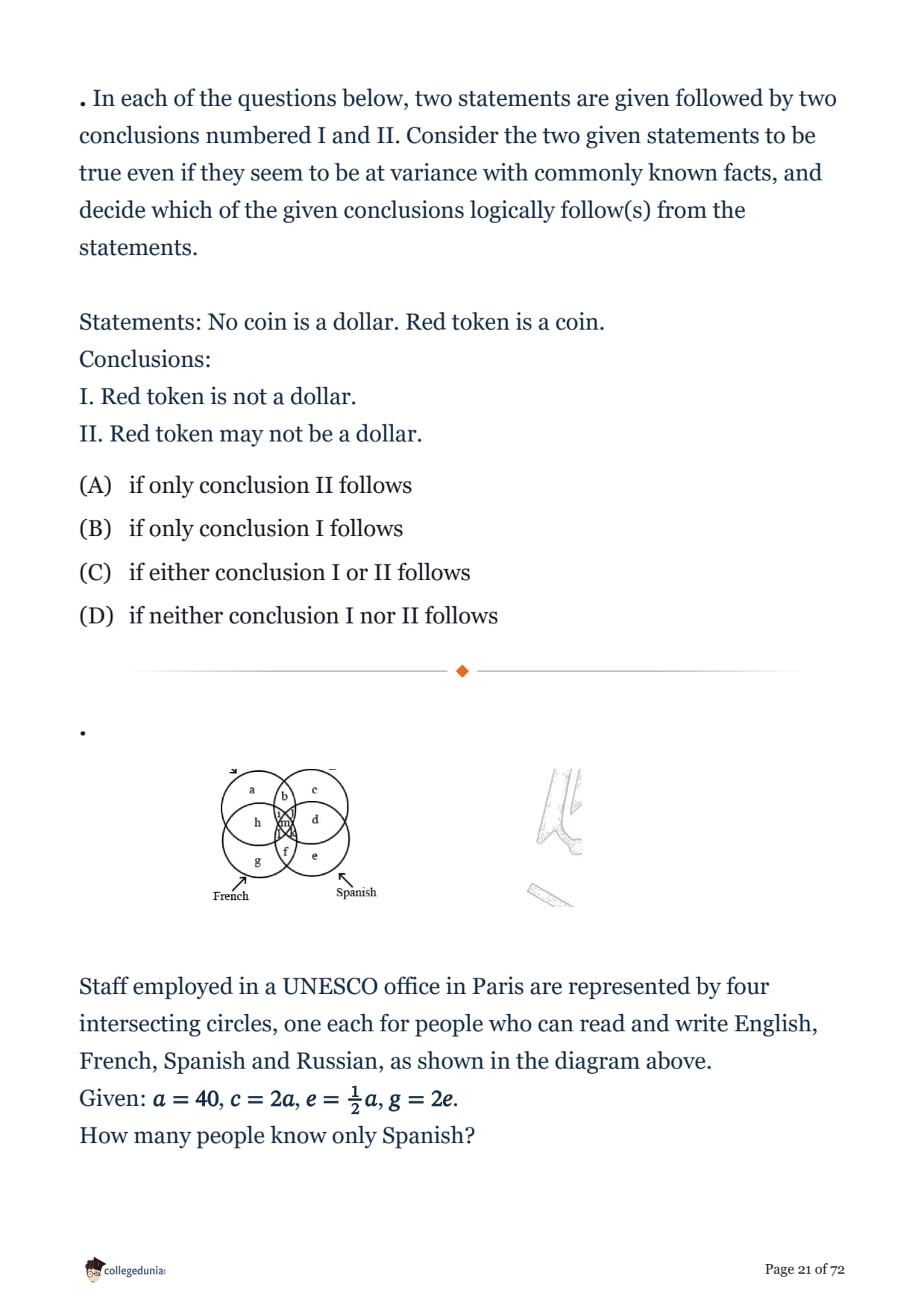
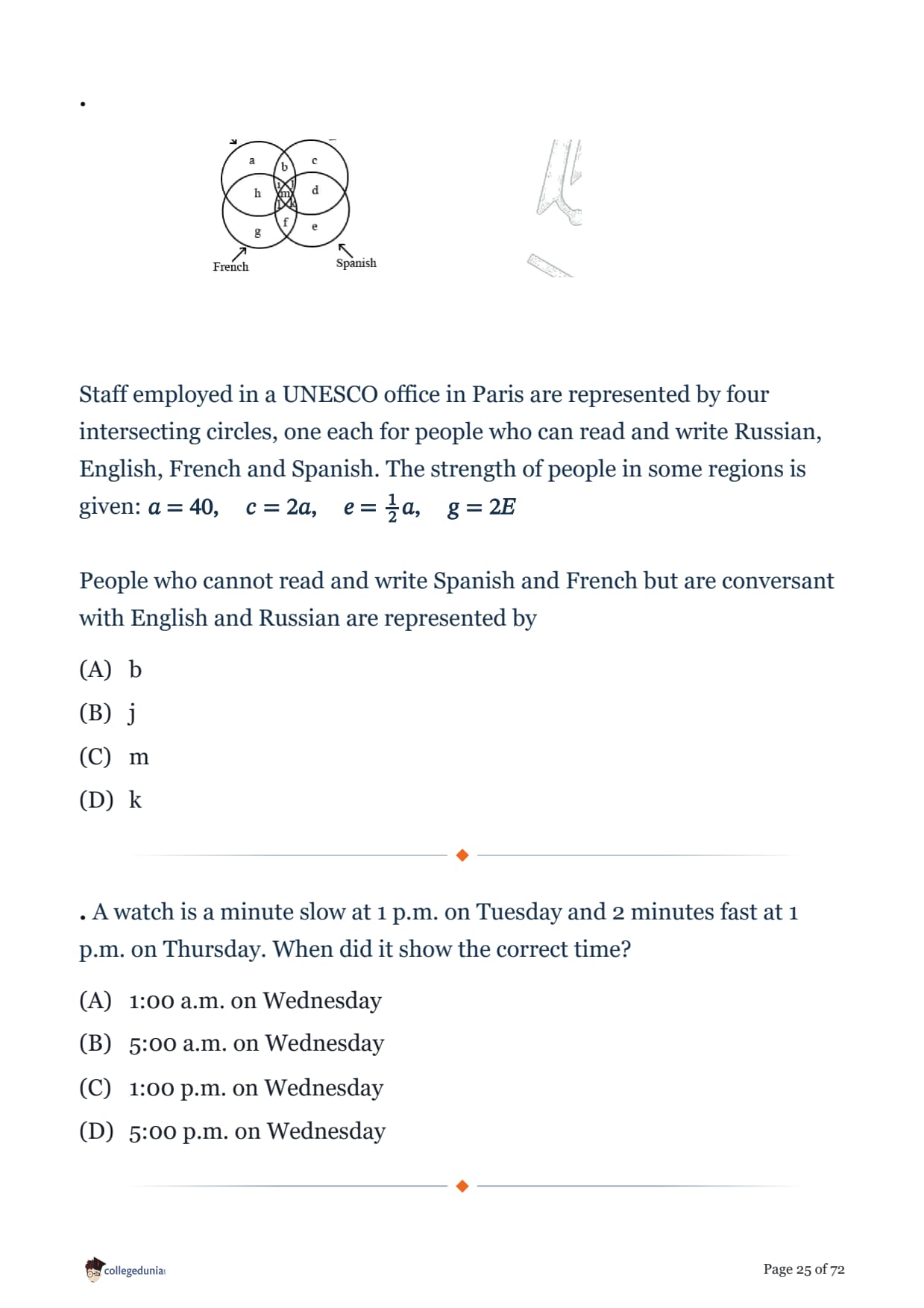
Staff employed in a UNESCO office in Paris are represented by four intersecting circles, one each for people who can read and write English, French, Spanish and Russian, as shown in the diagram above.
Given: \(a = 40\), \(c = 2a\), \(e = \frac{1}{2}a\), \(g = 2e\).
How many people know only Spanish?
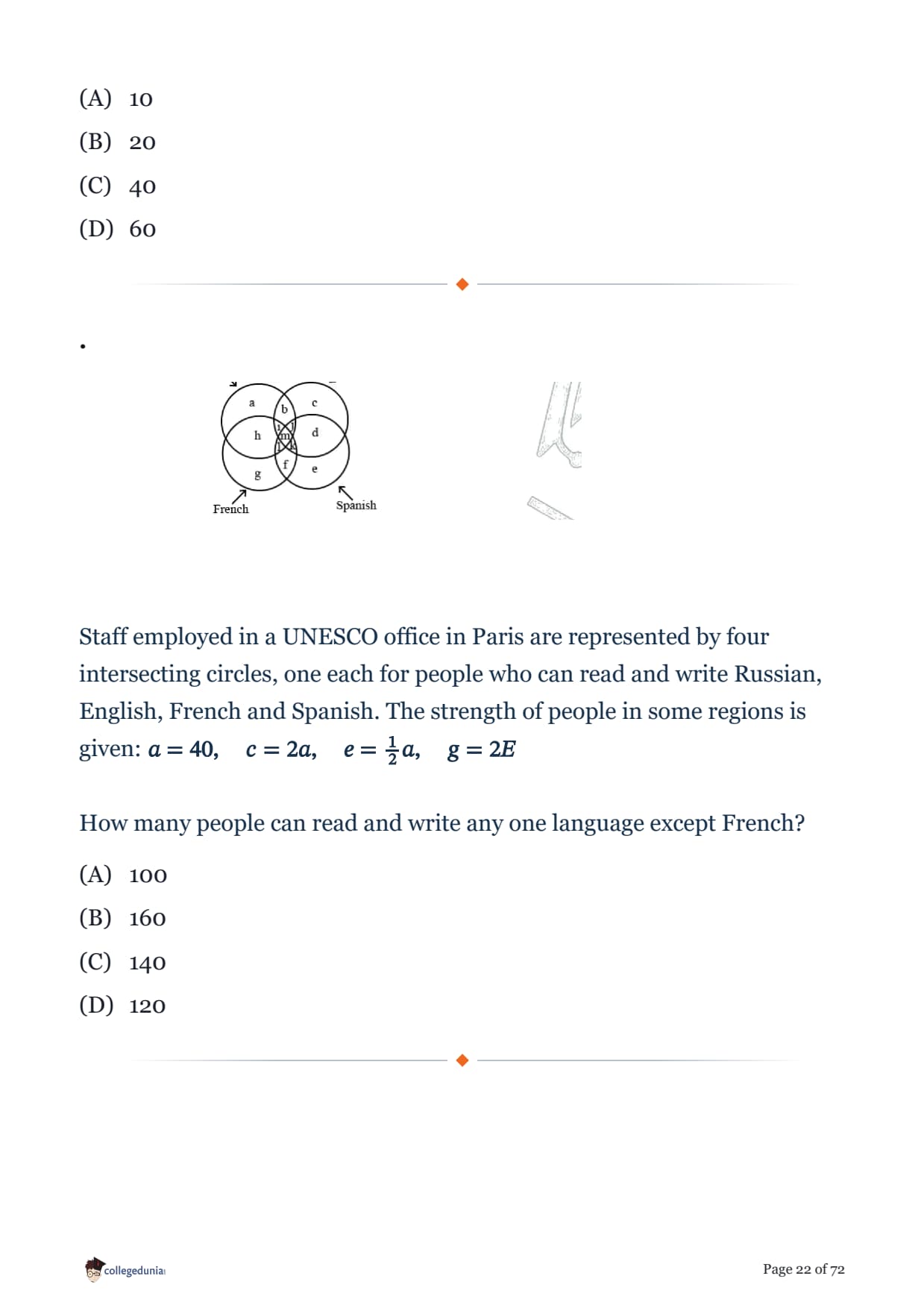
Staff employed in a UNESCO office in Paris are represented by four intersecting circles, one each for people who can read and write Russian, English, French and Spanish. The strength of people in some regions is given: \(a = 40, \quad c = 2a, \quad e = \frac{1}{2}a, \quad g = 2E\)
How many people can read and write any one language except French?
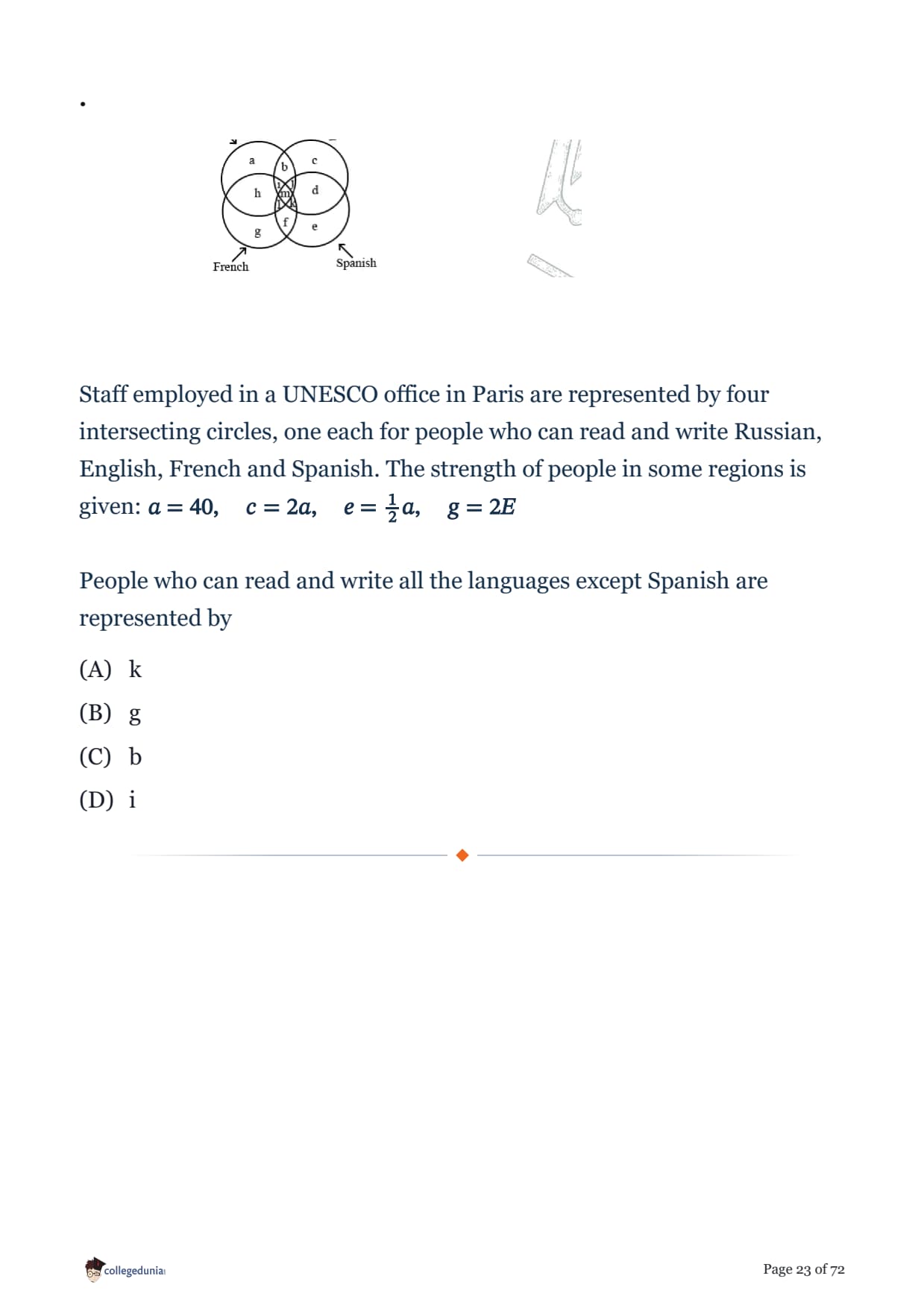
Staff employed in a UNESCO office in Paris are represented by four intersecting circles, one each for people who can read and write Russian, English, French and Spanish. The strength of people in some regions is given: \(a = 40, \quad c = 2a, \quad e = \frac{1}{2}a, \quad g = 2E\)
People who can read and write all the languages except Spanish are represented by
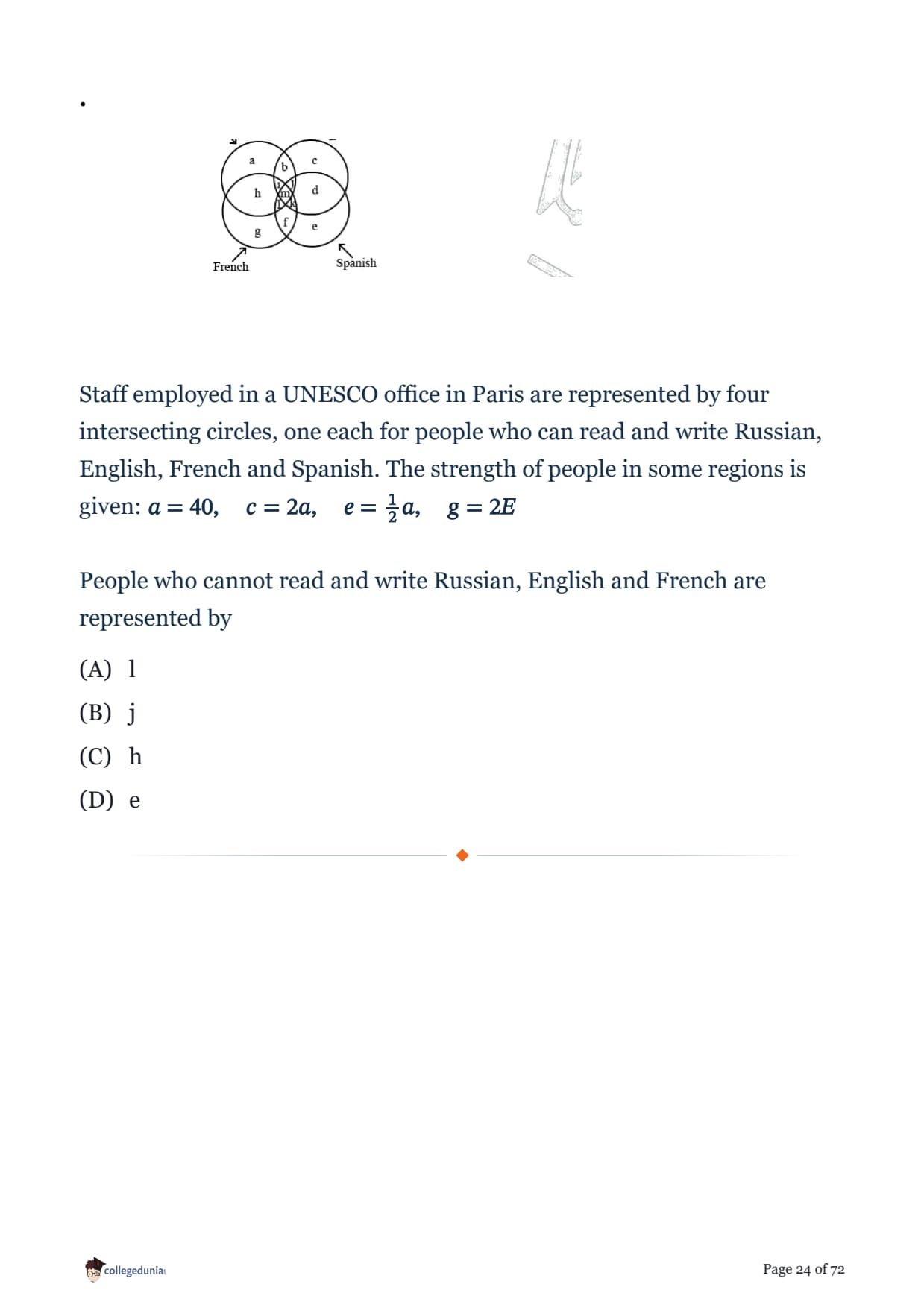
Staff employed in a UNESCO office in Paris are represented by four intersecting circles, one each for people who can read and write Russian, English, French and Spanish. The strength of people in some regions is given: \(a = 40, \quad c = 2a, \quad e = \frac{1}{2}a, \quad g = 2E\)
People who cannot read and write Russian, English and French are represented by
Staff employed in a UNESCO office in Paris are represented by four intersecting circles, one each for people who can read and write Russian, English, French and Spanish. The strength of people in some regions is given: \(a = 40, \quad c = 2a, \quad e = \frac{1}{2}a, \quad g = 2E\)
People who cannot read and write Spanish and French but are conversant with English and Russian are represented by
A watch is a minute slow at 1 p.m. on Tuesday and 2 minutes fast at 1 p.m. on Thursday. When did it show the correct time?
If NOR is coded as 2-3-6, then how should REST be coded in the same code language?
In a certain code language, '3a, 2b, 7c' means 'Truth is Eternal', '7c, 9a, 8b, 3a' means 'Enmity is not Eternal' and '9a, 4d, 2b, 8b' means 'Truth does not perish'. Which of the following means 'Enmity' in that language?
If 'CONSTABLE' is coded as 91, what will be the code number for 'STABLE'?
Ravi has Rs 3 more than Ramu, but then Ramu wins on the horses and triples his money so that he now has Rs 2 more than the original amount of money that the two boys had between them. How much money did Ravi and Ramu have between them before Ramu's win?
A woman introduces a man as the son of the brother of her mother. How is the man related to the woman?
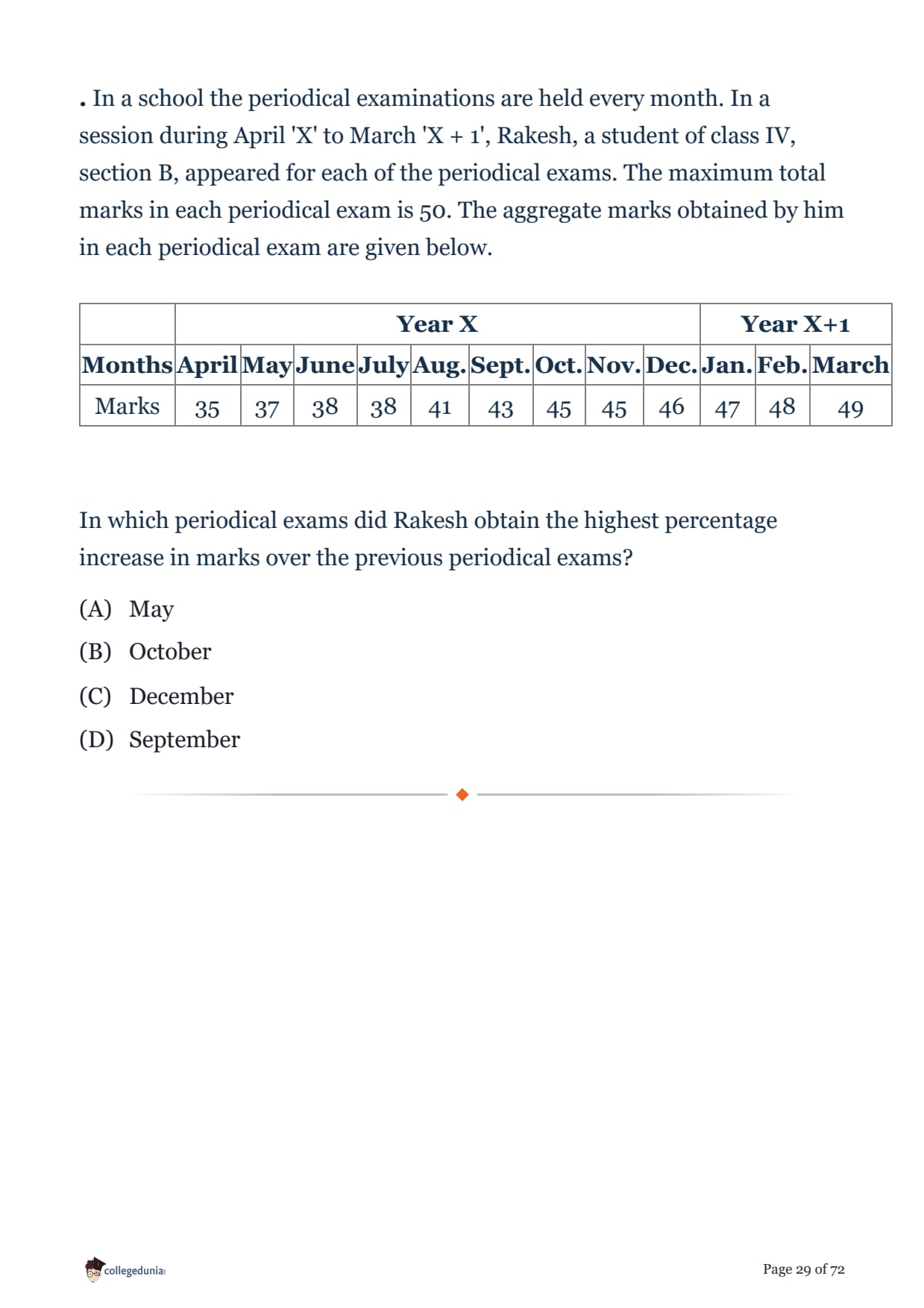
In a school the periodical examinations are held every month. In a session during April 'X' to March 'X + 1', Rakesh, a student of class IV, section B, appeared for each of the periodical exams. The maximum total marks in each periodical exam is 50. The aggregate marks obtained by him in each periodical exam are given below.
| Year X | Year X+1 | |||||||||||
|---|---|---|---|---|---|---|---|---|---|---|---|---|
| Months | April | May | June | July | Aug. | Sept. | Oct. | Nov. | Dec. | Jan. | Feb. | March |
| Marks | 35 | 37 | 38 | 38 | 41 | 43 | 45 | 45 | 46 | 47 | 48 | 49 |
The total marks obtained in December X is what per cent more than the total marks obtained in June X?
In a school the periodical examinations are held every month. In a session during April 'X' to March 'X + 1', Rakesh, a student of class IV, section B, appeared for each of the periodical exams. The maximum total marks in each periodical exam is 50. The aggregate marks obtained by him in each periodical exam are given below.
| Year X | Year X+1 | |||||||||||
|---|---|---|---|---|---|---|---|---|---|---|---|---|
| Months | April | May | June | July | Aug. | Sept. | Oct. | Nov. | Dec. | Jan. | Feb. | March |
| Marks | 35 | 37 | 38 | 38 | 41 | 43 | 45 | 45 | 46 | 47 | 48 | 49 |
In which periodical exams did Rakesh obtain the highest percentage increase in marks over the previous periodical exams?
India is a multi-religion, multi-language and multi-cultural country where people belonging to different religions join in celebrating the festivities together. The Indian Government declares such big occasions as public holidays to enable the citizens to enjoy and foster the feelings of brotherhood. Five broad-minded persons belonging to different religions were asked to give their preferences of four such festivals which they would like to enjoy with like-minded brethren. Their options are:
A. Holi, Dussehra, Diwali, Guru Nanak Birthday
B. Shivratri, Christmas, Onam, Eid
C. Holi, Shivratri, Christmas, Diwali
D. Holi, Dussehra, Guru Nanak Birthday, Eid
E. Christmas, Diwali, Onam, Guru Nanak Birthday
Which pair celebrates Christmas and Onam but not Dussehra and Holi?
India is a multi-religion, multi-language and multi-cultural country where people belonging to different religions join in celebrating the festivities together. The Indian Government declares such big occasions as public holidays to enable the citizens to enjoy and foster the feelings of brotherhood. Five broad-minded persons belonging to different religions were asked to give their preferences of four such festivals which they would like to enjoy with like-minded brethren. Their options are:
A. Holi, Dussehra, Diwali, Guru Nanak Birthday
B. Shivratri, Christmas, Onam, Eid
C. Holi, Shivratri, Christmas, Diwali
D. Holi, Dussehra, Guru Nanak Birthday, Eid
E. Christmas, Diwali, Onam, Guru Nanak Birthday
Which pair does not participate in Eid and Onam but joins in Holi?
Five persons, A, B, C, D and E, belonging to different religions were asked to state their preferences for four festivals each, which they would like to celebrate with like minded people. Their preferences are:
A: Holi, Dussehra, Diwali, Guru Nanak Birthday
B: Shivratri, Christmas, Onam, Eid
C: Holi, Shivratri, Christmas, Diwali
D: Holi, Dussehra, Guru Nanak Birthday, Eid
E: Christmas, Diwali, Onam, Guru Nanak Birthday
Who enjoys Holi and Eid but not Diwali and Christmas?
Which of the following expressions will definitely be true if the expression \( R > O = A > S < T \) is definitely true?
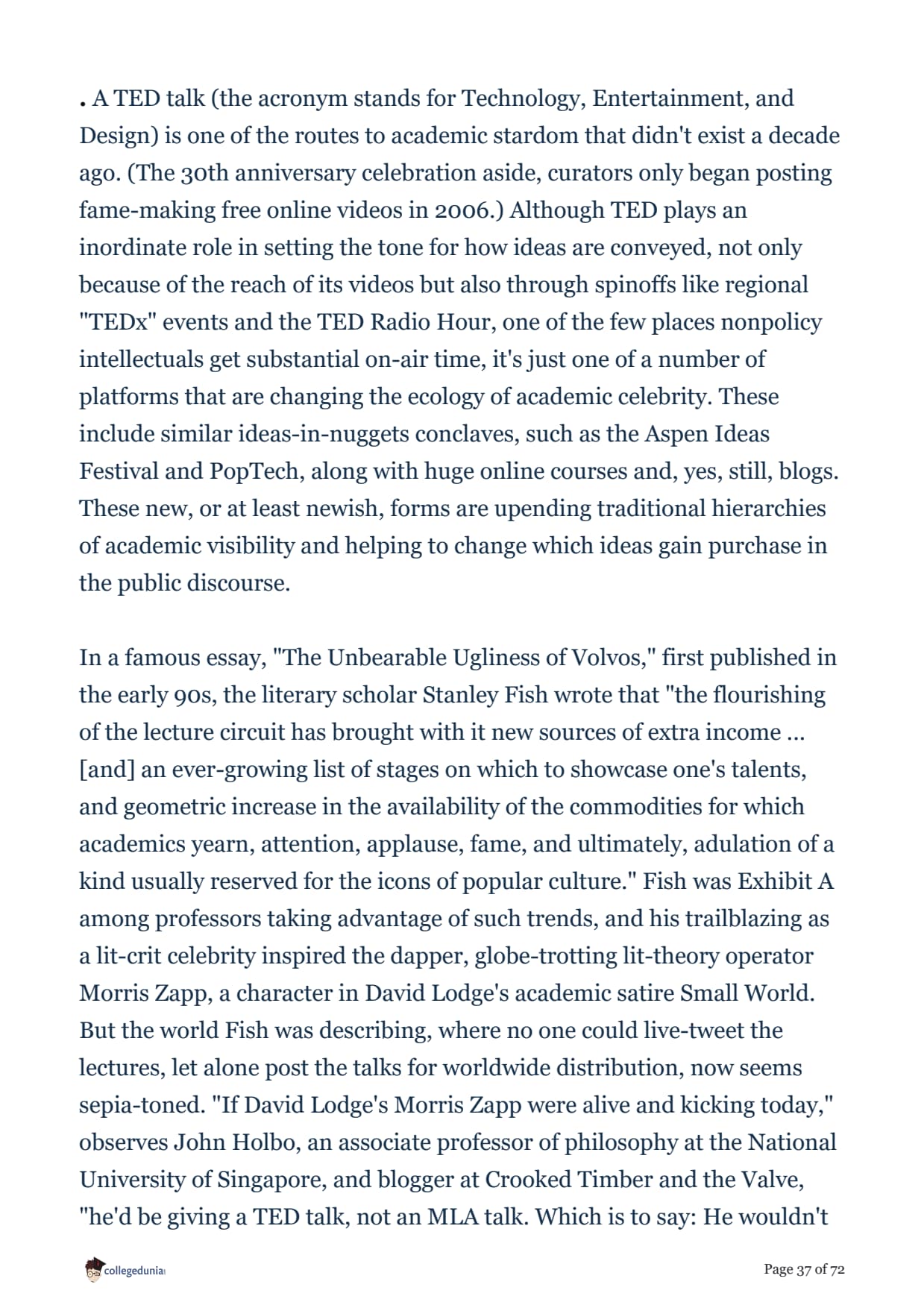
A TED talk (the acronym stands for Technology, Entertainment, and Design) is one of the routes to academic stardom that didn't exist a decade ago. (The 30th anniversary celebration aside, curators only began posting fame-making free online videos in 2006.) Although TED plays an inordinate role in setting the tone for how ideas are conveyed, not only because of the reach of its videos but also through spinoffs like regional "TEDx" events and the TED Radio Hour, one of the few places nonpolicy intellectuals get substantial on-air time, it's just one of a number of platforms that are changing the ecology of academic celebrity. These include similar ideas-in-nuggets conclaves, such as the Aspen Ideas Festival and PopTech, along with huge online courses and, yes, still, blogs. These new, or at least newish, forms are upending traditional hierarchies of academic visibility and helping to change which ideas gain purchase in the public discourse.
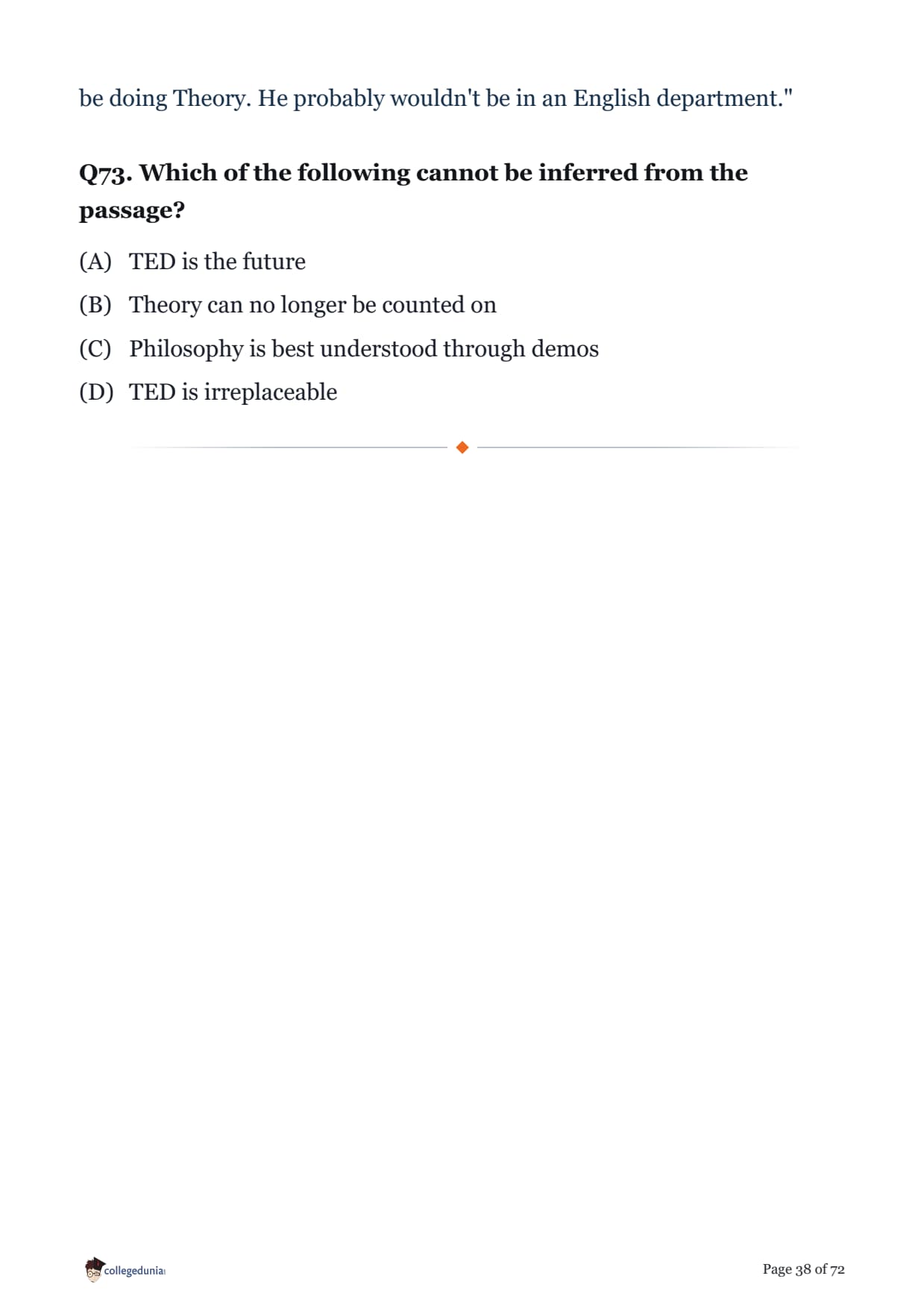
In a famous essay, "The Unbearable Ugliness of Volvos," first published in the early 90s, the literary scholar Stanley Fish wrote that "the flourishing of the lecture circuit has brought with it new sources of extra income ... [and] an ever-growing list of stages on which to showcase one's talents, and geometric increase in the availability of the commodities for which academics yearn, attention, applause, fame, and ultimately, adulation of a kind usually reserved for the icons of popular culture." Fish was Exhibit A among professors taking advantage of such trends, and his trailblazing as a lit-crit celebrity inspired the dapper, globe-trotting lit-theory operator Morris Zapp, a character in David Lodge's academic satire Small World. But the world Fish was describing, where no one could live-tweet the lectures, let alone post the talks for worldwide distribution, now seems sepia-toned. "If David Lodge's Morris Zapp were alive and kicking today," observes John Holbo, an associate professor of philosophy at the National University of Singapore, and blogger at Crooked Timber and the Valve, "he'd be giving a TED talk, not an MLA talk. Which is to say: He wouldn't be doing Theory. He probably wouldn't be in an English department."
Q71. The passage is mainly about:
A TED talk (the acronym stands for Technology, Entertainment, and Design) is one of the routes to academic stardom that didn't exist a decade ago. (The 30th anniversary celebration aside, curators only began posting fame-making free online videos in 2006.) Although TED plays an inordinate role in setting the tone for how ideas are conveyed, not only because of the reach of its videos but also through spinoffs like regional "TEDx" events and the TED Radio Hour, one of the few places nonpolicy intellectuals get substantial on-air time, it's just one of a number of platforms that are changing the ecology of academic celebrity. These include similar ideas-in-nuggets conclaves, such as the Aspen Ideas Festival and PopTech, along with huge online courses and, yes, still, blogs. These new, or at least newish, forms are upending traditional hierarchies of academic visibility and helping to change which ideas gain purchase in the public discourse.
In a famous essay, "The Unbearable Ugliness of Volvos," first published in the early 90s, the literary scholar Stanley Fish wrote that "the flourishing of the lecture circuit has brought with it new sources of extra income ... [and] an ever-growing list of stages on which to showcase one's talents, and geometric increase in the availability of the commodities for which academics yearn, attention, applause, fame, and ultimately, adulation of a kind usually reserved for the icons of popular culture." Fish was Exhibit A among professors taking advantage of such trends, and his trailblazing as a lit-crit celebrity inspired the dapper, globe-trotting lit-theory operator Morris Zapp, a character in David Lodge's academic satire Small World. But the world Fish was describing, where no one could live-tweet the lectures, let alone post the talks for worldwide distribution, now seems sepia-toned. "If David Lodge's Morris Zapp were alive and kicking today," observes John Holbo, an associate professor of philosophy at the National University of Singapore, and blogger at Crooked Timber and the Valve, "he'd be giving a TED talk, not an MLA talk. Which is to say: He wouldn't be doing Theory. He probably wouldn't be in an English department."
Q72. The phrase "sepia-toned" implies:
A TED talk (the acronym stands for Technology, Entertainment, and Design) is one of the routes to academic stardom that didn't exist a decade ago. (The 30th anniversary celebration aside, curators only began posting fame-making free online videos in 2006.) Although TED plays an inordinate role in setting the tone for how ideas are conveyed, not only because of the reach of its videos but also through spinoffs like regional "TEDx" events and the TED Radio Hour, one of the few places nonpolicy intellectuals get substantial on-air time, it's just one of a number of platforms that are changing the ecology of academic celebrity. These include similar ideas-in-nuggets conclaves, such as the Aspen Ideas Festival and PopTech, along with huge online courses and, yes, still, blogs. These new, or at least newish, forms are upending traditional hierarchies of academic visibility and helping to change which ideas gain purchase in the public discourse.
In a famous essay, "The Unbearable Ugliness of Volvos," first published in the early 90s, the literary scholar Stanley Fish wrote that "the flourishing of the lecture circuit has brought with it new sources of extra income ... [and] an ever-growing list of stages on which to showcase one's talents, and geometric increase in the availability of the commodities for which academics yearn, attention, applause, fame, and ultimately, adulation of a kind usually reserved for the icons of popular culture." Fish was Exhibit A among professors taking advantage of such trends, and his trailblazing as a lit-crit celebrity inspired the dapper, globe-trotting lit-theory operator Morris Zapp, a character in David Lodge's academic satire Small World. But the world Fish was describing, where no one could live-tweet the lectures, let alone post the talks for worldwide distribution, now seems sepia-toned. "If David Lodge's Morris Zapp were alive and kicking today," observes John Holbo, an associate professor of philosophy at the National University of Singapore, and blogger at Crooked Timber and the Valve, "he'd be giving a TED talk, not an MLA talk. Which is to say: He wouldn't be doing Theory. He probably wouldn't be in an English department."
Q73. Which of the following cannot be inferred from the passage?
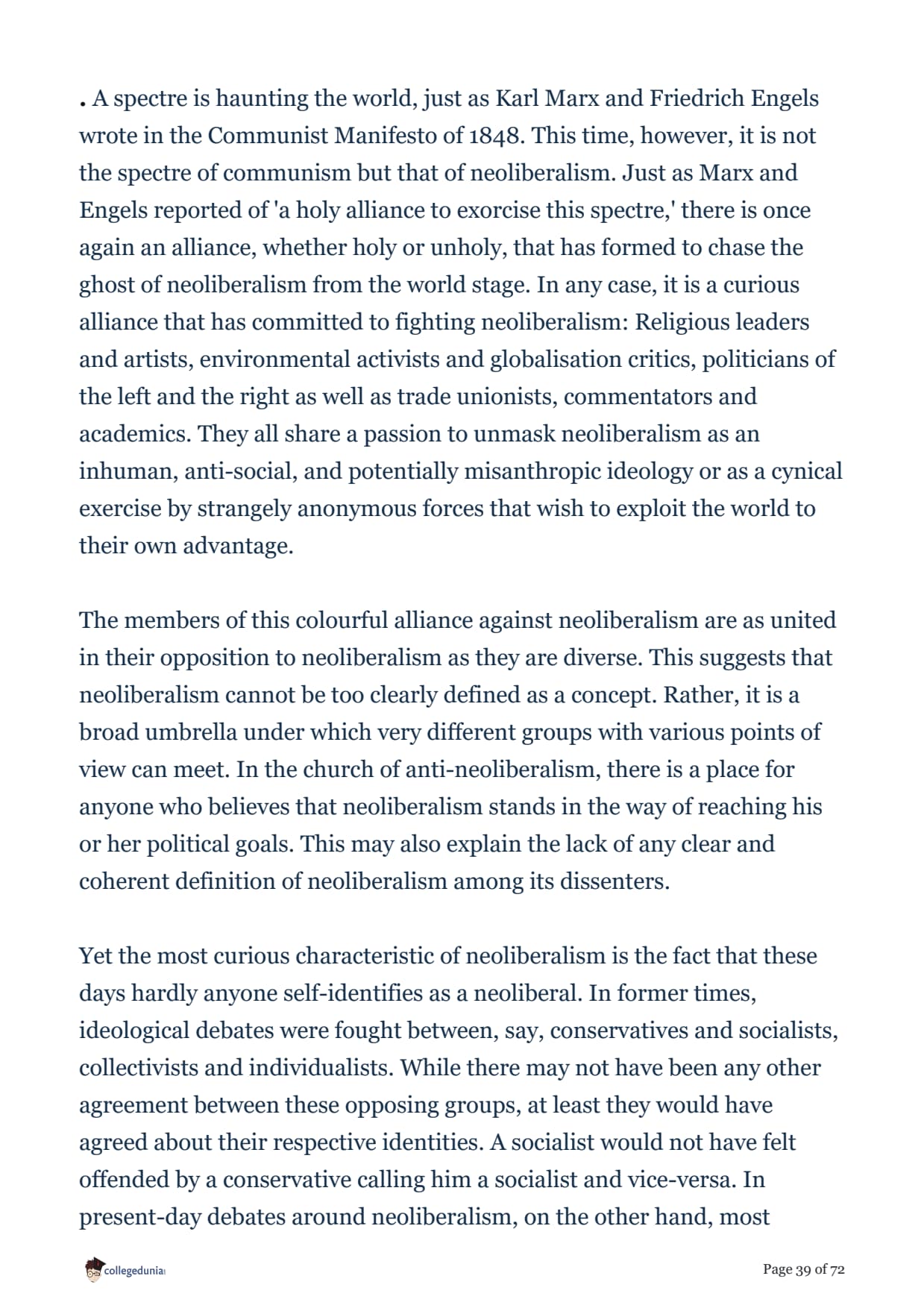
A spectre is haunting the world, just as Karl Marx and Friedrich Engels wrote in the Communist Manifesto of 1848. This time, however, it is not the spectre of communism but that of neoliberalism. Just as Marx and Engels reported of 'a holy alliance to exorcise this spectre,' there is once again an alliance, whether holy or unholy, that has formed to chase the ghost of neoliberalism from the world stage. In any case, it is a curious alliance that has committed to fighting neoliberalism: Religious leaders and artists, environmental activists and globalisation critics, politicians of the left and the right as well as trade unionists, commentators and academics. They all share a passion to unmask neoliberalism as an inhuman, anti-social, and potentially misanthropic ideology or as a cynical exercise by strangely anonymous forces that wish to exploit the world to their own advantage.
The members of this colourful alliance against neoliberalism are as united in their opposition to neoliberalism as they are diverse. This suggests that neoliberalism cannot be too clearly defined as a concept. Rather, it is a broad umbrella under which very different groups with various points of view can meet. In the church of anti-neoliberalism, there is a place for anyone who believes that neoliberalism stands in the way of reaching his or her political goals. This may also explain the lack of any clear and coherent definition of neoliberalism among its dissenters.
Yet the most curious characteristic of neoliberalism is the fact that these days hardly anyone self-identifies as a neoliberal. In former times, ideological debates were fought between, say, conservatives and socialists, collectivists and individualists. While there may not have been any other agreement between these opposing groups, at least they would have agreed about their respective identities. A socialist would not have felt offended by a conservative calling him a socialist and vice-versa. In present-day debates around neoliberalism, on the other hand, most accused of holding 'neoliberal' views would not accept being called 'neoliberal.' Either they would insist on being something else (whether it is 'liberal,' 'classical liberal,' or 'libertarian'), or they would simply claim to be misunderstood by their opponents. In any case, scarcely anybody wants to be a 'neoliberal' any more. For example, in an online survey of the readers of Andrew Norton's blog, out of more than 1,200 participants not a single person self-identified with the term, while 'classical liberal,' 'conservative,' and 'libertarian' were strong responses. These are strange debates indeed when the enemy you are fighting claims he does not exist.
Q74. According to the passage, the spectre is being chased by all except which one of the following:
A spectre is haunting the world, just as Karl Marx and Friedrich Engels wrote in the Communist Manifesto of 1848. This time, however, it is not the spectre of communism but that of neoliberalism. Just as Marx and Engels reported of 'a holy alliance to exorcise this spectre,' there is once again an alliance, whether holy or unholy, that has formed to chase the ghost of neoliberalism from the world stage. In any case, it is a curious alliance that has committed to fighting neoliberalism: Religious leaders and artists, environmental activists and globalisation critics, politicians of the left and the right as well as trade unionists, commentators and academics. They all share a passion to unmask neoliberalism as an inhuman, anti-social, and potentially misanthropic ideology or as a cynical exercise by strangely anonymous forces that wish to exploit the world to their own advantage.
The members of this colourful alliance against neoliberalism are as united in their opposition to neoliberalism as they are diverse. This suggests that neoliberalism cannot be too clearly defined as a concept. Rather, it is a broad umbrella under which very different groups with various points of view can meet. In the church of anti-neoliberalism, there is a place for anyone who believes that neoliberalism stands in the way of reaching his or her political goals. This may also explain the lack of any clear and coherent definition of neoliberalism among its dissenters.
Yet the most curious characteristic of neoliberalism is the fact that these days hardly anyone self-identifies as a neoliberal. In former times, ideological debates were fought between, say, conservatives and socialists, collectivists and individualists. While there may not have been any other agreement between these opposing groups, at least they would have agreed about their respective identities. A socialist would not have felt offended by a conservative calling him a socialist and vice-versa. In present-day debates around neoliberalism, on the other hand, most accused of holding 'neoliberal' views would not accept being called 'neoliberal.' Either they would insist on being something else (whether it is 'liberal,' 'classical liberal,' or 'libertarian'), or they would simply claim to be misunderstood by their opponents. In any case, scarcely anybody wants to be a 'neoliberal' any more. For example, in an online survey of the readers of Andrew Norton's blog, out of more than 1,200 participants not a single person self-identified with the term, while 'classical liberal,' 'conservative,' and 'libertarian' were strong responses. These are strange debates indeed when the enemy you are fighting claims he does not exist.
Q75. Why, according to the passage, is there an association against the phenomenon of neoliberalism?
A spectre is haunting the world, just as Karl Marx and Friedrich Engels wrote in the Communist Manifesto of 1848. This time, however, it is not the spectre of communism but that of neoliberalism. Just as Marx and Engels reported of 'a holy alliance to exorcise this spectre,' there is once again an alliance, whether holy or unholy, that has formed to chase the ghost of neoliberalism from the world stage. In any case, it is a curious alliance that has committed to fighting neoliberalism: Religious leaders and artists, environmental activists and globalisation critics, politicians of the left and the right as well as trade unionists, commentators and academics. They all share a passion to unmask neoliberalism as an inhuman, anti-social, and potentially misanthropic ideology or as a cynical exercise by strangely anonymous forces that wish to exploit the world to their own advantage.
The members of this colourful alliance against neoliberalism are as united in their opposition to neoliberalism as they are diverse. This suggests that neoliberalism cannot be too clearly defined as a concept. Rather, it is a broad umbrella under which very different groups with various points of view can meet. In the church of anti-neoliberalism, there is a place for anyone who believes that neoliberalism stands in the way of reaching his or her political goals. This may also explain the lack of any clear and coherent definition of neoliberalism among its dissenters.
Yet the most curious characteristic of neoliberalism is the fact that these days hardly anyone self-identifies as a neoliberal. In former times, ideological debates were fought between, say, conservatives and socialists, collectivists and individualists. While there may not have been any other agreement between these opposing groups, at least they would have agreed about their respective identities. A socialist would not have felt offended by a conservative calling him a socialist and vice-versa. In present-day debates around neoliberalism, on the other hand, most accused of holding 'neoliberal' views would not accept being called 'neoliberal.' Either they would insist on being something else (whether it is 'liberal,' 'classical liberal,' or 'libertarian'), or they would simply claim to be misunderstood by their opponents. In any case, scarcely anybody wants to be a 'neoliberal' any more. For example, in an online survey of the readers of Andrew Norton's blog, out of more than 1,200 participants not a single person self-identified with the term, while 'classical liberal,' 'conservative,' and 'libertarian' were strong responses. These are strange debates indeed when the enemy you are fighting claims he does not exist.
Q76. The author implies:
A spectre is haunting the world, just as Karl Marx and Friedrich Engels wrote in the Communist Manifesto of 1848. This time, however, it is not the spectre of communism but that of neoliberalism. Just as Marx and Engels reported of 'a holy alliance to exorcise this spectre,' there is once again an alliance, whether holy or unholy, that has formed to chase the ghost of neoliberalism from the world stage. In any case, it is a curious alliance that has committed to fighting neoliberalism: Religious leaders and artists, environmental activists and globalisation critics, politicians of the left and the right as well as trade unionists, commentators and academics. They all share a passion to unmask neoliberalism as an inhuman, anti-social, and potentially misanthropic ideology or as a cynical exercise by strangely anonymous forces that wish to exploit the world to their own advantage.
The members of this colourful alliance against neoliberalism are as united in their opposition to neoliberalism as they are diverse. This suggests that neoliberalism cannot be too clearly defined as a concept. Rather, it is a broad umbrella under which very different groups with various points of view can meet. In the church of anti-neoliberalism, there is a place for anyone who believes that neoliberalism stands in the way of reaching his or her political goals. This may also explain the lack of any clear and coherent definition of neoliberalism among its dissenters.
Yet the most curious characteristic of neoliberalism is the fact that these days hardly anyone self-identifies as a neoliberal. In former times, ideological debates were fought between, say, conservatives and socialists, collectivists and individualists. While there may not have been any other agreement between these opposing groups, at least they would have agreed about their respective identities. A socialist would not have felt offended by a conservative calling him a socialist and vice-versa. In present-day debates around neoliberalism, on the other hand, most accused of holding 'neoliberal' views would not accept being called 'neoliberal.' Either they would insist on being something else (whether it is 'liberal,' 'classical liberal,' or 'libertarian'), or they would simply claim to be misunderstood by their opponents. In any case, scarcely anybody wants to be a 'neoliberal' any more. For example, in an online survey of the readers of Andrew Norton's blog, out of more than 1,200 participants not a single person self-identified with the term, while 'classical liberal,' 'conservative,' and 'libertarian' were strong responses. These are strange debates indeed when the enemy you are fighting claims he does not exist.
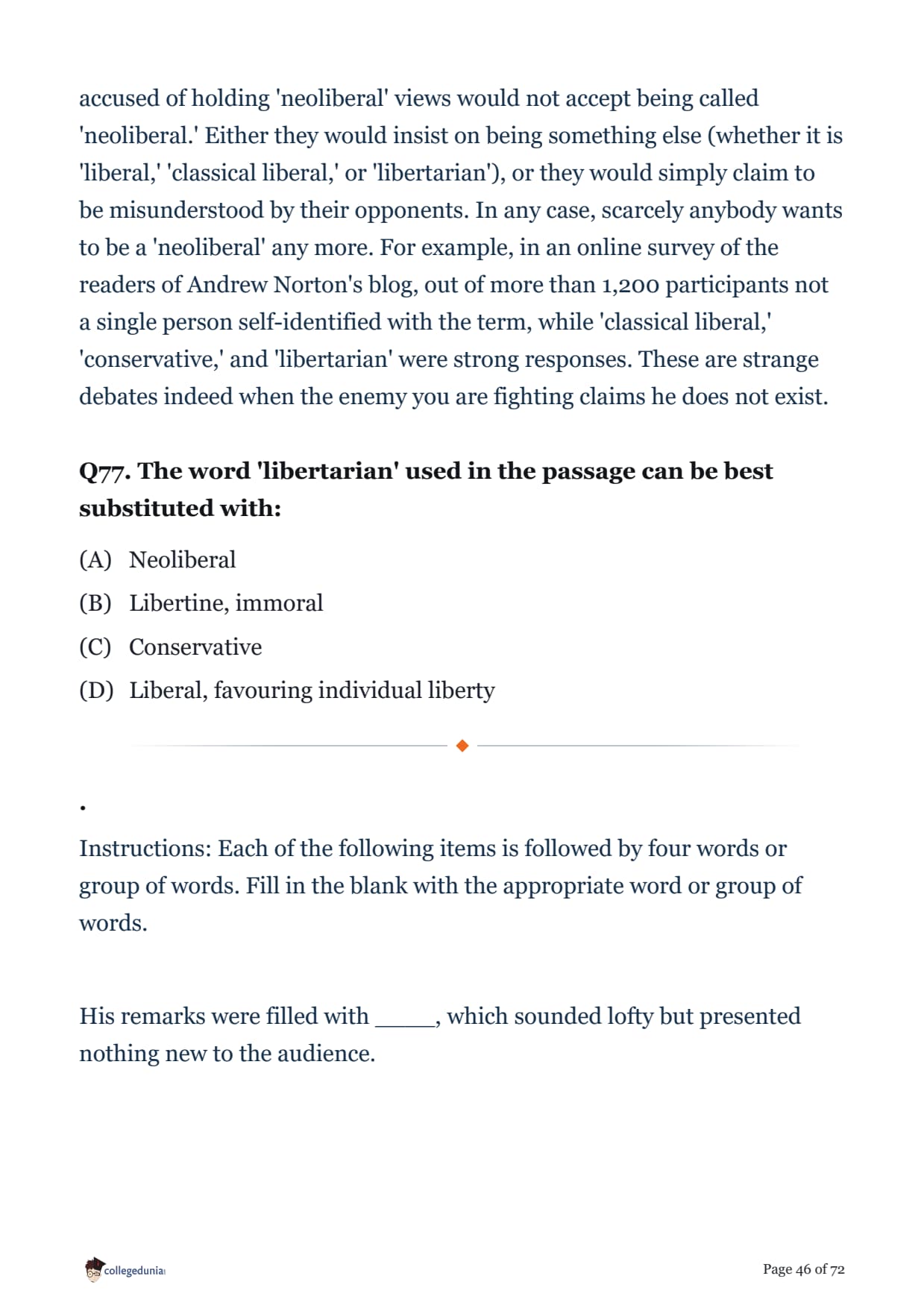
Q77. The word 'libertarian' used in the passage can be best substituted with:
Instructions: Each of the following items is followed by four words or group of words. Fill in the blank with the appropriate word or group of words.
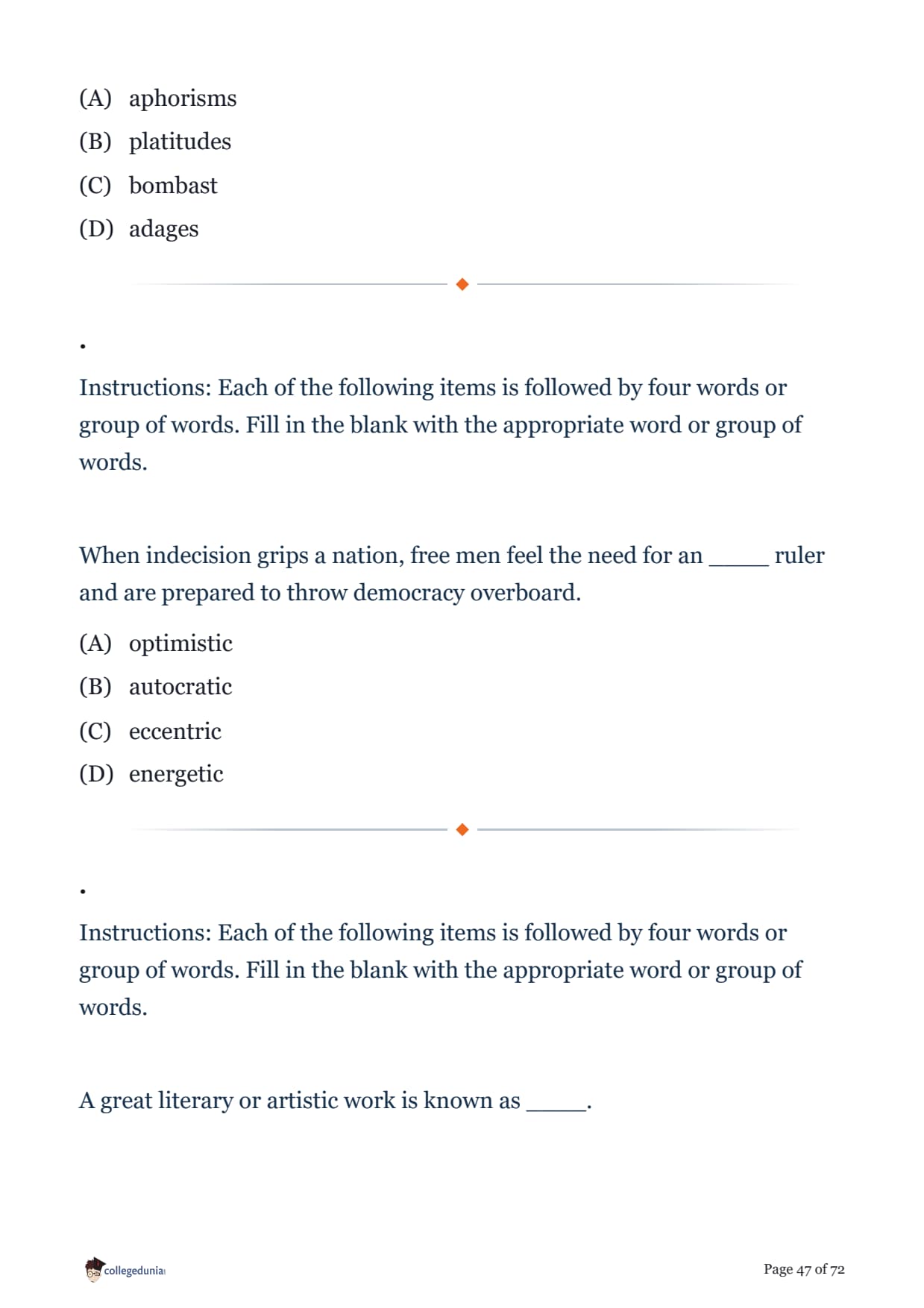
His remarks were filled with ____, which sounded lofty but presented nothing new to the audience.
Instructions: Each of the following items is followed by four words or group of words. Fill in the blank with the appropriate word or group of words.
When indecision grips a nation, free men feel the need for an ____ ruler and are prepared to throw democracy overboard.
Instructions: Each of the following items is followed by four words or group of words. Fill in the blank with the appropriate word or group of words.
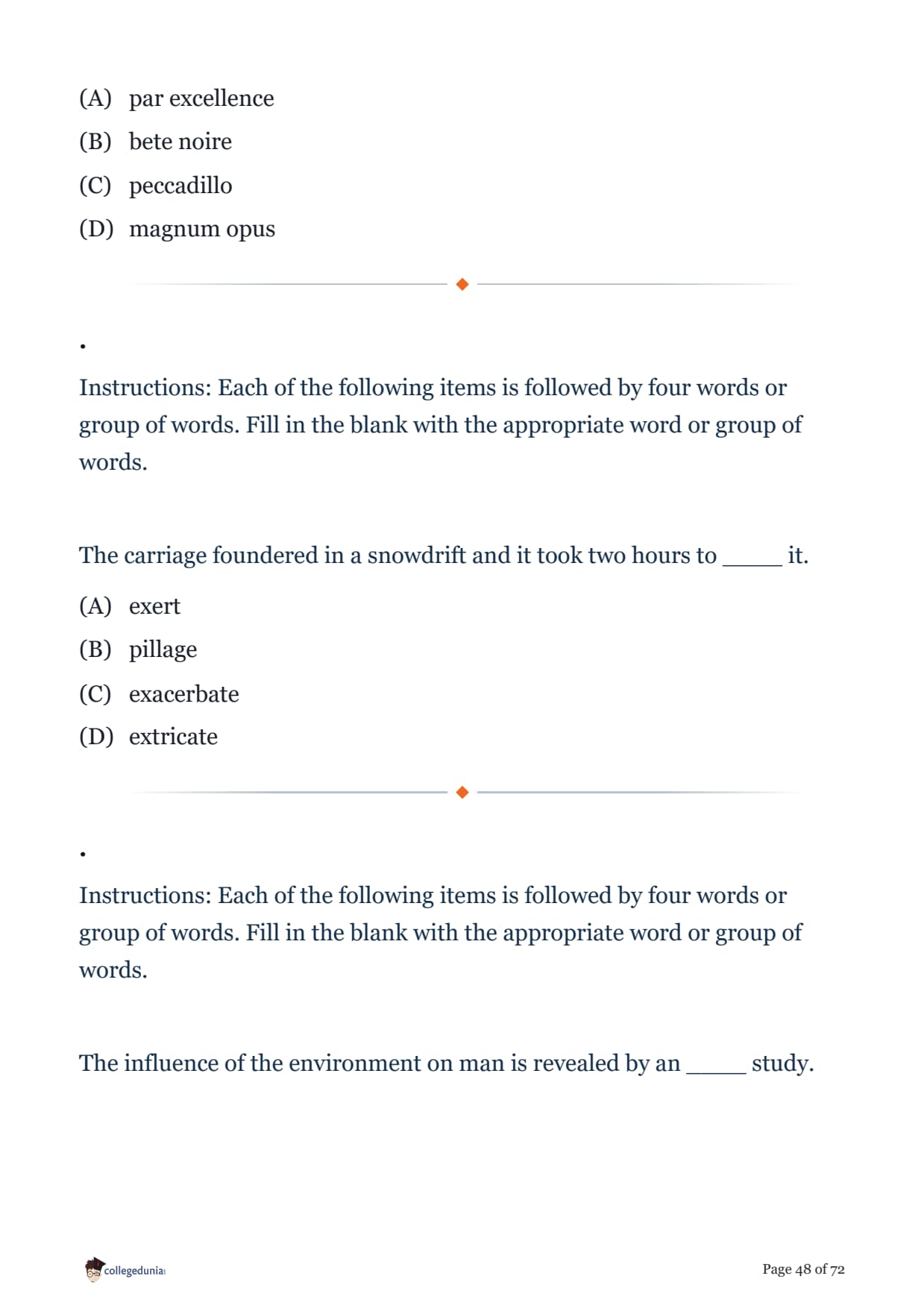
A great literary or artistic work is known as ____.
Instructions: Each of the following items is followed by four words or group of words. Fill in the blank with the appropriate word or group of words.
The carriage foundered in a snowdrift and it took two hours to ____ it.
Instructions: Each of the following items is followed by four words or group of words. Fill in the blank with the appropriate word or group of words.
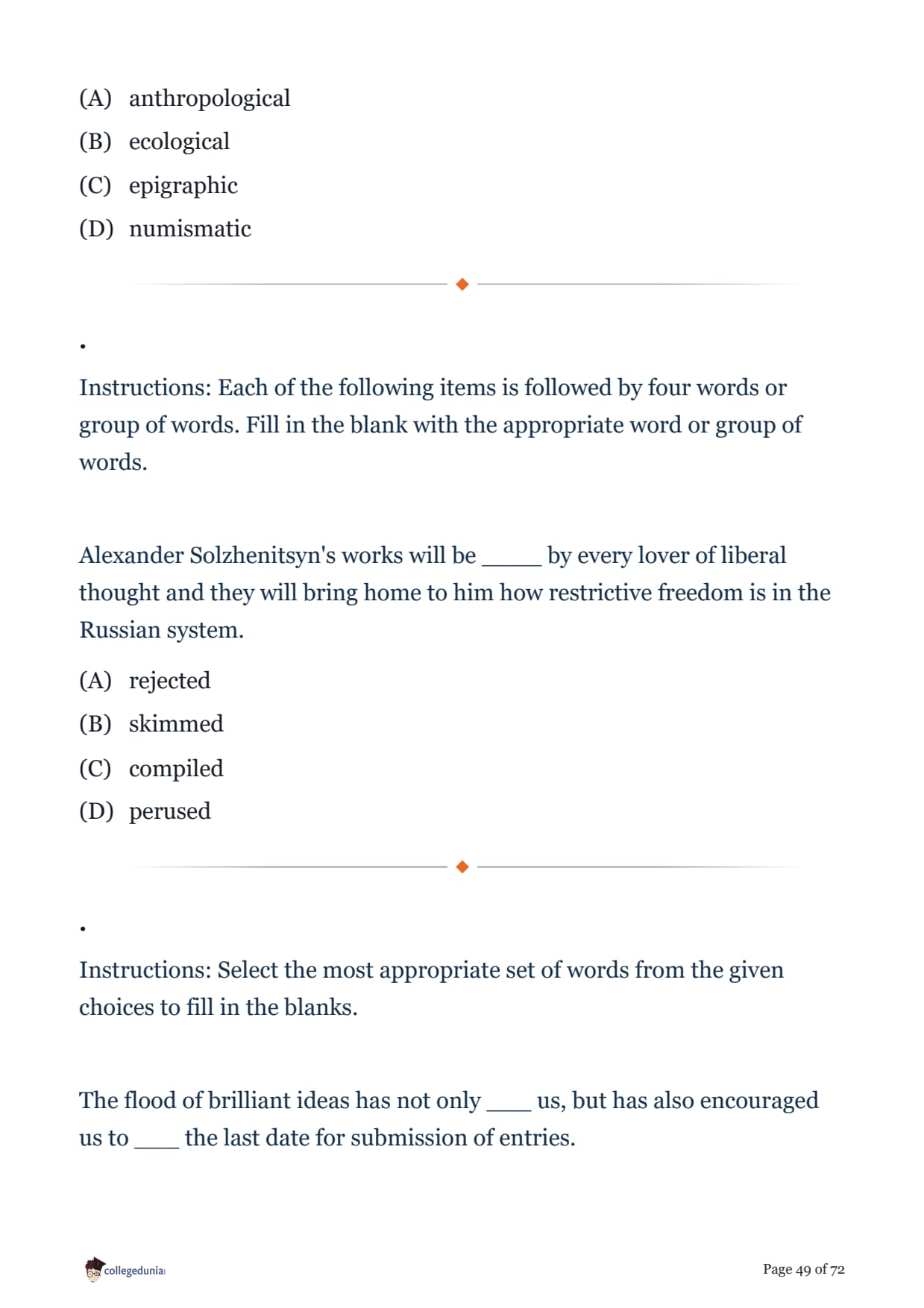
The influence of the environment on man is revealed by an ____ study.
Instructions: Each of the following items is followed by four words or group of words. Fill in the blank with the appropriate word or group of words.
Alexander Solzhenitsyn's works will be ____ by every lover of liberal thought and they will bring home to him how restrictive freedom is in the Russian system.
Instructions: Select the most appropriate set of words from the given choices to fill in the blanks.
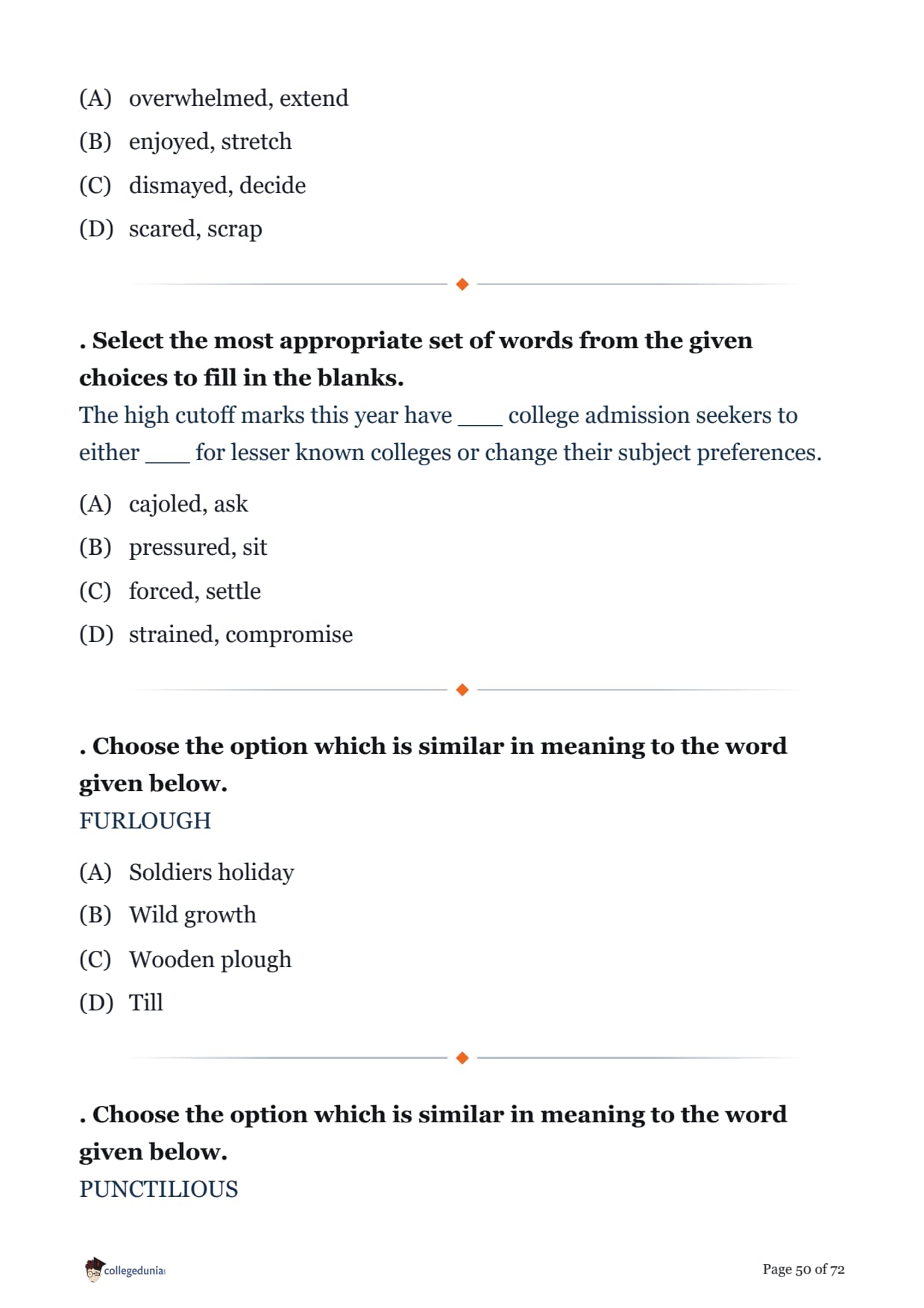
The flood of brilliant ideas has not only ___ us, but has also encouraged us to ___ the last date for submission of entries.
Select the most appropriate set of words from the given choices to fill in the blanks.
The high cutoff marks this year have ___ college admission seekers to either ___ for lesser known colleges or change their subject preferences.
Choose the option which is similar in meaning to the word given below.
FURLOUGH
Choose the option which is similar in meaning to the word given below.
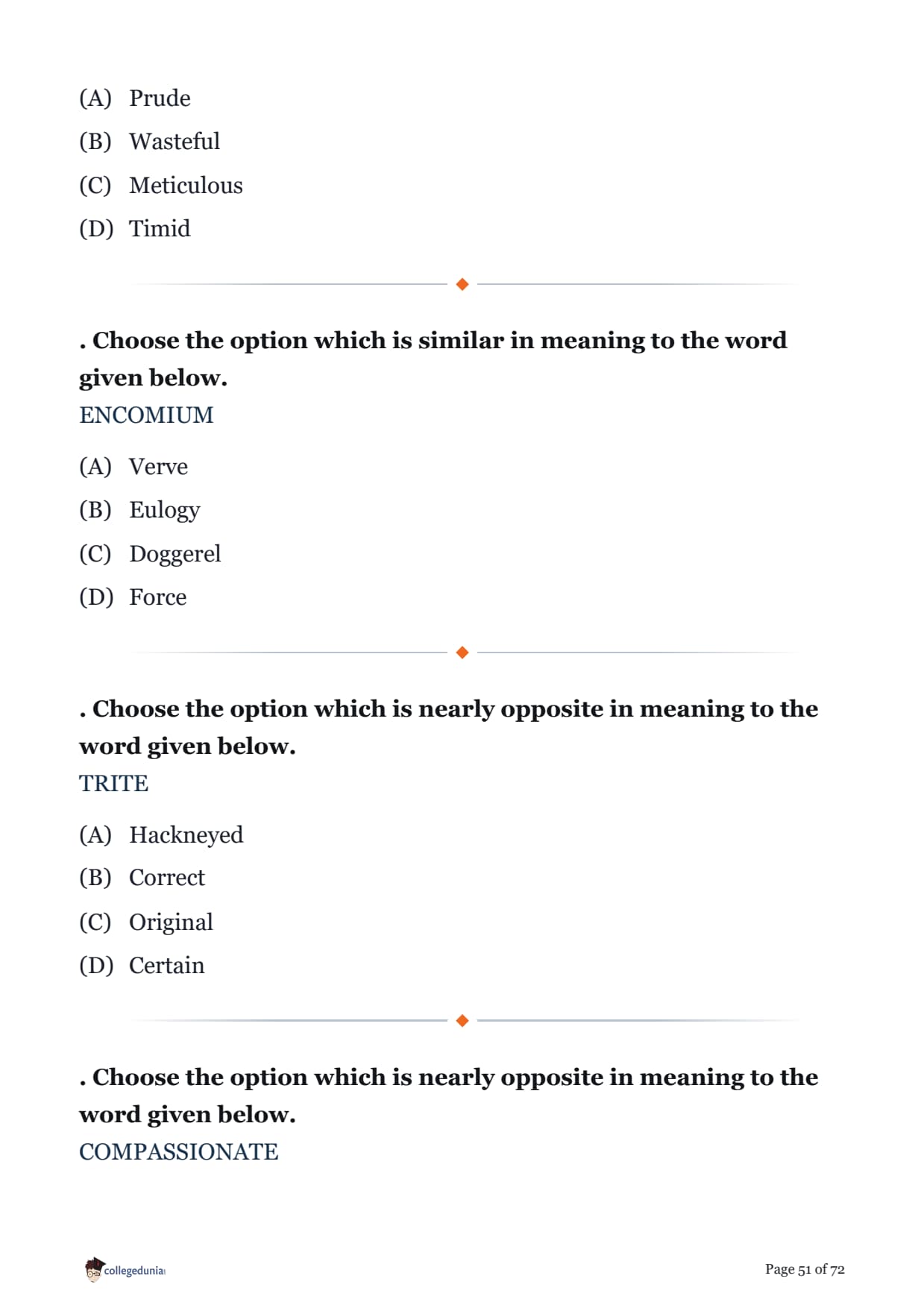
PUNCTILIOUS
Choose the option which is similar in meaning to the word given below.
ENCOMIUM
Choose the option which is nearly opposite in meaning to the word given below.
TRITE
Choose the option which is nearly opposite in meaning to the word given below.
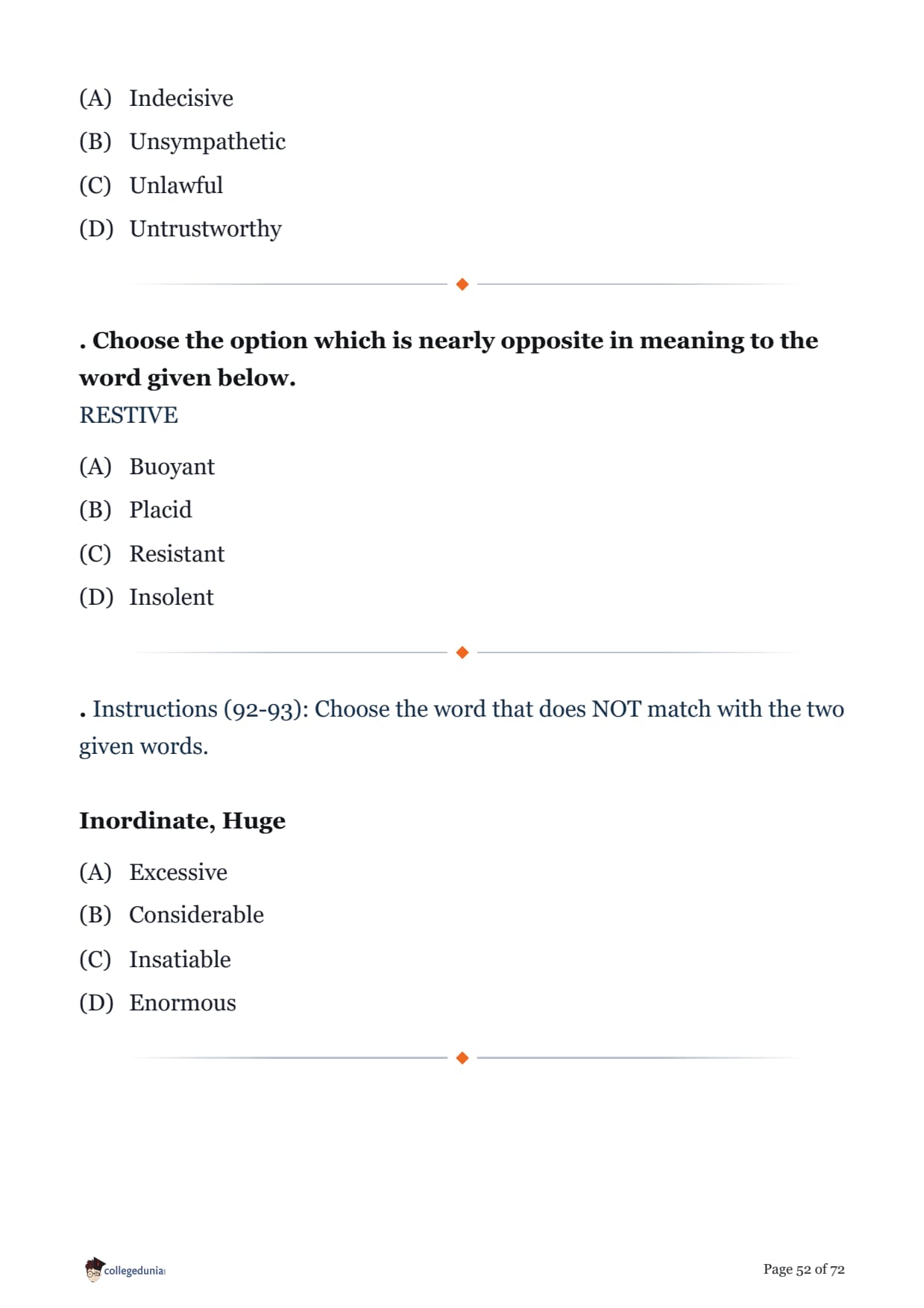
COMPASSIONATE
Choose the option which is nearly opposite in meaning to the word given below.
RESTIVE
Instructions (92-93): Choose the word that does NOT match with the two given words.
Inordinate, Huge
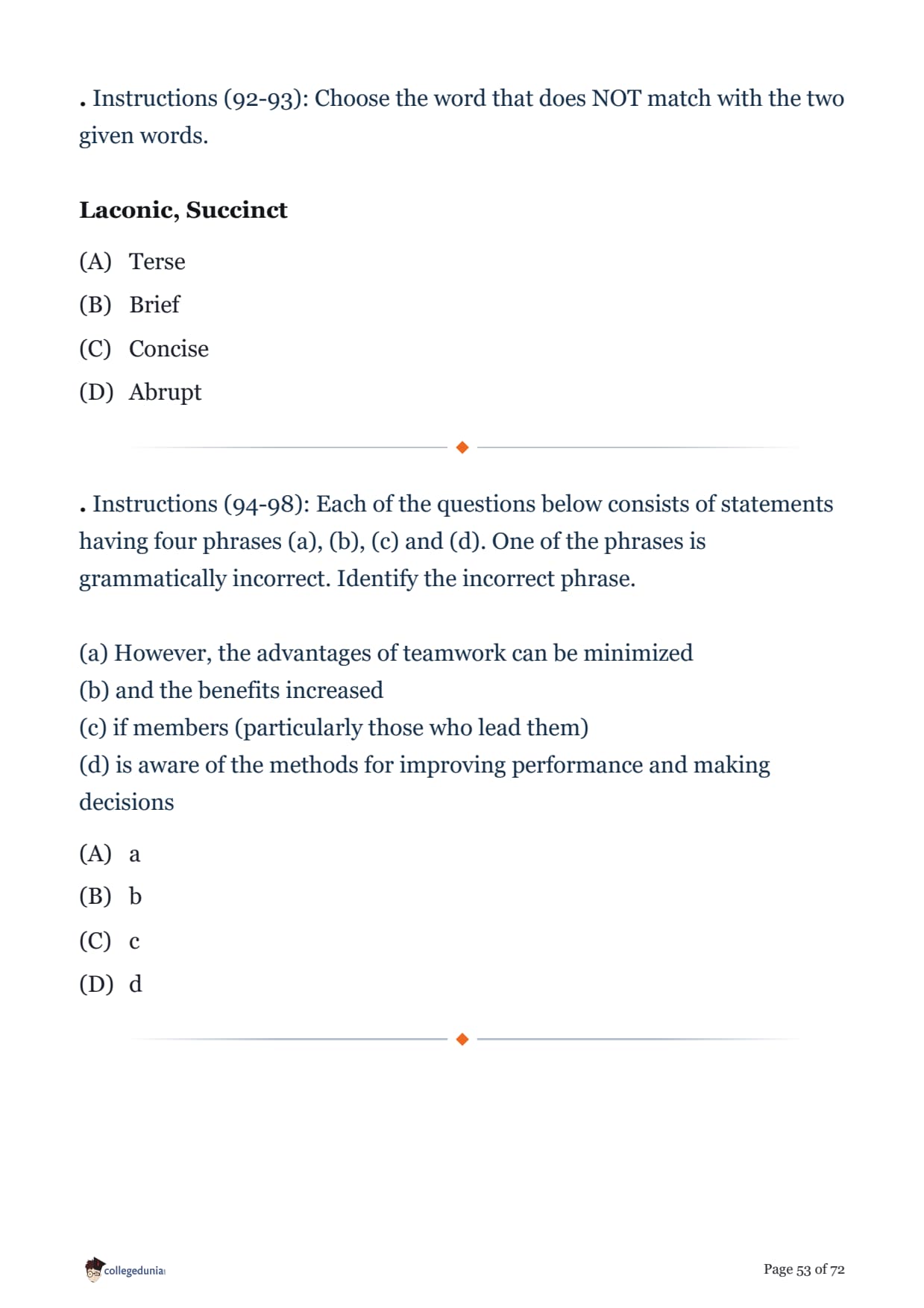
Instructions (92-93): Choose the word that does NOT match with the two given words.
Laconic, Succinct
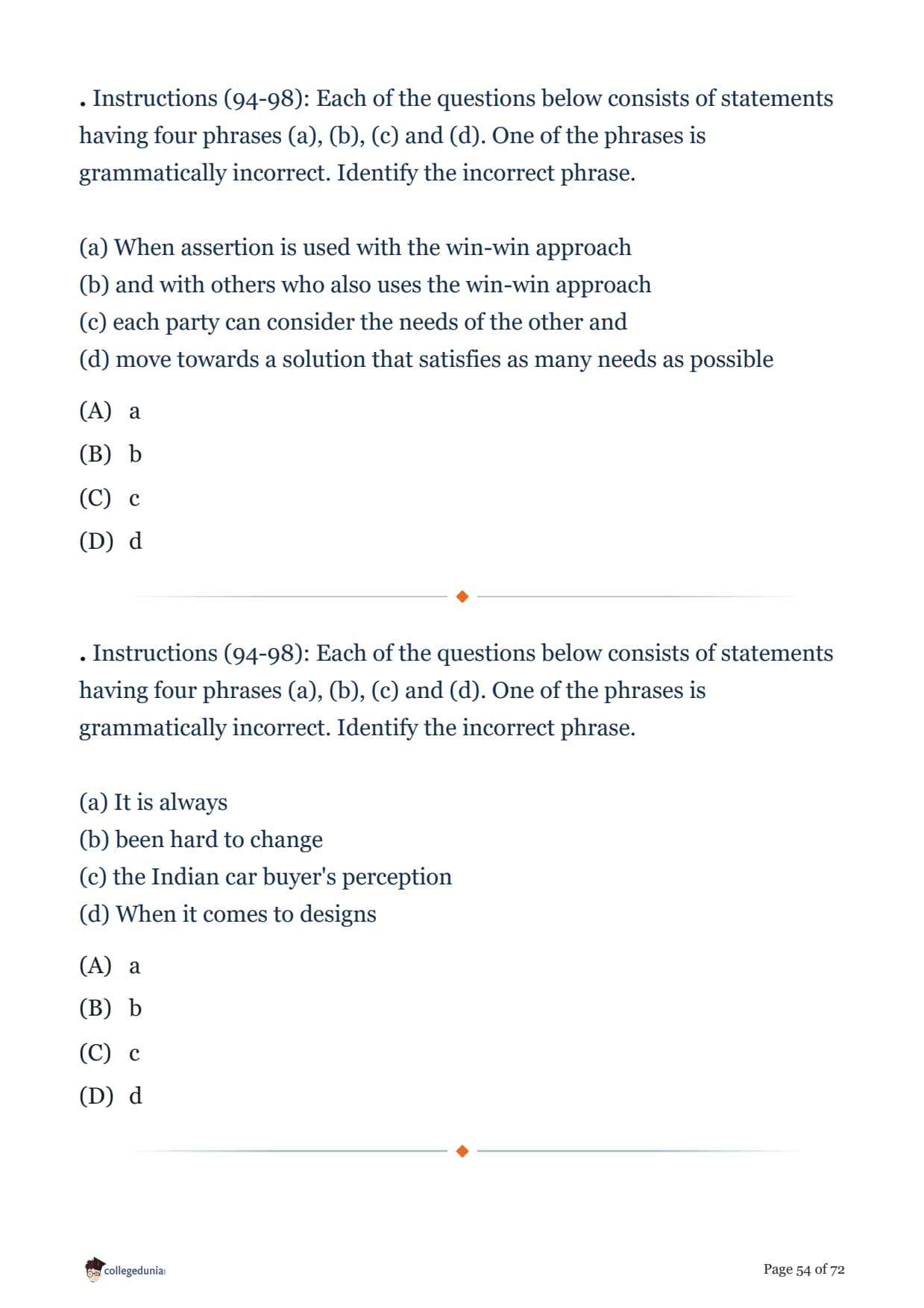
Instructions (94-98): Each of the questions below consists of statements having four phrases (a), (b), (c) and (d). One of the phrases is grammatically incorrect. Identify the incorrect phrase.
(a) However, the advantages of teamwork can be minimized
(b) and the benefits increased
(c) if members (particularly those who lead them)
(d) is aware of the methods for improving performance and making decisions
Instructions (94-98): Each of the questions below consists of statements having four phrases (a), (b), (c) and (d). One of the phrases is grammatically incorrect. Identify the incorrect phrase.
(a) When assertion is used with the win-win approach
(b) and with others who also uses the win-win approach
(c) each party can consider the needs of the other and
(d) move towards a solution that satisfies as many needs as possible
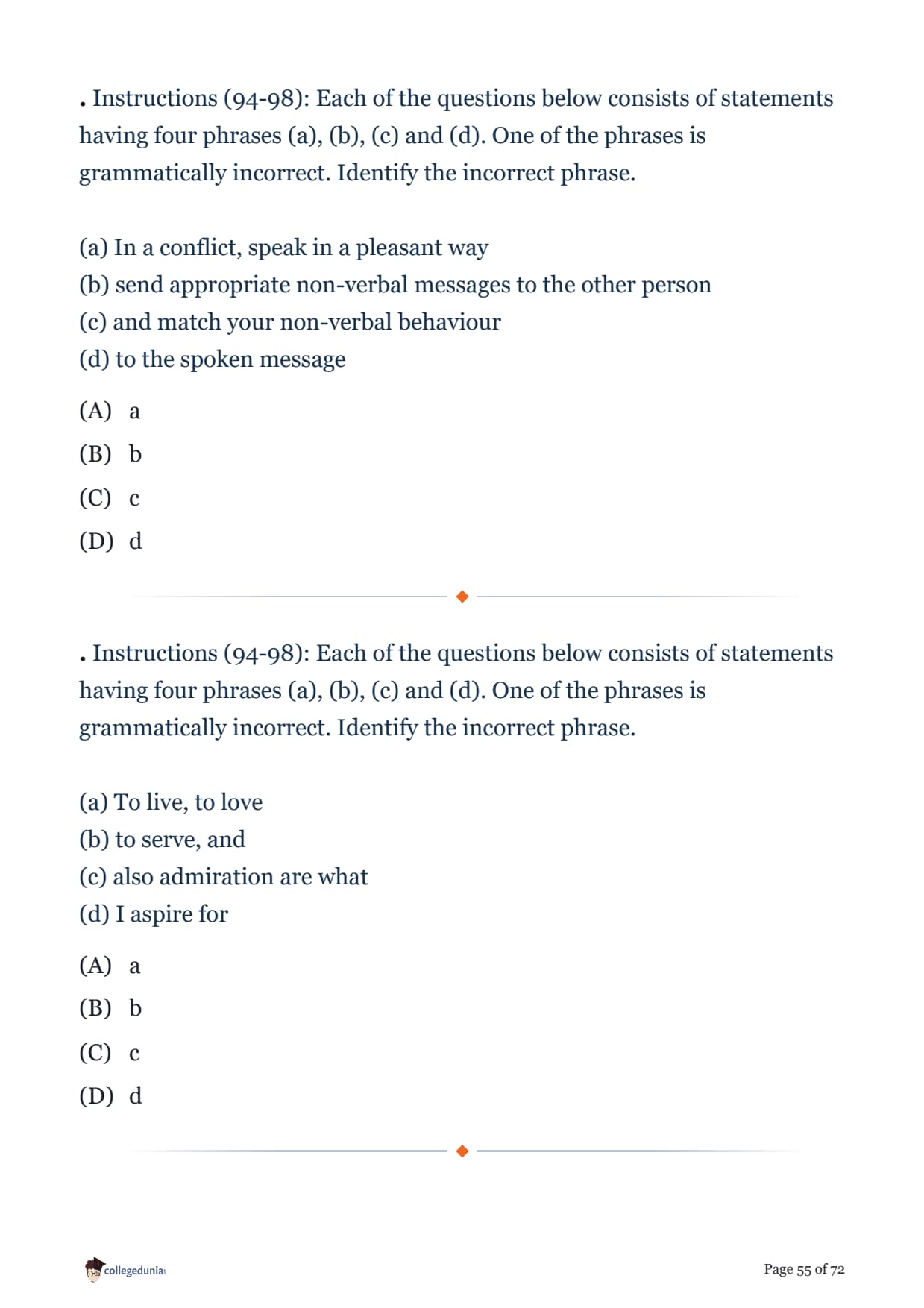
Instructions (94-98): Each of the questions below consists of statements having four phrases (a), (b), (c) and (d). One of the phrases is grammatically incorrect. Identify the incorrect phrase.
(a) It is always
(b) been hard to change
(c) the Indian car buyer's perception
(d) When it comes to designs
Instructions (94-98): Each of the questions below consists of statements having four phrases (a), (b), (c) and (d). One of the phrases is grammatically incorrect. Identify the incorrect phrase.
(a) In a conflict, speak in a pleasant way
(b) send appropriate non-verbal messages to the other person
(c) and match your non-verbal behaviour
(d) to the spoken message
Instructions (94-98): Each of the questions below consists of statements having four phrases (a), (b), (c) and (d). One of the phrases is grammatically incorrect. Identify the incorrect phrase.
(a) To live, to love
(b) to serve, and
(c) also admiration are what
(d) I aspire for
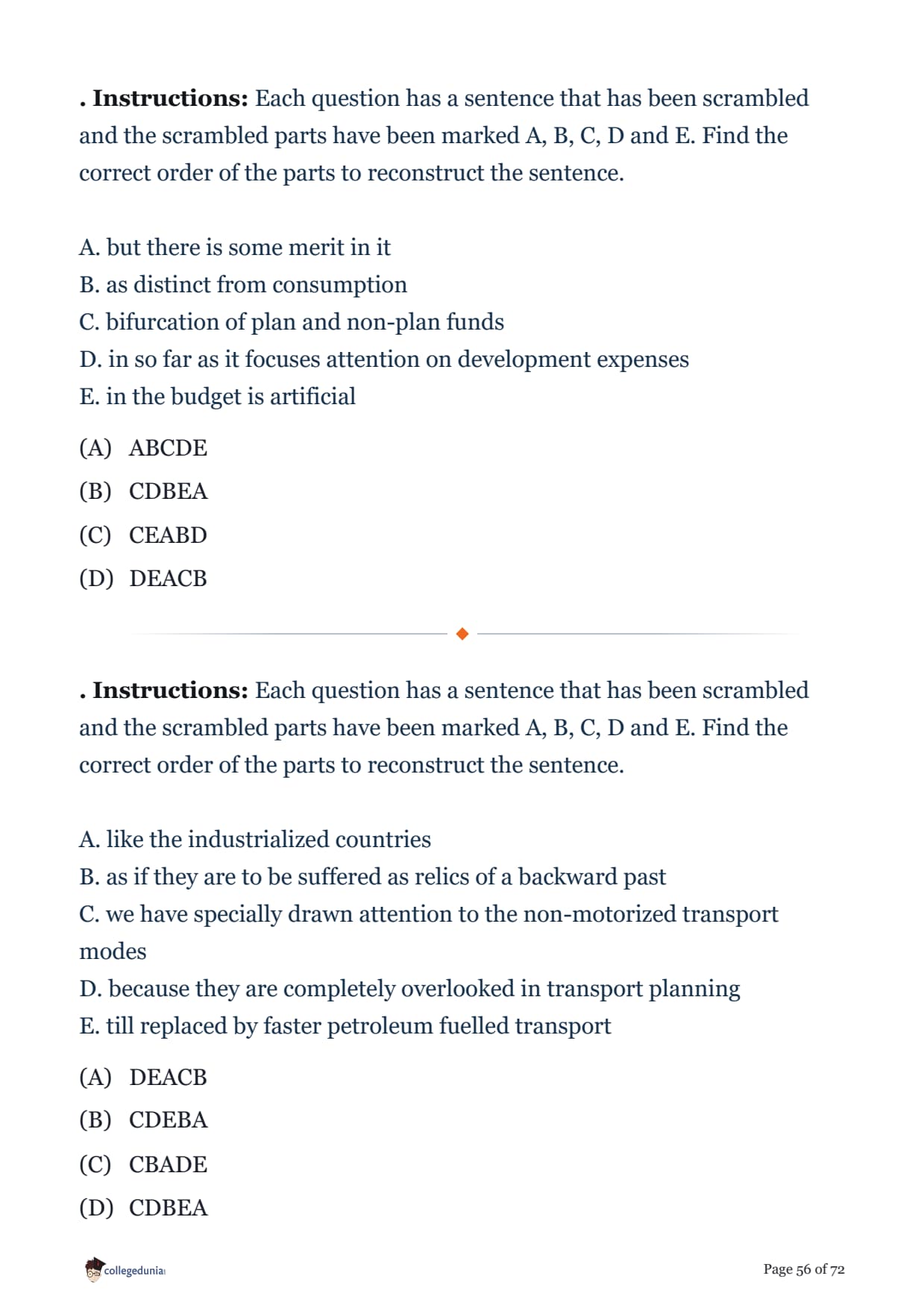
Instructions: Each question has a sentence that has been scrambled and the scrambled parts have been marked A, B, C, D and E. Find the correct order of the parts to reconstruct the sentence.
A. but there is some merit in it
B. as distinct from consumption
C. bifurcation of plan and non-plan funds
D. in so far as it focuses attention on development expenses
E. in the budget is artificial
Instructions: Each question has a sentence that has been scrambled and the scrambled parts have been marked A, B, C, D and E. Find the correct order of the parts to reconstruct the sentence.
A. like the industrialized countries
B. as if they are to be suffered as relics of a backward past
C. we have specially drawn attention to the non-motorized transport modes
D. because they are completely overlooked in transport planning
E. till replaced by faster petroleum fuelled transport
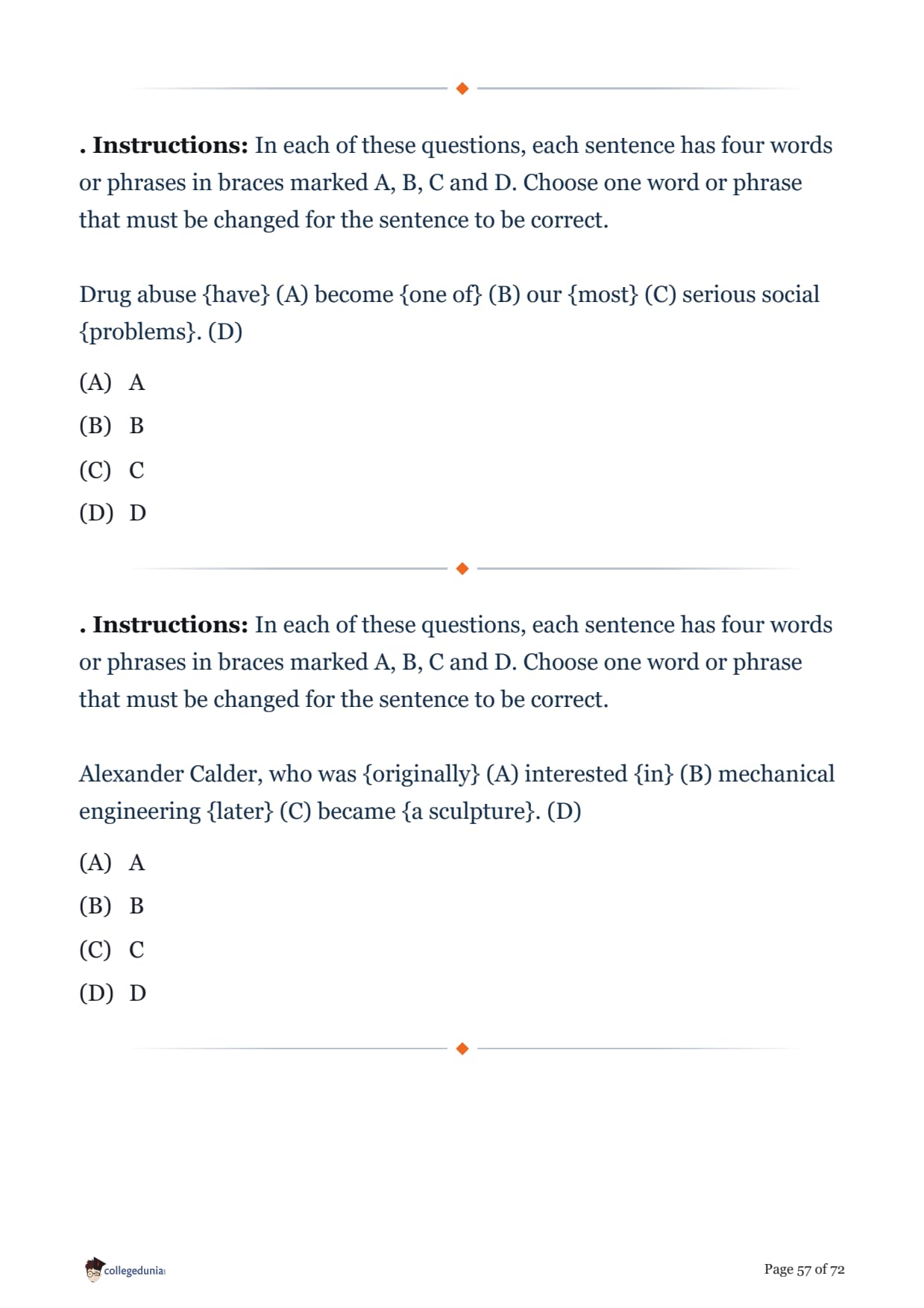
Instructions: In each of these questions, each sentence has four words or phrases in braces marked A, B, C and D. Choose one word or phrase that must be changed for the sentence to be correct.
Drug abuse {have} (A) become {one of} (B) our {most} (C) serious social {problems}. (D)
Instructions: In each of these questions, each sentence has four words or phrases in braces marked A, B, C and D. Choose one word or phrase that must be changed for the sentence to be correct.
Alexander Calder, who was {originally} (A) interested {in} (B) mechanical engineering {later} (C) became {a sculpture}. (D)
Instructions: A sentence has been broken into four parts. Choose the part that has an error.
(a) The sound was taken up by another dog, and then another and another,
(b) till, borne on the wind which now sighed softly through the pass,
(c) a wild howling began, which seemed to come from all over the country,
(d) as far as the imagination could grasp them through the gloom of the night.
Instructions: A sentence has been broken into four parts. Choose the part that has an error.
(a) At last there came a time when the driver went
(b) further afield than he had yet gone,
(c) and during its absence, the horses began to tremble
(d) worse than ever and to snort and scream with fright.
Instructions: A sentence has been broken into four parts. Choose the part that has an error.
(a) The house was silent when we got back,
(b) save for some poor creature who was
(c) screaming away in one of the distant ward,
(d) and a low, moaning sound from Vinod's room.
He said, "Where shall I be this time next year?"
Select the option that correctly converts the above sentence into indirect speech.
She said to him, "Why don't you go today?"
Select the option that correctly converts the above sentence into indirect speech.
In the following question, a group of four words is given. In this group one word is correctly spelt. Find the correctly spelt word.
In the following question, a group of four words is given. In this group one word is correctly spelt. Find the correctly spelt word.
How many members can be nominated to both the Houses of the Parliament by the President?
Under which Article of the Constitution can an individual move to the Supreme Court directly in case of any violation of Fundamental Rights?
The Dandi March of Gandhi is an example of
Inflation is caused by
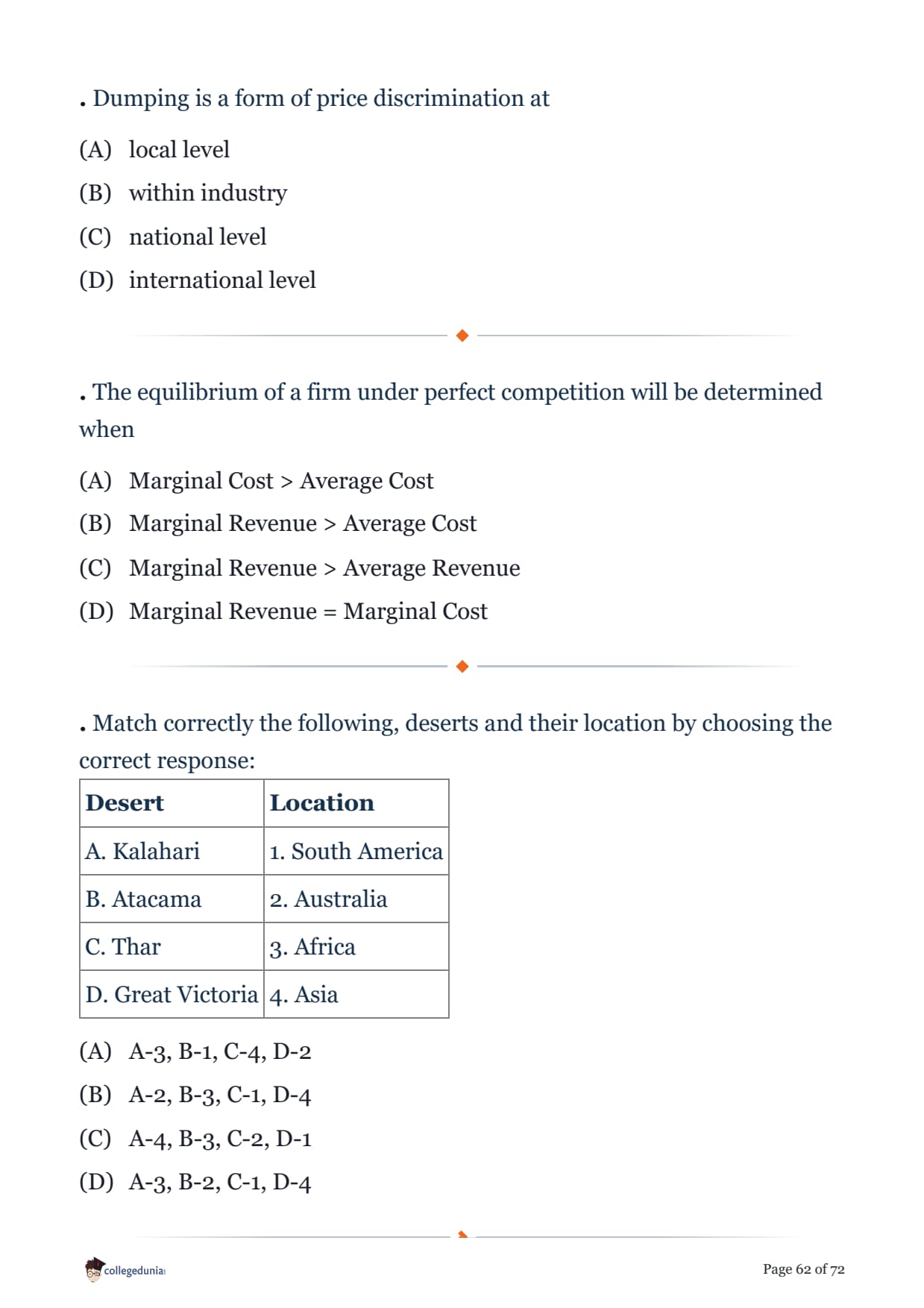
Dumping is a form of price discrimination at
The equilibrium of a firm under perfect competition will be determined when
Match correctly the following, deserts and their location by choosing the correct response:
| Desert | Location |
|---|---|
| A. Kalahari | 1. South America |
| B. Atacama | 2. Australia |
| C. Thar | 3. Africa |
| D. Great Victoria | 4. Asia |
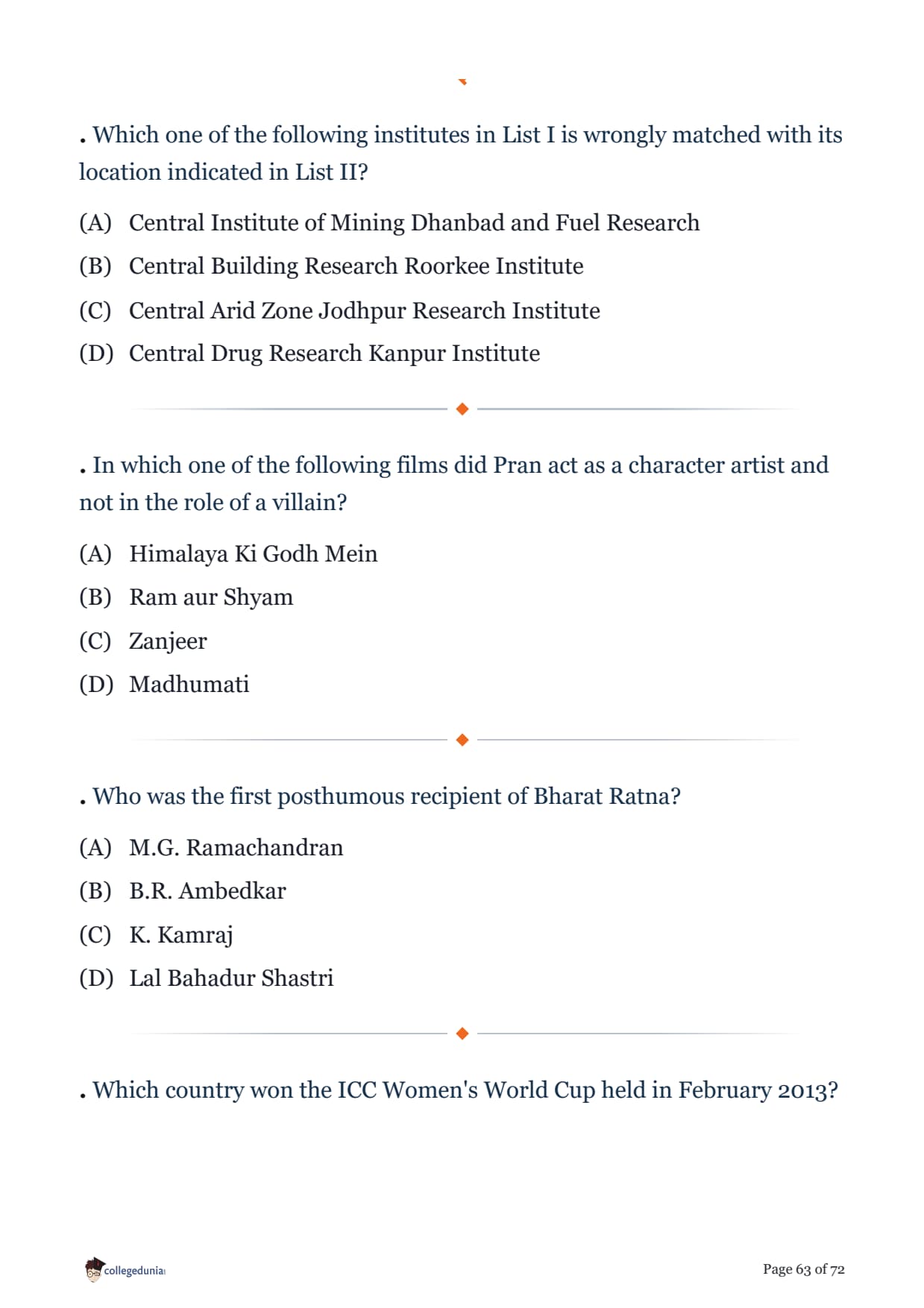
Which one of the following institutes in List I is wrongly matched with its location indicated in List II?
In which one of the following films did Pran act as a character artist and not in the role of a villain?
Who was the first posthumous recipient of Bharat Ratna?
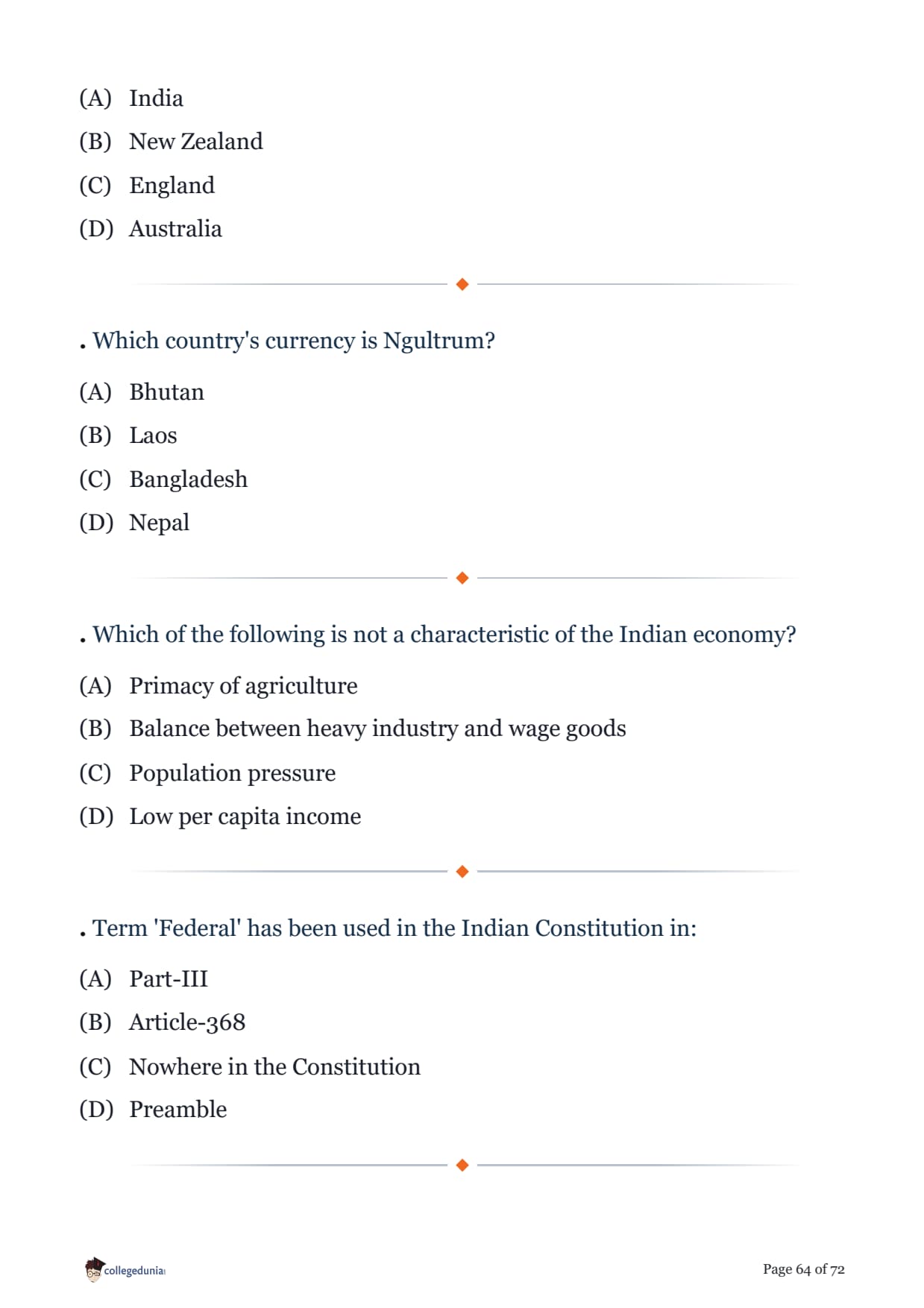
Which country won the ICC Women's World Cup held in February 2013?
Which country's currency is Ngultrum?
Which of the following is not a characteristic of the Indian economy?
Term 'Federal' has been used in the Indian Constitution in:
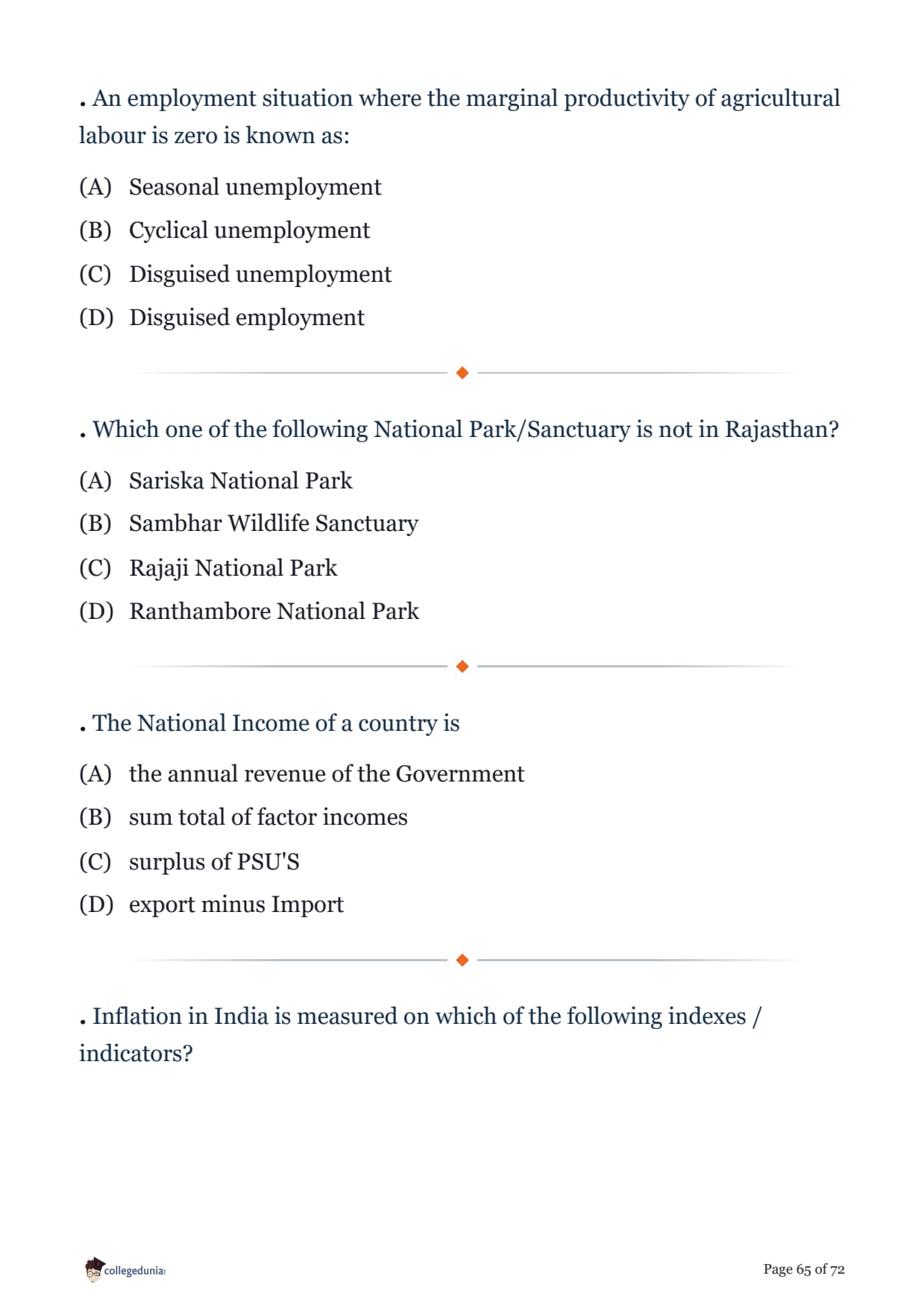
An employment situation where the marginal productivity of agricultural labour is zero is known as:
Which one of the following National Park/Sanctuary is not in Rajasthan?
The National Income of a country is
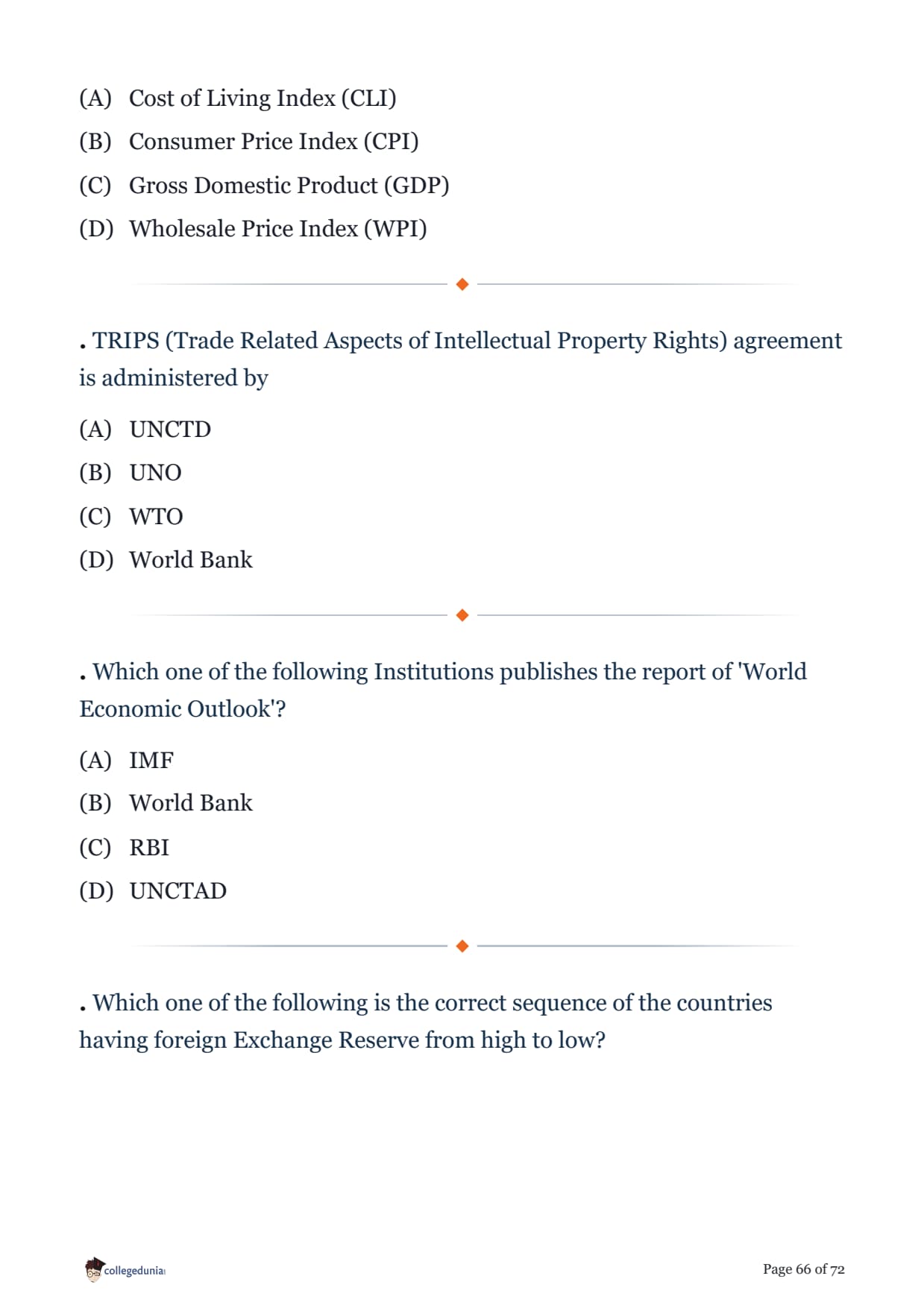
Inflation in India is measured on which of the following indexes / indicators?
TRIPS (Trade Related Aspects of Intellectual Property Rights) agreement is administered by
Which one of the following Institutions publishes the report of 'World Economic Outlook'?
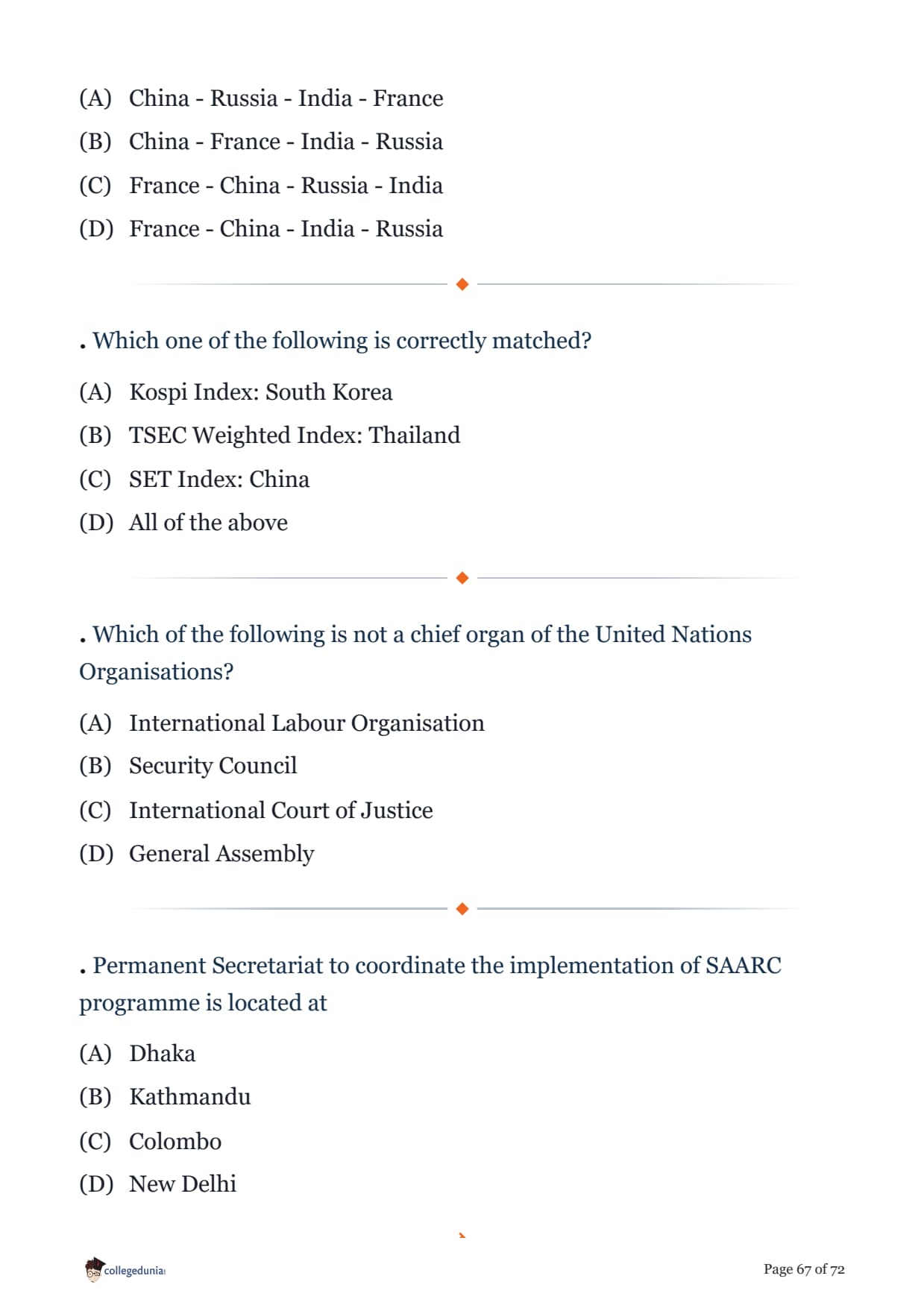
Which one of the following is the correct sequence of the countries having foreign Exchange Reserve from high to low?
Which one of the following is correctly matched?
Which of the following is not a chief organ of the United Nations Organisations?
Permanent Secretariat to coordinate the implementation of SAARC programme is located at
Which of the following describe correctly the Group of Seven Countries (G-7)?
Which of the following countries is not a member of Group 15 developing countries?
The headquarters of Food and Agriculture Organisation is in
The headquarters of the UNESCO is at
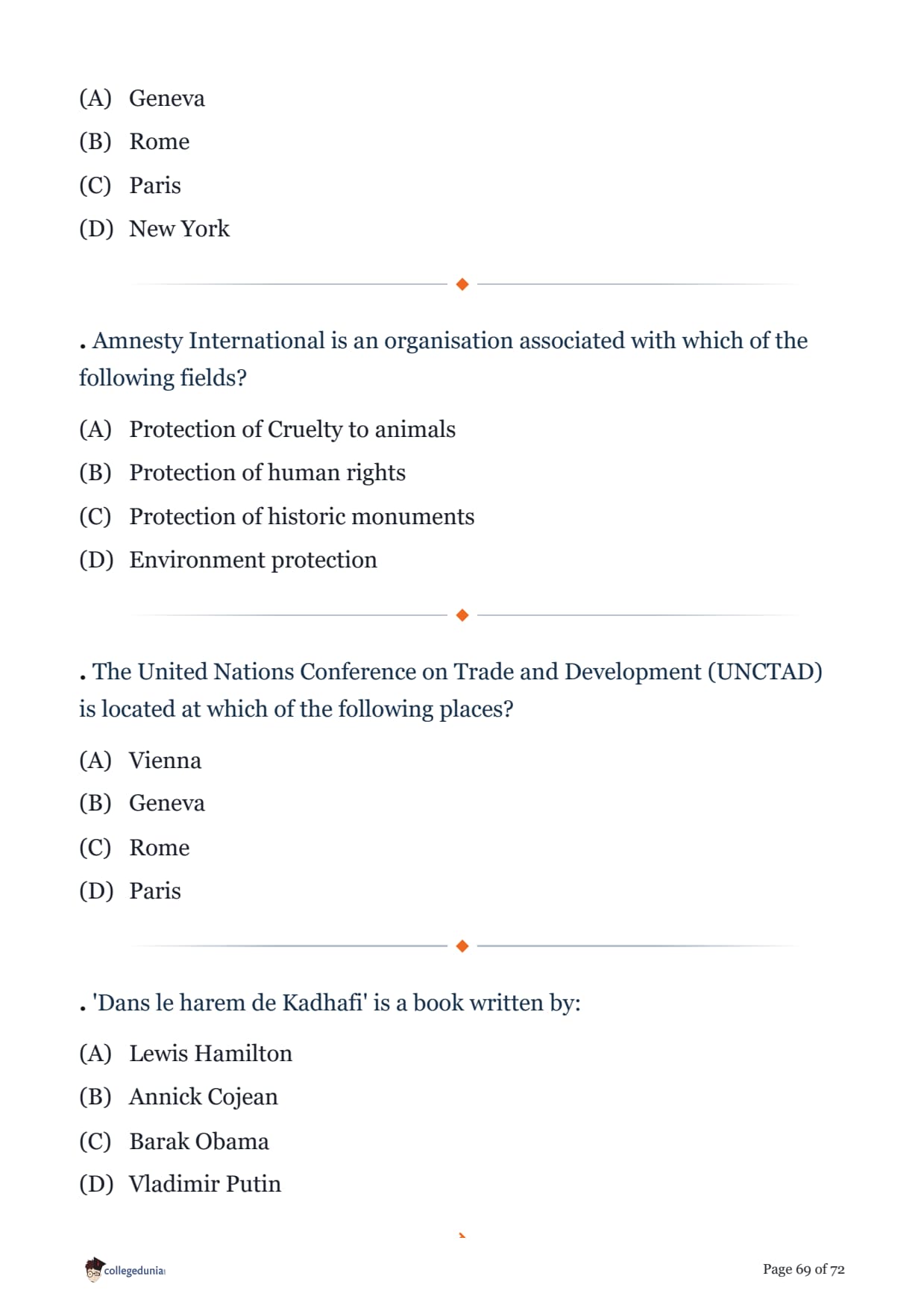
Amnesty International is an organisation associated with which of the following fields?
The United Nations Conference on Trade and Development (UNCTAD) is located at which of the following places?
'Dans le harem de Kadhafi' is a book written by:
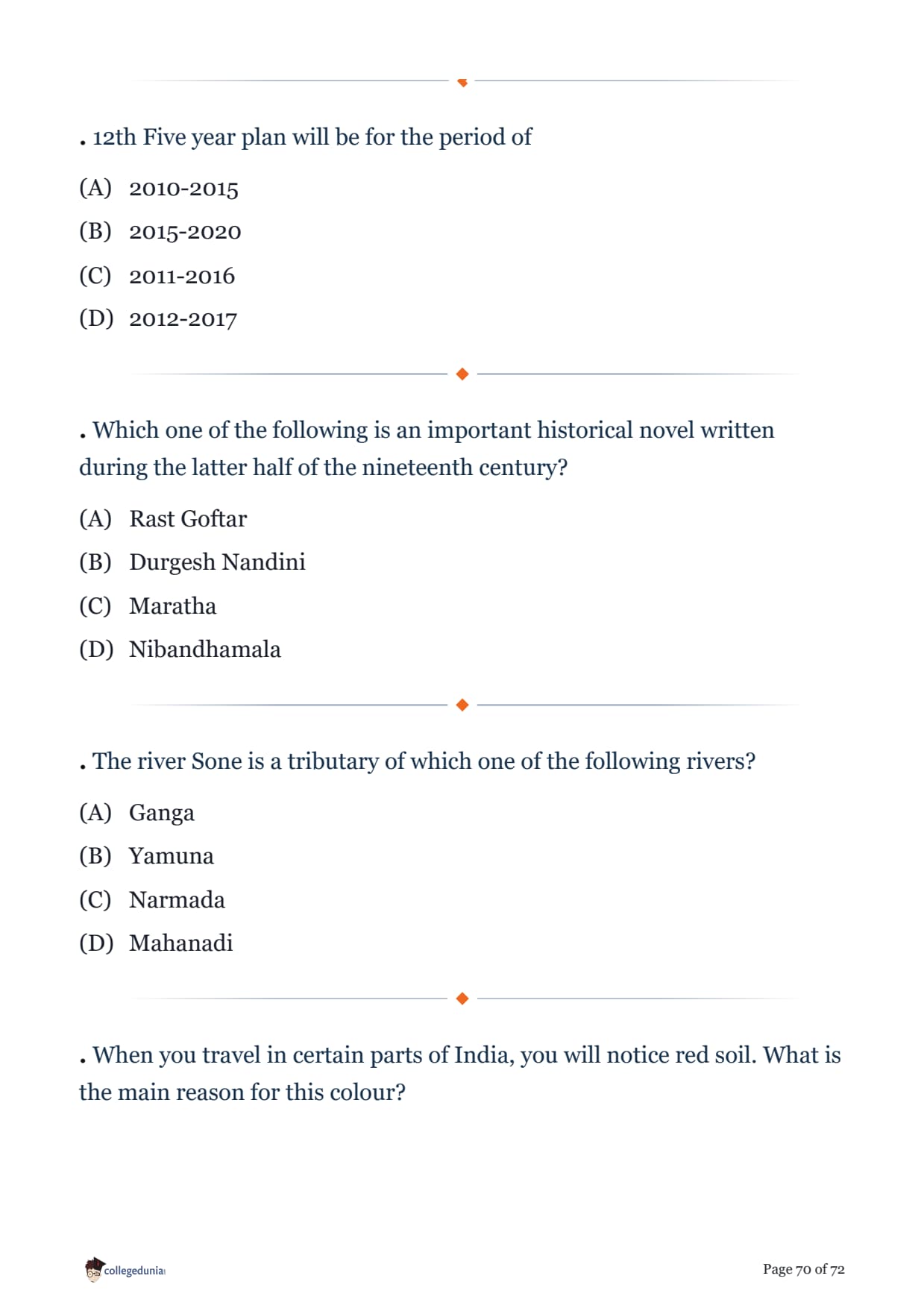
12th Five year plan will be for the period of
Which one of the following is an important historical novel written during the latter half of the nineteenth century?
The river Sone is a tributary of which one of the following rivers?
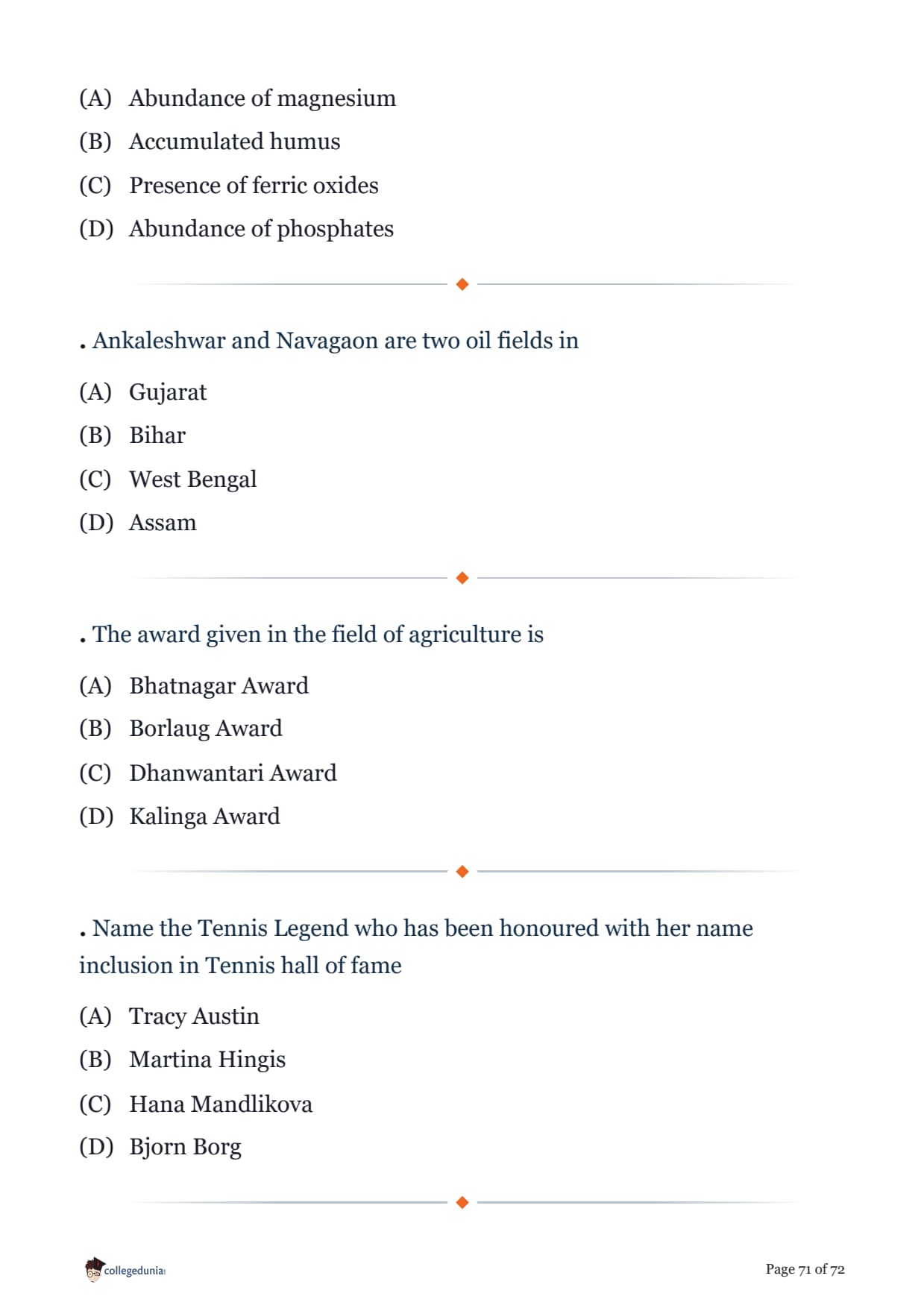
When you travel in certain parts of India, you will notice red soil. What is the main reason for this colour?
Ankaleshwar and Navagaon are two oil fields in
The award given in the field of agriculture is
Name the Tennis Legend who has been honoured with her name inclusion in Tennis hall of fame
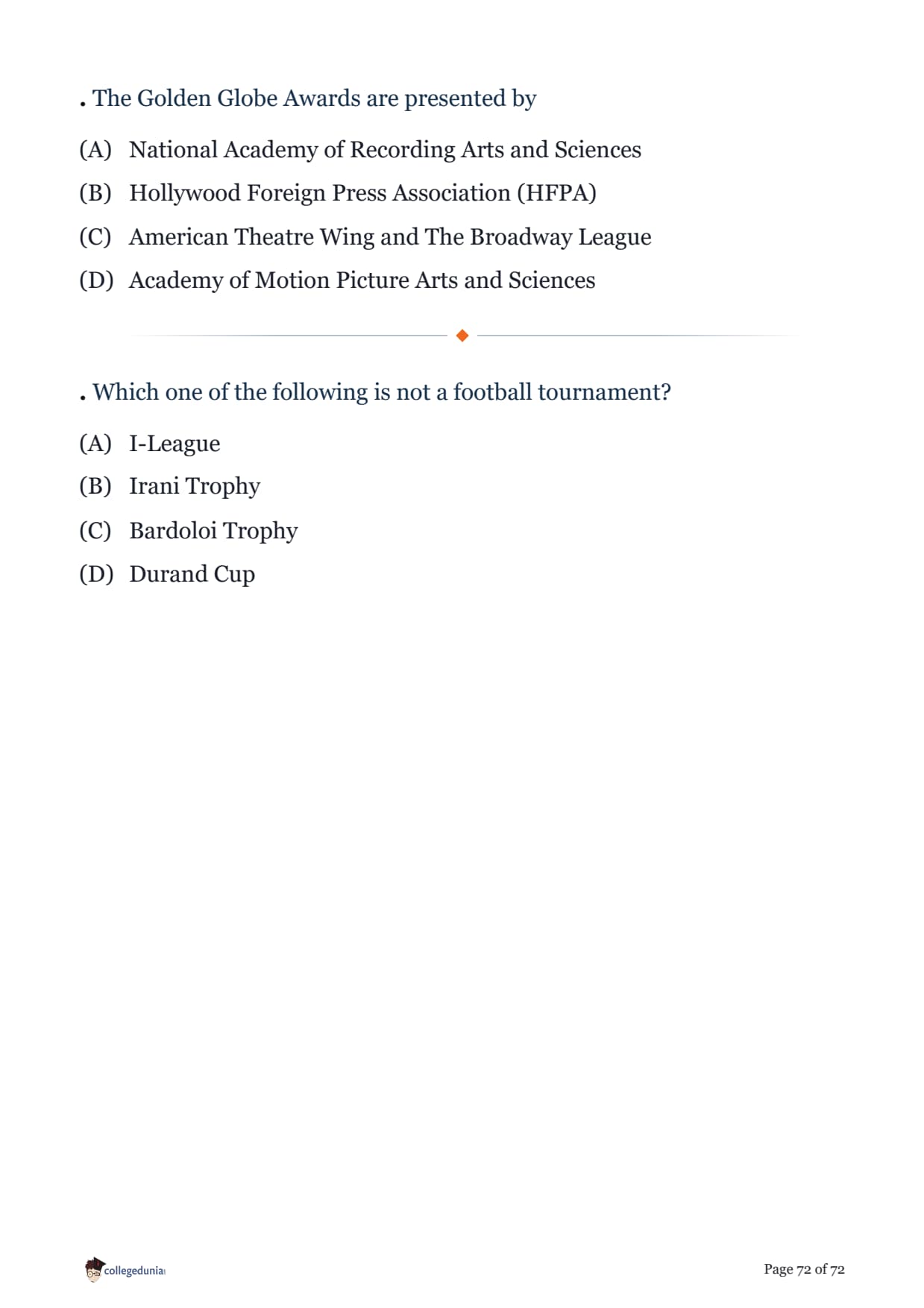
The Golden Globe Awards are presented by
Which one of the following is not a football tournament?
SNAP 2013 Combined Paper Section-Wise Question Split
This SNAP 2013 paper, held on December 15, 2013, ran on the older pen-and-paper format with four sections instead of the three SNAP uses today.
- Quantitative Aptitude, Data Interpretation & Data Sufficiency: 40 questions
- Analytical & Logical Reasoning: 30 questions
- General English: 39 questions
- General Awareness: 40 questions
SNAP Exam Pattern Today Versus the 2013 Paper
SNAP has changed a lot since 2013. As per the official test structure on snaptest.org, the current SNAP is a 60-minute computer-based test with no General Awareness section at all.
- Total questions: 60 MCQs, down from 150 in 2013
- Duration: 60 minutes in one sitting, no sectional timers
- Marking scheme: +1 for a correct answer, -0.25 for a wrong one
- Sections: General English (15 Qs), Analytical & Logical Reasoning (25 Qs), Quantitative Ability/DI/DS (20 Qs)
- Attempts: up to 3 test attempts allowed, with your best score used for the percentile
SNAP 2013 Question Paper Analysis Video
Source: CAT By The Study Anchor
High-Weightage Topics to Practice From This SNAP Paper
Even on the older 4-section format, the topics tested in this SNAP 2013 paper still show up every year in the modern 60-question SNAP.
- Puzzles and seating arrangement: the biggest chunk of Analytical & Logical Reasoning, both in 2013 and in the current 25-question LR section
- Percentages, Profit and Loss, Ratio and Proportion: repeat every year across the Quant section
- Time, Speed and Distance, Time and Work, SI/CI: the standard word-problem set you see in this paper's Q1-Q40
- Coding-decoding, syllogisms, and blood relations: a fixed part of the Reasoning section across SNAP years
- Vocabulary, grammar, and para-jumbles: carried over into the current 15-question General English section
How to Use This SNAP 2013 Paper for Practice
Since this paper has 150 questions against the current SNAP's 60, split it into shorter timed sets rather than attempting it in one sitting.
- Solve one section at a time, timing yourself at roughly 45 seconds a question, the pace the current 60-minute format demands
- Check every answer against the solution PDF and note which topic you got wrong, not just the score
- Redo the Reasoning puzzles and Quant word problems separately once you've reviewed them, since these repeat most often
- Skip the General Awareness section for current SNAP prep, since it was dropped from the exam after this format changed
SNAP 2013 Question Paper FAQs
Ques. Where can I download the SNAP 2013 question paper with solutions PDF for free?
Ans. You can download the full SNAP 2013 combined paper PDF from the table above on this page. It has all 149 solved questions across Quantitative Aptitude, Reasoning, English, and General Awareness, with a separate solutions PDF covering every answer step by step.
Ques. Is the SNAP 2013 paper still useful for SNAP 2026 preparation?
Ans. Yes, for topic practice. The Quant, Reasoning, and English question types repeat every year even though the current SNAP has only 60 questions and drops the General Awareness section entirely. Use this paper to practice individual topics, not as a full-length current-format mock.
Ques. How many questions were there in SNAP 2013 and how is that different from SNAP now?
Ans. SNAP 2013 had 150 questions across four sections on a pen-and-paper test. The current SNAP, run as a computer-based test since 2016, has only 60 questions across three sections (English, Reasoning, Quant/DI/DS) in a single 60-minute sitting.
Ques. What is the marking scheme in SNAP?
Ans. The current SNAP awards +1 for every correct answer and deducts 0.25 marks for every wrong answer, with no penalty for questions left unattempted. This negative marking is why accuracy matters more than attempting every question.
Ques. Which topics have the highest weightage in SNAP Quant and Reasoning?
Ans. In Reasoning, puzzles and seating arrangement questions make up the largest share, followed by coding-decoding and syllogisms. In Quant, Percentages, Profit and Loss, Ratio and Proportion, and Time-Speed-Distance are the topics you'll see most often, the same ones tested across this 2013 paper's Q1-Q40.
Ques. What is a good score to aim for in SNAP for 99 percentile?
Ans. A raw score of around 45 out of 60, with high accuracy in Reasoning and Quant, is commonly reported as the benchmark for 99 percentile in the current SNAP format. Since wrong answers cost 0.25 marks, most 99 percentile scorers attempt fewer questions with near-perfect accuracy rather than rushing through all 60.



Comments