




The SNAP 2012 Combined Paper question paper is available with detailed solutions for free download. SNAP 2012 was conducted by Symbiosis International University across test slots between December 3 and 16, 2012, as a single 150-question, 120-minute paper covering Quantitative Aptitude & DI, General Knowledge, General English, and Analytical & Logical Reasoning.
| SNAP 2012 Combined Paper Question Paper with Solutions | Download PDF | Check Solutions |
SNAP 2012 Combined Paper Questions with Solutions
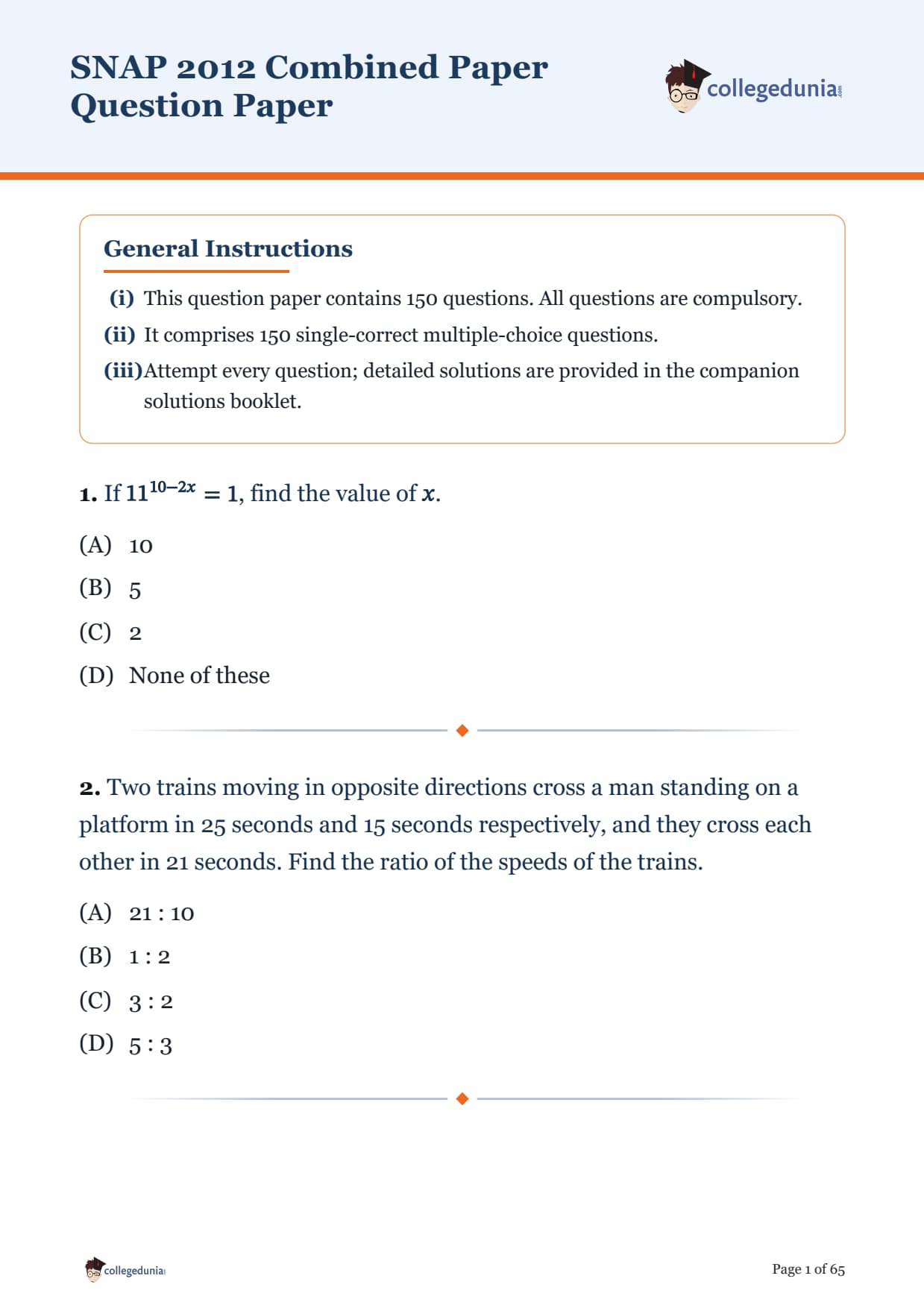
If \(11^{10-2x} = 1\), find the value of \(x\).
Two trains moving in opposite directions cross a man standing on a platform in 25 seconds and 15 seconds respectively, and they cross each other in 21 seconds. Find the ratio of the speeds of the trains.
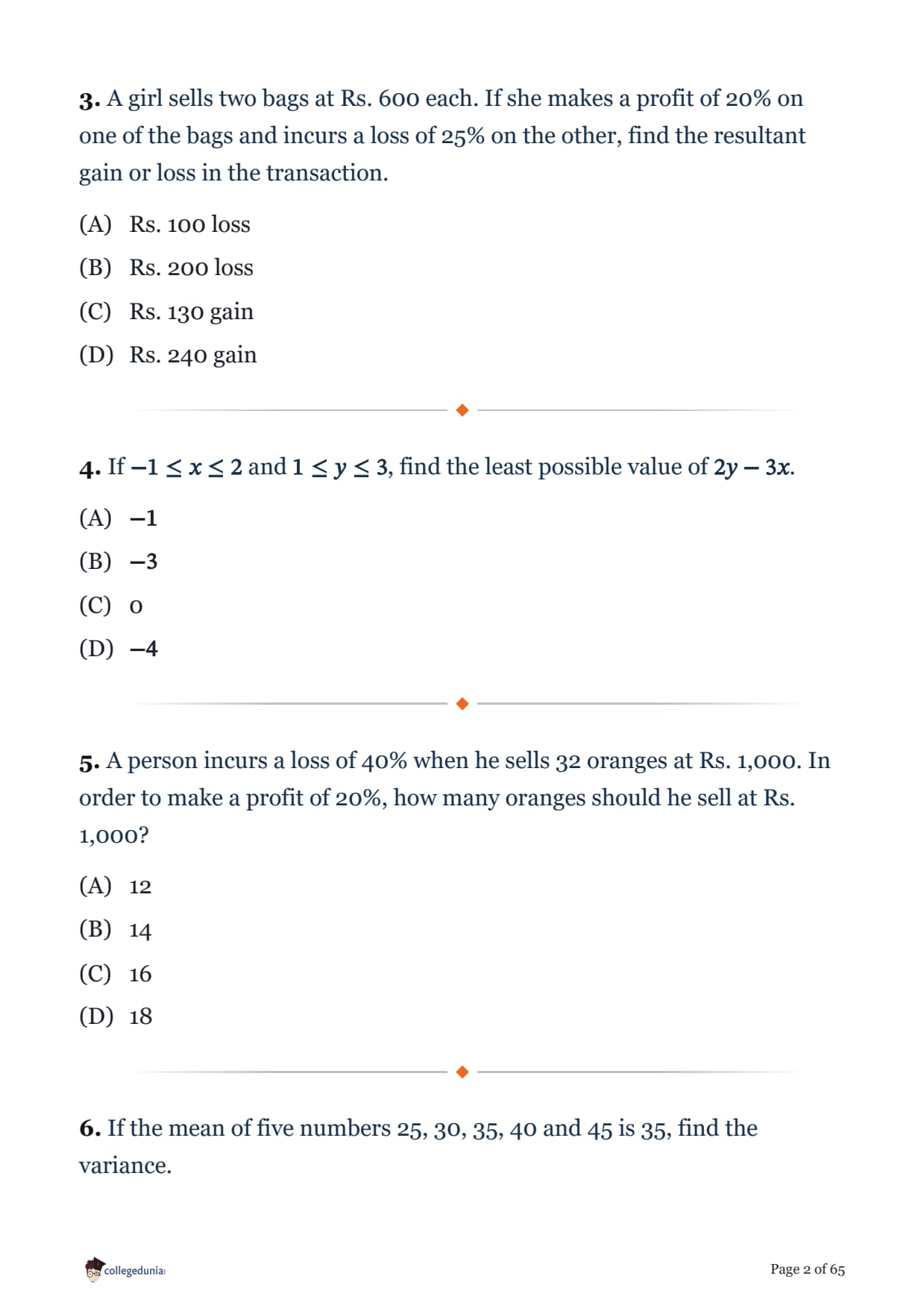
A girl sells two bags at Rs. 600 each. If she makes a profit of 20% on one of the bags and incurs a loss of 25% on the other, find the resultant gain or loss in the transaction.
If \(-1 \leq x \leq 2\) and \(1 \leq y \leq 3\), find the least possible value of \(2y - 3x\).
A person incurs a loss of 40% when he sells 32 oranges at Rs. 1,000. In order to make a profit of 20%, how many oranges should he sell at Rs. 1,000?
If the mean of five numbers 25, 30, 35, 40 and 45 is 35, find the variance.
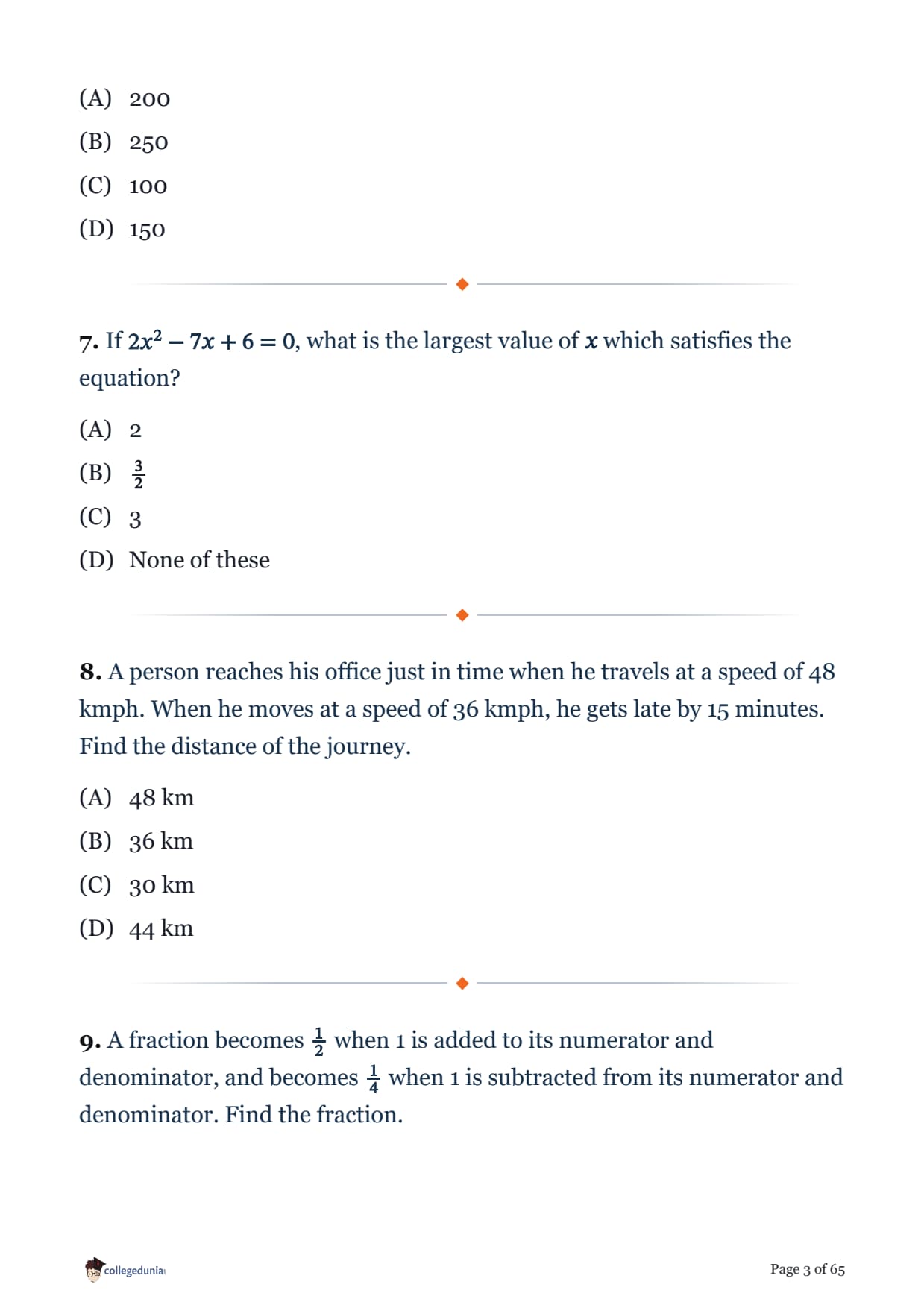
If \(2x^2 - 7x + 6 = 0\), what is the largest value of \(x\) which satisfies the equation?
A person reaches his office just in time when he travels at a speed of 48 kmph. When he moves at a speed of 36 kmph, he gets late by 15 minutes. Find the distance of the journey.
A fraction becomes \(\frac{1}{2}\) when 1 is added to its numerator and denominator, and becomes \(\frac{1}{4}\) when 1 is subtracted from its numerator and denominator. Find the fraction.
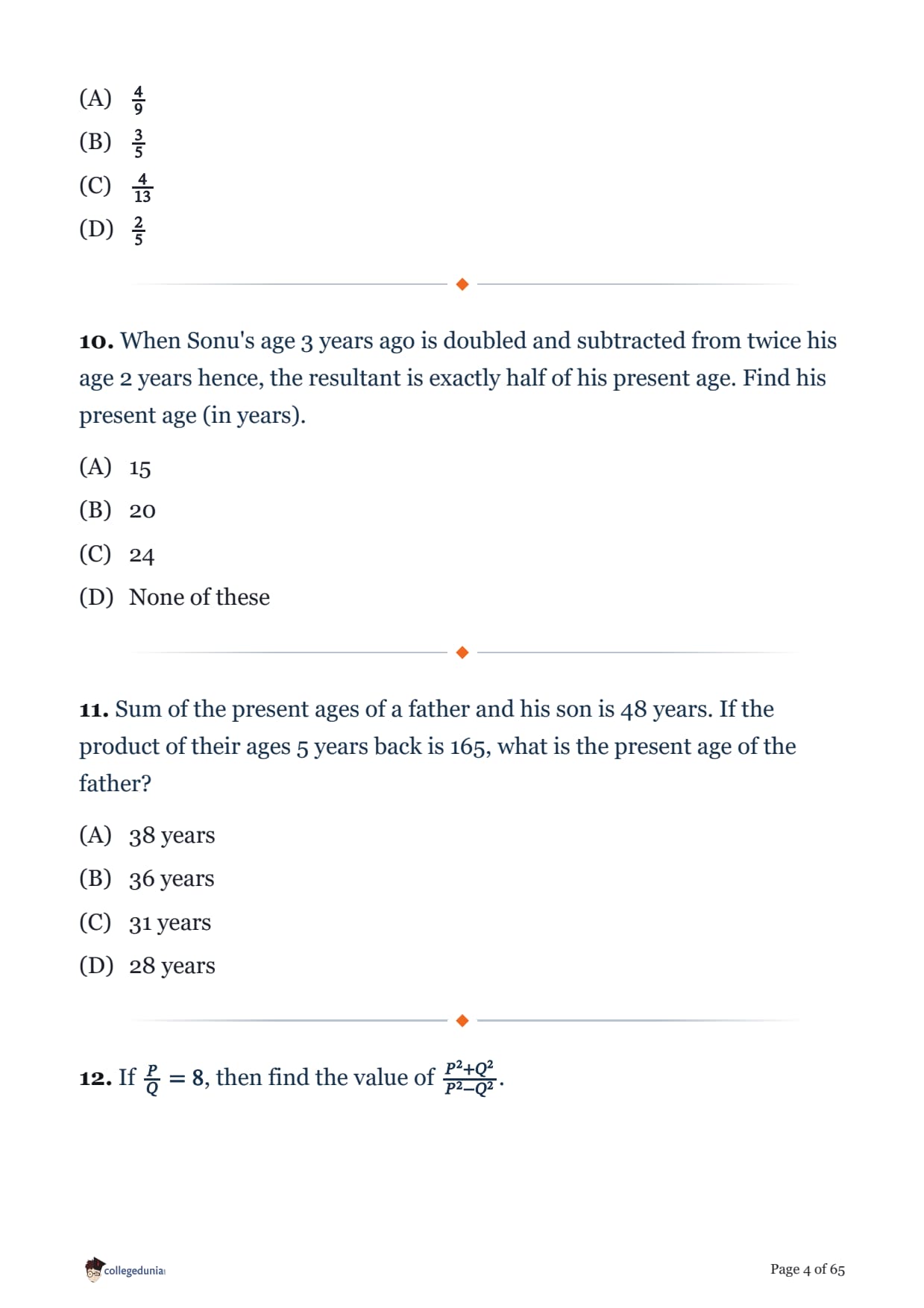
When Sonu's age 3 years ago is doubled and subtracted from twice his age 2 years hence, the resultant is exactly half of his present age. Find his present age (in years).
Sum of the present ages of a father and his son is 48 years. If the product of their ages 5 years back is 165, what is the present age of the father?
If \(\frac{P}{Q} = 8\), then find the value of \(\frac{P^2+Q^2}{P^2-Q^2}\).
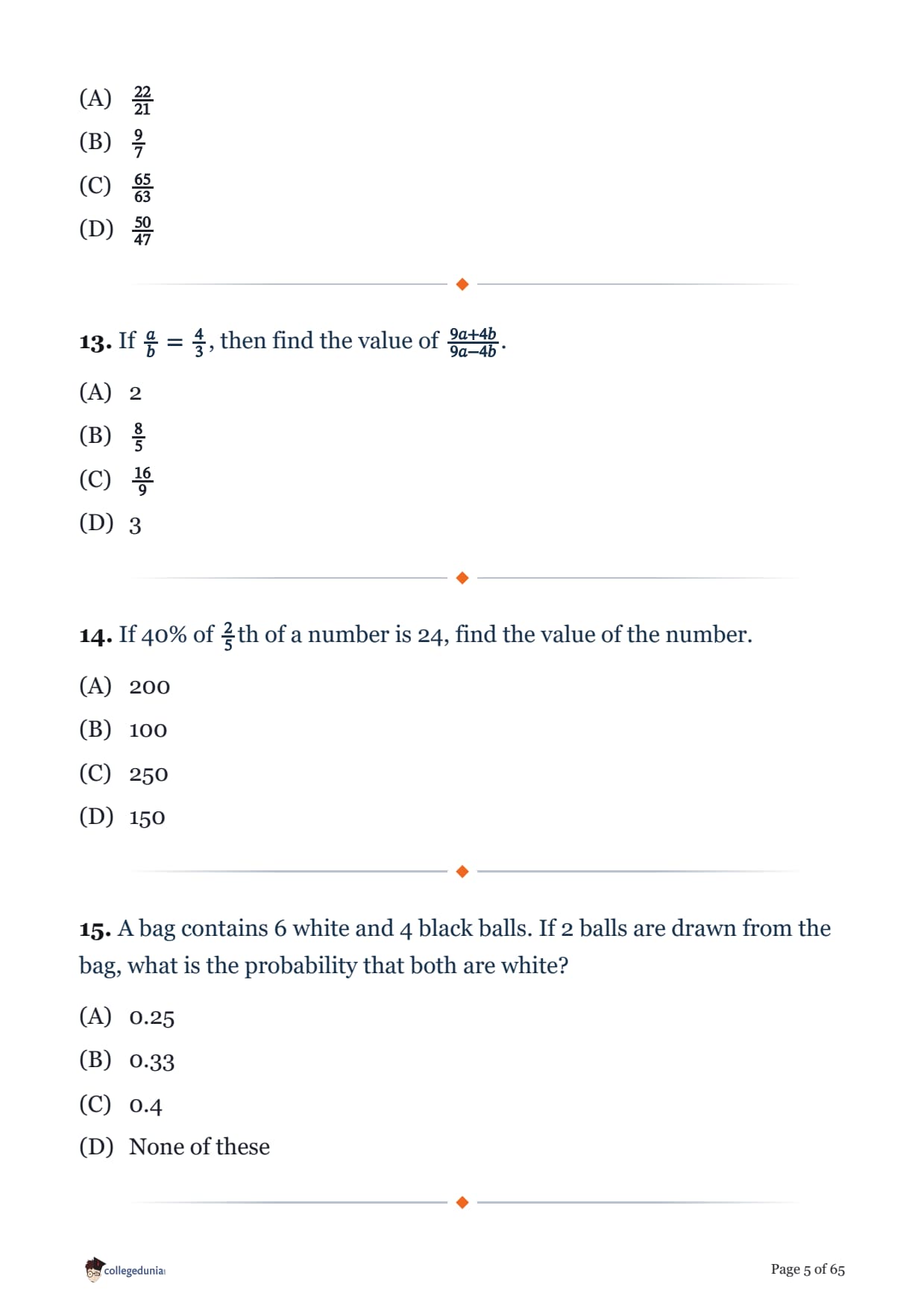
If \(\frac{a}{b} = \frac{4}{3}\), then find the value of \(\frac{9a+4b}{9a-4b}\).
If 40% of \(\frac{2}{5}\)th of a number is 24, find the value of the number.
A bag contains 6 white and 4 black balls. If 2 balls are drawn from the bag, what is the probability that both are white?
If a card is drawn from a pack of cards, what is the probability that it is either a club or a jack?
Find the area of an equilateral triangle whose height is \(12\) cm.
10 women can complete a piece of work in \(8\) days and 10 children can do the work in \(16\) days. In how many days can 5 women and 10 children complete the work?
Find the value of
\[ \frac{(0.6)^4-(0.5)^4}{(0.6)^2+(0.5)^2} \]
The mean of \(n\) terms of an arithmetic progression is \(\bar{x}\). If the sum of \((n-1)\) terms is \(k\), find the \(n\)th term.
When a number is divided by \(4\), the remainder is \(2\). When the quotient is divided by \(2\), the remainder is \(1\). What will be the remainder when the number is divided by \(8\)?
If \(\log(x^2y^4) = a\) and \(\log \frac{x}{y} = b\), find the value of \(\frac{\log x}{\log y}\).
The distance between A and B is \(180\) km. A starts towards B at a speed of \(30\) kmph at 9:00 a.m., and after 1 hour, B starts towards A at a speed of \(20\) kmph. At what time will they meet for the first time?
A, B and C start a business in which A's investment is Rs. 20,000. At the end of the year, out of a total profit of Rs. 2,000, A's share is Rs. 1,000 and B's share is Rs. 600. Find the investment of C.
In a class, 52% of the students failed in English, 40% failed in Mathematics, and 20% failed in both the subjects. What percent of the students passed in both the subjects?
Rohan travels 30 meters in 4 seconds, whereas Mohan travels 40 meters in 5 seconds. If both start from the same point, what distance would be travelled by Mohan by the time he is 20 meters ahead of Rohan?
The ratio of two numbers is \( \frac{1}{2} \). If the ratio becomes \( \frac{5}{8} \) when 4 is added to both the numbers, find the bigger number.
\includegraphics{images/q28.png}
If \( 4x + 2y = 14 \) and \( \frac{5x}{2y} = \frac{5}{3} \), find the value of \( y - x \).
The cost of 6 hard-discs equals the cost of 9 printers, the cost of 27 printers equals the cost of 30 scanners, and the cost of 300 scanners equals the cost of 9 computers. If the cost of 3 computers is Rs. 72,000, find the cost of a hard-disc.
There are 2 baskets, A and B, containing mangoes. If 10 mangoes are transferred from A to B, the number of mangoes in both baskets become equal. If 20 mangoes had been transferred from B to A instead, the number of mangoes in basket A would have become twice that in basket B. Find the original number of mangoes in basket A.
In a triangle ABC, \( AB = 6 \) cm, \( BC = 8 \) cm and \( AC = 10 \) cm. A perpendicular BD is drawn from B to a point D on AC. Taking B as the centre and BD as the radius, a circle is drawn that cuts AB and BC at points E and F respectively. Find the ratio of the length of AE to that of CF.
The cost of an I-pad increases by 10% and the cost of a mobile increases by 18%. The cost of an I-pad is thrice the cost of a mobile. Find the percentage increase in the total cost of 10 I-pads and 5 mobiles.
A person incurs a loss of 10% when he sells an item for Rs. 1,800. At what price should the item be sold to earn a profit of 10%?
Directions for questions 35 to 40: Study the following details about a family's monthly income and expenditure and answer the question that follows.
| Income | Amount / Rate |
|---|---|
| Basic salary | Rs. 5,000 |
| Petrol allowance | 20% of basic salary |
| PF deduction | 10% of basic salary |
| Expenditure | Share of net income |
|---|---|
| Food | 28% |
| House rent | 22% |
| Entertainment | 12% |
| Children's Education | 25% |
| Other expenses | 13% |
What is the house rent?
Directions for questions 35 to 40: Study the following details about a family's monthly income and expenditure and answer the question that follows.
| Income | Amount / Rate |
|---|---|
| Basic salary | Rs. 5,000 |
| Petrol allowance | 20% of basic salary |
| PF deduction | 10% of basic salary |
| Expenditure | Share of net income |
|---|---|
| Food | 28% |
| House rent | 22% |
| Entertainment | 12% |
| Children's Education | 25% |
| Other expenses | 13% |
What is the expenditure on food and entertainment?
Directions for questions 35 to 40: Study the following details about a family's monthly income and expenditure and answer the question that follows.
| Income | Amount / Rate |
|---|---|
| Basic salary | Rs. 5,000 |
| Petrol allowance | 20% of basic salary |
| PF deduction | 10% of basic salary |
| Expenditure | Share of net income |
|---|---|
| Food | 28% |
| House rent | 22% |
| Entertainment | 12% |
| Children's Education | 25% |
| Other expenses | 13% |
If the family has no children, how much maximum can they save including PF?
Directions for questions 35 to 40: Study the following details about a family's monthly income and expenditure and answer the question that follows.
| Income | Amount / Rate |
|---|---|
| Basic salary | Rs. 5,000 |
| Petrol allowance | 20% of basic salary |
| PF deduction | 10% of basic salary |
| Expenditure | Share of net income |
|---|---|
| Food | 28% |
| House rent | 22% |
| Entertainment | 12% |
| Children's Education | 25% |
| Other expenses | 13% |
After PF deduction and house rent, what is left for expenditure?
Directions for questions 35 to 40: Study the following details about a family's monthly income and expenditure and answer the question that follows.
| Income | Amount / Rate |
|---|---|
| Basic salary | Rs. 5,000 |
| Petrol allowance | 20% of basic salary |
| PF deduction | 10% of basic salary |
| Expenditure | Share of net income |
|---|---|
| Food | 28% |
| House rent | 22% |
| Entertainment | 12% |
| Children's Education | 25% |
| Other expenses | 13% |
How much is the PF deduction?
Directions for questions 35 to 40: Study the following details about a family's monthly income and expenditure and answer the question that follows.
| Income | Amount / Rate |
|---|---|
| Basic salary | Rs. 5,000 |
| Petrol allowance | 20% of basic salary |
| PF deduction | 10% of basic salary |
| Expenditure | Share of net income |
|---|---|
| Food | 28% |
| House rent | 22% |
| Entertainment | 12% |
| Children's Education | 25% |
| Other expenses | 13% |
If the family gets a 15% inflation allowance on the basic salary, then what is the gross income of the family?
Who among the following is the winner of the men's singles Lawn Tennis tournament at the Olympics 2012?
Fibre optic cables transmit large amounts of data using .
Six sigma based quality improvement concepts are not applicable to .
Which among the following are not constitutional bodies?
1. EC
2. CVC
3. NHRC
4. UPSC
Correct code:
Which was the first country to draw funds from the IMF?
An octopus has .
Maxis Communications holds a majority stake in .
What is the term for a computer virus which has a delayed payload?
Suez canal connects.
Lok Sabha passed two bills to change name of state and name of language of.
Which among the following is not a Public Sector Bank of India?
First foreign Minister of India.
Study of Fossil.
Which among the following is not a direct tax?
King, Queen, workers and soldiers can be found in.
Which among the following is not a deptt under Ministry of Finance?
Prior to the amendment in 2000, which tax was levied and collected by the Union but distributed between the Union and the States in India?
In 2007, the New York Stock Exchange was merged with _______ to form the first global equities exchange.
The exemption limit for general category individual tax payers in the Union Budget 2012-13 is _______.
What is the validity period for cheques and bank drafts now?
What is the name of the Turkish currency?
Yoga in Sanskrit means
The statutory auditor of a company is appointed by
Chairperson of Lakme who was once called the Cosmetic Czarina of India
Which is the odd one out?
Who is the author of "Hunger and Entitlements"?
What is the mascot of the 2011 India Census?
Hippophobia is the fear of......
The most common symbol found on the national flags of countries around the world is......
The unit used to measure the speed and direction of movement of a computer mouse is called......
Which of the following causes Tetanus?
Question Hour in Parliament refers to......
Which of the following date is celebrated as Victory Day by Bangladesh and Vijay Diwas by India?
Which of the following term is used for regulator prescribed price limit on stock indices in stock markets?
Name the company which has appointed Sushil Kumar as its Ambassador?
Name the first European country to come to India and last to leave.
Name the maker of Royal Enfield Bullet?
Which company operates both Delhi and Hyderabad Airports?
Who is winner of Nobel Prize in Literature for year 2011?
Birth rate measures number of births during a year per what population?
Find out the synonym of the given word.
Minion
Find out the synonym of the given word.
Platitude
Find out the synonym of the given word.
Polemic
Find out the synonym of the given word.
Leitmotif
Find out the synonym of the given word.
Iridescent
Select the phrase that is incorrect.
Fill in the blank with the correct word.
Today's Headline: The Indian team ________ another Olympic gold medal.
Fill in the blank with the correct word.
Try as I ________, I couldn't open the door.
I think it would be nice to buy him MP3 player as New year's gift.
Fill in the blanks with the correct pronoun.
shall I say is calling?
do you advice the most?
Directions for questions 91 and 92: Fill in the blanks with the correct words or phrases.
The government's attempt to petrol prices have failed.
It is important that the TOEFL office every applicant's registration.
Identify the correct sentence structure.
My family watches cricket matches on television but never goes to the stadium.
Spot the error in the following sentence.
He said, "What a wonderful surprise"!
Directions for questions 95 to 97: From the given options, choose the word that is most nearly same in meaning to the underlined word.
He asked his friend why he has so tetchy with his wife.
They launched a scurrilous attack.
From the given options, choose the word that is most nearly the same in meaning to the underlined word.
He castigated her for her insensitive remarks.
Although it does contain some path breaking ideas, one would hardly characterize the work as .
From the words given below, choose the pair of words that, when filled in the blank (used interchangeably), would not alter the meaning of the sentence.
- revolutionary
- original
- conventional
- interesting
- innovative
The word Pyrohic means 'victory that comes at a high cost.' Choose the correct spelling of the underlined word.
Identify the pronoun in the given sentence.
It is Atul who gave me the pen. Identify 'who' in the given sentence.
Out of the four given words, two of them are either synonyms or antonyms of each other. Identify the correct pair.
- Limpid
- Luscious
- Acrid
- Benign
Out of the four given words, two of them are either synonyms or antonyms of each other. Identify the correct pair.
- Prolixity
- Brevity
- Agreement
- Proposition
Arrange sentences 1, 2, 3, 4 and 5 to form a logical sequence. Choose the most logical order of sentences from the four given choices.
- Seen through Bond's eyes, the morning sun comes 'shouting over the rooftops', while the whistling-thrush is 'Fred Astaire dancing in top hat and tails'.
- But they don't matter.
- You can feel how precious this world, with its mountains and valleys, rivers and cascades, animals, birds, insects and plants, is to the author.
- When Bond describes a destination it ceases to be a place on the map and becomes a beautiful portrait of life itself.
- As is inevitable with an anthology containing such a vast body of work, there is some overlapping of material and several typos.
Arrange the sentences 1, 2, 3, 4, 5 and 6 to form a logical sequence. Choose the most logical order of sentences from the four given choices.
1. The Croatian mercenaries in the French Service wearing their traditional small, knotted neckerchiefs aroused the interest of Parisians.
2. Men looked smarter in the age of the tie.
3. Its appeal to the masses started only during the industrial revolution when masses of people shifted to cities.
4. Croat soon became Cravats and a fashion craze started among men and women.
5. The modern history of this accessory is generally traced back to the Thirty Years' War (1618-1648).
6. But it was still a part of the elite style.
Given below are fragments of a sentence numbered 1 to 8. Arrange these fragments in a logical order so that together they make a meaningful sentence. From the given options, choose the one with the most appropriate sequence.
1. not only
2. I still think
3. because it is cheap
4. because it is large
5. that we should
6. but also
7. buy this plot
8. although you may not like it
Directions for questions 107 to 111: Read the following passage and answer the questions that follow.
The Celts may be taken as a starting point for a study of the long series of people whose arrival and settlement in Britain have contributed to its history. They provide a link between the prehistoric period, at the end of which they had emerged ...
(Passage of 230 words, from "The Celts" by Nora Chadwick, Penguin edition.)
Directions for questions 107 to 111: Read the following passage and answer the questions that follow.
The Celts may be taken as a starting point for a study of the long series of people whose arrival and settlement in Britain have contributed to its history. They provide a link between the prehistoric period, at the end of which they had emerged ...
(Passage of 230 words, from "The Celts" by Nora Chadwick, Penguin edition.)
Directions for questions 107 to 111: Read the following passage and answer the questions that follow.
The Celts may be taken as a starting point for a study of the long series of people whose arrival and settlement in Britain have contributed to its history. They provide a link between the prehistoric period, at the end of which they had emerged ...
(Passage of 230 words, from "The Celts" by Nora Chadwick, Penguin edition.)
Directions for questions 107 to 111: Read the following passage and answer the questions that follow.
The Celts may be taken as a starting point for a study of the long series of people whose arrival and settlement in Britain have contributed to its history. They provide a link between the prehistoric period, at the end of which they had emerged ...
(Passage of 230 words, from "The Celts" by Nora Chadwick, Penguin edition.)
Directions for questions 107 to 111: Read the following passage and answer the questions that follow.
The Celts may be taken as a starting point for a study of the long series of people whose arrival and settlement in Britain have contributed to its history. They provide a link between the prehistoric period, at the end of which they had emerged ...
(Passage of 230 words, from "The Celts" by Nora Chadwick, Penguin edition.)
Identify if the sentence has an error in it.
The CEO, together with his managers, have decided to organize a meeting.
Read the arguments given below and answer the question that follows.
A number of independent studies have confirmed that XYZ minivans on an average have a better system of brakes as compared to any other minivans. Therefore, anyone wanting to buy a minivan solely on the basis of safety should buy XYZ minivans.
Which of the following most weakens the above conclusion?
Select the word / words that have to be removed / replaced in order to make the sentence grammatically correct.
The tiles were secure fastened and so very few of them were dislodged when the shuttle re-entered the earth's atmosphere.
Spot the error in the following sentence.
The Pickerel frog should be avoided as the secretions from their skin are lethal to animals and irritating to humans.
Spot the error in the following sentence.
Neither the mathematics department nor the economics department at the State University require that the students must write a thesis to be awarded a Master's Degree.
Fill in the Blank.
For safety concerns, the nuclear detonator has been designed to have ______ so that two individuals can separately handle them.
He gave me a drink from his water-gourd. Identify "drink" in the given sentence.
Bollywood and reality television shows have made dance glamorous. Identify "glamorous" in the given sentence.
Fill in the blank.
It was a fine June day, brilliant ______ sunlight.
A cube is painted Green on four adjoining side faces and Black on the other two faces, which are opposite each other (the top face and the bottom face). The cube is then cut by two evenly spaced cuts parallel to each of its three pairs of faces, which divides every edge into 3 equal parts and turns the big cube into a 3 x 3 x 3 arrangement of 27 smaller cubes of equal size.
How many smaller cubes are formed in all?
A cube is painted Green on four adjoining side faces and Black on the other two faces, which are opposite each other (the top face and the bottom face). The cube is then cut by two evenly spaced cuts parallel to each of its three pairs of faces, which divides every edge into 3 equal parts and turns the big cube into a 3 x 3 x 3 arrangement of 27 smaller cubes of equal size.
How many of the smaller cubes have only one face painted, and that face is Black colored?
A cube is painted Green on four adjoining side faces and Black on the other two faces, which are opposite each other (the top face and the bottom face). The cube is then cut by two evenly spaced cuts parallel to each of its three pairs of faces, which divides every edge into 3 equal parts and turns the big cube into a 3 x 3 x 3 arrangement of 27 smaller cubes of equal size.
How many of the smaller cubes have no face painted at all?
A cube is painted Green on four adjoining side faces and Black on the other two faces, which are opposite each other (the top face and the bottom face). The cube is then cut by two evenly spaced cuts parallel to each of its three pairs of faces, which divides every edge into 3 equal parts and turns the big cube into a 3 x 3 x 3 arrangement of 27 smaller cubes of equal size.
How many of the smaller cubes have at least three faces painted?
If 'AIR' is coded as 'DLU', what is the code for 'PLANE'?
A family has seven members, A, B, C, D, E, F and G. Among them there are three married couples. B, an engineer, is the father of E, who is a student. F, a contractor, is the grandfather of E. C is the daughter-in-law of D, who is a professor. G, a doctor, is the uncle of the student E. Among the seven members there is one journalist, one housewife and one student. C is the sister-in-law of B. The student, E, is single.
Who is C's husband?
A family has seven members, A, B, C, D, E, F and G. Among them there are three married couples. B, an engineer, is the father of E, who is a student. F, a contractor, is the grandfather of E. C is the daughter-in-law of D, who is a professor. G, a doctor, is the uncle of the student E. Among the seven members there is one journalist, one housewife and one student. C is the sister-in-law of B. The student, E, is single.
Who is E's aunt?
A family has seven members, A, B, C, D, E, F and G. Among them there are three married couples. B, an engineer, is the father of E, who is a student. F, a contractor, is the grandfather of E. C is the daughter-in-law of D, who is a professor. G, a doctor, is the uncle of the student E. Among the seven members there is one journalist, one housewife and one student. C is the sister-in-law of B. The student, E, is single.
Which are the three married couples?
A family consists of seven people, A, B, C, D, E, F and G. Out of them, there are three married couples. B, the engineer, is the father of E, who is the student. F, who is a contractor, is the grandfather of E. C is the daughter-in-law of D, who is a professor. G, the doctor, is the uncle of the student. There is one journalist, one housewife and one student. C is the sister-in-law of B. The student is single.
Which of the following groups definitely represents the females?
Study the diagram below, which shows three overlapping groups, College Students, Singers and Dancers, divided into the labelled regions P, Q, R, S, T, U and V, and answer the question that follows.
\includegraphics{images/q131.png}
College students who are dancers but not singers are represented by?
Study the diagram below, which shows three overlapping groups, College Students, Singers and Dancers, divided into the labelled regions P, Q, R, S, T, U and V, and answer the question that follows.
\includegraphics{images/q132.png}
College students who are singers but not dancers are represented by?
Study the diagram below, which shows three overlapping groups, College Students, Singers and Dancers, divided into the labelled regions P, Q, R, S, T, U and V, and answer the question that follows.
\includegraphics{images/q133.png}
College students who are dancers as well as singers are represented by?
Study the diagram below, which shows three overlapping groups, College Students, Singers and Dancers, divided into the labelled regions P, Q, R, S, T, U and V, and answer the question that follows.
\includegraphics{images/q134.png}
College students who are neither dancers nor singers are represented by?
Answer the question on the basis of the information given below.
\[ P \# Q = \frac{P+PQ}{Q} \] \[ P \, \$ \, Q = \frac{P-PQ}{Q} \] \[ P \; ? \; Q = \frac{Q+PQ}{P} \] \[ P \, @ \, Q = \frac{Q-PQ}{P} \]
Find \(a \# b\), if \(a = (P \# Q + P \; ? \; Q)\), \(b = (P \, \$ \, Q + P \, @ \, Q)\) and \(P = 1\) and \(Q = 3\).
Answer the question on the basis of the information given below.
\[ P \# Q = \frac{P+PQ}{Q} \] \[ P \, \$ \, Q = \frac{P-PQ}{Q} \] \[ P \; ? \; Q = \frac{Q+PQ}{P} \] \[ P \, @ \, Q = \frac{Q-PQ}{P} \]
The value of \( \left( \dfrac{P \# Q}{P \, \$ \, Q} \right) \div \left( \dfrac{P \; ? \; Q}{P \, @ \, Q} \right) \), where \(P = 1\) and \(Q = 2\), is
Six persons, A, B, C, D, E and F, live in six bungalows, three of which face North and three face South. The bungalows are named after six different flowers: Yarrow, Periwinkle, Rose, Orchid, Blue Star and White Primrose, not necessarily in that order. The following facts are known:
1. C lives in the Yarrow bungalow and faces South.
2. There is no bungalow to the left of White Primrose.
3. The bungalow of D is to the right of the bungalow opposite that of B.
4. The bungalow opposite C is Periwinkle.
5. The bungalow opposite B faces North and it is not Rose.
6. The Blue Star bungalow is to the immediate left of Rose, and it faces North.
7. E lives in a bungalow that is to the right of F.
Who lives in the Orchid bungalow?
Six persons, A, B, C, D, E and F, live in six bungalows, three of which face North and three face South. The bungalows are named after six different flowers: Yarrow, Periwinkle, Rose, Orchid, Blue Star and White Primrose, not necessarily in that order. The following facts are known:
1. C lives in the Yarrow bungalow and faces South.
2. There is no bungalow to the left of White Primrose.
3. The bungalow of D is to the right of the bungalow opposite that of B.
4. The bungalow opposite C is Periwinkle.
5. The bungalow opposite B faces North and it is not Rose.
6. The Blue Star bungalow is to the immediate left of Rose, and it faces North.
7. E lives in a bungalow that is to the right of F.
What is the name of E's bungalow?
Six persons, A, B, C, D, E and F, live in six bungalows, three of which face North and three face South. The bungalows are named after six different flowers: Yarrow, Periwinkle, Rose, Orchid, Blue Star and White Primrose, not necessarily in that order. The following facts are known:
1. C lives in the Yarrow bungalow and faces South.
2. There is no bungalow to the left of White Primrose.
3. The bungalow of D is to the right of the bungalow opposite that of B.
4. The bungalow opposite C is Periwinkle.
5. The bungalow opposite B faces North and it is not Rose.
6. The Blue Star bungalow is to the immediate left of Rose, and it faces North.
7. E lives in a bungalow that is to the right of F.
Who lives to the immediate left of B?
Six persons, A, B, C, D, E and F, live in six bungalows, three of which face North and three face South. The bungalows are named after six different flowers: Yarrow, Periwinkle, Rose, Orchid, Blue Star and White Primrose, not necessarily in that order. The following facts are known:
1. C lives in the Yarrow bungalow and faces South.
2. There is no bungalow to the left of White Primrose.
3. The bungalow of D is to the right of the bungalow opposite that of B.
4. The bungalow opposite C is Periwinkle.
5. The bungalow opposite B faces North and it is not Rose.
6. The Blue Star bungalow is to the immediate left of Rose, and it faces North.
7. E lives in a bungalow that is to the right of F.
Which bungalow is the leftmost and faces North?
Each of the three figures below shows three 3 digit numbers, one below the other. Find the odd one out.
| (1) | (2) | (3) |
| 583 | 658 | 482 |
| 146 | 314 | 157 |
| 729 | 962 | 639 |
From one sequence of digits, another sequence of digits has to be formed as per the following rule:
Single switch: interchange of any two adjacent digits, where one such interchange counts as one step.
Using only single switching, what is the minimum number of steps required to change 51432 to 12345?
From one sequence of digits, another sequence of digits has to be formed as per the following rule:
Double switch: interchange of any two digits that have at most one digit between them (that is, two digits that are either next to each other or have exactly one digit sitting between them), where one such interchange counts as one step.
Using only double switching, what is the minimum number of steps required to change 165324 to 123456?
From one sequence of digits, another sequence of digits has to be formed as per the following rule:
Random switch: interchange of any two digits, regardless of where they sit in the sequence, where one such interchange counts as one step.
Using only random switching, what is the minimum number of steps required to change 653124 to 123456?
If COMPATIBLE is to CURIE, then AUDIENCE is to _____ ?
Directions for questions 146 to 148: Answer the questions on the basis of the information given below.
Ten sports persons A, B, C, D, E, F, G, H, I and J are sitting around a circular table. Each two of them play one of the following sports: Cricket, Swimming, Athletics, Football and Tennis, not necessarily in that order. It is also known that:
- Cricketers are sitting to the immediate right of Athletes and to the immediate left of Swimmers.
- Players who play the same sport sit opposite each other.
- The Tennis player does not sit next to a Swimmer.
- G is sitting equidistant from I and D.
- B and F are Athletes.
- C and D are Cricketers.
- G is sitting three places to the right of D and two places to the left of C.
- J and I are Swimmers.
- H is sitting two places to the right of I.
Which sport does G play?
Directions for questions 146 to 148: Answer the questions on the basis of the information given below.
Ten sports persons A, B, C, D, E, F, G, H, I and J are sitting around a circular table. Each two of them play one of the following sports: Cricket, Swimming, Athletics, Football and Tennis, not necessarily in that order. It is also known that:
- Cricketers are sitting to the immediate right of Athletes and to the immediate left of Swimmers.
- Players who play the same sport sit opposite each other.
- The Tennis player does not sit next to a Swimmer.
- G is sitting equidistant from I and D.
- B and F are Athletes.
- C and D are Cricketers.
- G is sitting three places to the right of D and two places to the left of C.
- J and I are Swimmers.
- H is sitting two places to the right of I.
If F, D and J sit together, then answer the following question.
Who are the neighbors of H?
Directions for questions 146 to 148: Answer the questions on the basis of the information given below.
Ten sports persons A, B, C, D, E, F, G, H, I and J are sitting around a circular table. Each two of them play one of the following sports: Cricket, Swimming, Athletics, Football and Tennis, not necessarily in that order. It is also known that:
- Cricketers are sitting to the immediate right of Athletes and to the immediate left of Swimmers.
- Players who play the same sport sit opposite each other.
- The Tennis player does not sit next to a Swimmer.
- G is sitting equidistant from I and D.
- B and F are Athletes.
- C and D are Cricketers.
- G is sitting three places to the right of D and two places to the left of C.
- J and I are Swimmers.
- H is sitting two places to the right of I.
If F, D and J sit together, then answer the following question.
Who sits to the immediate left of C?
Directions: Each question has a set of four sequentially ordered statements. Each statement can be classified as one of the following:
- Fact (F): a piece of information that has been heard, seen or read, and which is open to discovery or verification.
- Inference (I): a conclusion drawn about the unknown, on the basis of the known.
- Judgment (J): an opinion that implies approval or disapproval of persons, objects, situations or occurrences in the past, present or future.
Select the answer option that best describes the set of four statements.
- Yuvraj Singh's 6 sixes in an over in the match against England in the Twenty20 World Cup helped him score the fastest 50 in any form of cricket.
- India would have lost the game against England if Yuvraj had not played.
- Yuvraj's innings propelled India to a score which would have otherwise been difficult to reach.
- Yuvraj Singh won the Man of the Match award for his outstanding performance in India's match against England.
Directions: Each question has a set of four sequentially ordered statements. Each statement can be classified as one of the following:
- Fact (F): a piece of information that has been heard, seen or read, and which is open to discovery or verification.
- Inference (I): a conclusion drawn about the unknown, on the basis of the known.
- Judgment (J): an opinion that implies approval or disapproval of persons, objects, situations or occurrences in the past, present or future.
Select the answer option that best describes the set of four statements.
- SEBI has given an 'informal guidance' to Insilco on the buy back of Non Convertible Debentures.
- This move could serve as a useful guide for other companies who may have similar plans.
- The debentures are due for redemption in three annual installments.
- Insilco may go ahead with early redemption since SEBI has clarified the process.
SNAP 2012 Exam Pattern and Marking Scheme Explained
SNAP 2012 followed the older combined-paper format used before SNAP moved to a shorter 60-question test, and it is worth knowing this pattern before you time yourself on it.
- Total questions: 150 MCQs across 4 sections
- Duration: 120 minutes for the full paper, no sectional time limit
- Total marks: 180, split as 40 marks each for Quantitative Aptitude & DI, General Knowledge, and General English, and 60 marks for Analytical & Logical Reasoning
- Marking scheme: 1 mark per question in the first three sections and 2 marks per question in Analytical & Logical Reasoning, with 25% negative marking for every wrong answer
- Question types: single-answer MCQs, with a few directions-based sets sharing a common passage or diagram
High-Weightage Topics in SNAP 2012 Quant and Reasoning
The 2012 paper leaned heavily on a handful of topics in each section rather than spreading marks evenly, and the same topics keep showing up in Symbiosis papers.
- Arithmetic and algebra: ages, time-speed-distance, time and work, and ratio-proportion questions made up close to half of the 40 quant questions
- Data interpretation: one full income-and-expenditure set (6 questions) tested reading a two-table data block under time pressure
- Blood relations, cubes, and coding-decoding: these three topics alone accounted for over a third of the 30 reasoning questions
- Vocabulary and grammar: synonyms, error spotting, and fill-in-the-blanks carried more weight in English than reading comprehension, which had just 1 passage
- Current affairs and business GK: questions on 2012 events (London Olympics, Eurozone mergers, RBI rules) dominated the 40 GK questions over static GK
How to Use the SNAP 2012 Question Paper for Practice
Treat this as a timed mock rather than a read-through, since SNAP has always rewarded speed over depth.
- Attempt all 150 questions in one sitting of 120 minutes before looking at the solutions PDF
- Skip a question the moment it crosses 90 seconds and come back to it in a second pass
- Review every wrong or skipped question using the step-by-step solution, not just the correct option
- Redo the Analytical & Logical Reasoning sets separately, since they carry double marks per question
SNAP 2012 Good Attempts Benchmark for a 150-Question Paper
- Aim for 110-120 attempts at 80%+ accuracy across the paper, since the 25% negative marking punishes guesswork more than a low attempt count
- Clear 35+ out of 40 in General Knowledge only if you are confident on most current-affairs questions, since GK has no partial credit for elimination the way quant does
- Use your section-wise score split here to decide which section needs another timed round
SNAP 2012 Question Paper FAQs
Ques. How many questions were there in the SNAP 2012 question paper?
Ans. SNAP 2012 had 150 questions across 4 sections: Quantitative Aptitude & Data Interpretation, General Knowledge, General English, and Analytical & Logical Reasoning, worth 180 marks in total.
Ques. What was the negative marking rule in SNAP 2012?
Ans. SNAP 2012 deducted 25% of the marks allotted to a question for every wrong answer, so a 1-mark question cost 0.25 marks and a 2-mark Analytical & Logical Reasoning question cost 0.5 marks.
Ques. Which topics had the highest weightage in SNAP 2012 quant and reasoning?
Ans. Arithmetic and algebra made up nearly half of the 40 quant questions, and blood relations, cubes, and coding-decoding together made up over a third of the 30 reasoning questions.
Ques. Is SNAP 2012 useful practice for the current SNAP exam pattern?
Ans. Yes for topic practice, but not for timing. SNAP has since moved to a shorter 60-question, 60-minute format, so use the 2012 paper to build topic strength in quant, reasoning, and vocabulary rather than to simulate the current exam's pace.
Ques. Who conducts the SNAP exam and where can I find the official notification?
Ans. SNAP is conducted by Symbiosis International (Deemed University). The official exam dates, syllabus, and notifications are published on snaptest.org.
Ques. Where can I download the SNAP 2012 question paper with solutions PDF for free?
Ans. You can download the SNAP 2012 question paper and its step-by-step solutions PDF for free from the table above on Collegedunia. For the official past papers released by Symbiosis, check snaptest.org.



Comments