




The SNAP 2011 question paper with solutions for the Combined paper is now available for free download. SNAP 2011 was conducted by Symbiosis International (Deemed University), Pune, on Sunday, December 18, 2011, as a 150-question test across General Awareness, Analytical & Logical Reasoning, Quantitative Aptitude, and General English, solved in 120 minutes.
| SNAP 2011 Combined Paper Question Paper with Solutions | Download PDF | Check Solutions |
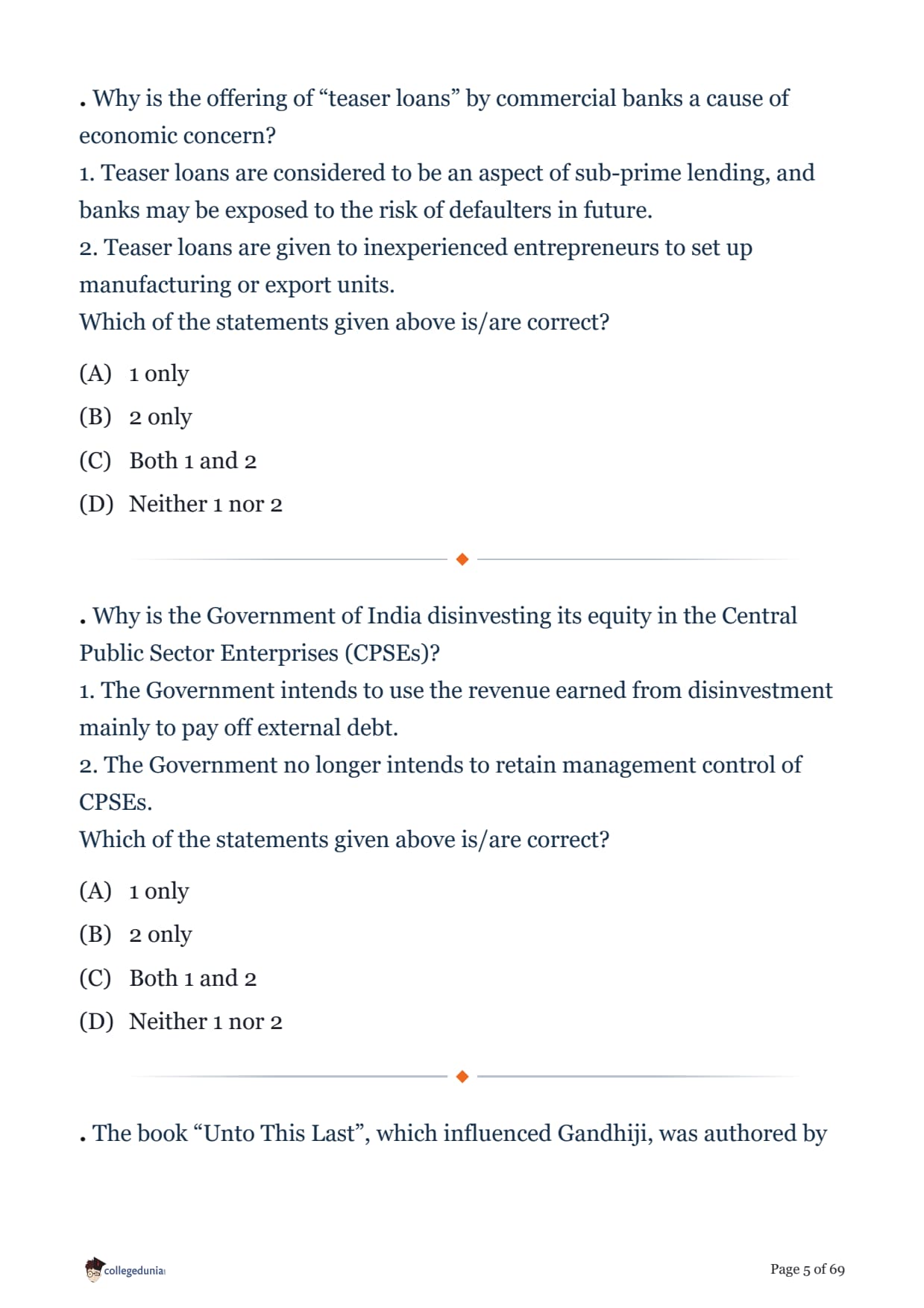
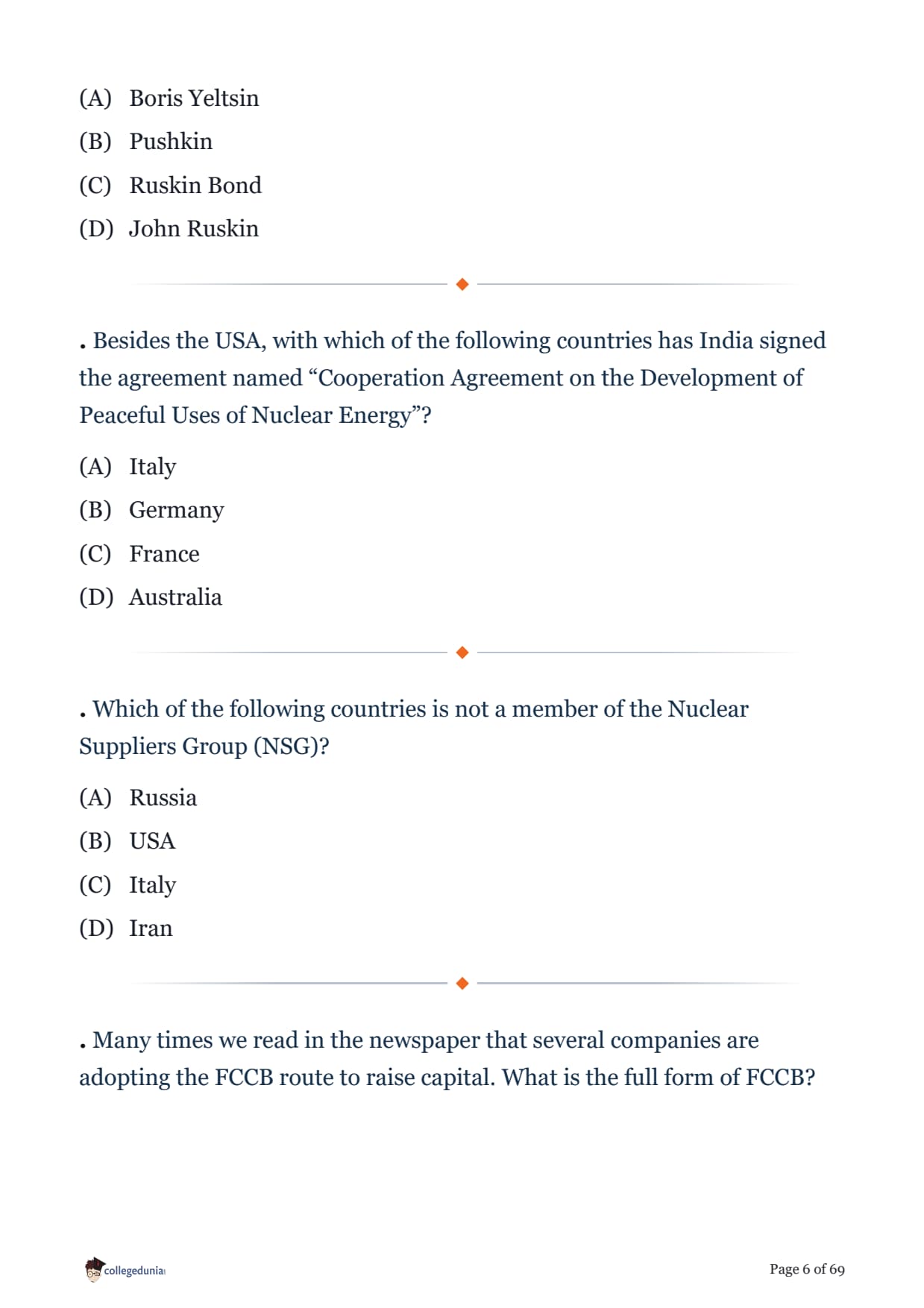
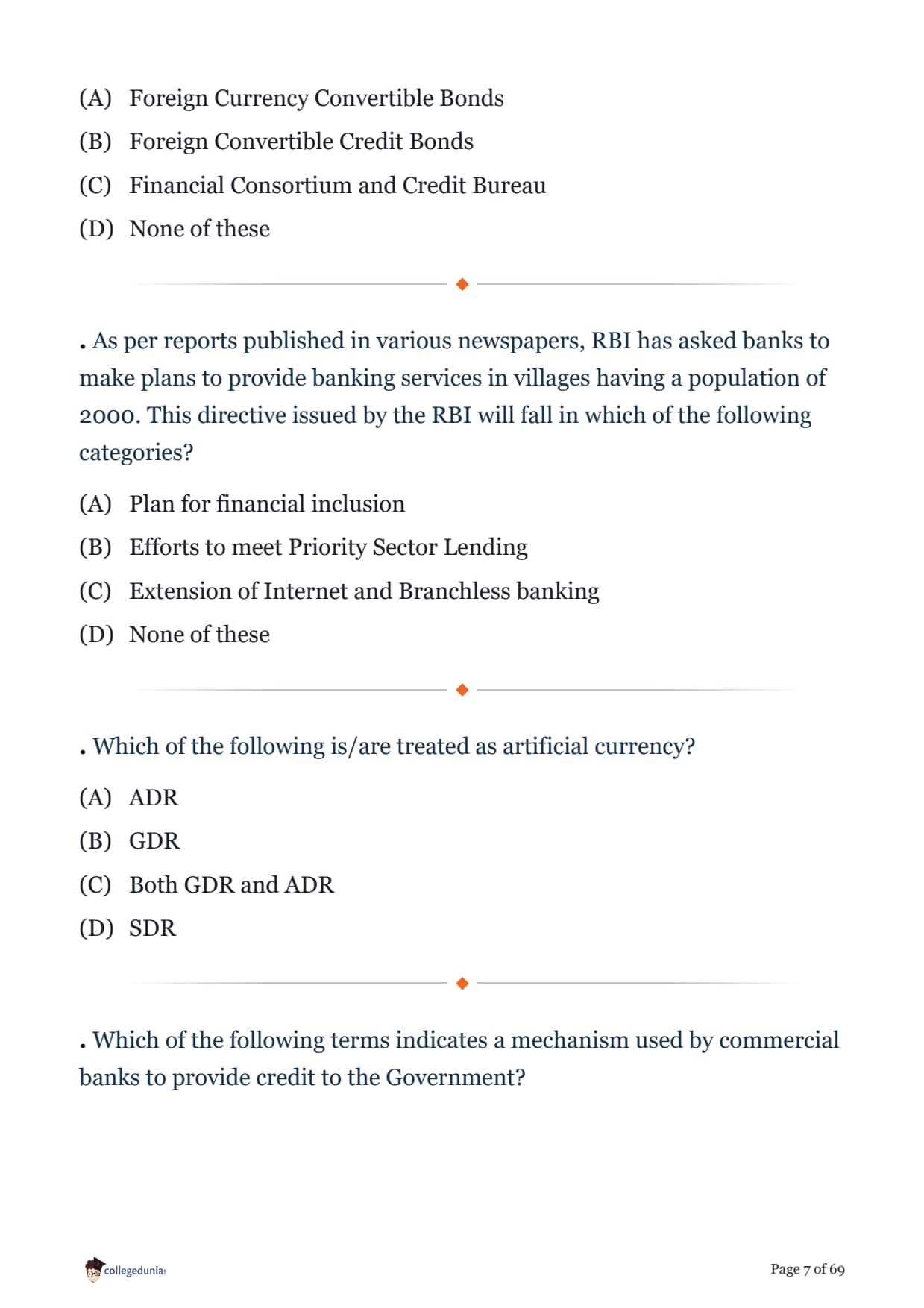
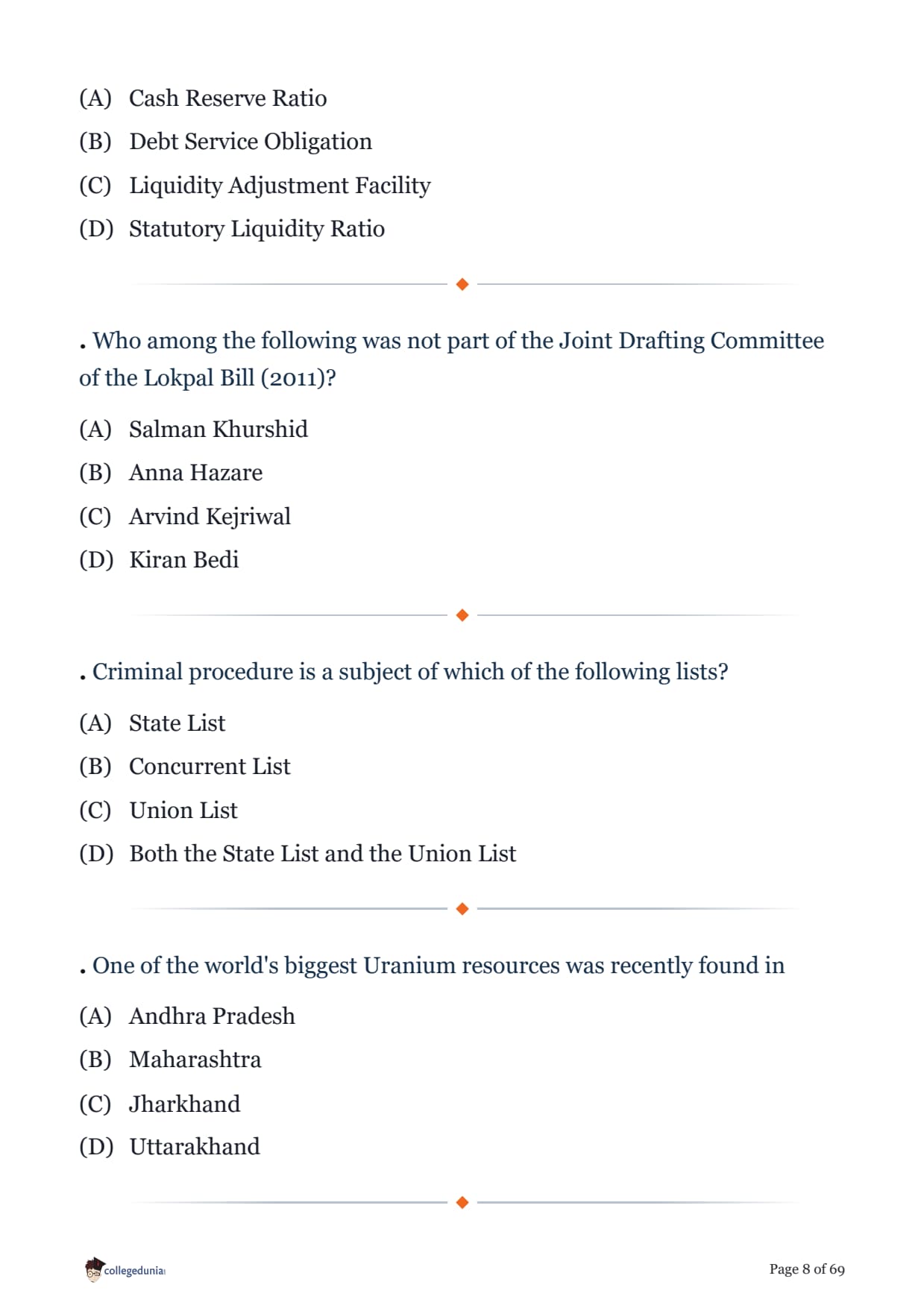
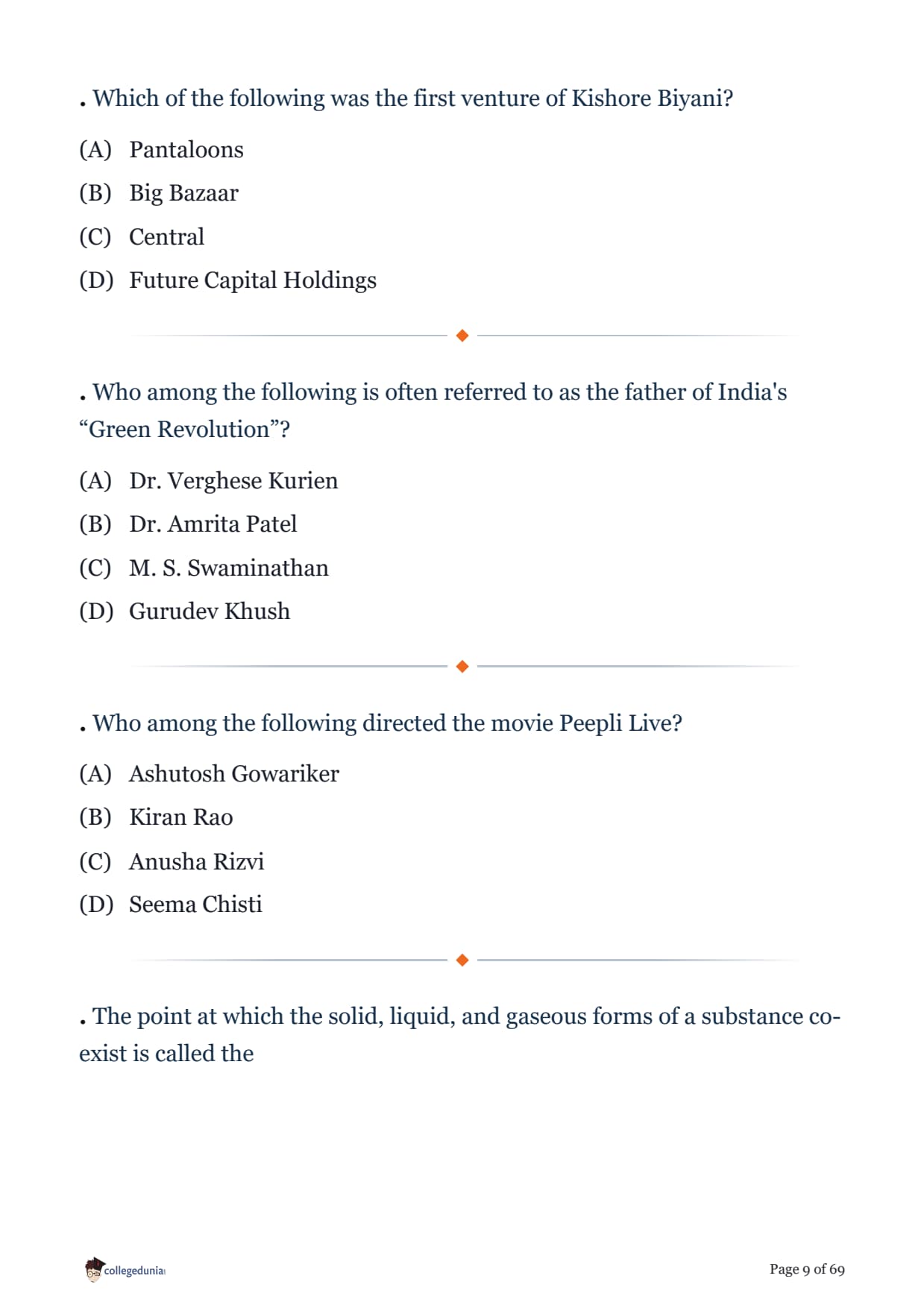
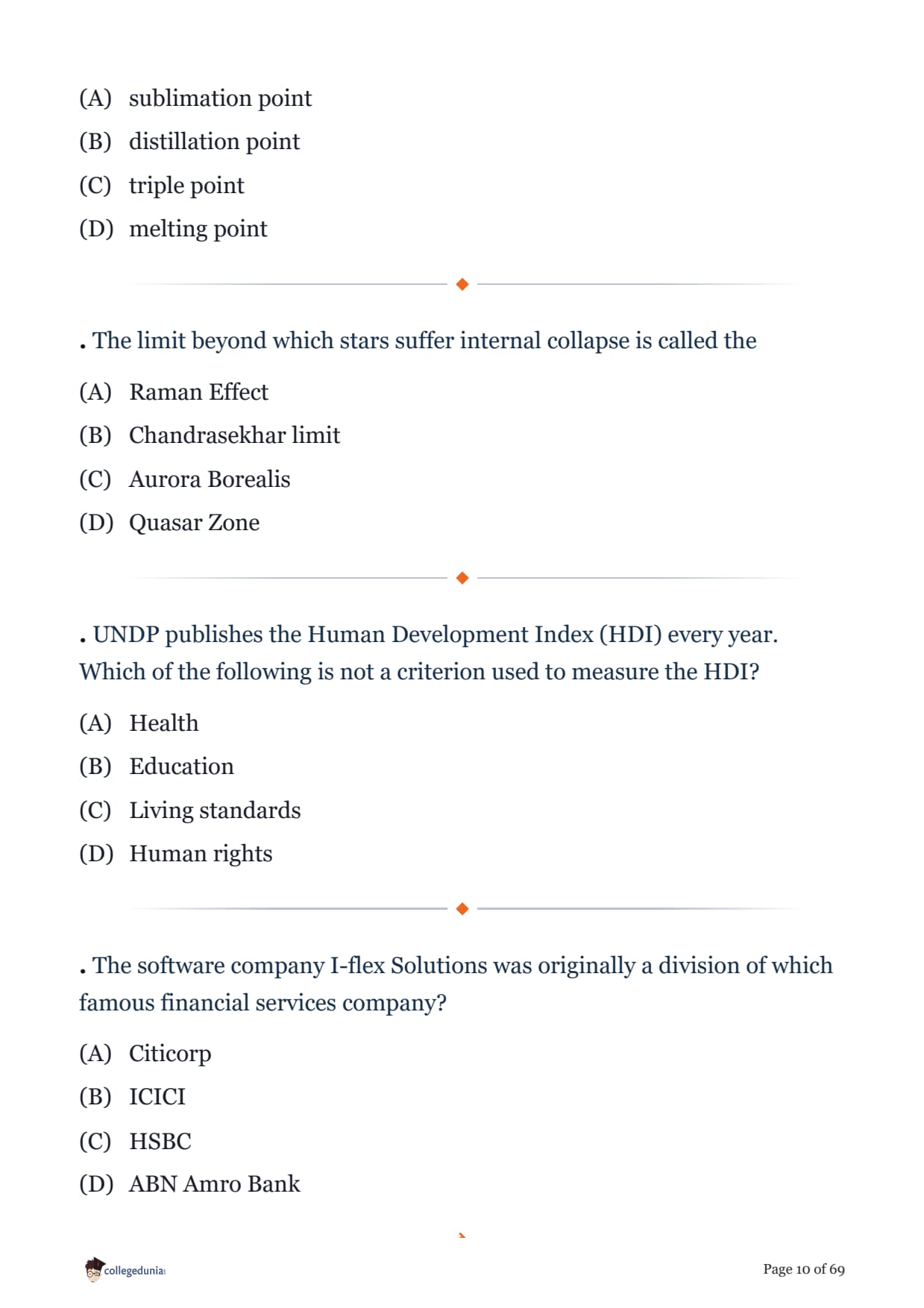
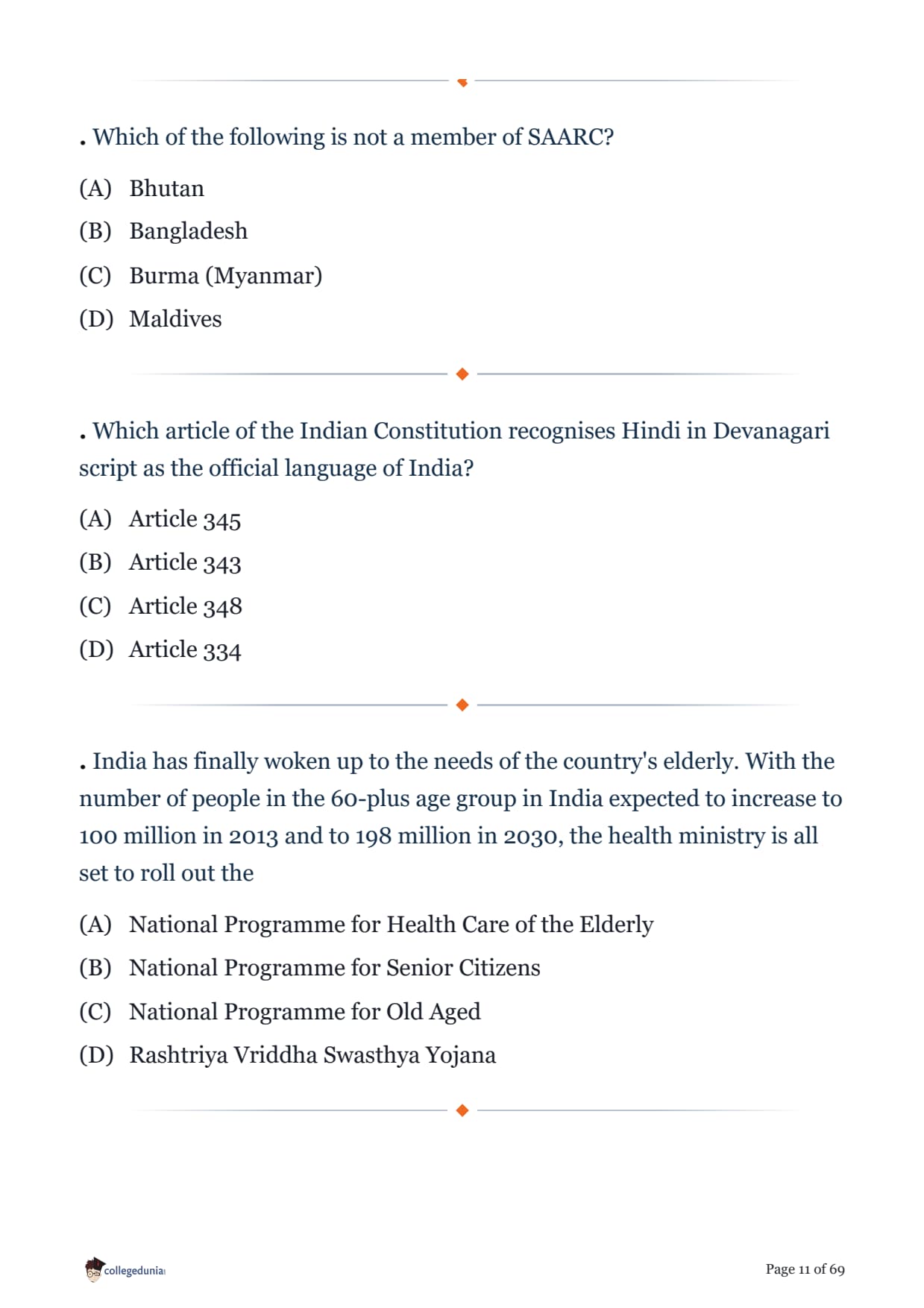
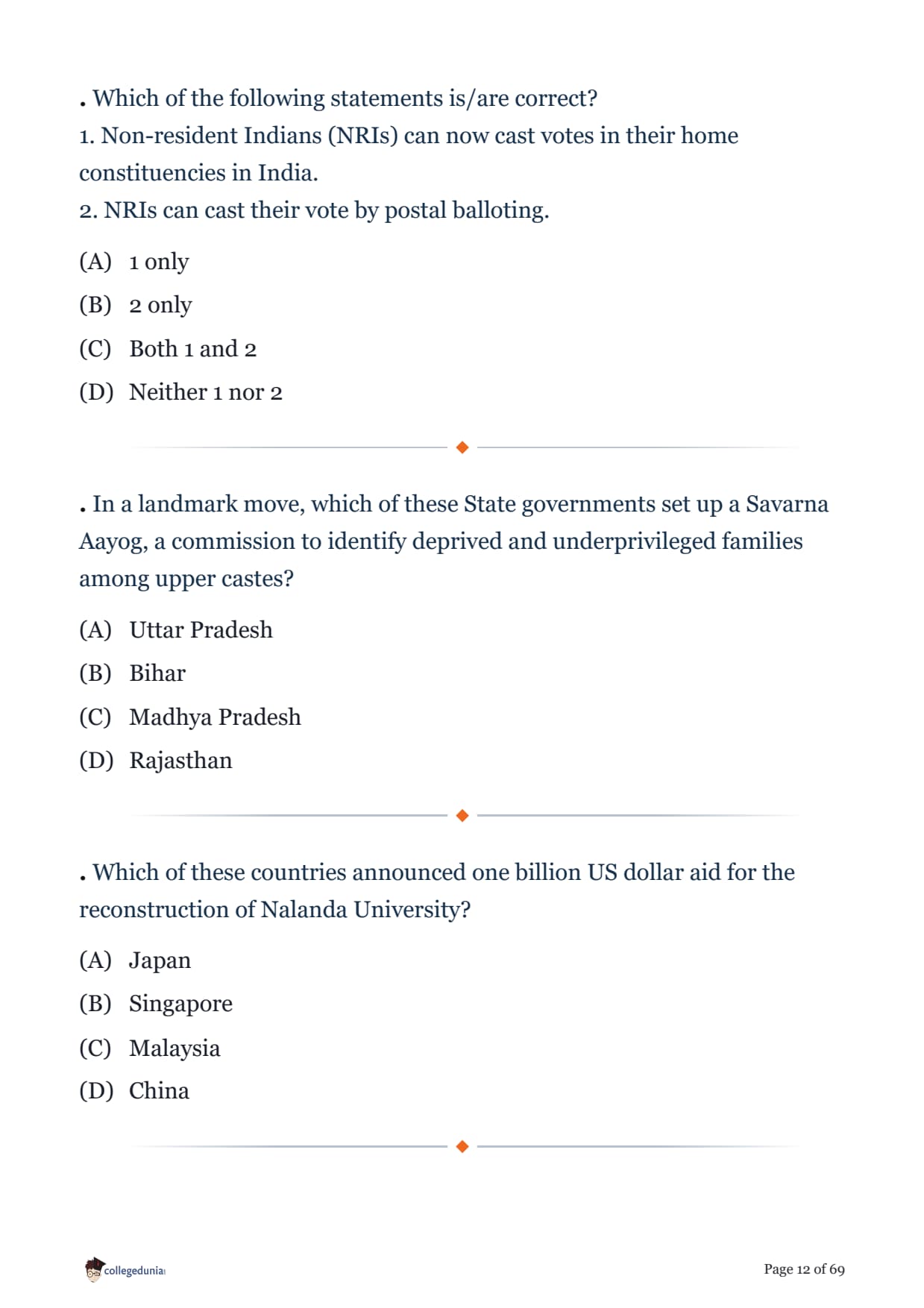
SNAP 2011 Questions with Solutions
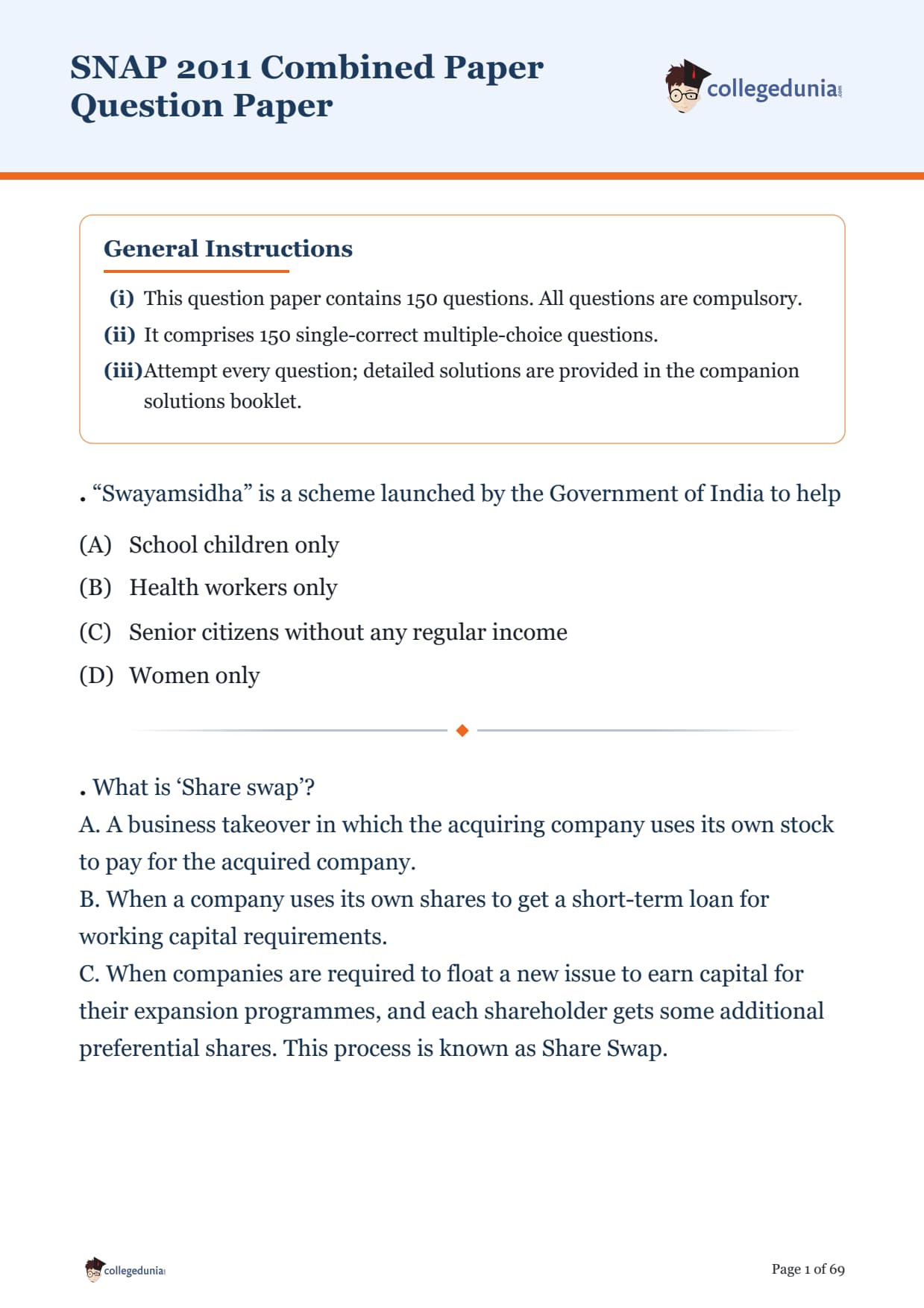
“Swayamsidha” is a scheme launched by the Government of India to help
What is ‘Share swap’?
A. A business takeover in which the acquiring company uses its own stock to pay for the acquired company.
B. When a company uses its own shares to get a short-term loan for working capital requirements.
C. When companies are required to float a new issue to earn capital for their expansion programmes, and each shareholder gets some additional preferential shares. This process is known as Share Swap.
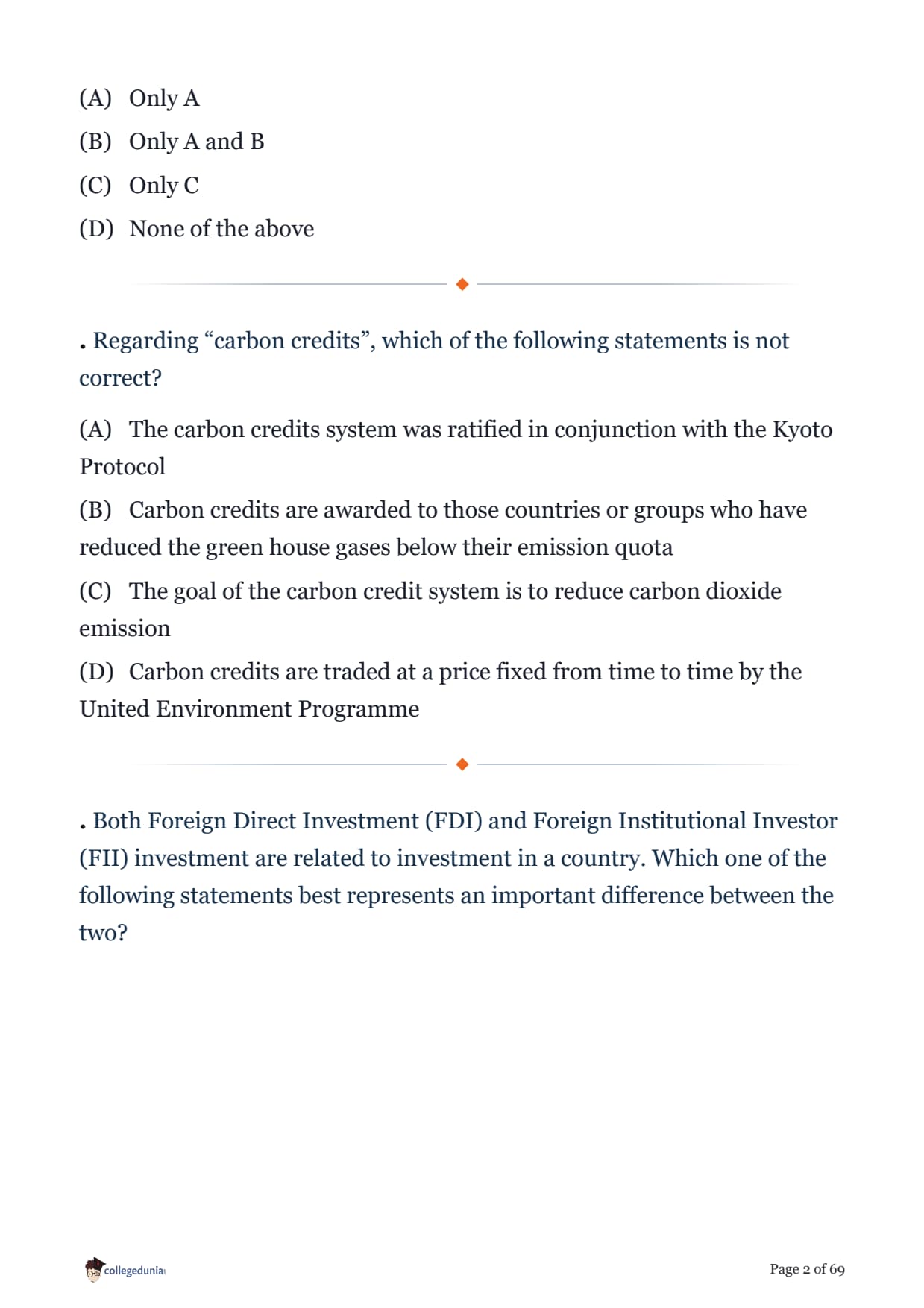
Regarding “carbon credits”, which of the following statements is not correct?
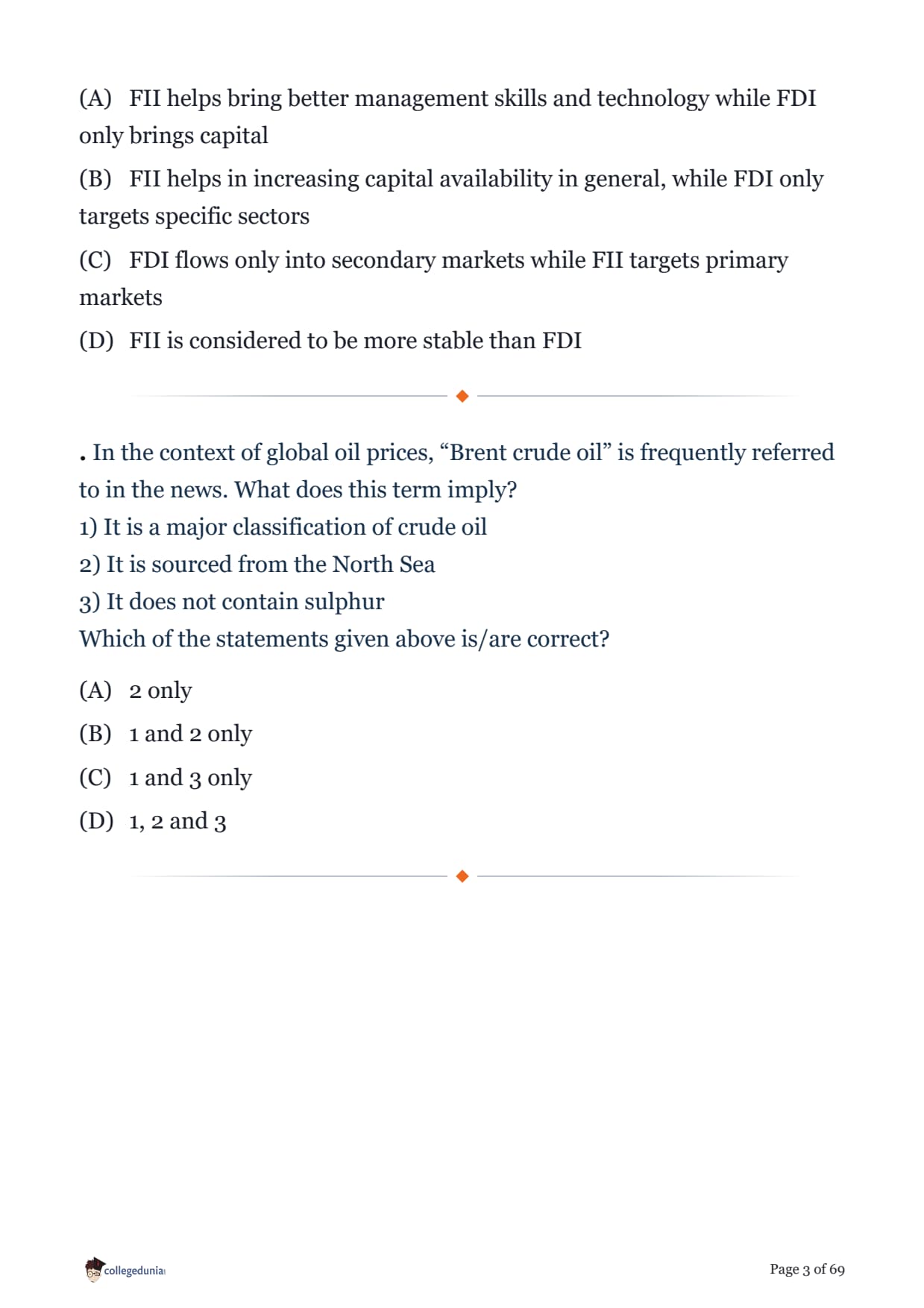
Both Foreign Direct Investment (FDI) and Foreign Institutional Investor (FII) investment are related to investment in a country. Which one of the following statements best represents an important difference between the two?
In the context of global oil prices, “Brent crude oil” is frequently referred to in the news. What does this term imply?
1) It is a major classification of crude oil
2) It is sourced from the North Sea
3) It does not contain sulphur
Which of the statements given above is/are correct?
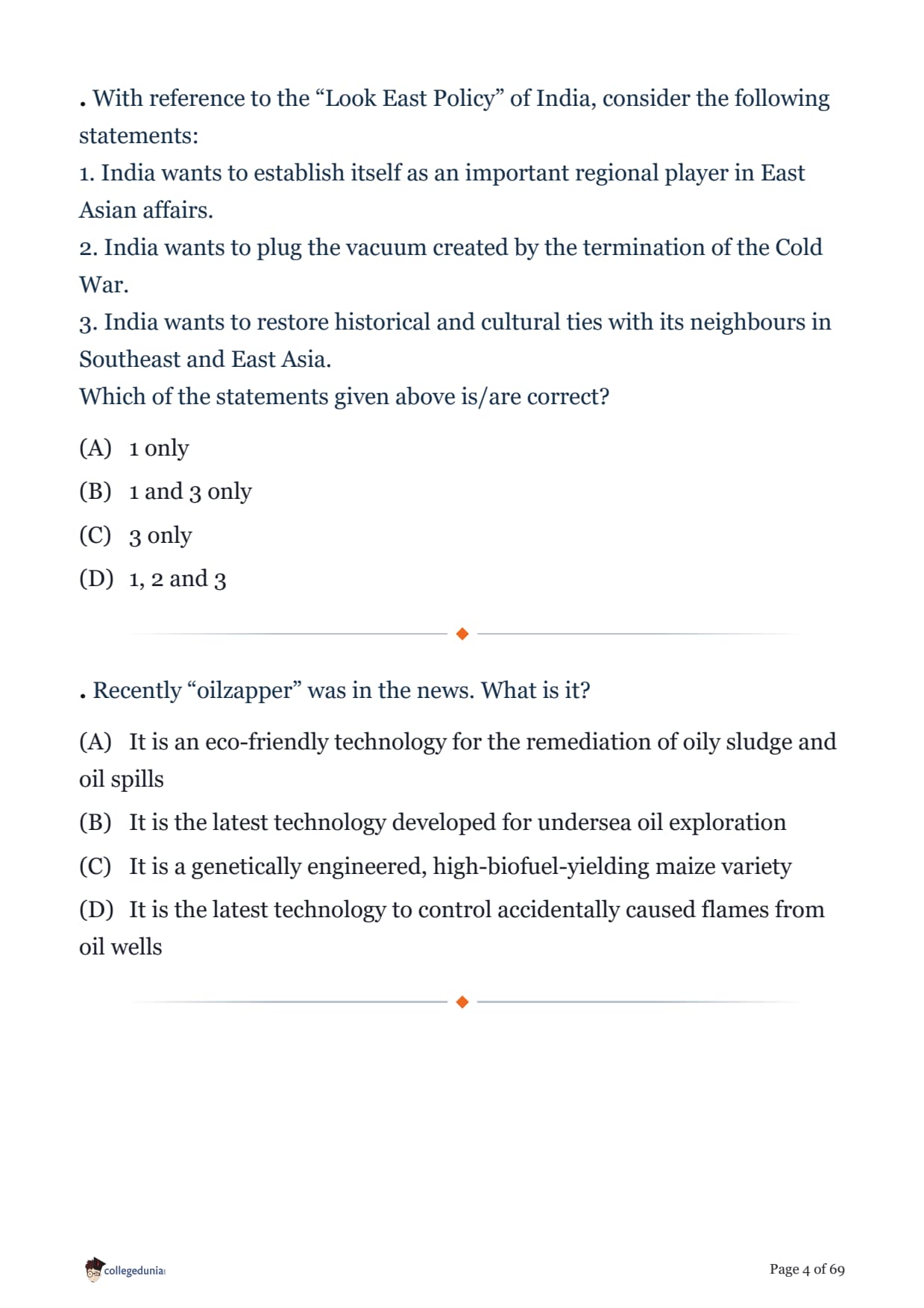
With reference to the “Look East Policy” of India, consider the following statements:
1. India wants to establish itself as an important regional player in East Asian affairs.
2. India wants to plug the vacuum created by the termination of the Cold War.
3. India wants to restore historical and cultural ties with its neighbours in Southeast and East Asia.
Which of the statements given above is/are correct?
Recently “oilzapper” was in the news. What is it?
Why is the offering of “teaser loans” by commercial banks a cause of economic concern?
1. Teaser loans are considered to be an aspect of sub-prime lending, and banks may be exposed to the risk of defaulters in future.
2. Teaser loans are given to inexperienced entrepreneurs to set up manufacturing or export units.
Which of the statements given above is/are correct?
Why is the Government of India disinvesting its equity in the Central Public Sector Enterprises (CPSEs)?
1. The Government intends to use the revenue earned from disinvestment mainly to pay off external debt.
2. The Government no longer intends to retain management control of CPSEs.
Which of the statements given above is/are correct?
The book “Unto This Last”, which influenced Gandhiji, was authored by
Besides the USA, with which of the following countries has India signed the agreement named “Cooperation Agreement on the Development of Peaceful Uses of Nuclear Energy”?
Which of the following countries is not a member of the Nuclear Suppliers Group (NSG)?
Many times we read in the newspaper that several companies are adopting the FCCB route to raise capital. What is the full form of FCCB?
As per reports published in various newspapers, RBI has asked banks to make plans to provide banking services in villages having a population of 2000. This directive issued by the RBI will fall in which of the following categories?
Which of the following is/are treated as artificial currency?
Which of the following terms indicates a mechanism used by commercial banks to provide credit to the Government?
Who among the following was not part of the Joint Drafting Committee of the Lokpal Bill (2011)?
Criminal procedure is a subject of which of the following lists?
One of the world's biggest Uranium resources was recently found in
Which of the following was the first venture of Kishore Biyani?
Who among the following is often referred to as the father of India's “Green Revolution”?
Who among the following directed the movie Peepli Live?
The point at which the solid, liquid, and gaseous forms of a substance co-exist is called the
The limit beyond which stars suffer internal collapse is called the
UNDP publishes the Human Development Index (HDI) every year. Which of the following is not a criterion used to measure the HDI?
The software company I-flex Solutions was originally a division of which famous financial services company?
Which of the following is not a member of SAARC?
Which article of the Indian Constitution recognises Hindi in Devanagari script as the official language of India?
India has finally woken up to the needs of the country's elderly. With the number of people in the 60-plus age group in India expected to increase to 100 million in 2013 and to 198 million in 2030, the health ministry is all set to roll out the
Which of the following statements is/are correct?
1. Non-resident Indians (NRIs) can now cast votes in their home constituencies in India.
2. NRIs can cast their vote by postal balloting.
In a landmark move, which of these State governments set up a Savarna Aayog, a commission to identify deprived and underprivileged families among upper castes?
Which of these countries announced one billion US dollar aid for the reconstruction of Nalanda University?
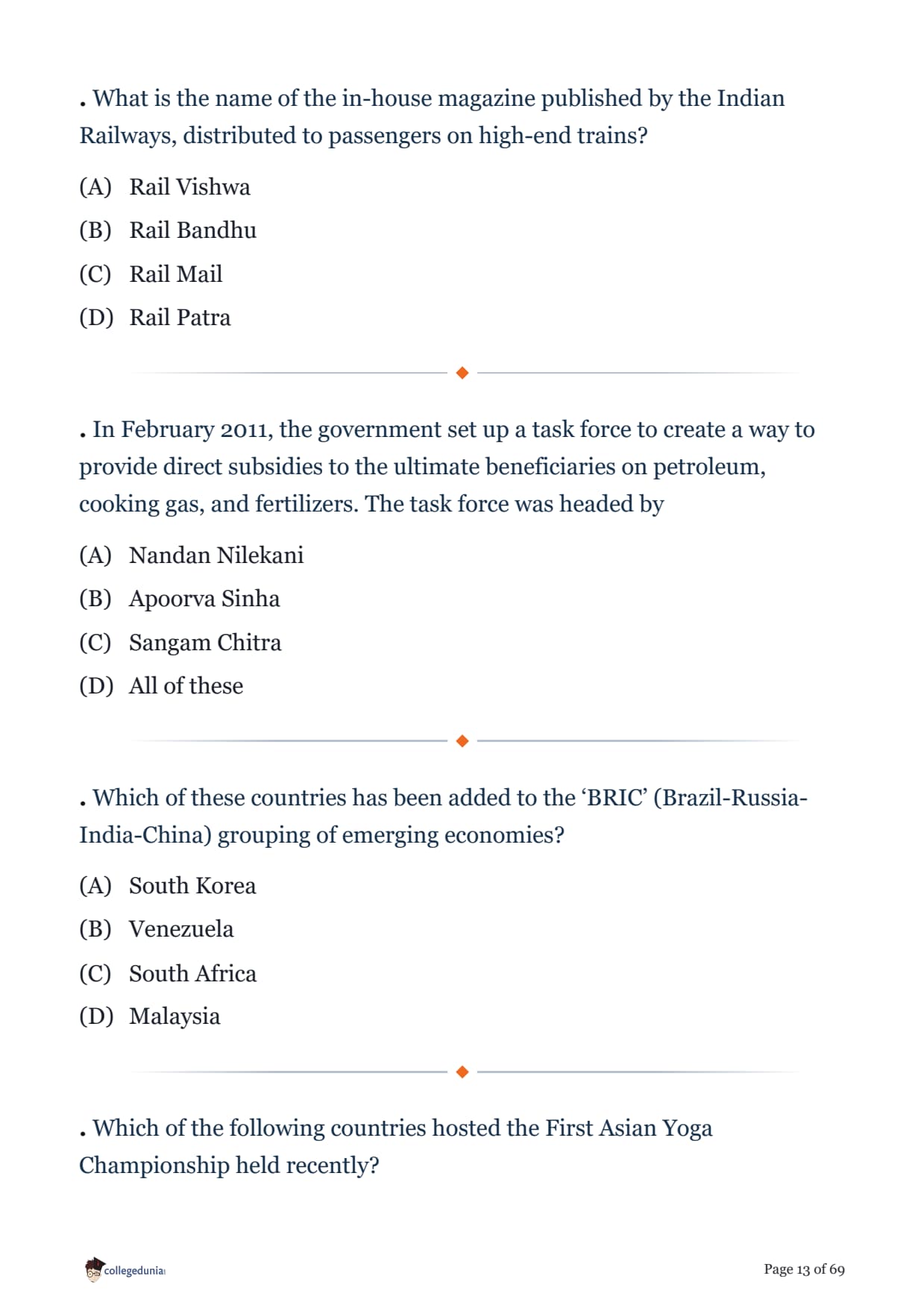
What is the name of the in-house magazine published by the Indian Railways, distributed to passengers on high-end trains?
In February 2011, the government set up a task force to create a way to provide direct subsidies to the ultimate beneficiaries on petroleum, cooking gas, and fertilizers. The task force was headed by
Which of these countries has been added to the ‘BRIC’ (Brazil-Russia-India-China) grouping of emerging economies?
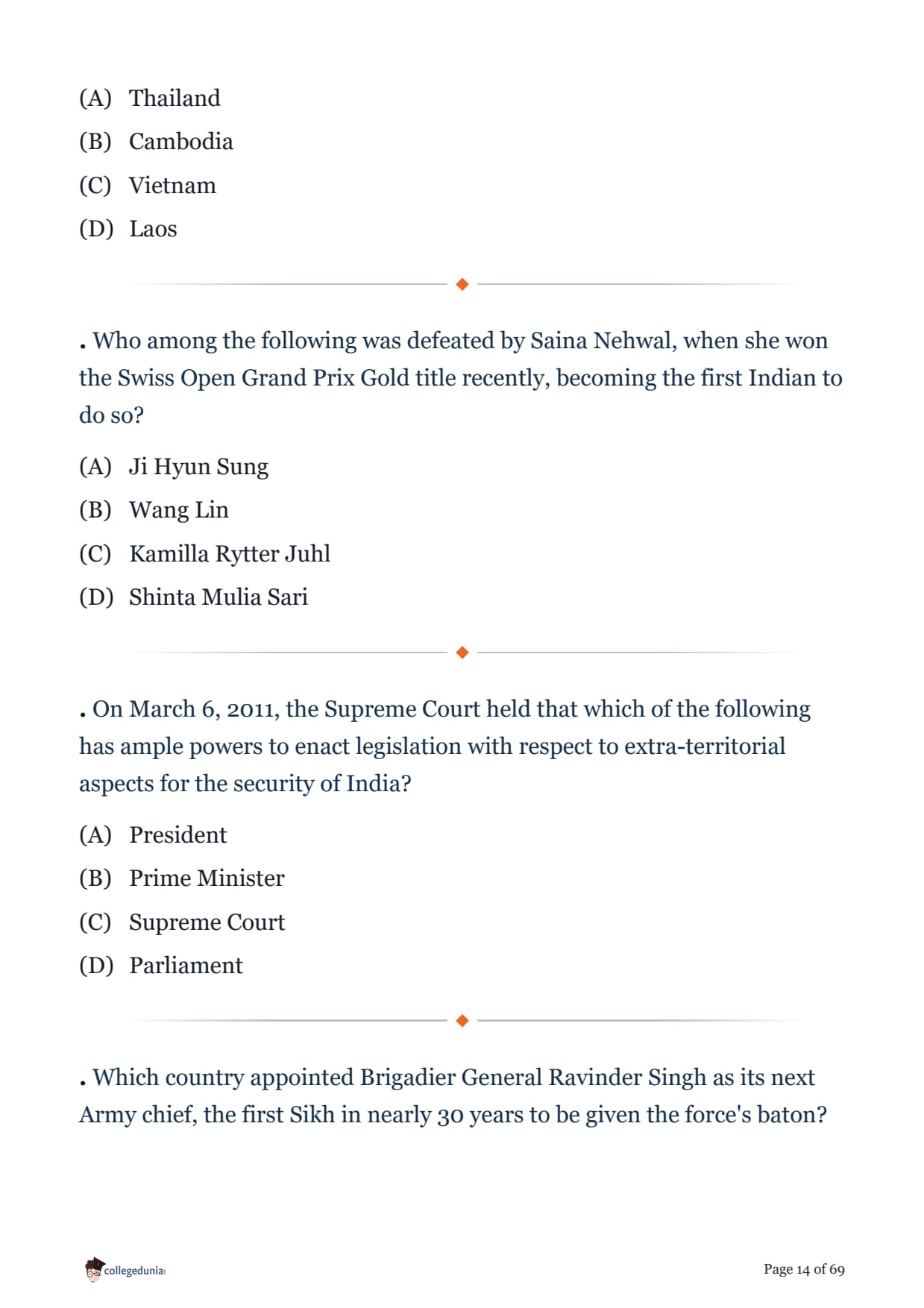
Which of the following countries hosted the First Asian Yoga Championship held recently?
Who among the following was defeated by Saina Nehwal, when she won the Swiss Open Grand Prix Gold title recently, becoming the first Indian to do so?
On March 6, 2011, the Supreme Court held that which of the following has ample powers to enact legislation with respect to extra-territorial aspects for the security of India?
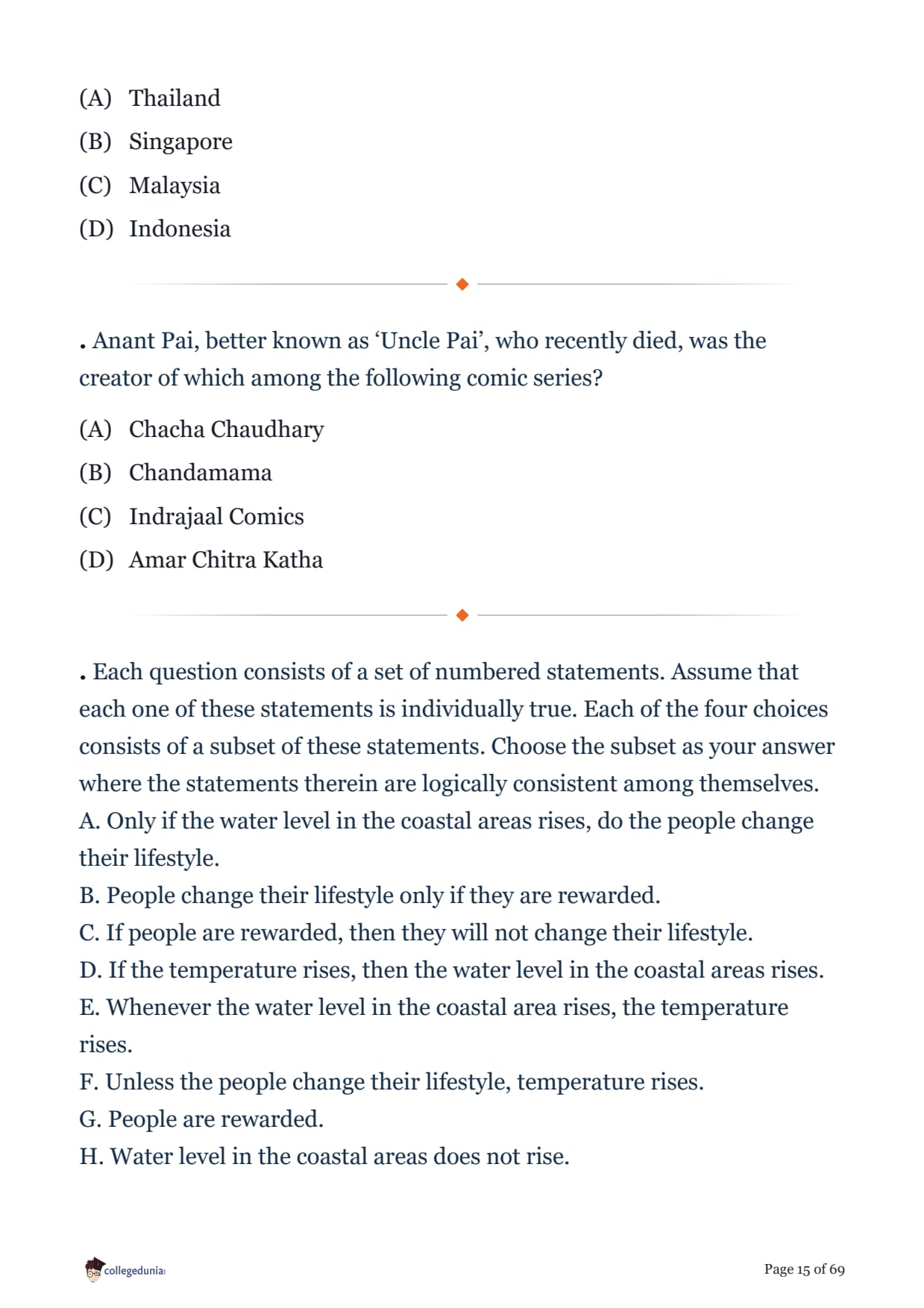
Which country appointed Brigadier General Ravinder Singh as its next Army chief, the first Sikh in nearly 30 years to be given the force's baton?
Anant Pai, better known as ‘Uncle Pai’, who recently died, was the creator of which among the following comic series?
Each question consists of a set of numbered statements. Assume that each one of these statements is individually true. Each of the four choices consists of a subset of these statements. Choose the subset as your answer where the statements therein are logically consistent among themselves.
A. Only if the water level in the coastal areas rises, do the people change their lifestyle.
B. People change their lifestyle only if they are rewarded.
C. If people are rewarded, then they will not change their lifestyle.
D. If the temperature rises, then the water level in the coastal areas rises.
E. Whenever the water level in the coastal area rises, the temperature rises.
F. Unless the people change their lifestyle, temperature rises.
G. People are rewarded.
H. Water level in the coastal areas does not rise.
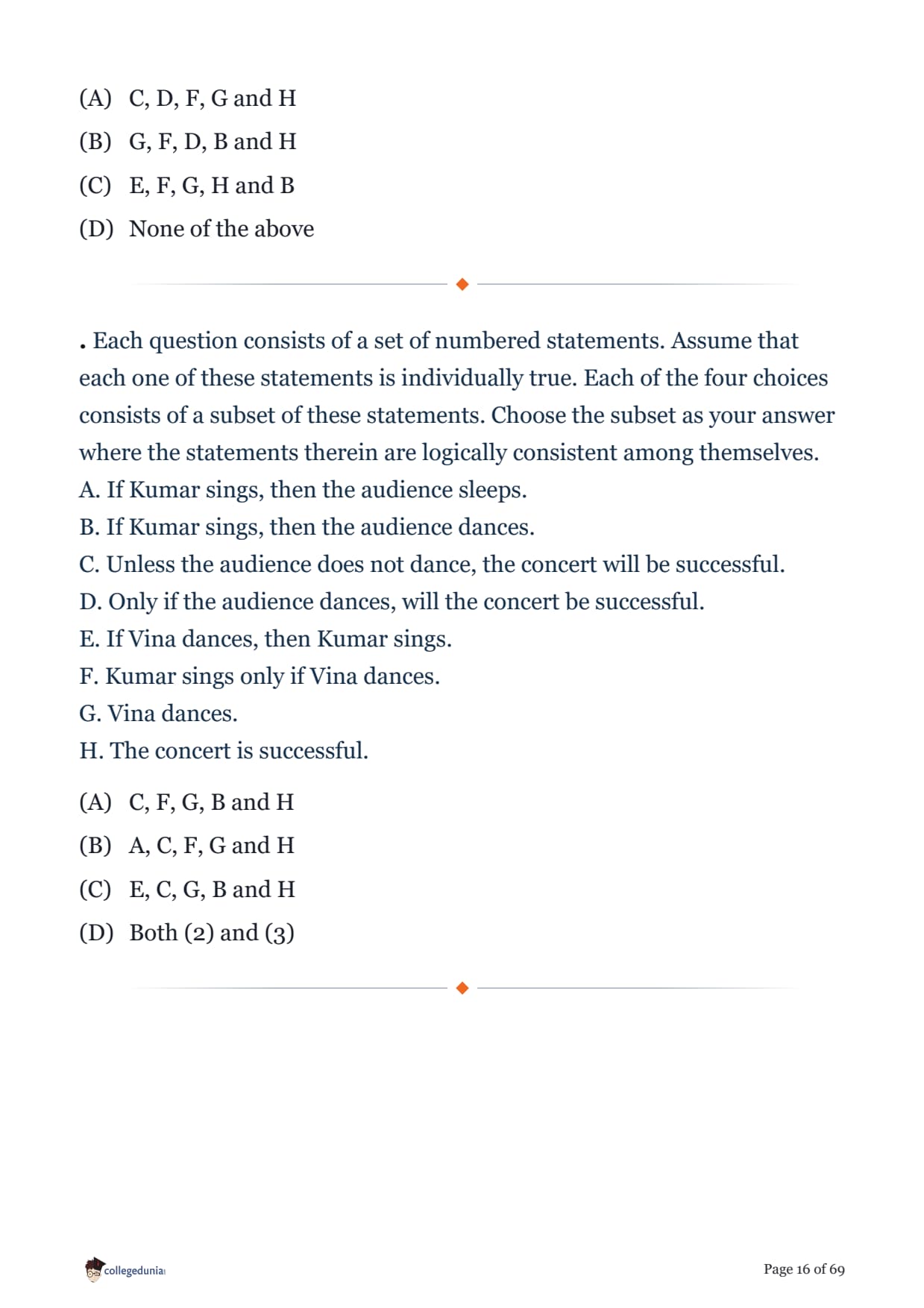
Each question consists of a set of numbered statements. Assume that each one of these statements is individually true. Each of the four choices consists of a subset of these statements. Choose the subset as your answer where the statements therein are logically consistent among themselves.
A. If Kumar sings, then the audience sleeps.
B. If Kumar sings, then the audience dances.
C. Unless the audience does not dance, the concert will be successful.
D. Only if the audience dances, will the concert be successful.
E. If Vina dances, then Kumar sings.
F. Kumar sings only if Vina dances.
G. Vina dances.
H. The concert is successful.
Instructions: There are only four members of a family, namely A, B, C and D, and there is only one couple among them. When asked about their relationships, their replies were as follows:
A: “B is my son. D is my mother.”
B: “C is my wife. D is my father.”
C: “D is my mother-in-law. A is my daughter.”
D: “A is my grand-daughter. B is my daughter-in-law.”
Who always speaks the truth?
Instructions: There are only four members of a family, namely A, B, C and D, and there is only one couple among them. When asked about their relationships, their replies were as follows:
A: “B is my son. D is my mother.”
B: “C is my wife. D is my father.”
C: “D is my mother-in-law. A is my daughter.”
D: “A is my grand-daughter. B is my daughter-in-law.”
How is B related to C?
Instructions: There are only four members of a family, namely A, B, C and D, and there is only one couple among them. When asked about their relationships, their replies were as follows:
A: “B is my son. D is my mother.”
B: “C is my wife. D is my father.”
C: “D is my mother-in-law. A is my daughter.”
D: “A is my grand-daughter. B is my daughter-in-law.”
Which of the following statements must be true?
Instructions: A cube of 7 cm x 7 cm x 7 cm is kept in the corner of a room and painted in three different colours, one colour on each of the three faces that can be seen (the three faces meeting at the corner facing into the room). The cube is then cut into 343 smaller, identical unit cubes.
How many of the smaller cubes do not have any face painted?
Instructions: A cube of 7 cm x 7 cm x 7 cm is kept in the corner of a room and painted in three different colours, one colour on each of the three faces that can be seen. The cube is then cut into 343 smaller, identical unit cubes.
How many of the smaller cubes have exactly one colour on them?
Instructions: A cube of 7 cm x 7 cm x 7 cm is kept in the corner of a room and painted in three different colours, one colour on each of the three faces that can be seen. The cube is then cut into 343 smaller, identical unit cubes.
How many of the smaller cubes have at most two faces painted?
Instructions: Amit was driving in New Town, where all roads run either north-south or east-west, forming a grid. Roads are at a distance of 1 km from each other and are parallel.
Amit started at the intersection of streets no. 7 and 8. He drove 3 km north, 3 km west, and then 4 km south. Which further route could bring him back to his starting point?
I. 3 km east, then 2 km south
II. 1 km north, then 3 km east
III. 1 km north, then 2 km west
Instructions: Amit was driving in New Town, where all roads run either north-south or east-west, forming a grid. Roads are at a distance of 1 km from each other and are parallel.
After driving as stated in the previous question (3 km north, 3 km west, then 4 km south from his starting point), Amit did not return to his starting point but instead drove a further 4 km east and 1 km north. How far is he from his starting point?
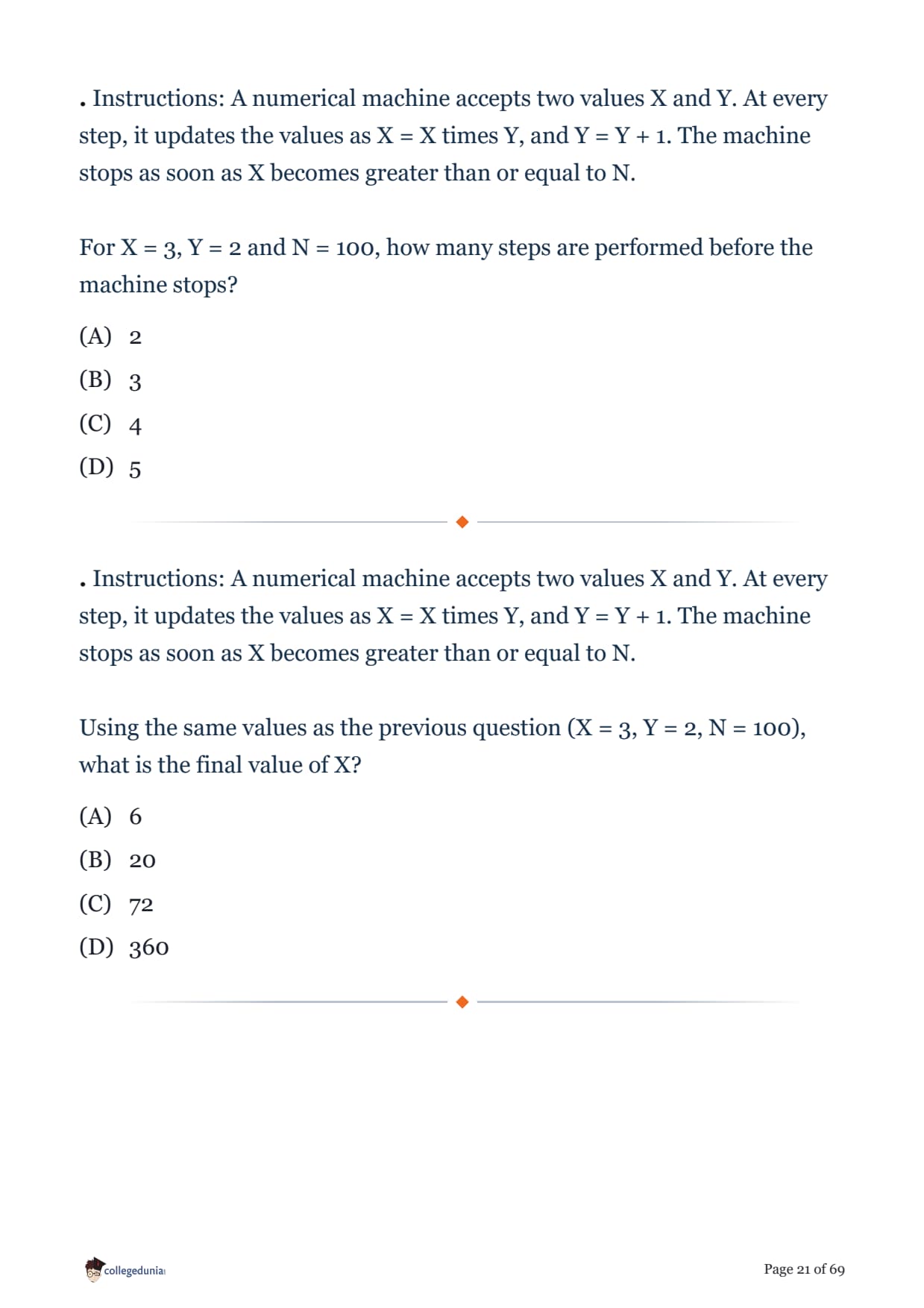
Instructions: A numerical machine accepts two values X and Y. At every step, it updates the values as X = X times Y, and Y = Y + 1. The machine stops as soon as X becomes greater than or equal to N.
For X = 3, Y = 2 and N = 100, how many steps are performed before the machine stops?
Instructions: A numerical machine accepts two values X and Y. At every step, it updates the values as X = X times Y, and Y = Y + 1. The machine stops as soon as X becomes greater than or equal to N.
Using the same values as the previous question (X = 3, Y = 2, N = 100), what is the final value of X?
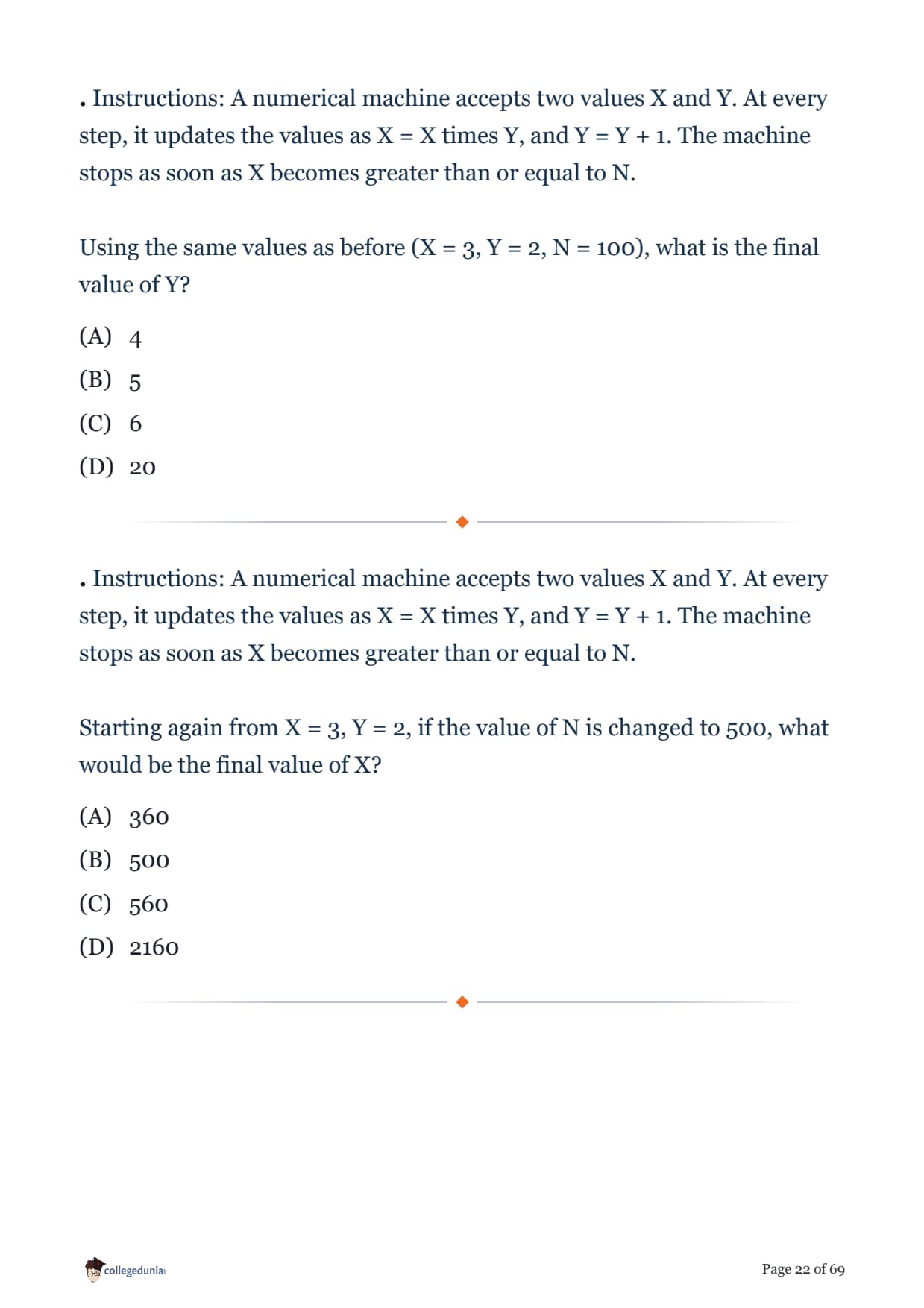
Instructions: A numerical machine accepts two values X and Y. At every step, it updates the values as X = X times Y, and Y = Y + 1. The machine stops as soon as X becomes greater than or equal to N.
Using the same values as before (X = 3, Y = 2, N = 100), what is the final value of Y?
Instructions: A numerical machine accepts two values X and Y. At every step, it updates the values as X = X times Y, and Y = Y + 1. The machine stops as soon as X becomes greater than or equal to N.
Starting again from X = 3, Y = 2, if the value of N is changed to 500, what would be the final value of X?
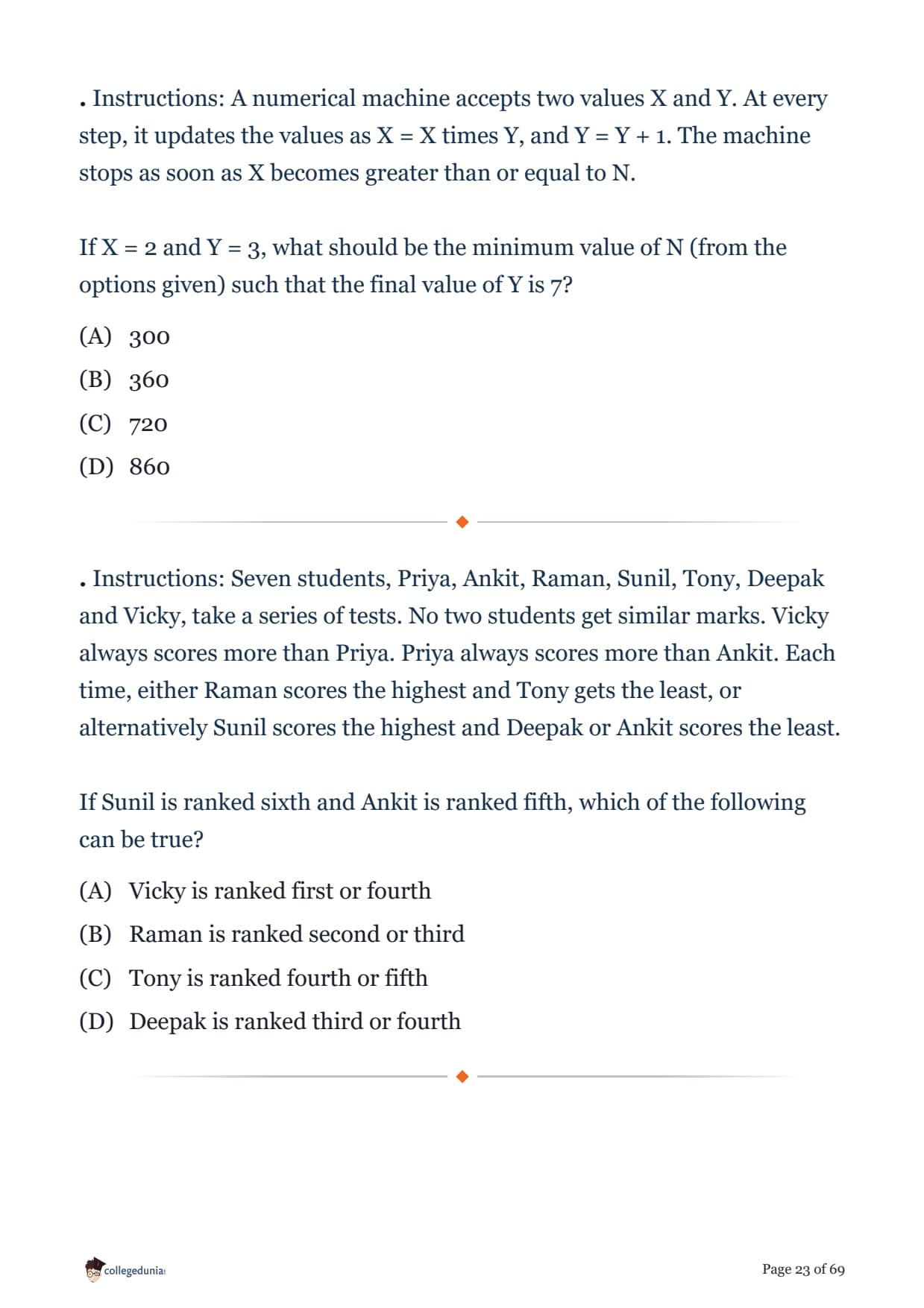
Instructions: A numerical machine accepts two values X and Y. At every step, it updates the values as X = X times Y, and Y = Y + 1. The machine stops as soon as X becomes greater than or equal to N.
If X = 2 and Y = 3, what should be the minimum value of N (from the options given) such that the final value of Y is 7?
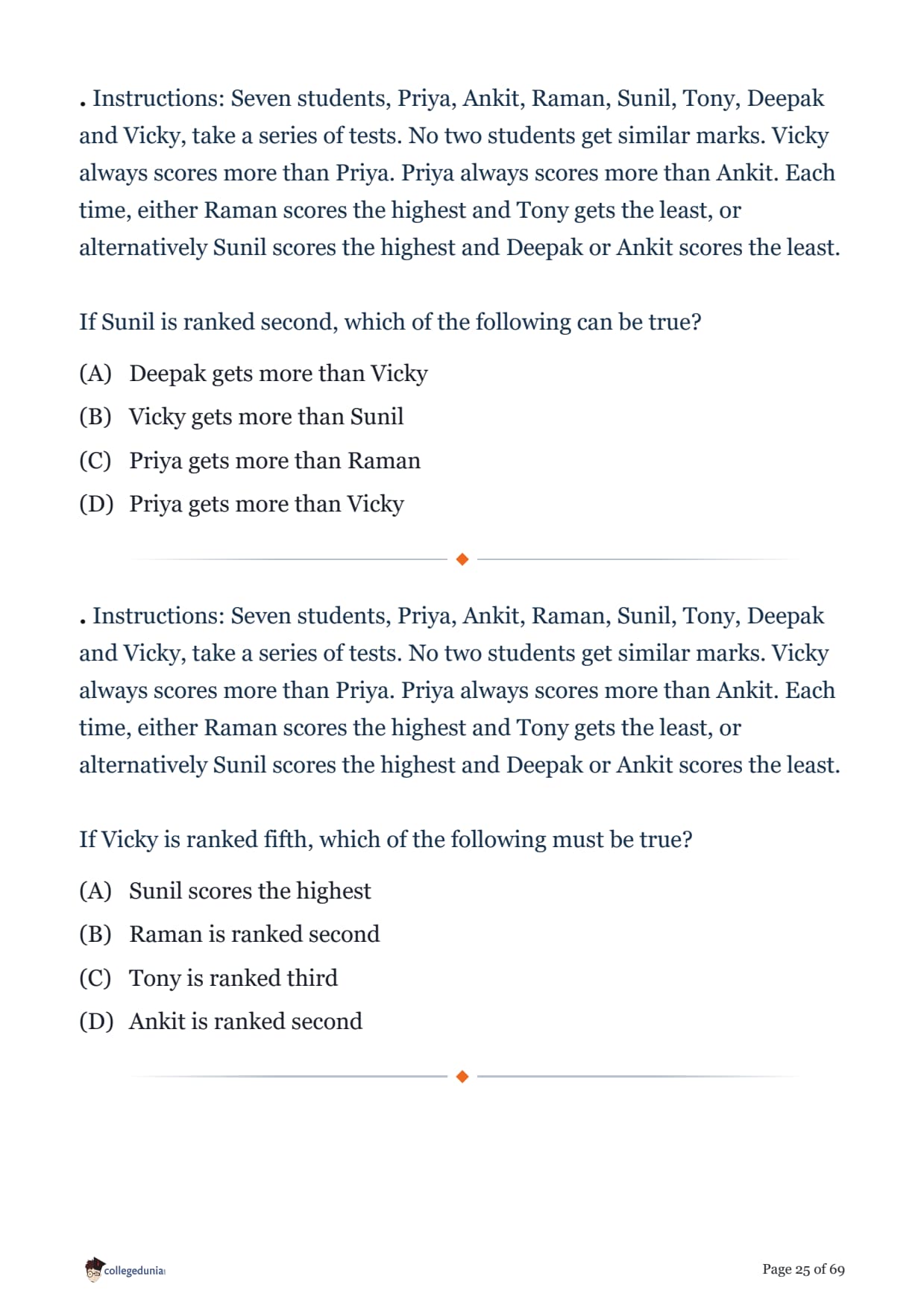
Instructions: Seven students, Priya, Ankit, Raman, Sunil, Tony, Deepak and Vicky, take a series of tests. No two students get similar marks. Vicky always scores more than Priya. Priya always scores more than Ankit. Each time, either Raman scores the highest and Tony gets the least, or alternatively Sunil scores the highest and Deepak or Ankit scores the least.
If Sunil is ranked sixth and Ankit is ranked fifth, which of the following can be true?
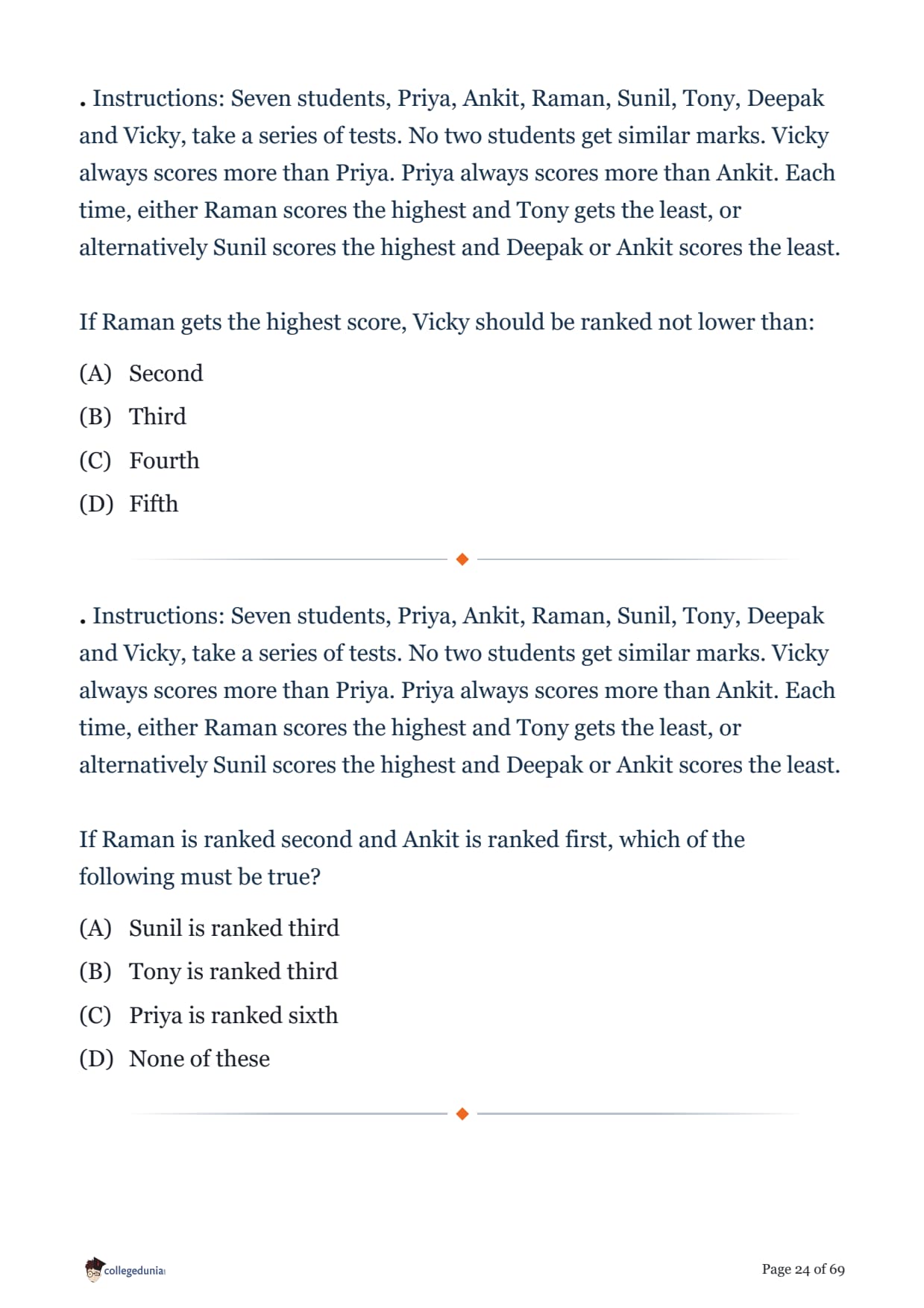
Instructions: Seven students, Priya, Ankit, Raman, Sunil, Tony, Deepak and Vicky, take a series of tests. No two students get similar marks. Vicky always scores more than Priya. Priya always scores more than Ankit. Each time, either Raman scores the highest and Tony gets the least, or alternatively Sunil scores the highest and Deepak or Ankit scores the least.
If Raman gets the highest score, Vicky should be ranked not lower than:
Instructions: Seven students, Priya, Ankit, Raman, Sunil, Tony, Deepak and Vicky, take a series of tests. No two students get similar marks. Vicky always scores more than Priya. Priya always scores more than Ankit. Each time, either Raman scores the highest and Tony gets the least, or alternatively Sunil scores the highest and Deepak or Ankit scores the least.
If Raman is ranked second and Ankit is ranked first, which of the following must be true?
Instructions: Seven students, Priya, Ankit, Raman, Sunil, Tony, Deepak and Vicky, take a series of tests. No two students get similar marks. Vicky always scores more than Priya. Priya always scores more than Ankit. Each time, either Raman scores the highest and Tony gets the least, or alternatively Sunil scores the highest and Deepak or Ankit scores the least.
If Sunil is ranked second, which of the following can be true?
Instructions: Seven students, Priya, Ankit, Raman, Sunil, Tony, Deepak and Vicky, take a series of tests. No two students get similar marks. Vicky always scores more than Priya. Priya always scores more than Ankit. Each time, either Raman scores the highest and Tony gets the least, or alternatively Sunil scores the highest and Deepak or Ankit scores the least.
If Vicky is ranked fifth, which of the following must be true?
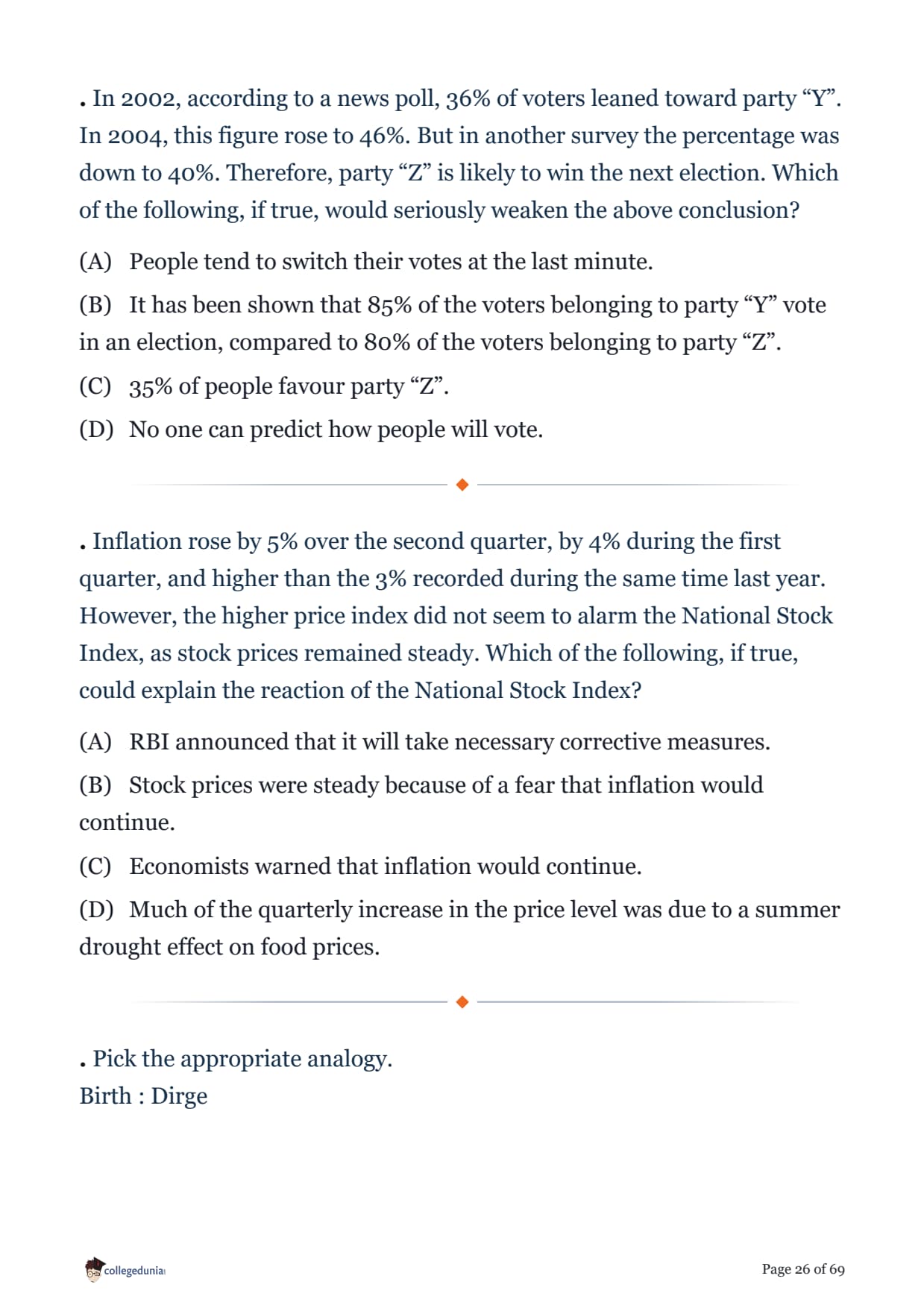
In 2002, according to a news poll, 36% of voters leaned toward party “Y”. In 2004, this figure rose to 46%. But in another survey the percentage was down to 40%. Therefore, party “Z” is likely to win the next election. Which of the following, if true, would seriously weaken the above conclusion?
Inflation rose by 5% over the second quarter, by 4% during the first quarter, and higher than the 3% recorded during the same time last year. However, the higher price index did not seem to alarm the National Stock Index, as stock prices remained steady. Which of the following, if true, could explain the reaction of the National Stock Index?
Pick the appropriate analogy.
Birth : Dirge
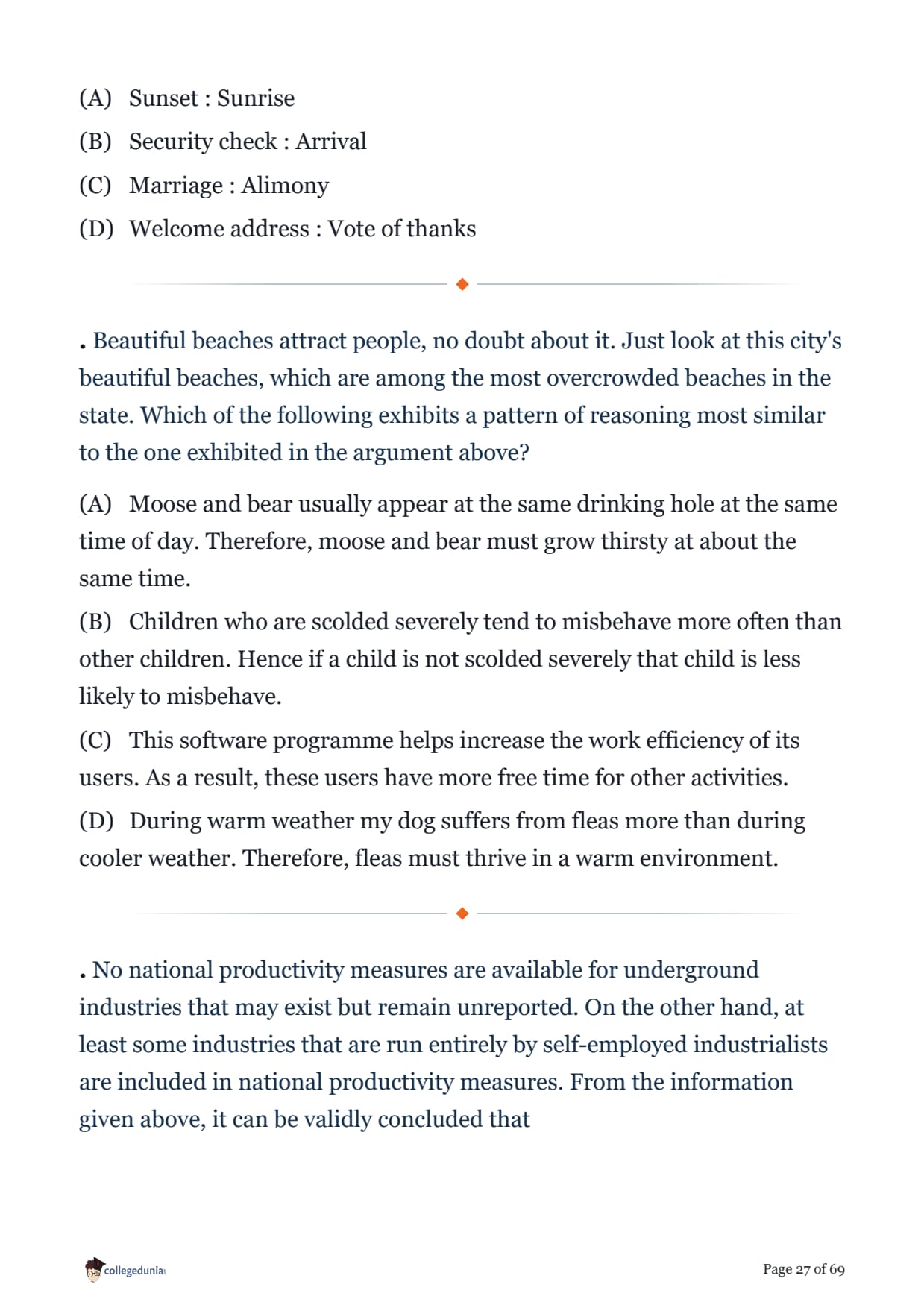
Beautiful beaches attract people, no doubt about it. Just look at this city's beautiful beaches, which are among the most overcrowded beaches in the state. Which of the following exhibits a pattern of reasoning most similar to the one exhibited in the argument above?
No national productivity measures are available for underground industries that may exist but remain unreported. On the other hand, at least some industries that are run entirely by self-employed industrialists are included in national productivity measures. From the information given above, it can be validly concluded that
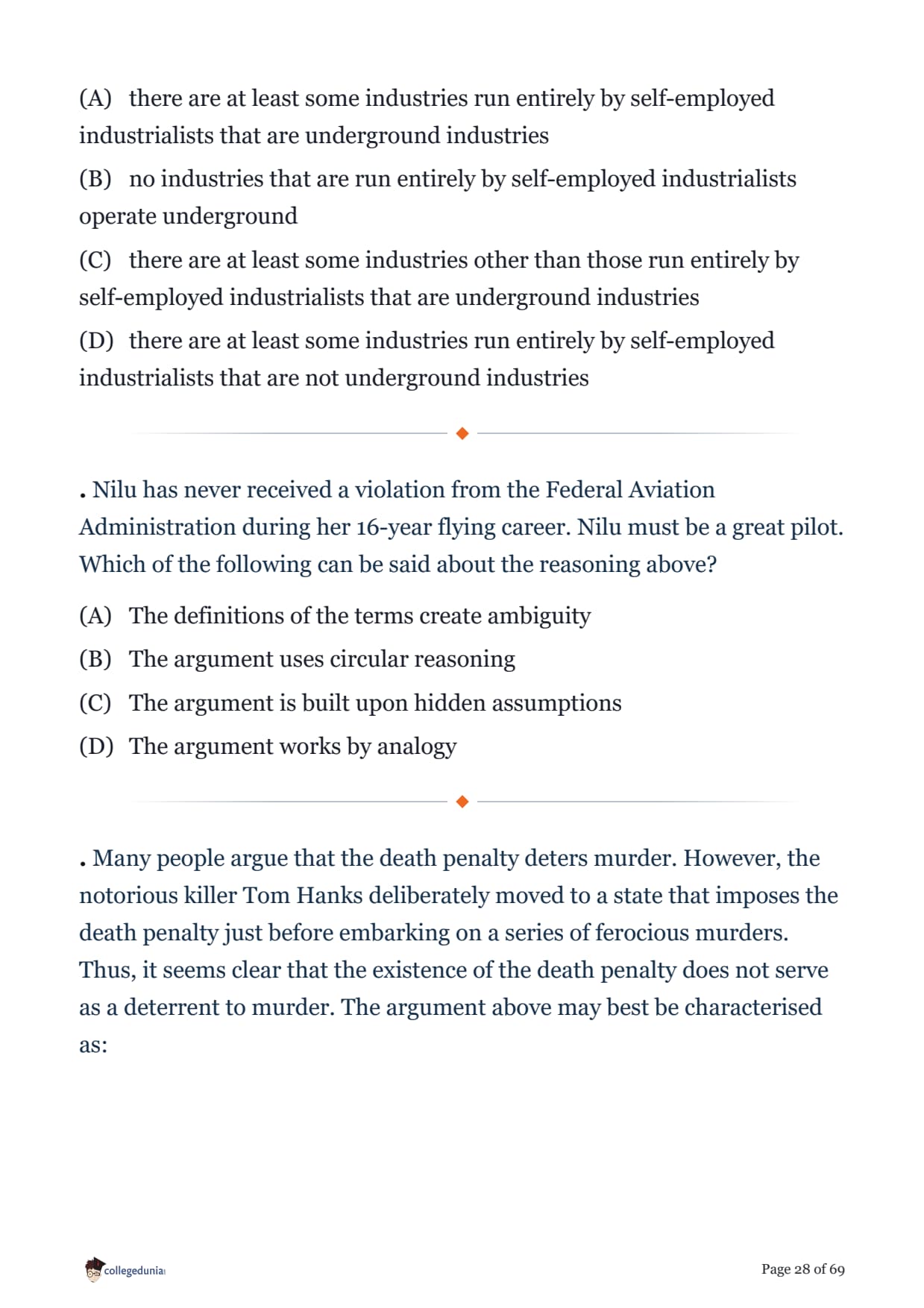
Nilu has never received a violation from the Federal Aviation Administration during her 16-year flying career. Nilu must be a great pilot. Which of the following can be said about the reasoning above?
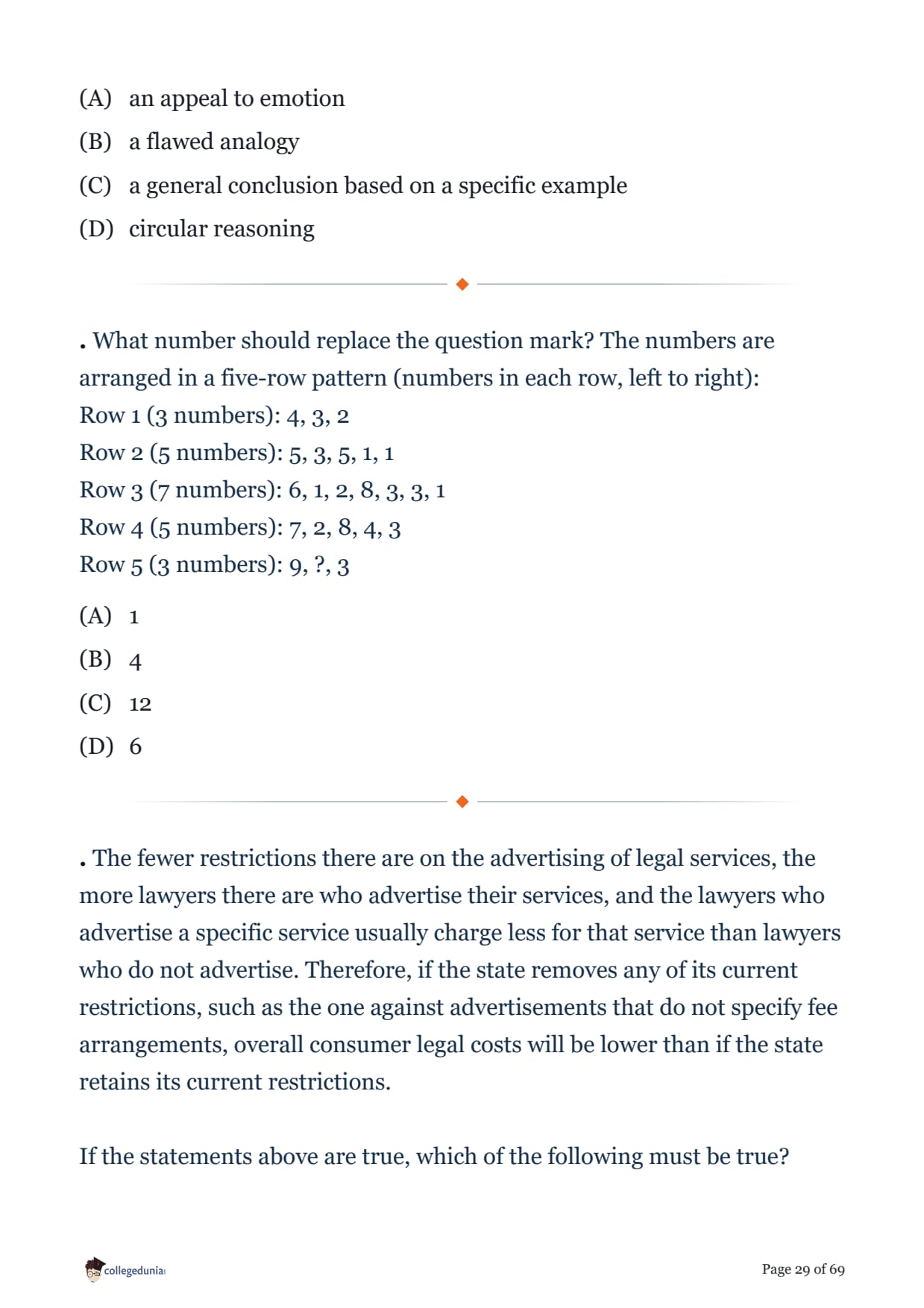
Many people argue that the death penalty deters murder. However, the notorious killer Tom Hanks deliberately moved to a state that imposes the death penalty just before embarking on a series of ferocious murders. Thus, it seems clear that the existence of the death penalty does not serve as a deterrent to murder. The argument above may best be characterised as:
What number should replace the question mark? The numbers are arranged in a five-row pattern (numbers in each row, left to right):
Row 1 (3 numbers): 4, 3, 2
Row 2 (5 numbers): 5, 3, 5, 1, 1
Row 3 (7 numbers): 6, 1, 2, 8, 3, 3, 1
Row 4 (5 numbers): 7, 2, 8, 4, 3
Row 5 (3 numbers): 9, ?, 3
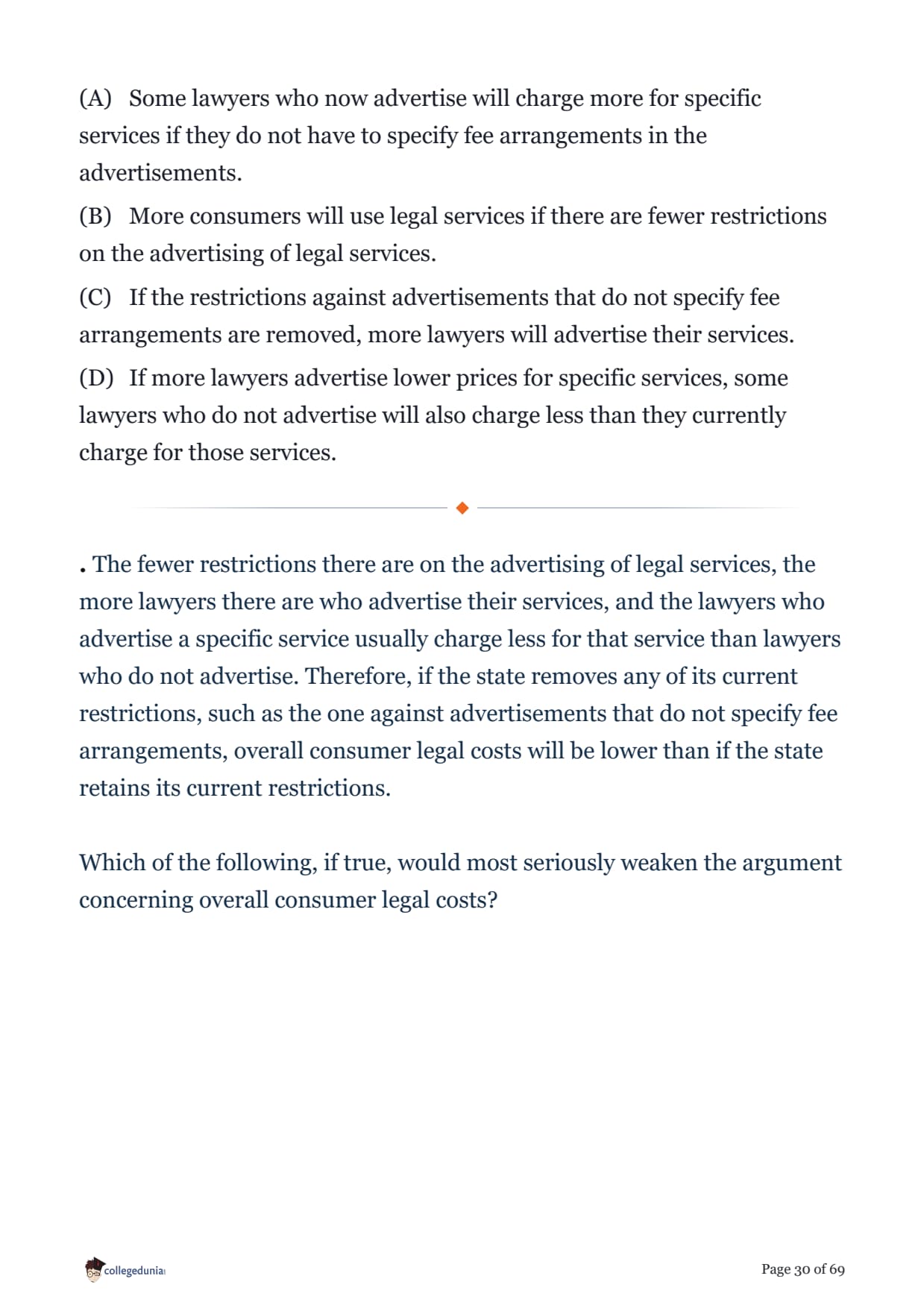
The fewer restrictions there are on the advertising of legal services, the more lawyers there are who advertise their services, and the lawyers who advertise a specific service usually charge less for that service than lawyers who do not advertise. Therefore, if the state removes any of its current restrictions, such as the one against advertisements that do not specify fee arrangements, overall consumer legal costs will be lower than if the state retains its current restrictions.
If the statements above are true, which of the following must be true?
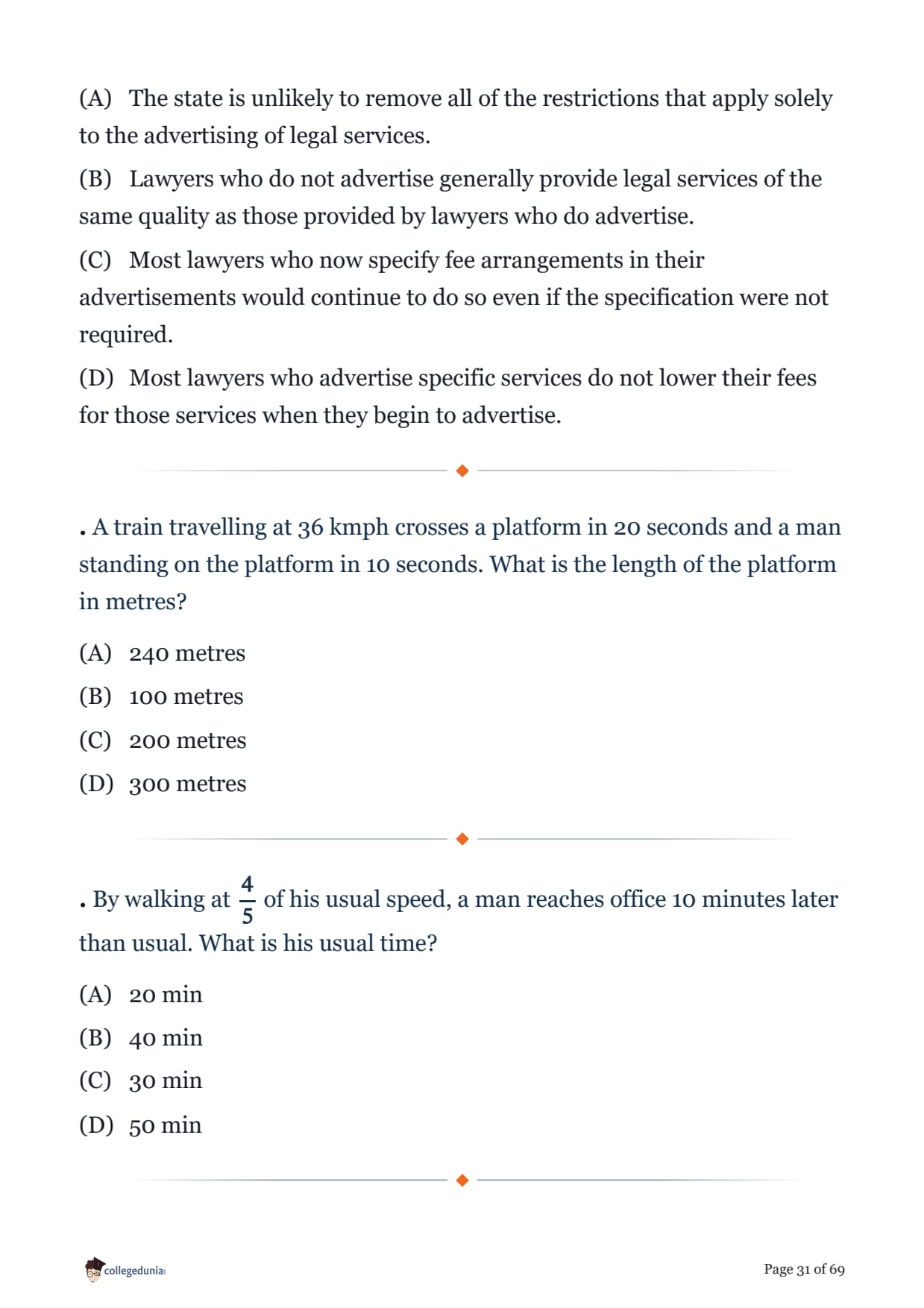
The fewer restrictions there are on the advertising of legal services, the more lawyers there are who advertise their services, and the lawyers who advertise a specific service usually charge less for that service than lawyers who do not advertise. Therefore, if the state removes any of its current restrictions, such as the one against advertisements that do not specify fee arrangements, overall consumer legal costs will be lower than if the state retains its current restrictions.
Which of the following, if true, would most seriously weaken the argument concerning overall consumer legal costs?
A train travelling at 36 kmph crosses a platform in 20 seconds and a man standing on the platform in 10 seconds. What is the length of the platform in metres?
By walking at \(\dfrac{4}{5}\) of his usual speed, a man reaches office 10 minutes later than usual. What is his usual time?
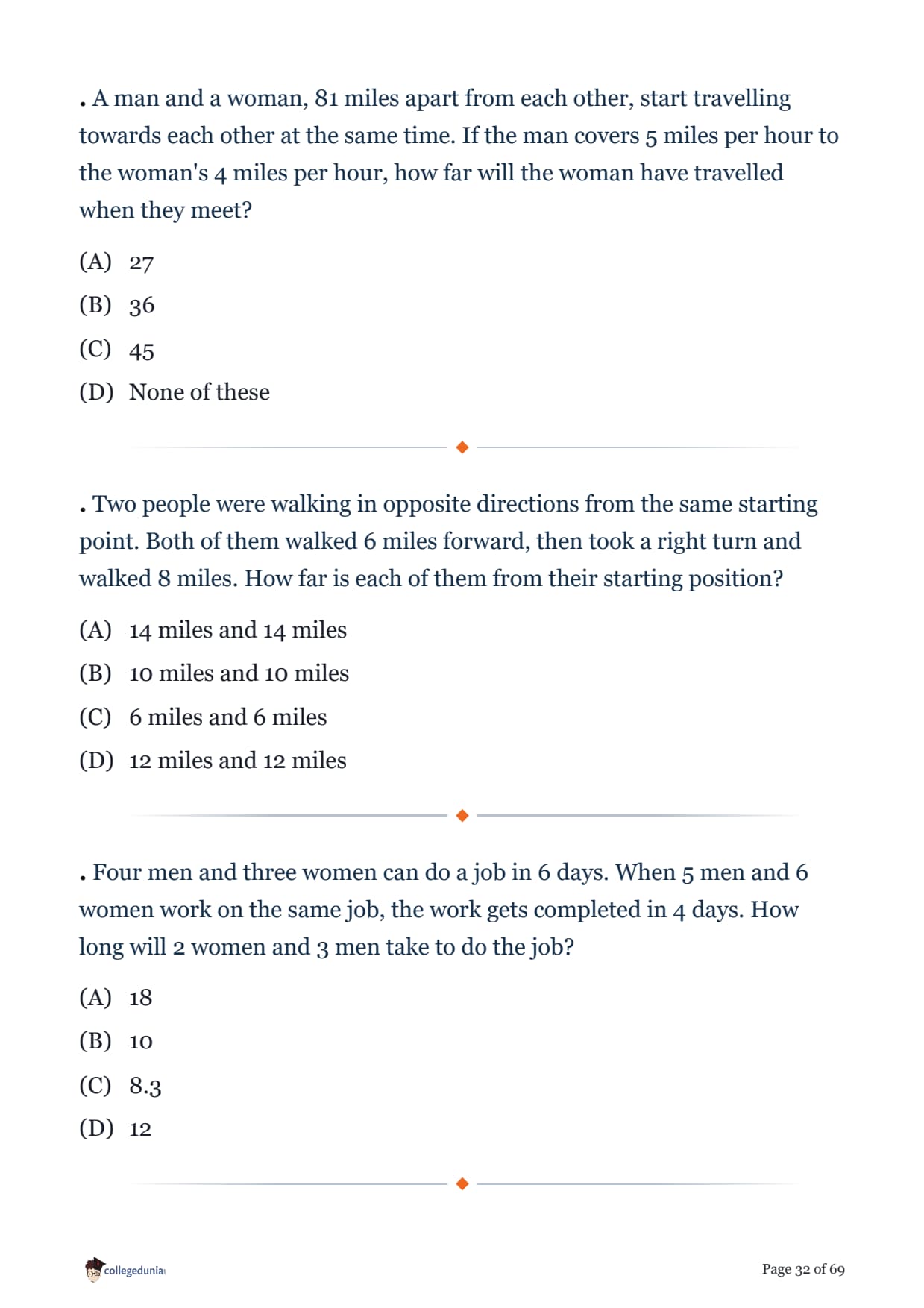
A man and a woman, 81 miles apart from each other, start travelling towards each other at the same time. If the man covers 5 miles per hour to the woman's 4 miles per hour, how far will the woman have travelled when they meet?
Two people were walking in opposite directions from the same starting point. Both of them walked 6 miles forward, then took a right turn and walked 8 miles. How far is each of them from their starting position?
Four men and three women can do a job in 6 days. When 5 men and 6 women work on the same job, the work gets completed in 4 days. How long will 2 women and 3 men take to do the job?
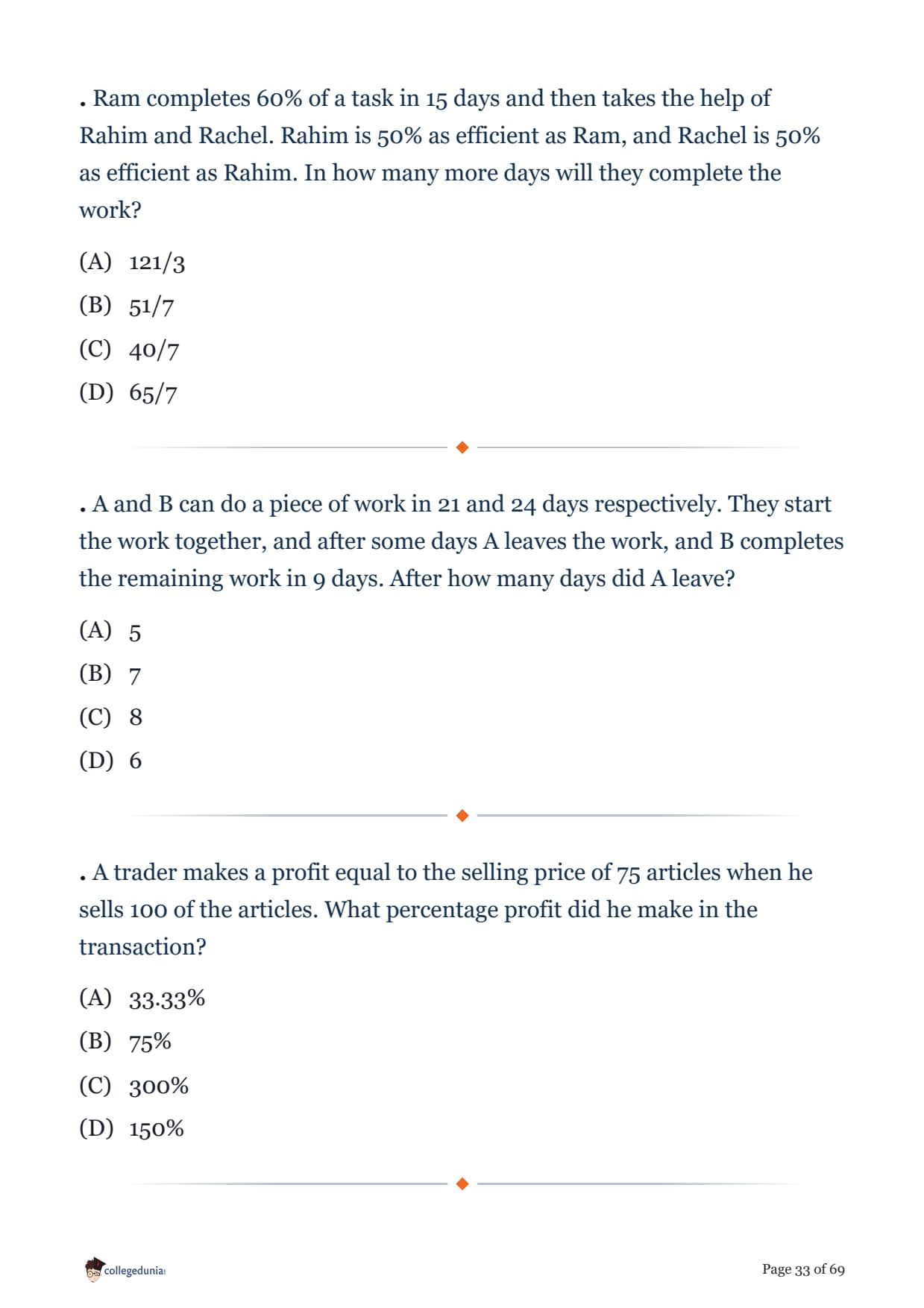
Ram completes 60% of a task in 15 days and then takes the help of Rahim and Rachel. Rahim is 50% as efficient as Ram, and Rachel is 50% as efficient as Rahim. In how many more days will they complete the work?
A and B can do a piece of work in 21 and 24 days respectively. They start the work together, and after some days A leaves the work, and B completes the remaining work in 9 days. After how many days did A leave?
A trader makes a profit equal to the selling price of 75 articles when he sells 100 of the articles. What percentage profit did he make in the transaction?
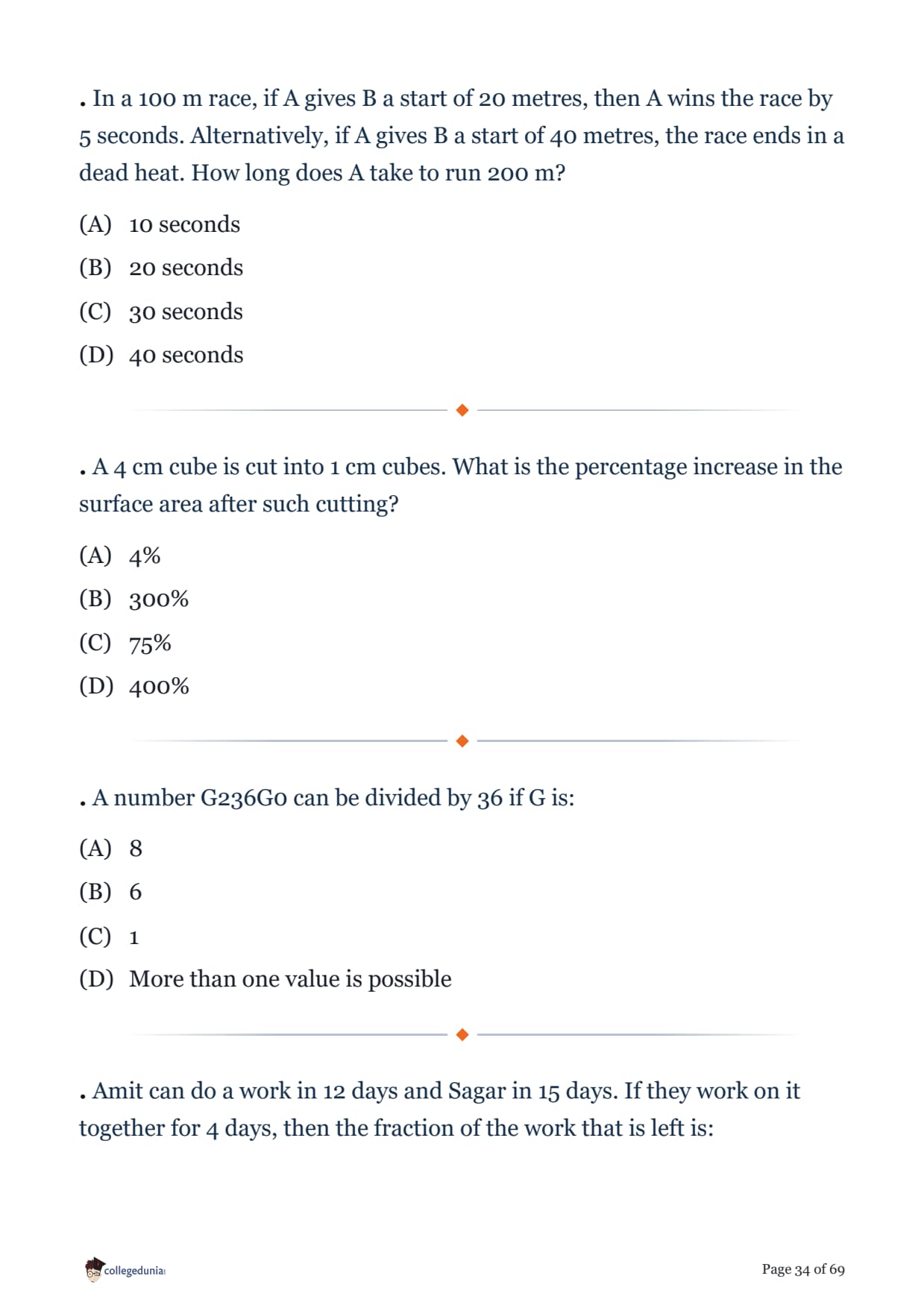
In a 100 m race, if A gives B a start of 20 metres, then A wins the race by 5 seconds. Alternatively, if A gives B a start of 40 metres, the race ends in a dead heat. How long does A take to run 200 m?
A 4 cm cube is cut into 1 cm cubes. What is the percentage increase in the surface area after such cutting?
A number G236G0 can be divided by 36 if G is:
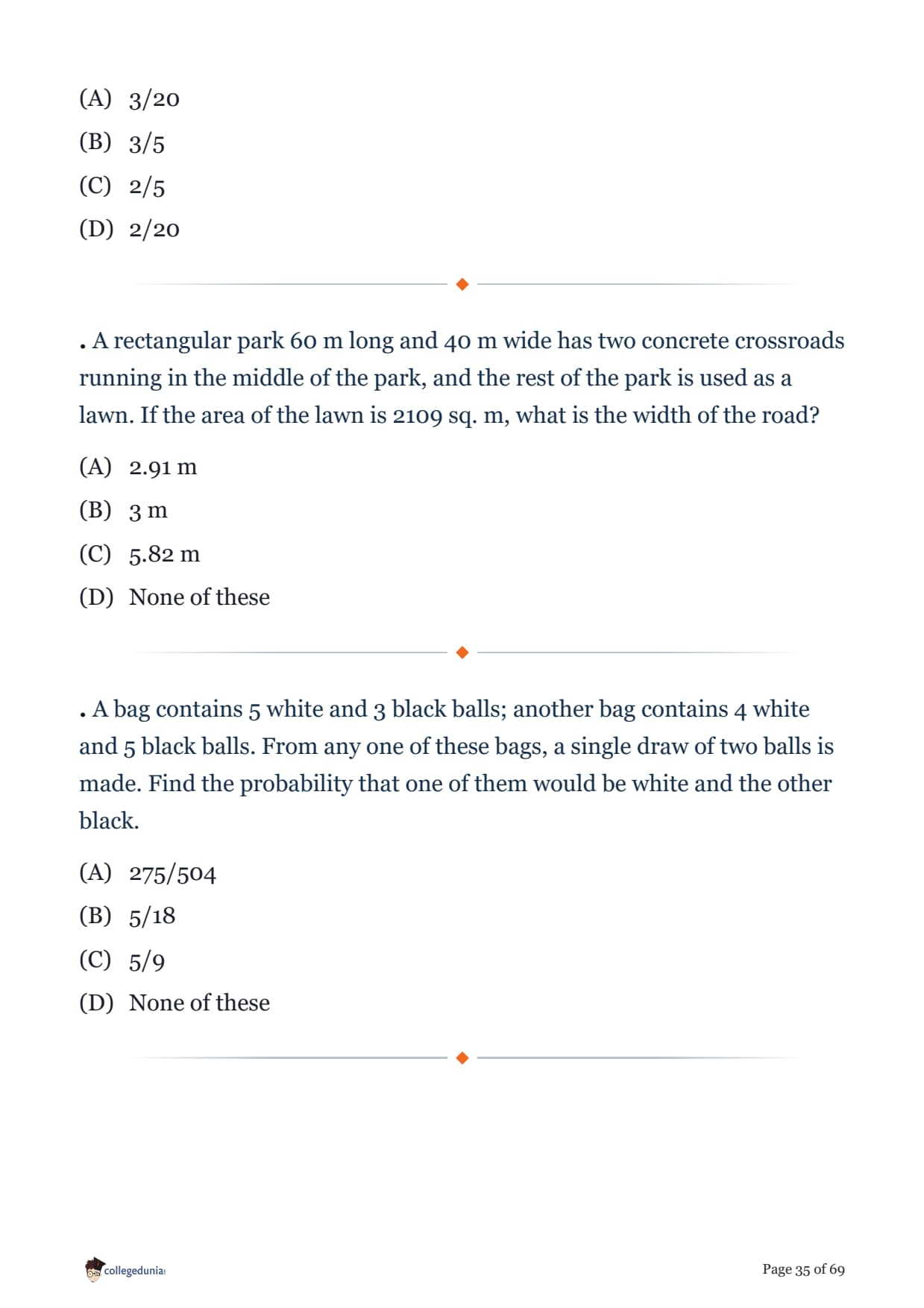
Amit can do a work in 12 days and Sagar in 15 days. If they work on it together for 4 days, then the fraction of the work that is left is:
A rectangular park 60 m long and 40 m wide has two concrete crossroads running in the middle of the park, and the rest of the park is used as a lawn. If the area of the lawn is 2109 sq. m, what is the width of the road?
A bag contains 5 white and 3 black balls; another bag contains 4 white and 5 black balls. From any one of these bags, a single draw of two balls is made. Find the probability that one of them would be white and the other black.
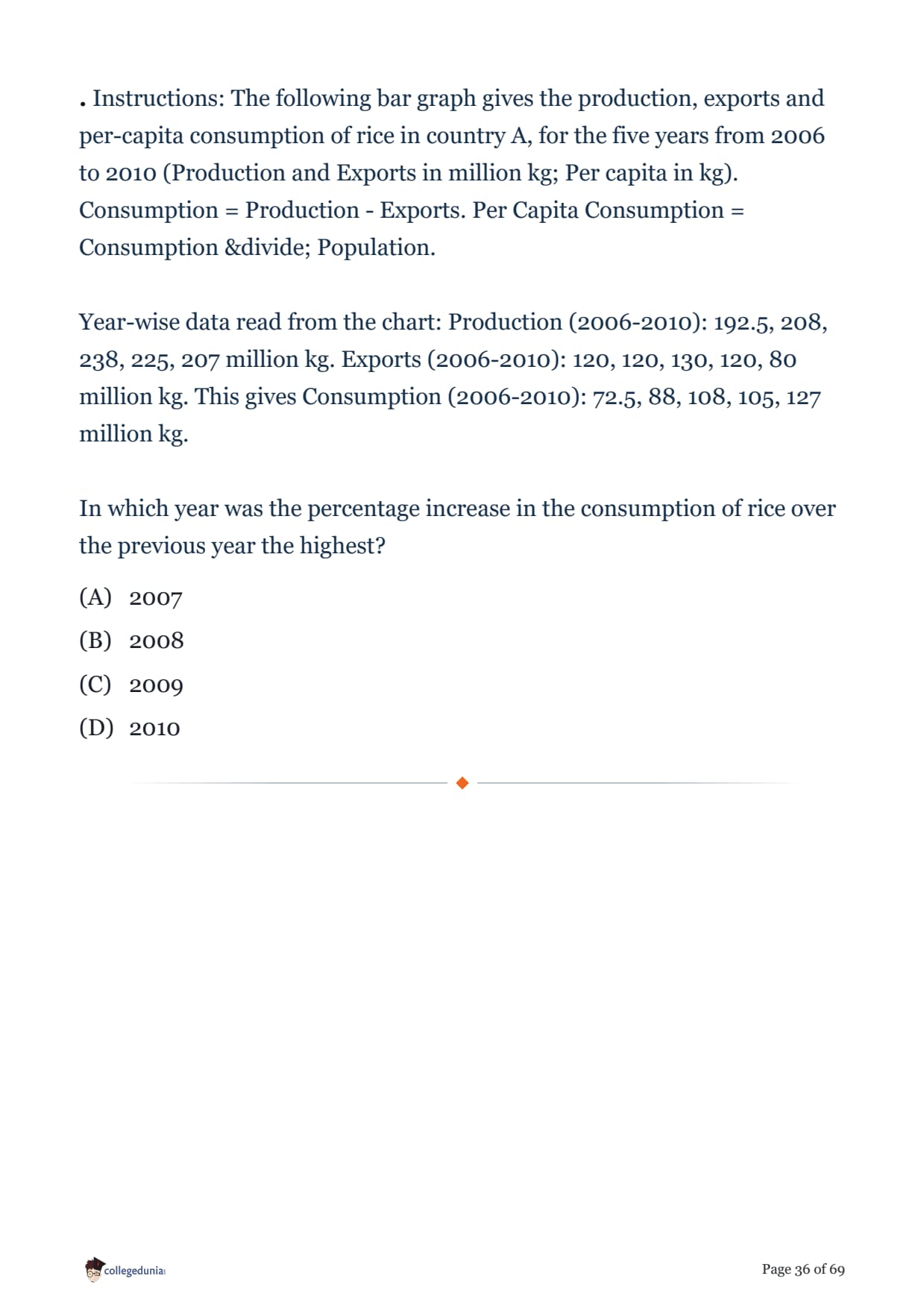
Instructions: The following bar graph gives the production, exports and per-capita consumption of rice in country A, for the five years from 2006 to 2010 (Production and Exports in million kg; Per capita in kg). Consumption = Production - Exports. Per Capita Consumption = Consumption ÷ Population.
Year-wise data read from the chart: Production (2006-2010): 192.5, 208, 238, 225, 207 million kg. Exports (2006-2010): 120, 120, 130, 120, 80 million kg. This gives Consumption (2006-2010): 72.5, 88, 108, 105, 127 million kg.
In which year was the percentage increase in the consumption of rice over the previous year the highest?
Instructions: The following bar graph gives the production, exports and per-capita consumption of rice in country A, for the five years from 2006 to 2010. Consumption = Production - Exports. Per Capita Consumption = Consumption ÷ Population.
Reading the chart precisely gives this table:
2006: Consumption = 72.5 million kg, Per-capita consumption = 36.25 kg
2007: Consumption = 88 million kg, Per-capita consumption = 35.2 kg
2008: Consumption = 108 million kg, Per-capita consumption = 38.7 kg
2009: Consumption = 105 million kg, Per-capita consumption = 40.5 kg
2010: Consumption = 127 million kg, Per-capita consumption = 42 kg
What is the population of country A in the year 2008 (in million)?
Instructions: The following bar graph gives the production, exports and per-capita consumption of rice in country A, for the five years from 2006 to 2010 (Production and Exports in million kg). Consumption = Production - Exports.
Reading the chart: Exports (2006-2010) = 120, 120, 130, 120, 80 million kg. Consumption (2006-2010) = 72.5, 88, 108, 105, 127 million kg.
The ratio of exports to consumption in the given period was the highest in the year
Instructions: The following bar graph gives the production, exports and per-capita consumption of rice in country A, for the five years from 2006 to 2010. Consumption = Production - Exports. Per Capita Consumption = Consumption ÷ Population.
Reading the chart precisely gives this table:
2006: Consumption = 72.5, Per-capita = 36.25, Population = 2.00 million
2007: Consumption = 88, Per-capita = 35.2, Population = 2.5 million
2008: Consumption = 108, Per-capita = 38.7, Population = 2.79 million
2009: Consumption = 105, Per-capita = 40.5, Population = 2.59 million
2010: Consumption = 127, Per-capita = 42, Population = 3.02 million
In which of the given years was the population of country A the highest?
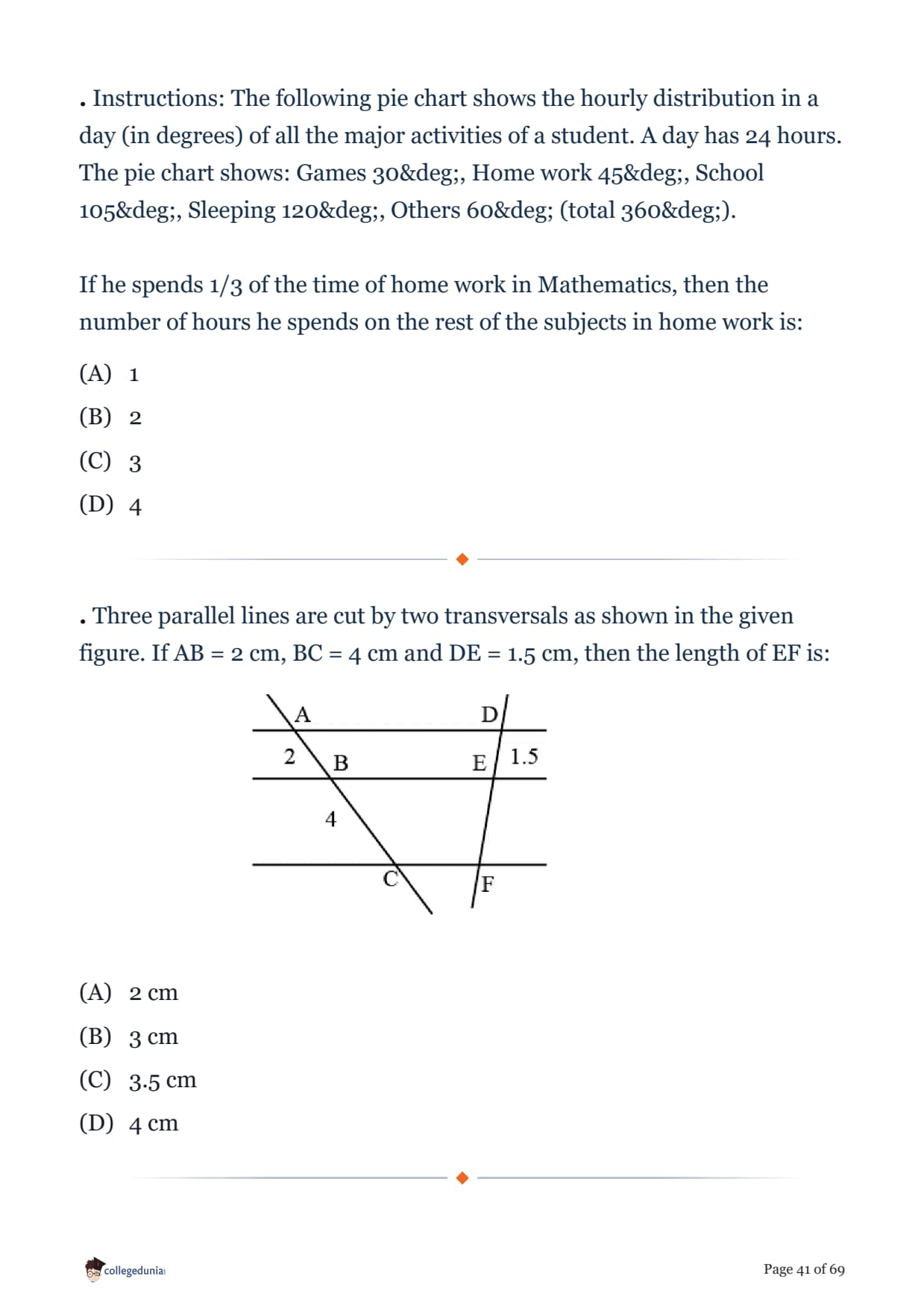
Instructions: The following pie chart shows the hourly distribution in a day (in degrees) of all the major activities of a student. A day has 24 hours. The pie chart shows: Games 30°, Home work 45°, School 105°, Sleeping 120°, Others 60° (total 360°).
The percentage of time which he spends in school is:
Instructions: The following pie chart shows the hourly distribution in a day (in degrees) of all the major activities of a student. A day has 24 hours. The pie chart shows: Games 30°, Home work 45°, School 105°, Sleeping 120°, Others 60° (total 360°).
How much time (in per cent) does he spend in games in comparison to sleeping?
Instructions: The following pie chart shows the hourly distribution in a day (in degrees) of all the major activities of a student. A day has 24 hours. The pie chart shows: Games 30°, Home work 45°, School 105°, Sleeping 120°, Others 60° (total 360°).
If he spends the time in games equal to the home work, and the other activities remain constant, what is the percentage decrease in the time spent sleeping?
Instructions: The following pie chart shows the hourly distribution in a day (in degrees) of all the major activities of a student. A day has 24 hours. The pie chart shows: Games 30°, Home work 45°, School 105°, Sleeping 120°, Others 60° (total 360°).
What is the difference in time (in hours) spent in school and in home work?
Instructions: The following pie chart shows the hourly distribution in a day (in degrees) of all the major activities of a student. A day has 24 hours. The pie chart shows: Games 30°, Home work 45°, School 105°, Sleeping 120°, Others 60° (total 360°).
If he spends 1/3 of the time of home work in Mathematics, then the number of hours he spends on the rest of the subjects in home work is:
Three parallel lines are cut by two transversals as shown in the given figure. If AB = 2 cm, BC = 4 cm and DE = 1.5 cm, then the length of EF is:

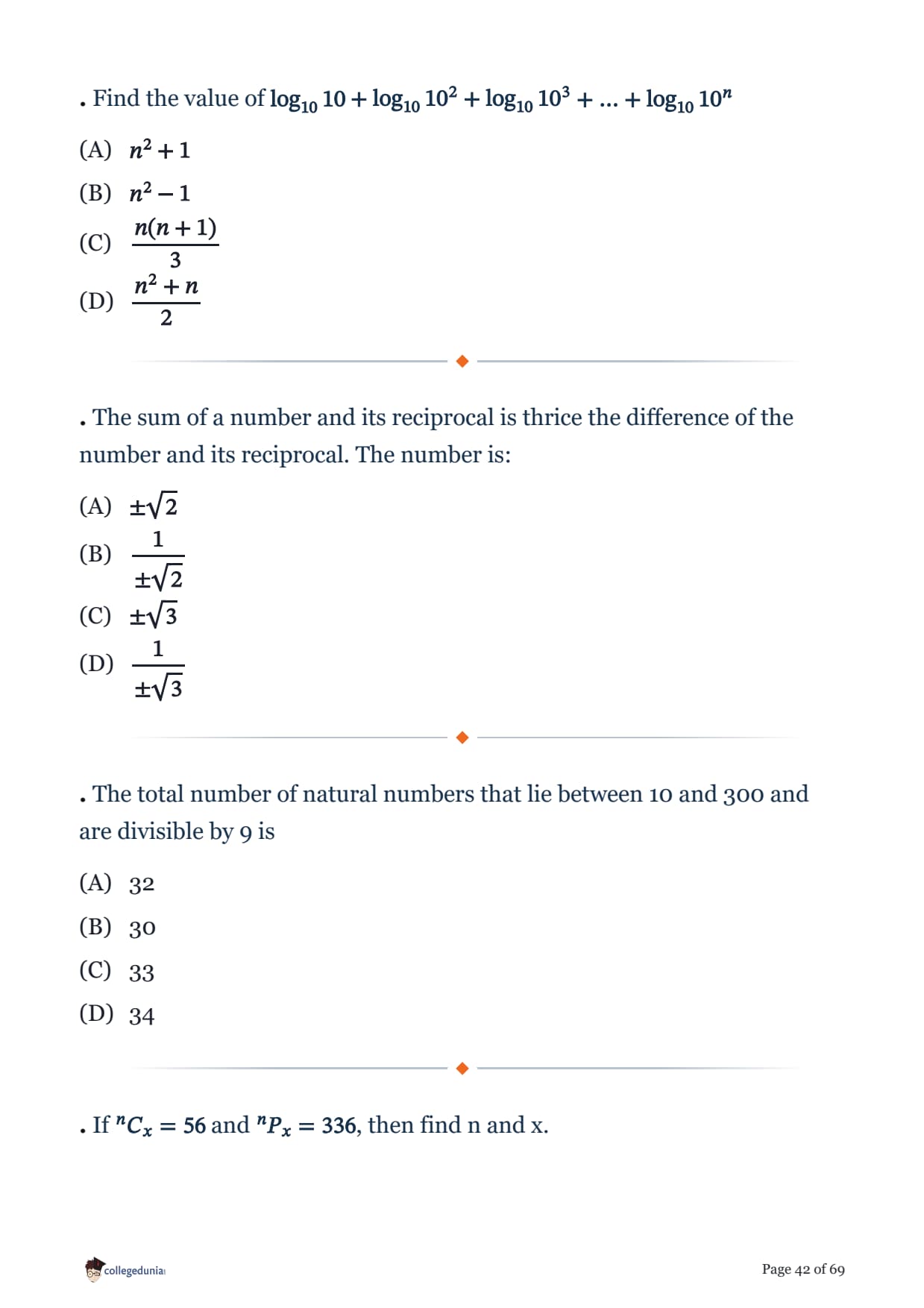
Find the value of \(\log_{10}10+\log_{10}10^2+\log_{10}10^3+\ldots+\log_{10}10^n\)
The sum of a number and its reciprocal is thrice the difference of the number and its reciprocal. The number is:
The total number of natural numbers that lie between 10 and 300 and are divisible by 9 is
If \({}^nC_x=56\) and \({}^nP_x=336\), then find n and x.
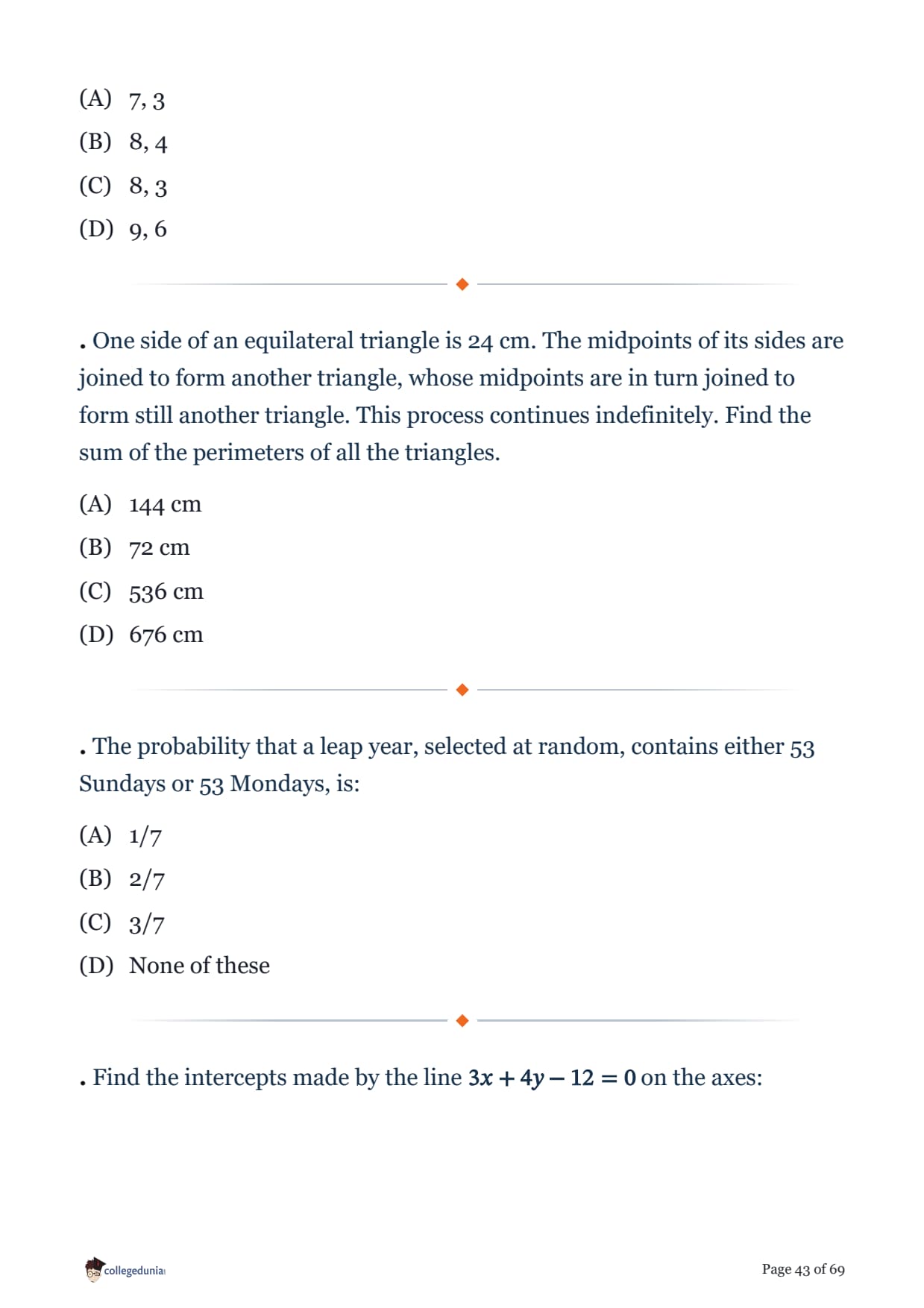
One side of an equilateral triangle is 24 cm. The midpoints of its sides are joined to form another triangle, whose midpoints are in turn joined to form still another triangle. This process continues indefinitely. Find the sum of the perimeters of all the triangles.
The probability that a leap year, selected at random, contains either 53 Sundays or 53 Mondays, is:
Find the intercepts made by the line \(3x+4y-12=0\) on the axes:
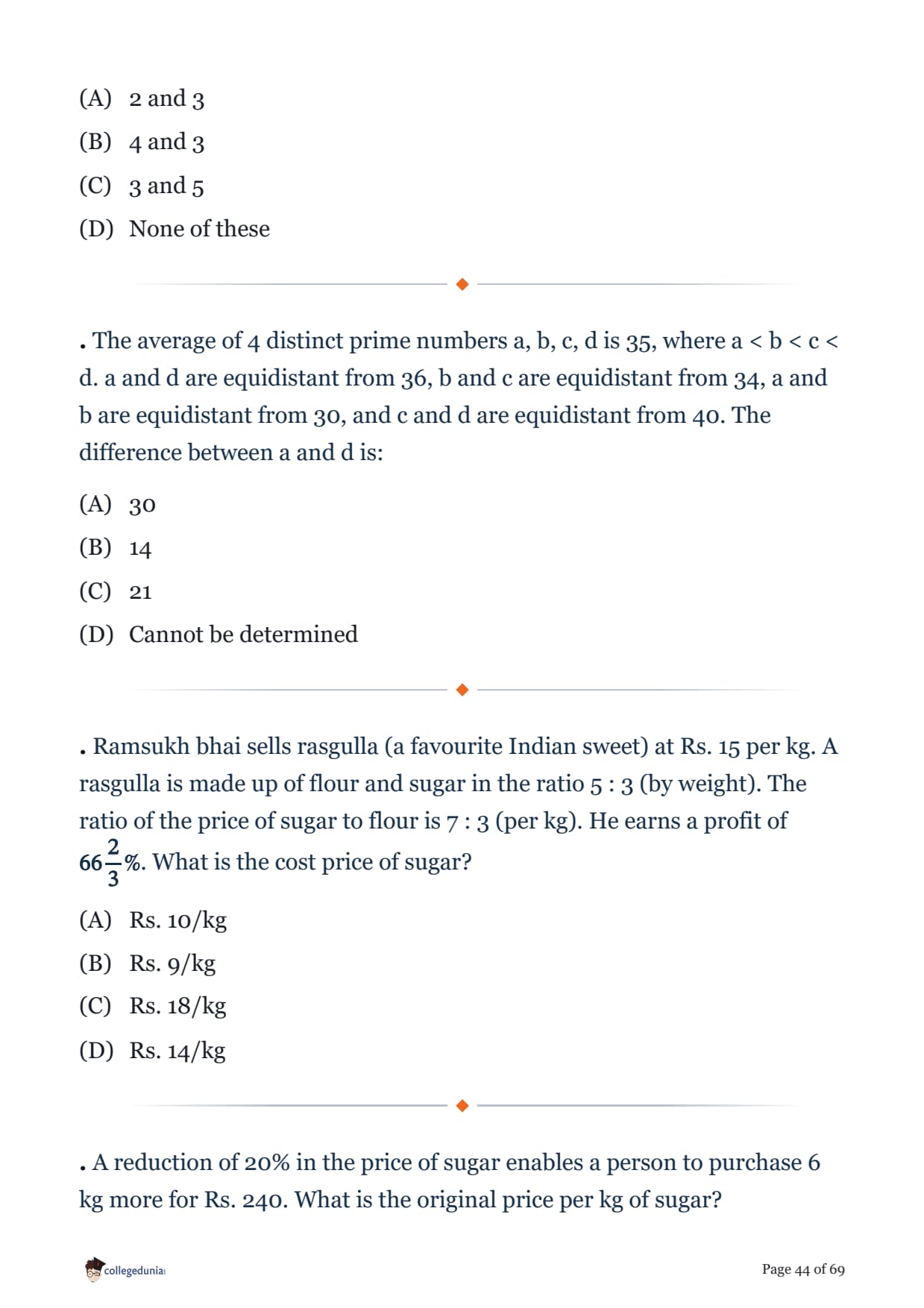
The average of 4 distinct prime numbers a, b, c, d is 35, where a < b < c < d. a and d are equidistant from 36, b and c are equidistant from 34, a and b are equidistant from 30, and c and d are equidistant from 40. The difference between a and d is:
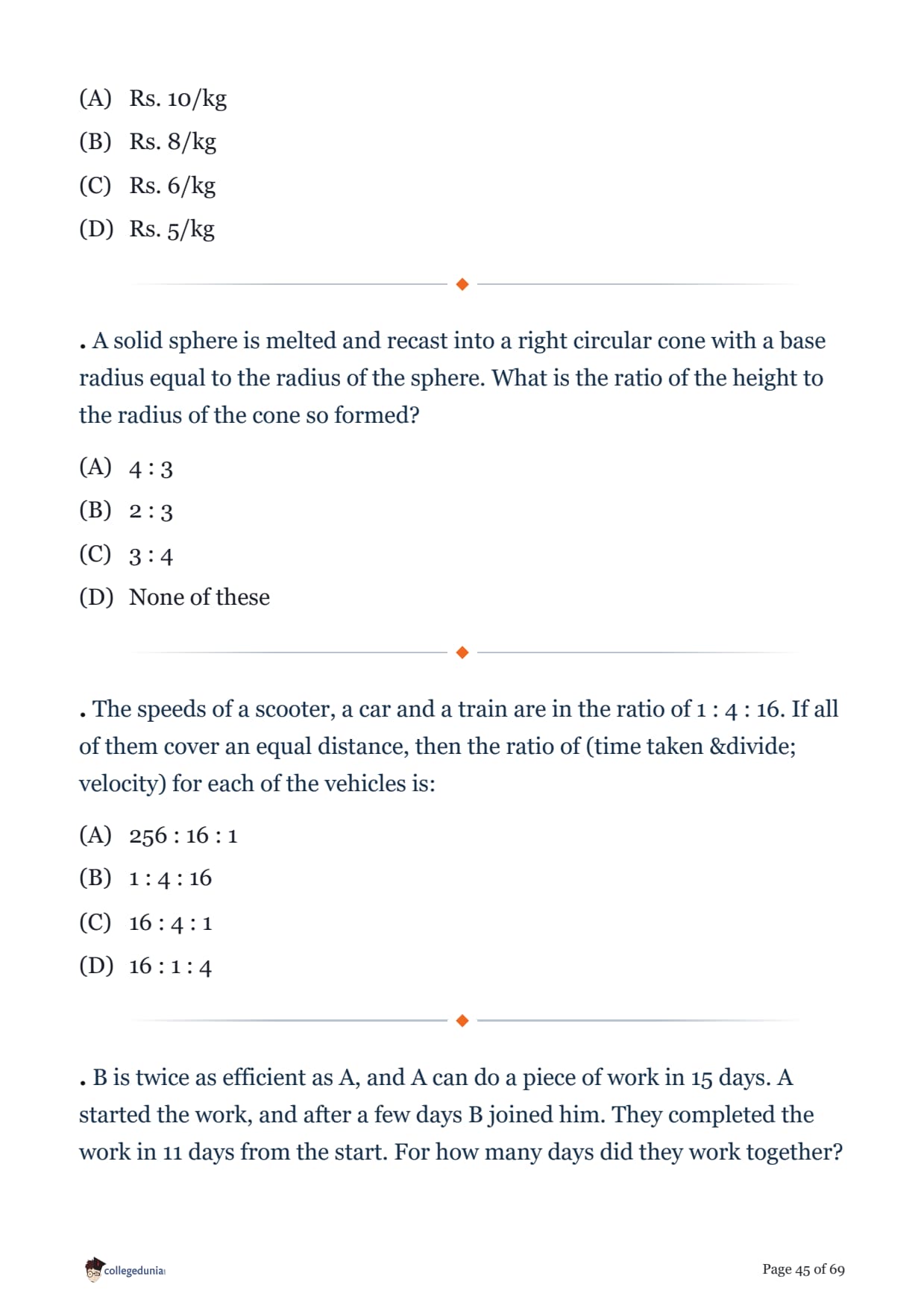
Ramsukh bhai sells rasgulla (a favourite Indian sweet) at Rs. 15 per kg. A rasgulla is made up of flour and sugar in the ratio 5 : 3 (by weight). The ratio of the price of sugar to flour is 7 : 3 (per kg). He earns a profit of \(66\dfrac{2}{3}\%\). What is the cost price of sugar?
A reduction of 20% in the price of sugar enables a person to purchase 6 kg more for Rs. 240. What is the original price per kg of sugar?
A solid sphere is melted and recast into a right circular cone with a base radius equal to the radius of the sphere. What is the ratio of the height to the radius of the cone so formed?
The speeds of a scooter, a car and a train are in the ratio of 1 : 4 : 16. If all of them cover an equal distance, then the ratio of (time taken ÷ velocity) for each of the vehicles is:
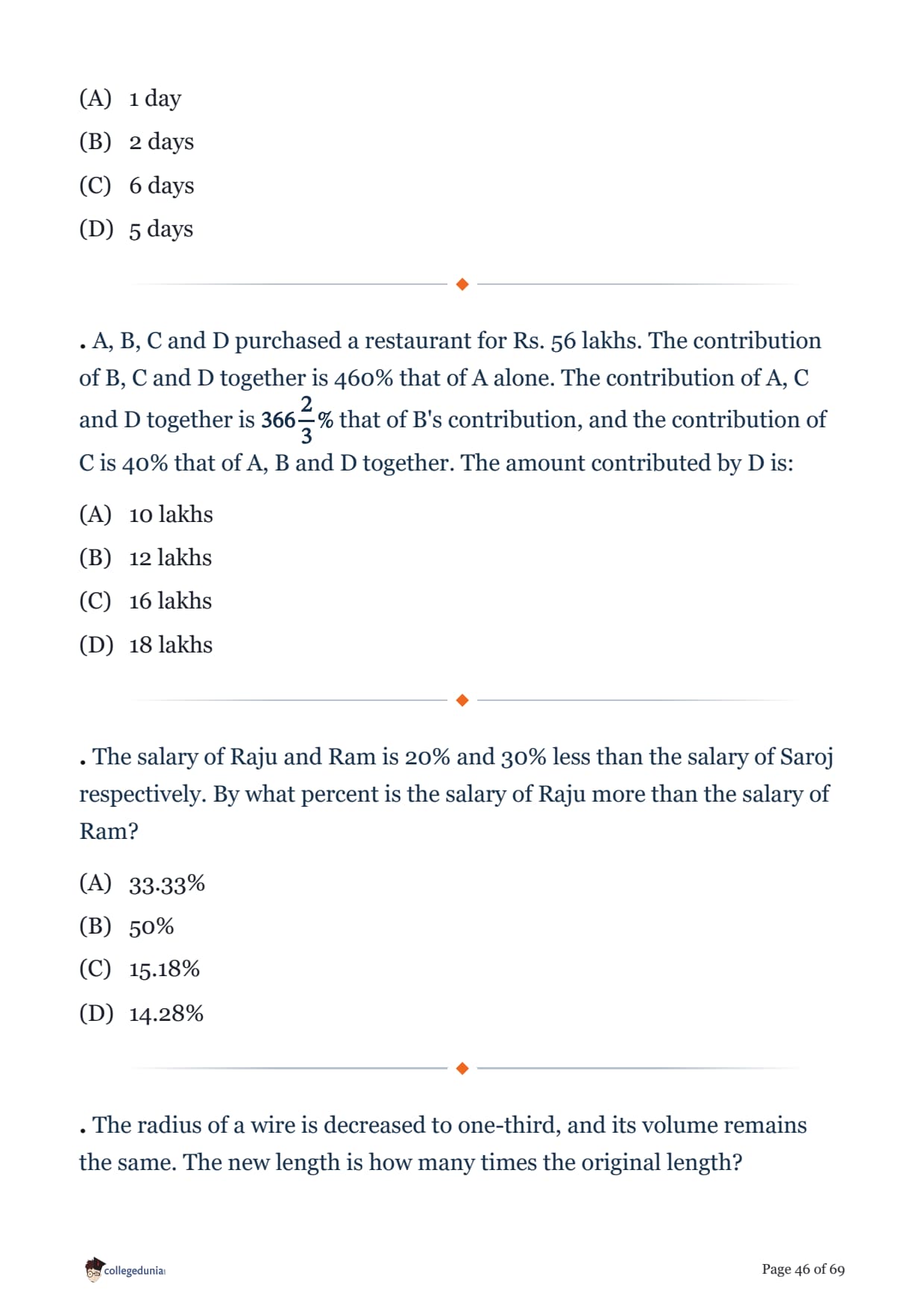
B is twice as efficient as A, and A can do a piece of work in 15 days. A started the work, and after a few days B joined him. They completed the work in 11 days from the start. For how many days did they work together?
A, B, C and D purchased a restaurant for Rs. 56 lakhs. The contribution of B, C and D together is 460% that of A alone. The contribution of A, C and D together is \(366\dfrac{2}{3}\%\) that of B's contribution, and the contribution of C is 40% that of A, B and D together. The amount contributed by D is:
The salary of Raju and Ram is 20% and 30% less than the salary of Saroj respectively. By what percent is the salary of Raju more than the salary of Ram?
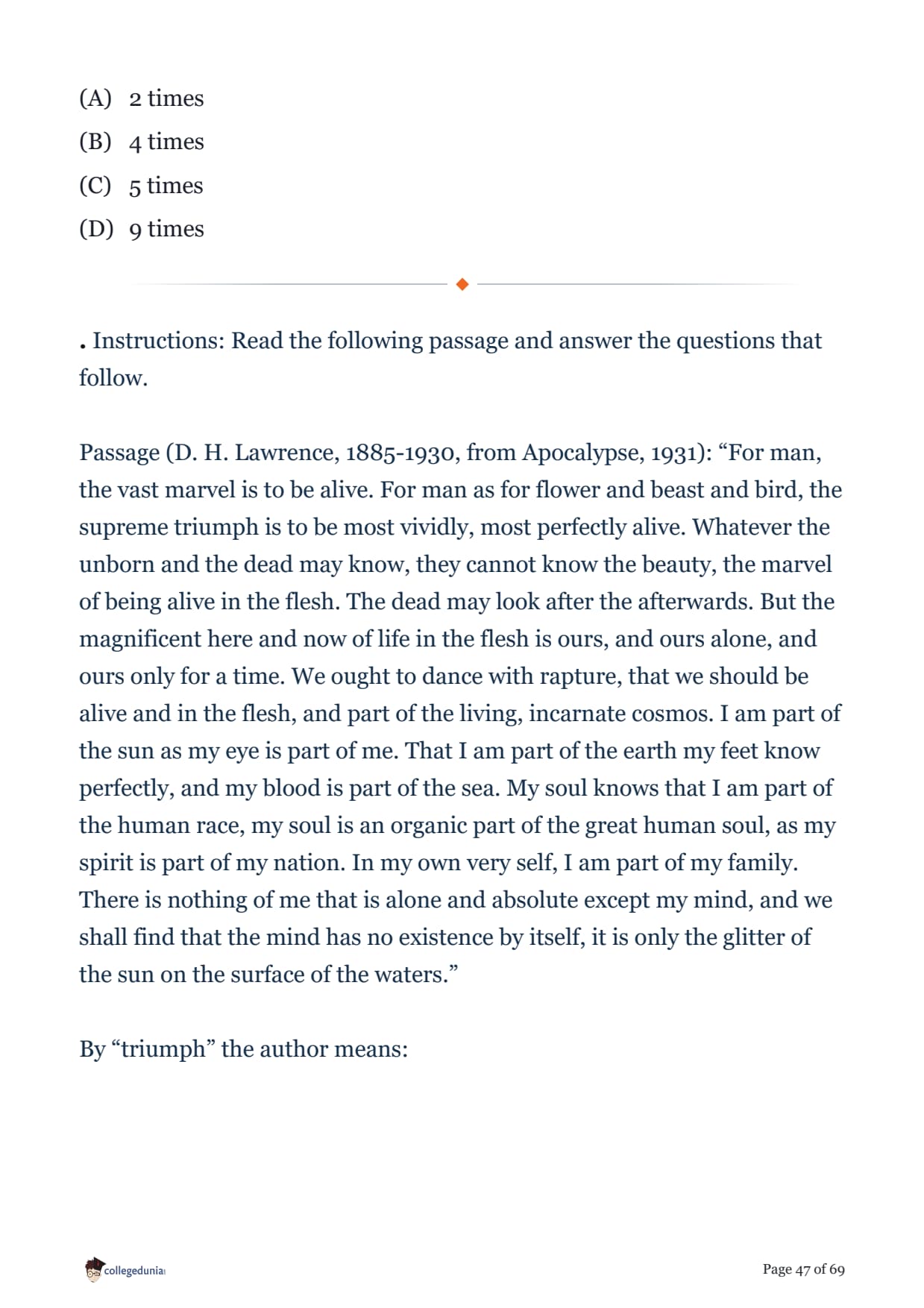
The radius of a wire is decreased to one-third, and its volume remains the same. The new length is how many times the original length?
Instructions: Read the following passage and answer the questions that follow.
Passage (D. H. Lawrence, 1885-1930, from Apocalypse, 1931): “For man, the vast marvel is to be alive. For man as for flower and beast and bird, the supreme triumph is to be most vividly, most perfectly alive. Whatever the unborn and the dead may know, they cannot know the beauty, the marvel of being alive in the flesh. The dead may look after the afterwards. But the magnificent here and now of life in the flesh is ours, and ours alone, and ours only for a time. We ought to dance with rapture, that we should be alive and in the flesh, and part of the living, incarnate cosmos. I am part of the sun as my eye is part of me. That I am part of the earth my feet know perfectly, and my blood is part of the sea. My soul knows that I am part of the human race, my soul is an organic part of the great human soul, as my spirit is part of my nation. In my own very self, I am part of my family. There is nothing of me that is alone and absolute except my mind, and we shall find that the mind has no existence by itself, it is only the glitter of the sun on the surface of the waters.”
By “triumph” the author means:
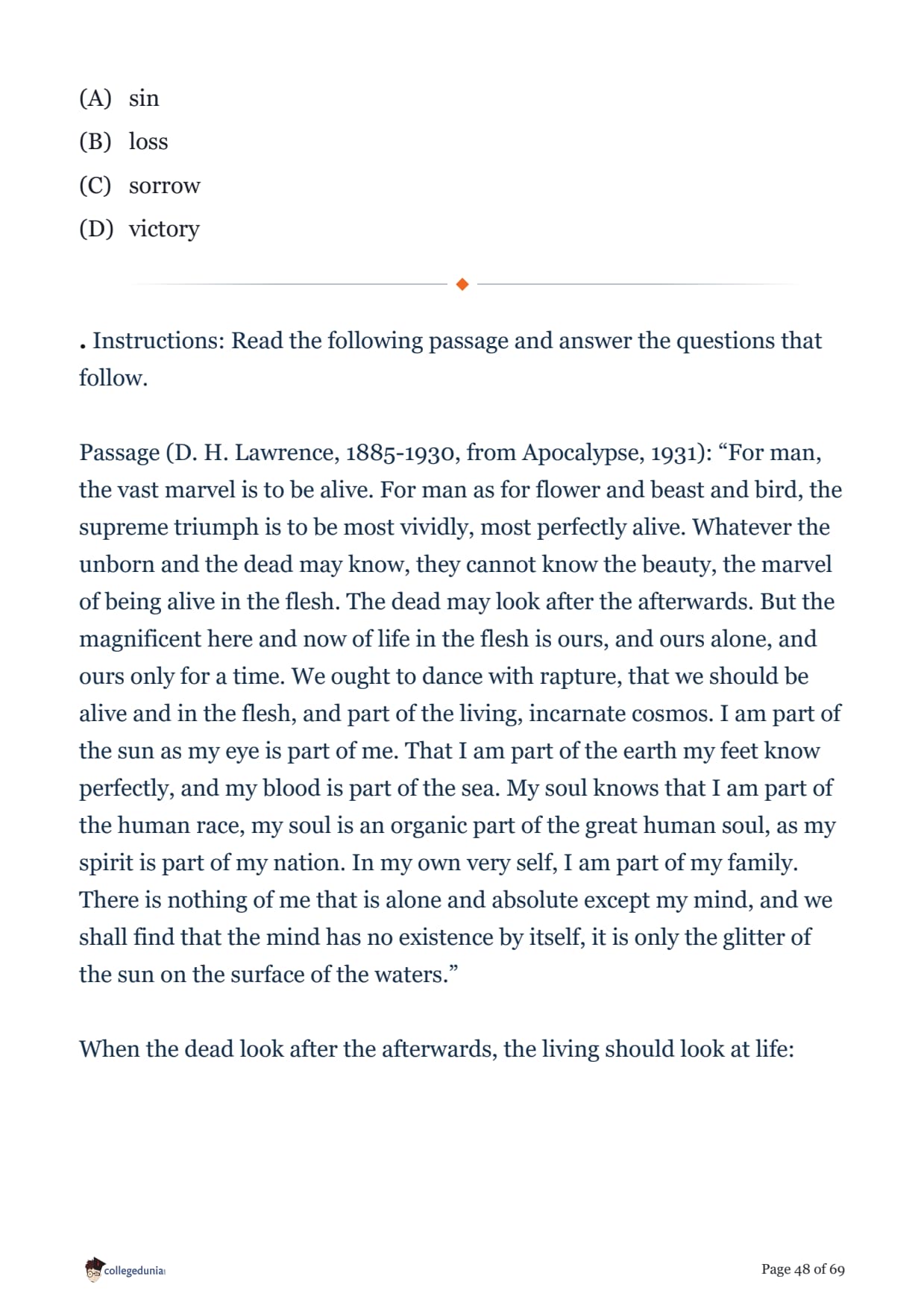
Instructions: Read the following passage and answer the questions that follow.
Passage (D. H. Lawrence, 1885-1930, from Apocalypse, 1931): “For man, the vast marvel is to be alive. For man as for flower and beast and bird, the supreme triumph is to be most vividly, most perfectly alive. Whatever the unborn and the dead may know, they cannot know the beauty, the marvel of being alive in the flesh. The dead may look after the afterwards. But the magnificent here and now of life in the flesh is ours, and ours alone, and ours only for a time. We ought to dance with rapture, that we should be alive and in the flesh, and part of the living, incarnate cosmos. I am part of the sun as my eye is part of me. That I am part of the earth my feet know perfectly, and my blood is part of the sea. My soul knows that I am part of the human race, my soul is an organic part of the great human soul, as my spirit is part of my nation. In my own very self, I am part of my family. There is nothing of me that is alone and absolute except my mind, and we shall find that the mind has no existence by itself, it is only the glitter of the sun on the surface of the waters.”
When the dead look after the afterwards, the living should look at life:
Instructions: Read the following passage and answer the questions that follow.
Passage (D. H. Lawrence, 1885-1930, from Apocalypse, 1931): “For man, the vast marvel is to be alive. For man as for flower and beast and bird, the supreme triumph is to be most vividly, most perfectly alive. Whatever the unborn and the dead may know, they cannot know the beauty, the marvel of being alive in the flesh. The dead may look after the afterwards. But the magnificent here and now of life in the flesh is ours, and ours alone, and ours only for a time. We ought to dance with rapture, that we should be alive and in the flesh, and part of the living, incarnate cosmos. I am part of the sun as my eye is part of me. That I am part of the earth my feet know perfectly, and my blood is part of the sea. My soul knows that I am part of the human race, my soul is an organic part of the great human soul, as my spirit is part of my nation. In my own very self, I am part of my family. There is nothing of me that is alone and absolute except my mind, and we shall find that the mind has no existence by itself, it is only the glitter of the sun on the surface of the waters.”
By “rapture” the author means an emotion involving great:
Instructions: Read the following passage and answer the questions that follow.
Passage (D. H. Lawrence, 1885-1930, from Apocalypse, 1931): “For man, the vast marvel is to be alive. For man as for flower and beast and bird, the supreme triumph is to be most vividly, most perfectly alive. Whatever the unborn and the dead may know, they cannot know the beauty, the marvel of being alive in the flesh. The dead may look after the afterwards. But the magnificent here and now of life in the flesh is ours, and ours alone, and ours only for a time. We ought to dance with rapture, that we should be alive and in the flesh, and part of the living, incarnate cosmos. I am part of the sun as my eye is part of me. That I am part of the earth my feet know perfectly, and my blood is part of the sea. My soul knows that I am part of the human race, my soul is an organic part of the great human soul, as my spirit is part of my nation. In my own very self, I am part of my family. There is nothing of me that is alone and absolute except my mind, and we shall find that the mind has no existence by itself, it is only the glitter of the sun on the surface of the waters.”
By the last line, “It [has no existence by itself, it is only the glitter of the sun on the surface of] waters”, the author means that the mind is only:
Instructions: Read the following passage and answer the questions that follow.
Passage (D. H. Lawrence, 1885-1930, from Apocalypse, 1931): “For man, the vast marvel is to be alive. For man as for flower and beast and bird, the supreme triumph is to be most vividly, most perfectly alive. Whatever the unborn and the dead may know, they cannot know the beauty, the marvel of being alive in the flesh. The dead may look after the afterwards. But the magnificent here and now of life in the flesh is ours, and ours alone, and ours only for a time. We ought to dance with rapture, that we should be alive and in the flesh, and part of the living, incarnate cosmos. I am part of the sun as my eye is part of me. That I am part of the earth my feet know perfectly, and my blood is part of the sea. My soul knows that I am part of the human race, my soul is an organic part of the great human soul, as my spirit is part of my nation. In my own very self, I am part of my family. There is nothing of me that is alone and absolute except my mind, and we shall find that the mind has no existence by itself, it is only the glitter of the sun on the surface of the waters.”
The tone of this passage is:
Instructions: Read the following passage and answer the questions that follow.
Passage (D. H. Lawrence, 1885-1930, from Apocalypse, 1931): “For man, the vast marvel is to be alive. For man as for flower and beast and bird, the supreme triumph is to be most vividly, most perfectly alive. Whatever the unborn and the dead may know, they cannot know the beauty, the marvel of being alive in the flesh. The dead may look after the afterwards. But the magnificent here and now of life in the flesh is ours, and ours alone, and ours only for a time. We ought to dance with rapture, that we should be alive and in the flesh, and part of the living, incarnate cosmos. I am part of the sun as my eye is part of me. That I am part of the earth my feet know perfectly, and my blood is part of the sea. My soul knows that I am part of the human race, my soul is an organic part of the great human soul, as my spirit is part of my nation. In my own very self, I am part of my family. There is nothing of me that is alone and absolute except my mind, and we shall find that the mind has no existence by itself, it is only the glitter of the sun on the surface of the waters.”
The most suitable title for this passage would be:
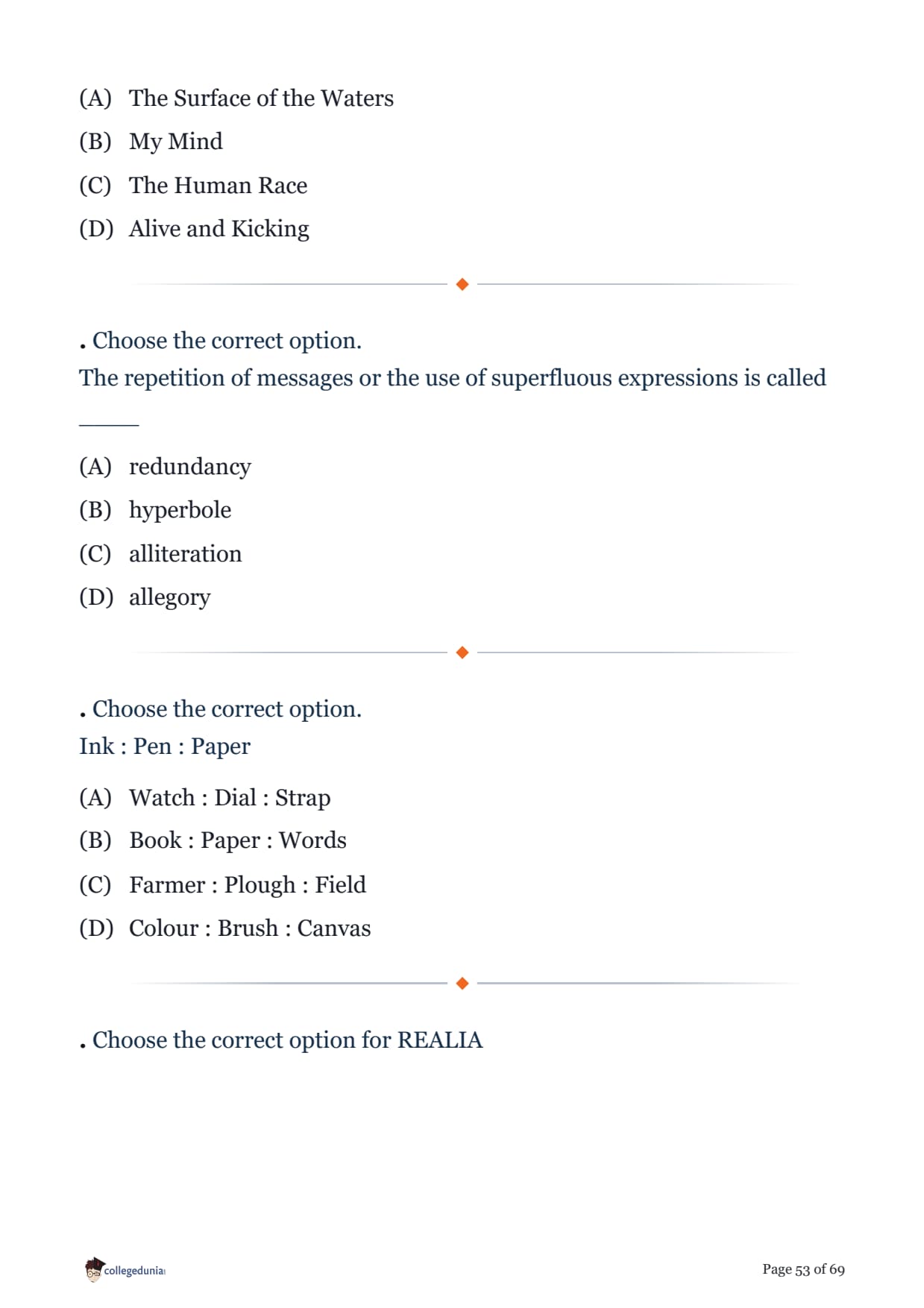
Choose the correct option.
The repetition of messages or the use of superfluous expressions is called ____
Choose the correct option.
Ink : Pen : Paper
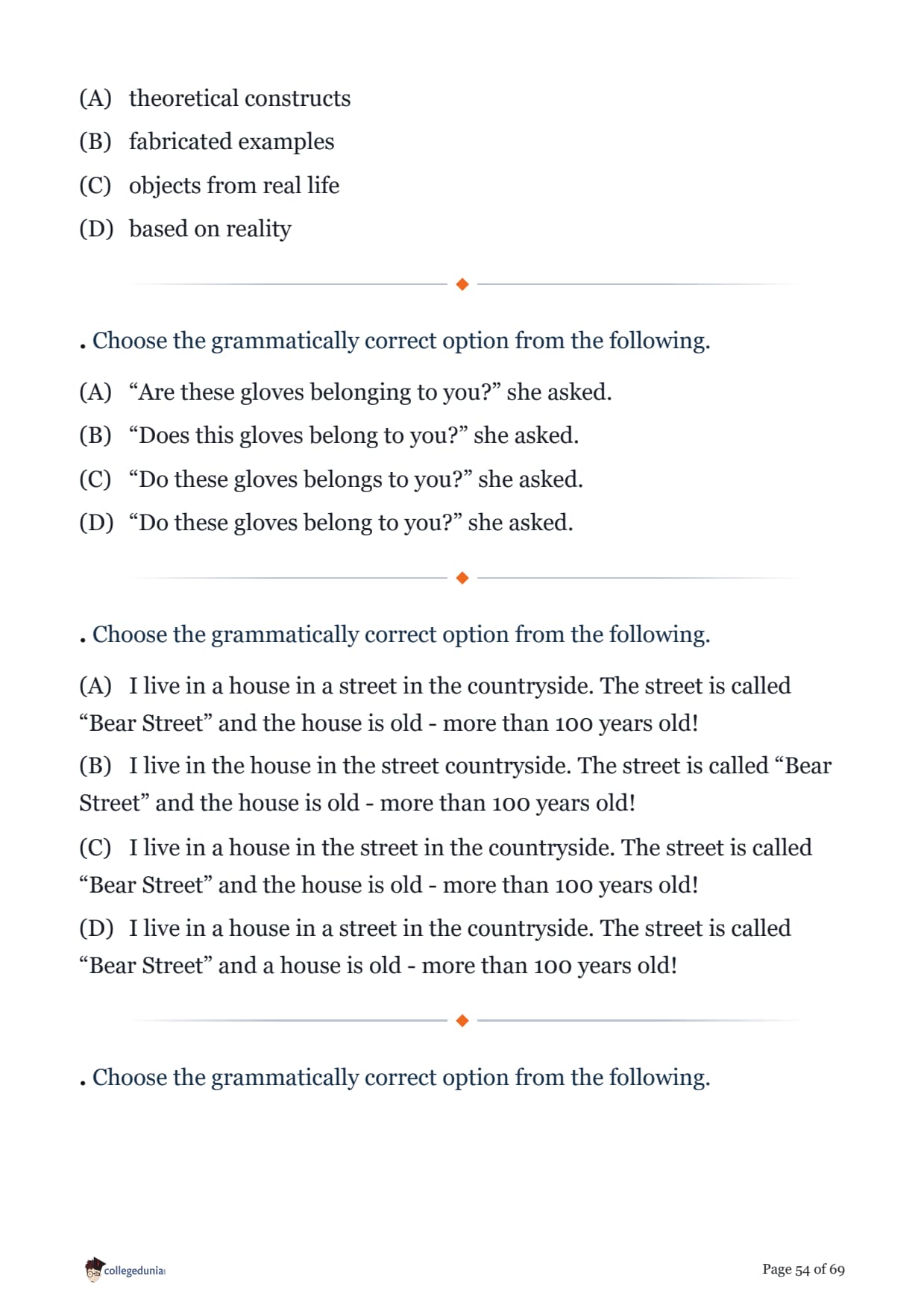
Choose the correct option for REALIA
Choose the grammatically correct option from the following.
Choose the grammatically correct option from the following.
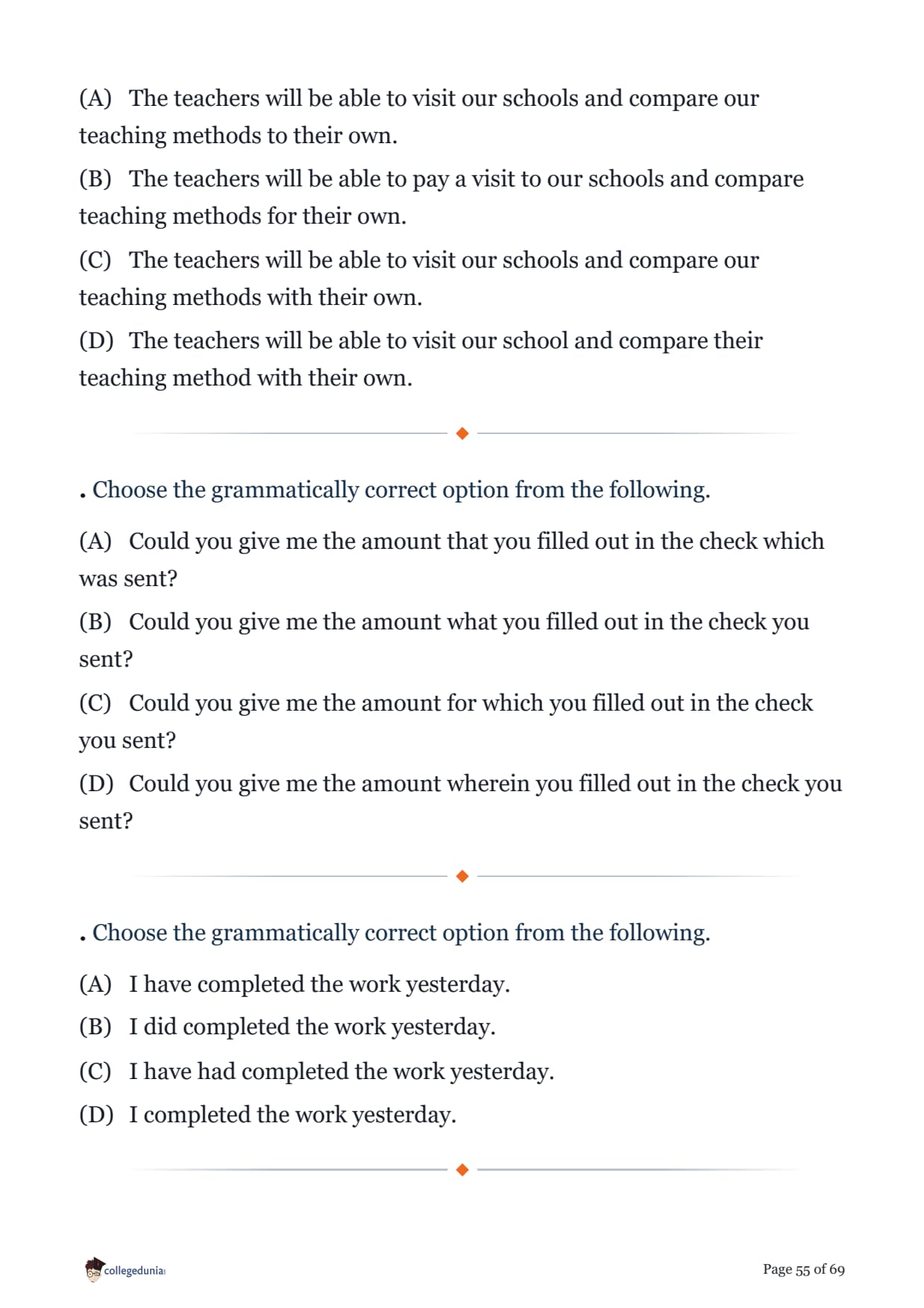
Choose the grammatically correct option from the following.
Choose the grammatically correct option from the following.
Choose the grammatically correct option from the following.
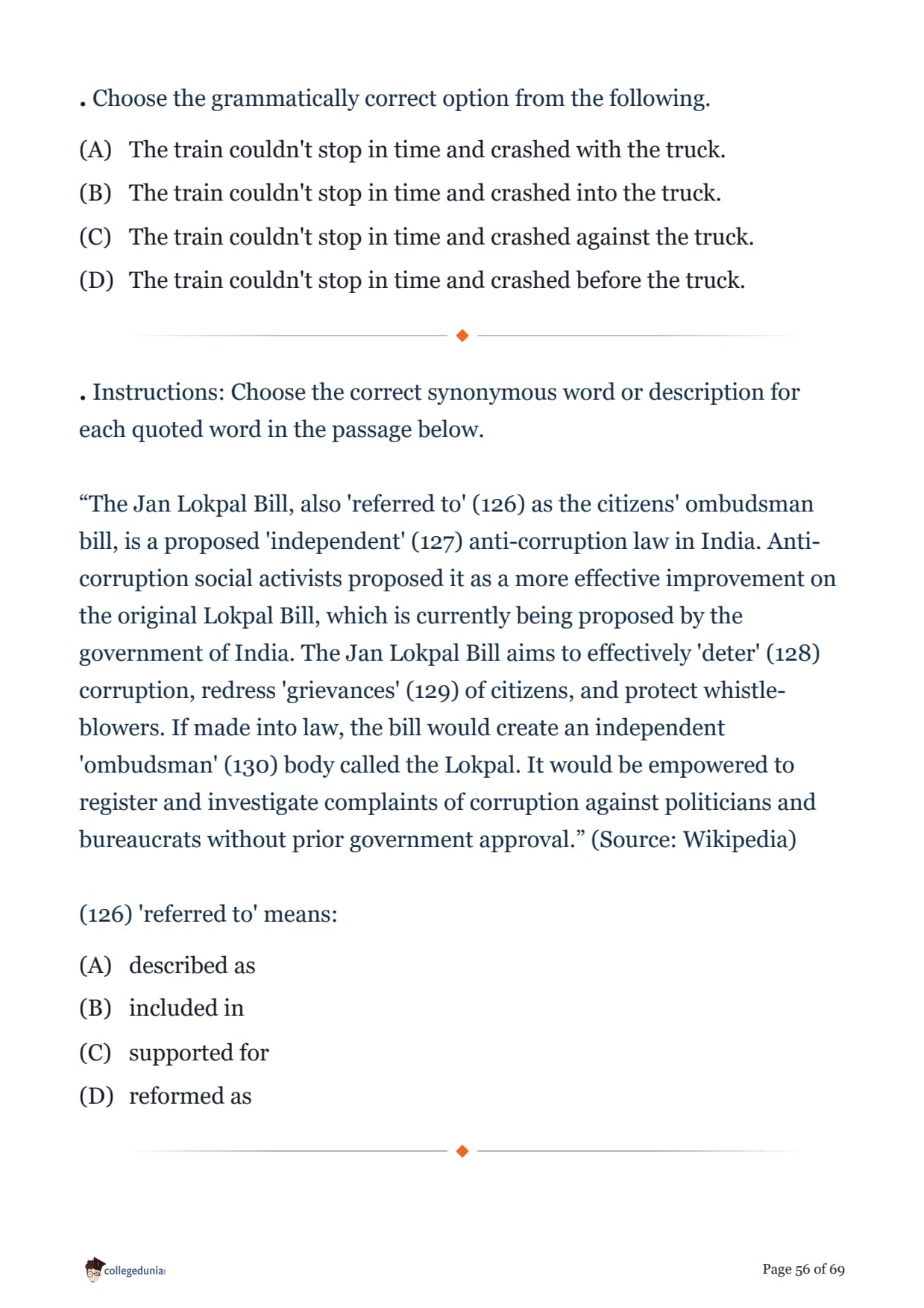
Choose the grammatically correct option from the following.
Instructions: Choose the correct synonymous word or description for each quoted word in the passage below.
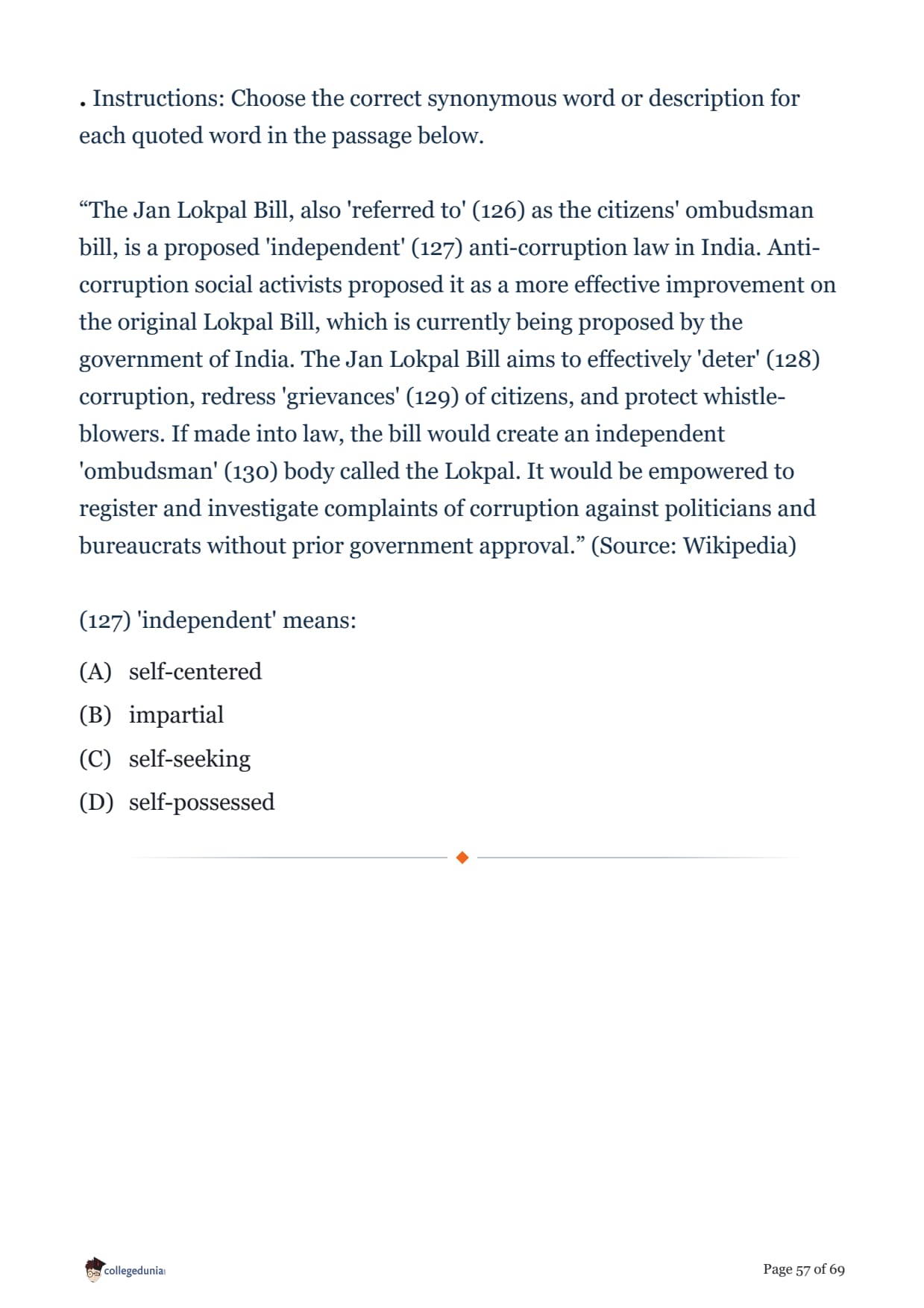
“The Jan Lokpal Bill, also 'referred to' (126) as the citizens' ombudsman bill, is a proposed 'independent' (127) anti-corruption law in India. Anti-corruption social activists proposed it as a more effective improvement on the original Lokpal Bill, which is currently being proposed by the government of India. The Jan Lokpal Bill aims to effectively 'deter' (128) corruption, redress 'grievances' (129) of citizens, and protect whistle-blowers. If made into law, the bill would create an independent 'ombudsman' (130) body called the Lokpal. It would be empowered to register and investigate complaints of corruption against politicians and bureaucrats without prior government approval.” (Source: Wikipedia)
(126) 'referred to' means:
Instructions: Choose the correct synonymous word or description for each quoted word in the passage below.
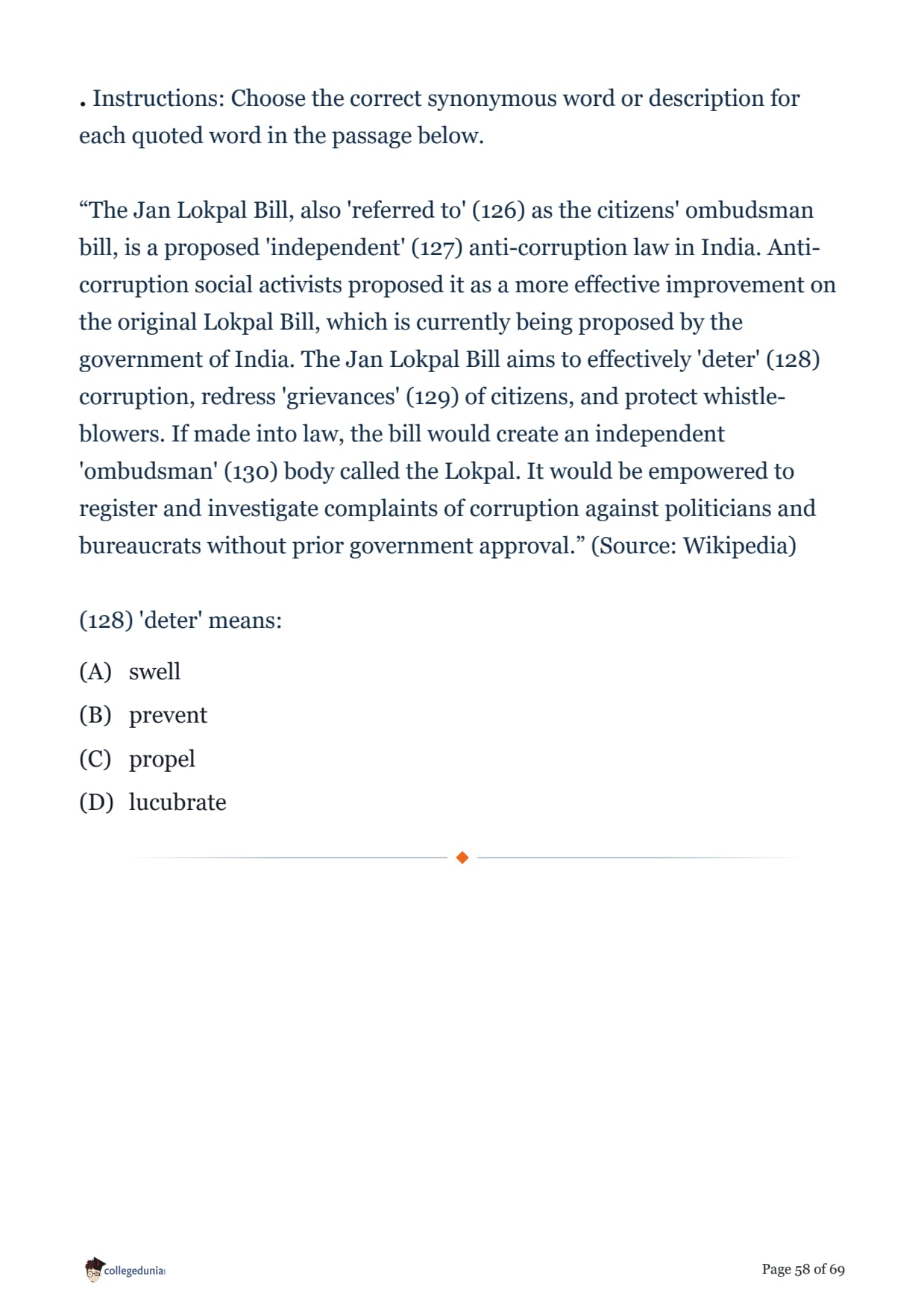
“The Jan Lokpal Bill, also 'referred to' (126) as the citizens' ombudsman bill, is a proposed 'independent' (127) anti-corruption law in India. Anti-corruption social activists proposed it as a more effective improvement on the original Lokpal Bill, which is currently being proposed by the government of India. The Jan Lokpal Bill aims to effectively 'deter' (128) corruption, redress 'grievances' (129) of citizens, and protect whistle-blowers. If made into law, the bill would create an independent 'ombudsman' (130) body called the Lokpal. It would be empowered to register and investigate complaints of corruption against politicians and bureaucrats without prior government approval.” (Source: Wikipedia)
(127) 'independent' means:
Instructions: Choose the correct synonymous word or description for each quoted word in the passage below.
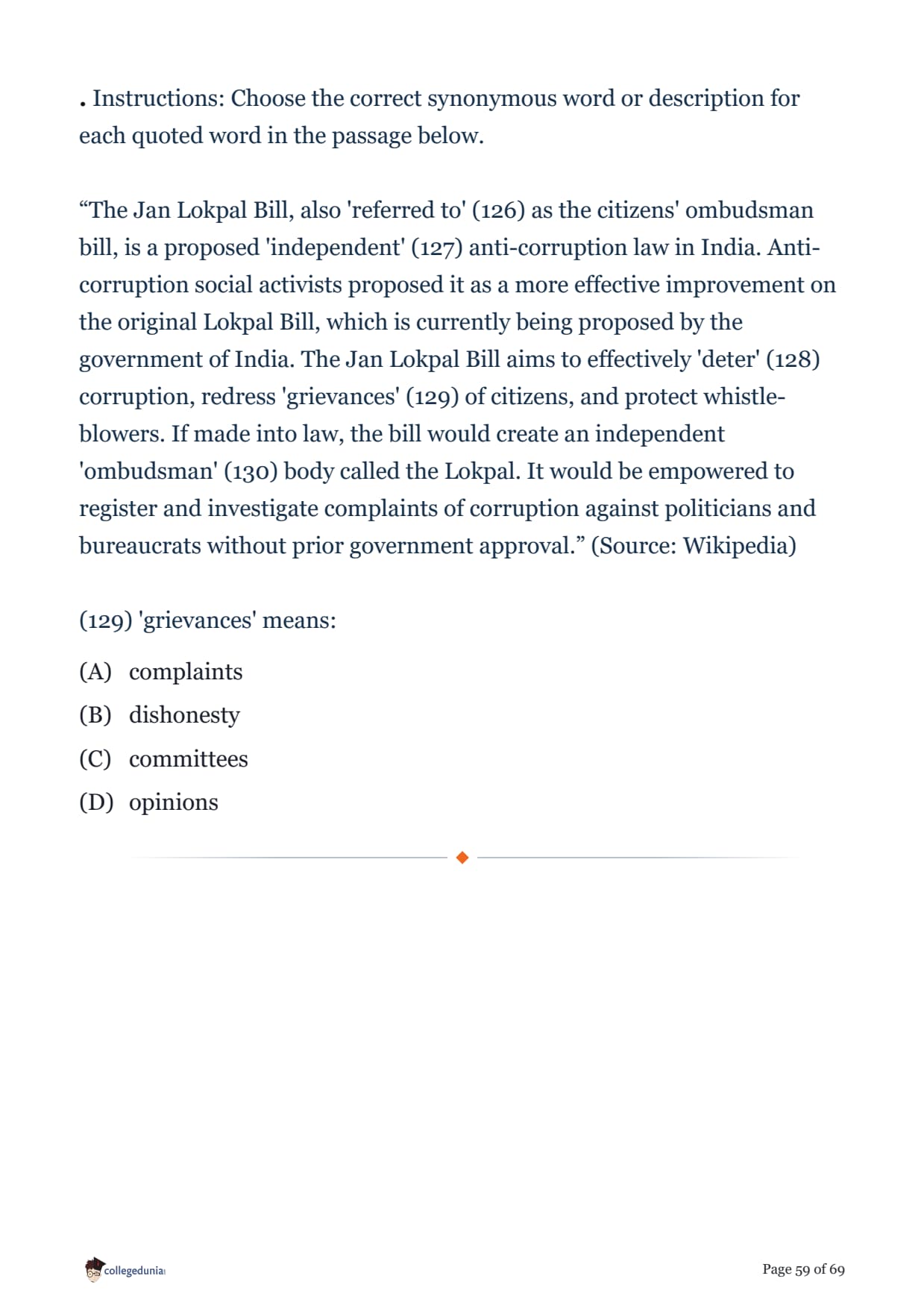
“The Jan Lokpal Bill, also 'referred to' (126) as the citizens' ombudsman bill, is a proposed 'independent' (127) anti-corruption law in India. Anti-corruption social activists proposed it as a more effective improvement on the original Lokpal Bill, which is currently being proposed by the government of India. The Jan Lokpal Bill aims to effectively 'deter' (128) corruption, redress 'grievances' (129) of citizens, and protect whistle-blowers. If made into law, the bill would create an independent 'ombudsman' (130) body called the Lokpal. It would be empowered to register and investigate complaints of corruption against politicians and bureaucrats without prior government approval.” (Source: Wikipedia)
(128) 'deter' means:
Instructions: Choose the correct synonymous word or description for each quoted word in the passage below.
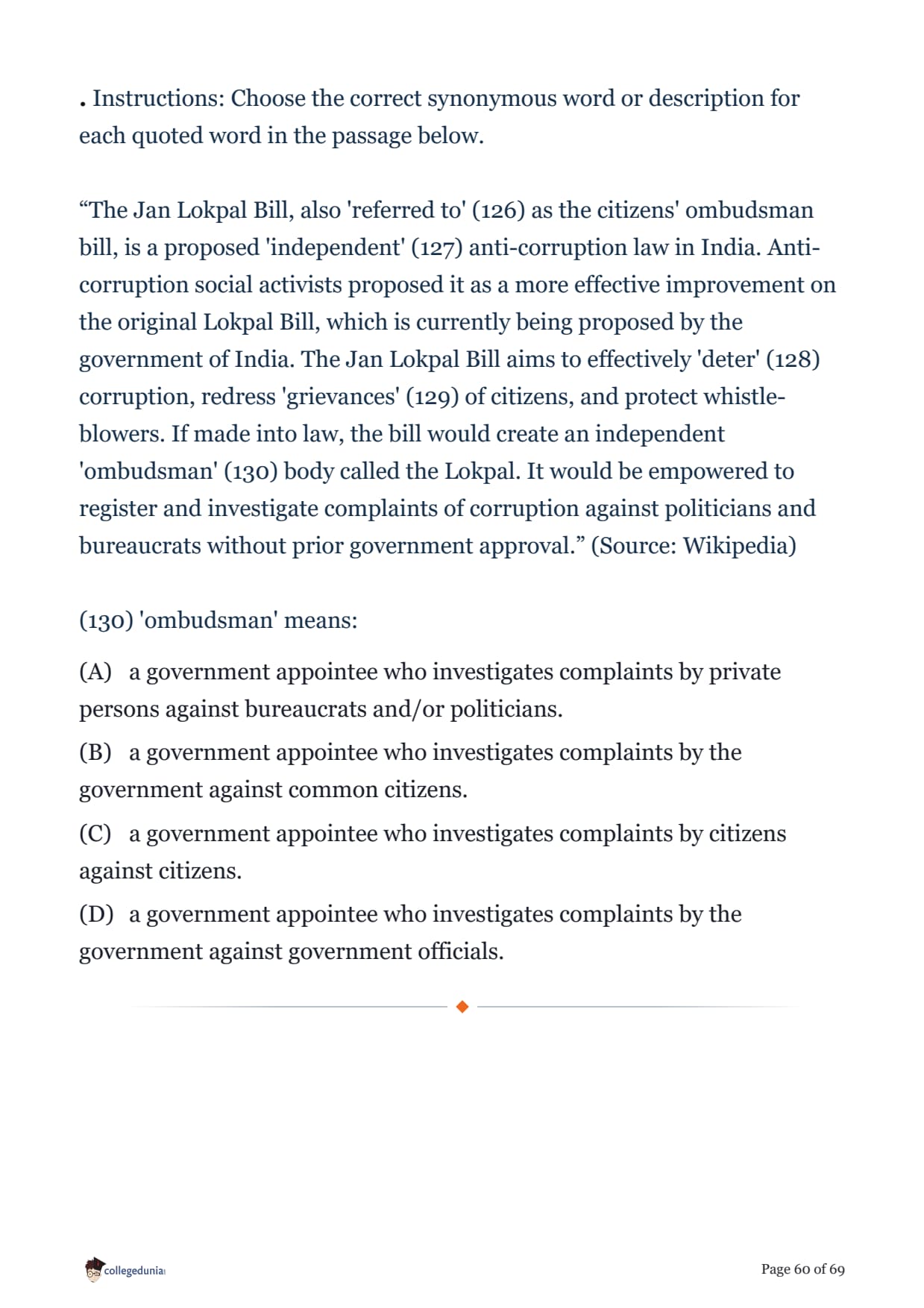
“The Jan Lokpal Bill, also 'referred to' (126) as the citizens' ombudsman bill, is a proposed 'independent' (127) anti-corruption law in India. Anti-corruption social activists proposed it as a more effective improvement on the original Lokpal Bill, which is currently being proposed by the government of India. The Jan Lokpal Bill aims to effectively 'deter' (128) corruption, redress 'grievances' (129) of citizens, and protect whistle-blowers. If made into law, the bill would create an independent 'ombudsman' (130) body called the Lokpal. It would be empowered to register and investigate complaints of corruption against politicians and bureaucrats without prior government approval.” (Source: Wikipedia)
(129) 'grievances' means:
Instructions: Choose the correct synonymous word or description for each quoted word in the passage below.
“The Jan Lokpal Bill, also 'referred to' (126) as the citizens' ombudsman bill, is a proposed 'independent' (127) anti-corruption law in India. Anti-corruption social activists proposed it as a more effective improvement on the original Lokpal Bill, which is currently being proposed by the government of India. The Jan Lokpal Bill aims to effectively 'deter' (128) corruption, redress 'grievances' (129) of citizens, and protect whistle-blowers. If made into law, the bill would create an independent 'ombudsman' (130) body called the Lokpal. It would be empowered to register and investigate complaints of corruption against politicians and bureaucrats without prior government approval.” (Source: Wikipedia)
(130) 'ombudsman' means:
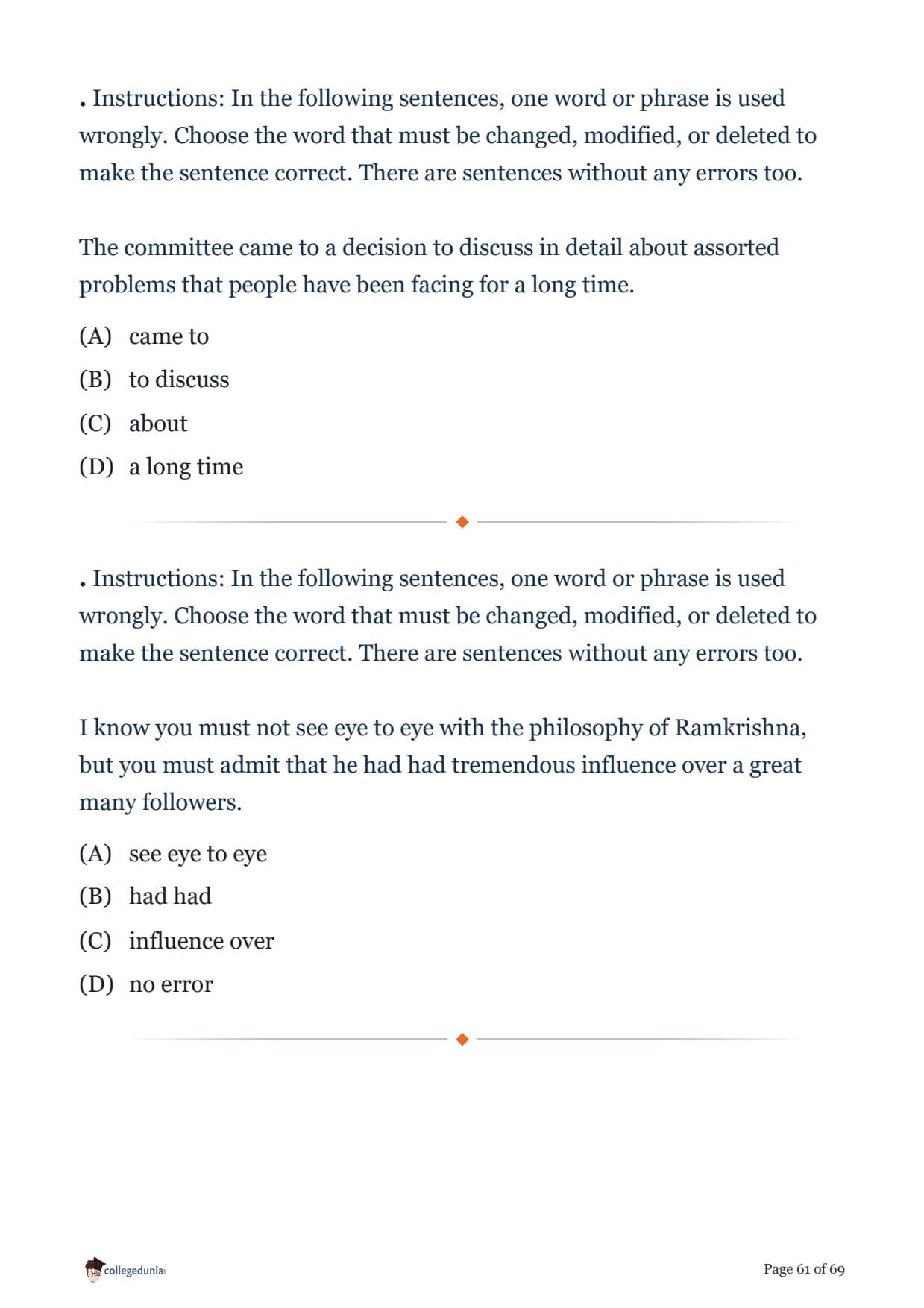
Instructions: In the following sentences, one word or phrase is used wrongly. Choose the word that must be changed, modified, or deleted to make the sentence correct. There are sentences without any errors too.
The committee came to a decision to discuss in detail about assorted problems that people have been facing for a long time.
Instructions: In the following sentences, one word or phrase is used wrongly. Choose the word that must be changed, modified, or deleted to make the sentence correct. There are sentences without any errors too.
I know you must not see eye to eye with the philosophy of Ramkrishna, but you must admit that he had had tremendous influence over a great many followers.
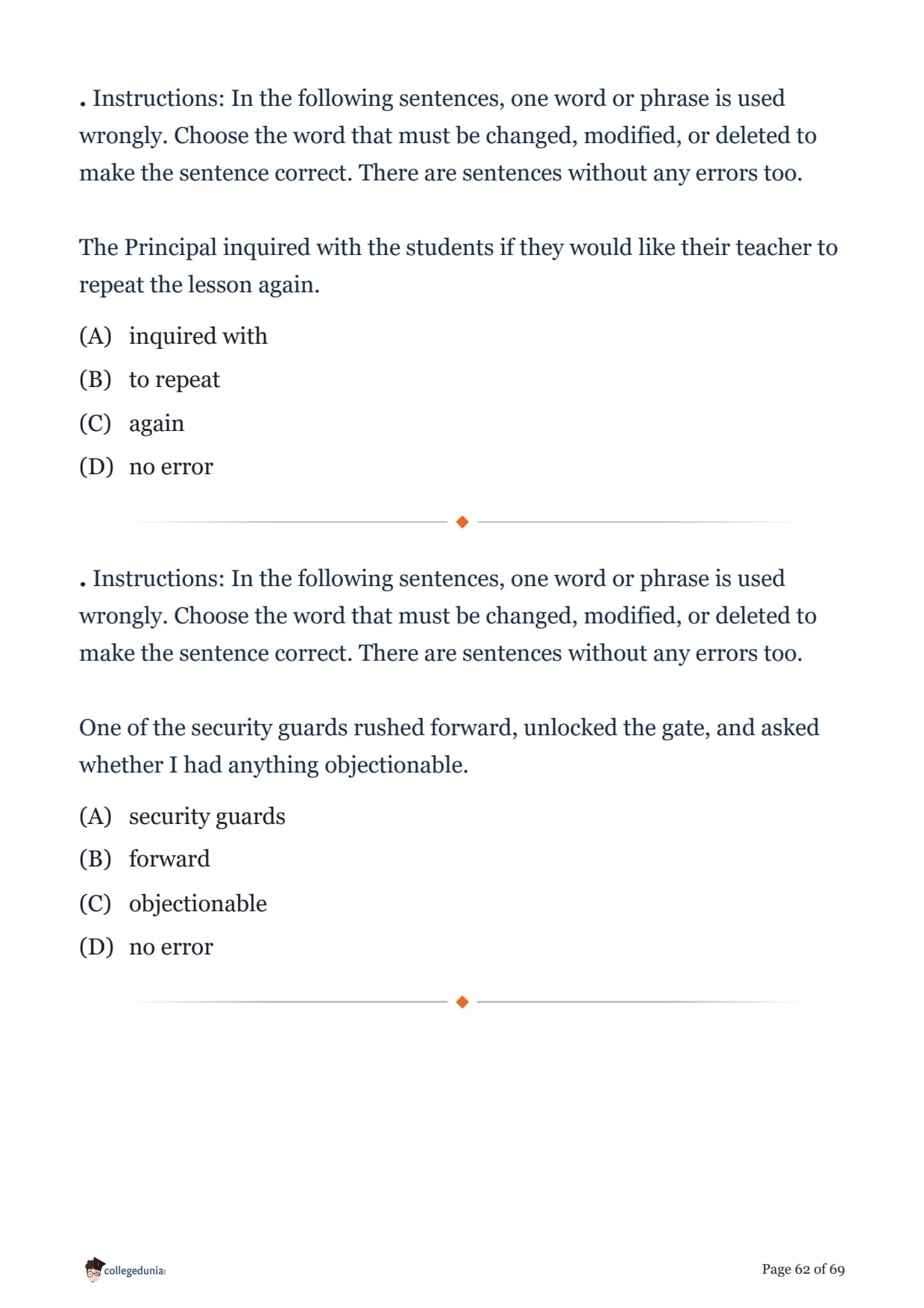
Instructions: In the following sentences, one word or phrase is used wrongly. Choose the word that must be changed, modified, or deleted to make the sentence correct. There are sentences without any errors too.
The Principal inquired with the students if they would like their teacher to repeat the lesson again.
Instructions: In the following sentences, one word or phrase is used wrongly. Choose the word that must be changed, modified, or deleted to make the sentence correct. There are sentences without any errors too.
One of the security guards rushed forward, unlocked the gate, and asked whether I had anything objectionable.
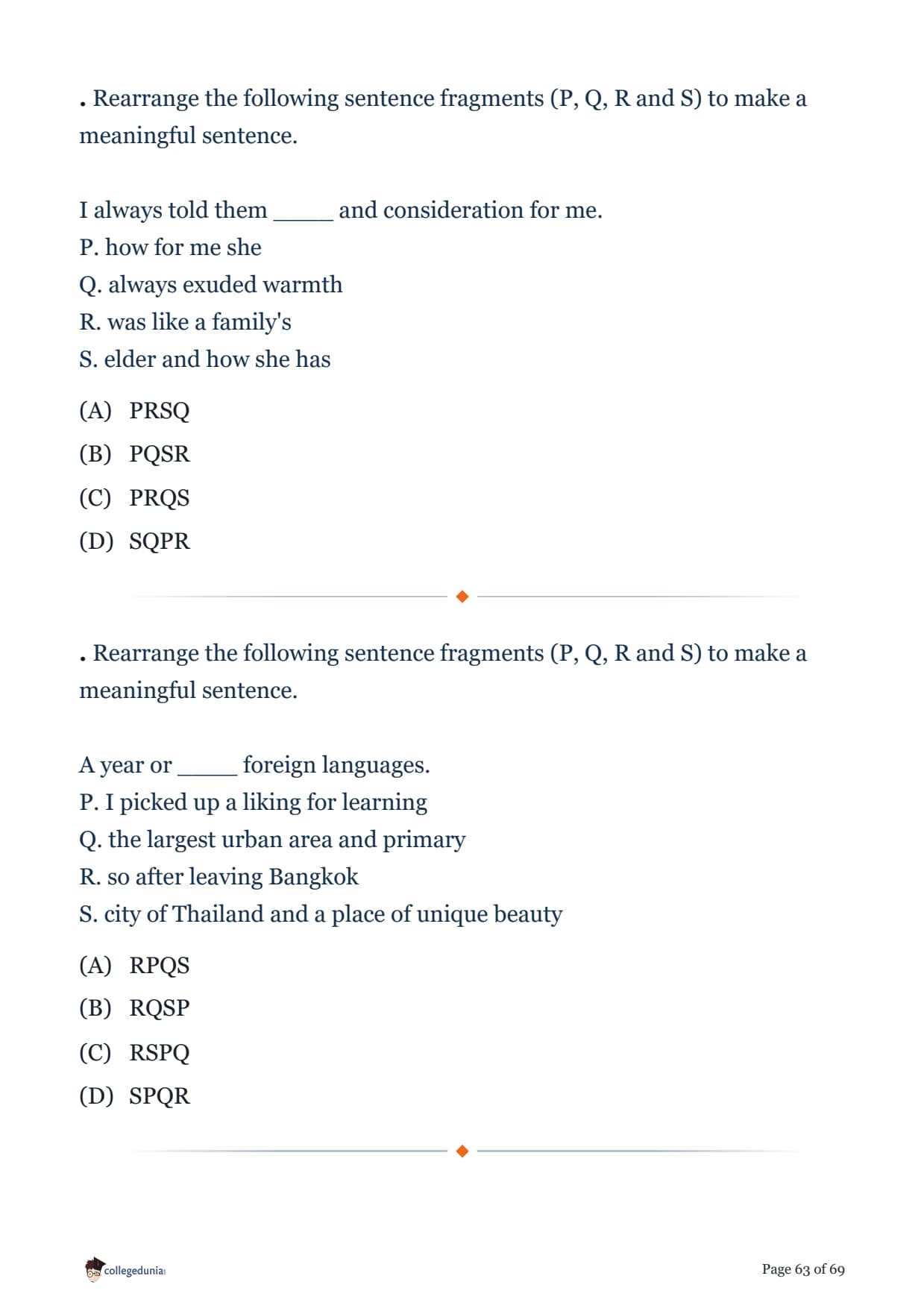
Rearrange the following sentence fragments (P, Q, R and S) to make a meaningful sentence.
I always told them ____ and consideration for me.
P. how for me she
Q. always exuded warmth
R. was like a family's
S. elder and how she has
Rearrange the following sentence fragments (P, Q, R and S) to make a meaningful sentence.
A year or ____ foreign languages.
P. I picked up a liking for learning
Q. the largest urban area and primary
R. so after leaving Bangkok
S. city of Thailand and a place of unique beauty
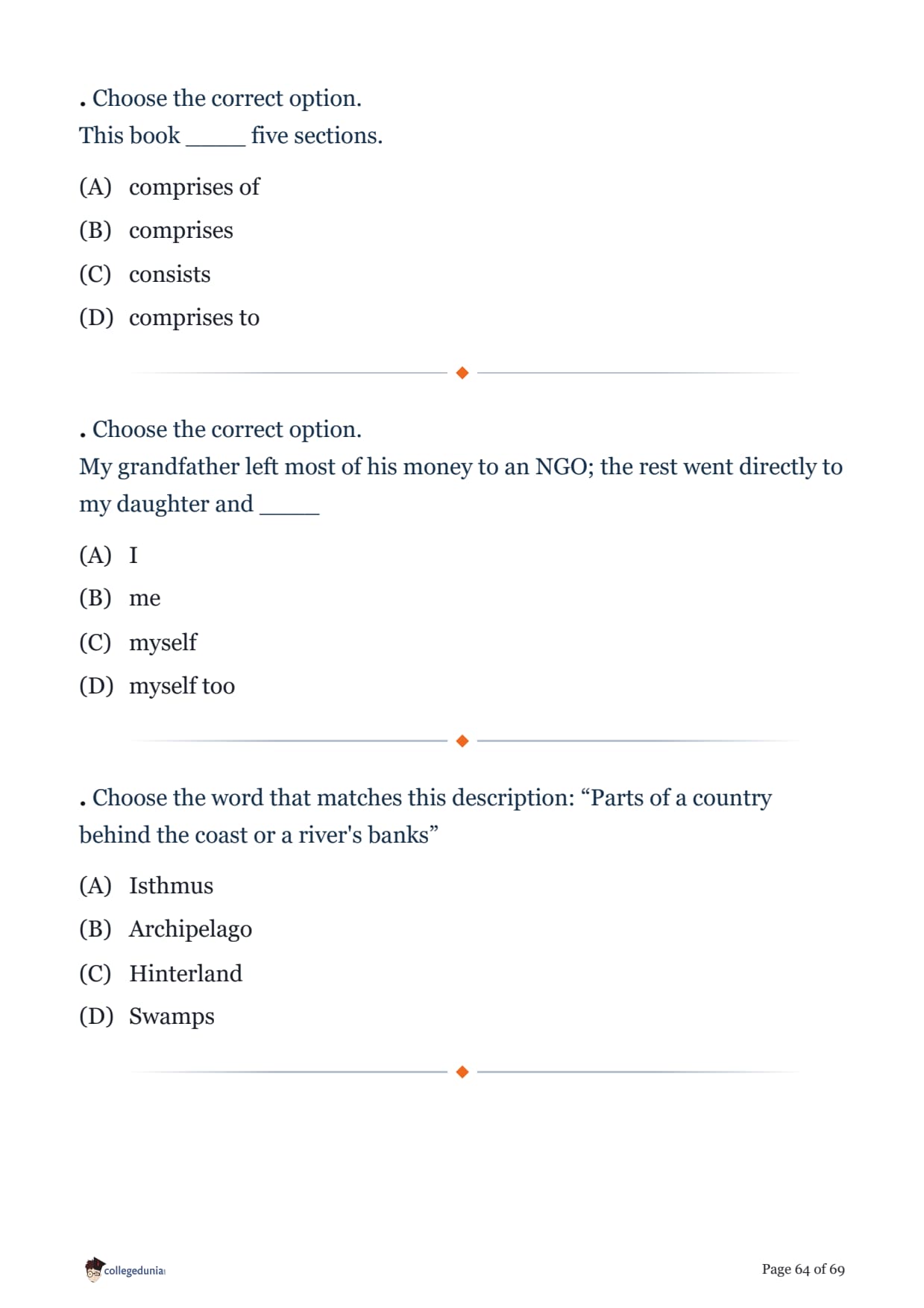
Choose the correct option.
This book ____ five sections.
Choose the correct option.
My grandfather left most of his money to an NGO; the rest went directly to my daughter and ____
Choose the word that matches this description: “Parts of a country behind the coast or a river's banks”
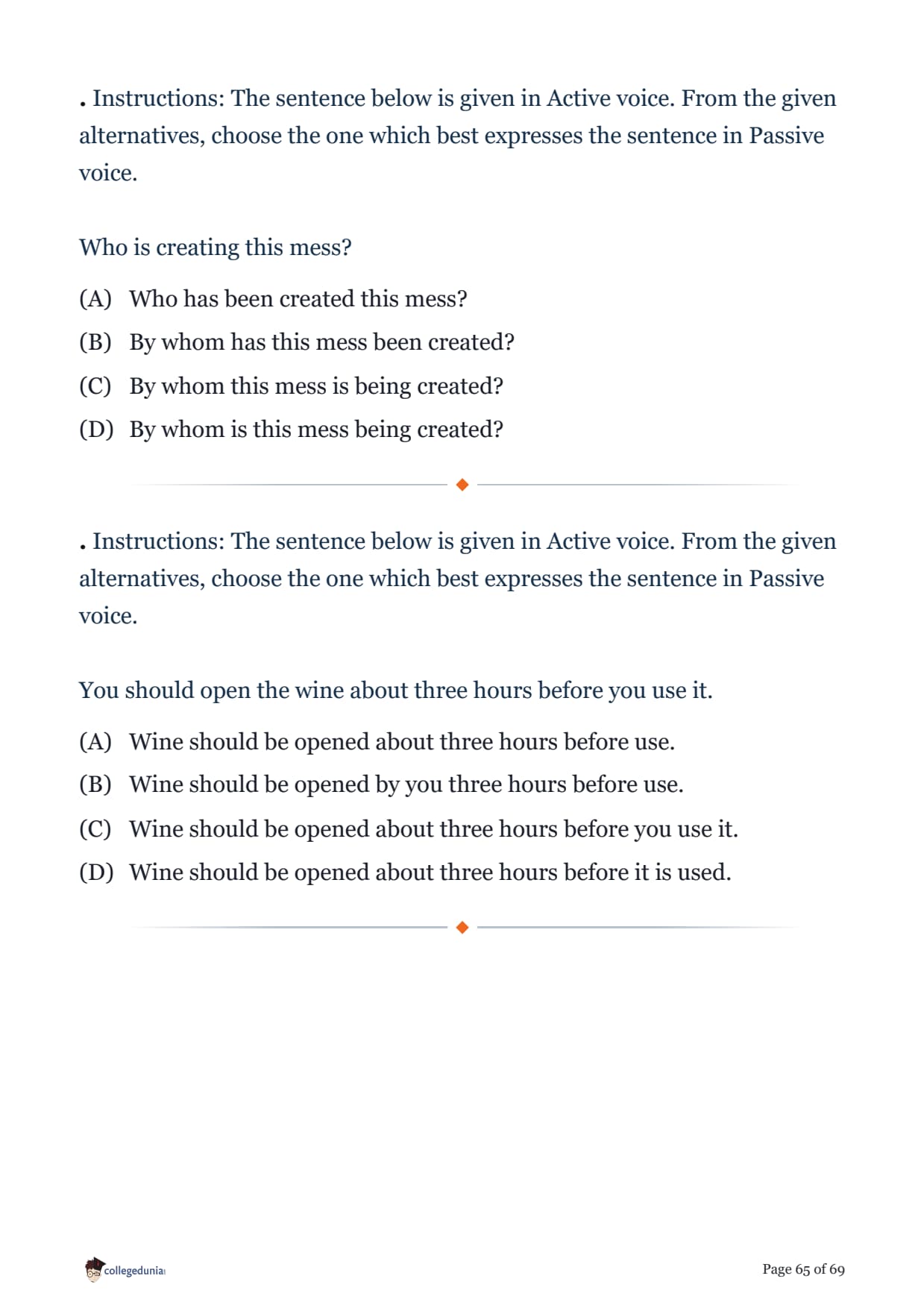
Instructions: The sentence below is given in Active voice. From the given alternatives, choose the one which best expresses the sentence in Passive voice.
Who is creating this mess?
Instructions: The sentence below is given in Active voice. From the given alternatives, choose the one which best expresses the sentence in Passive voice.
You should open the wine about three hours before you use it.
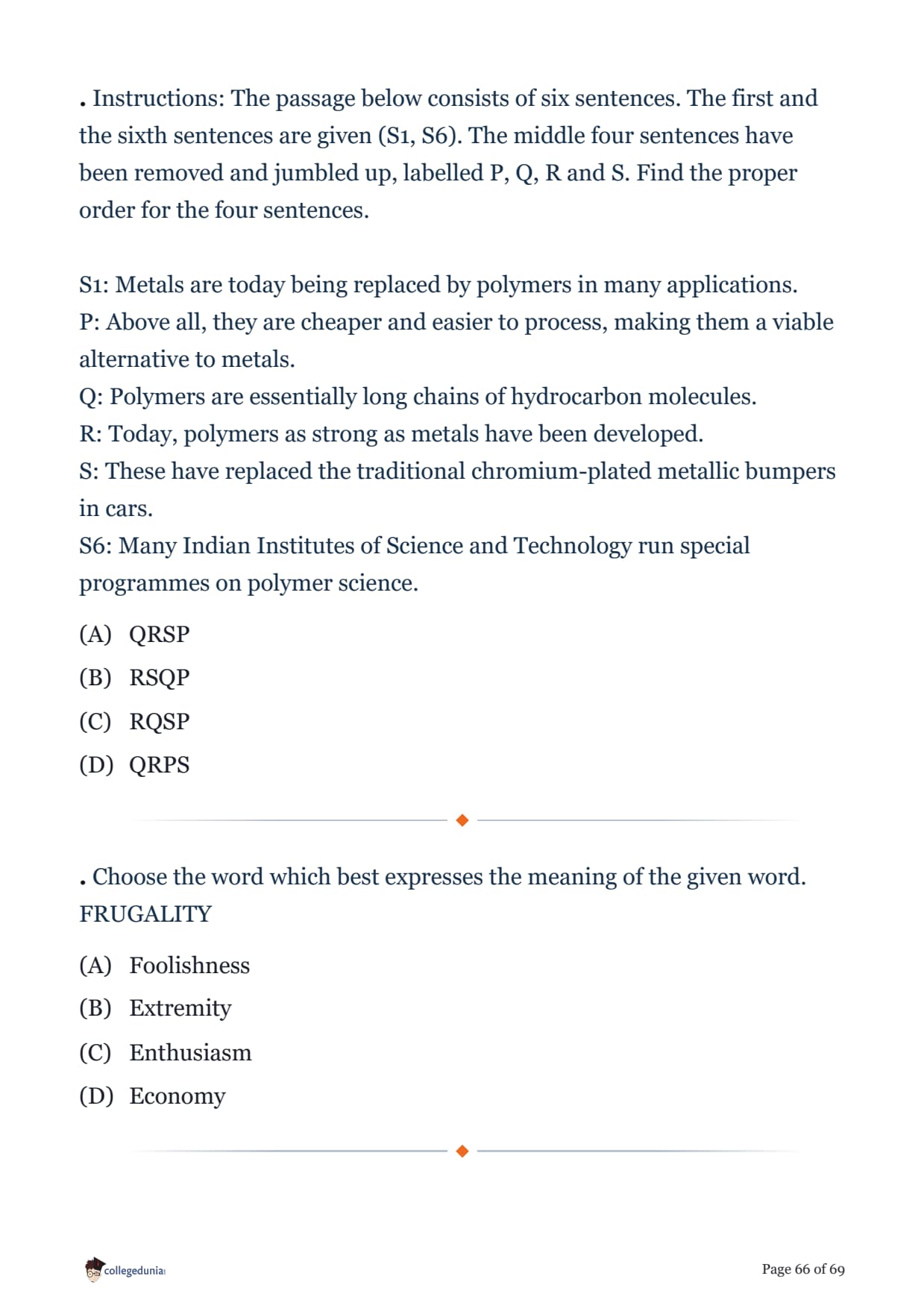
Instructions: The passage below consists of six sentences. The first and the sixth sentences are given (S1, S6). The middle four sentences have been removed and jumbled up, labelled P, Q, R and S. Find the proper order for the four sentences.
S1: Metals are today being replaced by polymers in many applications.
P: Above all, they are cheaper and easier to process, making them a viable alternative to metals.
Q: Polymers are essentially long chains of hydrocarbon molecules.
R: Today, polymers as strong as metals have been developed.
S: These have replaced the traditional chromium-plated metallic bumpers in cars.
S6: Many Indian Institutes of Science and Technology run special programmes on polymer science.
Choose the word which best expresses the meaning of the given word.
FRUGALITY
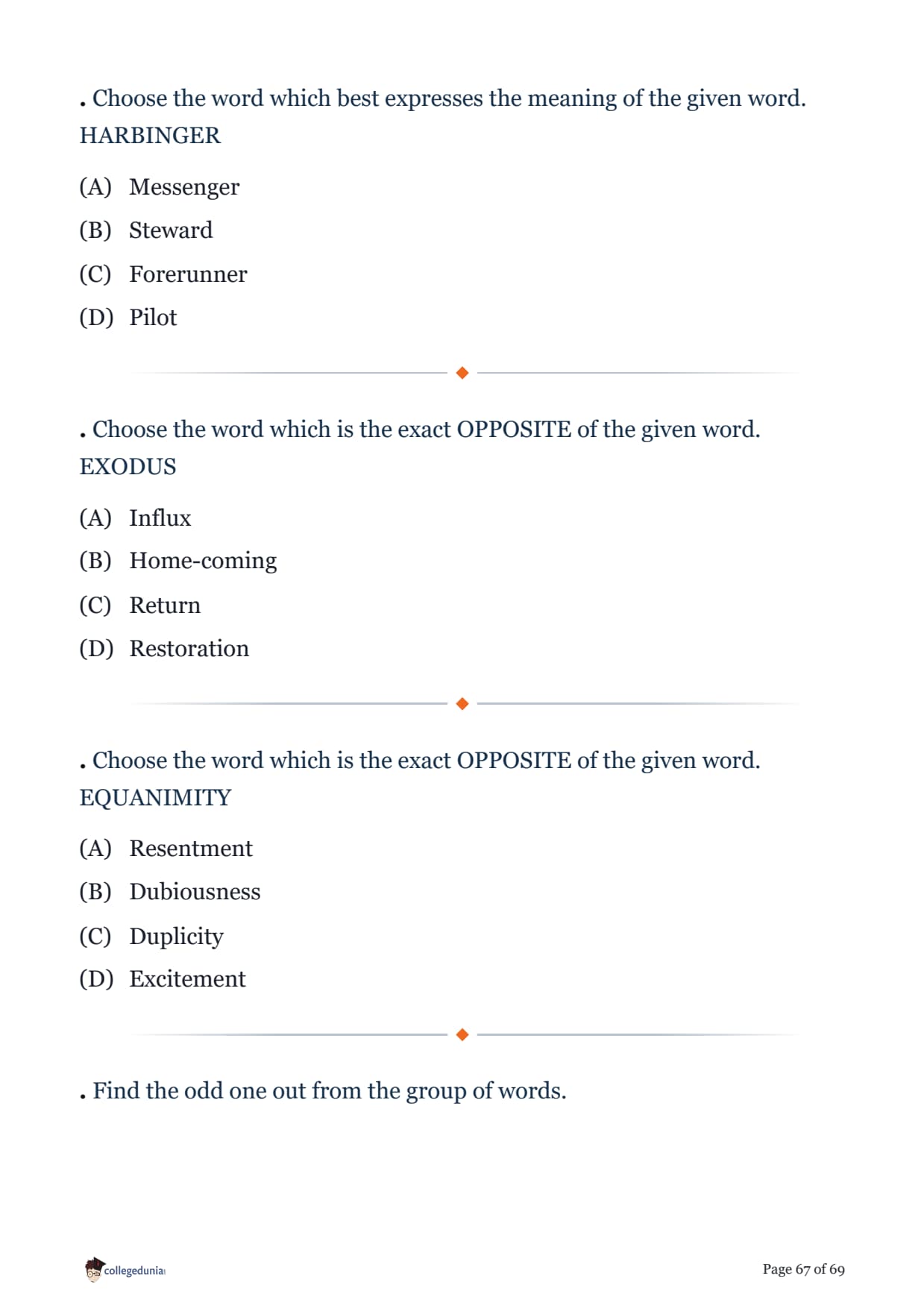
Choose the word which best expresses the meaning of the given word.
HARBINGER
Choose the word which is the exact OPPOSITE of the given word.
EXODUS
Choose the word which is the exact OPPOSITE of the given word.
EQUANIMITY
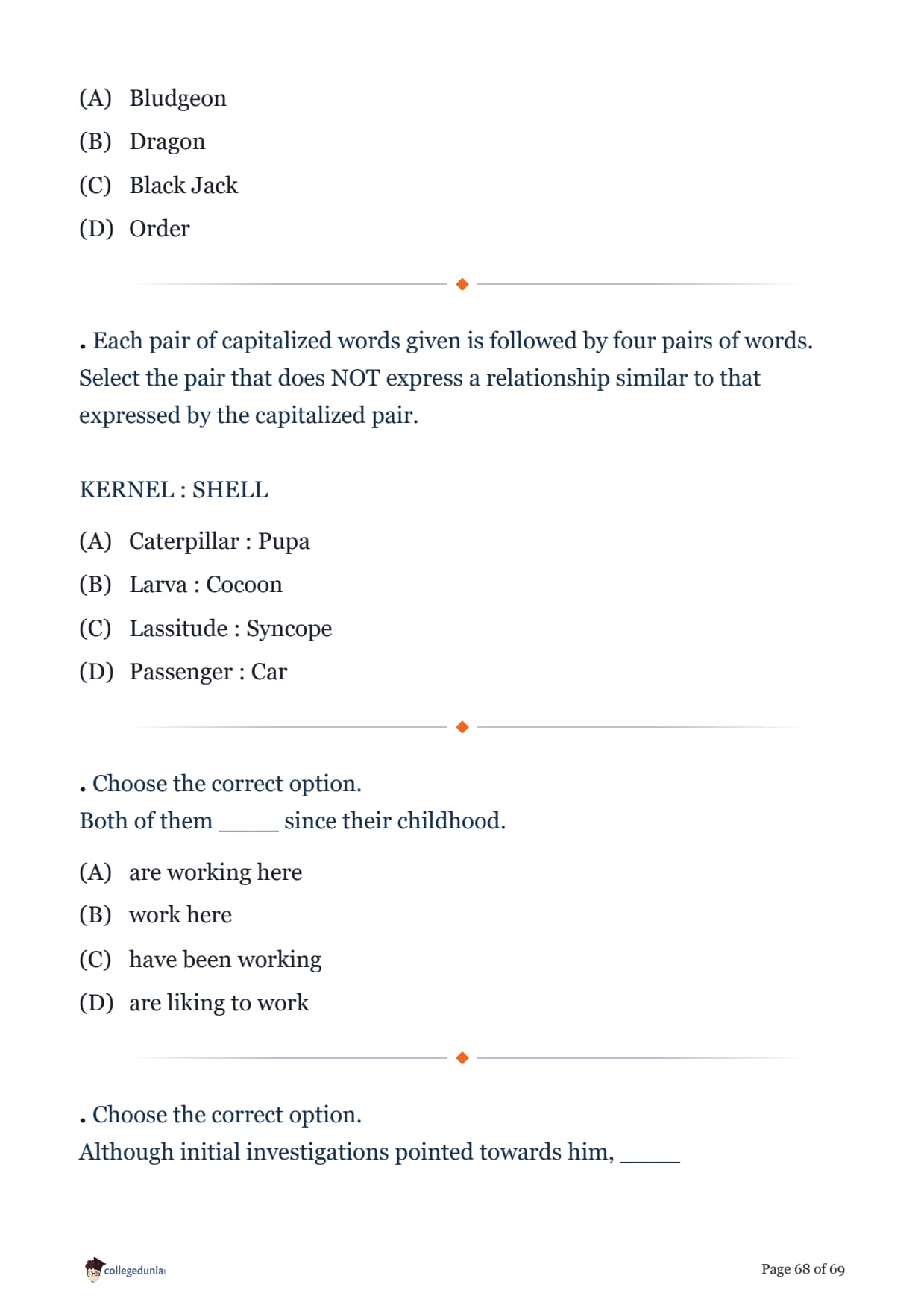
Find the odd one out from the group of words.
Each pair of capitalized words given is followed by four pairs of words. Select the pair that does NOT express a relationship similar to that expressed by the capitalized pair.
KERNEL : SHELL
Choose the correct option.
Both of them ____ since their childhood.
Choose the correct option.
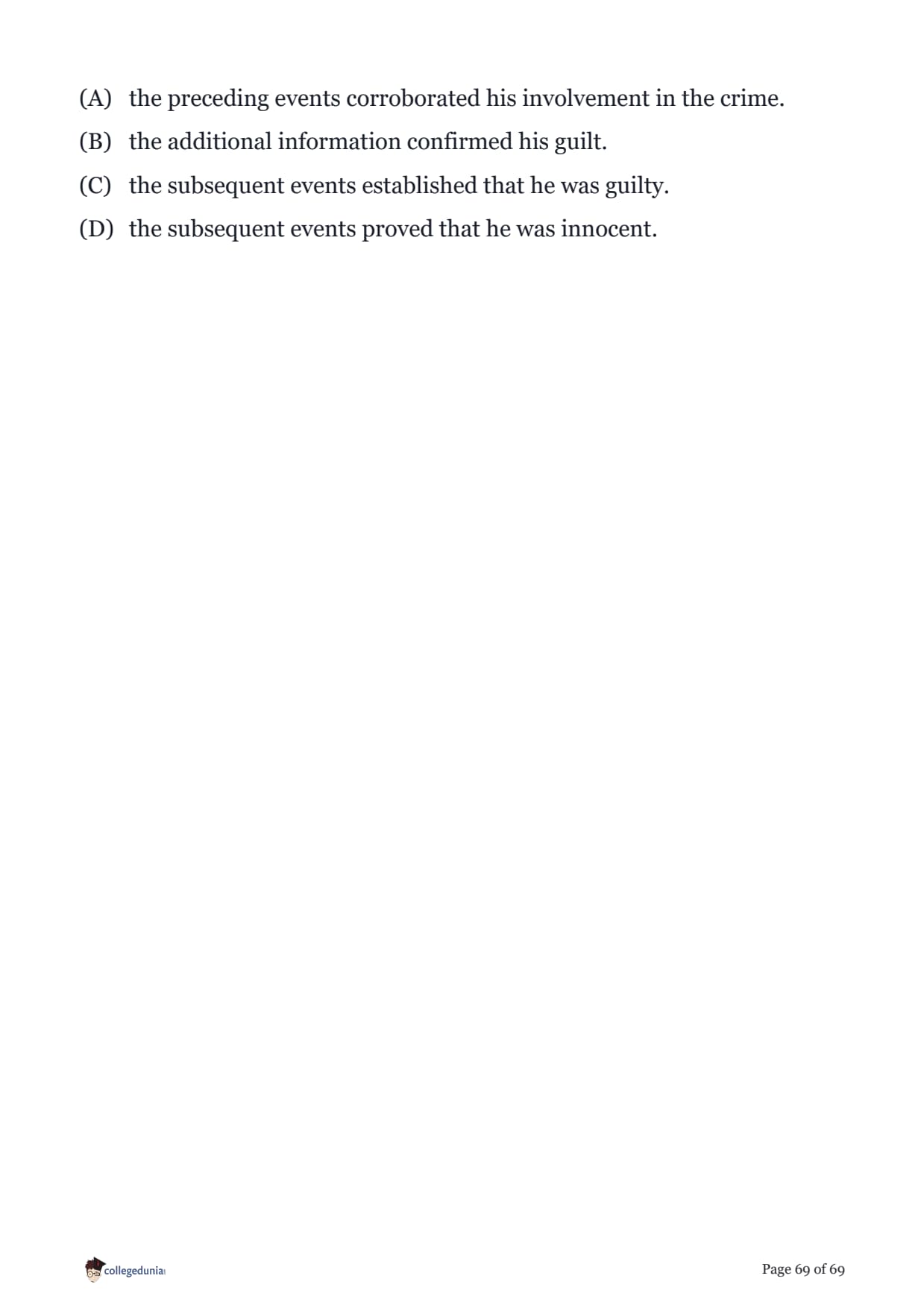
Although initial investigations pointed towards him, ____
SNAP 2011 Exam Pattern and Marking Scheme Explained
SNAP 2011 was a pen-and-paper test with four sections and no sectional time limit inside the overall 120 minutes.
- Total questions: 150 MCQs, each with 4 options
- Duration: 120 minutes, single sitting
- Total marks: 180
- General Awareness: Q1-40, 1 mark each (40 marks)
- Analytical & Logical Reasoning: Q41-70, 2 marks each (60 marks)
- Quantitative Aptitude, DI & DS: Q71-110, 1 mark each (40 marks)
- General English: Q111-150, 1 mark each (40 marks), with one reading-comprehension passage
- Negative marking: 0.25 marks deducted for every wrong answer
SNAP 2011 Question Paper Analysis Video
Source: Mathological
High-Weightage Topics in the SNAP 2011 Combined Paper to Focus On First
Solving all 150 questions in this paper shows a clear pattern in what each section leans on.
- Grammar carried 10 of the 40 English questions, more than any other English topic
- Vocabulary (synonyms, antonyms, word usage) added another 8 English questions
- Data Interpretation (bar graph and pie chart sets) made up 9 of the 40 Quant questions
- Geometry and Mensuration added 7 more Quant questions
- Critical reasoning (statement-consistency sets, family-tree puzzles, cube-and-dice counting) ran through 8 of the 30 Reasoning questions
- Polity and Governance and International Relations together accounted for 11 of the 40 General Awareness questions
How to Use the SNAP 2011 Question Paper for Practice
Solve it as a timed mock first, then go section by section against the solution PDF to fix your weak spots.
- Attempt the full 150 questions in one 120-minute sitting to build stamina, then re-attempt only the sections you missed
- Use the solutions PDF to check your method against the step-by-step working, not just the final answer
- Redo the Grammar, Vocabulary, and Data Interpretation sets separately since they carry the most questions in this paper
- Skip re-drilling the General Awareness section for current-affairs recall - it tests 2011-era events and isn't representative of what you will be asked today
SNAP Exam Pattern Then vs Now
- SNAP 2011 ran 150 questions in 120 minutes across 4 sections, including a separate General Awareness section
- SNAP today runs 60 questions in 60 minutes across 3 sections - General Awareness has been dropped and Reading Comprehension has not appeared since SNAP 2023
- Because of this, practice the SNAP 2011 paper for question quality and topic drilling in English, Quant, and Reasoning - not as a direct time-pressure simulation of the current test
SNAP 2011 Question Paper FAQs
Ques. Where can I download the SNAP 2011 question paper with solutions PDF for free?
Ans. You can download the full SNAP 2011 Combined paper and its solutions PDF from the table above on Collegedunia. For the official SNAP exam information, visit snaptest.org, the Symbiosis International (Deemed University) portal.
Ques. How many questions were there in the SNAP 2011 question paper?
Ans. SNAP 2011 had 150 questions across 4 sections: 40 in General Awareness, 30 in Analytical & Logical Reasoning, 40 in Quantitative Aptitude, DI & DS, and 40 in General English, solved in 120 minutes.
Ques. Is the SNAP 2011 exam pattern the same as the current SNAP exam?
Ans. No. SNAP has since moved to a 60-question, 60-minute, 3-section format - the General Awareness section has been dropped, and Reading Comprehension has not featured since SNAP 2023. Use the 2011 paper for topic practice, not as a timed replica of the current test.
Ques. What is the negative marking scheme in the SNAP 2011 question paper?
Ans. Every wrong answer loses 0.25 marks. General Awareness, Quant, and English questions carried 1 mark each; Analytical & Logical Reasoning questions carried 2 marks each, for 180 total marks.
Ques. Which topics should I focus on while solving the SNAP 2011 paper?
Ans. Grammar and Vocabulary lead the English section with 10 and 8 questions, Data Interpretation and Geometry/Mensuration lead Quant with 9 and 7 questions, and statement-based critical reasoning sets make up 8 of the 30 Reasoning questions.
Ques. Are SNAP questions repeated from old papers like SNAP 2011?
Ans. Exact questions are not repeated, but the underlying topics are - grammar rules, vocabulary patterns, data interpretation sets, geometry formulas, and critical reasoning puzzle types recur every year, so solving SNAP 2011 still sharpens the same skills SNAP tests today.



Comments