




The XAT 2008 question paper with solutions is available here for free download. XAT 2008 was conducted by XLRI Jamshedpur on January 6, 2008, and this combined paper carried 120 objective questions across Verbal & Logical Ability, Analytical Reasoning & Decision Making, and Data Interpretation & Quantitative Ability.
| XAT 2008 Combined Question Paper with Solutions | Download PDF | Check Solutions |





XAT 2008 Questions with Solutions
Four digits of the number \(29138576\) are removed so that the remaining four digits, kept in their original order, form the largest possible number. Which removed digit has the largest value?
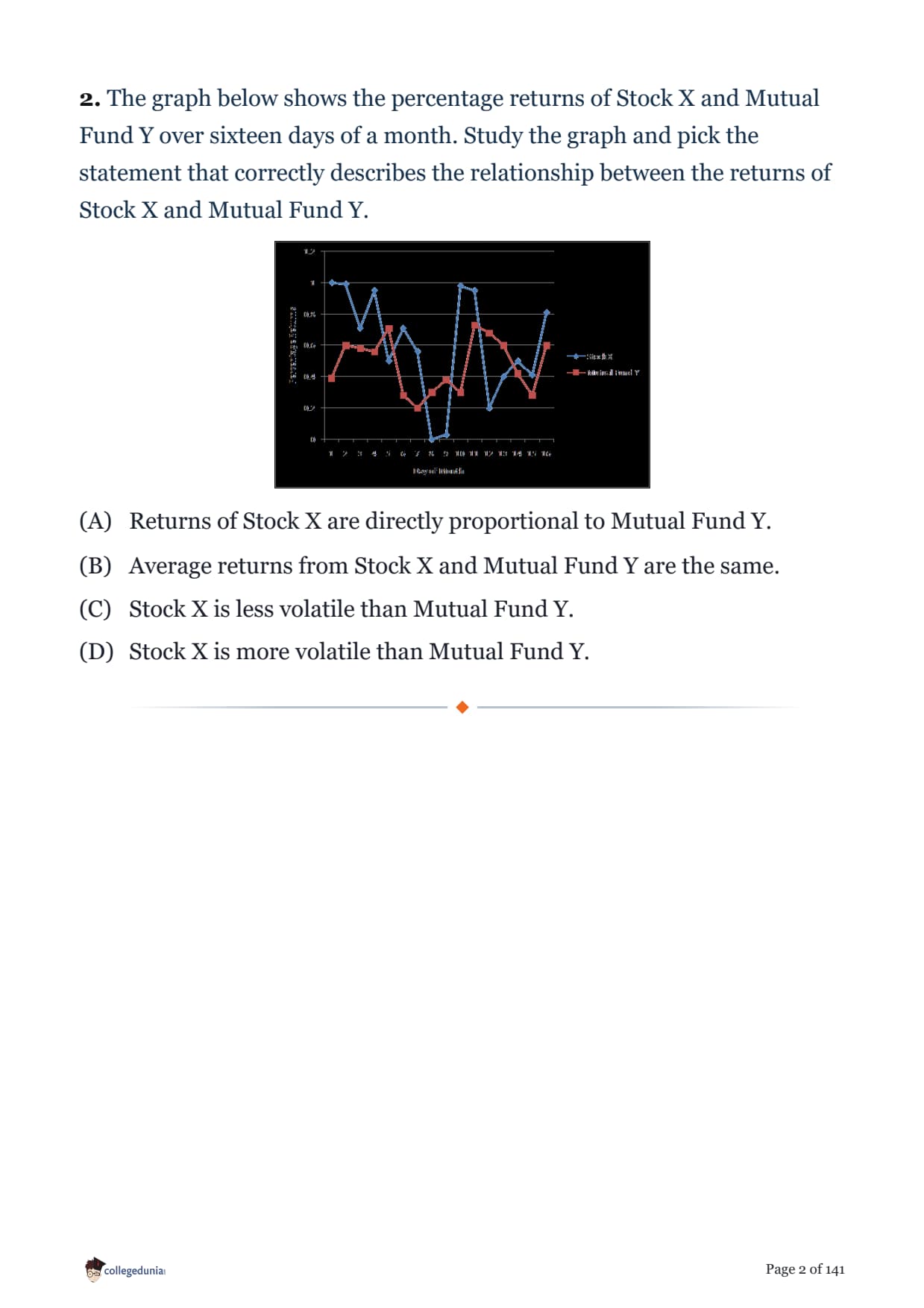
The graph below shows the percentage returns of Stock X and Mutual Fund Y over sixteen days of a month. Study the graph and pick the statement that correctly describes the relationship between the returns of Stock X and Mutual Fund Y.
Directions: A statement is followed by three conclusions. Choose the answer from the options below.
(AA) Using the given statement, only conclusion I can be derived.
(BB) Using the given statement, only conclusion II can be derived.
(CC) Using the given statement, only conclusion III can be derived.
(DD) Using the given statement, all conclusions can be derived.
(EE) Using the given statement, none of the three conclusions I, II and III can be derived.
An operation # is defined by \(a \# b = 1 - \dfrac{b}{a}\).
Conclusion I: \((2 \# 1) \# (4 \# 3) = -1\)
Conclusion II: \((3 \# 1) \# (4 \# 2) = -2\)
Conclusion III: \((2 \# 3) \# (1 \# 3) = 0\)
Directions: A statement is followed by three conclusions. Choose the answer from the options below.
(AA) Using the given statement, only conclusion I can be derived.
(BB) Using the given statement, only conclusion II can be derived.
(CC) Using the given statement, only conclusion III can be derived.
(DD) Using the given statement, all conclusions can be derived.
(EE) Using the given statement, none of the three conclusions I, II and III can be derived.
A, B, C and D are whole numbers such that:
\(A + B + C = 118\)
\(B + C + D = 156\)
\(C + D + A = 166\)
\(D + A + B = 178\)
Conclusion I: A is the smallest number and A = 21.
Conclusion II: D is the largest number and D = 88.
Conclusion III: B is the largest number and B = 56.
If \([XX]\) denotes the greatest integer less than or equal to \(X\), find the value of \[ \left[\frac{1}{3}\right] + \left[\frac{1}{3}+\frac{1}{99}\right] + \left[\frac{1}{3}+\frac{2}{99}\right] + \cdots + \left[\frac{1}{3}+\frac{98}{99}\right] \]
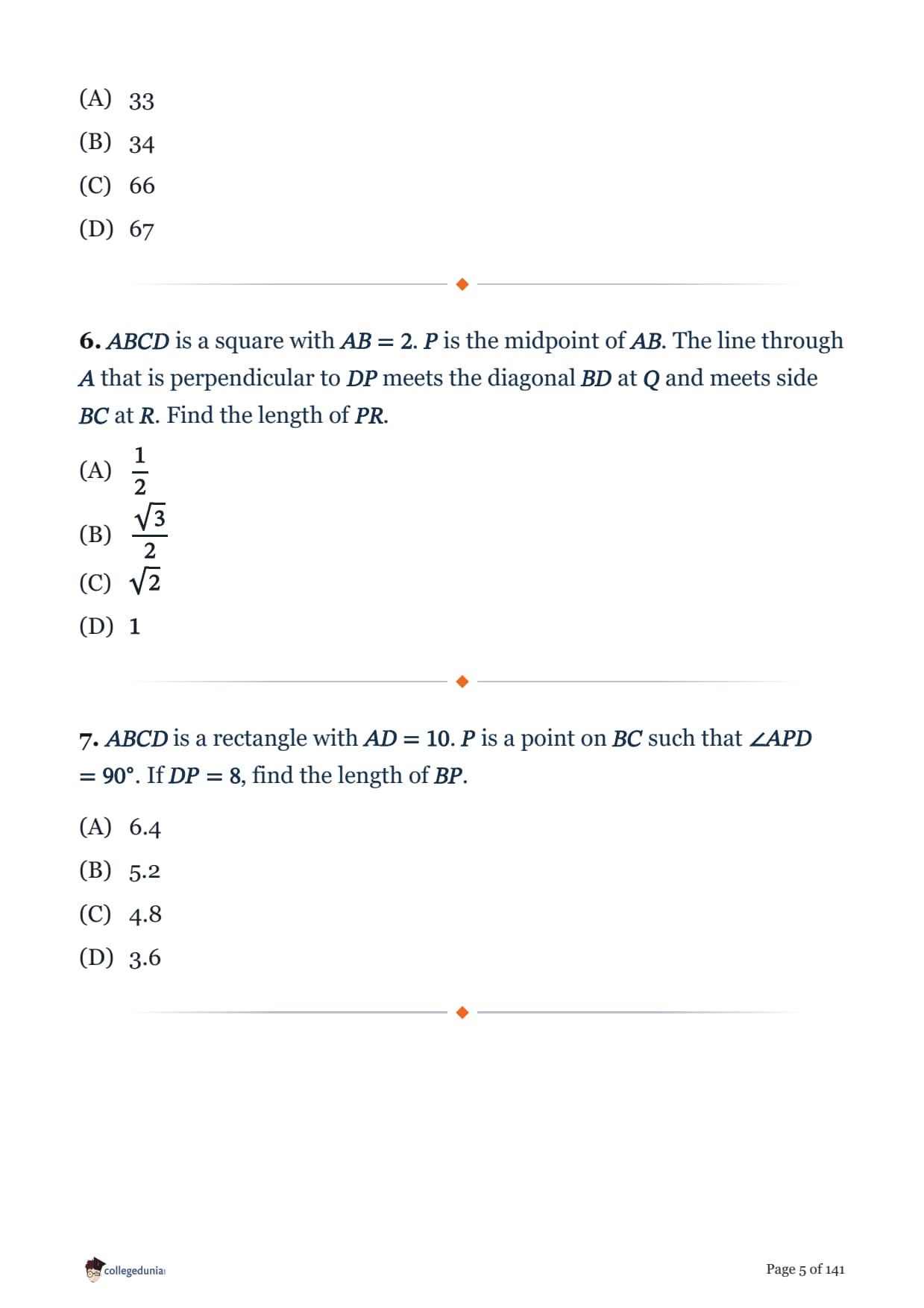
\(ABCD\) is a square with \(AB = 2\). \(P\) is the midpoint of \(AB\). The line through \(A\) that is perpendicular to \(DP\) meets the diagonal \(BD\) at \(Q\) and meets side \(BC\) at \(R\). Find the length of \(PR\).
\(ABCD\) is a rectangle with \(AD = 10\). \(P\) is a point on \(BC\) such that \(\angle APD = 90^{\circ}\). If \(DP = 8\), find the length of \(BP\).
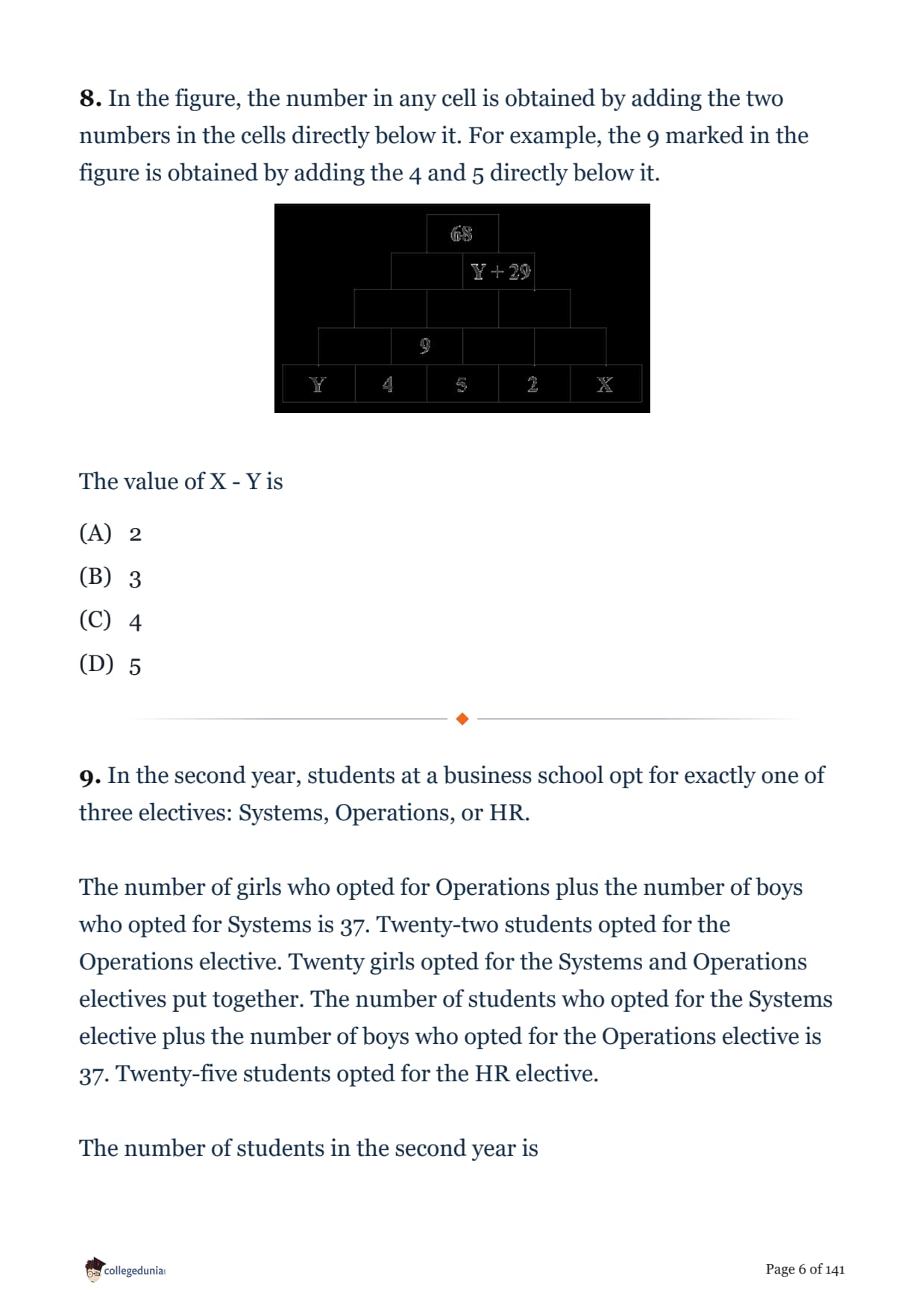
In the figure, the number in any cell is obtained by adding the two numbers in the cells directly below it. For example, the 9 marked in the figure is obtained by adding the 4 and 5 directly below it.
The value of X - Y is
In the second year, students at a business school opt for exactly one of three electives: Systems, Operations, or HR.
The number of girls who opted for Operations plus the number of boys who opted for Systems is 37. Twenty-two students opted for the Operations elective. Twenty girls opted for the Systems and Operations electives put together. The number of students who opted for the Systems elective plus the number of boys who opted for the Operations elective is 37. Twenty-five students opted for the HR elective.
The number of students in the second year is
In the second year, students at a business school opt for exactly one of three electives: Systems, Operations, or HR.
The number of girls who opted for Operations plus the number of boys who opted for Systems is 37. Twenty-two students opted for the Operations elective. Twenty girls opted for the Systems and Operations electives put together. The number of students who opted for the Systems elective plus the number of boys who opted for the Operations elective is 37. Twenty-five students opted for the HR elective.
If 20% of the girls opt for the HR elective, then the total number of boys in the second year is
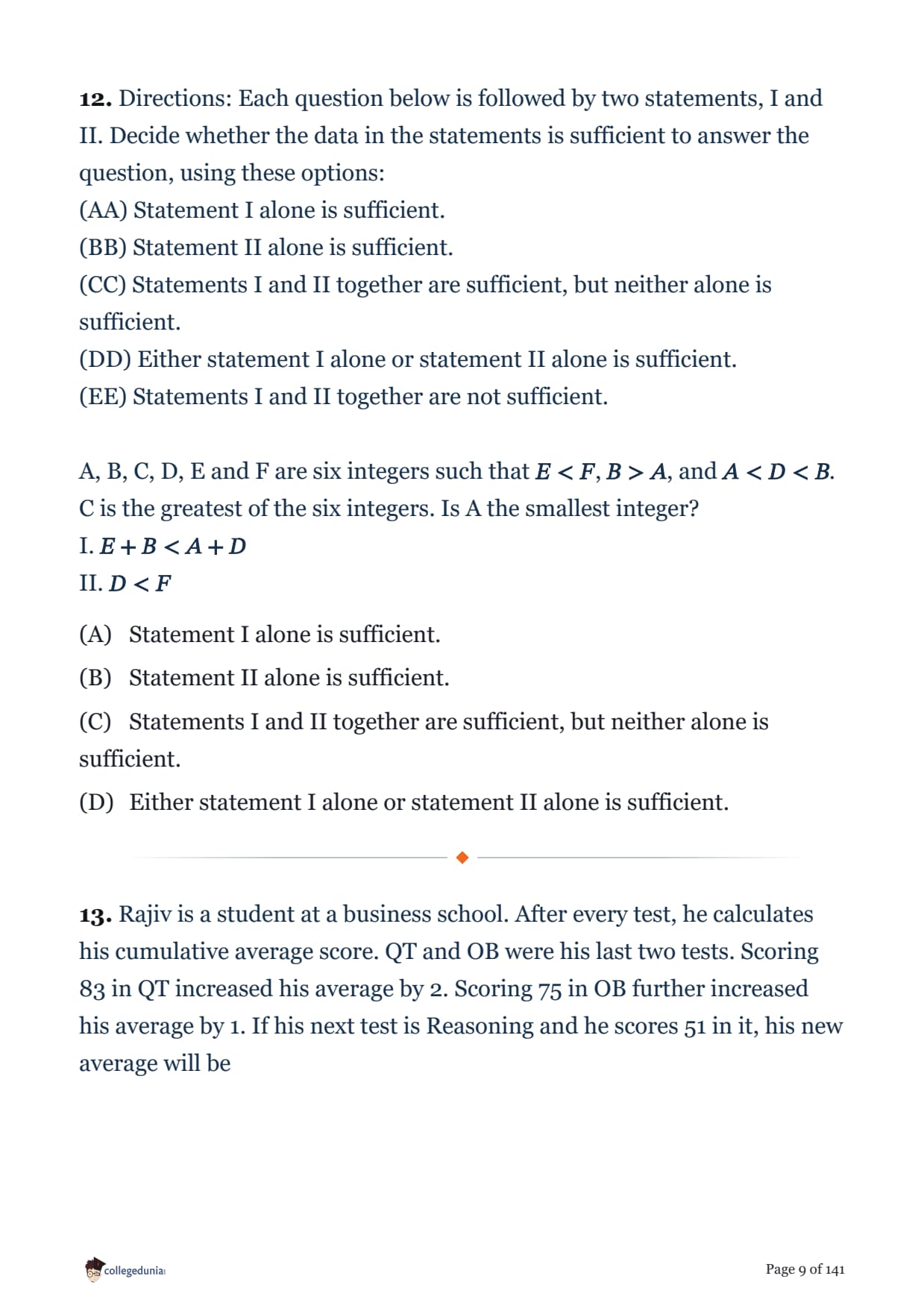
Directions: Each question below is followed by two statements, I and II. Decide whether the data in the statements is sufficient to answer the question, using these options:
(AA) Statement I alone is sufficient.
(BB) Statement II alone is sufficient.
(CC) Statements I and II together are sufficient, but neither alone is sufficient.
(DD) Either statement I alone or statement II alone is sufficient.
(EE) Statements I and II together are not sufficient.
The base of a triangle is 60 cm, and one of its base angles is \(60^{\circ}\). What is the length of the shortest side of the triangle?
I. The sum of the lengths of the other two sides is 80 cm.
II. The other base angle is \(45^{\circ}\).
Directions: Each question below is followed by two statements, I and II. Decide whether the data in the statements is sufficient to answer the question, using these options:
(AA) Statement I alone is sufficient.
(BB) Statement II alone is sufficient.
(CC) Statements I and II together are sufficient, but neither alone is sufficient.
(DD) Either statement I alone or statement II alone is sufficient.
(EE) Statements I and II together are not sufficient.
A, B, C, D, E and F are six integers such that \(E < F\), \(B > A\), and \(A < D < B\). C is the greatest of the six integers. Is A the smallest integer?
I. \(E + B < A + D\)
II. \(D < F\)
Rajiv is a student at a business school. After every test, he calculates his cumulative average score. QT and OB were his last two tests. Scoring 83 in QT increased his average by 2. Scoring 75 in OB further increased his average by 1. If his next test is Reasoning and he scores 51 in it, his new average will be
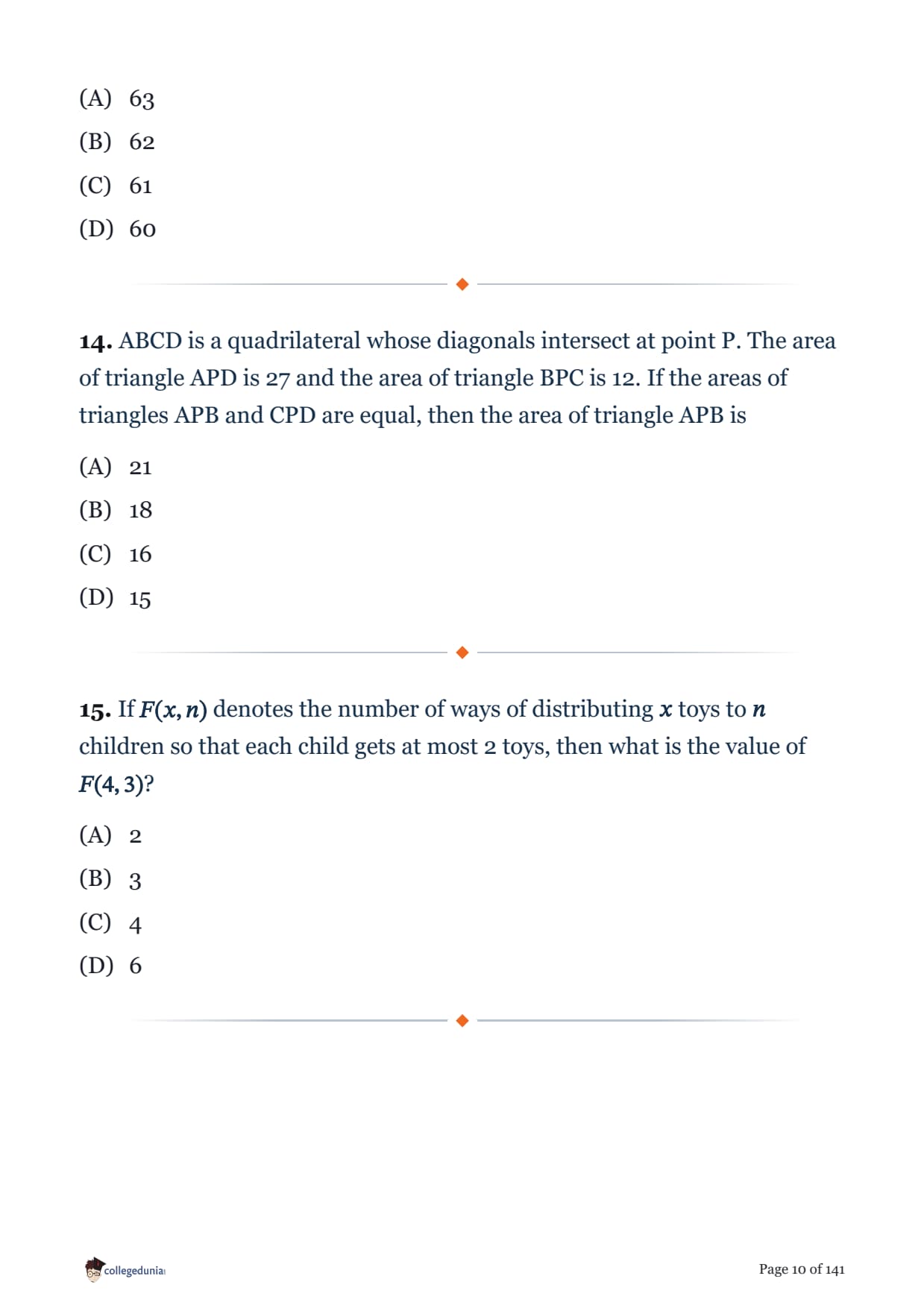
ABCD is a quadrilateral whose diagonals intersect at point P. The area of triangle APD is 27 and the area of triangle BPC is 12. If the areas of triangles APB and CPD are equal, then the area of triangle APB is
If \(F(x, n)\) denotes the number of ways of distributing \(x\) toys to \(n\) children so that each child gets at most 2 toys, then what is the value of \(F(4, 3)\)?
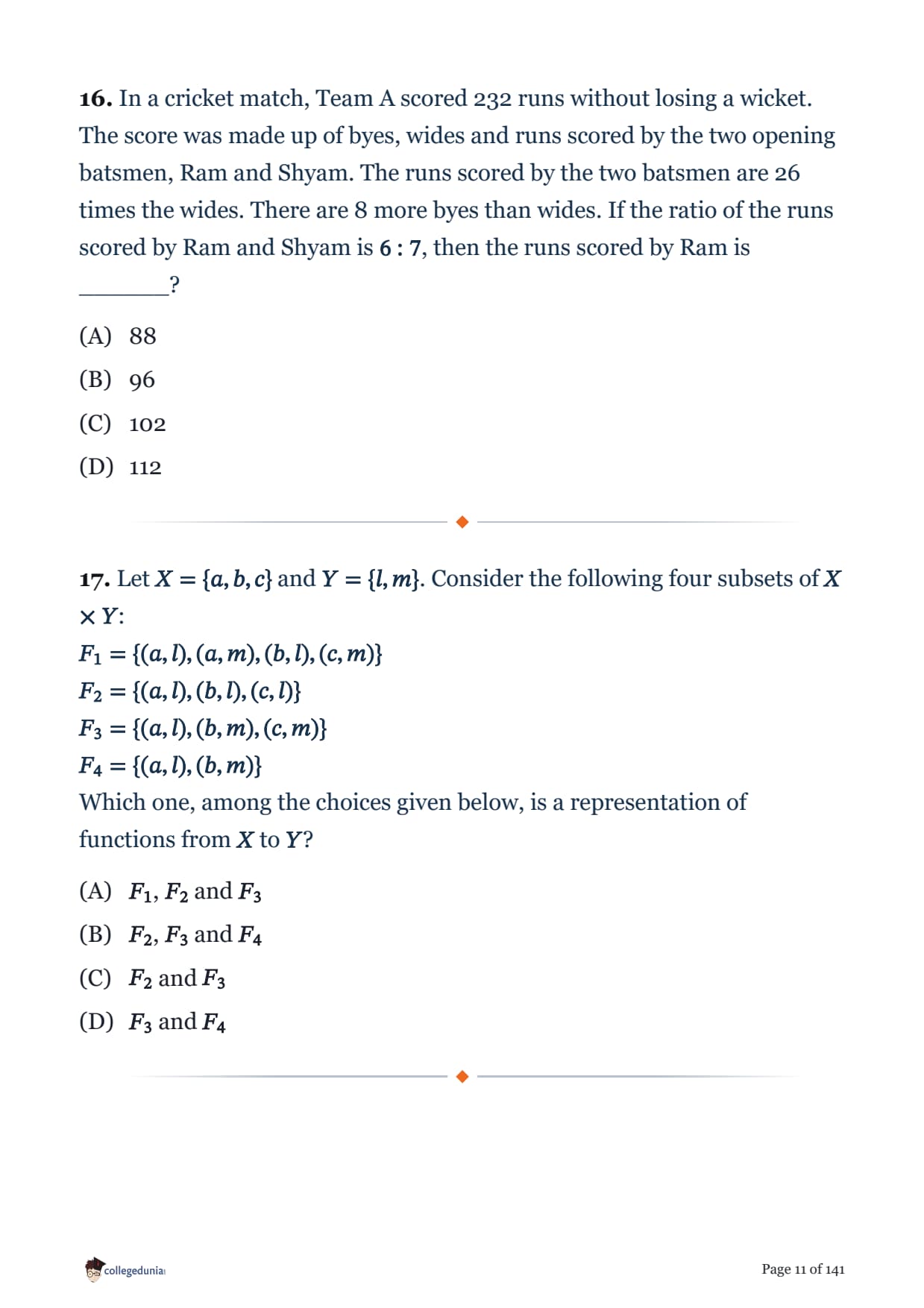
In a cricket match, Team A scored 232 runs without losing a wicket. The score was made up of byes, wides and runs scored by the two opening batsmen, Ram and Shyam. The runs scored by the two batsmen are 26 times the wides. There are 8 more byes than wides. If the ratio of the runs scored by Ram and Shyam is \(6:7\), then the runs scored by Ram is ______?
Let \(X = \{a, b, c\}\) and \(Y = \{l, m\}\). Consider the following four subsets of \(X \times Y\):
\(F_1 = \{(a, l), (a, m), (b, l), (c, m)\}\)
\(F_2 = \{(a, l), (b, l), (c, l)\}\)
\(F_3 = \{(a, l), (b, m), (c, m)\}\)
\(F_4 = \{(a, l), (b, m)\}\)
Which one, among the choices given below, is a representation of functions from \(X\) to \(Y\)?
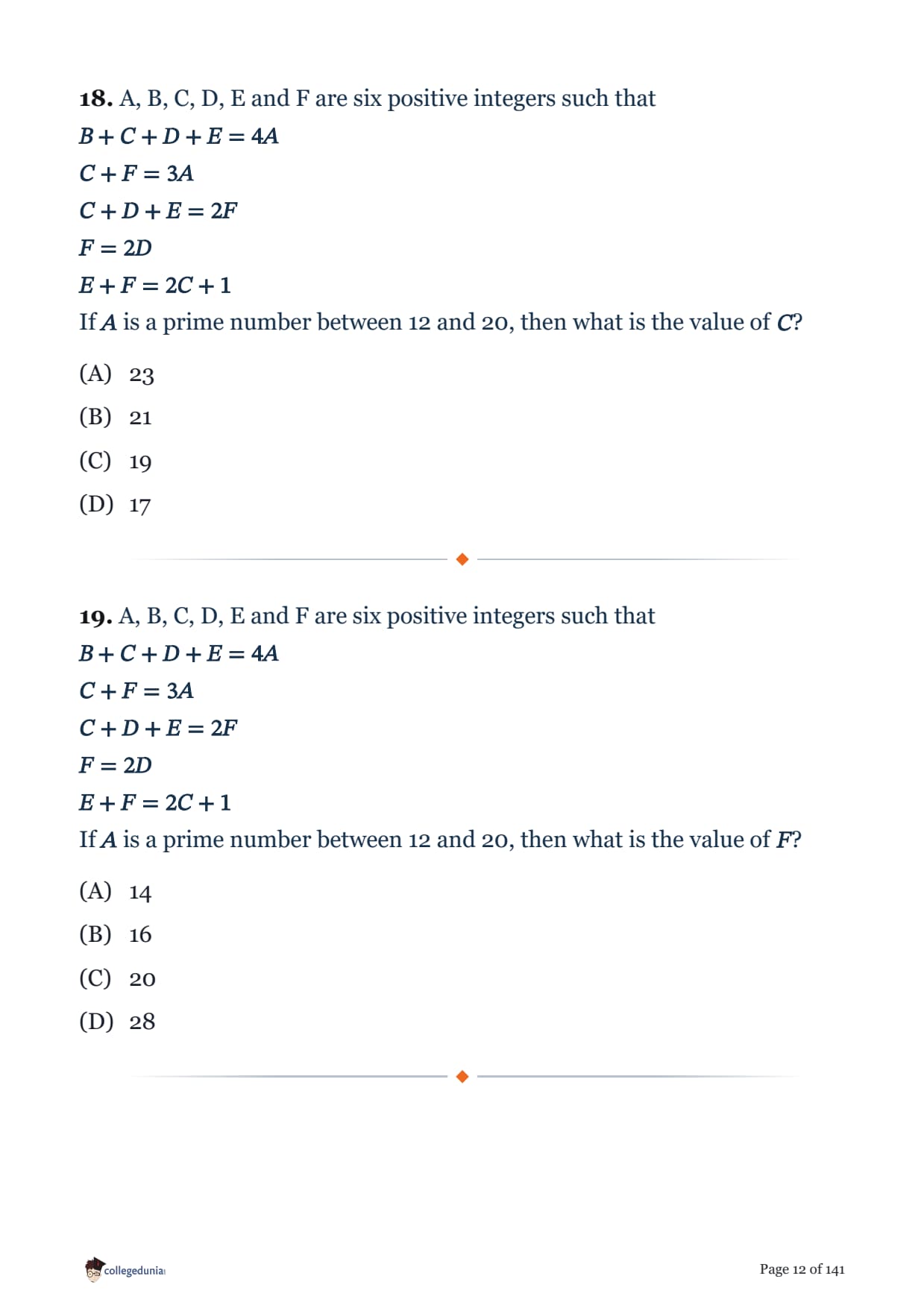
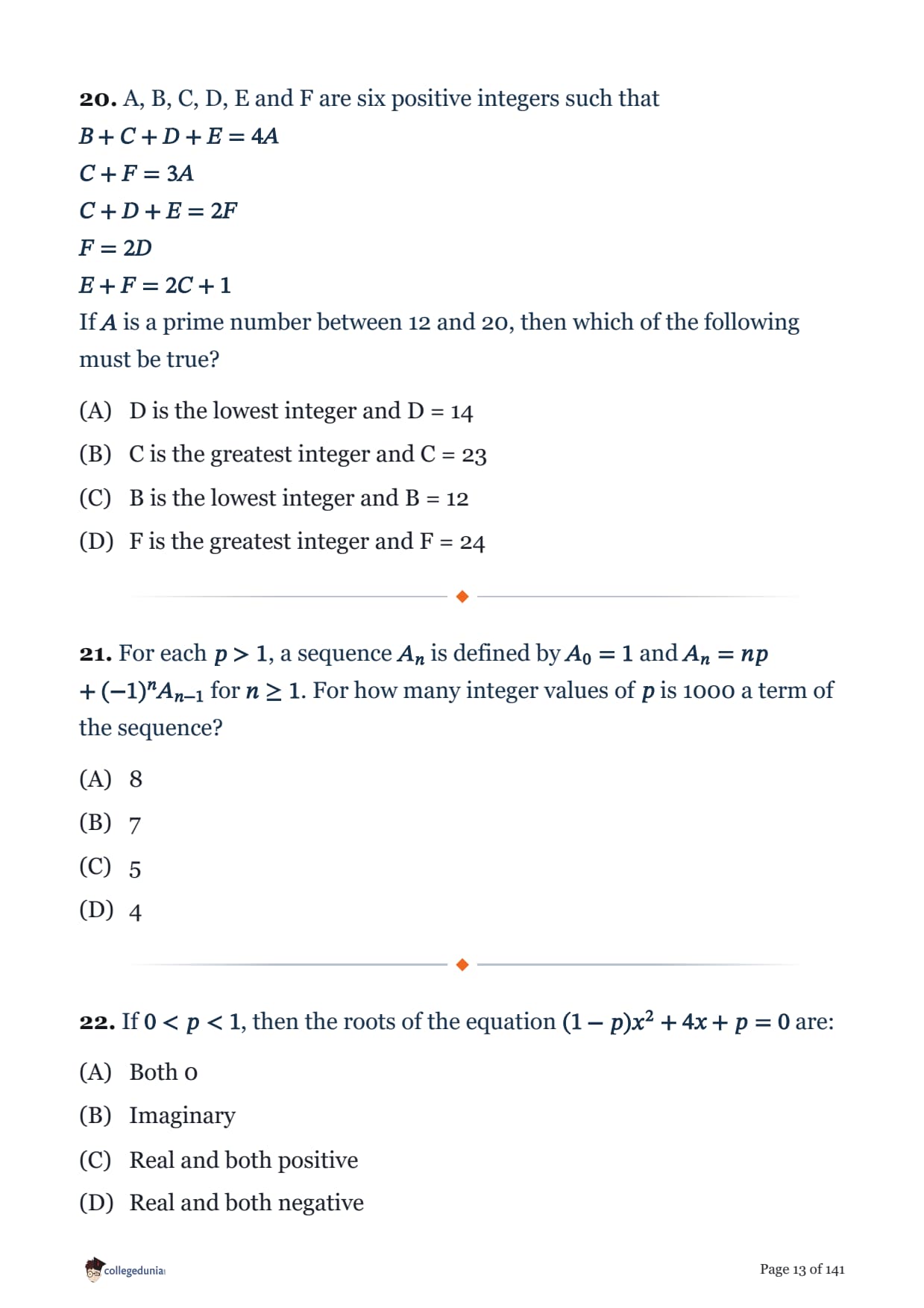
A, B, C, D, E and F are six positive integers such that
\(B + C + D + E = 4A\)
\(C + F = 3A\)
\(C + D + E = 2F\)
\(F = 2D\)
\(E + F = 2C + 1\)
If \(A\) is a prime number between 12 and 20, then what is the value of \(C\)?
A, B, C, D, E and F are six positive integers such that
\(B + C + D + E = 4A\)
\(C + F = 3A\)
\(C + D + E = 2F\)
\(F = 2D\)
\(E + F = 2C + 1\)
If \(A\) is a prime number between 12 and 20, then what is the value of \(F\)?
A, B, C, D, E and F are six positive integers such that
\(B + C + D + E = 4A\)
\(C + F = 3A\)
\(C + D + E = 2F\)
\(F = 2D\)
\(E + F = 2C + 1\)
If \(A\) is a prime number between 12 and 20, then which of the following must be true?
For each \(p > 1\), a sequence \(A_n\) is defined by \(A_0 = 1\) and \(A_n = np + (-1)^n A_{n-1}\) for \(n \geq 1\). For how many integer values of \(p\) is 1000 a term of the sequence?
If \(0 < p < 1\), then the roots of the equation \((1-p)x^2 + 4x + p = 0\) are:
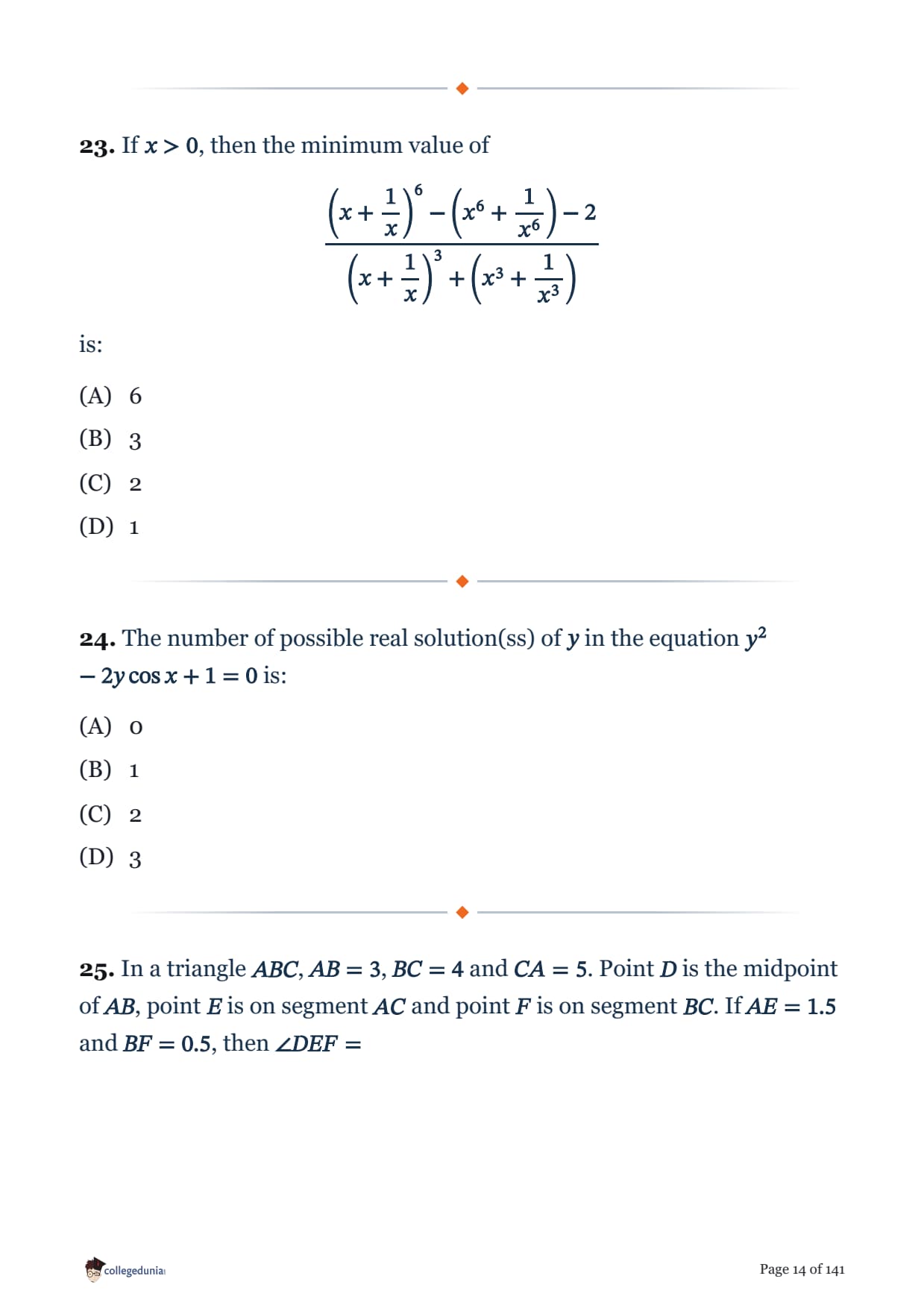
If \(x>0\), then the minimum value of \[ \dfrac{\left(x+\dfrac{1}{x}\right)^6 - \left(x^6+\dfrac{1}{x^6}\right) - 2}{\left(x+\dfrac{1}{x}\right)^3 + \left(x^3+\dfrac{1}{x^3}\right)} \] is:
The number of possible real solution(ss) of \(y\) in the equation \(y^2 - 2y\cos x + 1 = 0\) is:
In a triangle \(ABC\), \(AB=3\), \(BC=4\) and \(CA=5\). Point \(D\) is the midpoint of \(AB\), point \(E\) is on segment \(AC\) and point \(F\) is on segment \(BC\). If \(AE=1.5\) and \(BF=0.5\), then \(\angle DEF =\)
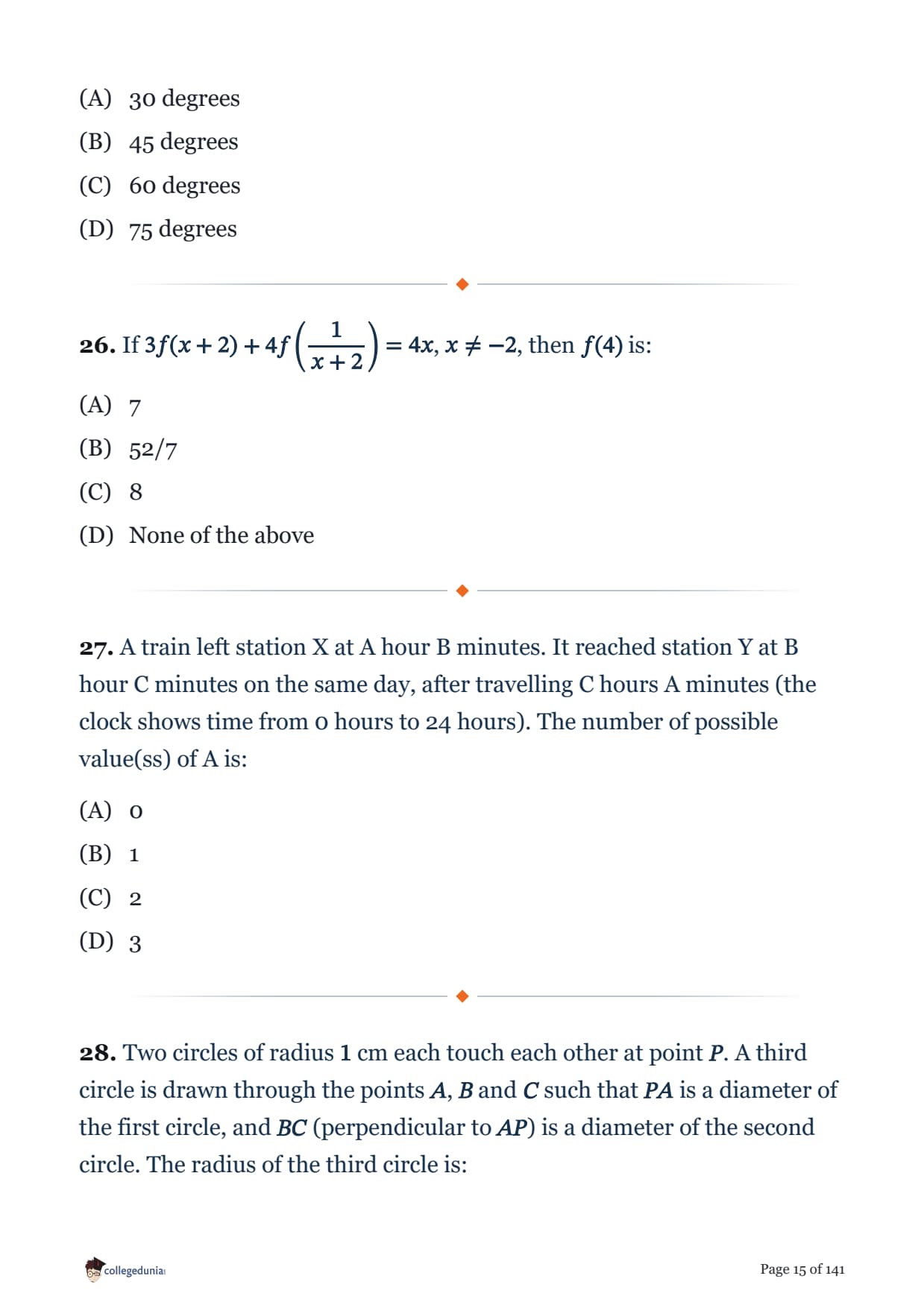
If \(3f(x+2)+4f\left(\dfrac{1}{x+2}\right)=4x\), \(x\neq-2\), then \(f(4)\) is:
A train left station X at A hour B minutes. It reached station Y at B hour C minutes on the same day, after travelling C hours A minutes (the clock shows time from 0 hours to 24 hours). The number of possible value(ss) of A is:
Two circles of radius \(1\) cm each touch each other at point \(P\). A third circle is drawn through the points \(A\), \(B\) and \(C\) such that \(PA\) is a diameter of the first circle, and \(BC\) (perpendicular to \(AP\)) is a diameter of the second circle. The radius of the third circle is:
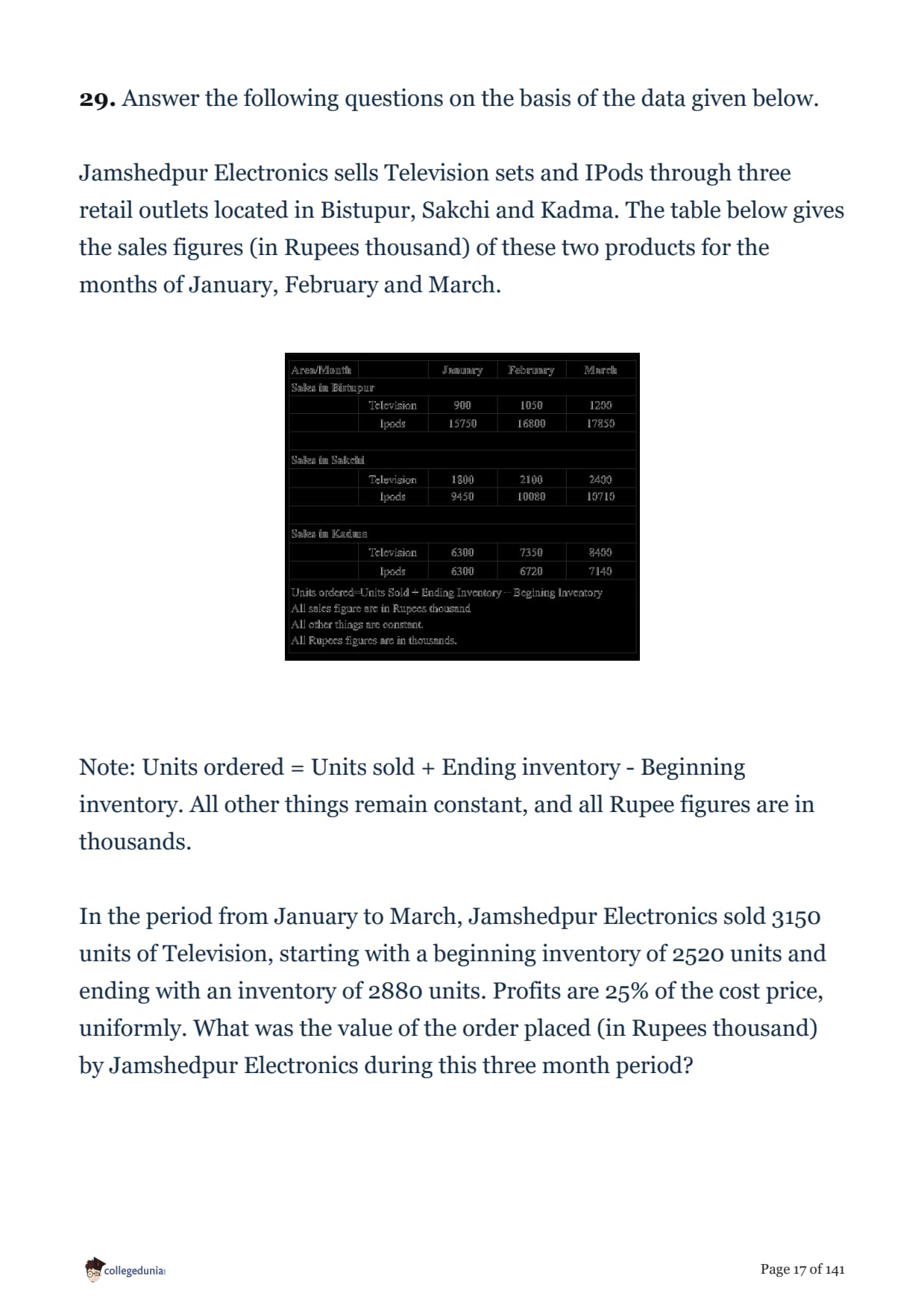
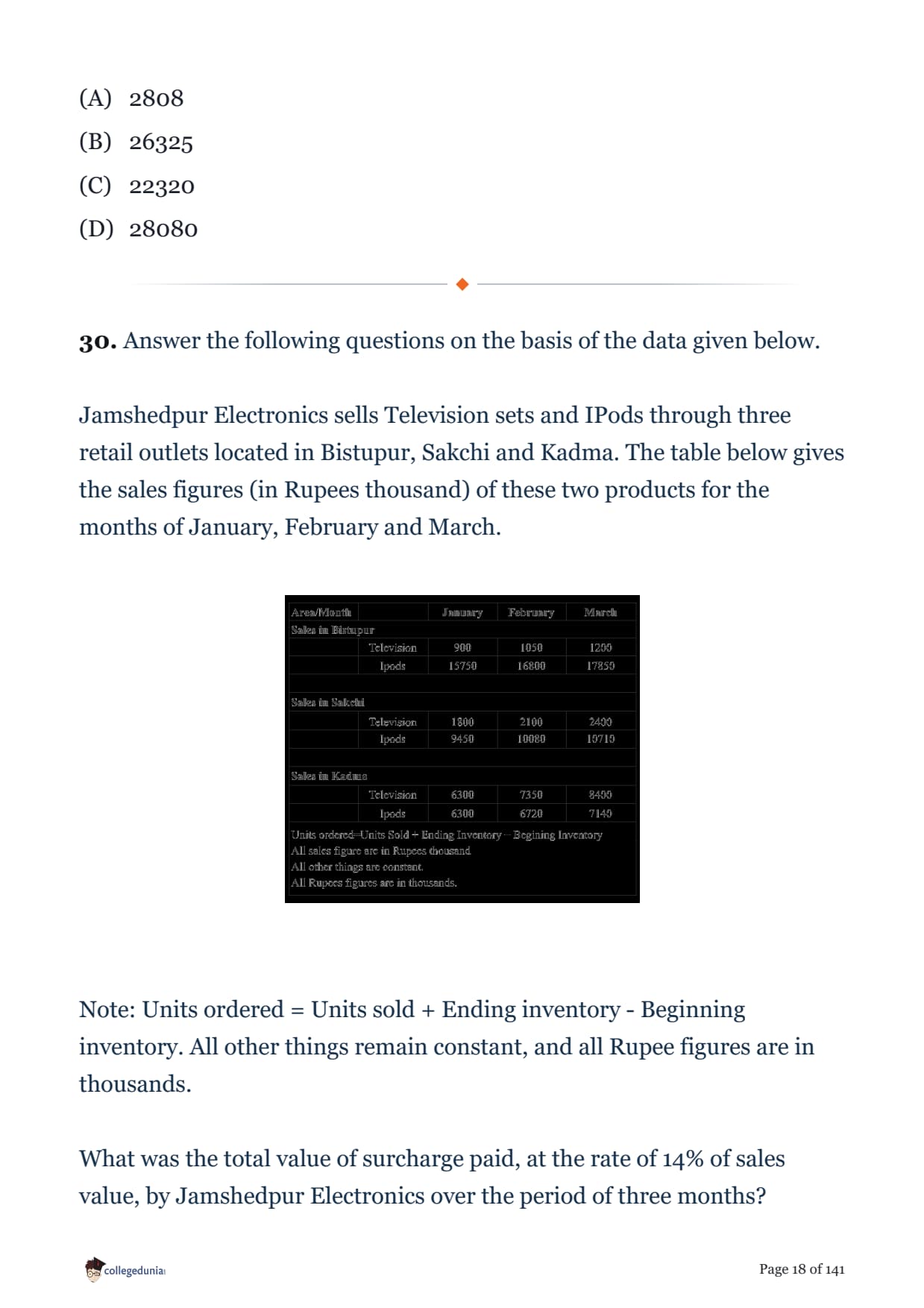
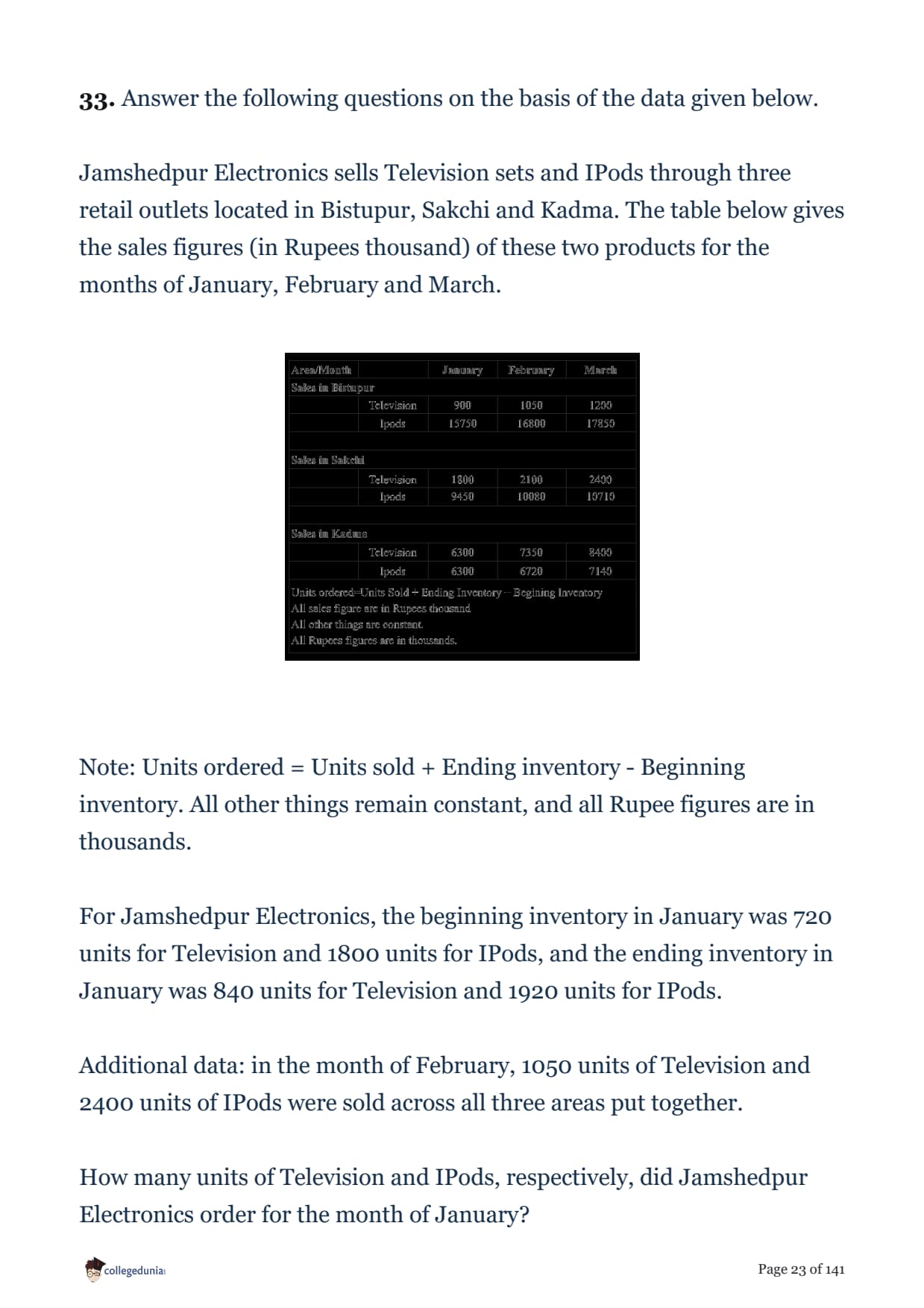
Answer the following questions on the basis of the data given below.
Jamshedpur Electronics sells Television sets and IPods through three retail outlets located in Bistupur, Sakchi and Kadma. The table below gives the sales figures (in Rupees thousand) of these two products for the months of January, February and March.
Note: Units ordered = Units sold + Ending inventory - Beginning inventory. All other things remain constant, and all Rupee figures are in thousands.
In the period from January to March, Jamshedpur Electronics sold 3150 units of Television, starting with a beginning inventory of 2520 units and ending with an inventory of 2880 units. Profits are 25% of the cost price, uniformly. What was the value of the order placed (in Rupees thousand) by Jamshedpur Electronics during this three month period?
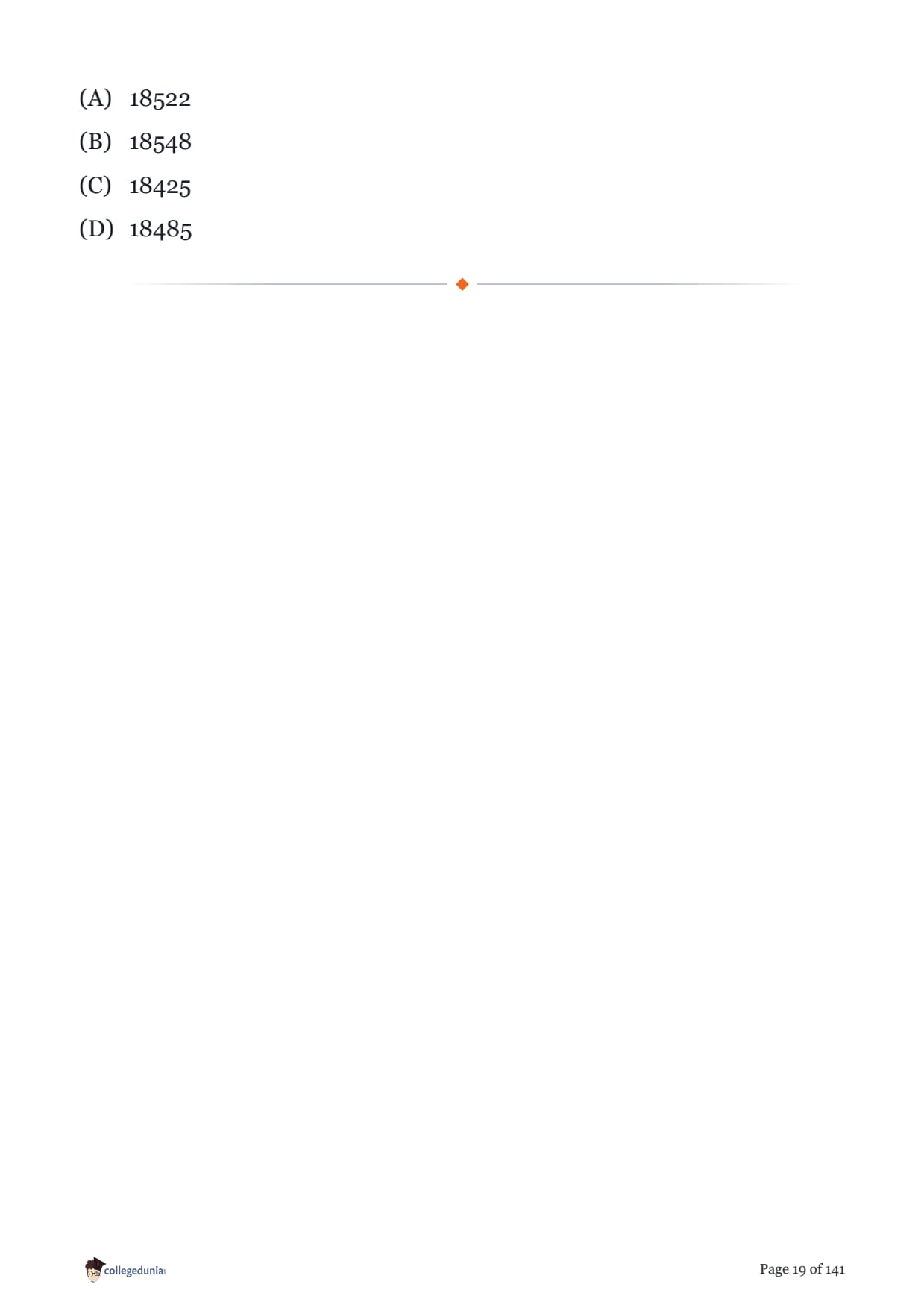
Answer the following questions on the basis of the data given below.
Jamshedpur Electronics sells Television sets and IPods through three retail outlets located in Bistupur, Sakchi and Kadma. The table below gives the sales figures (in Rupees thousand) of these two products for the months of January, February and March.
Note: Units ordered = Units sold + Ending inventory - Beginning inventory. All other things remain constant, and all Rupee figures are in thousands.
What was the total value of surcharge paid, at the rate of 14% of sales value, by Jamshedpur Electronics over the period of three months?
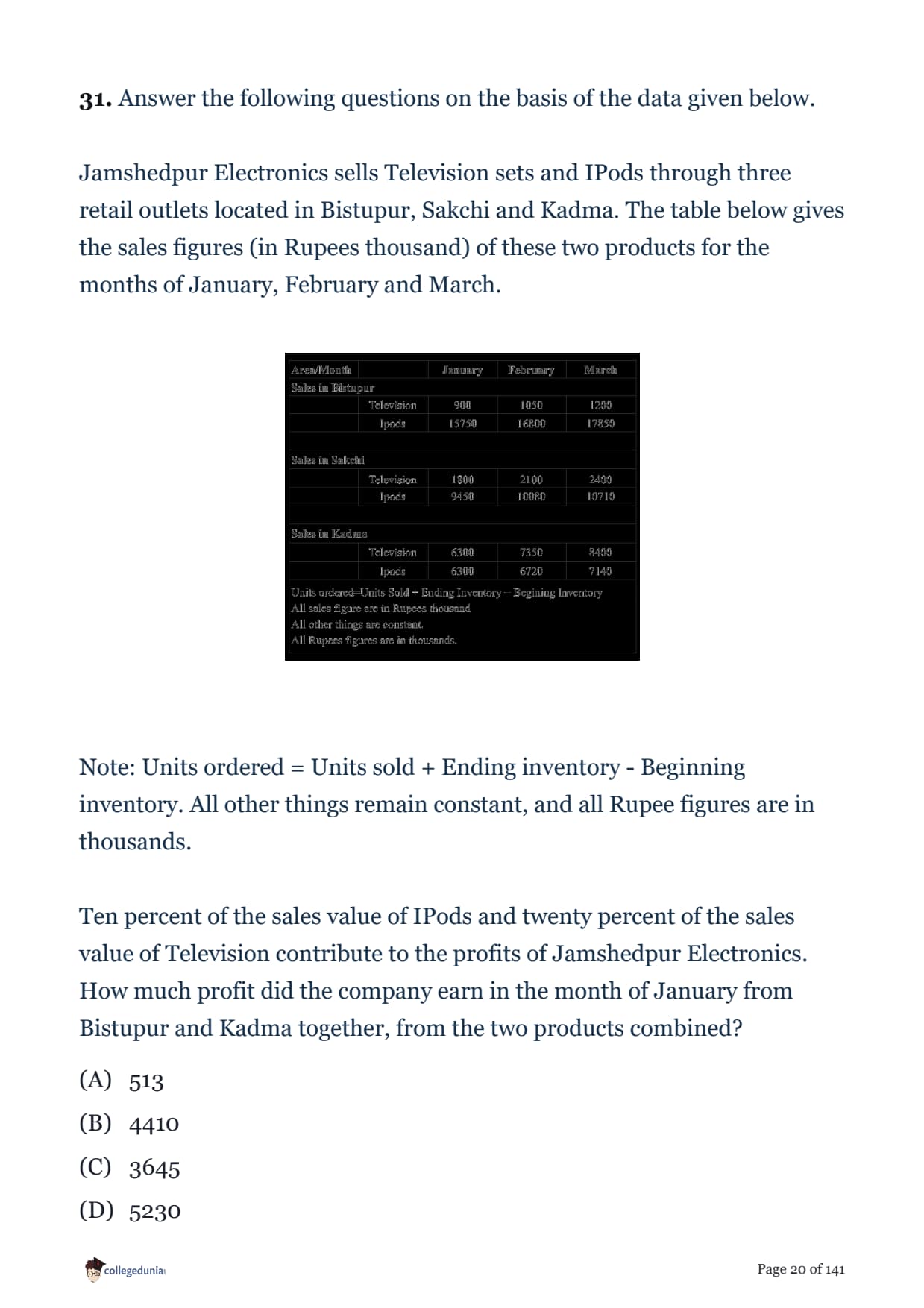
Answer the following questions on the basis of the data given below.
Jamshedpur Electronics sells Television sets and IPods through three retail outlets located in Bistupur, Sakchi and Kadma. The table below gives the sales figures (in Rupees thousand) of these two products for the months of January, February and March.
Note: Units ordered = Units sold + Ending inventory - Beginning inventory. All other things remain constant, and all Rupee figures are in thousands.
Ten percent of the sales value of IPods and twenty percent of the sales value of Television contribute to the profits of Jamshedpur Electronics. How much profit did the company earn in the month of January from Bistupur and Kadma together, from the two products combined?
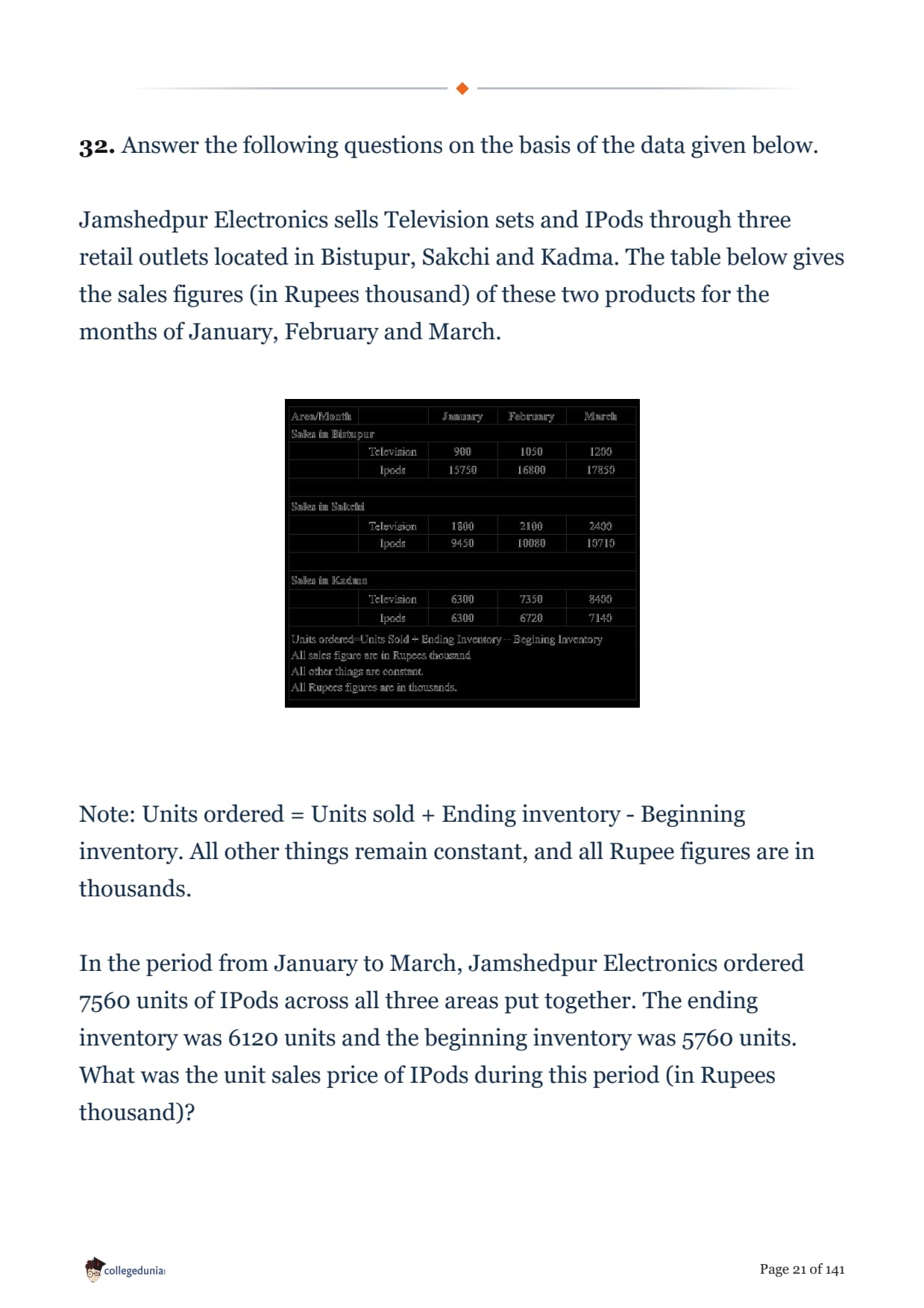
Answer the following questions on the basis of the data given below.
Jamshedpur Electronics sells Television sets and IPods through three retail outlets located in Bistupur, Sakchi and Kadma. The table below gives the sales figures (in Rupees thousand) of these two products for the months of January, February and March.
Note: Units ordered = Units sold + Ending inventory - Beginning inventory. All other things remain constant, and all Rupee figures are in thousands.
In the period from January to March, Jamshedpur Electronics ordered 7560 units of IPods across all three areas put together. The ending inventory was 6120 units and the beginning inventory was 5760 units. What was the unit sales price of IPods during this period (in Rupees thousand)?
Answer the following questions on the basis of the data given below.
Jamshedpur Electronics sells Television sets and IPods through three retail outlets located in Bistupur, Sakchi and Kadma. The table below gives the sales figures (in Rupees thousand) of these two products for the months of January, February and March.
Note: Units ordered = Units sold + Ending inventory - Beginning inventory. All other things remain constant, and all Rupee figures are in thousands.
For Jamshedpur Electronics, the beginning inventory in January was 720 units for Television and 1800 units for IPods, and the ending inventory in January was 840 units for Television and 1920 units for IPods.
Additional data: in the month of February, 1050 units of Television and 2400 units of IPods were sold across all three areas put together.
How many units of Television and IPods, respectively, did Jamshedpur Electronics order for the month of January?
Consider a sequence -6, -12, 48, 24, -30, -36, 42, ... continuing in the same style. If the sum of the first n terms of the sequence is 132, what is the value of n?
The coordinates of P and Q are (0, 4) and (a, 6), respectively, where a is a non-zero integer. R is the midpoint of PQ. The perpendicular bisector of PQ cuts the X-axis at the point S(b, 0). For how many integer values of a is b also an integer?
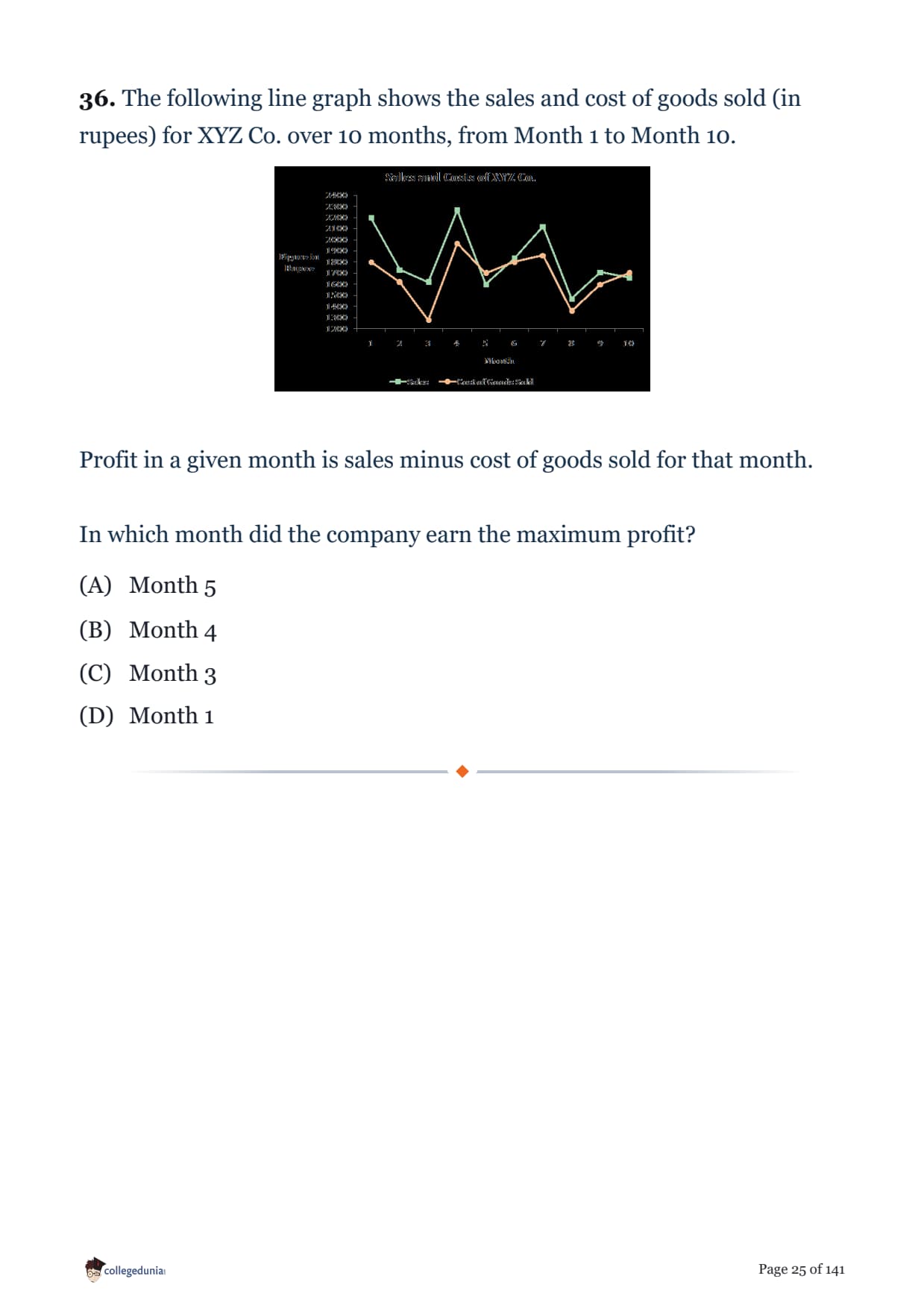
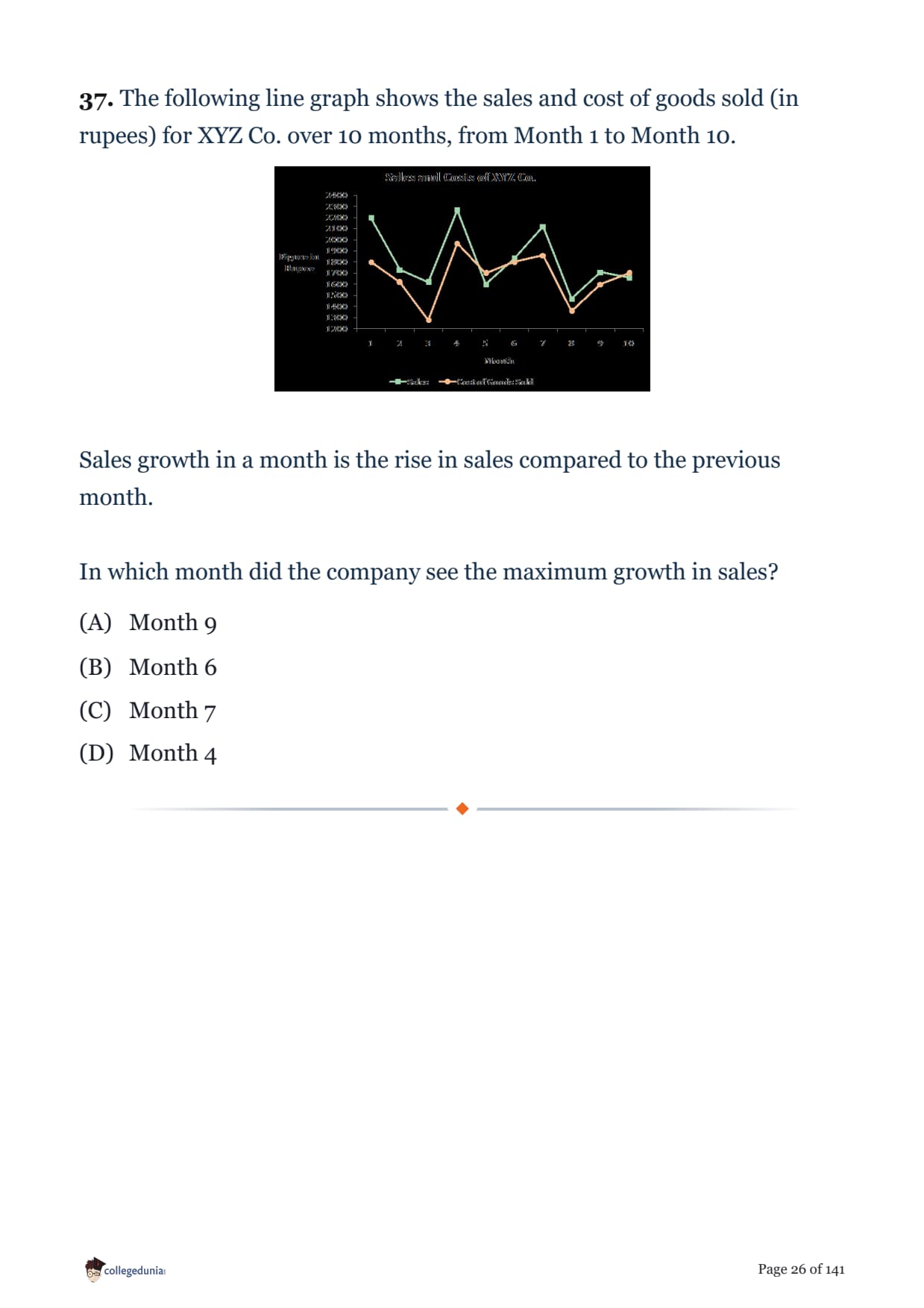
The following line graph shows the sales and cost of goods sold (in rupees) for XYZ Co. over 10 months, from Month 1 to Month 10.
Profit in a given month is sales minus cost of goods sold for that month.
In which month did the company earn the maximum profit?
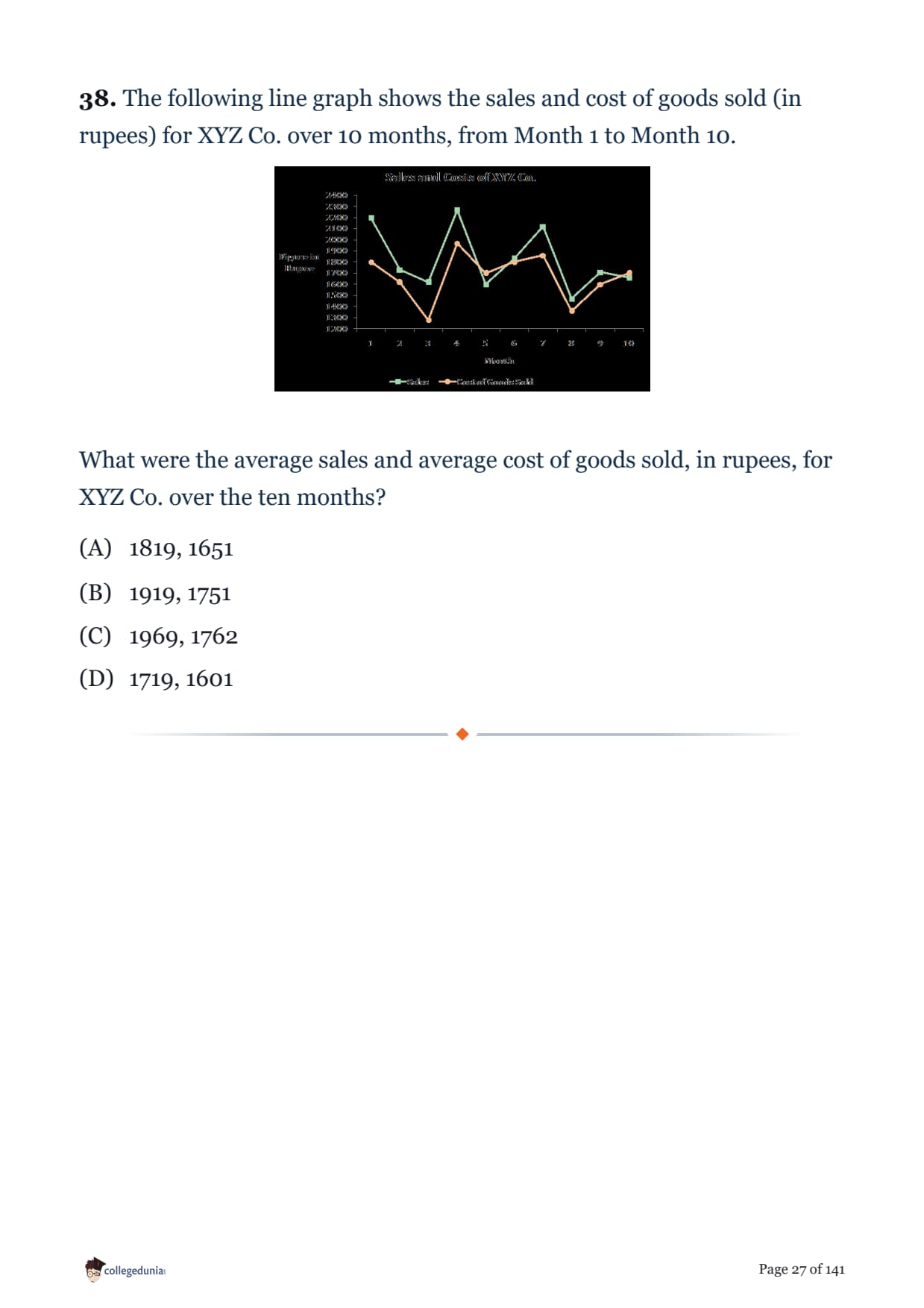
The following line graph shows the sales and cost of goods sold (in rupees) for XYZ Co. over 10 months, from Month 1 to Month 10.
Sales growth in a month is the rise in sales compared to the previous month.
In which month did the company see the maximum growth in sales?
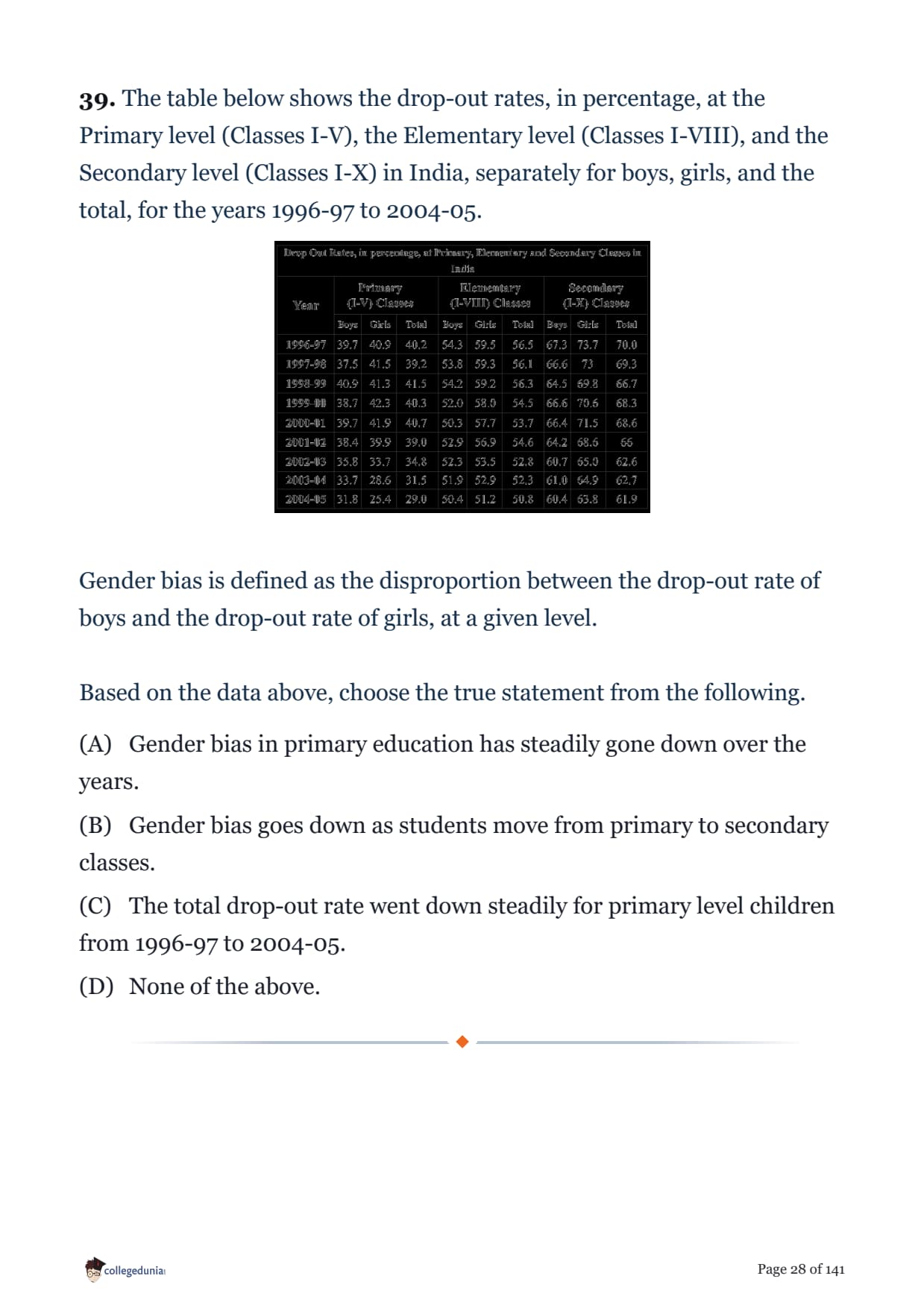
The following line graph shows the sales and cost of goods sold (in rupees) for XYZ Co. over 10 months, from Month 1 to Month 10.
What were the average sales and average cost of goods sold, in rupees, for XYZ Co. over the ten months?
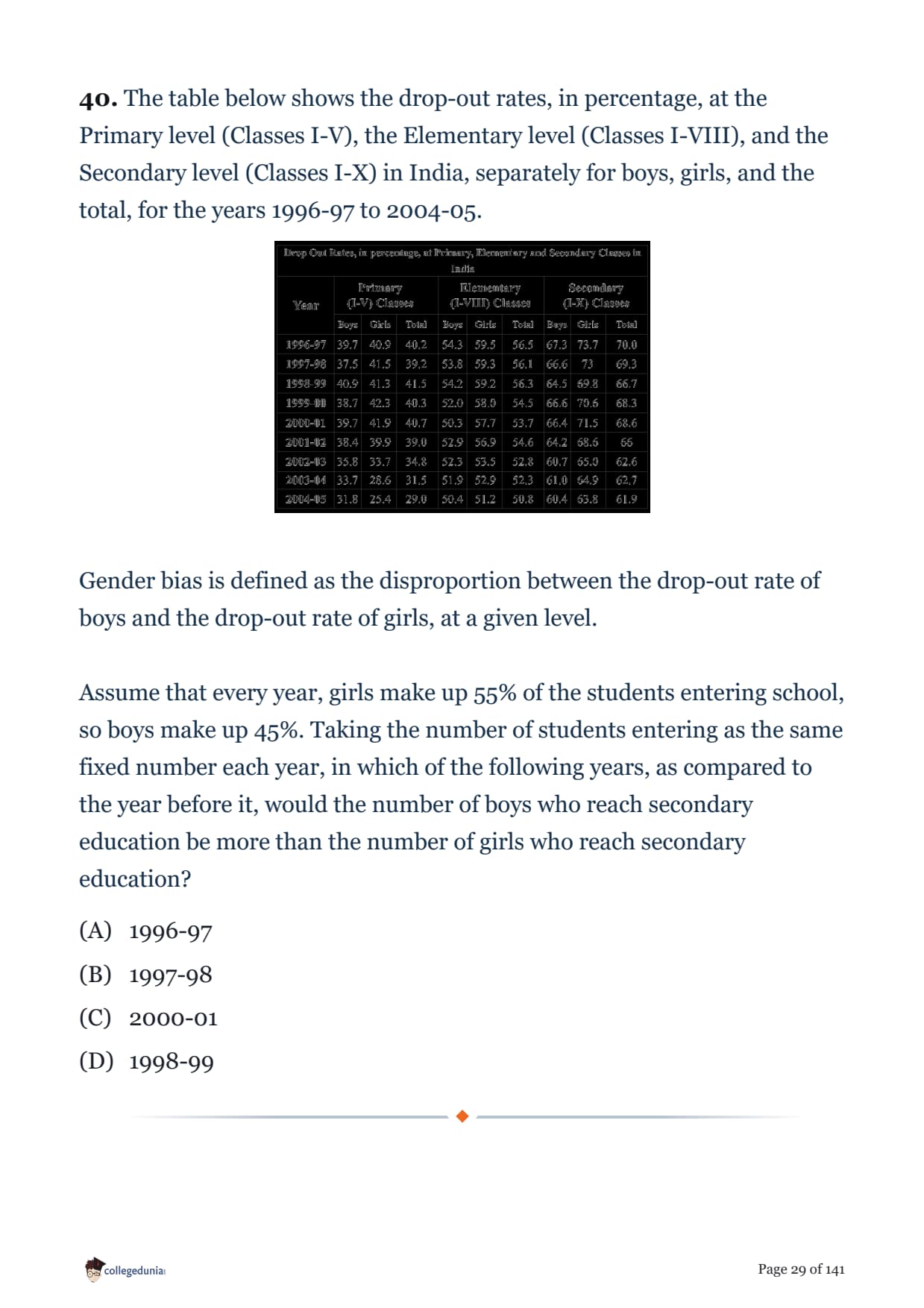
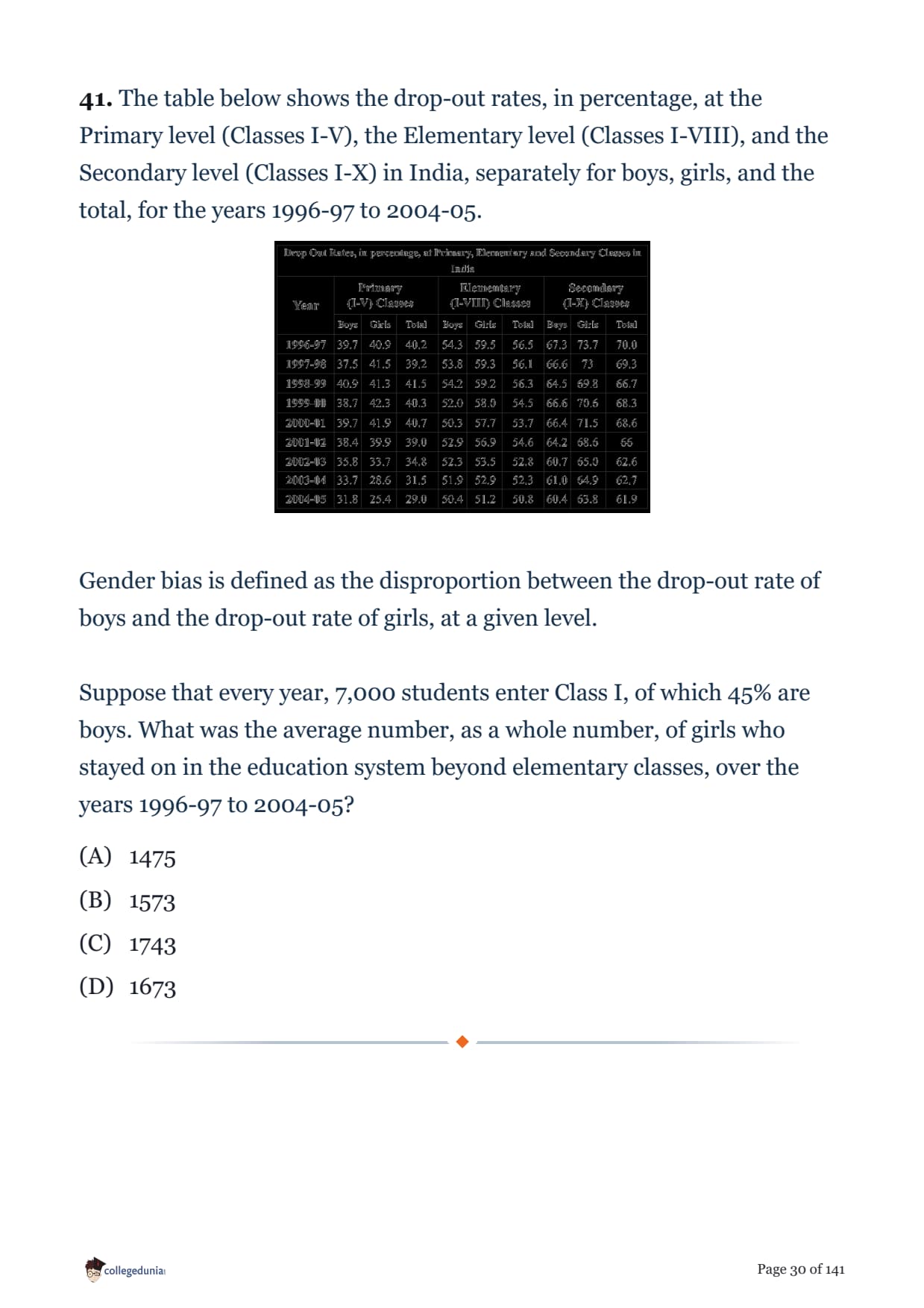
The table below shows the drop-out rates, in percentage, at the Primary level (Classes I-V), the Elementary level (Classes I-VIII), and the Secondary level (Classes I-X) in India, separately for boys, girls, and the total, for the years 1996-97 to 2004-05.
Gender bias is defined as the disproportion between the drop-out rate of boys and the drop-out rate of girls, at a given level.
Based on the data above, choose the true statement from the following.
The table below shows the drop-out rates, in percentage, at the Primary level (Classes I-V), the Elementary level (Classes I-VIII), and the Secondary level (Classes I-X) in India, separately for boys, girls, and the total, for the years 1996-97 to 2004-05.
Gender bias is defined as the disproportion between the drop-out rate of boys and the drop-out rate of girls, at a given level.
Assume that every year, girls make up 55% of the students entering school, so boys make up 45%. Taking the number of students entering as the same fixed number each year, in which of the following years, as compared to the year before it, would the number of boys who reach secondary education be more than the number of girls who reach secondary education?
The table below shows the drop-out rates, in percentage, at the Primary level (Classes I-V), the Elementary level (Classes I-VIII), and the Secondary level (Classes I-X) in India, separately for boys, girls, and the total, for the years 1996-97 to 2004-05.
Gender bias is defined as the disproportion between the drop-out rate of boys and the drop-out rate of girls, at a given level.
Suppose that every year, 7,000 students enter Class I, of which 45% are boys. What was the average number, as a whole number, of girls who stayed on in the education system beyond elementary classes, over the years 1996-97 to 2004-05?
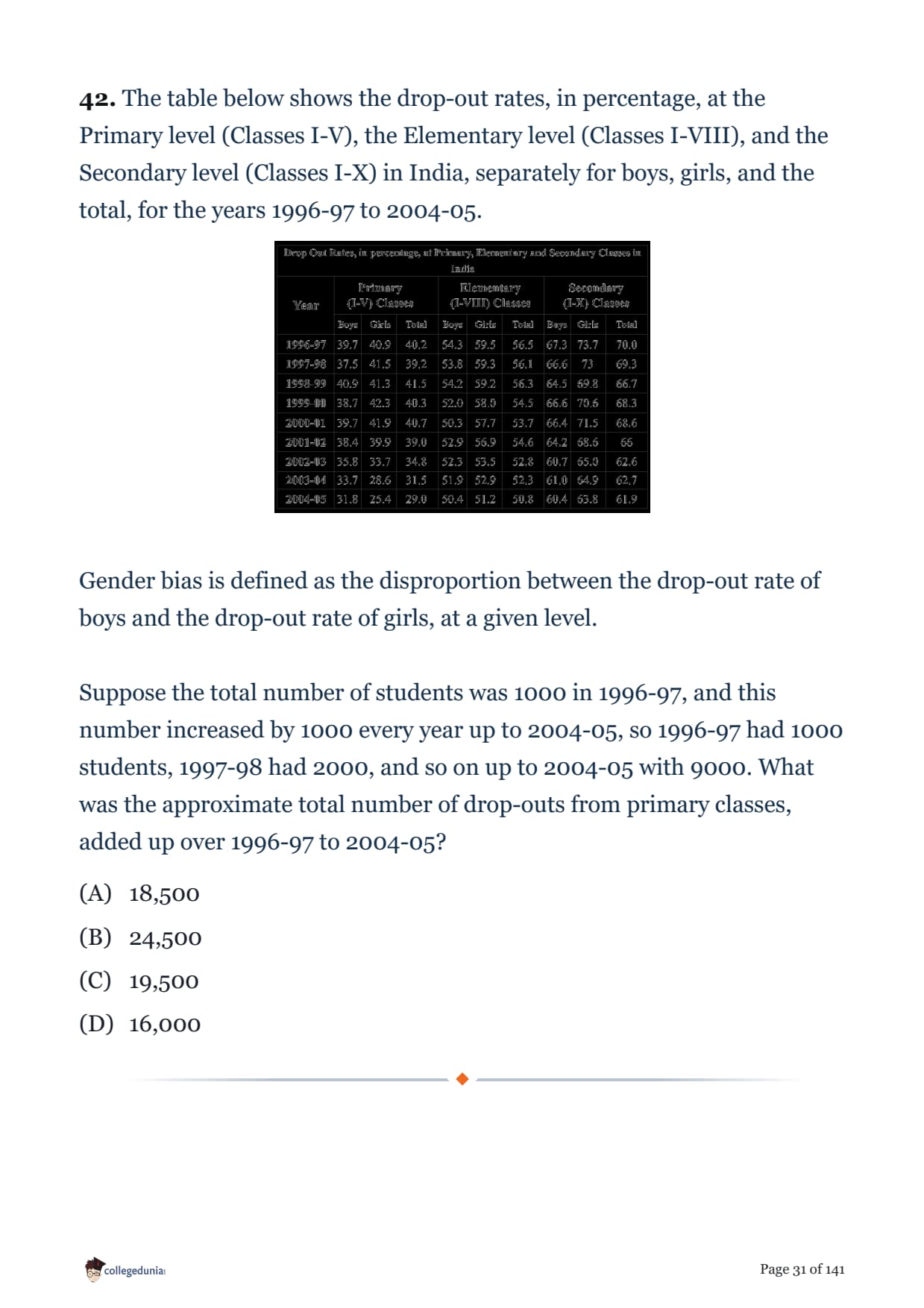
The table below shows the drop-out rates, in percentage, at the Primary level (Classes I-V), the Elementary level (Classes I-VIII), and the Secondary level (Classes I-X) in India, separately for boys, girls, and the total, for the years 1996-97 to 2004-05.
Gender bias is defined as the disproportion between the drop-out rate of boys and the drop-out rate of girls, at a given level.
Suppose the total number of students was 1000 in 1996-97, and this number increased by 1000 every year up to 2004-05, so 1996-97 had 1000 students, 1997-98 had 2000, and so on up to 2004-05 with 9000. What was the approximate total number of drop-outs from primary classes, added up over 1996-97 to 2004-05?
Questions 43 and 44 are based on the following instructions: each question gives a statement followed by three conclusions, I, II and III. Pick the option that tells you which of the three conclusions can be derived from the statement alone.
Statement: \(A_0, A_1, A_2, \ldots\) is a sequence of numbers with \(A_0 = 1\), \(A_1 = 3\), and \(A_t = (t+1)A_{t-1} - tA_{t-2}\) for \(t = 2, 3, 4, \ldots\)
Conclusion I: \(A_8 = 77\)
Conclusion II: \(A_{10} = 121\)
Conclusion III: \(A_{12} = 145\)
Questions 43 and 44 are based on the following instructions: each question gives a statement followed by three conclusions, I, II and III. Pick the option that tells you which of the three conclusions can be derived from the statement alone.
Statement: Let \(A\), \(B\), \(C\) be real numbers satisfying \(A < B < C\), \(A + B + C = 6\), and \(AB + BC + CA = 9\).
Conclusion I: \(1 < B < 3\)
Conclusion II: \(2 < A < 3\)
Conclusion III: \(0 < C < 1\)
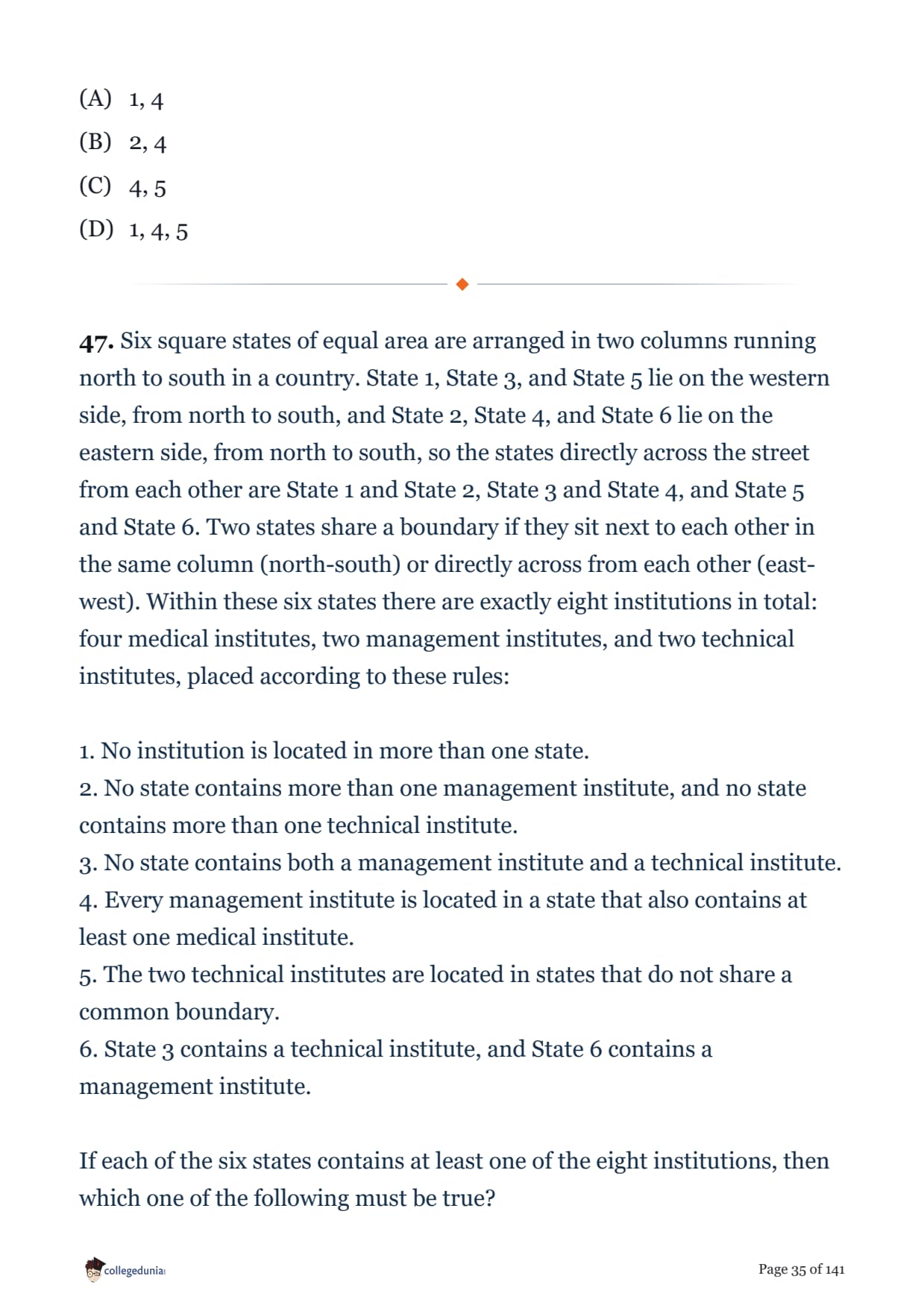
Six square states of equal area are arranged in two columns running north to south in a country. State 1, State 3, and State 5 lie on the western side, from north to south, and State 2, State 4, and State 6 lie on the eastern side, from north to south, so the states directly across the street from each other are State 1 and State 2, State 3 and State 4, and State 5 and State 6. Two states share a boundary if they sit next to each other in the same column (north-south) or directly across from each other (east-west). Within these six states there are exactly eight institutions in total: four medical institutes, two management institutes, and two technical institutes, placed according to these rules:
1. No institution is located in more than one state.
2. No state contains more than one management institute, and no state contains more than one technical institute.
3. No state contains both a management institute and a technical institute.
4. Every management institute is located in a state that also contains at least one medical institute.
5. The two technical institutes are located in states that do not share a common boundary.
6. State 3 contains a technical institute, and State 6 contains a management institute.
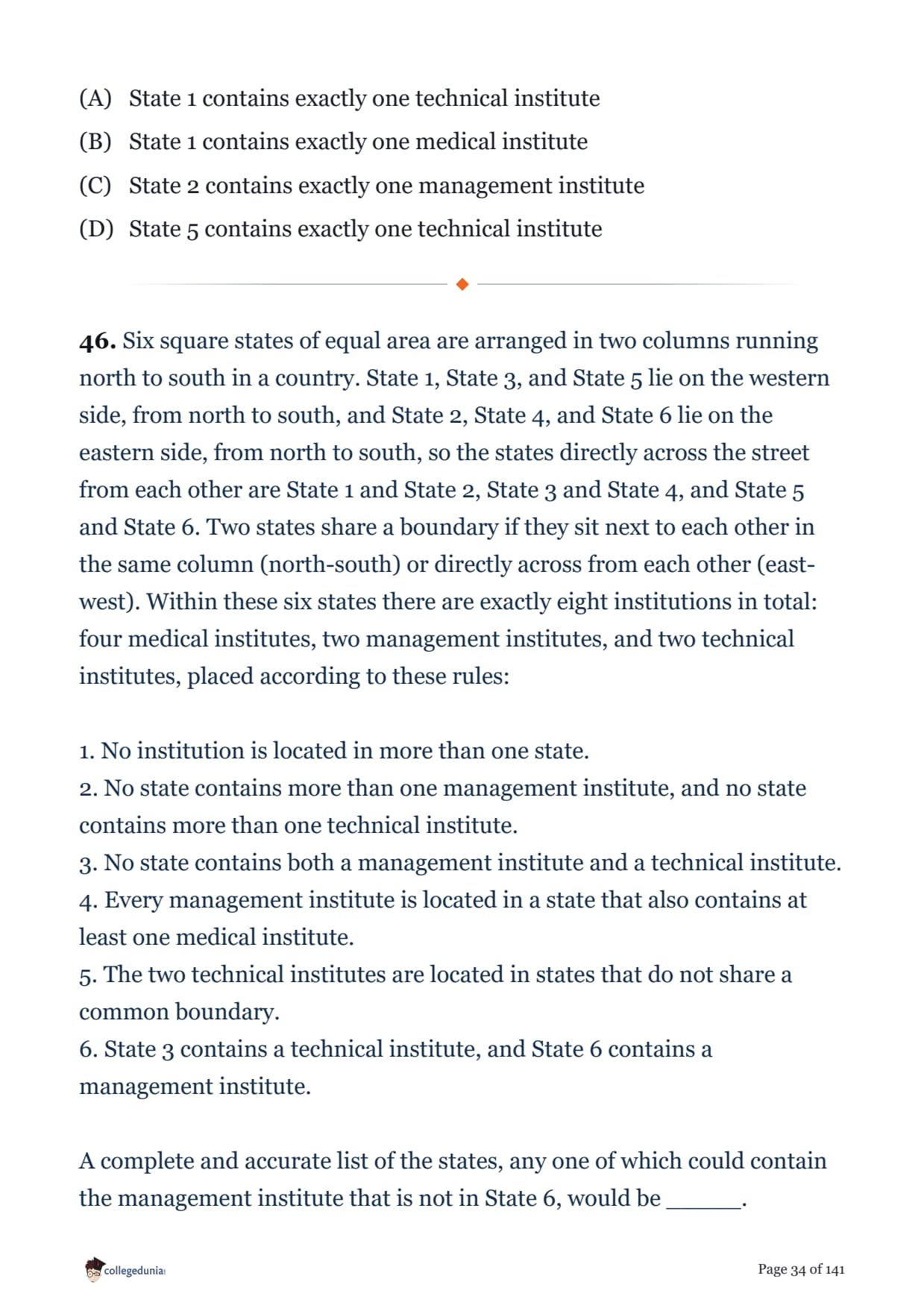
Which one of the following could be true?
Six square states of equal area are arranged in two columns running north to south in a country. State 1, State 3, and State 5 lie on the western side, from north to south, and State 2, State 4, and State 6 lie on the eastern side, from north to south, so the states directly across the street from each other are State 1 and State 2, State 3 and State 4, and State 5 and State 6. Two states share a boundary if they sit next to each other in the same column (north-south) or directly across from each other (east-west). Within these six states there are exactly eight institutions in total: four medical institutes, two management institutes, and two technical institutes, placed according to these rules:
1. No institution is located in more than one state.
2. No state contains more than one management institute, and no state contains more than one technical institute.
3. No state contains both a management institute and a technical institute.
4. Every management institute is located in a state that also contains at least one medical institute.
5. The two technical institutes are located in states that do not share a common boundary.
6. State 3 contains a technical institute, and State 6 contains a management institute.
A complete and accurate list of the states, any one of which could contain the management institute that is not in State 6, would be _____.
Six square states of equal area are arranged in two columns running north to south in a country. State 1, State 3, and State 5 lie on the western side, from north to south, and State 2, State 4, and State 6 lie on the eastern side, from north to south, so the states directly across the street from each other are State 1 and State 2, State 3 and State 4, and State 5 and State 6. Two states share a boundary if they sit next to each other in the same column (north-south) or directly across from each other (east-west). Within these six states there are exactly eight institutions in total: four medical institutes, two management institutes, and two technical institutes, placed according to these rules:
1. No institution is located in more than one state.
2. No state contains more than one management institute, and no state contains more than one technical institute.
3. No state contains both a management institute and a technical institute.
4. Every management institute is located in a state that also contains at least one medical institute.
5. The two technical institutes are located in states that do not share a common boundary.
6. State 3 contains a technical institute, and State 6 contains a management institute.
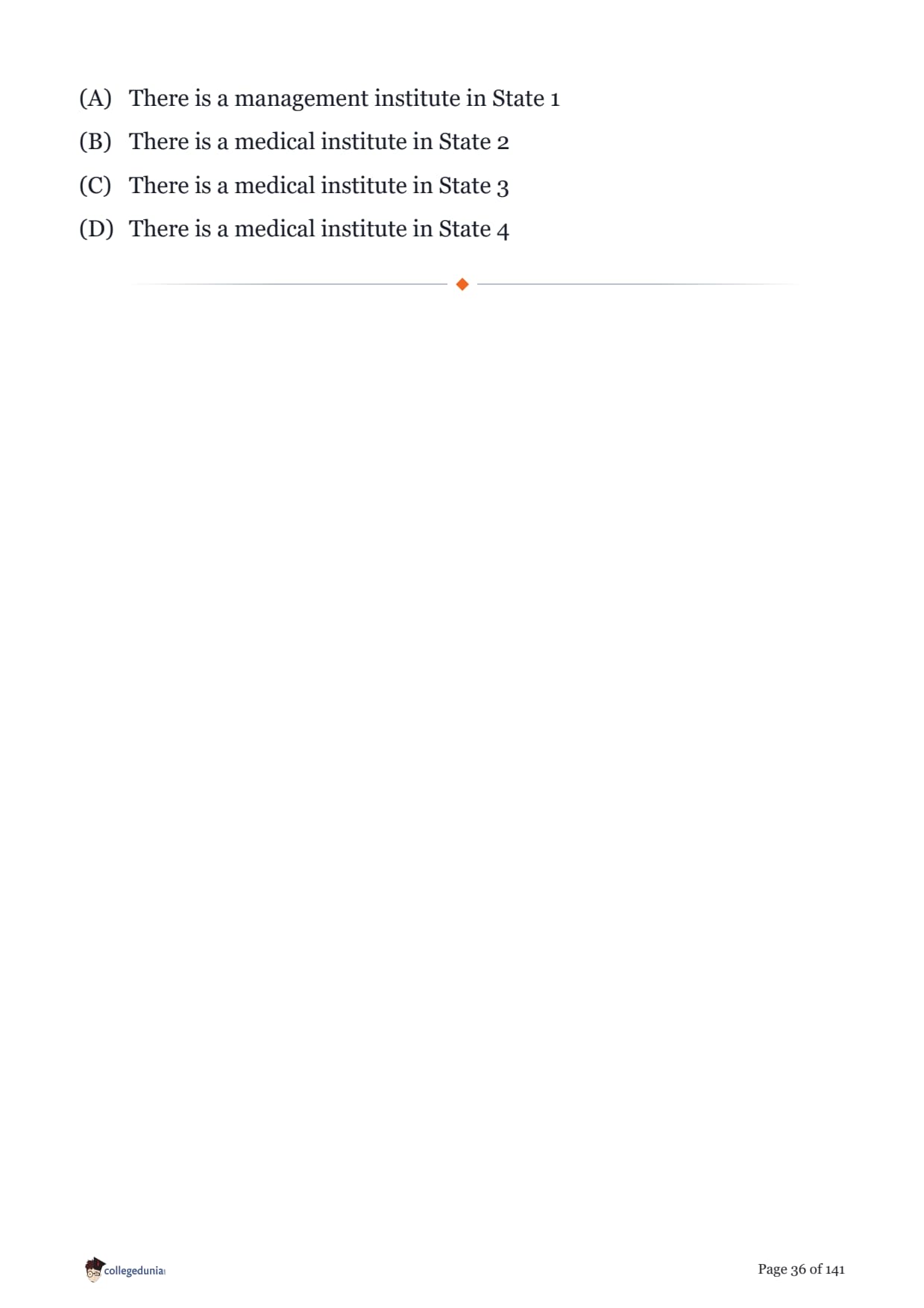
If each of the six states contains at least one of the eight institutions, then which one of the following must be true?
Six square states of equal area are arranged in two columns running north to south in a country. State 1, State 3, and State 5 lie on the western side, from north to south, and State 2, State 4, and State 6 lie on the eastern side, from north to south, so the states directly across the street from each other are State 1 and State 2, State 3 and State 4, and State 5 and State 6. Two states share a boundary if they sit next to each other in the same column (north-south) or directly across from each other (east-west). Within these six states there are exactly eight institutions in total: four medical institutes, two management institutes, and two technical institutes, placed according to these rules:
1. No institution is located in more than one state.
2. No state contains more than one management institute, and no state contains more than one technical institute.
3. No state contains both a management institute and a technical institute.
4. Every management institute is located in a state that also contains at least one medical institute.
5. The two technical institutes are located in states that do not share a common boundary.
6. State 3 contains a technical institute, and State 6 contains a management institute.
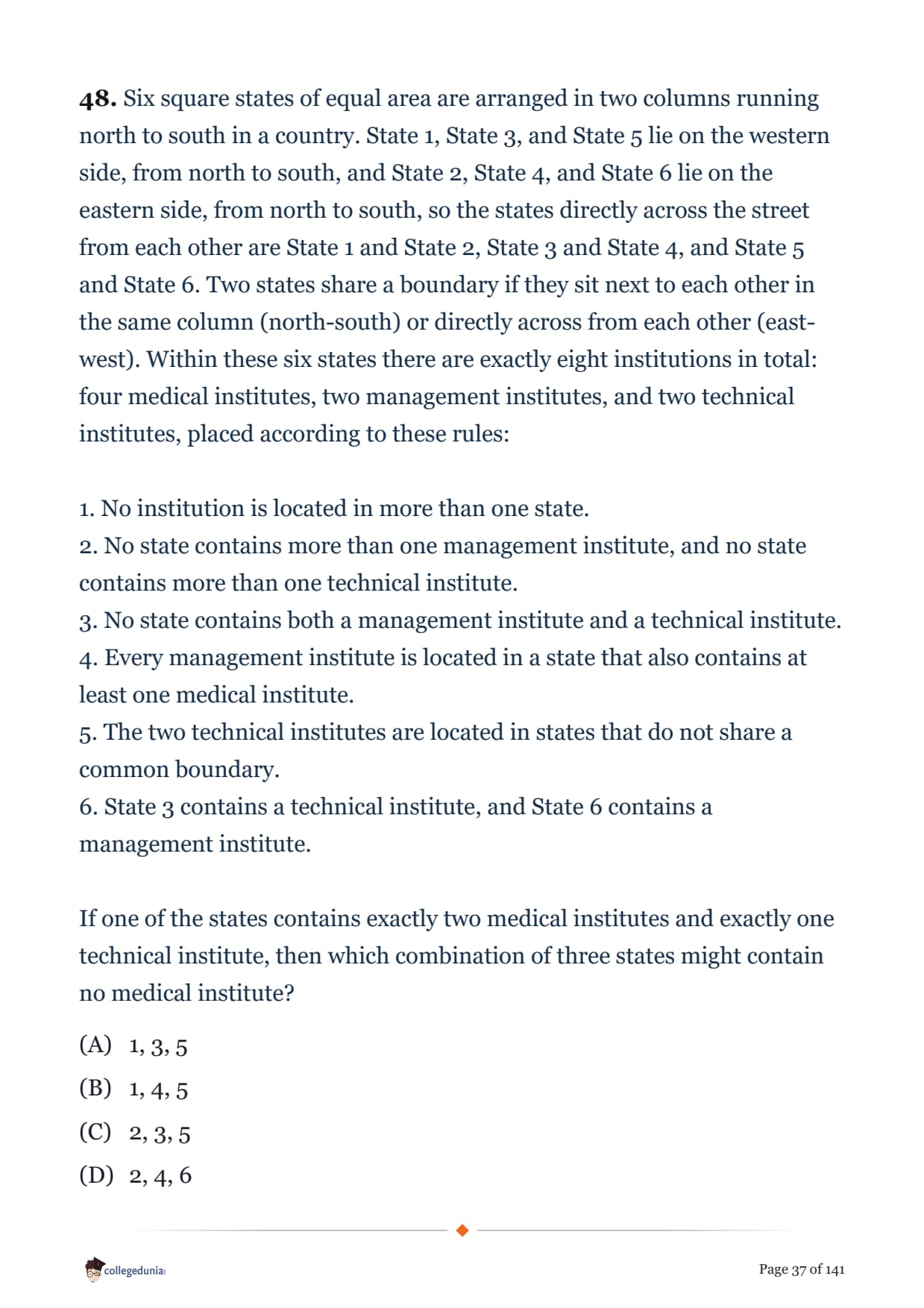
If one of the states contains exactly two medical institutes and exactly one technical institute, then which combination of three states might contain no medical institute?
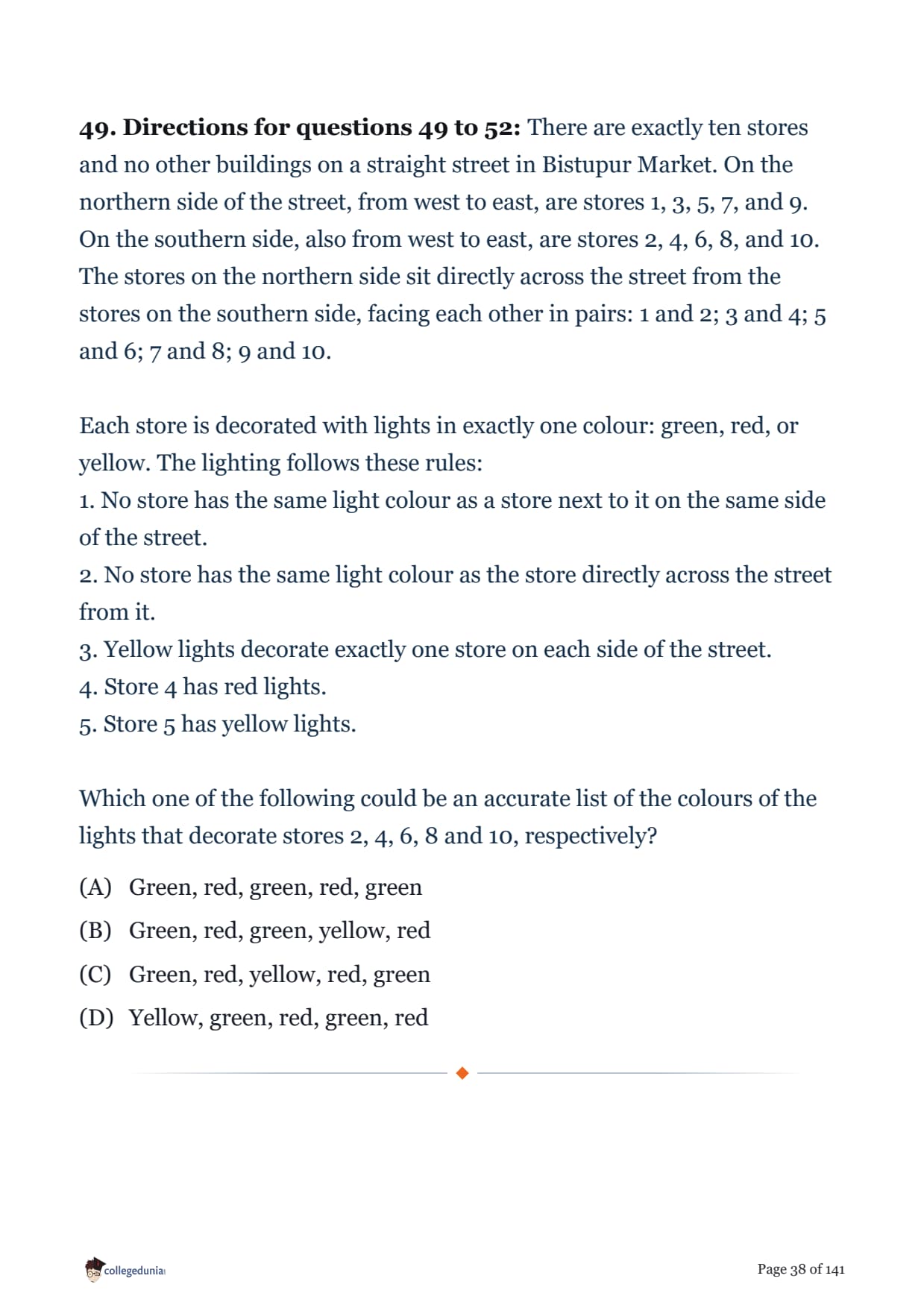
Directions for questions 49 to 52: There are exactly ten stores and no other buildings on a straight street in Bistupur Market. On the northern side of the street, from west to east, are stores 1, 3, 5, 7, and 9. On the southern side, also from west to east, are stores 2, 4, 6, 8, and 10. The stores on the northern side sit directly across the street from the stores on the southern side, facing each other in pairs: 1 and 2; 3 and 4; 5 and 6; 7 and 8; 9 and 10.
Each store is decorated with lights in exactly one colour: green, red, or yellow. The lighting follows these rules:
1. No store has the same light colour as a store next to it on the same side of the street.
2. No store has the same light colour as the store directly across the street from it.
3. Yellow lights decorate exactly one store on each side of the street.
4. Store 4 has red lights.
5. Store 5 has yellow lights.
Which one of the following could be an accurate list of the colours of the lights that decorate stores 2, 4, 6, 8 and 10, respectively?
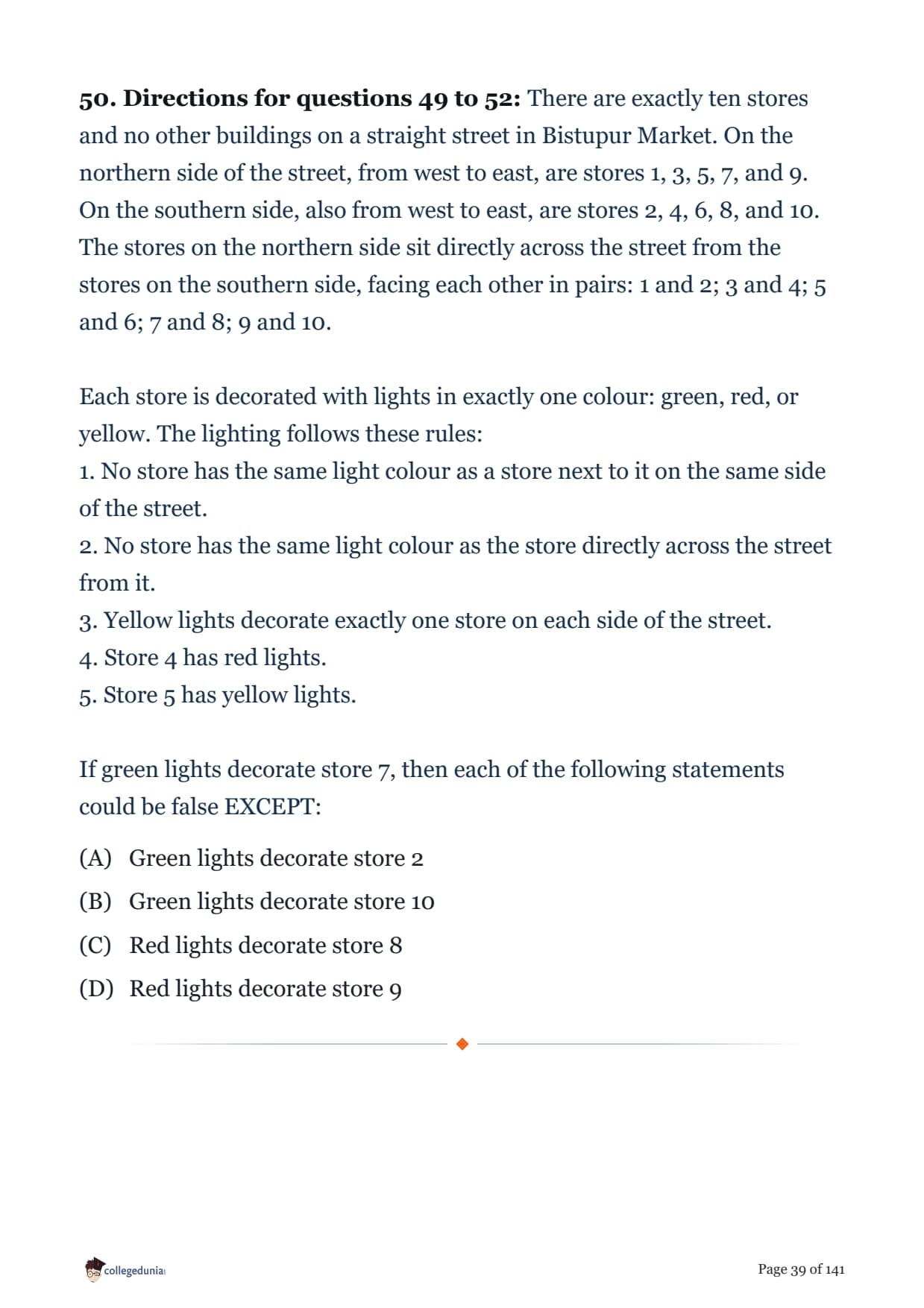
Directions for questions 49 to 52: There are exactly ten stores and no other buildings on a straight street in Bistupur Market. On the northern side of the street, from west to east, are stores 1, 3, 5, 7, and 9. On the southern side, also from west to east, are stores 2, 4, 6, 8, and 10. The stores on the northern side sit directly across the street from the stores on the southern side, facing each other in pairs: 1 and 2; 3 and 4; 5 and 6; 7 and 8; 9 and 10.
Each store is decorated with lights in exactly one colour: green, red, or yellow. The lighting follows these rules:
1. No store has the same light colour as a store next to it on the same side of the street.
2. No store has the same light colour as the store directly across the street from it.
3. Yellow lights decorate exactly one store on each side of the street.
4. Store 4 has red lights.
5. Store 5 has yellow lights.
If green lights decorate store 7, then each of the following statements could be false EXCEPT:
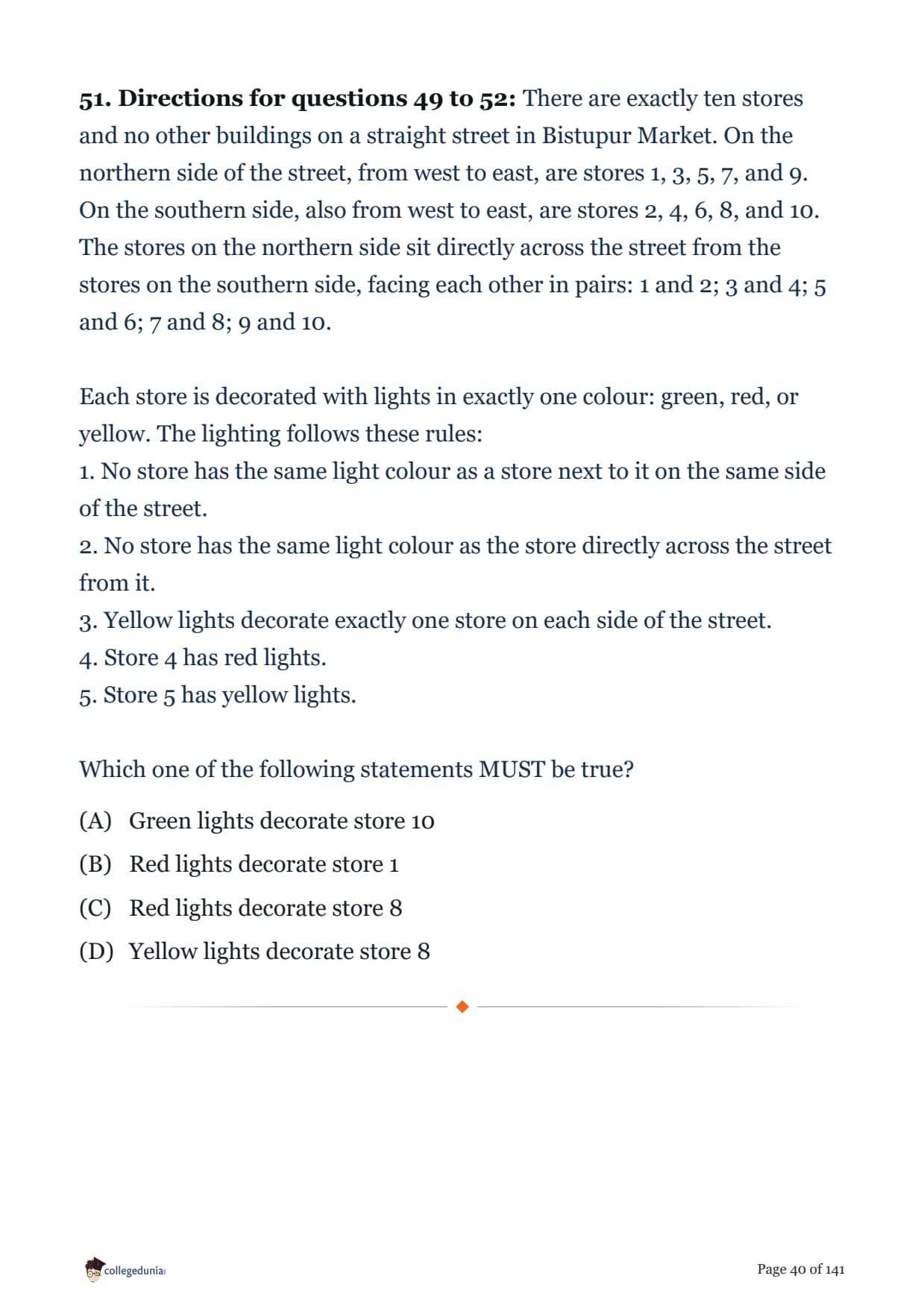
Directions for questions 49 to 52: There are exactly ten stores and no other buildings on a straight street in Bistupur Market. On the northern side of the street, from west to east, are stores 1, 3, 5, 7, and 9. On the southern side, also from west to east, are stores 2, 4, 6, 8, and 10. The stores on the northern side sit directly across the street from the stores on the southern side, facing each other in pairs: 1 and 2; 3 and 4; 5 and 6; 7 and 8; 9 and 10.
Each store is decorated with lights in exactly one colour: green, red, or yellow. The lighting follows these rules:
1. No store has the same light colour as a store next to it on the same side of the street.
2. No store has the same light colour as the store directly across the street from it.
3. Yellow lights decorate exactly one store on each side of the street.
4. Store 4 has red lights.
5. Store 5 has yellow lights.
Which one of the following statements MUST be true?
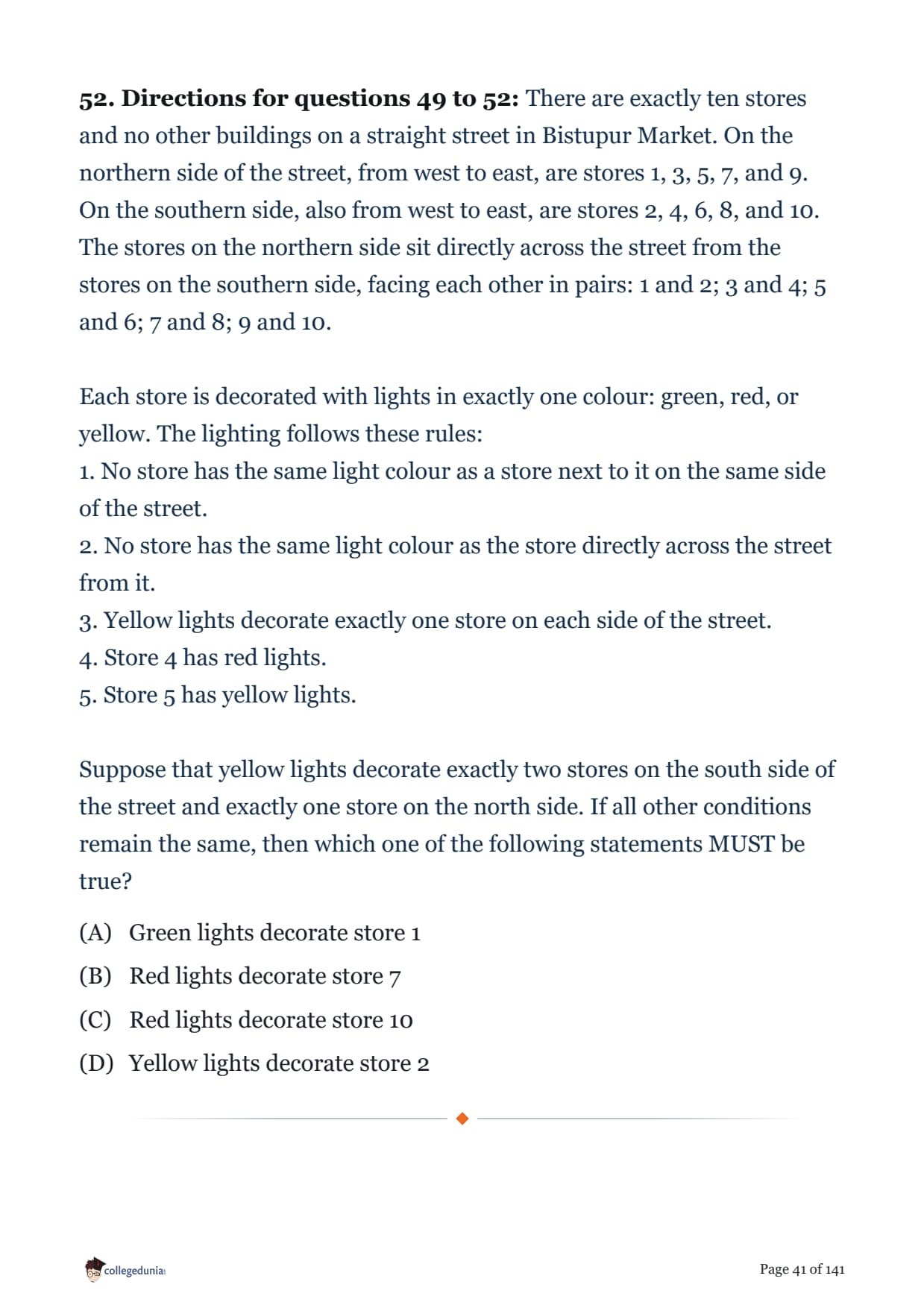
Directions for questions 49 to 52: There are exactly ten stores and no other buildings on a straight street in Bistupur Market. On the northern side of the street, from west to east, are stores 1, 3, 5, 7, and 9. On the southern side, also from west to east, are stores 2, 4, 6, 8, and 10. The stores on the northern side sit directly across the street from the stores on the southern side, facing each other in pairs: 1 and 2; 3 and 4; 5 and 6; 7 and 8; 9 and 10.
Each store is decorated with lights in exactly one colour: green, red, or yellow. The lighting follows these rules:
1. No store has the same light colour as a store next to it on the same side of the street.
2. No store has the same light colour as the store directly across the street from it.
3. Yellow lights decorate exactly one store on each side of the street.
4. Store 4 has red lights.
5. Store 5 has yellow lights.
Suppose that yellow lights decorate exactly two stores on the south side of the street and exactly one store on the north side. If all other conditions remain the same, then which one of the following statements MUST be true?
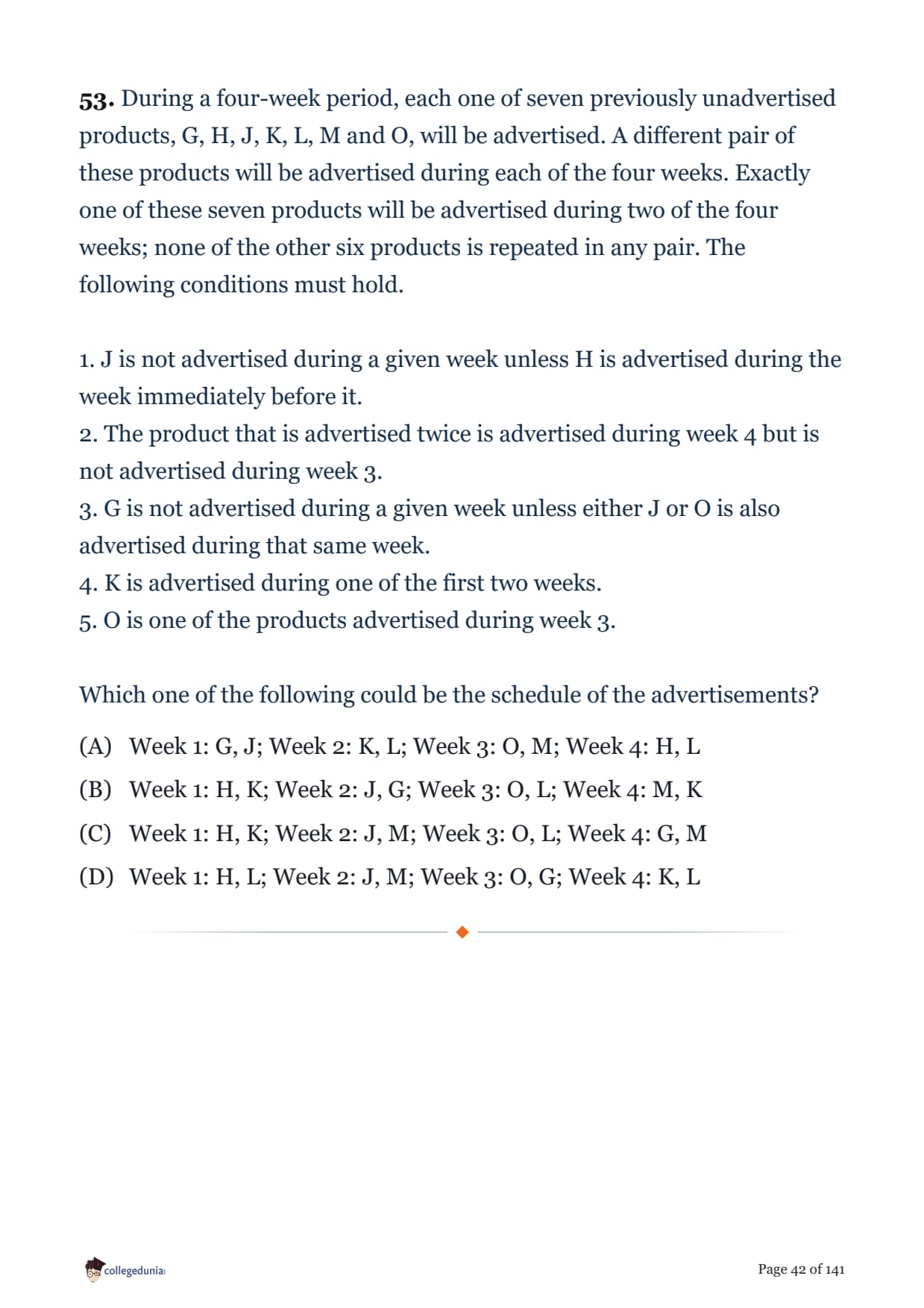
During a four-week period, each one of seven previously unadvertised products, G, H, J, K, L, M and O, will be advertised. A different pair of these products will be advertised during each of the four weeks. Exactly one of these seven products will be advertised during two of the four weeks; none of the other six products is repeated in any pair. The following conditions must hold.
1. J is not advertised during a given week unless H is advertised during the week immediately before it.
2. The product that is advertised twice is advertised during week 4 but is not advertised during week 3.
3. G is not advertised during a given week unless either J or O is also advertised during that same week.
4. K is advertised during one of the first two weeks.
5. O is one of the products advertised during week 3.
Which one of the following could be the schedule of the advertisements?
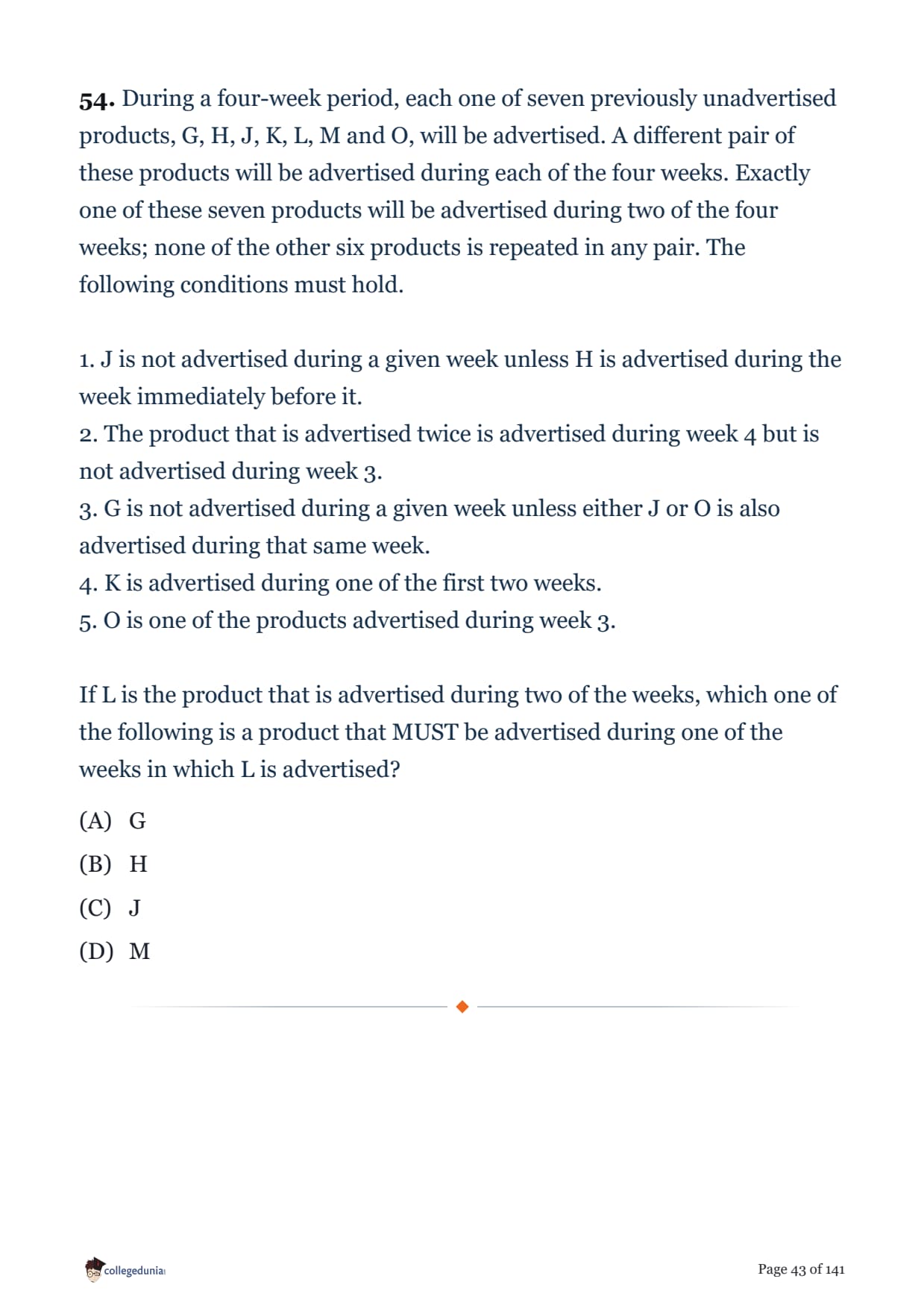
During a four-week period, each one of seven previously unadvertised products, G, H, J, K, L, M and O, will be advertised. A different pair of these products will be advertised during each of the four weeks. Exactly one of these seven products will be advertised during two of the four weeks; none of the other six products is repeated in any pair. The following conditions must hold.
1. J is not advertised during a given week unless H is advertised during the week immediately before it.
2. The product that is advertised twice is advertised during week 4 but is not advertised during week 3.
3. G is not advertised during a given week unless either J or O is also advertised during that same week.
4. K is advertised during one of the first two weeks.
5. O is one of the products advertised during week 3.
If L is the product that is advertised during two of the weeks, which one of the following is a product that MUST be advertised during one of the weeks in which L is advertised?
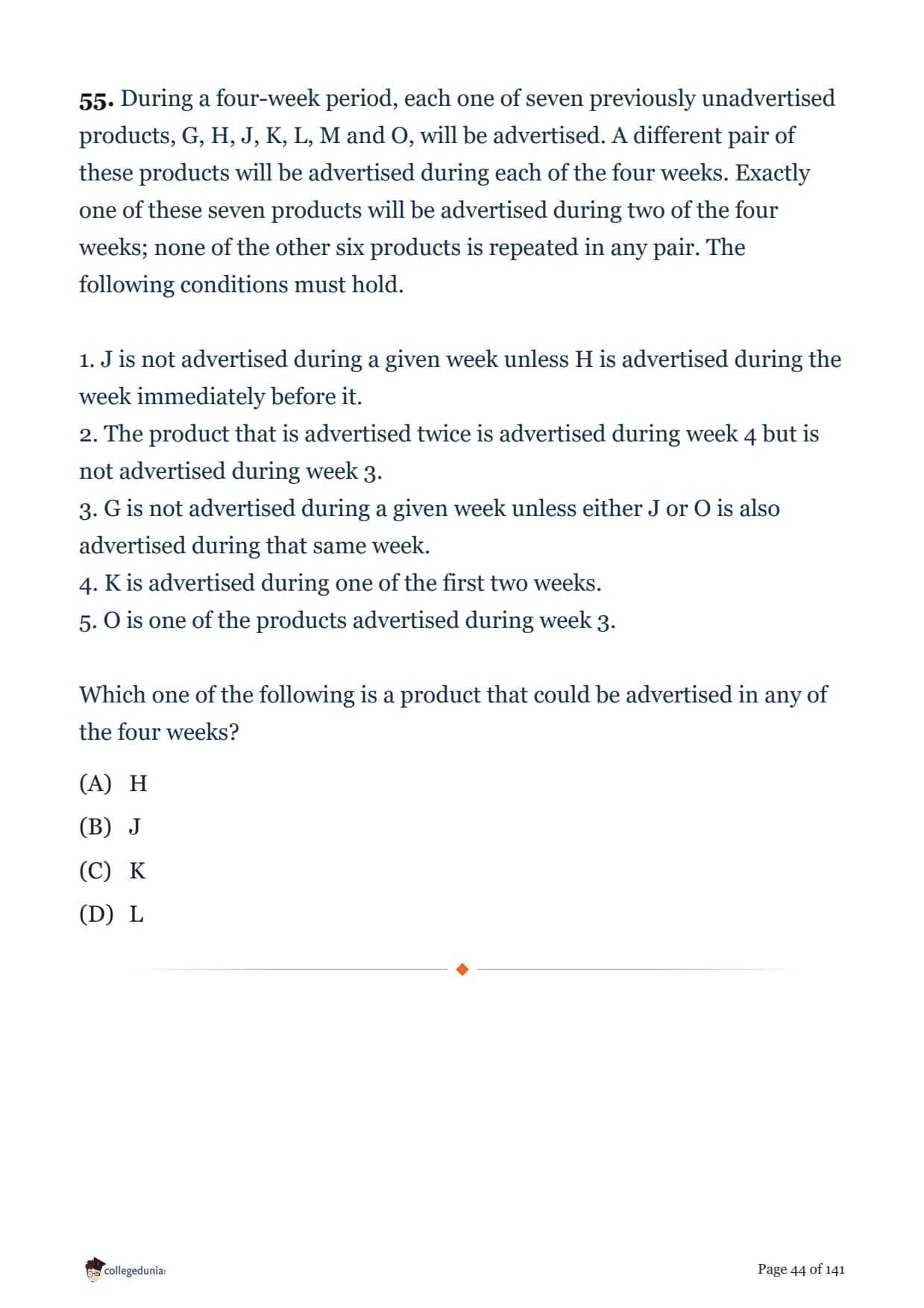
During a four-week period, each one of seven previously unadvertised products, G, H, J, K, L, M and O, will be advertised. A different pair of these products will be advertised during each of the four weeks. Exactly one of these seven products will be advertised during two of the four weeks; none of the other six products is repeated in any pair. The following conditions must hold.
1. J is not advertised during a given week unless H is advertised during the week immediately before it.
2. The product that is advertised twice is advertised during week 4 but is not advertised during week 3.
3. G is not advertised during a given week unless either J or O is also advertised during that same week.
4. K is advertised during one of the first two weeks.
5. O is one of the products advertised during week 3.
Which one of the following is a product that could be advertised in any of the four weeks?
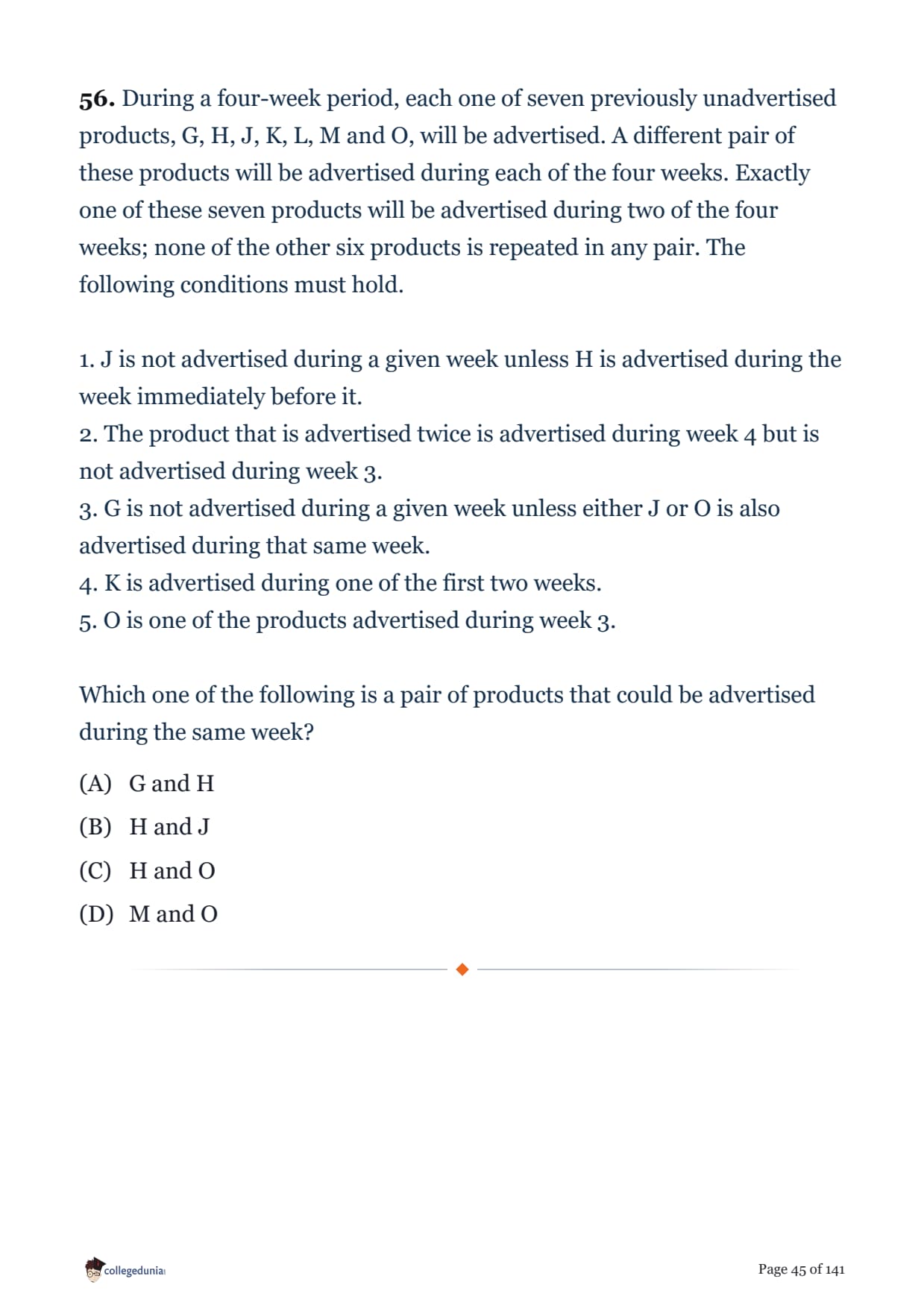
During a four-week period, each one of seven previously unadvertised products, G, H, J, K, L, M and O, will be advertised. A different pair of these products will be advertised during each of the four weeks. Exactly one of these seven products will be advertised during two of the four weeks; none of the other six products is repeated in any pair. The following conditions must hold.
1. J is not advertised during a given week unless H is advertised during the week immediately before it.
2. The product that is advertised twice is advertised during week 4 but is not advertised during week 3.
3. G is not advertised during a given week unless either J or O is also advertised during that same week.
4. K is advertised during one of the first two weeks.
5. O is one of the products advertised during week 3.
Which one of the following is a pair of products that could be advertised during the same week?
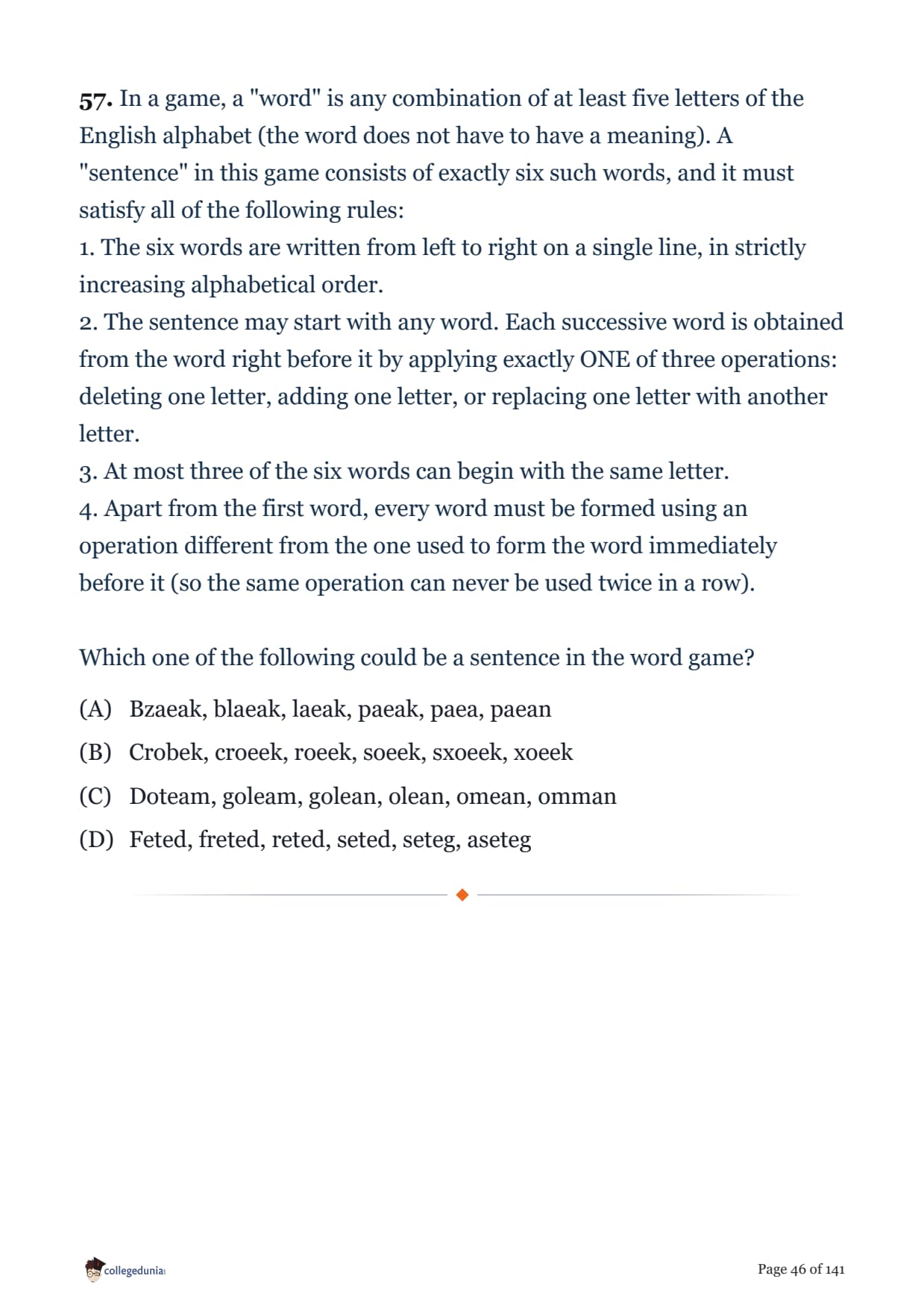
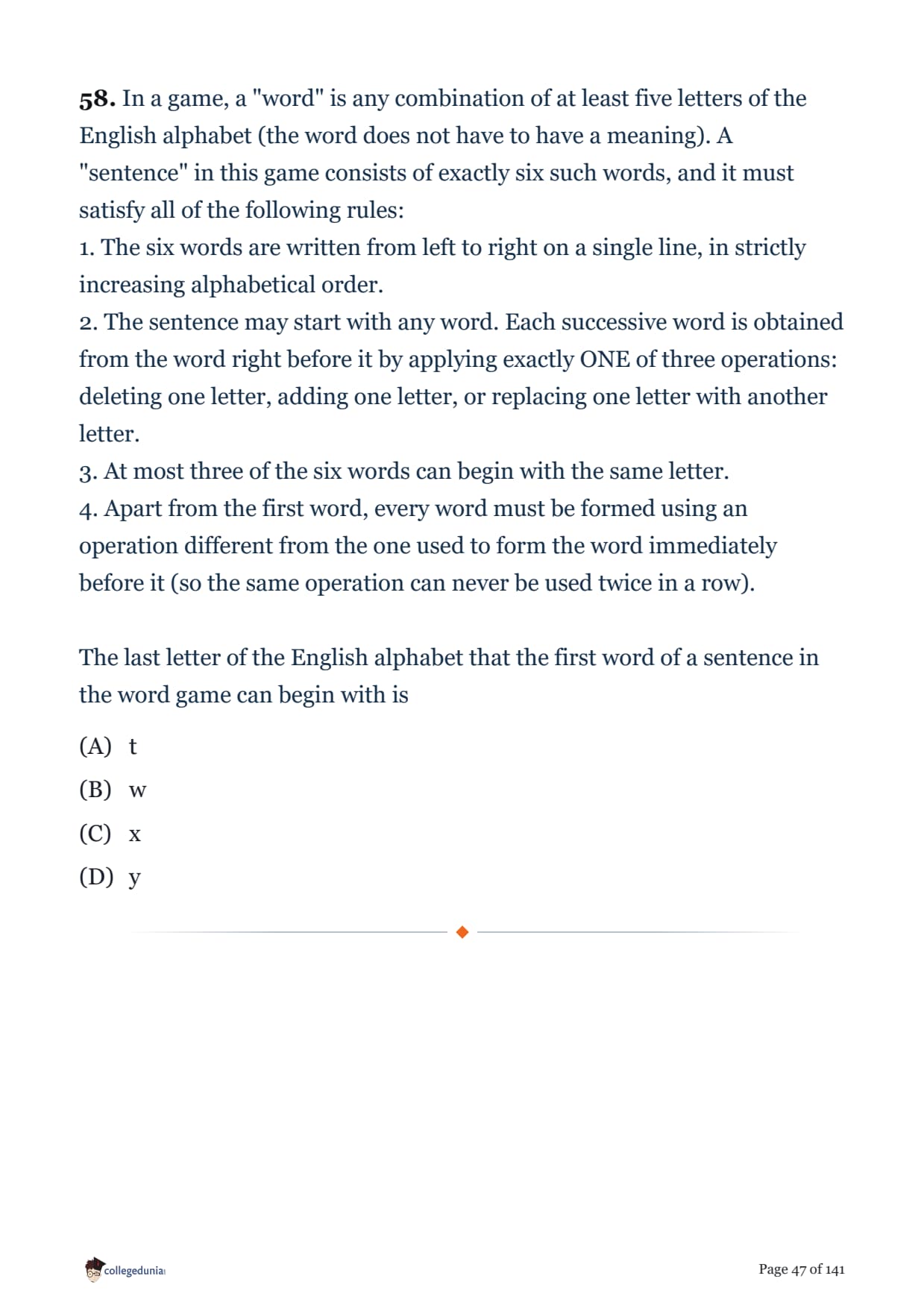
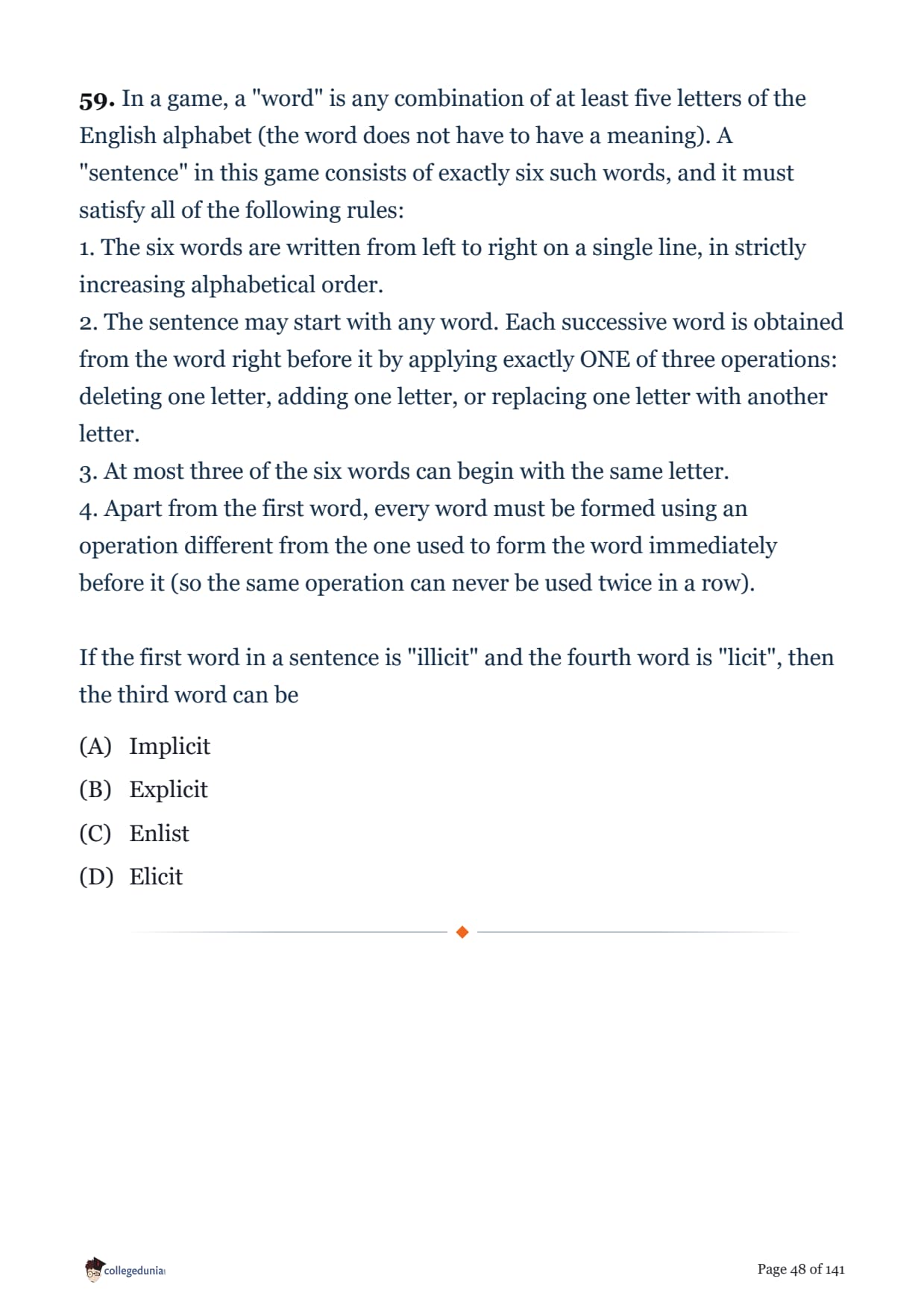
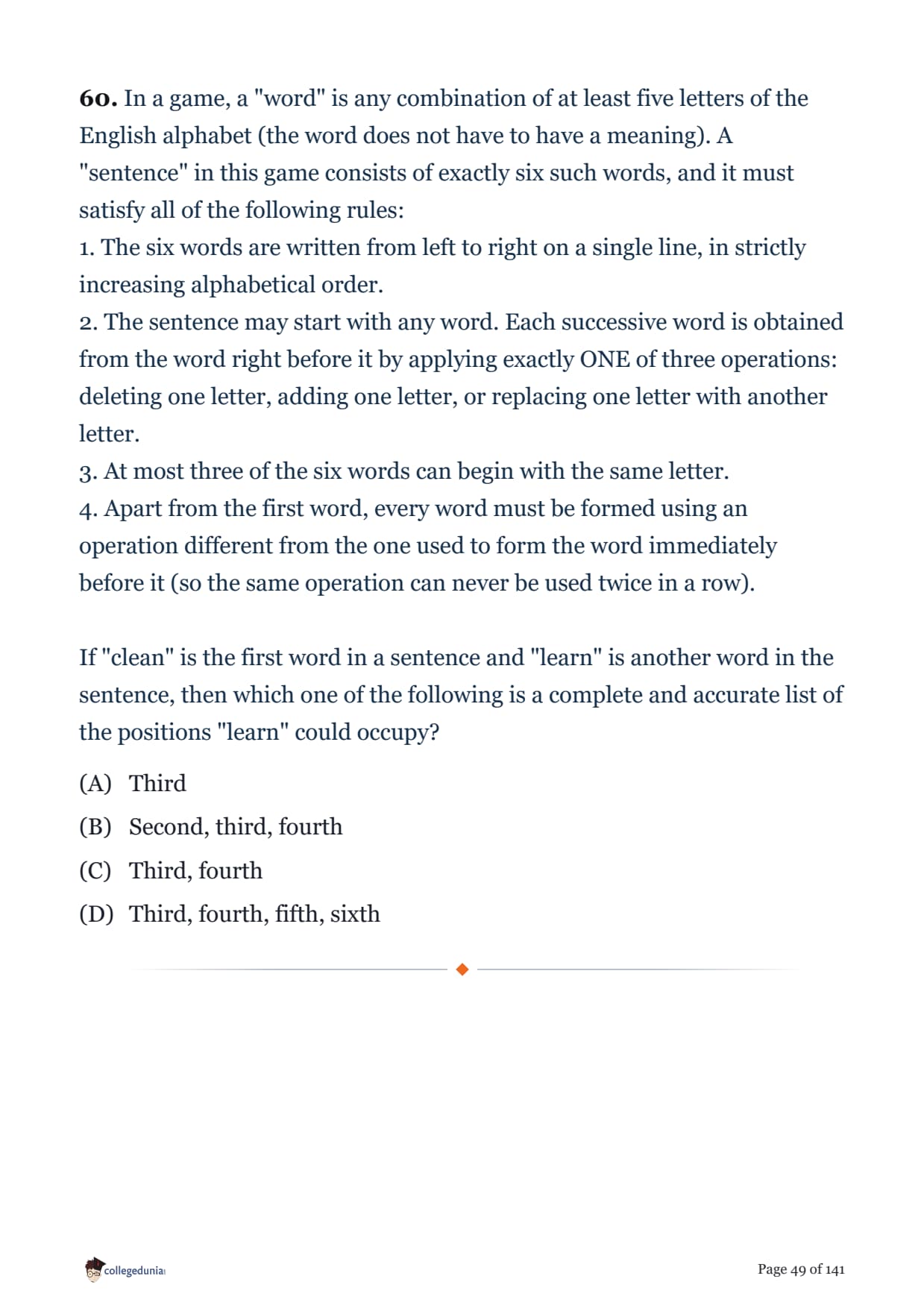
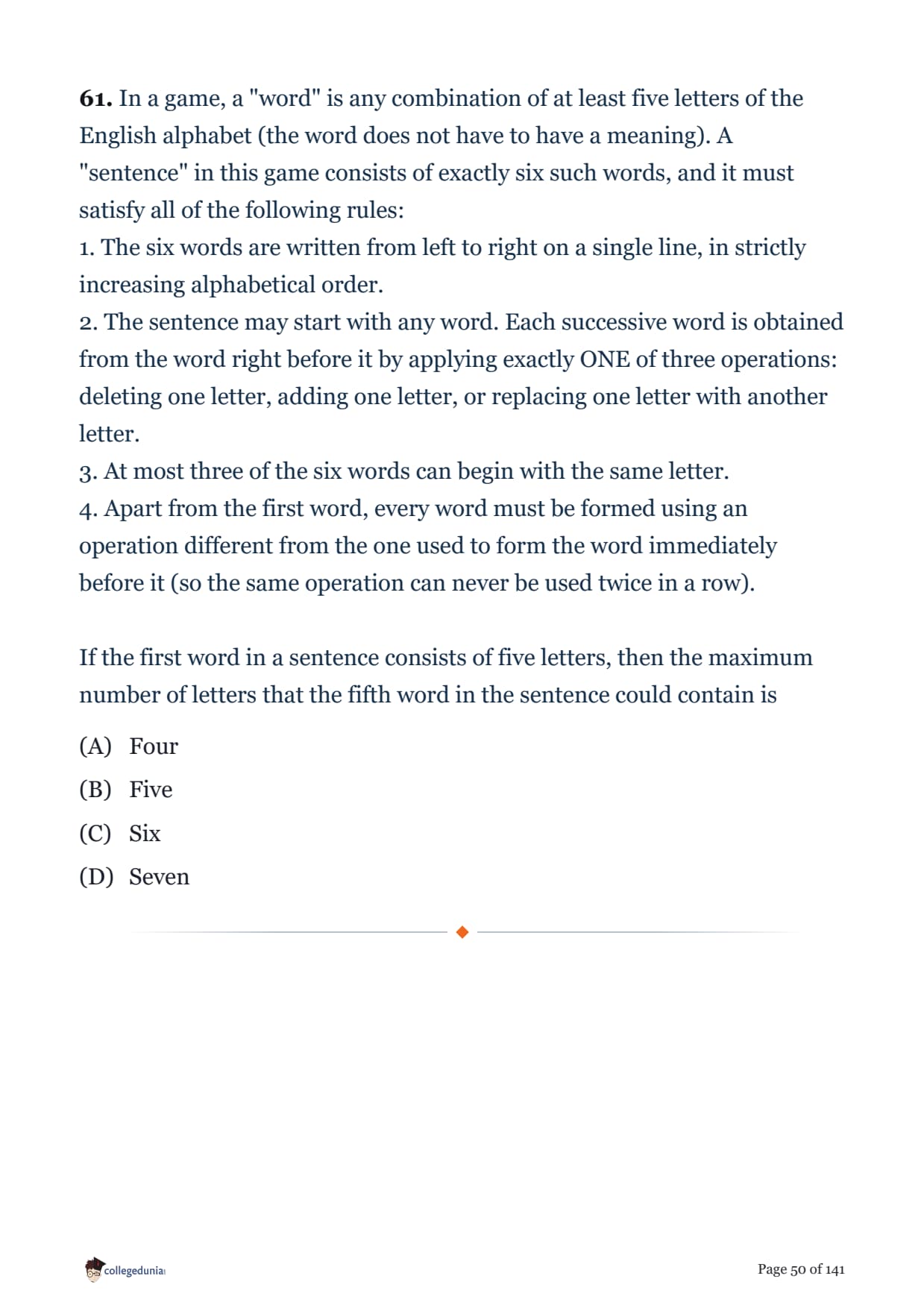
In a game, a "word" is any combination of at least five letters of the English alphabet (the word does not have to have a meaning). A "sentence" in this game consists of exactly six such words, and it must satisfy all of the following rules:
1. The six words are written from left to right on a single line, in strictly increasing alphabetical order.
2. The sentence may start with any word. Each successive word is obtained from the word right before it by applying exactly ONE of three operations: deleting one letter, adding one letter, or replacing one letter with another letter.
3. At most three of the six words can begin with the same letter.
4. Apart from the first word, every word must be formed using an operation different from the one used to form the word immediately before it (so the same operation can never be used twice in a row).
Which one of the following could be a sentence in the word game?
In a game, a "word" is any combination of at least five letters of the English alphabet (the word does not have to have a meaning). A "sentence" in this game consists of exactly six such words, and it must satisfy all of the following rules:
1. The six words are written from left to right on a single line, in strictly increasing alphabetical order.
2. The sentence may start with any word. Each successive word is obtained from the word right before it by applying exactly ONE of three operations: deleting one letter, adding one letter, or replacing one letter with another letter.
3. At most three of the six words can begin with the same letter.
4. Apart from the first word, every word must be formed using an operation different from the one used to form the word immediately before it (so the same operation can never be used twice in a row).
The last letter of the English alphabet that the first word of a sentence in the word game can begin with is
In a game, a "word" is any combination of at least five letters of the English alphabet (the word does not have to have a meaning). A "sentence" in this game consists of exactly six such words, and it must satisfy all of the following rules:
1. The six words are written from left to right on a single line, in strictly increasing alphabetical order.
2. The sentence may start with any word. Each successive word is obtained from the word right before it by applying exactly ONE of three operations: deleting one letter, adding one letter, or replacing one letter with another letter.
3. At most three of the six words can begin with the same letter.
4. Apart from the first word, every word must be formed using an operation different from the one used to form the word immediately before it (so the same operation can never be used twice in a row).
If the first word in a sentence is "illicit" and the fourth word is "licit", then the third word can be
In a game, a "word" is any combination of at least five letters of the English alphabet (the word does not have to have a meaning). A "sentence" in this game consists of exactly six such words, and it must satisfy all of the following rules:
1. The six words are written from left to right on a single line, in strictly increasing alphabetical order.
2. The sentence may start with any word. Each successive word is obtained from the word right before it by applying exactly ONE of three operations: deleting one letter, adding one letter, or replacing one letter with another letter.
3. At most three of the six words can begin with the same letter.
4. Apart from the first word, every word must be formed using an operation different from the one used to form the word immediately before it (so the same operation can never be used twice in a row).
If "clean" is the first word in a sentence and "learn" is another word in the sentence, then which one of the following is a complete and accurate list of the positions "learn" could occupy?
In a game, a "word" is any combination of at least five letters of the English alphabet (the word does not have to have a meaning). A "sentence" in this game consists of exactly six such words, and it must satisfy all of the following rules:
1. The six words are written from left to right on a single line, in strictly increasing alphabetical order.
2. The sentence may start with any word. Each successive word is obtained from the word right before it by applying exactly ONE of three operations: deleting one letter, adding one letter, or replacing one letter with another letter.
3. At most three of the six words can begin with the same letter.
4. Apart from the first word, every word must be formed using an operation different from the one used to form the word immediately before it (so the same operation can never be used twice in a row).
If the first word in a sentence consists of five letters, then the maximum number of letters that the fifth word in the sentence could contain is
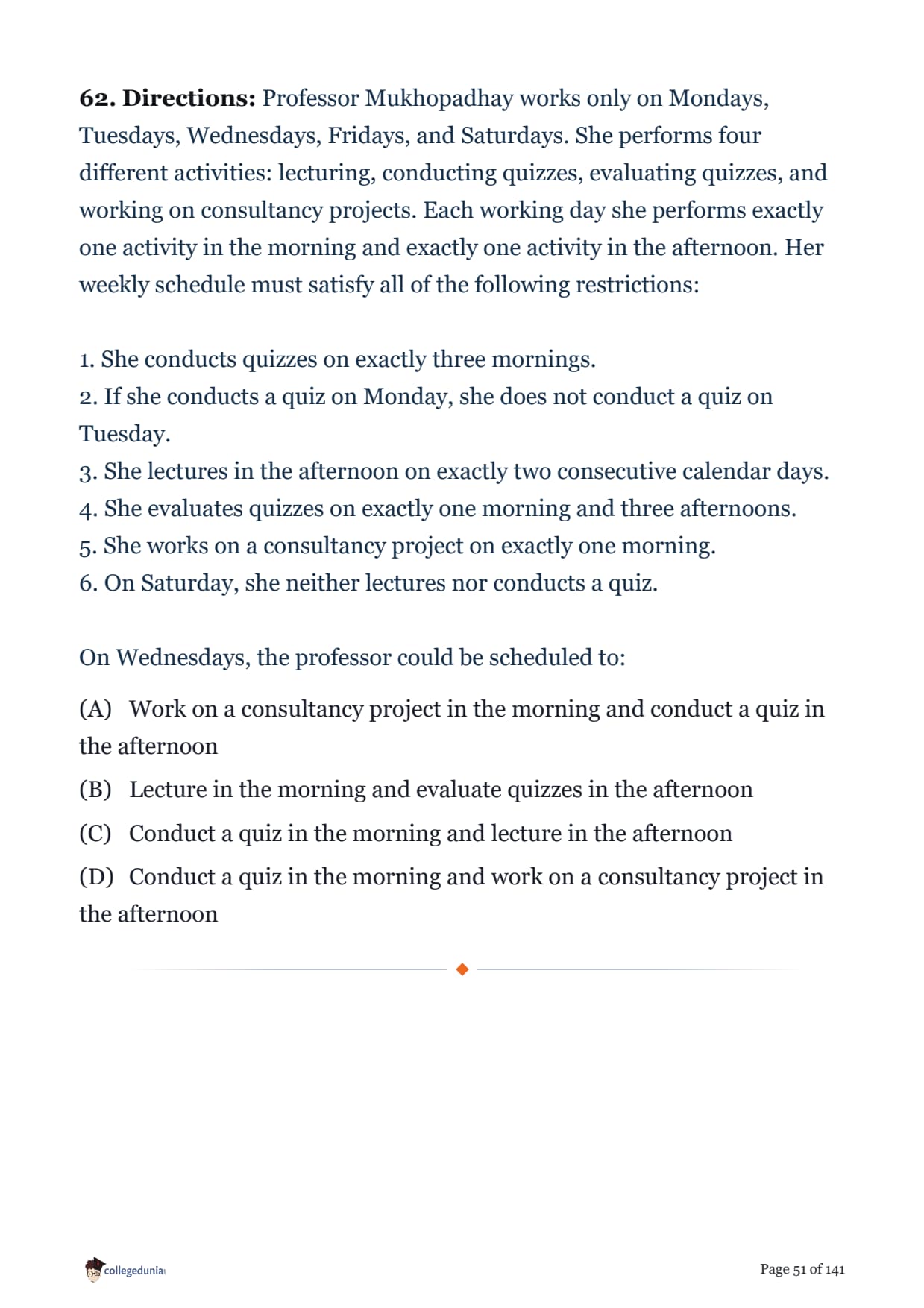
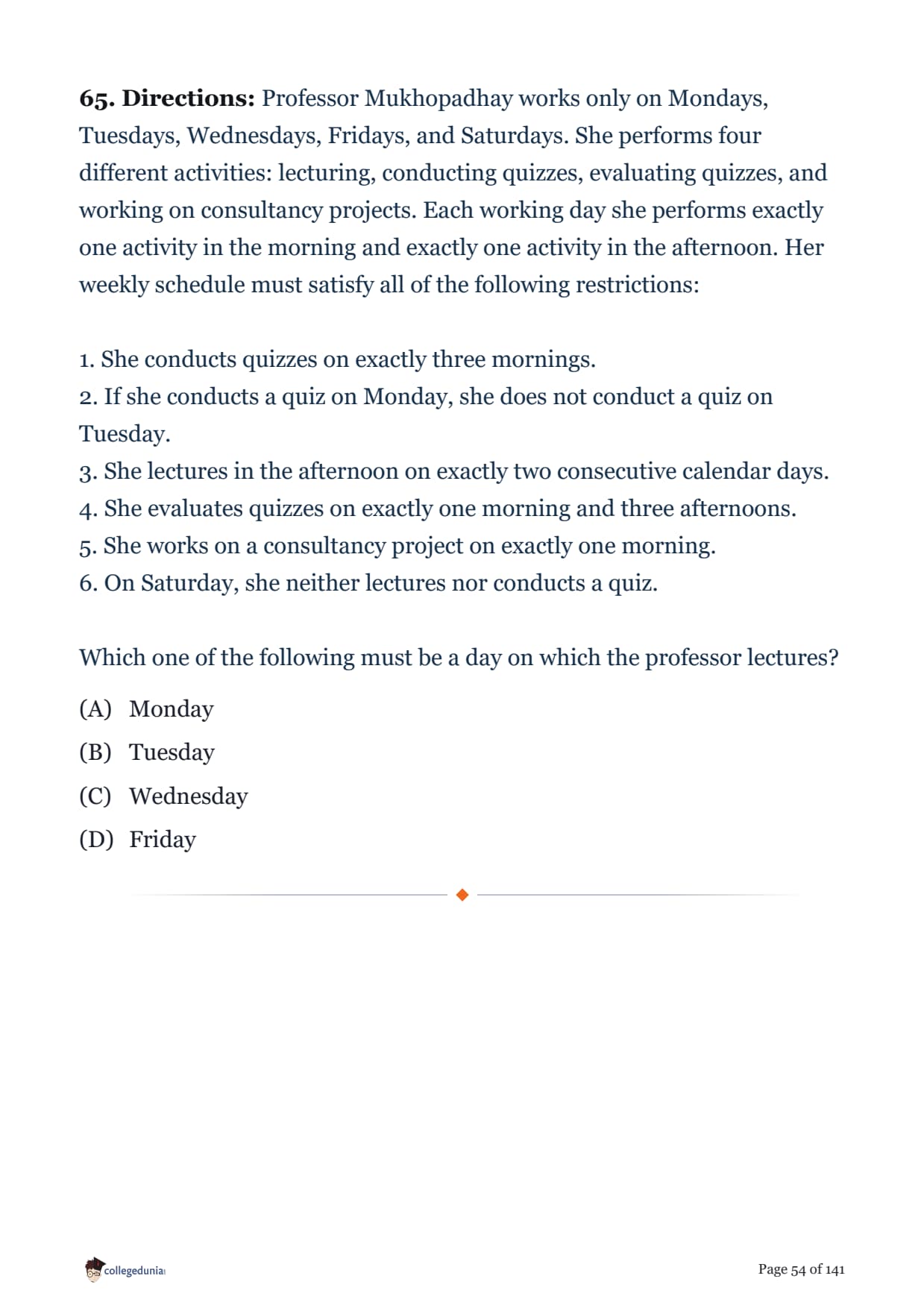
Directions: Professor Mukhopadhay works only on Mondays, Tuesdays, Wednesdays, Fridays, and Saturdays. She performs four different activities: lecturing, conducting quizzes, evaluating quizzes, and working on consultancy projects. Each working day she performs exactly one activity in the morning and exactly one activity in the afternoon. Her weekly schedule must satisfy all of the following restrictions:
1. She conducts quizzes on exactly three mornings.
2. If she conducts a quiz on Monday, she does not conduct a quiz on Tuesday.
3. She lectures in the afternoon on exactly two consecutive calendar days.
4. She evaluates quizzes on exactly one morning and three afternoons.
5. She works on a consultancy project on exactly one morning.
6. On Saturday, she neither lectures nor conducts a quiz.
On Wednesdays, the professor could be scheduled to:
Directions: Professor Mukhopadhay works only on Mondays, Tuesdays, Wednesdays, Fridays, and Saturdays. She performs four different activities: lecturing, conducting quizzes, evaluating quizzes, and working on consultancy projects. Each working day she performs exactly one activity in the morning and exactly one activity in the afternoon. Her weekly schedule must satisfy all of the following restrictions:
1. She conducts quizzes on exactly three mornings.
2. If she conducts a quiz on Monday, she does not conduct a quiz on Tuesday.
3. She lectures in the afternoon on exactly two consecutive calendar days.
4. She evaluates quizzes on exactly one morning and three afternoons.
5. She works on a consultancy project on exactly one morning.
6. On Saturday, she neither lectures nor conducts a quiz.
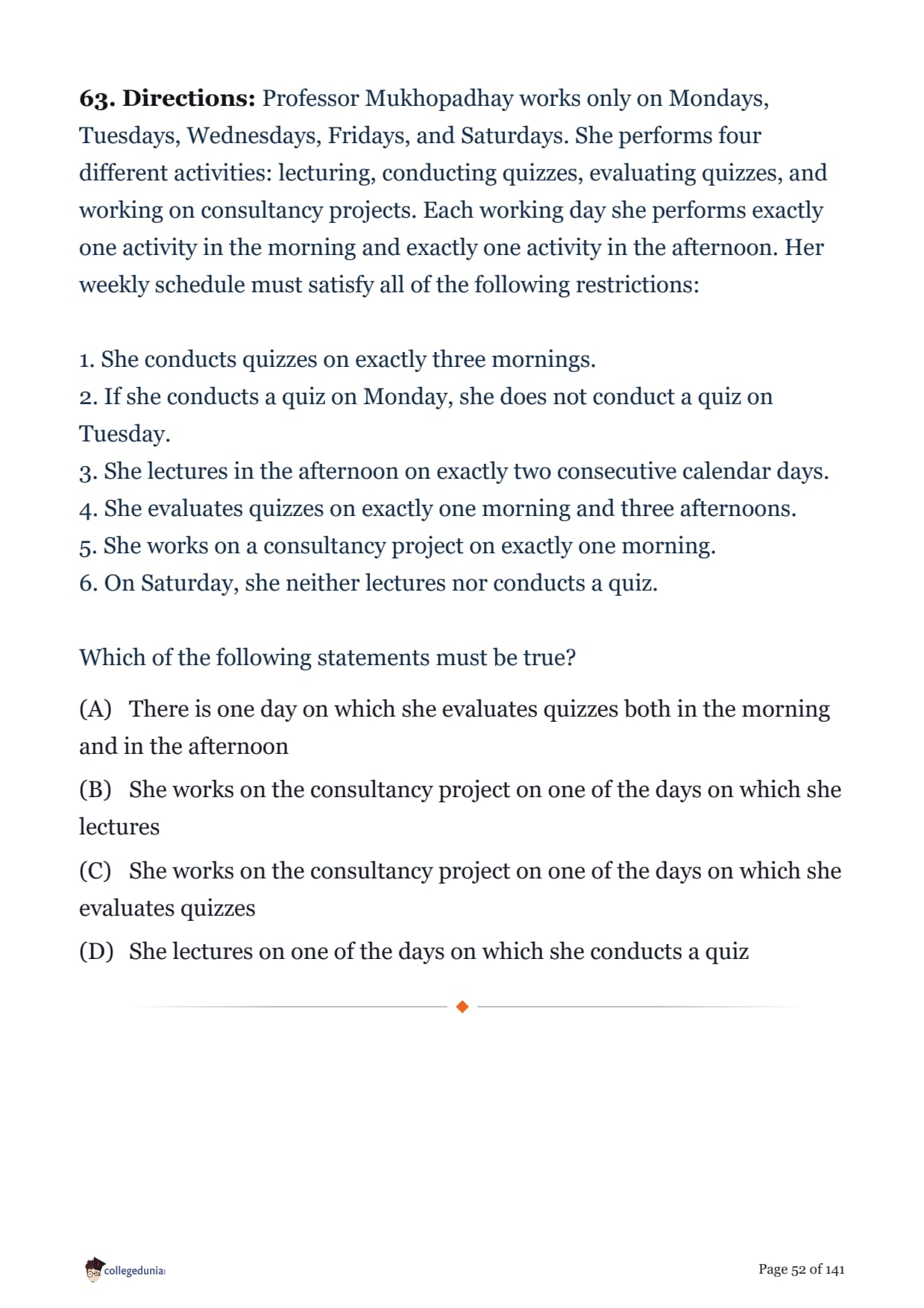
Which of the following statements must be true?
Directions: Professor Mukhopadhay works only on Mondays, Tuesdays, Wednesdays, Fridays, and Saturdays. She performs four different activities: lecturing, conducting quizzes, evaluating quizzes, and working on consultancy projects. Each working day she performs exactly one activity in the morning and exactly one activity in the afternoon. Her weekly schedule must satisfy all of the following restrictions:
1. She conducts quizzes on exactly three mornings.
2. If she conducts a quiz on Monday, she does not conduct a quiz on Tuesday.
3. She lectures in the afternoon on exactly two consecutive calendar days.
4. She evaluates quizzes on exactly one morning and three afternoons.
5. She works on a consultancy project on exactly one morning.
6. On Saturday, she neither lectures nor conducts a quiz.
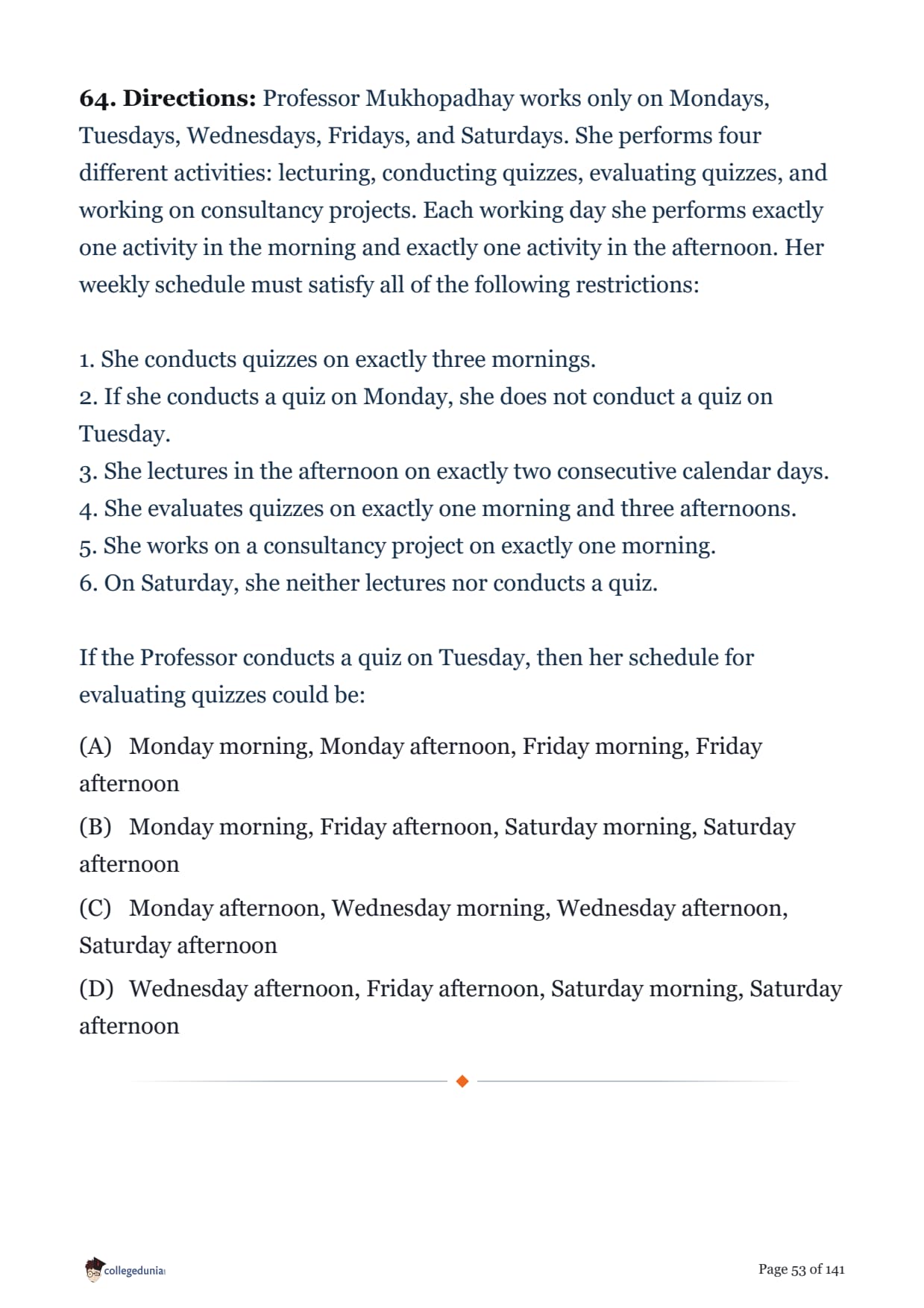
If the Professor conducts a quiz on Tuesday, then her schedule for evaluating quizzes could be:
Directions: Professor Mukhopadhay works only on Mondays, Tuesdays, Wednesdays, Fridays, and Saturdays. She performs four different activities: lecturing, conducting quizzes, evaluating quizzes, and working on consultancy projects. Each working day she performs exactly one activity in the morning and exactly one activity in the afternoon. Her weekly schedule must satisfy all of the following restrictions:
1. She conducts quizzes on exactly three mornings.
2. If she conducts a quiz on Monday, she does not conduct a quiz on Tuesday.
3. She lectures in the afternoon on exactly two consecutive calendar days.
4. She evaluates quizzes on exactly one morning and three afternoons.
5. She works on a consultancy project on exactly one morning.
6. On Saturday, she neither lectures nor conducts a quiz.
Which one of the following must be a day on which the professor lectures?
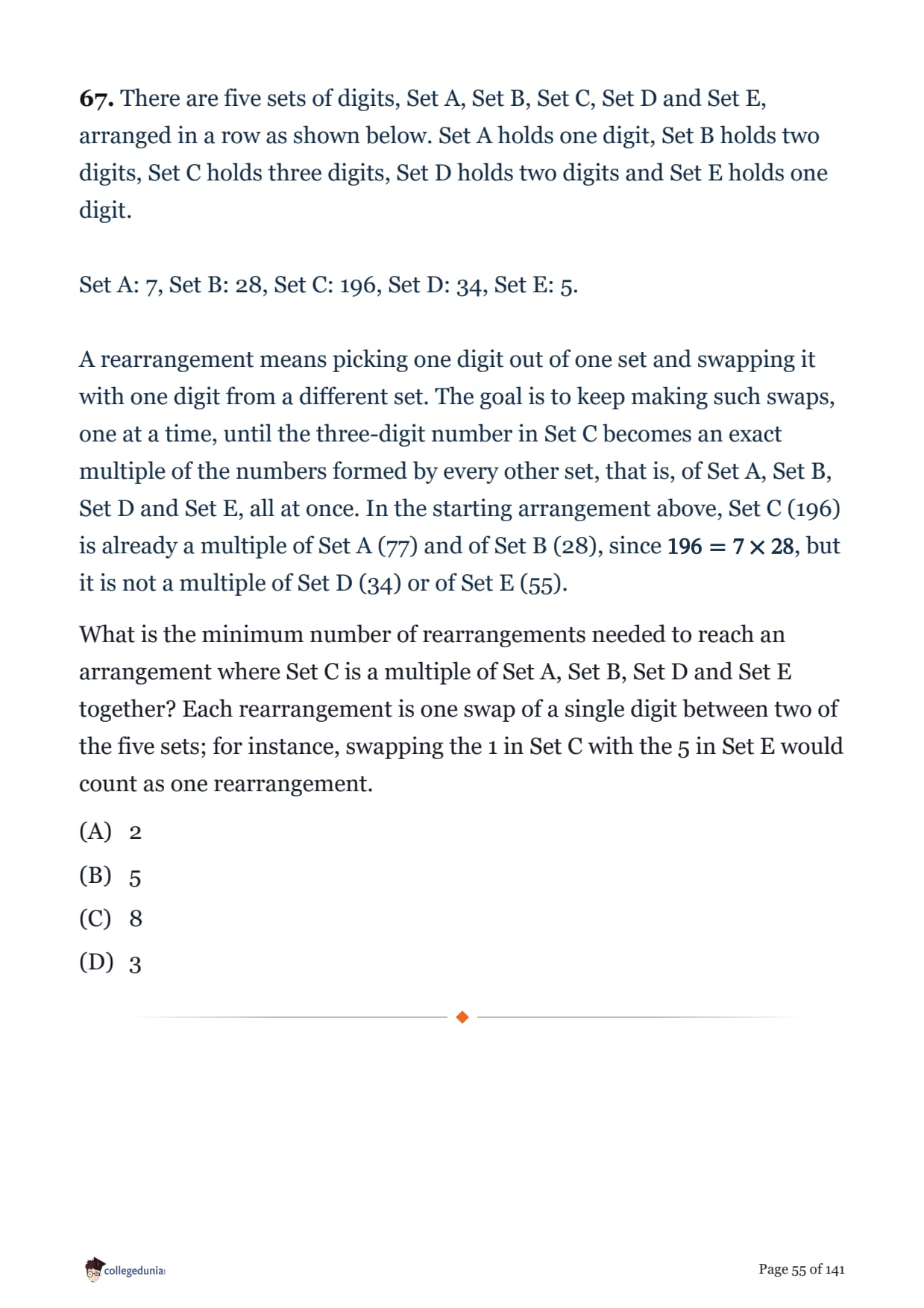
There are five sets of digits, Set A, Set B, Set C, Set D and Set E, arranged in a row as shown below. Set A holds one digit, Set B holds two digits, Set C holds three digits, Set D holds two digits and Set E holds one digit.
Set A: 7, Set B: 28, Set C: 196, Set D: 34, Set E: 5.
A rearrangement means picking one digit out of one set and swapping it with one digit from a different set. The goal is to keep making such swaps, one at a time, until the three-digit number in Set C becomes an exact multiple of the numbers formed by every other set, that is, of Set A, Set B, Set D and Set E, all at once. In the starting arrangement above, Set C (196) is already a multiple of Set A (77) and of Set B (28), since \(196 = 7 \times 28\), but it is not a multiple of Set D (34) or of Set E (55).
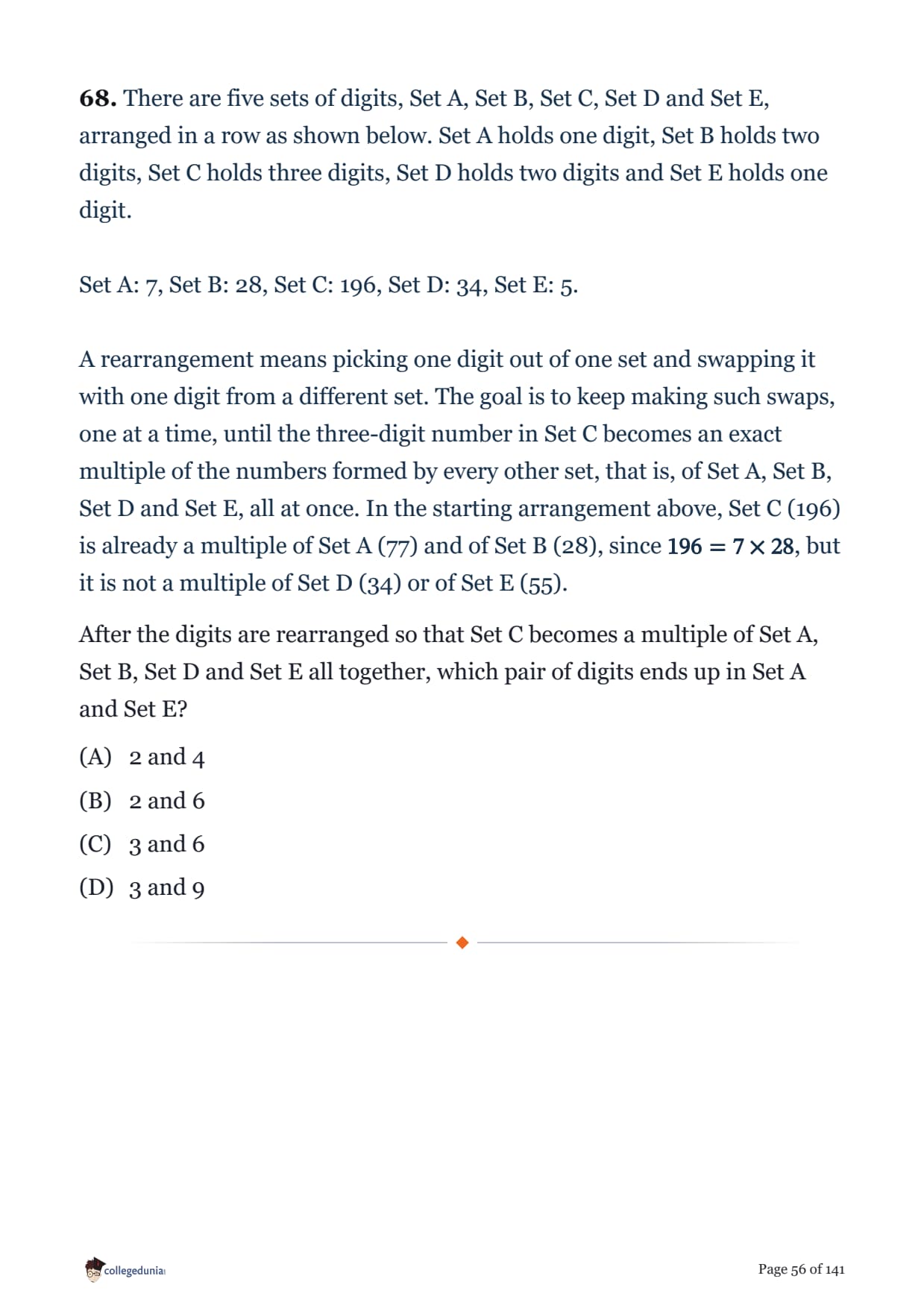
There are five sets of digits, Set A, Set B, Set C, Set D and Set E, arranged in a row as shown below. Set A holds one digit, Set B holds two digits, Set C holds three digits, Set D holds two digits and Set E holds one digit.
Set A: 7, Set B: 28, Set C: 196, Set D: 34, Set E: 5.
A rearrangement means picking one digit out of one set and swapping it with one digit from a different set. The goal is to keep making such swaps, one at a time, until the three-digit number in Set C becomes an exact multiple of the numbers formed by every other set, that is, of Set A, Set B, Set D and Set E, all at once. In the starting arrangement above, Set C (196) is already a multiple of Set A (77) and of Set B (28), since \(196 = 7 \times 28\), but it is not a multiple of Set D (34) or of Set E (55).
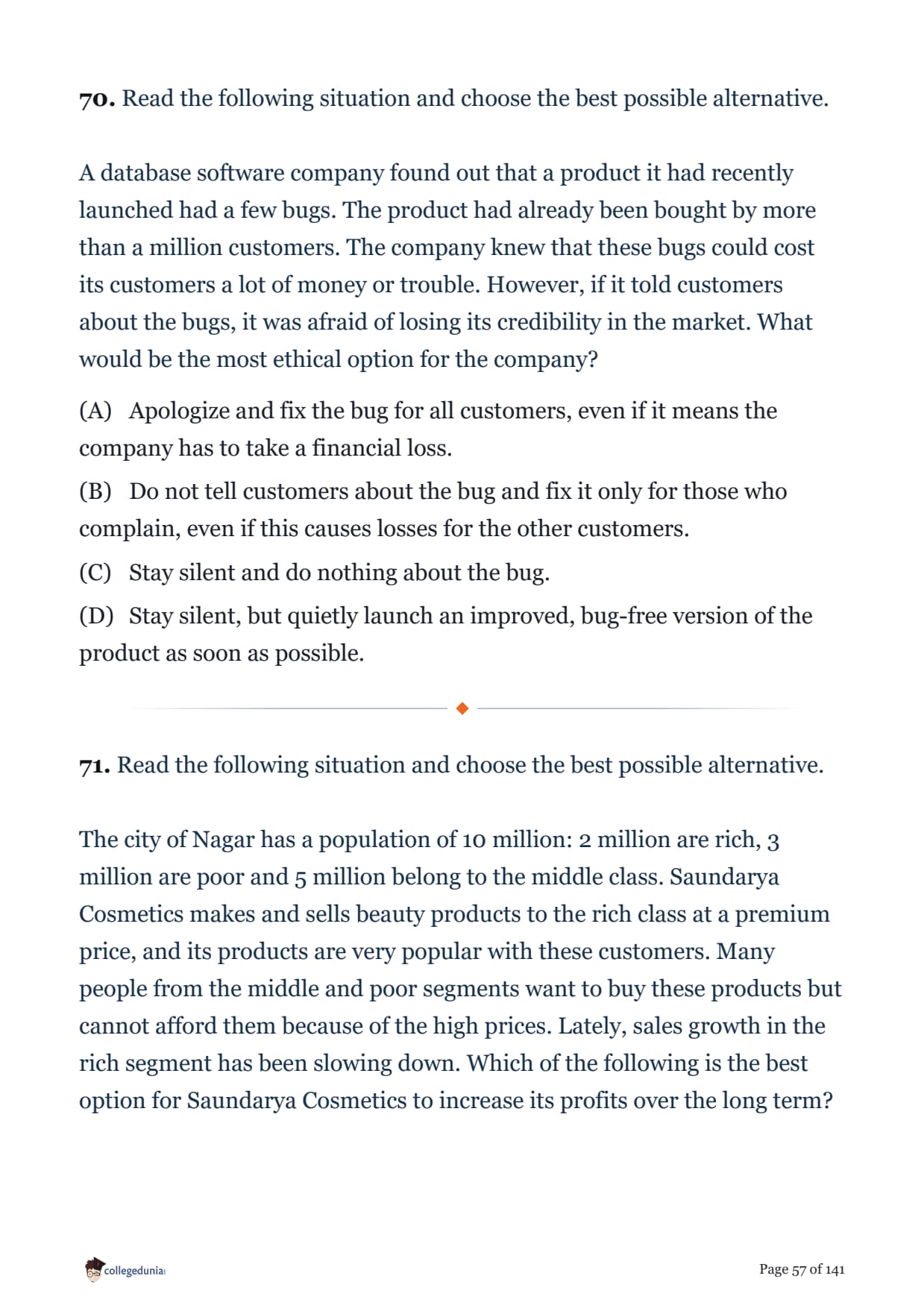
Read the following situation and choose the best possible alternative.
A database software company found out that a product it had recently launched had a few bugs. The product had already been bought by more than a million customers. The company knew that these bugs could cost its customers a lot of money or trouble. However, if it told customers about the bugs, it was afraid of losing its credibility in the market. What would be the most ethical option for the company?
Read the following situation and choose the best possible alternative.
The city of Nagar has a population of 10 million: 2 million are rich, 3 million are poor and 5 million belong to the middle class. Saundarya Cosmetics makes and sells beauty products to the rich class at a premium price, and its products are very popular with these customers. Many people from the middle and poor segments want to buy these products but cannot afford them because of the high prices. Lately, sales growth in the rich segment has been slowing down. Which of the following is the best option for Saundarya Cosmetics to increase its profits over the long term?
Read the following situation and choose the best possible alternative.
Seema was a finance manager at an MNC and felt that gender discrimination at her workplace was slowing down her career. Frustrated, she quit her job and started her own company. When she started the company, Seema decided to keep an equal number of male and female employees. Over the last six years, Seema has become a very successful entrepreneur and has grown her business to eight locations across the country. Recently, however, Seema has run into an ethical problem: many of her female employees are not willing to travel between cities or work late hours, even though the job needs this, while her male employees do this without hesitation. Seema is now under pressure to reduce the number of female employees, but she also knows that hiring equal numbers of men and women was one of the strongest reasons she started the company in the first place. What should she do as a responsible woman entrepreneur?
Read the following situation and choose the best possible alternative.
You are a recruitment manager interviewing Mayank, a hard-working young man who has trouble speaking fluent English because he studied in schools and colleges that used a regional language as the medium of instruction. If your company currently has open positions, what would you choose to do?
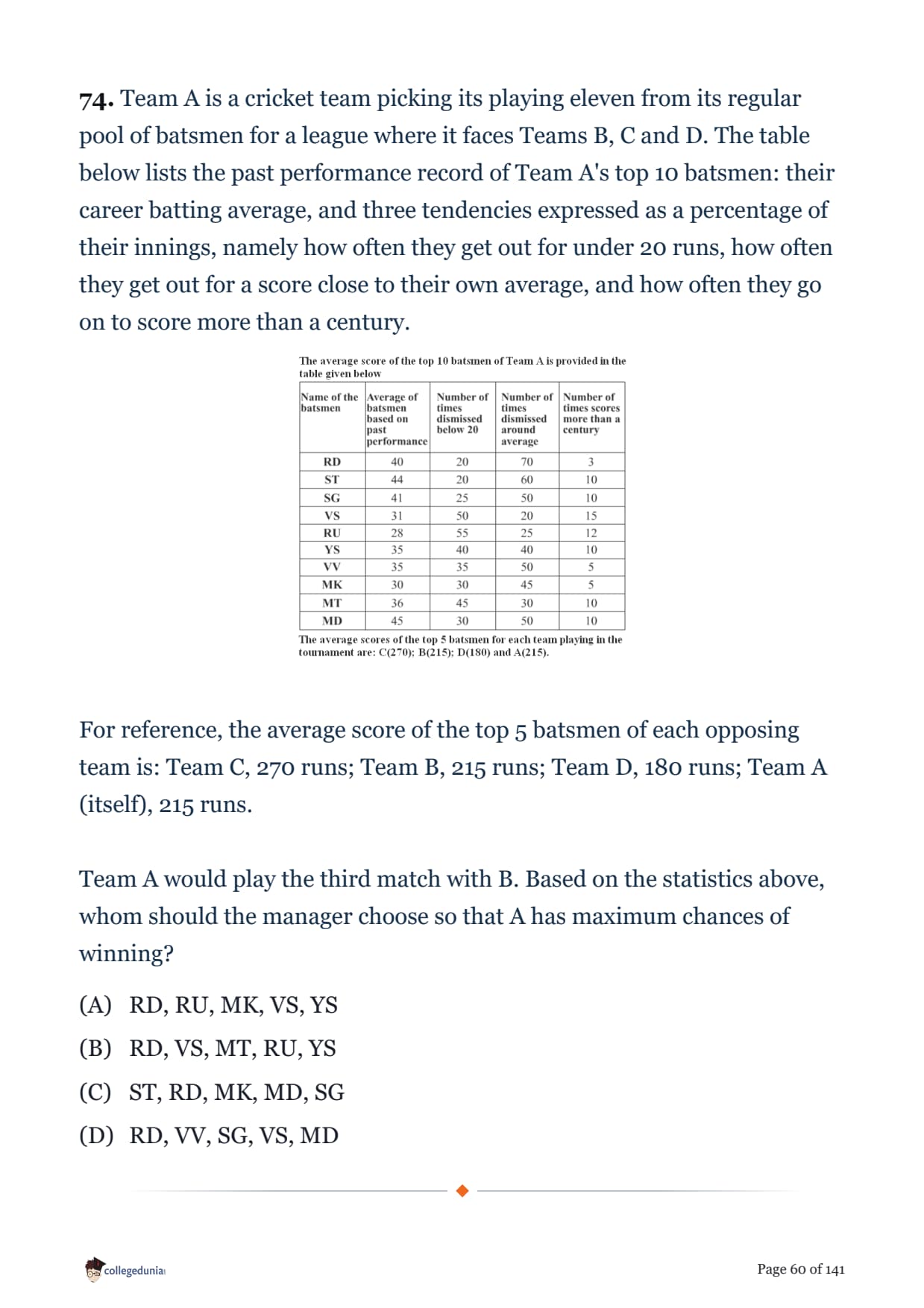
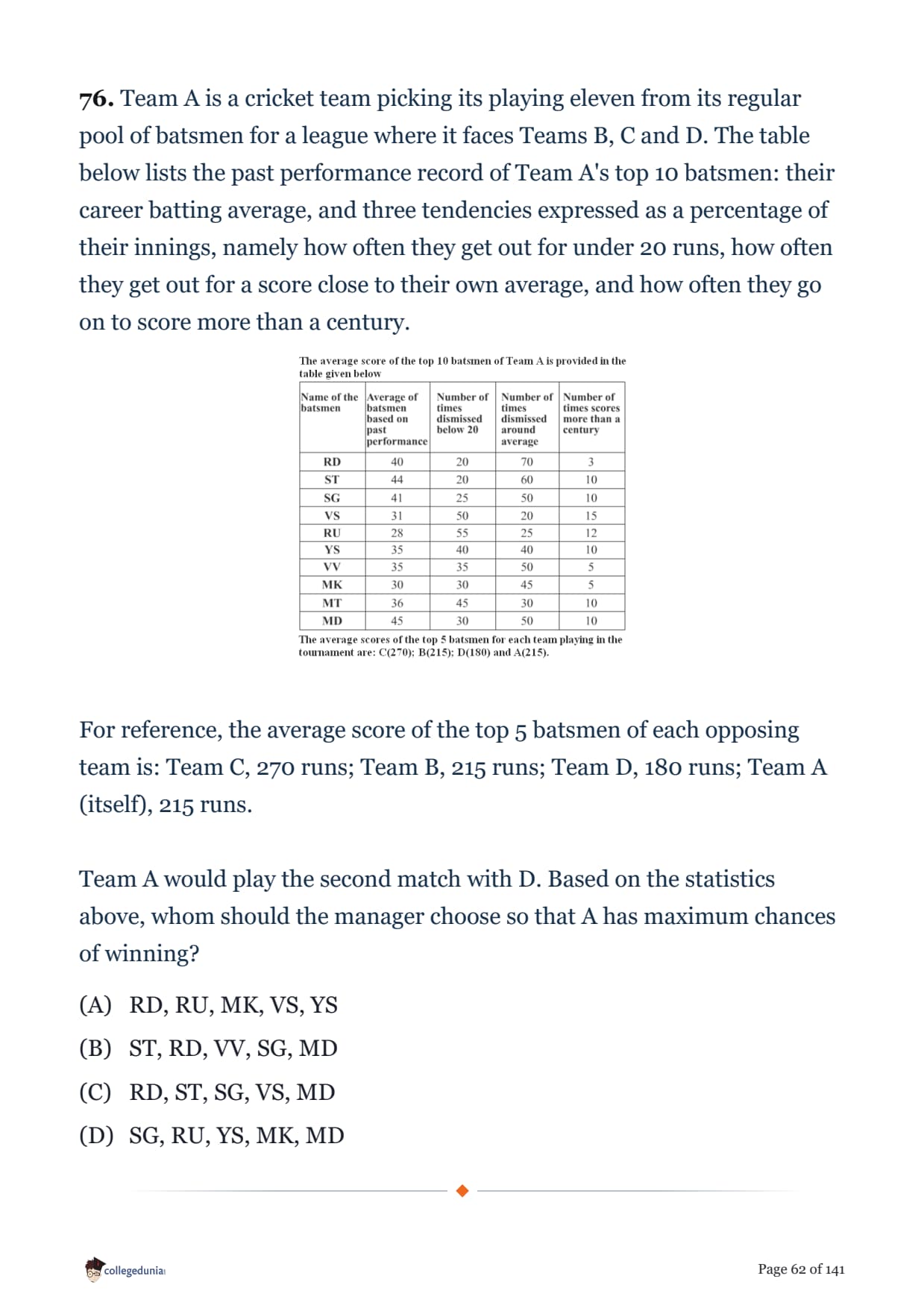
Team A is a cricket team picking its playing eleven from its regular pool of batsmen for a league where it faces Teams B, C and D. The table below lists the past performance record of Team A's top 10 batsmen: their career batting average, and three tendencies expressed as a percentage of their innings, namely how often they get out for under 20 runs, how often they get out for a score close to their own average, and how often they go on to score more than a century.
For reference, the average score of the top 5 batsmen of each opposing team is: Team C, 270 runs; Team B, 215 runs; Team D, 180 runs; Team A (itself), 215 runs.
Team A would play the third match with B. Based on the statistics above, whom should the manager choose so that A has maximum chances of winning?
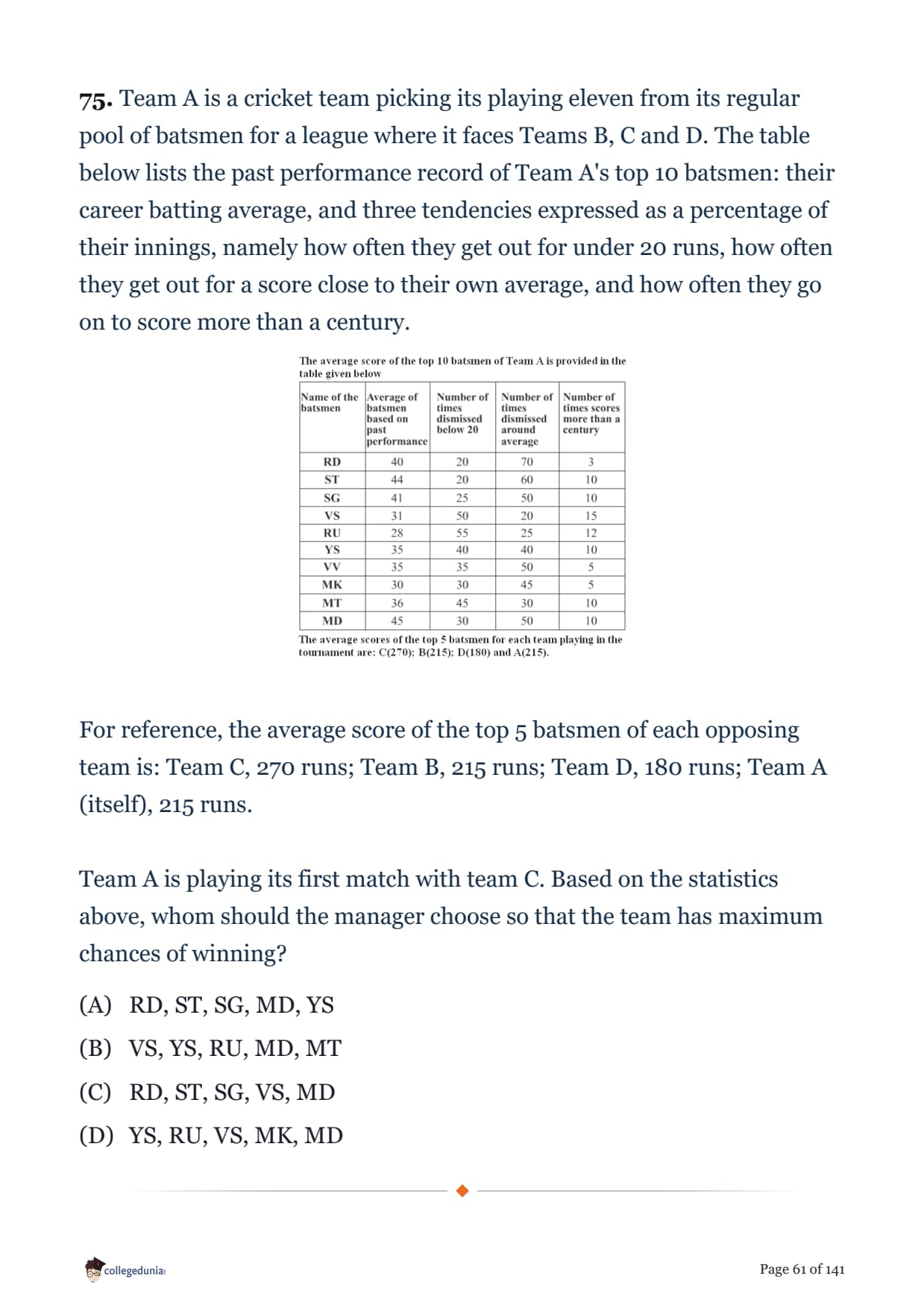
Team A is a cricket team picking its playing eleven from its regular pool of batsmen for a league where it faces Teams B, C and D. The table below lists the past performance record of Team A's top 10 batsmen: their career batting average, and three tendencies expressed as a percentage of their innings, namely how often they get out for under 20 runs, how often they get out for a score close to their own average, and how often they go on to score more than a century.
For reference, the average score of the top 5 batsmen of each opposing team is: Team C, 270 runs; Team B, 215 runs; Team D, 180 runs; Team A (itself), 215 runs.
Team A is playing its first match with team C. Based on the statistics above, whom should the manager choose so that the team has maximum chances of winning?
Team A is a cricket team picking its playing eleven from its regular pool of batsmen for a league where it faces Teams B, C and D. The table below lists the past performance record of Team A's top 10 batsmen: their career batting average, and three tendencies expressed as a percentage of their innings, namely how often they get out for under 20 runs, how often they get out for a score close to their own average, and how often they go on to score more than a century.
For reference, the average score of the top 5 batsmen of each opposing team is: Team C, 270 runs; Team B, 215 runs; Team D, 180 runs; Team A (itself), 215 runs.
Team A would play the second match with D. Based on the statistics above, whom should the manager choose so that A has maximum chances of winning?
Read the following caselet and answer the question that follows.
Mr. Rajiv Singhal, Chairman of the Board of Directors of Loha India Ltd. (a steel manufacturing company), had just been visited by several other directors of the company. The directors were upset with the recent actions of the company president, Mr. Ganesh Thakur. They demanded that the board consider firing the president.
Mr. Thakur, recently appointed as president, had undertaken to solve some of the management-employee problems by dealing directly with individuals as often as possible. The company did not have a history of strikes or any other form of collective action and was considered to have a good work culture. However, Mr. Thakur felt that by dealing directly with individuals, he could show the management's concern for the employees. An important step Mr. Thakur took was to negotiate the wages of the supervisors with each supervisor one on one. In these negotiation meetings he did not involve anyone else, including the Personnel Department which reported to him, so that he could take an unbiased decision. After negotiation, a wage contract was drawn up for each supervisor. He felt this would recognise and reward the better performers. Mr. Thakur carried out this process for most of the supervisors, except those working the night shift. For them he drew up the contracts on his own, benchmarking the night shift supervisors' wages against the day shift supervisors' wages.
For several days, Ram Lal, a night shift supervisor, had been trying to get an appointment with Mr. Thakur about his wages. He was upset, not only because he could not see the president, but also because there had been no discussion about his wage contract before it was put into effect. As a family man with six dependents, he felt his weekly wage should be higher than what he had been given.
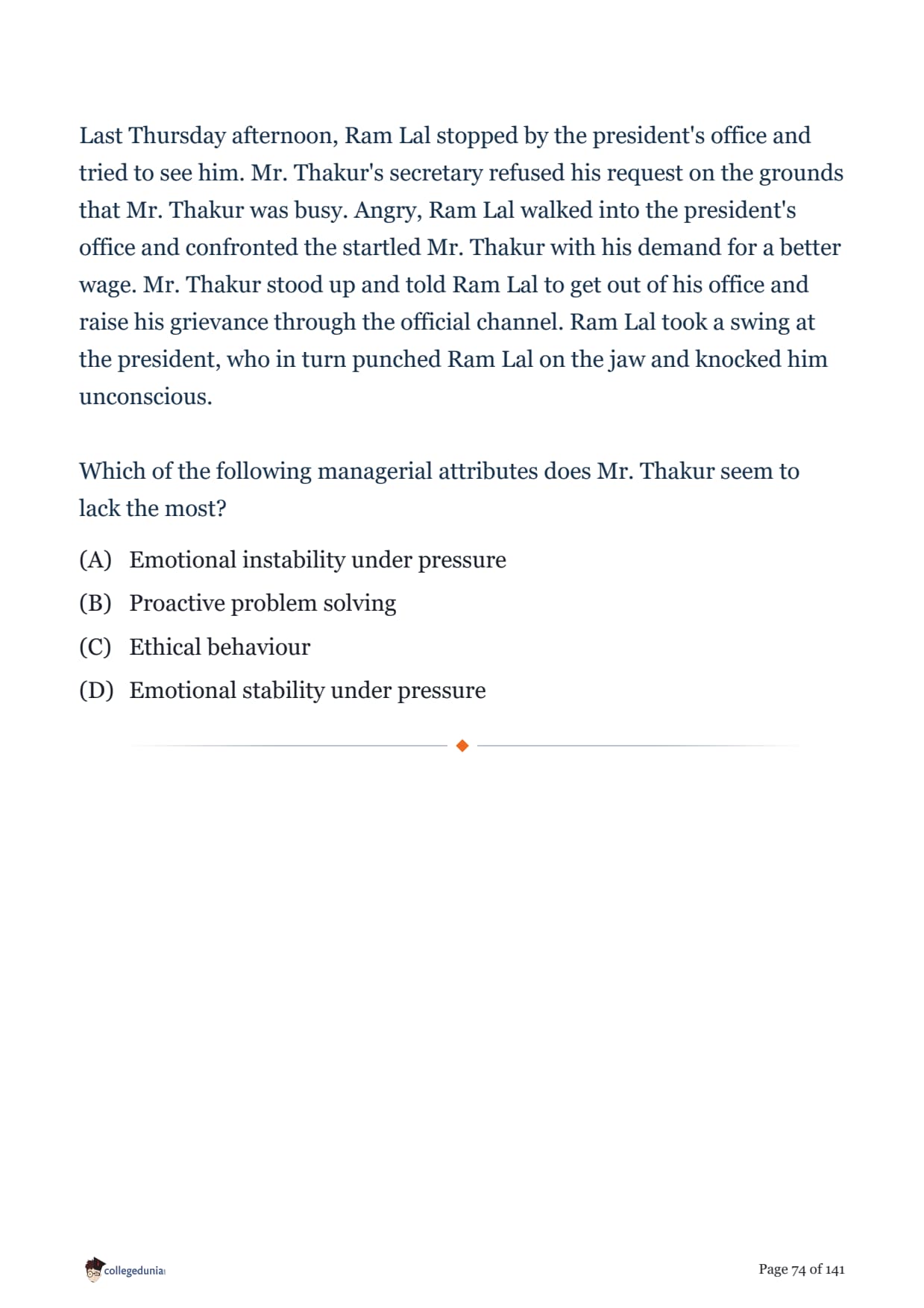
Last Thursday afternoon, Ram Lal stopped by the president's office and tried to see him. Mr. Thakur's secretary refused his request on the grounds that Mr. Thakur was busy. Angry, Ram Lal walked into the president's office and confronted the startled Mr. Thakur with his demand for a better wage. Mr. Thakur stood up and told Ram Lal to get out of his office and raise his grievance through the official channel. Ram Lal took a swing at the president, who in turn punched Ram Lal on the jaw and knocked him unconscious.
The most likely premise behind Mr. Thakur's step of holding individual meetings with the supervisors seems to be:
Read the following caselet and answer the question that follows.
Mr. Rajiv Singhal, Chairman of the Board of Directors of Loha India Ltd. (a steel manufacturing company), had just been visited by several other directors of the company. The directors were upset with the recent actions of the company president, Mr. Ganesh Thakur. They demanded that the board consider firing the president.
Mr. Thakur, recently appointed as president, had undertaken to solve some of the management-employee problems by dealing directly with individuals as often as possible. The company did not have a history of strikes or any other form of collective action and was considered to have a good work culture. However, Mr. Thakur felt that by dealing directly with individuals, he could show the management's concern for the employees. An important step Mr. Thakur took was to negotiate the wages of the supervisors with each supervisor one on one. In these negotiation meetings he did not involve anyone else, including the Personnel Department which reported to him, so that he could take an unbiased decision. After negotiation, a wage contract was drawn up for each supervisor. He felt this would recognise and reward the better performers. Mr. Thakur carried out this process for most of the supervisors, except those working the night shift. For them he drew up the contracts on his own, benchmarking the night shift supervisors' wages against the day shift supervisors' wages.
For several days, Ram Lal, a night shift supervisor, had been trying to get an appointment with Mr. Thakur about his wages. He was upset, not only because he could not see the president, but also because there had been no discussion about his wage contract before it was put into effect. As a family man with six dependents, he felt his weekly wage should be higher than what he had been given.
Last Thursday afternoon, Ram Lal stopped by the president's office and tried to see him. Mr. Thakur's secretary refused his request on the grounds that Mr. Thakur was busy. Angry, Ram Lal walked into the president's office and confronted the startled Mr. Thakur with his demand for a better wage. Mr. Thakur stood up and told Ram Lal to get out of his office and raise his grievance through the official channel. Ram Lal took a swing at the president, who in turn punched Ram Lal on the jaw and knocked him unconscious.
Out of the following, which one seems to be the most likely cause of Ram Lal's grievance?
Read the following caselet and answer the question that follows.
Mr. Rajiv Singhal, Chairman of the Board of Directors of Loha India Ltd. (a steel manufacturing company), had just been visited by several other directors of the company. The directors were upset with the recent actions of the company president, Mr. Ganesh Thakur. They demanded that the board consider firing the president.
Mr. Thakur, recently appointed as president, had undertaken to solve some of the management-employee problems by dealing directly with individuals as often as possible. The company did not have a history of strikes or any other form of collective action and was considered to have a good work culture. However, Mr. Thakur felt that by dealing directly with individuals, he could show the management's concern for the employees. An important step Mr. Thakur took was to negotiate the wages of the supervisors with each supervisor one on one. In these negotiation meetings he did not involve anyone else, including the Personnel Department which reported to him, so that he could take an unbiased decision. After negotiation, a wage contract was drawn up for each supervisor. He felt this would recognise and reward the better performers. Mr. Thakur carried out this process for most of the supervisors, except those working the night shift. For them he drew up the contracts on his own, benchmarking the night shift supervisors' wages against the day shift supervisors' wages.
For several days, Ram Lal, a night shift supervisor, had been trying to get an appointment with Mr. Thakur about his wages. He was upset, not only because he could not see the president, but also because there had been no discussion about his wage contract before it was put into effect. As a family man with six dependents, he felt his weekly wage should be higher than what he had been given.
Last Thursday afternoon, Ram Lal stopped by the president's office and tried to see him. Mr. Thakur's secretary refused his request on the grounds that Mr. Thakur was busy. Angry, Ram Lal walked into the president's office and confronted the startled Mr. Thakur with his demand for a better wage. Mr. Thakur stood up and told Ram Lal to get out of his office and raise his grievance through the official channel. Ram Lal took a swing at the president, who in turn punched Ram Lal on the jaw and knocked him unconscious.
The most important causal factor for this entire episode could be:
Read the following caselet and answer the question that follows.
Mr. Rajiv Singhal, Chairman of the Board of Directors of Loha India Ltd. (a steel manufacturing company), had just been visited by several other directors of the company. The directors were upset with the recent actions of the company president, Mr. Ganesh Thakur. They demanded that the board consider firing the president.
Mr. Thakur, recently appointed as president, had undertaken to solve some of the management-employee problems by dealing directly with individuals as often as possible. The company did not have a history of strikes or any other form of collective action and was considered to have a good work culture. However, Mr. Thakur felt that by dealing directly with individuals, he could show the management's concern for the employees. An important step Mr. Thakur took was to negotiate the wages of the supervisors with each supervisor one on one. In these negotiation meetings he did not involve anyone else, including the Personnel Department which reported to him, so that he could take an unbiased decision. After negotiation, a wage contract was drawn up for each supervisor. He felt this would recognise and reward the better performers. Mr. Thakur carried out this process for most of the supervisors, except those working the night shift. For them he drew up the contracts on his own, benchmarking the night shift supervisors' wages against the day shift supervisors' wages.
For several days, Ram Lal, a night shift supervisor, had been trying to get an appointment with Mr. Thakur about his wages. He was upset, not only because he could not see the president, but also because there had been no discussion about his wage contract before it was put into effect. As a family man with six dependents, he felt his weekly wage should be higher than what he had been given.
Last Thursday afternoon, Ram Lal stopped by the president's office and tried to see him. Mr. Thakur's secretary refused his request on the grounds that Mr. Thakur was busy. Angry, Ram Lal walked into the president's office and confronted the startled Mr. Thakur with his demand for a better wage. Mr. Thakur stood up and told Ram Lal to get out of his office and raise his grievance through the official channel. Ram Lal took a swing at the president, who in turn punched Ram Lal on the jaw and knocked him unconscious.
The situation with Mr. Lal could have been avoided if Mr. Thakur had:
1. Delegated the task of negotiating wage contracts for night shift employees to the Personnel department.
2. Created a process for supervisors working the night shift so that they could have an opportunity to interact with him.
3. Created an open door policy that would have allowed employees to see him without any appointment.
4. Postponed the decision on wage revision for supervisors in the night shift for two months, since supervisors were rotated across different shifts every two months.
The option that best arranges the above managerial interventions in decreasing order of organisational impact is:
Read the following caselet and answer the question that follows.
Mr. Rajiv Singhal, Chairman of the Board of Directors of Loha India Ltd. (a steel manufacturing company), had just been visited by several other directors of the company. The directors were upset with the recent actions of the company president, Mr. Ganesh Thakur. They demanded that the board consider firing the president.
Mr. Thakur, recently appointed as president, had undertaken to solve some of the management-employee problems by dealing directly with individuals as often as possible. The company did not have a history of strikes or any other form of collective action and was considered to have a good work culture. However, Mr. Thakur felt that by dealing directly with individuals, he could show the management's concern for the employees. An important step Mr. Thakur took was to negotiate the wages of the supervisors with each supervisor one on one. In these negotiation meetings he did not involve anyone else, including the Personnel Department which reported to him, so that he could take an unbiased decision. After negotiation, a wage contract was drawn up for each supervisor. He felt this would recognise and reward the better performers. Mr. Thakur carried out this process for most of the supervisors, except those working the night shift. For them he drew up the contracts on his own, benchmarking the night shift supervisors' wages against the day shift supervisors' wages.
For several days, Ram Lal, a night shift supervisor, had been trying to get an appointment with Mr. Thakur about his wages. He was upset, not only because he could not see the president, but also because there had been no discussion about his wage contract before it was put into effect. As a family man with six dependents, he felt his weekly wage should be higher than what he had been given.
Last Thursday afternoon, Ram Lal stopped by the president's office and tried to see him. Mr. Thakur's secretary refused his request on the grounds that Mr. Thakur was busy. Angry, Ram Lal walked into the president's office and confronted the startled Mr. Thakur with his demand for a better wage. Mr. Thakur stood up and told Ram Lal to get out of his office and raise his grievance through the official channel. Ram Lal took a swing at the president, who in turn punched Ram Lal on the jaw and knocked him unconscious.
Apart from the supervisors working the night shift, executives of which department will have the most justified reasons to be unhappy with Mr. Thakur's initiative?
1. Production department, for not being consulted regarding the behaviour of the supervisors on the shop floor.
2. Finance department, for not being taken into confidence regarding the financial consequences of the wage contracts.
3. Marketing department, for not being consulted on the likely impact of the wage contracts on the image of the company.
4. Quality control, for not being able to give inputs to Mr. Thakur on how to improve the quality of the steel making process.
5. Personnel department, since it was their job to oversee wage policies for employees, and they had been ignored by Mr. Thakur.
Read the following caselet and answer the question that follows.
Mr. Rajiv Singhal, Chairman of the Board of Directors of Loha India Ltd. (a steel manufacturing company), had just been visited by several other directors of the company. The directors were upset with the recent actions of the company president, Mr. Ganesh Thakur. They demanded that the board consider firing the president.
Mr. Thakur, recently appointed as president, had undertaken to solve some of the management-employee problems by dealing directly with individuals as often as possible. The company did not have a history of strikes or any other form of collective action and was considered to have a good work culture. However, Mr. Thakur felt that by dealing directly with individuals, he could show the management's concern for the employees. An important step Mr. Thakur took was to negotiate the wages of the supervisors with each supervisor one on one. In these negotiation meetings he did not involve anyone else, including the Personnel Department which reported to him, so that he could take an unbiased decision. After negotiation, a wage contract was drawn up for each supervisor. He felt this would recognise and reward the better performers. Mr. Thakur carried out this process for most of the supervisors, except those working the night shift. For them he drew up the contracts on his own, benchmarking the night shift supervisors' wages against the day shift supervisors' wages.
For several days, Ram Lal, a night shift supervisor, had been trying to get an appointment with Mr. Thakur about his wages. He was upset, not only because he could not see the president, but also because there had been no discussion about his wage contract before it was put into effect. As a family man with six dependents, he felt his weekly wage should be higher than what he had been given.
Last Thursday afternoon, Ram Lal stopped by the president's office and tried to see him. Mr. Thakur's secretary refused his request on the grounds that Mr. Thakur was busy. Angry, Ram Lal walked into the president's office and confronted the startled Mr. Thakur with his demand for a better wage. Mr. Thakur stood up and told Ram Lal to get out of his office and raise his grievance through the official channel. Ram Lal took a swing at the president, who in turn punched Ram Lal on the jaw and knocked him unconscious.
Which of the following managerial attributes does Mr. Thakur seem to lack the most?
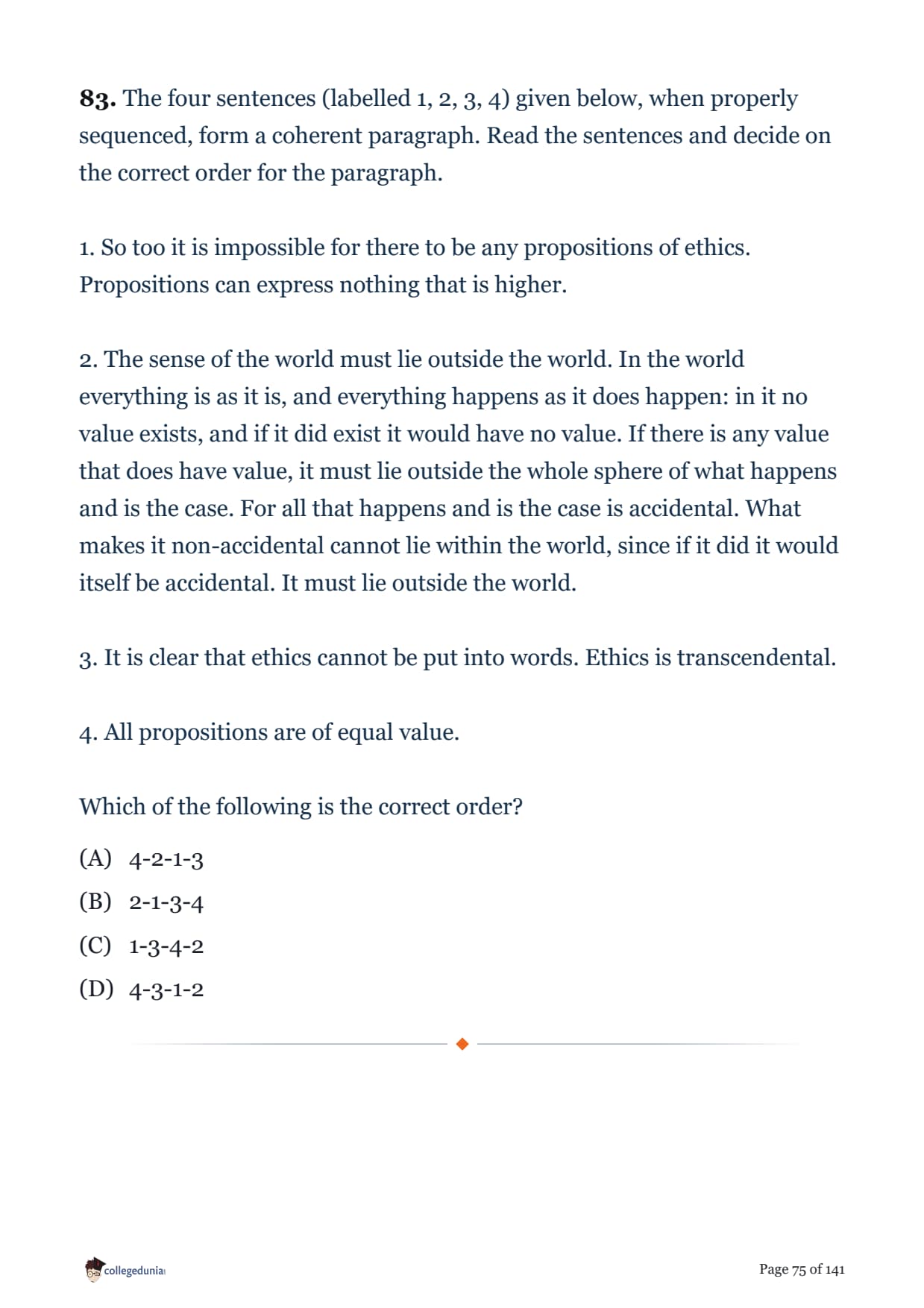
The four sentences (labelled 1, 2, 3, 4) given below, when properly sequenced, form a coherent paragraph. Read the sentences and decide on the correct order for the paragraph.
1. So too it is impossible for there to be any propositions of ethics. Propositions can express nothing that is higher.
2. The sense of the world must lie outside the world. In the world everything is as it is, and everything happens as it does happen: in it no value exists, and if it did exist it would have no value. If there is any value that does have value, it must lie outside the whole sphere of what happens and is the case. For all that happens and is the case is accidental. What makes it non-accidental cannot lie within the world, since if it did it would itself be accidental. It must lie outside the world.
3. It is clear that ethics cannot be put into words. Ethics is transcendental.
4. All propositions are of equal value.
Which of the following is the correct order?
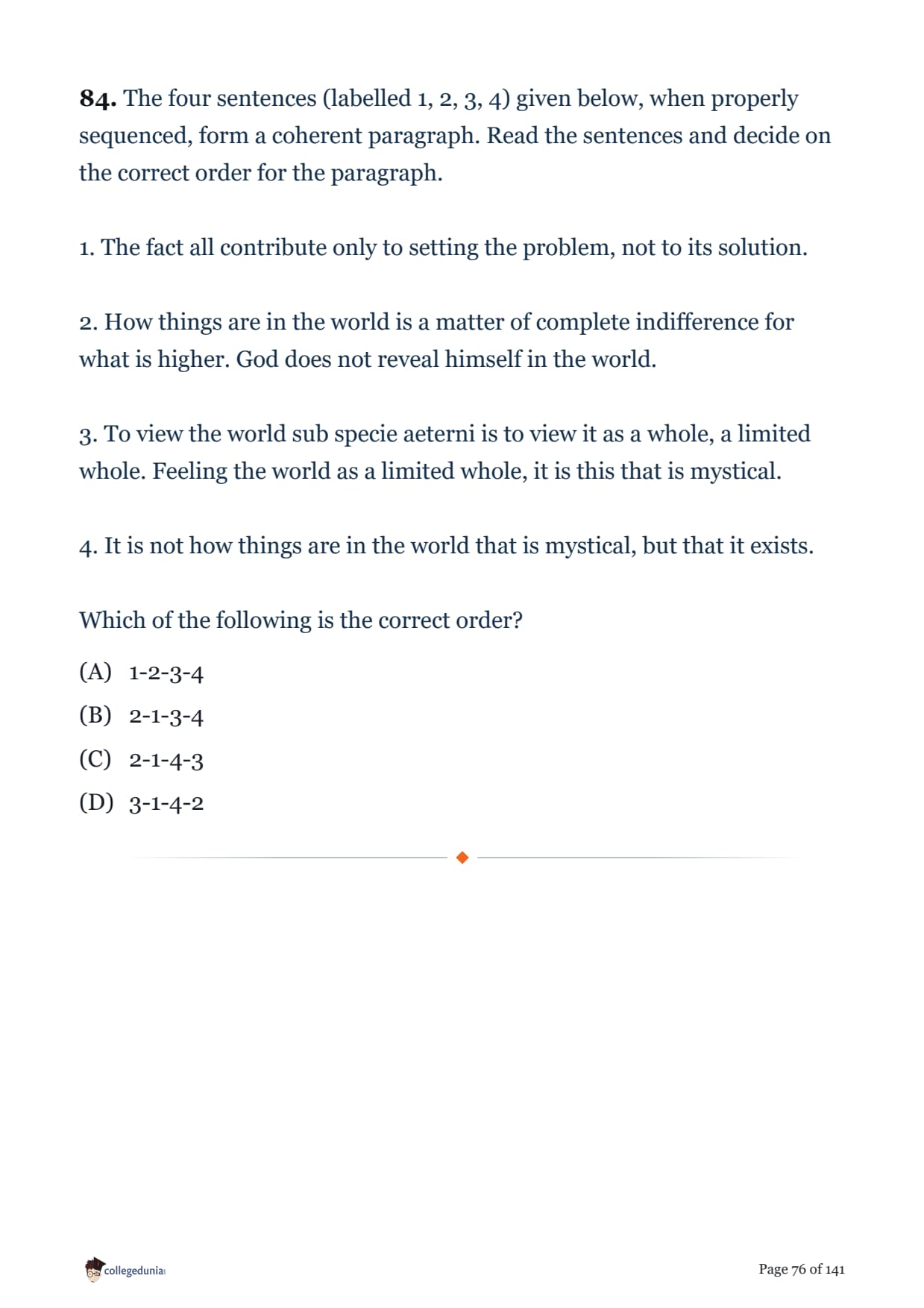
The four sentences (labelled 1, 2, 3, 4) given below, when properly sequenced, form a coherent paragraph. Read the sentences and decide on the correct order for the paragraph.
1. The fact all contribute only to setting the problem, not to its solution.
2. How things are in the world is a matter of complete indifference for what is higher. God does not reveal himself in the world.
3. To view the world sub specie aeterni is to view it as a whole, a limited whole. Feeling the world as a limited whole, it is this that is mystical.
4. It is not how things are in the world that is mystical, but that it exists.
Which of the following is the correct order?
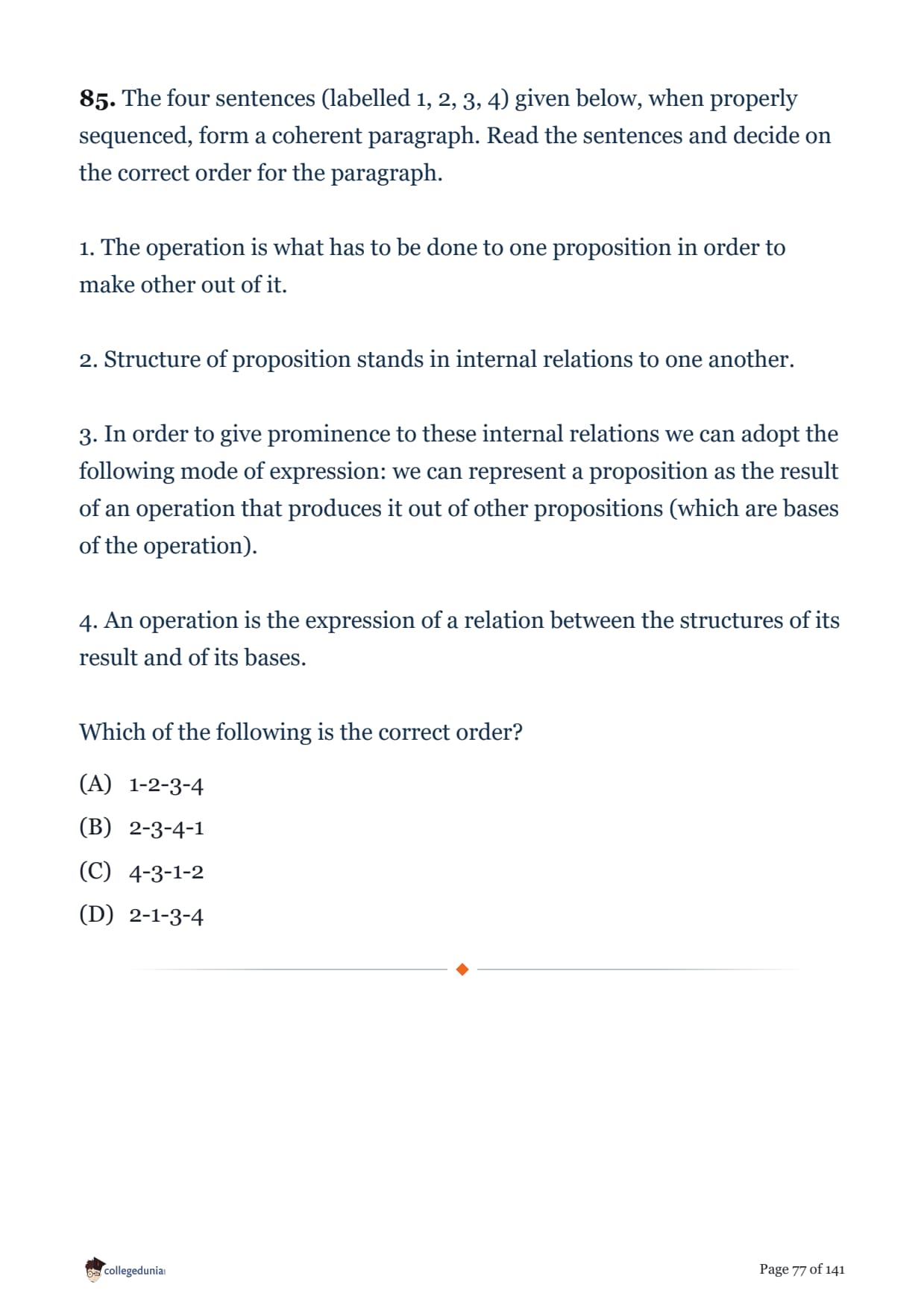
The four sentences (labelled 1, 2, 3, 4) given below, when properly sequenced, form a coherent paragraph. Read the sentences and decide on the correct order for the paragraph.
1. The operation is what has to be done to one proposition in order to make other out of it.
2. Structure of proposition stands in internal relations to one another.
3. In order to give prominence to these internal relations we can adopt the following mode of expression: we can represent a proposition as the result of an operation that produces it out of other propositions (which are bases of the operation).
4. An operation is the expression of a relation between the structures of its result and of its bases.
Which of the following is the correct order?
Passage:
Every conscious mental state carries a quality we call mood. We are always in some mood, pleasant or unpleasant to some degree. Bad moods may come from too little positive reinforcement in a person's life, along with too many punishments. Moods differ from emotions in one clear way: emotions are tied to a specific object, while moods are not. This split is not perfect, since emotions can also be aimed at something broad (a person can be angry at people in general), while a mood still carries a general sense about the state of the world at large. Moods show up as positive or negative feelings linked to health, personality, or how good a person feels life is. Moods can also grow out of an emotion, such as the mood that follows a specific event like failing to secure a loan. In that sense, a mood is the mind's judgment on the recent past. Goldie notes that an emotion can rise and fall inside a mood, while an emotion can still carry traits that are not object specific.
Moods matter to marketing because they color outlook and bias judgment. This is why consumer confidence surveys matter, since consumer confidence reflects the national mood. There is mood congruence when a person's thoughts and actions fall in line with their mood. Goleman describes this as a constant stream of feeling that runs in perfect harmony with a person's stream of thought. Mood congruence happens because a positive mood brings pleasant associations that soften later thoughts and actions, while a negative mood brings pessimistic associations that shape later judgment and behavior. A consumer in a good mood is more optimistic and confident about buying, and more willing to put up with things like waiting in a queue. Businesses try to put customers in the right mood using music and friendly staff, or place bakeries inside malls so the smell of fresh bread pulls shoppers in.
Thayer treats mood as a mix of biological and psychological influences, a kind of clinical thermometer that reflects everything going on inside and outside a person. For Thayer, the two building blocks of mood are energy and tension, combined in different amounts. A specific mixture of energy and tension, together with the thoughts they influence, produces moods. He describes four mood states:
- Calm-energy: the optimal mood for feeling good.
- Calm-tiredness: mild tiredness without stress, which can still feel pleasant.
- Tense-energy: a low level of anxiety suited to a fight-or-flight response.
- Tense-tiredness: a mix of fatigue and anxiety behind the unpleasant feeling of depression.
People generally feel down or feel good because of events happening around them, and this adds up to the national mood. People feel elated when their national soccer team wins an international match, and low when the team loses. An elated mood of calm-energy is an optimistic mood, which is good for business. Consumers, as socially involved individuals, are shaped by the prevailing social climate, and marketers talk about the national mood running for or against conspicuous consumption. Moods do change. Writing early in the nineteenth century, Tocqueville describes an American elite embarrassed by showy material display; sixty years later, in the Gilded Age, many people were eager to embrace a showy, materialistic style instead. The hard part is predicting a shift in national mood, since a change in mood affects everything from buying stocks to buying houses and washing machines. Thayer would argue that we should watch for national events likely to push people toward a tense-tiredness state or a calm-energy state, since these two extremes are more likely to shape behavior. Artists sensitive to national moods capture these long-term shifts. One example is the emotional distance between Charles Dickens's sentimental account of the death of Little Nell and Oscar Wilde's cruel joke about it (that one would need a heart of stone not to laugh at the death of Little Nell), a shift from high Victorian sentiment to the sharper cynicism found later in writers like Thomas Hardy and artists like Aubrey Beardsley.
Whenever the mind is not fully absorbed, consciousness is no longer focused and ordered, and under such conditions the mind drifts toward unpleasant thoughts, building a negative mood. Csikszentmihalyi argues that the human need to keep consciousness fully active drives a good deal of consumer behavior. Sometimes it does not matter what a person is shopping for; the act of shopping itself is one way to fill the void in consciousness when there is nothing else to do.
Question: Which one of the following statements best summarizes the above passage?
Passage:
Every conscious mental state carries a quality we call mood. We are always in some mood, pleasant or unpleasant to some degree. Bad moods may come from too little positive reinforcement in a person's life, along with too many punishments. Moods differ from emotions in one clear way: emotions are tied to a specific object, while moods are not. This split is not perfect, since emotions can also be aimed at something broad (a person can be angry at people in general), while a mood still carries a general sense about the state of the world at large. Moods show up as positive or negative feelings linked to health, personality, or how good a person feels life is. Moods can also grow out of an emotion, such as the mood that follows a specific event like failing to secure a loan. In that sense, a mood is the mind's judgment on the recent past. Goldie notes that an emotion can rise and fall inside a mood, while an emotion can still carry traits that are not object specific.
Moods matter to marketing because they color outlook and bias judgment. This is why consumer confidence surveys matter, since consumer confidence reflects the national mood. There is mood congruence when a person's thoughts and actions fall in line with their mood. Goleman describes this as a constant stream of feeling that runs in perfect harmony with a person's stream of thought. Mood congruence happens because a positive mood brings pleasant associations that soften later thoughts and actions, while a negative mood brings pessimistic associations that shape later judgment and behavior. A consumer in a good mood is more optimistic and confident about buying, and more willing to put up with things like waiting in a queue. Businesses try to put customers in the right mood using music and friendly staff, or place bakeries inside malls so the smell of fresh bread pulls shoppers in.
Thayer treats mood as a mix of biological and psychological influences, a kind of clinical thermometer that reflects everything going on inside and outside a person. For Thayer, the two building blocks of mood are energy and tension, combined in different amounts. A specific mixture of energy and tension, together with the thoughts they influence, produces moods. He describes four mood states:
- Calm-energy: the optimal mood for feeling good.
- Calm-tiredness: mild tiredness without stress, which can still feel pleasant.
- Tense-energy: a low level of anxiety suited to a fight-or-flight response.
- Tense-tiredness: a mix of fatigue and anxiety behind the unpleasant feeling of depression.
People generally feel down or feel good because of events happening around them, and this adds up to the national mood. People feel elated when their national soccer team wins an international match, and low when the team loses. An elated mood of calm-energy is an optimistic mood, which is good for business. Consumers, as socially involved individuals, are shaped by the prevailing social climate, and marketers talk about the national mood running for or against conspicuous consumption. Moods do change. Writing early in the nineteenth century, Tocqueville describes an American elite embarrassed by showy material display; sixty years later, in the Gilded Age, many people were eager to embrace a showy, materialistic style instead. The hard part is predicting a shift in national mood, since a change in mood affects everything from buying stocks to buying houses and washing machines. Thayer would argue that we should watch for national events likely to push people toward a tense-tiredness state or a calm-energy state, since these two extremes are more likely to shape behavior. Artists sensitive to national moods capture these long-term shifts. One example is the emotional distance between Charles Dickens's sentimental account of the death of Little Nell and Oscar Wilde's cruel joke about it (that one would need a heart of stone not to laugh at the death of Little Nell), a shift from high Victorian sentiment to the sharper cynicism found later in writers like Thomas Hardy and artists like Aubrey Beardsley.
Whenever the mind is not fully absorbed, consciousness is no longer focused and ordered, and under such conditions the mind drifts toward unpleasant thoughts, building a negative mood. Csikszentmihalyi argues that the human need to keep consciousness fully active drives a good deal of consumer behavior. Sometimes it does not matter what a person is shopping for; the act of shopping itself is one way to fill the void in consciousness when there is nothing else to do.
Question: Which of the following is closest to "conspicuous consumption" as used in the passage?
Passage:
Every conscious mental state carries a quality we call mood. We are always in some mood, pleasant or unpleasant to some degree. Bad moods may come from too little positive reinforcement in a person's life, along with too many punishments. Moods differ from emotions in one clear way: emotions are tied to a specific object, while moods are not. This split is not perfect, since emotions can also be aimed at something broad (a person can be angry at people in general), while a mood still carries a general sense about the state of the world at large. Moods show up as positive or negative feelings linked to health, personality, or how good a person feels life is. Moods can also grow out of an emotion, such as the mood that follows a specific event like failing to secure a loan. In that sense, a mood is the mind's judgment on the recent past. Goldie notes that an emotion can rise and fall inside a mood, while an emotion can still carry traits that are not object specific.
Moods matter to marketing because they color outlook and bias judgment. This is why consumer confidence surveys matter, since consumer confidence reflects the national mood. There is mood congruence when a person's thoughts and actions fall in line with their mood. Goleman describes this as a constant stream of feeling that runs in perfect harmony with a person's stream of thought. Mood congruence happens because a positive mood brings pleasant associations that soften later thoughts and actions, while a negative mood brings pessimistic associations that shape later judgment and behavior. A consumer in a good mood is more optimistic and confident about buying, and more willing to put up with things like waiting in a queue. Businesses try to put customers in the right mood using music and friendly staff, or place bakeries inside malls so the smell of fresh bread pulls shoppers in.
Thayer treats mood as a mix of biological and psychological influences, a kind of clinical thermometer that reflects everything going on inside and outside a person. For Thayer, the two building blocks of mood are energy and tension, combined in different amounts. A specific mixture of energy and tension, together with the thoughts they influence, produces moods. He describes four mood states:
- Calm-energy: the optimal mood for feeling good.
- Calm-tiredness: mild tiredness without stress, which can still feel pleasant.
- Tense-energy: a low level of anxiety suited to a fight-or-flight response.
- Tense-tiredness: a mix of fatigue and anxiety behind the unpleasant feeling of depression.
People generally feel down or feel good because of events happening around them, and this adds up to the national mood. People feel elated when their national soccer team wins an international match, and low when the team loses. An elated mood of calm-energy is an optimistic mood, which is good for business. Consumers, as socially involved individuals, are shaped by the prevailing social climate, and marketers talk about the national mood running for or against conspicuous consumption. Moods do change. Writing early in the nineteenth century, Tocqueville describes an American elite embarrassed by showy material display; sixty years later, in the Gilded Age, many people were eager to embrace a showy, materialistic style instead. The hard part is predicting a shift in national mood, since a change in mood affects everything from buying stocks to buying houses and washing machines. Thayer would argue that we should watch for national events likely to push people toward a tense-tiredness state or a calm-energy state, since these two extremes are more likely to shape behavior. Artists sensitive to national moods capture these long-term shifts. One example is the emotional distance between Charles Dickens's sentimental account of the death of Little Nell and Oscar Wilde's cruel joke about it (that one would need a heart of stone not to laugh at the death of Little Nell), a shift from high Victorian sentiment to the sharper cynicism found later in writers like Thomas Hardy and artists like Aubrey Beardsley.
Whenever the mind is not fully absorbed, consciousness is no longer focused and ordered, and under such conditions the mind drifts toward unpleasant thoughts, building a negative mood. Csikszentmihalyi argues that the human need to keep consciousness fully active drives a good deal of consumer behavior. Sometimes it does not matter what a person is shopping for; the act of shopping itself is one way to fill the void in consciousness when there is nothing else to do.
Question: What is "mood congruence" as described in the passage?
Passage:
Every conscious mental state carries a quality we call mood. We are always in some mood, pleasant or unpleasant to some degree. Bad moods may come from too little positive reinforcement in a person's life, along with too many punishments. Moods differ from emotions in one clear way: emotions are tied to a specific object, while moods are not. This split is not perfect, since emotions can also be aimed at something broad (a person can be angry at people in general), while a mood still carries a general sense about the state of the world at large. Moods show up as positive or negative feelings linked to health, personality, or how good a person feels life is. Moods can also grow out of an emotion, such as the mood that follows a specific event like failing to secure a loan. In that sense, a mood is the mind's judgment on the recent past. Goldie notes that an emotion can rise and fall inside a mood, while an emotion can still carry traits that are not object specific.
Moods matter to marketing because they color outlook and bias judgment. This is why consumer confidence surveys matter, since consumer confidence reflects the national mood. There is mood congruence when a person's thoughts and actions fall in line with their mood. Goleman describes this as a constant stream of feeling that runs in perfect harmony with a person's stream of thought. Mood congruence happens because a positive mood brings pleasant associations that soften later thoughts and actions, while a negative mood brings pessimistic associations that shape later judgment and behavior. A consumer in a good mood is more optimistic and confident about buying, and more willing to put up with things like waiting in a queue. Businesses try to put customers in the right mood using music and friendly staff, or place bakeries inside malls so the smell of fresh bread pulls shoppers in.
Thayer treats mood as a mix of biological and psychological influences, a kind of clinical thermometer that reflects everything going on inside and outside a person. For Thayer, the two building blocks of mood are energy and tension, combined in different amounts. A specific mixture of energy and tension, together with the thoughts they influence, produces moods. He describes four mood states:
- Calm-energy: the optimal mood for feeling good.
- Calm-tiredness: mild tiredness without stress, which can still feel pleasant.
- Tense-energy: a low level of anxiety suited to a fight-or-flight response.
- Tense-tiredness: a mix of fatigue and anxiety behind the unpleasant feeling of depression.
People generally feel down or feel good because of events happening around them, and this adds up to the national mood. People feel elated when their national soccer team wins an international match, and low when the team loses. An elated mood of calm-energy is an optimistic mood, which is good for business. Consumers, as socially involved individuals, are shaped by the prevailing social climate, and marketers talk about the national mood running for or against conspicuous consumption. Moods do change. Writing early in the nineteenth century, Tocqueville describes an American elite embarrassed by showy material display; sixty years later, in the Gilded Age, many people were eager to embrace a showy, materialistic style instead. The hard part is predicting a shift in national mood, since a change in mood affects everything from buying stocks to buying houses and washing machines. Thayer would argue that we should watch for national events likely to push people toward a tense-tiredness state or a calm-energy state, since these two extremes are more likely to shape behavior. Artists sensitive to national moods capture these long-term shifts. One example is the emotional distance between Charles Dickens's sentimental account of the death of Little Nell and Oscar Wilde's cruel joke about it (that one would need a heart of stone not to laugh at the death of Little Nell), a shift from high Victorian sentiment to the sharper cynicism found later in writers like Thomas Hardy and artists like Aubrey Beardsley.
Whenever the mind is not fully absorbed, consciousness is no longer focused and ordered, and under such conditions the mind drifts toward unpleasant thoughts, building a negative mood. Csikszentmihalyi argues that the human need to keep consciousness fully active drives a good deal of consumer behavior. Sometimes it does not matter what a person is shopping for; the act of shopping itself is one way to fill the void in consciousness when there is nothing else to do.
Question: Implication and proposition are defined as follows. Implication: a statement that follows from the passage. Proposition: a statement that forms a part of the passage. Consider the two statements below and decide whether each is an implication or a proposition. Statement I: The marketers should understand and make use of moods and emotions in designing and selling products and services. Statement II: Consuming is nothing but a way of filling the void in consciousness.
Passage:
Every conscious mental state carries a quality we call mood. We are always in some mood, pleasant or unpleasant to some degree. Bad moods may come from too little positive reinforcement in a person's life, along with too many punishments. Moods differ from emotions in one clear way: emotions are tied to a specific object, while moods are not. This split is not perfect, since emotions can also be aimed at something broad (a person can be angry at people in general), while a mood still carries a general sense about the state of the world at large. Moods show up as positive or negative feelings linked to health, personality, or how good a person feels life is. Moods can also grow out of an emotion, such as the mood that follows a specific event like failing to secure a loan. In that sense, a mood is the mind's judgment on the recent past. Goldie notes that an emotion can rise and fall inside a mood, while an emotion can still carry traits that are not object specific.
Moods matter to marketing because they color outlook and bias judgment. This is why consumer confidence surveys matter, since consumer confidence reflects the national mood. There is mood congruence when a person's thoughts and actions fall in line with their mood. Goleman describes this as a constant stream of feeling that runs in perfect harmony with a person's stream of thought. Mood congruence happens because a positive mood brings pleasant associations that soften later thoughts and actions, while a negative mood brings pessimistic associations that shape later judgment and behavior. A consumer in a good mood is more optimistic and confident about buying, and more willing to put up with things like waiting in a queue. Businesses try to put customers in the right mood using music and friendly staff, or place bakeries inside malls so the smell of fresh bread pulls shoppers in.
Thayer treats mood as a mix of biological and psychological influences, a kind of clinical thermometer that reflects everything going on inside and outside a person. For Thayer, the two building blocks of mood are energy and tension, combined in different amounts. A specific mixture of energy and tension, together with the thoughts they influence, produces moods. He describes four mood states:
- Calm-energy: the optimal mood for feeling good.
- Calm-tiredness: mild tiredness without stress, which can still feel pleasant.
- Tense-energy: a low level of anxiety suited to a fight-or-flight response.
- Tense-tiredness: a mix of fatigue and anxiety behind the unpleasant feeling of depression.
People generally feel down or feel good because of events happening around them, and this adds up to the national mood. People feel elated when their national soccer team wins an international match, and low when the team loses. An elated mood of calm-energy is an optimistic mood, which is good for business. Consumers, as socially involved individuals, are shaped by the prevailing social climate, and marketers talk about the national mood running for or against conspicuous consumption. Moods do change. Writing early in the nineteenth century, Tocqueville describes an American elite embarrassed by showy material display; sixty years later, in the Gilded Age, many people were eager to embrace a showy, materialistic style instead. The hard part is predicting a shift in national mood, since a change in mood affects everything from buying stocks to buying houses and washing machines. Thayer would argue that we should watch for national events likely to push people toward a tense-tiredness state or a calm-energy state, since these two extremes are more likely to shape behavior. Artists sensitive to national moods capture these long-term shifts. One example is the emotional distance between Charles Dickens's sentimental account of the death of Little Nell and Oscar Wilde's cruel joke about it (that one would need a heart of stone not to laugh at the death of Little Nell), a shift from high Victorian sentiment to the sharper cynicism found later in writers like Thomas Hardy and artists like Aubrey Beardsley.
Whenever the mind is not fully absorbed, consciousness is no longer focused and ordered, and under such conditions the mind drifts toward unpleasant thoughts, building a negative mood. Csikszentmihalyi argues that the human need to keep consciousness fully active drives a good deal of consumer behavior. Sometimes it does not matter what a person is shopping for; the act of shopping itself is one way to fill the void in consciousness when there is nothing else to do.
Question: Which of the following statements are correct, based on the passage? Statement 1: In general, emotions are object specific. Statement 2: In general, moods are not object specific. Statement 3: Moods and emotions are the same. Statement 4: As per Thayer, moods are a mix of biological and psychological influences.
Passage:
Every conscious mental state carries a quality we call mood. We are always in some mood, pleasant or unpleasant to some degree. Bad moods may come from too little positive reinforcement in a person's life, along with too many punishments. Moods differ from emotions in one clear way: emotions are tied to a specific object, while moods are not. This split is not perfect, since emotions can also be aimed at something broad (a person can be angry at people in general), while a mood still carries a general sense about the state of the world at large. Moods show up as positive or negative feelings linked to health, personality, or how good a person feels life is. Moods can also grow out of an emotion, such as the mood that follows a specific event like failing to secure a loan. In that sense, a mood is the mind's judgment on the recent past. Goldie notes that an emotion can rise and fall inside a mood, while an emotion can still carry traits that are not object specific.
Moods matter to marketing because they color outlook and bias judgment. This is why consumer confidence surveys matter, since consumer confidence reflects the national mood. There is mood congruence when a person's thoughts and actions fall in line with their mood. Goleman describes this as a constant stream of feeling that runs in perfect harmony with a person's stream of thought. Mood congruence happens because a positive mood brings pleasant associations that soften later thoughts and actions, while a negative mood brings pessimistic associations that shape later judgment and behavior. A consumer in a good mood is more optimistic and confident about buying, and more willing to put up with things like waiting in a queue. Businesses try to put customers in the right mood using music and friendly staff, or place bakeries inside malls so the smell of fresh bread pulls shoppers in.
Thayer treats mood as a mix of biological and psychological influences, a kind of clinical thermometer that reflects everything going on inside and outside a person. For Thayer, the two building blocks of mood are energy and tension, combined in different amounts. A specific mixture of energy and tension, together with the thoughts they influence, produces moods. He describes four mood states:
- Calm-energy: the optimal mood for feeling good.
- Calm-tiredness: mild tiredness without stress, which can still feel pleasant.
- Tense-energy: a low level of anxiety suited to a fight-or-flight response.
- Tense-tiredness: a mix of fatigue and anxiety behind the unpleasant feeling of depression.
People generally feel down or feel good because of events happening around them, and this adds up to the national mood. People feel elated when their national soccer team wins an international match, and low when the team loses. An elated mood of calm-energy is an optimistic mood, which is good for business. Consumers, as socially involved individuals, are shaped by the prevailing social climate, and marketers talk about the national mood running for or against conspicuous consumption. Moods do change. Writing early in the nineteenth century, Tocqueville describes an American elite embarrassed by showy material display; sixty years later, in the Gilded Age, many people were eager to embrace a showy, materialistic style instead. The hard part is predicting a shift in national mood, since a change in mood affects everything from buying stocks to buying houses and washing machines. Thayer would argue that we should watch for national events likely to push people toward a tense-tiredness state or a calm-energy state, since these two extremes are more likely to shape behavior. Artists sensitive to national moods capture these long-term shifts. One example is the emotional distance between Charles Dickens's sentimental account of the death of Little Nell and Oscar Wilde's cruel joke about it (that one would need a heart of stone not to laugh at the death of Little Nell), a shift from high Victorian sentiment to the sharper cynicism found later in writers like Thomas Hardy and artists like Aubrey Beardsley.
Whenever the mind is not fully absorbed, consciousness is no longer focused and ordered, and under such conditions the mind drifts toward unpleasant thoughts, building a negative mood. Csikszentmihalyi argues that the human need to keep consciousness fully active drives a good deal of consumer behavior. Sometimes it does not matter what a person is shopping for; the act of shopping itself is one way to fill the void in consciousness when there is nothing else to do.
Question: The statement "moods provide energy for human actions" is ________, based on the passage.
Directions: Read the following caselet and answer the question that follows.
According to recent reports, CEOs of large organisations are paid more than CEOs of small organisations. It does not seem fair that just because a CEO is heading a big organisation, he or she should be paid more. A CEO's salary should be tied to performance, especially growth in sales and profits. Big organisations are of course more complex to run than small ones, but every CEO puts in a large amount of energy and time managing the organisation. There is no proof that CEOs of big organisations face more stress than CEOs of small organisations. All CEOs should be paid according to their performance.
A person seeking to refute this argument might argue that
Directions: Read the following caselet and answer the question that follows.
According to recent reports, CEOs of large organisations are paid more than CEOs of small organisations. It does not seem fair that just because a CEO is heading a big organisation, he or she should be paid more. A CEO's salary should be tied to performance, especially growth in sales and profits. Big organisations are of course more complex to run than small ones, but every CEO puts in a large amount of energy and time managing the organisation. There is no proof that CEOs of big organisations face more stress than CEOs of small organisations. All CEOs should be paid according to their performance.
Which of the following, if true, would strengthen the speaker's argument?
Directions: Read the following passage and answer the question that follows.
Hindi ought to be the official language of India. There is no reason for the government to spend money printing documents in different languages just to cater to people who cannot read or write Hindi. The government has better ways to spend taxpayers' money. People across India should read, write, or learn Hindi at the earliest.
Which of the following, if true, would weaken the speaker's argument the most?
Directions: Read the following passage and answer the question that follows.
Hindi ought to be the official language of India. There is no reason for the government to spend money printing documents in different languages just to cater to people who cannot read or write Hindi. The government has better ways to spend taxpayers' money. People across India should read, write, or learn Hindi at the earliest.
United Nations members contribute funds, proportionate to their population, for the smooth functioning of the UN. By 2010, India, being the most populous nation on the planet, would contribute the maximum amount to the UN. Therefore, the official language of the United Nations should be changed to Hindi.
Which of the following is true?
Read the passage below and answer the question that follows.
The Bistupur-Sakchi corner needs a speed-breaker. Loyola school children cross this intersection, on their way to the school, and many a times do not check out for traffic. I get to read regular reports of cars and other vehicles hitting children. I know that speed-breakers are irritating for drivers, and I know that children cannot be protected from every danger, but this is one of the worst intersections in town. There needs to be a speed-breaker so that vehicles have to slow down and the children be made safer.
Which of the following types of argument is used in the passage above?
Read the passage and the additional information below, then answer the question that follows.
The Bistupur-Sakchi corner needs a speed-breaker. Loyola school children cross this intersection, on their way to the school, and many a times do not check out for traffic. I get to read regular reports of cars and other vehicles hitting children. I know that speed-breakers are irritating for drivers, and I know that children cannot be protected from every danger, but this is one of the worst intersections in town. There needs to be a speed-breaker so that vehicles have to slow down and the children be made safer.
According to a recent research conducted by the district road planning department, ten percent of students come with parents in cars, twenty percent of students use auto-rickshaws, twenty percent of students use taxis, forty percent of students use the school buses, and ten percent of students live in the hostel inside the school.
Which of the following is true about the paragraph containing the survey data above?
Read the passage below and answer the question that follows.
History, if viewed as a repository not merely of anecdotes or chronology, could produce a decisive transformation in the image of science by which we are now possessed. That image has previously been drawn, even by scientists themselves, mainly from the study of finished scientific achievements as these are recorded in the classics and, more recently, in the textbooks from which each new scientific generation learns to practice its trade.
Which of the following best summarizes the passage above?
Read the passage below and answer the question that follows.
History, if viewed as a repository not merely of anecdotes or chronology, could produce a decisive transformation in the image of science by which we are now possessed. That image has previously been drawn, even by scientists themselves, mainly from the study of finished scientific achievements as these are recorded in the classics and, more recently, in the textbooks from which each new scientific generation learns to practice its trade.
Which of the following statements is the author most likely to agree with?
Goodricke Group Ltd is planning to give top priority to the core competence of production and marketing of tea in 2007. The company plans to increase the production of orthodox varieties of tea. Goodricke intends to invest Rs. 10 crore to modernize its factories. The company has reported a net profit of Rs. 5.49 crore for 2006, against Rs. 3.76 crore in 2005.
Which of the following can be deduced from the caselet?
The author reflects on the concept of Blue Ocean Strategy. He explains that this concept delivers an instinctive framework for developing uncontested market space and making competition irrelevant. The author remarks that Blue Ocean Strategy is about having the best mix of attributes that results in the creation of uncontested market space and high growth, and not about being the best.
The above paragraph appears to be an attempt at
Deborah Mayo is a philosopher of science who has attempted to capture the implications of the new experimentalism in a philosophically rigorous way. Mayo focuses on the detailed way in which claims are validated by experiment, and is concerned with identifying just what claims are borne out and how. A key idea underlying her treatment is that a claim can only be said to be supported by experiment if the various ways in which the claim could be at fault have been investigated and eliminated. A claim can only be said to be borne out by experiment, and a severe test of a claim, as usefully construed by Mayo, must be such that the claim would be unlikely to pass it if it were false.
Her idea can be explained by some simple examples. Suppose Snell's law of refraction of light is tested by some very rough experiments in which very large margins of error are attributed to the measurements of angles of incidence and refraction, and suppose that the results are shown to be compatible with the law within those margins of error. Has the law been supported by experiments that have severely tested it? From Mayo's perspective the answer is 'no' because, owing to the roughness of the measurements, the law of refraction would be quite likely to pass this test even if it were false and some other law differing not too much from Snell's law true. An exercise I carried out in my school-teaching days serves to drive this point home. My students had conducted some not very careful experiments to test Snell's law. I then presented them with some alternative laws of refraction that had been suggested in antiquity and mediaeval times, prior to the discovery of Snell's law, and invited the students to test them with the measurements they had used to test Snell's law; because of the wide margins of error they had attributed to their measurements, all of these alternative laws pass the test. This clearly brings out the point that the experiments in question did not constitute a severe test of Snell's law. The law would have passed the test even if it were false and one of the historical alternatives true.
Which of the following conclusions can be drawn from the passage?
Deborah Mayo is a philosopher of science who has attempted to capture the implications of the new experimentalism in a philosophically rigorous way. Mayo focuses on the detailed way in which claims are validated by experiment, and is concerned with identifying just what claims are borne out and how. A key idea underlying her treatment is that a claim can only be said to be supported by experiment if the various ways in which the claim could be at fault have been investigated and eliminated. A claim can only be said to be borne out by experiment, and a severe test of a claim, as usefully construed by Mayo, must be such that the claim would be unlikely to pass it if it were false.
Her idea can be explained by some simple examples. Suppose Snell's law of refraction of light is tested by some very rough experiments in which very large margins of error are attributed to the measurements of angles of incidence and refraction, and suppose that the results are shown to be compatible with the law within those margins of error. Has the law been supported by experiments that have severely tested it? From Mayo's perspective the answer is 'no' because, owing to the roughness of the measurements, the law of refraction would be quite likely to pass this test even if it were false and some other law differing not too much from Snell's law true. An exercise I carried out in my school-teaching days serves to drive this point home. My students had conducted some not very careful experiments to test Snell's law. I then presented them with some alternative laws of refraction that had been suggested in antiquity and mediaeval times, prior to the discovery of Snell's law, and invited the students to test them with the measurements they had used to test Snell's law; because of the wide margins of error they had attributed to their measurements, all of these alternative laws pass the test. This clearly brings out the point that the experiments in question did not constitute a severe test of Snell's law. The law would have passed the test even if it were false and one of the historical alternatives true.
As per Mayo's perspective, which of the following best defines the phrase 'scientific explanation'?
Deborah Mayo is a philosopher of science who has attempted to capture the implications of the new experimentalism in a philosophically rigorous way. Mayo focuses on the detailed way in which claims are validated by experiment, and is concerned with identifying just what claims are borne out and how. A key idea underlying her treatment is that a claim can only be said to be supported by experiment if the various ways in which the claim could be at fault have been investigated and eliminated. A claim can only be said to be borne out by experiment, and a severe test of a claim, as usefully construed by Mayo, must be such that the claim would be unlikely to pass it if it were false.
Her idea can be explained by some simple examples. Suppose Snell's law of refraction of light is tested by some very rough experiments in which very large margins of error are attributed to the measurements of angles of incidence and refraction, and suppose that the results are shown to be compatible with the law within those margins of error. Has the law been supported by experiments that have severely tested it? From Mayo's perspective the answer is 'no' because, owing to the roughness of the measurements, the law of refraction would be quite likely to pass this test even if it were false and some other law differing not too much from Snell's law true. An exercise I carried out in my school-teaching days serves to drive this point home. My students had conducted some not very careful experiments to test Snell's law. I then presented them with some alternative laws of refraction that had been suggested in antiquity and mediaeval times, prior to the discovery of Snell's law, and invited the students to test them with the measurements they had used to test Snell's law; because of the wide margins of error they had attributed to their measurements, all of these alternative laws pass the test. This clearly brings out the point that the experiments in question did not constitute a severe test of Snell's law. The law would have passed the test even if it were false and one of the historical alternatives true.
The author's use of Snell's law of refraction to illustrate Mayo's perspective can best be said to be
Enunciated by Jung as an integral part of his psychology in 1916, immediately after his unsettling confrontation with the unconscious, the transcendent function was seen by Jung as uniting the opposites, transforming psyche, and central to the individuation process. It also undoubtedly reflects his personal experience in coming to terms with the unconscious. Jung portrayed the transcendent function as operating through symbol and fantasy, and mediating between the opposites of consciousness and the unconscious to prompt the emergence of a new, third posture that transcends the two.
In exploring the details of the transcendent function and its connection to other Jungian constructs, this work has unearthed significant changes, ambiguities, and inconsistencies in Jung's writings. Further, it has identified two separate images of the transcendent function: (11) the narrow transcendent function, the function or process within Jung's pantheon of psychic structures, generally seen as the uniting of the opposites of consciousness and the unconscious from which a new attitude emerges; and (22) the expansive transcendent function, the root metaphor for psyche or being psychological that subsumes Jung's pantheon and that apprehends the most fundamental psychic activity of interacting with the unknown or other.
This book has also posited that the expansive transcendent function, as the root metaphor for exchanges between conscious and the unconscious, is the wellspring from whence flows other key Jungian structures such as the archetypes and the Self, and is the core of the individuation process. The expansive transcendent function has been explored further by surveying other schools of psychology, with both depth and non-depth orientations, and evaluating the transcendent function alongside structures or processes in those other schools which play similar mediatory and/or transitional roles.
The above passage is most likely an excerpt from:
Enunciated by Jung as an integral part of his psychology in 1916, immediately after his unsettling confrontation with the unconscious, the transcendent function was seen by Jung as uniting the opposites, transforming psyche, and central to the individuation process. It also undoubtedly reflects his personal experience in coming to terms with the unconscious. Jung portrayed the transcendent function as operating through symbol and fantasy, and mediating between the opposites of consciousness and the unconscious to prompt the emergence of a new, third posture that transcends the two.
In exploring the details of the transcendent function and its connection to other Jungian constructs, this work has unearthed significant changes, ambiguities, and inconsistencies in Jung's writings. Further, it has identified two separate images of the transcendent function: (11) the narrow transcendent function, the function or process within Jung's pantheon of psychic structures, generally seen as the uniting of the opposites of consciousness and the unconscious from which a new attitude emerges; and (22) the expansive transcendent function, the root metaphor for psyche or being psychological that subsumes Jung's pantheon and that apprehends the most fundamental psychic activity of interacting with the unknown or other.
This book has also posited that the expansive transcendent function, as the root metaphor for exchanges between conscious and the unconscious, is the wellspring from whence flows other key Jungian structures such as the archetypes and the Self, and is the core of the individuation process. The expansive transcendent function has been explored further by surveying other schools of psychology, with both depth and non-depth orientations, and evaluating the transcendent function alongside structures or processes in those other schools which play similar mediatory and/or transitional roles.
It can be definitely inferred from the passage above that:
Enunciated by Jung as an integral part of his psychology in 1916, immediately after his unsettling confrontation with the unconscious, the transcendent function was seen by Jung as uniting the opposites, transforming psyche, and central to the individuation process. It also undoubtedly reflects his personal experience in coming to terms with the unconscious. Jung portrayed the transcendent function as operating through symbol and fantasy, and mediating between the opposites of consciousness and the unconscious to prompt the emergence of a new, third posture that transcends the two.
In exploring the details of the transcendent function and its connection to other Jungian constructs, this work has unearthed significant changes, ambiguities, and inconsistencies in Jung's writings. Further, it has identified two separate images of the transcendent function: (11) the narrow transcendent function, the function or process within Jung's pantheon of psychic structures, generally seen as the uniting of the opposites of consciousness and the unconscious from which a new attitude emerges; and (22) the expansive transcendent function, the root metaphor for psyche or being psychological that subsumes Jung's pantheon and that apprehends the most fundamental psychic activity of interacting with the unknown or other.
This book has also posited that the expansive transcendent function, as the root metaphor for exchanges between conscious and the unconscious, is the wellspring from whence flows other key Jungian structures such as the archetypes and the Self, and is the core of the individuation process. The expansive transcendent function has been explored further by surveying other schools of psychology, with both depth and non-depth orientations, and evaluating the transcendent function alongside structures or processes in those other schools which play similar mediatory and/or transitional roles.
A comparison similar to the distinction between the two images of the transcendent function would be:
Enunciated by Jung as an integral part of his psychology in 1916, immediately after his unsettling confrontation with the unconscious, the transcendent function was seen by Jung as uniting the opposites, transforming psyche, and central to the individuation process. It also undoubtedly reflects his personal experience in coming to terms with the unconscious. Jung portrayed the transcendent function as operating through symbol and fantasy, and mediating between the opposites of consciousness and the unconscious to prompt the emergence of a new, third posture that transcends the two.
In exploring the details of the transcendent function and its connection to other Jungian constructs, this work has unearthed significant changes, ambiguities, and inconsistencies in Jung's writings. Further, it has identified two separate images of the transcendent function: (11) the narrow transcendent function, the function or process within Jung's pantheon of psychic structures, generally seen as the uniting of the opposites of consciousness and the unconscious from which a new attitude emerges; and (22) the expansive transcendent function, the root metaphor for psyche or being psychological that subsumes Jung's pantheon and that apprehends the most fundamental psychic activity of interacting with the unknown or other.
This book has also posited that the expansive transcendent function, as the root metaphor for exchanges between conscious and the unconscious, is the wellspring from whence flows other key Jungian structures such as the archetypes and the Self, and is the core of the individuation process. The expansive transcendent function has been explored further by surveying other schools of psychology, with both depth and non-depth orientations, and evaluating the transcendent function alongside structures or processes in those other schools which play similar mediatory and/or transitional roles.
As per the passage, the key Jungian structure, other than the Self, that emerges from the expansive transcendent function may NOT be expressed as a(nn):
Choose the appropriate words to fill in the blanks.
Mark Twain was responsible for many striking, mostly cynical ______, such as "Always do right. That will gratify some of the people, and astonish the rest." ______ can sometimes end up as ______, but rarely would someone use them as an ______.
Choose the appropriate words to fill in the blanks.
A candidate in the medical viva voce exam faced a tinge of intellectual ______ when asked to spell the ______ gland. The fact that he carried notes on his person would definitely be termed as ______ by faculty, but may be termed as ______ by more generous sections of students.
Choose the appropriate words to fill in the blanks.
It is not ______ democratic that the parliament should be ______ on issues and resort to passing ______ rather than have an open debate on the floor of the house.
Choose the appropriate words to fill in the blanks.
In a case of acute ______, ______ membranes secrete excessive ______.
Choose the appropriate words to fill in the blanks.
If a person makes the statement: "I never speak the truth." The person can be said to be ______.
Directions: Read the passage carefully and answer the question that follows.
India is renowned for its diversity. Dissimilitude abounds in every sphere, from the physical elements of its land and people to the intangible workings of its beliefs and practices. Indeed, given this variety, India itself appears to be not a single entity but an amalgamation, a "construct" arising from the conjoining of innumerable, discrete parts. Modern scholarship has, quite properly, tended to explore these elements in isolation. (In part, this trend represents the conscious reversal of the stance taken by an earlier generation of scholars whose work reified India into a monolithic entity, a critical element in the much maligned "Orientalist" enterprise.) Nonetheless, the representation of India as a singular "Whole" is not an entirely capricious enterprise, for India is an identifiable entity, united by, if not born out of, certain deep and pervasive structures. Thus, for example, the Hindu tradition has long maintained a body of mythology that weaves the disparate temples, gods, even geographic landscapes that exist throughout the subcontinent into a unified, albeit syncretic, whole.
In the realm of thought, there is no more pervasive, unifying structure than karma. It is the "doctrine" or "law" that ties actions to results and creates a determinant link between an individual's status in this life and his or her fate in future lives. Following what is considered to be its appearance in the Upanishads, the doctrine reaches into nearly every corner of Hindu thought. Indeed, its dominance is such in the Hindu world view that karma encompasses, at the same time, life-affirming and life-negating functions, for just as it defines the world in terms of the "positive" function of laying out a doctrine of rewards and punishments, it also defines the world through its "negative" picture of action as an all but inescapable trap, an unremitting cycle of death and rebirth.
Despite, or perhaps because of, karma's ubiquity, the doctrine is not easily defined. Wendy Doniger O'Flaherty reports of a scholarly conference devoted to the study of karma where, although the participants admitted to a general sense of the doctrine's parameters, considerable time was spent in a "lively but ultimately vain attempt to define...karma and rebirth". The base meaning of the term "karma" (or, more precisely, in its Sanskrit stem form, karman, a neuter noun) is "action". As a doctrine, karma covers a number of quasi-independent concepts: rebirth (punarjanam), consequence (phala, literally "fruit," a word that suggests the "ripening" of actions into consequences), and the valuation or "ethic-ization" of acts, which marks them as either "good" (punya or sukarman) or "bad" (papam or duskarman).
In a general way, however, for at least the past two thousand years, the following passage (from the well known text, the Bhagavata Purana) has held true as a statement of the main elements of the karma doctrine: "The same person enjoys the fruit of the same sinful or meritorious act in the next world, in the same manner and to the same extent, according to the manner and extent to which that (sinful or meritorious) act has been done by him in this world." Even so, depending on the context in which the doctrine appears, ranging from its use across a wide range of literary sources to its use at the popular level, not all these elements may be present, though in a general way they may still be implied.
Question: According to the passage, how did the orientalist perspective view India?
Directions: Read the passage carefully and answer the question that follows.
India is renowned for its diversity. Dissimilitude abounds in every sphere, from the physical elements of its land and people to the intangible workings of its beliefs and practices. Indeed, given this variety, India itself appears to be not a single entity but an amalgamation, a "construct" arising from the conjoining of innumerable, discrete parts. Modern scholarship has, quite properly, tended to explore these elements in isolation. (In part, this trend represents the conscious reversal of the stance taken by an earlier generation of scholars whose work reified India into a monolithic entity, a critical element in the much maligned "Orientalist" enterprise.) Nonetheless, the representation of India as a singular "Whole" is not an entirely capricious enterprise, for India is an identifiable entity, united by, if not born out of, certain deep and pervasive structures. Thus, for example, the Hindu tradition has long maintained a body of mythology that weaves the disparate temples, gods, even geographic landscapes that exist throughout the subcontinent into a unified, albeit syncretic, whole.
In the realm of thought, there is no more pervasive, unifying structure than karma. It is the "doctrine" or "law" that ties actions to results and creates a determinant link between an individual's status in this life and his or her fate in future lives. Following what is considered to be its appearance in the Upanishads, the doctrine reaches into nearly every corner of Hindu thought. Indeed, its dominance is such in the Hindu world view that karma encompasses, at the same time, life-affirming and life-negating functions, for just as it defines the world in terms of the "positive" function of laying out a doctrine of rewards and punishments, it also defines the world through its "negative" picture of action as an all but inescapable trap, an unremitting cycle of death and rebirth.
Despite, or perhaps because of, karma's ubiquity, the doctrine is not easily defined. Wendy Doniger O'Flaherty reports of a scholarly conference devoted to the study of karma where, although the participants admitted to a general sense of the doctrine's parameters, considerable time was spent in a "lively but ultimately vain attempt to define...karma and rebirth". The base meaning of the term "karma" (or, more precisely, in its Sanskrit stem form, karman, a neuter noun) is "action". As a doctrine, karma covers a number of quasi-independent concepts: rebirth (punarjanam), consequence (phala, literally "fruit," a word that suggests the "ripening" of actions into consequences), and the valuation or "ethic-ization" of acts, which marks them as either "good" (punya or sukarman) or "bad" (papam or duskarman).
In a general way, however, for at least the past two thousand years, the following passage (from the well known text, the Bhagavata Purana) has held true as a statement of the main elements of the karma doctrine: "The same person enjoys the fruit of the same sinful or meritorious act in the next world, in the same manner and to the same extent, according to the manner and extent to which that (sinful or meritorious) act has been done by him in this world." Even so, depending on the context in which the doctrine appears, ranging from its use across a wide range of literary sources to its use at the popular level, not all these elements may be present, though in a general way they may still be implied.
Question: In the passage, the word "reify" means:
Directions: Read the passage carefully and answer the question that follows.
India is renowned for its diversity. Dissimilitude abounds in every sphere, from the physical elements of its land and people to the intangible workings of its beliefs and practices. Indeed, given this variety, India itself appears to be not a single entity but an amalgamation, a "construct" arising from the conjoining of innumerable, discrete parts. Modern scholarship has, quite properly, tended to explore these elements in isolation. (In part, this trend represents the conscious reversal of the stance taken by an earlier generation of scholars whose work reified India into a monolithic entity, a critical element in the much maligned "Orientalist" enterprise.) Nonetheless, the representation of India as a singular "Whole" is not an entirely capricious enterprise, for India is an identifiable entity, united by, if not born out of, certain deep and pervasive structures. Thus, for example, the Hindu tradition has long maintained a body of mythology that weaves the disparate temples, gods, even geographic landscapes that exist throughout the subcontinent into a unified, albeit syncretic, whole.
In the realm of thought, there is no more pervasive, unifying structure than karma. It is the "doctrine" or "law" that ties actions to results and creates a determinant link between an individual's status in this life and his or her fate in future lives. Following what is considered to be its appearance in the Upanishads, the doctrine reaches into nearly every corner of Hindu thought. Indeed, its dominance is such in the Hindu world view that karma encompasses, at the same time, life-affirming and life-negating functions, for just as it defines the world in terms of the "positive" function of laying out a doctrine of rewards and punishments, it also defines the world through its "negative" picture of action as an all but inescapable trap, an unremitting cycle of death and rebirth.
Despite, or perhaps because of, karma's ubiquity, the doctrine is not easily defined. Wendy Doniger O'Flaherty reports of a scholarly conference devoted to the study of karma where, although the participants admitted to a general sense of the doctrine's parameters, considerable time was spent in a "lively but ultimately vain attempt to define...karma and rebirth". The base meaning of the term "karma" (or, more precisely, in its Sanskrit stem form, karman, a neuter noun) is "action". As a doctrine, karma covers a number of quasi-independent concepts: rebirth (punarjanam), consequence (phala, literally "fruit," a word that suggests the "ripening" of actions into consequences), and the valuation or "ethic-ization" of acts, which marks them as either "good" (punya or sukarman) or "bad" (papam or duskarman).
In a general way, however, for at least the past two thousand years, the following passage (from the well known text, the Bhagavata Purana) has held true as a statement of the main elements of the karma doctrine: "The same person enjoys the fruit of the same sinful or meritorious act in the next world, in the same manner and to the same extent, according to the manner and extent to which that (sinful or meritorious) act has been done by him in this world." Even so, depending on the context in which the doctrine appears, ranging from its use across a wide range of literary sources to its use at the popular level, not all these elements may be present, though in a general way they may still be implied.
Question: In the passage, "ethic-ization" means:
Directions: Read the passage carefully and answer the question that follows.
India is renowned for its diversity. Dissimilitude abounds in every sphere, from the physical elements of its land and people to the intangible workings of its beliefs and practices. Indeed, given this variety, India itself appears to be not a single entity but an amalgamation, a "construct" arising from the conjoining of innumerable, discrete parts. Modern scholarship has, quite properly, tended to explore these elements in isolation. (In part, this trend represents the conscious reversal of the stance taken by an earlier generation of scholars whose work reified India into a monolithic entity, a critical element in the much maligned "Orientalist" enterprise.) Nonetheless, the representation of India as a singular "Whole" is not an entirely capricious enterprise, for India is an identifiable entity, united by, if not born out of, certain deep and pervasive structures. Thus, for example, the Hindu tradition has long maintained a body of mythology that weaves the disparate temples, gods, even geographic landscapes that exist throughout the subcontinent into a unified, albeit syncretic, whole.
In the realm of thought, there is no more pervasive, unifying structure than karma. It is the "doctrine" or "law" that ties actions to results and creates a determinant link between an individual's status in this life and his or her fate in future lives. Following what is considered to be its appearance in the Upanishads, the doctrine reaches into nearly every corner of Hindu thought. Indeed, its dominance is such in the Hindu world view that karma encompasses, at the same time, life-affirming and life-negating functions, for just as it defines the world in terms of the "positive" function of laying out a doctrine of rewards and punishments, it also defines the world through its "negative" picture of action as an all but inescapable trap, an unremitting cycle of death and rebirth.
Despite, or perhaps because of, karma's ubiquity, the doctrine is not easily defined. Wendy Doniger O'Flaherty reports of a scholarly conference devoted to the study of karma where, although the participants admitted to a general sense of the doctrine's parameters, considerable time was spent in a "lively but ultimately vain attempt to define...karma and rebirth". The base meaning of the term "karma" (or, more precisely, in its Sanskrit stem form, karman, a neuter noun) is "action". As a doctrine, karma covers a number of quasi-independent concepts: rebirth (punarjanam), consequence (phala, literally "fruit," a word that suggests the "ripening" of actions into consequences), and the valuation or "ethic-ization" of acts, which marks them as either "good" (punya or sukarman) or "bad" (papam or duskarman).
In a general way, however, for at least the past two thousand years, the following passage (from the well known text, the Bhagavata Purana) has held true as a statement of the main elements of the karma doctrine: "The same person enjoys the fruit of the same sinful or meritorious act in the next world, in the same manner and to the same extent, according to the manner and extent to which that (sinful or meritorious) act has been done by him in this world." Even so, depending on the context in which the doctrine appears, ranging from its use across a wide range of literary sources to its use at the popular level, not all these elements may be present, though in a general way they may still be implied.
Question: Consider the following statements:
1. Meaning of karma is contextual.
2. Meaning of karma is not unanimous.
3. Meaning of karma includes many other quasi-independent concepts.
4. Karma also means actions and their rewards.
Which of the statements are true?
Directions: Read the passage carefully and answer the question that follows.
India is renowned for its diversity. Dissimilitude abounds in every sphere, from the physical elements of its land and people to the intangible workings of its beliefs and practices. Indeed, given this variety, India itself appears to be not a single entity but an amalgamation, a "construct" arising from the conjoining of innumerable, discrete parts. Modern scholarship has, quite properly, tended to explore these elements in isolation. (In part, this trend represents the conscious reversal of the stance taken by an earlier generation of scholars whose work reified India into a monolithic entity, a critical element in the much maligned "Orientalist" enterprise.) Nonetheless, the representation of India as a singular "Whole" is not an entirely capricious enterprise, for India is an identifiable entity, united by, if not born out of, certain deep and pervasive structures. Thus, for example, the Hindu tradition has long maintained a body of mythology that weaves the disparate temples, gods, even geographic landscapes that exist throughout the subcontinent into a unified, albeit syncretic, whole.
In the realm of thought, there is no more pervasive, unifying structure than karma. It is the "doctrine" or "law" that ties actions to results and creates a determinant link between an individual's status in this life and his or her fate in future lives. Following what is considered to be its appearance in the Upanishads, the doctrine reaches into nearly every corner of Hindu thought. Indeed, its dominance is such in the Hindu world view that karma encompasses, at the same time, life-affirming and life-negating functions, for just as it defines the world in terms of the "positive" function of laying out a doctrine of rewards and punishments, it also defines the world through its "negative" picture of action as an all but inescapable trap, an unremitting cycle of death and rebirth.
Despite, or perhaps because of, karma's ubiquity, the doctrine is not easily defined. Wendy Doniger O'Flaherty reports of a scholarly conference devoted to the study of karma where, although the participants admitted to a general sense of the doctrine's parameters, considerable time was spent in a "lively but ultimately vain attempt to define...karma and rebirth". The base meaning of the term "karma" (or, more precisely, in its Sanskrit stem form, karman, a neuter noun) is "action". As a doctrine, karma covers a number of quasi-independent concepts: rebirth (punarjanam), consequence (phala, literally "fruit," a word that suggests the "ripening" of actions into consequences), and the valuation or "ethic-ization" of acts, which marks them as either "good" (punya or sukarman) or "bad" (papam or duskarman).
In a general way, however, for at least the past two thousand years, the following passage (from the well known text, the Bhagavata Purana) has held true as a statement of the main elements of the karma doctrine: "The same person enjoys the fruit of the same sinful or meritorious act in the next world, in the same manner and to the same extent, according to the manner and extent to which that (sinful or meritorious) act has been done by him in this world." Even so, depending on the context in which the doctrine appears, ranging from its use across a wide range of literary sources to its use at the popular level, not all these elements may be present, though in a general way they may still be implied.
Question: The base meaning of karma is:
Directions: Read the passage carefully and answer the question that follows.
India is renowned for its diversity. Dissimilitude abounds in every sphere, from the physical elements of its land and people to the intangible workings of its beliefs and practices. Indeed, given this variety, India itself appears to be not a single entity but an amalgamation, a "construct" arising from the conjoining of innumerable, discrete parts. Modern scholarship has, quite properly, tended to explore these elements in isolation. (In part, this trend represents the conscious reversal of the stance taken by an earlier generation of scholars whose work reified India into a monolithic entity, a critical element in the much maligned "Orientalist" enterprise.) Nonetheless, the representation of India as a singular "Whole" is not an entirely capricious enterprise, for India is an identifiable entity, united by, if not born out of, certain deep and pervasive structures. Thus, for example, the Hindu tradition has long maintained a body of mythology that weaves the disparate temples, gods, even geographic landscapes that exist throughout the subcontinent into a unified, albeit syncretic, whole.
In the realm of thought, there is no more pervasive, unifying structure than karma. It is the "doctrine" or "law" that ties actions to results and creates a determinant link between an individual's status in this life and his or her fate in future lives. Following what is considered to be its appearance in the Upanishads, the doctrine reaches into nearly every corner of Hindu thought. Indeed, its dominance is such in the Hindu world view that karma encompasses, at the same time, life-affirming and life-negating functions, for just as it defines the world in terms of the "positive" function of laying out a doctrine of rewards and punishments, it also defines the world through its "negative" picture of action as an all but inescapable trap, an unremitting cycle of death and rebirth.
Despite, or perhaps because of, karma's ubiquity, the doctrine is not easily defined. Wendy Doniger O'Flaherty reports of a scholarly conference devoted to the study of karma where, although the participants admitted to a general sense of the doctrine's parameters, considerable time was spent in a "lively but ultimately vain attempt to define...karma and rebirth". The base meaning of the term "karma" (or, more precisely, in its Sanskrit stem form, karman, a neuter noun) is "action". As a doctrine, karma covers a number of quasi-independent concepts: rebirth (punarjanam), consequence (phala, literally "fruit," a word that suggests the "ripening" of actions into consequences), and the valuation or "ethic-ization" of acts, which marks them as either "good" (punya or sukarman) or "bad" (papam or duskarman).
In a general way, however, for at least the past two thousand years, the following passage (from the well known text, the Bhagavata Purana) has held true as a statement of the main elements of the karma doctrine: "The same person enjoys the fruit of the same sinful or meritorious act in the next world, in the same manner and to the same extent, according to the manner and extent to which that (sinful or meritorious) act has been done by him in this world." Even so, depending on the context in which the doctrine appears, ranging from its use across a wide range of literary sources to its use at the popular level, not all these elements may be present, though in a general way they may still be implied.
Question: As per the author, which of the following statements is wrong?
Directions: Read the passage carefully and answer the question that follows.
India is renowned for its diversity. Dissimilitude abounds in every sphere, from the physical elements of its land and people to the intangible workings of its beliefs and practices. Indeed, given this variety, India itself appears to be not a single entity but an amalgamation, a "construct" arising from the conjoining of innumerable, discrete parts. Modern scholarship has, quite properly, tended to explore these elements in isolation. (In part, this trend represents the conscious reversal of the stance taken by an earlier generation of scholars whose work reified India into a monolithic entity, a critical element in the much maligned "Orientalist" enterprise.) Nonetheless, the representation of India as a singular "Whole" is not an entirely capricious enterprise, for India is an identifiable entity, united by, if not born out of, certain deep and pervasive structures. Thus, for example, the Hindu tradition has long maintained a body of mythology that weaves the disparate temples, gods, even geographic landscapes that exist throughout the subcontinent into a unified, albeit syncretic, whole.
In the realm of thought, there is no more pervasive, unifying structure than karma. It is the "doctrine" or "law" that ties actions to results and creates a determinant link between an individual's status in this life and his or her fate in future lives. Following what is considered to be its appearance in the Upanishads, the doctrine reaches into nearly every corner of Hindu thought. Indeed, its dominance is such in the Hindu world view that karma encompasses, at the same time, life-affirming and life-negating functions, for just as it defines the world in terms of the "positive" function of laying out a doctrine of rewards and punishments, it also defines the world through its "negative" picture of action as an all but inescapable trap, an unremitting cycle of death and rebirth.
Despite, or perhaps because of, karma's ubiquity, the doctrine is not easily defined. Wendy Doniger O'Flaherty reports of a scholarly conference devoted to the study of karma where, although the participants admitted to a general sense of the doctrine's parameters, considerable time was spent in a "lively but ultimately vain attempt to define...karma and rebirth". The base meaning of the term "karma" (or, more precisely, in its Sanskrit stem form, karman, a neuter noun) is "action". As a doctrine, karma covers a number of quasi-independent concepts: rebirth (punarjanam), consequence (phala, literally "fruit," a word that suggests the "ripening" of actions into consequences), and the valuation or "ethic-ization" of acts, which marks them as either "good" (punya or sukarman) or "bad" (papam or duskarman).
In a general way, however, for at least the past two thousand years, the following passage (from the well known text, the Bhagavata Purana) has held true as a statement of the main elements of the karma doctrine: "The same person enjoys the fruit of the same sinful or meritorious act in the next world, in the same manner and to the same extent, according to the manner and extent to which that (sinful or meritorious) act has been done by him in this world." Even so, depending on the context in which the doctrine appears, ranging from its use across a wide range of literary sources to its use at the popular level, not all these elements may be present, though in a general way they may still be implied.
Question: Which of the following, if true, would be required for the concept of karma, as defined in the Bhagavata Purana, to be made equally valid across different space-time combinations?
XAT 2008 Exam Pattern and Marking Scheme Explained
XAT 2008 was a pen-and-paper test that XLRI set apart from CAT with its heavy reasoning and decision-making focus. The combined paper ran across three objective sections that you attempted in a single sitting.
- Total questions: 120 objective questions in the combined paper
- Sections: Verbal & Logical Ability, Analytical Reasoning & Decision Making, and Data Interpretation & Quantitative Ability
- Duration: 120 minutes for the objective paper
- Marking scheme: negative marking applied for wrong answers, so blind guessing hurt your score
- Question types: single-correct MCQs, with several reading-comprehension and caselet-based sets
High-Weightage Sections in XAT 2008 to Focus On First
XLRI kept XAT 2008 in line with XAT 2007 in difficulty, with no major surprises, but the reasoning-heavy design still made section selection matter. These are the areas that carried the paper.
- Analytical Reasoning & Decision Making: XAT's signature section, built on situation-based caselets where you pick the best course of action rather than a purely logical one
- Data Interpretation & Quantitative Ability: the toughest section for most students, mixing arithmetic, algebra, geometry, and multi-step DI caselets
- Verbal & Logical Ability: long reading-comprehension passages, para-jumbles, and vocabulary-in-context questions
- Decision Making caselets: the part that most separated XAT from CAT, rewarding ethical and managerial judgement over speed
XAT 2008 Combined Question Paper Solutions Video
Source: ExamNest
How to Use the XAT 2008 Question Paper for Practice
Treat this paper as a timed mock before you look at any answer. XAT rewards accuracy under negative marking, so the goal is to learn which questions to leave, not to solve all 120.
- Attempt the full paper in one 120-minute block, then score it with the solutions PDF above
- Review every Decision Making caselet you got wrong - the reasoning, not just the answer, is what XAT tests
- Redo the Quant and DI sets you skipped once, without a timer, to close concept gaps
- Track how many questions you attempted versus how many you got right, since XAT cutoffs reward high accuracy over raw attempts
XAT 2008 Question Paper with Solutions FAQs
Ques. How many questions were there in the XAT 2008 paper?
Ans. The XAT 2008 combined objective paper had 120 questions spread across Verbal & Logical Ability, Analytical Reasoning & Decision Making, and Data Interpretation & Quantitative Ability, to be attempted in 120 minutes.
Ques. Who conducted XAT 2008 and on what date?
Ans. XAT 2008 was conducted by XLRI Jamshedpur on Sunday, January 6, 2008. XLRI has run the Xavier Aptitude Test every year for admission to XAMI member institutes; you can check the current exam details on the official site (xlri.ac.in).
Ques. Was XAT 2008 tougher than XAT 2007?
Ans. No. XAT 2008 was on expected lines and its difficulty was similar to XAT 2007, so the cutoffs were expected to stay close. XLRI kept its tradition of a reasoning-heavy paper different from CAT, but there were no major surprises.
Ques. Which was the toughest section in XAT 2008?
Ans. Data Interpretation & Quantitative Ability was the section most students found hardest, with long calculation-heavy DI caselets. Decision Making was the more scoring section if you read each caselet carefully.
Ques. What is the Decision Making section in XAT?
Ans. Decision Making is XAT's signature section, unique to this exam. It gives you a management or ethical situation and asks for the best course of action, so judgement matters more than pure logic or speed. It is the part that most sets XAT apart from CAT.
Ques. Where can I download the XAT 2008 question paper with solutions PDF for free?
Ans. Use the download table at the top of this page on Collegedunia - the Download PDF link opens the full XAT 2008 question paper and Check Solutions opens the step-by-step solutions PDF. Both are free.



Comments