




The XLRI Jamshedpur has released the XAT 2027 exam pattern along with the official information bulletin on the official website xatonline.in. As per the XAT 2027 exam pattern, the examination will be conducted in Computer-Based Test (CBT) mode for admission to postgraduate management courses.
As per XLRI, the XAT 2027 exam pattern is to remain similar to previous years, with a total of 95 multiple-choice questions (MCQs).
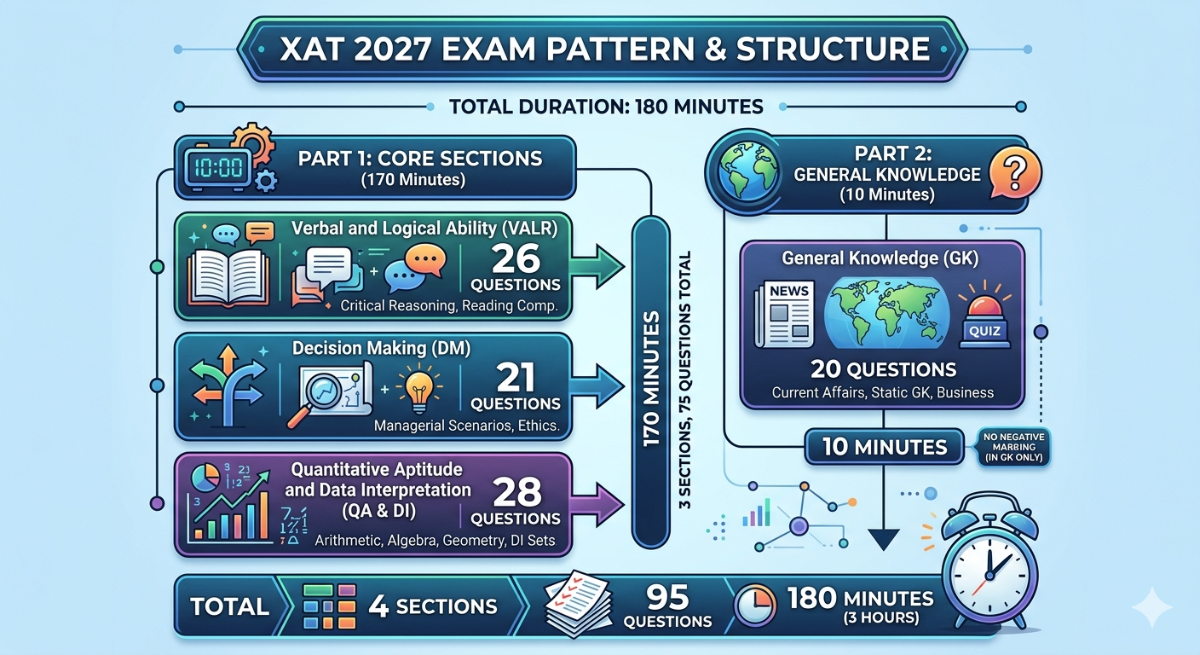
- The questions will be divided into 4 sections: Verbal & Logical Ability, Decision Making, Quantitative Ability & Data Interpretation, and General Knowledge.
- Part 1 is of 170 minutes and covers the first three sections.
- Part 2 is a 10-minute session dedicated to General Knowledge.
- The General Knowledge section comprises 20 marks.
- It is unique because it carries no negative marking & does not affect the initial percentile calculation.
- Instead, GK scores are used during the GD-PI stage by XLRI and other institutes.
The Analytical Essay Writing (AEW) section was removed in XAT 2025 and evaluated during GDPI rounds. This is a pattern continued in 2026 and is expected to remain the same in 2027.- xatonline.in/
Related Links:
- XAT Syllabus 2027 PDF Download: Section-wise Weightage, Exam Pattern, and Best Books
- XAT 2027 Preparation Tips, Section-wise Strategy, and Study Plan
- XAT 2027 Question Paper with Solutions
- List of Top MBA Colleges Accepting XAT Score Based on 2027 Ranking
Key Summary
In this article, you will read about the XAT Exam Pattern 2027, like the Format of the paper, Marking Scheme, Number of Sections, & Total Marks.
- The XAT Exam Pattern 2027 has been released on the official website xatonline.in.
- The XAT Exam will include 4 sections: Verbal & Logical Ability, Decision Making, Quantitative Ability & Data Interpretation, and General Knowledge.
- The XAT Exam will be of a duration of 180 minutes, Part 1 of 170 minutes, including 3 sections, and Part 2 of 10 minutes of GK.
- As per the XAT Exam Pattern, each correct answer will give you +1 mark, -0.25 for an incorrect answer, and -0.10 mark for more than 8 unattempted questions.
What is the XAT Exam Pattern 2027?
The XAT exam pattern is divided into two parts, including Part 1- Aptitude Test and Part 2- General Knowledge.
- Part 1 of the XAT exam pattern comprises sections such as Verbal Ability and Logical Reasoning (VALR), Decision Making (DM), and Quantitative Aptitude & Data Interpretation (QA & DI).
- Part 2 of the XAT Exam Pattern includes the General Knowledge section.
XAT Exam Pattern 2027 at a Glance
| Feature | Overview |
|---|---|
| Exam Name | Xavier Aptitude Test (XAT) 2027 |
| Conducting Body | XLRI Jamshedpur |
| Exam Mode | CBT |
| Total Questions | 95 Questions (75+20 GK) |
| Total Marks | 95 Marks |
| Duration of the Exam | 180 minutes (Part 1: 170 minutes, Part 2: 10 minutes) |
| Sections |
|
| Part 1 Time Limit | 170 minutes (no sectional time limit) |
| Part 2 Time Limit | 10 minutes (GK Section) |
| Marking Scheme | +1 for correct, –0.25 for incorrect, –0.10 for >8 unattempted in Part 1 |
| Negative Marking in GK | No Negative Marking in this section |
XAT Exam Pattern 2027: Important Dates
Registration for XAT 2027 has started for the upcoming academic session.
- Interested students can go to XLRI’s official website xatonline.in and can register themselves for the exam.
- The last date for registration is December 6, 2026.
| Event | Expected Date |
|---|---|
| XAT 2027 Registration Starts | 15 July 2026 |
| XAT 2027 Registration End | December 6, 2026 |
| XAT 2027 Admit Card Release | December 2026 |
| XAT 2027 Exam Date | First Sunday of January 2027 |
| XAT 2027 Response Sheet Release | 2–3 days after the exam |
| XAT 2027 Result Declaration | Third week of January 2027 |
| XAT 2027 Scorecard Download | Till March 2027 |
XAT Exam Pattern 2027: Exam Structure
The XAT 2027 paper is structured in two parts.
- Part 1 has 75 questions across VALR, DM, and QADI — these marks alone determine your XAT percentile.
- Part 2 presents 20 GK questions in a separate 10-minute window.
- There is no sectional time limit within Part 1.
- Students can allocate the full 170 minutes across the three sections as they choose.
| Part | Section | No. of Questions | Marks per Question | Total Marks | Duration |
|---|---|---|---|---|---|
| Part 1 | Verbal Ability & Logical Reasoning (VALR) | 26 | 1 | 26 | 170 min (shared; no sectional limit) |
| Part 1 | Decision Making (DM) | 21 | 1 | 21 | — |
| Part 1 | Quantitative Ability & Data Interpretation (QADI) | 28 | 1 | 28 | — |
| Part 2 | General Knowledge (GK) | 20 | 1 | 20 (not in percentile) | 10 minutes |
| Total | — | 95 | — | 75 marks (percentile) | 180 minutes |
XAT Exam Pattern 2027: Marking Scheme
XAT 2027 uses a +1 / -0.25 marking scheme for Part 1.
- Uniquely, it also penalises excessive unattempted questions.
- Students may skip up to 8 questions in Part 1 without any cost.
- From the 9th unattempted question onwards, each additional skip deducts -0.10 marks.
- The GK section in Part 2 carries no negative marking — attempt all 20 GK questions freely.
| Section / Part | Marks for Correct Answer | Marks for Wrong Answer | Marks for Unattempted |
|---|---|---|---|
| VALR – Part 1 | +1 | -0.25 | 0 (first 8 across Part 1 are free; -0.10 per question beyond 8th) |
| Decision Making – Part 1 | +1 | -0.25 | 0 (first 8 across Part 1 are free; -0.10 per question beyond 8th) |
| QADI – Part 1 | +1 | -0.25 | 0 (first 8 across Part 1 are free; -0.10 per question beyond 8th) |
| General Knowledge – Part 2 | +1 | 0 (no negative marking) | 0 |
Negative marking of 0.25 marks applies to every wrong answer in Part 1 — avoid random guessing in VALR, DM, and QADI.
Note on Unattempted Questions: The unattempted counter runs across all three Part 1 sections combined. Aim to attempt at least 67 out of 75 Part 1 questions to avoid triggering the penalty. The counter resets to zero when Part 2 (GK) begins — the GK unattempted rule does not apply.
Also Check:
XAT Exam Pattern 2027: Subject-Wise
XAT 2026 assesses four distinct competency areas.
- QADI has the highest weightage at 28 questions.
- Followed by VALR (26) and DM (21).
- The GK section (20 questions) is assessed separately.
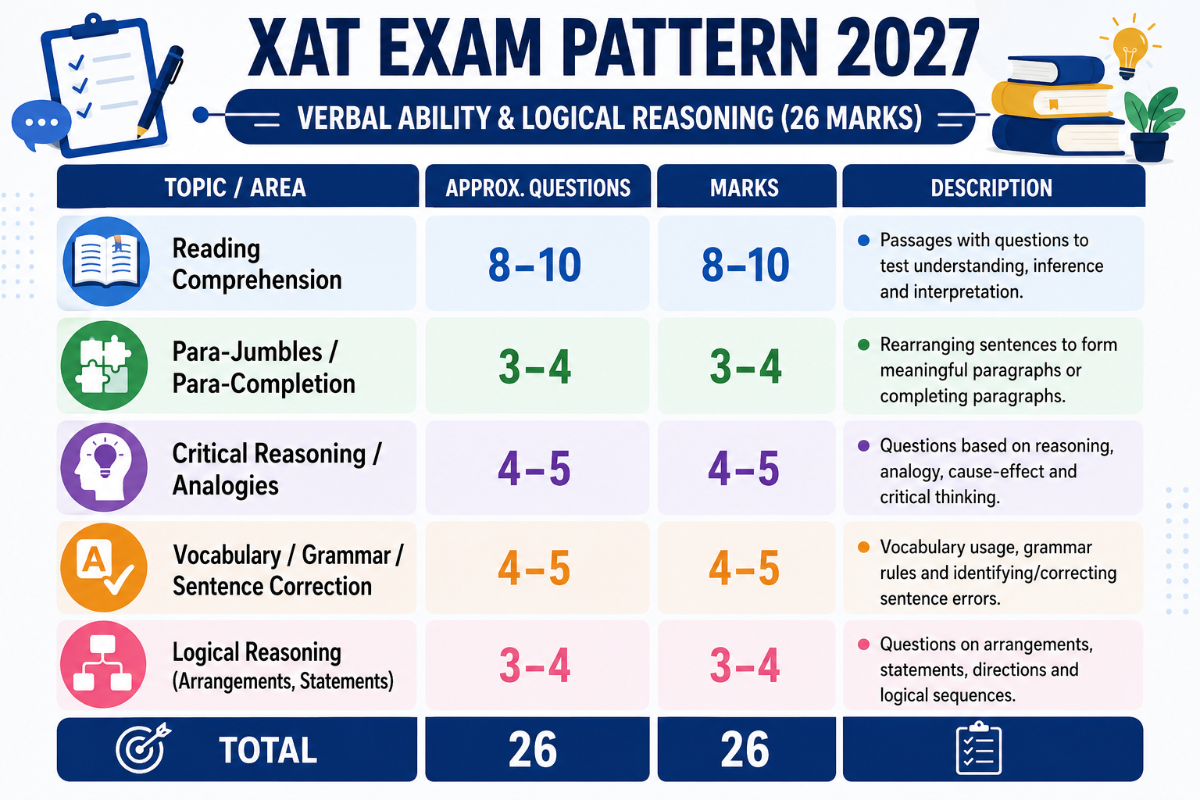
1. Verbal Ability & Logical Reasoning (VALR): 26 Questions, 26 Marks
VALR combines English comprehension with analytical reasoning.
- Passages in XAT are denser and more abstract than in most other MBA exams.
- Expect argument-based and inference questions alongside grammar and vocabulary items.
| Topic / Area | Approx. Questions | Marks |
|---|---|---|
| Reading Comprehension | 8–10 | 8–10 |
| Para-Jumbles / Para-Completion | 3–4 | 3–4 |
| Critical Reasoning / Analogies | 4–5 | 4–5 |
| Vocabulary / Grammar / Sentence Correction | 4–5 | 4–5 |
| Logical Reasoning (Arrangements, Statements) | 3–4 | 3–4 |
| Total | 26 | 26 |
Also Check:
- XAT 2027 VLA: Chapter-Wise Weightage and High-Scoring Topics
- Best Books for XAT 2027: VALR, Decision Making and QADI
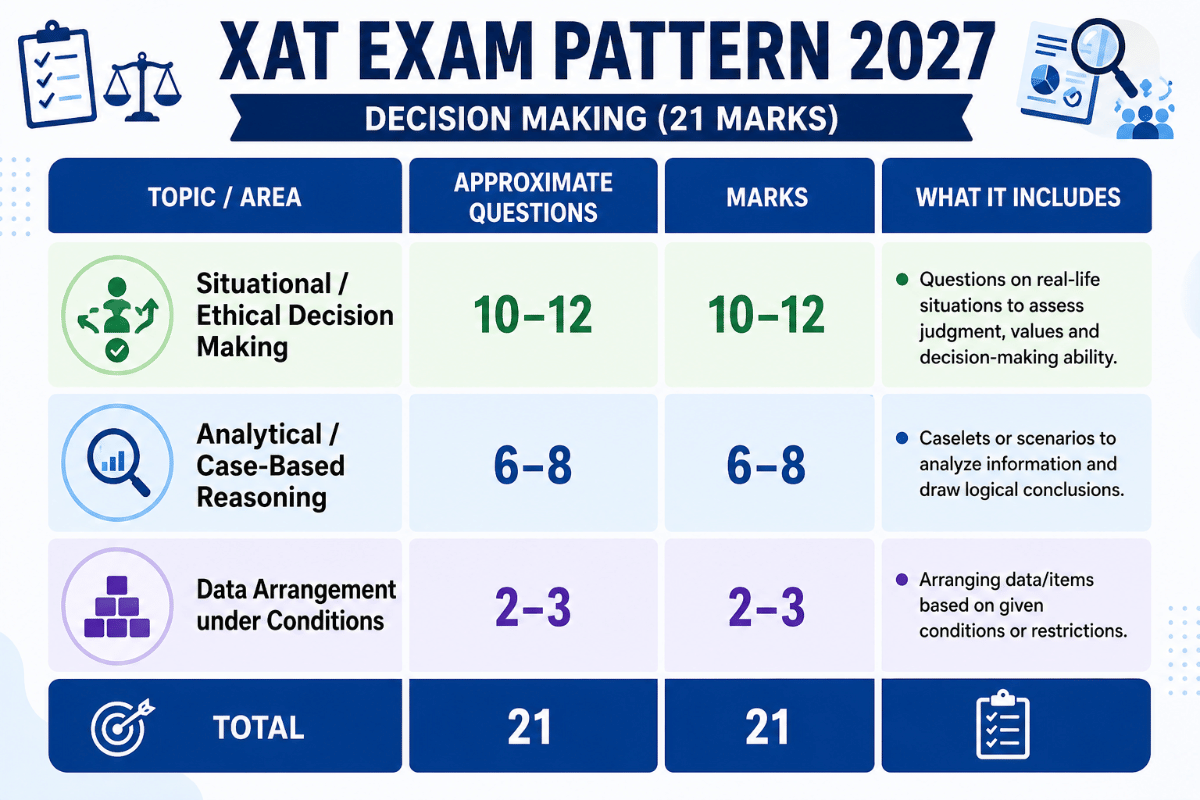
2. Decision Making (DM): 21 Questions, 21 Marks
Decision-making is XAT’s signature section. Questions appear in sets built around a real-world scenario.
| Topic / Area | Approximate Questions | Marks |
|---|---|---|
| Situational / Ethical Decision Making | 10–12 | 10–12 |
| Analytical / Case-Based Reasoning | 6–8 | 6–8 |
| Data Arrangement under Conditions | 2–3 | 2–3 |
| Total | 21 | 21 |
Also Check:
- XAT 2027 Decision Making: Chapter Weightage and High-Yield Topics
- Best Books for XAT 2027 Preparation: Verbal, Decision Making, and Quant
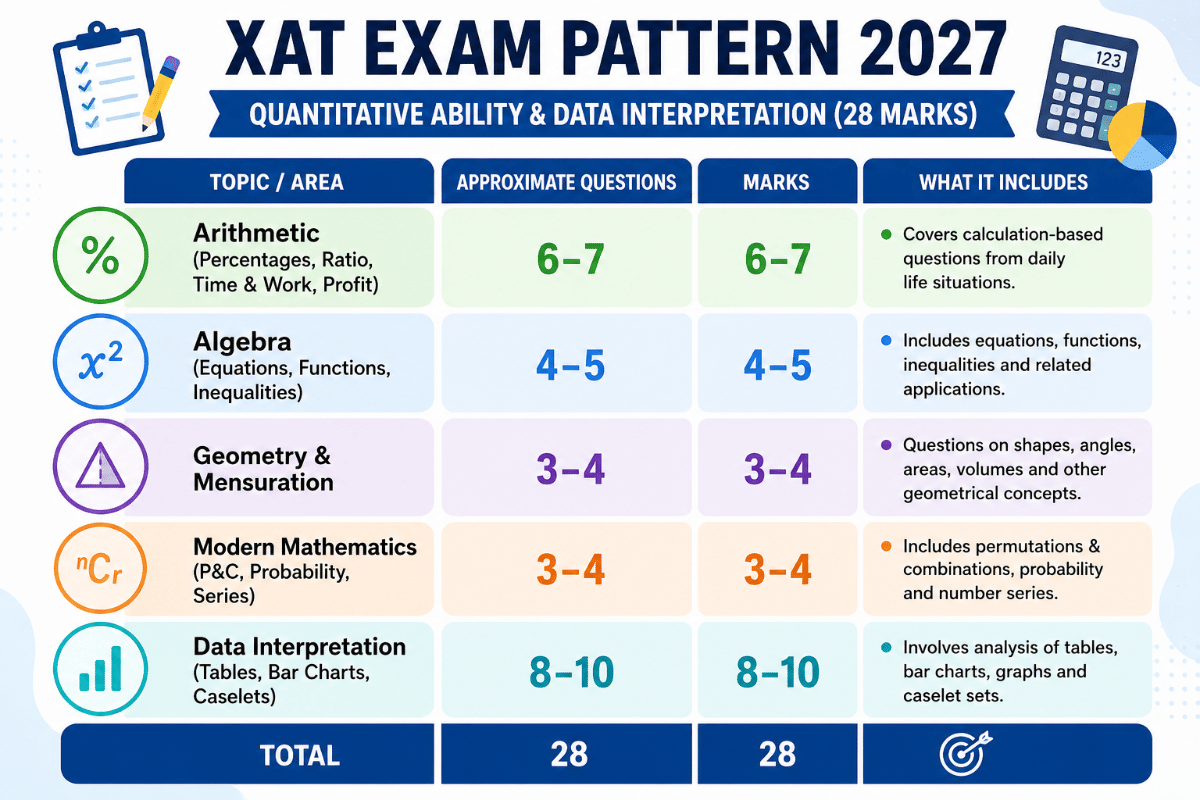
3. Quantitative Ability & Data Interpretation (QADI): 28 Questions, 28 Marks
QADI is the largest section in XAT 2026. It blends standard quantitative topics with data-based reasoning. DI sets typically appear in clusters of 3–5 questions and are calculation-intensive — Arithmetic & DI together account for roughly half the section.
| Topic / Area | Approximate Questions | Marks |
|---|---|---|
| Arithmetic (Percentages, Ratio, Time & Work, Profit) | 6–7 | 6–7 |
| Algebra (Equations, Functions, Inequalities) | 4–5 | 4–5 |
| Geometry & Mensuration | 3–4 | 3–4 |
| Modern Mathematics (P&C, Probability, Series) | 3–4 | 3–4 |
| Data Interpretation (Tables, Bar Charts, Caselets) | 8–10 | 8–10 |
| Total | 28 | 28 |
Also Check: XAT 2027 Quantitative Ability and Data Interpretation Chapter-Wise Weightage
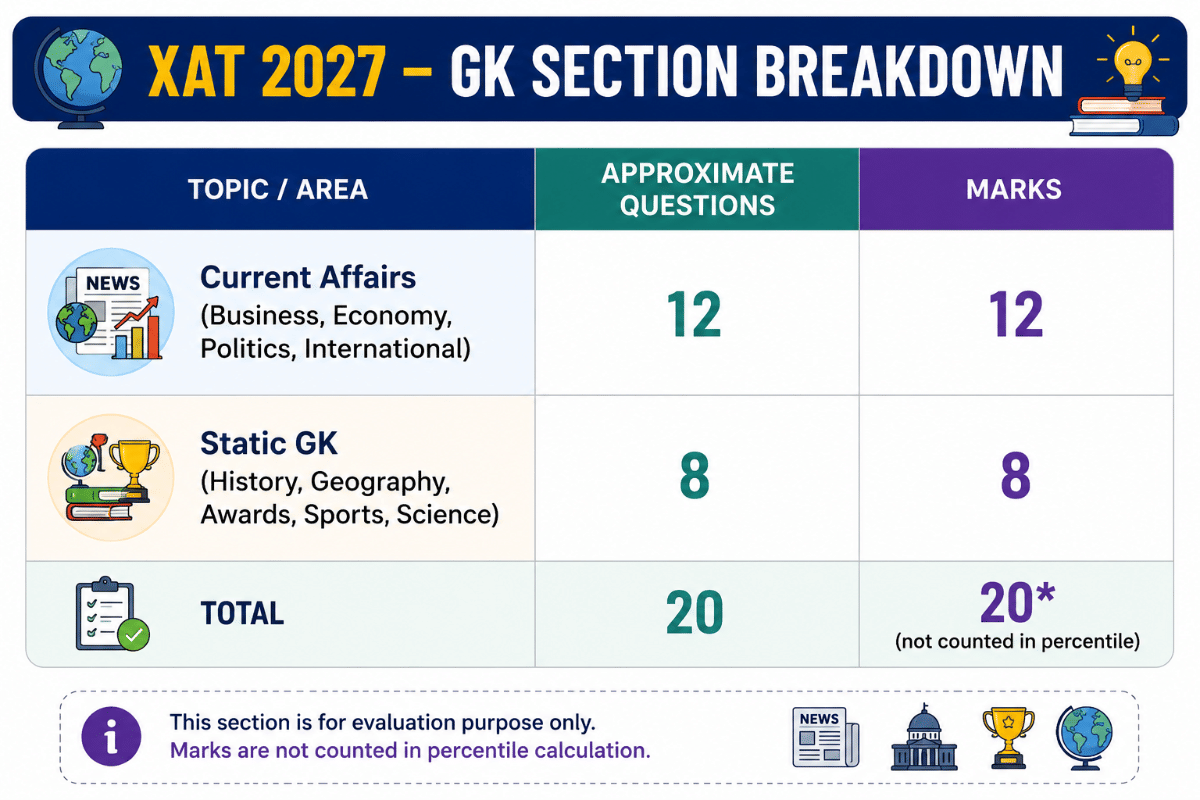
4. General Knowledge (GK): 20 Questions (Part 2; Not in Percentile)
The GK section forms Part 2 of XAT 2026 and lasts 10 minutes. It is not counted in the XAT percentile. Institutes like XLRI assess GK performance independently during the GD-PI round.
Current Affairs dominates at roughly 12 questions, with Static GK covering the remaining 8 questions.
| Topic / Area | Approximate Questions | Marks |
|---|---|---|
| Current Affairs (Business, Economy, Politics, International) | 12 | 12 |
| Static GK (History, Geography, Awards, Sports, Science) | 8 | 8 |
| Total | 20 | 20 (not counted in percentile) |
Also Check: XAT 2027 GK: Does General Knowledge Count Toward Percentile
XAT Exam Pattern 2027: Question Types
XAT Exam Pattern 2027 includes only Multiple Choice Questions (MCQs) across all four sections of the exam.
- Each question offers five answer options — one more than the four-option format used in CAT and most other MBA entrance exams.
- This extra distractor makes elimination harder and increases the cost of random guessing.
- Decision-making is scenario-based and tests ethical judgment over calculation.
- Reading Comprehension passages in VALR tend to be longer and more philosophical than those in CAT or IIFT.
- QADI questions often involve multi-step logic rather than simple formula application.
| Question Type | Sections | No. of Options | Negative Marking |
|---|---|---|---|
| MCQ — Single Correct Answer | VALR, DM, QADI (Part 1) | 5 options per question | -0.25 per wrong answer |
| MCQ — Single Correct Answer (GK) | General Knowledge (Part 2) | 5 options per question | No negative marking |
XAT Exam Pattern 2027: Changes in the last 4 Years
The XAT Exam Pattern 2027 removes the essay writing section and revises the total number of questions for better time management. However, the core topics and syllabus remain unchanged from previous years.
XAT Exam Pattern Changes (2026–2022)
- The Essay writing section was reintroduced in the last few years, starting in 2024, and then removed again in 2025.
- The Total question count has changed between 75 and 101, which makes changes in the difficulty and balance sections.
- It includes 25 to 21 questions, and is not included in the percentile, and makes an impact in the GD-PI Round.
| Year | Total Questions | Duration | Major Change |
|---|---|---|---|
| 2027 | 95 | 180 min | Follows the 2025 pattern with no Essay Writing; GK scores not counted in percentile. |
| 2026 | 95 | 180 min | Essay Writing removed; GK section retained but not counted in percentile. |
| 2025 | 95 | 180 min | Essay Writing removed; GK can be scored, but not added to the percentile. |
| 2024 | 100 | 210 min | Essay Writing reintroduced but evaluated only during PI shortlisting. |
| 2023 | 100 | 205 min | Slight reduction in QA & DI questions; Essay Writing included. |
| 2022 | 100 | 205 min | Essay Writing was brought back after several years; GK continued without negative marking. |
Also Check:
XAT Exam Pattern 2027: Preparation Strategy
Since the XAT 2027 is scheduled for January 3, 2027, you have a perfect window to build a high-percentile strategy.
- The XAT exam is tough due to its challenging Decision-Making, high-level QA-DI, and GK sections.
- Candidates prioritize a balanced preparation that includes accuracy, time management, and decision-making skills.
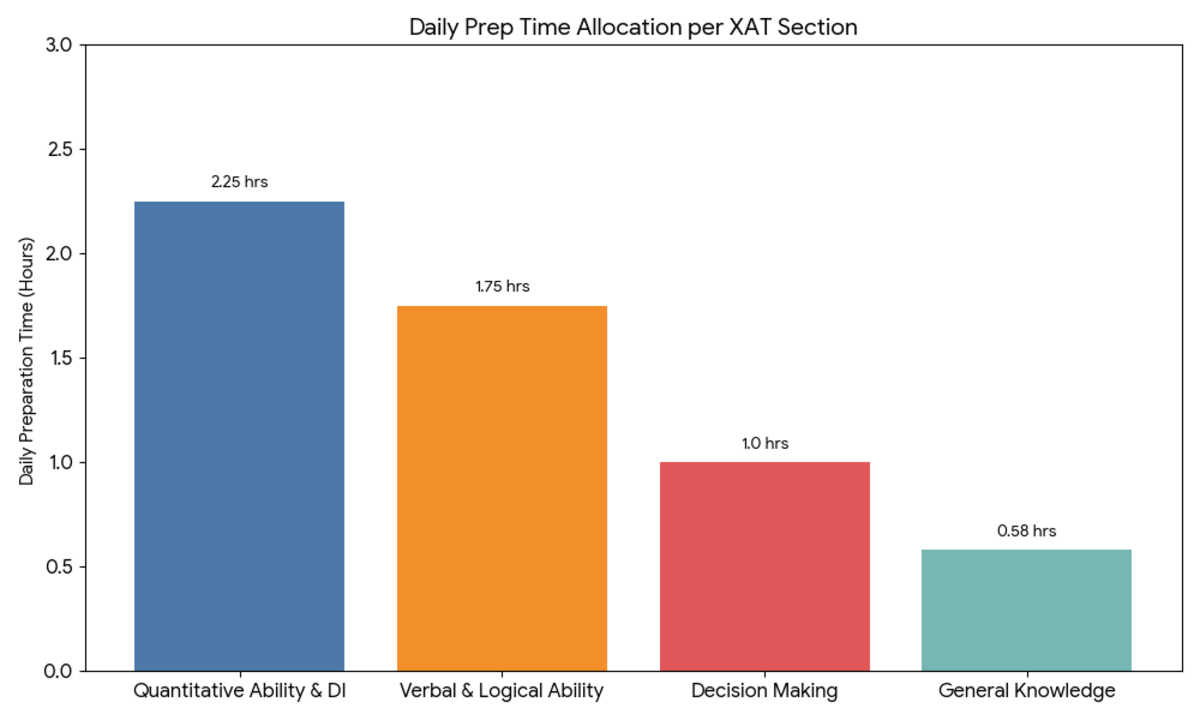
| Month | Quantitative Ability & DI (QA-DI) | Verbal & Logical Ability | Decision Making (DM) & GK | Mock Test & Practice Strategy |
|---|---|---|---|---|
| Month 1 | Focus heavily on Arithmetic (Percentages, Ratios, Profit & Loss). Memorize base tables and squares. | Read 1–2 diverse editorials daily (philosophy, economics). Revise core grammar rules. | Understand the XAT paper pattern. Spend 15 mins daily reading business news. | Take 1 diagnostic mock to check your baseline. Focus on untimed conceptual accuracy. |
| Month 2 | Finish Arithmetic and transition into basic Algebra (Linear/Quadratic Equations, Functions). | Solve 2 Reading Comprehension (RC) passages and 5–10 Critical Reasoning questions daily. | Read 15–20 previous-year DM caselets without answering—just map out stakeholders. | Solve 20–30 topic-specific quizzes. Maintain a formula/error journal. |
| Month 3 | Complete Geometry & Mensuration (highly weighted in XAT) and start basic Data Interpretation charts. | Practice XAT-style poetic RCs and complex Para Jumbles. Focus on tone identification. | Start answering DM caselets. Avoid extreme/emotional choices; favor balanced options. | Transition to Sectional Tests (1–2 per week) to understand time management. |
| Month 4 | Touch upon Modern Math (Permutations, Combinations, Probability) and tackle multi-layered DI datasets. | Integrate advanced vocabulary (cloze tests, synonyms) along with rigorous CR practice. | Solve 3–4 DM caselets daily under a timed constraint. Dedicate 20 mins to Static GK (Awards, Geography). | Attempt 1 full-length mock every 2 weeks. Spend 3 hours analyzing each mock. |
| Month 5 | Practice high-level mixed question sets. Master the smart skipping method for lengthy questions. | Work intensely on inference-based RCs. Practice 1 abstract descriptive essay per week. | Solve the last 10 years' actual XAT DM sections. Track GK current affairs of the past 12 months. | Scale up to 1–2 full-length mocks per week. Analyze accuracy trends over time. |
| Month 6 | No new concepts. Daily practice of formulas, shortcuts, and high-yielding arithmetic templates. | Review recurring errors in grammar/CR from your error log. Maintain a calm reading stamina. | Final revision of major business/economy news, RBI policies, and government metrics. | Attempt 2–3 final mocks in the first half of the month. Keep the last 5 days light to avoid burnout. |
Also Check:
XAT Exam Pattern 2027: Mock Test
Practising XAT mock tests helps you understand the actual exam pattern and improve your speed and accuracy. It also shows your strengths and weaknesses, so you can plan your preparation more effectively.
XAT VALR Mock test
| XAT VALR Mock Test | Download PDF |
|---|---|
| XAT VALR Mock Test 1 | Click here |
| XAT VALR Mock Test 2 | Click here |
| XAT VALR Mock Test 3 | Click here |
| XAT VALR Mock Test 4 | Click here |
| XAT VALR Mock Test 5 | Click here |
| XAT VALR Mock Test 6 | Click here |
XAT Decision-Making Mock Test
| XAT Decision-Making Mock Test | Download PDF |
|---|---|
| XAT Decision-Making Mock Test 1 | Click here |
| XAT Decision-Making Mock Test 2 | Click here |
| XAT Decision-Making Mock Test 3 | Click here |
| XAT Decision-Making Mock Test 4 | Click here |
| XAT Decision-Making Mock Test 5 | Click here |
XAT QA-DI Mock Test
| XAT QA-DI Mock Test | Download PDF |
|---|---|
| XAT QA-DI Mock Test 1 | Click here |
| XAT QA-DI Mock Test 2 | Click here |
| XAT QA-DI Mock Test 3 | Click here |
| XAT QA-DI Mock Test 4 | Click here |
| XAT QA-DI Mock Test 5 | Click here |
XAT General Knowledge Mock Test
| XAT GK Mock Test | Download PDF |
|---|---|
| XAT GK Mock Test 1 | Click here |
| XAT GK Mock Test 2 | Click here |
| XAT GK Mock Test 3 | Click here |
| XAT GK Mock Test 4 | Click here |
| XAT GK Mock Test 5 | Click here |
Also Check: XAT Score Calculator
XAT Exam Pattern 2027: Previous Years Papers
Practising XAT previous year papers helps students understand the exam pattern, question types, and difficulty level. It also improves their speed, accuracy, and confidence by giving them real exam-like practice.
| XAT Previous Years Papers | Download PDF | Check Solutions |
|---|---|---|
| XAT 2026 | Download PDF | Check Solutions |
| XAT 2025 | Download PDF | Check Solutions |
| XAT 2024 | Download PDF | Check Solutions |
| XAT 2023 | Download PDF | Check Solutions |
| XAT 2022 | Download PDF | Check Solutions |
| XAT 2021 | Download PDF | Check Solutions |
| XAT 2020 | Download PDF | Check Solutions |
Also Check: XAT Question Paper Pdf- Download Previous Year Papers with Solutions PDFs 2025-2010
XAT Exam Pattern FAQs
Ques. How many questions are in XAT 2026?
Ans. XAT 2026 has 95 questions in total. Part 1 has 75 questions across VALR (26), Decision Making (21), and QADI (28). Part 2 has 20 General Knowledge questions that are not counted in the percentile but are evaluated at the GD-PI stage.
Ques. Is there negative marking in XAT 2026?
Ans. Yes, XAT 2026 deducts 0.25 marks for every wrong answer in Part 1 (VALR, DM, and QADI). The GK section in Part 2 has no negative marking — you can attempt all 20 GK questions without any penalty for wrong answers.
Ques. What is the unattempted question penalty in XAT 2026?
Ans. You can skip up to 8 questions in Part 1 with no penalty. From the 9th unattempted question onwards, -0.10 marks are deducted for each additional skipped question. This counter runs across VALR, DM, and QADI combined — it resets to zero for Part 2 (GK), which has no unattempted penalty.
Ques. What is the total duration of XAT 2026?
Ans. The total duration of XAT 2026 is 180 minutes. Part 1 (VALR, DM, QADI) has a 170-minute shared window with no sectional time limits. Part 2 (GK) is a fixed separate 10-minute window that opens automatically after Part 1 ends.
Ques. Does the GK section affect the XAT 2026 percentile?
Ans. No, the GK section in XAT 2026 does not contribute to the XAT percentile. Your percentile is calculated solely from Part 1 marks (VALR + DM + QADI out of 75). GK scores are shared with participating institutes, which assess them independently during the GD-PI selection round.
Ques. What are the sections in XAT 2026 and how many questions does each have?
Ans. XAT 2026 has four sections: Verbal Ability and Logical Reasoning (VALR) with 26 questions, Decision Making (DM) with 21 questions, Quantitative Ability and Data Interpretation (QADI) with 28 questions, and General Knowledge (GK) with 20 questions. VALR, DM, and QADI form Part 1; GK is Part 2.
Ques. Is there a sectional time limit in XAT 2026?
Ans. No, XAT 2026 has no sectional time limit within Part 1. You have 170 minutes to attempt VALR, DM, and QADI in any order and for any duration you prefer. Part 2 (GK) is a fixed, separate 10-minute window after Part 1 closes.
Ques. What is the marking scheme for XAT 2026?
Ans. In Part 1, each correct answer earns +1 mark and each wrong answer deducts -0.25 marks. Unattempted questions beyond the first 8 in Part 1 attract an additional -0.10 penalty per question. In Part 2 (GK), a correct answer gives +1 mark and there is no negative marking for wrong or unattempted answers.
Ques. What type of questions are asked in XAT 2026?
Ans. XAT 2026 consists entirely of Multiple Choice Questions (MCQs). Each question offers five answer options — one more than the four-option format used in exams like CAT. The extra option makes careful reading and elimination more important and increases the risk of wrong guesses.
Ques. What major changes did XAT 2026 introduce compared to XAT 2025?
Ans. XAT 2026 removed the Essay Writing section entirely, reduced GK questions from 25 to 20, and cut the total exam duration from 210 minutes to 180 minutes. The Part 2 (GK) window shrank from 25 to 10 minutes. Part 1 (75 questions), negative marking (-0.25), and the unattempted penalty (-0.10 beyond 8) all stayed the same.
Ques. What changes are expected in XAT 2027?
Ans. XAT 2027 is expected to retain the 95-question format (75 Part 1 + 20 GK Part 2). The key change announced ahead of XAT 2027 registration is the expected removal of the unattempted-question penalty — the -0.10 deduction for skipping more than 8 questions in Part 1 may be dropped, making all unattempted questions fully penalty-free. GK will continue to be excluded from the percentile. Registration is expected to open in August–September 2026 at xatonline.in.
Ques. How is the XAT 2026 percentile calculated?
Ans. The XAT 2026 percentile is calculated based only on Part 1 raw marks — the combined score from VALR, DM, and QADI out of a maximum of 75. The GK section (Part 2) is completely excluded from percentile computation. Individual institutes then apply their own overall and section-wise cut-offs to shortlist students for GD-PI rounds.



Comments
Found 1 Comment
For every wrong answer in XAT exam, 0.25 mark will be deducted. However, the negative marking system is not applied for the General Knowledge section.