




Decision Making in XAT 2027 is expected to include 21 questions which makes it one of the highest weightage sections in the examination.
- Decision Making is unique to XAT and is not tested in any other major MBA entrance examination, making it a key differentiator for candidates.
- Unlike Verbal Ability and Quantitative Ability, the DM section evaluates managerial judgement, ethical reasoning and analytical thinking through real-life business situations.
- Business dilemmas and ethical caselets are expected to contribute around 8–10 questions, making them the highest-weightage topics in the Decision Making section.
- Analytical reasoning and condition-based caselets are expected to account for 5–7 questions, making them the second most important topics for XAT 2027 preparation.
- Managerial and situational decision-making questions are expected to contribute around 3–5 questions in the Decision Making section.
- XAT Part 1 does not have a sectional time limit, so Decision Making shares the common 170 minute duration with VALR and QADI.
Related Links:
- XAT Syllabus 2027 PDF Download: Section-wise Weightage, Exam Pattern, and Best Books
- XAT Score vs Percentile - Check Section Wise Score, Top College Cutoff for last 5 years
- XAT Preparation: Mock Test, Section-wise Strategy, Study Plan, Books, Online Coaching
- XAT PYQs: Practice XAT Previous Year Questions (Section-Wise) for QA, VARC, DM & GK

Key Summary
- Previous years' XAT papers indicate that most Decision Making questions are drawn from business, ethical, and analytical caselets, making these areas the top preparation priority.
- A well-planned Decision Making strategy with accurate question selection has consistently helped candidates meet the XLRI sectional requirement in recent XAT examinations.
- Regular practice of official XAT caselets, combined with effective time management during the 170-minute Part 1, can significantly improve Decision Making performance.
XAT Decision Making Section Overview 2027
Decision Making (DM) is exclusive to XAT and is not included in CAT, SNAP, or NMAT.
- XLRI Jamshedpur gives significant importance to Decision Making, as it assesses managerial judgement, ethical reasoning, and decision-making ability.
- XAT 2027 is scheduled for 3 January 2027, with Part 1 expected to include 26 VALR questions, 21 DM questions, and 28 QADI questions.
- Part 1 is conducted over a common 170-minute duration without any sectional time limit, while Part 2 includes 20 GK questions to be completed in 10 minutes.
- Candidates should manage their time carefully across different Decision Making caselets, as time allocation in Part 1 directly affects the overall percentile.
| Parameter | Details (Expected, based on 2024–2026 trends) |
|---|---|
| Total Questions (DM) | 21 questions |
| Marking Scheme | +1 for correct, –0.25 for wrong |
| Maximum DM Marks | 21 marks |
| Difficulty Level | Moderate to High |
| Recommended Time Allocation | 45–55 minutes |
| Good Attempts | 15–18 questions |
| Good Score in DM |
11–14+ marks (for 90+ percentile) |
Source: Exam Pattern Official
Also Read:
Chapter-Wise Weightage for XAT 2027 Decision Making
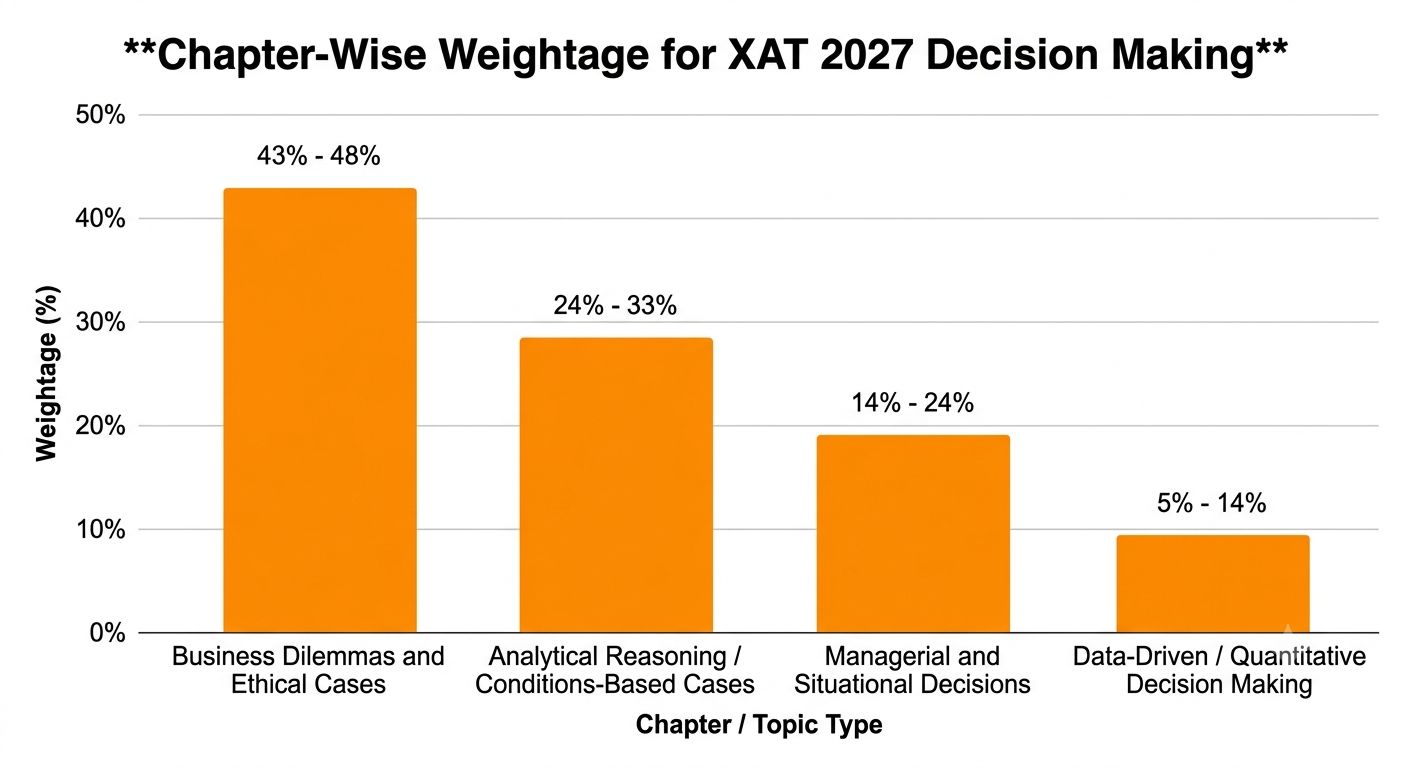
Based on XAT 2020–2026 paper analysis, Decision Making questions are expected to be divided into four major chapter types in XAT 2027.
- Business dilemmas and analytical reasoning are expected to contribute nearly 70–80% of the Decision Making section.
- Candidates who perform well in these two high-weightage chapters can significantly improve their Decision Making percentile and strengthen their chances of XLRI shortlisting, based on previous years' sectional cutoff trends.
| Chapter / Topic Type | Expected Questions (out of ~21) | Weightage (%) | Difficulty |
|---|---|---|---|
| Business Dilemmas and Ethical Cases | 8–10 | 38–48% | Moderate–High |
| Analytical Reasoning / Conditions-Based Cases | 5–7 | 24–33% | Moderate |
| Managerial and Situational Decisions | 3–5 | 14–24% | Moderate |
| Data-Driven / Quantitative Decision Making | 1–3 | 5–14% | Low–Moderate |
Also Read:
Ques. Which Decision Making topics should candidates prioritise for XAT 2027 preparation?
Ans. Candidates should prioritise Business Dilemmas and Ethical Cases and Analytical Reasoning/Conditions-Based Cases, as these two areas are expected to contribute nearly 70–80% of the XAT 2027 Decision Making section based on XAT 2020–2026 trends. Focusing on these chapters can significantly improve sectional performance.
Most Important Case Types in XAT 2027 Decision Making
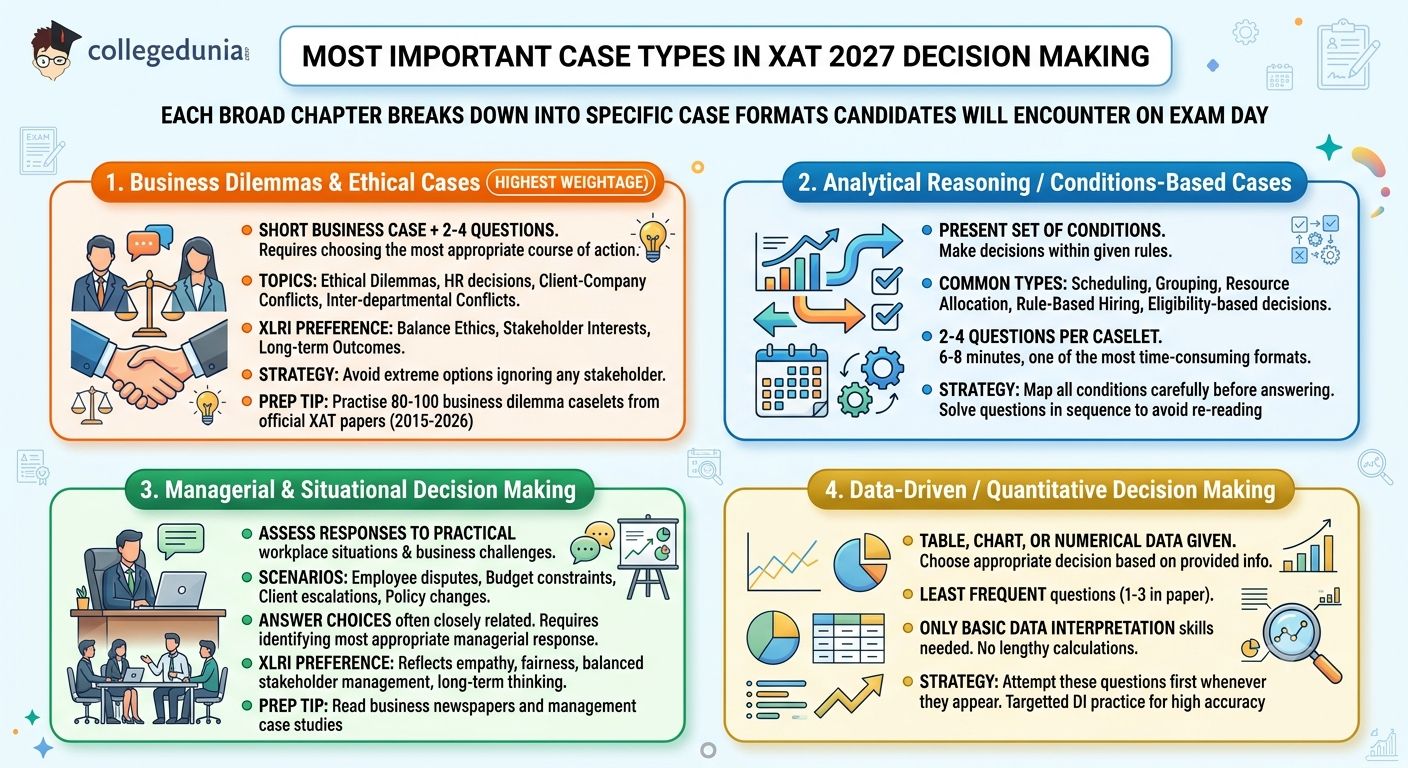
Each broad chapter breaks down into specific case formats candidates will encounter on exam day. Here is a detailed look at all four categories:
1. Business Dilemmas and Ethical Cases (Highest Weightage)
Business dilemmas are the most consistent and highest-weightage question type in the XAT Decision Making section.
- Most questions present a short business case followed by 2–4 questions requiring candidates to choose the most appropriate course of action.
- Common topics include ethical dilemmas, HR decisions, and client-company or inter-departmental conflicts.
- XLRI Jamshedpur generally prefers answers that balance ethics, stakeholder interests, and long-term business outcomes.
- Key Strategy: Candidates should avoid extreme options that ignore or unfairly affect any stakeholder, as these are usually incorrect.
- Preparation Tip: Candidates should practise 80–100 business dilemma caselets from official XAT papers (2015–2026) to build familiarity with the question pattern.
2. Analytical Reasoning / Conditions-Based Cases
Analytical reasoning caselets present a set of conditions and require candidates to make decisions within the given rules.
- Common question types include scheduling, grouping, resource allocation, rule-based hiring, and eligibility-based decisions.
- Each caselet generally contains 2–4 questions and may take around 6–8 minutes, making it one of the most time-consuming formats in XAT.
- Strategy: Candidates should map all conditions carefully before answering and solve the questions in sequence to avoid re-reading the caselet.
3. Managerial and Situational Decision Making
Managerial decision-making questions assess how candidates respond to practical workplace situations and business challenges.
- Common scenarios include employee disputes, budget constraints, client escalations, and policy changes.
- The answer choices are often closely related, requiring candidates to identify the most appropriate managerial response.
- XLRI Jamshedpur generally prefers answers that reflect empathy, fairness, balanced stakeholder management, and long-term thinking.
- Preparation Tip: Regular reading of business newspapers and management case studies can help candidates develop the required decision-making approach.
4. Data-Driven / Quantitative Decision Making
A table, chart, or numerical data is given, and candidates need to choose the most appropriate decision based on the information provided.
- These are the least frequent questions in the XAT Decision Making section and usually account for 1–3 questions in the paper.
- These questions require only basic Data Interpretation skills and do not involve lengthy calculations.
- Candidates should attempt these questions first whenever they appear in the examination.
- Targeted Data Interpretation practice helps candidates maintain high accuracy in these questions.
Also Read
XAT Decision Making Sample Paper: Last 10 Years PYQs PDF Download and Subject Wise WeightageQues. How much time should candidates spend on an Analytical Reasoning caselet in XAT 2027?
Ans. Candidates should ideally spend 6–8 minutes on each Analytical Reasoning caselet in XAT 2027. Reading all conditions carefully, mapping the given information, and solving the questions in sequence can help reduce errors and improve time management during the examination.
High-Yield Topics in XAT 2027 Decision Making
Ethical dilemmas and conditions-based scheduling/grouping cases are expected to account for nearly 45–55% of all XAT 2027 Decision Making questions.
- Based on XAT 2020–2026 trends, strong performance in these two areas can help candidates score around 10–12 marks in the Decision Making section.
- A 10–12 mark score in Decision Making has been sufficient to meet XLRI's sectional cutoff in most previous years.
- The topics listed below have consistently carried the highest preparation value in the Decision Making section based on XAT 2020–2026 paper analysis.
| High-Yield Topic | Why It Matters | Expected Questions per Paper |
|---|---|---|
| Ethical Dilemmas in Business |
Core of XLRI’s evaluation philosophy; appears in every paper |
4–6 |
| Conditions-Based Scheduling and Grouping |
High marks per caselet — one strong case yields 2–4 questions |
4–6 |
| HR and Employee Management Decisions |
Tests empathy and business judgment simultaneously |
2–4 |
| Conflicting Stakeholder Interest Cases |
Classic XAT DM format; tests long-term strategic thinking |
2–4 |
| Data Table-Based Decisions |
Easiest category — fastest marks with high accuracy potential |
1–3 |
Also Read
XAT Decision Making Practice Papers: Exam Pattern, Tips & TricksQues. Which is the easiest scoring topic in XAT 2027 Decision Making?
Ans. Data Table-Based Decision Making is generally considered the easiest scoring topic in the XAT Decision Making section. It usually contributes 1–3 questions and requires basic data interpretation with logical decision-making rather than lengthy calculations, making it a good opportunity for candidates to improve sectional scores with high accuracy.
Year-Wise Question Distribution Trend in XAT Decision Making
Understanding previous years' Decision Making trends helps candidates identify the expected question pattern for XAT 2027.
- The Decision Making section has consistently contained 21 questions, with no major change in the overall question count.
- Business dilemmas and ethical caselets have gained a slightly higher share in the Decision Making section since XAT 2022.
- Analytical reasoning caselets have reduced slightly in recent years or have been combined with business-based scenarios.
- Based on XAT 2020–2026 paper analysis, this pattern is expected to continue in XAT 2027.
| Year | Total DM Questions | Business Dilemmas (approx.) | Analytical Reasoning (approx.) | Managerial / Situational (approx.) |
|---|---|---|---|---|
| XAT 2026 | 21 | 9-10 | 6-7 | 4-5 |
| XAT 2025 | 21 | 8-9 | 7 | 5 |
| XAT 2024 | 21 | 9 | 6-7 | 5 |
| XAT 2023 | 21 | 8-9 | 7 | 5 |
| XAT 2022 | 21 | 7-8 | 7-8 | 6 |
Also Read
XAT 2027 Decision Making (DM) Mock Test Link, Attempt XAT Mock Test Online Free, Test Series and Papers PDFQues. Has the XAT Decision Making section changed over the last five years?
Ans. No. The XAT Decision Making section has remained largely consistent from XAT 2022 to XAT 2026, with 21 questions in every paper. The main change has been a gradual increase in Business Dilemmas and Ethical Caselets, while Analytical Reasoning questions have either reduced slightly or been integrated into business-based scenarios.
How to Score High in XAT 2027 Decision Making
DM is the section where preparation strategy matters more than raw aptitude. Here is a chapter-wise approach to maximise marks on exam day:
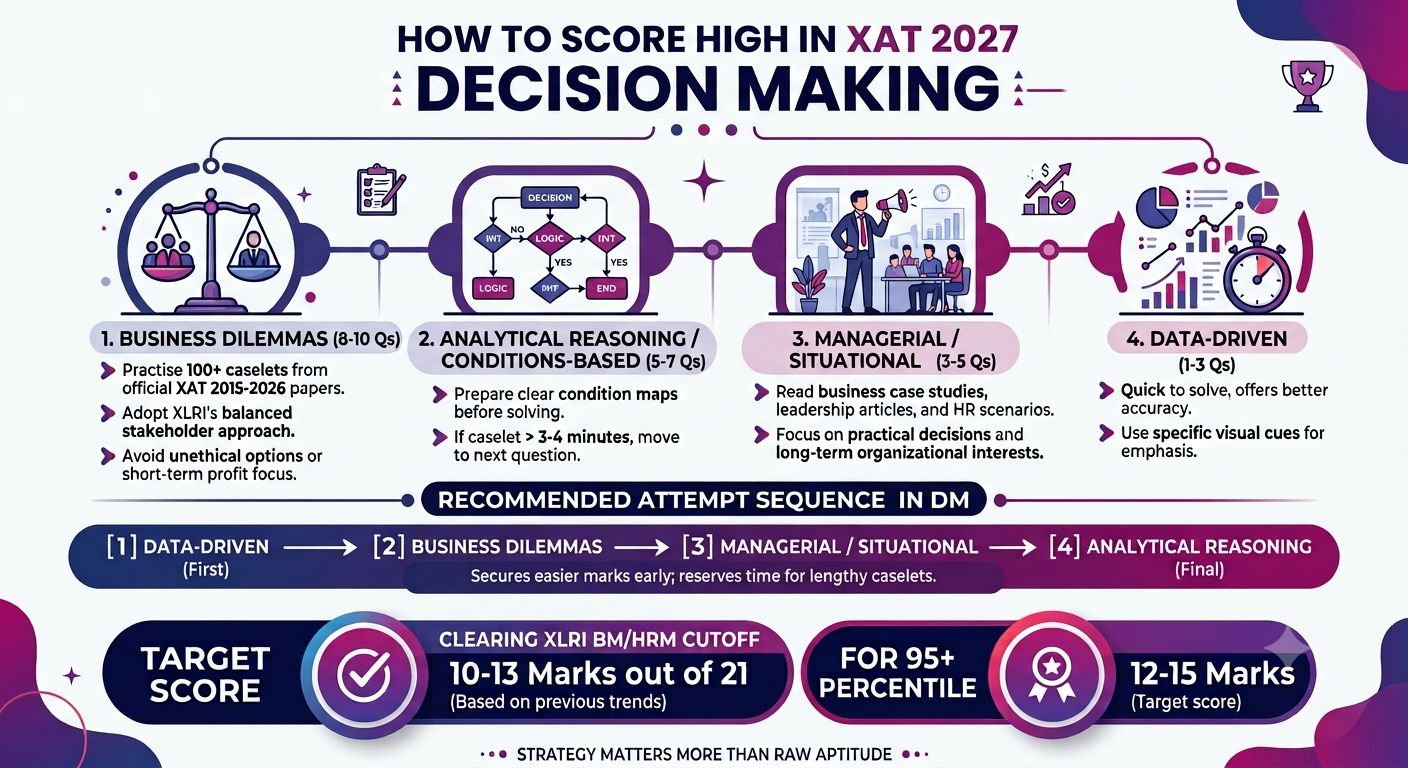
- Business Dilemmas (8–10 questions): Candidates should practise 100+ caselets from official XAT 2015–2026 papers and understand XLRI's balanced stakeholder approach. Options ignoring ethics or focusing only on short-term profit should be avoided.
- Analytical Reasoning / Conditions-Based (5–7 questions): Candidates should prepare clear condition maps before solving each caselet. If a caselet takes more than 3–4 minutes, it is better to move to the next question.
- Managerial / Situational (3–5 questions): Regular reading of business case studies, leadership articles, and HR scenarios helps candidates understand practical managerial decisions and long-term organisational interests.
- Data-Driven (1–3 questions): These questions should be attempted early in the examination, as they are usually quicker to solve and offer better accuracy than most other Decision Making caselets.
Recommended attempt sequence in DM:
- Candidates should attempt Data-Driven caselets first, followed by Business Dilemmas, Managerial / Situational caselets, and finally Analytical Reasoning caselets.
- This order helps candidates secure easier marks early and reserve more time for lengthy Analytical Reasoning caselets.
Target Score:
- Based on previous years' trends, a 10–13 mark score out of 21 in the Decision Making section is generally sufficient to clear the XLRI BM and HRM sectional cutoff.
- Candidates aiming for a 95+ percentile should target around 12–15 marks in the Decision Making section.
Also Read
XAT 2027 Revision Plan: How to Prioritise DM, Verbal and QuantQues. What is the best attempt order for the XAT 2027 Decision Making section?
Ans. Candidates should ideally attempt Data-Driven caselets first, followed by Business Dilemmas, Managerial and Situational caselets, and finally Analytical Reasoning caselets. This strategy helps candidates secure quicker marks early, improve time management, and reserve sufficient time for lengthy analytical caselets.
XAT 2027 Decision Making: Reddit Discussion
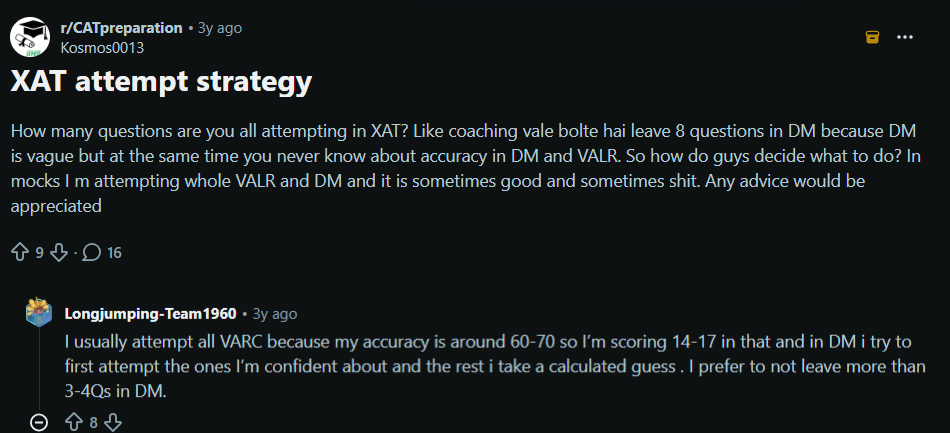
- The discussion focused on the XAT attempt strategy, with candidates seeking advice on how many questions to attempt in VARC and Decision Making (DM).
- Another Reddit user suggested attempting all VARC questions and answering only the confident DM questions first, while making calculated guesses on the remaining ones instead of leaving too many unattempted.
Source: Reddit
XAT 2027 Decision Making FAQs
Ques. How many questions are there in the XAT 2027 Decision Making section?
Ans. Based on recent XAT trends, the Decision Making (DM) section is expected to contain 21 questions in XAT 2027. Each correct answer carries 1 mark, while every incorrect answer in Part 1 attracts a 0.25-mark negative marking.
Ques. Which chapter has the highest weightage in XAT Decision Making?
Ans. Business Dilemmas and Ethical Cases are expected to carry the highest weightage in the XAT 2027 Decision Making section. Based on previous years' trends, these topics generally contribute 8–10 questions and should be the highest priority during preparation.
Ques. What is a good score in XAT 2027 Decision Making?
Ans. A score of around 10–13 marks in the XAT 2027 Decision Making section is generally considered competitive based on recent examination trends. Candidates aiming for a high percentile should target 14–16 accurate attempts while maintaining good accuracy.
Ques. Is there a separate time limit for the XAT Decision Making section?
Ans. No. XAT 2027 is expected to have no sectional time limit in Part 1. Candidates will have 170 minutes to complete Verbal and Logical Ability (VALR), Decision Making (DM), and Quantitative Ability and Data Interpretation (QADI), allowing them to distribute time according to their strengths.
Ques. How is XAT Decision Making different from CAT Logical Reasoning?
Ans. XAT Decision Making evaluates ethical reasoning, business judgement, and managerial decision-making, whereas CAT Logical Reasoning focuses mainly on logical puzzles, arrangements, and analytical reasoning. The Decision Making section is unique to XAT and forms an important part of the selection process at XLRI and other participating institutes.
Ques. What are the best resources to prepare for XAT 2027 Decision Making?
Ans. Candidates should primarily solve official XAT previous years' question papers and analyse Decision Making caselets from recent examinations. Reading business newspapers, management case studies, and articles on ethics and leadership can also help candidates improve their performance in the Decision Making section.



Comments